WO2016181933A1 - 熱サイクルシステム用組成物および熱サイクルシステム - Google Patents
熱サイクルシステム用組成物および熱サイクルシステム Download PDFInfo
- Publication number
- WO2016181933A1 WO2016181933A1 PCT/JP2016/063739 JP2016063739W WO2016181933A1 WO 2016181933 A1 WO2016181933 A1 WO 2016181933A1 JP 2016063739 W JP2016063739 W JP 2016063739W WO 2016181933 A1 WO2016181933 A1 WO 2016181933A1
- Authority
- WO
- WIPO (PCT)
- Prior art keywords
- cycle system
- mass
- heat cycle
- composition
- working medium
- Prior art date
- Legal status (The legal status is an assumption and is not a legal conclusion. Google has not performed a legal analysis and makes no representation as to the accuracy of the status listed.)
- Ceased
Links
Images
Classifications
-
- C—CHEMISTRY; METALLURGY
- C09—DYES; PAINTS; POLISHES; NATURAL RESINS; ADHESIVES; COMPOSITIONS NOT OTHERWISE PROVIDED FOR; APPLICATIONS OF MATERIALS NOT OTHERWISE PROVIDED FOR
- C09K—MATERIALS FOR MISCELLANEOUS APPLICATIONS, NOT PROVIDED FOR ELSEWHERE
- C09K5/00—Heat-transfer, heat-exchange or heat-storage materials, e.g. refrigerants; Materials for the production of heat or cold by chemical reactions other than by combustion
- C09K5/02—Materials undergoing a change of physical state when used
- C09K5/04—Materials undergoing a change of physical state when used the change of state being from liquid to vapour or vice versa
-
- C—CHEMISTRY; METALLURGY
- C10—PETROLEUM, GAS OR COKE INDUSTRIES; TECHNICAL GASES CONTAINING CARBON MONOXIDE; FUELS; LUBRICANTS; PEAT
- C10M—LUBRICATING COMPOSITIONS; USE OF CHEMICAL SUBSTANCES EITHER ALONE OR AS LUBRICATING INGREDIENTS IN A LUBRICATING COMPOSITION
- C10M105/00—Lubricating compositions characterised by the base-material being a non-macromolecular organic compound
- C10M105/02—Well-defined hydrocarbons
- C10M105/06—Well-defined hydrocarbons aromatic
-
- C—CHEMISTRY; METALLURGY
- C10—PETROLEUM, GAS OR COKE INDUSTRIES; TECHNICAL GASES CONTAINING CARBON MONOXIDE; FUELS; LUBRICANTS; PEAT
- C10M—LUBRICATING COMPOSITIONS; USE OF CHEMICAL SUBSTANCES EITHER ALONE OR AS LUBRICATING INGREDIENTS IN A LUBRICATING COMPOSITION
- C10M105/00—Lubricating compositions characterised by the base-material being a non-macromolecular organic compound
- C10M105/08—Lubricating compositions characterised by the base-material being a non-macromolecular organic compound containing oxygen
- C10M105/32—Esters
- C10M105/36—Esters of polycarboxylic acids
-
- C—CHEMISTRY; METALLURGY
- C10—PETROLEUM, GAS OR COKE INDUSTRIES; TECHNICAL GASES CONTAINING CARBON MONOXIDE; FUELS; LUBRICANTS; PEAT
- C10M—LUBRICATING COMPOSITIONS; USE OF CHEMICAL SUBSTANCES EITHER ALONE OR AS LUBRICATING INGREDIENTS IN A LUBRICATING COMPOSITION
- C10M105/00—Lubricating compositions characterised by the base-material being a non-macromolecular organic compound
- C10M105/08—Lubricating compositions characterised by the base-material being a non-macromolecular organic compound containing oxygen
- C10M105/32—Esters
- C10M105/38—Esters of polyhydroxy compounds
-
- C—CHEMISTRY; METALLURGY
- C10—PETROLEUM, GAS OR COKE INDUSTRIES; TECHNICAL GASES CONTAINING CARBON MONOXIDE; FUELS; LUBRICANTS; PEAT
- C10M—LUBRICATING COMPOSITIONS; USE OF CHEMICAL SUBSTANCES EITHER ALONE OR AS LUBRICATING INGREDIENTS IN A LUBRICATING COMPOSITION
- C10M105/00—Lubricating compositions characterised by the base-material being a non-macromolecular organic compound
- C10M105/08—Lubricating compositions characterised by the base-material being a non-macromolecular organic compound containing oxygen
- C10M105/32—Esters
- C10M105/42—Complex esters, i.e. compounds containing at least three esterified carboxyl groups and derived from the combination of at least three different types of the following five types of compound: monohydroxy compounds, polyhydroxy compounds, monocarboxylic acids, polycarboxylic acids and hydroxy carboxylic acids
-
- C—CHEMISTRY; METALLURGY
- C10—PETROLEUM, GAS OR COKE INDUSTRIES; TECHNICAL GASES CONTAINING CARBON MONOXIDE; FUELS; LUBRICANTS; PEAT
- C10M—LUBRICATING COMPOSITIONS; USE OF CHEMICAL SUBSTANCES EITHER ALONE OR AS LUBRICATING INGREDIENTS IN A LUBRICATING COMPOSITION
- C10M105/00—Lubricating compositions characterised by the base-material being a non-macromolecular organic compound
- C10M105/08—Lubricating compositions characterised by the base-material being a non-macromolecular organic compound containing oxygen
- C10M105/32—Esters
- C10M105/48—Esters of carbonic acid
-
- C—CHEMISTRY; METALLURGY
- C10—PETROLEUM, GAS OR COKE INDUSTRIES; TECHNICAL GASES CONTAINING CARBON MONOXIDE; FUELS; LUBRICANTS; PEAT
- C10M—LUBRICATING COMPOSITIONS; USE OF CHEMICAL SUBSTANCES EITHER ALONE OR AS LUBRICATING INGREDIENTS IN A LUBRICATING COMPOSITION
- C10M107/00—Lubricating compositions characterised by the base-material being a macromolecular compound
- C10M107/20—Lubricating compositions characterised by the base-material being a macromolecular compound containing oxygen
- C10M107/22—Macromolecular compounds obtained by reactions only involving carbon-to-carbon unsaturated bonds
- C10M107/24—Macromolecular compounds obtained by reactions only involving carbon-to-carbon unsaturated bonds containing monomers having an unsaturated radical bound to an alcohol, aldehyde, ketonic, ether, ketal or acetal radical
-
- C—CHEMISTRY; METALLURGY
- C10—PETROLEUM, GAS OR COKE INDUSTRIES; TECHNICAL GASES CONTAINING CARBON MONOXIDE; FUELS; LUBRICANTS; PEAT
- C10M—LUBRICATING COMPOSITIONS; USE OF CHEMICAL SUBSTANCES EITHER ALONE OR AS LUBRICATING INGREDIENTS IN A LUBRICATING COMPOSITION
- C10M107/00—Lubricating compositions characterised by the base-material being a macromolecular compound
- C10M107/20—Lubricating compositions characterised by the base-material being a macromolecular compound containing oxygen
- C10M107/30—Macromolecular compounds obtained otherwise than by reactions only involving carbon-to-carbon unsaturated bonds
- C10M107/32—Condensation polymers of aldehydes or ketones; Polyesters; Polyethers
- C10M107/34—Polyoxyalkylenes
-
- F—MECHANICAL ENGINEERING; LIGHTING; HEATING; WEAPONS; BLASTING
- F25—REFRIGERATION OR COOLING; COMBINED HEATING AND REFRIGERATION SYSTEMS; HEAT PUMP SYSTEMS; MANUFACTURE OR STORAGE OF ICE; LIQUEFACTION SOLIDIFICATION OF GASES
- F25B—REFRIGERATION MACHINES, PLANTS OR SYSTEMS; COMBINED HEATING AND REFRIGERATION SYSTEMS; HEAT PUMP SYSTEMS
- F25B1/00—Compression machines, plants or systems with non-reversible cycle
-
- Y—GENERAL TAGGING OF NEW TECHNOLOGICAL DEVELOPMENTS; GENERAL TAGGING OF CROSS-SECTIONAL TECHNOLOGIES SPANNING OVER SEVERAL SECTIONS OF THE IPC; TECHNICAL SUBJECTS COVERED BY FORMER USPC CROSS-REFERENCE ART COLLECTIONS [XRACs] AND DIGESTS
- Y02—TECHNOLOGIES OR APPLICATIONS FOR MITIGATION OR ADAPTATION AGAINST CLIMATE CHANGE
- Y02P—CLIMATE CHANGE MITIGATION TECHNOLOGIES IN THE PRODUCTION OR PROCESSING OF GOODS
- Y02P20/00—Technologies relating to chemical industry
- Y02P20/10—Process efficiency
Definitions
- the present invention relates to a composition for a heat cycle system and a heat cycle system using the composition.
- CFC chlorofluorocarbons
- HCFC hydrochlorofluorocarbons
- HFC-32 difluoromethane
- HFC-125 pentafluoroethane
- R410A a pseudo-azeotropic mixture of HFC-32 and HFC-125 having a mass ratio of 1: 1 is a refrigerant that has been widely used.
- HFC may cause global warming.
- R410A has been widely used for ordinary air-conditioning equipment called so-called package air conditioners and room air conditioners because of its high refrigerating capacity.
- GWP global warming potential
- the global warming potential (GWP) is as high as 2088, and therefore development of a low GWP working medium is required.
- R410A is simply replaced and the devices that have been used so far continue to be used.
- HFO olefins
- HFC saturated HFC
- HFC is referred to as HFC, and is used separately from HFO.
- HFC is specified as a saturated hydrofluorocarbon.
- heat cycle systems (1) to (3) are known as working media containing HFO.
- HFO-1243zf 3,3,3-trifluoropropene
- HFO-1234ze 1,3,3,3-tetrafluoropropene
- 2-fluoropropene HFO-1261yf
- 2,3,3 , 3-tetrafluoropropene HFO-1234yf
- 1,1,2-trifluoropropene HFO-1243yc
- thermal cycle system using a working medium see, for example, Patent Document 1
- Patent Document 1 2,3,3,3-pentafluoropropene (HFO-1225ye), trans-1,3,3,3-tetrafluoropropene (HFO-1234ze (E)), cis-1,3,3 Thermal cycle system using a working medium containing 3,3-tetrafluoropropene (HFO-1234ze (Z)), HFO-1234yf, etc.
- Patent Document 2 (3) Thermal cycle system using a working medium containing 3,3-tetraflu
- both the thermal cycle systems (1) and (2) have insufficient cycle performance (capability).
- the thermal cycle system (3) can provide excellent cycle performance, HFO-1123 has combustibility, and thus there is a problem in ensuring safety.
- a large-scale air conditioning equipment such as a building air conditioner for buildings
- the refrigerant charging amount is large, even if the working medium in the gas phase formed in the system leaks, mixes with the air, and ignites, It is important to use a working medium that does not spread easily and ensure the safety of the system.
- HFO-1123 used as such a working medium is a compound containing an unsaturated bond in the molecule and has a very short life in the atmosphere. Therefore, compression and heating in a thermal cycle are repeated. Under such conditions, the stability is inferior to saturated hydrofluorocarbons and hydrochlorofluorocarbons such as conventional HFCs and HCFCs, and lubricity may be reduced in the thermal cycle system.
- the present invention has been made from the above viewpoint, and in a composition for a thermal cycle system containing trifluoroethylene (HFO-1123), the low global warming potential and excellent cycle performance of HFO-1123 are sufficiently obtained.
- the purpose of the present invention is to provide a composition for a heat cycle system that is nonflammable, has little influence on the ozone layer even if leaked, is excellent in safety, and can be more stably lubricated.
- the present invention uses the above composition for a heat cycle system, has little influence on the ozone layer and global warming, has high cycle performance, is excellent in safety, and further has lubricity of the working medium for heat cycle.
- the purpose is to provide an improved thermal cycle system.
- the present invention provides a working medium for heat cycle, a composition for heat cycle system, and a heat cycle system having the configurations described in [1] to [14] below.
- a thermal cycle system composition comprising a thermal cycle working medium and refrigeration oil, wherein the thermal cycle working medium comprises trifluoroethylene, 1,1,1,2-tetrafluoroethane, Containing pentafluoroethane and 2,3,3,3-tetrafluoropropene, and trifluoroethylene, 1,1,1,2-tetrafluoroethane, pentafluoroethane and 2 with respect to the total mass of the working fluid for thermal cycle , 3,3,3-tetrafluoropropene is more than 90% by mass and less than 100% by mass, and trifluoroethylene, 1,1,1,2-tetrafluoroethane, pentafluoroethane and 2 , 3,3,3-tetrafluoropropene, the ratio of trifluoroethylene is 3% by mass to 35% by mass, 1,1,1, -The ratio of tetrafluoroethane is 10 mass% to 53 mass%, the ratio of pentafluoroethanethan
- a composition for a heat cycle system comprising at least 1% by mass, wherein the refrigerating machine oil comprises at least one selected from an ester refrigerating machine oil, an ether refrigerating machine oil, and an alkylbenzene.
- the working medium for thermal cycle is trifluoroethylene, 1,1,1,2-tetrafluoroethane, pentafluoroethane and 2,3,3,3-tetrafluoropropene with respect to the total amount.
- the proportion of ethylene is 6% by mass to 25% by mass
- the proportion of 1,1,1,2-tetrafluoroethane is 20% by mass to 35% by mass
- pentafluoroethane is 8% by mass to 30% by mass.
- composition for a heat cycle system according to [1], wherein the proportion of 2,3,3,3-tetrafluoropropene is 20% by mass or more and 50% by mass or less.
- Composition for thermal cycle system [4] The composition for a heat cycle system according to any one of [1] to [3], wherein the refrigerating machine oil has a kinematic viscosity at 40 ° C.
- composition for a heat cycle system according to any one of [1] to [4], wherein the refrigerating machine oil has a kinematic viscosity at 100 ° C. of 1 to 100 mm 2 / s.
- the thermal cycle system according to any one of [1] to [5], wherein the base oil component of the refrigerating machine oil has a carbon atom to oxygen atom ratio (carbon / oxygen molar ratio) of 2 to 7.5.
- Composition Composition.
- thermal cycle system according to any one of [1] to [9], wherein the thermal cycle working medium further includes a hydrofluoroolefin other than trifluoroethylene and 2,3,3,3-tetrafluoropropene.
- Composition [11] The composition for a heat cycle system according to [10], wherein the hydrofluoroolefin is 1,3,3,3-tetrafluoropropene.
- the thermal cycle system according to [12] wherein a ratio of trifluoroethylene in the gas phase formed in the thermal cycle system is 50% by mass or less.
- the thermal cycle system according to [12] or [13], wherein the thermal cycle system is a refrigeration / refrigeration device, an air conditioning device, a power generation system, a heat transport device, or a secondary cooler.
- a composition for a thermal cycle system containing trifluoroethylene is nonflammable, ozone while fully utilizing the low global warming potential and excellent cycle performance of HFO-1123. It is possible to provide a composition for a heat cycle system that has less influence on the layer and that can more stably lubricate a working medium for heat cycle containing HFO-1123.
- the thermal cycle system of the present invention is non-flammable, has little impact on global warming, has high safety by applying a thermal cycle working medium having high cycle performance, and has little impact on the environment.
- this is a thermal cycle system with improved thermal cycle performance and improved lubrication characteristics of the thermal cycle working medium.
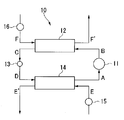
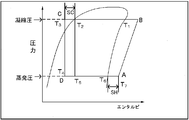
- FIG. 2 is a cycle diagram in which a change in state of a working medium in the refrigeration cycle system of FIG. 1 is described on a pressure-enthalpy diagram.
- composition for a heat cycle system includes a working medium for heat cycle containing HFO-1123, HFC-134a, HFC-125, and HFO-1234yf at a predetermined ratio, and refrigeration oil.
- working medium for heat cycle is also simply referred to as “working medium”.
- a heat cycle system using a heat exchanger such as a condenser or an evaporator is used without particular limitation.
- a heat cycle system for example, a refrigeration cycle
- a gas working medium is compressed by a compressor, cooled by a condenser to produce a high-pressure liquid, the pressure is reduced by an expansion valve, and vaporized at a low temperature by an evaporator. It has a mechanism that takes heat away with heat.
- HFO-1123 or HFO-1234yf becomes unstable and self-decomposition occurs depending on the temperature and pressure conditions.
- the function of the working medium may deteriorate.
- the above mixture is made incombustible by allowing the refrigerating machine oil to coexist in a working medium containing HFO-1123, HFO-1234yf, HFC-134a, and HFC-125 in a predetermined ratio.
- each component which the composition for thermal cycle systems of this invention contains is demonstrated.
- the working medium of the present invention includes HFO-1123, HFC-134a, HFC-125, and HFO-1234yf, and the total amount of HFO-1123, HFC-134a, HFC-125, and HFO-1234yf with respect to the total amount of the working medium.
- the ratio is more than 90% by mass and 100% by mass or less, and the ratio of HFO-1123 to the total amount of HFO-1123, HFC-134a, HFC-125, and HFO-1234yf is 3% by mass to 35% by mass,
- the ratio of HFC-134a is preferably 10% by mass to 53% by mass
- the ratio of HFC-125 is 4% by mass to 50% by mass
- the ratio of HFO-1234yf is preferably 5% by mass to 50% by mass.
- the working medium of the present invention includes HFO-1123, HFC-134a, HFC-125, and HFO-1234yf, and the total of HFO-1123, HFC-134a, HFC-125, and HFO-1234yf with respect to the total amount of the working medium.
- the ratio of the amount is more than 90% by mass and not more than 100% by mass, and the ratio of HFO-1123 to the total amount of HFO-1123, HFC-134a, HFC-125, and HFO-1234yf is 6% by mass or more and 25% by mass
- the ratio of HFC-134a is 20% by mass to 35% by mass
- the ratio of HFC-125 is 8% by mass to 30% by mass
- the ratio of HFO-1234yf is 20% by mass to 50% by mass. Even more preferred.
- the working medium is non-flammable, and is more excellent in safety, has less influence on the ozone layer and global warming, and is even better when used in a heat cycle system.
- the working medium having a high cycle performance can be obtained.
- HFO other than HFO-1123 and HFO-1234yf examples include 1,2-difluoroethylene (HFO-1132), 2-fluoropropene (HFO-1261yf), 1,1,2-trifluoropropene (HFO-1243yc), Trans-1,3,3,3-tetrafluoropropene (HFO-1234ze (E)), cis-1,3,3,3-tetrafluoropropene (HFO-1234ze (Z)), 3,3,3- Trifluoropropene (HFO-1243zf), trans-1,2,3,3,3-pentafluoropropene (HFO-1225ye (E)), cis-1,2,3,3,3-pentafluoropropene (HFO) -1225ye (Z)) and the like. HFOs other than HFO-1123 and HFO-1234yf may be used alone or in combination of two or more.
- the ratio of the total mass of the HFO to the total mass (100% by mass) of the working medium in the system is 10% by mass or less. % By mass is preferable, and 2 to 10% by mass is more preferable.
- HFCs other than HFC-134a and HFC-125 are components that improve the cycle performance (capability) of the thermal cycle system.
- HFCs other than HFC-134a and HFC-125 HFCs that have little influence on the ozone layer and little influence on global warming are preferable.
- HFCs other than HFC-134a and HFC-125 include difluoromethane, difluoroethane, trifluoroethane, pentafluoropropane, hexafluoropropane, heptafluoropropane, pentafluorobutane, heptafluorocyclopentane, and the like.
- difluoromethane (HFC-32) and 1,1-difluoroethane (HFC-152a) are particularly preferable because they have little influence on the ozone layer and little influence on global warming.
- HFCs other than HFC-134a and HFC-125 may be used alone or in combination of two or more.
- the content of HFC other than HFC-134a and HFC-125 can be controlled according to the required characteristics of the working medium.
- the working medium includes HFCs other than HFC-134a and HFC-125
- the ratio of the total mass of the HFC to the total mass (100% by mass) of the working medium in the system is 10% by mass or less. % By mass is preferable, and 2 to 10% by mass is more preferable.
- hydrocarbon is a component which improves the solubility to the working medium of the mineral oil mentioned later.
- examples of the hydrocarbon include propane, propylene, cyclopropane, butane, isobutane, pentane, isopentane and the like.
- a hydrocarbon may be used individually by 1 type and may be used in combination of 2 or more type.
- the ratio of the total mass of hydrocarbons to the total mass (100% by mass) of the working medium in the system is preferably 10% by mass or less, preferably 1 to 10% by mass, and 2 to 5%. The mass% is more preferable. If the ratio of the total mass of the hydrocarbon is not less than the lower limit value, the solubility of the lubricating oil in the working medium becomes good. If the ratio of the total mass of the hydrocarbon is equal to or less than the upper limit value, it is easy to suppress the combustibility of the working medium.
- HCFO and CFO are components that suppress the combustibility of the working medium and improve the solubility of the lubricating oil in the working medium.
- HCFO and CFO having a small influence on the ozone layer and a small influence on global warming are preferable.
- HCFO examples include hydrochlorofluoropropene and hydrochlorofluoroethylene.
- hydrochlorofluoropropene examples include hydrochlorofluoropropene and hydrochlorofluoroethylene.
- HCFO- 1-chloro-2,3,3,3-tetrafluoropropene
- HCFO-1122 1-chloro-1,2-difluoroethylene
- HCFO may be used alone or in combination of two or more.
- CFO examples include chlorofluoropropene and chlorofluoroethylene.
- 1,1-dichloro-2,3,3,3-tetrafluoropropene (CFO) is used from the viewpoint of sufficiently suppressing the flammability of the working medium without greatly reducing the cycle performance (capacity) of the thermal cycle system.
- CFO-1112 1,2-dichloro-1,2-difluoroethylene
- the ratio of the total mass of HCFO and CFO to the total mass (100% by mass) of the working medium in the system is 10% by mass or less. 10 mass% is preferable.
- Chlorine atoms have the effect of suppressing flammability, and the addition of HCFO and CFO can sufficiently suppress the flammability of the working medium without significantly reducing the cycle performance (capability) of the thermal cycle system. .
- Examples of other compounds include alcohols having 1 to 4 carbon atoms, or compounds used as conventional working media, refrigerants, and heat transfer media. Also, perfluoropropyl methyl ether (C 3 F 7 OCH 3 ), perfluorobutyl methyl ether (C 4 F 9 OCH 3 ), perfluorobutyl ethyl ether (C 4 F 9 OC 2 H 5 ), 1, 1, 2, 2 Fluorine-containing ethers such as tetrafluoroethyl-2,2,2-trifluoroethyl ether (CF 2 HCF 2 OCH 2 CF 3 , manufactured by Asahi Glass Co., Ltd., AE-3000) may be used.
- perfluoropropyl methyl ether C 3 F 7 OCH 3
- perfluorobutyl methyl ether C 4 F 9 OCH 3
- perfluorobutyl ethyl ether C 4 F 9 OC 2 H 5
- the ratio of the total mass of other compounds to the total mass (100 mass%) of the working medium in the system may be in a range that does not significantly reduce the effect of the present invention, and is 10 mass% or less, and 8 mass% or less. Preferably, 6 mass% or less is more preferable.
- GWP when used in a thermal cycle in combination with HFO-1123, HFC-134a, HFC-125 and HFO-1234yf, GWP has the effect of further increasing the relative coefficient of performance and the relative refrigeration capacity, which will be described later. And a compound that can keep the temperature gradient within an acceptable range is preferable.
- the working medium contains such a compound in combination with the above-mentioned working medium mixture, a better cycle performance can be obtained while keeping the GWP low, and the influence of the temperature gradient is small.
- GWP Global warming potential
- IPCC Intergovernmental Panel on climate Change
- the global warming potential (100 years) of HFO-1123 contained in the working medium used in the present invention is 0.3. This value is much smaller than GWP of other HFOs, for example, 6 of HFO-1234ze, 4 of HFO-1234yf, and the like.
- R410A HFC-125 and HFC-32 and HFC-32 used in air conditioning applications such as room air conditioners, store packaged air conditioners, building packaged air conditioners, and facility packaged air conditioners to be replaced by the working medium used in the present invention.
- the 1: 1 (mass) composition) has a very high GWP of 2088.
- R404A HFC-125 and 1,1,1-trifluoroethane (HFC-143a) and HFC, which are used for freezing and refrigeration applications such as built-in showcases, stand-alone showcases, and commercial refrigeration / refrigerators.
- the 11: 13: 1 (mass) composition with -134a) has a GWP that is twice as large as 3922 and R410A.
- the working medium used in the present invention preferably has a small global warming potential from the viewpoint of the effect on global warming.
- the GWP of the working medium used in the present invention is preferably 2000 or less, more preferably 1500 or less, and particularly preferably 1000 or less.
- GWP2000 is about 50% of R404A used for freezing and refrigeration applications
- GWP1000 is about 25% of R404A and about 50% of R410A used for air conditioning applications. It shows that the influence can be reduced.
- the GWP in the mixture is a weighted average based on the composition mass.
- the working medium of the present invention contains optional components other than HFO-1123, HFC-134a, and HFC-125
- the GWP per unit mass of the optional component is further weighted averaged by the composition mass, The GWP of the working medium can be obtained.
- the composition for a heat cycle system of the present invention comprises a refrigerating machine oil capable of improving the lubrication characteristics of the working medium including HFO-1123, HFC-134a, HFC-125 and HFO-1234yf in addition to the above working medium. .
- refrigerating machine oil used in the present invention examples include ester refrigerating machine oil, ether refrigerating machine oil, hydrocarbon refrigerating machine oil, and the like.
- an oxygen-containing synthetic refrigerating machine oil such as an ester refrigerating machine oil, an ether refrigerating machine oil, or a polyglycol based refrigerating machine oil is preferable. More preferred are system refrigerating machine oil and ether type refrigerating machine oil.
- the kinematic viscosity at 40 ° C. of the refrigeration oil does not decrease the lubricity and the hermeticity of the compressor, and is satisfactory in compatibility with the working medium under low temperature conditions. From the viewpoint of sufficient heat exchange in the evaporator, 1 to 750 mm 2 / s is preferable, and 1 to 400 mm 2 / s is more preferable.
- the kinematic viscosity at 100 ° C. is preferably 1 to 100 mm 2 / s, more preferably 1 to 50 mm 2 / s from the viewpoint of maintaining power consumption and wear resistance within an appropriate range.
- carbon atoms and oxygen atoms are typically cited as the atoms constituting the refrigerating machine oil. If the ratio of carbon atoms to oxygen atoms (carbon / oxygen molar ratio) is too small, the hygroscopicity is increased, and if it is too large, the compatibility with the working medium is lowered. From this viewpoint, the molar ratio of the carbon atom and oxygen atom in the base oil component of the refrigerating machine oil is suitably 2 to 7.5.
- hydrocarbon-based refrigeration oil is required to circulate both the working medium and the refrigeration oil in the heat cycle system. It is most preferable that the refrigerating machine oil dissolves in the working medium. However, if a refrigerating machine oil that can circulate the refrigerating machine oil and the working medium in the heat cycle system is selected, a refrigerating machine oil having a low solubility (for example, in Japanese Patent No. 2803451).
- the refrigerating machine oils described can be used as one component of the composition for a thermal cycle system of the present invention.
- the refrigerating machine oil is required to have a low kinematic viscosity.
- the kinematic viscosity of the hydrocarbon refrigerating machine oil is preferably 1 to 50 mm 2 / s at 40 ° C., particularly preferably 1 to 25 mm 2 / s.
- These refrigerating machine oils may contain a stabilizer in order to prevent the working medium, base oil components and the like from being deteriorated.
- Additives include oxidation resistance improvers, heat resistance improvers, metal deactivators, and the stabilizer content may be in a range that does not significantly reduce the effects of the present invention. In an object (100 mass%), it is 5 mass% or less normally, and 3 mass% or less is preferable.
- ester-based refrigerating machine oil in terms of chemical stability, dibasic acid ester of dibasic acid and monohydric alcohol, polyol ester of polyol and fatty acid, or polyol, polybasic acid and monohydric alcohol ( Or, a complex ester with a fatty acid), a polyol carbonate ester and the like are mentioned as the base oil component.
- Dibasic acid esters include dibasic acids such as oxalic acid, malonic acid, succinic acid, glutaric acid, adipic acid, pimelic acid, suberic acid, azelaic acid, sebacic acid, phthalic acid, isophthalic acid, terephthalic acid, A dibasic acid having 5 to 10 carbon atoms (glutaric acid, adipic acid, pimelic acid, suberic acid, azelaic acid, sebacic acid, etc.) and a monohydric alcohol having 1 to 15 carbon atoms having a linear or branched alkyl group (methanol) , Ethanol, propanol, butanol, pentanol, hexanol, heptanol, octanol, nonanol, decanol, undecanol, dodecanol, tridecanol, tetradecanol, pentadecan
- dibasic ester refrigerating machine oil examples include ditridecyl glutarate, di (2-ethylhexyl) adipate, diisodecyl adipate, ditridecyl adipate, di (3-ethylhexyl) sebacate and the like.
- the polyol ester is an ester synthesized from a polyhydric alcohol and a fatty acid (carboxylic acid), and has a carbon / oxygen molar ratio of 2 to 7.5, preferably 3.2 to 5.8. .
- polyhydric alcohol constituting the polyol ester examples include diols (ethylene glycol, 1,3-propanediol, propylene glycol, 1,4-butanediol, 1,2-butanediol, 2-methyl-1,3-propanediol.
- 1,5-pentanediol neopentyl glycol, 1,6-hexanediol, 2-ethyl-2-methyl-1,3-propanediol, 1,7-heptanediol, 2-methyl-2-propyl-1 , 3-propanediol, 2,2-diethyl-1,3-propanediol, 1,8-octanediol, 1,9-nonanediol, 1,10-decanediol, 1,11-undecanediol, 1,12 -Dodecanediol, etc.), polyols having 3 to 20 hydroxyl groups (trimethylolethane, Tylolpropane, trimethylolbutane, di- (trimethylolpropane), tri- (trimethylolpropane), pentaerythritol, di- (pentaerythritol), tri- (pentaeryth
- the number of carbon atoms is not particularly limited, but those having 1 to 24 carbon atoms are usually used.
- Straight chain fatty acids and branched fatty acids are preferred.
- Linear fatty acids include acetic acid, propionic acid, butanoic acid, pentanoic acid, hexanoic acid, heptanoic acid, octanoic acid, nonanoic acid, decanoic acid, undecanoic acid, dodecanoic acid, tridecanoic acid, tetradecanoic acid, pentadecanoic acid, hexadecanoic acid , Heptadecanoic acid, octadecanoic acid, nonadecanoic acid, eicosanoic acid, oleic acid, linoleic acid, linolenic acid, etc., and the hydrocarbon group bonded to the carboxyl group may be all saturated hydrocarbons or unsatur
- branched fatty acids include 2-methylpropanoic acid, 2-methylbutanoic acid, 3-methylbutanoic acid, 2,2-dimethylpropanoic acid, 2-methylpentanoic acid, 3-methylpentanoic acid, 4-methylpentanoic acid 2,2-dimethylbutanoic acid, 2,3-dimethylbutanoic acid, 3,3-dimethylbutanoic acid, 2-methylhexanoic acid, 3-methylhexanoic acid, 4-methylhexanoic acid, 5-methylhexanoic acid, 2 , 2-dimethylpentanoic acid, 2,3-dimethylpentanoic acid, 2,4-dimethylpentanoic acid, 3,3-dimethylpentanoic acid, 3,4-dimethylpentanoic acid, 4,4-dimethylpentanoic acid, 2-ethyl Pentanoic acid, 3-ethylpentanoic acid, 2,2,3-trimethylbutanoic acid
- the polyol constituting the ester may be one kind or a mixture of two or more kinds.
- the fatty acid which comprises ester may be 1 type, and 2 or more types of mixtures may be sufficient as it.
- the polyol ester refrigerating machine oil may have a free hydroxyl group.
- Specific polyol esters include neopentyl glycol, trimethylol ethane, trimethylol propane, trimethylol butane, di- (trimethylol propane), tri- (trimethylol propane), pentaerythritol, di- (pentaerythritol), More preferred are esters of hindered alcohols such as tri- (pentaerythritol), even more preferred are esters of neopentyl glycol, trimethylol ethane, trimethylol propane, trimethylol butane and pentaerythritol, di- (pentaerythritol). Preference is given to esters of pentyl glycol, trimethylolpropane, pentaerythritol, di- (pentaerythritol) and the like with fatty acids having 2 to 20 carbon atoms.
- the fatty acid may be only a fatty acid having a linear alkyl group or may be selected from fatty acids having a branched structure. Moreover, the mixed ester of a linear and branched fatty acid may be sufficient. Furthermore, the fatty acid which comprises ester may use 2 or more types chosen from the said fatty acid.
- the molar ratio of the linear fatty acid having 4 to 6 carbon atoms and the branched fatty acid having 7 to 9 carbon atoms is 15:85 to 90:10, preferably 15:85 to 85:15, more preferably 20:80 to 80:20, still more preferably 25:75 to 75:25, and most preferably 30:70. ⁇ 70: 30.
- the total ratio of the straight chain fatty acid having 4 to 6 carbon atoms and the branched fatty acid having 7 to 9 carbon atoms in the total amount of fatty acids constituting the polyhydric alcohol fatty acid ester is 20 mol% or more.
- the fatty acid composition should be selected in consideration of sufficient compatibility with the working medium and compatibility with the viscosity required for refrigerating machine oil.
- the ratio of the fatty acid here is a value based on the total amount of fatty acids constituting the polyhydric alcohol fatty acid ester contained in the refrigerating machine oil.
- Complex esters are esters of fatty acids and dibasic acids with monohydric alcohols and polyols.
- fatty acid, dibasic acid, monohydric alcohol, and polyol the same ones as described above can be used.
- fatty acid As fatty acid, what was shown with the fatty acid of the said polyol ester is mentioned.
- dibasic acid include oxalic acid, malonic acid, succinic acid, glutaric acid, adipic acid, pimelic acid, suberic acid, azelaic acid, sebacic acid, phthalic acid, isophthalic acid, terephthalic acid and the like.
- polyol examples include those shown as the polyhydric alcohol of the above polyol ester.
- Complex esters are esters of these fatty acids, dibasic acids, and polyols, and each may be a single component or an ester composed of a plurality of components.
- the polyol carbonate ester is an ester of carbonic acid and polyol.
- Polyols include polyglycols (polyalkylene glycols, ether compounds thereof, modified compounds thereof, etc.) obtained by homopolymerization or copolymerization of diols (same as above), polyols (same as above), polyols and polyglycols. And the like added.
- polyalkylene glycol examples include those obtained by polymerizing C 2-4 alkylene oxide (ethylene oxide, propylene oxide, etc.) using water or alkali hydroxide as an initiator. Moreover, what etherified the hydroxyl group of polyalkylene glycol may be used.
- the oxyalkylene units in the polyalkylene glycol may be the same in one molecule, or two or more oxyalkylene units may be included. It is preferable that at least an oxypropylene unit is contained in one molecule.
- the polyol carbonate refrigerating machine oil may be a ring-opening polymer of cyclic alkylene carbonate.
- Examples of the base oil component of the ether refrigerating machine oil include polyvinyl ether and polyalkylene glycol.
- Polyvinyl ethers include those obtained by polymerizing vinyl ether monomers, those obtained by copolymerizing vinyl ether monomers and hydrocarbon monomers having olefinic double bonds, and polyvinyl ether and alkylene glycol or polyalkylene. There are glycols or their copolymers with monoethers.
- the carbon / oxygen molar ratio of polyvinyl ether is 2 or more and 7.5 or less, preferably 2.5 or more and 5.8 or less. If the carbon / oxygen molar ratio is less than this range, the hygroscopicity is high, and if it exceeds this range, the compatibility is lowered.
- the weight average molecular weight of polyvinyl ether is preferably 200 or more and 3000 or less, more preferably 500 or more and 1500 or less.
- Kinematic viscosity at 40 ° C. it is preferably 1 ⁇ 750mm 2 / s kinematic viscosity at 40 °C, 1 ⁇ 400mm 2 / s is more preferable.
- the kinematic viscosity at 100 ° C. is preferably 1 to 100 mm 2 / s, and more preferably 1 to 50 mm 2 / s.
- a vinyl ether monomer may be used individually by 1 type, and may be used in combination of 2 or more type.
- hydrocarbon monomers having an olefinic double bond include ethylene, propylene, various butenes, various pentenes, various hexenes, various heptenes, various octenes, diisobutylene, triisobutylene, styrene, ⁇ -methylstyrene, various alkyl-substituted styrenes, etc. Is mentioned.
- the hydrocarbon monomer which has an olefinic double bond may be used individually by 1 type, and may be used in combination of 2 or more type.
- the polyvinyl ether copolymer may be either a block or a random copolymer.
- One type of polyvinyl ether refrigerating machine oil may be used alone, or two or more types may be used in combination.
- Preferably used polyvinyl ether has a structural unit represented by the following general formula (1).
- R 1 , R 2 and R 3 may be the same or different and each represents a hydrogen atom or a hydrocarbon group having 1 to 8 carbon atoms; R 4 is a divalent carbon atom having 1 to 10 carbon atoms
- R 2 represents a hydrogen group or a divalent ether-bonded oxygen-containing hydrocarbon group having 2 to 20 carbon atoms
- R 5 represents a hydrocarbon group having 1 to 20 carbon atoms
- m represents an average value of m for the polyvinyl ether.
- R 1 to R 5 may be the same or different for each structural unit, and when m is 2 or more in one structural unit, a plurality of R 4 O may be the same or different.
- R 1 , R 2 and R 3 is preferably a hydrogen atom, particularly preferably a hydrogen atom.
- M in the general formula (1) is 0 or more and 10 or less, particularly 0 or more and 5 or less, and more preferably 0.
- R 5 in the general formula (1) represents a hydrocarbon group having 1 to 20 carbon atoms. Specific examples of the hydrocarbon group include methyl group, ethyl group, n-propyl group, isopropyl group, n-butyl group, isobutyl group, sec-butyl group, tert-butyl group, various pentyl groups, and various hexyl groups.
- Alkyl groups such as various heptyl groups and various octyl groups, cyclopentyl groups, cyclohexyl groups, various methyl cyclohexyl groups, various ethyl cyclohexyl groups, various dimethyl cyclohexyl groups and other cycloalkyl groups, phenyl groups, various methyl phenyl groups, various ethyl phenyls Groups, aryl groups such as various dimethylphenyl groups, arylalkyl groups such as benzyl groups, various phenylethyl groups, and various methylbenzyl groups. Alkyl groups, particularly alkyl groups having 1 to 5 carbon atoms are preferred.
- the polyvinyl ether in the present embodiment may be a homopolymer having the same structural unit represented by the general formula (1) or a copolymer composed of two or more structural units.
- the copolymer may be a block copolymer or a random copolymer.
- the polyvinyl ether according to the present embodiment may be composed only of the structural unit represented by the general formula (1), but may further include a structural unit represented by the following general formula (2). It may be a polymer. In this case, the copolymer may be a block copolymer or a random copolymer.
- R 6 to R 9 may be the same as or different from each other, and each represents a hydrogen atom or a hydrocarbon group having 1 to 20 carbon atoms.
- vinyl ether monomers include those corresponding to the above-mentioned polyvinyl ether, such as vinyl methyl ether; vinyl ethyl ether; vinyl-n-propyl ether; vinyl-isopropyl ether; vinyl-n-butyl ether; Vinyl-sec-butyl ether; vinyl-tert-butyl ether; vinyl-n-pentyl ether; vinyl-n-hexyl ether; vinyl-2-methoxyethyl ether; vinyl-2-ethoxyethyl ether; 1-methylethyl ether; vinyl-2-methoxy-propyl ether; vinyl-3,6-dioxaheptyl ether; vinyl-3,6,9-trioxadecyl ether; vinyl-1,4-dimethyl-3,6 -The Oxaheptyl ether; vinyl-1,4,7-trimethyl-3,6,9-trioxadecyl ether; vinyl-2,6-dioxa
- the polyvinyl ether having the structural unit represented by the above general formula (1) used as a refrigerating machine oil in the composition for a heat cycle system of the present invention has a method of indicating the terminal in the disclosed example and a known one.
- the method can be converted into a desired structure.
- Examples of the group to be converted include saturated hydrocarbons, ethers, alcohols, ketones, amides, and nitriles.
- the polyvinyl ether used as the refrigerating machine oil in the composition for a heat cycle system of the present invention preferably has a terminal structure represented by the following formulas (4) to (8).
- R 11 , R 21 and R 31 may be the same or different from each other and each represents a hydrogen atom or a hydrocarbon group having 1 to 8 carbon atoms;
- R 41 is a divalent divalent having 1 to 10 carbon atoms;
- R 51 represents a hydrocarbon group having 1 to 20 carbon atoms, and
- m represents an average value of m for polyvinyl ether of 0
- the plurality of R 41 Os may be the same or different.
- R 61 , R 71 , R 81 and R 91 may be the same as or different from each other, and each represents a hydrogen atom or a hydrocarbon group having 1 to 20 carbon atoms.
- R 12 , R 22 and R 32 may be the same as or different from each other, each represents a hydrogen atom or a hydrocarbon group having 1 to 8 carbon atoms, and R 42 is a divalent divalent hydrocarbon having 1 to 10 carbon atoms.
- R 2 represents a hydrocarbon group or a divalent ether-bonded oxygen-containing hydrocarbon group having 2 to 20 carbon atoms
- R 52 represents a hydrocarbon group having 1 to 20 carbon atoms
- m represents an average value of m for polyvinyl ether is 0.
- the plurality of R 42 Os may be the same or different.
- R 62 , R 72 , R 82 and R 92 may be the same or different from each other, and each represents a hydrogen atom or a hydrocarbon group having 1 to 20 carbon atoms.
- R 13 , R 23 and R 33 may be the same as or different from each other, and each represents a hydrogen atom or a hydrocarbon group having 1 to 8 carbon atoms.
- the polyvinyl ether in the present embodiment can be produced by radical polymerization, cationic polymerization, radiation polymerization or the like of the above-described monomer. After completion of the polymerization reaction, a polyvinyl ether compound having the target structural unit represented by the general formula (1) can be obtained by subjecting to an ordinary separation / purification method as necessary.
- polyalkylene glycol examples include those obtained by polymerizing alkylene oxides having 2 to 4 carbon atoms (ethylene oxide, propylene oxide, etc.) using water or alkali hydroxide as an initiator. Moreover, what etherified the hydroxyl group of polyalkylene glycol may be used.
- the oxyalkylene units in the polyalkylene glycol refrigerating machine oil may be the same in one molecule, or two or more oxyalkylene units may be included. It is preferable that at least an oxypropylene unit is contained in one molecule.
- R 101 As specific polyalkylene glycol, for example, the following general formula (9) R 101 -[(OR 102 ) k -OR 103 ] l (9) (Wherein R 101 is a hydrogen atom, an alkyl group having 1 to 10 carbon atoms, an acyl group having 2 to 10 carbon atoms, or an aliphatic hydrocarbon group having 1 to 10 carbon atoms having 2 to 6 bonding parts, R 102 Is an alkylene group having 2 to 4 carbon atoms, R 103 is a hydrogen atom, an alkyl group having 1 to 10 carbon atoms or an acyl group having 2 to 10 carbon atoms, l is an integer of 1 to 6, and k is an average value of k ⁇ l Is a number from 6 to 80.).
- the alkyl group in R 101 and R 103 may be linear, branched or cyclic.
- Specific examples of the alkyl group include a methyl group, an ethyl group, an n-propyl group, an isopropyl group, various butyl groups, various pentyl groups, various hexyl groups, various heptyl groups, various octyl groups, various nonyl groups, and various decyl groups. , Cyclopentyl group, cyclohexyl group and the like. When the number of carbon atoms of the alkyl group exceeds 10, compatibility with the working medium is lowered, and rough separation may occur.
- the alkyl group preferably has 1 to 6 carbon atoms.
- the alkyl group portion of the acyl group in R 101 and R 103 may be linear, branched or cyclic.
- various groups having 1 to 9 carbon atoms exemplified as specific examples of the alkyl group can be exemplified.
- compatibility with the working medium may be reduced and phase separation may occur.
- a preferred acyl group has 2 to 6 carbon atoms.
- R 101 and R 103 are both alkyl groups or acyl groups, R 101 and R 103 may be the same or different from each other. Further, when l is 2 or more, a plurality of R 103 in one molecule may be the same or different.
- R 101 is an aliphatic hydrocarbon group having 1 to 10 carbon atoms having 2 to 6 bonding sites
- the aliphatic hydrocarbon group may be a chain or a cyclic one. Also good.
- Examples of the aliphatic hydrocarbon group having two binding sites include ethylene group, propylene group, butylene group, pentylene group, hexylene group, heptylene group, octylene group, nonylene group, decylene group, cyclopentylene group, and cyclohexylene. Group and the like.
- Examples of the aliphatic hydrocarbon group having 3 to 6 binding sites include trimethylolpropane, glycerin, pentaerythritol, sorbitol; 1,2,3-trihydroxycyclohexane; 1,3,5-trihydroxycyclohexane. Examples thereof include a residue obtained by removing a hydroxyl group from a polyhydric alcohol.
- the compatibility with the working medium is lowered, and phase separation may occur.
- a preferred carbon number is 2-6.
- R 102 in the general formula (9) is an alkylene group having 2 to 4 carbon atoms, and examples of the oxyalkylene group of the repeating unit include an oxyethylene group, an oxypropylene group, and an oxybutylene group.
- the oxyalkylene groups in one molecule may be the same or two or more oxyalkylene groups may be contained, but those containing at least an oxypropylene unit in one molecule are preferred, and in particular, oxyalkylene units. Those containing 50 mol% or more of oxypropylene units are preferred.
- l is an integer of 1 to 6, and is determined according to the number of R 101 binding sites.
- R 101 is an alkyl group or an acyl group
- l is 1, and when R 101 is an aliphatic hydrocarbon group having 2, 3, 4, 5, and 6 binding sites, l is 2, 3 respectively. , 4, 5 and 6.
- k is a number with an average value of k ⁇ l of 6 to 80, and if the average value of k ⁇ l deviates from the above range, the object of the present invention cannot be sufficiently achieved.
- polyalkylene glycol is such that polypropylene glycol dimethyl ether represented by the following general formula (10) and poly (oxyethyleneoxypropylene) glycol dimethyl ether represented by the following general formula (11) are economical and have the aforementioned effects.
- a polypropylene glycol monobutyl ether represented by the following general formula (12), a polypropylene glycol monomethyl ether represented by the following general formula (13), and a polyglycol represented by the following general formula (14) (Oxyethyleneoxypropylene) glycol monomethyl ether, poly (oxyethyleneoxypropylene) glycol monobutyl ether represented by the following general formula (15), polypropylene glycol diacetate represented by the following general formula (16), It is preferable in terms of gender, and the like.
- Kinematic viscosity at 40 ° C. of polyalkylene glycol represented by the above general formula (9) is preferably 1 ⁇ 750mm 2 / s kinematic viscosity at 40 °C, 1 ⁇ 400mm 2 / s is more preferable.
- the kinematic viscosity at 100 ° C. is preferably 1 to 100 mm 2 / s, and more preferably 1 to 50 mm 2 / s.
- Alkyl benzene is mentioned as a base oil component of hydrocarbon refrigerating machine oil.
- alkylbenzene branched alkylbenzene synthesized using propylene polymer and benzene as raw materials using a catalyst such as hydrogen fluoride, and linear alkylbenzene synthesized using normal paraffin and benzene as raw materials using the same catalyst can be used.
- the number of carbon atoms of the alkyl group is preferably 1 to 30, more preferably 4 to 20, from the viewpoint of obtaining a viscosity suitable as a base oil component of a lubricating oil.
- the number of alkyl groups contained in one molecule of alkylbenzene is preferably 1 to 4, more preferably 1 to 3, in order to keep the viscosity within a set range depending on the number of carbon atoms of the alkyl group.
- the refrigeration oil is required to circulate in the heat cycle system together with the working medium. It is most preferable that the refrigerating machine oil dissolves with the working medium, but if a refrigerating machine oil that can circulate the refrigerating machine oil and the working medium in the heat cycle system is selected, the refrigerating machine oil with low solubility is used as the refrigerating machine oil composition of the present invention. Can be used.
- the refrigerating machine oil is required to have a low kinematic viscosity.
- the kinematic viscosity of alkylbenzene at 40 ° C. is preferably 1 to 50 mm 2 / s, particularly preferably 1 to 25 mm 2 / s.
- These refrigeration oils may be used alone or in combination of two or more.
- These refrigerating machine oils are preferably mixed with a working medium and used as a composition for a heat cycle system.
- the blending ratio of the refrigerating machine oil is desirably 5 to 60% by mass and more preferably 10 to 50% by mass with respect to the total amount of the composition for a heat cycle system.
- composition for thermal cycle systems can contain known optional components as long as the effects of the present invention are not impaired.
- optional components include known stabilizers and leak detection materials conventionally used in thermal cycle system compositions, and these optional leak detection materials include ultraviolet fluorescent dyes and odorous gases. And odor masking agents.
- the ultraviolet fluorescent dyes are described in U.S. Pat. No. 4,249,412, JP-T-10-502737, JP-T 2007-511645, JP-T 2008-500437, JP-T 2008-531836.
- odor masking agent examples include known fragrances used in heat cycle systems, together with working media composed of halogenated hydrocarbons, such as those described in JP-T-2008-500337 and JP-A-2008-531836. Can be mentioned.
- a solubilizing agent that improves the solubility of the leak detection substance in the working medium may be used.
- solubilizer examples include those described in JP-T 2007-511645, JP-T 2008-500337, JP-T 2008-531836.
- the content of the leak detection substance in the composition for a heat cycle system may be in a range that does not significantly reduce the effect of the present invention, and is preferably 2 parts by mass or less, based on 100 parts by mass of the working medium, and 0.5 mass. Part or less is more preferable.
- the thermal cycle system of the present invention is a system using the composition for a thermal cycle system of the present invention.
- the heat cycle system of the present invention may be a heat pump system that uses warm heat obtained by a condenser, or may be a refrigeration cycle system that uses cold heat obtained by an evaporator.
- thermal cycle system of the present invention examples include refrigeration / refrigeration equipment, air conditioning equipment, power generation systems, heat transport devices, and secondary coolers.
- the thermal cycle system of the present invention can exhibit thermal cycle performance efficiently even in a higher temperature operating environment, it is preferably used as an air conditioner that is often installed outdoors.
- the thermal cycle system of the present invention is also preferably used as a refrigeration / refrigeration apparatus.
- air conditioners include room air conditioners, packaged air conditioners (store packaged air conditioners, building packaged air conditioners, facility packaged air conditioners, etc.), gas engine heat pumps, train air conditioners, automobile air conditioners, and the like.
- refrigeration / refrigeration equipment include showcases (built-in showcases, separate showcases, etc.), commercial freezers / refrigerators, vending machines, ice makers, and the like.
- a power generation system using a Rankine cycle system is preferable.
- the working medium is heated by geothermal energy, solar heat, waste heat in the middle to high temperature range of about 50 to 200 ° C in the evaporator, and the working medium turned into high-temperature and high-pressure steam is expanded.
- An example is a system in which power is generated by adiabatic expansion by a machine, and a generator is driven by work generated by the adiabatic expansion.
- the heat cycle system of the present invention may be a heat transport device.
- a latent heat transport device is preferable.
- the latent heat transport device include a heat pipe and a two-phase sealed thermosyphon device that transport latent heat using phenomena such as evaporation, boiling, and condensation of a working medium enclosed in the device.
- the heat pipe is applied to a relatively small cooling device such as a cooling device for a heat generating part of a semiconductor element or an electronic device. Since the two-phase closed thermosyphon does not require a wig and has a simple structure, it is widely used for a gas-gas heat exchanger, for promoting snow melting on roads, and for preventing freezing.
- the refrigeration cycle system is a system that uses cold heat obtained by an evaporator.
- a refrigeration cycle system 10 shown in FIG. 1 cools and liquefies a compressor 11 that compresses the working medium vapor A into a high-temperature and high-pressure working medium vapor B and the working medium vapor B discharged from the compressor 11.
- the condenser 12 as a low-temperature and high-pressure working medium C
- the expansion valve 13 that expands the working medium C discharged from the condenser 12 to form a low-temperature and low-pressure working medium D
- the working medium D discharged from the expansion valve 13 Is composed of an evaporator 14 that heats the working medium vapor A to a high-temperature and low-pressure working medium vapor A, a pump 15 that supplies a load fluid E to the evaporator 14, and a pump 16 that supplies a fluid F to the condenser 12.
- the working medium C discharged from the condenser 12 is expanded by the expansion valve 13 to obtain a low-temperature and low-pressure working medium D (hereinafter referred to as “CD process”).
- the working medium D discharged from the expansion valve 13 is heated by the load fluid E in the evaporator 14 to obtain high-temperature and low-pressure working medium vapor A. At this time, the load fluid E is cooled to become the load fluid E ′ and discharged from the evaporator 14 (hereinafter referred to as “DA process”).
- the refrigeration cycle system 10 is a cycle system including adiabatic / isoentropic change, isoenthalpy change, and isopressure change.
- the state change of the working medium is described on the pressure-enthalpy line (curve) diagram shown in FIG. 2, it can be expressed as a trapezoid having A, B, C, and D as apexes.
- the AB process is a process in which adiabatic compression is performed by the compressor 11 to convert the high-temperature and low-pressure working medium vapor A into a high-temperature and high-pressure working medium vapor B, which is indicated by an AB line in FIG.
- the BC process is a process in which the condenser 12 performs isobaric cooling to convert the high-temperature and high-pressure working medium vapor B into a low-temperature and high-pressure working medium C, and is indicated by a BC line in FIG.
- the pressure at this time is the condensation pressure.
- Pressure - an intersection T 1 of the high enthalpy side condensing temperature of the intersection of the enthalpy and BC line, the low enthalpy side intersection T 2 is the condensation boiling temperature.
- the temperature gradient in the case where HFO-1123 is a mixed medium with another working medium and is a non-azeotropic mixed medium is shown as a difference between T 1 and T 2 .
- the CD process is a process in which the enthalpy expansion is performed by the expansion valve 13 and the low-temperature and high-pressure working medium C is used as the low-temperature and low-pressure working medium D, and is indicated by a CD line in FIG.
- T 2 -T 3 is (i) ⁇ supercooling degree of the working medium in the cycle of (iv) (hereinafter, optionally in the "SC" It is shown.)
- the DA process is a process of performing isobaric heating in the evaporator 14 to return the low-temperature and low-pressure working medium D to the high-temperature and low-pressure working medium vapor A, and is indicated by a DA line in FIG.
- T 6 The pressure at this time is the evaporation pressure.
- Pressure - intersection T 6 of the high enthalpy side of the intersection of the enthalpy and DA line is evaporating temperature. If Shimese the temperature of the working medium vapor A in T 7, T 7 -T 6 is (i) ⁇ superheat of the working medium in the cycle of (iv) a (hereinafter,. Indicated by "SH", if necessary) .
- T 4 indicates the temperature of the working medium D.
- the cycle performance of the working medium is evaluated by, for example, the refrigerating capacity of the working medium (hereinafter, indicated as “Q” as necessary) and the coefficient of performance (hereinafter, indicated as “COP” as necessary).
- Q and COP of the working medium in each state of A after evaporation, high temperature and low pressure
- B after compression, high temperature and high pressure
- C after condensation, low temperature and high pressure
- D after expansion, low temperature and low pressure.
- COP means efficiency in the refrigeration cycle system. The higher the COP value, the smaller the input, for example, the amount of power required to operate the compressor, and the larger the output, for example, Q can be obtained. It represents what you can do.
- Q means the ability to freeze the load fluid, and the higher Q means that more work can be done in the same system.
- a large Q indicates that the target performance can be obtained with a small amount of working medium, and the system can be miniaturized.
- both the Q and COP are high, that is, equivalent to R410A, while keeping the global warming coefficient much lower. It is possible to set a level higher than that.
- the composition that keeps the temperature gradient of the working medium contained in the composition for the heat cycle system to be a certain value or less, in which case, the composition change when filling from the pressure vessel to the refrigeration air conditioner, A change in the refrigerant composition in the refrigeration air conditioner when the refrigerant leaks from the refrigeration air conditioner can be suppressed to a low level.
- the composition for a heat cycle system of the present invention since the lubrication characteristics of the working medium containing HFO-1123 and HFO-1234yf can be improved, the heat cycle system using the composition is more effective than the conventional working medium. An efficient circulation state can be maintained, and the system can be operated stably.
- the thermal cycle system of the present invention is preferably controlled so that the proportion of HFO-1123 in the gas phase formed in the system is 50% by mass or less. If it is a working medium which has the said composition, normally this condition is satisfy
- a method for controlling the moisture concentration in the thermal cycle system a method using a moisture removing means such as a desiccant (silica gel, activated alumina, zeolite, etc.) can be mentioned.
- the desiccant is preferably brought into contact with the liquid thermal cycle system composition in terms of dehydration efficiency. For example, it is preferable to place a desiccant at the outlet of the condenser 12 or the inlet of the evaporator 14 to contact the composition for the thermal cycle system.
- a zeolitic desiccant is preferable from the viewpoint of chemical reactivity between the desiccant and the composition for the heat cycle system and the moisture absorption capacity of the desiccant.
- the main component is a compound represented by the following formula (C) because it has a high hygroscopic capacity.
- Zeolite desiccants are preferred.
- M is a Group 1 element such as Na or K, or a Group 2 element such as Ca
- n is a valence of M
- x and y are values determined by a crystal structure. .
- pore diameter and breaking strength are important.
- the working medium or the desiccant having a pore size larger than the molecular diameter of the refrigerating machine oil contained in the composition for the heat cycle system is used, the working medium or the refrigerating machine oil is adsorbed in the desiccant, and as a result, the working medium or A chemical reaction occurs between the refrigerating machine oil and the desiccant, and undesired phenomena such as generation of non-condensable gas, a decrease in the strength of the desiccant, and a decrease in adsorption capacity occur.
- a zeolitic desiccant having a small pore size as the desiccant.
- a sodium / potassium A type synthetic zeolite having a pore diameter of 3.5 angstroms or less is preferable.
- sodium / potassium type A synthetic zeolite having a pore size smaller than the molecular diameter of the working medium or refrigerating machine oil only the water in the heat cycle system is selectively absorbed without adsorbing the working medium or refrigerating machine oil. Can be removed by adsorption. In other words, the adsorption of the working medium and the refrigerating machine oil to the desiccant is unlikely to occur, so that the thermal decomposition is difficult to occur. As a result, it is possible to suppress the deterioration of the materials constituting the thermal cycle system and the occurrence of contamination.
- the size of the zeolitic desiccant is preferably about 0.5 to 5 mm because if it is too small, it will cause clogging of valves and piping details of the heat cycle system, and if it is too large, the drying ability will be reduced.
- the shape is preferably granular or cylindrical.
- the zeolitic desiccant can be formed into an arbitrary shape by solidifying powdery zeolite with a binder (such as bentonite).
- a binder such as bentonite
- Other desiccants silicon gel, activated alumina, etc.
- the use ratio of the zeolitic desiccant with respect to the composition for a heat cycle system is not particularly limited.
- non-condensable gas when non-condensable gas is mixed in the heat cycle system, it adversely affects heat transfer in the condenser and the evaporator and increases in operating pressure. Therefore, it is necessary to suppress mixing as much as possible.
- oxygen which is one of non-condensable gases, reacts with the working medium and refrigerating machine oil to promote decomposition.
- the non-condensable gas concentration is preferably 1.5% by volume or less, particularly preferably 0.5% by volume or less in terms of volume ratio to the working medium in the gas phase part of the working medium.
- the composition for the thermal cycle system of the present invention described above, by using the composition for the thermal cycle system of the present invention, the lubrication characteristics are good, nonflammable and high in safety, and the influence on global warming is suppressed. The practically sufficient cycle performance can be obtained, and there is almost no problem with the temperature gradient.
- HFO-1123, HFC-134a, HFO-1234yf, and HFC-125 are mixed so that the ratio of each medium is as shown in Table 2, and a four-component working medium for heat cycle is prepared.
- the combustibility when the medium was mixed with air at a ratio of every 10% by mass between 10 and 90% by mass with respect to the air to reach an equilibrium state was evaluated.
- Combustibility was evaluated as follows using equipment specified in ASTM E-681. After evacuating the interior of a 12-liter flask set in a thermostat controlled at 25 ° C., each working medium mixed with air at the above-mentioned ratio was sealed up to atmospheric pressure. Thereafter, in the gas phase near the center in the flask, the discharge was ignited at 15 kV and 30 mA for 0.4 seconds, and then the spread of the flame was visually recognized. The case where the upward flame spread angle was 90 degrees or more was judged as combustible, and the case where it was less than 90 degrees was judged as non-combustible.
- Examples 1 to 152 Comparative Examples (Examples 153 to 190).
- 50 g of refrigerating machine oil was mixed and dissolved in 50 g of the working medium in the combinations shown in Tables 4 to 20 to produce a composition for a heat cycle system. Therefore, the composition for a heat cycle system in this example is composed of 50% by mass of a working medium and 50% by mass of refrigerating machine oil.
- the compounds constituting the working medium used here are shown together in Table 3. About the working medium of Table 3, it is a working medium of the range which does not have combustibility, and evaluation of the refrigerating cycle performance about a working medium and evaluation of a global warming potential (GWP) were also shown collectively.
- GWP global warming potential
- the refrigeration cycle performance (refrigeration capacity and coefficient of performance) was evaluated as the cycle performance (capacity and efficiency) when the working medium was applied to the refrigeration cycle system 10 of FIG.
- the average evaporation temperature of the working medium in the evaporator 14 is 0 ° C.
- the average condensation temperature of the working medium in the condenser 12 is 40 ° C.
- the degree of supercooling of the working medium in the condenser 12 is 5 ° C.
- the operation in the evaporator 14 is performed. It carried out by setting the degree of superheating of the medium to 5 ° C., respectively.
- the refrigeration capacity Q and the coefficient of performance ⁇ can be obtained from the following expressions (A) and (B) when the enthalpy h of each state (where the subscript h represents the state of the working medium).
- Q h A -h D (A)
- the characteristic value of the thermodynamic property necessary for calculating the refrigeration cycle performance was calculated based on the generalized equation of state (Soave-Redrich-Kwong equation) based on the corresponding state principle and the thermodynamic relational equations. When characteristic values were not available, calculations were performed using an estimation method based on the group contribution method.
- the coefficient of performance represents the refrigeration efficiency in the refrigeration cycle system 10, and the higher the coefficient of performance, the smaller the input (the amount of power required to operate the compressor) and the larger the output (refrigeration capacity). It represents what can be obtained.
- the refrigeration capacity represents the ability to cool the load fluid, and the higher the refrigeration capacity, the more work can be done in the same system. In other words, the larger the refrigeration capacity, the more the target performance can be obtained with a small amount of working medium, and the system can be miniaturized.
- Table 3 also shows the values of the global warming potential of the working medium used.
- HFC-134a GWP (100) is 1430 according to the Intergovernmental Panel on Climate Change (IPCC) Fourth Assessment Report (2007) and HFC-125 GWP (100) is 3500 .
- the HWP-1234yf has a GWP (100 years) of 4.
- the GWP (100 years) of HFO-1123 is 0.3 as a value measured according to the IPCC Fourth Assessment Report.
- GWP in a mixture is shown as a weighted average by a composition mass.
- Refrigerating machine oil 1 Refrigerating machine oil mainly composed of polyol ester (trade name: Ze-GLES RB-68, JX Nippon Oil & Energy Corporation product: kinematic viscosity at 40 ° C. 68 mm 2 / s)
- Refrigerating machine oil 2 Refrigerating machine oil mainly composed of polyvinyl ether (trade name: Daphne Hermetic Oil FVC68D, Idemitsu Kosan Co., Ltd. product: kinematic viscosity at 40 ° C.
- Refrigerating machine oil 3 Refrigerating machine oil mainly composed of polyalkylene glycol (trade name: ND-8, DENSO Corporation product: kinematic viscosity at 40 ° C. is 41 mm 2 / s)
- Refrigerating machine oil 4 Refrigerating machine oil mainly composed of alkylbenzene (trade name: Atmos N22, JX Nippon Mining & Energy Corporation product; kinematic viscosity at 40 ° C. is 21.5 mm 2 / s)
- Refrigerating machine oil 5 naphthenic high-grade refrigerating machine oil (trade name: Suniso 4GS, Idemitsu Kosan Co., Ltd. product: kinematic viscosity at 40 ° C. is 56 mm 2 / s).
- the composition for a heat cycle system obtained in each example was put into the heat cycle system 10 shown in FIG. 1, and the heat cycle system was continuously operated.
- a part of the flow path from the evaporator 14 to the compressor 11 in the heat cycle system was made into glass piping.
- the inside of the glass pipe was observed to evaluate the circulation state of the composition for the heat cycle system in the heat cycle system.
- the circulation state was visually evaluated according to the following criteria. ⁇ : Refrigerating machine oil circulation was confirmed. ⁇ : Refrigerating machine oil is circulated, but the circulation rate is insufficient. X: Refrigerating machine oil circulation cannot be confirmed.
- the stability test conforms to “Chemical stability test method of refrigerant and refrigerating machine oil (autoclave)” described in JIS K 2211 for the composition for thermal cycle system of Examples 1-152 in good circulation condition. And carried out.
- the composition for a heat cycle system obtained in Examples 1-152 was placed in a 200 ml stainless steel pressure vessel containing a 150 ml glass tube inside, and further, as a catalyst, iron, copper and An aluminum specimen was placed and sealed.
- the sealed pressure vessel was then stored in a thermostatic chamber (Perfect Oven PHH-202, manufactured by ESPEC Corporation) at 175 ° C. for 14 days.
- the acid content of the working medium was measured, the hue of the refrigerating machine oil was observed, and the catalyst The appearance change was observed.
- the following metal pieces were used as the catalyst.
- a) Iron Cold-rolled steel sheet for general use (as defined in JIS G3141, symbol type SPCC-SB), 30 mm ⁇ 25 mm ⁇ thickness 3.2 mm
- b) Copper Tough pitch copper (as defined in JIS H3100, alloy number C1100, symbol C1100P) test piece, 30 mm ⁇ 25 mm ⁇ thickness 2 mm
- c) Aluminum Test piece of pure aluminum as defined in JIS H4000, alloy number 1050, symbol A1050P), 30 mm ⁇ 25 mm ⁇ thickness 2 mm
- the acid content of the working medium after the test was measured according to JIS K1560 (1,1,1,2-tetrafluoroethane (HFC-134a)).
- the pressure vessel after the test was allowed to stand until it reached room temperature. 100 ml of pure water was put in each of four absorption bottles, and a series of pipes connected in series was prepared. Connect a pressure vessel at room temperature to which an absorption bottle containing pure water is connected, and gradually open the valve of the pressure vessel to introduce refrigerant gas into the water in the absorption bottle. Minutes were extracted.
- the water in the absorption bottle after extraction was added with 1 drop of an indicator (BTB: bromothymol blue) for the 1st and 2nd bottles, and titrated with 1/100 N-NaOH alkaline standard solution.
- BTB bromothymol blue
- the third and fourth water in the absorption bottle were combined and titrated in the same manner to obtain a measurement blank. From these measurement values and measurement blank values, the acid content in the refrigerant after the test was determined as the HCl concentration.
- the composition for a heat cycle system of the present invention and the heat cycle system using the composition are refrigeration / refrigeration equipment (built-in showcase, separate-type showcase, commercial refrigeration / refrigerator, vending machine, ice maker, etc.) , Air conditioners (room air conditioners, store packaged air conditioners, building packaged air conditioners, facility packaged air conditioners, gas engine heat pumps, train air conditioners, automotive air conditioners, etc.), power generation systems (waste heat recovery power generation, etc.), heat transport It can be used for equipment (heat pipe, etc.).
- refrigeration / refrigeration equipment built-in showcase, separate-type showcase, commercial refrigeration / refrigerator, vending machine, ice maker, etc.
- Air conditioners room air conditioners, store packaged air conditioners, building packaged air conditioners, facility packaged air conditioners, gas engine heat pumps, train air conditioners, automotive air conditioners, etc.
- power generation systems waste heat recovery power generation, etc.
- heat transport It can be used for equipment (heat pipe, etc.).
Landscapes
- Chemical & Material Sciences (AREA)
- Organic Chemistry (AREA)
- Oil, Petroleum & Natural Gas (AREA)
- Chemical Kinetics & Catalysis (AREA)
- General Chemical & Material Sciences (AREA)
- Emergency Medicine (AREA)
- Health & Medical Sciences (AREA)
- Engineering & Computer Science (AREA)
- Thermal Sciences (AREA)
- Physics & Mathematics (AREA)
- Materials Engineering (AREA)
- Combustion & Propulsion (AREA)
- Mechanical Engineering (AREA)
- General Engineering & Computer Science (AREA)
- Lubricants (AREA)
Abstract
不飽和結合を含む化合物を含む熱サイクルシステム用組成物において、不燃性であり、漏えいしてもオゾン層および地球温暖化への影響が少なく、優れたサイクル性能を有し、かつ安全性に優れたものであって、さらにより安定的に潤滑可能とした熱サイクルシステム用組成物、および該組成物を用いた熱サイクルシステムの提供。トリフルオロエチレンと1,1,1,2-テトラフルオロエタンとペンタフルオロエタンと2,3,3,3-テトラフルオロプロペンとを含む熱サイクル用作動媒体と、冷凍機油と、を含む熱サイクルシステム用組成物であって、作動媒体を構成する4成分を所定の配合量とした熱サイクルシステム用組成物、およびこの熱サイクルシステム用組成物を用いた熱サイクルシステム。
Description
本発明は熱サイクルシステム用組成物および該組成物を用いた熱サイクルシステムに関する。
本明細書において、ハロゲン化炭化水素については、化合物名の後の括弧内にその化合物の略称を記すが、本明細書では必要に応じて化合物名に代えてその略称を用いる。
従来、冷凍機用冷媒、空調機器用冷媒、発電システム(廃熱回収発電等)用作動媒体、潜熱輸送装置(ヒートパイプ等)用作動媒体、二次冷却媒体等の熱サイクルシステム用の作動媒体としては、クロロトリフルオロメタン、ジクロロジフルオロメタン等のクロロフルオロカーボン(CFC)、クロロジフルオロメタン等のヒドロクロロフルオロカーボン(HCFC)が用いられてきた。しかし、CFCおよびHCFCは、成層圏のオゾン層への影響が指摘され、現在、規制の対象となっている。
従来、冷凍機用冷媒、空調機器用冷媒、発電システム(廃熱回収発電等)用作動媒体、潜熱輸送装置(ヒートパイプ等)用作動媒体、二次冷却媒体等の熱サイクルシステム用の作動媒体としては、クロロトリフルオロメタン、ジクロロジフルオロメタン等のクロロフルオロカーボン(CFC)、クロロジフルオロメタン等のヒドロクロロフルオロカーボン(HCFC)が用いられてきた。しかし、CFCおよびHCFCは、成層圏のオゾン層への影響が指摘され、現在、規制の対象となっている。
このような経緯から、熱サイクル用作動媒体としては、CFCやHCFCに代えて、オゾン層への影響が少ない、ジフルオロメタン(HFC-32)、テトラフルオロエタン、ペンタフルオロエタン(HFC-125)等のヒドロフルオロカーボン(HFC)が用いられるようになった。例えば、R410A(HFC-32とHFC-125の質量比1:1の擬似共沸混合物)等は従来から広く使用されてきた冷媒である。しかし、HFCは、地球温暖化の原因となる可能性が指摘されている。
R410Aは、冷凍能力の高さからいわゆるパッケージエアコンやルームエアコンと言われる通常の空調機器等に広く用いられてきた。しかし、地球温暖化係数(GWP)が2088と高く、そのため低GWP作動媒体の開発が求められている。この際、R410Aを単に置き換えて、これまで用いられてきた機器をそのまま使用し続けることを前提にした作動媒体の開発が求められている。
最近、炭素-炭素二重結合を有しその結合が大気中のOHラジカルによって分解されやすいことから、オゾン層への影響が少なく、かつ地球温暖化への影響が少ない作動媒体である、ヒドロフルオロオレフィン(HFO)、すなわち炭素-炭素二重結合を有するHFCに期待が集まっている。本明細書においては、特に断りのない限り飽和のHFCをHFCといい、HFOとは区別して用いる。また、HFCを飽和のヒドロフルオロカーボンのように明記する場合もある。
HFOを含む作動媒体として、具体的には、以下の(1)~(3)の熱サイクルシステムが知られている。
(1)3,3,3-トリフルオロプロペン(HFO-1243zf)、1,3,3,3-テトラフルオロプロペン(HFO-1234ze)、2-フルオロプロペン(HFO-1261yf)、2,3,3,3-テトラフルオロプロペン(HFO-1234yf)、1,1,2-トリフルオロプロペン(HFO-1243yc)等を含む作動媒体を用いた熱サイクルシステム(例えば、特許文献1参照。)
(2)1,2,3,3,3-ペンタフルオロプロペン(HFO-1225ye)、トランス-1,3,3,3-テトラフルオロプロペン(HFO-1234ze(E))、シス-1,3,3,3-テトラフルオロプロペン(HFO-1234ze(Z))、HFO-1234yf等を含む作動媒体を用いた熱サイクルシステム(例えば、特許文献2参照)
(3)トリフルオロエチレン(HFO-1123)を含む作動媒体を用いた熱サイクルシステム(例えば、特許文献3参照)
(1)3,3,3-トリフルオロプロペン(HFO-1243zf)、1,3,3,3-テトラフルオロプロペン(HFO-1234ze)、2-フルオロプロペン(HFO-1261yf)、2,3,3,3-テトラフルオロプロペン(HFO-1234yf)、1,1,2-トリフルオロプロペン(HFO-1243yc)等を含む作動媒体を用いた熱サイクルシステム(例えば、特許文献1参照。)
(2)1,2,3,3,3-ペンタフルオロプロペン(HFO-1225ye)、トランス-1,3,3,3-テトラフルオロプロペン(HFO-1234ze(E))、シス-1,3,3,3-テトラフルオロプロペン(HFO-1234ze(Z))、HFO-1234yf等を含む作動媒体を用いた熱サイクルシステム(例えば、特許文献2参照)
(3)トリフルオロエチレン(HFO-1123)を含む作動媒体を用いた熱サイクルシステム(例えば、特許文献3参照)
しかし、熱サイクルシステム(1)、(2)は、いずれもサイクル性能(能力)が不充分である。
また、熱サイクルシステム(3)は優れたサイクル性能が得られるものの、HFO-1123が燃焼性を有しているため、安全性の確保について課題がある。例えば、ビル用パッケージエアコンなどの大型空調機器においては、冷媒充填量が多いため、システム内に形成される気相の作動媒体が漏洩し、該作動媒体が空気と混合し、着火したとしても、燃え広がりにくい作動媒体を用い、システムの安全性を確保することは重要である。
また、熱サイクルシステム(3)は優れたサイクル性能が得られるものの、HFO-1123が燃焼性を有しているため、安全性の確保について課題がある。例えば、ビル用パッケージエアコンなどの大型空調機器においては、冷媒充填量が多いため、システム内に形成される気相の作動媒体が漏洩し、該作動媒体が空気と混合し、着火したとしても、燃え広がりにくい作動媒体を用い、システムの安全性を確保することは重要である。
さらに、このような作動媒体として用いられるHFO-1123は、分子中に不飽和結合を含む化合物であり、大気中での寿命が非常に短い化合物であることから、熱サイクルにおける圧縮、加熱が繰り返される条件では、従来のHFCやHCFCといった飽和のヒドロフルオロカーボン、ヒドロクロロフルオロカーボンよりも安定性に劣り、熱サイクルシステム内において潤滑性が低下する場合があった。
そこで、HFO-1123を作動媒体として使用する熱サイクルシステムにおいて、HFO-1123が有する優れたサイクル性能を充分に活かしながら、潤滑性を維持し、熱サイクルシステムを効率的に稼働できる方法が求められていた。
本発明は、上記観点からなされたものであって、トリフルオロエチレン(HFO-1123)を含む熱サイクルシステム用組成物において、HFO-1123の有する低い地球温暖化係数および優れたサイクル性能を充分に活かしながら、不燃性であり、漏えいしてもオゾン層への影響が少なく、かつ安全性に優れ、より安定的に潤滑可能とした熱サイクルシステム用組成物の提供を目的とする。
また、本発明は上記熱サイクルシステム用組成物を用いた、オゾン層および地球温暖化への影響が少なく、高いサイクル性能を兼ね備え、かつ安全性に優れ、さらに熱サイクル用作動媒体の潤滑性を改善した熱サイクルシステムの提供を目的とする。
また、本発明は上記熱サイクルシステム用組成物を用いた、オゾン層および地球温暖化への影響が少なく、高いサイクル性能を兼ね備え、かつ安全性に優れ、さらに熱サイクル用作動媒体の潤滑性を改善した熱サイクルシステムの提供を目的とする。
本発明は、以下の[1]~[14]に記載の構成を有する熱サイクル用作動媒体、熱サイクルシステム用組成物および熱サイクルシステムを提供する。
[1]熱サイクル用作動媒体と、冷凍機油と、を含む熱サイクルシステム用組成物であって、前記熱サイクル用作動媒体は、トリフルオロエチレンと1,1,1,2-テトラフルオロエタンとペンタフルオロエタンと2,3,3,3-テトラフルオロプロペンとを含み、該熱サイクル用作動媒体の総質量に対するトリフルオロエチレンと1,1,1,2-テトラフルオロエタンとペンタフルオロエタンと2,3,3,3-テトラフルオロプロペンとの合計量の割合が90質量%を超え100質量%以下であり、トリフルオロエチレンと1,1,1,2-テトラフルオロエタンとペンタフルオロエタンと2,3,3,3-テトラフルオロプロペンとの合計量に対する、トリフルオロエチレンの割合が3質量%以上35質量%以下、1,1,1,2-テトラフルオロエタンの割合が10質量%以上53質量%以下、ペンタフルオロエタンの割合が4質量%以上50質量%以下、2,3,3,3-テトラフルオロプロペンの割合が5質量%以上50質量%以下であり、前記冷凍機油が、エステル系冷凍機油、エーテル系冷凍機油、およびアルキルベンゼンから選ばれる少なくとも1種を含む、熱サイクルシステム用組成物。
[2]前記熱サイクル用作動媒体が、トリフルオロエチレンと1,1,1,2-テトラフルオロエタンとペンタフルオロエタンと2,3,3,3-テトラフルオロプロペンとの合計量に対する、トリフルオロエチレンの割合が6質量%以上25質量%以下、1,1,1,2-テトラフルオロエタンの割合が20質量%以上35質量%以下、ペンタフルオロエタンの割合が8質量%以上30質量%以下、2,3,3,3-テトラフルオロプロペンの割合が20質量%以上50質量%以下である、[1]に記載の熱サイクルシステム用組成物。
[3]前記冷凍機油が、二塩基酸エステル、ポリオールエステル、コンプレックスエステル、ポリオール炭酸エステル、ポリビニルエーテル、ポリアルキレングリコールおよびアルキルベンゼンから選ばれる少なくとも1種を含む、[1]または[2]に記載の熱サイクルシステム用組成物。
[4]前記冷凍機油の40℃における動粘度が1~750mm2/sである、[1]~[3]のいずれかに記載の熱サイクルシステム用組成物。
[5]前記冷凍機油の100℃における動粘度が1~100mm2/sである、[1]~[4]のいずれかに記載の熱サイクルシステム用組成物。
[6]前記冷凍機油の基油成分の炭素原子と酸素原子の比率(炭素/酸素モル比)が2~7.5である、[1]~[5]のいずれかに記載の熱サイクルシステム用組成物。
[7]前記熱サイクル用作動媒体の地球温暖化係数が2000以下である、[1]~[6]のいずれかに記載の熱サイクルシステム用組成物。
[8]前記熱サイクル用作動媒体がさらに1,1,1,2-テトラフルオロエタンおよびペンタフルオロエタン以外の飽和のヒドロフルオロカーボンを含む、[1]~[7]のいずれかに記載の熱サイクルシステム用組成物。
[9]前記飽和のヒドロフルオロカーボンがジフルオロメタンおよび1,1-ジフルオロエタンから選ばれる少なくとも1種である、[8]に記載の熱サイクルシステム用組成物。
[2]前記熱サイクル用作動媒体が、トリフルオロエチレンと1,1,1,2-テトラフルオロエタンとペンタフルオロエタンと2,3,3,3-テトラフルオロプロペンとの合計量に対する、トリフルオロエチレンの割合が6質量%以上25質量%以下、1,1,1,2-テトラフルオロエタンの割合が20質量%以上35質量%以下、ペンタフルオロエタンの割合が8質量%以上30質量%以下、2,3,3,3-テトラフルオロプロペンの割合が20質量%以上50質量%以下である、[1]に記載の熱サイクルシステム用組成物。
[3]前記冷凍機油が、二塩基酸エステル、ポリオールエステル、コンプレックスエステル、ポリオール炭酸エステル、ポリビニルエーテル、ポリアルキレングリコールおよびアルキルベンゼンから選ばれる少なくとも1種を含む、[1]または[2]に記載の熱サイクルシステム用組成物。
[4]前記冷凍機油の40℃における動粘度が1~750mm2/sである、[1]~[3]のいずれかに記載の熱サイクルシステム用組成物。
[5]前記冷凍機油の100℃における動粘度が1~100mm2/sである、[1]~[4]のいずれかに記載の熱サイクルシステム用組成物。
[6]前記冷凍機油の基油成分の炭素原子と酸素原子の比率(炭素/酸素モル比)が2~7.5である、[1]~[5]のいずれかに記載の熱サイクルシステム用組成物。
[7]前記熱サイクル用作動媒体の地球温暖化係数が2000以下である、[1]~[6]のいずれかに記載の熱サイクルシステム用組成物。
[8]前記熱サイクル用作動媒体がさらに1,1,1,2-テトラフルオロエタンおよびペンタフルオロエタン以外の飽和のヒドロフルオロカーボンを含む、[1]~[7]のいずれかに記載の熱サイクルシステム用組成物。
[9]前記飽和のヒドロフルオロカーボンがジフルオロメタンおよび1,1-ジフルオロエタンから選ばれる少なくとも1種である、[8]に記載の熱サイクルシステム用組成物。
[10]前記熱サイクル用作動媒体がさらにトリフルオロエチレンおよび2,3,3,3-テトラフルオロプロペン以外のヒドロフルオロオレフィンを含む、[1]~[9]のいずれかに記載の熱サイクルシステム用組成物。
[11]前記ヒドロフルオロオレフィンが、1,3,3,3-テトラフルオロプロペンである、[10]に記載の熱サイクルシステム用組成物。
[12][1]~[11]のいずれかに記載の熱サイクルシステム用組成物を用いた、熱サイクルシステム。
[13]
前記熱サイクルシステム内に形成される気相中のトリフルオロエチレンの割合が50質量%以下である、[12]に記載の熱サイクルシステム。
[14]前記熱サイクルシステムが、冷凍・冷蔵機器、空調機器、発電システム、熱輸送装置または二次冷却機である、[12]または[13]に記載の熱サイクルシステム。
[11]前記ヒドロフルオロオレフィンが、1,3,3,3-テトラフルオロプロペンである、[10]に記載の熱サイクルシステム用組成物。
[12][1]~[11]のいずれかに記載の熱サイクルシステム用組成物を用いた、熱サイクルシステム。
[13]
前記熱サイクルシステム内に形成される気相中のトリフルオロエチレンの割合が50質量%以下である、[12]に記載の熱サイクルシステム。
[14]前記熱サイクルシステムが、冷凍・冷蔵機器、空調機器、発電システム、熱輸送装置または二次冷却機である、[12]または[13]に記載の熱サイクルシステム。
本発明によれば、トリフルオロエチレン(HFO-1123)を含む熱サイクルシステム用組成物において、HFO-1123の有する低い地球温暖化係数および優れたサイクル性能を充分に活かしながら、不燃性で、オゾン層への影響が少なく、かつ、HFO-1123を含む熱サイクル用作動媒体をより安定的に潤滑可能とした熱サイクルシステム用組成物が提供できる。
本発明の熱サイクルシステムは、不燃性で、地球温暖化への影響が少なく、かつ高いサイクル性能を兼ね備えた熱サイクル用作動媒体を適用した安全性が高く、環境への影響が少ないものであって、さらに熱サイクル用作動媒体の潤滑特性を改善した熱サイクル性能の良好な熱サイクルシステムである。
以下、本発明の実施の形態について説明する。
[熱サイクルシステム用組成物]
熱サイクルシステム用組成物は、HFO-1123とHFC-134aとHFC-125とHFO-1234yfとを所定の割合で含む熱サイクル用作動媒体と、冷凍機油とを含む。以下、熱サイクル用作動媒体を単に「作動媒体」ともいう。
[熱サイクルシステム用組成物]
熱サイクルシステム用組成物は、HFO-1123とHFC-134aとHFC-125とHFO-1234yfとを所定の割合で含む熱サイクル用作動媒体と、冷凍機油とを含む。以下、熱サイクル用作動媒体を単に「作動媒体」ともいう。
本発明の熱サイクルシステム用組成物が適用される熱サイクルシステムとしては、凝縮器や蒸発器等の熱交換器による熱サイクルシステムが特に制限なく用いられる。熱サイクルシステム、例えば、冷凍サイクルにおいては、気体の作動媒体を圧縮機で圧縮し、凝縮器で冷却して圧力が高い液体をつくり、膨張弁で圧力を下げ、蒸発器で低温気化させて気化熱で熱を奪う機構を有する。
このような熱サイクルシステムにHFO-1123やHFO-1234yfを含む混合物を作動媒体として用いると、温度条件、圧力条件によって、HFO-1123やHFO-1234yfが不安定化し、自己分解が生じて熱サイクル用作動媒体の機能が低下する場合がある。本発明の熱サイクルシステム用組成物においては、HFO-1123、HFO-1234yf、HFC-134aおよびHFC-125を所定の割合で含む作動媒体に冷凍機油を共存させることで、上記混合物を不燃化するとともに、熱サイクル用作動媒体としての潤滑性を高め、安全性を向上させ、かつ、効率的なサイクル性能を発揮することが可能となる。
以下、本発明の熱サイクルシステム用組成物が含有する各成分を説明する。
以下、本発明の熱サイクルシステム用組成物が含有する各成分を説明する。
<作動媒体>
本発明の作動媒体は、HFO-1123とHFC-134aとHFC-125とHFO-1234yfとを含み、作動媒体全量に対するHFO-1123とHFC-134aとHFC-125とHFO-1234yfとの合計量の割合が90質量%を超え100質量%以下であり、HFO-1123とHFC-134aとHFC-125とHFO-1234yfとの合計量に対する、HFO-1123の割合が3質量%以上35質量%以下、HFC-134aの割合が10質量%以上53質量%以下、HFC-125の割合が4質量%以上50質量%以下、HFO-1234yfの割合が5質量%以上50質量%以下であることが好ましい。このような作動媒体とすることにより、作動媒体が不燃性であり、かつ安全性に優れ、オゾン層および地球温暖化への影響をより少なくし、熱サイクルシステムに用いた際により優れたサイクル性能を有する作動媒体とすることができる。
本発明の作動媒体は、HFO-1123とHFC-134aとHFC-125とHFO-1234yfとを含み、作動媒体全量に対するHFO-1123とHFC-134aとHFC-125とHFO-1234yfとの合計量の割合が90質量%を超え100質量%以下であり、HFO-1123とHFC-134aとHFC-125とHFO-1234yfとの合計量に対する、HFO-1123の割合が3質量%以上35質量%以下、HFC-134aの割合が10質量%以上53質量%以下、HFC-125の割合が4質量%以上50質量%以下、HFO-1234yfの割合が5質量%以上50質量%以下であることが好ましい。このような作動媒体とすることにより、作動媒体が不燃性であり、かつ安全性に優れ、オゾン層および地球温暖化への影響をより少なくし、熱サイクルシステムに用いた際により優れたサイクル性能を有する作動媒体とすることができる。
さらに、本発明の作動媒体は、HFO-1123とHFC-134aとHFC-125とHFO-1234yfとを含み、作動媒体全量に対するHFO-1123とHFC-134aとHFC-125とHFO-1234yfとの合計量の割合が90質量%を超え100質量%以下であり、HFO-1123とHFC-134aとHFC-125とHFO-1234yfとの合計量に対する、HFO-1123の割合が6質量%以上25質量%以下、HFC-134aの割合が20質量%以上35質量%以下、HFC-125の割合が8質量%以上30質量%以下、HFO-1234yfの割合が20質量%以上50質量%以下であることがより一層好ましい。このような作動媒体とすることにより、作動媒体が不燃性であり、かつ安全性により一層優れ、オゾン層および地球温暖化への影響をより一層少なくし、熱サイクルシステムに用いた際により一層優れたサイクル性能を有する作動媒体とすることができる。
作動媒体は、本発明の効果を損なわない範囲であれば、必要に応じて、HFO-1123およびHFO-1234yf以外のHFO、HFC-134aおよびHFC-125以外のHFC、炭化水素、HCFO、CFO、他の化合物等を含んでいてもよい。
(HFO-1123およびHFO-1234yf以外のHFO)
HFO-1123およびHFO-1234yf以外のHFOとしては、1,2-ジフルオロエチレン(HFO-1132)、2-フルオロプロペン(HFO-1261yf)、1,1,2-トリフルオロプロペン(HFO-1243yc)、トランス-1,3,3,3-テトラフルオロプロペン(HFO-1234ze(E))、シス-1,3,3,3-テトラフルオロプロペン(HFO-1234ze(Z))、3,3,3-トリフルオロプロペン(HFO-1243zf)、トランス-1,2,3,3,3-ペンタフルオロプロペン(HFO-1225ye(E))、シス-1,2,3,3,3-ペンタフルオロプロペン(HFO-1225ye(Z))等が挙げられる。
HFO-1123およびHFO-1234yf以外のHFOは、1種を単独で用いてもよく、2種以上を組み合わせて用いてもよい。
HFO-1123およびHFO-1234yf以外のHFOとしては、1,2-ジフルオロエチレン(HFO-1132)、2-フルオロプロペン(HFO-1261yf)、1,1,2-トリフルオロプロペン(HFO-1243yc)、トランス-1,3,3,3-テトラフルオロプロペン(HFO-1234ze(E))、シス-1,3,3,3-テトラフルオロプロペン(HFO-1234ze(Z))、3,3,3-トリフルオロプロペン(HFO-1243zf)、トランス-1,2,3,3,3-ペンタフルオロプロペン(HFO-1225ye(E))、シス-1,2,3,3,3-ペンタフルオロプロペン(HFO-1225ye(Z))等が挙げられる。
HFO-1123およびHFO-1234yf以外のHFOは、1種を単独で用いてもよく、2種以上を組み合わせて用いてもよい。
作動媒体がHFO-1123およびHFO-1234yf以外のHFOを含む場合、システム内の作動媒体の総質量(100質量%)に対する該HFOの総質量の割合は、10質量%以下であり、1~10質量%が好ましく、2~10質量%がより好ましい。
(HFC-134aおよびHFC-125以外のHFC)
HFC-134aおよびHFC-125以外のHFCは、熱サイクルシステムのサイクル性能(能力)を向上させる成分である。HFC-134aおよびHFC-125以外のHFCとしては、オゾン層への影響が少なく、かつ地球温暖化への影響が小さいHFCが好ましい。
HFC-134aおよびHFC-125以外のHFCは、熱サイクルシステムのサイクル性能(能力)を向上させる成分である。HFC-134aおよびHFC-125以外のHFCとしては、オゾン層への影響が少なく、かつ地球温暖化への影響が小さいHFCが好ましい。
HFC-134aおよびHFC-125以外のHFCとしては、ジフルオロメタン、ジフルオロエタン、トリフルオロエタン、ペンタフルオロプロパン、ヘキサフルオロプロパン、ヘプタフルオロプロパン、ペンタフルオロブタン、ヘプタフルオロシクロペンタン等が挙げられる。なかでも、オゾン層への影響が少なく、かつ地球温暖化への影響が小さい点から、ジフルオロメタン(HFC-32)、1,1-ジフルオロエタン(HFC-152a)が特に好ましい。
HFC-134aおよびHFC-125以外のHFCは、1種を単独で用いてもよく、2種以上を組み合わせて用いてもよい。
HFC-134aおよびHFC-125以外のHFCは、1種を単独で用いてもよく、2種以上を組み合わせて用いてもよい。
HFC-134aおよびHFC-125以外のHFCの含有量は、作動媒体の要求特性に応じて制御できる。
作動媒体がHFC-134aおよびHFC-125以外のHFCを含む場合、システム内の作動媒体の総質量(100質量%)に対する該HFCの総質量の割合は、10質量%以下であり、1~10質量%が好ましく、2~10質量%がより好ましい。
作動媒体がHFC-134aおよびHFC-125以外のHFCを含む場合、システム内の作動媒体の総質量(100質量%)に対する該HFCの総質量の割合は、10質量%以下であり、1~10質量%が好ましく、2~10質量%がより好ましい。
(炭化水素)
炭化水素は、後述の鉱物油の作動媒体への溶解性を向上させる成分である。
炭化水素としては、プロパン、プロピレン、シクロプロパン、ブタン、イソブタン、ペンタン、イソペンタン等が挙げられる。
炭化水素は、1種を単独で用いてもよく、2種以上を組み合わせて用いてもよい。
炭化水素は、後述の鉱物油の作動媒体への溶解性を向上させる成分である。
炭化水素としては、プロパン、プロピレン、シクロプロパン、ブタン、イソブタン、ペンタン、イソペンタン等が挙げられる。
炭化水素は、1種を単独で用いてもよく、2種以上を組み合わせて用いてもよい。
作動媒体が炭化水素を含む場合、システム内の作動媒体の総質量(100質量%)に対する炭化水素の総質量の割合は、10質量%以下が好ましく、1~10質量%が好ましく、2~5質量%がより好ましい。前記炭化水素の総質量の割合が前記下限値以上であれば、作動媒体への潤滑油の溶解性が良好になる。前記炭化水素の総質量の割合が前記上限値以下であれば、作動媒体の燃焼性を抑えやすい。
(HCFO、CFO)
HCFOおよびCFOは、作動媒体の燃焼性を抑え、また作動媒体への潤滑油の溶解性を向上させる成分である。HCFO、CFOとしては、オゾン層への影響が少なく、かつ地球温暖化への影響が小さいHCFO、CFOが好ましい。
HCFOおよびCFOは、作動媒体の燃焼性を抑え、また作動媒体への潤滑油の溶解性を向上させる成分である。HCFO、CFOとしては、オゾン層への影響が少なく、かつ地球温暖化への影響が小さいHCFO、CFOが好ましい。
HCFOとしては、ヒドロクロロフルオロプロペン、ヒドロクロロフルオロエチレン等が挙げられる。なかでも、熱サイクルシステムのサイクル性能(能力)を大きく低下させることなく、作動媒体の燃焼性を充分に抑えやすい点から、1-クロロ-2,3,3,3-テトラフルオロプロペン(HCFO-1224yd)、1-クロロ-1,2-ジフルオロエチレン(HCFO-1122)が好ましい。
HCFOは、1種を単独で用いてもよく、2種以上を組み合わせて用いてもよい。
HCFOは、1種を単独で用いてもよく、2種以上を組み合わせて用いてもよい。
CFOとしては、クロロフルオロプロペン、クロロフルオロエチレン等が挙げられる。なかでも、熱サイクルシステムのサイクル性能(能力)を大きく低下させることなく、作動媒体の燃焼性を充分に抑える点から、1,1-ジクロロ-2,3,3,3-テトラフルオロプロペン(CFO-1214ya)、1,2-ジクロロ-1,2-ジフルオロエチレン(CFO-1112)が好ましい。
作動媒体がHCFOおよびCFOのいずれか一方または両方を含む場合、システム内の作動媒体の総質量(100質量%)に対する、HCFOとCFOの合計質量の割合は、10質量%以下であり、1~10質量%が好ましい。塩素原子は燃焼性を抑制する効果を有しており、HCFOとCFOの添加によって、熱サイクルシステムのサイクル性能(能力)を大きく低下させることなく、作動媒体の燃焼性を充分に抑えることができる。
(他の化合物)
他の化合物としては、炭素数1~4のアルコール、または、従来の作動媒体、冷媒、熱伝達媒体として用いられている化合物等が挙げられる。また、ペルフルオロプロピルメチルエーテル(C3F7OCH3)、ペルフルオロブチルメチルエーテル(C4F9OCH3)、ペルフルオロブチルエチルエーテル(C4F9OC2H5)、1,1,2,2-テトラフルオロエチル-2,2,2-トリフルオロエチルエーテル(CF2HCF2OCH2CF3、旭硝子社製、AE-3000)等の含フッ素エーテルを用いてもよい。
他の化合物としては、炭素数1~4のアルコール、または、従来の作動媒体、冷媒、熱伝達媒体として用いられている化合物等が挙げられる。また、ペルフルオロプロピルメチルエーテル(C3F7OCH3)、ペルフルオロブチルメチルエーテル(C4F9OCH3)、ペルフルオロブチルエチルエーテル(C4F9OC2H5)、1,1,2,2-テトラフルオロエチル-2,2,2-トリフルオロエチルエーテル(CF2HCF2OCH2CF3、旭硝子社製、AE-3000)等の含フッ素エーテルを用いてもよい。
システム内の作動媒体の総質量(100質量%)に対する他の化合物の総質量の割合は、本発明の効果を著しく低下させない範囲であればよく、10質量%以下であり、8質量%以下が好ましく、6質量%以下がより好ましい。
任意成分としては、HFO-1123、HFC-134a、HFC-125およびHFO-1234yfと組み合わせて熱サイクルに用いた際、後述する、相対成績係数、相対冷凍能力をより高める作用を有しながら、GWPや温度勾配を許容の範囲にとどめられる化合物が好ましい。作動媒体が上記作動媒体の混合物との組み合わせにおいてこのような化合物を含むと、GWPを低く維持しながら、より良好なサイクル性能が得られるとともに、温度勾配による影響も少ない。
[地球温暖化係数(GWP)]
本発明においては、作動媒体の地球温暖化への影響をはかる指標として、GWPを用いる。本明細書において、GWPは、特に断りのない限り気候変動に関する政府間パネル(IPCC)第4次評価報告書(2007年)の100年の値とする。
各化合物のGWPを表1に示す。
本発明においては、作動媒体の地球温暖化への影響をはかる指標として、GWPを用いる。本明細書において、GWPは、特に断りのない限り気候変動に関する政府間パネル(IPCC)第4次評価報告書(2007年)の100年の値とする。
各化合物のGWPを表1に示す。

本発明に用いられる作動媒体が含有するHFO-1123の地球温暖化係数(100年)は、0.3である。この値は、他のHFOのGWP、例えば、HFO-1234zeの6、HFO-1234yfの4等に比べても格段に小さい値である。
また、本発明に用いられる作動媒体が代替しようとするルームエアコン、店舗用パッケージエアコン、ビル用パッケージエアコン、設備用パッケージエアコン等の空調用途で使用されているR410A(HFC-125とHFC-32との1:1(質量)組成物)は、GWPが2088と極めて高い。また、内蔵型ショーケース、別置型ショーケース、業務用冷凍・冷蔵庫等の冷凍・冷蔵用途で使用されているR404A(HFC-125と1,1,1-トリフルオロエタン(HFC-143a)およびHFC-134aとの11:13:1(質量)組成物)は3922とR410Aよりさらに2倍大きいGWPを有している。
本発明に用いられる作動媒体は、地球温暖化に対する影響の観点から、地球温暖化係数が小さいことが好ましい。具体的には、本発明に用いられる作動媒体のGWPは、2000以下が好ましく、1500以下がより好ましく、1000以下が特に好ましい。GWP2000は冷凍・冷蔵用途で使用されているR404Aの約50%であり、GWP1000はR404Aの25%、空調用途で使用されているR410Aの約50%の値であり、大幅に地球温暖化への影響を低減することができることを示している。
なお、混合物におけるGWPは、組成質量による加重平均とする。例えば、HFO-1123とHFC-134aの質量比1:1の混合物におけるGWPは、(0.3+1430)/2=715と算出できる。本発明の作動媒体が、HFO-1123とHFC-134a、HFC-125以外の任意成分を含有する場合には、当該任意成分の単位質量あたりのGWPをさらに、組成質量により加重平均することで、作動媒体のGWPを求めることができる。
なお、混合物におけるGWPは、組成質量による加重平均とする。例えば、HFO-1123とHFC-134aの質量比1:1の混合物におけるGWPは、(0.3+1430)/2=715と算出できる。本発明の作動媒体が、HFO-1123とHFC-134a、HFC-125以外の任意成分を含有する場合には、当該任意成分の単位質量あたりのGWPをさらに、組成質量により加重平均することで、作動媒体のGWPを求めることができる。
<冷凍機油>
本発明の熱サイクルシステム用組成物には、上記作動媒体に加え、HFO-1123、HFC-134a、HFC-125およびHFO-1234yfを含む作動媒体の潤滑特性を改善可能な冷凍機油を含んでなる。
本発明の熱サイクルシステム用組成物には、上記作動媒体に加え、HFO-1123、HFC-134a、HFC-125およびHFO-1234yfを含む作動媒体の潤滑特性を改善可能な冷凍機油を含んでなる。
本発明に使用する冷凍機油の具体例としては、エステル系冷凍機油、エーテル系冷凍機油、炭化水素系冷凍機油等が挙げられる。
その中でも、本発明の必須の作動媒体成分であるトリフルオロエチレンとの相溶性の観点からエステル系冷凍機油、エーテル系冷凍機油、ポリグリコール系冷凍機油等の含酸素系合成冷凍機油が好ましく、エステル系冷凍機油、エーテル系冷凍機油がより好ましい。
その中でも、本発明の必須の作動媒体成分であるトリフルオロエチレンとの相溶性の観点からエステル系冷凍機油、エーテル系冷凍機油、ポリグリコール系冷凍機油等の含酸素系合成冷凍機油が好ましく、エステル系冷凍機油、エーテル系冷凍機油がより好ましい。
これらの冷凍機油は、1種を単独で用いてもよく、2種以上を組み合わせて用いてもよい。さらに冷凍機油の40℃における動粘度は、潤滑性や圧縮機の密閉性が低下せず、低温条件下で作動媒体に対して相溶性が満足にあり、冷凍機圧縮機の潤滑不良の抑制や蒸発器における熱交換を十分に行うという観点から、1~750mm2/sが好ましく、1~400mm2/sがより好ましい。また、100℃における動粘度は、消費電力および耐摩耗性を適正な範囲に維持できる観点から、1~100mm2/sが好ましく、1~50mm2/sであることがより好ましい。
特に、エステル系冷凍機油、エーテル系冷凍機油の場合には、冷凍機油を構成する原子として炭素原子と酸素原子が代表的に挙げられる。この炭素原子と酸素原子の比率(炭素/酸素モル比)により、小さすぎると吸湿性が高くなり、大きすぎると作動媒体との相溶性が低下する問題がある。この観点より、冷凍機油の基油成分の炭素原子と酸素原子の比率はモル比で2~7.5が適している。
さらに、炭化水素系冷凍機油では熱サイクル系内を作動媒体および冷凍機油が共に循環することが求められる。冷凍機油は作動媒体と溶解することが最も好ましい形態だが、熱サイクル系内を冷凍機油と作動媒体が循環できる冷凍機油を選定すれば、溶解性が低い冷凍機油(例えば、特許第2803451号公報に記載されている冷凍機油)を本発明の熱サイクルシステム用組成物の一成分として使用することができる。冷凍機油が熱サイクル系内を循環するためには、冷凍機油の動粘度が小さいことが求められる。本発明において、炭化水素系冷凍機油の動粘度は、40℃において1~50mm2/sであることが好ましく、特に好ましくは1~25mm2/sである。
また、これらの冷凍機油には、作動媒体、基油成分などの劣化を防止するために安定剤を含んでいてもよい。添加剤には、耐酸化性向上剤、耐熱性向上剤、金属不活化剤が挙げられ、安定剤の含有量は、本発明の効果を著しく低下させない範囲であればよく、熱サイクルシステム用組成物(100質量%)中、通常5質量%以下であり、3質量%以下が好ましい。
〈エステル系冷凍機油〉
エステル系冷凍機油としては、化学的な安定性の面で、二塩基酸と1価アルコールとの二塩基酸エステル、ポリオールと脂肪酸とのポリオールエステル、またはポリオールと多価塩基酸と1価アルコール(又は脂肪酸)とのコンプレックスエステル、ポリオール炭酸エステル等が基油成分として挙げられる。
エステル系冷凍機油としては、化学的な安定性の面で、二塩基酸と1価アルコールとの二塩基酸エステル、ポリオールと脂肪酸とのポリオールエステル、またはポリオールと多価塩基酸と1価アルコール(又は脂肪酸)とのコンプレックスエステル、ポリオール炭酸エステル等が基油成分として挙げられる。
(二塩基酸エステル)
二塩基酸エステルとしては、シュウ酸、マロン酸、コハク酸、グルタル酸、アジピン酸、ピメリン酸、スベリン酸、アゼライン酸、セバシン酸、フタル酸、イソフタル酸、テレフタル酸等の二塩基酸、特に、炭素数5~10の二塩基酸(グルタル酸、アジピン酸、ピメリン酸、スベリン酸、アゼライン酸、セバシン酸等)と、直鎖または分岐アルキル基を有する炭素数1~15の一価アルコール(メタノール、エタノール、プロパノール、ブタノール、ペンタノール、ヘキサノール、ヘプタノール、オクタノール、ノナノール、デカノール、ウンデカノール、ドデカノール、トリデカノール、テトラデカノール、ペンタデカノール等)とのエステルが好ましい。この二塩基酸エステル系冷凍機油としては、具体的には、グルタル酸ジトリデシル、アジピン酸ジ(2-エチルヘキシル)、アジピン酸ジイソデシル、アジピン酸ジトリデシル、セバシン酸ジ(3-エチルヘキシル)等が挙げられる。
二塩基酸エステルとしては、シュウ酸、マロン酸、コハク酸、グルタル酸、アジピン酸、ピメリン酸、スベリン酸、アゼライン酸、セバシン酸、フタル酸、イソフタル酸、テレフタル酸等の二塩基酸、特に、炭素数5~10の二塩基酸(グルタル酸、アジピン酸、ピメリン酸、スベリン酸、アゼライン酸、セバシン酸等)と、直鎖または分岐アルキル基を有する炭素数1~15の一価アルコール(メタノール、エタノール、プロパノール、ブタノール、ペンタノール、ヘキサノール、ヘプタノール、オクタノール、ノナノール、デカノール、ウンデカノール、ドデカノール、トリデカノール、テトラデカノール、ペンタデカノール等)とのエステルが好ましい。この二塩基酸エステル系冷凍機油としては、具体的には、グルタル酸ジトリデシル、アジピン酸ジ(2-エチルヘキシル)、アジピン酸ジイソデシル、アジピン酸ジトリデシル、セバシン酸ジ(3-エチルヘキシル)等が挙げられる。
(ポリオールエステル)
ポリオールエステルとは、多価アルコールと脂肪酸(カルボン酸)とから合成されるエステルであり、炭素/酸素モル比が2以上7.5以下、好ましくは3.2以上5.8以下のものである。
ポリオールエステルとは、多価アルコールと脂肪酸(カルボン酸)とから合成されるエステルであり、炭素/酸素モル比が2以上7.5以下、好ましくは3.2以上5.8以下のものである。
ポリオールエステルを構成する多価アルコールとしては、ジオール(エチレングリコール、1,3-プロパンジオール、プロピレングリコール、1,4-ブタンジオール、1,2-ブタンジオール、2-メチル-1,3-プロパンジオール、1,5-ペンタンジオール、ネオペンチルグリコール、1,6-ヘキサンジオール、2-エチル-2-メチル-1,3-プロパンジオール、1,7-ヘプタンジオール、2-メチル-2-プロピル-1,3-プロパンジオール、2,2-ジエチル-1,3-プロパンジオール、1,8-オクタンジオール、1,9-ノナンジオール、1,10-デカンジオール、1,11-ウンデカンジオール、1,12-ドデカンジオール等)、水酸基を3~20個有するポリオール(トリメチロールエタン、トリメチロールプロパン、トリメチロールブタン、ジ-(トリメチロールプロパン)、トリ-(トリメチロールプロパン)、ペンタエリスリトール、ジ-(ペンタエリスリトール)、トリ-(ペンタエリスリトール)、グリセリン、ポリグリセリン(グリセリンの2~3量体)、1,3,5-ペンタントリオール、ソルビトール、ソルビタン、ソルビトールグリセリン縮合物、アドニトール、アラビトール、キシリトール、マンニトールなどの多価アルコール、キシロース、アラビノース、リボース、ラムノース、グルコース、フルクトース、ガラクトース、マンノース、ソルボース、セロビオース、マルトース、イソマルトース、トレハロース、シュクロース、ラフィノース、ゲンチアノース、メレンジトースなどの糖類、ならびにこれらの部分エーテル化物等)が挙げられ、エステルを構成する多価アルコールとしては、上記の1種でもよく、2種以上が含まれていてもよい。
ポリオールエステルを構成する脂肪酸としては、特に炭素数は制限されないが、通常炭素数1~24のものが用いられる。直鎖の脂肪酸、分岐を有する脂肪酸が好ましい。直鎖の脂肪酸としては、酢酸、プロピオン酸、ブタン酸、ペンタン酸、ヘキサン酸、ヘプタン酸、オクタン酸、ノナン酸、デカン酸、ウンデカン酸、ドデカン酸、トリデカン酸、テトラデカン酸、ペンタデカン酸、ヘキサデカン酸、ヘプタデカン酸、オクタデカン酸、ノナデカン酸、エイコサン酸、オレイン酸、リノール酸、リノレン酸等が挙げられ、カルボキシル基に結合する炭化水素基は、全て飽和炭化水素であってもよく、不飽和炭化水素を有していてもよい。さらに、分岐を有する脂肪酸としては、2-メチルプロパン酸、2-メチルブタン酸、3-メチルブタン酸、2,2-ジメチルプロパン酸、2-メチルペンタン酸、3-メチルペンタン酸、4-メチルペンタン酸、2,2-ジメチルブタン酸、2,3-ジメチルブタン酸、3,3-ジメチルブタン酸、2-メチルヘキサン酸、3-メチルヘキサン酸、4-メチルヘキサン酸、5-メチルヘキサン酸、2,2-ジメチルペンタン酸、2,3-ジメチルペンタン酸、2,4-ジメチルペンタン酸、3,3-ジメチルペンタン酸、3,4-ジメチルペンタン酸、4,4-ジメチルペンタン酸、2-エチルペンタン酸、3-エチルペンタン酸、2,2,3-トリメチルブタン酸、2,3,3-トリメチルブタン酸、2-エチル-2-メチルブタン酸、2-エチル-3-メチルブタン酸、2-メチルヘプタン酸、3-メチルヘプタン酸、4-メチルヘプタン酸、5-メチルヘプタン酸、6-メチルヘプタン酸、2-エチルヘキサン酸、3-エチルヘキサン酸、4-エチルヘキサン酸、2,2-ジメチルヘキサン酸、2,3-ジメチルヘキサン酸、2,4-ジメチルヘキサン酸、2,5-ジメチルヘキサン酸、3,3-ジメチルヘキサン酸、3,4-ジメチルヘキサン酸、3,5-ジメチルヘキサン酸、4,4-ジメチルヘキサン酸、4,5-ジメチルヘキサン酸、5,5-ジメチルヘキサン酸、2-プロピルペンタン酸、2-メチルオクタン酸、3-メチルオクタン酸、4-メチルオクタン酸、5-メチルオクタン酸、6-メチルオクタン酸、7-メチルオクタン酸、2,2-ジメチルヘプタン酸、2,3-ジメチルヘプタン酸、2,4-ジメチルヘプタン酸、2,5-ジメチルヘプタン酸、2,6-ジメチルヘプタン酸、3,3-ジメチルヘプタン酸、3,4-ジメチルヘプタン酸、3,5-ジメチルヘプタン酸、3,6-ジメチルヘプタン酸、4,4-ジメチルヘプタン酸、4,5-ジメチルヘプタン酸、4,6-ジメチルヘプタン酸、5,5-ジメチルヘプタン酸、5,6-ジメチルヘプタン酸、6,6-ジメチルヘプタン酸、2-メチル-2-エチルヘキサン酸、2-メチル-3-エチルヘキサン酸、2-メチル-4-エチルヘキサン酸、3-メチル-2-エチルヘキサン酸、3-メチル-3-エチルヘキサン酸、3-メチル-4-エチルヘキサン酸、4-メチル-2-エチルヘキサン酸、4-メチル-3-エチルヘキサン酸、4-メチル-4-エチルヘキサン酸、5-メチル-2-エチルヘキサン酸、5-メチル-3-エチルヘキサン酸、5-メチル-4-エチルヘキサン酸、2-エチルヘプタン酸、3-メチルオクタン酸、3,5,5-トリメチルヘキサン酸、2-エチル-2,3,3-トリメチル酪酸、2,2,4,4-テトラメチルペンタン酸、2,2,3,3-テトラメチルペンタン酸、2,2,3,4-テトラメチルペンタン酸、2,2-ジイソプロピルプロパン酸などが挙げられる。脂肪酸は、これらの中から選ばれる1種または2種以上の脂肪酸とのエステルでも構わない。
エステルを構成するポリオールは1種類でもよく、2種以上の混合物でもよい。また、エステルを構成する脂肪酸は、1種類でもよく、2種類以上の混合物でもよい。また、ポリオールエステル系冷凍機油は、遊離の水酸基を有していてもよい。
具体的なポリオールエステルとしては、ネオペンチルグリコール、トリメチロールエタン、トリメチロールプロパン、トリメチロールブタン、ジ-(トリメチロールプロパン)、トリ-(トリメチロールプロパン)、ペンタエリスリトール、ジ-(ペンタエリスリトール)、トリ-(ペンタエリスリトール)などのヒンダードアルコールのエステルがより好ましく、ネオペンチルグリコール、トリメチロールエタン、トリメチロールプロパン、トリメチロールブタンおよびペンタエリスリトール、ジ-(ペンタエリスリトール)のエステルがさらにより好ましく、ネオペンチルグリコール、トリメチロールプロパン、ペンタエリスリトール、ジ-(ペンタエリスリトール)等と炭素数2~20の脂肪酸とのエステルが好ましい。
このような多価アルコール脂肪酸エステルを構成する脂肪酸において、脂肪酸は直鎖アルキル基をもつ脂肪酸のみでもよいし、分岐構造をもつ脂肪酸から選ばれてもよい。また、直鎖と分岐脂肪酸の混合エステルでもよい。さらに、エステルを構成する脂肪酸は、上記脂肪酸から選ばれる2種類以上が用いられていてもよい。
具体的な例として、直鎖と分岐脂肪酸の混合エステルの場合には、直鎖を有する炭素数4~6の脂肪酸と分岐を有する炭素数7~9の脂肪酸のモル比は、15:85~90:10であり、好ましくは15:85~85:15であり、より好ましくは20:80~80:20であり、さらに好ましくは25:75~75:25であり、最も好ましくは30:70~70:30である。また、多価アルコール脂肪酸エステルを構成する脂肪酸の全量に占める直鎖を有する炭素数4~6の脂肪酸および分岐を有する炭素数7~9の脂肪酸の合計の割合は20モル%以上である。脂肪酸組成に関しては、作動媒体との十分な相溶性、および冷凍機油として必要な粘度とを両立することを考慮して選定されるべきである。なお、ここでいう脂肪酸の割合とは、冷凍機油に含まれる多価アルコール脂肪酸エステルを構成する脂肪酸全量を基準とした値である。
(コンプレックスエステル)
コンプレックスエステルとは、脂肪酸および二塩基酸と、一価アルコールおよびポリオールとのエステルである。脂肪酸、二塩基酸、一価アルコール、ポリオールとしては、上述と同様のものを用いることができる。
コンプレックスエステルとは、脂肪酸および二塩基酸と、一価アルコールおよびポリオールとのエステルである。脂肪酸、二塩基酸、一価アルコール、ポリオールとしては、上述と同様のものを用いることができる。
脂肪酸としては、上記ポリオールエステルの脂肪酸で示したものが挙げられる。
二塩基酸としては、シュウ酸、マロン酸、コハク酸、グルタル酸、アジピン酸、ピメリン酸、スベリン酸、アゼライン酸、セバシン酸、フタル酸、イソフタル酸、テレフタル酸等が挙げられる。
二塩基酸としては、シュウ酸、マロン酸、コハク酸、グルタル酸、アジピン酸、ピメリン酸、スベリン酸、アゼライン酸、セバシン酸、フタル酸、イソフタル酸、テレフタル酸等が挙げられる。
ポリオールとしては、上記ポリオールエステルの多価アルコールとして示したものが挙げられる。コンプレックスエステルは、これらの脂肪酸、二塩基酸、ポリオールのエステルであり、各々単一成分でもよいし、複数成分からなるエステルでもよい。
(ポリオール炭酸エステル)
ポリオール炭酸エステルとは、炭酸とポリオールとのエステルである。
ポリオールとしては、ジオール(上述と同様のもの)を単独重合または共重合したポリグリコール(ポリアルキレングリコール、そのエーテル化合物、それらの変性化合物等)、ポリオール(上述と同様のもの)、ポリオールにポリグリコールを付加したもの等が挙げられる。
ポリオール炭酸エステルとは、炭酸とポリオールとのエステルである。
ポリオールとしては、ジオール(上述と同様のもの)を単独重合または共重合したポリグリコール(ポリアルキレングリコール、そのエーテル化合物、それらの変性化合物等)、ポリオール(上述と同様のもの)、ポリオールにポリグリコールを付加したもの等が挙げられる。
ポリアルキレングリコールとしては、炭素数2~4のアルキレンオキシド(エチレンオキシド、プロピレンオキシド等)を、水や水酸化アルカリを開始剤として重合させる方法等により得られたものが挙げられる。また、ポリアルキレングリコールの水酸基をエーテル化したものであってもよい。ポリアルキレングリコール中のオキシアルキレン単位は、1分子中において同一であってもよく、2種以上のオキシアルキレン単位が含まれていてもよい。1分子中に少なくともオキシプロピレン単位が含まれることが好ましい。また、ポリオール炭酸エステル系冷凍機油としては、環状アルキレンカーボネートの開環重合体であってもよい。
〈エーテル系冷凍機油〉
エーテル系冷凍機油の基油成分としては、ポリビニルエーテル、ポリアルキレングリコール等が挙げられる。
エーテル系冷凍機油の基油成分としては、ポリビニルエーテル、ポリアルキレングリコール等が挙げられる。
(ポリビニルエーテル)
ポリビニルエーテルとしては、ビニルエーテルモノマーを重合して得られたもの、ビニルエーテルモノマーとオレフィン性二重結合を有する炭化水素モノマーとを共重合して得られたもの、およびポリビニルエーテルと、アルキレングリコールもしくはポリアルキレングリコール、またはそれらのモノエーテルとの共重合体がある。
ポリビニルエーテルとしては、ビニルエーテルモノマーを重合して得られたもの、ビニルエーテルモノマーとオレフィン性二重結合を有する炭化水素モノマーとを共重合して得られたもの、およびポリビニルエーテルと、アルキレングリコールもしくはポリアルキレングリコール、またはそれらのモノエーテルとの共重合体がある。
ポリビニルエーテルの炭素/酸素モル比は、2以上7.5以下であり、好ましくは2.5以上5.8以下である。炭素/酸素モル比がこの範囲未満では吸湿性が高くなり、この範囲を超えると相溶性が低下する。また、ポリビニルエーテルの重量平均分子量は、好ましくは200以上3000以下、より好ましくは500以上1500以下である。40℃における動粘度は、40℃における動粘度が1~750mm2/sが好ましく、1~400mm2/sがより好ましい。また、100℃における動粘度は1~100mm2/sが好ましく、1~50mm2/sであることがより好ましい。
・ポリビニルエーテルの構造
ビニルエーテルモノマーは、1種を単独で用いてもよく、2種以上を組み合わせて用いてもよい。オレフィン性二重結合を有する炭化水素モノマーとしては、エチレン、プロピレン、各種ブテン、各種ペンテン、各種ヘキセン、各種ヘプテン、各種オクテン、ジイソブチレン、トリイソブチレン、スチレン、α-メチルスチレン、各種アルキル置換スチレン等が挙げられる。オレフィン性二重結合を有する炭化水素モノマーは、1種を単独で用いてもよく、2種以上を組み合わせて用いてもよい。
ビニルエーテルモノマーは、1種を単独で用いてもよく、2種以上を組み合わせて用いてもよい。オレフィン性二重結合を有する炭化水素モノマーとしては、エチレン、プロピレン、各種ブテン、各種ペンテン、各種ヘキセン、各種ヘプテン、各種オクテン、ジイソブチレン、トリイソブチレン、スチレン、α-メチルスチレン、各種アルキル置換スチレン等が挙げられる。オレフィン性二重結合を有する炭化水素モノマーは、1種を単独で用いてもよく、2種以上を組み合わせて用いてもよい。
ポリビニルエーテル共重合体は、ブロックまたはランダム共重合体のいずれであってもよい。ポリビニルエーテル系冷凍機油は、1種を単独で用いてもよく、2種以上を組み合わせて用いてもよい。
好ましく用いられるポリビニルエーテルは、下記一般式(1)で表される構造単位を有する。
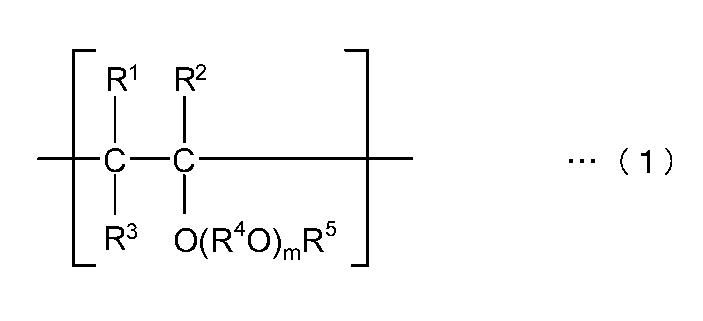
上記一般式(1)におけるR1、R2およびR3は、少なくとも1つが水素原子、特には全てが水素原子であることが好ましい。一般式(1)におけるmは0以上10以下、特には0以上5以下が、さらには0であることが好ましい。一般式(1)におけるR5は炭素数1~20の炭化水素基を示す。この炭化水素基としては、具体的にはメチル基、エチル基、n-プロピル基、イソプロピル基、n-ブチル基、イソブチル基、sec-ブチル基、tert-ブチル基、各種ペンチル基、各種ヘキシル基、各種ヘプチル基、各種オクチル基などのアルキル基、シクロペンチル基,シクロヘキシル基、各種メチルシクロヘキシル基、各種エチルシクロヘキシル基、各種ジメチルシクロヘキシル基などのシクロアルキル基、フェニル基、各種メチルフェニル基、各種エチルフェニル基、各種ジメチルフェニル基などのアリール基、ベンジル基、各種フェニルエチル基、各種メチルベンジル基などのアリールアルキル基などが挙げられ、アルキル基、特には炭素数1以上5以下のアルキル基が好ましい。
本実施形態におけるポリビニルエーテルは、一般式(1)で表される構造単位が同一である単独重合体であっても、2種以上の構造単位で構成される共重合体であってもよい。共重合体はブロック共重合体またはランダム共重合体のいずれであってもよい。
本実施形態に係るポリビニルエーテルは、上記一般式(1)で表される構造単位のみで構成されるものであってもよいが、下記一般式(2)で表される構造単位をさらに含む共重合体であってもよい。この場合、共重合体はブロック共重合体またはランダム共重合体のいずれであってもよい。
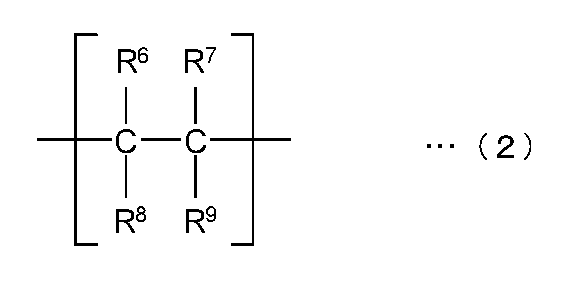
(ポリビニルエーテルモノマー)
ビニルエーテルモノマーとしては、下記一般式(3)の化合物が挙げられる。

(式中、R1、R2、R3、R4、R5およびmは、それぞれ一般式(1)中のR1、R2、R3、R4、R5およびmと同一の定義内容を示す。)
ビニルエーテルモノマーとしては、下記一般式(3)の化合物が挙げられる。
ビニルエーテルのモノマーとしては、上記ポリビニルエーテルに対応する各種のものがあるが、例えば、ビニルメチルエーテル;ビニルエチルエーテル;ビニル-n-プロピルエーテル;ビニル-イソプロピルエーテル;ビニル-n-ブチルエーテル;ビニル-イソブチルエーテル;ビニル-sec-ブチルエーテル;ビニル-tert-ブチルエーテル;ビニル-n-ペンチルエーテル;ビニル-n-ヘキシルエーテル;ビニル-2-メトキシエチルエーテル;ビニル-2-エトキシエチルエーテル;ビニル-2-メトキシ-1-メチルエチルエーテル;ビニル-2-メトキシ-プロピルエーテル;ビニル-3,6-ジオキサヘプチルエーテル;ビニル-3,6,9-トリオキサデシルエーテル;ビニル-1,4-ジメチル-3,6-ジオキサヘプチルエーテル;ビニル-1,4,7-トリメチル-3,6,9-トリオキサデシルエーテル;ビニル-2,6-ジオキサ-4-ヘプチルエーテル;ビニル-2,6,9-トリオキサ-4-デシルエーテル;1-メトキシプロペン;1-エトキシプロペン;1-n-プロポキシプロペン;1-イソプロポキシプロペン;1-n-ブトキシプロペン;1-イソブトキシプロペン;1-sec-ブトキシプロペン;1-tert-ブトキシプロペン;2-メトキシプロペン;2-エトキシプロペン;2-n-プロポキシプロペン;2-イソプロポキシプロペン;2-n-ブトキシプロペン;2-イソブトキシプロペン;2-sec-ブトキシプロペン;2-tert-ブトキシプロペン;1-メトキシ-1-ブテン;1-エトキシ-1-ブテン;1-n-プロポキシ-1-ブテン;1-イソプロポキシ-1-ブテン;1-n-ブトキシ-1-ブテン;1-イソブトキシ-1-ブテン;1-sec-ブトキシ-1-ブテン;1-tert-ブトキシ-1-ブテン;2-メトキシ-1-ブテン;2-エトキシ-1-ブテン;2-n-プロポキシ-1-ブテン;2-イソプロポキシ-1-ブテン;2-n-ブトキシ-1-ブテン;2-イソブトキシ-1-ブテン;2-sec-ブトキシ-1-ブテン;2-tert-ブトキシ-1-ブテン;2-メトキシ-2-ブテン;2-エトキシ-2-ブテン;2-n-プロポキシ-2-ブテン;2-イソプロポキシ-2-ブテン;2-n-ブトキシ-2-ブテン;2-イソブトキシ-2-ブテン;2-sec-ブトキシ-2-ブテン;2-tert-ブトキシ-2-ブテン等が挙げられる。これらのビニルエーテル系モノマーは公知の方法により製造することができる。
・ポリビニルエーテルの末端
本発明の熱サイクルシステム用組成物に冷凍機油として用いられる上記一般式(1)で表される構成単位を有するポリビニルエーテルは、その末端を本開示例に示す方法及び公知の方法により、所望の構造に変換することができる。変換する基としては、飽和の炭化水素,エーテル,アルコール,ケトン,アミド,ニトリルなどを挙げることができる。
本発明の熱サイクルシステム用組成物に冷凍機油として用いられる上記一般式(1)で表される構成単位を有するポリビニルエーテルは、その末端を本開示例に示す方法及び公知の方法により、所望の構造に変換することができる。変換する基としては、飽和の炭化水素,エーテル,アルコール,ケトン,アミド,ニトリルなどを挙げることができる。
本発明の熱サイクルシステム用組成物に冷凍機油として用いられるポリビニルエーテルは、次の式(4)~(8)に示す末端構造を有するものが好適である。


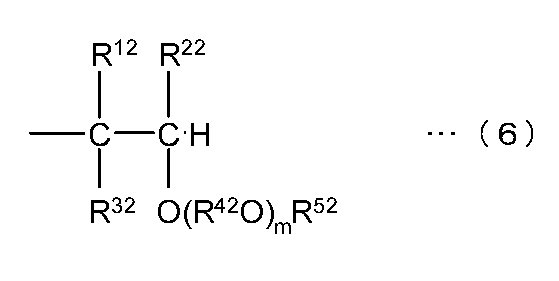
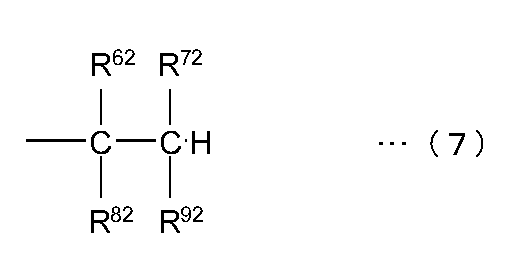
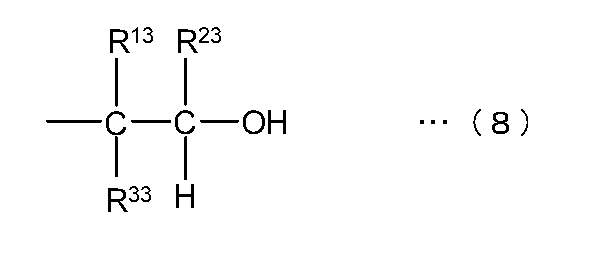
(ポリビニルエーテルの製法)
本実施形態におけるポリビニルエーテルは、上記したモノマーをラジカル重合、カチオン重合、放射線重合などによって製造することができる。重合反応終了後、必要に応じて通常の分離・精製方法を施すことにより、目的とする一般式(1)で表される構造単位を有するポリビニルエーテル系化合物が得られる。
本実施形態におけるポリビニルエーテルは、上記したモノマーをラジカル重合、カチオン重合、放射線重合などによって製造することができる。重合反応終了後、必要に応じて通常の分離・精製方法を施すことにより、目的とする一般式(1)で表される構造単位を有するポリビニルエーテル系化合物が得られる。
(ポリアルキレングリコール)
ポリアルキレングリコールとしては、炭素数2~4のアルキレンオキシド(エチレンオキシド、プロピレンオキシド等)を、水や水酸化アルカリを開始剤として重合させる方法等により得られたものが挙げられる。また、ポリアルキレングリコールの水酸基をエーテル化したものであってもよい。ポリアルキレングリコール系冷凍機油中のオキシアルキレン単位は、1分子中において同一であってもよく、2種以上のオキシアルキレン単位が含まれていてもよい。1分子中に少なくともオキシプロピレン単位が含まれることが好ましい。
ポリアルキレングリコールとしては、炭素数2~4のアルキレンオキシド(エチレンオキシド、プロピレンオキシド等)を、水や水酸化アルカリを開始剤として重合させる方法等により得られたものが挙げられる。また、ポリアルキレングリコールの水酸基をエーテル化したものであってもよい。ポリアルキレングリコール系冷凍機油中のオキシアルキレン単位は、1分子中において同一であってもよく、2種以上のオキシアルキレン単位が含まれていてもよい。1分子中に少なくともオキシプロピレン単位が含まれることが好ましい。
具体的なポリアルキレングリコールとしては、例えば次の一般式(9)
R101-[(OR102)k-OR103]l …(9)
(式中、R101は水素原子、炭素数1~10のアルキル基、炭素数2~10のアシル基又は結合部2~6個を有する炭素数1~10の脂肪族炭化水素基、R102は炭素数2~4のアルキレン基、R103は水素原子、炭素数1~10のアルキル基又は炭素数2~10のアシル基、lは1~6の整数、kはk×lの平均値が6~80となる数を示す。)で表される化合物が挙げられる。
R101-[(OR102)k-OR103]l …(9)
(式中、R101は水素原子、炭素数1~10のアルキル基、炭素数2~10のアシル基又は結合部2~6個を有する炭素数1~10の脂肪族炭化水素基、R102は炭素数2~4のアルキレン基、R103は水素原子、炭素数1~10のアルキル基又は炭素数2~10のアシル基、lは1~6の整数、kはk×lの平均値が6~80となる数を示す。)で表される化合物が挙げられる。
上記一般式(9)において、R101、R103におけるアルキル基は直鎖状、分岐鎖状、環状のいずれであってもよい。該アルキル基の具体例としては、メチル基、エチル基、n-プロピル基、イソプロピル基、各種ブチル基、各種ペンチル基、各種ヘキシル基、各種ヘプチル基、各種オクチル基、各種ノニル基、各種デシル基、シクロペンチル基、シクロヘキシル基などを挙げることができる。このアルキル基の炭素数が10を超えると作動媒体との相溶性が低下し、粗分離を生じる場合がある。好ましいアルキル基の炭素数は1~6である。
また、R101、R103における該アシル基のアルキル基部分は直鎖状、分岐鎖状、環状のいずれであってもよい。該アシル基のアルキル基部分の具体例としては、上記アルキル基の具体例として挙げた炭素数1~9の種々の基を同様に挙げることができる。該アシル基の炭素数が10を超えると作動媒体との相溶性が低下し、相分離を生じる場合がある。好ましいアシル基の炭素数は2~6である。
R101及びR103が、いずれもアルキル基又はアシル基である場合には、R101とR103は同一であってもよいし、互いに異なっていてもよい。
さらにlが2以上の場合には、1分子中の複数のR103は同一であってもよいし、異なっていてもよい。
さらにlが2以上の場合には、1分子中の複数のR103は同一であってもよいし、異なっていてもよい。
R101が結合部位2~6個を有する炭素数1~10の脂肪族炭化水素基である場合、この脂肪族炭化水素基は鎖状のものであってもよいし、環状のものであってもよい。結合部位2個を有する脂肪族炭化水素基としては、例えば、エチレン基、プロピレン基、ブチレン基、ペンチレン基、ヘキシレン基、ヘプチレン基、オクチレン基、ノニレン基、デシレン基、シクロペンチレン基、シクロヘキシレン基などが挙げられる。また、結合部位3~6個を有する脂肪族炭化水素基としては、例えば、トリメチロールプロパン、グリセリン、ペンタエリスリトール、ソルビトール;1,2,3-トリヒドロキシシクロヘキサン;1,3,5-トリヒドロキシシクロヘキサンなどの多価アルコールから水酸基を除いた残基を挙げることができる。
この脂肪族炭化水素基の炭素数が10を超えると作動媒体との相溶性が低下し、相分離が生じる場合がある。好ましい炭素数は2~6である。
上記一般式(9)中のR102は炭素数2~4のアルキレン基であり、繰り返し単位のオキシアルキレン基としては、オキシエチレン基、オキシプロピレン基、オキシブチレン基が挙げられる。1分子中のオキシアルキレン基は同一であってもよいし、2種以上のオキシアルキレン基が含まれていてもよいが、1分子中に少なくともオキシプロピレン単位を含むものが好ましく、特にオキシアルキレン単位中に50モル%以上のオキシプロピレン単位を含むものが好適である。
上記一般式(9)中のlは1~6の整数で、R101の結合部位の数に応じて定められる。例えばR101がアルキル基やアシル基の場合、lは1であり、R101が結合部位2,3,4,5及び6個を有する脂肪族炭化水素基である場合、lはそれぞれ2,3,4,5及び6となる。また、kはk×lの平均値が6~80となる数であり、k×lの平均値が前記範囲を逸脱すると本発明の目的は十分に達せられない。
ポリアルキレングリコールの構造は、下記一般式(10)で表されるポリプロピレングリコールジメチルエーテル、並びに下記一般式(11)で表されるポリ(オキシエチレンオキシプロピレン)グリコールジメチルエーテルが経済性および前述の効果の点で好適であり、また、下記一般式(12)で表されるポリプロピレングリコールモノブチルエーテル、さらには下記一般式(13)で表されるポリプロピレングリコールモノメチルエーテル、下記一般式(14)で表されるポリ(オキシエチレンオキシプロピレン)グリコールモノメチルエーテル、下記一般式(15)で表されるポリ(オキシエチレンオキシプロピレン)グリコールモノブチルエーテル、下記一般式(16)で表されるポリプロピレングリコールジアセテートが、経済性等の点で好適である。
CH3O-(C3H6O)h-CH3 …(10)
(式中、hは6~80の数を表す。)
CH3O-(C2H4O)i-(C3H6O)j-CH3 …(11)
(式中、iおよびjはそれぞれ1以上であり且つiとjとの合計が6~80となる数を表す。)
C4H9O-(C3H6O)h-H …(12)
(式中、hは6~80の数を示す。)
CH3O-(C3H6O)h-H …(13)
(式中、hは6~80の数を表す。)
(式中、hは6~80の数を表す。)
CH3O-(C2H4O)i-(C3H6O)j-CH3 …(11)
(式中、iおよびjはそれぞれ1以上であり且つiとjとの合計が6~80となる数を表す。)
C4H9O-(C3H6O)h-H …(12)
(式中、hは6~80の数を示す。)
CH3O-(C3H6O)h-H …(13)
(式中、hは6~80の数を表す。)
CH3O-(C2H4O)i-(C3H6O)j-H …(14)
(式中、iおよびjはそれぞれ1以上であり且つiとjとの合計が6~80となる数を表す。)
C4H9O-(C2H4O)i-(C3H6O)j-H …(15)
(式中、iおよびjはそれぞれ1以上であり且つiとjとの合計が6~80となる数を表す。)
CH3COO-(C3H6O)h-COCH3 …(16)
(式中、hは6~80の数を表す。)
このポリオキシアルキレングリコール類は、1種を単独で用いてもよく、2種以上を組み合わせて用いてもよい。
(式中、iおよびjはそれぞれ1以上であり且つiとjとの合計が6~80となる数を表す。)
C4H9O-(C2H4O)i-(C3H6O)j-H …(15)
(式中、iおよびjはそれぞれ1以上であり且つiとjとの合計が6~80となる数を表す。)
CH3COO-(C3H6O)h-COCH3 …(16)
(式中、hは6~80の数を表す。)
このポリオキシアルキレングリコール類は、1種を単独で用いてもよく、2種以上を組み合わせて用いてもよい。
上記一般式(9)で表されるポリアルキレングリコールの40℃における動粘度は、40℃における動粘度が1~750mm2/sが好ましく、1~400mm2/sがより好ましい。また、100℃における動粘度は1~100mm2/sが好ましく、1~50mm2/sであることがより好ましい。
〈炭化水素系冷凍機油〉
炭化水素系冷凍機油の基油成分としては、アルキルベンゼンが挙げられる。
炭化水素系冷凍機油の基油成分としては、アルキルベンゼンが挙げられる。
アルキルベンゼンとしては、フッ化水素などの触媒を用いてプロピレンの重合物とベンゼンを原料として合成される分岐アルキルベンゼン、また同触媒を用いてノルマルパラフィンとベンゼンを原料として合成される直鎖アルキルベンゼンが使用できる。アルキル基の炭素数は、潤滑油の基油成分として好適な粘度とする観点から、好ましくは1~30、より好ましくは4~20である。また、アルキルベンゼン1分子が有するアルキル基の数は、アルキル基の炭素数によるが粘度を設定範囲内とするために、好ましくは1~4、より好ましくは1~3である。
さらに、冷凍機油は熱サイクル系内を作動媒体とともに循環することが求められる。冷凍機油は作動媒体と溶解することが最も好ましい形態だが、熱サイクル系内を冷凍機油と作動媒体が循環できる冷凍機油を選定すれば、溶解性が低い冷凍機油を本発明の冷凍機油組成物として使用することができる。冷凍機油が熱サイクル系内を循環するためには、冷凍機油の動粘度が小さいことが求められる。本発明において、アルキルベンゼンの40℃における動粘度は、1~50mm2/sが好ましく、特に好ましくは1~25mm2/sである。
これらの冷凍機油は、1種を単独で用いてもよく、2種以上を組み合わせて用いてもよい。
これらの冷凍機油は、作動媒体と混合して熱サイクルシステム用組成物として使用することが好ましい。このとき、冷凍機油の配合割合は、熱サイクルシステム用組成物全量に対して5~60質量%が望ましく、10~50質量%がより好ましい。
これらの冷凍機油は、作動媒体と混合して熱サイクルシステム用組成物として使用することが好ましい。このとき、冷凍機油の配合割合は、熱サイクルシステム用組成物全量に対して5~60質量%が望ましく、10~50質量%がより好ましい。
<その他任意成分>
熱サイクルシステム用組成物は、その他、本発明の効果を阻害しない範囲で公知の任意成分を含有できる。このような任意成分としては、例えば、従来から熱サイクルシステム用組成物に用いられる公知の安定剤や漏れ検出物質が挙げられ、この任意に含有する漏れ検出物質としては、紫外線蛍光染料、臭気ガスや臭いマスキング剤等が挙げられる。
熱サイクルシステム用組成物は、その他、本発明の効果を阻害しない範囲で公知の任意成分を含有できる。このような任意成分としては、例えば、従来から熱サイクルシステム用組成物に用いられる公知の安定剤や漏れ検出物質が挙げられ、この任意に含有する漏れ検出物質としては、紫外線蛍光染料、臭気ガスや臭いマスキング剤等が挙げられる。
紫外線蛍光染料としては、米国特許第4249412号明細書、特表平10-502737号公報、特表2007-511645号公報、特表2008-500437号公報、特表2008-531836号公報に記載されたもの等、従来、ハロゲン化炭化水素からなる作動媒体とともに、熱サイクルシステムに用いられる公知の紫外線蛍光染料が挙げられる。
臭いマスキング剤としては、特表2008-500437号公報、特表2008-531836号公報に記載されたもの等、従来からハロゲン化炭化水素からなる作動媒体とともに、熱サイクルシステムに用いられる公知の香料が挙げられる。
漏れ検出物質を用いる場合には、作動媒体への漏れ検出物質の溶解性を向上させる可溶化剤を用いてもよい。
可溶化剤としては、特表2007-511645号公報、特表2008-500437号公報、特表2008-531836号公報に記載されたもの等が挙げられる。
熱サイクルシステム用組成物における、漏れ検出物質の含有量は、本発明の効果を著しく低下させない範囲であればよく、作動媒体100質量部に対して、2質量部以下が好ましく、0.5質量部以下がより好ましい。
[熱サイクルシステム]
本発明の熱サイクルシステムは、本発明の熱サイクルシステム用組成物を用いたシステムである。本発明の熱サイクルシステムは、凝縮器で得られる温熱を利用するヒートポンプシステムであってもよく、蒸発器で得られる冷熱を利用する冷凍サイクルシステムであってもよい。
本発明の熱サイクルシステムは、本発明の熱サイクルシステム用組成物を用いたシステムである。本発明の熱サイクルシステムは、凝縮器で得られる温熱を利用するヒートポンプシステムであってもよく、蒸発器で得られる冷熱を利用する冷凍サイクルシステムであってもよい。
本発明の熱サイクルシステムとして、具体的には、冷凍・冷蔵機器、空調機器、発電システム、熱輸送装置および二次冷却機等が挙げられる。なかでも、本発明の熱サイクルシステムは、より高温の作動環境でも効率的に熱サイクル性能を発揮できるため、屋外等に設置されることが多い空調機器として用いられることが好ましい。また、本発明の熱サイクルシステムは、冷凍・冷蔵機器として用いられることも好ましい。
空調機器として、具体的には、ルームエアコン、パッケージエアコン(店舗用パッケージエアコン、ビル用パッケージエアコン、設備用パッケージエアコン等)、ガスエンジンヒートポンプ、列車用空調装置、自動車用空調装置等が挙げられる。
冷凍・冷蔵機器として、具体的には、ショーケース(内蔵型ショーケース、別置型ショーケース等)、業務用冷凍・冷蔵庫、自動販売機、製氷機等が挙げられる。
冷凍・冷蔵機器として、具体的には、ショーケース(内蔵型ショーケース、別置型ショーケース等)、業務用冷凍・冷蔵庫、自動販売機、製氷機等が挙げられる。
発電システムとしては、ランキンサイクルシステムによる発電システムが好ましい。
発電システムとして、具体的には、蒸発器において地熱エネルギー、太陽熱、50~200℃程度の中~高温度域廃熱等により作動媒体を加熱し、高温高圧状態の蒸気となった作動媒体を膨張機にて断熱膨張させ、該断熱膨張によって発生する仕事によって発電機を駆動させ、発電を行うシステムが例示される。
発電システムとして、具体的には、蒸発器において地熱エネルギー、太陽熱、50~200℃程度の中~高温度域廃熱等により作動媒体を加熱し、高温高圧状態の蒸気となった作動媒体を膨張機にて断熱膨張させ、該断熱膨張によって発生する仕事によって発電機を駆動させ、発電を行うシステムが例示される。
また、本発明の熱サイクルシステムは、熱輸送装置であってもよい。熱輸送装置としては、潜熱輸送装置が好ましい。
潜熱輸送装置としては、装置内に封入された作動媒体の蒸発、沸騰、凝縮等の現象を利用して潜熱輸送を行うヒートパイプおよび二相密閉型熱サイフォン装置が挙げられる。ヒートパイプは、半導体素子や電子機器の発熱部の冷却装置等、比較的小型の冷却装置に適用される。二相密閉型熱サイフォンは、ウィッグを必要とせず構造が簡単であることから、ガス-ガス型熱交換器、道路の融雪促進および凍結防止等に広く利用される。
潜熱輸送装置としては、装置内に封入された作動媒体の蒸発、沸騰、凝縮等の現象を利用して潜熱輸送を行うヒートパイプおよび二相密閉型熱サイフォン装置が挙げられる。ヒートパイプは、半導体素子や電子機器の発熱部の冷却装置等、比較的小型の冷却装置に適用される。二相密閉型熱サイフォンは、ウィッグを必要とせず構造が簡単であることから、ガス-ガス型熱交換器、道路の融雪促進および凍結防止等に広く利用される。
以下、本発明の実施形態の熱サイクルシステムの一例として、冷凍サイクルシステムについて、上記で大枠を説明した図1に概略構成図が示される冷凍サイクルシステム10を例として説明する。冷凍サイクルシステムとは、蒸発器で得られる冷熱を利用するシステムである。
図1に示す冷凍サイクルシステム10は、作動媒体蒸気Aを圧縮して高温高圧の作動媒体蒸気Bとする圧縮機11と、圧縮機11から排出された作動媒体蒸気Bを冷却し、液化して低温高圧の作動媒体Cとする凝縮器12と、凝縮器12から排出された作動媒体Cを膨張させて低温低圧の作動媒体Dとする膨張弁13と、膨張弁13から排出された作動媒体Dを加熱して高温低圧の作動媒体蒸気Aとする蒸発器14と、蒸発器14に負荷流体Eを供給するポンプ15と、凝縮器12に流体Fを供給するポンプ16とを具備して概略構成されるシステムである。
冷凍サイクルシステム10においては、以下の(i)~(iv)のサイクルが繰り返される。
(i)蒸発器14から排出された作動媒体蒸気Aを圧縮機11にて圧縮して高温高圧の作動媒体蒸気Bとする(以下、「AB過程」という。)。
(ii)圧縮機11から排出された作動媒体蒸気Bを凝縮器12にて流体Fによって冷却し、液化して低温高圧の作動媒体Cとする。この際、流体Fは加熱されて流体F’となり、凝縮器12から排出される(以下、「BC過程」という。)。
(iii)凝縮器12から排出された作動媒体Cを膨張弁13にて膨張させて低温低圧の作動媒体Dとする(以下、「CD過程」という。)。
(iv)膨張弁13から排出された作動媒体Dを蒸発器14にて負荷流体Eによって加熱して高温低圧の作動媒体蒸気Aとする。この際、負荷流体Eは冷却されて負荷流体E’となり、蒸発器14から排出される(以下、「DA過程」という。)。
(i)蒸発器14から排出された作動媒体蒸気Aを圧縮機11にて圧縮して高温高圧の作動媒体蒸気Bとする(以下、「AB過程」という。)。
(ii)圧縮機11から排出された作動媒体蒸気Bを凝縮器12にて流体Fによって冷却し、液化して低温高圧の作動媒体Cとする。この際、流体Fは加熱されて流体F’となり、凝縮器12から排出される(以下、「BC過程」という。)。
(iii)凝縮器12から排出された作動媒体Cを膨張弁13にて膨張させて低温低圧の作動媒体Dとする(以下、「CD過程」という。)。
(iv)膨張弁13から排出された作動媒体Dを蒸発器14にて負荷流体Eによって加熱して高温低圧の作動媒体蒸気Aとする。この際、負荷流体Eは冷却されて負荷流体E’となり、蒸発器14から排出される(以下、「DA過程」という。)。
冷凍サイクルシステム10は、断熱・等エントロピ変化、等エンタルピ変化および等圧変化からなるサイクルシステムである。作動媒体の状態変化を、図2に示される圧力-エンタルピ線(曲線)図上に記載すると、A、B、C、Dを頂点とする台形として表すことができる。
AB過程は、圧縮機11で断熱圧縮を行い、高温低圧の作動媒体蒸気Aを高温高圧の作動媒体蒸気Bとする過程であり、図2においてAB線で示される。
BC過程は、凝縮器12で等圧冷却を行い、高温高圧の作動媒体蒸気Bを低温高圧の作動媒体Cとする過程であり、図2においてBC線で示される。この際の圧力が凝縮圧である。圧力-エンタルピ線とBC線の交点のうち高エンタルピ側の交点T1が凝縮温度であり、低エンタルピ側の交点T2が凝縮沸点温度である。ここで、HFO-1123が他の作動媒体との混合媒体であって非共沸混合媒体である場合の温度勾配はT1とT2の差として示される。
BC過程は、凝縮器12で等圧冷却を行い、高温高圧の作動媒体蒸気Bを低温高圧の作動媒体Cとする過程であり、図2においてBC線で示される。この際の圧力が凝縮圧である。圧力-エンタルピ線とBC線の交点のうち高エンタルピ側の交点T1が凝縮温度であり、低エンタルピ側の交点T2が凝縮沸点温度である。ここで、HFO-1123が他の作動媒体との混合媒体であって非共沸混合媒体である場合の温度勾配はT1とT2の差として示される。
CD過程は、膨張弁13で等エンタルピ膨張を行い、低温高圧の作動媒体Cを低温低圧の作動媒体Dとする過程であり、図2においてCD線で示される。なお、低温高圧の作動媒体Cにおける温度をT3で示せば、T2-T3が(i)~(iv)のサイクルにおける作動媒体の過冷却度(以下、必要に応じて「SC」で示す。)となる。
DA過程は、蒸発器14で等圧加熱を行い、低温低圧の作動媒体Dを高温低圧の作動媒体蒸気Aに戻す過程であり、図2においてDA線で示される。この際の圧力が蒸発圧である。圧力-エンタルピ線とDA線の交点のうち高エンタルピ側の交点T6は蒸発温度である。作動媒体蒸気Aの温度をT7で示せば、T7-T6が(i)~(iv)のサイクルにおける作動媒体の過熱度(以下、必要に応じて「SH」で示す。)となる。なお、T4は作動媒体Dの温度を示す。
DA過程は、蒸発器14で等圧加熱を行い、低温低圧の作動媒体Dを高温低圧の作動媒体蒸気Aに戻す過程であり、図2においてDA線で示される。この際の圧力が蒸発圧である。圧力-エンタルピ線とDA線の交点のうち高エンタルピ側の交点T6は蒸発温度である。作動媒体蒸気Aの温度をT7で示せば、T7-T6が(i)~(iv)のサイクルにおける作動媒体の過熱度(以下、必要に応じて「SH」で示す。)となる。なお、T4は作動媒体Dの温度を示す。
ここで、作動媒体のサイクル性能は、例えば、作動媒体の冷凍能力(以下、必要に応じて「Q」で示す。)と成績係数(以下、必要に応じて「COP」で示す。)で評価できる。作動媒体のQとCOPは、作動媒体のA(蒸発後、高温低圧)、B(圧縮後、高温高圧)、C(凝縮後、低温高圧)、D(膨張後、低温低圧)の各状態における各エンタルピ、hA、hB、hC、hDを用いると、下式(A)、(B)からそれぞれ求められる。
Q=hA-hD …(A)
COP=Q/圧縮仕事=(hA-hD)/(hB-hA) …(B)
COP=Q/圧縮仕事=(hA-hD)/(hB-hA) …(B)
なお、COPは冷凍サイクルシステムにおける効率を意味しており、COPの値が高いほど少ない入力、例えば圧縮機を運転するために必要とされる電力量、により大きな出力、例えば、Qを得ることができることを表している。
一方、Qは負荷流体を冷凍する能力を意味しており、Qが高いほど同一のシステムにおいて、多くの仕事ができることを意味している。言い換えると、大きなQを有する場合は、少量の作動媒体で目的とする性能が得られることを表しており、システムの小型化が可能となる。
本発明の熱サイクルシステム用組成物を用いた本発明の熱サイクルシステムによれば、例えば、図1に示される冷凍サイクルシステム10において、従来から空調機器等で一般的に使用されているR410A(HFC-32とHFC-125の質量比1:1の混合媒体)を用いた場合に比べて、地球温暖化係数を格段に低く抑えながら、QとCOPをともに高いレベル、すなわち、R410Aと同等またはそれ以上のレベルに設定することが可能である。
さらに、用いる熱サイクルシステム用組成物が含有する作動媒体の温度勾配を一定値以下に抑える組成とすることも可能であり、その場合、圧力容器から冷凍空調機器へ充てんされる際の組成変化や冷凍空調機器からの冷媒漏えいが生じた場合の冷凍空調機器内の冷媒組成の変化を低いレベルに抑えることができる。また、本発明の熱サイクルシステム用組成物によれば、HFO-1123およびHFO-1234yfを含む作動媒体の潤滑特性を向上できることから、該組成物を用いた熱サイクルシステムは従来よりも作動媒体の効率的な循環状態を維持でき、システムの安定した稼働が可能である。
また、本発明の熱サイクルシステムは、システム内に形成される気相中のHFO-1123の割合が50質量%以下となるように制御することが好ましい。上記組成を有する作動媒体であれば、通常この条件を満たし、該気相の作動媒体の燃焼性が抑えられる。そのため、仮にシステム内の気相の作動媒体が漏洩し、空気と混合し、着火しても燃え広がりにくく、安全性が確保される。
なお、熱サイクルシステムの稼働に際しては、水分の混入や、酸素等の不凝縮性気体の混入による不具合の発生を避けるために、これらの混入を抑制する手段を設けることが好ましい。
熱サイクルシステム内に水分が混入すると、特に低温で使用される際に問題が生じる場合がある。例えば、キャピラリーチューブ内での氷結、作動媒体や冷凍機油の加水分解、サイクル内で発生した酸成分による材料劣化、コンタミナンツの発生等の問題が発生する。特に、冷凍機油がポリグリコール、ポリオールエステル等である場合は、吸湿性が極めて高く、また、加水分解反応を生じやすく、冷凍機油としての特性が低下し、圧縮機の長期信頼性を損なう大きな原因となる。したがって、冷凍機油の加水分解を抑えるためには、熱サイクルシステム内の水分濃度を制御する必要がある。
熱サイクルシステム内の水分濃度を制御する方法としては、乾燥剤(シリカゲル、活性アルミナ、ゼオライト等)等の水分除去手段を用いる方法が挙げられる。乾燥剤は、液状の熱サイクルシステム用組成物と接触させることが、脱水効率の点で好ましい。例えば、凝縮器12の出口、または蒸発器14の入口に乾燥剤を配置して、熱サイクルシステム用組成物と接触させることが好ましい。
乾燥剤としては、乾燥剤と熱サイクルシステム用組成物との化学反応性、乾燥剤の吸湿能力の点から、ゼオライト系乾燥剤が好ましい。
ゼオライト系乾燥剤としては、従来の鉱物系冷凍機油に比べて吸湿量の高い冷凍機油を用いる場合には、吸湿能力に優れる点から、下式(C)で表される化合物を主成分とするゼオライト系乾燥剤が好ましい。
M2/nO・Al2O3・xSiO2・yH2O …(C)
ただし、Mは、Na、K等の第1族の元素またはCa等の第2族の元素であり、nは、Mの原子価であり、x、yは、結晶構造にて定まる値である。Mを変化させることにより細孔径を調整できる。
M2/nO・Al2O3・xSiO2・yH2O …(C)
ただし、Mは、Na、K等の第1族の元素またはCa等の第2族の元素であり、nは、Mの原子価であり、x、yは、結晶構造にて定まる値である。Mを変化させることにより細孔径を調整できる。
乾燥剤の選定においては、細孔径および破壊強度が重要である。
熱サイクルシステム用組成物が含有する作動媒体や冷凍機油の分子径よりも大きい細孔径を有する乾燥剤を用いた場合、作動媒体や冷凍機油が乾燥剤中に吸着され、その結果、作動媒体や冷凍機油と乾燥剤との化学反応が生じ、不凝縮性気体の生成、乾燥剤の強度の低下、吸着能力の低下等の好ましくない現象を生じることとなる。
熱サイクルシステム用組成物が含有する作動媒体や冷凍機油の分子径よりも大きい細孔径を有する乾燥剤を用いた場合、作動媒体や冷凍機油が乾燥剤中に吸着され、その結果、作動媒体や冷凍機油と乾燥剤との化学反応が生じ、不凝縮性気体の生成、乾燥剤の強度の低下、吸着能力の低下等の好ましくない現象を生じることとなる。
したがって、乾燥剤としては、細孔径の小さいゼオライト系乾燥剤を用いることが好ましい。特に、細孔径が3.5オングストローム以下である、ナトリウム・カリウムA型の合成ゼオライトが好ましい。作動媒体や冷凍機油の分子径よりも小さい細孔径を有するナトリウム・カリウムA型合成ゼオライトを適用することによって、作動媒体や冷凍機油を吸着することなく、熱サイクルシステム内の水分のみを選択的に吸着除去できる。言い換えると、作動媒体や冷凍機油の乾燥剤への吸着が起こりにくいことから、熱分解が起こりにくくなり、その結果、熱サイクルシステムを構成する材料の劣化やコンタミナンツの発生を抑制できる。
ゼオライト系乾燥剤の大きさは、小さすぎると熱サイクルシステムの弁や配管細部への詰まりの原因となり、大きすぎると乾燥能力が低下するため、約0.5~5mmが好ましい。形状としては、粒状または円筒状が好ましい。
ゼオライト系乾燥剤は、粉末状のゼオライトを結合剤(ベントナイト等。)で固めることにより任意の形状とすることができる。ゼオライト系乾燥剤を主体とするかぎり、他の乾燥剤(シリカゲル、活性アルミナ等。)を併用してもよい。
熱サイクルシステム用組成物に対するゼオライト系乾燥剤の使用割合は、特に限定されない。
熱サイクルシステム用組成物に対するゼオライト系乾燥剤の使用割合は、特に限定されない。
さらに、熱サイクルシステム内に不凝縮性気体が混入すると、凝縮器や蒸発器における熱伝達の不良、作動圧力の上昇という悪影響をおよぼすため、極力混入を抑制する必要がある。特に、不凝縮性気体の一つである酸素は、作動媒体や冷凍機油と反応し、分解を促進する。
不凝縮性気体濃度は、作動媒体の気相部において、作動媒体に対する容積割合で1.5体積%以下が好ましく、0.5体積%以下が特に好ましい。
以上説明した本発明の熱サイクルシステムにあっては、本発明の熱サイクルシステム用組成物を用いることで、潤滑特性が良好で、不燃で安全性が高く、地球温暖化への影響を抑えつつ、実用上充分なサイクル性能が得られるとともに、温度勾配に係る問題も殆どない。
以下、本発明について、実施例および比較例を参照しながらさらに詳細に説明する。
その前に、まず4成分を必須成分として含有する作動媒体の燃焼特性について調べた。その結果を表2に示した。
その前に、まず4成分を必須成分として含有する作動媒体の燃焼特性について調べた。その結果を表2に示した。

[燃焼性の評価]
HFO-1123とHFC-134aとHFO-1234yfとHFC-125とを、各媒体の割合が表2に示す通りとなるように混合して4成分系の熱サイクル用作動媒体を調製し、各作動媒体を空気に対して10~90質量%の間の1質量%おきの比率で空気と混合して平衡状態に到達したときの燃焼性を評価した。
HFO-1123とHFC-134aとHFO-1234yfとHFC-125とを、各媒体の割合が表2に示す通りとなるように混合して4成分系の熱サイクル用作動媒体を調製し、各作動媒体を空気に対して10~90質量%の間の1質量%おきの比率で空気と混合して平衡状態に到達したときの燃焼性を評価した。
燃焼性の評価は、ASTM E-681に規定された設備を用いて、次のように実施した。25℃に温度制御された恒温槽内に設置された内容積12リットルのフラスコ内を真空排気した後、上記被率で空気と混合された各作動媒体を大気圧力まで封入した。その後、該フラスコ内の中心付近の気相において、15kV、30mAで0.4秒間放電着火させた後、火炎の広がりを目視にて認識した。上方への火炎の広がりの角度が90度以上である場合を燃焼性あり、90度未満の場合を燃焼性なし、と判断した。
次に、実施例(例1~152)および比較例(例153~190)を参照しながらさらに詳細に説明する。各例においては、表4~20に示した組み合わせで、作動媒体50gに冷凍機油50gを混合、溶解して熱サイクルシステム用組成物を製造した。したがって、本例における熱サイクルシステム用組成物は、作動媒体50質量%と冷凍機油50質量%とから構成されたものである。
ここで使用する作動媒体についてその構成する化合物を表3にまとめて示した。表3の作動媒体については、燃焼性の無い範囲の作動媒体であり、作動媒体についての冷凍サイクル性能の評価、地球温暖化係数(GWP)の評価についても併せて示した。

[冷凍サイクル性能の評価]
図1の冷凍サイクルシステム10に作動媒体を適用した場合のサイクル性能(能力および効率)として、冷凍サイクル性能(冷凍能力および成績係数)を評価した。
評価は、蒸発器14における作動媒体の平均蒸発温度を0℃、凝縮器12における作動媒体の平均凝縮温度を40℃、凝縮器12における作動媒体の過冷却度を5℃、蒸発器14における作動媒体の過熱度を5℃にそれぞれ設定して実施した。また、機器効率および配管、熱交換器における圧力損失はないものとした。
図1の冷凍サイクルシステム10に作動媒体を適用した場合のサイクル性能(能力および効率)として、冷凍サイクル性能(冷凍能力および成績係数)を評価した。
評価は、蒸発器14における作動媒体の平均蒸発温度を0℃、凝縮器12における作動媒体の平均凝縮温度を40℃、凝縮器12における作動媒体の過冷却度を5℃、蒸発器14における作動媒体の過熱度を5℃にそれぞれ設定して実施した。また、機器効率および配管、熱交換器における圧力損失はないものとした。
冷凍能力Qおよび成績係数ηは、各状態のエンタルピh(ただし、hの添え字は作動媒体の状態を表す。)を用いると、下式(A)、(B)から求められる。
Q=hA-hD ・・・(A)
η=Q/圧縮仕事
=(hA-hD)/(hB-hA) ・・・(B)
冷凍サイクル性能の算出に必要となる熱力学性質の特性値は、対応状態原理に基づく一般化状態方程式(Soave-Redlich-Kwong式)、および熱力学諸関係式に基づき算出した。特性値が入手できない場合は、原子団寄与法に基づく推算手法を用いて算出を行った。
Q=hA-hD ・・・(A)
η=Q/圧縮仕事
=(hA-hD)/(hB-hA) ・・・(B)
冷凍サイクル性能の算出に必要となる熱力学性質の特性値は、対応状態原理に基づく一般化状態方程式(Soave-Redlich-Kwong式)、および熱力学諸関係式に基づき算出した。特性値が入手できない場合は、原子団寄与法に基づく推算手法を用いて算出を行った。
なお、成績係数は、冷凍サイクルシステム10における冷凍効率を表しており、成績係数の値が高いほど少ない入力(圧縮機を運転するために必要とされる電力量)により大きな出力(冷凍能力)を得ることができることを表している。
一方、冷凍能力は、負荷流体を冷却する能力を表しており、冷凍能力が高いほど、同一のシステムにおいて、多くの仕事ができることを表している。言い換えると、大きな冷凍能力を有するほど、少量の作動媒体で目的とする性能が得られ、システムを小型化できることを表している。
一方、冷凍能力は、負荷流体を冷却する能力を表しており、冷凍能力が高いほど、同一のシステムにおいて、多くの仕事ができることを表している。言い換えると、大きな冷凍能力を有するほど、少量の作動媒体で目的とする性能が得られ、システムを小型化できることを表している。
[地球温暖化係数(GWP)の評価]
また、用いた作動媒体の地球温暖化係数の値を表3に併記した。
HFC-134aのGWP(100年)は、気候変動に関する政府間パネル(IPCC)第4次評価報告書(2007年)による値で1430であり、HFC-125のGWP(100年)は3500である。HFO-1234yfのGWP(100年)は4である。HFO-1123のGWP(100年)は、IPCC第4次評価報告書に準じて測定された値として、0.3である。また、混合物におけるGWPは、組成質量による加重平均として示す。
また、用いた作動媒体の地球温暖化係数の値を表3に併記した。
HFC-134aのGWP(100年)は、気候変動に関する政府間パネル(IPCC)第4次評価報告書(2007年)による値で1430であり、HFC-125のGWP(100年)は3500である。HFO-1234yfのGWP(100年)は4である。HFO-1123のGWP(100年)は、IPCC第4次評価報告書に準じて測定された値として、0.3である。また、混合物におけるGWPは、組成質量による加重平均として示す。
ここで使用する冷凍機油は以下の通りである。
冷凍機油1:ポリオールエステルを主成分とする冷凍機油(商品名:Ze-GLES RB-68、JX日鉱日石エネルギー株式会社製品:40℃における動粘度が68mm2/s)
冷凍機油2:ポリビニルエーテルを主成分とする冷凍機油(商品名:ダフニーハーメチックオイルFVC68D、出光興産株式会社製品:40℃における動粘度が68mm2/s)
冷凍機油3:ポリアルキレングリコールを主成分とする冷凍機油(商品名:ND-8、株式会社デンソー社製品:40℃における動粘度が41mm2/s)
冷凍機油4:アルキルベンゼンを主成分とする冷凍機油(商品名:アトモスN22、JX日鉱日石エネルギー株式会社製品;40℃の動粘度が21.5mm2/s)
冷凍機油5:ナフテン系高級冷凍機油(商品名:スニソ4GS、出光興産株式会社製品:40℃における動粘度が56mm2/s)。
冷凍機油1:ポリオールエステルを主成分とする冷凍機油(商品名:Ze-GLES RB-68、JX日鉱日石エネルギー株式会社製品:40℃における動粘度が68mm2/s)
冷凍機油2:ポリビニルエーテルを主成分とする冷凍機油(商品名:ダフニーハーメチックオイルFVC68D、出光興産株式会社製品:40℃における動粘度が68mm2/s)
冷凍機油3:ポリアルキレングリコールを主成分とする冷凍機油(商品名:ND-8、株式会社デンソー社製品:40℃における動粘度が41mm2/s)
冷凍機油4:アルキルベンゼンを主成分とする冷凍機油(商品名:アトモスN22、JX日鉱日石エネルギー株式会社製品;40℃の動粘度が21.5mm2/s)
冷凍機油5:ナフテン系高級冷凍機油(商品名:スニソ4GS、出光興産株式会社製品:40℃における動粘度が56mm2/s)。
(冷凍機油の循環状態)
図1に示した熱サイクルシステム10に、各例で得られた熱サイクルシステム用組成物を入れ、熱サイクルシステムの連続運転を行った。熱サイクルシステム用組成物の循環状態を評価するために、熱サイクルシステムにおける蒸発器14から圧縮機11への流路の一部をガラス配管とした。このガラス配管から内部を観察して熱サイクルシステム内の熱サイクルシステム用組成物の循環状態を評価した。循環状態は、目視にて以下の基準により評価した。
○:冷凍機油の循環が確認できた。
△:冷凍機油の循環は見られるが循環量が不十分。
×:冷凍機油の循環が確認できない。
図1に示した熱サイクルシステム10に、各例で得られた熱サイクルシステム用組成物を入れ、熱サイクルシステムの連続運転を行った。熱サイクルシステム用組成物の循環状態を評価するために、熱サイクルシステムにおける蒸発器14から圧縮機11への流路の一部をガラス配管とした。このガラス配管から内部を観察して熱サイクルシステム内の熱サイクルシステム用組成物の循環状態を評価した。循環状態は、目視にて以下の基準により評価した。
○:冷凍機油の循環が確認できた。
△:冷凍機油の循環は見られるが循環量が不十分。
×:冷凍機油の循環が確認できない。
その結果を表4~20に併せて示した。この結果から、例1~152の熱サイクルシステム用組成物では、すべて冷凍機油の循環が良好であることが確認できた。一方で、冷凍機油5を用いた例153~190は、ガラス管の観察では冷凍機油の循環が見られず、求める熱サイクルシステム用組成物としての性能は得られなかった。
[安定性試験]
安定性試験は、循環状態が良好な例1~152の熱サイクルシステム用組成物に対して、JIS K 2211に記された「冷媒と冷凍機油の化学的安定性試験方法(オートクレーブ)」に準拠して実施した。
例1~152で得られた熱サイクルシステム用組成物を、内部に150mlのガラス筒を入れた200mlのステンレス製の耐圧容器に、それぞれ入れ、さらに触媒として、1つの耐圧容器に鉄、銅およびアルミニウムの試験片を入れ、密閉した。次いで、密閉した耐圧容器を恒温槽(パーフェクトオーブンPHH-202、エスペック株式会社製)中に175℃で14日間保存し、次のように作動媒体の酸分量測定、冷凍機油の色相観察および触媒の外観変化観察を行った。
安定性試験は、循環状態が良好な例1~152の熱サイクルシステム用組成物に対して、JIS K 2211に記された「冷媒と冷凍機油の化学的安定性試験方法(オートクレーブ)」に準拠して実施した。
例1~152で得られた熱サイクルシステム用組成物を、内部に150mlのガラス筒を入れた200mlのステンレス製の耐圧容器に、それぞれ入れ、さらに触媒として、1つの耐圧容器に鉄、銅およびアルミニウムの試験片を入れ、密閉した。次いで、密閉した耐圧容器を恒温槽(パーフェクトオーブンPHH-202、エスペック株式会社製)中に175℃で14日間保存し、次のように作動媒体の酸分量測定、冷凍機油の色相観察および触媒の外観変化観察を行った。
なお、触媒となる金属片は,次のものを用いた。
a)鉄 一般用冷間圧延鋼板(JIS G3141に定められたもの、記号の種類SPCC-SB)の試験片,30mm×25mm×厚さ3.2mm
b)銅 タフピッチ銅(JIS H3100に定められたもの、合金番号C1100、記号C1100P)の試験片、30mm×25mm×厚さ2mm
c)アルミニウム 純アルミニウム(JIS H4000に定められたもの、合金番号1050、記号A1050P)の試験片、30mm×25mm×厚さ2mm
a)鉄 一般用冷間圧延鋼板(JIS G3141に定められたもの、記号の種類SPCC-SB)の試験片,30mm×25mm×厚さ3.2mm
b)銅 タフピッチ銅(JIS H3100に定められたもの、合金番号C1100、記号C1100P)の試験片、30mm×25mm×厚さ2mm
c)アルミニウム 純アルミニウム(JIS H4000に定められたもの、合金番号1050、記号A1050P)の試験片、30mm×25mm×厚さ2mm
(酸分量の測定)
試験後の作動媒体の酸分量測定は、JIS K1560(1,1,1,2-テトラフルオロエタン(HFC-134a))に準拠して試験を実施した。
試験後の耐圧容器を室温になるまで静置した。
吸収瓶4本にそれぞれ純水を100ml入れ、導管で直列に連結したものを準備した。
室温になった耐圧容器に、純水を加えた吸収瓶を連結したものをつなぎ、徐々に耐圧容器の弁を開放して、冷媒ガスを吸収瓶の水中に導入し、冷媒ガスに含まれる酸分を抽出した。
抽出後の吸収瓶の水は、1本目と2本目を合わせて指示薬(BTB:ブロモチモールブルー)を1滴加え、1/100N-NaOHアルカリ標準液を用いて滴定した。同時に、吸収瓶の3本目および4本目の水を合わせて同様に滴定し、測定ブランクとした。これら測定値と測定ブランクの値から、試験後の冷媒に含まれる酸分をHCl濃度として求めた。
試験後の作動媒体の酸分量測定は、JIS K1560(1,1,1,2-テトラフルオロエタン(HFC-134a))に準拠して試験を実施した。
試験後の耐圧容器を室温になるまで静置した。
吸収瓶4本にそれぞれ純水を100ml入れ、導管で直列に連結したものを準備した。
室温になった耐圧容器に、純水を加えた吸収瓶を連結したものをつなぎ、徐々に耐圧容器の弁を開放して、冷媒ガスを吸収瓶の水中に導入し、冷媒ガスに含まれる酸分を抽出した。
抽出後の吸収瓶の水は、1本目と2本目を合わせて指示薬(BTB:ブロモチモールブルー)を1滴加え、1/100N-NaOHアルカリ標準液を用いて滴定した。同時に、吸収瓶の3本目および4本目の水を合わせて同様に滴定し、測定ブランクとした。これら測定値と測定ブランクの値から、試験後の冷媒に含まれる酸分をHCl濃度として求めた。
(冷凍機油の色相)
酸分量測定後、作動媒体を抜き出した圧力容器に残った冷凍機油を取り出し、ASTM-D156に準拠して冷凍機油の色相を評価した。ここで、L値は数値が大きいほど着色度合いが大きいため、数値が低いほど好ましい。ここではL3.5以下が好ましく、L3.0以下がより好ましく、L2.5以下がさらに好ましい。
酸分量測定後、作動媒体を抜き出した圧力容器に残った冷凍機油を取り出し、ASTM-D156に準拠して冷凍機油の色相を評価した。ここで、L値は数値が大きいほど着色度合いが大きいため、数値が低いほど好ましい。ここではL3.5以下が好ましく、L3.0以下がより好ましく、L2.5以下がさらに好ましい。
(触媒の外観変化)
触媒の外観変化は、上記試験後の触媒金属の外観を目視で確認し、以下の基準により評価した。
○:変化なし、×:光沢なしまたは黒く変色
光沢なしまたは黒く変色の場合は、上記安定性試験により熱サイクルシステム用組成物が劣化したことを示す。
触媒の外観変化は、上記試験後の触媒金属の外観を目視で確認し、以下の基準により評価した。
○:変化なし、×:光沢なしまたは黒く変色
光沢なしまたは黒く変色の場合は、上記安定性試験により熱サイクルシステム用組成物が劣化したことを示す。

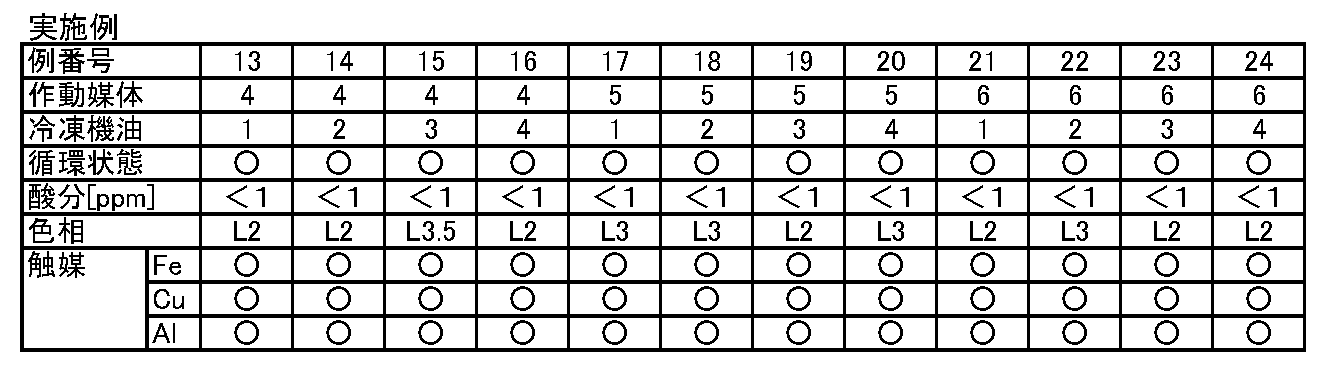

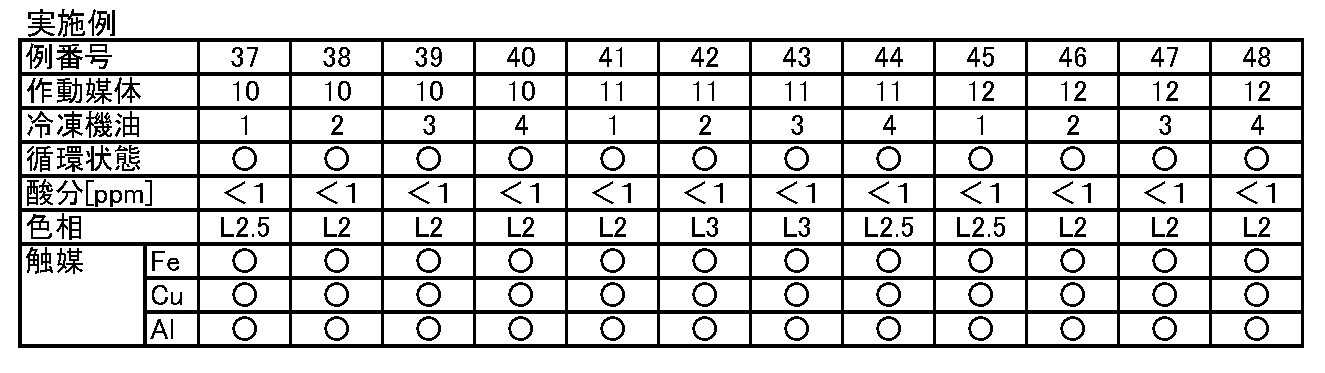
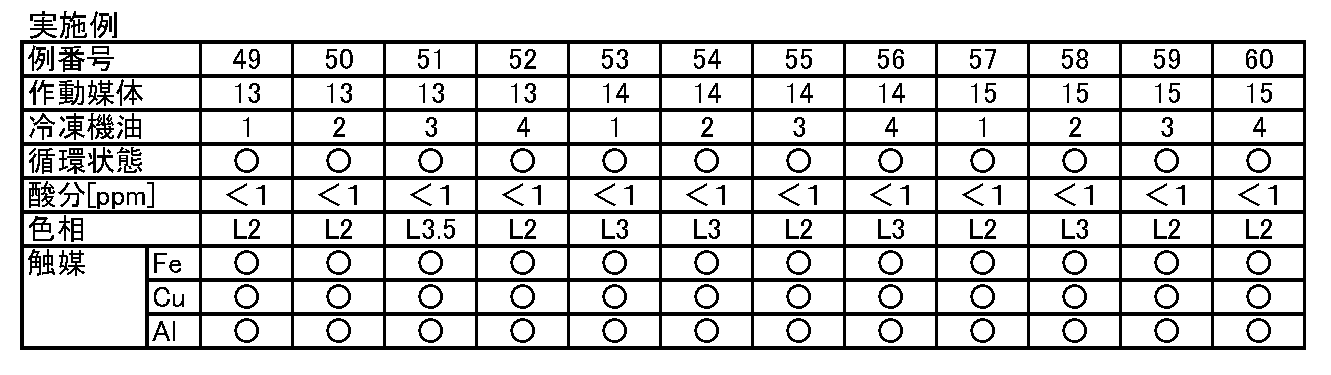

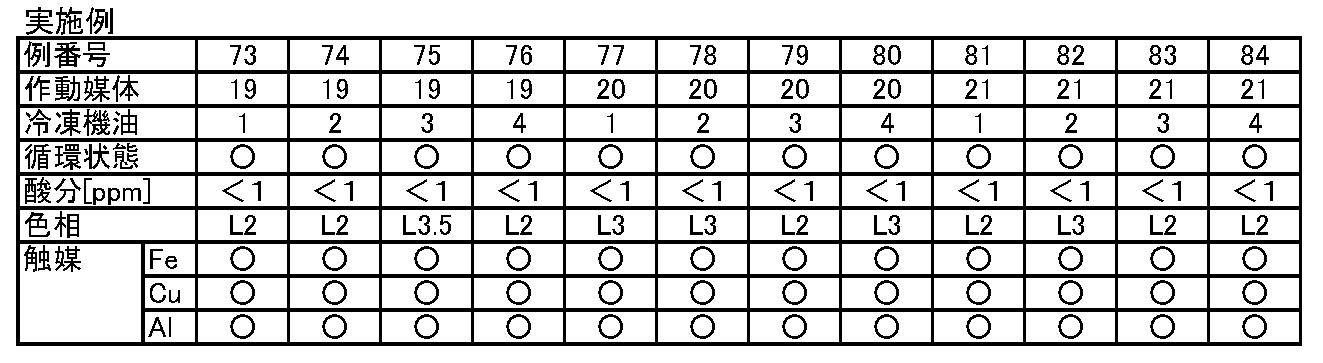

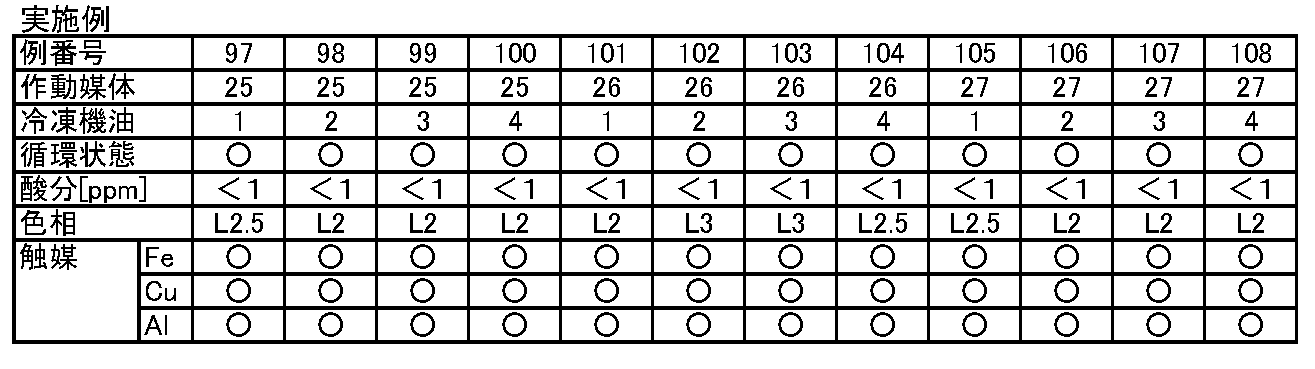
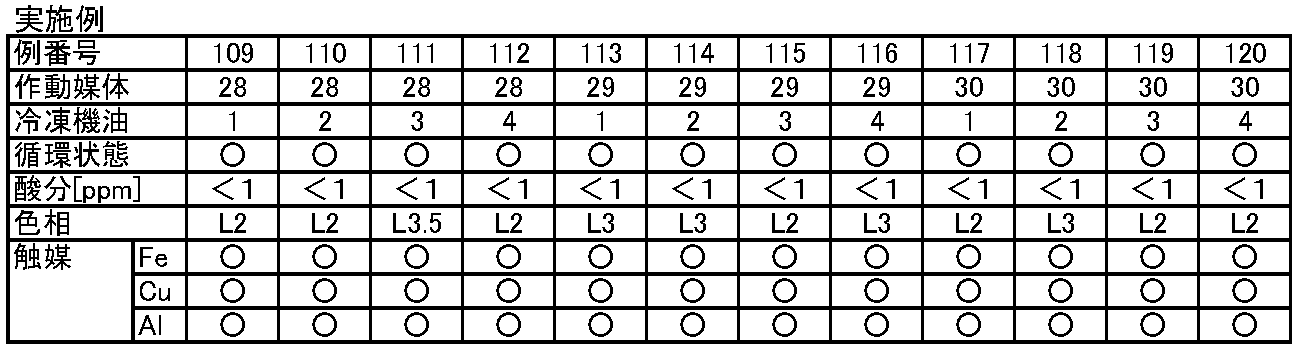


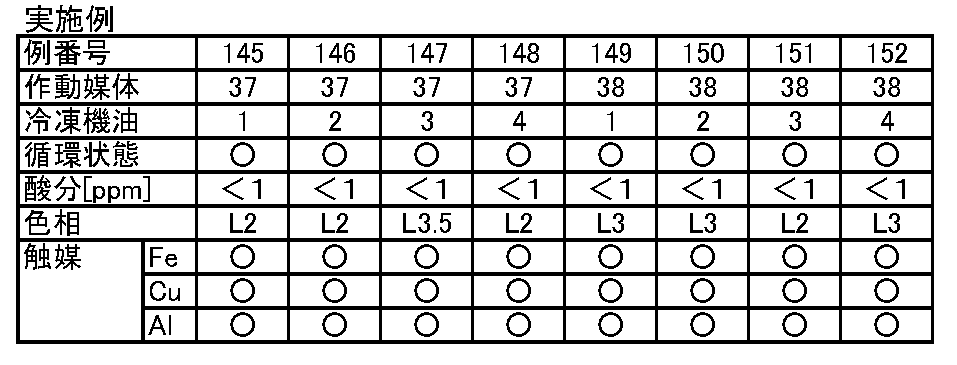


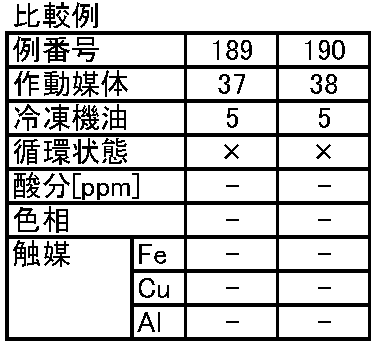
以上の結果から、本発明の実施例である例1~152では、全ての熱サイクルシステム用組成物において従来技術の組成物と同等の特性を有し、熱サイクルシステム用組成物として適していることが明らかになった。
本発明の熱サイクルシステム用組成物および該組成物を用いた熱サイクルシステムは、冷凍・冷蔵機器(内蔵型ショーケース、別置型ショーケース、業務用冷凍・冷蔵庫、自動販売機、製氷機等)、空調機器(ルームエアコン、店舗用パッケージエアコン、ビル用パッケージエアコン、設備用パッケージエアコン、ガスエンジンヒートポンプ、列車用空調装置、自動車用空調装置等)、発電システム(廃熱回収発電等)、熱輸送装置(ヒートパイプ等)に利用できる。
10…冷凍サイクルシステム、11…圧縮機、12…凝縮器、13…膨張弁、14…蒸発器、15,16…ポンプ。
Claims (14)
- 熱サイクル用作動媒体と、冷凍機油と、を含む熱サイクルシステム用組成物であって、
前記熱サイクル用作動媒体は、トリフルオロエチレンと1,1,1,2-テトラフルオロエタンとペンタフルオロエタンと2,3,3,3-テトラフルオロプロペンとを含み、該熱サイクル用作動媒体の総質量に対するトリフルオロエチレンと1,1,1,2-テトラフルオロエタンとペンタフルオロエタンと2,3,3,3-テトラフルオロプロペンとの合計量の割合が90質量%を超え100質量%以下であり、トリフルオロエチレンと1,1,1,2-テトラフルオロエタンとペンタフルオロエタンと2,3,3,3-テトラフルオロプロペンとの合計量に対する、トリフルオロエチレンの割合が3質量%以上35質量%以下、1,1,1,2-テトラフルオロエタンの割合が10質量%以上53質量%以下、ペンタフルオロエタンの割合が4質量%以上50質量%以下、2,3,3,3-テトラフルオロプロペンの割合が5質量%以上50質量%以下であり、
前記冷凍機油が、エステル系冷凍機油、エーテル系冷凍機油、およびアルキルベンゼンから選ばれる少なくとも1種を含む、熱サイクルシステム用組成物。 - 前記熱サイクル用作動媒体が、トリフルオロエチレンと1,1,1,2-テトラフルオロエタンとペンタフルオロエタンと2,3,3,3-テトラフルオロプロペンとの合計量に対する、トリフルオロエチレンの割合が6質量%以上25質量%以下、1,1,1,2-テトラフルオロエタンの割合が20質量%以上35質量%以下、ペンタフルオロエタンの割合が8質量%以上30質量%以下、2,3,3,3-テトラフルオロプロペンの割合が20質量%以上50質量%以下である、請求項1に記載の熱サイクルシステム用組成物。
- 前記冷凍機油が、二塩基酸エステル、ポリオールエステル、コンプレックスエステル、ポリオール炭酸エステル、ポリビニルエーテル、ポリアルキレングリコールおよびアルキルベンゼンから選ばれる少なくとも1種を含む、請求項1または2に記載の熱サイクルシステム用組成物。
- 前記冷凍機油の40℃における動粘度が1~750mm2/sである、請求項1~3のいずれか1項に記載の熱サイクルシステム用組成物。
- 前記冷凍機油の100℃における動粘度が1~100mm2/sである、請求項1~4のいずれか1項に記載の熱サイクルシステム用組成物。
- 前記冷凍機油の基油成分の炭素原子と酸素原子の比率(炭素/酸素モル比)が2~7.5である、請求項1~5のいずれか1項に記載の熱サイクルシステム用組成物。
- 前記熱サイクル用作動媒体の地球温暖化係数が2000以下である、請求項1~6のいずれか1項に記載の熱サイクルシステム用組成物。
- 前記熱サイクル用作動媒体がさらに1,1,1,2-テトラフルオロエタンおよびペンタフルオロエタン以外の飽和のヒドロフルオロカーボンを含む、請求項1~7のいずれか1項に記載の熱サイクルシステム用組成物。
- 前記飽和のヒドロフルオロカーボンがジフルオロメタンおよび1,1-ジフルオロエタンから選ばれる少なくとも1種である、請求項8に記載の熱サイクルシステム用組成物。
- 前記熱サイクル用作動媒体がさらにトリフルオロエチレンおよび2,3,3,3-テトラフルオロプロペン以外のヒドロフルオロオレフィンを含む、請求項1~9のいずれか1項に記載の熱サイクルシステム用組成物。
- 前記ヒドロフルオロオレフィンが、1,3,3,3-テトラフルオロプロペンである、請求項10に記載の熱サイクルシステム用組成物。
- 請求項1~11のいずれか1項に記載の熱サイクルシステム用組成物を用いた、熱サイクルシステム。
- 前記熱サイクルシステム内に形成される気相中のトリフルオロエチレンの割合が50質量%以下である、請求項12に記載の熱サイクルシステム。
- 前記熱サイクルシステムが、冷凍・冷蔵機器、空調機器、発電システム、熱輸送装置または二次冷却機である、請求項12または13に記載の熱サイクルシステム。
Priority Applications (2)
| Application Number | Priority Date | Filing Date | Title |
|---|---|---|---|
| CN201680027297.8A CN107532072A (zh) | 2015-05-12 | 2016-05-09 | 热循环系统用组合物以及热循环系统 |
| JP2017517931A JPWO2016181933A1 (ja) | 2015-05-12 | 2016-05-09 | 熱サイクルシステム用組成物および熱サイクルシステム |
Applications Claiming Priority (2)
| Application Number | Priority Date | Filing Date | Title |
|---|---|---|---|
| JP2015-097422 | 2015-05-12 | ||
| JP2015097422 | 2015-05-12 |
Publications (1)
| Publication Number | Publication Date |
|---|---|
| WO2016181933A1 true WO2016181933A1 (ja) | 2016-11-17 |
Family
ID=57248038
Family Applications (1)
| Application Number | Title | Priority Date | Filing Date |
|---|---|---|---|
| PCT/JP2016/063739 Ceased WO2016181933A1 (ja) | 2015-05-12 | 2016-05-09 | 熱サイクルシステム用組成物および熱サイクルシステム |
Country Status (3)
| Country | Link |
|---|---|
| JP (1) | JPWO2016181933A1 (ja) |
| CN (1) | CN107532072A (ja) |
| WO (1) | WO2016181933A1 (ja) |
Cited By (2)
| Publication number | Priority date | Publication date | Assignee | Title |
|---|---|---|---|---|
| WO2019033189A1 (pt) * | 2017-08-16 | 2019-02-21 | Ideal Eficiência Energética Ltda. | Composição de fluido refrigerante, uso da composição, aparelho refrigerador, produto envasado e processo de envasamento |
| JP2020521855A (ja) * | 2017-06-02 | 2020-07-27 | アルケマ フランス | トリフルオロエチレン系組成物とその使用 |
Families Citing this family (3)
| Publication number | Priority date | Publication date | Assignee | Title |
|---|---|---|---|---|
| WO2020017521A1 (ja) * | 2018-07-17 | 2020-01-23 | ダイキン工業株式会社 | 冷媒サイクル装置 |
| CN113150745B (zh) * | 2021-04-13 | 2022-10-11 | 珠海格力电器股份有限公司 | 三元环保混合制冷剂、其制备方法及制冷系统 |
| CN119709131A (zh) * | 2025-02-27 | 2025-03-28 | 安徽中科都菱商用电器股份有限公司 | 一种混合制冷剂及其添加剂、制备方法和应用 |
Citations (6)
| Publication number | Priority date | Publication date | Assignee | Title |
|---|---|---|---|---|
| WO2011024663A1 (ja) * | 2009-08-28 | 2011-03-03 | Jx日鉱日石エネルギー株式会社 | 冷凍機油および冷凍機用作動流体組成物 |
| JP2014077143A (ja) * | 2013-12-09 | 2014-05-01 | Idemitsu Kosan Co Ltd | 冷凍機用潤滑油組成物 |
| WO2014123120A1 (ja) * | 2013-02-05 | 2014-08-14 | 旭硝子株式会社 | ヒートポンプ用作動媒体およびヒートポンプシステム |
| JP2014194030A (ja) * | 2008-09-09 | 2014-10-09 | Jx Nippon Oil & Energy Corp | 冷媒2,3,3,3‐テトラフルオロ‐1‐プロペン用冷凍機油 |
| WO2015005290A1 (ja) * | 2013-07-12 | 2015-01-15 | 旭硝子株式会社 | 熱サイクル用作動媒体、熱サイクルシステム用組成物および熱サイクルシステム |
| WO2015133587A1 (ja) * | 2014-03-06 | 2015-09-11 | 旭硝子株式会社 | 熱サイクル用作動媒体および熱サイクルシステム |
-
2016
- 2016-05-09 JP JP2017517931A patent/JPWO2016181933A1/ja active Pending
- 2016-05-09 WO PCT/JP2016/063739 patent/WO2016181933A1/ja not_active Ceased
- 2016-05-09 CN CN201680027297.8A patent/CN107532072A/zh active Pending
Patent Citations (6)
| Publication number | Priority date | Publication date | Assignee | Title |
|---|---|---|---|---|
| JP2014194030A (ja) * | 2008-09-09 | 2014-10-09 | Jx Nippon Oil & Energy Corp | 冷媒2,3,3,3‐テトラフルオロ‐1‐プロペン用冷凍機油 |
| WO2011024663A1 (ja) * | 2009-08-28 | 2011-03-03 | Jx日鉱日石エネルギー株式会社 | 冷凍機油および冷凍機用作動流体組成物 |
| WO2014123120A1 (ja) * | 2013-02-05 | 2014-08-14 | 旭硝子株式会社 | ヒートポンプ用作動媒体およびヒートポンプシステム |
| WO2015005290A1 (ja) * | 2013-07-12 | 2015-01-15 | 旭硝子株式会社 | 熱サイクル用作動媒体、熱サイクルシステム用組成物および熱サイクルシステム |
| JP2014077143A (ja) * | 2013-12-09 | 2014-05-01 | Idemitsu Kosan Co Ltd | 冷凍機用潤滑油組成物 |
| WO2015133587A1 (ja) * | 2014-03-06 | 2015-09-11 | 旭硝子株式会社 | 熱サイクル用作動媒体および熱サイクルシステム |
Cited By (2)
| Publication number | Priority date | Publication date | Assignee | Title |
|---|---|---|---|---|
| JP2020521855A (ja) * | 2017-06-02 | 2020-07-27 | アルケマ フランス | トリフルオロエチレン系組成物とその使用 |
| WO2019033189A1 (pt) * | 2017-08-16 | 2019-02-21 | Ideal Eficiência Energética Ltda. | Composição de fluido refrigerante, uso da composição, aparelho refrigerador, produto envasado e processo de envasamento |
Also Published As
| Publication number | Publication date |
|---|---|
| CN107532072A (zh) | 2018-01-02 |
| JPWO2016181933A1 (ja) | 2018-03-08 |
Similar Documents
| Publication | Publication Date | Title |
|---|---|---|
| US10851276B2 (en) | Composition for heat cycle system, and heat cycle system | |
| JP6693513B2 (ja) | 熱サイクルシステム用組成物および熱サイクルシステム | |
| JP6693512B2 (ja) | 熱サイクルシステム用組成物および熱サイクルシステム | |
| US20170058172A1 (en) | Composition for heat cycle system and heat cycle system | |
| JP6409865B2 (ja) | 熱サイクル用作動媒体、熱サイクルシステム用組成物および熱サイクルシステム | |
| JPWO2015141678A1 (ja) | 熱サイクル用作動媒体、熱サイクルシステム用組成物および熱サイクルシステム | |
| JP2016056374A (ja) | 熱サイクル用作動媒体、熱サイクルシステム用組成物および熱サイクルシステム | |
| WO2015115252A1 (ja) | 熱サイクル用作動媒体、熱サイクルシステム用組成物および熱サイクルシステム | |
| WO2015186670A1 (ja) | 熱サイクルシステム用組成物および熱サイクルシステム | |
| WO2015125878A1 (ja) | 熱サイクルシステム用組成物および熱サイクルシステム | |
| US11390827B2 (en) | Composition for heat cycle system, and heat cycle system | |
| JPWO2015133587A1 (ja) | 熱サイクル用作動媒体および熱サイクルシステム | |
| WO2016181910A1 (ja) | 熱サイクルシステム用組成物および熱サイクルシステム | |
| JPWO2016181933A1 (ja) | 熱サイクルシステム用組成物および熱サイクルシステム |
Legal Events
| Date | Code | Title | Description |
|---|---|---|---|
| 121 | Ep: the epo has been informed by wipo that ep was designated in this application |
Ref document number: 16792658 Country of ref document: EP Kind code of ref document: A1 |
|
| ENP | Entry into the national phase |
Ref document number: 2017517931 Country of ref document: JP Kind code of ref document: A |
|
| NENP | Non-entry into the national phase |
Ref country code: DE |
|
| 122 | Ep: pct application non-entry in european phase |
Ref document number: 16792658 Country of ref document: EP Kind code of ref document: A1 |