WO2016175317A1 - 含フッ素化合物含有組成物、その製造方法、コーティング液、ハードコート層形成用組成物および物品 - Google Patents
含フッ素化合物含有組成物、その製造方法、コーティング液、ハードコート層形成用組成物および物品 Download PDFInfo
- Publication number
- WO2016175317A1 WO2016175317A1 PCT/JP2016/063465 JP2016063465W WO2016175317A1 WO 2016175317 A1 WO2016175317 A1 WO 2016175317A1 JP 2016063465 W JP2016063465 W JP 2016063465W WO 2016175317 A1 WO2016175317 A1 WO 2016175317A1
- Authority
- WO
- WIPO (PCT)
- Prior art keywords
- compound
- composition
- fluorine
- solvent
- group
- Prior art date
- Legal status (The legal status is an assumption and is not a legal conclusion. Google has not performed a legal analysis and makes no representation as to the accuracy of the status listed.)
- Ceased
Links
Classifications
-
- C—CHEMISTRY; METALLURGY
- C08—ORGANIC MACROMOLECULAR COMPOUNDS; THEIR PREPARATION OR CHEMICAL WORKING-UP; COMPOSITIONS BASED THEREON
- C08F—MACROMOLECULAR COMPOUNDS OBTAINED BY REACTIONS ONLY INVOLVING CARBON-TO-CARBON UNSATURATED BONDS
- C08F290/00—Macromolecular compounds obtained by polymerising monomers on to polymers modified by introduction of aliphatic unsaturated end or side groups
- C08F290/02—Macromolecular compounds obtained by polymerising monomers on to polymers modified by introduction of aliphatic unsaturated end or side groups on to polymers modified by introduction of unsaturated end groups
- C08F290/06—Polymers provided for in subclass C08G
- C08F290/067—Polyurethanes; Polyureas
-
- C—CHEMISTRY; METALLURGY
- C09—DYES; PAINTS; POLISHES; NATURAL RESINS; ADHESIVES; COMPOSITIONS NOT OTHERWISE PROVIDED FOR; APPLICATIONS OF MATERIALS NOT OTHERWISE PROVIDED FOR
- C09D—COATING COMPOSITIONS, e.g. PAINTS, VARNISHES OR LACQUERS; FILLING PASTES; CHEMICAL PAINT OR INK REMOVERS; INKS; CORRECTING FLUIDS; WOODSTAINS; PASTES OR SOLIDS FOR COLOURING OR PRINTING; USE OF MATERIALS THEREFOR
- C09D175/00—Coating compositions based on polyureas or polyurethanes; Coating compositions based on derivatives of such polymers
- C09D175/04—Polyurethanes
- C09D175/14—Polyurethanes having carbon-to-carbon unsaturated bonds
-
- C—CHEMISTRY; METALLURGY
- C08—ORGANIC MACROMOLECULAR COMPOUNDS; THEIR PREPARATION OR CHEMICAL WORKING-UP; COMPOSITIONS BASED THEREON
- C08F—MACROMOLECULAR COMPOUNDS OBTAINED BY REACTIONS ONLY INVOLVING CARBON-TO-CARBON UNSATURATED BONDS
- C08F2/00—Processes of polymerisation
- C08F2/44—Polymerisation in the presence of compounding ingredients, e.g. plasticisers, dyestuffs, fillers
-
- C—CHEMISTRY; METALLURGY
- C08—ORGANIC MACROMOLECULAR COMPOUNDS; THEIR PREPARATION OR CHEMICAL WORKING-UP; COMPOSITIONS BASED THEREON
- C08F—MACROMOLECULAR COMPOUNDS OBTAINED BY REACTIONS ONLY INVOLVING CARBON-TO-CARBON UNSATURATED BONDS
- C08F2/00—Processes of polymerisation
- C08F2/46—Polymerisation initiated by wave energy or particle radiation
- C08F2/48—Polymerisation initiated by wave energy or particle radiation by ultraviolet or visible light
- C08F2/50—Polymerisation initiated by wave energy or particle radiation by ultraviolet or visible light with sensitising agents
-
- C—CHEMISTRY; METALLURGY
- C08—ORGANIC MACROMOLECULAR COMPOUNDS; THEIR PREPARATION OR CHEMICAL WORKING-UP; COMPOSITIONS BASED THEREON
- C08F—MACROMOLECULAR COMPOUNDS OBTAINED BY REACTIONS ONLY INVOLVING CARBON-TO-CARBON UNSATURATED BONDS
- C08F290/00—Macromolecular compounds obtained by polymerising monomers on to polymers modified by introduction of aliphatic unsaturated end or side groups
- C08F290/02—Macromolecular compounds obtained by polymerising monomers on to polymers modified by introduction of aliphatic unsaturated end or side groups on to polymers modified by introduction of unsaturated end groups
- C08F290/06—Polymers provided for in subclass C08G
-
- C—CHEMISTRY; METALLURGY
- C08—ORGANIC MACROMOLECULAR COMPOUNDS; THEIR PREPARATION OR CHEMICAL WORKING-UP; COMPOSITIONS BASED THEREON
- C08G—MACROMOLECULAR COMPOUNDS OBTAINED OTHERWISE THAN BY REACTIONS ONLY INVOLVING UNSATURATED CARBON-TO-CARBON BONDS
- C08G18/00—Polymeric products of isocyanates or isothiocyanates
- C08G18/06—Polymeric products of isocyanates or isothiocyanates with compounds having active hydrogen
- C08G18/08—Processes
- C08G18/0838—Manufacture of polymers in the presence of non-reactive compounds
- C08G18/0842—Manufacture of polymers in the presence of non-reactive compounds in the presence of liquid diluents
- C08G18/0847—Manufacture of polymers in the presence of non-reactive compounds in the presence of liquid diluents in the presence of solvents for the polymers
- C08G18/0852—Manufacture of polymers in the presence of non-reactive compounds in the presence of liquid diluents in the presence of solvents for the polymers the solvents being organic
-
- C—CHEMISTRY; METALLURGY
- C08—ORGANIC MACROMOLECULAR COMPOUNDS; THEIR PREPARATION OR CHEMICAL WORKING-UP; COMPOSITIONS BASED THEREON
- C08G—MACROMOLECULAR COMPOUNDS OBTAINED OTHERWISE THAN BY REACTIONS ONLY INVOLVING UNSATURATED CARBON-TO-CARBON BONDS
- C08G18/00—Polymeric products of isocyanates or isothiocyanates
- C08G18/06—Polymeric products of isocyanates or isothiocyanates with compounds having active hydrogen
- C08G18/08—Processes
- C08G18/16—Catalysts
- C08G18/22—Catalysts containing metal compounds
- C08G18/24—Catalysts containing metal compounds of tin
- C08G18/244—Catalysts containing metal compounds of tin tin salts of carboxylic acids
- C08G18/246—Catalysts containing metal compounds of tin tin salts of carboxylic acids containing also tin-carbon bonds
-
- C—CHEMISTRY; METALLURGY
- C08—ORGANIC MACROMOLECULAR COMPOUNDS; THEIR PREPARATION OR CHEMICAL WORKING-UP; COMPOSITIONS BASED THEREON
- C08G—MACROMOLECULAR COMPOUNDS OBTAINED OTHERWISE THAN BY REACTIONS ONLY INVOLVING UNSATURATED CARBON-TO-CARBON BONDS
- C08G18/00—Polymeric products of isocyanates or isothiocyanates
- C08G18/06—Polymeric products of isocyanates or isothiocyanates with compounds having active hydrogen
- C08G18/28—Polymeric products of isocyanates or isothiocyanates with compounds having active hydrogen characterised by the compounds used containing active hydrogen
- C08G18/2805—Compounds having only one group containing active hydrogen
- C08G18/288—Compounds containing at least one heteroatom other than oxygen or nitrogen
- C08G18/2885—Compounds containing at least one heteroatom other than oxygen or nitrogen containing halogen atoms
-
- C—CHEMISTRY; METALLURGY
- C08—ORGANIC MACROMOLECULAR COMPOUNDS; THEIR PREPARATION OR CHEMICAL WORKING-UP; COMPOSITIONS BASED THEREON
- C08G—MACROMOLECULAR COMPOUNDS OBTAINED OTHERWISE THAN BY REACTIONS ONLY INVOLVING UNSATURATED CARBON-TO-CARBON BONDS
- C08G18/00—Polymeric products of isocyanates or isothiocyanates
- C08G18/06—Polymeric products of isocyanates or isothiocyanates with compounds having active hydrogen
- C08G18/28—Polymeric products of isocyanates or isothiocyanates with compounds having active hydrogen characterised by the compounds used containing active hydrogen
- C08G18/67—Unsaturated compounds having active hydrogen
-
- C—CHEMISTRY; METALLURGY
- C08—ORGANIC MACROMOLECULAR COMPOUNDS; THEIR PREPARATION OR CHEMICAL WORKING-UP; COMPOSITIONS BASED THEREON
- C08G—MACROMOLECULAR COMPOUNDS OBTAINED OTHERWISE THAN BY REACTIONS ONLY INVOLVING UNSATURATED CARBON-TO-CARBON BONDS
- C08G18/00—Polymeric products of isocyanates or isothiocyanates
- C08G18/06—Polymeric products of isocyanates or isothiocyanates with compounds having active hydrogen
- C08G18/28—Polymeric products of isocyanates or isothiocyanates with compounds having active hydrogen characterised by the compounds used containing active hydrogen
- C08G18/67—Unsaturated compounds having active hydrogen
- C08G18/671—Unsaturated compounds having only one group containing active hydrogen
- C08G18/672—Esters of acrylic or alkyl acrylic acid having only one group containing active hydrogen
-
- C—CHEMISTRY; METALLURGY
- C08—ORGANIC MACROMOLECULAR COMPOUNDS; THEIR PREPARATION OR CHEMICAL WORKING-UP; COMPOSITIONS BASED THEREON
- C08G—MACROMOLECULAR COMPOUNDS OBTAINED OTHERWISE THAN BY REACTIONS ONLY INVOLVING UNSATURATED CARBON-TO-CARBON BONDS
- C08G18/00—Polymeric products of isocyanates or isothiocyanates
- C08G18/06—Polymeric products of isocyanates or isothiocyanates with compounds having active hydrogen
- C08G18/70—Polymeric products of isocyanates or isothiocyanates with compounds having active hydrogen characterised by the isocyanates or isothiocyanates used
- C08G18/72—Polyisocyanates or polyisothiocyanates
- C08G18/77—Polyisocyanates or polyisothiocyanates having heteroatoms in addition to the isocyanate or isothiocyanate nitrogen and oxygen or sulfur
- C08G18/78—Nitrogen
- C08G18/79—Nitrogen characterised by the polyisocyanates used, these having groups formed by oligomerisation of isocyanates or isothiocyanates
- C08G18/791—Nitrogen characterised by the polyisocyanates used, these having groups formed by oligomerisation of isocyanates or isothiocyanates containing isocyanurate groups
- C08G18/792—Nitrogen characterised by the polyisocyanates used, these having groups formed by oligomerisation of isocyanates or isothiocyanates containing isocyanurate groups formed by oligomerisation of aliphatic and/or cycloaliphatic isocyanates or isothiocyanates
-
- C—CHEMISTRY; METALLURGY
- C08—ORGANIC MACROMOLECULAR COMPOUNDS; THEIR PREPARATION OR CHEMICAL WORKING-UP; COMPOSITIONS BASED THEREON
- C08G—MACROMOLECULAR COMPOUNDS OBTAINED OTHERWISE THAN BY REACTIONS ONLY INVOLVING UNSATURATED CARBON-TO-CARBON BONDS
- C08G18/00—Polymeric products of isocyanates or isothiocyanates
- C08G18/06—Polymeric products of isocyanates or isothiocyanates with compounds having active hydrogen
- C08G18/70—Polymeric products of isocyanates or isothiocyanates with compounds having active hydrogen characterised by the isocyanates or isothiocyanates used
- C08G18/72—Polyisocyanates or polyisothiocyanates
- C08G18/80—Masked polyisocyanates
- C08G18/8061—Masked polyisocyanates masked with compounds having only one group containing active hydrogen
- C08G18/8083—Masked polyisocyanates masked with compounds having only one group containing active hydrogen with compounds containing at least one heteroatom other than oxygen or nitrogen
- C08G18/8087—Masked polyisocyanates masked with compounds having only one group containing active hydrogen with compounds containing at least one heteroatom other than oxygen or nitrogen containing halogen atoms
-
- C—CHEMISTRY; METALLURGY
- C08—ORGANIC MACROMOLECULAR COMPOUNDS; THEIR PREPARATION OR CHEMICAL WORKING-UP; COMPOSITIONS BASED THEREON
- C08G—MACROMOLECULAR COMPOUNDS OBTAINED OTHERWISE THAN BY REACTIONS ONLY INVOLVING UNSATURATED CARBON-TO-CARBON BONDS
- C08G18/00—Polymeric products of isocyanates or isothiocyanates
- C08G18/06—Polymeric products of isocyanates or isothiocyanates with compounds having active hydrogen
- C08G18/70—Polymeric products of isocyanates or isothiocyanates with compounds having active hydrogen characterised by the isocyanates or isothiocyanates used
- C08G18/81—Unsaturated isocyanates or isothiocyanates
- C08G18/8141—Unsaturated isocyanates or isothiocyanates masked
- C08G18/815—Polyisocyanates or polyisothiocyanates masked with unsaturated compounds having active hydrogen
- C08G18/8158—Polyisocyanates or polyisothiocyanates masked with unsaturated compounds having active hydrogen with unsaturated compounds having only one group containing active hydrogen
- C08G18/8175—Polyisocyanates or polyisothiocyanates masked with unsaturated compounds having active hydrogen with unsaturated compounds having only one group containing active hydrogen with esters of acrylic or alkylacrylic acid having only one group containing active hydrogen
-
- C—CHEMISTRY; METALLURGY
- C09—DYES; PAINTS; POLISHES; NATURAL RESINS; ADHESIVES; COMPOSITIONS NOT OTHERWISE PROVIDED FOR; APPLICATIONS OF MATERIALS NOT OTHERWISE PROVIDED FOR
- C09D—COATING COMPOSITIONS, e.g. PAINTS, VARNISHES OR LACQUERS; FILLING PASTES; CHEMICAL PAINT OR INK REMOVERS; INKS; CORRECTING FLUIDS; WOODSTAINS; PASTES OR SOLIDS FOR COLOURING OR PRINTING; USE OF MATERIALS THEREFOR
- C09D151/00—Coating compositions based on graft polymers in which the grafted component is obtained by reactions only involving carbon-to-carbon unsaturated bonds; Coating compositions based on derivatives of such polymers
- C09D151/08—Coating compositions based on graft polymers in which the grafted component is obtained by reactions only involving carbon-to-carbon unsaturated bonds; Coating compositions based on derivatives of such polymers grafted on to macromolecular compounds obtained otherwise than by reactions only involving carbon-to-carbon unsaturated bonds
-
- C—CHEMISTRY; METALLURGY
- C09—DYES; PAINTS; POLISHES; NATURAL RESINS; ADHESIVES; COMPOSITIONS NOT OTHERWISE PROVIDED FOR; APPLICATIONS OF MATERIALS NOT OTHERWISE PROVIDED FOR
- C09D—COATING COMPOSITIONS, e.g. PAINTS, VARNISHES OR LACQUERS; FILLING PASTES; CHEMICAL PAINT OR INK REMOVERS; INKS; CORRECTING FLUIDS; WOODSTAINS; PASTES OR SOLIDS FOR COLOURING OR PRINTING; USE OF MATERIALS THEREFOR
- C09D175/00—Coating compositions based on polyureas or polyurethanes; Coating compositions based on derivatives of such polymers
- C09D175/04—Polyurethanes
- C09D175/08—Polyurethanes from polyethers
-
- C—CHEMISTRY; METALLURGY
- C09—DYES; PAINTS; POLISHES; NATURAL RESINS; ADHESIVES; COMPOSITIONS NOT OTHERWISE PROVIDED FOR; APPLICATIONS OF MATERIALS NOT OTHERWISE PROVIDED FOR
- C09D—COATING COMPOSITIONS, e.g. PAINTS, VARNISHES OR LACQUERS; FILLING PASTES; CHEMICAL PAINT OR INK REMOVERS; INKS; CORRECTING FLUIDS; WOODSTAINS; PASTES OR SOLIDS FOR COLOURING OR PRINTING; USE OF MATERIALS THEREFOR
- C09D175/00—Coating compositions based on polyureas or polyurethanes; Coating compositions based on derivatives of such polymers
- C09D175/04—Polyurethanes
- C09D175/14—Polyurethanes having carbon-to-carbon unsaturated bonds
- C09D175/16—Polyurethanes having carbon-to-carbon unsaturated bonds having terminal carbon-to-carbon unsaturated bonds
-
- C—CHEMISTRY; METALLURGY
- C09—DYES; PAINTS; POLISHES; NATURAL RESINS; ADHESIVES; COMPOSITIONS NOT OTHERWISE PROVIDED FOR; APPLICATIONS OF MATERIALS NOT OTHERWISE PROVIDED FOR
- C09D—COATING COMPOSITIONS, e.g. PAINTS, VARNISHES OR LACQUERS; FILLING PASTES; CHEMICAL PAINT OR INK REMOVERS; INKS; CORRECTING FLUIDS; WOODSTAINS; PASTES OR SOLIDS FOR COLOURING OR PRINTING; USE OF MATERIALS THEREFOR
- C09D4/00—Coating compositions, e.g. paints, varnishes or lacquers, based on organic non-macromolecular compounds having at least one polymerisable carbon-to-carbon unsaturated bond ; Coating compositions, based on monomers of macromolecular compounds of groups C09D183/00 - C09D183/16
-
- C—CHEMISTRY; METALLURGY
- C09—DYES; PAINTS; POLISHES; NATURAL RESINS; ADHESIVES; COMPOSITIONS NOT OTHERWISE PROVIDED FOR; APPLICATIONS OF MATERIALS NOT OTHERWISE PROVIDED FOR
- C09J—ADHESIVES; NON-MECHANICAL ASPECTS OF ADHESIVE PROCESSES IN GENERAL; ADHESIVE PROCESSES NOT PROVIDED FOR ELSEWHERE; USE OF MATERIALS AS ADHESIVES
- C09J4/00—Adhesives based on organic non-macromolecular compounds having at least one polymerisable carbon-to-carbon unsaturated bond ; adhesives, based on monomers of macromolecular compounds of groups C09J183/00 - C09J183/16
-
- G—PHYSICS
- G03—PHOTOGRAPHY; CINEMATOGRAPHY; ANALOGOUS TECHNIQUES USING WAVES OTHER THAN OPTICAL WAVES; ELECTROGRAPHY; HOLOGRAPHY
- G03F—PHOTOMECHANICAL PRODUCTION OF TEXTURED OR PATTERNED SURFACES, e.g. FOR PRINTING, FOR PROCESSING OF SEMICONDUCTOR DEVICES; MATERIALS THEREFOR; ORIGINALS THEREFOR; APPARATUS SPECIALLY ADAPTED THEREFOR
- G03F7/00—Photomechanical, e.g. photolithographic, production of textured or patterned surfaces, e.g. printing surfaces; Materials therefor, e.g. comprising photoresists; Apparatus specially adapted therefor
- G03F7/004—Photosensitive materials
Definitions
- the present invention relates to a fluorine-containing compound-containing composition, a method for producing the same, a coating liquid containing the fluorine-containing compound-containing composition, a composition for forming a hard coat layer comprising the coating liquid, and a hard coat layer formed from the composition. It relates to an article having.
- Optical articles, displays, optical recording media and the like usually have a hard coat layer on the surface for preventing scratches and the like.
- the article has a characteristic that dirt (fingerprint, sebum, sweat, cosmetics, food, oil-based ink, etc.) does not easily adhere to the surface and can be easily removed even if the dirt adheres to the surface, that is, antifouling property. It is hoped that. For example, if dirt adheres to the surface of the spectacle lens, good visibility is hindered and the appearance is deteriorated. If dirt adheres to the surface of the optical recording medium, there may be a problem in signal recording and reproduction. When dirt adheres to the surface of the display, the visibility is lowered, and the operability is adversely affected in a display with a touch panel.
- Substances that can impart antifouling properties to the hard coat layer include triisocyanate, perfluoropolyether having one active hydrogen, and a monomer having active hydrogen and a polymerizable carbon-carbon double bond in a reaction solvent.
- Patent Document 1 has been proposed.
- the fluorine-containing compound-containing composition containing the fluorine-containing compound and the reaction solvent obtained by the production method described in Patent Document 1 has the following problems.
- the fluorine-containing compound-containing composition may foam when the reaction solvent is distilled off. In this case, the degree of decompression cannot be lowered, so that it takes time for distillation, and the productivity is insufficient.
- the fluorine-containing compound-containing composition may foam.
- the present invention provides a fluorine-containing compound-containing composition that can impart excellent antifouling properties (oil-based ink repellency, fingerprint stain removability) to an object (such as a hard coat layer), has excellent compatibility, and suppresses foaming. And a manufacturing method thereof; a coating solution capable of forming an object having excellent compatibility and excellent antifouling property; a composition for forming a hard coat layer capable of forming a hard coat layer having excellent compatibility and excellent antifouling property; An object of the present invention is to provide an article having a hard coat layer excellent in soiling.
- the present inventors have determined that the fluorine-containing compound-containing composition contains a compound having a polymerizable carbon-carbon double bond and an active hydrogen-containing group at a specific content. By including, it discovered that it was excellent in the compatibility of the fluorine-containing compound containing composition, and foaming was suppressed, and came to complete this invention.
- the present invention provides a fluorine-containing compound-containing composition having the following constitutions [1] to [12], a method for producing the fluorine-containing compound-containing composition, a coating liquid, a composition for forming a hard coat layer, and an article.
- a composition comprising the following fluorine-containing compound (A), the following compound (B) and a solvent (S1), wherein the content of the following fluorine-containing compound (A) in the composition is relative to the composition 5 to 30% by mass, and the content of the following compound (B) is 0.1 to 2% by mass with respect to the composition.
- Fluorine-containing compound (A) a portion derived from a compound (a) having a poly (oxyperfluoroalkylene) chain and an active hydrogen-containing group, and a compound (b) having a polymerizable carbon-carbon double bond and an active hydrogen-containing group And a fluorine-containing compound having no isocyanate group.
- Compound (B) A compound having a polymerizable carbon-carbon double bond and an active hydrogen-containing group.
- [2] The composition of [1], wherein at least a part of the compound (B) is the compound (b).
- [3] The composition according to [1] or [2], wherein each of the compound (B) other than the compound (b) and the compound (b) is a compound having one hydroxy group.
- [4] The composition according to any one of [1] to [3], wherein the compound (a) is a compound having one hydroxy group.
- [5] A method for producing the composition according to any one of [1] to [4] by reacting the compound (a), the compound (b) and the polyisocyanate (c) in the solvent (S1).
- the amount of the polyisocyanate (c) used is equal to or greater than the equivalent of the compound (a) and less than the equivalent of the total equivalent of the compound (a) and the compound (b).
- the compound (B) is added, and the fluorine-containing compound is adjusted by adjusting the amount of the solvent (S1) used and adjusting the total amount of the unreacted compound (b) and the optionally added compound (B).
- the manufacturing method of the composition characterized by adjusting content of a compound (A) and the said compound (B) to the range of the said content.
- a composition comprising the following fluorine-containing compound (A), the following compound (B) and the following solvent (S2), wherein the content of the following fluorine-containing compound (A) in the composition is 5 to 30% by mass with respect to the composition, and a content of the following compound (B) is 0.1 to 2% by mass.
- Fluorine-containing compound (A) a portion derived from a compound (a) having a poly (oxyperfluoroalkylene) chain and an active hydrogen-containing group, and a compound (b) having a polymerizable carbon-carbon double bond and an active hydrogen-containing group And a fluorine-containing compound having no isocyanate group.
- Compound (B) A compound having a polymerizable carbon-carbon double bond and an active hydrogen-containing group.
- Solvent (S2) A solvent containing a non-fluorinated organic solvent or a fluorinated organic solvent having an active hydrogen-containing group. [9] The method for producing a fluorine-containing compound-containing composition according to [8], wherein at least a part of the solvent (S1) of the composition according to any one of [1] to [4] is used as the solvent (S2). The manufacturing method characterized by replacing.
- composition according to any one of [1] to [4] or the fluorine-containing compound-containing composition according to [9] and a photopolymerizable compound provided that the fluorine-containing compound (A) and the compound ( A coating liquid characterized by containing a photopolymerization initiator except for B).
- a composition for forming a hard coat layer comprising the coating liquid of [10].
- An article comprising a base material and a hard coat layer formed from the hard coat layer forming composition of [11].
- the fluorine-containing compound-containing composition of the present invention can impart an excellent antifouling property to an object, has excellent compatibility, and suppresses foaming.
- the method for producing a fluorine-containing compound-containing composition of the present invention it is possible to produce a fluorine-containing compound-containing composition that can impart excellent antifouling properties to an object, has excellent compatibility, and suppresses foaming.
- the coating liquid of the present invention can form an object having excellent compatibility and excellent antifouling properties.
- the composition for forming a hard coat layer of the present invention can form a hard coat layer having excellent antifouling properties.
- the article of the present invention has a hard coat layer excellent in antifouling properties.
- a compound represented by the formula (1) is referred to as a compound (1).
- the fluorine-containing compound-containing composition, the coating liquid, and the hard coat layer forming composition may be collectively referred to simply as “composition”.
- composition The meanings of the following terms in the specification are as follows. “Poly (oxyperfluoroalkylene) chain” means a molecular chain in which two or more oxyperfluoroalkylene units are linked.
- the “oxyperfluoroalkylene unit” means a unit having an oxygen atom at one end of the perfluoroalkylene group, and the chemical formula thereof is expressed by describing the oxygen atom on the right side of the perfluoroalkylene group.
- the “etheric oxygen atom” means an oxygen atom that forms an ether bond (—O—) between carbon-carbon atoms.
- “Fluoroalkylene group” means a group in which some or all of the hydrogen atoms of the alkylene group are substituted with fluorine atoms, and “perfluoroalkylene group” means that all of the hydrogen atoms in the alkylene group are substituted with fluorine atoms. Means the group formed.
- the “perfluoroalkyl group” means a group in which all hydrogen atoms of an alkyl group are substituted with fluorine atoms.
- the “(meth) acryloyl group” is a general term for an acryloyl group and a methacryloyl group.
- “(Meth) acrylate” is a general term for acrylate and methacrylate.
- Polyisocyanate means a compound having two or more isocyanate groups.
- Object means an object to which antifouling property is imparted. Examples of the object include a hard coat layer, a liquid repellent layer, a release layer, and a molded product.
- composition containing the fluorine-containing compound of the present invention includes a composition containing the following fluorine-containing compound (A), the following compound (B) and a solvent (S1), and the following fluorine-containing compound (A) and the following compound ( B) and the following solvent (S2).
- the former composition is also referred to as “composition (X)”
- the latter composition is also referred to as “composition (Y)”.
- the fluorine-containing compound-containing composition of the present invention has other components (unreacted raw materials, by-products, additives used in the production of the fluorine-containing compound-containing composition (within the range not impairing the effects of the present invention)).
- Fluorine-containing compound (A) compound (a) having a poly (oxyperfluoroalkylene) chain and an active hydrogen-containing group
- polyisocyanate A fluorine-containing compound obtained by reacting with (c).
- Compound (B) A compound having a polymerizable carbon-carbon double bond and an active hydrogen-containing group.
- the solvent (S1) is a reaction solvent used when the fluorine-containing compound (A) is produced, and is soluble in reaction raw materials such as the compound (a1) and the fluorine-containing compound (A) to be generated. It is a high solvent. Further, the solvent (S1) needs to be an inert solvent for the reaction raw material.
- the composition (X) may be a composition used for a coating liquid described later, or may be a composition used for producing the composition (Y) by solvent substitution or the like.
- the said solvent (S2) is a solvent which melt
- the solvent (S2) is not used as a reaction solvent for producing the fluorine-containing compound (A), and may be a solvent that can react with the polyisocyanate (c). Since the solvent (S2) is often preferred as the solvent for the coating liquid described later, the composition (Y) is used for the production of the coating liquid.
- the fluorine-containing compound (A) includes a part derived from the compound (a) having a poly (oxyperfluoroalkylene) chain and an active hydrogen-containing group, and a compound (b) having a polymerizable carbon-carbon double bond and an active hydrogen-containing group. ) And a fluorine-containing compound having a portion derived from polyisocyanate (c) and having no isocyanate group.
- the fluorine-containing compound (A) is a reaction product obtained by reacting the compound (a), the compound (b) and the polyisocyanate (c), and is usually a mixture of two or more fluorine-containing compounds.
- both of the compound (a) and the compound (b) are compounds having one active hydrogen-containing group per molecule. preferable.
- compound (a) or compound (b) is a compound having two or more active hydrogen-containing groups in one molecule
- the fluorinated compound (A) tends to be a high molecular weight product, and a high molecular weight fluorinated compound ( When A) is produced, its solvent solubility and compatibility with other components are likely to decrease.
- the compound (a) is produced from a linear compound having a poly (oxyperfluoroalkylene) chain, and in this case, a poly (oxyperfluoroalkylene) together with a compound having an active hydrogen-containing group at one end of the poly (oxyperfluoroalkylene) chain.
- a compound having an active hydrogen-containing group at both ends of the chain is also easily generated.
- a compound having two unreacted active hydrogen-containing groups in a compound having one active hydrogen-containing group tends to remain.
- a compound having one active hydrogen-containing group and a compound having two active hydrogen-containing groups can be separated.
- the compound (a) is preferably a compound having one active hydrogen-containing group per molecule, but a small amount of a compound having two active hydrogen-containing groups may be included in one molecule.
- the compound (a) is a compound having one active hydrogen-containing group per molecule.
- the compound (b) is also a compound having one active hydrogen-containing group per molecule.
- the compound (B) may be a compound having two or more active hydrogen-containing groups in one molecule as long as it does not participate in the production of the fluorine-containing compound (A).
- Polyisocyanate (c) is a compound having two or more isocyanate groups per molecule.
- the polyisocyanate (c) is a diisocyanate, a by-product in which the compound (a) is reacted with two isocyanate groups and a by-product in which the compound (b) is reacted with two isocyanate groups are likely to be generated. Therefore, as the polyisocyanate (c), a compound having an average of 2.5 to 4 isocyanate groups per molecule is preferable, and triisocyanate is particularly preferable.
- Examples of the fluorine-containing compound obtained by reacting the compound (a), the compound (b) and the polyisocyanate (c) include the following fluorine-containing compounds (A1) to (A4).
- a compound (a) having a poly (oxyperfluoroalkylene) chain and one active hydrogen group (hereinafter also referred to as “compound (a1)”) and a polymerizable carbon-carbon double compound are added to polyisocyanate (c).
- a fluorine-containing compound obtained by reacting a compound (b) having a bond and one active hydrogen group hereinafter also referred to as “compound (b1)”.
- a compound (a) having a poly (oxyperfluoroalkylene) chain and two active hydrogen groups (hereinafter also referred to as “compound (a2)”) is crosslinked between two or more polyisocyanates (c). Furthermore, a crosslinkable fluorine-containing compound obtained by reacting one or both of the compound (a1) and the compound (b1) with an isocyanate group that does not contribute to crosslinking of each polyisocyanate (c).
- the fluorine-containing compound (A1) there are (the number of isocyanate groups of polyisocyanate (c) -1) types of fluorine-containing compounds (A1).
- the fluorine-containing compound obtained by reacting one compound (a1) and two compounds (b1) with the polyisocyanate (c) and the polyisocyanate (c
- fluorine-containing compound (A4) according to the number of the whole compound (a2) and polyisocyanate (c), and the combination of the compound (a1) and compound (b1) which react with each polyisocyanate (c). There are countless types.
- compound (a) when compound (a) has one hydroxy group and one end is a trifluoromethyl group, compound (b) has one hydroxy group, and polyisocyanate (c) is triisocyanate, As shown in the following formula, the compound (a), the compound (b), and the polyisocyanate (c) react to form fluorine-containing compounds (A1) to (A3) in which each compound is bonded by a urethane bond. Is obtained.
- Ra is a residue obtained by removing the terminal trifluoromethyl group and hydroxy group from the compound (a)
- Rb is obtained by removing the terminal polymerizable carbon-carbon double bond and hydroxy group from the compound (b).
- Rc is a residue obtained by removing an isocyanate group from polyisocyanate (c).
- the compound (a) is a compound having a poly (oxyperfluoroalkylene) chain and an active hydrogen-containing group.
- the compound (a) is preferably a compound having a poly (oxyperfluoroalkylene) chain and one active hydrogen-containing group from the viewpoint of sufficiently imparting antifouling properties to an object (such as a hard coat layer).
- the compound (a1) preferably has one perfluoroalkyl group from the viewpoint of sufficiently imparting antifouling properties to an object (such as a hard coat layer).
- the poly (oxyperfluoroalkylene) chain imparts antifouling properties to the object.
- the poly (oxyperfluoroalkylene) chain is preferably a chain represented by the following formula from the viewpoint of sufficiently imparting antifouling properties to the object.
- (C m F 2m O) n is an integer of 1 to 6
- n is an integer of 2 to 200
- (C m F 2m O) n is composed of two or more kinds of C m F 2m O different in m. There may be.
- n is preferably an integer of 1 to 3, particularly preferably 1 or 2, from the viewpoint of sufficiently imparting antifouling properties to the object.
- C m F 2m O may be linear or branched. From the viewpoint of sufficiently imparting antifouling properties to the object, a straight chain is preferable.
- N is preferably an integer of 3 or more, more preferably an integer of 4 or more, and particularly preferably an integer of 5 or more from the viewpoint of sufficiently imparting antifouling properties to an object.
- the number average molecular weight of the compound (a) is too large, the number of polymerizable carbon-carbon double bonds present per unit molecular weight of the fluorine-containing compound (A) is decreased, and the wear resistance of the object is decreased.
- n is preferably an integer of 100 or less, more preferably an integer of 80 or less, and particularly preferably an integer of 60 or less.
- each C m F 2m O is not limited.
- CF 2 O and CF 2 CF 2 O may be randomly or alternately arranged, and a block composed of a plurality of CF 2 O and a plurality of CF 2 CF A block composed of 2 O may be connected.
- (C m F 2m O) n is ⁇ (CF 2 O) n1 (CF 2 CF 2 O) n2 ⁇ (where n1 is 1 or more from the viewpoint of sufficiently imparting antifouling properties to the object)
- N2 is an integer of 1 or more
- n1 + n2 is an integer of 2 to 200
- the bonding order of n1 CF 2 O and n2 CF 2 CF 2 O is not limited.
- ⁇ (CF 2 O) n1 (CF 2 CF 2 O) n2 ⁇ is excellent in mobility, and therefore the lubricity of the object is excellent.
- (CF 2 O) n1 is superior in mobility because it is a group having 1 carbon atom and having an oxygen atom.
- ⁇ (CF 2 O) n1 ( CF 2 CF 2 O) n2 ⁇ from the viewpoint of ease in manufacturing of the compound (a), of ⁇ (CF 2 O) n1 ( CF 2 CF 2 O) n2 ⁇
- the terminal on the side bonded to —CH 2 — of D 1 described later is preferably CF 2 O.
- -CH 2 - the ends of the side to be bonded to is CF 2 O ⁇ (CF 2 O ) n1 (CF 2 CF 2 O) n2 ⁇ , hereinafter, CF 2 O ⁇ (CF 2 O) n1-1 (CF It represents a 2 CF 2 O) n2 ⁇ .
- CF 2 O (CF 2 O) n1-1 (CF 2 CF 2 O) n2 ⁇ , as described above, (n1-1) (CF 2 O) and n2 (CF 2
- the order of bonding of CF 2 O) is not limited.
- N1 is preferably an integer of 2 or more, and particularly preferably an integer of 3 or more, from the viewpoint of sufficiently imparting antifouling properties to an object.
- n1 is preferably an integer of 50 or less, more preferably an integer of 40 or less, and particularly preferably an integer of 30 or less from the viewpoint of excellent compatibility between the fluorine-containing compound (A) and other components in the composition. .
- N2 is particularly preferably an integer of 2 or more from the viewpoint of sufficiently imparting antifouling properties to the object.
- the number average molecular weight of the compound (a) is too large, the number of polymerizable carbon-carbon double bonds present per unit molecular weight of the fluorine-containing compound (A) is decreased, and the wear resistance of the object is decreased.
- n2 is preferably an integer of 50 or less, more preferably an integer of 40 or less, and particularly preferably an integer of 30 or less. .
- the ratio between n1 and n2 is preferably 1 to 3 times n1 from the viewpoint of sufficiently imparting lubricity to the object.
- the compound (a) can be produced as a mixture of a plurality of compounds in which the number of n in (C m F 2m O) n is different.
- the average value of n as a mixture is preferably 2 to 100, particularly preferably 4 to 80.
- the compound (a) can be produced as a mixture of a plurality of types of compounds having different numbers of n1 and n2 in ⁇ (CF 2 O) n1 (CF 2 CF 2 O) n2 ⁇ .
- the average value of n1 as a mixture is preferably 1 to 50
- the average value of n2 is preferably 1 to 50.
- the active hydrogen-containing group reacts with the isocyanate group of the polyisocyanate (c) to incorporate the structure of the compound (a) as a part of the structure of the fluorine-containing compound (A).
- the active hydrogen-containing group include a hydroxy group, a carboxy group, and an amino group. From the viewpoint of availability of raw materials, a hydroxy group is particularly preferable.
- the compound (1) represented by the following formula (1) is preferable from the viewpoint of sufficiently imparting antifouling properties to the object.
- D is D 1 —R f —O—CH 2 — or D 2 —O—
- D 1 is CF 3 — or CF 3 —O—
- R f represents a fluoroalkylene group having 1 to 20 carbon atoms, a fluoroalkylene group having 2 to 20 carbon atoms having an etheric oxygen atom between carbon-carbon atoms, an alkylene group having 1 to 20 carbon atoms, or a carbon-carbon atom.
- An alkylene group having 2 to 20 carbon atoms with an etheric oxygen atom in between D 2 is a perfluoroalkyl group having 1 to 6 carbon atoms, m is an integer from 1 to 6, n is an integer of 2 to 200, and (C m F 2m O) n may be composed of two or more types of C m F 2m O different from m , E is a monovalent organic group having one hydroxy group.
- the compound (1) can sufficiently impart antifouling properties to the object.
- the number of hydrogen atoms in R f is preferably 1 or more from the viewpoint of sufficiently imparting lubricity to the object.
- the number of hydrogen atoms in R f is (the number of carbon atoms in R f ) ⁇ 2 or less, and is preferably (the number of carbon atoms in R f ) or less from the viewpoint of sufficiently imparting antifouling properties to an object. From the viewpoint of sufficiently imparting antifouling properties to an object, it is preferable that R f does not contain a hydrogen atom.
- R f has a hydrogen atom
- the mobility of the above-mentioned (C m F 2m O) n is further improved, and sufficient lubricity can be imparted to the object, and the fluorine-containing compound (A) in the composition and others Excellent compatibility with other ingredients.
- R f does not have a hydrogen atom
- sufficient lubricity cannot be imparted to the object, and the compatibility between the fluorine-containing compound (A) and other components in the composition is insufficient. Storage stability is insufficient.
- R f is a group represented by the following formula (g1-1), a group represented by the following formula (g1-2), or a group represented by the following formula (g1- The group represented by 3) is preferred.
- R F is a group bonded to D 1 .
- R F is a single bond, a perfluoroalkylene group having 1 to 15 carbon atoms, or a perfluoroalkylene group having 2 to 15 carbon atoms having an etheric oxygen atom between carbon-carbon atoms, and z is 1 to 4 Is an integer.
- R F is a perfluoroalkylene group having 1 to 9 carbon atoms or a perfluoroalkylene group having 2 to 13 carbon atoms having an etheric oxygen atom between carbon-carbon atoms from the viewpoint of sufficiently imparting antifouling properties to an object. Is preferred.
- the perfluoroalkylene group may be linear or branched.
- z is preferably an integer of 1 to 3. When z is 3 or more, C z H 2z may be linear or branched, and is preferably linear.
- R f is preferably a group represented by the formula (g1-1) from the viewpoint of ease of production of the compound (1).
- Examples of the D 1 -R f —O—CH 2 — group include The group represented by the formula (g2) is preferable.
- R F2 is a C 1-6 perfluoroalkyl group having a terminal CF 3 .
- Specific examples of the group represented by the formula (g2) include the following groups. CF 3 O—CHFCF 2 —O—CH 2 —, CF 3 CF 2 —O—CHFCF 2 —O—CH 2 —, CF 3 CF 2 CF 2 —O—CHFCF 2 —O—CH 2 —, CF 3 CF 2 CF 2 —O—CHFCF 2 —O—CH 2 —, CF 3 CF 2 CF 2 CF 2 CF 2 —O—CHFCF 2 —O—CH 2 —.
- the perfluoroalkyl group for D 2 may be linear or branched.
- D 2 a perfluoroalkyl group having 1 to 3 carbon atoms is preferable, and CF 3 — or CF 3 CF 2 — is particularly preferable from the viewpoint of sufficiently imparting antifouling property to an object.
- E examples include —R 1 —OH (where R 1 is a divalent organic group which may have a fluorine atom).
- R 1 is preferably an alkylene group having 10 or less carbon atoms, or a fluoroalkylene group having 10 or less carbon atoms in which the —OH side terminal is a methylene group.
- E is preferably —CF 2 CH 2 —OH, —CF 2 CF 2 CH 2 —OH, or —CF 2 CF 2 CF 2 CH 2 —OH.
- the compound (1) include the following. CF 3 CF 2 —O— (CF 2 CF 2 CF 2 O) n10 —CF 2 CF 2 CH 2 —OH (11) CF 3 —CF 2 CF 2 —O—CHFCF 2 —O—CH 2 —CF 2 O ⁇ (CF 2 O) n11-1 (CF 2 CF 2 O) n12 ⁇ —CF 2 CH 2 —OH.
- n10 is an integer of 2 to 200
- n11 is an integer of 1 or more
- n12 is an integer of 0 or more
- n11 + n12 is an integer of 2 to 200
- n11 CF 2 O The order of bonding of n12 CF 2 CF 2 O is not limited, and n13 ⁇ 2 + 1 is an integer of 3 to 200.
- the number average molecular weight of the compound (a) is preferably 1,000 to 6,000, more preferably 1,000 to 5,000, and particularly preferably 1,200 to 4,000. When the number average molecular weight of the compound (a) is within this range, the object can be sufficiently imparted with antifouling properties, and the compound (a) is excellent in compatibility with other components in the composition.
- the number average molecular weight of compound (a) is compared with the outflow time of polymethyl methacrylate by gel permeation chromatography (GPC), or the internal standard substance and the terminal functional group of compound (a) by nuclear magnetic resonance apparatus (NMR). It is obtained by comparing the integration ratio of.
- Method for producing compound (a) As a method for producing the compound (a), when the active hydrogen-containing group is a hydroxy group, for example, the following method (1) or method (2) may be mentioned.
- a commercially available compound can be used as the compound having a poly (oxyperfluoroalkylene) chain and two carboxy groups.
- a method of reacting a compound having a poly (oxyperfluoroalkylene) chain and two hydroxy groups with perfluoro (alkyl vinyl ether) to add a perfluorovinyl group to a part of the hydroxy group A commercially available compound can be used as the compound having a poly (oxyperfluoroalkylene) chain and two hydroxy groups. Examples of commercially available compounds include “FLUOROLINK D” (trade name), “Fomblin Z-Dol” (trade name), and the like.
- a compound having two hydroxy groups is preferably formed or left unreacted, so that it is preferable to remove the compound having two hydroxy groups.
- a mixture containing the compound having two hydroxy groups as the compound (a) can be used as the compound (a).
- Method (1) A specific example of the method (1) will be described below.
- the compound (53-1) is contacted with fluorine gas to obtain a mixture (d) composed of the compound (43-1), the unreacted compound (53-1) and the compound (33-1).
- CF 3 —O — ⁇ (CF 2 O) p (CF 2 CF 2 O) q ⁇ —CF 2 C ( ⁇ O) OH (43-1) HO—C ( ⁇ O) —CF 2 O ⁇ (CF 2 O) p (CF 2 CF 2 O) q ⁇ —CF 2 C ( ⁇ O) —OH (53-1) CF 3 —O — ⁇ (CF 2 O) p (CF 2 CF 2 O) q ⁇ —CF 3 (33-1)
- p is an integer of 1 or more
- q is an integer of 0 or more
- p + q + 1 is an integer of 3 to 200
- the bonding order of p CF 2 O and q CF 2 CF 2 O is not limited. .
- the mixture (d) is treated with a reducing agent (such as bis (2-methoxyethoxy) aluminum sodium hydride) to give the compound (13-1), the compound (23-1) and the unreacted compound (33-1).
- a reducing agent such as bis (2-methoxyethoxy) aluminum sodium hydride
- the target compound (a) is the compound (a1)
- the compound (a2) has a poly (oxyperfluoroalkylene) chain and two perfluoroalkyl groups, and an active hydrogen-containing group
- the compound (e1) which does not have can be by-produced.
- the target compound (a) is the compound (a1)
- the unreacted compound (a2) can remain in the method (2).
- a compound (e1) may be byproduced.
- Compound (a2) may be mixed in compound (a) obtained by method (1) or method (2), or may be mixed in a fluorine-containing compound-containing composition produced using compound (a). Alternatively, it may be mixed in a coating liquid and a hard coat layer forming composition prepared using the fluorine-containing compound-containing composition, or may be mixed in a hard coat layer formed from the hard coat layer forming composition.
- the compound (e1) since the compound (e1) has low compatibility with other components, when the compound (e1) remains in the composition, the composition becomes cloudy. Therefore, when the mixture obtained by the method (1) or the method (2) contains the compound (e1), the compound (e1) may be removed by purification.
- the compound (a2) include the following. HO—CH 2 —CF 2 CF 2 O (CF 2 CF 2 CF 2 O) n20-1 —CF 2 CF 2 CH 2 —OH (21) HO—CH 2 —CF 2 O ⁇ (CF 2 O) n21-1 (CF 2 CF 2 O) n22 ⁇ —CF 2 CH 2 —OH (23) HO—CH 2 —CF 2 CF 2 CF 2 O [(CF 2 CF 2 O—CF 2 CF 2 CF 2 O) n23 —CF 2 CF 2 O] —CF 2 CF 2 CF 2 CH 2 —OH (24) HO—CH 2 —CF 2 O (CF 2 CF 2 O) n20-1 —CF 2 CH 2 OH (25)
- n20 is an integer of 2 to 200
- n21 is an integer of 1 or more
- n22 is an integer of 0 or more
- n21 + n22 is an integer of 2 to 200
- the compound (e1) include the following. CF 3 CF 2 —O— (CF 2 CF 2 CF 2 O) n30 —CF 2 CF 3 (31) CF 3 -CF 2 CF 2 -O- CHFCF 2 -O-CH 2 -CF 2 O ⁇ (CF 2 O) n31-1 (CF 2 CF 2 O) n32 ⁇ -CF 2 CH 2 -O-CF 2 CHF —O—CF 2 CF 2 —CF 3 (32) CF 3 -O - ⁇ (CF 2 O) n31 (CF 2 CF 2 O) n32 ⁇ -CF 3 ⁇ (33) CF 3 —O— (CF 2 CF 2 O) n30 —CF 3 (35)
- n30 is an integer of 2 to 200
- n31 is an integer of 1 or more
- n32 is an integer of 0 or more
- n31 + n32 is an integer of 2 to 200
- n31 CF 2 O The order of bonding n
- the compound (b) is a compound having a polymerizable carbon-carbon double bond and an active hydrogen-containing group.
- the polymerizable carbon-carbon double bond reacts with a photopolymerizable compound described later contained in the composition by irradiation with light, and imparts abrasion resistance to the object (hard coat layer or the like).
- the group having a polymerizable carbon-carbon double bond include a (meth) acryloyl group, a vinyl group, an allyl group, a styryl group, and a maleimide group.
- a (meth) acryloyl group is preferable and an acryloyl group is particularly preferable from the viewpoint of sufficiently imparting abrasion resistance to the object.
- the number of polymerizable carbon-carbon double bonds is preferably 1 to 8, more preferably 1 to 4, and particularly preferably 1 per molecule of the compound (b).
- the active hydrogen-containing group reacts with the isocyanate group of the polyisocyanate (c) to incorporate the structure of the compound (b) as part of the structure of the fluorine-containing compound (A).
- Examples of the active hydrogen-containing group include those similar to the active hydrogen-containing group of the compound (a), and preferred embodiments thereof are also the same.
- the number of active hydrogen-containing groups is preferably 1 per molecule of the compound (b).
- Examples of the compound (b) include hydroxyalkyl (meth) acrylate and polyoxyalkylene glycol mono (meth) acrylate.
- a hydroxyalkyl (meth) acrylate having a hydroxyalkyl group having 2 to 10 carbon atoms is preferable, and a hydroxyalkyl acrylate having a linear hydroxyalkyl group having a hydroxy group at the terminal is particularly preferable.
- R is a hydrogen atom or a methyl group
- i is an integer of 2 to 10
- k is an integer of 2 to 20.
- polyisocyanate (c) The polyisocyanate (c) is a compound having two or more isocyanate groups.
- the isocyanate group reacts with the active hydrogen-containing group of the compound (a) or the active hydrogen-containing group of the compound (b) to incorporate the structure of the polyisocyanate (c) as part of the structure of the fluorine-containing compound (A). belongs to.
- the number of isocyanate groups is preferably 2.5 to 4 on average per molecule, and particularly preferably 3.
- polyisocyanate (c) examples include diisocyanates such as hexamethylene diisocyanate, isophorone diisocyanate, 4,4′-dicyclohexylmethane diisocyanate, tolylene diisocyanate, 4,4′-diphenylmethane diisocyanate, xylylene diisocyanate, and modified diisocyanates. And triisocyanate.
- diisocyanates such as hexamethylene diisocyanate, isophorone diisocyanate, 4,4′-dicyclohexylmethane diisocyanate, tolylene diisocyanate, 4,4′-diphenylmethane diisocyanate, xylylene diisocyanate, and modified diisocyanates. And triisocyanate.
- triisocyanate examples include the following. Isocyanurate-modified alkylene diisocyanate represented by the following formula (6-1) (cyclic trimer of alkylene diisocyanate), Isocyanurate-modified tolylene diisocyanate represented by the following formula (6-2) (a cyclic trimer of tolylene diisocyanate), Isocyanurate-modified isophorone diisocyanate (cyclic trimer of isophorone diisocyanate) represented by the following formula (6-3): A burette-modified alkylene diisocyanate represented by the following formula (6-4): Glycerol-modified alkylene diisocyanate represented by the following formula (6-5): However, s, t and u are each independently an integer of 2 to 10.
- the number average molecular weight of the fluorine-containing compound (A) is preferably 1,200 to 8,000, more preferably 1,200 to 7,000, and particularly preferably 1,200 to 5,000. If the number average molecular weight is within this range, the antifouling property can be sufficiently imparted to the object (hard coat layer or the like), and the compatibility between the fluorine-containing compound (A) and other components is excellent in the composition.
- the number average molecular weight of the fluorine-containing compound (A) is a number average molecular weight in terms of polymethyl methacrylate determined by gel permeation chromatography (GPC).
- the compound (B) is a compound having a polymerizable carbon-carbon double bond and an active hydrogen-containing group.
- As the active hydrogen group a hydroxy group is preferable from the viewpoint of excellent defoaming effect.
- the compound (B) is specifically a compound (b), a compound having a polymerizable carbon-carbon double bond and an active hydrogen-containing group other than the compound (b), or a mixture thereof. That is, the compound (B) may be an unreacted compound (b) used in producing the fluorine-containing compound-containing composition of the present invention and remaining in the fluorine-containing compound-containing composition of the present invention.
- the compound added after reacting (a), the compound (b), and the polyisocyanate (c) to obtain the fluorine-containing compound (A) may be used.
- the compound (B) added after obtaining the fluorine-containing compound (A) is exemplified as the compound selected as the compound (b) in the production of the fluorine-containing compound (A) and the other compound (b) other than that.
- a reaction product containing unreacted (b) can be obtained by using the compound (b) in excess. Therefore, at least a part of the compound (B) in the composition of the present invention is the compound (b) used for the production of the fluorine-containing compound (A).
- the solvent (S1) is inactive in the production of the fluorine-containing compound (A), is a solvent that can dissolve the raw material compound, and can dissolve the fluorine-containing compound (A) and the compound (B).
- the solvent (S1) is a reaction solvent used when producing the fluorine-containing compound-containing composition of the present invention, and may be a part or all of the following coating solvent.
- As the solvent (S1) a solvent that is highly soluble in both the raw material compound such as the compound (a) and the resulting fluorine-containing compound (A) is preferable.
- it is an inert solvent in manufacture of a fluorine-containing compound (A) as mentioned above.
- the solvent (S1) is preferably a fluorine-based organic solvent, and examples thereof include fluoroalkanes, hydrochlorofluoroalkanes, chlorofluoroalkanes, fluoroaromatic compounds, and fluoroalkyl ethers.
- the solvent (S1) chlorofluoroalkane and fluoroalkyl ether are preferable. Since a solvent having a particularly high solubility for the compound (a) is used as the solvent (S1), a solvent different from the following coating solvent is often used. In that case, the solvent (S1) in the composition (X) of the present invention is replaced with the following coating solvent to obtain the composition (Y) of the present invention, which is used for the production of the coating liquid.
- the solvent in the coating solution is preferably a solvent suitable for coating (hereinafter referred to as “coating solvent”).
- coating solvent an organic solvent having a boiling point suitable for the coating method is preferable, and an organic solvent having a boiling point of 80 ° C. or higher is more preferable.
- the organic solvent may be a fluorinated organic solvent, a non-fluorinated organic solvent, or may contain both solvents.
- fluorine-based organic solvent examples include fluoroalkanes, fluoroaromatic compounds, fluoroalkyl ethers, fluoroalkylamines, and fluoroalcohols.
- fluorine-based organic solvent a fluoroalkane, a fluoroaromatic compound, a fluoroalcohol, and a fluoroalkyl ether are preferable, and a fluoroalcohol or a fluoroalkyl ether is particularly preferable because the fluorine-containing compound (A) is easily dissolved.
- non-fluorine-based organic solvent a compound consisting of only hydrogen atoms and carbon atoms, a compound consisting of only hydrogen atoms, carbon atoms and oxygen atoms are preferable, hydrocarbon-based organic solvents, alcohol-based organic solvents, ketone-based organic solvents, ethers. And organic ether solvents, glycol ether organic solvents, and ester organic solvents.
- non-fluorine organic solvent glycol ether organic solvents and ketone organic solvents are particularly preferable because the fluorine-containing compound (A) is easily dissolved.
- the solvent for coating is selected from the group consisting of fluoroalkanes, fluoroaromatic compounds, fluoroalkyl ethers, fluoroalcohols, compounds consisting only of hydrogen atoms and carbon atoms, and compounds consisting only of hydrogen atoms, carbon atoms and oxygen atoms.
- at least one organic solvent selected from the group consisting of fluoroalkanes, fluoroaromatic compounds, fluoroalkyl ethers and fluoroalcohols is particularly preferred.
- the coating solvent from the point of increasing the solubility of the fluorine-containing compound (A), from fluoroalkanes, fluoroaromatic compounds, fluoroalkyl ethers, fluoroalcohols, and compounds consisting only of hydrogen atoms, carbon atoms and oxygen atoms. It is preferable to include at least one organic solvent selected from the group consisting of 90% by mass or more of the total coating solvent.
- the solvent for coating may be the solvent (S1) or the solvent (S2), or may be a solvent other than these.
- a solvent (S2) is preferable.
- the solvent (S2) is a solvent containing a non-fluorine organic solvent having low solubility of the raw material compound such as the compound (a) or a fluorine organic solvent having an active hydrogen-containing group that cannot be used as the reaction solvent.
- the non-fluorinated solvent may be a non-fluorinated solvent having an active hydrogen-containing group. Fluoroalcohol is mentioned as a fluorine-type solvent which has an active hydrogen containing group. Examples of the non-fluorinated solvent having an active hydrogen-containing group include non-fluorinated organic solvents containing a hydroxyl group such as alkylene glycol monoalkyl ether.
- composition of fluorine-containing compound-containing composition The content of the fluorine-containing compound (A) in the composition (X) and the composition (Y) is 5 to 30% by mass in the composition (100% by mass), preferably 5 to 25% by mass, 10 to 20% by mass is particularly preferable. If content of a fluorine-containing compound (A) is more than the lower limit of the said range, the quantity of the solvent (S1) used when manufacturing a composition (X) can be suppressed, and a solvent (S1) is coated. The labor and energy when substituting for the solvent can be reduced. In the case of the composition (Y), the capacity when shipping the composition (Y) can be reduced. If content of a fluorine-containing compound (A) is below the upper limit of the said range, it will be excellent in the solubility of the fluorine-containing compound (A) to a composition (X) and a composition (Y).
- the content of the compound (B) in the composition (X) and the composition (Y) is 0.1 to 2% by mass of the composition (100% by mass), and 0.1 to 1.5% by mass. % Is preferable, and 0.5 to 1.1% by mass is particularly preferable. If the content of the compound (B) is not less than the lower limit of the above range, the foaming of the composition (X) and the composition (Y) is caused by the defoaming effect by the compound (B) having a highly polar active hydrogen-containing group. It can be suppressed.
- composition (B) If content of a compound (B) is below the upper limit of the said range, the quantity of a compound (B) with low compatibility with a fluorine-containing compound (A) will be suppressed, and composition (X) and composition (Y ) The solubility of the fluorine-containing compound (A) is excellent.
- the content of the solvent (S1) in the composition (X) and the solvent (S2) in the composition (Y) is preferably 68.9 to 94.9% by mass of the composition (100% by mass), and 75 Is more preferably 90 to 90% by mass, and particularly preferably 80 to 90% by mass.
- Composition (X) and composition (Y) are a by-product (compound (e1), etc.) produced during the production of the fluorine-containing compound-containing composition, unreacted raw materials (compound (a), compound (b) Etc.) and impurities such as production additives (polymerization inhibitors etc.) used in the production of the fluorine-containing compound (A) may be contained.
- impurities such as production additives (polymerization inhibitors etc.) used in the production of the fluorine-containing compound (A) may be contained.
- the compound (a) and the compound (e1) have low compatibility with other components, and therefore, when the compound (a) and the compound (e1) remain in the composition, the composition becomes cloudy.
- the total content of the compound (a) and the compound (e1) is preferably 1% by mass or less and particularly preferably 0.5% by mass or less in the composition (100% by mass).
- polyisocyanate (c) has high reactivity with other components, and therefore, when polyisocyanate (c) remains in the composition, the storage stability of the composition decreases. Therefore, the content of polyisocyanate (c) needs to be substantially zero.
- content of the compound containing isocyanate groups, such as an isocyanate group-containing intermediate is also substantially zero. Impurities are identified and quantified by 1 H-NMR and 19 F-NMR or gas chromatography.
- composition (X) of the present invention can be produced by the following method.
- reaction is carried out in the presence of a catalyst for promoting the reaction between the isocyanate group and the active hydrogen-containing group and a polymerization inhibitor for suppressing the reaction of the polymerizable carbon-carbon double bond.
- a catalyst for promoting the reaction between the isocyanate group and the active hydrogen-containing group and a polymerization inhibitor for suppressing the reaction of the polymerizable carbon-carbon double bond.
- the catalyst include urethanization catalysts such as dibutyltin dilaurate and triethylamine.
- the compound (a), the compound (b) and the polyisocyanate (c) are reacted to produce a fluorine-containing compound (A), and the excess compound (b) is unreacted. It remains in the reaction system containing the solvent (S1).
- the amount of the unreacted compound (b) is less than 0.1% by mass relative to the composition of the reaction system, the compound (B) is added after completion of the reaction, and the content is 0.1 mass. % Or more.
- finish of reaction may be the compound (b) used as a raw material, and may be the other compound (B).
- the amount of the unreacted compound (b) exceeds 2% by mass with respect to the composition of the reaction system, a solvent is added to dilute the compound (b) to 2% by mass or less. . More preferably, the amount of compound (b) used is adjusted so that the amount of unreacted compound (b) is 0.1 to 2% by mass.
- the content of the produced fluorine-containing compound can be 5 to 30% by mass.
- composition (X) As the production method of the composition (X), a compound (a) and an excess equivalent of the polyisocyanate (c) are reacted in a solvent (S1) to produce a reaction intermediate having an isocyanate group, A method is preferred in which compound (b) in an amount exceeding the equivalent equivalent to the reaction intermediate is added to the reaction system and the reaction intermediate is reacted with compound (b). By this method, a composition (X) with few unreacted raw materials other than by-products and compound (b) can be produced.
- the composition (Y) of the present invention can be produced by replacing the solvent (S1) of the composition (X) with a solvent for coating.
- a solvent (S2) is preferable.
- the method of replacing the solvent (S1) with the coating solvent include a method of distilling off the solvent (S1) from the composition (X) and then adding the coating solvent. Part of the solvent (S1) is distilled off, a solvent other than the solvent (S1) (for example, the solvent (S2)) is added, and a mixed solvent of the solvent (S1) and the solvent other than the solvent (S1) is coated.
- a solvent may be used.
- the distillation method include known methods such as distillation.
- the coating liquid of the present invention contains a fluorine-containing compound-containing composition, a photopolymerizable compound (excluding the fluorine-containing compound (A) and the compound (B)), and a photopolymerization initiator.
- the coating liquid of this invention may further contain the additive for coating liquids as needed.
- the composition of the coating liquid is not limited to the composition of the composition (X) or the composition (Y).
- the concentration of the fluorine-containing compound (A) or the compound (B) can be lowered by further adding a coating solvent to the composition (X) or the composition (Y).
- a photopolymerizable compound is a monomer that initiates a polymerization reaction when irradiated with light in the presence of a photopolymerization initiator described later.
- Examples of the photopolymerizable compound include a polyfunctional monomer and a monofunctional monomer. From the viewpoint of imparting abrasion resistance to an object (such as a hard coat layer), those containing a polyfunctional monomer as an essential component are preferable.
- a photopolymerizable compound may be used individually by 1 type, and may use 2 or more types together.
- Examples of the polyfunctional monomer include compounds having two or more (meth) acryloyl groups in one molecule.
- the number of (meth) acryloyl groups is preferably 3 or more, particularly preferably 3 to 30, per molecule of the polyfunctional monomer.
- a polyfunctional monomer a monomer having three or more (meth) acryloyl groups and a molecular weight of 120 or less per (meth) acryloyl group from the viewpoint of imparting sufficient abrasion resistance to the object.
- a monomer having three or more of a urethane bond and a (meth) acryloyl group is a monomer having three or more of a urethane bond and a (meth) acryloyl group.
- Polyfunctional monomers include polyols (trimethylolpropane, glycerol, pentaerythritol, their multimers, etc.) and reaction products of (meth) acrylic acid, tris (2-acryloyloxyethyl) isocyanurate, polyols and poly Reaction products of isocyanate and hydroxyalkyl (meth) acrylate, reaction products of monofunctional monomer having a hydroxy group and polyisocyanate, and the like can be mentioned.
- Photopolymerization initiator examples include known photopolymerization initiators such as aryl ketone photopolymerization initiators (acetophenones, benzophenones, alkylaminobenzophenones, benzyls, benzoins, benzoin ethers, benzyldimethylketals, Benzoylbenzoates, ⁇ -acyloxime esters, etc.), sulfur-containing photopolymerization initiators (sulfides, thioxanthones, etc.), acylphosphine oxides (acyl diarylphosphine oxide, etc.), and other photopolymerization initiators.
- a photoinitiator may be used individually by 1 type and may use 2 or more types together.
- the photopolymerization initiator may be used in combination with a photosensitizer such as amines.
- Additives for coating solutions include colloidal silica, photosensitizers, UV absorbers, light stabilizers, thermosetting stabilizers, antioxidants, leveling agents, antifoaming agents, thickeners, antisettling agents, pigments, Examples thereof include dyes, dispersants, antistatic agents, surfactants (antifogging agents, leveling agents, etc.), metal oxide particles, and various resins (epoxy resins, unsaturated polyester resins, polyurethane resins, etc.).
- composition of coating solution The content of the fluorine-containing compound (A) is preferably 0.01 to 5% by mass, more preferably 0.02 to 4% by mass in the coating liquid (excluding the solvent) (100% by mass), 0.05 to 3% by mass is particularly preferable. If content of a fluorine-containing compound (A) is in the said range, it is excellent in the storage stability of a coating liquid, the external appearance of a target object (hard coat layer etc.), abrasion resistance, and antifouling property.
- the content of the photopolymerizable compound is preferably 20 to 99.99% by mass, more preferably 50 to 99.99% by mass in the coating liquid (excluding the solvent) (100% by mass), 60 to 99.99% by mass. 99.99% by mass is more preferable, and 80 to 99.99% by mass is particularly preferable.
- the content of the photopolymerizable compound is within the above range, the storage stability of the coating liquid, the appearance of the object, the abrasion resistance and the antifouling property are excellent.
- the content of the photopolymerization initiator is preferably 1 to 15% by mass, more preferably 3 to 15% by mass, and more preferably 3 to 10% by mass in the coating liquid (excluding the solvent) (100% by mass). Particularly preferred. If content of a photoinitiator is in the said range, it is excellent in compatibility with a photopolymerizable compound. Moreover, it is excellent in the sclerosis
- the content of the coating liquid additive is preferably 0.5 to 20 mass% in the coating liquid (excluding the solvent) (100 mass%), preferably 1 to 1 mass%. 15% by mass is more preferable, and 1 to 10% by mass is particularly preferable.
- the coating liquid of this invention contains the solvent (S1) and solvent (S2) which were contained in the composition (X) and the composition (Y). These solvents may be further diluted.
- the content of the coating solvent in the coating solution is preferably 5 to 80% by mass, more preferably 10 to 70% by mass, and particularly preferably 20 to 60% by mass in the coating solution (100% by mass).
- the total content of the compound (a) and the compound (e1) is preferably 1% by mass or less and particularly preferably 0.5% by mass or less in the coating liquid (100% by mass).
- composition for forming a hard coat layer of the present invention comprises the coating liquid of the present invention. Since the coating liquid of the present invention does not require heating when curing the coating film formed from now, it is suitable for forming a hard coat layer on a substrate made of a resin having low heat resistance compared to glass or the like. Used.
- the coating liquid and the composition for forming a hard coat layer of the present invention described above contain the fluorine-containing compound (A), an object (such as a hard coat layer) having excellent antifouling properties can be formed.
- the article of the present invention has a base material and a hard coat layer formed from the composition for forming a hard coat layer of the present invention.
- the hard coat layer may be directly formed on at least one surface of the substrate, or may be formed on at least one surface of the substrate via a primer layer described later.
- the thickness of the hard coat layer is preferably from 0.5 to 20 ⁇ m, particularly preferably from 1 to 15 ⁇ m, from the viewpoints of wear resistance and antifouling properties.
- the base material is a main body part of various articles (optical lenses, displays, optical recording media, etc.) that require wear resistance and antifouling property, or a member constituting the surface of the article.
- the material for the surface of the substrate include metals, resins, glass, ceramics, stones, and composite materials thereof.
- As a material for the surface of the substrate in the optical lens, display, or optical recording medium glass or a transparent resin substrate is preferable.
- the article of the present invention may further have a primer layer between the substrate and the hard coat layer from the viewpoint of improving the adhesion between the substrate and the hard coat layer.
- the primer layer include known ones.
- the primer layer is formed, for example, by applying a primer layer forming composition containing a solvent to the surface of the substrate and evaporating and removing the solvent.
- the article of the present invention is suitable as a member constituting a touch panel.
- the touch panel is an input device of an input / display device (touch panel device) that combines a display device and a device that inputs contact position information by contact with a finger or the like.
- the touch panel includes a base material and input detection means.
- the input detection means is composed of, for example, a transparent conductive film, electrodes, wiring, IC, and the like.
- Example 1 is an example
- examples 2 and 3 are comparative examples.
- AC-2000 C 6 F 13 H (Asahi Glass Co., Ltd., Asahi Clin (registered trademark) AC-2000), AE-3000: CF 3 CH 2 OCF 2 CF 2 H (Asahi Glass (registered trademark) AE-3000, manufactured by Asahi Glass Co., Ltd.), L: liter, Mn: Number average molecular weight.
- ⁇ (possible): The oil-based ink is not repelled in a ball shape but is repelled in a linear shape, and the line width is 50% or more and less than 100% of the width of the pen tip of the felt pen.
- X (defect): The oil-based ink is not repelled in a ball shape or a linear shape, and a clean line can be drawn on the surface.
- ⁇ Either the water contact angle or the oleic acid contact angle is less than 10% of the difference from the initial contact angle.
- X impossible: The difference between the water contact angle and the oleic acid contact angle from the initial contact angle is 10% or more.
- the mixture was developed on silica gel column chromatography (developing solvent: AC-2000 and AE-3000) to fractionate the compound (13-1-1).
- Mn of the compound (13-1-1) was 1,540.
- DBTDL Dibutyltin dilaurate
- Example 1 (Production of fluorine-containing compound-containing composition)
- a 50 mL two-necked flask equipped with a stirrer 1.0 g of triisocyanate (c-1) and 6.0 g of solvent (S1-1) were placed, 7.5 mg of DBTDL and 2,6-di- 0.3 mg of tert-butyl-p-cresol was added.
- a solution prepared by dissolving 0.94 g of the compound (13-1-1) in 1.0 g of the solvent (S1-1) was added dropwise over 1 hour with stirring at 40 ° C. in a nitrogen atmosphere. Stir for hours.
- 0.656 g of compound (b-1) was added dropwise over 2 minutes and stirred for 12 hours.
- composition for forming hard coat layer (Preparation of composition for forming hard coat layer)
- 1 mg of the fluorine-containing compound-containing composition 1 mg
- 94 mg of the photopolymerizable compound (m-1) 94 mg
- 94 mg of the photopolymerizable compound (m-2) 11 mg
- the photopolymerization initiator (i-1) 18 mg
- 18 mg of the solvent (s-3) and 117 mg of the solvent (s-2) were added and stirred for 1 hour at room temperature and in the light-shielded state to obtain a composition for forming a hard coat layer.
- the composition for forming a hard coat layer was applied to the surface of a polyethylene terephthalate substrate by bar coating to form a coating film, and dried on a hot plate at 50 ° C. for 1 minute to form a dry film on the surface of the substrate.
- a high pressure mercury lamp was used to irradiate ultraviolet rays (light quantity: 300 mJ / cm 2 , ultraviolet integrated energy amount of wavelength 365 nm) to form a hard coat layer having a thickness of 5 ⁇ m on the surface of the substrate.
- Table 1 shows the evaluation results of the hard coat layer forming composition and the hard coat layer.
- Example 2 After reacting triisocyanate (c-1) and compound (13-1-1) in the same manner as in Example 1 except that the appropriate amount of compound (b-1) was changed to 0.533 g, Further, the compound (b-1) was reacted. From the infrared absorption spectrum, it was confirmed that the absorption of the isocyanate group completely disappeared.
- the solvent (S1-1) was distilled off under reduced pressure using a rotary evaporator. The solution bubbled during distillation under reduced pressure, and the degree of vacuum could not be lowered. Distillation was complete in 60 minutes.
- a composition for forming a hard coat layer was prepared in the same manner as in Example 1 except that the composition was changed to the fluorine-containing compound-containing composition of Example 2, and a hard coat layer was formed.
- Table 1 shows the evaluation results of the hard coat layer forming composition and the hard coat layer.
- Example 3 After reacting triisocyanate (c-1) with compound (13-1-1) in the same manner as in Example 1 except that the appropriate amount of compound (b-1) was changed to 1.77 g, Further, the compound (b-1) was reacted. From the infrared absorption spectrum, it was confirmed that the absorption of the isocyanate group completely disappeared.
- a composition for forming a hard coat layer was prepared in the same manner as in Example 1 except that the composition was changed to the fluorine-containing compound-containing composition of Example 3, and a hard coat layer was formed.
- Table 1 shows the evaluation results of the hard coat layer forming composition and the hard coat layer.
- the fluorine-containing compound-containing composition of Example 1 contained 0.1% by mass or more of compound (B), foaming when the reaction solvent (x) was distilled off was suppressed.
- the fluorine-containing compound-containing composition of Example 2 since the content of the compound (B) is less than 0.1% by mass, the solution foams when the reaction solvent (x) is distilled off, and the distillation takes time. It took.
- the fluorine-containing compound-containing composition of Example 3 the content of the compound (B) having low compatibility exceeded 2% by mass, so that the fluorine-containing compound-containing composition became cloudy. Further, the storage stability was insufficient, and the appearance of the formed hard coat layer was also insufficient.
- the fluorine-containing compound-containing composition of the present invention can be suitably used for imparting excellent antifouling properties to an object (such as a hard coat layer). Also used for mixing with resin materials to impart antifouling properties to molded products, mold release agents, prevention of oil leakage from bearings, prevention of process solution adhesion when processing electronic parts, processed products It can be used for moisture prevention.
Landscapes
- Chemical & Material Sciences (AREA)
- Organic Chemistry (AREA)
- Chemical Kinetics & Catalysis (AREA)
- Polymers & Plastics (AREA)
- Medicinal Chemistry (AREA)
- Health & Medical Sciences (AREA)
- Engineering & Computer Science (AREA)
- Wood Science & Technology (AREA)
- Life Sciences & Earth Sciences (AREA)
- Materials Engineering (AREA)
- Manufacturing & Machinery (AREA)
- Physics & Mathematics (AREA)
- General Physics & Mathematics (AREA)
- Polyurethanes Or Polyureas (AREA)
- Paints Or Removers (AREA)
- Macromonomer-Based Addition Polymer (AREA)
- Polyethers (AREA)
- Polymerisation Methods In General (AREA)
- Compositions Of Macromolecular Compounds (AREA)
Abstract
Description
また、該物品には、汚れ(指紋、皮脂、汗、化粧品、食品、油性インク等)が表面に付着しにくく、汚れが表面に付着しても容易に除去できる特性、すなわち防汚性を有することが望まれる。たとえば、メガネレンズの表面に汚れが付着すると、良好な視界を妨げ、見栄えを悪くする。光記録媒体の表面に汚れが付着すると、信号の記録および再生に障害が発生することがある。ディスプレイの表面に汚れが付着すると、視認性が低下し、タッチパネル付きディスプレイにおいては操作性に悪影響を及ぼす。
・含フッ素化合物含有組成物に含まれる反応用溶媒を、コーティングに適した他の溶媒に置換するために、反応用溶媒を留去する際に、含フッ素化合物含有組成物が泡立つことがある。そうすると、減圧度を下げることができないため、留去時間がかかり製造性が不充分である。
・溶媒を置換した後の含フッ素化合物含有組成物を出荷等のために容器に充填する際に、含フッ素化合物含有組成物が泡立つことがある。そうすると、容器から泡立った含フッ素化合物含有組成物が溢れ出ないように充填するためには、充填速度を遅くする必要があり、製造性が不充分である。
また、本発明者によれば、特許文献1においては、含フッ素化合物とコーティングに適した上述の他の溶媒との相溶性が不充分である。そのため、組成物が白濁する。
本発明は、下記[1]~[12]の構成を有する含フッ素化合物含有組成物、含フッ素化合物含有組成物の製造方法、コーティング液、ハードコート層形成用組成物および物品を提供する。
含フッ素化合物(A):ポリ(オキシペルフルオロアルキレン)鎖および活性水素含有基を有する化合物(a)に由来する部分と、重合性炭素-炭素二重結合および活性水素含有基を有する化合物(b)に由来する部分と、ポリイソシアネート(c)に由来する部分を有する化合物であって、イソシアネート基を有しない含フッ素化合物。
化合物(B):重合性炭素-炭素二重結合および活性水素含有基を有する化合物。
[2]前記化合物(B)の少なくとも一部が前記化合物(b)である、[1]の組成物。
[3]前記化合物(b)および化合物(b)以外の前記化合物(B)が、いずれも、1個のヒドロキシ基を有する化合物である、[1]または[2]の組成物。
[4]前記化合物(a)が1個のヒドロキシ基を有する化合物である、[1]~[3]のいずれかの組成物。
[6]前記化合物(a)と過剰当量の前記ポリイソシアネート(c)とを溶媒(S1)中で反応させてイソシアネート基を有する反応中間体を製造し、次いで前記反応中間体対して等当量を超える量の化合物(b)を反応系に加えて前記反応中間体に化合物(b)を反応させる、[5]の製造方法。
[7]反応に使用する前記化合物(b)の量の調整により、反応終了後に前記化合物(B)を添加することなく、前記化合物(B)の含有量を前記含有量の範囲に調整する、[6]の製造方法。
含フッ素化合物(A):ポリ(オキシペルフルオロアルキレン)鎖および活性水素含有基を有する化合物(a)に由来する部分と、重合性炭素-炭素二重結合および活性水素含有基を有する化合物(b)に由来する部分と、ポリイソシアネート(c)に由来する部分を有する化合物であって、イソシアネート基を有しない含フッ素化合物。
化合物(B):重合性炭素-炭素二重結合および活性水素含有基を有する化合物。
溶媒(S2):非フッ素系有機溶媒または活性水素含有基を有するフッ素系有機溶媒を含む溶媒。
[9]前記[8]の含フッ素化合物含有組成物の製造方法であって、[1]~[4]のいずれかの組成物の溶媒(S1)の少なくとも一部を前記溶媒(S2)に置換することを特徴とする製造方法。
[11]前記[10]のコーティング液からなる、ハードコート層形成用組成物。
[12]基材と、[11]のハードコート層形成用組成物から形成したハードコート層とを有することを特徴とする物品。
本発明の含フッ素化合物含有組成物の製造方法によれば、対象物に優れた防汚性を付与でき、相溶性に優れ、かつ泡立ちが抑えられた含フッ素化合物含有組成物を製造できる。
本発明のコーティング液は、相溶性に優れ、防汚性に優れる対象物を形成できる。
本発明のハードコート層形成用組成物は、防汚性に優れるハードコート層を形成できる。
本発明の物品は、防汚性に優れるハードコート層を有する。
本明細書において、含フッ素化合物含有組成物、コーティング液およびハードコート層形成用組成物を総称して、単に「組成物」と記すこともある。
明細書における下記の用語の意味は以下の通りである。
「ポリ(オキシペルフルオロアルキレン)鎖」とは、2つ以上のオキシペルフルオロアルキレン単位が連結した分子鎖を意味する。
「オキシペルフルオロアルキレン単位」とは、ペルフルオロアルキレン基の片末端に酸素原子を有する単位を意味し、その化学式は、酸素原子をペルフルオロアルキレン基の右側に記載して表すものとする。
「エーテル性酸素原子」とは、炭素-炭素原子間においてエーテル結合(-O-)を形成する酸素原子を意味する。
「フルオロアルキレン基」とは、アルキレン基の水素原子の一部またはすべてがフッ素原子に置換された基を意味し、「ペルフルオロアルキレン基」とは、アルキレン基の水素原子のすべてがフッ素原子に置換された基を意味する。
「ペルフルオロアルキル基」とは、アルキル基の水素原子のすべてがフッ素原子に置換された基を意味する。
「(メタ)アクリロイル基」とは、アクリロイル基およびメタクリロイル基の総称である。
「(メタ)アクリレート」とは、アクリレートおよびメタクリレートの総称である。
「ポリイソシアネート」とは、2つ以上のイソシアナート基を有する化合物を意味する。
「対象物」とは、防汚性を付与されるものを意味する。対象物としては、たとえば、ハードコート層、撥液層、離型層、成形品等が挙げられる。
本発明の含フッ素化合物を含有する組成物は、下記含フッ素化合物(A)と下記化合物(B)と溶媒(S1)とを含む組成物、および、下記含フッ素化合物(A)と下記化合物(B)と下記溶媒(S2)とを含む組成物である。以下、前者の組成物を「組成物(X)」とも記し、後者の組成物を「組成物(Y)」とも記す。本発明の含フッ素化合物含有組成物は、本発明の効果を損なわない範囲内において、他の成分(未反応の原料、副生物、含フッ素化合物含有組成物の製造の際に用いた添加剤(以下、「製造用添加剤」とも記す。)等)を含んでいてもよい。
含フッ素化合物(A):ポリ(オキシペルフルオロアルキレン)鎖および活性水素含有基を有する化合物(a)と、重合性炭素-炭素二重結合および活性水素含有基を有する化合物(b)と、ポリイソシアネート(c)とを反応させて得られた含フッ素化合物。
化合物(B):重合性炭素-炭素二重結合および活性水素含有基を有する化合物。
溶媒(S2):非フッ素系溶媒または活性水素含有基を有するフッ素系溶媒を含む溶媒。
一方、前記溶媒(S2)は、含フッ素化合物(A)を溶解する溶媒であるが、化合物(a1)やポリイソシアネート(c)に対する溶解性は低くてもよい。また、溶媒(S2)は含フッ素化合物(A)を製造するための反応用溶媒としては使用されないものであり、ポリイソシアネート(c)と反応しうる溶媒であってもよい。後述するコーティング液の溶媒としては溶媒(S2)が好ましいことが少なくないことより、コーティング液の製造に組成物(Y)が使用される。
含フッ素化合物(A)は、ポリ(オキシペルフルオロアルキレン)鎖および活性水素含有基を有する化合物(a)に由来する部分と、重合性炭素-炭素二重結合および活性水素含有基を有する化合物(b)に由来する部分と、ポリイソシアネート(c)に由来する部分を有する化合物であって、かつイソシアネート基を有しない含フッ素化合物である。
含フッ素化合物(A)は、化合物(a)、化合物(b)およびポリイソシアネート(c)を反応させて得られる反応生成物であり、通常、2種以上の含フッ素化合物の混合物である。化合物(a)や化合物(b)が単官能性であるか多官能性であるかによって、またそれら3成分の反応のさせ方等によって、種々の含フッ素化合物(A)が生じるとともに、含フッ素化合物(A)以外の含フッ素化合物や非フッ素化合物等の副生成物の種類や生成量が異なる。
好ましくない副生成物の生成を抑制し、また、副生成物量を少なくするために、化合物(a)および化合物(b)はいずれも1分子に1つの活性水素含有基を有する化合物であることが好ましい。化合物(a)および化合物(b)のいずれかが1分子に2つ以上の活性水素含有基を有する化合物であると含フッ素化合物(A)が高分子量体となりやすく、高分子量の含フッ素化合物(A)が生成すると、その溶媒溶解性や他の成分との相溶性が低下しやすい。
一方、化合物(a)はポリ(オキシペルフルオロアルキレン)鎖を有する線状化合物から製造され、その際ポリ(オキシペルフルオロアルキレン)鎖の一端に活性水素含有基を有する化合物とともに、ポリ(オキシペルフルオロアルキレン)鎖の両端に活性水素含有基を有する化合物も生成しやすい。また、2つの活性水素含有基を有する化合物から1つの活性水素含有基を有する化合物を製造する場合、1つの活性水素含有基を有する化合物中に未反応の2つの活性水素含有基を有する化合物が残留しやすい。なお、1つの活性水素含有基を有する化合物と2つの活性水素含有基を有する化合物は分離することができる。
化合物(a)は1分子に1つの活性水素含有基を有する化合物であることが好ましいが、少量の1分子に2つの活性水素含有基を有する化合物が含まれていてもよい。1つの活性水素含有基を有する化合物と少量の2つの活性水素含有基を有する化合物を含む場合、1つの活性水素含有基を有する化合物と2つの活性水素含有基を有する化合物の合計量に対する2つの活性水素含有基を有する化合物の割合は、0.1質量%未満であることが好ましい。
以下、特に言及しない限り、化合物(a)は1分子に1つの活性水素含有基を有する化合物であるとする。
同様に、以下、特に言及しない限り、化合物(b)もまた1分子に1つの活性水素含有基を有する化合物であるとする。なお、化合物(B)は、それが含フッ素化合物(A)の製造に関与しないものであれば、1分子に2つ以上の活性水素含有基を有する化合物であってもよい。
(A1)ポリイソシアネート(c)に、ポリ(オキシペルフルオロアルキレン)鎖および1つの活性水素基を有する化合物(a)(以下、「化合物(a1)」とも記す。)ならびに重合性炭素-炭素二重結合および1つの活性水素基を有する化合物(b)(以下、「化合物(b1)」とも記す。)が反応した含フッ素化合物。
(A2)ポリイソシアネート(c)に化合物(a1)のみが反応した含フッ素化合物。
(A3)ポリイソシアネート(c)に化合物(b1)のみが反応した含フッ素化合物。
(A4)2つ以上のポリイソシアネート(c)の間を、ポリ(オキシペルフルオロアルキレン)鎖および2つの活性水素基を有する化合物(a)(以下、「化合物(a2)」とも記す。)が架橋し、さらに各ポリイソシアネート(c)の、架橋に寄与しないイソシアナート基に化合物(a1)および化合物(b1)のいずれか一方または両方が反応した架橋タイプの含フッ素化合物。
また、含フッ素化合物(A4)としては、全体の化合物(a2)およびポリイソシアネート(c)の数、および各ポリイソシアネート(c)に反応する化合物(a1)および化合物(b1)の組み合わせに応じて、無数の種類が存在する。
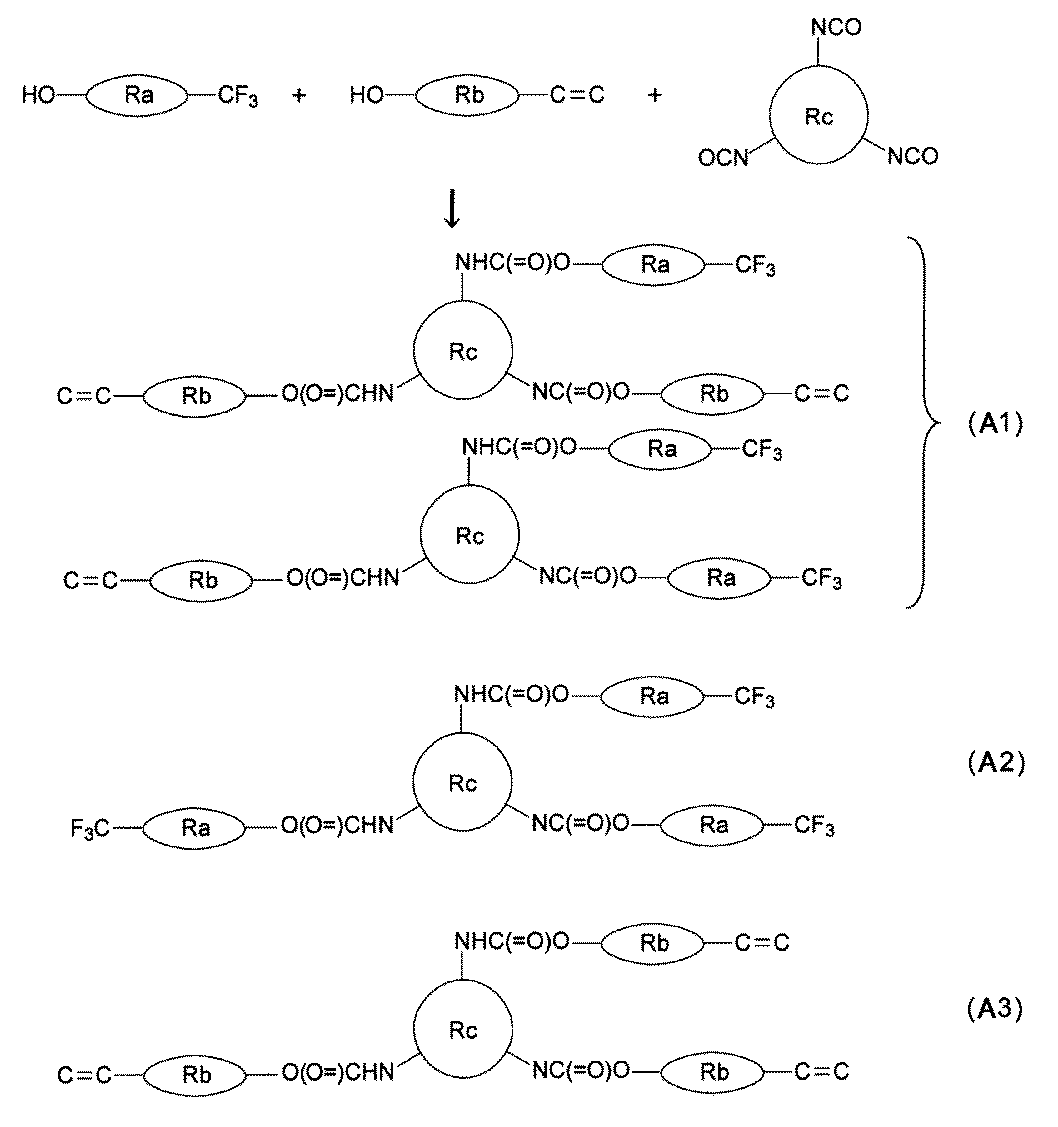
化合物(a)は、ポリ(オキシペルフルオロアルキレン)鎖および活性水素含有基を有する化合物である。
化合物(a)としては、対象物(ハードコート層等)に防汚性を充分に付与する点から、ポリ(オキシペルフルオロアルキレン)鎖および1つの活性水素含有基を有する化合物が好ましい。
化合物(a1)は、対象物(ハードコート層等)に防汚性を充分に付与する点から、1つのペルフルオロアルキル基を有することが好ましい。
ポリ(オキシペルフルオロアルキレン)鎖は、対象物に防汚性を付与する。
ポリ(オキシペルフルオロアルキレン)鎖としては、対象物に防汚性を充分に付与する点から、下式で表される鎖が好ましい。
(CmF2mO)n
ただし、mは、1~6の整数であり、nは、2~200の整数であり、(CmF2mO)nは、mの異なる2種以上のCmF2mOからなるものであってもよい。
mが2以上の場合、CmF2mOは、直鎖状であってもよく、分岐状であってもよい。対象物に防汚性を充分に付与する点からは、直鎖状が好ましい。
{(CF2O)n1(CF2CF2O)n2}は運動性に優れ、そのため、対象物の潤滑性が優れる。特に(CF2O)n1は、炭素数が1で酸素原子を有する基であるため、運動性により優れる。
活性水素含有基は、ポリイソシアネート(c)のイソシアナート基と反応し、化合物(a)の構造を含フッ素化合物(A)の構造の一部として組み入れるためのものである。
活性水素含有基としては、ヒドロキシ基、カルボキシ基、アミノ基等が挙げられる。原料の入手容易性の点から、ヒドロキシ基が特に好ましい。
D-(CmF2mO)n-E ・・・(1)
ただし、
Dは、D1-Rf-O-CH2-またはD2-O-であり、
D1は、CF3-またはCF3-O-であり、
Rfは、炭素数1~20のフルオロアルキレン基、炭素-炭素原子間にエーテル性酸素原子を有する炭素数2~20のフルオロアルキレン基、炭素数1~20のアルキレン基、または炭素-炭素原子間にエーテル性酸素原子を有する炭素数2~20のアルキレン基であり、
D2は、炭素数1~6のペルフルオロアルキル基であり、
mは、1~6の整数であり、
nは、2~200の整数であり、(CmF2mO)nは、mの異なる2種以上のCmF2mOからなるものであってもよく、
Eは、1つのヒドロキシ基を有する1価の有機基である。
-RF-O-CHFCF2- ・・・(g1-1)
-RF-CHFCF2- ・・・(g1-2)
-RF-CzH2z- ・・・(g1-3)
ただし、RFは、単結合、炭素数1~15のペルフルオロアルキレン基、または炭素-炭素原子間にエーテル性酸素原子を有する炭素数2~15のペルフルオロアルキレン基であり、zは、1~4の整数である。
zは、1~3の整数が好ましい。zが3以上の場合、CzH2zは、直鎖状であってもよく、分岐状であってもよく、直鎖状が好ましい。
RF2-O-CHFCF2-O-CH2- ・・・(g2)
ただし、RF2は、末端がCF3である、炭素数1~6のペルフルオロアルキル基である。
式(g2)で表される基は、HO-CH2-を有するポリ(オキシペルフルオロアルキレン)鎖含有化合物に、RF2-O-CF=CF2で表されるペルフルオロ(アルキルビニルエーテル)を付加させることにより形成できる。
式(g2)で表される基の具体例としては、以下の基が挙げられる。
CF3O-CHFCF2-O-CH2-、
CF3CF2-O-CHFCF2-O-CH2-、
CF3CF2CF2-O-CHFCF2-O-CH2-、
CF3CF2CF2CF2-O-CHFCF2-O-CH2-、
CF3CF2CF2CF2CF2CF2-O-CHFCF2-O-CH2-。
D2としては、対象物に防汚性を充分に付与する点から、炭素数1~3のペルフルオロアルキル基が好ましく、CF3-またはCF3CF2-が特に好ましい。
R1としては、炭素数10以下のアルキレン基、-OH側末端がメチレン基である炭素数10以下のフルオロアルキレン基が好ましい。
Eとしては、-CF2CH2-OH、-CF2CF2CH2-OH、-CF2CF2CF2CH2-OHが好ましい。
CF3CF2-O-(CF2CF2CF2O)n10-CF2CF2CH2-OH ・・・(11)
CF3-CF2CF2-O-CHFCF2-O-CH2-CF2O{(CF2O)n11-1(CF2CF2O)n12}-CF2CH2-OH ・・・(12)
CF3-O-{(CF2O)n11(CF2CF2O)n12}-CF2CH2-OH ・・・(13)
CF3-O-[(CF2CF2O-CF2CF2CF2CF2O)n13-CF2CF2O]-CF2CF2CF2CH2-OH ・・・(14)
CF3-O-(CF2CF2O)n10-CF2CH2-OH ・・・(15)
ただし、n10は、2~200の整数であり、n11は、1以上の整数であり、n12は、0以上の整数であり、n11+n12は、2~200の整数であり、n11個のCF2Oおよびn12個のCF2CF2Oの結合順序は限定されず、n13×2+1は、3~200の整数である。
化合物(a)の数平均分子量は、1,000~6,000が好ましく、1,000~5,000がより好ましく、1,200~4,000が特に好ましい。化合物(a)の数平均分子量が該範囲内であれば、対象物に防汚性を充分に付与できるとともに、化合物(a)が組成物における他の成分との相溶性に優れる。
化合物(a)の数平均分子量は、ゲルパーミエーションクロマトグラフィ(GPC)によってポリメチルメタクリレートの流出時間と比較すること、あるいは核磁気共鳴装置(NMR)によって内部標準物質と化合物(a)の末端官能基の積分比を比較することにより求められる。
化合物(a)を製造する方法としては、活性水素含有基がヒドロキシ基である場合、たとえば、下記の方法(1)または方法(2)が挙げられる。
(1)ポリ(オキシペルフルオロアルキレン)鎖および2つのカルボキシ基を有する化合物にフッ素ガスを接触させて、カルボキシ基の一部をフッ素化した後、残りのカルボキシ基を還元する方法(特開2011-116947号公報参照)。ポリ(オキシペルフルオロアルキレン)鎖および2つのカルボキシ基を有する化合物としては市販の化合物を使用できる。
(2)ポリ(オキシペルフルオロアルキレン)鎖および2つのヒドロキシ基を有する化合物とペルフルオロ(アルキルビニルエーテル)とを反応させ、ヒドロキシ基の一部にペルフルオロビニル基を付加させる方法。ポリ(オキシペルフルオロアルキレン)鎖および2つのヒドロキシ基を有する化合物としては、市販の化合物を使用できる。市販の化合物としては、たとえば、「FLUOROLINK D」(商品名)、「Fomblin Z-Dol」(商品名)等が挙げられる。
上記2つの方法では2つのヒドロキシ基を有する化合物が生成ないし未反応で残ることが少なくないことより、2つのヒドロキシ基を有する化合物は除去することが好ましい。ただし、2つのヒドロキシ基を有する化合物の含有量が少ない場合は、化合物(a)として2つのヒドロキシ基を有する化合物の含有を含有する混合物を化合物(a)として使用できる。
方法(1)の具体的な一例を以下に説明する。
化合物(53-1)をフッ素ガスと接触させて、化合物(43-1)、未反応の化合物(53-1)および化合物(33-1)からなる混合物(d)を得る。
CF3-O-{(CF2O)p(CF2CF2O)q}-CF2C(=O)OH ・・・(43-1)
HO-C(=O)-CF2O{(CF2O)p(CF2CF2O)q}-CF2C(=O)-OH ・・・(53-1)
CF3-O-{(CF2O)p(CF2CF2O)q}-CF3 ・・・(33-1)
ただし、pは1以上の整数であり、qは0以上の整数であり、p+q+1は3~200の整数であり、pのCF2Oおよびq個のCF2CF2Oの結合順序は限定されない。
CF3-O-{(CF2O)p(CF2CF2O)q}-CF2CH2-OH ・・・(13-1)
HO-CH2-CF2O{(CF2O)p(CF2CF2O)q}-CF2CH2-OH ・・・(23-1)
CF3-O-{(CF2O)p(CF2CF2O)q}-CF3 ・・・(33-1)
方法(2)の具体的な一例を以下に説明する。
化合物(23-1)とペルフルオロ(n-プロピルビニルエーテル)(CF3CF2CF2-O-CF=CF2)とを反応させて、化合物(12-1)、未反応の化合物(23-1)および化合物(32-1)からなる混合物を得る。
CF3-CF2CF2-O-CHFCF2-O-CH2-CF2O{(CF2O)p(CF2CF2O)q}-CF2CH2-OH ・・・(12-1)
HO-CH2-CF2O{(CF2O)p(CF2CF2O)q}-CF2CH2-OH ・・・(23-1)
CF3-CF2CF2-O-CHFCF2-O-CH2-CF2O{(CF2O)p(CF2CF2O)q}-CF2CH2-O-CF2CHF-O-CF2CF2-CF3 ・・・(32-1)
目的の化合物(a)が化合物(a1)である場合、方法(1)においては、化合物(a2)、ならびにポリ(オキシペルフルオロアルキレン)鎖および2つのペルフルオロアルキル基を有し、活性水素含有基を有しない化合物(e1)が副生され得る。
目的の化合物(a)が化合物(a1)である場合、方法(2)においては、未反応の化合物(a2)が残存し得る。また、化合物(e1)が副生され得る。
HO-CH2-CF2CF2O(CF2CF2CF2O)n20-1-CF2CF2CH2-OH ・・・(21)
HO-CH2-CF2O{(CF2O)n21-1(CF2CF2O)n22}-CF2CH2-OH ・・・(23)
HO-CH2-CF2CF2CF2O[(CF2CF2O-CF2CF2CF2CF2O)n23-CF2CF2O]-CF2CF2CF2CH2-OH ・・・(24)
HO-CH2-CF2O(CF2CF2O)n20-1-CF2CH2OH ・・・(25)
ただし、n20は、2~200の整数であり、n21は、1以上の整数であり、n22は、0以上の整数であり、n21+n22は、2~200の整数であり、n21個のCF2Oおよびn22個のCF2CF2Oの結合順序は限定されず、n23×2+2は、4~200の整数である。
CF3CF2-O-(CF2CF2CF2O)n30-CF2CF3 ・・・(31)
CF3-CF2CF2-O-CHFCF2-O-CH2-CF2O{(CF2O)n31-1(CF2CF2O)n32}-CF2CH2-O-CF2CHF-O-CF2CF2-CF3 ・・・(32)
CF3-O-{(CF2O)n31(CF2CF2O)n32}-CF3 ・・・(33)
CF3-O-(CF2CF2O)n30-CF3 ・・・(35)
ただし、n30は、2~200の整数であり、n31は、1以上の整数であり、n32は、0以上の整数であり、n31+n32は、2~200の整数であり、n31個のCF2Oおよびn32個のCF2CF2Oの結合順序は限定されない。
化合物(b)は、重合性炭素-炭素二重結合および活性水素含有基を有する化合物である。
重合性炭素-炭素二重結合は、光照射により、組成物に含まれる後述の光重合性化合物と反応し、対象物(ハードコート層等)に耐摩耗性を付与する。
重合性炭素-炭素二重結合を有する基としては、(メタ)アクリロイル基、ビニル基、アリル基、スチリル基、マレイミド基等が挙げられる。対象物に耐摩耗性を充分に付与する点から、(メタ)アクリロイル基が好ましく、アクリロイル基が特に好ましい。
重合性炭素-炭素二重結合の数は、化合物(b)の1分子あたり、1~8が好ましく、1~4がより好ましく、1が特に好ましい。
活性水素含有基としては、化合物(a)の活性水素含有基と同様のものが挙げられ、好ましい態様も同様である。
活性水素含有基の数は、化合物(b)の1分子あたり、1が好ましい。
HOCH2CH2OC(=O)C(R)=CH2、
H2NCH2CH2OC(=O)C(R)=CH2、
HO(CH2CH2O)i-C(=O)C(R)C=CH2、
CH3CH(OH)CH2OC(=O)C(R)C=CH2、
CH3CH2CH(OH)CH2OC(=O)C(R)C=CH2、
C6H5OCH2CH(OH)CH2OC(=O)C(R)C=CH2、
HOCH2CH=CH2、
HO(CH2)kCH=CH2、
(CH3)3SiCH(OH)CH=CH2、
HOC6H4CH=CHC6H5。
ただし、Rは、水素原子またはメチル基であり、iは、2~10の整数であり、kは、2~20の整数である。
ポリイソシアネート(c)は、2つ以上のイソシアナート基を有する化合物である。
イソシアナート基は、化合物(a)の活性水素含有基または化合物(b)の活性水素含有基と反応し、ポリイソシアネート(c)の構造を含フッ素化合物(A)の構造の一部として組み入れるためのものである。
イソシアナート基の数は、1分子あたり平均2.5~4が好ましく、3が特に好ましい。
ポリイソシアネート(c)としては、ヘキサメチレンジイソシアネート、イソホロンジイソシアネート、4,4’-ジシクロヘキシルメタンジイソシアネート、トリレンジイソシアネート、4,4’-ジフェニルメタンジイソシアネート、キシリレンジイソシアネート等のジイソシアネート、および、ジイソシアネートの変性体等のトリイソシアネートまたはテトライソシアネートが挙げられる。
下式(6-1)で表されるイソシアヌレート変性アルキレンジイソシアネート(アルキレンジイソシアネートの環状3量体)、
下式(6-2)で表されるイソシアヌレート変性トリレンジイソシアネート(トリレンジイソシアネートの環状3量体)、
下式(6-3)で表されるイソシアヌレート変性イソホロンジイソシアネート(イソホロンジイソシアネートの環状3量体)、
下式(6-4)で表されるビュレット変性アルキレンジイソシアネート、
下式(6-5)で表されるグリセロール変性アルキレンジイソシアネート。
ただし、s、tおよびuは、それぞれ独立に2~10の整数である。
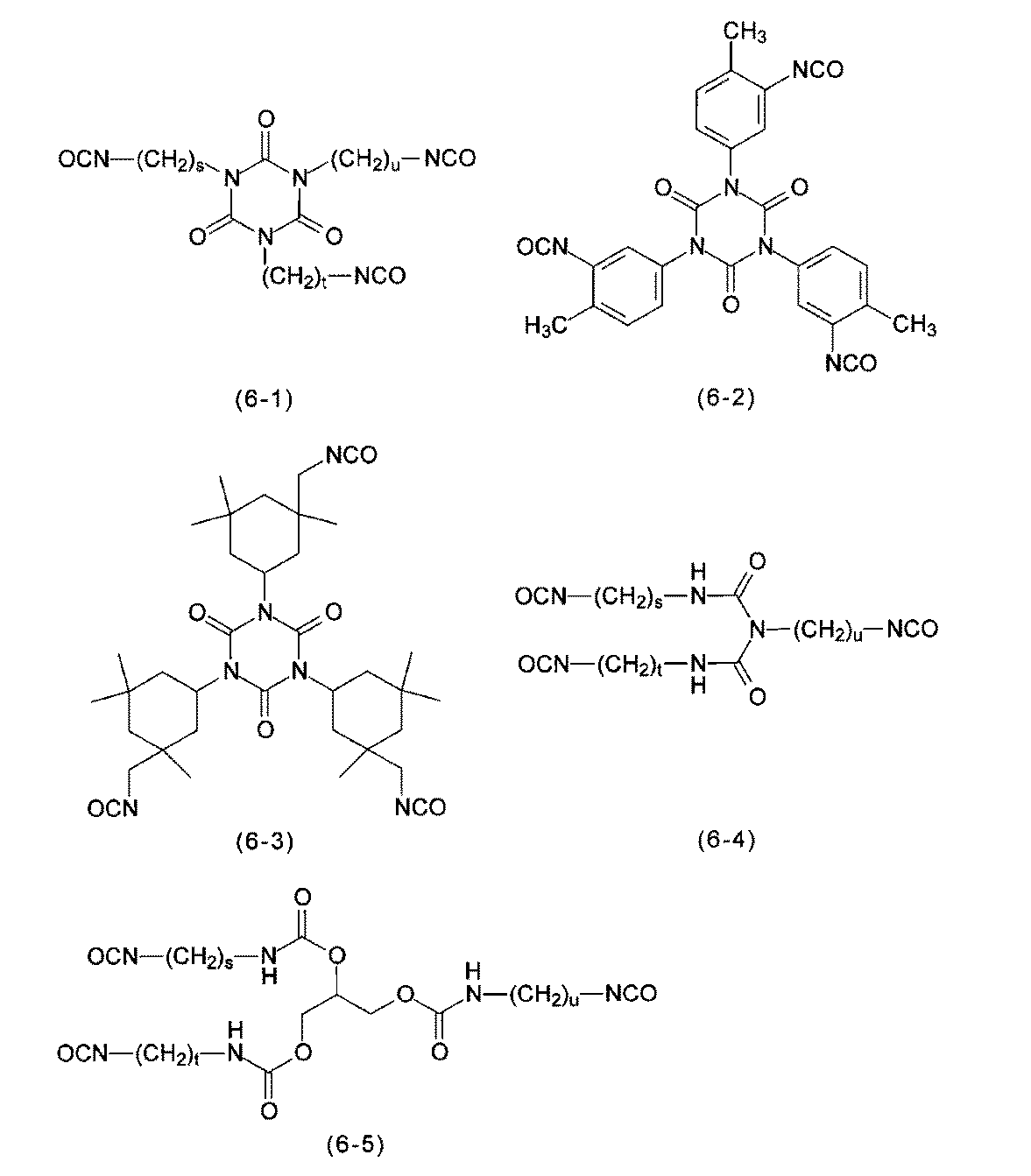
含フッ素化合物(A)の数平均分子量は、1,200~8,000が好ましく、1,200~7,000がより好ましく、1,200~5,000が特に好ましい。数平均分子量が該範囲内であれば、対象物(ハードコート層等)に防汚性を充分に付与できるとともに、組成物において含フッ素化合物(A)と他の成分との相溶性に優れる。
含フッ素化合物(A)の数平均分子量は、ゲルパーミエーションクロマトグラフィ(GPC)によって求めたポリメチルメタクリレート換算の数平均分子量である。
化合物(B)は、重合性炭素-炭素二重結合および活性水素含有基を有する化合物である。活性水素基としては、消泡効果に優れる点から、ヒドロキシ基が好ましい。
化合物(B)は、具体的には、化合物(b)、化合物(b)以外の重合性炭素-炭素二重結合および活性水素含有基を有する化合物、またはそれらの混合物である。
すなわち、化合物(B)は、本発明の含フッ素化合物含有組成物を製造する際に用い、本発明の含フッ素化合物含有組成物に残存した未反応の化合物(b)であってもよく、化合物(a)と化合物(b)とポリイソシアネート(c)とを反応させて含フッ素化合物(A)を得た後に添加された化合物であってもよい。
含フッ素化合物(A)においては、化合物(b)を過剰に用いることより未反応の(b)を含む反応生成物が得られる。したがって、本発明の組成物における化合物(B)の少なくとも一部は含フッ素化合物(A)の製造に使用した化合物(b)である。
溶媒(S1)は、含フッ素化合物(A)の製造において不活性であり、原料化合物を溶解しうる溶媒であり、かつ含フッ素化合物(A)および化合物(B)を溶解し得るものであればよく、特に限定はされない。
溶媒(S1)は、本発明の含フッ素化合物含有組成物を製造する際に用いた反応用溶媒であり、下記コーティング用溶媒の一部または全部であってもよい。
溶媒(S1)としては、化合物(a)等の原料化合物および得られる含フッ素化合物(A)のいずれに対しても溶解性の高い溶媒が好ましい。また、前記のように含フッ素化合物(A)の製造において不活性の溶媒である。たとえば、活性水素含有基を有しない溶媒である。溶媒(S1)としては、フッ素系有機溶媒が好ましく、たとえば、フルオロアルカン、ハイドロクロロフルオロアルカン、クロロフルオロアルカン、フルオロ芳香族化合物、フルオロアルキルエーテルが挙げられる。溶媒(S1)としては、クロロフルオロアルカンおよびフルオロアルキルエーテルが好ましい。
溶媒(S1)として特に化合物(a)の溶解性が高い溶媒を使用することより、下記コーティング用溶媒とは異なる溶媒を使用することが少なくない。その場合、本発明の組成物(X)中の溶媒(S1)を下記コーティング用溶媒に置換して本発明の組成物(Y)とし、コーティング液の製造に使用する。
コーティング液中の溶媒は、コーティングに適した溶媒(以下、「コーティング用溶媒」と記す。)が好ましい。コーティング用溶媒としては、塗布方法に適した沸点を有する有機溶媒が好ましく、沸点が80℃以上の有機溶媒がより好ましい。
有機溶媒は、フッ素系有機溶媒であっても、非フッ素系有機溶媒であってもよく、両溶媒を含んでもよい。
フッ素系有機溶媒としては、含フッ素化合物(A)が溶解しやすい点から、フルオロアルカン、フルオロ芳香族化合物、フルオロアルコール、フルオロアルキルエーテルが好ましく、フルオロアルコールまたはフルオロアルキルエーテルが特に好ましい。
非フッ素系有機溶媒としては、含フッ素化合物(A)が溶解しやすい点から、グリコールエーテル系有機溶媒およびケトン系有機溶媒が特に好ましい。
溶媒(S2)は化合物(a)等の原料化合物の溶解性が低い非フッ素系有機溶媒や前記反応用溶媒としては使用できない活性水素含有基を有するフッ素系有機溶媒を含む溶媒である。非フッ素系溶媒は活性水素含有基を有する非フッ素系溶媒であってもよい。
活性水素含有基を有するフッ素系溶媒としてフルオロアルコールが挙げられる。活性水素含有基を有する非フッ素系溶媒としては、アルキレングリコールモノアルキルエーテル等の水酸基を含む非フッ素系有機溶媒が挙げられる。
組成物(X)および組成物(Y)における含フッ素化合物(A)の含有量は、該組成物(100質量%)のうち、5~30質量%であり、5~25質量%が好ましく、10~20質量%が特に好ましい。含フッ素化合物(A)の含有量が前記範囲の下限値以上であれば、組成物(X)を製造する際に用いる溶媒(S1)の量を抑えることができ、溶媒(S1)を、コーティング用溶媒に置換する際の手間およびエネルギーを低減できる。また、組成物(Y)の場合は、組成物(Y)を出荷等する際の容量を低減できる。含フッ素化合物(A)の含有量が前記範囲の上限値以下であれば、組成物(X)および組成物(Y)への含フッ素化合物(A)の溶解性に優れる。
不純物のうち、化合物(a)および化合物(e1)は、他の成分との相溶性が低いため、組成物に化合物(a)および化合物(e1)が残存した場合、組成物が白濁する。よって、化合物(a)および化合物(e1)の合計の含有量は、組成物(100質量%)のうち、1質量%以下が好ましく、0.5質量%以下が特に好ましい。
不純物のうち、ポリイソシアネート(c)は、他の成分との反応性が高いため、組成物にポリイソシアネート(c)が残存した場合、組成物の貯蔵安定性が低下する。よって、ポリイソシアネート(c)の含有量は、実質的に0であることが必要である。また、イソシアネート基含有中間体等のイソシアネート基を含む化合物の含有量も実質的に0であることが好ましい。
不純物の同定および定量は、1H-NMRおよび19F-NMRあるいはガスクロマトグラフィによって行う。
本発明の組成物(X)は、下記方法によって製造できる。
化合物(a)と化合物(b)とポリイソシアネート(c)を溶媒(S1)中で反応させて製造する方法であって、ポリイソシアネート(c)の使用量が化合物(a)に対して等当量以上でかつ化合物(a)と化合物(b)の合計当量に対して等当量未満であり、必要により反応終了後化合物(B)を添加し、溶媒(S1)の使用量の調節および未反応の化合物(b)と任意に添加された化合物(B)の合計量の調節により含フッ素化合物(A)と前記化合物(B)の含有量を前記含有量の範囲に調整する方法。
上記製造方法において、イソシアネート基と活性水素含有基の反応を促進するための触媒や、重合性炭素-炭素二重結合の反応を抑制するための重合禁止剤を反応系に存在させて反応を行うこともできる。触媒としては、ジブチル錫ジラウレート、トリエチルアミン等のウレタン化触媒が挙げられる。
上記製造方法において、溶媒(S1)中の原料化合物の量を調整することで、生成する含フッ素化合物の含有量を5~30質量%とすることができる。
溶媒(S1)をコーティング用溶媒に置換する方法としては、組成物(X)から溶媒(S1)を留去した後、コーティング用溶媒を添加する方法が挙げられる。溶媒(S1)の一部を留去し、溶媒(S1)以外の溶媒(たとえば、溶媒(S2))を添加して、溶媒(S1)と溶媒(S1)以外の溶媒との混合溶媒をコーティング用溶媒としてもよい。
留去方法としては、蒸留等の公知の方法が挙げられる。
以上説明した本発明の組成物(X)、組成物(Y)およびそれらの製造方法にあっては、化合物(a)と化合物(b)とポリイソシアネート(c)とを反応させることによって、含フッ素化合物(A)を得ているため、化合物(a)に由来する構造(特に末端のCF3-)によって、対象物(ハードコート層等)の表面の表面エネルギーが低下する。その結果、防汚性を対象物に付与できる。
また、化合物(B)を0.1質量%以上含ませているため、極性の高い活性水素含有基を有する化合物(B)による消泡効果によって組成物の泡立ちが抑えられる。
本発明のコーティング液は、含フッ素化合物含有組成物と、光重合性化合物(ただし、含フッ素化合物(A)および化合物(B)を除く。)と、光重合開始剤とを含む。本発明のコーティング液は、必要に応じて、コーティング液用添加剤をさらに含んでいてもよい。
コーティング液の組成は前記組成物(X)や組成物(Y)の組成に限定されない。たとえば、組成物(X)や組成物(Y)にさらにコーティング用溶媒を添加して含フッ素化合物(A)や化合物(B)の濃度を下げることができる。
光重合性化合物は、後述する光重合開始剤の存在下、光を照射することによって重合反応を開始するモノマーである。
光重合性化合物としては、多官能性モノマー、単官能性モノマーが挙げられる。対象物(ハードコート層等)に耐摩耗性を付与する点から、多官能性モノマーを必須成分として含むものが好ましい。
光重合性化合物は、1種を単独で用いてもよく、2種以上を併用してもよい。
多官能性モノマーとしては、対象物に充分な耐摩耗性を付与する点から、(メタ)アクリロイル基の3つ以上を有し、(メタ)アクリロイル基1つあたりの分子量が120以下であるモノマー、またはウレタン結合および(メタ)アクリロイル基の3つ以上を有するモノマーが好ましい。
光重合開始剤としては、公知の光重合開始剤、たとえば、アリールケトン系光重合開始剤(アセトフェノン類、ベンゾフェノン類、アルキルアミノベンゾフェノン類、ベンジル類、ベンゾイン類、ベンゾインエーテル類、ベンジルジメチルケタール類、ベンゾイルベンゾエート類、α-アシルオキシムエステル類等)、含硫黄系光重合開始剤(スルフィド類、チオキサントン類等)、アシルホスフィンオキシド類(アシルジアリールホスフィンオキシド等)、その他の光重合開始剤が挙げられる。
光重合開始剤は、1種を単独で用いてもよく、2種以上を併用してもよい。
光重合開始剤は、アミン類等の光増感剤と併用してもよい。
コーティング液用添加剤としては、コロイダルシリカ、光増感剤、紫外線吸収剤、光安定剤、熱硬化安定剤、酸化防止剤、レベリング剤、消泡剤、増粘剤、沈降防止剤、顔料、染料、分散剤、帯電防止剤、界面活性剤(防曇剤、レベリング剤等)、金属酸化物粒子、各種樹脂(エポキシ樹脂、不飽和ポリエステル樹脂、ポリウレタン樹脂等)等が挙げられる。
含フッ素化合物(A)の含有量は、コーティング液(ただし、溶媒を除く。)(100質量%)のうち、0.01~5質量%が好ましく、0.02~4質量%がより好ましく、0.05~3質量%が特に好ましい。含フッ素化合物(A)の含有量が前記範囲内であれば、コーティング液の貯蔵安定性、対象物(ハードコート層等)の外観、耐摩耗性および防汚性に優れる。
コーティング液中のコーティング用溶媒の含有量は、コーティング液(100質量%)のうち、5~80質量%が好ましく、10~70質量%がより好ましく、20~60質量%が特に好ましい。
本発明のハードコート層形成用組成物は、本発明のコーティング液からなる。
本発明のコーティング液は、これから形成された塗膜の硬化に際して加熱が不要であるため、ガラス等に比較して耐熱性の低い樹脂からなる基材に、ハードコート層を形成する際に好適に用いられる。
以上説明した本発明のコーティング液およびハードコート層形成用組成物にあっては、含フッ素化合物(A)を含むため、防汚性に優れる対象物(ハードコート層等)を形成できる。
本発明の物品は、基材と、本発明のハードコート層形成用組成物から形成したハードコート層とを有する。
ハードコート層は、基材の少なくとも1つの表面に直接形成されていてもよく、基材の少なくとも1つの表面に後述するプライマ層を介して形成されたものであってもよい。
ハードコート層の厚さは、耐摩耗性および防汚性の点から、0.5~20μmが好ましく、1~15μmが特に好ましい。
基材は、耐摩耗性および防汚性が必要とされる種々の物品(光学レンズ、ディスプレイ、光記録媒体等)の本体部分、または該物品の表面を構成する部材である。
基材の表面の材料としては、金属、樹脂、ガラス、セラミック、石、これらの複合材料等が挙げられる。光学レンズ、ディスプレイ、光記録媒体における基材の表面の材料としては、ガラスまたは透明樹脂基材が好ましい。
本発明の物品は、基材とハードコート層との密着性を向上させる点から、基材とハードコート層との間にプライマ層をさらに有していてもよい。
プライマ層としては、公知のものが挙げられる。プライマ層は、たとえば、溶媒を含むプライマ層形成用組成物を基材の表面に塗布し、溶媒を蒸発除去することによって形成される。
本発明の物品は、タッチパネルを構成する部材として好適である。タッチパネルとは、指等による接触によってその接触位置情報を入力する装置と表示装置とを組み合わせた入力/表示装置(タッチパネル装置)の、入力装置である。タッチパネルは、基材と、入力検出手段等とから構成される。入力検出手段は、たとえば、透明導電膜、電極、配線、IC等から構成される。物品のハードコート層を有する面をタッチパネルの入力面とすることによって、防汚性および耐摩耗性に優れるタッチパネルが得られる。
物品は、たとえば、下記の工程(I)および工程(II)を経て製造される。
工程(I):必要に応じて、プライマ層形成用組成物を基材の表面に塗布してプライマ層を形成する工程。
工程(II):ハードコート層形成用組成物を基材またはプライマ層の表面に塗布して塗膜を得て、コーティング用溶媒を除去し、光硬化させてハードコート層を形成する工程。
以上説明した本発明の物品にあっては、ハードコート層形成用組成物から形成したハードコート層を有するため、防汚性に優れる。
例1は実施例であり、例2、3は比較例である。
AC-2000:C6F13H(旭硝子社製、アサヒクリン(登録商標)AC-2000)、
AE-3000:CF3CH2OCF2CF2H(旭硝子社製、アサヒクリン(登録商標)AE-3000)、
L:リットル、
Mn:数平均分子量。
(化合物(a)のMn)
化合物(a)の数平均分子量は、核磁気共鳴装置(NMR)によって内部標準物質と化合物(a)の末端官能基の積分比を比較することにより求めた。
下記の基準にしたがい、目視によって調製直後のハードコート層形成用組成物の外観を評価した。
○(良好):溶液が均一で濁りがない。
△(可) :わずかに濁りが確認できる。
×(不可):濁りが目視で明らかに確認できる。
ハードコート層形成用組成物を室温で3ヶ月静置した後、目視によってハードコート層形成用組成物の外観を評価した。
○(良好):溶液が均一で濁りがない。
△(可) :わずかに濁りが確認できる。
×(不可):濁りが目視で明らかに確認できる。
下記の基準にしたがい、目視によってハードコート層の外観を評価した。
○(良好):異物が確認できず、膜厚が均一である。
△(可) :異物は確認できないが、膜厚にムラがある。
×(不良):異物が確認され、膜厚にムラがある。
人工指紋液(オレイン酸とスクアレンとからなる液)を、シリコンゴム栓の平坦面に付着させた後、余分な油分を不織布(旭化成社製、ベンコット(登録商標)M-3)にて拭き取り、指紋のスタンプを準備した。該指紋スタンプを、ハードコート層を有する物品上に乗せ、荷重:9.8Nにて10秒間押しつけた。指紋が付着した箇所について、ティッシュペーパを取り付けた、往復式トラバース試験機(ケイエヌテー社製)を用い、荷重:4.9Nにて拭き取りを行った。拭き取り一往復毎にヘーズを目視で観察し、10往復後までのヘーズを目視で観察することによって評価した。評価基準は下記の通りである。
○(良好):ヘーズを目視で確認できない。
△(可) :ヘーズを目視でわずかに確認できる。
×(不可):ヘーズを目視で明らかに確認できる。
ハードコート層の表面にフェルトペン(ゼブラ社製、マッキー極太黒色)で線を描き、油性インクの付着状態を目視で観察することによって評価した。評価基準は下記の通りである。
◎(優良):油性インクを玉状にはじく。
○(良好):油性インクを玉状にはじかず、線状にはじき、線幅がフェルトペンのペン先の幅の50%未満である。
△(可) :油性インクを玉状にはじかず、線状にはじき、線幅がフェルトペンのペン先の幅の50%以上100%未満である。
×(不良):油性インクを玉状にも線状にもはじかず、表面にきれいに線が描ける。
ハードコート層を有する物品について、往復式トラバース試験機(ケイエヌテー社製)を用い、スチールウール(日本スチールウール社製、ボンスター(登録商標)#0000)を荷重:9.8Nにて100回往復させた後、JIS R3257:1999「基板ガラス表面のぬれ性試験方法」に準拠して、液滴:約2μL/滴、温度:20℃の条件で水接触角およびオレイン酸接触角を測定した。各接触角は、3箇所で測定して、それらの平均値とした。評価基準は下記の通りである。
○(良好):水接触角、オレイン酸接触角ともに、初期接触角との差が10%未満。
△(可) :水接触角、オレイン酸接触角のいずれかが、初期接触角との差が10%未満。
×(不可):水接触角、オレイン酸接触角ともに、初期接触角との差が10%以上。
ハードコート層の表面の鉛筆硬度を、JIS K5600-5-4:1999(ISO 15184:1996)「引っかき硬度(鉛筆法)」に準じて測定した。
(化合物(13-1-1)の製造)
特開2011-116947号公報の段落[0061]、[0062]に記載の方法にしたがい、化合物(53-1-1)(ソルベイ・ソレクシス社製、FLUOROLINK(登録商標) C)から、化合物(13-1-1)、化合物(23-1-1)および化合物(33-1-1)からなる混合物を得た。
HO-C(=O)-CF2O{(CF2O)p(CF2CF2O)q}-CF2C(=O)-OH ・・・(53-1-1)
CF3-O-{(CF2O)p(CF2CF2O)q}-CF2CH2-OH ・・・(13-1-1)
HO-CH2-CF2O{(CF2O)p(CF2CF2O)q}-CF2CH2-OH ・・・(23-1-1)
CF3-O-{(CF2O)p(CF2CF2O)q}-CF3 ・・・(33-1-1)
ただし、p/q=0.6、p+q≒15である。
(化合物(b))
(b-1):HOCH2CH2OC(=O)CH=CH2(日本触媒社製、2-ヒドロキシエチルアクリレート)。
(c-1):式(6-1)で表されるイソシアヌレート変性ヘキサメチレンジイソシアネート(旭化成ケミカルズ社製、DURANATE(登録商標)TKA-100、ヘキサメチレンジイソシアネートの環状3量体、イソシアネート基含有量:21.8質量%)。
(S1-1):CF3CF2CHCl2とCClF2CF2CHClFとの混合物(旭硝子社製、アサヒクリン(登録商標)AK-225、沸点:54~56℃)。
DBTDL:ジブチル錫ジラウレート。
(s-1):1,1,2,2,3,3,4-ヘプタフルオロシクロペンタン(日本ゼオン社製、ゼオローラ(登録商標)H、沸点:82.5℃)、
(s-2):プロピレングリコールモノメチルエーテル(沸点:120℃)。
(s-3):2,2,3,3-テトラフルオロプロパノール、
(m-1):ジペンタエリスリトールヘキサアクリレート、
(m-2):トリス(アクリロイルオキシエチル)イソシアヌレート。
(i-1):2-メチル-1-{4-(メチルチオ)フェニル}-2-モルホリノプロパン-1-オン。
(含フッ素化合物含有組成物の製造)
撹拌機を装着した50mLの2つ口フラスコに、トリイソシアネート(c-1)の1.0g、溶媒(S1-1)の6.0gを入れ、DBTDLの7.5mgおよび2,6-ジ-tert-ブチル-p-クレゾールの0.3mgを加えた。窒素雰囲気中、40℃で撹拌しながら1時間かけて、化合物(13-1-1)の0.94gを溶媒(S1-1)の1.0gに溶かした溶液を滴下し、40℃で12時間撹拌した。化合物(b-1)の0.656gを2分間で滴下し、12時間撹拌した。赤外吸収スペクトルによってイソシアナート基の吸収が完全に消失していることを確認できた。
ロータリーエバポレータによって溶媒(S1-1)を減圧留去した。減圧留去中には泡立ちが見られず、15分で留去が終了した。溶媒(s-1):溶媒(s-2)=5:3(質量比)の混合溶媒の9.8gを加え、含フッ素化合物含有組成物を得た。ガスクロマトグラフィ分析によって、含フッ素化合物含有組成物中に化合物(b-1)が1質量%含まれていることを確認した。
30mLのバイアル管に、含フッ素化合物含有組成物の1mg、光重合性化合物(m-1)の94mg、光重合性化合物(m-2)の94mg、光重合開始剤(i-1)の11mg、溶媒(s-3)の18mg、溶媒(s-2)の117mgを入れ、常温および遮光にした状態で、1時間撹拌して、ハードコート層形成用組成物を得た。
ポリエチレンテレフタレート基材の表面にハードコート層形成用組成物をバーコートにより塗布し、塗膜を形成し、50℃のホットプレートで1分間乾燥させ、基材の表面に乾燥膜を形成した。高圧水銀ランプを用いて紫外線(光量:300mJ/cm2、波長365nmの紫外線積算エネルギー量)を照射し、基材の表面に厚さ5μmのハードコート層を形成した。
ハードコート層形成用組成物およびハードコート層の評価結果を表1に示す。
化合物(b-1)の適下量を0.533gに変更した以外は、例1と同様にして、トリイソシアネート(c-1)と化合物(13-1-1)とを反応させた後、さらに化合物(b-1)を反応させた。赤外吸収スペクトルによってイソシアナート基の吸収が完全に消失していることを確認できた。
ロータリーエバポレータによって溶媒(S1-1)を減圧留去した。減圧留去中に溶液が泡立ち、減圧度を下げることができなかった。60分で留去が終了した。溶媒(s-1):溶媒(s-2)=5:3(質量比)の混合溶媒の9.9gを加え、含フッ素化合物含有組成物を得た。ガスクロマトグラフィ分析によって、含フッ素化合物含有組成物中に化合物(b-1)が0.01質量%含まれていることを確認した。
化合物(b-1)の適下量を1.77gに変更した以外は、例1と同様にして、トリイソシアネート(c-1)と化合物(13-1-1)とを反応させた後、さらに化合物(b-1)を反応させた。赤外吸収スペクトルによってイソシアナート基の吸収が完全に消失していることを確認できた。
ロータリーエバポレータによって溶媒(S1-1)を減圧留去した。15分で留去が終了した。溶媒(s-1):溶媒(s-2)=5:3(質量比)の混合溶媒の8.66gを加え、含フッ素化合物含有組成物を得た。含フッ素化合物含有組成物は白濁していた。ガスクロマトグラフィ分析によって、含フッ素化合物含有組成物中に化合物(b-1)が10質量%含まれていることを確認した。
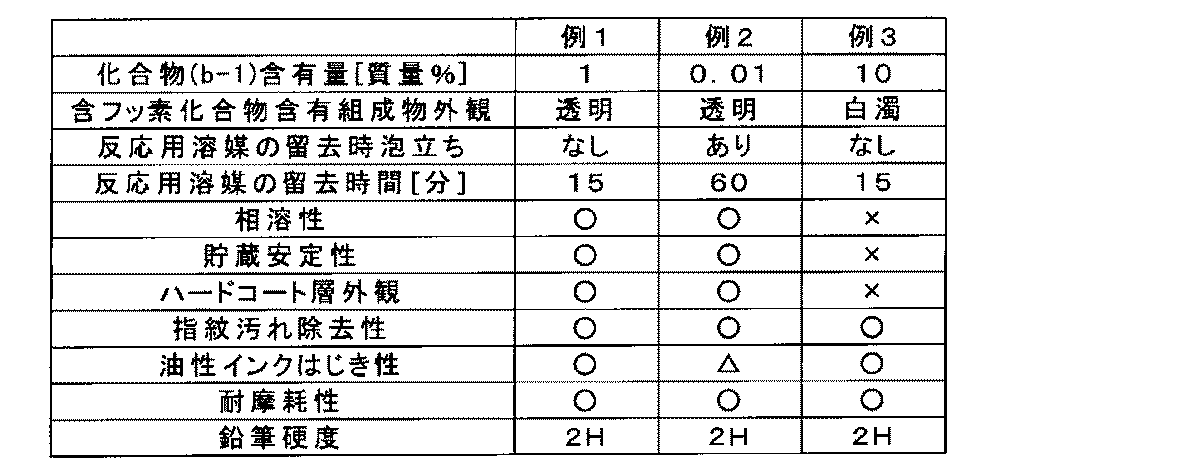
例2の含フッ素化合物含有組成物は、化合物(B)の含有量が0.1質量%未満であるため、反応用溶媒(x)を留去する際に溶液が泡立ち、留去に時間がかかった。
例3の含フッ素化合物含有組成物は、相溶性の低い化合物(B)の含有量が2質量%を超えるため、含フッ素化合物含有組成物が白濁した。また、貯蔵安定性が不充分であり、形成したハードコート層の外観も不充分であった。
なお、2015年4月30日に出願された日本特許出願2015-092930号の明細書、特許請求の範囲および要約書の全内容をここに引用し、本発明の明細書の開示として、取り入れるものである。
Claims (12)
- 下記含フッ素化合物(A)と下記化合物(B)と溶媒(S1)とを含む組成物であって、前記組成物中の下記含フッ素化合物(A)の含有量が組成物に対して5~30質量%であり、下記化合物(B)の含有量が組成物に対して0.1~2質量%であることを特徴とする組成物。
含フッ素化合物(A):ポリ(オキシペルフルオロアルキレン)鎖および活性水素含有基を有する化合物(a)に由来する部分と、重合性炭素-炭素二重結合および活性水素含有基を有する化合物(b)に由来する部分と、ポリイソシアネート(c)に由来する部分を有する化合物であって、イソシアネート基を有しない含フッ素化合物。
化合物(B):重合性炭素-炭素二重結合および活性水素含有基を有する化合物。 - 前記化合物(B)の少なくとも一部が前記化合物(b)である、請求項1に記載の組成物。
- 前記化合物(b)および化合物(b)以外の前記化合物(B)が、いずれも、1個のヒドロキシ基を有する化合物である、請求項1または2に記載の組成物。
- 前記化合物(a)が1個のヒドロキシ基を有する化合物である、請求項1~3のいずれか一項に記載の組成物。
- 前記化合物(a)と前記化合物(b)と前記ポリイソシアネート(c)を前記溶媒(S1)中で反応させて請求項1~4のいずれか一項に記載の組成物を製造する方法であって、前記ポリイソシアネート(c)の使用量が前記化合物(a)に対して等当量以上でかつ前記化合物(a)と前記化合物(b)の合計当量に対して等当量未満であり、必要により反応終了後前記化合物(B)を添加し、溶媒(S1)の使用量の調節および未反応の化合物(b)と任意に添加された前記化合物(B)の合計量の調節により前記含フッ素化合物(A)と前記化合物(B)の含有量を前記含有量の範囲に調整することを特徴とする組成物の製造方法。
- 前記化合物(a)と過剰当量の前記ポリイソシアネート(c)とを溶媒(S1)中で反応させてイソシアネート基を有する反応中間体を製造し、次いで前記反応中間体対して等当量を超える量の化合物(b)を反応系に加えて前記反応中間体に化合物(b)を反応させる、請求項5に記載の製造方法。
- 反応に使用する前記化合物(b)の量の調整により、反応終了後に前記化合物(B)を添加することなく、前記化合物(B)の含有量を前記含有量の範囲に調整する、請求項6に記載の製造方法。
- 下記含フッ素化合物(A)と下記化合物(B)と下記溶媒(S2)とを含む組成物であって、前記組成物中の下記含フッ素化合物(A)の含有量が組成物に対して5~30質量%であり、下記化合物(B)の含有量が組成物に対して0.1~2質量%であることを特徴とする組成物。
含フッ素化合物(A):ポリ(オキシペルフルオロアルキレン)鎖および活性水素含有基を有する化合物(a)に由来する部分と、重合性炭素-炭素二重結合および活性水素含有基を有する化合物(b)に由来する部分と、ポリイソシアネート(c)に由来する部分を有する化合物であって、イソシアネート基を有しない含フッ素化合物。
化合物(B):重合性炭素-炭素二重結合および活性水素含有基を有する化合物。
溶媒(S2):非フッ素系有機溶媒または活性水素含有基を有するフッ素系有機溶媒を含む溶媒。 - 請求項8に記載の含フッ素化合物含有組成物の製造方法であって、請求項1~4のいずれか一項に記載の組成物の溶媒(S1)の少なくとも一部を前記溶媒(S2)に置換することを特徴とする製造方法。
- 請求項1~4のいずれか一項に記載の組成物、または、請求項9に記載の含フッ素化合物含有組成物と、
光重合性化合物(ただし、前記含フッ素化合物(A)および前記化合物(B)を除く。)と、
光重合開始剤と
を含むことを特徴とするコーティング液。 - 請求項10に記載のコーティング液からなる、ハードコート層形成用組成物。
- 基材と、
請求項11に記載のハードコート層形成用組成物から形成したハードコート層と
を有することを特徴とする物品。
Priority Applications (4)
| Application Number | Priority Date | Filing Date | Title |
|---|---|---|---|
| CN201680024628.2A CN107531816B (zh) | 2015-04-30 | 2016-04-28 | 含有含氟化合物的组合物、其制造方法、涂布液、硬质涂层形成用组合物以及物品 |
| KR1020177022562A KR20170141648A (ko) | 2015-04-30 | 2016-04-28 | 함불소 화합물 함유 조성물, 그 제조 방법, 코팅액, 하드 코트층 형성용 조성물 및 물품 |
| JP2017515627A JP6708209B2 (ja) | 2015-04-30 | 2016-04-28 | 含フッ素化合物含有組成物、その製造方法、コーティング液、ハードコート層形成用組成物および物品 |
| US15/679,198 US10138315B2 (en) | 2015-04-30 | 2017-08-17 | Fluorinated compound-containing composition, method for its production, coating liquid, hard coat layer-forming composition and article |
Applications Claiming Priority (2)
| Application Number | Priority Date | Filing Date | Title |
|---|---|---|---|
| JP2015-092930 | 2015-04-30 | ||
| JP2015092930 | 2015-04-30 |
Related Child Applications (1)
| Application Number | Title | Priority Date | Filing Date |
|---|---|---|---|
| US15/679,198 Continuation US10138315B2 (en) | 2015-04-30 | 2017-08-17 | Fluorinated compound-containing composition, method for its production, coating liquid, hard coat layer-forming composition and article |
Publications (1)
| Publication Number | Publication Date |
|---|---|
| WO2016175317A1 true WO2016175317A1 (ja) | 2016-11-03 |
Family
ID=57198571
Family Applications (1)
| Application Number | Title | Priority Date | Filing Date |
|---|---|---|---|
| PCT/JP2016/063465 Ceased WO2016175317A1 (ja) | 2015-04-30 | 2016-04-28 | 含フッ素化合物含有組成物、その製造方法、コーティング液、ハードコート層形成用組成物および物品 |
Country Status (6)
| Country | Link |
|---|---|
| US (1) | US10138315B2 (ja) |
| JP (1) | JP6708209B2 (ja) |
| KR (1) | KR20170141648A (ja) |
| CN (1) | CN107531816B (ja) |
| TW (1) | TW201702279A (ja) |
| WO (1) | WO2016175317A1 (ja) |
Cited By (1)
| Publication number | Priority date | Publication date | Assignee | Title |
|---|---|---|---|---|
| JPWO2023013505A1 (ja) * | 2021-08-02 | 2023-02-09 |
Citations (6)
| Publication number | Priority date | Publication date | Assignee | Title |
|---|---|---|---|---|
| WO2003002628A1 (fr) * | 2001-06-27 | 2003-01-09 | Daikin Industries, Ltd. | Composition d'agent de traitement de surface et procede de fabrication associe |
| JP2005519146A (ja) * | 2002-02-28 | 2005-06-30 | ルバンティックス・カンパニー・リミテッド | 光導波路用光硬化性樹脂組成物およびそれから製造された光導波路 |
| WO2007102370A1 (ja) * | 2006-03-02 | 2007-09-13 | Dow Corning Corporation | 高エネルギー線硬化性組成物 |
| JP2009256598A (ja) * | 2008-03-26 | 2009-11-05 | Jsr Corp | 硬化性組成物、硬化膜及び積層体 |
| JP2010095695A (ja) * | 2008-09-18 | 2010-04-30 | Jsr Corp | 低屈折率層形成用硬化性組成物 |
| JP2012241060A (ja) * | 2011-05-17 | 2012-12-10 | Yokohama Rubber Co Ltd:The | 硬化性樹脂組成物 |
Family Cites Families (5)
| Publication number | Priority date | Publication date | Assignee | Title |
|---|---|---|---|---|
| JP4547642B2 (ja) * | 2008-04-30 | 2010-09-22 | Dic株式会社 | 活性エネルギー線硬化型塗料組成物、その硬化物、及び新規硬化性樹脂 |
| JP5669257B2 (ja) | 2009-10-27 | 2015-02-12 | 信越化学工業株式会社 | フルオロオキシアルキレン基含有ポリマー組成物および該組成物を含む表面処理剤並びに該表面処理剤で表面処理された物品 |
| JP2011162572A (ja) * | 2010-02-04 | 2011-08-25 | Dic Corp | フッ素化合物及びそれを用いた活性エネルギー線硬化型樹脂組成物 |
| JP5479170B2 (ja) * | 2010-03-15 | 2014-04-23 | 共栄社化学株式会社 | ハードコート用組成物及びハードコート層が形成された成形品 |
| EP2966110A4 (en) * | 2013-03-05 | 2016-09-14 | Asahi Glass Co Ltd | FLUOROUS ETHER COMPOUND, COMPOSITION FOR FORMING A HARD COATING LAYER AND ARTICLES WITH A HARD COATING LAYER |
-
2016
- 2016-04-28 JP JP2017515627A patent/JP6708209B2/ja not_active Expired - Fee Related
- 2016-04-28 CN CN201680024628.2A patent/CN107531816B/zh not_active Expired - Fee Related
- 2016-04-28 KR KR1020177022562A patent/KR20170141648A/ko not_active Abandoned
- 2016-04-28 WO PCT/JP2016/063465 patent/WO2016175317A1/ja not_active Ceased
- 2016-04-29 TW TW105113456A patent/TW201702279A/zh unknown
-
2017
- 2017-08-17 US US15/679,198 patent/US10138315B2/en active Active
Patent Citations (6)
| Publication number | Priority date | Publication date | Assignee | Title |
|---|---|---|---|---|
| WO2003002628A1 (fr) * | 2001-06-27 | 2003-01-09 | Daikin Industries, Ltd. | Composition d'agent de traitement de surface et procede de fabrication associe |
| JP2005519146A (ja) * | 2002-02-28 | 2005-06-30 | ルバンティックス・カンパニー・リミテッド | 光導波路用光硬化性樹脂組成物およびそれから製造された光導波路 |
| WO2007102370A1 (ja) * | 2006-03-02 | 2007-09-13 | Dow Corning Corporation | 高エネルギー線硬化性組成物 |
| JP2009256598A (ja) * | 2008-03-26 | 2009-11-05 | Jsr Corp | 硬化性組成物、硬化膜及び積層体 |
| JP2010095695A (ja) * | 2008-09-18 | 2010-04-30 | Jsr Corp | 低屈折率層形成用硬化性組成物 |
| JP2012241060A (ja) * | 2011-05-17 | 2012-12-10 | Yokohama Rubber Co Ltd:The | 硬化性樹脂組成物 |
Cited By (2)
| Publication number | Priority date | Publication date | Assignee | Title |
|---|---|---|---|---|
| JPWO2023013505A1 (ja) * | 2021-08-02 | 2023-02-09 | ||
| WO2023013505A1 (ja) * | 2021-08-02 | 2023-02-09 | 日本板硝子株式会社 | ガラス部材及びその製造方法 |
Also Published As
| Publication number | Publication date |
|---|---|
| US20180022850A1 (en) | 2018-01-25 |
| JPWO2016175317A1 (ja) | 2018-03-01 |
| CN107531816B (zh) | 2020-04-28 |
| KR20170141648A (ko) | 2017-12-26 |
| TW201702279A (zh) | 2017-01-16 |
| CN107531816A (zh) | 2018-01-02 |
| JP6708209B2 (ja) | 2020-06-10 |
| US10138315B2 (en) | 2018-11-27 |
Similar Documents
| Publication | Publication Date | Title |
|---|---|---|
| JP6784257B2 (ja) | 含フッ素化合物、光硬化性組成物、コーティング液、ハードコート層形成用組成物および物品 | |
| JP5804224B2 (ja) | 含フッ素化合物、ハードコート層形成用組成物およびハードコート層を有する物品 | |
| US7781604B2 (en) | Fluorine-containing acrylate | |
| JP6056935B2 (ja) | 表面処理組成物 | |
| JP6265207B2 (ja) | 含フッ素エーテル化合物、ハードコート層形成用組成物およびハードコート層を有する物品 | |
| JP6708209B2 (ja) | 含フッ素化合物含有組成物、その製造方法、コーティング液、ハードコート層形成用組成物および物品 | |
| JP6547384B2 (ja) | 表面処理組成物 | |
| JPWO2017014218A1 (ja) | 含フッ素化合物、光硬化性組成物、コーティング液、ハードコート層形成用組成物および物品 | |
| JP2016210836A (ja) | 含フッ素化合物含有組成物、その製造方法、コーティング液、ハードコート層形成用組成物および物品 | |
| WO2015002109A1 (ja) | 含フッ素ポリマー、ハードコート層形成用組成物およびハードコート層を有する物品 |
Legal Events
| Date | Code | Title | Description |
|---|---|---|---|
| 121 | Ep: the epo has been informed by wipo that ep was designated in this application |
Ref document number: 16786593 Country of ref document: EP Kind code of ref document: A1 |
|
| ENP | Entry into the national phase |
Ref document number: 20177022562 Country of ref document: KR Kind code of ref document: A |
|
| ENP | Entry into the national phase |
Ref document number: 2017515627 Country of ref document: JP Kind code of ref document: A |
|
| NENP | Non-entry into the national phase |
Ref country code: DE |
|
| 122 | Ep: pct application non-entry in european phase |
Ref document number: 16786593 Country of ref document: EP Kind code of ref document: A1 |