WO2016150937A1 - Method for preparation of thiophenecarbonyl chlorides - Google Patents
Method for preparation of thiophenecarbonyl chlorides Download PDFInfo
- Publication number
- WO2016150937A1 WO2016150937A1 PCT/EP2016/056214 EP2016056214W WO2016150937A1 WO 2016150937 A1 WO2016150937 A1 WO 2016150937A1 EP 2016056214 W EP2016056214 W EP 2016056214W WO 2016150937 A1 WO2016150937 A1 WO 2016150937A1
- Authority
- WO
- WIPO (PCT)
- Prior art keywords
- compound
- formula
- group
- alkyl
- riva
- Prior art date
- Legal status (The legal status is an assumption and is not a legal conclusion. Google has not performed a legal analysis and makes no representation as to the accuracy of the status listed.)
- Ceased
Links
- 0 C*C(*)(*1c2c(*C)c(*)c(*(CCOC3)C3=O)c(*)c2**)C(*)(C(C)(*)*(*)C(C(CC2)NC2N)=O)OC1=O Chemical compound C*C(*)(*1c2c(*C)c(*)c(*(CCOC3)C3=O)c(*)c2**)C(*)(C(C)(*)*(*)C(C(CC2)NC2N)=O)OC1=O 0.000 description 1
Classifications
-
- C—CHEMISTRY; METALLURGY
- C07—ORGANIC CHEMISTRY
- C07D—HETEROCYCLIC COMPOUNDS
- C07D333/00—Heterocyclic compounds containing five-membered rings having one sulfur atom as the only ring hetero atom
- C07D333/02—Heterocyclic compounds containing five-membered rings having one sulfur atom as the only ring hetero atom not condensed with other rings
- C07D333/04—Heterocyclic compounds containing five-membered rings having one sulfur atom as the only ring hetero atom not condensed with other rings not substituted on the ring sulphur atom
- C07D333/26—Heterocyclic compounds containing five-membered rings having one sulfur atom as the only ring hetero atom not condensed with other rings not substituted on the ring sulphur atom with hetero atoms or with carbon atoms having three bonds to hetero atoms with at the most one bond to halogen, e.g. ester or nitrile radicals, directly attached to ring carbon atoms
- C07D333/38—Carbon atoms having three bonds to hetero atoms with at the most one bond to halogen, e.g. ester or nitrile radicals
-
- C—CHEMISTRY; METALLURGY
- C07—ORGANIC CHEMISTRY
- C07D—HETEROCYCLIC COMPOUNDS
- C07D413/00—Heterocyclic compounds containing two or more hetero rings, at least one ring having nitrogen and oxygen atoms as the only ring hetero atoms
- C07D413/02—Heterocyclic compounds containing two or more hetero rings, at least one ring having nitrogen and oxygen atoms as the only ring hetero atoms containing two hetero rings
- C07D413/04—Heterocyclic compounds containing two or more hetero rings, at least one ring having nitrogen and oxygen atoms as the only ring hetero atoms containing two hetero rings directly linked by a ring-member-to-ring-member bond
-
- C—CHEMISTRY; METALLURGY
- C07—ORGANIC CHEMISTRY
- C07D—HETEROCYCLIC COMPOUNDS
- C07D413/00—Heterocyclic compounds containing two or more hetero rings, at least one ring having nitrogen and oxygen atoms as the only ring hetero atoms
- C07D413/14—Heterocyclic compounds containing two or more hetero rings, at least one ring having nitrogen and oxygen atoms as the only ring hetero atoms containing three or more hetero rings
Definitions
- the invention discloses a method for the preparation of thiophenecarbonyl chlorides starting from acetylthiophenes with thionyl chloride in the presence of a base.
- Thiophenecarbonyl chlorides are important synthetic intermediates, for instance for the synthesis of drugs and agrochemicals. They can be prepared by a number of different routes, each having advantages and disadvantages. Of particular interest are methods that only require inexpensive starting materials and reagents, are easy to perform, and generate only small amounts of waste.
- 2-Thiophenecarbonyl chloride is an intermediate for the preparation of Tioxazafen, a nematicide, with CAS 330459-31-9 and with the chemical name 3-phenyl-5-(thiophen-2-yl)- 1,2,4-oxadiazole and which is the compound of formula (THIOXA-1).
- WO 2014/008257 A2 discloses the preparation of compound of formula (THIOXA-1).
- 5 -Chloro-2 -thiophenecarbonyl chloride is an intermediate for the preparation of Rivaroxaban, an anti-thrombotic agent, with CAS 366789-02-8 and with the chemical name (S)-5-Chlor-N- ⁇ 2-0X0-3- [4-(3-oxomorpholin-4-yl)phenyl]- 1 ,3-oxazolidin-5- ylmethyl ⁇ thiophen-2-carbamid and which is compound of formula (RIVA-1).
- US 4,321,399 discloses the preparation of 2-thiophenecarbonyl chloride by a reaction of thiophene and phosgene in the presence of aluminum chloride and in a specific and inert organic solvent.
- thiophene is added to a premixture of phosgene and aluminum chloride in the solvent.
- the resulting mixture must be hydrolysed immediately by pouring the resulting mixture immediately into iced aqueous hydrochloric acid.
- the disclosure stresses the necessity of fast hydrolysis of the resulting mixture by advising a minimal continued contact of the thiophene with the premixture.
- Adiwidjaja therefore discloses that the switch from aliphatic methyl ketones to aromatic methyl ketones lowers the yield and leads to mixtures of the desired product with by products.
- WP 2007/008895 Al discloses in example 34 the conversion of 5-acetyl-thiophene-2- carboxylic acid with thionyl chloride to a crude acid chloride. No base is present in the reaction.
- ambient pressure means usually 1 bar, depending on the weather
- halogen means F, CI, Br or I, preferably CI, Br or I, more preferably CI or Br;
- Subject of the invention is a method for the preparation of compound of formula (III);
- the method comprises a step ST2;
- ST2 comprises a reaction REAC2 of a compound of formula (II) with thionyl chloride
- Rl, R2 and R3 are identical or different and independently from each other selected from the group consisting of H, halogen, C0 2 R4, C(0)C1, phenyl, 2-pyridyl, N0 2 , CN, CF 3 ,
- R3 is selected from the group consisting of H, halogen, C0 2 R4, C(0)C1, phenyl, 2-pyridyl, N0 2 , CN, CF 3 , Ci_8 alkyl, and Ci_ 8 alkoxy;
- R4 is Ci_6 alkyl
- REAC2 is done in the presence of a base BAS2 or of a salt of BAS2;
- BAS2 is selected from the group consisting of pyridine, picoline, chloropyridine, methylethylpyridine, N(R10)(R1 1)R12, l ,4-diazabicyclo[2.2.2]octane, Phe-N(R20)R21 , and mixtures thereof;
- RIO, Rl 1 and R12 are identical or different and are independently from each other
- R20 and R21 are identical or different and are independently from each other Ci_s alkyl; and the salt of BAS2 is selected from the group consisting of hydrochloride salt,
- hydrobromide salt hydrogensulfate salt, sulfate salt, acetate salt and trifluoroacetate salt.
- the C(0)C1 residue in compound of formula (III) and the C(0)CH 3 residue of compound of formula (II) are on position 2 of the thiophene ring.
- Rl , R2 and R3 are identical or different and independently from each other selected from the group consisting of H, F, CI, Br, C0 2 R4, C(0)C1, phenyl, 2- pyridyl, N0 2 , CN, CF 3 , alkyl, and Ci_ 2 alkoxy; or
- R3 is selected from the group consisting of H, F, CI, Br, C0 2 R4, C(0)C1, phenyl, 2- pyridyl, N0 2 , CN, CF 3 , C ⁇ alkyl, and Ci_ 2 alkoxy;
- R4 is Ci_4 alkyl
- Rl , R2 and R3 are identical or different and independently from each other selected from the group consisting of H, CI, Br, C02R4, N02, CN, CF3, alkyl, and Ci_ 2 alkoxy; and
- R4 is CI -4 alkyl; more preferably, Rl , R2 and R3 are identical or different and independently from each other selected from the group consisting of H, F CI, Br, C0 2 R4, C(0)C1, phenyl, 2-pyridyl, N0 2 , CF 3 , methyl, and methoxy; or
- R3 is selected from the group consisting of H, F CI, Br, C0 2 R4, C(0)C1, phenyl, 2-pyridyl, N0 2 , CF 3 , methyl, and methoxy;
- R4 is Ci_2 alkyl;
- Rl, R2 and R3 are identical or different and
- R4 is Ci_ 2 alkyl; even more preferably, Rl is H or CI, and R2 and R3
- compound of formula (III) is selected from the group consisting of
- compound of formula (II) is selected from the group consisting of
- Rl, R2 and R3 are H or Rl is CI and R2 and R3 are H.
- compound of formula (III) is compound of formula (III- 1) or compound of formula ( ⁇ -2), and compound of formula (II) is compound of formula (II- 1) or compound of formula ( ⁇ -2) respectively.
- the molar amount of thionyl chloride is from 2 to 50 times, more preferably from 2 to 35 times, even more preferably from 2 to 25 times, especially from 2 to 15 times, more especially from 3 to 10 times, even more especially from 3 to 7 times, based on the molar amount of compound of formula (II).
- any excess of thionyl chloride is recycled.
- REAC2 is done at a temperature TEMP2 of from -20 °C to 250 °C, more
- REAC2 is done at a pressure of from ambient pressure to 100 bar, more preferably of from ambient pressure to 75 bar, even more preferably of from ambient pressure to 50 bar, especially of from ambient pressure to 30 bar, more especially of from ambient pressure to 25 bar, even more especially of from ambient pressure to 20 bar.
- the pressure of REAC2 can be adjusted according to the chosen temperature of REAC2 and the boiling point of thionyl chloride.
- the reaction time TIME2 of REAC2 is from 1 min to 96 h, more preferably from 5 min to 60 h, even more preferably from 5 min to 48 h, especially from 30 min to 48 h.
- R10, Rl 1 and R12 are identical or different and are independently from each other alkyl; R20 and R21 are identical or different and are independently from each other Ci_ 2 alkyl.
- BAS2 is selected from the group consisting of pyridine, 2-picoline, 3-picoline, 4- picoline, 2-chloropyridine, 2-methyl-5-ethylpyridine, triethylamine, tributylamine, 1,4- diazabicyclo[2.2.2]octane, ⁇ , ⁇ -dimethylaniline, and mixtures thereof;
- BAS2 is selected from the group consisting of pyridine, 3-picoline, 2- chloropyridine, 2-methyl-5-ethylpyridine, triethylamine, tributylamine, and mixtures thereof;
- BAS2 is selected from the group consisting of pyridine, 3-picoline, 2- chloropyridine, 2-methyl-5-ethylpyridine, and mixtures thereof.
- BAS2 is selected from the group consisting of pyridine, picoline, chloropyridine, methylethylpyridine, and mixtures thereof;
- BAS2 is selected from the group consisting of pyridine, 2-picoline, 3- picoline, 4-picoline, 2-chloropyridine, 2-methyl-5-ethylpyridine, and mixtures thereof; even more preferably, BAS2 is selected from the group consisting of pyridine, 3-picoline, 2- chloropyridine, 2-methyl-5-ethylpyridine, and mixtures thereof.
- the salt of BAS2 is selected from the group consisting of hydrochloride salt, hydrobromide salt, acetate salt and trifluoroacetate salt;
- the salt of BAS2 is selected from the group consisting of hydrochloride salt, acetate salt and trifluoroacetate salt;
- the salt of BAS2 is selected from the group consisting of hydrochloride salt and acetate salt.
- the molar amount of BAS2 is from 0.001 to 1 times, more preferably from 0.005 to 0.5 times, and even more preferably from 0.01 to 0.20 times, based on the molar amount of compound of formula (II).
- REAC2 can be done in a solvent SOLV2, SOLV2 is selected from the group consisting of benzene, toluene, xylene, chlorobenzene, nitrobenzene, anisole, dichlorobenzene, dichloroethane, and mixtures thereof; preferably, SOLV2 is selected from the group consisting of toluene, o-xylene, m-xylene, p- xylene, chlorobenzene, nitrobenzene, anisole, 1,2-dichlorobenzene, 1,3-dichlorobenzene, 1 ,4-dichlorobenzene, 1 ,2-dichloroethane, and mixtures thereof;
- SOLV2 is selected from the group consisting of toluene, o-xylene, m-xylene, p-xylene, chlorobenzene, 1 ,2-dichloroethane, and mixtures thereof.
- the weight of SOLV2 is from 0.5 to 100 times, more preferably from 1 to 50 times, of the weight of compound of formula (II).
- any SOLV2 is recycled.
- ST2 can comprise after REAC2 a step ST-HEAT2, in ST-HEAT2 the reaction mixture
- TEMP-HEAT2 is preferably from 80 °C to 250 °C, more preferably from 100 °C to 200 °C, even more preferably from 120 °C to 175 °C .
- the time TIME-HEAT2, during which the reaction mixture is subjected to TEMP-HEAT2, is preferably from 30 min to 96 h, more preferably from 1 h to 60 h, even more preferably from 2 h to 48 h.
- REAC2 is done at first at a temperature TEMPI for a time
- TEMPI is from 40 to 85°C
- TIME1 is from 2 to 60 h
- TEMP2 is from 135 to 145°C
- TIME2 is from 10 to 25 h; more preferably,
- TEMP2 is from 50 to 80°C
- TIME2 is from 3 to 10 h
- TEMP-HEAT2 is from 135 to 145°C
- TIME-HEAT2 is from 10 to 25 h.
- ST-HEAT2 can be done in a solvent SOLV-HEAT2, SOLV-HEAT2 is selected from the group consisting of toluene, xylene, chlorobenzene, nitrobenzene, anisole,
- SOLV-HEAT2 is selected from the group consisting of toluene, o-xylene, m- xylene, p-xylene, chlorobenzene, nitrobenzene, anisole, 1 ,2-dichlorobenzene, 1,3- dichlorobenzene, 1 ,4-dichlorobenzene, 1 ,2-dichloroethane, and mixtures thereof;
- SOLV-HEAT2 is selected from the group consisting of toluene, o-xylene, m-xylene, p-xylene, chlorobenzene, 1 ,2-dichloroethane, and mixtures thereof.
- the weight of SOLV-HEAT2 is from 0.5 to 100 times, more preferably from 1 to 50 times, of the weight of compound of formula (II).
- any SOLV-HEAT2 is recycled.
- ST- HEAT2 can be done under the respective necessary or higher pressure.
- SOLV2 and SOLV-HEAT2 are used, then preferably SOLV2 and SOLV-HEAT2 are identical.
- compound of formula (III) can be isolated and purified by methods well-known to those skilled in the art. These include, for instance, distillation, preferably fractional distillation, which can be done under reduced pressure, crystallization, extraction, or a combination of these methods.
- compound of formula (II) is prepared in a step ST1, therefore preferably the method comprises ST1 and ST2;
- ST1 is done before ST2;
- ST1 comprises a reaction REAC1 of a compound of formula (I) with a compound ACET;
- ACET is selected from the group consisting of acetyl chloride, acetic anhydride, acetic acid, ketene, and mixtures thereof;
- Rl, R2 and R3 as defined herein, also with their embodiments.
- ACET is selected from the group consisting of acetyl chloride, acetic anhydride, and mixtures thereof.
- the molar amount of ACET is from 1 to 50 times, more preferably from 1 to 35 times, and even more preferably from 1 to 20 times, based on the molar amount of compound of formula (I).
- any excess of ACET is recycled.
- REACl is done at a temperature of from -10 °C to 200 °C, more preferably from 0
- °C to 150 °C even more preferably from 20 °C to 125 °C.
- REACl is done at a pressure of from ambient pressure to 25 bar, more preferably from ambient pressure to 20.
- the pressure of REACl can be adjusted according to the chosen temperature of REACl and the boiling point of ACET.
- reaction time of REACl is from 30 min to 24 h, more preferably from 1 h to
- REACl is done in the presence of an acid ACIl
- ACIl is selected from the group consisting of thionyl chloride, BF 3 -OEt 2 , perchloric acid, A1C1 3 , polymeric sulfonic acid resin, toluene sulfonic acid, HC1, H 2 S0 4 , H 3 P0 4 , Si0 2 , citric acid, tartaric acid, oxalic acid, zeolite, and mixtures thereof.
- Zeolite can be any zeolite, preferably montmorrilonte or bentonite, more preferably
- montmorillonite even more preferably Montmorillonite K10®, BASF, Germany (also available at Sigma Aldrich, CAS Number 1318-93-0).
- ACIl is selected from the group consisting of thionyl chloride, BF 3 -OEt 2 ,
- perchloric acid A1C1 3 , polymeric sulfonic acid resin, toluene sulfonic acid, HC1, H 2 S0 4 , H 3 P0 4 , Si0 2 , zeolite, and mixtures thereof;
- ACIl is selected from the group consisting of thionyl chloride, perchloric acid, A1C1 3 , polymeric sulfonic acid resin, montmorillonite, H 3 P0 4 , and mixtures thereof; especially, ACIl is thionyl chloride, perchloric acid, A1C1 3 or H 3 P0 4 .
- the molar amount of ACIl is from 0.001 to 1 times, more preferably from 0.005 to 0.5 times, and even more preferably from 0.01 to 0.20 times, based on the molar amount of compound of formula (I).
- ACIl is thionyl chloride.
- REACl can be done in a solvent SOLVl
- SOLVl is selected from the group consisting of benzene, toluene, xylene, chlorobenzene, nitrobenzene, dichlorobenzene,
- dichloromethane dichloroethane, carbon disulfide, and mixtures thereof;
- SOLVl is selected from the group consisting of toluene, o-xylene, m-xylene, p- xylene, chlorobenzene, nitrobenzene, 1 ,2-dichlorobenzene, 1,3-dichlorobenzene, 1,4- dichlorobenzene, dichloromethane, 1 ,2-dichloroethane, carbon disulfide, and mixtures thereof;
- SOLVl is selected from the group consisting of toluene, o-xylene, m-xylene, p-xylene, chlorobenzene, dichloromethane, 1 ,2-dichloroethane, and mixtures thereof.
- the weight of SOLVl is from 0.5 to 100 times, more preferably from 1 to 50 times, of the weight of compound of formula (I).
- any SOLVl is recycled.
- compound of formula (II) can be isolated and purified by methods well-known to those skilled in the art. These include, for instance, hydrolysis, distillation, preferably fractional distillation, which can be done under reduced pressure, crystallization, extraction, or a combination of these methods.
- ACIl is thionyl chloride and is identical with the thionyl chloride of ST2.
- ACIl is thionyl chloride and is identical with the thionyl chloride of ST2, and the solvents SOLV1 and SOLV2 are identical.
- ACIl is thionyl
- SOLV2 and SOLV-HEAT2 are identical.
- STl and ST2 are done in one pot.
- Preferred embodiments of compound of formula (I), compound of formula (II) and compound of formula (III) are those compounds wherein Rl, R2 and R3 are H or Rl is CI and R2 and R3 are H.
- More preferred embodiments of compound of formula (I), compound of formula (II) and compound of formula (III) are compound of formula (I-l), compound of formula (1-2), compound of formula (II- 1), compound of formula ( ⁇ -2), compound of formula (III-l) and compound of formula ( ⁇ -2) respectively.
- the method comprises the step ST2;
- R30, R31 , R32, R33 and R34 are identical or different and independently from each other selected from the group consisting of H, halogen, CF 3 , CH 3 , OCF 3 , OCH 3 , CN and
- step ST1 in addition to step ST2;
- ST1 is done before ST2;
- ST1 is as defined herein, also with all its embodiments
- R30, R31, R32, R33 and R34 are H;
- Rl, R2, R3, R30, R31, R32, R33 and R34 are H.
- the method for preparation of compound of formula (THIOXA) starting from compound of formula (III) has a step ST3;
- ST3 is done after ST2;
- ST3 comprises a reaction REAC3, in REAC3 the compound of formula (III) is reacted with a compound of formula (IV).
- compound of formula (III) in ST2 and in ST3 in the method for preparation of compound of formula (THIOXA) is compound of formula (III- 1) or compound of formula (III-2);
- compound of formula (III) is compound of formula (III- 1).
- compound of formula (IV) is selected from the group consisting of compound of formula (IV-1), compound of formula (IV-2), compound of formula (IV-3), compound of formula (IV-4), compound of formula (IV-5), compound of formula (IV-6) and compound of formula (IV-7);
- compound of formula (IV) is compound of formula (IV- 1) or compound of formula (IV-2).
- reaction mixture is formed.
- REAC3 is done in the presence of a solvent SOLV3.
- SOLV3 is a water-immiscible organic solvent.
- SOLV3 solubilizes compound of formula (IV) and compound of formula
- SOLV3 forms an azeotrope with water.
- SOLV3 is selected from the group consisting of 2-methyltetrahydrofuran and butyl acetate;
- SOLV3 is 2-methyltetrahydrofuran.
- REAC3 is done in the presence of a base BAS3.
- BAS3 is an aqueous base.
- BAS3 is selected from the group consisting of sodium hydroxide, potassium
- hydroxide lithium hydroxide, and calcium hydroxide.
- the reaction mixture of REAC3 comprises an organic phase and an aqueous phase.
- the pH of the aqueous phase is greater than 8, more preferably greater than 10.
- the pH of the aqueous phase is increased or maintained by adding additional
- the temperature of REAC3 is no greater than 85°C;
- the temperature of REAC3 is maintained at from 55 °C to 75 °C.
- REAC3 is done in the presence of a phase transfer catalyst PTC3.
- PTC3 is selected from the group consisting of quaternary ammonium salts
- PTC3 is selected from the group consisting of tetrabutylammonium
- PTC3 is tetrabutylammonium hydroxide.
- compound of formula (IV) is dissolved in SOLV3 prior to adding the compound of formula (III) to form the reaction mixture of REAC3.
- REAC3 is done in the presence of water.
- R50, R51 , R52 and R53 are identical or different and independently of one another each is selected from the group consisting of H, halogen, CF 3 , CN, N0 2 , C(0)-NH 2 ,
- R60 and R61 are identical or different and independently of one another each is selected from the group consisting of H, Ci_ 4 alkyl and C(0)R63;
- R63 is selected from the group consisting of Ci_ 4 alkyl-NH 2 , NH 2 , NH-Ci_ 4 alkyl,
- R43, R44, R45, R46, R47 and R48 are identical or different and independently of one another each represents H or Ci_ 6 alkyl; wherein the method comprises the step ST2;
- step ST1 in addition to step ST2;
- ST1 is done before ST2;
- ST1 is as defined herein, also with all its embodiments
- ST4 is done after ST2;
- ST4 comprises a reaction REAC4, in REAC4 the compound of formula (III) is reacted with a compound of formula (RIVA-Ia);
- compound of formula (III) is compound of formula (III-2);
- compound of formula (III) is compound of formula ( ⁇ -2) and compound of formula (RIVA-Ia) is compound of formula (RIVA-1 a).
- compound of formula (III) in ST2 and in ST4 in the method for preparation of compound of formula (RIVA-I) is compound of formula (III-l) or compound of formula (III-2);
- compound of formula (III) is compound of formula ( ⁇ -2).
- REAC4 is done in a solvent SOLV4,
- SOLV4 is selected from the group consisting of halogenated hydrocarbons, ethers, alcohols, hydrocarbons, dimethylformamide, dimethyl sulphoxide, acetonitrile, pyridine, hexamethylphosphoric triamide, water and mixtures thereof.
- Halogenated hydrocarbons are preferably selected from the group consisting of
- dichloromethane trichloromethane, carbon tetrachloride, 1 ,2-dichloroethane, trichloroethane, tetrachloroethane, 1 ,2-dichloroethylene and trichloroethylene.
- Ethers are preferably selected from the group consisting of diethyl ether, methyl tert-butyl ether, dioxane, tetrahydrofuran, glycol dimethyl ether and diethylene glycol dimethyl ether.
- Alcohols are preferably selected from the group consisting of methanol, ethanol, propanol, butanol.
- Hydrocarbons are preferably selected from the group consisting of benzene, xylene, toluene, hexane and cyclohexane.
- REAC4 can be done in the presence of a base BAS4, BAS4 can be any customary inorganic or organic base.
- BAS4 is preferably selected from the group consisting of alkali metal hydroxide, alkali metal carbonate, sodium methoxide, potassium methoxide, sodium ethoxide, potassium ethoxide, potassium-tert-butoxide, amide, amine, and mixtures thereof;
- alkali metal hydroxide is preferably sodium hydroxide or potassium hydroxide
- alkali metal carbonate is preferably sodium carbonate or potassium carbonate
- amide is preferably selected from the group consisting of sodium amide, lithium
- amine is preferably selected from the group consisting of triethyl
- BAS4 can be employed in an amount of from 1 to 5 mol, preferably from 1 to 2 mol, based on 1 mol of compound of formula (RIVA-Ia).
- REAC4 is done at a reaction temperature of from -78 °C to reflux temperature, more preferably from 0 °C to reflux temperature, with the reflux temperature being the reflux temperature under the respective pressure.
- REAC4 is done at a pressure of from 0.5 to 5 bar, more preferably at atmospheric pressure.
- compound of formula (RIVA-I) is compound of formula (RIVA-1) and compound of formula (III) is compound of formula ( ⁇ -2),
- ST5 is done after ST2;
- ST5 comprises a reaction REAC5, in REAC5 compound of formula ( ⁇ -2) is reacted with compound of formula (RIVA-10); the reaction product of REAC5 is compound of formula (RIVA-11);
- (RIVA-1 1) preferably, after ST5 a step ST6 is done;
- reaction product of REAC6 is compound of formula (RIVA-13);
- ST7 comprises a reaction REAC7, in REAC7 compound of formula (RIVA-13) is cyclized to obtain compound of formula (RIVA-1).
- the phosgene equivalent is preferably diphosgene or triphosgene or a carbon monoxide
- a carbon monoxide equivalent is preferably carbonyldiimidazole or disuccinimidyl carbonate.
- Compound of formula (RIVA-10) can also be used in form of a salt thereof, preferably as a hydrochloride salt.
- Compound of formula (RIVA-10) is a known compound and can be prepared according to known method, e.g. as disclosed in US Patent 6,107,519 or in US 2015/0133657 Al .
- REAC5 is done in the presence of a base, such as sodium bicarbonate.
- REAC5 is done in a solvent
- the solvent can be ethyl acetate, hexane, water,
- the reaction temperature of REAC5 is from 0 to 40 °C.
- the reaction time of REAC5 is from 0.5 to 10 h.
- the compound of formula (RIVA-11) may be isolated from the reaction mixture after REAC5 by methods including layer separation, concentration, distillation, decantation, filtration, evaporation, centrifugation, or a combination thereof, and may further be dried.
- REAC6 is done in a solvent.
- the solvent in REAC6 can be dichloromethane, dichloroethane, or a mixture thereof.
- REAC6 can be done in the presence of a base,
- the base in REAC6 can be pyridine,
- dimethylaminopyridine triethylamine, sodium carbonate, potassium carbonate, or a mixture thereof; more preferably pyridine, triethylamine, sodium carbonate, potassium carbonate, or a mixture thereof.
- reaction time of REAC6 is from 0.5 to 10 h.
- the reaction temperature of REAC6 is from 0 to 35 °C.
- the phosgen or phosgene equivalent is mixed with
- reaction time of the first step of REAC6 is from 0.5 to 4 h.
- the reaction temperature of the first step of REAC6 is from 5 to 25 °C.
- reaction time of the second step of REAC6 is from 0.5 to 6 h.
- the reaction temperature of the second step of REAC6 is from 10 to 35 °C.
- the compound of formula (RIVA-13) may be isolated from the reaction mixture after REAC6 by methods including layer separation, concentration, distillation, decantation, filtration, evaporation, centrifugation, or a combination thereof, and may further be dried.
- the cyclization of REAC7 is done in a solvent.
- the solvent in REAC7 can be
- REAC7 can be done in the presence of a base.
- the base in REAC7 can be potassium
- the base in REAC7 may be added to the mixture containing the compound of formula
- the reaction temperature of REAC7 is of from 10 to 40 °C.
- the reaction time of REAC7 is from 2 to 15 h.
- Compound of formula (RIVA-I), compound of formula (RIVA-II) and compound of formula (RIVA-1) may be isolated from any reaction mixture by methods including layer separation, concentration, distillation, decantation, filtration, evaporation,
- centrifugation or a combination thereof, and may further be dried.
Landscapes
- Chemical & Material Sciences (AREA)
- Organic Chemistry (AREA)
- Heterocyclic Carbon Compounds Containing A Hetero Ring Having Oxygen Or Sulfur (AREA)
Abstract
The invention discloses a method for the preparation of thiophenecarbonyl chlorides starting from acetylthiophenes with thionyl chloride in the presence of a base.
Description
METHOD FOR PREPARATION OF THIOPHENECARBONYL CHLORIDES
The invention discloses a method for the preparation of thiophenecarbonyl chlorides starting from acetylthiophenes with thionyl chloride in the presence of a base.
BACKGROUND OF THE INVENTION
Thiophenecarbonyl chlorides are important synthetic intermediates, for instance for the synthesis of drugs and agrochemicals. They can be prepared by a number of different routes, each having advantages and disadvantages. Of particular interest are methods that only require inexpensive starting materials and reagents, are easy to perform, and generate only small amounts of waste.
2-Thiophenecarbonyl chloride is an intermediate for the preparation of Tioxazafen, a nematicide, with CAS 330459-31-9 and with the chemical name 3-phenyl-5-(thiophen-2-yl)- 1,2,4-oxadiazole and which is the compound of formula (THIOXA-1).
(THIOXA-l)

WO 2014/008257 A2 discloses the preparation of compound of formula (THIOXA-1).
5 -Chloro-2 -thiophenecarbonyl chloride is an intermediate for the preparation of Rivaroxaban, an anti-thrombotic agent, with CAS 366789-02-8 and with the chemical name (S)-5-Chlor-N- {2-0X0-3- [4-(3-oxomorpholin-4-yl)phenyl]- 1 ,3-oxazolidin-5- ylmethyl}thiophen-2-carbamid and which is compound of formula (RIVA-1).
US 2003/0153610 Al discloses Rivaroxaban and a method for its preparation, US
2015/0133657 Al discloses another method for its preparation, US Patent 6,107,519 discloses certain precursors used in said preparation.
US 4,321,399 discloses the preparation of 2-thiophenecarbonyl chloride by a reaction of thiophene and phosgene in the presence of aluminum chloride and in a specific and inert
organic solvent. In this method thiophene is added to a premixture of phosgene and aluminum chloride in the solvent. After the addition of thiophene the resulting mixture must be hydrolysed immediately by pouring the resulting mixture immediately into iced aqueous hydrochloric acid. The disclosure stresses the necessity of fast hydrolysis of the resulting mixture by advising a minimal continued contact of the thiophene with the premixture.
Furthermore also higher concentration of thiophene are stated to have a negative effect on the yield, a content of only 5 to 10% of thiophene in the resulting mixture is advised. Therefore a continuous stream reaction is suggested in order to control these critical parameters, but such a continuous stream reaction is not disclosed. A draw back of a continuous reaction for the disclosed method is the insolubility of aluminum chloride in the solvent, because a suspension is formed which creates difficulties when conveyed by pumping through a continuous reactor set up due to clogging. Obviously when the disclosed reaction needs to be scaled up for production the disclosed "immediate hydrolysis" is no longer feasible, therefore the continuous reactor set up is actually mandatorily needed to ensure the required "immediate hydrolysis".
Pizey et al. in Phosphorus and Sulfur, 1980, 8, 1 to 8, discloses in example 14 the conversion of tert-butyl methyl ketone into trimethylacetanilide with 20% yield by refluxing for 2 days a mixture of pinacolone, thionyl chloride and pyridine, then followed by a reaction of the intermediate trimethylacetyl chloride with aniline.
Adiwidjaja et al. in Angew. Chem. Int. Ed. Engl. 1980, 19, 563 to 564, report the reaction of thionyl chloride with acetophenone in pyridine, which provides a mixture of benzoyl chloride and compound of formula (8b) with 36%> and 15 > yield respectively.

Adiwidjaja therefore discloses that the switch from aliphatic methyl ketones to aromatic methyl ketones lowers the yield and leads to mixtures of the desired product with by products.
Edwards et al. in J. Org. Chem. 1966, 31, 1283 to 1285, disclose on page 1284 right coloumn second paragraph, that thiophene is sensitive to acids and polymerizes to tar upon treatment
with aluminum chloride: "With thiophene, aluminum chloride, and the same anhydride, tar formation was so great that the results were meaningless".
Various documents disclose the conversion 2-acetylthiophene or one of its derivatives at first to the corresponding 2-thiophenecarboxylic acid, which is then treated with thionyl chloride to give the corresponding thiophenecarbonyl chloride, such as for example EP 393936 Al, which also discloses discloses in example 46 the conversion 5-acetyl-2-thiophenecarboxylic acid with thionyl chloride to 5-acetyl-2-thiophenecarbonyl chloride. No base is present in the reaction.
WP 2007/008895 Al discloses in example 34 the conversion of 5-acetyl-thiophene-2- carboxylic acid with thionyl chloride to a crude acid chloride. No base is present in the reaction. There was a need for a method for preparation of thiophenecarbonyl chlorides that has few steps, with high yields, that allows the preparation without or at least with only minor amounts of by products, that starts with relatively inexpensive substrates, that does not need aluminum chloride, that does not create large amounts of salt as aluminum chloride for example would do, and that does not require mandatorily the use of a continuous reactor set up when it is scaled up for production.
Unexpectedly a method for preparation of thiophenecarbonyl chlorides starting from acetyl thiophenes with comparatively inexpensive thionyl chloride in the presence of a base was found which meets the needs mentioned above. Contrary to the disclosure of Adiwidjaja and of Edwards the yields and the purities are comparatively high, no significant amounts of by products such as mentioned in Adiwidjaja are formed, no aluminum chloride is required, no continuous reactor set up is mandatorily required, and the acetyl thiophenes as substrates are readily available by Friedel-Crafts acetylation and are therefore also comparatively inexpensive.
In the following text,
ambient pressure means usually 1 bar, depending on the weather;
halogen means F, CI, Br or I, preferably CI, Br or I, more preferably CI or Br;
wt-% percent by weight;
if not otherwise stated.
SUMMARY OF THE INVENTION
Subject of the invention is a method for the preparation of compound of formula (III);

ST2 comprises a reaction REAC2 of a compound of formula (II) with thionyl chloride;

Rl, R2 and R3 are identical or different and independently from each other selected from the group consisting of H, halogen, C02R4, C(0)C1, phenyl, 2-pyridyl, N02, CN, CF3,
Ci_8 alkyl, and Ci_8 alkoxy;
or
Rl and R2 together represent -CH=CH-CH=CH- and form together with the thiophene ring a benzothiophene, and
R3 is selected from the group consisting of H, halogen, C02R4, C(0)C1, phenyl, 2-pyridyl, N02, CN, CF3, Ci_8 alkyl, and Ci_8 alkoxy;
R4 is Ci_6 alkyl;
REAC2 is done in the presence of a base BAS2 or of a salt of BAS2;
BAS2 is selected from the group consisting of pyridine, picoline, chloropyridine, methylethylpyridine, N(R10)(R1 1)R12, l ,4-diazabicyclo[2.2.2]octane, Phe-N(R20)R21 , and mixtures thereof;
RIO, Rl 1 and R12 are identical or different and are independently from each other
Ci_8 alkyl;
R20 and R21 are identical or different and are independently from each other Ci_s alkyl; and the salt of BAS2 is selected from the group consisting of hydrochloride salt,
hydrobromide salt, hydrogensulfate salt, sulfate salt, acetate salt and trifluoroacetate salt.
DETAILED DESCRIPTION OF THE INVENTION
Preferably, the C(0)C1 residue in compound of formula (III) and the C(0)CH3 residue of compound of formula (II) are on position 2 of the thiophene ring. Preferably, Rl , R2 and R3 are identical or different and independently from each other selected from the group consisting of H, F, CI, Br, C02R4, C(0)C1, phenyl, 2- pyridyl, N02, CN, CF3,
 alkyl, and Ci_2 alkoxy; or
Rl and R2 together represent -CH=CH-CH=CH- and form together with the thiophene ring a benzothiophene, and
R3 is selected from the group consisting of H, F, CI, Br, C02R4, C(0)C1, phenyl, 2- pyridyl, N02, CN, CF3, C^ alkyl, and Ci_2 alkoxy;
R4 is Ci_4 alkyl;
in another preferred embodiment, Rl , R2 and R3 are identical or different and independently from each other selected from the group consisting of H, CI, Br, C02R4, N02, CN, CF3,
 alkyl, and Ci_2 alkoxy; and
R4 is CI -4 alkyl; more preferably, Rl , R2 and R3 are identical or different and independently from each other selected from the group consisting of H, F CI, Br, C02R4, C(0)C1, phenyl, 2-pyridyl, N02, CF3, methyl, and methoxy; or
Rl and R2 together represent -CH=CH-CH=CH- and form together with the thiophene ring a benzothiophene, and
R3 is selected from the group consisting of H, F CI, Br, C02R4, C(0)C1, phenyl, 2-pyridyl, N02, CF3, methyl, and methoxy;
R4 is Ci_2 alkyl;
in another more preferred embodiment, Rl, R2 and R3 are identical or different and
independently from each other selected from the group consisting of H, CI, Br, C02R4, C(0)C1, phenyl, N02, CN, CF3, Ci_2 alkyl, and Ci_2 alkoxy; and
R4 is Ci_2 alkyl; even more preferably, Rl is H or CI, and R2 and R3
Especially, compound of formula (III) is selected from the group consisting of

Especially, compound of formula (II) is selected from the group consisting of

In particular, Rl, R2 and R3 are H or Rl is CI and R2 and R3 are H.
More in particular, compound of formula (III) is compound of formula (III- 1) or compound of formula (ΙΠ-2), and compound of formula (II) is compound of formula (II- 1) or compound of formula (Π-2) respectively.
(III-l)


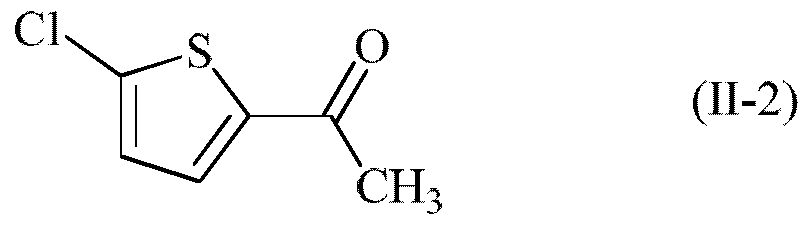
Preferably, the molar amount of thionyl chloride is from 2 to 50 times, more preferably from 2 to 35 times, even more preferably from 2 to 25 times, especially from 2 to 15 times, more especially from 3 to 10 times, even more especially from 3 to 7 times, based on the molar amount of compound of formula (II).
Preferably, any excess of thionyl chloride is recycled. Preferably, REAC2 is done at a temperature TEMP2 of from -20 °C to 250 °C, more
preferably from -10 °C to 200 °C, even more preferably from 0 °C to 175 °C, especially from 40 °C to 175 °C.
Preferably, REAC2 is done at a pressure of from ambient pressure to 100 bar, more preferably of from ambient pressure to 75 bar, even more preferably of from ambient pressure to 50 bar, especially of from ambient pressure to 30 bar, more especially of from ambient pressure to 25 bar, even more especially of from ambient pressure to 20 bar.
The pressure of REAC2 can be adjusted according to the chosen temperature of REAC2 and the boiling point of thionyl chloride.
Preferably, the reaction time TIME2 of REAC2 is from 1 min to 96 h, more preferably from 5 min to 60 h, even more preferably from 5 min to 48 h, especially from 30 min to 48 h.
Preferably, R10, Rl 1 and R12 are identical or different and are independently from each other
 alkyl;
R20 and R21 are identical or different and are independently from each other Ci_2 alkyl.
alkyl;
R20 and R21 are identical or different and are independently from each other Ci_2 alkyl.
Preferably, BAS2 is selected from the group consisting of pyridine, 2-picoline, 3-picoline, 4- picoline, 2-chloropyridine, 2-methyl-5-ethylpyridine, triethylamine, tributylamine, 1,4- diazabicyclo[2.2.2]octane, Ν,Ν-dimethylaniline, and mixtures thereof;
even more preferably, BAS2 is selected from the group consisting of pyridine, 3-picoline, 2- chloropyridine, 2-methyl-5-ethylpyridine, triethylamine, tributylamine, and mixtures thereof;
more preferably, BAS2 is selected from the group consisting of pyridine, 3-picoline, 2- chloropyridine, 2-methyl-5-ethylpyridine, and mixtures thereof.
In another preferable embodiment, BAS2 is selected from the group consisting of pyridine, picoline, chloropyridine, methylethylpyridine, and mixtures thereof;
more preferably, BAS2 is selected from the group consisting of pyridine, 2-picoline, 3- picoline, 4-picoline, 2-chloropyridine, 2-methyl-5-ethylpyridine, and mixtures thereof; even more preferably, BAS2 is selected from the group consisting of pyridine, 3-picoline, 2- chloropyridine, 2-methyl-5-ethylpyridine, and mixtures thereof.
Preferably, the salt of BAS2 is selected from the group consisting of hydrochloride salt, hydrobromide salt, acetate salt and trifluoroacetate salt;
more preferably, the salt of BAS2 is selected from the group consisting of hydrochloride salt, acetate salt and trifluoroacetate salt;
even more preferably, the salt of BAS2 is selected from the group consisting of hydrochloride salt and acetate salt.
Preferably, the molar amount of BAS2 is from 0.001 to 1 times, more preferably from 0.005 to 0.5 times, and even more preferably from 0.01 to 0.20 times, based on the molar amount of compound of formula (II).
REAC2 can be done in a solvent SOLV2, SOLV2 is selected from the group consisting of benzene, toluene, xylene, chlorobenzene, nitrobenzene, anisole, dichlorobenzene, dichloroethane, and mixtures thereof;
preferably, SOLV2 is selected from the group consisting of toluene, o-xylene, m-xylene, p- xylene, chlorobenzene, nitrobenzene, anisole, 1,2-dichlorobenzene, 1,3-dichlorobenzene, 1 ,4-dichlorobenzene, 1 ,2-dichloroethane, and mixtures thereof;
more preferably, SOLV2 is selected from the group consisting of toluene, o-xylene, m-xylene, p-xylene, chlorobenzene, 1 ,2-dichloroethane, and mixtures thereof.
Preferably, the weight of SOLV2 is from 0.5 to 100 times, more preferably from 1 to 50 times, of the weight of compound of formula (II). Preferably, any SOLV2 is recycled.
ST2 can comprise after REAC2 a step ST-HEAT2, in ST-HEAT2 the reaction mixture
resulting from REAC2 is subjected to an elevated temperature TEMP-HEAT2, TEMP- HEAT2 is preferably from 80 °C to 250 °C, more preferably from 100 °C to 200 °C, even more preferably from 120 °C to 175 °C .
The time TIME-HEAT2, during which the reaction mixture is subjected to TEMP-HEAT2, is preferably from 30 min to 96 h, more preferably from 1 h to 60 h, even more preferably from 2 h to 48 h. In a preferred embodiment, REAC2 is done at first at a temperature TEMPI for a time
TIME1, and then at a temperature TEMP2 for a time TIME2;
TEMPI is from 40 to 85°C,
TIME1 is from 2 to 60 h,
TEMP2 is from 135 to 145°C, and
TIME2 is from 10 to 25 h; more preferably,
TEMP2 is from 50 to 80°C,
TIME2 is from 3 to 10 h,
TEMP-HEAT2 is from 135 to 145°C, and
TIME-HEAT2 is from 10 to 25 h.
ST-HEAT2 can be done in a solvent SOLV-HEAT2, SOLV-HEAT2 is selected from the group consisting of toluene, xylene, chlorobenzene, nitrobenzene, anisole,
dichlorobenzene, dichloroethane, and mixtures thereof;
preferably, SOLV-HEAT2 is selected from the group consisting of toluene, o-xylene, m- xylene, p-xylene, chlorobenzene, nitrobenzene, anisole, 1 ,2-dichlorobenzene, 1,3- dichlorobenzene, 1 ,4-dichlorobenzene, 1 ,2-dichloroethane, and mixtures thereof;
more preferably, SOLV-HEAT2 is selected from the group consisting of toluene, o-xylene, m-xylene, p-xylene, chlorobenzene, 1 ,2-dichloroethane, and mixtures thereof. Preferably, the weight of SOLV-HEAT2 is from 0.5 to 100 times, more preferably from 1 to 50 times, of the weight of compound of formula (II).
Preferably, any SOLV-HEAT2 is recycled. Depending on the boiling point of SOLV-HEAT2 and of the desired TEMP-HEAT2, ST- HEAT2 can be done under the respective necessary or higher pressure.
If both SOLV2 and SOLV-HEAT2 are used, then preferably SOLV2 and SOLV-HEAT2 are identical.
After ST2, compound of formula (III) can be isolated and purified by methods well-known to those skilled in the art. These include, for instance, distillation, preferably fractional distillation, which can be done under reduced pressure, crystallization, extraction, or a combination of these methods.
Preferably, compound of formula (II) is prepared in a step ST1, therefore preferably the method comprises ST1 and ST2;
ST1 is done before ST2;
ST1 comprises a reaction REAC1 of a compound of formula (I) with a compound ACET;

ACET is selected from the group consisting of acetyl chloride, acetic anhydride, acetic acid, ketene, and mixtures thereof;
with Rl, R2 and R3 as defined herein, also with their embodiments.
Preferably, ACET is selected from the group consisting of acetyl chloride, acetic anhydride, and mixtures thereof.
Preferably, the molar amount of ACET is from 1 to 50 times, more preferably from 1 to 35 times, and even more preferably from 1 to 20 times, based on the molar amount of compound of formula (I).
In case of ACET being acetic anhydride, the stated minimum amount of ACET of 1 time, based on the molar amount of compound of formula (I), could possibly be lowered to 0.5 times, based on the molar amount of compound of formula (I).
Preferably, any excess of ACET is recycled.
Preferably, REACl is done at a temperature of from -10 °C to 200 °C, more preferably from 0
°C to 150 °C, even more preferably from 20 °C to 125 °C.
Preferably, REACl is done at a pressure of from ambient pressure to 25 bar, more preferably from ambient pressure to 20.
The pressure of REACl can be adjusted according to the chosen temperature of REACl and the boiling point of ACET.
Preferably, the reaction time of REACl is from 30 min to 24 h, more preferably from 1 h to
12 h.
Preferably, REACl is done in the presence of an acid ACIl, ACIl is selected from the group consisting of thionyl chloride, BF3-OEt2, perchloric acid, A1C13, polymeric sulfonic acid
resin, toluene sulfonic acid, HC1, H2S04, H3P04, Si02, citric acid, tartaric acid, oxalic acid, zeolite, and mixtures thereof.
Zeolite can be any zeolite, preferably montmorrilonte or bentonite, more preferably
montmorillonite, even more preferably Montmorillonite K10®, BASF, Germany (also available at Sigma Aldrich, CAS Number 1318-93-0).
Preferably, ACIl is selected from the group consisting of thionyl chloride, BF3-OEt2,
perchloric acid, A1C13, polymeric sulfonic acid resin, toluene sulfonic acid, HC1, H2S04, H3P04, Si02, zeolite, and mixtures thereof;
more preferably, ACIl is selected from the group consisting of thionyl chloride, perchloric acid, A1C13, polymeric sulfonic acid resin, montmorillonite, H3P04, and mixtures thereof; especially, ACIl is thionyl chloride, perchloric acid, A1C13 or H3P04. Preferably, the molar amount of ACIl is from 0.001 to 1 times, more preferably from 0.005 to 0.5 times, and even more preferably from 0.01 to 0.20 times, based on the molar amount of compound of formula (I).
In particular, ACIl is thionyl chloride.
REACl can be done in a solvent SOLVl, SOLVl is selected from the group consisting of benzene, toluene, xylene, chlorobenzene, nitrobenzene, dichlorobenzene,
dichloromethane, dichloroethane, carbon disulfide, and mixtures thereof;
preferably, SOLVl is selected from the group consisting of toluene, o-xylene, m-xylene, p- xylene, chlorobenzene, nitrobenzene, 1 ,2-dichlorobenzene, 1,3-dichlorobenzene, 1,4- dichlorobenzene, dichloromethane, 1 ,2-dichloroethane, carbon disulfide, and mixtures thereof;
more preferably, SOLVl is selected from the group consisting of toluene, o-xylene, m-xylene, p-xylene, chlorobenzene, dichloromethane, 1 ,2-dichloroethane, and mixtures thereof.
Preferably, the weight of SOLVl is from 0.5 to 100 times, more preferably from 1 to 50 times, of the weight of compound of formula (I).
Preferably, any SOLVl is recycled.
After STl, compound of formula (II) can be isolated and purified by methods well-known to those skilled in the art. These include, for instance, hydrolysis, distillation, preferably fractional distillation, which can be done under reduced pressure, crystallization, extraction, or a combination of these methods.
Preferably, ACIl is thionyl chloride and is identical with the thionyl chloride of ST2.
Preferably, ACIl is thionyl chloride and is identical with the thionyl chloride of ST2, and the solvents SOLV1 and SOLV2 are identical.
In case that both SOLV2 and SOLV-HEAT2 are used, then preferably ACIl is thionyl
chloride and is identical with the thionyl chloride of ST2, and the solvents SOLV1,
SOLV2 and SOLV-HEAT2 are identical.
Preferably, STl and ST2 are done in one pot.
Preferred embodiments of compound of formula (I), compound of formula (II) and compound of formula (III) are those compounds wherein Rl, R2 and R3 are H or Rl is CI and R2 and R3 are H.
More preferred embodiments of compound of formula (I), compound of formula (II) and compound of formula (III) are compound of formula (I-l), compound of formula (1-2), compound of formula (II- 1), compound of formula (Π-2), compound of formula (III-l) and compound of formula (ΙΠ-2) respectively.

Further subject of the invention is a method for the preparation of compound of formula (THIOXA);
(THIOXA)

R30, R31 , R32, R33 and R34 are identical or different and independently from each other selected from the group consisting of H, halogen, CF3, CH3, OCF3, OCH3, CN and
C(H)0;
wherein ST2, Rl, R2 and R3 are as defined herein, also with all their embodiments; further subject of the invention is a method for the preparation of compound of formula
(THIOXA),
wherein the method comprises the step ST1 in addition to step ST2;
ST1 is done before ST2;
wherein ST1 is as defined herein, also with all its embodiments;
also with any individual embodiment or with any combination of two or more embodiments, the embodiments as described herein for any of these steps; especially wherein Rl, R2 and R3 are H;
in another especial embodiment R30, R31, R32, R33 and R34 are H;
more especially wherein Rl, R2, R3, R30, R31, R32, R33 and R34 are H.
Preferably, the method for preparation of compound of formula (THIOXA) starting from compound of formula (III) has a step ST3;
ST3 is done after ST2;
ST3 comprises a reaction REAC3, in REAC3 the compound of formula (III) is reacted with a compound of formula (IV).

Details for ST3 are disclosed in WO 2014/008257 A2.
Specific embodiments for ST3 are disclosed in the examples 2, 3, 7, 9, 10, 11 and 12 of WO 2014/008257 A2
Preferably, compound of formula (III) in ST2 and in ST3 in the method for preparation of compound of formula (THIOXA) is compound of formula (III- 1) or compound of formula (III-2);
more preferably, compound of formula (III) is compound of formula (III- 1).
Preferably, compound of formula (IV) is selected from the group consisting of compound of formula (IV-1), compound of formula (IV-2), compound of formula (IV-3), compound of formula (IV-4), compound of formula (IV-5), compound of formula (IV-6) and compound of formula (IV-7);


When compound of formula (III) is brought into contact with compound of formula (IV) a reaction mixture is formed.
Preferably, REAC3 is done in the presence of a solvent SOLV3.
Preferably, SOLV3 is a water-immiscible organic solvent.
Preferably, SOLV3 solubilizes compound of formula (IV) and compound of formula
(THIOXA).
Preferably, SOLV3 forms an azeotrope with water.
Preferably, SOLV3 is selected from the group consisting of 2-methyltetrahydrofuran and butyl acetate;
more preferably, SOLV3 is 2-methyltetrahydrofuran.
Preferably, REAC3 is done in the presence of a base BAS3.
Preferably, BAS3 is an aqueous base.
Preferably, BAS3 is selected from the group consisting of sodium hydroxide, potassium
hydroxide, lithium hydroxide, and calcium hydroxide.
Preferably, the reaction mixture of REAC3 comprises an organic phase and an aqueous phase. Preferably, the pH of the aqueous phase is greater than 8, more preferably greater than 10. Preferably, the pH of the aqueous phase is increased or maintained by adding additional
BAS3 to the reaction mixture or REAC3.
Preferably, the temperature of REAC3 is no greater than 85°C;
more preferably, the temperature of REAC3 is maintained at from 55 °C to 75 °C.
Preferably, REAC3 is done in the presence of a phase transfer catalyst PTC3.
Preferably, PTC3 is selected from the group consisting of quaternary ammonium salts,
phosphonium salts, and crown ethers;
more preferably, PTC3 is selected from the group consisting of tetrabutylammonium
hydroxide, tetrabutylammonium bromide, tetrabutylammonium fluoride,
tetrabutylammonium iodide, tetrabutylphosphonium bromide, tetrabutylphosphonium chloride, and benzyltrimethylammonium hydroxide;
even more preferably, PTC3 is tetrabutylammonium hydroxide.
Preferably, compound of formula (IV) is dissolved in SOLV3 prior to adding the compound of formula (III) to form the reaction mixture of REAC3.
Preferably, REAC3 is done in the presence of water.
Further subject of the invention is a method for the preparation of compound of formula (RIVA-I);

R50, R51 , R52 and R53 are identical or different and independently of one another each is selected from the group consisting of H, halogen, CF3, CN, N02, C(0)-NH2,
C(0)-Ci_6 alkyl, O-R60; N(R60)R61 and Ci_6 alkyl;
R60 and R61 are identical or different and independently of one another each is selected from the group consisting of H, Ci_4 alkyl and C(0)R63;
R63 is selected from the group consisting of Ci_4 alkyl-NH2, NH2, NH-Ci_4 alkyl,
N(Ci_4 alkyl)Ci_4 alkyl and Ci_8 alkyl;
R43, R44, R45, R46, R47 and R48 are identical or different and independently of one another each represents H or Ci_6 alkyl; wherein the method comprises the step ST2;
wherein ST2, Rl, R2 and R3 are as defined herein, also with all their embodiments; further subject of the invention is a method for the preparation of compound of formula
(RIVA-I),
wherein the method comprises the step ST1 in addition to step ST2;
ST1 is done before ST2;
wherein ST1 is as defined herein, also with all its embodiments;
also with any individual embodiment or with any combination of two or more embodiments, the embodiments as described herein for any of these steps;
especially wherein the compound of formula (RIVA-I) is the compound of formula
(RIVA-II);


Preferably, the method for preparation of compound of formula (RIVA-I) starting from
compound of formula (III) has a step ST4;
ST4 is done after ST2;
ST4 comprises a reaction REAC4, in REAC4 the compound of formula (III) is reacted with a compound of formula (RIVA-Ia);

more preferably, compound of formula (III) is compound of formula (ΙΠ-2) and compound of formula (RIVA-Ia) is compound of formula (RIVA-1 a).

Details for ST4 are disclosed in US 2003/0153610 Al .
Preferably, compound of formula (III) in ST2 and in ST4 in the method for preparation of compound of formula (RIVA-I) is compound of formula (III-l) or compound of formula (III-2);
more preferably, compound of formula (III) is compound of formula (ΙΠ-2).
Preferably, REAC4 is done in a solvent SOLV4, SOLV4 is selected from the group consisting of halogenated hydrocarbons, ethers, alcohols, hydrocarbons, dimethylformamide, dimethyl sulphoxide, acetonitrile, pyridine, hexamethylphosphoric triamide, water and mixtures thereof.
Halogenated hydrocarbons are preferably selected from the group consisting of
dichloromethane, trichloromethane, carbon tetrachloride, 1 ,2-dichloroethane, trichloroethane, tetrachloroethane, 1 ,2-dichloroethylene and trichloroethylene.
Ethers are preferably selected from the group consisting of diethyl ether, methyl tert-butyl ether, dioxane, tetrahydrofuran, glycol dimethyl ether and diethylene glycol dimethyl ether.
Alcohols are preferably selected from the group consisting of methanol, ethanol, propanol, butanol.
Hydrocarbons are preferably selected from the group consisting of benzene, xylene, toluene, hexane and cyclohexane.
REAC4 can be done in the presence of a base BAS4, BAS4 can be any customary inorganic or organic base.
BAS4 is preferably selected from the group consisting of alkali metal hydroxide, alkali metal carbonate, sodium methoxide, potassium methoxide, sodium ethoxide, potassium ethoxide, potassium-tert-butoxide, amide, amine, and mixtures thereof;
alkali metal hydroxide is preferably sodium hydroxide or potassium hydroxide;
alkali metal carbonate is preferably sodium carbonate or potassium carbonate; amide is preferably selected from the group consisting of sodium amide, lithium
bis-(trimethylsilyl)amide and lithium diisopropylamide;
amine is preferably selected from the group consisting of triethyl
diisopropylethylamine, diisopropylamine, 4-N,N-dimethylaminopyridine and pyridine.
BAS4 can be employed in an amount of from 1 to 5 mol, preferably from 1 to 2 mol, based on 1 mol of compound of formula (RIVA-Ia).
Preferably, REAC4 is done at a reaction temperature of from -78 °C to reflux temperature, more preferably from 0 °C to reflux temperature, with the reflux temperature being the reflux temperature under the respective pressure.
Preferably, REAC4 is done at a pressure of from 0.5 to 5 bar, more preferably at atmospheric pressure.
In case that compound of formula (RIVA-I) is compound of formula (RIVA-1) and compound of formula (III) is compound of formula (ΙΠ-2),
then in another preferred embodiment the preparation of compound of formula (RIVA-1) starting from compound of formula (ΙΠ-2) has a step ST5;
details for ST5 are disclosed in US 2015/0133657 Al;
ST5 is done after ST2;
ST5 comprises a reaction REAC5, in REAC5 compound of formula (ΙΠ-2) is reacted with compound of formula (RIVA-10);
 the reaction product of REAC5 is compound of formula (RIVA-11);
(RIVA-1 1)
 preferably, after ST5 a step ST6 is done;
ST6 comprsies a reaction REAC6, in REAC6 compound of formula (RIVA-11) is reacted with a compound of formula (RIVA-12) in the presence of phosgene or a phosgene equivalent;


ST7 comprises a reaction REAC7, in REAC7 compound of formula (RIVA-13) is cyclized to obtain compound of formula (RIVA-1).
The phosgene equivalent is preferably diphosgene or triphosgene or a carbon monoxide
equivalent.
A carbon monoxide equivalent is preferably carbonyldiimidazole or disuccinimidyl carbonate.
Compound of formula (RIVA-10) can also be used in form of a salt thereof, preferably as a hydrochloride salt. Compound of formula (RIVA-10) is a known compound and can be prepared according to known method, e.g. as disclosed in US Patent 6,107,519 or in US 2015/0133657 Al .
Preferably, REAC5 is done in the presence of a base, such as sodium bicarbonate.
Preferably, REAC5 is done in a solvent, the solvent can be ethyl acetate, hexane, water,
toluene or a mixture thereof.
Preferably, the reaction temperature of REAC5 is from 0 to 40 °C.
Preferably, the reaction time of REAC5 is from 0.5 to 10 h.
The compound of formula (RIVA-11) may be isolated from the reaction mixture after REAC5 by methods including layer separation, concentration, distillation, decantation, filtration, evaporation, centrifugation, or a combination thereof, and may further be dried. Preferably, REAC6 is done in a solvent. The solvent in REAC6 can be dichloromethane, dichloroethane, or a mixture thereof.
REAC6 can be done in the presence of a base, The base in REAC6 can be pyridine,
dimethylaminopyridine, triethylamine, sodium carbonate, potassium carbonate, or a mixture thereof; more preferably pyridine, triethylamine, sodium carbonate, potassium carbonate, or a mixture thereof.
Preferably, the reaction time of REAC6 is from 0.5 to 10 h.
Preferably, the reaction temperature of REAC6 is from 0 to 35 °C.
Preferably, in a first step of REAC6 the phosgen or phosgene equivalent is mixed with
compound of formula (RIVA-11), optionally also with the base of REAC6, optionally in the solvent of REAC6, thereafter in a second step of REAC6 compound of formula
(RIVA-12) is added.
Preferably, the reaction time of the first step of REAC6 is from 0.5 to 4 h.
Preferably, the reaction temperature of the first step of REAC6 is from 5 to 25 °C.
Preferably, the reaction time of the second step of REAC6 is from 0.5 to 6 h.
Preferably, the reaction temperature of the second step of REAC6 is from 10 to 35 °C.
The compound of formula (RIVA-13) may be isolated from the reaction mixture after REAC6 by methods including layer separation, concentration, distillation, decantation, filtration, evaporation, centrifugation, or a combination thereof, and may further be dried. Preferably, the cyclization of REAC7 is done in a solvent. The solvent in REAC7 can be
acetone, acetonitrile, methanol, ethanol, isopropanol, dioxane, tetrahydofuran, water, or a mixture thereof.
REAC7 can be done in the presence of a base. The base in REAC7 can be potassium
carbonate, potassium bicarbonate, potassium hydroxide, sodium hydroxide, sodium carbonate, sodium bicarbonate, sodium hydride, or a mixture thereof.
The base in REAC7 may be added to the mixture containing the compound of formula
(RIVA-13) and the solvent of REAC7 or a mixture containing the compound of formula (RIVA-13) in which it is formed in RE AC 6.
Preferably, the reaction temperature of REAC7 is of from 10 to 40 °C.
Preferably, the reaction time of REAC7 is from 2 to 15 h.
Compound of formula (RIVA-I), compound of formula (RIVA-II) and compound of formula (RIVA-1) may be isolated from any reaction mixture by methods including layer separation, concentration, distillation, decantation, filtration, evaporation,
centrifugation, or a combination thereof, and may further be dried.
Examples
Example 1: 2-thiophenecarbonyl chloride
To 2-acetylthiophene (0.108 ml, 1.00 mmol) were added pyridine (0.08 ml, 0.10 mmol) and thionyl chloride (1.5 ml, 20 mmol), and the mixture was stirred at 80°C for 48 h. The excess thionyl chloride was evaporated off, and the residue was stirred at 140°C oil bath temperature for 18 h. Ensueing analysis of the reaction mixture by 1H NMR indicated formation of 2-thiophenecarbonyl chloride, no significant amounts of any by products were visible in the 1H NMR spectrum.
1H NMR (CDC13, 400 MHz) delta = 7.99 (d, br, J = 4 Hz, 1H), 7.83 (d, br, J = 4 Hz, 1H), 7.20 (t, J = 4 Hz, 1H).
Example 2: 2-thiophenecarbonyl chloride
To 2-acetylthiophene (0.054 ml, 0.50 mmol) were added pyridine (0.004 ml, 0.05 mmol) and thionyl chloride (0.362 ml, 5.0 mmol), and the mixture was stirred at 60°C for 4.5 h. The excess thionyl chloride was evaporated off, and the residue was stirred at 140°C oil bath temperature for 18 h. Ensueing analysis of the reaction mixture by 1H NMR with
triisobutylphosphate as internal standard indicated formation of 2-thiophenecarbonyl chloride in 69% yield, no significant amounts of any byproducts were visible in the 1H NMR spectrum. The 13C NMR corresponded to the one reported in the literature (Aldrich).
Example 3: 2-thiophene carbonyl chloride
A mixture of 2-acetylthiophene (1.08 ml, 10.0 mmol), pyridine (0.0806 ml, 1.0 mmol), and thionyl chloride (4.35 ml, 60.0 mmol) was stirred at 75 °C for 4 h, and then at 140°C oilbath temperature for 18 h. Analysis of the mixture by 1H NMR indicated that this mixture mainly contained the 2-thiophene carbonyl chloride. Bulb-to-Bulb distillation of the mixture (100 to 130°C, 10 mbar) yielded 1.78 g of an oil containing 51 wt-% of 2-thiophenecarbonyl chloride. The total yield of product was 61 >.
Example 4: 2-thiophene carbonyl chloride
A mixture of 2-acetylthiophene (0.216 ml, 2.0 mmol) and pyridine (0.016 ml, 0.2 mmol) was added dropwise within 20 min to thionyl chloride (0.869 ml, 12 mmol) at 75°C. Stirring at 75°C was continued for 7 h, and the mixture was then stirred at 140°C for 16 h. Analysis of
the mixture by 1H NMR indicated that this mixture mainly contained the 2-thiophene carbonyl chloride.
Example 5: 2-thiophene carbonyl chloride
Thionyl chloride (0.869 ml, 12 mmol) was added dropwise within 30 min to a mixture of 2-acetylthiophene (0.216 ml, 2.0 mmol) and pyridine (0.016 ml, 0.2 mmol), said mixture having a temperature of 75°C. Stirring at 75°C was continued for 7 h, and the mixture was then stirred at 140°C for 16 h. Analysis of the mixture by 1H NMR indicated that this mixture mainly contained the 2-thiophene carbonyl chloride.
Example 6: 2-thiophene carbonyl chloride
A mixture of 2-acetylthiophene (0.108 ml, 1.0 mmol), 3-picoline (0.010 ml, 0.1 mmol), and thionyl chloride (0.363 ml, 5.0 mmol) was stirred at 70°C for 3 h 45 min, and then at 140°C for 14 h. The mixture was diluted with CDCI3 (1.5 ml), an internal standard was added
(1BU3PO4, 0.0552 ml, 0.20 mmol), and the mixture was analyzed. 1H NMR indicated that mainly 2-thiophene carbonyl chloride (72% yield) had been formed.
Example 7: 5-chloro-2-thiophene carbonyl chloride
A mixture of 2-acetyl-5-chlorothiophene (161 mg, 1.00 mmol), pyridine (0.008 ml, 0.10 mmol), and thionyl chloride (0.435 ml, 6.00 mmol) was stirred at 70°C for 3 h 15 min, and then at 137°C for 14.5 h. Then the mixture was diluted with CDCI3 (2 ml), an internal standard was added (1BU3PO4, 0.0552 ml, 0.20 mmol), and the mixture was analyzed with 1H
NMR: 5-chloro-2-thiophene carbonyl chloride (76% yield).
1H NMR (CDCI3, 400 MHz) delta = 7.80 (d, J = 4 Hz, 1H), 7.06 (d, J = 4 Hz, 1H).
13C NMR (CDC13, 100 MHz) delta = 158.5, 143.1, 137.5, 134.9, 128.3.
Claims
1. Method for the preparation of compound of formula (III);

ST2 comprises a reaction REAC2 of a compound of formula (II) with thionyl chloride;

Rl , R2 and R3 are identical or different and independently from each other selected from the group consisting of H, halogen, C02R4, C(0)C1, phenyl, 2-pyridyl, N02, CN, CF3, Ci_8 alkyl, and Ci_s alkoxy;
or
Rl and R2 together represent -CH=CH-CH=CH- and form together with the thiophene ring a benzothiophene, and
R3 is selected from the group consisting of H, halogen, C02R4, C(0)C1, phenyl, 2-pyridyl, N02, CN, CF3, Ci-8 alkyl, and Ci_8 alkoxy;
R4 is Ci_6 alkyl;
REAC2 is done in the presence of a base BAS2 or of a salt of BAS2;
BAS2 is selected from the group consisting of pyridine, picoline, chloropyridine,
methylethylpyridine, N(R10)(R1 1)R12, l ,4-diazabicyclo[2.2.2]octane, Phe-N(R20)R21 , and mixtures thereof;
RIO, Rl 1 and R12 are identical or different and are independently from each other
Ci_8 alkyl;
R20 and R21 are identical or different and are independently from each other Ci_8 alkyl; and the salt of BAS2 is selected from the group consisting of hydrochloride salt,
hydrobromide salt, hydrogensulfate salt, sulfate salt, acetate salt and trifluoroacetate salt.
2. Method according to claim 1 , wherein
Rl , R2 and R3 are identical or different and independently from each other selected from the group consisting of H, F, CI, Br, C02R4, C(0)C1, phenyl, 2-pyridyl, N02, CN, CF3, alkyl, and Ci_2 alkoxy; or
Rl and R2 together represent -CH=CH-CH=CH- and form together with the thiophene ring a benzothiophene, and
R3 is selected from the group consisting of H, F, CI, Br, C02R4, C(0)C1, phenyl, 2-pyridyl,
N02, CN, CF3, Ci-4 alkyl, and Ci_2 alkoxy;
R4 is Ci_4 alkyl.
3. Method according to claim 1 or 2, wherein
Rl , R2 and R3 are H.
4. Method according to one or more of claims 1 to 3, wherein
the C(0)C1 residue in compound of formula (III) and the C(0)CH3 residue of compound of formula (II) are on position 2 of the thiophene ring.
5. Method according to one or more of claims 1 to 4, wherein
REAC2 is done in a solvent SOLV2, SOLV2 is selected from the group consisting of
benzene, toluene, xylene, chlorobenzene, nitrobenzene, anisole, dichlorobenzene, dichloroethane, and mixtures thereof.
6. Method according to one or more of claims 1 to 5, wherein
compound of formula (II) is prepared in a step ST1 ;
ST1 is done before ST2;
ST1 comprises a reaction REAC 1 of a compound of formula (I) with a compound ACET;

ACET is selected from the group consisting of acetyl chloride, acetic anhydride, acetic acid, ketene, and mixtures thereof;
with Rl , R2 and R3 as defined in claim 1.
7. Method according to claim 6, wherein
ACET is selected from the group consisting of acetyl chloride, acetic anhydride, and mixtures thereof.
8. Method according to claim 6 or 7, wherein
REACl is done in the presence of an acid ACI1, ACI1 is selected from the group consisting of thionyl chloride, BF3-OEt2, perchloric acid, polymeric sulfonic acid resin, toluene sulfonic acid, HC1, H2S04, H3P04, Si02, citric acid, tartaric acid, oxalic acid, zeolite, and mixtures thereof.
9. Method according to one or more of claims 6 to 8, wherein
REACl is done in a solvent SOLVl, SOLVl is selected from the group consisting of toluene, xylene, chlorobenzene, nitrobenzene, dichlorobenzene, dichloromethane, dichloroethane, and mixtures thereof.
10. Method according to one or more of claims 6 to 9, wherein
ACI1 is thionyl chloride and is identical with the thionyl chloride of ST2, and the solvents SOLVl and SOLV2 are identical.
11. Method according to one or more of claims 6 to 10, wherein
Rl, R2 and R3 are H.
12. Method for the preparation of compound of formula (THIOXA);
 wherein the method comprises the step ST2;
R30, R31 , R32, R33 and R34 are identical or different and independently from each other selected from the group consisting of H, halogen, CF3, CH3, OCF3, OCH3, CN and C(H)0;
wherein ST2 is as defined in one or more of the claims 1 to 5;
Rl, R2 and R3 are as defined in any of the claims 1, 2 or 3.
13. Method according to claim 12; wherein
the method comprises the step STl;
STl is done before ST2;
wherein step STl is as defined in one or more of claims 6 to 11.
14. Method according to claim 12 or 13; wherein
R30, R31, R32, R33 and R34 are H.
15. Method according to one or more of claims 12 to 14; wherein
Rl, R2 and R3 are H.
16. Method for the preparation of compound of formula (RIVA-I);

R50, R51 , R52 and R53 are identical or different and independently of one another each is selected from the group consisting of H, halogen, CF3, CN, N02, C(0)-NH2, C(0)-Ci_6 alkyl, O-R60; N(R60)R61 and Ci_6 alkyl;
R60 and R61 are identical or different and independently of one another each is selected from the group consisting of H, Ci_4 alkyl and C(0)R63;
R63 is selected from the group consisting of Ci_4 alkyl-NH2, NH2, NH-Ci_4 alkyl,
N(Ci_4 alkyl)Ci_4 alkyl and Ci_8 alkyl;
R43, R44, R45, R46, R47 and R48 are identical or different and independently of one another each represents H or Ci_6 alkyl; wherein the method comprises the step ST2;
wherein ST2 is as defined in one or more of the claims 1 to 5;
Rl, R2 and R3 are as defined in any of the claims 1, 2 or 3.
17. Method according to claim 16; wherein
wherein the method comprises the step ST1;
ST1 is done before ST2;
wherein step ST1 is as defined in one or more of claims 6 to 11.
18. Method according to claim 16 or 17; wherein
the compound of formula (RIVA-I) is the compound of formula (RIVA-II).
(RIVA-II)
 wherein R50, R51, R52, R53, R43, R44, R45, R46, R47 and R48 are as defined in claim 16.
19. Method according to one or more of claims 16 to 18; wherein
the compound of formula (RIVA-I) is the compound of formula (RIVA-1).
(RIVA-1)

Applications Claiming Priority (22)
| Application Number | Priority Date | Filing Date | Title |
|---|---|---|---|
| US201562138120P | 2015-03-25 | 2015-03-25 | |
| US62/138,120 | 2015-03-25 | ||
| EP15160909.6 | 2015-03-25 | ||
| EP15160909 | 2015-03-25 | ||
| EP15161389 | 2015-03-27 | ||
| EP15161389.0 | 2015-03-27 | ||
| EP15163348 | 2015-04-13 | ||
| EP15163348.4 | 2015-04-13 | ||
| EP15171856 | 2015-06-12 | ||
| EP15171856.6 | 2015-06-12 | ||
| EP15172006.7 | 2015-06-15 | ||
| EP15172006 | 2015-06-15 | ||
| EP15172236 | 2015-06-16 | ||
| EP15172236.0 | 2015-06-16 | ||
| EP15177362.9 | 2015-07-17 | ||
| EP15177362 | 2015-07-17 | ||
| EP15177915 | 2015-07-22 | ||
| EP15177915.4 | 2015-07-22 | ||
| EP15191810.9 | 2015-10-28 | ||
| EP15191810 | 2015-10-28 | ||
| EP16150304.0 | 2016-01-06 | ||
| EP16150304 | 2016-01-06 |
Publications (1)
| Publication Number | Publication Date |
|---|---|
| WO2016150937A1 true WO2016150937A1 (en) | 2016-09-29 |
Family
ID=56977020
Family Applications (1)
| Application Number | Title | Priority Date | Filing Date |
|---|---|---|---|
| PCT/EP2016/056214 Ceased WO2016150937A1 (en) | 2015-03-25 | 2016-03-22 | Method for preparation of thiophenecarbonyl chlorides |
Country Status (1)
| Country | Link |
|---|---|
| WO (1) | WO2016150937A1 (en) |
Citations (11)
| Publication number | Priority date | Publication date | Assignee | Title |
|---|---|---|---|---|
| US4321399A (en) | 1978-06-21 | 1982-03-23 | Smithkline Corporation | Preparation of 2-thiophenecarbonyl chloride |
| US4814341A (en) * | 1986-08-26 | 1989-03-21 | Reiter Lawrence A | 2-guanidino-4-(2-furyl) thiazoles as antiulcer agents |
| EP0393936A1 (en) | 1989-04-18 | 1990-10-24 | Pfizer Inc. | 3-substituted-2-oxindole derivatives as antiinflammatory agents |
| US6107519A (en) | 1997-11-07 | 2000-08-22 | Pharmacia & Upjohn Company | Process to produce oxazolidinones |
| US20030153610A1 (en) | 1999-12-24 | 2003-08-14 | Alexander Straub | Substituted oxazolidinones and their in the field of blood coagulation |
| WO2007008895A1 (en) | 2005-07-13 | 2007-01-18 | Allergan, Inc. | Kinase inhibitors |
| CN102363615A (en) * | 2011-11-14 | 2012-02-29 | 连云港宏业化工有限公司 | Method for synthesizing 2-thiophenecarbonyl chloride |
| WO2013152168A1 (en) * | 2012-04-06 | 2013-10-10 | Indiana University Research And Technology Corporation | Processes for preparing rivaroxaban |
| WO2014008257A2 (en) | 2012-07-02 | 2014-01-09 | Monsanto Technology Llc | Processes for the preparation of 3,5-disubstituted-1,2,4-oxadiazoles |
| CN103980265A (en) * | 2014-05-14 | 2014-08-13 | 武汉工程大学 | Synthetic technology for 3-phenyl-5-(thiophene-2-yl)-1,2,4-oxadiazole |
| US20150133657A1 (en) | 2012-05-24 | 2015-05-14 | Ranbaxy Laboratories Limited | Process for the preparation of rivaroxaban |
-
2016
- 2016-03-22 WO PCT/EP2016/056214 patent/WO2016150937A1/en not_active Ceased
Patent Citations (11)
| Publication number | Priority date | Publication date | Assignee | Title |
|---|---|---|---|---|
| US4321399A (en) | 1978-06-21 | 1982-03-23 | Smithkline Corporation | Preparation of 2-thiophenecarbonyl chloride |
| US4814341A (en) * | 1986-08-26 | 1989-03-21 | Reiter Lawrence A | 2-guanidino-4-(2-furyl) thiazoles as antiulcer agents |
| EP0393936A1 (en) | 1989-04-18 | 1990-10-24 | Pfizer Inc. | 3-substituted-2-oxindole derivatives as antiinflammatory agents |
| US6107519A (en) | 1997-11-07 | 2000-08-22 | Pharmacia & Upjohn Company | Process to produce oxazolidinones |
| US20030153610A1 (en) | 1999-12-24 | 2003-08-14 | Alexander Straub | Substituted oxazolidinones and their in the field of blood coagulation |
| WO2007008895A1 (en) | 2005-07-13 | 2007-01-18 | Allergan, Inc. | Kinase inhibitors |
| CN102363615A (en) * | 2011-11-14 | 2012-02-29 | 连云港宏业化工有限公司 | Method for synthesizing 2-thiophenecarbonyl chloride |
| WO2013152168A1 (en) * | 2012-04-06 | 2013-10-10 | Indiana University Research And Technology Corporation | Processes for preparing rivaroxaban |
| US20150133657A1 (en) | 2012-05-24 | 2015-05-14 | Ranbaxy Laboratories Limited | Process for the preparation of rivaroxaban |
| WO2014008257A2 (en) | 2012-07-02 | 2014-01-09 | Monsanto Technology Llc | Processes for the preparation of 3,5-disubstituted-1,2,4-oxadiazoles |
| CN103980265A (en) * | 2014-05-14 | 2014-08-13 | 武汉工程大学 | Synthetic technology for 3-phenyl-5-(thiophene-2-yl)-1,2,4-oxadiazole |
Non-Patent Citations (6)
| Title |
|---|
| ADIWIDJAJA ET AL., ANGEW. CHEM. INT. ED. ENGL., vol. 19, 1980, pages 563 - 564 |
| ADIWIDJAJA G ET AL: "Are .alpha.-Oxothioacyl Chlorides Formed in the Reaction of Methyl Ketones with Thionyl Chloride?", ANGEWANDTE CHEMIE. INTERNATIONAL EDITION, VCH VERLAG, WEINHEIM, DE, vol. 19, no. 7, 1 July 1980 (1980-07-01), pages 563 - 564, XP002752005, ISSN: 0570-0833, [retrieved on 20031222], DOI: 10.1002/ANIE.198005631 * |
| EDWARDS ET AL., J. ORG. CHEM., vol. 31, 1966, pages 1283 - 1285 |
| FLORENCIO ZARAGOZA: "One-Step Conversion of Methyl Ketones to Acyl Chlorides", THE JOURNAL OF ORGANIC CHEMISTRY, vol. 80, no. 20, 16 October 2015 (2015-10-16), US, pages 10370 - 10374, XP055271946, ISSN: 0022-3263, DOI: 10.1021/acs.joc.5b01707 * |
| NG. PH. BUU-HOÏ ET AL: "Etudes dans la Sêrie du Thiophène. V. ) Nouvelles cétones thiophéniques et leurs dérivés", RECUEIL DES TRAVAUX CHIMIQUES DES PAYS-BAS, vol. 69, no. 9, 2 September 1950 (1950-09-02), pages 1083 - 1108, XP055211512, ISSN: 0165-0513, DOI: 10.1002/recl.19500690904 * |
| PIZEY ET AL., PHOSPHORUS AND SULFUR, vol. 8, 1980, pages 1 - 8 |
Similar Documents
| Publication | Publication Date | Title |
|---|---|---|
| EP3368531B1 (en) | Intermediates to prepare pyridazinone herbicides, and a process to prepare them | |
| KR101025528B1 (en) | Process for producing 5-2'-pyridyl-2-pyridone derivative | |
| EP0669924B1 (en) | Regioselective synthesis of 4-chloro-2-thiophenecarboxylic acid | |
| JP6771475B2 (en) | Method for producing 3-chloro-2-vinylphenyl sulfonates | |
| CZ20004595A3 (en) | Process for preparing 1,4-dihydropyridine compounds | |
| WO2016150937A1 (en) | Method for preparation of thiophenecarbonyl chlorides | |
| EP3325476B1 (en) | Method for preparation of thiophene-2-carbonyl chlorides | |
| Hull Jr et al. | Development of potential manufacturing routes for substituted thiophenes–Preparation of halogenated 2-thiophenecarboxylic acid derivatives as building blocks for a new family of 2, 6-dihaloaryl 1, 2, 4-triazole insecticides | |
| WO2016202757A1 (en) | Method for preparation of carboxylic acid chlorides from methyl ketones | |
| WO2017005606A1 (en) | Method for preparation of carboxylic acid chlorides from methyl ketones with two reagents | |
| JP4963970B2 (en) | Method for producing methylene disulfonate compound | |
| US12516045B2 (en) | Process for synthesis of a 2-thioalkyl pyrimidine | |
| JP4251508B2 (en) | Method for producing acid chloride compound | |
| JPS5970685A (en) | Benzoylthiophene derivative and its preparation | |
| JP2008208047A (en) | Method for producing 1,3,4-trimethylpyrazole-5-carboxylate, and intermediate for producing the same | |
| JP3325139B2 (en) | Method for producing thienyl ether derivative | |
| JP4745315B2 (en) | 3-aminothiophene derivatives | |
| HK1252355A1 (en) | Method for preparation of thiophene-2-carbonyl chlorides with oxalyl chloride | |
| JP2011157278A (en) | Method for producing dithienyl sulfide compound | |
| JPH0656820A (en) | Production of thienyl ether derivative | |
| JPH0625222A (en) | Production of 3-hydroxy-2-thiophenecarboxylic acid derivative | |
| JP2011157277A (en) | Method for producing dithienyl sulfide compound | |
| JPWO2001087864A1 (en) | Thiazolyl ethanone compound and method for producing the same | |
| JPS62265282A (en) | 2-(alpha-alkoxyimino)ethylthiophene derivative and production thereof | |
| JPS62148480A (en) | Method for producing 3-bromothiophene or its derivative |
Legal Events
| Date | Code | Title | Description |
|---|---|---|---|
| 121 | Ep: the epo has been informed by wipo that ep was designated in this application |
Ref document number: 16710987 Country of ref document: EP Kind code of ref document: A1 |
|
| DPE1 | Request for preliminary examination filed after expiration of 19th month from priority date (pct application filed from 20040101) | ||
| NENP | Non-entry into the national phase |
Ref country code: DE |
|
| 122 | Ep: pct application non-entry in european phase |
Ref document number: 16710987 Country of ref document: EP Kind code of ref document: A1 |