WO2016133217A1 - 光学活性オキシインドール化合物の製造方法及びそれに触媒として用いられるトリアゾリウム塩 - Google Patents
光学活性オキシインドール化合物の製造方法及びそれに触媒として用いられるトリアゾリウム塩 Download PDFInfo
- Publication number
- WO2016133217A1 WO2016133217A1 PCT/JP2016/054960 JP2016054960W WO2016133217A1 WO 2016133217 A1 WO2016133217 A1 WO 2016133217A1 JP 2016054960 W JP2016054960 W JP 2016054960W WO 2016133217 A1 WO2016133217 A1 WO 2016133217A1
- Authority
- WO
- WIPO (PCT)
- Prior art keywords
- group
- general formula
- compound
- optionally substituted
- same
- Prior art date
- Legal status (The legal status is an assumption and is not a legal conclusion. Google has not performed a legal analysis and makes no representation as to the accuracy of the status listed.)
- Ceased
Links
- 0 C[C@](*1C(I=C)=C(*)*(*)=*1)C(*)(*)*(C(**)=O)I=C Chemical compound C[C@](*1C(I=C)=C(*)*(*)=*1)C(*)(*)*(C(**)=O)I=C 0.000 description 2
- OSIGJGFTADMDOB-UHFFFAOYSA-N Cc1cc(OC)ccc1 Chemical compound Cc1cc(OC)ccc1 OSIGJGFTADMDOB-UHFFFAOYSA-N 0.000 description 2
- NQQDCVDFJGOVPF-IPJYTNDNSA-N CC(C)C[C@H](CC(CCC1)C=C(c(cccc2)c2-c2ccccc2)[N]1(Cc1ccccc1)NC)C(c1ccccc1)(c1ccccc1)NC(c1ccccc1)=O Chemical compound CC(C)C[C@H](CC(CCC1)C=C(c(cccc2)c2-c2ccccc2)[N]1(Cc1ccccc1)NC)C(c1ccccc1)(c1ccccc1)NC(c1ccccc1)=O NQQDCVDFJGOVPF-IPJYTNDNSA-N 0.000 description 1
- XYNVWCJGMMXNCG-QLAAVUPPSA-N C[C@H](CC(CCC1)C=C(c(cccc2)c2-c2ccccc2)[N]1(Cc1ccccc1)NC)C(c1ccccc1)(c1ccccc1)NC(c1ccccc1)=O Chemical compound C[C@H](CC(CCC1)C=C(c(cccc2)c2-c2ccccc2)[N]1(Cc1ccccc1)NC)C(c1ccccc1)(c1ccccc1)NC(c1ccccc1)=O XYNVWCJGMMXNCG-QLAAVUPPSA-N 0.000 description 1
Images
Classifications
-
- B—PERFORMING OPERATIONS; TRANSPORTING
- B01—PHYSICAL OR CHEMICAL PROCESSES OR APPARATUS IN GENERAL
- B01J—CHEMICAL OR PHYSICAL PROCESSES, e.g. CATALYSIS OR COLLOID CHEMISTRY; THEIR RELEVANT APPARATUS
- B01J31/00—Catalysts comprising hydrides, coordination complexes or organic compounds
- B01J31/02—Catalysts comprising hydrides, coordination complexes or organic compounds containing organic compounds or metal hydrides
-
- C—CHEMISTRY; METALLURGY
- C07—ORGANIC CHEMISTRY
- C07C—ACYCLIC OR CARBOCYCLIC COMPOUNDS
- C07C227/00—Preparation of compounds containing amino and carboxyl groups bound to the same carbon skeleton
- C07C227/04—Formation of amino groups in compounds containing carboxyl groups
- C07C227/06—Formation of amino groups in compounds containing carboxyl groups by addition or substitution reactions, without increasing the number of carbon atoms in the carbon skeleton of the acid
-
- C—CHEMISTRY; METALLURGY
- C07—ORGANIC CHEMISTRY
- C07C—ACYCLIC OR CARBOCYCLIC COMPOUNDS
- C07C229/00—Compounds containing amino and carboxyl groups bound to the same carbon skeleton
- C07C229/46—Compounds containing amino and carboxyl groups bound to the same carbon skeleton having amino or carboxyl groups bound to carbon atoms of rings other than six-membered aromatic rings of the same carbon skeleton
- C07C229/50—Compounds containing amino and carboxyl groups bound to the same carbon skeleton having amino or carboxyl groups bound to carbon atoms of rings other than six-membered aromatic rings of the same carbon skeleton with amino groups and carboxyl groups bound to carbon atoms being part of the same condensed ring system
-
- C—CHEMISTRY; METALLURGY
- C07—ORGANIC CHEMISTRY
- C07D—HETEROCYCLIC COMPOUNDS
- C07D209/00—Heterocyclic compounds containing five-membered rings, condensed with other rings, with one nitrogen atom as the only ring hetero atom
- C07D209/02—Heterocyclic compounds containing five-membered rings, condensed with other rings, with one nitrogen atom as the only ring hetero atom condensed with one carbocyclic ring
- C07D209/04—Indoles; Hydrogenated indoles
- C07D209/30—Indoles; Hydrogenated indoles with hetero atoms or with carbon atoms having three bonds to hetero atoms with at the most one bond to halogen, directly attached to carbon atoms of the hetero ring
- C07D209/32—Oxygen atoms
- C07D209/34—Oxygen atoms in position 2
-
- C—CHEMISTRY; METALLURGY
- C07—ORGANIC CHEMISTRY
- C07D—HETEROCYCLIC COMPOUNDS
- C07D209/00—Heterocyclic compounds containing five-membered rings, condensed with other rings, with one nitrogen atom as the only ring hetero atom
- C07D209/02—Heterocyclic compounds containing five-membered rings, condensed with other rings, with one nitrogen atom as the only ring hetero atom condensed with one carbocyclic ring
- C07D209/04—Indoles; Hydrogenated indoles
- C07D209/30—Indoles; Hydrogenated indoles with hetero atoms or with carbon atoms having three bonds to hetero atoms with at the most one bond to halogen, directly attached to carbon atoms of the hetero ring
- C07D209/32—Oxygen atoms
- C07D209/36—Oxygen atoms in position 3, e.g. adrenochrome
-
- C—CHEMISTRY; METALLURGY
- C07—ORGANIC CHEMISTRY
- C07D—HETEROCYCLIC COMPOUNDS
- C07D249/00—Heterocyclic compounds containing five-membered rings having three nitrogen atoms as the only ring hetero atoms
- C07D249/02—Heterocyclic compounds containing five-membered rings having three nitrogen atoms as the only ring hetero atoms not condensed with other rings
- C07D249/04—1,2,3-Triazoles; Hydrogenated 1,2,3-triazoles
- C07D249/06—1,2,3-Triazoles; Hydrogenated 1,2,3-triazoles with aryl radicals directly attached to ring atoms
-
- C—CHEMISTRY; METALLURGY
- C07—ORGANIC CHEMISTRY
- C07D—HETEROCYCLIC COMPOUNDS
- C07D487/00—Heterocyclic compounds containing nitrogen atoms as the only ring hetero atoms in the condensed system, not provided for by groups C07D451/00 - C07D477/00
- C07D487/02—Heterocyclic compounds containing nitrogen atoms as the only ring hetero atoms in the condensed system, not provided for by groups C07D451/00 - C07D477/00 in which the condensed system contains two hetero rings
- C07D487/10—Spiro-condensed systems
-
- C—CHEMISTRY; METALLURGY
- C07—ORGANIC CHEMISTRY
- C07B—GENERAL METHODS OF ORGANIC CHEMISTRY; APPARATUS THEREFOR
- C07B53/00—Asymmetric syntheses
-
- C—CHEMISTRY; METALLURGY
- C07—ORGANIC CHEMISTRY
- C07B—GENERAL METHODS OF ORGANIC CHEMISTRY; APPARATUS THEREFOR
- C07B61/00—Other general methods
Definitions
- the present invention relates to a method for producing an optically active oxindole compound and a triazolium salt used as a catalyst therefor.
- Optically active oxindole derivatives (especially oxindole derivatives substituted at the 3-position with an amino group) exist as partial structures of biologically active substances such as AG-041R and cartellin C, and are intermediates in the synthesis of pharmaceuticals and agrochemicals. Widely used. In recent years, synthesis of oxindole derivatives having an asymmetric carbon at the ⁇ -position has been desired for the purpose of developing higher-performance pharmaceutical derivatives.
- an electrophilic stereoselective ⁇ -amination reaction method of a specific oxindole derivative is known.
- an amination reagent in this ⁇ -amination reaction azodicarboxylic acid esters, nitroso compounds, azide iodinanes and the like have been conventionally used (for example, Non-Patent Documents 1 to 4).
- the present invention provides an amino group having various substituents at the ⁇ -position of an oxindole compound without undergoing a reaction that reductively cleaves the nitrogen-nitrogen bond, nitrogen-oxygen bond, etc. of the product.
- the object is to provide a method for stereoselective introduction in only stages.
- Another object of the present invention is to provide a method for stereoselectively introducing an amino group having various substituents at the ⁇ -position to other substrates in one step with the same reaction mechanism.
- this invention also aims at providing the catalyst which can be used for the said method.
- a hydroxylamine compound capable of introducing various substituents onto nitrogen is used as an amino source, and an electrophilic amination reagent is generated by reacting with trihalogenated acetonitrile in the system.
- an electrophilic amination reagent is generated by reacting with trihalogenated acetonitrile in the system.
- This method can be used for ⁇ -hydroxylation reactions on carbonyl compounds (especially oxindole compounds) and intramolecular ring-closing ⁇ -amination reactions of carbonyl compounds having amino groups at the ends (especially oxindole compounds having amino groups at the ends). Is also applicable. Based on such knowledge, the present inventors have further studied and completed the present invention. That is, the present invention includes the following configurations.
- R 1 are the same or different and each represents a halogen atom or an organic group.
- R 2 represents a hydrogen atom or an organic group.
- R 3 represents an organic group.
- R 4 represents an optionally substituted amino group or hydroxyl group.
- n represents an integer of 0 to 4.
- X 1 represents a halogen atom or a monovalent anion.
- R 5 , R 8 , R 9 and R 10 are the same or different and each represents an optionally substituted aryl group.
- R 6 represents an optionally substituted primary alkyl group.
- R 7 represents an optionally substituted aliphatic alkyl group or an optionally substituted cycloalkyl group.
- R 1 , R 2 , R 3 and n are the same as defined above.
- Item 2 The production method according to Item 1, wherein the reaction step is performed in the presence of a base.
- R 4 in the general formula (1A) is an optionally substituted amino group
- the reaction step includes the compound represented by the general formula (4A) and Item 3.
- R 4 in the general formula (1A) is a hydroxyl group
- the reaction step includes the compound represented by the general formula (4A) and Item 3.
- the method according to Item 1 or 2 which is a step of reacting with hydrogen peroxide.
- R 1 are the same or different and each represents a halogen atom or an organic group.
- R 11 represents an organic group.
- R represents an organic group.
- n represents an integer of 0 to 4.
- X 1 represents a halogen atom or a monovalent anion.
- R 5 , R 8 , R 9 and R 10 are the same or different and each represents an optionally substituted aryl group.
- R 6 represents an optionally substituted primary alkyl group.
- R 7 represents an optionally substituted aliphatic alkyl group or an optionally substituted cycloalkyl group.
- R 11 represents an organic group.
- the manufacturing method provided with the reaction process which makes the hydroxylamine compound represented by these react.
- Item 6 The production method according to Item 5, wherein the reaction step is performed in the presence of a base.
- R 1 are the same or different and each represents a halogen atom or an organic group.
- R 2 represents a hydrogen atom or an organic group.
- R 12 represents a divalent linking group.
- n represents an integer of 0 to 4.
- X 1 represents a halogen atom or a monovalent anion.
- R 5 , R 8 , R 9 and R 10 are the same or different and each represents an optionally substituted aryl group.
- R 6 represents an optionally substituted primary alkyl group.
- R 7 represents an optionally substituted aliphatic alkyl group or an optionally substituted cycloalkyl group.
- R 1 , R 2 , R 12 and n are the same as defined above.
- R 13 represents an alkyl group.
- Item 8 The production method according to Item 7, wherein the intramolecular cyclization reaction step is performed in the presence of a base.
- X 1 represents a halogen atom or a monovalent anion.
- R 5 , R 8 , R 9 and R 10 are the same or different and each represents an optionally substituted aryl group.
- R 6 represents an optionally substituted primary alkyl group.
- R 7 represents an optionally substituted aliphatic alkyl group or an optionally substituted cycloalkyl group.
- the carbonyl compound is General formula (4A):
- R 1 are the same or different and each represents a halogen atom or an organic group.
- R 2 represents a hydrogen atom or an organic group.
- R 3 represents an organic group.
- n represents an integer of 0 to 4.
- R 1 and n are the same as defined above.
- R represents an organic group.
- R 1 , R 2 and n are the same as defined above.
- R 12 represents a divalent linking group.
- R 13 represents an alkyl group.
- Item 11 The asymmetric ⁇ -amination or asymmetric ⁇ -hydroxylation catalyst of the carbonyl compound according to Item 9, which is a compound represented by:
- R 1 are the same or different and each represents a halogen atom or an organic group.
- R 2 represents a hydrogen atom or an organic group.
- R 3 represents an organic group.
- R 4 represents an optionally substituted amino group or hydroxyl group.
- n represents an integer of 0 to 4.
- R 1 and n are the same as defined above.
- R 11 represents an organic group.
- R represents an organic group.
- R 1 , R 2 and n are the same as defined above.
- R 12 represents a divalent linking group.
- an electrophilic amination reagent is generated by using a hydroxylamine compound capable of introducing various substituents on nitrogen as an amino source and reacting with a trihalogenated acetonitrile compound in the system.
- this amination reagent in combination with a chiral 1,2,3-triazolium salt catalyst, ⁇ -amination reaction can be directly performed on carbonyl compounds (especially oxindole compounds). Can be realized with enantioselectivity.
- This reaction proceeds efficiently under mild conditions, and carbonyl compounds (especially oxindole compounds) having amino groups of various structures at the ⁇ -position can be synthesized stereoselectively in one step.
- carbonyl compounds especially oxindole compounds
- the reaction for reductively cleaving the nitrogen-nitrogen bond, nitrogen-oxygen bond, etc. of the product required in the above conventional method is unnecessary, the reaction can be carried out more easily and with high yield. it can.
- the strategy of generating such highly reactive electrophilic species in the system is an enantioselective ⁇ of a carbonyl compound (especially an oxindole compound) using hydrogen peroxide as an oxygen source using the same type of catalyst. It can also be applied to hydroxylation reactions and intramolecular ring-closing ⁇ -amination reactions of carbonyl compounds having an amino group at the terminal (particularly oxindole compounds having an amino group at the terminal).
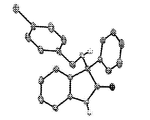
- Example 5-1 The crystal structure of the compound S5 obtained in Example 5-1 is shown. For clarity, the hydrogen atom is omitted.
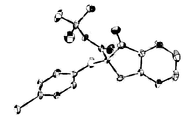
- the crystal structure of the compound S6 obtained in Example 5-2 is shown. For clarity, the hydrogen atom is omitted.
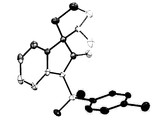
- the crystal structure of the compound S8 obtained in Example 5-3 is shown. For clarity, the hydrogen atom is omitted.
- optically active compound (1A) In the first embodiment of the present invention, a specific compound (oxindole compound), a hydroxylamine compound or hydrogen peroxide in the presence of a triazolium salt and a trihalogenated acetonitrile compound Can be effectively reacted to obtain an optically active compound.
- amino groups or hydroxy groups into which various substituents are introduced can be introduced into the ⁇ -position with respect to various substrate compounds (oxindole compounds) with wide substrate selectivity. Therefore, it is possible to obtain various optically active compounds.
- a specific compound (oxindole compound), a hydroxylamine compound or hydrogen peroxide is usually reacted in a solvent in the presence of a triazolium salt and a trihalogenated acetonitrile compound.
- oxindole compound a hydroxylamine compound or hydrogen peroxide is usually reacted in a solvent in the presence of a triazolium salt and a trihalogenated acetonitrile compound.
- Substrate Compound The compound used as a substrate to be subjected to the reaction is not particularly limited.
- R 1 are the same or different and each represents a halogen atom or an organic group.
- R 2 represents a hydrogen atom or an organic group.
- R 3 represents an organic group.
- n represents an integer of 0 to 4.
- any of a fluorine atom, a chlorine atom, a bromine atom and an iodine atom can be employed.
- a chlorine atom, a bromine atom, etc. are preferable.
- the organic group represented by R 1 is not particularly limited, and is a hydrocarbon group (alkyl group, cycloalkyl group, alkenyl group, aryl group), alkoxy group, alkoxycarbonyl group, aryloxy group. Etc.
- the alkyl group as the organic group represented by R 1 is not particularly limited, and examples thereof include a methyl group, an ethyl group, an n-propyl group, an isopropyl group, an n-butyl group, an isobutyl group, acyclic aliphatic alkyl group such as sec-butyl group and tert-butyl group (preferably an acyclic aliphatic alkyl group having 1 to 6 carbon atoms, particularly 1 to 4 carbon atoms); benzyl group, methylbenzyl group, Examples thereof include aralkyl groups such as phenethyl group, methylphenethyl group, naphthylmethyl group, and methylnaphthylmethyl group (preferably aralkyl groups having 7 to 20 carbon atoms, particularly 7 to 14 carbon atoms).
- a linear acyclic aliphatic alkyl group can also be employ
- These alkyl groups include substituents such as the halogen atoms, cycloalkyl groups described below, alkenyl groups described below, aryl groups described below, alkoxy groups described below, alkoxycarbonyl groups described below, aryloxy groups described below, cyano groups, It can also have about 1 to 3 pieces.
- the cycloalkyl group as the organic group represented by R 1 is not particularly limited, and examples thereof include a cyclopropyl group, a cyclopropylmethyl group, a cyclobutyl group, a cyclobutylmethyl group, a cyclopentyl group, and a cyclopentyl group.
- examples thereof include cycloalkyl groups such as a methyl group, a cyclohexyl group, a cyclohexylmethyl group, and a cyclohexylethyl group having 3 to 10 carbon atoms (preferably a cycloalkyl group having 3 to 8 carbon atoms).
- cycloalkyl groups include substituents such as the halogen atom, the alkyl group, the alkenyl group described below, the aryl group described below, the alkoxy group described below, the alkoxycarbonyl group described below, the aryloxy group described below, and the cyano group. It can also have about 1 to 3 pieces.
- the alkenyl group as the organic group represented by R 1 is not particularly limited, and examples thereof include alkenyl groups such as vinyl groups and allyl groups (preferably having 2 to 6 carbon atoms, particularly 2 carbon atoms). -4 alkenyl groups) and the like. These alkenyl groups include the halogen atom, the alkyl group, the cycloalkyl group, the alkenyl group, the aryl group described below, the alkoxy group described below, the alkoxycarbonyl group described below, the aryloxy group described below, and the cyano group. It may have about 1 to 3 substituents such as
- the aryl group as the organic group represented by R 1 is not particularly limited, and examples thereof include a phenyl group, a tolyl group (o-tolyl group, m-tolyl group, p-tolyl group), Examples include xylyl group (o-xylyl group, m-xylyl group, p-xylyl group), naphthyl group and the like.
- These aryl groups are the halogen atom, the alkyl group, the cycloalkyl group, the alkenyl group, the aryl group, the alkoxy group described below, the alkoxycarbonyl group described below, the aryloxy group described below, and the cyano group. It may have about 1 to 3 substituents such as
- the alkoxy group as the organic group represented by R 1 is not particularly limited, and examples thereof include a methoxy group, an ethoxy group, an n-propoxy group, an isopropoxy group, an n-butoxy group, and an isobutoxy group.
- acyclic aliphatic alkoxy groups such as sec-butoxy group and tert-butoxy group (preferably an acyclic aliphatic alkoxy group having 1 to 6 carbon atoms, particularly 1 to 4 carbon atoms).
- an acyclic linear aliphatic alkoxy group can also be employ
- These alkoxy groups include the halogen atom, the alkyl group, the cycloalkyl group, the alkenyl group, the aryl group, the alkoxy group, the alkoxycarbonyl group described later, the aryloxy group described below, and the cyano group. It may have about 1 to 3 substituents such as
- the alkoxycarbonyl group as the organic group represented by R 1 is not particularly limited, and examples thereof include a methoxycarbonyl group, an ethoxycarbonyl group, an n-propoxycarbonyl group, an isopropoxycarbonyl group, an n- Aliphatic alkoxycarbonyl groups such as butoxycarbonyl group, isobutoxycarbonyl group, sec-butoxycarbonyl group, tert-butoxycarbonyl group (preferably an aliphatic alkoxycarbonyl group having 2 to 7 carbon atoms, especially 2 to 5 carbon atoms), etc. Is mentioned.
- a linear aliphatic alkoxycarbonyl group can also be employ
- alkoxycarbonyl groups include the halogen atom, the alkyl group, the cycloalkyl group, the alkenyl group, the aryl group, the alkoxy group, the alkoxycarbonyl group, the aryloxy group described below, and cyano. It may have about 1 to 3 substituents such as a group.
- the aryloxy group as the organic group represented by R 1 is not particularly limited.
- xylyloxy group o-xylyloxy group, m-xylyloxy group, p-xylyloxy group
- naphthyloxy group a group having a phenoxy group, a tolyloxy group (o-tolyloxy group, m-tolyloxy group, p-tolyloxy group)
- xylyloxy group o-xylyloxy group, m-xylyloxy group, p-xylyloxy group
- aryloxy groups include the halogen atom, the alkyl group, the cycloalkyl group, the alkenyl group, the aryl group, the alkoxy group, the alkoxycarbonyl group, the aryloxy group, the cyano, It may have about 1 to 3 substituents such as a group.
- R 1 from the viewpoint of yield, stereoselectivity, etc., a halogen atom, an optionally substituted alkyl group, an optionally substituted alkoxy group and the like are preferable, an unsubstituted alkyl group, an unsubstituted group An alkoxy group and the like are more preferable, and an unsubstituted acyclic aliphatic alkyl group and an unsubstituted acyclic aliphatic alkoxy group are more preferable.
- n is plural (an integer of 2 to 4)
- the plural R 1 s may be the same or different.
- n which is the number of R 1 , is an integer of 0 to 4, preferably an integer of 0 to 2, more preferably 0 or 1, from the viewpoints of yield, stereoselectivity, and the like.
- R 1 is most preferably an unsubstituted acyclic aliphatic alkyl group, and n is most preferably 1.
- R 1 is an unsubstituted acyclic ring. Most preferably, it is a formula aliphatic alkoxy group, and n is 1.
- the organic group represented by R 2 is not particularly limited, and any group that can be used as a general protecting group for a nitrogen atom can be employed.
- methoxycarbonyl group ethoxy Alkoxycarbonyl groups such as carbonyl group, isopropoxycarbonyl group, tert-butoxycarbonyl group (hereinafter sometimes referred to as “Boc”), benzyloxycarbonyl group, 4-methoxybenzyloxycarbonyl group; trimethylsilyl group, triethylsilyl group Silyl groups such as tert-butyldimethylsilyl group; acyl groups such as acetyl group, pivaloyl group and benzoyl group; sulfonyl groups such as benzenesulfonyl group and p-toluenesulfonyl group; methoxymethyl group, tetrahydropyranyl group, acetoxymethyl Acetal type protecting
- the organic group represented by R 3 is not particularly limited, and is a hydrocarbon group (alkyl group, cycloalkyl group, alkenyl group, aryl group), alkoxy group, alkoxycarbonyl group, aryloxy group.
- a hydrocarbon group is preferable from the viewpoints of yield, stereoselectivity, and the like.
- an alkyl group, a cycloalkyl group, an alkenyl group, an aryl group, or the like is more preferable.
- a hydrocarbon group alkyl group, cycloalkyl group, an alkenyl group, an aryl group, or the like.
- Etc. are more preferable.
- an alkyl group, an alkenyl group or an aryl group is more preferable, an alkyl group or an alkenyl group is further preferable, and an aralkyl group or an alkenyl group is particularly preferable.
- an alkyl group, an alkenyl group or an aryl group is more preferable, an alkyl group or an alkenyl group is further preferable, and an aralkyl group or an alkenyl group is particularly preferable.
- Etc. are more preferable.
- the organic group represented by R 11 is not particularly limited, and is a hydrocarbon group (alkyl group, cycloalkyl group, alkenyl group, aryl group), alkoxy group, alkoxycarbonyl group, aryloxy group.
- a hydrocarbon group alkyl group, cycloalkyl group, alkenyl group, aryl group
- alkoxy group alkoxycarbonyl group, aryloxy group.
- an aliphatic alkyl group, an aralkyl group, a cycloalkyl group, an aryl group and the like are preferable, an aralkyl group, a cycloalkyl group, an aryl group and the like are more preferable, An aryl group and the like are further preferable, and an unsubstituted cycloalkyl group, an unsubstituted or substituted aryl group, and the like are particularly preferable.
- hydroxylamine compounds (5) that satisfy these conditions include:
- Etc. are more preferable.
- the amount of the hydroxylamine compound (5) or hydrogen peroxide used is not particularly limited, and is usually about 0.5 to 20 moles per mole of the compound (4A) from the viewpoint of yield, stereoselectivity, etc.
- the amount is preferably about 1 to 10 moles.
- hydrogen peroxide an excessive amount of hydrogen peroxide water can be used.
- X 1 represents a halogen atom or a monovalent anion.
- R 5 , R 8 , R 9 and R 10 are the same or different and each represents an optionally substituted aryl group.
- R 6 represents an optionally substituted primary alkyl group.
- R 7 represents an optionally substituted aliphatic alkyl group or an optionally substituted cycloalkyl group.
- triazolium salt (2) (Hereinafter also referred to as “triazolium salt (2)”).
- any of a fluorine atom, a chlorine atom, a bromine atom and an iodine atom can be adopted.
- X 1 is preferably a halogen atom, more preferably a chlorine atom, a bromine atom, or the like, and further preferably a bromine atom, from the viewpoints of yield, stereoselectivity, and the like.
- aryl group represented by R 5 those described above can be employed.
- the kind and number of substituents are the same.
- a substituted aryl group is preferable from the viewpoints of yield, stereoselectivity, and the like, and an aryl group substituted with 1 to 2 halogen atoms, aryl groups, and the like is more preferable.
- an aryl group substituted with 1 to 2 halogen atoms, aryl groups, and the like is more preferable.
- the primary alkyl group represented by R 6 is not particularly limited, and examples thereof include acyclic groups such as a methyl group, an ethyl group, an n-propyl group, an n-butyl group, and an isobutyl group.
- Aliphatic primary alkyl group (preferably an acyclic aliphatic primary alkyl group having 1 to 6 carbon atoms, particularly 1 to 4 carbon atoms); benzyl group, methylbenzyl group, phenethyl group, methylphenethyl group, naphthyl
- An aromatic primary alkyl group such as an aralkyl group such as a methyl group or a methylnaphthylmethyl group (preferably an aromatic primary alkyl group such as an aralkyl group having 7 to 20 carbon atoms, particularly 7 to 14 carbon atoms), etc.
- a linear acyclic aliphatic primary alkyl group can also be used, and a branched acyclic primary aliphatic alkyl group is also used.
- You can also These primary alkyl groups include the halogen atom, the cycloalkyl group, the alkenyl group, the aryl group, the alkoxy group, the alkoxycarbonyl group, the aryloxy group, and the cyano group. It may have about 1 to 3 substituents.
- the aliphatic alkyl group represented by R 7 is not particularly limited, and examples thereof include a methyl group, ethyl group, n-propyl group, isopropyl group, n-butyl group, isobutyl group, sec- And acyclic aliphatic alkyl groups such as a butyl group and a tert-butyl group (preferably an acyclic aliphatic alkyl group having 1 to 6 carbon atoms, particularly 1 to 4 carbon atoms).
- a linear acyclic aliphatic alkyl group can also be employ
- These aliphatic alkyl groups have 1 to 3 substituents such as the halogen atom, the alkenyl group, the aryl group, the alkoxy group, the alkoxycarbonyl group, the aryloxy group, and the cyano group. It can also have a degree.
- the cycloalkyl group represented by R 7 is not particularly limited, and examples thereof include a cyclopropyl group, a cyclopropylmethyl group, a cyclobutyl group, a cyclobutylmethyl group, a cyclopentyl group, a cyclopentylmethyl group, and cyclohexyl.
- a cyclic aliphatic alkyl group such as a cyclohexylmethyl group and a cyclohexylethyl group (preferably a cyclic aliphatic alkyl group having 3 to 10 carbon atoms, particularly 3 to 8 carbon atoms).
- cycloalkyl groups include substituents such as the halogen atom, the alkyl group, the alkenyl group, the aryl group, the alkoxy group, the alkoxycarbonyl group, the aryloxy group, and the cyano group. It can also have about 1 to 3 pieces.
- R 8 and R 9 As the aryl group represented by R 8 and R 9 , those described above can be adopted. The kind and number of substituents are the same. Among these, from the viewpoints of yield, stereoselectivity, etc., an unsubstituted aryl group or an aryl group substituted with one halogen atom is preferable, and a phenyl group or a chlorophenyl group is more preferable. R 8 and R 9 may be the same or different.
- aryl group represented by R 10 those described above can be employed.
- the kind and number of substituents are the same.
- an aryl group substituted with an unsubstituted aryl group or two alkyl groups preferably a halogenated alkyl group, particularly a perfluoroalkyl group
- the alkoxy group, etc. are preferable, and a phenyl group, a dimethoxyphenyl group, and a bis (trifluoromethyl) phenyl group are more preferable.
- triazolium salts (2) may be known or commercially available compounds, and may be synthesized according to the methods described in the previous reports (J. Am. Chem. Soc. 2011, 133, 1307-1309., Etc.). You can also.
- the amount of triazolium salt (2) to be used is not particularly limited, and from the viewpoint of yield, stereoselectivity, etc., for example, it is usually preferably about 0.01 to 0.2 mol, preferably 0.02 to 0.1 mol, per 1 mol of compound (4A). A molar degree is more preferable.
- Such a triazolium salt (2) is not limited to the production method of the present invention, and can be used as an asymmetric ⁇ -amination or asymmetric ⁇ -hydroxylation catalyst of a carbonyl compound.
- Trihalogenated acetonitrile compound used in the present invention has the general formula (3): CX 2 3 CN (3) [Wherein X 2 is the same or different and represents a halogen atom. ] (Hereinafter also referred to as “trihalogenated acetonitrile compound (3)”).
- the halogen atom represented by X 2 may be the same or different (preferably the same), and any of a fluorine atom, a chlorine atom, a bromine atom and an iodine atom can be adopted. From the viewpoints of yield, stereoselectivity and the like, in this step, a chlorine atom, a bromine atom and the like are preferable, and a chlorine atom is more preferable. That is, CCl 3 CN is most preferable as the trihalogenated acetonitrile compound (3).
- the amount of the trihalogenated acetonitrile compound (3) used is not particularly limited, and is usually preferably about 0.01 to 5.0 moles per mole of the compound (4A) from the viewpoint of yield, stereoselectivity, etc. About 2.0 mol is more preferable.
- Examples of the base that can be used in the present invention include alkali metal phosphates such as potassium phosphate and sodium phosphate; alkali metal carbonates such as sodium carbonate, potassium carbonate, cesium carbonate and rubidium carbonate; trimethylamine, triethylamine and the like. Examples include amines. These can be used alone or in combination of two or more. Among these, alkali metal carbonates are preferable and potassium carbonate is more preferable from the viewpoints of yield, stereoselectivity, and the like.
- the amount of the base used is not particularly limited, and is generally preferably 0.2 to 5 mol, more preferably 0.5 to 2 mol, relative to 1 mol of compound (4A) from the viewpoints of yield, stereoselectivity and the like.
- the solvent examples include aromatic hydrocarbons such as toluene, xylene, benzene, mesitylene; aliphatic halogenated hydrocarbons such as dichloromethane, chloroform, carbon tetrachloride, dichloroethane; diethyl ether, dimethoxyethane, diisopropyl ether, tert-butyl.
- chain ethers such as methyl ether; esters such as ethyl acetate and ethyl propionate; ketones such as acetone and methyl ethyl ketone. These can be used alone or in combination of two or more.
- aromatic hydrocarbons are preferable for ⁇ -amination and chain ethers are preferable for hydroxylation from the viewpoints of yield, stereoselectivity, and the like.
- the present invention is preferably carried out under anhydrous conditions and under an inert gas atmosphere (nitrogen gas, argon gas, etc.), and the reaction temperature can be carried out under heating, at room temperature or under cooling. It is about ⁇ 78 ° C. to room temperature (25 ° C.), preferably about ⁇ 50 to 20 ° C., more preferably about ⁇ 25 to 10 ° C.
- the reaction time can be a time for which the reaction proceeds sufficiently, and is usually about 10 minutes to 72 hours, preferably about 1 to 48 hours.
- the target compound After completion of the reaction, the target compound can be obtained through normal isolation and purification steps as necessary. If the reaction of the present invention is used, various useful optically active compounds can be obtained.
- reaction mechanism in the present invention is not particularly limited, and the following reaction formula 1:
- reaction 2 [Wherein, R 11 and X 2 are the same as defined above. ] Or reaction 2:
- the amination reagent (6A) when used in place of the trihalogenated acetonitrile compound (3) and the hydroxylamine compound (5), the trihalogenated acetonitrile compound (3) and hydrogen peroxide are used.
- the amination reagent (6B) is used instead of the above is also included.
- optically active compound (1A) is a novel compound not described in any literature.
- optically active compound (1B) In the second embodiment of the present invention, a specific compound and a hydroxylamine compound are effectively reacted in the presence of a triazolium salt and a trihalogenated acetonitrile compound, An optically active compound can be obtained.
- various optically active compounds can be obtained because amino groups having various substituents introduced therein can be introduced into the ⁇ -position with respect to various substrate compounds. It is also possible.
- various optically active compounds are obtained by reacting a specific compound with a hydroxylamine compound, usually in a solvent in the presence of a triazolium salt and a trihalogenated acetonitrile compound. Can do.
- Substrate compound The compound used as a substrate to be subjected to the reaction is not particularly limited, and for example, a general formula (4B):
- R 1 and n are the same as defined above.
- R represents an organic group.
- compound (4B) can be employed.
- R is an organic group.
- organic groups include hydrocarbon groups (alkyl groups, cycloalkyl groups, alkenyl groups, aryl groups), alkoxy groups, alkoxycarbonyl groups, aryloxy groups, and the like. Can do. The same applies to preferred types, types and numbers of substituents and the like.
- the hydroxylamine compound used in the present invention is a hydroxylamine compound represented by the general formula (5) described above. What was demonstrated above is employable about the preferable kind, usage-amount, etc. of each substituent. The same applies to preferred specific examples of the hydroxylamine compound.
- the triazolium salt used as a catalyst is a triazolium salt represented by the general formula (2) described above. What was demonstrated above is employable about the preferable kind of each substituent, the usage-amount, a synthesis method, etc. The same applies to specific examples of triazolium salts.
- Trihalogenated acetonitrile compound used in the present invention is a trihalogenated acetonitrile compound represented by the general formula (3) described above. What was demonstrated above is employable about the preferable kind of substituent, usage-amount, etc.
- reaction conditions of the present invention those described in the first embodiment can be adopted.
- reaction mechanism in the present invention is not particularly limited, and an amination reagent (6A) is produced according to the above-described reaction formula 1, and this amination reagent (6A) and the catalyst are used as a catalyst. It is considered that the intramolecular ring closure reaction of compound (4B) is promoted by the action with triazolium salt (2). At this time, as a by-product
- this invention includes the case where the said amination reagent (6A) is used instead of the said trihalogenated acetonitrile compound (3) and a hydroxylamine compound (5).
- optically active compound (1B) is a novel compound not described in any literature.
- a specific compound (an oxindole compound having an amino group at the terminal) is formed in the presence of a triazolium salt and a trihalogenated acetonitrile compound.
- An optically active compound can be obtained by an internal ring-closing reaction.
- various asymmetric spiro compounds can be obtained with wide substrate selectivity with respect to various substrate compounds.
- a specific compound (an oxindole compound having an amino group at the terminal) is usually subjected to an intramolecular ring-closing reaction in a solvent in the presence of a triazolium salt and a trihalogenated acetonitrile compound.
- a specific compound an oxindole compound having an amino group at the terminal
- a solvent in the presence of a triazolium salt and a trihalogenated acetonitrile compound.
- Substrate compound used as a substrate to be subjected to the reaction is not particularly limited.
- R 1 , R 2 and n are the same as defined above.
- R 12 represents a divalent linking group.
- R 13 represents an alkyl group.
- compound (4C) can be employed.
- R 1 , R 2 and n may be those described above. The same applies to preferred types, types and numbers of substituents, and the like.
- R 12 is a divalent linking group.
- a divalent linking group include a single bond; an alkylene group having 1 to 6 carbon atoms such as a methylene group, an ethylene group, a trimethylene group, a propylene group, a tetramethylene group, and a butylene group; a carbonyl group; -; -S-; a linking group combining two or more of these, and the like.
- R 13 is an alkyl group. As such an alkyl group, what was mentioned above is employable. The same applies to preferred types, types and numbers of substituents, and the like.
- Etc. can be used.
- the triazolium salt used as a catalyst is a triazolium salt represented by the general formula (2) described above. What was demonstrated above is employable about the preferable kind of each substituent, the usage-amount, a synthesis method, etc. The same applies to specific examples of triazolium salts.
- Trihalogenated acetonitrile compound used in the present invention is a trihalogenated acetonitrile compound represented by the general formula (3) described above. What was demonstrated above is employable about the preferable kind of substituent, usage-amount, etc.
- reaction conditions of the present invention those described in the first embodiment can be adopted.
- optically active compound in which the ⁇ -position is aminated is a novel compound not described in any literature.
- the optical rotation was measured with a HORIBA SEPA-500 polarimeter. High resolution mass spectra were performed with Thermo Fisher Scientific Exactive (ESI). Analytical thin layer chromatography (TLC) was performed on Merck pre-coated TLC plates (silica gel 60 GF254, 0.25 mm). Flash column chromatography was performed using CHROMATOREX DIOL MB100-40 / 75 (spherical, 40-75 ⁇ m; Fuji Silysia Chemical), CHROMATOREX NH DM2035 (spherical, 60 ⁇ m; Fuji Silysia Chemical), and silica gel 60 (Merck 1.09385). .9929, 230-400 mesh).
- Enantiomeric excess is determined by chiral column [ ⁇ 4.6 mm ⁇ 250 mm, DAICEL CHIRALCEL OD-3 (OD3), CHIRALCEL OZ-3 (OZ3), CHIRALPAK AS-H (ASH), CHIRALPAK ID-3 (ID3), CHIRALPAK IE -3 (IE3), and CHIRALPAK IF-3 (IF3)] were determined by HPLC analysis using hexane (Hex), isopropyl alcohol (IPA) and ethanol (EtOH) as eluents.
- Hex hexane
- IPA isopropyl alcohol
- EtOH ethanol
- Et 3 N represents triethylamine.
- Hex represents hexane.
- t-BuOMe represents tert-butyl methyl ether.
- Bn represents a benzyl group.
- TBAB represents tetrabutylammonium bromide.
- THF represents tetrahydrofuran. The same applies hereinafter.
- the obtained cyclohexanone oxime was suspended in ethanol (20 mL). Next, sodium cyanoborohydride (NaBH 3 CN; 0.75 g, 12 mmol) was added to the mixture, and a 6 N methanol solution of HCl (16 mL) was added dropwise at 0 ° C. After stirring at room temperature for 3 hours, the reaction mixture was poured into water and the whole mixture was neutralized with KOH pellets at 0 ° C. After extraction with ethyl acetate, the organic extract was washed with brine and dried over Na 2 SO 4 .
- NaBH 3 CN sodium cyanoborohydride
- N-alkylhydroxylamine compounds were obtained in the same manner.
- N-cyclohexyl-o-methylhydroxylamine was obtained in the same manner as in Synthesis Example 1-3 except that o-methylhydroxylammonium chloride was used in place of hydroxylammonium chloride.
- 1 H NMR (400 MHz, CDCl 3 ) ⁇ 5.33 (1H, brs), 3.54 (3H, s), 2.84 (1H, tt, J 10.6, 3.8 Hz), 1.88-1.84 (2H, m), 1.77 -1.73 (2H, m), 1.65-1.60 (1H, m), 1.33-1.05 (5H, m).
- CDI carbonyldiimidazole.
- Bz represents a benzoyl group. The same applies hereinafter.
- N-cyclohexylhydroxylamine (3c; 0.11 g, 1 mmol) obtained in Synthesis Example 1-3 was introduced, and stirring was continued for another 6 hours. Saturated aqueous NH 4 Cl was added to quench the reaction mixture.
- the obtained oxime compound (1.45 g, 10 mmol) was suspended in ethanol (20 mL). Next, sodium cyanoborohydride (NaBH 3 CN; 0.75 g, 12 mmol) was added to the mixture, and acetic acid (5.7 mL, 100 mmol) was added dropwise. After stirring for 12 hours, the reaction mixture was poured into water and all the mixture was neutralized with saturated aqueous NaHCO 3 solution. The solvent was removed under vacuum and extracted with ethyl acetate. The orange extract was dried over Na 2 SO 4 and the solvent was evaporated.
- sodium cyanoborohydride NaBH 3 CN; 0.75 g, 12 mmol
- acetic acid 5.7 mL, 100 mmol
- Example 1 Asymmetric ⁇ -amination of oxindole compound
- Example 1-1 Synthesis of compound 4l
- Example 1-3 The same treatment as in Example 1-1 was performed, except that various hydroxylamine compounds were used and the compounds shown in Table 1 were used as catalysts. The results are shown in Table 1. When 1d ⁇ Br or 1e ⁇ Br was used as the catalyst, almost no optically active compound was obtained, and only a mixture of stereoisomers (racemate) was obtained.
- Example 1-4 Unless otherwise specified, the above procedure was performed except that various compounds were used as substrate compounds, various hydroxylamine compounds as hydroxylamine compounds, and any triazolium salt obtained in Synthesis Examples 2-1 to 2-6 was used as a catalyst. The same treatment as in Example 1-1 and Example 1-2 was performed. As a result, it was confirmed that an optically active compound having a substituent shown in Table 2 below was obtained. The results are shown in Table 2.
- Example 1-5 Asymmetric amination using compound S3
- Example 1-6 Reversibility in amination reagent formation
- Example 2 Asymmetric ⁇ -hydroxylation of oxindole compound
- Example 2-1 Synthesis of compound 5a
- Triazolium salt 1b ⁇ Br (3.76 mg, 0.005 mmol) obtained in Synthesis Example 2-2, oxindole compound 2a (30.9 mg, 0.10 mmol), and diethyl ether (1.0) of K 2 CO 3 (13.8 mg, 0.10 mmol) mL) solution was degassed by alternately evacuating and refilling with argon.
- the obtained mixture was cooled to ⁇ 10 ° C., 30% H 2 O 2 aqueous solution (50 ⁇ L, 0.50 mmol) and CCl 3 CN (10 ⁇ L, 0.10 mmol) were added to the reaction mixture. Thereafter, stirring was continued for 24 hours at the same temperature.
- the target optically active ⁇ -hydroxylated oxindole compound 4 was obtained (28.6 mg, 88% yield, 94% enantioselectivity). This result corresponds to entry 1 in Table 2 described later.
- Example 2-2 Unless otherwise limited, the same treatment as in Example 2-1 was performed except that various compounds were used as the substrate compound. As a result, it was confirmed that an optically active compound having a substituent shown in Table 3 below was obtained. The results are shown in Table 3.
- 4-MeC 6 H 4 represents a 4-methylphenyl group.
- 4-MeOC 6 H 4 represents a 4-methoxyphenyl group.
- 4-FC 6 H 4 represents a 4-fluorophenyl group.
- 3-MeC 6 H 4 represents a 3-methylphenyl group.
- 3-MeOC 6 H 4 represents a 3-methoxyphenyl group.
- 2-Naph represents a 2-naphthyl group.
- 1-Naph represents a 1-naphthyl group.
- CH 2 Ph represents a benzyl group.
- CH 2 (4-F) C 6 H 4 represents a 4-fluorobenzyl group.
- CH 2 (4-MeO) C 6 H 4 represents a 4-methoxybenzyl group.
- c-Hex represents a cyclohexyl group.
- Et represents an ethyl group.
- n-Bu represents an n-butyl group.
- Example 1-1 The same treatment as in Example 1-1 was performed except that the triazolium salt 1c ⁇ Br obtained in Synthesis Example 2-3 was used as a catalyst.
- the triazolium salt 1c ⁇ Br obtained in Synthesis Example 2-3 was used as a catalyst.
- the oxindole compound it was possible to introduce an amino group at the ⁇ -position, and the product 7 was obtained in 73% yield and 90% enantioselectivity.
- TFA Trifluoroacetic acid
- the structure is determined by the direct method (IR92: Altomare, A., Cascarano, G., Giacovazzo, C., Guagliardi, A., Burla, M., Polidori, G. & Camalli, MJ Appl. Cryst., 27, 435 ( 1994).) And the extended Fourier transform method. Non-hydrogen atoms were refined anisotropically. Some hydrogen atoms were determined isotropically, some hydrogen atoms were determined using the rising model, and the remaining hydrogen atoms were included in the solidified position. As a result, the determined structure is shown in FIGS.
Landscapes
- Chemical & Material Sciences (AREA)
- Organic Chemistry (AREA)
- Chemical Kinetics & Catalysis (AREA)
- Engineering & Computer Science (AREA)
- Materials Engineering (AREA)
- Organic Low-Molecular-Weight Compounds And Preparation Thereof (AREA)
- Low-Molecular Organic Synthesis Reactions Using Catalysts (AREA)
- Indole Compounds (AREA)
- Catalysts (AREA)
Abstract
特定の化合物(オキシインドール化合物等のカルボニル化合物)と、特定のヒドロキシルアミン化合物又は過酸化水素とを、特定のトリアゾリウム塩及び特定のトリハロゲン化アセトニトリル化合物の存在下に反応させることで、生成物の窒素-窒素結合、窒素-酸素結合等を還元的に切断する反応を経ずとも、オキシインドール化合物のα位に多様な置換基を有するアミノ基を、一段階のみで、立体選択的に導入する方法を提供することができる。また、同様の反応機構で、他の基質に対して、α位に多様な置換基を有するアミノ基を、一段階のみで、立体選択的に導入することもできる。該反応は、塩基の存在下で行うことが好ましい。
Description
本発明は、光学活性オキシインドール化合物の製造方法及びそれに触媒として用いられるトリアゾリウム塩に関する。
光学活性なオキシインドール誘導体(特に、3位がアミノ基で置換されたオキシインドール誘導体)は、AG-041R、cartellin C等の生物活性物質の部分構造として存在し、医農薬品合成の中間体に広く利用されている。近年、より高機能な医薬品誘導体の開発を目的として、α位に不斉炭素を有するオキシインドール誘導体の合成が望まれている。
このような四置換不斉炭素を有するオキシインドール誘導体の合成方法としては、特定のオキシインドール誘導体の求電子的な立体選択的α-アミノ化反応方法が知られている。このα-アミノ化反応におけるアミノ化試剤としては、従来から、アゾジカルボン酸エステル、ニトロソ化合物、アジ化ヨージナン類等が使用されている(例えば、非特許文献1~4等)。
Angew. Chem. Int. Ed. 2011, 50, 4684-4688.
J. Am. Chem. Soc. 2010, 132, 1255-1257.
J. Am. Chem. Soc. 2006, 126, 16488-16489.
Organic Letters, 2008, 10, 1593-1595.
しかしながら、上記の従来の方法では、立体選択的な求電子的α-アミノ化反応に利用できるアミノ化試剤は極めて限られていた。また、上記の従来の方法では、生成物の窒素-窒素結合、窒素-酸素結合等を還元的に切断する反応を経なければα-アミノカルボニル化合物が得られなかった。このため、オキシインドール化合物のα位に多様な置換基を有するアミノ基を導入することは困難であった。
このため、本発明は、生成物の窒素-窒素結合、窒素-酸素結合等を還元的に切断する反応を経ずとも、オキシインドール化合物のα位に多様な置換基を有するアミノ基を、一段階のみで、立体選択的に導入する方法を提供することを目的とする。また、本発明は、同様の反応機構で、他の基質に対して、α位に多様な置換基を有するアミノ基を、一段階のみで、立体選択的に導入する方法を提供することも目的とする。さらに、本発明は、当該方法に使用することができる触媒を提供することも目的とする。
本発明者らは上記の課題を解決するために鋭意研究を行った。その結果、窒素上に種々の置換基を導入することができるヒドロキシルアミン化合物をアミノ源とし、系内でトリハロゲン化アセトニトリルと反応させることで求電子的なアミノ化試剤を発生させるとともに、このアミノ化試剤とキラルな1,2,3-トリアゾリウム塩触媒とを組合せて使用することで、カルボニル化合物(特にオキシインドール化合物)に対して、直接的にα-アミノ化反応を、高いエナンチオ選択性で実現することができた。この方法は、カルボニル化合物(特にオキシインドール化合物)に対するα-ヒドロキシル化反応や、末端にアミノ基を有するカルボニル化合物(特に末端にアミノ基を有するオキシインドール化合物)の分子内閉環α-アミノ化反応にも適用できる。本発明者らは、このような知見に基づき、さらに研究を重ね、本発明を完成した。すなわち、本発明は以下の構成を包含する。
項1.一般式(1A):
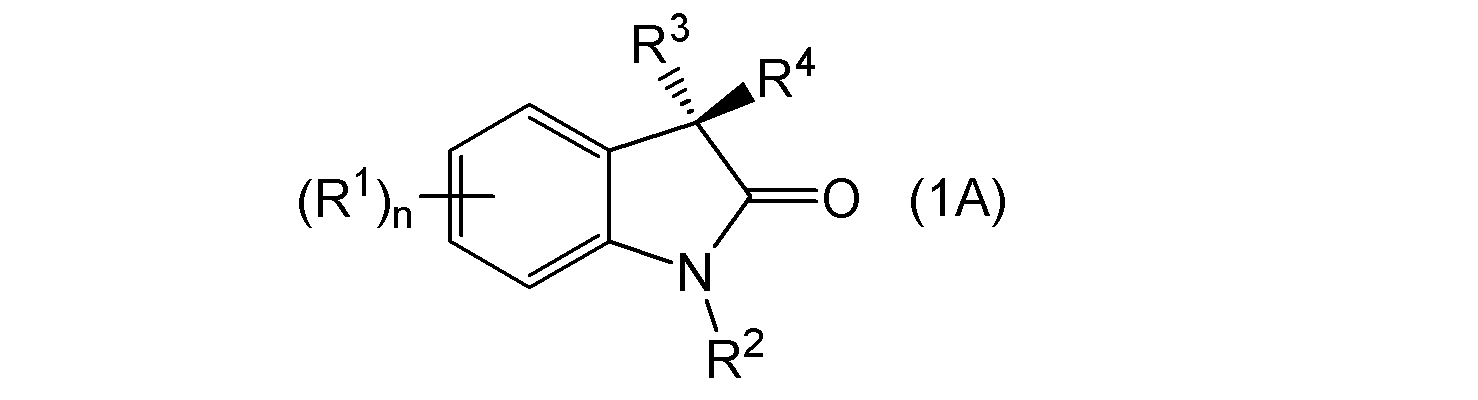
[式中、R1は同一又は異なって、ハロゲン原子又は有機基を示す。R2は水素原子又は有機基を示す。R3は有機基を示す。R4は置換されていてもよいアミノ基又は水酸基を示す。nは0~4の整数を示す。]
で表される光学活性化合物の製造方法であって、
一般式(2):
で表される光学活性化合物の製造方法であって、
一般式(2):

[式中、X1はハロゲン原子又は1価のアニオンを示す。R5、R8、R9及びR10は同一又は異なって、置換されていてもよいアリール基を示す。R6は置換されていてもよい第一級アルキル基を示す。R7は置換されていてもよい脂肪族アルキル基又は置換されていてもよいシクロアルキル基を示す。]
で表されるトリアゾリウム塩と、
一般式(3):
CX2 3CN (3)
[式中、X2は同一又は異なって、ハロゲン原子を示す。]
で表されるトリハロゲン化アセトニトリル化合物の存在下に、
一般式(4A):
で表されるトリアゾリウム塩と、
一般式(3):
CX2 3CN (3)
[式中、X2は同一又は異なって、ハロゲン原子を示す。]
で表されるトリハロゲン化アセトニトリル化合物の存在下に、
一般式(4A):

[式中、R1、R2、R3及びnは前記に同じである。]
で表される化合物と、
一般式(5):
R11NHOH (5)
[式中、R11は有機基を示す。]
で表されるヒドロキシルアミン化合物又は過酸化水素とを反応させる反応工程
を備える、製造方法。
で表される化合物と、
一般式(5):
R11NHOH (5)
[式中、R11は有機基を示す。]
で表されるヒドロキシルアミン化合物又は過酸化水素とを反応させる反応工程
を備える、製造方法。
項2.前記反応工程が、塩基の存在下に行われる、項1に記載の製造方法。
項3.前記一般式(1A)におけるR4が置換されていてもよいアミノ基であり、
前記反応工程が、前記一般式(2)で表されるトリアゾリウム塩及び一般式(3)で表されるトリハロゲン化アセトニトリル化合物の存在下に、前記一般式(4A)で表される化合物と前記一般式(5)で表されるヒドロキシルアミン化合物とを反応させる工程である、項1又は2に記載の製造方法。
前記反応工程が、前記一般式(2)で表されるトリアゾリウム塩及び一般式(3)で表されるトリハロゲン化アセトニトリル化合物の存在下に、前記一般式(4A)で表される化合物と前記一般式(5)で表されるヒドロキシルアミン化合物とを反応させる工程である、項1又は2に記載の製造方法。
項4.前記一般式(1A)におけるR4が水酸基であり、
前記反応工程が、前記一般式(2)で表されるトリアゾリウム塩及び一般式(3)で表されるトリハロゲン化アセトニトリル化合物の存在下に、前記一般式(4A)で表される化合物と前記過酸化水素とを反応させる工程である、項1又は2に記載の製造方法。
前記反応工程が、前記一般式(2)で表されるトリアゾリウム塩及び一般式(3)で表されるトリハロゲン化アセトニトリル化合物の存在下に、前記一般式(4A)で表される化合物と前記過酸化水素とを反応させる工程である、項1又は2に記載の製造方法。
項5.一般式(1B):

[式中、R1は同一又は異なって、ハロゲン原子又は有機基を示す。R11は有機基を示す。Rは有機基を示す。nは0~4の整数を示す。]
で表される光学活性化合物の製造方法であって、
一般式(2):
で表される光学活性化合物の製造方法であって、
一般式(2):
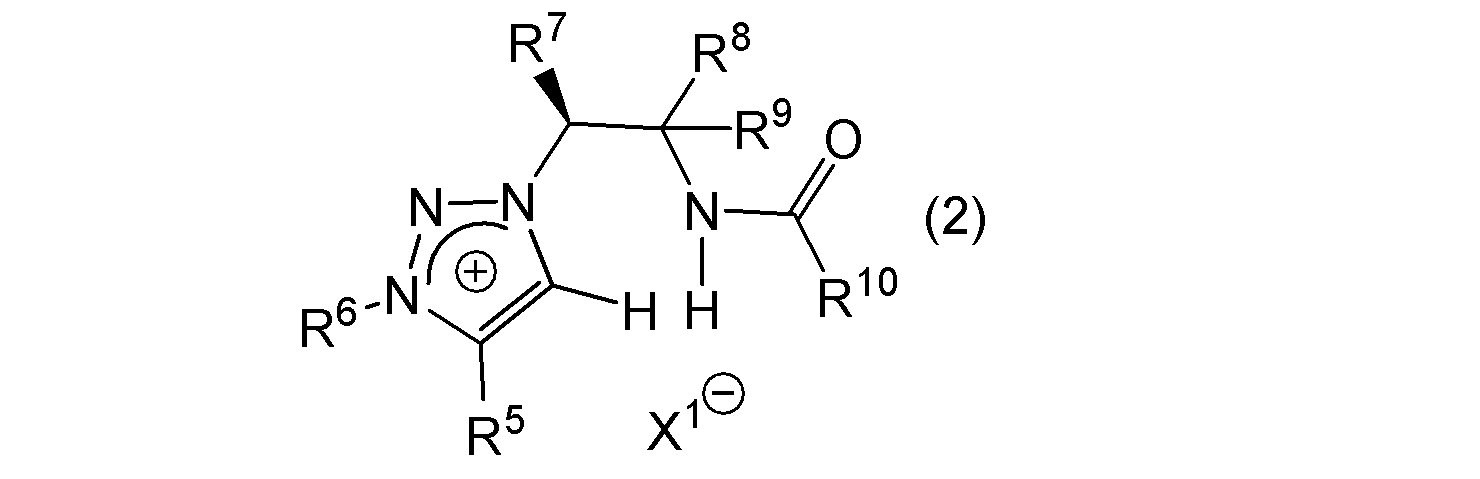
[式中、X1はハロゲン原子又は1価のアニオンを示す。R5、R8、R9及びR10は同一又は異なって、置換されていてもよいアリール基を示す。R6は置換されていてもよい第一級アルキル基を示す。R7は置換されていてもよい脂肪族アルキル基又は置換されていてもよいシクロアルキル基を示す。]
で表されるトリアゾリウム塩と、
一般式(3):
CX2 3CN (3)
[式中、X2は同一又は異なって、ハロゲン原子を示す。]
で表されるトリハロゲン化アセトニトリル化合物の存在下に、
一般式(4B):
で表されるトリアゾリウム塩と、
一般式(3):
CX2 3CN (3)
[式中、X2は同一又は異なって、ハロゲン原子を示す。]
で表されるトリハロゲン化アセトニトリル化合物の存在下に、
一般式(4B):

[式中、R1、R及びnは前記に同じである。]
で表される化合物と、
一般式(5):
R11NHOH (5)
[式中、R11は有機基を示す。]
で表されるヒドロキシルアミン化合物とを反応させる反応工程
を備える、製造方法。
で表される化合物と、
一般式(5):
R11NHOH (5)
[式中、R11は有機基を示す。]
で表されるヒドロキシルアミン化合物とを反応させる反応工程
を備える、製造方法。
項6.前記反応工程が、塩基の存在下に行われる、項5に記載の製造方法。
項7.一般式(1C):
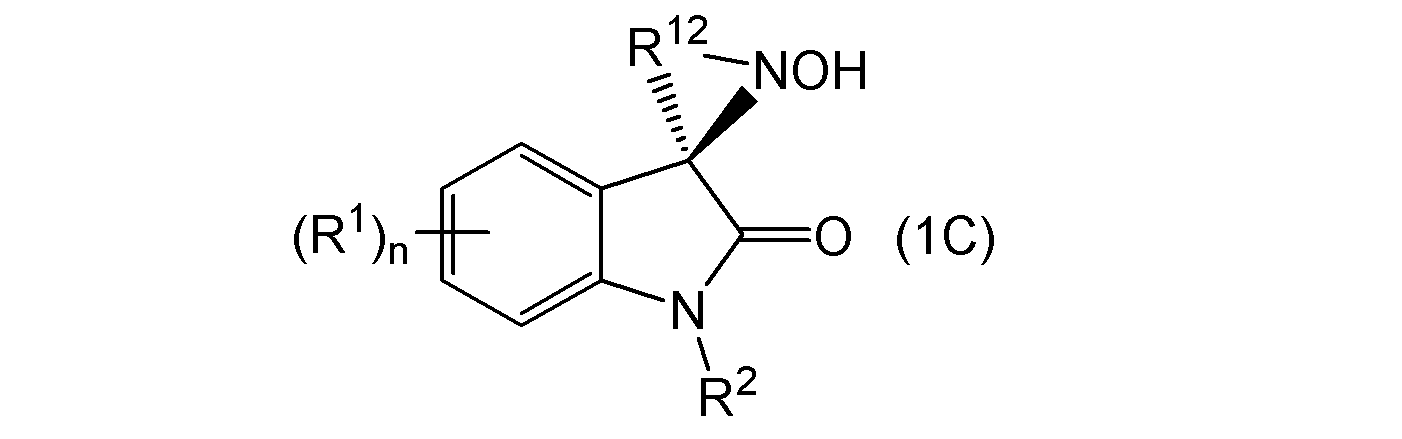
[式中、R1は同一又は異なって、ハロゲン原子又は有機基を示す。R2は水素原子又は有機基を示す。R12は2価の連結基を示す。nは0~4の整数を示す。]
で表される光学活性化合物の製造方法であって、
一般式(2):
で表される光学活性化合物の製造方法であって、
一般式(2):
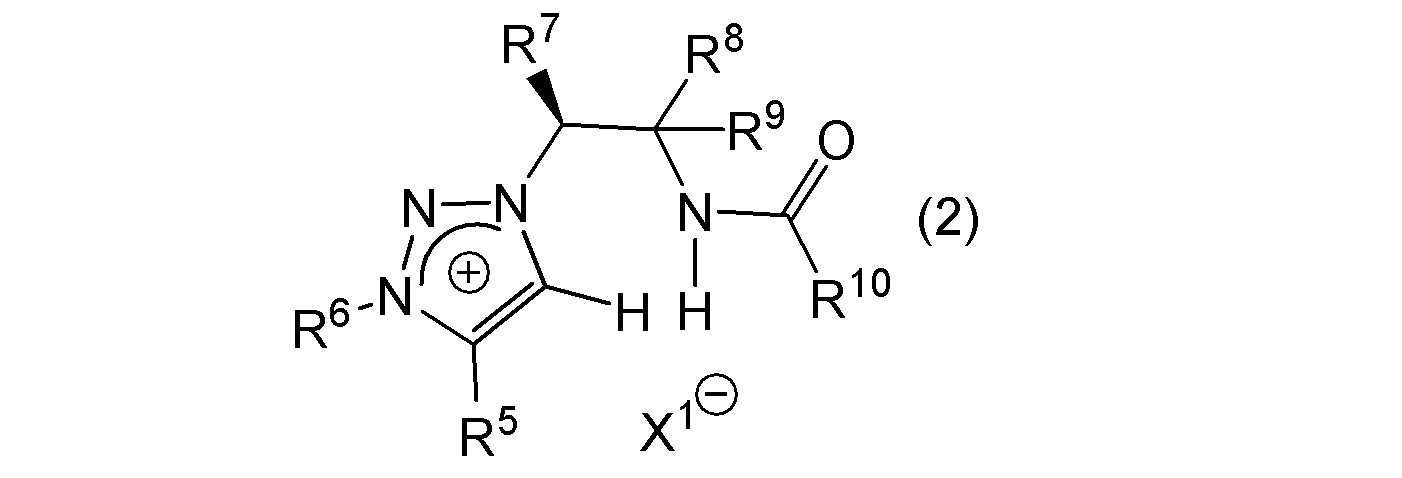
[式中、X1はハロゲン原子又は1価のアニオンを示す。R5、R8、R9及びR10は同一又は異なって、置換されていてもよいアリール基を示す。R6は置換されていてもよい第一級アルキル基を示す。R7は置換されていてもよい脂肪族アルキル基又は置換されていてもよいシクロアルキル基を示す。]
で表されるトリアゾリウム塩と、
一般式(3):
CX2 3CN (3)
[式中、X2は同一又は異なって、ハロゲン原子を示す。]
で表されるトリハロゲン化アセトニトリル化合物の存在下に、
一般式(4C):
で表されるトリアゾリウム塩と、
一般式(3):
CX2 3CN (3)
[式中、X2は同一又は異なって、ハロゲン原子を示す。]
で表されるトリハロゲン化アセトニトリル化合物の存在下に、
一般式(4C):

[式中、R1、R2、R12及びnは前記に同じである。R13はアルキル基を示す。]
で表される化合物を、分子内閉環反応させる分子内閉環反応工程
を備える、製造方法。
で表される化合物を、分子内閉環反応させる分子内閉環反応工程
を備える、製造方法。
項8.前記分子内閉環反応工程が、塩基の存在下に行われる、項7に記載の製造方法。
項9.一般式(2):

[式中、X1はハロゲン原子又は1価のアニオンを示す。R5、R8、R9及びR10は同一又は異なって、置換されていてもよいアリール基を示す。R6は置換されていてもよい第一級アルキル基を示す。R7は置換されていてもよい脂肪族アルキル基又は置換されていてもよいシクロアルキル基を示す。]
で表されるトリアゾリウム塩からなるカルボニル化合物の不斉α-アミノ化又は不斉α-ヒドロキシル化触媒。
で表されるトリアゾリウム塩からなるカルボニル化合物の不斉α-アミノ化又は不斉α-ヒドロキシル化触媒。
項10.前記カルボニル化合物は、
一般式(4A):
一般式(4A):
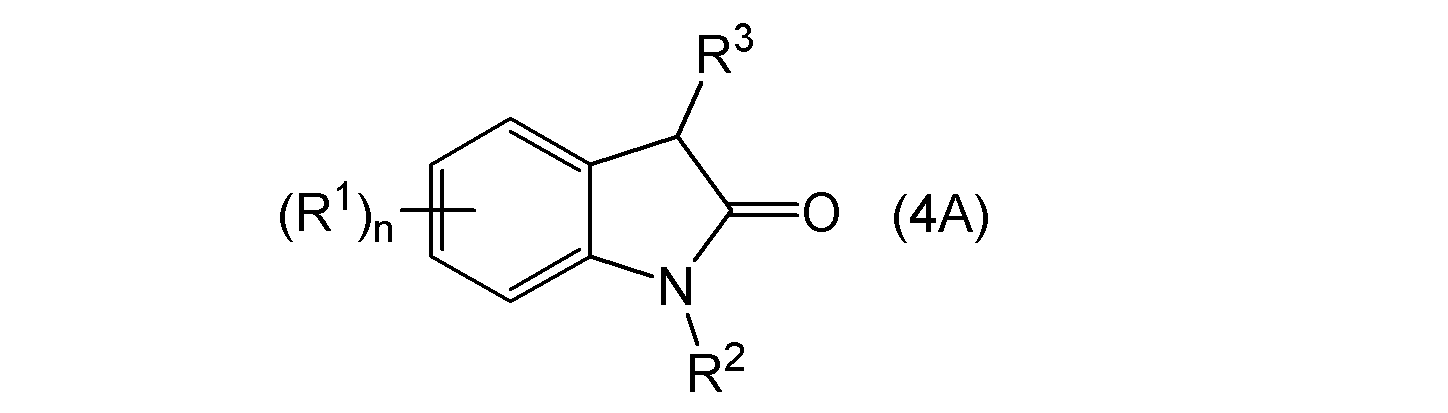
[式中、R1は同一又は異なって、ハロゲン原子又は有機基を示す。R2は水素原子又は有機基を示す。R3は有機基を示す。nは0~4の整数を示す。]
で表される化合物、
一般式(4B):
で表される化合物、
一般式(4B):
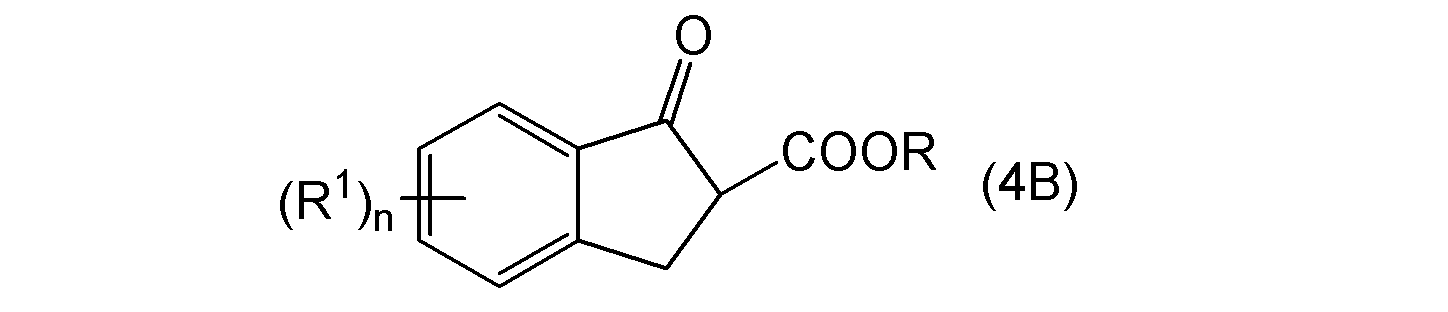
[式中、R1及びnは前記に同じである。Rは有機基を示す。]
で表される化合物、又は
一般式(4C):
で表される化合物、又は
一般式(4C):

[式中、R1、R2及びnは前記に同じである。R12は2価の連結基を示す。R13はアルキル基を示す。]
で表される化合物である、項9に記載のカルボニル化合物の不斉α-アミノ化又は不斉α-ヒドロキシル化触媒。
で表される化合物である、項9に記載のカルボニル化合物の不斉α-アミノ化又は不斉α-ヒドロキシル化触媒。
項11.一般式(2A):

[式中、Phはフェニル基を示す。R14は4-クロロフェニル基を示す。]
で表されるトリアゾリウム塩。
で表されるトリアゾリウム塩。
項12.一般式(1A):
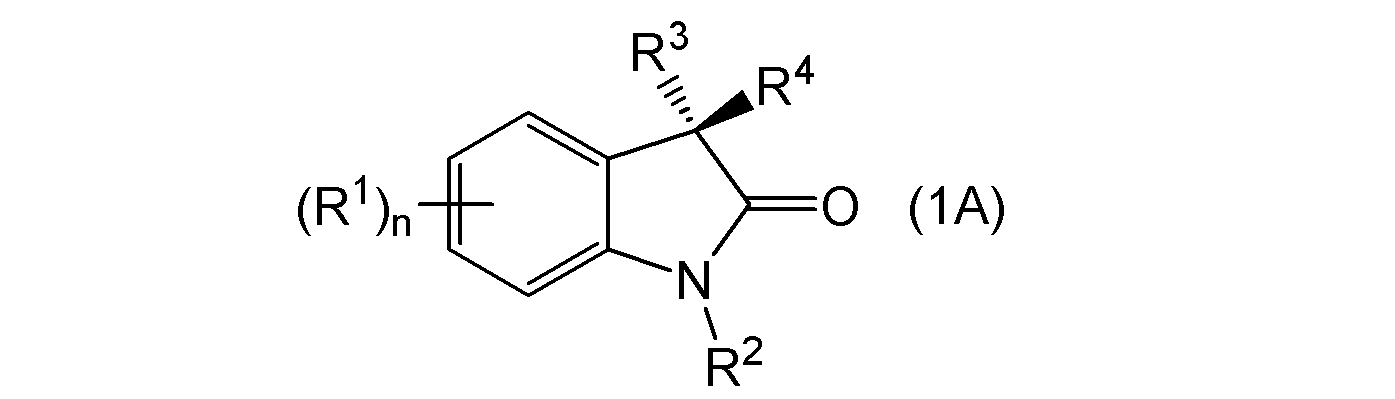
[式中、R1は同一又は異なって、ハロゲン原子又は有機基を示す。R2は水素原子又は有機基を示す。R3は有機基を示す。R4は置換されていてもよいアミノ基又は水酸基を示す。nは0~4の整数を示す。]
、一般式(1B):
、一般式(1B):

[式中、R1及びnは前記に同じである。R11は有機基を示す。Rは有機基を示す。]
、又は一般式(1C):
、又は一般式(1C):
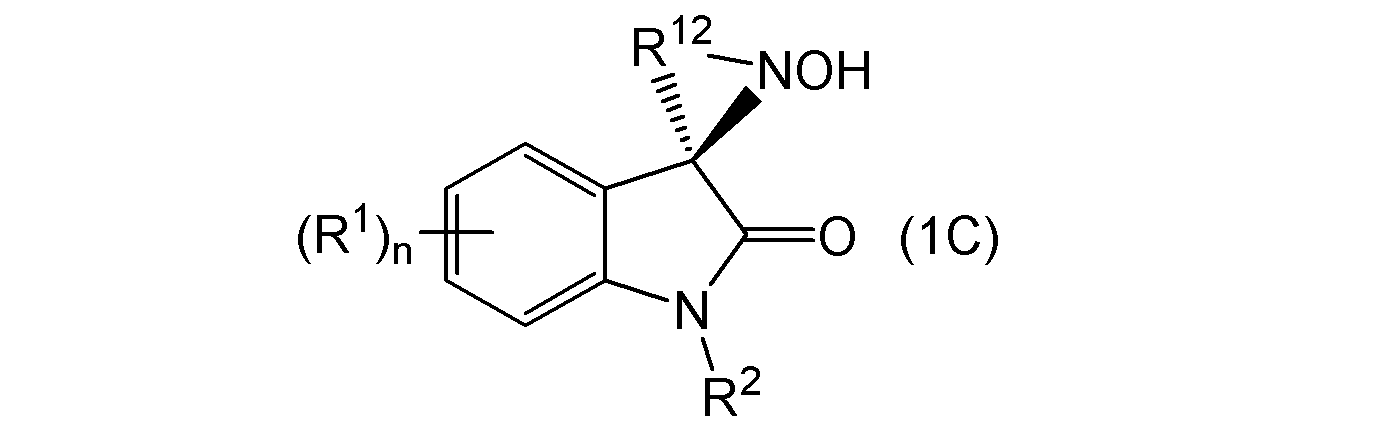
[式中、R1、R2及びnは前記に同じである。R12は2価の連結基を示す。]
で表される光学活性化合物。
で表される光学活性化合物。
本発明によれば、窒素上に種々の置換基を導入することができるヒドロキシルアミン化合物をアミノ源とし、系内でトリハロゲン化アセトニトリル化合物と反応させることで求電子的なアミノ化試剤を発生させるとともに、このアミノ化試剤とキラルな1,2,3-トリアゾリウム塩触媒とを組合せて使用することで、カルボニル化合物(特にオキシインドール化合物)に対して、直接的にα-アミノ化反応を、高いエナンチオ選択性で実現することができる。
この反応は、温和な条件下で効率よく進行し、様々な構造のアミノ基をα位に有するカルボニル化合物(特にオキシインドール化合物)を、一段階で立体選択的に合成することができる。しかも、上記従来の方法では必要であった生成物の窒素-窒素結合、窒素-酸素結合等を還元的に切断する反応が不要であるので、より簡便且つ高収率に反応を進行させることができる。
また、このように反応性の高い求電子種を系内で発生させるという戦略は、同種の触媒を用いた過酸化水素を酸素源とするカルボニル化合物(特にオキシインドール化合物)のエナンチオ選択的なα-ヒドロキシル化反応や、末端にアミノ基を有するカルボニル化合物(特に末端にアミノ基を有するオキシインドール化合物)の分子内閉環α-アミノ化反応にも適用することが可能である。
1.光学活性化合物(1A)の製造方法
本発明の第1の態様においては、トリアゾリウム塩と、トリハロゲン化アセトニトリル化合物の存在下に、特定の化合物(オキシインドール化合物)と、ヒドロキシルアミン化合物又は過酸化水素とを効果的に反応させて、光学活性化合物を得ることができる。
本発明の第1の態様においては、トリアゾリウム塩と、トリハロゲン化アセトニトリル化合物の存在下に、特定の化合物(オキシインドール化合物)と、ヒドロキシルアミン化合物又は過酸化水素とを効果的に反応させて、光学活性化合物を得ることができる。
本発明の第1の態様においては、種々の基質化合物(オキシインドール化合物)に対して、基質選択性広く、種々の置換基を導入したアミノ基、又はヒドロキシ基をα位に導入することができるため、様々な光学活性化合物を得ることも可能である。
本発明の第1の態様においては、通常、溶媒中、トリアゾリウム塩と、トリハロゲン化アセトニトリル化合物の存在下に、特定の化合物(オキシインドール化合物)と、ヒドロキシルアミン化合物又は過酸化水素とを反応させて様々な光学活性化合物を得ることができる。
(1-1)基質化合物
反応に供される基質としての化合物としては、特に制限されず、例えば、一般式(4A):
反応に供される基質としての化合物としては、特に制限されず、例えば、一般式(4A):

[式中、R1は同一又は異なって、ハロゲン原子又は有機基を示す。R2は水素原子又は有機基を示す。R3は有機基を示す。nは0~4の整数を示す。]
で表される化合物(以下、「化合物(4A)と言うこともある」)を採用できる。
で表される化合物(以下、「化合物(4A)と言うこともある」)を採用できる。
一般式(4A)において、R1で示されるハロゲン原子としては、フッ素原子、塩素原子、臭素原子及びヨウ素原子のいずれも採用し得るが、収率、立体選択性等の観点から、本工程では塩素原子、臭素原子等が好ましい。
一般式(4A)において、R1で示される有機基としては、特に制限されず、炭化水素基(アルキル基、シクロアルキル基、アルケニル基、アリール基)、アルコキシ基、アルコキシカルボニル基、アリールオキシ基等が挙げられる。
一般式(4A)において、R1で示される有機基としてのアルキル基としては、特に制限はなく、例えば、メチル基、エチル基、n-プロピル基、イソプロピル基、n-ブチル基、イソブチル基、sec-ブチル基、tert-ブチル基等の非環式脂肪族アルキル基(好ましくは炭素数1~6、特に炭素数1~4の非環式脂肪族アルキル基);ベンジル基、メチルベンジル基、フェネチル基、メチルフェネチル基、ナフチルメチル基、メチルナフチルメチル基等のアラルキル基(好ましくは炭素数7~20、特に炭素数7~14のアラルキル基)等が挙げられる。なお、非環式脂肪族アルキル基を採用する場合、直鎖非環式脂肪族アルキル基も採用でき、分岐鎖非環式脂肪族アルキル基も採用できる。これらアルキル基は、前記のハロゲン原子、後述のシクロアルキル基、後述のアルケニル基、後述のアリール基、後述のアルコキシ基、後述のアルコキシカルボニル基、後述のアリールオキシ基、シアノ基等の置換基を1~3個程度有することもできる。
一般式(4A)において、R1で示される有機基としてのシクロアルキル基としては、特に制限はなく、例えば、シクロプロピル基、シクロプロピルメチル基、シクロブチル基、シクロブチルメチル基、シクロペンチル基、シクロペンチルメチル基、シクロヘキシル基、シクロヘキシルメチル基、シクロヘキシルエチル基等のシクロアルキル基炭素数3~10(好ましくは炭素数3~8のシクロアルキル基)等が挙げられる。これらシクロアルキル基は、前記のハロゲン原子、前記のアルキル基、後述のアルケニル基、後述のアリール基、後述のアルコキシ基、後述のアルコキシカルボニル基、後述のアリールオキシ基、シアノ基等の置換基を1~3個程度有することもできる。
一般式(4A)において、R1で示される有機基としてのアルケニル基としては、特に制限はなく、例えば、ビニル基、アリル基等のアルケニル基(好ましくは炭素数2~6、特に炭素数2~4のアルケニル基)等が挙げられる。これらアルケニル基は、前記のハロゲン原子、前記のアルキル基、前記のシクロアルキル基、前記のアルケニル基、後述のアリール基、後述のアルコキシ基、後述のアルコキシカルボニル基、後述のアリールオキシ基、シアノ基等の置換基を1~3個程度有することもできる。
一般式(4A)において、R1で示される有機基としてのアリール基としては、特に制限はなく、例えば、フェニル基、トリル基(o-トリル基、m-トリル基、p-トリル基)、キシリル基(o-キシリル基、m-キシリル基、p-キシリル基)、ナフチル基等が挙げられる。これらアリール基は、前記のハロゲン原子、前記のアルキル基、前記のシクロアルキル基、前記のアルケニル基、前記のアリール基、後述のアルコキシ基、後述のアルコキシカルボニル基、後述のアリールオキシ基、シアノ基等の置換基を1~3個程度有することもできる。
一般式(4A)において、R1で示される有機基としてのアルコキシ基としては、特に制限はなく、例えば、メトキシ基、エトキシ基、n-プロポキシ基、イソプロポキシ基、n-ブトキシ基、イソブトキシ基、sec-ブトキシ基、tert-ブトキシ基等の非環式脂肪族アルコキシ基(好ましくは炭素数1~6、特に炭素数1~4の非環式脂肪族アルコキシ基)等が挙げられる。なお、非環式脂肪族アルコキシ基を採用する場合、非環式直鎖脂肪族アルコキシ基も採用でき、非環式分岐鎖脂肪族アルコキシ基も採用できる。これらアルコキシ基は、前記のハロゲン原子、前記のアルキル基、前記のシクロアルキル基、前記のアルケニル基、前記のアリール基、前記のアルコキシ基、後述のアルコキシカルボニル基、後述のアリールオキシ基、シアノ基等の置換基を1~3個程度有することもできる。
一般式(4A)において、R1で示される有機基としてのアルコキシカルボニル基としては、特に制限はなく、例えば、メトキシカルボニル基、エトキシカルボニル基、n-プロポキシカルボニル基、イソプロポキシカルボニル基、n-ブトキシカルボニル基、イソブトキシカルボニル基、sec-ブトキシカルボニル基、tert-ブトキシカルボニル基等の脂肪族アルコキシカルボニル基(好ましくは炭素数2~7、特に炭素数2~5の脂肪族アルコキシカルボニル基)等が挙げられる。なお、脂肪族アルコキシカルボニル基を採用する場合、直鎖脂肪族アルコキシカルボニル基も採用でき、分岐鎖脂肪族アルコキシカルボニル基も採用できる。これらアルコキシカルボニル基は、前記のハロゲン原子、前記のアルキル基、前記のシクロアルキル基、前記のアルケニル基、前記のアリール基、前記のアルコキシ基、前記のアルコキシカルボニル基、後述のアリールオキシ基、シアノ基等の置換基を1~3個程度有することもできる。
一般式(4A)において、R1で示される有機基としてのアリールオキシ基としては、特に制限はなく、例えば、フェノキシ基、トリルオキシ基(o-トリルオキシ基、m-トリルオキシ基、p-トリルオキシ基)、キシリルオキシ基(o-キシリルオキシ基、m-キシリルオキシ基、p-キシリルオキシ基)、ナフチルオキシ基等が挙げられる。これらアリールオキシ基は、前記のハロゲン原子、前記のアルキル基、前記のシクロアルキル基、前記のアルケニル基、前記のアリール基、前記のアルコキシ基、前記のアルコキシカルボニル基、前記のアリールオキシ基、シアノ基等の置換基を1~3個程度有することもできる。
これらのR1のなかでも、収率、立体選択性等の観点から、ハロゲン原子、置換されていてもよいアルキル基、置換されていてもよいアルコキシ基等が好ましく、非置換アルキル基、非置換アルコキシ基等がより好ましく、非置換非環式脂肪族アルキル基、非置換非環式脂肪族アルコキシ基がさらに好ましい。また、一般式(4A)において、nが複数(2~4の整数)である場合、複数のR1はそれぞれ同一でも異なっていてもよい。
一般式(4A)において、R1の数であるnは、収率、立体選択性等の観点から、0~4の整数、好ましくは0~2の整数、より好ましくは0又は1である。特に、α-アミノ化反応においては、R1が非置換非環式脂肪族アルキル基であり、nが1であるのが最も好ましく、α-ヒドロキシル化反応においては、R1が非置換非環式脂肪族アルコキシ基であり、nが1であるのが最も好ましい。
一般式(4A)において、R2で示される有機基としては、特に制限されず、一般的な窒素原子の保護基として適用できる基をいずれも採用することができ、例えば、メトキシカルボニル基、エトキシカルボニル基、イソプロポキシカルボニル基、tert-ブトキシカルボニル基(以下、「Boc」と言うこともある)、ベンジルオキシカルボニル基、4-メトキシベンジルオキシカルボニル基等のアルコキシカルボニル基;トリメチルシリル基、トリエチルシリル基、tert-ブチルジメチルシリル基等のシリル基;アセチル基、ピバロイル基、ベンゾイル基等のアシル基;ベンゼンスルホニル基、p-トルエンスルホニル基等のスルホニル基;メトキシメチル基、テトラヒドロピラニル基、アセトキシメチル基等のアセタール型保護基等が挙げられ、収率、立体選択性等の観点から、アルコキシカルボニル基が好ましく、tert-ブトキシカルボニル基がより好ましい。一般式(4A)において、R2としては、窒素原子を保護する観点から、有機基が好ましいが、水素原子であってもよい。
一般式(4A)において、R3で示される有機基としては、特に制限されず、炭化水素基(アルキル基、シクロアルキル基、アルケニル基、アリール基)、アルコキシ基、アルコキシカルボニル基、アリールオキシ基等が挙げられ、上記説明したものを採用し得る。置換基の種類及び数も同様である。これらのなかでも、収率、立体選択性等の観点から、炭化水素基が好ましい。なお、α-アミノ化反応においては、アルキル基、シクロアルキル基、アルケニル基、アリール基等がより好ましい。具体的には、

等が挙げられ、
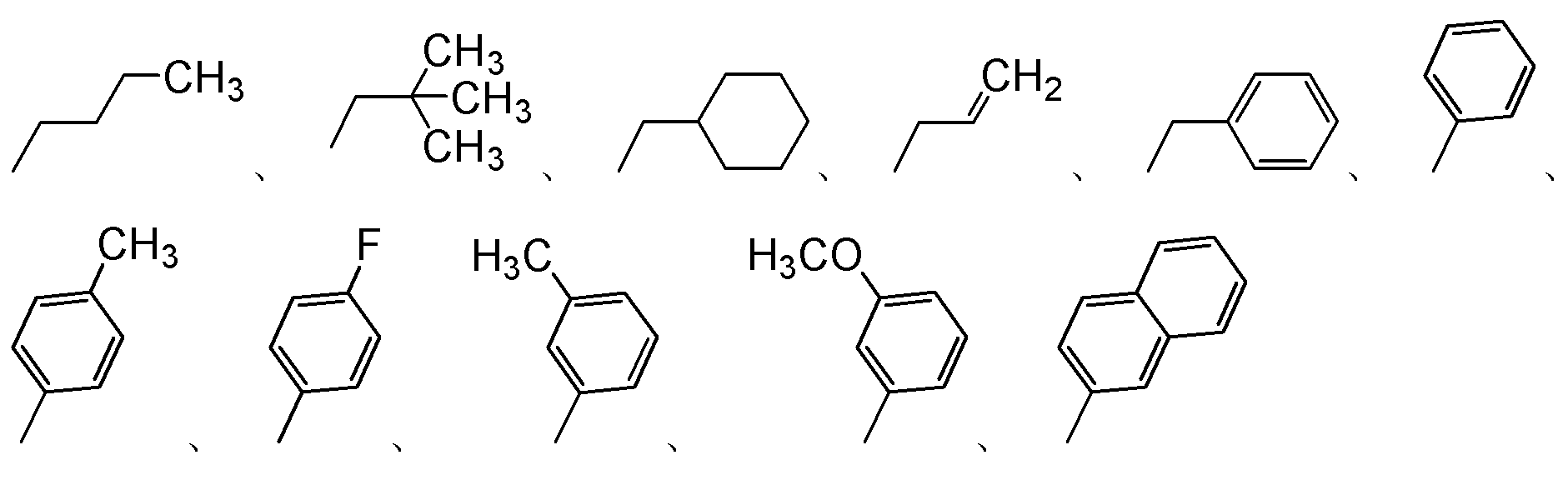
等が好ましく、
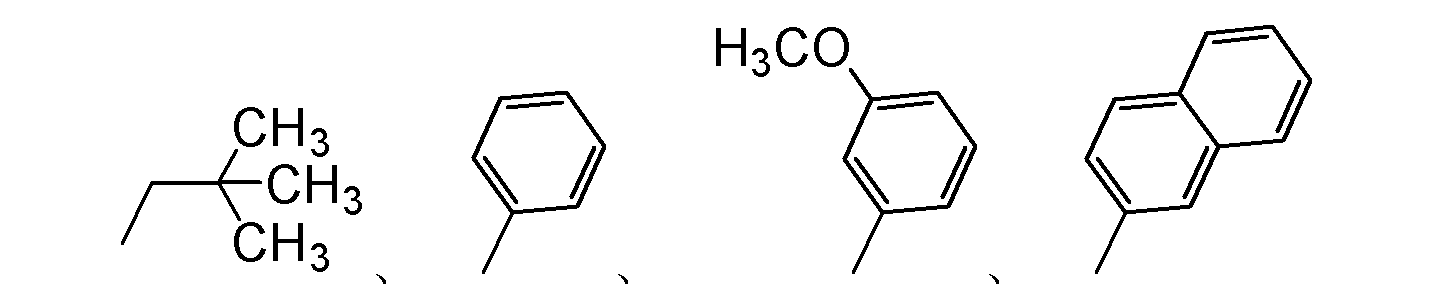
等がより好ましい。
また、α-ヒドロキシル化反応においては、アルキル基、アルケニル基又はアリール基がより好ましく、アルキル基又はアルケニル基がさらに好ましく、アラルキル基又はアルケニル基が特に好ましい。具体的には、

等が挙げられ、
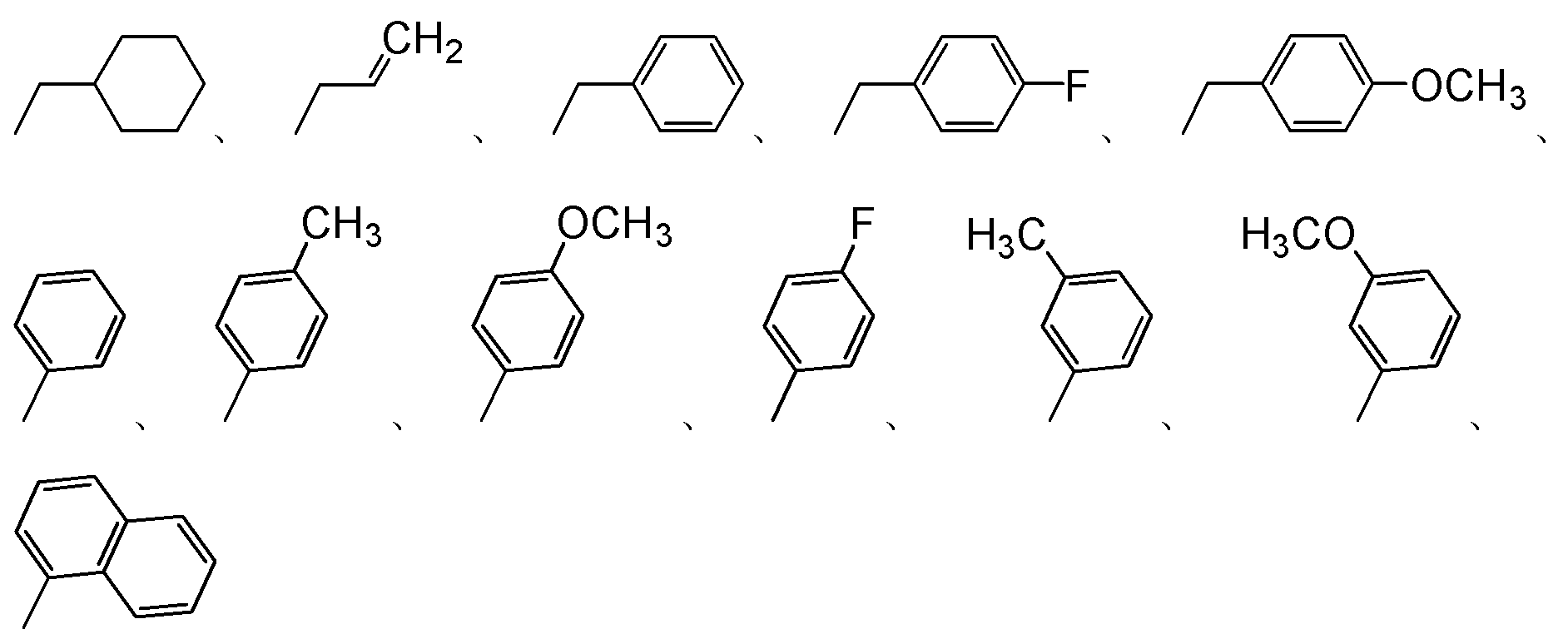
等が好ましく、

等がより好ましい。
このような条件を満たす基質としての化合物(4A)としては、例えば、
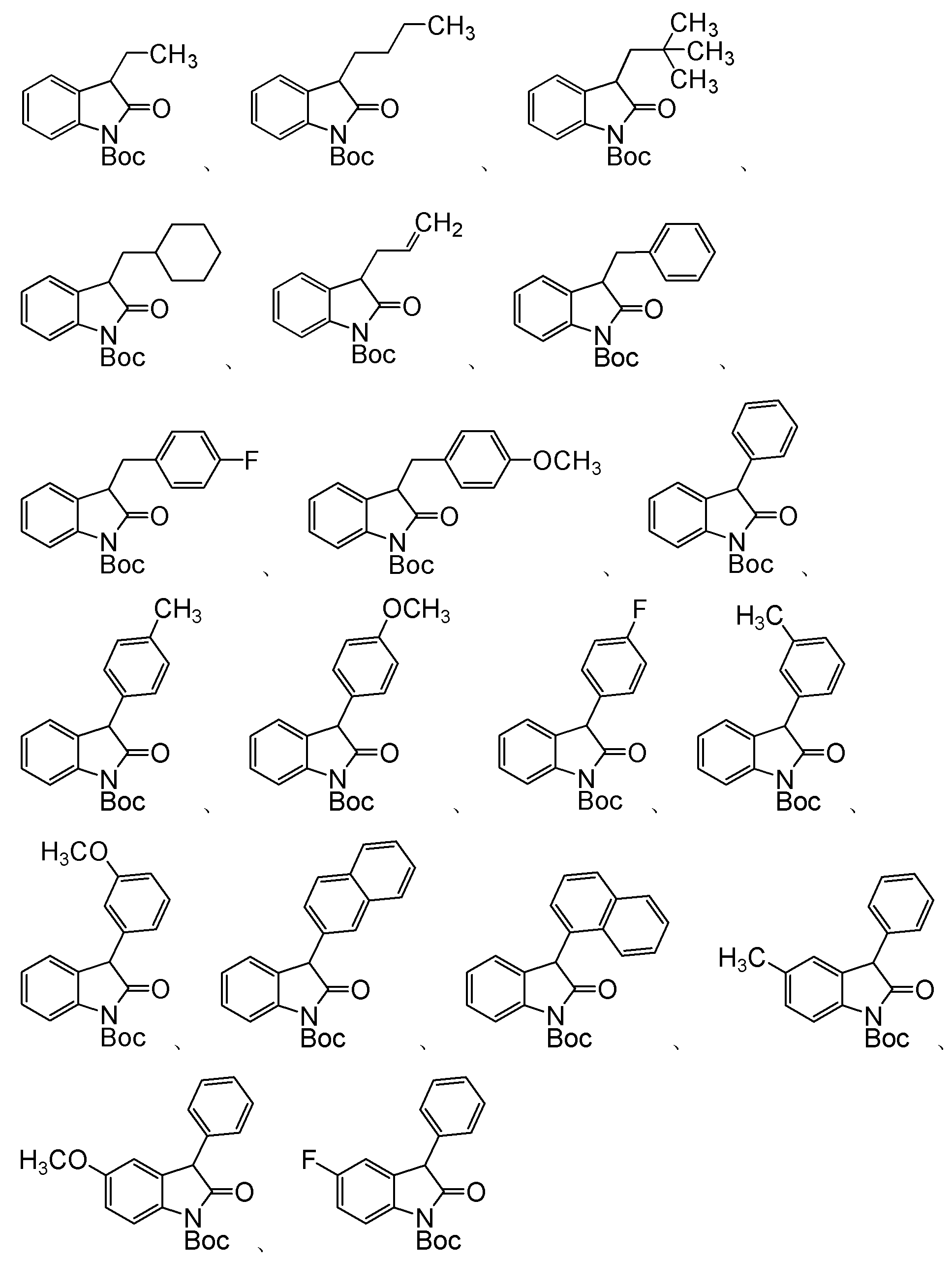
等を使用することができ、

等が好ましい。
(1-2)ヒドロキシルアミン化合物又は過酸化水素
本発明において、上記した基質化合物(化合物(4A))にアミノ基を導入する場合はヒドロキシルアミン化合物を使用し、上記した基質化合物(化合物(4A))にヒドロキシ基を導入する場合は過酸化水素を使用する。
本発明において、上記した基質化合物(化合物(4A))にアミノ基を導入する場合はヒドロキシルアミン化合物を使用し、上記した基質化合物(化合物(4A))にヒドロキシ基を導入する場合は過酸化水素を使用する。
ヒドロキシルアミン化合物を使用する場合、一般式(5):
R11NHOH (5)
[式中、R11は有機基を示す。]
で表されるヒドロキシルアミン化合物(以下、「ヒドロキシルアミン化合物(5)」と言うこともある)を使用する。
R11NHOH (5)
[式中、R11は有機基を示す。]
で表されるヒドロキシルアミン化合物(以下、「ヒドロキシルアミン化合物(5)」と言うこともある)を使用する。
一般式(5)において、R11で示される有機基としては、特に制限されず、炭化水素基(アルキル基、シクロアルキル基、アルケニル基、アリール基)、アルコキシ基、アルコキシカルボニル基、アリールオキシ基等が挙げられ、上記説明したものを採用し得る。なかでも、収率、立体選択性等の観点から、脂肪族アルキル基、アラルキル基、シクロアルキル基、アリール基等が好ましく、アラルキル基、シクロアルキル基、アリール基等がより好ましく、シクロアルキル基、アリール基等がさらに好ましく、非置換シクロアルキル基、非置換又は置換アリール基等が特に好ましい。
このような条件を満たすヒドロキシルアミン化合物(5)としては、例えば、

等が挙げられ、
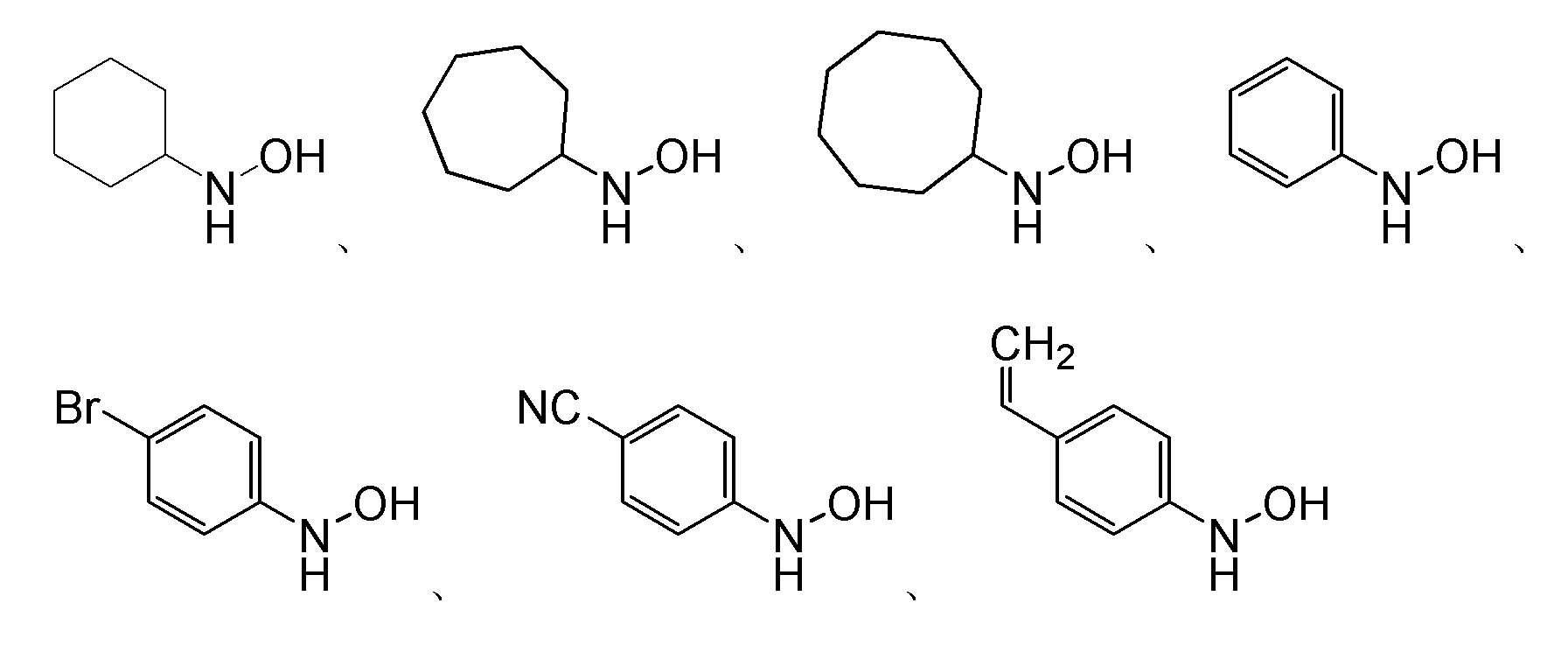
等が好ましく、

等がより好ましい。
ヒドロキシルアミン化合物(5)又は過酸化水素の使用量は、特に制限されず、収率、立体選択性等の観点から、例えば、化合物(4A)1モルに対し、通常、0.5~20モル程度が好ましく、1~10モル程度がより好ましい。なお、過酸化水素を使用する場合は、過酸化水素水を過剰量使用することもできる。
(1-3)トリアゾリウム塩
本発明において、触媒として使用されるトリアゾリウム塩は、一般式(2):
本発明において、触媒として使用されるトリアゾリウム塩は、一般式(2):
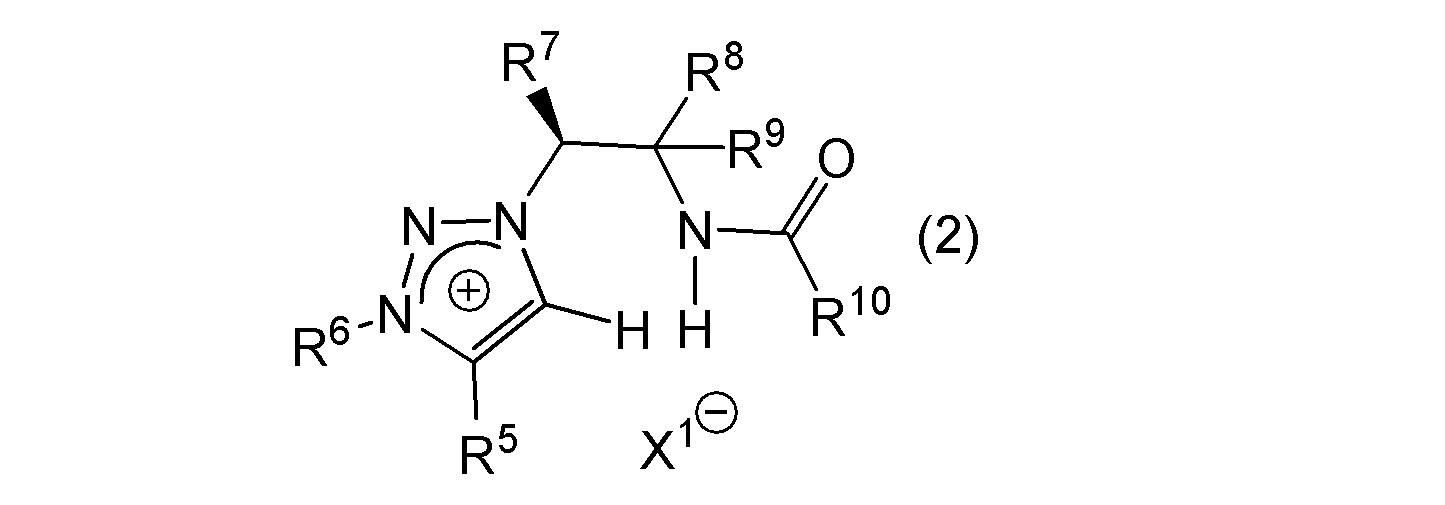
[式中、X1はハロゲン原子又は1価のアニオンを示す。R5、R8、R9及びR10は同一又は異なって、置換されていてもよいアリール基を示す。R6は置換されていてもよい第一級アルキル基を示す。R7は置換されていてもよい脂肪族アルキル基又は置換されていてもよいシクロアルキル基を示す。]
で表されるトリアゾリウム塩である(以下、「トリアゾリウム塩(2)」と言うこともある)。
で表されるトリアゾリウム塩である(以下、「トリアゾリウム塩(2)」と言うこともある)。
一般式(2)において、X1で示されるハロゲン原子としては、フッ素原子、塩素原子、臭素原子及びヨウ素原子のいずれも採用し得る。
一般式(2)において、X1で示される1価のアニオンとしては、フェノキシド、カルボキシラート、テトラフルオロホウ酸イオン等を採用し得る。
なかでも、X1としては、収率、立体選択性等の観点から、ハロゲン原子が好ましく、塩素原子、臭素原子等がより好ましく、臭素原子がさらに好ましい。
一般式(2)において、R5で示されるアリール基としては、上記したものを採用することができる。置換基の種類及び数も同様である。なかでも、収率、立体選択性等の観点から、置換アリール基が好ましく、1~2個の前記ハロゲン原子、前記アリール基等で置換されたアリール基がより好ましい。具体的には、

等が挙げられ、

等が好ましい。
一般式(2)において、R6で示される第一級アルキル基としては、特に制限されず、例えば、メチル基、エチル基、n-プロピル基、n-ブチル基、イソブチル基等の非環式脂肪族第一級アルキル基(好ましくは炭素数1~6、特に炭素数1~4の非環式脂肪族第一級アルキル基);ベンジル基、メチルベンジル基、フェネチル基、メチルフェネチル基、ナフチルメチル基、メチルナフチルメチル基等のアラルキル基等の芳香族第一級アルキル基(好ましくは炭素数7~20、特に炭素数7~14のアラルキル基等の芳香族第一級アルキル基)等が挙げられる。なお、非環式脂肪族第一級アルキル基を採用する場合、直鎖非環式脂肪族第一級アルキル基を採用することもでき、分岐鎖非環式第一級脂肪族アルキル基を採用することもできる。これら第一級アルキル基は、前記のハロゲン原子、前記のシクロアルキル基、前記のアルケニル基、前記のアリール基、前記のアルコキシ基、前記のアルコキシカルボニル基、前記のアリールオキシ基、シアノ基等の置換基を1~3個程度有することもできる。
一般式(2)において、R7で示される脂肪族アルキル基としては、特に制限されず、例えば、メチル基、エチル基、n-プロピル基、イソプロピル基、n-ブチル基、イソブチル基、sec-ブチル基、tert-ブチル基等の非環式脂肪族アルキル基(好ましくは炭素数1~6、特に炭素数1~4の非環式脂肪族アルキル基)等が挙げられる。なお、非環式脂肪族アルキル基を採用する場合、直鎖非環式脂肪族アルキル基を採用することもでき、分岐鎖非環式脂肪族アルキル基を採用することもできる。これら脂肪族アルキル基は、前記のハロゲン原子、前記のアルケニル基、前記のアリール基、前記のアルコキシ基、前記のアルコキシカルボニル基、前記のアリールオキシ基、シアノ基等の置換基を1~3個程度有することもできる。
一般式(2)において、R7で示されるシクロアルキル基としては、特に制限されず、例えば、シクロプロピル基、シクロプロピルメチル基、シクロブチル基、シクロブチルメチル基、シクロペンチル基、シクロペンチルメチル基、シクロヘキシル基、シクロヘキシルメチル基、シクロヘキシルエチル基等の環式脂肪族アルキル基(好ましくは炭素数3~10、特に炭素数3~8の環式脂肪族アルキル基)等が挙げられる。これらシクロアルキル基は、前記のハロゲン原子、前記のアルキル基、前記のアルケニル基、前記のアリール基、前記のアルコキシ基、前記のアルコキシカルボニル基、前記のアリールオキシ基、シアノ基等の置換基を1~3個程度有することもできる。
一般式(2)において、R8及びR9で示されるアリール基としては、上記したものを採用することができる。置換基の種類及び数も同様である。なかでも、収率、立体選択性等の観点から、非置換アリール基又は1個の前記ハロゲン原子で置換されたアリール基が好ましく、フェニル基又はクロロフェニル基がより好ましい。R8とR9は同一でもよいし、異なっていてもよい。
一般式(2)において、R10で示されるアリール基としては、上記したものを採用することができる。置換基の種類及び数も同様である。なかでも、収率、立体選択性等の観点から、非置換アリール基又は2個の前記アルキル基(好ましくはハロゲン化アルキル基、特にパーフルオロアルキル基)、前記アルコキシ基等で置換されたアリール基が好ましく、フェニル基、ジメトキシフェニル基、ビス(トリフルオロメチル)フェニル基がより好ましい。
このような条件を満たすトリアゾリウム塩(2)としては、
具体的には、
具体的には、
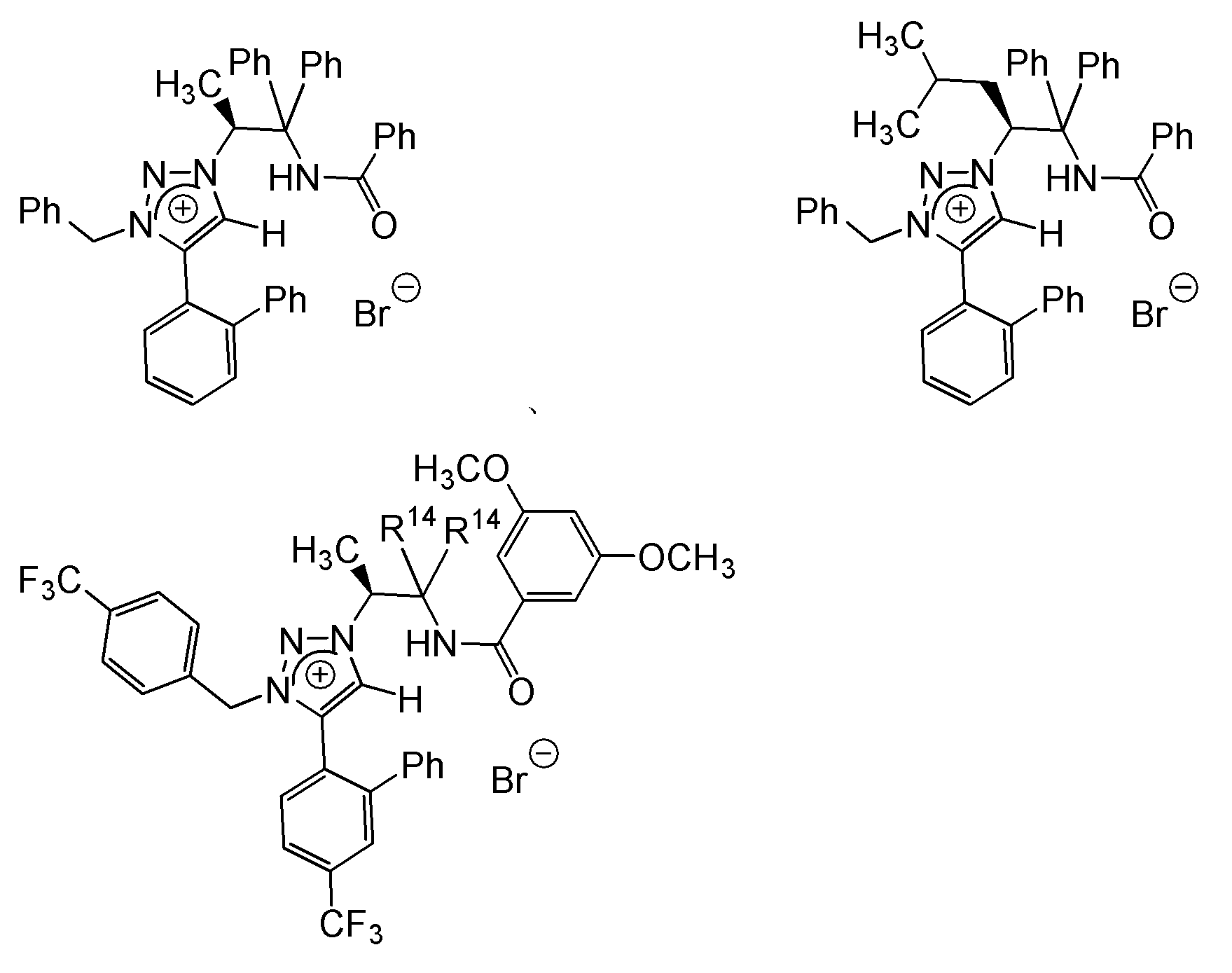
[式中、Phはフェニル基を示す。R14は4-クロロフェニル基を示す。以下同様である。]
等が挙げられる。
等が挙げられる。
これらトリアゾリウム塩(2)は、公知又は市販の化合物を使用することもできるし、既報(J. Am. Chem. Soc. 2011, 133, 1307-1309.等)に記載の方法に準じて合成することもできる。
トリアゾリウム塩(2)の使用量は、特に制限されず、収率、立体選択性等の観点から、例えば、化合物(4A)1モルに対し、通常、0.01~0.2モル程度が好ましく、0.02~0.1モル程度がより好ましい。
このようなトリアゾリウム塩(2)は、本発明の製造方法のみに限られず、カルボニル化合物の不斉α-アミノ化又は不斉α-ヒドロキシル化触媒として使用することができる。また、トリアゾリウム塩(2)のうち、一般式(2A):

で表される化合物は文献未記載の新規化合物である。
(1-4)トリハロゲン化アセトニトリル化合物
本発明において使用されるトリハロゲン化アセトニトリル化合物は、一般式(3):
CX2 3CN (3)
[式中、X2は同一又は異なって、ハロゲン原子を示す。]
で表される化合物である(以下、「トリハロゲン化アセトニトリル化合物(3)」と言うこともある)。
本発明において使用されるトリハロゲン化アセトニトリル化合物は、一般式(3):
CX2 3CN (3)
[式中、X2は同一又は異なって、ハロゲン原子を示す。]
で表される化合物である(以下、「トリハロゲン化アセトニトリル化合物(3)」と言うこともある)。
一般式(3)において、X2で示されるハロゲン原子としては、同一でも異なっていてもよく(好ましくは同一であり)、フッ素原子、塩素原子、臭素原子及びヨウ素原子のいずれも採用し得るが、収率、立体選択性等の観点から、本工程では塩素原子、臭素原子等が好ましく、塩素原子がより好ましい。つまり、トリハロゲン化アセトニトリル化合物(3)としては、CCl3CNが最も好ましい。
トリハロゲン化アセトニトリル化合物(3)の使用量は、特に制限されず、収率、立体選択性等の観点から、化合物(4A)1モルに対し、通常、0.01~5.0モル程度が好ましく、0.02~2.0モル程度がより好ましい。
(1-5)他の添加物及び反応条件
本発明においては、反応を進行させるために塩基の添加が好ましい。
本発明においては、反応を進行させるために塩基の添加が好ましい。
本発明において使用し得る塩基としては、例えば、リン酸カリウム、リン酸ナトリウム等のアルカリ金属リン酸塩;炭酸ナトリウム、炭酸カリウム、炭酸セシウム、炭酸ルビジウム等のアルカリ金属炭酸塩;トリメチルアミン、トリエチルアミン等のアミン類等が挙げられる。これらは、1種のみを用いることもでき、2種以上を組合せて用いることもできる。このうち、収率、立体選択性等の観点から、アルカリ金属炭酸塩が好ましく、炭酸カリウムがより好ましい。
塩基の使用量は、特に制限されず、収率、立体選択性等の観点から、化合物(4A)1モルに対し、通常、0.2~5モルが好ましく、0.5~2モルがより好ましい。
溶媒としては、例えば、トルエン、キシレン、ベンゼン、メシチレン等の芳香族炭化水素;ジクロロメタン、クロロホルム、四塩化炭素、ジクロロエタン等の脂肪族ハロゲン化炭化水素;ジエチルエーテル、ジメトキシエタン、ジイソプロピルエーテル、tert-ブチルメチルエーテル等の鎖状エーテル;酢酸エチル、プロピオン酸エチル等のエステル;アセトン、メチルエチルケトン等のケトン等が挙げられる。これらは、1種のみを用いることもでき、2種以上を組合せて用いることもできる。なかでも、収率、立体選択性等の観点から、α-アミノ化においては芳香族炭化水素が好ましく、ヒドロキシル化においては鎖状エーテルが好ましい。
本発明は、無水条件下且つ不活性ガス雰囲気(窒素ガス、アルゴンガス等)下で行うことが好ましく、反応温度は、加温下、常温下及び冷却下のいずれでも行うことができ、通常、-78℃~室温(25℃)程度、好ましくは-50~20℃程度、より好ましくは-25~10℃程度である。反応時間は、反応が十分に進行する時間とでき、通常、10分~72時間程度、好ましくは1~48時間程度である。
反応終了後は、必要に応じて通常の単離及び精製工程を経て、目的化合物を得ることができる。本発明の反応を用いれば、種々の有用な光学活性化合物を得ることができる。
(1-6)反応機構
本発明における反応機構は特に制限されず、以下の反応式1:
本発明における反応機構は特に制限されず、以下の反応式1:
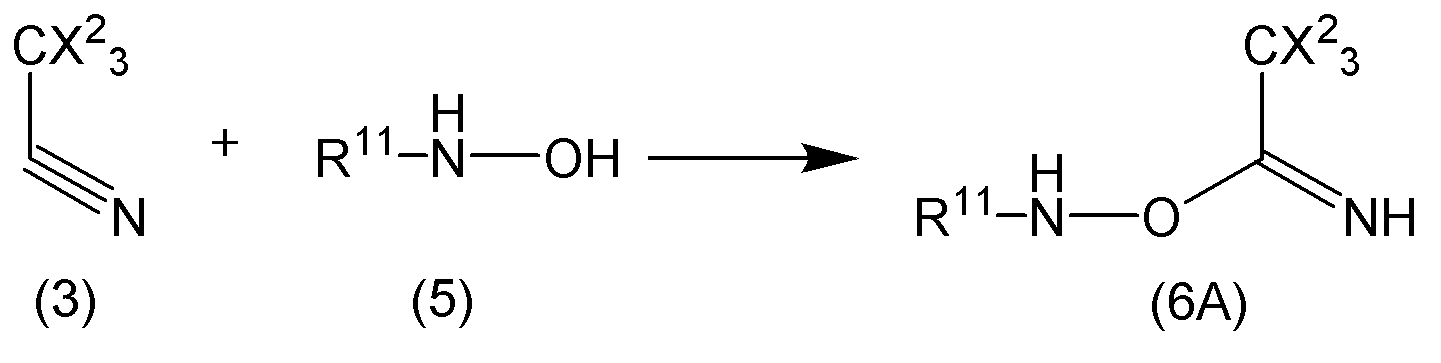
[式中、R11及びX2は前記に同じである。]
又は反応式2:
又は反応式2:

[式中、X2は前記に同じである。]
にしたがってアミノ化試剤(6A)又はヒドロキシル化試剤(6B)が生成され、このアミノ化試剤(6A)又はヒドロキシル化試剤(6B)と触媒としてのトリアゾリウム塩(2)との作用によって、化合物(4A)のα位にアミノ基又はヒドロキシ基が導入されるものと考えられる。この際、副生成物として
にしたがってアミノ化試剤(6A)又はヒドロキシル化試剤(6B)が生成され、このアミノ化試剤(6A)又はヒドロキシル化試剤(6B)と触媒としてのトリアゾリウム塩(2)との作用によって、化合物(4A)のα位にアミノ基又はヒドロキシ基が導入されるものと考えられる。この際、副生成物として

[式中、X2は前記に同じである。]
が発生するため、後処理として通常の単離・精製処理を行うことが好ましい。
が発生するため、後処理として通常の単離・精製処理を行うことが好ましい。
なお、本発明は、上記トリハロゲン化アセトニトリル化合物(3)及びヒドロキシルアミン化合物(5)の代わりに上記アミノ化試剤(6A)を用いた場合、上記トリハロゲン化アセトニトリル化合物(3)及び過酸化水素の代わりに上記アミノ化試剤(6B)を用いた場合も包含する。
(1-7)生成物
このようにして得られるα位がアミノ化された光学活性化合物(光学活性化合物(1A))は、いずれも文献未記載の新規化合物である。
このようにして得られるα位がアミノ化された光学活性化合物(光学活性化合物(1A))は、いずれも文献未記載の新規化合物である。
2.光学活性化合物(1B)の製造方法
本発明の第2の態様においては、トリアゾリウム塩と、トリハロゲン化アセトニトリル化合物の存在下に、特定の化合物と、ヒドロキシルアミン化合物とを効果的に反応させて、光学活性化合物を得ることができる。
本発明の第2の態様においては、トリアゾリウム塩と、トリハロゲン化アセトニトリル化合物の存在下に、特定の化合物と、ヒドロキシルアミン化合物とを効果的に反応させて、光学活性化合物を得ることができる。
本発明の第2の態様においては、種々の基質化合物に対して、基質選択性広く、種々の置換基を導入したアミノ基をα位に導入することができるため、様々な光学活性化合物を得ることも可能である。
本発明の第2の態様においては、通常、溶媒中、トリアゾリウム塩と、トリハロゲン化アセトニトリル化合物の存在下に、特定の化合物と、ヒドロキシルアミン化合物とを反応させて様々な光学活性化合物を得ることができる。
(2-1)基質化合物
反応に供される基質としての化合物としては、特に制限されず、例えば、一般式(4B):
反応に供される基質としての化合物としては、特に制限されず、例えば、一般式(4B):

[式中、R1及びnは前記に同じである。Rは有機基を示す。]
で表される化合物(以下、「化合物(4B)と言うこともある」)を採用できる。
で表される化合物(以下、「化合物(4B)と言うこともある」)を採用できる。
一般式(4B)において、R1及びnは前記で説明したものを採用することができる。好ましい種類、置換基の種類及び数等についても同様である。
一般式(4B)において、Rは有機基である。このような有機基としては、例えば、炭化水素基(アルキル基、シクロアルキル基、アルケニル基、アリール基)、アルコキシ基、アルコキシカルボニル基、アリールオキシ基等が挙げられ、上記したものを採用することができる。好ましい種類、置換基の種類及び数等も同様である。
このような化合物(4B)としては、具体的には、

[式中、t-Buはtert-ブチル基を示す。以下同様である。]
等を使用することができる。
等を使用することができる。
(2-2)ヒドロキシルアミン化合物
本発明において使用されるヒドロキシルアミン化合物は、上記説明した一般式(5)で表されるヒドロキシルアミン化合物である。各置換基の好ましい種類、使用量等については上記説明したものを採用できる。ヒドロキシルアミン化合物の好ましい具体例も同様である。
本発明において使用されるヒドロキシルアミン化合物は、上記説明した一般式(5)で表されるヒドロキシルアミン化合物である。各置換基の好ましい種類、使用量等については上記説明したものを採用できる。ヒドロキシルアミン化合物の好ましい具体例も同様である。
(2-3)トリアゾリウム塩
本発明において、触媒として使用されるトリアゾリウム塩は、上記説明した一般式(2)で表されるトリアゾリウム塩である。各置換基の好ましい種類、使用量、合成方法等については上記説明したものを採用できる。トリアゾリウム塩の具体例も同様である。
本発明において、触媒として使用されるトリアゾリウム塩は、上記説明した一般式(2)で表されるトリアゾリウム塩である。各置換基の好ましい種類、使用量、合成方法等については上記説明したものを採用できる。トリアゾリウム塩の具体例も同様である。
(2-4)トリハロゲン化アセトニトリル化合物
本発明において使用されるトリハロゲン化アセトニトリル化合物は、上記説明した一般式(3)で表されるトリハロゲン化アセトニトリル化合物である。置換基の好ましい種類、使用量等については上記説明したものを採用できる。
本発明において使用されるトリハロゲン化アセトニトリル化合物は、上記説明した一般式(3)で表されるトリハロゲン化アセトニトリル化合物である。置換基の好ましい種類、使用量等については上記説明したものを採用できる。
(2-5)他の添加物及び反応条件
本発明においては、反応を進行させるために塩基の添加が好ましい。
本発明においては、反応を進行させるために塩基の添加が好ましい。
本発明において使用し得る塩基及び溶媒としては、上記説明したものを採用できる。塩基及び溶媒の好ましい種類、使用量等についても同様である。
本発明の反応条件も上記第1の態様にて説明したものを採用できる。
(2-6)反応機構
本発明における反応機構は特に制限されるわけではなく、上記説明した反応式1にしたがってアミノ化試剤(6A)が生成され、このアミノ化試剤(6A)と触媒としてのトリアゾリウム塩(2)との作用によって、化合物(4B)の分子内閉環反応が促進されるものと考えられる。この際、副生成物として
本発明における反応機構は特に制限されるわけではなく、上記説明した反応式1にしたがってアミノ化試剤(6A)が生成され、このアミノ化試剤(6A)と触媒としてのトリアゾリウム塩(2)との作用によって、化合物(4B)の分子内閉環反応が促進されるものと考えられる。この際、副生成物として

[式中、X2は前記に同じである。]
が発生するため、後処理として通常の単離・精製処理を行うことが好ましい。
が発生するため、後処理として通常の単離・精製処理を行うことが好ましい。
なお、本発明は、上記トリハロゲン化アセトニトリル化合物(3)及びヒドロキシルアミン化合物(5)の代わりに上記アミノ化試剤(6A)を用いた場合も包含する。
(2-7)生成物
このようにして得られるα位がアミノ化された光学活性化合物(光学活性化合物(1B))は、いずれも文献未記載の新規化合物である。
このようにして得られるα位がアミノ化された光学活性化合物(光学活性化合物(1B))は、いずれも文献未記載の新規化合物である。
3.光学活性化合物(1C)の製造方法
本発明の第3の態様においては、トリアゾリウム塩と、トリハロゲン化アセトニトリル化合物の存在下に、特定の化合物(末端にアミノ基を有するオキシインドール化合物)を、分子内閉環反応させて、光学活性化合物を得ることができる。
本発明の第3の態様においては、トリアゾリウム塩と、トリハロゲン化アセトニトリル化合物の存在下に、特定の化合物(末端にアミノ基を有するオキシインドール化合物)を、分子内閉環反応させて、光学活性化合物を得ることができる。
本発明の第3の態様においては、種々の基質化合物に対して、基質選択性広く、種々の不斉スピロ化合物を得ることができる。
本発明の第3の態様においては、通常、溶媒中、トリアゾリウム塩と、トリハロゲン化アセトニトリル化合物の存在下に、特定の化合物(末端にアミノ基を有するオキシインドール化合物)を、分子内閉環反応させて様々な光学活性スピロ化合物を得ることができる。
(3-1)基質化合物
反応に供される基質としての化合物としては、特に制限されず、例えば、一般式(4C):
反応に供される基質としての化合物としては、特に制限されず、例えば、一般式(4C):

[式中、R1、R2及びnは前記に同じである。R12は2価の連結基を示す。R13はアルキル基を示す。]
で表される化合物(以下、「化合物(4C)と言うこともある」)を採用できる。
で表される化合物(以下、「化合物(4C)と言うこともある」)を採用できる。
一般式(4C)において、R1、R2及びnは前記で説明したものを採用することができる。好ましい種類、置換基の種類及び数等についても同様である。
一般式(4C)において、R12は2価の連結基である。このような2価の連結基としては、例えば、単結合;メチレン基、エチレン基、トリメチレン基、プロピレン基、テトラメチレン基、ブチレン基等の炭素数1~6のアルキレン基;カルボニル基;-O-;-S-;これらの2種以上を組合せた連結基等が挙げられる。
一般式(4C)において、R13はアルキル基である。このようなアルキル基としては、上記したものを採用することができる。好ましい種類、置換基の種類及び数等も同様である。
このような化合物(4C)としては、具体的には、
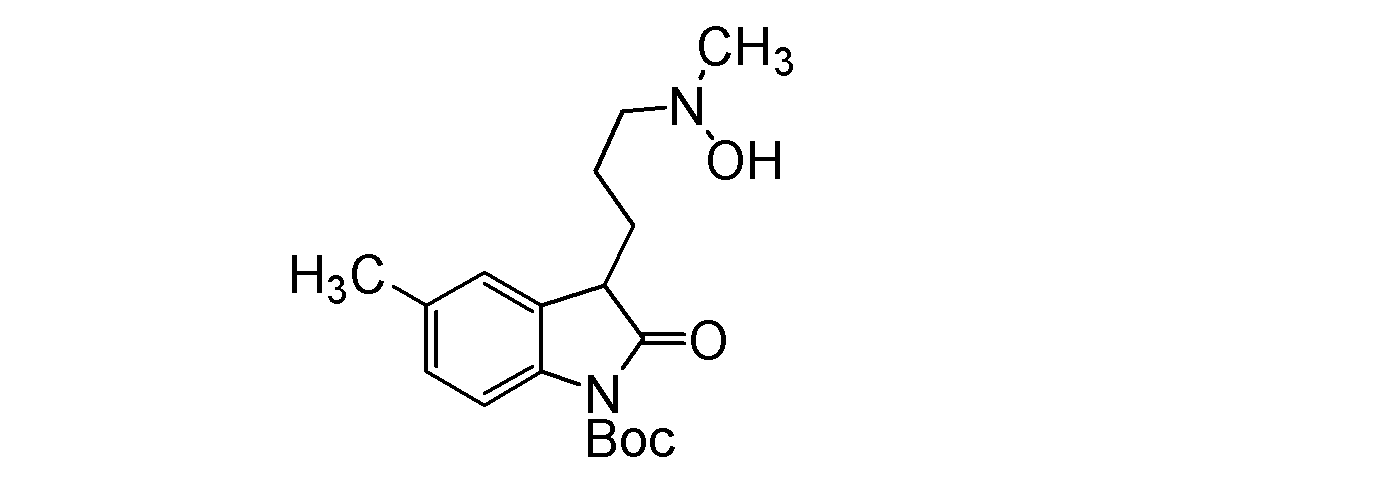
等を使用することができる。
(3-2)トリアゾリウム塩
本発明において、触媒として使用されるトリアゾリウム塩は、上記説明した一般式(2)で表されるトリアゾリウム塩である。各置換基の好ましい種類、使用量、合成方法等については上記説明したものを採用できる。トリアゾリウム塩の具体例も同様である。
本発明において、触媒として使用されるトリアゾリウム塩は、上記説明した一般式(2)で表されるトリアゾリウム塩である。各置換基の好ましい種類、使用量、合成方法等については上記説明したものを採用できる。トリアゾリウム塩の具体例も同様である。
(3-3)トリハロゲン化アセトニトリル化合物
本発明において使用されるトリハロゲン化アセトニトリル化合物は、上記説明した一般式(3)で表されるトリハロゲン化アセトニトリル化合物である。置換基の好ましい種類、使用量等については上記説明したものを採用できる。
本発明において使用されるトリハロゲン化アセトニトリル化合物は、上記説明した一般式(3)で表されるトリハロゲン化アセトニトリル化合物である。置換基の好ましい種類、使用量等については上記説明したものを採用できる。
(3-4)他の添加物及び反応条件
本発明においては、反応を進行させるために塩基の添加が好ましい。
本発明においては、反応を進行させるために塩基の添加が好ましい。
本発明において使用し得る塩基及び溶媒としては、上記説明したものを採用できる。塩基及び溶媒の好ましい種類、使用量等についても同様である。
本発明の反応条件も上記第1の態様にて説明したものを採用できる。
(3-5)生成物
このようにして得られるα位がアミノ化された光学活性化合物(光学活性化合物(1C))は、いずれも文献未記載の新規化合物である。
このようにして得られるα位がアミノ化された光学活性化合物(光学活性化合物(1C))は、いずれも文献未記載の新規化合物である。
以下、本発明について、実施例を挙げて具体的に説明するが、本発明は、これらの実施例に何ら制約されるものではない。
なお、赤外線スペクトルはShimadzu IRAffinity-1分光計で記録した。1H NMRスペクトルはJEOL JNM-ECS400(400 MHz)分光計及びJEOL JNM-ECZ400S(400 MHz)分光計で記録した。化学シフトは、内部標準(CDCl3)として溶媒共鳴からのppmとして報告する(トルエン-d8; 2.08 ppm、テトラメチルシラン; 0.0 ppm)。データは、化学シフト、integration、multiplicity(s =singlet、d =doublet、t =triplet、q =quartet、sept=septet、m=multiplet、br =broad)、及び結合定数(Hz)の順に報告する。13C NMRスペクトルはJEOL JNM-ECS400(101 MHz)分光計及びJEOL JNM-ECZ400S(101 MHz)分光計で記録した。化学シフトは、内部標準として溶媒共鳴からのppmとして報告する(CDCl3; 77.16 ppm、トルエン- d8; 20.43 ppm)。19F NMRスペクトルはJEOL JNM-ECS400(376 MHz)分光計及びJEOL JNM-ECZ400S(376 MHz)分光計で記録した。化学シフトは、外部標準としてベンゾフルオライド(-64.0 ppm)共鳴からppmとして報告する。旋光度は、HORIBA SEPA-500偏光計で測定した。高分解能質量スペクトルは、Thermo Fisher Scientific Exactive(ESI)で行った。分析用薄層クロマトグラフィー(TLC)は、MerckプレコートTLCプレート(シリカゲル60 GF254, 0.25 mm)の上で行った。フラッシュカラムクロマトグラフィーは、CHROMATOREX DIOL MB100-40/75(球状、40-75μm; 富士シリシア化学(株))、CHROMATOREX NH DM2035(球状、60μm; 富士シリシア化学(株))、及びシリカゲル60(Merck 1.09385.9929、230-400メッシュ)を用いて行った。エナンチオマー過剰率は、キラルカラム[φ4.6 mm×250 mm、DAICEL CHIRALCEL OD-3(OD3)、CHIRALCEL OZ-3(OZ3)、CHIRALPAK AS-H(ASH)、CHIRALPAK ID-3(ID3)、CHIRALPAK IE-3(IE3)、及びCHIRALPAK IF-3(IF3)]を、溶離液としてヘキサン(Hex)、イソプロピルアルコール(IPA)及びエタノール(EtOH)とともに用いたHPLC分析により決定した。
すべての空気及び水分に敏感な反応は、乾燥したガラス容器中のアルゴン(Ar)雰囲気下で行った。ジクロロメタン(CH2Cl2)、ジエチルエーテル(Et2O)、及びテトラヒドロフラン(THF)は、関東化学(株)から脱水溶媒として得た後、GlassContour溶媒精製装置を用いてA2アルミナ及びQ5反応剤で精製した。酢酸エチル(EtOAc)は、和光純薬化学工業(株)から脱水溶媒として得た。1,2,3-トリアゾリウム塩1d・Br及び1e・Brは、既報の文献(Ohmatsu, K., Kiyokawa, M. & Ooi, T. J. Am. Chem. Soc. 133, 1307-1309 (2011).)にしたがって合成した。基質であるオキシインドール化合物は、既報(J. Am. Chem. Soc. 2005, 127, 10164- 10165)にしたがって合成した。また、他の単純な化学物質は、市販品を精製せずに使用した。
[合成例1:ヒドロキシルアミン化合物の合成]
以下に、実施例で使用したヒドロキシルアミン化合物(N-フェニルヒドロキシルアミン及びN-ベンジルヒドロキシルアミン)の合成例を示す。また、N-(n-ブチル)ヒドロキシルアミンは、市販品を精製せずに使用した。他のヒドロキシルアミン化合物は、以下の合成例にしたがって合成することが可能である。なお、N-フェニルヒドロキシルアミン及びN-ベンジルヒドロキシルアミンを含むすべてのヒドロキシルアミン化合物は市販されているため、市販品を使用することもできる。
以下に、実施例で使用したヒドロキシルアミン化合物(N-フェニルヒドロキシルアミン及びN-ベンジルヒドロキシルアミン)の合成例を示す。また、N-(n-ブチル)ヒドロキシルアミンは、市販品を精製せずに使用した。他のヒドロキシルアミン化合物は、以下の合成例にしたがって合成することが可能である。なお、N-フェニルヒドロキシルアミン及びN-ベンジルヒドロキシルアミンを含むすべてのヒドロキシルアミン化合物は市販されているため、市販品を使用することもできる。
合成例1-1:N-フェニルヒドロキシルアミン(3a)の合成
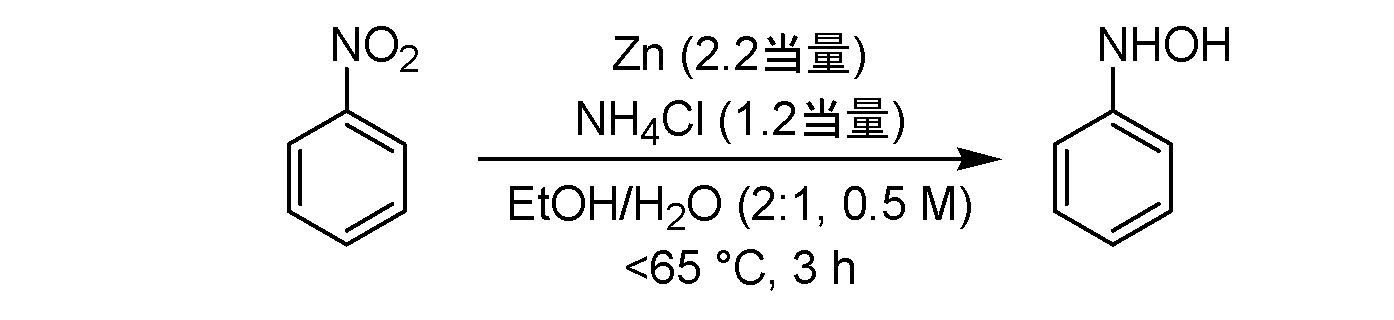
[式中、EtOHはエタノールを示す。以下同様である。]
ニトロベンゼン(0.50 mL, 5 mmol)及び塩化アンモニウム(0.32 g, 6 mmol)のエタノール(6 mL)及び水(3 mL)の溶液に、亜鉛粉末(0.72 g, 11 mmol)を添加し、反応混合物を65℃で3時間攪拌した。室温まで冷却後、反応混合物に対して、酢酸エチルを用いたセライトパッドによるろ過をすることで、二相のろ液を得た。有機相を分離し、水相を酢酸エチルで抽出した。合わせた有機抽出物を食塩水で洗浄し、Na2SO4で乾燥した。減圧下のろ過及び濃縮に引き続いて、CH2Cl2/ヘキサンからの再結晶を行い、N-フェニルヒドロキシルアミンを得た(0.11 g, 1.0 mmol, 20 %収率)。
ニトロベンゼン(0.50 mL, 5 mmol)及び塩化アンモニウム(0.32 g, 6 mmol)のエタノール(6 mL)及び水(3 mL)の溶液に、亜鉛粉末(0.72 g, 11 mmol)を添加し、反応混合物を65℃で3時間攪拌した。室温まで冷却後、反応混合物に対して、酢酸エチルを用いたセライトパッドによるろ過をすることで、二相のろ液を得た。有機相を分離し、水相を酢酸エチルで抽出した。合わせた有機抽出物を食塩水で洗浄し、Na2SO4で乾燥した。減圧下のろ過及び濃縮に引き続いて、CH2Cl2/ヘキサンからの再結晶を行い、N-フェニルヒドロキシルアミンを得た(0.11 g, 1.0 mmol, 20 %収率)。
その他、種々のN-アリールヒドロキシルアミン化合物は、既報(Shi, Q. X., Lu, R. W., Jin, K., Zhang, Z. X. & Zhao, D. F. Chem. Lett. 35, 226‐227 (2006).)に記載の合成方法に準じて(原料の置換基等を変更すること等以外は同様の方法で)合成した。
合成例1-2:N-ベンジルヒドロキシルアミン(3b)の合成

[式中、Et3Nはトリエチルアミンを示す。Hexはヘキサンを示す。t-BuOMeはtert-ブチルメチルエーテルを示す。Bnはベンジル基を示す。TBABはテトラブチルアンモニウムブロマイドを示す。THFはテトラヒドロフランを示す。以下同様である。]
ジ-tert-ブチルジカーボネート(Boc2O;23 mL, 100 mmol)及びトリエチルアミン(Et3N;14.6 mL, 105 mmol)のヘキサン/tert-ブチルメチルエーテル(5: 1, 35 mL)の溶液を、ヒドロキシルアミンハイドロクロライド(H2NOH・HCl;3.5 g, 50 mmol)の水(35 mL)溶液に0℃で滴下した。同じ温度で6時間十分攪拌した後に、混合物を室温まで昇温し、12時間攪拌した。反応混合物をNH4Clの飽和水溶液で希釈し、酢酸エチルで抽出作業を行った。Na2SO4での乾燥、ろ過、及び溶液の除去の後に、粗生成物をカラムクロマトグラフィー(溶離液:ヘキサン/酢酸エチル=10: 1)で精製し、N,O-ジBocヒドロキシルアミンを清澄液として得た(11 g, 47 mmol, 94 %収率)。
ジ-tert-ブチルジカーボネート(Boc2O;23 mL, 100 mmol)及びトリエチルアミン(Et3N;14.6 mL, 105 mmol)のヘキサン/tert-ブチルメチルエーテル(5: 1, 35 mL)の溶液を、ヒドロキシルアミンハイドロクロライド(H2NOH・HCl;3.5 g, 50 mmol)の水(35 mL)溶液に0℃で滴下した。同じ温度で6時間十分攪拌した後に、混合物を室温まで昇温し、12時間攪拌した。反応混合物をNH4Clの飽和水溶液で希釈し、酢酸エチルで抽出作業を行った。Na2SO4での乾燥、ろ過、及び溶液の除去の後に、粗生成物をカラムクロマトグラフィー(溶離液:ヘキサン/酢酸エチル=10: 1)で精製し、N,O-ジBocヒドロキシルアミンを清澄液として得た(11 g, 47 mmol, 94 %収率)。
N,O-ジBocヒドロキシルアミン(1.2 g, 5 mmol)、ベンジルブロマイド(BnBr;0.65 mL, 5.5 mmol)、及びテトラブチルアンモニウムブロマイド(TBAB;0.16 g, 0.5 mmol)のCH2Cl2(10 mL)の溶液に、1N KOH水溶液(5.5 mL, 5.5 mmol)を室温で添加し、全反応混合物を24時間攪拌した。次に反応混合物を水で希釈し、CHCl3による抽出作業を行った。Na2SO4での乾燥、ろ過、及び溶液の除去の後に、粗生成物をカラムクロマトグラフィー(溶離液:ヘキサン/酢酸エチル=20: 1)で精製し、N,O-ジBoc-N-ベンジルヒドロキシルアミンを清澄液として得た(1.45 g, 4.5 mmol, 90 %収率)。
N,O-ジBoc-N-ベンジルヒドロキシルアミン(1.45 g, 4.5 mmol)のTHF(4.5 mL)溶液に、6 N HCl(9 mL)を室温で添加した。80℃で3時間攪拌した後、反応溶液を室温まで冷却し、水で希釈した。水相をエーテルで洗浄し、Na2CO3の飽和水溶液を添加して塩基性化した。次に、酢酸エチルによる抽出作業を行った。Na2SO4での乾燥、ろ過、及び溶液の除去の後に、粗生成物をカラムクロマトグラフィー(溶離液:ヘキサン/酢酸エチル=3: 1)で精製し、N-ベンジルヒドロキシルアミンを白色固体として得た(0.43 g, 3.5 mmol, 78 %収率)。
合成例1-3:N-シクロヘキシルヒドロキシルアミン(3c)の合成

[式中、Acはアセチル基を示す。以下同様である。]
シクロヘキサノン(0.98 g, 10 mmol)及びヒドロキシルアンモニウムクロリド(0.83 g, 12 mmol)のエタノール(10 mL)及び水(10 mL)の溶液に、酢酸ナトリウム(NaOAc; 1.64 g, 20 mmol)を添加した。ケトンを消費するまで溶液を撹拌した。真空下に溶媒を除去し、粗生成物を水で希釈し、酢酸エチルで抽出した。Na2SO4で乾燥した後、ろ過し、溶媒を除去し、シクロヘキサノンオキシムを得た。この化合物を精製せずに次の工程に用いた。
シクロヘキサノン(0.98 g, 10 mmol)及びヒドロキシルアンモニウムクロリド(0.83 g, 12 mmol)のエタノール(10 mL)及び水(10 mL)の溶液に、酢酸ナトリウム(NaOAc; 1.64 g, 20 mmol)を添加した。ケトンを消費するまで溶液を撹拌した。真空下に溶媒を除去し、粗生成物を水で希釈し、酢酸エチルで抽出した。Na2SO4で乾燥した後、ろ過し、溶媒を除去し、シクロヘキサノンオキシムを得た。この化合物を精製せずに次の工程に用いた。
得られたシクロヘキサノンオキシムをエタノール(20 mL)で懸濁した。次に、この混合物にシアノ水素化ホウ素ナトリウム(NaBH3CN; 0.75 g, 12 mmol)を添加し、HCl(16 mL)の6 Nメタノール溶液を0℃で滴下した。室温で3時間撹拌した後、反応混合物を水に注ぎ、全体の混合物を0℃でKOHペレットで中和した。酢酸エチルで抽出した後、有機抽出物を食塩水で洗浄し、Na2SO4で乾燥した。溶媒を蒸発させて除去し、残渣をシリカゲルカラムクロマトグラフィー(溶離液:ヘキサン/酢酸エチル=3: 1~1: 1)で精製し、目的化合物であるN-シクロヘキシルヒドロキシルアミンを白色固体として得た(0.52 g, 4.5 mmol, 45 %収率)。
1H NMR (400 MHz, CDCl3) δ6.10 (1H, brs), 2.84-2.79 (1H, m), 1.92-1.62 (5H, m), 1.33-1.06 (5H, m)。
1H NMR (400 MHz, CDCl3) δ6.10 (1H, brs), 2.84-2.79 (1H, m), 1.92-1.62 (5H, m), 1.33-1.06 (5H, m)。
他のN-アルキルヒドロキシルアミン化合物も同様にして得た。
合成例1-4:N-シクロヘキシル-o-メチルヒドロキシルアミン(3d)の合成

ヒドロキシルアンモニウムクロリドの代わりに、o-メチルヒドロキシルアンモニウムクロリドを使用すること以外は合成例1-3と同様に、N-シクロヘキシル-o-メチルヒドロキシルアミンを得た。
1H NMR (400 MHz, CDCl3) δ5.33 (1H, brs), 3.54 (3H, s), 2.84 (1H, tt, J= 10.6, 3.8 Hz), 1.88-1.84 (2H, m), 1.77-1.73 (2H, m), 1.65-1.60 (1H, m), 1.33-1.05 (5H, m)。
1H NMR (400 MHz, CDCl3) δ5.33 (1H, brs), 3.54 (3H, s), 2.84 (1H, tt, J= 10.6, 3.8 Hz), 1.88-1.84 (2H, m), 1.77-1.73 (2H, m), 1.65-1.60 (1H, m), 1.33-1.05 (5H, m)。
合成例1-5:ヒドロキシルアミン化合物(3e)の合成
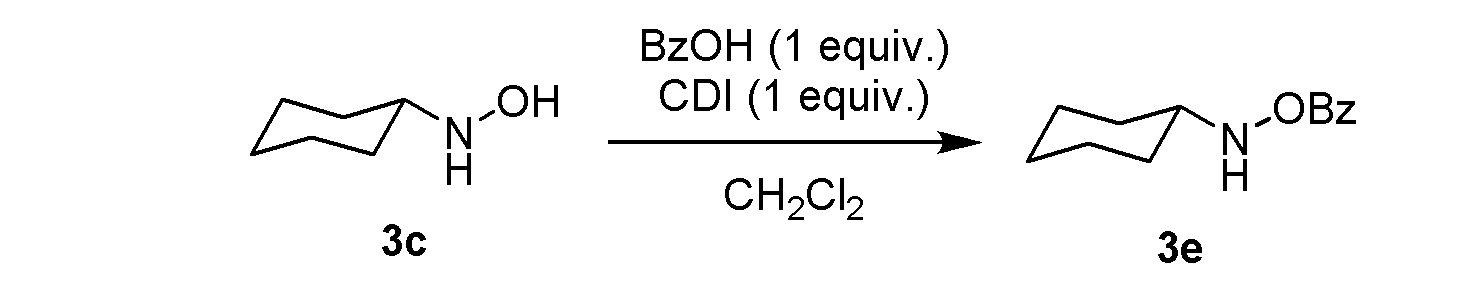
[式中、CDIはカルボニルジイミダゾールを示す。Bzはベンゾイル基を示す。以下同様である。]
カルボニルジイミダゾール(CDI; 0.16 g, 1 mmol)のCH2Cl2(2 mL)溶液に、室温で安息香酸(BzOH; 0.12 g, 1 mmol)を添加し、混合物を30分間攪拌した。次に、合成例1-3で得たN-シクロヘキシルヒドロキシルアミン(3c; 0.11 g, 1 mmol)を導入し、さらに6時間撹拌し続けた。飽和NH4Cl水溶液を添加して反応混合物をクエンチした。酢酸エチルで抽出し、橙色の抽出物を食塩水で洗浄し、Na2SO4で乾燥した。溶媒を蒸発させて除去し、残渣をシリカゲルカラムクロマトグラフィー(溶離液:ヘキサン/酢酸エチル=3: 1)で精製し、目的化合物であるヒドロキシルアミン化合物3eを無色オイルとして得た(0.18 g, 0.82 mmol, 82 %収率)。
1H NMR (400 MHz, CDCl3) δ 8.03 (2H, dd, J = 7.8, 1.2 Hz), 7.58 (1H, td, J = 7.8, 1.2 Hz), 7.46 (2H, t, J = 7.8 Hz), 3.09-3.03 (1H, m), 2.02-1.91 (2H, m), 1.82-1.79 (2H, m), 1.71-1.50 (1H, m), 1.38-1.18 (5H, m)。
カルボニルジイミダゾール(CDI; 0.16 g, 1 mmol)のCH2Cl2(2 mL)溶液に、室温で安息香酸(BzOH; 0.12 g, 1 mmol)を添加し、混合物を30分間攪拌した。次に、合成例1-3で得たN-シクロヘキシルヒドロキシルアミン(3c; 0.11 g, 1 mmol)を導入し、さらに6時間撹拌し続けた。飽和NH4Cl水溶液を添加して反応混合物をクエンチした。酢酸エチルで抽出し、橙色の抽出物を食塩水で洗浄し、Na2SO4で乾燥した。溶媒を蒸発させて除去し、残渣をシリカゲルカラムクロマトグラフィー(溶離液:ヘキサン/酢酸エチル=3: 1)で精製し、目的化合物であるヒドロキシルアミン化合物3eを無色オイルとして得た(0.18 g, 0.82 mmol, 82 %収率)。
1H NMR (400 MHz, CDCl3) δ 8.03 (2H, dd, J = 7.8, 1.2 Hz), 7.58 (1H, td, J = 7.8, 1.2 Hz), 7.46 (2H, t, J = 7.8 Hz), 3.09-3.03 (1H, m), 2.02-1.91 (2H, m), 1.82-1.79 (2H, m), 1.71-1.50 (1H, m), 1.38-1.18 (5H, m)。
合成例1-6:ヒドロキシルアミン化合物(3f)の合成

tert-ブチルアクリレート(2.9 mL, 20 mmol)のCH2Cl2(70 mL)溶液に、メタノール(20 mmol, 0.85 mL)を添加し、反応フラスコを-78℃に冷却した。次に、この溶液中にオゾンを同じ温度で30分間バブルした。混合物をジメチルスルフィド(200 mmol, 14.8 mL)で処理して残存オゾンを除去し、全ての反応混合物を室温で12時間撹拌した。得られた混合物を濃縮し、残渣をシリカゲルカラムクロマトグラフィー(溶離液:ヘキサン/酢酸エチル=5: 1)で精製し、tert-ブチルグリオキシレートを無色オイルとして得た(2.34 g, 18 mmol, 90 %収率)。
tert-ブチルグリオキシレート(2.34 g, 18 mmol)及びヒドロキシルアンモニウムクロリド(1.53 g, 22 mmol)のエタノール(18 mL)及び水(18 mL)の溶液に、炭酸ナトリウム(Na2CO3; 3.82 g, 36 mmol)を添加した。全ての反応溶液を6時間撹拌子、次に、真空下に溶媒を除去した。残渣を水で希釈し、酢酸エチルで抽出した。Na2SO4で乾燥した後、ろ過し、溶媒を除去し、残渣をシリカゲルカラムクロマトグラフィー(溶離液:ヘキサン/酢酸エチル=3: 1)で精製し、対応するオキシム化合物を無色オイルとして得た(2.44 g, 16.8 mmol, 93 %収率)。
1H NMR (400 MHz, CDCl3) δ 9.34 (1H, brs), 7.47 (1H, s), 1.54 (9H, s)。
1H NMR (400 MHz, CDCl3) δ 9.34 (1H, brs), 7.47 (1H, s), 1.54 (9H, s)。
得られたオキシム化合物(1.45 g, 10 mmol)をエタノール(20 mL)で懸濁した。次に、この混合物にシアノ水素化ホウ素ナトリウム(NaBH3CN; 0.75 g, 12 mmol)を添加し、酢酸(5.7 mL, 100 mmol)を滴下した。12時間撹拌した後、反応混合物を水に注ぎ、全ての混合物を飽和NaHCO3水溶液で中和した。溶媒を真空下に除去し、酢酸エチルで抽出した。橙色の抽出物をNa2SO4で乾燥し、溶媒を蒸発させた。残渣をシリカゲルカラムクロマトグラフィー(溶離液:ヘキサン/酢酸エチル=2: 1)で精製し、対応するヒドロキシルアミン化合物3fを白色固体として得た(0.35 g, 2.4 mmol, 24 %収率)。
1H NMR (400 MHz, CDCl3) δ 5.79 (2H, brs), 3.58 (2H, s), 1.50 (9H, s)。
1H NMR (400 MHz, CDCl3) δ 5.79 (2H, brs), 3.58 (2H, s), 1.50 (9H, s)。
[合成例2:トリアゾリウム塩の合成]
合成例2-1:化合物1a・Brの合成
トリアゾリウム塩1a・Br:
合成例2-1:化合物1a・Brの合成
トリアゾリウム塩1a・Br:
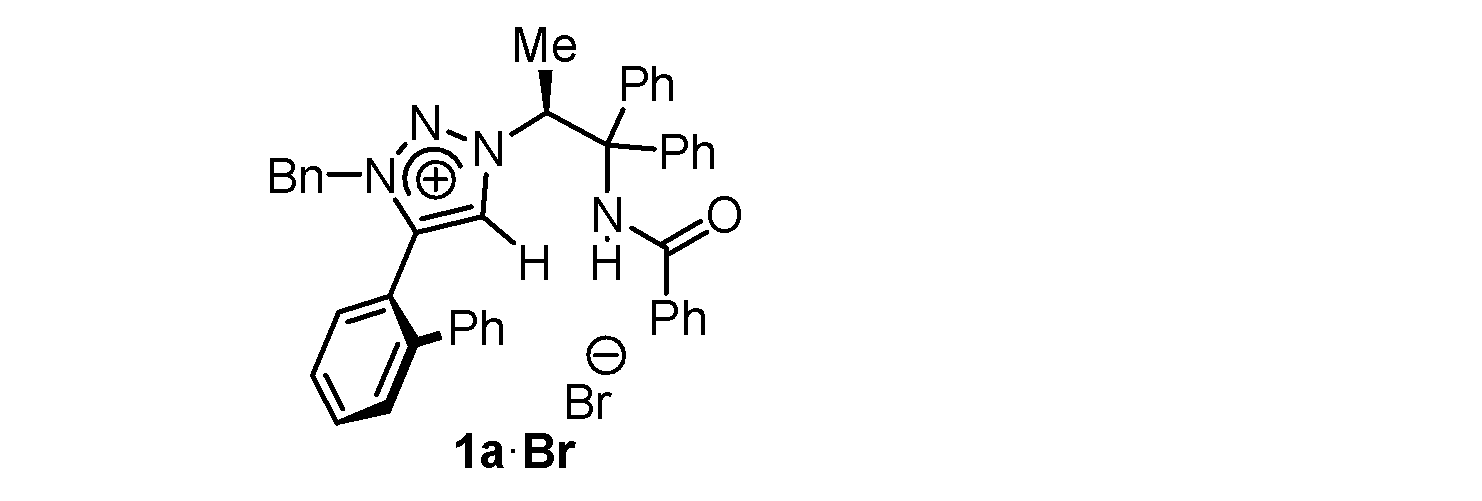
[式中、Meはメチル基を示す。以下同様である。]
を、既報(J. Am. Chem. Soc. 2011, 133, 1307-1309.)に記載の合成方法に準じて(原料の置換基等を変更すること等以外は同様の方法で)合成した。なお、この化合物は、既報(J. Am. Chem. Soc. 2013, 135, 18706-18709.)にも記載の化合物である。
を、既報(J. Am. Chem. Soc. 2011, 133, 1307-1309.)に記載の合成方法に準じて(原料の置換基等を変更すること等以外は同様の方法で)合成した。なお、この化合物は、既報(J. Am. Chem. Soc. 2013, 135, 18706-18709.)にも記載の化合物である。
合成例2-2:化合物1b・Brの合成
トリアゾリウム塩1b・Br:
トリアゾリウム塩1b・Br:
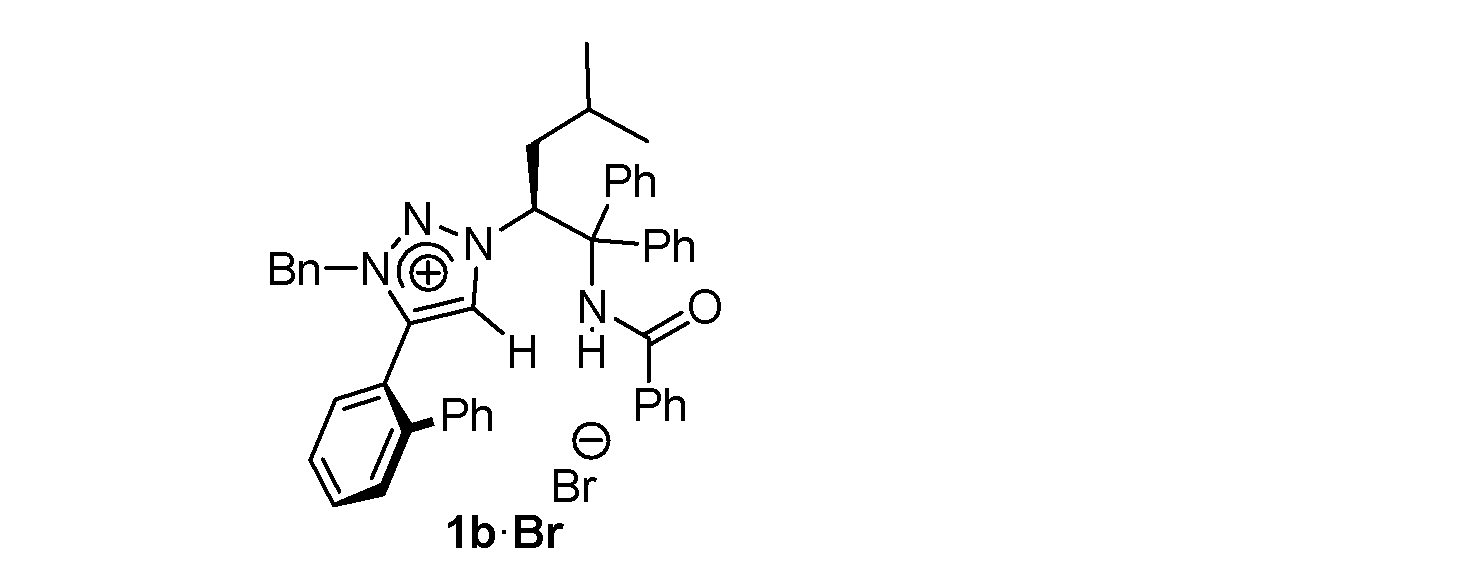
を、既報(J. Am. Chem. Soc. 2011, 133, 1307-1309.)に記載の合成方法に準じて(原料の置換基等を変更すること等以外は同様の方法で)合成した。なお、この化合物は、既報(Chem. Commun. 2012, 48, 7913-7915.)にも記載の化合物である。
合成例2-3:化合物1c・Brの合成
トリアゾリウム塩1c・Br:
トリアゾリウム塩1c・Br:
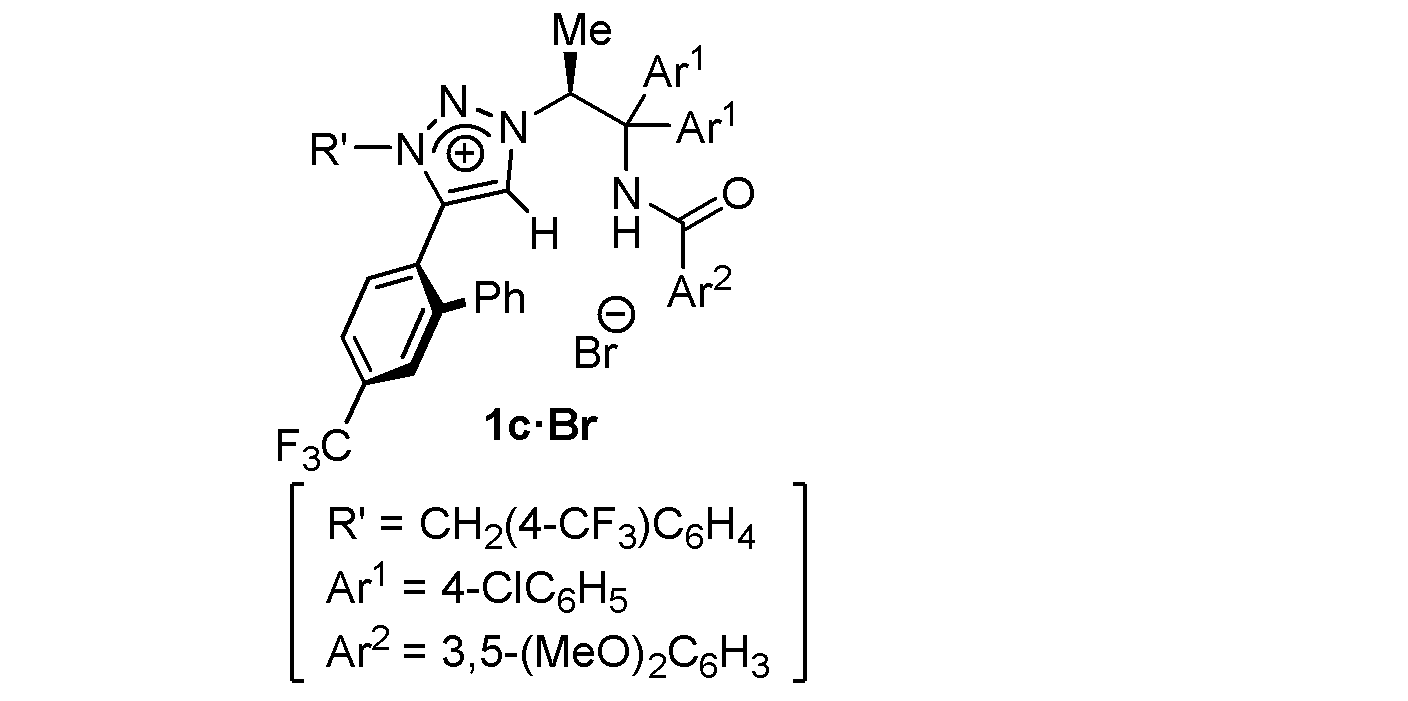
[式中、CH2(4-CF3)C6H4は4-トリフルオロメチルベンジル基を示す。4-ClC6H5は4-クロロフェニル基を示す。3,5-(MeO)2C6H3は3,5-ジメトキシフェニル基を示す。以下同様である。]
を、既報(J. Am. Chem. Soc. 2011, 133, 1307-1309.)に記載の合成方法に準じて(原料の置換基等を変更すること等以外は同様の方法で)合成した。
[α]D25 = -11.8 (c = 1.0, CHCl3); 1H NMR (400 MHz, CDCl3) δ 10.35 (1H, brs), 9.01 (1H, brs), 8.08 (1H, brs), 7.86 (1H, q, J = 6.6 Hz), 7.79 (2H, d, J = 7.4 Hz), 7.70 (1H, d, J = 7.4 Hz), 7.67 (1H, s), 7.52 (2H, d, J = 7.4 Hz), 7.36 (2H, s), 7.32 (2H, d, J = 8.6 Hz), 7.29-7.23 (2H, m), 7.07 (2H, t, J = 7.4 Hz), 7.00 (2H, brs), 6.85 (2H, d, J = 7.4 Hz), 6.78-6.73 (3H, m), 6.57 (1H, brs), 5.12 (1H, d, J = 14.4 Hz), 5.02 (1H, d, J = 14.4 Hz), 3.82, (6H, s), 1.66 (3H, d, J = 6.6 Hz) 13C NMR (101 MHz, CDCl3) δ 167.4, 161.0, 144.0, 139.2, 137.9, 137.0, 135.4, 134.8 (q, JC-F = 33.8 Hz), 134.2, 133.8, 133.6, 133.1, 132.8, 132.5 (q, JC-F = 33.8 Hz), 130.7, 130.1, 129.5, 129.4, 129.4, 128.7, 128.6, 127.9, 127.6, 126.3 (q, JC-F = 3.9 Hz), 125.3, 123.8, 123.4 (q, JC-F = 277 Hz), 123.1 (q, JC-F= 277 Hz), 106.1, 105.5, 68.7, 65.5, 56.3, 55.2, 15.7, one peak for aromatic carbon was not found probably due to overlapping; 19F NMR (376 MHz, CDCl3) δ -63.0, -63.1; IR 3211, 3011, 2963, 2839, 2253, 1674, 1593, 1493, 1323, 1130, 826, 729 cm-1; HRMS (ESI) Calcd for C47H37N4O3F6Cl2 +([M]+) 889.2141. Found 889.2125。
を、既報(J. Am. Chem. Soc. 2011, 133, 1307-1309.)に記載の合成方法に準じて(原料の置換基等を変更すること等以外は同様の方法で)合成した。
[α]D25 = -11.8 (c = 1.0, CHCl3); 1H NMR (400 MHz, CDCl3) δ 10.35 (1H, brs), 9.01 (1H, brs), 8.08 (1H, brs), 7.86 (1H, q, J = 6.6 Hz), 7.79 (2H, d, J = 7.4 Hz), 7.70 (1H, d, J = 7.4 Hz), 7.67 (1H, s), 7.52 (2H, d, J = 7.4 Hz), 7.36 (2H, s), 7.32 (2H, d, J = 8.6 Hz), 7.29-7.23 (2H, m), 7.07 (2H, t, J = 7.4 Hz), 7.00 (2H, brs), 6.85 (2H, d, J = 7.4 Hz), 6.78-6.73 (3H, m), 6.57 (1H, brs), 5.12 (1H, d, J = 14.4 Hz), 5.02 (1H, d, J = 14.4 Hz), 3.82, (6H, s), 1.66 (3H, d, J = 6.6 Hz) 13C NMR (101 MHz, CDCl3) δ 167.4, 161.0, 144.0, 139.2, 137.9, 137.0, 135.4, 134.8 (q, JC-F = 33.8 Hz), 134.2, 133.8, 133.6, 133.1, 132.8, 132.5 (q, JC-F = 33.8 Hz), 130.7, 130.1, 129.5, 129.4, 129.4, 128.7, 128.6, 127.9, 127.6, 126.3 (q, JC-F = 3.9 Hz), 125.3, 123.8, 123.4 (q, JC-F = 277 Hz), 123.1 (q, JC-F= 277 Hz), 106.1, 105.5, 68.7, 65.5, 56.3, 55.2, 15.7, one peak for aromatic carbon was not found probably due to overlapping; 19F NMR (376 MHz, CDCl3) δ -63.0, -63.1; IR 3211, 3011, 2963, 2839, 2253, 1674, 1593, 1493, 1323, 1130, 826, 729 cm-1; HRMS (ESI) Calcd for C47H37N4O3F6Cl2 +([M]+) 889.2141. Found 889.2125。
合成例2-4:化合物1d・Brの合成
トリアゾリウム塩1d・Br:
トリアゾリウム塩1d・Br:
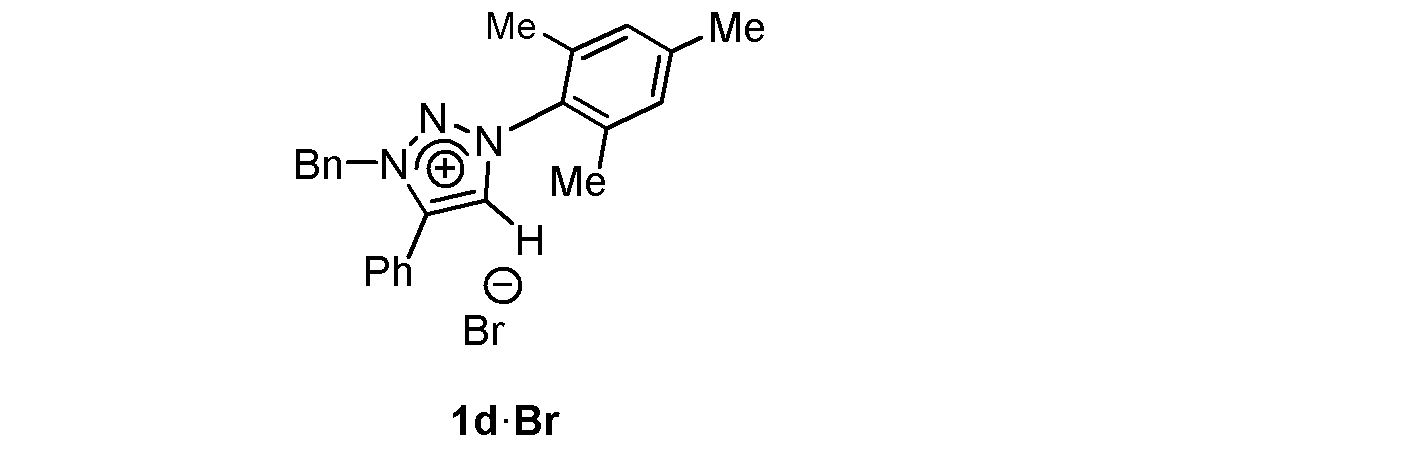
を、既報(Ohmatsu, K., Kiyokawa, M. & Ooi, T. J. Am. Chem. Soc. 133, 1307-1309 (2011).)に記載の合成方法に準じて合成した。
1H NMR (400 MHz, CDCl3) δ 9.40 (1H, s), 7.98 (2H, d, J = 7.2 Hz), 7.58-7.51 (3H, m), 7.35-7.27 (3H, m), 7.12 (2H, d, J = 7.6 Hz), 7.02 (2H, s), 6.08 (2H, s), 2.34 (3H, s), 2.16 (6H, s); 13C NMR (101 MHz, CDCl3) δ 143.8, 142.4, 134.4, 131.9, 131.8, 131.3, 131.2, 130.4, 129.8, 129.5, 129.4, 129.2, 128.2, 121.5, 56.5, 21.2, 18.0; IR 3649, 3389, 3028, 2982, 2359, 2180, 1607, 1454, 1186, 1020, 922, 723 cm-1; HRMS (ESI) Calcd for C24H24N3 + ([M]+) 354.1965. Found 354.1962。
1H NMR (400 MHz, CDCl3) δ 9.40 (1H, s), 7.98 (2H, d, J = 7.2 Hz), 7.58-7.51 (3H, m), 7.35-7.27 (3H, m), 7.12 (2H, d, J = 7.6 Hz), 7.02 (2H, s), 6.08 (2H, s), 2.34 (3H, s), 2.16 (6H, s); 13C NMR (101 MHz, CDCl3) δ 143.8, 142.4, 134.4, 131.9, 131.8, 131.3, 131.2, 130.4, 129.8, 129.5, 129.4, 129.2, 128.2, 121.5, 56.5, 21.2, 18.0; IR 3649, 3389, 3028, 2982, 2359, 2180, 1607, 1454, 1186, 1020, 922, 723 cm-1; HRMS (ESI) Calcd for C24H24N3 + ([M]+) 354.1965. Found 354.1962。
合成例2-5:化合物1e・Brの合成
トリアゾリウム塩1e・Br:
トリアゾリウム塩1e・Br:

を、既報(Ohmatsu, K., Kiyokawa, M. & Ooi, T. J. Am. Chem. Soc. 133, 1307-1309 (2011).)に記載の合成方法に準じて合成した。
1H NMR (400 MHz, CDCl3) δ 7.83 (2H, dd, J = 6.8, 2.4 Hz), 7.51-7.47 (3H, m), 7.24-7.16 (3H, m), 7.01-6.99 (4H, m), 5.94 (2H, s), 2.30 (3H, s), 2.17 (3H, s), 2.06 (6H, s); 13C NMR (101 MHz, CDCl3) δ 142.6, 140.9, 139.1, 135.0, 131.9, 131.7, 130.8, 129.9, 129.6, 129.2, 129.1, 128.3, 121.8, 56.8, 21.1, 17.8, 9.1, one peak for aromatic carbon was not found probably due to overlapping; IR 3647, 3389, 3032, 2918, 2172, 1827, 1607, 1447, 1331, 1055, 924, 725 cm-1; HRMS (ESI) Calcd for C25H26N3 + ([M]+) 368.2121. Found 368.2120。
1H NMR (400 MHz, CDCl3) δ 7.83 (2H, dd, J = 6.8, 2.4 Hz), 7.51-7.47 (3H, m), 7.24-7.16 (3H, m), 7.01-6.99 (4H, m), 5.94 (2H, s), 2.30 (3H, s), 2.17 (3H, s), 2.06 (6H, s); 13C NMR (101 MHz, CDCl3) δ 142.6, 140.9, 139.1, 135.0, 131.9, 131.7, 130.8, 129.9, 129.6, 129.2, 129.1, 128.3, 121.8, 56.8, 21.1, 17.8, 9.1, one peak for aromatic carbon was not found probably due to overlapping; IR 3647, 3389, 3032, 2918, 2172, 1827, 1607, 1447, 1331, 1055, 924, 725 cm-1; HRMS (ESI) Calcd for C25H26N3 + ([M]+) 368.2121. Found 368.2120。
合成例2-6:化合物1f・Brの合成
トリアゾリウム塩1f・Br:
トリアゾリウム塩1f・Br:

を、既報(J. Am. Chem. Soc. 2011, 133, 1307-1309.)に記載の合成方法に準じて(原料の置換基等を変更すること等以外は同様の方法で)合成した。
[α]D23 = -42.7 (c = 1.0, MeOH); 1H NMR (400 MHz, CDCl3) δ 10.3 (1H, brs), 9.72 (1H, brs), 8.75 (2H, s), 8.13 (1H, brm), 7.97 (1H, brs), 7.83 (2H, d, J = 7.2 Hz), 7.70 (1H, q, J = 6.8 Hz), 7.69 (1H, s), 7.60 (1H, d, J = 8.0 Hz), 7.46 (2H, d, J = 8.0 Hz), 7.34 (2H, t, J = 7.6 Hz), 7.27 (1H, t, J = 7.8 Hz), 7.20 (2H, t, J = 6.6 Hz), 7.09-7.04 (4H, m), 6.98 (2H, brs), 6.92 (2H, d, J = 7.2 Hz), 6.81 (2H, d, J = 8.0 Hz), 5.08 (1H, d, J = 14.6 Hz), 5.01 (1H, d, J = 14.6 Hz), 1.79 (3H, d, J = 6.8 Hz); 13C NMR (101 MHz, CDCl3) δ 165.0, 143.7, 139.4, 139.1, 137.2, 135.8, 134.7 (q, JC-F = 33.8 Hz), 134.5, 133.3, 133.2, 133.1, 132.3 (q, JC-F = 33.8 Hz), 131.7 (q, JC-F = 33.8 Hz), 129.8, 129.4, 129.2, 129.2, 128.9, 128.7, 128.3, 128.1, 127.8, 127.3, 126.2 (q, JC-F = 3.8 Hz), 125.4 (q, JC-F = 3.8 Hz), 125.0 (q, JC-F = 3.8 Hz), 123.5 (q, JC-F = 274 Hz), 123.3 (q, JC-F = 274 Hz), 123.1 (q, JC-F = 274 Hz), 69.8, 65.9, 55.1, 15.8, three peaks for aromatic carbons were not found probably due to overlapping; 19F NMR (376 MHz, CDCl3) δ -62.4, -63.0, -63.3; IR 3219, 3022, 2359, 2210, 1682, 1526, 1450, 1325, 1277, 1126, 1016, 908, 845, 731 cm-1; HRMS (ESI) Calcd for C47H33N4OF12 +([M]+) 897.2457. Found 897.2438。
[α]D23 = -42.7 (c = 1.0, MeOH); 1H NMR (400 MHz, CDCl3) δ 10.3 (1H, brs), 9.72 (1H, brs), 8.75 (2H, s), 8.13 (1H, brm), 7.97 (1H, brs), 7.83 (2H, d, J = 7.2 Hz), 7.70 (1H, q, J = 6.8 Hz), 7.69 (1H, s), 7.60 (1H, d, J = 8.0 Hz), 7.46 (2H, d, J = 8.0 Hz), 7.34 (2H, t, J = 7.6 Hz), 7.27 (1H, t, J = 7.8 Hz), 7.20 (2H, t, J = 6.6 Hz), 7.09-7.04 (4H, m), 6.98 (2H, brs), 6.92 (2H, d, J = 7.2 Hz), 6.81 (2H, d, J = 8.0 Hz), 5.08 (1H, d, J = 14.6 Hz), 5.01 (1H, d, J = 14.6 Hz), 1.79 (3H, d, J = 6.8 Hz); 13C NMR (101 MHz, CDCl3) δ 165.0, 143.7, 139.4, 139.1, 137.2, 135.8, 134.7 (q, JC-F = 33.8 Hz), 134.5, 133.3, 133.2, 133.1, 132.3 (q, JC-F = 33.8 Hz), 131.7 (q, JC-F = 33.8 Hz), 129.8, 129.4, 129.2, 129.2, 128.9, 128.7, 128.3, 128.1, 127.8, 127.3, 126.2 (q, JC-F = 3.8 Hz), 125.4 (q, JC-F = 3.8 Hz), 125.0 (q, JC-F = 3.8 Hz), 123.5 (q, JC-F = 274 Hz), 123.3 (q, JC-F = 274 Hz), 123.1 (q, JC-F = 274 Hz), 69.8, 65.9, 55.1, 15.8, three peaks for aromatic carbons were not found probably due to overlapping; 19F NMR (376 MHz, CDCl3) δ -62.4, -63.0, -63.3; IR 3219, 3022, 2359, 2210, 1682, 1526, 1450, 1325, 1277, 1126, 1016, 908, 845, 731 cm-1; HRMS (ESI) Calcd for C47H33N4OF12 +([M]+) 897.2457. Found 897.2438。
[合成例3:オキシインドール化合物の合成]
以下の実施例で使用した化合物8a及び8b以外のオキシインドール化合物は、既報(Hamashima, Y., Suzuki, T., Takano, H., Shimura, Y. & Sodeoka, M. J. Am. Chem. Soc. 127, 10164‐10165 (2005).)に記載の合成方法に準じて合成した。なお、3-(1-ナフチル)オキシインドール以外の化合物は、公知の化合物である。
3-(1-ナフチル)オキシインドール:
1H NMR (400 MHz, CDCl3) δ 8.35 (1H, brs), 8.00 (1H, d, J = 8.7 Hz), 7.89 (1H, d, J = 8.2 Hz), 7.82 (1H, d, J = 8.2 Hz), 7.67-7.46 (2H, brm), 7.38 (2H, t, J = 8.0 Hz), 7.16-7.04 (3H, brm), 5.64 (1H, brs), 1.64 (9H, s); 13C NMR (101 MHz, CDCl3) δ 173.8, 149.6, 140.6, 134.4, 129.0, 128.9, 128.7, 128.2, 126.8, 126.1, 125.7, 125.5, 124.8, 124.0, 115.3, 84.5, 53.5, 28.2, three peaks for aromatic carbons were not found probably due to overlapping; IR 3049, 2982, 2253, 1769, 1607, 1479, 1288, 1146, 912, 773 cm-1; HRMS (ESI) Calcd for C23H21NO3Na+([M+Na]+) 382.1414. Found 382.1414。
以下の実施例で使用した化合物8a及び8b以外のオキシインドール化合物は、既報(Hamashima, Y., Suzuki, T., Takano, H., Shimura, Y. & Sodeoka, M. J. Am. Chem. Soc. 127, 10164‐10165 (2005).)に記載の合成方法に準じて合成した。なお、3-(1-ナフチル)オキシインドール以外の化合物は、公知の化合物である。
3-(1-ナフチル)オキシインドール:
1H NMR (400 MHz, CDCl3) δ 8.35 (1H, brs), 8.00 (1H, d, J = 8.7 Hz), 7.89 (1H, d, J = 8.2 Hz), 7.82 (1H, d, J = 8.2 Hz), 7.67-7.46 (2H, brm), 7.38 (2H, t, J = 8.0 Hz), 7.16-7.04 (3H, brm), 5.64 (1H, brs), 1.64 (9H, s); 13C NMR (101 MHz, CDCl3) δ 173.8, 149.6, 140.6, 134.4, 129.0, 128.9, 128.7, 128.2, 126.8, 126.1, 125.7, 125.5, 124.8, 124.0, 115.3, 84.5, 53.5, 28.2, three peaks for aromatic carbons were not found probably due to overlapping; IR 3049, 2982, 2253, 1769, 1607, 1479, 1288, 1146, 912, 773 cm-1; HRMS (ESI) Calcd for C23H21NO3Na+([M+Na]+) 382.1414. Found 382.1414。
合成例3-1:化合物8bの合成
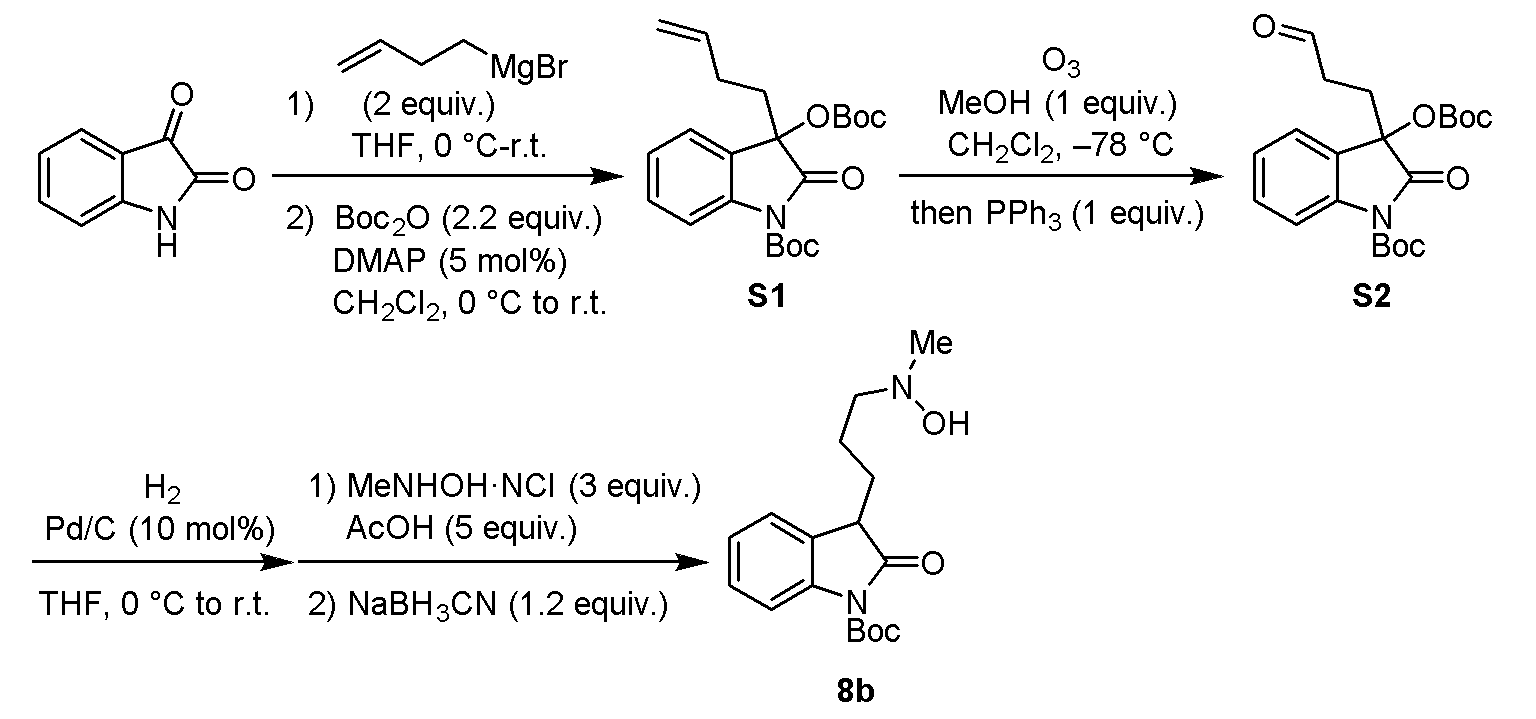
アルゴン雰囲気下、1-ブテニルマグネシウムブロミド(1 M in THF, 20 mL, 20 mmol)の溶液に、イサチン(1.47 g, 10 mmol)のTHF(50 mL)の撹拌した懸濁溶液を0℃で添加し、イサチンが消費されるまでこの混合物を室温で撹拌した。得られた混合物を飽和NH4Cl水溶液で希釈し、酢酸エチルで抽出した。Na2SO4で乾燥し、溶媒を除去し、粗生成物を精製せずに次の工程に使用した。この粗生成物のCH2Cl2(50 mL)溶液に、ジtert-ブチルジカーボネート((Boc)2O; 5.1 mL, 22 mmol)及びN,N-ジメチル-4-アミノピリジン(DMAP; 61 mg, 0.5 mmol)を室温で添加し、混合物を3時間撹拌した。反応をNH4Cl水溶液でクエンチし、合わせた有機層を水及び食塩水で洗浄し、次に、Na2SO4で乾燥した。溶媒を蒸発させて除去し、残渣をシリカゲルカラムクロマトグラフィー(溶離液:ヘキサン/酢酸エチル=3: 1)で精製し、化合物S1を橙色固体として得た(3.0 g, 7.5 mmol, 75 %収率)。
1H NMR (400 MHz, CDCl3) δ 7.88 (1H, d, J = 7.6 Hz), 7.38 (1H, td, J= 8.0, 1.2 Hz), 7.31 (1H, dd, J = 7.0, 1.2 Hz), 7.19 (1H, t, J = 7.4 Hz), 5.68 (1H, ddt, J = 17.2, 10.4, 6.2 Hz), 4.94 (1H, dd, J = 17.2, 1.6 Hz), 4.92 (1H, dd, J = 10.4, 1.6 Hz), 2.15-1.98 (4H, m), 1.66 (9H, s), 1.35 (9H, s)。
1H NMR (400 MHz, CDCl3) δ 7.88 (1H, d, J = 7.6 Hz), 7.38 (1H, td, J= 8.0, 1.2 Hz), 7.31 (1H, dd, J = 7.0, 1.2 Hz), 7.19 (1H, t, J = 7.4 Hz), 5.68 (1H, ddt, J = 17.2, 10.4, 6.2 Hz), 4.94 (1H, dd, J = 17.2, 1.6 Hz), 4.92 (1H, dd, J = 10.4, 1.6 Hz), 2.15-1.98 (4H, m), 1.66 (9H, s), 1.35 (9H, s)。
化合物S1のCH2Cl2(40 mL)溶液に、メタノール(0.32 mL, 7.5 mmol)を添加し、反応フラスコを-78℃まで冷却した。次に、この反応溶液中にオゾンを同じ温度で30分間バブルした。トリフェニルホスフィン(2.0 g, 7.5 mmol)を添加して残存オゾンを除去し、全ての混合物を室温でさらに30分間撹拌した。得られた混合物を濃縮し、残渣をシリカゲルカラムクロマトグラフィー(溶離液:ヘキサン/酢酸エチル=3: 1)で精製し、化合物S2を淡黄色オイルとして得た(1.5 g, 3.7 mmol, 49 %収率)。
1H NMR (400 MHz, CDCl3) δ 9.69 (1H, s), 7.87 (1H, d, J = 8.0 Hz), 7.37 (1H, t, J = 8.0 Hz), 7.30 (1H, d, J = 7.2 Hz), 7.18 (1H, t, J = 7.8 Hz), 2.41 (2H, t, J = 7.8 Hz), 2.00 (2H, t, J = 7.8 Hz), 1.65 (9H, s), 1.33 (9H, s)。
1H NMR (400 MHz, CDCl3) δ 9.69 (1H, s), 7.87 (1H, d, J = 8.0 Hz), 7.37 (1H, t, J = 8.0 Hz), 7.30 (1H, d, J = 7.2 Hz), 7.18 (1H, t, J = 7.8 Hz), 2.41 (2H, t, J = 7.8 Hz), 2.00 (2H, t, J = 7.8 Hz), 1.65 (9H, s), 1.33 (9H, s)。
化合物S2のTHF(15 mL)溶液に、Pd/C(39 mg, 0.37 mmol)を0℃で添加し、水素雰囲気(バルーン)下、反応混合物を室温で24時間撹拌した。ろ過してPd/Cを除去し、N-メチルヒドロキシルアミン(0.93 g, 11.1 mmol)及び酢酸(1.05 mL, 18.5 mmol)を引き続いて反応溶液に添加し、混合物を室温で2時間撹拌した。次に、反応溶液にシアノ水素化ホウ素ナトリウム(NaBH3CN; 0.28 g, 4.5 mmol)を添加し、さらに3時間撹拌し続けた。反応をNaHCO3水溶液でクエンチし、酢酸エチルで抽出した。Na2SO4で乾燥した後、溶媒を蒸発させ、残渣をシリカゲルカラムクロマトグラフィー(溶離液:ヘキサン/酢酸エチル=2: 1)で精製し、目的化合物8bを白色固体として得た(0.58 g, 1.8 mmol, 49 %収率)。なお、化合物8bにおいてメチル基を水素原子とした化合物8aも同様の方法で合成した。
1H NMR (400 MHz, CDCl3) δ 7.80 (1H, d, J = 8.4 Hz), 7.29 (1H, t, J= 7.6 Hz), 7.24 (1H, d, J = 7.2 Hz), 7.14 (1H, t, J = 7.6 Hz), 3.62 (1H, brt, J = 5.8 Hz), 2.63 (2H, t, J = 7.2 Hz), 2.56 (3H, s), 2.12-1.96 (2H, m), 1.71-1.43 (2H, m), 1.64 (9H, s); 13C NMR (101 MHz, CDCl3) δ 176.2, 149.3, 140.2, 128.2, 127.8, 124.4, 123.7, 115.0, 84.3, 61.6, 48.3, 45.7, 28.9, 28.2, 23.2; IR 3308, 2980, 2253, 1728, 1609, 1464, 1350, 1290, 1146, 912, 843, 729 cm-1; HRMS (ESI) Calcd for C17H25N2O4 +([M+H]+) 321.1809. Found 321.1805。
1H NMR (400 MHz, CDCl3) δ 7.80 (1H, d, J = 8.4 Hz), 7.29 (1H, t, J= 7.6 Hz), 7.24 (1H, d, J = 7.2 Hz), 7.14 (1H, t, J = 7.6 Hz), 3.62 (1H, brt, J = 5.8 Hz), 2.63 (2H, t, J = 7.2 Hz), 2.56 (3H, s), 2.12-1.96 (2H, m), 1.71-1.43 (2H, m), 1.64 (9H, s); 13C NMR (101 MHz, CDCl3) δ 176.2, 149.3, 140.2, 128.2, 127.8, 124.4, 123.7, 115.0, 84.3, 61.6, 48.3, 45.7, 28.9, 28.2, 23.2; IR 3308, 2980, 2253, 1728, 1609, 1464, 1350, 1290, 1146, 912, 843, 729 cm-1; HRMS (ESI) Calcd for C17H25N2O4 +([M+H]+) 321.1809. Found 321.1805。
[実施例1:オキシインドール化合物の不斉α-アミノ化]
実施例1-1:化合物4lの合成
実施例1-1:化合物4lの合成
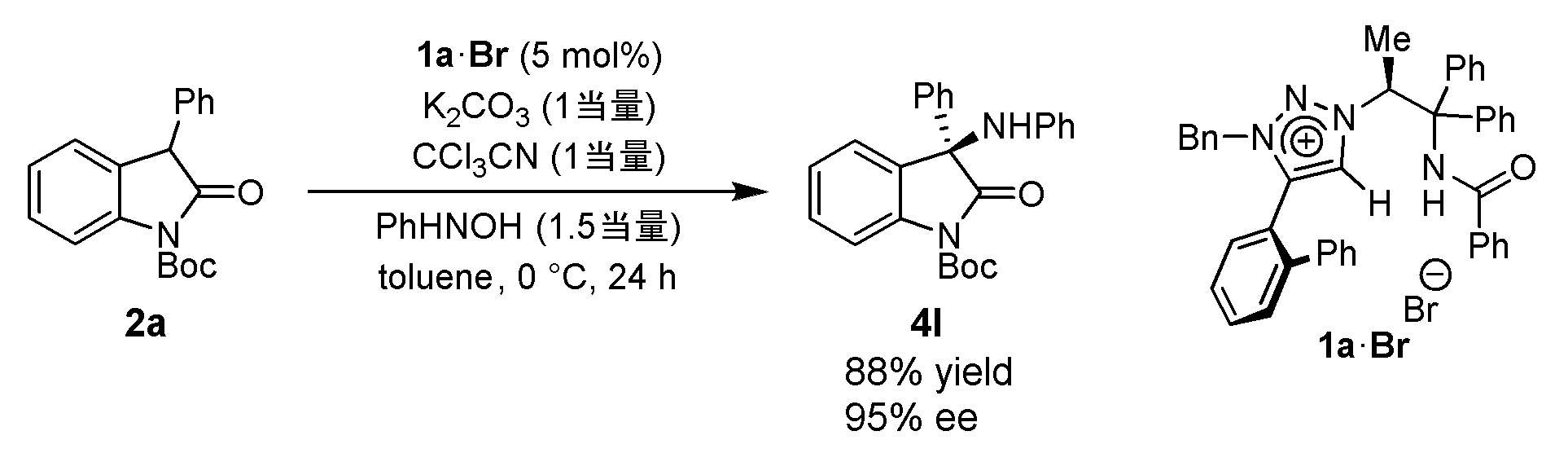
合成例2-1で得たトリアゾリウム塩1a・Br(3.53 mg, 0.005 mmol)、オキシインドール化合物2a(30.9 mg, 0.10 mmol)、合成例1-1で得たN-フェニルヒドロキシルアミン(3a; 16.5 mg, 0.15 mmol)、及びK2CO3(13.8 mg, 0.10 mmol)のトルエン(1.0 mL)溶液を、真空排気及びアルゴン再充填を交互に行うことにより脱気した。次に、得られた混合物を0℃に冷却した。この溶液に、CCl3CN(10μL, 0.10 mmol)を添加し、混合物を24時間攪拌した。反応混合物をNH4Cl飽和水溶液で希釈し、CHCl3による抽出作業を行った。Na2SO4での乾燥、ろ過、及び溶液の除去の後に、粗生成物を、CHROMATOREX NH DM2035を用いたカラムクロマトグラフィー(溶離液:ヘキサン/酢酸エチル=20: 1)で精製し、目的の光学活性α-アミノ化オキシインドール化合物4lを得た(35.2 mg, 88 %収率, 95%エナンチオ選択率)。
[α]D23 = +10.2 (c = 0.8, 1,2-dichloroethane) for 95% ee; 1H NMR (400 MHz, CDCl3) δ 7.96 (1H, d, J = 5.9 Hz), 7.50 (2H, dd, J= 7.9, 1.4 Hz), 7.41-7.33 (5H, m), 7.19 (1H, t, J =7.6 Hz), 7.01 (2H, t, J= 7.9 Hz), 6.69 (1H, t, J = 7.6 Hz), 6.34 (2H, t, J = 8.3 Hz), 4.61 (1H, s), 1.61 (9H, s); 13C NMR (125 MHz, CDCl3) δ 175.7, 149.7, 145.1, 140.4, 139.8, 130.2, 129.6, 129.6, 129.5, 129.4, 127.3, 125.8, 125.5, 119.8, 116.2, 115.8, 85.2, 68.5, 28.6; HRMS (ESI) Calcd for C25H24N2O3Na ([M+Na]+) 423.1679. Found 423.1675; HPLC IF3, Hex/IPA = 10: 1, flow rate = 1.0 mL/min, λ= 254 nm, 7.6 min (minor), 9.4 min (major)。
[α]D23 = +10.2 (c = 0.8, 1,2-dichloroethane) for 95% ee; 1H NMR (400 MHz, CDCl3) δ 7.96 (1H, d, J = 5.9 Hz), 7.50 (2H, dd, J= 7.9, 1.4 Hz), 7.41-7.33 (5H, m), 7.19 (1H, t, J =7.6 Hz), 7.01 (2H, t, J= 7.9 Hz), 6.69 (1H, t, J = 7.6 Hz), 6.34 (2H, t, J = 8.3 Hz), 4.61 (1H, s), 1.61 (9H, s); 13C NMR (125 MHz, CDCl3) δ 175.7, 149.7, 145.1, 140.4, 139.8, 130.2, 129.6, 129.6, 129.5, 129.4, 127.3, 125.8, 125.5, 119.8, 116.2, 115.8, 85.2, 68.5, 28.6; HRMS (ESI) Calcd for C25H24N2O3Na ([M+Na]+) 423.1679. Found 423.1675; HPLC IF3, Hex/IPA = 10: 1, flow rate = 1.0 mL/min, λ= 254 nm, 7.6 min (minor), 9.4 min (major)。
実施例1-2:化合物4aの合成
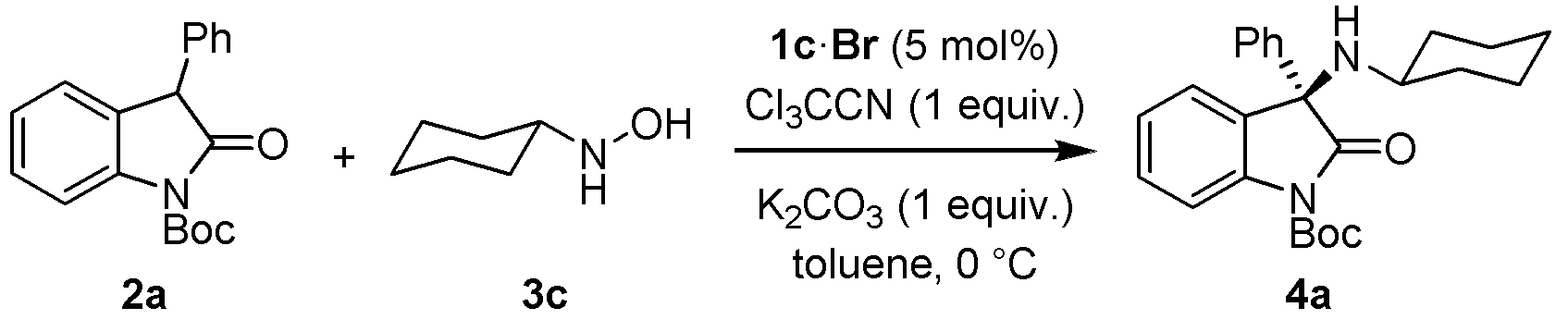
合成例2-1で得たトリアゾリウム塩1a・Brの代わりに合成例2-3で得たトリアゾリウム塩1c・Br(4.85 mg, 0.005 mmol)を用い、合成例1-1で得たN-フェニルヒドロキシルアミンの代わりに合成例1-1で得たN-シクロヘキシルヒドロキシルアミン(3c; 17.3 mg, 0.15 mmol)を用いたこと以外は実施例1-1と同様の処理を行い、目的化合物4aを無色オイルとして得た(32.5 mg, 0.080 mmol, 80 %収率, 99 %エナンチオ選択率)。この実施例1-2は、後述の表1のentry 6に相当する。
[α]D24 = +68.5 (c = 1.3, CHCl3) for 99% ee; 1H NMR (400 MHz, CDCl3) δ7.88 (1H, dd, J = 8.0, 2.0 Hz), 7.43 (2H, dd, J = 8.2, 1.8 Hz), 7.34 (1H, td, J = 7.2, 1.2 Hz), 7.32 (1H, d, J = 8.0 Hz), 7.30-7.23 (3H, m), 7.17 (1H, td, J = 8.2, 1.2 Hz), 2.36-2.30 (1H, m), 2.17 (1H, brs), 1.76-1.45 (5H, m), 1.64 (9H, s), 1.19-1.01 (5H, m); 13C NMR (101 MHz, CDCl3) δ 178.7, 149.3, 141.7, 139.5, 130.4, 129.2, 128.7, 128.2, 126.3, 126.0, 124.6, 115.4, 84.6, 69.4, 53.3, 35.8, 35.1, 28.3, 25.8, 25.3, 25.1; IR 3327, 2928, 2853, 1767, 1728, 1607, 1472, 1342, 1287, 1146, 1001, 754 cm-1; HRMS (ESI) Calcd for C25H31N2O3 + ([M+H]+) 407.2329. Found 407.2327.; HPLC IE3, Hex/IPA = 10: 1, flow rate = 1.0 mL/min, λ= 210 nm, 7.8 min (minor isomer), 14.2 min (major isomer)。
[α]D24 = +68.5 (c = 1.3, CHCl3) for 99% ee; 1H NMR (400 MHz, CDCl3) δ7.88 (1H, dd, J = 8.0, 2.0 Hz), 7.43 (2H, dd, J = 8.2, 1.8 Hz), 7.34 (1H, td, J = 7.2, 1.2 Hz), 7.32 (1H, d, J = 8.0 Hz), 7.30-7.23 (3H, m), 7.17 (1H, td, J = 8.2, 1.2 Hz), 2.36-2.30 (1H, m), 2.17 (1H, brs), 1.76-1.45 (5H, m), 1.64 (9H, s), 1.19-1.01 (5H, m); 13C NMR (101 MHz, CDCl3) δ 178.7, 149.3, 141.7, 139.5, 130.4, 129.2, 128.7, 128.2, 126.3, 126.0, 124.6, 115.4, 84.6, 69.4, 53.3, 35.8, 35.1, 28.3, 25.8, 25.3, 25.1; IR 3327, 2928, 2853, 1767, 1728, 1607, 1472, 1342, 1287, 1146, 1001, 754 cm-1; HRMS (ESI) Calcd for C25H31N2O3 + ([M+H]+) 407.2329. Found 407.2327.; HPLC IE3, Hex/IPA = 10: 1, flow rate = 1.0 mL/min, λ= 210 nm, 7.8 min (minor isomer), 14.2 min (major isomer)。
実施例1-3
種々のヒドロキシルアミン化合物を用い、触媒として表1に示す化合物を用いたこと以外は上記実施例1-1と同様の処理を行った。結果を表1に示す。なお、触媒として1d・Br又は1e・Brを用いた場合、光学活性化合物はほとんど得られず、立体異性体の混合物(ラセミ体)しか得られなかった。
種々のヒドロキシルアミン化合物を用い、触媒として表1に示す化合物を用いたこと以外は上記実施例1-1と同様の処理を行った。結果を表1に示す。なお、触媒として1d・Br又は1e・Brを用いた場合、光学活性化合物はほとんど得られず、立体異性体の混合物(ラセミ体)しか得られなかった。
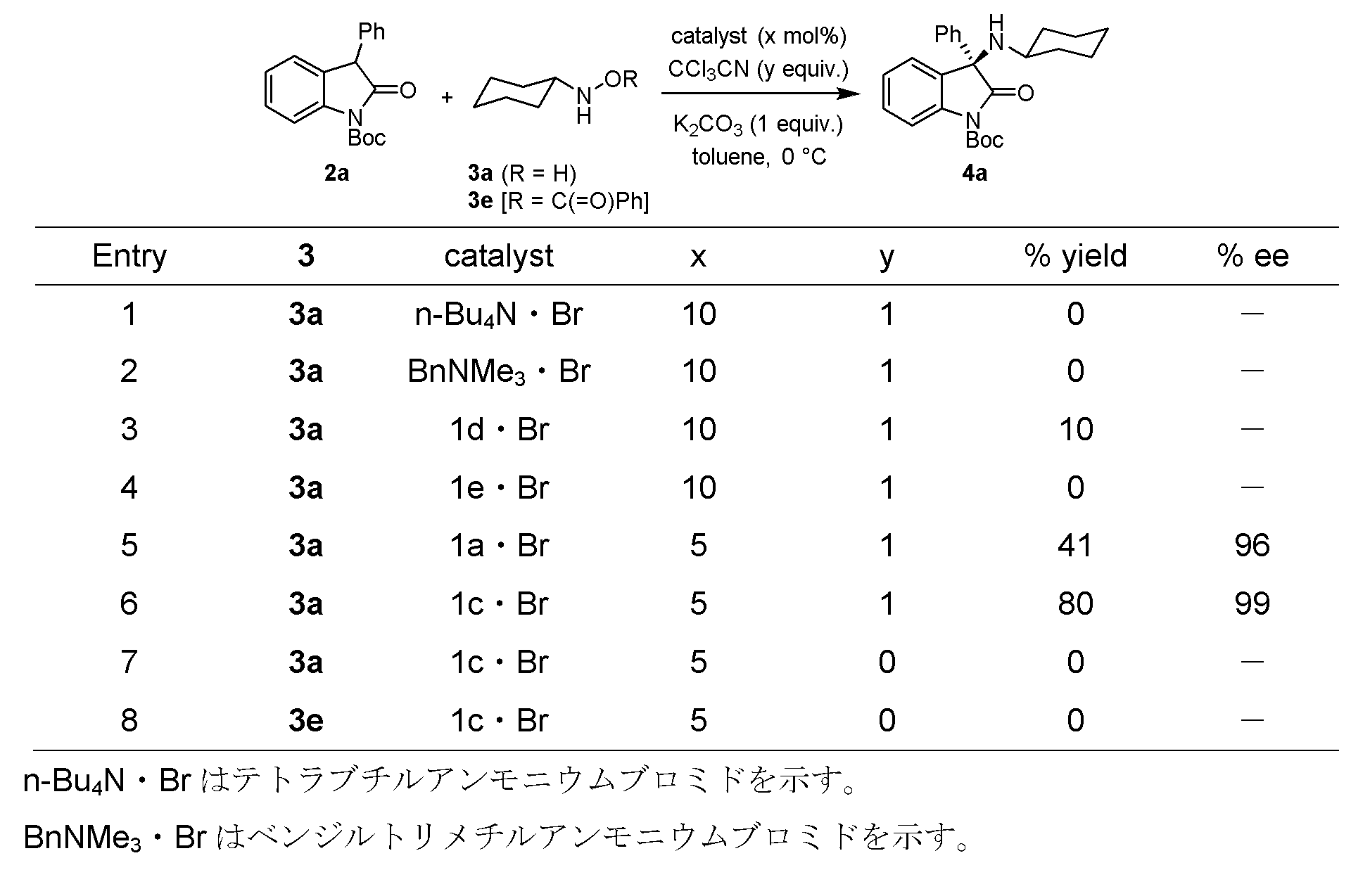
実施例1-4
特に制限のない限り、基質化合物として種々の化合物、ヒドロキシルアミン化合物として種々のヒドロキシルアミン化合物、触媒として合成例2-1~2-6で得たいずれかのトリアゾリウム塩を用いたこと以外は上記実施例1-1及び実施例1-2と同様の処理を行った。その結果、以下の表2に示す置換基を有する光学活性化合物が得られたことを確認した。結果を表2に示す。
特に制限のない限り、基質化合物として種々の化合物、ヒドロキシルアミン化合物として種々のヒドロキシルアミン化合物、触媒として合成例2-1~2-6で得たいずれかのトリアゾリウム塩を用いたこと以外は上記実施例1-1及び実施例1-2と同様の処理を行った。その結果、以下の表2に示す置換基を有する光学活性化合物が得られたことを確認した。結果を表2に示す。

化合物4b:
[α]D24 = +59.3 (c = 1.0, CHCl3) for 99% ee; 1H NMR (400 MHz, CDCl3) δ 7.88 (1H, d, J = 8.4 Hz), 7.43 (2H, dt, J = 8.0, 1.6 Hz), 7.33 (1H, dt, J = 7.8, 1.2 Hz), 7.31-7.22 (4H, m), 7.17 (1H, t, J = 7.6 Hz), 2.58-2.52 (1H, m), 2.16 (1H, brs), 1.80-1.72 (1H, m), 1.64 (9H, s), 1.58-1.12 (11H, m); 13C NMR (101 MHz, CDCl3) δ 178.5, 149.3, 141.7, 139.6, 130.3, 129.2, 128.7, 128.2, 126.4, 126.1, 124.6, 115.3, 84.6, 69.7, 55.1, 37.2, 36.5, 28.7, 28.4, 28.3, 24.1, 23.8; IR 3325, 2926, 2855, 1765, 1728, 1605, 1464, 1342, 1285, 1146, 1001, 754 cm-1; HRMS (ESI) Calcd for C26H33N2O3 +([M+H]+) 421.2486. Found 421.2486.; HPLC ID3, Hex/IPA = 10: 1, flow rate = 1.0 mL/min, λ= 210 nm, 6.0 min (minor isomer), 12.5 min (major isomer)。
化合物4c:
[α]D24 = +52.4 (c = 1.3, CHCl3) for 97% ee; 1H NMR (400 MHz, CDCl3) δ 7.88 (1H, d, J = 7.6 Hz), 7.44 (2H, d, J= 6.8 Hz), 7.33 (1H, dt, J = 8.2, 1.0 Hz), 7.31-7.22 (4H, m), 7.16 (1H, td, J= 7.4, 1.2 Hz), 2.58-2.52 (1H, m), 2.15 (1H, brs), 1.75-1.22 (13H, m), 1.64 (9H, s), 1.10-1.01 (1H, m); 13C NMR (101 MHz, CDCl3) δ 178.6, 149.3, 141.7, 139.6, 130.4, 129.2, 128.7, 128.1, 126.4, 126.1, 124.6, 115.3, 84.6, 69.8, 53.8, 34.2, 33.8, 28.2, 27.6, 27.2, 25.9, 23.9, 23.5; IR 3321, 2918, 1765, 1728, 1605, 1466, 1342, 1285, 1146, 1001, 754 cm-1; HRMS (ESI) Calcd for C27H35N2O3 +([M+H]+) 435.2642. Found 435.2640.; HPLC ID3, Hex/IPA = 10: 1, flow rate = 1.0 mL/min, λ= 210 nm, 6.0 min (minor isomer), 13.3 min (major isomer)。
化合物4d:
[α]D23 = +11.5 (c = 1.2, CHCl3) for 95% ee; 1H NMR (400 MHz, CDCl3) δ 7.92 (1H, d, J = 8.0 Hz), 7.48 (2H, d, J= 7.2 Hz), 7.38 (2H, t, J = 8.0 Hz), 7.34-7.22 (8H, m), 7.20 (1H, t, J = 7.6 Hz), 3.63 (1H, d, J = 12.2 Hz), 3.46 (1H, d, J = 12.2 Hz), 2.54 (1H, brs), 1.66 (9H, s); 13C NMR (101 MHz, CDCl3) δ 177.4, 149.2, 140.6, 139.8, 139.8, 129.7, 129.5, 128.8, 128.5, 128.4, 128.4, 127.3, 126.3, 125.4, 125.1, 115.5, 84.8, 69.9, 48.5, 28.3; IR 3318, 3030, 2978, 1763, 1730, 1605, 1466, 1342, 1287, 1148, 1001, 752 cm-1; HRMS (ESI) Calcd for C26H27N2O3 +([M+H]+) 415.2016. Found 415.2017.; HPLC IF3, Hex/IPA = 10: 1, flow rate = 1.0 mL/min, λ= 210 nm, 7.3 min (major isomer), 14.0 min (minor isomer)。
化合物4e:
[α]D23 = +41.0 (c = 1.0, CHCl3) for 99% ee; 1H NMR (400 MHz, CDCl3) δ 7.91 (1H, d, J = 8.0 Hz), 7.47 (2H, d, J= 8.0 Hz), 7.40 (2H, d, J = 8.8 Hz), 7.38-7.25 (5H, m), 7.19 (1H, t, J = 8.0 Hz), 7.18 (2H, d, J = 8.0 Hz), 3.59 (1H, d, J = 12.0 Hz), 3.42 (1H, d, J = 12.0 Hz), 2.52, (1H, brs), 1.66 (9H, s); 13C NMR (101 MHz, CDCl3) δ 177.3, 149.2, 140.5, 139.9, 138.9, 131.5, 130.1, 129.6, 129.5, 128.9, 128.5, 126.3, 125.4, 125.1, 121.1, 115.5, 84.9, 69.9, 47.9, 28.3; IR 3325, 3057, 2980, 2930, 1730, 1605, 1466, 1342, 1287, 1148, 1011, 754 cm-1; HRMS (ESI) Calcd for C26H26N2O3Br+([M+H]+) 493.1121. Found 493.1121.; HPLC OZ3, Hex/IPA = 10: 1, flow rate = 0.5 mL/min, λ= 210 nm, 8.2 min (S), 9.2 min (R)。
化合物4f:
[α]D23 = +50.0 (c = 1.0, CHCl3) for 99% ee; 1H NMR (400 MHz, CDCl3) δ 7.92 (1H, dd, J = 8.6, 1.2 Hz), 7.54 (2H, d, J= 7.6 Hz), 7.48 (2H, d, J = 7.6 Hz), 7.44 (2H, d, J = 8.0 Hz), 7.36 (2H, td, J = 7.3, 1.2 Hz), 7.31 (1H, d, J = 7.2 Hz), 7.29 (1H, t, J = 6.8 Hz), 7.19 (1H, t, J = 7.0 Hz), 3.71 (1H, d, J = 13.2 Hz), 3.52 (1H, d, J = 13.2 Hz), 2.57 (1H, brs), 1.67 (9H, s); 13C NMR (101 MHz, CDCl3) δ 177.3, 149.2, 143.9, 140.3, 139.8, 129.6, 129.5 (q, JF-C = 32.3 Hz), 129.4, 128.9, 128.6, 128.5, 126.3, 125.4, 125.2, 124.3 (q, JF-C = 273 Hz), 115.6, 85.0, 69.9, 48.0, 28.3, one peak for aromatic carbon was not found probably due to overlapping; 19F NMR (376 MHz, CDCl3) δ -62.3; IR 3318, 3059, 2982, 2934, 1732, 1607, 1468, 1323, 1248, 1123, 1018, 754 cm-1; HRMS (ESI) Calcd for C27H25N2O3F3Na+([M+Na]+) 505.1709. Found 505.1707.; HPLC IF3, Hex/IPA = 10: 1, flow rate = 1.0 mL/min, λ= 210 nm, 5.3 min (major isomer), 8.3 min (minor isomer)。
化合物4g:
[α]D24 = +68.6 (c = 0.8, CHCl3) for 97% ee; 1H NMR (400 MHz, CDCl3) δ 7.89 (1H, d, J = 8.0 Hz), 7.42 (2H, dd, J= 8.2, 1.2 Hz), 7.33 (1H, td, J = 8.4, 1.6 Hz), 7.31-7.25 (4H, m), 7.17 (1H, t, J = 7.6 Hz), 2.44 (1H, dt, J= 10.8, 6.8 Hz), 2.24 (1H, brs), 2.22 (1H, dt, J = 10.8, 6.8 Hz), 1.64 (9H, s), 1.50-1.40 (2H, m), 1.36-1.25 (2H, m), 0.84 (3H, t, J = 7.4 Hz); 13C NMR (101 MHz, CDCl3) δ 177.9, 149.3, 140.8, 139.8, 130.0, 129.2, 128.8, 128.3, 126.3, 125.4, 124.9, 115.4, 84.7, 69.9, 43.9, 32.7, 28.3, 20.4, 14.1; IR 3389, 3053, 2932, 1771, 1603, 1464, 1344, 1287, 1142, 1003, 746 cm-1; HRMS (ESI) Calcd for C23H29N2O3 +([M+H]+) 381.2173. Found 381.2171.; HPLC IF3, Hex/IPA = 19: 1, flow rate = 1.0 mL/min, λ= 210 nm, 6.2 min (minor isomer), 6.7 min (major isomer)。
化合物4h:
5 M K2CO3のトルエン(0.5 mL)水溶液を用いて室温で反応を行った。
[α]D23 = +104.4 (c = 0.8, CHCl3) for 97% ee; 1H NMR (400 MHz, CDCl3) δ 7.88 (1H, d, J = 8.0 Hz), 7.47 (2H, dt, J= 8.2, 1.4 Hz), 7.32 (1H, td, J = 7.6, 1.6 Hz), 7.30-7.23 (4H, m), 7.16 (1H, td, J = 7.3, 1.2 Hz), 2.30 (1H, d, J= 10.6 Hz), 2.22 (1H, brs), 1.85 (1H, d, J= 10.6 Hz), 1.66 (9H, s), 0.88 (9H, s); 13C NMR (101 MHz, CDCl3) δ 177.9, 149.3, 141.4, 139.7, 130.3, 129.1, 128.8, 128.2, 126.2, 125.4, 124.9, 115.3, 84.7, 69.9, 55.3, 31.6, 28.3, 27.7; IR 3327, 3057, 2953, 1730, 1607, 1470, 1342, 1285, 1148, 1001, 754 cm-1; HRMS (ESI) Calcd for C24H30N2O3Na+([M+Na]+) 417.2149. Found 417.2153.; HPLC IF3, Hex/IPA = 10: 1, flow rate = 1.0 mL/min, λ= 210 nm, 4.1 min (minor isomer), 4.8 min (major isomer)。
化合物4i:
5 M K2CO3のトルエン(0.5 mL)水溶液を用いて室温で反応を行った。
[α]D24 = +72.3 (c = 1.2, CHCl3) for 98% ee; 1H NMR (400 MHz, CDCl3) δ 7.89 (1H, d, J = 8.0 Hz), 7.43 (2H, d, J= 8.0 Hz), 7.36-7.22 (5H, m), 7.18 (1H, td, J= 7.6, 1.2 Hz), 2.73 (1H, sept, J = 6.0 Hz), 2.16 (1H, brs), 1.64 (9H, s), 1.01 (3H, d, J = 6.0 Hz), 0.88 (3H, d, J= 6.0 Hz); 13C NMR (101 MHz, CDCl3) δ 178.6, 149.3, 141.6, 139.6, 130.2, 129.3, 128.7, 128.2, 126.3, 126.1, 124.7, 115.4, 84.6, 69.5, 46.0, 28.3, 25.5, 24.7; IR 3329, 3059, 2974, 1767, 1607, 1476, 1342, 1285, 1146, 1001, 754 cm-1; HRMS (ESI) Calcd for C22H27N2O3 + ([M+H]+) 367.2016 Found 367.2016.; HPLC IE3, Hex/IPA = 10: 1, flow rate = 1.0 mL/min, λ= 210 nm, 6.6 min (minor isomer), 8.0 min (major isomer)。
化合物4j:
5 M K2CO3のトルエン(0.5 mL)水溶液を用いて室温で反応を行った。
[α]D24 = +56.9 (c = 1.2, CHCl3) for 95% ee; 1H NMR (400 MHz, CDCl3) δ 7.90 (1H, d, J = 8.8 Hz), 7.45 (2H, d, J= 7.6 Hz), 7.36 (2H, t, J = 7.6 Hz), 7.33-7.25 (7H, m), 7.21 (2H, t, J = 7.6 Hz), 6.37 (1H, d, J = 16.2 Hz), 6.21 (1H, ddd, J = 16.2, 7.2, 5.6 Hz), 3.26 (1H, dd, J = 13.6, 7.2 Hz), 3.18 (1H, dd, J = 13.6, 5.6 Hz), 2.46 (1H, brs), 1.59 (9H, s); 13C NMR (101 MHz, CDCl3) δ 177.7, 149.1, 140.6, 139.9, 137.0, 131.9, 129.5, 128.8, 128.6, 128.3, 127.8, 127.6, 126.5, 126.3, 125.5, 125.0, 115.5, 84.7, 69.5, 46.9, 28.2, one peak for aromatic carbon was not found probably due to overlapping; IR 3318, 3024, 2980, 1730, 1605, 1466, 1342, 1287, 1148, 968, 752 cm-1; HRMS (ESI) Calcd for C28H28N2O3Na+([M+Na]+) 463.1992. Found 463.1993.; HPLC IE3, Hex/IPA = 10: 1, flow rate = 1.0 mL/min, λ= 210 nm, 12.5 min (major isomer), 17.7 min (minor isomer)。
化合物4k:
5 M K2CO3のトルエン(0.5 mL)水溶液を用いて室温で反応を行った。
[α]D24 = +63.6 (c = 1.4, CHCl3) for 94% ee; 1H NMR (400 MHz, CDCl3) δ 7.91 (1H, d, J = 8.4 Hz), 7.45 (2H, dd, J= 8.6, 1.4 Hz), 7.36-7.25 (5H, m), 7.17 (1H, t, J = 7.4 Hz), 3.20 (2H, s), 2.83 (1H, brs), 1.65 (9H, s), 1.42 (9H, s); 13C NMR (101 MHz, CDCl3) δ 176.7, 170.7, 149.2, 139.8, 139.6, 129.6, 129.6, 128.8, 128.4, 126.5, 125.4, 125.1, 115.5, 84.8, 81.7, 68.6, 46.6, 28.2, 28.2; IR 3333, 3063, 2980, 1730, 1607, 1477, 1369, 1246, 1148, 1001, 754 cm-1; HRMS (ESI) Calcd for C25H30N2O5Na+([M+Na]+) 461.2047. Found 461.2045.; HPLC ID3, Hex/IPA = 10: 1, flow rate = 1.0 mL/min, λ= 210 nm, 9.0 min (major isomer), 16.0 min (minor isomer)。
化合物4m:
シリカゲルカラムクロマトグラフィーで精製した。
[α]D22 = +31.1 (c = 1.0, acetone) for 95% ee; 1H NMR (400 MHz, CDCl3) δ 7.96 (1H, d, J= 8.4 Hz), 7.48-7.45 (2H, m), 7.40 (1H, td, J= 8.4, 1.2 Hz), 7.37-7.33 (4H, m), 7.21 (1H, t, J = 7.0 Hz), 7.10 (2H, d, J= 9.0 Hz), 6.23 (2H, d, J = 9.0 Hz), 4.62 (1H, s), 1.61 (9H, s); 13C NMR (101 MHz, CDCl3) δ 174.9, 149.2, 143.8, 139.5, 139.4, 132.0, 130.0, 129.3, 129.1, 128.7, 126.8, 125.3, 125.2, 117.1, 115.9, 111.5, 85.0, 68.0, 28.2; IR 3397, 3057, 2980, 1732, 1595, 1493, 1341, 1287, 1146, 908, 754 cm-1; HRMS (ESI) Calcd for C25H23N2O3BrNa+([M+Na]+) 501.0784. Found 501.0785.; HPLC ID3, Hex/IPA = 10: 1, flow rate = 1.0 mL/min, λ= 210 nm, 7.6 min (minor isomer), 11.7 min (major isomer)。
化合物4n:
シリカゲルカラムクロマトグラフィーで精製した。
[α]D24 = +16.1 (c = 1.0, acetone) for 90% ee; 1H NMR (400 MHz, CDCl3) δ 8.00 (1H, d, J= 8.4 Hz), 7.67 (2H, d, J = 8.4 Hz), 7.48-7.46 (2H, m), 7.42 (1H, td, J = 7.8, 1.2 Hz), 7.37-7.35 (4H, m), 7.21 (1H, td, J = 7.6, 1.2 Hz), 6.30 (2H, d, J= 8.4 Hz), 4.95 (1H, s), 1.62 (9H, s), 1.51 (9H, s); 13C NMR (101 MHz, CDCl3) δ 174.4, 165.8, 149.2, 148.3, 139.4, 139.2, 131.2, 130.1, 129.3, 129.3, 128.4, 126.9, 125.2, 122.4, 115.9, 113.7, 85.0, 80.1, 67.6, 28.4, 28.2, one peak for aromatic carbon was not found probably due to overlapping; IR 3366, 3061, 2978, 1732, 1605, 1476, 1341, 1288, 1148, 1007, 770 cm-1; HRMS (ESI) Calcd for C30H32N2O5Na+([M+Na]+) 523.2203. Found 523.2204.; HPLC OD3, Hex/IPA = 10: 1, flow rate = 1.0 mL/min, λ= 210 nm, 6.6 min (major isomer), 9.2 min (minor isomer)。
化合物4o:
CHROMATOREX DIOLを用いたカラムクロマトグラフィーで精製した。
[α]D23 = +45.6 (c = 1.0, acetone) for 94% ee; 1H NMR (400 MHz, CDCl3) δ 8.00 (1H, d, J= 8.0 Hz), 7.47-7.43 (3H, m), 7.38-7.34 (4H, m), 7.29 (2H, d, J = 8.6 Hz), 7.23 (1H, t, J = 7.2 Hz), 6.33 (2H, d, J = 8.6 Hz), 5.07 (1H, s), 1.62 (9H, s); 13C NMR (101 MHz, CDCl3) δ 174.1, 149.1, 148.1, 139.2, 138.6, 133.6, 130.3, 129.5, 127.8, 126.8, 125.3, 125.1, 119.9, 116.1, 114.5, 101.2, 85.3, 67.4, 28.2, one peak for aromatic carbon was not found probably due to overlapping; IR 3360, 3059, 2982, 2216, 1732, 1605, 1516, 1464, 1337, 1285, 1146, 910, 827, 756 cm-1; HRMS (ESI) Calcd for C26H23N3O3Na+([M+Na]+) 448.1632. Found 448.1632.; HPLC IF3, Hex/IPA = 10: 1, flow rate = 1.0 mL/min, λ= 210 nm, 12.2 min (minor isomer), 27.3 min (major isomer)。
化合物4p:
シリカゲルカラムクロマトグラフィーで精製した。
[α]D23 = +15.0 (c = 1.2, acetone) for 94% ee; 1H NMR (400 MHz, CDCl3) δ 7.97 (1H, d, J= 8.8 Hz), 7.50-7.47 (2H, m), 7.42-7.34 (5H, m), 7.20 (1H, d, J = 7.6 Hz), 7.08 (2H, d, J = 8.0 Hz), 6.52 (1H, dd, J = 17.3, 11.0 Hz), 6.30 (2H, d, J = 8.0 Hz), 5.46 (1H, d, J = 17.3 Hz), 4.99 (1H, d, J = 11.0 Hz), 4.67 (1H, s), 1.61 (9H, s); 13C NMR (101 MHz, CDCl3) δ 175.0, 149.3, 144.5, 139.8, 139.4, 136.5, 129.8, 129.2, 129.1, 129.1, 129.0, 127.3, 126.9, 125.3, 125.1, 115.8, 115.2, 110.6, 84.8, 68.0, 28.2; IR 3402, 3057, 2980, 1730, 1609, 1516, 1476, 1342, 1287, 1146, 829, 731 cm-1; HRMS (ESI) Calcd for C27H26N2O3Na+([M+Na]+) 449.1836. Found 449.1838.; HPLC IE3, Hex/IPA = 10: 1, flow rate = 1.0 mL/min, λ= 210 nm, 11.4 min (minor isomer), 17.1 min (major isomer)。
化合物4q:
シリカゲルカラムクロマトグラフィーで精製した。
[α]D23 = +6.9 (c = 1.1, 1,2-dichloroethane) for 95% ee; 1H NMR (400 MHz, CDCl3) δ 7.96 (1H, d, J = 8.8 Hz), 7.41-7.36 (4H, m), 7.19 (1H, t, J = 7.6 Hz), 7.16 (2H, d, J= 8.4 Hz), 7.01 (2H, t, J = 7.6 Hz), 6.68 (1H, td, J = 7.6, 0.8 Hz), 6.32 (2H, d, J = 8.4 Hz), 4.60 (1H, s), 2.33 (3H, s), 1.60 (9H, s); 13C NMR (101 MHz, CDCl3) δ 175.3, 149.3, 144.8, 139.3, 139.0, 137.0, 129.8, 129.6, 129.2, 126.8, 125.3, 125.0, 119.3, 115.7, 115.2, 84.7, 67.8, 28.2, 21.2, one peak for aromatic carbon was not found probably due to overlapping; IR 3395, 3053, 2982, 1728, 1603, 1503, 1464, 1342, 1285, 1146, 910, 841, 746 cm-1; HRMS (ESI) Calcd for C26H26N2O3Na+([M+Na]+) 437.1836. Found 437.1839.; HPLC IF3, Hex/IPA = 10: 1, flow rate = 1.0 mL/min, λ= 210 nm, 9.5 min (minor isomer), 11.1 min (major isomer)。
化合物4r:
シリカゲルカラムクロマトグラフィーで精製した。
[α]D23 = -10.1 (c = 0.8, acetone) for 92% ee; 1H NMR (400 MHz, CDCl3) δ 7.96 (1H, d, J= 8.8 Hz), 7.48 (2H, dd, J = 9.0, JF-H = 5.2 Hz), 7.41 (1H, td, J = 8.6, 1.2 Hz), 7.38 (1H, d, J = 8.0 Hz), 7.20 (1H, t, J = 8.0 Hz), 7.04 (2H, dd, J = 9.0, JF-H = 8.8 Hz), 7.02 (2H, t, J = 7.6 Hz), 6.71 (1H, t, J= 7.2 Hz), 6.35 (2H, d, J = 7.6 Hz), 4.53 (1H, brs), 1.61 (9H, s); 13C NMR (101 MHz, CDCl3) δ 175.1, 163.1 (JF-C= 250 Hz), 149.2, 144.5, 139.4, 135.6 (JF-C= 2.8 Hz), 129.9, 129.2, 129.0 (JF-C= 8.7 Hz), 128.9, 125.3, 125.2, 119.6, 116.1 (JF-C = 22.2 Hz), 115.9, 115.5, 85.0, 67.5, 28.2; 19F NMR (376 MHz, CDCl3) δ -112.6; IR 3393, 3053, 1732, 1603, 1504, 1464, 1342, 1287, 1148, 812, 748 cm-1; HRMS (ESI) Calcd for C25H23N2O3FNa+([M+Na]+) 441.1585. Found 441.1583.; HPLC IF3, Hex/IPA = 19: 1, flow rate = 1.0 mL/min, λ= 210 nm, 9.8 min (minor isomer), 10.8 min (major isomer)。
化合物4t:
シリカゲルカラムクロマトグラフィーで精製した。
[α]D23 = +13.8 (c = 1.2, 1,2-dichloroethane) for 97% ee; 1H NMR (400 MHz, CDCl3) δ 7.95 (1H, d, J = 8.4 Hz), 7.41-7.37 (2H, m), 7.35 (1H, s), 7.24-7.22 (2H, m), 7.19 (1H, t, J = 7.6 Hz), 7.17-7.14 (1H, m), 7.01 (2H, t, J = 8.0 Hz), 6.69 (1H, t, J = 7.2 Hz), 6.33 (2H, dd, J = 8.0, 1.2 Hz), 4.61 (1H, brs), 2.33 (3H, s), 1.61 (9H, s); 13C NMR (101 MHz, CDCl3) δ 175.3, 149.3, 144.7, 139.9, 139.4, 139.0, 129.8, 129.7, 129.2, 129.1, 129.0, 127.4, 125.4, 125.0, 123.9, 119.3, 115.7, 115.3, 84.8, 68.0, 28.2, 21.7; IR 3404, 3051, 2982, 1730, 1601, 1501, 1476, 1341, 1285, 1144, 1001, 910, 746 cm-1; HRMS (ESI) Calcd for C26H26N2O3Na+([M+Na]+) 437.1836. Found 437.1834.; HPLC IF3, Hex/IPA = 10: 1, flow rate = 1.0 mL/min, λ= 210 nm, 7.1 min (minor isomer), 8.0 min (major isomer)。
化合物4u:
シリカゲルカラムクロマトグラフィーで精製した。
[α]D22 = +17.2 (c = 0.8, 1,2-dichloroethane) for 96% ee; 1H NMR (400 MHz, CDCl3) δ 7.94 (1H, dd, J = 8.6, 1.2 Hz), 7.41-7.36 (2H, m), 7.26 (1H, t, J = 8.0 Hz), 7.18 (1H, td, J = 7.2, 1.2 Hz), 7.08 (1H, t, J = 2.2 Hz), 7.03 (2H, t, J = 8.2 Hz), 7.00 (1H, dd, J = 8.2, 1.2 Hz), 6.87 (1H, dd, J = 8.4, 2.2 Hz), 6.69 (1H, t, J = 7.4 Hz), 6.34 (2H, dd, J = 8.2, 1.2 Hz), 4.62 (1H, brs), 3.77 (3H, s), 1.61 (9H, s); 13C NMR (101 MHz, CDCl3) δ 175.1, 160.1, 149.3, 144.7, 141.5, 139.4, 130.1, 129.8, 129.2, 129.0, 125.3, 125.1, 119.4, 119.1, 115.7, 115.4, 114.2, 113.0, 84.8, 68.0, 55.5, 28.2; IR 3397, 3053, 2980, 1730, 1601, 1501, 1464, 1341, 1246, 1144, 1049, 908, 839, 746 cm-1; HRMS (ESI) Calcd for C26H26N2O4Na+([M+Na]+) 453.1785. Found 453.1786.; HPLC IF3, Hex/IPA = 10: 1, flow rate = 1.0 mL/min, λ= 210 nm, 9.1 min (minor isomer), 14.8 min (major isomer)。
化合物4v:
シリカゲルカラムクロマトグラフィーで精製した。
[α]D23 = +11.5 (c = 1.2, CHCl3) for 94% ee; 1H NMR (400 MHz, CDCl3) δ 7.62 (1H, d, J = 8.0 Hz), 7.29-7.25 (2H, m), 7.17-7.13 (2H, m), 7.08 (2H, t, J = 7.2 Hz), 6.96 (2H, t, J = 7.8 Hz), 6.78 (2H, d, J = 7.6 Hz), 6.66 (1H, t, J = 7.2 Hz), 6.23 (2H, d, J = 7.6 Hz), 4.48 (1H, brs), 3.24 (2H, s), 1.53 (9H, s); 13C NMR (101 MHz, CDCl3) δ 176.5, 148.6, 144.8, 139.2, 132.5, 130.3, 129.4, 129.3, 128.1, 127.9, 127.5, 124.8, 123.9, 119.4, 115.4, 115.2, 84.2, 66.2, 48.2, 28.1; IR 3387, 3030, 2980, 1790, 1732, 1601, 1497, 1344, 1288, 1146, 746 cm-1; HRMS (ESI) Calcd for C26H26N2O3Na+([M+Na]+) 437.1836. Found 437.1834.; HPLC IF3, Hex/IPA = 10: 1, flow rate = 1.0 mL/min, λ= 210 nm, 8.3 min (minor isomer), 9.8 min (major isomer)。
化合物4w:
シリカゲルカラムクロマトグラフィーで精製した。
[α]D23 = +11.0 (c = 0.7, CHCl3) for 93% ee; 1H NMR (400 MHz, CDCl3) δ 7.91 (1H, d, J = 8.0 Hz), 7.37 (1H, td, J= 8.0, 1.2 Hz), 7.31 (1H, d, J = 7.2 Hz), 7.17 (1H, t, J = 7.6 Hz), 6.95 (2H, td, J = 8.0, 1.2 Hz), 6.65 (1H, t, J = 7.4 Hz), 6.19 (2H, dd, J = 7.8, 1.2 Hz), 4.25 (1H, brs), 1.90 (2H, d, J = 5.6 Hz), 1.61 (9H, s), 1.58-1.41 (5H, m), 1.26-0.84 (6H, m); 13C NMR (101 MHz, CDCl3) δ 177.1, 149.3, 144.9, 139.3, 129.4, 129.4, 129.2, 125.0, 124.0, 119.5, 115.6, 115.5, 84.5, 65.0, 49.2, 35.0, 34.7, 32.9, 28.2, 26.2, 26.2, 26.1; IR 3391, 3053, 2922, 1730, 1601, 1464, 1344, 1288, 1146, 746 cm-1; HRMS (ESI) Calcd for C26H32N2O3Na+([M+Na]+) 443.2305. Found 443.2309.; HPLC IF3, Hex/IPA = 10: 1, flow rate = 1.0 mL/min, λ= 210 nm, 6.5 min (major isomer), 7.4 min (minor isomer)。
化合物4x:
シリカゲルカラムクロマトグラフィーで精製した。
[α]D23 = +10.2 (c = 1.4, CHCl3) for 92% ee; 1H NMR (400 MHz, CDCl3) δ 7.89 (1H, d, J = 7.2 Hz), 7.38-7.34 (2H, m), 7.16 (1H, t, J = 7.0 Hz), 6.95 (2H, td, J= 7.8, 1.2 Hz), 6.67 (1H, t, J = 7.4 Hz), 6.21 (2H, d, J = 8.0 Hz), 4.16 (1H, brs), 2.18 (1H, d, J = 13.4 Hz), 2.11 (1H, d, J = 13.4 Hz), 1.59 (9H, s), 0.72 (9H, s); 13C NMR (101 MHz, CDCl3) δ 176.9, 149.3, 144.7, 139.7, 129.6, 129.2, 129.1, 125.1, 124.7, 119.9, 116.4, 115.6, 84.4, 64.7, 54.7, 31.3, 30.8, 28.2; IR 3393, 3053, 2955, 1728, 1601, 1477, 1344, 1285, 1144, 746 cm-1; HRMS (ESI) Calcd for C24H30N2O3Na+([M+Na]+) 417.2149. Found 417.2144.; HPLC IE3, Hex/IPA = 10: 1, flow rate = 1.0 mL/min, λ= 210 nm, 6.6 min (minor isomer), 7.3 min (major isomer)。
化合物4y:
シリカゲルカラムクロマトグラフィーで精製した。
[α]D23 = -13.0 (c = 0.8, CHCl3) for 94% ee; 1H NMR (400 MHz, CDCl3) δ 7.93 (1H, d, J = 8.8 Hz), 7.36 (1H, td, J= 7.8, 1.2 Hz), 7.29 (1H, d, J = 6.8 Hz), 7.16 (1H, t, J = 7.6 Hz), 6.97 (2H, t, J = 8.0 Hz), 6.66 (1H, t, J = 7.2 Hz), 6.20 (2H, d, J = 8.4 Hz), 5.72 (1H, dddd, J = 14.8, 11.6, 8.2, 6.8 Hz), 5.22 (1H, d, J = 14.8 Hz), 5.22 (1H, d, J = 11.6 Hz), 4.40 (1H, brs), 2.69 (1H, dd, J = 13.0, 6.8 Hz), 2.60 (1H, dd, J = 13.0, 8.2 Hz), 1.63 (9H, s); 13C NMR (101 MHz, CDCl3) δ 176.4, 149.3, 144.8, 138.8, 130.0, 129.4, 129.3, 129.1, 125.0, 123.8, 121.7, 119.4, 115.7, 115.0, 84.7, 64.0, 45.7, 28.2; IR 3393, 3053, 2980, 1730, 1603, 1477, 1344, 1288, 1146, 748 cm-1; HRMS (ESI) Calcd for C22H24N2O3Na+([M+Na]+) 387.1679. Found 387.1680.; HPLC IE3, Hex/IPA = 10: 1, flow rate = 1.0 mL/min, λ= 210 nm, 7.2 min (minor isomer), 8.0 min (major isomer)。
化合物4aa:
シリカゲルカラムクロマトグラフィーで精製した。
[α]D23 = +12.2 (c = 0.8, acetone) for 90% ee; 1H NMR (400 MHz, CDCl3) δ 8.68 (1H, dd, J= 8.8, 1.6 Hz), 7.93 (1H, d, J = 8.0 Hz), 7.87 (1H, dd, J = 6.6, 3.0 Hz), 7.84 (1H, d, J = 8.0 Hz), 7.51-7.43 (3H, m), 7.39 (1H, td, J = 7.8, 1.2 Hz), 7.35 (1H, t, J = 8.0 Hz), 7.28 (1H, dd, J = 7.2, 1.2 Hz), 7.13 (1H, td, J = 7.2, 1.6 Hz), 7.03 (2H, td, J = 8.0, 1.2 Hz), 6.75 (1H, t, J = 7.4 Hz), 6.44 (2H, d, J = 8.0 Hz), 4.72 (1H, brs), 1.57 (9H, s); 13C NMR (101 MHz, CDCl3) δ 174.1, 149.4, 143.9, 139.6, 135.1, 134.7, 130.7, 130.5, 130.0, 129.4, 129.0, 126.8, 126.6, 126.4, 125.9, 125.6, 125.2, 125.0, 120.1, 117.0, 115.6, 84.6, 70.0, 28.2, one peak for aromatic carbon was not found probably due to overlapping; IR 3387, 3051, 2980, 1728, 1601, 1503, 1464, 1339, 1287, 1144, 1084, 908, 729 cm-1; HRMS (ESI) Calcd for C29H26N2O3Na+([M+Na]+) 473.1836. Found 473.1839.; HPLC IF3, Hex/IPA = 10: 1, flow rate = 1.0 mL/min, λ= 254 nm, 6.2 min (minor isomer), 7.5 min (major isomer)。
化合物4ab:
シリカゲルカラムクロマトグラフィーで精製した。
[α]D23 = -22.8 (c = 0.8, acetone) for 93% ee; 1H NMR (400 MHz, CDCl3) δ 7.93 (1H, d, J= 8.4 Hz), 7.36 (1H, td, J = 7.6, 1.2 Hz), 7.30 (1H, dd, J = 6.6, 1.2 Hz), 7.17 (1H, t, J = 7.4 Hz), 6.96 (2H, t, J = 8.2 Hz), 6.65 (1H, t, J = 7.4 Hz), 6.21 (2H, d, J = 8.8 Hz), 4.32 (1H, brs), 1.98-1.93 (2H, m), 1.63 (9H, s), 1.30-1.05 (4H, m), 0.83 (3H, t, J = 7.4 Hz); 13C NMR (101 MHz, CDCl3) δ 177.2, 149.3, 145.1, 139.2, 129.4, 129.3, 129.3, 125.0, 123.8, 119.4, 115.6, 115.2, 84.7, 65.0, 41.7, 28.3, 24.8, 22.7, 13.9; IR 3389, 3053, 2932, 1730, 1603, 1464, 1344, 1287, 1142, 746 cm-1; HRMS (ESI) Calcd for C23H28N2O3Na+([M+Na]+) 403.1992. Found 403.1985.; HPLC IF3, Hex/IPA = 10: 1, flow rate = 1.0 mL/min, λ= 210 nm, 6.0 min (major isomer), 6.8 min (minor isomer)。
化合物4ac:
シリカゲルカラムクロマトグラフィーで精製した。
[α]D23 = +29.9 (c = 1.3, 1,2-dichloroethane) for 94% ee; 1H NMR (400 MHz, CDCl3) δ 7.83 (1H, d, J = 8.8 Hz), 7.50 (2H, dd, J= 7.8, 2.2 Hz), 7.38-7.33 (3H, m), 7.20 (1H, s), 7.19 (1H, d, J = 6.8 Hz), 7.02 (2H, t, J = 8.0 Hz), 6.70 (1H, t, J = 7.4 Hz), 6.35 (2H, d, J = 8.0 Hz), 4.61 (1H, s), 2.32 (3H, s), 1.60 (9H, s); 13C NMR (101 MHz, CDCl3) δ 175.4, 149.3, 144.8, 140.1, 136.9, 134.8, 130.3, 129.2, 129.2, 129.1, 128.9, 126.8, 125.8, 119.3, 115.6, 115.3, 84.6, 68.1, 28.2, 21.3; IR 3404, 3055, 2980, 1730, 1601, 1489, 1333, 1298, 1152, 748 cm-1; HRMS (ESI) Calcd for C26H26N2O3Na+([M+Na]+) 437.1836. Found 437.1833.; HPLC IF3, Hex/IPA = 10: 1, flow rate = 1.0 mL/min, λ= 210 nm, 7.7 min (minor isomer), 9.5 min (major isomer)。
化合物4ad:
シリカゲルカラムクロマトグラフィーで精製した。
[α]D22 = +25.1 (c = 0.9, 1,2-dichloroethane) for 94% ee; 1H NMR (400 MHz, CDCl3) δ 7.89 (1H, d, J = 9.2 Hz), 7.50 (2H, dd, J= 7.8, 2.4 Hz), 7.38-7.34 (3H, m), 7.02 (2H, t, J = 7.8 Hz), 6.95 (1H, d, J= 2.4 Hz), 6.91 (1H, dd, J = 9.0, 3.0 Hz), 6.70 (1H, t, J = 7.4 Hz), 6.36 (2H, d, J = 8.8 Hz), 4.61 (1H, s), 3.76 (3H, s), 1.60 (9H, s); 13C NMR (101 MHz, CDCl3) δ 175.3, 157.3, 149.4, 144.7, 140.0, 132.6, 130.5, 129.3, 129.2, 129.0, 126.8, 119.4, 116.8, 115.3, 114.7, 111.2, 84.6, 68.3, 55.7, 28.2; IR 3399, 3057, 2980, 1728, 1601, 1487, 1369, 1277, 1150, 731 cm-1; HRMS (ESI) Calcd for C26H26N2O4Na+([M+Na]+) 453.1785. Found 453.1789.; HPLC IF3, Hex/IPA = 10: 1, flow rate = 1.0 mL/min, λ= 210 nm, 9.3 min (minor isomer), 11.1 min (major isomer)。
[α]D24 = +59.3 (c = 1.0, CHCl3) for 99% ee; 1H NMR (400 MHz, CDCl3) δ 7.88 (1H, d, J = 8.4 Hz), 7.43 (2H, dt, J = 8.0, 1.6 Hz), 7.33 (1H, dt, J = 7.8, 1.2 Hz), 7.31-7.22 (4H, m), 7.17 (1H, t, J = 7.6 Hz), 2.58-2.52 (1H, m), 2.16 (1H, brs), 1.80-1.72 (1H, m), 1.64 (9H, s), 1.58-1.12 (11H, m); 13C NMR (101 MHz, CDCl3) δ 178.5, 149.3, 141.7, 139.6, 130.3, 129.2, 128.7, 128.2, 126.4, 126.1, 124.6, 115.3, 84.6, 69.7, 55.1, 37.2, 36.5, 28.7, 28.4, 28.3, 24.1, 23.8; IR 3325, 2926, 2855, 1765, 1728, 1605, 1464, 1342, 1285, 1146, 1001, 754 cm-1; HRMS (ESI) Calcd for C26H33N2O3 +([M+H]+) 421.2486. Found 421.2486.; HPLC ID3, Hex/IPA = 10: 1, flow rate = 1.0 mL/min, λ= 210 nm, 6.0 min (minor isomer), 12.5 min (major isomer)。
化合物4c:
[α]D24 = +52.4 (c = 1.3, CHCl3) for 97% ee; 1H NMR (400 MHz, CDCl3) δ 7.88 (1H, d, J = 7.6 Hz), 7.44 (2H, d, J= 6.8 Hz), 7.33 (1H, dt, J = 8.2, 1.0 Hz), 7.31-7.22 (4H, m), 7.16 (1H, td, J= 7.4, 1.2 Hz), 2.58-2.52 (1H, m), 2.15 (1H, brs), 1.75-1.22 (13H, m), 1.64 (9H, s), 1.10-1.01 (1H, m); 13C NMR (101 MHz, CDCl3) δ 178.6, 149.3, 141.7, 139.6, 130.4, 129.2, 128.7, 128.1, 126.4, 126.1, 124.6, 115.3, 84.6, 69.8, 53.8, 34.2, 33.8, 28.2, 27.6, 27.2, 25.9, 23.9, 23.5; IR 3321, 2918, 1765, 1728, 1605, 1466, 1342, 1285, 1146, 1001, 754 cm-1; HRMS (ESI) Calcd for C27H35N2O3 +([M+H]+) 435.2642. Found 435.2640.; HPLC ID3, Hex/IPA = 10: 1, flow rate = 1.0 mL/min, λ= 210 nm, 6.0 min (minor isomer), 13.3 min (major isomer)。
化合物4d:
[α]D23 = +11.5 (c = 1.2, CHCl3) for 95% ee; 1H NMR (400 MHz, CDCl3) δ 7.92 (1H, d, J = 8.0 Hz), 7.48 (2H, d, J= 7.2 Hz), 7.38 (2H, t, J = 8.0 Hz), 7.34-7.22 (8H, m), 7.20 (1H, t, J = 7.6 Hz), 3.63 (1H, d, J = 12.2 Hz), 3.46 (1H, d, J = 12.2 Hz), 2.54 (1H, brs), 1.66 (9H, s); 13C NMR (101 MHz, CDCl3) δ 177.4, 149.2, 140.6, 139.8, 139.8, 129.7, 129.5, 128.8, 128.5, 128.4, 128.4, 127.3, 126.3, 125.4, 125.1, 115.5, 84.8, 69.9, 48.5, 28.3; IR 3318, 3030, 2978, 1763, 1730, 1605, 1466, 1342, 1287, 1148, 1001, 752 cm-1; HRMS (ESI) Calcd for C26H27N2O3 +([M+H]+) 415.2016. Found 415.2017.; HPLC IF3, Hex/IPA = 10: 1, flow rate = 1.0 mL/min, λ= 210 nm, 7.3 min (major isomer), 14.0 min (minor isomer)。
化合物4e:
[α]D23 = +41.0 (c = 1.0, CHCl3) for 99% ee; 1H NMR (400 MHz, CDCl3) δ 7.91 (1H, d, J = 8.0 Hz), 7.47 (2H, d, J= 8.0 Hz), 7.40 (2H, d, J = 8.8 Hz), 7.38-7.25 (5H, m), 7.19 (1H, t, J = 8.0 Hz), 7.18 (2H, d, J = 8.0 Hz), 3.59 (1H, d, J = 12.0 Hz), 3.42 (1H, d, J = 12.0 Hz), 2.52, (1H, brs), 1.66 (9H, s); 13C NMR (101 MHz, CDCl3) δ 177.3, 149.2, 140.5, 139.9, 138.9, 131.5, 130.1, 129.6, 129.5, 128.9, 128.5, 126.3, 125.4, 125.1, 121.1, 115.5, 84.9, 69.9, 47.9, 28.3; IR 3325, 3057, 2980, 2930, 1730, 1605, 1466, 1342, 1287, 1148, 1011, 754 cm-1; HRMS (ESI) Calcd for C26H26N2O3Br+([M+H]+) 493.1121. Found 493.1121.; HPLC OZ3, Hex/IPA = 10: 1, flow rate = 0.5 mL/min, λ= 210 nm, 8.2 min (S), 9.2 min (R)。
化合物4f:
[α]D23 = +50.0 (c = 1.0, CHCl3) for 99% ee; 1H NMR (400 MHz, CDCl3) δ 7.92 (1H, dd, J = 8.6, 1.2 Hz), 7.54 (2H, d, J= 7.6 Hz), 7.48 (2H, d, J = 7.6 Hz), 7.44 (2H, d, J = 8.0 Hz), 7.36 (2H, td, J = 7.3, 1.2 Hz), 7.31 (1H, d, J = 7.2 Hz), 7.29 (1H, t, J = 6.8 Hz), 7.19 (1H, t, J = 7.0 Hz), 3.71 (1H, d, J = 13.2 Hz), 3.52 (1H, d, J = 13.2 Hz), 2.57 (1H, brs), 1.67 (9H, s); 13C NMR (101 MHz, CDCl3) δ 177.3, 149.2, 143.9, 140.3, 139.8, 129.6, 129.5 (q, JF-C = 32.3 Hz), 129.4, 128.9, 128.6, 128.5, 126.3, 125.4, 125.2, 124.3 (q, JF-C = 273 Hz), 115.6, 85.0, 69.9, 48.0, 28.3, one peak for aromatic carbon was not found probably due to overlapping; 19F NMR (376 MHz, CDCl3) δ -62.3; IR 3318, 3059, 2982, 2934, 1732, 1607, 1468, 1323, 1248, 1123, 1018, 754 cm-1; HRMS (ESI) Calcd for C27H25N2O3F3Na+([M+Na]+) 505.1709. Found 505.1707.; HPLC IF3, Hex/IPA = 10: 1, flow rate = 1.0 mL/min, λ= 210 nm, 5.3 min (major isomer), 8.3 min (minor isomer)。
化合物4g:
[α]D24 = +68.6 (c = 0.8, CHCl3) for 97% ee; 1H NMR (400 MHz, CDCl3) δ 7.89 (1H, d, J = 8.0 Hz), 7.42 (2H, dd, J= 8.2, 1.2 Hz), 7.33 (1H, td, J = 8.4, 1.6 Hz), 7.31-7.25 (4H, m), 7.17 (1H, t, J = 7.6 Hz), 2.44 (1H, dt, J= 10.8, 6.8 Hz), 2.24 (1H, brs), 2.22 (1H, dt, J = 10.8, 6.8 Hz), 1.64 (9H, s), 1.50-1.40 (2H, m), 1.36-1.25 (2H, m), 0.84 (3H, t, J = 7.4 Hz); 13C NMR (101 MHz, CDCl3) δ 177.9, 149.3, 140.8, 139.8, 130.0, 129.2, 128.8, 128.3, 126.3, 125.4, 124.9, 115.4, 84.7, 69.9, 43.9, 32.7, 28.3, 20.4, 14.1; IR 3389, 3053, 2932, 1771, 1603, 1464, 1344, 1287, 1142, 1003, 746 cm-1; HRMS (ESI) Calcd for C23H29N2O3 +([M+H]+) 381.2173. Found 381.2171.; HPLC IF3, Hex/IPA = 19: 1, flow rate = 1.0 mL/min, λ= 210 nm, 6.2 min (minor isomer), 6.7 min (major isomer)。
化合物4h:
5 M K2CO3のトルエン(0.5 mL)水溶液を用いて室温で反応を行った。
[α]D23 = +104.4 (c = 0.8, CHCl3) for 97% ee; 1H NMR (400 MHz, CDCl3) δ 7.88 (1H, d, J = 8.0 Hz), 7.47 (2H, dt, J= 8.2, 1.4 Hz), 7.32 (1H, td, J = 7.6, 1.6 Hz), 7.30-7.23 (4H, m), 7.16 (1H, td, J = 7.3, 1.2 Hz), 2.30 (1H, d, J= 10.6 Hz), 2.22 (1H, brs), 1.85 (1H, d, J= 10.6 Hz), 1.66 (9H, s), 0.88 (9H, s); 13C NMR (101 MHz, CDCl3) δ 177.9, 149.3, 141.4, 139.7, 130.3, 129.1, 128.8, 128.2, 126.2, 125.4, 124.9, 115.3, 84.7, 69.9, 55.3, 31.6, 28.3, 27.7; IR 3327, 3057, 2953, 1730, 1607, 1470, 1342, 1285, 1148, 1001, 754 cm-1; HRMS (ESI) Calcd for C24H30N2O3Na+([M+Na]+) 417.2149. Found 417.2153.; HPLC IF3, Hex/IPA = 10: 1, flow rate = 1.0 mL/min, λ= 210 nm, 4.1 min (minor isomer), 4.8 min (major isomer)。
化合物4i:
5 M K2CO3のトルエン(0.5 mL)水溶液を用いて室温で反応を行った。
[α]D24 = +72.3 (c = 1.2, CHCl3) for 98% ee; 1H NMR (400 MHz, CDCl3) δ 7.89 (1H, d, J = 8.0 Hz), 7.43 (2H, d, J= 8.0 Hz), 7.36-7.22 (5H, m), 7.18 (1H, td, J= 7.6, 1.2 Hz), 2.73 (1H, sept, J = 6.0 Hz), 2.16 (1H, brs), 1.64 (9H, s), 1.01 (3H, d, J = 6.0 Hz), 0.88 (3H, d, J= 6.0 Hz); 13C NMR (101 MHz, CDCl3) δ 178.6, 149.3, 141.6, 139.6, 130.2, 129.3, 128.7, 128.2, 126.3, 126.1, 124.7, 115.4, 84.6, 69.5, 46.0, 28.3, 25.5, 24.7; IR 3329, 3059, 2974, 1767, 1607, 1476, 1342, 1285, 1146, 1001, 754 cm-1; HRMS (ESI) Calcd for C22H27N2O3 + ([M+H]+) 367.2016 Found 367.2016.; HPLC IE3, Hex/IPA = 10: 1, flow rate = 1.0 mL/min, λ= 210 nm, 6.6 min (minor isomer), 8.0 min (major isomer)。
化合物4j:
5 M K2CO3のトルエン(0.5 mL)水溶液を用いて室温で反応を行った。
[α]D24 = +56.9 (c = 1.2, CHCl3) for 95% ee; 1H NMR (400 MHz, CDCl3) δ 7.90 (1H, d, J = 8.8 Hz), 7.45 (2H, d, J= 7.6 Hz), 7.36 (2H, t, J = 7.6 Hz), 7.33-7.25 (7H, m), 7.21 (2H, t, J = 7.6 Hz), 6.37 (1H, d, J = 16.2 Hz), 6.21 (1H, ddd, J = 16.2, 7.2, 5.6 Hz), 3.26 (1H, dd, J = 13.6, 7.2 Hz), 3.18 (1H, dd, J = 13.6, 5.6 Hz), 2.46 (1H, brs), 1.59 (9H, s); 13C NMR (101 MHz, CDCl3) δ 177.7, 149.1, 140.6, 139.9, 137.0, 131.9, 129.5, 128.8, 128.6, 128.3, 127.8, 127.6, 126.5, 126.3, 125.5, 125.0, 115.5, 84.7, 69.5, 46.9, 28.2, one peak for aromatic carbon was not found probably due to overlapping; IR 3318, 3024, 2980, 1730, 1605, 1466, 1342, 1287, 1148, 968, 752 cm-1; HRMS (ESI) Calcd for C28H28N2O3Na+([M+Na]+) 463.1992. Found 463.1993.; HPLC IE3, Hex/IPA = 10: 1, flow rate = 1.0 mL/min, λ= 210 nm, 12.5 min (major isomer), 17.7 min (minor isomer)。
化合物4k:
5 M K2CO3のトルエン(0.5 mL)水溶液を用いて室温で反応を行った。
[α]D24 = +63.6 (c = 1.4, CHCl3) for 94% ee; 1H NMR (400 MHz, CDCl3) δ 7.91 (1H, d, J = 8.4 Hz), 7.45 (2H, dd, J= 8.6, 1.4 Hz), 7.36-7.25 (5H, m), 7.17 (1H, t, J = 7.4 Hz), 3.20 (2H, s), 2.83 (1H, brs), 1.65 (9H, s), 1.42 (9H, s); 13C NMR (101 MHz, CDCl3) δ 176.7, 170.7, 149.2, 139.8, 139.6, 129.6, 129.6, 128.8, 128.4, 126.5, 125.4, 125.1, 115.5, 84.8, 81.7, 68.6, 46.6, 28.2, 28.2; IR 3333, 3063, 2980, 1730, 1607, 1477, 1369, 1246, 1148, 1001, 754 cm-1; HRMS (ESI) Calcd for C25H30N2O5Na+([M+Na]+) 461.2047. Found 461.2045.; HPLC ID3, Hex/IPA = 10: 1, flow rate = 1.0 mL/min, λ= 210 nm, 9.0 min (major isomer), 16.0 min (minor isomer)。
化合物4m:
シリカゲルカラムクロマトグラフィーで精製した。
[α]D22 = +31.1 (c = 1.0, acetone) for 95% ee; 1H NMR (400 MHz, CDCl3) δ 7.96 (1H, d, J= 8.4 Hz), 7.48-7.45 (2H, m), 7.40 (1H, td, J= 8.4, 1.2 Hz), 7.37-7.33 (4H, m), 7.21 (1H, t, J = 7.0 Hz), 7.10 (2H, d, J= 9.0 Hz), 6.23 (2H, d, J = 9.0 Hz), 4.62 (1H, s), 1.61 (9H, s); 13C NMR (101 MHz, CDCl3) δ 174.9, 149.2, 143.8, 139.5, 139.4, 132.0, 130.0, 129.3, 129.1, 128.7, 126.8, 125.3, 125.2, 117.1, 115.9, 111.5, 85.0, 68.0, 28.2; IR 3397, 3057, 2980, 1732, 1595, 1493, 1341, 1287, 1146, 908, 754 cm-1; HRMS (ESI) Calcd for C25H23N2O3BrNa+([M+Na]+) 501.0784. Found 501.0785.; HPLC ID3, Hex/IPA = 10: 1, flow rate = 1.0 mL/min, λ= 210 nm, 7.6 min (minor isomer), 11.7 min (major isomer)。
化合物4n:
シリカゲルカラムクロマトグラフィーで精製した。
[α]D24 = +16.1 (c = 1.0, acetone) for 90% ee; 1H NMR (400 MHz, CDCl3) δ 8.00 (1H, d, J= 8.4 Hz), 7.67 (2H, d, J = 8.4 Hz), 7.48-7.46 (2H, m), 7.42 (1H, td, J = 7.8, 1.2 Hz), 7.37-7.35 (4H, m), 7.21 (1H, td, J = 7.6, 1.2 Hz), 6.30 (2H, d, J= 8.4 Hz), 4.95 (1H, s), 1.62 (9H, s), 1.51 (9H, s); 13C NMR (101 MHz, CDCl3) δ 174.4, 165.8, 149.2, 148.3, 139.4, 139.2, 131.2, 130.1, 129.3, 129.3, 128.4, 126.9, 125.2, 122.4, 115.9, 113.7, 85.0, 80.1, 67.6, 28.4, 28.2, one peak for aromatic carbon was not found probably due to overlapping; IR 3366, 3061, 2978, 1732, 1605, 1476, 1341, 1288, 1148, 1007, 770 cm-1; HRMS (ESI) Calcd for C30H32N2O5Na+([M+Na]+) 523.2203. Found 523.2204.; HPLC OD3, Hex/IPA = 10: 1, flow rate = 1.0 mL/min, λ= 210 nm, 6.6 min (major isomer), 9.2 min (minor isomer)。
化合物4o:
CHROMATOREX DIOLを用いたカラムクロマトグラフィーで精製した。
[α]D23 = +45.6 (c = 1.0, acetone) for 94% ee; 1H NMR (400 MHz, CDCl3) δ 8.00 (1H, d, J= 8.0 Hz), 7.47-7.43 (3H, m), 7.38-7.34 (4H, m), 7.29 (2H, d, J = 8.6 Hz), 7.23 (1H, t, J = 7.2 Hz), 6.33 (2H, d, J = 8.6 Hz), 5.07 (1H, s), 1.62 (9H, s); 13C NMR (101 MHz, CDCl3) δ 174.1, 149.1, 148.1, 139.2, 138.6, 133.6, 130.3, 129.5, 127.8, 126.8, 125.3, 125.1, 119.9, 116.1, 114.5, 101.2, 85.3, 67.4, 28.2, one peak for aromatic carbon was not found probably due to overlapping; IR 3360, 3059, 2982, 2216, 1732, 1605, 1516, 1464, 1337, 1285, 1146, 910, 827, 756 cm-1; HRMS (ESI) Calcd for C26H23N3O3Na+([M+Na]+) 448.1632. Found 448.1632.; HPLC IF3, Hex/IPA = 10: 1, flow rate = 1.0 mL/min, λ= 210 nm, 12.2 min (minor isomer), 27.3 min (major isomer)。
化合物4p:
シリカゲルカラムクロマトグラフィーで精製した。
[α]D23 = +15.0 (c = 1.2, acetone) for 94% ee; 1H NMR (400 MHz, CDCl3) δ 7.97 (1H, d, J= 8.8 Hz), 7.50-7.47 (2H, m), 7.42-7.34 (5H, m), 7.20 (1H, d, J = 7.6 Hz), 7.08 (2H, d, J = 8.0 Hz), 6.52 (1H, dd, J = 17.3, 11.0 Hz), 6.30 (2H, d, J = 8.0 Hz), 5.46 (1H, d, J = 17.3 Hz), 4.99 (1H, d, J = 11.0 Hz), 4.67 (1H, s), 1.61 (9H, s); 13C NMR (101 MHz, CDCl3) δ 175.0, 149.3, 144.5, 139.8, 139.4, 136.5, 129.8, 129.2, 129.1, 129.1, 129.0, 127.3, 126.9, 125.3, 125.1, 115.8, 115.2, 110.6, 84.8, 68.0, 28.2; IR 3402, 3057, 2980, 1730, 1609, 1516, 1476, 1342, 1287, 1146, 829, 731 cm-1; HRMS (ESI) Calcd for C27H26N2O3Na+([M+Na]+) 449.1836. Found 449.1838.; HPLC IE3, Hex/IPA = 10: 1, flow rate = 1.0 mL/min, λ= 210 nm, 11.4 min (minor isomer), 17.1 min (major isomer)。
化合物4q:
シリカゲルカラムクロマトグラフィーで精製した。
[α]D23 = +6.9 (c = 1.1, 1,2-dichloroethane) for 95% ee; 1H NMR (400 MHz, CDCl3) δ 7.96 (1H, d, J = 8.8 Hz), 7.41-7.36 (4H, m), 7.19 (1H, t, J = 7.6 Hz), 7.16 (2H, d, J= 8.4 Hz), 7.01 (2H, t, J = 7.6 Hz), 6.68 (1H, td, J = 7.6, 0.8 Hz), 6.32 (2H, d, J = 8.4 Hz), 4.60 (1H, s), 2.33 (3H, s), 1.60 (9H, s); 13C NMR (101 MHz, CDCl3) δ 175.3, 149.3, 144.8, 139.3, 139.0, 137.0, 129.8, 129.6, 129.2, 126.8, 125.3, 125.0, 119.3, 115.7, 115.2, 84.7, 67.8, 28.2, 21.2, one peak for aromatic carbon was not found probably due to overlapping; IR 3395, 3053, 2982, 1728, 1603, 1503, 1464, 1342, 1285, 1146, 910, 841, 746 cm-1; HRMS (ESI) Calcd for C26H26N2O3Na+([M+Na]+) 437.1836. Found 437.1839.; HPLC IF3, Hex/IPA = 10: 1, flow rate = 1.0 mL/min, λ= 210 nm, 9.5 min (minor isomer), 11.1 min (major isomer)。
化合物4r:
シリカゲルカラムクロマトグラフィーで精製した。
[α]D23 = -10.1 (c = 0.8, acetone) for 92% ee; 1H NMR (400 MHz, CDCl3) δ 7.96 (1H, d, J= 8.8 Hz), 7.48 (2H, dd, J = 9.0, JF-H = 5.2 Hz), 7.41 (1H, td, J = 8.6, 1.2 Hz), 7.38 (1H, d, J = 8.0 Hz), 7.20 (1H, t, J = 8.0 Hz), 7.04 (2H, dd, J = 9.0, JF-H = 8.8 Hz), 7.02 (2H, t, J = 7.6 Hz), 6.71 (1H, t, J= 7.2 Hz), 6.35 (2H, d, J = 7.6 Hz), 4.53 (1H, brs), 1.61 (9H, s); 13C NMR (101 MHz, CDCl3) δ 175.1, 163.1 (JF-C= 250 Hz), 149.2, 144.5, 139.4, 135.6 (JF-C= 2.8 Hz), 129.9, 129.2, 129.0 (JF-C= 8.7 Hz), 128.9, 125.3, 125.2, 119.6, 116.1 (JF-C = 22.2 Hz), 115.9, 115.5, 85.0, 67.5, 28.2; 19F NMR (376 MHz, CDCl3) δ -112.6; IR 3393, 3053, 1732, 1603, 1504, 1464, 1342, 1287, 1148, 812, 748 cm-1; HRMS (ESI) Calcd for C25H23N2O3FNa+([M+Na]+) 441.1585. Found 441.1583.; HPLC IF3, Hex/IPA = 19: 1, flow rate = 1.0 mL/min, λ= 210 nm, 9.8 min (minor isomer), 10.8 min (major isomer)。
化合物4t:
シリカゲルカラムクロマトグラフィーで精製した。
[α]D23 = +13.8 (c = 1.2, 1,2-dichloroethane) for 97% ee; 1H NMR (400 MHz, CDCl3) δ 7.95 (1H, d, J = 8.4 Hz), 7.41-7.37 (2H, m), 7.35 (1H, s), 7.24-7.22 (2H, m), 7.19 (1H, t, J = 7.6 Hz), 7.17-7.14 (1H, m), 7.01 (2H, t, J = 8.0 Hz), 6.69 (1H, t, J = 7.2 Hz), 6.33 (2H, dd, J = 8.0, 1.2 Hz), 4.61 (1H, brs), 2.33 (3H, s), 1.61 (9H, s); 13C NMR (101 MHz, CDCl3) δ 175.3, 149.3, 144.7, 139.9, 139.4, 139.0, 129.8, 129.7, 129.2, 129.1, 129.0, 127.4, 125.4, 125.0, 123.9, 119.3, 115.7, 115.3, 84.8, 68.0, 28.2, 21.7; IR 3404, 3051, 2982, 1730, 1601, 1501, 1476, 1341, 1285, 1144, 1001, 910, 746 cm-1; HRMS (ESI) Calcd for C26H26N2O3Na+([M+Na]+) 437.1836. Found 437.1834.; HPLC IF3, Hex/IPA = 10: 1, flow rate = 1.0 mL/min, λ= 210 nm, 7.1 min (minor isomer), 8.0 min (major isomer)。
化合物4u:
シリカゲルカラムクロマトグラフィーで精製した。
[α]D22 = +17.2 (c = 0.8, 1,2-dichloroethane) for 96% ee; 1H NMR (400 MHz, CDCl3) δ 7.94 (1H, dd, J = 8.6, 1.2 Hz), 7.41-7.36 (2H, m), 7.26 (1H, t, J = 8.0 Hz), 7.18 (1H, td, J = 7.2, 1.2 Hz), 7.08 (1H, t, J = 2.2 Hz), 7.03 (2H, t, J = 8.2 Hz), 7.00 (1H, dd, J = 8.2, 1.2 Hz), 6.87 (1H, dd, J = 8.4, 2.2 Hz), 6.69 (1H, t, J = 7.4 Hz), 6.34 (2H, dd, J = 8.2, 1.2 Hz), 4.62 (1H, brs), 3.77 (3H, s), 1.61 (9H, s); 13C NMR (101 MHz, CDCl3) δ 175.1, 160.1, 149.3, 144.7, 141.5, 139.4, 130.1, 129.8, 129.2, 129.0, 125.3, 125.1, 119.4, 119.1, 115.7, 115.4, 114.2, 113.0, 84.8, 68.0, 55.5, 28.2; IR 3397, 3053, 2980, 1730, 1601, 1501, 1464, 1341, 1246, 1144, 1049, 908, 839, 746 cm-1; HRMS (ESI) Calcd for C26H26N2O4Na+([M+Na]+) 453.1785. Found 453.1786.; HPLC IF3, Hex/IPA = 10: 1, flow rate = 1.0 mL/min, λ= 210 nm, 9.1 min (minor isomer), 14.8 min (major isomer)。
化合物4v:
シリカゲルカラムクロマトグラフィーで精製した。
[α]D23 = +11.5 (c = 1.2, CHCl3) for 94% ee; 1H NMR (400 MHz, CDCl3) δ 7.62 (1H, d, J = 8.0 Hz), 7.29-7.25 (2H, m), 7.17-7.13 (2H, m), 7.08 (2H, t, J = 7.2 Hz), 6.96 (2H, t, J = 7.8 Hz), 6.78 (2H, d, J = 7.6 Hz), 6.66 (1H, t, J = 7.2 Hz), 6.23 (2H, d, J = 7.6 Hz), 4.48 (1H, brs), 3.24 (2H, s), 1.53 (9H, s); 13C NMR (101 MHz, CDCl3) δ 176.5, 148.6, 144.8, 139.2, 132.5, 130.3, 129.4, 129.3, 128.1, 127.9, 127.5, 124.8, 123.9, 119.4, 115.4, 115.2, 84.2, 66.2, 48.2, 28.1; IR 3387, 3030, 2980, 1790, 1732, 1601, 1497, 1344, 1288, 1146, 746 cm-1; HRMS (ESI) Calcd for C26H26N2O3Na+([M+Na]+) 437.1836. Found 437.1834.; HPLC IF3, Hex/IPA = 10: 1, flow rate = 1.0 mL/min, λ= 210 nm, 8.3 min (minor isomer), 9.8 min (major isomer)。
化合物4w:
シリカゲルカラムクロマトグラフィーで精製した。
[α]D23 = +11.0 (c = 0.7, CHCl3) for 93% ee; 1H NMR (400 MHz, CDCl3) δ 7.91 (1H, d, J = 8.0 Hz), 7.37 (1H, td, J= 8.0, 1.2 Hz), 7.31 (1H, d, J = 7.2 Hz), 7.17 (1H, t, J = 7.6 Hz), 6.95 (2H, td, J = 8.0, 1.2 Hz), 6.65 (1H, t, J = 7.4 Hz), 6.19 (2H, dd, J = 7.8, 1.2 Hz), 4.25 (1H, brs), 1.90 (2H, d, J = 5.6 Hz), 1.61 (9H, s), 1.58-1.41 (5H, m), 1.26-0.84 (6H, m); 13C NMR (101 MHz, CDCl3) δ 177.1, 149.3, 144.9, 139.3, 129.4, 129.4, 129.2, 125.0, 124.0, 119.5, 115.6, 115.5, 84.5, 65.0, 49.2, 35.0, 34.7, 32.9, 28.2, 26.2, 26.2, 26.1; IR 3391, 3053, 2922, 1730, 1601, 1464, 1344, 1288, 1146, 746 cm-1; HRMS (ESI) Calcd for C26H32N2O3Na+([M+Na]+) 443.2305. Found 443.2309.; HPLC IF3, Hex/IPA = 10: 1, flow rate = 1.0 mL/min, λ= 210 nm, 6.5 min (major isomer), 7.4 min (minor isomer)。
化合物4x:
シリカゲルカラムクロマトグラフィーで精製した。
[α]D23 = +10.2 (c = 1.4, CHCl3) for 92% ee; 1H NMR (400 MHz, CDCl3) δ 7.89 (1H, d, J = 7.2 Hz), 7.38-7.34 (2H, m), 7.16 (1H, t, J = 7.0 Hz), 6.95 (2H, td, J= 7.8, 1.2 Hz), 6.67 (1H, t, J = 7.4 Hz), 6.21 (2H, d, J = 8.0 Hz), 4.16 (1H, brs), 2.18 (1H, d, J = 13.4 Hz), 2.11 (1H, d, J = 13.4 Hz), 1.59 (9H, s), 0.72 (9H, s); 13C NMR (101 MHz, CDCl3) δ 176.9, 149.3, 144.7, 139.7, 129.6, 129.2, 129.1, 125.1, 124.7, 119.9, 116.4, 115.6, 84.4, 64.7, 54.7, 31.3, 30.8, 28.2; IR 3393, 3053, 2955, 1728, 1601, 1477, 1344, 1285, 1144, 746 cm-1; HRMS (ESI) Calcd for C24H30N2O3Na+([M+Na]+) 417.2149. Found 417.2144.; HPLC IE3, Hex/IPA = 10: 1, flow rate = 1.0 mL/min, λ= 210 nm, 6.6 min (minor isomer), 7.3 min (major isomer)。
化合物4y:
シリカゲルカラムクロマトグラフィーで精製した。
[α]D23 = -13.0 (c = 0.8, CHCl3) for 94% ee; 1H NMR (400 MHz, CDCl3) δ 7.93 (1H, d, J = 8.8 Hz), 7.36 (1H, td, J= 7.8, 1.2 Hz), 7.29 (1H, d, J = 6.8 Hz), 7.16 (1H, t, J = 7.6 Hz), 6.97 (2H, t, J = 8.0 Hz), 6.66 (1H, t, J = 7.2 Hz), 6.20 (2H, d, J = 8.4 Hz), 5.72 (1H, dddd, J = 14.8, 11.6, 8.2, 6.8 Hz), 5.22 (1H, d, J = 14.8 Hz), 5.22 (1H, d, J = 11.6 Hz), 4.40 (1H, brs), 2.69 (1H, dd, J = 13.0, 6.8 Hz), 2.60 (1H, dd, J = 13.0, 8.2 Hz), 1.63 (9H, s); 13C NMR (101 MHz, CDCl3) δ 176.4, 149.3, 144.8, 138.8, 130.0, 129.4, 129.3, 129.1, 125.0, 123.8, 121.7, 119.4, 115.7, 115.0, 84.7, 64.0, 45.7, 28.2; IR 3393, 3053, 2980, 1730, 1603, 1477, 1344, 1288, 1146, 748 cm-1; HRMS (ESI) Calcd for C22H24N2O3Na+([M+Na]+) 387.1679. Found 387.1680.; HPLC IE3, Hex/IPA = 10: 1, flow rate = 1.0 mL/min, λ= 210 nm, 7.2 min (minor isomer), 8.0 min (major isomer)。
化合物4aa:
シリカゲルカラムクロマトグラフィーで精製した。
[α]D23 = +12.2 (c = 0.8, acetone) for 90% ee; 1H NMR (400 MHz, CDCl3) δ 8.68 (1H, dd, J= 8.8, 1.6 Hz), 7.93 (1H, d, J = 8.0 Hz), 7.87 (1H, dd, J = 6.6, 3.0 Hz), 7.84 (1H, d, J = 8.0 Hz), 7.51-7.43 (3H, m), 7.39 (1H, td, J = 7.8, 1.2 Hz), 7.35 (1H, t, J = 8.0 Hz), 7.28 (1H, dd, J = 7.2, 1.2 Hz), 7.13 (1H, td, J = 7.2, 1.6 Hz), 7.03 (2H, td, J = 8.0, 1.2 Hz), 6.75 (1H, t, J = 7.4 Hz), 6.44 (2H, d, J = 8.0 Hz), 4.72 (1H, brs), 1.57 (9H, s); 13C NMR (101 MHz, CDCl3) δ 174.1, 149.4, 143.9, 139.6, 135.1, 134.7, 130.7, 130.5, 130.0, 129.4, 129.0, 126.8, 126.6, 126.4, 125.9, 125.6, 125.2, 125.0, 120.1, 117.0, 115.6, 84.6, 70.0, 28.2, one peak for aromatic carbon was not found probably due to overlapping; IR 3387, 3051, 2980, 1728, 1601, 1503, 1464, 1339, 1287, 1144, 1084, 908, 729 cm-1; HRMS (ESI) Calcd for C29H26N2O3Na+([M+Na]+) 473.1836. Found 473.1839.; HPLC IF3, Hex/IPA = 10: 1, flow rate = 1.0 mL/min, λ= 254 nm, 6.2 min (minor isomer), 7.5 min (major isomer)。
化合物4ab:
シリカゲルカラムクロマトグラフィーで精製した。
[α]D23 = -22.8 (c = 0.8, acetone) for 93% ee; 1H NMR (400 MHz, CDCl3) δ 7.93 (1H, d, J= 8.4 Hz), 7.36 (1H, td, J = 7.6, 1.2 Hz), 7.30 (1H, dd, J = 6.6, 1.2 Hz), 7.17 (1H, t, J = 7.4 Hz), 6.96 (2H, t, J = 8.2 Hz), 6.65 (1H, t, J = 7.4 Hz), 6.21 (2H, d, J = 8.8 Hz), 4.32 (1H, brs), 1.98-1.93 (2H, m), 1.63 (9H, s), 1.30-1.05 (4H, m), 0.83 (3H, t, J = 7.4 Hz); 13C NMR (101 MHz, CDCl3) δ 177.2, 149.3, 145.1, 139.2, 129.4, 129.3, 129.3, 125.0, 123.8, 119.4, 115.6, 115.2, 84.7, 65.0, 41.7, 28.3, 24.8, 22.7, 13.9; IR 3389, 3053, 2932, 1730, 1603, 1464, 1344, 1287, 1142, 746 cm-1; HRMS (ESI) Calcd for C23H28N2O3Na+([M+Na]+) 403.1992. Found 403.1985.; HPLC IF3, Hex/IPA = 10: 1, flow rate = 1.0 mL/min, λ= 210 nm, 6.0 min (major isomer), 6.8 min (minor isomer)。
化合物4ac:
シリカゲルカラムクロマトグラフィーで精製した。
[α]D23 = +29.9 (c = 1.3, 1,2-dichloroethane) for 94% ee; 1H NMR (400 MHz, CDCl3) δ 7.83 (1H, d, J = 8.8 Hz), 7.50 (2H, dd, J= 7.8, 2.2 Hz), 7.38-7.33 (3H, m), 7.20 (1H, s), 7.19 (1H, d, J = 6.8 Hz), 7.02 (2H, t, J = 8.0 Hz), 6.70 (1H, t, J = 7.4 Hz), 6.35 (2H, d, J = 8.0 Hz), 4.61 (1H, s), 2.32 (3H, s), 1.60 (9H, s); 13C NMR (101 MHz, CDCl3) δ 175.4, 149.3, 144.8, 140.1, 136.9, 134.8, 130.3, 129.2, 129.2, 129.1, 128.9, 126.8, 125.8, 119.3, 115.6, 115.3, 84.6, 68.1, 28.2, 21.3; IR 3404, 3055, 2980, 1730, 1601, 1489, 1333, 1298, 1152, 748 cm-1; HRMS (ESI) Calcd for C26H26N2O3Na+([M+Na]+) 437.1836. Found 437.1833.; HPLC IF3, Hex/IPA = 10: 1, flow rate = 1.0 mL/min, λ= 210 nm, 7.7 min (minor isomer), 9.5 min (major isomer)。
化合物4ad:
シリカゲルカラムクロマトグラフィーで精製した。
[α]D22 = +25.1 (c = 0.9, 1,2-dichloroethane) for 94% ee; 1H NMR (400 MHz, CDCl3) δ 7.89 (1H, d, J = 9.2 Hz), 7.50 (2H, dd, J= 7.8, 2.4 Hz), 7.38-7.34 (3H, m), 7.02 (2H, t, J = 7.8 Hz), 6.95 (1H, d, J= 2.4 Hz), 6.91 (1H, dd, J = 9.0, 3.0 Hz), 6.70 (1H, t, J = 7.4 Hz), 6.36 (2H, d, J = 8.8 Hz), 4.61 (1H, s), 3.76 (3H, s), 1.60 (9H, s); 13C NMR (101 MHz, CDCl3) δ 175.3, 157.3, 149.4, 144.7, 140.0, 132.6, 130.5, 129.3, 129.2, 129.0, 126.8, 119.4, 116.8, 115.3, 114.7, 111.2, 84.6, 68.3, 55.7, 28.2; IR 3399, 3057, 2980, 1728, 1601, 1487, 1369, 1277, 1150, 731 cm-1; HRMS (ESI) Calcd for C26H26N2O4Na+([M+Na]+) 453.1785. Found 453.1789.; HPLC IF3, Hex/IPA = 10: 1, flow rate = 1.0 mL/min, λ= 210 nm, 9.3 min (minor isomer), 11.1 min (major isomer)。
合成例1-7:化合物S3の合成

N-シクロヘキシルヒドロキシルアミン(13.8 mg, 0.12 mmol)のトルエン(1.0 mL)溶液に、トリクロロアセトニトリル(12μL, 0.12 mmol)を添加し、得られた溶液を室温で30分間攪拌した。溶媒を除去した後、得られた粗生成物を、CHROMATOREX DIOL(ヘキサン/酢酸エチル=10: 1)を用いたカラムクロマトグラフィーにより精製し、目的化合物S3を得た(24.7 mg, 0.095 mmol, 79 %収率)。
1H NMR for major isomer (400 MHz, toluene-d8) δ 8.87 (1H, brs), 4.93 (1H, brd, J = 4.0 Hz), 2.51 (1H, br), 1.64-1.25 (5H, m), 1.13-0.72 (5H, m); 13C NMR for major isomer (101 MHz, toluene-d8) δ 162.8, 92.0, 59.5, 29.9, 26.0, 24.4; IR 3238, 3208, 2932, 2853, 1672, 1452, 1302, 1157, 1078, 926, 885, 795 cm-1; HRMS (ESI) Calcd for C8H14N2OCl3 + ([M+H]+) 259.0166. Found 259.0166。
1H NMR for major isomer (400 MHz, toluene-d8) δ 8.87 (1H, brs), 4.93 (1H, brd, J = 4.0 Hz), 2.51 (1H, br), 1.64-1.25 (5H, m), 1.13-0.72 (5H, m); 13C NMR for major isomer (101 MHz, toluene-d8) δ 162.8, 92.0, 59.5, 29.9, 26.0, 24.4; IR 3238, 3208, 2932, 2853, 1672, 1452, 1302, 1157, 1078, 926, 885, 795 cm-1; HRMS (ESI) Calcd for C8H14N2OCl3 + ([M+H]+) 259.0166. Found 259.0166。
合成例1-8:化合物S4の合成

N-シクロヘキシルヒドロキシルアミンの代わりに、合成例1-2で得たN-ベンジルヒドロキシルアミンを使用すること以外は合成例1-7と同様に、化合物S4を得た。
1H NMR for major isomer (400 MHz, toluene-d8) δ8.75 (1H, brs), 7.13 (1H, t, J = 7.2 Hz), 7.07-7.03 (2H, m), 6.89 (2H, dd, J= 6.4, 2.4 Hz), 5.18 (1H, t, J = 6.0 Hz), 3.49 (2H, d, J = 6.0 Hz); 13C NMR for major isomer (101 MHz, toluene-d8) δ 162.0, 135.4, 129.3, 128.3, 91.7, 56.2, one peak for aromatic carbon was not found probably due to overlapping.; IR 3200, 3032, 2918, 2359, 1719, 1676, 1454, 1298, 1072, 914, 872, 795 cm-1; HRMS (ESI) Calcd for C9H10N2OCl3 +([M+H]+) 266.9853. Found 266.9849。
1H NMR for major isomer (400 MHz, toluene-d8) δ8.75 (1H, brs), 7.13 (1H, t, J = 7.2 Hz), 7.07-7.03 (2H, m), 6.89 (2H, dd, J= 6.4, 2.4 Hz), 5.18 (1H, t, J = 6.0 Hz), 3.49 (2H, d, J = 6.0 Hz); 13C NMR for major isomer (101 MHz, toluene-d8) δ 162.0, 135.4, 129.3, 128.3, 91.7, 56.2, one peak for aromatic carbon was not found probably due to overlapping.; IR 3200, 3032, 2918, 2359, 1719, 1676, 1454, 1298, 1072, 914, 872, 795 cm-1; HRMS (ESI) Calcd for C9H10N2OCl3 +([M+H]+) 266.9853. Found 266.9849。
実施例1-5:化合物S3を用いた不斉アミノ化
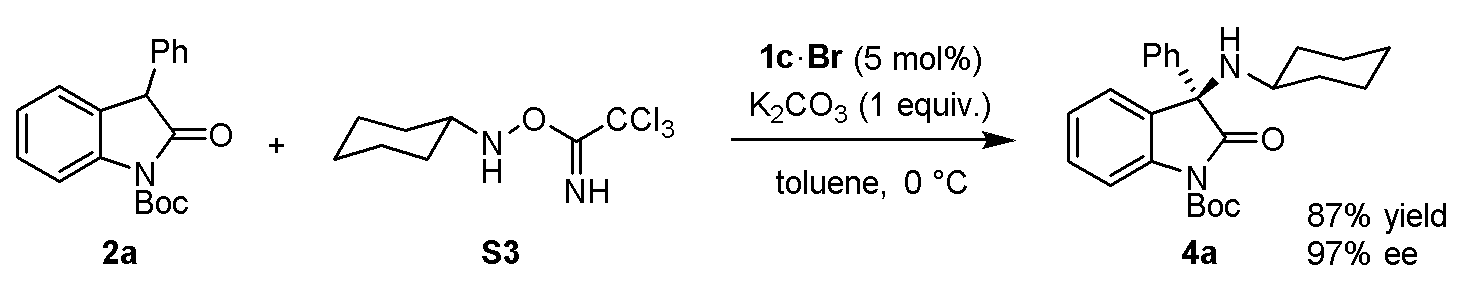
合成例1-7で得た化合物S3を用いた反応を行った。具体的には、合成例1-1で得たN-フェニルヒドロキシルアミン及びCCl3CNの代わりに合成例1-7で得た化合物S3を用い、触媒としては合成例2-1で得たトリアゾリウム塩1a・Brの代わりに合成例2-3で得たトリアゾリウム塩1c・Brを用いたこと以外は実施例1-1及び実施例1-2と同様の処理を行い、目的化合物4aを87 %収率及び97 %エナンチオ選択率で得た。得られた化合物の収率及び選択率は、実施例1-1や、実施例1-2のentry 6、実施例1-3等と同程度であることから、実施例1-1~実施例1-3の反応は、系中で上記化合物S3に代表されるアミノ化試剤が生成し、このアミノ化試剤によってアミノ化反応が進行することが示唆される。
実施例1-6:アミノ化試剤形成における可逆性

ヒドロキシルアミン化合物及びトリクロロアセトニトリルからのアミノ化試剤の形成が可逆か否かを調査するため、合成例1-7で得た化合物S3と、合成例1-2で得たN-ベンジルヒドロキシルアミンとを1: 1(モル比)で混合し、触媒として成例2-3で得たトリアゾリウム塩1c・Brを用い、トリクロロアセトニトリルを使用しなかったこと以外は実施例1-1及び実施例1-2と同様の処理を行った。粗生成物の1H NMR分析の結果から、化合物4aと化合物4dとが、6: 1(モル比)の比率で生成していた(化合物4aは99 %エナンチオ選択率、化合物4dは96 %エナンチオ選択率)。この結果から、系中で、化合物S3からN-シクロヘキシルヒドロキシルアミン及びトリクロロアセトニトリルが生成し(合成例1-3の逆反応)、生成したトリクロロアセトニトリルとN-ベンジルヒドロキシルアミンとから化合物S4が生成し、この化合物S4の作用で化合物4dが生成したことが示唆される。
[実施例2:オキシインドール化合物の不斉α-ヒドロキシル化]
実施例2-1:化合物5aの合成
実施例2-1:化合物5aの合成
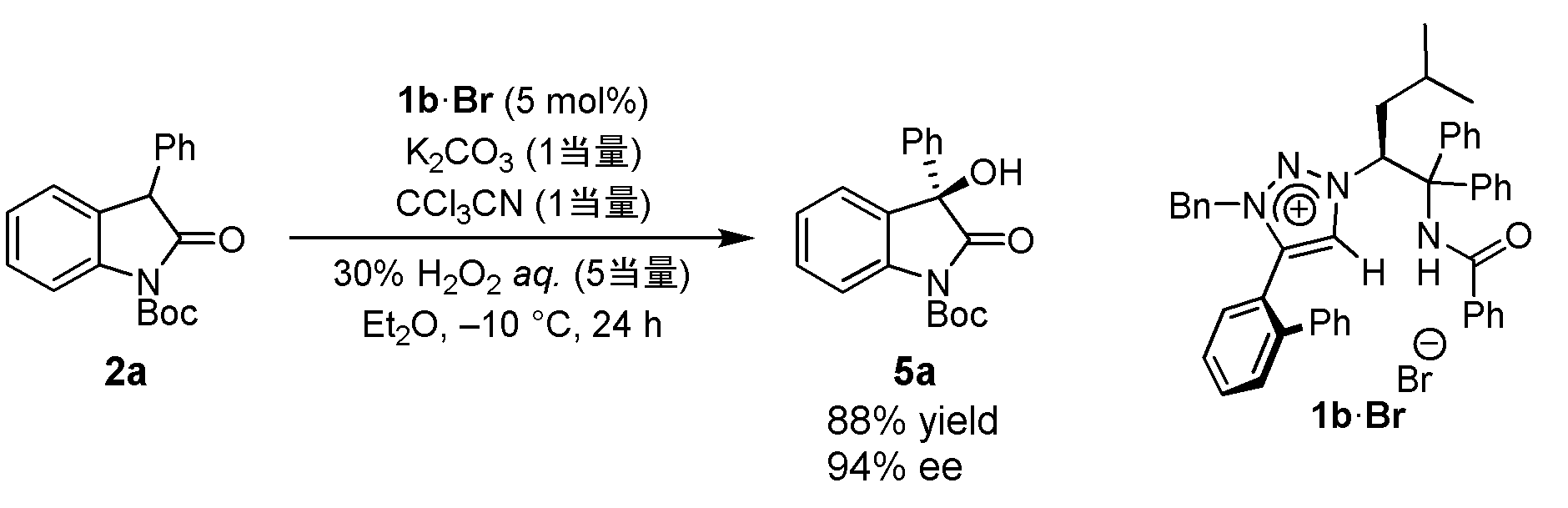
合成例2-2で得たトリアゾリウム塩1b・Br(3.76 mg, 0.005 mmol)、オキシインドール化合物2a(30.9 mg, 0.10 mmol)、及びK2CO3(13.8 mg, 0.10 mmol)のジエチルエーテル(1.0 mL)溶液を、真空排気及びアルゴン再充填を交互に行うことにより脱気した。次に、得られた混合物を-10℃に冷却した後、反応混合物に30 % H2O2水溶液(50μL, 0.50 mmol)及びCCl3CN(10μL, 0.10 mmol)を添加した。その後、同じ温度で24時間攪拌し続けた。反応混合物をNH4Cl飽和水溶液で希釈し、CHCl3による抽出作業を行った。Na2SO4での乾燥、ろ過、及び溶液の除去の後に、粗生成物を、CHROMATOREX DIOL MB100-40/75を用いたカラムクロマトグラフィー(溶離液:ヘキサン/酢酸エチル=3: 1)で精製し、目的の光学活性α-ヒドロキシル化オキシインドール化合物4を得た(28.6 mg, 88 %収率, 94%エナンチオ選択率)。この結果は、後述の表2のentry 1に相当する。
[α]D23 = +45.6 (c = 3.0, CHCl3) for 94% ee ;1H NMR (400 MHz, CDCl3) δ 7.93 (1H, d, J = 8.2 Hz), 7.40 (1H, td, J= 8.2, 1.4 Hz), 7.36-7.29 (6H, m), 7.20 (1H, t, J =7.8 Hz), 3.41 (1H, s), 1.62 (9H, s); 13C NMR (125 MHz, CDCl3) δ 176.0, 149.2, 139.9, 139.8, 130.3, 128.8, 128.7, 125.7, 125.4, 125.2, 115.6, 85.0, 28.2, one peak for aromatic carbon was not found probably due to overlapping; IR 3456, 3001, 2978, 1788, 1609, 1479, 1342, 1285, 1146, 908, 719 cm-1; HRMS (ESI) Calcd for C19H19NO4Na ([M+Na]+) 348.1206. Found 348.1206; HPLC ID3, Hex/IPA = 10: 1, flow rate = 0.5 mL/min, λ= 210 nm, 15.8 min (major), 17.5 min (minor)。
[α]D23 = +45.6 (c = 3.0, CHCl3) for 94% ee ;1H NMR (400 MHz, CDCl3) δ 7.93 (1H, d, J = 8.2 Hz), 7.40 (1H, td, J= 8.2, 1.4 Hz), 7.36-7.29 (6H, m), 7.20 (1H, t, J =7.8 Hz), 3.41 (1H, s), 1.62 (9H, s); 13C NMR (125 MHz, CDCl3) δ 176.0, 149.2, 139.9, 139.8, 130.3, 128.8, 128.7, 125.7, 125.4, 125.2, 115.6, 85.0, 28.2, one peak for aromatic carbon was not found probably due to overlapping; IR 3456, 3001, 2978, 1788, 1609, 1479, 1342, 1285, 1146, 908, 719 cm-1; HRMS (ESI) Calcd for C19H19NO4Na ([M+Na]+) 348.1206. Found 348.1206; HPLC ID3, Hex/IPA = 10: 1, flow rate = 0.5 mL/min, λ= 210 nm, 15.8 min (major), 17.5 min (minor)。
実施例2-2
特に限定しない限り、基質化合物として種々の化合物を用いたこと以外は上記実施例2-1と同様の処理を行った。その結果、以下の表3に示す置換基を有する光学活性化合物が得られたことを確認した。結果を表3に示す。なお、4-MeC6H4は4-メチルフェニル基を示す。4-MeOC6H4は4-メトキシフェニル基を示す。4-FC6H4は4-フルオロフェニル基を示す。3-MeC6H4は3-メチルフェニル基を示す。3-MeOC6H4は3-メトキシフェニル基を示す。2-Naphは2-ナフチル基を示す。1-Naphは1-ナフチル基を示す。CH2Phはベンジル基を示す。CH2(4-F)C6H4は4-フルオロベンジル基を示す。CH2(4-MeO)C6H4は4-メトキシベンジル基を示す。c-Hexはシクロヘキシル基を示す。Etはエチル基を示す。n-Buはn-ブチル基を示す。
特に限定しない限り、基質化合物として種々の化合物を用いたこと以外は上記実施例2-1と同様の処理を行った。その結果、以下の表3に示す置換基を有する光学活性化合物が得られたことを確認した。結果を表3に示す。なお、4-MeC6H4は4-メチルフェニル基を示す。4-MeOC6H4は4-メトキシフェニル基を示す。4-FC6H4は4-フルオロフェニル基を示す。3-MeC6H4は3-メチルフェニル基を示す。3-MeOC6H4は3-メトキシフェニル基を示す。2-Naphは2-ナフチル基を示す。1-Naphは1-ナフチル基を示す。CH2Phはベンジル基を示す。CH2(4-F)C6H4は4-フルオロベンジル基を示す。CH2(4-MeO)C6H4は4-メトキシベンジル基を示す。c-Hexはシクロヘキシル基を示す。Etはエチル基を示す。n-Buはn-ブチル基を示す。

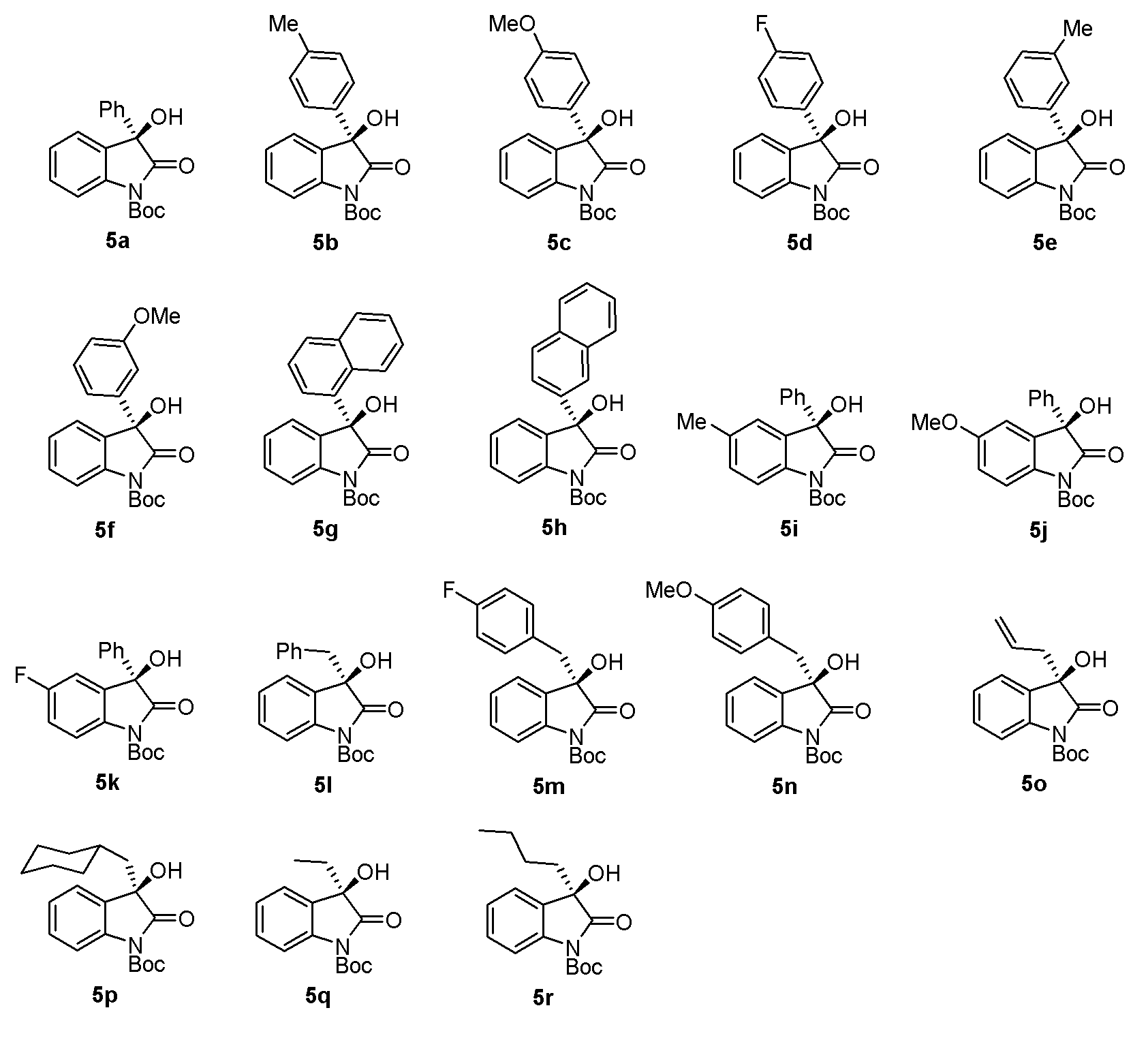
化合物5b:
反応時間は1時間とした。
[α]D24 = +37.6 (c = 2.6, CHCl3) for 94% ee; 1H NMR (400 MHz, CDCl3) δ 7.93 (1H, d, J = 8.5 Hz), 7.39 (1H, t, J= 8.1 Hz), 7.31 (1H, d, J = 7.6 Hz), 7.23 (2H, d, J = 8.4 Hz), 7.19 (1H, t, J = 7.7 Hz), 7.13 (2H, d, J = 8.4 Hz), 3.33 (1H, s), 2.31 (3H, s), 1.62 (9H, s); 13C NMR (101 MHz, CDCl3) δ 176.0, 149.2, 139.8, 138.6, 137.0, 130.3, 130.2, 129.5, 125.6, 125.4, 125.2, 115.5, 84.9, 77.7, 28.2, 21.2; IR 3482, 2984, 2932, 1730, 1609, 1468, 1369, 1285, 1146, 999, 733 cm-1; HRMS (ESI) Calcd for C20H21NO4Na+([M+Na]+) 362.1363. Found 362.1364.; HPLC OD3, Hex/IPA = 10: 1, flow rate = 1.0 mL/min, λ= 210 nm, 6.5 min (minor isomer), 7.2 min (major isomer)。
化合物5c:
反応時間は1時間とした。
[α]D24 = +22.5 (c = 2.2, CHCl3) for 92% ee; 1H NMR (400 MHz, CDCl3) δ 7.93 (1H, d, J = 8.5 Hz), 7.40 (1H, td, J= 8.1, 1.6 Hz), 7.33 (1H, dd, J = 7.6, 0.7 Hz), 7.28 (2H, d, J = 9.2 Hz), 7.21 (1H, td, J = 7.7, 0.9 Hz), 6.85 (2H, d, J = 9.2 Hz), 3.78 (3H, s), 3.30 (1H, brs), 1.62 (9H, s); 13C NMR (101 MHz, CDCl3) δ 176.1, 159.9, 149.2, 139.7, 131.9, 130.3, 130.2, 127.2, 125.4, 125.2, 115.5, 114.2, 84.9, 55.4, 28.2, one peak for aliphatic carbon was not found probably due to overlapping; IR 3445, 2974, 2932, 1730, 1607, 1464, 1342, 1248, 1146, 999, 729 cm-1; HRMS (ESI) Calcd for C20H21NO5Na+([M+Na]+) 378.1312. Found 378.1311.; HPLC ID3, Hex/IPA = 10: 1, flow rate = 1.0 mL/min, λ= 210 nm, 12.5 min (major isomer), 15.0 min (minor isomer)。
化合物5d:
反応時間は1時間とした。
[α]D24 = +20.5 (c = 2.1, CHCl3) for 93% ee; 1H NMR (400 MHz, CDCl3) δ 7.93 (1H, d, J = 8.2 Hz), 7.41 (1H, td, J= 7.8, 1.6 Hz), 7.35-7.28 (3H, m), 7.21 (1H, td, J = 7.8, 0.9 Hz), 7.03-6.99 (2H, m), 3.41 (1H, s), 1.62 (9H, s); 13C NMR (101 MHz, CDCl3) δ 175.7, 163.0 (d, JF-C= 254 Hz), 149.1, 139.8, 135.6 (d, JF-C= 2.9 Hz), 130.5, 130.0, 127.8 (d, JF-C= 8.7 Hz), 125.5, 125.1, 115.7 (d, JF-C= 22.2 Hz), 115.6, 85.2, 77.3, 28.2; 19F NMR (376 MHz, CDCl3) δ -113.1; IR 3443, 2980, 2972, 1769, 1605, 1504, 1369, 1285, 1111, 908, 772 cm-1; HRMS (ESI) Calcd for C19H18NO4FNa+([M+Na]+) 366.1112. Found 366.1116.; HPLC OZ3, Hex/IPA = 10: 1, flow rate = 1.0 mL/min, λ= 210 nm, 5.6 min (major isomer), 7.7 min (minor isomer)。
化合物5e:
反応時間は1時間とした。
[α]D24 = +42.3 (c = 2.6, CHCl3) for 90% ee; 1H NMR (400 MHz, CDCl3) δ 7.93 (1H, d, J = 8.2 Hz), 7.39 (1H, td, J= 8.0, 1.5 Hz), 7.30 (1H, dd, J = 7.6, 0.9 Hz), 7.21 (1H, t, J = 7.3 Hz), 7.19-7.17 (2H, m), 7.12-7.10 (2H, m), 3.32 (1H, brs), 2.32 (3H, s), 1.63 (9H, s); 13C NMR (101 MHz, CDCl3) δ 176.0, 149.2, 139.8, 138.6, 130.4, 130.3, 129.5, 128.7, 126.2, 125.4, 125.2, 122.7, 115.5, 85.0, 77.8, 28.2, 21.7, one peak for aromatic carbon was not found probably due to overlapping; IR 3441, 2972, 2932, 1730, 1605, 1479, 1337, 1248, 1142, 908, 729 cm-1; HRMS (ESI) Calcd for C20H21NO4Na+([M+Na]+) 362.1363. Found 362.1364.; HPLC OD3, Hex/IPA = 10: 1, flow rate = 1.0 mL/min, λ= 210 nm, 5.2 min (major isomer), 5.7 min (minor isomer)。
化合物5f:
反応時間は1時間とした。
[α]D24 = +47.1 (c = 2.9, CHCl3) for 93% ee; 1H NMR (400 MHz, CDCl3) δ 7.92 (1H, d, J = 8.2 Hz), 7.39 (1H, td, J= 8.0, 1.6 Hz), 7.30 (1H, dd, J = 7.6, 1.1 Hz), 7.23 (1H, t, J = 8.0 Hz), 7.19 (1H, td, J = 7.6, 1.1 Hz), 6.98 (1H, t, J = 2.1 Hz), 6.86-6.82 (2H, m), 3.78 (3H, s), 3.45 (1H, s), 1.62 (9H, s); 13C NMR (101 MHz, CDCl3) δ 175.8, 159.9, 149.1, 141.5, 139.8, 130.3, 130.3, 129.8, 125.4, 125.1, 117.9, 115.6, 114.0, 111.7, 85.0, 77.8, 55.4, 28.2; IR 3462, 2980, 2938, 1730, 1599, 1454, 1393, 1285, 1144, 910, 752 cm-1; HRMS (ESI) Calcd for C20H21NO5Na+([M+Na]+) 378.1312. Found 378.1311.; HPLC ID3, Hex/IPA = 10: 1, flow rate = 1.0 mL/min, λ= 210 nm, 11.7 min (minor isomer), 13.6 min (major isomer)。
化合物5g:
反応時間は3時間とした。
[α]D25 = +102.7 (c = 2.2, CHCl3) for 90% ee; 1H NMR (400 MHz, CDCl3) δ 8.03 (1H, d, J = 8.2 Hz), 7.89 (1H, d, J= 7.3 Hz), 7.84 (2H, d, J = 8.0 Hz), 7.70 (1H, brd, J = 7.8 Hz), 7.48 (1H, t, J = 7.8 Hz), 7.41 (1H, td, J = 6.9, 1.2 Hz), 7.40 (1H, d, J = 7.2 Hz), 7.35 (1H, td, J = 8.3, 1.4 Hz), 7.17 (1H, dd, J = 7.6, 1.2 Hz), 7.08 (1H, td, J = 7.6, 0.9 Hz), 3.32 (1H, s), 1.65 (9H, s); 13C NMR (101 MHz, CDCl3) δ 175.5, 149.4, 139.8, 134.7, 134.5, 130.6, 130.5, 130.1, 130.1, 129.3, 126.7, 125.8, 125.4, 125.1, 125.0, 125.0, 124.3, 115.9, 85.1, 78.5, 28.2; IR 3514, 3009, 2916, 1788, 1607, 1454, 1369, 1250, 1146, 976, 735 cm-1; HRMS (ESI) Calcd for C23H21NO4Na+([M+Na]+) 398.1363. Found 398.1354.; HPLC ID3, Hex/IPA = 10: 1, flow rate = 1.0 mL/min, λ= 210 nm, 10.5 min (minor isomer), 11.4 min (major isomer)。
化合物5h:
反応時間は3時間とした。
[α]D24 = +63.9 (c = 1.9, CHCl3) for 92% ee; 1H NMR (400 MHz, CDCl3) δ 7.98 (1H, d, J = 8.4 Hz), 7.84-7.79 (3H, m), 7.78 (1H, s), 7.49-7.40 (4H, m), 7.33 (1H, dt, J = 7.8, 0.9 Hz), 7.20 (1H, td, J = 7.8, 0.9 Hz), 3.45 (1H, br), 1.63 (9H, s); 13C NMR (101 MHz, CDCl3) δ 175.9, 149.2, 139.9, 137.2, 133.3, 133.1, 130.5, 130.2, 128.9, 128.5, 127.7, 126.7, 126.6, 125.5, 125.3, 124.9, 123.3, 115.7, 85.1, 78.0, 28.2; IR 3453, 3022, 2980, 1730, 1607, 1479, 1337, 1248, 1146, 1009, 750 cm-1; HRMS (ESI) Calcd for C23H21NO4Na+([M+Na]+) 398.1363. Found 398.1359.; HPLC OZ3, Hex/IPA = 10: 1, flow rate = 1.0 mL/min, λ= 210 nm, 7.9 min (major isomer), 11.1 min (minor isomer)。
化合物5i:
反応時間は1時間とした。
[α]D24 = +25.5 (c = 2.6, CHCl3) for 94% ee; 1H NMR (400 MHz, CDCl3) δ 7.80 (1H, d, J = 8.2 Hz), 7.37-7.30 (5H, m), 7.18 (1H, dd, J = 8.2, 1.4 Hz), 7.10 (1H, d, J= 1.4 Hz), 3.37 (1H, s), 2.31 (3H, s), 1.62 (9H, s); 13C NMR (101 MHz, CDCl3) δ 176.1, 149.2, 140.1, 137.4, 135.2, 130.8, 130.2, 128.8, 128.6, 125.6, 115.3, 84.8, 77.9, 28.2, 21.1, one peak for aromatic carbons was not found probably due to overlapping; IR 3470, 2980, 2930, 1726, 1599, 1485, 1331, 1277, 1105, 907, 731 cm-1; HRMS (ESI) Calcd for C20H21NO4Na+([M+Na]+) 362.1363. Found 362.1364.; HPLC ID3, Hex/IPA = 10: 1, flow rate = 1.0 mL/min, λ= 210 nm, 8.6 min (major isomer), 9.4 min (minor isomer)。
化合物5j:
反応時間は1時間とした。
[α]D25 = -13.5 (c = 2.8, MeOH) for 94% ee; 1H NMR (400 MHz, CDCl3) δ 7.85 (1H, d, J= 9.0 Hz), 7.36-7.30 (5H, m), 6.91 (1H, dd, J= 9.0, 2.8 Hz), 6.84 (1H, d, J = 2.8 Hz), 3.75 (3H, s), 3.53 (1H, s), 1.61 (9H, s); 13C NMR (101 MHz, CDCl3) δ 176.1, 157.5, 149.2, 139.9, 133.0, 131.5, 128.8, 128.7, 125.6, 116.7, 115.8, 110.5, 84.8, 78.1, 55.8, 28.2; IR 3435, 2978, 2934, 1726, 1599, 1412, 1333, 1246, 1144, 1003, 772 cm-1; HRMS (ESI) Calcd for C20H21NO5Na+([M+Na]+) 378.1312. Found 378.1311.; HPLC ID3, Hex/IPA = 10: 1, flow rate = 1.0 mL/min, λ= 210 nm, 11.1 min (major isomer), 13.5 min (minor isomer)。
化合物5k:
反応時間は1時間とした。
[α]D24 = +54.2 (c = 2.3, CHCl3) for 90% ee; 1H NMR (400 MHz, CDCl3) δ 7.92 (1H, dd, J = 9.0, JF-H= 4.6 Hz), 7.36-7.32 (5H, m), 7.08 (1H, td, J= 9.0, 2.7 Hz), 7.01 (1H, dd, J = 2.7, JF-H = 7.3 Hz), 3.57 (1H, s), 1.61 (9H, s); 13C NMR (101 MHz, CDCl3) δ 175.7, 160.4 (d, JF-C = 249 Hz), 149.1, 139.4, 135.6 (d, JF-C = 1.9 Hz), 132.1 (d, JF-C = 8.7 Hz), 128.9, 125.5, 117.1 (d, JF-C = 8.7 Hz), 116.9 (d, JF-C = 24.2 Hz), 112.6 (d, JF-C = 24.2 Hz), 85.3, 77.8, 28.2, one peak for aromatic carbon was not found probably due to overlapping; 19F NMR (376 MHz, CDCl3) δ -116.3; IR 3464, 2984, 2934, 1726, 1611, 1479, 1342, 1261, 1144, 1009, 760 cm-1; HRMS (ESI) Calcd for C19H18NO4FNa+([M+Na]+) 366.1112. Found 366.1114.; HPLC ID3, Hex/IPA = 10: 1, flow rate = 1.0 mL/min, λ= 210 nm, 6.0 min (major isomer), 6.9 min (minor isomer)。
化合物5l:
反応時間は24時間とした。
[α]D24 = +65.3 (c = 2.1, CHCl3) for 97% ee; 1H NMR (400 MHz, CDCl3) δ 7.63 (1H, d, J = 8.2 Hz), 7.28 (1H, td, J= 8.2, 1.4 Hz), 7.19-7.10 (5H, m), 6.91 (2H, d, J = 6.2 Hz), 3.27 (1H, d, J= 13.0 Hz), 3.15 (1H, d, J = 13.0 Hz), 3.00 (1H, s), 1.57 (9H, s); 13C NMR (101 MHz, CDCl3) δ 177.0, 148.6, 139.3, 133.4, 130.4, 130.0, 128.2, 128.0, 127.2, 124.7, 124.4, 115.1, 84.5, 46.1, 28.1, one peak for aliphatic carbon was not found probably due to overlapping; IR 3429, 2980, 2961, 1776, 1605, 1468, 1341, 1287, 1150, 912, 785 cm-1; HRMS (ESI) Calcd for C20H21NO4Na+([M+Na]+) 362.1363. Found 362.1367.; HPLC ID3, Hex/IPA = 10: 1, flow rate = 1.0 mL/min, λ= 210 nm, 8.2 min (major isomer), 9.3 min (minor isomer)。
化合物5m:
反応時間は24時間とした。
[α]D24 = +58.1 (c = 2.5, CHCl3) for 98% ee; 1H NMR (400 MHz, CDCl3) δ 7.62 (1H, d, J = 8.3 Hz), 7.29 (1H, td, J= 8.3, 1.9 Hz), 7.19 (1H, dd, J = 7.6, 1.9 Hz), 7.15 (1H, td, J = 7.6, 0.9 Hz), 6.89-6.78 (4H, m), 3.24 (1H, d, J= 13.4 Hz), 3.16 (1H, brs), 3.13 (1H, d, J= 13.4 Hz), 1.57 (9H, s); 13C NMR (101 MHz, CDCl3) δ 177.0, 162.2 (d, JF-C = 251 Hz), 148.5, 139.3, 131.9 (d, JF-C = 7.7 Hz), 130.1, 129.2, 128.0, 124.8, 124.3, 115.1, 114.9 (d, JF-C= 22.2 Hz), 84.7, 45.2, 28.1, one peak for aliphatic carbon was not found probably due to overlapping; 19F NMR (376 MHz, CDCl3) δ -116.3; IR 3478, 2982, 2922, 1788, 1603, 1468, 1344, 1250, 1148, 837, 754 cm-1; HRMS (ESI) Calcd for C20H20NO4FNa+([M+Na]+) 380.1269. Found 380.1269.; HPLC ASH, Hex/IPA = 10: 1, flow rate = 0.5 mL/min, λ= 210 nm, 15.8 min (major isomer), 23.3 min (minor isomer)。
化合物5n:
反応時間は24時間とした。
[α]D24 = +56.9 (c = 2.0, CHCl3) for 94% ee; 1H NMR (400 MHz, CDCl3) δ 7.65 (1H, d, J = 8.5 Hz), 7.29 (1H, td, J= 8.5, 1.8 Hz), 7.19 (1H, dd, J = 7.6, 1.8 Hz), 7.15 (1H, t, J = 7.6 Hz), 6.84 (2H, d, J = 8.7 Hz), 6.67 (2H, d, J = 8.7 Hz), 3.75 (3H, s), 3.21 (1H, d, J = 13.3 Hz), 3.09 (1H, d, J = 13.3 Hz), 2.88 (1H, brs), 1.58 (9H, s); 13C NMR (101 MHz, CDCl3) δ 177.1, 158.9, 148.7, 139.4, 131.5, 130.0, 128.3, 125.4, 124.7, 124.4, 115.2, 113.5, 84.6, 55.3, 45.3, 28.2, one peak for aliphatic carbon was not found probably due to overlapping; IR 3429, 2980, 2913, 1776, 1612, 1468, 1369, 1250, 1150, 912, 746 cm-1; HRMS (ESI) Calcd for C21H23NO5Na+ ([M+Na]+) 392.1468. Found 392.1455.; HPLC OZ3, Hex/IPA = 10: 1, flow rate = 1.0 mL/min, λ= 210 nm, 10.0 min (major isomer), 17.9 min (minor isomer)。
化合物5o:
反応時間は24時間とした。
[α]D24 = +32.6 (c = 0.9, CHCl3) for 95% ee; 1H NMR (400 MHz, CDCl3) δ 7.84 (1H, d, J = 8.5 Hz), 7.40 (1H, dd, J= 7.6, 1.4 Hz), 7.36 (1H, td, J = 8.0, 1.4 Hz), 7.21 (1H, t, J = 7.6 Hz), 5.72-5.62 (1H, m), 5.16-5.12 (2H, brm), 2.82 (1H, s), 2.72 (1H, dd, J = 13.8, 6.4 Hz), 2.62 (1H, dd, J = 13.8, 8.5 Hz), 1.64 (9H, s); 13C NMR (101 MHz, CDCl3) δ 176.5, 149.0, 139.4, 130.1, 130.0, 128.7, 125.0, 124.2, 121.3, 115.4, 84.8, 75.6, 43.9, 28.2; IR 3458, 2920, 2849, 1728, 1611, 1479, 1344, 1287, 1150, 984, 750 cm-1; HRMS (ESI) Calcd for C16H19NO4Na+([M+Na]+) 312.1206. Found 312.1207.; HPLC OZ3, Hex/IPA = 10: 1, flow rate = 1.0 mL/min, λ= 210 nm, 5.4 min (major isomer), 9.7 min (minor isomer)。
化合物5p:
反応時間は24時間とした。
[α]D25 = +45.5 (c = 2.5, CHCl3) for 94% ee; 1H NMR (400 MHz, CDCl3) δ 7.85 (1H, d, J = 8.5 Hz), 7.38 (1H, dd, J= 7.6, 0.9 Hz), 7.37 (1H, td, J = 8.0, 1.6 Hz), 7.21 (1H, td, J = 7.6, 0.9 Hz), 2.67 (1H, s), 1.92 (2H, d, J= 6.0 Hz), 1.64 (9H, s), 1.61-1.43 (5H, m), 1.21-1.04 (4H, m), 0.97-0.80 (2H, m); 13C NMR (101 MHz, CDCl3) δ 177.3, 149.1, 139.6, 130.0, 129.1, 125.0, 124.3, 115.4, 84.7, 76.2, 46.6, 34.4, 34.2, 33.3, 28.2, 26.1; IR 3462, 2978, 2920, 1730, 1611, 1468, 1344, 1287, 1150, 1001, 750 cm-1; HRMS (ESI) Calcd for C20H27NO4Na+ ([M+Na]+) 368.1832. Found 368.1824.; HPLC OZ3, Hex/IPA = 10: 1, flow rate = 1.0 mL/min, λ= 210 nm, 5.4 min (major isomer), 9.3 min (minor isomer)。
化合物5q:
反応時間は3時間とした。
[α]D25 = +42.1 (c = 1.2, CHCl3) for 94% ee; 1H NMR (400 MHz, CDCl3) δ 7.85 (1H, d, J = 8.2 Hz), 7.39 (1H, dd, J= 8.4, 0.7 Hz), 7.36 (1H, td, J = 8.2, 1.4 Hz), 7.22 (1H, td, J = 7.8, 1.4 Hz), 2.70 (1H, s), 2.00 (2H, q, J = 7.8 Hz), 1.64 (9H, s), 0.78 (3H, t, J= 7.8 Hz); 13C NMR (101 MHz, CDCl3) δ 177.2, 149.1, 139.7, 130.0, 128.8, 125.0, 124.0, 115.4, 84.8, 77.0, 32.7, 28.2, 7.7; IR 3489, 2976, 2932, 1788, 1611, 1454, 1346, 1287, 1144, 928, 750 cm-1; HRMS (ESI) Calcd for C15H19NO4Na+([M+Na]+) 300.1206. Found 300.1207.; HPLC OZ3, Hex/IPA = 10: 1, flow rate = 1.0 mL/min, λ= 210 nm, 5.3 min (major isomer), 9.9 min (minor isomer)。
化合物5r:
反応時間は24時間とした。
[α]D24 = +41.5 (c = 1.7, CHCl3) for 89% ee; 1H NMR (400 MHz, CDCl3) δ 7.85 (1H, d, J = 8.5 Hz), 7.39 (1H, d, J= 8.2 Hz), 7.37 (1H, t, J = 8.2 Hz), 7.21 (1H, t, J = 7.8 Hz), 2.71 (1H, br), 2.00-1.92 (2H, m), 1.64 (9H, s), 1.30-1.21 (2H, m), 1.19-1.12 (1H, m), 1.08-0.99 (1H, m), 0.82 (3H, t, J = 7.3 Hz); 13C NMR (101 MHz, CDCl3) δ 177.3, 149.1, 139.6, 130.0, 129.0, 125.0, 124.0, 115.4, 84.8, 76.5, 39.4, 28.2, 25.2, 22.8, 13.9; IR 3447, 2934, 2872, 1728, 1612, 1454, 1337, 1287, 1140, 978, 750 cm-1; HRMS (ESI) Calcd for C17H23NO4Na+ ([M+Na]+) 328.1519. Found 328.1518.; HPLC OZ3, Hex/IPA = 10: 1, flow rate = 1.0 mL/min, λ= 210 nm, 5.0 min (major isomer), 8.4 min (minor isomer)。
反応時間は1時間とした。
[α]D24 = +37.6 (c = 2.6, CHCl3) for 94% ee; 1H NMR (400 MHz, CDCl3) δ 7.93 (1H, d, J = 8.5 Hz), 7.39 (1H, t, J= 8.1 Hz), 7.31 (1H, d, J = 7.6 Hz), 7.23 (2H, d, J = 8.4 Hz), 7.19 (1H, t, J = 7.7 Hz), 7.13 (2H, d, J = 8.4 Hz), 3.33 (1H, s), 2.31 (3H, s), 1.62 (9H, s); 13C NMR (101 MHz, CDCl3) δ 176.0, 149.2, 139.8, 138.6, 137.0, 130.3, 130.2, 129.5, 125.6, 125.4, 125.2, 115.5, 84.9, 77.7, 28.2, 21.2; IR 3482, 2984, 2932, 1730, 1609, 1468, 1369, 1285, 1146, 999, 733 cm-1; HRMS (ESI) Calcd for C20H21NO4Na+([M+Na]+) 362.1363. Found 362.1364.; HPLC OD3, Hex/IPA = 10: 1, flow rate = 1.0 mL/min, λ= 210 nm, 6.5 min (minor isomer), 7.2 min (major isomer)。
化合物5c:
反応時間は1時間とした。
[α]D24 = +22.5 (c = 2.2, CHCl3) for 92% ee; 1H NMR (400 MHz, CDCl3) δ 7.93 (1H, d, J = 8.5 Hz), 7.40 (1H, td, J= 8.1, 1.6 Hz), 7.33 (1H, dd, J = 7.6, 0.7 Hz), 7.28 (2H, d, J = 9.2 Hz), 7.21 (1H, td, J = 7.7, 0.9 Hz), 6.85 (2H, d, J = 9.2 Hz), 3.78 (3H, s), 3.30 (1H, brs), 1.62 (9H, s); 13C NMR (101 MHz, CDCl3) δ 176.1, 159.9, 149.2, 139.7, 131.9, 130.3, 130.2, 127.2, 125.4, 125.2, 115.5, 114.2, 84.9, 55.4, 28.2, one peak for aliphatic carbon was not found probably due to overlapping; IR 3445, 2974, 2932, 1730, 1607, 1464, 1342, 1248, 1146, 999, 729 cm-1; HRMS (ESI) Calcd for C20H21NO5Na+([M+Na]+) 378.1312. Found 378.1311.; HPLC ID3, Hex/IPA = 10: 1, flow rate = 1.0 mL/min, λ= 210 nm, 12.5 min (major isomer), 15.0 min (minor isomer)。
化合物5d:
反応時間は1時間とした。
[α]D24 = +20.5 (c = 2.1, CHCl3) for 93% ee; 1H NMR (400 MHz, CDCl3) δ 7.93 (1H, d, J = 8.2 Hz), 7.41 (1H, td, J= 7.8, 1.6 Hz), 7.35-7.28 (3H, m), 7.21 (1H, td, J = 7.8, 0.9 Hz), 7.03-6.99 (2H, m), 3.41 (1H, s), 1.62 (9H, s); 13C NMR (101 MHz, CDCl3) δ 175.7, 163.0 (d, JF-C= 254 Hz), 149.1, 139.8, 135.6 (d, JF-C= 2.9 Hz), 130.5, 130.0, 127.8 (d, JF-C= 8.7 Hz), 125.5, 125.1, 115.7 (d, JF-C= 22.2 Hz), 115.6, 85.2, 77.3, 28.2; 19F NMR (376 MHz, CDCl3) δ -113.1; IR 3443, 2980, 2972, 1769, 1605, 1504, 1369, 1285, 1111, 908, 772 cm-1; HRMS (ESI) Calcd for C19H18NO4FNa+([M+Na]+) 366.1112. Found 366.1116.; HPLC OZ3, Hex/IPA = 10: 1, flow rate = 1.0 mL/min, λ= 210 nm, 5.6 min (major isomer), 7.7 min (minor isomer)。
化合物5e:
反応時間は1時間とした。
[α]D24 = +42.3 (c = 2.6, CHCl3) for 90% ee; 1H NMR (400 MHz, CDCl3) δ 7.93 (1H, d, J = 8.2 Hz), 7.39 (1H, td, J= 8.0, 1.5 Hz), 7.30 (1H, dd, J = 7.6, 0.9 Hz), 7.21 (1H, t, J = 7.3 Hz), 7.19-7.17 (2H, m), 7.12-7.10 (2H, m), 3.32 (1H, brs), 2.32 (3H, s), 1.63 (9H, s); 13C NMR (101 MHz, CDCl3) δ 176.0, 149.2, 139.8, 138.6, 130.4, 130.3, 129.5, 128.7, 126.2, 125.4, 125.2, 122.7, 115.5, 85.0, 77.8, 28.2, 21.7, one peak for aromatic carbon was not found probably due to overlapping; IR 3441, 2972, 2932, 1730, 1605, 1479, 1337, 1248, 1142, 908, 729 cm-1; HRMS (ESI) Calcd for C20H21NO4Na+([M+Na]+) 362.1363. Found 362.1364.; HPLC OD3, Hex/IPA = 10: 1, flow rate = 1.0 mL/min, λ= 210 nm, 5.2 min (major isomer), 5.7 min (minor isomer)。
化合物5f:
反応時間は1時間とした。
[α]D24 = +47.1 (c = 2.9, CHCl3) for 93% ee; 1H NMR (400 MHz, CDCl3) δ 7.92 (1H, d, J = 8.2 Hz), 7.39 (1H, td, J= 8.0, 1.6 Hz), 7.30 (1H, dd, J = 7.6, 1.1 Hz), 7.23 (1H, t, J = 8.0 Hz), 7.19 (1H, td, J = 7.6, 1.1 Hz), 6.98 (1H, t, J = 2.1 Hz), 6.86-6.82 (2H, m), 3.78 (3H, s), 3.45 (1H, s), 1.62 (9H, s); 13C NMR (101 MHz, CDCl3) δ 175.8, 159.9, 149.1, 141.5, 139.8, 130.3, 130.3, 129.8, 125.4, 125.1, 117.9, 115.6, 114.0, 111.7, 85.0, 77.8, 55.4, 28.2; IR 3462, 2980, 2938, 1730, 1599, 1454, 1393, 1285, 1144, 910, 752 cm-1; HRMS (ESI) Calcd for C20H21NO5Na+([M+Na]+) 378.1312. Found 378.1311.; HPLC ID3, Hex/IPA = 10: 1, flow rate = 1.0 mL/min, λ= 210 nm, 11.7 min (minor isomer), 13.6 min (major isomer)。
化合物5g:
反応時間は3時間とした。
[α]D25 = +102.7 (c = 2.2, CHCl3) for 90% ee; 1H NMR (400 MHz, CDCl3) δ 8.03 (1H, d, J = 8.2 Hz), 7.89 (1H, d, J= 7.3 Hz), 7.84 (2H, d, J = 8.0 Hz), 7.70 (1H, brd, J = 7.8 Hz), 7.48 (1H, t, J = 7.8 Hz), 7.41 (1H, td, J = 6.9, 1.2 Hz), 7.40 (1H, d, J = 7.2 Hz), 7.35 (1H, td, J = 8.3, 1.4 Hz), 7.17 (1H, dd, J = 7.6, 1.2 Hz), 7.08 (1H, td, J = 7.6, 0.9 Hz), 3.32 (1H, s), 1.65 (9H, s); 13C NMR (101 MHz, CDCl3) δ 175.5, 149.4, 139.8, 134.7, 134.5, 130.6, 130.5, 130.1, 130.1, 129.3, 126.7, 125.8, 125.4, 125.1, 125.0, 125.0, 124.3, 115.9, 85.1, 78.5, 28.2; IR 3514, 3009, 2916, 1788, 1607, 1454, 1369, 1250, 1146, 976, 735 cm-1; HRMS (ESI) Calcd for C23H21NO4Na+([M+Na]+) 398.1363. Found 398.1354.; HPLC ID3, Hex/IPA = 10: 1, flow rate = 1.0 mL/min, λ= 210 nm, 10.5 min (minor isomer), 11.4 min (major isomer)。
化合物5h:
反応時間は3時間とした。
[α]D24 = +63.9 (c = 1.9, CHCl3) for 92% ee; 1H NMR (400 MHz, CDCl3) δ 7.98 (1H, d, J = 8.4 Hz), 7.84-7.79 (3H, m), 7.78 (1H, s), 7.49-7.40 (4H, m), 7.33 (1H, dt, J = 7.8, 0.9 Hz), 7.20 (1H, td, J = 7.8, 0.9 Hz), 3.45 (1H, br), 1.63 (9H, s); 13C NMR (101 MHz, CDCl3) δ 175.9, 149.2, 139.9, 137.2, 133.3, 133.1, 130.5, 130.2, 128.9, 128.5, 127.7, 126.7, 126.6, 125.5, 125.3, 124.9, 123.3, 115.7, 85.1, 78.0, 28.2; IR 3453, 3022, 2980, 1730, 1607, 1479, 1337, 1248, 1146, 1009, 750 cm-1; HRMS (ESI) Calcd for C23H21NO4Na+([M+Na]+) 398.1363. Found 398.1359.; HPLC OZ3, Hex/IPA = 10: 1, flow rate = 1.0 mL/min, λ= 210 nm, 7.9 min (major isomer), 11.1 min (minor isomer)。
化合物5i:
反応時間は1時間とした。
[α]D24 = +25.5 (c = 2.6, CHCl3) for 94% ee; 1H NMR (400 MHz, CDCl3) δ 7.80 (1H, d, J = 8.2 Hz), 7.37-7.30 (5H, m), 7.18 (1H, dd, J = 8.2, 1.4 Hz), 7.10 (1H, d, J= 1.4 Hz), 3.37 (1H, s), 2.31 (3H, s), 1.62 (9H, s); 13C NMR (101 MHz, CDCl3) δ 176.1, 149.2, 140.1, 137.4, 135.2, 130.8, 130.2, 128.8, 128.6, 125.6, 115.3, 84.8, 77.9, 28.2, 21.1, one peak for aromatic carbons was not found probably due to overlapping; IR 3470, 2980, 2930, 1726, 1599, 1485, 1331, 1277, 1105, 907, 731 cm-1; HRMS (ESI) Calcd for C20H21NO4Na+([M+Na]+) 362.1363. Found 362.1364.; HPLC ID3, Hex/IPA = 10: 1, flow rate = 1.0 mL/min, λ= 210 nm, 8.6 min (major isomer), 9.4 min (minor isomer)。
化合物5j:
反応時間は1時間とした。
[α]D25 = -13.5 (c = 2.8, MeOH) for 94% ee; 1H NMR (400 MHz, CDCl3) δ 7.85 (1H, d, J= 9.0 Hz), 7.36-7.30 (5H, m), 6.91 (1H, dd, J= 9.0, 2.8 Hz), 6.84 (1H, d, J = 2.8 Hz), 3.75 (3H, s), 3.53 (1H, s), 1.61 (9H, s); 13C NMR (101 MHz, CDCl3) δ 176.1, 157.5, 149.2, 139.9, 133.0, 131.5, 128.8, 128.7, 125.6, 116.7, 115.8, 110.5, 84.8, 78.1, 55.8, 28.2; IR 3435, 2978, 2934, 1726, 1599, 1412, 1333, 1246, 1144, 1003, 772 cm-1; HRMS (ESI) Calcd for C20H21NO5Na+([M+Na]+) 378.1312. Found 378.1311.; HPLC ID3, Hex/IPA = 10: 1, flow rate = 1.0 mL/min, λ= 210 nm, 11.1 min (major isomer), 13.5 min (minor isomer)。
化合物5k:
反応時間は1時間とした。
[α]D24 = +54.2 (c = 2.3, CHCl3) for 90% ee; 1H NMR (400 MHz, CDCl3) δ 7.92 (1H, dd, J = 9.0, JF-H= 4.6 Hz), 7.36-7.32 (5H, m), 7.08 (1H, td, J= 9.0, 2.7 Hz), 7.01 (1H, dd, J = 2.7, JF-H = 7.3 Hz), 3.57 (1H, s), 1.61 (9H, s); 13C NMR (101 MHz, CDCl3) δ 175.7, 160.4 (d, JF-C = 249 Hz), 149.1, 139.4, 135.6 (d, JF-C = 1.9 Hz), 132.1 (d, JF-C = 8.7 Hz), 128.9, 125.5, 117.1 (d, JF-C = 8.7 Hz), 116.9 (d, JF-C = 24.2 Hz), 112.6 (d, JF-C = 24.2 Hz), 85.3, 77.8, 28.2, one peak for aromatic carbon was not found probably due to overlapping; 19F NMR (376 MHz, CDCl3) δ -116.3; IR 3464, 2984, 2934, 1726, 1611, 1479, 1342, 1261, 1144, 1009, 760 cm-1; HRMS (ESI) Calcd for C19H18NO4FNa+([M+Na]+) 366.1112. Found 366.1114.; HPLC ID3, Hex/IPA = 10: 1, flow rate = 1.0 mL/min, λ= 210 nm, 6.0 min (major isomer), 6.9 min (minor isomer)。
化合物5l:
反応時間は24時間とした。
[α]D24 = +65.3 (c = 2.1, CHCl3) for 97% ee; 1H NMR (400 MHz, CDCl3) δ 7.63 (1H, d, J = 8.2 Hz), 7.28 (1H, td, J= 8.2, 1.4 Hz), 7.19-7.10 (5H, m), 6.91 (2H, d, J = 6.2 Hz), 3.27 (1H, d, J= 13.0 Hz), 3.15 (1H, d, J = 13.0 Hz), 3.00 (1H, s), 1.57 (9H, s); 13C NMR (101 MHz, CDCl3) δ 177.0, 148.6, 139.3, 133.4, 130.4, 130.0, 128.2, 128.0, 127.2, 124.7, 124.4, 115.1, 84.5, 46.1, 28.1, one peak for aliphatic carbon was not found probably due to overlapping; IR 3429, 2980, 2961, 1776, 1605, 1468, 1341, 1287, 1150, 912, 785 cm-1; HRMS (ESI) Calcd for C20H21NO4Na+([M+Na]+) 362.1363. Found 362.1367.; HPLC ID3, Hex/IPA = 10: 1, flow rate = 1.0 mL/min, λ= 210 nm, 8.2 min (major isomer), 9.3 min (minor isomer)。
化合物5m:
反応時間は24時間とした。
[α]D24 = +58.1 (c = 2.5, CHCl3) for 98% ee; 1H NMR (400 MHz, CDCl3) δ 7.62 (1H, d, J = 8.3 Hz), 7.29 (1H, td, J= 8.3, 1.9 Hz), 7.19 (1H, dd, J = 7.6, 1.9 Hz), 7.15 (1H, td, J = 7.6, 0.9 Hz), 6.89-6.78 (4H, m), 3.24 (1H, d, J= 13.4 Hz), 3.16 (1H, brs), 3.13 (1H, d, J= 13.4 Hz), 1.57 (9H, s); 13C NMR (101 MHz, CDCl3) δ 177.0, 162.2 (d, JF-C = 251 Hz), 148.5, 139.3, 131.9 (d, JF-C = 7.7 Hz), 130.1, 129.2, 128.0, 124.8, 124.3, 115.1, 114.9 (d, JF-C= 22.2 Hz), 84.7, 45.2, 28.1, one peak for aliphatic carbon was not found probably due to overlapping; 19F NMR (376 MHz, CDCl3) δ -116.3; IR 3478, 2982, 2922, 1788, 1603, 1468, 1344, 1250, 1148, 837, 754 cm-1; HRMS (ESI) Calcd for C20H20NO4FNa+([M+Na]+) 380.1269. Found 380.1269.; HPLC ASH, Hex/IPA = 10: 1, flow rate = 0.5 mL/min, λ= 210 nm, 15.8 min (major isomer), 23.3 min (minor isomer)。
化合物5n:
反応時間は24時間とした。
[α]D24 = +56.9 (c = 2.0, CHCl3) for 94% ee; 1H NMR (400 MHz, CDCl3) δ 7.65 (1H, d, J = 8.5 Hz), 7.29 (1H, td, J= 8.5, 1.8 Hz), 7.19 (1H, dd, J = 7.6, 1.8 Hz), 7.15 (1H, t, J = 7.6 Hz), 6.84 (2H, d, J = 8.7 Hz), 6.67 (2H, d, J = 8.7 Hz), 3.75 (3H, s), 3.21 (1H, d, J = 13.3 Hz), 3.09 (1H, d, J = 13.3 Hz), 2.88 (1H, brs), 1.58 (9H, s); 13C NMR (101 MHz, CDCl3) δ 177.1, 158.9, 148.7, 139.4, 131.5, 130.0, 128.3, 125.4, 124.7, 124.4, 115.2, 113.5, 84.6, 55.3, 45.3, 28.2, one peak for aliphatic carbon was not found probably due to overlapping; IR 3429, 2980, 2913, 1776, 1612, 1468, 1369, 1250, 1150, 912, 746 cm-1; HRMS (ESI) Calcd for C21H23NO5Na+ ([M+Na]+) 392.1468. Found 392.1455.; HPLC OZ3, Hex/IPA = 10: 1, flow rate = 1.0 mL/min, λ= 210 nm, 10.0 min (major isomer), 17.9 min (minor isomer)。
化合物5o:
反応時間は24時間とした。
[α]D24 = +32.6 (c = 0.9, CHCl3) for 95% ee; 1H NMR (400 MHz, CDCl3) δ 7.84 (1H, d, J = 8.5 Hz), 7.40 (1H, dd, J= 7.6, 1.4 Hz), 7.36 (1H, td, J = 8.0, 1.4 Hz), 7.21 (1H, t, J = 7.6 Hz), 5.72-5.62 (1H, m), 5.16-5.12 (2H, brm), 2.82 (1H, s), 2.72 (1H, dd, J = 13.8, 6.4 Hz), 2.62 (1H, dd, J = 13.8, 8.5 Hz), 1.64 (9H, s); 13C NMR (101 MHz, CDCl3) δ 176.5, 149.0, 139.4, 130.1, 130.0, 128.7, 125.0, 124.2, 121.3, 115.4, 84.8, 75.6, 43.9, 28.2; IR 3458, 2920, 2849, 1728, 1611, 1479, 1344, 1287, 1150, 984, 750 cm-1; HRMS (ESI) Calcd for C16H19NO4Na+([M+Na]+) 312.1206. Found 312.1207.; HPLC OZ3, Hex/IPA = 10: 1, flow rate = 1.0 mL/min, λ= 210 nm, 5.4 min (major isomer), 9.7 min (minor isomer)。
化合物5p:
反応時間は24時間とした。
[α]D25 = +45.5 (c = 2.5, CHCl3) for 94% ee; 1H NMR (400 MHz, CDCl3) δ 7.85 (1H, d, J = 8.5 Hz), 7.38 (1H, dd, J= 7.6, 0.9 Hz), 7.37 (1H, td, J = 8.0, 1.6 Hz), 7.21 (1H, td, J = 7.6, 0.9 Hz), 2.67 (1H, s), 1.92 (2H, d, J= 6.0 Hz), 1.64 (9H, s), 1.61-1.43 (5H, m), 1.21-1.04 (4H, m), 0.97-0.80 (2H, m); 13C NMR (101 MHz, CDCl3) δ 177.3, 149.1, 139.6, 130.0, 129.1, 125.0, 124.3, 115.4, 84.7, 76.2, 46.6, 34.4, 34.2, 33.3, 28.2, 26.1; IR 3462, 2978, 2920, 1730, 1611, 1468, 1344, 1287, 1150, 1001, 750 cm-1; HRMS (ESI) Calcd for C20H27NO4Na+ ([M+Na]+) 368.1832. Found 368.1824.; HPLC OZ3, Hex/IPA = 10: 1, flow rate = 1.0 mL/min, λ= 210 nm, 5.4 min (major isomer), 9.3 min (minor isomer)。
化合物5q:
反応時間は3時間とした。
[α]D25 = +42.1 (c = 1.2, CHCl3) for 94% ee; 1H NMR (400 MHz, CDCl3) δ 7.85 (1H, d, J = 8.2 Hz), 7.39 (1H, dd, J= 8.4, 0.7 Hz), 7.36 (1H, td, J = 8.2, 1.4 Hz), 7.22 (1H, td, J = 7.8, 1.4 Hz), 2.70 (1H, s), 2.00 (2H, q, J = 7.8 Hz), 1.64 (9H, s), 0.78 (3H, t, J= 7.8 Hz); 13C NMR (101 MHz, CDCl3) δ 177.2, 149.1, 139.7, 130.0, 128.8, 125.0, 124.0, 115.4, 84.8, 77.0, 32.7, 28.2, 7.7; IR 3489, 2976, 2932, 1788, 1611, 1454, 1346, 1287, 1144, 928, 750 cm-1; HRMS (ESI) Calcd for C15H19NO4Na+([M+Na]+) 300.1206. Found 300.1207.; HPLC OZ3, Hex/IPA = 10: 1, flow rate = 1.0 mL/min, λ= 210 nm, 5.3 min (major isomer), 9.9 min (minor isomer)。
化合物5r:
反応時間は24時間とした。
[α]D24 = +41.5 (c = 1.7, CHCl3) for 89% ee; 1H NMR (400 MHz, CDCl3) δ 7.85 (1H, d, J = 8.5 Hz), 7.39 (1H, d, J= 8.2 Hz), 7.37 (1H, t, J = 8.2 Hz), 7.21 (1H, t, J = 7.8 Hz), 2.71 (1H, br), 2.00-1.92 (2H, m), 1.64 (9H, s), 1.30-1.21 (2H, m), 1.19-1.12 (1H, m), 1.08-0.99 (1H, m), 0.82 (3H, t, J = 7.3 Hz); 13C NMR (101 MHz, CDCl3) δ 177.3, 149.1, 139.6, 130.0, 129.0, 125.0, 124.0, 115.4, 84.8, 76.5, 39.4, 28.2, 25.2, 22.8, 13.9; IR 3447, 2934, 2872, 1728, 1612, 1454, 1337, 1287, 1140, 978, 750 cm-1; HRMS (ESI) Calcd for C17H23NO4Na+ ([M+Na]+) 328.1519. Found 328.1518.; HPLC OZ3, Hex/IPA = 10: 1, flow rate = 1.0 mL/min, λ= 210 nm, 5.0 min (major isomer), 8.4 min (minor isomer)。
[実施例3]
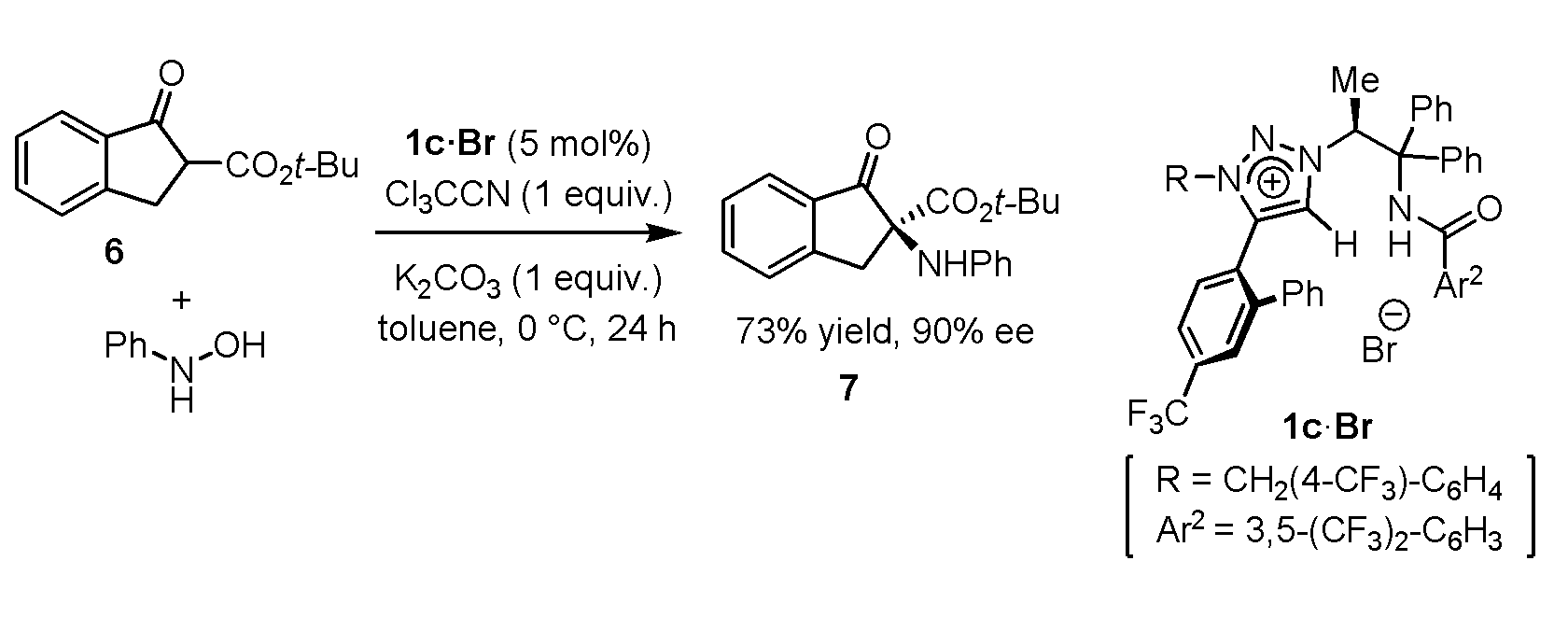
基質として

で表される化合物を用い、触媒として合成例2-3で得たトリアゾリウム塩1c・Brを用いたこと以外は実施例1-1と同様の処理を行った。この場合も、オキシインドール化合物と同様に、α位にアミノ基を導入することが可能であり、生成物7を73 %収率、90 %エナンチオ選択率で得た。
[α]D22= +72.1 (c = 1.1, acetone) for 92% ee; 1H NMR (400 MHz, CDCl3) δ 7.84 (1H, d, J = 7.6 Hz), 7.68 (1H, t, J = 7.6 Hz), 7.53 (1H, d, J = 7.6 Hz), 7.44 (1H, t, J = 7.6 Hz), 7.14 (2H, t, J = 7.6 Hz), 6.76 (1H, t, J = 7.6 Hz), 6.55 (2H, d, J = 7.6 Hz), 5.14 (1H, s), 3.99 (1H, d, J = 16.9 Hz), 3.43 (1H, d, J = 16.9 Hz), 1.23 (9H, s) ; 13C NMR (101 MHz, CDCl3) δ 200.1, 168.6, 153.0, 145.4, 136.2, 134.2, 129.4, 128.1, 126.6, 125.2, 118.9, 114.6, 83.3, 71.9, 38.8, 27.6; IR 3385, 3053, 2978, 1715, 1603, 1504, 1369, 1263, 1150, 937, 745 cm-1; HRMS (ESI) Calcd for C20H21NO3Na+([M+Na]+) 346.1414. Found 346.1410.; HPLC ID3, Hex/IPA = 10: 1, flow rate = 1.0 mL/min, λ= 210 nm, 9.2 min (R), 10.4 min (S)。
[α]D22= +72.1 (c = 1.1, acetone) for 92% ee; 1H NMR (400 MHz, CDCl3) δ 7.84 (1H, d, J = 7.6 Hz), 7.68 (1H, t, J = 7.6 Hz), 7.53 (1H, d, J = 7.6 Hz), 7.44 (1H, t, J = 7.6 Hz), 7.14 (2H, t, J = 7.6 Hz), 6.76 (1H, t, J = 7.6 Hz), 6.55 (2H, d, J = 7.6 Hz), 5.14 (1H, s), 3.99 (1H, d, J = 16.9 Hz), 3.43 (1H, d, J = 16.9 Hz), 1.23 (9H, s) ; 13C NMR (101 MHz, CDCl3) δ 200.1, 168.6, 153.0, 145.4, 136.2, 134.2, 129.4, 128.1, 126.6, 125.2, 118.9, 114.6, 83.3, 71.9, 38.8, 27.6; IR 3385, 3053, 2978, 1715, 1603, 1504, 1369, 1263, 1150, 937, 745 cm-1; HRMS (ESI) Calcd for C20H21NO3Na+([M+Na]+) 346.1414. Found 346.1410.; HPLC ID3, Hex/IPA = 10: 1, flow rate = 1.0 mL/min, λ= 210 nm, 9.2 min (R), 10.4 min (S)。
[実施例4]
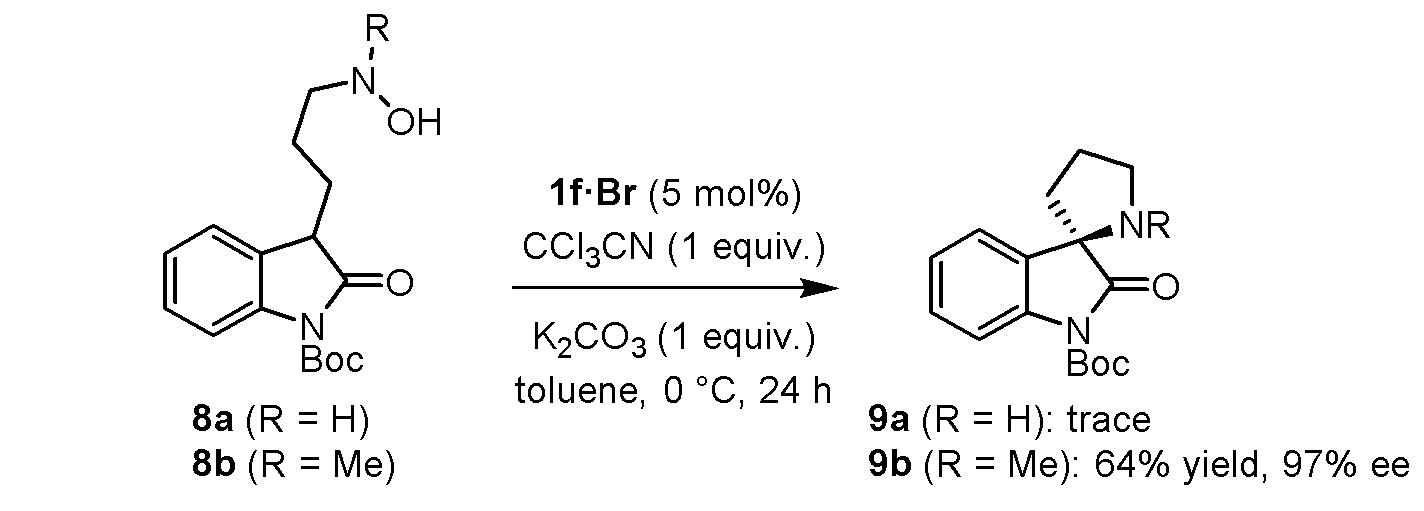
基質として
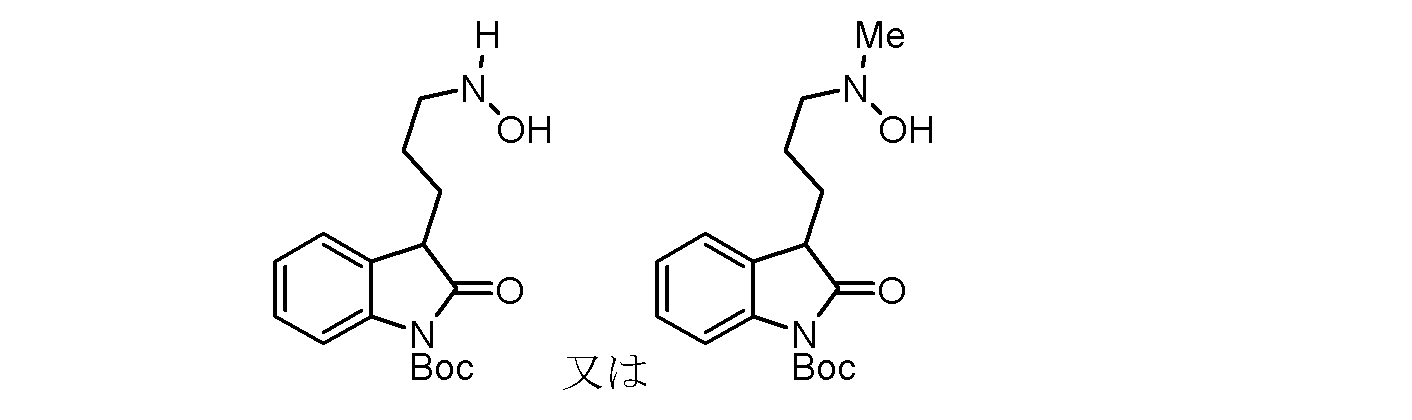
で表される化合物を用い、触媒として合成例2-6で得たトリアゾリウム塩1f・Brを用いたこと以外は実施例1-1及び実施例1-2と同様の処理を行った。この場合、化合物8a(R=H)の場合は反応が進行しなかったが、化合物8b(R=Me)の場合は、オキシインドール化合物のα位にスピロ結合した光学活性化合物が得られ、生成物9bを64 %収率、97 %エナンチオ選択率で得た。
化合物9b:
[α]D23 = +14.3 (c = 0.8, acetone) for 97% ee; 1H NMR (400 MHz, CDCl3) δ 7.81 (1H, d, J= 8.0 Hz), 7.33-7.29 (2H, m), 7.18 (1H, td, J= 7.4, 1.2 Hz), 3.31-3.20 (2H, m), 2.31-2.07 (4H, m), 2.14 (3H, s), 1.64 (9H, s); 13C NMR (101 MHz, CDCl3) δ 177.5, 149.4, 140.2, 129.6, 129.1, 124.9, 123.9, 114.9, 84.3, 71.3, 54.1, 38.0, 35.3, 28.3, 22.3; IR 2976, 2843, 1728, 1609, 1466, 1346, 1292, 1146, 1094, 843, 754 cm-1; HRMS (ESI) Calcd for C17H23N2O3 +([M+H]+) 303.1703. Found 303.1703.; HPLC IF3, Hex/EtOH = 99: 1, flow rate = 0.5 mL/min, column oven 15℃, λ= 210 nm, 11.6 min (R), 13.2 min (S)。
化合物9b:
[α]D23 = +14.3 (c = 0.8, acetone) for 97% ee; 1H NMR (400 MHz, CDCl3) δ 7.81 (1H, d, J= 8.0 Hz), 7.33-7.29 (2H, m), 7.18 (1H, td, J= 7.4, 1.2 Hz), 3.31-3.20 (2H, m), 2.31-2.07 (4H, m), 2.14 (3H, s), 1.64 (9H, s); 13C NMR (101 MHz, CDCl3) δ 177.5, 149.4, 140.2, 129.6, 129.1, 124.9, 123.9, 114.9, 84.3, 71.3, 54.1, 38.0, 35.3, 28.3, 22.3; IR 2976, 2843, 1728, 1609, 1466, 1346, 1292, 1146, 1094, 843, 754 cm-1; HRMS (ESI) Calcd for C17H23N2O3 +([M+H]+) 303.1703. Found 303.1703.; HPLC IF3, Hex/EtOH = 99: 1, flow rate = 0.5 mL/min, column oven 15℃, λ= 210 nm, 11.6 min (R), 13.2 min (S)。
[実施例5:アミノ化生成物の絶対配置の決定]
化合物4e、化合物7及び化合物9bの絶対配置を、以下のように誘導体化した後にX線結晶解析によって明確に決定した。
化合物4e、化合物7及び化合物9bの絶対配置を、以下のように誘導体化した後にX線結晶解析によって明確に決定した。
実施例5-1:化合物4eの誘導体化
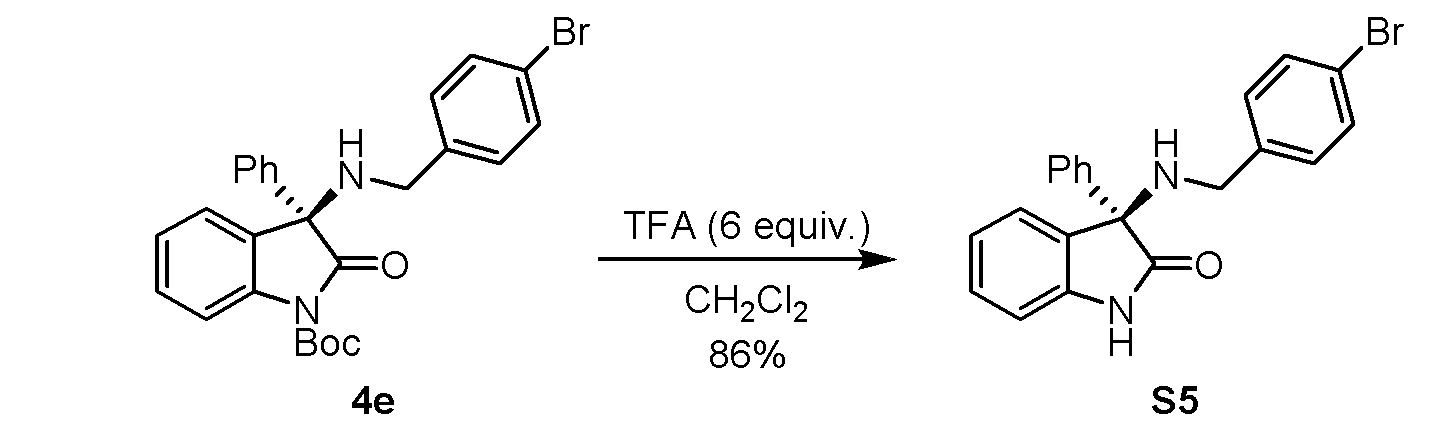
化合物4e(32.0 mg, 0.065 mmol, 99 %エナンチオ率)のCH2Cl2(0.7 mL)溶液に、トリフルオロ酢酸(TFA; 30μL, 0.39 mmol)を添加し、得られた溶液を室温で17時間撹拌した。0℃まで冷却した後、混合物を飽和NaHCO3水溶液で希釈し、酢酸エチルで抽出した。Na2SO4で乾燥し、ろ過し、溶媒を除去し、残渣をシリカゲルカラムクロマトグラフィー(溶離液:ヘキサン/酢酸エチル=2: 1)で精製し、目的化合物S5を得た(22.0 mg, 0.056 mmol, 86 %収率)。
1H NMR (400 MHz, CDCl3) δ7.59 (1H, br), 7.54 (2H, d, J = 8.4 Hz), 7.40 (2H, d, J = 8.4 Hz), 7.34-7.26 (5H, m), 7.23-7.19 (2H, m), 7.06 (1H, td, J = 7.2, 1.2 Hz), 6.92 (1H, d, J= 7.2 Hz), 3.62 (1H, d, J = 13.0 Hz), 3.42 (1H, d, J = 13.0 Hz), 2.46 (1H, br)。
1H NMR (400 MHz, CDCl3) δ7.59 (1H, br), 7.54 (2H, d, J = 8.4 Hz), 7.40 (2H, d, J = 8.4 Hz), 7.34-7.26 (5H, m), 7.23-7.19 (2H, m), 7.06 (1H, td, J = 7.2, 1.2 Hz), 6.92 (1H, d, J= 7.2 Hz), 3.62 (1H, d, J = 13.0 Hz), 3.42 (1H, d, J = 13.0 Hz), 2.46 (1H, br)。
実施例5-2:化合物7の誘導体化
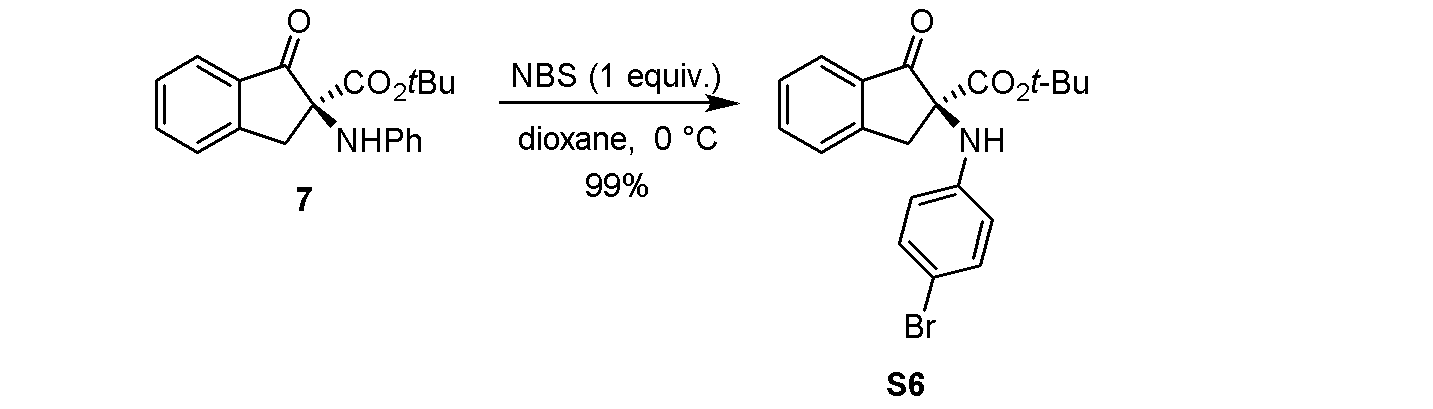
化合物7(23.6 mg, 0.073 mmol, 90 %エナンチオ率)の1,4-ジオキサン(0.7 mL)溶液に、N-ブロモスクシンイミド(NBS; 13.0 mg, 0.073 mmol)を添加し、得られた混合物を0℃で5分間撹拌した。次に、混合物を水で希釈し、酢酸エチルで抽出した。有機層をNa2SO4で乾燥し、ろ過した。溶媒を蒸発させ、残渣をシリカゲルカラムクロマトグラフィー(溶離液:ヘキサン/酢酸エチル=10: 1)で精製し、目的化合物S6を得た(29.4 mg, 0.073 mmol, 99 %収率)。
1H NMR (400 MHz, CDCl3) δ7.84 (1H, d, J = 8.0 Hz), 7.69 (1H, td, J = 8.0, 1.2 Hz), 7.53 (1H, d, J = 8.0 Hz), 7.45 (1H, t, J = 8.0 Hz), 7.22 (2H, d, J = 8.4 Hz), 6.42 (2H, d, J = 8.4 Hz), 5.17 (1H, s), 3.96 (1H, d, J = 16.6 Hz), 3.38 (1H, d, J = 16.6 Hz), 1.24 (9H, s)。
1H NMR (400 MHz, CDCl3) δ7.84 (1H, d, J = 8.0 Hz), 7.69 (1H, td, J = 8.0, 1.2 Hz), 7.53 (1H, d, J = 8.0 Hz), 7.45 (1H, t, J = 8.0 Hz), 7.22 (2H, d, J = 8.4 Hz), 6.42 (2H, d, J = 8.4 Hz), 5.17 (1H, s), 3.96 (1H, d, J = 16.6 Hz), 3.38 (1H, d, J = 16.6 Hz), 1.24 (9H, s)。
実施例5-3:化合物9bの誘導体化

化合物9b(18.1 mg, 0.064 mmol, 97 %エナンチオ率)のCH2Cl2(0.6 mL)溶液に、トリフルオロ酢酸(TFA; 28μL, 0.36 mmol)を添加し、得られた溶液を室温で17時間撹拌した。0℃まで冷却した後、混合物を飽和NaHCO3水溶液で希釈し、酢酸エチルで抽出した。Na2SO4で乾燥し、ろ過し、溶媒を真空下に除去し、残渣をシリカゲルカラムクロマトグラフィー(溶離液:ヘキサン/酢酸エチル=2: 1)で精製し、目的化合物S7を得た(22.0 mg, 0.056 mmol, 86 %収率)。
1H NMR (400 MHz, CDCl3) δ7.26 (1H, d, J = 7.2 Hz), 7.21 (1H, t, J = 7.6 Hz), 7.04 (1H, t, J = 7.6 Hz), 6.85 (1H, d, J = 7.6 Hz), 3.34-3.28 (1H, m), 3.20-3.15 (1H, m), 2.35-2.10 (4H, m), 2.17 (3H, s)。
1H NMR (400 MHz, CDCl3) δ7.26 (1H, d, J = 7.2 Hz), 7.21 (1H, t, J = 7.6 Hz), 7.04 (1H, t, J = 7.6 Hz), 6.85 (1H, d, J = 7.6 Hz), 3.34-3.28 (1H, m), 3.20-3.15 (1H, m), 2.35-2.10 (4H, m), 2.17 (3H, s)。
得られた化合物S7のTHF(0.5 mL)溶液に、0℃で水素化ナトリウム(NaH; 2.2 mg, 0.055 mmol)を慎重に添加した。30分間攪拌した後、4-ブロモベンゼンスルホニルクロリド(12.8 mg, 0.05 mmol)を添加し、全ての反応混合物を室温で10時間撹拌した。反応混合物に水を添加して反応をクエンチし、酢酸エチルで抽出した。有機層をNa2SO4で乾燥し、ろ過した。溶媒を蒸発させ、残渣をシリカゲルカラムクロマトグラフィー(溶離液:ヘキサン/酢酸エチル=5: 1)で精製し、目的化合物S8を得た(4.2 mg, 0.01 mmol, 22 %収率)。
1H NMR (400 MHz, CDCl3) δ7.94 (2H, d, J = 8.4 Hz), 7.89 (1H, d, J = 8.4 Hz), 7.66 (2H, d, J = 8.4 Hz), 7.36 (1H, td, J = 8.0, 2.0 Hz), 7.29 (1H, dd, J = 7.2, 1.2 Hz), 7.22 (1H, td, J = 7.2, 1.2 Hz), 3.18-3.07 (2H, m), 2.17-2.03 (4H, m), 1.84 (3H, s)。
1H NMR (400 MHz, CDCl3) δ7.94 (2H, d, J = 8.4 Hz), 7.89 (1H, d, J = 8.4 Hz), 7.66 (2H, d, J = 8.4 Hz), 7.36 (1H, td, J = 8.0, 2.0 Hz), 7.29 (1H, dd, J = 7.2, 1.2 Hz), 7.22 (1H, td, J = 7.2, 1.2 Hz), 3.18-3.07 (2H, m), 2.17-2.03 (4H, m), 1.84 (3H, s)。
また、化合物5a及び化合物5oも、既報(Barroso, S., Blay, G., Cardona, L., Fernandez, I., Garcia, B., Pedro, J. R. J. Org. Chem. 69, 6821‐6829 (2004).、及びKitajima, M., Mori, I., Arai, K., Kogure, N. & Takayama, H. Tetrahedron. Lett. 47, 3199‐3202 (2006).)にしたがって誘導体化し、結晶構造を決定した。
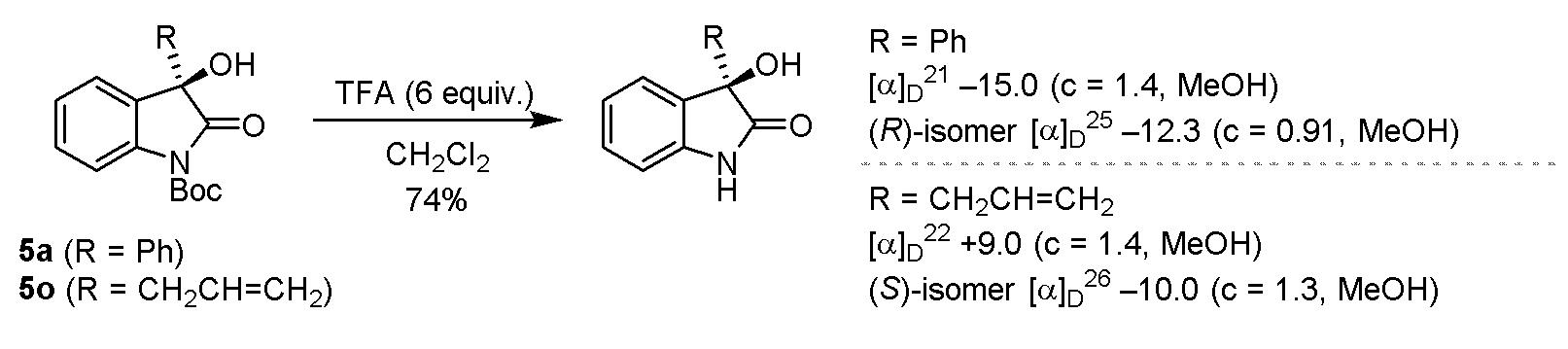
[試験例1:結晶構造の決定]
化合物S5及び化合物S6の単結晶は、室温で、CH2Cl2/ペンタン溶媒系から得た。化合物S8の単結晶は、室温でペンタンから得た。このようにして得た単結晶をCryoLoopに載せた。X線回折のデータは、多層化ミラーを備えたRigaku XtaLAB P200回折計を用いて、単色化されたMoKα線(λ= 0.71075Å)で123 Kで測定した。経験的な吸収補正は、0.677~0.889の範囲の透過率を適用した。データは、Lorentz効果及び偏光効果について補正した。構造は、直接法(IR92: Altomare, A., Cascarano, G., Giacovazzo, C., Guagliardi, A., Burla, M., Polidori, G. & Camalli, M. J. Appl. Cryst., 27, 435 (1994).)及び拡張フーリエ変換法により解析した。非水素原子を異方的に精密化した。いくつかの水素原子は等方的に決定し、いくつかの水素原子はライジングモデルを用いて決定し、残りの水素原子は固体された位置に含まれていた。この結果、決定された構造を図1~3に示す。
化合物S5及び化合物S6の単結晶は、室温で、CH2Cl2/ペンタン溶媒系から得た。化合物S8の単結晶は、室温でペンタンから得た。このようにして得た単結晶をCryoLoopに載せた。X線回折のデータは、多層化ミラーを備えたRigaku XtaLAB P200回折計を用いて、単色化されたMoKα線(λ= 0.71075Å)で123 Kで測定した。経験的な吸収補正は、0.677~0.889の範囲の透過率を適用した。データは、Lorentz効果及び偏光効果について補正した。構造は、直接法(IR92: Altomare, A., Cascarano, G., Giacovazzo, C., Guagliardi, A., Burla, M., Polidori, G. & Camalli, M. J. Appl. Cryst., 27, 435 (1994).)及び拡張フーリエ変換法により解析した。非水素原子を異方的に精密化した。いくつかの水素原子は等方的に決定し、いくつかの水素原子はライジングモデルを用いて決定し、残りの水素原子は固体された位置に含まれていた。この結果、決定された構造を図1~3に示す。
Claims (12)
- 一般式(1A):

で表される光学活性化合物の製造方法であって、
一般式(2):
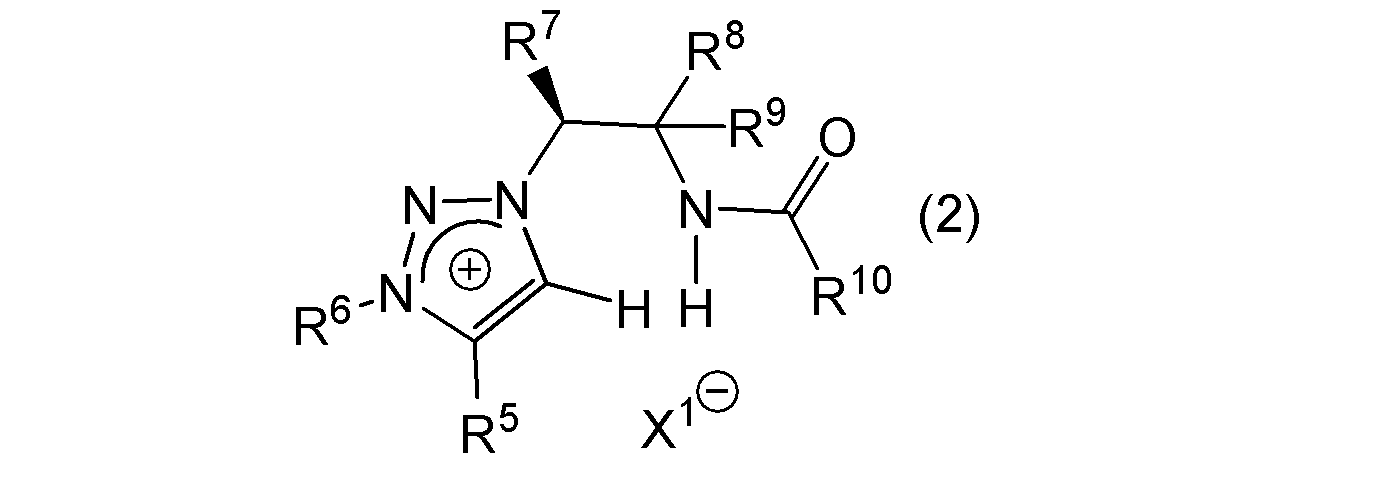
で表されるトリアゾリウム塩と、
一般式(3):
CX2 3CN (3)
[式中、X2は同一又は異なって、ハロゲン原子を示す。]
で表されるトリハロゲン化アセトニトリル化合物の存在下に、
一般式(4A):
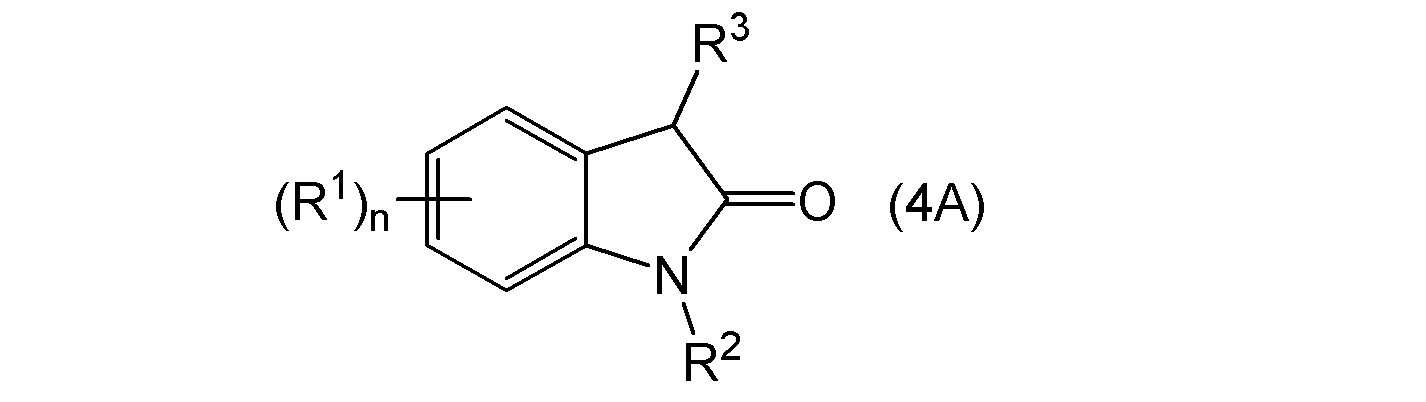
で表される化合物と、
一般式(5):
R11NHOH (5)
[式中、R11は有機基を示す。]
で表されるヒドロキシルアミン化合物又は過酸化水素とを反応させる反応工程
を備える、製造方法。 - 前記反応工程が、塩基の存在下に行われる、請求項1に記載の製造方法。
- 前記一般式(1A)におけるR4が置換されていてもよいアミノ基であり、
前記反応工程が、前記一般式(2)で表されるトリアゾリウム塩及び一般式(3)で表されるトリハロゲン化アセトニトリル化合物の存在下に、前記一般式(4A)で表される化合物と前記一般式(5)で表されるヒドロキシルアミン化合物とを反応させる工程である、請求項1又は2に記載の製造方法。 - 前記一般式(1A)におけるR4が水酸基であり、
前記反応工程が、前記一般式(2)で表されるトリアゾリウム塩及び一般式(3)で表されるトリハロゲン化アセトニトリル化合物の存在下に、前記一般式(4A)で表される化合物と前記過酸化水素とを反応させる工程である、請求項1又は2に記載の製造方法。 - 一般式(1B):

で表される光学活性化合物の製造方法であって、
一般式(2):
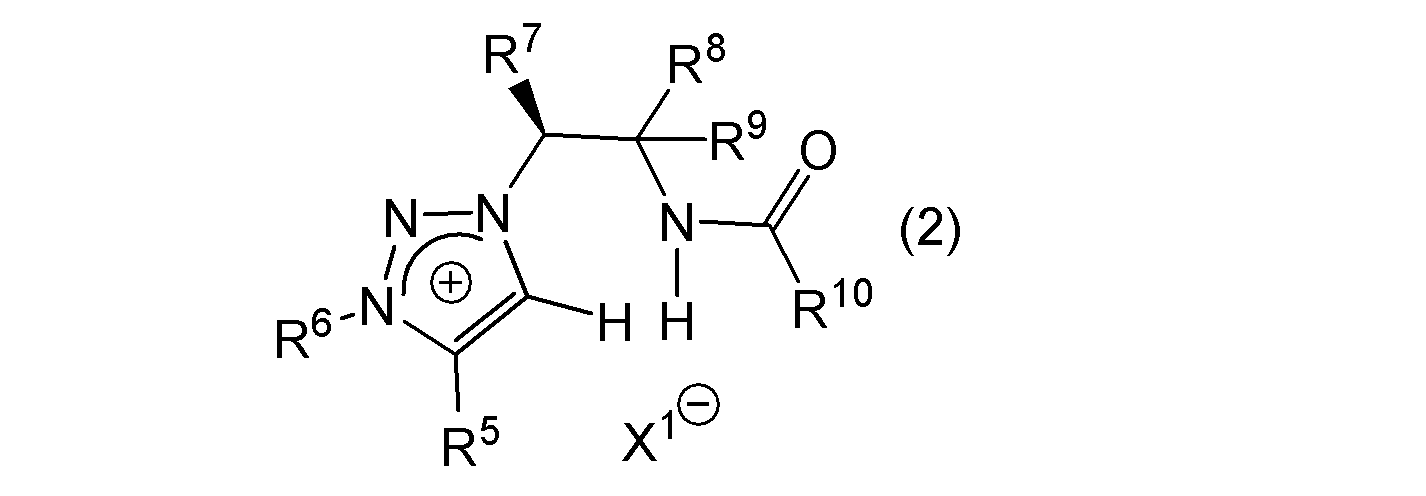
で表されるトリアゾリウム塩と、
一般式(3):
CX2 3CN (3)
[式中、X2は同一又は異なって、ハロゲン原子を示す。]
で表されるトリハロゲン化アセトニトリル化合物の存在下に、
一般式(4B):

で表される化合物と、
一般式(5):
R11NHOH (5)
[式中、R11は有機基を示す。]
で表されるヒドロキシルアミン化合物とを反応させる反応工程
を備える、製造方法。 - 前記反応工程が、塩基の存在下に行われる、請求項5に記載の製造方法。
- 一般式(1C):

で表される光学活性化合物の製造方法であって、
一般式(2):
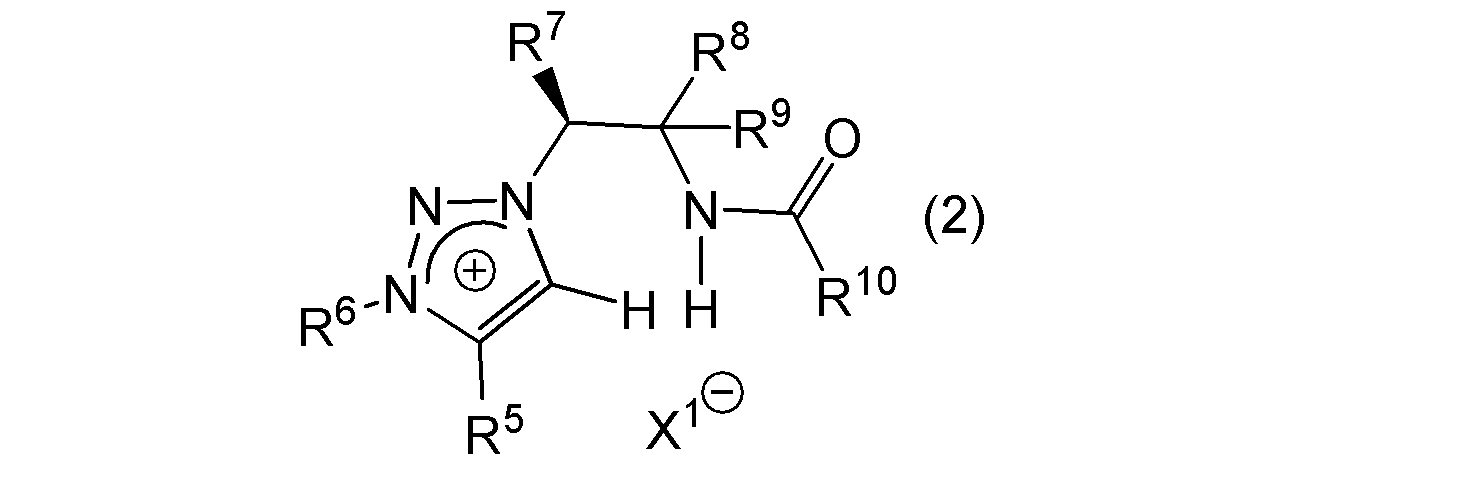
で表されるトリアゾリウム塩と、
一般式(3):
CX2 3CN (3)
[式中、X2は同一又は異なって、ハロゲン原子を示す。]
で表されるトリハロゲン化アセトニトリル化合物の存在下に、
一般式(4C):

で表される化合物を、分子内閉環反応させる分子内閉環反応工程
を備える、製造方法。 - 前記分子内閉環反応工程が、塩基の存在下に行われる、請求項7に記載の製造方法。
- 一般式(2):
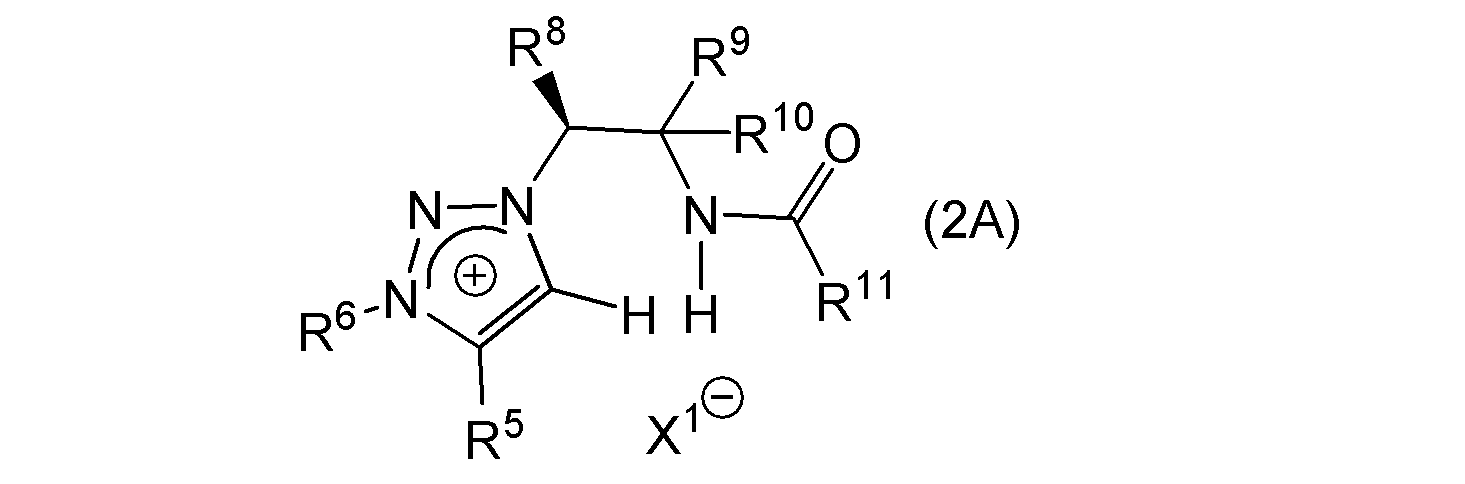
で表されるトリアゾリウム塩からなるカルボニル化合物の不斉α-アミノ化又は不斉α-ヒドロキシル化触媒。 - 前記カルボニル化合物は、
一般式(4A):
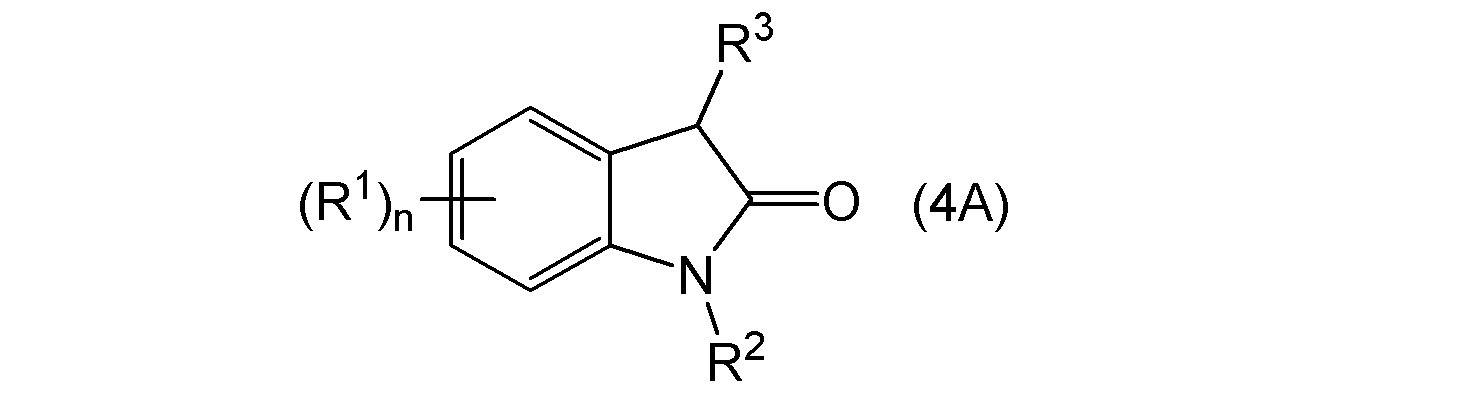
で表される化合物、
一般式(4B):
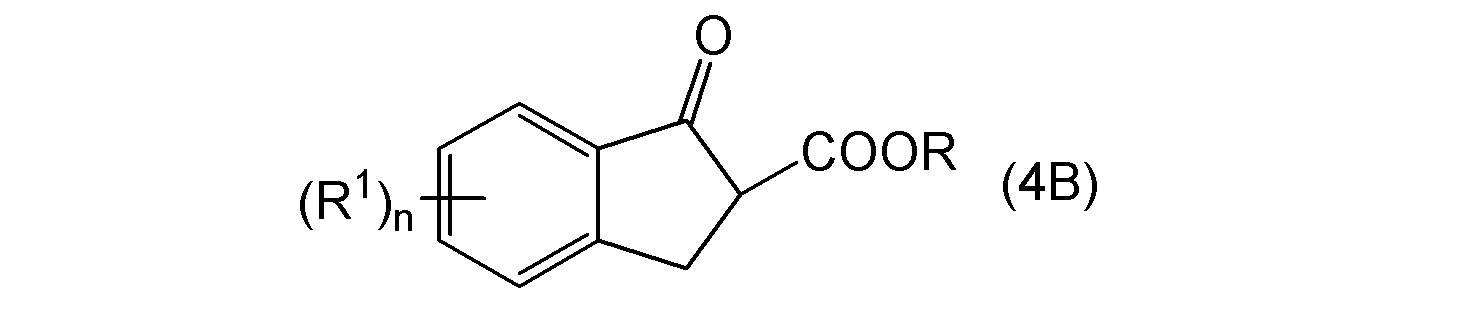
で表される化合物、又は
一般式(4C):
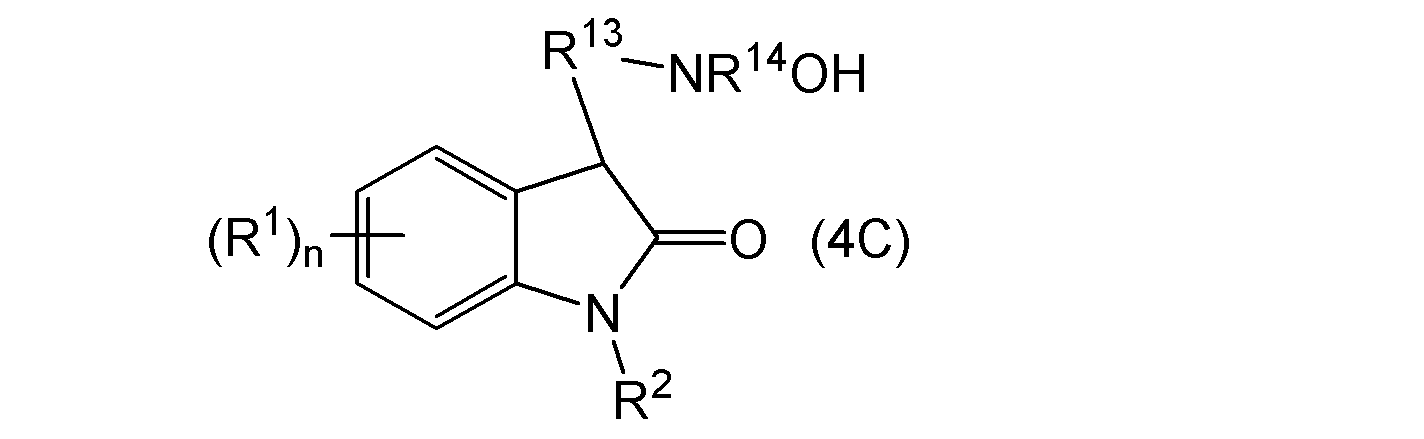
で表される化合物である、請求項9に記載のカルボニル化合物の不斉α-アミノ化又は不斉α-ヒドロキシル化触媒。 - 一般式(2A):

で表されるトリアゾリウム塩。 - 一般式(1A):
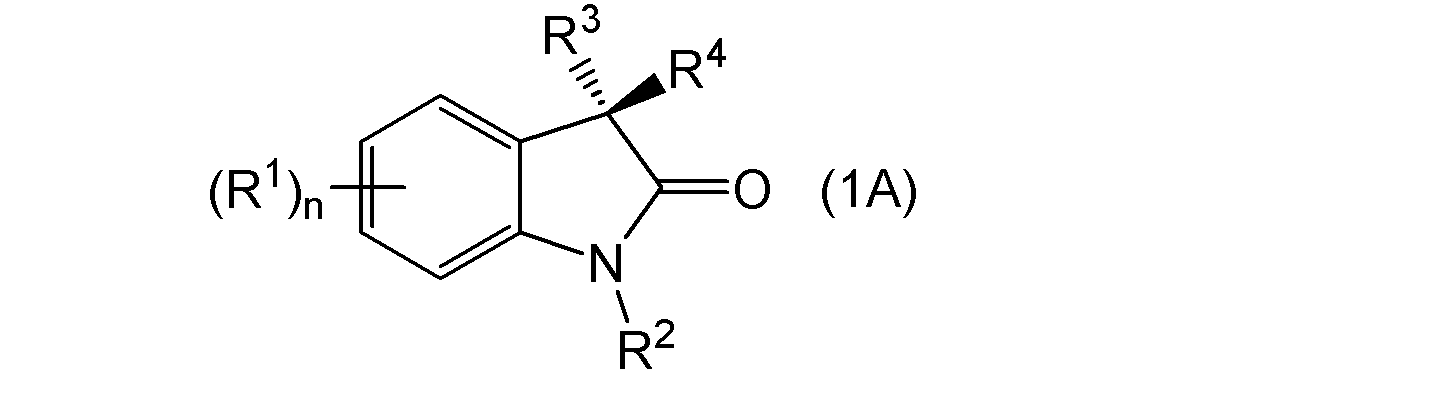
、一般式(1B):

、又は一般式(1C):

で表される光学活性化合物。
Priority Applications (1)
| Application Number | Priority Date | Filing Date | Title |
|---|---|---|---|
| JP2017500769A JPWO2016133217A1 (ja) | 2015-02-20 | 2016-02-19 | 光学活性オキシインドール化合物の製造方法及びそれに触媒として用いられるトリアゾリウム塩 |
Applications Claiming Priority (2)
| Application Number | Priority Date | Filing Date | Title |
|---|---|---|---|
| JP2015-032106 | 2015-02-20 | ||
| JP2015032106 | 2015-02-20 |
Publications (1)
| Publication Number | Publication Date |
|---|---|
| WO2016133217A1 true WO2016133217A1 (ja) | 2016-08-25 |
Family
ID=56689412
Family Applications (1)
| Application Number | Title | Priority Date | Filing Date |
|---|---|---|---|
| PCT/JP2016/054960 Ceased WO2016133217A1 (ja) | 2015-02-20 | 2016-02-19 | 光学活性オキシインドール化合物の製造方法及びそれに触媒として用いられるトリアゾリウム塩 |
Country Status (2)
| Country | Link |
|---|---|
| JP (1) | JPWO2016133217A1 (ja) |
| WO (1) | WO2016133217A1 (ja) |
Cited By (2)
| Publication number | Priority date | Publication date | Assignee | Title |
|---|---|---|---|---|
| CN108003086A (zh) * | 2017-11-15 | 2018-05-08 | 宁波大学 | 一种3-胺基-2-吲哚酮类化合物的制备方法 |
| CN111704620A (zh) * | 2020-07-24 | 2020-09-25 | 中国科学院成都有机化学有限公司 | 高光学纯度的[3,2’]-吡咯烷手性螺环氧化吲哚骨架类化合物、其制备方法及应用 |
Citations (1)
| Publication number | Priority date | Publication date | Assignee | Title |
|---|---|---|---|---|
| JP2012082155A (ja) * | 2010-10-08 | 2012-04-26 | Nagoya Univ | トリアゾリウム塩及びその製造方法、アジドアルコール並びに不斉反応によるアルキル化オキシインドールの製造方法 |
-
2016
- 2016-02-19 WO PCT/JP2016/054960 patent/WO2016133217A1/ja not_active Ceased
- 2016-02-19 JP JP2017500769A patent/JPWO2016133217A1/ja active Pending
Patent Citations (1)
| Publication number | Priority date | Publication date | Assignee | Title |
|---|---|---|---|---|
| JP2012082155A (ja) * | 2010-10-08 | 2012-04-26 | Nagoya Univ | トリアゾリウム塩及びその製造方法、アジドアルコール並びに不斉反応によるアルキル化オキシインドールの製造方法 |
Non-Patent Citations (15)
| Title |
|---|
| BENATI, L. ET AL.: "Radical Chain Reactions of alpha-Azido-beta-keto Esters with Tributyltin Hydride. A Novel Entry to Amides and Lactams through Regiospecific Nitrogen Insertion", THE JOURNAL OF ORGANIC CHEMISTRY, vol. 64, no. 21, 1999, pages 7836 - 7841, XP002700804, ISSN: 0022-3263, DOI: doi:10.1021/JO990837G * |
| GUO, Q.-X. ET AL.: "Enantioselective and Solvent-Controlled Diastereoselective Mannich Reaction of Isatin Imines with Hydroxyacetone: Synthesis of 3-Substituted 3-Aminooxindoles", THE JOURNAL OF ORGANIC CHEMISTRY, vol. 77, no. 7, 2012, pages 3589 - 3594, ISSN: 0022-3263 * |
| HIROSHI YAMANAKA ET AL.: "1 General aspects of the preparation of optically active compounds", KIKAN KAGAKU SOSETSU NO.6, 1989 RESOLUTION OF OPTICAL ISOMERS, 10 June 1999 (1999-06-10), pages 2 - 14, XP008146717 * |
| ISHIMARU, T. ET AL.: "Lewis Acid-Catalyzed Enantioselective Hydroxylation Reactions of Oxindoles and beta-Keto Esters Using DBFOX Ligand", JOURNAL OF THE AMERICAN CHEMICAL SOCIETY, vol. 128, no. 51, 2006, pages 16488 - 16489, ISSN: 0002-7863 * |
| LIN, X. ET AL.: "Model studies on total synthesis of the chartellines, spirocyclic beta- lactam alkaloids from a marine bryozoan", TETRAHEDRON LETTERS, vol. 42, no. 14, 2001, pages 2631 - 2633, XP004231627, ISSN: 0040-4039, DOI: doi:10.1016/S0040-4039(01)00270-2 * |
| MARI KIYOKAWA ET AL.: "1C3-10 ''1,2,3-Triazolium Cation no Anion Ninshikino o Riyo shita Chiral Yuki Bunshi Shokubai no Sekkei to Kino Soshutsu", THE 91ST ANNUAL MEETING OF THE CHEMICAL SOCIETY OF JAPAN IN SPRING (2011) KOEN YOKOSHU IV, 11 March 2011 (2011-03-11), pages 1270, ISSN: 0285-7626 * |
| OHMATSU, K. ET AL.: "Asymmetric Substitution at the Tetrasubstituted Chiral Carbon: Catalytic Ring-Opening Alkylation of Racemic 2,2- Disubstituted Aziridines with 3-Substituted Oxindoles", JOURNAL OF THE AMERICAN CHEMICAL SOCIETY, vol. 135, no. 50, 2013, pages 18706 - 18709, ISSN: 0002-7863 * |
| OHMATSU, K. ET AL.: "Catalytic Asymmetric Ring Openings of Meso and Terminal Aziridines with Halides Mediated by Chiral 1,2,3-Triazolium Silicates", JOURNAL OF THE AMERICAN CHEMICAL SOCIETY, vol. 134, no. 21, 2012, pages 8794 - 8797, ISSN: 0002-7863 * |
| OHMATSU, K. ET AL.: "Chiral 1,2,3-Triazoliums as New Cationic Organic Catalysts with Anion- Recognition Ability: Application to Asymmetric Alkylation of Oxindoles", JOURNAL OF THE AMERICAN CHEMICAL SOCIETY, vol. 133, no. 5, 2011, pages 1307 - 1309, ISSN: 0002-7863 * |
| PACCANI, R. R. ET AL.: "Toward a Stable a- Cycloalkyl Amino Acid with a Photoswitchable Cationic Side Chain", THE JOURNAL OF ORGANIC CHEMISTRY, vol. 77, no. 4, 2012, pages 1738 - 1748, ISSN: 0022-3263 * |
| PULEO, L. ET AL.: "Synthesis and pharmacological evaluation of indolinone derivatives as novel ghrelin receptor antagonists", BIOORGANIC & MEDICINAL CHEMISTRY, vol. 20, no. 18, 2012, pages 5623 - 5636, XP028938215, ISSN: 0968-0896, DOI: doi:10.1016/j.bmc.2012.07.018 * |
| RAJKUMAR, V. ET AL.: "Unactivated Norbornenes in [3+2]Cycloadditions: Remarkably Stereo- controlled Entry into Norbornane-Fused Spirooxindolopyrrolidines, Spiro-1,3- indandionolylpyrrolidines, and Spirooxindolopyrrolizidines", SYNLETT, vol. 23, no. 4, 2012, pages 549 - 556, ISSN: 0936-5214 * |
| SUH, C. W. ET AL.: "Enantioselective decarboxylative aldol addition of beta-ketoacids to isatins catalyzed by binaphthyl-modified organocatalyst", TETRAHEDRON LETTERS, vol. 54, no. 28, 2013, pages 3651 - 3654, XP028561937, ISSN: 0040-4039, DOI: doi:10.1016/j.tetlet.2013.04.132 * |
| TOLSTOY, P. ET AL.: "Synthesis of Enantiomerically Enriched 3-Amino-2-oxindoles through a Palladium-Mediated Asymmetric Intramolecular Arylation of alpha-Ketimino Amides", ORGANIC LETTERS, vol. 14, no. 18, 2012, pages 4810 - 4813, ISSN: 1523-7052 * |
| ZHONG, F. ET AL.: "Enantioselective Construction of 3-Hydroxy Oxindoles via Decarboxylative Addition of beta-Ketoacids to Isatins", ORGANIC LETTERS, vol. 14, no. 15, 2012, pages 4018 - 4021, ISSN: 1523-7052 * |
Cited By (4)
| Publication number | Priority date | Publication date | Assignee | Title |
|---|---|---|---|---|
| CN108003086A (zh) * | 2017-11-15 | 2018-05-08 | 宁波大学 | 一种3-胺基-2-吲哚酮类化合物的制备方法 |
| CN108003086B (zh) * | 2017-11-15 | 2020-08-14 | 宁波大学 | 一种3-胺基-2-吲哚酮类化合物的制备方法 |
| CN111704620A (zh) * | 2020-07-24 | 2020-09-25 | 中国科学院成都有机化学有限公司 | 高光学纯度的[3,2’]-吡咯烷手性螺环氧化吲哚骨架类化合物、其制备方法及应用 |
| CN111704620B (zh) * | 2020-07-24 | 2023-05-23 | 中国科学院成都有机化学有限公司 | [3,2’]-吡咯烷手性螺环氧化吲哚骨架类化合物、其制备方法及应用 |
Also Published As
| Publication number | Publication date |
|---|---|
| JPWO2016133217A1 (ja) | 2018-01-18 |
Similar Documents
| Publication | Publication Date | Title |
|---|---|---|
| Dong et al. | Enantioselective palladium-catalyzed C (sp2)-H carbamoylation | |
| Lu et al. | Dipeptide-derived multifunctional phosphonium salt as a catalyst to synthesize highly functionalized chiral cyclopentanes | |
| US7902207B2 (en) | Process for production of amines | |
| WO2016133217A1 (ja) | 光学活性オキシインドール化合物の製造方法及びそれに触媒として用いられるトリアゾリウム塩 | |
| Rodríguez-Alvarado et al. | Design, organocatalytic synthesis, and bioactivity evaluation of enantiopure fluorinated LpxC inhibitors | |
| WO2014000455A1 (zh) | 一种手性五元二环胍化合物及其制备方法和应用 | |
| Li et al. | An efficient enantioselective synthesis of florfenicol via a vanadium-catalyzed asymmetric epoxidation | |
| Dwivedi et al. | Asymmetric organocatalysis with glycosyl-β-amino acids: direct asymmetric aldol reaction of acetone with aldehydes | |
| CN115836041B (zh) | 光学活性的化合物的制造方法 | |
| Miranda et al. | Stereoselective synthesis of (−)‐cytoxazone and its unnatural congener (+)‐5‐epi‐cytoxazone | |
| JP2000327659A (ja) | 光学活性ピリジルアルコール類の製造方法 | |
| Abbiati et al. | [2+ 2] Cycloaddition reactions of 1-benzyl-2, 4-diphenyl-1, 3-diazabuta-1, 3-diene with chiral ketenes | |
| KR101446017B1 (ko) | 고 입체순도를 갖는 4-알킬-5-아릴 5-원고리 설파미데이트의 제조방법 | |
| Kabumoto et al. | Efficient and Convenient Access to Optically Active Tetrafluoroethylenated Amines Based on [1, 3]-Proton Shift Reaction | |
| US11512041B2 (en) | Highly enantioselective access to cyclic beta-amino acids | |
| Khanvilkar et al. | Applications of chiral naphthyloxycyclohexanols in deracemization of α-substituted carboxylic acids by dynamic thermodynamic resolution | |
| JP4427266B2 (ja) | β−アラニン誘導体およびその製造方法 | |
| CN110668976A (zh) | 卡巴拉汀光学异构中间体及(r)-卡巴拉汀的合成方法 | |
| US7767845B2 (en) | Process for producing optically active 2-hydroxybutyric ester | |
| KR101686087B1 (ko) | 광학 활성을 갖는 인돌린 유도체 또는 이의 염의 신규 제조 방법 | |
| CN100560561C (zh) | 光学纯 α—二氟甲基胺和高立体选择性制备的方法 | |
| WO2005068457A1 (en) | Cataltytic asymmetric hetero diels-alder reaction of a heteroaromatic c-nitroso dienophile: a novel method for synthesis of chiral non-racemic amino alcohols | |
| JP2008540640A (ja) | N(5)−エチルグルタミンの製造方法 | |
| Cook et al. | Tandem palladium-catalyzed allene arylation and oxazoline formation | |
| JP5246903B2 (ja) | β−アミノカルボニル化合物の製法 |
Legal Events
| Date | Code | Title | Description |
|---|---|---|---|
| 121 | Ep: the epo has been informed by wipo that ep was designated in this application |
Ref document number: 16752603 Country of ref document: EP Kind code of ref document: A1 |
|
| ENP | Entry into the national phase |
Ref document number: 2017500769 Country of ref document: JP Kind code of ref document: A |
|
| NENP | Non-entry into the national phase |
Ref country code: DE |
|
| 122 | Ep: pct application non-entry in european phase |
Ref document number: 16752603 Country of ref document: EP Kind code of ref document: A1 |