WO2016129480A1 - ポリマー組成物、ペレット、及び成形品 - Google Patents
ポリマー組成物、ペレット、及び成形品 Download PDFInfo
- Publication number
- WO2016129480A1 WO2016129480A1 PCT/JP2016/053223 JP2016053223W WO2016129480A1 WO 2016129480 A1 WO2016129480 A1 WO 2016129480A1 JP 2016053223 W JP2016053223 W JP 2016053223W WO 2016129480 A1 WO2016129480 A1 WO 2016129480A1
- Authority
- WO
- WIPO (PCT)
- Prior art keywords
- cyclic olefin
- polymer
- polymer composition
- group
- olefin polymer
- Prior art date
- Legal status (The legal status is an assumption and is not a legal conclusion. Google has not performed a legal analysis and makes no representation as to the accuracy of the status listed.)
- Ceased
Links
Classifications
-
- C—CHEMISTRY; METALLURGY
- C08—ORGANIC MACROMOLECULAR COMPOUNDS; THEIR PREPARATION OR CHEMICAL WORKING-UP; COMPOSITIONS BASED THEREON
- C08L—COMPOSITIONS OF MACROMOLECULAR COMPOUNDS
- C08L23/00—Compositions of homopolymers or copolymers of unsaturated aliphatic hydrocarbons having only one carbon-to-carbon double bond; Compositions of derivatives of such polymers
- C08L23/02—Compositions of homopolymers or copolymers of unsaturated aliphatic hydrocarbons having only one carbon-to-carbon double bond; Compositions of derivatives of such polymers not modified by chemical after-treatment
- C08L23/18—Homopolymers or copolymers of hydrocarbons having four or more carbon atoms
- C08L23/24—Homopolymers or copolymers of hydrocarbons having four or more carbon atoms having ten or more carbon atoms
Definitions
- the present invention relates to a polymer composition containing a cyclic olefin polymer, a pellet, and a molded article.
- Cyclic olefin polymers are widely used as packaging materials for foods, pharmaceuticals, medical supplies, daily necessities, electronic parts, and the like because of their excellent heat resistance, transparency, and water vapor barrier properties. Moreover, since it is excellent in moldability, it is expected to be applied to diagnostic instruments in the medical field, or devices or parts used in the manufacturing process of pharmaceuticals, semiconductors and the like.
- Patent Documents 1 and 2 disclose cyclic olefin-based resin compositions suitable for applications such as containers and packaging.
- a cyclic olefin resin composition comprising a resin composition (A2) comprising a polyolefin and (B) an amide compound is disclosed.
- cyclic olefin polymers have features such as excellent heat resistance and low dielectric constant. However, since the elastic modulus is high and the toughness is low, it may be difficult to use the cyclic olefin polymer alone depending on applications, molding methods, and the like.
- an object of the embodiment of the present invention is to provide a polymer composition excellent in toughness while maintaining high heat resistance, and a pellet for obtaining the polymer composition.
- Another object of the present invention is to provide a molded article having excellent toughness while maintaining high heat resistance.
- the present inventor has found that the above problem can be solved by using a specific cyclic olefin polymer in combination, and has completed the present invention.
- An embodiment of the present invention contains a cyclic olefin polymer (I) having a glass transition temperature of 60 ° C. or higher and a cyclic olefin polymer (i) having a glass transition temperature of 10 ° C. or lower, and ISO 527-2. / Relates to a polymer composition having a tensile modulus of elasticity of 800 MPa or more measured according to 1A.
- Another embodiment of the present invention relates to a molded article formed from the polymer composition of the above embodiment.
- the present invention it is possible to provide a polymer composition excellent in toughness while maintaining high heat resistance, and a pellet for obtaining the polymer composition. Further, according to another embodiment of the present invention, it is possible to provide a molded article having excellent toughness while maintaining high heat resistance.
- the present invention is related to the subject matter described in Japanese Patent Application No. 2015-024323 filed on February 10, 2015, the disclosure of which is incorporated herein by reference.
- An embodiment of the present invention contains a cyclic olefin polymer (I) having a glass transition temperature of 60 ° C. or higher and a cyclic olefin polymer (i) having a glass transition temperature of 10 ° C. or lower, and ISO 527-2 / 1A relates to a composition having a tensile modulus measured in accordance with 1A of 800 MPa or more.
- the toughness and impact resistance of the obtained molded product tend to be inferior because the polymer has low toughness.
- the toughness can be improved by using the cyclic olefin polymer (I) and the cyclic olefin polymer (i) having a glass transition temperature of 10 ° C. or less in combination.
- the cyclic olefin polymer (I) and the cyclic olefin polymer (i) are obtained by polymerizing at least a polymerization component containing a cyclic olefin component. It can be a polymer.
- the cyclic olefin-based polymer has at least a cyclic alkylene structure in the main chain.
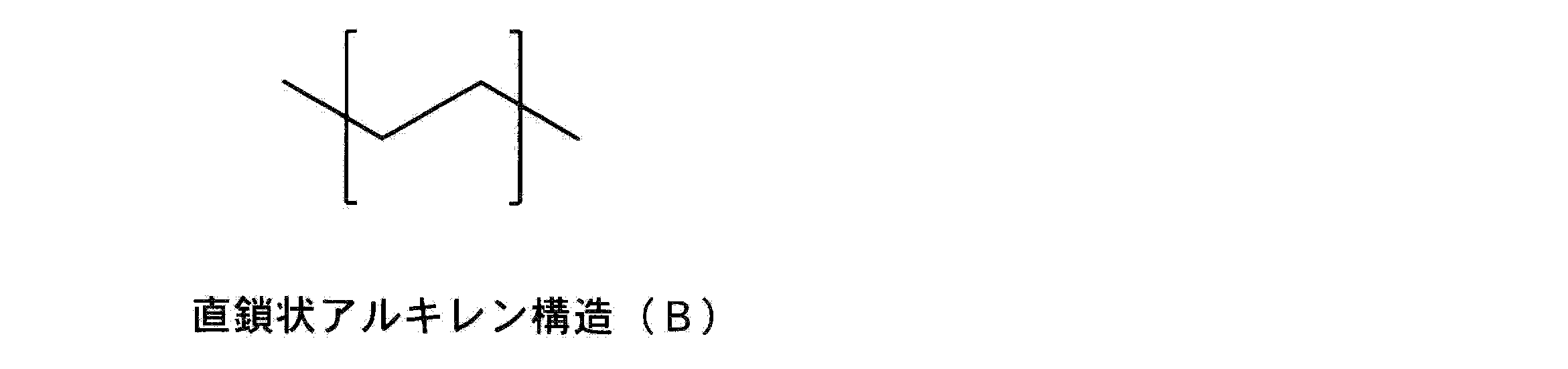
- the cyclic olefin-based polymer has at least one selected from the group consisting of the following cyclic alkylene structure (A1) and the following cyclic alkylene structure (A2), and the following linear alkylene structure (B).
- each of R 1 to R 12 is selected from the group consisting of a hydrogen atom, a halogen atom, and a hydrocarbon group, and may be the same or different from each other; R 9 and R 10 , and R 11 and R 12 may be integrated to form a divalent hydrocarbon group, R 9 or R 10 and R 11 or R 12 may be bonded to each other to form a ring.
- n represents 0 or a positive integer. When n is 2 or more, R 5 to R 8 may be the same as or different from each other for each repeating unit. Although the upper limit of n is not specifically limited, For example, it can be 3 or less.
- each of R 1 , R 2 and R 9 to R 12 is selected from the group consisting of a hydrogen atom, a halogen atom, and a hydrocarbon group, and may be the same or different from each other; R 9 and R 10 , and R 11 and R 12 may be integrated to form a divalent hydrocarbon group, R 9 or R 10 and R 11 or R 12 may be bonded to each other to form a ring.
- R 1 to R 12 may be the same or different and are each selected from the group consisting of a hydrogen atom, a halogen atom, and a hydrocarbon group. Preferably it is a hydrogen atom.
- R 1 to R 8 include a hydrogen atom; a halogen atom such as fluorine, chlorine and bromine; a lower alkyl group such as a methyl group, an ethyl group, a propyl group and a butyl group.
- R 1 to R 8 may be different from each other, partially different from each other, or all may be the same.
- R 9 to R 12 include, for example, hydrogen atom; halogen atom such as fluorine, chlorine, bromine; methyl group, ethyl group, propyl group, isopropyl group, butyl group, isobutyl group, hexyl group, stearyl group, etc.
- a cycloalkyl group such as a cyclohexyl group; a substituted or unsubstituted aromatic hydrocarbon group such as a phenyl group, a tolyl group, an ethylphenyl group, an isopropylphenyl group, a naphthyl group, an anthryl group; a benzyl group, a phenethyl group, etc.
- R 9 to R 12 may be different from each other, partially different from each other, or all may be the same.
- R 9 and R 10 , or R 11 and R 12 are integrated to form a divalent hydrocarbon group
- specific examples include alkylidene groups such as an ethylidene group, a propylidene group, and an isopropylidene group. Etc.
- the formed ring may be monocyclic or polycyclic. Further, the ring formed may be a polycyclic ring having a bridge or a ring having a double bond. Furthermore, the ring which consists of a combination of these rings may be sufficient. In addition, the ring formed may have a substituent such as a methyl group.
- the cyclic olefin polymer includes a polymer having a structure derived from an unsaturated compound having a polar group.
- Examples of the polar group include a carboxyl group, an acid anhydride group, an epoxy group, an amide group, an ester group, and a hydroxyl group.
- Examples of unsaturated compounds having a polar group include (meth) acrylic acid, maleic acid, maleic anhydride, itaconic anhydride, glycidyl (meth) acrylate, alkyl (meth) acrylate (preferably having 1 to 10 carbon atoms) ester And alkyl maleate (preferably having a carbon number of 1 to 10), (meth) acrylamide, (meth) acrylic acid-2-hydroxyethyl and the like.
- (meth) acryl means “acryl” or “methacryl”
- (meth) acrylate means “acrylate” or “methacrylate”.
- the cyclic olefin-based polymers (I) and (i) are each at least one selected from the group consisting of a cyclic alkylene structure (A1) and a cyclic alkylene structure (A2), and a linear alkylene structure (B). And have.
- the cyclic olefin polymer (I) and the cyclic olefin polymer (i) may both have a cyclic alkylene structure (A1), or may both have a cyclic alkylene structure (A2). . Further, the cyclic olefin polymer (I) may have a cyclic alkylene structure (A1), and the cyclic olefin polymer (i) may have a cyclic alkylene structure (A2).
- At least the cyclic olefin polymer (i) has a cyclic alkylene structure (A1), more preferably, the cyclic olefin polymer (I) and the cyclic olefin polymer (i) are both cyclic alkylene structures (A1). ).
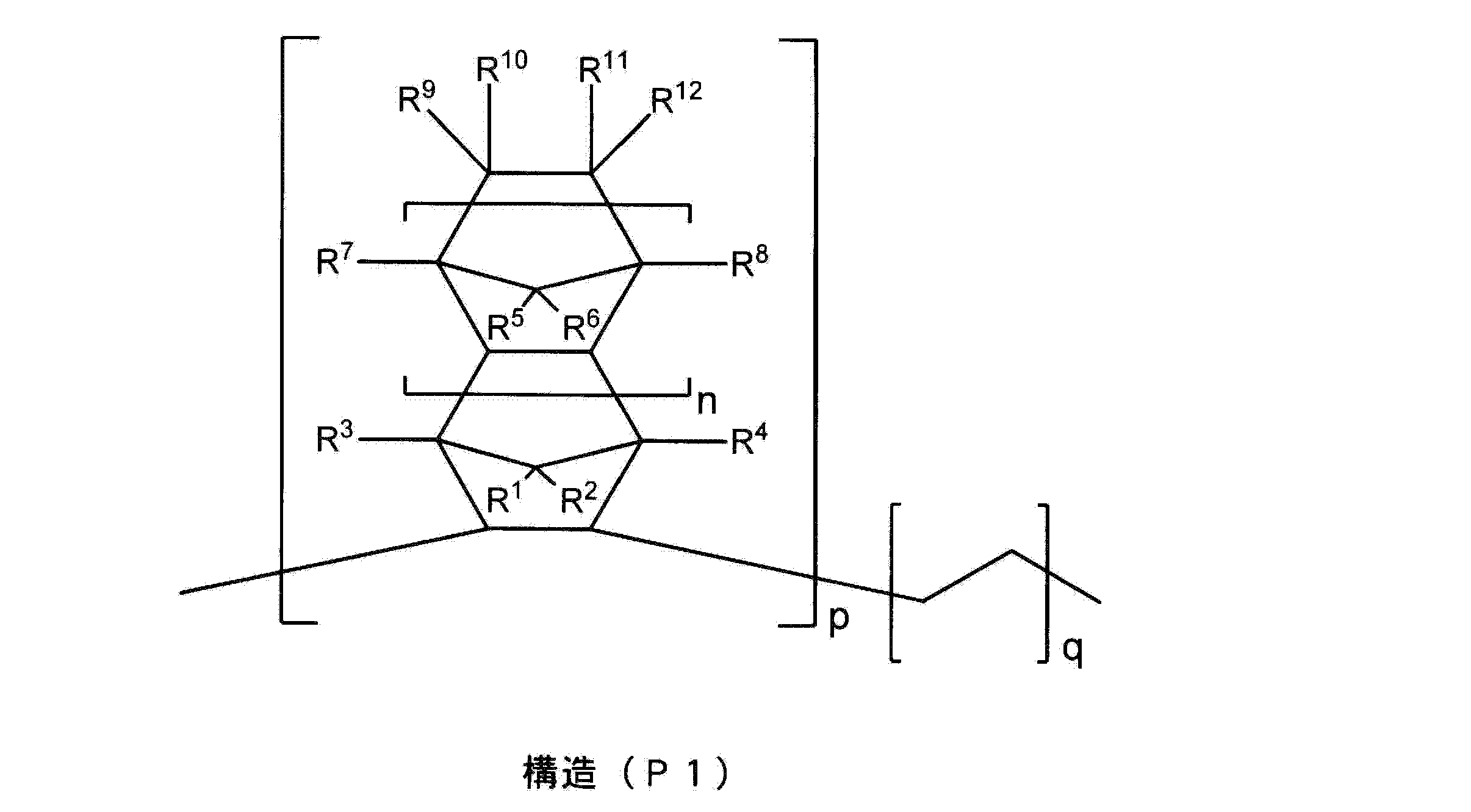
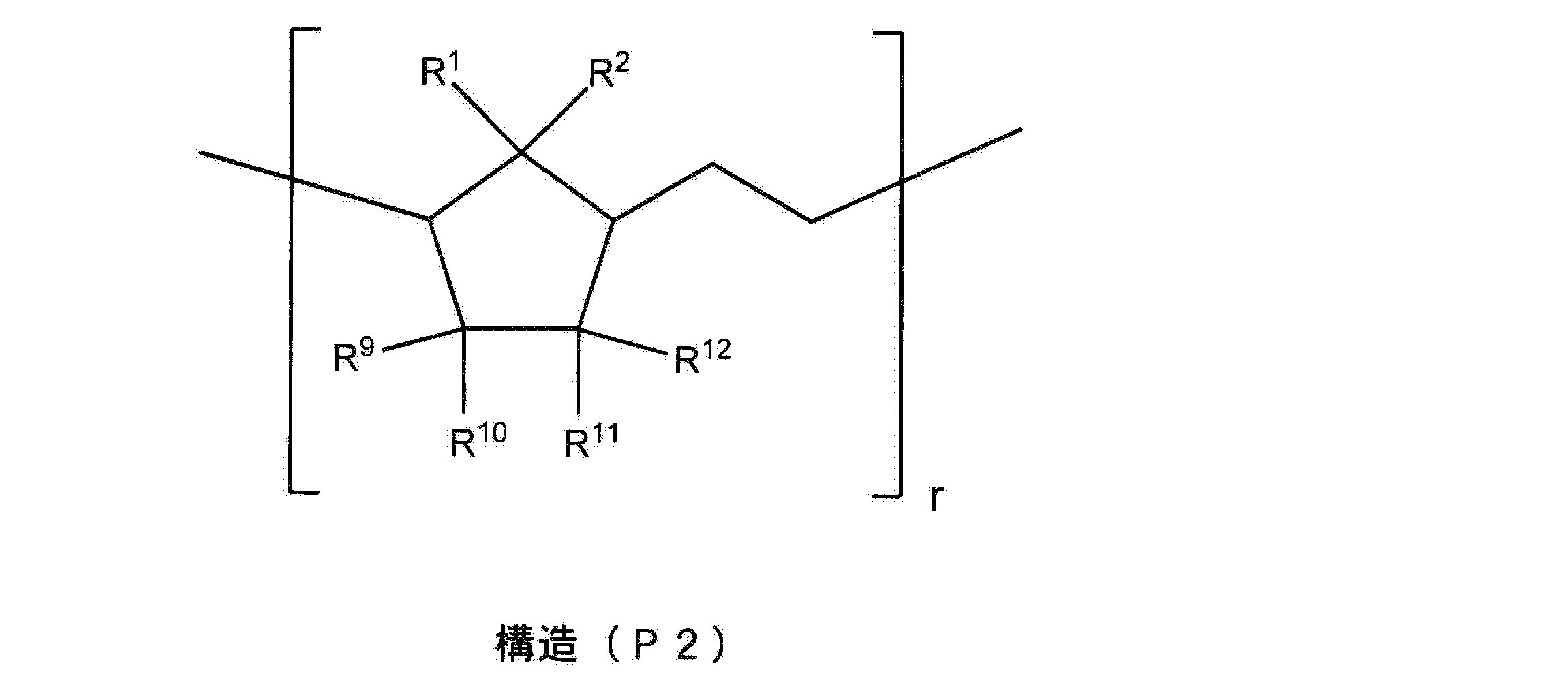
- cyclic olefin-based polymer examples include polymers having the following structure (P1) or the following structure (P2).
- R 1 ⁇ R 12 and n are the same as R 1 ⁇ R 12 and n in the cyclic alkylene structure (A1).
- p and q each represent a number of 1 or more. Although the upper limit of p and q is not specifically limited, For example, p can be 800 or less and q can be 2500 or less.
- R 1, R 2 and R 9 ⁇ R 12 are the same as R 1, R 2 and R 9 ⁇ R 12 in the cyclic alkylene structure (A2).
- r represents a number of 2 or more. Although the upper limit of r is not specifically limited, For example, it can be 400 or less.
- the cyclic olefin polymers (I) and (i) each have the structure (P1) or the structure (P2).
- the cyclic olefin polymer (I) and the cyclic olefin polymer (i) may both have the structure (P1), or both may have the structure (P2). Furthermore, the cyclic olefin polymer (I) may have a structure (P1), and the cyclic olefin polymer (i) may have a structure (P2). Preferably, at least the cyclic olefin polymer (i) has the structure (P1), more preferably the cyclic olefin polymer (I) and the cyclic olefin polymer (i) both have the structure (P1).
- the production method of the cyclic olefin polymer is not particularly limited, and the cyclic olefin polymer may be a polymer obtained by any production method. Examples thereof include a copolymer of a cyclic olefin component and an ⁇ -olefin component, a ring-opening (co) polymer of the cyclic olefin component, a hydrogenated product of a ring-opening (co) polymer of the cyclic olefin component, and the like.
- the copolymer may be a random copolymer, a block copolymer, or a graft copolymer, and is preferably a random copolymer.
- cyclic olefin polymer a copolymer of a cyclic olefin component and an ⁇ -olefin component can be preferably used from the viewpoint of easy adjustment of the glass transition temperature, the tensile modulus, and the like.
- the ⁇ -olefin is not particularly limited, but an ⁇ -olefin having 2 to 20 carbon atoms is preferable.
- ethylene propylene, 1-butene, 1-pentene, 1-hexene, 3-methyl-1-butene, 3-methyl-1-pentene, 3-ethyl-1-pentene, 4-methyl-1-pentene 4-methyl-1-hexene, 4,4-dimethyl-1-hexene, 4,4-dimethyl-1-pentene, 4-ethyl-1-hexene, 3-ethyl-1-hexene, 1-octene 1-decene, 1-dodecene, 1-tetradecene, 1-hexadecene, 1-octadecene, 1-eicocene and the like.
- the ⁇ -olefin component can be used alone or in combination of two or more. As the ⁇ -olefin component, it is preferable to use ethylene alone because it is easily available
- Preferred cyclic olefin components include the following compound (C).
- R 1 ⁇ R 12 and n are the same as R 1 ⁇ R 12 and n in the cyclic alkylene structure (A1).
- cyclic olefin component examples include, for example, Cyclopentene, cyclohexene, cyclooctene; monocyclic olefins such as cyclopentadiene, 1,3-cyclohexadiene; Bicyclo [2.2.1] hept-2-ene (common name: norbornene), 5-methyl-bicyclo [2.2.1] hept-2-ene, 5,5-dimethyl-bicyclo [2.2.
- Cyclic olefin ring Tricyclo [4.3.0.1 2,5 ] deca-3,7-diene (common name: dicyclopentadiene), tricyclo [4.3.0.1 2,5 ] dec-3-ene; tricyclo [ 4.4.0.1 2,5 ] undeca-3,7-diene or tricyclo [4.4.0.1 2,5 ] undeca-3,8-diene or a partially hydrogenated product thereof (or cyclopentadiene) Tricyclo [4.4.0.1 2,5 ] undec-3-ene; 5-cyclopentyl-bicyclo [2.2.1] hept-2-ene, 5-cyclohexyl-bicyclo [2.2.1] hept-2-ene, 5-cyclohexenylbicyclo [2.2.1] hept-2-ene, 5-phenyl-bicyclo [2.2.1] hept-2-ene, etc.
- a tricyclic olefin Tetracyclo [4.4.0.1 2,5 . 1 7,10 ] dodec-3-ene (also simply referred to as tetracyclododecene), 8-methyltetracyclo [4.4.0.1 2,5 . 1 7,10 ] dodec-3-ene, 8-ethyltetracyclo [4.4.0.1 2,5 . 1 7,10 ] dodec-3-ene, 8-methylidenetetracyclo [4.4.0.1 2,5 . 1 7,10 ] dodec-3-ene, 8-ethylidenetetracyclo [4.4.0.1 2,5 . 1 7,10 ] dodec-3-ene, 8-ethylidenetetracyclo [4.4.0.1 2,5 .
- pentadeca-5,10,12,14-tetraene also referred to as 1,4-methano-1,4,4a, 5,10,10a-hexahydroanthracene
- pentacyclo [6.6.1] .1,3,6 . 0 2,7 . 0 9,14 ] -4-hexadecene pentacyclo [6.5.1.1 3,6 . 0 2,7 . 0 9,13] -4-pentadecene
- the cyclic olefin component may be used alone or in combination of two or more.
- bicyclo [2.2.1] hept-2-ene (common name: norbornene) is preferably used alone.
- an unsaturated compound having a polar group is also possible to use as an optional component.
- Examples of the polar group and the unsaturated compound having the polar group are as described above.
- the polymerization catalyst used is not particularly limited, and a known catalyst such as a Ziegler-Natta, metathesis, or metallocene catalyst can be used.
- a copolymer of a cyclic olefin component and an ⁇ -olefin component is preferably produced using a metallocene catalyst.
- the ring-opening (co) polymer of the cyclic olefin component is preferably produced using a metathesis catalyst.
- the polymer obtained by the metathesis catalyst is preferably hydrogenated using an inorganic carrier-supported transition metal catalyst or the like.
- the glass transition temperature of the cyclic olefin-based polymer (I) is 60 ° C. or higher, preferably 70 ° C. or higher, more preferably 100 ° C. or higher, from the viewpoint of adapting to the usage environment in various applications. Moreover, since it becomes brittle when it exceeds 220 degreeC and a process tends to become difficult, the thing of the glass transition temperature of 220 degrees C or less is used normally. More preferably, it is 200 degrees C or less.
- the glass transition temperature of the cyclic olefin polymer (i) is 10 ° C. or lower. When it exceeds 10 degreeC, the toughness provision effect will become inadequate. On the other hand, if the glass transition temperature is less than ⁇ 50 ° C., there may be a problem that the pellets stick to each other during normal temperature storage, and it is preferably ⁇ 50 ° C. or higher. More preferably, it is ⁇ 10 ° C. or higher, and further preferably 0 ° C. or higher.
- the tensile elastic modulus of the cyclic olefin polymer (I) is preferably 1500 MPa or more, more preferably 2000 MPa or more, and further preferably 2500 MPa or more. Further, the tensile elastic modulus is preferably 5000 MPa or less, more preferably 4000 MPa or less, and further preferably 3500 MPa or less.
- the tensile elastic modulus of the cyclic olefin polymer (i) is preferably 1 MPa or more, more preferably 10 MPa or more, and further preferably 30 MPa or more. Further, the tensile elastic modulus is preferably 300 MPa or less, more preferably 100 MPa or less, and further preferably 60 MPa or less.
- cyclic olefin polymer examples include TOPAS (registered trademark) (manufactured by TOPAS Advanced Polymers), Apel (registered trademark) (manufactured by Mitsui Chemicals), Zeonex (registered trademark) (manufactured by Nippon Zeon), Examples include ZEONOR (registered trademark) (manufactured by ZEON Corporation), ARTON (registered trademark) (manufactured by JSR Corporation), and the like.
- TOPAS registered trademark
- Apel registered trademark
- Zeonex registered trademark
- ZEONOR registered trademark
- ARTON registered trademark
- cyclic olefin polymer (I) TOPAS 8007S-04 (78 ° C., 2600 MPa), 6013S-04 (138 ° C., 2900 MPa), 6015S-04 (158 ° C., 3000 MPa), 6017S-04 ( 178 ° C., 3000 MPa).
- the glass transition temperature (° C.) and tensile modulus (MPa) of the cyclic olefin polymer are shown in parentheses.
- the glass transition temperature and tensile modulus of the cyclic olefin polymer change, for example, the copolymerization ratio of the cyclic olefin component and the ⁇ -olefin component.
- Can be adjusted. Increasing the ratio of the cyclic olefin component tends to increase the glass transition temperature and the tensile elastic modulus, and increasing the proportion of the ⁇ -olefin component tends to decrease the glass transition temperature and the tensile elastic modulus.
- the glass transition temperature can be measured according to ISO 11357-1, -2, -3.
- the tensile elastic modulus can be measured according to ISO 527-2 / 1A.
- the tensile elastic modulus of the polymer composition is 800 MPa or more, preferably more than 1300 MPa, more preferably more than 1500 MPa, from the viewpoint of the practical strength of a processed product using the polymer composition.
- the tensile modulus of the polymer composition is not particularly limited, but is preferably 3800 MPa or less, more preferably 3500 MPa or less, and further preferably 3300 MPa or less.
- the upper limit of the tensile elastic modulus is from the viewpoint that the stress at the time of assembly tends to be too high if the tensile elastic modulus is too high. It is preferable that it is the said range.
- the polymer composition preferably exhibits two glass transition temperatures derived from the cyclic olefin polymer (I) and the cyclic olefin polymer (i) in a DSC curve created by differential scanning calorimetry. It is preferable that the polymer composition exhibits two glass transition temperatures from the viewpoint of maintaining the heat resistance of the cyclic olefin polymer (I). Differential scanning calorimetry can be performed according to ISO 11357-1, -2, -3.
- the cyclic olefin polymer (I) and the cyclic olefin polymer (i) are preferably incompatible. Due to the incompatibility, even when the cyclic olefin polymer (i) having a low glass transition temperature is added and mixed, the glass transition temperature does not change and the glass transition temperature of the cyclic olefin (I) is lowered. Therefore, heat resistance can be maintained.
- the polymer composition has a phase separation structure. It can be confirmed using a scanning electron microscope (SEM) that the polymer composition has a phase separation structure.
- the polymer composition preferably has a sea-island phase separation structure in which the sea phase is formed of the cyclic olefin-based polymer (I) and the island phase is formed of the cyclic olefin-based polymer (i).
- the content of the cyclic olefin polymer (I) in the polymer composition is preferably 50% by mass or more, more preferably 55% by mass or more, based on the total mass of the polymer composition, from the viewpoint of maintaining a high elastic modulus. More preferably, it is 60 mass% or more. Further, the content of the cyclic olefin polymer (I) is preferably 99% by mass or less, more preferably 95% by mass or less, and still more preferably 90% by mass, based on the total mass of the polymer composition, from the viewpoint of improving toughness. % Or less.
- the content of the cyclic olefin polymer (i) in the polymer composition is preferably 1% by mass or more, more preferably 5% by mass or more, and still more preferably, based on the total mass of the polymer composition. Is 10% by mass or more.
- the content of the cyclic olefin polymer (i) is preferably 50% by mass or less, more preferably 45% by mass or less, and still more preferably from the viewpoint of maintaining a high elastic modulus, based on the total mass of the polymer composition. It is 40 mass% or less.
- the polymer composition contains the cyclic olefin polymer (I) in an amount of 50 to 99% by mass with respect to the total mass of the polymer composition, and the cyclic olefin polymer (i) with respect to the total mass of the polymer composition. 1 to 50% by mass is contained.
- the polymer composition may contain an arbitrary component other than the cyclic olefin polymer.
- optional components include thermoplastic resins and additives.
- thermoplastic resin examples include general-purpose polyolefin resins such as high-density polyethylene (HDPE), low-density polyethylene (LDPE), linear low-density polyethylene (LLDPE), and polypropylene; polystyrene, polyacrylate, polymethacrylate, and the like A vinyl resin; a polyester resin such as polyethylene terephthalate and polybutylene terephthalate; and a polyamide resin such as nylon 6 and nylon 66.
- a thermoplastic resin can be used individually by 1 type or in combination of 2 or more types.
- the content is preferably such that the purity of the polymer composition is not impaired.
- the additive is not particularly limited as long as it is usually used in thermoplastic resin materials.
- examples thereof include heat stabilizers, light stabilizers, antistatic agents, slip agents, antiblocking agents, deodorants, lubricants, synthetic oils, natural oils, inorganic and organic fillers, dyes, pigments, and the like.
- the content of the additive is preferably a content that does not impair the purity of the polymer composition.
- the method for producing the polymer composition is not particularly limited.
- the cyclic olefin-based polymer (I), the cyclic olefin-based polymer (i), and optional components as necessary can be blended and mixed.
- the mixing method is not limited to a specific method. Specific examples of the mixing method include a method of kneading the cyclic olefin polymer in a molten state with an apparatus such as a mixer, a single-screw kneader, a twin-screw kneader, a roll, a Brabender, or an extruder, and the cyclic olefin polymer in an appropriate solvent.
- the solvent may be removed by dissolution, dispersion, solidification, casting, or direct drying.
- the form of the polymer composition is not particularly limited, and examples thereof include pellets, powders, and solutions.
- a pellet shape is preferred.
- the polymer composition can be prepared by mixing the cyclic olefin polymers (I) and (i) using a kneader, extruding them into a rod shape in a molten state, cutting them into an appropriate length with a cutter, and pelletizing them.
- the purity of the polymer composition is preferably excellent.
- the metal content contained in the polymer composition is preferably 20 ppm or less, more preferably 10 ppm or less, and still more preferably 5 ppm or less.
- the metal include Al, Ca, Fe, Mg, Mn, Na, and Ti.
- the metal content can be measured by inductively coupled plasma (ICP) emission spectroscopy.
- ICP inductively coupled plasma
- a purified cyclic polyolefin-based polymer In order to suppress the metal content in the polymer composition, it is preferable to use a purified cyclic polyolefin-based polymer.
- the purification method include filtration, adsorption, and the like. Specifically, paragraphs 0010 of JP 05-317411 A, paragraphs 0009 of JP 2003-183361 A, JP 2009-227840 A, and the like. Methods described in paragraphs 0038 to 0054 of the publication are known.
- pellets Another embodiment of the invention relates to pellets (a set of pellets comprising two or more pellets) for obtaining a polymer composition.
- the pellet includes at least a pellet (I) containing a cyclic olefin polymer (I) and a pellet (i) containing a cyclic olefin polymer (i).
- the metal content contained in each pellet is preferably low.
- the total content of aluminum, calcium, iron, magnesium, manganese, sodium, and titanium contained in each pellet is preferably 20 ppm or less, more preferably 10 ppm or less, and even more preferably 5 ppm or less.
- the metal content contained in each pellet is preferably 20 ppm or less, more preferably 10 ppm or less, and even more preferably 5 ppm or less.
- Examples of commercially available products of cyclic olefin polymers having a low metal content include TOPAS (registered trademark) (manufactured by TOPAS Advanced Polymers). Since these cyclic olefin-based polymers have a low metal content compared to commercially available polyethylene and the like, they are suitable for producing highly pure polymer compositions. By mixing pellets having a low metal content, it is possible to easily obtain a polymer composition having excellent purity.
- Molded articles include food films, pharmaceutical films, agricultural films, coating materials, medical infusion packs, diagnostic instruments, daily necessities, toys, automobile parts, home appliance parts, non-woven fabrics or woven fabrics used for various filters, Examples include various filter housings, piping tubes, connectors, and the like.
- a pellet (compound) made of a polymer composition is used, or a pellet made of a cyclic olefin polymer (I) and a pellet made of a cyclic olefin polymer (i) are used by dry blending. May be.
- Examples of the molding method include a single screw extruder, a vent-type extruder, a twin screw extruder, a conical twin screw extruder, a kneader, a plasticizer, a mixed screwer, a twin screw conical screw extruder, and a planetary screw extruder. And a method of performing extrusion molding, injection molding, blow molding, rotational molding, melt spinning, long-fiber nonwoven fabric processing, etc. using a gear-type extruder, a screwless extruder, or the like. Furthermore, a film or a sheet can be produced by a T-die molding method, an inflation molding method, or the like. In molding process, heat stabilizer, light stabilizer, antistatic agent, slip agent, antiblocking agent, deodorant, lubricant, synthetic oil, natural oil, inorganic and organic filler, dye, pigment as required It is also possible to add additives such as.
- the obtained polymer composition was subjected to thermal deformation temperature evaluation, tensile test and the like. The results are shown in Table 2.
- the polymer composition containing the cyclic olefin polymer (I) having a glass transition temperature of 60 ° C. or higher and the cyclic olefin polymer (i) having a glass transition temperature of 10 ° C. or lower is high. It had excellent flexibility while maintaining the heat distortion temperature. It was also excellent in purity.
- Glass transition temperature of cyclic olefin polymer The glass transition temperature of the cyclic olefin-based polymer was measured according to ISO 11357-1, -2, -3, at a heating rate of 10 ° C / min.
- An inductively coupled plasma emission spectrometer (“CIROSCCD-120” manufactured by Spectro Co.) was used to measure the metal content of the cyclic olefin polymer and the polymer composition.
- ICP general-purpose mixed solution XSTC-22 manufactured by SPEX was used.
- a 1 g sample washed with ultrapure water was weighed into a platinum crucible, heated and carbonized with an electric stove, and then incinerated with an electric furnace (600 ° C. ⁇ 1 hr).
- the incinerated sample was dissolved in 5 ml of a 3.5% by mass hydrochloric acid aqueous solution, and the resulting solution was made up to 25 ml with ultrapure water.
- the fixed volume solution was used as an analysis sample, and the target metal (Al, Ca, Fe, Mg, Mn, Na, Ti) was quantitatively analyzed by ICP emission spectrometry.
- the lower limit of detection is 0.25 ppm ( ⁇ g / g).
- Table 2 shows the total content of the target metals. “ ⁇ 5” means “less than 5 ppm”.
- Glass transition temperature of polymer composition The polymer composition was subjected to differential scanning calorimetry in accordance with ISO 11357-1, -2, -3 at a heating rate of 10 ° C / min, and a DSC curve was prepared. In the DSC curve, what was able to confirm the two glass transition temperatures derived from the cyclic olefin-based polymers (I) and (i) was determined to be “present”, and those that could not be confirmed were determined to be “not present”.
- Heat deformation temperature (DTUL) The heat distortion temperature of the polymer composition was measured under the condition of a load of 0.45 MPa according to ISO 75-1, -2.
- Example 7 and Comparative Example 3 were evaluated according to the folding resistance test (MIT) (JIS P 8115). Evaluation conditions are shown below. Table 2 shows the number of reciprocations until destruction. Measuring equipment: MIT Folding Fatigue Tester “MIT-DA” manufactured by Toyo Seiki Seisakusho Co., Ltd. Angle: 135 ° Test speed: 175 cpm Load: 9.8N Clamp: Curvature 0.38 Clearance 0.25mm Test piece: Width 15mm Measurement environment: 23 ° C, 50% RH Folding direction MD: Fold the film in the resin flow direction. The fold line is orthogonal to the resin flow direction. TD: Fold the film in a direction perpendicular to the resin flow direction. The crease is along the resin flow direction.
- MIT folding resistance test
- the polymer composition, pellets, and molded article of the present invention are foods, pharmaceuticals, medical supplies, daily necessities, packaging materials such as electronic components, diagnostic instruments in the medical field, or devices used in manufacturing processes of pharmaceuticals, semiconductors, etc. It is preferably used for applications such as parts.
- a polymer composition having a low metal content is suitable for medical applications (pharmaceutical processes, equipment piping, joints, etc.) and semiconductor applications (semiconductor manufacturing processes).
Landscapes
- Chemical & Material Sciences (AREA)
- Health & Medical Sciences (AREA)
- Chemical Kinetics & Catalysis (AREA)
- Medicinal Chemistry (AREA)
- Polymers & Plastics (AREA)
- Organic Chemistry (AREA)
- Compositions Of Macromolecular Compounds (AREA)
Abstract
本発明の実施形態は、ガラス転移温度が60℃以上である環状オレフィン系ポリマー(I)、及び、ガラス転移温度が10℃以下である環状オレフィン系ポリマー(i)を含有し、ISO 527-2/1Aに準拠して測定した引張弾性率が800MPa以上である、ポリマー組成物に関する。
Description
本発明は、環状オレフィン系ポリマーを含有するポリマー組成物、ペレット、及び成形品に関する。
環状オレフィン系ポリマーは、耐熱性、透明性、水蒸気バリア性等に優れていることから、食品、医薬品、医療用品、日用品、電子部品等の包装材料として、広く用いられている。また、成形性にも優れることから、医療分野における診断器具、又は、医薬品、半導体等の製造工程で用いられる装置若しくは部品などへの適用も期待されている。
例えば、特許文献1及び2には、容器、包装等の用途に適した環状オレフィン系樹脂組成物が開示されている。特許文献1では、スリップ性が改良され、透明性、表面光沢に優れた成形体を提供するという課題に対し、(A)環状オレフィン系樹脂(A1)又は該環状オレフィン系樹脂(A1)と(b)ポリオレフィンとからなる樹脂組成物(A2)と、(B)アミド系化合物とよりなる環状オレフィン系樹脂組成物が開示されている。また、特許文献2では、スリップ性が改良され、透明性、表面光沢に優れた成形体を提供するという課題に対し、(A)環状オレフィン系樹脂(A1)又は該環状オレフィン系樹脂(A1)と(b)ポリオレフィンとからなる樹脂組成物(A2)と、(B)前記(A1)とは異なる化学構造を有する少なくとも一種の環状オレフィン系樹脂(B1)とよりなる環状オレフィン系樹脂組成物が開示されている。
一般に用いられている環状オレフィン系ポリマーは、耐熱性に優れ、誘電率が低い等の特徴を有している。しかし、弾性率が高く靭性が低いために、用途、成形方法等によっては、環状オレフィン系ポリマー単独で使用することが難しい場合がある。
そこで、本発明の実施形態は、高い耐熱性を維持しつつ、靱性に優れるポリマー組成物、及び当該ポリマー組成物を得るためのペレットを提供することを目的とする。また、本発明の実施形態は、高い耐熱性を維持しつつ、靱性に優れる成形品を提供することを目的とする。
本発明者は、特定の環状オレフィン系ポリマーを組み合わせて用いることにより、上記課題を解決できることを見出し、本発明を完成させるに至った。
本発明の実施形態は、ガラス転移温度が60℃以上である環状オレフィン系ポリマー(I)、及び、ガラス転移温度が10℃以下である環状オレフィン系ポリマー(i)を含有し、ISO 527-2/1Aに準拠して測定した引張弾性率が800MPa以上である、ポリマー組成物に関する。
また、本発明の他の実施形態は、前記環状オレフィン系ポリマー(I)を含有するペレット(I)と、前記環状オレフィン系ポリマー(i)を含有するペレット(i)とを備え、前記実施形態のポリマー組成物を得るために用いられる、ペレットに関する。
さらに、本発明の他の実施形態は、前記実施形態のポリマー組成物により形成された成形品に関する。
本発明の実施形態によれば、高い耐熱性を維持しつつ、靭性に優れるポリマー組成物、及び当該ポリマー組成物を得るためのペレットを提供することができる。また、本発明の他の実施形態によれば、高い耐熱性を維持しつつ、靱性に優れる成形品を提供することができる。
本発明は、平成27年2月10日に出願された特願2015-024323号に記載の主題と関連しており、その開示内容は、参照によりここに援用される。
以下、本発明の実施形態について説明する。
[ポリマー組成物]
本発明の実施形態は、ガラス転移温度が60℃以上である環状オレフィン系ポリマー(I)、及び、ガラス転移温度が10℃以下である環状オレフィン系ポリマー(i)を含有し、ISO 527-2/1Aに準拠して測定した引張弾性率が800MPa以上である組成物に関する。
本発明の実施形態は、ガラス転移温度が60℃以上である環状オレフィン系ポリマー(I)、及び、ガラス転移温度が10℃以下である環状オレフィン系ポリマー(i)を含有し、ISO 527-2/1Aに準拠して測定した引張弾性率が800MPa以上である組成物に関する。
ガラス転移温度が60℃以上である環状オレフィン系ポリマー(I)のみを用いる場合、ポリマーの靭性が低いために、得られた成形品の靱性、耐衝撃性等が劣るという傾向がある。本発明の実施形態においては、環状オレフィン系ポリマー(I)とガラス転移温度が10℃以下である環状オレフィン系ポリマー(i)とを併用することによって、靱性の向上が可能となる。
環状オレフィン系ポリマー(I)及び環状オレフィン系ポリマー(i)(以下、両者を併せて、「環状オレフィン系ポリマー」という場合がある。)は、少なくとも環状オレフィン成分を含む重合成分を重合して得ることができるポリマーである。環状オレフィン系ポリマーは、主鎖に少なくとも環状アルキレン構造を有する。
一実施形態において、環状オレフィン系ポリマーは、下記環状アルキレン構造(A1)及び下記環状アルキレン構造(A2)からなる群から選択される少なくとも一種と、下記直鎖状アルキレン構造(B)とを有する。

R9とR10、及び、R11とR12は、それぞれ、一体化して2価の炭化水素基を形成していてもよく、
R9又はR10と、R11又はR12とは、それぞれ、結合して環を形成していてもよい。
nは、0又は正の整数を示し、nが2以上の場合には、R5~R8は、繰り返し単位ごとに、互いに同一でも異なっていてもよい。nの上限は特に限定されないが、例えば、3以下とできる。
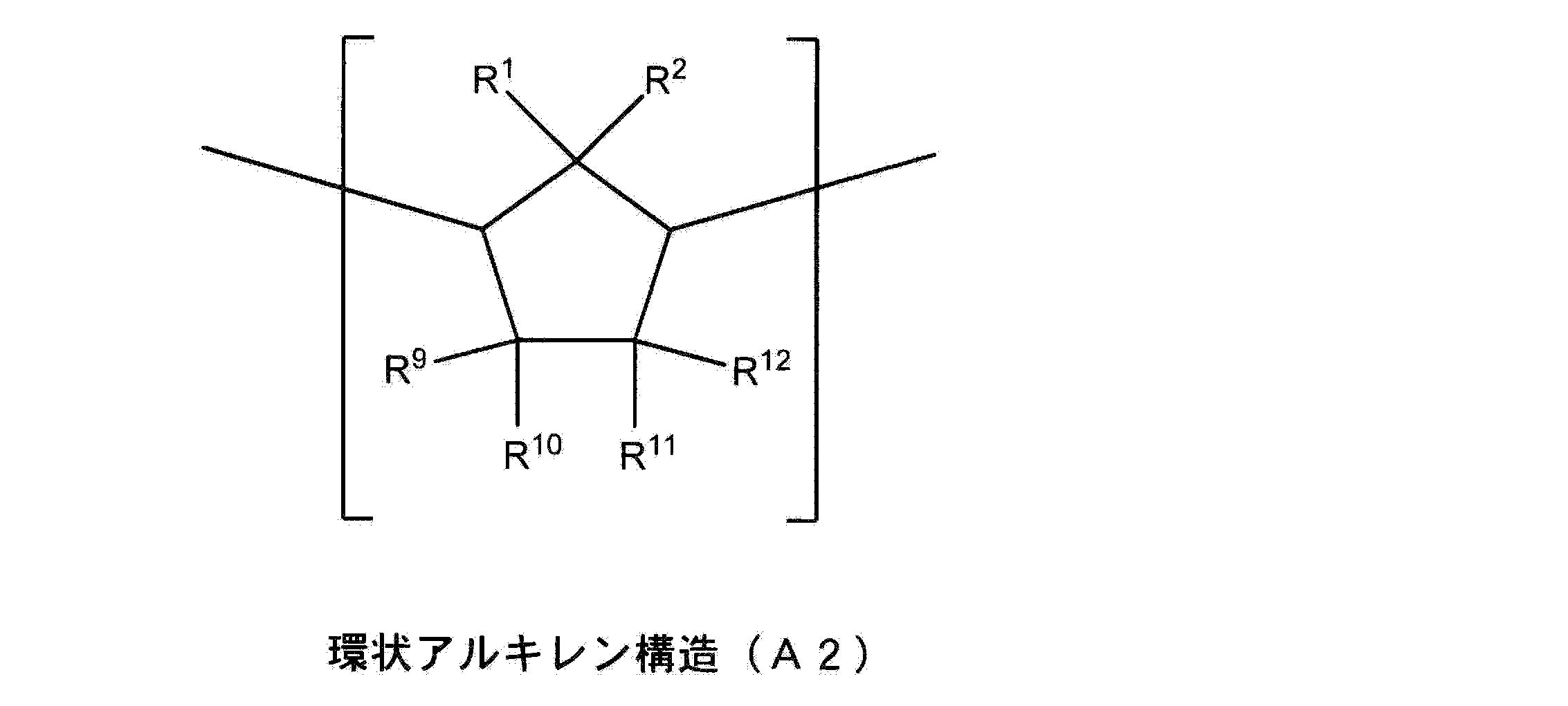
R9とR10、及び、R11とR12は、それぞれ、一体化して2価の炭化水素基を形成していてもよく、
R9又はR10と、R11又はR12とは、それぞれ、結合して環を形成していてもよい。

R1~R12は、それぞれ独立に、同一でも異なっていてもよく、水素原子、ハロゲン原子、及び、炭化水素基からなる群より選ばれるものである。好ましくは水素原子である。
R1~R8の具体例としては、例えば、水素原子;フッ素、塩素、臭素等のハロゲン原子;メチル基、エチル基、プロピル基、ブチル基等の低級アルキル基等を挙げることができる。R1~R8は、それぞれ異なっていてもよく、部分的に異なっていてもよく、また、全部が同一であってもよい。
R9~R12の具体例としては、例えば、水素原子;フッ素、塩素、臭素等のハロゲン原子;メチル基、エチル基、プロピル基、イソプロピル基、ブチル基、イソブチル基、ヘキシル基、ステアリル基等のアルキル基;シクロヘキシル基等のシクロアルキル基;フェニル基、トリル基、エチルフェニル基、イソプロピルフェニル基、ナフチル基、アントリル基等の置換又は無置換の芳香族炭化水素基;ベンジル基、フェネチル基等のアルキル基にアリール基が置換したアラルキル基等を挙げることができる。R9~R12は、それぞれ異なっていてもよく、部分的に異なっていてもよく、また、全部が同一であってもよい。
R9とR10、又は、R11とR12とが、一体化して2価の炭化水素基を形成する場合、具体例としては、例えば、エチリデン基、プロピリデン基、イソプロピリデン基等のアルキリデン基等を挙げることができる。
R9又はR10と、R11又はR12とが、環を形成する場合、形成される環は単環であっても、多環であってもよい。また、形成される環は、架橋を有する多環であってもよく、二重結合を有する環であってもよい。さらに、これらの環の組合せからなる環であってもよい。また、形成される環はメチル基等の置換基を有していてもよい。
環状オレフィン系ポリマーには、極性基を有する不飽和化合物に由来する構造を有するポリマーも含まれる。
極性基としては、例えば、カルボキシル基、酸無水物基、エポキシ基、アミド基、エステル基、ヒドロキシル基等を挙げることができる。極性基を有する不飽和化合物としては、(メタ)アクリル酸、マレイン酸、無水マレイン酸、無水イタコン酸、グリシジル(メタ)アクリレート、(メタ)アクリル酸アルキル(好ましくは、炭素数1~10)エステル、マレイン酸アルキル(好ましくは、炭素数1~10)エステル、(メタ)アクリルアミド、(メタ)アクリル酸-2-ヒドロキシエチル等を挙げることができる。
なお、「(メタ)アクリル」とは、「アクリル」又は「メタクリル」を意味し、「(メタ)アクリレート」とは、「アクリレート」又は「メタクリレート」を意味する。
好ましくは、環状オレフィン系ポリマー(I)及び(i)が、それぞれ、環状アルキレン構造(A1)及び環状アルキレン構造(A2)からなる群から選択される少なくとも一種と、直鎖状アルキレン構造(B)とを有する。
環状オレフィン系ポリマー(I)と環状オレフィン系ポリマー(i)とは、共に環状アルキレン構造(A1)を有するものであっても、又は、共に環状アルキレン構造(A2)を有するものであってもよい。さらに、環状オレフィン系ポリマー(I)が環状アルキレン構造(A1)を有し、環状オレフィン系ポリマー(i)が環状アルキレン構造(A2)を有するものであってもよい。好ましくは、少なくとも環状オレフィン系ポリマー(i)が環状アルキレン構造(A1)を有し、より好ましくは、環状オレフィン系ポリマー(I)と環状オレフィン系ポリマー(i)とが、共に環状アルキレン構造(A1)を有する。
環状オレフィン系ポリマーとして、具体的には、下記構造(P1)又は下記構造(P2)を有するポリマーが挙げられる。

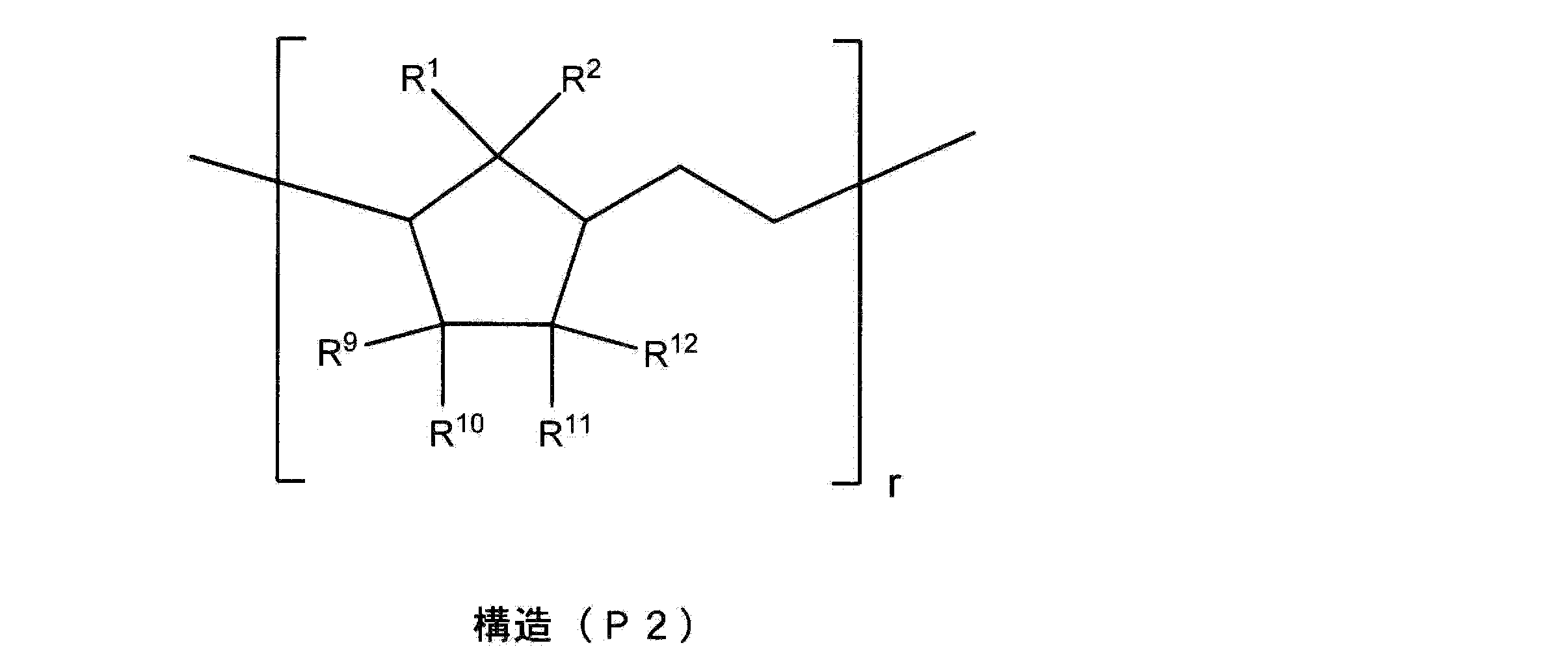
好ましくは、環状オレフィン系ポリマー(I)及び(i)が、それぞれ、構造(P1)又は構造(P2)を有する。
環状オレフィン系ポリマー(I)と環状オレフィン系ポリマー(i)とは、共に構造(P1)を有するものであっても、又は、共に構造(P2)を有するものであってもよい。さらに、環状オレフィン系ポリマー(I)が構造(P1)を有し、環状オレフィン系ポリマー(i)が構造(P2)を有するものであってもよい。好ましくは、少なくとも環状オレフィン系ポリマー(i)が、構造(P1)を有し、より好ましくは環状オレフィン系ポリマー(I)と環状オレフィン系ポリマー(i)とが、共に構造(P1)を有する。
環状オレフィン系ポリマーの製造方法は特に限定されず、環状オレフィン系ポリマーとしては、いずれの製造方法で得たポリマーであっても構わない。例えば、環状オレフィン成分とα-オレフィン成分との共重合体、環状オレフィン成分の開環(共)重合体、環状オレフィン成分の開環(共)重合体の水素添加物等が挙げられる。共重合体は、ランダム共重合体であっても、ブロック共重合体であっても、グラフト共重合体であってもよく、ランダム共重合であることが好ましい。
環状オレフィン系ポリマーとしては、ガラス転移温度、引張弾性率等の調整が容易であるという観点から、環状オレフィン成分とα-オレフィン成分との共重合体を好ましく用いることができる。
α-オレフィンとしては、特に制限はないが、炭素数2~20のα-オレフィンが好ましい。例えば、エチレン、プロピレン、1-ブテン、1-ペンテン、1-へキセン、3-メチル-1-ブテン、3-メチル-1-ペンテン、3-エチル-1-ペンテン、4-メチル-1-ペンテン、4-メチル-1-へキセン、4,4-ジメチル-1-ヘキセン、4,4-ジメチル-1-ペンテン、4-エチル-1-へキセン、3-エチル-1-ヘキセン、1-オクテン、1-デセン、1-ドデセン、1-テトラデセン、1-ヘキサデセン、1-オクタデセン、1-エイコセン等を挙げることができる。また、α-オレフィン成分は、一種を単独で、又は、二種以上を組み合わせて使用できる。α-オレフィン成分としては入手しやすさ、及び、扱いやすさからエチレンの単独使用が好ましい。
好ましい環状オレフィン成分として、下記化合物(C)が挙げられる。
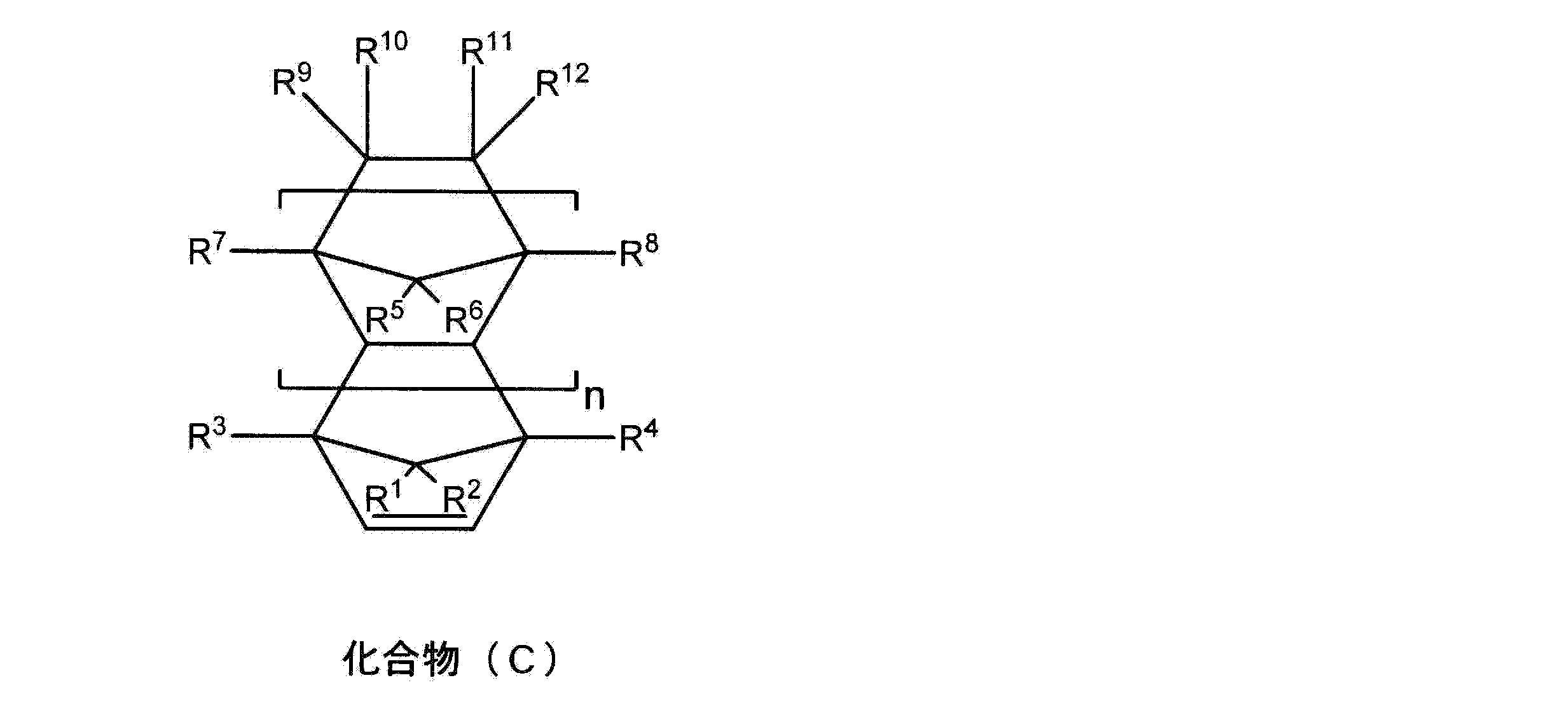
環状オレフィン成分の具体例としては、例えば、
シクロペンテン、シクロヘキセン、シクロオクテン;シクロペンタジエン、1,3-シクロヘキサジエン等の1環の環状オレフィン;
ビシクロ[2.2.1]ヘプタ-2-エン(慣用名:ノルボルネン)、5-メチル-ビシクロ[2.2.1]ヘプタ-2-エン、5,5-ジメチル-ビシクロ[2.2.1]ヘプタ-2-エン、5-エチル-ビシクロ[2.2.1]ヘプタ-2-エン、5-ブチル-ビシクロ[2.2.1]ヘプタ-2-エン、5-エチリデン-ビシクロ[2.2.1]ヘプタ-2-エン、5-ヘキシル-ビシクロ[2.2.1]ヘプタ-2-エン、5-オクチル-ビシクロ[2.2.1]ヘプタ-2-エン、5-オクタデシル-ビシクロ[2.2.1]ヘプタ-2-エン、5-メチリデン-ビシクロ[2.2.1]ヘプタ-2-エン、5-ビニル-ビシクロ[2.2.1]ヘプタ-2-エン、5-プロペニル-ビシクロ[2.2.1]ヘプタ-2-エン等の2環の環状オレフィン;
トリシクロ[4.3.0.12,5]デカ-3,7-ジエン(慣用名:ジシクロペンタジエン)、トリシクロ[4.3.0.12,5]デカ-3-エン;トリシクロ[4.4.0.12,5]ウンデカ-3,7-ジエン若しくはトリシクロ[4.4.0.12,5]ウンデカ-3,8-ジエン又はこれらの部分水素添加物(又はシクロペンタジエンとシクロヘキセンの付加物)であるトリシクロ[4.4.0.12,5]ウンデカ-3-エン;5-シクロペンチル-ビシクロ[2.2.1]ヘプタ-2-エン、5-シクロヘキシル-ビシクロ[2.2.1]ヘプタ-2-エン、5-シクロヘキセニルビシクロ[2.2.1]ヘプタ-2-エン、5-フェニル-ビシクロ[2.2.1]ヘプタ-2-エン等の3環の環状オレフィン;
テトラシクロ[4.4.0.12,5.17,10]ドデカ-3-エン(単にテトラシクロドデセンともいう)、8-メチルテトラシクロ[4.4.0.12,5.17,10]ドデカ-3-エン、8-エチルテトラシクロ[4.4.0.12,5.17,10]ドデカ-3-エン、8-メチリデンテトラシクロ[4.4.0.12,5.17,10]ドデカ-3-エン、8-エチリデンテトラシクロ[4.4.0.12,5.17,10]ドデカ-3-エン、8-ビニルテトラシクロ[4,4.0.12,5.17,10]ドデカ-3-エン、8-プロペニル-テトラシクロ[4.4.0.12,5.17,10]ドデカ-3-エン等の4環の環状オレフィン;
8-シクロペンチル-テトラシクロ[4.4.0.12,5.17,10]ドデカ-3-エン、8-シクロヘキシル-テトラシクロ[4.4.0.12,5.17,10]ドデカ-3-エン、8-シクロヘキセニル-テトラシクロ[4.4.0.12,5.17,10]ドデカ-3-エン、8-フェニル-シクロペンチル-テトラシクロ[4.4.0.12,5.17,10]ドデカ-3-エン;テトラシクロ[7.4.13,6.01,9.02,7]テトラデカ-4,9,11,13-テトラエン(1,4-メタノ-1,4,4a,9a-テトラヒドロフルオレンともいう)、テトラシクロ[8.4.14,7.01,10.03,8]ペンタデカ-5,10,12,14-テトラエン(1,4-メタノ-1,4,4a,5,10,10a-へキサヒドロアントラセンともいう);ペンタシクロ[6.6.1.13,6.02,7.09,14]-4-ヘキサデセン、ペンタシクロ[6.5.1.13,6.02,7.09,13]-4-ペンタデセン、ペンタシクロ[7.4.0.02,7.13,6.110,13]-4-ペンタデセン;ヘプタシクロ[8.7.0.12,9.14,7.111,17.03,8.012,16]-5-エイコセン、ヘプタシクロ[8.7.0.12,9.03,8.14,7.012,17.113,l6]-14-エイコセン;シクロペンタジエンの4量体等の多環の環状オレフィンを挙げることができる。
シクロペンテン、シクロヘキセン、シクロオクテン;シクロペンタジエン、1,3-シクロヘキサジエン等の1環の環状オレフィン;
ビシクロ[2.2.1]ヘプタ-2-エン(慣用名:ノルボルネン)、5-メチル-ビシクロ[2.2.1]ヘプタ-2-エン、5,5-ジメチル-ビシクロ[2.2.1]ヘプタ-2-エン、5-エチル-ビシクロ[2.2.1]ヘプタ-2-エン、5-ブチル-ビシクロ[2.2.1]ヘプタ-2-エン、5-エチリデン-ビシクロ[2.2.1]ヘプタ-2-エン、5-ヘキシル-ビシクロ[2.2.1]ヘプタ-2-エン、5-オクチル-ビシクロ[2.2.1]ヘプタ-2-エン、5-オクタデシル-ビシクロ[2.2.1]ヘプタ-2-エン、5-メチリデン-ビシクロ[2.2.1]ヘプタ-2-エン、5-ビニル-ビシクロ[2.2.1]ヘプタ-2-エン、5-プロペニル-ビシクロ[2.2.1]ヘプタ-2-エン等の2環の環状オレフィン;
トリシクロ[4.3.0.12,5]デカ-3,7-ジエン(慣用名:ジシクロペンタジエン)、トリシクロ[4.3.0.12,5]デカ-3-エン;トリシクロ[4.4.0.12,5]ウンデカ-3,7-ジエン若しくはトリシクロ[4.4.0.12,5]ウンデカ-3,8-ジエン又はこれらの部分水素添加物(又はシクロペンタジエンとシクロヘキセンの付加物)であるトリシクロ[4.4.0.12,5]ウンデカ-3-エン;5-シクロペンチル-ビシクロ[2.2.1]ヘプタ-2-エン、5-シクロヘキシル-ビシクロ[2.2.1]ヘプタ-2-エン、5-シクロヘキセニルビシクロ[2.2.1]ヘプタ-2-エン、5-フェニル-ビシクロ[2.2.1]ヘプタ-2-エン等の3環の環状オレフィン;
テトラシクロ[4.4.0.12,5.17,10]ドデカ-3-エン(単にテトラシクロドデセンともいう)、8-メチルテトラシクロ[4.4.0.12,5.17,10]ドデカ-3-エン、8-エチルテトラシクロ[4.4.0.12,5.17,10]ドデカ-3-エン、8-メチリデンテトラシクロ[4.4.0.12,5.17,10]ドデカ-3-エン、8-エチリデンテトラシクロ[4.4.0.12,5.17,10]ドデカ-3-エン、8-ビニルテトラシクロ[4,4.0.12,5.17,10]ドデカ-3-エン、8-プロペニル-テトラシクロ[4.4.0.12,5.17,10]ドデカ-3-エン等の4環の環状オレフィン;
8-シクロペンチル-テトラシクロ[4.4.0.12,5.17,10]ドデカ-3-エン、8-シクロヘキシル-テトラシクロ[4.4.0.12,5.17,10]ドデカ-3-エン、8-シクロヘキセニル-テトラシクロ[4.4.0.12,5.17,10]ドデカ-3-エン、8-フェニル-シクロペンチル-テトラシクロ[4.4.0.12,5.17,10]ドデカ-3-エン;テトラシクロ[7.4.13,6.01,9.02,7]テトラデカ-4,9,11,13-テトラエン(1,4-メタノ-1,4,4a,9a-テトラヒドロフルオレンともいう)、テトラシクロ[8.4.14,7.01,10.03,8]ペンタデカ-5,10,12,14-テトラエン(1,4-メタノ-1,4,4a,5,10,10a-へキサヒドロアントラセンともいう);ペンタシクロ[6.6.1.13,6.02,7.09,14]-4-ヘキサデセン、ペンタシクロ[6.5.1.13,6.02,7.09,13]-4-ペンタデセン、ペンタシクロ[7.4.0.02,7.13,6.110,13]-4-ペンタデセン;ヘプタシクロ[8.7.0.12,9.14,7.111,17.03,8.012,16]-5-エイコセン、ヘプタシクロ[8.7.0.12,9.03,8.14,7.012,17.113,l6]-14-エイコセン;シクロペンタジエンの4量体等の多環の環状オレフィンを挙げることができる。
環状オレフィン成分は、一種単独で、又は、二種以上を組み合わせて使用してもよい。環状オレフィン成分としては、ビシクロ[2.2.1]ヘプタ-2-エン(慣用名:ノルボルネン)を単独使用することが好ましい。
また、任意の成分として、極性基を有する不飽和化合物を用いることも可能である。極性基、及び、極性基を有する不飽和化合物の例は、上述のとおりである。
環状オレフィン成分とα-オレフィン成分との共重合方法、環状オレフィン成分の開環(共)重合方法、環状オレフィン成分の開環(共)重合体の水素添加方法に、特に制限はなく、公知の方法に従って行うことができる。
用いられる重合触媒についても特に限定されるものではなく、チーグラー・ナッタ系、メタセシス系、メタロセン系触媒等の公知の触媒を用いることができる。例えば、環状オレフィン成分とα-オレフィン成分との共重合体は、メタロセン系触媒を用いて製造されることが好ましい。また、環状オレフィン成分の開環(共)重合体は、メタセシス系触媒を用いて製造されることが好ましい。また、メタセシス触媒で得られる重合体は無機担体担持遷移金属触媒等を用いて水素添加することが好ましい。
環状オレフィン系ポリマー(I)のガラス転移温度は、種々用途での使用環境への適応の観点から、60℃以上であり、好ましくは70℃以上であり、より好ましくは100℃以上である。また、220℃を超えると脆くなり、加工が困難となる傾向があるため、通常220℃以下のガラス転移温度のものが用いられる。より好ましくは200℃以下である。
環状オレフィン系ポリマー(i)のガラス転移温度は10℃以下である。10℃を超えると、靭性付与効果が不十分となる。一方、ガラス転移温度が-50℃未満であると、常温保管時にペレット同士が貼り付く等の問題が生じる場合があり、-50℃以上が好ましい。より好ましくは-10℃以上、更に好ましくは0℃以上である。
環状オレフィン系ポリマー(I)の引張弾性率は、好ましくは1500MPa以上であり、より好ましくは2000MPa以上であり、更に好ましくは2500MPa以上である。また、引張弾性率は、好ましくは、5000MPa以下であり、より好ましくは4000MPa以下であり、更に好ましくは3500MPa以下である。
環状オレフィン系ポリマー(i)の引張弾性率は、好ましくは1MPa以上であり、より好ましくは10MPa以上であり、更に好ましくは30MPa以上である。また、引張弾性率は、好ましくは、300MPa以下であり、より好ましくは100MPa以下であり、更に好ましくは60MPa以下である。
環状オレフィン系ポリマーとして、市販のポリマーを用いることも可能である。市販されている環状オレフィン系ポリマーとしては、例えば、TOPAS(登録商標)(TOPAS Advanced Polymers社製)、アペル(登録商標)(三井化学社製)、ゼオネックス(登録商標)(日本ゼオン社製)、ゼオノア(登録商標)(日本ゼオン社製)、アートン(登録商標)(JSR社製)等を挙げることができる。
より具体的には、環状オレフィン系ポリマー(I)として、TOPAS 8007S-04(78℃、2600MPa)、6013S-04(138℃、2900MPa)、6015S-04(158℃、3000MPa)、6017S-04(178℃、3000MPa)等が挙げられる。
また、環状オレフィン系ポリマー(i)として、TOPAS Elastomer E-140(6℃、44MPa)等が挙げられる。
なお、上記においては、括弧内に環状オレフィン系ポリマーのガラス転移温度(℃)と引張弾性率(MPa)とを示した。
環状オレフィン系ポリマーが、環状オレフィン成分とα-オレフィン成分とを有する場合、環状オレフィン系ポリマーのガラス転移温度及び引張弾性率は、例えば、環状オレフィン成分とα-オレフィン成分との共重合比を変えることにより調整できる。環状オレフィン成分の比率を高くすると、ガラス転移温度及び引張弾性率が大きくなる傾向があり、α-オレフィン成分の比率を高くすると、ガラス転移温度及び引張弾性率が小さくなる傾向がある。
本発明において、ガラス転移温度は、ISO 11357-1,-2,-3に従い測定することができる。また、引張弾性率は、ISO 527-2/1Aに従い測定することができる。
ポリマー組成物の引張弾性率は、ポリマー組成物を使用した加工物の実用強度の観点から、800MPa以上であり、好ましくは1300MPa超であり、より好ましくは1500MPa超である。また、ポリマー組成物の引張弾性率は、特に限定されないが、好ましくは3800MPa以下であり、より好ましくは3500MPa以下であり、更に好ましくは3300MPa以下である。例えば、スナップフィット等の部品の変形を利用した組付け部品の場合、引張弾性率が高すぎると組付け時の応力が高くなりすぎる傾向があるとなどの観点から、引張弾性率の上限値は前記範囲であることが好ましい。
ポリマー組成物の引張弾性率を大きくするには、例えば、引張弾性率の大きい環状オレフィン系ポリマーの含有量を高め、また、ポリマー組成物の引張弾性率を小さくするには、引張弾性率の小さい環状オレフィン系ポリマーの含有量を高めればよい。
ポリマー組成物は、好ましくは、示差走査熱量測定により作成したDSC曲線において、環状オレフィン系ポリマー(I)と環状オレフィン系ポリマー(i)とに由来する2つのガラス転移温度を示す。ポリマー組成物が2つのガラス転移温度を示すことは、環状オレフィン系ポリマー(I)の耐熱性を維持する点から好ましい。示差走査熱量測定は、ISO 11357-1,-2,-3に従って行うことができる。
環状オレフィン系ポリマー(I)と環状オレフィン系ポリマー(i)とは、非相溶であることが好ましい。非相溶であることによって、ガラス転移温度の低い環状オレフィン系ポリマー(i)を添加し混合しても、それぞれのガラス転移温度は変化せず、環状オレフィン(I)のガラス転移温度を低下させることがないために、耐熱性を維持することができる。環状オレフィン系ポリマー(I)と環状オレフィン系ポリマー(i)とが非相溶である場合、ポリマー組成物は相分離構造を有する。ポリマー組成物が相分離構造を有することは、走査型電子顕微鏡(SEM)を用いて確認することができる。ポリマー組成物は、好ましくは、海相が環状オレフィン系ポリマー(I)により形成され、島相が環状オレフィン系ポリマー(i)により形成された海島相分離構造を有する。
ポリマー組成物中の環状オレフィン系ポリマー(I)の含有量は、高弾性率維持の観点から、ポリマー組成物の全質量を基準として、好ましくは50質量%以上、より好ましくは55質量%以上、更に好ましくは60質量%以上である。また、環状オレフィン系ポリマー(I)の含有量は、靱性改善の観点から、ポリマー組成物の全質量を基準として、好ましくは99質量%以下、より好ましくは95質量%以下、更に好ましくは90質量%以下である。
ポリマー組成物中の環状オレフィン系ポリマー(i)の含有量は、靱性改善の観点から、ポリマー組成物の全質量を基準として、好ましくは1質量%以上、より好ましくは5質量%以上、更に好ましくは10質量%以上である。また、環状オレフィン系ポリマー(i)の含有量は、高弾性率維持の観点から、ポリマー組成物の全質量を基準として、好ましくは50質量%以下、より好ましくは45質量%以下、更に好ましくは40質量%以下である。
好ましくは、ポリマー組成物は、環状オレフィン系ポリマー(I)を、ポリマー組成物の全質量に対し50~99質量%含有し、環状オレフィン系ポリマー(i)を、ポリマー組成物の全質量に対し1~50質量%含有する。
ポリマー組成物は、環状オレフィン系ポリマー以外の他の任意の成分を含有するものであってもよい。任意の成分としては、熱可塑性樹脂、添加剤等が挙げられる。
熱可塑性樹脂としては、例えば、高密度ポリエチレン(HDPE)、低密度ポリエチレン(LDPE)、直鎖低密度ポリエチレン(LLDPE)、ポリプロピレン等の汎用ポリオレフィン樹脂;ポリスチレン、ポリアクリル酸エステル、ポリメタクリル酸エステル等のビニル樹脂;ポリエチレンテレフタレート、ポリブチレンテレフタレート等のポリエステル樹脂;ナイロン6、ナイロン66等のポリアミド樹脂などが挙げられる。熱可塑性樹脂は、一種を単独で、又は、二種以上を組み合わせて使用できる。
ポリマー組成物が任意の熱可塑性樹脂を含有する場合、ポリマー組成物の純粋性を損なわない程度の含有量であることが好ましい。
添加剤としては、熱可塑性樹脂材料で通常用いられているものであれば特に制限はない。例えば、耐熱安定剤、光安定剤、帯電防止剤、スリップ剤、アンチブロッキング剤、防臭剤、滑剤、合成油、天然油、無機及び有機の充填剤、染料、顔料等などが挙げられる。
ポリマー組成物が任意の添加剤を含有する場合、添加剤の含有量は、ポリマー組成物の純粋性を損なわない程度の含有量であることが好ましい。
ポリマー組成物の製造方法は特に限定されない。環状オレフィン系ポリマー(I)、環状オレフィン系ポリマー(i)、必要に応じて任意の成分を、それぞれ配合し、混合することにより得ることができる。混合方法は、特定の方法に限定されない。混合方法の具体例は、ミキサー、一軸混練機、二軸混練機、ロール、ブラベンダー、押出機などの装置で環状オレフィン系ポリマーを溶融状態で混練する方法、環状オレフィン系ポリマーを適当な溶剤に溶解して分散させて凝固、キャスト、または直接乾燥させて溶剤を除去する方法などである。
ポリマー組成物の形態も特に限定されず、ペレット状、パウダー状、溶液状等が挙げられる。好ましくはペレット状である。ポリマー組成物は、例えば、環状オレフィン系ポリマー(I)及び(i)を、混練機を用いて混合後、溶融状態で棒状に押出し、カッターで適当な長さに切り、ペレット化できる。
ポリマー組成物を医療分野、半導体分野等で用いる場合などは、ポリマー組成物の純粋性が優れることが好ましい。この観点から、ポリマー組成物に含まれる金属含有量は、好ましくは20ppm以下、より好ましくは10ppm以下、更に好ましくは5ppm以下である。金属としては、例えば、Al、Ca、Fe、Mg、Mn、Na、Ti等が挙げられる。
金属含有量は、誘導結合プラズマ(ICP)発光分光分析法により測定することができる。
ポリマー組成物中の金属含有量を抑えるためには、精製された環状ポリオレフィン系ポリマーを用いることが好ましい。精製方法としては、例えば、濾過、吸着等による方法が挙げられ、具体的には、特開平05-317411号公報の段落0010、特開2003-183361号公報の段落0009、特開2009-227840号公報の段落0038~0054に記載の方法等が知られている。
[ペレット]
本発明の他の実施形態は、ポリマー組成物を得るためのペレット(二種以上のペレットを含むペレットのセット)に関する。ペレットは、少なくとも、環状オレフィン系ポリマー(I)を含有するペレット(I)と、環状オレフィン系ポリマー(i)を含有するペレット(i)とを備える。
本発明の他の実施形態は、ポリマー組成物を得るためのペレット(二種以上のペレットを含むペレットのセット)に関する。ペレットは、少なくとも、環状オレフィン系ポリマー(I)を含有するペレット(I)と、環状オレフィン系ポリマー(i)を含有するペレット(i)とを備える。
ポリマー組成物の靭性を向上させる方法として、環状オレフィン系ポリマーとポリエチレンをブレンドする方法、環状オレフィン系ポリマーにエラストマーを添加する方法等がある。しかし、他種化合物を添加することで、不純物が少ないといった純粋性が損なわれる場合がある。ポリマー組成物の純粋性の観点から、各ペレットに含まれる金属の含有量は低いことが好ましい。各ペレットに含まれるアルミニウム、カルシウム、鉄、マグネシウム、マンガン、ナトリウム、及びチタンの合計含有量は、好ましくは20ppm以下、より好ましくは10ppm以下、更に好ましくは5ppm以下である。さらに、各ペレットに含まれる金属含有量は、好ましくは20ppm以下、より好ましくは10ppm以下、更に好ましくは5ppm以下である。
金属含有量が低い環状オレフィン系ポリマーの市販品としては、例えば、TOPAS(登録商標)(TOPAS Advanced Polymers社製)等を挙げることができる。これらの環状オレフィン系ポリマーは、市販のポリエチレン等と比べて金属含有量が低いため、純粋性の高いポリマー組成物の作製に好適である。金属含有量が低いペレットを混合することによって、純粋性に優れたポリマー組成物を容易に得ることが可能である。
[成形品]
本発明の更に他の実施形態は、ポリマー組成物により形成された成形品に関する。成形品としては、食品用フィルム、医薬品用フィルム、農業用フィルム、被覆材、医療用輸液パック、診断器具、日用品、玩具、自動車部品、家電部品、各種フィルター等に使用される不織布又は織布、各種フィルタハウジング、配管チューブ又はコネクタ等が挙げられる。
本発明の更に他の実施形態は、ポリマー組成物により形成された成形品に関する。成形品としては、食品用フィルム、医薬品用フィルム、農業用フィルム、被覆材、医療用輸液パック、診断器具、日用品、玩具、自動車部品、家電部品、各種フィルター等に使用される不織布又は織布、各種フィルタハウジング、配管チューブ又はコネクタ等が挙げられる。
成形には、例えば、ポリマー組成物からなるペレット(コンパウンド)を用いても、又は、環状オレフィン系ポリマー(I)からなるペレットと環状オレフィン系ポリマー(i)からなるペレットとをドライブレンドして用いてもよい。
成形方法としては、例えば、単軸押出機、ベント式押出機、二本スクリュー押出機、円錐二本スクリュー押出機、コニーダー、プラティフィケーター、ミクストルーダー、二軸コニカルスクリュー押出機、遊星ねじ押出機、歯車型押出機、スクリューレス押出機などを用いて押出成形、射出成形、ブロー成形、回転成形、溶融紡糸、長繊維不織布加工等を行なう方法が挙げられる。さらに、Tダイ成型法、インフレーションン成型法等によりフィルム又はシートを作成することもできる。成形加工においては、必要に応じて、耐熱安定剤、光安定剤、帯電防止剤、スリップ剤、アンチブロッキング剤、防臭剤、滑剤、合成油、天然油、無機及び有機の充填剤、染料、顔料等の添加剤を添加することも可能である。
以下、実施例及び比較例を示し、本発明を具体的に説明するが、本発明はこれらの実施例に限定されるものではない。
[環状オレフィン系ポリマー]
実施例及び比較例では、環状オレフィン系ポリマーとして市販のペレットを用いた。用いた環状オレフィン系ポリマーを表1に示す。
実施例及び比較例では、環状オレフィン系ポリマーとして市販のペレットを用いた。用いた環状オレフィン系ポリマーを表1に示す。

[ポリマー組成物]
表1に示す環状オレフィン系ポリマーを表2に示す含有量となるように、二軸押出機(株式会社日本製鋼所製「TEX30α」、シリンダ温度280℃、スクリュー回転数150rpm、押出量15kg/hr)にて溶融混練して、ポリマー組成物を得た。
表1に示す環状オレフィン系ポリマーを表2に示す含有量となるように、二軸押出機(株式会社日本製鋼所製「TEX30α」、シリンダ温度280℃、スクリュー回転数150rpm、押出量15kg/hr)にて溶融混練して、ポリマー組成物を得た。
得られたポリマー組成物について、熱変形温度の評価、引張試験等を行った。結果を表2に示す。

表2に示すとおり、ガラス転移温度が60℃以上である環状オレフィン系ポリマー(I)と、ガラス転移温度が10℃以下である環状オレフィン系ポリマー(i)とを含有するポリマー組成物は、高い熱変形温度を保ちつつ、優れた柔軟性を有していた。また、純粋性にも優れていた。
[評価方法]
環状オレフィン系ポリマー及びポリマー組成物の評価は、以下に従い実施した。
環状オレフィン系ポリマー及びポリマー組成物の評価は、以下に従い実施した。
(引張弾性率)
環状オレフィン系ポリマー及びポリマー組成物の引張弾性率を、ISO 527-2/1Aに従い測定した。
環状オレフィン系ポリマー及びポリマー組成物の引張弾性率を、ISO 527-2/1Aに従い測定した。
(環状オレフィン系ポリマーのガラス転移温度)
環状オレフィン系ポリマーのガラス転移温度を、ISO 11357-1,-2,-3に従い、昇温速度10℃/minとして測定した。
環状オレフィン系ポリマーのガラス転移温度を、ISO 11357-1,-2,-3に従い、昇温速度10℃/minとして測定した。
(金属含有量)
環状オレフィン系ポリマー及びポリマー組成物の金属含有量の測定には、誘導結合プラズマ発光分光分析装置(スペクトロ社製「CIROSCCD-120」)を使用した。標準試料には、SPEX社製「ICP汎用混合液 XSTC-22」を用いた。
超純水で洗浄したサンプル1gを白金ルツボに量り取り、電器コンロで加熱して炭化させた後、電気炉(600℃×1hr)で灰化させた。灰化したサンプルを3.5質量%塩酸水溶液5mlに溶解させ、得られた溶液を超純水にて25mlに定容した。定容した溶液を分析試料とし、ICP発光分光分析法にて対象金属(Al、Ca、Fe、Mg、Mn、Na、Ti)の定量分析を行った。検出下限は0.25ppm(μg/g)である。表2には、対象金属の合計含有量を示した。「<5」は、「5ppm未満」を意味する。
環状オレフィン系ポリマー及びポリマー組成物の金属含有量の測定には、誘導結合プラズマ発光分光分析装置(スペクトロ社製「CIROSCCD-120」)を使用した。標準試料には、SPEX社製「ICP汎用混合液 XSTC-22」を用いた。
超純水で洗浄したサンプル1gを白金ルツボに量り取り、電器コンロで加熱して炭化させた後、電気炉(600℃×1hr)で灰化させた。灰化したサンプルを3.5質量%塩酸水溶液5mlに溶解させ、得られた溶液を超純水にて25mlに定容した。定容した溶液を分析試料とし、ICP発光分光分析法にて対象金属(Al、Ca、Fe、Mg、Mn、Na、Ti)の定量分析を行った。検出下限は0.25ppm(μg/g)である。表2には、対象金属の合計含有量を示した。「<5」は、「5ppm未満」を意味する。
(ポリマー組成物のガラス転移温度)
ポリマー組成物について、ISO 11357-1,-2,-3に従い、昇温速度10℃/minとして示差走査熱量測定を行い、DSC曲線を作成した。DSC曲線において、環状オレフィン系ポリマー(I)及び(i)に由来する2つのガラス転移温度を確認できたものを「有」、確認できなかったものを「無」と判定した。
ポリマー組成物について、ISO 11357-1,-2,-3に従い、昇温速度10℃/minとして示差走査熱量測定を行い、DSC曲線を作成した。DSC曲線において、環状オレフィン系ポリマー(I)及び(i)に由来する2つのガラス転移温度を確認できたものを「有」、確認できなかったものを「無」と判定した。
(熱変形温度(DTUL))
ポリマー組成物の熱変形温度を、ISO 75-1,-2に従い、荷重0.45MPaの条件で測定した。
ポリマー組成物の熱変形温度を、ISO 75-1,-2に従い、荷重0.45MPaの条件で測定した。
(引張破壊試験)
ポリマー組成物について、ISO 527-2/1Aに従い引張試験を行った。ネッキングが生じたものを「延性」破壊、ネッキングが生じなかったものを「脆性」破壊と判定した。
ポリマー組成物について、ISO 527-2/1Aに従い引張試験を行った。ネッキングが生じたものを「延性」破壊、ネッキングが生じなかったものを「脆性」破壊と判定した。
(耐折り曲げ試験)
ポリマー組成物を使用し、厚さ50μmのフィルムを作製した。フィルムの作製条件を以下に示す。
フィルム成形機器
押出機:φ32mm単軸押出機(株式会社プラスチック工学研究所製)
ダイス:300mm巾コートハンガーダイ
フィルム成形条件
スクリュー:供給部溝深さ=6mm、計量部溝深さ=2.6mm、C.R.=2.0、先端ユニメルト付
スクリュー回転数:50rpm(押出量≒10kg/hr)
フィード方法:フルフィード
リップクリアランス:0.6mm
フィルム厚み:引取速度を調整し、厚さ50μmのフィルムを採取した。
ポリマー組成物を使用し、厚さ50μmのフィルムを作製した。フィルムの作製条件を以下に示す。
フィルム成形機器
押出機:φ32mm単軸押出機(株式会社プラスチック工学研究所製)
ダイス:300mm巾コートハンガーダイ
フィルム成形条件
スクリュー:供給部溝深さ=6mm、計量部溝深さ=2.6mm、C.R.=2.0、先端ユニメルト付
スクリュー回転数:50rpm(押出量≒10kg/hr)
フィード方法:フルフィード
リップクリアランス:0.6mm
フィルム厚み:引取速度を調整し、厚さ50μmのフィルムを採取した。
実施例7、比較例3について得られたフィルムで、耐折性試験(MIT)(JIS P 8115)に従い評価を行った。評価条件を以下に示す。破壊するまでの往復回数を表2に示した。
測定機器:株式会社東洋精機製作所製 MIT耐折疲労試験機「MIT-DA」
角度 :135°
試験速度:175cpm
荷重 :9.8N
クランプ:曲率0.38 隙間0.25mm
試験片 :巾15mm
測定環境:23℃、50%RH
折り曲げの向き
MD:樹脂流動方向にフィルムを折る。折り目は樹脂流動方向に対し直交する。
TD:樹脂流動方向と直交する方向にフィルムを折る。折り目は樹脂流動方向に沿う。
測定機器:株式会社東洋精機製作所製 MIT耐折疲労試験機「MIT-DA」
角度 :135°
試験速度:175cpm
荷重 :9.8N
クランプ:曲率0.38 隙間0.25mm
試験片 :巾15mm
測定環境:23℃、50%RH
折り曲げの向き
MD:樹脂流動方向にフィルムを折る。折り目は樹脂流動方向に対し直交する。
TD:樹脂流動方向と直交する方向にフィルムを折る。折り目は樹脂流動方向に沿う。
本発明のポリマー組成物、ペレット、及び成形品は、食品、医薬品、医療用品、日用品、電子部品等の包装材料、医療分野における診断器具、又は、医薬品、半導体等の製造工程で用いられる装置若しくは部品などの用途に好ましく用いられる。特に、金属含有量の低いポリマー組成物は、医療用途(製薬工程、機器の配管又はジョイント等)、半導体用途(半導体製造工程)に適している。
Claims (11)
- ガラス転移温度が60℃以上である環状オレフィン系ポリマー(I)、及び、
ガラス転移温度が10℃以下である環状オレフィン系ポリマー(i)を含有し、
ISO 527-2/1Aに準拠して測定した引張弾性率が800MPa以上である、ポリマー組成物。 - 前記環状オレフィン系ポリマー(I)と前記環状オレフィン系ポリマー(i)とに由来する2つのガラス転移温度を有する、請求項1に記載のポリマー組成物。
- 前記環状オレフィン系ポリマー(I)を、ポリマー組成物の全質量に対し50~99質量%含有し、前記環状オレフィン系ポリマー(i)を、ポリマー組成物の全質量に対し1~50質量%含有する、請求項1又は2に記載のポリマー組成物。
- 前記環状オレフィン系ポリマー(I)及び(i)が、それぞれ、下記環状アルキレン構造(A1)及び下記環状アルキレン構造(A2)からなる群から選択される少なくとも一種と、下記直鎖状アルキレン構造(B)とを有する、請求項1~3のいずれかに記載のポリマー組成物。

R9とR10、及び、R11とR12は、それぞれ、一体化して2価の炭化水素基を形成していてもよく、
R9又はR10と、R11又はR12とは、それぞれ、結合して環を形成していてもよい。
nは、0又は正の整数を示し、nが2以上の場合には、R5~R8は、繰り返し単位ごとに、互いに同一でも異なっていてもよい。)
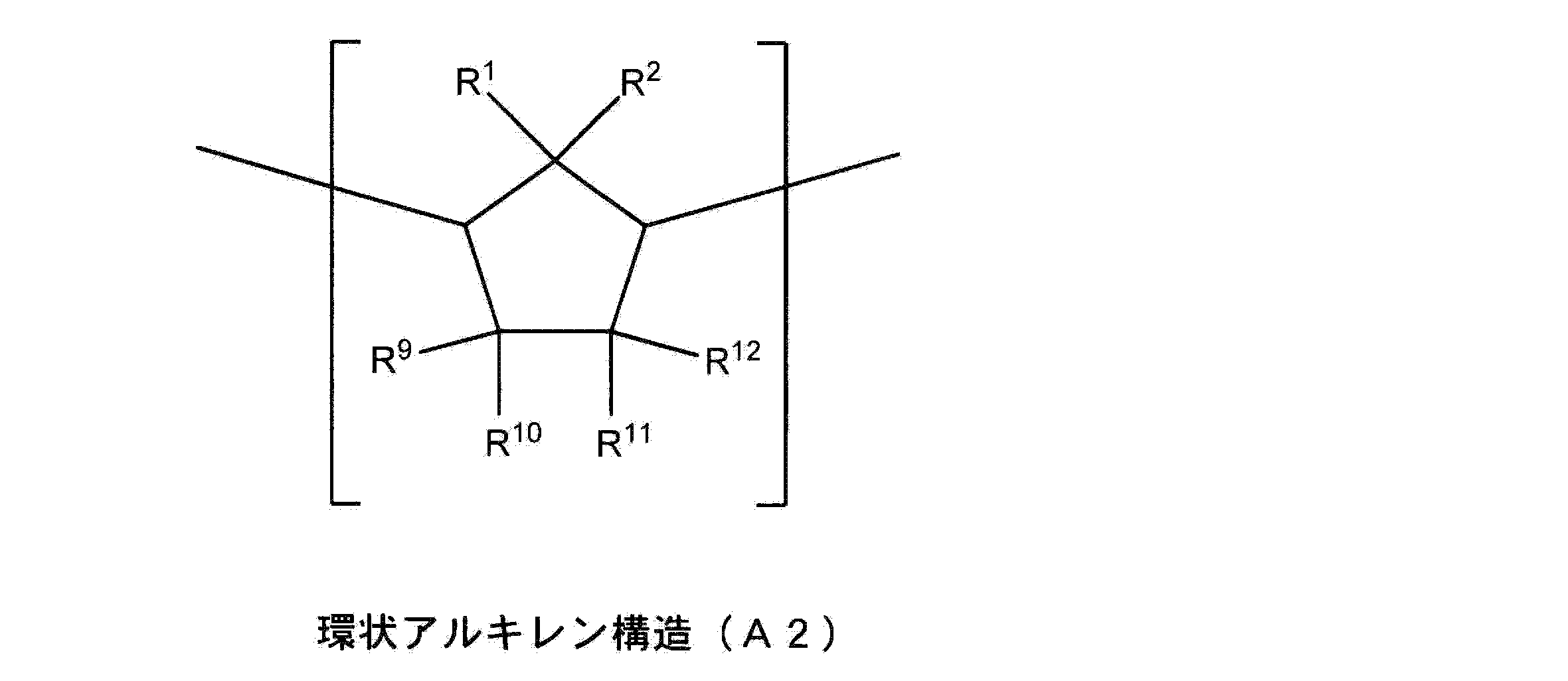
R9とR10、及び、R11とR12は、それぞれ、一体化して2価の炭化水素基を形成していてもよく、
R9又はR10と、R11又はR12とは、それぞれ、結合して環を形成していてもよい。)
- 前記環状オレフィン系ポリマー(i)が、前記環状アルキレン構造(A1)を有する、請求項4に記載のポリマー組成物。
- 前記環状オレフィン系ポリマー(I)及び(i)が、それぞれ、下記構造(P1)又は下記構造(P2)を有する、請求項1~5のいずれかに記載のポリマー組成物。
R9とR10、及び、R11とR12は、それぞれ、一体化して2価の炭化水素基を形成していてもよく、
R9又はR10と、R11又はR12とは、それぞれ、結合して環を形成していてもよい。
nは、0又は正の整数を示し、nが2以上の場合には、R5~R8は、繰り返し単位ごとに、互いに同一でも異なっていてもよい。
p及びqは、それぞれ、1以上の数を示す。)
R9とR10、及び、R11とR12は、それぞれ、一体化して2価の炭化水素基を形成していてもよく、
R9又はR10と、R11又はR12とは、それぞれ、結合して環を形成していてもよい。
rは、2以上の数を示す。) - 前記環状オレフィン系ポリマー(i)が、前記構造(P1)を有する、請求項6に記載のポリマー組成物。
- 前記環状オレフィン系ポリマー(I)を含有するペレット(I)と、前記環状オレフィン系ポリマー(i)を含有するペレット(i)とを備え、請求項1~7のいずれかに記載のポリマー組成物を得るために用いられる、ペレット。
- 前記ペレット(I)及び(i)の金属含有量が、それぞれ、5ppm以下である、請求項8に記載のペレット。
- 前記ペレット(I)及び(i)に含まれるアルミニウム、カルシウム、鉄、マグネシウム、マンガン、ナトリウム、及びチタンの合計含有量が、それぞれ、5ppm以下である、請求項8又は9に記載のペレット。
- 請求項1~7のいずれかに記載のポリマー組成物により形成された成形品。
Applications Claiming Priority (2)
| Application Number | Priority Date | Filing Date | Title |
|---|---|---|---|
| JP2015024323 | 2015-02-10 | ||
| JP2015-024323 | 2015-02-10 |
Publications (1)
| Publication Number | Publication Date |
|---|---|
| WO2016129480A1 true WO2016129480A1 (ja) | 2016-08-18 |
Family
ID=56614675
Family Applications (1)
| Application Number | Title | Priority Date | Filing Date |
|---|---|---|---|
| PCT/JP2016/053223 Ceased WO2016129480A1 (ja) | 2015-02-10 | 2016-02-03 | ポリマー組成物、ペレット、及び成形品 |
Country Status (2)
| Country | Link |
|---|---|
| TW (1) | TW201704330A (ja) |
| WO (1) | WO2016129480A1 (ja) |
Citations (3)
| Publication number | Priority date | Publication date | Assignee | Title |
|---|---|---|---|---|
| WO2008018951A1 (en) * | 2006-08-04 | 2008-02-14 | Exxonmobil Chemical Patents Inc. | Polymer compositions comprising cyclic olefin polymers, polyolefin modifiers, and fillers |
| WO2008018952A1 (en) * | 2006-08-04 | 2008-02-14 | Exxonmobil Chemical Patents Inc. | Polymer compositions comprising cyclic olefin copolymers and polyolefin modifiers |
| WO2011129869A1 (en) * | 2010-04-15 | 2011-10-20 | Topas Advanced Polymers, Inc. | Melt blends of amorphous cycloolefin polymers and partially crystalline cycloolefin elastomers with improved toughness |
-
2016
- 2016-02-03 WO PCT/JP2016/053223 patent/WO2016129480A1/ja not_active Ceased
- 2016-02-05 TW TW105103997A patent/TW201704330A/zh unknown
Patent Citations (3)
| Publication number | Priority date | Publication date | Assignee | Title |
|---|---|---|---|---|
| WO2008018951A1 (en) * | 2006-08-04 | 2008-02-14 | Exxonmobil Chemical Patents Inc. | Polymer compositions comprising cyclic olefin polymers, polyolefin modifiers, and fillers |
| WO2008018952A1 (en) * | 2006-08-04 | 2008-02-14 | Exxonmobil Chemical Patents Inc. | Polymer compositions comprising cyclic olefin copolymers and polyolefin modifiers |
| WO2011129869A1 (en) * | 2010-04-15 | 2011-10-20 | Topas Advanced Polymers, Inc. | Melt blends of amorphous cycloolefin polymers and partially crystalline cycloolefin elastomers with improved toughness |
Also Published As
| Publication number | Publication date |
|---|---|
| TW201704330A (zh) | 2017-02-01 |
Similar Documents
| Publication | Publication Date | Title |
|---|---|---|
| CA2584381C (en) | Polymer blends for producing films with a reduced number of defects | |
| ES2751555T3 (es) | Mezclas de polímeros heterogéneas compatibles | |
| JP2023527124A (ja) | 配向ポリエチレンフィルム及びそれを含む物品 | |
| JPWO2007132641A1 (ja) | 環状オレフィン系樹脂組成物 | |
| CN114829140A (zh) | 定向的聚乙烯膜和包含该聚乙烯膜的制品 | |
| JP6281950B2 (ja) | ポリオレフィン系無延伸多層フィルム | |
| WO2016194743A1 (ja) | 変性ポリエチレン樹脂組成物 | |
| JP7279300B2 (ja) | 樹脂組成物およびそれよりなるフィルム | |
| WO2006119901A1 (en) | Transparent easy tearable film | |
| JP2018065922A (ja) | ポリプロピレン系樹脂組成物、それからなる積層体及び二軸延伸ポリプロピレンフィルム | |
| KR102649475B1 (ko) | 프로필렌·에틸렌·α-올레핀 공중합체, 프로필렌계 중합체 조성물 및 이들의 용도 | |
| WO2016129480A1 (ja) | ポリマー組成物、ペレット、及び成形品 | |
| JP2016147936A (ja) | ポリマー組成物、ペレット、及び成形品 | |
| JP7754663B2 (ja) | フィルム、多層フィルム、および、樹脂組成物 | |
| JP3894822B2 (ja) | 樹脂組成物及び延伸成形体 | |
| JP4792741B2 (ja) | 易引き裂き性フィルム | |
| JP6379739B2 (ja) | 高剛性多層フィルム | |
| WO2010032560A1 (ja) | ペレット混合物、成形体、及び成形体の製造方法 | |
| JP2010116499A (ja) | 樹脂組成物および熱収縮性フィルム | |
| JP5375454B2 (ja) | ポリプロピレン系樹脂組成物および延伸フィルム | |
| CN101321827B (zh) | 维持成形体的透明性的方法、非晶性环状烯烃系树脂组合物以及光学材料、光学部件 | |
| JP2019143066A (ja) | 4−メチル−1−ペンテン系樹脂組成物およびその成形体 | |
| JP4359114B2 (ja) | 熱収縮性フィルム | |
| JP2019072985A (ja) | 易カット性多層フィルムならびにこれを用いた包装用袋 | |
| WO2022201741A1 (ja) | オレフィン系重合体組成物、および、フィルム |
Legal Events
| Date | Code | Title | Description |
|---|---|---|---|
| 121 | Ep: the epo has been informed by wipo that ep was designated in this application |
Ref document number: 16749124 Country of ref document: EP Kind code of ref document: A1 |
|
| NENP | Non-entry into the national phase |
Ref country code: DE |
|
| 122 | Ep: pct application non-entry in european phase |
Ref document number: 16749124 Country of ref document: EP Kind code of ref document: A1 |
|
| NENP | Non-entry into the national phase |
Ref country code: JP |