WO2016104647A1 - 糖鎖結合ワクチン抗原及び糖鎖導入剤 - Google Patents
糖鎖結合ワクチン抗原及び糖鎖導入剤 Download PDFInfo
- Publication number
- WO2016104647A1 WO2016104647A1 PCT/JP2015/086104 JP2015086104W WO2016104647A1 WO 2016104647 A1 WO2016104647 A1 WO 2016104647A1 JP 2015086104 W JP2015086104 W JP 2015086104W WO 2016104647 A1 WO2016104647 A1 WO 2016104647A1
- Authority
- WO
- WIPO (PCT)
- Prior art keywords
- group
- antigen
- sugar chain
- formula
- vaccine
- Prior art date
- Legal status (The legal status is an assumption and is not a legal conclusion. Google has not performed a legal analysis and makes no representation as to the accuracy of the status listed.)
- Ceased
Links
- 0 C*C1[C@@](**)OC(COC(*2)c3ccccc3)[C@@]2C1O Chemical compound C*C1[C@@](**)OC(COC(*2)c3ccccc3)[C@@]2C1O 0.000 description 5
- YPKQKDUXCOQREG-TWRPUSTOSA-N CO[C@@H](C(CC1O[C@H](C(C2O)O)OC(CO)[C@@H]2O)O)OC(CO)[C@@H]1O Chemical compound CO[C@@H](C(CC1O[C@H](C(C2O)O)OC(CO)[C@@H]2O)O)OC(CO)[C@@H]1O YPKQKDUXCOQREG-TWRPUSTOSA-N 0.000 description 1
Images


Classifications
-
- A—HUMAN NECESSITIES
- A61—MEDICAL OR VETERINARY SCIENCE; HYGIENE
- A61K—PREPARATIONS FOR MEDICAL, DENTAL OR TOILETRY PURPOSES
- A61K39/00—Medicinal preparations containing antigens or antibodies
Definitions
- the present invention relates to a vaccine antigen to which a sugar chain containing Gal ⁇ 1-3Gal is bound, a vaccine containing the vaccine antigen, a sugar chain introducing agent capable of introducing a sugar chain containing Gal ⁇ 1-3Gal, and the sugar chain introducing agent.
- the present invention relates to a method for introducing the sugar chain into an antigen.
- Cancer vaccine therapy is practiced in clinical practice as the third non-surgical therapy after chemotherapy and radiation therapy.
- cancer patients with poor general condition have a problem in that their ability to present antigens against tumor antigens is low because their immune functions are reduced.
- pancreatic cancer has a very poor prognosis, and there are very many patients who have no indication for surgery at the time of diagnosis. For this reason, in addition to the administration of anticancer drugs for the purpose of prolonging life, vaccine therapy is also performed.
- pancreatic cancer vaccines used for vaccine therapy peptide vaccines such as MUC1, VEGF, and WT1 are known.
- the effectiveness of pancreatic cancer vaccines is limited due to the low antigen presenting ability against the tumor antigens.
- Non-patent Document 1 A technique for adding an ⁇ 1-3 galactose epitope to pancreatic cancer cells by an in vitro enzymatic reaction with ⁇ 1-3 galactose transferase is also known.
- the ⁇ 1-3 galactose epitope is a sugar chain structure made by ⁇ 1-3 galactose transferase, which is possessed by animals below the former monkeys, but in the process of evolution, ⁇ 1-3 galactose transferase is a pseudogene in humans. Therefore, it does not have this sugar chain structure. However, since this sugar chain antigen is exposed to food such as pigs and cattle, approximately 1% of human blood IgG contains natural antibodies against ⁇ 1-3 galactose, and this antibody titer is determined at the end of cancer. It is maintained even in patients.
- the conventional method utilizes ⁇ 1-3 galactosyltransferase, the amino acid of Asn (asparagine) side chain in the consensus sequence of Asn-X-Ser / Thr (where X is any amino acid residue)
- a pig-type sugar chain can be introduced only into the group. That is, in the method using a transferase, since only N-type sugar chains can be formed, the number of pig-type sugar chains added is within the range of the above consensus sequence number of the protein to be introduced.
- An object of the present invention is to introduce a vaccine antigen in which a sugar chain containing galactose ⁇ 1-3 galactose (Gal ⁇ 1-3Gal) is bound via a linker, a vaccine containing the vaccine antigen, and a sugar chain containing Gal ⁇ 1-3Gal.
- An object is to provide a sugar chain introducing agent and a method for introducing the sugar chain into an antigen using the sugar chain introducing agent.
- a sugar chain containing Gal ⁇ 1-3Gal and a functional group possessed by an antigen for example, amino group, carboxyl group, mercapto group, hydroxyl group A functional group (reactive group or activating group) capable of forming a bond by reacting with a peptide or protein (or a functional group possessed by an amino acid constituting the peptide or protein)] such as a group via a linker.
- an antigen for example, amino group, carboxyl group, mercapto group, hydroxyl group A functional group (reactive group or activating group) capable of forming a bond by reacting with a peptide or protein (or a functional group possessed by an amino acid constituting the peptide or protein)
- the sugar chain can be efficiently introduced into the antigen by bringing the compound and the antigen in which both of them are bonded via such a linker into contact with the antigen; and (iii) such a sugar chain is introduced. It was found that the sugar chain functions as an excellent adjuvant
- the present invention includes the following inventions.
- G represents the following formula: L represents a linker containing at least a hydrocarbon unit, A represents an antigen, Z represents a bond between the linker and the antigen, and m represents an integer of 1 or more.
- the compound represented by the formula (2) is represented by the following formula (2A) (In the formula, L 1 is a sugar unit, L 2 is a linker containing at least a hydrocarbon unit, a is 0 or 1, and G, A, Z and m are the same as those in the formula (2).)
- a sugar chain introducing agent for introducing a sugar chain containing Gal ⁇ 1-3Gal into an antigen comprising the following formula (1) [In the formula, G represents the following formula: L represents a linker containing at least a hydrocarbon unit, and X represents a functional group capable of forming a bond by reaction with the functional group Y of the antigen.
- the compound represented by the formula (1) is represented by the following formula (1A)
- L 1 is a saccharide unit
- L 2 is a linker containing at least a hydrocarbon unit
- a is 0 or 1
- G and X are the same as those in the formula (1).
- the sugar chain introducing agent according to the above [6] which is a compound represented by the formula: [8]
- R represents a hydrocarbon unit
- E represents a unit having a hetero atom
- k represents an integer of 1 or more.
- [12] A method of introducing a sugar chain containing Gal ⁇ 1-3Gal into an antigen by bringing the antigen into contact with the sugar chain introducing agent according to any of [6] to [11].
- a vaccine comprising the vaccine antigen according to any one of [1] to [5].
- a vaccine comprising an antigen into which a sugar chain containing Gal ⁇ 1-3Gal has been introduced by the sugar chain introducing agent according to any one of [6] to [11].
- the vaccine according to [14] which is a cancer cell, a component of cancer cell, or a cancer vaccine into which a sugar chain containing Gal ⁇ 1-3Gal is introduced.
- the vaccine according to [14] or [15] which is a pancreatic cancer cell, a component of pancreatic cancer cell, or a pancreatic cancer vaccine into which a sugar chain containing Gal ⁇ 1-3Gal has been introduced.
- the present invention also includes a method for administering a vaccine antigen (or a vaccine containing this vaccine antigen) to a human and treating a disease corresponding to the antigen (for example, cancer such as pancreatic cancer).
- a vaccine antigen or a vaccine containing this vaccine antigen
- a disease corresponding to the antigen for example, cancer such as pancreatic cancer
- a vaccine antigen to which a sugar chain containing Gal ⁇ 1-3Gal is bound via a linker can be provided.
- a compound (sugar chain introduction agent) in which a Gal ⁇ 1-3Gal skeleton and a reactive group for a specific functional group are bonded via a linker can be obtained by a chemical synthesis method. According to such a compound, a sugar chain containing Gal ⁇ 1-3Gal can be efficiently introduced into an antigen (for example, a cancer cell, a cancer peptide vaccine, etc.).
- an N-type sugar chain is formed in order to utilize a reaction with a functional group possessed by an antigen (for example, an amino group, carboxyl group, mercapto group, etc. possessed by a peptide or protein constituting the antigen).
- an antigen for example, an amino group, carboxyl group, mercapto group, etc. possessed by a peptide or protein constituting the antigen.
- the compound of the present invention can introduce many sugar chains containing Gal ⁇ 1-3Gal to known vaccine antigens (particularly cancer vaccine antigens) already applied clinically such as MUC1, VEGF, and WT1. Therefore, a strong adjuvant effect can be obtained without causing any obvious side effects.
- vaccine antigens particularly cancer vaccine antigens
- MUC1, VEGF, and WT1 cancer vaccine antigens
- WT1 WT1
- a strong adjuvant effect can be obtained without causing any obvious side effects.
- the Gal ⁇ 1-3Gal skeleton can be introduced via a linker, a vaccine antigen that is easily recognized by the anti-Gal ⁇ 1-3Gal antibody can be efficiently obtained.
- FIG. 1 shows the results of detecting the anti-BSA antibody obtained in Example 13 by Western blotting.
- FIG. 2 shows the results of detecting the anti-MUC1 antibody obtained in Example 13 by Western blotting.
- the compound of the present invention is represented by the following formula (1).
- Such a compound can be used as a sugar chain introducing agent for introducing a sugar chain containing Gal ⁇ 1-3Gal, which is an epitope recognized by an antibody.
- G represents the following formula: Wherein L represents a linker (or spacer), X represents a functional group capable of forming a bond by reaction with the functional group Y. ]
- G is Gal ⁇ 1-3Gal (or Gal ⁇ 1-3Gal unit).
- G may be either ⁇ -form ( ⁇ -bond) or ⁇ -form ( ⁇ -bond) depending on the type of L (or L 1 or L 2 described later), and the ⁇ -form and ⁇ -form. It may be a mixture.
- L is a linker (linking group, spacer) for linking the Gal ⁇ 1-3Gal unit and the functional group X.
- the linker L may contain a saccharide unit (sugar residue).
- the sugar unit is usually adjacent (or glycosidic bond) to the Gal ⁇ 1-3Gal unit.
- Examples of the compound represented by the formula (1) which may contain such a sugar unit include a compound represented by the following formula (1A).
- L 1 is a saccharide unit
- L 2 is a linker (specifically, a linker other than a saccharide unit)
- a is 0 or 1
- G and X are the same as in the above formula (1).
- sugar may be a monosaccharide, it may be oligosaccharides.
- the oligosaccharide may be a homopolysaccharide or a heteropolysaccharide.
- the sugar may be a derivative (for example, a sugar with a reducing end modified, a sugar in which a hydroxyl group constituting the sugar is substituted with an acyloxy group or the like).
- the sugar may be a cyclic structure (cyclic acetal or cyclic ketal), or may be a ring-opened chain structure.
- Such a chain structure may be a structure formed by derivatization of a sugar having a cyclic structure (for example, a structure opened by modification with hydrazine or oxime at the reducing end).
- Specific sugars include, for example, pentose (eg, ribose, arabinose, xylose, deoxyribose, etc.), hexose (eg, fructose, tagatose, allose, altrose, glucose, mannose, galactose, rhamnose, glucosamine, N-acetyl) Glucosamine, glucuronic acid, galactosamine, etc.), oligosaccharides or polysaccharides to which these monosaccharides are bound (for example, disaccharides (eg, maltose, cordobiose, cellobiose, isomaltose, gentibiose, lactose, etc.), etc.).
- pentose eg, ribose, arabinose, xylose, deoxyribose, etc.
- hexose eg, fructose, tagatose, allose
- the following unit in which N-acetylglucosamine (GlcNAc) is ⁇ -1,4 linked to the Gal ⁇ 1-3Gal unit, which is an epitope, is a porcine sugar chain ( ⁇ -Gal).
- lactosamine (Gal ⁇ 1-4GlcNAc) is transferred to a porcine sugar chain (Gal ⁇ 1-3Gal ⁇ 1-4GlcNAc), and thus an N-acetylglucosamine unit is essential. Even without an acetylglucosamine unit, the Gal ⁇ 1-3Gal unit can be introduced.
- the group GL 1 — include, for example, a group represented by the following formula (G1) (a group in which the sugar unit is an N-acetylglucosamine unit), and the reducing end is modified in such a group G1.
- a unit for example, a group represented by the following formula (G2), a group represented by the following formula (G3), a group represented by the following formula (G4)
- G1 a group represented by the following formula (G2), a group represented by the following formula (G3), a group represented by the following formula (G4)
- N-acetylglucosamine The group GL 1 -etc. substituted on the sugar unit is included.
- Ra represents a substituent such as a hydrocarbon group (for example, a hydrocarbon group described later such as an alkyl group (such as a methyl group)), and G and Ac are the same as described above.)
- the linker (—L— or —L 2 —) is not particularly limited, but usually has at least a hydrocarbon unit (hydrocarbon unit, hydrocarbon group). There are many cases.
- hydrocarbon unit examples include a divalent hydrocarbon group, such as an aliphatic hydrocarbon unit [for example, an alkylene (or an alkylidene group, such as methylene, ethylene, trimethylene, propylene, tetramethylene, pentamethylene, hexamethylene, etc.
- aliphatic hydrocarbon unit for example, an alkylene (or an alkylidene group, such as methylene, ethylene, trimethylene, propylene, tetramethylene, pentamethylene, hexamethylene, etc.
- the hydrocarbon unit includes a unit in which two or more of the above units are connected [for example, an alkylene-arylene group (for example, methylenephenylene group, ethylenephenylene group), an alkenylene-arylene group (for example, vinylenephenylene group), etc.) Is also included.
- an alkylene-arylene group for example, methylenephenylene group, ethylenephenylene group
- an alkenylene-arylene group for example, vinylenephenylene group
- the hydrocarbon unit includes a unit in which a substituent is substituted on the above unit.
- the substituent is not particularly limited, for example, a hydrocarbon group ⁇ eg, alkyl group [eg, methyl group, ethyl group, n-propyl group, isopropyl group, n-butyl group, isobutyl group, s-butyl group, alkyl groups such as t-butyl group, pentyl group, hexyl group (for example, C 1-12 alkyl group, preferably C 1-8 alkyl group)], cycloalkyl groups (for example, cyclopentyl group, cyclohexyl group, etc.) C 4-10 cycloalkyl group, preferably C 5-8 cycloalkyl group), aralkyl group (for example, C 6-10 aryl C 1-4 alkyl group such as benzyl group, phenethyl group), polycyclic aliphatic carbonization
- the substituents may be substituted alone or in combination with two or more hydrocarbon units.
- Typical hydrocarbon units include alkylene groups, arylene groups, and the like.
- the linker may have one or more hydrocarbon units.
- the linker may comprise a unit containing a heteroatom.
- examples of the hetero atom include a nitrogen atom, an oxygen atom, and a sulfur atom.
- the unit containing a hetero atom may have two or more hetero atoms.
- the unit containing a hetero atom include a unit containing a nitrogen atom (for example, an imino group (—NH—), a substituted imino group (for example, —NR a — (wherein R a is the same as above), etc.) Amide group (—NHCO—), urethane group (—NCO—), urea group (—NHCONH—), azo group (—N ⁇ N—), hydrazone group (—C ⁇ N—NH—), nitrogen-containing ring Groups (for example, polyvalent groups corresponding to nitrogen-containing heterocyclic compounds such as piperidine, pyridine, indole, quinoline, carbazole, etc.) ⁇ , units containing oxygen atoms ⁇ eg, oxygen atoms (—O—), carbonyl groups ( -CO-), ester groups (oxycarbonyl group, -OCO-), oxygen-containing ring groups (for example, tetrahydrofuran, tetrahydropyran, furan
- the unit having a hetero atom includes a unit in which a substituent is substituted on the above unit depending on the type.
- substituents include the substituents exemplified in the section of the unit having a hydrocarbon group (for example, a hydrocarbon group, a halogen atom, etc.).
- Typical units containing a hetero atom include an imino group, a substituted imino group (such as an alkylimino group), an amide group, an oxygen atom (ether group, —O—), a carbonyl group (—CO—), an ester group (— OCO-, -COO-), thio group (-S-), thiocarbonyl group (-CS-) and the like.
- the linker may have a unit containing 1 or 2 or more heteroatoms.
- the linker has a hydrocarbon unit and a unit having a heteroatom
- the positional relationship of these units in the linker is not particularly limited, but usually the hydrocarbon unit and the unit having a heteroatom are adjacent (or bonded). There are many cases.
- the unit which has a hetero atom between the hydrocarbon units may be located.
- the linker is a unit in which a hydrocarbon unit and a unit having a hetero atom [for example, an oxyalkylene unit (for example, an oxyC 2-4 alkylene group such as oxyethylene group), a peptide unit, etc.] are combined as one unit.
- the repeating unit (repeating unit) may be formed. In such a case, the number of repetitions may be 2 or more (for example, about 2 to 20, preferably about 2 to 10, and more preferably about 2 to 6).
- linkers include, for example, groups (linkers) represented by the following formulas (L1) to (L8) (note that “-” at the left end is G or The bond to L 1 , the “ ⁇ ” at the right end represents the bond to X).
- R represents a hydrocarbon unit
- E represents a unit having a hetero atom
- k represents an integer of 1 or more.
- hydrocarbon unit R and the unit E having a hetero atom include the units exemplified above.
- the hydrocarbon unit may be an alkylene group, and E may be an ether group (—O—) or an amide group (—NHCO—).
- E may be an ether group (—O—) or an amide group (—NHCO—).
- the plurality of R or E may be the same or different units.
- More specific linkers include, for example, groups (linkers) represented by the following formulas (L1) to (L6).
- R 1 , R 2 and R 3 are the same or different divalent hydrocarbon groups
- R 4 is a C 2-4 alkylene group
- R 5 is an amino acid residue
- k is the same as above.
- examples of the divalent hydrocarbon group and the C 2-4 alkylene group include those exemplified above.
- R 1 to R 3 may typically be an alkylene group.
- R 1 is a methylene group
- R 2 and R 3 are alkylene groups having 2 or more carbon atoms (for example, C 2-10 alkylene groups such as ethylene group, trimethylene group, tetramethylene group, hexamethylene group, etc.) Also good.
- examples of R 4 include an ethylene group and a propylene group, and an ethylene group (—CH 2 CH 2 —) may be used.
- R 5 is an amino acid residue, that is, a group obtained by removing an amino group and a carboxyl group from an amino acid.
- R 5 is a methylene group.
- k is an integer of 1 or more. When k is 2 or more, the number of k (the number of repetitions) may be, for example, about 2 to 20, preferably about 2 to 10, and more preferably about 2 to 6.
- the functional group X may be any functional group that can react with the functional group Y different from the functional group X to form a bond.
- the functional group Y is usually a functional group of a peptide or protein (for example, a peptide or protein that constitutes an antigen) [for example, an amino acid that constitutes a peptide or protein such as a hydroxyl group, a carboxyl group, an amino group, or a mercapto group.
- a functional group introduced into a peptide or protein for example, an azide group, an alkynylene group (such as an acetylene group)] or the like.
- Examples of the functional group X include a carboxyl group or a derivatized (activated) carboxyl group ⁇ for example, a carboxyl group and an N-hydroxyamine (for example, N-hydroxysuccinimide, N-hydroxyphthalimide, N-hydroxynorbornene- 2,3-dicarboxylic acid imide, N-hydroxypiperidine, 2-hydroxyimino-2-cyanoacetic acid alkyl ester, 2-hydroxyimino-2-cyanoacetic acid amide, N-hydroxyimidazole, N-hydroxymaleimide, etc.) or derivatives thereof (Eg, N, N, N ′, N′-tetramethyl-O— (N-succinimidyl) uronium tetrafluoroborate) ester-bonded groups, acid halide groups, acid anhydride groups, acid azide groups, etc.
- N-hydroxyamine for example, N-hydroxysuccinimide, N-hydroxyphthalimide, N-hydroxynorbornene-
- Active ester group ⁇ , derivatized (activated) Droxyl group for example, sulfonate group (for example, tosylate group, mesylate group, triflate group, etc.)], maleimide group, halogen atom (chlorine atom, bromine atom, iodine atom, etc.), azido group, alkynyl group (for example, An ethynyl group or an acetylene group) and a group having a hexatriene- ⁇ -carbonyl skeleton (for example, a group represented by the following formula).
- sulfonate group for example, tosylate group, mesylate group, triflate group, etc.
- maleimide group for example, halogen atom (chlorine atom, bromine atom, iodine atom, etc.), azido group, alkynyl group (for example, An ethynyl group or an acetylene group
- the carboxyl group or the derivatized carboxyl group is a functional group Y such as a hydroxyl group or an amino group
- the derivatized hydroxyl group is a functional group Y such as a hydroxyl group or a carboxyl group
- the maleimide group is a mercapto group or the like.
- the functional group Y, the halogen atom is a mercapto group, the nitrogen atom constituting the nitrogen ring, the functional group Y such as an imino group (for example, the imino group of an imidazolyl ring constituting histidine), and the azide group is a functional group such as an alkynyl group Y and a group having a hexatriene- ⁇ -carbonyl skeleton each react with a functional group Y such as an amino group.
- the group -LX or the group -L 2 -X bonded to G or GL 1 includes L or L 2 as exemplified above, and X as exemplified above.
- the following table shows an example of all the combinations. In the table, symbols such as R 1 are the same as described above.
- carbohydrate introduction agent (compound represented by Formula (1) or (1A)) can be manufactured using a well-known organic chemical method.
- the reducing end of the sugar corresponding to G or GL 1 is oxidized by a conventional method (for example, the hydroxyl group at the reducing end of a protected sugar is oxidized after allyl etherification, the hydroxyl group at the reducing end is alkalized.
- the linker is —CH 2 —CONH—CH 2 CH 2 —NHCO—CH 2 —
- the functional group X is — Compounds having I can be obtained.
- the linker is —CH 2 —CONH—CH 2 CH 2 —NHCO—CH 2 —
- the functional group X is A compound having a tosyloxy group can be obtained.
- the sugar chain introducing agent of the present invention (compound represented by the formula (1) or (1A)) has a Gal1-3Gal skeleton and a functional group X, and a Gal1-3Gal skeleton (Gal1-3Gal) as an antigen.
- a sugar chain containing Gal ⁇ 1-3Gal is bound via a linker (vaccine antigen).
- the antigen is composed of a peptide or protein, and the amino acid constituting the peptide or protein has various functional groups Y that can react with the functional group X.
- a sugar chain introducing agent having an active ester group as the functional group X reacts with an amino acid having an amino group as the functional group Y to form a bond.
- the functional group X of the sugar chain introducing agent and the functional group Y of the antigen are reacted to introduce a sugar chain containing Gal1-3Gal into the antigen. (Or can be linked through a linker).
- the amino acid may have a functional group Y at the terminal of the peptide or protein, and may have a functional group as a side chain of the main chain.
- the amino acid located at the terminal has an amino group or a carboxyl group as the functional group Y regardless of the type of amino acid, and the functional group Y does not participate in peptide bonds with amino acids such as lysine, cysteine, serine, threonine, and glutamic acid. Therefore, these amino acids have a functional group Y (for example, amino group, hydroxyl group, carboxyl group, mercapto group, etc.) as a side chain of the peptide or protein in addition to the terminal.
- a functional group Y for example, amino group, hydroxyl group, carboxyl group, mercapto group, etc.
- the functional group Y located at the end or side chain of the peptide or protein can be used in the antigen, and thus the present invention is not limited to the amino group possessed by Asn of the specific consensus sequence as described above.
- the side chain functional group Y can be used, a very large number of Gal1-3Gal skeletons can be introduced.
- the functional group Y may contain a functional group other than the amino group derived from asparagine, which Asn of a specific consensus sequence particularly has.
- functional groups include lysine-derived amino groups, cysteine-derived mercapto groups, serine-derived hydroxyl groups, threonine-derived hydroxyl groups, aspartic acid-derived carboxyl groups, glutamic acid-derived carboxyl groups, and these amino acids.
- a functional group Y that does not originally exist in the antigen and react with the functional group X of the sugar chain introducing agent.
- an azide group or acetylene group may be introduced into the antigen as the functional group Y and reacted with a sugar chain introducing agent having the acetylene group or azide group as the functional group X.
- Such a method using the reaction between the functional group X and the functional group Y can also be referred to as a click chemistry method.
- Representative functional groups Y include hydroxyl group, carboxyl group, amino group, mercapto group, azide group, acetylene group and the like.
- the antigen may have a combination of two or more of these functional groups.
- the antigen is not particularly limited, and examples thereof include pathogens (for example, viruses such as influenza viruses or bacteria), cancer antigens, and the like. Moreover, it is good also considering a cancer cell (or cancer tissue) itself as an antigen.
- the antigen may in particular be a cancer cell, a component of a cancer cell, a cancer antigen or a cancer antigen peptide.
- the component of the cancer cell is not particularly limited as long as it is a constituent component of a cell that does not retain the cell morphology.
- lysate for example, lysate containing a membrane component, lysate containing no membrane component, etc.
- membrane components membrane proteins, etc.
- the target cancer is not particularly limited.
- pancreatic cancer has a poor prognosis and requires strong immunogenicity. Therefore, the utility of using the sugar chain introducing agent of the present invention for pancreatic cancer antigens is extremely high.
- cancer antigen various antigens can be used depending on the type of cancer to be treated.
- MUC1 peptide
- VEGF peptide
- WT1 peptide
- the present invention also includes a vaccine antigen in which a sugar chain containing Gal ⁇ 1-3Gal is introduced by the sugar chain introducing agent.
- Such a vaccine antigen has a structure different from that of an antigen (cancer cell) into which a porcine sugar chain has been introduced by a transferase.
- the vaccine antigen of the present invention has a structure in which a sugar chain containing Gal ⁇ 1-3Gal is bound to the antigen via a linker that cannot be introduced by a transferase.
- the functional group Y reacts with a functional group other than an amino group derived from asparagine having a specific consensus sequence, and a sugar chain containing Gal ⁇ 1-3Gal is introduced. For this reason, the amount of introduction of the Gal ⁇ 1-3Gal skeleton is usually larger than that when a transferase is used.
- such a vaccine antigen can be represented by the following formula (2) or the following formula (2A).
- the following formula (2) and the following formula (2A) correspond to the case of using the compound represented by the formula (1) and the compound represented by the formula (1A), respectively.
- A is an antigen
- Z is a bond between a linker and an antigen
- m is an integer of 1 or more
- G, L, L 1 , L 2 , and a are the same as described above.
- Z is a bond formed by the reaction between the functional group X of the formula (1) and the functional group Y of the antigen (for example, an amino acid-derived functional group of the antigen).
- the functional group Y may contain at least a functional group other than an amino group derived from asparagine. Examples of coupling are as illustrated in the table and the like.
- Z is an amide bond (—NHCO—).
- m is an integer of 1 or more. That is, a sugar chain containing one or more Gal ⁇ 1-3Gal is introduced into the antigen. Since an antigen usually has a plurality of functional groups Y that react with the functional group X, m is usually a plurality or two or more (eg, 3 to 1000, preferably 5 to 500, The number may preferably be 10 to 300). Depending on the type of antigen and the like, it is possible to bind a sugar chain containing a large number of Gal ⁇ 1-3Gal.
- the vaccine antigen of the present invention can be used as a vaccine as described above.
- the form of the vaccine of the present invention is not particularly limited as long as it contains the vaccine antigen of the present invention.
- the vaccine of the present invention may be composed only of the vaccine antigen of the present invention, and may constitute a composition (pharmaceutical composition) according to the dosage form and the like.
- the vaccine of this invention may make the vaccine antigen of this invention into a formulation (for example, solid formulation, liquid formulation etc.) suitably.
- a formulation for example, solid formulation, liquid formulation etc.
- conventional additives and formulation methods can be used.
- the vaccine of the present invention may contain one or more types of adjuvant, and may not contain an adjuvant.
- the vaccine of the present invention is highly useful in that a high adjuvant effect can be obtained without including an adjuvant.
- the vaccine of the present invention contains an adjuvant, it can be appropriately selected from known adjuvants.
- aluminum adjuvant for example, aluminum salt such as aluminum hydroxide, aluminum phosphate, aluminum sulfate or a combination thereof), Freund's adjuvant (complete or incomplete), TLR ligand (for example, CpG, Poly (I : C), Pam3CSK4, etc.), BAY, DC-chol, pcpp, monophosphoryl lipid A, QS-21, cholera toxin, formylmethionyl peptide and the like.
- it is an aluminum adjuvant, a TLR ligand, or a combination thereof.
- the present invention also includes a method of treating the corresponding disease (for example, cancer) by administering the vaccine (or sugar chain-introduced antigen or pharmaceutical composition).
- the dose of vaccine can be appropriately selected according to the type of disease and the type of vaccine.
- the present invention includes aspects in which the above-described configurations are variously combined within the technical scope of the present invention.
- Ph represents a phenyl group
- Bn and Bz represent a benzyl group
- Troc represents a 2,2,2-trichloroethoxycarbonyl group
- Allyl represents an allyl group
- Ac represents an acetyl group
- Me represents a methyl group.
- the reaction mixture was ultrafiltered using a centrifugal filter [Microcon (registered trademark) YM-10, 50,000 cut, Millipore] (10000 rpm for 5 minutes). Distilled water was added to this. Substitution of the solution from the buffer solution to water using this ultrafiltration was performed three times to obtain BSA16 into which a sugar chain was introduced.
- the introduction of sugar chains was confirmed by measuring the mass spectrum in BSA before and after the reaction. That is, the molecular weight of BSA before the reaction was about 66000, and the molecular weight of BSA after the reaction was about 73,000. From this result, it was confirmed that Compound 13 reacted with amino acids constituting the protein to form a bond. It was also confirmed that compound 13 can introduce a large number of sugar chains.
- One sugar chain was introduced because 34 of the 35 cysteine units possessed by BSA were disulfide-bonded, so that one cysteine-derived mercapto group reacted with compound 14.
- the introduction of sugar chains was confirmed by measuring the mass spectrum in BSA before and after the reaction. That is, the molecular weight of BSA before the reaction was about 66000, and the molecular weight of BSA after the reaction was about 67,000. From this result, it was confirmed that Compound 14 reacted with amino acids constituting the protein to form a bond.
- the introduction of sugar chains was confirmed by measuring the mass spectrum in BSA before and after the reaction. That is, the molecular weight of BSA before the reaction was about 66000, and the molecular weight of BSA after the reaction was about 70000. From this result, it was confirmed that Compound 15 reacted with amino acids constituting the protein to form a bond. It was also confirmed that compound 15 can introduce a large number of sugar chains.
- Example 7 Sugar chain introduction using compound 13 According to the following steps, a sugar chain-introduced MUC1 peptide 20 was obtained.
- the reaction mixture was purified by injection into HPLC [column: COSMOSIL 5C 18 -AR-300, 10 ⁇ 250 nm; MeCN in H 2 O containing 0.1% TFA (0-100% linear gradient over 50 min, 1 mL / min); UV detection at 220 nm; retention time: 30 min], and MUC1 peptide 20 (1.3 mg, 67%) into which a sugar chain was introduced was obtained.
- HRMS (ESI-LIT-Obitrap) calcd. for C 104 H 165 N 27 O 46 Na 2 [M + 2Na] 2+ 1287.5608, found 1287.5629
- MUC1 peptide 19 was synthesized as follows.
- MUC1 peptide 19 was synthesized according to a general Fmoc solid phase synthesis protocol. As Fmoc protected amino acids, His (Boc), Ala, Pro, Thr (tBu), Ser (tBu), Gly, Arg (Pmc), Asp (OtBu), and Val were used, and Boc-Gly was used for the N-terminus. .
- Glycine 2-chlorotrityl resin (0.195 mmol scale, 0.78 mmol / g, 100-200 mesh, 1% DVB, Watanabe Chemical) was used, and all amino acids were condensed according to the following procedure. went. Fmoc protected amino acid (0.975 mmol) 1-hydroxybenzotriazole (HOBt, 132 mg, 0.975 mmol), diisopropylcarbodiimide (DIC, 305 ⁇ L, 1.95 mmol) is dissolved in DMF (3.0 mL) and mixed for 30 minutes. The reagent was activated with The activated reagent was added to the resin and the suspension was shaken at room temperature for 2 hours.
- Fmoc protected amino acid (0.975 mmol) 1-hydroxybenzotriazole (HOBt, 132 mg, 0.975 mmol), diisopropylcarbodiimide (DIC, 305 ⁇ L, 1.95 mmol) is dissolved in DMF (3.0
- Et 2 O (30 mL) was added to the resulting precipitate, and the same centrifugation operation was performed twice to obtain a crude protected amino acid (343 mg, 62%) as a precipitate.
- Et 2 O (4 mL) was added to the supernatant and centrifuged (15,000 rpm, 5 minutes) to remove the supernatant.
- Example 8 Sugar chain introduction using compound 13 According to the following steps, WT1 peptide 22 into which a sugar chain was introduced was obtained.
- Peptide 21 is a peptide having the following amino acid sequence (1-182 aa, 182aa length), and a synthesized peptide was used.
- Example 9 Sugar chain introduction using compound 13 According to the following steps, an eEF2L peptide 24 into which a sugar chain was introduced was obtained.
- Peptide 23 is a peptide having the following amino acid sequence and was synthesized.
- Example 10 Sugar chain introduction into lysate According to the following steps, a cell lysate of PANC1 cells into which a sugar chain was introduced was obtained.
- the lysate of PANC1 cells was prepared as follows. About 100 conf PANC-1 cells (5-6 ⁇ 10 6 cells) were removed by treatment with 0.25% Trypsin-0.01 mM EDTA, and the cell solution resuspended in fresh medium was collected in a 15 ml tube. . After centrifugation at 100 ⁇ g, 5 min, 4 ° C., the supernatant was removed, 1 ml of PBS ( ⁇ ) was added and suspended by pipetting, and the whole cell solution was transferred to a 1.5 ml tube. After centrifugation at 600 ⁇ g, 3 min, 4 ° C., the supernatant was removed and stored at ⁇ 80 ° C. until the cell lysate was prepared.
- the cell lysis buffer (10 mM Tris-HCl pH 7.8, 1% Nonidet P-40, 0. 15 M NaCl, 1 mM EDTA, protease inhibitor) was added, and the cells were disrupted for 7 to 8 min using a water bath type ultrasonic crusher (BioRaptor) at 15 sec ON / OFF interval under ice cooling. Then, it centrifuged at 20,000xg, 15min, 4 degreeC. The supernatant collected after centrifugation was stored as a whole cell lysate at ⁇ 80 ° C. until sugar chain introduction.
- BioRaptor BioRaptor
- the immobilized PANC1 cells were prepared as follows.
- the cell pellet collected by the method described in Example 10 was treated under a fixing condition of -20 ° C methanol for 10 minutes. After this treatment, the mixture was centrifuged at 300 ⁇ g, 3 min, 4 ° C. to remove the fixative, and washed 3 times with PBS to remove the remaining fixative. Thereafter, the fixed cell pellet was resuspended in FACS buffer and stored at 4 ° C. until FACS measurement.
- the FACS analysis method is as follows.
- the immobilized cells 10 about five, were suspended in FACS buffer of 100 [mu] l, added M86 antibody 2 [mu] l, and stained on ice for 30 minutes with 50-fold dilution. Thereafter, the supernatant is removed by centrifugation at 300 ⁇ g for 3 minutes, 1 ⁇ l of PE-labeled anti-mouse IgM Ab is added to 100 ⁇ l of FACS buffer (2% FBS / D-PBS) (100-fold dilution), and the cells are resuspended.
- the mixture was allowed to stand for 20 to 30 minutes on ice, centrifuged again at 300 ⁇ g for 3 minutes, and the supernatant was removed.
- the supernatant was resuspended in 100 ⁇ l of FACS buffer, and a FACS analysis was performed using a part thereof.
- Example 12 Identification by ELISA using M86 antibody BSA16 obtained in the above Example was identified by ELISA using M86 antibody (an antibody recognizing ⁇ -Gal). For comparison, identification was also performed for subjects into which no sugar chain was introduced (negative control, negative control) and positive control (positive control). The results are as follows. In the following table, the magnification indicates the dilution factor of the M86 antibody.
- the M86 antibody that recognizes ⁇ -Gal was prepared by adding 50 ⁇ l of a 12.5-fold diluted M86 antibody solution to the first well in order to prepare a 2-fold dilution series. After stirring well, the work of transferring 50 ⁇ l to the next well was sequentially performed, and finally a dilution series up to 3200-fold dilution was prepared. Excess 50 ⁇ l in the last 8 rows was removed. Thereafter, the ELISA plate was wrapped in a wrap and incubated in a 37 ° C. gas phase thermostat for 2 hours. The antibody solution was discarded, each well was washed twice with 200 ⁇ l of 0.1% Tween / PBS, and then the wash solution was removed as completely as possible by tapping the plate on a paper towel.
- the buffer composition used is as follows. Carbonate buffer: 15 mM Na 2 CO 3 , 35 mM NaHCO 3 , 3.1 mM NaN 3 (pH 9.5) Peroxidase buffer: 50 mM Na 2 HPO 4 , 60 mM citric acid (pH 5.0)
- the anti- ⁇ -Gal antibody titer in mouse serum was determined by measuring over time using the method described in Example 10.
- the amount of protein used in one vaccine experiment was 10 ⁇ g / head for both labeled and unlabeled substances in the case of BSA, and 2.5 ⁇ g / head for both labeled and unlabeled substances in the case of the MUC1 peptide.
- Groups of 5 mice were prepared.
- Serum was prepared by administering intraperitoneal administration once a week for 5 weeks, and sampling 200 to 300 ⁇ l of blood approximately every week after each administration. Each serum was dispensed into multiple microtubes and stored at ⁇ 80 ° C.
- the reaction was performed at room temperature for 1 hour using HRP-labeled anti-mouse IgG (Promega) diluted 5000 times with skim milk / TBST. After the completion of the reaction, similarly, washing was performed with TBST for 10 minutes three times, and then the target band was detected by chemiluminescence using ECL-Prime (GE). For detection of chemiluminescence, LAS-4000mini (GE) was used.
- Electrophoresis was performed at a constant voltage of 150 V using 7.5% polyacrylamide gel using 30 ⁇ g of cell lysate of pancreatic cancer cell line Panc1 per lane. Thereafter, the resultant was transferred to a nitrocellulose filter (Millipore) at 120 mA for 60 minutes using a semi-dry type blotting apparatus (Bio-Rad). The nitrocellulose filter after the transfer was cut and separated for each lane and subjected to overnight blocking at 4 ° C. using 5% skim milk / TBST.
- CST anti-MUC1 antibody
- MUC1 peptide vaccine serum MUC1 peptide vaccine serum
- ⁇ -gal-MUC1 peptide vaccine serum MUC1 peptide vaccine serum
- ⁇ -1,3- a negative control
- galactosyltransferase serum Four types of galactosyltransferase serum were used as primary antibodies and reacted at room temperature for 1 hour. After completion of the reaction, the antibody solution was removed by suction, and washed with TBST for 10 minutes three times.
- anti-MUC1 antibody and secondary antibodies against three mouse sera were reacted with HRP-labeled anti-mouse IgG (Jackson Lab) diluted 5-fold with 5% skim milk / TBST for 1 hour at room temperature. I let you. After the completion of the reaction, similarly, washing was performed with TBST for 10 minutes three times, and then the target band was detected by chemiluminescence using ECL-Prime (GE). For detection of chemiluminescence, LAS-4000mini (GE) was used.
- FIG. 1 shows the detection result of the anti-BSA antibody
- FIG. 2 shows the detection result of the anti-MUC1 antibody.
- “PonceauS” is a confirmation of the BSA band.
- the compound or sugar chain introducing agent of the present invention can easily introduce a sugar chain containing Gal ⁇ 1-3Gal into an antigen.
- the sugar chain can be introduced regardless of the type of amino acid (or amino acid sequence), a large amount of the sugar chain can be introduced, and a very high immune reaction can be obtained.
- the sugar chain can be introduced into a known vaccine antigen, a high adjuvant effect can be obtained. Therefore, the compound (or sugar chain introduction agent) of the present invention can also be used as an adjuvant (immunostimulatory agent, immune enhancer).
- Such a sugar chain introduction agent and vaccine antigen of the present invention are useful for the treatment of various diseases such as cancer (malignant tumor) and infectious diseases (influenza, etc.), and in particular, cancer vaccine therapy such as pancreatic cancer. Useful in.
Landscapes
- Health & Medical Sciences (AREA)
- Life Sciences & Earth Sciences (AREA)
- Epidemiology (AREA)
- Animal Behavior & Ethology (AREA)
- Medicinal Chemistry (AREA)
- Microbiology (AREA)
- Mycology (AREA)
- Pharmacology & Pharmacy (AREA)
- Chemical & Material Sciences (AREA)
- Immunology (AREA)
- General Health & Medical Sciences (AREA)
- Public Health (AREA)
- Veterinary Medicine (AREA)
- Medicines Containing Antibodies Or Antigens For Use As Internal Diagnostic Agents (AREA)
- Medicinal Preparation (AREA)
- Saccharide Compounds (AREA)
- Peptides Or Proteins (AREA)
Abstract
ガラクトースα1-3ガラクトース(Galα1-3Gal)を含む糖鎖がリンカーを介して結合しているワクチン抗原を提供する。ワクチン抗原を、下記式(2)で表される基、Lは少なくとも炭化水素ユニットを含むリンカー、Aは抗原、Zはリンカーと抗原との結合、mは1以上の整数を示す。) で表される化合物で構成する。抗原は、がん細胞、がん細胞の成分、がん抗原又はがん抗原ペプチドであることが好ましい。
Description
本発明は、Galα1-3Galを含む糖鎖が結合しているワクチン抗原及び当該ワクチン抗原を含むワクチン、Galα1-3Galを含む糖鎖を導入できる糖鎖導入剤、並びに当該糖鎖導入剤を用いて抗原に前記糖鎖を導入する方法に関する。
がんワクチン療法は、化学療法、放射線治療に次ぐ第三の非手術療法として実地臨床の場で行われている。しかし、全身状態不良のがん患者では、免疫機能が低下しているため、腫瘍抗原に対する抗原提示能が低いという問題がある。
一方、がんの中でも、特に、膵がんは、極めて予後不良な疾患で、診断時には手術適応のない患者が非常に多い。このため、延命効果を目的とした抗がん薬投与の他、ワクチン療法も行われている。ワクチン療法に用いられる膵がんワクチンには、MUC1、VEGF、WT1などのペプチドワクチンが知られている。しかし、膵がんワクチンにおいても、前記の腫瘍抗原に対する抗原提示能の低さなどの理由により、その有効性には限界がある。
このような中、エピトープを付加することにより、抗原提示能をさらに向上させようとする試みもなされつつある。例えば、本発明者らは、α1-3ガラクトース転移酵素の遺伝子発現によって、α1-3ガラクトースエピトープを過剰発現させた膵がん細胞のライセート(cell lysate)が、マウスのがんモデルにおいて非常に強いワクチン効果を有することを報告している(非特許文献1)。また、α1-3ガラクトース転移酵素によるインビトロ(in vitro)での酵素反応により、膵がん細胞にα1-3ガラクトースエピトープを付加する技術も知られている。
なお、α1-3ガラクトースエピトープは、α1-3ガラクトース転移酵素によって作られる糖鎖構造で、旧猿人以下の動物は持っているが、進化の過程でヒトではα1-3ガラクトース転移酵素が偽遺伝子となっているため、この糖鎖構造を持たない。しかし、ブタや牛などの食物摂取により、この糖鎖抗原に暴露されているため、ヒトの血中IgGの約1%はα1-3ガラクトースに対する自然抗体が存在し、この抗体価はがん末期患者でも維持される。実際、ブタの臓器をヒヒに移植すると、α1-3ガラクトースに対する超急性拒絶反応が起こり、ブタの臓器は排除されることが知られている。このため、α1-3ガラクトースエピトープは、ブタ型糖鎖とも言われている。
しかし、従来の方法では、α1-3ガラクトース転移酵素を利用するため、Asn-X-Ser/Thr(式中、Xは任意のアミノ酸残基)のコンセンサス配列において、Asn(アスパラギン)側鎖のアミノ基にしか、ブタ型糖鎖を導入することができない。
すなわち、転移酵素を利用する方法では、N型糖鎖しか形成できないため、ブタ型糖鎖の付加数は、導入されるタンパク質が有する上記コンセンサス配列数の範囲内にとどまる。
すなわち、転移酵素を利用する方法では、N型糖鎖しか形成できないため、ブタ型糖鎖の付加数は、導入されるタンパク質が有する上記コンセンサス配列数の範囲内にとどまる。
Cancer Res.70(13),5259-69,2010 Deguchi T, Tanemura M, Miyoshi E et al.
本発明の目的は、ガラクトースα1-3ガラクトース(Galα1-3Gal)を含む糖鎖がリンカーを介して結合しているワクチン抗原、及び当該ワクチン抗原を含むワクチン、Galα1-3Galを含む糖鎖を導入できる糖鎖導入剤、並びに当該糖鎖導入剤を用いて抗原に前記糖鎖を導入する方法を提供することにある。
本発明者らは、上記課題を解決するために鋭意研究を重ねた結果、(i)Galα1-3Galを含む糖鎖と、抗原が有する官能基[例えば、アミノ基、カルボキシル基、メルカプト基、ヒドロキシル基などの抗体を構成するペプチドやタンパク質(又はペプチドやタンパク質を構成するアミノ酸)が有する官能基]と反応して結合形成可能な官能基(反応性基又は活性化基)とをリンカーを介して結合できること、(ii)このようなリンカーを介して両者が結合した化合物と抗原とを接触させることで、効率よく抗原に前記糖鎖を導入できること、(iii)このような前記糖鎖が導入された抗原は、前記糖鎖が優れたアジュバントとして機能し、高い抗原性のワクチン(又はその有効成分)として有効であることを見出し、さらに検討を重ねて、本発明を完成した。
すなわち、本発明は以下の各発明を包含する。
[1]下記式(2)

(式中、Gは、下記式
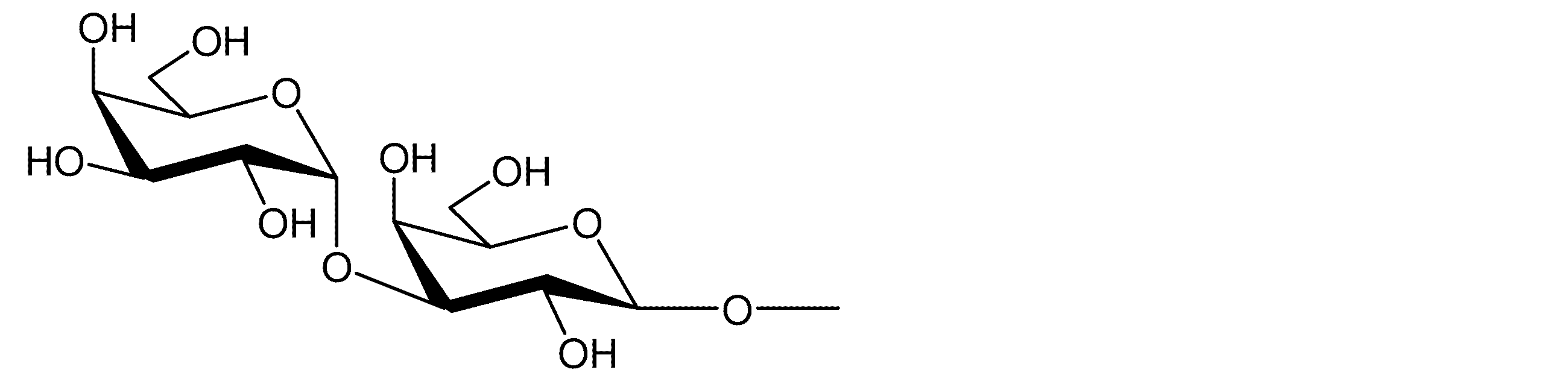
で表される基、Lは少なくとも炭化水素ユニットを含むリンカー、Aは抗原、Zはリンカーと抗原との結合、mは1以上の整数を示す。)
で表される化合物で構成されたGalα1-3Galを含む糖鎖がリンカーを介して結合しているワクチン抗原。
[2]式(2)で表される化合物が、下記式(2A)

(式中、L1は糖ユニット、L2は少なくとも炭化水素ユニットを含むリンカー、aは0又は1を示し、G、A、Z及びmは前記式(2)と同じ。)
で表される化合物である前記[1]記載のワクチン抗原。
[3]抗原が、がん細胞、がん細胞の成分、がん抗原又はがん抗原ペプチドである前記[1]又は[2]記載のワクチン抗原。
[4]がん抗原ペプチドが、MUC1ペプチド、VEGFペプチド、WT1ペプチド又はeEF2Lペプチドである前記[3]記載のワクチン抗原。
[5]がんが、膵がんである前記[3]又は[4]記載のワクチン抗原。
[6]抗原に、Galα1-3Galを含む糖鎖を導入するための糖鎖導入剤であって、下記式(1)

[式中、Gは、下記式
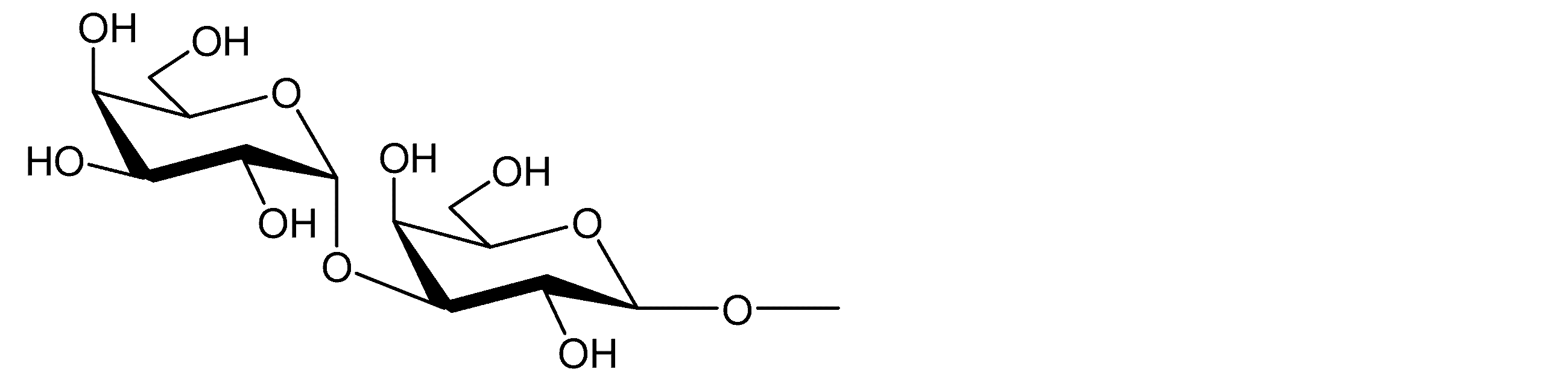
で表される基、Lは少なくとも炭化水素ユニットを含むリンカー、Xは抗原が有する官能基Yとの反応により結合を形成可能な官能基を示す。]
で表される化合物で構成された糖鎖導入剤。
[7]式(1)で表される化合物が、下記式(1A)

(式中、L1は糖ユニット、L2は少なくとも炭化水素ユニットを含むリンカー、aは0又は1を示し、G及びXは前記式(1)と同じ。)
で表される化合物である前記[6]記載の糖鎖導入剤。
[8]リンカーが、下記式(L1)~(L8)のいずれかで表される基である前記[6]又は[7]記載の糖鎖導入剤。
-R- (L1)
-(R-E)k- (L2)
-(R-E)k-R- (L3)
-E-(R-E)k-R- (L4)
-(E-R)k- (L5)
-(E-R)k-E- (L6)
-R-(E-R)k- (L7)
-R-(E-R)k-E- (L8)
(式中、Rは炭化水素ユニット、Eはヘテロ原子を有するユニット、kは1以上の整数を示す。)
[9]Rがアルキレン基であり、Eがエーテル基又はアミド基である前記[8]記載の糖鎖導入剤。
[10]Xが活性エステル基、スルホン酸エステル基、マレイミド基、ハロゲン原子、アジド基、アルキニル基、又はヘキサトリエン-β-カルボニル骨格を有する基である前記[6]~[9]のいずれかに記載の糖鎖導入剤。
[11]官能基Yが、ヒドロキシル基、カルボキシル基、アミノ基、メルカプト基、アジド基、及びアルキニル基から選択された少なくとも1種である前記[6]~[10]のいずれかに記載の糖鎖導入剤。
[12]抗原と、前記[6]~[11]のいずれかに記載の糖鎖導入剤とを接触させ、抗原にGalα1-3Galを含む糖鎖を導入する方法。
[13]前記[1]~[5]のいずれかに記載のワクチン抗原を含むワクチン。
[14]前記[6]~[11]のいずれかに記載の糖鎖導入剤により、Galα1-3Galを含む糖鎖が導入された抗原を含むワクチン。
[15]Galα1-3Galを含む糖鎖が導入されたがん細胞、がん細胞の成分又はがんワクチンである前記[14]記載のワクチン。
[16]Galα1-3Galを含む糖鎖が導入された膵がん細胞、膵がん細胞の成分又は膵がんワクチンである前記[14]又は[15]記載のワクチン。
[1]下記式(2)
で表される化合物で構成されたGalα1-3Galを含む糖鎖がリンカーを介して結合しているワクチン抗原。
[2]式(2)で表される化合物が、下記式(2A)
で表される化合物である前記[1]記載のワクチン抗原。
[3]抗原が、がん細胞、がん細胞の成分、がん抗原又はがん抗原ペプチドである前記[1]又は[2]記載のワクチン抗原。
[4]がん抗原ペプチドが、MUC1ペプチド、VEGFペプチド、WT1ペプチド又はeEF2Lペプチドである前記[3]記載のワクチン抗原。
[5]がんが、膵がんである前記[3]又は[4]記載のワクチン抗原。
[6]抗原に、Galα1-3Galを含む糖鎖を導入するための糖鎖導入剤であって、下記式(1)
で表される化合物で構成された糖鎖導入剤。
[7]式(1)で表される化合物が、下記式(1A)
で表される化合物である前記[6]記載の糖鎖導入剤。
[8]リンカーが、下記式(L1)~(L8)のいずれかで表される基である前記[6]又は[7]記載の糖鎖導入剤。
-R- (L1)
-(R-E)k- (L2)
-(R-E)k-R- (L3)
-E-(R-E)k-R- (L4)
-(E-R)k- (L5)
-(E-R)k-E- (L6)
-R-(E-R)k- (L7)
-R-(E-R)k-E- (L8)
(式中、Rは炭化水素ユニット、Eはヘテロ原子を有するユニット、kは1以上の整数を示す。)
[9]Rがアルキレン基であり、Eがエーテル基又はアミド基である前記[8]記載の糖鎖導入剤。
[10]Xが活性エステル基、スルホン酸エステル基、マレイミド基、ハロゲン原子、アジド基、アルキニル基、又はヘキサトリエン-β-カルボニル骨格を有する基である前記[6]~[9]のいずれかに記載の糖鎖導入剤。
[11]官能基Yが、ヒドロキシル基、カルボキシル基、アミノ基、メルカプト基、アジド基、及びアルキニル基から選択された少なくとも1種である前記[6]~[10]のいずれかに記載の糖鎖導入剤。
[12]抗原と、前記[6]~[11]のいずれかに記載の糖鎖導入剤とを接触させ、抗原にGalα1-3Galを含む糖鎖を導入する方法。
[13]前記[1]~[5]のいずれかに記載のワクチン抗原を含むワクチン。
[14]前記[6]~[11]のいずれかに記載の糖鎖導入剤により、Galα1-3Galを含む糖鎖が導入された抗原を含むワクチン。
[15]Galα1-3Galを含む糖鎖が導入されたがん細胞、がん細胞の成分又はがんワクチンである前記[14]記載のワクチン。
[16]Galα1-3Galを含む糖鎖が導入された膵がん細胞、膵がん細胞の成分又は膵がんワクチンである前記[14]又は[15]記載のワクチン。
さらに、本発明には、前記ワクチン抗原(又はこのワクチン抗原を含むワクチン)を、ヒトに投与し、抗原に対応する疾患(例えば、膵がんなどのがん)を治療する方法も含まれる。
本発明により、リンカーを介してGalα1-3Galを含む糖鎖が結合しているワクチン抗原を提供することができる。また、本発明では、化学合成的手法により、Galα1-3Gal骨格と、特定の官能基に対する反応性基とがリンカーを介して結合した化合物(糖鎖導入剤)を得ることができる。そして、このような化合物によれば、抗原(例えば、がん細胞やがんペプチドワクチンなど)にGalα1-3Galを含む糖鎖を効率よく導入できる。
本発明の化合物によれば、抗原が有する官能基(例えば、抗原を構成するペプチドやタンパク質が有するアミノ基、カルボキシル基、メルカプト基など)との反応を利用するため、N型糖鎖を形成する必要が無く、Asn-X-Ser/Thrのコンセンサス配列によらずとも、Galα1-3Galを含む糖鎖を導入できる。そのため、抗原にGalα1-3Galを含む糖鎖を数多く導入でき、このような糖鎖が導入された抗原では、非常に高い免疫反応を得ることができる。
さらに、本発明の化合物は、MUC1、VEGF、WT1などの既に臨床応用されている公知のワクチン抗原(特にがんワクチン抗原)に対してGalα1-3Galを含む糖鎖を数多く導入できる。そのため、明らかな副作用を生じることなく、強力なアジュバント効果を得ることができる。特に、本発明では、リンカーを介してGalα1-3Gal骨格を導入できるので、抗Galα1-3Gal抗体に認識されやすいワクチン抗原を効率よく得ることができる。
[糖鎖導入剤]
本発明の化合物は、下記式(1)で表される。このような化合物は、抗体に認識されるエピトープであるGalα1-3Galを含む糖鎖を導入するための糖鎖導入剤として使用できる。
本発明の化合物は、下記式(1)で表される。このような化合物は、抗体に認識されるエピトープであるGalα1-3Galを含む糖鎖を導入するための糖鎖導入剤として使用できる。


上記式(1)において、GはGalα1-3Gal(又はGalα1-3Galユニット)である。なお、Gは、L(又は後述のL1又はL2)の種類等に応じて、α体(α結合)又はβ体(β結合)のいずれであってもよく、α体とβ体の混合物であってもよい。
式(1)において、Lは、Galα1-3Galユニットと官能基Xとを連結するためのリンカー(連結基、スペーサー)である。
リンカーLは、糖ユニット(糖の残基)を含んでいてもよい。なお、糖ユニットは、通常、Galα1-3Galユニットに隣接(又はグリコシド結合)している場合が多い。このような糖ユニットを含んでいてもよい式(1)で表される化合物としては、例えば、下記式(1A)で表される化合物などが挙げられる。
リンカーLは、糖ユニット(糖の残基)を含んでいてもよい。なお、糖ユニットは、通常、Galα1-3Galユニットに隣接(又はグリコシド結合)している場合が多い。このような糖ユニットを含んでいてもよい式(1)で表される化合物としては、例えば、下記式(1A)で表される化合物などが挙げられる。

(式中、L1は糖ユニット、L2はリンカー(詳細には糖ユニット以外のリンカー)、aは0又は1を示し、G及びXは前記式(1)と同じ。)
糖ユニットL1において、糖は、単糖であってもよく、オリゴ糖であってもよい。なお、オリゴ糖は、ホモ多糖であってもよく、ヘテロ多糖であってもよい。
また、糖は誘導体(例えば、還元末端が修飾された糖、糖を構成するヒドロキシル基がアシルオキシ基などに置換された糖)であってもよい。さらに、糖は、環状構造(環状アセタール又は環状ケタール)であってもよく、開環した鎖状構造であってもよい。このような鎖状構造は、環状構造の糖の誘導体化により形成された構造(例えば、還元末端のヒドラジンやオキシムによる修飾により開環した構造など)であってもよい。
また、糖は誘導体(例えば、還元末端が修飾された糖、糖を構成するヒドロキシル基がアシルオキシ基などに置換された糖)であってもよい。さらに、糖は、環状構造(環状アセタール又は環状ケタール)であってもよく、開環した鎖状構造であってもよい。このような鎖状構造は、環状構造の糖の誘導体化により形成された構造(例えば、還元末端のヒドラジンやオキシムによる修飾により開環した構造など)であってもよい。
具体的な糖としては、例えば、ペントース(例えば、リボース、アラビノース、キシロース、デオキシリボースなど)、ヘキソース(例えば、フルクトース、タガトース、アロース、アルトロース、グルコース、マンノース、ガラクトース、ラムノース、グルコサミン、N-アセチルグルコサミン、グルクロン酸、ガラクトサミンなど)、これらの単糖類が結合したオリゴ糖又は多糖[例えば、二糖(例えば、マルトース、コージビオース、セロビオース、イソマルトース、ゲンチビオース、ラクトースなど)など]などが挙げられる。
なお、エピトープであるGalα1-3GalユニットにN-アセチルグルコサミン(GlcNAc)がβ-1,4結合した下記のユニットは、ブタ型糖鎖(α-Gal)である。

(式中、Acはアセチル基を示す)
転移酵素による場合には、ラクトサミン(Galβ1-4GlcNAc)をブタ型糖鎖(Galα1-3Galβ1-4GlcNAc)に転移させるため、N-アセチルグルコサミンユニットが必須となるが、本発明では、このようなN-アセチルグルコサミンユニットがなくても、Galα1-3Galユニットを導入できる。
具体的な基G-L1-としては、例えば、下記式(G1)で表される基(糖ユニットがN-アセチルグルコサミンユニットである基)、このような基G1において還元末端が修飾されたユニット(例えば、下記式(G2)で表される基、下記式(G3)で表される基、下記式(G4)で表される基)、これらの基において、N-アセチルグルコサミンを他の糖ユニットに置換した基G-L1-などが含まれる。

(式中、Raは、炭化水素基(例えば、アルキル基(メチル基など)などの後述の炭化水素基)などの置換基を示し、G及びAcは前記と同じ。)
式(1)又は式(1A)において、リンカー(-L-又は-L2-)としては、特に限定されないが、通常、少なくとも炭化水素ユニット(炭化水素単位、炭化水素基)を有している場合が多い。
炭化水素ユニットとしては、2価の炭化水素基、例えば、脂肪族炭化水素ユニット[例えば、アルキレン(又はアルキリデン基を含む、例えば、メチレン、エチレン、トリメチレン、プロピレン、テトラメチレン、ペンタメチレン、ヘキサメチレンなどのC1-20アルキレン、好ましくはC1-12アルキレン、さらに好ましくはC1-8アルキレン)ユニット、アルケニレン(例えば、ビニレン、プロペン-1,2-ジイルなどのC2-20アルケニレン、好ましくはC2-12アルケニレン、さらに好ましくはC2-8アルケニレン)ユニット、アルキニレン(例えば、エチニレン(-C≡C-)などのC2-20アルキニレン、好ましくはC2-12アルキニレン、さらに好ましくはC2-8アルキニレン)ユニットなどの鎖状脂肪族炭化水素ユニット;シクロアルキレン(例えば、シクロペンチレン、シクロヘキシレン、シクロヘプチレン、シクロオクチレンなどのC4-10シクロアルキレン、好ましくはC5-8シクロアルキレン)ユニット、シクロアルケニレン(例えば、シクロヘキセニレンなどのC5-10シクロアルケニレン、好ましくはC5-8シクロアルケニレン)ユニットなどの脂環式炭化水素ユニット]、芳香族炭化水素ユニット[例えば、アリーレン(例えば、フェニレン、トリレンなどのC6-20アリーレン、好ましくはC6-12アリーレン、さらに好ましくはC6-10アリーレン)]などが挙げられる。
また、炭化水素ユニットには、上記ユニットが2以上連結したユニット[例えば、アルキレン-アリーレン基(例えば、メチレンフェニレン基、エチレンフェニレン基など)、アルケニレン-アリーレン基(例えば、ビニレンフェニレン基など)など]も含まれる。
さらに、炭化水素ユニットには、上記ユニットに置換基が置換したユニットも含まれる。置換基としては、特に限定されず、例えば、炭化水素基{例えば、アルキル基[例えば、メチル基、エチル基、n-プロピル基、イソプロピル基、n-ブチル基、イソブチル基、s-ブチル基、t-ブチル基、ペンチル基、ヘキシル基などのアルキル基(例えば、C1-12アルキル基、好ましくはC1-8アルキル基)]、シクロアルキル基(例えば、シクロペンチル基、シクロへキシル基などのC4-10シクロアルキル基、好ましくはC5-8シクロアルキル基)、アラルキル基(例えば、ベンジル基、フェネチル基などのC6-10アリールC1-4アルキル基)、多環式脂肪族炭化水素基(例えば、デカリニル基、ノルボルニル基、アダマンチル基など)などの飽和又は不飽和脂肪族炭化水素基;アリール基(例えば、フェニル基、トリル基、キシリル基などのC6-12アリール基)などの芳香族炭化水素基}、ヘテロ原子含有基{例えば、窒素原子含有基[例えば、アミノ基、基-NRaRb(式中、Raは前記例示の炭化水素基、Rbは水素原子又は前記例示の炭化水素基を示す)で表される基(例えば、モノ又はジアルキルアミノ基(例えば、メチルアミノ基、ジメチルアミノ基、ジエチルアミノ基などのモノ又はジC1-20アルキルアミノ基)など)、カルバモイル基、基-CONRaRb(式中、Ra及びRbは前記と同じ)で表される基、窒素含有環基(例えば、ピリジル基など)]、酸素原子含有基[例えば、ヒドロキシ基、カルボキシル基、基-ORa(式中、Raは前記と同じ)で表される基(例えば、アルコキシ基(例えば、メトキシ基、エトキシ基、プロポキシ基などのC1-20アルコキシ基、好ましくはC1-10アルコキシ基)など)、ホルミル基、基-CORa(式中、Raは前記と同じ)で表される基(例えば、アルカノイル基(例えば、アセチル基、プロピオニル基などのC2-20アルカノイル基)など)、基-COORa(式中、Raは前記と同じ)で表される基(例えば、アルコキシカルボニル基(例えば、メトキシカルボニル基、エトキシカルボニル基などのC1-10アルコキシ-カルボニル基)など)、酸素含有環基(例えば、テトラヒドロフラニル基など)など]、硫黄原子含有基[例えば、メルカプト基、基-SRa(式中、Raは前記と同じ)で表される基(例えば、アルキルチオ基(例えば、メチルチオ基などのC1-20アルキルチオ基、好ましくはC1-10アルキルチオ基)など)、基-CSRa(式中、Raは前記と同じ)で表される基、硫黄含有環基(例えば、チオフェン-2-イル基など)など]など}、ハロゲン原子(例えば、フッ素原子、塩素原子、臭素原子、ヨウ素原子など)などが挙げられる。
置換基は、単独で又は2以上組み合わせて炭化水素ユニットに置換していてもよい。
代表的な炭化水素ユニットには、アルキレン基、アリーレン基などが含まれる。
リンカーは、1又は2以上の炭化水素ユニットを有していてもよい。
リンカーは、ヘテロ原子を含むユニットを含んでいてもよい。ヘテロ原子を含むユニットにおいて、ヘテロ原子としては、例えば、窒素原子、酸素原子、硫黄原子などが挙げられる。ヘテロ原子を含むユニットは、2以上のヘテロ原子を有していてもよい。
具体的なヘテロ原子を含むユニットとしては、窒素原子を含むユニット{例えば、イミノ基(-NH-)、置換イミノ基(例えば、-NRa-(式中、Raは前記と同じ)など)、アミド基(-NHCO-)、ウレタン基(-NCO-)、尿素基(-NHCONH-)、アゾ基(-N=N-)、ヒドラゾン基(-C=N-NH-)、窒素含有環基(例えば、ピペリジン、ピリジン、インドール、キノリン、カルバソールなどの窒素含有ヘテロ環式化合物に対応する多価基)など}、酸素原子を含むユニット{例えば、酸素原子(-O-)、カルボニル基(-CO-)、エステル基(オキシカルボニル基、-OCO-)、酸素含有環基(例えば、テトラヒドロフラン、テトラヒドロピラン、フラン、モルホリン、キサンテンなどの酸素含有ヘテロ環式化合物に対応する多価基)など}、硫黄原子を含むユニット{例えば、硫黄原子(-S-)、チオカルボニル基(-CS-)、硫黄含有環基(例えば、チオフェン、テトラヒドロチオピラン、チアゾールなどの硫黄含有ヘテロ環式化合物に対応する多価基)など}、これらのユニットが2以上連結したユニットなどが含まれる。
具体的なヘテロ原子を含むユニットとしては、窒素原子を含むユニット{例えば、イミノ基(-NH-)、置換イミノ基(例えば、-NRa-(式中、Raは前記と同じ)など)、アミド基(-NHCO-)、ウレタン基(-NCO-)、尿素基(-NHCONH-)、アゾ基(-N=N-)、ヒドラゾン基(-C=N-NH-)、窒素含有環基(例えば、ピペリジン、ピリジン、インドール、キノリン、カルバソールなどの窒素含有ヘテロ環式化合物に対応する多価基)など}、酸素原子を含むユニット{例えば、酸素原子(-O-)、カルボニル基(-CO-)、エステル基(オキシカルボニル基、-OCO-)、酸素含有環基(例えば、テトラヒドロフラン、テトラヒドロピラン、フラン、モルホリン、キサンテンなどの酸素含有ヘテロ環式化合物に対応する多価基)など}、硫黄原子を含むユニット{例えば、硫黄原子(-S-)、チオカルボニル基(-CS-)、硫黄含有環基(例えば、チオフェン、テトラヒドロチオピラン、チアゾールなどの硫黄含有ヘテロ環式化合物に対応する多価基)など}、これらのユニットが2以上連結したユニットなどが含まれる。
さらに、ヘテロ原子を有するユニットには、その種類に応じて、上記ユニットに置換基が置換したユニットも含まれる。置換基としては、炭化水素基を有するユニットの項で例示した置換基(例えば、炭化水素基、ハロゲン原子など)などが含まれる。
代表的なヘテロ原子を含むユニットとしては、イミノ基、置換イミノ基(アルキルイミノ基など)、アミド基、酸素原子(エーテル基、-O-)、カルボニル基(-CO-)、エステル基(-OCO-、-COO-)、チオ基(-S-)、チオカルボニル基(-CS-)などが挙げられる。
リンカーは、1又は2以上のヘテロ原子を含むユニットを有していてもよい。
リンカーが、炭化水素ユニットとヘテロ原子を有するユニットとを有する場合、リンカーにおけるこれらのユニットの位置関係は特に限定されないが、通常、炭化水素ユニットとヘテロ原子を有するユニットとは隣接(又は結合)している場合が多い。また、複数の炭化水素ユニットを有する場合には、炭化水素ユニット間にヘテロ原子を有するユニットが位置していてもよい。
さらに、リンカーは、炭化水素ユニットとヘテロ原子を有するユニットとの結合ユニット[例えば、オキシアルキレンユニット(例えば、オキシエチレン基などのオキシC2-4アルキレン基)、ペプチドユニットなど]を1つのユニットとして、繰り返し単位(繰り返しユニット)を形成していてもよい。このような場合、繰り返しの数は、2以上(例えば、2~20、好ましくは2~10、さらに好ましくは2~6程度)であってもよい。
代表的なリンカー(-L-又は-L2-)としては、例えば、下記式(L1)~(L8)で表される基(リンカー)が挙げられる(なお、左端の「-」はG又はL1との結合、右端の「-」はXとの結合を示す)。
-R- (L1)
-(R-E)k- (L2)
-(R-E)k-R- (L3)
-E-(R-E)k-R- (L4)
-(E-R)k- (L5)
-(E-R)k-E- (L6)
-R-(E-R)k- (L7)
-R-(E-R)k-E- (L8)
(式中、Rは炭化水素ユニット、Eはヘテロ原子を有するユニット、kを1以上の整数を示す。)
-R- (L1)
-(R-E)k- (L2)
-(R-E)k-R- (L3)
-E-(R-E)k-R- (L4)
-(E-R)k- (L5)
-(E-R)k-E- (L6)
-R-(E-R)k- (L7)
-R-(E-R)k-E- (L8)
(式中、Rは炭化水素ユニット、Eはヘテロ原子を有するユニット、kを1以上の整数を示す。)
炭化水素ユニットR及びヘテロ原子を有するユニットEとしては、前記例示のユニットが挙げられる。特に、炭化水素ユニットは、アルキレン基であってもよく、Eはエーテル基(-O-)又はアミド基(-NHCO-)であってもよい。
なお、上記式において、R又はEが複数である場合、複数のR又はEは同一又は異なるユニットであってもよい。
なお、上記式において、R又はEが複数である場合、複数のR又はEは同一又は異なるユニットであってもよい。
より具体的なリンカー(L又はL2)としては、例えば、下記式(L1)~(L6)で表される基(リンカー)などが含まれる。
-R1- (L1)
-R1-CO-NH- (L2)
-R1-CO-NH-R2- (L3)
-R1-CO-NH-R2-NH-CO-R3- (L4)
-(R4-O)k-R1- (L5)
-(CO-R5-NH)k-R5- (L6)
(式中、R1、R2、R3は同一の又は異なる二価の炭化水素基、R4はC2-4アルキレン基、R5はアミノ酸の残基を示し、kは前記と同じ。)
-R1- (L1)
-R1-CO-NH- (L2)
-R1-CO-NH-R2- (L3)
-R1-CO-NH-R2-NH-CO-R3- (L4)
-(R4-O)k-R1- (L5)
-(CO-R5-NH)k-R5- (L6)
(式中、R1、R2、R3は同一の又は異なる二価の炭化水素基、R4はC2-4アルキレン基、R5はアミノ酸の残基を示し、kは前記と同じ。)
上記式において、二価の炭化水素基及びC2-4アルキレン基としては、前記例示の基が挙げられる。
R1~R3は、代表的にはアルキレン基であってもよい。特に、R1はメチレン基、R2及びR3が炭素数2以上のアルキレン基(例えば、エチレン基、トリメチレン基、テトラメチレン基、ヘキサメチレン基などのC2-10アルキレン基など)であってもよい。
また、R4としては、エチレン基、プロピレン基などが挙げられ、特に、エチレン基(-CH2CH2-)であってもよい。
また、R5はアミノ酸の残基、すなわち、アミノ酸からアミノ基及びカルボキシル基を除いた基である。例えば、アミノ酸がグリシンである場合、R5はメチレン基である。なお、kは1以上の整数である。kが2以上であるとき、kの数(繰り返し数)は、例えば、2~20、好ましくは2~10、さらに好ましくは2~6程度であってもよい。
式(1)又は(1A)において、官能基Xとしては、官能基Xとは異なる官能基Yと反応して結合を形成可能な官能基であればよい。
なお、官能基Yは、通常、ペプチド又はタンパク質(例えば、抗原を構成するペプチド又はタンパク質)が有する官能基[例えば、ヒドロキシル基、カルボキシル基、アミノ基、メルカプト基などのペプチド又はタンパク質を構成するアミノ酸が有する官能基]であってもよく、ペプチド又はタンパク質に導入された官能基[例えば、アジド基、アルキニレン基(アセチレン基など)など]などであってもよい。
なお、官能基Yは、通常、ペプチド又はタンパク質(例えば、抗原を構成するペプチド又はタンパク質)が有する官能基[例えば、ヒドロキシル基、カルボキシル基、アミノ基、メルカプト基などのペプチド又はタンパク質を構成するアミノ酸が有する官能基]であってもよく、ペプチド又はタンパク質に導入された官能基[例えば、アジド基、アルキニレン基(アセチレン基など)など]などであってもよい。
官能基Xとしては、例えば、カルボキシル基又は誘導体化(活性化)されたカルボキシル基{例えば、カルボキシル基とN-ヒドロキシアミン類(例えば、N-ヒドロキシスクシンイミド、N-ヒドロキシフタルイミド、N-ヒドロキシノルボルネン-2,3-ジカルボン酸イミド、N-ヒドロキシピペリジン、2-ヒドロキシイミノ-2-シアノ酢酸アルキルエステル、2-ヒドロキシイミノ-2-シアノ酢酸アミド、N-ヒドロキシイミダゾール、N-ヒドロキシマレイミドなど)又はその誘導体(例えば、N,N,N’,N’-テトラメチル-O-(N-スクシンイミジル)ウロニウムテトラフルオロボラート)とがエステル結合した基、酸ハライド基、酸無水物基、酸アジド基などの活性エステル基}、誘導体化(活性化)されたヒドロキシル基[例えば、スルホン酸エステル基(例えば、トシラート基、メシラート基、トリフラート基など)など]、マレイミド基、ハロゲン原子(塩素原子、臭素原子、ヨウ素原子など)、アジド基、アルキニル基(例えば、エチニル基又はアセチレン基など)、ヘキサトリエン-β-カルボニル骨格を有する基(例えば、下記式で表される基)などが挙げられる。

(式中、Ra及びRbは前記と同じ。)
なお、カルボキシル基又は誘導体化されたカルボキシル基はヒドロキシル基、アミノ基などの官能基Yと、誘導体化されたヒドロキシル基はヒドロキシル基、カルボキシル基などの官能基Yと、マレイミド基はメルカプト基などの官能基Yと、ハロゲン原子はメルカプト基、窒素環を構成する窒素原子やイミノ基(例えば、ヒスチジンを構成するイミダゾイル環のイミノ基)などの官能基Yと、アジド基はアルキニル基などの官能基Yと、ヘキサトリエン-β-カルボニル骨格を有する基はアミノ基などの官能基Yと、それぞれ反応する。
代表的な官能基Xと官能基Yとの組み合わせ、及びこの組み合わせにより形成される結合を下記表に示す。なお、表中、Raなどの記号は前記と同じである。
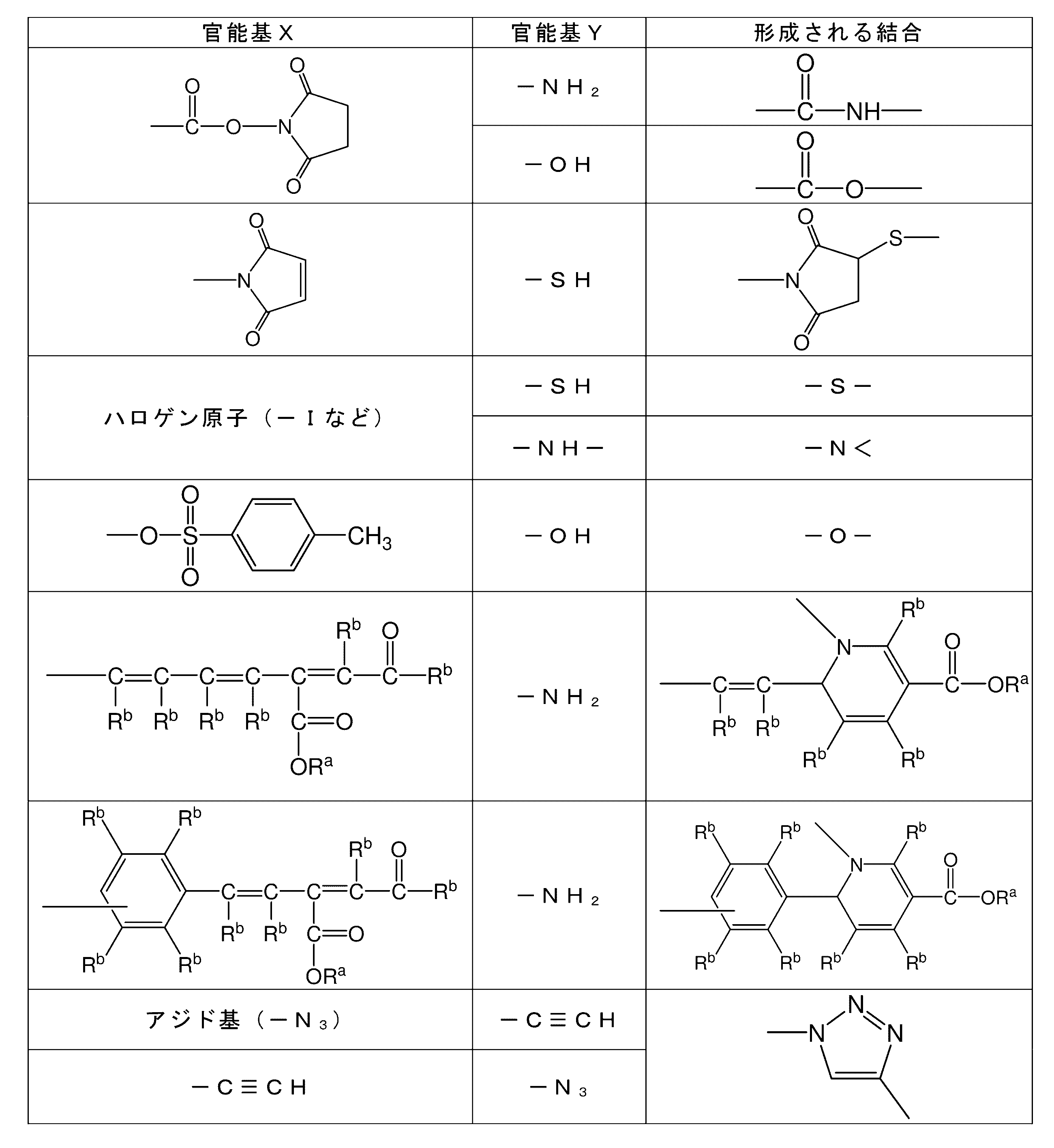
また、式(1)又は(1A)において、G又はG-L1に結合する基-L-X又は基-L2-Xとしては、前記例示のL又はL2と、前記例示のXとのすべての組み合わせを含むが、その一例を下記表に示す。なお、表中、R1などの記号は前記と同じである。

なお、糖鎖導入剤(式(1)又は(1A)で表される化合物)の製造方法は、公知の有機化学的手法を用いて製造できる。
例えば、G又はG-L1に対応する糖の還元末端を慣用の方法(例えば、保護された糖の還元末端のヒドロキシル基をアリルエーテル化したのち酸化する方法、還元末端のヒドロキシル基をアルカリ化したのち、モノクロロ酢酸と反応させる方法、還元末端の糖に対するグリコシル化反応など)によりカルボキシメチル化し、N-ヒドロキシアミン類又はその誘導体(例えば、N,N,N’,N’-テトラメチル-O-(N-スクシンイミジル)ウロニウムテトラフルオロボラート)とを反応させることで、リンカーとしてメチレン基、官能基Xとして活性エステル基を有する化合物を得ることができる。
また、上記のようにしてカルボキシメチル化し、エチレンジアミンと反応させたのち、ヨード酢酸を反応させることで、リンカーとして-CH2-CONH-CH2CH2-NHCO-CH2-、官能基Xとして-Iを有する化合物を得ることができる。一方、エチレンジアミンと反応させた後、さらに、グリコール酸と反応させ、塩化パラトルエンスルホニルと反応させることで、リンカーとして-CH2-CONH-CH2CH2-NHCO-CH2-、官能基Xとしてトシルオキシ基を有する化合物を得ることができる。
さらに、糖の還元末端にエチレンオキシドを付加させたのち、カルボキシメチル化し、N-ヒドロキシアミン類と反応させることで、リンカーとして、-(CH2CH2O)k-CH2-、官能基Xとして活性エステル基を有する化合物を得ることができる。
[糖鎖導入剤の用途]
本発明の糖鎖導入剤(式(1)又は(1A)で表される化合物)は、Gal1-3Gal骨格と官能基Xとを有しており、抗原にGal1-3Gal骨格(Gal1-3Galを含む糖鎖)を導入し、Galα1-3Galを含む糖鎖がリンカーを介して結合している抗原(ワクチン抗原)を製造するのに有用である。
本発明の糖鎖導入剤(式(1)又は(1A)で表される化合物)は、Gal1-3Gal骨格と官能基Xとを有しており、抗原にGal1-3Gal骨格(Gal1-3Galを含む糖鎖)を導入し、Galα1-3Galを含む糖鎖がリンカーを介して結合している抗原(ワクチン抗原)を製造するのに有用である。
抗原は、ペプチド又はタンパク質で構成されており、そして、このペプチド又はタンパク質を構成するアミノ酸には、官能基Xと反応可能な種々の官能基Yを有している。例えば、官能基Xとして活性エステル基を有する糖鎖導入剤は、官能基Yとしてアミノ基を有するアミノ酸と反応して結合を形成する。
すなわち、抗原と糖鎖導入剤とを接触(又は反応)させることにより、糖鎖導入剤の官能基Xと、抗原の官能基Yとを反応させ、抗原にGal1-3Galを含む糖鎖を導入できる(又はリンカーを介して結合できる)。
なお、アミノ酸は、ペプチド又はタンパク質の末端に官能基Yを有していてもよく、主鎖の側鎖として官能基を有していてもよい。例えば、末端に位置するアミノ酸はアミノ酸の種類によらず官能基Yとしてアミノ基やカルボキシル基を有しており、リシン、システイン、セリン、トレオニン、グルタミン酸などのアミノ酸ではペプチド結合に関与しない官能基Yを有しているため、これらのアミノ酸では、末端に加え、ペプチド又はタンパク質の側鎖として官能基Y(例えば、アミノ基、ヒドロキシル基、カルボキシル基、メルカプト基など)を有している。
このように、本発明では、抗原において、ペプチド又はタンパク質の末端や側鎖に位置する官能基Yを利用できるため、前記のような特定のコンセンサス配列のAsnが有するアミノ基に限定されることなく、官能基Xと反応させることができ、効率よく多数のGal1-3Gal骨格を抗原に導入できる。特に、本発明では、側鎖の官能基Yを利用できるので、非常に多くのGal1-3Gal骨格を導入することができる。
そのため、官能基Yは、特に、特定のコンセンサス配列のAsnが有するアスパラギン由来のアミノ基以外の官能基を含んでいてもよい。このような官能基としては、例えば、リシン由来のアミノ基、システイン由来のメルカプト基、セリン由来のヒドロキシル基、トレオニン由来のヒドロキシル基、アスパラギン酸由来のカルボキシル基、グルタミン酸由来のカルボキシル基、これらのアミノ酸を含むアミノ酸由来のアミノ基及び/又はカルボキシル基などが挙げられる。
また、抗原に元来存在しない官能基Yを導入し、糖鎖導入剤の官能基Xと反応させることもできる。例えば、抗原に、官能基Yとしてアジド基やアセチレン基を導入し、官能基Xとしてアセチレン基やアジド基を有する糖鎖導入剤と反応させてもよい。このような官能基Xと官能基Yとの反応を利用する方法は、クリックケミストリー的手法ということもできる。
代表的な官能基Yとしては、ヒドロキシル基、カルボキシル基、アミノ基、メルカプト基、アジド基、アセチレン基などが挙げられる。抗原は、これらの官能基を2種以上組み合わせて有していてもよい。
抗原としては、特に限定されず、例えば、病原体(例えば、インフルエンザウイルスなどのウイルス又は細菌)、がん抗原などが挙げられる。また、がん細胞(又はがん組織)そのものを抗原としてもよい。
抗原は、特に、がん細胞、がん細胞の成分、がん抗原又はがん抗原ペプチドであってもよい。なお、がん細胞の成分としては、細胞の形態を保持していない細胞の構成成分であれば特に限定されず、例えば、ライセート(例えば、膜成分を含むライセート、膜成分を含まないライセートなど)、膜成分(膜タンパクなど)などが挙げられる。
対象となるがん(悪性腫瘍)は、特に限定されず、例えば、甲状腺がん、肺がん、乳がん、胃がん、膵がん、肝臓がん、腎臓がん、大腸がん、膀胱がん、子宮がん、子宮頸がん、卵巣がん、前立腺がん、皮膚がん、白血病、悪性リンパ腫などが挙げられる。特に、膵がんは、予後不良ながんであり、強力な免疫原性が要求されるため、膵がん抗原に対して本発明の糖鎖導入剤を利用する有用性は極めて高い。
がん抗原としては、対象となるがんの種類に応じて、種々の抗原を利用できる。例えば、膵がん抗原ペプチドとしては、MUC1(ペプチド)、VEGF(ペプチド)、WT1(ペプチド)などが挙げられる。
本発明には、前記糖鎖導入剤により、Galα1-3Galを含む糖鎖が導入されたワクチン抗原も含まれる。
このようなワクチン抗原(糖鎖導入抗原)は、転移酵素によりブタ型糖鎖が導入された抗原(がん細胞)とは異なる構造を有している。例えば、本発明のワクチン抗原は、Galα1-3Galを含む糖鎖が、転移酵素では導入され得ないリンカーを介して抗原に結合している構造を有している。
また、官能基Yが特定のコンセンサス配列のアスパラギンに由来するアミノ基以外の官能基に対しても反応し、Galα1-3Galを含む糖鎖が導入される。そのため、単に、抗原に対する結合形式において異なるだけでなく、通常、Galα1-3Gal骨格の導入量が、転移酵素を用いる場合に比べて、大きくなる。
さらに、リンカーが糖ユニットとしてN-アセチルグルコサミンユニットを含まない場合でも、抗原にGalα1-3Galを含む糖鎖が導入される。
なお、このようなワクチン抗原は、下記式(2)又は下記式(2A)で表すことができる。下記式(2)及び下記式(2A)は、それぞれ、前記式(1)で表される化合物及び前記式(1A)で表される化合物を用いる場合に対応している。

(式中、Aは抗原、Zはリンカーと抗原との結合、mは1以上の整数を示し、G、L、L1、L2、及びaは前記と同じ。)
(式中、Aは抗原、Zはリンカーと抗原との結合、mは1以上の整数を示し、G、L、L1、L2、及びaは前記と同じ。)
上記式(2)及び(2A)において、Zは式(1)の官能基Xと抗原が有する官能基Y(例えば、抗原が有するアミノ酸由来の官能基)との反応により形成された結合である。特に、官能基Yは、少なくともアスパラギン由来のアミノ基以外の官能基を含んでいてもよい。なお、結合の例は、前記表などに例示の通りである。例えば、官能基Xが活性エステル基、官能基Yがアミノ基(例えば、リシン由来のアミノ基)である場合、Zはアミド結合(-NHCO-)である。
さらに、mは1以上の整数である。すなわち、抗原に、1以上のGalα1-3Galを含む糖鎖が導入されている。抗原は、通常、官能基Xと反応する官能基Yを複数有している場合が多いため、mは、通常、複数又は2以上(例えば、3~1000個、好ましくは5~500個、さらに好ましくは10~300個)であってもよい。抗原の種類等によっては、多数のGalα1-3Galを含む糖鎖を結合させることも可能である。
本発明のワクチン抗原は、前記の通り、ワクチンとして使用できる。本発明のワクチンは、本発明のワクチン抗原を含む限り、その形態は特に限定されない。例えば、本発明のワクチンは、本発明のワクチン抗原のみで構成してもよく、投与形態等に応じて、組成物(医薬組成物)を構成してもよい。また、本発明のワクチンは、適宜、本発明のワクチン抗原を製剤(例えば、固形製剤、液状製剤など)化してもよい。なお、医薬組成物の構成や製剤化においては、慣用の添加剤や製剤化方法を使用できる。
本発明のワクチンは、1種以上のアジュバントを含んでいてもよく、アジュバントを含んでいなくてもよい。本発明のワクチンは、アジュバントを含まなくても高いアジュバント効果を得ることもできる点で有用性が高い。本発明のワクチンがアジュバントを含む場合、公知のアジュバントの中から適宜選択して用いることができる。具体的には、例えば、アルミニウムアジュバント(例えば、水酸化アルミニウム、リン酸アルミニウム、硫酸アルミニウム等のアルミニウム塩またはその組み合わせ)、フロイントアジュバント(完全または不完全)、TLRリガンド(例えば、CpG、Poly(I:C)、Pam3CSK4など)、BAY、DC-chol、pcpp、モノホスホリル脂質A、QS-21、コレラ毒素、ホルミルメチオニルペプチドなどが挙げられる。好ましくは、アルミニウムアジュバント、TLRリガンドまたはこれらの組み合わせである。
本発明には、上記ワクチン(又は糖鎖導入抗原又は医薬組成物)を投与し、対応する疾患(例えば、がん)を治療する方法も含まれる。
ワクチンの投与量は、疾患の種類やワクチンの種類などに応じて適宜選択できる。
なお、本発明は、本発明の効果を奏する限り、本発明の技術的範囲内において、上記の構成を種々組み合わせた態様を含む。
次に、実施例を挙げて本発明をさらに具体的に説明するが、本発明はこれらの実施例により何ら限定されるものではなく、多くの変形が本発明の技術的思想内で当分野において通常の知識を有する者により可能である。
[実施例1]糖鎖導入剤の合成
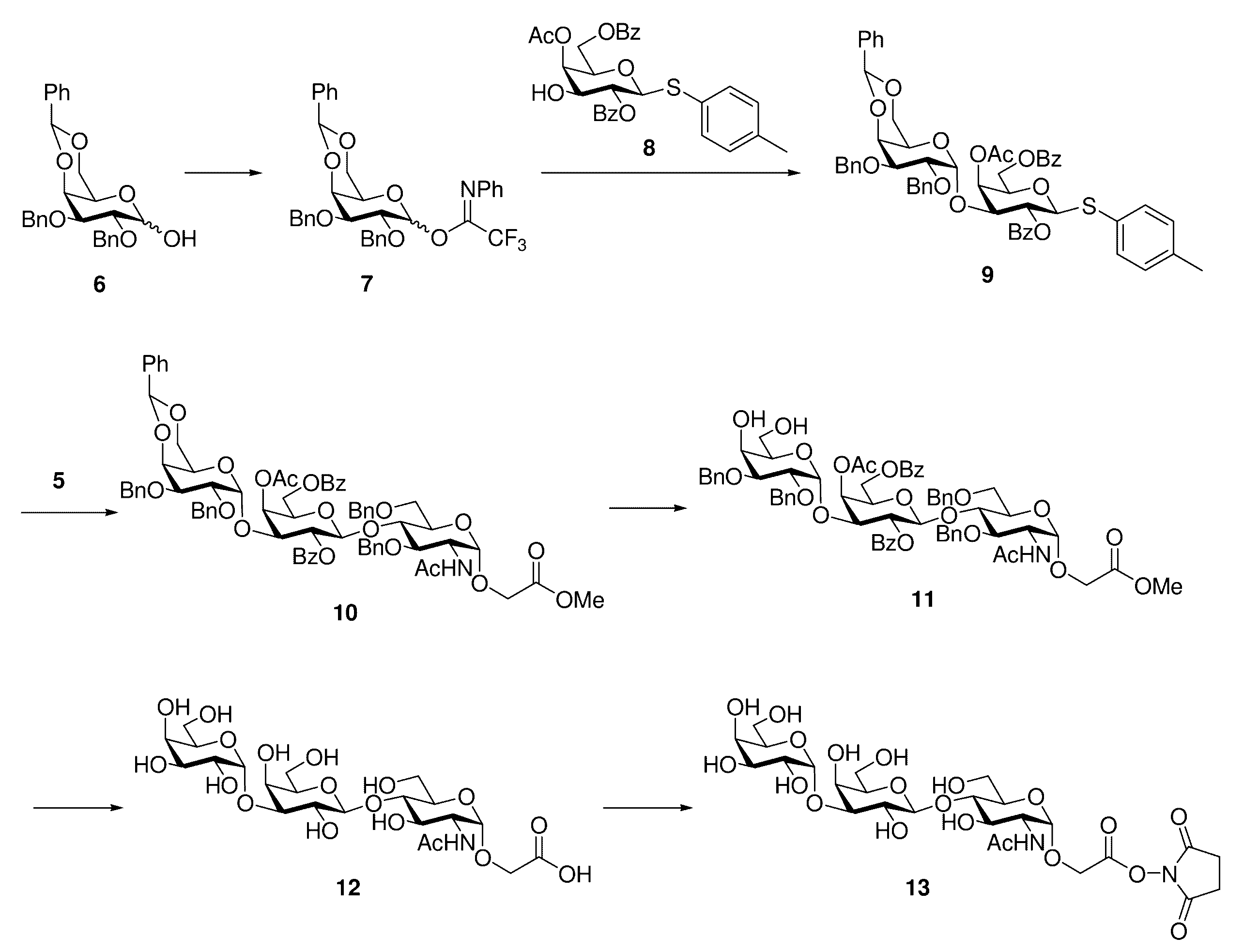
下記工程に従い、化合物13を得た。
下記工程に従い、化合物13を得た。

(化合物2の合成)
亜鉛粉末(4g)を含む水懸濁液を30分間超音波処理した。2.0%のCuSO4水溶液を添加したのち、混合物を濾過した。活性化されたZn/Cu残渣を、室温で、化合物1(1.0g、1.9mmol)、テトラヒドロフラン(THF)(20mL)、酢酸(20mL)及び無水酢酸(20mL)を含む溶液に添加した。室温で1.5時間撹拌した後、反応混合物を濾過し、減圧濃縮した。残渣をシリカゲルカラムクロマトグラフィー(クロロホルム/メタノール=1/0から20/1)にて精製し、白色固体として化合物2を得た(707mg、90%)。
亜鉛粉末(4g)を含む水懸濁液を30分間超音波処理した。2.0%のCuSO4水溶液を添加したのち、混合物を濾過した。活性化されたZn/Cu残渣を、室温で、化合物1(1.0g、1.9mmol)、テトラヒドロフラン(THF)(20mL)、酢酸(20mL)及び無水酢酸(20mL)を含む溶液に添加した。室温で1.5時間撹拌した後、反応混合物を濾過し、減圧濃縮した。残渣をシリカゲルカラムクロマトグラフィー(クロロホルム/メタノール=1/0から20/1)にて精製し、白色固体として化合物2を得た(707mg、90%)。
1H NMR(400MHz,CDCl3):δ=7.51-7.16(m,10H,aromatic),5.85(m,1H,-CH2-CH=CH2),5.60(s,1H,-CHPh),5.35(d,J=9.2Hz,1H,-NH-),5.28-5.19(m,2H,-CH2-CH=CH
2),4.92(d,J=12.3Hz,1H,-CH
2Ph),4.86(d,J=3.9Hz,1H,H-1),4.63(d,J=12.2Hz,1H,-CH
2Ph),4.33-4.26(m,2H,H-2,H-4),4.16(ddt,J=13.0,6.3,1.2Hz,1H,-CH
2-CH=CH2),3.96(ddt,J=13.0,6.3,1.2Hz,1H,-CH
2-CH=CH2),3.85(m,1H,H-3),3.80-3.70(m,3H,H-5,H-6),1.92(s,3H,-CH
3).
13C NMR(100MHz,CDCl3):δ=169.7,138.5,137.3,133.4,128.9,128.3,127.9,127.6,126.0,118.0,101.2,97.3,82.7,76.0,74.0,69.0,68.4,62.9,52.4,23.4.
HRMS (ESI-LIT-Orbitrap)m/z calcd for C25H29O6N+Na[M+Na]+,462.1887,found 462.1887.
13C NMR(100MHz,CDCl3):δ=169.7,138.5,137.3,133.4,128.9,128.3,127.9,127.6,126.0,118.0,101.2,97.3,82.7,76.0,74.0,69.0,68.4,62.9,52.4,23.4.
HRMS (ESI-LIT-Orbitrap)m/z calcd for C25H29O6N+Na[M+Na]+,462.1887,found 462.1887.
(化合物3の合成)
化合物2(50mg、114μmol)及び塩化メチレン/アセトニトリル/水(2/2/3、2.5mL)を含む溶液に、室温で、NaIO4(200mg、910μmol)及びRuCl3・H2O(1.0mg、4.6μmol)を添加した。室温で3時間撹拌後、反応混合物を水で希釈し、塩化メチレンで抽出した、有機層を水で洗浄し、Na2SO4で乾燥し、濾過し、減圧濃縮することで、粗生成物として化合物3を得た。
化合物2(50mg、114μmol)及び塩化メチレン/アセトニトリル/水(2/2/3、2.5mL)を含む溶液に、室温で、NaIO4(200mg、910μmol)及びRuCl3・H2O(1.0mg、4.6μmol)を添加した。室温で3時間撹拌後、反応混合物を水で希釈し、塩化メチレンで抽出した、有機層を水で洗浄し、Na2SO4で乾燥し、濾過し、減圧濃縮することで、粗生成物として化合物3を得た。
(化合物4の合成)
化合物3(114μmol)及びN,N-ジメチルホルムアミド(1mL)を含む溶液に、室温で、ヨウ化メチル(35μL、570μmol)及びK2CO3(79mg、570μmol)を添加した。室温で1時間撹拌した後、反応混合物を水で希釈し、クロロホルムで抽出した。有機層を食塩水で洗浄し、Na2SO4で乾燥し、濾過し、減圧蒸留した。残渣をシリカゲルカラムクロマトグラフィー(クロロホルム/メタノール=50/1)にて精製し、白色固体として化合物4を得た(33mg、61%、2段階)。
化合物3(114μmol)及びN,N-ジメチルホルムアミド(1mL)を含む溶液に、室温で、ヨウ化メチル(35μL、570μmol)及びK2CO3(79mg、570μmol)を添加した。室温で1時間撹拌した後、反応混合物を水で希釈し、クロロホルムで抽出した。有機層を食塩水で洗浄し、Na2SO4で乾燥し、濾過し、減圧蒸留した。残渣をシリカゲルカラムクロマトグラフィー(クロロホルム/メタノール=50/1)にて精製し、白色固体として化合物4を得た(33mg、61%、2段階)。
1H NMR(400MHz,CDCl3):δ=7.51-7.24(m,10H,aromatic),5.95(d,J=9.3Hz,1H,-NH-),5.59(s,1H,-CHPh),4.92(d,J=12.3Hz,1H,-CH
2Ph),4.82(d,J=3.8Hz,1H,H-1),4.66(d,J=12.4Hz,1H,-CH
2Ph),4.34(td,J=9.4,13.6Hz,1H,H-2),4.25(dd,J=10.3,4.8Hz,1H,H-4),4.18(dd,J=19.8,16.8Hz,2H,-O-CH
2-C=O),3.90(m,1H,H-5),3.81-3.76(m,3H,H-3,H-6),3.75(s,3H,-CH
3),1.92(s,3H,-CH
3).
13C NMR(100MHz,CDCl3):δ=170.2,170.1,138.5,137.3,129.0,128.3,128.2,127.9,127.6,126.0,101.3,99.2,82.5,76.0,74.0,68.8,64.6,63.5,52.2,52.1,23.3.
HRMS(ESI-LIT-Orbitrap)m/z calcd for C25H29O8N+Na[M+Na]+,494.1785,found 494.1790.
13C NMR(100MHz,CDCl3):δ=170.2,170.1,138.5,137.3,129.0,128.3,128.2,127.9,127.6,126.0,101.3,99.2,82.5,76.0,74.0,68.8,64.6,63.5,52.2,52.1,23.3.
HRMS(ESI-LIT-Orbitrap)m/z calcd for C25H29O8N+Na[M+Na]+,494.1785,found 494.1790.
(化合物5の合成)
化合物4(143mg、302μmol)、トリエチルシラン(144μL、906μmol)及び蒸留塩化メチレン(1.4mL)を含む溶液に、アルゴン雰囲気下、-20℃で、三フッ化ホウ素ジエチルエーテル(115μL、906μmol)を滴下した。0℃で1.5時間、その後室温で一晩、撹拌した。反応混合物を飽和炭酸水素ナトリウム水溶液でクエンチし、塩化メチレンで抽出した。有機層を食塩水で洗浄し、Na2SO4で乾燥し、濾過し、減圧濃縮した。残渣をシリカゲルカラムクロマトグラフィー(塩化メチレン/酢酸エチル=3/1)にて精製し、白色固体として化合物5を得た(78mg、55%)。
化合物4(143mg、302μmol)、トリエチルシラン(144μL、906μmol)及び蒸留塩化メチレン(1.4mL)を含む溶液に、アルゴン雰囲気下、-20℃で、三フッ化ホウ素ジエチルエーテル(115μL、906μmol)を滴下した。0℃で1.5時間、その後室温で一晩、撹拌した。反応混合物を飽和炭酸水素ナトリウム水溶液でクエンチし、塩化メチレンで抽出した。有機層を食塩水で洗浄し、Na2SO4で乾燥し、濾過し、減圧濃縮した。残渣をシリカゲルカラムクロマトグラフィー(塩化メチレン/酢酸エチル=3/1)にて精製し、白色固体として化合物5を得た(78mg、55%)。
1H NMR(400MHz,CDCl3):δ=7.36-7.26(m,10H,aromatic),6.11(d,J=9.2Hz,1H,-NH-),4.78(d,J=3.6Hz,1H,H-1),4.73(dd,J=13.5,11.7Hz,2H,-CH
2Ph),4.57(dd,J=21.6,12.0Hz,2H,-CH
2Ph),4.34(ddd,J=10.4,9.5,3.6Hz,1H,H-2),4.19(dd,J=21.0,16.8Hz,2H,-O-CH
2-C=O),3.82(m,1H,H-5),3.77-3.67(m,6H,H-3,H-6,-CH
3),3.61(m,1H,H-3),2.70(m,1H,-OH),1.98(s,3H,-CH
3).
13C NMR(100MHz,CDCl3):δ=170.5,170.3,138.5,137.8,128.5,128.4,128.0,127.8,127.7,127.6,98.9,80.0,74.0,73.6,71.4,71.1,70.0,64.4,52.0,51.8,23.4.
HRMS(ESI-LIT-Orbitrap)m/z calcd for C25H31O8N+Na[M+Na]+,496.1942,found 496.1247.
13C NMR(100MHz,CDCl3):δ=170.5,170.3,138.5,137.8,128.5,128.4,128.0,127.8,127.7,127.6,98.9,80.0,74.0,73.6,71.4,71.1,70.0,64.4,52.0,51.8,23.4.
HRMS(ESI-LIT-Orbitrap)m/z calcd for C25H31O8N+Na[M+Na]+,496.1942,found 496.1247.
(化合物7の合成)
化合物6(350mg、0.78mmol)及びアセトン(7mL)を含む溶液に、室温で、N-フェニルトリフルオロアセトイミダートクロリド(245mg、1.17mmol)及びK2CO3(525mg、3.9mmol)を添加した。室温で2時間撹拌後、反応混合物を濾過し、減圧濃縮した。残渣を凍結乾燥し、粗生成物として化合物7を得た。
化合物6(350mg、0.78mmol)及びアセトン(7mL)を含む溶液に、室温で、N-フェニルトリフルオロアセトイミダートクロリド(245mg、1.17mmol)及びK2CO3(525mg、3.9mmol)を添加した。室温で2時間撹拌後、反応混合物を濾過し、減圧濃縮した。残渣を凍結乾燥し、粗生成物として化合物7を得た。
(化合物9の合成)
ドナーである化合物7(226mg、366μmol)、アクセプターである化合物8(196mg、366μmol)、モレキュラーシーブ4A、及び無水塩化メチレン(8.4mL)を含む溶液に、アルゴン雰囲気下、-20℃で、トリメチルシリルトリフラート(13μL、73.2μmol)を添加した。アルゴン雰囲気下、-20℃で1時間撹拌した後、反応混合物を飽和炭酸水素ナトリウム水溶液でクエンチし、塩化メチレンで抽出した。有機層を食塩水で洗浄し、Na2SO4で乾燥し、濾過し、減圧濃縮した。残渣をシリカゲルカラムクロマトグラフィー(塩化メチレン/酢酸エチル=60/1)にて精製し、白色固体として化合物9を得た(215mg、77%)。
ドナーである化合物7(226mg、366μmol)、アクセプターである化合物8(196mg、366μmol)、モレキュラーシーブ4A、及び無水塩化メチレン(8.4mL)を含む溶液に、アルゴン雰囲気下、-20℃で、トリメチルシリルトリフラート(13μL、73.2μmol)を添加した。アルゴン雰囲気下、-20℃で1時間撹拌した後、反応混合物を飽和炭酸水素ナトリウム水溶液でクエンチし、塩化メチレンで抽出した。有機層を食塩水で洗浄し、Na2SO4で乾燥し、濾過し、減圧濃縮した。残渣をシリカゲルカラムクロマトグラフィー(塩化メチレン/酢酸エチル=60/1)にて精製し、白色固体として化合物9を得た(215mg、77%)。
1H NMR(400MHz,CDCl3):δ=8.07-6.90(m,29H,aromatic),5.62(d,J=3.0Hz,1H,H-4’),5.52(m,1H,H-2’),5.18(s,1H,-CHPh),5.09(d,J=3.3Hz,1H,H-1),4.79(d,J=10.1Hz,1H,H-1’),4.73-4.54(m,4H,H-6,-CH
2Ph),4.43(ddd,J=16.6,11.6,5.2Hz,2H,H-6’),4.04-3.99(m,2H,H-3’,H-5’),3.95(dd,J=10.2,3.3Hz,1H,H-2),3.82(d,J=11.5Hz,1H,-CHPh),3.74(dd,J=10.2,3.4Hz,1H,H-3),3.57(d,J=3.3Hz,1H,H-4),3.39(d,J=12.0Hz,2H,H-5,-CH
2Ph),1.90(s,3H,-CH
3),1.80(s,3H,-CH
3).
13C NMR(100MHz,CDCl3):δ=170.2,166.0,164.8,138.8,138.6,138.1,137.7,133.5,133.2,129.8,129.6,129.6,128.8,128.6,128.4,128.3,128.1,128.1,127.6,127.5,126.2,100.8,96.0,87.5,76.1,75.2,74.4,74.3,73.9,72.1,68.8,65.8,62.9,21.1,20.4.
HRMS(ESI-LIT-Orbitrap)m/z calcd for C56H54O13S+Na[M+Na]+,989.3177,found 989.3189.
13C NMR(100MHz,CDCl3):δ=170.2,166.0,164.8,138.8,138.6,138.1,137.7,133.5,133.2,129.8,129.6,129.6,128.8,128.6,128.4,128.3,128.1,128.1,127.6,127.5,126.2,100.8,96.0,87.5,76.1,75.2,74.4,74.3,73.9,72.1,68.8,65.8,62.9,21.1,20.4.
HRMS(ESI-LIT-Orbitrap)m/z calcd for C56H54O13S+Na[M+Na]+,989.3177,found 989.3189.
(化合物10の合成)
ドナーである化合物9(94mg、97μmol)、アクセプターである化合物5(46mg、97μmol)、モレキュラーシーブ4A、及び無水塩化メチレン(4mL)を含む溶液に、アルゴン雰囲気下、-20℃で、N-ヨードスクシンイミド(26mg、116μmol)及びトリフルオロメタンスルホン酸(3.4μL、39μmol)を添加した。アルゴン雰囲気下、-20℃で2.5時間撹拌したのち、反応混合物を、トリエチルアミンでクエンチし、塩化メチレンで抽出した。有機層を食塩水で洗浄し、Na2SO4で乾燥し、濾過し、減圧濃縮した。残渣をシリカゲルカラムクロマトグラフィー(塩化メチレン/酢酸エチル=3/1)にて精製し、白色固体として化合物10を得た(106mg、83%)。
ドナーである化合物9(94mg、97μmol)、アクセプターである化合物5(46mg、97μmol)、モレキュラーシーブ4A、及び無水塩化メチレン(4mL)を含む溶液に、アルゴン雰囲気下、-20℃で、N-ヨードスクシンイミド(26mg、116μmol)及びトリフルオロメタンスルホン酸(3.4μL、39μmol)を添加した。アルゴン雰囲気下、-20℃で2.5時間撹拌したのち、反応混合物を、トリエチルアミンでクエンチし、塩化メチレンで抽出した。有機層を食塩水で洗浄し、Na2SO4で乾燥し、濾過し、減圧濃縮した。残渣をシリカゲルカラムクロマトグラフィー(塩化メチレン/酢酸エチル=3/1)にて精製し、白色固体として化合物10を得た(106mg、83%)。
1H NMR(500MHz,CDCl3):δ=8.06-7.22(m,35H,aromatic),5.80(d,J=6.6Hz,1H,-NH-),5.51(d,J=3.2Hz,1H,H-4’),5.52(dd,J=10.1,8.1Hz,1H,H-2’),5.17(s,1H,-CHPh),5.06(d,J=3.3Hz,1H,H-1),4.96(d,J=11.8Hz,1H,-CH
2Ph),4.77(d,J=3.7Hz,1H,H-1’’),4.72-4.60(m,6H,H-1’,H-6,H-6’,-CH
2Ph),4.55(d,J=12.4Hz,1H,-CH
2Ph),4.29-4.21(m,2H,-CH
2Ph,H-2’’),4.12(m,2H,H-6’’),4.06-4.02(m,3H,-O-CH
2-C=O,H-4’’),3.93(dd,J=10.2,3.3Hz,1H,H-2),3.86(dd,J=12.5,1.6Hz,1H,-CH
2Ph),3.77(dd,J=10.2,3.6Hz,1H,H-3’),3.72-3.62(m,6H,-CH
3,H-3,H-5’,H-5’’),3.50(d,J=2.8Hz,1H,H-3’’),3.43(d,J=9.5Hz,1H,H-5),3.38(dd,J=12.5,1.6Hz,1H,-CH
2Ph),3.26(s,1H,H-4),1.90(s,3H,-CH
3),1.81(s,3H,-CH
3).
13C NMR(125MHz,CDCl3):δ=170.2,164.5,139.0,138.8,138.6,133.6,133.2,129.8,129.4,128.9,128.7,128.5,128.2,128.2,128.1,127.9,127.8,127.6,127.5,127.4,126.2,100.8,100.3,98.4,96.0,77.8,76.0,74.4,74.2,74.1,74.0,74.0,73.5,72.1,71.1,71.0,68.8,67.7,65.3,64.4,62.9,61.7,52.0,41.0,23.3,20.1.
HRMS(ESI-LIT-Orbitrap)m/z calcd for C74H77O21N+Na[M+Na]+,1338.4880,found 1338.4891.
13C NMR(125MHz,CDCl3):δ=170.2,164.5,139.0,138.8,138.6,133.6,133.2,129.8,129.4,128.9,128.7,128.5,128.2,128.2,128.1,127.9,127.8,127.6,127.5,127.4,126.2,100.8,100.3,98.4,96.0,77.8,76.0,74.4,74.2,74.1,74.0,74.0,73.5,72.1,71.1,71.0,68.8,67.7,65.3,64.4,62.9,61.7,52.0,41.0,23.3,20.1.
HRMS(ESI-LIT-Orbitrap)m/z calcd for C74H77O21N+Na[M+Na]+,1338.4880,found 1338.4891.
(化合物11の合成)
化合物10(88mg、67μmol)及び塩化メチレン(8.8mL)を含む溶液に、水(0.88mL)及びトリフルオロ酢酸(1.76mL)を室温で添加した。室温で45分撹拌後、反応混合物を、飽和炭酸水素ナトリウム水溶液でクエンチし、塩化メチレンで抽出した。有機層を食塩水で洗浄し、Na2SO4で乾燥し、濾過し、減圧濃縮した。残渣をシリカゲルカラムクロマトグラフィー(クロロホルム/メタノール=60/1)にて精製し、白色固体として化合物11を得た(106mg、83%)。
化合物10(88mg、67μmol)及び塩化メチレン(8.8mL)を含む溶液に、水(0.88mL)及びトリフルオロ酢酸(1.76mL)を室温で添加した。室温で45分撹拌後、反応混合物を、飽和炭酸水素ナトリウム水溶液でクエンチし、塩化メチレンで抽出した。有機層を食塩水で洗浄し、Na2SO4で乾燥し、濾過し、減圧濃縮した。残渣をシリカゲルカラムクロマトグラフィー(クロロホルム/メタノール=60/1)にて精製し、白色固体として化合物11を得た(106mg、83%)。
1H NMR(400MHz,CDCl3):δ=8.04-7.23(m,30H,aromatic),5.80(d,J=9.2Hz,1H,-NH-),5.55(d,J=3.0Hz,1H,H-4’),5.50(dd,J=9.8,8.2Hz,1H,H-2’),5.13(d,J=3.2Hz,1H,H-1),4.97(d,J=11.8Hz,1H,-CH
2Ph),4.78-4.76(m,2H,H-1’,H-1’’),4.769-4.56(m,5H,H-6,H-6’,-CH
2Ph),4.45-4.36(m,2H,-CH
2Ph),4.25(td,J=13.0,10.3,3.7Hz,1H,H-2’’),4.15(m,2H,H-6’’),4.09-4.05(m,3H,-O-CH
2-C=O,H-4’’),3.88(dd,J=10.1,3.2Hz,H-3’),3.72-3.45(m,11H,-CH
3,-CH
2Ph,H-2,H-3,H-3’’,H-5,H-5’,H-5’’),3.30(d,J=2.5Hz,1H,H-4),2.60(s,1H,-OH),2.47(s,1H,-OH),1.89(s,3H,-CH
3),1.83(s,3H,-CH
3).
13C NMR(100MHz,CDCl3):δ=170.2,170.1,166.0,164.7,139.0,138.4,138.1,137.9,133.7,133.3,129.8,129.6,129.6,129.3,128.8,128.5,128.2,127.9,127.9,127.8,127.8,127.6,127.5,127.4,100.6,98.5,94.1,77.8,74.9,74.2,73.6,73.3,72.8,72.7,71.7,71.1,71.0,69.3,68.9,67.7,64.9,64.4,62.9,61.6,52.1,52.0,23.3,20.4.
HRMS(ESI-LIT-Orbitrap)m/z calcd for C67H73O21N+Na[M+Na]+,1250.4567,found 1250.4578.
13C NMR(100MHz,CDCl3):δ=170.2,170.1,166.0,164.7,139.0,138.4,138.1,137.9,133.7,133.3,129.8,129.6,129.6,129.3,128.8,128.5,128.2,127.9,127.9,127.8,127.8,127.6,127.5,127.4,100.6,98.5,94.1,77.8,74.9,74.2,73.6,73.3,72.8,72.7,71.7,71.1,71.0,69.3,68.9,67.7,64.9,64.4,62.9,61.6,52.1,52.0,23.3,20.4.
HRMS(ESI-LIT-Orbitrap)m/z calcd for C67H73O21N+Na[M+Na]+,1250.4567,found 1250.4578.
(化合物12の合成)
化合物11(82mg、67μmol)及びメタノール(4.1mL)を含む溶液に、Pd(OH)2(82mg)を室温で添加した。1.5MPaの水素雰囲気下、室温で一晩撹拌後、反応混合物をメンブランフィルター(フロロポア(登録商標))で濾過し、減圧濃縮した。
粗生成物(67μmol)及びテトラヒドロフラン/1,4-ジオキサン/水(2/1/0.5、1.2mL)を含む溶液に、室温で、LiOH・H2O(28mg、668μmol)を添加した。室温で2時間撹拌後、反応混合物をイオン交換樹脂(ダウエックス(TM)、50WX8 50-100)でクエンチし、濾過し、減圧濃縮した。残渣を、1%の酢酸水溶液を用いたゲル濾過(セファデックス(TM) LH-20)にて精製し、白色固体として化合物12を得た(32mg、80%、2段階)。
化合物11(82mg、67μmol)及びメタノール(4.1mL)を含む溶液に、Pd(OH)2(82mg)を室温で添加した。1.5MPaの水素雰囲気下、室温で一晩撹拌後、反応混合物をメンブランフィルター(フロロポア(登録商標))で濾過し、減圧濃縮した。
粗生成物(67μmol)及びテトラヒドロフラン/1,4-ジオキサン/水(2/1/0.5、1.2mL)を含む溶液に、室温で、LiOH・H2O(28mg、668μmol)を添加した。室温で2時間撹拌後、反応混合物をイオン交換樹脂(ダウエックス(TM)、50WX8 50-100)でクエンチし、濾過し、減圧濃縮した。残渣を、1%の酢酸水溶液を用いたゲル濾過(セファデックス(TM) LH-20)にて精製し、白色固体として化合物12を得た(32mg、80%、2段階)。
1H NMR(500MHz,CD3OD):δ=4.93(d,J=1.9Hz,1H,H-1’’),4.63(d,J=3.5Hz,1H,H-1’’),4.33(d,J=7.2Hz,1H,H-1’),4.14(t,1H,J=5.9,1H,H-4’’),3.97(d,J=15.1Hz,1H,-O-CH
2-C=O),3.94-3.92(m,2H,H-2,H-3’),3.83-3.77(m,3H,H-3,H-4’,H-5),3.73-3.68(m,5H,H-2’’,H-3’’,H-6,-O-CH
2-C=O),3.65-3.53(m,8H,H-2’,H-3’,H-5’,H-5’’,H-6’,H-6’’),3.48(m,1H,H-4),1.91(s,3H,-CH
3)
13C NMR(125MHz,CD3OD):δ=173.7,105.0,98.9,97.7,80.9,79.8,76.7,72.4,71.9,71.4,71.2,71.0,70.2,68.1,66.8,62.7,62.5,61.7,54.5,22.8.
HRMS(ESI-LIT-Orbitrap)m/z calcd for C22H37O18N+Na[M+Na]+,626.1903,found 626.1912.
13C NMR(125MHz,CD3OD):δ=173.7,105.0,98.9,97.7,80.9,79.8,76.7,72.4,71.9,71.4,71.2,71.0,70.2,68.1,66.8,62.7,62.5,61.7,54.5,22.8.
HRMS(ESI-LIT-Orbitrap)m/z calcd for C22H37O18N+Na[M+Na]+,626.1903,found 626.1912.
(化合物13の合成)
化合物12(4.5mg、7.5μmol)及び無水N,N-ジメチルホルムアミド(1.5mL)を含む溶液を、トリエチルアミン(1.2μL、9.0μmol)及びN,N,N’,N’-テトラメチル-O-(N-スクシンイミジル)ウロニウムテトラフルオロボラート(TSTU,2.7mg、9.0μmol)を室温で添加した。アルゴン雰囲気下、室温で3時間撹拌した後、反応混合物を減圧濃縮し、化合物13を得た。
化合物12(4.5mg、7.5μmol)及び無水N,N-ジメチルホルムアミド(1.5mL)を含む溶液を、トリエチルアミン(1.2μL、9.0μmol)及びN,N,N’,N’-テトラメチル-O-(N-スクシンイミジル)ウロニウムテトラフルオロボラート(TSTU,2.7mg、9.0μmol)を室温で添加した。アルゴン雰囲気下、室温で3時間撹拌した後、反応混合物を減圧濃縮し、化合物13を得た。
[実施例2]糖鎖導入剤の合成
下記工程に従い、化合物14を得た。
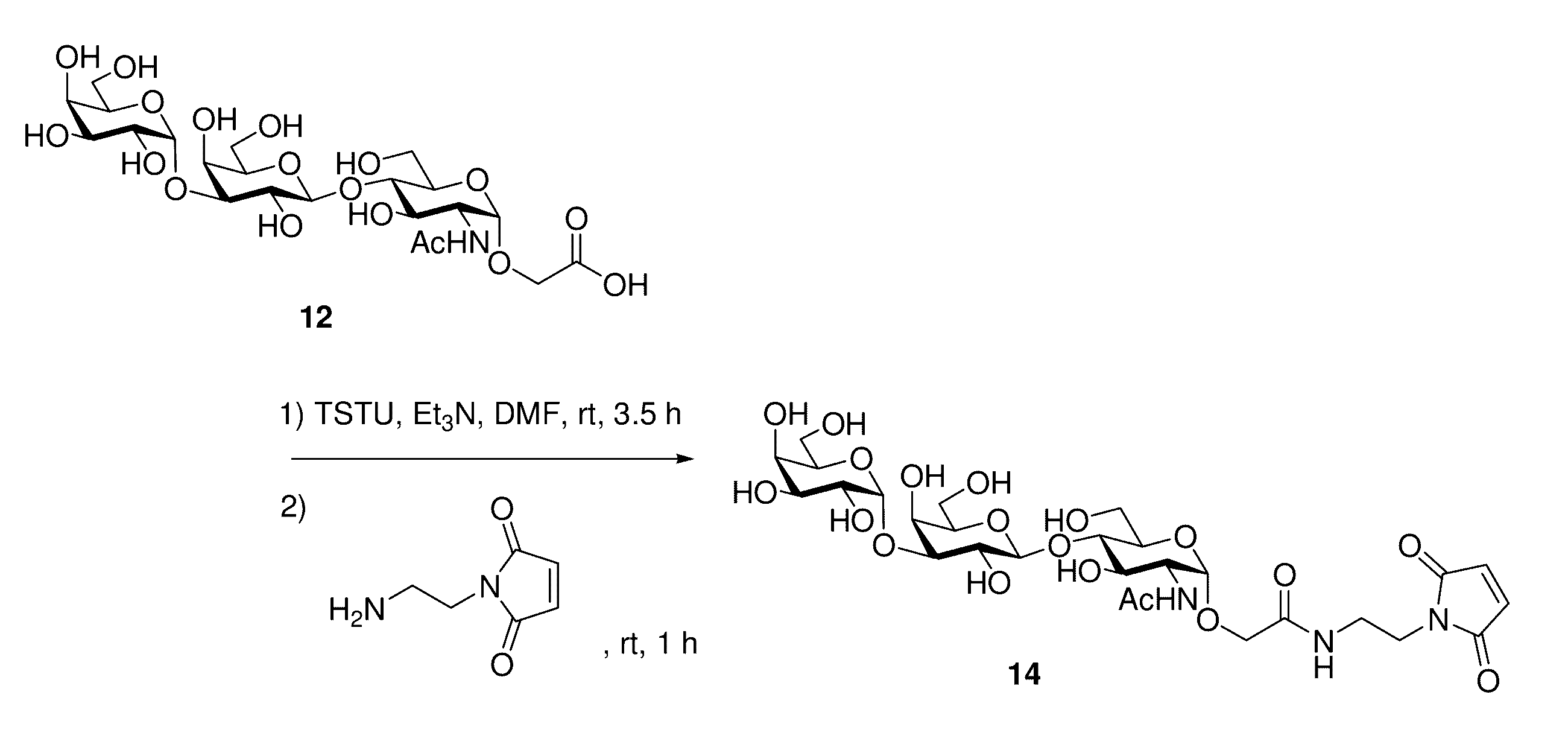
下記工程に従い、化合物14を得た。
化合物12(410μg、0.68μmol)及び無水N,N-ジメチルホルムアミド(137μL)を含む溶液に、トリエチルアミン(0.9μL、6.8μmol)及びN,N,N’,N’-テトラメチル-O-(N-スクシンイミジル)ウロニウムテトラフルオロボラート(TSTU,301μg,1.0μmol)を添加し、アルゴン雰囲気下、室温で3.5時間撹拌した。反応混合物に、2-マレイミドエチルアミン(207μg,0.82μmol)を加えた後、1時間撹拌した。減圧濃縮することで、化合物14を得た。
[実施例3]糖鎖導入剤の合成
下記工程に従い、化合物15を得た。
下記工程に従い、化合物15を得た。
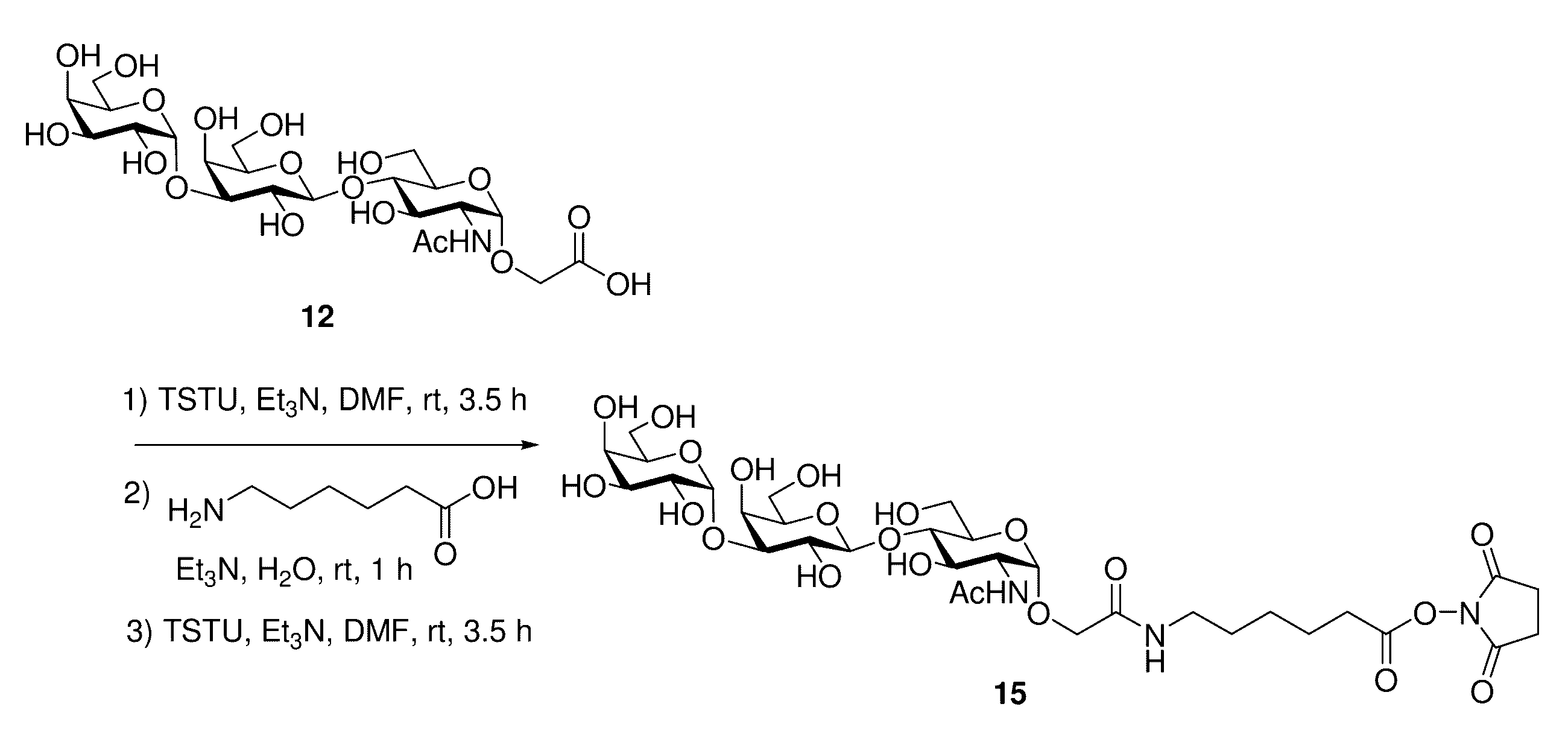
化合物12(200μg,0.33μmol)及び無水N,N-ジメチルホルムアミド(67μL)を含む溶液に、トリエチルアミン(1.4μL,1.0μmol)及びN,N,N’,N’-テトラメチル-O-(N-スクシンイミジル)ウロニウムテトラフルオロボラート(TSTU,301μg,1.0μmol)を添加し、アルゴン雰囲気下、室温で2.5時間撹拌した後、減圧濃縮した。残渣に6-アミノヘキサン酸(48μg,0.36μmol)とトリエチルアミン(1.4μL,1.0μmol)を溶解した水溶液(67μL)を加えた後、1.5時間撹拌し、反応液を凍結乾燥した。残渣を無水N,N-ジメチルホルムアミド(67μL)に溶解し、トリエチルアミン(0.7μL,0.50μmol)及びTSTU(150μg,0.50μmol)を添加し、アルゴン雰囲気下、室温で3時間撹拌し、減圧濃縮することで化合物15を得た。
[実施例4]化合物13を用いた糖鎖導入
下記工程に従い、BSAに糖鎖を導入した。
下記工程に従い、BSAに糖鎖を導入した。
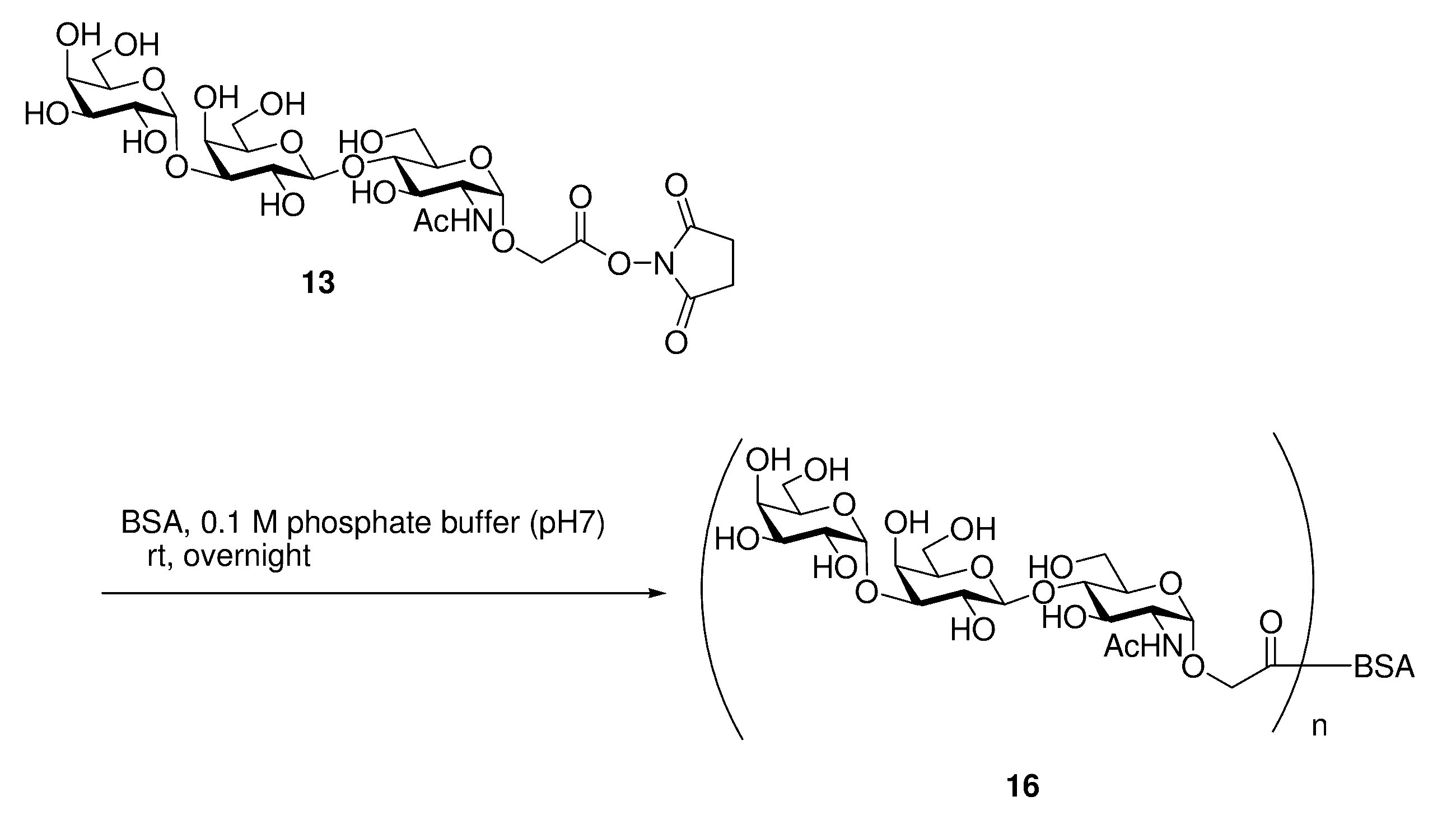
ウシ血清アルブミン(BSA)(SIGMA製、660μg、10nmol)を0.1Mリン酸ナトリウム緩衝液(100μL,pH=8)に溶解し、化合物13(300nmol)を加え、室温で15時間インキュベートした。反応混合液を遠心式フィルター[Microcon(登録商標) YM-10,50,000cut,Millipore]を用いて限外濾過した(10000rpmで5分間)。これに蒸留水を加えた。この限外濾過を用いた緩衝液から水への溶液の置換を3回行い、糖鎖を導入したBSA16を得た。
BSA16には、10~12個の糖鎖(n=10~12)が導入されていた。
なお、糖鎖の導入(化合物13とBSAとの反応による結合形成)は、マススペクトルを反応前後のBSAにおいて測定することで確認した。すなわち、反応前のBSAの分子量は約66000であり、反応後のBSAの分子量は約73000であった。
この結果より、化合物13は、タンパク質を構成するアミノ酸と反応して結合形成することを確認できた。また、化合物13によれば、多数の糖鎖を導入できることも確認できた。
なお、糖鎖の導入(化合物13とBSAとの反応による結合形成)は、マススペクトルを反応前後のBSAにおいて測定することで確認した。すなわち、反応前のBSAの分子量は約66000であり、反応後のBSAの分子量は約73000であった。
この結果より、化合物13は、タンパク質を構成するアミノ酸と反応して結合形成することを確認できた。また、化合物13によれば、多数の糖鎖を導入できることも確認できた。
[実施例5]化合物14を用いた糖鎖導入
下記工程に従い、糖鎖を導入したBSA17を得た。
下記工程に従い、糖鎖を導入したBSA17を得た。
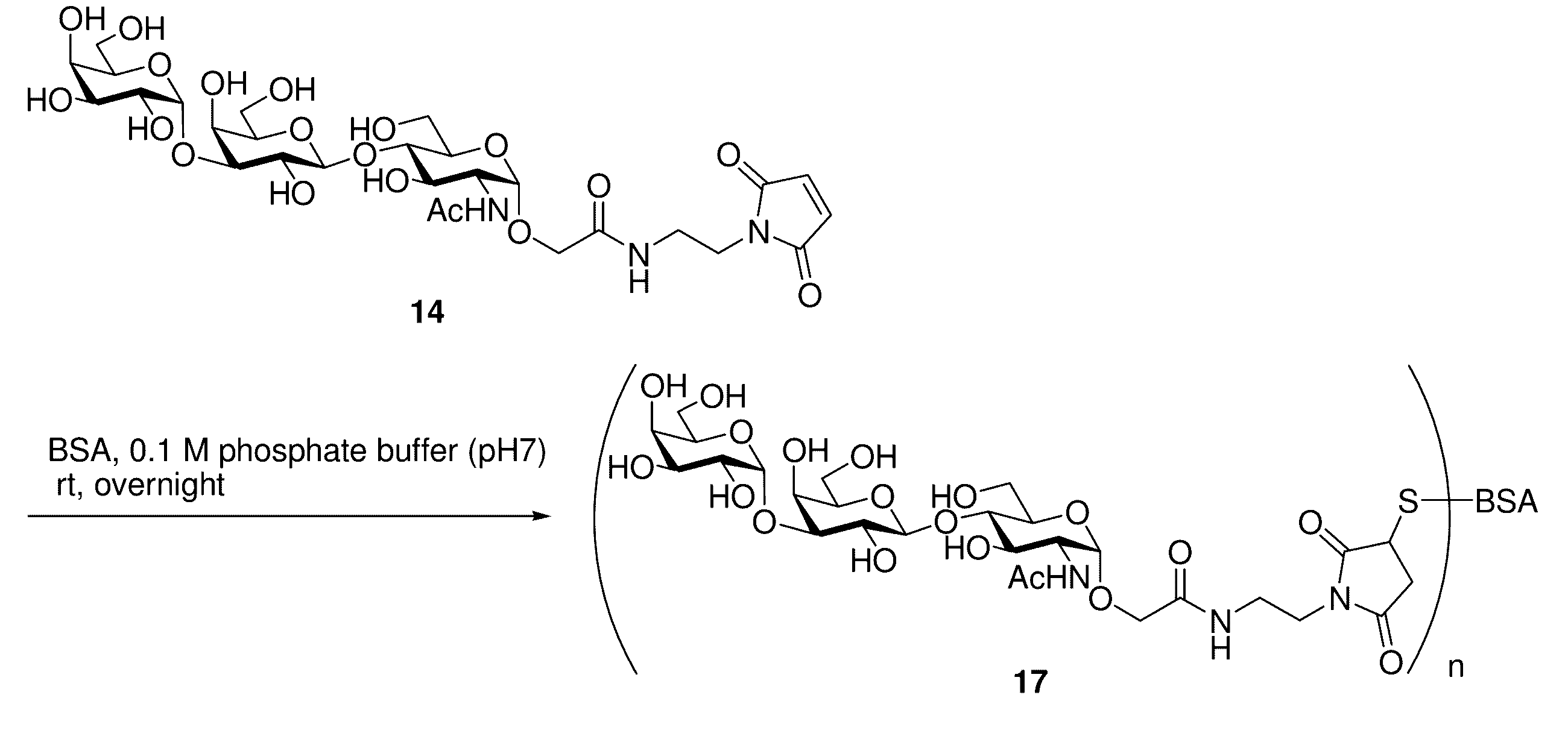
ウシ血清アルブミン(BSA)(SIGMA製、748μg、11.3nmol)を0.1Mリン酸ナトリウム緩衝液(113μL,pH=7)に溶解し、化合物14(340nmol)を加え、室温で16時間インキュベートした。反応混合液を遠心式フィルター[Microcon(登録商標) YM-10,50,000cut,Millipore]を用いて限外濾過した(10000rpmで10分間)。これに蒸留水を加えた。この限外濾過を用いた緩衝液から水への溶液の置換を3回行い、糖鎖を導入したBSA17を得た。
BSA17には、1つの糖鎖(n=1)が導入されていた。糖鎖が1個導入されたのは、BSAが有する35個のシステイン単位のうち34個がジスルフィド結合しているため、1個のシステイン由来のメルカプト基が化合物14と反応したためである。
なお、糖鎖の導入(化合物14とBSAとの反応による結合形成)は、マススペクトルを反応前後のBSAにおいて測定することで確認した。すなわち、反応前のBSAの分子量は約66000であり、反応後のBSAの分子量は約67000であった。
この結果より、化合物14は、タンパク質を構成するアミノ酸と反応して結合形成することを確認できた。
BSA17には、1つの糖鎖(n=1)が導入されていた。糖鎖が1個導入されたのは、BSAが有する35個のシステイン単位のうち34個がジスルフィド結合しているため、1個のシステイン由来のメルカプト基が化合物14と反応したためである。
なお、糖鎖の導入(化合物14とBSAとの反応による結合形成)は、マススペクトルを反応前後のBSAにおいて測定することで確認した。すなわち、反応前のBSAの分子量は約66000であり、反応後のBSAの分子量は約67000であった。
この結果より、化合物14は、タンパク質を構成するアミノ酸と反応して結合形成することを確認できた。
[実施例6]化合物15を用いた糖鎖導入
下記工程に従い、糖鎖を導入したBSA18を得た。
下記工程に従い、糖鎖を導入したBSA18を得た。
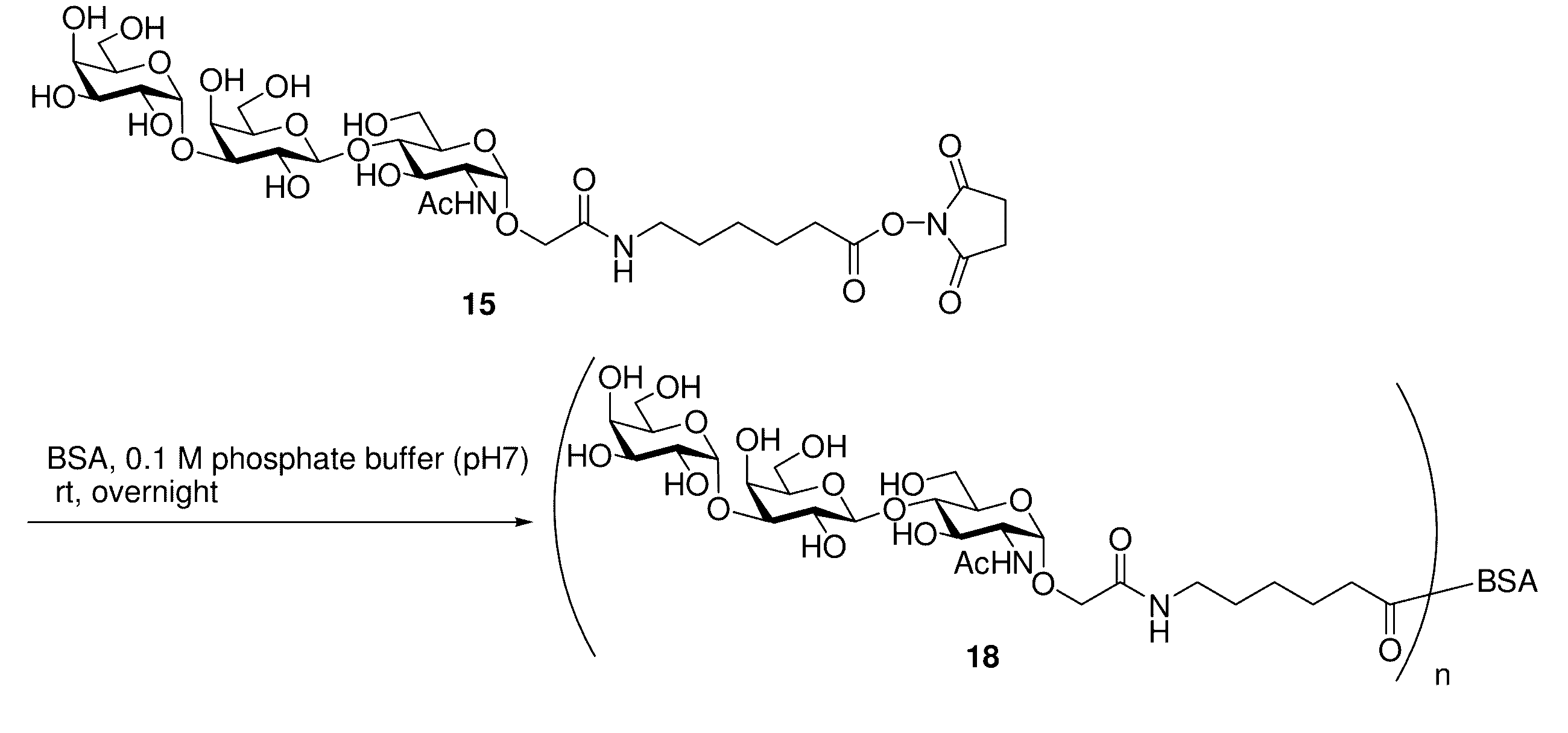
ウシ血清アルブミン(BSA)(SIGMA製、748μg、11.3nmol)を0.1Mリン酸ナトリウム緩衝液(100μL,pH=8)に溶解し、化合物15(340nmol)を加え、室温で15時間インキュベートした。反応混合液を遠心式フィルター[Microcon(登録商標) YM-10,50,000cut,Millipore]を用いて限外濾過した(10000rpmで5分間)。これに蒸留水を加えた。この限外濾過を用いた緩衝液から水への溶液の置換を3回行い、糖鎖を導入したBSA18を得た。
BSA18には、約6個の糖鎖(n=6)が導入されていた。
なお、糖鎖の導入(化合物15とBSAとの反応による結合形成)は、マススペクトルを反応前後のBSAにおいて測定することで確認した。すなわち、反応前のBSAの分子量は約66000であり、反応後のBSAの分子量は約70000であった。
この結果より、化合物15は、タンパク質を構成するアミノ酸と反応して結合形成することを確認できた。また、化合物15によれば、多数の糖鎖を導入できることも確認できた。
BSA18には、約6個の糖鎖(n=6)が導入されていた。
なお、糖鎖の導入(化合物15とBSAとの反応による結合形成)は、マススペクトルを反応前後のBSAにおいて測定することで確認した。すなわち、反応前のBSAの分子量は約66000であり、反応後のBSAの分子量は約70000であった。
この結果より、化合物15は、タンパク質を構成するアミノ酸と反応して結合形成することを確認できた。また、化合物15によれば、多数の糖鎖を導入できることも確認できた。
[実施例7]化合物13を用いた糖鎖導入
下記工程に従い、糖鎖を導入したMUC1ペプチド20を得た。
下記工程に従い、糖鎖を導入したMUC1ペプチド20を得た。

MUC1ペプチド19(配列番号1で示されるアミノ酸配列、1.5mg、770nmol)を0.1Mリン酸ナトリウム緩衝液(770μL,pH=8)に溶解し、化合物13(3.86μmol)を加え、室温で16時間インキュベートした。反応混合液をHPLCに打ち込み精製し[column: COSMOSIL 5C18-AR-300,10×250nm;MeCN in H2O containing 0.1%TFA(0-100% liner gradient over 50min,1mL/min);UV detection at 220nm;retention time:30min]、糖鎖を導入したMUC1ペプチド20(1.3mg,67%)を得た。
HRMS(ESI-LIT-Obitrap) calcd. for C104H165N27O46Na2[M+2Na]2+ 1287.5608,found 1287.5629
HRMS(ESI-LIT-Obitrap) calcd. for C104H165N27O46Na2[M+2Na]2+ 1287.5608,found 1287.5629
なお、MUC1ペプチド19は、以下のようにして、合成した。
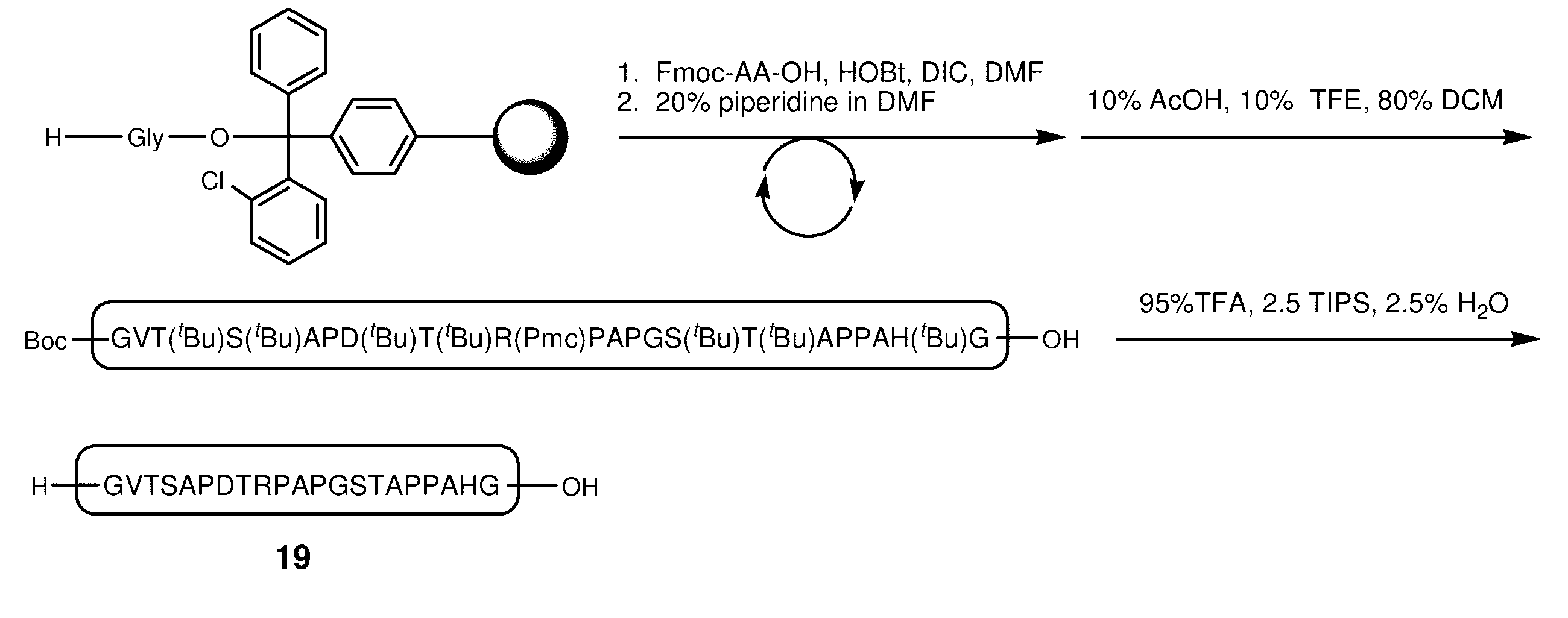
MUC1ペプチド19は一般的なFmoc固相合成法のプロトコルに従って合成した。Fmoc保護アミノ酸として、His(Boc)、Ala、Pro、Thr(tBu)、Ser(tBu)、Gly、Arg(Pmc)、Asp(OtBu)、Valを用い、N末端にはBoc-Glyを使用した。
グリシン 2-クロロトリチルレジン(Glycine 2-chlorotrityl resin)(0.195mmol scale,0.78mmol/g,100-200mesh,1%DVB,渡辺化学)を使用し、すべてのアミノ酸の縮合は以下の手順に従って行った。
Fmoc保護アミノ酸(0.975mmol)1-ヒドロキシベンゾトリアゾール(HOBt,132mg,0.975mmol)、ジイソプロピルカルボジイミド(DIC,305μL,1.95mmol)をDMF(3.0mL)に溶解し、30分間混合することで試薬を活性化させた。
活性化した試薬を樹脂に加え、その懸濁液を室温で2時間振とうした。すべてのFmoc基の除去は20%ピペリジンのDMF溶液(3mL)を樹脂に加え、室温で30分振とうすることで行った。すべての縮合が終了した後、樹脂に酢酸(AcOH)/トリフルオロエタノール(TFE)/ジクロロメタン(DCM)(1/1/8,3mL)を加え、2時間振とうし、その上清にジエチルエーテル(Et2O)(30mL)を加え、遠心分離し(15,000rpm,5分間)、上清を除いた。得られた沈殿にEt2O(30mL)を加え、同様の遠心分離の操作を2回行い、粗精製の保護アミノ酸(343mg,62%)を沈殿として得た。得られた保護アミノ酸(21mg)に95%トリフルオロ酢酸(TFA)、2.5%トリイソプロピルシラン(TIPS)、2.5%H2Oの混合液を400μL加え、室温で5時間振とうし、その上清にEt2O(4mL)を加え、遠心分離し(15,000rpm,5分間)、上清を除いた。得られた沈殿にEt2O(4mL)を加え、同様の遠心分離の操作を2回行い、粗精製の19を沈殿として得た。得られた沈殿をHPLCにより精製し(column:COSMOSIL 5C18-AR-300,10×250nm;MeCN in H2O containing 0.1%TFA(0-100% gradient over 50min,1mL/min);UV detection at 220nm;retention time:31min)、MUC1ペプチド19(15mg,quant)を得た。
HRMS(ESI-LIT-Obitrap) calcd. for C82H130N26O29 [M+2H]2+ 972.9835,found 972.9840.
Fmoc保護アミノ酸(0.975mmol)1-ヒドロキシベンゾトリアゾール(HOBt,132mg,0.975mmol)、ジイソプロピルカルボジイミド(DIC,305μL,1.95mmol)をDMF(3.0mL)に溶解し、30分間混合することで試薬を活性化させた。
活性化した試薬を樹脂に加え、その懸濁液を室温で2時間振とうした。すべてのFmoc基の除去は20%ピペリジンのDMF溶液(3mL)を樹脂に加え、室温で30分振とうすることで行った。すべての縮合が終了した後、樹脂に酢酸(AcOH)/トリフルオロエタノール(TFE)/ジクロロメタン(DCM)(1/1/8,3mL)を加え、2時間振とうし、その上清にジエチルエーテル(Et2O)(30mL)を加え、遠心分離し(15,000rpm,5分間)、上清を除いた。得られた沈殿にEt2O(30mL)を加え、同様の遠心分離の操作を2回行い、粗精製の保護アミノ酸(343mg,62%)を沈殿として得た。得られた保護アミノ酸(21mg)に95%トリフルオロ酢酸(TFA)、2.5%トリイソプロピルシラン(TIPS)、2.5%H2Oの混合液を400μL加え、室温で5時間振とうし、その上清にEt2O(4mL)を加え、遠心分離し(15,000rpm,5分間)、上清を除いた。得られた沈殿にEt2O(4mL)を加え、同様の遠心分離の操作を2回行い、粗精製の19を沈殿として得た。得られた沈殿をHPLCにより精製し(column:COSMOSIL 5C18-AR-300,10×250nm;MeCN in H2O containing 0.1%TFA(0-100% gradient over 50min,1mL/min);UV detection at 220nm;retention time:31min)、MUC1ペプチド19(15mg,quant)を得た。
HRMS(ESI-LIT-Obitrap) calcd. for C82H130N26O29 [M+2H]2+ 972.9835,found 972.9840.
[実施例8]化合物13を用いた糖鎖導入
下記工程に従い、糖鎖を導入したWT1ペプチド22を得た。
下記工程に従い、糖鎖を導入したWT1ペプチド22を得た。
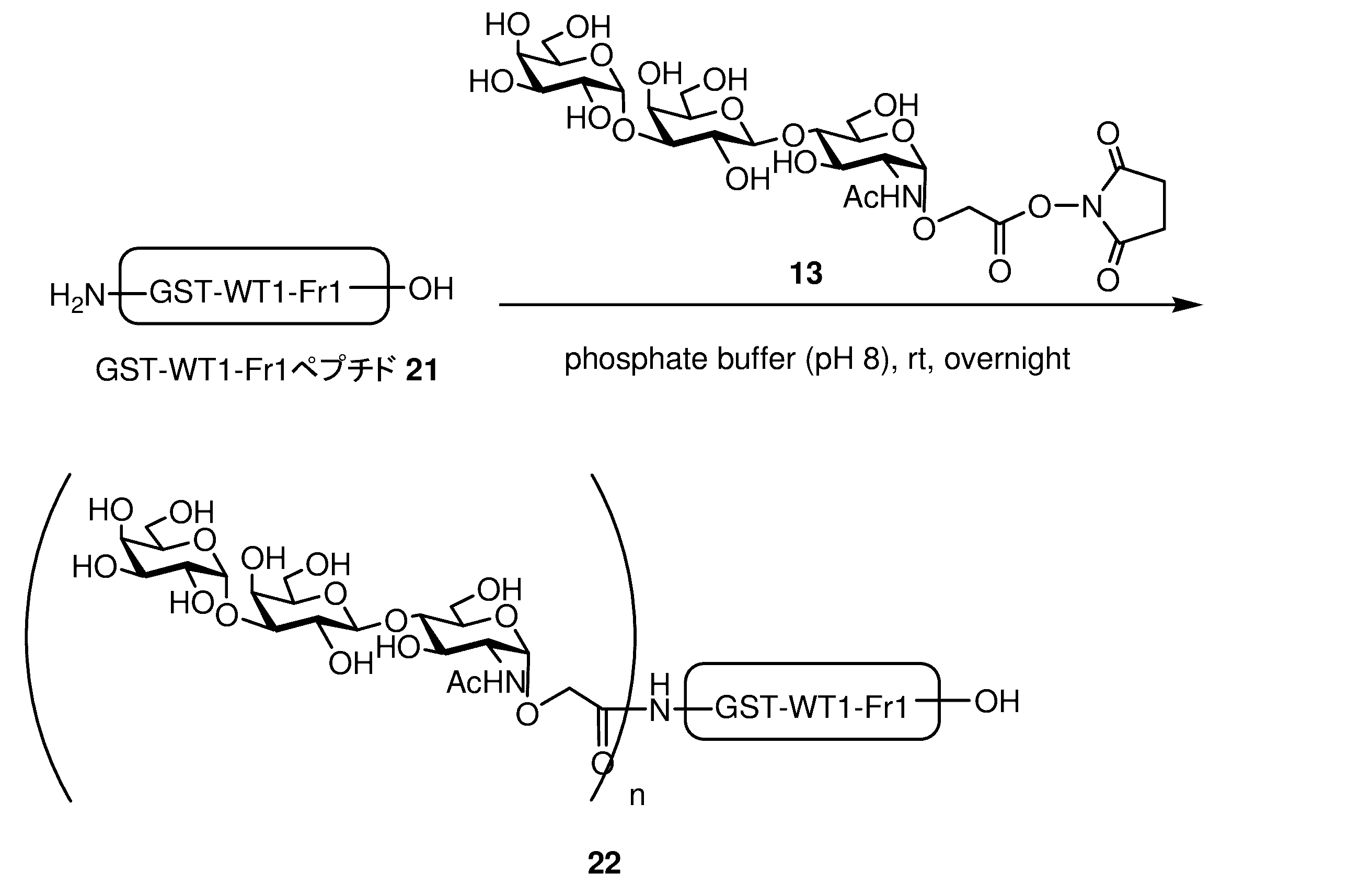
GST-WT1-Fr1ペプチド21(1-182 aa, 182aa長、配列番号2で示されるアミノ酸配列、33μL、0.5mg/mL)のTris-Glycine SDS緩衝液を遠心式フィルター[Microcon(登録商標) YM-10,3,000cut,Millipore]を用いて限外濾過した(13,200rpm,5分間)。これに0.1Mリン酸ナトリウム緩衝液(100μL,pH=8)を加えた。この限外濾過を用いた緩衝液の置換を7回行った。得られたタンパク質溶液(50μL)に化合物13(150nmol)を加え、室温で20時間インキュベートした。反応混合液を遠心式フィルター[Microcon(登録商標) YM-10,3,000cut,Millipore]を用いて限外濾過した(13,200rpmで5分間)。これに蒸留水を加えた。この限外濾過を用いた緩衝液から水への溶液の置換を3回行い、糖鎖を導入したGST-WT1-Fr1ペプチド22を得た。
HRMS(ESI-LIT-Obitrap) calcd.for C104H165N27O46Na2[M+2Na]2+ 1287.5608,found 1287.5629
HRMS(ESI-LIT-Obitrap) calcd.for C104H165N27O46Na2[M+2Na]2+ 1287.5608,found 1287.5629
なお、ペプチド21は、以下のアミノ酸配列を有するペプチド(1-182 aa, 182aa長)であり、合成したものを使用した。
MGSDVRDLNALLPAVPSLGGGGGCALPVSGAAQWAPVLDFAPPGASAYGSLGGPAPPPAPPPPPPPPPHSFIKQEPSWGGAEPHEEQCLSAFTVHFSGQFTGTAGACRYGPFGPPPPSQASSGQARMFPNAPYLPSCLESQPAIRNQGYSTVTFDGTPSYGHTPSHHAAQFPNHSFKHEDPM
[実施例9]化合物13を用いた糖鎖導入
下記工程に従い、糖鎖を導入したeEF2Lペプチド24を得た。
下記工程に従い、糖鎖を導入したeEF2Lペプチド24を得た。

GST-eEF2Lペプチド23(50μL,0.15μg/μL、配列番号3で示されるアミノ酸配列)の0.2%アジ化ナトリウム含有炭酸ナトリウム緩衝液(pH=9.6)に化合物13(150nmol)を加え、室温で20.5時間インキュベートした。反応混合液を遠心式フィルター[Microcon(登録商標) YM-10,3,000cut,Millipore]を用いて限外濾過した(13,200rpmで5分間)。これに蒸留水を加えた。この限外濾過を用いた緩衝液から水への溶液の置換を3回行い、糖鎖を導入したGST-eEF2Lペプチド24を得た。
なお、ペプチド23は、以下のアミノ酸配列を有するペプチドであり、合成したものを使用した。
YAFGRVFSGLVSTGLKVRIMGPNYTPGKKEDLYLKPIQRTILMMGRYVEPIEDVPCGNIVGLVGVDQFLVKTGTITTFEHAHNMRVMKFSVSPVVRVAVEAKNPADLPKLVEGLKRLAKSDPMVQCIIEESGEHIIAGAGELHLEICLKDLEEDHACIPIKKSDPVVSYRETVSEESNVLCLSKSPNKHNRLYMKARPFPDGLAEDIDKGEVSARQELKQRARYLAEKYEWDVAEARKIWCFGPDGTGPNILTDITKGVQYLNEIKDSVVAGFQWATKEGALCEENMRGVRFDVHDVTLHADAIHRGGGQIIPTARRCLYASVLTAQPRLMEPIYLVEIQCPEQVVGGIYGVLNRKRGHVFEESQVAGTPMFVVKAYLPVNESFGFTADLRSNTGGQAFPQCVFDHWQILPGDPFDNSSRPSQVVAETRKRKGLKEGIPALDNFLDKL
[実施例10]ライセートへの糖鎖導入
下記工程に従い、糖鎖を導入したPANC1細胞のセルライセートを得た。
下記工程に従い、糖鎖を導入したPANC1細胞のセルライセートを得た。
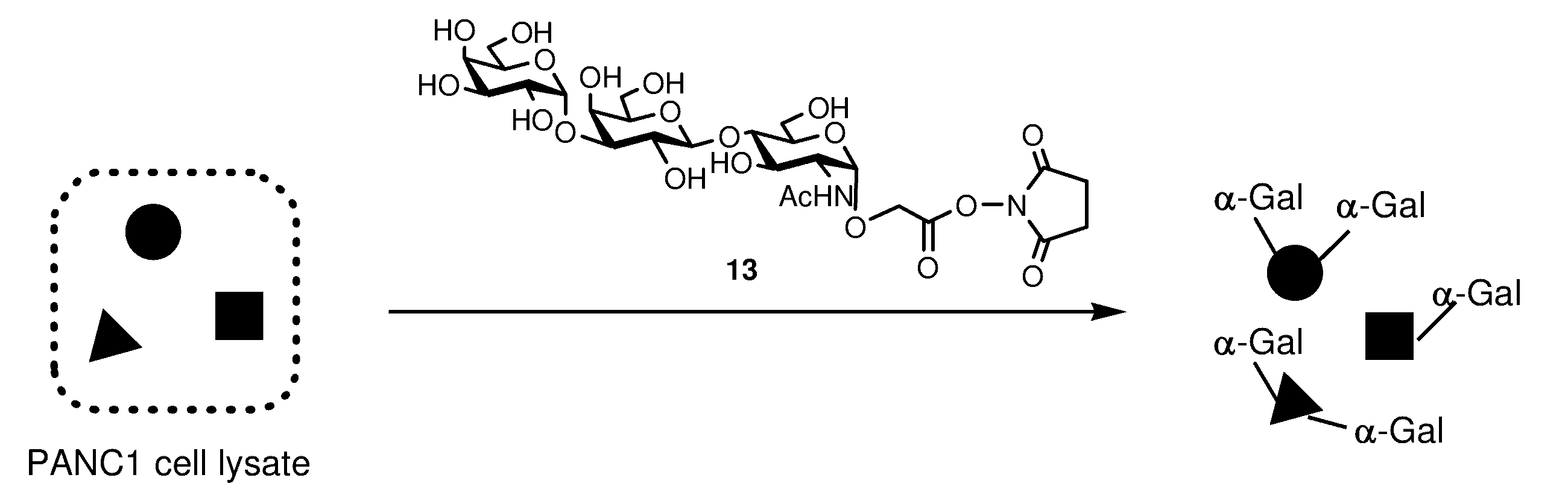
PANC1細胞のライセート(12μg/μL)を100μLの0.1Mリン酸ナトリウム緩衝液(pH=8)に懸濁させ、化合物13(0.2μmol)を加え、室温で12時間インキュベートした。この反応液を遠心分離し(10,000rpm,15分間)、上清を除いた。これに蒸留水(400μL)を加え、同様の遠心分離の操作を5回繰り返し、糖鎖を導入したセルライセートを得た。
なお、PANC1細胞のライセートは、以下のようにして調製した。
ほぼconfluentのPANC-1細胞100mm dish1枚(5~6x10⁶個)分を0.25%Trypsin-0.01mM EDTAで処理して剥がし、fresh mediumで再懸濁した細胞液を15mlチューブに回収した。100xg,5min,4℃で遠心した後、上清を除き、PBS(-)1mlを加えてピペッティングで懸濁後、全細胞液を1.5mlチューブに移した。600xg,3min,4℃で遠心した後、上清を除き、セルライセート(cell lysate)調製時まで-80℃保存した。連続してライセート(lysate)調製を行う場合は、ペレット(pellet)の量に対して等量から2倍量のcell lysis buffer(10mM Tris-HCl pH7.8,1%Nonidet P-40,0.15M NaCl,1mM EDTA,protease inhibitor)を加え、water bath型超音波破砕機(BioRaptor)を用いて、氷冷下15sec ON/OFF intervalで7~8min細胞の破砕操作を行った。その後、20,000xg,15min,4℃で遠心した。遠心終了後上清を回収したものをwhole cell lysateとして、糖鎖導入時まで-80℃で保存した。
ほぼconfluentのPANC-1細胞100mm dish1枚(5~6x10⁶個)分を0.25%Trypsin-0.01mM EDTAで処理して剥がし、fresh mediumで再懸濁した細胞液を15mlチューブに回収した。100xg,5min,4℃で遠心した後、上清を除き、PBS(-)1mlを加えてピペッティングで懸濁後、全細胞液を1.5mlチューブに移した。600xg,3min,4℃で遠心した後、上清を除き、セルライセート(cell lysate)調製時まで-80℃保存した。連続してライセート(lysate)調製を行う場合は、ペレット(pellet)の量に対して等量から2倍量のcell lysis buffer(10mM Tris-HCl pH7.8,1%Nonidet P-40,0.15M NaCl,1mM EDTA,protease inhibitor)を加え、water bath型超音波破砕機(BioRaptor)を用いて、氷冷下15sec ON/OFF intervalで7~8min細胞の破砕操作を行った。その後、20,000xg,15min,4℃で遠心した。遠心終了後上清を回収したものをwhole cell lysateとして、糖鎖導入時まで-80℃で保存した。
[実施例11]PANC1細胞への糖鎖導入
下記工程に従い、糖鎖を導入したPANC1細胞を得た。
下記工程に従い、糖鎖を導入したPANC1細胞を得た。
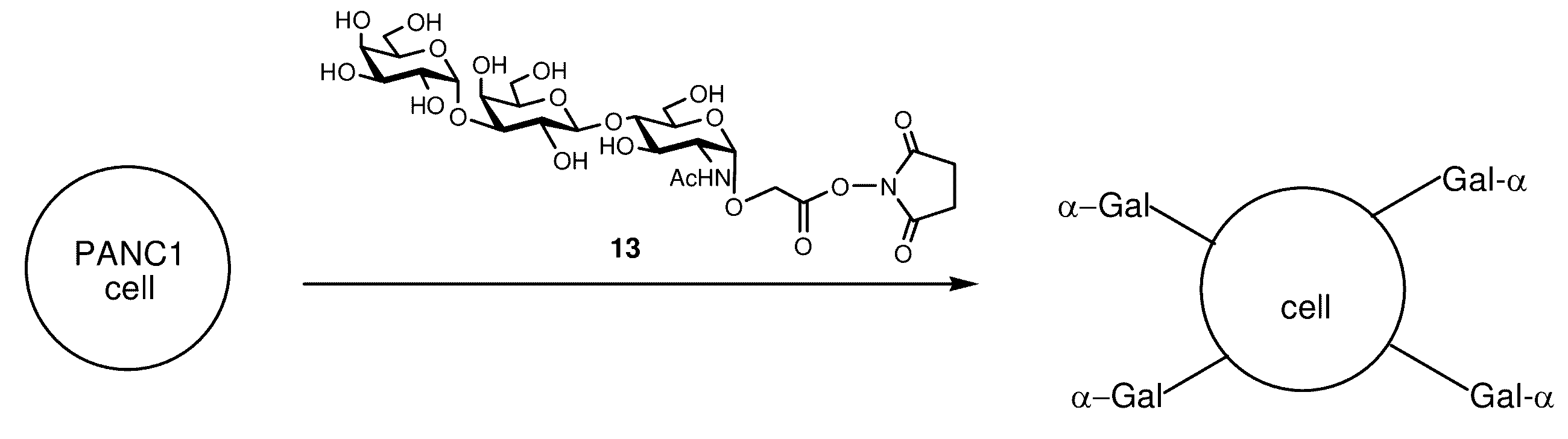
固定化したPANC1細胞(2.5×10⁷個)を2.5mLの0.1Mリン酸ナトリウム緩衝液(pH=8)に懸濁させ、化合物13(7.5μmol)を加え、室温で20時間インキュベートした。この反応液を遠心分離し(10,000rpm,5分間)、上清を除いた。これにPBS(2.5mL)を加え、同様の遠心分離の操作を3回繰り返し、糖鎖を導入したPANC1細胞を得た。
なお、固定化したPANC1細胞は、以下のようにして調製した。
実施例10に記載の方法にて回収した細胞ペレットに対して、-20℃メタノール10分の固定化条件で処理した。
この処理の後、300xg,3min,4℃で遠心し、固定液を除き、PBSで3度洗浄して残存固定液を除いた。その後、固定化を行った細胞ペレットは、FACS bufferに再懸濁し、FACS測定まで4℃で保存した。
実施例10に記載の方法にて回収した細胞ペレットに対して、-20℃メタノール10分の固定化条件で処理した。
この処理の後、300xg,3min,4℃で遠心し、固定液を除き、PBSで3度洗浄して残存固定液を除いた。その後、固定化を行った細胞ペレットは、FACS bufferに再懸濁し、FACS測定まで4℃で保存した。
なお、固定化したPANC1細胞に糖鎖が導入されていることは、FACS解析を行うことによって確認した。FACS解析方法は、以下の通りである。
固定化した細胞105個程度を、100μlのFACS bufferに懸濁し、M86抗体2μlを加え、50倍希釈で使って氷上30分で染色した。その後300xgで3分遠心して上清を除き、PEラベルのanti-mouse IgM Ab 1μlを100μlのFACS buffer(2%FBS/D-PBS)に加え(100倍希釈)、これで細胞を再懸濁、氷上20~30分静置して、再度300xgで3分遠心、上清を除いた後、100μlのFACS bufferに再懸濁し、この一部を使ってFACS解析を行った。
固定化した細胞105個程度を、100μlのFACS bufferに懸濁し、M86抗体2μlを加え、50倍希釈で使って氷上30分で染色した。その後300xgで3分遠心して上清を除き、PEラベルのanti-mouse IgM Ab 1μlを100μlのFACS buffer(2%FBS/D-PBS)に加え(100倍希釈)、これで細胞を再懸濁、氷上20~30分静置して、再度300xgで3分遠心、上清を除いた後、100μlのFACS bufferに再懸濁し、この一部を使ってFACS解析を行った。
[実施例12]M86抗体を用いたELISAによる同定
上記実施例で得られた、BSA16について、M86抗体(α-Galを認識する抗体)を用いたELISAによる同定を行った。なお、比較のため、同定は、糖鎖を導入していない対象(陰性対照、ネガティブコントロール)及び陽性対照(ポジティブコントロール)についても行った。
結果は以下の通りである。なお、下記表において、倍率とはM86抗体の希釈倍率を示す。
上記実施例で得られた、BSA16について、M86抗体(α-Galを認識する抗体)を用いたELISAによる同定を行った。なお、比較のため、同定は、糖鎖を導入していない対象(陰性対照、ネガティブコントロール)及び陽性対照(ポジティブコントロール)についても行った。
結果は以下の通りである。なお、下記表において、倍率とはM86抗体の希釈倍率を示す。

上記表の結果から明らかなように、実施例で得られた試料は、導入した糖鎖(α-Gal)を認識することがわかった。
なお、ELISAによる同定は、以下のようにして行った。
96 well マイクロプレートを用い、ウェルあたり0.5μg(5ng/μlを100μl)の試料を含む液(試料液)を加え、クリーンベンチ内でオーバーナイト蒸発乾固した。M86抗体によるGalα1-3Gal(又はブタ型糖鎖)の導入確認では、希釈系列を作成する必要があるため、1種類の試料に対し、8ウェルを準備した。ポジコンとしては、α-Galエピトープを発現するブタ腎臓片タンパク(PKF)を用いた。
ドライアップしたウェルに抗体の非特異的吸着を防止するため、1%BSA/カーボネートバッファー150μlを加え、プレートをラップで包んだ後、37℃の気相恒温槽で2時間インキュベートした。その後このブロッキング溶液を除き、200μlのPBSで2回洗浄の後、洗浄液をペーパータオル上でプレートを叩く方法により出来るだけ完全に除去した。
96 well マイクロプレートを用い、ウェルあたり0.5μg(5ng/μlを100μl)の試料を含む液(試料液)を加え、クリーンベンチ内でオーバーナイト蒸発乾固した。M86抗体によるGalα1-3Gal(又はブタ型糖鎖)の導入確認では、希釈系列を作成する必要があるため、1種類の試料に対し、8ウェルを準備した。ポジコンとしては、α-Galエピトープを発現するブタ腎臓片タンパク(PKF)を用いた。
ドライアップしたウェルに抗体の非特異的吸着を防止するため、1%BSA/カーボネートバッファー150μlを加え、プレートをラップで包んだ後、37℃の気相恒温槽で2時間インキュベートした。その後このブロッキング溶液を除き、200μlのPBSで2回洗浄の後、洗浄液をペーパータオル上でプレートを叩く方法により出来るだけ完全に除去した。
使用する各ウェル全てに50μlの1%BSA/PBSを加えた。α-Galを認識するM86抗体[Galili先生(マサチューセッツ大学、シカゴ大学)より入手]は、2倍の希釈系列を作成するため、最初のウェルに12.5倍希釈のM86抗体液を50μl加え、良く撹拌後50μlを次のウェルに移すという作業を順次行い、最終的に3200倍希釈までの希釈系列を作成した。最終8列目の過剰な50μlは除いた。この後、ELISAプレートをラップで包み、37℃の気相恒温槽で2時間インキュベートした。
抗体液を捨て、各ウェルを200μlの0.1%Tween/PBSで2回洗浄の後、洗浄液をペーパータオル上でプレートを叩く方法により出来るだけ完全に除去した。
抗体液を捨て、各ウェルを200μlの0.1%Tween/PBSで2回洗浄の後、洗浄液をペーパータオル上でプレートを叩く方法により出来るだけ完全に除去した。
各ウェルに、1%BSA/PBSで500倍希釈したHRP標識anti-mouse IgM抗体50μlを加え、ラップで包んだ後、室温で1時間インキュベートした。
抗体液を捨て、各ウェルを200μlの0.1%Tween/PBSで2回洗浄の後、洗浄液をペーパータオル上でプレートを叩く方法により出来るだけ完全に除去した。
各ウェルにOPD(オルトフェニレンジアミン)溶液(OPD1tabletを11mlのペルオキシダーゼバッファーに溶解後、4μlの過酸化水素水を加え良く混合したもの)を100μlずつ加え、発色具合を見ながら適当なところで1M硫酸溶液50μlを加えて発色反応を停止させた。
この後、プレートリーダーを用いて、492nmの吸光度を測定した。
使用したバッファー組成は以下の通りである。
カーボネートバッファー:15mM Na2CO3、35mM NaHCO3、3.1mM NaN3(pH9.5)
ペルオキシダーゼバッファー:50mM Na2HPO4、60mM クエン酸(pH5.0)
抗体液を捨て、各ウェルを200μlの0.1%Tween/PBSで2回洗浄の後、洗浄液をペーパータオル上でプレートを叩く方法により出来るだけ完全に除去した。
各ウェルにOPD(オルトフェニレンジアミン)溶液(OPD1tabletを11mlのペルオキシダーゼバッファーに溶解後、4μlの過酸化水素水を加え良く混合したもの)を100μlずつ加え、発色具合を見ながら適当なところで1M硫酸溶液50μlを加えて発色反応を停止させた。
この後、プレートリーダーを用いて、492nmの吸光度を測定した。
使用したバッファー組成は以下の通りである。
カーボネートバッファー:15mM Na2CO3、35mM NaHCO3、3.1mM NaN3(pH9.5)
ペルオキシダーゼバッファー:50mM Na2HPO4、60mM クエン酸(pH5.0)
[実施例13]アジュバント効果のウェスタンブロット法による確認
糖鎖を導入した標識体であるBSA16、MUC1ペプチド20、これらに対応する未標識体[すなわち、糖鎖を導入していないBSA及びMUC1ペプチド(ペプチド20)]のそれぞれに対するワクチン実験は、20~25週齢のα-1,3-ガラクトシルトランスフェラーゼ(galactosyltransferase)ノックアウトマウス[Galili先生(マサチューセッツ大学、シカゴ大学)より入手]に、250mg/mlに調製したブタ腎臓フラグメント(粗タンパク液)400μlを用いて、1週間に1度、4週に渡って腹腔内投与を行い、α-Gal抗原に対して、ヒトと同じ免疫反応が引き起こされるように抗α-gal抗体価を高めたマウスを用いて行った。
糖鎖を導入した標識体であるBSA16、MUC1ペプチド20、これらに対応する未標識体[すなわち、糖鎖を導入していないBSA及びMUC1ペプチド(ペプチド20)]のそれぞれに対するワクチン実験は、20~25週齢のα-1,3-ガラクトシルトランスフェラーゼ(galactosyltransferase)ノックアウトマウス[Galili先生(マサチューセッツ大学、シカゴ大学)より入手]に、250mg/mlに調製したブタ腎臓フラグメント(粗タンパク液)400μlを用いて、1週間に1度、4週に渡って腹腔内投与を行い、α-Gal抗原に対して、ヒトと同じ免疫反応が引き起こされるように抗α-gal抗体価を高めたマウスを用いて行った。
なお、マウス血清中における抗α-Gal抗体価は、実施例10に記載した方法を用い、経時的に測定して判断した。
1度のワクチン実験に用いたタンパク量は、BSAの場合は標識体、未標識体とも10μg/headで、MUC1ペプチドの場合は、標識体、未標識体とも2.5μg/headであり、1群5匹のマウスを用意した。1週に1度の腹腔内投与を5週間に渡り行い、各投与後およそ1週間ごとに200~300μlの血液をサンプリングし、血清を調製した。各々の血清は複数本のマイクロチューブに分注し、-80℃で保存した。
そして、マウス血清中に誘導された抗体を、以下のようにして検出した。
(抗BSA抗体の検出)
1 laneあたり市販のBSA1μgを用い、10%ポリアクリルアミドゲルを用いて、150Vの等電圧で電気泳動を行った。その後、ニトロセルロースフィルター(Millipore)にセミドライ型のブロッティング装置(Bio-Rad)を用いて120mAで60分転写した。
転写後のニトロセルロースフィルターは、各レーン毎に切断分離し、5%スキムミルク/TBSTを用いて、4℃でオーバーナイトブロッキングを行った。ブロッキング溶液を除いた後、5%スキムミルク/TBSTで1000倍に希釈した市販の抗BSA抗体(BETHYL)、BSAワクチン血清、α-gal-BSAワクチン血清の3種を1次抗体として用い、室温1時間反応させた。反応終了後、抗体液を吸引除去し、TBSTで10分、3度洗浄操作を行った。TBSTを除去後、抗BSA抗体に対する2次抗体としては、5%スキムミルク/TBSTで10000倍に希釈したHRP標識anti-sheep IgG(Jackson Lab)を、2種のマウス血清に対しては、5%スキムミルク/TBSTで5000倍に希釈したHRP標識anti-mouse IgG(Promega)を用い、室温で1時間反応させた。反応終了後、同様にTBSTで10分、3度洗浄操作を行った後、ECL-Prime (GE)を用いて、化学発光で目的バンドの検出を行った。化学発光の検出には、LAS-4000mini(GE)を使用した。
1 laneあたり市販のBSA1μgを用い、10%ポリアクリルアミドゲルを用いて、150Vの等電圧で電気泳動を行った。その後、ニトロセルロースフィルター(Millipore)にセミドライ型のブロッティング装置(Bio-Rad)を用いて120mAで60分転写した。
転写後のニトロセルロースフィルターは、各レーン毎に切断分離し、5%スキムミルク/TBSTを用いて、4℃でオーバーナイトブロッキングを行った。ブロッキング溶液を除いた後、5%スキムミルク/TBSTで1000倍に希釈した市販の抗BSA抗体(BETHYL)、BSAワクチン血清、α-gal-BSAワクチン血清の3種を1次抗体として用い、室温1時間反応させた。反応終了後、抗体液を吸引除去し、TBSTで10分、3度洗浄操作を行った。TBSTを除去後、抗BSA抗体に対する2次抗体としては、5%スキムミルク/TBSTで10000倍に希釈したHRP標識anti-sheep IgG(Jackson Lab)を、2種のマウス血清に対しては、5%スキムミルク/TBSTで5000倍に希釈したHRP標識anti-mouse IgG(Promega)を用い、室温で1時間反応させた。反応終了後、同様にTBSTで10分、3度洗浄操作を行った後、ECL-Prime (GE)を用いて、化学発光で目的バンドの検出を行った。化学発光の検出には、LAS-4000mini(GE)を使用した。
(抗MUC1抗体の検出)
1 laneあたり膵癌細胞株Panc1のcell lysate 30μgを用い、7.5%ポリアクリルアミドゲルを用いて、150Vの等電圧で電気泳動を行った。その後、ニトロセルロースフィルター(Millipore)にセミドライ型のブロッティング装置(Bio-Rad)を用いて120mA、60分転写した。転写後のニトロセルロースフィルターは、各レーン毎に切断分離し、5%スキムミルク/TBSTを用いて、4℃でオーバーナイトブロッキングを行った。ブロッキング溶液を除いた後、5%スキムミルク/TBSTで1000倍に希釈した市販の抗MUC1抗体(CST)、MUC1ペプチドワクチン血清、α-gal-MUC1ペプチドワクチン血清、ネガティブコントロールとしてα-1,3-ガラクトシルトランスフェラーゼ(galactosyltransferase)血清の4種を1次抗体として用い、室温で1時間反応させた。反応終了後、抗体液を吸引除去し、TBSTで10分、3度洗浄操作を行った。TBSTを除去後、抗MUC1抗体並びに3種のマウス血清に対する2次抗体としては、5%スキムミルク/TBSTで5000倍に希釈したHRP標識anti-mouse IgG(Jackson Lab)を用い、室温で1時間反応させた。反応終了後、同様にTBSTで10分、3度洗浄操作を行った後、ECL-Prime(GE)を用いて、化学発光で目的バンドの検出を行った。化学発光の検出には、LAS-4000mini(GE)を使用した。
1 laneあたり膵癌細胞株Panc1のcell lysate 30μgを用い、7.5%ポリアクリルアミドゲルを用いて、150Vの等電圧で電気泳動を行った。その後、ニトロセルロースフィルター(Millipore)にセミドライ型のブロッティング装置(Bio-Rad)を用いて120mA、60分転写した。転写後のニトロセルロースフィルターは、各レーン毎に切断分離し、5%スキムミルク/TBSTを用いて、4℃でオーバーナイトブロッキングを行った。ブロッキング溶液を除いた後、5%スキムミルク/TBSTで1000倍に希釈した市販の抗MUC1抗体(CST)、MUC1ペプチドワクチン血清、α-gal-MUC1ペプチドワクチン血清、ネガティブコントロールとしてα-1,3-ガラクトシルトランスフェラーゼ(galactosyltransferase)血清の4種を1次抗体として用い、室温で1時間反応させた。反応終了後、抗体液を吸引除去し、TBSTで10分、3度洗浄操作を行った。TBSTを除去後、抗MUC1抗体並びに3種のマウス血清に対する2次抗体としては、5%スキムミルク/TBSTで5000倍に希釈したHRP標識anti-mouse IgG(Jackson Lab)を用い、室温で1時間反応させた。反応終了後、同様にTBSTで10分、3度洗浄操作を行った後、ECL-Prime(GE)を用いて、化学発光で目的バンドの検出を行った。化学発光の検出には、LAS-4000mini(GE)を使用した。
抗BSA抗体の検出結果を図1に、抗MUC1抗体の検出結果を図2に示す。なお、図1において、「PonceauS」はBSAのバンドを確認したものである。
図の結果から明らかなように、α-Galを導入したBSA及びMUC1ペプチドにおいて、アジュバント効果が得られていることがわかる。
図の結果から明らかなように、α-Galを導入したBSA及びMUC1ペプチドにおいて、アジュバント効果が得られていることがわかる。
本発明の化合物又は糖鎖導入剤は、Galα1-3Galを含む糖鎖を抗原に容易に導入できる。特に、アミノ酸(又はアミノ酸配列)の種類によらず、当該糖鎖を導入できるため、当該糖鎖を多く導入でき、非常に高い免疫反応を得ることができる。また、公知のワクチン抗原に当該糖鎖を導入できるため、高いアジュバント効果を得ることもできる。そのため、本発明の化合物(又は糖鎖導入剤)は、アジュバント(免疫賦活剤、免疫増強剤)として用いることもできる。
このような本発明の糖鎖導入剤及びワクチン抗原は、がん(悪性腫瘍)、感染症(インフルエンザなど)などの各種疾患の治療に有用であり、特に、膵がんなどのがんワクチン療法において有用である。
このような本発明の糖鎖導入剤及びワクチン抗原は、がん(悪性腫瘍)、感染症(インフルエンザなど)などの各種疾患の治療に有用であり、特に、膵がんなどのがんワクチン療法において有用である。
Claims (13)
- 下記式(2)

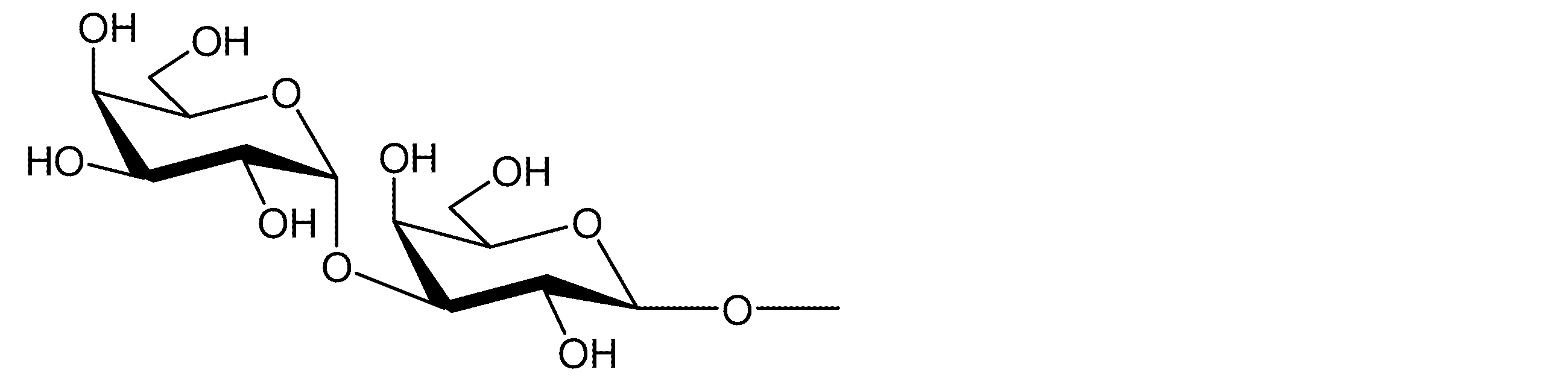
で表される化合物で構成されたGalα1-3Galを含む糖鎖がリンカーを介して結合しているワクチン抗原。 - 式(2)で表される化合物が、下記式(2A)

で表される化合物である請求項1記載のワクチン抗原。 - 抗原が、がん細胞、がん細胞の成分、がん抗原又はがん抗原ペプチドである請求項1又は2記載のワクチン抗原。
- がん抗原ペプチドが、MUC1ペプチド、VEGFペプチド、WT1ペプチド又はeEF2Lペプチドである請求項3記載のワクチン抗原。
- がんが、膵がんである請求項3又は4記載のワクチン抗原。
- 抗原に、Galα1-3Galを含む糖鎖を導入するための糖鎖導入剤であって、下記式(1)

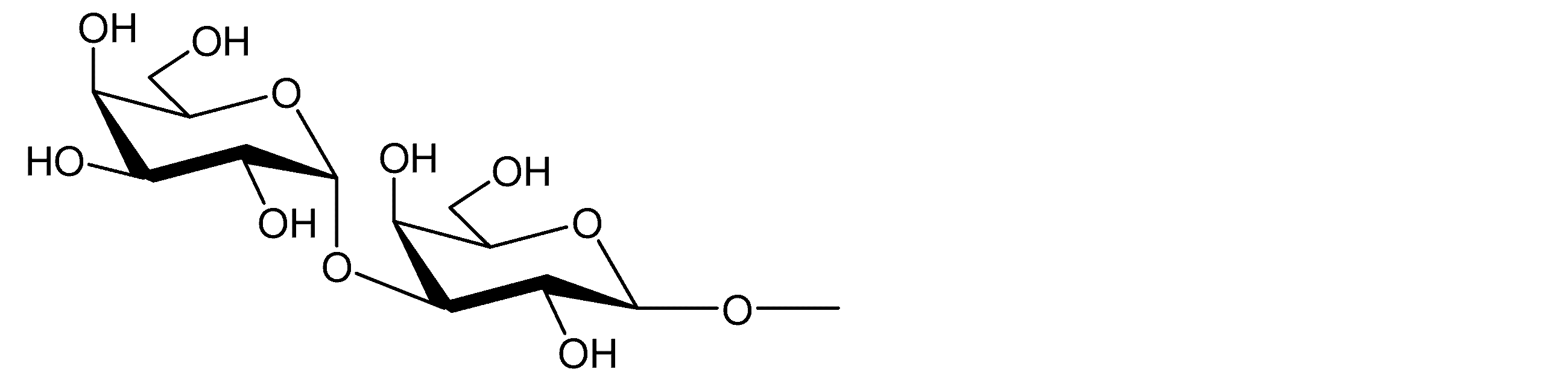
で表される化合物で構成された糖鎖導入剤。 - 式(1)で表される化合物が、下記式(1A)

で表される化合物である請求項6記載の糖鎖導入剤。 - リンカーが、下記式(L1)~(L8)のいずれかで表される基である請求項6又は7記載の糖鎖導入剤。
-R- (L1)
-(R-E)k- (L2)
-(R-E)k-R- (L3)
-E-(R-E)k-R- (L4)
-(E-R)k- (L5)
-(E-R)k-E- (L6)
-R-(E-R)k- (L7)
-R-(E-R)k-E- (L8)
(式中、Rは炭化水素ユニット、Eはヘテロ原子を有するユニット、kは1以上の整数を示す。) - Rがアルキレン基であり、Eがエーテル基又はアミド基である請求項8記載の糖鎖導入剤。
- Xが活性エステル基、スルホン酸エステル基、マレイミド基、ハロゲン原子、アジド基、アルキニル基、又はヘキサトリエン-β-カルボニル骨格を有する基である請求項6~9のいずれかに記載の糖鎖導入剤。
- 官能基Yが、ヒドロキシル基、カルボキシル基、アミノ基、メルカプト基、アジド基、及びアルキニル基から選択された少なくとも1種である請求項6~10のいずれかに記載の糖鎖導入剤。
- 抗原と、請求項6~11のいずれかに記載の糖鎖導入剤とを接触させ、抗原にGalα1-3Galを含む糖鎖を導入する方法。
- 請求項1~5のいずれかに記載のワクチン抗原を含むワクチン。
Priority Applications (1)
| Application Number | Priority Date | Filing Date | Title |
|---|---|---|---|
| JP2016566473A JPWO2016104647A1 (ja) | 2014-12-25 | 2015-12-24 | 糖鎖結合ワクチン抗原及び糖鎖導入剤 |
Applications Claiming Priority (2)
| Application Number | Priority Date | Filing Date | Title |
|---|---|---|---|
| JP2014-263056 | 2014-12-25 | ||
| JP2014263056 | 2014-12-25 |
Publications (1)
| Publication Number | Publication Date |
|---|---|
| WO2016104647A1 true WO2016104647A1 (ja) | 2016-06-30 |
Family
ID=56150660
Family Applications (1)
| Application Number | Title | Priority Date | Filing Date |
|---|---|---|---|
| PCT/JP2015/086104 Ceased WO2016104647A1 (ja) | 2014-12-25 | 2015-12-24 | 糖鎖結合ワクチン抗原及び糖鎖導入剤 |
Country Status (2)
| Country | Link |
|---|---|
| JP (1) | JPWO2016104647A1 (ja) |
| WO (1) | WO2016104647A1 (ja) |
Cited By (3)
| Publication number | Priority date | Publication date | Assignee | Title |
|---|---|---|---|---|
| JP2019526614A (ja) * | 2016-09-13 | 2019-09-19 | センタウリ セラピューティクス リミテッド | 新規化合物及びその治療上の使用 |
| JP2021528371A (ja) * | 2018-05-09 | 2021-10-21 | ザ・ユニバーシティ・オブ・シカゴThe University Of Chicago | 免疫寛容に関する組成物および方法 |
| US12060414B2 (en) | 2010-08-10 | 2024-08-13 | École Polytechnique Fédérale De Lausanne (Epfl) | Erythrocyte-binding therapeutics |
Citations (1)
| Publication number | Priority date | Publication date | Assignee | Title |
|---|---|---|---|---|
| WO2008057235A2 (en) * | 2006-10-25 | 2008-05-15 | Newlink Genetics | Enhanced immunogenicity of tumor associated antigens by addition of alphagal epitopes |
-
2015
- 2015-12-24 JP JP2016566473A patent/JPWO2016104647A1/ja active Pending
- 2015-12-24 WO PCT/JP2015/086104 patent/WO2016104647A1/ja not_active Ceased
Patent Citations (1)
| Publication number | Priority date | Publication date | Assignee | Title |
|---|---|---|---|---|
| WO2008057235A2 (en) * | 2006-10-25 | 2008-05-15 | Newlink Genetics | Enhanced immunogenicity of tumor associated antigens by addition of alphagal epitopes |
Non-Patent Citations (1)
| Title |
|---|
| TANEMURA M ET AL.: "Role of a-gal epitope/anti- Gal antibody reaction in immunotherapy and its clinical application in pancreatic cancer.", CANCER SCIENCE, vol. 104, no. 3, 2013, pages 282 - 290 * |
Cited By (6)
| Publication number | Priority date | Publication date | Assignee | Title |
|---|---|---|---|---|
| US12060414B2 (en) | 2010-08-10 | 2024-08-13 | École Polytechnique Fédérale De Lausanne (Epfl) | Erythrocyte-binding therapeutics |
| JP2019526614A (ja) * | 2016-09-13 | 2019-09-19 | センタウリ セラピューティクス リミテッド | 新規化合物及びその治療上の使用 |
| JP7185622B2 (ja) | 2016-09-13 | 2022-12-07 | センタウリ セラピューティクス リミテッド | 新規化合物及びその治療上の使用 |
| JP2021528371A (ja) * | 2018-05-09 | 2021-10-21 | ザ・ユニバーシティ・オブ・シカゴThe University Of Chicago | 免疫寛容に関する組成物および方法 |
| JP2024123048A (ja) * | 2018-05-09 | 2024-09-10 | ザ・ユニバーシティ・オブ・シカゴ | 免疫寛容に関する組成物および方法 |
| US12383617B2 (en) | 2018-05-09 | 2025-08-12 | The University Of Chicago | Compositions and methods concerning immune tolerance |
Also Published As
| Publication number | Publication date |
|---|---|
| JPWO2016104647A1 (ja) | 2017-10-05 |
Similar Documents
| Publication | Publication Date | Title |
|---|---|---|
| US8623378B2 (en) | Glycoconjugates, glycoamino acids, intermediates thereto, and uses thereof | |
| US20030153492A1 (en) | Novel glycoconjugates, glycoamino acids, intermediates thereto, and uses thereof | |
| Huo et al. | Synthetic and immunological studies of N-acyl modified S-linked STn derivatives as anticancer vaccine candidates | |
| KR102250099B1 (ko) | 스트렙토코커스 뉴모니에 1형에 대한 합성 백신 | |
| KR20200106034A (ko) | 클렙시엘라 뉴모니아에 대한 백신 | |
| Xiao et al. | Synthesis and immunological evaluation of MUC1 glycopeptide conjugates bearing N-acetyl modified STn derivatives as anticancer vaccines | |
| CN107709343B (zh) | 针对肺炎链球菌血清型5的疫苗 | |
| CA2843908C (en) | Oligosaccharides and oligosaccharide-protein conjugates derived from clostridium difficile polysaccaride ps-i, methods of synthesis and uses thereof, in particular as vaccines anddiagnostic tools | |
| CN105829342A (zh) | 铜绿假单胞菌的psl胞外多糖的合成寡糖亚基及其用途 | |
| EP2164521B1 (fr) | Glycoconjugues et leur utilisation comme vaccin contre shigella flexneri de serotype 3a et x | |
| WO2006017180A2 (en) | Glycopeptide dimers and uses thereof | |
| US20240024489A1 (en) | Protected disaccharides, their process of preparation and their use in the synthesis of zwitterionic oligosaccharides, and conjugates thereof | |
| JPWO2016104647A1 (ja) | 糖鎖結合ワクチン抗原及び糖鎖導入剤 | |
| EP2581380B1 (en) | SIALIC ACID (alpha-(2-6))-D-AMINOPYRANOSE DERIVATIVES, SYNTHESIS METHODS AND USES THEREOF | |
| KR102803369B1 (ko) | 클로스트리듐 디피실에 대한 안정성 백신 | |
| US20240182603A1 (en) | Sulfur-substituted sugar to stabilize oligosaccharide | |
| US10376593B2 (en) | Glycoconjugates and their use as potential vaccines against infection by Shigella flexneri | |
| Maklikov | Synthesis of MUC4 glycopeptide antigen structures: Strategic synthesis of MUC4 glycopeptide using Fmoc-Thr-OAll for the TN-antigen incorporation | |
| Khatuntseva et al. | Synthesis of 3-aminopropyl β-glycoside of sialyl-3′-lactose and derived neoglycoconjugates as a tumor vaccine prototype and artificial antigens for the control of immune response | |
| Khatuntseva et al. | Synthesis of 2-aminoethyl 3′-(N-glycolylneuraminyl)-β-actoside and neoglycoconjugates based thereon—a prototype of a cancer vaccine and artificial antigens for the control of immune response | |
| Østerlid | Synthesis, structure and epitope mapping of well-defined Staphylococcus aureus capsular polysaccharides | |
| Davidson | Synthesis of selected fragments of the Lewis B Lewis A Tumor-Associated Carbohydrate Antigen | |
| Nishat | Syntheses and immunological evaluation of zwitterionic polysaccharide (PS A1) based vaccines | |
| Cheng | Development of alkyl imidate glycosylation method and application to allyl Lewis A synthesis | |
| Mickael | Total Synthesis of the Tumor-Associated Carbohydrate Antigen Lewis A Lewis X Hexasaccharide and Selected Fragments |
Legal Events
| Date | Code | Title | Description |
|---|---|---|---|
| 121 | Ep: the epo has been informed by wipo that ep was designated in this application |
Ref document number: 15873215 Country of ref document: EP Kind code of ref document: A1 |
|
| ENP | Entry into the national phase |
Ref document number: 2016566473 Country of ref document: JP Kind code of ref document: A |
|
| NENP | Non-entry into the national phase |
Ref country code: DE |
|
| 122 | Ep: pct application non-entry in european phase |
Ref document number: 15873215 Country of ref document: EP Kind code of ref document: A1 |