WO2016093023A1 - 非発酵ビール様発泡性飲料 - Google Patents
非発酵ビール様発泡性飲料 Download PDFInfo
- Publication number
- WO2016093023A1 WO2016093023A1 PCT/JP2015/082199 JP2015082199W WO2016093023A1 WO 2016093023 A1 WO2016093023 A1 WO 2016093023A1 JP 2015082199 W JP2015082199 W JP 2015082199W WO 2016093023 A1 WO2016093023 A1 WO 2016093023A1
- Authority
- WO
- WIPO (PCT)
- Prior art keywords
- beer
- sparkling beverage
- concentration
- ppm
- acid
- Prior art date
- Legal status (The legal status is an assumption and is not a legal conclusion. Google has not performed a legal analysis and makes no representation as to the accuracy of the status listed.)
- Ceased
Links
Classifications
-
- A—HUMAN NECESSITIES
- A23—FOODS OR FOODSTUFFS; TREATMENT THEREOF, NOT COVERED BY OTHER CLASSES
- A23L—FOODS, FOODSTUFFS OR NON-ALCOHOLIC BEVERAGES, NOT OTHERWISE PROVIDED FOR; PREPARATION OR TREATMENT THEREOF
- A23L2/00—Non-alcoholic beverages; Dry compositions or concentrates therefor; Preparation or treatment thereof
- A23L2/38—Other non-alcoholic beverages
-
- A—HUMAN NECESSITIES
- A23—FOODS OR FOODSTUFFS; TREATMENT THEREOF, NOT COVERED BY OTHER CLASSES
- A23L—FOODS, FOODSTUFFS OR NON-ALCOHOLIC BEVERAGES, NOT OTHERWISE PROVIDED FOR; PREPARATION OR TREATMENT THEREOF
- A23L2/00—Non-alcoholic beverages; Dry compositions or concentrates therefor; Preparation or treatment thereof
-
- A—HUMAN NECESSITIES
- A23—FOODS OR FOODSTUFFS; TREATMENT THEREOF, NOT COVERED BY OTHER CLASSES
- A23L—FOODS, FOODSTUFFS OR NON-ALCOHOLIC BEVERAGES, NOT OTHERWISE PROVIDED FOR; PREPARATION OR TREATMENT THEREOF
- A23L11/00—Pulses, i.e. fruits of leguminous plants, for production of food; Products from legumes; Preparation or treatment thereof
- A23L11/60—Drinks from legumes, e.g. lupine drinks
- A23L11/65—Soy drinks
-
- C—CHEMISTRY; METALLURGY
- C12—BIOCHEMISTRY; BEER; SPIRITS; WINE; VINEGAR; MICROBIOLOGY; ENZYMOLOGY; MUTATION OR GENETIC ENGINEERING
- C12G—WINE; PREPARATION THEREOF; ALCOHOLIC BEVERAGES; PREPARATION OF ALCOHOLIC BEVERAGES NOT PROVIDED FOR IN SUBCLASSES C12C OR C12H
- C12G3/00—Preparation of other alcoholic beverages
- C12G3/04—Preparation of other alcoholic beverages by mixing, e.g. for preparation of liqueurs
Definitions
- the present invention relates to a non-fermented beer-like sparkling beverage that is produced without undergoing a fermentation process and has a sufficient body despite its very low purine concentration.
- beer-like sparkling beverages such as beer and sparkling liquor retain the flavor of conventional beers while reducing the purine content.
- Consumer expectations for beer-like sparkling beverages are growing.
- many beer-like sparkling beverages use raw materials containing a relatively large amount of purine bodies such as malt and hops in order to maintain the beer-like quality, so that the content of purine bodies in the final product increases.
- the concentration of purine bodies in the final product is adjusted by adjusting the addition amount of a raw material containing a relatively large amount of purine bodies such as malt and further without undergoing a fermentation process.
- an unprecedented low non-fermenting beer-like sparkling beverage of 0.2 mg / 100 mL or less can be produced.
- the purine body content in the final product can be suppressed without performing purine body removal treatment such as activated carbon treatment or zeolite treatment.
- Patent Document 3 gives a drinking response by adjusting the pH within the range of 2.7 to 4.5 for a low-extract beer-like sparkling beverage with a low concentration of components such as malt. A method is disclosed.
- the object of the present invention is to provide a non-fermenting beer-like sparkling beverage having a sufficient body despite the very low purine concentration.
- the present inventor has adjusted the amount of raw material containing a relatively large amount of purine bodies such as malt, and produced it without going through a fermentation step, so that A non-fermented beer-like sparkling beverage with a purine concentration of 0.2 mg / 100 mL or less can be produced, and the pH of the non-fermented beer-like sparkling beverage thus produced is within a specific range.
- the present invention was completed by discovering that richness can be imparted by adding one or more organic acids selected from the group consisting of phosphoric acid and lactic acid.
- Non-fermented beer-like sparkling beverages according to the present invention are the following [1] to [9].
- the non-fermented beer-like sparkling beverage according to the present invention has a very rich and highly functional beer-like, although the purine concentration is suppressed to a very low level of 0.2 mg / 100 mL or less. It is a sparkling beverage.
- beer-likeness means a taste pronounced of flavored beer regardless of the product name and display.
- beer-like effervescent beverages are flavors and tastes similar to or similar to beer, regardless of alcohol content, presence or absence of malt and hops, and presence or absence of fermentation.
- a sparkling beverage having a texture.
- non-fermented beer-like sparkling beverage in the present invention and the specification of the present application refers to a beverage manufactured without undergoing a fermentation process and having a beer-like and sparkling property due to carbon dioxide gas.
- the non-fermented beer-like sparkling beverage may be an alcoholic beverage, or a so-called non-alcoholic beverage or low-alcoholic beverage having an alcohol content of less than 1% by volume. Specific examples include beer, sparkling liquor, low alcohol sparkling beverage, non-alcoholic beer and the like.
- the non-fermented beer-like sparkling beverage according to the present invention is characterized in that the amount of the raw material containing the purine body is adjusted and the purine body concentration is 0.2 mg / 100 mL or less.
- the non-fermented beer-like sparkling beverage according to the present invention is prepared without adjusting the addition amount of raw materials containing purine bodies and further undergoing a fermentation process, thereby purifying the purine bodies such as activated carbon treatment and zeolite treatment.
- the purine body concentration can be kept low as never before.
- the purine body concentration of the non-fermented beer-like sparkling beverage according to the present invention is preferably less than 0.2 mg / 100 mL, more preferably 0.1 mg / 100 mL or less, and even more preferably less than 0.08 mg / 100 mL.
- the purine refers to the total amount of the four purine bases of adenine, xanthine, guanine, and hypoxanthine.
- the content of purines in non-fermented beer-like sparkling beverages and raw materials can be detected, for example, by LC-MS / MS after hydrolysis with perchloric acid (“Guidelines for microanalysis of liquor purines”) , Japan Food Analysis Center, Internet ⁇ URL: http://www.jfrl.or.jp/item/nutrition/post-31.html>, January 2013 search).
- Biological raw materials such as malt and protein degradation products have a relatively high purine content, so in the non-fermented beer-like sparkling beverage according to the present invention, the concentration of purine in the final product beverage is 0.2 mg. The amount used is adjusted to be low so as to be less than / 100 mL. On the other hand, the ingredients derived from these raw materials also contribute to the richness of beer-like sparkling beverages, and the richness tends to be impaired when the amount of these raw materials used is reduced.
- the content of one or more organic acids selected from the group consisting of phosphoric acid and lactic acid is within a specific range, and the pH is 3.2-4. .5, it has a sufficient body even when the amount of biological material used is small.
- the non-fermenting beer-like sparkling beverage according to the present invention contains at least one of phosphoric acid and lactic acid, and the content of phosphoric acid or lactic acid is 40 to 700 ppm.
- the content of phosphoric acid or lactic acid is preferably 40 to 500 ppm, more preferably 40 to 300 ppm, and 40 to 100 ppm. Is more preferable, and 50 to 100 ppm is even more preferable.
- the content of phosphoric acid or lactic acid is preferably 40 to 700 ppm, more preferably 40 to 500 ppm.
- the total content of phosphoric acid and lactic acid is preferably 40 to 700 ppm, and the content of lactic acid is 10 ppm. More preferably, the phosphoric acid content is 10 to 500 ppm, and the sum of the phosphoric acid and lactic acid content is 40 to 700 ppm.
- the pH of the non-fermented beer-like sparkling beverage according to the present invention is 3.2 to 4.5.
- the pH of the non-fermented beer-like sparkling beverage according to the present invention is preferably 3.2 to 4.2, more preferably 3.5 to 4.1.
- the pH is preferably 3.5 or more and less than 4.0.
- the pH of the non-fermented beer-like sparkling beverage can be adjusted by blending an acidulant used as a pH adjuster in acidic foods and drinks such as organic acid salts and bicarbonates.
- organic acid salt used as a pH adjuster include salts such as citric acid, gluconic acid, tartaric acid, malic acid, succinic acid, adipic acid, and fumaric acid.
- salts only one type may be used, or two or more types may be used in combination.
- at least one selected from the group consisting of salts of citric acid and salts of gluconic acid is used.
- it contains one or more selected from the group consisting of sodium salt of citric acid, potassium salt of citric acid, potassium gluconate, and sodium gluconate, trisodium citrate, glucone
- sodium salt of citric acid potassium salt of citric acid
- potassium gluconate potassium gluconate
- sodium gluconate trisodium citrate
- glucone What contains 1 or more types selected from the group which consists of potassium acid and sodium gluconate is still more preferable.
- those containing trisodium citrate are particularly preferred because the amount used can be kept relatively low and the sugar content of the beverage can be kept lower.
- the content of the pH adjuster in the non-fermented beer-like sparkling beverage according to the present invention may be an amount that adjusts the pH of the beverage within the range of 3.2 to 4.5. Phosphoric acid and / or lactic acid
- the content is appropriately adjusted in consideration of the content of other ingredients, the amount of other raw materials used, and the like.
- the non-fermented beer-like sparkling beverage according to the present invention contains a sodium salt of citric acid
- the sodium salt of citric acid has a citric acid concentration of 10 to 650 ppm per non-fermented beer-like sparkling beverage.
- the citric acid concentration per non-fermented beer-like sparkling beverage is more preferably 30 to 650 ppm, and the citric acid concentration per non-fermented beer-like sparkling beverage is 80. More preferably, it is contained so as to be ⁇ 500 ppm, and still more preferably contained so as to be 80 ⁇ 400 ppm.
- the non-fermented beer-like sparkling beverage according to the present invention preferably further contains water-soluble dietary fiber.
- water-soluble dietary fiber is meant a carbohydrate that is soluble in water and is not or is difficult to digest by human digestive enzymes.
- Water-soluble dietary fiber can reduce the acidity derived from phosphoric acid and lactic acid, in addition to enhancing the richness. For this reason, by containing water-soluble dietary fiber, a larger amount of phosphoric acid and / or lactic acid is added without imparting excessive sourness than non-fermented beer-like sparkling beverages that do not contain water-soluble dietary fiber. It can be included.
- the water-soluble dietary fiber further functions as a foaming agent, a non-fermented beer-like sparkling beverage with good foam quality can be obtained without adding a separate foaming agent.
- the water-soluble dietary fiber include soybean dietary fiber, polydextrose, indigestible dextrin, galactomannan, inulin, guar gum degradation product, pectin, gum arabic and the like.
- the non-fermented beer-like sparkling beverage according to the present invention one containing soybean dietary fiber is preferable.
- the non-fermented beer-like sparkling beverage according to the present invention preferably has a low saccharide content, and the saccharide concentration is 0.5 g / 100 mL.
- the saccharide concentration is 0.5 g / 100 mL.
- the carbohydrate concentration is more preferably less than 0.5 g / 100 mL.
- the non-fermented beer-like sparkling beverage according to the present invention may contain a foaming agent other than water-soluble dietary fiber.
- foaming agent include soybean peptide, soybean saponin, alginic acid ester, and quillaja saponin. These foaming agents may be used alone or in combination of two or more.
- the non-fermented beer-like sparkling beverage according to the present invention preferably further contains a pigment.
- the pigment contained in the non-fermented beer-like sparkling beverage according to the present invention is not particularly limited as long as it is a pigment that can impart a beer-like color and can be eaten or consumed, but a caramelization reaction product (caramel) Dye) is particularly preferred.
- the non-fermented beer-like sparkling beverage according to the present invention preferably further contains a bitter agent.
- the bittering agent is not particularly limited as long as it has the same or similar bitterness as beer in the non-fermented beer-like sparkling beverage, which is a product, and is a bitter component contained in hops. It may be a bitter component not contained in hops.
- bittering agent specifically, magnesium salt, calcium salt, tributyl citrate, triethyl citrate, naringin, quassin, iso- ⁇ acid, tetraiso- ⁇ acid, ⁇ -acid oxide, quinine, momordesine, quercitrin
- bitterness-imparting ingredients such as theobromine and caffeine
- bitterness-imparting materials such as bitter gourd, senburi tea, bitter tea, nigamomogi extract, gentian extract, and kina extract. These bitterings may use only 1 type and may use 2 or more types together.
- the non-fermenting beer-like sparkling beverage according to the present invention preferably further contains one or more sweetening ingredients.
- the sweetening component those having a relatively low sweetness than monosaccharides are preferable, and specific examples thereof include polysaccharides, sweet amino acids, and high-sensitivity sweeteners.
- the polysaccharide means a saccharide obtained by polymerizing three or more monosaccharides. Polysaccharides are roughly classified into starch, dextrin, and oligosaccharide mainly depending on the size.
- An oligosaccharide is a saccharide obtained by polymerizing about 3 to 10 monosaccharides, and a dextrin is a saccharide obtained by hydrolyzing starch and is larger than the oligosaccharide.
- the sweet amino acid include alanine and glycine, and alanine is preferable.
- the high-sensitivity sweetener include acesulfame potassium, aspartame, stevia, enzyme-treated stevia, and sucralose.
- it is preferable to use a high-sensitivity sweetener because sufficient sweetness can be achieved with a small amount of content and calories can be suppressed.
- the non-fermented beer-like sparkling beverage according to the present invention may further contain a flavoring agent.
- the flavoring agent include beer flavor, beer flavoring, and hop flavoring.
- the hop fragrance is a fragrance containing, for example, linalool, humulene epoxide, esters, and the like, which are flavor components contained in hops, as main components.
- Specific examples of the esters include ethyl isobutyrate, ethyl-2-methyl butyrate, and ethyl isovalerate.
- the non-fermented beer-like sparkling beverage according to the present invention may further contain ethanol.
- the ethanol concentration in the beverage is preferably 1% by volume or more and less than 10% by volume, more preferably 1 to 9% by volume, and more preferably 1 to 8% by volume. More preferred is 1 to 7% by volume.
- the raw material ethanol generally used in manufacture of liquor is used for ethanol.
- the non-fermented beer-like sparkling beverage according to the present invention can be produced, for example, by a method (mixing method) of mixing raw materials. Specifically, it can be produced by a production method having the following steps (a) to (b). (A) a step of preparing a preparation liquid by mixing raw materials; and (b) a step of adding carbon dioxide gas to the preparation liquid obtained by the step (a).
- a mixed solution is prepared by mixing raw materials.
- the order of mixing the raw materials is not particularly limited. All the raw materials may be added simultaneously to the raw material water, or the raw materials may be added sequentially, such as by adding the raw materials remaining after dissolving the previously added raw materials.
- raw material water may be mixed with solid (for example, powdered or granular) raw material and alcohol. The solid raw material is previously prepared as an aqueous solution, and these aqueous solution, alcohol, and raw water as required. You may mix.
- insoluble matter removal treatment is not particularly limited, and can be performed by a method usually used in the technical field such as a filtration method or a centrifugal separation method.
- insoluble matters are preferably removed by filtration, and more preferably removed by diatomaceous earth filtration.
- step (b) carbon dioxide gas is added to the preparation liquid obtained in the step (a).
- a non-fermented beer-like sparkling beverage is obtained.
- carbonic acid By adding carbonic acid, a refreshing feeling similar to that of beer is given.
- Carbon dioxide can be added by a conventional method.
- the preparation liquid obtained by the step (a) and carbonated water may be mixed, and carbon dioxide gas may be directly added and dissolved in the preparation liquid obtained by the step (a).
- the obtained non-fermented beer-like sparkling beverage may be further subjected to a treatment for removing insoluble matters such as filtration.
- the insoluble matter removal treatment is not particularly limited, and can be performed by a method usually used in the technical field.
- the purine content in each beverage was measured by a method using LC-MS / MS after hydrolysis with perchloric acid (Japan Food Analysis Center: “Guide for microanalysis of liquor purine bodies”).
- the quantitative limit value for each of adenine, guanine, xanthine, and hypoxanthine was 0.02 mg / 100 mL.
- Table 1 shows the measurement results.
- “6>” in the column of phosphoric acid and lactic acid “4>” in the column of citric acid, “0.08>” in the column of purine bodies, and “0.005>” in the column of ethanol are , Indicating that each was less than the limit of quantification.
- Example 1 Phosphoric acid was added to a base solution having the composition described in Table 2 so as to be 0, 40, 80, 320, 560, or 720 ppm, pH was measured, and then carbon dioxide gas was 2.8 gas vol. Samples 1-1 to 1-6 were prepared by adding In addition, the purine body density
- Samples 1-2 to 1-6 formulated with phosphoric acid had improved body compared to the additive-free sample 1-1.
- Samples 1-2 and 1-3 having a pH of 3.2 or more and 4.0 or less had low acidity and improved beer-likeness.
- Example 2 Phosphoric acid is added to the base solution having the composition described in Table 2 so that the concentration is 0, 50, 100, 300, 500, or 700 ppm, and trisodium citrate is further added to adjust the pH to 3.8. After that, carbon dioxide gas was added at 2.8 gas vol. Samples 2-2 to 2-6 were prepared by adding As a control, carbon dioxide was added to a base solution (pH 6.18) having the composition shown in Table 2 at 2.8 gas vol. Sample 2-1 was prepared by adding Sensory evaluation was performed in the same manner as in Example 1 for the richness and beer-likeness of each sample. The evaluation results are shown in Table 4 together with the phosphoric acid concentration and the citric acid concentration by adding trisodium citrate.
- samples 2-2 to 2-6 whose pH was adjusted to 3.8 with trisodium citrate, samples 2-2 to 2-5 having a phosphoric acid concentration of 50 to 500 ppm were rich. And the beer quality was improved. That is, when the pH is adjusted within the preferred range for a beer-like sparkling beverage, it has been clarified that by setting the phosphoric acid concentration to 50 to 500 ppm, a rich feeling can be imparted and the beer quality can be improved. .
- a base solution having the composition described in Table 5 (a solution obtained by adding ethanol to the base solution described in Table 2) was used. Samples 2-1 to 2-6 Samples were prepared in the same manner as described above, and sensory evaluation was performed on the obtained samples. Similarly, in the case where the pH was adjusted to 3.8 and the phosphoric acid concentration was 50 to 500 ppm, rich and beer The appearance was improved.
- Example 3 Lactic acid was added to a base solution having the composition shown in Table 2 so as to be 0, 50, 100, 300, 500, or 700 ppm, pH was measured, and then carbon dioxide gas was 2.8 gas vol. Samples 3-1 to 3-6 were prepared by adding Sensory evaluation was performed in the same manner as in Example 1 for the richness and beer-likeness of each sample.
- Samples 3-2 to 3-6 blended with lactic acid had improved body compared to the additive-free sample 3-1.
- Samples 3-2, 3-3, and 3-4 having a pH of 3.2 or more and 4.0 or less had low acidity and improved beer quality.
- Lactic acid was added to the base solution having the composition shown in Table 2 to 0, 50, 100, 300, 500, or 700 ppm, and trisodium citrate was further added to adjust the pH to 3.8. Thereafter, carbon dioxide gas was supplied at 2.8 gas vol.
- Samples 4-2 to 4-6 were prepared by adding As a control, carbon dioxide was added to a base solution (pH 6.18) having the composition shown in Table 2 at 2.8 gas vol.
- Sample 4-1 was prepared by adding Sensory evaluation was performed in the same manner as in Example 1 for the richness and beer-likeness of each sample. The evaluation results are shown in Table 7 together with the lactic acid concentration and the citric acid concentration by adding trisodium citrate.
- samples 4-2 to 4-6 whose pH was adjusted to 3.8 with trisodium citrate samples 4-2 to 4-5 having a lactic acid concentration of 50 to 500 ppm were rich.
- the beer quality was improved. That is, when the pH is adjusted within a preferable range for a beer-like sparkling beverage, it has been clarified that the richness can be imparted and the beer quality can be improved by setting the lactic acid concentration to 50 to 500 ppm.
- a sample was prepared by mixing the sample manufactured in Example 2 and the sample manufactured in this Example, and sensory evaluation was performed in the same manner. Specifically, Samples 2-2 and 4-2, Samples 2-3 and 4-3, Samples 2-4 and 4-4, Samples 2-5 and 4-5, and Samples 2-6 and 4-6 Samples mixed at 1: 1 were prepared, and sensory evaluation was performed on the obtained samples. As a result, a sample in which the total concentration of phosphoric acid and lactic acid was 50 to 500 ppm (mixed sample of samples 2-2 and 4-2, mixed sample of samples 2-3 and 4-3, samples 2-4 and 4) -4 and the mixed samples of Samples 2-5 and 4-5) were improved in richness and beer quality.
- the sum of the concentrations of phosphoric acid and lactic acid is set to 50 to 500 ppm, which gives a rich feeling and can improve the beer quality. Became clear.
- Example 5 Phosphoric acid was added to the base solution having the composition shown in Table 2 to 500 ppm, and each salt shown in Table 8 was added to adjust the pH to 3.8, followed by carbon dioxide gas at 2.8 gas. vol. Samples 5-1 to 5-7 were prepared by adding The beer-likeness of each sample was subjected to a sensory evaluation in the blind by a panel of four experts. The evaluation was carried out by a four-level evaluation ( ⁇ : beer-like, ⁇ : somewhat beer-like, ⁇ : somewhat beer-like, ⁇ : not beer-like).
- Phosphoric acid is 300, 500, 700, or so that the soy dietary fiber (“Soya Five S-LA200” from Fuji Oil Co., Ltd.) is 1.5 g / L in the base solution having the composition shown in Table 2. After adding each to 1000 ppm and further adding trisodium citrate to adjust the pH to 3.8, carbon dioxide gas was adjusted to 2.8 gas vol. Samples 6-1 to 6-4 were prepared by adding Sensory evaluation was performed in the same manner as in Example 1 for the richness and beer-likeness of each sample. The evaluation results are shown in Table 9 together with the phosphoric acid concentration and the citric acid concentration by adding trisodium citrate.
- Example 7 In the base solution having the composition shown in Table 2, soy dietary fiber (“Soya Five S-LA200” manufactured by Fuji Oil Co., Ltd.) is 1.5 g / L, and lactic acid is 300, 500, 700, or 1000 ppm. Then, trisodium citrate was further added to adjust the pH to 3.8, and then carbon dioxide gas was 2.8 gas vol. Samples 7-1 to 7-4 were prepared by adding Sensory evaluation was performed in the same manner as in Example 1 for the richness and beer-likeness of each sample. The evaluation results are shown in Table 10 together with the lactic acid concentration and the citric acid concentration by adding trisodium citrate.
- samples 7-1 to 7-3 having a lactic acid concentration of 300 to 700 ppm out of samples containing soybean dietary fiber and adjusted to pH 3.8 with trisodium citrate are rich and beer.
- the appearance was improved together. That is, when the pH is adjusted within the preferred range for a beer-like sparkling beverage and also contains water-soluble dietary fiber, by setting the lactic acid concentration to 700 ppm or less, both the richness and the beer-like character are remarkable. It became clear that it can be improved.
- a sample was prepared by mixing the sample manufactured in Example 6 and the sample manufactured in this Example, and sensory evaluation was performed in the same manner. Specifically, samples 6-1 and 7-1, samples 6-2 and 7-2, samples 6-3 and 7-3, and samples 6-4 and 7-4 were mixed at a ratio of 1: 1, respectively. The prepared sample was subjected to sensory evaluation. As a result, the sum of the concentrations of phosphoric acid and lactic acid was 300 to 700 ppm (mixed sample of samples 6-1 and 7-1, mixed sample of samples 6-2 and 7-2, and sample 6-3). In the mixed sample 7-3, the richness and beer-likeness were improved.
- Samples 8-1 to 8-3 were prepared by mixing phosphoric acid, lactic acid, trisodium citrate, ethanol, and various other components into the base solution having the composition shown in Table 2.
- the pH, phosphoric acid concentration, lactic acid concentration, citric acid concentration, purine body concentration, and ethanol concentration of each sample were measured in the same manner as in Reference Example 1.
- Table 11 shows the measurement results. Samples 8-1 to 8-3 thus obtained had sufficient richness, were beer-like, mild, harmonious and highly non-fermenting beer-like sparkling beverages.
- the non-fermented beer-like sparkling beverage according to the present invention has a sufficient body despite the fact that the amount of the raw material containing the purine body is adjusted and the purine body concentration is very low. It can be used in a beer-like sparkling beverage and its manufacturing field.
Landscapes
- Life Sciences & Earth Sciences (AREA)
- Chemical & Material Sciences (AREA)
- Health & Medical Sciences (AREA)
- Engineering & Computer Science (AREA)
- Nutrition Science (AREA)
- Food Science & Technology (AREA)
- Polymers & Plastics (AREA)
- Organic Chemistry (AREA)
- Botany (AREA)
- Biochemistry (AREA)
- Bioinformatics & Cheminformatics (AREA)
- General Engineering & Computer Science (AREA)
- General Health & Medical Sciences (AREA)
- Genetics & Genomics (AREA)
- Agronomy & Crop Science (AREA)
- Wood Science & Technology (AREA)
- Zoology (AREA)
- Alcoholic Beverages (AREA)
- Non-Alcoholic Beverages (AREA)
Abstract
本発明は、プリン体濃度が非常に低いにもかかわらず、充分なコクを有する非発酵ビール様発泡性飲料を提供する。本発明は、プリン体を含む原料の添加量が調整されており、プリン体濃度が0.2mg/100mL以下であり、リン酸及び乳酸からなる群より選択される1種以上の有機酸の含有量が40~700ppmであり、かつpHが3.2~4.5である、非発酵ビール様発泡性飲料、さらに、クエン酸の塩類及びグルコン酸の塩類からなる群より選択される1種以上を含有する、前記記載の非発酵ビール様発泡性飲料、さらに、水溶性食物繊維を含有する、前記いずれか記載の非発酵ビール様発泡性飲料である。
Description
本発明は、発酵工程を経ずに製造され、プリン体濃度が非常に低いにもかかわらず、充分なコクを有する非発酵ビール様発泡性飲料に関する。
本願は、2014年12月8日に、日本に出願された特願2014-248154号に基づき優先権を主張し、その内容をここに援用する。
本願は、2014年12月8日に、日本に出願された特願2014-248154号に基づき優先権を主張し、その内容をここに援用する。
プリン体は、高尿酸血症、ひいては痛風の原因となるため、ビールや発泡酒等のビール様発泡性飲料においては、プリン体含有量が低減されつつ、従来のビール等が有する香味を保持したビール様発泡性飲料に対する消費者の期待が高まっている。しかしながら、多くのビール様発泡性飲料では、ビールらしさを維持するために麦芽やホップ等のプリン体を比較的多く含む原料を用いているため、最終製品中のプリン体含有量が多くなってしまうという問題がある。そこで、例えば、特許文献1及び2には、麦芽等のプリン体を比較的多く含む原料の添加量を調整し、さらに発酵工程を経ずに製造することによって、最終製品中のプリン体濃度が0.2mg/100mL以下という従来になく低い非発酵ビール様発泡性飲料を製造できることが開示されている。予め原料に由来するプリン体の量を低く抑えることにより、活性炭処理やゼオライト処理等のプリン体除去処理を行わずとも、最終製品中のプリン体含有量を抑えることができる。
また、近年の消費者の健康志向から、低カロリーや低糖質のビール様発泡性飲料に対する需要も高まっている。麦芽等の原料の使用量を抑えることによって、ビール様発泡性飲料のカロリーや糖質含有量を低減させることができるが、飲み応えも低下してしまうという問題がある。そこで、特許文献3には、麦芽などの成分濃度が低い、低エキス分のビール様発泡性飲料について、pHを2.7以上4.5以下の範囲内に調整することによって、飲み応えを付与する方法が開示されている。
本発明は、プリン体濃度が非常に低いにもかかわらず、充分なコクを有する非発酵ビール様発泡性飲料を提供することを目的とする。
本発明者は、上記課題を解決すべく鋭意研究した結果、麦芽等のプリン体を比較的多く含む原料の添加量を調整すること、かつ発酵工程を経ずに製造することによって、最終製品中のプリン体濃度が0.2mg/100mL以下という従来になく低い非発酵ビール様発泡性飲料を製造することができること、このように製造された非発酵ビール様発泡性飲料について、pHを特定の範囲内とし、さらにリン酸及び乳酸からなる群より選択される1種以上の有機酸を添加することによってコクを付与できることを見出し、本発明を完成させた。
本発明に係る非発酵ビール様発泡性飲料は、下記[1]~[9]である。
[1] プリン体を含む原料の添加量が調整されており、プリン体濃度が0.2mg/100mL以下であり、リン酸及び乳酸からなる群より選択される1種以上の有機酸の含有量が40~700ppmであり、かつpHが3.2~4.5である、非発酵ビール様発泡性飲料。
[2] さらに、クエン酸の塩類及びグルコン酸の塩類からなる群より選択される1種以上を含有する、前記[1]の非発酵ビール様発泡性飲料。
[3] クエン酸のナトリウム塩を、非発酵ビール様発泡性飲料当たりのクエン酸濃度が10~650ppmとなるように含有させた、前記[1]の非発酵ビール様発泡性飲料。
[4] プリン体濃度が0.08mg/100mL以下である、前記[1]~[3]のいずれかの非発酵ビール様発泡性飲料。
[5] 糖質濃度が0.5g/100mL以下である、前記[1]~[4]のいずれかの非発酵ビール様発泡性飲料。
[6] リン酸及び乳酸からなる群より選択される1種以上の有機酸の含有量が40~500ppmである、前記[1]~[5]のいずれかの非発酵ビール様発泡性飲料。
[7] さらに、水溶性食物繊維を含有する、前記[1]~[6]のいずれかの非発酵ビール様発泡性飲料。
[8] 前記水溶性食物繊維が大豆食物繊維である、前記[7]の非発酵ビール様発泡性飲料。
[9] さらに、エタノールを含有する、前記[1]~[8]のいずれかの非発酵ビール様発泡性飲料。
[1] プリン体を含む原料の添加量が調整されており、プリン体濃度が0.2mg/100mL以下であり、リン酸及び乳酸からなる群より選択される1種以上の有機酸の含有量が40~700ppmであり、かつpHが3.2~4.5である、非発酵ビール様発泡性飲料。
[2] さらに、クエン酸の塩類及びグルコン酸の塩類からなる群より選択される1種以上を含有する、前記[1]の非発酵ビール様発泡性飲料。
[3] クエン酸のナトリウム塩を、非発酵ビール様発泡性飲料当たりのクエン酸濃度が10~650ppmとなるように含有させた、前記[1]の非発酵ビール様発泡性飲料。
[4] プリン体濃度が0.08mg/100mL以下である、前記[1]~[3]のいずれかの非発酵ビール様発泡性飲料。
[5] 糖質濃度が0.5g/100mL以下である、前記[1]~[4]のいずれかの非発酵ビール様発泡性飲料。
[6] リン酸及び乳酸からなる群より選択される1種以上の有機酸の含有量が40~500ppmである、前記[1]~[5]のいずれかの非発酵ビール様発泡性飲料。
[7] さらに、水溶性食物繊維を含有する、前記[1]~[6]のいずれかの非発酵ビール様発泡性飲料。
[8] 前記水溶性食物繊維が大豆食物繊維である、前記[7]の非発酵ビール様発泡性飲料。
[9] さらに、エタノールを含有する、前記[1]~[8]のいずれかの非発酵ビール様発泡性飲料。
本発明に係る非発酵ビール様発泡性飲料は、プリン体濃度が0.2mg/100mL以下という非常に低く抑えられているにもかかわらず、充分なコクを有する、非常に官能性の高いビール様発泡性飲料である。
本発明及び本願明細書においては、「ビールらしさ」とは、製品名称・表示にかかわらず、香味上ビールを想起させる呈味のことを意味する。つまり、ビールらしさを有する発泡性飲料(ビール様発泡性飲料)とは、アルコール含有量、麦芽及びホップの使用の有無、発酵の有無に関わらず、ビールと同等の又はそれと似た風味・味覚及びテクスチャーを有する発泡性飲料である。
また、本発明及び本願明細書における非発酵ビール様発泡性飲料とは、発酵工程を経ずに製造される飲料であって、ビールらしさと炭酸ガスによる発泡性を有する飲料を意味する。非発酵ビール様発泡性飲料は、アルコール飲料であってもよく、アルコール含量が1容量%未満であるいわゆるノンアルコール飲料又はローアルコール飲料であってもよい。具体的には、ビール、発泡酒、ローアルコール発泡性飲料、ノンアルコールビール等が挙げられる。
本発明に係る非発酵ビール様発泡性飲料は、プリン体を含む原料の添加量が調整されており、かつプリン体濃度が0.2mg/100mL以下であることを特徴とする。本発明に係る非発酵ビール様発泡性飲料は、プリン体を含む原料の添加量を調整し、さらに発酵工程を経ずに製造されることによって、活性炭処理やゼオライト処理等のプリン体除去工程を要することなく、プリン体濃度を従来になく低く抑えることができる。本発明に係る非発酵ビール様発泡性飲料のプリン体濃度は、0.2mg/100mL未満が好ましく、0.1mg/100mL以下がより好ましく、0.08mg/100mL未満がさらに好ましい。
なお、本発明及び本願明細書において、プリン体とは、アデニン、キサンチン、グアニン、ヒポキサンチンのプリン体塩基4種の総量を指す。非発酵ビール様発泡性飲料や原料中のプリン体含有量は、例えば、過塩素酸による加水分解後にLC-MS/MSを用いて検出する方法(「酒類のプリン体の微量分析のご案内」、財団法人日本食品分析センター、インターネット<URL: http://www.jfrl.or.jp/item/nutrition/post-31.html>、平成25年1月検索)により測定することができる。
麦芽やタンパク質分解物等の生物由来の原料は、プリン体含有量が比較的多いため、本発明に係る非発酵ビール様発泡性飲料においては、最終製品たる飲料中のプリン体濃度が0.2mg/100mL以下となるように使用量を低く抑えて調整される。一方で、これらの原料由来の成分は、ビール様発泡性飲料のコクにも寄与しており、これらの原料の使用量が低くなると、コクも損なわれやすい。本発明に係る非発酵ビール様発泡性飲料においては、リン酸及び乳酸からなる群より選択される1種以上の有機酸の含有量が特定の範囲内であり、かつpHが3.2~4.5であることにより、生物由来の原料の使用量が少ない場合であっても、充分なコクを有する。
本発明に係る非発酵ビール様発泡性飲料は、リン酸と乳酸の少なくとも一方を含有しており、かつリン酸又は乳酸の含有量は40~700ppmである。本発明に係る非発酵ビール様発泡性飲料が、後記の水溶性食物繊維を含有しない場合には、リン酸又は乳酸の含有量は40~500ppmが好ましく、40~300ppmがより好ましく、40~100ppmがさらに好ましく、50~100ppmがよりさらに好ましい。本発明に係る非発酵ビール様発泡性飲料が、後記の水溶性食物繊維を含有する場合には、リン酸又は乳酸の含有量は40~700ppmが好ましく、40~500ppmがより好ましい。
本発明に係る非発酵ビール様発泡性飲料がリン酸と乳酸の両方を含有する場合には、リン酸と乳酸の含有量の和が40~700ppmであることが好ましく、乳酸の含有量が10ppm以上であり、リン酸の含有量が10~500ppmであり、かつリン酸と乳酸の含有量の和が40~700ppmであることがより好ましい。
本発明に係る非発酵ビール様発泡性飲料のpHは、3.2~4.5である。飲料のpHが当該範囲内であることにより、リン酸及び/又は乳酸を、コク感を付与するために充分な量含有させた場合でも、過度の酸味を抑制し、ビールらしいコクを達成できる。本発明に係る非発酵ビール様発泡性飲料のpHとしては、3.2~4.2が好ましく、3.5~4.1がより好ましい。特に、本発明に係る非発酵ビール様発泡性飲料がエタノールを含有しない場合には、pHは3.5以上4.0未満が好ましい。
非発酵ビール様発泡性飲料のpHは、有機酸塩や重炭酸塩等のように、酸性の飲食品においてpH調整剤として使用されている酸味料を配合することにより調整できる。pH調整剤として使用される有機酸塩としては、クエン酸、グルコン酸、酒石酸、リンゴ酸、コハク酸、アジピン酸、及びフマル酸等の塩類が挙げられる。当該塩類としては、1種類のみを用いてもよく、2種類以上を組み合わせて用いてもよい。本発明に係る非発酵ビール様発泡性飲料としては、ビールらしい香味を損なうことなくpHを調整することができることから、クエン酸の塩類及びグルコン酸の塩類からなる群より選択される1種以上を含有するものが好ましく、クエン酸のナトリウム塩、クエン酸のカリウム塩、グルコン酸カリウム、及びグルコン酸ナトリウムからなる群より選択される1種以上を含有するものがより好ましく、クエン酸三ナトリウム、グルコン酸カリウム、及びグルコン酸ナトリウムからなる群より選択される1種以上を含有するものがさらに好ましい。中でも、比較的使用量を低く抑えることができ、飲料の糖質含有量もより低く抑えられることから、クエン酸三ナトリウムを含有するものが特に好ましい。
本発明に係る非発酵ビール様発泡性飲料におけるpH調整剤の含有量は、飲料のpHが3.2~4.5の範囲内に調整される量であればよく、リン酸及び/又は乳酸の含有量やその他の原料の種類や使用量等を考慮して適宜調節される。例えば、本発明に係る非発酵ビール様発泡性飲料がクエン酸のナトリウム塩を含有する場合には、クエン酸のナトリウム塩を、非発酵ビール様発泡性飲料当たりのクエン酸濃度が10~650ppmとなるように含有させることが好ましく、非発酵ビール様発泡性飲料当たりのクエン酸濃度が30~650ppmとなるように含有させることがより好ましく、非発酵ビール様発泡性飲料当たりのクエン酸濃度が80~500ppmとなるように含有させることがさらに好ましく、80~400ppmとなるように含有させることがよりさらに好ましい。
本発明に係る非発酵ビール様発泡性飲料は、さらに水溶性食物繊維を含有する事が好ましい。水溶性食物繊維とは、水に溶解し、かつヒトの消化酵素により消化されない又は消化され難い炭水化物を意味する。水溶性食物繊維は、コク感を高められることに加えて、リン酸と乳酸に由来する酸味を低減させることができる。このため、水溶性食物繊維を含有させることにより、水溶性食物繊維を含有させない非発酵ビール様発泡性飲料に比べて、過度の酸味を付与することなく、リン酸及び/又は乳酸をより多量に含有させることができる。また、水溶性食物繊維は、さらに起泡剤としても機能するため、別途起泡剤を配合せずとも泡品質のよい非発酵ビール様発泡性飲料が得られる。水溶性食物繊維としては、例えば、大豆食物繊維、ポリデキストロース、難消化性デキストリン、ガラクトマンナン、イヌリン、グアーガム分解物、ペクチン、アラビアゴム等が挙げられる。本発明に係る非発酵ビール様発泡性飲料としては、大豆食物繊維を含有するものが好ましい。
リン酸又は乳酸によるコク感付与効果をより充分に発揮できるため、本発明に係る非発酵ビール様発泡性飲料としては、糖質含有量が低いものが好ましく、糖質濃度が0.5g/100mL以下であるものがより好ましく、糖質濃度が0.5g/100mL未満であるものがさらに好ましい。
本発明に係る非発酵ビール様発泡性飲料は、水溶性食物繊維以外の起泡剤を含有していてもよい。当該起泡剤としては、例えば、大豆ペプチド、大豆サポニン、アルギン酸エステル、キラヤサポニン等が挙げられる。これらの起泡剤は、1種類のみを用いてもよく、2種類以上を併用してもよい。
本発明に係る非発酵ビール様発泡性飲料は、さらに、色素を含有することが好ましい。本発明に係る非発酵ビール様発泡性飲料が含有する色素としては、ビールらしい色を付与可能であり、かつ飲食可能な色素であれば特に限定されるものではないが、カラメル化反応物(カラメル色素)が特に好ましい。
本発明に係る非発酵ビール様発泡性飲料は、さらに、苦味料を含有することが好ましい。当該苦味料としては、製品である非発酵ビール様発泡性飲料において、ビールと同質若しくは近似する苦味を呈するものであれば特に限定されるものではなく、ホップ中に含まれている苦味成分であってもよく、ホップには含まれていない苦味成分であってもよい。当該苦味料としては、具体的には、マグネシウム塩、カルシウム塩、クエン酸トリブチル、クエン酸トリエチル、ナリンジン、クワシン、イソα酸、テトライソα酸、β酸の酸化物、キニーネ、モモルデシン、クエルシトリン、テオブロミン、カフェイン等の苦味付与成分、及びゴーヤ、センブリ茶、苦丁茶、ニガヨモギ抽出物、ゲンチアナ抽出物、キナ抽出物等の苦味付与素材が代表的に挙げられる。これらの苦味料は、1種類のみを用いてもよく、2種類以上を併用してもよい。
本発明に係る非発酵ビール様発泡性飲料は、さらに、1種又は2種以上の甘味成分を含有することが好ましい。当該甘味成分としては、単糖よりも、比較的甘味度の低いものが好ましく、具体的には、多糖類、甘味系アミノ酸、高感度甘味料等が挙げられる。多糖類とは、3以上の単糖が重合した糖質を意味する。多糖類は、主にその大きさによって、でんぷん、デキストリン、及びオリゴ糖に大別される。オリゴ糖は、3~10個程度の単糖が重合した糖質であり、デキストリンは、でんぷんを加水分解して得られる糖質であって、オリゴ糖よりも大きなものを指す。甘味系アミノ酸としては、アラニンやグリシンが挙げられ、アラニンが好ましい。当該高感度甘味料としては、アセスルファムカリウム、アスパルテーム、ステビア、酵素処理ステビア、スクラロース等が挙げられる。本発明に係る非発酵ビール様発泡性飲料としては、少量の含有量で充分な甘味を達成でき、かつカロリーも抑えられることから、高感度甘味料を使用することが好ましい。
本発明に係る非発酵ビール様発泡性飲料としては、さらに、香味料を含有していてもよい。当該香味料としては、ビールフレーバー、ビール香料、ホップ香料等が挙げられる。ホップ香料とは、例えば、ホップに含まれている香味成分であるリナロール(Linalool)、フムレンエポキシド、エステル類等を主要成分として含有する香料である。当該エステル類としては、具体的には、エチルイソブチレイト、エチル-2-メチルブチレイト、及び、エチルイソバレレイト等が挙げられる。
本発明に係る非発酵ビール様発泡性飲料は、さらに、エタノールを含有していてもよい。本発明に係る非発酵ビール様発泡性飲料がエタノールを含有する場合、飲料中のエタノール濃度は1容量%以上10容量%未満が好ましく、1~9容量%がより好ましく、1~8容量%がさらに好ましく、1~7容量%がよりさらに好ましい。なお、エタノールは、酒類の製造において一般的に用いられている原料エタノールが用いられる。
本発明に係る非発酵ビール様発泡性飲料は、例えば、各原料を混合する方法(調合法)によって製造できる。具体的には、以下の工程(a)~(b)を有する製造方法により製造し得る。
(a)原料を混合することにより、調合液を調製する工程;及び(b)前記工程(a)により得られた調合液に炭酸ガスを加える工程。
(a)原料を混合することにより、調合液を調製する工程;及び(b)前記工程(a)により得られた調合液に炭酸ガスを加える工程。
まず、工程(a)において、原料を混合することにより、調合液を調製する。工程(a)においては、炭酸ガス以外の全ての原料を混合した調合液を調製することが好ましい。各原料を混合する順番は特に限定されるものではない。原料水に、全ての原料を同時に添加してもよく、先に添加した原料を溶解させた後に残る原料を添加する等、順次原料を添加してもよい。また、例えば、原料水に、固形(例えば粉末状や顆粒状)の原料及びアルコールを混合してもよく、固形原料を予め水溶液としておき、これらの水溶液、及びアルコール、必要に応じて原料水を混合してもよい。
工程(a)において調製された調合液に、不溶物が生じた場合には、工程(b)の前に、当該調合液に対して濾過等の不溶物を除去する処理を行うことが好ましい。不溶物除去処理は、特に限定されるものではなく、濾過法、遠心分離法等の当該技術分野で通常用いられている方法で行うことができる。本発明においては、不溶物は濾過除去することが好ましく、珪藻土濾過により除去することがより好ましい。
次いで、工程(b)として、工程(a)により得られた調合液に炭酸ガスを加える。これにより、非発酵ビール様発泡性飲料を得る。炭酸を加えることによって、ビールと同様の爽快感が付与される。なお、炭酸ガスの添加は、常法により行うことができる。例えば、工程(a)により得られた調合液、及び炭酸水を混合してよく、工程(a)により得られた調合液に炭酸ガスを直接加えて溶け込ませてもよい。
炭酸ガスを添加した後、得られた非発酵ビール様発泡性飲料に対して、さらに濾過等の不溶物を除去する処理を行ってもよい。不溶物除去処理は、特に限定されるものではなく、当該技術分野で通常用いられている方法で行うことができる。
次に実施例を示して本発明をさらに詳細に説明するが、本発明は以下の実施例に限定されるものではない。
[参考例1]
市販されている5種類の非発酵ビール様発泡性飲料について、pH、リン酸濃度、乳酸濃度、クエン酸濃度、プリン体濃度、及びエタノール濃度を測定した。市販品A及びBは、ノンアルコールのビール様発泡性飲料であり、市販品C~Eは、アルコールを含有するビール様発泡性飲料である。なお、pH、リン酸濃度、乳酸濃度、クエン酸濃度、及びエタノール濃度は常法により測定した。使用した測定方法において、リン酸及び乳酸の定量限界値は6ppmであり、クエン酸の定量限界値は4ppmであり、エタノールの定量限界値は0.005容量%であった。
市販されている5種類の非発酵ビール様発泡性飲料について、pH、リン酸濃度、乳酸濃度、クエン酸濃度、プリン体濃度、及びエタノール濃度を測定した。市販品A及びBは、ノンアルコールのビール様発泡性飲料であり、市販品C~Eは、アルコールを含有するビール様発泡性飲料である。なお、pH、リン酸濃度、乳酸濃度、クエン酸濃度、及びエタノール濃度は常法により測定した。使用した測定方法において、リン酸及び乳酸の定量限界値は6ppmであり、クエン酸の定量限界値は4ppmであり、エタノールの定量限界値は0.005容量%であった。
各飲料中のプリン体含有量は、過塩素酸による加水分解後にLC-MS/MSを用いた方法(日本食品分析センター:「酒類のプリン体の微量分析のご案内」)により測定した。当該測定方法においては、アデニン、グアニン、キサンチン、及びヒポキサンチンのそれぞれについての定量限界値は、0.02mg/100mLであった。
測定結果を表1に示す。表1中、リン酸及び乳酸の欄の「6>」、クエン酸の欄の「4>」、プリン体の欄の「0.08>」、及びエタノールの欄の「0.005>」は、それぞれ定量限界値未満であったことを示す。

[実施例1]
表2に記載の組成からなるベース液に、リン酸を0、40、80、320、560、又は720ppmとなるように添加し、pHを測定した後、炭酸ガスを2.8gas vol.になるように加えることにより、サンプル1-1~1-6を調製した。なお、当該ベース液のプリン体濃度は、0.08mg/100mL未満であり、当該ベース液にリン酸と炭酸ガスを加えた各サンプルのプリン体濃度も0.08mg/100mL未満であった。
表2に記載の組成からなるベース液に、リン酸を0、40、80、320、560、又は720ppmとなるように添加し、pHを測定した後、炭酸ガスを2.8gas vol.になるように加えることにより、サンプル1-1~1-6を調製した。なお、当該ベース液のプリン体濃度は、0.08mg/100mL未満であり、当該ベース液にリン酸と炭酸ガスを加えた各サンプルのプリン体濃度も0.08mg/100mL未満であった。

各サンプルに対して、コクとビールらしさについて、4名の専門パネルによりブラインドでの官能評価を実施した。評価は、5段階評価(5:コクがある/ビールらしい、4:ややコクがある/ややビールらしい、3:どちらともいえない、2:コクがやや足りない/ややビールらしくない、1:コクが非常に足りない/ビールらしくない)にて行った。
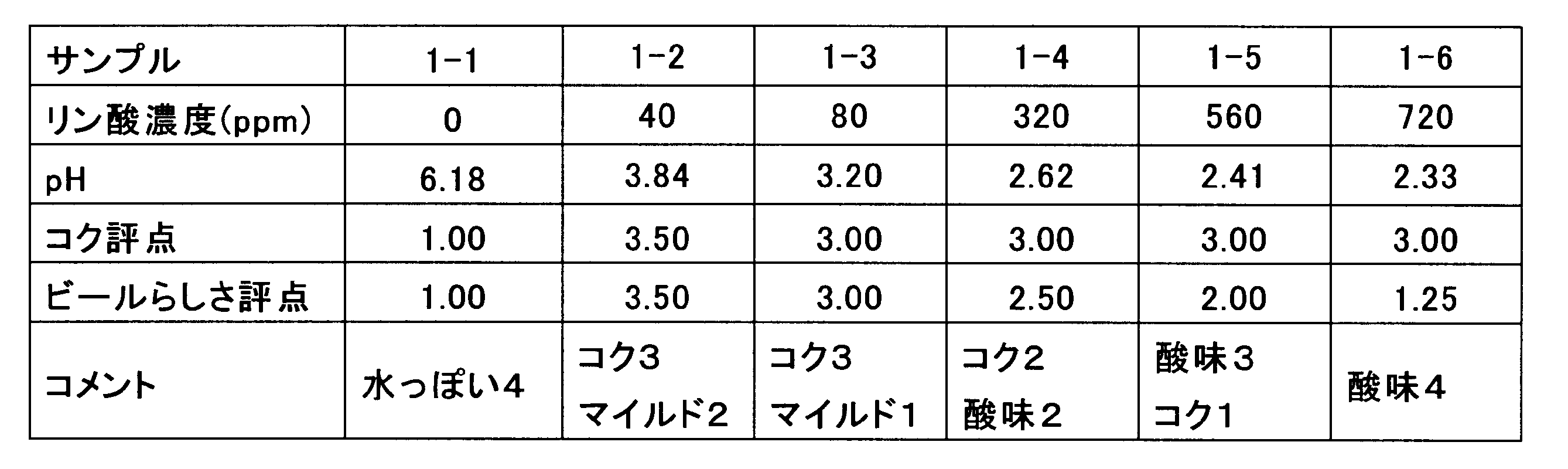
評価結果を、リン酸の含有量とpHの測定結果と共に表3に示す。コメント欄の数値は、当該コメントをした専門パネルの人数を示す。リン酸を配合したサンプル1-2~1-6は、無添加のサンプル1-1に比べて、コクが改善していた。特に、pHが3.2以上4.0以下のサンプル1-2及び1-3は、酸味が少なく、ビールらしさも改善されていた。
[実施例2]
表2に記載の組成からなるベース液に、リン酸を0、50、100、300、500、又は700ppmとなるように添加し、さらにクエン酸三ナトリウムを添加してpHを3.8に調整した後、炭酸ガスを2.8gas vol.になるように加えることにより、サンプル2-2~2-6を調製した。対照として、表2に記載の組成からなるベース液(pH6.18)に、炭酸ガスを2.8gas vol.になるように加えることにより、サンプル2-1を調製した。各サンプルのコクとビールらしさについて、実施例1と同様にして官能評価を実施した。評価結果を、リン酸濃度とクエン酸三ナトリウム添加によるクエン酸濃度と共に表4に示す。
表2に記載の組成からなるベース液に、リン酸を0、50、100、300、500、又は700ppmとなるように添加し、さらにクエン酸三ナトリウムを添加してpHを3.8に調整した後、炭酸ガスを2.8gas vol.になるように加えることにより、サンプル2-2~2-6を調製した。対照として、表2に記載の組成からなるベース液(pH6.18)に、炭酸ガスを2.8gas vol.になるように加えることにより、サンプル2-1を調製した。各サンプルのコクとビールらしさについて、実施例1と同様にして官能評価を実施した。評価結果を、リン酸濃度とクエン酸三ナトリウム添加によるクエン酸濃度と共に表4に示す。
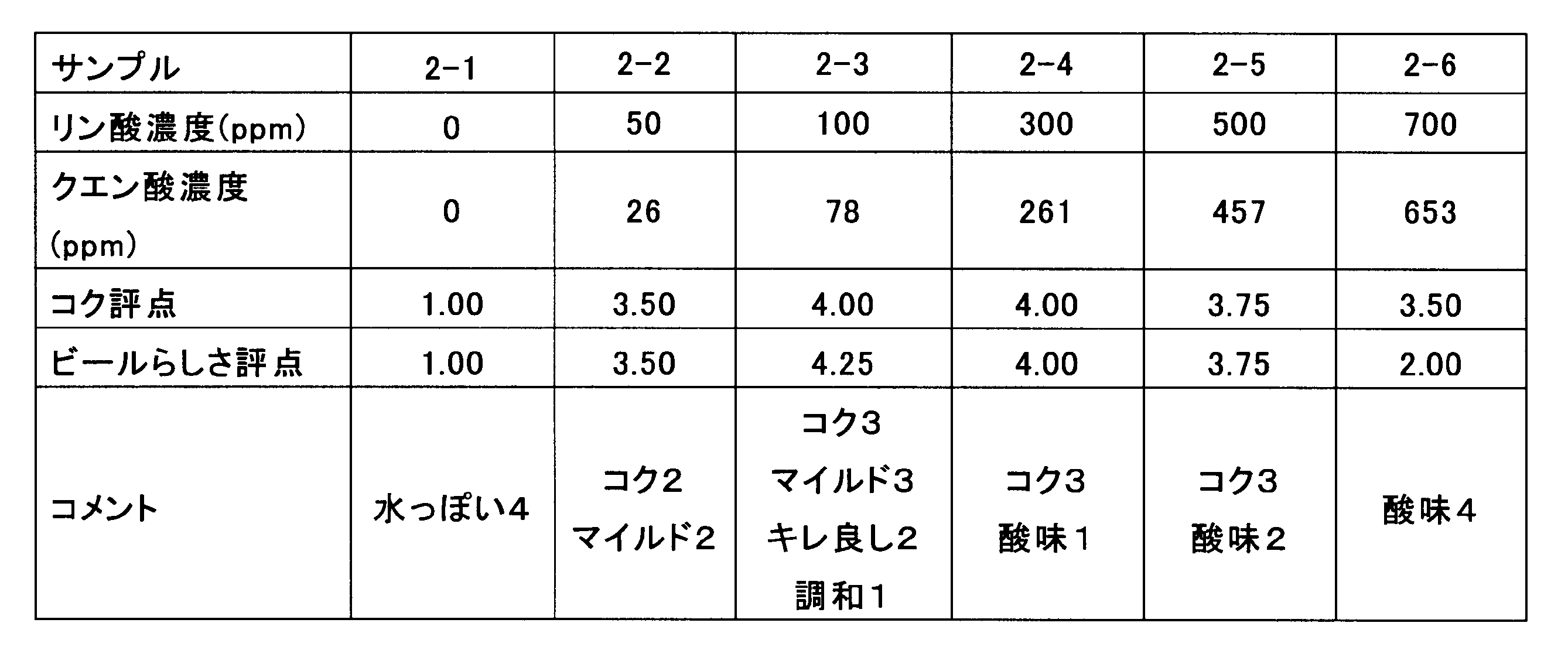
表4に示す通り、クエン酸三ナトリウムによってpHを3.8に調整したサンプル2-2~2-6のうち、リン酸濃度が50~500ppmであるサンプル2-2~2-5では、コクとビールらしさが改善されていた。すなわち、pHがビール様発泡性飲料として好ましい範囲内に調整されている場合には、リン酸濃度を50~500ppmとすることにより、コク感が付与され、ビールらしさを改善できることが明らかとなった。
また、表2に記載のベース液に代えて、表5に記載の組成からなるベース液(表2に記載のベース液に、エタノールを加えたもの)を用い、サンプル2-1~2-6と同様にしてサンプルを調製し、得られたサンプルについて官能評価を行ったところ、同様に、pHが3.8に調整されており、かつリン酸濃度が50~500ppmのサンプルでは、コクとビールらしさが改善されていた。

[実施例3]
表2に記載の組成からなるベース液に、乳酸を0、50、100、300、500、又は700ppmとなるように添加し、pHを測定した後、炭酸ガスを2.8gas vol.になるように加えることにより、サンプル3-1~3-6を調製した。各サンプルのコクとビールらしさについて、実施例1と同様にして官能評価を実施した。
表2に記載の組成からなるベース液に、乳酸を0、50、100、300、500、又は700ppmとなるように添加し、pHを測定した後、炭酸ガスを2.8gas vol.になるように加えることにより、サンプル3-1~3-6を調製した。各サンプルのコクとビールらしさについて、実施例1と同様にして官能評価を実施した。
評価結果を、乳酸の含有量とpHの測定結果と共に表6に示す。乳酸を配合したサンプル3-2~3-6は、無添加のサンプル3-1に比べて、コクが改善していた。特に、pHが3.2以上4.0以下のサンプル3-2、3-3、及び3-4は、酸味が少なく、ビールらしさも改善されていた。

[実施例4]
表2に記載の組成からなるベース液に、乳酸を0、50、100、300、500、又は700ppmとなるように添加し、さらにクエン酸三ナトリウムを添加してpHを3.8に調整した後、炭酸ガスを2.8gas vol.になるように加えることにより、サンプル4-2~4-6を調製した。対照として、表2に記載の組成からなるベース液(pH6.18)に、炭酸ガスを2.8gas vol.になるように加えることにより、サンプル4-1を調製した。各サンプルのコクとビールらしさについて、実施例1と同様にして官能評価を実施した。評価結果を、乳酸濃度とクエン酸三ナトリウム添加によるクエン酸濃度と共に表7に示す。
表2に記載の組成からなるベース液に、乳酸を0、50、100、300、500、又は700ppmとなるように添加し、さらにクエン酸三ナトリウムを添加してpHを3.8に調整した後、炭酸ガスを2.8gas vol.になるように加えることにより、サンプル4-2~4-6を調製した。対照として、表2に記載の組成からなるベース液(pH6.18)に、炭酸ガスを2.8gas vol.になるように加えることにより、サンプル4-1を調製した。各サンプルのコクとビールらしさについて、実施例1と同様にして官能評価を実施した。評価結果を、乳酸濃度とクエン酸三ナトリウム添加によるクエン酸濃度と共に表7に示す。
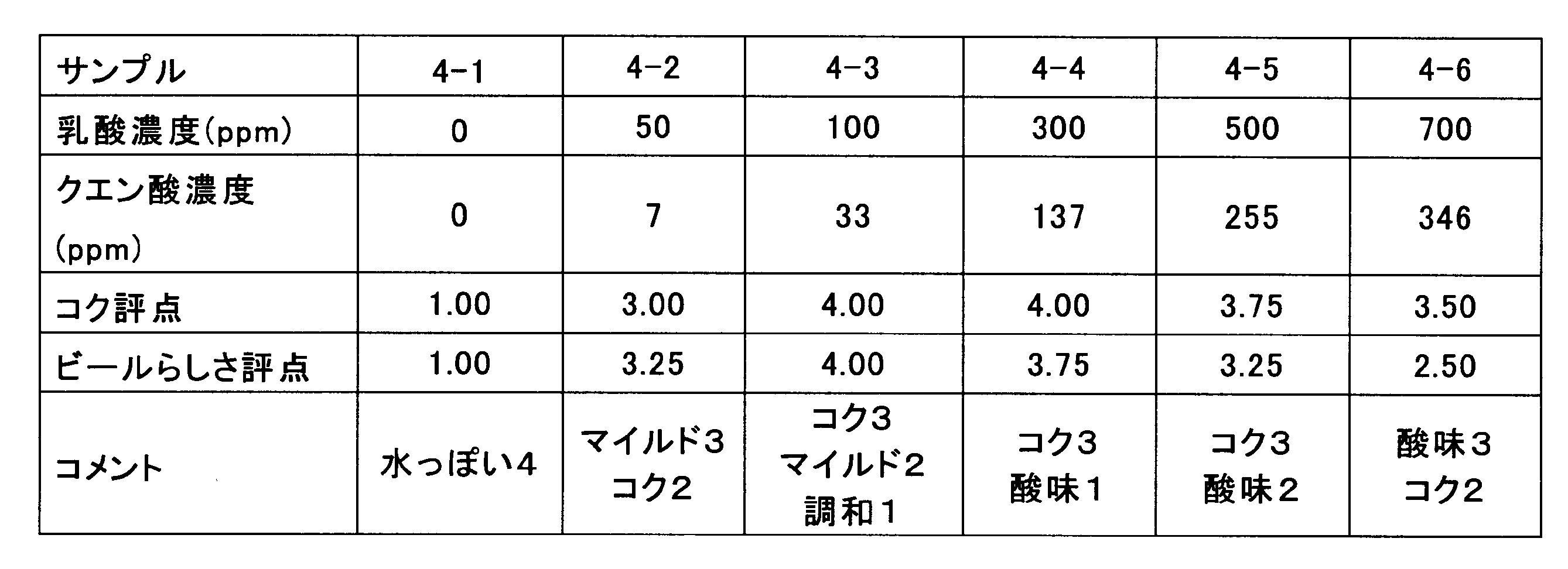
表7に示す通り、クエン酸三ナトリウムによってpHを3.8に調整したサンプル4-2~4-6のうち、乳酸濃度が50~500ppmであるサンプル4-2~4-5では、コクとビールらしさが改善されていた。すなわち、pHがビール様発泡性飲料として好ましい範囲内に調整されている場合には、乳酸濃度を50~500ppmとすることにより、コク感が付与され、ビールらしさを改善できることが明らかとなった。
また、実施例2で製造したサンプルと本実施例で製造したサンプルを混合したサンプルを調製し、同様に官能評価を行った。具体的には、サンプル2-2と4-2、サンプル2-3と4-3、サンプル2-4と4-4、サンプル2-5と4-5、サンプル2-6と4-6をそれぞれ1:1で混合したサンプルを調製し、得られたサンプルについて官能評価を行った。この結果、リン酸と乳酸の濃度の和が50~500ppmであったサンプル(サンプル2-2と4-2の混合サンプル、サンプル2-3と4-3の混合サンプル、サンプル2-4と4-4の混合サンプル、及びサンプル2-5と4-5の混合サンプル)では、コクとビールらしさが改善されていた。すなわち、pHがビール様発泡性飲料として好ましい範囲内に調整されている場合には、リン酸と乳酸の濃度の和を50~500ppmとすることにより、コク感が付与され、ビールらしさを改善できることが明らかとなった。
また、表2に記載のベース液に代えて、表5に記載の組成からなるベース液を用い、サンプル4-1~4-6と同様にしてサンプルを調製し、得られたサンプルについて官能評価を行ったところ、同様に、pHが3.8に調整されており、かつ乳酸濃度が50~500ppmのサンプルでは、コクとビールらしさが改善されていた。
[実施例5]
表2に記載の組成からなるベース液に、リン酸を500ppmとなるように添加し、さらに表8に示す各塩類を添加してpHを3.8に調整した後、炭酸ガスを2.8gas vol.になるように加えることにより、サンプル5-1~5-7を調製した。各サンプルのビールらしさについて、4名の専門パネルによりブラインドでの官能評価を実施した。評価は、4段階評価(◎:ビールらしい、○:ややビールらしい、△:ややビールらしくない、×:ビールらしくない)にて行った。
表2に記載の組成からなるベース液に、リン酸を500ppmとなるように添加し、さらに表8に示す各塩類を添加してpHを3.8に調整した後、炭酸ガスを2.8gas vol.になるように加えることにより、サンプル5-1~5-7を調製した。各サンプルのビールらしさについて、4名の専門パネルによりブラインドでの官能評価を実施した。評価は、4段階評価(◎:ビールらしい、○:ややビールらしい、△:ややビールらしくない、×:ビールらしくない)にて行った。

評価結果を、酸味料の濃度(ppm)と共に表8に示す。クエン酸三ナトリウム、グルコン酸カリウム、及びグルコン酸ナトリウムを用いたサンプル5-1~5-3は、その他の酸味料を用いてpH調整したサンプルよりもビールらしい香味に優れていた。中でも、クエン酸三ナトリウムを用いたサンプル5-1は、グルコン酸カリウム及びグルコン酸ナトリウムよりも使用量が少なかった。
[実施例6]
表2に記載の組成からなるベース液に、大豆食物繊維(不二製油株式会社の「ソヤファイブS-LA200」)を1.5g/Lとなるように、リン酸を300、500、700、又は1000ppmとなるようにそれぞれ添加し、さらにクエン酸三ナトリウムを添加してpHを3.8に調整した後、炭酸ガスを2.8gas vol.になるように加えることにより、サンプル6-1~6-4を調製した。各サンプルのコクとビールらしさについて、実施例1と同様にして官能評価を実施した。評価結果を、リン酸濃度とクエン酸三ナトリウム添加によるクエン酸濃度と共に表9に示す。
表2に記載の組成からなるベース液に、大豆食物繊維(不二製油株式会社の「ソヤファイブS-LA200」)を1.5g/Lとなるように、リン酸を300、500、700、又は1000ppmとなるようにそれぞれ添加し、さらにクエン酸三ナトリウムを添加してpHを3.8に調整した後、炭酸ガスを2.8gas vol.になるように加えることにより、サンプル6-1~6-4を調製した。各サンプルのコクとビールらしさについて、実施例1と同様にして官能評価を実施した。評価結果を、リン酸濃度とクエン酸三ナトリウム添加によるクエン酸濃度と共に表9に示す。
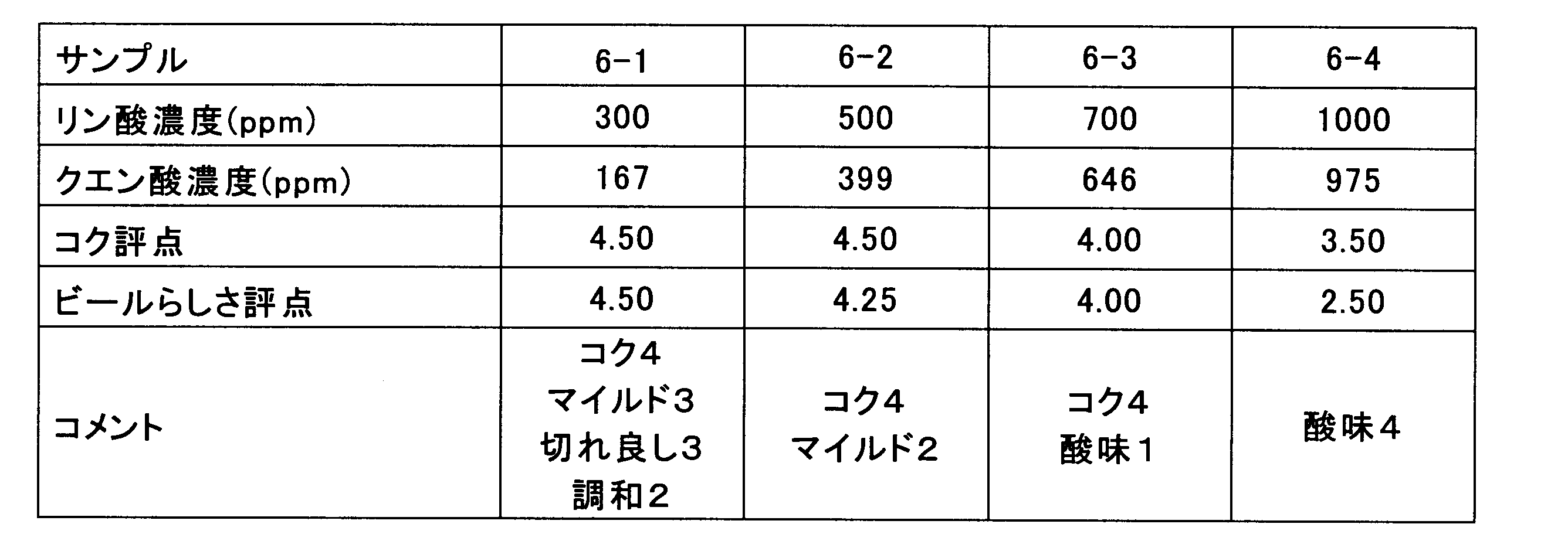
表9に示す通り、大豆食物繊維を含み、クエン酸三ナトリウムによってpHを3.8に調整したサンプルのうち、リン酸濃度が300~700ppmであるサンプル6-1~6-3では、コクとビールらしさが共に改善されていた。すなわち、pHがビール様発泡性飲料として好ましい範囲内に調整されており、かつ水溶性食物繊維も含有する場合には、リン酸濃度を700ppm以下とすることにより、コク感とビールらしさの両方を顕著に改善できることが明らかとなった。
また、表2に記載のベース液に代えて、表5に記載の組成からなるベース液を用い、サンプル6-1~6-4と同様にしてサンプルを調製し、得られたサンプルについて官能評価を行ったところ、同様に、pHが3.8に調整されており、水溶性食物繊維も含有し、かつリン酸濃度が300~700ppmのサンプルでは、コクとビールらしさの両方が改善されていた。
[実施例7]
表2に記載の組成からなるベース液に、大豆食物繊維(不二製油株式会社の「ソヤファイブS-LA200」)を1.5g/Lとなるように、乳酸を300、500、700、又は1000ppmとなるようにそれぞれ添加し、さらにクエン酸三ナトリウムを添加してpHを3.8に調整した後、炭酸ガスを2.8gas vol.になるように加えることにより、サンプル7-1~7-4を調製した。各サンプルのコクとビールらしさについて、実施例1と同様にして官能評価を実施した。評価結果を、乳酸濃度とクエン酸三ナトリウム添加によるクエン酸濃度と共に表10に示す。
表2に記載の組成からなるベース液に、大豆食物繊維(不二製油株式会社の「ソヤファイブS-LA200」)を1.5g/Lとなるように、乳酸を300、500、700、又は1000ppmとなるようにそれぞれ添加し、さらにクエン酸三ナトリウムを添加してpHを3.8に調整した後、炭酸ガスを2.8gas vol.になるように加えることにより、サンプル7-1~7-4を調製した。各サンプルのコクとビールらしさについて、実施例1と同様にして官能評価を実施した。評価結果を、乳酸濃度とクエン酸三ナトリウム添加によるクエン酸濃度と共に表10に示す。

表10に示す通り、大豆食物繊維を含み、クエン酸三ナトリウムによってpHを3.8に調整したサンプルのうち、乳酸濃度が300~700ppmであるサンプル7-1~7-3では、コクとビールらしさが共に改善されていた。すなわち、pHがビール様発泡性飲料として好ましい範囲内に調整されており、かつ水溶性食物繊維も含有する場合には、乳酸濃度を700ppm以下とすることにより、コク感とビールらしさの両方を顕著に改善できることが明らかとなった。
また、実施例6で製造したサンプルと本実施例で製造したサンプルを混合したサンプルを調製し、同様に官能評価を行った。具体的には、サンプル6-1と7-1、サンプル6-2と7-2、サンプル6-3と7-3、サンプル6-4と7-4をそれぞれ1:1で混合したサンプルを調製し、得られたサンプルについて官能評価を行った。この結果、リン酸と乳酸の濃度の和が300~700ppmであったサンプル(サンプル6-1と7-1の混合サンプル、サンプル6-2と7-2の混合サンプル、及びサンプル6-3と7-3の混合サンプル)では、コクとビールらしさが改善されていた。すなわち、pHがビール様発泡性飲料として好ましい範囲内に調整されており、かつ水溶性食物繊維も含有する場合には、リン酸と乳酸の濃度の和を700ppm以下とすることにより、コク感とビールらしさの両方を顕著に改善できることが明らかとなった。
また、表2に記載のベース液に代えて、表5に記載の組成からなるベース液を用い、サンプル7-1~7-4と同様にしてサンプルを調製し、得られたサンプルについて官能評価を行ったところ、同様に、pHが3.8に調整されており、水溶性食物繊維も含有し、かつ乳酸濃度が300~700ppmのサンプルでは、コクとビールらしさの両方が改善されていた。
[実施例8]
表2に記載の組成からなるベース液に、リン酸、乳酸、クエン酸三ナトリウム、エタノール、その他各種成分を配合し、サンプル8-1~8-3を調製した。各サンプルのpH、リン酸濃度、乳酸濃度、クエン酸濃度、プリン体濃度、及びエタノール濃度を、参考例1と同様にして測定した。測定結果を表11に示す。得られたサンプル8-1~8-3は、いずれも充分なコクを備えており、ビールらしく、マイルドで調和のとれた非常に嗜好性の高い非発酵ビール様発泡性飲料であった。
表2に記載の組成からなるベース液に、リン酸、乳酸、クエン酸三ナトリウム、エタノール、その他各種成分を配合し、サンプル8-1~8-3を調製した。各サンプルのpH、リン酸濃度、乳酸濃度、クエン酸濃度、プリン体濃度、及びエタノール濃度を、参考例1と同様にして測定した。測定結果を表11に示す。得られたサンプル8-1~8-3は、いずれも充分なコクを備えており、ビールらしく、マイルドで調和のとれた非常に嗜好性の高い非発酵ビール様発泡性飲料であった。

本発明に係る非発酵ビール様発泡性飲料は、プリン体を含む原料の添加量が調整されており、プリン体濃度が非常に低いにもかかわらず、充分なコクを有しているため、特にビール様発泡性飲料及びその製造分野で利用が可能である。
Claims (9)
- プリン体を含む原料の添加量が調整されており、プリン体濃度が0.2mg/100mL以下であり、リン酸及び乳酸からなる群より選択される1種以上の有機酸の含有量が40~700ppmであり、かつpHが3.2~4.5である、非発酵ビール様発泡性飲料。
- さらに、クエン酸の塩類及びグルコン酸の塩類からなる群より選択される1種以上を含有する、請求項1に記載の非発酵ビール様発泡性飲料。
- クエン酸のナトリウム塩を、非発酵ビール様発泡性飲料当たりのクエン酸濃度が10~650ppmとなるように含有させた、請求項1に記載の非発酵ビール様発泡性飲料。
- プリン体濃度が0.08mg/100mL以下である、請求項1~3のいずれか一項に記載の非発酵ビール様発泡性飲料。
- 糖質濃度が0.5g/100mL以下である、請求項1~4のいずれか一項に記載の非発酵ビール様発泡性飲料。
- リン酸及び乳酸からなる群より選択される1種以上の有機酸の含有量が40~500ppmである、請求項1~5のいずれか一項に記載の非発酵ビール様発泡性飲料。
- さらに、水溶性食物繊維を含有する、請求項1~6のいずれか一項に記載の非発酵ビール様発泡性飲料。
- 前記水溶性食物繊維が大豆食物繊維である、請求項7に記載の非発酵ビール様発泡性飲料。
- さらに、エタノールを含有する、請求項1~8のいずれか一項に記載の非発酵ビール様発泡性飲料。
Applications Claiming Priority (2)
| Application Number | Priority Date | Filing Date | Title |
|---|---|---|---|
| JP2014-248154 | 2014-12-08 | ||
| JP2014248154A JP6570242B2 (ja) | 2014-12-08 | 2014-12-08 | 非発酵ビール様発泡性飲料 |
Publications (1)
| Publication Number | Publication Date |
|---|---|
| WO2016093023A1 true WO2016093023A1 (ja) | 2016-06-16 |
Family
ID=56107217
Family Applications (1)
| Application Number | Title | Priority Date | Filing Date |
|---|---|---|---|
| PCT/JP2015/082199 Ceased WO2016093023A1 (ja) | 2014-12-08 | 2015-11-17 | 非発酵ビール様発泡性飲料 |
Country Status (3)
| Country | Link |
|---|---|
| JP (1) | JP6570242B2 (ja) |
| TW (1) | TW201621039A (ja) |
| WO (1) | WO2016093023A1 (ja) |
Families Citing this family (4)
| Publication number | Priority date | Publication date | Assignee | Title |
|---|---|---|---|---|
| JP6938140B2 (ja) * | 2016-11-29 | 2021-09-22 | 麒麟麦酒株式会社 | 収斂味が低減された容器詰めアルコール飲料およびその製造方法 |
| JP6905347B2 (ja) * | 2017-02-10 | 2021-07-21 | アサヒビール株式会社 | 容器詰め炭酸アルコール飲料及びその製造方法 |
| JP7046593B2 (ja) * | 2017-12-21 | 2022-04-04 | キリンホールディングス株式会社 | トランス-2-ノネナール等による酸化臭が低減したビールテイスト飲料 |
| JP2024173324A (ja) * | 2023-06-02 | 2024-12-12 | サッポロビール株式会社 | ビールテイスト飲料の製造方法、及びビールテイスト飲料、並びにビールテイスト飲料の総プリン体含有量を低減する方法 |
Citations (5)
| Publication number | Priority date | Publication date | Assignee | Title |
|---|---|---|---|---|
| JP2011036228A (ja) * | 2009-08-18 | 2011-02-24 | Kirin Brewery Co Ltd | アルコール感が抑制され、かつ甘味と酸味が調和した低アルコール無糖飲料の製造方法 |
| JP2011217706A (ja) * | 2010-04-14 | 2011-11-04 | Asahi Breweries Ltd | ビールテイスト飲料、及び、その製造方法 |
| WO2013077292A1 (ja) * | 2011-11-22 | 2013-05-30 | サントリーホールディングス株式会社 | pHを調整した低エキス分のビールテイスト飲料 |
| JP5525632B1 (ja) * | 2013-02-28 | 2014-06-18 | サッポロビール株式会社 | ビールテイスト飲料及びその製造方法 |
| WO2014119064A1 (ja) * | 2013-01-31 | 2014-08-07 | アサヒビール株式会社 | 非発酵ビール様発泡性飲料 |
-
2014
- 2014-12-08 JP JP2014248154A patent/JP6570242B2/ja active Active
-
2015
- 2015-11-17 TW TW104137933A patent/TW201621039A/zh unknown
- 2015-11-17 WO PCT/JP2015/082199 patent/WO2016093023A1/ja not_active Ceased
Patent Citations (5)
| Publication number | Priority date | Publication date | Assignee | Title |
|---|---|---|---|---|
| JP2011036228A (ja) * | 2009-08-18 | 2011-02-24 | Kirin Brewery Co Ltd | アルコール感が抑制され、かつ甘味と酸味が調和した低アルコール無糖飲料の製造方法 |
| JP2011217706A (ja) * | 2010-04-14 | 2011-11-04 | Asahi Breweries Ltd | ビールテイスト飲料、及び、その製造方法 |
| WO2013077292A1 (ja) * | 2011-11-22 | 2013-05-30 | サントリーホールディングス株式会社 | pHを調整した低エキス分のビールテイスト飲料 |
| WO2014119064A1 (ja) * | 2013-01-31 | 2014-08-07 | アサヒビール株式会社 | 非発酵ビール様発泡性飲料 |
| JP5525632B1 (ja) * | 2013-02-28 | 2014-06-18 | サッポロビール株式会社 | ビールテイスト飲料及びその製造方法 |
Also Published As
| Publication number | Publication date |
|---|---|
| JP6570242B2 (ja) | 2019-09-04 |
| JP2016106586A (ja) | 2016-06-20 |
| TW201621039A (zh) | 2016-06-16 |
Similar Documents
| Publication | Publication Date | Title |
|---|---|---|
| JP6284580B2 (ja) | 非発酵ビール様発泡性飲料の製造方法 | |
| JP5583878B1 (ja) | 非発酵ビール様発泡性飲料 | |
| JP6576029B2 (ja) | 非発酵ビール様発泡性飲料 | |
| JP6815187B2 (ja) | 非発酵ビール様発泡性飲料及びその製造方法 | |
| WO2016063820A1 (ja) | ビール様発泡性飲料 | |
| JP6599606B2 (ja) | 非発酵ビール様発泡性飲料 | |
| WO2016063818A1 (ja) | 非発酵ビール様発泡性飲料 | |
| WO2016063823A1 (ja) | 非発酵ビール様発泡性飲料 | |
| JP6570242B2 (ja) | 非発酵ビール様発泡性飲料 | |
| WO2016125361A1 (ja) | 柑橘類風味ノンアルコール飲料 | |
| JP6463075B2 (ja) | 非発酵ビール様発泡性飲料 | |
| JP2019047823A (ja) | 非発酵ビール様発泡性飲料 | |
| WO2016140065A1 (ja) | 非発酵ビールテイスト飲料 | |
| JP7096320B2 (ja) | 非発酵ビール様発泡性飲料に飲み応えを付与する方法 |
Legal Events
| Date | Code | Title | Description |
|---|---|---|---|
| 121 | Ep: the epo has been informed by wipo that ep was designated in this application |
Ref document number: 15866817 Country of ref document: EP Kind code of ref document: A1 |
|
| NENP | Non-entry into the national phase |
Ref country code: DE |
|
| 122 | Ep: pct application non-entry in european phase |
Ref document number: 15866817 Country of ref document: EP Kind code of ref document: A1 |