WO2016091165A1 - 治疗非小细胞肺癌的喹啉衍生物 - Google Patents
治疗非小细胞肺癌的喹啉衍生物 Download PDFInfo
- Publication number
- WO2016091165A1 WO2016091165A1 PCT/CN2015/096770 CN2015096770W WO2016091165A1 WO 2016091165 A1 WO2016091165 A1 WO 2016091165A1 CN 2015096770 W CN2015096770 W CN 2015096770W WO 2016091165 A1 WO2016091165 A1 WO 2016091165A1
- Authority
- WO
- WIPO (PCT)
- Prior art keywords
- compound
- pharmaceutically acceptable
- administration
- small cell
- pharmaceutical composition
- Prior art date
- Legal status (The legal status is an assumption and is not a legal conclusion. Google has not performed a legal analysis and makes no representation as to the accuracy of the status listed.)
- Ceased
Links
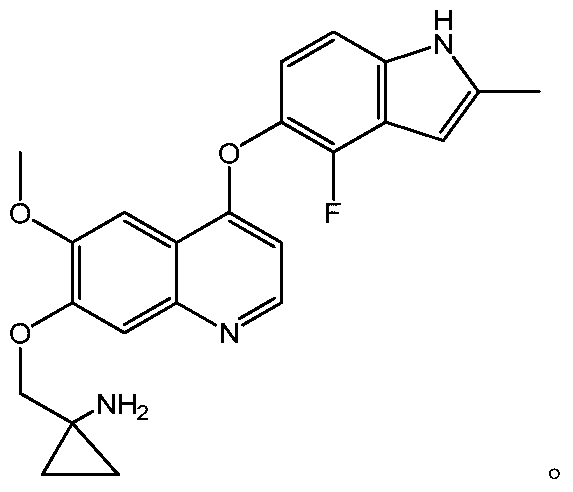
- KSMZEXLVHXZPEF-UHFFFAOYSA-N Cc1cc(c(F)c(cc2)Oc3c(cc(c(OCC4(CC4)N)c4)OC)c4ncc3)c2[nH]1 Chemical compound Cc1cc(c(F)c(cc2)Oc3c(cc(c(OCC4(CC4)N)c4)OC)c4ncc3)c2[nH]1 KSMZEXLVHXZPEF-UHFFFAOYSA-N 0.000 description 3
Classifications
-
- A—HUMAN NECESSITIES
- A61—MEDICAL OR VETERINARY SCIENCE; HYGIENE
- A61K—PREPARATIONS FOR MEDICAL, DENTAL OR TOILETRY PURPOSES
- A61K31/00—Medicinal preparations containing organic active ingredients
- A61K31/33—Heterocyclic compounds
- A61K31/395—Heterocyclic compounds having nitrogen as a ring hetero atom, e.g. guanethidine or rifamycins
- A61K31/435—Heterocyclic compounds having nitrogen as a ring hetero atom, e.g. guanethidine or rifamycins having six-membered rings with one nitrogen as the only ring hetero atom
- A61K31/47—Quinolines; Isoquinolines
- A61K31/4709—Non-condensed quinolines and containing further heterocyclic rings
Definitions
- This application belongs to the field of medical technology, and the present application relates to the use of quinoline derivatives for antitumor.
- the present application relates to the use of a quinoline derivative for the treatment of non-small cell lung cancer.
- Non-small cell lung cancer is the most malignant tumor with morbidity and mortality in China. Its main histological types include adenocarcinoma, squamous cell carcinoma (SCC) and large cell carcinoma. . Based on cell morphology, adenocarcinoma is a common histological type of NSCLC. Surgical resection combined with chemotherapy is the main means of treatment. However, most patients have lost the opportunity for surgery in the late stage of diagnosis. Most patients undergoing surgery also need adjuvant chemotherapy. Therefore, chemotherapy is the most important method of treatment. Traditional chemotherapeutic drugs have been limited in clinical application due to their poor specificity and toxic side effects. Choosing the right drug and targeting individualized treatment is the development direction of cancer treatment.
- EGFR-TKI epidermal growth factor receptor-tyrosine kinase inhibitors
- EGFR-TKI epidermal growth factor receptor-tyrosine kinase inhibitors
- beneficial effects in the treatment of non-small cell lung cancer such as gefitinib and erlotinib. , ectinib (icotinib), etc.
- EGFR-TKI inhibits the activation and phosphorylation of the enzyme by binding to the ATP binding site of the EGFR tyrosine kinase domain, so that the activation signal can not be transmitted downward, inhibit tumor cell proliferation, and initiate Apoptosis.
- the application provides a method of treating non-small cell lung cancer that is not EGFR-TKI-treated, the method comprising administering to a patient in need of treatment a therapeutically effective amount of Compound 1, or a pharmaceutically acceptable salt thereof, having the formula
- the application provides the use of Compound 1, or a pharmaceutically acceptable salt thereof, having the above formula, for the manufacture of a medicament for the treatment of non-small cell lung cancer for which EGFR-TKI therapy is not applicable.
- the application provides a compound I or a pharmaceutical composition having the above formula, wherein the pharmaceutical composition comprises Compound I or a pharmaceutically acceptable salt thereof, and a non-small cell lung cancer that is not suitable for treatment with EGFR-TKI At least one pharmaceutically acceptable carrier.
- the application provides a method of treating non-small cell lung cancer that is not EGFR-TKI-treated, the method comprising administering to a patient in need of treatment a therapeutically effective amount of Compound I having the following structural formula or a pharmaceutically acceptable thereof salt,
- a method of treating advanced non-small cell lung cancer and/or metastatic non-small cell lung cancer that is not EGFR-TKI treated comprising administering to a patient in need of treatment a therapeutically effective amount Compound I or a pharmaceutically acceptable salt thereof.
- Compound I can be administered in the form of its free base or it can be administered in the form of its salts, hydrates and prodrugs which are converted in vivo to the free base form of Compound I.
- a pharmaceutically acceptable salt of Compound I is within the scope of the present application and can be produced from different organic and inorganic acids by methods well known in the art.
- the administration is in the form of Compound I hydrochloride. In some embodiments, the administration is in the form of Compound I monohydrochloride. In some embodiments, the administration is in the form of Compound I dihydrochloride. In some embodiments, the administration is in the form of a crystal of Compound I hydrochloride. In a particular embodiment, it is administered in the form of a crystal of Compound I dihydrochloride.
- Compound 1, or a pharmaceutically acceptable salt thereof can be administered by a variety of routes including, but not limited to, those selected from the group consisting of oral, parenteral, intraperitoneal, intravenous, intraarterial, transdermal, sublingual, Intramuscular, rectal, buccal, intranasal, inhalation, vaginal, intraocular, topical, subcutaneous, intrahepatic, intra-articular, intraperitoneal, and intrathecal. In a particular embodiment, it is administered orally.
- the amount of Compound I or a pharmaceutically acceptable salt thereof administered can be determined based on the severity of the disease, the response to the disease, any treatment-related toxicity, the age and health of the patient.
- the daily dose of Compound 1, or a pharmaceutically acceptable salt thereof is from 3 mg to 30 mg. In some embodiments, the daily dose of Compound 1, or a pharmaceutically acceptable salt thereof, is from 5 mg to 20 mg. In some embodiments, the daily dose of Compound 1, or a pharmaceutically acceptable salt thereof, is from 8 mg to 16 mg. In some embodiments, the daily dose of Compound 1, or a pharmaceutically acceptable salt thereof, is from 10 mg to 14 mg. In a specific embodiment, the daily dose of Compound 1, or a pharmaceutically acceptable salt thereof, is 8 mg. In a specific embodiment, the daily dose of Compound 1, or a pharmaceutically acceptable salt thereof, is 10 mg. In a specific embodiment, the daily dose of Compound 1, or a pharmaceutically acceptable salt thereof, is 12 mg.
- Compound I or a pharmaceutically acceptable salt thereof can be administered one or more times a day. In some embodiments, Compound 1, or a pharmaceutically acceptable salt thereof, is administered once daily. In one embodiment, the oral solid preparation is administered once a day.
- the method of administration can be comprehensively determined based on the activity, toxicity, and tolerance of the patient.
- Compound 1, or a pharmaceutically acceptable salt thereof is administered in a separate manner.
- the interval administration includes a administration period and a withdrawal period, and Compound I or a pharmaceutically acceptable salt thereof may be administered one or more times a day during the administration period.
- Compound I or a pharmaceutically acceptable salt thereof is administered daily during the administration period, and then the administration is stopped for a certain period of time during the withdrawal period, followed by the administration period, and then the withdrawal period, which can be repeated a plurality of times.
- the ratio of the administration period to the withdrawal period in days is 2:0.5 to 5, preferably 2:0.5 to 3, more preferably 2:0.5 to 2, still more preferably 2:0.5 to 1.
- the continuous administration is discontinued for 2 weeks for 2 weeks.
- the drug is administered once a day for 14 days, then for 14 days; then once a day for 14 days, then for 14 days, so
- the interval administration method in which the administration is continued for 2 weeks and the drug is stopped for 2 weeks can be repeated a plurality of times.
- the continuous administration is discontinued for 2 weeks for 1 week. In some embodiments, administration once a day for 14 days, followed by 7 days of withdrawal; followed by 1 administration per day for 14 days, followed by 7 days of discontinuation, such continuous administration for 2 weeks
- the interval of administration of the drug for one week can be repeated a plurality of times.
- the administration is continued for 5 days for 2 days.
- the drug is administered once a day for 5 days, then for 2 days; then once a day for 5 days, then for 2 days, such continuous administration for 5 days.
- the two-day interval administration method can be repeated multiple times.
- the oral administration is administered once daily at a dose of 12 mg, administered continuously for 2 weeks, and administered for 1 week.
- Compound 1, or a pharmaceutically acceptable salt thereof is administered to a patient as the sole active ingredient.
- the present application also provides the use of Compound 1, or a pharmaceutically acceptable salt thereof, for the manufacture of a medicament for the treatment of non-small cell lung cancer for which EGFR-TKI therapy is not applicable.
- Compound 1, or a pharmaceutically acceptable salt thereof is provided in the manufacture of a medicament for the treatment of advanced non-small cell lung cancer and/or metastatic non-small cell lung cancer for which EGFR-TKI therapy is not applicable. the use of.
- Compound I may be in its free base form, or it may be in the form of its salts, hydrates and prodrugs which are converted in vivo to the free base form of Compound I.
- a pharmaceutically acceptable salt of Compound I is within the scope of the present application and can be produced from different organic and inorganic acids by methods well known in the art.
- Compound 1, or a pharmaceutically acceptable salt thereof is the hydrochloride salt form of Compound I.
- the amount of Compound I or a pharmaceutically acceptable salt thereof can be determined depending on the severity of the disease, the response of the disease, any treatment-related toxicity, the age of the patient, and the state of health.
- the daily dose of Compound 1, or a pharmaceutically acceptable salt thereof is from 3 mg to 30 mg.
- the daily dose of Compound 1, or a pharmaceutically acceptable salt thereof is from 5 mg to 20 mg.
- the daily dose of Compound 1, or a pharmaceutically acceptable salt thereof is from 8 mg to 16 mg.
- the daily dose of Compound 1, or a pharmaceutically acceptable salt thereof is from 10 mg to 14 mg.
- the present application provides a Compound I or a pharmaceutical composition for treating non-small cell lung cancer that is not suitable for EGFR-TKI treatment, wherein the pharmaceutical composition comprises Compound 1, or a pharmaceutically acceptable salt thereof, and at least A pharmaceutically acceptable carrier.
- a Compound I or pharmaceutical composition for treating advanced non-small cell lung cancer and/or metastatic non-small cell lung cancer that is not suitable for EGFR-TKI treatment wherein the pharmaceutical composition comprises Compound I or a pharmaceutically acceptable salt thereof, and at least one pharmaceutically acceptable carrier.
- Compound I may be in its free base form, or it may be in the form of its salts, hydrates and prodrugs which are converted in vivo to the free base form of Compound I.
- a pharmaceutically acceptable salt of Compound I is within the scope of the present application and can be produced from different organic and inorganic acids by methods well known in the art.
- the amount of Compound I or a pharmaceutically acceptable salt thereof can be determined depending on the severity of the disease, the response of the disease, any treatment-related toxicity, the age of the patient, and the state of health.
- the above pharmaceutical compositions contain from 3 mg to 30 mg of Compound 1, or a pharmaceutically acceptable salt thereof, on a unit dosage basis.
- the above pharmaceutical compositions contain 5 mg to 20 mg of Compound 1, or a pharmaceutically acceptable salt thereof, on a unit dosage basis.
- the above pharmaceutical compositions contain from 8 mg to 16 mg of Compound 1, or a pharmaceutically acceptable salt thereof, on a unit dosage basis.
- the above pharmaceutical compositions contain 10 mg to 14 mg of Compound 1, or a pharmaceutically acceptable salt thereof, on a unit dosage basis.
- "containing 12 mg of Compound I on a unit dose basis" means that 12 mg of Compound I is contained per tablet or capsule per capsule.
- the pharmaceutical composition contains 8, 10 or 12 mg of Compound 1, or a pharmaceutically acceptable salt thereof, on a unit dosage basis.
- Compound I is formulated for oral, parenteral, intraperitoneal, intravenous, intraarterial, transdermal, sublingual, intramuscular, rectal, buccal, intranasal, inhalation, vaginal, ocular Formulations for internal, topical, subcutaneous, intra-, intra-articular, intraperitoneal, and intrathecal administration; preferably suitable for oral administration, including tablets, capsules, powders, granules, pills, pastes, Powders and the like, preferably tablets and capsules.
- the tablet may be a common tablet, a dispersible tablet, an effervescent tablet, a sustained release tablet, a controlled release tablet or an enteric coated tablet
- the capsule may be a general capsule, a sustained release capsule, a controlled release capsule or an enteric coated capsule.
- pharmaceutically acceptable carriers include fillers, absorbents, wetting agents, binders, disintegrants, lubricants, and the like.
- Filling agents include starch, lactose, mannitol, microcrystalline cellulose, etc.; absorbents include calcium sulfate, calcium hydrogen phosphate, calcium carbonate, etc.; wetting agents include water, ethanol, etc.; binders include hypromellose, poly Retardone, microcrystalline cellulose, etc.; disintegrants include croscarmellose sodium, crospovidone, surfactant, low-substituted hydroxypropyl cellulose, etc.; lubricants include magnesium stearate, talc Powder, polyethylene glycol, Sodium lauryl sulfate, micronized silica gel, talc, and the like. Pharmaceutical excipients also include coloring agents, sweeteners, and the like.
- the pharmaceutical composition may be suitable for oral, parenteral, intraperitoneal, intravenous, intraarterial, transdermal, sublingual, intramuscular, rectal, buccal, intranasal, inhalation, vaginal, intraocular, meridian Formulations for topical administration, subcutaneous, intra-, intra-articular, intraperitoneal and intrathecal administration; preferably suitable for oral administration, including tablets, capsules, powders, granules, dropping pills, pastes, powders, etc. Preference is given to tablets and capsules.
- the tablet may be a common tablet, a dispersible tablet, an effervescent tablet, a sustained release tablet, a controlled release tablet or an enteric coated tablet
- the capsule may be a general capsule, a sustained release capsule, a controlled release capsule or an enteric coated capsule.
- pharmaceutically acceptable carriers include fillers, absorbents, wetting agents, binders, disintegrants, lubricants, and the like.
- Filling agents include starch, lactose, mannitol, microcrystalline cellulose, etc.; absorbents include calcium sulfate, calcium hydrogen phosphate, calcium carbonate, etc.; wetting agents include water, ethanol, etc.; binders include hypromellose, poly Retardone, microcrystalline cellulose, etc.; disintegrants include croscarmellose sodium, crospovidone, surfactant, low-substituted hydroxypropyl cellulose, etc.; lubricants include magnesium stearate, talc Powder, polyethylene glycol, sodium lauryl sulfate, micronized silica gel, talcum powder, and the like. Pharmaceutical excipients also include coloring agents, sweeteners, and the like.
- Compound I or the above pharmaceutical composition is administered in a separate manner.
- the interval administration includes a administration period and a withdrawal period, and the compound I or the above pharmaceutical composition may be administered one or more times a day during the administration period.
- Compound I or the above-mentioned pharmaceutical composition is administered daily during the administration period, and then the administration is stopped for a certain period of time during the withdrawal period, followed by the administration period, and then the withdrawal period, which can be repeated a plurality of times.
- the ratio of the administration period to the withdrawal period in days is 2:0.5 to 5, preferably 2:0.5 to 3, more preferably 2:0.5 to 2, still more preferably 2:0.5 to 1.
- the continuous administration is discontinued for 2 weeks for 2 weeks. In some embodiments, administration once a day for 14 days, followed by 14 days of withdrawal; followed by 1 administration per day for 14 days, followed by 14 days of discontinuation, such continuous administration for 2 weeks
- the two-week interval administration method can be repeated a plurality of times.
- the continuous administration is discontinued for 2 weeks for 1 week. In some embodiments, administration once a day for 14 days, followed by 7 days of withdrawal; followed by 1 administration per day for 14 days, followed by 7 days of discontinuation, such continuous administration for 2 weeks
- the interval of administration of the drug for one week can be repeated a plurality of times.
- the administration is continued for 5 days for 2 days.
- the drug is administered once a day for 5 days, then for 2 days; then once a day for 5 days, then for 2 days, such continuous administration for 5 days.
- the two-day interval administration method can be repeated multiple times.
- Compound I or the above pharmaceutical composition can be administered one or more times a day. In some embodiments, Compound I or a pharmaceutical composition described above is administered once a day. In one embodiment, the oral solid preparation is administered once a day.
- the oral administration is administered once daily at a dose of 12 mg, administered continuously for 2 weeks, and administered for 1 week.
- the EGFR-TKI described herein is an epidermal growth factor receptor tyrosine kinase inhibitor, and examples thereof include, but are not limited to, gefitinib (Iressa), Ero Tinie (Troquet), Ektorini (Kemena).
- stage III-IV non-small cell lung cancer As used herein, “late” refers to the staging of non-small cell lung cancer based on the extent of the lesion and concurrent disease, such as stage III-IV non-small cell lung cancer according to the TNM classification of the AJCC cancer staging manual lung cancer staging system.
- the advanced non-small cell lung cancer is a stage IIIB-IV non-small cell lung cancer.
- EGFR epidermal growth factor receptor
- negative mutation of EGFR generally means that the EGFR gene mutation is not detected by a gene detection method commonly used in clinical diagnosis.
- the EGFR mutation status can be detected by a variety of methods.
- DNA mutation detection is the preferred method for detecting EGFR status.
- Multiple DNA mutation detection assays can be used to detect EGFR mutation status in tumor cells.
- the most common EGFR mutation in non-small cell lung cancer patients is Direct exon 19 deletion and exon 21 mutation, direct DNA sequencing of exon 18-21 (or exons 19 and 21 only) is a reasonable choice.
- the amount of Compound I administered can be determined based on the severity of the disease, the response to the disease, any treatment-related toxicity, the age of the patient, and the state of health.
- the period of administration can be comprehensively determined based on the activity, toxicity, and tolerance of the patient.
- non-small cell lung cancer not treated with EGFR-TKI includes: non-small cell lung cancer treated with EGFR-TKI first, such as non-small cell lung cancer with negative EGFR mutation; and resistance or intolerance to EGFR-TKI
- Non-small cell lung cancer, after treatment with EGFR-TKI, benefits from initial treatment, and continues to use non-small cell lung cancer with progression of the disease or non-small cell lung cancer in patients with toxic side effects that are unlikely to be tolerated.
- Non-small cell lung cancer that is not suitable for EGFR-TKI treatment includes non-small cell lung cancer that is not sensitive to EGFR-TKI, that is, non-small cell lung cancer that does not benefit from treatment with EGFR-TKI and whose disease is still progressing.
- "benefit" means that the disease has no progress.
- Patient means a mammal, preferably a human.
- “Pharmaceutically acceptable” means that it is used in the preparation of a pharmaceutical composition which is generally safe, non-toxic and neither biologically or otherwise undesirable, and which includes its use for human pharmaceutical use. Accepted.
- “Pharmaceutically acceptable salt” includes, but is not limited to, acid addition salts with inorganic acids such as hydrochloric acid, hydrobromic acid, sulfuric acid, nitric acid, phosphoric acid, and the like; or with organic acids such as acetic acid, trifluoroacetic acid, propionic acid , hexanoic acid, heptanoic acid, cyclopentane propionic acid, B Alkyd, pyruvic acid, lactic acid, malonic acid, succinic acid, malic acid, maleic acid, fumaric acid, tartaric acid, citric acid, benzoic acid, cinnamic acid, mandelic acid, methanesulfonic acid, ethanesulfonic acid, 1, 2-ethanedisulfonic acid, 2-hydroxyethanesulfonic acid, benzenesulfonic acid, p-chlorobenzenesulfonic acid, p-toluenesulfonic acid
- terapéuticaally effective amount is meant an amount of a compound that is sufficient to effect control of the disease when administered to a human for the treatment of a disease.
- Treatment means any administration of a therapeutically effective amount of a compound and includes:
- progression-free survival P50 refers to the time when no disease progresses in 50% of patients participating in the statistics
- progression-free survival P75 refers to the time when no disease progresses in 25% of the patients participating in the statistics
- Mean survival progression mean the mean value of progression-free survival in patients who participated in the outcome statistics.
- the dihydrochloride salt of Compound I is pulverized and passed through a 80 mesh sieve; then uniformly mixed with mannitol and hydroxypropylcellulose; then a prescribed amount of microcrystalline cellulose is added, uniformly mixed, and passed through a 0.8 mm sieve; The magnesium stearate is mixed evenly and filled with capsules.
- the continuous medication for 2 weeks, 1 week, that is, 3 weeks (21 days) is a cycle program; until the researchers believe that the patient is not suitable for continued medication or efficacy evaluation for disease progression (PD) When the medication is over.
- PD disease progression
- the dihydrochloride salt of Compound I can significantly prolong the progression-free survival of patients with non-small cell lung cancer who are not treated with EGFR-TKI.
- the sum of the diameters of the second cycle (2014-1-1) is 70.29 mm (the upper lung cavity continues to enlarge, the wall becomes thinner; the right lower lung cavity becomes larger)
- the fourth cycle (2014-2-12) the sum of the diameters is 74.2mm (the cavity continues to increase) to the sixteenth cycle.
- CT examination suggests that the cavity present in the right upper lobe during the screening continues to increase during the treatment, the wall Thinning; the solid lesion in the right lower lobe appeared in the first cycle after the cavity, after which the cavity continued to increase; non-target lesions did not progress, and no new lesions appeared.
- the patient had received Compound I dihydrochloride for one year and one month, and still took Compound I dihydrochloride capsules during the nineteenth treatment cycle. The tumor continued to respond and the clinical performance was better. it is good.
- Treatment with Compound I dihydrochloride was generally well tolerated. There was no significant change in blood routine, and no drug-related cardiotoxicity was observed during treatment.
- lymph node dissection was performed in the outpatient department, and the pathological suggestion (right-locked) lymph node metastatic carcinoma was poorly differentiated adenocarcinoma.
- pathological diagnosis right upper lobe adenocarcinoma, bilateral lung metastasis, mediastinal lymph node metastasis, right supraclavicular lymph node metastasis (T4N3M1, stage IV), no other history of disease.
- the dose was reduced to 10 mg.
- the 6-week CT results showed that the sum of the diameters of the two large measurable target lesions was 114 mm, which was decreased by 21.1% (52 mm in the anterior segment of the right upper lobe).
- the right lung lesion was 62 mm, and the imaging showed a cavity in the tumor.
- the patient had received Compound I dihydrochloride for 351 days, and still took Compound I dihydrochloride at the 16th treatment cycle. The tumor continues to respond and the clinical performance is still good.
- Treatment with Compound I dihydrochloride was generally well tolerated and no drug-related cardiotoxicity was observed during treatment.
- CT-guided pulmonary puncture was confirmed as non-small cell lung cancer adenocarcinoma.
- the gene detection EML4-ALK fusion gene was not mutated, and the EGFR gene was not mutated.
- Enhanced CT showed left upper lobe cancer with obstructive inflammation, bilateral lung metastasis, interlobular septal thickening in the lower lung, left hilar and mediastinal lymph node metastasis, right
- the supraclavicular lymph nodes were enlarged, and the bilateral pleural metastases were considered. Some of them were better, and some of them were not significant. The best effect was evaluated by RECIST1.1.
- the patient's head enhanced CT showed that the left temporal lobe nodule was slightly smaller than the baseline.
- Cisplatin and gemcitabine were given from March 26, 2013 to June 5, 2013. The best effect was SD for 4 cycles of chemotherapy. After the above chemotherapy, the local radiotherapy was performed for one cycle, and the adverse reactions were mild. Two cycles of chemotherapy with cisplatin and gemcitabine were given from September 9, 2013 to October 6, 2013. The CT was reviewed in December 2013, suggesting that the disease progressed. On March 24, 2014, a dose of docetaxel chemotherapy was given. After chemotherapy, bone marrow suppression, oral infection, and pneumonia occurred, and the symptomatic treatment improved. On December 10, 2014, the CT examination revealed: 1. The soft tissue shadow of the right upper hilar was increased earlier; 2. The multiple lungs of the lungs were less changed than before; 3.
- a capsule of 12 mg of Compound I dihydrochloride was orally administered once a day (continuous administration for 1 week for 1 week for one treatment cycle).
- the patient received treatment for 1 cycle, and enhanced CT showed a soft tissue density tumor of the right hilar, which was slightly smaller than the previous one; the left clavicle, mediastinum, and right hilar multiple lymph nodes; lung inflammation, the range was changed before Large, double lung multiple lung vesicles, less change than before; according to RECIST1.1 evaluation of SD (small), the total target lesion is 66mm, 10mm smaller than the baseline.
- the patient's enhanced CT showed a soft tissue density tumor of the right hilar, which was slightly smaller than before.
- the total target lesion was 63mm; on September 8, 2015, enhanced CT showed that the lesion was further reduced, and the total target lesion was 57mm.
- enhanced CT showed that the lesion was reduced, which was not changed much before, and the total target lesion was 56mm.
- the patient's adverse reactions are basically tolerable and continue to be treated.
Landscapes
- Health & Medical Sciences (AREA)
- Chemical & Material Sciences (AREA)
- Medicinal Chemistry (AREA)
- Pharmacology & Pharmacy (AREA)
- Epidemiology (AREA)
- Life Sciences & Earth Sciences (AREA)
- Animal Behavior & Ethology (AREA)
- General Health & Medical Sciences (AREA)
- Public Health (AREA)
- Veterinary Medicine (AREA)
- Pharmaceuticals Containing Other Organic And Inorganic Compounds (AREA)
Abstract
本申请提供了一种治疗非小细胞肺癌的喹啉衍生物。本申请所提供的1-[[[4-(4-氟-2-甲基-1H-吲哚-5-基)氧基-6-甲氧基喹啉-7-基]氧基]甲基]环丙胺或其药学上可接受的盐,可用于治疗不适用EGFR-TKI治疗的非小细胞肺癌患者,且相对于安慰剂,能显著提高不适用EGFR-TKI治疗的非小细胞肺癌患者的无进展生存期。
Description
相关申请的交叉引用
本申请要求于2014年12月09日向中国国家知识产权局提交的第201410747455.X号中国专利申请的优先权和权益,所述申请公开的内容通过引用整体并入本文中。
本申请属于医药技术领域,本申请涉及喹啉衍生物用于抗肿瘤的用途。具体而言,本申请涉及喹啉衍生物用于治疗非小细胞肺癌的用途。
非小细胞肺癌(non-small cell lung cancer,NSCLC)是我国发病率和死亡率最高的恶性肿瘤,其主要组织学分型包括腺癌、鳞状细胞癌(squamous cell carcinoma,SCC)和大细胞癌。基于细胞形态,腺癌是常见的NSCLC组织学分型。手术切除辅以化疗是对其治疗的主要手段。然而多数患者因确诊时已为晚期失去了手术机会,多数接受手术治疗的患者也需辅助化疗,因此,化疗是治疗的最主要方式。传统的化疗药物因特异性差、毒副作用大,临床应用受到了很大限制。选择恰当的药物,有的放矢的进行个体化治疗,是肿瘤治疗的发展方向。肿瘤分子靶向药物治疗因特异性好,副作用小,正逐渐成为临床肿瘤个体化疗的主流。许多表皮生长因子受体酪氨酸激酶抑制剂(epidermal growth factor receptor-tyrosine kinase inhibiter,EGFR-TKI)在非小细胞肺癌的治疗中显示出有益的效果,例如吉非替尼、厄洛替尼、埃克替尼(icotinib)等;EGFR-TKI通过与EGFR酪氨酸激酶区ATP结合位点结合,抑制该酶的活化和磷酸化,使活化信号不能向下传递,抑制肿瘤细胞增殖,启动细胞凋亡。近年来的临床应用发现EGFR-TKI对NSCLC患者的治疗存在个体差异。因此,迫切需要对非小细胞肺癌做进一步的研究,以期开发出有效的治疗药物,改善生存率,给患者带来实质性益处。
发明概述
一方面,本申请提供了治疗不适用EGFR-TKI治疗的非小细胞肺癌的方法,所述方法包括给予需要治疗的患者治疗有效量的具有如下结构式的化合物I或其药学上可接受的盐,

另一方面,本申请提供了具有如上结构式的化合物I或其药学上可接受的盐在制备用于治疗不适用EGFR-TKI治疗的非小细胞肺癌的药物中的用途。
再一方面,本申请提供了治疗不适用EGFR-TKI治疗的非小细胞肺癌的具有如上结构式的化合物I或药物组合物,其中所述药物组合物包含化合物I或其药学上可接受的盐以及至少一种药学上可接受的载体。
发明详述
一方面,本申请提供了一种治疗不适用EGFR-TKI治疗的非小细胞肺癌的方法,所述方法包括给予需要治疗的患者治疗有效量的具有如下结构式的化合物I或其药学上可接受的盐,

在本申请的一些实施方案中,提供了一种治疗不适用EGFR-TKI治疗的晚期非小细胞肺癌和/或转移性非小细胞肺癌的方法,所述方法包括给予需要治疗的患者治疗有效量的化合物I或其药学上可接受的盐。
化合物I可以以它的游离碱形式给药,也可以以其盐、水合物和前药的形式给药,该前药在体内转换成化合物I的游离碱形式。例如,化合物I药学上可接受的盐在本申请的范围内,可按照本领域公知的方法由不同的有机酸和无机酸产生所述盐。
在一些实施方案中,以化合物I盐酸盐的形式给药。在一些实施方案中,以化合物I一盐酸盐的形式给药。在一些实施方案中,以化合物I二盐酸盐的形式给药。在一些实施方案中,以化合物I盐酸盐的晶体形式给药。在特定的实施方案中,以化合物I二盐酸盐的晶体形式给药。
化合物I的化学名为1-[[[4-(4-氟-2-甲基-1H-吲哚-5-基)氧基-6-甲氧基喹啉-7-基]氧基]甲基]环丙胺,其具有如下的结构式:

化合物I或其药学上可接受的盐可通过多种途径给药,该途径包括但不限于选自以下的途径:口服、肠胃外、腹膜内、静脉内、动脉内、透皮、舌下、肌内、直肠、透颊、鼻内、吸入、阴道、眼内、局部、皮下、脂肪内、关节内、腹膜内和鞘内。在一个特定的实施方案中,通过口服给药。
给予化合物I或其药学上可接受的盐的量可根据疾病的严重程度、疾病的响应、任何治疗相关的毒性、患者的年龄和健康状态来确定。在一些实施方案中,给予化合物I或其药学上可接受的盐的日剂量为3毫克至30毫克。在一些实施方案中,给予化合物I或其药学上可接受的盐的日剂量为5毫克至20毫克。在一些实施方案中,给予化合物I或其药学上可接受的盐的日剂量为8毫克至16毫克。在一些实施方案中,给予化合物I或其药学上可接受的盐的日剂量为10毫克至14毫克。在一个特定的实施方案中,给予化合物I或其药学上可接受的盐的日剂量为8毫克。在一个特定的实施方案中,给予化合物I或其药学上可接受的盐的日剂量为10毫克。在一个特定的实施方案中,给予化合物I或其药学上可接受的盐的日剂量为12毫克。
化合物I或其药学上可接受的盐可以每日施用一次或多次。在一些实施方案中,每天一次给予化合物I或其药学上可接受的盐。在一个实施方案中,以口服固体制剂每天给药一次。
上述治疗方法中,给药的方法可根据药物的活性、毒性以及患者的耐受性等来综合确定。优选地,以间隔给药的方式给予化合物I或其药学上可接受的盐。所述的间隔给药包括给药期和停药期,在给药期内可以每天一次或多次给予化合物I或其药学上可接受的盐。例如在给药期内每天给予化合物I或其药学上可接受的盐,然后停药期内停止给药一段时间,接着给药期,然后停药期,如此可以反复进行多次。其中,给药期和停药期的以天数计的比值为2:0.5~5,优选2:0.5~3,较优选2:0.5~2,更优选2:0.5~1。
在一些实施方案中,连续给药2周停药2周。在一些实施方案中,每天给药1次,持续给药14天,然后停药14天;接着每天给药1次,持续给药14天,然后停药14天,如此连
续给药2周停药2周的间隔给药方式可以反复进行多次。
在一些实施方案中,连续给药2周停药1周。在一些实施方案中,每天给药1次,持续给药14天,然后停药7天;接着每天给药1次,持续给药14天,然后停药7天,如此连续给药2周停药1周的间隔给药方式可以反复进行多次。
在一些实施方案中,连续给药5天停药2天。在一些实施方案中,每天给药1次,持续给药5天,然后停药2天;接着每天给药1次,持续给药5天,然后停药2天,如此连续给药5天停药2天的间隔给药方式可以反复进行多次。
在某些特定的实施方案中,以每日一次12mg的剂量口服给药,连续用药2周,停1周的给药方式给药。
在一个实施方案中,化合物I或其药学上可接受的盐是作为唯一的活性成分单独给予患者的。
另一方面,本申请还提供了化合物I或其药学上可接受的盐在制备用于治疗不适用EGFR-TKI治疗的非小细胞肺癌的药物中的用途。
在本申请的一些实施方案中,提供了化合物I或其药学上可接受的盐在制备用于治疗不适用EGFR-TKI治疗的晚期非小细胞肺癌和/或转移性非小细胞肺癌的药物中的用途。
化合物I可以是它的游离碱形式,也可以是其盐、水合物和前药的形式,该前药在体内转换成化合物I的游离碱形式。例如,化合物I药学上可接受的盐在本申请的范围内,可按照本领域公知的方法由不同的有机酸和无机酸产生所述盐。
在一些实施方案中,化合物I或其药学上可接受的盐为化合物I的盐酸盐形式。在一些实施方案中,为化合物I一盐酸盐的形式。在一些实施方案中,为化合物I二盐酸盐的形式。在一些实施方案中,为化合物I盐酸盐的晶体形式。在特定的实施方案中,为化合物I二盐酸盐的晶体形式。
化合物I或其药学上可接受的盐的量可根据疾病的严重程度、疾病的响应、任何治疗相关的毒性、患者的年龄和健康状态来确定。在一些实施方案中,给予化合物I或其药学上可接受的盐的日剂量为3毫克至30毫克。在一些实施方案中,给予化合物I或其药学上可接受的盐的日剂量为5毫克至20毫克。在一些实施方案中,给予化合物I或其药学上可接受的盐的日剂量为8毫克至16毫克。在一些实施方案中,给予化合物I或其药学上可接受的盐的日剂量为10毫克至14毫克。
再一方面,本申请提供了一种治疗不适用EGFR-TKI治疗的非小细胞肺癌的化合物I或药物组合物,其中所述药物组合物包含化合物I或其药学上可接受的盐,以及至少一种药学上可接受的载体。
在本申请的一些实施方案中,提供了一种治疗不适用EGFR-TKI治疗的晚期非小细胞肺癌和/或转移性非小细胞肺癌的化合物I或药物组合物,其中所述药物组合物包含化合物I或其药学上可接受的盐,以及至少一种药学上可接受的载体。
化合物I可以是它的游离碱形式,也可以是其盐、水合物和前药的形式,该前药在体内转换成化合物I的游离碱形式。例如,化合物I药学上可接受的盐在本申请的范围内,可按照本领域公知的方法由不同的有机酸和无机酸产生所述盐。
在一些实施方案中,化合物I或其药学上可接受的盐为化合物I的盐酸盐形式。在一些实施方案中,为化合物I一盐酸盐的形式。在一些实施方案中,为化合物I二盐酸盐的形式。在一些实施方案中,为化合物I盐酸盐的晶体形式。在特定的实施方案中,为化合物I二盐酸盐的晶体形式。
化合物I或其药学上可接受的盐的量可根据疾病的严重程度、疾病的响应、任何治疗相关的毒性、患者的年龄和健康状态来确定。在一些实施方案中,上述药物组合物以单位剂量为基础含有3毫克至30毫克的化合物I或其药学上可接受的盐。在一些实施方案中,上述药物组合物以单位剂量为基础含有5毫克至20毫克的化合物I或其药学上可接受的盐。在一些实施方案中,上述药物组合物以单位剂量为基础含有8毫克至16毫克的化合物I或其药学上可接受的盐。在一些实施方案中,上述药物组合物以单位剂量为基础含有10毫克至14毫克的化合物I或其药学上可接受的盐。在本申请中,例如,对于片剂或胶囊剂而言,“以单位剂量为基础含有12mg的化合物I”意味着最终制成的每片片剂或每颗胶囊剂中含有12mg的化合物I。
在一些特定的实施方案中,其中所述的药物组合物以单位剂量为基础含有8、10或12毫克化合物I或其药学上可接受的盐。
在一些实施方案中,化合物I被配制为适于口服、肠胃外、腹膜内、静脉内、动脉内、透皮、舌下、肌内、直肠、透颊、鼻内、经吸入、阴道、眼内、经局部给药、皮下、脂肪内、关节内、腹膜内和鞘内给药的制剂;优选适于口服的制剂,包括片剂、胶囊剂、粉剂、颗粒剂、滴丸、糊剂、散剂等,优选片剂和胶囊剂。其中片剂可以是普通片剂、分散片、泡腾片、缓释片、控释片或肠溶片,胶囊剂可以是普通胶囊、缓释胶囊、控释胶囊或肠溶胶囊。所述的口服制剂可使用本领域公知的药学上可接受的载体通过常规方法制得。药学上可接受的载体包括填充剂、吸收剂、润湿剂、粘合剂、崩解剂、润滑剂等。填充剂包括淀粉、乳糖、甘露醇、微晶纤维素等;吸收剂包括硫酸钙、磷酸氢钙、碳酸钙等;润湿剂包括水、乙醇等;粘合剂包括羟丙甲纤维素、聚维酮、微晶纤维素等;崩解剂包括交联羧甲基纤维素钠、交联聚维酮、表面活性剂、低取代羟丙基纤维素等;润滑剂包括硬脂酸镁、滑石粉、聚乙二醇、
十二烷基硫酸钠、微粉硅胶、滑石粉等。药用辅料还包括着色剂、甜味剂等。
所述的药物组合物可以是适于口服、肠胃外、腹膜内、静脉内、动脉内、透皮、舌下、肌内、直肠、透颊、鼻内、经吸入、阴道、眼内、经局部给药、皮下、脂肪内、关节内、腹膜内和鞘内给药的制剂;优选适于口服的制剂,包括片剂、胶囊剂、粉剂、颗粒剂、滴丸、糊剂、散剂等,优选片剂和胶囊剂。其中片剂可以是普通片剂、分散片、泡腾片、缓释片、控释片或肠溶片,胶囊剂可以是普通胶囊、缓释胶囊、控释胶囊或肠溶胶囊。所述的口服制剂可使用本领域公知的药学上可接受的载体通过常规方法制得。药学上可接受的载体包括填充剂、吸收剂、润湿剂、粘合剂、崩解剂、润滑剂等。填充剂包括淀粉、乳糖、甘露醇、微晶纤维素等;吸收剂包括硫酸钙、磷酸氢钙、碳酸钙等;润湿剂包括水、乙醇等;粘合剂包括羟丙甲纤维素、聚维酮、微晶纤维素等;崩解剂包括交联羧甲基纤维素钠、交联聚维酮、表面活性剂、低取代羟丙基纤维素等;润滑剂包括硬脂酸镁、滑石粉、聚乙二醇、十二烷基硫酸钠、微粉硅胶、滑石粉等。药用辅料还包括着色剂、甜味剂等。
优选地,以间隔给药的方式给予化合物I或上述药物组合物。所述的间隔给药包括给药期和停药期,在给药期内可以每天一次或多次给予化合物I或上述药物组合物。例如在给药期内每天给予化合物I或上述药物组合物,然后停药期内停止给药一段时间,接着给药期,然后停药期,如此可以反复进行多次。其中,给药期和停药期的以天数计的比值为2:0.5~5,优选2:0.5~3,较优选2:0.5~2,更优选2:0.5~1。
在一些实施方案中,连续给药2周停药2周。在一些实施方案中,每天给药1次,持续给药14天,然后停药14天;接着每天给药1次,持续给药14天,然后停药14天,如此连续给药2周停药2周的间隔给药方式可以反复进行多次。
在一些实施方案中,连续给药2周停药1周。在一些实施方案中,每天给药1次,持续给药14天,然后停药7天;接着每天给药1次,持续给药14天,然后停药7天,如此连续给药2周停药1周的间隔给药方式可以反复进行多次。
在一些实施方案中,连续给药5天停药2天。在一些实施方案中,每天给药1次,持续给药5天,然后停药2天;接着每天给药1次,持续给药5天,然后停药2天,如此连续给药5天停药2天的间隔给药方式可以反复进行多次。
在一些实施方案中,化合物I或上述药物组合物可以每日施用一次或多次。在一些实施方案中,每天一次给予化合物I或上述药物组合物。在一个实施方案中,以口服固体制剂每天给药一次。
在某些特定的实施方案中,以每日一次12mg的剂量口服给药,连续用药2周,停1周的给药方式给药。
本领域技术人员可以理解的是,本申请所述的EGFR-TKI为表皮生长因子受体酪氨酸激酶抑制剂,可以列举的实例包括但不限于吉非替尼(易瑞沙)、厄洛替尼(特罗凯)、埃克替尼(凯美纳)。
本文中,“晚期”,是指根据病变的程度和并发疾病对非小细胞肺癌进行分期,例如可以是按照AJCC cancer staging manual肺癌分期系统中TNM分类法的Ⅲ-Ⅳ期的非小细胞肺癌,在一些实施方案中,晚期非小细胞肺癌为ⅢB-Ⅳ期的非小细胞肺癌。
本文中,“EGFR”是指表皮生长因子受体。
对本领域技术人员而言,“EGFR突变阴性”通常是指按照临床诊断常用的基因检测方法未检测到EGFR基因突变。EGFR突变状态可用多种方法进行检测,DNA突变检测是检测EGFR状态的首选方法,多种DNA突变检测分析可以用于检测肿瘤细胞的EGFR突变状态,对于非小细胞肺癌患者最常见的EGFR突变为外显子19缺失和外显子21突变,外显子18-21(或仅外显子19和21)的直接DNA测序是一种合理的选择。
本文中,除非另有说明,这里提供的剂量和范围都是基于化合物Ⅰ游离碱形式的分子量计算得到。
本文中,给予化合物Ⅰ的量可根据疾病的严重程度、疾病的响应、任何治疗相关的毒性、患者的年龄和健康状态来确定。给药的周期可根据药物的活性、毒性以及患者的耐受性等来综合确定。
本文中,不适用EGFR-TKI治疗的非小细胞肺癌包括:不推荐首先选用EGFR-TKI治疗的非小细胞肺癌,例如EGFR突变阴性的非小细胞肺癌;和对EGFR-TKI耐药或不耐受的非小细胞肺癌,即采用EGFR-TKI治疗后,初期治疗获益,继续使用出现病情进展的非小细胞肺癌或患者出现不可能耐受的毒副反应的非小细胞肺癌。不适用EGFR-TKI治疗的非小细胞肺癌也包括:对EGFR-TKI不敏感的非小细胞肺癌,即采用EGFR-TKI治疗时,未获益,疾病仍然进展的非小细胞肺癌。这里,“获益”是指疾病无进展。
除非另有说明,为本申请的目的,本说明书和权利要求书中所用的下列术语应具有下述含义。
“患者”是指哺乳动物,优选人。
“药学上可接受的”是指其用于制备药物组合物,该药物组合物通常是安全、无毒的并且既不在生物学上或其它方面不合乎需要,并且包括其对于人类药物使用是可接受的。
“药学上可接受的盐”包括,但不限于与无机酸如盐酸、氢溴酸、硫酸、硝酸、磷酸等等形成的酸加成盐;或者与有机酸如乙酸、三氟乙酸、丙酸、己酸、庚酸、环戊烷丙酸、乙
醇酸、丙酮酸、乳酸、丙二酸、琥珀酸、苹果酸、马来酸、富马酸、酒石酸、柠檬酸、苯甲酸、肉桂酸、扁桃酸、甲磺酸、乙磺酸、1,2-乙二磺酸、2-羟基乙磺酸、苯磺酸、对氯苯磺酸、对甲苯磺酸、3-苯基丙酸、三甲基乙酸、叔丁基乙酸、十二烷基硫酸、葡糖酸、谷氨酸、羟基萘甲酸、水杨酸、硬脂酸等形成的酸加成盐。
“治疗有效量”意指化合物被给予人用于治疗疾病时,足以实现对该疾病控制的使用量。
“治疗”意指治疗上有效量的化合物的任何施用,并且包括:
(1)抑制正经历或显示出所述疾病的病理学或症状学的人体中的该疾病(即,阻止所述病理学和/或症状学的进一步发展),或
(2)改善正经历或显示出所述疾病的病理学或症状学的人体中的该疾病(即逆转所述病理学和/或症状学)。
本文中,无进展生存期P50是指参与统计的患者中,50%的患者疾病无进展的时间;无进展生存期P75是指参与统计的患者中,25%的患者疾病无进展的时间;无进展生存期均值是指参与结果统计的患者的无进展生存期的平均数值。
以下以具体的实施例说明本申请的技术方案,但本申请的保护范围不限于所述的实施例范围。
实施例11-[[[4-(4-氟-2-甲基-1H-吲哚-5-基)氧基-6-甲氧基喹啉-7-基]氧基]甲基]环丙胺二盐酸盐

参照WO2008112407中实施例24的方法制备得到1-[[[4-(4-氟-2-甲基-1H-吲哚-5-基)氧基-6-甲氧基喹啉-7-基]氧基]甲基]环丙胺,然后参照说明书中盐形式的实施例的制备方法,制备得到标题化合物。
实施例21-[[[4-(4-氟-2-甲基-1H-吲哚-5-基)氧基-6-甲氧基喹啉-7-基]氧基]甲基]环丙胺二盐酸盐(化合物Ⅰ的二盐酸盐)的胶囊的制备


将化合物Ⅰ的二盐酸盐粉碎,过80目筛;然后与甘露醇、羟丙纤维素混合均匀;接着加入处方量的微晶纤维素,混合均匀,过0.8mm筛网;最后加入处方量的硬脂酸镁混合均匀,并填充胶囊。
实施例3
在患有可测量病灶的经病理学确诊为晚期非小细胞肺癌、接受过二线及以上治疗或无法耐受治疗的和接受其它细胞毒性药物、放疗或手术超过四周的患者中,实施了随机、双盲、安慰剂平行对照、多中心的II期临床试验研究。在该研究中,与安慰剂对照,初步评价化合物Ⅰ的二盐酸盐胶囊治疗晚期非小细胞肺癌的有效性。评价主要指标是疾病无进展生存期(PFS)。在该研究中有117例患者入组,其中随机57例入组安慰剂组,随机60例入组盐酸盐组,这些患者的年龄在18-70岁之间。
上述符合条件的非小细胞肺癌患者,接受化合物Ⅰ二盐酸盐/安慰剂进行临床试验。按每天1次,每次12mg/0mg剂量,连续用药2周停1周,即3周(21天)为一个周期方案;直至研究者认为患者不适合继续用药或疗效评价为疾病进展(PD)时用药结束。
研究结果:共招募117例非小细胞肺癌患者入组,其中随机57例入组安慰剂组,随机60例入组化合物Ⅰ二盐酸盐组,目前进行数据统计的安慰剂组有43例,化合物Ⅰ二盐酸盐组有32例,其余病例因试验过程中受试者脱落或者剔除或受试者还未出组,仍在访视中,未纳入数据统计中。研究过程中,对于不适用EGFR-TKI治疗的非小细胞肺癌,按照既往服用EGFR-TKI是否获益进行分层分析,这里获益是指疾病无进展。统计结果如下表所示:

根据上述结果,化合物Ⅰ的二盐酸盐可以显著延长不适用EGFR-TKI治疗的非小细胞肺癌患者的无进展生存期。
实施例4
A)病史
一位41岁妇女,2012年2月因“咳嗽一周”入院,行胸部CT示右肺占位,2月24日行右肺下叶切除术,术后病理:右肺下叶背段及基底段侵润性粘液腺癌,中分化。术后于2013年3月17日复查胸片示术后改变。2012年3月28日-7月6日使用NP(长春瑞宾与顺铂)方案化疗4个周期。2012年9月因胸痛不适,复查胸部CT提示两肺多发小结节,后经头孢替安治疗11天后复查两肺小结节增大增多;2012年11月6日、2012年12月8日使用A(培美曲赛)方案化疗2次,疾病进展;2013年1月23日使用GP(吉西他滨与顺铂)化疗一周期;2013年3月-2013年4月使用D(多西他赛)方案化疗一周期,疗效PD(疾病进展);2013年6月1日-7月31日给予凯美纳(盐酸埃克替尼)治疗,疗效PD(疾病进展)。2013年8月12日-9月30日使用IE(异环磷酰胺+依托泊苷)方案化疗两个周期,疗效不详。无放疗史,入组时伴随脂肪肝、左肾肾乳征。
2013年11月21日开始每日一次口服12mg(连续用2周停1周为一个治疗周期)剂量的化合物Ⅰ二盐酸盐胶囊进行治疗。
B)CT结果
在服用化合物Ⅰ二盐酸盐前的CT扫描中,两个大的可测量病灶直径之和为71.51mm(右上肺病灶存在空洞,直径33.34mm,右下肺病灶38.17mm)。在其后的化合物Ⅰ二盐酸盐治疗过程进行的CT扫描中,开始用化合物Ⅰ二盐酸盐治疗后第一周期(2013-12-11)直径之和降至68.65mm(右上肺空洞变大,壁变薄;右下肺实性病灶出现空洞);第二周期(2014-1-1)直径之和为70.29mm(上肺空洞继续变大,壁变薄;右下肺空洞变大)、第四周期(2014-2-12)直径之和为74.2mm(空洞继续增大)至第十六周期CT检查提示:右上叶在筛选时存在的空洞在治疗过程中持续增大,壁变薄;右下叶的实性病灶在之后第一周期时候出现空腔,此后空腔持续增大;非靶病灶均未进展,也未出现新发病灶。截止到2014年12月4日,患者已经接受化合物Ⅰ二盐酸盐治疗一年零一个月,在第十九治疗周期时仍服用化合物Ⅰ二盐酸盐胶囊,肿瘤继续应答且临床表现较好。
C)耐受性
用化合物Ⅰ二盐酸盐治疗总体耐受良好。血常规变化不显著,治疗期间,未见与药物相关的心脏毒性。
实施例5
A)病史
一位66岁高龄的离退休妇女,无吸烟史,1990年行子宫肌瘤切除术。2007年于门诊行淋巴结切检术,病理提示(右锁上)淋巴结转移性癌,为低分化腺癌。结合影像学检查结果,临床诊断:右肺上叶腺癌,双肺转移,纵隔淋巴结转移,右锁骨上淋巴结转移(T4N3M1,Ⅳ期),无其他疾病史。2008年1月4日至2008年3月13日接受了4周期NP(长春瑞滨+顺铂)+恩度方案化疗,最佳疗效PR(部份缓解),2008年5月19日至2008年6月17日使用恩度+艾素方案,2008年7月开始用恩度单药维持治疗,于2008年7月28日复查胸部CT,提示右肺上叶肿物浸润较前增多,考虑进展,2008年8月5日开始吉西他滨+顺铂方案,最佳疗效SD(疾病稳定),2008年9月开始服用易瑞沙(吉非替尼)治疗,复查CT显示右肺上叶肿物较前缩小,右侧胸腔积液消失。2009年3月3日培美曲塞+顺铂+恩度两周期后继续口服易瑞沙(吉非替尼),2009年7月CT显示双肺结节较前增大,2009年9月21日培美曲塞+顺铂3周期,2010年3月6日口服厄洛替尼3个月,疗效PD(疾病进展)。2010年7月培美曲塞+奥沙利铂3周期,2011年1月19日口服甲磺酸阿帕替尼,PD进展;继续培美曲塞+奥沙利铂,16周期后疾病进展,2013年4月1日使用席栗替尼(Theliatinib)2周期后疾病进展,2013年7月口服吉非替尼后,2013年12月CT提示双肺多发结节及肿物较前增大。肿瘤标志物CEA检查结果异常,7.25ng/mL。
2013年12月18日开始每日一次口服12mg(连续用药2周停1周为一个治疗周期)剂量的化合物Ⅰ二盐酸盐胶囊进行治疗。
B)CT结果
用化合物Ⅰ二盐酸盐治疗后患者的肿瘤靶病灶长径之和有相当大的降低。在服用化合物Ⅰ二盐酸盐前一天的CT扫描中,2个大的可测量的靶病灶直径之和为142mm(右肺上叶前段病灶72mm,右肺病灶70mm)。在其后的化合物Ⅰ二盐酸盐治疗过程进行的CT扫描中,开始用化合物Ⅰ二盐酸盐治疗后的3个星期时靶病灶直径之和降至108mm,降低23.9%(右肺上叶前段病灶48mm,右肺病灶60mm),用药14天时,降低剂量至10mg,6星期CT结果示2个大的可测量的靶病灶直径之和为114mm,降低21.1%(右肺上叶前段病灶52mm,右肺病灶62mm,影像学提示肿瘤出现空洞);截止到2014年12月4日,患者已经接受化合物Ⅰ二盐酸盐治疗351天,在第16治疗周期时仍服用化合物Ⅰ二盐酸盐,肿瘤继续应答且临床表现仍良好。
C)耐受性
用化合物Ⅰ二盐酸盐治疗总体耐受良好,治疗期间,未见与药物相关的心脏毒性。
实施例6
一名62岁女性患者,2014年6月2日经CT检查发现左肺癌,双肺转移,双肺门及纵膈、右锁骨上淋巴结转移,并ECT提示骨转移,颅MRI提示左额叶转移。行CT引导下肺穿刺确诊为非小细胞肺癌腺癌,基因检测EML4-ALK融合基因无突变,EGFR基因无突变。
2014年6月9日至2014年9月25日给予顺铂和培美曲塞化疗6周期,最佳疗效PR,期间出现II度胃肠道反应,无骨髓抑制。2014年10月17日至2014年11月1日出院期间口服替吉奥胶囊2周,咳嗽减轻,轻度胸闷。2015年1月27日检查发现疾病进展,于2015年1月31日至2015年6月21日给予埃克替尼联合多西他赛化疗6周期,最佳疗效SD。2015年7月8日参加化合物Ⅰ二盐酸盐胶囊的临床研究,并于当日开始每日一次口服12mg(连续用药2周停1周为一个治疗周期)剂量的化合物Ⅰ二盐酸盐胶囊进行治疗。
2015年7月29日患者接受治疗1周期,增强CT提示左肺上叶癌伴阻塞性炎症,双肺转移,双肺下叶小叶间间隔增厚,左肺门及纵膈淋巴结转移,右侧锁骨上淋巴结肿大,考虑双侧叶间胸膜转移,部分较好转,部分变化不显著,按RECIST1.1评价最佳疗效已达PR。
2015年8月20日患者头部增强CT提示左颞叶结节灶较基线略缩小。
2015年11月12日增强CT提示病情持续被控制,经确认疗效仍为PR。截至申请日,患者不良反应基本可耐受,仍在继续接受治疗。
实施例7
一名62岁男性,2013年3月经CT引导下肺穿刺确诊为非小细胞肺癌鳞癌,颅MRI提示左额叶转移。基因检测EML4-ALK融合基因无突变,EGFR基因无突变。
2013年3月26日至2013年6月5日给予顺铂和吉西他滨,化疗4周期,最佳疗效SD,上述化疗结束后行肺部局部放疗一周期,期间不良反应轻。2013年9月9日至2013年10月6日给予顺铂和吉西他滨化疗2周期。2013年12月复查CT,提示病情进展。2014年3月24日给予多西他赛化疗一周期,化疗后出现骨髓抑制,口腔感染、肺炎,对症处理后好转。2014年12月10日复查CT提示:1.右上肺门软组织影,较前增大;2.双肺多发肺大泡,较前变化不大;3.双肺炎症,范围较前缩小;4.左侧锁骨上、纵膈内及右肺门多发淋巴结,较前略增大。2015年1月7日至2015年1月29日给予吉西他滨和奈达铂(NDP),化疗后出现III度骨髓抑制,给予升白后恢复。2015年3月4日复查CT提示右肺肿块较前增大。2015年3月6日口服替吉奥治疗。2015年5月27日复查CT提示进展。2015年6月2日病理诊断提示:右
肺鳞癌放化疗后,(右肺)低分化癌。
2015年6月4日开始每日一次口服12mg的化合物I二盐酸盐的胶囊(连续用药2周停1周为一个治疗周期)进行治疗。2015年6月25日患者接受治疗1周期,增强CT提示右肺门软组织密度肿块,较前略缩小;左侧锁骨上、纵膈内及右肺门多发淋巴结;双肺炎症,范围较前变化不大,双肺多发肺大泡,较前变化不大;按RECIST1.1评价为SD(小),靶病灶总和为66mm,较基线缩小10mm。
2015年07月15日患者增强CT提示右肺门软组织密度肿块,较前略缩小。靶病灶总和为63mm;2015年9月8日增强CT提示病灶进一步缩小,靶病灶总和57mm;2015年10月16日增强CT提示病灶缩小,较前变化不大,靶病灶总和56mm;截至申请日,患者不良反应基本可耐受,仍在继续接受治疗。
Claims (23)
- 治疗不适用EGFR-TKI治疗的非小细胞肺癌的方法,所述方法包括给予需要治疗的患者治疗有效量的具有如下结构式的化合物I或其药学上可接受的盐,

- 如权利要求1所述的方法,其中所述不适用EGFR-TKI治疗的非小细胞肺癌为晚期非小细胞肺癌和/或转移性非小细胞肺癌。
- 如权利要求1-2中任一项所述的方法,其中所述化合物I或其药学上可接受的盐为化合物I的盐酸盐,优选为化合物I的一盐酸盐或二盐酸盐。
- 如权利要求1-3中任一项所述的方法,其中,给予所述化合物I或其药学上可接受的盐的日剂量为3毫克至30毫克,优选为5毫克至20毫克,更优选为8毫克至16毫克,进一步优选为10毫克至14毫克,最优选为8毫克、10毫克或12毫克。
- 如权利要求1-4中任一项所述的方法,以间隔给药的方式给予所述化合物I或其药学上可接受的盐,优选给药期和停药期以天数计的比值为2:0.5~5,优选2:0.5~3,较优选2:0.5~2,更优选2:0.5~1。
- 如权利要求1-5中任一项所述的方法,其中将所述化合物I或其药学上可接受的盐连续给药2周停药2周,或者连续给药2周停药1周,或者连续给药5天停药2天。
- 如权利要求1-6中任一项所述的方法,其中每3周为一个治疗的周期,连续用药2周,停1周。
- 如权利要求1-7中任一项所述的方法,其中所述化合物I或其药学上可接受的盐的给药途径包括:口服、肠胃外、腹膜内、静脉内、动脉内、透皮、舌下、肌内、直肠、透颊、鼻内、吸入、阴道、眼内、局部、皮下、脂肪内、关节内、腹膜内和鞘内,优选口服。
- 如权利要求1-8中任一项所述的方法,其中所述化合物I或其药学上可接受的盐每日施用一次或多次,优选每天给药1次,更优选以口服固体制剂每天给药一次。
- 如权利要求1-9中任一项所述的方法,其中所述化合物I或其药学上可接受的盐以 每日一次12mg的剂量口服给药,连续用药2周,停1周的给药方式给药。
- 具有如下结构式的化合物I或其药学上可接受的盐在制备用于治疗不适用EGFR-TKI治疗的非小细胞肺癌的药物中的用途,

- 如权利要求11所述的用途,其中所述不适用EGFR-TKI治疗的非小细胞肺癌为晚期非小细胞肺癌和/或转移性非小细胞肺癌。
- 如权利要求11-12中任一项所述的用途,其中所述化合物I或其药学上可接受的盐为化合物I的盐酸盐,优选为化合物I的一盐酸盐或二盐酸盐。
- 治疗不适用EGFR-TKI治疗的非小细胞肺癌的具有如下结构式的化合物I或药物组合物,其中所述药物组合物包含化合物I或其药学上可接受的盐以及至少一种药学上可接受的载体,
- 如权利要求14所述的化合物I或药物组合物,其中所述不适用EGFR-TKI治疗的非小细胞肺癌为晚期非小细胞肺癌和/或转移性非小细胞肺癌。
- 如权利要求14-15中任一项所述的化合物I或药物组合物,其中所述化合物I或其药学上可接受的盐为化合物I的盐酸盐,优选为化合物I的一盐酸盐或二盐酸盐。
- 权利要求14-16中任一项所述的化合物I或药物组合物,其中所述药物组合物以单位剂量为基础含有3毫克至30毫克的化合物I或其药学上可接受的盐,优选为5毫克至20毫克,更优选为8毫克至16毫克,进一步优选为10毫克至14毫克,最优选为8毫克、10毫克或12毫克。
- 权利要求14-17中任一项所述的化合物I或药物组合物,其中所述化合物I被配制为适于口服、肠胃外、腹膜内、静脉内、动脉内、透皮、舌下、肌内、直肠、透颊、鼻内、经 吸入、阴道、眼内、经局部给药、皮下、脂肪内、关节内、腹膜内和鞘内给药的制剂,优选适于口服的制剂;或者所述药物组合物是适于口服、肠胃外、腹膜内、静脉内、动脉内、透皮、舌下、肌内、直肠、透颊、鼻内、经吸入、阴道、眼内、经局部给药、皮下、脂肪内、关节内、腹膜内和鞘内给药的制剂;优选适于口服的制剂。
- 权利要求18所述的化合物I或药物组合物,其中所述制剂为片剂、胶囊剂、粉剂、颗粒剂、滴丸、糊剂或散剂,优选片剂和胶囊剂。
- 如权利要求14-19中任一项所述的化合物I或药物组合物,其中以间隔给药的方式给予所述化合物I或药物组合物,给药期和停药期以天数计的比值为2:0.5~5,优选2:0.5~3,较优选2:0.5~2,更优选2:0.5~1。
- 如权利要求14-20中任一项所述的化合物I或药物组合物,其中将所述化合物I或药物组合物连续给药2周停药2周,或者连续给药2周停药1周,或者连续给药5天停药2天。
- 如权利要求14-21中任一项所述的化合物I或药物组合物,其中所述化合物I或药物组合物每日施用一次或多次,优选每天给药1次,更优选以口服固体制剂每天给药一次。
- 如权利要求14-22中任一项所述的化合物I或药物组合物,其中所述化合物I或药物组合物以每日一次12mg的剂量口服给药,连续用药2周,停1周的给药方式给药。
Priority Applications (5)
| Application Number | Priority Date | Filing Date | Title |
|---|---|---|---|
| CN202210460116.8A CN114652723A (zh) | 2014-12-09 | 2015-12-09 | 治疗非小细胞肺癌的喹啉衍生物 |
| CN202210459751.4A CN114767680A (zh) | 2014-12-09 | 2015-12-09 | 治疗非小细胞肺癌的喹啉衍生物 |
| CN201580066135.0A CN106999484A (zh) | 2014-12-09 | 2015-12-09 | 治疗非小细胞肺癌的喹啉衍生物 |
| CN202210458595.XA CN115590852A (zh) | 2014-12-09 | 2015-12-09 | 治疗非小细胞肺癌的喹啉衍生物 |
| CN202210460641.XA CN114831988A (zh) | 2014-12-09 | 2015-12-09 | 治疗非小细胞肺癌的喹啉衍生物 |
Applications Claiming Priority (2)
| Application Number | Priority Date | Filing Date | Title |
|---|---|---|---|
| CN201410747455 | 2014-12-09 | ||
| CN201410747455.X | 2014-12-09 |
Publications (1)
| Publication Number | Publication Date |
|---|---|
| WO2016091165A1 true WO2016091165A1 (zh) | 2016-06-16 |
Family
ID=56106716
Family Applications (1)
| Application Number | Title | Priority Date | Filing Date |
|---|---|---|---|
| PCT/CN2015/096770 Ceased WO2016091165A1 (zh) | 2014-12-09 | 2015-12-09 | 治疗非小细胞肺癌的喹啉衍生物 |
Country Status (2)
| Country | Link |
|---|---|
| CN (7) | CN106999484A (zh) |
| WO (1) | WO2016091165A1 (zh) |
Cited By (4)
| Publication number | Priority date | Publication date | Assignee | Title |
|---|---|---|---|---|
| WO2020057539A1 (zh) * | 2018-09-18 | 2020-03-26 | 正大天晴药业集团股份有限公司 | 用于治疗小细胞肺癌的喹啉衍生物 |
| WO2020057536A1 (zh) * | 2018-09-18 | 2020-03-26 | 正大天晴药业集团股份有限公司 | 用于治疗脑肿瘤的喹啉衍生物 |
| WO2021143928A1 (zh) * | 2020-01-19 | 2021-07-22 | 正大天晴药业集团股份有限公司 | 用于治疗类风湿性关节炎的喹啉衍生物 |
| CN113811298A (zh) * | 2019-05-20 | 2021-12-17 | 正大天晴药业集团股份有限公司 | 用于联合治疗小细胞肺癌的喹啉衍生物 |
Families Citing this family (4)
| Publication number | Priority date | Publication date | Assignee | Title |
|---|---|---|---|---|
| WO2019223672A1 (zh) * | 2018-05-22 | 2019-11-28 | 正大天晴药业集团股份有限公司 | 用于治疗非小细胞肺癌的喹啉衍生物 |
| WO2021018310A1 (zh) * | 2019-08-01 | 2021-02-04 | 正大天晴药业集团股份有限公司 | 用于治疗非小细胞肺癌的氨基吡啶衍生物 |
| CN111617048B (zh) * | 2020-07-13 | 2023-06-20 | 苏州特瑞药业股份有限公司 | 一种用于治疗非小细胞肺癌的厄洛替尼缓释制剂 |
| CN120289432B (zh) * | 2025-06-12 | 2025-09-05 | 上海健康医学院 | 一种具有极光激酶b和表皮生长因子受体双重抑制作用的喹啉类化合物及用途 |
Citations (1)
| Publication number | Priority date | Publication date | Assignee | Title |
|---|---|---|---|---|
| CN103483319A (zh) * | 2007-03-14 | 2014-01-01 | 南京爱德程医药科技有限公司 | 作为血管生成抑制剂的螺取代化合物 |
Family Cites Families (2)
| Publication number | Priority date | Publication date | Assignee | Title |
|---|---|---|---|---|
| CN101265274B (zh) * | 2007-02-16 | 2013-09-04 | 中国医学科学院药物研究所 | 嘧啶噻唑胺衍生物、及其制法和药物组合物与用途 |
| RU2671212C2 (ru) * | 2013-02-02 | 2018-10-30 | Чиа Тай Тяньцин Фармасьютикал Груп Ко., Лтд | Замещенный 2-аминопиридин в качестве ингибитора протеинкиназы |
-
2015
- 2015-12-09 CN CN201580066135.0A patent/CN106999484A/zh active Pending
- 2015-12-09 CN CN202210460641.XA patent/CN114831988A/zh active Pending
- 2015-12-09 CN CN202210460116.8A patent/CN114652723A/zh active Pending
- 2015-12-09 CN CN202210458595.XA patent/CN115590852A/zh active Pending
- 2015-12-09 CN CN202210459751.4A patent/CN114767680A/zh active Pending
- 2015-12-09 WO PCT/CN2015/096770 patent/WO2016091165A1/zh not_active Ceased
- 2015-12-09 CN CN202010985618.3A patent/CN112057451A/zh active Pending
- 2015-12-09 CN CN202010985627.2A patent/CN112057452A/zh active Pending
Patent Citations (1)
| Publication number | Priority date | Publication date | Assignee | Title |
|---|---|---|---|---|
| CN103483319A (zh) * | 2007-03-14 | 2014-01-01 | 南京爱德程医药科技有限公司 | 作为血管生成抑制剂的螺取代化合物 |
Cited By (8)
| Publication number | Priority date | Publication date | Assignee | Title |
|---|---|---|---|---|
| WO2020057539A1 (zh) * | 2018-09-18 | 2020-03-26 | 正大天晴药业集团股份有限公司 | 用于治疗小细胞肺癌的喹啉衍生物 |
| WO2020057536A1 (zh) * | 2018-09-18 | 2020-03-26 | 正大天晴药业集团股份有限公司 | 用于治疗脑肿瘤的喹啉衍生物 |
| AU2019344764B2 (en) * | 2018-09-18 | 2025-04-24 | Chia Tai Tianqing Pharmaceutical Group Co., Ltd. | Quinoline derivative used for treating small cell lung cancer |
| CN113811298A (zh) * | 2019-05-20 | 2021-12-17 | 正大天晴药业集团股份有限公司 | 用于联合治疗小细胞肺癌的喹啉衍生物 |
| CN113811298B (zh) * | 2019-05-20 | 2023-08-01 | 正大天晴药业集团股份有限公司 | 用于联合治疗小细胞肺癌的喹啉衍生物 |
| WO2021143928A1 (zh) * | 2020-01-19 | 2021-07-22 | 正大天晴药业集团股份有限公司 | 用于治疗类风湿性关节炎的喹啉衍生物 |
| CN114929225A (zh) * | 2020-01-19 | 2022-08-19 | 正大天晴药业集团股份有限公司 | 用于治疗类风湿性关节炎的喹啉衍生物 |
| US12508258B2 (en) | 2020-01-19 | 2025-12-30 | Chia Tai Tianqing Pharmaceutical Group Co., Ltd. | Quinoline derivative for treating rheumatoid arthritis |
Also Published As
| Publication number | Publication date |
|---|---|
| CN106999484A (zh) | 2017-08-01 |
| CN112057452A (zh) | 2020-12-11 |
| CN114767680A (zh) | 2022-07-22 |
| CN114652723A (zh) | 2022-06-24 |
| CN115590852A (zh) | 2023-01-13 |
| CN112057451A (zh) | 2020-12-11 |
| CN114831988A (zh) | 2022-08-02 |
Similar Documents
| Publication | Publication Date | Title |
|---|---|---|
| US10888559B2 (en) | Quinoline derivatives for non-small cell lung cancer | |
| WO2016091165A1 (zh) | 治疗非小细胞肺癌的喹啉衍生物 | |
| WO2015185014A1 (zh) | 喹啉衍生物用于治疗软组织肉瘤的方法和用途以及用于治疗软组织肉瘤的药物组合物 | |
| CN115624550B (zh) | 一种用于治疗胃癌的喹啉衍生物 | |
| WO2018214925A1 (zh) | 用于治疗结直肠癌的喹啉衍生物 | |
| WO2015185011A1 (zh) | 喹啉衍生物用于治疗甲状腺癌的方法和用途以及用于治疗甲状腺癌的药物组合物 | |
| WO2020057536A1 (zh) | 用于治疗脑肿瘤的喹啉衍生物 | |
| WO2020029918A1 (zh) | 用于治疗结外nk/t细胞淋巴瘤的喹啉衍生物 | |
| CN111757737B (zh) | 用于治疗三阴性乳腺癌的喹啉衍生物 | |
| WO2020057539A1 (zh) | 用于治疗小细胞肺癌的喹啉衍生物 | |
| CN106999485B (zh) | 抗肺鳞癌的喹啉衍生物 | |
| CN111757736B (zh) | 治疗鼻咽癌的喹啉衍生物 | |
| CN110339195A (zh) | 用于治疗胆管癌的喹啉衍生物 | |
| HK40079036A (zh) | 治疗非小细胞肺癌的喹啉衍生物 | |
| HK40080863A (zh) | 治疗非小细胞肺癌的喹啉衍生物 | |
| HK1238631B (zh) | 抗非小细胞肺癌的喹啉衍生物 | |
| HK1238536B (zh) | 抗肺鳞癌的喹啉衍生物 | |
| CN116440134A (zh) | 用于治疗非小细胞肺癌的喹啉衍生物 | |
| CN111110681A (zh) | 喹啉衍生物联合卡培他滨在治疗肝癌的用途 | |
| HK40046131A (zh) | 用於治疗小细胞肺癌的喹啉衍生物 |
Legal Events
| Date | Code | Title | Description |
|---|---|---|---|
| 121 | Ep: the epo has been informed by wipo that ep was designated in this application |
Ref document number: 15867029 Country of ref document: EP Kind code of ref document: A1 |
|
| NENP | Non-entry into the national phase |
Ref country code: DE |
|
| 122 | Ep: pct application non-entry in european phase |
Ref document number: 15867029 Country of ref document: EP Kind code of ref document: A1 |