WO2016005299A1 - Wasserdampfdurchlässige verbundteile - Google Patents

Wasserdampfdurchlässige verbundteile Download PDF

Info

Publication number
WO2016005299A1
WO2016005299A1 PCT/EP2015/065283 EP2015065283W WO2016005299A1 WO 2016005299 A1 WO2016005299 A1 WO 2016005299A1 EP 2015065283 W EP2015065283 W EP 2015065283W WO 2016005299 A1 WO2016005299 A1 WO 2016005299A1
Authority
WO
WIPO (PCT)
Prior art keywords
oxide units
poly
ethylene oxide
sheet
glycol
Prior art date
Legal status (The legal status is an assumption and is not a legal conclusion. Google has not performed a legal analysis and makes no representation as to the accuracy of the status listed.)
Ceased
Application number
PCT/EP2015/065283
Other languages
English (en)
French (fr)
Inventor
Govert Woeste
Markus Broich
Current Assignee (The listed assignees may be inaccurate. Google has not performed a legal analysis and makes no representation or warranty as to the accuracy of the list.)
Covestro Deutschland AG
Original Assignee
Covestro Deutschland AG
Priority date (The priority date is an assumption and is not a legal conclusion. Google has not performed a legal analysis and makes no representation as to the accuracy of the date listed.)
Filing date
Publication date
Application filed by Covestro Deutschland AG filed Critical Covestro Deutschland AG
Priority to EP15734163.7A priority Critical patent/EP3166792B1/de
Priority to US15/325,669 priority patent/US10213997B2/en
Priority to CN201580037625.8A priority patent/CN106660340B/zh
Priority to RU2017104437A priority patent/RU2017104437A/ru
Publication of WO2016005299A1 publication Critical patent/WO2016005299A1/de
Anticipated expiration legal-status Critical
Ceased legal-status Critical Current

Links

Classifications

    • BPERFORMING OPERATIONS; TRANSPORTING
    • B32LAYERED PRODUCTS
    • B32BLAYERED PRODUCTS, i.e. PRODUCTS BUILT-UP OF STRATA OF FLAT OR NON-FLAT, e.g. CELLULAR OR HONEYCOMB, FORM
    • B32B27/00Layered products comprising a layer of synthetic resin
    • B32B27/40Layered products comprising a layer of synthetic resin comprising polyurethanes
    • BPERFORMING OPERATIONS; TRANSPORTING
    • B32LAYERED PRODUCTS
    • B32BLAYERED PRODUCTS, i.e. PRODUCTS BUILT-UP OF STRATA OF FLAT OR NON-FLAT, e.g. CELLULAR OR HONEYCOMB, FORM
    • B32B27/00Layered products comprising a layer of synthetic resin
    • B32B27/06Layered products comprising a layer of synthetic resin as the main or only constituent of a layer, which is next to another layer of the same or of a different material
    • B32B27/08Layered products comprising a layer of synthetic resin as the main or only constituent of a layer, which is next to another layer of the same or of a different material of synthetic resin
    • CCHEMISTRY; METALLURGY
    • C08ORGANIC MACROMOLECULAR COMPOUNDS; THEIR PREPARATION OR CHEMICAL WORKING-UP; COMPOSITIONS BASED THEREON
    • C08GMACROMOLECULAR COMPOUNDS OBTAINED OTHERWISE THAN BY REACTIONS ONLY INVOLVING UNSATURATED CARBON-TO-CARBON BONDS
    • C08G18/00Polymeric products of isocyanates or isothiocyanates
    • C08G18/06Polymeric products of isocyanates or isothiocyanates with compounds having active hydrogen
    • C08G18/08Processes
    • C08G18/0804Manufacture of polymers containing ionic or ionogenic groups
    • C08G18/0819Manufacture of polymers containing ionic or ionogenic groups containing anionic or anionogenic groups
    • C08G18/0823Manufacture of polymers containing ionic or ionogenic groups containing anionic or anionogenic groups containing carboxylate salt groups or groups forming them
    • CCHEMISTRY; METALLURGY
    • C08ORGANIC MACROMOLECULAR COMPOUNDS; THEIR PREPARATION OR CHEMICAL WORKING-UP; COMPOSITIONS BASED THEREON
    • C08GMACROMOLECULAR COMPOUNDS OBTAINED OTHERWISE THAN BY REACTIONS ONLY INVOLVING UNSATURATED CARBON-TO-CARBON BONDS
    • C08G18/00Polymeric products of isocyanates or isothiocyanates
    • C08G18/06Polymeric products of isocyanates or isothiocyanates with compounds having active hydrogen
    • C08G18/28Polymeric products of isocyanates or isothiocyanates with compounds having active hydrogen characterised by the compounds used containing active hydrogen
    • C08G18/30Low-molecular-weight compounds
    • C08G18/32Polyhydroxy compounds; Polyamines; Hydroxyamines
    • C08G18/3203Polyhydroxy compounds
    • C08G18/3206Polyhydroxy compounds aliphatic
    • CCHEMISTRY; METALLURGY
    • C08ORGANIC MACROMOLECULAR COMPOUNDS; THEIR PREPARATION OR CHEMICAL WORKING-UP; COMPOSITIONS BASED THEREON
    • C08GMACROMOLECULAR COMPOUNDS OBTAINED OTHERWISE THAN BY REACTIONS ONLY INVOLVING UNSATURATED CARBON-TO-CARBON BONDS
    • C08G18/00Polymeric products of isocyanates or isothiocyanates
    • C08G18/06Polymeric products of isocyanates or isothiocyanates with compounds having active hydrogen
    • C08G18/28Polymeric products of isocyanates or isothiocyanates with compounds having active hydrogen characterised by the compounds used containing active hydrogen
    • C08G18/30Low-molecular-weight compounds
    • C08G18/34Carboxylic acids; Esters thereof with monohydroxyl compounds
    • C08G18/348Hydroxycarboxylic acids
    • CCHEMISTRY; METALLURGY
    • C08ORGANIC MACROMOLECULAR COMPOUNDS; THEIR PREPARATION OR CHEMICAL WORKING-UP; COMPOSITIONS BASED THEREON
    • C08GMACROMOLECULAR COMPOUNDS OBTAINED OTHERWISE THAN BY REACTIONS ONLY INVOLVING UNSATURATED CARBON-TO-CARBON BONDS
    • C08G18/00Polymeric products of isocyanates or isothiocyanates
    • C08G18/06Polymeric products of isocyanates or isothiocyanates with compounds having active hydrogen
    • C08G18/28Polymeric products of isocyanates or isothiocyanates with compounds having active hydrogen characterised by the compounds used containing active hydrogen
    • C08G18/40High-molecular-weight compounds
    • C08G18/48Polyethers
    • C08G18/4833Polyethers containing oxyethylene units
    • C08G18/4837Polyethers containing oxyethylene units and other oxyalkylene units
    • C08G18/4845Polyethers containing oxyethylene units and other oxyalkylene units containing oxypropylene or higher oxyalkylene end groups
    • CCHEMISTRY; METALLURGY
    • C08ORGANIC MACROMOLECULAR COMPOUNDS; THEIR PREPARATION OR CHEMICAL WORKING-UP; COMPOSITIONS BASED THEREON
    • C08GMACROMOLECULAR COMPOUNDS OBTAINED OTHERWISE THAN BY REACTIONS ONLY INVOLVING UNSATURATED CARBON-TO-CARBON BONDS
    • C08G18/00Polymeric products of isocyanates or isothiocyanates
    • C08G18/06Polymeric products of isocyanates or isothiocyanates with compounds having active hydrogen
    • C08G18/28Polymeric products of isocyanates or isothiocyanates with compounds having active hydrogen characterised by the compounds used containing active hydrogen
    • C08G18/40High-molecular-weight compounds
    • C08G18/60Polyamides or polyester-amides
    • C08G18/603Polyamides
    • CCHEMISTRY; METALLURGY
    • C08ORGANIC MACROMOLECULAR COMPOUNDS; THEIR PREPARATION OR CHEMICAL WORKING-UP; COMPOSITIONS BASED THEREON
    • C08GMACROMOLECULAR COMPOUNDS OBTAINED OTHERWISE THAN BY REACTIONS ONLY INVOLVING UNSATURATED CARBON-TO-CARBON BONDS
    • C08G18/00Polymeric products of isocyanates or isothiocyanates
    • C08G18/06Polymeric products of isocyanates or isothiocyanates with compounds having active hydrogen
    • C08G18/70Polymeric products of isocyanates or isothiocyanates with compounds having active hydrogen characterised by the isocyanates or isothiocyanates used
    • C08G18/72Polyisocyanates or polyisothiocyanates
    • C08G18/74Polyisocyanates or polyisothiocyanates cyclic
    • C08G18/76Polyisocyanates or polyisothiocyanates cyclic aromatic
    • C08G18/7657Polyisocyanates or polyisothiocyanates cyclic aromatic containing two or more aromatic rings
    • C08G18/7664Polyisocyanates or polyisothiocyanates cyclic aromatic containing two or more aromatic rings containing alkylene polyphenyl groups
    • C08G18/7671Polyisocyanates or polyisothiocyanates cyclic aromatic containing two or more aromatic rings containing alkylene polyphenyl groups containing only one alkylene bisphenyl group
    • EFIXED CONSTRUCTIONS
    • E04BUILDING
    • E04BGENERAL BUILDING CONSTRUCTIONS; WALLS, e.g. PARTITIONS; ROOFS; FLOORS; CEILINGS; INSULATION OR OTHER PROTECTION OF BUILDINGS
    • E04B1/00Constructions in general; Structures which are not restricted either to walls, e.g. partitions, or floors or ceilings or roofs
    • E04B1/62Insulation or other protection; Elements or use of specified material therefor
    • E04B1/625Sheets or foils allowing passage of water vapor but impervious to liquid water; house wraps
    • EFIXED CONSTRUCTIONS
    • E04BUILDING
    • E04DROOF COVERINGS; SKY-LIGHTS; GUTTERS; ROOF-WORKING TOOLS
    • E04D12/00Non-structural supports for roofing materials, e.g. battens, boards
    • E04D12/002Sheets of flexible material, e.g. roofing tile underlay
    • BPERFORMING OPERATIONS; TRANSPORTING
    • B32LAYERED PRODUCTS
    • B32BLAYERED PRODUCTS, i.e. PRODUCTS BUILT-UP OF STRATA OF FLAT OR NON-FLAT, e.g. CELLULAR OR HONEYCOMB, FORM
    • B32B2307/00Properties of the layers or laminate
    • B32B2307/70Other properties
    • B32B2307/724Permeability to gases, adsorption

Definitions

  • the invention relates to water vapor permeable, flat composite parts consisting of at least two layers, wherein at least one layer consists of a polyester and polyether-based thermoplastic polyurethane, and their use.
  • Thermoplastic polyurethane elastomers are of industrial importance as they exhibit excellent mechanical properties and are cost-effective to process thermoplastically. By using different chemical components, their mechanical properties can be varied over a wide range. Summary representations of TPU, their properties and applications can be found in Plastics 68 (1978), pp 819-825 and rubber, rubber, plastics 35 (1982), pp 568-584.
  • TPUs are built up from linear polyols, usually polyester or polyether polyols, organic diisocyanates and short-chain diols (chain extenders).
  • catalysts can be added to accelerate the formation reaction.
  • the molar ratios of the constituent components can be varied over a wide range, which can adjust the properties of the product. Depending on the molar ratios of polyols to chain extenders products result in a wide Shore hardness range.
  • the structure of the thermoplastically processable polyurethane elastomers can be carried out either stepwise (prepolymer process) or by the simultaneous reaction of all components in one stage (one-shot process).
  • an isocyanate-containing prepolymer is formed from the polyol and the diisocyanate, which is reacted in a second step with the chain extender.
  • the TPUs can be produced continuously or discontinuously.
  • the best known technical production methods are the belt process and the extruder process.
  • auxiliaries and additives can also be added to the TPU building components.
  • TPU are used in the form of extruded films. In combination with textile layers or fleece-like fabrics, they find application in weatherproof garments, tarpaulins, roof underlays or facade chutes (composite parts). It is the task of the TPU, on the one hand, to act as a barrier for water in liquid form (eg rain) and, on the other hand, to release water in the gaseous state from the interior to the outside in order to obtain the most pleasant indoor climate possible. Unlike other materials, TPU can perform this dual function without creating micropores in the TPU layer.
  • both the lowest possible swelling and sufficient mechanical properties of the TPU films used in the composite part are of crucial importance. Too much pronounced swelling of the TPU foil increases the risk of detachment of the TPU foil from the other layers belonging to the composite (eg fleece), also called substructure. As a result of this replacement, the usually very thin TPU films / layers are additionally exposed to the risk of damage in the form of, for example, cracking. In addition, inadequate mechanical properties of the TPU film used not only complicate the processing to the composite part, but also increase the risk of damage and lead to noticeable loss of functionality of the composite parts.
  • the soft segment comprises 20-80% by weight of polyesterdiol and 20-80% by weight of poly (oxypropylene) -poly (oxyethylene) glycol-polyetherdiol, the content of oxyethylene groups being less than 25% by weight of the polyetherdiol.
  • the oxyethylene group content based on the totality of the polyols (soft segment) is thus below 20% by weight.
  • the water vapor permeability is insufficient.
  • US-A 2008/0269454 discloses TPU from 4,4'-diphenylmethane diisocyanate, 20-60% by weight of hydrophilic polyether polyols comprising polyethylene glycol, polypropylene glycol or polytetramethylene glycol, having a carbon / oxygen ratio of 2: 1 to 2.4: 1 and 10-40% by weight of aliphatic polyester polyols, some of which have good water vapor permeability and good film processability.
  • the TPUs described herein swell or the water vapor permeability is insufficient. In part, the raw material costs are too high.
  • EP-A 1599522 is concerned with TPU of a polyisocyanate, a symmetrical chain extender, another chain extender whose proportion of the total amount of chain extender is 1-50 mol% and whose molar amount in relation to the weight percentage of the polyether polyol is 0.1-10, a polyester polyol and 1-50% by weight, based on the total amount of polyol, of a polyether-co-polyol comprising polytetramethylene ether glycol, polypropylene oxide, poly (propylene oxide-co-ethylene oxide), polyethylene oxide, or combinations thereof.
  • the TPU have the disadvantage that they either swell, have a low water vapor permeability or the raw material costs are high.
  • TPU from an aromatic diisocyanate and a mixture of 60-85 parts of polyester, 15-40 parts of poly (alkylene oxide) and 1.25-12.8 mol, based on one mole of polyester and poly (alkylene oxide), an aliphatic glycol containing 2-12 carbon atoms.
  • the mixture of polyester, poly (alkylene oxide) and glycol should have an average molecular weight of 300-450 exhibit.
  • the TPUs show improved injection moldability. However, the TPU have the disadvantage that they either have a low water vapor permeability or the raw material costs are high.
  • TPUs comprised of a poly (oxypropylene) -poly (oxyethylene) glycol containing 25-60 weight percent oxyethylene groups, a polyester polyol, a polyisocyanate selected from the group consisting of 2,4-toluene diisocyanate, Methylene bis (4-phenyl isocyanate), 4,4'-diisocyanatodicyclo-hexylmethane and isophorone diisocyanate and a chain extender, wherein the molar ratio of the chain extender to poly (oxypropylene) -poly (oxyethylene) glycol and polyester polyol 3: 1 to 10 Is 1 and wherein the weight ratio of the poly (oxypropylene) - poly (oxyethylene) glycol to the polyester polyol is 10/90 to 90/10.
  • the TPUs thus obtained are said to have good mechanical and elastic properties, good heat stability and dyeability, and good processability and low cost. Their water vapor permeability is bad, however
  • the object was to provide a laminar composite of at least two layers at least one of which is TPU, the TPU layer being based on relatively inexpensive raw materials that are sufficiently reactive to be easily processed into a TPU layer be, and wherein the TPU layer and thus the composite part has a high water vapor permeability at the same time low swelling and sufficient mechanical properties.
  • TPU layer in the composite part as a TPU based on a mixture of polyether polyols and polyester polyols.
  • a certain content of oxyethylene units must be maintained in this mixture and also a certain ratio between the TPU hard segment and the TPU soft segment phase, defined by the molar ratio of chain extender (component B) to polyol (component C and component D ).
  • the invention relates to water vapor-permeable, flat composite parts consisting of at least one layer (i), which does not consist of thermoplastic polyurethane, at least one layer (ii) of polyether polyol and polyester polyol-based thermoplastic polyurethane and optionally further layers (iii) of thermoplastic polyurethane, not directly adjacent to the layer (ii), wherein the layer (ii) consists of a thermoplastic polyurethane obtainable from the reaction of the components consisting of
  • C a component consisting of one or more polyether polyols each having a number average molecular weight of 500-5000 g / mol, of which at least one polyether polyol (Cl) contains ethylene oxide units,
  • the TPUs used according to the invention in layer (ii) surprisingly have very good water vapor permeabilities combined with extremely low swelling and moreover have sufficiently good mechanical properties so that the composite parts according to the invention could be made available.
  • Suitable organic diisocyanates A) are preferably aliphatic, cycloaliphatic, araliphatic, heterocyclic and aromatic diisocyanates, as described in Justus Liebigs Annalen der Chemie, 562, pp. 75-136.
  • aliphatic diisocyanates such as 1,6-hexamethylene diisocyanate
  • cycloaliphatic diisocyanates such as isophorone diisocyanate, 1,4-cyclohexane diisocyanate, 1-methyl-2,4-cyclohexane diisocyanate and 1-methyl-2,6-diisocyanate.
  • 1,6-hexamethylene diisocyanate isophorone diisocyanate, 4,4'-dicyclohexylmethane diisocyanate, 1,5-naphthylene diisocyanate and diphenylmethane diisocyanate isomer mixtures having a 4,4'-diphenylmethane diisocyanate content of> 96% by weight and in particular 4,4'-diphenylmethane - diisocyanate and 1,6-hexamethylene diisocyanate.
  • the diisocyanates mentioned can be used individually or in the form of mixtures with one another.
  • a polyisocyanate for example triphenylmethane-4,4 ', 4 "-triisocyanate or polyphenyl-polymethylene-polyisocyanates.
  • one or more diols having a number average molecular weight of from 60 to 490 g / mol are used, preferably aliphatic diols preferably having from 2 to 14 carbon atoms, e.g. Ethanediol, 1, 2-propanediol, 1,3-propanediol, butanediol, hexanediol, diethylene glycol, dipropylene glycol, in particular aliphatic diols preferably having 2 to 8 carbon atoms, preferably 1, 4-butanediol and 1,6-hexanediol.
  • aliphatic diols preferably having from 2 to 14 carbon atoms, e.g. Ethanediol, 1, 2-propanediol, 1,3-propanediol, butanediol, hexanediol, diethylene glycol, dipropylene glycol, in particular aliphatic
  • diesters of terephthalic acid with glycols of 2 to 4 carbon atoms e.g. Terephthalic acid bis-ethylene glycol or terephthalic acid bis-l, 4-butanediol, hydroxyalkylene ethers of hydroquinone, e.g. 1, 4-di (beta-hydroxyethyl) hydroquinone and ethoxylated bisphenols, e.g. l, 4-di (betahydroxyethyl) bisphenol A.
  • chain extenders in particular two different, particularly preferably aliphatic, chain extenders, in particular 1,4-butanediol and 1,6-hexanediol.
  • chain extenders in particular 1,4-butanediol and 1,6-hexanediol.
  • triols smaller amounts can be added.
  • Suitable polyether polyols for component C) can be prepared by reacting one or more alkylene oxides having 2 to 4 carbon atoms in the alkylene radical with a starter molecule containing two active hydrogen atoms bonded.
  • alkylene oxides may be mentioned, for example: ethylene oxide, 1, 2-propylene oxide, epichlorohydrin and 1, 2-butylene oxide and 2,3-butylene oxide.
  • the alkylene oxides can be used individually, alternately in succession or as mixtures.
  • starter molecules are: water, amino alcohols, such as N-alkyldiethanolamines, for example N-methyldiethanolamine, and diols, such as ethylene glycol, 1,3-propylene glycol, 1,4-butanediol and 1,6-hexanediol , Optionally, mixtures of starter molecules can be used.
  • Suitable polyether polyols are also the hydroxyl-containing polymerization of 1,3-propanediol and tetrahydrofuran. It is also possible to use trifunctional polyethers, but at most in such an amount that a thermoplastically processable product is formed and the number average functionality of the sum of all polyether polyols under C) and D) is 1.8 to 2.5.
  • the preferably substantially linear polyether polyols have number-average molecular weights of 500 to 5000 g / mol.
  • the polyether polyols can be used both individually and in the form of mixtures with one another. In a particularly preferred embodiment, no poly (tetramethylene glycol) is used as the polyether polyol.
  • Component C) contains at least one polyether polyol Cl) which contains ethylene oxide units (- (O-CH 2 -CH 2 -) units, also referred to as oxyethylene units).
  • the content of ethylene oxide units in component C) is at least 5 and at most 45 wt .-%, preferably 21 to 45 wt .-%, particularly preferably 21 to 33 wt .-%, based on the total weight of C) and D), and the content of ethylene oxide units (X in% by weight) in component C) is dependent on the molar ratio Y of chain extender B) to the sum of components C) and D) below that of formula X (wt.
  • polyether polyols use that From 30 to 99% by weight of ethylene oxide units and from 1 to 70% by weight of propylene oxide units, preferably from 35 to 99% by weight of ethylene oxide units and from 1 to 65% by weight of propylene oxide units, more preferably from 35 to 55% by weight of ethylene oxide units and from 45 to 65 wt .-% propylene oxide units.
  • the polyether polyols composed of ethylene oxide units and propylene oxide units and having 1 to 75%, especially 50 to 75%, primary hydroxyl end groups are particularly preferred.
  • At least one of the polyether polyols Cl) containing ethylene oxide units in component C) is preferably one or more components selected from the group consisting of poly (ethylene glycol), a copolymer of ethylene oxide units and 1,2-propylene oxide units, a copolymer of ethylene oxide units and 1 3 propylene oxide units, a copolymer of ethylene oxide units and 1,3-propylene oxide units and 1,2-propylene oxide units.
  • the polyether polyols Cl) built up from ethylene oxide units and from propylene oxide units are not present as block copolymers.
  • the polyether polyols Cl) composed of ethylene oxide units and of propylene oxide units can be used both individually and in the form of mixtures with one another or in admixture with one or more preferably aliphatic polyether polyols preferably from the group consisting of poly (ethylene glycol), poly (l, 2-propylene glycol) and poly (l, 3-propylene glycol) are used.
  • mixtures of poly (ethylene glycol) with one or more preferably aliphatic polyether polyols preferably from the group consisting of poly (l, 2-propylene glycol) and poly (l, 3-propylene glycol) can be used.
  • Component C) is preferably a component mixture of the group consisting of poly (ethylene glycol) and poly (1,2-propylene glycol), of poly (ethylene glycol) and poly (1,3-propylene glycol), of poly (Ethylene glycol) and poly (1,3-propylene glycol) and poly (l, 2-propylene glycol), poly (ethylene glycol) and a polyol composed of ethylene oxide units and from propylene oxide units, from poly (l, 2-propylene glycol) and a polyol composed of Ethylene oxide units and of propylene oxide units, of poly (1,3-propylene glycol) and a polyol composed of ethylene oxide units and of propylene oxide units, of poly (ethylene glycol) and poly (1,2-propylene glycol) and a polyol composed of ethylene oxide units and of propylene oxide units, of poly (Ethylene glycol) and poly (1,3-propylene glycol) and a polyol composed of ethylene oxide units and of prop
  • TPUs containing the component C) described in the preceding paragraphs have very good water vapor permeabilities combined with extremely low swelling and also have sufficiently good mechanical properties.
  • Suitable aliphatic polyester polyols D) can be prepared, for example, from dicarboxylic acids having 2 to 12 carbon atoms, preferably 4 to 6 carbon atoms, and polyhydric alcohols.
  • Suitable dicarboxylic acids are, for example: aliphatic dicarboxylic acids, such as succinic acid, glutaric acid, adipic acid, suberic acid, azelaic acid and sebacic acid.
  • the dicarboxylic acids can be used individually or as mixtures, for example in the form of an amber, glutaric and adipic acid mixture.
  • the corresponding dicarboxylic acid derivatives such as carbonic diesters having 1 to 4 carbon atoms in the alcohol radical, carboxylic anhydrides or carbonyl chlorides.
  • polyhydric alcohols are glycols having 2 to 10, preferably 2 to 6 carbon atoms, such as ethylene glycol, diethylene glycol, 1, 4-butanediol, 1,5-pentanediol, 1,6-hexanediol, 1, 10-decanediol, 2,2- Dimethyl-1,3-propanediol, 1,3-propanediol and dipropylene glycol.
  • the polyhydric alcohols may be used alone or optionally mixed with each other.
  • esters of carbonic acid with the diols mentioned in particular those with 4 bis 6 carbon atoms, such as 1, 4-butanediol or 1,6-hexanediol, condensation products of hydroxycarboxylic acids, for example hydroxycaproic acid and polymerization of lactones, for example optionally substituted caprolactones.
  • Ethanediol polyadipates, 1,4-butanediol polyadipates, ethanediol-1,4-butanediol polyadipates, 1,6-hexanediol neopentyl glycol polyadipates, 1,6-hexanediol-1,4-butanediol are preferably used as polyester polyols polyadipates and poly-caprolactones.
  • the polyester polyols have number average molecular weights of 500 to 5000 g / mol and can be used individually or in the form of mixtures with one another.
  • the aliphatic polyester polyols are used in an amount of 10 to 85 wt .-%, preferably in an amount of 10 to 55 wt .-%, based on the total amount of C) and D).
  • the molar ratio between the chain extender B) on the one hand and the sum of the polyols C) and D) on the other hand is preferably 0.68: 1 to 2.95: 1.
  • Suitable catalysts E) for TPU preparation may be those known in the art and conventional tertiary amines, e.g. Triethylamine, dimethylcyclohexylamine, N-methylmorpholine, ⁇ , ⁇ '-dimethyl-piperazine, 2- (dimethylamino-ethoxy) -ethanol, diazabicyclo- (2,2,2) -octane, and preferably organic metal compounds, e.g. Titanic acid esters, iron compounds, tin compounds, e.g. Stannous diacetate, stannous dioctoate, stannous dilaurate or the tin dialkyl salts of aliphatic carboxylic acids, e.g. Dibutyltin diacetate, dibutyltin dilaurate. Particularly preferred catalysts are organic metal compounds, especially titanic acid esters, iron or tin compounds.
  • auxiliaries and / or additives F may also be added. Mention may be made, for example, of silicone compounds, antiblocking agents, inhibitors, stabilizers against hydrolysis, light, heat and discoloration, flame retardants, dyes, pigments, inorganic or organic fillers and reinforcing agents. Reinforcing agents are, in particular, fibrous reinforcing materials, such as inorganic fibers, which are produced according to the prior art and can also be treated with a sizing agent. Further details about the auxiliaries and additives mentioned can be found in the specialist literature, for example J.H. Saunders, K.C.
  • plasticizers such as phosphates, adipates, sebacates and alkylsulfonic acid esters.
  • plasticizers such as phosphates, adipates, sebacates and alkylsulfonic acid esters.
  • customary monofunctional compounds in small amounts, for example as chain terminators or demolding aids. Examples include alcohols such as octanol and stearyl alcohol or amines such as butylamine and stearylamine.
  • the synthesis components if appropriate in the presence of catalysts, auxiliaries and additives, can be reacted in amounts such that the equivalence ratio of NCO groups to the sum of the NCO-reactive groups, in particular the OH Groups of low molecular weight diols / triols and polyols 0.9: 1.0 to 1.2: 1.0, preferably 0.95: 1.0 to 1.10: 1.0.
  • water-vapor-permeable layer or layers (i) of the composite part preference is given to layers of textiles, nonwovens, thermoplastic polymers, excluding thermoplastic polyurethane, such as e.g. Polyethylene, polypropylene, fluorinated polyolefins, polyesters and polyamides, paper or cardboard or metal mesh used.
  • thermoplastic polyurethane such as e.g. Polyethylene, polypropylene, fluorinated polyolefins, polyesters and polyamides, paper or cardboard or metal mesh used.
  • Under water vapor-permeable layers are both layers with mechanically generated holes through which the water vapor can penetrate, as well as layers that are permeable to water vapor, understood.
  • nonwovens or textiles Particular preference is given to nonwovens or textiles.
  • the layers (i) can be arranged on one side or on both sides on the layer (ii) of TPU.
  • the TPUs used for the layer (ii) can be continuously processed by the so-called extruder method, e.g. in a multi-screw extruder.
  • the dosage of TPU components A), B), C) and D) can be concurrent, i. in the one-shot method, or sequentially, i. by a prepolymer method.
  • the prepolymer can be initially introduced in batches or continuously in a part of the extruder or in a separate upstream prepolymer aggregate.
  • films and films as well as coatings with high homogeneity can be produced from the melt as layer (ii).
  • the composite parts according to the invention can be used as roof underlays and facade tension webs.
  • the respective polyol at a temperature of 200 ° C, in which, based on the total weight of all starting materials, 0.1 to 0.36 wt .-% carbodiimide ILF (Bayer MaterialScience AG, Leverkusen, DE), 0 1 to 0.88 wt .-% Irganox ® 1010 (manufacturer: BASF SE, Ludwigshafen, DE), optionally from 0.03 to 0.09 wt .-% Irgafos ® PEPQ (BASF SE, Ludwigshafen, DE), 0 to 0.01 wt .-% KL3-2049 (heat stabilizer; Bayer material Science AG, Leverkusen, DE) and 0.8 to 0.83 wt .-% Licolub ® FA6 (producer: Clariant, Gersthofen, Germany) or Loxamid ® 3324 ( Cognis Oleochemicals GmbH, Dusseldorf, DE) were presented.
  • Polyol A Polyether L5050 (OH number: 55.9-57.2 mg KOH / g, bifunctional polyether started on 1, 2-propylene glycol and composed of ethylene oxide and propylene oxide with an ethylene oxide cap (about 10% by weight), an ethylene oxide content of about 50% by weight and with 60-70% primary hydroxyl end groups); Bayer MaterialScience
  • Polyol B Acclaim® Polyol 2200 N (OH number: 56.1 mg KOH / g, poly (l, 2-propylene glycol));
  • Polyol C Polyether PW56 (OH number: 56.7 mg KOH / g, poly (ethylene glycol)); Bavarian
  • Polyol D Polyester PE 225B (OH number: 50-50.9 mg KOH / g, poly (1,4-butanediol adipate));
  • Polyester PE 90B (OH number: 117.7-120.7 mg KOH / g, poly (1,4-butanediol adipate));
  • Butanediol adipate Bayer MaterialScience AG, Leverkusen, DE
  • the TPU granules 1 to 27 were each melted in a single-shaft extruder (single-screw extruder 30 / 25D Plasticorder PL 2100-6, Fa.Bender) (dosage about 3 kg / h, 185-225 ° C) and by a Slot die each extruded into a flat film. Measurement of the water vapor permeability (WDD) of the composite part by measuring the WDD of the TPU foils used
  • the water vapor permeability (WDD) of the films produced was determined on the basis of DIN 53122.
  • the films were stretched and fixed on a 50 ml or a 100 ml vessel (diameter 46.5 mm).
  • the vessel was previously 40g for 12 hours at 130 ° C heated silica gel granules (l-3mm diameter, with indicator) filled.
  • the vessel was conditioned for measurement in a desiccator over saturated aqueous potassium chloride solution (air humidity about 85%) and at room temperature. Every 2 hours, weight was determined until the weight gain remained constant (6-8 h).
  • WDD values it should be noted that, due to temperature differences between measurements on different days, only results from samples that were simultaneously tested together in the same desiccator can be compared.
  • TPU injection molding plates for measuring the mechanical properties of the TPU used
  • the TPU granules were melted in an Allrounder 470 S 1000-290 (30 mm screw) injection molding machine from Arburg and shaped into SL rods (melt temperature approx. 220 ° C.) , Mold temperature: 25 ° C; bar size: 115x25 / 6x2mm).
  • the examples of the invention show good water vapor permeability with simultaneously low swelling (see Table 3).
  • the swelling of the TPU according to the invention is low while at the same time having sufficient tear strength and elongation at break (see Table 4).
  • the TU films used on the basis of comparatively inexpensive polyether polyols with sufficient reactivity show good water vapor permeabilities as well as sufficient mechanical properties with simultaneously low swelling, so that flat composite parts with the corresponding properties can be made available.

Landscapes

  • Chemical & Material Sciences (AREA)
  • Engineering & Computer Science (AREA)
  • Medicinal Chemistry (AREA)
  • Health & Medical Sciences (AREA)
  • Polymers & Plastics (AREA)
  • Organic Chemistry (AREA)
  • Chemical Kinetics & Catalysis (AREA)
  • Architecture (AREA)
  • Civil Engineering (AREA)
  • Structural Engineering (AREA)
  • Manufacturing & Machinery (AREA)
  • Physics & Mathematics (AREA)
  • Electromagnetism (AREA)
  • Polyurethanes Or Polyureas (AREA)
  • Laminated Bodies (AREA)

Abstract

Die Erfindung betrifft wasserdampfdurchlässige, flächige Verbundteile bestehend aus mindestens zwei Schichten, wobei mindestens eine Schicht aus einem Polyester- und Polyether-basierten thermoplastischen Polyurethan besteht, und deren Verwendung.

Description

Wasserdampfdurchlässige Verbundteile
Die Erfindung betrifft wasserdampfdurchlässige, flächige Verbundteile bestehend aus mindestens zwei Schichten, wobei mindestens eine Schicht aus einem Polyester- und Polyether-basierten thermoplastischen Polyurethan besteht, und deren Verwendung. Thermoplastische Polyurethanelastomere (TPU) sind von technischer Bedeutung, da sie ausgezeichnete mechanische Eigenschaften zeigen und sich kostengünstig thermoplastisch verarbeiten lassen. Durch die Verwendung unterschiedlicher chemischer Aufbaukomponenten lassen sich ihre mechanischen Eigenschaften über einen großen Bereich variieren. Zusammenfassende Darstellungen von TPU, ihren Eigenschaften und Anwendungen finden sich in Kunststoffe 68 (1978), S. 819-825 und Kautschuk, Gummi, Kunststoffe 35 (1982), S. 568-584.
TPU werden aus linearen Polyolen, meist Polyester- oder Polyetherpolyolen, organischen Diisocyanaten und kurzkettigen Diolen (Kettenverlängerern) aufgebaut. Zur Beschleunigung der Bildungsreaktion können zusätzlich Katalysatoren zugesetzt werden. Die molaren Verhältnisse der Aufbaukomponenten können über einen breiten Bereich variiert werden, wodurch sich die Eigenschaften des Produkts einstellen lassen. Je nach molaren Verhältnissen von Polyolen zu Kettenverlängerern ergeben sich Produkte in einem weiten Shore-Härte-Bereich. Der Aufbau der thermoplastisch verarbeitbaren Polyurethanelastomeren kann entweder schrittweise (Prepolymer- verfahren) oder durch die gleichzeitige Reaktion aller Komponenten in einer Stufe erfolgen (one-shot- Verfahren). Beim Prepolymerverfahren wird aus dem Polyol und dem Diisocyanat ein isocyanathaltiges Prepolymer gebildet, das in einem zweiten Schritt mit dem Kettenverlängerer umgesetzt wird. Die TPU können kontinuierlich oder diskontinuierlich hergestellt werden. Die bekanntesten technischen Herstellverfahren sind das Bandverfahren und das Extruderverfahren.
Neben Katalysatoren können den TPU-Aufbaukomponenten auch Hilfsmittel und Zusatzstoffe zugesetzt werden. Vor allem in der Textil- und in der Bauindustrie werden TPU in Form von extrudierten Folien eingesetzt. Im Verbund mit Textilschichten oder vliesartigen Geweben finden sie Anwendung in wetterfesten Kleidungsstücken, Zeltbahnen, Dachunterspannbahnen oder Fassadenspannbahnen (Verbundteile). Aufgabe des TPU ist es hierbei jeweils, einerseits als Barriere für Wasser in flüssiger Form (z.B. Regen) zu wirken und andererseits Wasser im gasförmigen Zustand vom Innenraum an den Außenraum abzugeben, um ein möglichst angenehmes Innenraumklima zu erhalten. Im Gegensatz zu anderen Materialien kann TPU diese Doppelfunktion ohne Erzeugung von Mikroporen in der TPU- Schicht erfüllen. Von entscheidender Bedeutung sind neben einer guten Wasserdampfdurchlässigkeit derartiger Verbundteile und damit der TPU-Schicht sowohl eine möglichst niedrige Quellung als auch ausreichende mechanische Eigenschaften der im Verbundteil verwendeten TPU-Folien. Eine zu stark ausgeprägte Quellneigung der TPU-Folie erhöht die Gefahr einer Ablösung der TPU-Folie vom zum Verbund gehörenden anderen Schichten (z.B. Vlies), auch Unterbau genannt. Infolge dieser Ablösung sind die zumeist sehr dünnen TPU-Folien/Schichten zusätzlich der Gefahr von Schädigungen in Form von z.B. Rissbildungen ausgesetzt. Zudem erschweren unzureichende mechanische Eigenschaften der eingesetzten TPU-Folie nicht nur die Verarbeitung zum Verbundteil, sondern erhöhen ebenfalls das Risiko von Schädigungen und führen zu fühlbaren Einbußen der Funktionalität der Verbundteile.
In EP-A 1937743 werden TPU mit 30-55 Gew.-% Hartsegment (Diisocyanat und Kettenverlängerer) und 45-70 Gew.-% Weichsegment beschrieben. Das Weichsegment umfasst dabei 20-80 Gew.-% Polyesterdiol und 20-80 Gew.-% Poly(oxypropylen)poly(oxyethylen)glycol-Polyetherdiol, wobei der Gehalt an Oxyethylengruppen weniger als 25 Gew.-% des Polyetherdiols beträgt. Der Oxyethylengruppengehalt bezogen auf die Gesamtheit der Polyole (Weichsegment) liegt somit unter 20 Gew.- %. Die Wasserdampfdurchlässigkeit ist ungenügend.
Die US-A 2008/0269454 offenbart TPU aus 4,4'-Diphenylmethandiisocyanat, 20-60 Gew.-% hydrophilen Polyetherpolyolen, umfassend Polyethylenglyol, Polypropylenglycol oder Polytetramethylenglycol, mit einem Kohlenstoff/Sauerstoff- Verhältnis von 2:1 bis 2,4: 1 und 10-40 Gew.-% aliphatischen Polyesterpolyolen, die teilweise eine gute Wasserdampfdurchlässigkeit und gute Verarbeitbarkeit zu Filmen aufweisen. Die hier beschriebenen TPU quellen jedoch oder die Wasserdampfdurchlässigkeit ist nicht ausreichend. Zum Teil sind auch die Rohstoffkosten zu hoch.
In EP-A 1599522 geht es um TPU aus einem Polyisocyanat, einem symmetrischen Kettenverlängerer, einem weiteren Kettenverlängerer, dessen Anteil an der Kettenverlängerergesamtmenge 1-50 mol% beträgt und dessen Stoffmenge im Verhältnis zum Gewichtsprozentanteil des Polyetherpolyols 0,1 bis 10 beträgt, einem Polyesterpolyol und 1-50 Gew.-%, bezogen auf die Gesamtmenge an Polyol, eines Polyether-co- polyols, das Polytetramethylenetherglycol, Polypropylenoxid, Poly(propylenoxid-co-ethylenoxid), Polyethylenoxid oder Kombinationen davon umfasst. Die TPU haben den Nachteil, dass sie entweder quellen, eine niedrige Wasserdampfdurchlässigkeit aufweisen oder die Rohstoffkosten hoch sind. In US-A 3493634 werden TPU aus einem aromatischen Diisocyanat sowie einer Mischung aus 60-85 Teilen Polyester, 15-40 Teilen Poly(alkylenoxid) und 1,25-12,8 mol, bezogen auf ein Mol Polyester und Poly(alkylenoxid), eines aliphatischen Glycols, welches 2-12 Kohlenstoffatome enthält, beschrieben. Die Mischung aus Polyester, Poly(alkylenoxid) und Glycol soll ein mittleres Molekulargewicht von 300-450 aufweisen. Die TPU zeigen eine verbesserte Spritzgießfähigkeit. Die TPU haben allerdings den Nachteil, dass sie entweder eine niedrige Wasserdampfdurchlässigkeit aufweisen oder die Rohstoff kosten hoch sind.
In US-A 4124572 werden TPU offenbart, die aus einem Poly(oxypropylen)-poly(oxyethylen)glycol, welches 25-60 Gew.-% Oxyethylengruppen enthält, einem Polyesterpolyol, einem Polyisocyanat aus der Gruppe bestehend aus 2,4-Toluoldiisocyanat, Methylen-bis-(4-phenylisocyanat), 4,4'- Diisocyanatodicyclo-hexylmethan und Isophorondiisocyanat sowie einem Kettenverlängerer aufgebaut sind, wobei das molare Verhältnis des Kettenverlängerers zu Poly(oxypropylen)-poly(oxyethylen)glycol und Polyesterpolyol 3:1 bis 10:1 beträgt und wobei das Gewichtsverhältnis des Poly(oxypropylen)- poly(oxyethylen)glycols zum Polyesterpolyol 10/90 bis 90/10 beträgt. Die so erhaltenen TPU weisen gemäß der Beschreibung gute mechanische und elastische Eigenschaften, gute Wärmestabilität und Anfärbbarkeit sowie gute Verarbeitbarkeit und niedrige Kosten auf. Ihre Wasserdampfdurchlässigkeit ist allerdings schlecht.
Aufgabe war es, ein flächiges Verbundteil aus mindestens zwei Schichten, von denen mindestens eine aus TPU besteht, zur Verfügung zu stellen, wobei die TPU-Schicht auf vergleichsweise kostengünstigen Rohstoffen basiert, die ausreichend reaktiv sind, um einfach zu einer TPU-Schicht verarbeitet zu werden, und wobei die TPU-Schicht und damit das Verbundteil eine hohe Wasserdampfdurchlässigkeit bei gleichzeitig niedriger Quellung und ausreichenden mechanischen Eigenschaften aufweist.
Diese Aufgabe konnte dadurch gelöst werden, dass als TPU-Schicht im Verbundteil ein TPU eingesetzt wird, das auf einer Mischung von Polyetherpolyolen und Polyesterpolyolen basiert. Dabei muss in dieser Mischung ein bestimmter Gehalt an Oxyethylen-Einheiten eingehalten und zudem muss ein bestimmtes Verhältnis zwischen der TPU-Hartsegment- und der TPU- Weichsegmentphase, definiert über das molare Verhältnis aus Kettenverlängerer (Komponente B) zu Polyol (Komponente C und Komponente D), eingestellt werden.
Gegenstand der Erfindung sind wasserdampfdurchlässige, flächige Verbundteile bestehend aus mindestens einer Schicht (i), die nicht aus thermoplastischem Polyurethan besteht, mindestens einer Schicht (ii) aus Polyetherpolyol und Polyesterpolyol basiertem thermoplastischem Polyurethan und gegebenenfalls weiteren Schichten (iii) aus thermoplastischem Polyurethan, die nicht direkt flächig an die Schicht (ii) angrenzen, wobei die Schicht (ii) aus einem thermoplastischen Polyurethan besteht, das erhältlich ist aus der Reaktion der Komponenten bestehend aus
A) mindestens einem organischen Diisocyanat,
B) mindestens einer Komponente mit zwei Hydroxylgruppen und jeweils einem
zahlenmittleren Molekulargewicht von 60 bis 490 g/mol als Kettenverlängerer, C) einer Komponente bestehend aus einem oder mehreren Polyetherpolyolen mit jeweils einem zahlenmittleren Molekulargewicht von 500-5000 g/mol, von denen mindestens ein Polyetherpolyol (Cl) Ethylenoxideinheiten enthält,
D) 10 bis 85 Gew.-% bezogen auf die Gesamtmenge von C) und D) eines oder mehrerer aliphatischer Polyesterpolyole mit jeweils einem zahlenmittleren Molekulargewicht von 500-
5000 g/mol,
in Gegenwart von
E) gegebenenfalls Katalysatoren,
F) gegebenenfalls Hilfs- und/oder Zusatzstoffen,
wobei das Molverhältnis der NCO-Gruppen in A) zu den gegenüber Isocyanat reaktiven Gruppen in B), C) und D) 0,9: 1 bis 1,2: 1 beträgt,
dadurch gekennzeichnet, dass der gesamte Gehalt an Ethylenoxideinheiten in der Komponente C) mindestens 5 und maximal 45 Gew.-%, bezogen auf das Gesamtgewicht der Komponenten C) und D), und die zahlenmittlere Funktionalität der Summe aller Polyole unter C) und D) 1,8 bis 2,5 beträgt, und der Gehalt an Ethylenoxideinheiten (X in Gew.-%) in der Komponente C) in Abhängigkeit von dem molaren Verhältnis Y aus Kettenverlängerer B) zu der Summe der Komponenten C) und D) unterhalb des sich aus der Formel X (Gew.-%) = 7,35 * Y + 13,75 ergebenden Wertes für X liegt. Die erfindungsgemäß in der Schicht (ii) eingesetzten TPU weisen überraschenderweise sehr gute Wasserdampfdurchlässigkeiten bei gleichzeitig äußerst niedriger Quellung auf und verfügen zudem über ausreichend gute mechanische Eigenschaften, so dass die erfindungsgemäßen Verbundteile zur Verfügung gestellt werden konnten.
Als organische Diisocyanate A) kommen vorzugsweise aliphatische, cycloaliphatische, araliphati- sehe, heteroeyclische und aromatische Diisocyanate in Betracht, wie sie in Justus Liebigs Annalen der Chemie, 562, S.75-136 beschrieben werden.
Im Einzelnen seien beispielhaft genannt: aliphatische Diisocyanate, wie 1,6- Hexamethylendiisocyanat, cycloaliphatische Diisocyanate, wie Isophorondiisocyanat, 1,4- Cyclohexan-diisocyanat, l-Methyl-2,4-cyclohexan-diisocyanat und l-Methyl-2,6-cyclohexan- diisoeyanat sowie die entsprechenden Isomerengemische, 4,4'-Dicyclohexylmethan-diisocyanat, 2,4'- Dicyclohexylmethan-diisocyanat und 2,2'-Dicyclohexylmethan-diisocyanat sowie die entsprechenden Isomerengemische, aromatische Diisocyanate, wie 2,4-Toluylendiisocyanat, Gemische aus 2,4- Toluylendiisocyanat und 2,6-Toluylendiisocyanat, 4,4'-Diphenylmethan-diisocyanat, 2,4'- Diphenylmethandiisocyanat und 2,2'-Diphenylmethandiisocyanat, Gemische aus 2,4'-Diphenyl- methandiisocyanat und 4,4'-Diphenylmethandiisocyanat, urethanmodifizierte flüssige 4,4'- Diphenylmethandiisocyanate und 2,4'-Diphenylmethandiisocyanate, 4,4'-Diisocyanatodiphenyl- ethan-(l,2) und 1,5-Naphthylendiisocyanat. Vorzugsweise verwendet werden 1,6- Hexamethylendiisocyanat, Isophorondiisocyanat, 4,4'-Dicyclohexylmethandiisocyanat, 1,5- Naphthylendiisocyanat und Diphenylmethandiisocyanat-Isomerengemische mit einem 4,4'- Diphenylmethandiisocyanatgehalt von >96 Gew.-% und insbesondere 4,4'-Diphenylmethan- diisocyanat und 1,6-Hexamethylendiisocyanat. Die genannten Diisocyanate können einzeln oder in Form von Mischungen untereinander zur Anwendung kommen. Sie können auch zusammen mit bis zu 15 Gew.-% (berechnet auf die Gesamtmenge an Diisocyanat) eines Polyisocyanates verwendet werden, beispielsweise Triphenylmethan-4,4',4"-triisocyanat oder Polyphenyl-polymethylen-poly- isocyanaten.
Als Kettenverlängerer B) werden ein oder mehrere Diole mit einem zahlenmittleren Molekulargewicht von 60 bis 490 g/mol eingesetzt, vorzugsweise aliphatische Diole mit vorzugsweise 2 bis 14 Kohlenstoffatomen, wie z.B. Ethandiol, 1 ,2-Propandiol, 1,3-Propandiol, Butandiol, Hexandiol, Diethylenglykol, Dipropylenglykol, insbesondere aliphatische Diole mit vorzugsweise 2 bis 8 Kohlenstoffatomen, bevorzugt 1 ,4-Butandiol und 1,6-Hexandiol. Geeignet sind jedoch auch Diester der Terephthalsäure mit Glykolen mit 2 bis 4 Kohlenstoffatomen, wie z.B. Terephthalsäure-bis-ethylenglykol oder Terephthalsäure-bis-l,4-butandiol, Hydroxyalkylenether des Hydrochinons, wie z.B. l,4-Di(-betahydroxyethyl)-hydrochinon und ethoxylierte Bisphenole, wie z.B. l,4-Di-(betahydroxyethyl)-bisphenol A. Es können auch Gemische der oben genannten Kettenverlängerer eingesetzt werden, insbesondere zwei verschiedene, besonders bevorzugt aliphatische, Kettenverlängerer, insbesondere 1 ,4-Butandiol und 1,6-Hexandiol. Daneben können auch kleinere Mengen an Triolen zugesetzt werden.
Geeignete Polyetherpolyole für die Komponente C) können dadurch hergestellt werden, dass man ein oder mehrere Alkylenoxide mit 2 bis 4 Kohlenstoffatomen im Alkylenrest mit einem Startermolekül, das zwei aktive Wasserstoffatome gebunden enthält, umsetzt. Als Alkylenoxide seien z.B. genannt: Ethylenoxid, 1 ,2-Propylenoxid, Epichlorhydrin und 1 ,2-Butylenoxid und 2,3-Butylenoxid. Die Alkylenoxide können einzeln, alternierend nacheinander oder als Mischungen verwendet werden. Als Startermoleküle kommen beispielsweise in Betracht: Wasser, Aminoalkohole, wie N-Alkyl- diethanolamine, beispielsweise N-Methyl-diethanol-amin, und Diole, wie Ethylenglykol, 1,3- Propylenglykol, 1 ,4-Butandiol und 1,6-Hexandiol. Gegebenenfalls können auch Mischungen von Startermolekülen eingesetzt werden. Geeignete Polyetherpolyole sind ferner die hydroxylgruppenhaltigen Polymerisationsprodukte des 1,3-Propandiol und des Tetrahydrofurans. Es können auch trifunktionelle Polyether eingesetzt werden, jedoch höchstens in solcher Menge, dass ein thermoplastisch verarbeitbares Produkt entsteht und die zahlenmittlere Funktionalität der Summe aller Polyetherpolyole unter C) und D) 1,8 bis 2,5 beträgt. Die vorzugsweise im wesentlichen linearen Polyetherpolyole besitzen zahlenmittlere Molekulargewichte von 500 bis 5000 g/mol. Die Polyetherpolyole können sowohl einzeln als auch in Form von Mischungen untereinander zur Anwendung kommen. In einer besonders bevorzugten Ausführung wird als Polyetherpolyol kein Poly(tetramethylenglykol) verwendet.
Die Komponente C) enthält mindestens ein Polyetherpolyol Cl), welches Ethylenoxideinheiten (-(O- CH2-CH2-)-Einheiten, auch als Oxyethyleneinheiten bezeichnet) enthält. Der Gehalt an Ethylenoxideinheiten in der Komponente C) beträgt mindestens 5 und maximal 45 Gew.-%, bevorzugt 21 bis 45 Gew.-%, besonders bevorzugt 21 bis 33 Gew.-%, bezogen auf das Gesamtgewicht aus C) und D), und der Gehalt an Ethylenoxideinheiten (X in Gew.-%) in der Komponente C) liegt in Abhängigkeit von dem molaren Verhältnis Y aus Kettenverlängerer B) zu der Summe der Komponenten C) und D) unterhalb des sich aus der Formel X (Gew.-%) = 7,35 * Y + 13,75 ergebenden Wertes für X. Als Ethylenoxideinheiten-haltige Polyetherpolyole Cl) werden bevorzugt aliphatische Polyetherpolyole aufgebaut aus Ethylenoxideinheiten und aus Propylenoxideinheiten (-(0-CH(CH3)- CH2-)- und/oder (-(0-CH2-CH2-CH2-)-Einheiten, auch als Oxypropyleneinheiten bezeichnet) eingesetzt, deren zahlenmittlere Molekulargewichte vorzugsweise 1800 bis 3000 g/mol betragen. Insbesondere finden dabei diejenigen aus Ethylenoxideinheiten und aus Propylenoxideinheiten aufgebauten Polyetherpolyole Verwendung, die 30 bis 99 Gew.-% Ethylenoxideinheiten und 1 bis 70 Gew.-% Propylenoxideinheiten, bevorzugt 35 bis 99 Gew.-% Ethylenoxideinheiten und 1 bis 65 Gew.-% Propylenoxideinheiten, besonders bevorzugt 35 bis 55 Gew.-% Ethylenoxideinheiten und 45 bis 65 Gew.-% Propylenoxideinheiten enthalten. Darüber hinaus sind die aus Ethylenoxideinheiten und aus Propylenoxideinheiten aufgebauten Polyetherpolyole, die 1 bis 75%, insbesondere 50 bis 75%, primäre Hydroxylendgruppen aufweisen, besonders bevorzugt. Es handelt sich bei mindestens einem der Ethylenoxideinheiten enthaltenden Polyetherpolyole Cl) in der Komponente C) bevorzugt um eine oder mehrere Komponenten aus der Gruppe bestehend aus Poly(Ethylenglykol), einem Copolymer aus Ethylenoxideinheiten und 1 ,2-Propylenoxideinheiten, einem Copolymer aus Ethylenoxideinheiten und 1,3 -Propylenoxideinheiten, einem Copolymer aus Ethylenoxideinheiten und 1,3 -Propylenoxideinheiten und 1 ,2-Propylenoxideinheiten. In einer besonders bevorzugten Ausführung liegen die aus Ethylenoxideinheiten und aus Propylenoxideinheiten aufgebauten Polyetherpolyole Cl) nicht als Blockcopolymere vor. Die aus Ethylenoxideinheiten und aus Propylenoxideinheiten aufgebauten Polyetherpolyole Cl) können sowohl einzeln als auch in Form von Mischungen untereinander als auch im Gemisch mit einem oder mehreren vorzugsweise aliphatischen Polyetherpolyolen bevorzugt aus der Gruppe bestehend aus Poly(Ethylenglykol), Poly(l,2-Propylenglykol) und Poly(l,3-Propylenglykol) zur Anwendung kommen. Des Weiteren können auch Gemische aus Poly(Ethylenglykol) mit einem oder mehreren vorzugsweise aliphatischen Polyetherpolyolen bevorzugt aus der Gruppe bestehend aus Poly(l,2-Propylenglykol) und Poly(l,3- Propylenglykol) zum Einsatz kommen.
Es handelt sich bei der Komponente C) vorzugsweise um ein Komponenten-Gemisch aus der Gruppe bestehend aus Poly(Ethylenglykol) und Poly(l,2-Propylenglykol), aus Poly(Ethylenglykol) und Poly( 1,3 -Propylenglykol), aus Poly(Ethylenglykol) und Poly( 1,3 -Propylenglykol) und Poly(l,2- Propylenglykol), Poly(Ethylenglykol) und einem Polyol aufgebaut aus Ethylenoxideinheiten und aus Propylenoxideinheiten, aus Poly(l,2-Propylenglykol) und einem Polyol aufgebaut aus Ethylenoxideinheiten und aus Propylenoxideinheiten, aus Poly( 1,3 -Propylenglykol) und einem Polyol aufgebaut aus Ethylenoxideinheiten und aus Propylenoxideinheiten, aus Poly(Ethylenglykol) und Poly(l,2-Propylenglykol) und einem Polyol aufgebaut aus Ethylenoxideinheiten und aus Propylenoxideinheiten, aus Poly(Ethylenglykol) und Poly( 1,3 -Propylenglykol) und einem Polyol aufgebaut aus Ethylenoxideinheiten und aus Propylenoxideinheiten, aus Poly(Ethylenglykol) und Poly( 1,3 -Propylenglykol) und Poly(l,2-Propylenglykol) und einem Polyol aufgebaut aus Ethylenoxideinheiten und aus Propylenoxideinheiten.
TPU, die die in den vorangehenden Absätzen beschriebene Komponente C) enthalten, weisen sehr gute Wasserdampfdurchlässigkeiten bei gleichzeitig äußerst niedriger Quellung auf und verfügen zudem über ausreichend gute mechanische Eigenschaften.
Geeignete aliphatische Polyesterpolyole D) können beispielsweise aus Dicarbonsäuren mit 2 bis 12 Kohlenstoffatomen, vorzugsweise 4 bis 6 Kohlenstoffatomen, und mehrwertigen Alkoholen hergestellt werden. Als Dicarbonsäuren kommen beispielsweise in Betracht: aliphatische Dicarbonsäuren, wie Bernsteinsäure, Glutarsäure, Adipinsäure, Korksäure, Azelainsäure und Sebacinsäure. Die Dicarbonsäuren können einzeln oder als Gemische, z.B. in Form einer Bernstein-, Glutar- und Adipinsäuremischung, verwendet werden. Zur Herstellung der Polyesterpolyole kann es gegebenenfalls vorteilhaft sein, anstelle der Dicarbonsäuren die entsprechenden Dicarbon- säurederivate, wie Carbonsäurediester mit 1 bis 4 Kohlenstoffatomen im Alkoholrest, Carbonsäureanhydride oder Carbonsäurechloride zu verwenden. Beispiele für mehrwertige Alkohole sind Glykole mit 2 bis 10, vorzugsweise 2 bis 6 Kohlenstoffatomen, wie Ethylenglykol, Diethylenglykol, 1 ,4-Butandiol, 1,5-Pentandiol, 1,6-Hexandiol, 1 , 10-Decandiol, 2,2-Dimethyl-l,3- propandiol, 1,3-Propandiol und Dipropylenglykol. Je nach den gewünschten Eigenschaften können die mehrwertigen Alkohole allein oder gegebenenfalls in Mischung untereinander verwendet werden. Geeignet sind ferner Ester der Kohlensäure mit den genannten Diolen, insbesondere solchen mit 4 bis 6 Kohlenstoffatomen, wie 1 ,4-Butandiol oder 1,6-Hexandiol, Kondensationsprodukte von Hydroxy- carbonsäuren, beispielsweise Hydroxycapronsäure und Polymerisationsprodukte von Lactonen, beispielsweise gegebenenfalls substituierten Caprolactonen. Als Polyesterpolyole vorzugsweise verwendet werden Ethandiol-polyadipate, 1 ,4-Butandiol-polyadipate, Ethandiol-l,4-butandiol-poly- adipate, 1,6-Hexandiol-neopentylglykol-polyadipate, 1,6-Hexandiol- 1 ,4-butandiol-polyadipate und Poly-caprolactone. Die Polyesterpolyole besitzen zahlenmittlere Molekulargewichte von 500 bis 5000 g/mol und können einzeln oder in Form von Mischungen untereinander zur Anwendung kommen. Die aliphatischen Polyesterpolyole werden in einer Menge von 10 bis 85 Gew.-%, bevorzugt in einer Menge von 10 bis 55 Gew.-%, bezogen auf die Gesamtmenge von C) und D) eingesetzt.
Das molare Verhältnis zwischen dem Kettenverlängerer B) einerseits und der Summe der Polyole C) und D) andererseits beträgt vorzugsweise 0,68: 1 bis 2,95: 1.
Geeignete Katalysatoren E) für die TPU-Herstellung können die nach dem Stand der Technik bekannten und üblichen tertiären Amine sein, wie z.B. Triethylamin, Dimethylcyclohexylamin, N- Methylmorpholin, Ν,Ν'-Dimethyl-piperazin, 2-(Dimethylamino-ethoxy)-ethanol, Diazabicyclo- (2,2,2)-octan sowie vorzugsweise organische Metallverbindungen, wie z.B. Titansäureester, Eisenverbindungen, Zinnverbindungen, wie z.B. Zinndiacetat, Zinndioctoat, Zinndilaurat oder die Zinn- dialkylsalze aliphatischer Carbonsäuren, wie z.B. Dibutylzinndiacetat, Dibutylzinndilaurat. Besonders bevorzugte Katalysatoren sind organische Metallverbindungen, insbesondere Titansäure- ester, Eisen- oder Zinnverbindungen.
Neben den TPU-Komponenten und den Katalysatoren können auch andere Hilfsmittel und/oder Zusatzstoffe F) zugesetzt werden. Genannt seien beispielsweise Siliconverbindungen, Antiblockmittel, Inhibitoren, Stabilisatoren gegen Hydrolyse, Licht, Hitze und Verfärbung, Flammschutzmittel, Farbstoffe, Pigmente, anorganische oder organische Füllstoffe und Verstärkungsmittel. Verstärkungsmittel sind insbesondere faserartige Verstärkungsstoffe wie anorganische Fasern, die nach dem Stand der Technik hergestellt werden und auch mit einer Schlichte beaufschlagt sein können. Nähere Angaben über die genannten Hilfs- und Zusatzstoffe sind der Fachliteratur zu entnehmen, beispielsweise J.H. Saunders, K.C. Frisch: "High Polymers", Band XVI, Polyurethane, Teil 1 und 2, Interscience Publishers 1962 bzw. 1964, R.Gächter, H.Müller (Ed.): Taschenbuch der Kunststoff-Additive, 3.Ausgabe, Hanser Verlag, München 1989, oder DE-A 29 01 774.
Weiterhin zur Einarbeitung geeignet sind handelsübliche Weichmacher wie Phosphate, Adipate, Sebacate und Alkylsulfonsäureester. Ebenso können in geringen Mengen auch übliche monofunktionelle Verbindungen eingesetzt werden, z.B. als Kettenabbrecher oder Entformungshilfen. Beispielhaft genannt seien Alkohole wie Oktanol und Stearylalkohol oder Amine wie Butylamin und Stearylamin.
Zur Herstellung der TPU in der Schicht (ii) können die Aufbaukomponenten, gegebenenfalls in Gegenwart von Katalysatoren, Hilfsmitteln und Zusatzstoffen, in solchen Mengen zur Reaktion gebracht werden, dass das Äquivalenzverhältnis von NCO-Gruppen zur Summe der NCO-reaktiven Gruppen, insbesondere der OH-Gruppen der niedermolekularen Diole/Triole und Polyole 0,9: 1,0 bis 1,2: 1,0, vorzugsweise 0,95:1,0 bis 1,10:1,0 beträgt.
Als weitere wasserdampfdurchlässige Schicht oder Schichten (i) des Verbundteils werden bevorzugt Schichten aus Textilien, Vliesen, thermoplastischen Polymeren, ausgenommen thermoplastischem Polyurethan, wie z.B. Polyethylen, Polypropylen, fluorierten Polyolefinen, Polyester und Polyamide, Papier oder Pappe oder Metallgitter verwendet. Unter wasserdampfdurchlässigen Schichten werden sowohl Schichten mit mechanisch erzeugten Löchern, durch die der Wasserdampf durchdringen kann, als auch Schichten, die von sich aus wasserdampfdurchlässig sind, verstanden. Besonders bevorzugt werden Vliese oder Textilien eingesetzt. Die Schichten (i) können einseitig oder beidseitig auf der Schicht (ii) aus TPU angeordnet sein.
Die für die Schicht (ii) verwendeten TPU können kontinuierlich im sogenannten Extruderverfahren, z.B. in einem Mehrwellenextruder, hergestellt werden. Die Dosierung der TPU-Komponenten A), B), C) und D) kann gleichzeitig, d.h. im one-shot- Verfahren, oder nacheinander, d.h. nach einem Prepolymer- Verfahren, erfolgen. Dabei kann das Prepolymer sowohl batchweise vorgelegt, als auch kontinuierlich in einem Teil des Extruders oder in einem separaten vorgeschalteten Prepolymer- aggregat hergestellt werden.
Aus den verwendeten Polyetherpolyol und Polyesterpolyol basierten TPU lassen sich aus der Schmelze Filme und Folien sowie Beschichtungen mit großer Homogenität als Schicht (ii) herstellen. Die erfindungsgemäßen Verbundteile können als Dachunterspannbahnen und Fassadenspannbahnen verwendet werden.
Die Erfindung soll anhand der nachfolgenden Beispiele näher erläutert werden. Beispiele
TPU-Herstellung
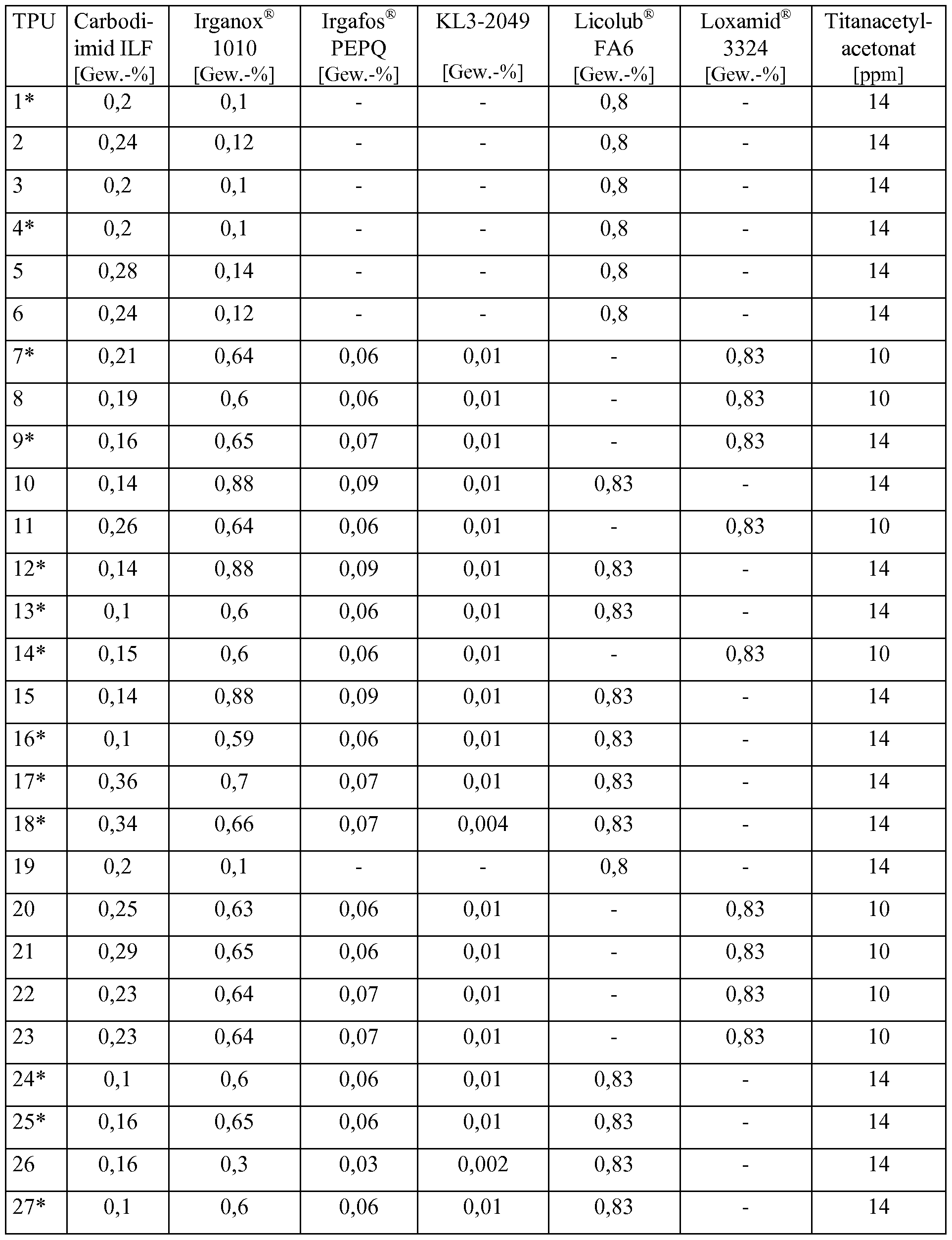
In einem Reaktionsgefäß wurde das jeweilige Polyol mit einer Temperatur von 200°C, in dem, jeweils bezogen auf das Gesamtgewicht aller Einsatzstoffe, 0,1 bis 0,36 Gew.-% Carbodiimid ILF (Bayer MaterialScience AG, Leverkusen, DE), 0,1 bis 0,88 Gew.-% Irganox® 1010 (Hersteller: BASF SE, Ludwigshafen, DE), gegebenenfalls 0,03 bis 0,09 Gew.-% Irgafos® PEPQ (BASF SE, Ludwigshafen, DE), 0 bis 0,01 Gew.-% KL3-2049 (Wärmestabilisator; Bayer MaterialScience AG, Leverkusen, DE) und 0,8 bis 0,83 Gew.-% Licolub® FA6 (Hersteller: Clariant, Gersthofen, DE) oder Loxamid® 3324 (Cognis Oleochemicals GmbH, Düsseldorf, DE) gelöst waren, vorgelegt. Dann wurden 1 ,4-Butandiol (BDO) und 1,6-Hexandiol (HDO), so viel 60°C warmes 4,4'- Diphenylmethandiisocyanat (MDI), dass die Kennzahl 0,995 betrug, und 10 bis 14ppm Titanacetylacetonat als Katalysator unter Rühren zugegeben und die gesamte Reaktionsmischung 10 bis 25 Sekunden lang intensiv gerührt. Anschließend wurde die viskose Reaktionsmischung auf ein beschichtetes Blech gegossen und bei 80°C 30 Minuten nachgetempert. Die erhaltenen Gießplatten wurden geschnitten und granuliert.
Verwendete Rohstoffe:
Polyol A Polyether L5050 (OH-Zahl: 55,9-57,2 mg KOH/g, auf 1 ,2-Propylenglykol gestarteter bifunktioneller Polyether aufgebaut aus Ethylenoxid und Propylenoxid mit einem Ethylenoxid-Cap (ca. 10 Gew.-%), einem Ethylenoxidanteil von ca. 50 Gew.-% und mit 60-70% primären Hydroxylendgruppen); Bayer MaterialScience
AG, Leverkusen, DE
Polyol B Acclaim® Polyol 2200 N (OH-Zahl: 56,1 mg KOH/g, Poly(l,2-Propylenglykol));
Bayer MaterialScience AG, Leverkusen, DE
Polyol C Polyether PW56 (OH-Zahl: 56,7 mg KOH/g, Poly(Ethylenglykol)); Bayer
MaterialScience AG, Leverkusen, DE
Polyol D Polyester PE 225B (OH-Zahl: 50-50,9 mg KOH/g, Poly(l,4-Butandioladipat));
Bayer MaterialScience AG, Leverkusen, DE
Polyol E Polyester PE 90B (OH-Zahl: 117,7-120,7 mg KOH/g, Poly(l,4-Butandioladipat));
Bayer MaterialScience AG, Leverkusen, DE
Polyol F Desmophen® 2002H (OH-Zahl: 54,7-57,6 mg KOH/g, Poly(Ethandioladipat-co-l,4-
Butandioladipat)); Bayer MaterialScience AG, Leverkusen, DE
MDI Desmodur® 44 M (4,4'-Diphenylmethandiisocyanat); Bayer MaterialScience AG,
Leverkusen, DE
BDO 1 ,4-Butandiol; BASF SE, Ludwigshafen, DE HDO 1,6-Hexandiol; Lanxess, Uerdingen, DE
Tabelle 1: Herstellung von TPU
Figure imgf000012_0001
Vergleichsbeispiele Tabelle 2: Additiv- und Katalysatorgehalte der hergestellten TPU
Figure imgf000013_0001
Vergleichsbeispiele TPU-Folien-Herstellung
Die TPU-Granulate 1 bis 27 wurden jeweils in einem Einwellen-Extruder (Einwellen-Extruder 30/25D Plasticorder PL 2100-6, Fa.Brabender) aufgeschmolzen (Dosierung ca. 3 kg/h; 185-225°C) und durch eine Breitschlitzdüse jeweils zu einer Flachfolie extrudiert. Messung der Wasserdampfdurchlässigkeit (WDD) des Verbundteils durch Messung der WDD der eingesetzten TPU-Folien
Die Wasserdampfdurchlässigkeit (WDD) der hergestellten Folien wurde in Anlehnung an die DIN 53122 bestimmt. Die Folien wurden dazu auf ein 50ml- oder ein lOOml-Gefäß (Durchmesser 46,5mm) aufgespannt und fixiert. In das Gefäß wurden zuvor 40g 12h lang bei 130°C ausgeheiztes Silicagel-Granulat (l-3mm Durchmesser, mit Indikator) eingefüllt. Das Gefäß wurde zur Messung in einem Exsikkator über gesättigter wässriger Kaliumchlorid-Lösung (Luftfeuchte ca. 85%) und bei Raumtemperatur konditioniert. Alle 2h erfolgte eine Gewichtsbestimmung bis zur Konstanz der Gewichtszunahme (6-8h). Beim Vergleich von WDD-Werten ist zu berücksichtigen, dass aufgrund von Temperaturunterschieden zwischen Messungen an verschiedenen Tagen nur Ergebnisse von Proben miteinander verglichen werden können, die zeitgleich zusammen im selben Exsikkator getestet wurden.
Bestimmung der Quellung der TPU-Folien
Zur Bestimmung der Intensität der Quellung wurden auf die Flachfolien Wassertropfen aufgebracht, die nach einer Einwirkzeit von 10min vorsichtig mit einem saugfähigen Tuch wieder entfernt wurden. Die Stellen, an denen sich zuvor die Wassertropfen befunden hatten, wurden daraufhin untersucht, ob sich die Flachfolie vom Untergrund abgehoben hatte (starkes Quellen) oder nicht (kein bzw. geringes Quellen).
Herstellung von TPU-Spritzgießplatten zur Messung der mechanischen Eigenschaften der eingesetzten TPU Die TPU-Granulate wurden in einer Spritzgießmaschine Allrounder 470 S 1000-290 (30 mm- Schnecke) der Firma Arburg aufgeschmolzen und zu Sl -Stäben geformt (Massetemperatur ca. 220°C, Formtemperatur: 25°C; Stabgröße: 115x25/6x2mm).
Messung der mechanischen Eigenschaften
Die Reißfestigkeit und die Reißdehnung wurden durch Messungen im Zugversuch nach DIN 53504 an S 1 -Stäben bestimmt. Die wichtigsten Eigenschaften der so hergestellten TPU-Folien bzw. Sl -Stäbe sind in den Tabellen 3 und 4 angegeben.
Tabelle 3: Wasserdampfdurchlässigkeit (WDD) und Quellung der TPU-Folien
Figure imgf000015_0001
* Vergleichsbeispiele; KV = Kettenverlängerer
Die erfindungsgemäßen Beispiele zeigen gute Wasserdampfdurchlässigkeit bei gleichzeitig geringer Quellung (siehe Tabelle 3).
Tabelle 4: Quellung, Reißfestigkeit und Reißdehnung
TPU Quellung Reißfestigkeit Reißdehnung
MPa %
7* stark 27,4 945
8 keine 31,8 795
9* stark 27,7 1045 11 keine 45,3 755
12* mittel bis stark 19,9 939
13* stark 28,4 876
14* stark 30,1 880
15 gering 31,1 837
16* stark 28,9 879
20 keine 28,9 854
21 keine 21,5 960
22 sehr gering 36,6 835
24* stark 29,5 874
25* stark 25,5 1069
26 gering 30,8 837
27* sehr stark 25,3 967
Vergleichsbeispiele
Die Quellung der erfindungsgemäßen TPU ist gering bei gleichzeitig ausreichender Reißfestigkeit und Reißdehnung (siehe Tabelle 4). Die erfindungsgemäß verwendeten TU-Folien auf Basis vergleichsweise kostengünstiger Polyetherpolyole mit ausreichender Reaktivität zeigen gute Wasserdampfdurchlässigkeiten sowie ausreichende mechanische Eigenschaften bei gleichzeitig niedriger Quellung, so dass damit flächige Verbundteile mit den entsprechenden Eigenschaften zur Verfügung gestellt werden können.

Claims

Wasserdampfdurchlässiges flächiges Verbundteil bestehend aus mindestens einer Schicht (i), die nicht aus thermoplastischem Polyurethan besteht, mindestens einer Schicht (ii) aus Polyetherpolyol und Polyesterpolyol basiertem thermoplastischem Polyurethan und gegebenenfalls weiteren Schichten (iii) aus thermoplastischem Polyurethan, die nicht direkt flächig an die Schicht (ii) angrenzen, wobei die Schicht (ii) aus einem thermoplastischen Polyurethan besteht, das erhältlich ist aus der Reaktion der Komponenten bestehend aus
A) mindestens einem organischen Diisocyanat,
B) mindestens einer Komponente mit zwei Hydroxylgruppen und jeweils einem
zahlenmittleren Molekulargewicht von 60 bis 490 g/mol als Kettenverlängerer,
C) einer Komponente bestehend aus einem oder mehreren Polyetherpolyolen mit jeweils einem zahlenmittleren Molekulargewicht von 500-5000 g/mol, von denen mindestens ein Polyetherpolyol (Cl) Ethylenoxideinheiten enthält,
D) 10 bis 85 Gew.-% bezogen auf die Gesamtmenge von C) und D) eines oder mehrerer aliphatischer Polyesterpolyole mit jeweils einem zahlenmittleren Molekulargewicht von 500-5000 g/mol,
in Gegenwart von
E) gegebenenfalls Katalysatoren,
F) gegebenenfalls Hilfs- und/oder Zusatzstoffen,
wobei das Molverhältnis der NCO-Gruppen in A) zu den gegenüber Isocyanat reaktiven Gruppen in B), C) und D) 0,9:1 bis 1,
2: 1 beträgt,
dadurch gekennzeichnet, dass der gesamte Gehalt an Ethylenoxideinheiten in der Komponente C) mindestens 5 und maximal 45 Gew.-%, bezogen auf das Gesamtgewicht der Komponenten C) und D), und die zahlenmittlere Funktionalität der Summe aller Polyole unter C) und D) 1,8 bis 2,5 beträgt, und der Gehalt an Ethylenoxideinheiten (X in Gew.-%) in der Komponente C) in Abhängigkeit von dem molaren Verhältnis Y aus Kettenverlängerer B) zu der Summe der Komponenten C) und D) unterhalb des sich aus der Formel X (Gew.- %) = 7,35 * Y + 13,75 ergebenden Wertes für X liegt.
Flächiges Verbundteil gemäß Anspruch 1, wobei es sich bei dem Diisocyanat A) um 4,4'- Diphenylmethandiisocyanat, Isophorondiisocyanat, 1,6-Hexamethylendiisocyanat, 1,5- Naphthylendiisocyanat oder 4,4'-Dicyclohexylmethandiisocyanat oder ein Gemisch daraus handelt.
3. Flächiges Verbundteil gemäß Anspruch 1, wobei es sich bei dem Kettenverlängerer B) um mindestens einen aliphatischen Kettenverlängerer mit zwei Hydroxylgruppen handelt.
Flächiges Verbundteil gemäß Anspruch 1 , wobei es sich bei dem Kettenverlängerer B) um mindestens einen aliphatischen Kettenverlängerer mit zwei Hydroxylgruppen und zwei bis acht Kohlenstoffatomen handelt.
Flächiges Verbundteil gemäß Anspruch 1 , wobei es sich bei dem Kettenverlängerer B) um mindestens eine Verbindung aus der Gruppe bestehend aus Ethandiol, Propandiol, Butandiol, Hexandiol, 1 ,4-Di-(betahydroxyethyl)-hydrochinon, 1 ,4-Di-(betahydroxyethyl)-bisphenol A oder Gemische daraus handelt.
6. Flächiges Verbundteil gemäß Anspruch 1, wobei der Kettenverlängerer B) mindestens zwei aliphatische Kettenverlängerer mit jeweils zwei Hydroxylgruppen enthält.
7. Flächiges Verbundteil gemäß Anspruch 6, wobei die mindestens zwei aliphatischen Kettenverlängerer jeweils zwei Hydroxylgruppen und jeweils zwei bis acht Kohlenstoffatome aufweisen.
Flächiges Verbundteil gemäß Anspruch 1, wobei es sich bei mindestens einem der Ethylenoxideinheiten enthaltenden Polyetherpolyole Cl) in der Komponente C) um eine Komponente oder mehrere Komponenten aus der Gruppe bestehend aus Poly(Ethylenglykol), einem Copolymer aus Ethylenoxideinheiten und 1 ,2-Propylenoxideinheiten, einem Copolymer aus Ethylenoxideinheiten und 1,3-Propylenoxideinheiten, einem Copolymer aus Ethylenoxideinheiten und 1,3-Propylenoxideinheiten und 1,2-Propylenoxideinheiten handelt.
Flächiges Verbundteil gemäß Anspruch 1, wobei es sich bei der Komponente C) um ein Komponenten-Gemisch aus der Gruppe bestehend aus Poly(Ethylenglykol) und Poly(l,2- Propylenglykol), aus Poly(Ethylenglykol) und Poly(l,3-Propylenglykol), aus Poly(Ethylenglykol) und Poly(l,3-Propylenglykol) und Poly(l,2-Propylenglykol), Poly(Ethylenglykol) und einem Polyol aufgebaut aus Ethylenoxideinheiten und aus Propylenoxideinheiten, aus Poly(l,2-Propylenglykol) und einem Polyol aufgebaut aus Ethylenoxideinheiten und aus Propylenoxideinheiten, aus Poly(l,3-Propylenglykol) und einem Polyol aufgebaut aus Ethylenoxideinheiten und aus Propylenoxideinheiten, aus Poly(Ethylenglykol) und Poly(l,2-Propylenglykol) und einem Polyol aufgebaut aus Ethylenoxideinheiten und aus Propylenoxideinheiten, aus Poly(Ethylenglykol) und Poly(l,3- Propylenglykol) und einem Polyol aufgebaut aus Ethylenoxideinheiten und aus Propylenoxideinheiten, aus Poly(Ethylenglykol) und Poly( 1,3 -Propylenglykol) und Poly(l,2- Propylenglykol) und einem Polyol aufgebaut aus Ethylenoxideinheiten und aus Propylenoxideinheiten handelt.
Flächiges Verbundteil gemäß Anspruch 1 , wobei die Polyetherpolyole in der Komponente C) zusammen einen Gehalt an Ethylenoxideinheiten von 21 bis 33 Gew.-% bezogen auf das Gesamtgewicht aus C) und D) aufweisen.
Flächiges Verbundteil gemäß Anspruch 1 , wobei mindestens eines der Ethylenoxideinheiten enthaltenden Polyetherpolyole Cl) in der Komponente C) zusätzlich Propylenoxideinheiten enthält und 1 bis 75% primäre Hydroxylendgruppen aufweist.
Flächiges Verbundteil gemäß Anspruch 1 , wobei mindestens eines der Ethylenoxideinheiten enthaltenden Polyetherpolyole Cl) in der Komponente C) aus 30 bis 99 Gew.-% Ethylenoxideinheiten und 1 bis 70 Gew.- % Propylenoxideinheiten aufgebaut ist.
Flächiges Verbundteil gemäß Anspruch 1 , wobei es sich bei der Komponente C) nicht um Poly(tetramethylenglykol) handelt.
Flächiges Verbundteil gemäß Anspruch 1, wobei die Polyesterpolyole unter D) in einer Menge von 10 bis 55 Gew.-% bezogen auf die Gesamtmenge von C) und D) enthalten sind.
15. Verwendung der flächigen Verbundteile gemäß Anspruch 1 bis 14 zur Herstellung von Dachunterspannbahnen und Fassadenspannbahnen.
PCT/EP2015/065283 2014-07-11 2015-07-06 Wasserdampfdurchlässige verbundteile Ceased WO2016005299A1 (de)

Priority Applications (4)

Application Number Priority Date Filing Date Title
EP15734163.7A EP3166792B1 (de) 2014-07-11 2015-07-06 Wasserdampfdurchlässige verbundteile
US15/325,669 US10213997B2 (en) 2014-07-11 2015-07-06 Water-vapour permeable composite parts
CN201580037625.8A CN106660340B (zh) 2014-07-11 2015-07-06 水蒸气可透过的复合部件
RU2017104437A RU2017104437A (ru) 2014-07-11 2015-07-06 Паропроницаемые композитные детали

Applications Claiming Priority (4)

Application Number Priority Date Filing Date Title
EP14176657 2014-07-11
EP14176657.6 2014-07-11
EP15152634.0 2015-01-27
EP15152634 2015-01-27

Publications (1)

Publication Number Publication Date
WO2016005299A1 true WO2016005299A1 (de) 2016-01-14

Family

ID=53510878

Family Applications (1)

Application Number Title Priority Date Filing Date
PCT/EP2015/065283 Ceased WO2016005299A1 (de) 2014-07-11 2015-07-06 Wasserdampfdurchlässige verbundteile

Country Status (6)

Country Link
US (1) US10213997B2 (de)
EP (1) EP3166792B1 (de)
CN (1) CN106660340B (de)
RU (1) RU2017104437A (de)
TW (1) TWI676552B (de)
WO (1) WO2016005299A1 (de)

Cited By (1)

* Cited by examiner, † Cited by third party
Publication number Priority date Publication date Assignee Title
US20170036429A1 (en) * 2015-08-05 2017-02-09 Ewald Dörken Ag Multi-Layer Composite Film for the Construction Sector

Families Citing this family (3)

* Cited by examiner, † Cited by third party
Publication number Priority date Publication date Assignee Title
CN106794686A (zh) * 2014-07-11 2017-05-31 科思创德国股份有限公司 水蒸汽可透过的复合构件
WO2016005300A1 (de) * 2014-07-11 2016-01-14 Covestro Deutschland Ag Wasserdampfdurchlässige verbundteile
CN111065290A (zh) * 2017-09-01 2020-04-24 巴斯夫欧洲公司 焊接多孔膜的方法

Citations (3)

* Cited by examiner, † Cited by third party
Publication number Priority date Publication date Assignee Title
DE19706380A1 (de) * 1997-02-19 1998-08-20 Wolff Walsrode Ag Atmungsaktive Mehrschichtfolie
EP1319503A1 (de) * 2001-12-17 2003-06-18 Bayer Ag Verbundteile aus Deckschichten und Polyurethan-Sandwichmaterialien und ihre Herstellung
DE102005012796A1 (de) * 2005-03-19 2006-09-21 Hennecke Gmbh Verfahren zur Herstellung von faserverstärkten Verbundteilen

Family Cites Families (4)

* Cited by examiner, † Cited by third party
Publication number Priority date Publication date Assignee Title
DE4442380A1 (de) * 1994-11-29 1996-05-30 Wolff Walsrode Ag Wasserdichte und atmungsaktive Flächengebilde aus Harzmischungen thermoplastischer Polyurethane
US20040087739A1 (en) * 2002-10-30 2004-05-06 Kemal Onder Monolithic thermoplastic ether polyurethane having high water vapor transmission
US6984709B2 (en) * 2002-12-20 2006-01-10 Noveon Ip Holdings Corp. Organometallic-free polyurethanes having low extractables
DE102005025980A1 (de) * 2005-06-03 2006-12-07 Basf Ag Verbundelemente, enthaltend Vliesstoff aus thermoplastischem Polyurehthan

Patent Citations (3)

* Cited by examiner, † Cited by third party
Publication number Priority date Publication date Assignee Title
DE19706380A1 (de) * 1997-02-19 1998-08-20 Wolff Walsrode Ag Atmungsaktive Mehrschichtfolie
EP1319503A1 (de) * 2001-12-17 2003-06-18 Bayer Ag Verbundteile aus Deckschichten und Polyurethan-Sandwichmaterialien und ihre Herstellung
DE102005012796A1 (de) * 2005-03-19 2006-09-21 Hennecke Gmbh Verfahren zur Herstellung von faserverstärkten Verbundteilen

Cited By (1)

* Cited by examiner, † Cited by third party
Publication number Priority date Publication date Assignee Title
US20170036429A1 (en) * 2015-08-05 2017-02-09 Ewald Dörken Ag Multi-Layer Composite Film for the Construction Sector

Also Published As

Publication number Publication date
US20170157907A1 (en) 2017-06-08
CN106660340A (zh) 2017-05-10
EP3166792B1 (de) 2020-11-04
EP3166792A1 (de) 2017-05-17
CN106660340B (zh) 2019-09-20
RU2017104437A (ru) 2018-08-15
TWI676552B (zh) 2019-11-11
TW201615415A (zh) 2016-05-01
US10213997B2 (en) 2019-02-26
RU2017104437A3 (de) 2019-01-25

Similar Documents

Publication Publication Date Title
EP1338614B1 (de) Verfahren zur Herstellung von weichen, gut entformbaren thermoplastischen Polyurethanelastomeren mit geringer Schwindung
EP1967537A1 (de) Verfahren zur Herstellung von Formgedächtnisformkörpern mit einem breiten Einsatzbereich
EP0845492B1 (de) Spezielle Wachsmischungen enthaltende thermoplastisch verarbeitbare Polyurethane
EP1826225A2 (de) Thermoplastisch verarbeitbare Polyurethane, Verfahren zu ihrer Herstellung und ihre Verwendung
EP3083735B1 (de) Thermoplastisches polyurethan für dichtungsanwendungen
EP3166792B1 (de) Wasserdampfdurchlässige verbundteile
EP1153951B1 (de) Formkörper aus thermoplastischen Polyurethanen mit reduziertem Fogging
EP3601396A1 (de) Verfahren zur herstellung von polyurethanen mit geringen ausblüheffekten und guter kälteflexibilität auf basis von urethan-haltigen polymeren hydroxyl-verbindungen
DE19607870A1 (de) Wachs enthaltende thermoplastisch verarbeitbare Polyurethane
EP3129421A1 (de) Thermoplastische polyurethane, deren herstellung und verwendung
EP3589676B1 (de) Schlagzähe thermoplastische polyurethane, deren herstellung und verwendung
EP2758444B1 (de) Thermoplastisches polyurethan zur herstellung hydrophiler fasern
WO2018210608A1 (de) Schlagzähfeste polyestermischung
EP0950674A1 (de) Verfahren zur Herstellung von thermoplastischen Polyurethanen
WO2018192936A1 (de) Aliphatische thermoplastische polyurethane, deren herstellung und verwendung
WO2016005300A1 (de) Wasserdampfdurchlässige verbundteile
EP0718335B1 (de) Thermoplastische Polyurethane mit verbessertem Schmelzefluss
EP3166791A1 (de) Wasserdampfdurchlässige verbundteile
EP0854158B1 (de) Thermoplastische Polyurethane mit eingebauten Formtrennmitteln
EP1078944B1 (de) Verfahren zur Herstellung von thermoplastischen Polyurethan Fasern
EP2918618A1 (de) Aliphatische thermoplastische Polyurethane, ihre Herstellung und Verwendung

Legal Events

Date Code Title Description
121 Ep: the epo has been informed by wipo that ep was designated in this application

Ref document number: 15734163

Country of ref document: EP

Kind code of ref document: A1

REEP Request for entry into the european phase

Ref document number: 2015734163

Country of ref document: EP

WWE Wipo information: entry into national phase

Ref document number: 2015734163

Country of ref document: EP

NENP Non-entry into the national phase

Ref country code: DE

WWE Wipo information: entry into national phase

Ref document number: 15325669

Country of ref document: US

ENP Entry into the national phase

Ref document number: 2017104437

Country of ref document: RU

Kind code of ref document: A