WO2015166916A1 - 無線回路 - Google Patents
無線回路 Download PDFInfo
- Publication number
- WO2015166916A1 WO2015166916A1 PCT/JP2015/062710 JP2015062710W WO2015166916A1 WO 2015166916 A1 WO2015166916 A1 WO 2015166916A1 JP 2015062710 W JP2015062710 W JP 2015062710W WO 2015166916 A1 WO2015166916 A1 WO 2015166916A1
- Authority
- WO
- WIPO (PCT)
- Prior art keywords
- wireless communication
- lte
- radio
- communication
- wireless
- Prior art date
- Legal status (The legal status is an assumption and is not a legal conclusion. Google has not performed a legal analysis and makes no representation as to the accuracy of the status listed.)
- Ceased
Links
Images

Classifications
-
- H—ELECTRICITY
- H04—ELECTRIC COMMUNICATION TECHNIQUE
- H04W—WIRELESS COMMUNICATION NETWORKS
- H04W88/00—Devices specially adapted for wireless communication networks, e.g. terminals, base stations or access point devices
- H04W88/02—Terminal devices
- H04W88/06—Terminal devices adapted for operation in multiple networks or having at least two operational modes, e.g. multi-mode terminals
-
- H—ELECTRICITY
- H04—ELECTRIC COMMUNICATION TECHNIQUE
- H04B—TRANSMISSION
- H04B1/00—Details of transmission systems, not covered by a single one of groups H04B3/00 - H04B13/00; Details of transmission systems not characterised by the medium used for transmission
- H04B1/005—Details of transmission systems, not covered by a single one of groups H04B3/00 - H04B13/00; Details of transmission systems not characterised by the medium used for transmission adapting radio receivers, transmitters andtransceivers for operation on two or more bands, i.e. frequency ranges
- H04B1/0053—Details of transmission systems, not covered by a single one of groups H04B3/00 - H04B13/00; Details of transmission systems not characterised by the medium used for transmission adapting radio receivers, transmitters andtransceivers for operation on two or more bands, i.e. frequency ranges with common antenna for more than one band
- H04B1/006—Details of transmission systems, not covered by a single one of groups H04B3/00 - H04B13/00; Details of transmission systems not characterised by the medium used for transmission adapting radio receivers, transmitters andtransceivers for operation on two or more bands, i.e. frequency ranges with common antenna for more than one band using switches for selecting the desired band
Definitions
- the present invention relates to a radio circuit capable of radio communication in an unlicensed frequency band.
- WiFi registered trademark, hereinafter omitted
- unlicensed frequency bands frequency bands that do not require a license or license, Unlicensed band, ISM band
- Non-Patent Documents 1 and 2 LTE-U communication in which LTE communication is performed in the unlicensed frequency band has been proposed.
- LTE-U communication is performed along with LTE communication using a licensed frequency band (simply referred to as “LTE communication” in this specification). To offload part of the data traffic. In the future, it is also considered to offload part of the data traffic on the uplink.
- LTE-U communication is superior to WiFi communication in the following points: LTE communication and radio access network (and core network) can be shared; WiFi communication allows each terminal to communicate freely On the other hand, efficient communication can be performed by exchanging control signals on the LTE communication side; the influence on other WiFi devices is lower than that of the WiFi device itself; On the other hand, WiFi communication has an advantage that the number of base stations (access points, APs) already installed is large.
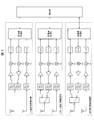
- wireless communication using the unlicensed frequency band includes those performed along with wireless communication using the license frequency band. Therefore, a configuration as shown in FIG. 6 is assumed as an example of a configuration of a wireless circuit that can perform a plurality of types of wireless communication in a license-free frequency band.
- the wireless circuit shown in FIG. 6 since the number of antennas and circuit elements increases, it is difficult to realize a small terminal.
- the present invention has been made in view of the above problems, and a main object thereof is to provide a technique for realizing a wireless circuit capable of a plurality of types of wireless communication using an unlicensed frequency band with a smaller number of components.
- a wireless circuit includes at least one first high-frequency circuit element connected to at least one antenna and at least one connected to at least one antenna.
- the at least one first high-frequency circuit element and the first modulation / demodulation processing unit process a radio signal of a first radio communication system that performs radio communication in a licensed frequency band
- the at least one second high-frequency circuit element and The second modulation / demodulation processing unit processes a radio signal of the second radio communication method that performs radio communication in the unlicensed frequency band independently of the radio communication by the first radio communication method.
- the at least one second high-frequency circuit element and the first modulation / demodulation processing unit process a radio signal of a third radio communication system that performs radio communication in an unlicensed frequency band along with radio communication of the first radio communication system It is characterized by doing.
- a wireless circuit capable of a plurality of types of wireless communication using an unlicensed frequency band can be realized with a smaller number of components.
- the present invention includes at least one first high-frequency circuit element connected to at least one antenna, at least one second high-frequency circuit element connected to at least one antenna, a first high-frequency circuit element, and a second A first modulation / demodulation processing unit connected to the high-frequency circuit element; and a second modulation / demodulation processing unit connected to the second high-frequency circuit element.
- the at least one first high-frequency circuit element and the first modulation / demodulation unit The processing unit processes a radio signal of a first radio communication system that performs radio communication in a licensed frequency band, and the at least one second high-frequency circuit element and the second modulation / demodulation processing unit perform radio communication using the first radio communication system.
- a wireless signal of a second wireless communication method for performing wireless communication in an unlicensed frequency band independently of the at least one second high-frequency circuit element and the first Demodulator provides a radio circuit for processing radio signals of the third wireless communication method for performing wireless communication by unlicensed frequency band with the radio communication by the first wireless communication scheme.
- the first wireless communication method wireless communication and the third wireless communication method wireless communication communicate with each other using different antennas and high-frequency circuit elements.
- Wireless communication of the third wireless communication system can be performed along with the wireless communication.
- the wireless communication of the first wireless communication method and the wireless communication of the third wireless communication method can be made to cooperate (for example, carrier aggregation in LTE (Long-Term Evolution: Long-Term Evolution) or Supplemental downlink).
- the first wireless communication method and the third wireless communication method share the first modulation / demodulation processing unit, and the second wireless communication method and the third wireless communication method.
- the second antenna and the second high-frequency circuit element are shared. Thereby, the number of parts can be reduced.
- a wireless circuit capable of a plurality of types of wireless communication using an unlicensed frequency band can be realized with a smaller number of components.
- LTE including LTE-Advanced
- a license-free frequency band is used as the second wireless communication system.
- WiFi in the 5 GHz band and using LTE-U in the 5 GHz band, which is an unlicensed frequency band, as a third wireless communication system will be described, but the present invention is not limited to this, and wireless in the license frequency band is described.
- a first wireless communication method for performing communication and a wireless communication method of a type different from the first wireless communication method, and performing a wireless communication in an unlicensed frequency band independently of the wireless communication by the first wireless communication method
- a wireless communication method of the same type as the first wireless communication method and a license-free frequency in association with the wireless communication by the first wireless communication method. It can be used a third wireless communication method for performing wireless communication by frequency appropriately.
- a device on which the wireless circuit according to the present invention is mounted is not particularly limited, and may be mounted on an electronic device other than a communication terminal, such as a tablet terminal, a wearable information terminal, a notebook computer, or a smart home appliance.
- Embodiment 1 Hereinafter, an embodiment (Embodiment 1) of the present invention will be described with reference to FIGS.
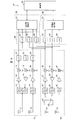
- FIG. 1 is a block diagram illustrating a schematic configuration of a wireless circuit 100 according to the first embodiment.
- the radio circuit 100 includes antennas (first antennas) 11 and 12, a duplexer (first high frequency circuit element) 13, a filter (first high frequency circuit element) 14, an LNA (low noise amplifier) (first high frequency circuit element) 15, and 17, power amplifier (first high frequency circuit element) 16, mixer (first high frequency circuit element) 18 to 20, A / D converter (analog-digital converter) (first high frequency circuit element) 21 and 23, D / A converter ( Digital / analog converter (first high frequency circuit element) 22, antennas (second antenna) 31 and 32, switch (second high frequency circuit element) 33, filters (second high frequency circuit elements) 34 to 36, LNA (second high frequency circuit element) Circuit elements) 37 and 39, power amplifier (second high frequency circuit element) 38, mixer (second high frequency circuit element) 40 42, A / D converters (second high frequency circuit elements) 43 and 45, D / A converter (second high frequency circuit elements) 44, modul
- the antennas 11 and 12, the duplexer 13, the filter 14, the LNAs 15 and 17, the power amplifier 16, the mixers 18 to 20, the A / D converters 21 and 23, and the D / A converter 22 are LTE blocks for LTE communication. 10 is configured.
- the antennas 31 and 32, the switch 33, the filters 34 to 36, the LNAs 37 and 39, the power amplifier 38, the mixers 40 to 42, the A / D converters 43 and 45, and the D / A converter 44 are connected to WiFi communication and LTE-U communication.
- a WiFi / LTE-U block 30 is configured.
- the modulation / demodulation processing unit 51 constitutes an LTE / LTE-U block 50 for LTE communication and LTE-U communication.
- the modulation / demodulation processing unit 61 constitutes a WiFi block 60 for WiFi communication.
- the radio circuit 100 When performing LTE communication, the radio circuit 100 operates as follows. When transmitting a radio signal, the control unit 70 generates a transmission signal, the modulation / demodulation processing unit 51 modulates the transmission signal, the D / A converter 22 converts the transmission signal into analog, the mixer 19 upconverts the transmission signal, The power amplifier 16 amplifies the transmission signal, the duplexer 13 transmits the transmission signal to the antenna 11, and the antenna 11 radiates the transmission signal.
- the antennas 11 and 12 When receiving a radio signal, the antennas 11 and 12 receive the received signal, the duplexer 13 and the filter 14 transmit the received signal to the LNAs 15 and 17, the LNAs 15 and 17 amplify the received signal, and the mixers 18 and 20
- the received signal is down-converted, the A / D converters 21 and 23 convert the received signal to digital, the modulation / demodulation processing unit 51 demodulates the received signal, and the control unit 70 processes the received signal.
- the radio circuit 100 when performing WiFi communication, operates as follows.
- the control unit 70 When transmitting a radio signal, the control unit 70 generates a transmission signal, the modulation / demodulation processing unit 61 modulates the transmission signal, the D / A converter 44 converts the transmission signal into analog, the mixer 41 upconverts the transmission signal, The power amplifier 38 amplifies the transmission signal, the filter 35 and the switch 33 transmit the transmission signal to the antenna 31, and the antenna 31 radiates the transmission signal.
- the antennas 31 and 32 When receiving a radio signal, the antennas 31 and 32 receive the received signal, the switch 33 and the filters 34 and 36 transmit the received signal to the LNAs 37 and 39, the LNAs 37 and 39 amplify the received signal, and the mixer 40 and 42 down-converts the received signal, A / D converters 43 and 45 digitally convert the received signal, modulation / demodulation processing unit 61 demodulates the received signal, and control unit 70 processes the received signal.
- the radio circuit 100 when performing LTE-U communication, operates as follows.
- the control unit 70 When transmitting a radio signal, the control unit 70 generates a transmission signal, the modulation / demodulation processing unit 51 modulates the transmission signal, the D / A converter 44 converts the transmission signal into analog, the mixer 41 upconverts the transmission signal, The power amplifier 38 amplifies the transmission signal, the filter 35 and the switch 33 transmit the transmission signal to the antenna 31, and the antenna 31 radiates the transmission signal.
- the antennas 31 and 32 When receiving a radio signal, the antennas 31 and 32 receive the received signal, the switch 33 and the filters 34 and 36 transmit the received signal to the LNAs 37 and 39, the LNAs 37 and 39 amplify the received signal, and the mixer 40 and 42 down-converts the received signal, A / D converters 43 and 45 digitally convert the received signal, modulation / demodulation processing unit 51 demodulates the received signal, and control unit 70 processes the received signal.
- the LTE block 10 and the LTE / LTE-U block 50 when performing LTE communication, the LTE block 10 and the LTE / LTE-U block 50 operate, and when performing WiFi communication, the WiFi / LTE-U block 30 and the WiFi block 60 When operating and performing LTE-U communication, the WiFi / LTE-U block 30 and the LTE / LTE-U block 50 operate.
- the blocks including the antenna and the high-frequency circuit element are communicated using different blocks, so that the LTE communication and the LTE-U communication can be performed simultaneously.
- LTE-U communication can be performed along with LTE communication. Thereby, for example, carrier aggregation or supplemental downlink can be realized.
- the WiFi communication and the LTE-U communication cannot share the WiFi communication and the LTE-U communication at the same time because they share the block including the antenna and the high-frequency circuit element.
- LTE / LTE-U block 50 is shared by LTE communication and LTE-U communication
- WiFi / LTE-U block 30 is shared by WiFi communication and LTE-U communication.
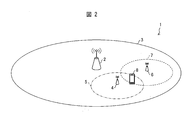
- FIG. 2 is a diagram illustrating an example of a main configuration of the system 1 in which the wireless circuit 100 according to the first embodiment is used.
- the system 1 includes an LTE base station (eNB) 2, a WiFi base station (access point, AP) 4, an LTE-U base station 6, and a communication terminal 8.
- the communication terminal 8 includes a wireless circuit 100. 2 shows an LTE communication area 3 that can be connected to the LTE base station 2, a WiFi communication area 5 that can be connected to the WiFi base station 4, and an LTE-U communication area 7 that can be connected to the LTE-U base station 6. Respectively.
- the communication terminal 8 may belong to any of the LTE communication area 3, the WiFi communication area 5, and the LTE-U communication area 7.
- the radio circuit 100 of the communication terminal 8 cannot perform WiFi communication and LTE-U communication at the same time. Therefore, the radio circuit 100 (the control unit 70) is connected to the WiFi base station 4 and the LTE-U base station. 6 is connected as follows.
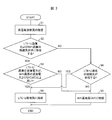
- FIG. 3 is a flowchart for explaining control of the connection destination by the radio circuit 100.
- the control unit 70 confirms the surrounding radio wave status. Specifically, the above-described LTE-U reception operation and WiFi reception operation are performed, and a reception frequency band is searched for a downlink signal from a neighboring base station. At the same time, the reception power is calculated using the reference signal included in the reception signal and whether the connection to the neighboring base stations is possible.
- the connection possibility indicates that, for example, it is determined whether or not connection is possible due to a base station of a different network operator or a WiFi base station whose connection is restricted.
- step S1 when both the connection destination of LTE-U communication and the connection destination of WiFi communication exist (YES in step S2), the control unit 70 receives the reception power of LTE-U communication and the reception power of WiFi communication. Are compared (step S3).
- step S3 When the received power of LTE-U communication is higher than the received power of WiFi communication by X [dB / MHz] or more (YES in step S3), control unit 70 determines that radio circuit 100 performs LTE-U communication. Then, it connects to the LTE-U base station 6 (step S4).
- control unit 70 determines that radio circuit 100 performs WiFi communication. Determine and connect to the WiFi base station 4 (step S5).
- [DB / MHz] indicates a power ratio per bandwidth.
- the “X” is a value set in advance depending on which of the LTE-U communication and the WiFi communication is prioritized. For example, by setting a negative value, the LTE having an advantage over the WiFi communication is used. -U communication can be prioritized.
- the control unit 70 determines that the reception power of wireless communication by LTE-U (third wireless communication method) is a predetermined value for the reception power of wireless communication by WiFi (second wireless communication method).
- wireless communication is performed by WiFi (second wireless communication method)
- wireless circuit is performed by LTE-U (third wireless communication method).
- the reception power of wireless communication by LTE-U (third wireless communication system) adds a predetermined value to the reception power of wireless communication by WiFi (second wireless communication system) If the value is greater than or equal to the value, wireless communication is performed by LTE-U (third wireless communication method), which can cooperate with wireless communication by LTE (first wireless communication method), and LTE-U (third wireless communication method).
- the reception power of the line communication is lower than a value obtained by adding a predetermined value to the reception power of the wireless communication by WiFi (second wireless communication method)
- the wireless communication by WiFi (second wireless communication method) By performing the above, efficient communication can be performed.
- step S1 when only one of the connection destination of LTE-U communication and the connection destination of WiFi communication exists (NO in step S2), the connection destination of LTE-U communication exists. If this is the case (YES in step S6), step S4 is executed. If there is no connection destination for LTE-U communication (NO in step S6), step S5 may be executed.
- control unit 70 may control the radio circuit 100 so that wireless communication using WiFi (second wireless communication method) and wireless communication using LTE-U (third wireless communication method) are performed in a time-sharing manner. Good. That is, the control unit 70 may switch between using the WiFi / LTE-U block 30 for WiFi communication or LTE-U communication at predetermined time intervals. As a result, both the WiFi base station 2 and the LTE-U base station 4 are simultaneously connected, and both wireless communication using WiFi (second wireless communication method) and wireless communication using LTE-U (third wireless communication method) are performed. Can be performed in parallel.
- the WiFi / LTE-U block 30 shared by WiFi communication and LTE-U communication includes at least one antenna (second antenna), at least one high-frequency circuit element (second high-frequency circuit element), and As long as it is included.
- the WiFi communication and the LTE-U communication may each include a unique high-frequency circuit element in addition to the high-frequency circuit element (second high-frequency circuit element). This will be described with an example. For convenience of explanation, members having the same functions as those described in the embodiment are given the same reference numerals, and descriptions thereof are omitted.
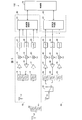
- FIG. 4 is a block diagram showing a schematic configuration of a wireless circuit 101 according to another embodiment (embodiment 2) of the present invention.
- the wireless circuit 101 replaces the A / D converters 43 and 45 and the D / A converter 44 with A / D converters 62, 64, 81 and 83 and D / A converters 63 and 82.
- the WiFi / LTE-U block 30 includes antennas 31 and 32, a switch 33, filters 34 to 36, LNAs 37 and 39, a power amplifier 38, and mixers 40 to 42.
- the WiFi block 60 includes a modulation / demodulation processing unit 61, A / D converters 62 and 64, and a D / A converter 63.
- the A / D converters 81 and 83 and the D / A converter 82 constitute an LTE-U block 80 for LTE-U communication.
- the high-frequency circuit elements (second high-frequency circuit elements) constituting the WiFi / LTE-U block 30 A / D converters 43 and 45 and D / A converter 44) are deleted and corresponding to this.
- the high-frequency circuit elements to be configured may be provided in the WiFi block 60 and the LTE-U block 80, respectively.
- the LTE block 10 and the WiFi / LTE-U block 30 may share a part or all of the antennas.
- at least a part of the antennas may be shared in LTE communication, WiFi communication, and LTE-U communication. This will be described with an example.
- members having the same functions as those described in the embodiment are given the same reference numerals, and descriptions thereof are omitted.
- FIG. 5 is a block diagram showing a schematic configuration of a wireless circuit 102 according to another embodiment (third embodiment) of the present invention.
- the radio circuit 102 includes an antenna 91 and a diplexer 92 instead of the antenna 12 and the antenna 32 when compared with the radio circuit 100.
- the filter 14 of the LTE block 10 and the filter 36 of the WiFi / LTE-U block 30 are both connected to the antenna 12 via the diplexer 92.
- the LTE block 10 and the WiFi / LTE-U block 30 share the antenna 91.
- the antenna 91 is shared.
- the signal between the filter 14 and the antenna 91 is, for example, a 2 GHz band
- the signal between the filter 36 and the antenna 91 is, for example, a 5 GHz band, so that the signal is successfully distributed by the diplexer 92. ing.
- the radio circuit (100) includes at least one first high-frequency circuit element (13 to 23) connected to at least one antenna and at least one antenna connected to at least one antenna.
- a modulation / demodulation processing unit (61) wherein the at least one first high-frequency circuit element and the first modulation / demodulation processing unit process a radio signal of a first radio communication system that performs radio communication in a licensed frequency band,
- the at least one second high-frequency circuit element and the second modulation / demodulation processing unit perform a second wireless communication that performs wireless communication in an unlicensed frequency band independently of wireless communication by the first wireless communication method.
- a wireless signal of a communication system and the at least one second high-frequency circuit element and the first modulation / demodulation processing unit perform a wireless communication in an unlicensed frequency band along with the wireless communication in the first wireless communication system. Processes wireless signals for wireless communication.
- the first wireless communication method wireless communication and the third wireless communication method wireless communication perform communication using different high-frequency circuit elements. Accordingly, wireless communication of the third wireless communication method can be performed. Thereby, the wireless communication of the first wireless communication method and the wireless communication of the third wireless communication method can be cooperated (for example, carrier aggregation or supplemental downlink in LTE). Further, according to the above configuration, the first wireless communication method and the third wireless communication method share the first modulation / demodulation processing unit, and the second wireless communication method and the third wireless communication method. The second high-frequency circuit element is shared. Thereby, the number of parts can be reduced. As described above, a wireless circuit capable of a plurality of types of wireless communication using an unlicensed frequency band can be realized with a smaller number of components.
- the wireless circuit according to aspect 2 of the present invention is the wireless circuit according to aspect 1, in which the first wireless communication method is LTE, the second wireless communication method is WiFi, and the third wireless communication method is LTE- U may be sufficient.
- a radio circuit capable of LTE communication, WiFi communication, and LTE-U communication can be realized with a smaller number of components.
- the at least one second high-frequency circuit element includes a filter (34 to 36), a switch (33), a power amplifier (38), an LNA (37 39), an A / D converter (43, 45), a D / A converter (44) and one or more high-frequency circuit elements selected from the mixers (40 to 42).
- one or more high-frequency circuit elements selected from a filter, a switch, a power amplifier, an LNA, an A / D converter, a D / A converter, and a mixer are connected to the second wireless communication system and the third wireless communication system. Since it can be shared with the wireless communication system, the wireless circuit can be realized with a smaller number of components.
- the reception power of the wireless communication by the third wireless communication system is a value predetermined as the reception power of the wireless communication by the second wireless communication system. If the value is lower than the added value, wireless communication is performed according to the second wireless communication method, and otherwise, the control unit that controls the wireless circuit so as to perform wireless communication according to the third wireless communication method ( 70).
- the first performs wireless communication by the third wireless communication method that can cooperate with wireless communication by the wireless communication method, and the reception power of the wireless communication by the third wireless communication method is received by the second wireless communication method.
- efficient communication can be performed by performing wireless communication by the second wireless communication method.
- a wireless circuit according to aspect 5 of the present invention controls the wireless circuit according to aspects 1 to 3 so that wireless communication using the second wireless communication system and wireless communication using the third wireless communication system are performed in a time-sharing manner.
- the control part (70) to perform may be provided.
- the wireless communication by the second wireless communication method and the wireless communication by the third wireless communication method are performed in a time-sharing manner, so that the wireless communication by the second wireless communication method and the third wireless communication are performed. Both types of wireless communication can be performed.
- An electronic device includes the wireless circuit according to any one of aspects 1 to 5.
- the electronic device has the same effect as the above-described wireless circuit.
- the present invention can be used in the field of manufacturing a wireless circuit and an electronic device including the wireless circuit.
Landscapes
- Engineering & Computer Science (AREA)
- Computer Networks & Wireless Communication (AREA)
- Signal Processing (AREA)
- Mobile Radio Communication Systems (AREA)
- Transceivers (AREA)
Abstract
Description
以下、本発明の一実施形態(実施形態1)について、図1~3を参照して説明する。
図1は、実施形態1に係る無線回路100の概略構成を示すブロック図である。無線回路100は、アンテナ(第一アンテナ)11および12、デュプレクサ(第一高周波回路素子)13、フィルタ(第一高周波回路素子)14、LNA(低雑音増幅器)(第一高周波回路素子)15および17、パワーアンプ(第一高周波回路素子)16、ミキサ(第一高周波回路素子)18~20、A/Dコンバータ(アナログデジタルコンバータ)(第一高周波回路素子)21および23、D/Aコンバータ(デジタルアナログコンバータ)(第一高周波回路素子)22、アンテナ(第二アンテナ)31および32、スイッチ(第二高周波回路素子)33、フィルタ(第二高周波回路素子)34~36、LNA(第二高周波回路素子)37および39、パワーアンプ(第二高周波回路素子)38、ミキサ(第二高周波回路素子)40~42、A/Dコンバータ(第二高周波回路素子)43および45、D/Aコンバータ(第二高周波回路素子)44、変復調処理部(第一変復調処理部)51、変復調処理部(第二変復調処理部)61ならびに制御部70を備えている。
図2は、実施形態1に係る無線回路100が使用されるシステム1の要部構成の一例を示す図である。システム1には、LTE基地局(eNB)2、WiFi基地局(アクセスポイント、AP)4、LTE-U基地局6および通信端末8が含まれている。通信端末8は、無線回路100を備えている。また、図2に、LTE基地局2と接続可能なLTE通信エリア3、WiFi基地局4と接続可能なWiFi通信エリア5、および、LTE-U基地局6と接続可能なLTE-U通信エリア7をそれぞれ示している。
図3は、無線回路100による接続先の制御を説明するフローチャートである。ステップS1において、制御部70は、周辺電波状況の確認を行う。具体的には、前述したLTE-U受信動作およびWiFi受信動作を行い、周辺の基地局からのダウンリンク信号があるかどうか受信周波数帯の探索を行う。同時に周辺の基地局への接続可否および受信信号に含まれる基準信号を用いて受信電力を計算する。なお、接続可否とは、例えば、異なるネットワーク事業者の基地局であったり、接続制限されたWiFi基地局であったりという理由により接続できない状態にあるかどうかの判断を行うことを示す。
なお、制御部70は、WiFi(第二の無線通信方式)による無線通信およびLTE-U(第三の無線通信方式)による無線通信を時間分割して行うように無線回路100を制御してもよい。すなわち、制御部70が、所定の時間間隔毎に、WiFi/LTE-U用ブロック30を、WiFi通信に用いるか、LTE-U通信に用いるかを切り替えるようになっていてもよい。これにより、WiFi基地局2およびLTE-U基地局4に同時に接続し、WiFi(第二の無線通信方式)による無線通信およびLTE-U(第三の無線通信方式)による無線通信の両方の通信を並行して行うことができる。
なお、WiFi通信とLTE-U通信とで共用されるWiFi/LTE-U用ブロック30には、少なくとも一つのアンテナ(第二アンテナ)と、少なくとも一つの高周波回路素子(第二高周波回路素子)とが含まれていればよい。WiFi通信とLTE-U通信とは、上記高周波回路素子(第二高周波回路素子)以外に、それぞれ独自の高周波回路素子を備えていてもよい。これを、例を挙げて説明する。なお、説明の便宜上、前記実施形態にて説明した部材と同じ機能を有する部材については、同じ符号を付記し、その説明を省略する。
また、LTE用ブロック10と、WiFi/LTE-U用ブロック30とにおいて、一部または全部のアンテナを共用してもよい。換言すれば、LTE通信、WiFi通信およびLTE-U通信において、少なくとも一部のアンテナを共用してもよい。これを、例を挙げて説明する。なお、説明の便宜上、前記実施形態にて説明した部材と同じ機能を有する部材については、同じ符号を付記し、その説明を省略する。
本発明の態様1に係る無線回路(100)は、少なくとも一つのアンテナに接続している少なくとも一つの第一高周波回路素子(13~23)と、少なくとも一つのアンテナに接続している少なくとも一つの第二高周波回路素子(33~43)と、第一高周波回路素子および第二高周波回路素子に接続している第一変復調処理部(51)と、第二高周波回路素子に接続している第二変復調処理部(61)と、を備えており、該少なくとも一つの第一高周波回路素子および第一変復調処理部は、免許周波数帯域による無線通信を行う第一無線通信方式の無線信号を処理し、該少なくとも一つの第二高周波回路素子および第二変復調処理部は、第一の無線通信方式による無線通信とは独立して免許不要周波数帯域による無線通信を行う第二の無線通信方式の無線信号を処理し、該少なくとも一つの第二高周波回路素子および第一変復調処理部は、第一の無線通信方式による無線通信に伴って免許不要周波数帯域による無線通信を行う第三の無線通信方式の無線信号を処理する。
Claims (5)
- 少なくとも一つのアンテナに接続している少なくとも一つの第一高周波回路素子と、
少なくとも一つのアンテナに接続している少なくとも一つの第二高周波回路素子と、
第一高周波回路素子および第二高周波回路素子に接続している第一変復調処理部と、
第二高周波回路素子に接続している第二変復調処理部と、を備えており、
該少なくとも一つの第一高周波回路素子および第一変復調処理部は、免許周波数帯域による無線通信を行う第一無線通信方式の無線信号を処理し、
該少なくとも一つの第二高周波回路素子および第二変復調処理部は、第一の無線通信方式による無線通信とは独立して免許不要周波数帯域による無線通信を行う第二の無線通信方式の無線信号を処理し、
該少なくとも一つの第二高周波回路素子および第一変復調処理部は、第一の無線通信方式による無線通信に伴って免許不要周波数帯域による無線通信を行う第三の無線通信方式の無線信号を処理することを特徴とする無線回路。 - 第一の無線通信方式は、LTEであり、
第二の無線通信方式は、WiFiであり、
第三の無線通信方式は、LTE-Uであることを特徴とする請求項1に記載の無線回路。 - 上記少なくとも一つの第二高周波回路素子は、フィルタ、スイッチ、パワーアンプ、LNA、A/Dコンバータ、D/Aコンバータおよびミキサから選択される一つ以上の高周波回路素子を含むことを特徴とする請求項1または2に記載の無線回路。
- 第三の無線通信方式による無線通信の受信電力が、第二の無線通信方式による無線通信の受信電力に予め定められた値を加えた値より低い場合には、第二の無線通信方式による無線通信を行い、そうでない場合には、第三の無線通信方式による無線通信を行うように上記無線回路を制御する制御部を備えていることを特徴とする請求項1~3の何れか一項に記載の無線回路。
- 第二の無線通信方式による無線通信および第三の無線通信方式による無線通信を時間分割して行うように上記無線回路を制御する制御部を備えていることを特徴とする請求項1~3の何れか一項に記載の無線回路。
Priority Applications (2)
| Application Number | Priority Date | Filing Date | Title |
|---|---|---|---|
| JP2016516374A JP6314214B2 (ja) | 2014-05-01 | 2015-04-27 | 無線回路 |
| US15/302,217 US9781771B2 (en) | 2014-05-01 | 2015-04-27 | Wireless circuit |
Applications Claiming Priority (2)
| Application Number | Priority Date | Filing Date | Title |
|---|---|---|---|
| JP2014094545 | 2014-05-01 | ||
| JP2014-094545 | 2014-05-01 |
Publications (1)
| Publication Number | Publication Date |
|---|---|
| WO2015166916A1 true WO2015166916A1 (ja) | 2015-11-05 |
Family
ID=54358643
Family Applications (1)
| Application Number | Title | Priority Date | Filing Date |
|---|---|---|---|
| PCT/JP2015/062710 Ceased WO2015166916A1 (ja) | 2014-05-01 | 2015-04-27 | 無線回路 |
Country Status (3)
| Country | Link |
|---|---|
| US (1) | US9781771B2 (ja) |
| JP (1) | JP6314214B2 (ja) |
| WO (1) | WO2015166916A1 (ja) |
Families Citing this family (3)
| Publication number | Priority date | Publication date | Assignee | Title |
|---|---|---|---|---|
| US10517021B2 (en) | 2016-06-30 | 2019-12-24 | Evolve Cellular Inc. | Long term evolution-primary WiFi (LTE-PW) |
| US10505580B2 (en) * | 2018-02-28 | 2019-12-10 | STMicroelectronics (Shenzhen) R&D Co. Ltd | Antenna tuning control using general purpose input/output data |
| US11405059B2 (en) * | 2020-01-09 | 2022-08-02 | Skyworks Solutions, Inc. | Mobile device front end architecture for antenna plexing for multiple frequency bands |
Citations (4)
| Publication number | Priority date | Publication date | Assignee | Title |
|---|---|---|---|---|
| JPH07327258A (ja) * | 1994-05-31 | 1995-12-12 | Kyocera Corp | デジタル方式無線電話機 |
| JP2010258596A (ja) * | 2009-04-22 | 2010-11-11 | Fujitsu Ltd | 無線通信装置、無線中継装置及び無線通信システム |
| JP2012530473A (ja) * | 2009-06-16 | 2012-11-29 | クゥアルコム・インコーポレイテッド | 多数無線サービス共存のための装置および方法 |
| JP2014500685A (ja) * | 2010-12-06 | 2014-01-09 | インターデイジタル パテント ホールディングス インコーポレイテッド | ライセンス不要スペクトルでワイヤレス動作を可能にする方法 |
Family Cites Families (4)
| Publication number | Priority date | Publication date | Assignee | Title |
|---|---|---|---|---|
| US8594056B2 (en) * | 2009-06-16 | 2013-11-26 | Qualcomm Incorporated | Method and apparatus for dynamic and dual antenna bluetooth (BT)/WLAN coexistence |
| CN103001662B (zh) * | 2011-09-15 | 2017-09-15 | 马维尔国际贸易有限公司 | 通信设备和通信方法 |
| US9467260B2 (en) * | 2014-09-26 | 2016-10-11 | Intel IP Corporation | Methods, devices, and computer readable media for dynamic scheduling |
| US9554413B2 (en) * | 2015-02-05 | 2017-01-24 | Qualcomm Incorporated | Case-based radio platform for wireless network |
-
2015
- 2015-04-27 US US15/302,217 patent/US9781771B2/en not_active Expired - Fee Related
- 2015-04-27 JP JP2016516374A patent/JP6314214B2/ja active Active
- 2015-04-27 WO PCT/JP2015/062710 patent/WO2015166916A1/ja not_active Ceased
Patent Citations (4)
| Publication number | Priority date | Publication date | Assignee | Title |
|---|---|---|---|---|
| JPH07327258A (ja) * | 1994-05-31 | 1995-12-12 | Kyocera Corp | デジタル方式無線電話機 |
| JP2010258596A (ja) * | 2009-04-22 | 2010-11-11 | Fujitsu Ltd | 無線通信装置、無線中継装置及び無線通信システム |
| JP2012530473A (ja) * | 2009-06-16 | 2012-11-29 | クゥアルコム・インコーポレイテッド | 多数無線サービス共存のための装置および方法 |
| JP2014500685A (ja) * | 2010-12-06 | 2014-01-09 | インターデイジタル パテント ホールディングス インコーポレイテッド | ライセンス不要スペクトルでワイヤレス動作を可能にする方法 |
Non-Patent Citations (1)
| Title |
|---|
| CISCO: "On LTE in Unlicensed Spectrum", 3GPP TSG- RAN MEETING #62, Busan, Korea 3th - 6th December 2013 , RP-131749, XP050733900 * |
Also Published As
| Publication number | Publication date |
|---|---|
| US9781771B2 (en) | 2017-10-03 |
| JPWO2015166916A1 (ja) | 2017-04-20 |
| US20170034871A1 (en) | 2017-02-02 |
| JP6314214B2 (ja) | 2018-04-18 |
Similar Documents
| Publication | Publication Date | Title |
|---|---|---|
| US20200076565A1 (en) | Reducing intermodulation distortion for intra-band dual connectivity | |
| KR102116557B1 (ko) | 단말간 직접 통신이 가능한 단말기 그리고 그것의 간섭 제거 방법 | |
| EP3190844B1 (en) | D2d signal frequency hopping method and base station | |
| WO2020259665A1 (zh) | 一种天线的切换电路和电子设备 | |
| EP3602803B1 (en) | Multi-band radio-frequency reception | |
| KR102653890B1 (ko) | 반송파 집성을 지원하는 rfic 및 이를 포함하는 무선 통신 장치 | |
| CN105490714B (zh) | 终端、终端的多载波发送及接收方法 | |
| JP6314214B2 (ja) | 無線回路 | |
| EP2717482B1 (en) | Radio transceiver | |
| US9832002B2 (en) | Phalanx radio system architecture for high capacity wireless communication | |
| US20230354161A1 (en) | Frequency band having variable duplex spacing | |
| KR20240060795A (ko) | 구성 가능한 경로를 갖는 팬아웃 멀티-스테이지 증폭기 | |
| CN114128197A (zh) | 一种侧行链路通信方法及装置 | |
| US20180159583A1 (en) | Wireless device | |
| CN106686726B (zh) | 无线通信设备和无线通信方法 | |
| CN115397000B (zh) | 用于符合室内/室外未许可频带规定的系统和方法 | |
| EP3498047B1 (en) | Multiple mac entities per user equipment | |
| CN111726145B (zh) | 上行链路的传输选择方法及终端 | |
| CN118648246A (zh) | 用于减少所发射信号和所接收信号之间的干扰的系统和方法 | |
| CN106888033A (zh) | 第五代微波基站收、发信机及其实现方法 | |
| CN116783974A (zh) | 信道接入方法及设备 | |
| WO2016189893A1 (ja) | ユーザ装置 | |
| KR102653889B1 (ko) | 반송파 집성을 지원하는 수신기 및 이를 포함하는 무선 통신 장치 | |
| CN116097571B (zh) | 一种通信装置 | |
| CN204305366U (zh) | 应用在通讯基站中的无线通讯的装置 |
Legal Events
| Date | Code | Title | Description |
|---|---|---|---|
| 121 | Ep: the epo has been informed by wipo that ep was designated in this application |
Ref document number: 15785687 Country of ref document: EP Kind code of ref document: A1 |
|
| ENP | Entry into the national phase |
Ref document number: 2016516374 Country of ref document: JP Kind code of ref document: A |
|
| WWE | Wipo information: entry into national phase |
Ref document number: 15302217 Country of ref document: US |
|
| NENP | Non-entry into the national phase |
Ref country code: DE |
|
| 122 | Ep: pct application non-entry in european phase |
Ref document number: 15785687 Country of ref document: EP Kind code of ref document: A1 |