WO2015152001A1 - 金属錯体およびその製造方法 - Google Patents
金属錯体およびその製造方法 Download PDFInfo
- Publication number
- WO2015152001A1 WO2015152001A1 PCT/JP2015/059400 JP2015059400W WO2015152001A1 WO 2015152001 A1 WO2015152001 A1 WO 2015152001A1 JP 2015059400 W JP2015059400 W JP 2015059400W WO 2015152001 A1 WO2015152001 A1 WO 2015152001A1
- Authority
- WO
- WIPO (PCT)
- Prior art keywords
- metal complex
- aluminum
- raw material
- material mixture
- terephthalic acid
- Prior art date
- Legal status (The legal status is an assumption and is not a legal conclusion. Google has not performed a legal analysis and makes no representation as to the accuracy of the status listed.)
- Ceased
Links
Images





Classifications
-
- C—CHEMISTRY; METALLURGY
- C07—ORGANIC CHEMISTRY
- C07C—ACYCLIC OR CARBOCYCLIC COMPOUNDS
- C07C51/00—Preparation of carboxylic acids or their salts, halides or anhydrides
- C07C51/41—Preparation of salts of carboxylic acids
Definitions
- the present invention relates to a metal complex. More specifically, the present invention relates to a porous metal complex that is inexpensive and practical and is expected to be applied to uses such as an adsorbent and a catalyst.
- a porous metal complex (Metal Organic Framework: MOF) composed of metal ion clusters and organic ligands has a higher specific surface area and pore volume than zeolite and activated carbon. Therefore, as an alternative material such as zeolite, porous metal complexes are expected to be applied to gas adsorption, separation, and storage, as well as to catalyst use, and further to drug delivery and other uses.
- MOF Metal Organic Framework
- Terephthalic acid is one of the most important divalent organic ligands because it forms porous metal complexes with many kinds of metal ions and is an industrially inexpensive raw material.
- a porous metal complex containing terephthalic acid as an organic ligand MIL-53 (Cr), MIL-53 (Al), MIL-53 (V), MIL-68 (Al), MIL-88B (Cr), Specific examples include MIL-88B (Fe), MIL-101 (Cr), and MIL-101 (Fe).
- Non-Patent Document 1 discloses MIL-101 (Cr) composed of a coordinate bond between a chromium (Cr) ion cluster and terephthalic acid.
- MIL-101 (Cr) has a BET specific surface area of 3000 m 2 / g or more, a pore having a pore diameter of 29 mm, and a pore having a pore diameter of 34 mm, and has a heat resistance of about 300 ° C.
- Non-Patent Document 2 discloses MIL-101 (Fe) composed of a coordinate bond between an iron (Fe) ion cluster and terephthalic acid.
- MIL-101 (Fe) had a BET specific surface area of 3200 m 2 / g and a pore volume of 1.4 cm 3 / g.
- MIL-53 (Al) was reported in Non-Patent Document 3 and MIL-68 (Al) was reported in Non-Patent Document 4 as porous metal complexes composed of coordination bonds between aluminum ion clusters and terephthalic acid. Yes.
- Non-Patent Document 5 discloses NH 2 -MIL-101 composed of an aluminum (Al) ion cluster and 2-aminoterephthalic acid as a porous metal complex having an analogous compound of terephthalic acid as an organic ligand. (Al) is disclosed.
- MIL-101 (Cr) was a porous metal complex containing toxic chromium ions. Therefore, MIL-101 (Cr) cannot be used for environmental use or biological use. Furthermore, MIL-101 (Cr) has a thermal decomposition temperature of 300 ° C. and is not only easily deteriorated by heat treatment but also has limited applications. Furthermore, the synthesis of MIL-101 (Cr) requires the use of high temperature of 200 ° C. or higher and highly toxic hydrogen fluoride (HF). Therefore, there is a problem in that the synthesis requires special equipment and management, and the cost is increased.
- HF highly toxic hydrogen fluoride
- MIL-101 (Fe) has a thermal decomposition temperature of about 180 ° C., and is not only easily deteriorated by heat treatment as compared with MIL-101 (Cr), but also applicable applications are further limited.
- the space group to which the crystal structure of MIL-53 (Al) belongs is Pnam, and the space group to which the crystal structure of MIL-68 (Al) belongs is Cmcm.
- MIL-53 (Al) and MIL-68 (Al) have relatively high heat resistance, but their specific surface area was as low as about 1500 m 2 / g due to such a crystal structure. Therefore, higher specific surface area and pore volume are required for applications such as adsorbents.
- NH 2 -MIL-101 (Al) has a structure similar to MIL-101 (Cr), the specific surface area and pore volume are relatively high. However, its thermal decomposition temperature is as low as about 250 ° C. For this reason, NH 2 -MIL-101 (Al) has a limited use in comparison with MIL-101 (Cr). Furthermore, 2-aminoterephthalic acid is an expensive compound, and NH 2 -MIL-101 (Al) containing 2- aminoterephthalic acid is also expensive.
- the porous metal complex having terephthalic acid as an organic ligand has only a high specific surface area but low heat resistance, or high heat resistance but low specific surface area.
- an object of the present invention is to provide a porous metal complex having terephthalic acid as a ligand and having high heat resistance and high specific surface area. Furthermore, it is another object to provide a simple method for producing such a porous metal complex.
- the present inventors examined a porous metal complex having terephthalic acid as an organic ligand and having both high heat resistance and high specific surface area. As a result, we focused on aluminum ion clusters from among a number of metal ion clusters, and found that porous metal complexes consisting of terephthalic acid and having a specific crystal structure have both high heat resistance and high specific surface area. It was. Further, the inventors have found that such a porous metal complex can be obtained for the first time by paying attention to the water content in the raw material and controlling it, and have completed the present invention.
- the gist of the present invention is as follows.
- [1] A metal complex having a structure in which terephthalic acid is coordinated to an aluminum ion cluster and having a space group of Fd-3m.
- [2] The metal complex according to [1], wherein the BET specific surface area is 1500 m 2 / g or more.
- [3] The metal complex according to [1] or [2], wherein the thermal decomposition temperature is 400 ° C. or higher.
- a production method comprising a reaction step of reacting a raw material mixture containing an aluminum source, terephthalic acid and an aprotic solvent, wherein the molar ratio of water to aluminum in the raw material mixture is 1.0 or less.
- the method for producing a metal complex according to any one of [1] to [3].
- [5] The method according to [4], wherein the raw material mixture has an aluminum concentration of 0.01 mol / L or more.
- [6] The production method according to [4] or [5], wherein a molar ratio of terephthalic acid to aluminum in the raw material mixture is 0.20 or more.
- the aprotic solvent consists of the group of N, N-dimethylformamide, N, N-dimethylacetamide, N, N-diethylformamide, dimethyl sulfoxide, acetonitrile, tetrahydrofuran, and N-methyl-2-pyrrolidone.
- a porous metal complex having terephthalic acid as a ligand and having high heat resistance and high specific surface area can be provided. Furthermore, since the metal complex of the present invention does not contain a toxic metal, a metal complex that can be applied to uses such as drug delivery can be provided.
- the metal complex of the present invention can be used as a nitrogen adsorbent and a catalyst, and can be expected to be used as an adsorbent and a catalyst other than this.
- the production method of the present invention can provide a simple production method of such a porous metal complex. Furthermore, since the metal complex is obtained from an inexpensive raw material such as an aluminum source and terephthalic acid by the production method of the present invention, it can be provided as an inexpensive metal complex and a production method thereof.
- the present invention is a metal complex, more specifically a porous metal complex.
- the porous metal complex is a crystalline organometallic complex having a skeleton structure composed of metal ion clusters and organic ligands.
- the structure of the metal complex of the present invention is shown in FIG.
- the metal complex of the present invention has a structure in which terephthalic acid is coordinated to an aluminum (Al) ion cluster as a metal ion cluster. More specifically, the metal complex of the present invention has a tetrahedral structure in which a terephthalate anion is coordinated to each aluminum ion (Al 3+ ) of an aluminum ion cluster (FIG. 1 (a)) composed of A1 3 —O. (FIG. 1B).
- the skeleton structure of the metal complex of the present invention has a three-dimensional structure similar to that of MTN zeolite, in which the unit skeletons are continuously bonded (FIG. 1 (c)). Note that the unit skeleton exists at a position corresponding to each vertex of the MTN framework.
- the space group of the metal complex of the present invention is Fd-3m. That is, the symmetry of the crystal structure of the metal complex of the present invention belongs to the space group Fd-3m.
- the metal complex of the present invention has a skeletal structure composed of aluminum ion clusters and terephthalic acid, and has a high heat resistance and a high specific surface area by having a crystal structure belonging to the space group. Furthermore, the pore volume tends to increase.
- XRD powder X-ray diffraction
- the space group and crystal structure of the metal complex of the present invention can be identified by comparing with the XRD pattern of MIL-101 (Cr).
- MIL-101 (Cr) is a porous metal complex having a chromium ion cluster as a metal ion cluster and coordinated with terephthalic acid, and its space group is Fd-3m.
- the crystal structure and space group of the metal complex of the present invention can be identified by having the same crystal structure and space group as MIL-101 (Cr).
- the metal complex of the present invention Compared to a conventional porous metal complex containing terephthalic acid as an organic ligand, the metal complex of the present invention has higher heat resistance. Therefore, the thermal decomposition temperature of the metal complex of this invention is 400 degreeC or more, Furthermore, it is 450 degreeC or more. Even when the metal complex of the present invention is at 400 ° C. or higher, thermal decomposition of the organic ligand and thermal dissociation of the bond between aluminum and oxygen in the aluminum ion cluster hardly occur. By having such high heat resistance, the metal complex of the present invention can be used for applications such as catalysts and adsorbents that are used at high temperatures. The higher the thermal decomposition temperature, the wider the range of applications that can be used.
- the thermal decomposition temperature of the metal complex of the present invention is preferably 490 ° C. or higher, more preferably 495 ° C. or higher, and even more preferably 500 ° C. or higher.
- Examples of the thermal decomposition temperature of the metal complex of the present invention include 400 ° C. to 600 ° C., 400 ° C. to 500 ° C., 490 ° C. to 500 ° C., and 495 ° C. to 500 ° C. be able to.
- the thermal decomposition temperature of the metal complex can be determined by thermogravimetric analysis (TG analysis).
- the metal complex of the present invention has a high specific surface area.
- the specific surface area of the metal complex of this invention is 1500 m ⁇ 2 > / g or more as a BET specific surface area, Furthermore, 2500 m ⁇ 2 > / g or more, Furthermore, it is 3000 m ⁇ 2 > / g or more. Since the use which can be applied increases as the specific surface area increases, the BET specific surface area of the metal complex of the present invention is preferably 3200 m 2 / g or more.
- the BET specific surface area of the metal complex of the present invention is 4500 m 2 / g or less, and further 4000 m 2 / g or less.
- As preferable range of the BET specific surface area for example, 3000 m 2 / g or more 4500 m 2 / g or less, further 3030m 2 / g or more 4500 m 2 / g or less, or even 3200 m 2 / g or more 4500 m 2 / g or less, or even it is 3000 m 2 / g or more 4000 m 2 / g or less, or even 3030m 2 / g or more 4000 m 2 / g or less, or even can be given 3200 m 2 / g or more 4000 m 2 / g or less.
- More specific BET specific surface area of the metal complexes of the present invention 3030m 2 / g or more 3260m 2 / g or less, further may include the following 3200 m 2 / g or more 3260m 2 / g.
- the BET specific surface area can be measured by a nitrogen adsorption method. For example, after vacuum-degassing the dried metal complex, nitrogen gas is introduced at 77 K, and the equilibrium pressure and adsorption amount are measured to obtain an adsorption isotherm. What is necessary is just to obtain
- the metal complex of the present invention has a pore volume of 0.9 cm 3 / g or more, further 1.0 cm 3 / g or more, and further 1.5 cm 3 / g or more. As the pore volume increases, the adsorption amount of the adsorbed substance tends to increase.
- the catalyst in applications such as adsorbent or drug delivery system, for example, a pore volume of 4.0 cm 3 / g or less, as long as more 3.0 cm 3 / g or less.
- the pore volume is 0.9 cm 3 / g or more 4.0 cm 3 / g or less, further 1.0 cm 3 / g or more 4.0 cm 3 / g or less
- 1.56 cm 3 / g or more and 4.0 cm 3 / g or less further 1.75 cm 3 / g or more and 4.0 cm 3 / g or less, or further 1.56 cm 3 / g or more and 3.0 cm.
- the metal complex of the present invention has the same structure as MIL-101 (Cr). Therefore, the metal complex of the present invention has two types of pores having a pore diameter of 29 mm and a pore diameter of 34 mm.
- the metal complex of the present invention is a production method having a reaction step of reacting a raw material mixture containing an aluminum source, terephthalic acid and an aprotic solvent, wherein the molar ratio of water to aluminum in the raw material mixture is 1.0 or less. It can be obtained by a manufacturing method characterized in that it exists.
- the production method of the present invention has a reaction step of reacting a raw material mixture containing an aluminum source, terephthalic acid and an aprotic solvent.
- the metal complex of the present invention can be obtained by reacting an aluminum source and terephthalic acid in an aprotic solvent and crystallizing them.
- the molar ratio (mol / mol) of water to aluminum in the raw material mixture in the reaction step (hereinafter referred to as “H 2 O / Al”) is 1.0 or less, further 0.5 or less, and further 0.2. It is as follows.
- H 2 O / Al exceeds 1.0, the metal complex of the present invention cannot be obtained.
- the resulting metal complex is a metal complex having a space group other than Fd-3m, such as MIL-53 (Al) or MIL-68 (Al), or these It becomes a metal complex containing.
- H 2 O / Al is may be at 1.0 or less, H 2 O / Al is 0.1 or less, or even 0.05 or less.
- the water (H 2 O) in the raw material mixture includes aluminum source, terephthalic acid, and crystal water derived from any of aprotic solvents, adsorbed water and other water.
- the aluminum source is a compound containing aluminum, and H 2 O / Al in the raw material mixture may be 1.0 or less.
- an aluminum source aluminum chloride, aluminum chloride hexahydrate, aluminum fluoride, aluminum bromide, aluminum iodide, aluminum sulfate, aluminum sulfate 16 hydrate, aluminum nitrate, aluminum nitrate nonahydrate, aluminum hydroxide, At least one selected from the group consisting of aluminum ethoxide and aluminum isopropoxide, and also aluminum chloride, aluminum fluoride, aluminum bromide, aluminum iodide, aluminum sulfate, aluminum nitrate, aluminum hydroxide, aluminum ethoxide, and The at least 1 sort (s) chosen from the group of aluminum isopropoxide can be mentioned.
- the aluminum source is preferably an aluminum halide anhydride, more preferably anhydrous aluminum chloride.
- the aluminum source may be a solid or an aluminum source solution dissolved in an aprotic solvent.
- the aluminum concentration of the raw material mixture can be 0.01 mol / L or more, and further 0.03 mol / L or more.
- the aluminum concentration may be 2.0 mol / L or less, and further 1.0 mol / L or less.
- the terephthalic acid only needs to have a low water content such as adsorbed water, and any terephthalic acid may be used as long as H 2 O / Al in the raw material mixture is 1.0 or less.
- Terephthalic acid is an aromatic compound comprising a benzene ring having a carboxylic acid group at the 1-position and 4-position, and is an aromatic compound having no substituent other than the carboxylic acid group. Therefore, terephthalic acid having a substituent other than a carboxylic acid group such as aminoterephthalic acid and methylterephthalic acid is not included.
- the purity of terephthalic acid is preferably 90% by weight or higher, preferably 95% by weight or higher, more preferably 98% by weight or higher.
- the terephthalic acid may be a solid or a terephthalic acid solution dissolved in an aprotic solvent.
- the terephthalic acid concentration in the raw material mixture is 0.2 or more, more preferably 0.4 or more, as the molar ratio (mol / mol) of terephthalic acid to aluminum in the raw material mixture (hereinafter referred to as “TA / Al”). Can be mentioned.
- TA / Al is 0.2 or more, the yield of the metal complex of the present invention tends to increase. If TA / Al is 1.2 or less, and further 1.0 or less, the metal complex of the present invention can be obtained in a sufficient yield.
- Examples of TA / Al include 0.2 or more and 1.2 or less, further 0.4 or more and 1.2 or less, and further 0.4 or more and 1.0 or less.
- the aprotic solvent is a polar or nonpolar solvent that does not have a proton donating property, and any H 2 O / Al in the raw material mixture may be 1.0 or less.
- Specific aprotic solvents include at least the group consisting of N, N-dimethylformamide, N, N-dimethylacetamide, N, N-diethylformamide, dimethyl sulfoxide, acetonitrile, tetrahydrofuran, and N-methyl-2-pyrrolidone. One type can be mentioned.
- the aprotic solvent is at least one selected from the group consisting of N, N-dimethylformamide, N, N-dimethylacetamide, and N, N-diethylformamide, Is preferably N, N-dimethylformamide.
- the reaction in the reaction step is performed by, for example, mixing an aluminum source, terephthalic acid, and an aprotic solvent to obtain a raw material mixture, and then crystallizing the raw material mixture as a predetermined reaction temperature, either an aluminum source or terephthalic acid.
- a predetermined reaction temperature either an aluminum source or terephthalic acid.
- the other raw material of terephthalic acid or aluminum source is mixed with this to form a raw material mixture, and the raw material mixture is crystallized.
- an aluminum source, terephthalic acid, or a mixture thereof is mixed with the aprotic solvent to form a raw material mixture, and the raw material mixture is crystallized.
- the reaction step the raw material mixture is heated to crystallize it to obtain the metal complex of the present invention.
- the reaction temperature in the reaction step can be lower than 200 ° C., further 170 ° C. or lower, further 160 ° C. or lower, or 130 ° C. or lower.
- the reaction temperature is 90 ° C. or higher, further 100 ° C. or higher, and further 110 ° C. or higher, crystallization of the raw material mixture is easily promoted.
- the reaction temperature is preferably 90 ° C. or higher and 150 ° C. or lower.
- the reaction temperature is, for example, 90 ° C.
- the reaction temperature may be changed during the reaction.
- the temperature during the reaction may be higher than the reaction start temperature, and conversely, it may be lower than the reaction start temperature.
- reaction time 0.5 hour or more and 36 hours or less, Furthermore, 1 hour or more and 24 hours or less can be mentioned.
- the reaction step can be performed at 1 atm or more and 2 atm or less. Since a general reaction apparatus can be used, the reaction step is preferably performed in an open system, for example, in the atmosphere. On the other hand, the reaction step may be performed at a higher pressure using a closed reactor such as an autoclave.
- the reaction may be performed with the raw material mixture standing, but the raw material mixture may be reacted with stirring, or after stirring, the reaction may be stopped and the reaction may be performed while standing.
- the metal complex of the present invention can be easily obtained by reacting the raw material mixture with stirring within one hour after the reaction starts at the reaction temperature, for example, terephthalic acid and the aluminum source.
- a washing step or a firing step may be included after the reaction step.
- washing process impurities attached to the metal complex can be removed.
- the washing method is arbitrary, washing with the same kind of solvent as the aprotic solvent contained in the raw material mixture, alcohol or the like can be mentioned.
- the firing step unreacted terephthalic acid and the solvent adsorbed on the metal complex are removed.
- the firing method is arbitrary, and examples thereof include various gas atmospheres and heat treatments under reduced pressure.
- Examples of the heat treatment conditions include a method of heat treatment at 100 to 500 ° C. for 1 to 100 hours in any atmosphere under dry air, dry nitrogen stream or reduced pressure.
- the crystal structure of the sample was measured by XRD measurement.
- the crystal structure and space group were identified by comparing the XRD pattern of the obtained sample with the XRD pattern of the target sample.
- the measurement apparatus and measurement conditions for XRD measurement are as follows. Apparatus: M03XHF, manufactured by Mac Science Co., Ltd.
- X-ray source: Cu-K ⁇ ray Measurement range: 2 ⁇ 3 to 43 ° Step width: 0.02 ° / sec
- MIL-101 (Cr) synthesized by the following method was used as a target sample.
- BET specific surface area and pore volume The BET specific surface area and pore volume of the sample were measured by the BET multipoint method.
- the measurement apparatus and measurement conditions for the BET specific surface area and pore volume are as follows. Apparatus: BELSORP 28SA, manufactured by Nippon Bell Co., Ltd. Analysis software: BELMaster version 5.3.3.0 Pretreatment: 200 ° C., 6.5 hours, deaeration treatment
- Adsorption gas Nitrogen Adsorption / desorption temperature: ⁇ 196 ° C. (boiling point of nitrogen) Equilibrium relative pressure used for calculation of specific surface area: 0.05 ⁇ p / p 0 ⁇ 0.15.
- the thermal decomposition temperature of the sample was measured by TG.
- the measurement apparatus and measurement conditions for TG measurement are as follows. Apparatus: TG / DTA6300, manufactured by SEIKO, Inc. Temperature range: 20-600 ° C Temperature increase rate: 10 ° C / min Gas atmosphere: Dry air The temperature corresponding to the intersection of the tangent at the inflection point of the weight loss curve obtained by TG measurement and the extended line with the base line was defined as the thermal decomposition temperature.
- MIL-101 (Cr) was synthesized as a target sample.
- MIL-101 (Cr) was synthesized by a method according to the synthesis method of MIL-101 (Cr) in Non-Patent Document 1.
- the XRD pattern of the target sample is shown in FIG. 4 and the XRD pattern of MIL-101 (Cr) in the space group Fd-3m described in Fig. 4, and Fig. Of Reference (Chem. Commun., Pp. 4192-4194 (2008)).
- a pattern similar to the XRD pattern of MIL-101 (Cr) by the calculation described in S3 was shown. This confirmed that the target sample was MIL-101 (Cr) in the space group Fd-3m.
- Example 1 ⁇ Synthesis> In a 200 mL eggplant flask, 0.67 g (5.0 mmol) of anhydrous aluminum chloride, 0.50 g (3.0 mmol) of terephthalic acid, and N, N-dimethylformamide (hereinafter referred to as “DMF”) having a water content of 10 ppm by weight or less. .) 120 mL was mixed to obtain a raw material mixture. H 2 O / Al of the raw material mixture was below the detection limit (0.02), TA / Al was 0.6, and aluminum concentration was 0.042 mol / L.
- DMF N, N-dimethylformamide
- the raw material mixture was heated to 110 ° C. in 20 minutes with stirring, and maintained at 110 ° C. for 3 hours while continuing the stirring. Then, stirring was stopped and the white metal complex was obtained by leaving still at 110 degreeC for 12 hours.
- the metal complex was collected by filtration, washed with 20 mL of DMF, and then rinsed with 20 mL of ethanol. The washed metal complex was dried at 100 ° C. for 3 hours under a nitrogen stream to obtain 0.66 g of a crude product. 0.50 g of the crude product was dispersed in 25 mL of ethanol and washed at 80 ° C. for 12 hours. After washing, filtering, and heating at 100 ° C. for 6 hours under a flow of dry nitrogen, a metal complex of this example was obtained.
- the XRD pattern of the metal complex of this example was the same as the XRD pattern of the target sample. From this, it was confirmed that the metal complex of this example was the space group Fd-3m and had the same crystal structure as MIL-101 (Cr).
- the XRD pattern of the metal complex of this example is shown in FIG. 2, and the main XRD peaks are shown in Table 2.
- the metal complex of this example had a specific surface area of 3030 m 2 / g and a pore volume of 1.56 cm 3 / g. This confirmed that the metal complex had a high specific surface area and pore volume.
- the nitrogen adsorption isotherm of the metal complex and the target sample (MIL-101 (Cr)) is shown in FIG.
- the metal complex was confirmed to exhibit an adsorption isotherm similar to MIL-101 (Cr). This suggests that the metal complex has a pore structure similar to MIL-101 (Cr), that is, has two types of pores with a pore diameter of 29 mm and a pore diameter of 34 mm. Moreover, it was confirmed that the metal complex of the present invention can be applied as a nitrogen adsorbent.
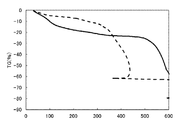
- FIG. 4 shows the thermal decomposition behavior of the metal complex of this example and the target sample.
- the thermal decomposition temperature of the metal complex of this example was 500 ° C.
- the thermal decomposition temperature of MIL-101 (Cr) was 310 ° C.
- MIL-101 (Cr) has the same organic ligand, crystal structure and space group
- the metal complex of this example has a significantly higher thermal decomposition temperature than MIL-101 (Cr). It was confirmed to have The results are shown in Table 3.
- Example 2 ⁇ Synthesis> In a 200 mL eggplant flask, 0.67 g (5.0 mmol) of anhydrous aluminum chloride, 0.50 g (3.0 mmol) of terephthalic acid, and 60 mL of DMF having a water content of 250 ppm by weight were mixed to obtain a raw material mixture.
- the raw material mixture had H 2 O / Al of 0.16, TA / Al of 0.6, and an aluminum concentration of 0.083 mol / L.
- the raw material mixture was heated to 130 ° C. in 20 minutes with stirring, and maintained at 130 ° C. for 3 hours while stirring was continued. Thereafter, stirring was stopped, and the mixture was allowed to stand at 130 ° C. for 12 hours to obtain a white solid metal complex.
- the metal complex was collected by filtration, washed with 20 mL of DMF, and then rinsed with 20 mL of ethanol. The washed metal complex was dried at 100 ° C. for 3 hours under a nitrogen stream to obtain 0.87 g of a crude product.
- Example 3 ⁇ Synthesis> A 200 mL eggplant flask was mixed with 0.67 g (5.0 mmol) of anhydrous aluminum chloride, 0.50 g (3.0 mmol) of terephthalic acid and 60 mL of N, N-dimethylformamide having a water content of 125 ppm by weight to obtain a raw material mixture. .
- the raw material mixture had an H 2 O / Al ratio of 0.08, a TA / Al ratio of 0.6, and an aluminum concentration of 0.083 mol / L.
- the raw material mixture was heated to 110 ° C. in 20 minutes with stirring, and kept at 110 ° C. for 1 hour while continuing stirring. Then, it heated at 160 degreeC and made it react for 2 hours, making a raw material mixture recirculate
- the metal complex was collected by filtration, washed with 20 mL of DMF, and then rinsed with 20 mL of ethanol. The washed metal complex was dried at 100 ° C. for 3 hours under a nitrogen stream to obtain 0.75 g of a crude product.
- the 0.50 g of the crude product was dispersed in 25 mL of ethanol and washed at 80 ° C. for 12 hours. After washing, filtering, and heating at 100 ° C. for 6 hours under a flow of dry nitrogen, a metal complex of this example was obtained.
- Comparative Example 1 A metal complex of this comparative example was obtained in the same manner as in Example 2 except that DMF having a water content of 1000 ppm by weight was used as DMF.
- the H 2 O / Al of the raw material mixture was 1.05
- TA / Al was 0.6
- the aluminum concentration was 0.083 mol / L.
- the obtained crude product was 0.72 g of a white solid.
- the metal complex of this comparative example was evaluated in the same manner as in Example 1.
- the metal complex of this comparative example was MIL-53 (Al) and its space group was Pnam.
- the BET specific surface area was 1100 m 2 /, and the pore volume was 0.62 cm 3 / g.
- the XRD pattern is shown in FIG.
- Comparative Example 2 A metal complex of this comparative example was obtained in the same manner as in Example 2 except that 1.21 g (5.0 mmol) of aluminum chloride hexahydrate was used as the aluminum source.
- the raw material mixture contains water (H 2 O) derived from the hydrate of the aluminum source, the H 2 O / Al is 6.0 or more.
- TA / Al of the raw material mixture was 0.6, and the aluminum concentration was 0.083 mol / L.
- the obtained crude product was 0.68 g of a white solid.
- Comparative Example 3 A metal complex of this comparative example was obtained by the same method as in Comparative Example 2 except that DMF was 120 mL and the reaction temperature was 120 ° C.
- the raw material mixture contains water (H 2 O) derived from the hydrate of the aluminum source
- the H 2 O / Al is 6.0 or more.
- TA / Al of the raw material mixture was 0.6, and the aluminum concentration was 0.042 mol / L.
- the obtained crude product was 0.80 g of a white solid.
- the metal complex of this comparative example was evaluated in the same manner as in Example 1.
- the metal complex of this comparative example was MIL-68 (Al) and the space group was Cmcm.
- the BET specific surface area was 1420 m ⁇ 2 > /, and the pore volume was 0.87 cm ⁇ 3 > / g.
- the XRD pattern is shown in FIG.
- Comparative Example 1 is the same as Example 2 except for H 2 O / Al.
- the metal complex of the present invention can be obtained by paying attention to the amount of water in the raw material mixture and controlling it.
- the metal complex of the present invention has high heat resistance and a high specific surface area, and further has a high pore volume. Therefore, the metal complex of the present invention can be applied to gas adsorption, separation, or storage of hydrogen, carbon dioxide, nitrogen, hydrocarbons such as methane and propane, and mixed gas thereof. Furthermore, the metal complex of the present invention can be applied as a catalyst as it is, or can be applied as a catalyst after immobilizing a noble metal such as platinum or palladium on the surface.
Landscapes
- Chemical & Material Sciences (AREA)
- Organic Chemistry (AREA)
- Engineering & Computer Science (AREA)
- Oil, Petroleum & Natural Gas (AREA)
- Organic Low-Molecular-Weight Compounds And Preparation Thereof (AREA)
Abstract
テレフタル酸を配位子とする多孔質金属錯体であって、高い耐熱性及び高比表面積を兼ね備えた多孔質金属錯体を提供する。 アルミニウムイオンクラスターにテレフタル酸が配位した構造を有し、空間群がFd-3mであることを特徴とする金属錯体。この様な金属錯体は、アルミニウム源、テレフタル酸及び非プロトン性溶媒を含む原料混合物を反応させる反応工程を有する製造方法であって、前記原料混合物のアルミニウムに対する水のモル比が1.0以下であることを特徴とする製造方法により得ることができる。
Description
本発明は金属錯体に関する。より詳しくは、安価、かつ実用的であって、吸着剤、触媒等の用途への適用が期待される多孔質金属錯体に関する。
金属イオンクラスターと有機配位子から構成される多孔質金属錯体(Metal Organic Framework;MOF)は、ゼオライトや活性炭等と比べ、高い比表面積や細孔容積を有する。そのため、ゼオライト等の代替物質として、多孔質金属錯体はガスの吸着、分離、及び貯蔵、並びに触媒用途、更には、ドラッグデリバリー等の用途への応用が期待されている。
テレフタル酸は、多種類の金属イオンと多孔質金属錯体を形成すること、及び、工業的に安価な原料であることから、最も重要な2価の有機配位子のひとつとされている。テレフタル酸を有機配位子として含む多孔質金属錯体として、MIL-53(Cr)、MIL-53(Al)、MIL-53(V)、MIL-68(Al)、MIL-88B(Cr)、MIL-88B(Fe)、MIL-101(Cr)、及びMIL-101(Fe)などが具体的に挙げられる。
例えば、非特許文献1にはクロム(Cr)イオンクラスターとテレフタル酸の配位結合で構成された、MIL-101(Cr)が開示されている。MIL-101(Cr)は3000m2/g以上のBET比表面積及び、細孔径29Åの細孔、及び細孔径34Åの細孔を有し、なおかつ、300℃程度の耐熱性を有する。
非特許文献2には、鉄(Fe)イオンクラスターとテレフタル酸の配位結合で構成された、MIL-101(Fe)が開示されている。MIL-101(Fe)は、BET比表面積が3200m2/gであり、なおかつ、細孔容積が1.4cm3/gであった。
アルミニウムイオンクラスターとテレフタル酸との配位結合で構成された多孔質金属錯体として、MIL-53(Al)が非特許文献3に、MIL-68(Al)が非特許文献4にそれぞれ報告されている。
さらに、非特許文献5には、テレフタル酸の類縁化合物を有機配位子とする多孔質金属錯体として、アルミニウム(Al)イオンクラスターと2-アミノテレフタル酸から構成される、NH2-MIL-101(Al)が開示されている。
Science,Vol.309,pp.2040-2042(2005)
Chem.Commun.,Issue48,pp.6812-6814(2012)
Chem.Commun.,Issue24,pp.2976-2977(2003)
J.Mater.Chem.,Vol.22,pp.10210-10220(2012)
Chem. Mater.,Vol.23,pp.2565-2572(2011)
MIL-101(Cr)は、毒性を有するクロムイオンを含む多孔質金属錯体であった。そのため、MIL-101(Cr)は環境用途や生体用途で使用することはできない。さらに、MIL-101(Cr)は、熱分解温度が300℃であり、熱処理により劣化しやすいだけではなく、適用できる用途が限定される。また更には、MIL-101(Cr)の合成には、200℃以上の高温、及び毒性の高いフッ化水素(HF)の使用を必須とする。そのため、その合成には特殊な装置、管理が必要とされ、コストが高くなるという問題があった。
また、MIL-101(Fe)は、その熱分解温度が180℃程度であり、MIL-101(Cr)よりも熱処理により劣化しやすいだけではなく、適用できる用途がさらに限定される。
MIL-53(Al)の結晶構造が属する空間群はPnamであり、MIL-68(Al)の結晶構造が属する空間群はCmcmである。MIL-53(Al)及びMIL-68(Al)は、比較的高い耐熱性を有するが、このような結晶構造のため比表面積が1500m2/g程度と低かった。そのため、吸着剤等の用途としては、より高い比表面積及び細孔容積が必要とされている。
NH2-MIL-101(Al)は、MIL-101(Cr)に類似した構造を有するため、比表面積及び細孔容積は比較的高い。しかしながら、その熱分解温度は約250℃と低い。そのため、NH2-MIL-101(Al)は、MIL-101(Cr)に比べて使用される用途が限定される。さらに、2-アミノテレフタル酸は高価な化合物であり、2-アミノテレフタル酸を含むNH2-MIL-101(Al)も高価であった。
このように、テレフタル酸を有機配位子とする多孔質金属錯体は、高比表面積を有するが低い耐熱性を有するもの、又は、高い耐熱性を有するが低比表面積を有するものしかなかった。
これらの課題に鑑み、本発明は、テレフタル酸を配位子とする多孔質金属錯体であって、高い耐熱性及び高比表面積を兼ね備えた多孔質金属錯体を提供することを目的とする。さらには、この様な多孔質金属錯体の簡便な製造方法を提供することを別の目的とする。
本発明者等は、テレフタル酸を有機配位子とする多孔質金属錯体であって、高耐熱性及び高比表面積を兼ね備えるものについて検討した。その結果、数ある金属イオンクラスターの中からアルミニウムイオンクラスターに注目し、これとテレフタル酸とからなり、特定の結晶構造を有する多孔質金属錯体が高い耐熱性と高比表面積とを兼ね備えることを見出した。さらに、このような多孔質金属錯体は、原料中の含水量に着目し、なおかつ、これを制御することではじめて得られることを見出し、本発明を完成するに至った。
すなわち、本発明の要旨は以下に存する。
[1]アルミニウムイオンクラスターにテレフタル酸が配位した構造を有し、空間群がFd-3mであることを特徴とする金属錯体。
[2]BET比表面積が1500m2/g以上であることを特徴とする[1]に記載の金属錯体。
[3]熱分解温度が400℃以上であることを特徴とする[1]又は[2]に記載の金属錯体。
[4]アルミニウム源、テレフタル酸及び非プロトン性溶媒を含む原料混合物を反応させる反応工程を有する製造方法であって、前記原料混合物のアルミニウムに対する水のモル比が1.0以下であることを特徴とする[1]乃至[3]のいずれかに記載の金属錯体の製造方法。
[5]前記原料混合物のアルミニウム濃度が0.01mol/L以上であることを特徴とする[4]に記載の製造方法。
[6]前記原料混合物のアルミニウムに対するテレフタル酸のモル比が0.20以上であることを特徴とする[4]又は[5]に記載の製造方法。
[7]前記非プロトン性溶媒が、N,N-ジメチルホルムアミド、N,N-ジメチルアセトアミド、N,N-ジエチルホルムアミド、ジメチルスルホキシド、アセトニトリル、テトラヒドロフラン、及びN-メチル-2-ピロリドンの群からなる少なくとも1種であることを特徴とする[4]乃至[6]のいずれかに記載の製造方法。
[1]アルミニウムイオンクラスターにテレフタル酸が配位した構造を有し、空間群がFd-3mであることを特徴とする金属錯体。
[2]BET比表面積が1500m2/g以上であることを特徴とする[1]に記載の金属錯体。
[3]熱分解温度が400℃以上であることを特徴とする[1]又は[2]に記載の金属錯体。
[4]アルミニウム源、テレフタル酸及び非プロトン性溶媒を含む原料混合物を反応させる反応工程を有する製造方法であって、前記原料混合物のアルミニウムに対する水のモル比が1.0以下であることを特徴とする[1]乃至[3]のいずれかに記載の金属錯体の製造方法。
[5]前記原料混合物のアルミニウム濃度が0.01mol/L以上であることを特徴とする[4]に記載の製造方法。
[6]前記原料混合物のアルミニウムに対するテレフタル酸のモル比が0.20以上であることを特徴とする[4]又は[5]に記載の製造方法。
[7]前記非プロトン性溶媒が、N,N-ジメチルホルムアミド、N,N-ジメチルアセトアミド、N,N-ジエチルホルムアミド、ジメチルスルホキシド、アセトニトリル、テトラヒドロフラン、及びN-メチル-2-ピロリドンの群からなる少なくとも1種であることを特徴とする[4]乃至[6]のいずれかに記載の製造方法。
本発明により、テレフタル酸を配位子とする多孔質金属錯体であって、高い耐熱性及び高比表面積を兼ね備えた多孔質金属錯体を提供することができる。さらには、本発明の金属錯体は毒性を示す金属を含まないため、ドラッグデリバリー等の用途にも適用できる金属錯体を提供することができる。
さらに、本発明の金属錯体は窒素吸着剤および触媒として使用することができ、なおかつ、これ以外の吸着剤、触媒とすることが期待できる。
本発明の製造方法により、この様な多孔質金属錯体の簡便な製造方法を提供することができる。さらには、本発明の製造方法により、アルミニウム源とテレフタル酸という安価な原料から金属錯体が得られるため、安価な金属錯体及びその製造方法として提供することができる。
本発明は、金属錯体であり、より具体的には多孔質金属錯体である。多孔質金属錯体とは、金属イオンクラスターと有機配位子からなる骨格構造を有する結晶性有機金属錯体である。
本発明の金属錯体の構造を図1に示す。本発明の金属錯体は、金属イオンクラスターとしてのアルミニウム(Al)イオンクラスターにテレフタル酸が配位した構造である。より具体的には、本発明の金属錯体は、A13-Oからなるアルミニウムイオンクラスター(図1(a))の各アルミニウムイオン(Al3+)にテレフタル酸アニオンが配位した四面体を単位骨格とする(図1(b))。本発明の金属錯体の骨格構造は、当該単位骨格が連続して結合し、MTN型ゼオライトと類似した3次元構造を有する(図1(c))。なお、当該単位骨格はMTNフレームワークの各頂点に相当する位置に存在する。
本発明の金属錯体の空間群はFd-3mである。すなわち、本発明の金属錯体の結晶構造の対称性が、空間群Fd-3mに属する。本発明の金属錯体は、アルミニウムイオンクラスター及びテレフタル酸からなる骨格構造を有し、当該空間群に属する結晶構造を有することにより、高い耐熱性及び高い比表面積を兼ね備える。さらには、細孔容積が多くなりやすい。
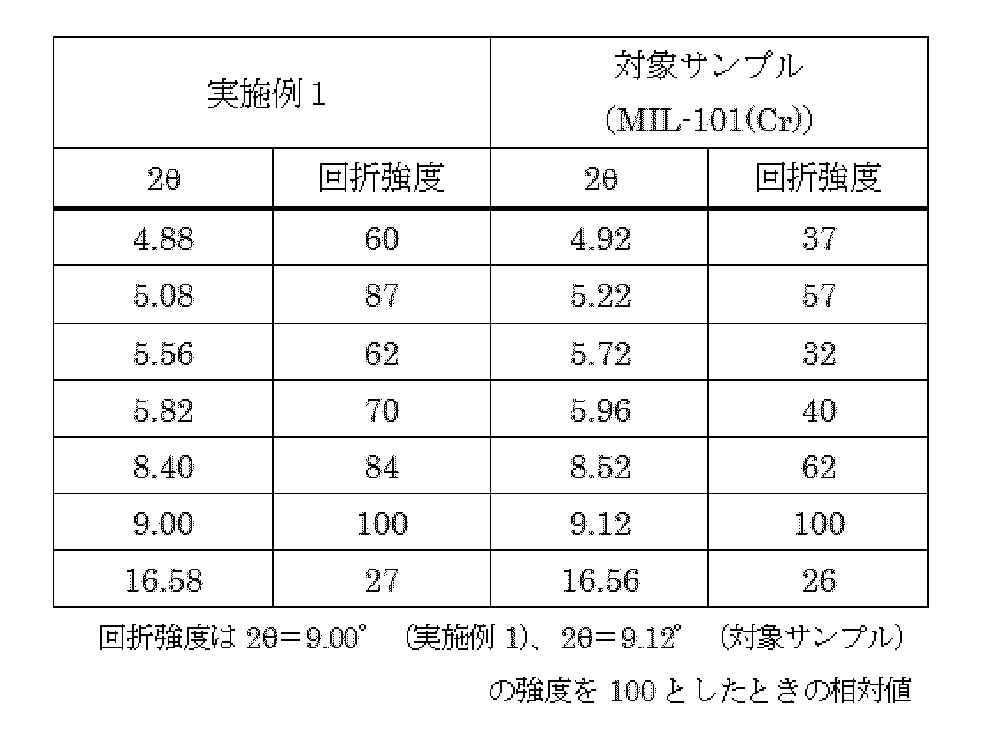
本発明の金属錯体は、粉末X線回折(以下、「XRD」とする。)パターンにおいて、2θ=3~17°の範囲に特徴的なピークを有する。すなわち、本発明の金属錯体のXRDパターンは、少なくともとも2θ=5.10±0.1°、5.85±0.1°、8.40±0.1°、及び9.00±0.1°に中強度のXRDピーク、及び2θ=4.90±0.1°、5.55±0.1°、及び、16.50±0.1°に弱強度のXRDピークを有する。本発明の金属錯体の特徴的なXRDピークを表1に示す。

本発明の金属錯体の空間群及び結晶構造は、MIL-101(Cr)のXRDパターンと比較することで同定することができる。MIL-101(Cr)は金属イオンクラスターとしてクロムイオンクラスターを有し、これにテレフタル酸が配位した多孔質金属錯体であり、その空間群がFd-3mである。このように、MIL-101(Cr)と同様な結晶構造及び空間群を有することをもって、本発明の金属錯体の結晶構造及び空間群を同定することができる。
従来のテレフタル酸を有機配位子として含む多孔質金属錯体と比べて、本発明の金属錯体はより高い耐熱性を有する。そのため、本発明の金属錯体の熱分解温度は400℃以上、更には450℃以上である。本発明の金属錯体は400℃以上であっても、有機配位子の熱分解やアルミニウムイオンクラスター中のアルミニウム-酸素間の結合の熱的な解離が生じにくい。このような高い耐熱性を有することで、本発明の金属錯体を高温下で使用する触媒や吸着剤などの用途で使用することができる。熱分解温度が高いほど、使用できる用途が広がるため、本発明の金属錯体の熱分解温度は490℃以上、更には495℃以上、また更には500℃以上であることが好ましい。本発明の金属錯体の熱分解温度として、例えば、400℃以上600℃以下、更には400℃以上500℃以下、また更には490℃以上500℃以下、また更には495℃以上500℃以下を挙げることができる。
本発明において、金属錯体の熱分解温度は熱重量分析(TG分析)により求めることができる。
本発明の金属錯体は高い比表面積を有する。本発明の金属錯体の比表面積は、BET比表面積として1500m2/g以上、更には2500m2/g以上、また更には3000m2/g以上である。比表面積が高いほど適用できる用途が多くなるため、本発明の金属錯体のBET比表面積は3200m2/g以上であることが好ましい。
本発明の金属錯体のBET比表面積は4500m2/g以下、更には4000m2/g以下である。好ましいBET比表面積の範囲として、例えば、3000m2/g以上4500m2/g以下、更には3030m2/g以上4500m2/g以下、また更には3200m2/g以上4500m2/g以下、また更には3000m2/g以上4000m2/g以下、また更には3030m2/g以上4000m2/g以下、また更には3200m2/g以上4000m2/g以下を挙げることができる。本発明の金属錯体のより具体的なBET比表面積として、3030m2/g以上3260m2/g以下、更には3200m2/g以上3260m2/g以下を挙げることができる。
BET比表面積は窒素吸着法により測定することができる。例えば、乾燥処理した金属錯体を真空脱気した後、77Kで窒素ガスを導入し、その平衡圧と吸着量を測定して吸着等温線を得る。得られた吸着等温線からBET比表面積を求めればよい。
本発明の金属錯体は細孔容積が0.9cm3/g以上、更には1.0cm3/g以上、また更には1.5cm3/g以上である。細孔容積が多くなるほど被吸着物質の吸着量が多くなりやすい。
本発明の金属錯体を触媒、吸着剤又はドラッグデリバリーシステムなどの用途で使用する場合、例えば、細孔容積は4.0cm3/g以下、更には3.0cm3/g以下であればよい。本発明の金属錯体をこれらの用途で使用する場合、その細孔容積は0.9cm3/g以上4.0cm3/g以下、更には1.0cm3/g以上4.0cm3/g以下、また更には1.56cm3/g以上4.0cm3/g以下、また更には1.75cm3/g以上4.0cm3/g以下、また更には1.56cm3/g以上3.0cm3/g以下、また更には1.75cm3/g以上3.0cm3/g以下を例示することができる。本発明の金属錯体のより具体的な細孔容積として、1.56cm3/g以上1.89cm3/g以下、更には1.75cm3/g以上1.89cm3/g以下を挙げることができる。
上記の様に、本発明の金属錯体はMIL-101(Cr)と同様な構造を有する。そのため、本発明の金属錯体は細孔径29Åの細孔、及び細孔径34Åの2種類の細孔を有する。
次に、本発明の金属錯体の製造方法について説明する。
本発明の金属錯体は、アルミニウム源、テレフタル酸及び非プロトン性溶媒を含む原料混合物を反応させる反応工程を有する製造方法であって、前記原料混合物のアルミニウムに対する水のモル比が1.0以下であることを特徴とする製造方法により得ることができる。
本発明の製造方法は、アルミニウム源、テレフタル酸及び非プロトン性溶媒を含む原料混合物を反応させる反応工程を有する。非プロトン性溶媒中でアルミニウム源及びテレフタル酸を反応させ、これを結晶化することで本発明の金属錯体を得ることができる。
反応工程における原料混合物のアルミニウムに対する水のモル比(mol/mol)(以下、「H2O/Al」とする。)は1.0以下、更には0.5以下、また更には0.2以下である。H2O/Alが1.0を超えると、本発明の金属錯体が得られない。例えば、H2O/Alが1.0を超えた場合、得られる金属錯体は空間群がFd-3m以外の金属錯体、例えば、MIL-53(Al)やMIL-68(Al)、又はこれらを含んだ金属錯体となる。H2O/Alは1.0以下であればよいが、H2O/Alは0.1以下、更には0.05以下であってもよい。
なお、原料混合物中の水(H2O)にはアルミニウム源やテレフタル酸、更には非プロトン性溶媒のいずれかに由来する結晶水、吸着水及びその他の水を含む。
アルミニウム源は、アルミニウムを含む化合物であり、なおかつ、原料混合物中のH2O/Alが1.0以下となるものであればよい。アルミニウム源として、塩化アルミニウム、塩化アルミニウム6水和物、フッ化アルミニウム、臭化アルミニウム、ヨウ化アルミニウム、硫酸アルミニウム、硫酸アルミニウム16水和物、硝酸アルミニウム、硝酸アルミニウム9水和物、水酸化アルミニウム、アルミニウムエトキシド、及びアルミニウムイソプロポキシドの群から選ばれる少なくとも1種、更には塩化アルミニウム、フッ化アルミニウム、臭化アルミニウム、ヨウ化アルミニウム、硫酸アルミニウム、硝酸アルミニウム、水酸化アルミニウム、アルミニウムエトキシド、及びアルミニウムイソプロポキシドの群から選ばれる少なくとも1種を挙げることができる。
原料混合物中のH2O/Alをより低くするため、アルミニウム源は、ハロゲン化アルミニウムの無水物、更には無水塩化アルミニウムであることが好ましい。アルミニウム源は固体であってもよく、非プロトン性溶媒に溶解したアルミニウム源溶液であってもよい。
原料混合物のアルミニウム濃度として、0.01mol/L以上、更には0.03mol/L以上を挙げることができる。また、アルミニウム濃度は、2.0mol/L以下、更には1.0mol/L以下であればよい。
テレフタル酸は吸着水などの水分が少ないものであればよく、原料混合物中のH2O/Alが1.0以下となるものであればよい。テレフタル酸は、1位と4位にカルボン酸基を有するベンゼン環からなる芳香族化合物であり、カルボン酸基以外の置換基を有さない芳香族化合物である。したがって、アミノテレフタル酸やメチルテレフタル酸など、カルボン酸基以外の置換基を有するテレフタル酸は含まれない。テレフタル酸は、その純度が90重量%以上、好ましくは95重量%以上、さらに好ましくは98重量%以上であることが好ましい。テレフタル酸は固体であってもよく、非プロトン性溶媒に溶解されたテレフタル酸溶液であってもよい。
原料混合物中のテレフタル酸濃度は、原料混合物中のアルミニウムに対するテレフタル酸のモル比(mol/mol)(以下、「TA/Al」とする)として、0.2以上、更には0.4以上を挙げることができる。TA/Alが0.2以上であることで、本発明の金属錯体の収率が高くなる傾向がある。TA/Alは1.2以下、更には1.0以下であれば、十分な収率で本発明の金属錯体が得られる。TA/Alとして、例えば、0.2以上1.2以下、更には0.4以上1.2以下、また更には0.4以上1.0以下を挙げることができる。
非プロトン性溶媒は、プロトン供与性を有さない極性又は非極性の溶媒であり、なおかつ、原料混合物中のH2O/Alが1.0以下となるものであればよい。具体的な非プロトン性溶媒として、N,N-ジメチルホルムアミド、N,N-ジメチルアセトアミド、N,N-ジエチルホルムアミド、ジメチルスルホキシド、アセトニトリル、テトラヒドロフラン、及びN-メチル-2-ピロリドンの群からなる少なくとも1種を挙げることができる。本発明の金属錯体が得られやすくなることから、非プロトン性溶媒は、N,N-ジメチルホルムアミド、N,N-ジメチルアセトアミド、及びN,N-ジエチルホルムアミドの群から選ばれる少なくとも1種、更にはN,N-ジメチルホルムアミドであることが好ましい。
反応工程における反応は、例えば、アルミニウム源、テレフタル酸、及び非プロトン性溶媒を混合して原料混合物を得た後に当該原料混合物を所定の反応温度として結晶化させること、アルミニウム源又はテレフタル酸のいずれか一方の原料と非プロトン性溶媒とを混合した後、所定の反応温度としてから、テレフタル酸又はアルミニウム源の他方の原料をこれに混合して原料混合物とし、当該原料混合物を結晶化させること、並びに、非プロトン性溶媒を所定の反応温度とした後、アルミニウム源、テレフタル酸、又はこれらの混合物を非プロトン性溶媒に混合して原料混合物とし、当該原料混合物を結晶化させることが挙げられる。
反応工程においては、原料混合物を加熱することでこれを結晶化して本発明の金属錯体を得る。反応工程では上記の原料混合物を使用するため、高い反応温度を必要としない。そのため、反応工程における反応温度は200℃未満、更には170℃以下、また更には160℃以下、また更には130℃以下とすることができる。反応温度は90℃以上、更には100℃以上、また更には110℃以上であれば、原料混合物の結晶化が促進されやすくなる。反応時間との兼ね合いから、反応温度は90℃以上、150℃以下であることが好ましい。反応温度として、例えば、90℃以上200℃未満、更には90℃以上170℃以下、また更には90℃以上160℃以下、また更には100℃以上200℃未満、また更には110℃以上200℃未満、また更には110℃以上170℃以下を挙げることができる。
反応中に反応温度を変化させてもよい。例えば、上記の温度範囲であれば、反応中の温度は反応開始温度より高い温度としてもよく、反対に、反応開始温度より低い温度としてもよい。
反応工程において、温度が高くなるほど反応に要する時間が短くなる傾向がある。反応時間として、0.5時間以上、36時間以下、更には1時間以上、24時間以下を挙げることができる。
反応工程は1気圧以上、2気圧以下で行うことができる。一般的な反応装置を使用することができるため、反応工程は開放系、例えば、大気中で行われることが好ましい。一方、反応工程はオートクレーブ等の密閉型反応器を用いてさらに高い圧力で反応させてもよい。
反応工程において、反応は原料混合物を静置して行われてもよいが、原料混合物を攪拌しながら反応させてもよく、攪拌した後にこれを停止し、静置しながら反応させてもよい。反応の初期段階、例えば、テレフタル酸とアルミニウム源とが反応温度にて反応を開始してから1時間以内に原料混合物を攪拌しながら反応させることにより、本発明の金属錯体が得られやすくなる。
本発明の製造方法において、反応工程の後に洗浄工程又は焼成工程を含んでいてもよい。
洗浄工程では、金属錯体に付着した不純物を除去することができる。洗浄方法は任意であるが、原料混合物に含まれる非プロトン性溶媒と同じ種類の溶媒や、アルコールなどにより洗浄することが挙げられる。
焼成工程では、未反応のテレフタル酸や、金属錯体に吸着する溶媒を除去する。焼成方法は任意であるが、種々のガス雰囲気や減圧下における加熱処理を挙げることができる。加熱処理の条件としては、例えば、乾燥空気、乾燥窒素気流下及び減圧下のいずれか任意の雰囲気中、100~500℃で1~100時間加熱処理する方法が挙げられる。
以下、実施例および比較例に基づき本発明をさらに具体的に説明する。しかしながら、本発明は以下の実施例に何ら制限されるものではない。以下、評価方法及び評価条件を示す。
(結晶構造の同定)
試料の結晶構造をXRD測定により測定した。得られた試料のXRDパターンと、対象サンプルのXRDパターンとを対比することで、その結晶構造及び空間群を同定した。XRD測定の測定装置及び測定条件は以下のとおりである。
装置 :M03XHF、マックサイエンス社製
X線源 :Cu-Kα線
測定範囲 :2θ=3~43°
ステップ幅:0.02°/sec
なお、対象サンプルとして、以下に示した方法で合成したMIL-101(Cr)を使用した。
試料の結晶構造をXRD測定により測定した。得られた試料のXRDパターンと、対象サンプルのXRDパターンとを対比することで、その結晶構造及び空間群を同定した。XRD測定の測定装置及び測定条件は以下のとおりである。
装置 :M03XHF、マックサイエンス社製
X線源 :Cu-Kα線
測定範囲 :2θ=3~43°
ステップ幅:0.02°/sec
なお、対象サンプルとして、以下に示した方法で合成したMIL-101(Cr)を使用した。
(BET比表面積および細孔容積)
試料のBET比表面積及び細孔容積はBET多点法により測定した。BET比表面積及び細孔容積の測定装置及び測定条件は以下のとおりである。
装置 :BELSORP 28SA、日本ベル株式会社製
解析ソフトウェア:BELMaster バージョン5.3.3.0
前処理 :200℃、6.5時間、脱気処理
吸着ガス :窒素
吸脱着温度 :-196℃(窒素の沸点)
比表面積の算出に用いた平衡相対圧:0.05<p/p0<0.15。
試料のBET比表面積及び細孔容積はBET多点法により測定した。BET比表面積及び細孔容積の測定装置及び測定条件は以下のとおりである。
装置 :BELSORP 28SA、日本ベル株式会社製
解析ソフトウェア:BELMaster バージョン5.3.3.0
前処理 :200℃、6.5時間、脱気処理
吸着ガス :窒素
吸脱着温度 :-196℃(窒素の沸点)
比表面積の算出に用いた平衡相対圧:0.05<p/p0<0.15。
(熱分解温度の評価)
試料の熱分解温度をTGにより測定した。TG測定の測定装置及び測定条件は以下のとおりである。
装置 :TG/DTA6300、SEIKO社製
温度範囲 :20~600℃
昇温速度 :10℃/min
ガス雰囲気 :乾燥空気
TG測定により得られた重量減少曲線の変曲点における接線と、基線との延長線との交点に対応する温度を熱分解温度とした。
試料の熱分解温度をTGにより測定した。TG測定の測定装置及び測定条件は以下のとおりである。
装置 :TG/DTA6300、SEIKO社製
温度範囲 :20~600℃
昇温速度 :10℃/min
ガス雰囲気 :乾燥空気
TG測定により得られた重量減少曲線の変曲点における接線と、基線との延長線との交点に対応する温度を熱分解温度とした。
(対象サンプルの合成)
本発明の金属錯体の結晶構造及び空間群を同定するために、対象サンプルとしてMIL-101(Cr)を合成した。MIL-101(Cr)は、非特許文献1のMIL-101(Cr)の合成方法に準じた方法で合成した。
本発明の金属錯体の結晶構造及び空間群を同定するために、対象サンプルとしてMIL-101(Cr)を合成した。MIL-101(Cr)は、非特許文献1のMIL-101(Cr)の合成方法に準じた方法で合成した。
すなわち、テフロン(登録商標)内筒密閉容器に硝酸クロム9水和物1.20g(3mmol)、テレフタル酸0.498g(3mmol)、フッ化水素3mmol、及び脱イオン水15mLを混合し、これを220℃で8時間加熱した。自然放冷後、粗いグラスフィルターで未反応のテレフタル酸を取り除いた後、アセトンでリンス洗浄した。洗浄後、窒素気流下、100℃で3時間乾燥させることで淡緑色固体1.21gを得、これを対象サンプルとした。また、対象サンプルのBET比表面積は3370m2/g、また細孔容積は1.84cm3/gであった。
当該対象サンプルのXRDパターンは、非特許文献1のFig.4に記載された空間群Fd-3mのMIL-101(Cr)のXRDパターン、及び参考文献(Chem.Commun.,pp.4192-4194(2008))のFig.S3に記載された計算によるMIL-101(Cr)のXRDパターンと同様なパターンを示した。これより、対象サンプルは空間群Fd-3mのMIL-101(Cr)であることが確認された。
実施例1
<合成>
200mLのナスフラスコに無水塩化アルミニウム0.67g(5.0mmol)、テレフタル酸0.50g(3.0mmol)及び、含水量10重量ppm以下のN,N-ジメチルホルムアミド(以下、「DMF」とする。)120mLを混合して原料混合物を得た。原料混合物のH2O/Alは検出限界(0.02)以下、TA/Alは0.6、及びアルミニウム濃度は0.042mol/Lであった。
<合成>
200mLのナスフラスコに無水塩化アルミニウム0.67g(5.0mmol)、テレフタル酸0.50g(3.0mmol)及び、含水量10重量ppm以下のN,N-ジメチルホルムアミド(以下、「DMF」とする。)120mLを混合して原料混合物を得た。原料混合物のH2O/Alは検出限界(0.02)以下、TA/Alは0.6、及びアルミニウム濃度は0.042mol/Lであった。
当該原料混合物を撹拌しながら20分で110℃まで加熱し、攪拌を継続したまま110℃で3時間保持した。その後、撹拌を停止し、110℃で12時間静置することで白色固体状の金属錯体を得た。
当該金属錯体をろ過して回収し、20mLのDMFで洗浄した後に、20mLのエタノールでリンス洗浄した。洗浄後の金属錯体を、窒素気流下、100℃で3時間乾燥することで0.66gの粗製物を得た。当該粗製物0.50gをエタノール25mLに分散させ、80℃で12時間洗浄した。洗浄後、ろ過後、乾燥窒素流通下、100℃で6時間加熱することで本実施例の金属錯体とした。
<評価>
本実施例の金属錯体のXRDパターンは、対象サンプルのXRDパターンと同一であった。これより、本実施例の金属錯体は、空間群Fd-3mであり、MIL-101(Cr)と同一の結晶構造を有することが確認できた。本実施例の金属錯体のXRDパターンを図2に示し、主なXRDピークを表2に示した。
本実施例の金属錯体のXRDパターンは、対象サンプルのXRDパターンと同一であった。これより、本実施例の金属錯体は、空間群Fd-3mであり、MIL-101(Cr)と同一の結晶構造を有することが確認できた。本実施例の金属錯体のXRDパターンを図2に示し、主なXRDピークを表2に示した。
本実施例の金属錯体は、比表面積が3030m2/g、及び細孔容積が1.56cm3/gであった。これにより当該金属錯体は高い比表面積と細孔容積を有していることが確認された。
当該金属錯体および対象サンプル(MIL-101(Cr))の窒素吸着等温線を図3に示した。当該金属錯体は、その吸着等温線はMIL-101(Cr)と同様な吸着挙動を示すことが確認された。これにより、当該金属錯体がMIL-101(Cr)と同様な細孔構造を有すること、すなわち、細孔径29Åの細孔、及び細孔径34Åの2種類の細孔を有することが示唆された。また、本発明の金属錯体が窒素吸着剤として適用できることが確認された。
本実施例の金属錯体及び対象サンプルの熱分解挙動を図4に示した。本実施例の金属錯体の熱分解温度は500℃であったのに対し、MIL-101(Cr)の熱分解温度は310℃であった。これより、MIL-101(Cr)と有機配位子、結晶構造及び空間群が同じであるにも関わらず、本実施例の金属錯体はMIL-101(Cr)と比べて著しく高い熱分解温度を有することが確認された。結果を表3に示した。
実施例2
<合成>
200mLのナスフラスコに無水塩化アルミニウム0.67g(5.0mmol)、テレフタル酸0.50g(3.0mmol)、及び、含水量250重量ppmのDMF60mLを混合し、原料混合物を得た。当該原料混合物のH2O/Alは0.16、TA/Alは0.6、及びアルミニウム濃度は0.083mol/Lであった。
<合成>
200mLのナスフラスコに無水塩化アルミニウム0.67g(5.0mmol)、テレフタル酸0.50g(3.0mmol)、及び、含水量250重量ppmのDMF60mLを混合し、原料混合物を得た。当該原料混合物のH2O/Alは0.16、TA/Alは0.6、及びアルミニウム濃度は0.083mol/Lであった。
当該原料混合物を撹拌しながら20分で130℃まで加熱し、攪拌を継続したまま130℃で3時間保持した。その後、撹拌を停止し、130℃で12時間静置することで白色固体状の金属錯体を得た。
当該金属錯体をろ過して回収し、20mLのDMFで洗浄した後に、20mLのエタノールでリンス洗浄した。洗浄後の金属錯体を、窒素気流下、100℃で3時間乾燥することで0.87gの粗製物を得た。
当該粗製物0.50gをエタノール25mLに分散させ、80℃で12時間洗浄した。洗浄後、ろ過後、乾燥窒素流通下、100℃で6時間加熱することで本実施例の金属錯体とした。
<評価>
本実施例の金属錯体のXRDパターンから、本実施例の金属錯体はMIL-101(Cr)と同等なXRDパターンを有することが確認された。XRDパターンを図5に、結果を表3に示した。
<評価>
本実施例の金属錯体のXRDパターンから、本実施例の金属錯体はMIL-101(Cr)と同等なXRDパターンを有することが確認された。XRDパターンを図5に、結果を表3に示した。
実施例3
<合成>
200mLのナスフラスコに無水塩化アルミニウム0.67g(5.0mmol)、テレフタル酸0.50g(3.0mmol)および含水量125重量ppmのN,N-ジメチルホルムアミド60mLを混合し、原料混合物を得た。当該原料混合物のH2O/Alは0.08、TA/Alは0.6、及びアルミニウム濃度は0.083mol/Lであった。
<合成>
200mLのナスフラスコに無水塩化アルミニウム0.67g(5.0mmol)、テレフタル酸0.50g(3.0mmol)および含水量125重量ppmのN,N-ジメチルホルムアミド60mLを混合し、原料混合物を得た。当該原料混合物のH2O/Alは0.08、TA/Alは0.6、及びアルミニウム濃度は0.083mol/Lであった。
当該原料混合物を撹拌しながら20分で110℃まで加熱し、攪拌を継続したまま110℃で1時間保持した。その後、160℃に加熱して原料混合物を還流させながら、2時間反応させることで白色固体状の金属錯体を得た。
当該金属錯体をろ過して回収し、20mLのDMFで洗浄した後に、20mLのエタノールでリンス洗浄した。洗浄後の金属錯体を、窒素気流下、100℃で3時間乾燥することで0.75gの粗製物を得た。
当該粗製物0.50gをエタノール25mLに分散させ、80℃で12時間洗浄した。洗浄後、ろ過後、乾燥窒素流通下、100℃で6時間加熱することで本実施例の金属錯体とした。
<評価>
本実施例の金属錯体のXRDパターンから、本実施例の金属錯体はMIL-101(Cr)と同等なXRDパターンを有することが確認できた。XRDパターンを図6に、結果を表3に示した。
本実施例の金属錯体のXRDパターンから、本実施例の金属錯体はMIL-101(Cr)と同等なXRDパターンを有することが確認できた。XRDパターンを図6に、結果を表3に示した。

比較例1
<合成>
DMFとして、含水量が1000重量ppmのDMFを使用したこと以外は実施例2と同様な方法により、本比較例の金属錯体を得た。本比較例において、原料混合物のH2O/Alは1.05、TA/Alは0.6、及びアルミニウム濃度は0.083mol/Lであった。得られた粗製物は0.72gの白色固体であった。
<合成>
DMFとして、含水量が1000重量ppmのDMFを使用したこと以外は実施例2と同様な方法により、本比較例の金属錯体を得た。本比較例において、原料混合物のH2O/Alは1.05、TA/Alは0.6、及びアルミニウム濃度は0.083mol/Lであった。得られた粗製物は0.72gの白色固体であった。
<評価>
実施例1と同様にして本比較例の金属錯体を評価した。得られたXRDパターンは2θ=5.82°のXRDピークを有していなかった。また、当該XRDパターンより、本比較例の金属錯体はMIL-53(Al)であり、その空間群はPnamであることが確認された。また、BET比表面積は1100m2/、及び、細孔容積は0.62cm3/gであった。XRDパターンを図7に、結果を表4に示した。
実施例1と同様にして本比較例の金属錯体を評価した。得られたXRDパターンは2θ=5.82°のXRDピークを有していなかった。また、当該XRDパターンより、本比較例の金属錯体はMIL-53(Al)であり、その空間群はPnamであることが確認された。また、BET比表面積は1100m2/、及び、細孔容積は0.62cm3/gであった。XRDパターンを図7に、結果を表4に示した。
比較例2
<合成>
アルミニウム源として塩化アルミニウム6水和物1.21g(5.0mmol)を使用したこと以外は実施例2と同様な方法により、本比較例の金属錯体を得た。本比較例において、原料混合物はアルミニウム源の水和物に由来する水(H2O)を含むため、そのH2O/Alは6.0以上である。また、原料混合物のTA/Alは0.6、及びアルミニウム濃度は0.083mol/Lであった。得られた粗製物は0.68gの白色固体であった。
<合成>
アルミニウム源として塩化アルミニウム6水和物1.21g(5.0mmol)を使用したこと以外は実施例2と同様な方法により、本比較例の金属錯体を得た。本比較例において、原料混合物はアルミニウム源の水和物に由来する水(H2O)を含むため、そのH2O/Alは6.0以上である。また、原料混合物のTA/Alは0.6、及びアルミニウム濃度は0.083mol/Lであった。得られた粗製物は0.68gの白色固体であった。
<評価>
実施例1と同様にして本比較例の金属錯体を評価した。得られたXRDパターンは2θ=5.82°のXRDピークを有していなかった。また、当該XRDパターンより、本比較例の金属錯体はMIL-53(Al)であり、その空間群はPnamであることが確認された。また、BET比表面積は1030m2/、及び、細孔容積は0.60cm3/gであった。XRDパターンを図8に、結果を表4に示した。
実施例1と同様にして本比較例の金属錯体を評価した。得られたXRDパターンは2θ=5.82°のXRDピークを有していなかった。また、当該XRDパターンより、本比較例の金属錯体はMIL-53(Al)であり、その空間群はPnamであることが確認された。また、BET比表面積は1030m2/、及び、細孔容積は0.60cm3/gであった。XRDパターンを図8に、結果を表4に示した。
比較例3
<合成>
DMFを120mLとしたこと、及び、反応温度を120℃としたこと以外は比較例2と同様な方法により、本比較例の金属錯体を得た。本比較例において、原料混合物はアルミニウム源の水和物に由来する水(H2O)を含むため、そのH2O/Alは6.0以上である。また、原料混合物のTA/Alは0.6、及びアルミニウム濃度は0.042mol/Lであった。得られた粗製物は0.80gの白色固体であった。
<合成>
DMFを120mLとしたこと、及び、反応温度を120℃としたこと以外は比較例2と同様な方法により、本比較例の金属錯体を得た。本比較例において、原料混合物はアルミニウム源の水和物に由来する水(H2O)を含むため、そのH2O/Alは6.0以上である。また、原料混合物のTA/Alは0.6、及びアルミニウム濃度は0.042mol/Lであった。得られた粗製物は0.80gの白色固体であった。
<評価>
実施例1と同様にして本比較例の金属錯体を評価した。得られたXRDパターンは2θ=5.82°のXRDピークを有していなかった。また、当該XRDパターンより、本比較例の金属錯体はMIL-68(Al)であり、その空間群はCmcmであることが確認された。また、BET比表面積は1420m2/、及び、細孔容積は0.87cm3/gであった。XRDパターンを図9に、結果を表4に示した。
実施例1と同様にして本比較例の金属錯体を評価した。得られたXRDパターンは2θ=5.82°のXRDピークを有していなかった。また、当該XRDパターンより、本比較例の金属錯体はMIL-68(Al)であり、その空間群はCmcmであることが確認された。また、BET比表面積は1420m2/、及び、細孔容積は0.87cm3/gであった。XRDパターンを図9に、結果を表4に示した。
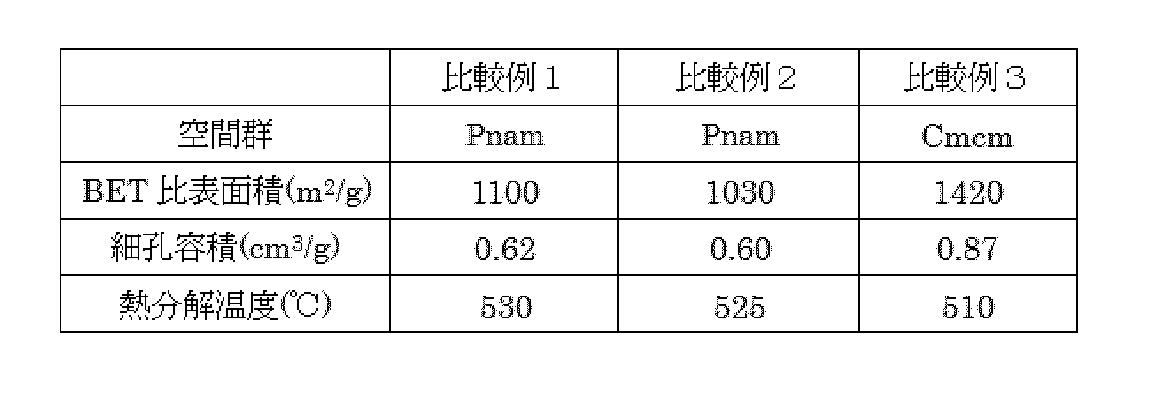
これらの比較例より、H2O/Alが0.50を超えた原料混合物を用いた場合、MIL-53(Al)またはMIL-68(Al)が得られることが確認された。特に、比較例1は、実施例2とH2O/Al以外は同じである。このように、原料混合物中の水の量に着目し、これを制御することで本発明の金属錯体が得られることが確認された。
本発明を詳細に、また特定の実施態様を参照して説明したが、本発明の本質と範囲を逸脱することなく様々な変更や修正をくわえることができることは当業者にとって明らかである。
なお、2014年4月3日に出願された日本特許出願2014-077074号、の明細書、特許請求の範囲、図面及び要約書の全内容をここに引用し、本発明の明細書の開示として、取り入れるものである。
本発明の金属錯体は、高い耐熱性及び高比表面積を兼ね備え、さらには高い細孔容積を有する。そのため、本発明の金属錯体は、水素、二酸化炭素、窒素、並びにメタン及びプロパン等の炭化水素やこれらの混合ガスのガス吸着、分離、又は貯蔵に適用できる。さらに、本発明の金属錯体は、これをそのまま触媒として適用することや、白金やパラジウム等の貴金属を表面に固定化した上で触媒として適用することができる。
Claims (7)
- アルミニウムイオンクラスターにテレフタル酸が配位した構造を有し、空間群がFd-3mであることを特徴とする金属錯体。
- BET比表面積が1500m2/g以上であることを特徴とする請求項1に記載の金属錯体。
- 熱分解温度が400℃以上であることを特徴とする請求項1又は2に記載の金属錯体。
- アルミニウム源、テレフタル酸及び非プロトン性溶媒を含む原料混合物を反応させる反応工程を有する製造方法であって、前記原料混合物のアルミニウムに対する水のモル比が1.0以下であることを特徴とする請求項1乃至3のいずれかに記載の金属錯体の製造方法。
- 前記原料混合物のアルミニウム濃度が0.01mol/L以上であることを特徴とする請求項4に記載の製造方法。
- 前記原料混合物のアルミニウムに対するテレフタル酸のモル比が0.20以上であることを特徴とする請求項4又は5に記載の製造方法。
- 前記非プロトン性溶媒が、N,N-ジメチルホルムアミド、N,N-ジメチルアセトアミド、N,N-ジエチルホルムアミド、ジメチルスルホキシド、アセトニトリル、テトラヒドロフラン、及びN-メチル-2-ピロリドンの群からなる少なくとも1種であることを特徴とする請求項4乃至6のいずれかに記載の製造方法。
Applications Claiming Priority (2)
| Application Number | Priority Date | Filing Date | Title |
|---|---|---|---|
| JP2014077074A JP6221910B2 (ja) | 2014-04-03 | 2014-04-03 | 金属錯体およびその製造方法 |
| JP2014-077074 | 2014-04-03 |
Publications (1)
| Publication Number | Publication Date |
|---|---|
| WO2015152001A1 true WO2015152001A1 (ja) | 2015-10-08 |
Family
ID=54240327
Family Applications (1)
| Application Number | Title | Priority Date | Filing Date |
|---|---|---|---|
| PCT/JP2015/059400 Ceased WO2015152001A1 (ja) | 2014-04-03 | 2015-03-26 | 金属錯体およびその製造方法 |
Country Status (2)
| Country | Link |
|---|---|
| JP (1) | JP6221910B2 (ja) |
| WO (1) | WO2015152001A1 (ja) |
Cited By (4)
| Publication number | Priority date | Publication date | Assignee | Title |
|---|---|---|---|---|
| CN110841717A (zh) * | 2019-11-21 | 2020-02-28 | 合肥工业大学 | 负载纳米级银单质的介孔铬基金属有机框架化合物中空微球壳及其制备方法 |
| CN111250167A (zh) * | 2018-11-30 | 2020-06-09 | 中国科学院大连化学物理研究所 | 一种Fe基双金属有机骨架电催化剂及其制备和应用 |
| CN111408413A (zh) * | 2020-03-30 | 2020-07-14 | 浙江工商大学 | 一种改性氮化碳/Fe基MOF复合材料及其制备方法和应用 |
| CN114409917A (zh) * | 2022-01-26 | 2022-04-29 | 华中师范大学 | 一种具有催化臭氧分解能力的抗湿性铁基金属有机框架材料及其制备方法和应用 |
Families Citing this family (1)
| Publication number | Priority date | Publication date | Assignee | Title |
|---|---|---|---|---|
| JP2016185534A (ja) * | 2015-03-27 | 2016-10-27 | 新日鐵住金株式会社 | ガス吸着材ならびにガス分離装置及びガス貯蔵装置 |
Citations (2)
| Publication number | Priority date | Publication date | Assignee | Title |
|---|---|---|---|---|
| JP2009506991A (ja) * | 2005-08-22 | 2009-02-19 | ビーエーエスエフ ソシエタス・ヨーロピア | 主族金属イオンを含有する金属有機骨格材料の製造方法 |
| US20100076220A1 (en) * | 2007-04-24 | 2010-03-25 | Basf Se | Novel metal organic frameworks based on aluminum, iron and chromium |
-
2014
- 2014-04-03 JP JP2014077074A patent/JP6221910B2/ja active Active
-
2015
- 2015-03-26 WO PCT/JP2015/059400 patent/WO2015152001A1/ja not_active Ceased
Patent Citations (2)
| Publication number | Priority date | Publication date | Assignee | Title |
|---|---|---|---|---|
| JP2009506991A (ja) * | 2005-08-22 | 2009-02-19 | ビーエーエスエフ ソシエタス・ヨーロピア | 主族金属イオンを含有する金属有機骨格材料の製造方法 |
| US20100076220A1 (en) * | 2007-04-24 | 2010-03-25 | Basf Se | Novel metal organic frameworks based on aluminum, iron and chromium |
Cited By (6)
| Publication number | Priority date | Publication date | Assignee | Title |
|---|---|---|---|---|
| CN111250167A (zh) * | 2018-11-30 | 2020-06-09 | 中国科学院大连化学物理研究所 | 一种Fe基双金属有机骨架电催化剂及其制备和应用 |
| CN110841717A (zh) * | 2019-11-21 | 2020-02-28 | 合肥工业大学 | 负载纳米级银单质的介孔铬基金属有机框架化合物中空微球壳及其制备方法 |
| CN110841717B (zh) * | 2019-11-21 | 2022-05-06 | 合肥工业大学 | 负载纳米级银单质的介孔铬基金属有机框架化合物中空微球壳及其制备方法 |
| CN111408413A (zh) * | 2020-03-30 | 2020-07-14 | 浙江工商大学 | 一种改性氮化碳/Fe基MOF复合材料及其制备方法和应用 |
| CN111408413B (zh) * | 2020-03-30 | 2022-09-20 | 浙江工商大学 | 一种改性氮化碳/Fe基MOF复合材料及其制备方法和应用 |
| CN114409917A (zh) * | 2022-01-26 | 2022-04-29 | 华中师范大学 | 一种具有催化臭氧分解能力的抗湿性铁基金属有机框架材料及其制备方法和应用 |
Also Published As
| Publication number | Publication date |
|---|---|
| JP6221910B2 (ja) | 2017-11-01 |
| JP2015196677A (ja) | 2015-11-09 |
Similar Documents
| Publication | Publication Date | Title |
|---|---|---|
| Wang et al. | Missing-node directed synthesis of hierarchical pores on a zirconium metal–organic framework with tunable porosity and enhanced surface acidity via a microdroplet flow reaction | |
| Biswas et al. | Enhanced selectivity of CO 2 over CH 4 in sulphonate-, carboxylate-and iodo-functionalized UiO-66 frameworks | |
| Rallapalli et al. | HF‐free synthesis of MIL‐101 (Cr) and its hydrogen adsorption studies | |
| Getachew et al. | Room temperature synthesis of metal organic framework MOF-2 | |
| Sánchez-Sánchez et al. | Synthesis of metal–organic frameworks in water at room temperature: salts as linker sources | |
| Zhao et al. | High-yield, fluoride-free and large-scale synthesis of MIL-101 (Cr) | |
| CN106029674B (zh) | 耐酸性、耐溶剂性、以及耐热性金属有机骨架 | |
| Vismara et al. | Amino-decorated bis (pyrazolate) metal–organic frameworks for carbon dioxide capture and green conversion into cyclic carbonates | |
| Wang et al. | A ligand conformation preorganization approach to construct a copper–hexacarboxylate framework with a novel topology for selective gas adsorption | |
| Yan et al. | Designed synthesis of functionalized two‐dimensional metal–organic frameworks with preferential CO2 capture | |
| US8313559B2 (en) | Aluminum aminocarboxylates as porous metal organic frameworks | |
| JP6221910B2 (ja) | 金属錯体およびその製造方法 | |
| Peralta et al. | Synthesis and adsorption properties of ZIF-76 isomorphs | |
| KR102390025B1 (ko) | 배위 불포화 금속 유기 구조체의 제조 방법 및 배위 불포화 금속 유기 구조체 | |
| Gao et al. | Rational construction and remarkable gas adsorption properties of a HKUST-1-like tbo-type MOF based on a tetraisophthalate linker | |
| CN111777769B (zh) | 一种用于高效分离混合气体的金属有机框架材料及其制法与应用 | |
| CN108147960A (zh) | 一种功能修饰铝金属有机框架材料及其制备方法 | |
| Gonzalez-Santiago et al. | Enhancing the synthetic routes to prepare MIL-96 (Al) and their efficiency for CO2 capture | |
| KR20250139389A (ko) | 흡착 특성 조절을 위한 금속-유기 골격체의 다형체 | |
| CN102105476B (zh) | 锂基金属有机结构材料 | |
| Xu et al. | Reaction duration-dependent formation of two Cu (ii)-MOFs with selective adsorption properties of C 3 H 4 over C 3 H 6 | |
| Mostakim et al. | Zr (IV) and Ce (IV)-based metal-organic frameworks incorporating 4-carboxycinnamic acid as ligand: Synthesis and properties | |
| CN111732736B (zh) | 一种Ni(II)-Salen配体金属有机框架晶体材料及其制备方法与应用 | |
| Zuo et al. | Temperature tuned two novel 3D Zn (II) metal organic frameworks exhibiting luminescence properties | |
| Xu et al. | Construction and selective gas adsorption properties of two heteroSBU MOFs based on unsymmetrical tetracarboxylate linkers |
Legal Events
| Date | Code | Title | Description |
|---|---|---|---|
| 121 | Ep: the epo has been informed by wipo that ep was designated in this application |
Ref document number: 15774487 Country of ref document: EP Kind code of ref document: A1 |
|
| NENP | Non-entry into the national phase | ||
| 122 | Ep: pct application non-entry in european phase |
Ref document number: 15774487 Country of ref document: EP Kind code of ref document: A1 |