WO2015133074A1 - 分泌シグナルペプチドをコードするdna - Google Patents
分泌シグナルペプチドをコードするdna Download PDFInfo
- Publication number
- WO2015133074A1 WO2015133074A1 PCT/JP2015/000762 JP2015000762W WO2015133074A1 WO 2015133074 A1 WO2015133074 A1 WO 2015133074A1 JP 2015000762 W JP2015000762 W JP 2015000762W WO 2015133074 A1 WO2015133074 A1 WO 2015133074A1
- Authority
- WO
- WIPO (PCT)
- Prior art keywords
- amino acid
- peptide
- signal peptide
- acid sequence
- valine
- Prior art date
- Legal status (The legal status is an assumption and is not a legal conclusion. Google has not performed a legal analysis and makes no representation as to the accuracy of the status listed.)
- Ceased
Links
Images


Classifications
-
- C—CHEMISTRY; METALLURGY
- C07—ORGANIC CHEMISTRY
- C07K—PEPTIDES
- C07K7/00—Peptides having 5 to 20 amino acids in a fully defined sequence; Derivatives thereof
- C07K7/04—Linear peptides containing only normal peptide links
- C07K7/08—Linear peptides containing only normal peptide links having 12 to 20 amino acids
-
- C—CHEMISTRY; METALLURGY
- C12—BIOCHEMISTRY; BEER; SPIRITS; WINE; VINEGAR; MICROBIOLOGY; ENZYMOLOGY; MUTATION OR GENETIC ENGINEERING
- C12N—MICROORGANISMS OR ENZYMES; COMPOSITIONS THEREOF; PROPAGATING, PRESERVING, OR MAINTAINING MICROORGANISMS; MUTATION OR GENETIC ENGINEERING; CULTURE MEDIA
- C12N15/00—Mutation or genetic engineering; DNA or RNA concerning genetic engineering, vectors, e.g. plasmids, or their isolation, preparation or purification; Use of hosts therefor
- C12N15/09—Recombinant DNA-technology
- C12N15/11—DNA or RNA fragments; Modified forms thereof; Non-coding nucleic acids having a biological activity
- C12N15/62—DNA sequences coding for fusion proteins
- C12N15/625—DNA sequences coding for fusion proteins containing a sequence coding for a signal sequence
-
- C—CHEMISTRY; METALLURGY
- C12—BIOCHEMISTRY; BEER; SPIRITS; WINE; VINEGAR; MICROBIOLOGY; ENZYMOLOGY; MUTATION OR GENETIC ENGINEERING
- C12N—MICROORGANISMS OR ENZYMES; COMPOSITIONS THEREOF; PROPAGATING, PRESERVING, OR MAINTAINING MICROORGANISMS; MUTATION OR GENETIC ENGINEERING; CULTURE MEDIA
- C12N15/00—Mutation or genetic engineering; DNA or RNA concerning genetic engineering, vectors, e.g. plasmids, or their isolation, preparation or purification; Use of hosts therefor
- C12N15/09—Recombinant DNA-technology
- C12N15/63—Introduction of foreign genetic material using vectors; Vectors; Use of hosts therefor; Regulation of expression
- C12N15/79—Vectors or expression systems specially adapted for eukaryotic hosts
- C12N15/80—Vectors or expression systems specially adapted for eukaryotic hosts for fungi
- C12N15/81—Vectors or expression systems specially adapted for eukaryotic hosts for fungi for yeasts
- C12N15/815—Vectors or expression systems specially adapted for eukaryotic hosts for fungi for yeasts for yeasts other than Saccharomyces
-
- C—CHEMISTRY; METALLURGY
- C12—BIOCHEMISTRY; BEER; SPIRITS; WINE; VINEGAR; MICROBIOLOGY; ENZYMOLOGY; MUTATION OR GENETIC ENGINEERING
- C12N—MICROORGANISMS OR ENZYMES; COMPOSITIONS THEREOF; PROPAGATING, PRESERVING, OR MAINTAINING MICROORGANISMS; MUTATION OR GENETIC ENGINEERING; CULTURE MEDIA
- C12N9/00—Enzymes; Proenzymes; Compositions thereof; Processes for preparing, activating, inhibiting, separating or purifying enzymes
- C12N9/0004—Oxidoreductases (1.)
- C12N9/0069—Oxidoreductases (1.) acting on single donors with incorporation of molecular oxygen, i.e. oxygenases (1.13)
-
- C—CHEMISTRY; METALLURGY
- C12—BIOCHEMISTRY; BEER; SPIRITS; WINE; VINEGAR; MICROBIOLOGY; ENZYMOLOGY; MUTATION OR GENETIC ENGINEERING
- C12P—FERMENTATION OR ENZYME-USING PROCESSES TO SYNTHESISE A DESIRED CHEMICAL COMPOUND OR COMPOSITION OR TO SEPARATE OPTICAL ISOMERS FROM A RACEMIC MIXTURE
- C12P21/00—Preparation of peptides or proteins
- C12P21/02—Preparation of peptides or proteins having a known sequence of two or more amino acids, e.g. glutathione
-
- C—CHEMISTRY; METALLURGY
- C07—ORGANIC CHEMISTRY
- C07K—PEPTIDES
- C07K2319/00—Fusion polypeptide
- C07K2319/01—Fusion polypeptide containing a localisation/targetting motif
- C07K2319/02—Fusion polypeptide containing a localisation/targetting motif containing a signal sequence
Definitions
- the present invention relates to a DNA encoding a secretory signal peptide capable of secreting a protein outside a cell.
- Protein production technology using various microorganisms including yeast has been developed.
- a method is used in which a DNA encoding the protein is introduced into a host cell and the protein is expressed in the cell.
- Proteins expressed in cells include proteins that are secreted outside the cells and proteins that are not secreted or hardly secreted outside the cells. When the latter protein is produced, it is necessary to crush the cells and separate the protein from the cell lysate, which has a problem of poor production efficiency.
- a method is used in which a secretory signal peptide is bound or substituted on the N-terminal side of the protein and the expressed protein is secreted outside the cell.
- secretory signal peptide a peptide that can function as a secretory signal in a eukaryotic host derived from the genome of Candida utilis (see Patent Document 1) or a hawk derived from Aspergillus oryzae (Taka)
- An amylase signal sequence TAA signal sequence
- a secretory signal peptide derived from copepod or shellfish luciferase see Patent Document 3
- Peptides were not fully satisfactory because they were not highly secreted.
- a method using a peptide obtained by modifying a wild type secretory signal peptide has been developed.
- a DNA sequence encoding a signal peptide is converted to an amino acid sequence MMRP.
- [Hydrophobic amino acid] n selected from the DNA sequence encoding TSALA or the amino acid sequence MKT [hydrophobic amino acid] n DNA sequence encoding CATVHC, wherein n is an integer of 4 to 16,
- An expression cassette in which the hydrophobic amino acid is A, I, L, M, F, or V has been proposed (see Patent Document 4), but it is secreted compared to a control using a routinely used signal sequence.
- the type and position of amino acids involved in secretion are not specified. It is known that the secretory signal peptide contains a basic amino acid near the N-terminus, followed by many hydrophobic amino acids, especially valine, leucine, isoleucine, phenylalanine, and tryptophan. It has not been fully clarified as to whether the amount of secretion increases if it is placed in the. Therefore, in order to modify the secretory signal peptide, it is necessary to examine a huge number of amino acid combinations, which requires labor and cost.
- An object of the present invention is to provide a DNA encoding a highly versatile secretion signal peptide that has a high secretion ability and can secrete a plurality of proteins.
- Gaussia luciferase GLuc
- yeast using secretory signal peptides obtained from amino acid sequences of secreted proteins derived from various organisms. It was.
- secretory signal peptides obtained from amino acid sequences of secreted proteins derived from various organisms. It was.
- each secretory signal peptide used was mainly composed of hydrophobic amino acids, there were various cases in which the amount of secretion was large or small depending on the type of secretory signal peptide.
- GLuc Gaussia luciferase
- the present invention provides [1] (a) a secretory signal peptide consisting of an amino acid sequence represented by formula (I); XM 1 -M 2 -... -M i -E Formula (I) (In the formula (I), X represents lysine or arginine, M represents methionine, E represents glutamic acid, and i represents an integer of 12 to 17) (B) a secretory signal peptide consisting of an amino acid sequence in which one or two methionines in formula (I) are substituted with hydrophobic amino acids, and having the ability to secrete the target protein expressed in yeast cells; DNA encoding a secretory signal peptide consisting of the amino acid sequence shown in (a) or (b) above, or [2] DNA described in [1] above encoding a secretory signal peptide consisting of the amino acid sequence shown in SEQ ID NO: 1 [3] a recombinant vector for yeast containing the DNA described in [1] or [2
- the present invention also provides [7] (a) a secretory signal peptide consisting of an amino acid sequence represented by formula (I); XM 1 -M 2 -... -M i -E Formula (I) (In the formula (I), X represents lysine or arginine, M represents methionine, E represents glutamic acid, and i represents an integer of 12 to 17) (B) a secretory signal peptide consisting of an amino acid sequence in which one or two methionines in the above formula (I) are substituted with hydrophobic amino acids, and having the ability to secrete the target protein expressed in yeast cells; It relates to a secretory signal peptide consisting of the amino acid sequence shown in (a) or (b).
- the present invention it is possible to provide a new DNA encoding a secretory signal peptide having the ability to secrete the target protein expressed in yeast cells.
- the DNA encoding the secretory signal peptide of the present invention to secrete and produce the target protein, various proteins can be efficiently produced without disrupting the cells.
- i is preferably an integer of 14 to 17, more preferably 16, and represented by the formula (I)
- a secretory signal peptide consisting of an amino acid sequence is preferred.
- the secretion signal peptide of the present invention is preferably a secretion signal peptide having methionine as an initiation codon on the N-terminal side of lysine or arginine in the formula (I).
- glycine is G
- valine V
- lysine is K
- leucine is L
- isoleucine is I
- methionine is M
- serine is S
- proline is P
- threonine is T
- alanine is A
- tyrosine is Y
- histidine H
- glutamine is Q
- asparagine is N
- aspartic acid is D
- glutamic acid E
- cysteine is C
- tryptophan W
- arginine is R
- phenylalanine is F.
- the DNA encoding the secretory signal peptide of the present invention is not particularly limited as long as it encodes the secretory signal peptide of the present invention, but is more preferably a DNA consisting of the base sequence shown in SEQ ID NO: 2.
- secretion means that a protein expressed in a cell is transported outside the cell
- secretion signal peptide means a peptide that functions to secrete the protein
- the amino acid sequence in which one or two methionines in formula (I) are substituted with hydrophobic amino acids is preferably an amino acid sequence in which one methionine in formula (I) is substituted with a hydrophobic amino acid.
- hydrophobic amino acids include leucine, alanine, phenylalanine, tryptophan, isoleucine, valine and tyrosine, and preferably leucine, alanine, phenylalanine and tryptophan.
- the target protein is not particularly limited and may be a secretory protein or a non-secretory protein, and examples thereof include storage proteins such as enzymes, antibodies, hormones, and albumins, structural proteins, metal binding proteins, and cofactor proteins. Can do.
- Non-secretory proteins include proteins from which secretory signals in secretory proteins are deleted.
- the yeast in the present invention is not particularly limited as long as it belongs to the yeast in taxonomics.
- the genus Kluyveromyces, Debaryomyces, Hansenuala, Candida Metschnikowia, Nematospora, Pichia, Saccharomyces, Saccharomycodes, Schizosaccharomyces, Schiesoswan ), Trichosporon, Triulosporon, Torulopsis, Rhodotorula, Yarrowia and the like.
- Kluyveromyces africanus K. africanus
- K. lactis Kruiberoma Yeasts of the genus Kluyveromyces such as K. marxianus and K.
- yeasts of the genus Debaryomyces such as D. hansenii, Hansenula Hansenula yeast such as H. anomala, C. albicans, C. utilis, C. glabrata, Candida boise (C. boidinii), Candida tropicalis, C. lipolytica, C. flaveri, C. versatilis and other yeasts of the genus Candida, Methnicowia yeasts such as M. pulcherrima (M.pulcherrima), Nematospora corili (N. coryli), etc. Yeast of Nematospora, P. stipitis P. farinosa, P. pastris, P.
- Saccharomyces kudria S. kudriavzevii Saccharomyces cerevisiae, S. douglasii, S. carlsbergensis, S. paradoxus, Saccharomyces paradoxus (S.pastorianus), Saccharomyces bayanus (S.bayanus), Saccharomyces manginini (S.mangini), Saccharomyces mikatae (S.mikatae) and other yeasts of the genus Saccharomyces, S. ludwigii Saccharomycodes yeast such as S. pombe and other yeasts of the genus Schizosaccharomyces, S. a11uvius, S.
- yeasts of the genus Torlopsis such as Tolropsis candida (T.candida)
- yeasts of the genus Rhodotorula such as Rhodotorula minuta (R.mucilaginosa)
- Yarrowia Yarrowia yeasts such as Mycopsis and Lipolytica (Y. (Saccharomycopsis) lipolytica)
- Kluyveromyces or Saccharomyces yeasts yeasts mention may be made inter alia of Kluyveromyces marxianus or Saccharomyces cerevisiae suitably.
- the yeast in the present invention includes mutants of these yeasts.
- the ability to secrete the target protein expressed in yeast cells outside the cell can be evaluated by the amount of the target protein secreted outside the cell.
- the amount of the target protein secreted outside the cell can be determined by transforming yeast using a recombinant vector containing the DNA encoding the target protein operably downstream of the DNA encoding the secretory signal peptide of the present invention. It can be determined by quantifying the amount of protein in the culture medium secreted by culturing the transformant by a known method.
- the target protein when expressed using a wild-type secretory signal peptide of Gaussia luciferase (GLuc) as a secretory signal peptide having the ability to secrete the target protein expressed in yeast cells to the outside of the cell.
- GLuc Gaussia luciferase
- the recombinant vector of the present invention is not particularly limited as long as it contains a DNA encoding the secretory signal peptide of the present invention, and the target protein can be obtained by performing PCR or ligation using such a vector. It becomes possible to introduce DNA encoding the secretory signal peptide of the present invention upstream of the encoding DNA. Even when the target protein already has a secretory signal peptide, the addition or substitution of DNA encoding the secretory signal peptide of the present invention is useful when it is desired to further increase the amount of secretion.
- the recombinant vector of the present invention may contain DNA encoding the target protein operably downstream of the DNA encoding the secretory signal peptide, and if the target protein is expressed in cells using such a vector, The expressed target protein can be secreted.
- the vector used for the recombinant vector of the present invention is not particularly limited as long as it can express the target protein, and may be linear or circular, and can be autonomously replicated, or can be integrated into a chromosome. Those containing control sequences such as promoters, enhancers and terminators can be preferably used.
- yeast transformant containing a recombinant vector containing a DNA encoding the target protein operably downstream of the DNA encoding the secretory signal peptide of the present invention is used.
- the yeast is preferably a yeast of the genus Kluyveromyces or Saccharomyces.
- the DNA encoding the secretory signal peptide of the present invention can be synthesized according to a conventional method using various commercially available DNA synthesizers.
- the secretory signal peptide of the present invention can be produced by a general chemical synthesis method according to its amino acid sequence.
- Chemical synthesis methods include peptide synthesis methods using ordinary liquid-phase methods and solid-phase methods. More specifically, the step of extending the chain by sequentially binding each amino acid one by one based on amino acid sequence information.
- the wise erosion method and a fragment condensation method in which a fragment consisting of several amino acids is synthesized in advance and then each fragment is subjected to a coupling reaction are included.
- a recombinant vector containing the DNA encoding the target protein operably downstream of the DNA encoding the secretory signal peptide of the present invention is used.
- the method is not particularly limited as long as it is a method for producing a transformed cell in which the target protein is expressed, and a method for producing such a transformed cell is a general method for introducing a recombinant vector into the cell.
- methods that are widely used in this technical field such as lithium acetate method, liposome method, lipofection method, microinjection method, DEAE dextran method, calcium phosphate method, electroporation method and the like.
- the production method of the target protein of the present invention is not particularly limited as long as it is a method for culturing a yeast transformant containing the recombinant vector of the present invention and recovering the target protein from the culture solution. It can carry out according to the usual method used for culture
- the yeast cell used for the production of the transformant is Kluyveromyces or Saccharomyces
- it is cultured at about 30 ° C., at about pH 6, and under aerobic conditions such as shaking culture or aeration-agitation culture. be able to.
- Examples of the method for recovering the target protein from the culture solution include a known protein recovery method, for example, centrifugation, followed by gel filtration, ion exchange, affinity chromatography and the like. Since the target protein is secreted outside the cell, it is preferable to recover the target protein without destroying the cells.
- a natural medium or a synthetic medium may be used as long as it contains a carbon source, a nitrogen source, inorganic salts and the like that can be assimilated by yeast cells and can culture the transformant. Any of them may be used.
- the carbon source that can be used in the above medium include carbohydrates such as glucose, galactose, fructose, sucrose, raffinose, and starch, organic acids such as acetic acid and propionic acid, and alcohols such as ethanol and propanol.
- Nitrogen sources that can be used in the above medium include ammonium salts of inorganic or organic acids such as ammonia, ammonium chloride, ammonium sulfate, ammonium acetate, and ammonium phosphate, or other nitrogen-containing compounds, peptone, meat extract, corn steep liquor And substances containing nitrogen sources such as various amino acids.
- examples of inorganic substances that can be used in the above-mentioned medium include monopotassium phosphate, dipotassium phosphate, magnesium phosphate, magnesium sulfate, sodium chloride, ferrous sulfate, manganese sulfate, copper sulfate, and calcium carbonate. it can.
- the DNA encoding the secretory signal peptide of the present invention can be provided as a kit for secreting and producing the target protein.
- a kit for secreting and producing the target protein includes a buffer, dNTPs, and a control. Templates, instructions, etc. may be included.
- Gaussia luciferase has a secretory signal peptide on the N-terminal side. An attempt was made to produce a secretory signal peptide having a high secretory ability by adding a mutation to a part of the secretory signal peptide to express GLuc.
- PCR was performed using a primer and a reverse primer, and the wild type peptide (MGVKV) consisting of the amino acid sequence shown in SEQ ID NO: 3 and the peptide 2G3V ⁇ lacking the second glycine and the third valine in the amino acid sequence shown in SEQ ID NO: 3 (MKV) Peptide 2G3V ⁇ 4KR (MRV) in which the second glycine and the third valine are deleted and the fourth lysine is replaced with arginine. The second glycine and the third valine are deleted and the fourth lysine is removed.
- MKV wild type peptide
- Peptide 2G3V ⁇ 4KN (MNV) substituted with asparagine is missing the second glycine and the third valine, Peptide 2G3V ⁇ 4KW (MWV) in which the second lysine is replaced with tryptophan, peptide 2G3V ⁇ 4KF (MFV) in which the second glycine and the third valine are deleted, and the fourth lysine is replaced with phenylalanine, the second glycine and the third glycine Peptide 2G3V ⁇ 4KY (MYV) with valine deficient and 4th lysine substituted with tyrosine 2G3V ⁇ 4KM (MMV) with 2nd glycine and 3rd valine deficient and 4th lysine substituted with methionine Peptide 2G3V ⁇ 4KH (MHV) in which the glycine and the third valine are deleted and the fourth lysine is replaced with histidine, the second glycine and the
- PCR was performed using KOD FX neo (Toyobo Co., Ltd.) according to the protocol.
- the KOD FX neo reaction mixture consists of 1 ⁇ l template DNA solution, 0.3 ⁇ l 10 ⁇ M forward primer solution, 0.3 ⁇ l 10 ⁇ M reverse primer solution, 5 ⁇ l 2 ⁇ KOD FX neo buffer, 2 ⁇ l 2 mM dNTPs in 10 ⁇ l reaction.
- 0.2 ⁇ l of KOD FX neo DNA polymerase and 1.2 ⁇ l of sterilized ultrapure water were prepared.
- the reaction was initially denatured at 94 ° C. for 2 minutes, followed by heat denaturation at 98 ° C. for 10 seconds, annealing at 65 ° C. for 30 seconds, and extension reaction at 68 ° C. for 3 minutes under 30 cycles.
- the transformant of Kluyveromyces marcianus was prepared according to the method of Abdel-Banat et al. (Abdel-Banat et al., Yeast vol. 27 29-39 (2009)). Using a 250 ml flask, Kluyveromyces marxianus RAK3908 strain (ura3 ade2: Yarimizu et al., Yeast vol. 30: 485-500) in 30 ml YPD medium (1% yeast extract, 2% polypeptone, 2% glucose) (2013)) was cultured with shaking at 150 rpm for 24 hours at 30 ° C.
- the cultured cells were collected by centrifugation at 3000 rpm for 3 minutes, and 900 ⁇ l of TFB buffer (20 ml of 60% polyethylene glycol 3350 (manufactured by Sigma-Aldrich)), 3 ml of 1M dithiothreitol (manufactured by Wako Pure Chemical Industries), Suspended in 5 ml of 4M lithium acetate (manufactured by Kishida Chemical Co., Ltd.), 5.5 ml of sterile water, centrifuged again at 3000 rpm for 3 minutes, and suspended in 600 ⁇ l of TFB buffer.
- TFB buffer 20 ml of 60% polyethylene glycol 3350 (manufactured by Sigma-Aldrich)
- 3 ml of 1M dithiothreitol manufactured by Wako Pure Chemical Industries
- 4M lithium acetate manufactured by Kishida Chemical Co., Ltd.
- sterile water centrifuged again at 3000 rpm for 3
- the horizontal axis represents the relative value of the luciferase activity measured by expressing each mutant peptide when the luciferase activity measured by expressing wild-type GLuc (MGVKV) is 1, and the vertical axis is expressed. Shows the types of peptides. As shown in FIG. 2, when lysine or arginine is used as the basic amino acid on the N-terminal side of the secretory signal peptide, it was revealed that the secretory ability is more than twice as high as that of the wild type.
- the provided mutant GLuc was expressed in yeast, and the secretion ability of the mutant secretion signal peptide was evaluated by examining the luciferase activity of the culture solution.
- PCR was performed using each forward primer and reverse primer shown in Table 2, and in the amino acid sequence shown in SEQ ID NO: 3, the second glycine and the third valine were Peptide lacking, 5th-12th amino acid substituted with leucine (MKL8), 2nd glycine and 3rd valine are missing, 4th lysine replaced with arginine, 5th-12th amino acid Is a peptide in which the second glycine and the third valine are deleted, the fourth lysine is replaced with arginine, and the fifth to twelfth amino acids are replaced with methionine, (MRM8), The second glycine and third valine are missing, the fourth lysine is replaced with arginine, and the fifth to twelfth amino acids are tripped.
- MKL8 5th-12th amino acid substituted with leucine
- MRM8 methionine
- MRT8 threonine
- MRT8 threonine
- MRT8 threonine
- MRT8 threonine
- the 2nd glycine and the 3rd valine are deleted
- the 4th lysine is Peptide substituted with arginine and 5th to 12th amino acid with glutamine (MRQ8), lack of 2nd glycine and 3rd valine
- the horizontal axis represents the relative value of the luciferase activity measured by expressing each mutant peptide when the luciferase activity measured by expressing wild-type GLuc (MGVKV) is 1, and the vertical axis is expressed. Shows the types of peptides. As shown in FIG. 3, when the amino acid following lysine or arginine is leucine, methionine, or tryptophan as the basic amino acid on the N-terminal side of the secretory signal peptide, the secretory ability is more than doubled compared to the wild type. It became clear.
- the second glycine and the third valine were A peptide that is deleted and in which the 5th to 15th amino acids are replaced with 7 consecutive leucines (MKL7E), the 2nd glycine and the 3rd valine are deleted, and the 8th to 15th amino acids are consecutive Peptide substituted with leucine (MKL8E), peptide lacking 2nd glycine and 3rd valine, 5th to 15th amino acid substituted with 9 consecutive leucines (MKL9E), 2nd glycine and A peptide in which the third valine is deleted and the 5th to 15th amino acids are replaced by 10 consecutive leucines (MKL10E), the second glycine and 3 A peptide in which the valine of the eye is missing and the 5th to 15th amino acids are replaced with 11 consecutive leucines (MKL11E), the 2nd glycine and the 3rd valine are missing, and the 5th to 15th amino acids
- the horizontal axis is the relative value of the luciferase activity measured by expressing each mutant peptide when the luciferase activity measured by expressing wild-type GLuc (MGVKV) is 1, and the vertical axis is expressed. Shows the types of peptides. As shown in FIG. 4, when the amino acid following lysine or arginine was leucine, the luciferase activity was high when the number of consecutive leucines was 11 to 13, but about three times that of the wild type.
- the second glycine and the third valine were Peptide lacking, 5th to 15th amino acid substituted with leucine (MKL13E), 2nd glycine and 3rd valine deleted, 5th to 15th amino acid replaced with leucine, 16th glutamic acid Peptide substituted with proline (MKL13P), peptide with 16th glutamic acid replaced with aspartic acid (MKL13D), peptide with 16th glutamic acid replaced with glutamine (MKL13Q), peptide with 16th glutamic acid replaced with asparagine ( MKL13N), a peptide in which the 16th glutamic acid is replaced with histidine (M KL13H), peptide with 16th glutamic acid substituted with lysine (MKL13K), peptide with 16th glutamic acid replaced with arginine (MKL13R), peptide with 16th glutamic acid replaced with serine (M
- the horizontal axis represents the relative value of the luciferase activity measured by expressing each mutant peptide when the luciferase activity measured by expressing wild-type GLuc (MGVKV) is 1, and the vertical axis is expressed. Shows the types of peptides. As shown in FIG. 5, it was revealed that secretory ability is high when the amino acid on the C-terminal side of continuous leucine is an acidic amino acid glutamic acid.
- the second glycine and the third valine were A peptide that is deleted and in which the 5th to 15th amino acids are replaced with 7 consecutive methionines (MKM7), the 2nd glycine and the 3rd valine are deleted, and the 5th to 15th amino acids are consecutive 8 Peptide substituted with methionine (MKM8), peptide lacking 2nd glycine and 3rd valine, 5th to 15th amino acid substituted with 9 consecutive methionine (MKM9), 2nd glycine and Peptide (MKM10) in which the 3rd valine is deleted and the 5th to 15th amino acids are replaced with 10 consecutive methionines (MKM10) And the 3rd valine, the 5th to 15th amino acids are replaced with 11 consecutive methionines (MKM11), the 2nd glycine and the 3rd valine are deficient.
- MKM16 A peptide in which the acid is replaced with 16 consecutive methionines
- MKM17 a peptide in which the 2nd glycine and the 3rd valine are deleted and the 5th to 15th amino acids are replaced with 17 consecutive methionines
- the horizontal axis represents the relative value of the luciferase activity measured by expressing each mutant peptide when the luciferase activity measured by expressing wild-type GLuc (MGVKV) is 1, and the vertical axis is expressed. Shows the types of peptides. As shown in FIG. 6, it is clear that if methionine has 12 to 17 amino acids following lysine, the secretion ability is very high, and in particular, the peptide consisting of the amino acid sequence shown in SEQ ID NO: 1 has a very high secretion ability. It became.
- the hydrophobic amino acid leucine was deeply involved in secretion, but it was unexpected that the peptide substituted with methionine had higher secretion ability than leucine.
- the number of methionine is 12 to 17 and has a high secretory ability, the number of methionine is adjusted according to the type of target protein to be expressed, and the secretory signal peptide optimal for the protein to be expressed is selected to select the target protein. It is possible to secrete efficiently.
- PCR was carried out using a forward primer (hLIF + 4) shown in SEQ ID NO: 85 and a reverse primer (MKM (16) Ec-TDH3p-1c) shown in SEQ ID NO: 86.
- a forward primer (hLIF + 58) represented by SEQ ID NO: 88 and a reverse primer (SEQ ID NO: 86) PCR was performed using MKM (16) Ec-TDH3p-1c), and a mutant peptide (MKM16E) in which the second to 19th amino acids of the hLIF amino acid sequence represented by SEQ ID NO: 87 were substituted with the amino acid sequence represented by SEQ ID NO: 1 -20G), FLAG tag, URA3 marker, KmCenD, KmARS7, ADE2 marker, and DNA fragment encoding TDH promoter (MKM16E-20G-hLIF-FLAG-URA3-KmCenD-KmARS7-ADE2-TDH3) was made.
- a forward primer (hLIF + 79) represented by SEQ ID NO: 89 and a reverse primer (SEQ ID NO: 86) PCR was performed using MKM (16) Ec-TDH3p-1c), and a mutant peptide (MKM16E) in which the second to 26th amino acids of the hLIF amino acid sequence represented by SEQ ID NO: 87 were replaced with the amino acid sequence represented by SEQ ID NO: 1 -27I), FLAG tag, URA3 marker, KmCenD, KmARS7, ADE2 marker TDH, and DNA fragment (MKM16E-27I-hLIF-FLAG-URA3-KmCenD-KmARS7-ADE2-TDH3) was made.
- Three DNA fragments encoding the produced mutant peptides were introduced into Kluyveromyces marxianus RAK3908 strain, cultured in uracil-deficient medium, and the grown strain was selected as a transformant.
- the transformant obtained by introducing DNA fragments encoding RAK11618 and MKM16E-271 was obtained by storing the adenine / uracil non-auxotrophic transformant as RAK11620.
- Table 6 shows the genotype of each strain.
- the Kluyveromyces marxianus RAK11616 strain, RAK11618 strain, and RAK11620 strain were each cultured in a YPD medium with shaking at 150 rpm and 28 ° C. for 2 days.
- the medium was centrifuged at 12,000 g for 10 minutes to obtain 400 ⁇ l of supernatant.
- 500 ⁇ l of acetone was added to precipitate the protein.
- the precipitate was dissolved in 40 ml of SDS-PAGE sample buffer (Laemmli sample buffer containing 5% 2-mercaptoethanol: manufactured by Bio-Rad), and then Laemmli sample buffer (Bio-Rad). After diluting 10 times, it was heated at 95 ° C. for 30 minutes.
- RAK8772 strain which is a transformant of Kluyveromyces marxianus RAK3908 prepared using a DNA fragment encoding a mutant peptide (MKM16), and RAK6205 strain having DNA encoding a wild type peptide (MGVKV), respectively.
- 1st PCR was performed using the DNA of the above as a template and the forward primer shown in SEQ ID NO: 90 (TDH3-572) and the reverse primer shown in SEQ ID NO: 91 (3CG9-yGLuc + 558c), and the ScTDH promoter, MKM16 signal sequence and yGLuc And a DNA fragment encoding ScTDH3 promoter and yGLuc.
- a forward primer (TDH3-572) shown in SEQ ID NO: 90 and a reverse shown in SEQ ID NO: 92 are used to add the sequence of the C-terminal part of ScURA3 for homologous recombination.
- the vector DNA is YEpGAP-cherry plasmid DNA (Keppler-Ross et al., Genetics 179: 705-710 (2008)) as a template and the forward primer (URA3 + 771c) shown in SEQ ID NO: 5 and SEQ ID NO: 29. It was prepared by performing PCR using the reverse primer (TDH3-1c40). 1st, 2nd PCR was performed according to the protocol using KOD FX neo (manufactured by Toyobo).
- Each 2nd PCR product and vector DNA were mixed to transform Saccharomyces cerevisiae BY4700 strain, applied to uracil-deficient medium, cultured at 28 ° C. for 2-3 days, and the grown transformants were named RAK11911 and RAK11908, respectively. did.
- Table 7 shows the genotypes of BY4700, RAK11911 strain, and RAK11908 strain.
- RAK11911 strain and RAK11908 strain were cultured in YPB medium, and the luciferase activity of the culture supernatant was measured in the same manner as in Example 1 except that GloMax (registered trademark) 20/20 luminometer (Promega) was used. .
- GloMax registered trademark 20/20 luminometer (Promega) was used.
- Table 8 The results are shown in Table 8. In the table, WT is RAK11908 strain, M 16 is GLuc the culture supernatant RAK11911 strain.
- the DNA encoding the secretory signal peptide of the present invention is used for highly secretory production of useful proteins.
Landscapes
- Life Sciences & Earth Sciences (AREA)
- Health & Medical Sciences (AREA)
- Genetics & Genomics (AREA)
- Chemical & Material Sciences (AREA)
- Organic Chemistry (AREA)
- Engineering & Computer Science (AREA)
- Zoology (AREA)
- Wood Science & Technology (AREA)
- Bioinformatics & Cheminformatics (AREA)
- Biomedical Technology (AREA)
- Biotechnology (AREA)
- Molecular Biology (AREA)
- General Engineering & Computer Science (AREA)
- General Health & Medical Sciences (AREA)
- Biochemistry (AREA)
- Microbiology (AREA)
- Biophysics (AREA)
- Medicinal Chemistry (AREA)
- Plant Pathology (AREA)
- Mycology (AREA)
- Physics & Mathematics (AREA)
- Proteomics, Peptides & Aminoacids (AREA)
- Chemical Kinetics & Catalysis (AREA)
- General Chemical & Material Sciences (AREA)
- Micro-Organisms Or Cultivation Processes Thereof (AREA)
- Preparation Of Compounds By Using Micro-Organisms (AREA)
- Peptides Or Proteins (AREA)
Abstract
分泌能力が高く、かつ複数のタンパク質を分泌することができる汎用性の高い分泌シグナルペプチドをコードするDNAを提供する。 次の(a)又は(b)に示されるアミノ酸配列からなる分泌シグナルペプチドをコードするDNAを作製する。 (a)式(I)に示されるアミノ酸配列からなる分泌シグナルペプチド; X-M1-M2・・・-Mi-E 式(I) (式(I)中、Xはリジン又はアルギニンを示し、Mはメチオニンを示し、Eはグルタミン酸を示し、iは12~17の整数を示す) (b)上記式(I)において1又は2個のメチオニンが疎水性アミノ酸に置換したアミノ酸配列からなり、酵母細胞で発現した目的タンパク質を細胞外に分泌する能力を有する分泌シグナルペプチド;
Description
本発明は、タンパク質を細胞外に分泌させることが可能な分泌シグナルペプチドをコードするDNAに関する。
これまでに、酵母をはじめとする様々な微生物を利用したタンパク質の生産技術が開発されている。遺伝子組み換え技術を利用してタンパク質を工業的に生産するには、タンパク質をコードするDNAを宿主となる細胞に導入し、細胞内でタンパク質を発現させる方法が用いられている。細胞内で発現したタンパク質には、細胞外に分泌されるタンパク質と、細胞外に分泌されない若しくは分泌されにくいタンパク質が存在する。後者のタンパク質を生産する場合には、細胞を破砕してタンパク質を細胞破砕物から分離する必要があり、生産効率が悪いという問題があった。そこで、細胞外に分泌されない若しくは分泌されにくいタンパク質を生産する場合には、タンパク質のN末端側に分泌シグナルペプチドを結合又は置換し、発現したタンパク質を細胞外に分泌させる方法が用いられている。
分泌シグナルペプチドとしては、キャンディダ・ユティリス(Candida utilis)のゲノムに由来する、真核細胞宿主内で分泌シグナルとして機能しうるペプチド(特許文献1参照)や、アスペルギルス・オリーゼ(Aspergillus oryzae)由来タカ(Taka)アミラーゼシグナル配列(TAAシグナル配列)(特許文献2参照)や、カイアシ類又は貝虫類のルシフェラーゼに由来する分泌シグナルペプチド(特許文献3参照)が提案されているが、いずれの分泌シグナルペプチドも、分泌能力が高いとはいえず、十分に満足いくものではなかった。
また、野生型の分泌シグナルペプチドを改変したペプチドを利用する方法が開発されており、例えば、異種性タンパク質の分泌のための発現カセットとして、シグナルペプチドをコード化しているDNA配列が、アミノ酸配列MMRP[疎水性アミノ酸]n TSALAをコード化しているDNA配列又はアミノ酸配列MKT[疎水性アミノ酸]n CATVHCをコード化しているDNA配列から選択され、式中のnは4~16の整数であり、前記疎水性アミノ酸はA、I、L、M、F又はVである発現カセット(特許文献4参照)が提案されているが、ルーチン的に使用されたシグナル配列を用いたコントロールと比較して、分泌量はわずか30%程度増加しているにすぎなかった。さらに、卵白リゾチームの天然のシグナルペプチドの第1、第2及び第16~18番目のアミノ酸を除く全て、又は少なくとも大部分のアミノ酸を1種の疎水性アミノ酸で置換した該シグナルペプチドのアミノ酸配列(特許文献5参照)が開示されているが、分泌量の向上は2.5倍程度にとどまっていた。
このように、野生型の分泌シグナルペプチドを改変しても十分な分泌量を得られていない理由の一つとして、分泌に関わるアミノ酸の種類や位置が特定されていないことが挙げられる。分泌シグナルペプチドはN末端近傍に塩基性アミノ酸が存在し、その後に疎水性アミノ酸、特にバリン、ロイシン、イソロイシン、フェニルアラニン、トリプトファンが多く含まれていることは知られているが、どのアミノ酸がどのように配置されていれば分泌量が増加するかについては十分に明らかにされていない。そのため、分泌シグナルペプチドを改変するには、膨大なアミノ酸の組み合わせを検討する必要が生じ、手間も費用も必要となる。したがって、分泌シグナルペプチドを利用して細胞外へタンパク質を分泌させる場合には、既知の分泌シグナルペプチドの中から経験と勘によって最適と思われる分泌シグナルペプチドを選択して用いるのが現状であった。
本発明の課題は、分泌能力が高く、かつ複数のタンパク質を分泌することができる汎用性の高い分泌シグナルペプチドをコードするDNAを提供することにある。
本発明者らは、上記課題を解決するために鋭意検討した中で、まずは様々な生物由来の分泌タンパク質のアミノ酸配列から得た分泌シグナルペプチドを用いて酵母でガウシアルシフェラーゼ(GLuc)を分泌させた。その結果、用いた各分泌シグナルペプチドはいずれも主に疎水性のアミノ酸から構成されているにも関わらず、分泌シグナルペプチドの種類によって分泌量が多い場合と少ない場合と様々であった。
そこで、分泌シグナルペプチドを構成するアミノ酸の一部を削除又は置換し、分泌に関わるアミノ酸を特定することを試みた。改変する分泌シグナルペプチドとしては、本明者らのこれまでの長年の知見等に基づいて、アミノ酸配列を改変することにより分泌能力が向上すると考えられるガウシアルシフェラーゼ(GLuc)の分泌シグナルペプチドを選択した。
その結果、N末端側のリジン又はアルギニンから一定の長さのメチオニンの連続配列が分泌量を高めることが明らかとなった。また、連続するメチオニンに続くC末端側のアミノ酸が、グルタミン酸の場合には分泌量が多いことが明らかとなった。さらに、リジン又はアルギニンとグルタミン酸の間のメチオニンの数を変えてみたところ、連続するメチオニンの数が12~17個の場合に、野生型のガウシアルシフェラーゼの分泌シグナルペプチドを用いた場合と比べて15倍以上もの高い分泌能力を有することが明らかとなった。加えて、かかる人工的な配列からなる分泌シグナルペプチドは、酵母において分泌させることが難しいヒトのLIFタンパク質(hLIF)を分泌させる能力を有することを見いだし、本発明を完成した。
すなわち、本発明は[1](a)式(I)に示されるアミノ酸配列からなる分泌シグナルペプチド;
X-M1-M2-・・・-Mi-E 式(I)
(式(I)中、Xはリジン又はアルギニンを示し、Mはメチオニンを示し、Eはグルタミン酸を示し、iは12~17の整数を示す)
(b)上記式(I)において1又は2個のメチオニンが疎水性アミノ酸に置換したアミノ酸配列からなり、酵母細胞で発現した目的タンパク質を細胞外に分泌する能力を有する分泌シグナルペプチド;
の(a)又は(b)に示されるアミノ酸配列からなる分泌シグナルペプチドをコードするDNAや、[2]配列番号1に示されるアミノ酸配列からなる分泌シグナルペプチドをコードする上記[1]記載のDNAや、[3]上記[1]又は[2]記載のDNAを含む酵母用組換えベクターや、[4]目的タンパク質をコードするDNAを含む上記[3]記載の組換えベクターや、[5]上記[4]記載の組換えベクターを含む酵母の形質転換体や、[6]上記[5]記載の形質転換体を培養し、培養液から目的タンパク質を回収することを特徴とする目的タンパク質の生産方法に関する。
X-M1-M2-・・・-Mi-E 式(I)
(式(I)中、Xはリジン又はアルギニンを示し、Mはメチオニンを示し、Eはグルタミン酸を示し、iは12~17の整数を示す)
(b)上記式(I)において1又は2個のメチオニンが疎水性アミノ酸に置換したアミノ酸配列からなり、酵母細胞で発現した目的タンパク質を細胞外に分泌する能力を有する分泌シグナルペプチド;
の(a)又は(b)に示されるアミノ酸配列からなる分泌シグナルペプチドをコードするDNAや、[2]配列番号1に示されるアミノ酸配列からなる分泌シグナルペプチドをコードする上記[1]記載のDNAや、[3]上記[1]又は[2]記載のDNAを含む酵母用組換えベクターや、[4]目的タンパク質をコードするDNAを含む上記[3]記載の組換えベクターや、[5]上記[4]記載の組換えベクターを含む酵母の形質転換体や、[6]上記[5]記載の形質転換体を培養し、培養液から目的タンパク質を回収することを特徴とする目的タンパク質の生産方法に関する。
また、本発明は、[7](a)式(I)に示されるアミノ酸配列からなる分泌シグナルペプチド;
X-M1-M2-・・・-Mi-E 式(I)
(式(I)中、Xはリジン又はアルギニンを示し、Mはメチオニンを示し、Eはグルタミン酸を示し、iは12~17の整数を示す)
(b)上記式(I)における1又は2個のメチオニンが疎水性アミノ酸に置換したアミノ酸配列からなり、酵母細胞で発現した目的タンパク質を細胞外に分泌する能力を有する分泌シグナルペプチド;
の(a)又は(b)に示されるアミノ酸配列からなる分泌シグナルペプチドに関する。
X-M1-M2-・・・-Mi-E 式(I)
(式(I)中、Xはリジン又はアルギニンを示し、Mはメチオニンを示し、Eはグルタミン酸を示し、iは12~17の整数を示す)
(b)上記式(I)における1又は2個のメチオニンが疎水性アミノ酸に置換したアミノ酸配列からなり、酵母細胞で発現した目的タンパク質を細胞外に分泌する能力を有する分泌シグナルペプチド;
の(a)又は(b)に示されるアミノ酸配列からなる分泌シグナルペプチドに関する。
本発明により、酵母細胞で発現した目的タンパク質を細胞外に分泌する能力を有する分泌シグナルペプチドをコードする新たなDNAを提供することができる。かかる本発明の分泌シグナルペプチドをコードするDNAを用い、目的タンパク質を分泌生産させることにより、細胞を破砕することなく様々なタンパク質を効率よく生産することが可能となる。
本発明における分泌シグナルペプチドとしては、
(a)式(I)に示されるアミノ酸配列からなる分泌シグナルペプチド;
X-M1-M2-・・・-Mi-E 式(I)
(式(I)中、Xはリジン又はアルギニンを示し、Mはメチオニンを示し、Eはグルタミン酸を示し、iは12~17の整数を示す)
(b)上記式(I)における1又は2個のメチオニンが疎水性アミノ酸に置換したアミノ酸配列からなり、酵母細胞で発現した目的タンパク質を細胞外に分泌する能力を有する分泌シグナルペプチド;
の(a)又は(b)に示されるアミノ酸配列からなる分泌シグナルペプチドであれば特に制限されないが、iは好ましくは14~17の整数、より好ましくは16であり、式(I)に示されるアミノ酸配列からなる分泌シグナルペプチドが好ましい。式(I)に示されるアミノ酸配列からなる分泌シグナルペプチドであって、iが16の分泌シグナルペプチドとしては、配列番号1に示されるアミノ酸配列からなるペプチドであることがより好ましい。
(a)式(I)に示されるアミノ酸配列からなる分泌シグナルペプチド;
X-M1-M2-・・・-Mi-E 式(I)
(式(I)中、Xはリジン又はアルギニンを示し、Mはメチオニンを示し、Eはグルタミン酸を示し、iは12~17の整数を示す)
(b)上記式(I)における1又は2個のメチオニンが疎水性アミノ酸に置換したアミノ酸配列からなり、酵母細胞で発現した目的タンパク質を細胞外に分泌する能力を有する分泌シグナルペプチド;
の(a)又は(b)に示されるアミノ酸配列からなる分泌シグナルペプチドであれば特に制限されないが、iは好ましくは14~17の整数、より好ましくは16であり、式(I)に示されるアミノ酸配列からなる分泌シグナルペプチドが好ましい。式(I)に示されるアミノ酸配列からなる分泌シグナルペプチドであって、iが16の分泌シグナルペプチドとしては、配列番号1に示されるアミノ酸配列からなるペプチドであることがより好ましい。
また、本発明の分泌シグナルペプチドにおいて、式(I)におけるリジン又はアルギニンのN末端側に開始コドンとしてのメチオニンを有する分泌シグナルペプチドであることが好ましい。
なお、以下、グリシンをG、バリンをV、リジンをK、ロイシンをL、イソロイシンをI、メチオニンをM、セリンをS、プロリンをP、スレオニンをT、アラニンをA、チロシンをY、ヒスチジンをH、グルタミンをQ、アスパラギンをN、アスパラギン酸をD、グルタミン酸をE、システインをC、トリプトファンをW、アルギニンをR、フェニルアラニンをFということもある。
本発明の分泌シグナルペプチドをコードするDNAとしては、上記本発明の分泌シグナルペプチドをコードするDNAであれば特に制限されないが、配列番号2に示される塩基配列からなるDNAであることがより好ましい。
本発明において、「分泌」とは、細胞内で発現したタンパク質が細胞外に輸送されることを意味し、「分泌シグナルペプチド」とはタンパク質を分泌させるために機能するペプチドを意味する。
本発明において、式(I)における1又は2個のメチオニンが疎水性アミノ酸に置換したアミノ酸配列としては、式(I)における1個のメチオニンが疎水性アミノ酸に置換したアミノ酸配列であることが好ましい。
本発明において、疎水性アミノ酸としては、ロイシン、アラニン、フェニルアラニン、トリプトファン、イソロイシン、バリン、チロシンを挙げることができ、好ましくはロイシン、アラニン、フェニルアラニン、トリプトファンを挙げることができる。
本発明において、目的タンパク質としては特に制限されず、分泌性タンパク質でも非分泌性タンパク質でもよく、酵素、抗体、ホルモン、アルブミン等の貯蔵タンパク質、構造タンパク質、金属結合タンパク質、補因子タンパク質等を挙げることができる。なお、非分泌性タンパク質には分泌性タンパク質における分泌シグナルが削除されたタンパク質も含まれる。
本発明における酵母としては、分類学上酵母に属するものであれば特に制限されず、例えば、クルイベロマイセス属(Kluyveromyces)、デバリオマイセス属(Debaryomyces)、ハンゼヌラ属(Hansenuala)、キャンディダ属(Candida)、メチニコウィア属(Metschnikowia)、ネマトスポラ属(Nematospora)、ピキア属(Pichia)、サッカロマイセス属(Saccharomyces)、サッカロマイコデス属(Saccharomycodes)、シゾサッカロマイセス属(Schizosaccharomyces)、シュワニオマイセス属(Schwanniomyces)、トリコスポロン属(Trichosporon)、トルロプシス属(Torulopsis)、ロドトルラ属(Rhodotorula)、ヤローウィア属(Yarrowia)等の酵母を挙げることができ、より具体的には、クルイベロマイセス・アフリカヌス(K.africanus)、クルイベロマイセス・ラクチス(K.lactis)、クルイベロマイセス・マルキシアヌス(K.marxianus)、クルイベロマイセス・ファゼオロスポラス(K.phaseolosporus)等のクルイベロマイセス属の酵母、デバリオマイセス・ハンセニイ(D.hansenii)等のデバリオマイセス属の酵母、ハンゼヌラ・アノマラ(H.anomala)等のハンゼヌラ属の酵母、キャンディダ・アルビカンス(C.albicans)、キャンディダ・ウティリス(C.utilis)、キャンディダ・グラブラタ(C.glabrata)、キャンディダ・ボイジニィ(C.boidinii)、キャンディダ・トロピカリス(C.tropicalis)、キャンディダ・リポリティカ(C.lipolytica)、キャンディダ・フレーベリ(C.flaveri)キャンディダ・ビルサチルス(C.versatilis)等のキャンディダ属の酵母、メチニコウィア・プルテェリマ(M.pulcherrima)等のメチニコウィア属の酵母、ネマトスポラ・コリリ(N.coryli)等のネマトスポラ属の酵母、ピキア・スチピチス(P.stipitis)ピキア・ファリノサ(P.farinosa)、ピキア・パストリス(P.pastris)、ピキア・アノマラ(P.anomala)等のピキア属の酵母、サッカロマイセス・クドリアヴゼヴィイ(S.kudriavzevii)、サッカロマイセス・セレビシエ(S.cerevisiae)、サッカロマイセス・ドウグラシ(S.douglasii)、サッカロマイセス・カールスベルゲンシス(S.carlsbergensis)、サッカロマイセス・パラドキサス(S.paradoxus)、サッカロマイセス・パストリアヌス(S.pastorianus)、サッカロマイセス・バヤヌス(S.bayanus)、サッカロマイセス・マンジニ(S.mangini)、サッカロマイセス・ミカタエ(S.mikatae)等のサッカロマイセス属の酵母、サッカロマイコデス・ルドウイギ(S.ludwigii)等のサッカロマイコデス属の酵母、シゾサッカロミセス・ポンベ(S.pombe)等のシゾサッカロミセス属の酵母、シュワニオマイセス・アルビウス(S.a11uvius)、シュワニオマイセス・オシデンタリス(S.occidentalis)、シュワニオマイセス・カステリ(S.castellii)等のシュワニオマイセス属の酵母、トリコスポロン・プルランス(T.pu11ulans)、トリコスポロン・ペニシァタム(T.penicillatum)等のトリコスポロン属の酵母、トルロプシス・マグノリアエ(T.magnoliae)、トルロプシス・ヴェラティリス(T.veratilis)、トルロプシス・キャンディダ(T.candida)等のトルロプシス属の酵母、ロドトルラ・ミニュータ(R.minuta)、ロドトルラ・ムシラギノーザ(R.mucilaginosa)等のロドトルラ属の酵母、ヤローウィア(サッカロマイコプシス)・リポリティカ(Y.(Saccharomycopsis)lipolytica)等のヤローウィア属の酵母を挙げることができるが、クルイベロマイセス属又はサッカロマイセス属の酵母の酵母、中でもクルイベロマイセス・マルシアヌス又はサッカロマイセス・セレビシエを好適に挙げることができる。また、本発明における酵母には、これらの酵母の変異株も含まれる。
酵母細胞で発現した目的タンパク質を細胞外に分泌する能力は、細胞外に分泌される目的タンパク質の量で評価することができる。細胞外に分泌される目的タンパク質の量は、本発明の分泌シグナルペプチドをコードするDNAの下流に作動可能に目的タンパク質をコードするDNAを含んだ組換えベクターを用いて酵母を形質転換し、形質転換体を培養して分泌された培養液中のタンパク質の量を公知の方法で定量することで求めることができる。
本発明において、酵母細胞で発現した目的タンパク質を細胞外に分泌する能力を有する分泌シグナルペプチドとしては、たとえば、ガウシアルシフェラーゼ(GLuc)の野生型分泌シグナルペプチドを用いて目的タンパク質を発現させた場合の細胞外に分泌される目的タンパク質の量と比較して、15倍以上、好ましくは20倍以上、より好ましくは35倍以上の目的タンパク質を分泌することが可能なペプチドを挙げることができる。
本発明の組換えベクターとしては、本発明の分泌シグナルペプチドをコードするDNAを含んでいる組換えベクターであれば特に制限されず、かかるベクターを用いてPCRやライゲーションを行うことにより、目的タンパク質をコードするDNAの上流に本発明の分泌シグナルペプチドをコードするDNAを導入することが可能となる。目的タンパク質が既に分泌シグナルペプチドを有している場合であっても、本発明の分泌シグナルペプチドをコードするDNAの付与や置換は、分泌量をさらに高めたい場合に有用である。
また、本発明の組換えベクターは、分泌シグナルペプチドをコードするDNAの下流に作動可能に目的タンパク質をコードするDNAを含んでもよく、かかるベクターを用いて細胞内で目的タンパク質を発現させれば、発現した目的タンパク質を分泌させることができる。
本発明の組換えベクターに用いるベクターとしては、目的タンパク質を発現できるものであれば特に制限されず、直鎖状でも環状でもよく、自立複製可能であるものや、あるいは染色体中へ組込み可能であるものが好ましく、また、プロモーター、エンハンサー、ターミネーター等の制御配列を含有しているものを好適に使用することができる。
本発明の組換えベクターを含む酵母の形質転換体としては、本発明の分泌シグナルペプチドをコードするDNAの下流に作動可能に目的タンパク質をコードするDNAを含んだ組換えベクターを含んでいる酵母の形質転換体であって、酵母としては、クルイベロマイセス属又はサッカロマイセス属の酵母が好ましい。
本発明の分泌シグナルペプチドをコードするDNAは、市販されている種々のDNA合成機を用いて常法に従って合成できる。
本発明の分泌シグナルペプチドは、そのアミノ酸配列に従って、一般的な化学合成法により製造することができる。化学合成法には、通常の液相法及び固相法によるペプチド合成法が包含され、より詳しくは、アミノ酸配列情報に基づいて、各アミノ酸を1個ずつ逐次結合させ鎖を延長させていくステップワイズエロゲーション法と、アミノ酸数個からなるフラグメントを予め合成し、次いで各フラグメントをカップリング反応させるフラグメント・コンデンセーション法とが包含される。
本発明の組換えベクターを含む酵母の形質転換体の製造方法としては、本発明の分泌シグナルペプチドをコードするDNAの下流に作動可能に目的タンパク質をコードするDNAを含んだ組換えベクターを酵母内に導入し、前記目的タンパク質が発現する形質転換細胞を製造する方法であれば特に制限されず、かかる形質転換細胞を製造する方法としては、組換えベクターを細胞内に導入する一般的な方法であればよく、酢酸リチウム法、リポソーム法、リポフェクション法、マイクロインジェクション法、DEAEデキストラン法、リン酸カルシウム法、エレクトロポレーション法等、当技術分野で広く用いられている手法を挙げることができる。
本発明の目的タンパク質の生産方法としては、本発明の組換えベクターを含む酵母の形質転換体を培養し、培養液から目的タンパク質を回収する方法であれば特に制限されず、培養方法としては酵母の培養に用いられる通常の方法に従って行うことができる。例えば、形質転換体の作製に用いる酵母細胞がクルイベロマイセス属又はサッカロマイセス属の場合は、30℃前後、pH6前後、及び、振とう培養又は通気攪拌培養等の好気的条件下で培養することができる。培養液から目的タンパク質を回収する方法としては、公知のタンパク質の回収方法、例えば、遠心分離、次いで、ゲルろ過、イオン交換、アフィニティ等のクロマトグラフィーにより回収する方法を挙げることができる。目的タンパク質は細胞外に分泌されるため、細胞を破壊せずに目的タンパク質を回収することが好ましい。
本発明の形質転換体を培養する培地としては、酵母細胞が資化し得る炭素源、窒素源、無機塩類等を含有し、形質転換体を培養し得る培地であれば、天然培地、合成培地のいずれを用いてもよい。上述の培地に用い得る炭素源としては、グルコース、ガラクトース、フラクトース、スクロース、ラフィノース、デンプン等の炭水化物、酢酸、プロピオン酸等の有機酸、エタノール、プロパノール等のアルコール類を挙げることができる。上述の培地に用い得る窒素源としては、アンモニア、塩化アンモニウム、硫酸アンモニウム、酢酸アンモニウム、リン酸アンモニウム等の無機酸若しくは有機酸のアンモニウム塩又はその他の含窒素化合物や、ペプトン、肉エキス、コーンスティープリカー、各種アミノ酸等の窒素源を含む物質を挙げることができる。上述の培地に用い得る無機物としては、リン酸第一カリウム、リン酸第二カリウム、リン酸マグネシウム、硫酸マグネシウム、塩化ナトリウム、硫酸第一鉄、硫酸マンガン、硫酸銅、炭酸カルシウム等を挙げることができる。
本発明の分泌シグナルペプチドをコードするDNAは、目的タンパク質を分泌生産するためのキットとして提供することもでき、かかるキットには本発明の分泌シグナルペプチドをコードするDNAの他、バッファー、dNTPs、コントロールテンプレート、説明書等を含んでもよい。
ガウシアルシフェラーゼ(GLuc)はN末端側に分泌シグナルペプチドを有している。かかる分泌シグナルペプチドの一部に変異を加えてGLucを発現させることで、分泌能力の高い分泌シグナルペプチドの作製を試みた。
[リジンの置換]
配列番号3に示すGLucのアミノ酸配列において、2番目のグリシンと3番目のバリンを削除し、4番目のリジンを他のアミノ酸に置換した、変異分泌シグナルペプチドを備えた変異GLucを酵母で発現させ、培養液のルシフェラーゼ活性を調べることにより変異分泌シグナルペプチドの分泌能力を評価した。
配列番号3に示すGLucのアミノ酸配列において、2番目のグリシンと3番目のバリンを削除し、4番目のリジンを他のアミノ酸に置換した、変異分泌シグナルペプチドを備えた変異GLucを酵母で発現させ、培養液のルシフェラーゼ活性を調べることにより変異分泌シグナルペプチドの分泌能力を評価した。
(変異ペプチドをコードするDNA断片の作製)
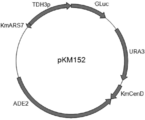
プラスミドpKM152(図1)が維持されたクルイベロマイセス・マルシアヌスRAK6205株(ura3 ade2 p[ScADE2c-KmARS7c-ScTDH3p-yGLuc-ScURA3-KmCEND])の染色体DNAをテンプレートとし、表1に示される各フォワードプライマーとリバースプライマーを用いてPCRを行い、配列番号3に示すアミノ酸配列からなる野生型ペプチド(MGVKV)、配列番号3に示すアミノ酸配列において、2番目のグリシンと3番目のバリンが欠損したペプチド2G3VΔ(MKV)、2番目のグリシンと3番目のバリンが欠損し、4番目のリジンをアルギニンに置換したペプチド2G3VΔ4KR(MRV)、2番目のグリシンと3番目のバリンが欠損し、4番目のリジンをアスパラギンに置換したペプチド2G3VΔ4KN(MNV)、2番目のグリシンと3番目のバリンが欠損し、4番目のリジンをトリプトファンに置換したペプチド2G3VΔ4KW(MWV)、2番目のグリシンと3番目のバリンが欠損し、4番目のリジンをフェニルアラニンに置換したペプチド2G3VΔ4KF(MFV)、2番目のグリシンと3番目のバリンが欠損し、4番目のリジンをチロシンに置換したペプチド2G3VΔ4KY(MYV)、2番目のグリシンと3番目のバリンが欠損し、4番目のリジンをメチオニンに置換したペプチド2G3VΔ4KM(MMV)、2番目のグリシンと3番目のバリンが欠損し、4番目のリジンをヒスチジンに置換したペプチド2G3VΔ4KH(MHV)、2番目のグリシンと3番目のバリンが欠損し、4番目のリジンをイソロイシンに置換したペプチド2G3VΔ4KI(MIV)、2番目のグリシンと3番目のバリンが欠損し、4番目のリジンをロイシンに置換したペプチド2G3VΔ4KL(MLV)、2番目のグリシンと3番目のバリンが欠損し、4番目のリジンをシステインに置換したペプチド2G3VΔ4KC(MCV)、2番目のグリシンと3番目のバリンが欠損し、4番目のリジンをスレオニンに置換したペプチド2G3VΔ4KT(MTV)、2番目のグリシンと3番目のバリンが欠損し、4番目のリジンをグルタミン酸に置換したペプチド2G3VΔ4KE(MEV)、2番目のグリシンと3番目のバリンが欠損し、4番目のリジンをグリシンに置換したペプチド2G3VΔ4KG(MGV)、2番目のグリシンと3番目のバリンが欠損し、4番目のリジンをアスパラギン酸に置換したペプチド2G3VΔ4KD(MDV)、2番目のグリシンと3番目のバリンが欠損し、4番目のリジンをセリンに置換したペプチド2G3VΔ4KS(MSV)、2番目のグリシンと3番目のバリンが欠損し、4番目のリジンをバリンに置換したペプチド2G3VΔ4KV(MVV)、2番目のグリシンと3番目のバリンが欠損し、4番目のリジンをプロリンに置換したペプチド2G3VΔ4KP(MPV)、2番目のグリシンと3番目のバリンが欠損し、4番目のリジンをアラニンに置換したペプチド2G3VΔ4KA(MAV)、又は2番目のグリシンと3番目のバリンが欠損し、4番目のリジンをグルタミンに置換したペプチド2G3VΔ4KQ(MQV)と、URA3マーカーと、KmCenDと、ADE2マーカーと、KmARS7と、TDH3プロモーターとをコードするDNA断片を作製した。PCRは、KOD FX neo(東洋紡社製)を用い、そのプロトコールに従って行った。KOD FX neo反応混合液は、反応液10μl中に1μlのテンプレートDNA溶液、0.3μlの10μMフォワードプライマー溶液、0.3μlの10μMリバースプライマー溶液、5μlの2×KOD FX neoバッファー、2μlの2mM dNTPs、0.2μlのKOD FX neo DNAポリメラーゼ、1.2μlの滅菌超純水を混ぜて調製した。反応は、94℃で2分間初期変性させた後、98℃で10秒間の熱変性、65℃で30秒間のアニーリング、68℃で3分間の伸長反応を30サイクルの条件で行った。
プラスミドpKM152(図1)が維持されたクルイベロマイセス・マルシアヌスRAK6205株(ura3 ade2 p[ScADE2c-KmARS7c-ScTDH3p-yGLuc-ScURA3-KmCEND])の染色体DNAをテンプレートとし、表1に示される各フォワードプライマーとリバースプライマーを用いてPCRを行い、配列番号3に示すアミノ酸配列からなる野生型ペプチド(MGVKV)、配列番号3に示すアミノ酸配列において、2番目のグリシンと3番目のバリンが欠損したペプチド2G3VΔ(MKV)、2番目のグリシンと3番目のバリンが欠損し、4番目のリジンをアルギニンに置換したペプチド2G3VΔ4KR(MRV)、2番目のグリシンと3番目のバリンが欠損し、4番目のリジンをアスパラギンに置換したペプチド2G3VΔ4KN(MNV)、2番目のグリシンと3番目のバリンが欠損し、4番目のリジンをトリプトファンに置換したペプチド2G3VΔ4KW(MWV)、2番目のグリシンと3番目のバリンが欠損し、4番目のリジンをフェニルアラニンに置換したペプチド2G3VΔ4KF(MFV)、2番目のグリシンと3番目のバリンが欠損し、4番目のリジンをチロシンに置換したペプチド2G3VΔ4KY(MYV)、2番目のグリシンと3番目のバリンが欠損し、4番目のリジンをメチオニンに置換したペプチド2G3VΔ4KM(MMV)、2番目のグリシンと3番目のバリンが欠損し、4番目のリジンをヒスチジンに置換したペプチド2G3VΔ4KH(MHV)、2番目のグリシンと3番目のバリンが欠損し、4番目のリジンをイソロイシンに置換したペプチド2G3VΔ4KI(MIV)、2番目のグリシンと3番目のバリンが欠損し、4番目のリジンをロイシンに置換したペプチド2G3VΔ4KL(MLV)、2番目のグリシンと3番目のバリンが欠損し、4番目のリジンをシステインに置換したペプチド2G3VΔ4KC(MCV)、2番目のグリシンと3番目のバリンが欠損し、4番目のリジンをスレオニンに置換したペプチド2G3VΔ4KT(MTV)、2番目のグリシンと3番目のバリンが欠損し、4番目のリジンをグルタミン酸に置換したペプチド2G3VΔ4KE(MEV)、2番目のグリシンと3番目のバリンが欠損し、4番目のリジンをグリシンに置換したペプチド2G3VΔ4KG(MGV)、2番目のグリシンと3番目のバリンが欠損し、4番目のリジンをアスパラギン酸に置換したペプチド2G3VΔ4KD(MDV)、2番目のグリシンと3番目のバリンが欠損し、4番目のリジンをセリンに置換したペプチド2G3VΔ4KS(MSV)、2番目のグリシンと3番目のバリンが欠損し、4番目のリジンをバリンに置換したペプチド2G3VΔ4KV(MVV)、2番目のグリシンと3番目のバリンが欠損し、4番目のリジンをプロリンに置換したペプチド2G3VΔ4KP(MPV)、2番目のグリシンと3番目のバリンが欠損し、4番目のリジンをアラニンに置換したペプチド2G3VΔ4KA(MAV)、又は2番目のグリシンと3番目のバリンが欠損し、4番目のリジンをグルタミンに置換したペプチド2G3VΔ4KQ(MQV)と、URA3マーカーと、KmCenDと、ADE2マーカーと、KmARS7と、TDH3プロモーターとをコードするDNA断片を作製した。PCRは、KOD FX neo(東洋紡社製)を用い、そのプロトコールに従って行った。KOD FX neo反応混合液は、反応液10μl中に1μlのテンプレートDNA溶液、0.3μlの10μMフォワードプライマー溶液、0.3μlの10μMリバースプライマー溶液、5μlの2×KOD FX neoバッファー、2μlの2mM dNTPs、0.2μlのKOD FX neo DNAポリメラーゼ、1.2μlの滅菌超純水を混ぜて調製した。反応は、94℃で2分間初期変性させた後、98℃で10秒間の熱変性、65℃で30秒間のアニーリング、68℃で3分間の伸長反応を30サイクルの条件で行った。

(形質転換体の作製)
クルイベロマイセス・マルシアヌスの形質転換体はAbdel-Banatらの方法(Abdel-Banat et al.,Yeast vol.27 29-39(2009))に従って作製した。250mlのフラスコを用い、30mlのYPD培地(1%酵母エキス、2%ポリペプトン、2%グルコース)でクルイベロマイセス・マルシアヌスRAK3908株(ura3 ade2:Yarimizu et al., Yeast vol. 30: 485-500(2013))を150rpm、24時間30℃の条件下で振とう培養した。培養した細胞を3000rpm、3分間遠心して回収し、900μlのTFBバッファー(20mlの60%ポリエチレングリコール3350(シグマ・アルドリッチ社製)、3mlの1Mジチオスレイトール(和光純薬工業社製)、1.5mlの4Mリチウムアセテート(キシダ化学社製)、5.5mlの滅菌水で懸濁した。再度3000rpm、3分間遠心して回収し、600μlのTFBバッファーで懸濁した。細胞懸濁液を50μlずつ1.5mlチューブに移し、上述で作製した野生型及び各変異ペプチドをコードするDNA断片70ngと混和した。42℃で30分培養後、細胞懸濁液をウラシル欠損培地(0.17%イーストニトロゲンベース(アミノ酸、硫酸アンモニウム不含)、0.5%硫酸アンモニウム、2%グルコース、ウラシル以外の必要な栄養素)に塗布し、28℃で2-3日培養し、生育したコロニーを形質転換体とした。
クルイベロマイセス・マルシアヌスの形質転換体はAbdel-Banatらの方法(Abdel-Banat et al.,Yeast vol.27 29-39(2009))に従って作製した。250mlのフラスコを用い、30mlのYPD培地(1%酵母エキス、2%ポリペプトン、2%グルコース)でクルイベロマイセス・マルシアヌスRAK3908株(ura3 ade2:Yarimizu et al., Yeast vol. 30: 485-500(2013))を150rpm、24時間30℃の条件下で振とう培養した。培養した細胞を3000rpm、3分間遠心して回収し、900μlのTFBバッファー(20mlの60%ポリエチレングリコール3350(シグマ・アルドリッチ社製)、3mlの1Mジチオスレイトール(和光純薬工業社製)、1.5mlの4Mリチウムアセテート(キシダ化学社製)、5.5mlの滅菌水で懸濁した。再度3000rpm、3分間遠心して回収し、600μlのTFBバッファーで懸濁した。細胞懸濁液を50μlずつ1.5mlチューブに移し、上述で作製した野生型及び各変異ペプチドをコードするDNA断片70ngと混和した。42℃で30分培養後、細胞懸濁液をウラシル欠損培地(0.17%イーストニトロゲンベース(アミノ酸、硫酸アンモニウム不含)、0.5%硫酸アンモニウム、2%グルコース、ウラシル以外の必要な栄養素)に塗布し、28℃で2-3日培養し、生育したコロニーを形質転換体とした。
(ルシフェラーゼ活性の測定)
ルシフェラーゼ活性の測定にはBioLux(登録商標)Gaussia Luciferase Assay Kit(ニューイングランド・バイオラボ社製)を用いた。まず、上述で得られた形質転換体をウラシル欠損培地で培養し、前培養液を調製した。次に、96ウェルのマイクロプレートを用い、300μlのYPD培地に10μlの前培養液を加えて、28℃で24時間培養し、かかる培養液10μlとGLucアッセイ溶液(1mlのBioLux(商標登録) GLuc Assay Buffer (×1)、10μlのBioLux(商標登録) GLuc Assay Substrate (×100))20μlを混合し、室温で5秒間静置してルシフェラーゼ活性をCentro LB960 microplate reader(Berthold社製)により測定した。結果を図2に示す。
ルシフェラーゼ活性の測定にはBioLux(登録商標)Gaussia Luciferase Assay Kit(ニューイングランド・バイオラボ社製)を用いた。まず、上述で得られた形質転換体をウラシル欠損培地で培養し、前培養液を調製した。次に、96ウェルのマイクロプレートを用い、300μlのYPD培地に10μlの前培養液を加えて、28℃で24時間培養し、かかる培養液10μlとGLucアッセイ溶液(1mlのBioLux(商標登録) GLuc Assay Buffer (×1)、10μlのBioLux(商標登録) GLuc Assay Substrate (×100))20μlを混合し、室温で5秒間静置してルシフェラーゼ活性をCentro LB960 microplate reader(Berthold社製)により測定した。結果を図2に示す。
(結果)
図2において、横軸は野生型のGLuc(MGVKV)を発現させて測定したルシフェラーゼ活性を1とした場合の、それぞれの変異ペプチドを発現させて測定したルシフェラーゼ活性の相対値、縦軸は発現させたペプチドの種類を示す。図2に示すように、分泌シグナルペプチドのN末端側の塩基性アミノ酸としてリジン又はアルギニンがあれば、分泌能力が野生型に比べて2倍以上に高くなることが明らかとなった。
図2において、横軸は野生型のGLuc(MGVKV)を発現させて測定したルシフェラーゼ活性を1とした場合の、それぞれの変異ペプチドを発現させて測定したルシフェラーゼ活性の相対値、縦軸は発現させたペプチドの種類を示す。図2に示すように、分泌シグナルペプチドのN末端側の塩基性アミノ酸としてリジン又はアルギニンがあれば、分泌能力が野生型に比べて2倍以上に高くなることが明らかとなった。
[リジン又はアルギニンに続くアミノ酸の置換]
配列番号3に示すGLucのアミノ酸配列において2番目のグリシンと3番目のバリンを削除し、4番目のリジン又はアルギニンに続くアミノ酸を連続する8個の同一のアミノ酸に置換した、変異分泌シグナルペプチドを備えた変異GLucを酵母で発現させ、培養液のルシフェラーゼ活性を調べることにより変異分泌シグナルペプチドの分泌能力を評価した。
配列番号3に示すGLucのアミノ酸配列において2番目のグリシンと3番目のバリンを削除し、4番目のリジン又はアルギニンに続くアミノ酸を連続する8個の同一のアミノ酸に置換した、変異分泌シグナルペプチドを備えた変異GLucを酵母で発現させ、培養液のルシフェラーゼ活性を調べることにより変異分泌シグナルペプチドの分泌能力を評価した。
(変異ペプチドをコードするDNA断片の作製)
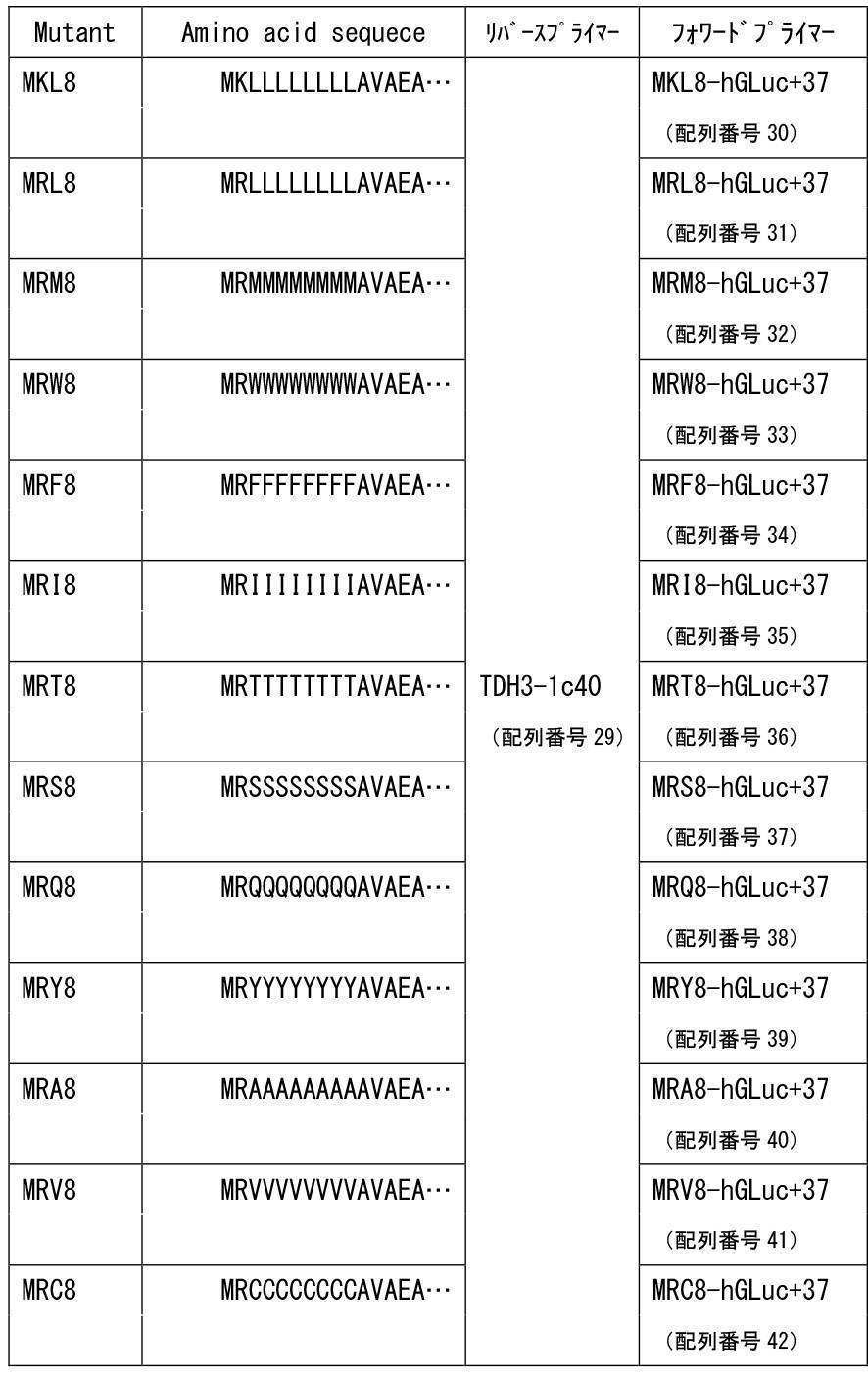
プラスミドpKM152(図1)が維持されたクルイベロマイセス・マルシアヌスRAK6205株の染色体をテンプレートとして、配列番号28に示されるフォワードプライマー(yGLuc+37)と配列番号29に示されるリバースプライマー(TDH3-1c40)を用いてPCRを行い、GLucと、URA3マーカーと、KmCenDと、ADE2マーカーと、KmARS7と、TDH3プロモーターとをコードするDNA断片を得た。次に、得られたDNA断片をテンプレートとして、表2に示される各フォワードプライマーとリバースプライマーを用いてPCRを行い、配列番号3に示されるアミノ酸配列において、2番目のグリシンと3番目のバリンが欠損し、5番目~12番目のアミノ酸をロイシンに置換したペプチド(MKL8)、2番目のグリシンと3番目のバリンが欠損し、4番目のリジンをアルギニンに置換し、5番目~12番目のアミノ酸をロイシンに置換したペプチド(MRL8)、2番目のグリシンと3番目のバリンが欠損し、4番目のリジンをアルギニンに置換し、5番目~12番目のアミノ酸をメチオニンに置換したペプチド(MRM8)、2番目のグリシンと3番目のバリンが欠損し、4番目のリジンをアルギニンに置換し、5番目~12番目のアミノ酸をトリプトファンに置換したペプチド(MRW8)、2番目のグリシンと3番目のバリンが欠損し、4番目のリジンをアルギニンに置換し、5番目~12番目のアミノ酸をフェニルアラニンに置換したペプチド(MRF8)、2番目のグリシンと3番目のバリンが欠損し、4番目のリジンをアルギニンに置換し、5番目~12番目のアミノ酸をイソロイシンに置換したペプチド(MRI8)、2番目のグリシンと3番目のバリンが欠損し、4番目のリジンをアルギニンに置換し、5番目~12番目のアミノ酸をスレオニンに置換したペプチド(MRT8)、2番目のグリシンと3番目のバリンが欠損し、4番目のリジンをアルギニンに置換し、5番目~12番目のアミノ酸をセリンに置換したペプチド(MRS8)、2番目のグリシンと3番目のバリンが欠損し、4番目のリジンをアルギニンに置換し、5番目~12番目のアミノ酸をグルタミンに置換したペプチド(MRQ8)、2番目のグリシンと3番目のバリンが欠損し、4番目のリジンをアルギニンに置換し、5番目~12番目のアミノ酸をチロシンに置換したペプチド(MRY8)、2番目のグリシンと3番目のバリンが欠損し、4番目のリジンをアルギニンに置換し、5番目~12番目のアミノ酸をアラニンに置換したペプチド(MRA8)、2番目のグリシンと3番目のバリンが欠損し、4番目のリジンをアルギニンに置換し、5番目~12番目のアミノ酸をバリンに置換したペプチド(MRV8)、又は2番目のグリシンと3番目のバリンが欠損し、4番目のリジンをアルギニンに置換し、5番目~12番目のアミノ酸をシステインに置換したペプチド(MRC8)と、URA3マーカーと、KmCenDと、ADE2マーカーと、KmARS7と、TDH3プロモーターとをコードするDNA断片を作製した。PCR反応は、上述と同様の条件で行った。
プラスミドpKM152(図1)が維持されたクルイベロマイセス・マルシアヌスRAK6205株の染色体をテンプレートとして、配列番号28に示されるフォワードプライマー(yGLuc+37)と配列番号29に示されるリバースプライマー(TDH3-1c40)を用いてPCRを行い、GLucと、URA3マーカーと、KmCenDと、ADE2マーカーと、KmARS7と、TDH3プロモーターとをコードするDNA断片を得た。次に、得られたDNA断片をテンプレートとして、表2に示される各フォワードプライマーとリバースプライマーを用いてPCRを行い、配列番号3に示されるアミノ酸配列において、2番目のグリシンと3番目のバリンが欠損し、5番目~12番目のアミノ酸をロイシンに置換したペプチド(MKL8)、2番目のグリシンと3番目のバリンが欠損し、4番目のリジンをアルギニンに置換し、5番目~12番目のアミノ酸をロイシンに置換したペプチド(MRL8)、2番目のグリシンと3番目のバリンが欠損し、4番目のリジンをアルギニンに置換し、5番目~12番目のアミノ酸をメチオニンに置換したペプチド(MRM8)、2番目のグリシンと3番目のバリンが欠損し、4番目のリジンをアルギニンに置換し、5番目~12番目のアミノ酸をトリプトファンに置換したペプチド(MRW8)、2番目のグリシンと3番目のバリンが欠損し、4番目のリジンをアルギニンに置換し、5番目~12番目のアミノ酸をフェニルアラニンに置換したペプチド(MRF8)、2番目のグリシンと3番目のバリンが欠損し、4番目のリジンをアルギニンに置換し、5番目~12番目のアミノ酸をイソロイシンに置換したペプチド(MRI8)、2番目のグリシンと3番目のバリンが欠損し、4番目のリジンをアルギニンに置換し、5番目~12番目のアミノ酸をスレオニンに置換したペプチド(MRT8)、2番目のグリシンと3番目のバリンが欠損し、4番目のリジンをアルギニンに置換し、5番目~12番目のアミノ酸をセリンに置換したペプチド(MRS8)、2番目のグリシンと3番目のバリンが欠損し、4番目のリジンをアルギニンに置換し、5番目~12番目のアミノ酸をグルタミンに置換したペプチド(MRQ8)、2番目のグリシンと3番目のバリンが欠損し、4番目のリジンをアルギニンに置換し、5番目~12番目のアミノ酸をチロシンに置換したペプチド(MRY8)、2番目のグリシンと3番目のバリンが欠損し、4番目のリジンをアルギニンに置換し、5番目~12番目のアミノ酸をアラニンに置換したペプチド(MRA8)、2番目のグリシンと3番目のバリンが欠損し、4番目のリジンをアルギニンに置換し、5番目~12番目のアミノ酸をバリンに置換したペプチド(MRV8)、又は2番目のグリシンと3番目のバリンが欠損し、4番目のリジンをアルギニンに置換し、5番目~12番目のアミノ酸をシステインに置換したペプチド(MRC8)と、URA3マーカーと、KmCenDと、ADE2マーカーと、KmARS7と、TDH3プロモーターとをコードするDNA断片を作製した。PCR反応は、上述と同様の条件で行った。
(形質転換体の作製及びルシフェラーゼ活性の測定)
作製した各変異ペプチドをコードするDNA断片を用い、上述と同様の方法でクルイベロマイセス・マルシアヌスRAK3908株の形質転換体を作製し、かかる形質転換体をYPB培地で培養して培養液中のルシフェラーゼ活性を測定した。結果を図3に示す。
作製した各変異ペプチドをコードするDNA断片を用い、上述と同様の方法でクルイベロマイセス・マルシアヌスRAK3908株の形質転換体を作製し、かかる形質転換体をYPB培地で培養して培養液中のルシフェラーゼ活性を測定した。結果を図3に示す。
(結果)
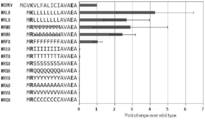
図3において、横軸は野生型のGLuc(MGVKV)を発現させて測定したルシフェラーゼ活性を1とした場合の、それぞれの変異ペプチドを発現させて測定したルシフェラーゼ活性の相対値、縦軸は発現させたペプチドの種類を示す。図3に示すように、分泌シグナルペプチドのN末端側の塩基性アミノ酸として、リジン又はアルギニンに続くアミノ酸がロイシンやメチオニンやトリプトファンであれば、分泌能力が野生型に比べて2倍以上に高くなることが明らかとなった。
図3において、横軸は野生型のGLuc(MGVKV)を発現させて測定したルシフェラーゼ活性を1とした場合の、それぞれの変異ペプチドを発現させて測定したルシフェラーゼ活性の相対値、縦軸は発現させたペプチドの種類を示す。図3に示すように、分泌シグナルペプチドのN末端側の塩基性アミノ酸として、リジン又はアルギニンに続くアミノ酸がロイシンやメチオニンやトリプトファンであれば、分泌能力が野生型に比べて2倍以上に高くなることが明らかとなった。
[連続したロイシンへの置換]
上記結果より、リジン又はアルギニンに続くアミノ酸がロイシンの場合に分泌能力が高かったことから、配列番号3に示すGlucのアミノ酸配列において、2番目のグリシンと3番目のバリンを削除し、5番目から15番目のアミノ酸を7個~17個の連続するロイシンにした、変異分泌シグナルペプチドを備えた変異GLucを酵母で発現させ、培養液のルシフェラーゼ活性を調べることにより変異分泌シグナルペプチドの分泌能力を評価した。
上記結果より、リジン又はアルギニンに続くアミノ酸がロイシンの場合に分泌能力が高かったことから、配列番号3に示すGlucのアミノ酸配列において、2番目のグリシンと3番目のバリンを削除し、5番目から15番目のアミノ酸を7個~17個の連続するロイシンにした、変異分泌シグナルペプチドを備えた変異GLucを酵母で発現させ、培養液のルシフェラーゼ活性を調べることにより変異分泌シグナルペプチドの分泌能力を評価した。
(変異ペプチドをコードするDNA断片の作製)
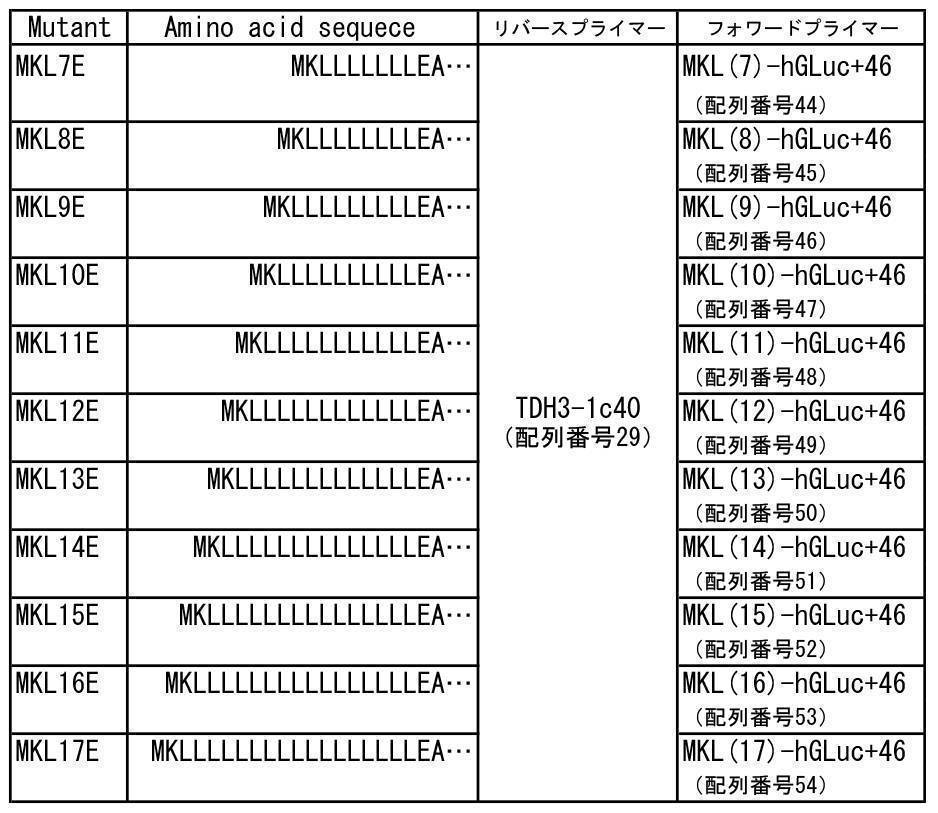
プラスミドpKM152(図1)が維持されたクルイベロマイセス・マルシアヌスRAK6205株の染色体をテンプレートとして、配列番号43に示されるフォワードプライマー(yGLuc+64)と配列番号29に示されるリバースプライマー(TDH3-1c40)を用いてPCRを行い、GLucと、URA3マーカーと、KmCenDと、ADE2マーカーと、KmARS7と、TDH3プロモーターとをコードするDNA断片を得た。次に、得られたDNA断片をテンプレートとして、表3に示される各フォワードプライマーとリバースプライマーを用いてPCRを行い、配列番号3に示されるアミノ酸配列において、2番目のグリシンと3番目のバリンが欠損し、5番目~15番目のアミノ酸を連続する7個のロイシンに置換したペプチド(MKL7E)、2番目のグリシンと3番目のバリンが欠損し、5番目~15番目のアミノ酸を連続する8個のロイシンに置換したペプチド(MKL8E)、2番目のグリシンと3番目のバリンが欠損し、5番目~15番目のアミノ酸を連続する9個のロイシンに置換したペプチド(MKL9E)、2番目のグリシンと3番目のバリンが欠損し、5番目~15番目のアミノ酸を連続する10個のロイシンに置換したペプチド(MKL10E)、2番目のグリシンと3番目のバリンが欠損し、5番目~15番目のアミノ酸を連続する11個のロイシンに置換したペプチド(MKL11E)、2番目のグリシンと3番目のバリンが欠損し、5番目~15番目のアミノ酸を連続する12個のロイシンに置換したペプチド(MKL12E)、2番目のグリシンと3番目のバリンが欠損し、5番目~15番目のアミノ酸を連続する13個のロイシンに置換したペプチド(MKL13E)、2番目のグリシンと3番目のバリンが欠損し、5番目~15番目のアミノ酸を連続する14個のロイシンに置換したペプチド(MKL14E)、2番目のグリシンと3番目のバリンが欠損し、5番目~15番目のアミノ酸を連続する15個のロイシンに置換したペプチド(MKL15E)、2番目のグリシンと3番目のバリンが欠損し、5番目~15番目のアミノ酸を連続する16個のロイシンに置換したペプチド(MKL16E)、又は2番目のグリシンと3番目のバリンが欠損し、5番目~15番目のアミノ酸を連続する17個のロイシンに置換したペプチド(MKL17E)と、URA3マーカーと、KmCenDと、ADE2マーカーと、KmARS7と、TDH3プロモーターとをコードするDNA断片を作製した。PCR反応は、上述と同様の条件で行った。
プラスミドpKM152(図1)が維持されたクルイベロマイセス・マルシアヌスRAK6205株の染色体をテンプレートとして、配列番号43に示されるフォワードプライマー(yGLuc+64)と配列番号29に示されるリバースプライマー(TDH3-1c40)を用いてPCRを行い、GLucと、URA3マーカーと、KmCenDと、ADE2マーカーと、KmARS7と、TDH3プロモーターとをコードするDNA断片を得た。次に、得られたDNA断片をテンプレートとして、表3に示される各フォワードプライマーとリバースプライマーを用いてPCRを行い、配列番号3に示されるアミノ酸配列において、2番目のグリシンと3番目のバリンが欠損し、5番目~15番目のアミノ酸を連続する7個のロイシンに置換したペプチド(MKL7E)、2番目のグリシンと3番目のバリンが欠損し、5番目~15番目のアミノ酸を連続する8個のロイシンに置換したペプチド(MKL8E)、2番目のグリシンと3番目のバリンが欠損し、5番目~15番目のアミノ酸を連続する9個のロイシンに置換したペプチド(MKL9E)、2番目のグリシンと3番目のバリンが欠損し、5番目~15番目のアミノ酸を連続する10個のロイシンに置換したペプチド(MKL10E)、2番目のグリシンと3番目のバリンが欠損し、5番目~15番目のアミノ酸を連続する11個のロイシンに置換したペプチド(MKL11E)、2番目のグリシンと3番目のバリンが欠損し、5番目~15番目のアミノ酸を連続する12個のロイシンに置換したペプチド(MKL12E)、2番目のグリシンと3番目のバリンが欠損し、5番目~15番目のアミノ酸を連続する13個のロイシンに置換したペプチド(MKL13E)、2番目のグリシンと3番目のバリンが欠損し、5番目~15番目のアミノ酸を連続する14個のロイシンに置換したペプチド(MKL14E)、2番目のグリシンと3番目のバリンが欠損し、5番目~15番目のアミノ酸を連続する15個のロイシンに置換したペプチド(MKL15E)、2番目のグリシンと3番目のバリンが欠損し、5番目~15番目のアミノ酸を連続する16個のロイシンに置換したペプチド(MKL16E)、又は2番目のグリシンと3番目のバリンが欠損し、5番目~15番目のアミノ酸を連続する17個のロイシンに置換したペプチド(MKL17E)と、URA3マーカーと、KmCenDと、ADE2マーカーと、KmARS7と、TDH3プロモーターとをコードするDNA断片を作製した。PCR反応は、上述と同様の条件で行った。
(形質転換体の作製及びルシフェラーゼ活性の測定)
作製した各変異ペプチドをコードするDNA断片を用い、上述と同様の方法でクルイベロマイセス・マルシアヌスRAK3908株の形質転換体を作製し、かかる形質転換体をYPB培地で培養してルシフェラーゼ活性を測定した。結果を図4に示す。
作製した各変異ペプチドをコードするDNA断片を用い、上述と同様の方法でクルイベロマイセス・マルシアヌスRAK3908株の形質転換体を作製し、かかる形質転換体をYPB培地で培養してルシフェラーゼ活性を測定した。結果を図4に示す。
(結果)
図4において、横軸は野生型のGLuc(MGVKV)を発現させて測定したルシフェラーゼ活性を1とした場合の、それぞれの変異ペプチドを発現させて測定したルシフェラーゼ活性の相対値、縦軸は発現させたペプチドの種類を示す。図4に示すように、リジン又はアルギニンに続くアミノ酸がロイシンの場合、ルシフェラーゼ活性は、連続するロイシンの個数が11~13の場合に高かったが、野生型に対して3倍程度であった。
図4において、横軸は野生型のGLuc(MGVKV)を発現させて測定したルシフェラーゼ活性を1とした場合の、それぞれの変異ペプチドを発現させて測定したルシフェラーゼ活性の相対値、縦軸は発現させたペプチドの種類を示す。図4に示すように、リジン又はアルギニンに続くアミノ酸がロイシンの場合、ルシフェラーゼ活性は、連続するロイシンの個数が11~13の場合に高かったが、野生型に対して3倍程度であった。
[16番目のグルタミン酸の置換]
配列番号3に示すGlucのアミノ酸配列において、16番目のグルタミン酸を他のアミノ酸に置換した、変異分泌シグナルペプチドを備えた変異GLucを酵母で発現させ、培養液のルシフェラーゼ活性を調べることにより変異分泌シグナルペプチドの分泌能力を評価した。
配列番号3に示すGlucのアミノ酸配列において、16番目のグルタミン酸を他のアミノ酸に置換した、変異分泌シグナルペプチドを備えた変異GLucを酵母で発現させ、培養液のルシフェラーゼ活性を調べることにより変異分泌シグナルペプチドの分泌能力を評価した。
(変異ペプチドをコードするDNA断片の作製)
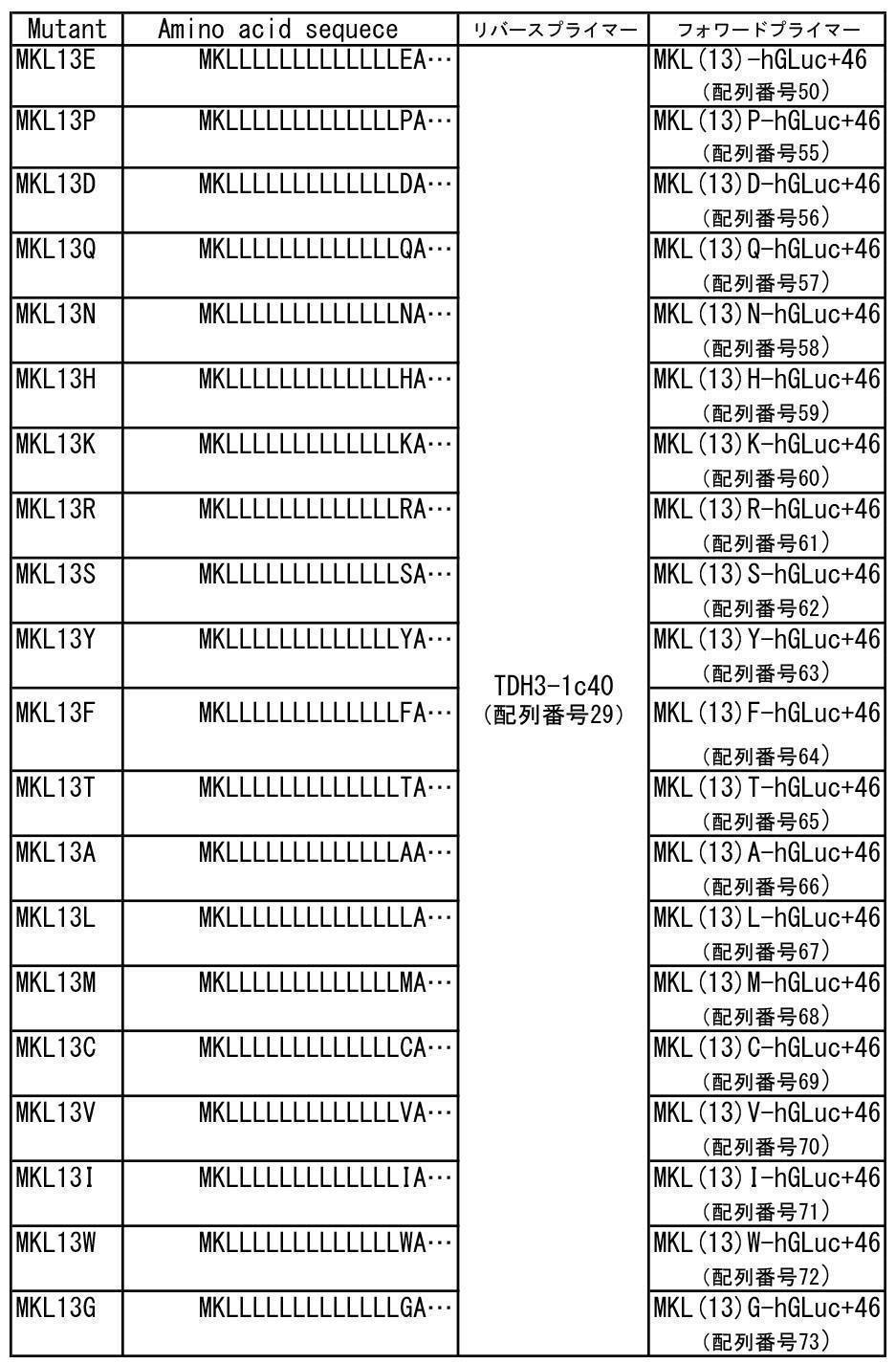
プラスミドpKM152(図1)が維持されたクルイベロマイセス・マルシアヌスRAK6205株の染色体をテンプレートとして、配列番号43に示されるフォワードプライマー(yGLuc+64)と配列番号29に示されるリバースプライマー(TDH3-1c40)を用いてPCRを行い、GLucと、URA3マーカーと、KmCenDと、ADE2マーカーと、KmARS7と、TDH3プロモーターをコードするDNA断片を得た。次に、得られたDNA断片をテンプレートとして、表4に示される各フォワードプライマーとリバースプライマーを用いてPCRを行い、配列番号3に示されるアミノ酸配列において、2番目のグリシンと3番目のバリンが欠損し、5番目~15番目のアミノ酸をロイシンに置換したペプチド(MKL13E)、2番目のグリシンと3番目のバリンが欠損し、5番目~15番目のアミノ酸をロイシンに置換し、16番目のグルタミン酸をプロリンに置換したペプチド(MKL13P)、16番目のグルタミン酸をアスパラギン酸に置換したペプチド(MKL13D)、16番目のグルタミン酸をグルタミンに置換したペプチド(MKL13Q)、16番目のグルタミン酸をアスパラギンに置換したペプチド(MKL13N)、16番目のグルタミン酸をヒスチジンに置換したペプチド(MKL13H)、16番目のグルタミン酸をリジンに置換したペプチド(MKL13K)、16番目のグルタミン酸をアルギニンに置換したペプチド(MKL13R)、16番目のグルタミン酸をセリンに置換したペプチド(MKL13S)、16番目のグルタミン酸をチロシンに置換したペプチド(MKL13Y)、16番目のグルタミン酸をフェニルアラニンに置換したペプチド(MKL13F)、16番目のグルタミン酸をスレオニンに置換したペプチド(MKL13T)、16番目のグルタミン酸をアラニンに置換したペプチド(MKL13A)、16番目のグルタミン酸をロイシンに置換したペプチド(MKL13L)、16番目のグルタミン酸をメチオニンに置換したペプチド(MKL13M)、16番目のグルタミン酸をシステインに置換したペプチド(MKL13C)、16番目のグルタミン酸をバリンに置換したペプチド(MKL13V)、16番目のグルタミン酸をイソロイシンに置換したペプチド(MKL13I)、16番目のグルタミン酸をトリプトファンに置換したペプチド(MKL13W)、又は16番目のグルタミン酸をグリシンに置換したペプチド(MKL13G)と、URA3マーカーと、KmCenDと、ADE2マーカーと、KmARS7と、TDH3プロモーターとをコードするDNA断片を作製した。PCR反応は、上述と同様の条件で行った。
プラスミドpKM152(図1)が維持されたクルイベロマイセス・マルシアヌスRAK6205株の染色体をテンプレートとして、配列番号43に示されるフォワードプライマー(yGLuc+64)と配列番号29に示されるリバースプライマー(TDH3-1c40)を用いてPCRを行い、GLucと、URA3マーカーと、KmCenDと、ADE2マーカーと、KmARS7と、TDH3プロモーターをコードするDNA断片を得た。次に、得られたDNA断片をテンプレートとして、表4に示される各フォワードプライマーとリバースプライマーを用いてPCRを行い、配列番号3に示されるアミノ酸配列において、2番目のグリシンと3番目のバリンが欠損し、5番目~15番目のアミノ酸をロイシンに置換したペプチド(MKL13E)、2番目のグリシンと3番目のバリンが欠損し、5番目~15番目のアミノ酸をロイシンに置換し、16番目のグルタミン酸をプロリンに置換したペプチド(MKL13P)、16番目のグルタミン酸をアスパラギン酸に置換したペプチド(MKL13D)、16番目のグルタミン酸をグルタミンに置換したペプチド(MKL13Q)、16番目のグルタミン酸をアスパラギンに置換したペプチド(MKL13N)、16番目のグルタミン酸をヒスチジンに置換したペプチド(MKL13H)、16番目のグルタミン酸をリジンに置換したペプチド(MKL13K)、16番目のグルタミン酸をアルギニンに置換したペプチド(MKL13R)、16番目のグルタミン酸をセリンに置換したペプチド(MKL13S)、16番目のグルタミン酸をチロシンに置換したペプチド(MKL13Y)、16番目のグルタミン酸をフェニルアラニンに置換したペプチド(MKL13F)、16番目のグルタミン酸をスレオニンに置換したペプチド(MKL13T)、16番目のグルタミン酸をアラニンに置換したペプチド(MKL13A)、16番目のグルタミン酸をロイシンに置換したペプチド(MKL13L)、16番目のグルタミン酸をメチオニンに置換したペプチド(MKL13M)、16番目のグルタミン酸をシステインに置換したペプチド(MKL13C)、16番目のグルタミン酸をバリンに置換したペプチド(MKL13V)、16番目のグルタミン酸をイソロイシンに置換したペプチド(MKL13I)、16番目のグルタミン酸をトリプトファンに置換したペプチド(MKL13W)、又は16番目のグルタミン酸をグリシンに置換したペプチド(MKL13G)と、URA3マーカーと、KmCenDと、ADE2マーカーと、KmARS7と、TDH3プロモーターとをコードするDNA断片を作製した。PCR反応は、上述と同様の条件で行った。
(形質転換体の作製及びルシフェラーゼ活性の測定)
作製した各変異ペプチドをコードするDNA断片を用い、上述と同様の方法でクルイベロマイセス・マルシアヌスRAK3908株の形質転換体を作製し、かかる形質転換体をYPB培地で培養してルシフェラーゼ活性を測定した。結果を図5に示す。
作製した各変異ペプチドをコードするDNA断片を用い、上述と同様の方法でクルイベロマイセス・マルシアヌスRAK3908株の形質転換体を作製し、かかる形質転換体をYPB培地で培養してルシフェラーゼ活性を測定した。結果を図5に示す。
(結果)
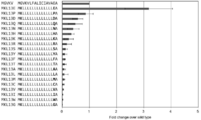
図5において、横軸は野生型のGLuc(MGVKV)を発現させて測定したルシフェラーゼ活性を1とした場合の、それぞれの変異ペプチドを発現させて測定したルシフェラーゼ活性の相対値、縦軸は発現させたペプチドの種類を示す。図5に示すように、連続するロイシンのC末端側のアミノ酸が酸性アミノ酸であるグルタミン酸の場合に分泌能力が高いことが明らかとなった。
図5において、横軸は野生型のGLuc(MGVKV)を発現させて測定したルシフェラーゼ活性を1とした場合の、それぞれの変異ペプチドを発現させて測定したルシフェラーゼ活性の相対値、縦軸は発現させたペプチドの種類を示す。図5に示すように、連続するロイシンのC末端側のアミノ酸が酸性アミノ酸であるグルタミン酸の場合に分泌能力が高いことが明らかとなった。
[連続したメチオニンへの置換]
塩基性アミノ酸であるリジン又はアルギニンと、酸性アミノ酸であるグルタミン酸の間にロイシンが11~13個あれば、分泌能力を有することが明らかとなったが、さらに分泌能力が高い分泌シグナルペプチドの作製を試みた。配列番号3に示すGlucのアミノ酸配列において、2番目のグリシンと3番目のバリンを削除し、5番目から15番目のアミノ酸を7個~17個の連続するメチオニンに置換した、変異分泌シグナルペプチドを備えた変異GLucを酵母で発現させ、培養液のルシフェラーゼ活性を調べることにより変異分泌シグナルペプチドの分泌能力を評価した。
塩基性アミノ酸であるリジン又はアルギニンと、酸性アミノ酸であるグルタミン酸の間にロイシンが11~13個あれば、分泌能力を有することが明らかとなったが、さらに分泌能力が高い分泌シグナルペプチドの作製を試みた。配列番号3に示すGlucのアミノ酸配列において、2番目のグリシンと3番目のバリンを削除し、5番目から15番目のアミノ酸を7個~17個の連続するメチオニンに置換した、変異分泌シグナルペプチドを備えた変異GLucを酵母で発現させ、培養液のルシフェラーゼ活性を調べることにより変異分泌シグナルペプチドの分泌能力を評価した。
(変異ペプチドをコードするDNA断片の作製)
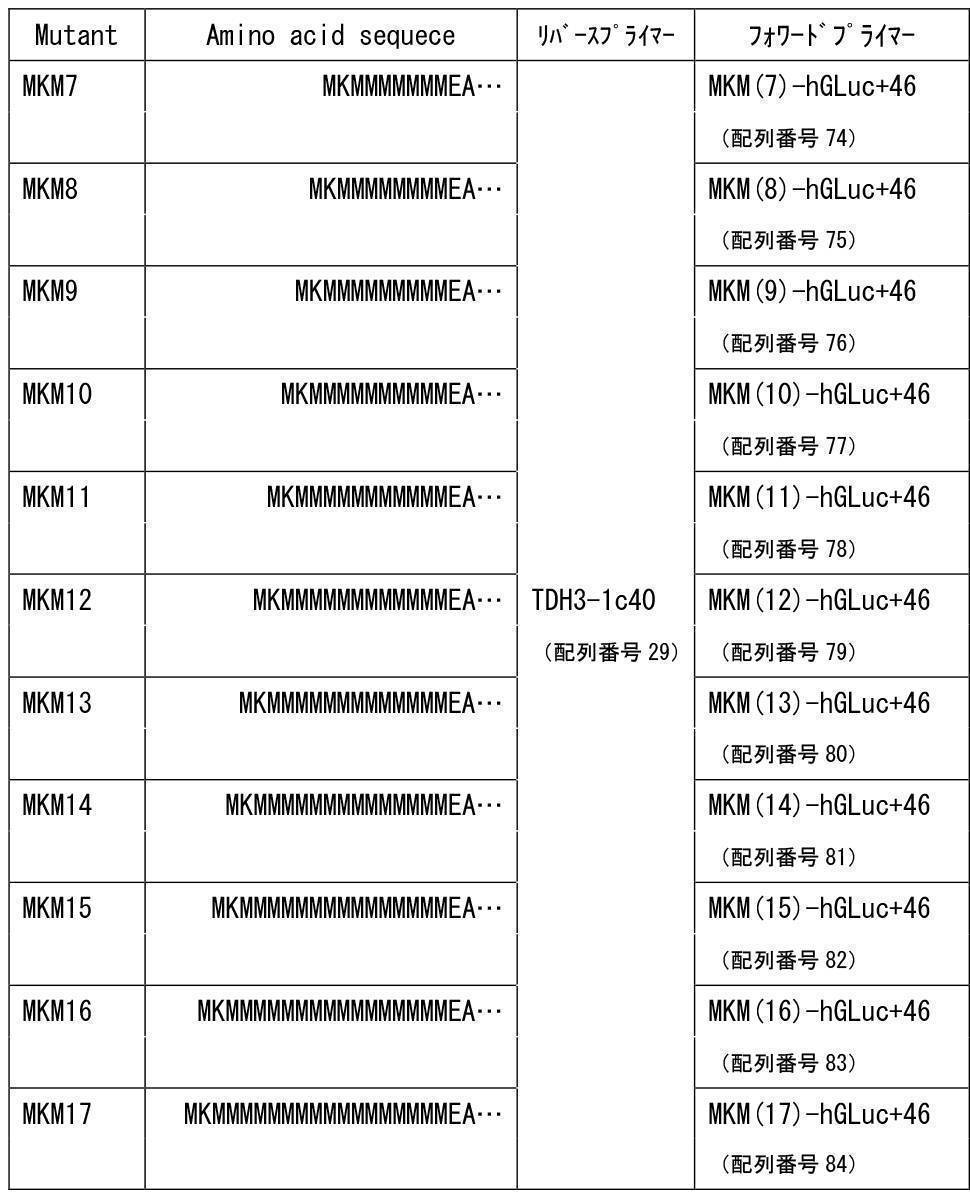
プラスミドpKM152(図1)が維持されたクルイベロマイセス・マルシアヌスRAK6205株の染色体をテンプレートとして、配列番号43に示されるフォワードプライマー(yGLuc+64)と配列番号29に示されるリバースプライマー(TDH3-1c40)を用いてPCRを行い、GLucと、URA3マーカーと、KmCenDと、ADE2マーカーと、KmARS7と、TDH3プロモーターをコードするDNA断片を得た。次に、得られたDNA断片をテンプレートとして、表5に示される各フォワードプライマーとリバースプライマーを用いてPCRを行い、配列番号3に示されるアミノ酸配列において、2番目のグリシンと3番目のバリンが欠損し、5番目~15番目のアミノ酸を連続する7個のメチオニンに置換したペプチド(MKM7)、2番目のグリシンと3番目のバリンが欠損し、5番目~15番目のアミノ酸を連続する8個のメチオニンに置換したペプチド(MKM8)、2番目のグリシンと3番目のバリンが欠損し、5番目~15番目のアミノ酸を連続する9個のメチオニンに置換したペプチド(MKM9)、2番目のグリシンと3番目のバリンが欠損し、5番目~15番目のアミノ酸を連続する10個のメチオニンに置換したペプチド(MKM10)、2番目のグリシンと3番目のバリンが欠損し、5番目~15番目のアミノ酸を連続する11個のメチオニンに置換したペプチド(MKM11)、2番目のグリシンと3番目のバリンが欠損し、5番目~15番目のアミノ酸を連続する12個のメチオニンに置換したペプチド(MKM12)、2番目のグリシンと3番目のバリンが欠損し、5番目~15番目のアミノ酸を連続する13個のメチオニンに置換したペプチド(MKM13)、2番目のグリシンと3番目のバリンが欠損し、5番目~15番目のアミノ酸を連続する14個のメチオニンに置換したペプチド(MKM14)、2番目のグリシンと3番目のバリンが欠損し、5番目~15番目のアミノ酸を連続する15個のメチオニンに置換したペプチド(MKM15)、2番目のグリシンと3番目のバリンが欠損し、5番目~15番目のアミノ酸を連続する16個のメチオニンに置換したペプチド(MKM16)、又は2番目のグリシンと3番目のバリンが欠損し、5番目~15番目のアミノ酸を連続する17個のメチオニンに置換したペプチド(MKM17)と、URA3マーカーと、KmCenDと、ADE2マーカーと、KmARS7と、TDH3プロモーターとをコードするDNA断片を作製した。PCR反応は、上述と同様の条件で行った。
プラスミドpKM152(図1)が維持されたクルイベロマイセス・マルシアヌスRAK6205株の染色体をテンプレートとして、配列番号43に示されるフォワードプライマー(yGLuc+64)と配列番号29に示されるリバースプライマー(TDH3-1c40)を用いてPCRを行い、GLucと、URA3マーカーと、KmCenDと、ADE2マーカーと、KmARS7と、TDH3プロモーターをコードするDNA断片を得た。次に、得られたDNA断片をテンプレートとして、表5に示される各フォワードプライマーとリバースプライマーを用いてPCRを行い、配列番号3に示されるアミノ酸配列において、2番目のグリシンと3番目のバリンが欠損し、5番目~15番目のアミノ酸を連続する7個のメチオニンに置換したペプチド(MKM7)、2番目のグリシンと3番目のバリンが欠損し、5番目~15番目のアミノ酸を連続する8個のメチオニンに置換したペプチド(MKM8)、2番目のグリシンと3番目のバリンが欠損し、5番目~15番目のアミノ酸を連続する9個のメチオニンに置換したペプチド(MKM9)、2番目のグリシンと3番目のバリンが欠損し、5番目~15番目のアミノ酸を連続する10個のメチオニンに置換したペプチド(MKM10)、2番目のグリシンと3番目のバリンが欠損し、5番目~15番目のアミノ酸を連続する11個のメチオニンに置換したペプチド(MKM11)、2番目のグリシンと3番目のバリンが欠損し、5番目~15番目のアミノ酸を連続する12個のメチオニンに置換したペプチド(MKM12)、2番目のグリシンと3番目のバリンが欠損し、5番目~15番目のアミノ酸を連続する13個のメチオニンに置換したペプチド(MKM13)、2番目のグリシンと3番目のバリンが欠損し、5番目~15番目のアミノ酸を連続する14個のメチオニンに置換したペプチド(MKM14)、2番目のグリシンと3番目のバリンが欠損し、5番目~15番目のアミノ酸を連続する15個のメチオニンに置換したペプチド(MKM15)、2番目のグリシンと3番目のバリンが欠損し、5番目~15番目のアミノ酸を連続する16個のメチオニンに置換したペプチド(MKM16)、又は2番目のグリシンと3番目のバリンが欠損し、5番目~15番目のアミノ酸を連続する17個のメチオニンに置換したペプチド(MKM17)と、URA3マーカーと、KmCenDと、ADE2マーカーと、KmARS7と、TDH3プロモーターとをコードするDNA断片を作製した。PCR反応は、上述と同様の条件で行った。
(形質転換体の作製及びルシフェラーゼ活性の測定)
作製した各変異ペプチドをコードするDNA断片を用い、上述と同様の方法でクルイベロマイセス・マルシアヌスRAK3908株の形質転換体を作製し、かかる形質転換体をYPB培地で培養してルシフェラーゼ活性を測定した。結果を図6に示す。
作製した各変異ペプチドをコードするDNA断片を用い、上述と同様の方法でクルイベロマイセス・マルシアヌスRAK3908株の形質転換体を作製し、かかる形質転換体をYPB培地で培養してルシフェラーゼ活性を測定した。結果を図6に示す。
(ルシフェラーゼ活性の測定結果)
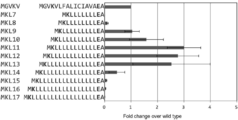
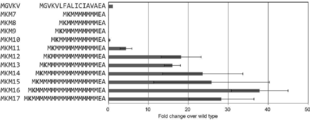
図6において、横軸は野生型のGLuc(MGVKV)を発現させて測定したルシフェラーゼ活性を1とした場合の、それぞれの変異ペプチドを発現させて測定したルシフェラーゼ活性の相対値、縦軸は発現させたペプチドの種類を示す。図6に示すように、リジンに続くアミノ酸が12~17個のメチオニンであれば分泌能力が非常に高く、特に配列番号1に示すアミノ酸配列からなるペプチドが非常に高い分泌能力を有することが明らかとなった。これまでに疎水性アミノ酸のロイシンが分泌に深く関与していると考えられていたが、ロイシンに比べてメチオニンに置換したペプチドの方が、分泌能力が高いことは予想外であった。また、メチオニンの数が12~17で高い分泌能力を有することから、発現させる目的タンパク質の種類に応じてメチオニンの数を調整し、発現させるタンパク質に最適な分泌シグナルペプチドを選択して目的タンパク質を効率よく分泌させることが可能となる。
図6において、横軸は野生型のGLuc(MGVKV)を発現させて測定したルシフェラーゼ活性を1とした場合の、それぞれの変異ペプチドを発現させて測定したルシフェラーゼ活性の相対値、縦軸は発現させたペプチドの種類を示す。図6に示すように、リジンに続くアミノ酸が12~17個のメチオニンであれば分泌能力が非常に高く、特に配列番号1に示すアミノ酸配列からなるペプチドが非常に高い分泌能力を有することが明らかとなった。これまでに疎水性アミノ酸のロイシンが分泌に深く関与していると考えられていたが、ロイシンに比べてメチオニンに置換したペプチドの方が、分泌能力が高いことは予想外であった。また、メチオニンの数が12~17で高い分泌能力を有することから、発現させる目的タンパク質の種類に応じてメチオニンの数を調整し、発現させるタンパク質に最適な分泌シグナルペプチドを選択して目的タンパク質を効率よく分泌させることが可能となる。
(ウェスタンブロッティング解析)
配列番号3に示すGlucのアミノ酸配列において、2番目のグリシンと3番目のバリンを削除し、5番目~15番目のアミノ酸を連続する16個のメチオニンに置換したペプチド(MKM16)をコードするDNA断片を用い、クルイベロマイセス・マルシアヌスRAK3908株を形質転換体し、RAK8772株を得た。かかるRAK8772株及びクルイベロマイセス・マルシアヌスRAK6205株をそれぞれ2mlのYPD培地で一晩培養した。培養後、上澄み液に1mlのアセトンを加えて12,000rpmで5分間遠心した。沈殿を20μlのLaemmliサンプルバッファー:バイオラッド社製)で溶解し、95℃で5分間加熱した。
配列番号3に示すGlucのアミノ酸配列において、2番目のグリシンと3番目のバリンを削除し、5番目~15番目のアミノ酸を連続する16個のメチオニンに置換したペプチド(MKM16)をコードするDNA断片を用い、クルイベロマイセス・マルシアヌスRAK3908株を形質転換体し、RAK8772株を得た。かかるRAK8772株及びクルイベロマイセス・マルシアヌスRAK6205株をそれぞれ2mlのYPD培地で一晩培養した。培養後、上澄み液に1mlのアセトンを加えて12,000rpmで5分間遠心した。沈殿を20μlのLaemmliサンプルバッファー:バイオラッド社製)で溶解し、95℃で5分間加熱した。
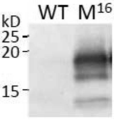
SDS-PAGEはカセット電気泳動槽(コスモ・バイオ社製)とSuperSep Ace 17ウェル(和光純薬工業社製)を用いて行った。SDS-PAGE後、タンパク質はimmobilon PVDF膜(ミリポア社製)に転写した。抗体反応においては、1/5000希釈抗GLuc抗体E8023S(New England Biolabs社製)及び1/1000希釈抗ラビットIgG-HRP抗体(Jackson ImmunoResearch社製)を用い、発光試薬としてはImmnostar(登録商標)Zeta(和光純薬工業社製)を用いて行った。ウェスタンブロッティング解析の結果を図7に示す。図7中、WTはRAK6205株、M16はRAK8772株の培養液上澄みにおけるGLucである。
(ウェスタンブロッティング解析の結果)
図7に示すように、M16では約20kDより低い位置にバンドが検出され、WTではバンドが検出されなかったことから、本発明のシグナルペプチドはタンパク質を細胞外に分泌する能力が高いことが確認された。また、16個のメチオニンを含むシグナル配列を有するMKM16の推定分子量は20.7kD、シグナル配列無しのGLucの推定分子量は18.4kDであり、図7の結果から、16個のメチオニンを含むシグナル配列は切断されていることが推測された。
図7に示すように、M16では約20kDより低い位置にバンドが検出され、WTではバンドが検出されなかったことから、本発明のシグナルペプチドはタンパク質を細胞外に分泌する能力が高いことが確認された。また、16個のメチオニンを含むシグナル配列を有するMKM16の推定分子量は20.7kD、シグナル配列無しのGLucの推定分子量は18.4kDであり、図7の結果から、16個のメチオニンを含むシグナル配列は切断されていることが推測された。
[ヒトLIFの分泌]
配列番号1に示す分泌シグナルペプチドを用いて、酵母での分泌が難しいヒトLIF(hLIF)を分泌させた。
配列番号1に示す分泌シグナルペプチドを用いて、酵母での分泌が難しいヒトLIF(hLIF)を分泌させた。
(分泌シグナルペプチドの付与)
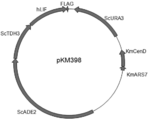
hLIF-FLAGペプチドに配列番号1に示されるペプチド(KMMMMMMMMMMMMMMMME)を付与するために、プラスミドpKM398(図8)が維持されたクルイベロマイセス・マルシアヌスRAK10252の染色体DNAをテンプレートとし、配列番号85に示されるフォワードプライマー(hLIF+4)と、配列番号29に示されるリバースプライマー(TDH3p-1c40)を用いてPCRを行い、hLIFと、FLAGタグと、URA3マーカーと、KmCenDと、KmARS7と、ADE2マーカーと、TDH3プロモーターとをコードするDNA断片(hLIF-FLAG-URA3-KmCenD-KmARS7-ADE2-TDH3)を得た。次に、得られたDNA断片をテンプレートとし、配列番号85に示されるフォワードプライマー(hLIF+4)と、配列番号86に示されるリバースプライマー(MKM(16)Ec-TDH3p-1c)を用いてPCRを行い、配列番号87に示されるhLIFアミノ酸配列の1番目のメチオニンと2番目のリジンの間に配列番号1に示されるアミノ酸配列を導入した、変異ペプチド(MKM16E-2K)と、FLAGタグと、URA3マーカーと、KmCenDと、KmARS7と、ADE2マーカーと、TDHプロモーターとをコードするDNA断片(MKM16E-2K-hLIF-FLAG-URA3-KmCenD-KmARS7-ADE2-TDH3)を作製した。また、得られたDNA断片(hLIF-FLAG-URA3-KmCenD-KmARS7-ADE2-TDH3)をテンプレートとし、配列番号88に示されるフォワードプライマー(hLIF+58)と、配列番号86に示されるリバースプライマー(MKM(16)Ec-TDH3p-1c)を用いてPCRを行い、配列番号87に示されるhLIFアミノ酸配列の2番目~19番目のアミノ酸を配列番号1に示されるアミノ酸配列に置換した変異ペプチド(MKM16E-20G)と、FLAGタグと、URA3マーカーと、KmCenDと、KmARS7と、ADE2マーカーと、TDHプロモーターとをコードするDNA断片(MKM16E-20G-hLIF-FLAG-URA3-KmCenD-KmARS7-ADE2-TDH3)を作製した。さらに、得られたDNA断片(hLIF-FLAG-URA3-KmCenD-KmARS7-ADE2-TDH3)をテンプレートとし、配列番号89に示されるフォワードプライマー(hLIF+79)と、配列番号86に示されるリバースプライマー(MKM(16)Ec-TDH3p-1c)を用いてPCRを行い、配列番号87に示されるhLIFアミノ酸配列の2番目~26番目のアミノ酸を配列番号1に示されるアミノ酸配列に置換した変異ペプチド(MKM16E-27I)と、FLAGタグと、URA3マーカーと、KmCenDと、KmARS7と、ADE2マーカーTDHと、プロモーターとをコードするDNA断片(MKM16E-27I-hLIF-FLAG-URA3-KmCenD-KmARS7-ADE2-TDH3)を作製した。
hLIF-FLAGペプチドに配列番号1に示されるペプチド(KMMMMMMMMMMMMMMMME)を付与するために、プラスミドpKM398(図8)が維持されたクルイベロマイセス・マルシアヌスRAK10252の染色体DNAをテンプレートとし、配列番号85に示されるフォワードプライマー(hLIF+4)と、配列番号29に示されるリバースプライマー(TDH3p-1c40)を用いてPCRを行い、hLIFと、FLAGタグと、URA3マーカーと、KmCenDと、KmARS7と、ADE2マーカーと、TDH3プロモーターとをコードするDNA断片(hLIF-FLAG-URA3-KmCenD-KmARS7-ADE2-TDH3)を得た。次に、得られたDNA断片をテンプレートとし、配列番号85に示されるフォワードプライマー(hLIF+4)と、配列番号86に示されるリバースプライマー(MKM(16)Ec-TDH3p-1c)を用いてPCRを行い、配列番号87に示されるhLIFアミノ酸配列の1番目のメチオニンと2番目のリジンの間に配列番号1に示されるアミノ酸配列を導入した、変異ペプチド(MKM16E-2K)と、FLAGタグと、URA3マーカーと、KmCenDと、KmARS7と、ADE2マーカーと、TDHプロモーターとをコードするDNA断片(MKM16E-2K-hLIF-FLAG-URA3-KmCenD-KmARS7-ADE2-TDH3)を作製した。また、得られたDNA断片(hLIF-FLAG-URA3-KmCenD-KmARS7-ADE2-TDH3)をテンプレートとし、配列番号88に示されるフォワードプライマー(hLIF+58)と、配列番号86に示されるリバースプライマー(MKM(16)Ec-TDH3p-1c)を用いてPCRを行い、配列番号87に示されるhLIFアミノ酸配列の2番目~19番目のアミノ酸を配列番号1に示されるアミノ酸配列に置換した変異ペプチド(MKM16E-20G)と、FLAGタグと、URA3マーカーと、KmCenDと、KmARS7と、ADE2マーカーと、TDHプロモーターとをコードするDNA断片(MKM16E-20G-hLIF-FLAG-URA3-KmCenD-KmARS7-ADE2-TDH3)を作製した。さらに、得られたDNA断片(hLIF-FLAG-URA3-KmCenD-KmARS7-ADE2-TDH3)をテンプレートとし、配列番号89に示されるフォワードプライマー(hLIF+79)と、配列番号86に示されるリバースプライマー(MKM(16)Ec-TDH3p-1c)を用いてPCRを行い、配列番号87に示されるhLIFアミノ酸配列の2番目~26番目のアミノ酸を配列番号1に示されるアミノ酸配列に置換した変異ペプチド(MKM16E-27I)と、FLAGタグと、URA3マーカーと、KmCenDと、KmARS7と、ADE2マーカーTDHと、プロモーターとをコードするDNA断片(MKM16E-27I-hLIF-FLAG-URA3-KmCenD-KmARS7-ADE2-TDH3)を作製した。
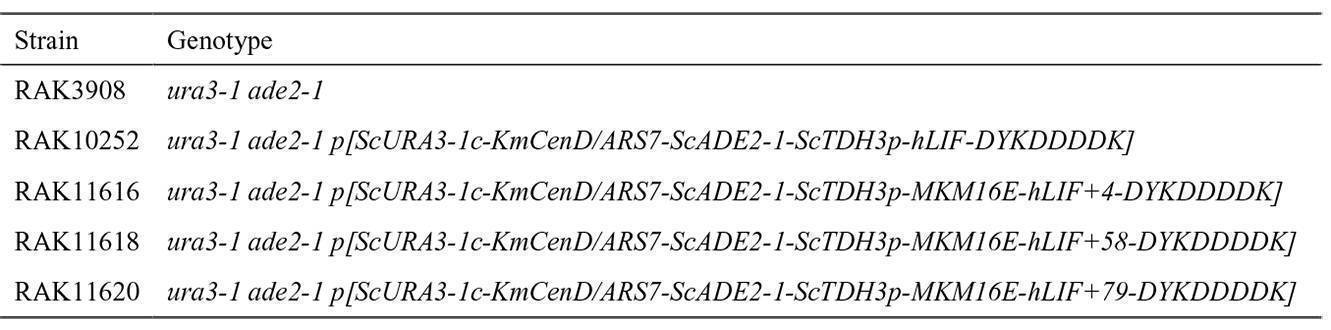
作製した変異ペプチドをコードする3つのDNA断片をクルイベロマイセス・マルシアヌスRAK3908株にそれぞれ導入し、ウラシル欠損培地で培養し、生育した株を形質転換体として選択した。MKM16E-2KをコードするDNA断片を導入して得られたアデニン、ウラシル非栄養要求性形質転換体をRAK11616、MKM16E-20GをコードするDNA断片を導入して得られたアデニン、ウラシル非栄養要求性形質転換体をRAK11618、MKM16E-27IをコードするDNA断片を導入して得られたアデニン、ウラシル非栄養要求性形質転換体をRAK11620と命名して保存した。それぞれの株の遺伝子型を表6に示す。
(ウェスタンブロッティング解析)
クルイベロマイセス・マルシアヌスRAK11616株、RAK11618株、RAK11620株それぞれをYPD培地で150rpm、28℃で2日間振とう培養した。培地を12,000gで10分間遠心し、400μlの上澄み液を得た。かかる上澄み液に500μlのアセトンを加えてタンパク質を沈殿させた。12,000gで10分間遠心後、沈殿を40mlのSDS-PAGEサンプルバッファー(5% 2-メルカプトエタノール含有Laemmliサンプルバッファー:バイオラッド社製)で溶解し、その後Laemmliサンプルバッファー(バイオラッド社製)で10倍に希釈後に95℃で30分間加熱した。
クルイベロマイセス・マルシアヌスRAK11616株、RAK11618株、RAK11620株それぞれをYPD培地で150rpm、28℃で2日間振とう培養した。培地を12,000gで10分間遠心し、400μlの上澄み液を得た。かかる上澄み液に500μlのアセトンを加えてタンパク質を沈殿させた。12,000gで10分間遠心後、沈殿を40mlのSDS-PAGEサンプルバッファー(5% 2-メルカプトエタノール含有Laemmliサンプルバッファー:バイオラッド社製)で溶解し、その後Laemmliサンプルバッファー(バイオラッド社製)で10倍に希釈後に95℃で30分間加熱した。
SDS-PAGEはカセット電気泳動槽(コスモ・バイオ社製)とSuperSep Ace 17ウェル(和光純薬工業社製)を用いて行った。SDS-PAGE後、タンパク質はimmobilon PVDF膜(ミリポア社製)に転写した。抗体反応においては、抗FLAGモノクローナル抗体1E6(和光純薬工業社製)を用い、発光試薬としてはImmnostar(登録商標)Zeta(和光純薬工業社製)を用いて行った。ウェスタンブロッティング解析の結果を図9に示す。
(結果)
(結果)
図9に示すように野生型(Wild type)のhLIFを発現させた場合にはバンドが検出されず、hLIFタンパク質が分泌していなかったが、配列番号1に示されるアミノ酸配列を有する変異hLIFタンパク質を発現させた場合にはバンドが検出され、hLIFタンパク質が分泌されていることが明らかとなった。したがって、本発明のシグナルペプチドは、GLucだけでなく、酵母での分泌が難しいhLIFを細胞外へ分泌する能力を有することが明らかとなった。
[サッカロマイセス・セレビシエでの分泌]
実施例1、2においては酵母としてクルイベロマイセス・マルシアヌスを用いたが、他の酵母においても本発明の分泌シグナルペプチドが同様に機能することを確かめるため、本発明の分泌シグナルペプチドを有するGLucをサッカロマイセス・セレビシエで発現させて、GLucの分泌を調べた。
実施例1、2においては酵母としてクルイベロマイセス・マルシアヌスを用いたが、他の酵母においても本発明の分泌シグナルペプチドが同様に機能することを確かめるため、本発明の分泌シグナルペプチドを有するGLucをサッカロマイセス・セレビシエで発現させて、GLucの分泌を調べた。
(形質転換体の作製)
まず、変異ペプチド(MKM16)をコードするDNA断片を用いて作製したクルイベロマイセス・マルシアヌスRAK3908株の形質転換体であるRAK8772株、及び野生型ペプチド(MGVKV)をコードするDNAを有するRAK6205株それぞれのDNAをテンプレートとして、配列番号90に示されるフォワードプライマー(TDH3-572)と配列番号91に示されるリバースプライマー(3CG9-yGLuc+558c)を用いて1stPCRを行い、ScTDHプロモーターとMKM16シグナル配列とyGLucとをコードするDNA断片、及びScTDH3プロモーターとyGLucをコードするDNA断片を得た。得られたそれぞれの1stPCR産物をテンプレートとして、相同組換えのためのScURA3のC末部分の配列を付加するために配列番号90に示されるフォワードプライマー(TDH3-572)と配列番号92に示されるリバースプライマー(ScURA3(717786TAA)-3CG9)を用いて2ndPCRを行い、ScTDHプロモーターとMKM16シグナル配列とyGLucとScURA3の一部をコードするDNA断片、及びScTDH3プロモーターとyGLucとScURA3の一部をコードするDNA断片を得た。ベクターDNAは、YEpGAP-cherry plasmid DNA(Keppler-Ross et al., Genetics 179:705-710(2008))をテンプレートとして、配列番号5に示されるフォワードプライマー(URA3+771c)と配列番号29に示されるリバースプライマー(TDH3-1c40)を用いてPCRを行うことで調製した。1st、2ndPCRは、KOD FX neo(東洋紡社製)を用い、そのプロトコールに従って行った。
まず、変異ペプチド(MKM16)をコードするDNA断片を用いて作製したクルイベロマイセス・マルシアヌスRAK3908株の形質転換体であるRAK8772株、及び野生型ペプチド(MGVKV)をコードするDNAを有するRAK6205株それぞれのDNAをテンプレートとして、配列番号90に示されるフォワードプライマー(TDH3-572)と配列番号91に示されるリバースプライマー(3CG9-yGLuc+558c)を用いて1stPCRを行い、ScTDHプロモーターとMKM16シグナル配列とyGLucとをコードするDNA断片、及びScTDH3プロモーターとyGLucをコードするDNA断片を得た。得られたそれぞれの1stPCR産物をテンプレートとして、相同組換えのためのScURA3のC末部分の配列を付加するために配列番号90に示されるフォワードプライマー(TDH3-572)と配列番号92に示されるリバースプライマー(ScURA3(717786TAA)-3CG9)を用いて2ndPCRを行い、ScTDHプロモーターとMKM16シグナル配列とyGLucとScURA3の一部をコードするDNA断片、及びScTDH3プロモーターとyGLucとScURA3の一部をコードするDNA断片を得た。ベクターDNAは、YEpGAP-cherry plasmid DNA(Keppler-Ross et al., Genetics 179:705-710(2008))をテンプレートとして、配列番号5に示されるフォワードプライマー(URA3+771c)と配列番号29に示されるリバースプライマー(TDH3-1c40)を用いてPCRを行うことで調製した。1st、2ndPCRは、KOD FX neo(東洋紡社製)を用い、そのプロトコールに従って行った。
それぞれの2ndPCR産物、及びベクターDNAを混合してサッカロマイセス・セレビシエBY4700株を形質転換し、ウラシル欠損培地に塗布後に28℃で2-3日培養し、生育した形質転換体をそれぞれRAK11911、RAK11908と命名した。BY4700、RAK11911株、RAK11908株の遺伝子型を表7に示す。

RAK11911株、RAK11908株をYPB培地で培養して培養液上澄みのルシフェラーゼ活性を、GloMax(登録商標)20/20ルミノメーター(プロメガ社製)を用いた以外は実施例1と同様の方法により測定した。結果を表8に示す。表中、WTはRAK11908株、M16はRAK11911株の培養液上澄みにおけるGLucである。
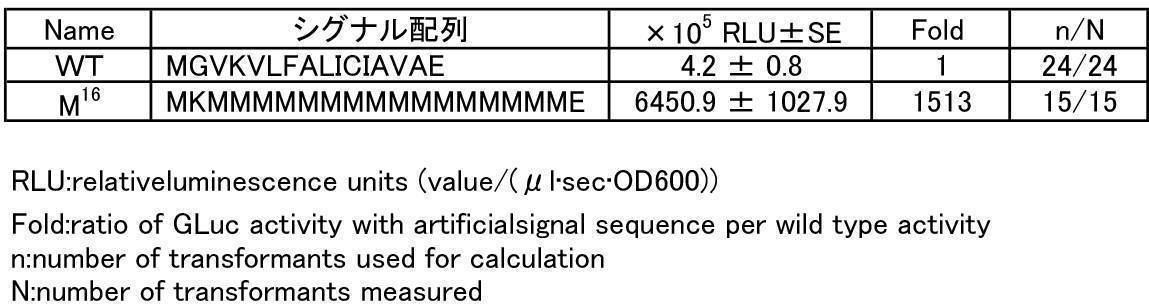
表8から明らかなように、RAK11908株の培養液上澄みに対してRAK11911株の培養液上澄みにおいて1513倍ものルシフェラーゼ活性が検出され、本発明のシグナルペプチドはサッカロマイセス・セレビシエにおいても発現したタンパク質を細胞外に分泌する能力が高いことが明らかとなった。
本発明の分泌シグナルペプチドをコードするDNAは、有用タンパク質の高分泌生産に利用される。
Claims (7)
- 次の(a)又は(b)に示されるアミノ酸配列からなる分泌シグナルペプチドをコードするDNA。
(a)式(I)に示されるアミノ酸配列からなる分泌シグナルペプチド;
X-M1-M2・・・-Mi-E 式(I)
(式(I)中、Xはリジン又はアルギニンを示し、Mはメチオニンを示し、Eはグルタミン酸を示し、iは12~17の整数を示す)
(b)上記式(I)において1又は2個のメチオニンが疎水性アミノ酸に置換したアミノ酸配列からなり、酵母細胞で発現した目的タンパク質を細胞外に分泌する能力を有する分泌シグナルペプチド; - 配列番号1に示されるアミノ酸配列からなる分泌シグナルペプチドをコードする請求項1記載のDNA。
- 請求項1又は2記載のDNAを含む酵母用組換えベクター。
- 目的タンパク質をコードするDNAを含む請求項3記載の組換えベクター。
- 請求項4記載の組換えベクターを含む酵母の形質転換体。
- 請求項5記載の形質転換体を培養し、培養液から目的タンパク質を回収することを特徴とする目的タンパク質の生産方法。
- 次の(a)又は(b)に示されるアミノ酸配列からなる分泌シグナルペプチド。
(a)式(I)に示されるアミノ酸配列からなる分泌シグナルペプチド;
X-M1-M2-・・・-Mi-E 式(I)
(式(I)中、Xはリジン又はアルギニンを示し、Mはメチオニンを示し、Eはグルタミン酸を示し、iは12~17の整数を示す)
(b)上記式(I)における1又は2個のメチオニンが疎水性アミノ酸に置換したアミノ酸配列からなり、酵母細胞で発現した目的タンパク質を細胞外に分泌する能力を有する分泌シグナルペプチド;
Priority Applications (1)
| Application Number | Priority Date | Filing Date | Title |
|---|---|---|---|
| JP2016506110A JP6460538B2 (ja) | 2014-03-04 | 2015-02-18 | 分泌シグナルペプチドをコードするdna |
Applications Claiming Priority (2)
| Application Number | Priority Date | Filing Date | Title |
|---|---|---|---|
| JP2014-041820 | 2014-03-04 | ||
| JP2014041820 | 2014-03-04 |
Publications (1)
| Publication Number | Publication Date |
|---|---|
| WO2015133074A1 true WO2015133074A1 (ja) | 2015-09-11 |
Family
ID=54054894
Family Applications (1)
| Application Number | Title | Priority Date | Filing Date |
|---|---|---|---|
| PCT/JP2015/000762 Ceased WO2015133074A1 (ja) | 2014-03-04 | 2015-02-18 | 分泌シグナルペプチドをコードするdna |
Country Status (2)
| Country | Link |
|---|---|
| JP (1) | JP6460538B2 (ja) |
| WO (1) | WO2015133074A1 (ja) |
Cited By (2)
| Publication number | Priority date | Publication date | Assignee | Title |
|---|---|---|---|---|
| WO2021045541A1 (ko) * | 2019-09-03 | 2021-03-11 | 재단법인 오송첨단의료산업진흥재단 | 단백질 생산성 향상을 위한 개별 바코딩 시스템 도입한 시그널 펩타이드 초고속 선별방법 |
| WO2025037535A1 (ja) * | 2023-08-11 | 2025-02-20 | 株式会社Co2資源化研究所 | ヒドロゲノフィラス属細菌由来の分泌シグナルペプチド遺伝子 |
Citations (2)
| Publication number | Priority date | Publication date | Assignee | Title |
|---|---|---|---|---|
| JP2007520200A (ja) * | 2003-06-25 | 2007-07-26 | ユニターゲッティング リサーチ エイエス | タンパク質発現システム |
| US20120238456A1 (en) * | 2009-08-12 | 2012-09-20 | Uni'TargetingResearch AS | Rational library |
-
2015
- 2015-02-18 JP JP2016506110A patent/JP6460538B2/ja active Active
- 2015-02-18 WO PCT/JP2015/000762 patent/WO2015133074A1/ja not_active Ceased
Patent Citations (2)
| Publication number | Priority date | Publication date | Assignee | Title |
|---|---|---|---|---|
| JP2007520200A (ja) * | 2003-06-25 | 2007-07-26 | ユニターゲッティング リサーチ エイエス | タンパク質発現システム |
| US20120238456A1 (en) * | 2009-08-12 | 2012-09-20 | Uni'TargetingResearch AS | Rational library |
Non-Patent Citations (3)
| Title |
|---|
| INOUYE, S. ET AL.: "Luminescence enhancement of the catalytic 19 kDa protein (KAZ) of Oplophorus luciferase by three amino acid substitutions", BIOCHEMICAL AND BIOPHYSICAL RESEARCH COMMUNICATIONS, vol. 445, February 2014 (2014-02-01), pages 157 - 162, XP028667284 * |
| SUZUKI, T. ET AL.: "Real-time bioluminescence imaging of a protein secretory pathway in living mammalian cells using Gaussia luciferase", FEBS LETTERS, vol. 581, 2007, pages 4551 - 4556, XP022262493 * |
| YARIMIZU, T. ET AL.: "Synthetic signal sequences that enable efficient secretory protein production in the yeast Kluyveromyces marxianus", MICROBIAL CELL FACTORIES, vol. 14, no. 20, 14 February 2015 (2015-02-14), pages 1 - 14 * |
Cited By (2)
| Publication number | Priority date | Publication date | Assignee | Title |
|---|---|---|---|---|
| WO2021045541A1 (ko) * | 2019-09-03 | 2021-03-11 | 재단법인 오송첨단의료산업진흥재단 | 단백질 생산성 향상을 위한 개별 바코딩 시스템 도입한 시그널 펩타이드 초고속 선별방법 |
| WO2025037535A1 (ja) * | 2023-08-11 | 2025-02-20 | 株式会社Co2資源化研究所 | ヒドロゲノフィラス属細菌由来の分泌シグナルペプチド遺伝子 |
Also Published As
| Publication number | Publication date |
|---|---|
| JPWO2015133074A1 (ja) | 2017-04-06 |
| JP6460538B2 (ja) | 2019-01-30 |
Similar Documents
| Publication | Publication Date | Title |
|---|---|---|
| JP7246100B2 (ja) | 新規融合タンパク質の調製およびそのタンパク質合成の向上における使用 | |
| CN110093284B (zh) | 一种在细胞中提高蛋白合成效率的方法 | |
| CN107614516A (zh) | 用于基因工程改造甲基营养型酵母的表达构建体和方法 | |
| CN109423496B (zh) | 一种细胞中内源性表达rna聚合酶的核酸构建物 | |
| Lee et al. | Characterization of Saccharomyces cerevisiae promoters for heterologous gene expression in Kluyveromyces marxianus | |
| EP3312278B1 (en) | Protein expression method | |
| CN108535489A (zh) | 一种用于体外蛋白质合成的蛋白合成体系、试剂盒及其制备方法 | |
| JP2021520835A (ja) | 有機酸耐性酵母由来新規プロモーター及びこれを用いた目的遺伝子の発現方法 | |
| CN102782130B (zh) | 马克斯克鲁维酵母来源的高表达启动子 | |
| US10174304B2 (en) | Expression vector and method for producing protein | |
| JP6460538B2 (ja) | 分泌シグナルペプチドをコードするdna | |
| EP4477738A1 (en) | Engineered strain of yeast having mitochondrion-positioned reductive tca pathway and efficiently producing succinic acid, construction method therefor and use thereof | |
| US12421511B2 (en) | Mutant protein for improving malic acid yield | |
| WO2016088824A1 (ja) | セントロメアdna配列を含むベクター及びその用途 | |
| WO2023093794A1 (zh) | 一种高产l-苹果酸的耐酸酵母菌株及其构建方法和应用 | |
| CN115836083A (zh) | 用于减少乳酸菌污染的酵母菌菌株 | |
| CN113493813A (zh) | 含外源镁离子的体外无细胞蛋白合成体系与试剂盒及其应用 | |
| CN113493801B (zh) | 一种含外源镁离子的体外无细胞蛋白合成体系和试剂盒及其应用 | |
| EP4067492A1 (en) | Polypeptide tag and application thereof in in vitro protein synthesis | |
| CN104263739A (zh) | 一种编码木糖转运蛋白的核酸分子及其编码的木糖转运蛋白 | |
| JP4671394B2 (ja) | キャンディダ・ユティリス由来のプロモーターdna | |
| JP2019014663A (ja) | ペプチドの合成方法 | |
| JP2019088191A (ja) | 誘導型プロモーター | |
| WO2025163019A1 (en) | Tags for enhanced expression of recombinant proteins | |
| HK40081975A (en) | Polypeptide tag and application thereof in in vitro protein synthesis |
Legal Events
| Date | Code | Title | Description |
|---|---|---|---|
| 121 | Ep: the epo has been informed by wipo that ep was designated in this application |
Ref document number: 15759041 Country of ref document: EP Kind code of ref document: A1 |
|
| ENP | Entry into the national phase |
Ref document number: 2016506110 Country of ref document: JP Kind code of ref document: A |
|
| NENP | Non-entry into the national phase |
Ref country code: DE |
|
| 122 | Ep: pct application non-entry in european phase |
Ref document number: 15759041 Country of ref document: EP Kind code of ref document: A1 |