WO2015115017A1 - 情報処理装置、情報処理方法、プログラム、情報処理システムおよび表示装置 - Google Patents
情報処理装置、情報処理方法、プログラム、情報処理システムおよび表示装置 Download PDFInfo
- Publication number
- WO2015115017A1 WO2015115017A1 PCT/JP2014/084483 JP2014084483W WO2015115017A1 WO 2015115017 A1 WO2015115017 A1 WO 2015115017A1 JP 2014084483 W JP2014084483 W JP 2014084483W WO 2015115017 A1 WO2015115017 A1 WO 2015115017A1
- Authority
- WO
- WIPO (PCT)
- Prior art keywords
- display device
- content
- user
- information processing
- viewing
- Prior art date
- Legal status (The legal status is an assumption and is not a legal conclusion. Google has not performed a legal analysis and makes no representation as to the accuracy of the status listed.)
- Ceased
Links
Images









Classifications
-
- H—ELECTRICITY
- H04—ELECTRIC COMMUNICATION TECHNIQUE
- H04N—PICTORIAL COMMUNICATION, e.g. TELEVISION
- H04N21/00—Selective content distribution, e.g. interactive television or video on demand [VOD]
- H04N21/20—Servers specifically adapted for the distribution of content, e.g. VOD servers; Operations thereof
- H04N21/25—Management operations performed by the server for facilitating the content distribution or administrating data related to end-users or client devices, e.g. end-user or client device authentication, learning user preferences for recommending movies
- H04N21/258—Client or end-user data management, e.g. managing client capabilities, user preferences or demographics, processing of multiple end-users preferences to derive collaborative data
-
- H—ELECTRICITY
- H04—ELECTRIC COMMUNICATION TECHNIQUE
- H04N—PICTORIAL COMMUNICATION, e.g. TELEVISION
- H04N21/00—Selective content distribution, e.g. interactive television or video on demand [VOD]
- H04N21/20—Servers specifically adapted for the distribution of content, e.g. VOD servers; Operations thereof
- H04N21/25—Management operations performed by the server for facilitating the content distribution or administrating data related to end-users or client devices, e.g. end-user or client device authentication, learning user preferences for recommending movies
- H04N21/258—Client or end-user data management, e.g. managing client capabilities, user preferences or demographics, processing of multiple end-users preferences to derive collaborative data
- H04N21/25866—Management of end-user data
-
- H—ELECTRICITY
- H04—ELECTRIC COMMUNICATION TECHNIQUE
- H04N—PICTORIAL COMMUNICATION, e.g. TELEVISION
- H04N21/00—Selective content distribution, e.g. interactive television or video on demand [VOD]
- H04N21/20—Servers specifically adapted for the distribution of content, e.g. VOD servers; Operations thereof
- H04N21/25—Management operations performed by the server for facilitating the content distribution or administrating data related to end-users or client devices, e.g. end-user or client device authentication, learning user preferences for recommending movies
- H04N21/266—Channel or content management, e.g. generation and management of keys and entitlement messages in a conditional access system, merging a VOD unicast channel into a multicast channel
- H04N21/2668—Creating a channel for a dedicated end-user group, e.g. insertion of targeted commercials based on end-user profiles
-
- H—ELECTRICITY
- H04—ELECTRIC COMMUNICATION TECHNIQUE
- H04N—PICTORIAL COMMUNICATION, e.g. TELEVISION
- H04N21/00—Selective content distribution, e.g. interactive television or video on demand [VOD]
- H04N21/80—Generation or processing of content or additional data by content creator independently of the distribution process; Content per se
- H04N21/81—Monomedia components thereof
- H04N21/812—Monomedia components thereof involving advertisement data
Definitions
- the present invention relates to an information processing device, an information processing method, a program, an information processing system, and a display device.
- An ID number is issued for each user, and for each of a large number of viewers who are watching the same TV program, an advertisement that conforms to their preferences and is independent of the TV advertisement and also according to the contents of each scene of the program Is provided through a home server (see, for example, Patent Document 1).
- the number of users who view a broadcast program reproduced by a certain television receiver is not necessarily limited to one specific person, and may be one of the housemates or a group of housemates.
- a broadcast program may be viewed by a single user in a private room, bedroom, etc., all the family members in the living room may view, and other family members and unspecified visitors may view between the guests. Accordingly, there is a problem in that viewing histories of a plurality of users are mixed, and a tendency of a user layer who uses a certain television receiver cannot be specified.
- the present invention has been made in view of the above points, and provides an information processing device, an information processing method, a program, an information processing system, and a display device capable of analyzing a tendency of a user layer who uses the display device. Is an issue.
- the present invention has been made to solve the above problems, and one aspect of the present invention is based on a viewing history that is a history of time when a user viewed content on the display device. It is an information processing apparatus provided with the analysis part which analyzes the tendency of the user who uses.
- 1 aspect of this invention is information processing apparatus, Comprising: The said analysis part is further comprised so that the tendency of the user who uses the said display apparatus may be analyzed based on the content of the said content. May be.
- 1 aspect of this invention is information processing apparatus, Comprising:
- the said analysis part is comprised so that the tendency of the user who uses the said display apparatus may be further analyzed based on the kind of said display apparatus. It may be.
- 1 aspect of this invention is provided with the selection part which selects the 2nd content delivered with respect to the said display apparatus based on the tendency of the user who uses the said display apparatus analyzed by the said analysis part. It may be.
- 1 aspect of this invention is an information processing apparatus, Comprising:
- the said selection part is comprised so that the said 2nd content may be selected based on the time when the said user is viewing the said content May be.
- 1 aspect of this invention is information processing apparatus, Comprising: The said selection part selects the said 2nd content based on the content of the said content which the said display apparatus is displaying. It may be configured.
- 1 aspect of this invention is information processing apparatus, Comprising:
- the said selection part is comprised so that the said selected 2nd content may be delivered with respect to the said display apparatus from a content delivery server. May be.
- One embodiment of the present invention may be an information processing device, and the content may be a broadcast program broadcast on television.
- One aspect of the present invention is an information processing apparatus, and the content may be a recorded content obtained by recording a broadcast program broadcast on television.
- One embodiment of the present invention is an information processing apparatus, wherein the analysis unit is further configured to analyze a tendency of a user who uses the display device based on a recording time of the recorded content. May be.
- an information processing including an analysis step of analyzing a tendency of a user who uses the display device based on a viewing history that is a history of time when the user views the content on the display device. Is the method.
- one aspect of the present invention is an information processing method, wherein the second information is distributed to the display device based on a tendency of a user who uses the display device analyzed in the analysis step.
- a selection step of selecting content and a distribution step of distributing the second content selected in the selection step from a content distribution server to the display device may be included.
- a computer performs an analysis step of analyzing a tendency of a user who uses the display device based on a viewing history that is a history of time when the user views the content on the display device. It is a program to make it.
- One embodiment of the present invention is a program, the second content distributed to the display device based on a tendency of a user using the display device analyzed in the analysis step.
- a selection step of selecting and a distribution step of distributing the second content selected in the selection step from the content distribution server to the display device are executed by a computer.
- a display device includes: a display unit that displays content; and a display device transmission unit that transmits a viewing time when the user views the content displayed by the display unit.
- a server reception unit that receives the viewing time transmitted by the display device transmission unit, a storage unit that stores a history of the viewing time received by the server reception unit, and the viewing history that the storage unit stores
- a viewing information server device a receiving unit that receives the viewing history transmitted by the viewing information server device, and the display based on the viewing history received by the receiving unit.
- An information processing system including an information processing device including an analysis unit that analyzes a tendency of a user who uses the device.
- One embodiment of the present invention is an information processing system including a content distribution server that distributes second content, and the information processing device uses the display device analyzed by the analysis unit.
- a selection unit is provided that selects second content to be distributed to the display device based on a user's tendency and distributes the selected second content from the content distribution server to the display device.
- a display unit that displays content
- a transmission unit that transmits a viewing time when a user views the content displayed on the display unit, and a history of the viewing time are selected.
- Receiving the received second content, and the display unit is a display device that displays the second content received by the receiving unit.
- One embodiment of the present invention is a display device, wherein the display unit receives the second content after a predetermined time has elapsed since the reception unit received the second content. Clear the display.
- 1 is a diagram illustrating an example of an information processing system according to a first embodiment. It is the block diagram which showed an example of the function structure of the display apparatus which concerns on 1st Embodiment. It is the block diagram which showed an example of the function structure of the viewing-and-listening information server apparatus which concerns on 1st Embodiment. It is the block diagram which showed an example of the function structure of the information processing apparatus which concerns on 1st Embodiment. It is the schematic which showed an example of the viewing-and-listening history database which concerns on 1st Embodiment. It is the schematic which showed an example of the analysis pattern database which concerns on 1st Embodiment. It is the schematic which showed an example of the user information database which concerns on 1st Embodiment.
- FIG. 1 is a schematic diagram showing an example of an information processing system S1 according to the first embodiment of the present invention.
- the information processing system S1 includes an information processing device 1, a display device 2, a viewing information server device 3, and a content distribution server 4.
- the information processing apparatus 1, the viewing information server apparatus 3, and the content distribution server 4 are, for example, server apparatuses having a known server function.
- the display device 2 is a device including the display unit 22 such as a television, a personal computer, a mobile phone, a tablet, a smartphone, or a PDA (Personal Digital Assistant).
- the information processing device 1, the display device 2, the viewing information server device 3, and the content distribution server 4 are connected to the network NW by wireless or wired communication, and can communicate with each other.
- the network NW includes, for example, a mobile phone network, a PHS (Personal Handy-phone System) network, a VPN (Virtual Private Network) network, a dedicated communication line network, a WAN (Wide Area Network), and a LAN (Local Network). Or an information communication network composed of PSTN (Public Switched Telephony Network), or a combination thereof.
- PSTN Public Switched Telephony Network
- the information processing apparatus 1 analyzes the tendency of the user who uses the display device 2 based on the viewing history that is the history of the time when the user viewed the broadcast program (content) on the display device 2.
- the information processing device 1 selects an advertisement (second content) to be distributed to the display device 2 based on the analyzed user tendency.
- the display device 2 receives the television broadcast and displays the broadcast program of the television broadcast on the display unit 22. Further, the display device 2 receives an advertisement distributed from the content distribution server 4 and displays the received advertisement on the display unit 22. In addition, the display device 2 transmits to the viewing information server device 3 viewing time specifying information for specifying the time when the user viewed the broadcast program. In addition, when transmitting the viewing time specifying information, the display device 2 transmits the device specifying information that can specify the own device in association with each other. For example, a MAC address (Media Access Control address) assigned to the communication unit of the display device 2 is used as the device identification information.
- a MAC address Media Access Control address
- the display device 2 displaying a broadcast program is read as the user of the display device 2 viewing the broadcast program.
- a person who uses the display device 2 and views a broadcast program is referred to as a viewer.
- the viewing information server device 3 holds a viewing history database that stores the viewing history of the display device 2. Details of the viewing history database will be described later.
- the viewing information server device 3 associates the viewing time specifying information transmitted from the display device 2 with the device specifying information and stores them in the viewing history database. Also, the viewing information server device 3 transmits the viewing time specifying information and the device specifying information stored in the viewing history database to the information processing device 1.
- the content distribution server 4 distributes the advertisement selected by the information processing device 1 to the display device 2 based on an instruction from the information processing device 1.
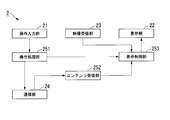
- FIG. 2 is a block diagram illustrating an example of a functional configuration of the display device 2.
- the display device 2 includes an operation input unit 21, a display unit 22, a video reception unit 23, a communication unit 24 (a transmission unit, a reception unit, a display device transmission unit), an operation processing unit 251, A content receiving unit 252 and a display control unit 253 are provided. Further, the display device 2 has a function of a known television receiver.
- the display device 2 includes a CPU (Central Processing Unit) and a storage device.
- the storage device includes, for example, an HDD (Hard Disc Drive), a flash memory, an EEPROM (Electrically Erasable Programmable Read Only Memory), a ROM (Read Only Memory), a RAM (Random Memory, etc.), and a RAM (Random Memory, etc.).
- Various programs executed by the CPU such as programs, and results of processing executed by the CPU are stored.
- the CPU operates as the operation processing unit 251, the content receiving unit 252, and the display control unit 253 by executing a program stored in the storage device.
- the operation input unit 21 receives an operation input to the display device 2 from the viewer.
- the operation input unit 21 receives an operation input via an input device such as a television remote controller, for example.
- the display unit 22 includes a display device such as a liquid crystal display or an organic EL (Electro-Luminescence) display.
- the display unit 22 displays a broadcast program received by the video receiving unit 23, an advertisement received by the content receiving unit 252 from the content distribution server 4, and the like.
- the video receiving unit 23 includes a television tuner and receives a broadcast program broadcast on television.
- the communication unit 24 includes a communication interface and communicates with other devices such as the information processing device 1, the viewing information server device 3, and the content distribution server 4.
- the operation processing unit 251 analyzes the input received by the operation input unit 21 and executes a process according to the input. For example, when the operation input unit 21 receives an input of a channel switching operation, the operation processing unit 251 outputs information about the channel after switching to the display control unit 253. Further, for example, when the operation input unit 21 receives an input of an operation to turn on the power, the operation processing unit 251 and the time (viewing time specifying information) at which the input of the operation to turn on the power is received via the communication unit 24.
- the device specifying information for uniquely specifying the display device 2 is transmitted to the viewing information server device 3.
- the operation processing unit 251 receives the input of the operation to turn off the power via the communication unit 24 (viewing time specifying information). ) And device specifying information for uniquely specifying the display device 2 are transmitted to the viewing information server device 3.
- the display control unit 253 causes the display unit 22 to display the broadcast program received by the video receiving unit 23, the advertisement received by the content receiving unit 252, and the like. For example, when the channel information after switching is input from the operation processing unit 251, the display control unit 253 switches the broadcast program to be displayed on the display unit 22 based on the channel information after switching. For example, the display control unit 253 causes the display unit 22 to display an advertisement when the content receiving unit 252 receives the advertisement. In addition, for example, the display control unit 253 may delete the display of the advertisement after a certain time has elapsed since the display of the advertisement on the display unit 22. Note that the fixed time may be determined in advance or may be set arbitrarily.
- FIG. 3 is a block diagram illustrating an example of a functional configuration of the viewing information server device 3.
- the viewing information server device 3 includes a communication unit 41 (server reception unit, server transmission unit), a history data reception control unit 42, a storage unit 43, and a history data transmission control unit 44.
- the viewing information server device 3 includes a CPU and a storage device.
- the storage device includes, for example, an HDD, a flash memory, an EEPROM, a ROM, and a RAM, and stores various programs executed by the CPU, such as firmware and application programs, and results of processing executed by the CPU.
- the CPU operates as the history data reception control unit 42 and the history data transmission control unit 44 by executing a program stored in the storage device.
- the communication unit 41 includes a communication interface and communicates with other devices such as the information processing device 1, the display device 2, and the content distribution server 4.
- the history data reception control unit 42 receives the viewing time specifying information and the device specifying information transmitted from the display device 2 via the communication unit 41.
- the history data reception control unit 42 stores the received viewing time specifying information and the device specifying information in association with each other in the viewing history database stored in the storage unit 43.
- the viewing time specifying information and the device specifying information stored in the viewing history database are used as viewing history data.
- the storage unit 43 includes, for example, an HDD and stores a viewing history database.
- the history data transmission control unit 44 transmits the viewing history data stored in the viewing history database of the storage unit 43 to the information processing apparatus 1 via the communication unit 41.
- FIG. 4 is a block diagram illustrating an example of a functional configuration of the information processing apparatus 1.
- the information processing apparatus 1 includes a storage unit 11, a communication unit 12, a viewing information acquisition unit 13, an analysis unit 14, and a selection unit 15.
- the information processing apparatus 1 includes a CPU and a storage device.
- the storage device includes, for example, an HDD, a flash memory, an EEPROM, a ROM, and a RAM, and stores various programs executed by the CPU, such as firmware and application programs, and results of processing executed by the CPU.
- the CPU operates as the viewing information acquisition unit 13, the analysis unit 14, and the selection unit 15 by executing a program stored in the storage device.
- the storage unit 11 includes, for example, an HDD, a flash memory, an EEPROM, a ROM, a RAM, and the like, and stores data used by each unit included in the information processing apparatus 1.
- the storage unit 11 stores an analysis pattern database, a user information database, and a distribution pattern database. Details of each database will be described later.
- the communication unit 12 includes a communication interface and communicates with other devices such as the display device 2, the viewing information server device 3, and the content distribution server 4.
- the viewing information acquisition unit 13 acquires viewing history data from the viewing information server device 3 via the communication unit 12.
- the analysis unit 14 analyzes the user layer of the analysis target user based on the viewing history data of the analysis target user acquired by the viewing information acquisition unit 13 and the analysis pattern stored in the analysis pattern database. Moreover, the analysis part 14 stores the analysis result of the user layer of the user of an analysis object in a user information database. A user layer analysis method will be described later.
- the selection unit 15 selects an advertisement to be distributed to the user based on the user layer of the user stored in the user information database and the distribution pattern stored in the distribution pattern database. A method for selecting an advertisement to be distributed will be described later.
- the selection unit 15 transmits a distribution instruction for distributing the selected type of advertisement to the content distribution server 4 via the communication unit 12.
- FIG. 5 is a schematic diagram showing an example of the viewing history database.
- the viewing history database has data items of “viewing time specifying information” and “device specifying information”, and stores data of each data item in association with each row.
- the data item “viewing time specifying information” stores the time at which viewing of the broadcast program starts and the time at which it ends.
- the data item “device identification information” stores the MAC address of the display device 2.
- the value stored in the data item “viewing time specifying information” in the row 101 is “2012/10/16 1: 59-2012 / 10/16 2:33”, and the data item “device specifying”
- the value stored in “Information” is “xx: xx: xx: xx: xx: xx”. This is because the user who uses the display device 2 specified by the MAC address “xx: xx: xx: xx: xx: xx” is “2012/10/26 1:59” to “2012/10/16 2: 33 "indicates that the broadcast program has been viewed.
- the other rows are as illustrated.
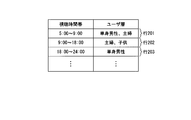
- FIG. 6 is a schematic diagram illustrating an example of an analysis pattern database.
- the analysis pattern database has data items of “viewing time zone” and “user layer”, and stores data of each data item in association with each row.
- the data item “viewing time zone” stores the time zone during which the broadcast program was viewed.
- the data item “user layer” stores a user layer having a high probability of using the display device 2.
- the value stored in the data item “viewing time zone” in the row 201 is “5:00 to 9:00”, and the value stored in the data item “user group” is “single male”. "Housewife”. This indicates that the user group who is watching a broadcast program between “5:00 and 9:00” has a high probability of “single man, housewife”.
- the other rows are as illustrated.
- FIG. 7 is a schematic diagram illustrating an example of a user information database.
- the user information database has data items of “device identification information” and “user layer”, and stores data of each data item in association with each row.
- the data item “device identification information” stores the MAC address of the display device 2.
- the data item “user layer” stores the result of analyzing the user layer of the user who is using the display device 2.
- the value stored in the data item “device identification information” in the row 301 is “xx: xx: xx: xx: xx: xx”, and the value stored in the data item “user layer”. Is a “single man”. This indicates that the user layer of the user who uses the display device 2 identified by the MAC address “xx: xx: xx: xx: xx” is analyzed as “single male”. The other rows are as illustrated.
- FIG. 8 is a schematic diagram illustrating an example of a distribution pattern database.
- the distribution pattern database has data items of “user layer” and “advertisement type”, and stores data of each data item in association with each row.
- the data item “user layer” stores the user layer of the user who uses the display device 2 that distributes the advertisement.
- the data item “advertisement type” stores the type of advertisement to be distributed.
- the value stored in the data item “user layer” in the row 401 is “single man”, and the value stored in the data item “advertisement type” is “AAA”. This indicates that the advertisement of “AAA” is distributed to the display device 2 analyzed that the user layer of the user to be used is “single male”.
- the other rows are as illustrated.
- the information processing apparatus 1 analyzes a user layer that uses the display apparatus 2
- the user group who uses the display device 2 in the morning time zone (4:00 to 10:00) is highly likely to be a single man or a housewife.
- a user group who uses the display device 2 in the daytime period (10:00 to 18:00) has a high possibility of being a housewife or a child.
- a user group who uses the display device 2 in the night time zone (18:00 to 24:00) is highly likely to be a single man or a child.
- the storage unit 11 of the information processing apparatus 1 stores an analysis pattern database in which features such as the above features are optimal for user layer analysis.
- the viewing information acquisition unit 13 of the information processing apparatus 1 acquires a viewing history that is a history of the time when the user viewed the broadcast program on the display device 2 from the viewing information server apparatus 3.
- the analysis unit 14 of the information processing device 1 analyzes the user layer using the display device 2 based on the viewing history acquired by the viewing information acquisition unit 13 and the above-described characteristics stored in the analysis pattern database. For example, when there are many viewing histories from 7:00 to 9:00 and 21:00 to 23:00, the analysis unit 14 analyzes that the user group of the user who uses the display device 2 is a single man.
- the information processing apparatus 1 can analyze the tendency of the user group of the user who uses the display device 2 based on the viewing history that is the history of the time when the user viewed the content on the display device 2. Moreover, the analysis part 14 stores the analyzed result in a user information database.
- the storage unit 11 of the information processing apparatus 1 stores a distribution pattern database in which a user layer using the display device 2 and a type of advertisement to be distributed are stored in association with each other.
- the selection unit 15 of the information processing device 1 selects the type of advertisement to be distributed to the display device 2 based on the result stored by the analysis unit 14 in the user information database and the information stored in the distribution pattern database. To do. For example, when the storage unit 11 stores the distribution pattern database illustrated in FIG. 8, the selection unit 15 selects the type of advertisement distributed to the display device 2 that has been analyzed that the user layer is “single male”. “AAA” is selected.
- the information processing apparatus 1 can select an advertisement according to the user layer using the display device 2. Further, the selection unit 15 causes the content distribution server 4 to distribute the selected type of advertisement.
- FIG. 9 is a flowchart showing an operation procedure of the information processing apparatus 1.
- the viewing information acquisition unit 13 acquires viewing history data from the viewing information server device 3 via the communication unit 24. Thereafter, the process proceeds to step S102.
- Step S102 The analysis unit 14 analyzes the user layer of the user who uses the display device 2 based on the viewing history data acquired in the process of step S101 and the analysis pattern database stored in the storage unit 11.
- the user layer analysis method is as described above. Thereafter, the process proceeds to step S103.
- Step S103 The analysis unit 14 stores the analysis result in the user information database stored in the storage unit 11. Thereafter, the process proceeds to step S104.
- Step S104 The selection unit 15 selects an advertisement to be distributed to the display device 2 based on the analysis result stored in the user information database in the process of Step S104 and the distribution pattern database stored in the storage unit 11. The advertisement selection method is as described above. Thereafter, the process proceeds to step S105.
- Step S105 The selection unit 15 transmits a distribution instruction to distribute the selected type of advertisement to the content distribution server 4. Thereafter, the process ends.
- the content distribution server 4 receives the distribution instruction, the content distribution server 4 distributes the advertisement selected by the information processing device 1 to the display device 2 based on the received distribution instruction.
- the information processing apparatus 1 analyzes the tendency of the user group who uses the display device 2 based on the viewing history that is the history of the time when the user viewed the content on the display device 2. To do. Thereby, the tendency of the user layer who uses a display apparatus can be analyzed based on when the user watched the broadcast program. Further, the information processing apparatus 1 can select an advertisement to be distributed based on the analyzed tendency of the user layer.
- the user group of the user who uses the display device 2 is highly likely to be a non-worker such as a housewife or a silver generation.
- the user group of the user who uses the display device 2 is a user group in which Monday is a holiday. There is a high possibility.
- the tendency of the user layer who uses the display apparatus 2 is analyzed based on the viewing history which is the history of the time when the user watched the broadcast program on the display apparatus 2, it is not limited to this. .
- the history of the time when the broadcast program was viewed the history of the time when the recorded program that recorded the broadcast program was viewed may be used as the viewing history.
- the time when the broadcast program was viewed the history of the time when the broadcast program was recorded may be used as the viewing history.
- the information processing apparatus of the present embodiment is not limited to the viewing history, which is the history of the time when the user viewed the broadcast program, but also the content of the broadcast program viewed by the user. Also, the user layer of the user who uses the display device 2 is analyzed with reference to FIG.
- FIG. 10 is a schematic diagram showing an example of an information processing system S2 according to the second embodiment of the present invention.
- the information processing system S2 includes an information processing device 5, a display device 2, a viewing information server device 3, a content distribution server 4, and a program information providing device 6.
- the configuration of the display device 2, the viewing information server device 3, and the content distribution server 4 is the same as the configuration of each device in the first embodiment.
- the information processing apparatus 5 and the program information providing apparatus 6 are server apparatuses having a known server function, for example.
- the information processing device 5, the display device 2, the viewing information server device 3, the content distribution server 4, and the program information providing device 6 are connected to the network NW by wireless or wired communication and can communicate with each other. .
- the information processing device 5 is based on the content of the television broadcast program viewed by the user on the display device 2 and the viewing history that is the history of the time when the user viewed the broadcast program on the display device 2. Analyzing user trends. The information processing device 5 selects an advertisement to be distributed to the display device 2 based on the analyzed user tendency.
- the display device 2 receives the television broadcast and displays the broadcast program of the television broadcast on the display unit 22. Further, the display device 2 receives an advertisement distributed from the content distribution server 4 and displays the received advertisement on the display unit 22. Further, the display device 2 transmits viewing program specifying information for specifying the broadcast program viewed by the user and viewing time specifying information for specifying the time when the user views the broadcast program to the viewing information server device 3. In addition, when transmitting the viewing program specifying information and the viewing time specifying information, the display device 2 transmits the device specifying information that can specify the own device in association with each other.
- the viewing information server device 3 stores the viewing program specifying information, the viewing time specifying information, and the device specifying information transmitted from the display device 2 in association with each other in the viewing history database. Also, the viewing information server device 3 transmits the viewing program specifying information, the viewing time specifying information, and the device specifying information stored in the viewing history database to the information processing device 1.
- the content distribution server 4 distributes the advertisement selected by the information processing device 1 to the display device 2 based on an instruction from the information processing device 1.
- the program information providing device 6 stores a program information database.
- the program information database is a database that stores various types of information on broadcast programs. Details of the program information database will be described later.
- the program information providing apparatus 6 transmits data stored in the program information database to the information processing apparatus 1.
- the configuration of the display device 2 in the present embodiment is the same as the configuration of the display device 2 in the first embodiment.
- the difference between the display device 2 of the present embodiment and the display device 2 of the first embodiment is that when the operation input unit 21 receives an input of a channel switching operation, the operation processing unit 251 is connected via the communication unit 24.
- channel information after switching viewing program specifying information
- device specifying information for uniquely specifying the display device 2 are transmitted to the viewing information server device 3.
- the configuration of the viewing information server device 3 in the present embodiment is the same as the configuration of the viewing information server device 3 in the first embodiment.
- the difference between the viewing information server device 3 of the present embodiment and the viewing information server device 3 of the first embodiment is that viewing program specifying information is used.
- the history data reception control unit 42 receives the viewing program specifying information, the viewing time specifying information, and the device specifying information transmitted from the display device 2 via the communication unit 41.
- the history data reception control unit 42 stores the received viewing program specifying information, viewing time specifying information, and device specifying information in association with each other in the viewing history database stored in the storage unit 43.
- “viewing program specifying information” is added to the data item of the viewing history database. Details of the viewing history database will be described later.
- FIG. 11 is a block diagram illustrating an example of a functional configuration of the information processing apparatus 5.
- the information processing apparatus 5 includes a storage unit 11, a communication unit 12, a viewing information acquisition unit 13, an analysis unit 14, a selection unit 15, and a program information acquisition unit 16.
- the information processing apparatus 5 includes a CPU and a storage device.
- the storage device includes, for example, an HDD, a flash memory, an EEPROM, a ROM, and a RAM, and stores various programs executed by the CPU, such as firmware and application programs, and results of processing executed by the CPU.
- the CPU operates as the viewing information acquisition unit 13, the analysis unit 14, the selection unit 15, and the program information acquisition unit 16 by executing a program stored in the storage device.
- the storage unit 11, the communication unit 12, the viewing information acquisition unit 13, and the selection unit 15 are the same as the units in the first embodiment.
- the program information acquisition unit 16 acquires program information from the program information providing device 6 via the communication unit 12.
- the analysis unit 14 Based on the viewing history data of the analysis target user acquired by the viewing information acquisition unit 13, the program information acquired by the program information acquisition unit 16, and the analysis pattern stored in the analysis pattern database, the analysis unit 14 Analyze the user base of users. Moreover, the analysis part 14 stores the analysis result of the user layer of the user of an analysis object in a user information database. A user layer analysis method will be described later.
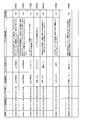
- FIG. 12 is a schematic diagram showing an example of a program information database.
- the program information database includes “identification ID”, “event start time”, “event end time”, “broadcast program name”, “event inclusion corner”, “event content information”, and “broadcast station ID”. ”And stores data of each data item in association with each row. For example, an event indicates an event such as a speech made by a performer or a video stream.
- the data item “identification ID” stores an identification ID for identifying program information.
- the data item “event start time” stores the time when the event occurred.
- the data item “event end time” stores the time when the event ended.
- the data item “broadcast program name” stores the name of the broadcast program.
- the data item “event inclusion corner” stores the name of the corner when the event occurs.
- the data item “event content information” stores the content of the event. As the contents of the event, for example, the content of the performer's statement, the name of the performer, the movement of the performer, the facial expression of the performer, and the like recorded in the text information are recorded.
- the data item “broadcast station ID” stores a broadcast station ID for identifying a broadcast station that broadcasts a broadcast program in which an event has occurred.
- the value stored in the data item “identification ID” in the row 501 is “3434366”, and the value stored in the data item “event start time” is “2012/10/16 1:56”.
- the value stored in the data item” event end time is “is” 2012/10/16 1:58 “, and the value stored in the data item” broadcast program name "is” miray SP of yyy " ”,
- the value stored in the data item“ event inclusion corner ” is“ miracle SP of yyy ”
- the value stored in the data item“ event content information ” is“ yyyy created ... “”
- the value stored in the data item “broadcasting station ID” is “1024”.
- the program information database may actually store all program information corresponding to broadcast programs broadcast nationwide or in regions.
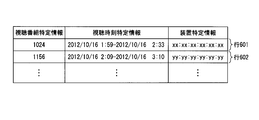
- FIG. 13 is a schematic diagram illustrating an example of a viewing history database.
- the viewing history database has data items of “viewing program specifying information”, “viewing time specifying information”, and “device specifying information”, and stores data of each data item in association with each row. ing.
- the data item “viewing program specifying information” stores a broadcasting station ID for identifying a broadcasting station broadcasting the viewed broadcasting program.
- the data item “viewing time specifying information” stores the time at which viewing of the broadcast program is started and the time at which it is ended.
- the data item “device identification information” stores the MAC address of the display device 2.
- the value stored in the data item “viewing program specifying information” in the row 601 is “1024”, and the value stored in the data item “viewing time specifying information” is “2012/10/16”. 1: 59-2012 / 10/16 2:33 ”, and the value stored in the data item“ device identification information ”is“ xx: xx: xx: xx: xx: xx ”. This is because the user who uses the display device 2 specified by the MAC address “xx: xx: xx: xx: xx: xx” is “2012/10/26 1:59” to “2012/10/16 2: Up to 33 "indicates that the broadcast program specified by the broadcast station ID" 1024 "has been viewed. The other rows are as illustrated.
- FIG. 14 is a schematic diagram illustrating an example of an analysis pattern database.
- the analysis pattern database has data items of “viewing time zone”, “program content”, and “user layer”, and stores data of each data item in association with each row.
- the data item “viewing time zone” stores the time zone during which the broadcast program was viewed.
- the data item “program content” stores the event content of the broadcast program viewed.
- the data item “user layer” stores a user layer having a high probability of using the display device 2.
- the value stored in the data item “viewing time zone” in the row 701 is “5:00 to 9:00”, and the value stored in the data item “program content” is “news”.
- the value stored in the data item “user group” is “single male”. This indicates that a user group who is watching a broadcast program in which an event about news has occurred between “5:00 and 9:00” has a high probability of “single man”.
- the other rows are as illustrated.
- the user information database in this embodiment is the same as the user information database in the first embodiment.
- the distribution pattern database in the present embodiment is the same as the distribution pattern database in the first embodiment.
- the time zone in which the display device 2 is used and the content of the broadcast program to be viewed are characteristic. For example, a user group who views a broadcast program in which an event about news occurred in the morning time zone (4:00 to 10:00) is likely to be a single man. In addition, for example, in the morning time zone (4:00 to 10:00), a user group who views a broadcast program in which an event about a wide show has occurred is likely to be a housewife. In addition, for example, a user group who uses the display device 2 in the night time zone (18:00 to 24:00) is highly likely to be a single man or a child. Thus, even if the time zone in which the display device 2 is used is the same, if the content of the broadcast program to be viewed is different, the user layer of the user who uses the display device 2 is also different.
- an analysis pattern database storing the above features is stored in the storage unit 11 of the information processing apparatus 5.
- the viewing information acquisition unit 13 of the information processing device 5 acquires a viewing history including viewing program specifying information from the viewing information server device 3.
- the program information acquisition unit 16 of the information processing device 5 acquires program information from the program information providing device 6.
- the analysis unit 14 of the information processing device 5 is based on the viewing history acquired by the viewing information acquisition unit 13, the program information acquired by the program information acquisition unit 16, and the above-described features stored in the analysis pattern database.
- the user layer that uses the display device 2 is analyzed.
- the analysis unit 14 analyzes that the user group of the user who uses the display device 2 is a single man. . In this way, the information processing device 5 is based on the content of the broadcast program that the user has viewed on the display device 2 and the viewing history that is the history of the time when the user viewed the broadcast program. Can be analyzed. Moreover, the analysis part 14 stores the analyzed result in a user information database.
- the method by which the information processing device 5 in this embodiment selects an advertisement to be distributed to the display device 2 is the same as the selection method in the first embodiment.
- FIG. 15 is a flowchart showing an operation procedure of the information processing apparatus 5.
- the viewing information acquisition unit 13 acquires viewing history data from the viewing information server device 3 via the communication unit 24. Thereafter, the process proceeds to step S202.
- the program information acquisition unit 16 acquires program information from the program information providing device 6 via the communication unit 24. Thereafter, the process proceeds to step S203.
- Step S203 The analysis unit 14 displays the display device 2 based on the viewing history data acquired in the process of step S201, the program information acquired in the process of step S202, and the analysis pattern database stored in the storage unit 11. Analyze the user base of the user to use.
- the user layer analysis method is as described above. Thereafter, the process proceeds to step S303.
- step S204 to step S206 is the same as the processing from step S103 to step S105 in the first embodiment.
- the information processing device 5 uses the display device 2 based on the content of the content viewed by the user on the display device 2 and the viewing history that is the history of the time when the content was viewed. Analyzing user demographic trends. Thereby, the tendency of the user layer who uses a display apparatus can be analyzed based on the contents of the broadcast program viewed by the user and the history of the time when the user viewed the broadcast program. Further, the information processing apparatus 5 can select an advertisement to be distributed based on the analyzed tendency of the user layer.
- the broadcast program genre is described as the content of the broadcast program.
- the present invention is not limited to this.
- a program performer may be used as the content of a broadcast program.
- the tendency of the user layer who uses the display apparatus 2 is analyzed based on the content of the broadcast program watched, it is not restricted to this.
- the tendency of the user group of the user who uses the display device 2 may be analyzed based on the combination of the content of the broadcast program to be viewed and the time zone to be viewed.
- the user group of the user who uses the display device 2 is likely to be a household with preschool children or elementary school children.
- the user group of the user who uses the display device 2 may be a household with the office worker Is expensive.
- the viewing layer information assumed when the broadcast program is produced it may be aggregated which viewing layer the program is viewed to analyze the user layer of the user who uses the display device 2. For example, when the frequency of viewing broadcast programs for women in their 30s and the frequency of viewing broadcast programs for infants are high, the user group of users who use the display device 2 may be households with housewives and children. high.
- the information processing apparatus of this embodiment refers not only to the viewing history, which is the history of the time when the user viewed the broadcast program, but also to the type of display device 2. Thus, the user layer of the user who uses the display device 2 is analyzed.
- the configuration of the information processing system S1 according to the present embodiment is the same as the configuration of the information processing system S1 according to the first embodiment.
- the information processing device 1 analyzes the tendency of the user who uses the display device 2 based on the viewing history that is the history of the time when the user viewed the broadcast program (content) on the display device 2 and the type of the display device 2. To do.
- the information processing device 1 selects an advertisement (second content) to be distributed to the display device 2 based on the analyzed user tendency.
- Examples of the display device 2 include a stationary television, a smartphone, and a tablet terminal.
- the display device 2 receives the television broadcast and displays the broadcast program of the television broadcast on the display unit 22. Further, the display device 2 receives an advertisement distributed from the content distribution server 4 and displays the received advertisement on the display unit 22. In addition, the display device 2 transmits to the viewing information server device 3 viewing time specifying information for specifying the time when the user viewed the broadcast program. When transmitting the viewing time specifying information, the display device 2 transmits the device specifying information that can specify the own device and the type specifying information indicating the type of the own device in association with each other.
- the viewing information server device 3 stores a viewing history database.
- the viewing history database is a database that stores the viewing history of the display device 2. Details of the viewing history database will be described later.
- the viewing information server device 3 stores the viewing time specifying information, the device specifying information, and the type specifying information transmitted from the display device 2 in the viewing history database in association with each other. Also, the viewing information server device 3 transmits the viewing time specifying information, the device specifying information, and the type specifying information stored in the viewing history database to the information processing device 1.
- the content distribution server 4 distributes the advertisement selected by the information processing device 1 to the display device 2 based on an instruction from the information processing device 1.
- the configuration of the information processing device 1, the display device 2, and the configuration of the viewing information server device 3 are the same as the configuration of each device in the first embodiment.
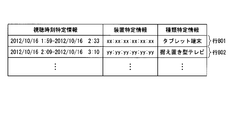
- FIG. 16 is a schematic diagram illustrating an example of a viewing history database.
- the viewing history database has data items of “viewing time specifying information”, “device specifying information”, and “type specifying information”, and stores data of each data item in association with each row. Yes.
- the data item “viewing time specifying information” stores the time at which viewing of the broadcast program starts and the time at which it ends.
- the data item “device identification information” stores the MAC address of the display device 2.
- the data item “type specifying information” stores information indicating the type of the display device 2.
- the value stored in the data item “viewing time specifying information” in the row 801 is “2012/10/16 1: 59-2012 / 10/16 2:33”, and the data item “device specifying”
- the value stored in the “information” is “xx: xx: xx: xx: xx”, and the value stored in the data item “type identification information” is “tablet terminal”.
- the type of the display device 2 specified by the MAC address “xx: xx: xx: xx: xx: xx: xx” is “tablet terminal”, and the user using the display device 2 is “2012/10/26 It shows that the broadcast program was viewed from “1:59” to “2012/10/16 2:33”.
- the other rows are as illustrated.
- FIG. 17 is a schematic diagram illustrating an example of an analysis pattern database.
- the analysis pattern database has data items of “viewing time zone”, “type identification information”, and “user layer”, and stores data of each data item in association with each row.
- the data item “viewing time zone” stores the time zone during which the broadcast program was viewed.
- the data item “type specifying information” stores information indicating the type of the display device 2.
- the data item “user layer” stores a user layer having a high probability of using the display device 2.
- the value stored in the data item “viewing time zone” in the row 901 is “5:00 to 9:00”, and the value stored in the data item “type identification information” is “tablet”. “Terminal”, and the value stored in the data item “User layer” is “Single male”. This indicates that the user group who is watching a broadcast program on the display device 2 that is a “tablet terminal” between “5:00 and 9:00” has a high probability of “single male”. .
- the other rows are as illustrated.
- the distribution pattern database in the present embodiment is the same as the distribution pattern database in the first embodiment.
- the information processing apparatus 1 analyzes a user layer that uses the display apparatus 2
- the time zone in which the display device 2 is used and the type of the display device 2 to be used are characteristic. For example, in the morning time zone (4:00 to 10:00), a user group who is watching a broadcast program on the display device 2 that is a tablet terminal is likely to be a single man. Further, for example, in the morning time zone (4:00 to 10:00), a user group who is watching a broadcast program on the display device 2 that is a stationary television is likely to be a housewife. Thus, even if the time zone in which the display device 2 is used is the same, if the type of the display device 2 to be used is different, the user layer of the user who uses the display device 2 is also different.
- an analysis pattern database storing the above features is stored in the storage unit 11 of the information processing apparatus 1.
- the viewing information acquisition unit 13 of the information processing apparatus 1 acquires a viewing history including type identification information from the viewing information server apparatus 3.
- the analysis unit 14 of the information processing device 1 analyzes the user layer using the display device 2 based on the viewing history acquired by the viewing information acquisition unit 13 and the above-described features stored in the analysis pattern database.
- the analysis unit 14 indicates that the user group of the user who uses the display device 2 is a single man. And analyze. As described above, the information processing apparatus 1 shows the tendency of the user layer of the user who uses the display device 2 based on the type of the display device 2 used by the user and the viewing history that is the history of the time when the broadcast program was viewed. Can be analyzed. Moreover, the analysis part 14 stores the analyzed result in a user information database.
- the method by which the information processing apparatus 1 in the present embodiment selects an advertisement to be distributed to the display device 2 is the same as the selection method in the first embodiment.
- FIG. 18 is a flowchart showing an operation procedure of the information processing apparatus 1.
- the viewing information acquisition unit 13 acquires viewing history data including type specifying information from the viewing information server device 3 via the communication unit 24. Thereafter, the process proceeds to step S302.
- Step S302 The analysis unit 14 analyzes the user layer of the user who uses the display device 2 based on the viewing history data acquired in the process of step S301 and the analysis pattern database stored in the storage unit 11.
- the user layer analysis method is as described above. Thereafter, the process proceeds to step S303.
- step S303 to step S305 is the same as the processing from step S103 to step S105 in the first embodiment.
- the information processing device 1 changes the display device 2 based on the type of the display device 2 on which the user has viewed the broadcast program and the viewing history that is the history of the time at which the user has viewed the content. Analyze the user demographics used. Thereby, the tendency of the user layer who uses a display apparatus can be analyzed based on the kind of display apparatus 2 with which the user watched the broadcast program, and the history of the time when the user watched the broadcast program. Further, the information processing apparatus 1 can select an advertisement to be distributed based on the analyzed tendency of the user layer.
- the difference between the present embodiment and the first embodiment is a method for selecting an advertisement to be distributed to the display device 2.
- the advertisement to be distributed is selected according to the analyzed user layer of the user and the time when the user views the broadcast program on the display device 2. Since other processes are the same as those in the first embodiment, description thereof will be omitted.
- the configuration of each device is the same as the configuration of each device in the first embodiment.
- Distribution in which the storage unit 11 of the information processing apparatus 1 stores a user group using the display device 2, a time zone during which a broadcast program is viewed on the display device 2, and a type of advertisement to be distributed in association with each other.
- Store the pattern database Store the pattern database.
- the selection unit 15 of the information processing device 1 selects the type of advertisement to be distributed to the display device 2 based on the result stored by the analysis unit 14 in the user information database and the information stored in the distribution pattern database. To do.
- FIG. 19 is a schematic diagram showing an example of a distribution pattern database.
- the distribution pattern database has data items of “user layer”, “viewing time zone”, and “advertisement type”, and stores data of each data item in association with each row.
- the data item “user layer” stores the user layer of the user who uses the display device 2 that distributes the advertisement.
- the data item “viewing time zone” stores a time zone during which a broadcast program is viewed on the display device 2.
- the data item “advertisement type” stores the type of advertisement to be distributed.
- the value stored in the data item “user group” in the row 1001 is “single male”, and the value stored in the data item “viewing time zone” is “8:00 to 10:00”.
- ”And the value stored in the data item“ advertisement type ” is“ AAA ”.
- This is the display device 2 analyzed that the user layer of the user to be used is “single male”, and when the user is watching a broadcast program from “8:00 to 10:00”, “AAA” ”Is distributed.
- the other rows are as illustrated.
- the selection unit 15 is the display device 2 analyzed that the user layer is “single male”, and the user is “8:00”. When viewing a broadcast program at “10:00”, “AAA” is selected as the type of advertisement to be distributed. As described above, the information processing apparatus 1 can select an advertisement according to the time zone during which the broadcast program is viewed on the display device 2 and the user layer using the display device 2. Further, the selection unit 15 causes the content distribution server 4 to distribute the selected type of advertisement.
- the information processing apparatus 1 can narrow down the advertisements to be distributed based on the user layer using the display device 2 and the time zone that the user is viewing.
- a fifth embodiment of the present invention will be described.
- the difference between the present embodiment and the second embodiment is a method of selecting an advertisement to be distributed to the display device 2.
- an advertisement to be distributed is selected according to the analyzed user layer of the user and the content of the broadcast program that the user is viewing on the display device 2.
- Other processes are the same as those in the second embodiment, and thus description thereof is omitted.
- the configuration of each device is the same as the configuration of each device in the second embodiment.
- the selection unit 15 of the information processing device 5 selects the type of advertisement to be distributed to the display device 2 based on the result stored by the analysis unit 14 in the user information database and the information stored in the distribution pattern database. To do.
- FIG. 20 is a schematic diagram showing an example of a distribution pattern database.
- the distribution pattern database has data items of “user layer”, “program content”, and “advertisement type”, and stores data of each data item in association with each row.
- the data item “user layer” stores the user layer of the user who uses the display device 2 that distributes the advertisement.
- the data item “program content” stores the content of the broadcast program being viewed on the display device 2.
- the data item “advertisement type” stores the type of advertisement to be distributed.
- the value stored in the data item “user group” in the row 1011 is “single male”
- the value stored in the data item “program content” is “news”
- the data item “ The value stored in “Advertisement Type” is “AAA”.
- This is the display device 2 analyzed that the user layer of the user to be used is “single male”, and when the user is watching a broadcast program in which an event about “news” has occurred, “AAA”. Indicates that the ad will be served.
- the other rows are as illustrated.
- the selection unit 15 is the display device 2 analyzed that the user layer is “single male”, and the user is about “news”.
- “AAA” is selected as the type of advertisement to be distributed.
- the information processing device 5 can select an advertisement according to the content of the broadcast program being viewed on the display device 2 and the user layer using the display device 2. Further, the selection unit 15 causes the content distribution server 4 to distribute the selected type of advertisement.
- the information processing apparatus 1 can narrow down advertisements to be distributed based on the user layer using the display device 2 and the content of the broadcast program that the user is viewing.
- the difference between the present embodiment and the second embodiment is a method of selecting an advertisement to be distributed to the display device 2.
- the distribution is performed according to the user layer of the analyzed user, the time when the user is viewing the broadcast program on the display device 2, and the content of the broadcast program that the user is viewing on the display device 2. Select an ad.
- Other processes are the same as those in the second embodiment, and thus description thereof is omitted.
- the configuration of each device is the same as the configuration of each device in the second embodiment.
- the information processing device 5 selects an advertisement to be distributed to the display device 2 .
- the storage unit 11 of the information processing device 5 the user layer using the display device 2, the time when the user views the broadcast program on the display device 2, and the content of the broadcast program viewed on the display device 2 And a distribution pattern database in which the types of advertisements to be distributed are stored in association with each other.
- the selection unit 15 of the information processing device 5 selects the type of advertisement to be distributed to the display device 2 based on the result stored by the analysis unit 14 in the user information database and the information stored in the distribution pattern database. To do.
- FIG. 21 is a schematic diagram showing an example of a distribution pattern database.
- the distribution pattern database has data items of “user layer”, “viewing time zone”, “program content”, and “advertisement type”, and associates data of each data item for each row. Storing.
- the data item “user layer” stores the user layer of the user who uses the display device 2 that distributes the advertisement.
- the data item “viewing time zone” stores a time zone during which a broadcast program is viewed on the display device 2.
- the data item “program content” stores the content of the broadcast program being viewed on the display device 2.
- the data item “advertisement type” stores the type of advertisement to be distributed.
- the value stored in the data item “user group” in the row 1021 is “single male”, and the value stored in the data item “viewing time zone” is “8:00 to 10:00”.
- the value stored in the data item” program content is “is” news ", and the value stored in the data item” advertisement type "is” AAA ".
- This is the display device 2 analyzed that the user layer of the user to be used is “single male”, the user is watching a broadcast program from “8:00 to 10:00”, and the user is “news”. When viewing a broadcast program in which an event has occurred, the advertisement of “AAA” is distributed.
- the other rows are as illustrated.
- the selection unit 15 is the display device 2 analyzed that the user layer is “single male”, and the user is “8:00”.
- “ AAA ” is selected as the type of advertisement to be distributed.
- the information processing device 5 includes the time zone during which a broadcast program is viewed on the display device 2, the contents of the broadcast program viewed on the display device 2, and the user group using the display device 2.
- the advertisement according to can be selected.
- the selection unit 15 causes the content distribution server 4 to distribute the selected type of advertisement.
- the information processing device 1 is based on the user layer using the display device 2, the time zone that the user is viewing, and the content of the broadcast program that the user is viewing. It is possible to narrow down the advertisements to be delivered.
- the program for realizing the above function may be recorded on a computer-readable recording medium, and the program recorded on the recording medium may be read into a computer system and executed.
- the “computer system” includes an OS and hardware such as peripheral devices.
- the “computer-readable recording medium” means a portable medium such as a flexible disk, a magneto-optical disk, a ROM, and a CD-ROM, and a storage unit such as a hard disk built in the computer system. Furthermore, the “computer-readable recording medium” dynamically holds a program for a short time like a communication line when transmitting a program via a network such as the Internet or a communication line such as a telephone line. In this case, a volatile memory inside a computer system serving as a server or a client in that case may be included and a program that holds a program for a certain period of time.
- the program may be a program for realizing a part of the functions described above, and may be a program capable of realizing the functions described above in combination with a program already recorded in a computer system.
- the example of the broadcast program is described as an example of the content displayed on the display device 2, but the present invention is not limited to this, and any content may be used.
- the example of the advertisement is described as an example of the content (second content) distributed by the content distribution server 5, but the present invention is not limited to this, and any content may be used.
- the present invention can be applied to mobile phones, personal computers, tablet computers, and the like.
Landscapes
- Engineering & Computer Science (AREA)
- Databases & Information Systems (AREA)
- Multimedia (AREA)
- Signal Processing (AREA)
- Computer Graphics (AREA)
- Business, Economics & Management (AREA)
- Marketing (AREA)
- Two-Way Televisions, Distribution Of Moving Picture Or The Like (AREA)
- Information Transfer Between Computers (AREA)
Abstract
ユーザが表示装置でコンテンツを視聴した時刻の履歴である視聴履歴に基づいて、当該表示装置を使用するユーザの傾向を解析する解析部を備えることを特徴とする情報処理装置。
Description
本発明は、情報処理装置、情報処理方法、プログラム、情報処理システムおよび表示装置に関する。
本願は、2014年1月31日に、日本に出願された特願2014-017259号に基づき優先権を主張し、その内容をここに援用する。
本願は、2014年1月31日に、日本に出願された特願2014-017259号に基づき優先権を主張し、その内容をここに援用する。
ユーザ毎にID番号を発行し、同じテレビ番組を視聴している多数の視聴者それぞれに対して、その嗜好に則し、かつテレビ広告とは別に、番組の各場面の内容にも則した広告を、ホームサーバーを通して提供するものがある(例えば、特許文献1参照)。
しかしながら、ある1つのテレビジョン受信装置が再生する放送番組を視聴するユーザは、必ずしも特定の1人に限られず、同居人のいずれか又は同居人の組になることがある。例えば、放送番組が個室や寝室等において1人のユーザが視聴すること、居間において同居家族全員が視聴すること、客間において他の同居家族と不特定の来客が視聴することがある。従って、複数ユーザの視聴履歴が混在し、ある1つのテレビジョン受信装置を使用するユーザ層の傾向を特定することができないという問題がある。
本発明は上記の点に鑑みてなされたものであり、表示装置を使用するユーザ層の傾向を解析することができる情報処理装置、情報処理方法、プログラム、情報処理システムおよび表示装置を提供することを課題とする。
(1)本発明は上記の課題を解決するためになされたものであり、本発明の一態様は、ユーザが表示装置でコンテンツを視聴した時刻の履歴である視聴履歴に基づいて、当該表示装置を使用するユーザの傾向を解析する解析部を備える情報処理装置である。
(2)また、本発明の一態様は、情報処理装置であって、前記解析部はさらに、前記コンテンツの内容に基づいて、前記表示装置を使用するユーザの傾向を解析するように構成されていてもよい。
(3)また、本発明の一態様は、情報処理装置であって、前記解析部はさらに、前記表示装置の種類に基づいて、前記表示装置を使用するユーザの傾向を解析するように構成されていてもよい。
(4)また、本発明の一態様は、前記解析部が解析した前記表示装置を使用するユーザの傾向に基づいて、前記表示装置に対して配信する第2のコンテンツを選択する選択部を備えていてもよい。
(5)また、本発明の一態様は、情報処理装置であって、前記選択部は、前記ユーザが前記コンテンツを視聴している時刻に基づいて、前記第2のコンテンツを選択するように構成されていてもよい。
(6)また、本発明の一態様は、情報処理装置であって、前記選択部は、前記表示装置が表示している前記コンテンツの内容に基づいて、前記第2のコンテンツを選択するように構成されていてもよい。
(7)また、本発明の一態様は、情報処理装置であって、前記選択部は、選択した前記第2のコンテンツを、コンテンツ配信サーバから前記表示装置に対して配信させるように構成されていてもよい。
(8)また、本発明の一態様は、情報処理装置であって、前記コンテンツは、テレビジョン放映された放送番組であってもよい。
(8)また、本発明の一態様は、情報処理装置であって、前記コンテンツは、テレビジョン放映された放送番組であってもよい。
(9)また、本発明の一態様は、情報処理装置であって、前記コンテンツは、テレビジョン放映された放送番組を録画した録画コンテンツであってもよい。
(10)また、本発明の一態様は、情報処理装置であって、前記解析部はさらに、前記録画コンテンツの録画時刻に基づいて、前記表示装置を使用するユーザの傾向を解析するように構成されていてもよい。
(11)また、本発明の一態様は、ユーザが表示装置でコンテンツを視聴した時刻の履歴である視聴履歴に基づいて、当該表示装置を使用するユーザの傾向を解析する解析ステップを含む情報処理方法である。
(12)また、本発明の一態様は、情報処理方法であって、前記解析ステップで解析した、前記表示装置を使用するユーザの傾向に基づいて、前記表示装置に対して配信する第2のコンテンツを選択する選択ステップと、前記選択ステップで選択した前記第2のコンテンツを、コンテンツ配信サーバから前記表示装置に対して配信させる配信ステップと、を含んでもよい。
(12)また、本発明の一態様は、情報処理方法であって、前記解析ステップで解析した、前記表示装置を使用するユーザの傾向に基づいて、前記表示装置に対して配信する第2のコンテンツを選択する選択ステップと、前記選択ステップで選択した前記第2のコンテンツを、コンテンツ配信サーバから前記表示装置に対して配信させる配信ステップと、を含んでもよい。
(13)また、本発明の一態様は、ユーザが表示装置でコンテンツを視聴した時刻の履歴である視聴履歴に基づいて、当該表示装置を使用するユーザの傾向を解析する解析ステップをコンピュータに実行させるためのプログラムである。
(14)また、本発明の一態様は、プログラムであって、前記解析ステップで解析した、前記表示装置を使用するユーザの傾向に基づいて、前記表示装置に対して配信する第2のコンテンツを選択する選択ステップと、前記選択ステップで選択した前記第2のコンテンツを、コンテンツ配信サーバから前記表示装置に対して配信させる配信ステップと、をコンピュータに実行させる。
(14)また、本発明の一態様は、プログラムであって、前記解析ステップで解析した、前記表示装置を使用するユーザの傾向に基づいて、前記表示装置に対して配信する第2のコンテンツを選択する選択ステップと、前記選択ステップで選択した前記第2のコンテンツを、コンテンツ配信サーバから前記表示装置に対して配信させる配信ステップと、をコンピュータに実行させる。
(15)また、本発明の一態様は、コンテンツを表示する表示部と、前記表示部が表示するコンテンツをユーザが視聴した視聴時刻を送信する表示装置送信部と、を備えた表示装置と、前記表示装置送信部が送信した前記視聴時刻を受信するサーバ受信部と、前記サーバ受信部が受信した前記視聴時刻の履歴を視聴履歴として記憶する記憶部と、前記記憶部が記憶する前記視聴履歴を送信するサーバ送信部と、を備えた視聴情報サーバ装置と、前記視聴情報サーバ装置が送信した前記視聴履歴を受信する受信部と、前記受信部が受信した前記視聴履歴に基づいて、前記表示装置を使用するユーザの傾向を解析する解析部と、を備えた情報処理装置と、を含む情報処理システムである。
(16)また、本発明の一態様は、情報処理システムであって、第2のコンテンツを配信するコンテンツ配信サーバを含み、前記情報処理装置は、前記解析部が解析した前記表示装置を使用するユーザの傾向に基づいて、前記表示装置に対して配信する第2のコンテンツを選択し、選択した前記第2のコンテンツを、前記コンテンツ配信サーバから前記表示装置に対して配信させる選択部を備える。
(16)また、本発明の一態様は、情報処理システムであって、第2のコンテンツを配信するコンテンツ配信サーバを含み、前記情報処理装置は、前記解析部が解析した前記表示装置を使用するユーザの傾向に基づいて、前記表示装置に対して配信する第2のコンテンツを選択し、選択した前記第2のコンテンツを、前記コンテンツ配信サーバから前記表示装置に対して配信させる選択部を備える。
(17)また、本発明の一態様は、コンテンツを表示する表示部と、前記表示部が表示するコンテンツをユーザが視聴した視聴時刻を送信する送信部と、前記視聴時刻の履歴に基づいて選択された第2のコンテンツを受信する受信部と、を備え、前記表示部は、前記受信部が受信した前記第2のコンテンツを表示する表示装置である。
(18)また、本発明の一態様は、表示装置であって、前記表示部は、前記受信部が前記第2のコンテンツを受信してから所定の時間が経過した後、前記第2のコンテンツの表示を消去する。
本発明の態様によれば、表示装置を使用するユーザの傾向を解析することができる。
(第1の実施形態)
以下、本発明の第1の実施形態について説明する。図1は、本発明の第1の実施形態に係る情報処理システムS1の一例を示す概略図である。図示する例では、情報処理システムS1は、情報処理装置1と、表示装置2と、視聴情報サーバ装置3と、コンテンツ配信サーバ4とを含む。
以下、本発明の第1の実施形態について説明する。図1は、本発明の第1の実施形態に係る情報処理システムS1の一例を示す概略図である。図示する例では、情報処理システムS1は、情報処理装置1と、表示装置2と、視聴情報サーバ装置3と、コンテンツ配信サーバ4とを含む。
情報処理装置1と、視聴情報サーバ装置3と、コンテンツ配信サーバ4とは、例えば、公知のサーバ機能を備えるサーバ装置である。表示装置2は、例えば、テレビや、パーソナルコンピュータや、携帯電話や、タブレットや、スマートフォンや、PDA(Personal Digital Assistant)など、表示部22を備える装置である。情報処理装置1と、表示装置2と、視聴情報サーバ装置3と、コンテンツ配信サーバ4とは、それぞれネットワークNWに無線または有線により接続され、互いに通信を行うことができる。
ネットワークNWは、例えば、携帯電話網や、PHS(Personal Handy-phone System)網や、VPN(Virtual Private Network)網や、専用通信回線網や、WAN(Wide Area Network)、LAN(Local Area Network)や、PSTN(Public Switched Telephone Network;公衆交換電話網)などによって構成される情報通信ネットワークであり、また、これらの組み合わせであってもよい。
情報処理装置1は、ユーザが表示装置2で放送番組(コンテンツ)を視聴した時刻の履歴である視聴履歴に基づいて、表示装置2を使用するユーザの傾向を解析する。また、情報処理装置1は、解析したユーザの傾向に基づいて、表示装置2に対して配信する広告(第2のコンテンツ)を選択する。
表示装置2は、テレビジョン放送を受信し、テレビジョン放送の放送番組を表示部22に表示する。また、表示装置2は、コンテンツ配信サーバ4から配信される広告を受信し、受信した広告を表示部22に表示する。また、表示装置2は、ユーザが放送番組を視聴した時刻を特定する視聴時刻特定情報を視聴情報サーバ装置3に対して送信する。なお、表示装置2は視聴時刻特定情報を送信する際には、自装置を特定することができる装置特定情報を関連付けて送信する。例えば、装置特定情報として、表示装置2の通信部に割り当てられているMACアドレス(Media Access Control address)を用いる。
なお、以下では、表示装置2が放送番組を表示することを、表示装置2の利用者が当該放送番組を視聴することと読み替える。また、表示装置2を利用し、放送番組を視聴する者を視聴者と称する。
視聴情報サーバ装置3は、表示装置2の視聴履歴を格納する視聴履歴データベースを保持する。視聴履歴データベースの詳細は後述する。視聴情報サーバ装置3は、表示装置2から送信される視聴時刻特定情報と、装置特定情報とを関連付けて、視聴履歴データベースに格納する。また、視聴情報サーバ装置3は、視聴履歴データベースに格納している視聴時刻特定情報と、装置特定情報とを情報処理装置1に対して送信する。コンテンツ配信サーバ4は、情報処理装置1の指示に基づいて、情報処理装置1が選択した広告を表示装置2に対して配信する。
次に、表示装置2の構成について説明する。図2は、表示装置2の機能構成の一例を示したブロック図である。図示する例では、表示装置2は、操作入力部21と、表示部22と、映像受信部23と、通信部24(送信部、受信部、表示装置送信部)と、操作処理部251と、コンテンツ受信部252と、表示制御部253とを備える。また、表示装置2は、公知のテレビジョン受信機の機能を有する。
また、表示装置2は、CPU(Central Processing Unit)や記憶装置を備える。記憶装置は、例えば、HDD(Hard Disc Drive)や、フラッシュメモリや、EEPROM(Electrically Erasable Programmable Read Only Memory)や、ROM(Read Only Memory)や、RAM(Random Access Memory)などを備え、ファームウェアやアプリケーションプログラムなど、CPUが実行するための各種プログラムやCPUが実行した処理の結果などを記憶する。例えば、CPUは、記憶装置に記憶されているプログラムを実行することによって、操作処理部251と、コンテンツ受信部252と、表示制御部253として動作する。
操作入力部21は、視聴者から、表示装置2に対する操作入力を受け付ける。操作入力部21は、例えば、テレビのリモコンなどの入力装置を介して、操作入力を受け付ける。表示部22は、例えば、液晶ディスプレイや有機EL(Electro-Luminescence)ディスプレイなどの表示装置を備える。表示部22は、映像受信部23が受信した放送番組や、コンテンツ受信部252がコンテンツ配信サーバ4から受信した広告などを表示する。
映像受信部23は、テレビチューナーを備え、テレビジョン放送された放送番組を受信する。通信部24は、通信インターフェースを備え、情報処理装置1や、視聴情報サーバ装置3や、コンテンツ配信サーバ4など、他の装置と通信を行う。
操作処理部251は、操作入力部21が受け付けた入力を解析し、入力に応じた処理を実行する。例えば、操作処理部251は、操作入力部21がチャンネルの切り替え操作の入力を受け付けた場合、切り替え後のチャンネルの情報を表示制御部253に対して出力する。また、例えば、操作入力部21が電源を入れる操作の入力を受け付けた場合、操作処理部251は、通信部24を介して、電源を入れる操作の入力を受け付けた時刻(視聴時刻特定情報)と、表示装置2を一意に特定する装置特定情報とを視聴情報サーバ装置3に対して送信する。また、例えば、操作入力部21が電源を切断する操作の入力を受け付けた場合、操作処理部251は、通信部24を介して、電源を切断する操作の入力を受け付けた時刻(視聴時刻特定情報)と、表示装置2を一意に特定する装置特定情報とを視聴情報サーバ装置3に対して送信する。
表示制御部253は、映像受信部23が受信した放送番組や、コンテンツ受信部252が受信した広告などを表示部22に表示させる。例えば、表示制御部253は、操作処理部251から切り替え後のチャンネルの情報が入力された場合、表示部22に表示させる放送番組を、切り替え後のチャンネルの情報に基づいて切り替える。また、例えば、表示制御部253は、コンテンツ受信部252が広告を受信した場合、表示部22に広告を表示させる。また、例えば、表示制御部253は、表示部22に広告を表示させてから一定時間経過した後、広告の表示を消去させてもよい。なお、一定時間は予め定められていてもよく、任意に設定できてもよい。
次に、視聴情報サーバ装置3の構成について説明する。図3は、視聴情報サーバ装置3の機能構成の一例を示したブロック図である。図示する例では、視聴情報サーバ装置3は、通信部41(サーバ受信部、サーバ送信部)と、履歴データ受信制御部42と、記憶部43と、履歴データ送信制御部44とを備える。
また、視聴情報サーバ装置3は、CPUや記憶装置を備える。記憶装置は、例えば、HDDや、フラッシュメモリや、EEPROMや、ROMや、RAMなどを備え、ファームウェアやアプリケーションプログラムなど、CPUが実行するための各種プログラムやCPUが実行した処理の結果などを記憶する。例えば、CPUは、記憶装置に記憶されているプログラムを実行することによって、履歴データ受信制御部42と、履歴データ送信制御部44として動作する。
通信部41は、通信インターフェースを備え、情報処理装置1や、表示装置2や、コンテンツ配信サーバ4など、他の装置と通信を行う。履歴データ受信制御部42は、表示装置2から送信される視聴時刻特定情報と、装置特定情報とを通信部41を介して受信する。また、履歴データ受信制御部42は、受信した視聴時刻特定情報と、装置特定情報とを関連付けて記憶部43が記憶する視聴履歴データベースに格納する。なお、視聴履歴データベースに格納されている視聴時刻特定情報と、装置特定情報とを視聴履歴データとする。
記憶部43は、例えばHDDを備え、視聴履歴データベースを記憶する。履歴データ送信制御部44は、通信部41を介して、記憶部43の視聴履歴データベースが格納している視聴履歴データを情報処理装置1に対して送信する。
次に、情報処理装置1の構成について説明する。図4は、情報処理装置1の機能構成の一例を示したブロック図である。図示する例では、情報処理装置1は、記憶部11と、通信部12と、視聴情報取得部13と、解析部14と、選択部15とを備える。
また、情報処理装置1は、CPUや記憶装置を備える。記憶装置は、例えば、HDDや、フラッシュメモリや、EEPROMや、ROMや、RAMなどを備え、ファームウェアやアプリケーションプログラムなど、CPUが実行するための各種プログラムやCPUが実行した処理の結果などを記憶する。例えば、CPUは、記憶装置に記憶されているプログラムを実行することによって、視聴情報取得部13と、解析部14と、選択部15として動作する。
記憶部11は、例えば、HDDや、フラッシュメモリや、EEPROMや、ROMや、RAMなどを備え、情報処理装置1が備える各部が用いるデータを記憶する。また、記憶部11は、解析パターンデータベースと、ユーザ情報データベースと、配信パターンデータベースとを記憶する。各データベースの詳細については後述する。
通信部12は、通信インターフェースを備え、表示装置2や、視聴情報サーバ装置3や、コンテンツ配信サーバ4など、他の装置と通信を行う。視聴情報取得部13は、通信部12を介して、視聴情報サーバ装置3から視聴履歴データを取得する。
解析部14は、視聴情報取得部13が取得した解析対象のユーザの視聴履歴データと、解析パターンデータベースが記憶する解析パターンとに基づいて、解析対象のユーザのユーザ層を解析する。また、解析部14は、解析対象のユーザのユーザ層の解析結果をユーザ情報データベースに格納する。なお、ユーザ層の解析方法については後述する。
選択部15は、ユーザ情報データベースに格納されているユーザのユーザ層と、配信パターンデータベースに格納されている配信パターンとに基づいて、ユーザに対して配信する広告を選択する。なお、配信する広告の選択方法については後述する。また、選択部15は、通信部12を介して、選択した種類の広告を配信させる配信指示を、コンテンツ配信サーバ4に対して送信する。
次に、視聴情報サーバ装置3の記憶部43が記憶している視聴履歴データベースについて説明する。図5は、視聴履歴データベースの一例を示した概略図である。視聴履歴データベースは、「視聴時刻特定情報」と、「装置特定情報」とのデータ項目を有しており、各データ項目のデータを行毎に対応付けて格納している。
データ項目「視聴時刻特定情報」は、放送番組の視聴を開始した時刻と終了した時刻とを格納する。データ項目「装置特定情報」は、表示装置2のMACアドレスを格納する。
図示する例では、行101のデータ項目「視聴時刻特定情報」に記憶されている値が「2012/10/16 1:59-2012/10/16 2:33」であり、データ項目「装置特定情報」に記憶されている値が「xx:xx:xx:xx:xx:xx」である。これは、MACアドレス「xx:xx:xx:xx:xx:xx」で特定される表示装置2を使用するユーザは、「2012/10/26 1:59」から「2012/10/16 2:33」まで放送番組を視聴したことを示している。なお、その他の行については図示するとおりである。
次に、情報処理装置1の記憶部11が記憶する解析パターンデータベースについて説明する。図6は、解析パターンデータベースの一例を示した概略図である。解析パターンデータベースは、「視聴時間帯」と、「ユーザ層」とのデータ項目を有しており、各データ項目のデータを行毎に対応付けて格納している。データ項目「視聴時間帯」は、放送番組を視聴した時間帯を格納する。データ項目「ユーザ層」は、表示装置2を使用している確率が高いユーザ層を格納する。
図示する例では、行201のデータ項目「視聴時間帯」に記憶されている値が「5:00~9:00」であり、データ項目「ユーザ層」に記憶されている値が「単身男性、主婦」である。これは、「5:00~9:00」の間に放送番組を視聴しているユーザ層は、「単身男性、主婦」の確率が高いことを示している。なお、その他の行については図示するとおりである。
次に、情報処理装置1の記憶部11が記憶するユーザ情報データベースについて説明する。図7は、ユーザ情報データベースの一例を示した概略図である。ユーザ情報データベースは、「装置特定情報」と、「ユーザ層」とのデータ項目を有しており、各データ項目のデータを行毎に対応付けて格納している。データ項目「装置特定情報」は、表示装置2のMACアドレスを格納する。データ項目「ユーザ層」は、表示装置2を使用しているユーザのユーザ層を解析した結果を格納する。
図示する例では、行301のデータ項目「装置特定情報」に記憶されている値が「xx:xx:xx:xx:xx:xx」であり、データ項目「ユーザ層」に記憶されている値が「単身男性」である。これは、MACアドレス「xx:xx:xx:xx:xx:xx」で特定される表示装置2を使用するユーザのユーザ層は「単身男性」であると解析したことを示している。なお、その他の行については図示するとおりである。
次に、情報処理装置1の記憶部11が記憶する配信パターンデータベースについて説明する。図8は、配信パターンデータベースの一例を示した概略図である。配信パターンデータベースは、「ユーザ層」と、「広告種類」とのデータ項目を有しており、各データ項目のデータを行毎に対応付けて格納している。データ項目「ユーザ層」は、広告を配信する表示装置2を使用しているユーザのユーザ層を格納する。データ項目「広告種類」は、配信する広告の種類を格納する。
図示する例では、行401のデータ項目「ユーザ層」に記憶されている値が「単身男性」であり、データ項目「広告種類」に記憶されている値が「AAA」である。これは、使用するユーザのユーザ層が「単身男性」であると解析された表示装置2に対して、「AAA」の広告を配信することを示している。なお、その他の行については図示するとおりである。
次に、情報処理装置1が、表示装置2を使用するユーザ層を解析する方法について説明する。ユーザ層によって、表示装置2を使用する時間帯に特徴がある。例えば、朝の時間帯(4:00~10:00)に表示装置2を使用するユーザ層は、単身男性や主婦の可能性が高い。また、例えば、昼の時間帯(10:00~18:00)に表示装置2を使用するユーザ層は、主婦や子供の可能性が高い。また、例えば、夜の時間帯(18:00~24:00)に表示装置2を使用するユーザ層は、単身男性や子供の可能性が高い。
そこで、本実施形態では、情報処理装置1の記憶部11に、上記の特徴など、ユーザ層の解析に最適な特徴を格納した解析パターンデータベースを記憶させる。また、情報処理装置1の視聴情報取得部13は、ユーザが表示装置2で放送番組を視聴した時刻の履歴である視聴履歴を視聴情報サーバ装置3から取得する。また、情報処理装置1の解析部14は、視聴情報取得部13が取得した視聴履歴と解析パターンデータベースが格納する上記の特徴とに基づいて、表示装置2を使用するユーザ層を解析する。例えば、7:00~9:00と、21:00~23:00の視聴履歴が多い場合、解析部14は、表示装置2を使用するユーザのユーザ層は単身男性であると解析する。このように、情報処理装置1は、ユーザが表示装置2でコンテンツを視聴した時刻の履歴である視聴履歴に基づいて、表示装置2を使用するユーザのユーザ層の傾向を解析することができる。また、解析部14は、解析した結果をユーザ情報データベースに格納する。
次に、情報処理装置1が、表示装置2に配信する広告を選択する方法について説明する。本実施形態では、情報処理装置1の記憶部11に、表示装置2を使用しているユーザ層と、配信する広告の種類とを対応付けて格納した配信パターンデータベースを記憶させる。また、情報処理装置1の選択部15は、解析部14がユーザ情報データベースに格納した結果と、配信パターンデータベースが格納する情報とに基づいて、表示装置2に対して配信する広告の種類を選択する。例えば、記憶部11が図8に示した配信パターンデータベースを記憶している場合、選択部15は、ユーザ層が「単身男性」であると解析された表示装置2に対して配信する広告の種類として、「AAA」を選択する。このように、情報処理装置1は、表示装置2を使用しているユーザ層に応じた広告を選択することができる。また、選択部15は、選択した種類の広告を、コンテンツ配信サーバ4に配信させる。
次に、情報処理装置1の動作手順について説明する。図9は、情報処理装置1の動作手順を示したフローチャートである。
(ステップS101)視聴情報取得部13は、通信部24を介して、視聴情報サーバ装置3から視聴履歴データを取得する。その後、ステップS102の処理に進む。
(ステップS101)視聴情報取得部13は、通信部24を介して、視聴情報サーバ装置3から視聴履歴データを取得する。その後、ステップS102の処理に進む。
(ステップS102)解析部14は、ステップS101の処理で取得した視聴履歴データと、記憶部11が記憶する解析パターンデータベースとに基づいて、表示装置2を使用するユーザのユーザ層を解析する。ユーザ層の解析方法は上述したとおりである。その後、ステップS103の処理に進む。
(ステップS103)解析部14は、解析した結果を記憶部11が記憶するユーザ情報データベースに格納する。その後、ステップS104の処理に進む。
(ステップS104)選択部15は、ステップS104の処理でユーザ情報データベースに格納された解析結果と、記憶部11が記憶する配信パターンデータベースとに基づいて、表示装置2に配信する広告を選択する。広告の選択方法は上述したとおりである。その後、ステップS105の処理に進む。
(ステップS104)選択部15は、ステップS104の処理でユーザ情報データベースに格納された解析結果と、記憶部11が記憶する配信パターンデータベースとに基づいて、表示装置2に配信する広告を選択する。広告の選択方法は上述したとおりである。その後、ステップS105の処理に進む。
(ステップS105)選択部15は、選択した種類の広告を配信させる配信指示を、コンテンツ配信サーバ4に対して送信する。その後、処理を終了する。なお、コンテンツ配信サーバ4は、配信指示を受信した場合、受信した配信指示に基づいて、情報処理装置1が選択した広告を表示装置2に対して配信する。
上述したとおり、本実施形態によれば、情報処理装置1は、ユーザが表示装置2でコンテンツを視聴した時刻の履歴である視聴履歴に基づいて、表示装置2を使用するユーザ層の傾向を解析する。これにより、ユーザが放送番組をいつ視聴したかに基づいて、表示装置を使用するユーザ層の傾向を解析することができる。また、情報処理装置1は、解析したユーザ層の傾向に基づいて、配信する広告を選択することができる。
なお、上述した例では、視聴される時間帯に基づいて、表示装置2を使用するユーザ層の傾向を解析しているが、これに限らない。例えば、視聴される曜日に基づいて、表示装置2を使用するユーザ層の傾向を解析してもよく、視聴される曜日と時間との組み合わせに基づいて、表示装置2を使用するユーザのユーザ層の傾向を解析してもよい。例えば、月曜日から金曜日の朝の時間帯と夜の時間帯のみ視聴され、土日、休日は昼の時間帯も視聴される場合、表示装置2を使用するユーザのユーザ層は、単身または共働きのサラリーマンの可能性が高い。また、曜日の区別なく、昼間も視聴される場合、表示装置2を使用するユーザのユーザ層は、主婦やシルバー世代など、非労働者の可能性が高い。また、火曜日から日曜日は朝の時間帯と夜の時間帯のみ視聴され、月曜日はいつも昼の時間帯に視聴される場合、表示装置2を使用するユーザのユーザ層は月曜日が休日のユーザ層である可能性が高い。
また、上述した例では、ユーザが表示装置2で放送番組を視聴した時刻の履歴である視聴履歴に基づいて、表示装置2を使用するユーザ層の傾向を解析しているが、これに限らない。例えば、放送番組を視聴した時刻の履歴の代わりに、放送番組を録画した録画番組を視聴した時刻の履歴を視聴履歴として用いてもよい。また、例えば、放送番組を視聴した時刻の代わりに、放送番組を録画した時刻の履歴を視聴履歴として用いてもよい。
(第2の実施形態)
次に、本発明の第2の実施形態について説明する。本実施形態と第1の実施形態とで異なる点は、本実施形態の情報処理装置は、ユーザが放送番組を視聴した時刻の履歴である視聴履歴だけではなく、ユーザが視聴した放送番組の内容も参照して表示装置2を使用するユーザのユーザ層を解析する点である。
次に、本発明の第2の実施形態について説明する。本実施形態と第1の実施形態とで異なる点は、本実施形態の情報処理装置は、ユーザが放送番組を視聴した時刻の履歴である視聴履歴だけではなく、ユーザが視聴した放送番組の内容も参照して表示装置2を使用するユーザのユーザ層を解析する点である。
図10は、本発明の第2の実施形態に係る情報処理システムS2の一例を示す概略図である。図示する例では、情報処理システムS2は、情報処理装置5と、表示装置2と、視聴情報サーバ装置3と、コンテンツ配信サーバ4と、番組情報提供装置6とを含む。表示装置2と、視聴情報サーバ装置3と、コンテンツ配信サーバ4との構成は、第1の実施形態における各装置の構成と同様である。
情報処理装置5と、番組情報提供装置6とは、例えば、公知のサーバ機能を備えるサーバ装置である。情報処理装置5と、表示装置2と、視聴情報サーバ装置3と、コンテンツ配信サーバ4と、番組情報提供装置6とは、それぞれネットワークNWに無線または有線により接続され、互いに通信を行うことができる。
情報処理装置5は、表示装置2でユーザが視聴したテレビジョン放送の放送番組の内容と、表示装置2でユーザが放送番組を視聴した時刻の履歴である視聴履歴とに基づいて、表示装置2を使用するユーザの傾向を解析する。また、情報処理装置5は、解析したユーザの傾向に基づいて、表示装置2に対して配信する広告を選択する。
表示装置2は、テレビジョン放送を受信し、テレビジョン放送の放送番組を表示部22に表示する。また、表示装置2は、コンテンツ配信サーバ4から配信される広告を受信し、受信した広告を表示部22に表示する。また、表示装置2は、ユーザが視聴した放送番組を特定する視聴番組特定情報と、ユーザが放送番組を視聴した時刻を特定する視聴時刻特定情報とを視聴情報サーバ装置3に対して送信する。なお、表示装置2は、視聴番組特定情報と視聴時刻特定情報とを送信する際には、自装置を特定することができる装置特定情報を関連付けて送信する。
視聴情報サーバ装置3は、表示装置2から送信される視聴番組特定情報と、視聴時刻特定情報と、装置特定情報とを関連付けて、視聴履歴データベースに格納する。また、視聴情報サーバ装置3は、視聴履歴データベースに格納している視聴番組特定情報と、視聴時刻特定情報と、装置特定情報とを情報処理装置1に対して送信する。コンテンツ配信サーバ4は、情報処理装置1の指示に基づいて、情報処理装置1が選択した広告を表示装置2に対して配信する。
番組情報提供装置6は、番組情報データベースを記憶する。番組情報データベースは、放送番組の各種情報を格納するデータベースである。番組情報データベースの詳細については後述する。番組情報提供装置6は、情報処理装置1に対して、番組情報データベースに格納されているデータを送信する。
次に、表示装置2の構成について説明する。本実施形態における表示装置2の構成は、第1の実施形態における表示装置2の構成と同様である。本実施形態の表示装置2と第1の実施形態の表示装置2とで異なる点は、操作入力部21がチャンネルの切り替え操作の入力を受け付けた場合、操作処理部251は、通信部24を介して、切り替え後のチャンネルの情報(視聴番組特定情報)と、表示装置2を一意に特定する装置特定情報とを視聴情報サーバ装置3に対して送信する点である。
次に、視聴情報サーバ装置3の構成について説明する。本実施形態における視聴情報サーバ装置3の構成は、第1の実施形態における視聴情報サーバ装置3の構成と同様である。本実施形態の視聴情報サーバ装置3と第1の実施形態の視聴情報サーバ装置3とで異なる点は、視聴番組特定情報を用いる点である。具体的には、履歴データ受信制御部42は、表示装置2から送信される視聴番組特定情報と、視聴時刻特定情報と、装置特定情報とを通信部41を介して受信する。また、履歴データ受信制御部42は、受信した視聴番組特定情報と、視聴時刻特定情報と、装置特定情報とを関連付けて記憶部43が記憶する視聴履歴データベースに格納する。また、視聴履歴データベースのデータ項目に、「視聴番組特定情報」が追加されている。視聴履歴データベースの詳細については後述する。
次に、情報処理装置5の構成について説明する。図11は、情報処理装置5の機能構成の一例を示したブロック図である。図示する例では、情報処理装置5は、記憶部11と、通信部12と、視聴情報取得部13と、解析部14と、選択部15と、番組情報取得部16とを備える。
また、情報処理装置5は、CPUや記憶装置を備える。記憶装置は、例えば、HDDや、フラッシュメモリや、EEPROMや、ROMや、RAMなどを備え、ファームウェアやアプリケーションプログラムなど、CPUが実行するための各種プログラムやCPUが実行した処理の結果などを記憶する。例えば、CPUは、記憶装置に記憶されているプログラムを実行することによって、視聴情報取得部13と、解析部14と、選択部15と、番組情報取得部16として動作する。
記憶部11と、通信部12と、視聴情報取得部13と、選択部15とは、第1の実施形態における各部と同様である。番組情報取得部16は、通信部12を介して、番組情報提供装置6から番組情報を取得する。
解析部14は、視聴情報取得部13が取得した解析対象のユーザの視聴履歴データと、番組情報取得部16が取得した番組情報と、解析パターンデータベースが記憶する解析パターンとに基づいて、解析対象のユーザのユーザ層を解析する。また、解析部14は、解析対象のユーザのユーザ層の解析結果をユーザ情報データベースに格納する。なお、ユーザ層の解析方法については後述する。
次に、番組情報提供装置6が記憶している番組情報データベースについて説明する。図12は、番組情報データベースの一例を示した概略図である。番組情報データベースは、「識別ID」と、「イベント開始時刻」と、「イベント終了時刻」と、「放送番組名」と、「イベント包含コーナー」と、「イベント内容情報」と、「放送局ID」とのデータ項目を有しており、各データ項目のデータを行毎に対応付けて格納している。イベントとは、例えば、出演者が発言したり、映像が流れたりといった一つ一つの出来事を示す。
データ項目「識別ID」は、番組情報を識別するための識別IDを格納する。データ項目「イベント開始時刻」は、イベントが起こった時刻を格納する。データ項目「イベント終了時刻」は、イベントが終わった時刻を格納する。データ項目「放送番組名」は、放送番組の名称を格納する。データ項目「イベント包含コーナー」は、イベントが起こった時のコーナー名を格納する。データ項目「イベント内容情報」は、イベントの内容を格納する。イベントの内容としては、例えば、イベント時に映っていた出演者の発言内容、出演者名、出演者の動き、出演者の表情等をテキスト情報で記録したものである。データ項目「放送局ID」は、イベントが起こった放送番組を放映している放送局を識別する放送局IDを格納する。
図示する例では、行501のデータ項目「識別ID」に格納されている値は「3434366」であり、データ項目「イベント開始時刻」に格納されている値は「2012/10/16 1:56」であり、データ項目「イベント終了時刻」に格納されている値は「2012/10/16 1:58」であり、データ項目「放送番組名」に格納されている値は「yyyの奇跡SP」であり、データ項目「イベント包含コーナー」に格納されている値は「yyyの奇跡SP」であり、データ項目「イベント内容情報」に格納されている値は「yyyが作ったのは・・・」であり、データ項目「放送局ID」に格納されている値は「1024」である。
これは、識別ID「3434366」で特定されるイベントは、「2012/10/16 1:56」に開始され、「2012/10/16 1:58」に終了し、放送番組名は「yyyの奇跡SP」であり、コーナー名は「yyyの奇跡SP」であり、イベントの内容は「yyyが作ったのは・・・」であり、放送局ID「1024」で特定される放送局が放送したことを示している。他の行については図示するとおりである。
なお、図12では、番組情報データベースの一部分のみを描いたが、実際には番組情報データベースは、全国又は地域で放映された放送番組に対応した番組情報を全て格納していてよい。
次に、視聴情報サーバ装置3の記憶部43が記憶している視聴履歴データベースについて説明する。図13は、視聴履歴データベースの一例を示した概略図である。視聴履歴データベースは、「視聴番組特定情報」と、「視聴時刻特定情報」と、「装置特定情報」とのデータ項目を有しており、各データ項目のデータを行毎に対応付けて格納している。
データ項目「視聴番組特定情報」は、視聴した放送番組を放映している放送局を識別する放送局IDを格納する。データ項目「視聴時刻特定情報」は、放送番組の視聴を開始した時刻と終了した時刻とを格納する。データ項目「装置特定情報」は、表示装置2のMACアドレスを格納する。
図示する例では、行601のデータ項目「視聴番組特定情報」に記憶されている値が「1024」であり、データ項目「視聴時刻特定情報」に記憶されている値が「2012/10/16 1:59-2012/10/16 2:33」であり、データ項目「装置特定情報」に記憶されている値が「xx:xx:xx:xx:xx:xx」である。これは、MACアドレス「xx:xx:xx:xx:xx:xx」で特定される表示装置2を使用するユーザは、「2012/10/26 1:59」から「2012/10/16 2:33」まで、放送局ID「1024」で特定される放送局が放映した放送番組を視聴したことを示している。なお、その他の行については図示するとおりである。
次に、情報処理装置5の記憶部11が記憶する解析パターンデータベースについて説明する。図14は、解析パターンデータベースの一例を示した概略図である。解析パターンデータベースは、「視聴時間帯」と、「番組内容」と、「ユーザ層」とのデータ項目を有しており、各データ項目のデータを行毎に対応付けて格納している。データ項目「視聴時間帯」は、放送番組を視聴した時間帯を格納する。データ項目「番組内容」は、視聴した放送番組のイベント内容を格納する。データ項目「ユーザ層」は、表示装置2を使用している確率が高いユーザ層を格納する。
図示する例では、行701のデータ項目「視聴時間帯」に記憶されている値が「5:00~9:00」であり、データ項目「番組内容」に記憶されている値が「ニュース」であり、データ項目「ユーザ層」に記憶されている値が「単身男性」である。これは、「5:00~9:00」の間に、ニュースについてのイベントが発生した放送番組を視聴しているユーザ層は、「単身男性」の確率が高いことを示している。なお、その他の行については図示するとおりである。
次に、情報処理装置5の記憶部11が記憶するユーザ情報データベースについて説明する。本実施形態におけるユーザ情報データベースは、第1の実施形態におけるユーザ情報データベースと同様である。
次に、情報処理装置5の記憶部11が記憶する配信パターンデータベースについて説明する。本実施形態における配信パターンデータベースは、第1の実施形態における配信パターンデータベースと同様である。
次に、情報処理装置5が、表示装置2を使用するユーザ層を解析する方法について説明する。ユーザ層によって、表示装置2を使用する時間帯および視聴する放送番組の内容に特徴がある。例えば、朝の時間帯(4:00~10:00)に、ニュースについてのイベントが発生した放送番組を視聴するユーザ層は、単身男性の可能性が高い。また、例えば、朝の時間帯(4:00~10:00)に、ワイドショーについてのイベントが発生した放送番組を視聴するユーザ層は、主婦の可能性が高い。また、例えば、夜の時間帯(18:00~24:00)に表示装置2を使用するユーザ層は、単身男性や子供の可能性が高い。このように、表示装置2を使用する時間帯が同じであっても、視聴する放送番組の内容が異なると、表示装置2を使用するユーザのユーザ層も異なる。
そこで、本実施形態では、情報処理装置5の記憶部11に、上記の特徴を格納した解析パターンデータベースを記憶させる。また、情報処理装置5の視聴情報取得部13は、視聴番組特定情報を含んだ視聴履歴を視聴情報サーバ装置3から取得する。また、情報処理装置5の番組情報取得部16は、番組情報を番組情報提供装置6から取得する。また、情報処理装置5の解析部14は、視聴情報取得部13が取得した視聴履歴と、番組情報取得部16が取得した番組情報と、解析パターンデータベースが格納する上記の特徴とに基づいて、表示装置2を使用するユーザ層を解析する。
例えば、7:00~9:00に、ニュースについてのイベントが発生した放送番組の視聴履歴が多い場合、解析部14は、表示装置2を使用するユーザのユーザ層は単身男性であると解析する。このように、情報処理装置5は、ユーザが表示装置2で視聴した放送番組の内容と、放送番組を視聴した時刻の履歴である視聴履歴に基づいて、表示装置2を使用するユーザのユーザ層の傾向を解析することができる。また、解析部14は、解析した結果をユーザ情報データベースに格納する。
次に、情報処理装置5が、表示装置2に配信する広告を選択する方法について説明する。本実施形態における情報処理装置5が、表示装置2に配信する広告を選択する方法は、第1の実施形態における選択方法と同様である。
次に、情報処理装置5の動作手順について説明する。図15は、情報処理装置5の動作手順を示したフローチャートである。
(ステップS201)視聴情報取得部13は、通信部24を介して、視聴情報サーバ装置3から視聴履歴データを取得する。その後、ステップS202の処理に進む。
(ステップS202)番組情報取得部16は、通信部24を介して、番組情報提供装置6から番組情報を取得する。その後、ステップS203の処理に進む。
(ステップS201)視聴情報取得部13は、通信部24を介して、視聴情報サーバ装置3から視聴履歴データを取得する。その後、ステップS202の処理に進む。
(ステップS202)番組情報取得部16は、通信部24を介して、番組情報提供装置6から番組情報を取得する。その後、ステップS203の処理に進む。
(ステップS203)解析部14は、ステップS201の処理で取得した視聴履歴データと、ステップS202の処理で取得した番組情報と、記憶部11が記憶する解析パターンデータベースとに基づいて、表示装置2を使用するユーザのユーザ層を解析する。ユーザ層の解析方法は上述したとおりである。その後、ステップS303の処理に進む。
ステップS204~ステップS206の処理は、第1の実施形態におけるステップS103~ステップS105の処理と同様である。
上述したとおり、本実施形態によれば、情報処理装置5は、ユーザが表示装置2で視聴したコンテンツの内容と、コンテンツを視聴した時刻の履歴である視聴履歴に基づいて、表示装置2を使用するユーザ層の傾向を解析する。これにより、ユーザが視聴した放送番組の内容と、ユーザが放送番組を視聴した時刻の履歴とに基づいて、表示装置を使用するユーザ層の傾向を解析することができる。また、情報処理装置5は、解析したユーザ層の傾向に基づいて、配信する広告を選択することができる。
なお、上述した例では、放送番組の内容として、放送番組のジャンルを用いて説明したが、これに限らない。例えば、放送番組の内容として、番組の出演者を用いてもよい。また、上述した例では、視聴される放送番組の内容に基づいて、表示装置2を使用するユーザ層の傾向を解析しているが、これに限らない。例えば、視聴される放送番組の内容と、視聴される時間帯との組み合わせに基づいて、表示装置2を使用するユーザのユーザ層の傾向を解析してもよい。例えば、子供向けの番組を子供が視聴する時間帯に視聴されている場合、表示装置2を使用するユーザのユーザ層は、就学前や小学生の子供がいる世帯である可能性が高い。また、経済ニュース番組など、サラリーマンが好んでみるジャンルの放送番組を大人が視聴する時間帯に視聴されている場合、表示装置2を使用するユーザのユーザ層は、サラリーマンがいる世帯である可能性が高い。
また、放送番組の制作時に想定された視聴層情報をもとに、どの視聴層の番組をみているかを集計して、表示装置2を使用するユーザのユーザ層を解析してもよい。例えば、30代女性向けの放送番組の視聴頻度と、幼児向けの放送番組の視聴頻度とが多い場合、表示装置2を使用するユーザのユーザ層は、主婦と子供がいる世帯である可能性が高い。
(第3の実施形態)
次に、本発明の第3の実施形態について説明する。本実施形態と第1の実施形態とで異なる点は、本実施形態の情報処理装置は、ユーザが放送番組を視聴した時刻の履歴である視聴履歴だけではなく、表示装置2の種類も参照して表示装置2を使用するユーザのユーザ層を解析する点である。
次に、本発明の第3の実施形態について説明する。本実施形態と第1の実施形態とで異なる点は、本実施形態の情報処理装置は、ユーザが放送番組を視聴した時刻の履歴である視聴履歴だけではなく、表示装置2の種類も参照して表示装置2を使用するユーザのユーザ層を解析する点である。
本実施形態の情報処理システムS1の構成は、第1の実施形態における情報処理システムS1の構成と同様である。
情報処理装置1は、ユーザが表示装置2で放送番組(コンテンツ)を視聴した時刻の履歴である視聴履歴と、表示装置2の種類とに基づいて、表示装置2を使用するユーザの傾向を解析する。また、情報処理装置1は、解析したユーザの傾向に基づいて、表示装置2に対して配信する広告(第2のコンテンツ)を選択する。表示装置2の種類としては、据え置き型のテレビや、スマートフォンや、タブレット端末などである。
表示装置2は、テレビジョン放送を受信し、テレビジョン放送の放送番組を表示部22に表示する。また、表示装置2は、コンテンツ配信サーバ4から配信される広告を受信し、受信した広告を表示部22に表示する。また、表示装置2は、ユーザが放送番組を視聴した時刻を特定する視聴時刻特定情報を視聴情報サーバ装置3に対して送信する。なお、表示装置2は視聴時刻特定情報を送信する際には、自装置を特定することができる装置特定情報と自装置の種類を示す種類特定情報とを関連付けて送信する。
視聴情報サーバ装置3は、視聴履歴データベースを記憶する。視聴履歴データベースは、表示装置2の視聴履歴を格納するデータベースである。視聴履歴データベースの詳細は後述する。視聴情報サーバ装置3は、表示装置2から送信される視聴時刻特定情報と、装置特定情報と、種類特定情報とを関連付けて、視聴履歴データベースに格納する。また、視聴情報サーバ装置3は、視聴履歴データベースに格納している視聴時刻特定情報と、装置特定情報と、種類特定情報とを情報処理装置1に対して送信する。コンテンツ配信サーバ4は、情報処理装置1の指示に基づいて、情報処理装置1が選択した広告を表示装置2に対して配信する。
情報処理装置1と、表示装置2の構成と、視聴情報サーバ装置3の構成は、第1の実施形態における各装置の構成と同様である。
次に、視聴情報サーバ装置3の記憶部43が記憶している視聴履歴データベースについて説明する。図16は、視聴履歴データベースの一例を示した概略図である。視聴履歴データベースは、「視聴時刻特定情報」と、「装置特定情報」と、「種類特定情報」とのデータ項目を有しており、各データ項目のデータを行毎に対応付けて格納している。
データ項目「視聴時刻特定情報」は、放送番組の視聴を開始した時刻と終了した時刻とを格納する。データ項目「装置特定情報」は、表示装置2のMACアドレスを格納する。データ項目「種類特定情報」は、表示装置2の種類を示す情報を格納する。
図示する例では、行801のデータ項目「視聴時刻特定情報」に記憶されている値が「2012/10/16 1:59-2012/10/16 2:33」であり、データ項目「装置特定情報」に記憶されている値が「xx:xx:xx:xx:xx:xx」であり、データ項目「種類特定情報」に格納されている値が「タブレット端末」である。これは、MACアドレス「xx:xx:xx:xx:xx:xx」で特定される表示装置2の種類は「タブレット端末」であり、表示装置2を使用するユーザは、「2012/10/26 1:59」から「2012/10/16 2:33」まで放送番組を視聴したことを示している。なお、その他の行については図示するとおりである。
次に、情報処理装置1の記憶部11が記憶する解析パターンデータベースについて説明する。図17は、解析パターンデータベースの一例を示した概略図である。解析パターンデータベースは、「視聴時間帯」と、「種類特定情報」と、「ユーザ層」とのデータ項目を有しており、各データ項目のデータを行毎に対応付けて格納している。データ項目「視聴時間帯」は、放送番組を視聴した時間帯を格納する。データ項目「種類特定情報」は、表示装置2の種類を示す情報を格納する。データ項目「ユーザ層」は、表示装置2を使用している確率が高いユーザ層を格納する。
図示する例では、行901のデータ項目「視聴時間帯」に記憶されている値が「5:00~9:00」であり、データ項目「種類特定情報」に記憶されている値が「タブレット端末」であり、データ項目「ユーザ層」に記憶されている値が「単身男性」である。これは、「5:00~9:00」の間に、「タブレット端末」である表示装置2で放送番組を視聴しているユーザ層は、「単身男性」の確率が高いことを示している。なお、その他の行については図示するとおりである。
次に、情報処理装置1の記憶部11が記憶する配信パターンデータベースについて説明する。本実施形態における配信パターンデータベースは、第1の実施形態における配信パターンデータベースと同様である。
次に、情報処理装置1が、表示装置2を使用するユーザ層を解析する方法について説明する。ユーザ層によって、表示装置2を使用する時間帯および使用する表示装置2の種類に特徴がある。例えば、朝の時間帯(4:00~10:00)に、タブレット端末である表示装置2で放送番組を視聴しているユーザ層は、単身男性の可能性が高い。また、例えば、朝の時間帯(4:00~10:00)に、据え置き型のテレビである表示装置2で放送番組を視聴しているユーザ層は、主婦の可能性が高い。このように、表示装置2を使用する時間帯が同じであっても、使用する表示装置2の種類が異なると、表示装置2を使用するユーザのユーザ層も異なる。
そこで、本実施形態では、情報処理装置1の記憶部11に、上記の特徴を格納した解析パターンデータベースを記憶させる。また、情報処理装置1の視聴情報取得部13は、種類特定情報を含んだ視聴履歴を視聴情報サーバ装置3から取得する。また、情報処理装置1の解析部14は、視聴情報取得部13が取得した視聴履歴と、解析パターンデータベースが格納する上記の特徴とに基づいて、表示装置2を使用するユーザ層を解析する。
例えば、7:00~9:00に、タブレット端末である表示装置2で放送番組を視聴した視聴履歴が多い場合、解析部14は、表示装置2を使用するユーザのユーザ層は単身男性であると解析する。このように、情報処理装置1は、ユーザが使用する表示装置2の種類と、放送番組を視聴した時刻の履歴である視聴履歴に基づいて、表示装置2を使用するユーザのユーザ層の傾向を解析することができる。また、解析部14は、解析した結果をユーザ情報データベースに格納する。
次に、情報処理装置1が、表示装置2に配信する広告を選択する方法について説明する。本実施形態における情報処理装置1が、表示装置2に配信する広告を選択する方法は、第1の実施形態における選択方法と同様である。
次に、情報処理装置1の動作手順について説明する。図18は、情報処理装置1の動作手順を示したフローチャートである。
(ステップS301)視聴情報取得部13は、通信部24を介して、視聴情報サーバ装置3から、種類特定情報を含んだ視聴履歴データを取得する。その後、ステップS302の処理に進む。
(ステップS301)視聴情報取得部13は、通信部24を介して、視聴情報サーバ装置3から、種類特定情報を含んだ視聴履歴データを取得する。その後、ステップS302の処理に進む。
(ステップS302)解析部14は、ステップS301の処理で取得した視聴履歴データと、記憶部11が記憶する解析パターンデータベースとに基づいて、表示装置2を使用するユーザのユーザ層を解析する。ユーザ層の解析方法は上述したとおりである。その後、ステップS303の処理に進む。
ステップS303~ステップS305の処理は、第1の実施形態におけるステップS103~ステップS105の処理と同様である。
上述したとおり、本実施形態によれば、情報処理装置1は、ユーザが放送番組を視聴した表示装置2の種類と、コンテンツを視聴した時刻の履歴である視聴履歴に基づいて、表示装置2を使用するユーザ層の傾向を解析する。これにより、ユーザが放送番組を視聴した表示装置2の種類と、ユーザが放送番組を視聴した時刻の履歴とに基づいて、表示装置を使用するユーザ層の傾向を解析することができる。また、情報処理装置1は、解析したユーザ層の傾向に基づいて、配信する広告を選択することができる。
(第4の実施形態)
次に、本発明の第4の実施形態について説明する。本実施形態と第1の実施形態とで異なる点は、表示装置2に配信する広告を選択する方法である。本実施形態では、解析したユーザのユーザ層と、ユーザが表示装置2で放送番組を視聴している時刻とに応じて、配信する広告を選択する。なお、その他の処理については、第1の実施形態と同様であるので説明を省略する。また、各装置の構成は、第1の実施形態における各装置の構成と同様である。
次に、本発明の第4の実施形態について説明する。本実施形態と第1の実施形態とで異なる点は、表示装置2に配信する広告を選択する方法である。本実施形態では、解析したユーザのユーザ層と、ユーザが表示装置2で放送番組を視聴している時刻とに応じて、配信する広告を選択する。なお、その他の処理については、第1の実施形態と同様であるので説明を省略する。また、各装置の構成は、第1の実施形態における各装置の構成と同様である。
次に、情報処理装置1が、表示装置2に配信する広告を選択する方法について説明する。情報処理装置1の記憶部11に、表示装置2を使用しているユーザ層と、表示装置2で放送番組を視聴している時間帯と、配信する広告の種類とを対応付けて格納した配信パターンデータベースを記憶させる。また、情報処理装置1の選択部15は、解析部14がユーザ情報データベースに格納した結果と、配信パターンデータベースが格納する情報とに基づいて、表示装置2に対して配信する広告の種類を選択する。
図19は、配信パターンデータベースの一例を示した概略図である。配信パターンデータベースは、「ユーザ層」と、「視聴時間帯」と、「広告種類」とのデータ項目を有しており、各データ項目のデータを行毎に対応付けて格納している。データ項目「ユーザ層」は、広告を配信する表示装置2を使用しているユーザのユーザ層を格納する。データ項目「視聴時間帯」は、表示装置2で放送番組を視聴している時間帯を格納する。データ項目「広告種類」は、配信する広告の種類を格納する。
図示する例では、行1001のデータ項目「ユーザ層」に記憶されている値が「単身男性」であり、データ項目「視聴時間帯」に格納されている値が「8:00~10:00」であり、データ項目「広告種類」に記憶されている値が「AAA」である。これは、使用するユーザのユーザ層が「単身男性」であると解析された表示装置2で、ユーザが「8:00~10:00」に放送番組を視聴している場合には、「AAA」の広告を配信することを示している。なお、その他の行については図示するとおりである。
例えば、記憶部11が図19に示した配信パターンデータベースを記憶している場合、選択部15は、ユーザ層が「単身男性」であると解析された表示装置2で、ユーザが「8:00~10:00」に放送番組を視聴している場合には、配信する広告の種類として、「AAA」を選択する。このように、情報処理装置1は、表示装置2で放送番組を視聴している時間帯と、表示装置2を使用しているユーザ層とに応じた広告を選択することができる。また、選択部15は、選択した種類の広告を、コンテンツ配信サーバ4に配信させる。
上述した構成および動作により、情報処理装置1は、表示装置2を使用しているユーザ層と、ユーザが視聴している時間帯とに基づいて、配信する広告を絞り込むことができる。
(第5の実施形態)
次に、本発明の第5の実施形態について説明する。本実施形態と第2の実施形態とで異なる点は、表示装置2に配信する広告を選択する方法である。本実施形態では、解析したユーザのユーザ層と、ユーザが表示装置2で視聴している放送番組の内容とに応じて、配信する広告を選択する。なお、その他の処理については、第2の実施形態と同様であるので説明を省略する。また、各装置の構成は、第2の実施形態における各装置の構成と同様である。
次に、本発明の第5の実施形態について説明する。本実施形態と第2の実施形態とで異なる点は、表示装置2に配信する広告を選択する方法である。本実施形態では、解析したユーザのユーザ層と、ユーザが表示装置2で視聴している放送番組の内容とに応じて、配信する広告を選択する。なお、その他の処理については、第2の実施形態と同様であるので説明を省略する。また、各装置の構成は、第2の実施形態における各装置の構成と同様である。
次に、情報処理装置5が、表示装置2に配信する広告を選択する方法について説明する。情報処理装置5の記憶部11に、表示装置2を使用しているユーザ層と、表示装置2で視聴している放送番組の内容と、配信する広告の種類とを対応付けて格納した配信パターンデータベースを記憶させる。また、情報処理装置5の選択部15は、解析部14がユーザ情報データベースに格納した結果と、配信パターンデータベースが格納する情報とに基づいて、表示装置2に対して配信する広告の種類を選択する。
図20は、配信パターンデータベースの一例を示した概略図である。配信パターンデータベースは、「ユーザ層」と、「番組内容」と、「広告種類」とのデータ項目を有しており、各データ項目のデータを行毎に対応付けて格納している。データ項目「ユーザ層」は、広告を配信する表示装置2を使用しているユーザのユーザ層を格納する。データ項目「番組内容」は、表示装置2で視聴している放送番組の内容を格納する。データ項目「広告種類」は、配信する広告の種類を格納する。
図示する例では、行1011のデータ項目「ユーザ層」に記憶されている値が「単身男性」であり、データ項目「番組内容」に格納されている値が「ニュース」であり、データ項目「広告種類」に記憶されている値が「AAA」である。これは、使用するユーザのユーザ層が「単身男性」であると解析された表示装置2で、ユーザが「ニュース」についてのイベントが発生した放送番組を視聴している場合には、「AAA」の広告を配信することを示している。なお、その他の行については図示するとおりである。
例えば、記憶部11が図20に示した配信パターンデータベースを記憶している場合、選択部15は、ユーザ層が「単身男性」であると解析された表示装置2で、ユーザが「ニュース」についてのイベントが発生した放送番組を視聴している場合には、配信する広告の種類として、「AAA」を選択する。このように、情報処理装置5は、表示装置2で視聴している放送番組の内容と、表示装置2を使用しているユーザ層とに応じた広告を選択することができる。また、選択部15は、選択した種類の広告を、コンテンツ配信サーバ4に配信させる。
上述した構成および動作により、情報処理装置1は、表示装置2を使用しているユーザ層と、ユーザが視聴している放送番組の内容とに基づいて、配信する広告を絞り込むことができる。
(第6の実施形態)
次に、本発明の第6の実施形態について説明する。本実施形態と第2の実施形態とで異なる点は、表示装置2に配信する広告を選択する方法である。本実施形態では、解析したユーザのユーザ層と、ユーザが表示装置2で放送番組を視聴している時刻と、ユーザが表示装置2で視聴している放送番組の内容とに応じて、配信する広告を選択する。なお、その他の処理については、第2の実施形態と同様であるので説明を省略する。また、各装置の構成は、第2の実施形態における各装置の構成と同様である。
次に、本発明の第6の実施形態について説明する。本実施形態と第2の実施形態とで異なる点は、表示装置2に配信する広告を選択する方法である。本実施形態では、解析したユーザのユーザ層と、ユーザが表示装置2で放送番組を視聴している時刻と、ユーザが表示装置2で視聴している放送番組の内容とに応じて、配信する広告を選択する。なお、その他の処理については、第2の実施形態と同様であるので説明を省略する。また、各装置の構成は、第2の実施形態における各装置の構成と同様である。
次に、情報処理装置5が、表示装置2に配信する広告を選択する方法について説明する。情報処理装置5の記憶部11に、表示装置2を使用しているユーザ層と、ユーザが表示装置2で放送番組を視聴している時刻と、表示装置2で視聴している放送番組の内容と、配信する広告の種類とを対応付けて格納した配信パターンデータベースを記憶させる。また、情報処理装置5の選択部15は、解析部14がユーザ情報データベースに格納した結果と、配信パターンデータベースが格納する情報とに基づいて、表示装置2に対して配信する広告の種類を選択する。
図21は、配信パターンデータベースの一例を示した概略図である。配信パターンデータベースは、「ユーザ層」と、「視聴時間帯」と、「番組内容」と、「広告種類」とのデータ項目を有しており、各データ項目のデータを行毎に対応付けて格納している。データ項目「ユーザ層」は、広告を配信する表示装置2を使用しているユーザのユーザ層を格納する。データ項目「視聴時間帯」は、表示装置2で放送番組を視聴している時間帯を格納する。データ項目「番組内容」は、表示装置2で視聴している放送番組の内容を格納する。データ項目「広告種類」は、配信する広告の種類を格納する。
図示する例では、行1021のデータ項目「ユーザ層」に記憶されている値が「単身男性」であり、データ項目「視聴時間帯」に格納されている値が「8:00~10:00」であり、データ項目「番組内容」に格納されている値が「ニュース」であり、データ項目「広告種類」に記憶されている値が「AAA」である。これは、使用するユーザのユーザ層が「単身男性」であると解析された表示装置2で、ユーザが「8:00~10:00」に放送番組を視聴しており、ユーザが「ニュース」についてのイベントが発生した放送番組を視聴している場合には、「AAA」の広告を配信することを示している。なお、その他の行については図示するとおりである。
例えば、記憶部11が図21に示した配信パターンデータベースを記憶している場合、選択部15は、ユーザ層が「単身男性」であると解析された表示装置2で、ユーザが「8:00~10:00」に放送番組を視聴しており、ユーザが「ニュース」についてのイベントが発生した放送番組を視聴している場合には、配信する広告の種類として、「AAA」を選択する。このように、情報処理装置5は、表示装置2で放送番組を視聴している時間帯と、表示装置2で視聴している放送番組の内容と、表示装置2を使用しているユーザ層とに応じた広告を選択することができる。また、選択部15は、選択した種類の広告を、コンテンツ配信サーバ4に配信させる。
上述した構成および動作により、情報処理装置1は、表示装置2を使用しているユーザ層と、ユーザが視聴している時間帯と、ユーザが視聴している放送番組の内容とに基づいて、配信する広告を絞り込むことができる。
なお、上述した実施形態における情報処理装置1,5と、表示装置と、視聴情報サーバ装置と、コンテンツ配信サーバ4と、番組情報提供装置6とが備える各部の機能全体あるいはその一部は、これらの機能を実現するためのプログラムをコンピュータ読み取り可能な記録媒体に記録して、この記録媒体に記録されたプログラムをコンピュータシステムに読み込ませ、実行することによって実現しても良い。なお、ここでいう「コンピュータシステム」とは、OSや周辺機器等のハードウェアを含むものとする。
また、「コンピュータ読み取り可能な記録媒体」とは、フレキシブルディスク、光磁気ディスク、ROM、CD-ROM等の可搬媒体、コンピュータシステムに内蔵されるハードディスク等の記憶部のことをいう。さらに「コンピュータ読み取り可能な記録媒体」とは、インターネット等のネットワークや電話回線等の通信回線を介してプログラムを送信する場合の通信線のように、短時間の間、動的にプログラムを保持するもの、その場合のサーバやクライアントとなるコンピュータシステム内部の揮発性メモリのように、一定時間プログラムを保持しているものも含んでも良い。また上記プログラムは、前述した機能の一部を実現するためのものであっても良く、さらに前述した機能をコンピュータシステムにすでに記録されているプログラムとの組み合わせで実現できるものであっても良い。
以上、本発明の第1の実施形態~第6の実施形態について説明したが、本発明は、上記実施形態に限定されるものではなく、本発明の趣旨を逸脱しない範囲において種々の変更を加えることが可能である。
例えば、上述した例では、表示装置2が表示するコンテンツの例として、放送番組の例を用いて説明したが、これに限らず、どのようなコンテンツでもよい。また、上述した例では、コンテンツ配信サーバ5が配信するコンテンツ(第2のコンテンツ)の例として、広告の例を用いて説明したが、これに限らず、どのようなコンテンツでもよい。
本発明は、携帯電話、パーソナル・コンピュータ、タブレット型コンピュータなどに適用できる。
1,5 情報処理装置
2 表示装置
3 視聴情報サーバ装置
4 コンテンツ配信サーバ
6 番組情報提供装置
11,43 記憶部
12,24,41 通信部
13 視聴情報取得部
14 解析部
15 選択部
16 番組情報取得部
21 操作入力部
22 表示部
23 映像受信部
42 履歴データ受信制御部
44 履歴データ送信制御部
251 操作処理部
252 コンテンツ受信部
253 表示制御部
2 表示装置
3 視聴情報サーバ装置
4 コンテンツ配信サーバ
6 番組情報提供装置
11,43 記憶部
12,24,41 通信部
13 視聴情報取得部
14 解析部
15 選択部
16 番組情報取得部
21 操作入力部
22 表示部
23 映像受信部
42 履歴データ受信制御部
44 履歴データ送信制御部
251 操作処理部
252 コンテンツ受信部
253 表示制御部
Claims (18)
- ユーザが表示装置でコンテンツを視聴した時刻の履歴である視聴履歴に基づいて、当該表示装置を使用するユーザの傾向を解析する解析部
を備える情報処理装置。 - 前記解析部はさらに、前記コンテンツの内容に基づいて、前記表示装置を使用するユーザの傾向を解析する
請求項1に記載の情報処理装置。 - 前記解析部はさらに、前記表示装置の種類に基づいて、前記表示装置を使用するユーザの傾向を解析する
請求項1または請求項2に記載の情報処理装置。 - 前記解析部が解析した前記表示装置を使用するユーザの傾向に基づいて、前記表示装置に対して配信する第2のコンテンツを選択する選択部
を備える請求項1から請求項3のいずれか1項に記載の情報処理装置。 - 前記選択部は、前記ユーザが前記コンテンツを視聴している時刻に基づいて、前記第2のコンテンツを選択する
請求項4に記載の情報処理装置。 - 前記選択部は、前記表示装置が表示している前記コンテンツの内容に基づいて、前記第2のコンテンツを選択する
請求項4または請求項5に記載の情報処理装置。 - 前記選択部は、選択した前記第2のコンテンツを、コンテンツ配信サーバから前記表示装置に対して配信させる
請求項4から請求項6のいずれか1項に記載の情報処理装置。 - 前記コンテンツは、テレビジョン放映された放送番組である
請求項1から請求項7のいずれか1項に記載の情報処理装置。 - 前記コンテンツは、テレビジョン放映された放送番組を録画した録画コンテンツである
請求項1から請求項8のいずれか1項に記載の情報処理装置。 - 前記解析部はさらに、前記録画コンテンツの録画時刻に基づいて、前記表示装置を使用するユーザの傾向を解析する
請求項9に記載の情報処理装置。 - ユーザが表示装置でコンテンツを視聴した時刻の履歴である視聴履歴に基づいて、当該表示装置を使用するユーザの傾向を解析する解析ステップ
を含む情報処理方法。 - 前記解析ステップで解析した、前記表示装置を使用するユーザの傾向に基づいて、前記表示装置に対して配信する第2のコンテンツを選択する選択ステップと、
前記選択ステップで選択した前記第2のコンテンツを、コンテンツ配信サーバから前記表示装置に対して配信させる配信ステップと、
を含む請求項11に記載の情報処理方法。 - ユーザが表示装置でコンテンツを視聴した時刻の履歴である視聴履歴に基づいて、当該表示装置を使用するユーザの傾向を解析する解析ステップ
をコンピュータに実行させるためのプログラム。 - 前記解析ステップで解析した、前記表示装置を使用するユーザの傾向に基づいて、前記表示装置に対して配信する第2のコンテンツを選択する選択ステップと、
前記選択ステップで選択した前記第2のコンテンツを、コンテンツ配信サーバから前記表示装置に対して配信させる配信ステップと、
をコンピュータに実行させるための請求項13に記載のプログラム。 - コンテンツを表示する表示部と、
前記表示部が表示するコンテンツをユーザが視聴した視聴時刻を送信する表示装置送信部と、
を備えた表示装置と、
前記表示装置送信部が送信した前記視聴時刻を受信するサーバ受信部と、
前記サーバ受信部が受信した前記視聴時刻の履歴を視聴履歴として記憶する記憶部と、
前記記憶部が記憶する前記視聴履歴を送信するサーバ送信部と、
を備えた視聴情報サーバ装置と、
前記視聴情報サーバ装置が送信した前記視聴履歴を受信する受信部と、
前記受信部が受信した前記視聴履歴に基づいて、前記表示装置を使用するユーザの傾向を解析する解析部と、
を備えた情報処理装置と、
を含む情報処理システム。 - 第2のコンテンツを配信するコンテンツ配信サーバ
を含み、
前記情報処理装置は、
前記解析部が解析した前記表示装置を使用するユーザの傾向に基づいて、前記表示装置に対して配信する第2のコンテンツを選択し、選択した前記第2のコンテンツを、前記コンテンツ配信サーバから前記表示装置に対して配信させる選択部を備える
請求項15に記載の情報処理システム。 - コンテンツを表示する表示部と、
前記表示部が表示するコンテンツをユーザが視聴した視聴時刻を送信する送信部と、
前記視聴時刻の履歴に基づいて選択された第2のコンテンツを受信する受信部と、
を備え、
前記表示部は、前記受信部が受信した前記第2のコンテンツを表示する
表示装置。 - 前記表示部は、前記受信部が前記第2のコンテンツを受信してから所定の時間が経過した後、前記第2のコンテンツの表示を消去する
請求項17に記載の表示装置。
Applications Claiming Priority (2)
| Application Number | Priority Date | Filing Date | Title |
|---|---|---|---|
| JP2014017259A JP2015144376A (ja) | 2014-01-31 | 2014-01-31 | 情報処理装置、情報処理方法、プログラム、情報処理システムおよび表示装置 |
| JP2014-017259 | 2014-01-31 |
Publications (1)
| Publication Number | Publication Date |
|---|---|
| WO2015115017A1 true WO2015115017A1 (ja) | 2015-08-06 |
Family
ID=53756605
Family Applications (1)
| Application Number | Title | Priority Date | Filing Date |
|---|---|---|---|
| PCT/JP2014/084483 Ceased WO2015115017A1 (ja) | 2014-01-31 | 2014-12-26 | 情報処理装置、情報処理方法、プログラム、情報処理システムおよび表示装置 |
Country Status (2)
| Country | Link |
|---|---|
| JP (1) | JP2015144376A (ja) |
| WO (1) | WO2015115017A1 (ja) |
Citations (5)
| Publication number | Priority date | Publication date | Assignee | Title |
|---|---|---|---|---|
| JP2004289776A (ja) * | 2003-01-28 | 2004-10-14 | Sharp Corp | 情報サーバ装置、情報処理方法、クライアント端末装置、情報提供方法、サブクライアント端末装置、情報伝送・表示システム、コンピュータ実行可能なプログラム、及び記録媒体 |
| JP2011015355A (ja) * | 2009-07-06 | 2011-01-20 | Nippon Telegr & Teleph Corp <Ntt> | 属性推定装置及び方法及びプログラム |
| JP2011090546A (ja) * | 2009-10-23 | 2011-05-06 | Ntt Docomo Inc | 番組連動コンテンツ配信サーバ及び番組連動コンテンツ配信システム |
| JP2012253791A (ja) * | 2005-01-12 | 2012-12-20 | Invidi Technologies Corp | 放送網のアセット配信のためのターゲット・インプレッション・モデル |
| JP2013143743A (ja) * | 2012-01-12 | 2013-07-22 | Sharp Corp | 緊急速報情報の変換・出力機能を備えるコンテンツ利用装置、同プログラム及び同プログラムを記憶した記録媒体 |
-
2014
- 2014-01-31 JP JP2014017259A patent/JP2015144376A/ja active Pending
- 2014-12-26 WO PCT/JP2014/084483 patent/WO2015115017A1/ja not_active Ceased
Patent Citations (5)
| Publication number | Priority date | Publication date | Assignee | Title |
|---|---|---|---|---|
| JP2004289776A (ja) * | 2003-01-28 | 2004-10-14 | Sharp Corp | 情報サーバ装置、情報処理方法、クライアント端末装置、情報提供方法、サブクライアント端末装置、情報伝送・表示システム、コンピュータ実行可能なプログラム、及び記録媒体 |
| JP2012253791A (ja) * | 2005-01-12 | 2012-12-20 | Invidi Technologies Corp | 放送網のアセット配信のためのターゲット・インプレッション・モデル |
| JP2011015355A (ja) * | 2009-07-06 | 2011-01-20 | Nippon Telegr & Teleph Corp <Ntt> | 属性推定装置及び方法及びプログラム |
| JP2011090546A (ja) * | 2009-10-23 | 2011-05-06 | Ntt Docomo Inc | 番組連動コンテンツ配信サーバ及び番組連動コンテンツ配信システム |
| JP2013143743A (ja) * | 2012-01-12 | 2013-07-22 | Sharp Corp | 緊急速報情報の変換・出力機能を備えるコンテンツ利用装置、同プログラム及び同プログラムを記憶した記録媒体 |
Also Published As
| Publication number | Publication date |
|---|---|
| JP2015144376A (ja) | 2015-08-06 |
Similar Documents
| Publication | Publication Date | Title |
|---|---|---|
| US9967708B2 (en) | Methods and systems for performing actions based on location-based rules | |
| US20210120312A1 (en) | Methods, systems, and media for presenting suggestions of media content | |
| US10015540B2 (en) | Method of providing information and display device thereof | |
| US9049073B2 (en) | Systems and methods for initializing allocations of transport streams based on historical data | |
| US11418833B2 (en) | Methods and systems for providing content | |
| US8869196B2 (en) | Programming based interactive content | |
| AU2024219986A1 (en) | Systems and methods for providing recommendations based on short-media viewing profile and long-media viewing profile | |
| US10169782B2 (en) | Targeting ads engaged by a user to related users | |
| CN106464947A (zh) | 提供适时媒体推荐 | |
| US11140435B2 (en) | Interactive overlays to determine viewer data | |
| CN107735786A (zh) | 基于用户的轨迹推荐媒体内容 | |
| CN104768067A (zh) | 一种通过移动终端进行直播电视节目预约及切换的方法和装置 | |
| JP2012039498A (ja) | コンテンツ視聴傾向分析システム、方法およびプログラム | |
| KR101980430B1 (ko) | Tv 홈쇼핑 데이터방송에서 방송알림서비스의 제공방법 | |
| CN104115499A (zh) | 定向广告 | |
| CN117998133A (zh) | 一种信息展示方法、装置、电子设备、计算机可读介质 | |
| US20140025769A1 (en) | Intelligent caching of content items | |
| US20190349644A1 (en) | Methods and apparatus for providing program channel status information and/or for controlling channel switching | |
| CN103974132B (zh) | 电视互动系统 | |
| JP6081952B2 (ja) | 受信装置、レコメンドシステム及びレコメンド方法 | |
| WO2015115017A1 (ja) | 情報処理装置、情報処理方法、プログラム、情報処理システムおよび表示装置 | |
| JP4162041B2 (ja) | 番組視聴通知装置 | |
| JP2017511555A (ja) | 迅速なウェブページへのアクセスのための方法とシステム | |
| JP2019087771A (ja) | 情報処理装置、プログラム、および情報処理方法 | |
| CN104202627A (zh) | 一种基于云数据处理的实时数字电视交互管理系统 |
Legal Events
| Date | Code | Title | Description |
|---|---|---|---|
| 121 | Ep: the epo has been informed by wipo that ep was designated in this application |
Ref document number: 14881235 Country of ref document: EP Kind code of ref document: A1 |
|
| NENP | Non-entry into the national phase |
Ref country code: DE |
|
| 122 | Ep: pct application non-entry in european phase |
Ref document number: 14881235 Country of ref document: EP Kind code of ref document: A1 |