WO2015114902A1 - 離床判定装置および離床判定方法 - Google Patents
離床判定装置および離床判定方法 Download PDFInfo
- Publication number
- WO2015114902A1 WO2015114902A1 PCT/JP2014/079451 JP2014079451W WO2015114902A1 WO 2015114902 A1 WO2015114902 A1 WO 2015114902A1 JP 2014079451 W JP2014079451 W JP 2014079451W WO 2015114902 A1 WO2015114902 A1 WO 2015114902A1
- Authority
- WO
- WIPO (PCT)
- Prior art keywords
- determination
- bed
- bedding
- determination criterion
- detected
- Prior art date
- Legal status (The legal status is an assumption and is not a legal conclusion. Google has not performed a legal analysis and makes no representation as to the accuracy of the status listed.)
- Ceased
Links
Images
Classifications
-
- A—HUMAN NECESSITIES
- A61—MEDICAL OR VETERINARY SCIENCE; HYGIENE
- A61B—DIAGNOSIS; SURGERY; IDENTIFICATION
- A61B5/00—Measuring for diagnostic purposes; Identification of persons
- A61B5/103—Measuring devices for testing the shape, pattern, colour, size or movement of the body or parts thereof, for diagnostic purposes
- A61B5/11—Measuring movement of the entire body or parts thereof, e.g. head or hand tremor or mobility of a limb
- A61B5/1113—Local tracking of patients, e.g. in a hospital or private home
- A61B5/1115—Monitoring leaving of a patient support, e.g. a bed or a wheelchair
-
- A—HUMAN NECESSITIES
- A61—MEDICAL OR VETERINARY SCIENCE; HYGIENE
- A61B—DIAGNOSIS; SURGERY; IDENTIFICATION
- A61B5/00—Measuring for diagnostic purposes; Identification of persons
- A61B5/103—Measuring devices for testing the shape, pattern, colour, size or movement of the body or parts thereof, for diagnostic purposes
- A61B5/11—Measuring movement of the entire body or parts thereof, e.g. head or hand tremor or mobility of a limb
- A61B5/1126—Measuring movement of the entire body or parts thereof, e.g. head or hand tremor or mobility of a limb using a particular sensing technique
- A61B5/1128—Measuring movement of the entire body or parts thereof, e.g. head or hand tremor or mobility of a limb using a particular sensing technique using image analysis
Definitions
- the present invention relates to a bed leaving determination device that detects that a person leaves the bed.
- Patent Document 1 a conventional technique such as Patent Document 1 has been proposed.
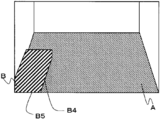
- Patent Literature 1 it is determined whether the care recipient has left the floor by performing image processing on a camera image as shown in FIG.
- B represents a bed area
- A represents a floor area
- B4 and B5 represent bed boundary sides, and if a human body movement is detected from the area B through B4 or B5 in the area A by image processing, it is determined to be a bed. To do.
- JP 2002-230533 A Japanese Patent Publication “JP 2002-230533 A”
- Patent Document 1 when a visitor or a care worker is nearby or is caring for a care recipient, human body movement is detected in the areas of A, B, B4, and B5. You may mistakenly determine that you are getting out of bed. If an incorrect bed determination is reported to a caregiver at another location through a nurse call or other communication method, the caregiver will need to go to the caregiver each time, increasing the burden. End up. In order to prevent this, the visitor may switch off the detection device or judgment device before approaching the care recipient, but forget to switch on the detection device or judgment device when leaving the care recipient. After that, it becomes impossible to detect the bed of the care recipient.
- an object of the present invention is to provide a bed leaving determination apparatus that determines the bed leaving state more accurately according to the situation, with the object of solving the above problems.
- a bed leaving determination apparatus includes a bedding, a camera that captures images of the periphery of the bedding, a motion detection unit that detects motion based on image information captured by the camera, and an observation target person's
- a bed leaving determination device including a situation determination unit for determining a situation, wherein the situation determination unit has a plurality of determination criteria for situation determination, and the situation is based on the detection result of the motion detection unit and the currently selected determination criterion. Further, based on the detection result of the motion detection unit, a determination criterion for the next determination is selected from a plurality of determination criteria.
- the motion detection unit includes a bedding area that is an area occupied by the bedding, a bedding side area that passes when getting off the bedding, and a bedding side area from outside the image information.
- the situation determination unit has two determination criteria of a first determination criterion and a second determination criterion. According to the first determination criterion, no motion is detected in the peripheral region. And when the movement is detected in the bedding side area, it is determined that the person is getting out of bed. In the second criterion, it is determined that the care is being performed when the movement is detected in the bedding side area.
- the second determination criterion is selected as the determination criterion for the next determination, and if no movement is detected in either the bedding side region or the surrounding region in the second determination criterion, Select the first criterion as the criterion Rukoto is preferable.
- the situation determination unit further includes a third determination criterion.
- the first determination criterion no movement is detected in the surrounding area and movement is detected in the bedding side area.
- the third determination criterion is selected as the determination criterion for the next determination, and the third determination criterion determines that the person is in bed when movement is detected in the bedding area and no movement is detected in the bedding side area.
- the first determination criterion is selected as the determination criterion for the next determination, and when the movement is detected in the bedding region at the start of the bed leaving determination process, the first determination criterion is selected, and the movement is not detected in the bedding region. It is preferable to select the third criterion.
- the motion detection unit moves from the image information to the bedding area that is the area occupied by the bedding, the bedding side area that passes when the bedclothes are taken off, and the bedding side area from the outside.
- the situation determination unit has two determination criteria, a first determination criterion and a third determination criterion.
- the first determination criterion no motion is detected in the peripheral region.
- the third determination criterion is selected as the determination criterion for the next determination.
- the third determination criterion movement is detected in the bedding area, and the bedding side If no motion is detected in the area, it is determined that the user is in the floor, and the first determination criterion is selected as the determination criterion for the next determination, and the first is detected when motion is detected in the bedding region at the start of the bed leaving determination process. Select the criteria and in the bedding area It is preferable to select a third criterion if Kiga not detected.
- the situation determination unit further includes a second determination criterion, and when a motion is detected in the surrounding area in the first determination criterion, the second determination is performed as a determination criterion for the next determination.
- a criterion is selected, and in the second determination criterion, when movement is detected in the bedding-side region, it is determined that care is being performed, and in the second determination criterion, no movement is detected in either the bedding-side region or the surrounding region.
- the first determination criterion is used at a normal time when the observation subject is substantially in the bedding.
- the second determination criterion is substantially used when the observation subject is cared for.
- the third determination criterion is substantially used when the observation subject leaves the bed.
- the situation determination unit selects a different determination criterion after the same motion detection result is continuously obtained a predetermined number of times, selecting a determination criterion different from that currently selected. It is preferable to do.
- the bed leaving determination apparatus of the present invention it is preferable to output both the result of determining the situation and the currently selected determination criterion to a predetermined output destination.
- the bed leaving determination method includes a bed detection including a movement detection step of detecting movement based on image information of the bedding and the surroundings of the bedding taken by a camera, and a situation determination step of determining the situation of the observation target person.
- the motion detection step is passed when moving from the image information to the bedding area which is an area occupied by the bedding, the bedding side area which is passed when getting off the bedding, and the bedding side area from the outside.
- the situation determination step determines the situation based on the first determination criterion or the second determination criterion. According to the first determination criterion, no motion is detected in the peripheral region, and in the bedding side region. When movement is detected, it is determined that the person is getting out of bed.
- the second determination criterion when movement is detected in the bedding-side area, it is determined that care is being performed. Furthermore, according to the first determination criterion, movement is detected in the surrounding area. In this case, the second determination criterion is selected as the determination criterion for the next determination, and the first determination criterion is used as the determination criterion for the next determination when no motion is detected in any of the bedding side region and the surrounding region in the second determination criterion. It is characterized by selecting.
- the present invention even when a visitor or a care worker is in the vicinity of a bed or is caring for a care recipient, it is not determined that the care recipient has left the floor by mistake. Unnecessary calls to caregivers in the hospital can be suppressed, reducing the burden on caregivers. Moreover, it is not necessary to turn off the detection device, the determination device, or the sensor attached to the device each time the care worker cares. In addition, it is possible to prevent the problem of leaving the bed and forgetting to turn on the switch after the end of care.
- the bed leaving determination apparatus includes a camera for shooting around the bed and an image processing unit for determining bed removal from a care recipient based on image information captured by the camera.
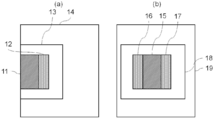
- FIG. 1 shows a camera image in the bed leaving determination apparatus according to the present invention.
- FIG. 1 shows a region division method for a camera image.
- FIG. 1A shows the case where the bed is at the end of the room, and
- FIG. 1B shows the case where the bed is in the center of the room.
- the areas shown in the camera image are designated as the bed area 11, the bedside area 12, the peripheral area 13, and the other external area 14, and the bed area 11, the bedside area 12, and the surrounding area are designated.
- the detection of getting out of bed is performed by detecting the movement in each of the areas 13.
- the peripheral area 13 does not include the bed area 11 and the bedside area 12, and the external area 14 does not include the peripheral area 13, the bed area 11, and the bedside area 12.
- the bed area 11 designates the bed area shown in the camera image. This area is designated to detect the movement of the care recipient on the bed.
- the bedside area 12 designates a bedside area that may pass when leaving the bed.
- the width is about the width of the human body (about 50 cm). This area is designated to detect movements such as a care recipient trying to get out of bed, or a visitor or care worker providing care near the bed.
- the peripheral area 13 designates an area around the bed, and preferably includes an area that passes through from the bed to the exit of the room. This area is designated to detect movements such as a care recipient walking in the room or a visitor or care worker entering the room.
- the bedside area 16 and the bedside area 17 are divided into the peripheral area 18 and the external area 19 as the bedside area.
- the peripheral area 18 does not include the bed area 15 and the bedside areas 16 and 17.
- the external area 19 does not include the bed area 15, the bedside areas 16 and 17, and the peripheral area 18.
- FIGS. 1A and 1B show an example in which the camera is mounted so as to face directly downward from the ceiling side, but the camera may face in an oblique direction. In this case, since the bed is photographed as a trapezoidal or distorted quadrangular region, it is necessary to set each region accordingly.
- FIG. 1A will be described as an example.
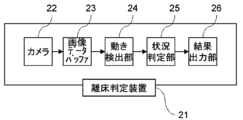
- FIG. 2 shows a block diagram of the bed leaving determination apparatus according to the present invention.
- the bed leaving determination device 21 includes a camera 22, an image data buffer 23 that temporarily stores an image captured by the camera 22, and a motion that detects a motion by performing image processing on the image in the image data buffer 23. It comprises a detection unit 24, a situation determination unit 25 that performs bed leaving determination based on the result detected by the motion detection unit 24, and a result output unit 26 that outputs the bed removal determination result determined by the situation determination unit 25 to the outside.
- the camera 22 selects the one with the angle of view that captures the bed and the surrounding area. For example, when a camera is mounted 2 m above the bed, using a camera with a focal length of 28 to 35 mm in terms of 35 mm film, an angle of view that can capture the bed and its surroundings can be obtained. If the mounting height must be lowered, a camera with a shorter focal length may be selected.
- the image data buffer 23 is a memory for storing images.
- the RAM is on the microcomputer board.
- the memory of the PC corresponds to the RAM.
- the motion detection unit 24 and the situation determination unit 25 are software executed on a microcomputer or a PC, but hardware that performs the same operation as the software can also be realized using an FPGA or the like.
- the motion detection part 24 and the situation determination part 25 are made into two components from the functional role, in fact, one software may perform two roles.
- the result output unit 26 is for informing the outside of the detection result obtained as a result of the image processing, and is a method of notification by voice, notification by lamp, notification to other PCs etc. via LAN, or nurse. Appropriate methods can be selected as needed, such as notification via a call.
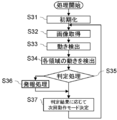
- FIG. 3 shows a flowchart of image processing executed by the motion detection unit 24 and the situation determination unit 25 in FIG.
- S represents a step.
- S31 to S34 are functions related to the motion detection unit 24
- S35 to S37 are functions related to the situation determination unit 25.
- initialization S31 is performed after the start of processing, such as when the power is turned on.
- the operation mode of the determination process S35 is initialized. Details will be described later.
- the image data is read from the image data buffer 23 of FIG.
- the acquired image is compared with the past image, and a pixel whose value has changed by a certain threshold value or more is detected.
- the simplest is to compare the current image with the previous image. Further, if the current image is compared with the average value of 1 to n images before, the influence of noise and the like can be reduced.
- a background separation method generally used in the image processing field may be used.
- the value change threshold is set to 10 in the case of an 8-bit image, for example. The threshold value is provided because the pixel value of the image slightly changes even if the same place that is not moving is photographed.
- the number of pixels that have moved is counted for each of the bed area 11, the bedside area 12, and the peripheral area 13 specified in FIG.
- a threshold value it is determined that there has been movement in that region. If the threshold is small, it is possible to determine even a small movement, but if it is too small, it is erroneously determined that there is a movement when there are many pixels that have changed due to camera noise. Therefore, it is preferable to make the threshold value as small as possible without causing erroneous determination due to noise.
- the threshold value of the ratio may be 10%, for example, though it depends on the performance of the camera.
- the bed leaving determination is performed based on the motion detection results for the bed region 11, the bedside region 12, and the peripheral region 13 obtained in S34.
- the judgment of getting out of bed of this application is performed as follows.
- a plurality of determination criteria according to the state of the care recipient is provided, and accurate determination according to the situation is realized by determining according to the state.
- This judgment criterion is called “operation mode”, and an operation mode that matches the current situation is selected from a plurality of operation modes, and the above motion detection result is applied to the judgment criterion of the selected operation mode. I do. Specifically, a corresponding determination result is set for the combination of the motion detection results, and the correspondence can be confirmed in the form of a determination table.
- the operation mode is different, different bed leaving determinations may be made. Specific examples of the operation mode will be described in each embodiment.
- the normal mode is selected.
- S36 according to the detection result obtained in S35, if necessary, it is output to the outside (reporting process), and the process proceeds to S37. If the notification is not required, the process proceeds to S37 without the notification process.
- all the detection results may be issued, or may be issued only when a previously designated result is detected. What is necessary is just to design suitably according to the objective and necessity.
- the “next mode”, that is, the next operation mode is determined according to the detection result obtained in S35. According to another expression, it can also be expressed as holding the current operation mode or shifting to another operation mode as the next operation mode. Note that the order of S36 and S37 may be reversed.
- Example 1 will be described as a specific example of the bed leaving determination apparatus according to the present invention.
- the repetition frequency of motion detection and bed leaving detection is sufficiently shorter than the normal operation time of a person requiring care or a care worker, and is continuously detected. ⁇ Assume that a decision has been made. In other words, it is assumed that human motion is not detected and missed.
- the situation determination unit 25 in FIG. 2 has two operation modes, “normal mode” and “bed-off mode”, in making the situation determination in S35 of FIG.
- Normal mode is an operation mode for detecting bed removal in the situation where a care recipient is sleeping on a bed.
- the bed leaving mode is a mode that indicates a state in which the person requiring care has left the floor and is within the range of being photographed by the camera or has gone out of the room.
- the operation mode is initialized to the normal mode in S31 after the processing is started as described above.
- Table 1 shows a determination table of determination criteria for each of the “normal mode” and the “get-off mode” as a specific example of the determination method in the first embodiment.
- the current operation mode is the normal mode (a)
- the table of (b) is used, and according to the “Yes” and “No” motion detection results in the bed area, the bedside area, and the surrounding area A “judgment result” is obtained.
- the “next mode” corresponding to the detection result is set, and the determination is performed in the operation mode of the transition destination at the next determination.
- the “next mode” column is the current mode
- the operation mode is not changed at the next determination, and the determination is performed in the same operation mode as this time. It can be expressed that the current operation mode is selected at the next determination.
- the judgment results include “body movement”, “getting out of bed”, “getting out of bed”, “under care”, “landing”, “stationary”.
- Body movement means that the care recipient moved his body by turning over.
- Preparation for getting out of bed means that the care recipient is preparing for getting out of bed, such as sitting by the bed.
- “Nursing” means that a care worker or visitor is near the bed and doing some work.
- body movement”, “stationary”, and “landing” can also be expressed as “being in bed” by the care recipient. It can be expressed as “in-bed (landing)”, and both can also be expressed as “in-bed”.
- “getting out of bed” can be interpreted as “getting out of bed” and expressed as “getting out of bed (preparation)”.
- under care is considered to be important to care, and the “careful” and “out of bed” of the care recipient at that time are not questioned, and are not particularly expressed. To do.
- the above wording is used in each table and each example, but this is only an example, and the determination result may be appropriately set.
- Table 1 (a) “normal mode” is set by initialization of S31.
- the condition 1 in Table 1 (a) is satisfied, so the determination is “still”.
- the condition 2 in Table 1 (a) is satisfied, and therefore the determination of “body movement” is made.
- the normal mode is maintained.
- the condition 4 in Table 1 (a) is satisfied, so the judgment is “Preparation for getting out of bed”, and the process proceeds to Table 1 (b) “Getting out of bed”.
- condition 4 Since the state of condition 4 continues in the motion detection result even after the transition to the bed leaving mode, it becomes condition 4 in Table 1 (b) and the determination of “prepare to leave” does not change. Subsequently, when the care recipient rises by the side of the bed, the condition 3 in Table 1 (b) is satisfied, so the determination is “getting out of bed”. Further, when the care recipient walks toward the entrance of the room, the condition 5 in Table 1 (b) is satisfied, so that the determination of “getting out of bed” is also made. Next, when the care recipient returns to the bed, it becomes condition 2 through condition 4 in Table 1 (b). Move to "Mode".
- the first embodiment takes two operation modes of “normal mode” and “bed-off mode”, so that the background and state up to that point are not compared with the case where a plurality of operation modes are not used. Since the judgment criteria according to the actual condition are provided, the situation of the care recipient can be judged accurately. For example, it is assumed that a care recipient is stationary in the bed area 11 and is stationary in a region other than the bed region 11 (the bedside region 12 or the peripheral region 13). Both of the motion detection results are “None” in all the areas, and therefore the condition 1 is. However, if the operation mode at this time is the normal mode, it is understood that the user is in the bed area 11; It can be seen that the area is other than 11.
- the caregiver can confirm both the situation determination result and the currently selected criterion, so More accurate judgment can be made.
- condition 1 when it goes out of the room after getting out of bed, it can be interpreted as being included in the range of “getting out” in the leaving mode. In the case of going out, it may be determined as “getting out (going out)” by interlocking with opening and closing of the door of the room.
- the repetition frequency of motion detection and bed leaving determination is sufficiently short compared with the time during which a person normally operates, so even if the operation mode is switched in a certain state (condition), both before and after the switching. If the determination of the state (condition) is made common in the operation mode, a determination error can be prevented. In the operation mode after the transition, if it is designed to make a judgment different from the same condition before the transition after changing from that state (condition) to another state (condition), more accurate situation will be judged by the operation mode can do.
- Example 2 will be described as a specific example of the bed leaving determination apparatus according to the present invention.
- Example 2 is the same as the apparatus configuration and function of each apparatus in Example 1 except for the operation mode. Hereinafter, a different part from Example 1 is demonstrated.
- the situation determination unit 25 in FIG. 2 has two operation modes of “normal mode” and “nursing mode” when performing the situation determination in S35 of FIG.
- Normal mode is an operation mode for detecting bed removal in the situation where a care recipient is sleeping on a bed.
- Care care mode is an operation mode that indicates a state in which a visitor or a care worker has come to the bed and is performing work such as care.
- the operation mode is initialized to the normal mode in S31 after the processing is started as described above.
- Table 2 shows a determination table of determination criteria for “normal mode” and “care mode” as specific examples of the determination method in the second embodiment.
- the current operation mode is the normal mode (a)
- the care mode is (b)
- use the table of (b) according to the “Yes” and “No” motion detection results in the bed area, the bedside area, and the surrounding area, A “judgment result” is obtained.
- the “next mode” corresponding to the detection result is set, and the determination is performed in the operation mode of the transition destination at the next determination.
- the “next mode” column is the current mode, the operation mode is not changed at the next determination, and the determination is performed in the same operation mode as this time. It can be expressed that the current operation mode is selected at the next determination.
- Table 2 (a) “normal mode” is set by the initialization of S31.
- condition 5 in Table 2 (a) is satisfied.
- the determination is “still”, and the operation mode shifts to (b) “care mode” by this determination.
- the state of condition 5 continues in the motion detection result, so that condition 5 in Table 2 (b) is obtained and the “still” determination is not changed.
- the condition 7 or 8 in Table 2 (a) is satisfied, so the determination is “being in care”.
- the configuration of the second embodiment even when a visitor or a care worker is in the vicinity of a bed or is caring for a care recipient, it is determined that the care recipient has accidentally left the floor. As a result, unnecessary calls to caregivers in different locations can be suppressed, reducing the burden on caregivers. Moreover, it is not necessary to turn off the detection device, the determination device, or the sensor attached to the device each time the care worker cares. In addition, it is possible to prevent the problem of leaving the bed and forgetting to turn on the switch after the end of care.
- Example 3 will be described as a specific example of the bed leaving determination apparatus according to the present invention.
- Example 3 is the same as the apparatus configuration and function of each apparatus in Example 1 except for the operation mode. Hereinafter, a different part from Example 1 is demonstrated.
- the situation determination unit 25 in FIG. 2 has three operation modes of “normal mode”, “get-off mode”, and “care mode” when performing the situation determination in S35 of FIG.
- Normal mode is an operation mode for detecting bed removal in the situation where a care recipient is sleeping on a bed.
- Leave bed mode is a mode that indicates a state where the care recipient is within the range that can be captured by the camera after getting out of bed.
- Care care mode is an operation mode that indicates a state in which a visitor or a care worker has come to the bed and is performing work such as care.
- the operation mode is initialized to the normal mode in S31 after the processing is started as described above.
- Table 3 shows a determination table of determination criteria for “normal mode”, “get-off mode”, and “care mode” as specific examples of the determination method in the third embodiment.
- Table 3 (a) “normal mode” is set by initialization of S31.
- the condition 1 in Table 1 (a) is satisfied, so the determination is “still”.
- the condition 2 in Table 3 (a) is satisfied, and therefore the “body movement” is determined.
- the condition 4 in Table 3 (a) is satisfied, so the determination is “prepare to get out of bed”, and the condition shifts to the condition 4 of (b) “bedout mode”.
- Example 3 when the condition 6 of Table 3 (b) “Getting out mode” is satisfied, the next mode is defined to shift to “Normal mode”, and Table 3 (a) “Normal mode” of the transfer destination is defined. ”Is defined to shift to the“ care mode ”as the next mode, but as described above, the determination interval is set sufficiently short relative to the actual movement of the care recipient or care worker. If this is done, the state of condition 6 continues, so that it is possible to steadily shift to Table 3 (c) “care mode” without delay. Actually, when the condition 6 in Table 3 (b) “Getting out mode” is satisfied, it is possible to define that the next mode is directly shifted to the “care mode”. What is necessary is just to design suitably.
- the configuration of the third embodiment even when a visitor or a care worker is in the vicinity of a bed or is caring for a care recipient, it is determined that the care recipient has accidentally left the floor. As a result, unnecessary calls to caregivers in different locations can be suppressed, reducing the burden on caregivers. Moreover, it is not necessary to turn off the detection device, the determination device, or the sensor attached to the device each time the care worker cares. In addition, it is possible to prevent the problem of leaving the bed and forgetting to turn on the switch after the end of care.
- Example 4 will be described as a specific example of the bed leaving determination apparatus according to the present invention.
- Example 4 is characterized in that the bed leaving determination device selects an operation mode according to the situation at the time of initialization in S31 of FIG.
- the fourth embodiment is the same as the apparatus configuration and function of each apparatus in the third embodiment except for the operation mode selection at the time of initialization.
- Example 3 a different part from Example 3 is demonstrated.
- the process will be in “normal mode” by the initialization of S31.
- the condition 5 in Table 3 (a) is satisfied, and therefore the determination is “still”.
- the condition 7 in Table 3 (a) is satisfied, so the determination is “being in care” and the process shifts to “care mode”.
- the determination is “body movement” and the process proceeds to the “normal mode”. In this way, since it is not possible to distinguish whether the person who entered from outside the room is a care worker or a care recipient, the care worker is misjudging that the care worker is in bed There is a case.
- the configuration of the fourth embodiment is configured as “normal mode” when there is a care recipient in the bed in the initialization of S31 in the flowchart of FIG. 3, and there is no care recipient in the bed.
- the “get-off mode” is set.
- Any method may be used to determine whether there is a care recipient in the bed.
- a face recognition method using a camera image a method using a thermal sensor, or the like can be used.
- the process is changed to the “getting out mode” instead of the “normal mode” by the initialization of S31.
- the condition 5 in Table 1 (b) is satisfied, and therefore the determination of “get out of bed” is made.
- the condition 7 in Table 1 (b) is satisfied, so the determination is “get out of bed”.
- the condition 2 in Table 1 (b) is satisfied, so the determination is “landing” and the process proceeds to the “normal mode”. In this way, it can be determined that the care recipient has landed.
- correct bed determination can be performed regardless of whether or not the bed is in need of a caregiver when the bed determination apparatus is turned on. it can.
- Example 5 which is another specific example will be described with reference to FIG.
- the operation mode at the time of the next detection is set as the “next mode”. However, if an erroneous determination is temporarily made due to noise or the like, the mode changes accordingly. There is a possibility that an erroneous determination due to an error in the operation mode will continue thereafter.
- the configuration of the fifth embodiment is, as the configuration, obtained in the determination result instead of immediately shifting to the “next mode” obtained from the determination result in S37 of the flowchart of FIG.
- the “next mode” is stored for a predetermined number of times, and when the same “next mode” determination is obtained for a predetermined number of times, the mode is actually changed.
- the configuration other than the above configuration is the same as the configuration and function of the third embodiment.
- the predetermined number of times is set to about 5. Although there will be a delay of 0.5 seconds in changing the operation mode, there is no problem because it is sufficiently shorter than the time required for the care recipient to get out of bed.
- the repetition frequency of motion detection and bed leaving determination is sufficiently short compared with the time during which a person normally operates, so even if the operation mode is switched in a certain state (condition), both before and after the switching. If the determination of the state (condition) is made common in the operation mode, a determination error can be prevented.
- the predetermined number of times and time may be designed so that the determination result and the operation mode are appropriately switched.
- the operation mode is not changed. It can be suppressed, and reliable bed leaving determination can be realized.
- the bed leaving determination device includes a bedding and a camera that captures the image of the periphery of the bedding, a motion detection unit that detects motion based on image information captured by the camera, and a situation determination unit that determines the status of the observation target person.
- the situation determination unit includes a plurality of determination criteria for determining the situation, determines the situation based on the detection result of the motion detection unit and the currently selected determination criterion, and further detects motion.
- a determination criterion for the next determination is selected from a plurality of determination criteria based on the detection result of the part.
- the motion detection unit moves from the image information to the bedding area that is the area occupied by the bedding, the bedding side area that passes when the bedclothes are taken off, and the bedding side area from the outside.
- the situation determination unit has two determination criteria, a first determination criterion and a second determination criterion, and in the first determination criterion, no motion is detected in the peripheral region, In addition, when movement is detected in the bedding-side area, it is determined that the person is getting out of bed. In the second determination criterion, when movement is detected in the bedding-side area, it is determined that care is being performed.
- the second determination criterion is selected as the determination criterion for the next determination when a motion is detected in the next determination, and the determination at the next determination is made when no motion is detected in either the bedding armor region or the surrounding region in the second determination criterion.
- the bed leaving determination method includes a bed detection including a movement detection step of detecting movement based on image information of the bedding and the surroundings of the bedding taken by a camera, and a situation determination step of determining the situation of the observation target person.
- the motion detection step is passed when moving from the image information to the bedding area which is an area occupied by the bedding, the bedding side area which is passed when getting off the bedding, and the bedding side area from the outside.
- the situation determination step determines the situation based on the first determination criterion or the second determination criterion. According to the first determination criterion, no motion is detected in the peripheral region, and in the bedding side region. When movement is detected, it is determined that the person is getting out of bed.
- the second determination criterion when movement is detected in the bedding-side area, it is determined that care is being performed. Furthermore, according to the first determination criterion, movement is detected in the surrounding area. In this case, the second determination criterion is selected as the determination criterion for the next determination, and the first determination criterion is used as the determination criterion for the next determination when no motion is detected in any of the bedding side region and the surrounding region in the second determination criterion. It is characterized by selecting.
- the situation determination unit further includes a third determination criterion.
- the first determination criterion no movement is detected in the surrounding area and movement is detected in the bedding side area.
- the third determination criterion is selected as the determination criterion for the next determination, and the third determination criterion determines that the person is in bed when movement is detected in the bedding area and no movement is detected in the bedding side area.
- the first determination criterion is selected as the determination criterion for the next determination, and when the movement is detected in the bedding region at the start of the bed leaving determination process, the first determination criterion is selected, and the movement is not detected in the bedding region. It is preferable to select the third criterion.
- the motion detection unit moves from the image information to the bedding area that is the area occupied by the bedding, the bedding side area that passes when the bedclothes are taken off, and the bedding side area from the outside.
- the situation determination unit has two determination criteria, a first determination criterion and a third determination criterion.
- the first determination criterion no motion is detected in the peripheral region.
- the third determination criterion is selected as the determination criterion for the next determination.
- the third determination criterion movement is detected in the bedding area, and the bedding side If no motion is detected in the area, it is determined that the user is in the floor, and the first determination criterion is selected as the determination criterion for the next determination, and the first is detected when motion is detected in the bedding region at the start of the bed leaving determination process. Select the criteria and in the bedding area It is preferable to select a third criterion if Kiga not detected.
- the situation determination unit further includes a second determination criterion, and when a motion is detected in the surrounding area in the first determination criterion, the second determination is performed as a determination criterion for the next determination.
- a criterion is selected, and in the second determination criterion, when movement is detected in the bedding-side region, it is determined that care is being performed, and in the second determination criterion, no movement is detected in either the bedding-side region or the surrounding region.
- the first determination criterion is used at a normal time when the observation subject is substantially in the bedding.
- the second determination criterion is substantially used when the observation subject is cared for.
- the third determination criterion is substantially used when the observation subject leaves the bed.
- the situation determination unit selects a different determination criterion after the same motion detection result is continuously obtained a predetermined number of times, selecting a determination criterion different from that currently selected. It is preferable to do.
- the bed leaving determination apparatus of the present invention it is preferable to output both the result of determining the situation and the currently selected determination criterion to a predetermined output destination.
- the present invention can be used in a bed leaving determination device that detects that a person leaves the bed.
Landscapes
- Health & Medical Sciences (AREA)
- Life Sciences & Earth Sciences (AREA)
- Engineering & Computer Science (AREA)
- Biomedical Technology (AREA)
- Public Health (AREA)
- Physiology (AREA)
- Dentistry (AREA)
- Oral & Maxillofacial Surgery (AREA)
- Physics & Mathematics (AREA)
- Veterinary Medicine (AREA)
- Biophysics (AREA)
- Pathology (AREA)
- General Health & Medical Sciences (AREA)
- Heart & Thoracic Surgery (AREA)
- Medical Informatics (AREA)
- Molecular Biology (AREA)
- Surgery (AREA)
- Animal Behavior & Ethology (AREA)
- Computer Vision & Pattern Recognition (AREA)
- Radiology & Medical Imaging (AREA)
- Nuclear Medicine, Radiotherapy & Molecular Imaging (AREA)
- Accommodation For Nursing Or Treatment Tables (AREA)
- Measurement Of The Respiration, Hearing Ability, Form, And Blood Characteristics Of Living Organisms (AREA)
- Invalid Beds And Related Equipment (AREA)
- Image Processing (AREA)
- Image Analysis (AREA)
Abstract
本発明の離床判定装置(21)は、ベッド周辺を撮影した画像について、ベッドが占有する領域であるベッド領域と、床面の領域でありベッドから離床するときに通る人体の横幅程度の幅のベッド脇領域と、室外からベッド脇領域に移動するときに通る周辺領域に分け、通常モードではベッド脇領域で動きが検出された場合に離床と判定するが、周辺領域のみで動きが検出されたときは介護モードになり、介護モードではベッド脇領域で動きが検出されても離床とは判定しない。これにより、介護従事者や面会者が近づいてきたことを認識し、その場合にはベッドや周辺で人体の動き検出をした場合でも要介護者が離床したとは判定しない離床判定装置を提供する。
Description
本発明は人がベッドから離床することを検出する離床判定装置に関する。
現在、介護医療において、高齢者や認知障害を持つ要介護者などが施設内のベッドから起き上がろうとして転倒し、骨折や打撲などを起こしたりする事故が多発している。また、徘徊する要介護者については施設外に勝手に出て行き交通事故などにあう危険もある。このような状況において、これらの要介護者が離床したことを介護従事者に通報するセンシングシステムが必要とされており、例えば特許文献1のような従来技術が提案されている。
図4をもとに従来技術である特許文献1について説明する。特許文献1の離床判定方法では、ベッドの周辺を撮影した図4のようなカメラ画像を画像処理することにより要介護者が離床したかの判定を行う。図4のBはベッド領域、Aは床面領域、B4とB5はベッド境界辺を表し、画像処理によって、Bの領域からB4またはB5を通ってAの領域で人体移動を検知すると離床と判定する。
しかしながら、特許文献1の方法では、面会者や介護従事者が近くにいたり、要介護者を介護していたりする場合にはAやBやB4,B5の領域で人体移動を検知してしまい、誤って離床と判定してしまう場合がある。誤った離床判定がナースコールやその他の通信方式を通じて別の場所にいる介護従事者に連絡された場合、介護従事者はその度に要介護者を確認しに行く必要が生じ、負担が増加してしまう。これを防ぐために、面会者は要介護者に近づく前に検出装置や判定装置のスイッチを切るなどの手法もあるが、要介護者から離れる際に検出装置や判定装置のスイッチを入れ忘れてしまうことがままあり、それ以降、要介護者の離床を検出できなくなってしまう。
そこで、本発明は上記の問題点を解決することを目的とし、状況に応じて離床状態をより正確に判定する離床判定装置を提供することにある。
上記課題を解決するために、本発明に係る離床判定装置は、寝具および該寝具周辺の撮影を行うカメラ、該カメラの撮影した画像情報に基づいて動きを検出する動き検出部および観察対象者の状況を判定する状況判定部を備える離床判定装置であって、状況判定部は、状況判定のための判定基準を複数有し、動き検出部の検出結果と現在選択中の判定基準に基づいて状況を判定し、さらに、動き検出部の検出結果に基づいて、複数の判定基準の中から次回判定時の判定基準を選択することを特徴としている。
また、本発明に係る離床判定装置は、動き検出部は、画像情報のうち、寝具が占有する領域である寝具領域と、寝具から離床するときに通る寝具脇領域と、室外から寝具脇領域に移動するときに通る周辺領域と、を識別し、状況判定部は、第1判定基準と第2判定基準の2つの判定基準を有し、第1判定基準では、周辺領域では動きが検出されず、かつ寝具脇領域で動きが検出された場合に離床と判定し、第2判定基準では、寝具脇領域で動きが検出された場合に介護中と判定し、さらに、第1判定基準において、周辺領域で動きが検出された場合に次回判定時の判定基準として第2判定基準を選択し、第2判定基準において、寝具脇領域と周辺領域のいずれにも動きが検出されない場合に次回判定時の判定基準として第1判定基準を選択することが好ましい。
また、本発明の離床判定装置において、状況判定部は、さらに第3判定基準を有し、第1判定基準では、周辺領域では動きが検出されず、かつ寝具脇領域で動きが検出された場合に、次回判定時の判定基準として第3判定基準を選択し、第3判定基準では、寝具領域で動きが検出され、かつ、寝具脇領域で動きが検出されない場合に在床と判定し、さらに次回判定時の判定基準として第1判定基準を選択し、離床判定処理の開始時において、寝具領域で動きが検出された場合に第1判定基準を選択し、寝具領域で動きが検出されない場合に第3判定基準を選択することが好ましい。
また、本発明の離床判定装置において、動き検出部は、画像情報のうち、寝具が占有する領域である寝具領域と、寝具から離床するときに通る寝具脇領域と、室外から寝具脇領域に移動するときに通る周辺領域と、を識別し、状況判定部は、第1判定基準と第3判定基準の2つの判定基準を有し、第1判定基準では、周辺領域では動きが検出されず、寝具脇領域で動きが検出された場合に離床と判定し、さらに次回判定時の判定基準として第3判定基準を選択し、第3判定基準では、寝具領域で動きが検出され、かつ、寝具脇領域で動きが検出されない場合に在床と判定し、さらに次回判定時の判定基準として第1判定基準を選択し、離床判定処理の開始時において、寝具領域で動きが検出された場合に第1判定基準を選択し、寝具領域で動きが検出されない場合に第3判定基準を選択することが好ましい。
また、本発明の離床判定装置において、状況判定部は、さらに第2判定基準を有し、第1判定基準において、周辺領域で動きが検出された場合に次回判定時の判定基準として第2判定基準を選択し、第2判定基準では、寝具脇領域で動きが検出された場合に介護中と判定し、さらに、第2判定基準において、寝具脇領域と周辺領域のいずれにも動きが検出されない場合に次回判定時の判定基準として第1判定基準を選択することが好ましい。
また、本発明の離床判定装置において、第1判定基準は実質的に観察対象者が寝具に在る通常時に用いられることが好ましい。
また、本発明の離床判定装置において、第2判定基準は実質的に観察対象者の被介護時に用いられることが好ましい。
また、本発明の離床判定装置において、第3判定基準は実質的に観察対象者の離床時に用いられることが好ましい。
また、本発明の離床判定装置において、状況判定部は、現在選択中とは異なる判定基準を選択する、同一の動き検出結果が所定の回数分連続して得られた後に、異なる判定基準を選択することが好ましい。
また、本発明の離床判定装置において、状況を判定した結果と現在選択中の判定基準の両方を所定の出力先へ出力することが好ましい。
また、本発明に係る離床判定方法は、カメラで撮影した、寝具および該寝具周辺の画像情報に基づいて動きを検出する動き検出ステップと、観察対象者の状況を判定する状況判定ステップを含む離床判定方法であって、動き検出ステップは、画像情報のうち、寝具が占有する領域である寝具領域と、寝具から離床するときに通る寝具脇領域と、室外から寝具脇領域に移動するときに通る周辺領域と、を識別し、状況判定ステップは、第1判定基準または第2判定基準に基づいて状況を判定し、第1判定基準では、周辺領域では動きが検出されず、かつ寝具脇領域で動きが検出された場合に離床と判定し、第2判定基準では、寝具脇領域で動きが検出された場合に介護中と判定し、さらに、第1判定基準において、周辺領域で動きが検出された場合に次回判定時の判定基準として第2判定基準を選択し、第2判定基準において、寝具脇領域と周辺領域のいずれにも動きが検出されない場合に次回判定時の判定基準として第1判定基準を選択することを特徴としている。
本発明によれば、面会者や介護従事者がベッド付近にいたり、要介護者を介護していたりする場合にも、誤って要介護者が離床したと判定することがないので、別の場所にいる介護従事者への不要な呼び出しを抑制でき、介護従事者の負担が軽減する。また、介護従事者が介護する都度、検出装置や判定装置あるいは装置付属のセンサのスイッチをOFFにする必要がなくなる。また、介護終了後スイッチをONにし忘れて、離床判定がもれてしまう問題も防ぐことができる。
本発明の実施の形態について図面を参照しながら詳細に説明する。なお、図中同一または相当部分には同一符号を付してその説明は繰り返さない。
本発明に係る離床判定装置は、ベッド周辺の撮影を行うカメラと、カメラの撮影した画像情報に基づいて要介護者の離床を判定する画像処理部とを備えている。
図1に本発明に係る離床判定装置におけるカメラ画像を示す。図1はカメラ画像の領域分割方法を示している。図1(a)は、ベッドが部屋の端にある場合、図1(b)はベッドが部屋の中央にある場合を示している。
最初に、ベッドが部屋の端にある図1(a)の例について説明する。本発明の離床判定装置では、カメラ画像に写っている領域をベッド領域11、ベッド脇領域12、周辺領域13と、それ以外の外部領域14に指定し、ベッド領域11、ベッド脇領域12、周辺領域13のそれぞれの領域での動きを検出することで離床判定を行う。なお、周辺領域13はベッド領域11およびベッド脇領域12を含まないものとし、外部領域14は周辺領域13、ベッド領域11、ベッド脇領域12を含まないものとする。
ベッド領域11は、カメラ画像に写っているベッドの領域を指定する。この領域は要介護者のベッド上での動きを検出するために指定される。
ベッド脇領域12は、ベッドから出るときに通過する可能性のあるベッドの脇領域を指定する。幅は人体の横幅程度(約50cm)をとる。この領域は、要介護者がベッドから出ようとしている、面会者や介護従事者がベッド付近で介護を行っている、などの動きを検出するために指定される。
周辺領域13は、ベッドの周辺の領域を指定するものであり、ベッドから部屋の出口に向かうときに通過する領域を含むのが好ましい。この領域は、要介護者が部屋を歩いている、面会者や介護従事者が部屋に入ってきた、などの動きを検出するために指定される。
次に、図1(b)のベッドが部屋の中央にある例について説明する。この場合、ベッド領域15、ベッドに柵などが設けられておらず左右どちらにも降りられる場合、ベッド脇領域としてベッド脇領域16およびベッド脇領域17の2箇所を、周辺領域18、外部領域19のようにそれぞれ指定する。図1(a)の周辺領域13と同様に周辺領域18はベッド領域15とベッド脇領域16、17を含まない。同じく外部領域19はベッド領域15、ベッド脇領域16、17および周辺領域18を含まない。
これらの領域はカメラ画像上のピクセル座標によって指定され、画像処理のパラメータとして画像処理装置内に記憶される。図1(a)(b)の各領域は全て矩形や、矩形から矩形を除いた図形で表されているが、矩形以外の多角形や、曲線を含むことも可能である。図1(a)(b)はカメラが天井側から真下を向くよう取り付けられた場合の例であるが、カメラが斜め方向を向いていてもかまわない。この場合、ベッドは台形や歪んだ四角形の領域として撮影されるので、各領域もそれに合わせて設定する必要がある。以降では特に断らない限り図1(a)を例に説明する。
図2に本発明に係る離床判定装置のブロック図を示す。図2に示すように、離床判定装置21はカメラ22と、カメラ22で撮影した画像を一時的に蓄える画像データバッファ23と、画像データバッファ23の画像を画像処理することによって動きを検出する動き検出部24と、動き検出部24にて検出した結果をもとに離床判定を行う状況判定部25と、状況判定部25の判定した離床判定結果を外部に出力する結果出力部26より成る。
カメラ22は、ベッドとその周辺領域が写る画角のものを選択する。例えば、ベッドから2m上方にカメラを取り付ける場合、35mmフィルム換算で、28~35mmの焦点距離のカメラを用いるとベッドとその周辺を写すことができる画角が得られる。取付高さを低くせねばならない場合はさらに焦点距離が短いカメラを選べばよい。
画像データバッファ23は、画像を蓄えるためのメモリである。動き検出部24や状況判定部25をマイコンボードで実行する場合はマイコンボード上のRAMであり、動き検出部24や状況判定部25をPC上で実行する場合はPCのメモリがそれに対応する。
動き検出部24や状況判定部25は、マイコンまたはPC上で実行されるソフトウェアであるが、ソフトウェアと同一の動作を行うハードウェアを、FPGAなどを用いて実現することも可能である。なお、動き検出部24と状況判定部25は、その機能的役割から2つの構成要素としているが、実際にはひとつのソフトウェアが2つの役割を実行するものであってもよい。
結果出力部26は、画像処理の結果得られる検出結果を外部に知らせるためのものであり、音声による通知や、ランプによる通知、LANを経由して他のPCなどに通知する方法、あるいは、ナースコールを通じて知らせる方法など、必要に応じて適切な方法を選択することができる。
図3に、図2の動き検出部24および状況判定部25で実行される画像処理のフローチャートを示す。図3の各ステップについて、「S+番号」と表記するものとする。Sはステップを表す。なお、簡単のため、ここでは、ひとつのソフトウェアが動き検出部24および状況判定部25の2つの役割を実行するものとし、併せて説明する。図3において、S31からS34までが動き検出部24に係る機能であり、S35からS37までが状況判定部25に係る機能である。
図3に示すように、電源投入時など、処理開始後に初期化S31が行われる。ここで判定処理S35の動作モードの初期化を行う。詳細は後述する。
S32の画像取得では、図2の画像データバッファ23から画像データを読み取る。
S33の動き検出では、取得した画像と過去の画像を比較し、値に一定閾値以上の変化があったピクセルを検出する。最も簡単には、現画像と1枚前の画像を比較すればよい。また、現画像と、1からn枚前の画像の平均値と比較すれば、ノイズなどの影響を軽減することが可能となる。これ以外にも、画像処理分野で一般に行われている背景分離方法を使ってもよい。値変化の閾値は、8bitの画像の場合、例えば10とする。閾値を設けるのは、動いていない同一の場所を撮影していたとしても画像のピクセル値は微妙に変化するためである。
S34では、図1(a)で指定したベッド領域11、ベッド脇領域12、周辺領域13ごとに、動きがあったピクセル数をカウントする。次に、各領域の全ピクセル数のうち、動きがあったピクセル数の割合が閾値以上になったとき、その領域内で動きがあったと判定する。閾値が小さいと小さな動きでも判定可能であるが、あまりに小さすぎるとカメラのノイズによって変化したピクセルが多いときに、動きがあったと誤判定してしまう。よって、閾値はノイズによる誤判定がない範囲でなるべく小さくするのが良い。割合の閾値はカメラの性能にもよるが、例えば10%とすればよい。
S35では、S34で得られたベッド領域11、ベッド脇領域12、周辺領域13ごとの動き検出結果に基づいて離床判定を行う。本願の離床判定は次のように行う。
上記3つの領域ごとの動き検出結果が同じであっても、離床検出対象の要介護者の状態に応じて状況が異なる場合がある。そこで本願では要介護者の状態に応じた判定基準を複数設け、その状態に応じて判定することで状況に即した正確な判定を実現する。この判定基準を「動作モード」とよび、複数の動作モードの中から現在の状況に合った動作モードを選択し、選択した動作モードの判定基準に対して上記動き検出結果を適用することで判定を行う。具体的には上記動き検出結果の組み合わせに対して、対応する判定結果が設定されており、その対応を判定表の形で確認することができる。例えば、上記3つの領域ごとの動き検出結果の組み合わせが全く同じであっても、動作モードが異なる場合には、異なった離床判定となる場合がある。動作モードの具体例は各実施例にて説明する。なお、初期化状態では、通常モードが選択されている。
S36では、S35で得られた検出結果に応じて、必要があれば外部に出力(発報処理)し、S37に進む。発報不要の場合、発報処理なしでS37に進む。なお、S36では検出結果をすべて発報処理してもよいし、あらかじめ指定された結果を検出した場合のみ発報処理してもよい。目的や必要に応じて適宜設計すればよい。
S37では、S35で得られた検出結果に応じて、「次モード」すなわち次回の動作モードの決定を行う。別の表現によれば、次回の動作モードとして、現動作モードの保持または他動作モードへの移行を行うとも表現できる。なおS36とS37の順序は逆であっても構わない。
ここまで、本発明の離床判定装置について構成と概要を説明してきたが、以下に状況判定部25の各動作モードと状況判定の詳細について例をもとに説明する。
本発明に係る離床判定装置の具体例として実施例1について説明する。なお、以降の実施例においては、特に断らない限り、動き検出および離床判定の繰り返し頻度は、要介護者・介護従事者などの人が通常動作する時間に比べて充分に短く、継続して検出・判定がなされているものとする。つまり人の動きを検出し逃すことはないものとする。
実施例1では図2における状況判定部25が、図3のS35の状況判定をするにあたり「通常モード」と「離床モード」の2つの動作モードを有している。
「通常モード」は、要介護者がベッドに寝ている状況で、離床を検知する動作モードである。
「離床モード」は、要介護者が離床したのち、カメラで写る範囲内にいる状態、もしくは部屋の外に出た状態を示すモードである。
動作モードは前述のように処理開始後にS31で通常モードに初期化される。
離床判定には、現在の動作モードとベッド領域11、ベッド脇領域12、周辺領域13での動き検出結果を用いる。表1に、実施例1における判定方法の具体例として「通常モード」と「離床モード」のそれぞれの判定基準の判定表を示す。

現在の動作モードが通常モードのときは(a)、離床モードのときは(b)の表を用い、ベッド領域、ベッド脇領域、周辺領域での動き検出結果の「あり」「なし」に従って、「判定結果」が得られる。同時に、検出結果に応じた「次モード」が設定されており、次回判定時には移行先の動作モードで判定が実施される。表で「次モード」の欄が現モードの場合は、次回判定時も動作モードを変更せず、今回と同じ動作モードで判定する。次回判定時に現動作モードを選択すると表現することもできる。
判定結果としては、「体動」「離床」「離床準備」「介護中」「着床」「静止」がある。
「体動」は、要介護者が寝返りなどで体を動かしたことを意味する。
「離床」は、要介護者がベッドから離れたことを意味する。
「離床準備」は、要介護者がベッドの脇に座るなど、離床準備を行っていることを意味する。
「介護中」は、介護従事者や面会者がベッドの近くまで来て、何らかの作業を行っていることを意味する。
「着床」は、要介護者がベッドに入ったことを意味する。
「静止」は、要介護者がベッドには在床しているが、安眠するなどで動きが検出されないことを意味する。
なお、「体動」「静止」および「着床」は要介護者が「在床」していると表現することもできるのでそれぞれ「在床(体動)」「在床(静止)」「在床(着床)」と表現してもよいし、どちらも同じく「在床」と表現することもできる。同様に「離床準備」も「離床」の範疇と解釈して「離床(準備)」と表現することもできる。また、本願実施例においては「介護中」は介護をしていることが重要であると考え、その際の要介護者の「在床」「離床」は問わないものとし、特に表現しないものとする。以降特に断らない限り、各表・各実施例において、上記文言を使用するがこれはあくまで一例であり、判定結果の表記は適宜設定すればよい。
以下、実際の検出について、具体例を挙げて説明する。
要介護者がベッドにいる状態で処理を開始した場合、S31の初期化によって、表1(a)「通常モード」となる。要介護者が安眠している場合、表1(a)の条件1となるので「静止」の判定となる。要介護者が寝返りをうった場合、表1(a)の条件2となるので、「体動」の判定となる。このときは動作モードに変化はなく、通常モードが保持される。要介護者がベッドから降りようと、ベッドに腰掛けた場合、表1(a)の条件4となるので「離床準備」の判定となり、表1(b)「離床モード」に移行する。離床モードに移行した後も動き検出結果は条件4の状態が継続するので、表1(b)の条件4となり「離床準備」の判定は変わらない。続いて、要介護者がベッドの脇で立ち上がった場合、表1(b)の条件3となるので、「離床」の判定となる。さらに、要介護者が部屋の出入口に向けて歩いた場合、表1(b)の条件5となるので、同じく「離床」の判定となる。次に、要介護者がベッドに戻った場合は、表1(b)の条件4を経て条件2となるので、「離床準備」の判定の次に、「着床」と判定され、「通常モード」に移行する。
以上に説明してきたように、実施例1は「通常モード」と「離床モード」の2つの動作モードをとることにより、複数の動作モードをとらない場合に比べて、それまでの経緯や状態に応じた実態に即した判定基準を備えているため、要介護者の状況を正確に判定できる。例えば要介護者がベッド領域11で静止している状態と離床してベッド領域11以外の領域(ベッド脇領域12あるいは周辺領域13)で静止している状態を想定する。動き検出結果はどちらも全領域において「なし」のため条件1であるが、この時の動作モードが通常モードであればベッド領域11にいることが分かり、離床モードであれば離床した後にベッド領域11以外の領域にいることが分かる。つまり、どちらも同じ動き検出結果・条件であっても動作モードを通知することで、介護従事者が、状況判定結果と現在選択中の判定基準を併せて確認できるので、要介護者の状況をより正確に判定できる。なお、離床後に部屋の外に出た場合も条件1となるので、離床モードの「離床」の範囲に含まれると解釈することができる。外出の場合には部屋の扉の開閉とも連動することで「離床(外出)」と判定してもよい。
なお、すでに説明したように、動き検出および離床判定の繰り返し頻度は、人が通常動作する時間に比べて充分に短いので、ある状態(条件)で動作モードが切り替わっても、切り替わり前後の両方の動作モードで、その状態(条件)の判定を共通にしておけば判定ミスを防止できる。移行した後の動作モードにおいて、その状態(条件)から他の状態(条件)に移り変わった後に、移行前の同条件と異なる判定となるように設計すれば、動作モードによってより正確な状況を判定することができる。
本発明に係る離床判定装置の具体例として実施例2について説明する。
実施例2は動作モード以外については、実施例1の装置構成、各装置の機能と同一である。以下、実施例1と異なる部分について説明する。
実施例2では図2における状況判定部25が、図3のS35の状況判定をするにあたり「通常モード」と「介護モード」の2つの動作モードを有している。
「通常モード」は、要介護者がベッドに寝ている状況で、離床を検知する動作モードである。
「介護モード」は、面会者や介護従事者がベッドにやってきて介護などの作業をしている状態を示す動作モードである。
動作モードは前述のように処理開始後にS31で通常モードに初期化される。
離床判定には、現在の動作モードとベッド領域、ベッド脇領域、周辺領域での動き検出結果を用いる。表2に、実施例2における判定方法の具体例として「通常モード」と「介護モード」のそれぞれの判定基準の判定表を示す。

現在の動作モードが通常モードのときは(a)、介護モードのときは(b)の表を用い、ベッド領域、ベッド脇領域、周辺領域での動き検出結果の「あり」「なし」に従って、「判定結果」が得られる。同時に、検出結果に応じた「次モード」が設定されており、次回判定時には移行先の動作モードで判定が実施される。表で「次モード」の欄が現モードの場合は、次回判定時も動作モードを変更せず、今回と同じ動作モードで判定する。次回判定時に現動作モードを選択すると表現することもできる。
以下、実際の検出について、具体例を挙げて説明する。
要介護者がベッドにいる状態で処理を開始した場合、S31の初期化によって、表2(a)「通常モード」となる。要介護者が動かない「静止」状態で、介護従事者が部屋に入ってきた場合、表2(a)の条件5となる。要介護者の状態は変化がなく、「静止」判定となり、この判定により動作モードが(b)「介護モード」に移行する。介護モードに移行した後も動き検出結果は条件5の状態が継続するので、表2(b)の条件5となり「静止」判定は変わらない。続いて、さらに介護従事者がベッドに近づいて、介護の作業を始めた場合、表2(a)の条件7または8となるので「介護中」の判定となる。介護従事者が周辺領域13から移動してベッドのそば、すなわちベッド脇領域12に立って介護を行う場合、表2(b)の条件4となるので、「介護中」の判定となる。「通常モード」で同じ動き検出結果の場合は「離床準備」と判定するが(表2(a)条件4)、この場合は「介護モード」では「介護中」の判定となるので、別の場所にいる介護従事者に不要な呼び出しがかからず、介護従事者の負担の軽減となる。実施例2によると、介護従事者が介護する都度、検出装置や判定装置あるいは装置付属のセンサのスイッチをOFFにする必要がなくなる。また、介護終了後上記スイッチをONにし忘れて、離床判定がもれてしまう問題も防ぐことができる。
以上のように、実施例2の構成によれば、面会者や介護従事者がベッド付近にいたり、要介護者を介護していたりする場合にも、誤って要介護者が離床したと判定することがないので、別の場所にいる介護従事者への不要な呼び出しを抑制でき、介護従事者の負担が軽減する。また、介護従事者が介護する都度、検出装置や判定装置あるいは装置付属のセンサのスイッチをOFFにする必要がなくなる。また、介護終了後スイッチをONにし忘れて、離床判定がもれてしまう問題も防ぐことができる。
本発明に係る離床判定装置の具体例として実施例3について説明する。
実施例3は動作モード以外については、実施例1の装置構成、各装置の機能と同一である。以下、実施例1と異なる部分について説明する。
実施例3では図2における状況判定部25が、図3のS35の状況判定をするにあたり「通常モード」「離床モード」「介護モード」の3つの動作モードを有している。
「通常モード」は、要介護者がベッドに寝ている状況で、離床を検知する動作モードである。
「離床モード」は、要介護者が離床したのち、カメラで写る範囲内にいる状態を示すモードである。
「介護モード」は、面会者や介護従事者がベッドにやってきて介護などの作業をしている状態を示す動作モードである。
動作モードは前述のように処理開始後にS31で通常モードに初期化される。
離床判定には、現在の動作モードとベッド領域、ベッド脇領域、周辺領域での動き検出結果を用いる。表3に、実施例3における判定方法の具体例として「通常モード」「離床モード」「介護モード」のそれぞれの判定基準の判定表を示す。
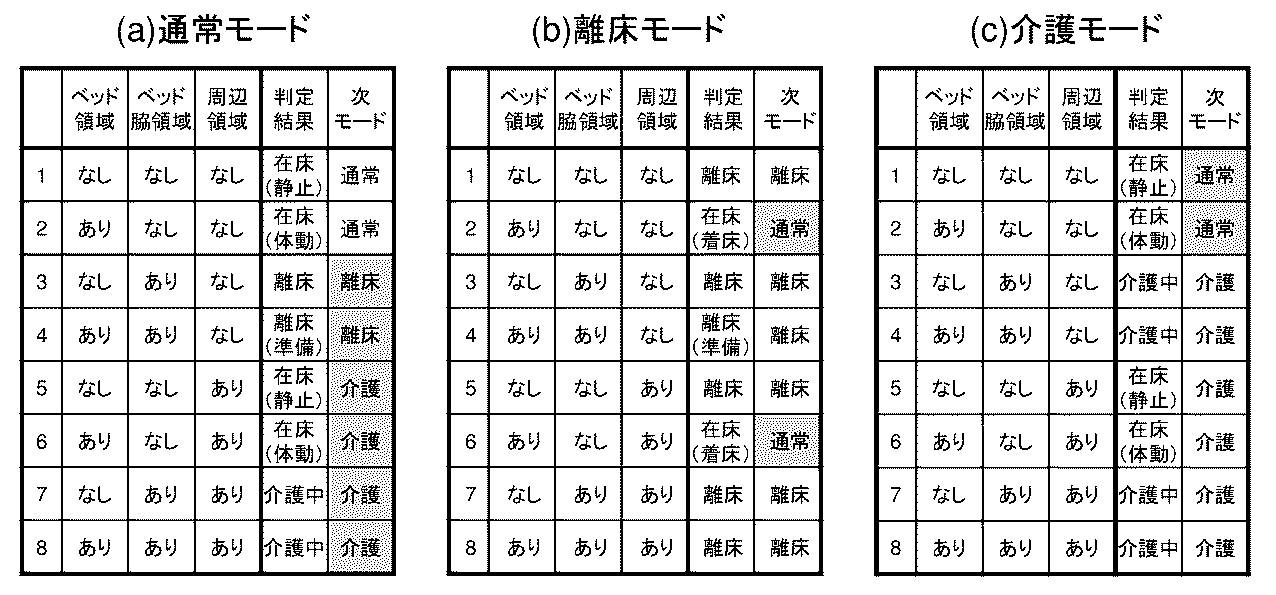
現在の動作モードが通常モードのときは(a)、離床モードのときは(b)、介護モードのときは(c)の表を用い、ベッド領域、ベッド脇領域、周辺領域での動き検出結果の「あり」「なし」に従って、「判定結果」が得られる。同時に、検出結果に応じた「次モード」が設定されており、次回判定時には移行先の動作モードで判定が実施される。表で「次モード」の欄が現モードの場合は、次回判定時も動作モードを変更せず、今回と同じ動作モードで判定する。次回判定時に現動作モードを選択すると表現することもできる。
以下、実際の検出について、具体例を挙げて説明する。
要介護者がベッドにいる状態で処理を開始した場合、S31の初期化によって、表3(a)「通常モード」となる。要介護者が安眠している場合、表1(a)の条件1となるので「静止」の判定となる。要介護者が寝返りをうった場合、表3(a)の条件2となるので、「体動」の判定となる。このときは動作モードに変化はなく、通常モードが保持される。要介護者がベッドから降りようと、ベッドに腰掛けた場合、表3(a)の条件4となるので「離床準備」の判定となり、(b)「離床モード」の条件4に移行する。引き続き、要介護者がベッドの脇で立ち上がった場合、表3(b)の条件3となるので、「離床」の判定となる。さらに、要介護者が部屋の出入口に向けて歩いた場合、表3(b)の条件5となるので、同じく「離床」の判定となる。次に、要介護者がベッドに戻った場合は、表3(b)の条件4を経て条件2となるので、「離床準備」の判定の次に、「着床」と判定され、「通常モード」に移行する。
次に通常モードから介護モードに移行する例を説明する。要介護者がベッドにいる状態で処理を開始した場合、S31の初期化によって、(a)「通常モード」となる。介護従事者が部屋に入ってきた場合、表3(a)の条件5となるので、「静止」の判定となる。「静止」判定後(c)「介護モード」に移行する。さらに介護従事者がベッドに近づいて、介護の作業を始めた場合、表3(a)の条件7または8となるので「介護中」の判定となり、(c)「介護モード」に移行する。介護従事者がベッドのそばに立って介護を行う場合、表3(c)の条件4となるので、「介護中」の判定となる。「通常モード」で同じ動き検出結果の場合は「離床準備」と判定するが(表3(a)条件4)、この場合は「介護モード」では「介護中」の判定となるので、別の場所にいる介護従事者に不要な呼び出しがかからず、介護従事者の負担の軽減となる。また、介護従事者が介護する都度、検出装置や判定装置あるいは装置付属のセンサのスイッチをOFFにする必要がなくなる。また、介護終了後上記スイッチをONにし忘れて、離床判定がもれてしまう問題も防ぐことができる。
なお、実施例3においては、表3(b)「離床モード」の条件6となった場合、次モードは「通常モード」へ移行するよう定義され、移行先の表3(a)「通常モード」の条件6にて次モードとして「介護モード」へ移行するよう定義されているが、上述のように、判定する間隔は実際の要介護者や介護従事者の動きに対して充分に短く設定しておけば、条件6の状態が続くことで表3(c)「介護モード」へ遅延なく着実に移行することができる。実際には表3(b)「離床モード」の条件6となった場合、次モードとして直接「介護モード」へ移行するよう定義することも可能である。適宜設計すればよい。
以上のように、実施例3の構成によれば、面会者や介護従事者がベッド付近にいたり、要介護者を介護していたりする場合にも、誤って要介護者が離床したと判定することがないので、別の場所にいる介護従事者への不要な呼び出しを抑制でき、介護従事者の負担が軽減する。また、介護従事者が介護する都度、検出装置や判定装置あるいは装置付属のセンサのスイッチをOFFにする必要がなくなる。また、介護終了後スイッチをONにし忘れて、離床判定がもれてしまう問題も防ぐことができる。
本発明に係る離床判定装置の具体例として実施例4について説明する。
実施例4では離床判定装置が、図3のS31における初期化時に、状況に応じた動作モードを選択することを特徴としている。実施例4は初期化時の動作モード選択以外については、実施例3の装置構成、各装置の機能と同一である。以下、実施例3と異なる部分について説明する。
まず、実施例4の構成ではない場合、例えば、次のようなケースを考える。
要介護者がベッドにいない状態で処理を開始した場合、S31の初期化によって、「通常モード」となる。要介護者が部屋に入ってきた場合、表3(a)の条件5となるので、「静止」の判定となる。さらに要介護者が自分のベッドに近づいた場合、表3(a)の条件7となるので「介護中」の判定となり、「介護モード」に移行する。その後要介護者がベッドに入った場合、表3(c)条件2となるので、「体動」の判定となり、「通常モード」に移行する。このように、部屋の外から入ってきた人が介護従事者か要介護者かの区別はできないため、要介護者が着床したのを介護従事者が介護中であると誤判定してしまう場合がある。
このような誤判定を防ぐために、実施例4はその構成として、図3のフローチャートのS31の初期化において、ベッドに要介護者がいる場合は「通常モード」に、ベッドに要介護者がいない場合は「離床モード」にするものである。
ベッドに要介護者がいるかどうかの判定は、どのような方法を用いてもよい。例えばカメラ画像で顔認識する方法、熱センサを用いる方法などを用いることができる。
要介護者がベッドにいない状態で処理を開始した場合、S31の初期化によって、「通常モード」ではなく「離床モード」となる。要介護者が部屋に入ってきた場合、表1(b)の条件5となるので、「離床」の判定となる。さらに要介護者が自分のベッドに近づいた場合も、表1(b)の条件7となるので「離床」の判定となる。次に要介護者がベッドに入った場合、表1(b)条件2となるので、「着床」の判定となり、「通常モード」に移行する。このようにして要介護者が着床したのを判定できる。
以上のように、実施例4の構成によれば、離床判定装置の電源を入れた時点でベッドに要介護者がいる/いない、のいずれの場合であっても、正しい離床判定を行うことができる。
図3をもとに、別の具体例である実施例5について説明する。
例えば、次のようなケースを考える。
図3のフローチャートのS37において、「次モード」として次の検出時の動作モードを設定するが、ノイズなどの影響で一時的に誤判定をしてしまった場合、それによってモードが変わってしまうと動作モードの誤りに起因する誤判定がその後も続いてしまう可能性がある。
これを防ぐために、実施例5はその構成として、図3のフローチャートのS37において、判定結果から得られる「次モード」に、直ちに次の判定処理で移行するのではなく、判定結果から得られる「次モード」を所定の回数分記憶しておき、所定回数連続で同じ「次モード」の判定が得られた場合に、実際にモードを変更するものである。上記構成以外については、実施例3の装置構成・機能と同一である。
このとき、記憶する回数が少なすぎるとノイズ除去の効果が少なく、多すぎると正しく動作モードを変更するときに遅れが生じてしまうので適切な値を指定する。例えば、1回の判定処理に0.1秒かかる場合には所定の回数を5回程度とする。動作モード変更に0.5秒遅れが生じることになるが、要介護者の離床に要する時間よりも十分短いため問題ない。
なお、すでに説明したように、動き検出および離床判定の繰り返し頻度は、人が通常動作する時間に比べて充分に短いので、ある状態(条件)で動作モードが切り替わっても、切り替わり前後の両方の動作モードで、その状態(条件)の判定を共通にしておけば判定ミスを防止できる。所定の回数や時間は、判定結果や動作モードの切り替えが適切になるよう設計すればよい。
以上のように、実施例5の構成によれば、カメラで撮影した画像にノイズが入り、一時的に誤判定が生じた場合でも、動作モードの変更が行われないため、誤判定・誤動作を抑制でき、確実な離床判定を実現できる。
本発明に係る離床判定装置は、寝具および該寝具周辺の撮影を行うカメラ、該カメラの撮影した画像情報に基づいて動きを検出する動き検出部および観察対象者の状況を判定する状況判定部を備える離床判定装置であって、状況判定部は、状況判定のための判定基準を複数有し、動き検出部の検出結果と現在選択中の判定基準に基づいて状況を判定し、さらに、動き検出部の検出結果に基づいて、複数の判定基準の中から次回判定時の判定基準を選択することを特徴としている。
上記構成によれば、それまでの経緯や状態に応じた実態に即した判定基準を備えているため、要介護者の状況を正確に判定できるという効果を奏する。
また、本発明の離床判定装置において、動き検出部は、画像情報のうち、寝具が占有する領域である寝具領域と、寝具から離床するときに通る寝具脇領域と、室外から寝具脇領域に移動するときに通る周辺領域と、を識別し、状況判定部は、第1判定基準と第2判定基準の2つの判定基準を有し、第1判定基準では、周辺領域では動きが検出されず、かつ寝具脇領域で動きが検出された場合に離床と判定し、第2判定基準では、寝具脇領域で動きが検出された場合に介護中と判定し、さらに、第1判定基準において、周辺領域で動きが検出された場合に次回判定時の判定基準として第2判定基準を選択し、第2判定基準において、寝具脇領域と周辺領域のいずれにも動きが検出されない場合に次回判定時の判定基準として第1判定基準を選択することが好ましい。
また、本発明に係る離床判定方法は、カメラで撮影した、寝具および該寝具周辺の画像情報に基づいて動きを検出する動き検出ステップと、観察対象者の状況を判定する状況判定ステップを含む離床判定方法であって、動き検出ステップは、画像情報のうち、寝具が占有する領域である寝具領域と、寝具から離床するときに通る寝具脇領域と、室外から寝具脇領域に移動するときに通る周辺領域と、を識別し、状況判定ステップは、第1判定基準または第2判定基準に基づいて状況を判定し、第1判定基準では、周辺領域では動きが検出されず、かつ寝具脇領域で動きが検出された場合に離床と判定し、第2判定基準では、寝具脇領域で動きが検出された場合に介護中と判定し、さらに、第1判定基準において、周辺領域で動きが検出された場合に次回判定時の判定基準として第2判定基準を選択し、第2判定基準において、寝具脇領域と周辺領域のいずれにも動きが検出されない場合に次回判定時の判定基準として第1判定基準を選択することを特徴としている。
上記構成によれば、面会者や介護従事者がベッド付近にいたり、要介護者を介護していたりする場合にも、誤って要介護者が離床したと判定することがないので、別の場所にいる介護従事者への不要な呼び出しを抑制でき、介護従事者の負担が軽減する。また、介護従事者が介護する都度、検出装置や判定装置あるいは装置付属のセンサのスイッチをOFFにする必要がなくなる。また、介護終了後上記スイッチをONにし忘れて、離床判定がもれてしまう問題も防ぐことができるという効果を奏する。
また、本発明の離床判定装置において、状況判定部は、さらに第3判定基準を有し、第1判定基準では、周辺領域では動きが検出されず、かつ寝具脇領域で動きが検出された場合に、次回判定時の判定基準として第3判定基準を選択し、第3判定基準では、寝具領域で動きが検出され、かつ、寝具脇領域で動きが検出されない場合に在床と判定し、さらに次回判定時の判定基準として第1判定基準を選択し、離床判定処理の開始時において、寝具領域で動きが検出された場合に第1判定基準を選択し、寝具領域で動きが検出されない場合に第3判定基準を選択することが好ましい。
上記構成によれば、離床判定装置の電源を入れた時点でベッドに要介護者がいる/いない、のいずれの場合であっても、正しい離床判定を行うことができるという効果を奏する。
また、本発明の離床判定装置において、動き検出部は、画像情報のうち、寝具が占有する領域である寝具領域と、寝具から離床するときに通る寝具脇領域と、室外から寝具脇領域に移動するときに通る周辺領域と、を識別し、状況判定部は、第1判定基準と第3判定基準の2つの判定基準を有し、第1判定基準では、周辺領域では動きが検出されず、寝具脇領域で動きが検出された場合に離床と判定し、さらに次回判定時の判定基準として第3判定基準を選択し、第3判定基準では、寝具領域で動きが検出され、かつ、寝具脇領域で動きが検出されない場合に在床と判定し、さらに次回判定時の判定基準として第1判定基準を選択し、離床判定処理の開始時において、寝具領域で動きが検出された場合に第1判定基準を選択し、寝具領域で動きが検出されない場合に第3判定基準を選択することが好ましい。
上記構成によれば、離床判定装置の電源を入れた時点でベッドに要介護者がいる/いない、のいずれの場合であっても、正しい離床判定を行うことができるという効果を奏する。
また、本発明の離床判定装置において、状況判定部は、さらに第2判定基準を有し、第1判定基準において、周辺領域で動きが検出された場合に次回判定時の判定基準として第2判定基準を選択し、第2判定基準では、寝具脇領域で動きが検出された場合に介護中と判定し、さらに、第2判定基準において、寝具脇領域と周辺領域のいずれにも動きが検出されない場合に次回判定時の判定基準として第1判定基準を選択することが好ましい。
上記構成によれば、面会者や介護従事者がベッド付近にいたり、要介護者を介護していたりする場合にも、誤って要介護者が離床したと判定することがないので、別の場所にいる介護従事者への不要な呼び出しを抑制でき、介護従事者の負担が軽減する。また、介護従事者が介護する都度、検出装置や判定装置あるいは装置付属のセンサのスイッチをOFFにする必要がなくなる。また、介護終了後上記スイッチをONにし忘れて、離床判定がもれてしまう問題も防ぐことができるという効果を奏する。
また、本発明の離床判定装置において、第1判定基準は実質的に観察対象者が寝具に在る通常時に用いられることが好ましい。
また、本発明の離床判定装置において、第2判定基準は実質的に観察対象者の被介護時に用いられることが好ましい。
また、本発明の離床判定装置において、第3判定基準は実質的に観察対象者の離床時に用いられることが好ましい。
上記構成によれば、それぞれの状況に相応しい判定基準を用いるため、より実態に即した適切かつ正確な判定が可能であるという効果を奏する。
また、本発明の離床判定装置において、状況判定部は、現在選択中とは異なる判定基準を選択する、同一の動き検出結果が所定の回数分連続して得られた後に、異なる判定基準を選択することが好ましい。
上記構成によれば、カメラで撮影した画像にノイズが入り、一時的に誤判定が生じた場合でも、動作モードの変更が行われないため、誤判定・誤動作を抑制でき、確実な離床判定を実現できるという効果を奏する。
また、本発明の離床判定装置において、状況を判定した結果と現在選択中の判定基準の両方を所定の出力先へ出力することが好ましい。
上記構成によれば、介護従事者が、状況判定結果と現在選択中の判定基準を併せて確認できるので、要介護者の状況をより正確に判定できるという効果を奏する。
本発明は、人がベッドから離床することを検出する離床判定装置に利用可能である。
11 ベッド領域
12 ベッド脇領域
13 周辺領域
14 外部領域
15 ベッド領域
16 ベッド脇領域
17 ベッド脇領域
18 周辺領域
19 外部領域
21 離床判定装置
22 カメラ
23 画像データバッファ
24 動き検出部
25 状況判定部
26 結果出力部
12 ベッド脇領域
13 周辺領域
14 外部領域
15 ベッド領域
16 ベッド脇領域
17 ベッド脇領域
18 周辺領域
19 外部領域
21 離床判定装置
22 カメラ
23 画像データバッファ
24 動き検出部
25 状況判定部
26 結果出力部
Claims (6)
- 寝具および該寝具周辺の撮影を行うカメラ、該カメラの撮影した画像情報に基づいて動きを検出する動き検出部および観察対象者の状況を判定する状況判定部を備える離床判定装置であって、
前記状況判定部は、状況判定のための判定基準を複数有し、前記動き検出部の検出結果と現在選択中の判定基準に基づいて状況を判定し、さらに、前記動き検出部の検出結果に基づいて、前記複数の判定基準の中から次回判定時の判定基準を選択することを特徴とする離床判定装置。 - 前記動き検出部は、
前記画像情報のうち、前記寝具が占有する領域である寝具領域と、
前記寝具から離床するときに通る寝具脇領域と、
室外から前記寝具脇領域に移動するときに通る周辺領域と、を識別し、
前記状況判定部は、第1判定基準と第2判定基準の2つの前記判定基準を有し、
前記第1判定基準では、前記周辺領域では動きが検出されず、かつ前記寝具脇領域で動きが検出された場合に離床と判定し、
前記第2判定基準では、前記寝具脇領域で動きが検出された場合に介護中と判定し、
さらに、前記第1判定基準において、前記周辺領域で動きが検出された場合に次回判定時の判定基準として前記第2判定基準を選択し、
前記第2判定基準において、前記寝具脇領域と前記周辺領域のいずれにも動きが検出されない場合に次回判定時の判定基準として前記第1判定基準を選択することを特徴とする請求項1に記載の離床判定装置。 - 前記状況判定部は、さらに第3判定基準を有し、
前記第1判定基準では、前記周辺領域では動きが検出されず、かつ前記寝具脇領域で動きが検出された場合に、次回判定時の判定基準として前記第3判定基準を選択し、
前記第3判定基準では、前記寝具領域で動きが検出され、かつ、前記寝具脇領域で動きが検出されない場合に在床と判定し、さらに次回判定時の判定基準として前記第1判定基準を選択し、
離床判定処理の開始時において、
前記寝具領域で動きが検出された場合に前記第1判定基準を選択し、
前記寝具領域で動きが検出されない場合に前記第3判定基準を選択することを特徴とする請求項2に記載の離床判定装置。 - 前記動き検出部は、
前記画像情報のうち、前記寝具が占有する領域である寝具領域と、
前記寝具から離床するときに通る寝具脇領域と、
室外から前記寝具脇領域に移動するときに通る周辺領域と、を識別し、
前記状況判定部は、第1判定基準と第3判定基準の2つの前記判定基準を有し、
前記第1判定基準では、前記周辺領域では動きが検出されず、前記寝具脇領域で動きが検出された場合に離床と判定し、さらに次回判定時の判定基準として前記第3判定基準を選択し、
前記第3判定基準では、前記寝具領域で動きが検出され、かつ、前記寝具脇領域で動きが検出されない場合に在床と判定し、さらに次回判定時の判定基準として前記第1判定基準を選択し、
離床判定処理の開始時において、
前記寝具領域で動きが検出された場合に前記第1判定基準を選択し、
前記寝具領域で動きが検出されない場合に前記第3判定基準を選択することを特徴とする請求項1に記載の離床判定装置。 - 前記状況判定部は、さらに第2判定基準を有し、
前記第1判定基準において、前記周辺領域で動きが検出された場合に次回判定時の判定基準として前記第2判定基準を選択し、
前記第2判定基準では、前記寝具脇領域で動きが検出された場合に介護中と判定し、
さらに、前記第2判定基準において、前記寝具脇領域と前記周辺領域のいずれにも動きが検出されない場合に次回判定時の判定基準として前記第1判定基準を選択することを特徴とする請求項4に記載の離床判定装置。 - カメラで撮影した、寝具および該寝具周辺の画像情報に基づいて動きを検出する動き検出ステップと、観察対象者の状況を判定する状況判定ステップを含む離床判定方法であって、
前記動き検出ステップは、
前記画像情報のうち、前記寝具が占有する領域である寝具領域と、
前記寝具から離床するときに通る寝具脇領域と、
室外から前記寝具脇領域に移動するときに通る周辺領域と、を識別し、
前記状況判定ステップは、第1判定基準または第2判定基準に基づいて状況を判定し、
前記第1判定基準では、前記周辺領域では動きが検出されず、かつ前記寝具脇領域で動きが検出された場合に離床と判定し、
前記第2判定基準では、前記寝具脇領域で動きが検出された場合に介護中と判定し、
さらに、前記第1判定基準において、前記周辺領域で動きが検出された場合に次回判定時の判定基準として前記第2判定基準を選択し、
前記第2判定基準において、前記寝具脇領域と前記周辺領域のいずれにも動きが検出されない場合に次回判定時の判定基準として前記第1判定基準を選択することを特徴とする離床判定方法。
Applications Claiming Priority (2)
| Application Number | Priority Date | Filing Date | Title |
|---|---|---|---|
| JP2014013870A JP2015139550A (ja) | 2014-01-29 | 2014-01-29 | 離床判定装置および離床判定方法 |
| JP2014-013870 | 2014-01-29 |
Publications (1)
| Publication Number | Publication Date |
|---|---|
| WO2015114902A1 true WO2015114902A1 (ja) | 2015-08-06 |
Family
ID=53756500
Family Applications (1)
| Application Number | Title | Priority Date | Filing Date |
|---|---|---|---|
| PCT/JP2014/079451 Ceased WO2015114902A1 (ja) | 2014-01-29 | 2014-11-06 | 離床判定装置および離床判定方法 |
Country Status (2)
| Country | Link |
|---|---|
| JP (1) | JP2015139550A (ja) |
| WO (1) | WO2015114902A1 (ja) |
Cited By (5)
| Publication number | Priority date | Publication date | Assignee | Title |
|---|---|---|---|---|
| WO2018012432A1 (ja) * | 2016-07-12 | 2018-01-18 | コニカミノルタ株式会社 | 行動判定装置及び行動判定方法 |
| BE1025269B1 (fr) * | 2017-09-29 | 2019-01-03 | KapCare SA | Dispositif et methode pour detecter qu’une personne alitee quitte son lit ou a chute. |
| WO2019031012A1 (ja) * | 2017-08-10 | 2019-02-14 | コニカミノルタ株式会社 | 行動検知装置および該方法ならびに被監視者監視支援システム |
| CN111568437A (zh) * | 2020-06-01 | 2020-08-25 | 浙江大学 | 一种非接触式离床实时监测方法 |
| AT523655B1 (de) * | 2020-05-05 | 2021-10-15 | Opus Novo Gmbh | Beleuchtungsmodul |
Families Citing this family (1)
| Publication number | Priority date | Publication date | Assignee | Title |
|---|---|---|---|---|
| JP6870514B2 (ja) * | 2017-07-14 | 2021-05-12 | オムロン株式会社 | 見守り支援システム及びその制御方法 |
Citations (6)
| Publication number | Priority date | Publication date | Assignee | Title |
|---|---|---|---|---|
| JP2002230533A (ja) * | 2001-01-31 | 2002-08-16 | Matsushita Electric Works Ltd | 画像処理装置 |
| JP2007202847A (ja) * | 2006-02-02 | 2007-08-16 | Matsushita Electric Works Ltd | 在床検出装置 |
| JP2008224396A (ja) * | 2007-03-12 | 2008-09-25 | Saxa Inc | 移動体検出装置及び移動体検知システム |
| JP2009005963A (ja) * | 2007-06-28 | 2009-01-15 | Nippon Telegr & Teleph Corp <Ntt> | 離床前動作検出装置、離床前動作検出プログラムおよび離床前動作検出方法 |
| JP2011086286A (ja) * | 2009-09-17 | 2011-04-28 | Shimizu Corp | ベッド上及び室内の見守りシステム |
| JP2012170483A (ja) * | 2011-02-17 | 2012-09-10 | Fujitsu Ltd | 状態検知装置および状態検知方法 |
Family Cites Families (1)
| Publication number | Priority date | Publication date | Assignee | Title |
|---|---|---|---|---|
| JP5915199B2 (ja) * | 2012-01-20 | 2016-05-11 | 富士通株式会社 | 状態検知装置および状態検知方法 |
-
2014
- 2014-01-29 JP JP2014013870A patent/JP2015139550A/ja active Pending
- 2014-11-06 WO PCT/JP2014/079451 patent/WO2015114902A1/ja not_active Ceased
Patent Citations (6)
| Publication number | Priority date | Publication date | Assignee | Title |
|---|---|---|---|---|
| JP2002230533A (ja) * | 2001-01-31 | 2002-08-16 | Matsushita Electric Works Ltd | 画像処理装置 |
| JP2007202847A (ja) * | 2006-02-02 | 2007-08-16 | Matsushita Electric Works Ltd | 在床検出装置 |
| JP2008224396A (ja) * | 2007-03-12 | 2008-09-25 | Saxa Inc | 移動体検出装置及び移動体検知システム |
| JP2009005963A (ja) * | 2007-06-28 | 2009-01-15 | Nippon Telegr & Teleph Corp <Ntt> | 離床前動作検出装置、離床前動作検出プログラムおよび離床前動作検出方法 |
| JP2011086286A (ja) * | 2009-09-17 | 2011-04-28 | Shimizu Corp | ベッド上及び室内の見守りシステム |
| JP2012170483A (ja) * | 2011-02-17 | 2012-09-10 | Fujitsu Ltd | 状態検知装置および状態検知方法 |
Cited By (11)
| Publication number | Priority date | Publication date | Assignee | Title |
|---|---|---|---|---|
| WO2018012432A1 (ja) * | 2016-07-12 | 2018-01-18 | コニカミノルタ株式会社 | 行動判定装置及び行動判定方法 |
| JPWO2018012432A1 (ja) * | 2016-07-12 | 2019-05-09 | コニカミノルタ株式会社 | 行動判定装置及び行動判定方法 |
| JP7183788B2 (ja) | 2016-07-12 | 2022-12-06 | コニカミノルタ株式会社 | 行動判定装置及び行動判定方法 |
| WO2019031012A1 (ja) * | 2017-08-10 | 2019-02-14 | コニカミノルタ株式会社 | 行動検知装置および該方法ならびに被監視者監視支援システム |
| BE1025269B1 (fr) * | 2017-09-29 | 2019-01-03 | KapCare SA | Dispositif et methode pour detecter qu’une personne alitee quitte son lit ou a chute. |
| WO2019063808A1 (fr) * | 2017-09-29 | 2019-04-04 | KapCare SA | Dispositif et methode pour detecter qu'une personne alitee quitte son lit ou a chute |
| US11234617B2 (en) | 2017-09-29 | 2022-02-01 | KapCare SA | Device and method for detecting if a bedridden person leaves his or her bed or has fallen |
| AT523655B1 (de) * | 2020-05-05 | 2021-10-15 | Opus Novo Gmbh | Beleuchtungsmodul |
| AT523655A4 (de) * | 2020-05-05 | 2021-10-15 | Opus Novo Gmbh | Beleuchtungsmodul |
| CN111568437A (zh) * | 2020-06-01 | 2020-08-25 | 浙江大学 | 一种非接触式离床实时监测方法 |
| CN111568437B (zh) * | 2020-06-01 | 2021-07-09 | 浙江大学 | 一种非接触式离床实时监测方法 |
Also Published As
| Publication number | Publication date |
|---|---|
| JP2015139550A (ja) | 2015-08-03 |
Similar Documents
| Publication | Publication Date | Title |
|---|---|---|
| WO2015114902A1 (ja) | 離床判定装置および離床判定方法 | |
| EP3170125B1 (en) | Occupancy detection | |
| JP6717235B2 (ja) | 見守り支援システム及びその制御方法 | |
| JP5782737B2 (ja) | 状態検知装置、状態検知方法および状態検知プログラム | |
| US10762761B2 (en) | Monitoring assistance system, control method thereof, and program | |
| CN111212220B9 (zh) | 保存有图像处理程序的记录介质以及图像处理装置 | |
| JP3941227B2 (ja) | 異常監視装置 | |
| CN107925748A (zh) | 显示控制装置、显示控制系统、显示控制方法、显示控制程序、记录介质 | |
| KR102052883B1 (ko) | 열화상 카메라를 이용한 낙상 예측 시스템 및 열화상 카메라를 이용한 낙상 예측 방법 | |
| JP2015119898A (ja) | 状態判定装置および状態判定モジュール | |
| CN106605238B (zh) | 占用监测 | |
| CN106575464A (zh) | 检测要被监测的对象的运动和/或位置 | |
| KR101715218B1 (ko) | 영상 분석을 통하여 환자의 낙상 위험을 판단하는 시스템 및 방법 | |
| WO2020145380A1 (ja) | 介護記録装置、介護記録システム、介護記録プログラムおよび介護記録方法 | |
| JP7226315B2 (ja) | ケアサポートシステムおよび情報通知制御方法 | |
| US10509967B2 (en) | Occupancy detection | |
| JPWO2019021744A1 (ja) | 発報制御システム、検知ユニット、ケアサポートシステムおよび発報制御方法 | |
| JP2023548886A (ja) | カメラを制御するための装置及び方法 | |
| WO2020008995A1 (ja) | 画像認識プログラム、画像認識装置、学習プログラム、および学習装置 | |
| WO2016181837A1 (ja) | 画像処理システム、画像処理装置、画像処理方法、および画像処理プログラム | |
| JP2019204366A (ja) | 行動監視装置及び行動監視方法 | |
| KR20230125453A (ko) | 환자의 자세를 추정하여 사이드 레일을 제어하는 의료용 침대 | |
| JP7500929B2 (ja) | 画像処理システム、画像処理プログラム、および画像処理方法 | |
| JP2019146712A (ja) | 行動監視システム、及び、行動監視方法 | |
| WO2023127623A1 (ja) | 端末装置 |
Legal Events
| Date | Code | Title | Description |
|---|---|---|---|
| 121 | Ep: the epo has been informed by wipo that ep was designated in this application |
Ref document number: 14880906 Country of ref document: EP Kind code of ref document: A1 |
|
| NENP | Non-entry into the national phase |
Ref country code: DE |
|
| 122 | Ep: pct application non-entry in european phase |
Ref document number: 14880906 Country of ref document: EP Kind code of ref document: A1 |