WO2015033879A1 - 感光性樹脂組成物、硬化膜の製造方法、硬化膜、液晶表示装置および有機el表示装置 - Google Patents
感光性樹脂組成物、硬化膜の製造方法、硬化膜、液晶表示装置および有機el表示装置 Download PDFInfo
- Publication number
- WO2015033879A1 WO2015033879A1 PCT/JP2014/072871 JP2014072871W WO2015033879A1 WO 2015033879 A1 WO2015033879 A1 WO 2015033879A1 JP 2014072871 W JP2014072871 W JP 2014072871W WO 2015033879 A1 WO2015033879 A1 WO 2015033879A1
- Authority
- WO
- WIPO (PCT)
- Prior art keywords
- group
- resin composition
- photosensitive resin
- solvent
- structural unit
- Prior art date
- Legal status (The legal status is an assumption and is not a legal conclusion. Google has not performed a legal analysis and makes no representation as to the accuracy of the status listed.)
- Ceased
Links
Images
Classifications
-
- G—PHYSICS
- G03—PHOTOGRAPHY; CINEMATOGRAPHY; ANALOGOUS TECHNIQUES USING WAVES OTHER THAN OPTICAL WAVES; ELECTROGRAPHY; HOLOGRAPHY
- G03F—PHOTOMECHANICAL PRODUCTION OF TEXTURED OR PATTERNED SURFACES, e.g. FOR PRINTING, FOR PROCESSING OF SEMICONDUCTOR DEVICES; MATERIALS THEREFOR; ORIGINALS THEREFOR; APPARATUS SPECIALLY ADAPTED THEREFOR
- G03F7/00—Photomechanical, e.g. photolithographic, production of textured or patterned surfaces, e.g. printing surfaces; Materials therefor, e.g. comprising photoresists; Apparatus specially adapted therefor
- G03F7/26—Processing photosensitive materials; Apparatus therefor
- G03F7/40—Treatment after imagewise removal, e.g. baking
-
- G—PHYSICS
- G03—PHOTOGRAPHY; CINEMATOGRAPHY; ANALOGOUS TECHNIQUES USING WAVES OTHER THAN OPTICAL WAVES; ELECTROGRAPHY; HOLOGRAPHY
- G03F—PHOTOMECHANICAL PRODUCTION OF TEXTURED OR PATTERNED SURFACES, e.g. FOR PRINTING, FOR PROCESSING OF SEMICONDUCTOR DEVICES; MATERIALS THEREFOR; ORIGINALS THEREFOR; APPARATUS SPECIALLY ADAPTED THEREFOR
- G03F7/00—Photomechanical, e.g. photolithographic, production of textured or patterned surfaces, e.g. printing surfaces; Materials therefor, e.g. comprising photoresists; Apparatus specially adapted therefor
- G03F7/004—Photosensitive materials
- G03F7/0048—Photosensitive materials characterised by the solvents or agents facilitating spreading, e.g. tensio-active agents
-
- G—PHYSICS
- G03—PHOTOGRAPHY; CINEMATOGRAPHY; ANALOGOUS TECHNIQUES USING WAVES OTHER THAN OPTICAL WAVES; ELECTROGRAPHY; HOLOGRAPHY
- G03F—PHOTOMECHANICAL PRODUCTION OF TEXTURED OR PATTERNED SURFACES, e.g. FOR PRINTING, FOR PROCESSING OF SEMICONDUCTOR DEVICES; MATERIALS THEREFOR; ORIGINALS THEREFOR; APPARATUS SPECIALLY ADAPTED THEREFOR
- G03F7/00—Photomechanical, e.g. photolithographic, production of textured or patterned surfaces, e.g. printing surfaces; Materials therefor, e.g. comprising photoresists; Apparatus specially adapted therefor
- G03F7/004—Photosensitive materials
- G03F7/038—Macromolecular compounds which are rendered insoluble or differentially wettable
-
- G—PHYSICS
- G03—PHOTOGRAPHY; CINEMATOGRAPHY; ANALOGOUS TECHNIQUES USING WAVES OTHER THAN OPTICAL WAVES; ELECTROGRAPHY; HOLOGRAPHY
- G03F—PHOTOMECHANICAL PRODUCTION OF TEXTURED OR PATTERNED SURFACES, e.g. FOR PRINTING, FOR PROCESSING OF SEMICONDUCTOR DEVICES; MATERIALS THEREFOR; ORIGINALS THEREFOR; APPARATUS SPECIALLY ADAPTED THEREFOR
- G03F7/00—Photomechanical, e.g. photolithographic, production of textured or patterned surfaces, e.g. printing surfaces; Materials therefor, e.g. comprising photoresists; Apparatus specially adapted therefor
- G03F7/004—Photosensitive materials
- G03F7/038—Macromolecular compounds which are rendered insoluble or differentially wettable
- G03F7/0382—Macromolecular compounds which are rendered insoluble or differentially wettable the macromolecular compound being present in a chemically amplified negative photoresist composition
-
- G—PHYSICS
- G03—PHOTOGRAPHY; CINEMATOGRAPHY; ANALOGOUS TECHNIQUES USING WAVES OTHER THAN OPTICAL WAVES; ELECTROGRAPHY; HOLOGRAPHY
- G03F—PHOTOMECHANICAL PRODUCTION OF TEXTURED OR PATTERNED SURFACES, e.g. FOR PRINTING, FOR PROCESSING OF SEMICONDUCTOR DEVICES; MATERIALS THEREFOR; ORIGINALS THEREFOR; APPARATUS SPECIALLY ADAPTED THEREFOR
- G03F7/00—Photomechanical, e.g. photolithographic, production of textured or patterned surfaces, e.g. printing surfaces; Materials therefor, e.g. comprising photoresists; Apparatus specially adapted therefor
- G03F7/004—Photosensitive materials
- G03F7/039—Macromolecular compounds which are photodegradable, e.g. positive electron resists
- G03F7/0392—Macromolecular compounds which are photodegradable, e.g. positive electron resists the macromolecular compound being present in a chemically amplified positive photoresist composition
-
- G—PHYSICS
- G03—PHOTOGRAPHY; CINEMATOGRAPHY; ANALOGOUS TECHNIQUES USING WAVES OTHER THAN OPTICAL WAVES; ELECTROGRAPHY; HOLOGRAPHY
- G03F—PHOTOMECHANICAL PRODUCTION OF TEXTURED OR PATTERNED SURFACES, e.g. FOR PRINTING, FOR PROCESSING OF SEMICONDUCTOR DEVICES; MATERIALS THEREFOR; ORIGINALS THEREFOR; APPARATUS SPECIALLY ADAPTED THEREFOR
- G03F7/00—Photomechanical, e.g. photolithographic, production of textured or patterned surfaces, e.g. printing surfaces; Materials therefor, e.g. comprising photoresists; Apparatus specially adapted therefor
- G03F7/004—Photosensitive materials
- G03F7/039—Macromolecular compounds which are photodegradable, e.g. positive electron resists
- G03F7/0392—Macromolecular compounds which are photodegradable, e.g. positive electron resists the macromolecular compound being present in a chemically amplified positive photoresist composition
- G03F7/0397—Macromolecular compounds which are photodegradable, e.g. positive electron resists the macromolecular compound being present in a chemically amplified positive photoresist composition the macromolecular compound having an alicyclic moiety in a side chain
-
- H—ELECTRICITY
- H10—SEMICONDUCTOR DEVICES; ELECTRIC SOLID-STATE DEVICES NOT OTHERWISE PROVIDED FOR
- H10K—ORGANIC ELECTRIC SOLID-STATE DEVICES
- H10K59/00—Integrated devices, or assemblies of multiple devices, comprising at least one organic light-emitting element covered by group H10K50/00
- H10K59/10—OLED displays
- H10K59/12—Active-matrix OLED [AMOLED] displays
- H10K59/124—Insulating layers formed between TFT elements and OLED elements
-
- H—ELECTRICITY
- H10—SEMICONDUCTOR DEVICES; ELECTRIC SOLID-STATE DEVICES NOT OTHERWISE PROVIDED FOR
- H10P—GENERIC PROCESSES OR APPARATUS FOR THE MANUFACTURE OR TREATMENT OF DEVICES COVERED BY CLASS H10
- H10P14/00—Formation of materials, e.g. in the shape of layers or pillars
- H10P14/60—Formation of materials, e.g. in the shape of layers or pillars of insulating materials
- H10P14/68—Organic materials, e.g. photoresists
- H10P14/683—Organic materials, e.g. photoresists carbon-based polymeric organic materials, e.g. polyimides, poly cyclobutene or PVC
-
- H—ELECTRICITY
- H10—SEMICONDUCTOR DEVICES; ELECTRIC SOLID-STATE DEVICES NOT OTHERWISE PROVIDED FOR
- H10P—GENERIC PROCESSES OR APPARATUS FOR THE MANUFACTURE OR TREATMENT OF DEVICES COVERED BY CLASS H10
- H10P50/00—Etching of wafers, substrates or parts of devices
- H10P50/20—Dry etching; Plasma etching; Reactive-ion etching
- H10P50/28—Dry etching; Plasma etching; Reactive-ion etching of insulating materials
Definitions
- the present invention relates to a photosensitive resin composition (hereinafter sometimes simply referred to as “the composition of the present invention”), a method for producing a cured film, a cured film, a liquid crystal display device, and an organic EL display device. More specifically, a photosensitive resin composition suitable for forming a flattening film, a protective film and an interlayer insulating film of an electronic component such as a liquid crystal display device, an organic EL (organic electroluminescence) display device, an integrated circuit element, and a solid-state imaging element. And a method for producing a cured film using the composition.
- an interlayer insulation is generally used to insulate between wirings arranged in layers.
- a membrane is provided.
- a photosensitive resin composition is widely used because a material having a small number of steps for obtaining a required pattern shape and sufficient flatness is preferable (for example, (See Patent Document 1).
- the present invention aims to solve such a problem, and provides a photosensitive resin composition having good chemical resistance and excellent storage stability while maintaining high sensitivity. Objective.
- ⁇ 1> (A) a polymer component containing a polymer that satisfies at least one of the following (1) and (2): (1) (a1) a structural unit having a group in which an acid group is protected with an acetal group, and (a2) a polymer having a structural unit having a crosslinkable group, (2) a polymer having the structural unit (a1) and a polymer having the structural unit (a2), (B) a photoacid generator, and (C) a solvent having an ether bond and / or an ester bond and having no alcoholic hydroxyl group, A photosensitive resin composition having a content of a solvent having an alcoholic hydroxyl group based on the total amount of the solvent of 1 to 50 ppm.
- ⁇ 2> The photosensitive resin composition according to ⁇ 1>, wherein the solvent having an alcoholic hydroxyl group has a boiling point at 1 atm of 95 ° C. or higher.
- the solvent (C) is a solvent having an ether bond.
- the (C) solvent contains a diethylene glycol derivative.
- the solvent comprises diethylene glycol ethyl methyl ether and / or diethylene glycol dimethyl ether.
- the crosslinkable group in the structural unit is at least one selected from an epoxy group, an oxetanyl group, and —NH—CH 2 —OR, and any one of ⁇ 1> to ⁇ 7> Photosensitive resin composition; wherein R represents an alkyl group having 1 to 20 carbon atoms.
- C The photosensitive resin composition according to any one of ⁇ 1> to ⁇ 8>, wherein the solvent is 50% by mass or more of the total solvent.
- B The photosensitive resin composition according to any one of ⁇ 1> to ⁇ 9>, wherein the photoacid generator is an oxime sulfonate compound and / or an onium salt compound.
- ⁇ 11> (1) A step of applying the photosensitive resin composition according to any one of ⁇ 1> to ⁇ 10> on a substrate, (2) a step of removing the solvent from the applied photosensitive resin composition; (3) A step of exposing the photosensitive resin composition from which the solvent has been removed with actinic radiation, (4) developing the exposed photosensitive resin composition with an aqueous developer, and (5) A method for producing a cured film, comprising a post-baking step of thermosetting the developed photosensitive resin composition.
- ⁇ 12> A cured film obtained by curing the photosensitive resin composition according to any one of ⁇ 1> to ⁇ 10>.
- ⁇ 13> The cured film according to ⁇ 12>, which is an interlayer insulating film.
- ⁇ 14> A liquid crystal display device or an organic EL display device having the cured film according to ⁇ 12> or ⁇ 13>.
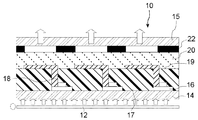
- FIG. 1 is a conceptual diagram of a configuration of an example of a liquid crystal display device.
- the schematic sectional drawing of the active matrix substrate in a liquid crystal display device is shown, and it has the cured film 17 which is an interlayer insulation film.
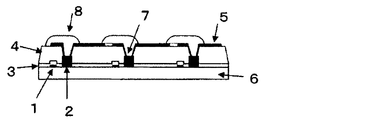
- 1 shows a conceptual diagram of a configuration of an example of an organic EL display device.
- a schematic cross-sectional view of a substrate in a bottom emission type organic EL display device is shown, and a planarizing film 4 is provided.
- the composition of the present invention comprises (A) a polymer component containing a polymer that satisfies at least one of the following (1) and (2): (1) (a1) a structural unit having a group in which an acid group is protected with an acetal group, and (a2) a polymer having a structural unit having a crosslinkable group, (2) a polymer having the structural unit (a1) and a polymer having the structural unit (a2), (B) a photoacid generator, and (C) a solvent having an ether bond and / or an ester bond and having no alcoholic hydroxyl group, and the content of the solvent having an alcoholic hydroxyl group relative to the total amount of the solvent is 1 to It is characterized by being 50 ppm.
- the colored photosensitive composition of the present invention is preferably a chemically amplified positive type.
- the composition of the present invention comprises, as a polymer component, a polymer (1) having (a1) a structural unit having a group in which an acid group is protected by an acetal group, and (a2) a structural unit having a crosslinkable group, At least one of the polymer having the structural unit (a1) and the polymer (2) having the structural unit (a2) is included. Furthermore, polymers other than these may be included.
- the polymer component (A) in the present invention includes, in addition to the polymer (1) and / or the polymer (2), other polymers added as necessary, unless otherwise specified. means.
- (a1) includes a polymer having a structural unit having an acid group protected by an acetal group and (a2) a polymer having a structural unit having a crosslinkable group
- (a1) acid group The ratio (molar ratio) between the polymer having a structural unit having a group protected by an acetal group and the polymer having a structural unit having (a2) a crosslinkable group is preferably 95: 5 to 5:95, 80:20 to 20:80 is more preferable, and 70:30 to 30:70 is more preferable. By setting it as such a range, the effect of this invention is exhibited more effectively.
- the (A) polymer component is preferably an addition polymerization type resin, and more preferably a polymer containing a structural unit derived from (meth) acrylic acid and / or an ester thereof.
- a polymer containing a structural unit derived from (meth) acrylic acid and / or an ester thereof may have structural units other than the structural unit derived from (meth) acrylic acid and / or its ester, for example, the structural unit derived from styrene, the structural unit derived from a vinyl compound, etc.
- the “structural unit derived from (meth) acrylic acid and / or its ester” is also referred to as “acrylic structural unit”.
- the polymer component has at least a structural unit (a1) having a group in which an acid group is protected by an acetal group.
- a polymer component has a structural unit (a1), it can be set as the highly sensitive photosensitive resin composition.
- the acid group in the present invention known ones can be used and are not particularly limited. Specific examples of the acid group preferably include a carboxyl group and a phenolic hydroxyl group.
- the structural unit (a1) is preferably a structural unit having a protected carboxyl group protected with an acetal group or a structural unit having a protected phenolic hydroxyl group protected with an acetal group.
- the structural unit (a1-1) having a protected carboxyl group protected with an acetal group, the structural unit (a1-2) having a protected phenolic hydroxyl group protected with an acetal group, and the acetal group will be described in this order. .
- the structural unit (a1-1) is a structural unit having a protected carboxyl group in which the carboxyl group of the structural unit having a carboxyl group is protected by an acetal group described in detail below.
- the structural unit having a carboxyl group that can be used for the structural unit (a1-1) is not particularly limited, and a known structural unit can be used.
- Examples thereof include a structural unit (a1-1-1) derived from an unsaturated carboxylic acid having at least one carboxyl group in the molecule, such as an unsaturated monocarboxylic acid, unsaturated dicarboxylic acid, or unsaturated tricarboxylic acid. It is done.
- the structural unit (a1-1-1) used as the structural unit having a carboxyl group will be described.
- ⁇ (a1-1-1) Structural Unit Derived from Unsaturated Carboxylic Acid etc. Having at least One Carboxyl Group in the Molecule >>>>>>>
- the unsaturated carboxylic acid used in the present invention include those listed below. That is, examples of the unsaturated monocarboxylic acid include acrylic acid, methacrylic acid, crotonic acid, ⁇ -chloroacrylic acid, cinnamic acid, 2- (meth) acryloyloxyethyl-succinic acid, 2- (meth) acrylic acid. And leuoxyethyl hexahydrophthalic acid, 2- (meth) acryloyloxyethyl-phthalic acid, and the like.
- the unsaturated dicarboxylic acid examples include maleic acid, fumaric acid, itaconic acid, citraconic acid, and mesaconic acid.
- the acid anhydride may be sufficient as unsaturated polyhydric carboxylic acid used in order to obtain the structural unit which has a carboxyl group. Specific examples include maleic anhydride, itaconic anhydride, citraconic anhydride, and the like.
- the unsaturated polyvalent carboxylic acid may be a mono (2-methacryloyloxyalkyl) ester of a polyvalent carboxylic acid, such as succinic acid mono (2-acryloyloxyethyl), succinic acid mono (2 -Methacryloyloxyethyl), mono (2-acryloyloxyethyl) phthalate, mono (2-methacryloyloxyethyl) phthalate and the like.
- the unsaturated polyvalent carboxylic acid may be a mono (meth) acrylate of a dicarboxy polymer at both terminals, and examples thereof include ⁇ -carboxypolycaprolactone monoacrylate and ⁇ -carboxypolycaprolactone monomethacrylate.
- unsaturated carboxylic acid acrylic acid-2-carboxyethyl ester, methacrylic acid-2-carboxyethyl ester, maleic acid monoalkyl ester, fumaric acid monoalkyl ester, 4-carboxystyrene and the like can also be used.
- acrylic acid, methacrylic acid, 2- (meth) acryloyloxyethyl-succinic acid, 2- (meth) acrylic acid are used. It is preferable to use leuoxyethyl hexahydrophthalic acid, 2- (meth) acryloyloxyethyl-phthalic acid, or an anhydride of an unsaturated polycarboxylic acid, such as acrylic acid, methacrylic acid, 2- (meth) acrylic acid. It is more preferable to use leuoxyethyl hexahydrophthalic acid.
- the structural unit (a1-1-1) may be composed of one type alone, or may be composed of two or more types.
- a first preferred embodiment of the structural unit (a1-1) is a structural unit represented by the following general formula (A2 ′).
- R 1 and R 2 each represent a hydrogen atom, an alkyl group or an aryl group, at least one of R 1 and R 2 represents an alkyl group or an aryl group, and R 3 represents Represents an alkyl group or an aryl group, and R 1 or R 2 and R 3 may be linked to form a cyclic ether, R 4 represents a hydrogen atom or a methyl group, and X represents a single bond or arylene. Represents a group.
- R 1 and R 2 are alkyl groups, alkyl groups having 1 to 10 carbon atoms are preferred.
- R 1 and R 2 are aryl groups, a phenyl group is preferred.
- R 1 and R 2 are each preferably a hydrogen atom or an alkyl group having 1 to 4 carbon atoms.
- R 3 represents an alkyl group or an aryl group, preferably an alkyl group having 1 to 10 carbon atoms, more preferably an alkyl group having 1 to 6 carbon atoms.
- X represents a single bond or an arylene group, and a single bond is preferred.
- a second preferred embodiment of the structural unit (a1-1) is a structural unit represented by the following general formula (1-12).
- Formula (1-12) (In the formula (1-12), R 121 represents a hydrogen atom or an alkyl group having 1 to 4 carbon atoms, L 1 represents a carbonyl group or a phenylene group, and R 122 to R 128 each independently represents a hydrogen atom or Represents an alkyl group having 1 to 4 carbon atoms.) R 121 is preferably a hydrogen atom or a methyl group. L 1 is preferably a carbonyl group. R 122 to R 128 are preferably hydrogen atoms.
- R represents a hydrogen atom or a methyl group.
- the structural unit (a1-2) is a structural unit (a1-2-1) having a protected phenolic hydroxyl group in which the structural unit having a phenolic hydroxyl group is protected by an acetal group described in detail below.
- ⁇ (a1-2-1) Structural Unit Having Phenolic Hydroxyl Group examples include a hydroxystyrene structural unit and a structural unit in a novolac resin.
- a structural unit derived from hydroxystyrene or ⁇ -methylhydroxystyrene includes: It is preferable from the viewpoint of sensitivity.
- a structural unit represented by the following general formula (a1-20) is also preferable from the viewpoint of sensitivity.
- R 220 represents a hydrogen atom or a methyl group
- R 221 represents a single bond or a divalent linking group
- R 222 represents a halogen atom or a straight chain of 1 to 5 carbon atoms or Represents a branched alkyl group
- a represents an integer of 1 to 5
- b represents an integer of 0 to 4
- a + b is 5 or less
- R 222 is 2 or more, these R 222 may be different from each other or the same.
- R 220 represents a hydrogen atom or a methyl group, and is preferably a methyl group.
- R 221 represents a single bond or a divalent linking group. A single bond is preferable because the sensitivity can be improved and the transparency of the cured film can be further improved.
- the divalent linking group of R 221 may be exemplified alkylene groups, specific examples R 221 is an alkylene group, a methylene group, an ethylene group, a propylene group, isopropylene group, n- butylene group, isobutylene group, tert -Butylene group, pentylene group, isopentylene group, neopentylene group, hexylene group and the like. Among these, it is preferable that R 221 is a single bond, a methylene group, or an ethylene group.
- the divalent linking group may have a substituent, and examples of the substituent include a halogen atom, a hydroxyl group, and an alkoxy group.
- A represents an integer of 1 to 5, but a is preferably 1 or 2 and more preferably 1 from the viewpoint of the effects of the present invention and the ease of production.
- the bonding position of the hydroxyl group in the benzene ring is preferably bonded to the 4-position when the carbon atom bonded to R 221 is defined as the reference (first position).
- R 222 is a halogen atom or a linear or branched alkyl group having 1 to 5 carbon atoms.
- a chlorine atom, a bromine atom, a methyl group, or an ethyl group is preferable from the viewpoint of easy production.
- B represents 0 or an integer of 1 to 4;
- the radical polymerizable monomer used for forming the structural unit (a1-2) a commercially available one may be used, or one synthesized by a known method may be used. For example, it can be synthesized by reacting a compound having a phenolic hydroxyl group with vinyl ether in the presence of an acid catalyst. In the above synthesis, a monomer having a phenolic hydroxyl group may be previously copolymerized with another monomer, and then reacted with vinyl ether in the presence of an acid catalyst.
- Acetal group that can be used for the structural unit (a1) >>>>>
- an acetal group is used as a group that is relatively easily decomposed by an acid.
- the basic physical properties of the photosensitive resin composition particularly the sensitivity, are the protected carboxyl group in which the carboxyl group is protected in the form of an acetal, and the protected phenolic hydroxyl group in which the phenolic hydroxyl group is protected with an acetal. And from the viewpoints of pattern shape, formability of contact holes, and storage stability of the photosensitive resin composition.
- the carboxyl group and the phenolic hydroxyl group are a protected carboxyl group and a phenolic hydroxyl group protected in the form of an acetal represented by the following general formula (a1-10).
- the carboxyl group is a protected carboxyl group protected in the form of an acetal represented by the following general formula (a1-10)
- the entire protected carboxyl group is — (C ⁇ O) —O—CR 101
- the structure is R 102 (OR 103 ).
- the protected phenolic hydroxyl group as a whole is —Ar—O—CR 101 R
- the structure is 102 (OR 103 ).
- Ar represents an arylene group.
- R 101 and R 102 each independently represents a hydrogen atom or an alkyl group, except that R 101 and R 102 are both hydrogen atoms, and R 103 represents an alkyl group.
- R 101 or R 102 and R 103 may be linked to form a cyclic ether.
- R 101 to R 103 each independently represents a hydrogen atom or an alkyl group, and the alkyl group may be linear, branched or cyclic.
- both R 101 and R 102 do not represent a hydrogen atom, and at least one of R 101 and R 102 represents an alkyl group.
- the linear or branched alkyl group preferably has 1 to 12 carbon atoms, more preferably 1 to 6 carbon atoms, and still more preferably 1 to 4 carbon atoms.
- methyl group, ethyl group, n-propyl group, i-propyl group, n-butyl group, i-butyl group, sec-butyl group, tert-butyl group, n-pentyl group, neopentyl group, n examples include -hexyl group, texyl group (2,3-dimethyl-2-butyl group), n-heptyl group, n-octyl group, 2-ethylhexyl group, n-nonyl group, n-decyl group and the like.
- R 101 to R 103 each independently represents a hydrogen atom or an alkyl group.
- the alkyl group may be linear, branched or cyclic.
- both R 101 and R 102 do not represent a hydrogen atom, and at least one of R 101 and R 102 represents an alkyl group.
- the linear or branched alkyl group preferably has 1 to 12 carbon atoms, more preferably 1 to 6 carbon atoms, and still more preferably 1 to 4 carbon atoms.
- methyl group, ethyl group, n-propyl group, i-propyl group, n-butyl group, i-butyl group, sec-butyl group, tert-butyl group, n-pentyl group, neopentyl group, n examples include -hexyl group, texyl group (2,3-dimethyl-2-butyl group), n-heptyl group, n-octyl group, 2-ethylhexyl group, n-nonyl group, n-decyl group and the like.
- the cyclic alkyl group preferably has 3 to 12 carbon atoms, more preferably 4 to 8 carbon atoms, and still more preferably 4 to 6 carbon atoms.
- Examples of the cyclic alkyl group include a cyclopropyl group, a cyclobutyl group, a cyclopentyl group, a cyclohexyl group, a cycloheptyl group, a cyclooctyl group, a norbornyl group, and an isobornyl group.
- the alkyl group may have a substituent, and examples of the substituent include a halogen atom, an aryl group, and an alkoxy group.
- R 101 , R 102 and R 103 When it has a halogen atom as a substituent, R 101 , R 102 and R 103 become a haloalkyl group, and when it has an aryl group as a substituent, R 101 , R 102 and R 103 become an aralkyl group.
- the halogen atom include a fluorine atom, a chlorine atom, a bromine atom, and an iodine atom, and among these, a fluorine atom or a chlorine atom is preferable.
- the aryl group is preferably an aryl group having 6 to 20 carbon atoms, more preferably 6 to 12 carbon atoms, and specific examples thereof include a phenyl group, an ⁇ -methylphenyl group, and a naphthyl group.
- the alkoxy group is preferably an alkoxy group having 1 to 6 carbon atoms, more preferably 1 to 4 carbon atoms, and more preferably a methoxy group or an ethoxy group.
- the cycloalkyl group may have a linear or branched alkyl group having 1 to 10 carbon atoms as a substituent, and the alkyl group is straight.
- the alkyl group is a chain or branched chain, it may have a cycloalkyl group having 3 to 12 carbon atoms as a substituent. These substituents may be further substituted with the above substituents.
- R 101 , R 102 and R 103 represent an aryl group
- the aryl group preferably has 6 to 12 carbon atoms, and preferably 6 to 10 carbon atoms. More preferred.
- the aryl group may have a substituent, and preferred examples of the substituent include an alkyl group having 1 to 6 carbon atoms. Examples of the aryl group include a phenyl group, a tolyl group, a xylyl group, a cumenyl group, and a 1-naphthyl group.
- R 101 , R 102 and R 103 can be bonded to each other to form a ring together with the carbon atom to which they are bonded.
- Examples of the ring structure when R 101 and R 102 , R 101 and R 103, or R 102 and R 103 are bonded include a cyclobutyl group, a cyclopentyl group, a cyclohexyl group, a cycloheptyl group, a tetrahydrofuranyl group, an adamantyl group, and a tetrahydropyrani group. And the like. Note that in the general formula (a1-10), it is preferable that any one of R 101 and R 102 be a hydrogen atom or a methyl group.
- radical polymerizable monomer used for forming the structural unit having a protected carboxyl group and a phenolic hydroxyl group represented by the general formula (a1-10) a commercially available one may be used, or a known one may be used. What was synthesize
- Examples of the radical polymerizable monomer used for forming a structural unit having a protected phenolic hydroxyl group in which the phenolic hydroxyl group is protected in the form of an acetal include paragraph number 0042 of JP2011-215590A. And the like.
- a 1-alkoxyalkyl protector of 4-hydroxyphenyl methacrylate and a tetrahydropyranyl protector of 4-hydroxyphenyl methacrylate are preferable from the viewpoint of transparency.
- acetal protecting group for the phenolic hydroxyl group examples include a 1-alkoxyalkyl group, such as a 1-ethoxyethyl group, a 1-methoxyethyl group, a 1-n-butoxyethyl group, and a 1-isobutoxyethyl group.
- 1- (2-chloroethoxy) ethyl group, 1- (2-ethylhexyloxy) ethyl group, 1-n-propoxyethyl group, 1-cyclohexyloxyethyl group, 1- (2-cyclohexylethoxy) ethyl group, 1 -A benzyloxyethyl group etc. can be mentioned, These can be used individually or in combination of 2 or more types.
- the content of the structural unit (a1) is preferably 20 to 100 mol% in the polymer, 30 -90 mol% is more preferable.
- the content of the structural unit (a1) is preferably 3 to 70 mol% in the polymer from the viewpoint of sensitivity. More preferred is ⁇ 60 mol%.
- the acetal group that can be used in the structural unit (a1) is a structural unit having a protected carboxyl group in which the carboxyl group is protected in the form of an acetal, the content is preferably 20 to 50 mol%.
- the structural unit (a1-1) is characterized by faster development than the structural unit (a1-2). Therefore, when it is desired to develop quickly, the structural unit (a1-1) is preferable. Conversely, when it is desired to delay the development, it is preferable to use the structural unit (a1-2).
- the polymer component has a structural unit (a2) having a crosslinkable group.
- a2 structural unit having a crosslinkable group.
- the crosslinkable group is not particularly limited as long as it is a group that causes a curing reaction by heat treatment.
- Preferred embodiments of the structural unit having a crosslinkable group include an epoxy group, an oxetanyl group, a group represented by —NH—CH 2 —O—R (R is a hydrogen atom or an alkyl group having 1 to 20 carbon atoms) and ethylene.
- the (A) polymer component includes a structural unit including at least one of an epoxy group and an oxetanyl group. In more detail, the following are mentioned.
- the (A-1) polymer component preferably contains a structural unit having an epoxy group and / or an oxetanyl group (hereinafter also referred to as a structural unit (a2-1)).
- the structural unit (a2-1) may have at least one epoxy group or oxetanyl group in one structural unit, and includes one or more epoxy groups, one or more oxetanyl groups, and two or more epoxy groups.
- Group may have two or more oxetanyl groups, and is not particularly limited, but preferably has a total of 1 to 3 epoxy groups and / or oxetanyl groups, and a total of epoxy groups and / or oxetanyl groups It is more preferable to have one or two, and it is more preferable to have one epoxy group or one oxetanyl group.
- radical polymerizable monomer used for forming the structural unit having an epoxy group include, for example, glycidyl acrylate, glycidyl methacrylate, glycidyl ⁇ -ethyl acrylate, and glycidyl ⁇ -n-propyl acrylate.
- radical polymerizable monomer used for forming the structural unit having an oxetanyl group include (meth) having an oxetanyl group described in paragraph Nos. 0011 to 0016 of JP-A No. 2001-330953, for example. Examples thereof include acrylate esters and compounds described in paragraph No. 0027 of JP2012-088459A, the contents of which are incorporated herein.
- radical polymerizable monomer used for forming the structural unit (a2-1) having the epoxy group and / or oxetanyl group include a monomer having a methacrylic ester structure and an acrylic ester structure. A monomer to be contained is preferable.
- glycidyl methacrylate, 3,4-epoxycyclohexylmethyl acrylate, 3,4-epoxycyclohexylmethyl methacrylate, o-vinylbenzyl glycidyl ether, m-vinylbenzyl glycidyl ether, p-vinylbenzyl glycidyl are preferred.
- Ether, acrylic acid (3-ethyloxetane-3-yl) methyl, and methacrylic acid (3-ethyloxetane-3-yl) methyl are preferred from the viewpoints of copolymerization reactivity and improved properties of the cured film.
- These structural units can be used individually by 1 type or in combination of 2 or more types.
- R represents a hydrogen atom or a methyl group.
- (a2-2) Structural unit having an ethylenically unsaturated group >>>
- the structural unit (a2) having a crosslinkable group there may be mentioned the structural unit (a2-2) having an ethylenically unsaturated group.
- the structural unit (a2-2) is preferably a structural unit having an ethylenically unsaturated group in the side chain, and a structural unit having an ethylenically unsaturated group at the terminal and having a side chain having 3 to 16 carbon atoms. More preferred.
- the polymer component (A) used in the present invention is a structural unit (a2-3) having a group represented by —NH—CH 2 —O—R (R is a hydrogen atom or an alkyl group having 1 to 20 carbon atoms). Is also preferable.
- R is preferably an alkyl group having 1 to 9 carbon atoms, and more preferably an alkyl group having 1 to 4 carbon atoms.
- the alkyl group may be a linear, branched or cyclic alkyl group, but is preferably a linear or branched alkyl group.
- the structural unit (a2-3) is more preferably a structural unit having a group represented by the following general formula (a2-30).
- Formula (a2-30) (In the general formula (a2-30), R 1 represents a hydrogen atom or a methyl group, and R 2 represents a hydrogen atom or an alkyl group having 1 to 20 carbon atoms.) R 2 is preferably an alkyl group having 1 to 9 carbon atoms, and more preferably an alkyl group having 1 to 4 carbon atoms.
- the alkyl group may be a linear, branched or cyclic alkyl group, but is preferably a linear or branched alkyl group.
- R 2 include a methyl group, an ethyl group, an n-butyl group, an i-butyl group, a cyclohexyl group, and an n-hexyl group. Of these, i-butyl, n-butyl and methyl are preferred.
- the epoxy group and / or oxetanyl group is preferably 50% by mass or more, more preferably 70% by mass or more, and more preferably 80% by mass or more. More preferably, 90 mass% or more is especially preferable.
- 70 mol% or more of the crosslinkable group contained in the polymer component is more preferably an epoxy group, and more preferably 80 mol% or more of the crosslinkable group is an epoxy group.
- the content of the structural unit (a2) is preferably 5 to 90 mol% in the polymer. 20 to 80 mol% is more preferable.
- the content of the structural unit (a2) is 3 to 70 mol% in the polymer from the viewpoint of chemical resistance. 10 to 60 mol% is more preferable.
- the content of the structural unit (a2) is preferably 3 to 70 mol% in all the structural units of the polymer component (A) regardless of any embodiment, and preferably 10 to 60 mol%. It is more preferable that By setting it within the above numerical range, a cured film having excellent characteristics can be formed.
- the polymer component (A) in addition to the structural unit (a1) and / or the structural unit (a2), includes at least a structural unit having an acid group as another structural unit (a3). It is preferable to have.
- the structural unit (a3) may be contained in the polymer (1) and / or (2).
- the polymer has a structural unit (a3) that does not substantially contain the structural unit (a1) and the structural unit (a2). Also good.
- the acid group in the present invention means a proton dissociable group having a pKa of less than 7.
- the acid group is usually incorporated into the polymer as a structural unit containing an acid group using a monomer capable of forming an acid group.
- Acid groups used in the present invention include those derived from carboxylic acid groups, those derived from sulfonamide groups, those derived from phosphonic acid groups, those derived from sulfonic acid groups, those derived from phenolic hydroxyl groups, sulfones Amide groups, sulfonylimide groups and the like are exemplified, and those derived from carboxylic acid groups and / or those derived from phenolic hydroxyl groups are preferred.
- the structural unit containing an acid group used in the present invention is more preferably a structural unit derived from styrene, a structural unit derived from a vinyl compound, a structural unit derived from (meth) acrylic acid and / or an ester thereof. .
- the structural unit having an acid group As a method for introducing the structural unit having an acid group, (a1) the structural unit and / or (a2) the structural unit can be introduced into the same polymer, and (a1) the structural unit and (a2) the structural unit. It can also be introduced as a constituent unit of a different polymer.
- a resin having a carboxyl group in the side chain is preferable.
- methacrylic acid copolymer acrylic acid copolymer, itaconic acid copolymer, crotonic acid copolymer, maleic acid copolymer, partially esterified maleic acid copolymer, etc.
- side chain examples thereof include acidic cellulose derivatives having a carboxyl group, those obtained by adding an acid anhydride to a polymer having a hydroxyl group, and high molecular polymers having a (meth) acryloyl group in the side chain.
- benzyl (meth) acrylate / (meth) acrylic acid copolymer 2-hydroxyethyl (meth) acrylate / benzyl (meth) acrylate / (meth) acrylic acid copolymer, described in JP-A-7-140654 2-hydroxypropyl (meth) acrylate / polystyrene macromonomer / benzyl methacrylate / methacrylic acid copolymer, 2-hydroxy-3-phenoxypropyl acrylate / polymethyl methacrylate macromonomer / benzyl methacrylate / methacrylic acid copolymer, 2 -Hydroxyethyl methacrylate / polystyrene macromonomer / methyl methacrylate / methacrylic acid copolymer, 2-hydroxyethyl methacrylate / polystyrene macromonomer / benzyl methacrylate / methacrylic acid
- Known polymer compounds described in JP-A-2003-233179, JP-A-2009-52020, and the like can be used, and the contents thereof are incorporated herein. These polymers may contain only 1 type and may contain 2 or more types.
- SMA 1000P As these polymers, commercially available SMA 1000P, SMA 2000P, SMA 3000P, SMA 1440F, SMA 17352P, SMA 2625P, SMA 3840F (above, manufactured by Sartomer), ARUFON UC-3000, ARUFON UC-3510, ARUFON UC-3900, ARUFON UC-3910, ARUFON UC-3920, ARUFON UC-3080 (above, manufactured by Toagosei Co., Ltd.), Joncryl 690, Joncryl 678, Joncryl 67, Joncryl 586 (above, manufactured by BASF, etc.) You can also.
- a structural unit having a carboxyl group from the viewpoint of reducing the relative dielectric constant of the cured film.
- a structural unit having a carboxyl group from the viewpoint of reducing the relative dielectric constant of the cured film.
- compounds described in JP 2012-88459 A, paragraph numbers 0021 to 0023 and paragraph numbers 0029 to 0044 can be used, the contents of which are incorporated herein.
- the structural unit containing an acid group is preferably 1 to 80% by mole, more preferably 1 to 50% by mole, still more preferably 5 to 40% by mole, and particularly preferably 5 to 30% by mole of the structural unit of all polymer components. 5 to 25 mol% is particularly preferred.
- a monomer used as structural unit (a3) other than the structural unit containing an acid group mentioned above For example, styrenes, (meth) acrylic acid alkyl ester, (meth) acrylic acid cyclic alkyl ester, (meta ) Acrylic acid aryl ester, unsaturated dicarboxylic acid diester, bicyclo unsaturated compound, maleimide compound, unsaturated aromatic compound, conjugated diene compound, unsaturated monocarboxylic acid, unsaturated dicarboxylic acid, unsaturated dicarboxylic anhydride And other unsaturated compounds.
- the monomer which becomes another structural unit (a3) can be used individually or in combination of 2 or more types.
- styrene methylstyrene, hydroxystyrene, ⁇ -methylstyrene, acetoxystyrene, methoxystyrene, ethoxystyrene, chlorostyrene, methyl vinylbenzoate, ethyl vinylbenzoate, 4-hydroxybenzoic acid (3-methacryloyloxy) Propyl) ester, (meth) acrylic acid, methyl (meth) acrylate, ethyl (meth) acrylate, n-propyl (meth) acrylate, isopropyl (meth) acrylate, 2-hydroxyethyl (meth) acrylate, 2-hydroxypropyl (meth) acrylate, benzyl (meth) acrylate, isobornyl (meth) acrylate, (meth) acryloylmorpholine, N-cyclohexylmaleimide, acrylonitrile, ethylene glycol
- styrenes and groups having an aliphatic cyclic skeleton are preferable from the viewpoint of electrical characteristics.
- Specific examples include styrene, methylstyrene, hydroxystyrene, ⁇ -methylstyrene, dicyclopentanyl (meth) acrylate, cyclohexyl (meth) acrylate, isobornyl (meth) acrylate, and benzyl (meth) acrylate.
- (meth) acrylic acid alkyl ester is preferable as another structural unit (a3) from the viewpoint of adhesion.
- Specific examples include methyl (meth) acrylate, ethyl (meth) acrylate, propyl (meth) acrylate, and n-butyl (meth) acrylate, and methyl (meth) acrylate is more preferred.
- the polymer component may further have a structural unit having an oxazoline group as the other structural unit (a3).
- the total amount of the polymer having (a1) and / or (a2) is preferably 99: 1 to 5:95, and 97: 3 to 30:70. Is more preferable, and 95: 5 to 50:50 is even more preferable.
- 70% by mass or more of the solid content is preferably the (A) polymer component.
- the molecular weight of the polymer (A) is a weight average molecular weight in terms of polystyrene, and is preferably 1,000 to 200,000, more preferably 2,000 to 50,000. Various characteristics are favorable in the range of said numerical value.
- the ratio (dispersity) between the number average molecular weight and the weight average molecular weight is preferably 1.0 to 5.0, more preferably 1.5 to 3.5.
- (A) Polymer Production Method >> also, various methods are known for the synthesis method of the polymer component (A). For example, in order to form at least the structural units represented by the above (a1) and (a3) It can be synthesized by polymerizing a radical polymerizable monomer mixture containing the radical polymerizable monomer used in an organic solvent using a radical polymerization initiator. It can also be synthesized by a so-called polymer reaction.
- the polymer preferably contains 50 mol% or more, more preferably 80 mol% or more of the structural unit derived from (meth) acrylic acid and / or its ester with respect to all the structural units. .
- the photosensitive resin composition of the present invention contains (B) a photoacid generator.
- the photoacid generator used in the present invention is preferably a compound that reacts with actinic rays having a wavelength of 300 nm or more, preferably 300 to 450 nm, and generates an acid, but is not limited to its chemical structure.
- a photoacid generator that is not directly sensitive to an actinic ray having a wavelength of 300 nm or more can also be used as a sensitizer if it is a compound that reacts with an actinic ray having a wavelength of 300 nm or more and generates an acid when used in combination with a sensitizer. It can be preferably used in combination.
- the photoacid generator used in the present invention is preferably a photoacid generator that generates an acid having a pKa of 4 or less, more preferably a photoacid generator that generates an acid having a pKa of 3 or less, and an acid of 2 or less. Most preferred are photoacid generators that generate.
- photoacid generator examples include trichloromethyl-s-triazines, sulfonium salts and iodonium salts, quaternary ammonium salts, diazomethane compounds, imide sulfonate compounds, and oxime sulfonate compounds. Among these, it is preferable to use an oxime sulfonate compound from the viewpoint of insulation.
- photoacid generators can be used singly or in combination of two or more.
- trichloromethyl-s-triazines diaryliodonium salts, triarylsulfonium salts, quaternary ammonium salts, and diazomethane derivatives include the compounds described in paragraph numbers 0083 to 0088 of JP2011-212494A. These can be illustrated and their contents are incorporated herein.
- Preferred examples of the oxime sulfonate compound that is, a compound having an oxime sulfonate structure include compounds having an oxime sulfonate structure represented by the following general formula (B1-1).
- General formula (B1-1) (In the general formula (B1-1), R 21 represents an alkyl group or an aryl group. The wavy line represents a bond with another group.)
- any group may be substituted, and the alkyl group in R 21 may be linear, branched or cyclic. Acceptable substituents are described below.
- the alkyl group for R 21 is preferably a linear or branched alkyl group having 1 to 10 carbon atoms.
- the alkyl group represented by R 21 has a halogen atom, an aryl group having 6 to 11 carbon atoms, an alkoxy group having 1 to 10 carbon atoms, or a cycloalkyl group (7,7-dimethyl-2-oxonorbornyl group). It may be substituted with a bridged alicyclic group, preferably a bicycloalkyl group or the like.
- aryl group for R 21 an aryl group having 6 to 11 carbon atoms is preferable, and a phenyl group or a naphthyl group is more preferable.
- the aryl group of R 21 may be substituted with a lower alkyl group, an alkoxy group, or a halogen atom.
- the compound containing the oxime sulfonate structure represented by the general formula (B1-1) is preferably an oxime sulfonate compound represented by the following general formula (B1-2).
- General formula (B1-2) (In the formula (B1-2), R 42 represents an optionally substituted alkyl group or aryl group, X represents an alkyl group, an alkoxy group, or a halogen atom, and m4 represents 0-3. Represents an integer, and when m4 is 2 or 3, a plurality of Xs may be the same or different.
- the alkyl group as X is preferably a linear or branched alkyl group having 1 to 4 carbon atoms.
- the alkoxy group as X is preferably a linear or branched alkoxy group having 1 to 4 carbon atoms.
- the halogen atom as X is preferably a chlorine atom or a fluorine atom.
- m4 is preferably 0 or 1.
- m4 is 1
- X is a methyl group
- substitution position of X is the ortho position
- R 42 is a linear alkyl group having 1 to 10 carbon atoms
- 7,7- A compound that is a dimethyl-2-oxonorbornylmethyl group or a p-toluyl group is particularly preferred.
- the compound containing an oxime sulfonate structure represented by the general formula (B1-1) is also preferably an oxime sulfonate compound represented by the following general formula (B1-3).
- General formula (B1-3) (In the formula (B1-3), R 43 has the same meaning as R 42 in the formula (B1-2), and X 1 is a halogen atom, a hydroxyl group, an alkyl group having 1 to 4 carbon atoms, or an alkyl group having 1 to 4 carbon atoms. Represents an alkoxy group, a cyano group or a nitro group, and n4 represents an integer of 0 to 5.)
- R 43 in the above general formula (B1-3) is methyl group, ethyl group, n-propyl group, n-butyl group, n-octyl group, trifluoromethyl group, pentafluoroethyl group, perfluoro-n—.
- a propyl group, a perfluoro-n-butyl group, a p-tolyl group, a 4-chlorophenyl group or a pentafluorophenyl group is preferable, and an n-octyl group is particularly preferable.
- X 1 is preferably an alkoxy group having 1 to 5 carbon atoms, and more preferably a methoxy group.
- n4 is preferably from 0 to 2, particularly preferably from 0 to 1.
- the description in paragraphs 0080 to 0082 of JP2012-163937A can be referred to. Incorporated in the description.
- the compound containing an oxime sulfonate structure represented by the general formula (B1-1) is also preferably a compound represented by the following general formula (OS-1).
- R 101 represents a hydrogen atom, an alkyl group, an alkenyl group, an alkoxy group, an alkoxycarbonyl group, an acyl group, a carbamoyl group, a sulfamoyl group, a sulfo group, a cyano group, an aryl group, or Represents a heteroaryl group.
- R102 represents an alkyl group or an aryl group.
- X 101 represents —O—, —S—, —NH—, —NR 105 —, —CH 2 —, —CR 106 H—, or —CR 105 R 107 —, wherein R 105 to R 107 are alkyl groups.
- R 121 to R 124 each independently represents a hydrogen atom, a halogen atom, an alkyl group, an alkenyl group, an alkoxy group, an amino group, an alkoxycarbonyl group, an alkylcarbonyl group, an arylcarbonyl group, an amide group, a sulfo group, a cyano group, Or an aryl group is represented. Two of R 121 to R 124 may be bonded to each other to form a ring.
- R 121 to R 124 are preferably a hydrogen atom, a halogen atom and an alkyl group, and an embodiment in which at least two of R 121 to R 124 are bonded to each other to form an aryl group is also preferred. Among these, an embodiment in which R 121 to R 124 are all hydrogen atoms is preferable from the viewpoint of sensitivity. Any of the aforementioned functional groups may further have a substituent.
- the compound represented by the general formula (OS-1) is, for example, a compound represented by the general formula (OS-2) described in paragraph numbers 0087 to 0089 of JP2012-163937A Which is incorporated herein by reference.
- the compound represented by the general formula (OS-1) that can be suitably used in the present invention include compounds described in paragraph numbers 0128 to 0132 of JP2011-221494A (exemplified compounds b-1 to b-34), but the present invention is not limited thereto.
- the compound containing the oxime sulfonate structure represented by the general formula (B1-1) is represented by the following general formula (OS-3), the following general formula (OS-4), or the following general formula (OS- The oxime sulfonate compound represented by 5) is preferred.
- R 22 , R 25 and R 28 each independently represents an alkyl group, an aryl group or a heteroaryl group
- R 23 , R 26 and R 29 Each independently represents a hydrogen atom, an alkyl group, an aryl group or a halogen atom
- R 24 , R 27 and R 30 each independently represent a halogen atom, an alkyl group, an alkyloxy group, a sulfonic acid group, an aminosulfonyl group or an alkoxysulfonyl group.
- X 1 to X 3 each independently represents an oxygen atom or a sulfur atom
- n 1 to n 3 each independently represents 1 or 2
- m 1 to m 3 each independently represents an integer of 0 to 6 Represents.
- the compound containing an oxime sulfonate structure represented by the above general formula (B1-1) is, for example, a compound represented by the general formula (OS-6) described in paragraph 0117 of JP2012-163937A. Particularly preferred is a compound represented by any of (OS-11), the contents of which are incorporated herein. Preferred ranges in the above general formulas (OS-6) to (OS-11) are preferred ranges of (OS-6) to (OS-11) described in paragraph numbers 0110 to 0112 of JP2011-221494A. The contents of which are incorporated herein by reference.
- oxime sulfonate compound represented by the general formula (OS-3) to the general formula (OS-5) include compounds described in paragraph numbers 0114 to 0120 of JP2011-221494A. The contents of which are incorporated herein by reference. The present invention is not limited to these.
- the compound containing an oxime sulfonate structure represented by the general formula (B1-1) is also preferably an oxime sulfonate compound represented by the following general formula (B1-4).
- General formula (B1-4) (In the general formula (B1-4), R 1 represents an alkyl group or an aryl group, R 2 represents an alkyl group, an aryl group, or a heteroaryl group. R 3 to R 6 each represents a hydrogen atom. Represents an alkyl group, an aryl group, or a halogen atom, provided that R 3 and R 4 , R 4 and R 5 , or R 5 and R 6 may combine to form an alicyclic ring or aromatic ring. , -O- or S-.
- R 1 represents an alkyl group or an aryl group.
- the alkyl group is preferably a branched alkyl group or a cyclic alkyl group.
- the alkyl group preferably has 3 to 10 carbon atoms. In particular, when the alkyl group has a branched structure, an alkyl group having 3 to 6 carbon atoms is preferable. When the alkyl group has a cyclic structure, an alkyl group having 5 to 7 carbon atoms is preferable.
- alkyl group examples include propyl group, isopropyl group, n-butyl group, s-butyl group, isobutyl group, tert-butyl group, pentyl group, isopentyl group, neopentyl group, 1,1-dimethylpropyl group, hexyl group. 2-ethylhexyl group, cyclohexyl group, octyl group and the like, preferably isopropyl group, tert-butyl group, neopentyl group, and cyclohexyl group.
- the aryl group preferably has 6 to 12 carbon atoms, more preferably 6 to 8 carbon atoms, and still more preferably 6 to 7 carbon atoms.
- Examples of the aryl group include a phenyl group and a naphthyl group, and a phenyl group is preferable.
- the alkyl group and aryl group represented by R 1 may have a substituent.
- substituents examples include a halogen atom (a fluorine atom, a chloro atom, a bromine atom, an iodine atom), a linear, branched or cyclic alkyl group (for example, a methyl group, an ethyl group, a propyl group, etc.), an alkenyl group, an alkynyl group, Aryl group, acyl group, alkoxycarbonyl group, aryloxycarbonyl group, carbamoyl group, cyano group, carboxyl group, hydroxyl group, alkoxy group, aryloxy group, alkylthio group, arylthio group, heterocyclic oxy group, acyloxy group, amino group, A nitro group, a hydrazino group, a heterocyclic group, etc. are mentioned. Further, these groups may be further substituted. Preferably, they are a halogen atom and a methyl group.
- R 1 is preferably an alkyl group from the viewpoint of transparency, and R 1 has a branched structure having 3 to 6 carbon atoms from the viewpoint of achieving both storage stability and sensitivity.
- An alkyl group, an alkyl group having a cyclic structure having 5 to 7 carbon atoms, or a phenyl group is preferable, and an alkyl group having a branched structure having 3 to 6 carbon atoms or an alkyl group having a cyclic structure having 5 to 7 carbon atoms is more preferable. .
- an isopropyl group, a tert-butyl group, a neopentyl group, and a cyclohexyl group are preferable, and a tert-butyl group and a cyclohexyl group are more preferable.
- R 2 represents an alkyl group, an aryl group, or a heteroaryl group.
- the alkyl group represented by R 2 is preferably a linear, branched or cyclic alkyl group having 1 to 10 carbon atoms.
- Examples of the alkyl group include a methyl group, an ethyl group, a propyl group, an isopropyl group, an n-butyl group, a tert-butyl group, a pentyl group, a neopentyl group, a hexyl group, and a cyclohexyl group. It is a group.
- As the aryl group an aryl group having 6 to 10 carbon atoms is preferable.
- Examples of the aryl group include a phenyl group, a naphthyl group, a p-toluyl group (p-methylphenyl group), and a phenyl group and a p-toluyl group are preferable.
- Examples of the heteroaryl group include a pyrrole group, an indole group, a carbazole group, a furan group, and a thiophene group.
- the alkyl group, aryl group, and heteroaryl group represented by R 2 may have a substituent. As a substituent, it is synonymous with the substituent which the alkyl group and aryl group which R ⁇ 1 > may have.
- R 2 is preferably an alkyl group or an aryl group, more preferably an aryl group, and more preferably a phenyl group.
- As the substituent for the phenyl group a methyl group is preferred.
- R 3 to R 6 each represent a hydrogen atom, an alkyl group, an aryl group, or a halogen atom (a fluorine atom, a chlorine atom, a bromine atom, or an iodine atom).
- the alkyl group represented by R 3 to R 6 has the same meaning as the alkyl group represented by R 2 , and the preferred range is also the same.
- the aryl group represented by R 3 to R 6 has the same meaning as the aryl group represented by R 1 , and the preferred range is also the same.
- R 3 to R 6 may combine to form a ring, and the ring may form an alicyclic ring or an aromatic ring. It is preferable that a benzene ring is more preferable.
- R 3 to R 6 are each a hydrogen atom, an alkyl group, a halogen atom (fluorine atom, chloro atom, bromine atom), or R 3 and R 4 , R 4 and R 5 , or R 5 and R 6.
- a benzene ring is preferably formed, and a hydrogen atom, a methyl group, a fluorine atom, a chloro atom, a bromine atom, or R 3 and R 4 , R 4 and R 5 , or R 5 and R 6 are combined to form a benzene ring Is more preferable.
- Preferred embodiments of R 3 to R 6 are as follows.
- At least two are hydrogen atoms.
- the number of alkyl groups, aryl groups, or halogen atoms is one or less.
- Aspect 3) R 3 and R 4 , R 4 and R 5 , or R 5 and R 6 are combined to form a benzene ring.
- X represents —O— or S—.
- Ts represents a tosyl group (p-toluenesulfonyl group)
- Me represents a methyl group
- Bu represents an n-butyl group
- Ph represents a phenyl group.
- the content of the (B) photoacid generator is preferably 0.1 to 20 parts by mass with respect to 100 parts by mass of the total solid components in the photosensitive resin composition. 5 to 10 parts by mass is more preferable, and 0.5 to 5 parts by mass is even more preferable. Only 1 type may be used for a photo-acid generator, and it can also use 2 or more types together.
- the composition of the present invention comprises (C) a solvent having an ether bond and / or an ester bond and having no alcoholic hydroxyl group ((C) solvent).
- the solvent having an ether bond refers to a solvent having one or more ether bonds in the molecule
- the solvent having an ester bond refers to a solvent having one or more ester bonds in the molecule.
- the solvent having an ester bond is intended to include a solvent having both an ester bond and an ether bond in the molecule.
- solvents can be used, and examples thereof include ethylene glycol monoalkyl ether acetates, propylene glycol monoalkyl ether acetates, diethylene glycol monoalkyl ether acetates, and lactones. Specific examples include propylene glycol monomethyl ether acetate, ethyl 3-ethoxypropionate, dipropylene glycol methyl ether acetate, 3-methoxybutyl ether acetate, diethylene glycol monoethyl ether acetate, 1,3-butylene glycol diacetate, ethylene glycol monomethyl ether acetate. And propylene glycol monomethyl ether propionate, propylene glycol diacetate, and ⁇ -butyrolactone.
- a known solvent can be used, such as ethylene glycol dialkyl ethers, propylene glycol dialkyl ethers, diethylene glycol dialkyl ethers, dipropylene glycol dialkyl ethers.
- cyclic ethers such as polyethylene glycol dialkyl ethers and 1,4-dioxane.
- solvent either a solvent having an ether bond or a solvent having an ester bond may be used, or both a solvent having an ether bond and a solvent having an ester bond may be used.
- the composition of the present invention may contain a solvent (except for the solvent having an alcoholic hydroxyl group) other than the solvent (C).
- a solvent except for the solvent having an alcoholic hydroxyl group
- the solvent other than the solvent include toluene and cyclohexanone. From the viewpoint of improving sensitivity, the solvent (C) is preferably 50% by mass or more, more preferably 70% by mass or more, and particularly preferably 90% by mass or more in the total solvent.
- the solvent may contain only one type or two or more types. When two or more types are included, the total amount is preferably within the above range.
- the composition of the present invention contains a solvent having an alcoholic hydroxyl group in a proportion of 1 to 50 ppm with respect to the total amount of the solvent.
- the content of the solvent having an alcoholic hydroxyl group with respect to the total amount of the solvent is preferably 1 to 30 ppm, and more preferably 1 to 10 ppm.
- the lower limit of the boiling point at 1 atm of the solvent having an alcoholic hydroxyl group is preferably 95 ° C or higher, more preferably 100 ° C or higher, further preferably 120 ° C or higher, and most preferably 140 ° C or higher.
- the upper limit of the boiling point at 1 atm of the solvent having an alcoholic hydroxyl group is preferably 300 ° C. or less, and more preferably 180 ° C. or less.
- the solvent having an alcoholic hydroxyl group is volatilized from the cured film after the cross-linking reaction in the treatment such as post-baking, so that the film properties of the cured film are kept good.
- the molecular weight of the solvent having an alcoholic hydroxyl group is preferably 40 to 400, more preferably 50 to 300. This range is preferable because the effects of the present invention are more effectively exhibited.
- Examples of the solvent having an alcoholic hydroxyl group include diethylene glycol monomethyl ether.
- the solvent having an alcoholic hydroxyl group is often contained in a commercially available solvent having an ether bond and / or an ester bond, and such a commercially available solvent having an ether bond and / or an ester bond is used. And the quantity of the solvent which has alcoholic hydroxyl group will increase too much. Therefore, in the present invention, when a solvent having a commercially available ether bond and / or ester bond is used, the solvent having a commercially available ether bond and / or ester bond is purified by means such as distillation, and the composition is used in the composition. It is preferable to adjust the amount of the solvent having an alcoholic hydroxyl group.
- the content of the solvent in the photosensitive resin composition of the present invention is preferably 50 to 95 parts by mass and more preferably 60 to 90 parts by mass with respect to 100 parts by mass of all components in the photosensitive resin composition. preferable.
- a sensitizer, an alkoxysilane compound, a basic compound, a surfactant, and an antioxidant can be preferably added to the photosensitive resin composition of the present invention as necessary.
- the photosensitive resin composition of the present invention includes an acid proliferation agent, a development accelerator, a plasticizer, a thermal radical generator, a thermal acid generator, an ultraviolet absorber, a thickener, and an organic or inorganic precipitation inhibitor.
- Known additives such as can be added.
- compounds described in paragraph numbers 0201 to 0224 of JP2012-8859A can be used, and the contents thereof are incorporated in the present specification.
- Each of these components may be only one type or two or more types.
- the photosensitive resin composition of the present invention preferably contains a sensitizer in order to promote the decomposition in combination with the photoacid generator.
- the sensitizer absorbs actinic rays and enters an electronically excited state.
- the sensitizer in an electronically excited state comes into contact with the photoacid generator, and effects such as electron transfer, energy transfer, and heat generation occur.
- a photo-acid generator raise
- Examples of preferred sensitizers include compounds belonging to the following compounds and having an absorption wavelength in any of the wavelength ranges from 350 nm to 450 nm.
- Polynuclear aromatics eg, pyrene, perylene, triphenylene, anthracene, 9,10-dibutoxyanthracene, 9,10-diethoxyanthracene, 3,7-dimethoxyanthracene, 9,10-dipropyloxyanthracene
- xanthenes Eg, fluorescein, eosin, erythrosine, rhodamine B, rose bengal
- xanthones eg, xanthone, thioxanthone, dimethylthioxanthone, diethylthioxanthone
- cyanines eg, thiacarbocyanine, oxacarbocyanine
- merocyanines For example, merocyanine, carbomerocyanine), rhodocyanines, oxonols, thiazines (eg, thionine, methylene blue, to
- polynuclear aromatics polynuclear aromatics, acridones, styryls, base styryls, and coumarins are preferable, and polynuclear aromatics are more preferable.
- polynuclear aromatics anthracene derivatives are most preferred.
- the addition amount of the sensitizer is preferably 0 to 100 parts by mass with respect to 100 parts by mass in total of the polymer component (A), and 0.1 to The amount is more preferably 50 parts by mass, and further preferably 0.5 to 20 parts by mass. Two or more sensitizers can be used in combination.
- the photosensitive resin composition of this invention may contain a crosslinking agent as needed. By adding a crosslinking agent, the cured film obtained by the photosensitive resin composition of the present invention can be made a stronger film.
- the crosslinking agent is not limited as long as a crosslinking reaction is caused by heat. For example, a compound having two or more epoxy groups or oxetanyl groups in the molecule described below, an alkoxymethyl group-containing crosslinking agent, a compound having at least one ethylenically unsaturated double bond, a blocked isocyanate compound, etc. Can be added.
- the content of the crosslinking agent is preferably 0.01 to 50 parts by mass with respect to 100 parts by mass of the total solid content in the photosensitive composition.
- the amount is more preferably 1 to 30 parts by mass, and further preferably 0.5 to 20 parts by mass.
- a plurality of crosslinking agents may be used in combination. In that case, the content is calculated by adding all the crosslinking agents.
- JER152, JER157S70, JER157S65, JER806, JER828, JER1007 are commercially available products described in paragraph No. 0189 of JP2011-221494, etc.
- bisphenol A type epoxy resin bisphenol F type epoxy resin, phenol novolac type epoxy resin and aliphatic epoxy resin are more preferable, and bisphenol A type epoxy resin is particularly preferable.
- the compound having two or more oxetanyl groups in the molecule Aron oxetane OXT-121, OXT-221, OX-SQ, and PNOX (manufactured by Toagosei Co., Ltd.) can be used.
- alkoxymethyl group-containing crosslinking agents described in paragraph numbers 0107 to 0108 of JP2012-8223A, and compounds having at least one ethylenically unsaturated double bond are also preferable. These contents can be used and are incorporated herein.
- alkoxymethyl group-containing crosslinking agent alkoxymethylated glycoluril is preferable.
- a blocked isocyanate compound can also be preferably employed as a crosslinking agent.
- a block isocyanate compound It is preferable that it is a compound which has a 2 or more block isocyanate group in 1 molecule from a sclerosing
- the blocked isocyanate group in this invention is a group which can produce
- the group which reacted the blocking agent and the isocyanate group and protected the isocyanate group can illustrate preferably.
- the blocked isocyanate group is preferably a group capable of generating an isocyanate group by heat at 90 ° C. to 250 ° C.
- the skeleton of the blocked isocyanate compound is not particularly limited and may be any as long as it has two isocyanate groups in one molecule, and is aliphatic, alicyclic or aromatic.
- Polyisocyanates may be used, for example, 2,4-tolylene diisocyanate, 2,6-tolylene diisocyanate, isophorone diisocyanate, 1,6-hexamethylene diisocyanate, 1,3-trimethylene diisocyanate, 1,4-tetramethylene Diisocyanate, 2,2,4-trimethylhexamethylene diisocyanate, 2,4,4-trimethylhexamethylene diisocyanate, 1,9-nonamethylene diisocyanate, 1,10-decamethylene diisocyanate, 1,4-cyclohexane diisocyanate, 2 2'-diethyl ether diisocyanate, diphenylmethane-4,4'-diisocyanate, o-xylene diisocyanate, m-xylene diisocyanate, p-xylene diisocyanate, methylene bis (cyclohexyl isocyanate), cyclohexane-1,3
- a compound and a prepolymer type skeleton compound derived from these compounds can be preferably used.
- tolylene diisocyanate (TDI), diphenylmethane diisocyanate (MDI), hexamethylene diisocyanate (HDI), and isophorone diisocyanate (IPDI) are particularly preferable.
- Examples of the matrix structure of the blocked isocyanate compound in the photosensitive resin composition of the present invention include biuret type, isocyanurate type, adduct type, and bifunctional prepolymer type.
- Examples of the blocking agent that forms the block structure of the blocked isocyanate compound include oxime compounds, lactam compounds, phenol compounds, alcohol compounds, amine compounds, active methylene compounds, pyrazole compounds, mercaptan compounds, imidazole compounds, and imide compounds. be able to.
- a blocking agent selected from oxime compounds, lactam compounds, phenol compounds, alcohol compounds, amine compounds, active methylene compounds, and pyrazole compounds is particularly preferable.
- Examples of the oxime compound include oxime and ketoxime, and specific examples include acetoxime, formaldoxime, cyclohexane oxime, methyl ethyl ketone oxime, cyclohexanone oxime, benzophenone oxime, and acetoxime.
- Examples of the lactam compound include ⁇ -caprolactam and ⁇ -butyrolactam.
- Examples of the phenol compound include phenol, naphthol, cresol, xylenol, and halogen-substituted phenol.
- Examples of the alcohol compound include methanol, ethanol, propanol, butanol, cyclohexanol, ethylene glycol monoalkyl ether, propylene glycol monoalkyl ether, and alkyl lactate.
- Examples of the amine compound include primary amines and secondary amines, which may be aromatic amines, aliphatic amines, and alicyclic amines, and examples thereof include aniline, diphenylamine, ethyleneimine, and polyethyleneimine.
- Examples of the active methylene compound include diethyl malonate, dimethyl malonate, ethyl acetoacetate, methyl acetoacetate and the like.
- Examples of the pyrazole compound include pyrazole, methylpyrazole, dimethylpyrazole and the like.
- Examples of the mercaptan compound include alkyl mercaptans and aryl mercaptans.
- the blocked isocyanate compound that can be used in the photosensitive resin composition of the present invention is commercially available.
- Coronate AP Stable M Coronate 2503, 2515, 2507, 2513, 2555, Millionate MS-50 (or more, Nippon Polyurethane Industry Co., Ltd.), Takenate B-830, B-815N, B-820NSU, B-842N, B-84N, B-870N, B-874N, B-882N (above, manufactured by Mitsui Chemicals, Inc.) ), Duranate 17B-60PX, 17B-60P, TPA-B80X, TPA-B80E, MF-B60X, MF-B60B, MF-K60X, MF-K60B, E402-B80B, SBN-70D, SBB-70P, K6000 (above , Manufactured by Asahi Kasei Chemicals Corporation, Death Module B 1100, BL1265 MPA / X, BL
- the photosensitive resin composition of the present invention may contain an alkoxysilane compound as an adhesion improving agent.
- an alkoxysilane compound is used, the adhesion between the film formed from the photosensitive resin composition of the present invention and the substrate can be improved, or the properties of the film formed from the photosensitive resin composition of the present invention can be adjusted. Can do.
- the alkoxysilane compound that can be used in the photosensitive resin composition of the present invention is a base material, for example, a silicon compound such as silicon, silicon oxide, or silicon nitride, or a metal such as gold, copper, molybdenum, titanium, or aluminum.
- the compound improves the adhesion between the insulating film and the insulating film.
- a known silane coupling agent or the like is also effective.
- the silane coupling agent include ⁇ -aminopropyltrimethoxysilane, ⁇ -aminopropyltriethoxysilane, ⁇ -glycidoxypropyltrialkoxysilane, ⁇ -glycidoxypropyltrimethoxysilane, and ⁇ -glycidoxy.
- ⁇ -glycidoxypropyltrialkoxysilane and ⁇ -methacryloxypropyltrialkoxysilane are more preferable, ⁇ -glycidoxypropyltrialkoxysilane is more preferable, and 3-glycidoxypropyltrimethoxysilane is more preferable. Further preferred. These can be used alone or in combination of two or more. Examples of commercially available products include KBM-403 and Shin-Etsu Silicone Co., Ltd.
- the alkoxysilane compound in the photosensitive resin composition of this invention is not specifically limited to these, A well-known thing can be used.
- the content of the alkoxysilane compound is preferably 0.1 to 30 parts by mass with respect to 100 parts by mass of the total solid content in the photosensitive resin composition. 5 to 20 parts by mass is more preferable.
- the photosensitive resin composition of the present invention may contain a basic compound.
- the basic compound can be arbitrarily selected from those used in chemically amplified resists. Examples include aliphatic amines, aromatic amines, heterocyclic amines, quaternary ammonium hydroxides, quaternary ammonium salts of carboxylic acids, and the like. Specific examples thereof include the compounds described in JP-A 2011-212494, paragraphs 0204 to 0207, the contents of which are incorporated herein.
- aliphatic amine examples include trimethylamine, diethylamine, triethylamine, di-n-propylamine, tri-n-propylamine, di-n-pentylamine, tri-n-pentylamine, diethanolamine, triethanolamine, and the like.
- examples include ethanolamine, dicyclohexylamine, and dicyclohexylmethylamine.
- aromatic amine examples include aniline, benzylamine, N, N-dimethylaniline, diphenylamine and the like.
- heterocyclic amine examples include pyridine, 2-methylpyridine, 4-methylpyridine, 2-ethylpyridine, 4-ethylpyridine, 2-phenylpyridine, 4-phenylpyridine, N-methyl-4-phenylpyridine, 4-dimethylaminopyridine, imidazole, benzimidazole, 4-methylimidazole, 2-phenylbenzimidazole, 2,4,5-triphenylimidazole, nicotine, nicotinic acid, nicotinamide, quinoline, 8-oxyquinoline, pyrazine, Pyrazole, pyridazine, purine, pyrrolidine, piperidine, piperazine, morpholine, 4-methylmorpholine, N-cyclohexyl-N ′-[2- (4-morpholinyl) ethyl] thiourea, 1,5-diazabicyclo [4.3.0 ] -5-Nonene, 1,8-di And azabicyclo
- Examples of the quaternary ammonium hydroxide include tetramethylammonium hydroxide, tetraethylammonium hydroxide, tetrapropylammonium hydroxide, benzyltrimethylammonium hydroxide, tetra-n-butylammonium hydroxide, and tetra-n-hexylammonium hydroxide. And so on.
- Examples of the quaternary ammonium salt of carboxylic acid include tetramethylammonium acetate, tetramethylammonium benzoate, tetra-n-butylammonium acetate, tetra-n-butylammonium benzoate and the like.
- the basic compounds that can be used in the present invention may be used singly or in combination of two or more.
- the content of the basic compound is preferably 0.001 to 3 parts by mass with respect to 100 parts by mass of the total solid components in the photosensitive resin composition.
- the amount is more preferably 0.005 to 1 part by mass.
- the photosensitive resin composition of the present invention may contain a surfactant.
- a surfactant any of anionic, cationic, nonionic, or amphoteric can be used, but a preferred surfactant is a nonionic surfactant.
- examples of the surfactant used in the composition of the present invention include those described in paragraph Nos. 0201 to 0205 in JP2012-88459A, and paragraphs 0185 to 0188 in JP2011-215580A. Can be used and these descriptions are incorporated herein.
- nonionic surfactants include polyoxyethylene higher alkyl ethers, polyoxyethylene higher alkyl phenyl ethers, higher fatty acid diesters of polyoxyethylene glycol, silicone-based and fluorine-based surfactants. .
- the following trade names are KP-341, X-22-822 (manufactured by Shin-Etsu Chemical Co., Ltd.), Polyflow No.
- the surfactant is measured by gel permeation chromatography using the structural unit A and the structural unit B represented by the following general formula (I-1-1) and using tetrahydrofuran (THF) as a solvent.
- a preferred example is a copolymer having a polystyrene-reduced weight average molecular weight (Mw) of 1,000 or more and 10,000 or less.
- R 401 and R 403 each independently represent a hydrogen atom or a methyl group
- R 402 represents a linear alkylene group having 1 to 4 carbon atoms
- R 404 represents hydrogen.
- L represents an alkylene group having 3 to 6 carbon atoms
- p and q are mass percentages representing a polymerization ratio
- p is 10 mass% to 80 mass%.
- the following numerical values are represented, q represents a numerical value of 20% to 90% by mass, r represents an integer of 1 to 18, and s represents an integer of 1 to 10.
- L is preferably a branched alkylene group represented by the following general formula (I-1-2).
- R 405 in formula (I-1-2) represents an alkyl group having 1 to 4 carbon atoms, and preferably an alkyl group having 1 to 3 carbon atoms in terms of compatibility and wettability with respect to the coated surface. And an alkyl group having 2 or 3 carbon atoms is more preferred.
- the weight average molecular weight (Mw) of the copolymer is more preferably from 1,500 to 5,000.
- These surfactants can be used individually by 1 type or in mixture of 2 or more types.
- the addition amount of the surfactant is preferably 10 parts by mass or less with respect to 100 parts by mass of the total solid components in the photosensitive resin composition. More preferably, it is ⁇ 10 parts by mass, and further preferably 0.01-3 parts by mass.
- ⁇ Antioxidant >>
- the photosensitive resin composition of the present invention may contain an antioxidant. As an antioxidant, a well-known antioxidant can be contained.
- antioxidants include phosphorus antioxidants, amides, hydrazides, hindered amine antioxidants, sulfur antioxidants, phenol antioxidants, ascorbic acids, zinc sulfate, sugars, Examples thereof include nitrates, sulfites, thiosulfates, and hydroxylamine derivatives.
- phenolic antioxidants, hindered amine antioxidants, phosphorus antioxidants, amide antioxidants, hydrazide antioxidants, sulfur oxidations are particularly preferred from the viewpoint of coloring of the cured film and reduction of the film thickness.
- Inhibitors are preferred, and phenolic antioxidants are most preferred. These may be used individually by 1 type and may mix 2 or more types. Specific examples include the compounds described in paragraph numbers 0026 to 0031 of JP-A-2005-29515, and the compounds described in paragraph numbers 0106 to 0116 of JP-A-2011-227106. It is incorporated herein. Preferred commercial products include ADK STAB AO-60, ADK STAB AO-20, ADK STAB AO-80, ADK STAB LA-52, ADK STAB LA-81, ADK STAB AO-412S, ADK STAB PEP-36, IRGANOX 1035, IRGANOX 1098, and Tinuvin 144. Can be mentioned.
- the content of the antioxidant is preferably 0.1 to 10 parts by mass with respect to 100 parts by mass of the total solid components in the photosensitive resin composition.
- the amount is more preferably 0.2 to 5 parts by mass, and particularly preferably 0.5 to 4 parts by mass.
- an acid proliferating agent can be used for the purpose of improving sensitivity.
- the acid proliferating agent that can be used in the present invention is a compound that can further generate an acid by an acid-catalyzed reaction to increase the acid concentration in the reaction system, and is a compound that exists stably in the absence of an acid. is there.
- Specific examples of such an acid proliferating agent include the acid proliferating agents described in paragraph numbers 0226 to 0228 of JP2011-221494A, the contents of which are incorporated herein.
- the photosensitive resin composition of the present invention can contain a development accelerator.
- a development accelerator those described in paragraphs 0171 to 0172 of JP2012-042837A can be referred to, and the contents thereof are incorporated in the present specification.
- a development accelerator may be used individually by 1 type, and can also use 2 or more types together.
- the addition amount of the development accelerator in the photosensitive resin composition of the present invention is preferably 0 to 30 parts by mass with respect to 100 parts by mass of the total solid content of the photosensitive composition, from the viewpoint of sensitivity and residual film ratio. 1 to 20 parts by mass is more preferable, and 0.5 to 10 parts by mass is most preferable.
- thermal radical generators described in paragraphs 0120 to 0121 of JP2012-8223A, nitrogen-containing compounds and thermal acid generators described in WO2011-133604A1 can be used. Is incorporated herein by reference.
- a resin composition can be prepared by preparing a solution in which components are dissolved in a solvent in advance and then mixing them in a predetermined ratio.
- the composition solution prepared as described above can be used after being filtered using, for example, a filter having a pore diameter of 0.2 ⁇ m.
- the method for producing a cured film of the present invention preferably includes the following steps (1) to (5).
- steps (1) to (5) The process of apply
- Each step will be described below in order.
- the photosensitive resin composition of the present invention is preferably applied onto a substrate to form a wet film containing a solvent.
- substrate cleaning such as alkali cleaning or plasma cleaning
- the method for treating the substrate surface with hexamethyldisilazane is not particularly limited, and examples thereof include a method in which the substrate is exposed to hexamethyldisilazane vapor.
- the substrate include inorganic substrates, resins, and resin composite materials.
- the inorganic substrate examples include glass, quartz, silicone, silicon nitride, and a composite substrate in which molybdenum, titanium, aluminum, copper, or the like is vapor-deposited on such a substrate.
- the resins include polybutylene terephthalate, polyethylene terephthalate, polyethylene naphthalate, polybutylene naphthalate, polystyrene, polycarbonate, polysulfone, polyethersulfone, polyarylate, allyl diglycol carbonate, polyamide, polyimide, polyamideimide, polyetherimide, poly Fluorine resins such as benzazole, polyphenylene sulfide, polycycloolefin, norbornene resin, polychlorotrifluoroethylene, liquid crystal polymer, acrylic resin, epoxy resin, silicone resin, ionomer resin, cyanate resin, crosslinked fumaric acid diester, cyclic polyolefin, aromatic Made of synthetic resin such as aromatic ether, maleimide
- the coating method on the substrate is not particularly limited, and for example, a slit coating method, a spray method, a roll coating method, a spin coating method, a casting coating method, a slit and spin method, or the like can be used.
- the wet film thickness when applied is not particularly limited, and can be applied with a film thickness according to the application, but it is usually used in the range of 0.5 to 10 ⁇ m.
- the solvent removal step (2) the solvent is removed from the applied film by vacuum (vacuum) and / or heating to form a dry coating film on the substrate.
- the heating conditions for the solvent removal step are preferably 70 to 130 ° C. and about 30 to 300 seconds. When the temperature and time are in the above ranges, the pattern adhesiveness is better and the residue tends to be further reduced.
- the substrate provided with the coating film is irradiated with an actinic ray having a predetermined pattern.
- the photoacid generator is decomposed to generate an acid.
- the acetal group contained in the coating film component is hydrolyzed to generate a carboxyl group or a phenolic hydroxyl group.
- a low-pressure mercury lamp, a high-pressure mercury lamp, an ultrahigh-pressure mercury lamp, a chemical lamp, an LED light source, an excimer laser generator, and the like can be used, and i-line (365 nm), h-line (405 nm), Actinic rays having a wavelength of 300 nm to 450 nm, such as 436 nm), can be preferably used.
- irradiation light can also be adjusted through spectral filters, such as a long wavelength cut filter, a short wavelength cut filter, and a band pass filter, as needed.
- the exposure amount is preferably 1 to 500 mJ / cm 2 .
- PEB Post Exposure Bake
- the temperature for performing PEB is preferably 30 ° C. or higher and 130 ° C. or lower, more preferably 40 ° C. or higher and 110 ° C. or lower, and particularly preferably 50 ° C.
- the acetal group in the present invention has a low activation energy for acid decomposition and is easily decomposed by an acid derived from an acid generator by exposure to generate a carboxyl group or a phenolic hydroxyl group. Therefore, development is not necessarily performed without PEB. Thus, a positive image can also be formed.
- a copolymer having a liberated carboxyl group or phenolic hydroxyl group is developed using an alkaline developer.
- a positive image is formed by removing an exposed area containing a resin composition having a carboxyl group or a phenolic hydroxyl group that is easily dissolved in an alkaline developer.
- the developer used in the development step preferably contains a basic compound.
- Examples of the basic compound include alkali metal hydroxides such as lithium hydroxide, sodium hydroxide and potassium hydroxide; alkali metal carbonates such as sodium carbonate and potassium carbonate; alkalis such as sodium bicarbonate and potassium bicarbonate Metal bicarbonates; ammonium hydroxides such as tetramethylammonium hydroxide, tetraethylammonium hydroxide and choline hydroxide; aqueous solutions such as sodium silicate and sodium metasilicate can be used.
- An aqueous solution obtained by adding an appropriate amount of a water-soluble organic solvent such as methanol or ethanol or a surfactant to the alkaline aqueous solution can also be used as a developer.
- a 0.4 to 2.5% aqueous solution of tetramethylammonium hydroxide can be mentioned.
- the pH of the developer is preferably 10.0 to 14.0.
- the development time is preferably 30 to 500 seconds, and the development method may be any of a liquid piling method (paddle method), a shower method, a dipping method, and the like.
- a rinsing step can also be performed after development. In the rinsing step, the developed substrate and the development residue are removed by washing the developed substrate with pure water or the like.
- a known method can be used as the rinsing method. For example, shower rinse and dip rinse can be mentioned.
- the obtained positive image is heated to thermally decompose the acetal group to generate a carboxyl group or a phenolic hydroxyl group, and to cure by crosslinking with a crosslinking group, a crosslinking agent or the like.
- a film can be formed.
- This heating is performed using a heating device such as a hot plate or an oven at a predetermined temperature, for example, 180 to 250 ° C. for a predetermined time, for example, 5 to 90 minutes on the hot plate, 30 to 120 minutes for the oven. It is preferable to By proceeding the crosslinking reaction in this way, a protective film and an interlayer insulating film that are superior in heat resistance, hardness, and the like can be formed.
- post-baking can be performed after baking at a relatively low temperature (addition of a middle baking process).
- middle baking it is preferable to post-bake at a high temperature of 200 ° C. or higher after heating at 90 to 150 ° C. for 1 to 60 minutes.
- middle baking and post-baking can be heated in three or more stages. The taper angle of the pattern can be adjusted by devising such middle baking and post baking.
- These heating methods can use well-known heating methods, such as a hotplate, oven, and an infrared heater.
- the entire surface of the patterned substrate was re-exposed with actinic rays (post-exposure), and then post-baked to generate an acid from the photoacid generator present in the unexposed portion, thereby performing a crosslinking step. It can function as a catalyst to promote, and can accelerate the curing reaction of the film.
- the preferred exposure amount in the case of including a post-exposure step preferably 100 ⁇ 3,000mJ / cm 2, particularly preferably 100 ⁇ 500mJ / cm 2.
- the cured film obtained from the photosensitive resin composition of the present invention can also be used as a dry etching resist.
- dry etching processes such as ashing, plasma etching, and ozone etching can be performed as the etching process.
- the cured film of the present invention is a cured film obtained by curing the above-described composition of the present invention.
- the cured film of the present invention can be suitably used as an interlayer insulating film.
- the cured film of this invention is a cured film obtained by the formation method of the cured film of this invention mentioned above.
- the photosensitive resin composition of the present invention With the photosensitive resin composition of the present invention, an interlayer insulating film having excellent insulation and high transparency even when baked at high temperatures can be obtained. Since the interlayer insulating film using the photosensitive resin composition of the present invention has high transparency and excellent cured film properties, it is useful for liquid crystal display devices and organic EL display devices.
- the liquid crystal display device of the present invention comprises the cured film of the present invention.
- the liquid crystal display device of the present invention is not particularly limited except that it has a flattening film and an interlayer insulating film formed using the photosensitive resin composition of the present invention, and known liquid crystal displays having various structures.
- An apparatus can be mentioned.
- specific examples of TFT (Thin-Film Transistor) included in the liquid crystal display device of the present invention include amorphous silicon-TFT, low-temperature polysilicon-TFT, oxide semiconductor TFT, and the like. Since the cured film of the present invention is excellent in electrical characteristics, it can be preferably used in combination with these TFTs.
- the liquid crystal driving method that can be adopted by the liquid crystal display device of the present invention, a TN (Twisted Nematic) method, a VA (Virtual Alignment) method, an IPS (In-Place-Switching) method, an FFS (Frings Field Switching) method, an OCB (Optical) method. Compensated Bend) method and the like.
- the cured film of the present invention can also be used in a COA (Color Filter on Array) type liquid crystal display device.
- the organic insulating film (115) of JP-A-2005-284291 It can be used as an organic insulating film (212).
- the alignment method of the liquid crystal alignment film that the liquid crystal display device of the present invention can take include a rubbing alignment method and a photo alignment method.
- the polymer orientation may be supported by a PSA (Polymer Sustained Alignment) technique described in JP-A Nos. 2003-149647 and 2011-257734.
- the photosensitive resin composition of this invention and the cured film of this invention are not limited to the said use, It can be used for various uses.
- a protective film for the color filter, a spacer for keeping the thickness of the liquid crystal layer in the liquid crystal display device constant, a micro lens provided on the color filter in the solid-state image sensor Can be suitably used.
- the color liquid crystal display device 10 is a liquid crystal panel having a backlight unit 12 on the back surface, and the liquid crystal panel includes all pixels disposed between two glass substrates 14 and 15 having a polarizing film attached thereto.
- the elements of the TFT 16 corresponding to are arranged.
- Each element formed on the glass substrate is wired with an ITO transparent electrode 19 that forms a pixel electrode through a contact hole 18 formed in the cured film 17.
- an RGB color filter 22 in which a liquid crystal 20 layer and a black matrix are arranged is provided.
- the light source of the backlight is not particularly limited, and a known light source can be used.
- the liquid crystal display device can be a 3D (stereoscopic) type or a touch panel type. Further, it can be made flexible, and used as the second interlayer insulating film (48) described in Japanese Patent Application Laid-Open No. 2011-145686 and the interlayer insulating film (520) described in Japanese Patent Application Laid-Open No. 2009-258758. Can do.
- the organic EL display device of the present invention comprises the cured film of the present invention.
- the organic EL display device of the present invention is not particularly limited except that it has a flattening film and an interlayer insulating film formed using the photosensitive resin composition of the present invention, and various known structures having various structures. Examples thereof include an organic EL display device and a liquid crystal display device.
- specific examples of TFT (Thin-Film Transistor) included in the organic EL display device of the present invention include amorphous silicon-TFT, low-temperature polysilicon-TFT, oxide semiconductor TFT, and the like. Since the cured film of the present invention is excellent in electrical characteristics, it can be preferably used in combination with these TFTs.
- FIG. 2 is a conceptual diagram of an example of an organic EL display device.
- a schematic cross-sectional view of a substrate in a bottom emission type organic EL display device is shown, and a planarizing film 4 is provided.
- a bottom gate type TFT 1 is formed on a glass substrate 6, and an insulating film 3 made of Si 3 N 4 is formed so as to cover the TFT 1.
- a contact hole (not shown) is formed in the insulating film 3, and then a wiring 2 (height: 1.0 ⁇ m) connected to the TFT 1 through the contact hole is formed on the insulating film 3.
- the wiring 2 is for connecting the TFT 1 with an organic EL element formed between the TFTs 1 or in a later process.
- the flattening film 4 is formed on the insulating film 3 with the unevenness due to the wiring 2 being embedded.
- a bottom emission type organic EL element is formed on the planarizing film 4. That is, the first electrode 5 made of ITO is formed on the planarizing film 4 so as to be connected to the wiring 2 through the contact hole 7.
- the first electrode 5 corresponds to the anode of the organic EL element.
- An insulating film 8 having a shape covering the periphery of the first electrode 5 is formed. By providing the insulating film 8, a short circuit between the first electrode 5 and the second electrode formed in the subsequent process is prevented. can do. Further, although not shown in FIG.
- a hole transport layer, an organic light emitting layer, and an electron transport layer are sequentially deposited through a desired pattern mask, and then a second layer made of Al is formed on the entire surface above the substrate.
- An active matrix organic material in which two electrodes are formed and sealed by bonding using a sealing glass plate and an ultraviolet curable epoxy resin, and each organic EL element is connected to a TFT 1 for driving it.
- An EL display device is obtained.
- a resist pattern formed using the photosensitive resin composition of the present invention as a structural member of a MEMS device can be used as a partition wall or mechanically driven. Used as part of the part.
- MEMS devices include parts such as SAW filters, BAW filters, gyro sensors, display micro shutters, image sensors, electronic paper, inkjet heads, biochips, sealants, and the like. More specific examples are exemplified in JP-T-2007-522531, JP-A-2008-250200, JP-A-2009-263544, and the like.
- the photosensitive resin composition of the present invention is excellent in flatness and transparency, for example, the bank layer (16) and the planarization film (57) described in FIG. 2 of JP-A-2011-107476, JP-A-2010-
- spacers for maintaining the thickness of the liquid crystal layer in liquid crystal display devices imaging optical systems for on-chip color filters such as facsimiles, electronic copying machines, solid-state image sensors, and micro lenses for optical fiber connectors are also used. It can be used suitably.
- MATHF 2-tetrahydrofuranyl methacrylate (synthetic product)
- MAEVE 1-ethoxyethyl methacrylate (manufactured by Wako Pure Chemical Industries, Ltd.)
- OXE-30 3-ethyl-3-oxetanylmethyl methacrylate (manufactured by Osaka Organic Chemical Industry Co., Ltd.)
- NBMA n-butoxymethylacrylamide (manufactured by Tokyo Chemical Industry Co., Ltd.)
- HEMA Hydroxyethyl methacrylate (Wako Pure Chemical Industries, Ltd.)
- MAA Methacrylic acid (manufactured by Wako Pure Chemical Industries)
- MMA Methyl methacrylate (Wako Pure Chemical Industries, Ltd.)
- St Styrene (Wako Pure Chemical Industries, Ltd.)
- t-BuMA t-Butyl methacrylate (Mitsubishi Rayon Co.,
- the numerical values not indicated in the table are in mol%.
- the numerical value of a polymerization initiator and an additive is mol% when a monomer component is 100 mol%.
- the solid content concentration is shown as monomer mass / (monomer mass + solvent mass) ⁇ 100 (unit mass%).
- ⁇ -butyrolactone (boiling point 204 ° C., manufactured by Mitsubishi Chemical)
- PGMEA (propylene glycol monomethyl ether acetate, boiling point 143 ° C., Showa Denko)
- 1,3-BGDA (1,3-butylene glycol diacetate, boiling point 232 ° C., manufactured by Daicel)
- Highsolve DM Diethylene glycol monomethyl ether, boiling point 194 ° C. (manufactured by Toho Chemical Industry Co., Ltd.)
- Toluene (boiling point 111 ° C, manufactured by Idemitsu Kosan Co., Ltd.)
- Cyclohexanone (boiling point 155 ° C., manufactured by Daicel)
- Distilled Highsolve EDM Distilled Highsolve MDM, Distilled Highsolve MMPOM, Distilled Ethyl Lactate, Distilled PGMEA, Distilled 1,3-BGDA, Distilled Toluene, Distilled Cyclohexanone Distilled and Purified the above Solvents by the Method below What was done was used.
- 700 g of Hisolv EDM was put in a 1 L scale vacuum distillation apparatus, distilled at a reduced pressure of 30 mmHg and an external temperature of 70 ° C., and about 100 g was removed as an initial flow to obtain 400 g of a distillate.
- W-1 Silicone-based surfactant (“SH 8400 FLUID” manufactured by Toray Dow Corning Co., Ltd.)
- W-2 Fluorine-based surfactant (manufactured by Neos Co., Ltd., Footgent FTX-218)
- W-3 Perfluoroalkyl group-containing nonionic surfactant represented by the following structural formula (F-554, manufactured by DIC)
- B-1 PAG-103 (trade name, structure shown below, manufactured by BASF)
- B-2 4,7-di-n-butoxy-1-naphthyltetrahydrothiophenium trifluoromethanesulfonate
- B-3 Structure shown below (Synthesis examples will be described later)
- Oven temperature 50 ° C. (held for 2 minutes and then heated at 10 ° C./min. Held at 250 ° C. for 28 minutes.
- Split ratio 10/1.
- Injection volume is 1 ⁇ L.
- the measurement results are shown in the table (unit: ppm).
- the film thickness (T1) of the obtained cured film was measured. And after immersing the board
- Comparative Example 1 although toluene is used as a solvent, it can be seen that the sensitivity is inferior compared with other examples. Thereby, it turns out that a sensitivity improves by using the solvent which has an ether bond and / or an ester bond. Moreover, it turns out that a sensitivity is inferior by not using the structural unit which has the group which the acid group protected by the acetal group from the comparative example 4. From Comparative Example 5, it can be seen that the chemical resistance is inferior because the structural unit having a crosslinkable group is not used.
- Example 1 Example 8, Example 16, and Example 18, it can be seen that chemical resistance is excellent by having an epoxy group as a structural unit having a crosslinkable group.
- an epoxy crosslinking group is used as a structural unit having a crosslinkable group by setting the solvent having an alcoholic hydroxyl group to 1 to 30 ppm, an extremely high chemical resistance of less than 1% of swelling can be achieved.
- Example 101 An organic EL display device using a thin film transistor (TFT) was produced by the following method (see FIG. 2).
- a bottom gate type TFT 1 was formed on a glass substrate 6, and an insulating film 3 made of Si 3 N 4 was formed so as to cover the TFT 1.
- a contact hole (not shown) is formed in the insulating film 3, and then a wiring 2 (height 1.0 ⁇ m) connected to the TFT 1 through the contact hole is formed on the insulating film 3. .
- the wiring 2 is used to connect the TFT 1 with an organic EL element formed between TFTs 1 or in a later process.
- the planarizing film 4 was formed on the insulating film 3 in a state where the unevenness due to the wiring 2 was embedded.
- the planarizing film 4 is formed on the insulating film 3 by slit-coating the photosensitive resin composition of Example 1 on the substrate, prebaking (90 ° C. ⁇ 2 minutes) on a hot plate, and then applying high pressure from above the mask. After irradiating 45 mJ / cm 2 (illuminance 20 mW / cm 2 ) with i-line (365 nm) using a mercury lamp, a pattern was formed by developing with an alkaline aqueous solution, and heat treatment was performed at 230 ° C. for 60 minutes.
- the applicability when applying the photosensitive resin composition was good, and no wrinkles or cracks were observed in the cured film obtained after exposure, development and baking. Furthermore, the average step of the wiring 2 was 500 nm, and the thickness of the prepared planarizing film 4 was 2,000 nm.
- a bottom emission type organic EL element was formed on the obtained planarization film 4.
- a first electrode 5 made of ITO was formed on the planarizing film 4 so as to be connected to the wiring 2 through the contact hole 7.
- a commercially available resist was applied, prebaked, exposed through a mask having a desired pattern, and developed. Using this resist pattern as a mask, pattern processing was performed by wet etching using an ITO etchant. Thereafter, the resist pattern was stripped at 50 ° C. using a resist stripper (remover 100, manufactured by AZ Electronic Materials).
- the first electrode 5 thus obtained corresponds to the anode of the organic EL element.
- an insulating film 8 having a shape covering the periphery of the first electrode 5 was formed.
- the photosensitive resin composition of Example 1 was used, and the insulating film 8 was formed by the same method as described above. By providing this insulating film 8, it is possible to prevent a short circuit between the first electrode 5 and the second electrode formed in the subsequent process.
- a hole transport layer, an organic light emitting layer, and an electron transport layer were sequentially deposited through a desired pattern mask in a vacuum deposition apparatus.
- a second electrode made of Al was formed on the entire surface above the substrate. The obtained board
- substrate was taken out from the vapor deposition machine, and it sealed by bonding together using the glass plate for sealing, and an ultraviolet curable epoxy resin.
- Example 102 In Example 101, an organic EL display device was produced in the same manner as in Example 101 except that the photosensitive resin composition of Example 1 was replaced with the photosensitive resin composition of Example 16. When a drive voltage was applied to the obtained organic EL display device, it was found that the organic EL display device showed good display characteristics and had high reliability.
- Example 103 an organic EL display device was produced in the same manner as in Example 101 except that the photosensitive resin composition of Example 1 was replaced with the photosensitive resin composition of Example 23. When a drive voltage was applied to the obtained organic EL display device, it was found that the organic EL display device showed good display characteristics and had high reliability.
- Example 104 an organic EL display device was produced in the same manner as in Example 101 except that the photosensitive resin composition of Example 1 was replaced with the photosensitive resin composition of Example 30. When a drive voltage was applied to the obtained organic EL display device, it was found that the organic EL display device showed good display characteristics and had high reliability.
- Example 105 an organic EL display device was produced in the same manner as in Example 101 except that the photosensitive resin composition of Example 1 was replaced with the photosensitive resin composition of Example 34. When a drive voltage was applied to the obtained organic EL display device, it was found that the organic EL display device showed good display characteristics and had high reliability.
- Example 106 In the active matrix liquid crystal display device described in FIG. 1 of Japanese Patent No. 3321003, a cured film 17 was formed as an interlayer insulating film as follows, and a liquid crystal display device of Example 106 was obtained. That is, using the photosensitive resin composition of Example 1, the cured film 17 was formed as an interlayer insulating film by the same method as the method for forming the planarizing film 4 of the organic EL display device in Example 101. When a driving voltage was applied to the obtained liquid crystal display device, it was found that the liquid crystal display device showed good display characteristics and high reliability.
- Example 107 a liquid crystal display device was produced in the same manner as in Example 106 except that the photosensitive resin composition of Example 1 was replaced with the photosensitive resin composition of Example 16. When a driving voltage was applied to the obtained liquid crystal display device, it was found that the liquid crystal display device showed good display characteristics and high reliability.
- Example 108 In Example 106, a liquid crystal display device was produced in the same manner as in Example 106, except that the photosensitive resin composition of Example 1 was replaced with the photosensitive resin composition of Example 23. When a driving voltage was applied to the obtained liquid crystal display device, it was found that the liquid crystal display device showed good display characteristics and high reliability.
- Example 109 a liquid crystal display device was produced in the same manner as in Example 106, except that the photosensitive resin composition of Example 1 was replaced with the photosensitive resin composition of Example 30. When a driving voltage was applied to the obtained liquid crystal display device, it was found that the liquid crystal display device showed good display characteristics and high reliability.
- Example 112 In Example 106, a liquid crystal display device was produced in the same manner as Example 106, except that the photosensitive resin composition of Example 1 was replaced with the photosensitive resin composition of Example 34. When a drive voltage was applied to the obtained liquid crystal display device, it was found that the liquid crystal display device showed good display characteristics and was highly reliable.
- TFT Thin Film Transistor
- Wiring 3 Insulating film 4: Flattened film 5: First electrode 6: Glass substrate 7: Contact hole 8: Insulating film 10: Liquid crystal display device 12: Backlight unit 14, 15: Glass substrate 16: TFT 17: Cured film 18: Contact hole 19: ITO transparent electrode 20: Liquid crystal 22: Color filter
Landscapes
- Physics & Mathematics (AREA)
- Spectroscopy & Molecular Physics (AREA)
- General Physics & Mathematics (AREA)
- Electroluminescent Light Sources (AREA)
- Nonlinear Science (AREA)
- Materials For Photolithography (AREA)
- Addition Polymer Or Copolymer, Post-Treatments, Or Chemical Modifications (AREA)
- Liquid Crystal (AREA)
- Mathematical Physics (AREA)
- Chemical & Material Sciences (AREA)
- Crystallography & Structural Chemistry (AREA)
- Optics & Photonics (AREA)
Abstract
Description
本発明者が検討した結果、特許文献1に記載されている化学増幅型感光性樹脂組成物は、感度に優れるが保存安定性が充分ではないことがわかった。このように、化学増幅型感光性樹脂組成物において、感度を維持しつつ、耐薬品性と保存安定性とを両立させる手段は知られていない。
<1>(A)下記(1)および(2)の少なくとも一方を満たす重合体を含む重合体成分、
(1)(a1)酸基がアセタール基で保護された基を有する構成単位、および(a2)架橋性基を有する構成単位を有する重合体、
(2)構成単位(a1)を有する重合体および構成単位(a2)を有する重合体、
(B)光酸発生剤、ならびに
(C)エーテル結合および/またはエステル結合を有し、アルコール性水酸基を有さない溶剤を含み、
全溶剤量に対するアルコール性水酸基を有する溶剤の含有量が1~50ppmである感光性樹脂組成物。
<2>アルコール性水酸基を有する溶剤の1atmにおける沸点が、95℃以上である、<1>に記載の感光性樹脂組成物。
<3>(C)溶剤が、エーテル結合を有する溶剤である、<1>または<2>に記載の感光性樹脂組成物。
<4>(C)溶剤が、ジエチレングリコール誘導体を含む、<1>~<3>のいずれかに記載の感光性樹脂組成物。
<5>(C)溶剤が、ジエチレングリコールエチルメチルエーテル、および/またはジエチレングリコールジメチルエーテルを含む、<1>~<4>のいずれかに記載の感光性樹脂組成物。
<6>(C)溶剤が、エーテル結合を有する溶剤、およびエステル結合を有する溶剤を含む、<1>~<2>、<4>~<5>のいずれかに記載の感光性樹脂組成物。
<7>構成単位(a1)が、下記一般式(A2’)で表される構成単位である、<1>~<6>のいずれかに記載の感光性樹脂組成物;
一般式(A2’):

<8>(a2)構成単位における架橋性基が、エポキシ基、オキセタニル基、および-NH-CH2-ORから選ばれる少なくとも1種である、<1>~<7>のいずれかに記載の感光性樹脂組成物;但し、Rは炭素数1~20のアルキル基を示す。
<9>(C)溶剤が、全溶剤の50質量%以上である、<1>~<8>のいずれかに記載の感光性樹脂組成物。
<10>(B)光酸発生剤が、オキシムスルホネート化合物および/またはオニウム塩化合物である、<1>~<9>のいずれかに記載の感光性樹脂組成物。
<11>(1)<1>~<10>のいずれかに記載の感光性樹脂組成物を基板上に塗布する工程、
(2)塗布された感光性樹脂組成物から溶剤を除去する工程、
(3)溶剤が除去された感光性樹脂組成物を活性放射線で露光する工程、
(4)露光された感光性樹脂組成物を水性現像液で現像する工程、および、
(5)現像された感光性樹脂組成物を熱硬化するポストベーク工程、を含む、硬化膜の製造方法。
<12><1>~<10>のいずれかに記載の感光性樹脂組成物を硬化してなる硬化膜。
<13>層間絶縁膜である、<12>に記載の硬化膜。
<14><12>または<13>に記載の硬化膜を有する、液晶表示装置または有機EL表示装置。
なお、本明細書における基(原子団)の表記において、置換及び無置換を記していない表記は、置換基を有さないものと共に置換基を有するものをも包含するものである。例えば「アルキル基」とは、置換基を有さないアルキル基(無置換アルキル基)のみならず、置換基を有するアルキル基(置換アルキル基)をも包含するものである。
本発明の組成物は、(A)下記(1)および(2)の少なくとも一方を満たす重合体を含む重合体成分、
(1)(a1)酸基がアセタール基で保護された基を有する構成単位、および(a2)架橋性基を有する構成単位を有する重合体、
(2)上記構成単位(a1)を有する重合体および上記構成単位(a2)を有する重合体、
(B)光酸発生剤、ならびに
(C)エーテル結合および/またはエステル結合を有し、アルコール性水酸基を有さない溶剤を含み、全溶剤量に対するアルコール性水酸基を有する溶剤の含有量が1~50ppmであることを特徴とする。
全溶剤量に対するアルコール性水酸基を有する溶剤の含有量を50ppm以下とすることで、アセタール基の分解を促進して、架橋反応が促進しすぎることを効果的に抑制することができ、耐薬品性を向上させると考えられる。一方、上記含有量を1ppm以上とすることで、アセタール基の脱保護を促進させ、感度をより向上させることができると考えられる。このようにアセタール基の脱保護は、組成物の他の成分の影響を受けやすいが、このように微量なアルコール性水酸基を有する溶剤を配合することによって、保存安定性を維持することができると考えられる。さらに、アルコール性水酸基を有する溶剤の含有量を50ppm以下とすることで、いわゆる低分子の不純物の割合が減少するため、得られる硬化膜のパターン形成性が向上するというメリットもある。
以下、本発明の組成物について詳細に説明する。なお、本発明の着色感光性組成物は、化学増幅ポジ型であることが好ましい。
本発明の組成物は、重合体成分として、(a1)酸基がアセタール基で保護された基を有する構成単位、および(a2)架橋性基を有する構成単位を有する重合体(1)、上記構成単位(a1)を有する重合体および上記構成単位(a2)を有する重合体(2)、の少なくとも一方を含む。さらに、これら以外の重合体を含んでいてもよい。本発明における(A)重合体成分は、特に述べない限り、上記重合体(1)および/または上記重合体(2)に加え、必要に応じて添加される他の重合体を含めたものを意味する。
(2)(a1)酸基がアセタール基で保護された基を有する構成単位を有する重合体および(a2)架橋性基を有する構成単位を有する重合体を含む場合には、(a1)酸基がアセタール基で保護された基を有する構成単位を有する重合体と(a2)架橋性基を有する構成単位を有する重合体との割合(モル比)は、95:5~5:95が好ましく、80:20~20:80がより好ましく、70:30~30:70がさらに好ましい。このような範囲とすることにより、本発明の効果がより効果的に発揮される。
(A)重合体成分は、酸基がアセタール基で保護された基を有する構成単位(a1)を少なくとも有する。(A)重合体成分が構成単位(a1)を有することにより、極めて高感度な感光性樹脂組成物とすることができる。
本発明における酸基は、公知のものを使用でき、特に限定されない。具体的な酸基としては、カルボキシル基、および、フェノール性水酸基が好ましく挙げられる。
以下、アセタール基で保護された保護カルボキシル基を有する構成単位(a1-1)、アセタール基で保護された保護フェノール性水酸基を有する構成単位(a1-2)、およびアセタール基について、順にそれぞれ説明する。
構成単位(a1-1)は、カルボキシル基を有する構成単位のカルボキシル基が、以下で詳細に説明するアセタール基によって保護された保護カルボキシル基を有する構成単位である。
上記構成単位(a1-1)に用いることができる上記カルボキシル基を有する構成単位としては、特に制限はなく公知の構成単位を用いることができる。例えば、不飽和モノカルボン酸、不飽和ジカルボン酸、不飽和トリカルボン酸などの、分子中に少なくとも1個のカルボキシル基を有する不飽和カルボン酸等に由来する構成単位(a1-1-1)が挙げられる。
以下、上記カルボキシル基を有する構成単位として用いられる、構成単位(a1-1-1)について説明する。
本発明で用いられる不飽和カルボン酸としては、以下に挙げるようなものが用いられる。
すなわち、不飽和モノカルボン酸としては、例えば、アクリル酸、メタクリル酸、クロトン酸、α-クロロアクリル酸、けい皮酸、2-(メタ)アクリロイロキシエチル-コハク酸、2-(メタ)アクリロイロキシエチルヘキサヒドロフタル酸、2-(メタ)アクリロイロキシエチル-フタル酸、などが挙げられる。
また、不飽和ジカルボン酸としては、例えば、マレイン酸、フマル酸、イタコン酸、シトラコン酸、メサコン酸などが挙げられる。
また、カルボキシル基を有する構成単位を得るために用いられる不飽和多価カルボン酸は、その酸無水物であってもよい。具体的には、無水マレイン酸、無水イタコン酸、無水シトラコン酸などが挙げられる。また、不飽和多価カルボン酸は、多価カルボン酸のモノ(2-メタクリロイロキシアルキル)エステルであってもよく、例えば、コハク酸モノ(2-アクリロイロキシエチル)、コハク酸モノ(2-メタクリロイロキシエチル)、フタル酸モノ(2-アクリロイロキシエチル)、フタル酸モノ(2-メタクリロイロキシエチル)などが挙げられる。さらに、不飽和多価カルボン酸は、その両末端ジカルボキシポリマーのモノ(メタ)アクリレートであってもよく、例えば、ω-カルボキシポリカプロラクトンモノアクリレート、ω-カルボキシポリカプロラクトンモノメタクリレートなどが挙げられる。また、不飽和カルボン酸としては、アクリル酸-2-カルボキシエチルエステル、メタクリル酸-2-カルボキシエチルエステル、マレイン酸モノアルキルエステル、フマル酸モノアルキルエステル、4-カルボキシスチレン等も用いることができる。
中でも、現像性の観点から、上記構成単位(a1-1-1)を形成するためには、アクリル酸、メタクリル酸、2-(メタ)アクリロイロキシエチル-コハク酸、2-(メタ)アクリロイロキシエチルヘキサヒドロフタル酸、2-(メタ)アクリロイロキシエチル-フタル酸、または不飽和多価カルボン酸の無水物等を用いることが好ましく、アクリル酸、メタクリル酸、2-(メタ)アクリロイロキシエチルヘキサヒドロフタル酸、を用いることがより好ましい。
構成単位(a1-1-1)は、1種単独で構成されていてもよいし、2種以上で構成されていてもよい。
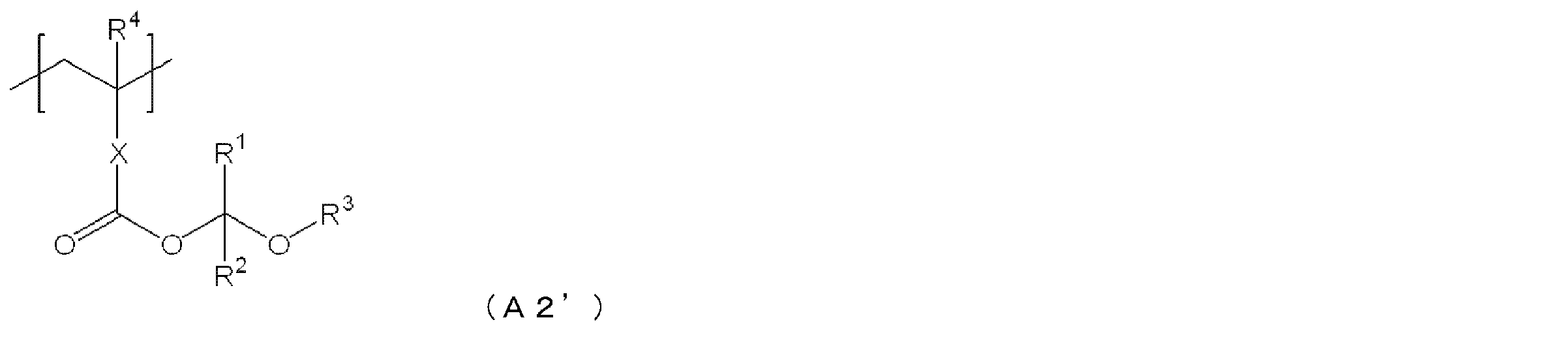
R1およびR2がアルキル基の場合、炭素数は1~10のアルキル基が好ましい。R1およびR2がアリール基の場合、フェニル基が好ましい。R1およびR2は、それぞれ、水素原子または炭素数1~4のアルキル基が好ましい。
R3は、アルキル基またはアリール基を表し、炭素数1~10のアルキル基が好ましく、1~6のアルキル基がより好ましい。
Xは単結合またはアリーレン基を表し、単結合が好ましい。
一般式(1-12)

R121は水素原子またはメチル基が好ましい。
L1はカルボニル基が好ましい。
R122~R128は、水素原子が好ましい。
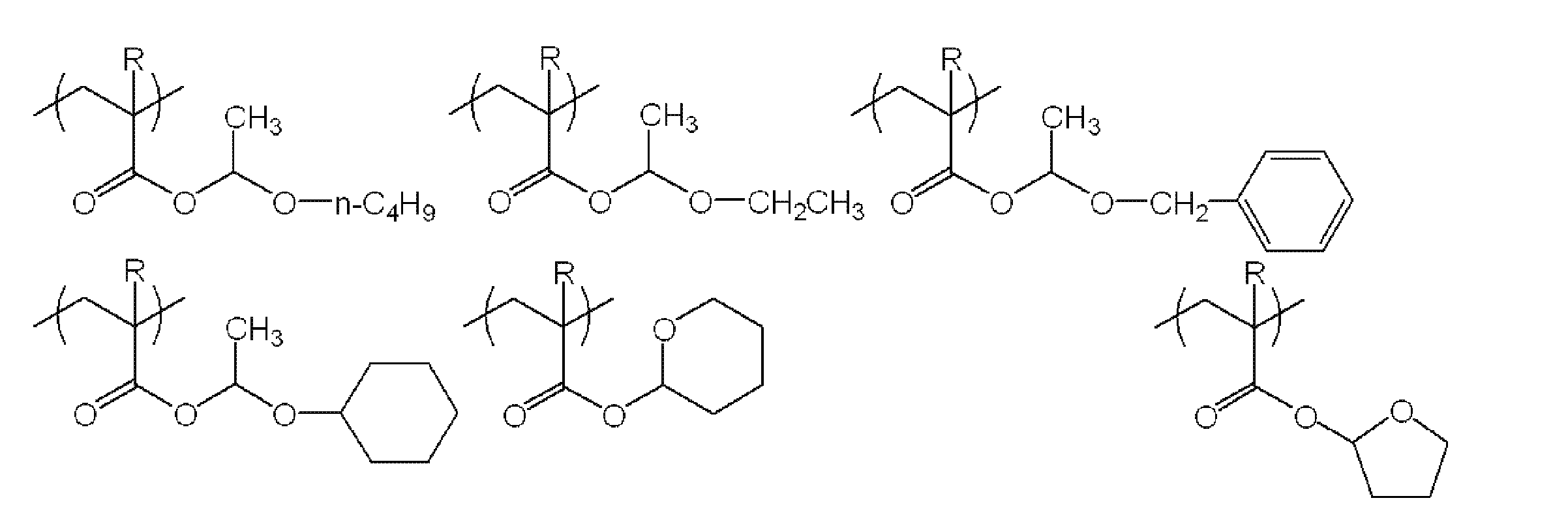
構成単位(a1-2)は、フェノール性水酸基を有する構成単位が、以下で詳細に説明するアセタール基によって保護された保護フェノール性水酸基を有する構成単位(a1-2-1)である。
上記フェノール性水酸基を有する構成単位としては、ヒドロキシスチレン系構成単位やノボラック系の樹脂における構成単位が挙げられるが、これらの中では、ヒドロキシスチレン、またはα-メチルヒドロキシスチレンに由来する構成単位が、感度の観点から好ましい。またフェノール性水酸基を有する構成単位として、下記一般式(a1-20)で表される構成単位も、感度の観点から好ましい。
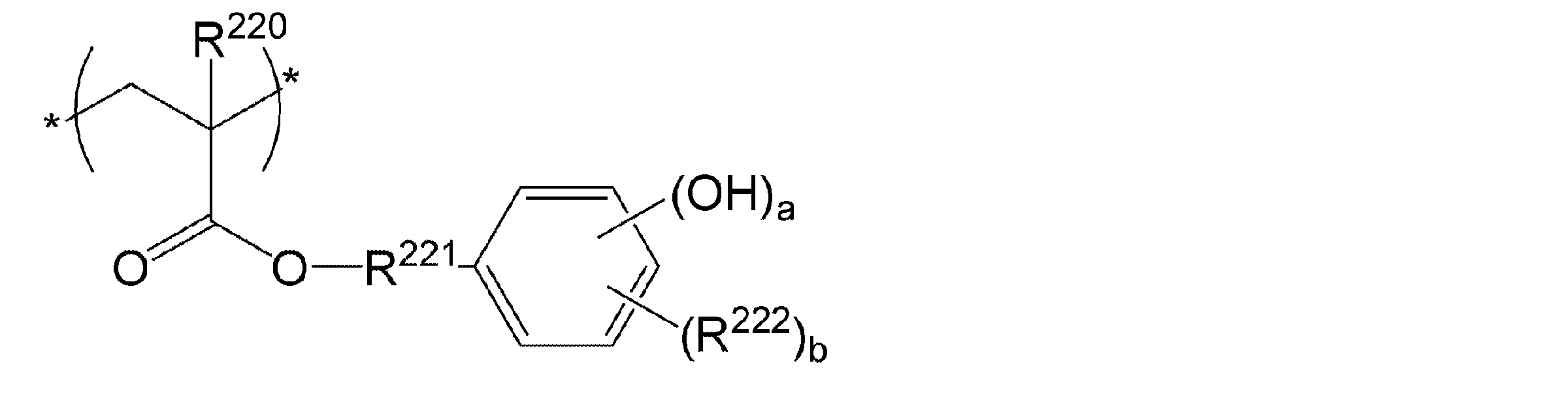
また、R221は単結合または二価の連結基を示す。単結合である場合には、感度を向上させることができ、さらに硬化膜の透明性を向上させることができるので好ましい。R221の二価の連結基としてはアルキレン基が例示でき、R221がアルキレン基である具体例としては、メチレン基、エチレン基、プロピレン基、イソプロピレン基、n-ブチレン基、イソブチレン基、tert-ブチレン基、ペンチレン基、イソペンチレン基、ネオペンチレン基、ヘキシレン基等が挙げられる。中でも、R221が単結合、メチレン基、エチレン基であることが好ましい。また、上記二価の連結基は、置換基を有していてもよく、置換基としては、ハロゲン原子、水酸基、アルコキシ基等が挙げられる。また、aは1~5の整数を表すが、本発明の効果の観点や、製造が容易であるという点から、aは1または2であることが好ましく、aが1であることがより好ましい。
また、ベンゼン環における水酸基の結合位置は、R221と結合している炭素原子を基準(1位)としたとき、4位に結合していることが好ましい。
R222はハロゲン原子または炭素数1~5の直鎖または分岐鎖状のアルキル基である。具体的には、フッ素原子、塩素原子、臭素原子、メチル基、エチル基、プロピル基、イソプロピル基、n-ブチル基、イソブチル基、tert-ブチル基、ペンチル基、イソペンチル基、ネオペンチル基等が挙げられる。中でも製造が容易であるという点から、塩素原子、臭素原子、メチル基またはエチル基であることが好ましい。
また、bは0または1~4の整数を表す。


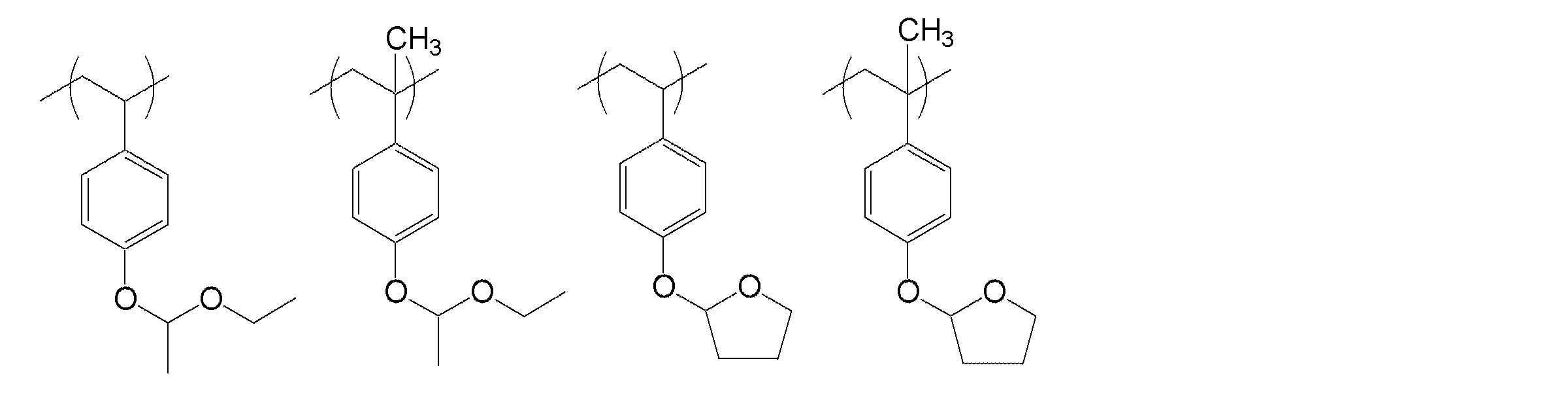
本発明では、酸により比較的分解し易い基としてアセタール基を用いる。本発明では、例えば、カルボキシル基がアセタールの形で保護された保護カルボキシル基、およびフェノール性水酸基がアセタールで保護された保護フェノール性水酸基であることが、感光性樹脂組成物の基本物性、特に感度やパターン形状、コンタクトホールの形成性、感光性樹脂組成物の保存安定性の観点から好ましい。さらに、カルボキシル基およびフェノール性水酸基が下記一般式(a1-10)で表されるアセタールの形で保護された保護カルボキシル基およびフェノール性水酸基であることが、感度の観点からより好ましい。なお、カルボキシル基が下記一般式(a1-10)で表されるアセタールの形で保護された保護カルボキシル基である場合、保護カルボキシル基の全体としては、-(C=O)-O-CR101R102(OR103)の構造となっている。また、フェノール性水酸基が下記一般式(a1-10)で表されるアセタールの形で保護された保護フェノール性水酸基である場合、保護フェノール性水酸基の全体としては、-Ar-O-CR101R102(OR103)の構造となっている。なお、Arはアリーレン基を表す。
フェノール性水酸基のアセタールエステル構造の好ましい例は、R101=R102=R103=メチル基やR101=R102=メチル基でR103=ベンジル基の組み合わせが例示できる。

上記直鎖状または分岐鎖状のアルキル基としては、炭素数1~12であることが好ましく、炭素数1~6であることがより好ましく、炭素数1~4であることがさらに好ましい。具体的には、メチル基、エチル基、n-プロピル基、i-プロピル基、n-ブチル基、i-ブチル基、sec-ブチル基、tert-ブチル基、n-ペンチル基、ネオペンチル基、n-ヘキシル基、テキシル基(2,3-ジメチル-2-ブチル基)、n-ヘプチル基、n-オクチル基、2-エチルヘキシル基、n-ノニル基、n-デシル基等を挙げることができる。
上記直鎖状または分岐鎖状のアルキル基としては、炭素数1~12であることが好ましく、炭素数1~6であることがより好ましく、炭素数1~4であることがさらに好ましい。具体的には、メチル基、エチル基、n-プロピル基、i-プロピル基、n-ブチル基、i-ブチル基、sec-ブチル基、tert-ブチル基、n-ペンチル基、ネオペンチル基、n-ヘキシル基、テキシル基(2,3-ジメチル-2-ブチル基)、n-ヘプチル基、n-オクチル基、2-エチルヘキシル基、n-ノニル基、n-デシル基等を挙げることができる。
上記環状アルキル基としては、炭素数3~12であることが好ましく、炭素数4~8であることがより好ましく、炭素数4~6であることがさらに好ましい。上記環状アルキル基としては、例えばシクロプロピル基、シクロブチル基、シクロペンチル基、シクロヘキシル基、シクロヘプチル基、シクロオクチル基、ノルボルニル基、イソボルニル基等を挙げることができる。
上記ハロゲン原子としては、フッ素原子、塩素原子、臭素原子、ヨウ素原子が例示され、これらの中でもフッ素原子または塩素原子が好ましい。
また、上記アリール基としては、炭素数6~20のアリール基が好ましく、より好ましくは炭素数6~12であり、具体的には、フェニル基、α-メチルフェニル基、ナフチル基等が例示でき、アリール基で置換されたアルキル基全体、すなわち、アラルキル基としては、ベンジル基、α-メチルベンジル基、フェネチル基、ナフチルメチル基等が例示できる。
上記アルコキシ基としては、炭素数1~6のアルコキシ基が好ましく、より好ましくは炭素数1~4であり、メトキシ基またはエトキシ基がより好ましい。
また、上記アルキル基がシクロアルキル基である場合、上記シクロアルキル基は、置換基として炭素数1~10の直鎖状または分岐鎖状のアルキル基を有していてもよく、アルキル基が直鎖状または分岐鎖状のアルキル基である場合には、置換基として炭素数3~12のシクロアルキル基を有していてもよい。
これらの置換基は、上記置換基でさらに置換されていてもよい。
なお、上記一般式(a1-10)において、R101およびR102のいずれか一方が、水素原子またはメチル基であることが好ましい。
これらの中でも、4-ヒドロキシフェニルメタクリレートの1-アルコキシアルキル保護体、4-ヒドロキシフェニルメタクリレートのテトラヒドロピラニル保護体が透明性の観点から好ましい。
上記構成単位(a1)を含有する重合体が、実質的に、構成単位(a2)を含まない場合、構成単位(a1)の含有量は、重合体中、20~100モル%が好ましく、30~90モル%がより好ましい。
上記構成単位(a1)を含有する重合体が、構成単位(a2)を含有する場合、構成単位(a1)の含有量は、重合体中、感度の観点から3~70モル%が好ましく、10~60モル%がより好ましい。また、特に上記構成単位(a1)に用いることができる上記アセタール基が、カルボキシル基がアセタールの形で保護された保護カルボキシル基を有する構成単位である場合、20~50モル%が好ましい。
(A)重合体成分は、架橋性基を有する構成単位(a2)を有する。本発明では、構成単位(a2)を含むため、耐薬品性に優れる。上記架橋性基は、加熱処理で硬化反応を起こす基であれば特に限定はされない。好ましい架橋性基を有する構成単位の態様としては、エポキシ基、オキセタニル基、-NH-CH2-O-R(Rは水素原子または炭素数1~20のアルキル基)で表される基およびエチレン性不飽和基よりなる群から選ばれた少なくとも1つを含む構成単位が挙げられ、エポキシ基、オキセタニル基、および、-NH-CH2-O-R(Rは水素原子または炭素数1~20のアルキル基)で表される基から選ばれる少なくとも1種であることが好ましい。その中でも、本発明の感光性樹脂組成物は、(A)重合体成分が、エポキシ基およびオキセタニル基のうち少なくとも1つを含む構成単位を含むことが好ましい。より詳細には、以下のものが挙げられる。
上記(A-1)重合体成分は、エポキシ基および/またはオキセタニル基を有する構成単位(以下、構成単位(a2-1)ともいう。)を含有することが好ましい。
上記構成単位(a2-1)は、1つの構成単位中にエポキシ基またはオキセタニル基を少なくとも1つ有していればよく、1つ以上のエポキシ基および1つ以上オキセタニル基、2つ以上のエポキシ基、または、2つ以上のオキセタニル基を有していてもよく、特に限定されないが、エポキシ基および/またはオキセタニル基を合計1~3つ有することが好ましく、エポキシ基および/またはオキセタニル基を合計1または2つ有することがより好ましく、エポキシ基またはオキセタニル基を1つ有することがさらに好ましい。
オキセタニル基を有する構成単位を形成するために用いられるラジカル重合性単量体の具体例としては、例えば、特開2001-330953号公報の段落番号0011~0016に記載のオキセタニル基を有する(メタ)アクリル酸エステルや、特開2012-088459公報の段落番号0027に記載されている化合物などが挙げられ、これらの内容は本願明細書に組み込まれる。
上記エポキシ基および/またはオキセタニル基を有する構成単位(a2-1)を形成するために用いられるラジカル重合性単量体の具体例としては、メタクリル酸エステル構造を含有するモノマー、アクリル酸エステル構造を含有するモノマーであることが好ましい。

上記架橋性基を有する構成単位(a2)の1つとして、エチレン性不飽和基を有する構成単位(a2-2)が挙げられる。上記構成単位(a2-2)としては、側鎖にエチレン性不飽和基を有する構成単位が好ましく、末端にエチレン性不飽和基を有し、炭素数3~16の側鎖を有する構成単位がより好ましい。
その他、構成単位(a2-2)については、特開2011-215580号公報の段落番号0072~0090の記載および特開2008-256974の段落番号0013~0031に記載の化合物等が好ましいものとして挙げられ、これらの内容は本願明細書に組み込まれる。
本発明で用いる(A)重合体成分は、-NH-CH2-O-R(Rは水素原子または炭素数1~20のアルキル基)で表される基を有する構成単位(a2-3)も好ましい。構成単位(a2-3)を有することで、緩やかな加熱処理で硬化反応を起こすことができ、諸特性に優れた硬化膜を得ることができる。ここで、Rは炭素数1~9のアルキル基が好ましく、炭素数1~4のアルキル基がより好ましい。また、アルキル基は、直鎖、分岐または環状のアルキル基のいずれであってもよいが、好ましくは、直鎖または分岐のアルキル基である。構成単位(a2-3)は、より好ましくは、下記一般式(a2-30)で表される基を有する構成単位である。
一般式(a2-30)
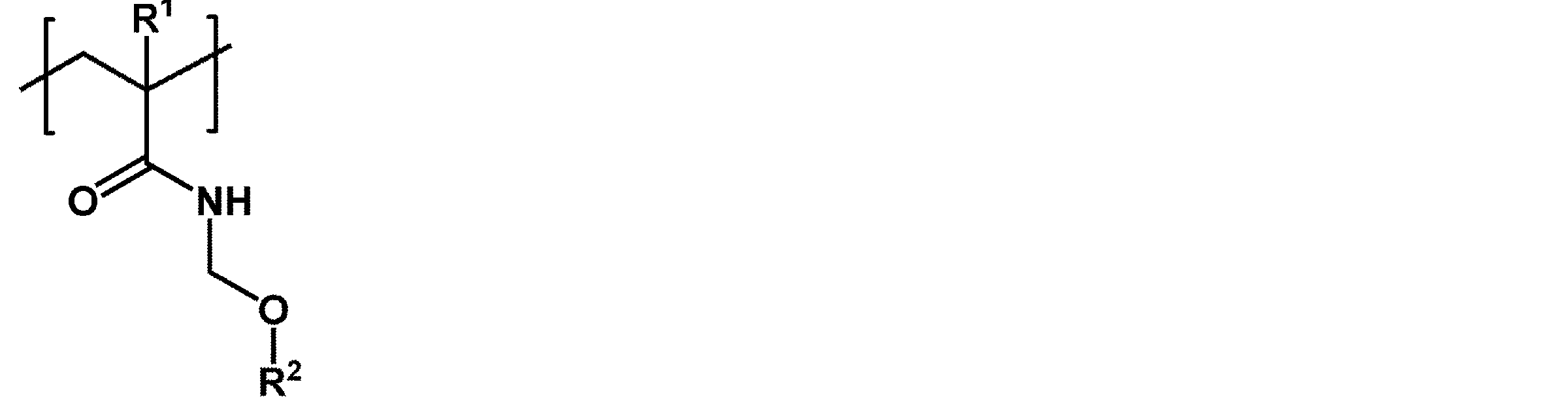
R2は、炭素数1~9のアルキル基が好ましく、炭素数1~4のアルキル基がさらに好ましい。また、アルキル基は、直鎖、分岐または環状のアルキル基のいずれであってもよいが、好ましくは、直鎖または分岐のアルキル基である。
R2の具体例としては、メチル基、エチル基、n-ブチル基、i-ブチル基、シクロヘキシル基、およびn-ヘキシル基を挙げることができる。中でもi-ブチル基、n-ブチル基、メチル基が好ましい。
耐薬品性をさらに優れたものとする観点から、構成単位(a2)のうち、エポキシ基および/またはオキセタニル基が、50質量%以上が好ましく、70質量%以上がより好ましく、80質量%以上がさらに好ましく、90質量%以上が特に好ましい。
本発明では、重合体成分に含まれる架橋性基の70モル%以上がエポキシ基であることがさらに好ましく、架橋性基の80モル%以上がエポキシ基であることがさらに好ましい。架橋性基としてエポキシ基を採用することにより、耐薬品性がより向上する傾向にある。
上記構成単位(a2)を含有する重合体が、上記構成単位(a1)を含有する場合、構成単位(a2)の含有量は、上記重合体中、薬品耐性の観点から3~70モル%が好ましく、10~60モル%がより好ましい。
本発明では、さらに、いずれの態様にかかわらず、(A)重合体成分の全構成単位中、構成単位(a2)の含有量が3~70モル%であることが好ましく、10~60モル%であることがより好ましい。
上記の数値の範囲内とすることで、諸特性に優れる硬化膜を形成できる。
本発明において、(A)重合体成分は、上記構成単位(a1)および/または構成単位(a2)に加えて、これら以外の他の構成単位(a3)として、少なくとも酸基を有する構成単位を有することが好ましい。構成単位(a3)は、上記重合体(1)および/または(2)が含んでいてもよい。また、上記重合体(1)または(2)とは別に、実質的に構成単位(a1)および構成単位(a2)を含まずに他の構成単位(a3)を有する重合体を有していてもよい。
本発明で用いられる酸基としては、カルボン酸基由来のもの、スルホンアミド基に由来のもの、ホスホン酸基に由来のもの、スルホン酸基に由来のもの、フェノール性水酸基に由来するもの、スルホンアミド基、スルホニルイミド基等が例示され、カルボン酸基由来のものおよび/またはフェノール性水酸基に由来のものが好ましい。
本発明で用いられる酸基を含む構成単位は、スチレンに由来する構成単位や、ビニル化合物に由来する構成単位、(メタ)アクリル酸および/またはそのエステルに由来する構成単位であることがより好ましい。例えば、特開2012-88459号公報の段落番号0021~0023および段落番号0029~0044記載の化合物を用いることができ、この内容は本願明細書に組み込まれる。なかでも、p-ヒドロキシスチレン、(メタ)アクリル酸、マレイン酸、無水マレイン酸に由来する構成単位が好ましい。
このような重合体としては、側鎖にカルボキシル基を有する樹脂が好ましい。例えば、特開昭59-44615号、特公昭54-34327号、特公昭58-12577号、特公昭54-25957号、特開昭59-53836号、特開昭59-71048号の各公報に記載されているような、メタクリル酸共重合体、アクリル酸共重合体、イタコン酸共重合体、クロトン酸共重合体、マレイン酸共重合体、部分エステル化マレイン酸共重合体等、並びに側鎖にカルボキシル基を有する酸性セルロース誘導体、水酸基を有するポリマーに酸無水物を付加させたもの等が挙げられ、さらに側鎖に(メタ)アクリロイル基を有する高分子重合体も好ましいものとして挙げられる。
その他にも、特開平7-207211号公報、特開平8-259876号公報、特開平10-300922号公報、特開平11-140144号公報、特開平11-174224号公報、特開2000-56118号公報、特開2003-233179号公報、特開2009-52020号公報等に記載の公知の高分子化合物を使用することができ、これらの内容は本願明細書に組み込まれる。
これらの重合体は、1種類のみ含んでいてもよいし、2種類以上含んでいてもよい。
また、重合体成分は、その他の構成単位(a3)として、オキサゾリン基を有する構成単位をさらに有していてもよい。
(第1の実施形態)
重合体(1)が、さらに、1種または2種以上のその他の構成単位(a3)を有する態様。
(第2の実施形態)
重合体(2)における、(a1)酸基がアセタール基で保護された基を有する構成単位を有する重合体が、さらに、1種または2種以上のその他の構成単位(a3)を有する態様。
(第3の実施形態)
重合体(2)における、(a2)架橋性基を有する構成単位を有する重合体が、さらに、1種または2種以上のその他の構成単位(a3)を有する態様。
(第4の実施形態)
上記重合体(1)または(2)とは別に、さらに、実質的に構成単位(a1)および構成単位(a2)を含まずに他の構成単位(a3)を有する重合体を有する態様。
(第5の実施形態)
上記第1~第4の実施形態の2以上の組み合わせからなる形態。
本発明の組成物は、固形分の70質量%以上が(A)重合体成分であることが好ましい。
(A)重合体の分子量は、ポリスチレン換算重量平均分子量で、好ましくは1,000~200,000、より好ましくは2,000~50,000の範囲である。上記の数値の範囲内であると、諸特性が良好である。数平均分子量と重量平均分子量の比(分散度)は1.0~5.0が好ましく1.5~3.5がより好ましい。
また、(A)重合体成分の合成法についても、様々な方法が知られているが、一例を挙げると、少なくとも上記(a1)および上記(a3)で表される構成単位を形成するために用いられるラジカル重合性単量体を含むラジカル重合性単量体混合物を有機溶剤中、ラジカル重合開始剤を用いて重合することにより合成することができる。また、いわゆる高分子反応で合成することもできる。
(A)重合体は、(メタ)アクリル酸および/またはそのエステルに由来する構成単位を、全構成単位に対し、50モル%以上含有することが好ましく、80モル%以上含有することがより好ましい。
本発明の感光性樹脂組成物は、(B)光酸発生剤を含有する。本発明で使用される光酸発生剤としては、波長300nm以上、好ましくは波長300~450nmの活性光線に感応し、酸を発生する化合物が好ましいが、その化学構造に制限されるものではない。また、波長300nm以上の活性光線に直接感応しない光酸発生剤についても、増感剤と併用することによって波長300nm以上の活性光線に感応し、酸を発生する化合物であれば、増感剤と組み合わせて好ましく用いることができる。本発明で使用される光酸発生剤としては、pKaが4以下の酸を発生する光酸発生剤が好ましく、pKaが3以下の酸を発生する光酸発生剤がより好ましく、2以下の酸を発生する光酸発生剤が最も好ましい。
一般式(B1-1)

R21のアルキル基としては、炭素数1~10の、直鎖状または分岐状アルキル基が好ましい。R21のアルキル基は、ハロゲン原子、炭素数6~11のアリール基、炭素数1~10のアルコキシ基、または、シクロアルキル基(7,7-ジメチル-2-オキソノルボルニル基などの有橋式脂環基を含む、好ましくはビシクロアルキル基等)で置換されてもよい。
R21のアリール基としては、炭素数6~11のアリール基が好ましく、フェニル基またはナフチル基がより好ましい。R21のアリール基は、低級アルキル基、アルコキシ基あるいはハロゲン原子で置換されてもよい。
一般式(B1-2)

Xとしてのアルキル基は、炭素数1~4の直鎖状または分岐状アルキル基が好ましい。また、Xとしてのアルコキシ基は、炭素数1~4の直鎖状または分岐状アルコキシ基が好ましい。また、Xとしてのハロゲン原子は、塩素原子またはフッ素原子が好ましい。
m4は、0または1が好ましい。上記一般式(B2)中、m4が1であり、Xがメチル基であり、Xの置換位置がオルト位であり、R42が炭素数1~10の直鎖状アルキル基、7,7-ジメチル-2-オキソノルボルニルメチル基、またはp-トルイル基である化合物が特に好ましい。
一般式(B1-3)

X1としては、炭素数1~5のアルコキシ基が好ましく、メトキシ基がより好ましい。
n4としては、0~2が好ましく、0~1が特に好ましい。
上記一般式(B1-3)で表される化合物の具体例および好ましいオキシムスルホネート化合物の具体例としては、特開2012-163937号公報の段落番号0080~0082の記載を参酌でき、この内容は本願明細書に組み込まれる。

X101は-O-、-S-、-NH-、-NR105-、-CH2-、-CR106H-、または、-CR105R107-を表し、R105~R107はアルキル基、または、アリール基を表す。
R121~R124は、それぞれ独立に、水素原子、ハロゲン原子、アルキル基、アルケニル基、アルコキシ基、アミノ基、アルコキシカルボニル基、アルキルカルボニル基、アリールカルボニル基、アミド基、スルホ基、シアノ基、または、アリール基を表す。R121~R124のうち2つは、それぞれ互いに結合して環を形成してもよい。
R121~R124としては、水素原子、ハロゲン原子、および、アルキル基が好ましく、また、R121~R124のうち少なくとも2つが互いに結合してアリール基を形成する態様もまた、好ましく挙げられる。中でも、R121~R124がいずれも水素原子である態様が感度の観点から好ましい。
既述の官能基は、いずれも、さらに置換基を有していてもよい。
上記一般式(OS-1)で表される化合物は、例えば、特開2012-163937号公報の段落番号0087~0089に記載されている一般式(OS-2)で表される化合物であることが好ましく、この内容は本願明細書に組み込まれる。
本発明では、上記一般式(B1-1)で表されるオキシムスルホネート構造を含有する化合物としては、下記一般式(OS-3)、下記一般式(OS-4)または下記一般式(OS-5)で表されるオキシムスルホネート化合物であることが好ましい。
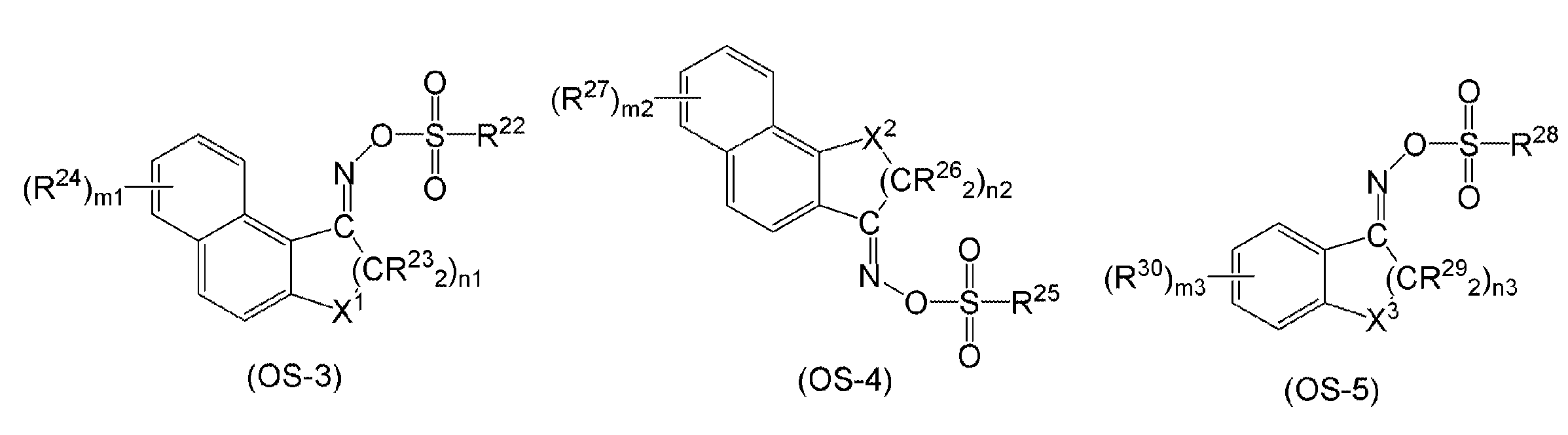
上記一般式(OS-3)~(OS-5)については、例えば、特開2012-163937号公報の段落番号0098~0115の記載を参酌でき、この内容は本願明細書に組み込まれる。
上記一般式(OS-6)~(OS-11)における好ましい範囲は、特開2011-221494号公報の段落番号0110~0112に記載される(OS-6)~(OS-11)の好ましい範囲と同様であり、この内容は本願明細書に組み込まれる。
上記一般式(OS-3)~上記一般式(OS-5)で表されるオキシムスルホネート化合物の具体例としては、特開2011-221494号公報の段落番号0114~0120に記載の化合物が挙げられ、この内容は本願明細書に組み込まれる。本発明は、これらに限定されるものではない。
一般式(B1-4)
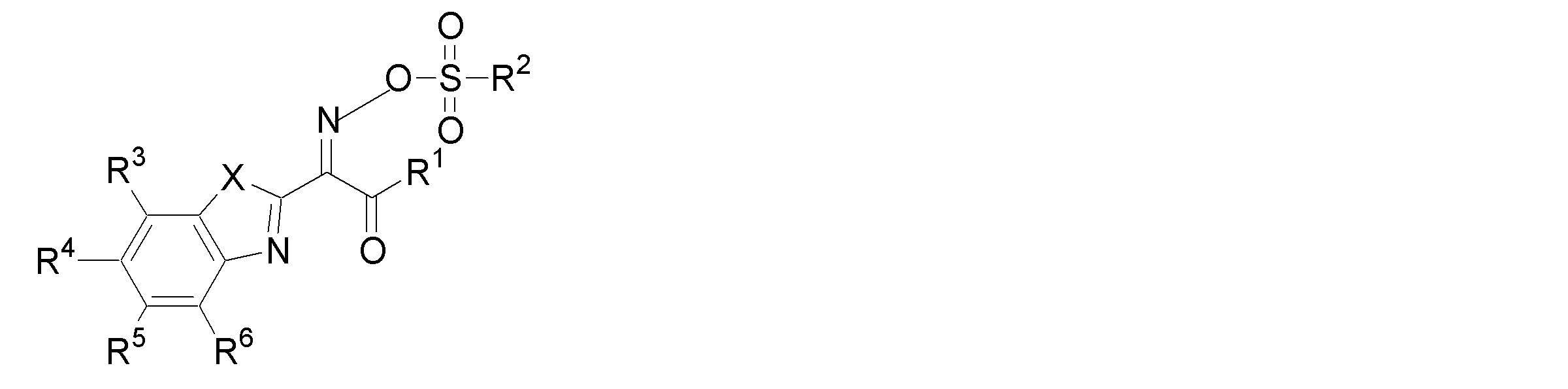
アルキル基の炭素数は、好ましくは3~10である。特にアルキル基が分岐構造を有する場合、炭素数3~6のアルキル基が好ましく、環状構造を有する場合、炭素数5~7のアルキル基が好ましい。
アルキル基としては、例えば、プロピル基、イソプロピル基、n-ブチル基、s-ブチル基、イソブチル基、tert-ブチル基、ペンチル基、イソペンチル基、ネオペンチル基、1,1-ジメチルプロピル基、ヘキシル基、2-エチルヘキシル基、シクロヘキシル基、オクチル基などが挙げられ、好ましくは、イソプロピル基、tert-ブチル基、ネオペンチル基、シクロヘキシル基である。
アリール基の炭素数は、好ましくは6~12であり、より好ましくは6~8であり、さらに好ましくは6~7である。上記アリール基としては、フェニル基、ナフチル基などが挙げられ、好ましくは、フェニル基である。
R1が表すアルキル基およびアリール基は、置換基を有していてもよい。置換基としては、例えばハロゲン原子(フッ素原子、クロロ原子、臭素原子、ヨウ素原子)、直鎖、分岐または環状のアルキル基(例えばメチル基、エチル基、プロピル基など)、アルケニル基、アルキニル基、アリール基、アシル基、アルコキシカルボニル基、アリールオキシカルボニル基、カルバモイル基、シアノ基、カルボキシル基、水酸基、アルコキシ基、アリールオキシ基、アルキルチオ基、アリールチオ基、ヘテロ環オキシ基、アシルオキシ基、アミノ基、ニトロ基、ヒドラジノ基、ヘテロ環基などが挙げられる。また、これらの基によってさらに置換されていてもよい。好ましくは、ハロゲン原子、メチル基である。
かさ高い置換基の中でも、イソプロピル基、tert-ブチル基、ネオペンチル基、シクロヘキシル基が好ましく、tert-ブチル基、シクロヘキシル基がより好ましい。
アリール基としては、炭素数6~10のアリール基が好ましい。上記アリール基としては、フェニル基、ナフチル基、p-トルイル基(p-メチルフェニル基)などが挙げられ、好ましくは、フェニル基、p-トルイル基である。
ヘテロアリール基としては、例えば、ピロール基、インドール基、カルバゾール基、フラン基、チオフェン基などが挙げられる。
R2が表すアルキル基、アリール基、およびヘテロアリール基は、置換基を有していてもよい。置換基としては、R1が表すアルキル基およびアリール基が有していてもよい置換基と同義である。
R2は、アルキル基またはアリール基が好ましく、アリール基がより好ましく、フェニル基がより好ましい。フェニル基の置換基としてはメチル基が好ましい。
R3~R6のうち、R3とR4、R4とR5、またはR5とR6が結合して環を形成してもよく、環としては、脂環または芳香環を形成していることが好ましく、ベンゼン環がより好ましい。
R3~R6は、水素原子、アルキル基、ハロゲン原子(フッ素原子、クロロ原子、臭素原子)、または、R3とR4、R4とR5、またはR5とR6が結合してベンゼン環を構成していることが好ましく、水素原子、メチル基、フッ素原子、クロロ原子、臭素原子またはR3とR4、R4とR5、またはR5とR6が結合してベンゼン環を構成していることがより好ましい。
R3~R6の好ましい態様は以下の通りである。
(態様1)少なくとも2つは水素原子である。
(態様2)アルキル基、アリール基、またはハロゲン原子の数は、1つ以下である。
(態様3)R3とR4、R4とR5、またはR5とR6が結合してベンゼン環を構成している。
(態様4)上記態様1と2を満たす態様、および/または、上記態様1と3を満たす態様。
Xは、-O-またはS-を表す。

本発明の組成物は、(C)エーテル結合および/またはエステル結合を有し、アルコール性水酸基を有さない溶剤((C)溶剤)を含む。
エーテル結合を有する溶剤とは、分子中に1以上のエーテル結合を有する溶剤のことをいい、エステル結合を有する溶剤とは、分子中に1以上のエステル結合を有する溶剤のことをいう。エステル結合を有する溶剤には、分子内にエステル結合およびエーテル結合の両方を含む溶剤も含む趣旨である。
具体例として、プロピレングリコールモノメチルエーテルアセテート、3-エトキシプロピオン酸エチル、ジプロピレングリコールメチルエーテルアセテート、3-メトキシブチルエーテルアセテート、ジエチレングリコールモノエチルエーテルアセテート、1,3-ブチレングリコールジアセテート、エチレングリコールモノメチルエーテルアセテート、プロピレングリコールモノメチルエーテルプロピオネート、プロピレングリコールジアセテート、γーブチロラクトン等が例示できる。
具体例として、プロピレングリコールメチル-n-ブチルエーテル、プロピレングリコールメチル-n-プロピルエーテル、ジエチレングリコールメチルエチルエーテル、ジエチレングリコールジメチルエーテル、ジエチレングリコールジエチエルエーテル、ジプロピレングリコールジメチルエーテル、ジプロピレングリコールジメチルエーテル、ジエチレングリコールイソプロピルメチルエーテル、トリプロピレングリコールジメチルエーテル、トリエチレングリコールジメチルエーテル等が例示できる。
感度向上の観点から、(C)溶剤は全溶剤中、50質量%以上が好ましく、70質量%以上がより好ましく、90質量%以上が特に好ましい。(C)溶剤は1種類のみ含んでいても良いし、2種類以上含んでいても良い。2種類以上含む場合は、合計量が上記範囲となることが好ましい。
本発明の組成物は、アルコール性水酸基を有する溶剤を、全溶剤量に対し、1~50ppmの割合で含む。アルコール性水酸基を有する溶剤の全溶剤量に対する含有量は、1~30ppmであることが好ましく、1~10ppmであることがより好ましい。
アルコール性水酸基を有する溶剤の含有量を1ppm以上とすることでアセタールの脱保護を促進させ、感度をより向上させることができる。アルコール性水酸基を有する溶剤の含有量を50ppm以下とすることで、アセタールの分解を抑制し、架橋反応が促進してしまうことを効果的に抑制することができる。すなわち、アルコール性水酸基を有する溶剤の含有量が50ppmを超えると、(a1)酸基がアセタール基で保護された基が不必要な段階で脱保護され、感光性樹脂組成物の粘度が増加し、安定的に製造することが困難になる。また、不必要な段階で脱保護されることにより、(a2)架橋性基が不必要な段階で架橋し、感光性樹脂組成物を硬化してなる硬化膜の耐薬品性がやや劣る傾向となる。
アルコール性水酸基を有する溶剤の1atmにおける沸点の上限は、300℃以下であることが好ましく、180℃以下であることがより好ましい。アルコール性水酸基を有する溶剤の1atmにおける沸点が300℃以下であると、ポストベークなどの処理において架橋反応後に溶剤が硬化膜から揮発されることにより、硬化膜の膜物性が良好に保たれるため好ましい
アルコール性水酸基を有する溶剤の分子量は40~400であることが好ましく、50~300であることがより好ましい。この範囲で、本発明の効果がより効果的に発揮されるため、好ましい。
本発明の感光性樹脂組成物には、上記成分に加えて、必要に応じて、増感剤、アルコキシシラン化合物、塩基性化合物、界面活性剤、酸化防止剤を好ましく加えることができる。さらに本発明の感光性樹脂組成物には、酸増殖剤、現像促進剤、可塑剤、熱ラジカル発生剤、熱酸発生剤、紫外線吸収剤、増粘剤、および、有機または無機の沈殿防止剤などの公知の添加剤を加えることができる。また、これらの化合物としては、例えば特開2012-88459号公報の段落番号0201~0224の記載の化合物を使用することができ、これらの内容は本願明細書に組み込まれる。これらの成分は、それぞれ、1種類のみでもよいし、2種類以上であってもよい。
本発明の感光性樹脂組成物は、光酸発生剤との組み合わせにおいて、その分解を促進させるために、増感剤を含有することが好ましい。増感剤は、活性光線を吸収して電子励起状態となる。電子励起状態となった増感剤は、光酸発生剤と接触して、電子移動、エネルギー移動、発熱などの作用が生じる。これにより光酸発生剤は化学変化を起こして分解し、酸を生成する。好ましい増感剤の例としては、以下の化合物類に属しており、かつ350nmから450nmの波長域のいずれかに吸収波長を有する化合物を挙げることができる。
これら増感剤の中でも、多核芳香族類、アクリドン類、スチリル類、ベーススチリル類、クマリン類が好ましく、多核芳香族類がより好ましい。多核芳香族類の中でもアントラセン誘導体が最も好ましい。
本発明の感光性樹脂組成物は、必要に応じ、架橋剤を含有してもよい。架橋剤を添加することにより、本発明の感光性樹脂組成物により得られる硬化膜をより強固な膜とすることができる。
架橋剤としては、熱によって架橋反応が起こるものであれば制限は無い。例えば、以下に述べる分子内に2個以上のエポキシ基またはオキセタニル基を有する化合物、アルコキシメチル基含有架橋剤、または、少なくとも1個のエチレン性不飽和二重結合を有する化合物、ブロックイソシアネート化合物等を添加することができる。
本発明の組成物に用いることができる架橋剤の市販品としては、例えばKAYARAD DPHA(日本化薬株式会社製)などが挙げられる。
本発明の組成物が架橋剤を有する場合、架橋剤の含有量は、感光性組成物中の全固形分100質量部に対して、0.01~50質量部であることが好ましく、0.1~30質量部であることがより好ましく、0.5~20質量部であることがさらに好ましい。この範囲で添加することにより、機械的強度および耐溶剤性に優れた硬化膜が得られる。架橋剤は複数を併用することもでき、その場合は架橋剤を全て合算して含有量を計算する。
分子内に2個以上のエポキシ基を有する化合物の具体例としては、ビスフェノールA型エポキシ樹脂、ビスフェノールF型エポキシ樹脂、フェノールノボラック型エポキシ樹脂、クレゾールノボラック型エポキシ樹脂、脂肪族エポキシ樹脂等を挙げることができる。
これらの中でも、ビスフェノールA型エポキシ樹脂、ビスフェノールF型エポキシ樹脂、フェノールノボラック型エポキシ樹脂および脂肪族エポキシ樹脂がより好ましく挙げられ、ビスフェノールA型エポキシ樹脂が特に好ましく挙げられる。
分子内に2個以上のオキセタニル基を有する化合物の具体例としては、アロンオキセタンOXT-121、OXT-221、OX-SQ、PNOX(以上、東亞合成(株)製)を用いることができる。
また、オキセタニル基を含む化合物は、単独でまたはエポキシ基を含む化合物と混合して使用することが好ましい。
本発明の感光性樹脂組成物では、架橋剤として、ブロックイソシアネート系化合物も好ましく採用できる。ブロックイソシアネート化合物は、特に制限はないが、硬化性の観点から、1分子内に2以上のブロックイソシアネート基を有する化合物であることが好ましい。
なお、本発明におけるブロックイソシアネート基とは、熱によりイソシアネート基を生成することが可能な基であり、例えば、ブロック剤とイソシアネート基とを反応させイソシアネート基を保護した基が好ましく例示できる。また、上記ブロックイソシアネート基は、90℃~250℃の熱によりイソシアネート基を生成することが可能な基であることが好ましい。
また、ブロックイソシアネート化合物としては、その骨格は特に限定されるものではなく、1分子中にイソシアネート基を2個有するものであればどのようなものでもよく、脂肪族、脂環族または芳香族のポリイソシアネートであってよいが、例えば2,4-トリレンジイソシアネート、2,6-トリレンジイソシアネート、イソホロンジイソシアネート、1,6-ヘキサメチレンジイソシアネート、1,3-トリメチレンジイソシアネート、1,4-テトラメチレンジイソシアネート、2,2,4-トリメチルヘキサメチレンジイソシアネート、2,4,4-トリメチルヘキサメチレンジイソシアネート、1,9-ノナメチレンジイソシアネート、1,10-デカメチレンジイソシアネート、1,4-シクロヘキサンジイソシアネート、2,2'-ジエチルエーテルジイソシアネート、ジフェニルメタン-4,4'-ジイソシアネート、o-キシレンジイソシアネート、m-キシレンジイソシアネート、p-キシレンジイソシアネート、メチレンビス(シクロヘキシルイソシアネート)、シクロヘキサン-1,3-ジメチレンジイソシアネート、シクロヘキサン-1,4-ジメチレレンジイソシアネート、1,5-ナフタレンジイソシアネート、p-フェニレンジイソシアネート、3,3'-メチレンジトリレン-4,4'-ジイソシアネート、4,4'-ジフェニルエーテルジイソシアネート、テトラクロロフェニレンジイソシアネート、ノルボルナンジイソシアネート、水素化1,3-キシリレンジイソシアネート、水素化1,4-キシリレンジイソシアネート等のイソシアネート化合物およびこれらの化合物から派生するプレポリマー型の骨格の化合物を好適に用いることができる。これらの中でも、トリレンジイソシアネート(TDI)やジフェニルメタンジイソシアネート(MDI)、ヘキサメチレンジイソシアネート(HDI)、イソホロンジイソシアネート(IPDI)が特に好ましい。
本発明の感光性樹脂組成物におけるブロックイソシアネート化合物の母構造としては、ビウレット型、イソシアヌレート型、アダクト型、2官能プレポリマー型等を挙げることができる。
上記ブロックイソシアネート化合物のブロック構造を形成するブロック剤としては、オキシム化合物、ラクタム化合物、フェノール化合物、アルコール化合物、アミン化合物、活性メチレン化合物、ピラゾール化合物、メルカプタン化合物、イミダゾール系化合物、イミド系化合物等を挙げることができる。これらの中でも、オキシム化合物、ラクタム化合物、フェノール化合物、アルコール化合物、アミン化合物、活性メチレン化合物、ピラゾール化合物から選ばれるブロック剤が特に好ましい。
上記ラクタム化合物としてはε-カプロラクタム、γ-ブチロラクタム等が例示できる。
上記フェノール化合物としては、フェノール、ナフトール、クレゾール、キシレノール、ハロゲン置換フェノール等が例示できる。
上記アルコール化合物としては、メタノール、エタノール、プロパノール、ブタノール、シクロヘキサノール、エチレングリコールモノアルキルエーテル、プロピレングリコールモノアルキルエーテル、乳酸アルキル等が例示できる。
上記アミン化合物としては、1級アミンおよび2級アミンが上げられ、芳香族アミン、脂肪族アミン、脂環族アミンいずれでもよく、アニリン、ジフェニルアミン、エチレンイミン、ポリエチレンイミン等が例示できる。
上記活性メチレン化合物としては、マロン酸ジエチル、マロン酸ジメチル、アセト酢酸エチル、アセト酢酸メチル等が例示できる。
上記ピラゾール化合物としては、ピラゾール、メチルピラゾール、ジメチルピラゾール等が例示できる。
上記メルカプタン化合物としては、アルキルメルカプタン、アリールメルカプタン等が例示できる。
本発明の感光性樹脂組成物は、密着改良剤としてアルコキシシラン化合物を含有してもよい。アルコキシシラン化合物を用いると、本発明の感光性樹脂組成物により形成された膜と基板との密着性を向上できたり、本発明の感光性樹脂組成物により形成された膜の性質を調整することができる。本発明の感光性樹脂組成物に用いることができるアルコキシシラン化合物は、基材となる無機物、例えば、シリコン、酸化シリコン、窒化シリコン等のシリコン化合物、金、銅、モリブデン、チタン、アルミニウム等の金属と絶縁膜との密着性を向上させる化合物であることが好ましい。具体的には、公知のシランカップリング剤等も有効である。
シランカップリング剤としては、例えば、γ-アミノプロピルトリメトキシシラン、γ-アミノプロピルトリエトキシシラン、γ-グリシドキシプロピルトリアルコキシシラン、γ-グリシドキシプロピルトリメトキシシラン、γ-グリシドキシプロピルジアルコキシシラン、γ-メタクリロキシプロピルトリアルコキシシラン、γ-メタクリロキシプロピルジアルコキシシラン、γ-クロロプロピルトリアルコキシシラン、γ-メルカプトプロピルトリアルコキシシラン、β-(3,4-エポキシシクロヘキシル)エチルトリアルコキシシラン、ビニルトリアルコキシシランが挙げられる。これらのうち、γ-グリシドキシプロピルトリアルコキシシランやγ-メタクリロキシプロピルトリアルコキシシランがより好ましく、γ-グリシドキシプロピルトリアルコキシシランがさらに好ましく、3-グリシドキシプロピルトリメトキシシランがよりさらに好ましい。これらは1種単独または2種以上を組み合わせて使用することができる。市販品としては、KBM-403、信越シリコーン社製等が例示される。
本発明の組成物がアルコキシシラン化合物を有する場合、アルコキシシラン化合物の含有量は、感光性樹脂組成物中の全固形分100質量部に対して、0.1~30質量部が好ましく、0.5~20質量部がより好ましい。
本発明の感光性樹脂組成物は、塩基性化合物を含有してもよい。塩基性化合物としては、化学増幅レジストで用いられるものの中から任意に選択して使用することができる。例えば、脂肪族アミン、芳香族アミン、複素環式アミン、第四級アンモニウムヒドロキシド、カルボン酸の第四級アンモニウム塩等が挙げられる。これらの具体例としては、特開2011-221494号公報の段落番号0204~0207に記載の化合物が挙げられ、これらの内容は本願明細書に組み込まれる。
芳香族アミンとしては、例えば、アニリン、ベンジルアミン、N,N-ジメチルアニリン、ジフェニルアミンなどが挙げられる。
複素環式アミンとしては、例えば、ピリジン、2-メチルピリジン、4-メチルピリジン、2-エチルピリジン、4-エチルピリジン、2-フェニルピリジン、4-フェニルピリジン、N-メチル-4-フェニルピリジン、4-ジメチルアミノピリジン、イミダゾール、ベンズイミダゾール、4-メチルイミダゾール、2-フェニルベンズイミダゾール、2,4,5-トリフェニルイミダゾール、ニコチン、ニコチン酸、ニコチン酸アミド、キノリン、8-オキシキノリン、ピラジン、ピラゾール、ピリダジン、プリン、ピロリジン、ピペリジン、ピペラジン、モルホリン、4-メチルモルホリン、N-シクロヘキシル-N’-[2-(4-モルホリニル)エチル]チオ尿素、1,5-ジアザビシクロ[4.3.0]-5-ノネン、1,8-ジアザビシクロ[5.3.0]-7-ウンデセン、1,8-ジアザビシクロ[5.4.0]-7-ウンデセンなどが挙げられる。
第四級アンモニウムヒドロキシドとしては、例えば、テトラメチルアンモニウムヒドロキシド、テトラエチルアンモニウムヒドロキシド、テトラプロピルアンモニウムヒドロキシド、ベンジルトリメチルアンモニウムヒドロキシド、テトラ-n-ブチルアンモニウムヒドロキシド、テトラ-n-ヘキシルアンモニウムヒドロキシドなどが挙げられる。
カルボン酸の第四級アンモニウム塩としては、例えば、テトラメチルアンモニウムアセテート、テトラメチルアンモニウムベンゾエート、テトラ-n-ブチルアンモニウムアセテート、テトラ-n-ブチルアンモニウムベンゾエートなどが挙げられる。
本発明に用いることができる塩基性化合物は、1種単独で使用しても、2種以上を併用してもよい。
本発明の感光性樹脂組成物は、界面活性剤を含有してもよい。界面活性剤としては、アニオン系、カチオン系、ノニオン系、または、両性のいずれでも使用することができるが、好ましい界面活性剤はノニオン界面活性剤である。本発明の組成物に用いられる界面活性剤としては、例えば、特開2012-88459号公報の段落番号0201~0205に記載のものや、特開2011-215580号公報の段落番号0185~0188に記載のものを用いることができ、これらの記載は本願明細書に組み込まれる。
ノニオン系界面活性剤の例としては、ポリオキシエチレン高級アルキルエーテル類、ポリオキシエチレン高級アルキルフェニルエーテル類、ポリオキシエチレングリコールの高級脂肪酸ジエステル類、シリコーン系、フッ素系界面活性剤を挙げることができる。また、以下商品名で、KP-341、X-22-822(信越化学工業(株)製)、ポリフローNo.99C(共栄社化学(株)製)、エフトップ(三菱マテリアル化成社製)、メガファック(DIC(株)製)、フロラードノベックFC-4430(住友スリーエム(株)製)、サーフロンS-242(AGCセイミケミカル社製)、PolyFoxPF-6320(OMNOVA社製)、SH 8400 FLUID、SH-8400(東レ・ダウコーニングシリコーン)、フタージェントFTX-218、フタージェントFTX-218G(ネオス社製)、F-554(DIC社製)等を挙げることができる。
また、界面活性剤として、下記一般式(I-1-1)で表される構成単位Aおよび構成単位Bを含み、テトラヒドロフラン(THF)を溶媒とした場合のゲルパーミエーションクロマトグラフィーで測定されるポリスチレン換算の重量平均分子量(Mw)が1,000以上10,000以下である共重合体を好ましい例として挙げることができる。


これらの界面活性剤は、1種単独でまたは2種以上を混合して使用することができる。
本発明の組成物が界面活性剤を有する場合、界面活性剤の添加量は、感光性樹脂組成物中の全固形成分100質量部に対し、10質量部以下であることが好ましく、0.001~10質量部であることがより好ましく、0.01~3質量部であることがさらに好ましい。
<<酸化防止剤>>
本発明の感光性樹脂組成物は、酸化防止剤を含有してもよい。酸化防止剤としては、公知の酸化防止剤を含有することができる。酸化防止剤を添加することにより、硬化膜の着色を防止できる、または、分解による膜厚減少を低減でき、また、耐熱透明性に優れるという利点がある。
このような酸化防止剤としては、例えば、リン系酸化防止剤、アミド類、ヒドラジド類、ヒンダードアミン系酸化防止剤、イオウ系酸化防止剤、フェノール系酸化防止剤、アスコルビン酸類、硫酸亜鉛、糖類、亜硝酸塩、亜硫酸塩、チオ硫酸塩、ヒドロキシルアミン誘導体などを挙げることができる。これらの中では、硬化膜の着色、膜厚減少の観点から特にフェノール系酸化防止剤、ヒンダードアミン系酸化防止剤、リン系酸化防止剤、アミド系酸化防止剤、ヒドラジド系酸化防止剤、イオウ系酸化防止剤が好ましく、フェノール系酸化防止剤が最も好ましい。これらは1種単独で用いてもよいし、2種以上を混合してもよい。
具体例としては、特開2005-29515号公報の段落番号0026~0031に記載の化合物、特開2011-227106号公報の段落番号0106~0116に記載の化合物を挙げる事ができ、これらの内容は本願明細書に組み込まれる。
好ましい市販品として、アデカスタブAO-60、アデカスタブAO-20、アデカスタブAO-80、アデカスタブLA-52、アデカスタブLA-81、アデカスタブAO-412S、アデカスタブPEP-36、イルガノックス1035、イルガノックス1098、チヌビン144を挙げる事ができる。
本発明の感光性樹脂組成物は、感度向上を目的に、酸増殖剤を用いることができる。
本発明に用いることができる酸増殖剤は、酸触媒反応によってさらに酸を発生して反応系内の酸濃度を上昇させることができる化合物であり、酸が存在しない状態では安定に存在する化合物である。
このような酸増殖剤の具体例としては、特開2011-221494号公報の段落番号0226~0228に記載の酸増殖剤が挙げられ、この内容は本願明細書に組み込まれる。
本発明の感光性樹脂組成物は、現像促進剤を含有することができる。
現像促進剤としては、特開2012-042837号公報の段落番号0171~0172に記載されているものを参酌でき、この内容は本願明細書に組み込まれる。
現像促進剤は、1種を単独で用いてもよいし、2種以上を併用することも可能である。
本発明の感光性樹脂組成物における現像促進剤の添加量は、感度と残膜率の観点から、感光性組成物の全固形分100質量部に対し、0~30質量部が好ましく、0.1~20質量部がより好ましく、0.5~10質量部であることが最も好ましい。
また、その他の添加剤としては特開2012-8223号公報の段落番号0120~0121に記載の熱ラジカル発生剤、WO2011/136074A1に記載の窒素含有化合物および熱酸発生剤も用いることができ、これらの内容は本願明細書に組み込まれる。
各成分を所定の割合でかつ任意の方法で混合し、撹拌溶解して感光性樹脂組成物を調製する。例えば、成分を、それぞれ予め溶剤に溶解させた溶液とした後、これらを所定の割合で混合して樹脂組成物を調製することもできる。以上のように調製した組成物溶液は、例えば孔径0.2μmのフィルター等を用いてろ過した後に、使用することもできる。
本発明の硬化膜の製造方法は、以下の(1)~(5)の工程を含むことが好ましい。
(1)本発明の感光性樹脂組成物を基板上に塗布する工程;
(2)塗布された感光性樹脂組成物から溶剤を除去する工程;
(3)溶剤が除去された感光性樹脂組成物を活性光線により露光する工程;
(4)露光された感光性樹脂組成物を水性現像液により現像する工程;
(5)現像された感光性樹脂組成物を熱硬化するポストベーク工程。
以下に各工程を順に説明する。
上記の基板としては、無機基板、樹脂、樹脂複合材料などが挙げられる。
無機基板としては、例えばガラス、石英、シリコーン、シリコンナイトライド、および、それらのような基板上にモリブデン、チタン、アルミ、銅などを蒸着した複合基板が挙げられる。
樹脂としては、ポリブチレンテレフタレート、ポリエチレンテレフタレート、ポリエチレンナフタレート、ポリブチレンナフタレート、ポリスチレン、ポリカーボネート、ポリスルホン、ポリエーテルスルホン、ポリアリレート、アリルジグリコールカーボネート、ポリアミド、ポリイミド、ポリアミドイミド、ポリエーテルイミド、ポリベンズアゾール、ポリフェニレンサルファイド、ポリシクロオレフィン、ノルボルネン樹脂、ポリクロロトリフルオロエチレン等のフッ素樹脂、液晶ポリマー、アクリル樹脂、エポキシ樹脂、シリコーン樹脂、アイオノマー樹脂、シアネート樹脂、架橋フマル酸ジエステル、環状ポリオレフィン、芳香族エーテル、マレイミドーオレフィン、セルロース、エピスルフィド化合物等の合成樹脂からなる基板が挙げられる。
これらの基板は、上記の形態のまま用いられる場合は少なく、通常、最終製品の形態によって、例えばTFT素子のような多層積層構造が形成されている。
基板への塗布方法は特に限定されず、例えば、スリットコート法、スプレー法、ロールコート法、回転塗布法、流延塗布法、スリットアンドスピン法等の方法を用いることができる。
塗布したときの湿潤膜厚は特に限定されるものではなく、用途に応じた膜厚で塗布することができるが、通常は0.5~10μmの範囲で使用される。
さらに、基板に本発明で用いられる組成物を塗布する前に、特開2009-145395号公報に記載されているような、所謂プリウェット法を適用することも可能である。
活性光線による露光光源としては、低圧水銀灯、高圧水銀灯、超高圧水銀灯、ケミカルランプ、LED光源、エキシマレーザー発生装置などを用いることができ、i線(365nm)、h線(405nm)、g線(436nm)などの波長300nm以上450nm以下の波長を有する活性光線が好ましく使用できる。また、必要に応じて長波長カットフィルター、短波長カットフィルター、バンドパスフィルターのような分光フィルターを通して照射光を調整することもできる。露光量は好ましくは1~500mJ/cm2である。
露光装置としては、ミラープロジェクションアライナー、ステッパー、スキャナー、プロキシミティ、コンタクト、マイクロレンズアレイ、レンズスキャナ、レーザー露光、など各種方式の露光機を用いることができる。
酸触媒の生成した領域において、上記の加水分解反応を加速させるために、露光後加熱処理:Post Exposure Bake(以下、「PEB」ともいう。)を行うことができる。PEBにより、アセタール基からのカルボキシル基またはフェノール性水酸基の生成を促進させることができる。PEBを行う場合の温度は、30℃以上130℃以下であることが好ましく、40℃以上110℃以下がより好ましく、50℃以上100℃以下が特に好ましい。
ただし、本発明におけるアセタール基は、酸分解の活性化エネルギーが低く、露光による酸発生剤由来の酸により容易に分解し、カルボキシル基またはフェノール性水酸基を生じるため、必ずしもPEBを行うことなく、現像によりポジ画像を形成することもできる。
現像工程で使用する現像液には、塩基性化合物が含まれることが好ましい。塩基性化合物としては、例えば、水酸化リチウム、水酸化ナトリウム、水酸化カリウムなどのアルカリ金属水酸化物類;炭酸ナトリウム、炭酸カリウムなどのアルカリ金属炭酸塩類;重炭酸ナトリウム、重炭酸カリウムなどのアルカリ金属重炭酸塩類;テトラメチルアンモニウムヒドロキシド、テトラエチルアンモニウムヒドロキシド、コリンヒドロキシド等のアンモニウムヒドロキシド類;ケイ酸ナトリウム、メタケイ酸ナトリウムなどの水溶液を使用することができる。また、上記アルカリ類の水溶液にメタノールやエタノールなどの水溶性有機溶剤や界面活性剤を適当量添加した水溶液を現像液として使用することもできる。
好ましい現像液として、テトラメチルアンモニウムヒドロキシドの0.4~2.5%水溶液を挙げる事ができる。
現像液のpHは、好ましくは10.0~14.0である。
現像時間は、好ましくは30~500秒間であり、また、現像の手法は液盛り法(パドル法)、シャワー法、ディップ法等の何れでもよい。
現像の後に、リンス工程を行うこともできる。リンス工程では、現像後の基板を純水などで洗うことで、付着している現像液除去、現像残渣除去を行う。リンス方法は公知の方法を用いることができる。例えばシャワーリンスやディップリンスなどを挙げる事ができる。
ポストベークの前に、比較的低温でベークを行った後にポストベークすることもできる(ミドルベーク工程の追加)。ミドルベークを行う場合は、90~150℃で1~60分加熱した後に、200℃以上の高温でポストベークすることが好ましい。また、ミドルベーク、ポストベークを3段階以上の多段階に分けて加熱する事もできる。このようなミドルベーク、ポストベークの工夫により、パターンのテーパー角を調整することができる。これらの加熱は、ホットプレート、オーブン、赤外線ヒーターなど、公知の加熱方法を使用することができる。
なお、ポストベークに先立ち、パターンを形成した基板に活性光線により全面再露光(ポスト露光)した後、ポストベークすることにより未露光部分に存在する光酸発生剤から酸を発生させ、架橋工程を促進する触媒として機能させることができ、膜の硬化反応を促進することができる。ポスト露光工程を含む場合の好ましい露光量としては、100~3,000mJ/cm2が好ましく、100~500mJ/cm2が特に好ましい。
本発明の硬化膜は、上述した本発明の組成物を硬化して得られた硬化膜である。
本発明の硬化膜は、層間絶縁膜として好適に用いることができる。また、本発明の硬化膜は、上述した本発明の硬化膜の形成方法により得られた硬化膜であることが好ましい。
本発明の感光性樹脂組成物により、絶縁性に優れ、高温でベークされた場合においても高い透明性を有する層間絶縁膜が得られる。本発明の感光性樹脂組成物を用いてなる層間絶縁膜は、高い透明性を有し、硬化膜物性に優れるため、液晶表示装置や有機EL表示装置の用途に有用である。
本発明の液晶表示装置は、本発明の硬化膜を具備することを特徴とする。
本発明の液晶表示装置としては、上記本発明の感光性樹脂組成物を用いて形成される平坦化膜や層間絶縁膜を有すること以外は特に制限されず、様々な構造をとる公知の液晶表示装置を挙げることができる。
例えば、本発明の液晶表示装置が具備するTFT(Thin-Film Transistor)の具体例としては、アモルファスシリコン-TFT、低温ポリシリコンーTFT、酸化物半導体TFT等が挙げられる。本発明の硬化膜は電気特性に優れるため、これらのTFTに組み合わせて好ましく用いることができる。
また、本発明の液晶表示装置が取りうる液晶駆動方式としてはTN(TwistedNematic)方式、VA(Virtical Alignment)方式、IPS(In-Place-Switching)方式、FFS(Frings Field Switching)方式、OCB(Optical Compensated Bend)方式などが挙げられる。
パネル構成においては、COA(Color Filter on Allay)方式の液晶表示装置でも本発明の硬化膜を用いることができ、例えば、特開2005-284291の有機絶縁膜(115)や、特開2005-346054の有機絶縁膜(212)として用いることができる。また、本発明の液晶表示装置が取りうる液晶配向膜の具体的な配向方式としてはラビング配向法、光配向方などが挙げられる。また、特開2003-149647号公報や特開2011-257734号公報に記載のPSA(Polymer Sustained Alignment)技術によってポリマー配向支持されていてもよい。
また、本発明の感光性樹脂組成物および本発明の硬化膜は、上記用途に限定されず種々の用途に使用することができる。例えば、平坦化膜や層間絶縁膜以外にも、カラーフィルターの保護膜や、液晶表示装置における液晶層の厚みを一定に保持するためのスペーサーや固体撮像素子においてカラーフィルター上に設けられるマイクロレンズ等に好適に用いることができる。
図1は、アクティブマトリックス方式の液晶表示装置10の一例を示す概念的断面図である。このカラー液晶表示装置10は、背面にバックライトユニット12を有する液晶パネルであって、液晶パネルは、偏光フィルムが貼り付けられた2枚のガラス基板14,15の間に配置されたすべての画素に対応するTFT16の素子が配置されている。ガラス基板上に形成された各素子には、硬化膜17中に形成されたコンタクトホール18を通して、画素電極を形成するITO透明電極19が配線されている。ITO透明電極19の上には、液晶20の層とブラックマトリックスを配置したRGBカラーフィルター22が設けられている。
バックライトの光源としては、特に限定されず公知の光源を用いることができる。例えば白色LED、青色・赤色・緑色などの多色LED、蛍光灯(冷陰極管)、有機ELなどを挙げる事ができる。
また、液晶表示装置は、3D(立体視)型のものとしたり、タッチパネル型のものとしたりすることも可能である。さらにフレキシブル型にすることも可能であり、特開2011-145686号公報に記載の第2層間絶縁膜(48)や、特開2009-258758号公報に記載の層間絶縁膜(520)として用いることができる。
本発明の有機EL表示装置は、本発明の硬化膜を具備することを特徴とする。
本発明の有機EL表示装置としては、上記本発明の感光性樹脂組成物を用いて形成される平坦化膜や層間絶縁膜を有すること以外は特に制限されず、様々な構造をとる公知の各種有機EL表示装置や液晶表示装置を挙げることができる。
例えば、本発明の有機EL表示装置が具備するTFT(Thin-Film Transistor)の具体例としては、アモルファスシリコン-TFT、低温ポリシリコンーTFT、酸化物半導体TFT等が挙げられる。本発明の硬化膜は電気特性に優れるため、これらのTFTに組み合わせて好ましく用いることができる。
図2は、有機EL表示装置の一例の構成概念図である。ボトムエミッション型の有機EL表示装置における基板の模式的断面図を示し、平坦化膜4を有している。
ガラス基板6上にボトムゲート型のTFT1を形成し、このTFT1を覆う状態でSi3N4から成る絶縁膜3が形成されている。絶縁膜3に、ここでは図示を省略したコンタクトホールを形成した後、このコンタクトホールを介してTFT1に接続される配線2(高さ1.0μm)が絶縁膜3上に形成されている。配線2は、TFT1間または、後の工程で形成される有機EL素子とTFT1とを接続するためのものである。
さらに、配線2の形成による凹凸を平坦化するために、配線2による凹凸を埋め込む状態で絶縁膜3上に平坦化膜4が形成されている。
平坦化膜4上には、ボトムエミッション型の有機EL素子が形成されている。すなわち、平坦化膜4上に、ITOからなる第一電極5が、コンタクトホール7を介して配線2に接続させて形成されている。また、第一電極5は、有機EL素子の陽極に相当する。
第一電極5の周縁を覆う形状の絶縁膜8が形成されており、この絶縁膜8を設けることによって、第一電極5とこの後の工程で形成する第二電極との間のショートを防止することができる。
さらに、図2には図示していないが、所望のパターンマスクを介して、正孔輸送層、有機発光層、電子輸送層を順次蒸着して設け、次いで、基板上方の全面にAlから成る第二電極を形成し、封止用ガラス板と紫外線硬化型エポキシ樹脂を用いて貼り合わせることで封止し、各有機EL素子にこれを駆動するためのTFT1が接続されてなるアクティブマトリックス型の有機EL表示装置が得られる。
MATHF:2-テトラヒドロフラニルメタクリレート(合成品)
MAEVE:1-エトキシエチルメタクリレート(和光純薬工業社製)
OXE-30:3-エチル-3-オキセタニルメチルメタクリレート(大阪有機化学工業社製)
NBMA:n-ブトキシメチルアクリルアミド(東京化成社製)
HEMA:ヒドロキシエチルメタクリレート(和光純薬工業社製)
MAA:メタクリル酸(和光純薬工業社製)
MMA:メチルメタクリレート(和光純薬工業社製)
St:スチレン(和光純薬工業社製)
t-BuMA:t-ブチルメタクリレート(三菱レイヨン社製)
GMA:グリシジルメタクリレート(和光純薬工業社製)
DCPM:ジシクロペンタニルメタクリレート
V-601:ジメチル 2,2’-アゾビス(2-メチルプロピオネート)(和光純薬工業社製)
V-65:2,2‘-アゾビス(2,4-ジメチルバレロニトリル)(和光純薬工業社製)
メタクリル酸(86g、1mol)を15℃に冷却しておき、カンファースルホン酸(4.6g、0.02mol)添加した。その溶液に、2-ジヒドロフラン(71g、1mol、1.0当量)を滴下した。1時間撹拌した後に、飽和炭酸水素ナトリウム(500mL)を加え、酢酸エチル(500mL)で抽出し、硫酸マグネシウムで乾燥後、不溶物を濾過後40℃以下で減圧濃縮し、残渣の黄色油状物を減圧蒸留して沸点(bp.)54~56℃/3.5mmHg留分のメタクリル酸テトラヒドロ-2H-フラン-2-イル(MATHF)125gを無色油状物として得た(収率80%)。
3つ口フラスコに蒸留PGMEA(89g)を入れ、窒素雰囲気下において90℃に昇温した。その溶液にMAA(全単量体成分中の10mol%となる量)、MATHF(全単量体成分中の40mol%となる量)、GMA(全単量体成分中の40mol%に相当)、MMA(全単量体成分中の10mol%となる量)、V-65(全単量体成分の合計100mol%に対して4mol%に相当)をPEGMEA(89g)に室温で溶解させた溶液を、2時間かけて滴下した。滴下終了後2時間攪拌し、反応を終了させた。反応混合液の5倍容量のヘキサンに投入し白色粉体を析出させ、析出した粉体を濾過取り出しし、これをPGMEAに溶解した。再度ヘキサンに投入し白色粉体を析出させ、析出した粉体を濾過取り出しし、乾燥させて重合体P-1を得た。
モノマー種類等を下記表に示す通りに変更し、他の重合体を合成した。

下記表に記載の固形分比となるように、(A)重合体成分、(B)光酸発生剤、溶剤、塩基性化合物、界面活性剤、その他の成分から、下記表に示す各実施例・各比較例に示す成分をそれぞれ混合し、溶液とした。その口径0.2μmのポリテトラフルオロエチレン製フィルターで濾過して、実施例および比較例の感光性樹脂組成物を得た。上記表において、表中の特に単位を付していない数値はmol%を単位とする。
(エーテル結合を有する溶剤)
ハイソルブEDM:(ジエチレングリコールエチルメチルエーテル、沸点176℃、東邦化学工業社製)
ハイソルブEDM-S:(ジエチレングリコールエチルメチルエーテル、沸点176℃、東邦化学工業社製)
ハイソルブMDM:(ジエチレングリコールジメチルエーテル、沸点162℃、東邦化学工業社製)
ハイソルブMMPOM:(プロピレングリコールジメチルエーテル、沸点97℃、東邦化学工業社製)
γ-ブチロラクトン:(沸点204℃、三菱化学製)
PGMEA:(プロピレングリコールモノメチルエーテルアセテート、沸点143℃、昭和電工社製)
1,3-BGDA:(1,3-ブチレングリコールジアセテート、沸点232℃、ダイセル社製)
ハイソルブDM:ジエチレングリコールモノメチルエーテル、沸点194℃(東邦化学工業社製)
シクロヘキサノン:(沸点155℃、ダイセル社製)
例えば1Lスケールの減圧蒸留装置にハイソルブEDMを700g入れ、減圧度30mmHg、外設温度70℃にて蒸留を行い、約100gを初流として除き、蒸留物を400g得た。
DBA:9,10-ジブトキシアントラセン(川崎化成社製)
DPHA:(KAYARAD DPHA、日本化薬社製)
(アルコキシシラン化合物)
KBM-403:γ-グリシドキシプロピルトリメトキシシラン(KBM-403、信越シリコーン社製)
AO-60:(アデカスタブAO-60、アデカ社製)
(架橋剤)
JER157S70:(JER157S70、三菱ケミカルホールディングス社製)
H-1:1,8-ジアザビシクロ[5.4.0]-7-ウンデセン
H-2:下記構造の化合物

W-1:シリコーン系界面活性剤((株)東レ・ダウコーニング製の「SH 8400 FLUID」)
W-2:フッ素系界面活性剤(ネオス社製、フタージェントFTX-218)
W-3:下記構造式で示されるパーフルオロアルキル基含有ノニオン界面活性剤(F-554,DIC社製)

B-1:PAG-103(商品名、下記に示す構造、BASF社製)
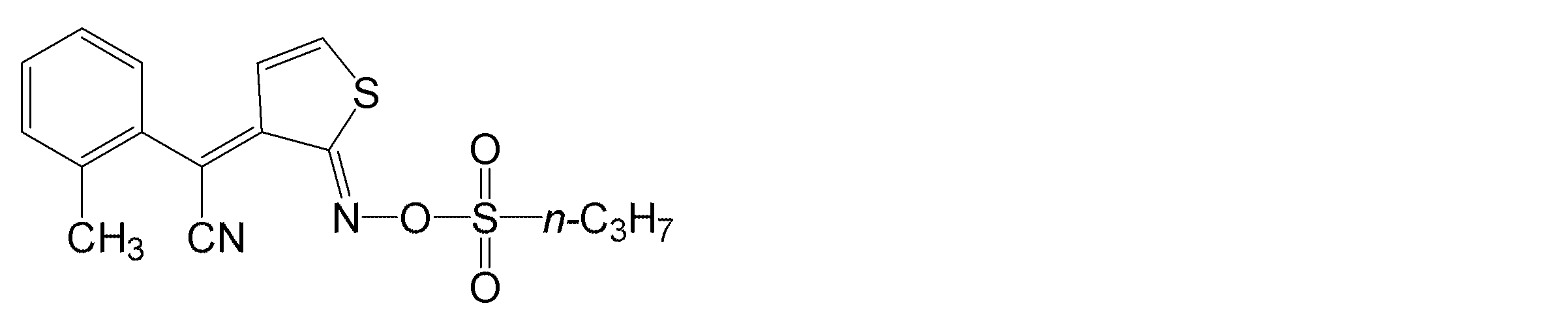
B-3:下記に示す構造(合成例を後述する。)

2-ナフトール(10g)、クロロベンゼン(30mL)の懸濁溶液に塩化アルミニウム(10.6g)、2-クロロプロピオニルクロリド(10.1g)を添加し、混合液を40℃に加熱して2時間反応させた。氷冷下、反応液に4NHCl水溶液(60mL)を滴下し、酢酸エチル(50mL)を添加して分液した。有機層に炭酸カリウム(19.2g)を加え、40℃で1時間反応させた後、2NHCl水溶液(60mL)を添加して分液し、有機層を濃縮後、結晶をジイソプロピルエーテル(10mL)でリスラリーし、ろ過、乾燥してケトン化合物(6.5g)を得た。
得られたケトン化合物(3.0g)、メタノール(30mL)の懸濁溶液に酢酸(7.3g)、50質量%ヒドロキシルアミン水溶液(8.0g)を添加し、加熱還流した。放冷後、水(50mL)を加え、析出した結晶をろ過、冷メタノール洗浄後、乾燥してオキシム化合物(2.4g)を得た。
得られたオキシム化合物(1.8g)をアセトン(20mL)に溶解させ、氷冷下トリエチルアミン(1.5g)、p-トルエンスルホニルクロリド(2.4g)を添加し、室温に昇温して1時間反応させた。反応液に水(50mL)を添加し、析出した結晶をろ過後、メタノール(20mL)でリスラリーし、ろ過、乾燥してB-3の化合物(上述の構造)(2.3g)を得た。
なお、B-3の1H-NMRスペクトル(300MHz、CDCl3)は、δ=8.3(d,1H),8.0(d,2H),7.9(d,1H),7.8(d,1H),7.6(dd,1H),7.4(dd,1H)7.3(d,2H),7.1(d.1H),5.6(q,1H),2.4(s,3H),1.7(d,3H)であった。
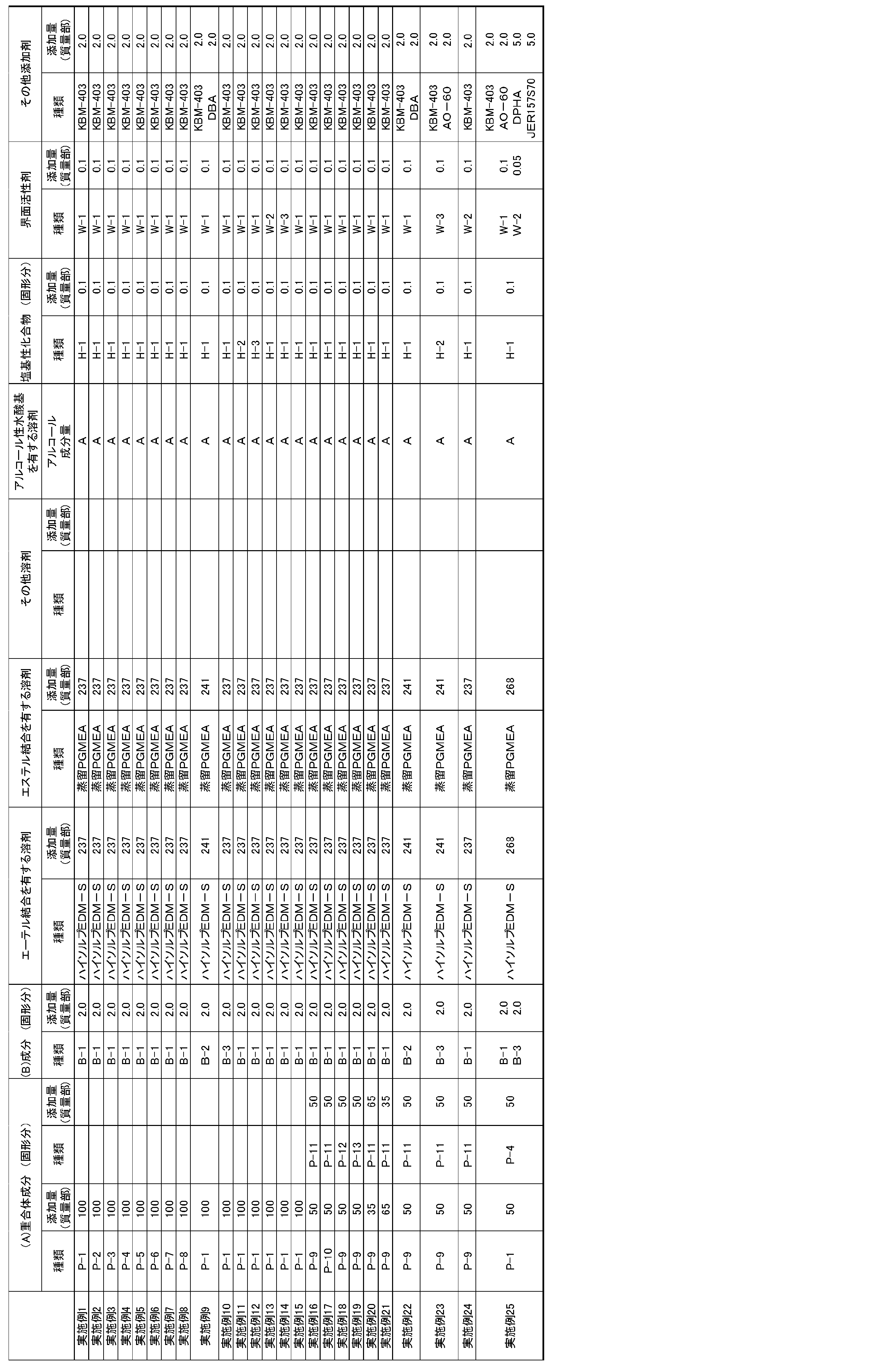


各組成物に配合する溶剤(2種以上用いる場合は混合物)をDMAc(ジメチルアセトアミド)で100倍または10倍に希釈したものをガスクロマトマトグラフィー装置(Agilent6890、カラム:HP-INNOWAX=30m×0.32mmID(膜厚0.25μm))にインジェクションし以下の条件下で測定した。それぞれのアルコール成分は絶対検量線法によって、試料中に含まれるそれぞれのアルコール成分量を求めた。
オーブン温度:50℃(2分保持した後10℃/分で昇温した。250℃で28分保持させた。
キャリアーガス:He=1mL/min、注入口温度:250℃、
スプリット比:10/1。FID検出器:温度300℃、
H2=40mL/min、Air=400mL/min。
注入量は1μL。
測定結果を表に示す(単位:ppm)。
A:1ppm以上10ppm以下
B:10ppmより大きく30ppm以下
C:30ppmより大きく50ppm以下
D:50ppmより大きく500ppm以下
E:500ppmより大きい
ヘキサメチルジシラザン蒸気で1分間表面処理をしたガラス基板(コーニング1737、0.7mm厚(コーニング社製))上に、各感光性樹脂組成物をスリット塗布した後(実施例37のみはスピンコート)、85℃/120秒ホットプレート上でプリベークして溶剤を揮発させ、膜厚3.0μmの感光性樹脂組成物層を形成した。
次に、得られた感光性樹脂組成物層を、キヤノン(株)製PLA-501F露光機(超高圧水銀ランプ)を用いて、4.0μmホールパターンのマスクを介して露光した。その後、アルカリ現像液(0.4質量%のテトラメチルアンモニウムヒドロキシド水溶液)で現像し(24℃、60秒)、超純水で20秒リンスした。下底の径が4.0μmのホールパターンを形成できることを確認し、またその時の最適露光量(Eopt)を感度とした。いずれの実施例も実用的な感度であった。
A:60mJ/cm2未満
B:60mJ/cm2以上80mJ/cm2未満
C:80mJ/cm2以上100mJ/cm2未満
D:100mJ/cm2以上200mJ/cm2未満
E:200mJ/cm2以上
各組成物の調整直後の粘度の測定結果をη1、気温32℃、湿度55%の環境下で経時させた後の粘度の測定結果をη2としたとき|η2-η1|/η1の変動が±8%以内に収まる期間を測定した。なお、粘度は東機産業 粘度計RE85Lを用い、25℃で測定した。変動が±8%以内に収まる期間が長いほど、保存安定性が優れる。A、B、Cが実用範囲である。
A:4週間以上
B:3週間以上、4週間未満
C:2週間以上、3週間未満
D:1週間以上、2週間未満
E:1週間未満
ガラス基板を、ヘキサメチルジシラザン(HMDS)蒸気下に30秒曝し、基板に各感光性樹脂組成物をスリットコート塗布した後(実施例37のみはスピンコート)、90℃/120秒ホットプレート上でプリベークして溶剤を揮発させ、膜厚4.0μmの感光性樹脂組成物層を形成した。続いて超高圧水銀灯を用いて積算照射量が300mJ/cm2(エネルギー強度:20mW/cm2、i線)となるように露光し、この基板をオーブンにて230℃/60分間加熱した。
得られた硬化膜の膜厚(T1)を測定した。そして、この硬化膜が形成された基板を60℃に温度制御されたジメチルスルホキシド溶剤中に10分間浸漬させた後、浸漬後の硬化膜の膜厚(t1)を測定し、浸漬による膜厚変化率{|t1-T1|/T1}×100〔%〕を算出した。結果を下記表に示す。小さいほど好ましく、C以上が実用上問題のないレベルである。
A:1%未満
B:1%以上4%未満
C:4%以上6%未満
D:6%以上10%未満
E:10%以上または溶解
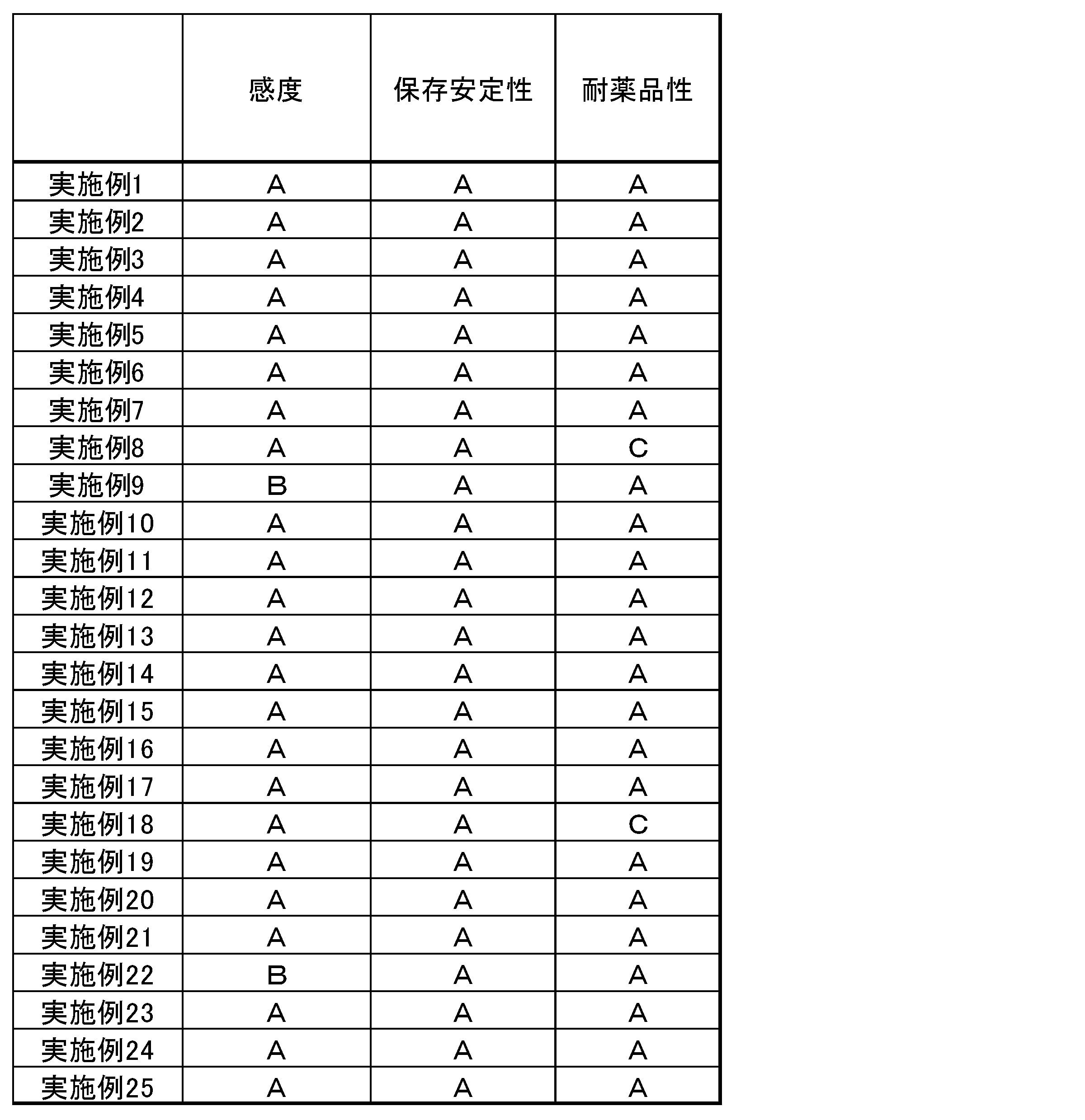
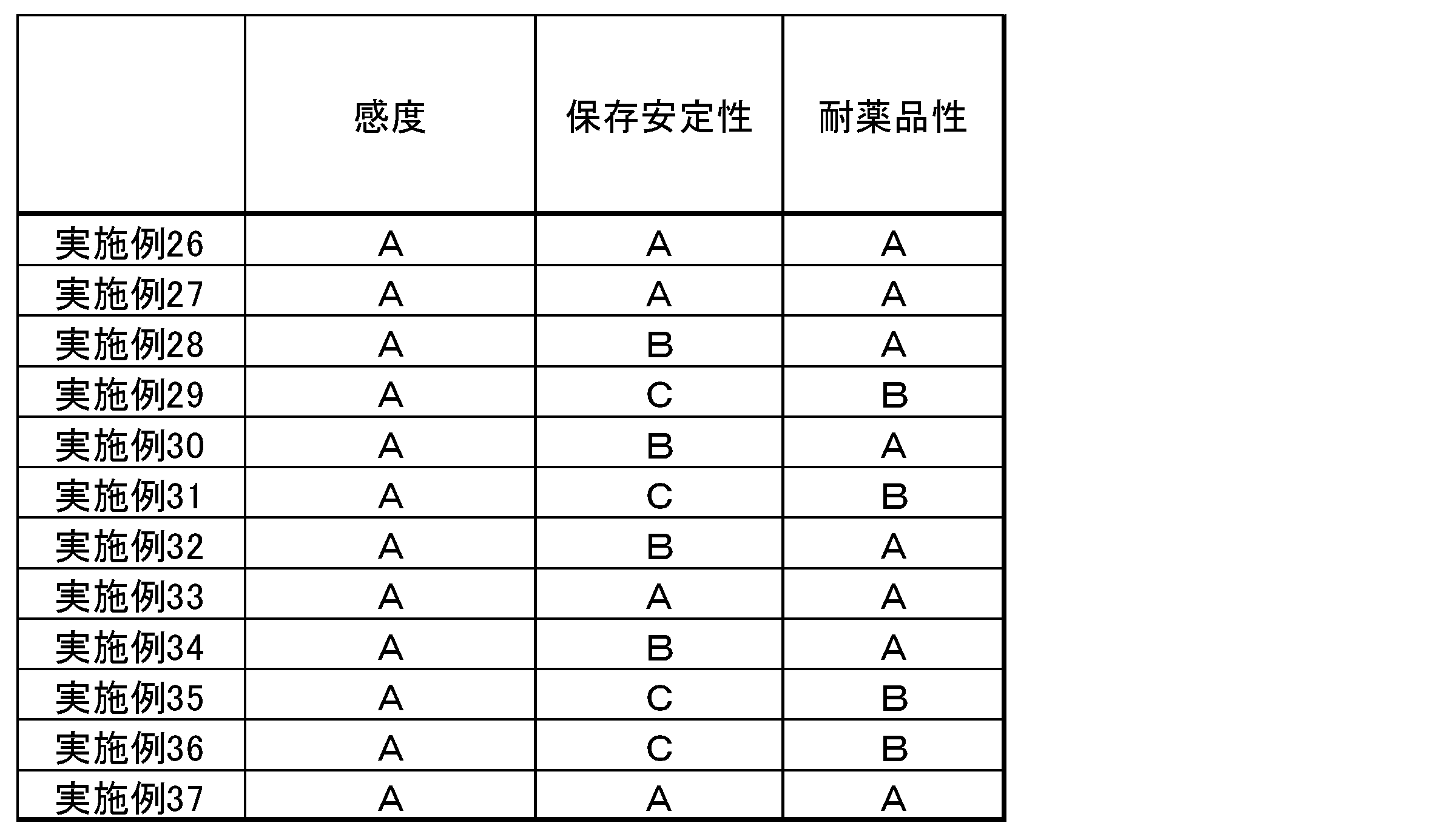
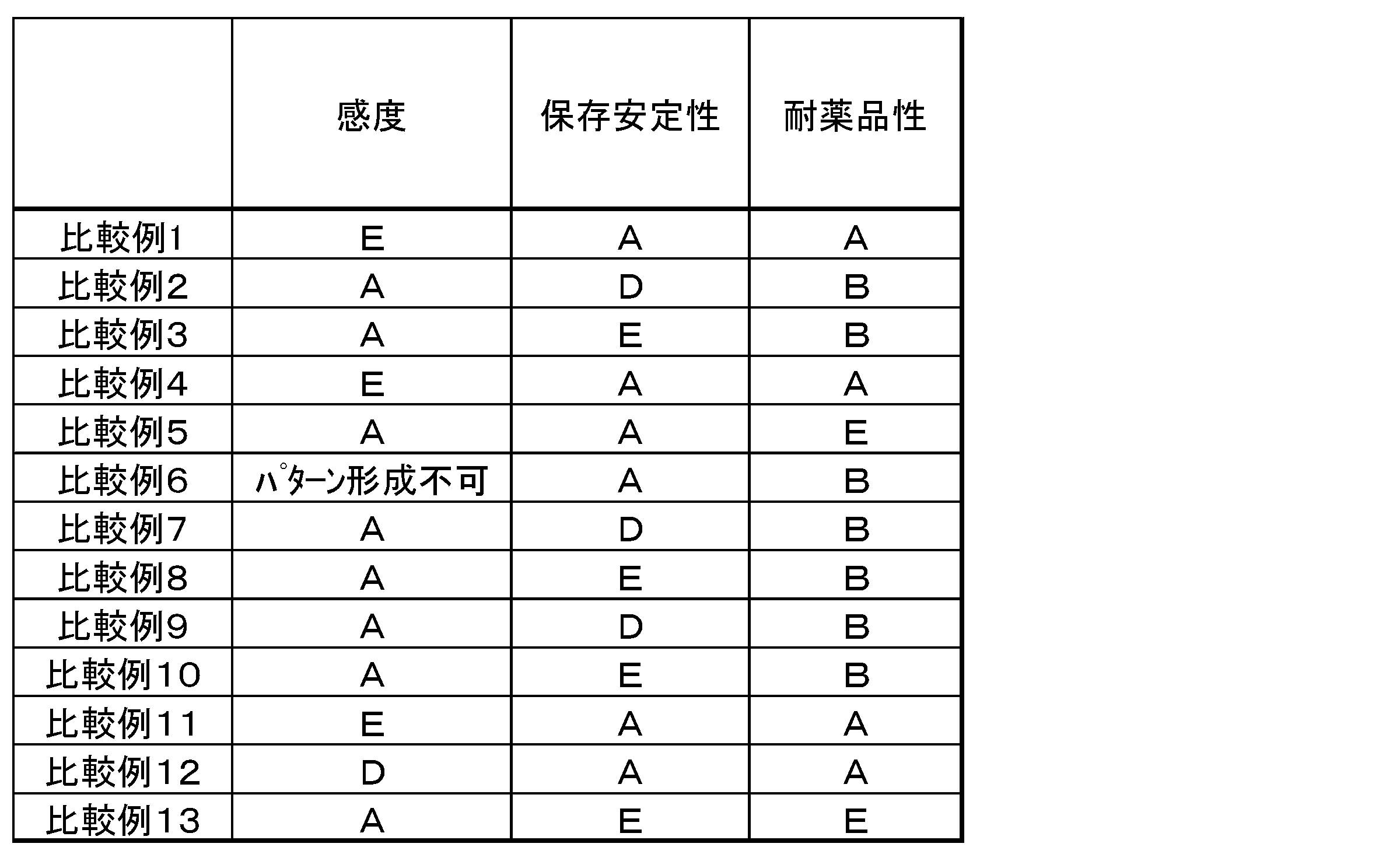
一方、アルコール性水酸基を有する溶剤の含有量が50ppmを超える場合(比較例2、3、7~10、および13)、保存安定性が顕著に劣り、耐薬品性も劣っていることが分かった。エーテル結合および/またはエステル結合を有する溶剤を含まない場合(比較例1、11、および12)、感度が劣ってしまっていた。重合体成分が、アセタール基で保護された基を有さない場合(比較例4)、感度が劣っていた。重合体成分が、架橋性基を有さない場合(比較例5)、耐薬品性が劣っていた。比較例6は、感度が悪く、パターンを形成することができなかった。
比較例1では、溶剤としてトルエンを使用しているが、他の実施例と比較して感度が劣ることがわかる。これにより、エーテル結合および/またはエステル結合を有する溶剤を用いることで感度が向上することがわかる。また、比較例4から、酸基がアセタール基で保護された基を有する構成単位を用いていないことで感度が劣ることがわかる。比較例5から、架橋性基を有する構成単位を用いていないことで耐薬品性が劣ることがわかる。
(実施例101)
薄膜トランジスタ(TFT)を用いた有機EL表示装置を以下の方法で作製した(図2参照)。
ガラス基板6上にボトムゲート型のTFT1を形成し、このTFT1を覆う状態でSi3N4から成る絶縁膜3を形成した。次に、この絶縁膜3に、ここでは図示を省略したコンタクトホールを形成した後、このコンタクトホールを介してTFT1に接続される配線2(高さ1.0μm)を絶縁膜3上に形成した。この配線2は、TFT1間または、後の工程で形成される有機EL素子とTFT1とを接続するためのものである。
さらに、配線2の形成による凹凸を平坦化するために、配線2による凹凸を埋め込む状態で絶縁膜3上へ平坦化膜4を形成した。絶縁膜3上への平坦化膜4の形成は、実施例1の感光性樹脂組成物を基板上にスリット塗布し、ホットプレート上でプリベーク(90℃×2分)した後、マスク上から高圧水銀灯を用いてi線(365nm)を45mJ/cm2(照度20mW/cm2)照射した後、アルカリ水溶液にて現像してパターンを形成し、230℃で60分間の加熱処理を行った。
感光性樹脂組成物を塗布する際の塗布性は良好で、露光、現像、焼成の後に得られた硬化膜には、しわやクラックの発生は認められなかった。さらに、配線2の平均段差は500nm、作製した平坦化膜4の膜厚は2,000nmであった。
次に、得られた平坦化膜4上に、ボトムエミッション型の有機EL素子を形成した。まず、平坦化膜4上に、ITOからなる第一電極5を、コンタクトホール7を介して配線2に接続させて形成した。その後、市販のレジストを塗布、プリベークし、所望のパターンのマスクを介して露光し、現像した。このレジストパターンをマスクとして、ITOエッチャント用いたウエットエッチングによりパターン加工を行った。その後、レジスト剥離液(リムーバ100、AZエレクトロニックマテリアルズ社製)を用いて上記レジストパターンを50℃で剥離した。こうして得られた第一電極5は、有機EL素子の陽極に相当する。
さらに、真空蒸着装置内で所望のパターンマスクを介して、正孔輸送層、有機発光層、電子輸送層を順次蒸着して設けた。次いで、基板上方の全面にAlから成る第二電極を形成した。得られた上記基板を蒸着機から取り出し、封止用ガラス板と紫外線硬化型エポキシ樹脂を用いて貼り合わせることで封止した。
以上のようにして、各有機EL素子にこれを駆動するためのTFT1が接続してなるアクティブマトリックス型の有機EL表示装置が得られた。駆動回路を介して電圧を印加したところ、良好な表示特性を示し、信頼性の高い有機EL表示装置であることが分かった。
実施例101において、実施例1の感光性樹脂組成物を実施例16の感光性樹脂組成物に換えたこと以外は、実施例101と同様に有機EL表示装置を作製した。得られた有機EL表示装置に対して、駆動電圧を印加したところ、良好な表示特性を示し、信頼性の高い有機EL表示装置であることが分かった。
実施例101において、実施例1の感光性樹脂組成物を実施例23の感光性樹脂組成物に換えたこと以外は、実施例101と同様に有機EL表示装置を作製した。得られた有機EL表示装置に対して、駆動電圧を印加したところ、良好な表示特性を示し、信頼性の高い有機EL表示装置であることが分かった。
実施例101において、実施例1の感光性樹脂組成物を実施例30の感光性樹脂組成物に換えたこと以外は、実施例101と同様に有機EL表示装置を作製した。得られた有機EL表示装置に対して、駆動電圧を印加したところ、良好な表示特性を示し、信頼性の高い有機EL表示装置であることが分かった。
実施例101において、実施例1の感光性樹脂組成物を実施例34の感光性樹脂組成物に換えたこと以外は、実施例101と同様に有機EL表示装置を作製した。得られた有機EL表示装置に対して、駆動電圧を印加したところ、良好な表示特性を示し、信頼性の高い有機EL表示装置であることが分かった。
特許第3321003号公報の図1に記載のアクティブマトリクス型液晶表示装置において、層間絶縁膜として硬化膜17を以下のようにして形成し、実施例106の液晶表示装置を得た。すなわち、実施例1の感光性樹脂組成物を用い、上記実施例101における有機EL表示装置の平坦化膜4の形成方法と同様の方法で、層間絶縁膜として硬化膜17を形成した。
得られた液晶表示装置に対して、駆動電圧を印加したところ、良好な表示特性を示し、信頼性の高い液晶表示装置であることが分かった。
実施例106において、実施例1の感光性樹脂組成物を実施例16の感光性樹脂組成物に換えたこと以外は、実施例106と同様に液晶表示装置を作製した。得られた液晶表示装置に対して、駆動電圧を印加したところ、良好な表示特性を示し、信頼性の高い液晶表示装置であることが分かった。
実施例106において、実施例1の感光性樹脂組成物を実施例23の感光性樹脂組成物に換えたこと以外は、実施例106と同様に液晶表示装置を作製した。得られた液晶表示装置に対して、駆動電圧を印加したところ、良好な表示特性を示し、信頼性の高い液晶表示装置であることが分かった。
実施例106において、実施例1の感光性樹脂組成物を実施例30の感光性樹脂組成物に換えたこと以外は、実施例106と同様に液晶表示装置を作製した。得られた液晶表示装置に対して、駆動電圧を印加したところ、良好な表示特性を示し、信頼性の高い液晶表示装置であることが分かった。
実施例106において、実施例1の感光性樹脂組成物を実施例34の感光性樹脂組成物に換えたこと以外は、実施例106と同様に液晶表示装置を作製した。得られた液晶表示装置に対して、駆動電圧を印加したところ、良好な表示特性を示し、信頼性の高い液晶表示装置であることが分
2:配線
3:絶縁膜
4:平坦化膜
5:第一電極
6:ガラス基板
7:コンタクトホール
8:絶縁膜
10:液晶表示装置
12:バックライトユニット
14,15:ガラス基板
16:TFT
17:硬化膜
18:コンタクトホール
19:ITO透明電極
20:液晶
22:カラーフィルター
Claims (14)
- (A)下記(1)および(2)の少なくとも一方を満たす重合体を含む重合体成分、
(1)(a1)酸基がアセタール基で保護された基を有する構成単位、および(a2)架橋性基を有する構成単位を有する重合体、
(2)前記構成単位(a1)を有する重合体および前記構成単位(a2)を有する重合体、
(B)光酸発生剤、ならびに
(C)エーテル結合および/またはエステル結合を有し、アルコール性水酸基を有さない溶剤、
を含み、
全溶剤量に対するアルコール性水酸基を有する溶剤の含有量が1~50ppmである感光性樹脂組成物。 - アルコール性水酸基を有する溶剤の1atmにおける沸点が、95℃以上である、請求項1に記載の感光性樹脂組成物。
- (C)溶剤が、エーテル結合を有する溶剤を含む、請求項1または2に記載の感光性樹脂組成物。
- (C)溶剤が、ジエチレングリコール誘導体を含む、請求項1~3のいずれか1項に記載の感光性樹脂組成物。
- (C)溶剤が、ジエチレングリコールエチルメチルエーテルおよび/またはジエチレングリコールジメチルエーテルを含む、請求項1~4のいずれか1項に記載の感光性樹脂組成物。
- (C)溶剤が、エーテル結合を有する溶剤およびエステル結合を有する溶剤を含む、請求項1~5のいずれか1項に記載の感光性樹脂組成物。
- 前記構成単位(a1)が、下記一般式(A2’)で表される構成単位である、請求項1~6のいずれか1項に記載の感光性樹脂組成物;
一般式(A2’):

- 前記(a2)構成単位における架橋性基が、エポキシ基、オキセタニル基、および-NH-CH2-ORから選ばれる少なくとも1種である、請求項1~7のいずれか1項に記載の感光性樹脂組成物;但し、Rは炭素数1~20のアルキル基を示す。
- 前記(C)溶剤が、全溶剤の50質量%以上である、請求項1~8のいずれか1項に記載の感光性樹脂組成物。
- (B)光酸発生剤が、オキシムスルホネート化合物および/またはオニウム塩化合物である、請求項1~9のいずれか1項に記載の感光性樹脂組成物。
- (1)請求項1~10のいずれか1項に記載の感光性樹脂組成物を基板上に塗布する工程、
(2)塗布された前記感光性樹脂組成物から溶剤を除去する工程、
(3)溶剤が除去された前記感光性樹脂組成物を活性放射線で露光する工程、
(4)露光された前記感光性樹脂組成物を水性現像液で現像する工程、および、
(5)現像された前記感光性樹脂組成物を熱硬化するポストベーク工程、を含む、硬化膜の製造方法。 - 請求項1~10のいずれか1項に記載の感光性樹脂組成物を硬化してなる硬化膜。
- 層間絶縁膜である、請求項12に記載の硬化膜。
- 請求項12または13に記載の硬化膜を有する、液晶表示装置または有機EL表示装置。
Priority Applications (2)
| Application Number | Priority Date | Filing Date | Title |
|---|---|---|---|
| KR1020167005402A KR101747771B1 (ko) | 2013-09-03 | 2014-09-01 | 감광성 수지 조성물, 경화막의 제조 방법, 경화막, 액정 표시 장치 및 유기 el 표시 장치 |
| JP2015535454A JP6159408B2 (ja) | 2013-09-03 | 2014-09-01 | 感光性樹脂組成物、硬化膜の製造方法、硬化膜、液晶表示装置および有機el表示装置 |
Applications Claiming Priority (2)
| Application Number | Priority Date | Filing Date | Title |
|---|---|---|---|
| JP2013181952 | 2013-09-03 | ||
| JP2013-181952 | 2013-09-03 |
Publications (1)
| Publication Number | Publication Date |
|---|---|
| WO2015033879A1 true WO2015033879A1 (ja) | 2015-03-12 |
Family
ID=52628353
Family Applications (1)
| Application Number | Title | Priority Date | Filing Date |
|---|---|---|---|
| PCT/JP2014/072871 Ceased WO2015033879A1 (ja) | 2013-09-03 | 2014-09-01 | 感光性樹脂組成物、硬化膜の製造方法、硬化膜、液晶表示装置および有機el表示装置 |
Country Status (3)
| Country | Link |
|---|---|
| JP (1) | JP6159408B2 (ja) |
| KR (1) | KR101747771B1 (ja) |
| WO (1) | WO2015033879A1 (ja) |
Cited By (4)
| Publication number | Priority date | Publication date | Assignee | Title |
|---|---|---|---|---|
| JP2015052660A (ja) * | 2013-09-05 | 2015-03-19 | Jsr株式会社 | 表示素子の絶縁膜形成用感放射線性樹脂組成物、この組成物の調製方法、表示素子の絶縁膜、この絶縁膜の形成方法及び表示素子 |
| JP2018025799A (ja) * | 2016-08-11 | 2018-02-15 | 東友ファインケム株式会社Dongwoo Fine−Chem Co., Ltd. | 化学増幅型感光性樹脂組成物及びそれから製造された絶縁膜 |
| CN108779317A (zh) * | 2016-03-23 | 2018-11-09 | 日本瑞翁株式会社 | 树脂组合物、树脂膜以及电子部件 |
| US11112695B2 (en) | 2017-02-09 | 2021-09-07 | Fujifilm Corporation | Photosensitive composition, cured film, optical filter, solid image pickup element, image display device, and infrared sensor |
Citations (1)
| Publication number | Priority date | Publication date | Assignee | Title |
|---|---|---|---|---|
| JP2011221494A (ja) * | 2010-01-15 | 2011-11-04 | Fujifilm Corp | 感光性樹脂組成物、硬化膜の形成方法、硬化膜、有機el表示装置、及び、液晶表示装置 |
Family Cites Families (1)
| Publication number | Priority date | Publication date | Assignee | Title |
|---|---|---|---|---|
| US6773872B2 (en) * | 2000-12-29 | 2004-08-10 | Shipley Company, L.L.C. | Reduction of inorganic contaminants in polymers and photoresist compositions comprising same |
-
2014
- 2014-09-01 KR KR1020167005402A patent/KR101747771B1/ko not_active Expired - Fee Related
- 2014-09-01 JP JP2015535454A patent/JP6159408B2/ja not_active Expired - Fee Related
- 2014-09-01 WO PCT/JP2014/072871 patent/WO2015033879A1/ja not_active Ceased
Patent Citations (1)
| Publication number | Priority date | Publication date | Assignee | Title |
|---|---|---|---|---|
| JP2011221494A (ja) * | 2010-01-15 | 2011-11-04 | Fujifilm Corp | 感光性樹脂組成物、硬化膜の形成方法、硬化膜、有機el表示装置、及び、液晶表示装置 |
Non-Patent Citations (1)
| Title |
|---|
| KABUSHIKI KAISHA ET AL., HANDOTAI SHUSEKI KAIROYO RESIST ZAIRYO HANDBOOK, 31 July 1996 (1996-07-31), pages 288 * |
Cited By (7)
| Publication number | Priority date | Publication date | Assignee | Title |
|---|---|---|---|---|
| JP2015052660A (ja) * | 2013-09-05 | 2015-03-19 | Jsr株式会社 | 表示素子の絶縁膜形成用感放射線性樹脂組成物、この組成物の調製方法、表示素子の絶縁膜、この絶縁膜の形成方法及び表示素子 |
| CN108779317A (zh) * | 2016-03-23 | 2018-11-09 | 日本瑞翁株式会社 | 树脂组合物、树脂膜以及电子部件 |
| JPWO2017163981A1 (ja) * | 2016-03-23 | 2019-01-31 | 日本ゼオン株式会社 | 樹脂組成物、樹脂膜、及び電子部品 |
| EP3434731A4 (en) * | 2016-03-23 | 2019-09-11 | Zeon Corporation | RESIN COMPOSITION, RESIN FOIL AND ELECTRONIC COMPONENT |
| CN108779317B (zh) * | 2016-03-23 | 2021-04-16 | 日本瑞翁株式会社 | 树脂组合物、树脂膜以及电子部件 |
| JP2018025799A (ja) * | 2016-08-11 | 2018-02-15 | 東友ファインケム株式会社Dongwoo Fine−Chem Co., Ltd. | 化学増幅型感光性樹脂組成物及びそれから製造された絶縁膜 |
| US11112695B2 (en) | 2017-02-09 | 2021-09-07 | Fujifilm Corporation | Photosensitive composition, cured film, optical filter, solid image pickup element, image display device, and infrared sensor |
Also Published As
| Publication number | Publication date |
|---|---|
| JP6159408B2 (ja) | 2017-07-05 |
| JPWO2015033879A1 (ja) | 2017-03-02 |
| KR20160038037A (ko) | 2016-04-06 |
| KR101747771B1 (ko) | 2017-06-15 |
Similar Documents
| Publication | Publication Date | Title |
|---|---|---|
| JP6182612B2 (ja) | 感光性樹脂組成物、硬化膜の製造方法、硬化膜、液晶表示装置および有機el表示装置 | |
| JP5849152B2 (ja) | 化学増幅型ポジ型感光性樹脂組成物、硬化膜の製造方法、硬化膜、有機el表示装置および液晶表示装置 | |
| JP6279571B2 (ja) | 感光性樹脂組成物、硬化膜の製造方法、硬化膜、液晶表示装置および有機el表示装置 | |
| JP6038951B2 (ja) | 感光性樹脂組成物、硬化膜の製造方法、硬化膜、有機el表示装置および液晶表示装置 | |
| WO2015046296A1 (ja) | 感光性樹脂組成物、硬化膜の製造方法、硬化膜、液晶表示装置および有機el表示装置 | |
| JP5941543B2 (ja) | 感光性樹脂組成物、硬化膜の製造方法、硬化膜、有機el表示装置および液晶表示装置 | |
| JP6116668B2 (ja) | 感光性樹脂組成物、硬化膜の製造方法、硬化膜、液晶表示装置及び有機el表示装置 | |
| JP6159408B2 (ja) | 感光性樹脂組成物、硬化膜の製造方法、硬化膜、液晶表示装置および有機el表示装置 | |
| JP2015121643A (ja) | 感光性樹脂組成物、硬化膜の製造方法、硬化膜、液晶表示装置および有機el表示装置 | |
| JP2015099320A (ja) | 感光性樹脂組成物、硬化膜の製造方法、硬化膜、有機el表示装置および液晶表示装置 | |
| JP6272338B2 (ja) | 感光性樹脂組成物、硬化膜の製造方法、硬化膜、液晶表示装置及び有機el表示装置 | |
| JP2014071308A (ja) | 感光性樹脂組成物、これを用いた硬化膜の製造方法、硬化膜、液晶表示装置および有機el表示装置 | |
| JP5933735B2 (ja) | 感光性樹脂組成物、硬化膜の製造方法、硬化膜、有機el表示装置および液晶表示装置 | |
| JP2014010200A (ja) | 感光性樹脂組成物、硬化膜の製造方法、硬化膜、有機el表示装置および液晶表示装置 | |
| WO2015033880A1 (ja) | 樹脂組成物、硬化膜の製造方法、硬化膜、液晶表示装置および有機el表示装置 | |
| WO2013191155A1 (ja) | 感光性樹脂組成物、硬化膜の製造方法、硬化膜、有機el表示装置および液晶表示装置 | |
| JP2015094898A (ja) | 感光性樹脂組成物、硬化膜の製造方法、硬化膜、液晶表示装置および有機el表示装置 | |
| JP6219949B2 (ja) | 感光性樹脂組成物、硬化膜の製造方法、硬化膜、液晶表示装置および有機el表示装置 | |
| JP2014071300A (ja) | 感光性樹脂組成物、これを用いた硬化膜の製造方法、硬化膜、液晶表示装置および有機el表示装置 | |
| JP6194357B2 (ja) | 感光性樹脂組成物、硬化膜の製造方法、硬化膜、液晶表示装置および有機el表示装置 | |
| JP2014235216A (ja) | 感光性樹脂組成物、硬化膜の製造方法、硬化膜、液晶表示装置及び有機el表示装置 |
Legal Events
| Date | Code | Title | Description |
|---|---|---|---|
| 121 | Ep: the epo has been informed by wipo that ep was designated in this application |
Ref document number: 14842759 Country of ref document: EP Kind code of ref document: A1 |
|
| ENP | Entry into the national phase |
Ref document number: 20167005402 Country of ref document: KR Kind code of ref document: A |
|
| ENP | Entry into the national phase |
Ref document number: 2015535454 Country of ref document: JP Kind code of ref document: A |
|
| NENP | Non-entry into the national phase |
Ref country code: DE |
|
| 122 | Ep: pct application non-entry in european phase |
Ref document number: 14842759 Country of ref document: EP Kind code of ref document: A1 |