WO2015008779A1 - 新規ピラノンカルボキサミド誘導体及びその抗c型肝炎ウイルス薬としての用途 - Google Patents
新規ピラノンカルボキサミド誘導体及びその抗c型肝炎ウイルス薬としての用途 Download PDFInfo
- Publication number
- WO2015008779A1 WO2015008779A1 PCT/JP2014/068880 JP2014068880W WO2015008779A1 WO 2015008779 A1 WO2015008779 A1 WO 2015008779A1 JP 2014068880 W JP2014068880 W JP 2014068880W WO 2015008779 A1 WO2015008779 A1 WO 2015008779A1
- Authority
- WO
- WIPO (PCT)
- Prior art keywords
- group
- aromatic
- phenyl
- stretching
- carboxamide
- Prior art date
- Legal status (The legal status is an assumption and is not a legal conclusion. Google has not performed a legal analysis and makes no representation as to the accuracy of the status listed.)
- Ceased
Links
- 0 CC(C=C(O1)[Al])=C(C(N*)=O)C1=O Chemical compound CC(C=C(O1)[Al])=C(C(N*)=O)C1=O 0.000 description 1
Images
Classifications
-
- C—CHEMISTRY; METALLURGY
- C07—ORGANIC CHEMISTRY
- C07D—HETEROCYCLIC COMPOUNDS
- C07D409/00—Heterocyclic compounds containing two or more hetero rings, at least one ring having sulfur atoms as the only ring hetero atoms
- C07D409/02—Heterocyclic compounds containing two or more hetero rings, at least one ring having sulfur atoms as the only ring hetero atoms containing two hetero rings
- C07D409/04—Heterocyclic compounds containing two or more hetero rings, at least one ring having sulfur atoms as the only ring hetero atoms containing two hetero rings directly linked by a ring-member-to-ring-member bond
-
- A—HUMAN NECESSITIES
- A61—MEDICAL OR VETERINARY SCIENCE; HYGIENE
- A61P—SPECIFIC THERAPEUTIC ACTIVITY OF CHEMICAL COMPOUNDS OR MEDICINAL PREPARATIONS
- A61P1/00—Drugs for disorders of the alimentary tract or the digestive system
- A61P1/16—Drugs for disorders of the alimentary tract or the digestive system for liver or gallbladder disorders, e.g. hepatoprotective agents, cholagogues, litholytics
-
- A—HUMAN NECESSITIES
- A61—MEDICAL OR VETERINARY SCIENCE; HYGIENE
- A61P—SPECIFIC THERAPEUTIC ACTIVITY OF CHEMICAL COMPOUNDS OR MEDICINAL PREPARATIONS
- A61P31/00—Antiinfectives, i.e. antibiotics, antiseptics, chemotherapeutics
- A61P31/12—Antivirals
- A61P31/14—Antivirals for RNA viruses
-
- C—CHEMISTRY; METALLURGY
- C07—ORGANIC CHEMISTRY
- C07D—HETEROCYCLIC COMPOUNDS
- C07D309/00—Heterocyclic compounds containing six-membered rings having one oxygen atom as the only ring hetero atom, not condensed with other rings
- C07D309/34—Heterocyclic compounds containing six-membered rings having one oxygen atom as the only ring hetero atom, not condensed with other rings having three or more double bonds between ring members or between ring members and non-ring members
- C07D309/36—Heterocyclic compounds containing six-membered rings having one oxygen atom as the only ring hetero atom, not condensed with other rings having three or more double bonds between ring members or between ring members and non-ring members with oxygen atoms directly attached to ring carbon atoms
- C07D309/38—Heterocyclic compounds containing six-membered rings having one oxygen atom as the only ring hetero atom, not condensed with other rings having three or more double bonds between ring members or between ring members and non-ring members with oxygen atoms directly attached to ring carbon atoms one oxygen atom in position 2 or 4, e.g. pyrones
Definitions
- the present invention relates to a novel pyranone carboxamide derivative and its use as an anti-hepatitis C virus (HCV) drug.
- HCV hepatitis C virus
- HCV hepatitis C virus
- interferon and ribavirin (1-[(2R, 3R, 4S, 5R) -3,4-dihydroxy-5- (hydroxymethyl) oxolan-2-yl] -1H-1,2, 4-Triazole-3-carboxamide) has been effective to some extent.
- type of virus (1b) that is common in Japan is difficult to work with interferon, and interferon and ribavirin are expensive and have strong side effects, so there are many cases where treatment must be interrupted. Therefore, development of an effective anti-HCV drug that has fewer side effects and is less expensive than ribavirin is desired.
- N- (4-cyclohexylphenyl) -4-hydroxy-2-oxo-6-phenyl-2H-pyran-3-carboxamide is useful as a therapeutic agent for bacterial infection in Patent Document 1.
- Patent Document 2 describes N- (5-bromo-1,3,4-oxadiazol-2-yl) -4-hydroxy-2-oxo-6-phenyl-2H-pyran- 3-carboxamide, 4-hydroxy-N- (5-methyl-2-furyl) -2-oxo-6-phenyl-2H-pyran-3-carboxamide, N- (5-bromo-1,3,4-thiadiazole -2-yl) -4-hydroxy-2-oxo-6-phenyl-2H-pyran-3-carboxamide and the like, N, 6-disubstituted 4-hydroxy-2-oxo-2H-pi Down-3-carboxamide colon cancer, melanoma, have been described to be useful in the prevention and treatment of cancer of liver cancer, such as breast and prostate cancer.
- the present inventors conducted a search for a new compound and a structural development study by using suppression of HCV gene replication in cultured cells as an index, thereby enabling the discovery of a novel skeleton having selective anti-HCV activity.
- the identification of the compound was successful and the present invention was completed. That is, the gist of the present invention is as follows.
- An anti-HCV drug comprising the compound according to (1), a salt thereof, or a solvate thereof.
- the compound of the present invention has high anti-HCV activity and can be suitably used as an anti-HCV drug.
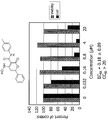
- 2 is a graph showing the measurement results of luciferase assay and cell survival assay for 4- (hydroxyamino) -2-oxo-6-phenyl-N- (p-tolyl) -2H-pyran-3-carboxamide.
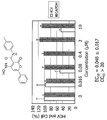
- 3 is a graph showing measurement results of HCV and GAPDH RNA quantitative assays for 4- (hydroxyamino) -2-oxo-6-phenyl-N- (p-tolyl) -2H-pyran-3-carboxamide.
- examples of the aromatic group in the substituted or unsubstituted aromatic group include a phenyl group, a naphthyl group (1-naphthyl group, 2-naphthyl group), an anthryl group (1-anthryl group, 2-anthryl group).
- 9-anthryl group fluorenyl group (1-fluorenyl group, 2-fluorenyl group, 9-fluorenyl group), phenanthryl group, pyrenyl group, chrysenyl group, perylenyl group, picenyl group and other aromatic hydrocarbon groups; furyl group , Thienyl group, pyrrolyl group, oxazolyl group, isoxazolyl group, thiazolyl group, isothiazolyl group, imidazolyl group, pyrazolyl group, triazolyl group (1,2,3-triazolyl group, 1,2,4-triazolyl group), pyridyl group, Pyrimidinyl, pyridazinyl, pyrazinyl, quinolyl, isoquinolyl, Drill group, an aromatic heterocyclic group such as a pyrido-thieno pyrimidine ring group.
- substituent in the aromatic group examples include methyl, ethyl, propyl, isopropyl, butyl, isobutyl, sec-butyl, tert-butyl, pentyl, isopentyl, hexyl, cyclo C 1-6 -alkyl groups such as propyl group, cyclobutyl group, cyclopentyl group, cyclohexyl group; methoxy group, ethoxy group, propoxy group, isopropoxy group, butoxy group, isobutoxy group, sec-butoxy group, tert-butoxy group, C 1-6 -alkoxy groups such as pentyloxy group, isopentyloxy group, hexyloxy group, cyclopropyloxy group, cyclobutyloxy group, cyclopentyloxy group, cyclohexyloxy group; methoxycarbonyl group, ethoxycarbonyl group, propoxycarbonyl Group, iso
- substituted aromatic group examples include 4-methylphenyl group (p-tolyl group), 3-methylphenyl group (m-tolyl group), 2-methylphenyl group (o-tolyl group), 4-ethylphenyl Group, 3-ethylphenyl group, 2-ethylphenyl group, 4-n-propylphenyl group, 4-isopropylphenyl group, 2-isopropylphenyl group, 4-n-butylphenyl group, 4-isobutylphenyl group, 4- sec-butylphenyl group, 2-sec-butylphenyl group, 4-tert-butylphenyl group, 3-tert-butylphenyl group, 2-tert-butylphenyl group, 4-n-pentylphenyl group, 4-isopentyl Phenyl group, 2-neopentylphenyl group, 4-tert-pentylphenyl group, 4-n-hexylphenyl group, 4-
- the hydrocarbon group represented by R is usually a C 1-25 -hydrocarbon group, and in addition to the substituted or unsubstituted aromatic hydrocarbon group, for example, a methyl group, Ethyl, propyl, isopropyl, butyl, isobutyl, sec-butyl, tert-butyl, pentyl, isopentyl, hexyl, heptyl, octyl, nonyl, decyl, undecyl, dodecyl
- a linear or branched C 1-25 -alkyl group such as a group, tridecyl group, tetradecyl group, pentadecyl group, hexadecyl group, heptadecyl group, octadecyl group, nonadecyl group, icosyl group, heicosyl group; cyclopropyl group, cyclobutyl
- hydrocarbon group examples include methoxy group, ethoxy group, propoxy group, isopropoxy group, butoxy group, isobutoxy group, sec-butoxy group, tert-butoxy group, pentyloxy group, isopentyloxy group, hexyloxy group, C 1-6 -alkoxy groups such as cyclopropyloxy group, cyclobutyloxy group, cyclopentyloxy group, cyclohexyloxy group; methoxycarbonyl group, ethoxycarbonyl group, propoxycarbonyl group, isopropoxycarbonyl group, butoxycarbonyl group, isobutoxy Carbonyl group, sec-butoxycarbonyl group, tert-butoxycarbonyl group, pentyloxycarbonyl group, isopentyloxycarbonyl group, cyclopropyloxycarbonyl group, cyclobutyloxycarbonyl group, B pentyloxycarbonyl group of C 1-6 - alk
- substituted hydrocarbon group examples include, in addition to the substituted aromatic hydrocarbon group, a 2-hydroxyethyl group, a 3-hydroxypropyl group, a methoxycarbonylmethyl group, and the like. Is not to be done.
- n is preferably 0 or 2.
- the salt of the compound represented by the formula (I) is preferably a pharmaceutically acceptable salt.
- a pharmaceutically acceptable salt for example, hydrochloric acid, sulfuric acid, phosphoric acid, hydrobromic acid, hydroiodic acid, nitric acid, pyrosulfuric acid, metaphosphoric acid Or salts with organic acids such as citric acid, benzoic acid, acetic acid, propionic acid, fumaric acid, maleic acid, sulfonic acid (eg methanesulfonic acid, p-toluenesulfonic acid, naphthalenesulfonic acid) Can be mentioned.
- sulfonic acid eg methanesulfonic acid, p-toluenesulfonic acid, naphthalenesulfonic acid
- alkali metal salts such as a sodium salt and potassium salt.
- Examples of the solvate of the compound represented by the formula (I) include hydrates.
- a “substituted or unsubstituted aromatic group” represented by Ar is a phenyl group, a phenyl group substituted with (for example, F, Cl), or thienyl. This is an example in which n is 0 or 2.
- X and Y correspond to Ar and R in the formula (I), respectively.
- acetophenone as a starting material is reacted with carbon disulfide to form a dimercapto form as an intermediate, and then methyl iodide is added to obtain a dithioacetal form (II).
- carboxylic acid derivative (III) of ⁇ -pyrone is obtained using diethyl malonate as a carbanion source in the presence of sodium hydride.
- HATU uronium / hexafluorophosphate
- 2- (7-aza-1H-benzotriazol-1-yl) -1,1,3,3-tetramethyl / uronium / hexafluorophosphate (HATU) was used, and an amine compound (YNH 2 ) And the carboxyl group of the carboxylic acid derivative (III) of ⁇ -pyrone to obtain the corresponding amide compound (IV).
- the target substance (I) can be produced by heating the amide compound (IV) in ethanol together with hydroxylamine hydrochloride and sodium bicarbonate.
- a commonly used technique such as column chromatography using silica gel or the like as a carrier, methanol, ethanol, chloroform, dimethyl sulfoxide, n-hexane-ethyl acetate, water, etc.
- a recrystallization method using the above may be used.
- the column chromatography elution solvent include methanol, ethanol, chloroform, acetone, hexane, dichloromethane, ethyl acetate, and mixed solvents thereof.
- the above compound can be formulated as an anti-HCV drug in combination with a conventional pharmaceutical carrier.
- the dosage form is not particularly limited, and can be appropriately selected and used as necessary. Tablets, capsules, granules, fine granules, powders, sustained-release preparations, solutions, suspensions, emulsions, syrups And oral agents such as elixirs and parenteral agents such as injections and suppositories.
- Oral preparations are produced according to conventional methods using, for example, starch, lactose, sucrose, mannitol, carboxymethylcellulose, inorganic salts and the like.
- a binder, a disintegrant, a surfactant, a lubricant, a fluidity promoter, a corrigent, a colorant, a fragrance, and the like can be appropriately added.
- binder examples include starch, dextrin, gum arabic, gelatin, hydroxypropyl starch, methylcellulose, sodium carboxymethylcellulose, hydroxypropylcellulose, crystalline cellulose, ethylcellulose, polyvinylpyrrolidone, macrogol and the like.
- disintegrant examples include starch, hydroxypropyl starch, carboxymethylcellulose sodium, carboxymethylcellulose calcium, carboxymethylcellulose, and low-substituted hydroxypropylcellulose.
- surfactant examples include sodium lauryl sulfate, soybean lecithin, sucrose fatty acid ester, polysorbate 80 and the like.
- lubricant examples include talc, waxes, hydrogenated vegetable oil, sucrose fatty acid ester, magnesium stearate, calcium stearate, aluminum stearate, polyethylene glycol and the like.
- fluidity promoter examples include light anhydrous silicic acid, dry aluminum hydroxide gel, synthetic aluminum silicate, magnesium silicate and the like.
- Injectables are produced according to conventional methods.
- distilled water for injection physiological saline, aqueous glucose solution, olive oil, sesame oil, peanut oil, soybean oil, corn oil, propylene glycol, polyethylene glycol and the like can be used as diluents.
- bactericides, preservatives, stabilizers, isotonic agents, soothing agents and the like may be added.
- the injection can be frozen after filling into a vial or the like, the water can be removed by a normal freeze-drying technique, and the solution can be re-prepared from the freeze-dried product immediately before use.
- the proportion of the compound of formula (I) in the injection may vary between 5 and 50% by weight, but is not limited thereto.
- parenterals include suppositories for rectal administration and are manufactured according to conventional methods.
- the formulated anti-HCV drug varies depending on the dosage form, administration route, etc., but can be administered, for example, 1 to 4 times a day for a period of 1 week to 3 months.
- the weight of the compound of formula (I) is usually 0.1 to 1000 mg in the case of an adult, for example. It is preferable to take 1 to 500 mg in several divided doses per day.
- the weight of the compound of formula (I) is, for example, 0.1 to It is appropriate to administer 1000 mg, preferably 1 to 500 mg by intravenous injection, intravenous drip injection, subcutaneous injection or intramuscular injection.
- the compound of the present invention may be used in combination with other drugs effective against HCV infection. These are administered separately during the course of treatment or are combined with the compounds of the invention in a single dosage form such as a tablet, intravenous solution, or capsule.
- other agents include, for example, interferon- ⁇ , ribavirin, or compounds currently in clinical trials, specifically HCV protease inhibitors (eg, ITMN-191 (R-7227), MK-7809, TMC435, Boceprevir (SCH503034), Telaprevir, etc., RNA polymerase inhibitors (eg, R7128, VCH-759, Valopititabine, etc.), DEBIO-025 (cyclophilin inhibitor), Celgosivir (glucosidase I inhibitor), BMS-790052N (SMS5AA inhibitor N, etc.) Is mentioned.
- HCV protease inhibitors eg, ITMN-191 (R-7227), MK-7809, TMC435, Bocepre
- Example 1 (1) Production of dithioacetal compound (II) A suspension of sodium hydride (166.4 mmol) in THF was stirred at 0 ° C., and the corresponding acetophenone (83.2 mmol) was added dropwise. The suspension was stirred at 0 ° C. for 30 minutes. Carbon disulfide (91.5 mmol) was added dropwise, and the mixture was further stirred at 0 ° C. for 30 minutes. After methyl iodide (208.0 mmol) was added dropwise at 0 ° C., cooling was stopped and the reaction mixture was slowly returned to room temperature. It stirred at room temperature for 4 hours and confirmed that reaction was complete
- the reaction mixture was poured into ice water, extracted with ethyl acetate, dried over anhydrous sodium sulfate, and the solvent was distilled off under reduced pressure to obtain a dithioacetal (II).
- the dithioacetal (II) was recrystallized with a mixed solvent of n-hexane and ethyl acetate to obtain a purified product.
- Luciferase gene-containing subgenomic HCV RNA replicon cells (LucNeo # 2, Goto M, Watashi K, Murata T, Hishiki T, Hijikata M, Shimotohno K. "Evaluation of the anti-hepatitis C virus effects of cyclophilin inhibitors, cyclosporin A, and NIM811 Biochem. Biophys. Res. Commun. 343: 879-884, 2006.) was suspended in DMEM medium supplemented with 10% FBS and 1 mg / ml G418 (protein synthesis inhibitor) (50 1,000 cells / ml). After 24 hours of incubation, cells were incubated for 3 days in fresh culture medium without G418, containing various concentrations of each test compound.
- luciferase assay For luciferase assay, cells were washed with PBS and treated with lysate for 10 minutes with intermittent shaking. Cell lysates (25 ⁇ l) were then transferred to white microtiter plates. Luciferase assay reagent (100 ⁇ l) was added to each well, and luciferase activity was measured with a luminometer.
- tetrazolium salts (2- (2-Methoxy-4-nitrophenyl) -3- (4-nitrophenyl) -5- (2,4-disulfophenyl) -2H-tetrazolium
- a reagent for measuring the number of viable cells (10 ⁇ l) containing monosodium salt: WST-8) was added to each well. After incubation at 37 ° C. for 1 hour, specific absorbance (450 nm) was measured with a microplate reader. The results are shown in Table 2 and FIG.
- the compound of the present invention has high anti-HCV activity and low cytotoxicity.
- the negative control compound (4- (hydroxyamino) -2-oxo-6-phenyl-2H-pyran-3-carboxylic acid) in which —CONHR at the 3-position of the pyran ring in (I) is replaced by —COOH is HCV activity could not be confirmed.
- Example 3 Full-genome HCV RNA replicon cells (NNC # 2, Ishii N, Watashi K, Hishiki T, Goto K, Inoue D, Hijikata M, Wakita T, Kato N, Shimotohno K. "Diverse effects of cyclosporine on hepatitis C virus strain replication.” J. Virol. 80: 4510-4520, 2006.) was suspended in DMEM medium supplemented with 10% FBS and 1 mg / ml G418 (protein synthesis inhibitor) (30,000 cells / ml). After 24 hours of incubation, cells were incubated for 3 days in fresh culture medium without G418, containing various concentrations of each test compound.
- the cells were washed with PBS and treated with a lysate containing DNA-degrading enzyme for 10 minutes with intermittent shaking. Then, the cell lysate (10 ⁇ l) was subjected to reverse transcription reaction, and quantification of HCV RNA and GAPDH RNA as an indicator of cell survival was simultaneously performed using a real-time PCR method. The result is shown in FIG.
Landscapes
- Chemical & Material Sciences (AREA)
- Organic Chemistry (AREA)
- Health & Medical Sciences (AREA)
- Life Sciences & Earth Sciences (AREA)
- Public Health (AREA)
- Animal Behavior & Ethology (AREA)
- Veterinary Medicine (AREA)
- Chemical Kinetics & Catalysis (AREA)
- General Chemical & Material Sciences (AREA)
- Medicinal Chemistry (AREA)
- Nuclear Medicine, Radiotherapy & Molecular Imaging (AREA)
- Virology (AREA)
- Pharmacology & Pharmacy (AREA)
- General Health & Medical Sciences (AREA)
- Oncology (AREA)
- Molecular Biology (AREA)
- Communicable Diseases (AREA)
- Gastroenterology & Hepatology (AREA)
- Engineering & Computer Science (AREA)
- Bioinformatics & Cheminformatics (AREA)
- Pharmaceuticals Containing Other Organic And Inorganic Compounds (AREA)
- Pyrane Compounds (AREA)
Abstract
本発明は、下記式(I):(式中、Arは置換又は無置換の芳香族基であり、Rは置換又は無置換の炭化水素基、又は置換又は無置換の複素環基であり、nは0~3の整数である。) で示される化合物、その塩又はそれらの溶媒和物、及び前記化合物を含有する抗HCV薬に関する。
Description
本発明は、新規ピラノンカルボキサミド誘導体及びその抗C型肝炎ウイルス(HCV)薬としての用途に関する。
抗ウイルス化学療法の進歩は、多くのウイルス疾患に対する選択的な抗ウイルス剤の創製を成し遂げ、臨床における有効性も確認されている。しかし、C型肝炎ウイルス(HCV)については、未だ満足な結果が得られていない。HCVのキャリアは世界に1億人近くいると推定され、また、日本のHCVキャリアの数は約160万人で、全人口の1.3%と推定されている。また、毎年約3万人が肝硬変で、約3千人が肝癌で死亡している。
HCVに対しては、既に、インターフェロンとリバビリン(1-[(2R,3R,4S,5R)-3,4-ジヒドロキシ-5-(ヒドロキシメチル)オキソラン-2-イル]-1H-1,2,4-トリアゾール-3-カルボキサミド)との併用療法により、ある程度の治療効果を上げている。しかし、日本に多いウイルスのタイプ(1b)はインターフェロンが効きにくく、また、インターフェロンやリバビリンは高価であり、副作用が強いため治療を中断せざるを得ない場合も多い。したがって、リバビリンよりも副作用が少なく安価である有効な抗HCV薬の開発が望まれている。
一方、ピラノンカルボキサミド誘導体としては、特許文献1にN-(4-シクロヘキシルフェニル)-4-ヒドロキシ-2-オキソ-6-フェニル-2H-ピラン-3-カルボキサミドが細菌感染症治療薬として有用であることが記載されており、特許文献2にN-(5-ブロモ-1,3,4-オキサジアゾール-2-イル)-4-ヒドロキシ-2-オキソ-6-フェニル-2H-ピラン-3-カルボキサミド、4-ヒドロキシ-N-(5-メチル-2-フリル)-2-オキソ-6-フェニル-2H-ピラン-3-カルボキサミド、N-(5-ブロモ-1,3,4-チアジアゾール-2-イル)-4-ヒドロキシ-2-オキソ-6-フェニル-2H-ピラン-3-カルボキサミド等のN,6-ジ置換4-ヒドロキシ-2-オキソ-2H-ピラン-3-カルボキサミドが大腸癌、黒色腫、肝癌、乳癌及び前立腺癌等の癌の予防及び治療に有用であることが記載されている。
しかしながら、いずれの文献もN,6-ジ置換4-(ヒドロキシアミノ)-2-オキソ-2H-ピラン-3-カルボキサミドについては言及していない。
現在、抗HCV活性を有する多くの薬剤が開発中であるが、薬剤耐性ウイルスの出現や副作用の問題等から、更に新規な化学構造を有する有効な抗HCV薬の創製と開発が望まれている。
前記課題を解決するため、本発明者らは、培養細胞におけるHCV遺伝子複製の抑制を指標として、新規化合物の探索及び構造展開研究を遂行することにより、選択的な抗HCV活性を有する新規骨格の化合物を同定することに成功し、本発明を完成するに至った。すなわち、本発明の要旨は以下のとおりである。
(1)下記式(I):
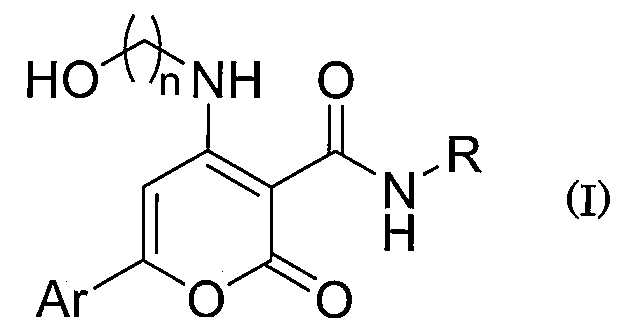
(式中、Arは置換又は無置換の芳香族基であり、Rは置換又は無置換の炭化水素基、又は置換又は無置換の複素環基であり、nは0~3の整数である。)
で示される化合物、その塩又はそれらの溶媒和物。
で示される化合物、その塩又はそれらの溶媒和物。
(2)前記(1)に記載の化合物、その塩又はそれらの溶媒和物を含有する抗HCV薬。
本発明の化合物は、高い抗HCV活性を有し、抗HCV薬として好適に用いることができる。
以下、本発明を詳細に説明する。
本明細書において、置換又は無置換の芳香族基における芳香族基としては、例えばフェニル基、ナフチル基(1-ナフチル基、2-ナフチル基)、アントリル基(1-アントリル基、2-アントリル基、9-アントリル基)、フルオレニル基(1-フルオレニル基、2-フルオレニル基、9-フルオレニル基)、フェナントリル基、ピレニル基、クリセニル基、ペリレニル基、ピセニル基等の芳香族炭化水素基;フリル基、チエニル基、ピロリル基、オキサゾリル基、イソオキサゾリル基、チアゾリル基、イソチアゾリル基、イミダゾリル基、ピラゾリル基、トリアゾリル基(1,2,3-トリアゾリル基、1,2,4-トリアゾリル基)、ピリジル基、ピリミジニル基、ピリダジニル基、ピラジニル基、キノリル基、イソキノリル基、インドリル基、ピリドチエノピリミジン環基等の芳香族複素環基が挙げられる。
前記芳香族基における置換基としては、例えば、メチル基、エチル基、プロピル基、イソプロピル基、ブチル基、イソブチル基、sec-ブチル基、tert-ブチル基、ペンチル基、イソペンチル基、ヘキシル基、シクロプロピル基、シクロブチル基、シクロペンチル基、シクロヘキシル基等のC1-6-アルキル基;メトキシ基、エトキシ基、プロポキシ基、イソプロポキシ基、ブトキシ基、イソブトキシ基、sec-ブトキシ基、tert-ブトキシ基、ペンチルオキシ基、イソペンチルオキシ基、ヘキシルオキシ基、シクロプロピルオキシ基、シクロブチルオキシ基、シクロペンチルオキシ基、シクロヘキシルオキシ基等のC1-6-アルコキシ基;メトキシカルボニル基、エトキシカルボニル基、プロポキシカルボニル基、イソプロポキシカルボニル基、ブトキシカルボニル基、イソブトキシカルボニル基、sec-ブトキシカルボニル基、tert-ブトキシカルボニル基、ペンチルオキシカルボニル基、イソペンチルオキシカルボニル基、シクロプロピルオキシカルボニル基、シクロブチルオキシカルボニル基、シクロペンチルオキシカルボニル基等のC1-6-アルコキシ-カルボニル基;水酸基;フェニル基、トリル基、ナフチル基等の芳香族炭化水素基;フッ素原子、塩素原子、臭素原子、ヨウ素原子等のハロゲン原子;ベンジル基、フェネチル基等のアラルキル基;ホルミル基、アセチル基、プロピオニル基(プロパノイル基)、ブチリル基(ブタノイル基)、バレリル基(ペンタノイル基)、ヘキサノイル基等のC1-6-脂肪族アシル基;ベンゾイル基、トルオイル基等の芳香族アシル基(アロイル基);アラルキルオキシ基、カルボキシル基、C1-6-アルキルアミノ基、ジC1-6-アルキルアミノ基が挙げられる。
置換された芳香族基としては、例えば4-メチルフェニル基(p-トリル基)、3-メチルフェニル基(m-トリル基)、2-メチルフェニル基(o-トリル基)、4-エチルフェニル基、3-エチルフェニル基、2-エチルフェニル基、4-n-プロピルフェニル基、4-イソプロピルフェニル基、2-イソプロピルフェニル基、4-n-ブチルフェニル基、4-イソブチルフェニル基、4-sec-ブチルフェニル基、2-sec-ブチルフェニル基、4-tert-ブチルフェニル基、3-tert-ブチルフェニル基、2-tert-ブチルフェニル基、4-n-ペンチルフェニル基、4-イソペンチルフェニル基、2-ネオペンチルフェニル基、4-tert-ペンチルフェニル基、4-n-ヘキシルフェニル基、4-(2-エチルブチル)フェニル基、4-n-ヘプチルフェニル基、4-n-オクチルフェニル基、4-(2-エチルヘキシル)フェニル基、4-tert-オクチルフェニル基、4-n-デシルフェニル基、4-n-ドデシルフェニル基、4-n-テトラデシルフェニル基、4-シクロペンチルフェニル基、4-シクロヘキシルフェニル基、4-(4-メチルシクロヘキシル)フェニル基、4-(4-tert-ブチルシクロヘキシル)フェニル基、3-シクロヘキシルフェニル基、2-シクロヘキシルフェニル基、4-エチル-1-ナフチル基、6-n-ブチル-2-ナフチル基、2,4-ジメチルフェニル基、2,5-ジメチルフェニル基、3,4-ジメチルフェニル基、3,5-ジメチルフェニル基、2,6-ジメチルフェニル基、2,4-ジエチルフェニル基、2,3,5-トリメチルフェニル基、2,3,6-トリメチルフェニル基、3,4,5-トリメチルフェニル基、2,6-ジエチルフェニル基、2,5-ジイソプロピルフェニル基、2,6-ジイソブチルフェニル基、2,4-ジ-tert-ブチルフェニル基、2,5-ジ-tert-ブチルフェニル基、4,6-ジ-tert-ブチル-2-メチルフェニル基、5-tert-ブチル-2-メチルフェニル基、4-tert-ブチル-2,6-ジメチルフェニル基、9-メチル-2-フルオレニル基、9-エチル-2-フルオレニル基、9-n-ヘキシル-2-フルオレニル基、9,9-ジメチル-2-フルオレニル基、9,9-ジエチル-2-フルオレニル基、9,9-ジ-n-プロピル-2-フルオレニル基、4-メトキシフェニル基、3-メトキシフェニル基、2-メトキシフェニル基、4-エトキシフェニル基、3-エトキシフェニル基、2-エトキシフェニル基、4-n-プロポキシフェニル基、3-n-プロポキシフェニル基、4-イソプロポキシフェニル基、2-イソプロポキシフェニル基、4-n-ブトキシフェニル基、4-イソブトキシフェニル基、2-sec-ブトキシフェニル基、4-n-ペンチルオキシフェニル基、4-イソペンチルオキシフェニル基、2-イソペンチルオキシフェニル基、4-ネオペンチルオキシフェニル基、2-ネオペンチルオキシフェニル基、4-n-ヘキシルオキシフェニル基、2-(2-エチルブチル)オキシフェニル基、4-n-オクチルオキシフェニル基、4-n-デシルオキシフェニル基、4-n-ドデシルオキシフェニル基、4-n-テトラデシルオキシフェニル基、4-シクロヘキシルオキシフェニル基、2-シクロヘキシルオキシフェニル基、2-メトキシ-1-ナフチル基、4-メトキシ-1-ナフチル基、4-n-ブトキシ-1-ナフチル基、5-エトキシ-1-ナフチル基、6-メトキシ-2-ナフチル基、6-エトキシ-2-ナフチル基、6-n-ブトキシ-2-ナフチル基、6-n-ヘキシルオキシ-2-ナフチル基、7-メトキシ-2-ナフチル基、7-n-ブトキシ-2-ナフチル基、2-メチル-4-メトキシフェニル基、2-メチル-5-メトキシフェニル基、3-メチル-4-メトキシフェニル基、3-メチル-5-メトキシフェニル基、3-エチル-5-メトキシフェニル基、2-メトキシ-4-メチルフェニル基、3-メトキシ-4-メチルフェニル基、2,4-ジメトキシフェニル基、2,5-ジメトキシフェニル基、2,6-ジメトキシフェニル基、3,4-ジメトキシフェニル基、3,5-ジメトキシフェニル基、3,5-ジエトキシフェニル基、3,5-ジ-n-ブトキシフェニル基、2-メトキシ-4-エトキシフェニル基、2-メトキシ-6-エトキシフェニル基、3,4,5-トリメトキシフェニル基、4-ヒドロキシフェニル基、3-ヒドロキシフェニル基、2-ヒドロキシフェニル基、4-メトキシカルボニルフェニル基、3-メトキシカルボニルフェニル基、2-メトキシカルボニルフェニル基、4-ビフェニリル基、3-ビフェニリル基、2-ビフェニリル基、4-(4-メチルフェニル)フェニル基、4-(3-メチルフェニル)フェニル基、4-(4-メトキシフェニル)フェニル基、4-(4-n-ブトキシフェニル)フェニル基、2-(2-メトキシフェニル)フェニル基、4-(4-クロロフェニル)フェニル基、3-メチル-4-フェニルフェニル基、3-メトキシ-4-フェニルフェニル基、ターフェニル基、3,5-ジフェニルフェニル基、10-フェニル-9-アントリル基、10-(3,5-ジフェニルフェニル)-9-アントリル基、9-フェニル-2-フルオレニル基、4-フルオロフェニル基、3-フルオロフェニル基、2-フルオロフェニル基、4-クロロフェニル基、3-クロロフェニル基、2-クロロフェニル基、4-ブロモフェニル基、2-ブロモフェニル基、4-クロロ-1-ナフチル基、4-クロロ-2-ナフチル基、6-ブロモ-2-ナフチル基、2,3-ジフルオロフェニル基、2,4-ジフルオロフェニル基、2,5-ジフルオロフェニル基、2,6-ジフルオロフェニル基、3,4-ジフルオロフェニル基、3,5-ジフルオロフェニル基、2,3-ジクロロフェニル基、2,4-ジクロロフェニル基、2,5-ジクロロフェニル基、3,4-ジクロロフェニル基、3,5-ジクロロフェニル基、2,5-ジブロモフェニル基、2,4,6-トリクロロフェニル基、2,4-ジクロロ-1-ナフチル基、1,6-ジクロロ-2-ナフチル基、2-フルオロ-4-メチルフェニル基、2-フルオロ-5-メチルフェニル基、3-フルオロ-2-メチルフェニル基、3-フルオロ-4-メチルフェニル基、2-メチル-4-フルオロフェニル基、2-メチル-5-フルオロフェニル基、3-メチル-4-フルオロフェニル基、2-クロロ-4-メチルフェニル基、2-クロロ-5-メチルフェニル基、2-クロロ-6-メチルフェニル基、2-メチル-3-クロロフェニル基、2-メチル-4-クロロフェニル基、3-クロロ-4-メチルフェニル基、3-メチル-4-クロロフェニル基、2-クロロ-4,6-ジメチルフェニル基、2-メトキシ-4-フルオロフェニル基、2-フルオロ-4-メトキシフェニル基、2-フルオロ-4-エトキシフェニル基、2-フルオロ-6-メトキシフェニル基、3-フルオロ-4-エトキシフェニル基、3-クロロ-4-メトキシフェニル基、2-メトキシ-5-クロロフェニル基、3-メトキシ-6-クロロフェニル基、5-クロロ-2,4-ジメトキシフェニル基等を挙げることができるが、これらに限定されるものではない。
前記式(I)において、Rで表される炭化水素基は、通常、C1-25-炭化水素基であり、前記の置換又は無置換の芳香族炭化水素基の他、例えば、メチル基、エチル基、プロピル基、イソプロピル基、ブチル基、イソブチル基、sec-ブチル基、tert-ブチル基、ペンチル基、イソペンチル基、ヘキシル基、ヘプチル基、オクチル基、ノニル基、デシル基、ウンデシル基、ドデシル基、トリデシル基、テトラデシル基、ペンタデシル基、ヘキサデシル基、ヘプタデシル基、オクタデシル基、ノナデシル基、イコシル基、ヘンイコシル基等の直鎖状又は分岐状のC1-25-アルキル基;シクロプロピル基、シクロブチル基、シクロペンチル基、シクロヘキシル基、シクロヘプチル基等のC3-25-シクロアルキル基;ビニル基、1-プロペニル基、アリル基、1-ブテニル基、2-ブテニル基、ペンテニル基、ヘキセニル基、オレイル基等のC2-25-アルケニル基;エチニル基、1-プロピニル基、2-プロピニル(プロパルギル)基、3-ブチニル基、ペンチニル基、ヘキシニル基等のC2-25-アルキニル基;ベンジル基、フェネチル基等のアラルキル基;アダマンチル基等の橋かけ環炭化水素基;スピロ炭化水素基;縮合多環式炭化水素基等が挙げられる。前記炭化水素基は、例えば、メトキシ基、エトキシ基、プロポキシ基、イソプロポキシ基、ブトキシ基、イソブトキシ基、sec-ブトキシ基、tert-ブトキシ基、ペンチルオキシ基、イソペンチルオキシ基、ヘキシルオキシ基、シクロプロピルオキシ基、シクロブチルオキシ基、シクロペンチルオキシ基、シクロヘキシルオキシ基等のC1-6-アルコキシ基;メトキシカルボニル基、エトキシカルボニル基、プロポキシカルボニル基、イソプロポキシカルボニル基、ブトキシカルボニル基、イソブトキシカルボニル基、sec-ブトキシカルボニル基、tert-ブトキシカルボニル基、ペンチルオキシカルボニル基、イソペンチルオキシカルボニル基、シクロプロピルオキシカルボニル基、シクロブチルオキシカルボニル基、シクロペンチルオキシカルボニル基等のC1-6-アルコキシ-カルボニル基;水酸基;フェニル基、トリル基、ナフチル基等の芳香族炭化水素基;フッ素原子、塩素原子、臭素原子、ヨウ素原子等のハロゲン原子;C1-6-アシル基、カルボキシル基、アラルキルオキシ基、C1-6-アルキルアミノ基、ジC1-6-アルキルアミノ基で置換されていてもよい。
置換された炭化水素基としては、前記の置換された芳香族炭化水素基の他、例えば2-ヒドロキシエチル基、3-ヒドロキシプロピル基、メトキシカルボニルメチル基等を挙げることができるが、これらに限定されるものではない。
前記式(I)において、nは好ましくは0又は2である。
前記式(I)で示される化合物の塩としては、薬学的に許容される塩が好ましく、例えば、塩酸、硫酸、リン酸、臭化水素酸、ヨウ化水素酸、硝酸、ピロ硫酸、メタリン酸等の無機酸、又はクエン酸、安息香酸、酢酸、プロピオン酸、フマル酸、マレイン酸、スルホン酸(例えば、メタンスルホン酸、p-トルエンスルホン酸、ナフタレンスルホン酸)等の有機酸との塩が挙げられる。また、フェノール性水酸基又はカルボキシル基を有する場合には、ナトリウム塩、カリウム塩等のアルカリ金属塩として用いることもできる。
前記式(I)で示される化合物の溶媒和物としては、例えば水和物が挙げられる。
前記式(I)で示される化合物は、例えば、以下に示すようにして製造することができる。なお、以下の反応式は、前記式(I)において、Arで表される「置換又は無置換の芳香族基」がフェニル基、(例えば、F,Clで)置換されたフェニル基、又はチエニル基であり、nが0又は2である場合を例にとったものである。X及びYは、それぞれ前記式(I)のAr及びRに対応する。

(i) NaH, THF, CS2, MeI, 0℃-rt, 4h;
(ii) NaH, Diethyl malonate, dioxane, 0-70℃, 6h;
(iii) YNH2, HATU, DMF, rt, 6h;
(iv) NH2OH.HCl, NaHCO3, Ethanol, 80℃, 4h.
(ii) NaH, Diethyl malonate, dioxane, 0-70℃, 6h;
(iii) YNH2, HATU, DMF, rt, 6h;
(iv) NH2OH.HCl, NaHCO3, Ethanol, 80℃, 4h.
出発原料として対応するアセトフェノンを用いて、二硫化炭素と反応させ、中間体としてジメルカプト体を形成させた後、ヨウ化メチルを加えてジチオアセタール体(II)を得る。次いで、水素化ナトリウムの存在下、カルバニオン源としてマロン酸ジエチルを用いて、α-ピロンのカルボン酸誘導体(III)を得る。カップリング試薬として、2-(7-アザ-1H-ベンゾトリアゾール-1-イル)-1,1,3,3-テトラメチル・ウロニウム・ヘキサフルオロホスフェート(HATU)を用いて、アミン化合物(YNH2)とα-ピロンのカルボン酸誘導体(III)のカルボキシル基を結合させて、対応するアミド化合物(IV)を得る。アミド化合物(IV)をヒドロキシルアミン塩酸塩及び炭酸水素ナトリウムとともにエタノール中で加熱することにより、目的物質(I)を製造することができる。
前記のようにして得られる生成物を精製するには、通常用いられる手法、例えばシリカゲル等を担体として用いたカラムクロマトグラフィーやメタノール、エタノール、クロロホルム、ジメチルスルホキシド、n-ヘキサン-酢酸エチル、水等を用いた再結晶法によればよい。カラムクロマトグラフィーの溶出溶媒としては、メタノール、エタノール、クロロホルム、アセトン、ヘキサン、ジクロロメタン、酢酸エチル、及びこれらの混合溶媒等が挙げられる。
本発明の化合物の具体例を表1に示す。
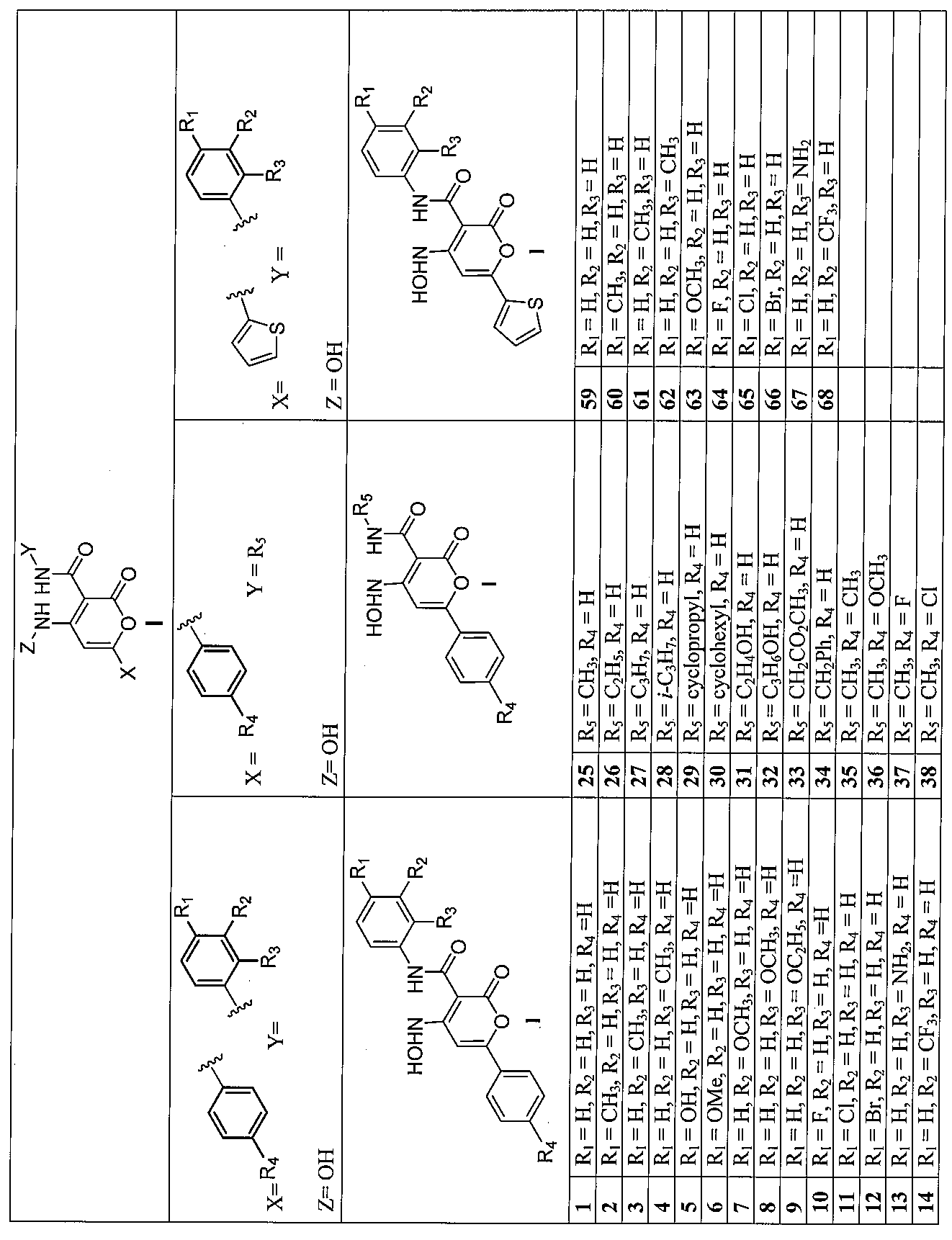
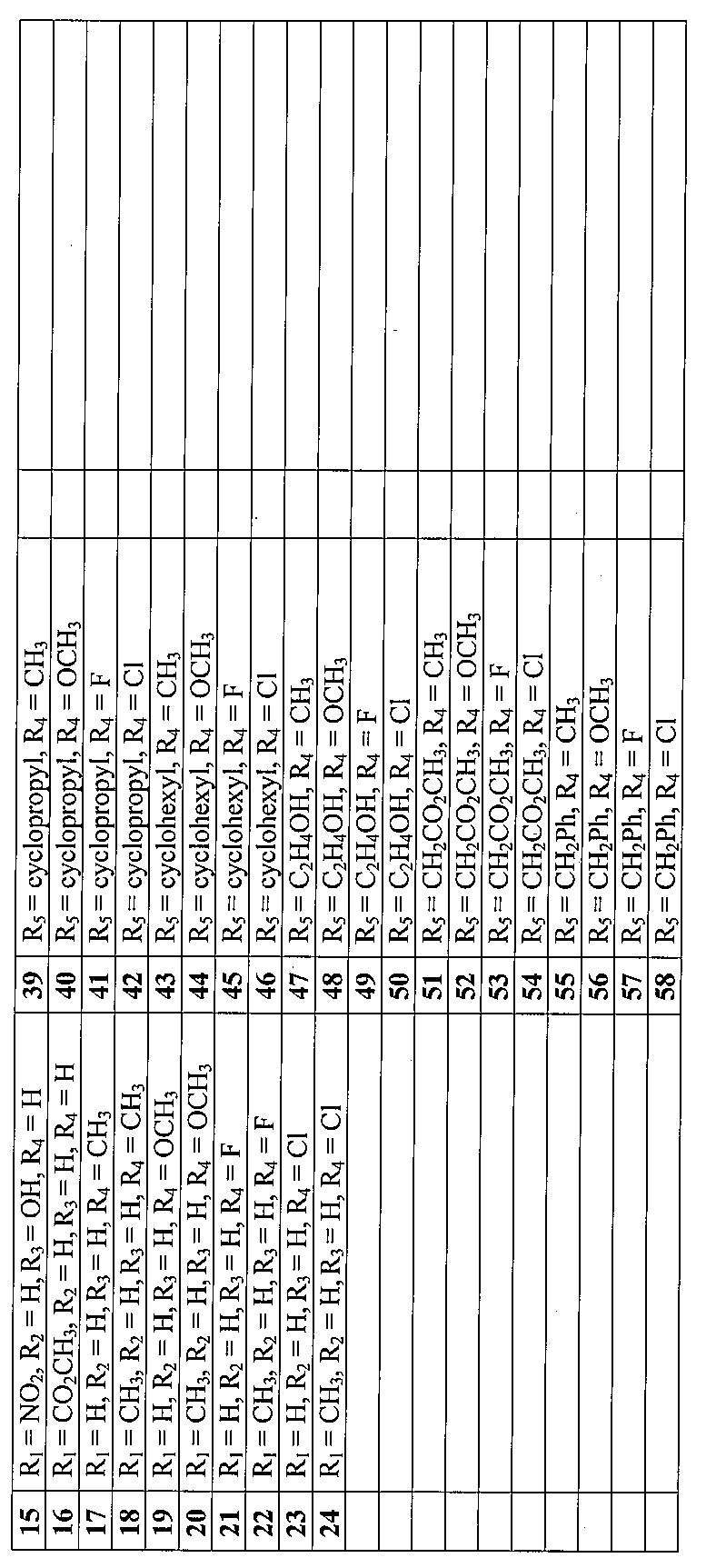

前記の化合物は、抗HCV薬として、慣用の製剤担体と組み合わせて製剤化することができる。投与形態としては、特に限定はなく、必要に応じ適宜選択して使用され、錠剤、カプセル剤、顆粒剤、細粒剤、散剤、徐放性製剤、液剤、懸濁剤、エマルジョン剤、シロップ剤、エリキシル剤等の経口剤、注射剤、坐剤等の非経口剤が挙げられる。
経口剤は、例えばデンプン、乳糖、白糖、マンニット、カルボキシメチルセルロース、無機塩類等を用いて常法に従って製造される。また、これらに加えて、結合剤、崩壊剤、界面活性剤、滑沢剤、流動性促進剤、矯味剤、着色剤、香料等を適宜添加することができる。
結合剤としては、例えばデンプン、デキストリン、アラビアゴム、ゼラチン、ヒドロキシプロピルスターチ、メチルセルロース、カルボキシメチルセルロースナトリウム、ヒドロキシプロピルセルロース、結晶セルロース、エチルセルロース、ポリビニルピロリドン、マクロゴール等が挙げられる。
崩壊剤としては、例えばデンプン、ヒドロキシプロピルスターチ、カルボキシメチルセルロースナトリウム、カルボキシメチルセルロースカルシウム、カルボキシメチルセルロース、低置換ヒドロキシプロピルセルロース等が挙げられる。
界面活性剤としては、例えばラウリル硫酸ナトリウム、大豆レシチン、ショ糖脂肪酸エステル、ポリソルベート80等が挙げられる。
滑沢剤としては、例えばタルク、ロウ類、水素添加植物油、ショ糖脂肪酸エステル、ステアリン酸マグネシウム、ステアリン酸カルシウム、ステアリン酸アルミニウム、ポリエチレングリコール等が挙げられる。
流動性促進剤としては、例えば軽質無水ケイ酸、乾燥水酸化アルミニウムゲル、合成ケイ酸アルミニウム、ケイ酸マグネシウム等が挙げられる。
注射剤は、常法に従って製造され、希釈剤として一般に注射用蒸留水、生理食塩水、ブドウ糖水溶液、オリーブ油、ゴマ油、ラッカセイ油、ダイズ油、トウモロコシ油、プロピレングリコール、ポリエチレングリコール等を用いることができる。更に必要に応じて、殺菌剤、防腐剤、安定剤、等張化剤、無痛化剤等を加えてもよい。また、注射剤は、安定性の観点から、バイアル等に充填後冷凍し、通常の凍結乾燥技術により水分を除去し、使用直前に凍結乾燥物から液剤を再調製することもできる。前記式(I)の化合物の注射剤中における割合は、5~50重量%の間で変動させ得るが、これに限定されるものではない。
その他の非経口剤としては、直腸内投与のための坐剤等が挙げられ、常法に従って製造される。
製剤化した抗HCV薬は、剤形、投与経路等により異なるが、例えば、1日1~4回を1週間から3ヶ月の期間、投与することが可能である。
経口剤として所期の効果を発揮するためには、患者の年令、体重、疾患の程度により異なるが、通常成人の場合、前記式(I)の化合物の重量として、例えば0.1~1000mg、好ましくは1~500mgを、1日数回に分けて服用することが適当である。
非経口剤として所期の効果を発揮するためには、患者の年令、体重、疾患の程度により異なるが、通常成人の場合、前記式(I)の化合物の重量として、例えば0.1~1000mg、好ましくは1~500mgを、静注、点滴静注、皮下注射、筋肉注射により投与することが適当である。
また、本発明の化合物は、HCV感染に対して有効な他の薬剤と組み合わせて使用してもよい。これらは、治療の過程において別々に投与されるか、例えば錠剤、静脈用溶液、又はカプセルのような単一の剤形において、本発明の化合物と組み合わせられる。このような他の薬剤としては、例えば、インターフェロン-α、リバビリン、あるいは、現在臨床試験中の化合物、具体的には、HCVプロテアーゼインヒビター(例えば、ITMN-191(R-7227)、MK-7009、TMC435、Boceprevir(SCH503034)、Telaprevir等)、RNAポリメラーゼインヒビター(例えば、R7128、VCH-759、Valopicitabine等)、DEBIO-025(シクロフィリンインヒビター)、Celgosivir(グルコシダーゼIインヒビター)、BMS-790052(NS5Aインヒビター)等が挙げられる。
以下、実施例により本発明を更に具体的に説明するが、本発明の範囲はこれらに限定されるものではない。
[実施例1]
(1)ジチオアセタール体(II)の製造
水素化ナトリウム(166.4mmol)のTHF懸濁液を0℃で撹拌し、対応するアセトフェノン(83.2mmol)を滴下した。この懸濁液を0℃で30分間撹拌した。二硫化炭素(91.5mmol)を滴下し、0℃で更に30分間撹拌した。ヨウ化メチル(208.0mmol)を0℃で滴下した後、冷却を止め、反応混合物をゆっくりと室温に戻した。室温で4時間撹拌し、TLCで反応が終了したことを確認した。反応混合物を氷水に注ぎ、酢酸エチルで抽出し、無水硫酸ナトリウムで乾燥し、減圧下で溶媒を留去して、ジチオアセタール体(II)を得た。ジチオアセタール体(II)をn-ヘキサンと酢酸エチルの混合溶媒で再結晶して、精製品を得た。
(1)ジチオアセタール体(II)の製造
水素化ナトリウム(166.4mmol)のTHF懸濁液を0℃で撹拌し、対応するアセトフェノン(83.2mmol)を滴下した。この懸濁液を0℃で30分間撹拌した。二硫化炭素(91.5mmol)を滴下し、0℃で更に30分間撹拌した。ヨウ化メチル(208.0mmol)を0℃で滴下した後、冷却を止め、反応混合物をゆっくりと室温に戻した。室温で4時間撹拌し、TLCで反応が終了したことを確認した。反応混合物を氷水に注ぎ、酢酸エチルで抽出し、無水硫酸ナトリウムで乾燥し、減圧下で溶媒を留去して、ジチオアセタール体(II)を得た。ジチオアセタール体(II)をn-ヘキサンと酢酸エチルの混合溶媒で再結晶して、精製品を得た。
(2)α-ピロンカルボン酸誘導体(III)の製造
水素化ナトリウム(33.4mmol)のTHF懸濁液を撹拌し、マロン酸ジエチル(14.7mmol)を滴下し、30分間撹拌した。ジチオアセタール体(II)(13.3mmol)を加え、反応混合物を室温で30分間撹拌した。反応混合物を70℃で6時間加熱し、TLCで反応が終了したことを確認した。反応混合物を氷水に注ぎ、酢酸エチルで抽出した。酢酸エチル層を除去した。水層を1.5N塩酸で中和し、得られた沈殿物を濾取し、ジクロロメタンに溶解し、無水硫酸ナトリウムで乾燥し、減圧下で溶媒を留去して、α-ピロンカルボン酸誘導体(III)を得た。
水素化ナトリウム(33.4mmol)のTHF懸濁液を撹拌し、マロン酸ジエチル(14.7mmol)を滴下し、30分間撹拌した。ジチオアセタール体(II)(13.3mmol)を加え、反応混合物を室温で30分間撹拌した。反応混合物を70℃で6時間加熱し、TLCで反応が終了したことを確認した。反応混合物を氷水に注ぎ、酢酸エチルで抽出した。酢酸エチル層を除去した。水層を1.5N塩酸で中和し、得られた沈殿物を濾取し、ジクロロメタンに溶解し、無水硫酸ナトリウムで乾燥し、減圧下で溶媒を留去して、α-ピロンカルボン酸誘導体(III)を得た。
(3)アミド化合物(IV)の製造
α-ピロンカルボン酸誘導体(III)(3.8mmol)のDMF溶液に室温で2-(7-アザ-1H-ベンゾトリアゾール-1-イル)-1,1,3,3-テトラメチル・ウロニウム・ヘキサフルオロホスフェート(HATU)(4.1mmol)及びジイソプロピルエチルアミン(11.4mmol)を加え、15分間撹拌した。アミン化合物(YNH2)(3.8mmol)を加え、室温で6時間撹拌し、TLCで反応が終了したことを確認した。反応混合物を撹拌しながら氷水に注いだ。得られた沈殿物を濾取し、n-ヘキサンと酢酸エチルの混合溶媒で再結晶して、アミド化合物(IV)を得た。
α-ピロンカルボン酸誘導体(III)(3.8mmol)のDMF溶液に室温で2-(7-アザ-1H-ベンゾトリアゾール-1-イル)-1,1,3,3-テトラメチル・ウロニウム・ヘキサフルオロホスフェート(HATU)(4.1mmol)及びジイソプロピルエチルアミン(11.4mmol)を加え、15分間撹拌した。アミン化合物(YNH2)(3.8mmol)を加え、室温で6時間撹拌し、TLCで反応が終了したことを確認した。反応混合物を撹拌しながら氷水に注いだ。得られた沈殿物を濾取し、n-ヘキサンと酢酸エチルの混合溶媒で再結晶して、アミド化合物(IV)を得た。
(4)本発明化合物(I)の製造
アミド化合物(IV)(0.56mmol)のエタノール溶液を撹拌し、室温でヒドロキシルアミン塩酸塩(1.42mmol)及び炭酸水素ナトリウム(1.13mmol)を加え、80℃で4時間還流させた。TLCで反応が終了したことを確認し、減圧下で溶媒を留去した。残渣に氷水を加え、得られた沈殿物を濾取し、熱気オーブン中50℃で乾燥した。粗精製物をカラムクロマトグラフィーで精製し、本発明化合物(I)を得た。
アミド化合物(IV)(0.56mmol)のエタノール溶液を撹拌し、室温でヒドロキシルアミン塩酸塩(1.42mmol)及び炭酸水素ナトリウム(1.13mmol)を加え、80℃で4時間還流させた。TLCで反応が終了したことを確認し、減圧下で溶媒を留去した。残渣に氷水を加え、得られた沈殿物を濾取し、熱気オーブン中50℃で乾燥した。粗精製物をカラムクロマトグラフィーで精製し、本発明化合物(I)を得た。
このようにして得られた本発明の化合物の化合物名及び物性を以下に示す。
4-(hydroxyamino)-2-oxo-6-phenyl-N-p-tolyl-2H-pyran-3-carboxamide (2)
黄色結晶粉末; 収率 68 %; mp 211-212℃; IR (KBr) (ν, cm-1) 3122 (OH), 1658 (C=O); UV/Vis (λmax, nm): 224, 320, 360; Mass [M++1]=336.9; 1H NMR: (400 MHz, DMSO-d6): δ 2.27 (s, 3H, Me), 7.14-7.16 (d, J=8.4 Hz, 2H, ArH), 7.20 (s, 1H, pyranone), 7.48-7.50 (d, J=8 Hz, 2H, ArH), 7.57-7.59 (m, 3H, ArH), 7.93-7.96 (m, 2H, ArH), 10.59 (s, 1H, NH amide), 11.26 (s, 1H, OH), 12.45 (s, 1H, NH); 13C NMR: (400 MHz, DMSO-d6): δ 20.8, 82.6, 92.01, 120.27, 126.46, 129.68, 129.77, 130.87, 132.23, 132.97, 136.12, 158.74, 159.95, 163.22, 166.36.
4-(hydroxyamino)-2-oxo-N,6-diphenyl-2H-pyran-3-carboxamide (1)
淡緑色結晶粉末; 収率 80 %; mp 216-217℃ ; IR (KBr) (ν, cm-1) 3140 (NH-stretching), 1687 (C=O stretching); Mass [M++1]=322.8; 1H NMR : (400 MHz, DMSO-d6): δ 7.07-7.11 (m, J=16 Hz, 1H-aromatic), 7.21 (s, 1H-pyranone), 7.32-7.36 (m, J=16 Hz, 2H-aromatic), 7.57-7.62 (m, 5H-aromatic), 7.94-7.95 (m, J=4 Hz, 2H-aromatic), 10.62 (s, 1H-NH amide), 11.35 (s, 1H-NH hydroxyl), 12.44 (s, 1H-OH).
N-(4-fluorophenyl)-4-(hydroxyamino)-2-oxo-6-phenyl-2H-pyran-3-carboxamide (10)
灰白色粉末; 収率 75 %; mp 230-231℃ ; IR (KBr) (ν, cm-1) 3153 (NH-stretching), 1660 (C=O stretching); Mass [M++1]=340.9; 1H NMR : (400 MHz, DMSO-d6): δ 7.15-7.20 (m, J=20 Hz, 3H-aromatic and pyranone), 7.57-7.65 (m, 5H-aromatic), 7.93-7.95 (m, 2H-aromatic), 10.6 (s, 1H-NH amide), 11.31 (s, 1H-NH hydroxyl), 12.40 (s, 1H-OH).
N-(4-chlorophenyl)-4-(hydroxyamino)-2-oxo-6-phenyl-2H-pyran-3-carboxamide (11)
淡緑色粉末; 収率 73 %; mp 239-240℃ ; IR (KBr) (ν, cm-1) 3122 (NH-stretching), 1664 (C=O stretching); Mass [M+]=356.8; 1H NMR : (400 MHz, DMSO-d6): δ 7.21 (s, 1H-pyranone), 7.38-7.40 (d, 2H-aromatic), 7.57-7.66 (m, 5H-aromatic), 7.93-7.95 (d, 2H-aromatic), 10.63 (s, 1H-NH amide), 11.40 (s, 1H-NH hydroxyl), 12.37 (s, 1H-OH).
N-(4-bromophenyl)-4-(hydroxyamino)-2-oxo-6-phenyl-2H-pyran-3-carboxamide (12)
白色粉末; 収率 70 %; mp 250-251℃ ; IR (KBr) (ν, cm-1) 3259 (NH-stretching), 1678 (C=O stretching); Mass [M++2]=402.9; 1H NMR : (400 MHz, DMSO-d6): δ 7.21 (s, 1H-pyranone), 7.50-7.61 (m, 7H-aromatic), 7.93-7.95 (d, 2H-aromatic), 10.6 (s, 1H-NH amide), 11.40 (s, 1H-NH hydroxyl), 12.36 (s, 1H-OH).
4-(hydroxyamino)-N-(4-hydroxyphenyl)-2-oxo-6-phenyl-2H-pyran-3-carboxamide (5)
淡黄色粉末; 収率 63 %; mp 224-225℃ ; IR (KBr) (ν, cm-1) 3495 (NH-stretching), 3259 (OH-stretching), 1666 (C=O stretching); Mass [M++1]=339.0; 1H NMR : (400 MHz, DMSO-d6): δ 6.72-6.74(d, 2H-aromatic), 7.19 (s,1H-pyranone), 7.37-7.39 (d, 2H-aromatic), 7.57-7.66 (s, 3H-aromatic), 7.93 (s, 2H-aromatic), 9.27 (s, 1H-NH amide), 11.08 (s, 1H-NH hydroxyl), 12.49 (s, 1H-OH).
4-(hydroxyamino)-N-(4-methoxyphenyl)-2-oxo-6-phenyl-2H-pyran-3-carboxamide (6)
淡黄色粉末; 収率 78 %; mp 194-195℃ ; IR (KBr) (ν, cm-1) 3516 (NH-stretching), 3199 (OH-stretching), 1670 (C=O stretching); Mass [M++1]=353.0; 1H NMR : (400 MHz, DMSO-d6): δ 3.74 (s, 3H-O methyl), 6.90-6.93 (d, 2H-aromatic), 7.20 (s, 1H-pyranone), 7.51-7.58 (m, 5H-aromatic), 7.93-7.95 (d, 2H-aromatic), 10.6 (s, 1H-NH amide), 11.18 (s, 1H-NH hydroxyl), 12.46 (s, 1H-OH).
4-(hydroxyamino)-2-oxo-6-phenyl-N-m-tolyl-2H-pyran-3-carboxamide (3)
灰白色粉末; 収率 78 %; mp 207-208℃ ; IR (KBr) (ν, cm-1) 3122 (NH-stretching), 1658 (C=O stretching); Mass [M++1]=337.1; 1H NMR : (400 MHz, DMSO-d6): δ 2.30 (s, 3H-toluidine methyl), 6.89-6.91 (m, 1H-pyranone), 7.20-7.22 (m, 2H-aromatic), 7.40-7.44 (m, 2H-aromatic), 7.56-7.58 (m, 3H-aromatic), 7.93-7.95 (m, 2H-aromatic), 10.60 (s, 1H-NH amide), 11.31 (s, 1H-NH hydroxyl), 12.44 (s, 1H-OH).
4-(hydroxyamino)-2-oxo-6-phenyl-N-o-tolyl-2H-pyran-3-carboxamide (4)
黄色粉末; 収率 75 % ; mp 229-230℃ ; IR (KBr) (ν, cm-1) 3055 (OH-stretching), 1664 (C=O stretching) ; Mass [M++1]=337.0 ; 1H NMR : (400 MHz, DMSO-d6): δ 2.30 (s, 3H-toluidine methyl), 7.00-7.03 (m, 1H-pyranone), 7.17-7.25 (m, 3H-aromatic), 7.56-7.60 (m, 3H-aromatic), 7.94-7.96 (m, 2H-aromatic), 8.14-8.16 (m, 1H-aromatic), 10.60 (s, 1H-NH amide), 11.26 (s, 1H-NH hydroxyl), 12.48 (s, 1H-OH).
Methyl 4-(4-(hydroxyamino)-2-oxo-6-phenyl-2H-pyran-3-carboxamido)benzoate (16)
灰白色粉末; 収率 74 % ; mp 225-226℃ ; IR (KBr) (ν, cm-1) 3194 (OH-stretching), 1672 (C=O stretching) ; Mass [M++1]=380.9 ; 1H NMR : (400 MHz, DMSO-d6): δ 3.83 (s, 3H-ester methyl), 7.22 (s, 1H-pyranone), 7.55-7.60 (m, 3H-aromatic), 7.75-7.77 (m, 2H-aromatic), 7.93-7.95 (m, 4H-aromatic), 10.69 (s, 1H-NH amide), 11.63 (s, 1H-NH hydroxyl), 12.36 (s, 1H-OH).
4-(hydroxyamino)-N-methyl-2-oxo-6-phenyl-2H-pyran-3-carboxamide (25)
淡黄色粉末; 収率 75 %; mp 226-227℃; IR (KBr) (ν, cm-1) 3284 (NH-stretching), 3176 (OH-stretching), 1687 (C=O stretching); Mass[M++1]=260.9; 1H NMR : (400 MHz, DMSO-d6): δ 2.77-2.78 (d, J=4 Hz, 3H-methyl), 7.12 (s, 1H-pyranone), 7.54-7.58 (m, J=16 Hz, 3H-aromatic), 7.90-7.92 (m, 8 Hz, 2H-aromatic), 8.96-8.97 (q, J=4 Hz, 1H-NH amide), 10.4 (s, 1H-NH hydroxyl), 12.6 (s, 1H-OH).
N-ethyl-4-(hydroxyamino)-2-oxo-6-phenyl-2H-pyran-3-carboxamide (26)
黄色結晶粉末 ; 収率 70 % ; mp 215-216℃ ; IR (KBr) (ν, cm-1) 3161 (OH-stretching), 1680 (C=O stretching) ; Mass [M++1]=275.0 ; 1H NMR : (400 MHz, DMSO-d6): δ 1.11-1.12 (t, 3H-methyl), 3.25-3.29(q, 2H-methylene), 7.12 (s, 1H-pyranone), 7.55-7.57 (m, 3H-aromatic), 7.90-7.92 (m, 2H-aromatic), 9.07-9.08 (t, 1H-NH amide), 10.40 (s, 1H-NH hydroxyl), 12.64 (s, 1H-OH).
4-(hydroxyamino)-2-oxo-6-phenyl-N-propyl-2H-pyran-3-carboxamide (27)
灰白色粉末; 収率 75 % ; mp 188-189℃ ; IR (KBr) (ν, cm-1) 3068 (OH-stretching), 1680 (C=O stretching) ; Mass [M++1]=289.1 ; 1H NMR : (400 MHz, DMSO-d6): δ 0.87-0.91 (t, 3H-methyl), 1.47-1.51 (m, 2H-methylene), 3.21-3.22 (t, 2H-methylene), 7.12 (s, 1H-pyranone), 7.54-7.56 (m, 3H-aromatic), 7.90-7.92 (m, 2H-aromatic), 9.11-9.14 (t, 1H-NH amide), 10.40 (s, 1H-NH hydroxyl), 12.63 (s, 1H-OH).
4-(hydroxyamino)-N-isopropyl-2-oxo-6-phenyl-2H-pyran-3-carboxamide (28)
淡黄色粉末; 収率 75 % ; mp 225-226℃ ; IR (KBr) (ν, cm-1) 3126 (OH-stretching), 1683 (C=O stretching) ; Mass [M++1]=289.1 ; 1H NMR : (400 MHz, DMSO-d6): δ 1.14-1.16 (d, 6H-dimethyl), 3.97-4.02 (m, 1H-methine), 7.12 (s, 1H-pyranone), 7.55-7.56 (m, 3H-aromatic), 7.90-7.91 (m, 2H-aromatic), 8.99-9.01 (d, 1H-NH amide), 10.40 (s, 1H-NH hydroxyl), 12.64 (s, 1H-OH).
N-cyclopropyl-4-(hydroxyamino)-2-oxo-6-phenyl-2H-pyran-3-carboxamide (29)
白色粉末; 収率 85%; mp: 210-211℃; Mass [M+] = 286.6; 1H NMR (400 MHz, DMSO-d6): δ 0.46-0.49 (q, J=15.2 Hz, 2H, CH2), 0.69-0.73 (q, J=18.4 Hz, 2H, CH2), 2.72-2.77 (m, 1H, CH), 7.12 (s, 1H, pyranone), 7.52-7.59 (m, 3H, ArH), 7.89-7.91 (d, J=7.6 Hz, 2H, ArH), 9.05-9.06 (d, J=3.6 Hz, 1H, NH amide), 10.56 (bs, 1H,OH), 12.58 (bs, 1H, NH).
N-cyclohexyl-4-(hydroxyamino)-2-oxo-6-phenyl-2H-pyran-3-carboxamide (30)
白色粉末; 収率 85%; mp: 184-185℃; Mass [M+] = 328.70; 1H NMR (400 MHz, DMSO-d6): δ 1.24-1.38 (m, 5H, CH2), 1.51-1.53 (m, 1H, CH2), 1.63-1.68 (m, 2H, CH2), 1.80-1.86 (m, 2H, CH2), 3.73-3.75 (m, 1H, CH), 7.13 (s, 1H, Pyranone), 7.55-7.57 (m, 3H, ArH), 7.90-7.92 (d, J=6.8 Hz, 2H, ArH), 9.12-9.13 (d, J=7.2 Hz, 1H, NH amide), 10.43 (s, 1H,OH), 12.63 (s, 1H, NH); 1H D2O EXG NMR (400 MHz, DMSO-d6): δ 1.19-1.31 (m, 5H, CH2), 1.46-1.49 (m, 1H, CH2), 1.56-1.72 (m, 2H, CH2), 1.76-1.80 (m, 2H, CH2), 3.68-3.71 (m, 1H, CH), 7.06 (s, 1H, Pyranone), 7.52-7.53 (m, 3H, ArH), 7.84-7.85 (d, J=6.4 Hz, 2H, ArH); 13C NMR (400 MHz, DMSO-d6): δ 24.59, 25.57, 32.77, 47.08, 82.06, 91.72, 126.32, 129.61, 130.98, 132.05, 158.94, 159.80, 162.76, 167.19.
4-(hydroxyamino)-N-(2-hydroxyethyl)-2-oxo-6-phenyl-2H-pyran-3-carboxamide (31)
淡黄色粉末; 収率 65 % ; mp 200-201℃ ; IR (KBr) (ν, cm-1) 3219 (OH-stretching), 1678 (C=O stretching) ; Mass [M++1]=291.0 ; 1H NMR : (400 MHz, DMSO-d6): δ 3.33-3.35 (t, 2H-methylene-NH), 3.50-3.53 (t, 2H-methylene-OH), 4.77-4.79 (t, 1H-OH), 7.12 (s, 1H-pyranone), 7.55-7.57 (m, 3H-aromatic), 7.90-7.92 (m, 2H-aromatic), 9.21-9.24 (t, 1H-NH amide), 10.41 (s, 1H-NH hydroxyl), 12.62 (s, 1H-OH).
4-(hydroxyamino)-N-(3-hydroxypropyl)-2-oxo-6-phenyl-2H-pyran-3-carboxamide (32)
白色粉末; 収率 68 % ; mp 194-195℃ ; IR (KBr) (ν, cm-1) 3182 (OH-stretching), 1685 (C=O stretching) ; Mass [M++1]=305.0 ; 1H NMR : (400 MHz, DMSO-d6): δ 1.64-1.67 (m, 2H-methylene), 3.29-3.33 (t, 2H-methylene-NH), 3.45-3.48 (t, 2H-methylene-OH), 4.50-4.52 (t, 1H-OH), 7.12 (s, 1H-pyranone), 7.55-7.57 (m, 3H-aromatic), 7.90-7.92 (m, 2H-aromatic), 9.12-9.14 (t, 1H-NH amide), 10.40 (s, 1H-NH hydroxyl), 12.62 (s, 1H-OH).
N-benzyl-4-(hydroxyamino)-2-oxo-6-phenyl-2H-pyran-3-carboxamide (34)
白色粉末; 収率 70 % ; mp 214-215℃; IR (KBr) (ν, cm-1) 3199 (OH-stretching), 1678 (C=O streching); Mass [M++1]=337.1 ; 1H NMR : (400 MHz, DMSO-d6) : δ 4.48-4.49 (d, 2H-benzyl), 7.14 (s, 1H-pyranone), 7.25-7.33 (m, 5H-Ar), 7.55-7.57 (m, 3H-Ar), 7.91-7.92 (m, 2H-aromatic), 9.50 (s, 1H-NH amide), 10.44 (s, 1H-NH hydroxyl), 12.56 (s, 1H-OH).
Methyl 2-(4-(hydroxyamino)-2-oxo-6-phenyl-2H-pyran-3-carboxamido)acetate (33)
灰白色粉末; 収率 70 % ; mp 202-204℃ ; IR (KBr) (ν, cm-1) 3178 (OH-stretching), 1672 (C=O stretching); Mass [M++1]=319.0 ; 1H NMR : (400 MHz, DMSO-d6) : δ 3.65 (s, 3H-methyl ester), 4.06-4.07 (d, 2H-methylene), 7.13 (s, 1H-pyranone), 7.53-7.59 (m, 3H-Ar), 7.91-7.93 (d, J= 4 Hz, 2H-aromatic), 9.35-9.38 (t, J= 6 Hz, 1H-NH amide), 10.46 (s, 1H-NH hydroxyl), 12.42 (s, 1H-OH).
4-(hydroxyamino)-N-(4-methoxyphenyl)-2-oxo-6-(thiophen-2-yl)-2H-pyran-3-carboxamide (63)
淡黄色粉末; 収率: 90%; mp: 196-198℃; IR (KBr) (n, cm-1) 3210 (OH -Stretching); 1689 (C=O Stretching); Mass [M++1] = 359.80; 1H NMR: (400 MHz, DMSO-d6): δ 3.79 (s, 3H, OCH3), 6.90-6.92 (dd, J=8 Hz, 2H, ArH), 7.0 (s, 1H, Pyran), 7.2-7.4 (m, 1H, Thiophene), 7.5 (dd, J=8 Hz, 2H, Ar H), 7.93-7.96 (m, 2H, Thiophene), 10.5 (s, NH amide), 11.0 (s, 1H, NH), 12.4 (s, 1H, OH).
黄色結晶粉末; 収率 68 %; mp 211-212℃; IR (KBr) (ν, cm-1) 3122 (OH), 1658 (C=O); UV/Vis (λmax, nm): 224, 320, 360; Mass [M++1]=336.9; 1H NMR: (400 MHz, DMSO-d6): δ 2.27 (s, 3H, Me), 7.14-7.16 (d, J=8.4 Hz, 2H, ArH), 7.20 (s, 1H, pyranone), 7.48-7.50 (d, J=8 Hz, 2H, ArH), 7.57-7.59 (m, 3H, ArH), 7.93-7.96 (m, 2H, ArH), 10.59 (s, 1H, NH amide), 11.26 (s, 1H, OH), 12.45 (s, 1H, NH); 13C NMR: (400 MHz, DMSO-d6): δ 20.8, 82.6, 92.01, 120.27, 126.46, 129.68, 129.77, 130.87, 132.23, 132.97, 136.12, 158.74, 159.95, 163.22, 166.36.
4-(hydroxyamino)-2-oxo-N,6-diphenyl-2H-pyran-3-carboxamide (1)
淡緑色結晶粉末; 収率 80 %; mp 216-217℃ ; IR (KBr) (ν, cm-1) 3140 (NH-stretching), 1687 (C=O stretching); Mass [M++1]=322.8; 1H NMR : (400 MHz, DMSO-d6): δ 7.07-7.11 (m, J=16 Hz, 1H-aromatic), 7.21 (s, 1H-pyranone), 7.32-7.36 (m, J=16 Hz, 2H-aromatic), 7.57-7.62 (m, 5H-aromatic), 7.94-7.95 (m, J=4 Hz, 2H-aromatic), 10.62 (s, 1H-NH amide), 11.35 (s, 1H-NH hydroxyl), 12.44 (s, 1H-OH).
N-(4-fluorophenyl)-4-(hydroxyamino)-2-oxo-6-phenyl-2H-pyran-3-carboxamide (10)
灰白色粉末; 収率 75 %; mp 230-231℃ ; IR (KBr) (ν, cm-1) 3153 (NH-stretching), 1660 (C=O stretching); Mass [M++1]=340.9; 1H NMR : (400 MHz, DMSO-d6): δ 7.15-7.20 (m, J=20 Hz, 3H-aromatic and pyranone), 7.57-7.65 (m, 5H-aromatic), 7.93-7.95 (m, 2H-aromatic), 10.6 (s, 1H-NH amide), 11.31 (s, 1H-NH hydroxyl), 12.40 (s, 1H-OH).
N-(4-chlorophenyl)-4-(hydroxyamino)-2-oxo-6-phenyl-2H-pyran-3-carboxamide (11)
淡緑色粉末; 収率 73 %; mp 239-240℃ ; IR (KBr) (ν, cm-1) 3122 (NH-stretching), 1664 (C=O stretching); Mass [M+]=356.8; 1H NMR : (400 MHz, DMSO-d6): δ 7.21 (s, 1H-pyranone), 7.38-7.40 (d, 2H-aromatic), 7.57-7.66 (m, 5H-aromatic), 7.93-7.95 (d, 2H-aromatic), 10.63 (s, 1H-NH amide), 11.40 (s, 1H-NH hydroxyl), 12.37 (s, 1H-OH).
N-(4-bromophenyl)-4-(hydroxyamino)-2-oxo-6-phenyl-2H-pyran-3-carboxamide (12)
白色粉末; 収率 70 %; mp 250-251℃ ; IR (KBr) (ν, cm-1) 3259 (NH-stretching), 1678 (C=O stretching); Mass [M++2]=402.9; 1H NMR : (400 MHz, DMSO-d6): δ 7.21 (s, 1H-pyranone), 7.50-7.61 (m, 7H-aromatic), 7.93-7.95 (d, 2H-aromatic), 10.6 (s, 1H-NH amide), 11.40 (s, 1H-NH hydroxyl), 12.36 (s, 1H-OH).
4-(hydroxyamino)-N-(4-hydroxyphenyl)-2-oxo-6-phenyl-2H-pyran-3-carboxamide (5)
淡黄色粉末; 収率 63 %; mp 224-225℃ ; IR (KBr) (ν, cm-1) 3495 (NH-stretching), 3259 (OH-stretching), 1666 (C=O stretching); Mass [M++1]=339.0; 1H NMR : (400 MHz, DMSO-d6): δ 6.72-6.74(d, 2H-aromatic), 7.19 (s,1H-pyranone), 7.37-7.39 (d, 2H-aromatic), 7.57-7.66 (s, 3H-aromatic), 7.93 (s, 2H-aromatic), 9.27 (s, 1H-NH amide), 11.08 (s, 1H-NH hydroxyl), 12.49 (s, 1H-OH).
4-(hydroxyamino)-N-(4-methoxyphenyl)-2-oxo-6-phenyl-2H-pyran-3-carboxamide (6)
淡黄色粉末; 収率 78 %; mp 194-195℃ ; IR (KBr) (ν, cm-1) 3516 (NH-stretching), 3199 (OH-stretching), 1670 (C=O stretching); Mass [M++1]=353.0; 1H NMR : (400 MHz, DMSO-d6): δ 3.74 (s, 3H-O methyl), 6.90-6.93 (d, 2H-aromatic), 7.20 (s, 1H-pyranone), 7.51-7.58 (m, 5H-aromatic), 7.93-7.95 (d, 2H-aromatic), 10.6 (s, 1H-NH amide), 11.18 (s, 1H-NH hydroxyl), 12.46 (s, 1H-OH).
4-(hydroxyamino)-2-oxo-6-phenyl-N-m-tolyl-2H-pyran-3-carboxamide (3)
灰白色粉末; 収率 78 %; mp 207-208℃ ; IR (KBr) (ν, cm-1) 3122 (NH-stretching), 1658 (C=O stretching); Mass [M++1]=337.1; 1H NMR : (400 MHz, DMSO-d6): δ 2.30 (s, 3H-toluidine methyl), 6.89-6.91 (m, 1H-pyranone), 7.20-7.22 (m, 2H-aromatic), 7.40-7.44 (m, 2H-aromatic), 7.56-7.58 (m, 3H-aromatic), 7.93-7.95 (m, 2H-aromatic), 10.60 (s, 1H-NH amide), 11.31 (s, 1H-NH hydroxyl), 12.44 (s, 1H-OH).
4-(hydroxyamino)-2-oxo-6-phenyl-N-o-tolyl-2H-pyran-3-carboxamide (4)
黄色粉末; 収率 75 % ; mp 229-230℃ ; IR (KBr) (ν, cm-1) 3055 (OH-stretching), 1664 (C=O stretching) ; Mass [M++1]=337.0 ; 1H NMR : (400 MHz, DMSO-d6): δ 2.30 (s, 3H-toluidine methyl), 7.00-7.03 (m, 1H-pyranone), 7.17-7.25 (m, 3H-aromatic), 7.56-7.60 (m, 3H-aromatic), 7.94-7.96 (m, 2H-aromatic), 8.14-8.16 (m, 1H-aromatic), 10.60 (s, 1H-NH amide), 11.26 (s, 1H-NH hydroxyl), 12.48 (s, 1H-OH).
Methyl 4-(4-(hydroxyamino)-2-oxo-6-phenyl-2H-pyran-3-carboxamido)benzoate (16)
灰白色粉末; 収率 74 % ; mp 225-226℃ ; IR (KBr) (ν, cm-1) 3194 (OH-stretching), 1672 (C=O stretching) ; Mass [M++1]=380.9 ; 1H NMR : (400 MHz, DMSO-d6): δ 3.83 (s, 3H-ester methyl), 7.22 (s, 1H-pyranone), 7.55-7.60 (m, 3H-aromatic), 7.75-7.77 (m, 2H-aromatic), 7.93-7.95 (m, 4H-aromatic), 10.69 (s, 1H-NH amide), 11.63 (s, 1H-NH hydroxyl), 12.36 (s, 1H-OH).
4-(hydroxyamino)-N-methyl-2-oxo-6-phenyl-2H-pyran-3-carboxamide (25)
淡黄色粉末; 収率 75 %; mp 226-227℃; IR (KBr) (ν, cm-1) 3284 (NH-stretching), 3176 (OH-stretching), 1687 (C=O stretching); Mass[M++1]=260.9; 1H NMR : (400 MHz, DMSO-d6): δ 2.77-2.78 (d, J=4 Hz, 3H-methyl), 7.12 (s, 1H-pyranone), 7.54-7.58 (m, J=16 Hz, 3H-aromatic), 7.90-7.92 (m, 8 Hz, 2H-aromatic), 8.96-8.97 (q, J=4 Hz, 1H-NH amide), 10.4 (s, 1H-NH hydroxyl), 12.6 (s, 1H-OH).
N-ethyl-4-(hydroxyamino)-2-oxo-6-phenyl-2H-pyran-3-carboxamide (26)
黄色結晶粉末 ; 収率 70 % ; mp 215-216℃ ; IR (KBr) (ν, cm-1) 3161 (OH-stretching), 1680 (C=O stretching) ; Mass [M++1]=275.0 ; 1H NMR : (400 MHz, DMSO-d6): δ 1.11-1.12 (t, 3H-methyl), 3.25-3.29(q, 2H-methylene), 7.12 (s, 1H-pyranone), 7.55-7.57 (m, 3H-aromatic), 7.90-7.92 (m, 2H-aromatic), 9.07-9.08 (t, 1H-NH amide), 10.40 (s, 1H-NH hydroxyl), 12.64 (s, 1H-OH).
4-(hydroxyamino)-2-oxo-6-phenyl-N-propyl-2H-pyran-3-carboxamide (27)
灰白色粉末; 収率 75 % ; mp 188-189℃ ; IR (KBr) (ν, cm-1) 3068 (OH-stretching), 1680 (C=O stretching) ; Mass [M++1]=289.1 ; 1H NMR : (400 MHz, DMSO-d6): δ 0.87-0.91 (t, 3H-methyl), 1.47-1.51 (m, 2H-methylene), 3.21-3.22 (t, 2H-methylene), 7.12 (s, 1H-pyranone), 7.54-7.56 (m, 3H-aromatic), 7.90-7.92 (m, 2H-aromatic), 9.11-9.14 (t, 1H-NH amide), 10.40 (s, 1H-NH hydroxyl), 12.63 (s, 1H-OH).
4-(hydroxyamino)-N-isopropyl-2-oxo-6-phenyl-2H-pyran-3-carboxamide (28)
淡黄色粉末; 収率 75 % ; mp 225-226℃ ; IR (KBr) (ν, cm-1) 3126 (OH-stretching), 1683 (C=O stretching) ; Mass [M++1]=289.1 ; 1H NMR : (400 MHz, DMSO-d6): δ 1.14-1.16 (d, 6H-dimethyl), 3.97-4.02 (m, 1H-methine), 7.12 (s, 1H-pyranone), 7.55-7.56 (m, 3H-aromatic), 7.90-7.91 (m, 2H-aromatic), 8.99-9.01 (d, 1H-NH amide), 10.40 (s, 1H-NH hydroxyl), 12.64 (s, 1H-OH).
N-cyclopropyl-4-(hydroxyamino)-2-oxo-6-phenyl-2H-pyran-3-carboxamide (29)
白色粉末; 収率 85%; mp: 210-211℃; Mass [M+] = 286.6; 1H NMR (400 MHz, DMSO-d6): δ 0.46-0.49 (q, J=15.2 Hz, 2H, CH2), 0.69-0.73 (q, J=18.4 Hz, 2H, CH2), 2.72-2.77 (m, 1H, CH), 7.12 (s, 1H, pyranone), 7.52-7.59 (m, 3H, ArH), 7.89-7.91 (d, J=7.6 Hz, 2H, ArH), 9.05-9.06 (d, J=3.6 Hz, 1H, NH amide), 10.56 (bs, 1H,OH), 12.58 (bs, 1H, NH).
N-cyclohexyl-4-(hydroxyamino)-2-oxo-6-phenyl-2H-pyran-3-carboxamide (30)
白色粉末; 収率 85%; mp: 184-185℃; Mass [M+] = 328.70; 1H NMR (400 MHz, DMSO-d6): δ 1.24-1.38 (m, 5H, CH2), 1.51-1.53 (m, 1H, CH2), 1.63-1.68 (m, 2H, CH2), 1.80-1.86 (m, 2H, CH2), 3.73-3.75 (m, 1H, CH), 7.13 (s, 1H, Pyranone), 7.55-7.57 (m, 3H, ArH), 7.90-7.92 (d, J=6.8 Hz, 2H, ArH), 9.12-9.13 (d, J=7.2 Hz, 1H, NH amide), 10.43 (s, 1H,OH), 12.63 (s, 1H, NH); 1H D2O EXG NMR (400 MHz, DMSO-d6): δ 1.19-1.31 (m, 5H, CH2), 1.46-1.49 (m, 1H, CH2), 1.56-1.72 (m, 2H, CH2), 1.76-1.80 (m, 2H, CH2), 3.68-3.71 (m, 1H, CH), 7.06 (s, 1H, Pyranone), 7.52-7.53 (m, 3H, ArH), 7.84-7.85 (d, J=6.4 Hz, 2H, ArH); 13C NMR (400 MHz, DMSO-d6): δ 24.59, 25.57, 32.77, 47.08, 82.06, 91.72, 126.32, 129.61, 130.98, 132.05, 158.94, 159.80, 162.76, 167.19.
4-(hydroxyamino)-N-(2-hydroxyethyl)-2-oxo-6-phenyl-2H-pyran-3-carboxamide (31)
淡黄色粉末; 収率 65 % ; mp 200-201℃ ; IR (KBr) (ν, cm-1) 3219 (OH-stretching), 1678 (C=O stretching) ; Mass [M++1]=291.0 ; 1H NMR : (400 MHz, DMSO-d6): δ 3.33-3.35 (t, 2H-methylene-NH), 3.50-3.53 (t, 2H-methylene-OH), 4.77-4.79 (t, 1H-OH), 7.12 (s, 1H-pyranone), 7.55-7.57 (m, 3H-aromatic), 7.90-7.92 (m, 2H-aromatic), 9.21-9.24 (t, 1H-NH amide), 10.41 (s, 1H-NH hydroxyl), 12.62 (s, 1H-OH).
4-(hydroxyamino)-N-(3-hydroxypropyl)-2-oxo-6-phenyl-2H-pyran-3-carboxamide (32)
白色粉末; 収率 68 % ; mp 194-195℃ ; IR (KBr) (ν, cm-1) 3182 (OH-stretching), 1685 (C=O stretching) ; Mass [M++1]=305.0 ; 1H NMR : (400 MHz, DMSO-d6): δ 1.64-1.67 (m, 2H-methylene), 3.29-3.33 (t, 2H-methylene-NH), 3.45-3.48 (t, 2H-methylene-OH), 4.50-4.52 (t, 1H-OH), 7.12 (s, 1H-pyranone), 7.55-7.57 (m, 3H-aromatic), 7.90-7.92 (m, 2H-aromatic), 9.12-9.14 (t, 1H-NH amide), 10.40 (s, 1H-NH hydroxyl), 12.62 (s, 1H-OH).
N-benzyl-4-(hydroxyamino)-2-oxo-6-phenyl-2H-pyran-3-carboxamide (34)
白色粉末; 収率 70 % ; mp 214-215℃; IR (KBr) (ν, cm-1) 3199 (OH-stretching), 1678 (C=O streching); Mass [M++1]=337.1 ; 1H NMR : (400 MHz, DMSO-d6) : δ 4.48-4.49 (d, 2H-benzyl), 7.14 (s, 1H-pyranone), 7.25-7.33 (m, 5H-Ar), 7.55-7.57 (m, 3H-Ar), 7.91-7.92 (m, 2H-aromatic), 9.50 (s, 1H-NH amide), 10.44 (s, 1H-NH hydroxyl), 12.56 (s, 1H-OH).
Methyl 2-(4-(hydroxyamino)-2-oxo-6-phenyl-2H-pyran-3-carboxamido)acetate (33)
灰白色粉末; 収率 70 % ; mp 202-204℃ ; IR (KBr) (ν, cm-1) 3178 (OH-stretching), 1672 (C=O stretching); Mass [M++1]=319.0 ; 1H NMR : (400 MHz, DMSO-d6) : δ 3.65 (s, 3H-methyl ester), 4.06-4.07 (d, 2H-methylene), 7.13 (s, 1H-pyranone), 7.53-7.59 (m, 3H-Ar), 7.91-7.93 (d, J= 4 Hz, 2H-aromatic), 9.35-9.38 (t, J= 6 Hz, 1H-NH amide), 10.46 (s, 1H-NH hydroxyl), 12.42 (s, 1H-OH).
4-(hydroxyamino)-N-(4-methoxyphenyl)-2-oxo-6-(thiophen-2-yl)-2H-pyran-3-carboxamide (63)
淡黄色粉末; 収率: 90%; mp: 196-198℃; IR (KBr) (n, cm-1) 3210 (OH -Stretching); 1689 (C=O Stretching); Mass [M++1] = 359.80; 1H NMR: (400 MHz, DMSO-d6): δ 3.79 (s, 3H, OCH3), 6.90-6.92 (dd, J=8 Hz, 2H, ArH), 7.0 (s, 1H, Pyran), 7.2-7.4 (m, 1H, Thiophene), 7.5 (dd, J=8 Hz, 2H, Ar H), 7.93-7.96 (m, 2H, Thiophene), 10.5 (s, NH amide), 11.0 (s, 1H, NH), 12.4 (s, 1H, OH).
[実施例2]
ルシフェラーゼ遺伝子含有サブゲノムHCV RNAレプリコン細胞(LucNeo#2、Goto M, Watashi K, Murata T, Hishiki T, Hijikata M, Shimotohno K. "Evaluation of the anti-hepatitis C virus effects of cyclophilin inhibitors, cyclosporin A, and NIM811." Biochem. Biophys. Res. Commun. 343: 879-884, 2006.を参照)を、10%FBS及び1mg/mlのG418(タンパク質合成阻害剤)を添加したDMEM培地に懸濁させた(50,000細胞/ml)。24時間のインキュベーションの後、各試験化合物を様々な濃度で含有する、G418を含まない新鮮な培養培地で細胞を3日間インキュベートした。
ルシフェラーゼ遺伝子含有サブゲノムHCV RNAレプリコン細胞(LucNeo#2、Goto M, Watashi K, Murata T, Hishiki T, Hijikata M, Shimotohno K. "Evaluation of the anti-hepatitis C virus effects of cyclophilin inhibitors, cyclosporin A, and NIM811." Biochem. Biophys. Res. Commun. 343: 879-884, 2006.を参照)を、10%FBS及び1mg/mlのG418(タンパク質合成阻害剤)を添加したDMEM培地に懸濁させた(50,000細胞/ml)。24時間のインキュベーションの後、各試験化合物を様々な濃度で含有する、G418を含まない新鮮な培養培地で細胞を3日間インキュベートした。
ルシフェラーゼアッセイのため、細胞をPBSで洗い、断続的に振盪させながら溶解液で10分間処理した。そして、細胞溶解物(25μl)を白色マイクロタイタープレートに移した。各ウェルにルシフェラーゼアッセイ試薬(100μl)を加え、ルシフェラーゼ活性を照度計で測定した。細胞生存アッセイについては、水溶性のホルマザンを生成させるテトラゾリウム塩(2-(2-Methoxy-4-nitrophenyl)-3-(4-nitrophenyl)-5-(2,4-disulfophenyl)-2H-tetrazolium,monosodium salt:WST-8)を含んだ生細胞数測定試薬(Tetra Color ONE、生化学工業株式会社製)(10μl)を各ウェルに加えた。37℃、1時間のインキュベーションの後、マイクロプレートリーダーにより比吸光度(450nm)を測定した。その結果を表2及び図1に示す。

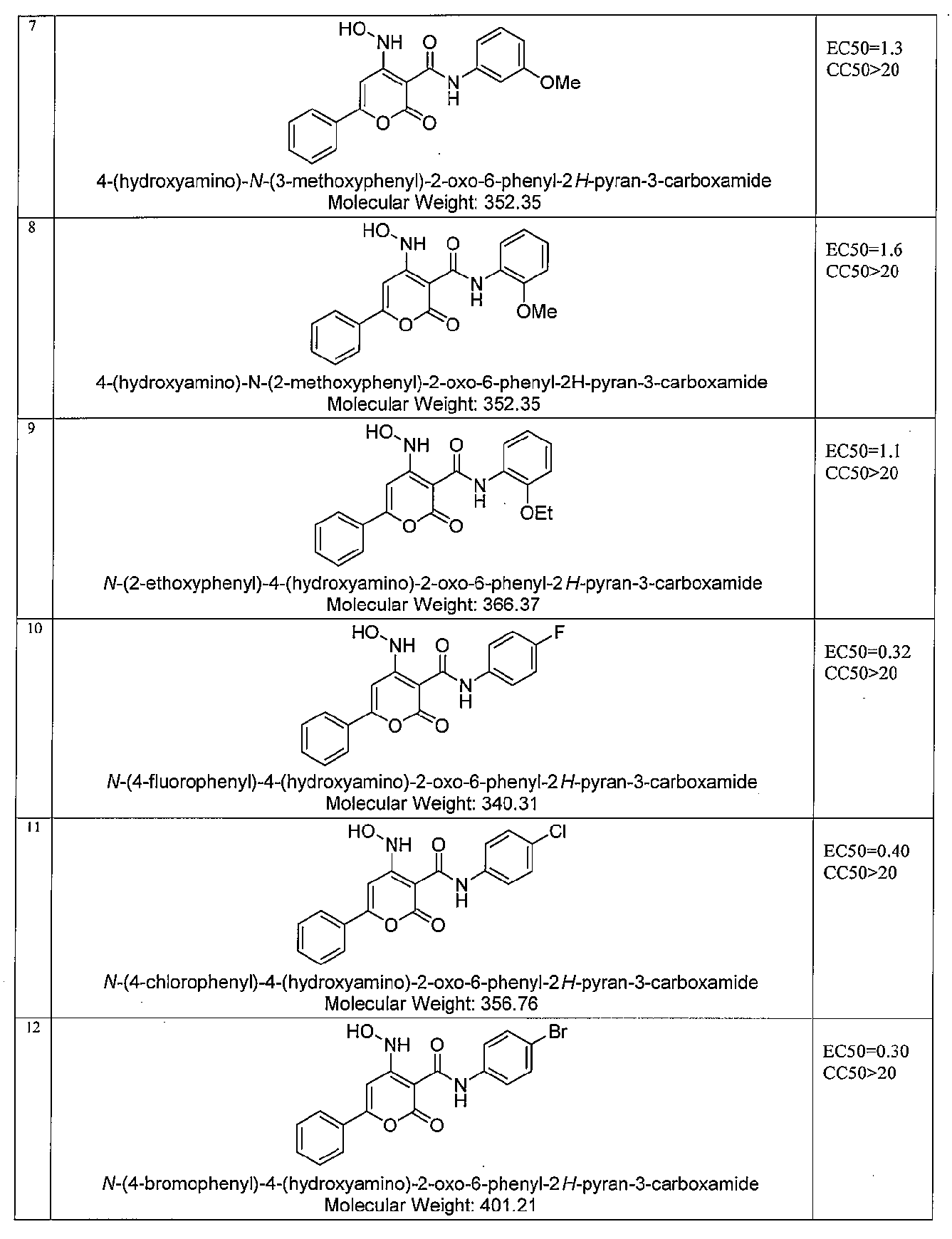


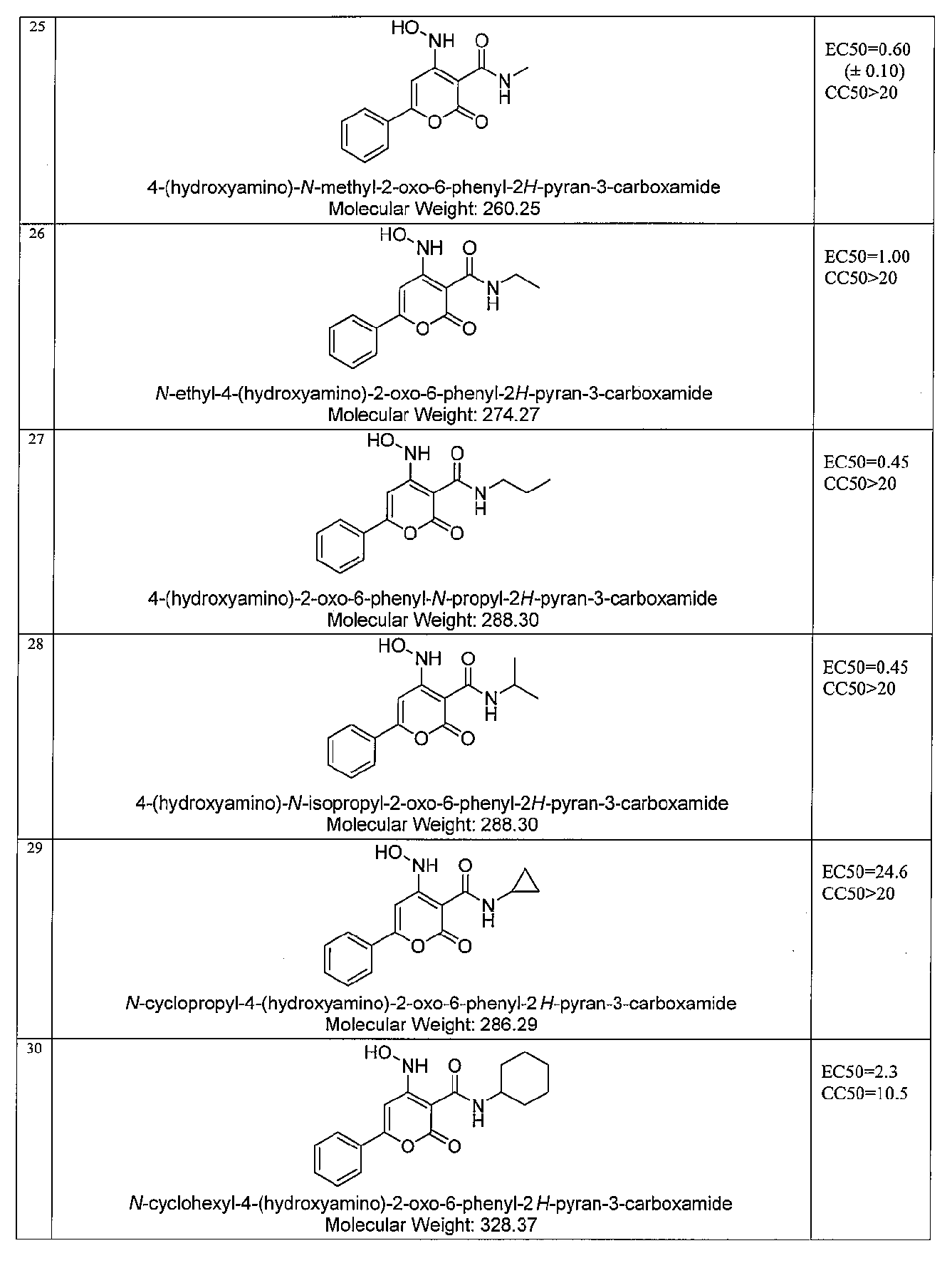
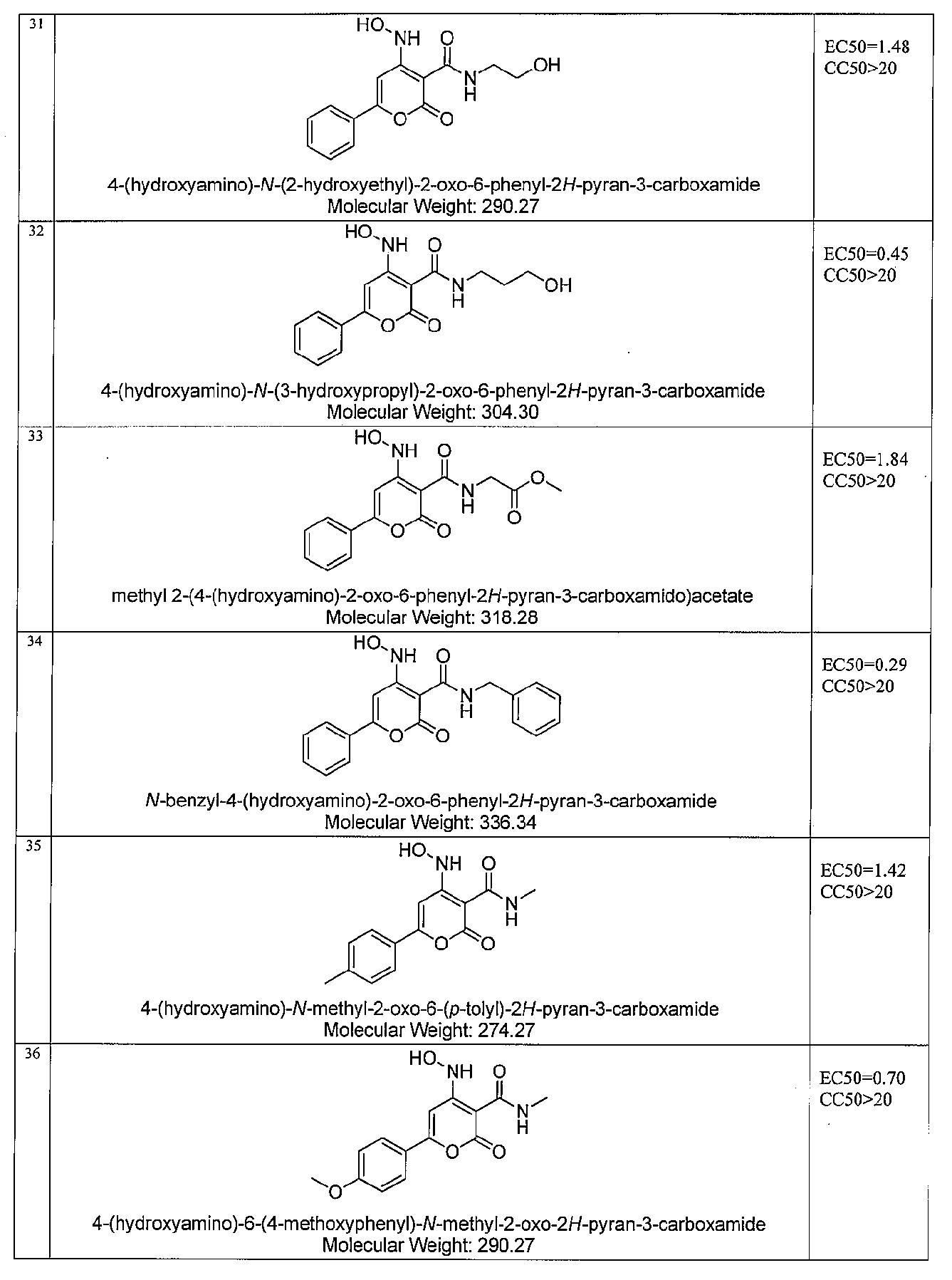
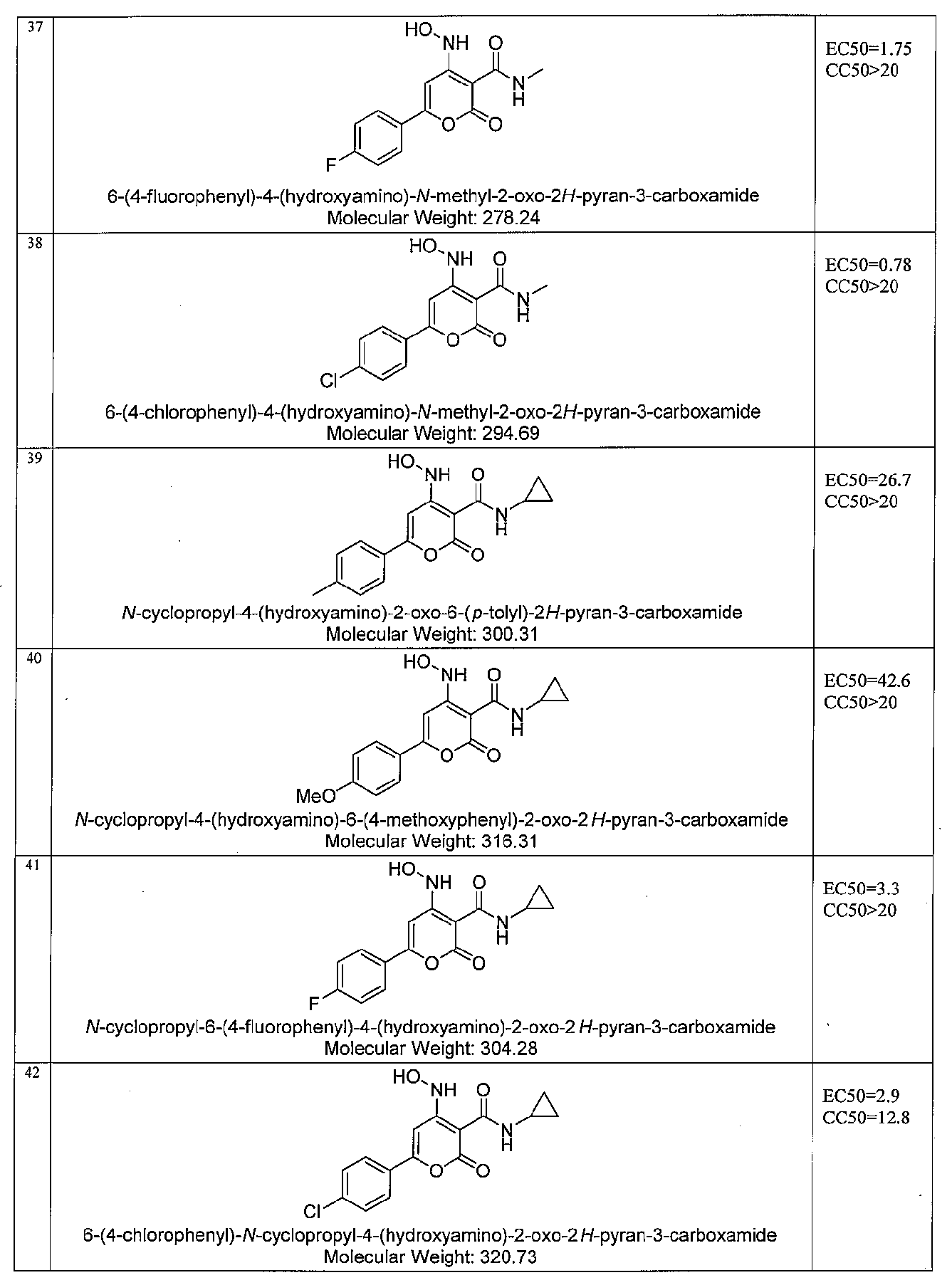
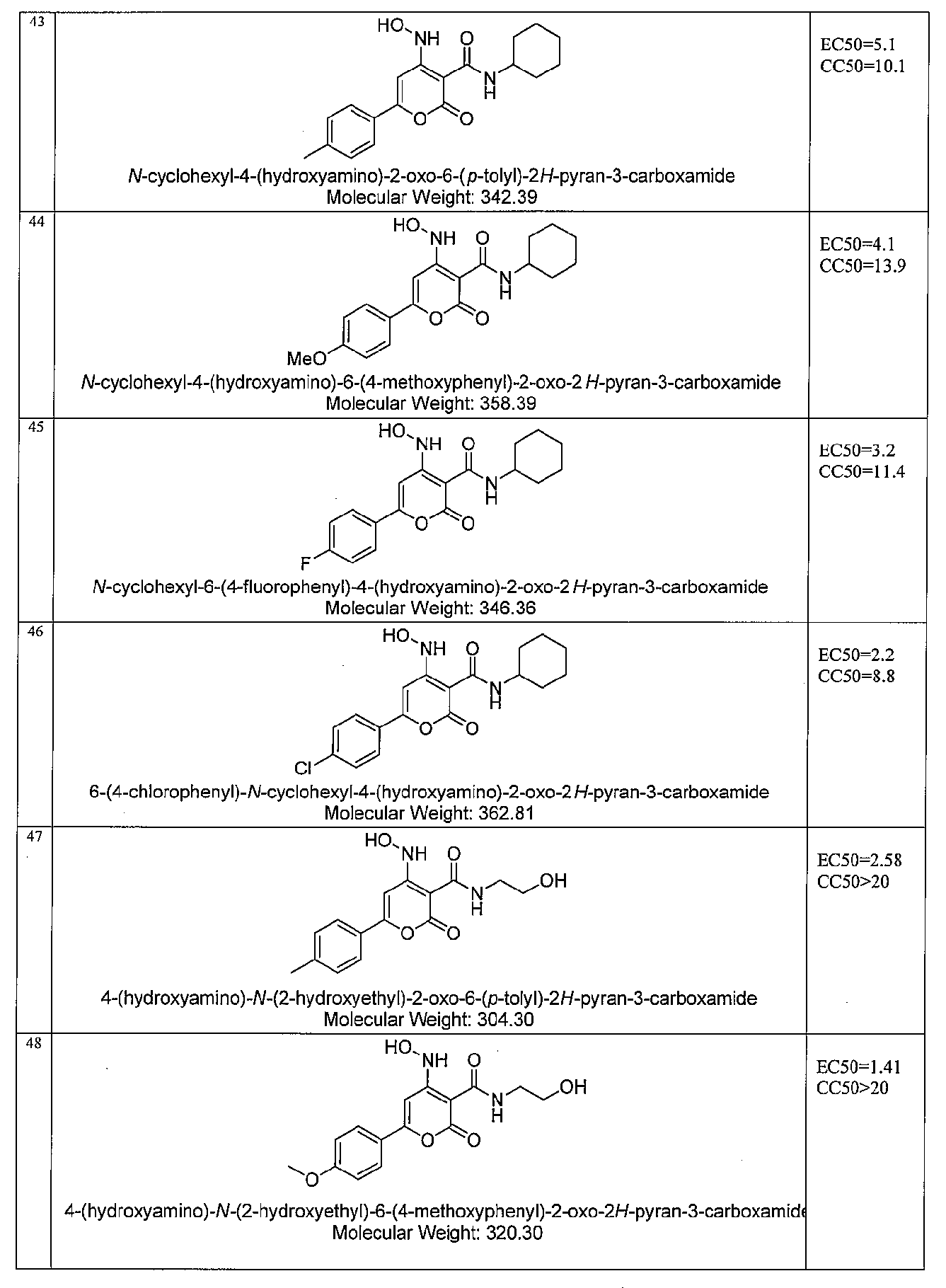

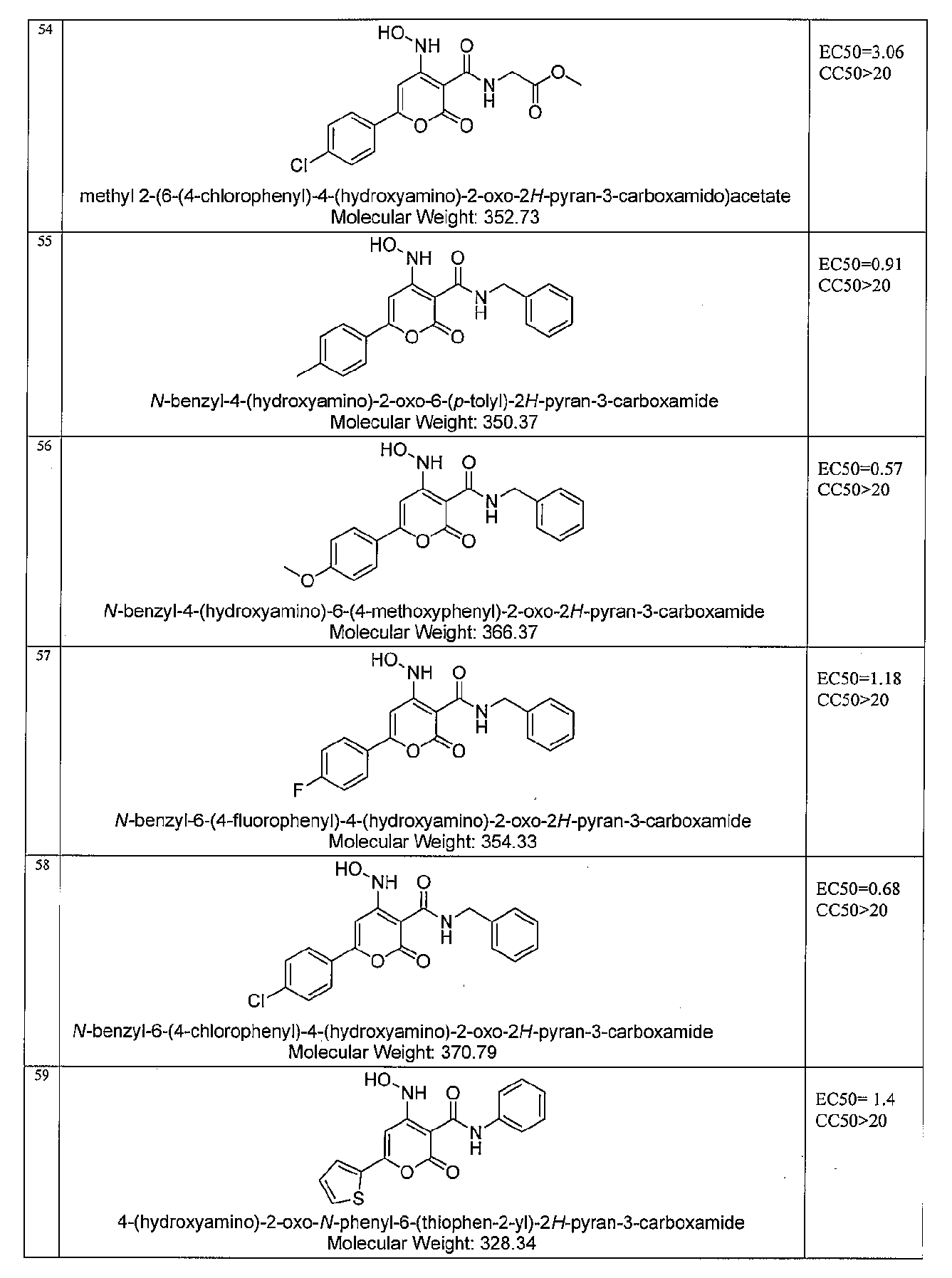
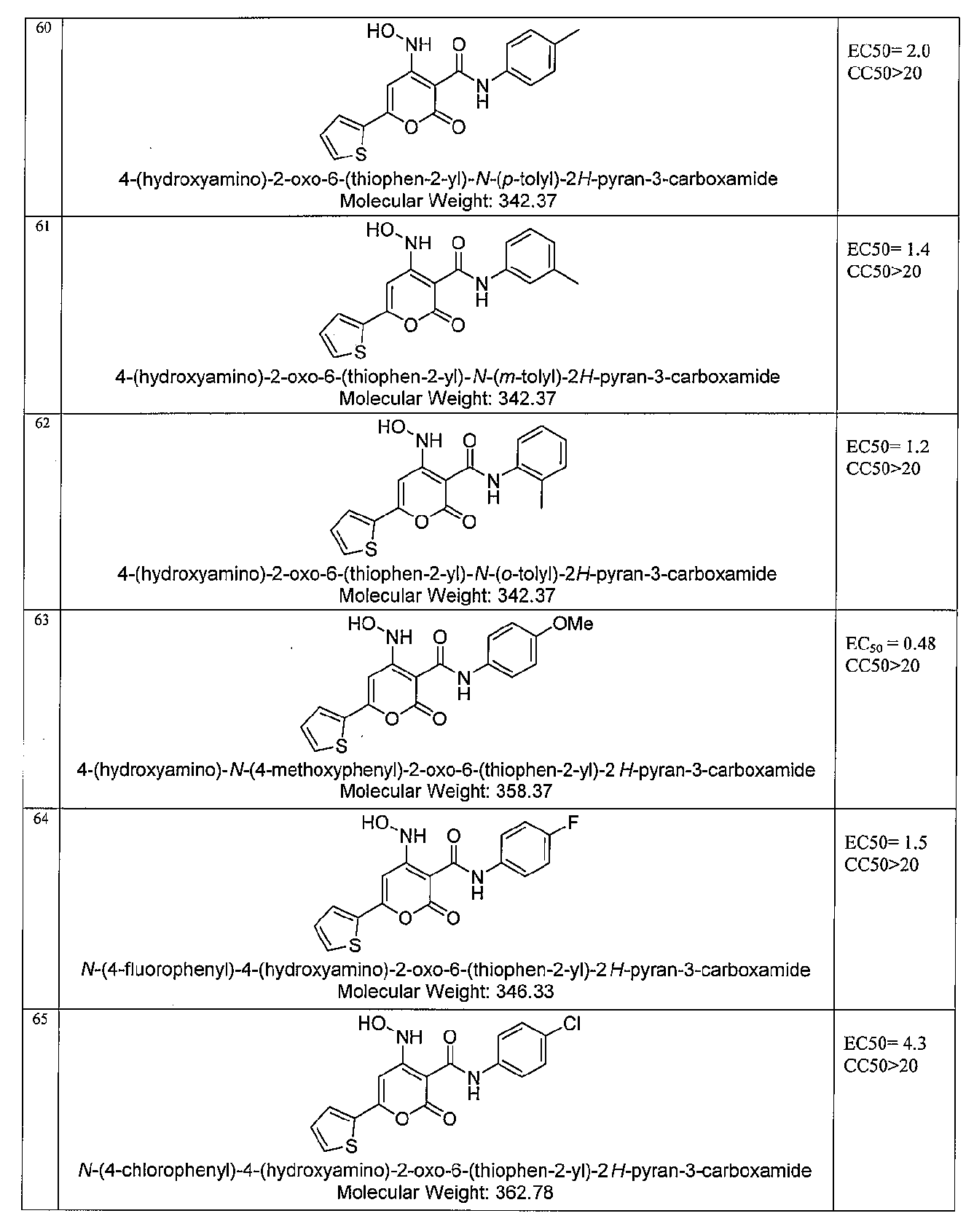




表2及び図1に示すように、本発明の化合物は、高い抗HCV活性を有し、細胞毒性が低い。一方、前記(I)におけるピラン環の3位の-CONHRが-COOHに置き換わった陰性対照化合物(4-(hydroxyamino)-2-oxo-6-phenyl-2H-pyran-3-carboxylic acid)は抗HCV活性が確認できなかった。
[実施例3]
フルゲノムHCV RNAレプリコン細胞(NNC#2、Ishii N, Watashi K, Hishiki T, Goto K, Inoue D, Hijikata M, Wakita T, Kato N, Shimotohno K. "Diverse effects of cyclosporine on hepatitis C virus strain replication." J. Virol. 80: 4510-4520, 2006.を参照)を10%FBS及び1mg/mlのG418(タンパク質合成阻害剤)を添加したDMEM培地に懸濁させた(30,000細胞/ml)。24時間のインキュベーションの後、各試験化合物を様々な濃度で含有する、G418を含まない新鮮な培養培地で細胞を3日間インキュベートした。
フルゲノムHCV RNAレプリコン細胞(NNC#2、Ishii N, Watashi K, Hishiki T, Goto K, Inoue D, Hijikata M, Wakita T, Kato N, Shimotohno K. "Diverse effects of cyclosporine on hepatitis C virus strain replication." J. Virol. 80: 4510-4520, 2006.を参照)を10%FBS及び1mg/mlのG418(タンパク質合成阻害剤)を添加したDMEM培地に懸濁させた(30,000細胞/ml)。24時間のインキュベーションの後、各試験化合物を様々な濃度で含有する、G418を含まない新鮮な培養培地で細胞を3日間インキュベートした。
細胞内HCV RNA定量アッセイのため、細胞をPBSで洗い、断続的に振盪させながらDNA分解酵素を含む溶解液で10分間処理した。そして、細胞溶解物(10μl)について、逆転写反応を行うとともに、引き続きリアルタイムPCR法を用いて、HCV RNA及び細胞生存の指標としてGAPDH RNAの定量を同時に実施した。その結果を図2に示す。
Claims (2)
- 下記式(I):

で示される化合物、その塩又はそれらの溶媒和物。 - 請求項1記載の化合物、その塩又はそれらの溶媒和物を含有する抗HCV薬。
Applications Claiming Priority (2)
| Application Number | Priority Date | Filing Date | Title |
|---|---|---|---|
| JP2013148716A JP2016193834A (ja) | 2013-07-17 | 2013-07-17 | 新規ピラノンカルボキサミド誘導体及びその抗c型肝炎ウイルス薬としての用途 |
| JP2013-148716 | 2013-07-17 |
Publications (1)
| Publication Number | Publication Date |
|---|---|
| WO2015008779A1 true WO2015008779A1 (ja) | 2015-01-22 |
Family
ID=52346227
Family Applications (1)
| Application Number | Title | Priority Date | Filing Date |
|---|---|---|---|
| PCT/JP2014/068880 Ceased WO2015008779A1 (ja) | 2013-07-17 | 2014-07-16 | 新規ピラノンカルボキサミド誘導体及びその抗c型肝炎ウイルス薬としての用途 |
Country Status (2)
| Country | Link |
|---|---|
| JP (1) | JP2016193834A (ja) |
| WO (1) | WO2015008779A1 (ja) |
Citations (1)
| Publication number | Priority date | Publication date | Assignee | Title |
|---|---|---|---|---|
| JP2011105705A (ja) * | 2009-10-22 | 2011-06-02 | Sumitomo Chemical Co Ltd | ピロン化合物およびその有害生物防除用途 |
-
2013
- 2013-07-17 JP JP2013148716A patent/JP2016193834A/ja active Pending
-
2014
- 2014-07-16 WO PCT/JP2014/068880 patent/WO2015008779A1/ja not_active Ceased
Patent Citations (1)
| Publication number | Priority date | Publication date | Assignee | Title |
|---|---|---|---|---|
| JP2011105705A (ja) * | 2009-10-22 | 2011-06-02 | Sumitomo Chemical Co Ltd | ピロン化合物およびその有害生物防除用途 |
Non-Patent Citations (4)
| Title |
|---|
| CHENG CC ET AL., ACS MEDICINAL CHEMISTRY LETTERS, vol. 1, 2010, pages 466 - 471 * |
| GOEL A ET AL., SYNLETT, vol. 13, 2005, pages 2027 - 2030 * |
| KONREDDY AK ET AL., ACS MEDICINAL CHEMISTRY LETTERS, vol. 5, 2014, pages 259 - 263 * |
| LI H ET AL., JOURNAL OF MEDICINAL CHEMISTRY, vol. 52, 2009, pages 1255 - 1258 * |
Also Published As
| Publication number | Publication date |
|---|---|
| JP2016193834A (ja) | 2016-11-17 |
Similar Documents
| Publication | Publication Date | Title |
|---|---|---|
| AU2002313410B2 (en) | Hepatitis C virus polymerase inhibitors with a heterobicyclic structure | |
| US20030236251A1 (en) | Viral polymerase inhibitors | |
| CN103703006B (zh) | Hcv蛋白酶抑制剂 | |
| EA001991B1 (ru) | 4,4-дизамещенные 3,4-дигидро-2(1н)-хиназолиноны, полезные в качестве ингибиторов обратной транскриптазы вич | |
| AU2002355150A1 (en) | Hepatitis C virus polymerase inhibitors with heterobicyclic structure | |
| JP2006515364A (ja) | ウイルスポリメラーゼ抑制剤 | |
| WO2012173448A2 (ko) | 인다논 유도체, 이의 약학적으로 허용되는 염 또는 이의 광학 이성질체, 이의 제조방법 및 이를 유효성분으로 함유하는 바이러스성 질환의 예방 또는 치료용 약학적 조성물 | |
| CA2871324A1 (en) | Substituted acyloxyamidines as hcv ns3/4a inhibitors | |
| US8048889B2 (en) | 3,4-disubstituted coumarin and quinolone compounds | |
| Kang et al. | Synthesis, activity, and pharmacokinetic properties of a series of conformationally-restricted thiourea analogs as novel hepatitis C virus inhibitors | |
| JP2009537518A (ja) | 3,4−二置換クマリン及びキノロン化合物 | |
| WO2015008779A1 (ja) | 新規ピラノンカルボキサミド誘導体及びその抗c型肝炎ウイルス薬としての用途 | |
| Ismail et al. | Molecular modeling based approach, synthesis and in vitro assay to new indole inhibitors of hepatitis C NS3/4A serine protease | |
| CN103864753B (zh) | 含有五元芳杂环结构的抗丙肝化合物及制备方法和用途 | |
| US20090054477A1 (en) | 4-thio substituted quinoline and naphthyridine compounds | |
| CN110229150B (zh) | 咪唑并[4,5-c]吡啶类衍生物及其用途 | |
| CN102775371B (zh) | 一种取代噻二嗪类衍生物及其制备方法与应用 | |
| CN116410106B (zh) | 一种苯甲酰胺类hbv衣壳蛋白抑制剂及其制备方法与应用 | |
| JP2010501570A (ja) | 4−チオ置換キノリンおよびナフチリジン化合物 | |
| JP6707763B2 (ja) | 抗b型肝炎ウイルス薬 | |
| JP5672496B2 (ja) | 抗hcv薬 | |
| WO2022244821A1 (ja) | 抗ウイルス活性等の生理活性を有する化合物 | |
| EA001154B1 (ru) | (4r,5s,6s,7r)-гексагидро-1-[5-(3-аминоиндазол)метил]-3-бутил-5,6-дигидрокси-4,7-бис[фенилметил]-2н-1,3-диазепин-2-он и его применение в качестве ингибитора вич-протеазы | |
| CN117551080A (zh) | 一种靶向降解parp7的protac化合物及其制备方法与应用 |
Legal Events
| Date | Code | Title | Description |
|---|---|---|---|
| 121 | Ep: the epo has been informed by wipo that ep was designated in this application |
Ref document number: 14825612 Country of ref document: EP Kind code of ref document: A1 |
|
| NENP | Non-entry into the national phase |
Ref country code: DE |
|
| 122 | Ep: pct application non-entry in european phase |
Ref document number: 14825612 Country of ref document: EP Kind code of ref document: A1 |
|
| NENP | Non-entry into the national phase |
Ref country code: JP |