WO2014207841A1 - 水質浄化装置 - Google Patents
水質浄化装置 Download PDFInfo
- Publication number
- WO2014207841A1 WO2014207841A1 PCT/JP2013/067538 JP2013067538W WO2014207841A1 WO 2014207841 A1 WO2014207841 A1 WO 2014207841A1 JP 2013067538 W JP2013067538 W JP 2013067538W WO 2014207841 A1 WO2014207841 A1 WO 2014207841A1
- Authority
- WO
- WIPO (PCT)
- Prior art keywords
- water
- porous cylindrical
- cylindrical body
- porous
- connecting member
- Prior art date
- Legal status (The legal status is an assumption and is not a legal conclusion. Google has not performed a legal analysis and makes no representation as to the accuracy of the status listed.)
- Ceased
Links
Images
Classifications
-
- C—CHEMISTRY; METALLURGY
- C02—TREATMENT OF WATER, WASTE WATER, SEWAGE, OR SLUDGE
- C02F—TREATMENT OF WATER, WASTE WATER, SEWAGE, OR SLUDGE
- C02F3/00—Biological treatment of water, waste water, or sewage
- C02F3/32—Biological treatment of water, waste water, or sewage characterised by the animals or plants used, e.g. algae
- C02F3/327—Biological treatment of water, waste water, or sewage characterised by the animals or plants used, e.g. algae characterised by animals and plants
-
- A—HUMAN NECESSITIES
- A01—AGRICULTURE; FORESTRY; ANIMAL HUSBANDRY; HUNTING; TRAPPING; FISHING
- A01K—ANIMAL HUSBANDRY; AVICULTURE; APICULTURE; PISCICULTURE; FISHING; REARING OR BREEDING ANIMALS, NOT OTHERWISE PROVIDED FOR; NEW BREEDS OF ANIMALS
- A01K61/00—Culture of aquatic animals
- A01K61/50—Culture of aquatic animals of shellfish
-
- A—HUMAN NECESSITIES
- A01—AGRICULTURE; FORESTRY; ANIMAL HUSBANDRY; HUNTING; TRAPPING; FISHING
- A01K—ANIMAL HUSBANDRY; AVICULTURE; APICULTURE; PISCICULTURE; FISHING; REARING OR BREEDING ANIMALS, NOT OTHERWISE PROVIDED FOR; NEW BREEDS OF ANIMALS
- A01K61/00—Culture of aquatic animals
-
- A—HUMAN NECESSITIES
- A01—AGRICULTURE; FORESTRY; ANIMAL HUSBANDRY; HUNTING; TRAPPING; FISHING
- A01K—ANIMAL HUSBANDRY; AVICULTURE; APICULTURE; PISCICULTURE; FISHING; REARING OR BREEDING ANIMALS, NOT OTHERWISE PROVIDED FOR; NEW BREEDS OF ANIMALS
- A01K63/00—Receptacles for live fish, e.g. aquaria; Terraria
- A01K63/04—Arrangements for treating water specially adapted to receptacles for live fish
-
- C—CHEMISTRY; METALLURGY
- C02—TREATMENT OF WATER, WASTE WATER, SEWAGE, OR SLUDGE
- C02F—TREATMENT OF WATER, WASTE WATER, SEWAGE, OR SLUDGE
- C02F2103/00—Nature of the water, waste water, sewage or sludge to be treated
- C02F2103/007—Contaminated open waterways, rivers, lakes or ponds
-
- Y—GENERAL TAGGING OF NEW TECHNOLOGICAL DEVELOPMENTS; GENERAL TAGGING OF CROSS-SECTIONAL TECHNOLOGIES SPANNING OVER SEVERAL SECTIONS OF THE IPC; TECHNICAL SUBJECTS COVERED BY FORMER USPC CROSS-REFERENCE ART COLLECTIONS [XRACs] AND DIGESTS
- Y02—TECHNOLOGIES OR APPLICATIONS FOR MITIGATION OR ADAPTATION AGAINST CLIMATE CHANGE
- Y02A—TECHNOLOGIES FOR ADAPTATION TO CLIMATE CHANGE
- Y02A40/00—Adaptation technologies in agriculture, forestry, livestock or agroalimentary production
- Y02A40/80—Adaptation technologies in agriculture, forestry, livestock or agroalimentary production in fisheries management
- Y02A40/81—Aquaculture, e.g. of fish
-
- Y—GENERAL TAGGING OF NEW TECHNOLOGICAL DEVELOPMENTS; GENERAL TAGGING OF CROSS-SECTIONAL TECHNOLOGIES SPANNING OVER SEVERAL SECTIONS OF THE IPC; TECHNICAL SUBJECTS COVERED BY FORMER USPC CROSS-REFERENCE ART COLLECTIONS [XRACs] AND DIGESTS
- Y02—TECHNOLOGIES OR APPLICATIONS FOR MITIGATION OR ADAPTATION AGAINST CLIMATE CHANGE
- Y02W—CLIMATE CHANGE MITIGATION TECHNOLOGIES RELATED TO WASTEWATER TREATMENT OR WASTE MANAGEMENT
- Y02W10/00—Technologies for wastewater treatment
- Y02W10/10—Biological treatment of water, waste water, or sewage
Definitions
- the present invention relates to a water purification device used in semi-enclosed water areas such as dam lakes and reservoirs, closed water areas, and the like. Specifically, the present invention relates to a water purification device that purifies water quality using a living organism having a filtering ability.
- Water quality in semi-enclosed water areas and closed water areas such as dam lakes and reservoirs is deteriorated by inflow of domestic wastewater and poor water circulation. Specifically, such water areas are eutrophied by nitrogen, phosphorus, nutrient salts, etc. contained in domestic wastewater. In eutrophied waters, a large amount of phytoplankton and other water pollutants such as sea cucumbers proliferate, and the dead bodies sink to the bottom of the water, deteriorating water quality. When the water quality deteriorates, bad odors are exerted over a wide range, for example, bad odor is generated not only in the water area but also in the downstream area and the water supply.
- Measures for purifying water quality include a method of collecting / removing aquatic plants using a blue-ocean collection vessel. However, it is not efficient to collect and remove blue sea urchins in the sea bream collection ship. There is also a method of purifying water quality by spraying chemicals. However, chemical spraying can cause other environmental problems. There is also a method of purifying water quality by circulating water using a pump. However, in order to use the pump, not only a large driving source is required, but also water circulates so that the sludge settled on the bottom of the water rises and causes new water pollution.
- the floating body described in Patent Document 1 is suspended from an annular body having a central opening, a buoyancy body surrounding the outer periphery of the annular body, and a central opening of the annular body in order to give buoyancy to the annular body.
- a cage-shaped mesh material and a number of swordfish shells housed inside the cage-shaped mesh material are provided.
- a coupling tool is provided in the outer periphery of a buoyancy body, and a floating body unit is assembled by connecting several floating bodies with a coupling tool.
- the floating body floats on the surface of the water, so that scallops housed in the cage mesh material are bred near the surface of the water.
- Sea mussels are raised by eating phytoplankton while taking oxygen.
- rainbow trout since rainbow trout has a filter food property, it removes phytoplankton, such as a giant sea lion.
- the floating body floats on the surface of the water, it floats in a semi-enclosed water area where water flow is generated by power generation intake like a dam lake. Therefore, this floating body not only moves in a state where water pollutants are not sufficiently removed, but also cannot be purified efficiently by moving to a water area free of water pollutants. In addition, since this floating body is connected with the adjacent saddle-shaped mesh materials separated, the water pollutants in the inlet move between the saddle-shaped mesh materials and diffuse outside the inlet. May end up.
- the present invention can be used not only in closed water areas where there is no flow, but also in semi-closed water areas where there is flow, and water quality deteriorated by not diffusing water pollutants from certain water areas. It is an object to provide a water purification device that can purify water.
- the water purification apparatus includes a perforated tubular body that is submerged in water in a vertical orientation except for its upper end, a living organism having a filtering ability housed in the perforated tubular body, and a large number of them in the horizontal direction.
- a connecting member for connecting the porous cylindrical bodies thus formed, and the plurality of connected porous cylindrical bodies are moored in a fixed water area.
- the porous cylindrical body is a resin net-like body
- the porous cylindrical body may be made of a hard resin.
- the porous cylindrical body includes a large-diameter porous cylindrical body and one or a plurality of small-diameter porous cylindrical bodies, and the small-diameter porous cylindrical body.
- a configuration in which the body is inserted into a large-diameter porous cylindrical body can be employed.
- a configuration in which the organism having the filtering ability is a filter edible shellfish can be employed.
- the connecting member is an upper connecting member that connects the porous cylindrical body at a boundary portion between an upper end portion protruding from the water surface and an intermediate portion submerged in water.
- a configuration can be employed.
- the upper connecting member may be a float that floats on the water surface.
- the connecting member may include a lower connecting member that connects the porous cylindrical bodies in water.
- the connecting member may employ a configuration in which the porous cylindrical body is connected linearly.
- a configuration in which a connecting tool for connecting and extending a plurality of connecting members is provided in the connecting member can be adopted.
- water purification apparatus it is possible to adopt a configuration further including a mooring member that spans the porous tubular body or the connecting member and a shore anchor.
- the present invention can be used not only in a closed water area without a flow but also in a semi-closed water area with a flow, and the water quality deteriorated by not diffusing water pollutants from a certain water area. It is possible to provide a water purification device that can purify water.
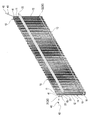
- FIG. 1 is a schematic perspective view showing an embodiment of a water purification device according to the present invention.
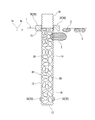
- FIG. 2 is a cross-sectional side view showing an embodiment of the water purification apparatus according to the present invention.
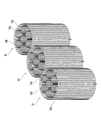
- FIG. 3 is a schematic perspective view showing a main part of another embodiment of the water purification apparatus according to the present invention.
- This water purification apparatus includes a porous cylindrical body 10 that is submerged in the vertical orientation except for the upper end portion 11, a living organism 20 that has a filtering ability and is accommodated in the porous cylindrical body 10, and a horizontal direction.
- a connecting member 30 for connecting a large number of porous cylindrical bodies 10 arranged in a row and a mooring member 40 for mooring the connected porous cylindrical bodies 10 in a certain water area 1 are provided.
- the porous cylindrical body 10 is made of polyethylene or other soft resin, and has a cylindrical main body portion 12 and a closing portion 13 that closes the bottom portion of the main body portion 12, both of which are formed in a net shape.
- the main body portion 12 and the closing portion 13 may be integrally formed.
- the shape of the mesh is not limited to squares, rectangles, rhombuses, turtle shells, or the like. However, the size of the mesh is, of course, smaller than the organism 20 having the filtering ability, and the organism 20 having the filtration ability housed in the porous cylindrical body 10 is prevented from coming out of the porous cylindrical body 10. ing.
- the porous cylindrical body 10 may be made of a hard resin such as vinyl chloride and having increased rigidity. Since the porous cylindrical body 10 made of hard resin is difficult to bend, even if a repeated load is applied due to a change in water flow, it does not fatigue and break.
- the porous cylindrical body 10 made of hard resin has a number of holes smaller than the organism 20 having a filtering ability so that water can enter the porous cylindrical body 10.
- the organism 20 having a filtering ability is stored in the porous cylindrical body 10 from the closed portion 13 to the vicinity of the upper end portion 11.
- a filter-feeding shellfish such as a swordfish shell (hereinafter referred to as “swordfish”) is adopted.
- the white mussel 20 has a characteristic of sucking phytoplankton such as a giant sea urchin together with water, filtering it, and discharging water.
- the length of the porous cylindrical body 10 that accommodates the scallop shell 20 is, for example, about 4 m. This is because the swordfish 20 is unlikely to live in deep water 1b having a depth of 4 m or more.
- the connecting member 30 that connects a large number of porous cylindrical bodies 10 is a combination of the upper connecting member 31 and the lower connecting member 32.
- the upper connecting member 31 is in a state in which a large number of porous cylindrical bodies 10 are arranged at a boundary portion 15 between the upper end portion 11 where the porous cylindrical body 10 protrudes from the water surface 1a and the intermediate portion 14 submerged in the water 1b. Link.
- the upper connecting member 31 is formed as a bar having rigidity with a material having a specific gravity smaller than that of water which acts as a float floating on the water surface 1a.
- the upper connecting member 31 connects a large number of porous cylindrical bodies 10 as a set of two such that a large number of the porous cylindrical bodies 10 are sandwiched from both sides of one surface and the other surface.
- each upper connecting member 31 At each end of each upper connecting member 31, a connecting tool 33 for connecting and extending a plurality of upper connecting members 31 is provided.
- a number of longitudinal arc-shaped grooves into which the outer surface of the porous cylindrical body 10 is fitted may be continuously formed on the surface where the upper connecting member 31 is in contact with the porous cylindrical body 10.
- the lower connecting member 32 is connected so as to maintain a state in which the lower ends 16 of the multi-layered porous cylindrical bodies 10 are aligned in the water 1b.
- the lower connecting member 32 a wire, a band, or the like is adopted, but it is preferable that the lower connecting member 32 has rigidity to maintain a state in which a large number of the porous cylindrical bodies 10 are arranged in a straight line. Further, the lower connecting member 32 connects a large number of the porous cylindrical bodies 10 together in a diving operation.
- the mooring member 40 is bridged between each upper end portion 11 of the outermost porous cylindrical body 10 and a shore anchor (not shown), and a large number of the porous cylindrical bodies 10 are moored in a certain water area 1. To do. That is, one end portion 41 of the anchoring member 40 is fixed to the upper end portion 11 of the outermost porous tubular body 10, and the other end portion 42 of the anchoring member 40 is locked to the shore anchor. Although not shown, the mooring member 40 may be fixed to the upper connecting member 31. And as long as the mooring member 40 has the intensity
- the water purification device is loaded with the porous cylindrical body 10 and the connecting member 30 being disassembled.
- the scallop 20 is placed in the porous cylindrical body 10 before being loaded or on the ship.
- the porous cylindrical body 10 containing the swordfish shell 20 is submerged in the water 1b except for the upper end portion 11 in a vertical posture.
- the porous cylindrical body 10 which accommodated the swordfish shell 20 is put in order so that it may adjoin in a horizontal direction.
- the predetermined number of the perforated cylindrical bodies 10 are connected by the upper connecting member 31 and the lower connecting member 32. Since the upper connecting member 31 acts as a float and floats on the water surface 1 a, the upper end portion 11 of the porous tubular body 10 above the upper connecting member 31 even when the scallop 20 is housed in the porous tubular body 10. Protrudes from the water surface 1a. Further, since the swordfish 20 is housed in each porous cylindrical body 10, the center of gravity is in the water 1b, but it is not sunk by the upper connecting member 31 acting as a float. And the lower connection member 32 connects the lower end part 16 of the porous cylindrical body 10 arranged in the predetermined number by the underwater 1b.
- the intermediate part 14 and the lower end part 16 of the multiple porous cylindrical bodies 10 connected in this way are not irregular, and are partitioned like a flat curtain wall from the upper connecting member 31 in the vertical direction. And hung.
- the vertical posture includes not only a strict vertical posture but also a tilted posture due to a water flow or the like.
- the porous cylindrical body 10 can be connected, for example, by 100 m or more by connecting the units one after another. A plurality of units can be added by connecting the connecting members 33 of the adjacent upper coupling members 31.
- one end 41 of the anchoring member 40 is fixed to the outermost porous cylindrical body 10, and the other end 42 of the anchoring member 40 is locked to the shore anchor. In this way, the water purification device is moored in a certain water area 1.
- the upper end portions 11 of the multiple porous cylindrical bodies 10 provided in the water purification device protrude from the water surface 1a without gaps, and the intermediate portion 14 and the lower end portion 16 are submerged in the water 1b without gaps. Therefore, this water purification device creates a closed area where the watermelon 2 is confined in the inlet and not diffused.
- the sea urchin 2 is confined in a closed region between a large number of the porous cylindrical bodies 10 and the shore.
- the sea cucumber climbs over the upper end portion 11 of the porous cylindrical body 10 protruding from the water surface and does not flow out of the closed water area.
- the upper end portions 11 of the large number of porous cylindrical bodies 10 function as a dike that does not allow the watermelon 2 in the inlet to flow out from the water surface 1a side.
- the aoko 2 enters the intermediate portion 14 of the porous cylindrical body 10.
- This sea urchin 2 is in contact with a swordfish shell 20 in the porous cylindrical body 10.
- the swordfish 20 sucks the blue sea bream 2 together with water, filters it, and spits out the water because of its filterability. Therefore, the filtered water flows out of the bay partitioned by the porous cylindrical body 10, and the filtered water is returned to the bay.
- water purification can be achieved with a low environmental load, and the transparency of water can be increased.
- the porous cylindrical body 10 is maintained in a state free from water pollution by the excrement of the swordfish shell 20. Therefore, the swordfish 20 grown in the porous cylindrical body 10 is also provided for food.
- the swordfish shell 20 is taken out by pulling up the porous cylindrical body 10. That is, the porous cylindrical body 10 adjacent to the porous cylindrical body 10 to be pulled up remains connected to the connecting member 30, and the intermediate porous cylindrical body 10 sandwiched between the porous cylindrical bodies 10 on both sides thereof is removed. By pulling up, the grown scallop 20 is taken out. And the porous cylindrical body 10 which accommodated the new scallop shell 20 is submerged in the water 1b. Thereby, the metabolism of the swordfish shell 20 can be promoted. The dead swordfish 20 is discarded.
- the porous cylindrical body 10 includes a large-diameter porous cylindrical body (hereinafter, mainly referred to as “large-diameter cylindrical body”) 10a and a plurality of small-diameter porous cylindrical bodies (hereinafter referred to as “large-diameter cylindrical bodies”). , Mainly referred to as “small-diameter cylindrical body”) 10b.
- the small-diameter cylindrical body 10b may include only one of a size that is slightly smaller than the large-diameter cylindrical body 10.
- the small-diameter cylindrical body 10b is inserted into the large-diameter cylindrical body 10a. And the swordfish shell 20 is accommodated in the small diameter cylindrical body 10b.
- the boundary portion between the upper end portion and the intermediate portion of the large-diameter cylindrical body 10 a is connected by the upper connecting member 31, and the lower end portion of the large-diameter cylindrical body 10 a is the lower connecting member 32. Connected by
- this small diameter cylindrical body 10b can be easily inserted and removed from the large diameter cylindrical body 10a. Therefore, this water purification device can easily replace the scallop 20.
- the material may be appropriately changed, for example, by combining the large-diameter cylindrical body 10a with a hard resin and the small-diameter cylindrical body 10b with a soft resin.
- the water purification device has a porous tubular body 10 that is submerged in the water 1b except for the upper end portion in a vertical orientation, and a biological organism that has a filtration capacity stored in the porous tubular body 10.
- 20 and a connecting member 30 that connects a large number of porous cylindrical bodies 10 arranged in the horizontal direction, and the connected multiple porous cylindrical bodies 10 are moored in a fixed water area.
- this water purification apparatus accommodates the organism 20 having filtration ability even if the water quality of the water area 1 such as a closed water area or a semi-closed water area deteriorates due to phytoplankton or other water pollutants such as the blue sea urchin 2.
- Water quality can be purified by mooring the porous cylindrical body 10 in a state of being submerged in the water 1b.
- a large number of the porous cylindrical bodies 10 are arranged in a vertical posture without gaps and are connected to the connecting member 30. Accordingly, a large number of the perforated cylindrical bodies 10 are arranged so that water pollutants such as phytoplankton are confined in the inlet and not diffused.
- the quality of water is purified because the living thing 20 which has a filtration capability filters water quality pollutants, such as a phytoplankton.
- the porous cylindrical body 10 is a resin net-like body.
- water pollutants such as phytoplankton can easily enter the porous cylindrical body 10. Therefore, the organism 20 having the filtering ability in the porous cylindrical body 10 is likely to come into contact with water pollutants that have entered the porous cylindrical body 10. Thereby, this water purification apparatus can purify
- the porous cylindrical body 10 may be made of a hard resin. Therefore, the porous cylindrical body 10 becomes difficult to bend and does not fatigue and break even when a repeated load is applied due to a change in the water flow.
- the porous tubular body 10 includes the large-diameter porous tubular body 10a and one or a plurality of small-diameter porous tubular bodies 10b, and the small-diameter porous tubular body 10b.
- the porous cylindrical body 10b is inserted into the large-diameter porous cylindrical body 10a.
- the organism 20 having the filtering ability can be accommodated in the small-diameter porous cylindrical body 10b, and the small-diameter porous cylindrical body 10b can be easily inserted and removed from the large-diameter porous cylindrical body 10a.
- the organism 20 having the filtration ability grown in the small-diameter porous cylindrical body 10b is easily taken out from the large-diameter porous cylinder 10a submerged in the water 1b, and the organism 20 having a new filtration ability is stored.
- the small-diameter porous cylindrical body 10b can be easily inserted into the large-diameter porous cylindrical body 10a.
- the organism 20 having the filtering ability is a filter edible shellfish.
- Filter-feeding shellfish have the characteristic of sucking a suspension such as phytoplankton together with water, filtering it, and discharging the water.
- the grown shellfish can be used for food.
- the connecting member 30 has the porous cylindrical body 10 at the boundary portion 15 between the upper end portion 11 protruding from the water surface 1a and the intermediate portion 14 submerged in the water 1b. It is the upper connection member 31 which connects. Since the center of gravity of the porous cylindrical body 10 is in the water 1b by accommodating the organism 20 having a filtration capacity, the upper connecting member 31 is a boundary 15 between the upper end portion 11 and the intermediate portion 14 of the porous cylindrical body 10. , The intermediate portion 14 and the lower end portion 16 of the porous cylindrical body 10 are submerged in the water 1b while being suspended from the upper connecting member 31.
- the upper connecting member 31 is a float that floats on the water surface 1a. Therefore, since the upper connecting member 31 floats on the water surface 1a by the float, the porous tubular body 10 containing the organism 20 having the filtering ability is given buoyancy and can be prevented from sinking into the water 1b.
- the connecting member 30 includes the lower connecting member 32 that connects the porous tubular body 10 with the water 1b.
- the intermediate portion 14 and the lower end portion 16 of the porous cylindrical body 10 are aligned in a straight line by the lower connecting member 32, thereby forming a partition like a flat curtain wall.
- the connecting member 30 connects the porous cylindrical body 10 linearly. Therefore, the water purification apparatus can make the state in which the water pollutant was confined in the inlet.
- the connecting member 30 is provided with a connecting tool 33 for connecting and extending a plurality of connecting members 30.
- a connecting tool 33 for connecting and extending a plurality of connecting members 30.
- the water purification device further includes a mooring member that spans the porous tubular body or the connecting member and the anchor on the shore.
- the tethered member can tether many connected porous cylindrical bodies in a certain water area.
- the water purification apparatus is not limited to the above embodiment, and various modifications can be made without departing from the gist of the present invention.
- the main body portion 12 of the porous tubular body 10 is not limited to a cylindrical shape, and may be a square tubular shape.
- the upper connecting member 31 may be a belt or a wire instead of a float.
- connecting member 30 is not limited to the upper and lower combinations of the upper connecting member 31 and the lower connecting member 32, and may be connected to the intermediate portion 14 of the porous cylindrical body 10, or conversely, the lower connecting member 32. May be omitted and only the upper connecting member 31 may be used.
- a large number of perforated cylindrical bodies 10 may not be arranged like a flat curtain wall, but may be arranged like an arch shape or an annular curtain wall in accordance with the state of occurrence of the water-bloom 2.
- the connecting member 30 is flexible.
- the porous cylindrical body 10 may close the intermediate part 14 of the main body part 12 with the closing part 13 instead of closing the bottom part of the main body part 12 with the closing part 13.
- the closing portion 13 may be constituted by a plurality of shafts that pierce the intermediate portion 14 of the main body portion 12.
- the porous cylindrical body 10 may have a length of 4 m or more, and the lower end portion 16 may be pierced into the water bottom.
- the porous cylindrical body 10 does not float in the water 1b. Therefore, the upper connecting member 31 in this water purification device does not have to act as a float. Further, when the porous cylindrical body 10 is stuck into the water bottom in a stable state, the mooring member 40 is not necessary.
- various aquatic organisms can be employed as the filter-feeding organism 20.
- aquatic plants water hyacinth, reed, sugi namo, tanukimo, baikamo, matsumo and the like may be employed.
- Aquatic animals include walnut shellfish, walnut shellfish, funnel shellfish, shellfish, warbler shellfish, marsdale shellfish, giant oyster shellfish, sea bream shellfish, horned shellfish, squid shellfish, kawachina, oyster shellfish, dove shellfish, crow shellfish, snail Molluscs such as shellfish such as worms, earthworms, gokai and leeches can be employed.
- These aquatic plants and aquatic animals may be mixed in the porous cylindrical body 10.
Landscapes
- Life Sciences & Earth Sciences (AREA)
- Environmental Sciences (AREA)
- Biodiversity & Conservation Biology (AREA)
- Marine Sciences & Fisheries (AREA)
- Animal Husbandry (AREA)
- Zoology (AREA)
- Engineering & Computer Science (AREA)
- Botany (AREA)
- Biotechnology (AREA)
- Microbiology (AREA)
- Hydrology & Water Resources (AREA)
- Environmental & Geological Engineering (AREA)
- Water Supply & Treatment (AREA)
- Chemical & Material Sciences (AREA)
- Organic Chemistry (AREA)
- Purification Treatments By Anaerobic Or Anaerobic And Aerobic Bacteria Or Animals (AREA)
- Farming Of Fish And Shellfish (AREA)
Abstract
この水質浄化装置は、鉛直方向の姿勢で上端部11を除いて水中1bに沈められる多孔筒状体10と、多孔筒状体10内に収納された濾過能力を有する生物(例えばシジミ貝)20と、多孔筒状体10を多数並べて連結する連結部材30とを備え、連結された多数本の多孔筒状体10が一定の水域1に係留されている。連結部材30は、水面から突出している上端部11と水中1bに沈んでいる中間部14との境界部15で多孔筒状体10を連結する上部連結部材31と、水中1bで多孔筒状体10を連結する下部連結部材32とを備えている。
Description
本発明は、ダム湖や溜池などの半閉鎖性水域や閉鎖性水域などで使用される水質浄化装置に関する。詳しくは、本発明は、濾過能力を有する生物を使用して、水質を浄化する水質浄化装置に関する。
ダム湖や溜池などの半閉鎖性水域や閉鎖性水域の水質は、生活排水などの流入や水の循環不良によって悪化する。具体的には、このような水域は、生活排水などに含まれる窒素、リン、栄養塩類などによって富栄養化される。富栄養化の進んだ水域では、大量のアオコなどの植物プランクトンその他の水質汚濁物が増殖し、さらに、死骸が水底に沈むことから、水質が悪化する。水質が悪化すると、その水域だけでなく、下流域や上水道において悪臭が発生するなど、広範囲に亘って悪影響が及ぶ。
水質を浄化するための対策として、アオコ採取船によってアオコを回収・除去するという方法がある。しかし、アオコ採取船では、アオコの回収・除去に時間や労力が掛かり、効率的でない。また、薬品などを散布することで水質を浄化するという方法もある。しかし、薬品の散布は、別の環境問題を起こしかねない。また、ポンプによって水を循環させることで水質を浄化するという方法もある。しかし、ポンプを使用するためには、大きな駆動源が必要となるだけでなく、水が循環することで、水底に沈殿しているヘドロを舞い上げ、新たな水質汚濁を起こしてしまう。
このため、労力が掛からず、新たな環境問題を起こすことなく、さらに、駆動源などのエネルギを不要として水質を浄化することができるようにした装置や方法が種々提案されている。例えば、特許文献1に記載された浮遊体は、中央開口部を有する環状体と、この環状体に浮力を与えるため、環状体の外周を囲む浮力体と、環状体の中央開口部に垂下した籠状メッシュ材と、この籠状メッシュ材の内部に収容した多数のシジミ貝とを備えている。そして、浮力体の外周に連結具が設けられ、複数の浮遊体が連結具によって連結されることで、浮遊体ユニットが組み立てられる。
浮遊体が水面に浮かべられることで、籠状メッシュ材内に収容されたシジミ貝が水面付近で飼育される。シジミ貝は、酸素を摂りつつ植物プランクトンを食することで飼育される。また、シジミ貝は、濾過食性を有していることから、アオコなどの植物プランクトンを除去する。
しかし、浮遊体は、水面に浮いているため、ダム湖のように発電取水によって水流が発生する半閉鎖性水域において浮動する。したがって、この浮遊体は、水質汚濁物を十分に除去していない状態で移動することがあるだけでなく、水質汚濁物がない水域に移動することで、効率的に水質浄化することができない。また、この浮遊体は、隣り合っている籠状メッシュ材を離した状態で連結したものであることから、入江内の水質汚濁物が籠状メッシュ材の間を移動し、入江外に拡散してしまうことがある。
そこで、本発明は、流れのない閉鎖性水域だけでなく、流れのある半閉鎖性水域などにおいても使用することができ、また、水質汚濁物を一定の水域から拡散させないことで、悪化した水質を浄化することができるようにした水質浄化装置を提供することを課題とする。
本発明に係る水質浄化装置は、鉛直方向の姿勢で上端部を除いて水中に沈められる多孔筒状体と、該多孔筒状体内に収納された濾過能力を有する生物と、水平方向に多数並べられた多孔筒状体を連結する連結部材とを備え、前記連結された多数本の多孔筒状体が一定の水域に係留されている。
ここで、本発明に係る水質浄化装置の一態様として、前記多孔筒状体は、樹脂製網状体である構成を採用することができる。
また、本発明に係る水質浄化装置の他態様として、前記多孔筒状体は、硬質樹脂製である構成を採用することができる。
また、本発明に係る水質浄化装置の他態様として、前記多孔筒状体は、大径の多孔筒状体と1本又は複数本の小径の多孔筒状体とを備え、小径の多孔筒状体が大径の多孔筒状体内に挿入されている構成を採用することができる。
また、本発明に係る水質浄化装置の他態様として、前記濾過能力を有する生物は、濾過食性の貝類である構成を採用することができる。
また、本発明に係る水質浄化装置の他態様として、前記連結部材は、水面から突出している上端部と水中に沈んでいる中間部との境界部で多孔筒状体を連結する上部連結部材である構成を採用することができる。
この場合、前記上部連結部材は、水面に浮くフロートである構成を採用することができる。
また、この場合、前記連結部材は、水中で多孔筒状体を連結する下部連結部材を備えている構成を採用することができる。
また、本発明に係る水質浄化装置の他態様として、前記連結部材は、前記多孔筒状体を直線状に連結する構成を採用することができる。
また、本発明に係る水質浄化装置の他態様として、前記連結部材には、複数本の連結部材を接続して延長するための接続具が設けられている構成を採用することができる。
また、本発明に係る水質浄化装置の他態様として、前記多孔筒状体又は連結部材と岸のアンカーとに架け渡す係留部材をさらに備えている構成を採用することができる。
本発明によれば、流れのない閉鎖性水域だけでなく、流れのある半閉鎖性水域などにおいても使用することができ、また、水質汚濁物を一定の水域から拡散させないことで、悪化した水質を浄化することができるようにした水質浄化装置を提供するすることができる。
本発明に係る水質浄化装置の一実施形態について図1及び図2を参照しながら説明する。
この水質浄化装置は、鉛直方向の姿勢で上端部11を除いて水中に沈められる多孔筒状体10と、この多孔筒状体10内に収納された濾過能力を有する生物20と、水平方向に多数本並べられた多孔筒状体10を連結する連結部材30と、連結された多数本の多孔筒状体10を一定の水域1に係留する係留部材40とを備えている。
多孔筒状体10は、ポリエチレンその他の軟質樹脂製とされ、円筒状の本体部12と、この本体部12の底部を閉じる閉鎖部13とを有し、ともに網状に成形されている。本体部12と閉鎖部13とは、一体成形されていてもよい。網目の形状は、正方形、長方形、菱形、亀甲形など限定しない。ただし、網目の大きさは、当然ながら、濾過能力を有する生物20よりも小さく、多孔筒状体10内に収納された濾過能力を有する生物20が多孔筒状体10外に出ないようにされている。
また、多孔筒状体10は、塩化ビニルその他の硬質樹脂製として、剛性を高めたものとしてもよい。硬質樹脂製の多孔筒状体10は、撓(しな)りにくいため、水流の変化によって繰返し荷重が加えられても、疲労して破断しない。そして、硬質樹脂製の多孔筒状体10には、濾過能力を有する生物20よりも小さな孔が多数形成され、多孔筒状体10内に水が進入できるようにされている。
いずれにしても、多孔筒状体10内には、閉鎖部13から上端部11付近まで濾過能力を有する生物20が収納される。濾過能力を有する生物20としては、シジミ貝などの濾過食性の貝類(以下、「シジミ貝」として説明する。)を採用する。シジミ貝20は、アオコなどの植物プランクトンを水と一緒に吸い込み、濾過して、水を吐き出すという特質を有している。
なお、シジミ貝20を収納する多孔筒状体10の長さは、例えば、4m程度とされる。シジミ貝20は、水深4m以上の深い水中1bにおいて棲息しにくいからである。
そして、多数本の多孔筒状体10を連結する連結部材30は、上部連結部材31と下部連結部材32を組み合わせたものとされる。上部連結部材31は、多孔筒状体10が水面1aから突出している上端部11と水中1bに沈んでいる中間部14との境界部15で多数本の多孔筒状体10を並べた状態に連結する。
また、上部連結部材31は、水面1aに浮くフロートとして作用するような水よりも比重が小さな材質で剛性を有するバーのように成形されている。この上部連結部材31は、多数本の多孔筒状体10を一方の面と他方の面の両面から挟むような2本一組として多数本の多孔筒状体10を連結する。
各上部連結部材31の各端部には、複数本の上部連結部材31を接続して延長するための接続具33が設けられている。なお、図示しないが、上部連結部材31が多孔筒状体10と接する面には、多孔筒状体10の外面を嵌め込む縦方向の円弧状溝が多数連続して形成されていてもよい。
そして、下部連結部材32は、多数本並べられた多孔筒状体10の下端部16が水中1bで揃えられた状態を維持するように連結する。この下部連結部材32としては、ワイヤーやバンドなどが採用されるが、多数本の多孔筒状体10が直線状に並んだ状態を維持する剛性を有していることが好ましい。また、下部連結部材32は、潜水作業によって多数本の多孔筒状体10を纏(まと)った状態に連結する。
そして、係留部材40は、最も外側の多孔筒状体10の各上端部11と岸のアンカー(図示せず)とに架け渡され、多数本の多孔筒状体10を一定の水域1に係留する。すなわち、係留部材40の一端部41は、最も外側の多孔筒状体10の上端部11に固定され、係留部材40の他端部42は、岸のアンカーに係止される。なお、図示しないが、係留部材40は、上部連結部材31に固定してもよい。そして、係留部材40は、切断されない強度を有している限り、材質を限定するものでなく、また、ロープやチェーンのように形態を特定するものでない。
ここで、以上のように構成された水質浄化装置の組立方法について説明する。例えば、アオコなどの植物プランクトンその他の水質汚濁物(以下、「アオコ」として説明する。)2が入江などで増殖している場合は、アオコ2を入江に閉じ込め、拡散しないように水質浄化装置を係留する。
水質浄化装置は、多孔筒状体10や連結部材30などが分解された状態で船積みされる。そして、船積みされる前又は船上で、多孔筒状体10内にシジミ貝20を入れる。このシジミ貝20入りの多孔筒状体10は、図2に示すように、鉛直方向の姿勢で上端部11を除いて水中1bに沈められる。そして、シジミ貝20を収納した多孔筒状体10は、水平方向に隣り合うように次々と並べられる。
そして、所定本数並べられた多孔筒状体10は、上部連結部材31と下部連結部材32とによって連結される。上部連結部材31は、フロートとして作用し、水面1aに浮くため、多孔筒状体10内にシジミ貝20が収納されても、上部連結部材31よりも上側の多孔筒状体10の上端部11は、水面1aよりも突出する。また、各多孔筒状体10内には、シジミ貝20が収納されているため、重心が水中1bにあるが、フロートとして作用する上部連結部材31によって沈み込まない。そして、下部連結部材32は、水中1bで所定本数並べられた多孔筒状体10の下端部16を連結する。
このようにして連結された多数本の多孔筒状体10の中間部14及び下端部16は、不揃いになることなく、上部連結部材31から鉛直方向の姿勢でフラットなカーテンウォールのような仕切りとなって吊り下げらる。なお、鉛直方向の姿勢とは、厳格な鉛直姿勢だけでなく、水流などによって、傾斜した姿勢となる場合を含む。
そして、上部連結部材31及び下部連結部材32の長さには、限界があるため、この限界の長さで連結された多数本の多孔筒状体10を一つのユニットとする。したがって、ユニットを次々と連結することで、多孔筒状体10を例えば100m以上連結することができる。隣り合う上部連結部材31の接続具33を接続することで、複数のユニットを継ぎ足すことができる。
そして、最も外側の多孔筒状体10に係留部材40の一端部41を固定し、係留部材40の他端部42を岸のアンカーに係止する。このようにして、この水質浄化装置は、一定の水域1に係留される。
この水質浄化装置に備えられた多数本の多孔筒状体10の上端部11は水面1aから隙間なく突出し、また、中間部14及び下端部16が隙間なく水中1bに沈められる。したがって、この水質浄化装置は、アオコ2を入江内に閉じ込め、拡散させない閉鎖領域を作る。
したがって、アオコ2は、図2に示すように、多数本の多孔筒状体10内と岸との間の閉鎖領域内に閉じ込められた状態となる。アオコは、水面から突出している多孔筒状体10の上端部11を乗り越えて、閉鎖水域外へ流出しない。換言すれば、多数本の多孔筒状体10の上端部11は、入江内のアオコ2を水面1a側から流出させない堤防のように機能する。
ただし、アオコ2は、多孔筒状体10の中間部14内に進入する。このアオコ2は、多孔筒状体10内のシジミ貝20に接触する。シジミ貝20は、濾過食性により、アオコ2を水と一緒に吸い込み、濾過して水を吐き出す。したがって、多孔筒状体10によって仕切られた入江外には、濾過された水が流出し、また、入江内に濾過された水が戻される。このようにして、シジミ貝20の濾過食性により、低環境負荷で水質浄化を図り、水の透明度を高めることができる。
そして、シジミ貝20の排泄物は、多孔筒状体10の閉鎖部13から水底に落下し、多孔筒状体10内に残留しない。したがって、多孔筒状体10内は、シジミ貝20の排泄物によって水質汚濁のない状態が維持される。そのため、多孔筒状体10内で生育したシジミ貝20は、食用としても提供される。
シジミ貝20は、多孔筒状体10を引き上げることで取り出される。すなわち、引き上げる多孔筒状体10と隣り合っている多孔筒状体10は、連結部材30に連結されたままとし、その両側の多孔筒状体10に挟まれた中間の多孔筒状体10を引き上げることで、生育したシジミ貝20を取り出す。そして、新たなシジミ貝20を収納した多孔筒状体10を水中1bに沈める。これにより、シジミ貝20の新陳代謝を促進することができる。なお、死滅したシジミ貝20は、廃棄される。
あるいは、多孔筒状体10は、図3に示すように、大径の多孔筒状体(以下、主として「大径筒状体」という。)10aと複数本の小径の多孔筒状体(以下、主として「小径筒状体」という。)10bとを備えたものとしてもよい。なお、図示しないが、小径筒状体10bは、大径筒状体10よりも一回り小さいなサイズのものを1本のみ備えてもよい。
いずれにしても、小径筒状体10bが大径筒状体10a内に挿入される。そして、小径筒状体10b内にシジミ貝20が収納される。なお、図3には示していないが、大径筒状体10aの上端部と中間部との境界部が上部連結部材31によって連結され、大径筒状体10aの下端部が下部連結部材32によって連結される。
そして、この小径筒状体10bは、大径筒状体10aから容易に抜き挿しすることができる。したがって、この水質浄化装置は、シジミ貝20を容易に交換することができる。なお、この場合は、例えば、大径筒状体10aを硬質樹脂製とし、小径筒状体10bを軟質樹脂製として組み合わせるなど、適宜、材質を変更してもよい。
以上、本実施形態に係る水質浄化装置は、鉛直方向の姿勢で上端部を除いて水中1bに沈められる多孔筒状体10と、該多孔筒状体10内に収納された濾過能力を有する生物20と、水平方向に多数並べられた多孔筒状体10を連結する連結部材30とを備え、前記連結された多数本の多孔筒状体10が一定の水域に係留されている。
そのため、この水質浄化装置は、閉鎖性水域や半閉鎖性水域などの水域1の水質がアオコ2のような植物プランクトンその他の水質汚濁物によって悪化したとしても、濾過能力を有する生物20を収納した多孔筒状体10が水中1bに沈められた状態で係留されることで水質を浄化することができる。多数本の多孔筒状体10は、鉛直方向の姿勢で隙間なく並べられ、連結部材30に連結されている。したがって、多数本並べられた多孔筒状体10は、植物プランクトンなどの水質汚濁物を入江内などに閉じ込め、拡散させない。そして、濾過能力を有する生物20が植物プランクトンなどの水質汚濁物を濾過することによって、水質が浄化される。
また、本実施形態に係る水質浄化装置によれば、前記多孔筒状体10は、樹脂製網状体である。これにより、植物プランクトンなどの水質汚濁物が多孔筒状体10の内部に進入しやすくなる。したがって、多孔筒状体10内の濾過能力を有する生物20は、多孔筒状体10の内部に侵入した水質汚濁物と接触しやすくなる。これにより、この水質浄化装置は、水質を効率的に浄化することができる。
また、本実施形態に係る水質浄化装置によれば、前記多孔筒状体10は、硬質樹脂製としてもよい。これにより、多孔筒状体10は、撓(しな)りにくくなり、水流の変化によって、繰返し荷重が加えられても、疲労して破断することがない。
また、本実施形態に係る水質浄化装置によれば、前記多孔筒状体10は、大径の多孔筒状体10aと1本又は複数本の小径の多孔筒状体10bとを備え、小径の多孔筒状体10bが大径の多孔筒状体10a内に挿入されている。これにより、小径の多孔筒状体10b内に濾過能力を有する生物20を収納し、この小径の多孔筒状体10bを大径の多孔筒状体10a内から容易に抜き挿しすることができる。したがって、小径の多孔筒状体10b内で成長した濾過能力を有する生物20を水中1bに沈められた大径の多孔筒状体10a内から容易に取り出し、新たな濾過能力を有する生物20を収納した小径の多孔筒状体10bを大径の多孔筒状体10a内に容易に挿入することができる。
また、本実施形態に係る水質浄化装置によれば、前記濾過能力を有する生物20は、濾過食性の貝類である。濾過食性の貝類は、植物プランクトンなどの懸濁物を水と一緒に吸い込み、濾過して水を吐き出すという特質を有している。そして、成長した貝類は、食用として利用することができる。
また、本実施形態に係る水質浄化装置によれば、前記連結部材30は、水面1aから突出している上端部11と水中1bに沈んでいる中間部14との境界部15で多孔筒状体10を連結する上部連結部材31である。多孔筒状体10は、濾過能力を有する生物20が収納されることによって重心が水中1bにあるため、上部連結部材31が多孔筒状体10の上端部11と中間部14との境界部15を連結することで、多孔筒状体10の中間部14及び下端部16が上部連結部材31から吊り下げられた状態で水中1bに沈められる。
また、本実施形態に係る水質浄化装置によれば、前記上部連結部材31は、水面1aに浮くフロートである。これにより、上部連結部材31がフロートによって水面1aに浮くため、濾過能力を有する生物20を収納した多孔筒状体10は、浮力が与えられ、水中1bに沈み込まないようにすることができる。
また、本実施形態に係る水質浄化装置によれば、前記連結部材30は、水中1bで多孔筒状体10を連結する下部連結部材32を備えている。これにより、多孔筒状体10の中間部14及び下端部16が下部連結部材32によって真っ直ぐに並んだ状態に揃えられ、フラットなカーテンウォールのような仕切りとなる。
また、本実施形態に係る水質浄化装置によれば、前記連結部材30は、前記多孔筒状体10を直線状に連結する。これにより、水質浄化装置は、水質汚濁物を入江内に閉じ込めた状態にすることができる。
また、本実施形態に係る水質浄化装置によれば、前記連結部材30には、複数本の連結部材30を接続して延長するための接続具33が設けられている。接続具33を備えていることにより、多数本の多孔筒状体10を連結したユニットを継ぎ足すことが可能となり、多孔筒状体10を並べる長さを連結部材30の長さと無関係に長くし、また、多孔筒状体10や連結部材30などを所定の水域1まで搬送しやすく、また、組み立てやすくすることができる。
また、本実施形態に係る水質浄化装置によれば、前記多孔筒状体又は連結部材と岸のアンカーとに架け渡す係留部材をさらに備えている。係留部材により、連結された多数本の多孔筒状体を一定の水域に係留することができる。
なお、本発明に係る水質浄化装置は、上記実施形態に限定されるものでなく、本発明の要旨を逸脱しない範囲で種々の変更が可能である。例えば、多孔筒状体10の本体部12は、円筒状に限らず、角筒状であってもよい。
また、多孔筒状体10が十分な浮力を有している場合は、上部連結部材31は、フロートでなく、ベルトやワイヤーとしてもよい。また、下部連結部材32は、ベルトやワイヤーでなく、隣り合っている多孔筒状体10の閉鎖部13や下端部16をそれぞれ連結するクリップなどで構成してもよい。
また、連結部材30は、上部連結部材31と下部連結部材32の上下の組み合わせに限定することなく、多孔筒状体10の中間部14でも連結してもよいし、逆に、下部連結部材32を省略し、上部連結部材31のみとしてもよい。
また、多数本の多孔筒状体10は、フラットなカーテンウォールのように並べられず、アオコ2の発生状況に合わせて、アーチ状や環状のカーテンウォールのように並べられてもよい。この場合の連結部材30は、可撓性を有するものを使用する。
また、多孔筒状体10は、本体部12の底部を閉鎖部13によって閉じるのではなく、本体部12の中間部14を閉鎖部13によって閉じてもよい。この閉鎖部13は、本体部12の中間部14を突き刺す複数の軸によって構成してもよい。
この場合は、多孔筒状体10を4m以上の長さとし、下端部16を水底に突き刺すようにしてもよい。この多孔筒状体10は、水中1bに浮いた状態とならない。したがって、この水質浄化装置における上部連結部材31は、フロートとして作用しなくてもよい。また、多孔筒状体10が安定した状態で水底に突き刺さる場合は、係留部材40が不要となる。
また、濾過食性の生物20として、シジミ貝20以外に種々の水生生物を採用することができる。例えば、水生植物としては、ホテイアオイ、ヨシ、スギナモ、タヌキモ、バイカモ、マツモなどを採用してもよい。また、水生動物としては、クルミ貝、シワロウバイ、フネ貝、イ貝、ウグイス貝、マルスダレ貝、オオノ貝、ウミタケ貝モドキ、ツノ貝、イケチョウ貝、カワニナ、イシ貝、ドブ貝、カラス貝、タニシなどの貝類、ミミズ、ゴカイ、ヒルなどの軟体動物を採用することができる。これらの水生植物と水生動物を多孔筒状体10内に混在させてもよい。
1…………水域
1a………水面
1b………水中
2…………水質汚濁物(アオコ)
10………多孔筒状体
11………上端部
13………閉鎖部
14………中間部
15………境界部
20………濾過能力を有する生物(シジミ貝)
30………連結部材
31………上部連結部材
32………下部連結部材
33………接続具
40………係留部材
1a………水面
1b………水中
2…………水質汚濁物(アオコ)
10………多孔筒状体
11………上端部
13………閉鎖部
14………中間部
15………境界部
20………濾過能力を有する生物(シジミ貝)
30………連結部材
31………上部連結部材
32………下部連結部材
33………接続具
40………係留部材
Claims (11)
- 鉛直方向の姿勢で上端部を除いて水中に沈められる多孔筒状体と、該多孔筒状体内に収納された濾過能力を有する生物と、水平方向に多数並べられた多孔筒状体を連結する連結部材とを備え、前記連結された多数本の多孔筒状体が一定の水域に係留されている水質浄化装置。
- 前記多孔筒状体は、樹脂製網状体である請求項1に記載の水質浄化装置。
- 前記多孔筒状体は、硬質樹脂製である請求項1又は2に記載の水質浄化装置。
- 前記多孔筒状体は、大径の多孔筒状体と1本又は複数本の小径の多孔筒状体とを備え、小径の多孔筒状体が大径の多孔筒状体内に挿入されている請求項1ないし3のいずれか一項に記載の水質浄化装置。
- 前記濾過能力を有する生物は、濾過食性の貝類である請求項1ないし4のいずれか一項に記載の水質浄化装置。
- 前記連結部材は、水面から突出している上端部と水中に沈んでいる中間部との境界部で多孔筒状体を連結する上部連結部材である請求項1ないし5のいずれか一項に記載の水質浄化装置。
- 前記上部連結部材は、水面に浮くフロートである請求項6に記載の水質浄化装置。
- 前記連結部材は、水中で多孔筒状体を連結する下部連結部材を備えている請求項6又は7に記載の水質浄化装置。
- 前記連結部材は、前記多孔筒状体を直線状に連結する請求項1ないし8のいずれか一項に記載の水質浄化装置。
- 前記連結部材には、複数本の連結部材を接続して延長するための接続具が設けられている請求項1ないし9のいずれか一項に記載の水質浄化装置。
- 前記多孔筒状体又は連結部材と岸のアンカーとに架け渡す係留部材をさらに備えていることを特徴とする請求項1ないし10のいずれか一項に記載の水質浄化装置。
Priority Applications (2)
| Application Number | Priority Date | Filing Date | Title |
|---|---|---|---|
| PCT/JP2013/067538 WO2014207841A1 (ja) | 2013-06-26 | 2013-06-26 | 水質浄化装置 |
| JP2015508913A JP5797869B2 (ja) | 2013-06-26 | 2013-06-26 | 水質浄化装置 |
Applications Claiming Priority (1)
| Application Number | Priority Date | Filing Date | Title |
|---|---|---|---|
| PCT/JP2013/067538 WO2014207841A1 (ja) | 2013-06-26 | 2013-06-26 | 水質浄化装置 |
Publications (1)
| Publication Number | Publication Date |
|---|---|
| WO2014207841A1 true WO2014207841A1 (ja) | 2014-12-31 |
Family
ID=52141247
Family Applications (1)
| Application Number | Title | Priority Date | Filing Date |
|---|---|---|---|
| PCT/JP2013/067538 Ceased WO2014207841A1 (ja) | 2013-06-26 | 2013-06-26 | 水質浄化装置 |
Country Status (2)
| Country | Link |
|---|---|
| JP (1) | JP5797869B2 (ja) |
| WO (1) | WO2014207841A1 (ja) |
Cited By (2)
| Publication number | Priority date | Publication date | Assignee | Title |
|---|---|---|---|---|
| JP2018121582A (ja) * | 2017-02-01 | 2018-08-09 | ルーテック株式会社 | 沈水植物と共存する糸状藻類の増殖抑制方法 |
| CN108678723A (zh) * | 2018-05-17 | 2018-10-19 | 大港油田集团有限责任公司 | 一种闭塞湖盆页岩油储层压裂改造方法 |
Citations (3)
| Publication number | Priority date | Publication date | Assignee | Title |
|---|---|---|---|---|
| JPS62103500U (ja) * | 1985-12-20 | 1987-07-01 | ||
| JPH07236378A (ja) * | 1994-02-28 | 1995-09-12 | Asuka Kisen Kk | オオフサモの栽培方法 |
| JP2000288577A (ja) * | 1999-04-09 | 2000-10-17 | Kitakyushu City | 海水又は淡水の浄化方法 |
Family Cites Families (2)
| Publication number | Priority date | Publication date | Assignee | Title |
|---|---|---|---|---|
| JP3049384B2 (ja) * | 1996-02-02 | 2000-06-05 | アイサワ工業株式会社 | 水質浄化方法とこれに用いる水質浄化装置 |
| JP2002205092A (ja) * | 2001-01-15 | 2002-07-23 | Ryoichi Tsumoto | 水質浄化用植裁 |
-
2013
- 2013-06-26 JP JP2015508913A patent/JP5797869B2/ja not_active Expired - Fee Related
- 2013-06-26 WO PCT/JP2013/067538 patent/WO2014207841A1/ja not_active Ceased
Patent Citations (3)
| Publication number | Priority date | Publication date | Assignee | Title |
|---|---|---|---|---|
| JPS62103500U (ja) * | 1985-12-20 | 1987-07-01 | ||
| JPH07236378A (ja) * | 1994-02-28 | 1995-09-12 | Asuka Kisen Kk | オオフサモの栽培方法 |
| JP2000288577A (ja) * | 1999-04-09 | 2000-10-17 | Kitakyushu City | 海水又は淡水の浄化方法 |
Cited By (3)
| Publication number | Priority date | Publication date | Assignee | Title |
|---|---|---|---|---|
| JP2018121582A (ja) * | 2017-02-01 | 2018-08-09 | ルーテック株式会社 | 沈水植物と共存する糸状藻類の増殖抑制方法 |
| CN108678723A (zh) * | 2018-05-17 | 2018-10-19 | 大港油田集团有限责任公司 | 一种闭塞湖盆页岩油储层压裂改造方法 |
| CN108678723B (zh) * | 2018-05-17 | 2020-08-18 | 大港油田集团有限责任公司 | 一种闭塞湖盆页岩油储层压裂改造方法 |
Also Published As
| Publication number | Publication date |
|---|---|
| JP5797869B2 (ja) | 2015-10-21 |
| JPWO2014207841A1 (ja) | 2017-02-23 |
Similar Documents
| Publication | Publication Date | Title |
|---|---|---|
| US9167803B2 (en) | Device for farming benthic organisms such as bivalves | |
| US7604734B2 (en) | Water filtration system | |
| JP5954629B2 (ja) | 二枚貝類の養殖兼富栄養化水域の水質及び底質浄化システム | |
| KR100952879B1 (ko) | 갯벌 체험수조 | |
| CA2849676C (en) | Fish farming plant, module, method and use | |
| CN109963463B (zh) | 水处理或海洋动物养殖的浮动装置 | |
| JP5254834B2 (ja) | 陸上養殖システム | |
| US6299765B1 (en) | Surface feed filter pump box for aquariums | |
| JP5797869B2 (ja) | 水質浄化装置 | |
| US20110204003A1 (en) | Method for cleaning a water environment of sludge and a device for cleaning a water environment of sludge, in particular an aquarium, miniature decorative pond, or oceanarium | |
| JP5658423B1 (ja) | 水産物の養殖装置、およびそれに使用する人工海藻 | |
| JP2008263787A (ja) | 浮遊体を活用する水質浄化兼水産資源飼育システム | |
| JP4232151B2 (ja) | 飼育水浄化装置、これを用いた飼育水槽及び飼育水の浄化方法 | |
| CN101274811B (zh) | 环境水中的底泥的分解除去方法 | |
| JP2009273440A (ja) | 水質浄化兼水産資源飼育システム及び浮遊体 | |
| KR100968614B1 (ko) | 패류서식장치 및 이를 포함하는 수질정화 시스템 | |
| RU81622U1 (ru) | Ферма для разведения водных организмов | |
| KR200252846Y1 (ko) | 가두리 양식장의 경계망 틀 | |
| KR100232719B1 (ko) | 파랑.유동제어기능을 가진 인공해조 부착형 인공어초 | |
| JP2000246273A (ja) | 動物プランクトン保持用構造体及びこれを用いた水質浄化方法 | |
| Miyake et al. | How to keep deep-sea animals | |
| KR200487944Y1 (ko) | 대형 아쿠아리움 전시관의 침전이물질 제거장치 | |
| CA3120416A1 (en) | System for bathing fish in marine fish farms | |
| JP6199916B2 (ja) | 水生生物育成器および水生生物育成システム | |
| KR20050091669A (ko) | 가두리 양식장의 적조차단장치 |
Legal Events
| Date | Code | Title | Description |
|---|---|---|---|
| ENP | Entry into the national phase |
Ref document number: 2015508913 Country of ref document: JP Kind code of ref document: A |
|
| 121 | Ep: the epo has been informed by wipo that ep was designated in this application |
Ref document number: 13887629 Country of ref document: EP Kind code of ref document: A1 |
|
| NENP | Non-entry into the national phase |
Ref country code: DE |
|
| 122 | Ep: pct application non-entry in european phase |
Ref document number: 13887629 Country of ref document: EP Kind code of ref document: A1 |