WO2014203540A1 - 金属錯体組成物、及び金属錯体の製造方法 - Google Patents
金属錯体組成物、及び金属錯体の製造方法 Download PDFInfo
- Publication number
- WO2014203540A1 WO2014203540A1 PCT/JP2014/003308 JP2014003308W WO2014203540A1 WO 2014203540 A1 WO2014203540 A1 WO 2014203540A1 JP 2014003308 W JP2014003308 W JP 2014003308W WO 2014203540 A1 WO2014203540 A1 WO 2014203540A1
- Authority
- WO
- WIPO (PCT)
- Prior art keywords
- group
- formula
- substituted
- metal complex
- unsubstituted
- Prior art date
- Legal status (The legal status is an assumption and is not a legal conclusion. Google has not performed a legal analysis and makes no representation as to the accuracy of the status listed.)
- Ceased
Links
Images


Classifications
-
- C—CHEMISTRY; METALLURGY
- C09—DYES; PAINTS; POLISHES; NATURAL RESINS; ADHESIVES; COMPOSITIONS NOT OTHERWISE PROVIDED FOR; APPLICATIONS OF MATERIALS NOT OTHERWISE PROVIDED FOR
- C09K—MATERIALS FOR MISCELLANEOUS APPLICATIONS, NOT PROVIDED FOR ELSEWHERE
- C09K11/00—Luminescent materials, e.g. electroluminescent or chemiluminescent
- C09K11/06—Luminescent materials, e.g. electroluminescent or chemiluminescent containing organic luminescent materials
-
- C—CHEMISTRY; METALLURGY
- C07—ORGANIC CHEMISTRY
- C07F—ACYCLIC, CARBOCYCLIC OR HETEROCYCLIC COMPOUNDS CONTAINING ELEMENTS OTHER THAN CARBON, HYDROGEN, HALOGEN, OXYGEN, NITROGEN, SULFUR, SELENIUM OR TELLURIUM
- C07F15/00—Compounds containing elements of Groups 8, 9, 10 or 18 of the Periodic Table
- C07F15/0006—Compounds containing elements of Groups 8, 9, 10 or 18 of the Periodic Table compounds of the platinum group
- C07F15/0033—Iridium compounds
-
- C—CHEMISTRY; METALLURGY
- C07—ORGANIC CHEMISTRY
- C07F—ACYCLIC, CARBOCYCLIC OR HETEROCYCLIC COMPOUNDS CONTAINING ELEMENTS OTHER THAN CARBON, HYDROGEN, HALOGEN, OXYGEN, NITROGEN, SULFUR, SELENIUM OR TELLURIUM
- C07F15/00—Compounds containing elements of Groups 8, 9, 10 or 18 of the Periodic Table
- C07F15/0006—Compounds containing elements of Groups 8, 9, 10 or 18 of the Periodic Table compounds of the platinum group
- C07F15/0086—Platinum compounds
-
- H—ELECTRICITY
- H10—SEMICONDUCTOR DEVICES; ELECTRIC SOLID-STATE DEVICES NOT OTHERWISE PROVIDED FOR
- H10K—ORGANIC ELECTRIC SOLID-STATE DEVICES
- H10K85/00—Organic materials used in the body or electrodes of devices covered by this subclass
- H10K85/30—Coordination compounds
- H10K85/341—Transition metal complexes, e.g. Ru(II)polypyridine complexes
- H10K85/342—Transition metal complexes, e.g. Ru(II)polypyridine complexes comprising iridium
-
- C—CHEMISTRY; METALLURGY
- C09—DYES; PAINTS; POLISHES; NATURAL RESINS; ADHESIVES; COMPOSITIONS NOT OTHERWISE PROVIDED FOR; APPLICATIONS OF MATERIALS NOT OTHERWISE PROVIDED FOR
- C09K—MATERIALS FOR MISCELLANEOUS APPLICATIONS, NOT PROVIDED FOR ELSEWHERE
- C09K2211/00—Chemical nature of organic luminescent or tenebrescent compounds
- C09K2211/10—Non-macromolecular compounds
- C09K2211/1003—Carbocyclic compounds
- C09K2211/1007—Non-condensed systems
-
- C—CHEMISTRY; METALLURGY
- C09—DYES; PAINTS; POLISHES; NATURAL RESINS; ADHESIVES; COMPOSITIONS NOT OTHERWISE PROVIDED FOR; APPLICATIONS OF MATERIALS NOT OTHERWISE PROVIDED FOR
- C09K—MATERIALS FOR MISCELLANEOUS APPLICATIONS, NOT PROVIDED FOR ELSEWHERE
- C09K2211/00—Chemical nature of organic luminescent or tenebrescent compounds
- C09K2211/10—Non-macromolecular compounds
- C09K2211/1018—Heterocyclic compounds
- C09K2211/1025—Heterocyclic compounds characterised by ligands
- C09K2211/1044—Heterocyclic compounds characterised by ligands containing two nitrogen atoms as heteroatoms
-
- C—CHEMISTRY; METALLURGY
- C09—DYES; PAINTS; POLISHES; NATURAL RESINS; ADHESIVES; COMPOSITIONS NOT OTHERWISE PROVIDED FOR; APPLICATIONS OF MATERIALS NOT OTHERWISE PROVIDED FOR
- C09K—MATERIALS FOR MISCELLANEOUS APPLICATIONS, NOT PROVIDED FOR ELSEWHERE
- C09K2211/00—Chemical nature of organic luminescent or tenebrescent compounds
- C09K2211/18—Metal complexes
- C09K2211/185—Metal complexes of the platinum group, i.e. Os, Ir, Pt, Ru, Rh or Pd
-
- H—ELECTRICITY
- H10—SEMICONDUCTOR DEVICES; ELECTRIC SOLID-STATE DEVICES NOT OTHERWISE PROVIDED FOR
- H10K—ORGANIC ELECTRIC SOLID-STATE DEVICES
- H10K2101/00—Properties of the organic materials covered by group H10K85/00
- H10K2101/10—Triplet emission
-
- H—ELECTRICITY
- H10—SEMICONDUCTOR DEVICES; ELECTRIC SOLID-STATE DEVICES NOT OTHERWISE PROVIDED FOR
- H10K—ORGANIC ELECTRIC SOLID-STATE DEVICES
- H10K50/00—Organic light-emitting devices
- H10K50/10—OLEDs or polymer light-emitting diodes [PLED]
- H10K50/11—OLEDs or polymer light-emitting diodes [PLED] characterised by the electroluminescent [EL] layers
Definitions
- the present invention relates to a metal complex composition, a method for producing a metal complex, and an organic electroluminescence device.
- a metal complex composition which can be used for the material of an organic electroluminescent element, etc.
- An organic electroluminescence element (hereinafter referred to as an organic EL element) has a configuration in which an organic layer such as a hole injection layer, a hole transport layer, a light emitting layer, or an electron transport layer is interposed between an anode and a cathode.
- the light emitting layer is often composed of a mixture of a host compound and a dopant compound.
- a dopant compound a phosphorescent material having high luminous efficiency is drawing attention instead of a fluorescent material.
- red and green light emitting materials have been improved in light emission efficiency and light emission lifetime.
- the blue light emitting material the light emission efficiency and the light emission lifetime are not always sufficient, and the development of a high performance material is desired.
- blue light-emitting materials for example, materials having a diazole having a substituent or a triazole skeleton are described in Patent Documents 1 to 3.
- the synthesis of a diazole or triazole compound having a substituent which is a ligand of the material is described in Patent Document 4 or 5.
- An object of the present invention is to provide a metal complex composition that can be suitably used as a material for an organic EL device.
- a metal complex composition including a metal complex including a partial structure represented by the following formula (1) and an impurity of the metal complex is provided, and the content of the metal complex is 99. 7% or more, and the impurities are produced by the metal complex being modified during purification or storage, and the content of the impurities is 0.036% or less.
- X 1 represents R III —C (C is a carbon atom) or a nitrogen atom
- X 2 represents R IV —C (C is a carbon atom) or a nitrogen atom.
- R I and R II are each independently a substituted or unsubstituted alkyl group having 1 to 20 carbon atoms, a substituted or unsubstituted cycloalkyl group having 3 to 10 ring carbon atoms, a substituted or unsubstituted ring forming carbon atom.
- R III and R IV are each independently a hydrogen atom, a substituted or unsubstituted alkyl group having 1 to 20 carbon atoms, a substituted or unsubstituted cycloalkyl group having 3 to 10 ring carbon atoms, a substituted or unsubstituted group.
- R I and R II may be bonded directly or via a linking group.
- M represents a typical metal or a transition metal of Groups 3 to 12 of the periodic table. Either R I or R II is covalently bonded to M.
- a solid line indicates a covalent bond, and an arrow indicates a coordinate bond between the M and a ligand in parentheses.
- a metal complex composition suitable as a material for an organic EL device and a method for producing a metal complex can be provided.
- the lifetime of the organic EL device can be improved.
- the metal complex composition which is one Embodiment of this invention contains the metal complex containing the partial structure shown by following formula (1), and the impurity of this metal complex.
- X 1 represents R III —C (C is a carbon atom) or a nitrogen atom
- X 2 represents R IV —C (C is a carbon atom) or a nitrogen atom
- R I and R II are each independently a substituted or unsubstituted alkyl group having 1 to 20 carbon atoms, a substituted or unsubstituted cycloalkyl group having 3 to 10 ring carbon atoms, a substituted or unsubstituted ring forming carbon atom.
- R III and R IV are each independently a hydrogen atom, a substituted or unsubstituted alkyl group having 1 to 20 carbon atoms, a substituted or unsubstituted cycloalkyl group having 3 to 10 ring carbon atoms, a substituted or unsubstituted group.
- R I and R II may be bonded directly or via a linking group.
- M represents a typical metal or a transition metal of Groups 3 to 12 of the periodic table. Either R I or R II is covalently bonded to M.
- a solid line indicates a covalent bond, and an arrow indicates a coordinate bond between the M and a ligand in parentheses.
- a metal complex composition means containing a trace amount impurity other than the metal complex which is a main component.
- the composition of this application can be called a metal complex substantially, in order to distinguish a trace amount impurity from a metal complex single-piece
- the impurities can be reduced by precisely repeating purification under the conditions described later. As a result, it is possible to reduce beyond the measurement limit of trace impurities that can be currently measured. Generally, the measurement limit is about 0.001%. From this viewpoint, the lower limit of impurities is about 0.001%. However, it is more preferable if the impurity concentration can be reduced to about 0.00001%, for example, by improving the performance of the measuring apparatus in the future.
- Impurities are generally generated during the synthesis of a metal complex, but the impurities of the present embodiment are generated when the metal complex is modified during purification or storage in addition to the synthesis.
- the metal complex etc. which have the ligand which the azole ring opened are mentioned. This impurity affects the life of the organic EL element even if the content is small.
- impurities that adversely affect the performance of the organic EL device include compounds having the following molecular weights.
- the content of the metal complex is 99.7% or more.
- the trace impurities act as carrier traps, affecting the charge conduction and light emission mechanism.
- device performance such as light emission efficiency, drive voltage, or lifetime May be adversely affected. Therefore, it is necessary to use as highly purified as possible.
- the content of the metal complex is 99.9% or more.
- the content may be 99.5% or more, or 99.6% or more.
- the upper limit of the content of the metal complex is preferably 100%, but as described above, the lower limit of the content of impurities in the composition of the present application is about 0.001% from the viewpoint of the measurement limit of the measuring device.
- the upper limit of the metal complex content is 99.999%.
- the lower limit of the impurity content is preferably 0.00001%, and therefore the content of the metal complex
- the upper limit of 99.9999% is preferable.
- content of a metal complex means the total amount of all the structural isomers.
- the following compound (tris body) having three ligands of bidentate coordination type is different in the binding direction of the ligand to a metal (iridium) having a regular octahedral hybrid orbital. This includes both facial and meridional structures.
- the content of the impurity is preferably as small as possible, but may be 0.036% or less from the viewpoint of the performance of the organic EL element, the purification process, the storage cost, and the like.
- the content of each component in the composition means the area ratio (%) of each peak to the total area of all peaks detected by liquid chromatography (LC) using an ultraviolet-visible absorption detector. Measurement conditions are shown in the examples.
- the metal complex including the partial structure represented by the formula (1) is preferably a metal complex including the partial structure represented by the formula (1b), for example.
- This metal complex has a diazole ring as an azole ring. Thereby, it becomes a long-lived blue light emitting complex.
- R I , R II , R III , R IV , and M are the same as in formula (1).
- M is an integer of 1 to 3.
- examples of the metal complex including the partial structure represented by the formula (1) or the formula (1b) include a metal complex represented by the following formula (1-1).
- M is the same as that of Formula (1b).
- Y 1 and Y 2 each independently represent a carbon atom, a nitrogen atom or an oxygen atom
- L 1 is Y 1 and a linking group of Y 2
- Y 1 and Y 2 2 bidentate ligand (Y 1 - A group of atoms forming L 1 -Y 2 ) is shown.
- L is a ligand represented by the following formula (L).
- m is an integer of 1 to 3
- n is an integer of 0 to 3.
- m + n is 1-6.
- the two or more ligands L may have the same or different structures. Two or more ligands L may form a crosslinked structure directly or via a linking group. ) (In the formula, R I , R II , R III and R IV are the same as in formula (1).)
- L in the formula (1-1) may be a ligand represented by the following formula (L-1). (Wherein R III and R IV are the same as in formula (1)).
- Ar 1 represents an aromatic ring group having a substituent or a heteroaromatic ring having a substituent.
- Ar 2 represents a substituted or unsubstituted aromatic ring or a substituted or unsubstituted heteroaromatic ring bonded to the metal M.
- ligand represented by the formula (L-1) include a ligand represented by the following formula (L-2).
- Ar 1 , Ar 2 , R III and R IV are the same as those in the formula (L-1)).
- ligand represented by the formula (L-2) include a ligand represented by the following formula (L-3).
- R 1 , R 5 , R III and R IV are the same as those in the formula (L-2)).
- R 2 to R 4 and R 6 to R 9 each represent a hydrogen atom or a substituent.
- the adjacent groups among R 2 to R 4 and R 6 to R 9 may be bonded to each other to form a ring.
- m + n in the above formula (1-1) is 2 or 3
- M is divalent platinum (Pt), divalent palladium (Pd), trivalent iridium (Ir), or trivalent rhodium. (Rh) is preferred.
- M is preferably trivalent iridium (Ir).
- unsubstituted in “substituted or unsubstituted...” Means that a hydrogen atom is bonded.
- the hydrogen atom includes isotopes having different numbers of neutrons, that is, light hydrogen (protium), deuterium (deuterium), and tritium.
- the number of ring-forming carbon atoms constitutes the ring itself of a compound having a structure in which atoms are bonded cyclically (for example, a monocyclic compound, a condensed ring compound, a bridged compound, a carbocyclic compound, or a heterocyclic compound). Represents the number of carbon atoms in the atom.
- the carbon contained in the substituent is not included in the number of ring-forming carbons.
- the “ring-forming carbon number” described below is the same unless otherwise specified.
- the benzene ring has 6 ring carbon atoms
- the naphthalene ring has 10 ring carbon atoms
- the pyridinyl group has 5 ring carbon atoms
- the furanyl group has 4 ring carbon atoms.
- the carbon number of the alkyl group is not included in the number of ring-forming carbons.
- the carbon number of the fluorene ring as a substituent is not included in the number of ring-forming carbons.
- the number of ring-forming atoms means a compound (for example, a monocyclic compound, a condensed ring compound, a bridging compound, a carbocyclic compound, a heterocycle) having a structure in which atoms are bonded in a cyclic manner (for example, a monocyclic ring, a condensed ring, or a ring assembly) Of the ring compound) represents the number of atoms constituting the ring itself.
- An atom that does not constitute a ring for example, a hydrogen atom that terminates a bond of an atom that constitutes a ring
- an atom contained in a substituent when the ring is substituted by a substituent is not included in the number of ring-forming atoms.
- the “number of ring-forming atoms” described below is the same unless otherwise specified.
- the pyridine ring has 6 ring atoms
- the quinazoline ring has 10 ring atoms
- the furan ring has 5 ring atoms.
- a hydrogen atom bonded to a carbon atom of a pyridine ring or a quinazoline ring or an atom constituting a substituent is not included in the number of ring-forming atoms. Further, when, for example, a fluorene ring is bonded to the fluorene ring as a substituent (including a spirofluorene ring), the number of atoms of the fluorene ring as a substituent is not included in the number of ring-forming atoms.
- the “carbon number XX to YY” in the expression “substituted or unsubstituted ZZ group having XX to YY” represents the number of carbon atoms in the case where the ZZ group is unsubstituted. The carbon number of the substituent in the case where it is present is not included.
- “YY” is larger than “XX”, and “XX” and “YY” each mean an integer of 1 or more.
- atom number XX to YY in the expression “a ZZ group having a substituted or unsubstituted atom number XX to YY” represents the number of atoms when the ZZ group is unsubstituted. In this case, the number of substituent atoms is not included.
- YY is larger than “XX”, and “XX” and “YY” each mean an integer of 1 or more.
- alkyl group having 1 to 20 carbon atoms for R I to R IV include methyl group, ethyl group, propyl group, isopropyl group, n-butyl group, s-butyl group, isobutyl group, and t-butyl group.
- cycloalkyl group having 3 to 10 ring carbon atoms include a cyclopropyl group, a cyclobutyl group, a cyclopentyl group, a cyclohexyl group, a cycloheptyl group, a norbornyl group, an adamantyl group, and the like. Those of 5 or 6 are preferred.
- Specific examples of the cycloalkenyl group having 3 to 10 ring carbon atoms include those having one or more double bonds in the above-described cycloalkyl group such as a cyclohexenyl group.
- aryl group having 6 to 50 ring carbon atoms include phenyl group, tolyl group, xylyl group, mesityl group, o-biphenyl group, m-biphenyl group, p-biphenyl group, o-terphenyl group, m -Terphenyl group, p-terphenyl group, naphthyl group, phenanthryl group, triphenylene group and the like.
- a phenyl group, m-biphenyl group, and m-terphenyl group are preferred.
- heteroaryl group having 5 to 30 ring atoms include pyrrolyl, pyrazinyl, pyridinyl, pyrimidinyl, pyridazinyl, triazinyl, indolyl, isoindolyl, furyl, benzofuranyl, isobenzofuran Nyl, dibenzofuranyl, dibenzothiophenyl, quinolyl, isoquinolyl, quinoxalinyl, carbazolyl, azacarbazolyl, phenanthridinyl, acridinyl, phenanthrolinyl, thienyl, pyrrolidinyl, dioxanyl Group, piperidinyl group, morpholinyl group, piperazinyl group, carbazolyl group, thiophenyl group, oxazolyl group, oxadiazolyl group, benzoxazolyl group, thiazolyl group, thiadia
- the “carbazolyl group” includes the following structures.
- X and Y are each an oxygen atom, a sulfur atom, a nitrogen atom or a —NH— group.
- the arylamino group is represented as —N (R a ) (R b ), and examples of (R a ) and (R b ) include the above-described aryl group or heteroaryl group. Specific examples include a diphenylamino group, a dibiphenylamino group, a phenyl dibenzofuranylamino group, a dibenzofuranylbiphenylamino group, and a di (N-phenyl) carbazolylamino group. Examples of the aralkyl group include alkyl groups having the above aryl group.
- the arylboryl group is represented by —B (R a ) (R b ), and examples of (R a ) and (R b ) include the above-described aryl group or heteroaryl group. Specific examples include a diphenylboryl group.
- the arylsilyl group is represented by —Si (R a ) (R b ) (R c ), and examples of (R a ) to (R c ) include the above-described aryl group or heteroaryl group. Specific examples include a triphenylsilyl group.
- M represents a typical metal or a transition metal of Groups 3 to 12 of the periodic table. Specifically, divalent platinum (Pt), divalent palladium (Pd), trivalent iridium (Ir), or trivalent rhodium (Rh) is preferable. In particular, M is preferably trivalent iridium (Ir).
- Examples of the aromatic ring group or heteroaromatic ring represented by Ar 1 and Ar 2 include a benzene ring, a thiophene ring, a pyridine ring, and a pyrrole ring.
- Examples of the linking group represented by L 1 , R I and R II include a single bond, a substituted or unsubstituted alkylene group, a substituted or unsubstituted unsaturated alkylene group, a substituted or unsubstituted arylene group, substituted or unsubstituted And substituted heteroarylene groups.
- a divalent group obtained by combining two or more of these may be used.
- Examples of the alkylene group, arylene group, and heteroarylene include divalent groups corresponding to the above-described alkyl group, aryl group, and heteroaryl.
- the substituent represented by R 1 to R 9 and the substituent of each group the above-mentioned alkyl group, aryl group, heteroaryl group, alkoxy group, fluoroalkyl group, halogen atom ( Fluorine, chlorine, bromine and iodine are preferable, preferably a fluorine atom.), Silyl group, hydroxyl group, nitro group, cyano group, carboxy group, aryloxy group, fluoroalkoxy group, diarylphosphino group, diarylphosphine Examples thereof include an oxide group, a diarylphosphinoaryl group, and an N-arylcarbazolyl group. These substituents may be further substituted with the above substituents. A plurality of these substituents may be bonded to each other to form a ring.
- the metal complex which is the main component of the present invention.
- the present invention is not limited to these metal complexes.
- an iridium complex is illustrated, a metal complex in which iridium is replaced with rhodium may be used.
- a platinum complex is illustrated, a metal complex in which platinum is replaced with palladium may be used.
- the structural isomer is not particularly limited, and for example, a tris body includes both a facial structure and a meridional structure.
- the second embodiment of the metal complex composition of the present invention is a metal complex containing a partial structure represented by the following formula (1a) and a partial structure represented by the following formula (2a).
- a metal complex impurity that is a compound containing The metal complex content is 99.7% or more, and the impurity content is 0.036% or less.
- R I and R II are each independently a substituted or unsubstituted alkyl group having 1 to 20 carbon atoms, a substituted or unsubstituted cycloalkyl group having 3 to 10 ring carbon atoms, a substituted or unsubstituted group.
- R III and R IV are each independently a hydrogen atom, a substituted or unsubstituted alkyl group having 1 to 20 carbon atoms, a substituted or unsubstituted cycloalkyl group having 3 to 10 ring carbon atoms, a substituted or unsubstituted group.
- R I and R II may be bonded directly or via a linking group.
- M represents a typical metal or a transition metal of Groups 3 to 12 of the periodic table.
- R I and R II may be bonded to M.
- a solid line indicates a covalent bond, and an arrow indicates a coordinate bond between the M and a ligand in parentheses.
- the metal complex including the partial structure represented by the formula (1a) is a metal complex including the partial structure represented by the following formula (1b), and the metal complex including the partial structure represented by the formula (2a) is represented by the following formula: It is a metal complex containing the partial structure shown by (2b).
- Formula (1b) is the same as Formula (1b) of the 1st aspect of this invention mentioned above. (In the formula, R I , R II , R III , R IV and M are the same as those in the formula (1a).
- M is an integer of 1 to 3.
- the main component metal complex of the first aspect of the composition described above is specified as a complex having the structure of the formula (1a).
- the structure of the specific impurity is also specified.
- impurities having a ligand in parentheses in the formula (2a) have a great influence on the performance of the organic EL element.
- the impurity represented by the formula (2a) needs to be removed from the metal complex composition to a content of 0.036% or less.
- the definition of the content of the main component metal complex and impurities, the examples of each group in each general formula such as formula (1a), and the specific examples of the metal complex are the first of the present invention described above. Since it is the same as the embodiment of, description is omitted.
- impurities having the following molecular weights may be observed in addition to the impurity of the above formula (2a).
- the structure (E) can be expected to be a structure represented by the following formulas (11) to (17) (inside the dotted line square). (R III and R IV in each formula are the same as those in the formula (1a).)
- the impurity represented by the above formula (2a) shows high correlation with the performance of the organic EL element.
- Examples of the metal complex including the partial structure represented by the above formula (1a) include a metal complex represented by the following formula (1-1).
- the impurity of the metal complex represented by the above formula (2a) is a metal complex represented by the following formula (2-1).
- the metal complex of the formula (1-1) is the same as the formula (1-1) of the first embodiment described above.
- M is the same as that of Formula (1b).
- Y 1 and Y 2 each independently represent a carbon atom, a nitrogen atom or an oxygen atom
- L 1 is Y 1 and a linking group of Y 2
- Y 1 and Y 2 2 bidentate ligand (Y 1 - A group of atoms forming L 1 -Y 2 ) is shown.
- L is a ligand represented by the following formula (L).
- m is an integer of 1 to 3
- n is an integer of 0 to 3.
- m + n is 1-6.
- the two or more ligands L may have the same or different structures.
- Two or more ligands L may form a crosslinked structure directly or via a linking group.
- R I , R II , R III and R IV are the same as in formula (1b).
- L, M, Y 1 , Y 2 , L 1 , M, m and n are the same as those in the formula (1-1).
- L 2 is a ligand represented by the following formula (L ′). .) (Wherein, R I, and R II and R III, R I, R II and R III of Formula (L) respectively show the same group.)
- Examples of the ligand of the formula (L) include a ligand represented by the following formula (L-1).
- the impurity (L ′) which is an impurity ligand, is a ligand represented by the following formula (L′-1).
- Ar 1 represents an aromatic ring group having a substituent or a heteroaromatic ring having a substituent.
- Ar 2 represents a substituted or unsubstituted aromatic ring or a substituted or unsubstituted heteroaromatic ring bonded to the metal M.
- the Ar 1, Ar 2 and R III, Ar 1, Ar 2 and R III of Formula (L-1) are respectively the same group.
- an example of the ligand of the formula (L-1) is a ligand represented by the following formula (L-2).
- the impurity (L′-1) which is an impurity ligand is a ligand represented by the following formula (L′-2).
- Ar 1 , Ar 2 , R III and R IV are the same as those in the formula (L-1)).
- R 1 and R 5, respectively, located in ⁇ -position of the nitrogen atom to which Ar 1 is attached, represent a substituent secondary carbons is bonded to Ar 1.
- Ar 1, Ar 2, R 1, and R 2 and R III, Ar 1, Ar 2 , R 1, R 2 and R III of Formula (L-2) respectively show the same group.
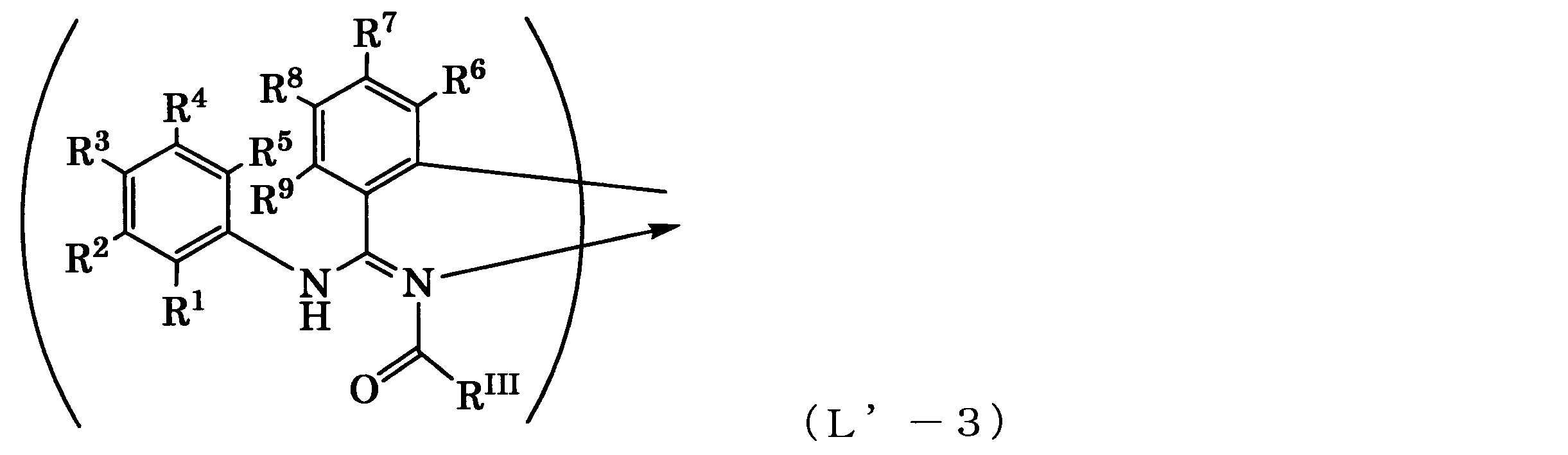
- the impurity (L′-2) which is an impurity ligand is a ligand represented by the following formula (L′-3).
- R 1 , R 5 , R III and R IV are the same as those in the formula (L-2)
- R 2 to R 4 and R 6 to R 9 each represent a hydrogen atom or a substituent.
- the adjacent groups among R 2 to R 4 and R 6 to R 9 may be bonded to each other to form a ring.
- the R 1 ⁇ R 9 and R III, R 1 ⁇ R 9 and R III of Formula (L-3) are respectively the same group.
- m + n is 2 or 3
- M is divalent platinum (Pt), divalent palladium (Pd), trivalent iridium (Ir), or trivalent rhodium (Rh). preferable.
- M is preferably trivalent iridium (Ir).
- the metal complex and its impurity include a case where the metal complex is a metal complex represented by the following formula (1 ′) and the impurity is a compound represented by the following formula (2 ′).
- R 1 to R 9 , R III and R IV are the same as in the above formula (L-3).
- R 1 ⁇ R 9, R III and R IV, R 1 ⁇ R 9 , R III and R IV of the formula (1 ') are respectively the same group.
- the metal complex of the present embodiment in which the predetermined impurity content is significantly reduced, is, for example, a step of synthesizing a metal complex including a partial structure represented by the above formula (1a),
- the content of the metal complex is 99.7% or more in the purification process, and the impurity content of the metal complex generated in the purification process is 0.036% or less with respect to the metal complex.
- the impurities shown in the present embodiment are synonymous with the impurities in the first embodiment described above.
- the purification step includes, for example, at least one purification method selected from recrystallization, silica gel column chromatography, sublimation, and fractionation using a liquid chromatography (LC) apparatus.
- LC liquid chromatography
- the metal complex which is the main component of the present invention itself undergoes a decomposition reaction in the presence of oxygen contained in the air in the process of purification by the action of a solvent, silica gel, light, etc. It has been confirmed that the purity is lowered when the decomposition reaction product is contained in the metal complex. Specifically, it has been confirmed that impurities are generated again by placing a metal complex having a purity close to 100% in air, a solvent, silica gel, and an environment with light. Therefore, attention should be paid to the solvent, silica gel and light.
- a solvent to be used for purification it is necessary to dissolve the metal complex itself, but a so-called nonpolar solvent having an aprotic property and a relative dielectric constant of 10 or less is preferable.
- a so-called nonpolar solvent having an aprotic property and a relative dielectric constant of 10 or less.
- hydrocarbon solvents aromatic hydrocarbon solvents, ether solvents, ester solvents, chloroform, methylene chloride and the like can be mentioned.
- it is toluene or methylene chloride.
- an inert gas such as nitrogen gas before use.
- Silica gel is generally known to be acidic or neutral. In order to suppress the decomposition reaction from the metal complex to a small amount of impurities, neutral silica gel is suitable.
- the use of silica gel column chromatography for purification is extremely effective for removing by-products generated during the complex synthesis reaction or trace impurities generated by decomposition of the complex itself, so it can be said to be indispensable in the purification process. .
- the decomposition reaction of the complex itself is promoted by light in the air.
- Ultraviolet light having a shorter wavelength and higher energy than visible light promotes decomposition of the complex.
- the handling of the metal complex of the present invention through reaction, separation, purification, and storage is preferably performed under illumination in which light having a wavelength as short as possible is removed as much as possible.
- the illuminance synthesis and / or purification at an illuminance of 0 lux is actually difficult, but it is desirable that the illuminance be as small as possible.
- the container used at the time of each process and storage is not a transparent glass appliance but a brown glass appliance. In general, brown glassware can cut UV light of 450 nm or less.
- brown glassware can cut UV light of 450 nm or less.
- since aluminum foil can be shielded from light by wrapping it around a glass fixture, it is preferable to perform operations such as synthesis and purification while performing light shielding with the aluminum foil as much as possible.
- all processes after the final stage of the process of synthesizing the metal complex are performed under an environment with an illuminance of 100 lux or less (more preferably 10 lux or less) and a wavelength of 480 nm or less ( More preferably, it is performed in an environment without light having a wavelength of 560 nm or less.
- the illuminance of the light source is set sufficiently low and a light source that does not emit light in the short wavelength region such as yellow light or orange light is used, or a color filter such as a yellow filter or an orange filter is used. It is obtained by shielding light in a short wavelength region included in the light source.
- Organic EL Device The metal complex composition or metal complex of the present invention can be suitably used as a material for an organic EL device, for example, a material for a light emitting layer.
- the organic EL device of the present invention has an organic thin film layer containing a light emitting layer between a cathode and an anode, and at least one of the organic thin film layers contains the above-described metal complex composition of the present invention. Thereby, the lifetime of an organic EL element can be improved.
- the organic thin film layer include, but are not limited to, a hole injection layer, a hole transport layer, a light emitting layer, an electron transport layer, an electron injection layer, a space layer, and a barrier layer.
- the light emitting layer preferably contains the metal complex of the present invention, and is particularly preferably used as a dopant material for the light emitting layer.
- the organic EL device of the present invention other configurations are not particularly limited as long as the above-described metal complex composition or metal complex of the present invention is included, and a known configuration can be adopted. This will be briefly described below.
- the substrate is used as a support for the light emitting element.
- the substrate for example, glass, quartz, plastic, or the like can be used.
- a flexible substrate may be used.
- the flexible substrate is a substrate that can be bent (flexible), and examples thereof include a plastic substrate made of polycarbonate or polyvinyl chloride.
- anode For the anode formed on the substrate, it is preferable to use a metal, an alloy, an electrically conductive compound, a mixture thereof, or the like having a high work function (specifically, 4.0 eV or more).
- a metal, an alloy, an electrically conductive compound, a mixture thereof, or the like having a high work function (specifically, 4.0 eV or more).
- ITO indium tin oxide
- ITO indium oxide-tin oxide containing silicon or silicon oxide
- indium oxide-zinc oxide silicon oxide
- tungsten oxide and indium oxide containing zinc oxide.
- graphene graphene.
- gold (Au), platinum (Pt), a nitride of a metal material (for example, titanium nitride), or the like can be given.
- the hole injection layer is a layer containing a substance having a high hole injection property.
- Substances with high hole injection properties include molybdenum oxide, titanium oxide, vanadium oxide, rhenium oxide, ruthenium oxide, chromium oxide, zirconium oxide, hafnium oxide, tantalum oxide, silver oxide, Tungsten oxide, manganese oxide, aromatic amine compound, or high molecular compound (oligomer, dendrimer, polymer, etc.) can also be used.
- the hole transport layer is a layer containing a substance having a high hole transport property.
- An aromatic amine compound, a carbazole derivative, an anthracene derivative, or the like can be used for the hole transport layer.
- a high molecular compound such as poly (N-vinylcarbazole) (abbreviation: PVK) or poly (4-vinyltriphenylamine) (abbreviation: PVTPA) can also be used.
- PVK N-vinylcarbazole
- PVTPA poly (4-vinyltriphenylamine
- the layer containing a substance having a high hole-transport property is not limited to a single layer, and two or more layers containing the above substances may be stacked.
- the light-emitting layer is a layer including a substance having high light-emitting properties, and various materials can be used.
- a fluorescent compound that emits fluorescence or a phosphorescent compound that emits phosphorescence can be used as the substance having high light-emitting property.
- a fluorescent compound is a compound that can emit light from a singlet excited state
- a phosphorescent compound is a compound that can emit light from a triplet excited state.
- a blue fluorescent material that can be used for the light emitting layer pyrene derivatives, styrylamine derivatives, chrysene derivatives, fluoranthene derivatives, fluorene derivatives, diamine derivatives, triarylamine derivatives, and the like can be used.
- An aromatic amine derivative or the like can be used as a green fluorescent material that can be used for the light emitting layer.
- Tetracene derivatives, diamine derivatives, and the like can be used as red fluorescent materials that can be used for the light emitting layer.
- a blue phosphorescent material that can be used for the light emitting layer a metal complex such as an iridium complex, an osmium complex, or a platinum complex is used.
- An iridium complex or the like is used as a green phosphorescent material that can be used in the light emitting layer.
- a metal complex such as an iridium complex, a platinum complex, a terbium complex, or a europium complex is used.
- the light-emitting layer may have a structure in which the above-described highly light-emitting substance (guest material) is dispersed in another substance (host material).
- Various materials can be used as a material for dispersing a highly luminescent substance.
- the lowest unoccupied orbital level (LUMO level) is higher than that of a highly luminescent substance, and the highest occupied orbital level ( It is preferable to use a substance having a low HOMO level.
- Substances (host materials) for dispersing highly luminescent substances include 1) metal complexes such as aluminum complexes, beryllium complexes, or zinc complexes, 2) oxadiazole derivatives, benzimidazole derivatives, phenanthroline derivatives, etc.
- the electron transport layer is a layer containing a substance having a high electron transport property.
- metal complexes such as aluminum complexes, beryllium complexes, and zinc complexes
- heteroaromatic compounds such as imidazole derivatives, benzimidazole derivatives, azine derivatives, carbazole derivatives, and phenanthroline derivatives
- 3) polymer compounds can be used.
- the electron injection layer is a layer containing a substance having a high electron injection property.
- the electron injection layer includes an alkali metal such as lithium (Li), lithium fluoride (LiF), cesium fluoride (CsF), calcium fluoride (CaF2), lithium oxide (LiOx), an alkaline earth metal, Alternatively, those compounds can be used.
- cathode For the cathode, it is preferable to use a metal, an alloy, an electrically conductive compound, a mixture thereof, or the like having a small work function (specifically, 3.8 eV or less).
- cathode materials include elements belonging to Group 1 or Group 2 of the periodic table of elements, that is, alkali metals such as lithium (Li) and cesium (Cs), and alkaline earth such as magnesium (Mg). And other rare earth metals such as alloys, alloys containing them (for example, MgAg, AlLi), and alloys containing these.
- Example 1 (Iridium complex synthesis under red fluorescent lamp)
- the reaction and purification were all performed under a red fluorescent lamp (illuminance: 100 lux or less).
- the containers used for the reaction, purification, and storage were all made of brown glass and shielded from ultraviolet rays.
- the column tube used for purification was covered with aluminum foil and silica gel column chromatography purification was performed under light shielding.
- Compound 3 which is a metal complex was synthesized by the following reaction route.
- LC-MS liquid chromatography mass spectrometry
- the facial form of compound 3 was 99.30%
- the meridional form of compound 3 was 0.63%
- the total of compound 3 was 99.93%.
- there were many impurities with no specific structure all impurities were 0.014% or less, and the total of impurities was 0.07%.
- peak No. 1 in which one C (carbon) was removed from compound 3 and one O (oxygen) was added to increase the molecular weight by four.
- the content of 20 impurities (+4 component [compound 3-C (carbon) + O (oxygen)]) was 0.001% or less.
- Example 1 the compound 3 obtained in Example 1 was purified by sublimation (before sublimation: 5.00 g, after sublimation: 4.34 g).
- the conditions for sublimation purification were as follows.
- Equipment Sublimation equipment for organic materials (manufactured by ALS Technology Inc.)
- Sublimation tube glass, inner diameter 40mm
- Sublimation method Airflow method (nitrogen flow rate: 10 m ⁇ sec)
- Sublimation temperature 260 ° C to 280 ° C on the high temperature side, 180 ° C on the low temperature side
- Degree of vacuum 3.5 Pa on the vacuum pump side
- Table 2 shows the results of LC-MS of compound 3 purified by sublimation.
- the facial isomer of compound 3 was 99.30%, the meridional isomer of compound 3 was 0.65%, and the total of compound 3 was 99.95%. Further, there were many impurities with no specific structure, all impurities were 0.016% or less, and the total of impurities was 0.05%. In addition, peak No. The content of 20 impurities was 0.001% or less. From the above results, it can be confirmed that the purity of the compound 3 is improved by sublimation purification.
- Example 2 (Iridium complex synthesis under yellow fluorescent lamp) Compound 3 was synthesized in the same manner as in Example 1 except that a yellow fluorescent lamp was used instead of the red fluorescent lamp. The results of LC-MS after sublimation purification are shown in Table 3.
- the facial form of compound 3 was 98.71%, the meridional form of compound 3 was 0.98%, and the total of compound 3 was 99.69%.
- peak No. The content of 20 impurities was 0.025%.
- Example 3 (Iridium complex synthesis under white fluorescent lamp) The reaction scale was reduced to a quarter, and the reaction and purification were all performed under a white fluorescent lamp (illuminance: 100 lux or less). All containers used for reaction, purification and storage were made of transparent glass. Moreover, the column tube used at the time of refinement
- the facial form of compound 3 was 99.17%
- the meridional form of compound 3 was 0.59%
- the total of compound 3 was 99.76%.
- peak No. The content of 20 impurities was 0.036%.
- Example 4 Purification by silica gel column chromatography under light-shielding conditions
- the compound 3 obtained in Example 3 was covered with aluminum foil, purified by silica gel column chromatography under light shielding, and purified by sublimation again.
- the results of LC-MS are shown in Table 5.
- the facial form of compound 3 was 99.09%, the meridional form of compound 3 was 0.68%, and the total of compound 3 was 99.77%.
- peak No. The content of 20 impurities was 0.027%.
- Comparative Example 1 Synthesis of low purity product
- Compound 3 was synthesized in the same manner as in Example 3 except that recrystallization with heptane / methylene chloride was not performed.
- the results of LC-MS are shown in Table 6.
- the facial isomer of compound 3 was 98.76%
- the meridional isomer of compound 3 was 0.93%
- the total of compound 3 was 99.69%.
- peak No. The content of 20 impurities was 0.039%.
- Example 3 From a comparison between Example 3 and Example 4, it was confirmed that the purity of Compound 3 could be improved by silica gel column chromatography purification. In particular, the impurity content of peak No. 20 observed as a peak after the target product (compound 3) in LC-MS could be reduced. From the comparison of Examples 1 to 3, by synthesizing under a red fluorescent lamp, the content of impurities of peak No. 20 observed as a peak after the target product (compound 3) in LC-MS is particularly remarkably reduced. I was able to.
- Example 5 A glass substrate with a 130 nm-thick ITO electrode line (manufactured by Geomatic) was ultrasonically cleaned in isopropyl alcohol for 5 minutes, followed by UV ozone cleaning for 30 minutes. The glass substrate with the ITO electrode line after cleaning is attached to the substrate holder of the vacuum deposition apparatus, and the following compound (HI1) is first thickened to cover the ITO electrode line on the surface on which the ITO electrode line is formed. Then, the following compound (HT1) was vapor-deposited by resistance heating at a thickness of 60 nm, and thin films were sequentially formed. The film formation rate was 1 ⁇ / s. These thin films function as a hole injection layer and a hole transport layer, respectively.
- the following compound (H1) and compound 3 (sublimation purified product) produced in Example 1 were simultaneously deposited by resistance heating to form a thin film having a thickness of 50 nm.
- the compound 3 was vapor-deposited so that the mass ratio was 20% with respect to the total mass of the compound (H1) and the compound 3.
- the film formation rates were 1.2 ⁇ / s and 0.3 ⁇ / s, respectively.
- This thin film functions as a phosphorescent light emitting layer.
- a thin film having a thickness of 10 nm was formed on the phosphorescent light emitting layer by resistance heating vapor deposition of the compound (H1).
- the film formation rate was 1 ⁇ / s.
- This thin film functions as a hole blocking layer.
- a thin film having a thickness of 10 nm was formed on this barrier layer by resistance heating vapor deposition of the following compound (ET1).
- the film formation rate was 1 ⁇ / s.
- This film functions as an electron injection layer.
- LiF having a film thickness of 1.0 nm was deposited on the electron injection layer at a film formation rate of 0.1 ⁇ / s.
- metal aluminum was vapor-deposited on the LiF film at a film formation rate of 8.0 ⁇ / s to form a metal cathode having a film thickness of 80 nm, thereby manufacturing an organic EL element.
- Examples 6-8, Comparative Example 2 An organic EL device was produced in the same manner as in Example 5 except that the compound 3 produced in Examples 2 to 4 and Comparative Example 1 was used instead of the compound 3 produced in Example 1.
- Table 7 shows the measurement results of the driving voltage, external quantum efficiency, and half-life when the organic EL element manufactured in each example was driven at 1000 cd / m 2 .
- Table 7 shows typical peak numbers and area ratios of impurities.
- FIG. 1 shows the relationship between the light emission time and the luminance when the initial luminance is 1.
- the lifetime of the element decreases in the order of Example 5, Example 6, Example 8, Example 7, and Comparative Example 2. It can be confirmed that it correlates with the content of 20 impurities. It can be said that the external quantum efficiency has the same relationship.
- the impurity 20 is an impurity having a structure represented by the formula (2a). Specifically, the molecular weight is [molecular weight of compound 3—C (carbon) + O (oxygen)]. Peak No. When the area ratio of 20 is smaller, the half-life tends to be longer. On the other hand, other impurity peaks such as No. 17, no. 16, no. There is no correlation between the area ratio of 22 and the half-life. That is, the impurity that most affects the half-life is an impurity having a structure represented by the formula (2a), and it is important to reduce the impurity content in order to produce an industrially useful organic EL device.
- Peak No. The ultraviolet visible absorption spectrum and low temperature (77K) emission spectrum of 20 impurities are shown in FIG. From the emission spectrum, this impurity was found to have a maximum emission wavelength at 623 nm.
- Compound 3 is a blue light-emitting material having a maximum emission wavelength at about 470 nm, and as a result, a material with an extremely small triplet energy gap having a light emission wavelength on the high wavelength side is mixed as an impurity, so that the light emission efficiency and the light emission lifetime can be obtained. This can cause a significant decrease in the performance of the organic EL element. Therefore, it is important to reduce the amount of impurities as much as possible for higher performance.
- Example 1 In a clear glass bottle, dissolve compound 3 obtained in Example 1 (before sublimation purification: 10 mg) in methylene chloride, add 3 g of silica gel (manufactured by Fuji Silysia Chemical Co., Ltd., PSQ100B (spherical)) under a white fluorescent lamp. It was left sealed at room temperature for 12 days. After standing, the methylene chloride soluble part of the liquid and the part eluted from the silica gel by methylene chloride washing were combined, the solvent was air-dried at room temperature, and the collected solid was subjected to LC-MS measurement.
- silica gel manufactured by Fuji Silysia Chemical Co., Ltd., PSQ100B (spherical)
- Evaluation Example 2 Evaluation was performed in the same manner as in Evaluation Example 1 except that the silica gel was changed to BW-820MH manufactured by Fuji Silysia Chemical.
- Evaluation Example 3 It carried out similarly to the said evaluation example 1 except not having used a silica gel.
- Evaluation Example 4 It carried out similarly to the said evaluation example 3 except having used the brown glass bottle instead of the transparent glass bottle.
- the LC-MS results of Evaluation Examples 1 to 4 are shown in Table 11.
- the result of Compound 3 synthesized in Example 1 and not purified by sublimation is also shown.
- only representative peak results are shown.
Landscapes
- Chemical & Material Sciences (AREA)
- Organic Chemistry (AREA)
- Engineering & Computer Science (AREA)
- Materials Engineering (AREA)
- Crystallography & Structural Chemistry (AREA)
- Inorganic Chemistry (AREA)
- Electroluminescent Light Sources (AREA)
Abstract
下記式(1)で示される部分構造を含む金属錯体と、不純物を含み、金属錯体の含有量が99.7%以上であり、不純物は、精製時又は保存時に前記金属錯体が変性することによって生成され、不純物の含有量が0.036%以下である金属錯体組成物。
Description
本発明は、金属錯体組成物、金属錯体の製造方法及び有機エレクトロルミネッセンス素子に関する。さらに詳しくは、有機エレクトロルミネッセンス素子の材料等に使用できる金属錯体組成物に関する。
有機エレクトロルミネッセンス素子(以下、有機EL素子という。)は、陽極及び陰極間に、正孔注入層、正孔輸送層、発光層、電子輸送層等の有機層を介在させた構成を有する。発光層はホスト化合物とドーパント化合物の混合物からなることが多い。
ドーパント化合物として、蛍光発光材料に代わり、発光効率が高い燐光発光材料が注目されている。燐光発光材料において、赤、及び、緑色の発光材料に関しては発光効率や発光寿命の改善が進んでいる。一方、青色の発光材料に関しては発光効率や発光寿命が必ずしも十分ではなく、高性能材料の開発が望まれている。
ドーパント化合物として、蛍光発光材料に代わり、発光効率が高い燐光発光材料が注目されている。燐光発光材料において、赤、及び、緑色の発光材料に関しては発光効率や発光寿命の改善が進んでいる。一方、青色の発光材料に関しては発光効率や発光寿命が必ずしも十分ではなく、高性能材料の開発が望まれている。
青色発光材料に関して、例えば、置換基を有するジアゾールやトリアゾール骨格を有する材料が、特許文献1~3に記載されている。該材料の配位子である置換基を有するジアゾールやトリアゾール化合物の合成については、特許文献4又は5に記載されている。
本発明の目的は、有機EL素子の材料として好適に使用できる金属錯体組成物を提供することである。
本発明の一実施形態によれば、下記式(1)で示される部分構造を含む金属錯体と、前記金属錯体の不純物を含む金属錯体組成物が提供され、前記金属錯体の含有量が99.7%以上であり、前記不純物は、精製時又は保存時に前記金属錯体が変性することによって生成され、前記不純物の含有量が0.036%以下である。

(式中、X1はRIII-C(Cは炭素原子である。)又は窒素原子を示し、X2はRIV-C(Cは炭素原子である。)又は窒素原子を示す。
RI及びRIIは、それぞれ独立に、置換もしくは無置換の炭素数1~20のアルキル基、置換もしくは無置換の環形成炭素数3~10のシクロアルキル基、置換もしくは無置換の環形成炭素数3~10のシクロアルケニル基、置換もしくは無置換の環形成炭素数6~50のアリール基、置換もしくは無置換の環形成原子数5~30のヘテロアリール基、置換もしくは無置換のアリールアミノ基、置換もしくは無置換のアラルキル基、置換もしくは無置換のアリールボリル基、又は、置換もしくは無置換のアリールシリル基である。
RIII及びRIVは、それぞれ独立に、水素原子、置換もしくは無置換の炭素数1~20のアルキル基、置換もしくは無置換の環形成炭素数3~10のシクロアルキル基、置換もしくは無置換の環形成炭素数3~10のシクロアルケニル基、置換もしくは無置換の環形成炭素数6~50のアリール基、置換もしくは無置換の環形成原子数5~30のヘテロアリール基、置換もしくは無置換のアリールアミノ基、置換もしくは無置換のアラルキル基、置換もしくは無置換のアリールボリル基、又は、置換もしくは無置換のアリールシリル基である。
RI及びRIIは直接、又は連結基を介して結合していてもよい。
Mは、周期律表第3族から第12族の典型金属又は遷移金属を示す。RI又はRIIのどちらか一方は、Mと共有結合している。
実線は共有結合を示し、矢印は前記Mと括弧内の配位子との配位結合を示す。)
RI及びRIIは、それぞれ独立に、置換もしくは無置換の炭素数1~20のアルキル基、置換もしくは無置換の環形成炭素数3~10のシクロアルキル基、置換もしくは無置換の環形成炭素数3~10のシクロアルケニル基、置換もしくは無置換の環形成炭素数6~50のアリール基、置換もしくは無置換の環形成原子数5~30のヘテロアリール基、置換もしくは無置換のアリールアミノ基、置換もしくは無置換のアラルキル基、置換もしくは無置換のアリールボリル基、又は、置換もしくは無置換のアリールシリル基である。
RIII及びRIVは、それぞれ独立に、水素原子、置換もしくは無置換の炭素数1~20のアルキル基、置換もしくは無置換の環形成炭素数3~10のシクロアルキル基、置換もしくは無置換の環形成炭素数3~10のシクロアルケニル基、置換もしくは無置換の環形成炭素数6~50のアリール基、置換もしくは無置換の環形成原子数5~30のヘテロアリール基、置換もしくは無置換のアリールアミノ基、置換もしくは無置換のアラルキル基、置換もしくは無置換のアリールボリル基、又は、置換もしくは無置換のアリールシリル基である。
RI及びRIIは直接、又は連結基を介して結合していてもよい。
Mは、周期律表第3族から第12族の典型金属又は遷移金属を示す。RI又はRIIのどちらか一方は、Mと共有結合している。
実線は共有結合を示し、矢印は前記Mと括弧内の配位子との配位結合を示す。)
本発明によれば、有機EL素子の材料として好適な金属錯体組成物及び金属錯体の製造方法が提供できる。本発明の金属錯体組成物又は金属錯体を使用することにより、有機EL素子の寿命を改善できる。
1.金属錯体組成物の第一の態様
本発明の一実施形態である金属錯体組成物は、下記式(1)で示される部分構造を含む金属錯体と、この金属錯体の不純物を含む。
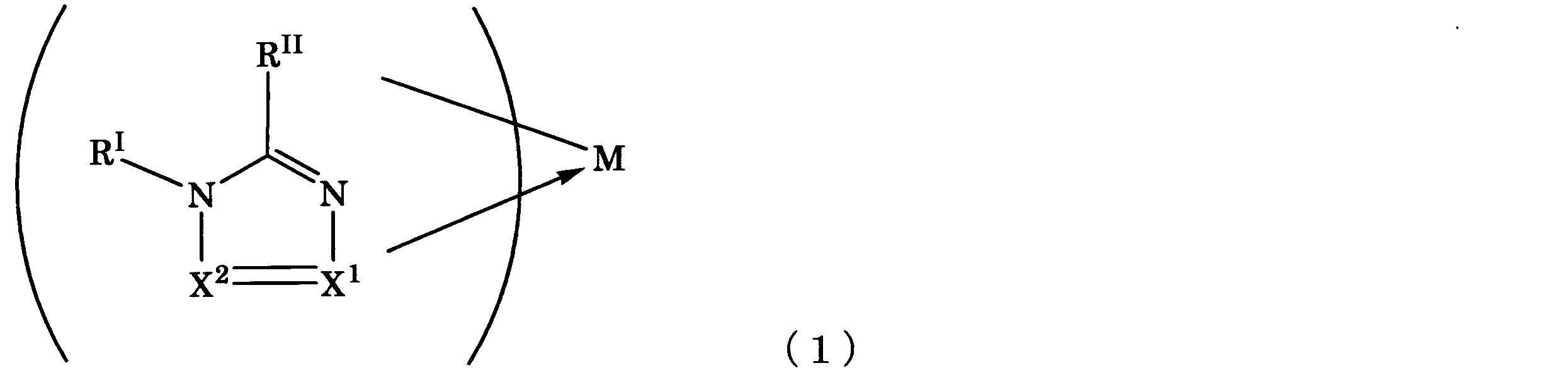
(式中、X1はRIII-C(Cは炭素原子である。)又は窒素原子を示し、X2はRIV-C(Cは炭素原子である。)又は窒素原子を示す。
RI及びRIIは、それぞれ独立に、置換もしくは無置換の炭素数1~20のアルキル基、置換もしくは無置換の環形成炭素数3~10のシクロアルキル基、置換もしくは無置換の環形成炭素数3~10のシクロアルケニル基、置換もしくは無置換の環形成炭素数6~50のアリール基、置換もしくは無置換の環形成原子数5~30のヘテロアリール基、置換もしくは無置換のアリールアミノ基、置換もしくは無置換のアラルキル基、置換もしくは無置換のアリールボリル基、又は、置換もしくは無置換のアリールシリル基である。
RIII及びRIVは、それぞれ独立に、水素原子、置換もしくは無置換の炭素数1~20のアルキル基、置換もしくは無置換の環形成炭素数3~10のシクロアルキル基、置換もしくは無置換の環形成炭素数3~10のシクロアルケニル基、置換もしくは無置換の環形成炭素数6~50のアリール基、置換もしくは無置換の環形成原子数5~30のヘテロアリール基、置換もしくは無置換のアリールアミノ基、置換もしくは無置換のアラルキル基、置換もしくは無置換のアリールボリル基、又は、置換もしくは無置換のアリールシリル基である。
RI及びRIIは直接、又は連結基を介して結合していてもよい。
Mは、周期律表第3族から第12族の典型金属又は遷移金属を示す。RI又はRIIのどちらか一方は、Mと共有結合している。
実線は共有結合を示し、矢印は前記Mと括弧内の配位子との配位結合を示す。)
本発明の一実施形態である金属錯体組成物は、下記式(1)で示される部分構造を含む金属錯体と、この金属錯体の不純物を含む。
RI及びRIIは、それぞれ独立に、置換もしくは無置換の炭素数1~20のアルキル基、置換もしくは無置換の環形成炭素数3~10のシクロアルキル基、置換もしくは無置換の環形成炭素数3~10のシクロアルケニル基、置換もしくは無置換の環形成炭素数6~50のアリール基、置換もしくは無置換の環形成原子数5~30のヘテロアリール基、置換もしくは無置換のアリールアミノ基、置換もしくは無置換のアラルキル基、置換もしくは無置換のアリールボリル基、又は、置換もしくは無置換のアリールシリル基である。
RIII及びRIVは、それぞれ独立に、水素原子、置換もしくは無置換の炭素数1~20のアルキル基、置換もしくは無置換の環形成炭素数3~10のシクロアルキル基、置換もしくは無置換の環形成炭素数3~10のシクロアルケニル基、置換もしくは無置換の環形成炭素数6~50のアリール基、置換もしくは無置換の環形成原子数5~30のヘテロアリール基、置換もしくは無置換のアリールアミノ基、置換もしくは無置換のアラルキル基、置換もしくは無置換のアリールボリル基、又は、置換もしくは無置換のアリールシリル基である。
RI及びRIIは直接、又は連結基を介して結合していてもよい。
Mは、周期律表第3族から第12族の典型金属又は遷移金属を示す。RI又はRIIのどちらか一方は、Mと共有結合している。
実線は共有結合を示し、矢印は前記Mと括弧内の配位子との配位結合を示す。)
尚、下記式(1)で示される部分構造を含む金属錯体とは、式(1)中、括弧内の配位子の他に、他の配位子を有していてもよいことを意味する。
本願において金属錯体組成物とは、主成分である金属錯体の他に微量の不純物を含むことを意味する。本願の組成物は、実質的には金属錯体ということができるが、極微量の不純物を金属錯体単体と区別するために金属錯体組成物という。尚、上記不純物は後述する条件下の精製を精緻に繰り返すことによって、削減することが可能である。その結果、現在測定可能な微量不純物の測定限界を超えて削減することも可能である。一般的には、測定限界が0.001%程度であり、この視点から述べると不純物の下限は0.001%程度となる。ただし、今後の測定装置の性能向上によって、例えば0.00001%程度まで不純物濃度を減らすことができればより好ましい。
本願において金属錯体組成物とは、主成分である金属錯体の他に微量の不純物を含むことを意味する。本願の組成物は、実質的には金属錯体ということができるが、極微量の不純物を金属錯体単体と区別するために金属錯体組成物という。尚、上記不純物は後述する条件下の精製を精緻に繰り返すことによって、削減することが可能である。その結果、現在測定可能な微量不純物の測定限界を超えて削減することも可能である。一般的には、測定限界が0.001%程度であり、この視点から述べると不純物の下限は0.001%程度となる。ただし、今後の測定装置の性能向上によって、例えば0.00001%程度まで不純物濃度を減らすことができればより好ましい。
不純物は、一般的に金属錯体の合成時に生成されるものだが、本実施形態の不純物は合成時に加えて精製時又は保存時に金属錯体が変性することによって生成するものである。例えば、アゾール環が開環した配位子を有する金属錯体等が挙げられる。この不純物は、含有量が少量であっても、有機EL素子の寿命に影響を与える。有機EL素子の性能に悪影響を与える不純物としては、例えば、下記の分子量を有する化合物がある。
(a)RIVが水素(H)の場合
<主成分である金属錯体の分子量>-C(炭素)+O(酸素)
=<主成分である金属錯体の分子量>+4
(b)RIVが水素(H)以外の場合
<主成分である金属錯体の分子量>-C(炭素)+O(酸素)+H(水素)-<RIV基の分子量>
=<主成分である金属錯体の分子量>-<RIV基の分子量>+5
これらの不純物は、複数の構造異性体を含む場合もあり、例えば、後述する実施例におけるピークNo.16とピークNo.20が構造異性体に相当する。この場合、有機EL素子の性能に悪影響を与える不純物としては、LC-MSにおいて溶出時間が後に出てくるピークNo.20の化合物が挙げられる。
(a)RIVが水素(H)の場合
<主成分である金属錯体の分子量>-C(炭素)+O(酸素)
=<主成分である金属錯体の分子量>+4
(b)RIVが水素(H)以外の場合
<主成分である金属錯体の分子量>-C(炭素)+O(酸素)+H(水素)-<RIV基の分子量>
=<主成分である金属錯体の分子量>-<RIV基の分子量>+5
これらの不純物は、複数の構造異性体を含む場合もあり、例えば、後述する実施例におけるピークNo.16とピークNo.20が構造異性体に相当する。この場合、有機EL素子の性能に悪影響を与える不純物としては、LC-MSにおいて溶出時間が後に出てくるピークNo.20の化合物が挙げられる。
本実施形態では、金属錯体の含有量が99.7%以上である。低分子の有機EL材料は、微量不純物が混在した場合、この微量不純物がキャリアトラップとして作用することで電荷の伝導や発光機構に影響し、結果として、発光効率、駆動電圧、あるいは寿命といった素子性能に悪影響を与えることがある。従って、できるだけ高純度化して利用することが必要である。本発明では、含有量が99.7%以上であれば、例えば、有機EL素子用材料として問題なく使用できる。好ましくは、金属錯体の含有量が99.9%以上である。尚、含有量は99.5%以上、又は99.6%以上としてもよい。
金属錯体の含有量の上限は100%であることが好ましいが、上述の通り本願の組成物における不純物の含有量の下限は、測定装置の測定限界の観点より0.001%程度であるため、金属錯体の含有量の上限は99.999%となる。また、今後の測定装置の性能向上によって、微量不純物の測定限界が0.00001%程度になった場合には、不純物の含有量の下限は0.00001%が好ましく、従って、金属錯体の含有量の上限は99.99999%が好ましい。
尚、金属錯体の含有量は、すべての構造異性体の合計量を意味する。例えば、二座配位型の3つの配位子を有する以下の化合物(トリス体)であれば、正八面体型混成軌道を有する金属(イリジウム)に対し、その配位子の結合する方向の違いにより、facial(フェイシャル)構造とmeridional(メリジオナル)構造の両方を含む。
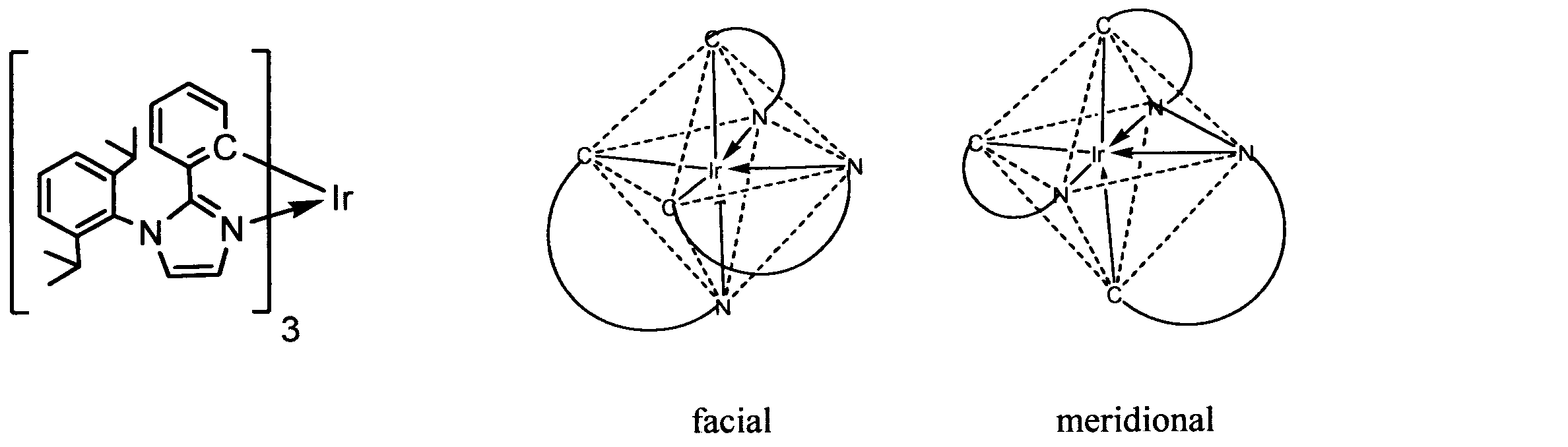
尚、金属錯体の含有量は、すべての構造異性体の合計量を意味する。例えば、二座配位型の3つの配位子を有する以下の化合物(トリス体)であれば、正八面体型混成軌道を有する金属(イリジウム)に対し、その配位子の結合する方向の違いにより、facial(フェイシャル)構造とmeridional(メリジオナル)構造の両方を含む。
また、上記不純物の含有量は、少ない程好ましいが、有機EL素子の性能、及び、精製工程や保存の費用等の観点から、0.036%以下であればよい。
本願において、組成物における各成分の含有量は、紫外可視吸収検出器による液体クロマトグラフ(LC)にて検出される全ピークの合計面積に対する各ピークの面積比(%)を意味する。測定条件は実施例で示す。
式(1)で示される部分構造を含む金属錯体は、例えば、式(1b)で示される部分構造を含む金属錯体であることが好ましい。本金属錯体は、アゾール環としてジアゾール環を有する。これにより、長寿命な青色発光錯体となる。

(式中、RI、RII、RIII、RIV、及びMは、それぞれ、式(1)と同様である。mは1~3の整数である。)
式(1)又は式(1b)で示される部分構造を含む金属錯体として、より具体的には下記式(1-1)で示される金属錯体が挙げられる。
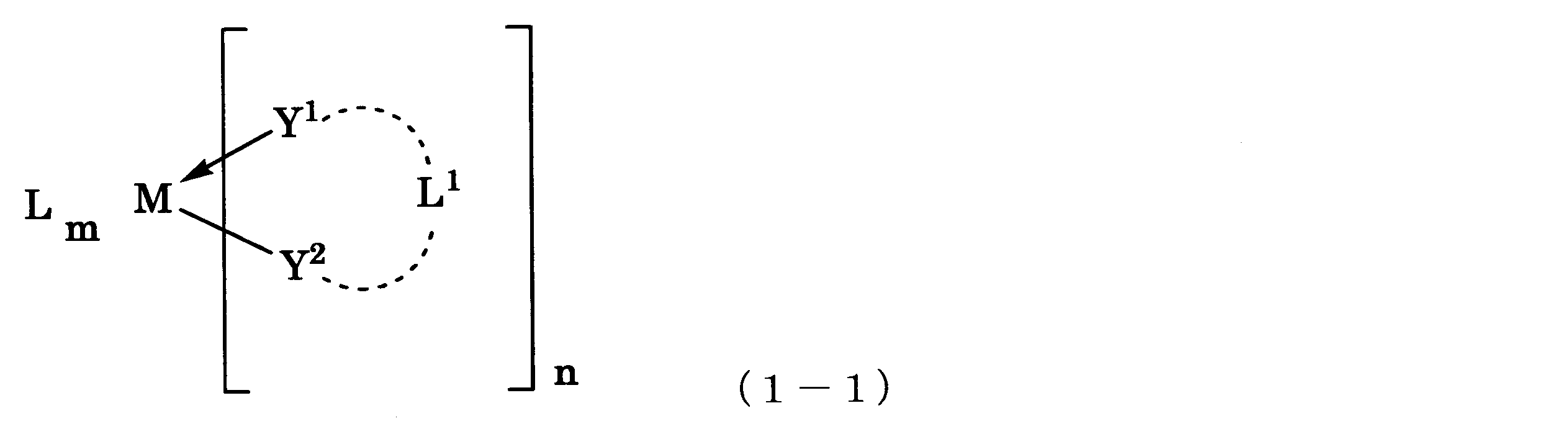
(式中、Mは、式(1b)と同様である。
Y1及びY2はそれぞれ独立に、炭素原子、窒素原子又は酸素原子を示し、L1はY1及びY2の連結基で、Y1及びY2とともに2座の配位子(Y1-L1-Y2)を形成する原子群を示す。
Lは下記式(L)で示される配位子である。
mは、1~3の整数であり、nは、0~3の整数である。m+nは1~6である。mが2以上の場合は、2つ以上ある配位子Lは互いに同じでも異なる構造でもよい。また、2つ以上の配位子Lは、直接又は連結基を介して架橋構造を形成してもよい。)

(式中、RI、RII、RIII及びRIVは、式(1)と同様である。)
Y1及びY2はそれぞれ独立に、炭素原子、窒素原子又は酸素原子を示し、L1はY1及びY2の連結基で、Y1及びY2とともに2座の配位子(Y1-L1-Y2)を形成する原子群を示す。
Lは下記式(L)で示される配位子である。
mは、1~3の整数であり、nは、0~3の整数である。m+nは1~6である。mが2以上の場合は、2つ以上ある配位子Lは互いに同じでも異なる構造でもよい。また、2つ以上の配位子Lは、直接又は連結基を介して架橋構造を形成してもよい。)
式(1-1)のLは、下記式(L-1)で示される配位子であってもよい。
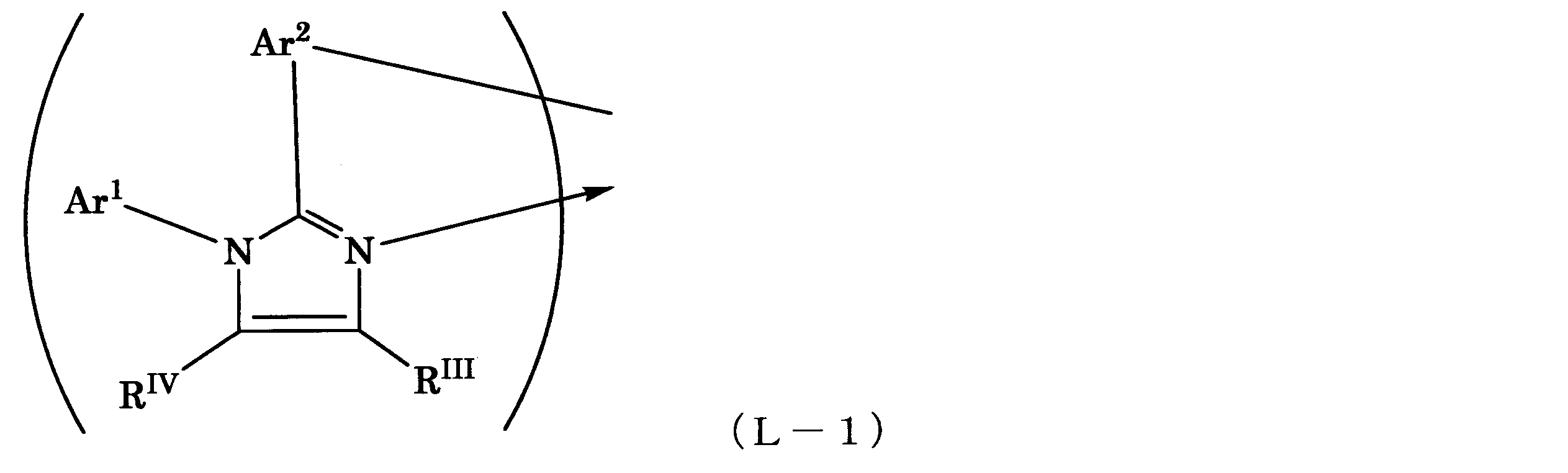
(式中、RIII及びRIVは、式(1)と同様である。
Ar1は、置換基を有する芳香環基又は置換基を有するヘテロ芳香環を示す。
Ar2は金属Mに結合する、置換もしくは無置換の芳香環又は置換もしくは無置換のヘテロ芳香環を示す。)
Ar1は、置換基を有する芳香環基又は置換基を有するヘテロ芳香環を示す。
Ar2は金属Mに結合する、置換もしくは無置換の芳香環又は置換もしくは無置換のヘテロ芳香環を示す。)
式(L-1)で示される配位子の具体例としては、下記式(L-2)で示される配位子がある。
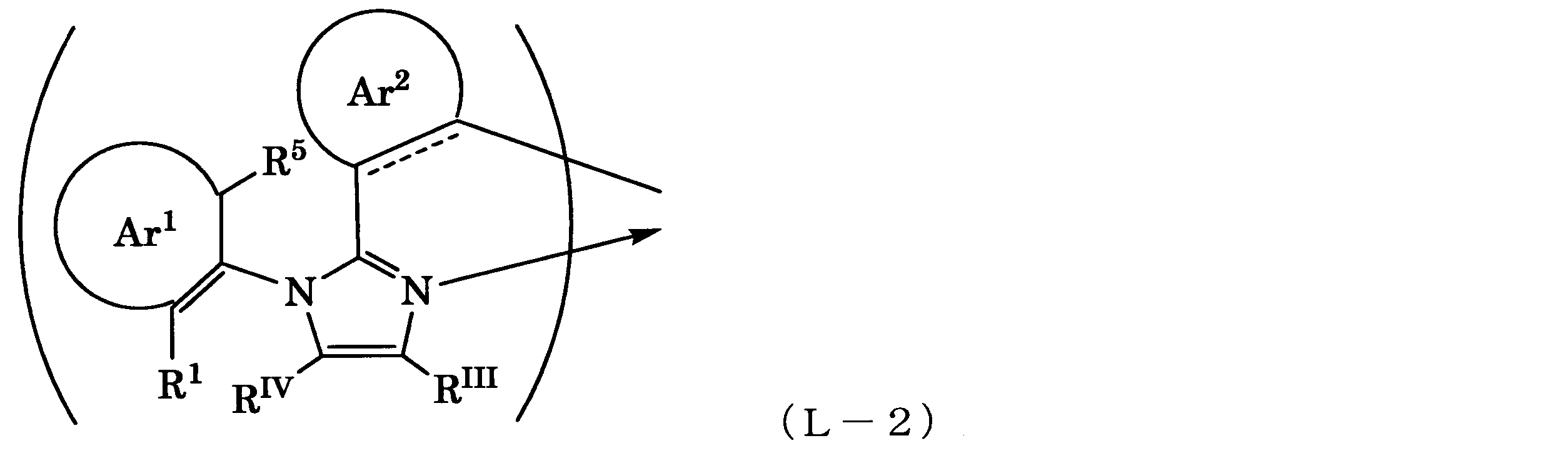
(式中、Ar1、Ar2、RIII及びRIVは、前記式(L-1)と同様である。
R1及びR5は、それぞれ、Ar1が結合する窒素原子のβ位に位置し、2級炭素がAr1に結合した置換基を示す。)
R1及びR5は、それぞれ、Ar1が結合する窒素原子のβ位に位置し、2級炭素がAr1に結合した置換基を示す。)
さらに、式(L-2)で示される配位子の具体例としては、下記式(L-3)で示される配位子がある。
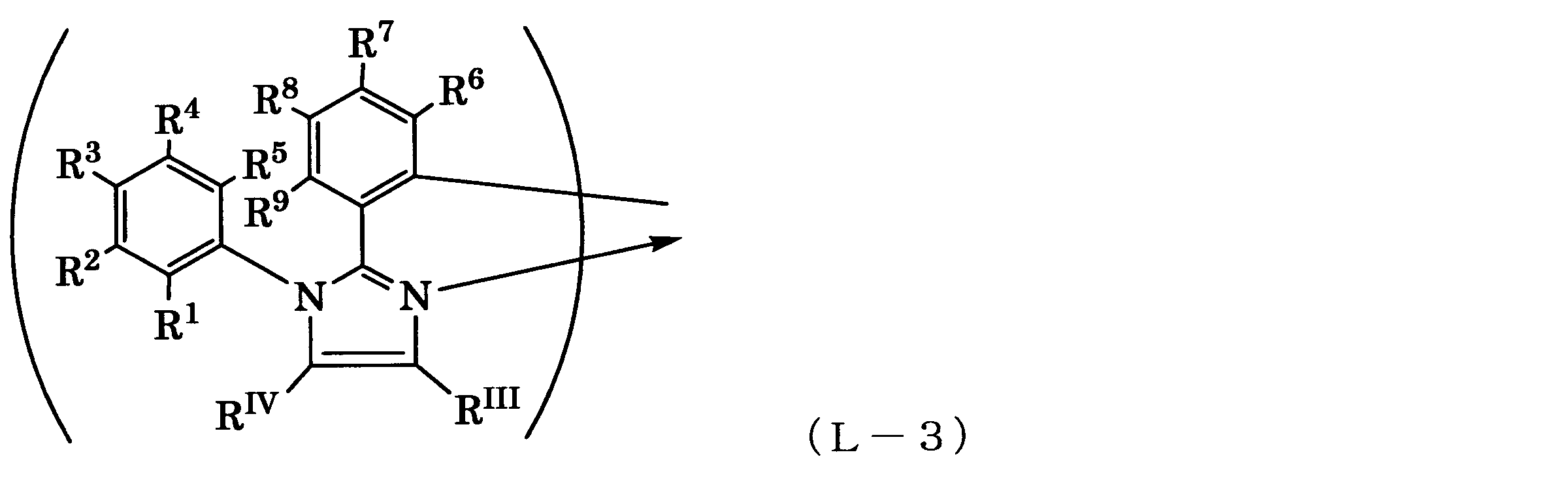
(式中、R1、R5、RIII及びRIVは、前記式(L-2)と同様である。
R2~R4、R6~R9はそれぞれ、水素原子又は置換基を示す。R2~R4、R6~R9のうち隣接する基は、互いに結合し環を形成してもよい。)
R2~R4、R6~R9はそれぞれ、水素原子又は置換基を示す。R2~R4、R6~R9のうち隣接する基は、互いに結合し環を形成してもよい。)
本発明では、上記式(1-1)のm+nが2又は3であり、Mが二価の白金(Pt)、二価のパラジウム(Pd)、三価のイリジウム(Ir)又は三価のロジウム(Rh)であることが好ましい。
特に、Mは三価のイリジウム(Ir)であることが好ましい。
特に、Mは三価のイリジウム(Ir)であることが好ましい。
以下、上述した式(1)等の各基の例について説明する。
本発明において、「置換もしくは無置換の・・・」の「無置換」とは、水素原子が結合していることを意味する。また、水素原子とは、中性子数が異なる同位体、即ち、軽水素(protium)、重水素(deuterium)、三重水素(tritium)を包含する。
本発明において、「置換もしくは無置換の・・・」の「無置換」とは、水素原子が結合していることを意味する。また、水素原子とは、中性子数が異なる同位体、即ち、軽水素(protium)、重水素(deuterium)、三重水素(tritium)を包含する。
本明細書において、環形成炭素数とは、原子が環状に結合した構造の化合物(例えば、単環化合物、縮合環化合物、架橋化合物、炭素環化合物、複素環化合物)の当該環自体を構成する原子のうちの炭素原子の数を表す。当該環が置換基によって置換される場合、置換基に含まれる炭素は環形成炭素数には含まない。以下で記される「環形成炭素数」については、特筆しない限り同様とする。例えば、ベンゼン環は環形成炭素数が6であり、ナフタレン環は環形成炭素数が10であり、ピリジニル基は環形成炭素数5であり、フラニル基は環形成炭素数4である。また、ベンゼン環やナフタレン環に置換基として例えばアルキル基が置換している場合、当該アルキル基の炭素数は、環形成炭素数の数に含めない。また、フルオレン環に置換基として例えばフルオレン環が結合している場合(スピロフルオレン環を含む)、置換基としてのフルオレン環の炭素数は環形成炭素数の数に含めない。
本明細書において、環形成原子数とは、原子が環状に結合した構造(例えば単環、縮合環、環集合)の化合物(例えば単環化合物、縮合環化合物、架橋化合物、炭素環化合物、複素環化合物)の当該環自体を構成する原子の数を表す。環を構成しない原子(例えば環を構成する原子の結合手を終端する水素原子)や、当該環が置換基によって置換される場合の置換基に含まれる原子は環形成原子数には含まない。以下で記される「環形成原子数」については、特筆しない限り同様とする。例えば、ピリジン環は環形成原子数は6であり、キナゾリン環は環形成原子数が10であり、フラン環の環形成原子数が5である。ピリジン環やキナゾリン環の炭素原子にそれぞれ結合している水素原子や置換基を構成する原子については、環形成原子数の数に含めない。また、フルオレン環に置換基として例えばフルオレン環が結合している場合(スピロフルオレン環を含む)、置換基としてのフルオレン環の原子数は環形成原子数の数に含めない。
本明細書において、「置換もしくは無置換の炭素数XX~YYのZZ基」という表現における「炭素数XX~YY」は、ZZ基が無置換である場合の炭素数を表すものであり、置換されている場合の置換基の炭素数は含めない。ここで、「YY」は「XX」よりも大きく、「XX」と「YY」はそれぞれ1以上の整数を意味する。
本明細書において、「置換もしくは無置換の原子数XX~YYのZZ基」という表現における「原子数XX~YY」は、ZZ基が無置換である場合の原子数を表すものであり、置換されている場合の置換基の原子数は含めない。ここで、「YY」は「XX」よりも大きく、「XX」と「YY」はそれぞれ1以上の整数を意味する。
RI~RIVについて、炭素数1~20のアルキル基の具体例としては、メチル基、エチル基、プロピル基、イソプロピル基、n-ブチル基、s-ブチル基、イソブチル基、t-ブチル基、n-ペンチル基、n-ヘキシル基、n-ヘプチル基、n-オクチル基、n-ノニル基、n-デシル基、n-ウンデシル基、n-ドデシル基、n-トリデシル基、n-テトラデシル基、n-ペンタデシル基、n-ヘキサデシル基、n-ヘプタデシル基、n-オクタデシル基、ネオペンチル基、1-メチルペンチル基、2-メチルペンチル基、1-ペンチルヘキシル基、1-ブチルペンチル基、1-ヘプチルオクチル基、3-メチルペンチル基等が挙げられ、このうち炭素数1~6のものが好ましい。
環形成炭素数3~10のシクロアルキル基の具体例としては、シクロプロピル基、シクロブチル基、シクロペンチル基、シクロヘキシル基、シクロヘプチル基、ノルボルニル基、アダマンチル基等が挙げられ、このうち環形成炭素数5又は6のものが好ましい。
環形成炭素数3~10のシクロアルケニル基の具体例としては、シクロヘキセニル基等、上述したシクロアルキル基において1つ以上の二重結合を有するものが挙げられる。
環形成炭素数3~10のシクロアルケニル基の具体例としては、シクロヘキセニル基等、上述したシクロアルキル基において1つ以上の二重結合を有するものが挙げられる。
環形成炭素数6~50のアリール基の具体例としては、フェニル基、トリル基、キシリル基、メシチル基、o-ビフェニル基、m-ビフェニル基、p-ビフェニル基、o-ターフェニル基、m-ターフェニル基、p-ターフェニル基、ナフチル基、フェナントリル基、トリフェニレン基等が挙げられる。中でもフェニル基、m-ビフェニル基、m-ターフェニル基が好ましい。
環形成原子数5~30のヘテロアリール基の具体例としては、ピロリル基、ピラジニル基、ピリジニル基、ピリミジニル基、ピリダジニル基、トリアジニル基、インドリル基、イソインドリル基、フリル基、ベンゾフラニル基、イソベンゾフラニル基、ジベンゾフラニル基、ジベンゾチオフェニル基、キノリル基、イソキノリル基、キノキサリニル基、カルバゾリル基、アザカルバゾリル基、フェナントリジニル基、アクリジニル基、フェナントロリニル基、チエニル基、ピロリジニル基、ジオキサニル基、ピペリジニル基、モルフォリニル基、ピペラジニル基、カルバゾリル基、チオフェニル基、オキサゾリル基、オキサジアゾリル基、ベンゾオキサゾリル基、チアゾリル基、チアジアゾリル基、ベンゾチアゾリル基、トリアゾリル基、イミダゾリル基、ベンゾイミダゾリル基、ピラニル基、ベンゾ[c]ジベンゾフラニル基、アザカルバゾリル基、アザジベンゾフラニル基、アザジベンゾチオフェニル基等が挙げられ、このうち環形成原子数6~14のものが好ましい。
上記の「カルバゾリル基」には以下の構造も含まれる。

また、上記のヘテロアリール基には以下の構造も含まれる。
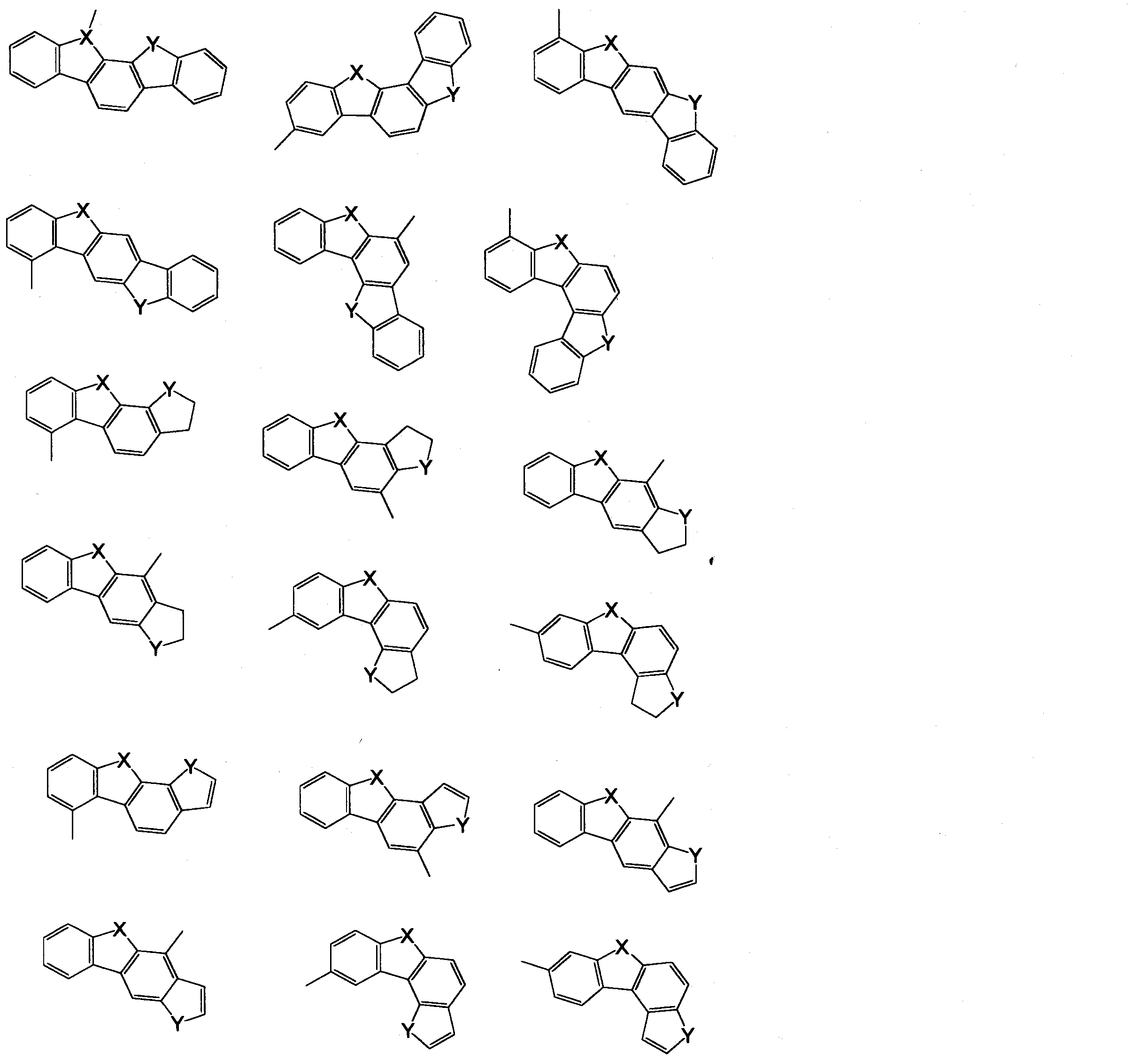
(式中、X,Yはそれぞれ酸素原子、硫黄原子、窒素原子又は-NH-基である。)
アリールアミノ基は、-N(Ra)(Rb)と表され、(Ra)及び(Rb)の例としては、上述したアリール基又はヘテロアリール基が挙げられる。具体的には、ジフェニルアミノ基、ジビフェニルアミノ基、フェニルジベンゾフラニルアミノ基、ジベンゾフラニルビフェニルアミノ基、ジ(N-フェニル)カルバゾリルアミノ基等がある。
アラルキル基としては、上記アリール基を有するアルキル基が挙げられる。
アラルキル基としては、上記アリール基を有するアルキル基が挙げられる。
アリールボリル基は、-B(Ra)(Rb)と表され、(Ra)及び(Rb)の例としては、上述したアリール基又はヘテロアリール基が挙げられる。具体的には、ジフェニルボリル基等がある。
アリールシリル基は、-Si(Ra)(Rb)(Rc)と表され、(Ra)~(Rc)の例としては、上述したアリール基又はヘテロアリール基が挙げられる。具体的には、トリフェニルシリル基等がある。
アリールシリル基は、-Si(Ra)(Rb)(Rc)と表され、(Ra)~(Rc)の例としては、上述したアリール基又はヘテロアリール基が挙げられる。具体的には、トリフェニルシリル基等がある。
Mは周期律表第3族から第12族の典型金属又は遷移金属を示す。具体的には、二価の白金(Pt)、二価のパラジウム(Pd)、三価のイリジウム(Ir)又は三価のロジウム(Rh)が好ましい。特に、Mは三価のイリジウム(Ir)であることが好ましい。
Ar1及びAr2が示す、芳香環基又はヘテロ芳香環としては、ベンゼン環、チオフェン環、ピリジン環、ピロール環等が挙げられる。
L1が示す連結基、RI及びRIIの連結基としては、単結合、置換もしくは無置換のアルキレン基、置換もしくは無置換の不飽和アルキレン基、置換もしくは無置換のアリーレン基、置換もしくは無置換のヘテロアリーレン基等が挙げられる。これらを2つ以上組み合わせた二価の基でもよい。
アルキレン基、アリーレン基、ヘテロアリーレンとしては、上述したアルキル基、アリール基、ヘテロアリールの対応する二価の基が挙げられる。
アルキレン基、アリーレン基、ヘテロアリーレンとしては、上述したアルキル基、アリール基、ヘテロアリールの対応する二価の基が挙げられる。
R1~R9で表される置換基、及び各基の置換基としては、それぞれ独立に、上記のアルキル基、アリール基、ヘテロアリール基や、その他にアルコキシ基、フルオロアルキル基、ハロゲン原子(フッ素、塩素、臭素、ヨウ素が挙げられ、好ましくはフッ素原子である。)、シリル基、ヒドロキシル基、ニトロ基、シアノ基、カルボキシ基、アリールオキシ基、フルオロアルコキシ基、ジアリールホスフィノ基、ジアリールホスフィンオキシド基、ジアリールホスフィノアリール基、N-アリールカルバゾリル基等が挙げられる。
これらの置換基には、上記の置換基によってさらに置換されてもよい。また、これらの置換基は複数が互いに結合して環を形成してもよい。
これらの置換基には、上記の置換基によってさらに置換されてもよい。また、これらの置換基は複数が互いに結合して環を形成してもよい。
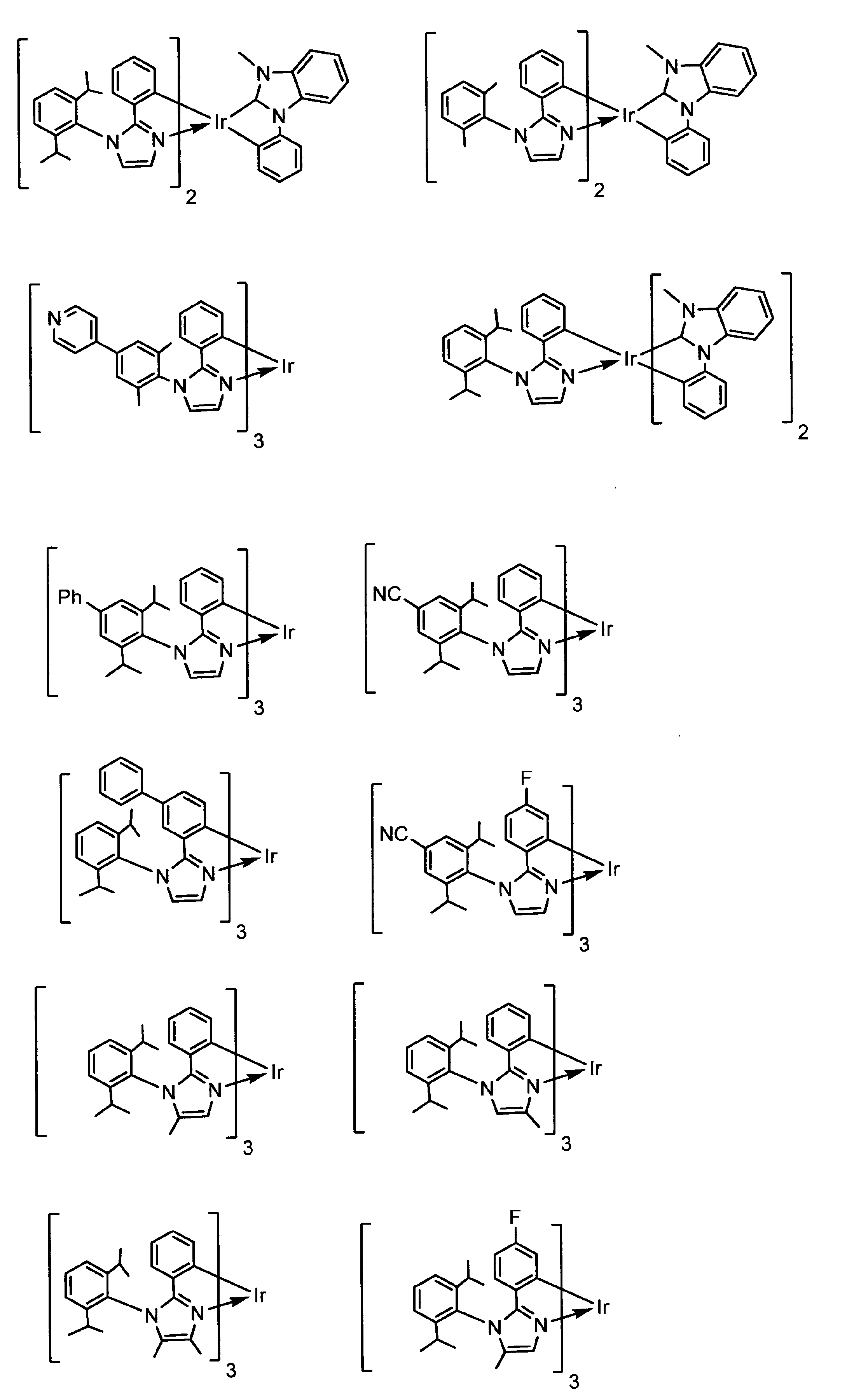
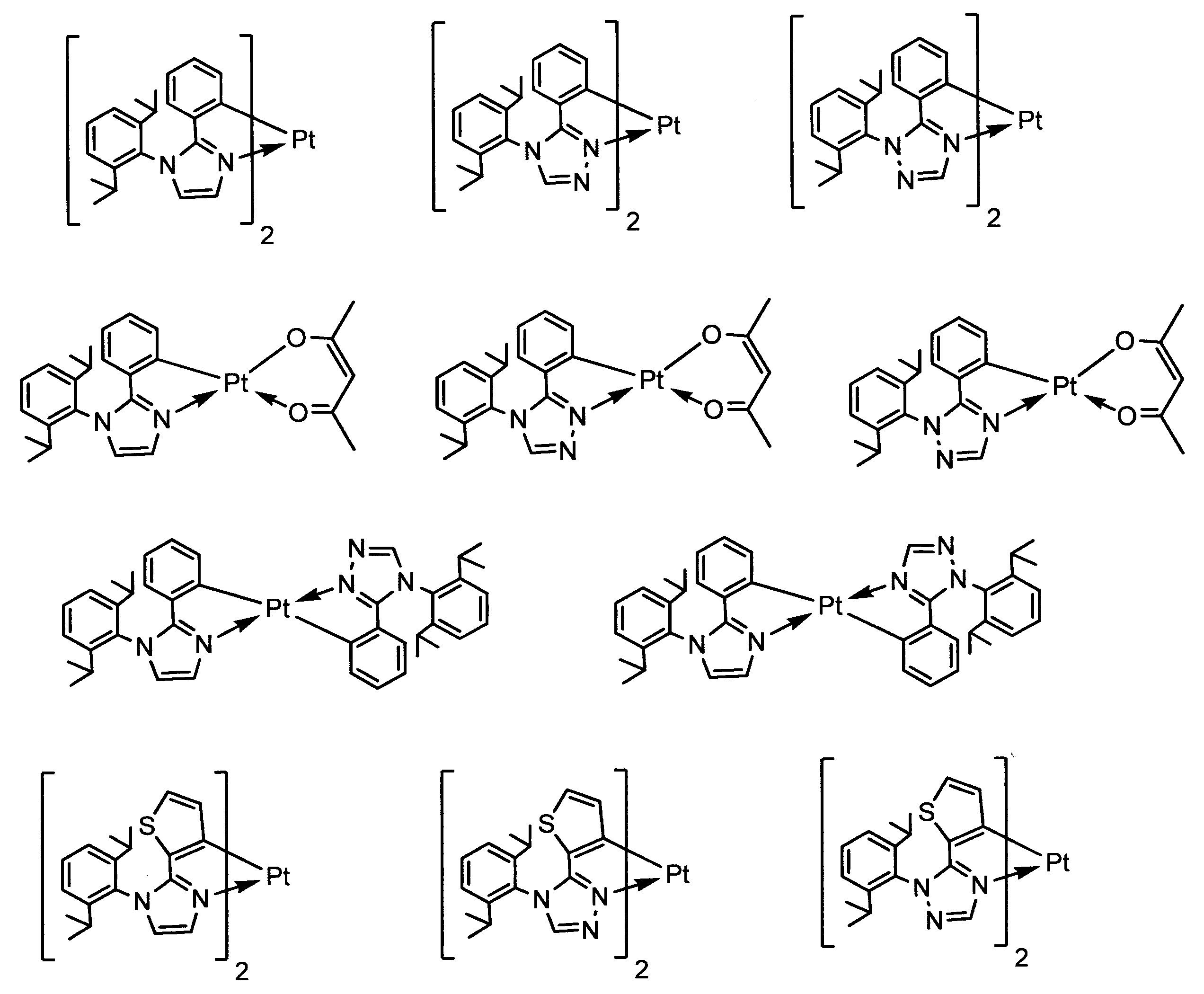
以下、本発明の主成分である金属錯体の具体例を示す。尚、本発明はこれらの金属錯体に限定されるものではない。また、イリジウム錯体を例示するが、イリジウムをロジウムに置き換えた金属錯体でもよい。同様に、白金錯体を例示するが、白金をパラジウムに置き換えた金属錯体でもよい。
また、構造異性体については特に限定するものではなく、例えば、トリス体であればfacial(フェイシャル)構造とmeridional(メリジオナル)構造の両方を含む。
また、構造異性体については特に限定するものではなく、例えば、トリス体であればfacial(フェイシャル)構造とmeridional(メリジオナル)構造の両方を含む。
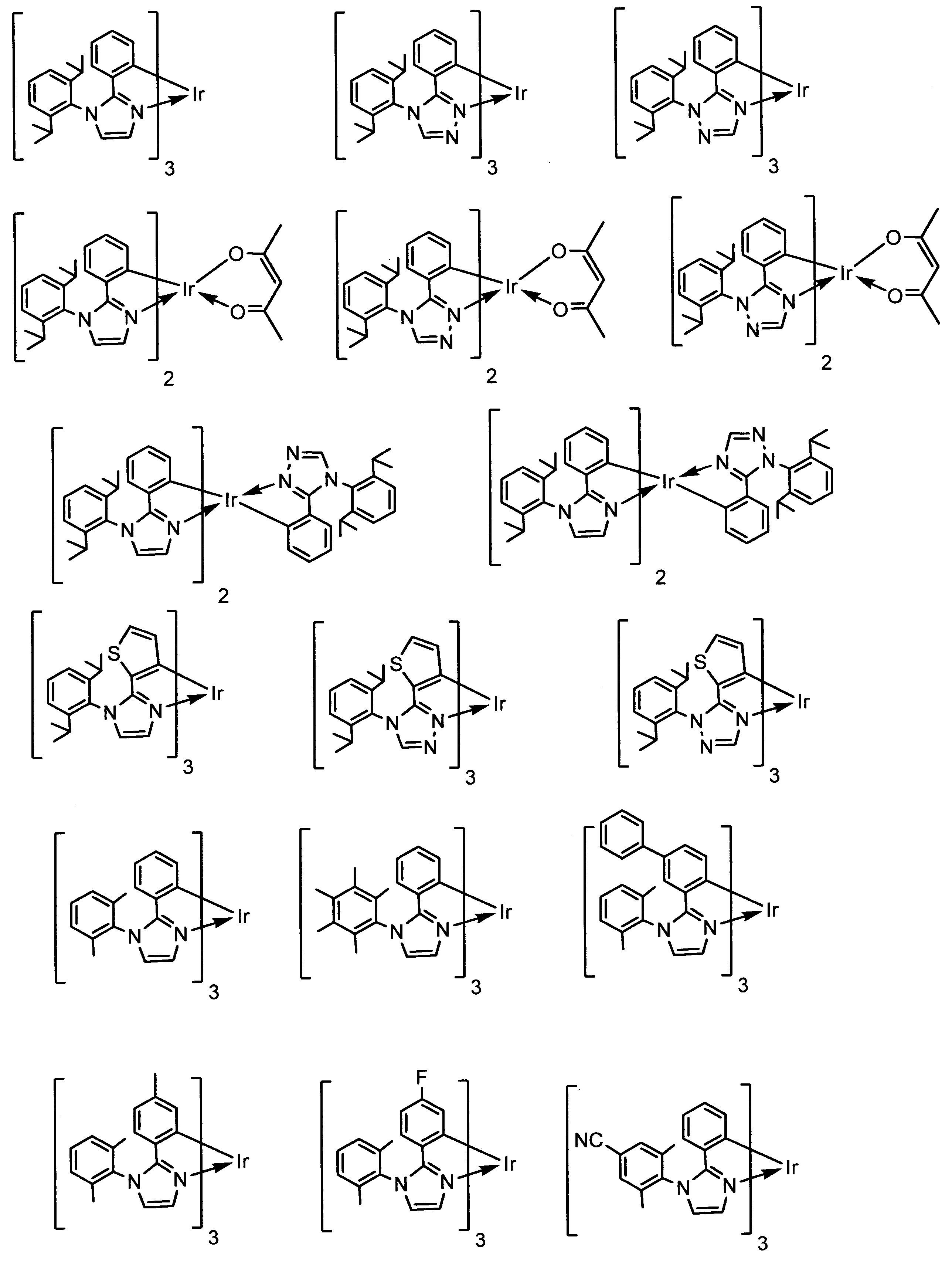

2.金属錯体組成物の第二の態様
本発明の金属錯体組成物の第二の実施形態は、下記式(1a)で示される部分構造を含む金属錯体と、下記式(2a)で示される部分構造を含む化合物である金属錯体の不純物を含む。そして、金属錯体の含有量が99.7%以上であり、不純物の含有量が0.036%以下である。
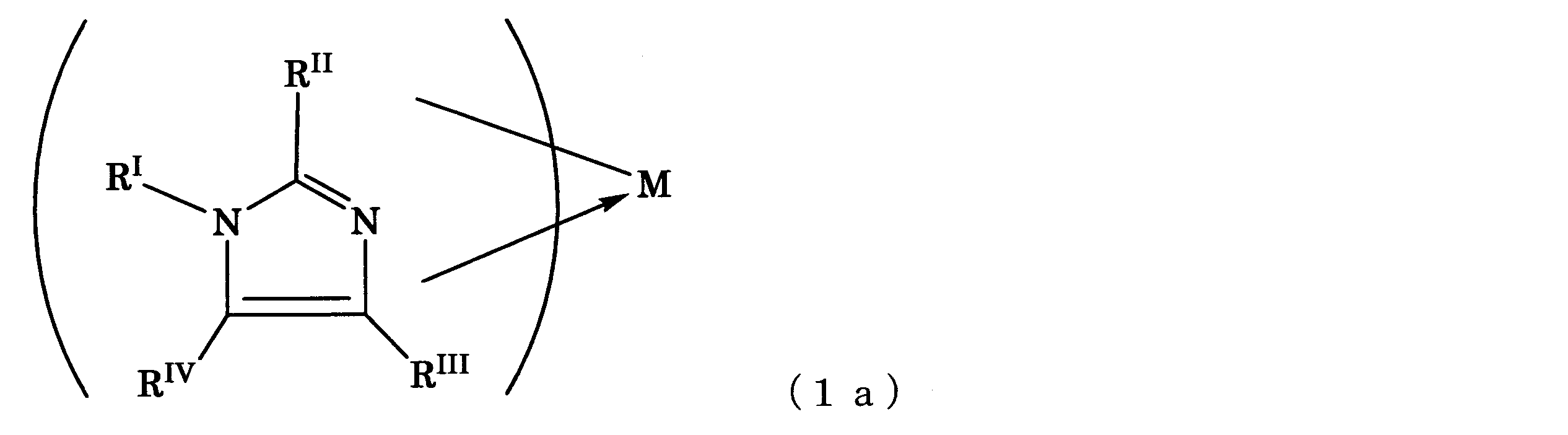
(式中、RI及びRIIは、それぞれ独立に、置換もしくは無置換の炭素数1~20のアルキル基、置換もしくは無置換の環形成炭素数3~10のシクロアルキル基、置換もしくは無置換の環形成炭素数3~10のシクロアルケニル基、置換もしくは無置換の環形成炭素数6~50のアリール基、置換もしくは無置換の環形成原子数5~30のヘテロアリール基、置換もしくは無置換のアリールアミノ基、置換もしくは無置換のアラルキル基、置換もしくは無置換のアリールボリル基、又は、置換もしくは無置換のアリールシリル基である。
RIII及びRIVは、それぞれ独立に、水素原子、置換もしくは無置換の炭素数1~20のアルキル基、置換もしくは無置換の環形成炭素数3~10のシクロアルキル基、置換もしくは無置換の環形成炭素数3~10のシクロアルケニル基、置換もしくは無置換の環形成炭素数6~50のアリール基、置換もしくは無置換の環形成原子数5~30のヘテロアリール基、置換もしくは無置換のアリールアミノ基、置換もしくは無置換のアラルキル基、置換もしくは無置換のアリールボリル基、又は、置換もしくは無置換のアリールシリル基である。
RI及びRIIは直接、又は連結基を介して結合していてもよい。
Mは、周期律表第3族から第12族の典型金属又は遷移金属を示す。RI及びRIIはMと結合していてもよい。
実線は共有結合を示し、矢印は前記Mと括弧内の配位子との配位結合を示す。)
本発明の金属錯体組成物の第二の実施形態は、下記式(1a)で示される部分構造を含む金属錯体と、下記式(2a)で示される部分構造を含む化合物である金属錯体の不純物を含む。そして、金属錯体の含有量が99.7%以上であり、不純物の含有量が0.036%以下である。
RIII及びRIVは、それぞれ独立に、水素原子、置換もしくは無置換の炭素数1~20のアルキル基、置換もしくは無置換の環形成炭素数3~10のシクロアルキル基、置換もしくは無置換の環形成炭素数3~10のシクロアルケニル基、置換もしくは無置換の環形成炭素数6~50のアリール基、置換もしくは無置換の環形成原子数5~30のヘテロアリール基、置換もしくは無置換のアリールアミノ基、置換もしくは無置換のアラルキル基、置換もしくは無置換のアリールボリル基、又は、置換もしくは無置換のアリールシリル基である。
RI及びRIIは直接、又は連結基を介して結合していてもよい。
Mは、周期律表第3族から第12族の典型金属又は遷移金属を示す。RI及びRIIはMと結合していてもよい。
実線は共有結合を示し、矢印は前記Mと括弧内の配位子との配位結合を示す。)
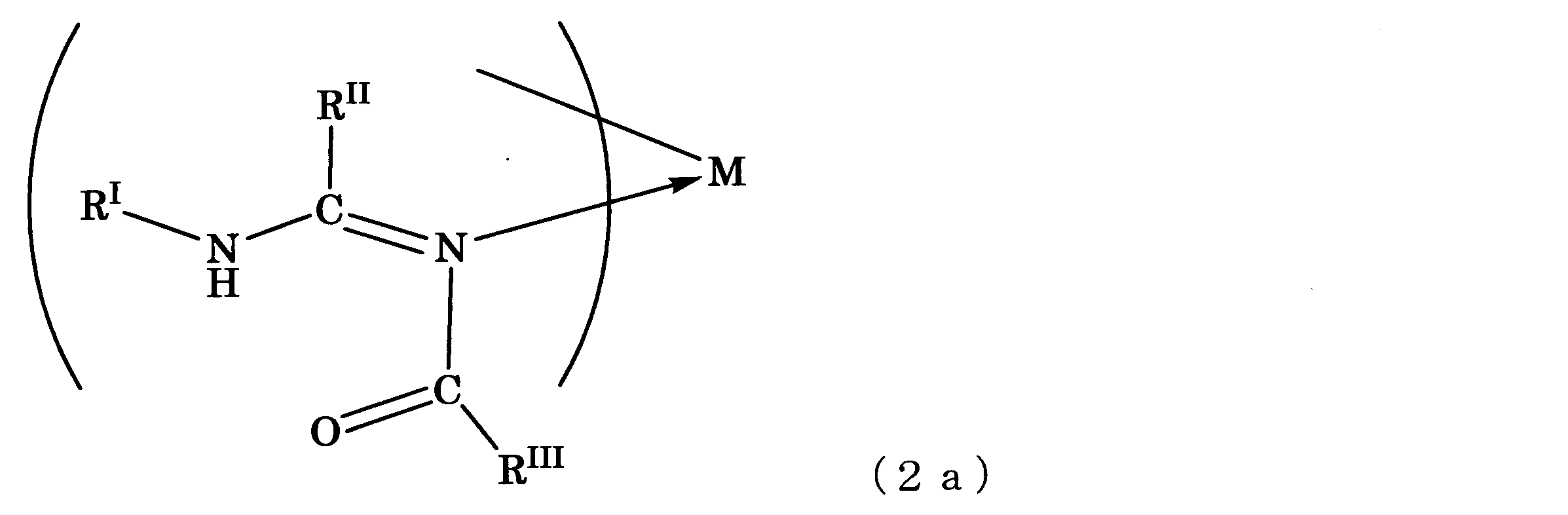
例えば、式(1a)で示される部分構造を含む金属錯体は下記式(1b)で示される部分構造を含む金属錯体であり、式(2a)で示される部分構造を含む金属錯体は、下記式(2b)で示される部分構造を含む金属錯体である。尚、式(1b)は上述した本発明の第一の態様の式(1b)と同じである。
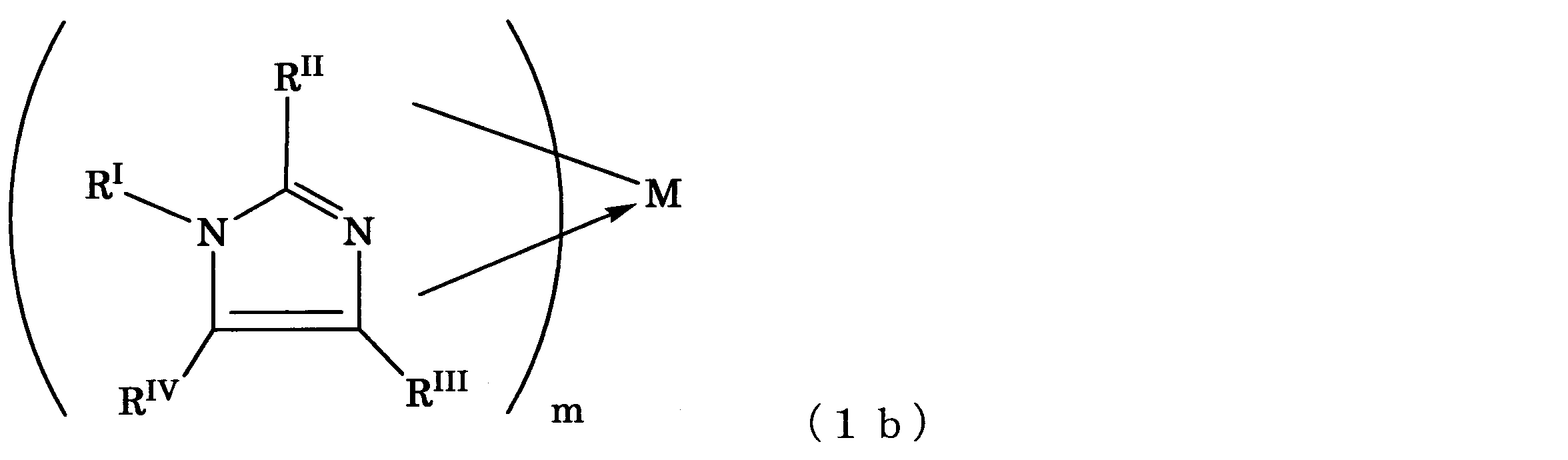
(式中、RI、RII、RIII、RIV及びMは、前記式(1a)と同様である。mは1~3の整数である。)
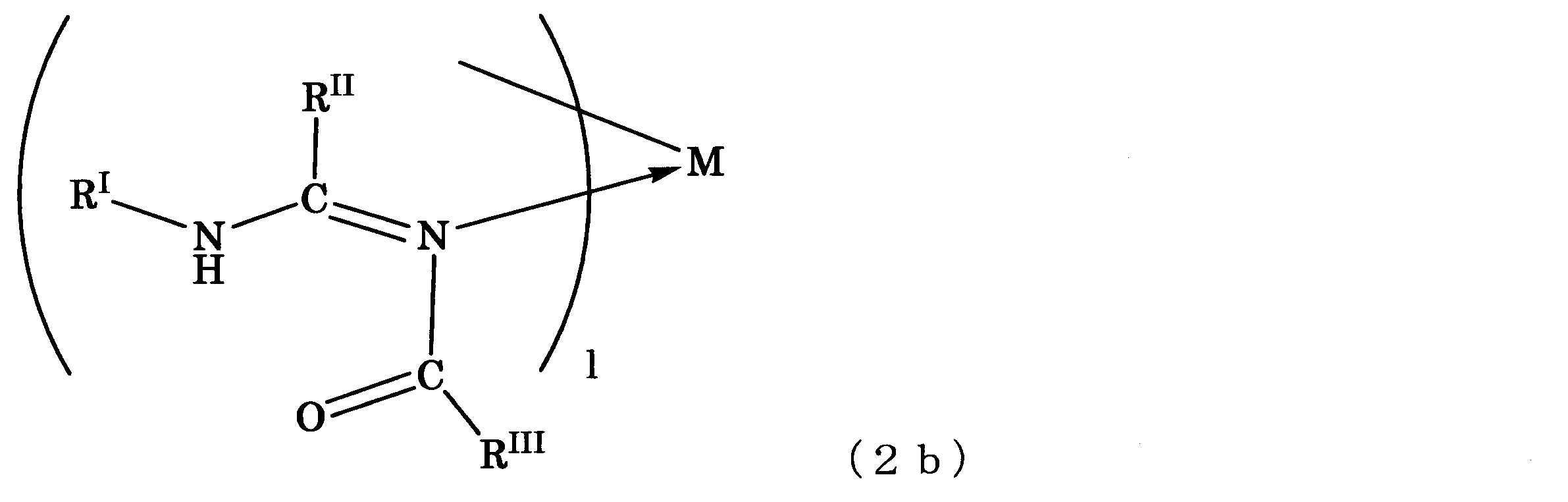
(式中、RI、RII及びRIIIと、前記式(1b)のRI、RII及びRIIIは、それぞれ同じ基を示す。Mと前記式(1b)のMは、同じ金属を示す。lは1~3の整数である。)
本実施形態は、上述した組成物の第一の態様の主成分の金属錯体を式(1a)の構造を有する錯体に特定したものである。これにより、特定不純物の構造も特定される。本実施形態は、式(2a)の括弧内の配位子を有する不純物が、有機EL素子の性能に大きな影響を与えることを見出したものである。言い換えると、式(2a)で表される不純物は、金属錯体組成物からその含有量が0.036%以下まで除去する必要がある。
尚、本実施形態において、主成分の金属錯体及び不純物の含有量の定義、式(1a)等、各一般式における各基の例示、及び金属錯体の具体例は、上述した本発明の第一の態様と同じであるので、説明を省略する。
紫外可視吸収検出による液体クロマトグラフでは、例えば、上記式(2a)の不純物以外にも以下の分子量からなる不純物が観測される場合がある。
(A)分子量が、[金属錯体の分子量-2H(水素)]
(B)分子量が、[金属錯体の分子量-H(水素)+N(窒素)+O(酸素)]
(C)分子量が、[金属錯体の分子量-2H(水素)+2N(窒素)+2O(酸素)]
(D)分子量が、[金属錯体の分子量+2H(水素)×n(n=1,2,3)]
(E)分子量が、[金属錯体の分子量+O(酸素)×n(n=1,2,3)]
(F)上記(A)~(E)の変性体を生じた反応の組合せから変性反応により生じた不純物
(B)分子量が、[金属錯体の分子量-H(水素)+N(窒素)+O(酸素)]
(C)分子量が、[金属錯体の分子量-2H(水素)+2N(窒素)+2O(酸素)]
(D)分子量が、[金属錯体の分子量+2H(水素)×n(n=1,2,3)]
(E)分子量が、[金属錯体の分子量+O(酸素)×n(n=1,2,3)]
(F)上記(A)~(E)の変性体を生じた反応の組合せから変性反応により生じた不純物
上記(A)としては、例えば、2つの配位子が架橋することにより、2つの水素原子が消失した化合物が考えられる。例えば、下記の反応が挙げられる。

上記(B)又は上記(C)については、高分解能質量分析(LC-MS/MS)から、その存在は示唆されたが、この反応生成物の構造については、その窒素源が定かではない。
上記(D)については、下記式(7)~(10)(点線の四角内)に示す水添体構造であることが予想できる。
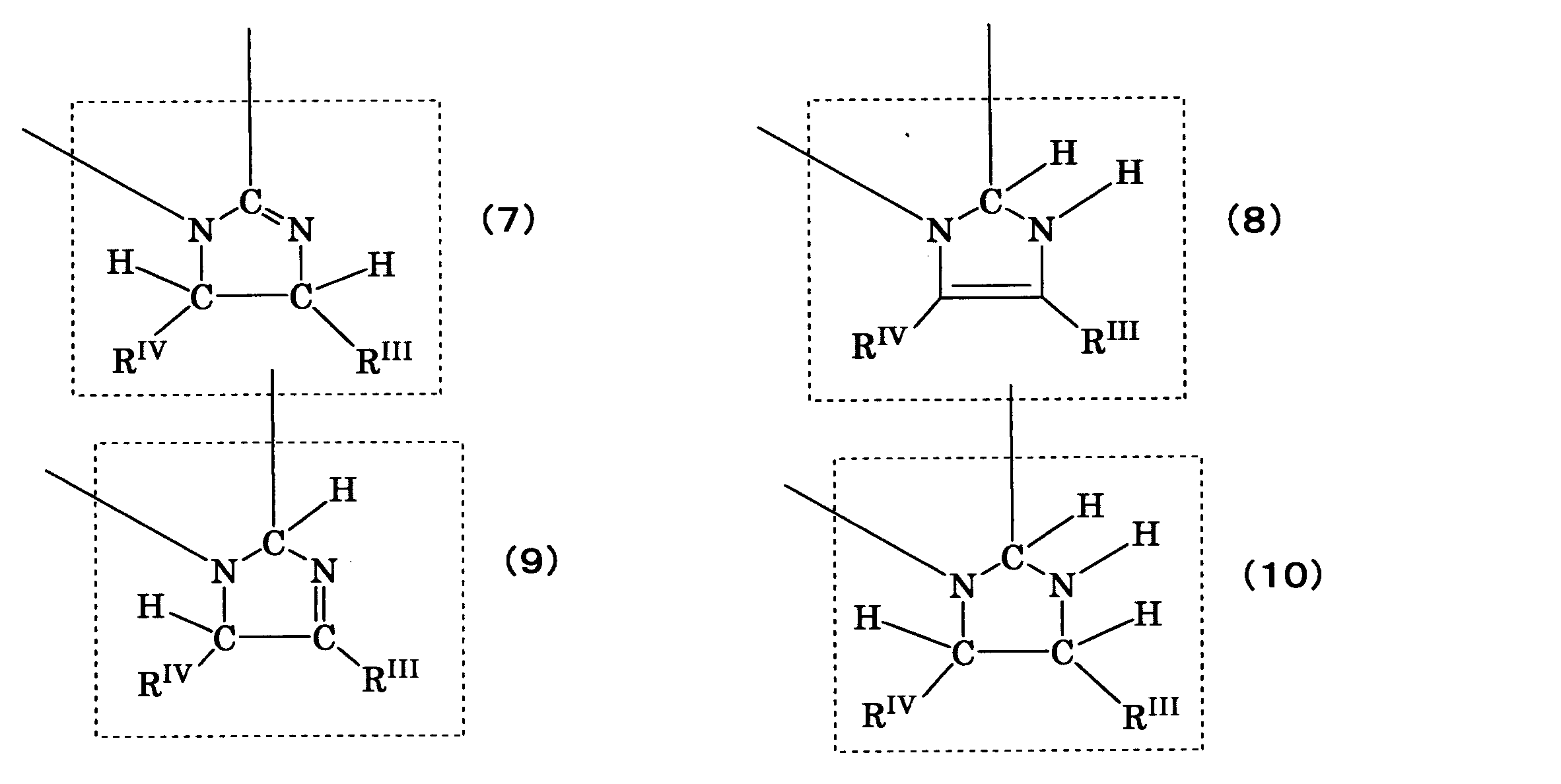
(各式の、RIII及びRIVは、前記式(1a)と同様である。)
上記(D)については、下記式(7)~(10)(点線の四角内)に示す水添体構造であることが予想できる。
上記(E)については、下記式(11)~(17)(点線の四角内)に示す構造であることが予想できる。

(各式の、RIII及びRIVは、前記式(1a)と同様である。)
このように、多数の不純物の存在が確認されるが、上記式(2a)で示される不純物が、有機EL素子の性能と高い相関性を示す。
上記式(1a)で示される部分構造を含む金属錯体としては、例えば、下記式(1-1)で示される金属錯体が挙げられる。この場合、上記式(2a)で示される金属錯体の不純物は、下記式(2-1)で示される金属錯体となる。尚、式(1-1)の金属錯体は、上述した第一の実施形態の式(1-1)と同じである。
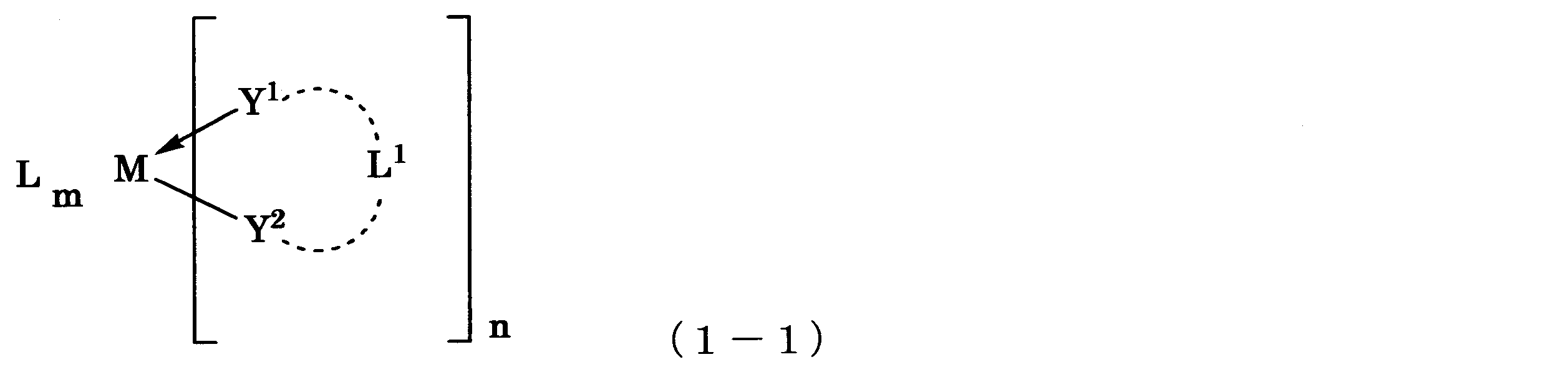
(式中、Mは、式(1b)と同様である。
Y1及びY2はそれぞれ独立に、炭素原子、窒素原子又は酸素原子を示し、L1はY1及びY2の連結基で、Y1及びY2とともに2座の配位子(Y1-L1-Y2)を形成する原子群を示す。
Lは下記式(L)で示される配位子である。
mは、1~3の整数であり、nは、0~3の整数である。m+nは1~6である。mが2以上の場合は、2つ以上ある配位子Lは互いに同じでも異なる構造でもよい。また、2つ以上の配位子Lは、直接又は連結基を介して架橋構造を形成してもよい。)

(式中、RI、RII、RIII及びRIVは、式(1b)と同様である。)
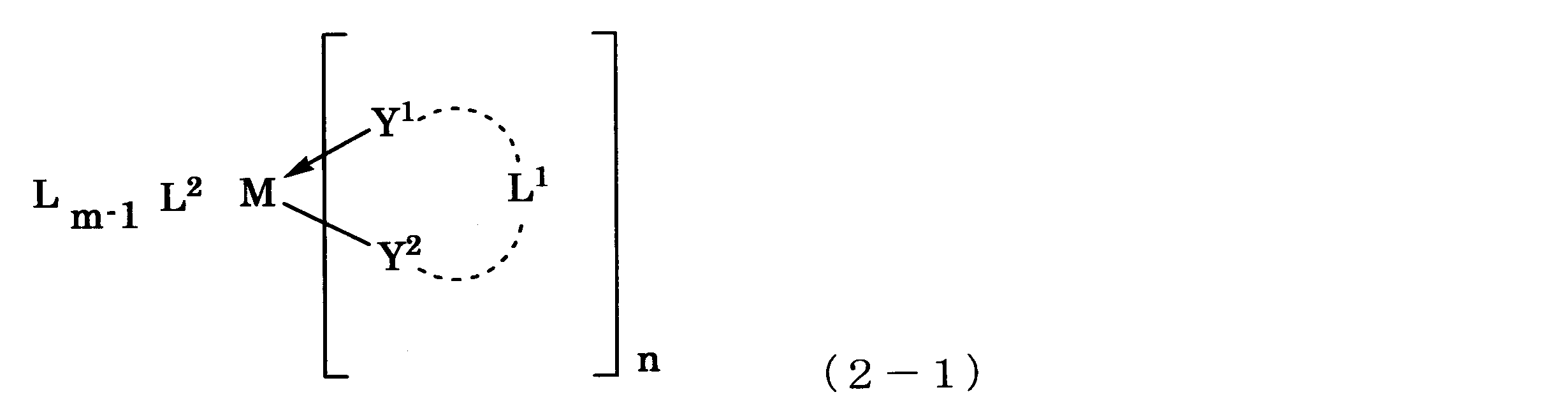
(式中、L、M、Y1、Y2、L1、M、m及びnは、式(1-1)と同様である。L2は下記式(L’)で示される配位子である。)
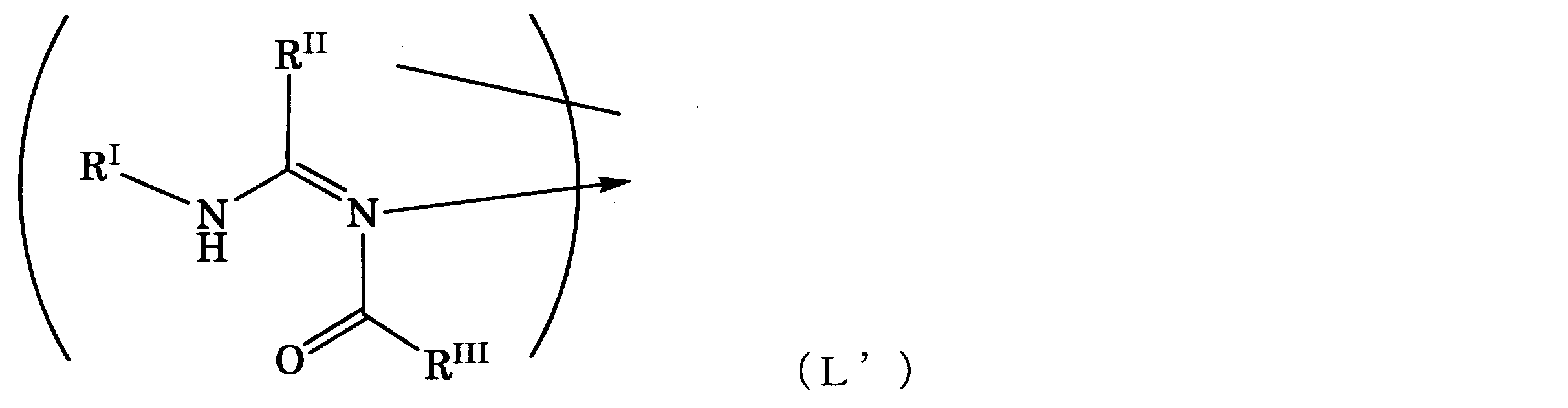
(式中、RI、RII及びRIIIと、前記式(L)のRI、RII及びRIIIは、それぞれ同じ基を示す。)
Y1及びY2はそれぞれ独立に、炭素原子、窒素原子又は酸素原子を示し、L1はY1及びY2の連結基で、Y1及びY2とともに2座の配位子(Y1-L1-Y2)を形成する原子群を示す。
Lは下記式(L)で示される配位子である。
mは、1~3の整数であり、nは、0~3の整数である。m+nは1~6である。mが2以上の場合は、2つ以上ある配位子Lは互いに同じでも異なる構造でもよい。また、2つ以上の配位子Lは、直接又は連結基を介して架橋構造を形成してもよい。)
式(L)の配位子の例として、下記式(L-1)で示される配位子がある。この場合、不純物の配位子である式(L’)は、下記式(L’-1)で示される配位子である。

(式中、RIII及びRIVは、式(L)と同様である。
Ar1は、置換基を有する芳香環基又は置換基を有するヘテロ芳香環を示す。
Ar2は金属Mに結合する、置換もしくは無置換の芳香環又は置換もしくは無置換のヘテロ芳香環を示す。)
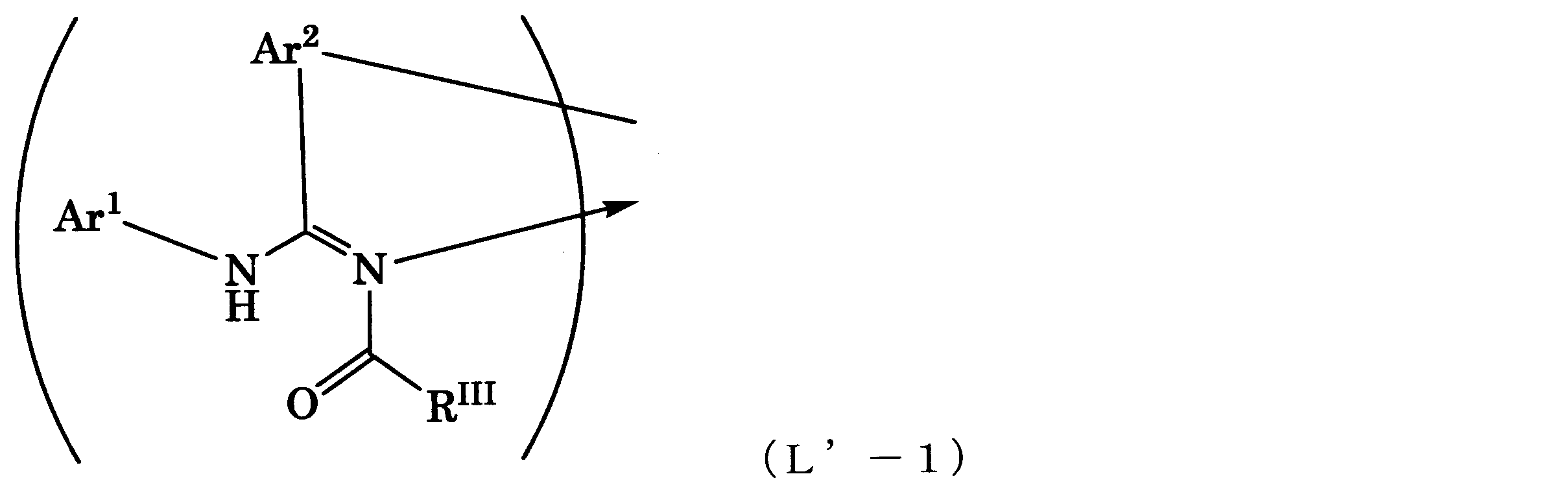
(式中、Ar1、Ar2及びRIIIと、前記式(L-1)のAr1、Ar2及びRIIIは、それぞれ同じ基を示す。)
Ar1は、置換基を有する芳香環基又は置換基を有するヘテロ芳香環を示す。
Ar2は金属Mに結合する、置換もしくは無置換の芳香環又は置換もしくは無置換のヘテロ芳香環を示す。)
また、式(L-1)の配位子の例として、下記式(L-2)で示される配位子がある。この場合、不純物の配位子である式(L’-1)は、下記式(L’-2)で示される配位子となる。
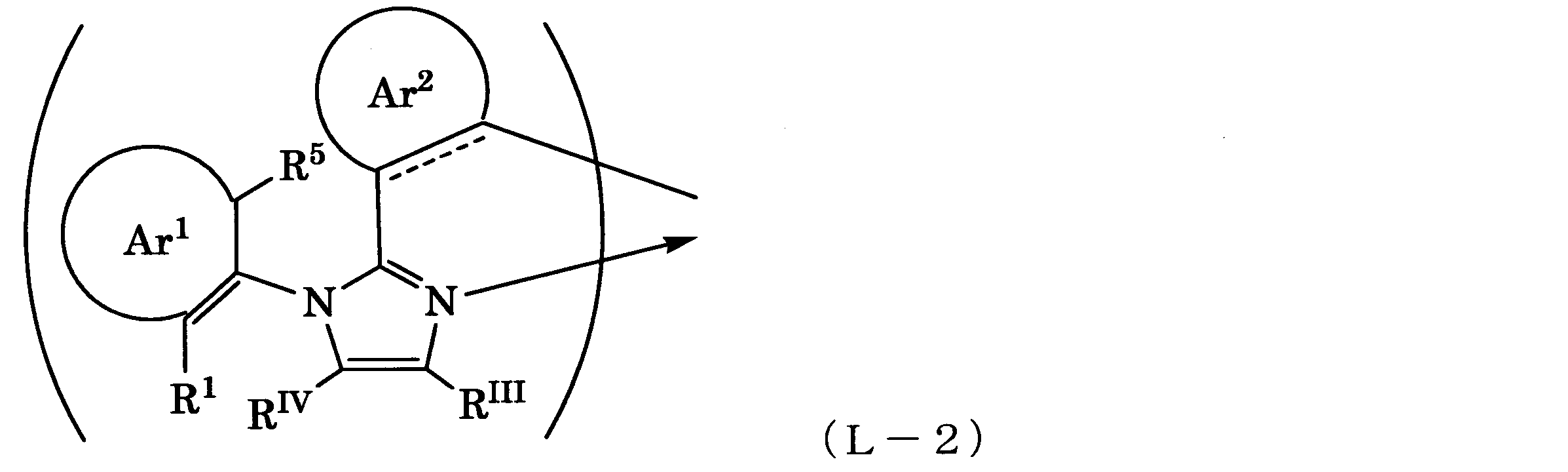
(式中、Ar1、Ar2、RIII及びRIVは、前記式(L-1)と同様である。
R1及びR5は、それぞれ、Ar1が結合する窒素原子のβ位に位置し、2級炭素がAr1に結合した置換基を示す。)

(式中、Ar1、Ar2、R1、R2及びRIIIと、前記式(L-2)のAr1、Ar2、R1、R2及びRIIIは、それぞれ同じ基を示す。)
R1及びR5は、それぞれ、Ar1が結合する窒素原子のβ位に位置し、2級炭素がAr1に結合した置換基を示す。)
式(L-2)の例として、下記式(L-3)で示される配位子がある。この場合、不純物の配位子である式(L’-2)は、下記式(L’-3)で示される配位子となる。

(式中、R1、R5、RIII及びRIVは、前記式(L-2)と同様である。
R2~R4、R6~R9はそれぞれ、水素原子又は置換基を示す。R2~R4、R6~R9のうち隣接する基は、互いに結合し環を形成してもよい。)
(式中、R1~R9及びRIIIと、前記式(L-3)のR1~R9及びRIIIは、それぞれ同じ基を示す。)
R2~R4、R6~R9はそれぞれ、水素原子又は置換基を示す。R2~R4、R6~R9のうち隣接する基は、互いに結合し環を形成してもよい。)
本実施形態において、m+nが2又は3であり、Mが二価の白金(Pt)、二価のパラジウム(Pd)、三価のイリジウム(Ir)又は三価のロジウム(Rh)であることが好ましい。
特に、Mは三価のイリジウム(Ir)であることが好ましい。
特に、Mは三価のイリジウム(Ir)であることが好ましい。
具体的な金属錯体及びその不純物として、例えば、金属錯体が下記式(1’)で示される金属錯体であり、不純物が下記式(2’)で示される化合物である場合を挙げられる。
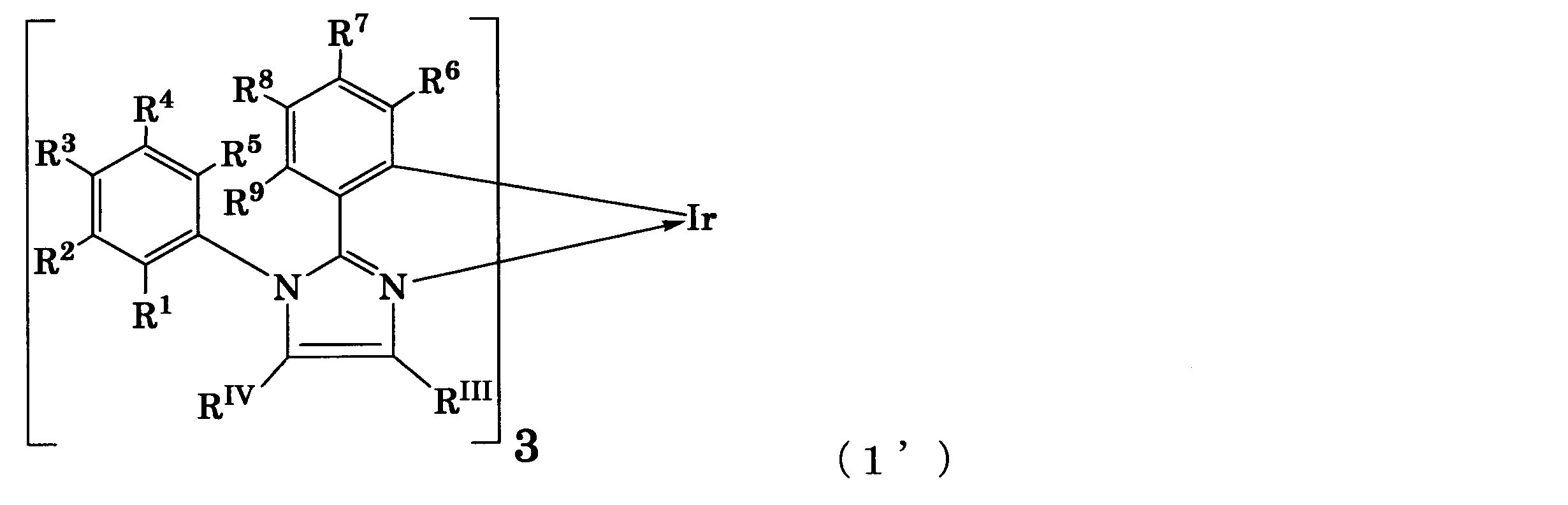
(式中、R1~R9、RIII及びRIVは、前記式(L-3)と同様である。)

(式中、R1~R9、RIII及びRIVと、前記式(1’)のR1~R9、RIII及びRIVは、それぞれ同じ基を示す。)
3.金属錯体の製造方法
所定の不純物含有量を大幅に低下させた、本実施形態の金属錯体は、例えば、上記式(1a)で示される部分構造を含む金属錯体を合成する工程と、金属錯体を精製する工程とを含み、精製工程にて、金属錯体の含有量を99.7%以上とし、精製工程で発生する、金属錯体の不純物の含有量を金属錯体に対し0.036%以下とすることにより製造できる。尚、本実施形態が示す不純物は、前述した第1実施形態の不純物と同義である。
所定の不純物含有量を大幅に低下させた、本実施形態の金属錯体は、例えば、上記式(1a)で示される部分構造を含む金属錯体を合成する工程と、金属錯体を精製する工程とを含み、精製工程にて、金属錯体の含有量を99.7%以上とし、精製工程で発生する、金属錯体の不純物の含有量を金属錯体に対し0.036%以下とすることにより製造できる。尚、本実施形態が示す不純物は、前述した第1実施形態の不純物と同義である。
金属錯体の合成工程については、例えば、国際公開第2006/046980号、国際公開第2006/121811号、国際公開第2007/095118号、特開2012-144454号公報、特開2012-144455号公報等を参照すればよい。
精製工程は、例えば、再結晶、シリカゲルカラムクロマトグラフィー、昇華、及び液体クロマトグラフィー(LC)装置を用いた分取操作から選択される少なくとも一つの精製法がある。これにより、金属錯体の含有量を99.7%以上とし、精製工程で発生する、金属錯体の不純物の含有量を0.036%以下とすることができる。
精製工程は、例えば、再結晶、シリカゲルカラムクロマトグラフィー、昇華、及び液体クロマトグラフィー(LC)装置を用いた分取操作から選択される少なくとも一つの精製法がある。これにより、金属錯体の含有量を99.7%以上とし、精製工程で発生する、金属錯体の不純物の含有量を0.036%以下とすることができる。
上記精製法は一般的であるが、本発明の主成分である金属錯体は、それ自身が精製の過程で、空気に含まれる酸素の存在下において、溶媒、シリカゲル、光等の作用で分解反応を起こし、その分解反応物が金属錯体に含まれることで純度が低下することを確認している。具体的に、100%に近い純度とした金属錯体を、空気中、溶媒、シリカゲル、光のある環境下におくことで、再び不純物が発生することを確認している。従って、溶媒、シリカゲル及び光については留意が必要である。
精製時に使用する溶媒としては、金属錯体自身を溶解させることが必要条件となるが、非プロトン性かつ比誘電率が10以下のいわゆる無極性溶媒が好ましい。例えば、炭化水素溶媒、芳香族炭化水素系溶媒、エーテル系溶媒、エステル系溶媒、クロロホルム、塩化メチレン等が挙げられる。好ましくは、トルエン又は塩化メチレンである。さらに、使用前に充分、窒素ガス等の不活性ガスにより溶存酸素を不活性ガスに置換しておくことが好ましい。
シリカゲルは、一般に酸性又は中性のものが知られている。金属錯体から微量不純物への分解反応を抑制するためには、中性のシリカゲルが好適である。精製にシリカゲルカラムクロマトグラフィーを利用することは、錯体合成反応時に生じた副生成物、又は錯体自身の分解で生じた微量不純物の除去には極めて有効であるため、精製プロセスにおいては必要不可欠ともいえる。
また、空気中、光により錯体自身の分解反応が促進される。可視光よりも波長が短くエネルギーが大きな紫外線のほうが錯体の分解を促進させる。従って、反応、分離、精製、及び保管を通じ、本発明の金属錯体の取り扱いについては、できるだけ短い波長の光を、できるだけ除去した照明下で実施することが好ましい。
また、照度については、実際に照度0ルクスでの合成及び/又は精製は困難であるが、できるだけ照度が小さい環境にすることが望ましい。
各工程及び保管時に使用する容器は、透明ガラス器具ではなく褐色ガラス器具がよい。一般に褐色ガラス器具は450nm以下の紫外線をカットすることができる。また、アルミホイルをガラス器具に巻くことで遮光できるので、できるだけアルミホイルによる遮光を行ないながら合成・精製等の操作を行なうことが好ましい。
また、照度については、実際に照度0ルクスでの合成及び/又は精製は困難であるが、できるだけ照度が小さい環境にすることが望ましい。
各工程及び保管時に使用する容器は、透明ガラス器具ではなく褐色ガラス器具がよい。一般に褐色ガラス器具は450nm以下の紫外線をカットすることができる。また、アルミホイルをガラス器具に巻くことで遮光できるので、できるだけアルミホイルによる遮光を行ないながら合成・精製等の操作を行なうことが好ましい。
本実施形態では、好ましくは、金属錯体を合成する工程の最終段階の反応時以降のすべての工程を、照度100ルクス以下(より好ましくは10ルクス以下)の環境下で、かつ、波長480nm以下(より好ましくは波長560nm以下)の光のない環境下で実施する。大きなエネルギーをもつ紫外線又はそれよりも短波長の光のない環境にて、合成から精製までの操作を行なうことで、より高純度な金属錯体が得やすくなる。
上記の環境は、例えば、光源の照度を十分に低く設定し、かつ、イエローライトやオレンジライト等、短波長領域の光を発しない光源を使用したり、イエローフィルターやオレンジフィルター等のカラーフィルターにより、光源に含まれる短波長領域の光を遮光することにより得られる。
上記の環境は、例えば、光源の照度を十分に低く設定し、かつ、イエローライトやオレンジライト等、短波長領域の光を発しない光源を使用したり、イエローフィルターやオレンジフィルター等のカラーフィルターにより、光源に含まれる短波長領域の光を遮光することにより得られる。
4.有機EL素子
本発明の金属錯体組成物又は金属錯体は、有機EL素子用材料、例えば、発光層の材料として、好適に使用できる。
本発明の有機EL素子は、陰極と陽極の間に発光層を含有する有機薄膜層を有し、この有機薄膜層のうちの少なくとも1層が前述した本発明の金属錯体組成物を含む。これにより、有機EL素子の寿命を向上できる。有機薄膜層の例としては、正孔注入層、正孔輸送層、発光層、電子輸送層、電子注入層、スペース層、及び障壁層等が挙げられるが、これらに限定されるものではない。本発明の有機EL素子では、本発明の金属錯体を発光層に含むことが好ましく、特に、発光層のドーパント材料として用いられることが好ましい。
本発明の有機EL素子では、前述した本発明の金属錯体組成物又は金属錯体を含んであれば、他の構成については特に限定はなく、公知の構成を採用できる。以下簡単に説明する。
本発明の金属錯体組成物又は金属錯体は、有機EL素子用材料、例えば、発光層の材料として、好適に使用できる。
本発明の有機EL素子は、陰極と陽極の間に発光層を含有する有機薄膜層を有し、この有機薄膜層のうちの少なくとも1層が前述した本発明の金属錯体組成物を含む。これにより、有機EL素子の寿命を向上できる。有機薄膜層の例としては、正孔注入層、正孔輸送層、発光層、電子輸送層、電子注入層、スペース層、及び障壁層等が挙げられるが、これらに限定されるものではない。本発明の有機EL素子では、本発明の金属錯体を発光層に含むことが好ましく、特に、発光層のドーパント材料として用いられることが好ましい。
本発明の有機EL素子では、前述した本発明の金属錯体組成物又は金属錯体を含んであれば、他の構成については特に限定はなく、公知の構成を採用できる。以下簡単に説明する。
(基板)
基板は、発光素子の支持体として用いられる。基板としては、例えば、ガラス、石英、プラスチック等を用いることができる。また、可撓性基板を用いてもよい。可撓性基板とは、折り曲げることができる(フレキシブル)基板のことであり、例えば、ポリカーボネート、ポリ塩化ビニルからなるプラスチック基板等が挙げられる。
基板は、発光素子の支持体として用いられる。基板としては、例えば、ガラス、石英、プラスチック等を用いることができる。また、可撓性基板を用いてもよい。可撓性基板とは、折り曲げることができる(フレキシブル)基板のことであり、例えば、ポリカーボネート、ポリ塩化ビニルからなるプラスチック基板等が挙げられる。
(陽極)
基板上に形成される陽極には、仕事関数の大きい(具体的には4.0eV以上)金属、合金、電気伝導性化合物、及びこれらの混合物等を用いることが好ましい。具体的には、例えば、酸化インジウム-酸化スズ(ITO:Indium Tin Oxide)、珪素若しくは酸化珪素を含有した酸化インジウム-酸化スズ、酸化インジウム-酸化亜鉛、酸化タングステン、及び酸化亜鉛を含有した酸化インジウム、グラフェン等が挙げられる。この他、金(Au)、白金(Pt)、又は金属材料の窒化物(例えば、窒化チタン)等が挙げられる。
基板上に形成される陽極には、仕事関数の大きい(具体的には4.0eV以上)金属、合金、電気伝導性化合物、及びこれらの混合物等を用いることが好ましい。具体的には、例えば、酸化インジウム-酸化スズ(ITO:Indium Tin Oxide)、珪素若しくは酸化珪素を含有した酸化インジウム-酸化スズ、酸化インジウム-酸化亜鉛、酸化タングステン、及び酸化亜鉛を含有した酸化インジウム、グラフェン等が挙げられる。この他、金(Au)、白金(Pt)、又は金属材料の窒化物(例えば、窒化チタン)等が挙げられる。
(正孔注入層)
正孔注入層は、正孔注入性の高い物質を含む層である。正孔注入性の高い物質としては、モリブデン酸化物、チタン酸化物、バナジウム酸化物、レニウム酸化物、ルテニウム酸化物、クロム酸化物、ジルコニウム酸化物、ハフニウム酸化物、タンタル酸化物、銀酸化物、タングステン酸化物、マンガン酸化物、芳香族アミン化合物、又は高分子化合物(オリゴマー、デンドリマー、ポリマー等)等も使用できる。
正孔注入層は、正孔注入性の高い物質を含む層である。正孔注入性の高い物質としては、モリブデン酸化物、チタン酸化物、バナジウム酸化物、レニウム酸化物、ルテニウム酸化物、クロム酸化物、ジルコニウム酸化物、ハフニウム酸化物、タンタル酸化物、銀酸化物、タングステン酸化物、マンガン酸化物、芳香族アミン化合物、又は高分子化合物(オリゴマー、デンドリマー、ポリマー等)等も使用できる。
(正孔輸送層)
正孔輸送層は、正孔輸送性の高い物質を含む層である。正孔輸送層には、芳香族アミン化合物、カルバゾール誘導体、アントラセン誘導体等を使用する事ができる。ポリ(N-ビニルカルバゾール)(略称:PVK)やポリ(4-ビニルトリフェニルアミン)(略称:PVTPA)等の高分子化合物を用いることもできる。但し、電子よりも正孔の輸送性の高い物質であれば、これら以外のものを用いてもよい。尚、正孔輸送性の高い物質を含む層は、単層のものだけでなく、上記物質からなる層が二層以上積層したものとしてもよい。
正孔輸送層は、正孔輸送性の高い物質を含む層である。正孔輸送層には、芳香族アミン化合物、カルバゾール誘導体、アントラセン誘導体等を使用する事ができる。ポリ(N-ビニルカルバゾール)(略称:PVK)やポリ(4-ビニルトリフェニルアミン)(略称:PVTPA)等の高分子化合物を用いることもできる。但し、電子よりも正孔の輸送性の高い物質であれば、これら以外のものを用いてもよい。尚、正孔輸送性の高い物質を含む層は、単層のものだけでなく、上記物質からなる層が二層以上積層したものとしてもよい。
(発光層のゲスト材料)
発光層は、発光性の高い物質を含む層であり、種々の材料を用いることができる。例えば、発光性の高い物質としては、蛍光を発光する蛍光性化合物や燐光を発光する燐光性化合物を用いることができる。蛍光性化合物は一重項励起状態から発光可能な化合物であり、燐光性化合物は三重項励起状態から発光可能な化合物である。
発光層に用いることができる青色系の蛍光発光材料として、ピレン誘導体、スチリルアミン誘導体、クリセン誘導体、フルオランテン誘導体、フルオレン誘導体、ジアミン誘導体、トリアリールアミン誘導体等が使用できる。発光層に用いることができる緑色系の蛍光発光材料として、芳香族アミン誘導体等を使用できる。発光層に用いることができる赤色系の蛍光発光材料として、テトラセン誘導体、ジアミン誘導体等が使用できる。
発光層に用いることができる青色系の燐光発光材料として、イリジウム錯体、オスミウム錯体、白金錯体等の金属錯体が使用される。発光層に用いることができる緑色系の燐光発光材料としてイリジウム錯体等が使用される。発光層に用いることができる赤色系の燐光発光材料として、イリジウム錯体、白金錯体、テルビウム錯体、ユーロピウム錯体等の金属錯体が使用される。
発光層は、発光性の高い物質を含む層であり、種々の材料を用いることができる。例えば、発光性の高い物質としては、蛍光を発光する蛍光性化合物や燐光を発光する燐光性化合物を用いることができる。蛍光性化合物は一重項励起状態から発光可能な化合物であり、燐光性化合物は三重項励起状態から発光可能な化合物である。
発光層に用いることができる青色系の蛍光発光材料として、ピレン誘導体、スチリルアミン誘導体、クリセン誘導体、フルオランテン誘導体、フルオレン誘導体、ジアミン誘導体、トリアリールアミン誘導体等が使用できる。発光層に用いることができる緑色系の蛍光発光材料として、芳香族アミン誘導体等を使用できる。発光層に用いることができる赤色系の蛍光発光材料として、テトラセン誘導体、ジアミン誘導体等が使用できる。
発光層に用いることができる青色系の燐光発光材料として、イリジウム錯体、オスミウム錯体、白金錯体等の金属錯体が使用される。発光層に用いることができる緑色系の燐光発光材料としてイリジウム錯体等が使用される。発光層に用いることができる赤色系の燐光発光材料として、イリジウム錯体、白金錯体、テルビウム錯体、ユーロピウム錯体等の金属錯体が使用される。
(発光層のホスト材料)
発光層としては、上述した発光性の高い物質(ゲスト材料)を他の物質(ホスト材料)に分散させた構成としてもよい。発光性の高い物質を分散させるための物質としては、各種のものを用いることができ、発光性の高い物質よりも最低空軌道準位(LUMO準位)が高く、最高被占有軌道準位(HOMO準位)が低い物質を用いることが好ましい。
発光性の高い物質を分散させるための物質(ホスト材料)としては、1)アルミニウム錯体、ベリリウム錯体、若しくは亜鉛錯体等の金属錯体、2)オキサジアゾール誘導体、ベンゾイミダゾール誘導体、若しくはフェナントロリン誘導体等の複素環化合物、3)カルバゾール誘導体、アントラセン誘導体、フェナントレン誘導体、ピレン誘導体、若しくはクリセン誘導体等の縮合芳香族化合物、3)トリアリールアミン誘導体、若しくは縮合多環芳香族アミン誘導体等の芳香族アミン化合物が使用される。
発光層としては、上述した発光性の高い物質(ゲスト材料)を他の物質(ホスト材料)に分散させた構成としてもよい。発光性の高い物質を分散させるための物質としては、各種のものを用いることができ、発光性の高い物質よりも最低空軌道準位(LUMO準位)が高く、最高被占有軌道準位(HOMO準位)が低い物質を用いることが好ましい。
発光性の高い物質を分散させるための物質(ホスト材料)としては、1)アルミニウム錯体、ベリリウム錯体、若しくは亜鉛錯体等の金属錯体、2)オキサジアゾール誘導体、ベンゾイミダゾール誘導体、若しくはフェナントロリン誘導体等の複素環化合物、3)カルバゾール誘導体、アントラセン誘導体、フェナントレン誘導体、ピレン誘導体、若しくはクリセン誘導体等の縮合芳香族化合物、3)トリアリールアミン誘導体、若しくは縮合多環芳香族アミン誘導体等の芳香族アミン化合物が使用される。
(電子輸送層)
電子輸送層は、電子輸送性の高い物質を含む層である。電子輸送層には、1)アルミニウム錯体、ベリリウム錯体、亜鉛錯体等の金属錯体、2)イミダゾール誘導体、ベンゾイミダゾール誘導体、アジン誘導体、カルバゾール誘導体、フェナントロリン誘導体等の複素芳香族化合物、3)高分子化合物を使用することができる。
電子輸送層は、電子輸送性の高い物質を含む層である。電子輸送層には、1)アルミニウム錯体、ベリリウム錯体、亜鉛錯体等の金属錯体、2)イミダゾール誘導体、ベンゾイミダゾール誘導体、アジン誘導体、カルバゾール誘導体、フェナントロリン誘導体等の複素芳香族化合物、3)高分子化合物を使用することができる。
(電子注入層)
電子注入層は、電子注入性の高い物質を含む層である。電子注入層には、リチウム(Li)、フッ化リチウム(LiF)、フッ化セシウム(CsF)、フッ化カルシウム(CaF2)、リチウム酸化物(LiOx)等のようなアルカリ金属、アルカリ土類金属、又はそれらの化合物を用いることができる。
電子注入層は、電子注入性の高い物質を含む層である。電子注入層には、リチウム(Li)、フッ化リチウム(LiF)、フッ化セシウム(CsF)、フッ化カルシウム(CaF2)、リチウム酸化物(LiOx)等のようなアルカリ金属、アルカリ土類金属、又はそれらの化合物を用いることができる。
(陰極)
陰極には、仕事関数の小さい(具体的には3.8eV以下)金属、合金、電気伝導性化合物、及びこれらの混合物等を用いることが好ましい。このような陰極材料の具体例としては、元素周期表の第1族又は第2族に属する元素、すなわちリチウム(Li)やセシウム(Cs)等のアルカリ金属、及びマグネシウム(Mg)等のアルカリ土類金属、及びこれらを含む合金(例えば、MgAg、AlLi)等の希土類金属及びこれらを含む合金等が挙げられる。
陰極には、仕事関数の小さい(具体的には3.8eV以下)金属、合金、電気伝導性化合物、及びこれらの混合物等を用いることが好ましい。このような陰極材料の具体例としては、元素周期表の第1族又は第2族に属する元素、すなわちリチウム(Li)やセシウム(Cs)等のアルカリ金属、及びマグネシウム(Mg)等のアルカリ土類金属、及びこれらを含む合金(例えば、MgAg、AlLi)等の希土類金属及びこれらを含む合金等が挙げられる。
[金属錯体の製造]
実施例1(赤色蛍光灯下でのイリジウム錯体合成)
本実施例では、反応、精製をすべて赤色蛍光灯下(照度:100ルクス以下)にて行なった。また、反応、精製及び保存時に使用する容器は、すべて褐色ガラス製のものを用い、紫外線を遮断した。また、精製時に用いたカラム管はアルミホイルで覆い、遮光下にてシリカゲルカラムクロマトグラフィー精製を行なった。
下記反応経路により金属錯体である化合物3を合成した。
実施例1(赤色蛍光灯下でのイリジウム錯体合成)
本実施例では、反応、精製をすべて赤色蛍光灯下(照度:100ルクス以下)にて行なった。また、反応、精製及び保存時に使用する容器は、すべて褐色ガラス製のものを用い、紫外線を遮断した。また、精製時に用いたカラム管はアルミホイルで覆い、遮光下にてシリカゲルカラムクロマトグラフィー精製を行なった。
下記反応経路により金属錯体である化合物3を合成した。
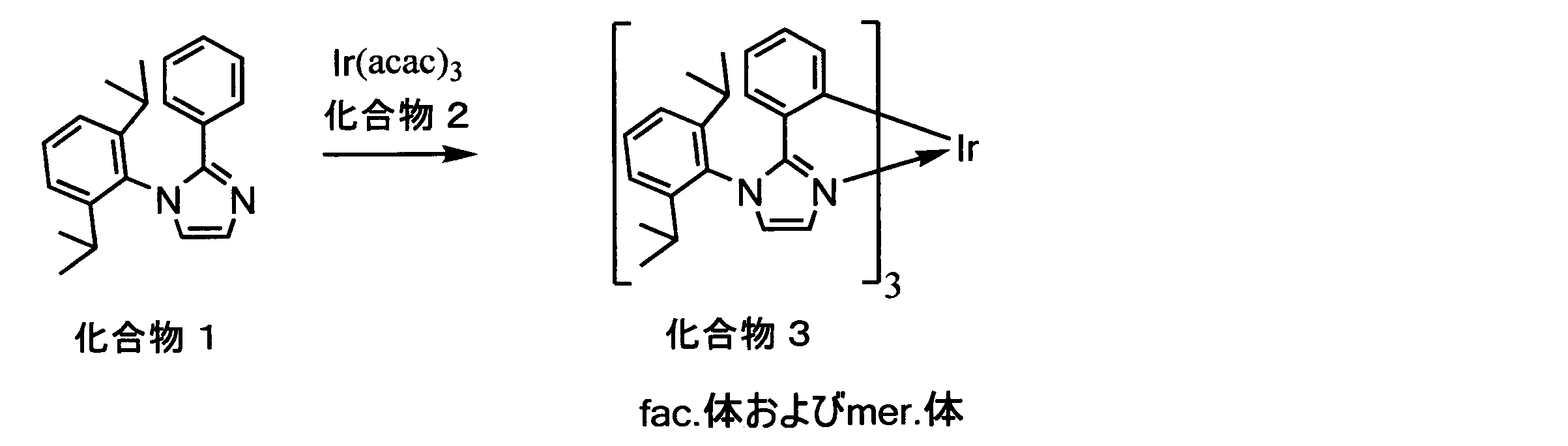
(1)合成工程
アルゴン気流下、リフラックスコンデンサーを取り付けた三口の500ミリリットルフラスコに、溶媒のグリセロール200mlを仕込み、150℃に加温し、150℃にて3時間アルゴンガスをバブリングさせて脱気した。これを室温に冷却し、化合物1(株式会社ケミカルソフト開発研究所製、分子量304.43、使用量20.00g、モル数0.0657モル)及び化合物2(トリス(アセチルアセトナト)イリジウム(III)、Strem Chemicals, Inc.製、分子量489.53、使用量8.04g、モル数0.0164モル)を加え、30分かけて220℃まで昇温し、反応を開始した。次に、反応温度を徐々に下げ、8時間かけて170℃まで落とし、さらに8時間、170℃にて反応を続けた。
アルゴン気流下、リフラックスコンデンサーを取り付けた三口の500ミリリットルフラスコに、溶媒のグリセロール200mlを仕込み、150℃に加温し、150℃にて3時間アルゴンガスをバブリングさせて脱気した。これを室温に冷却し、化合物1(株式会社ケミカルソフト開発研究所製、分子量304.43、使用量20.00g、モル数0.0657モル)及び化合物2(トリス(アセチルアセトナト)イリジウム(III)、Strem Chemicals, Inc.製、分子量489.53、使用量8.04g、モル数0.0164モル)を加え、30分かけて220℃まで昇温し、反応を開始した。次に、反応温度を徐々に下げ、8時間かけて170℃まで落とし、さらに8時間、170℃にて反応を続けた。
(2)精製工程
この反応液を室温まで冷却し、塩化メチレン1リットルに注ぎ、水2リットルで洗浄した。さらに塩化メチレン1リットルを用い、洗浄した水から抽出した。これらの塩化メチレン溶液を混ぜ、無水硫酸マグネシウムで乾燥した。次に、この塩化メチレン溶液から減圧下40℃にて塩化メチレンを留去し、濃縮した。この濃縮液を、展開溶媒として塩化メチレン/ヘプタン:1/1(体積%比)を用い、シリカゲルカラムクロマトグラフィーにより分離精製し、さらにもう一度同じ操作を繰り返した。次に、得られた固体を、ヘプタン(貧溶媒)/塩化メチレン(良溶媒)により再結晶精製することで、目的物である化合物3を6.36g(5.77ミリモル、収率35%)得た。
この反応液を室温まで冷却し、塩化メチレン1リットルに注ぎ、水2リットルで洗浄した。さらに塩化メチレン1リットルを用い、洗浄した水から抽出した。これらの塩化メチレン溶液を混ぜ、無水硫酸マグネシウムで乾燥した。次に、この塩化メチレン溶液から減圧下40℃にて塩化メチレンを留去し、濃縮した。この濃縮液を、展開溶媒として塩化メチレン/ヘプタン:1/1(体積%比)を用い、シリカゲルカラムクロマトグラフィーにより分離精製し、さらにもう一度同じ操作を繰り返した。次に、得られた固体を、ヘプタン(貧溶媒)/塩化メチレン(良溶媒)により再結晶精製することで、目的物である化合物3を6.36g(5.77ミリモル、収率35%)得た。
上記の化合物3の純度、及び不純物に関する構造情報を得るために、液体クロマトグラフ質量分析(LC-MS)を行なった。測定条件は以下のとおりである。
・LC/MS装置
LC部:アジレント・テクノロジー製 (Agilent 1200)
MS部:サーモフィッシャーサイエンティフィック製 イオントラップ型質量分析計(LXQ)
・LC/MS/MS条件
カラム:Inertsil ODS-3(3.0mmID×250mm, 粒径3μm)
カラム温度:40℃
移動相:アセトニトリル(HPLC用)
流速:400μL/min
注入量:3μL
UV検出波長:254nm
MSイオン化:大気圧イオン化法(APCI)、正イオン検出
・高分解能質量分析装置
LC部:アジレント・テクノロジー製 (1260 Infinity)
MS部:AB SCIEX製 Triple TOF 5600 System
イオン化法:大気圧イオン化法(APCI)、正イオン検出
フローインジェクション条件
流速:200μL/min.
移動相:アセトニトリル(HPLC用)
結果を表1に示す。
・LC/MS装置
LC部:アジレント・テクノロジー製 (Agilent 1200)
MS部:サーモフィッシャーサイエンティフィック製 イオントラップ型質量分析計(LXQ)
・LC/MS/MS条件
カラム:Inertsil ODS-3(3.0mmID×250mm, 粒径3μm)
カラム温度:40℃
移動相:アセトニトリル(HPLC用)
流速:400μL/min
注入量:3μL
UV検出波長:254nm
MSイオン化:大気圧イオン化法(APCI)、正イオン検出
・高分解能質量分析装置
LC部:アジレント・テクノロジー製 (1260 Infinity)
MS部:AB SCIEX製 Triple TOF 5600 System
イオン化法:大気圧イオン化法(APCI)、正イオン検出
フローインジェクション条件
流速:200μL/min.
移動相:アセトニトリル(HPLC用)
結果を表1に示す。

分析の結果、化合物3のfacial体が99.30%、化合物3のmeridional体が0.63%であり、化合物3の総和は99.93%であった。また、不純物としては特定の構造のものは存在せず多数存在し、すべての不純物はそれぞれ0.014%以下であり、不純物の総和は0.07%であった。また、化合物3からC(炭素)が1つ除かれ、O(酸素)が1つ加わって分子量が4増加したピークNo.20の不純物(+4成分[化合物3-C(炭素)+O(酸素)])の含有量は0.001%以下であった。
また、実施例1で得た化合物3を昇華精製した(昇華前:5.00g、昇華後:4.34g)。
昇華精製の条件は以下のとおりとした。
装置:有機材料用の昇華装置(株式会社エイエルエステクノロジー社製)
昇華管:ガラス製、内径40mm
昇華方法:気流法(窒素流量:10m・秒)
昇華温度:高温側260℃~280℃、低温側180℃
真空度:真空ポンプ側3.5Pa、サンプル側30Pa
昇華所要時間:160分
昇華精製した化合物3のLC-MSの結果を表2に示す。
昇華精製の条件は以下のとおりとした。
装置:有機材料用の昇華装置(株式会社エイエルエステクノロジー社製)
昇華管:ガラス製、内径40mm
昇華方法:気流法(窒素流量:10m・秒)
昇華温度:高温側260℃~280℃、低温側180℃
真空度:真空ポンプ側3.5Pa、サンプル側30Pa
昇華所要時間:160分
昇華精製した化合物3のLC-MSの結果を表2に示す。
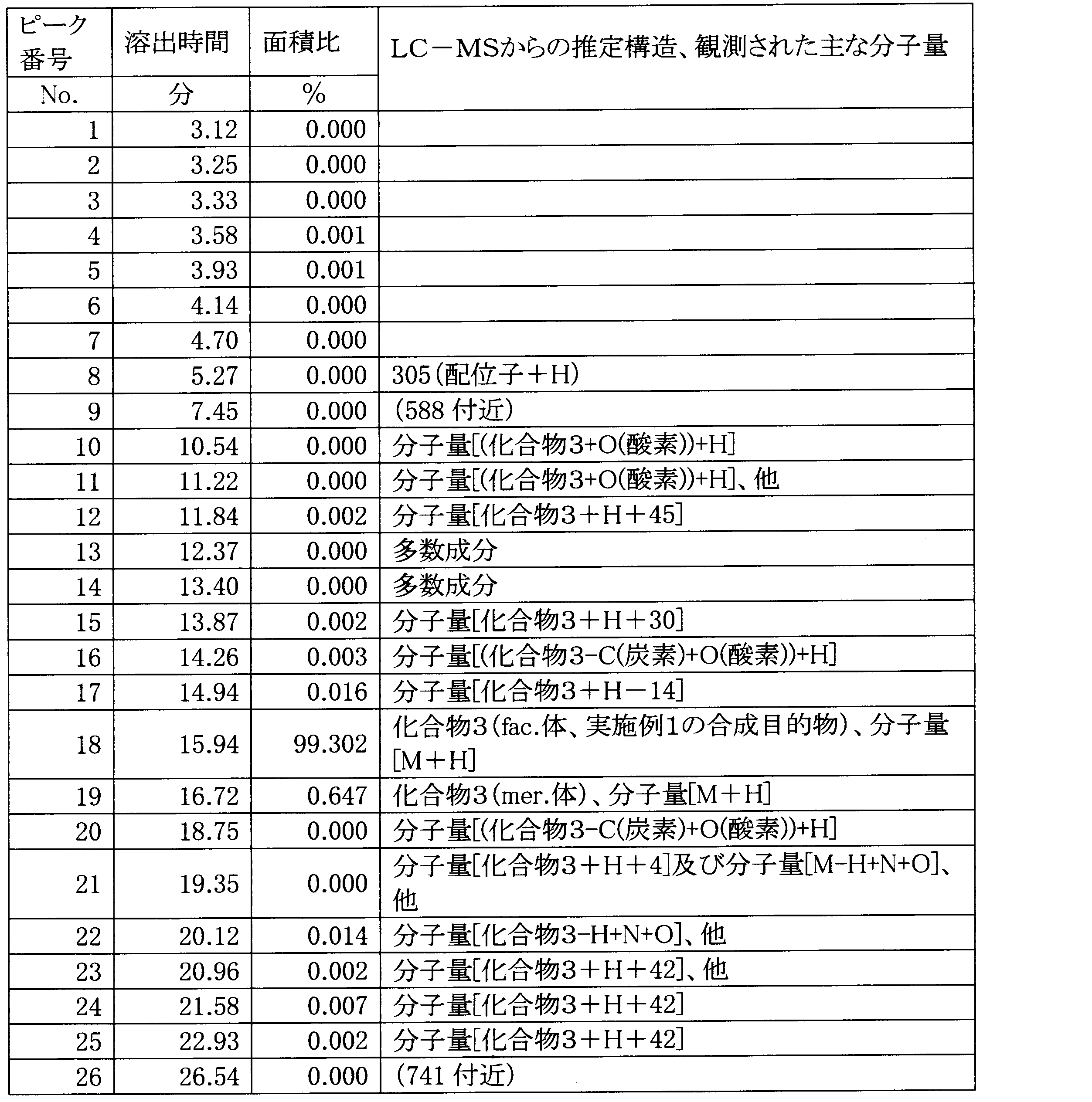
分析の結果、化合物3のfacial体が99.30%、化合物3のmeridional体が0.65%であり、化合物3の総和は99.95%であった。また、不純物は特定の構造のものは存在せず多数存在し、すべての不純物はそれぞれ0.016%以下であり、不純物の総和は0.05%であった。また、ピークNo.20の不純物の含有量は0.001%以下であった。
上記結果から、昇華精製により化合物3の純度が向上することが確認できる。
上記結果から、昇華精製により化合物3の純度が向上することが確認できる。
実施例2(黄色蛍光灯下でのイリジウム錯体合成)
赤色蛍光灯に代わり黄色蛍光灯を用いた以外は、実施例1と同様にして化合物3を合成した。昇華精製後のLC-MSの結果を表3に示す。
赤色蛍光灯に代わり黄色蛍光灯を用いた以外は、実施例1と同様にして化合物3を合成した。昇華精製後のLC-MSの結果を表3に示す。

分析の結果、化合物3のfacial体が98.71%、化合物3のmeridional体が0.98%、であり、化合物3の総和は99.69%であった。また、不純物としては特定の構造のものは存在せず多数存在し、不純物の総和は0.31%であった。また、ピークNo.20の不純物の含有量は0.025%であった。
実施例3(白色蛍光灯下でのイリジウム錯体合成)
反応スケールを4分の1とし、反応、精製はすべて白色蛍光灯下(照度:100ルクス以下)にて行なった。また、反応、精製及び保存時に使用する容器はすべて透明ガラス製のものを用いた。また、精製時に用いたカラム管はアルミホイルで覆うことなく、そのまま透明ガラスとして用いた。その他は、実施例1と同様にして化合物3を合成し、昇華精製した。昇華精製後のLC-MSの結果を表4に示す。
反応スケールを4分の1とし、反応、精製はすべて白色蛍光灯下(照度:100ルクス以下)にて行なった。また、反応、精製及び保存時に使用する容器はすべて透明ガラス製のものを用いた。また、精製時に用いたカラム管はアルミホイルで覆うことなく、そのまま透明ガラスとして用いた。その他は、実施例1と同様にして化合物3を合成し、昇華精製した。昇華精製後のLC-MSの結果を表4に示す。

分析の結果、化合物3のfacial体が99.17%、化合物3のmeridional体が0.59%であり、化合物3の総和は99.76%であった。また、不純物としては特定の構造のものは存在せず多数存在し、不純物の総和は0.24%であった。また、ピークNo.20の不純物の含有量は0.036%であった。
実施例4(遮光条件下でのシリカゲルカラムクロマトグラフィーによる精製)
上記実施例3で得た化合物3を、カラム管をアルミホイルで覆い、遮光下にてシリカゲルカラムクロマトグラフィーによる精製を行ない、再度昇華精製した。LC-MSの結果を表5に示す。
上記実施例3で得た化合物3を、カラム管をアルミホイルで覆い、遮光下にてシリカゲルカラムクロマトグラフィーによる精製を行ない、再度昇華精製した。LC-MSの結果を表5に示す。
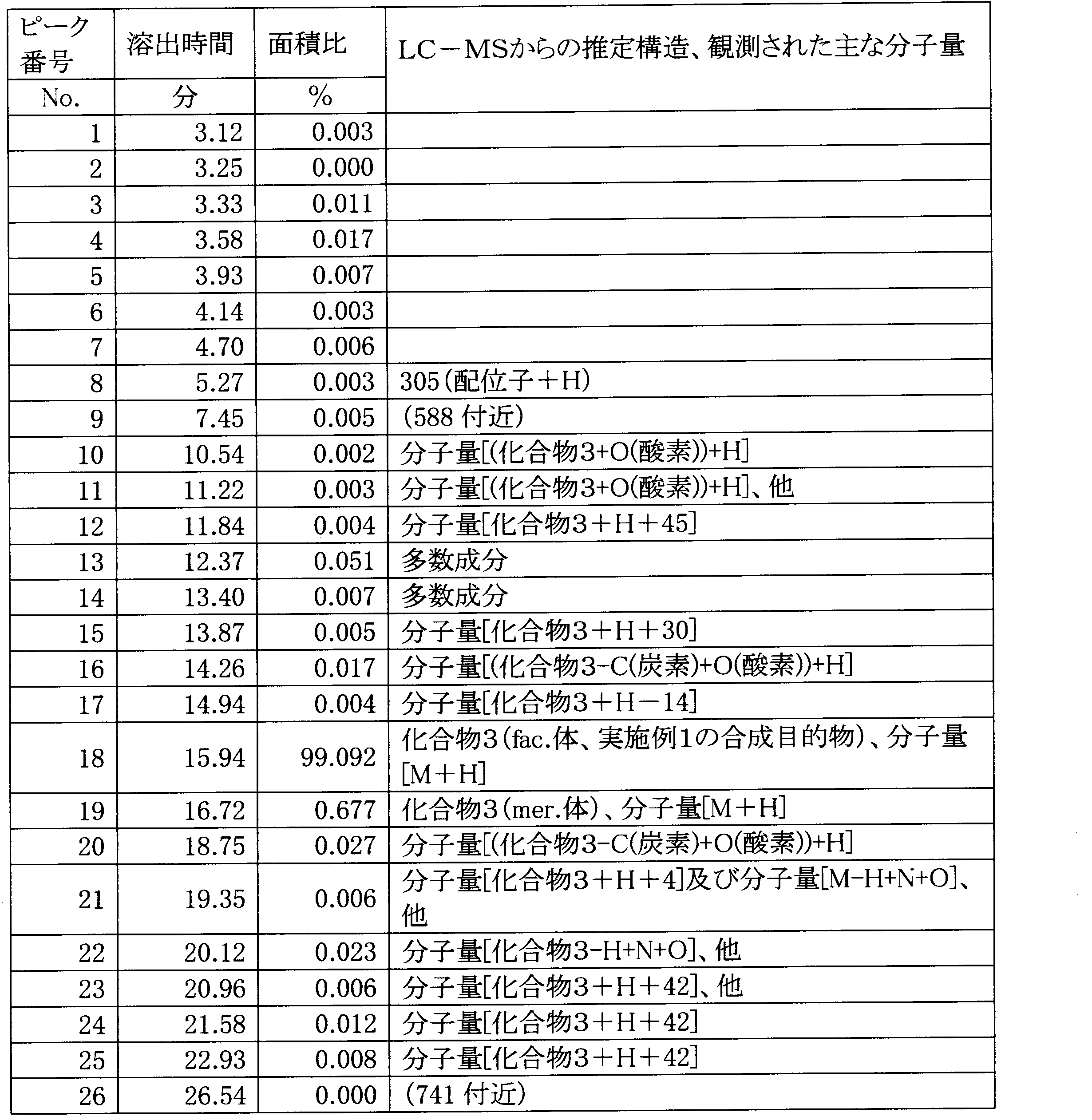
分析の結果、化合物3のfacial体が99.09%、化合物3のmeridional体が0.68%であり、化合物3の総和は99.77%であった。また、不純物としては特定の構造のものは存在せず多数存在し、不純物の総和は0.23%であった。また、ピークNo.20の不純物の含有量は0.027%であった。
比較例1(低純度品の合成)
ヘプタン/塩化メチレンによる再結晶をしなかった他は、上記実施例3と同様にして化合物3を合成した。LC-MSの結果を表6に示す。
ヘプタン/塩化メチレンによる再結晶をしなかった他は、上記実施例3と同様にして化合物3を合成した。LC-MSの結果を表6に示す。
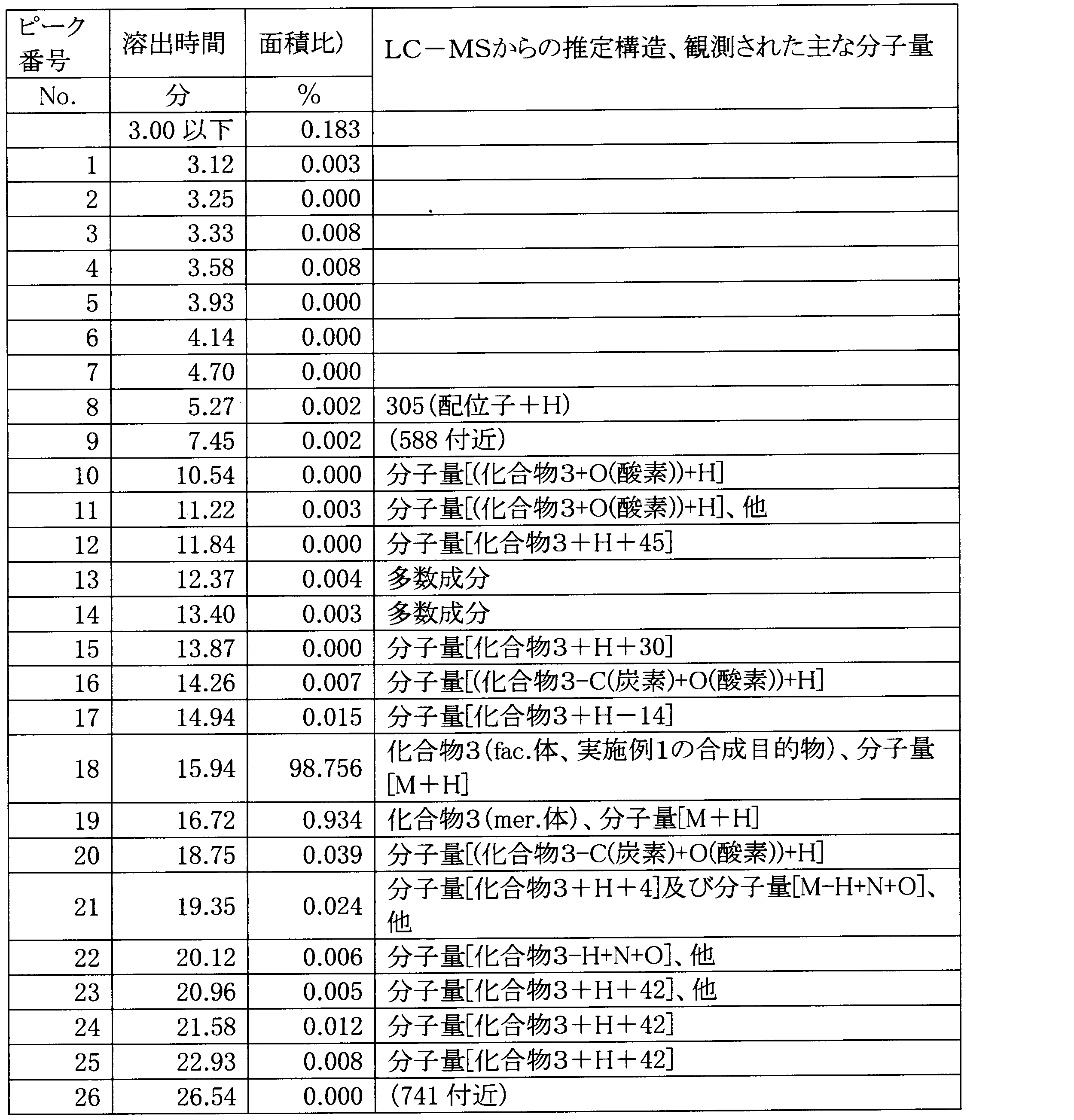
分析の結果、化合物3のfacial体が98.76%、化合物3のmeridional体が0.93%であり、化合物3の総和は99.69%であった。また、不純物としては特定の構造のものは存在せず多数存在し、不純物の総和は0.31%であった。また、ピークNo.20の不純物の含有量は0.039%であった。
実施例3と実施例4の比較から、シリカゲルカラムクロマトグラフィー精製により、化合物3の純度を向上できることを確認した。特に、LC-MSにおいて目的物(化合物3)後にピークとして観測されたピークNo.20の不純物の含有量を減らすことができた。
実施例1~3の比較から、赤色蛍光灯下で合成することで、特に顕著に、LC-MSにおいて目的物(化合物3)後にピークとして観測されたピークNo.20の不純物の含有量を減らすことができた。
実施例1~3の比較から、赤色蛍光灯下で合成することで、特に顕著に、LC-MSにおいて目的物(化合物3)後にピークとして観測されたピークNo.20の不純物の含有量を減らすことができた。
[有機EL素子の製造]
実施例5
膜厚130nmのITO電極ライン付きガラス基板(ジオマティック社製)を、イソプロピルアルコール中で5分間、超音波洗浄した後、UVオゾン洗浄を30分間行なった。
洗浄後のITO電極ライン付きガラス基板を真空蒸着装置の基板ホルダーに装着し、まずITO電極ラインが形成されている側の面上に、ITO電極ラインを覆うようにして下記化合物(HI1)を厚さ20nmで、次いで下記化合物(HT1)を厚さ60nmで抵抗加熱蒸着し、順次薄膜を成膜した。成膜レートは1Å/sとした。これらの薄膜は、それぞれ正孔注入層及び正孔輸送層として機能する。
次に、正孔輸送層上に、下記化合物(H1)と実施例1で製造した化合物3(昇華精製物)を同時に抵抗加熱蒸着して膜厚50nmの薄膜を成膜した。このとき、化合物3を、化合物(H1)と化合物3の総質量に対し質量比で20%になるように蒸着した。成膜レートはそれぞれ1.2Å/s、0.3Å/sとした。この薄膜は、燐光発光層として機能する。
次に、この燐光発光層上に、化合物(H1)を抵抗加熱蒸着して膜厚10nmの薄膜を成膜した。成膜レートは1Å/sとした。この薄膜は正孔阻止層として機能する。
次に、この障壁層上に、下記化合物(ET1)を抵抗加熱蒸着して膜厚10nmの薄膜を成膜した。成膜レートは1Å/sとした。この膜は電子注入層として機能する。
次に、この電子注入層上に膜厚1.0nmのLiFを成膜レート0.1Å/sで蒸着した。
次に、このLiF膜上に金属アルミニウムを成膜レート8.0Å/sにて蒸着し、膜厚80nmの金属陰極を形成して有機EL素子を製造した。
実施例5
膜厚130nmのITO電極ライン付きガラス基板(ジオマティック社製)を、イソプロピルアルコール中で5分間、超音波洗浄した後、UVオゾン洗浄を30分間行なった。
洗浄後のITO電極ライン付きガラス基板を真空蒸着装置の基板ホルダーに装着し、まずITO電極ラインが形成されている側の面上に、ITO電極ラインを覆うようにして下記化合物(HI1)を厚さ20nmで、次いで下記化合物(HT1)を厚さ60nmで抵抗加熱蒸着し、順次薄膜を成膜した。成膜レートは1Å/sとした。これらの薄膜は、それぞれ正孔注入層及び正孔輸送層として機能する。
次に、正孔輸送層上に、下記化合物(H1)と実施例1で製造した化合物3(昇華精製物)を同時に抵抗加熱蒸着して膜厚50nmの薄膜を成膜した。このとき、化合物3を、化合物(H1)と化合物3の総質量に対し質量比で20%になるように蒸着した。成膜レートはそれぞれ1.2Å/s、0.3Å/sとした。この薄膜は、燐光発光層として機能する。
次に、この燐光発光層上に、化合物(H1)を抵抗加熱蒸着して膜厚10nmの薄膜を成膜した。成膜レートは1Å/sとした。この薄膜は正孔阻止層として機能する。
次に、この障壁層上に、下記化合物(ET1)を抵抗加熱蒸着して膜厚10nmの薄膜を成膜した。成膜レートは1Å/sとした。この膜は電子注入層として機能する。
次に、この電子注入層上に膜厚1.0nmのLiFを成膜レート0.1Å/sで蒸着した。
次に、このLiF膜上に金属アルミニウムを成膜レート8.0Å/sにて蒸着し、膜厚80nmの金属陰極を形成して有機EL素子を製造した。
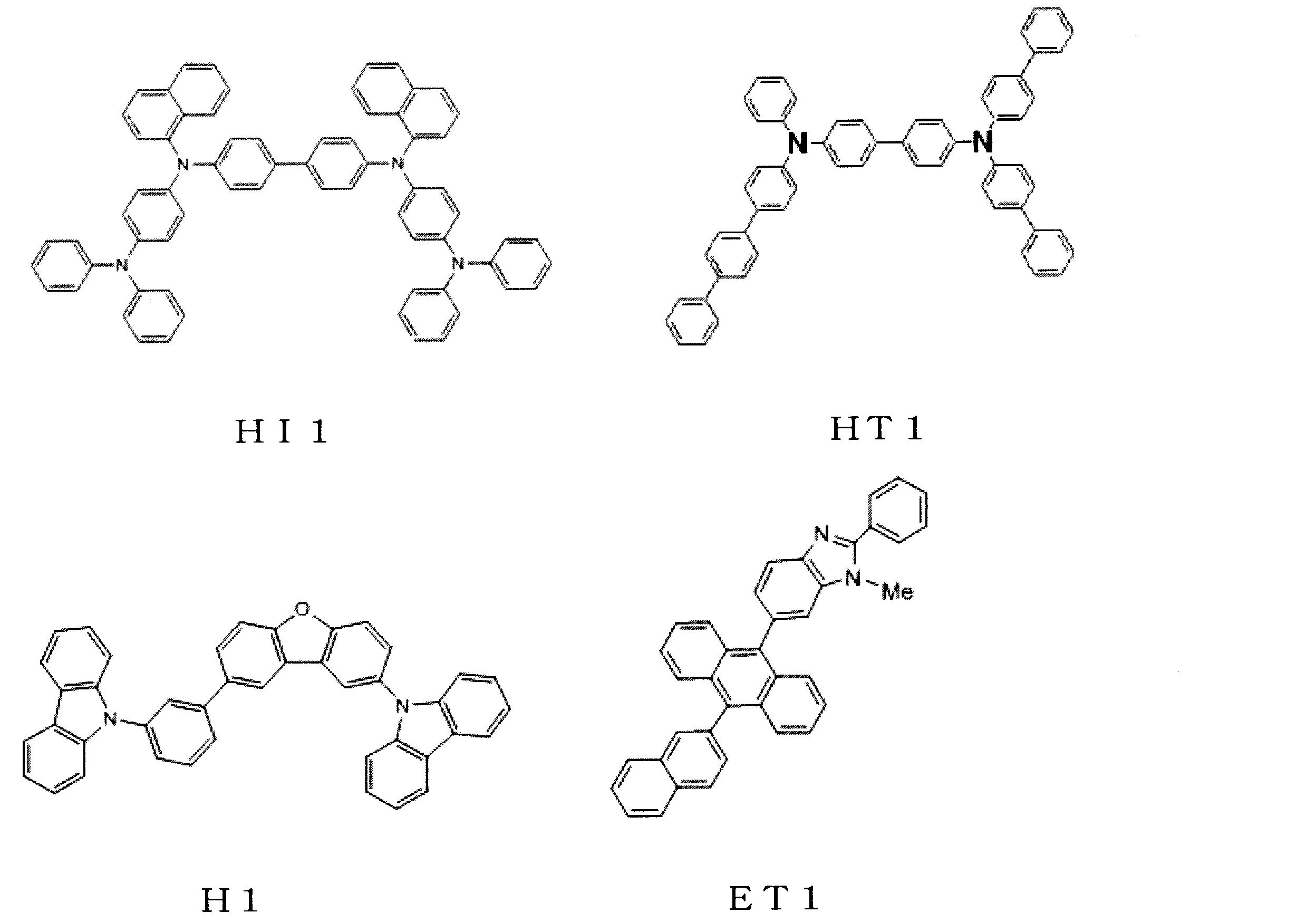
実施例6~8、比較例2
実施例1で製造した化合物3の代わりに、実施例2~4、比較例1で製造した化合物3を使用した他は、実施例5と同様にして有機EL素子を製造した。
上記各例で製造した有機EL素子について、1000cd/m2駆動時における駆動電圧、外部量子効率及び半減寿命の測定結果を表7に示す。尚、表7には、不純物の代表的なピーク番号及び面積比を記載した。
また、初期輝度を1としたときの、発光時間と輝度の関係を図1に示す。
実施例1で製造した化合物3の代わりに、実施例2~4、比較例1で製造した化合物3を使用した他は、実施例5と同様にして有機EL素子を製造した。
上記各例で製造した有機EL素子について、1000cd/m2駆動時における駆動電圧、外部量子効率及び半減寿命の測定結果を表7に示す。尚、表7には、不純物の代表的なピーク番号及び面積比を記載した。
また、初期輝度を1としたときの、発光時間と輝度の関係を図1に示す。
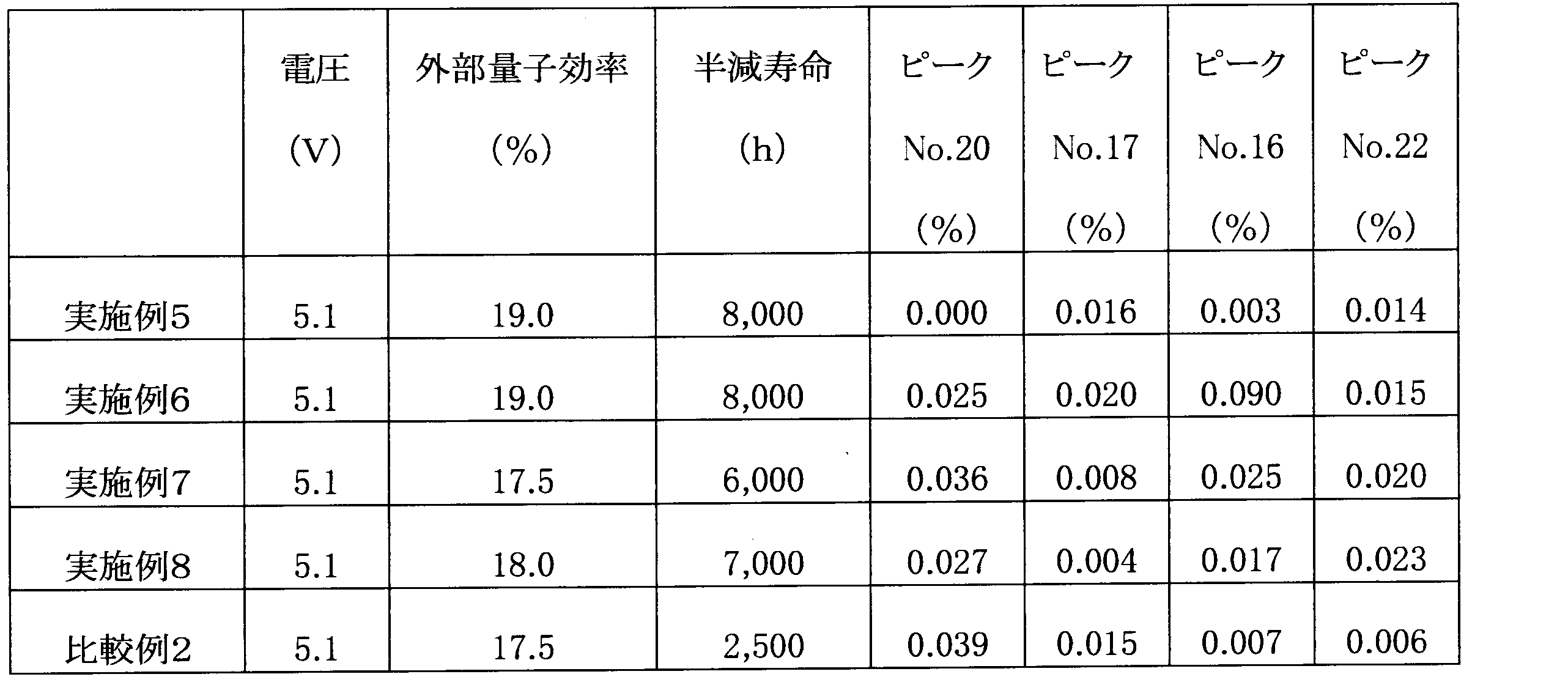
上記の結果から、素子の寿命は、実施例5、実施例6、実施例8、実施例7、比較例2の順に低下しているが、これは、ピークNo.20の不純物の含有量に相関していることが確認できる。外部量子効率についても同様の関係があるといえる。
ピークNo.20の不純物は、式(2a)で示す構造を有する不純物である。具体的には、分子量が[化合物3の分子量-C(炭素)+O(酸素)]となる。ピークNo.20の面積比が小さい方が半減寿命は長くなる傾向がある。一方、他の不純物ピーク、例えば、No.17、No.16、No.22の面積比と半減寿命には相関がない。即ち、半減寿命に最も影響を与える不純物は式(2a)に示す構造を有する不純物であり、この不純物含量を減らすことが、工業的に有用な有機EL素子を製造するために重要である。
ピークNo.20の不純物は、式(2a)で示す構造を有する不純物である。具体的には、分子量が[化合物3の分子量-C(炭素)+O(酸素)]となる。ピークNo.20の面積比が小さい方が半減寿命は長くなる傾向がある。一方、他の不純物ピーク、例えば、No.17、No.16、No.22の面積比と半減寿命には相関がない。即ち、半減寿命に最も影響を与える不純物は式(2a)に示す構造を有する不純物であり、この不純物含量を減らすことが、工業的に有用な有機EL素子を製造するために重要である。
[ピークNo.20の不純物の同定]
以下の反応は、不活性ガスを用いず、空気中にて行なった。
1リットル透明フラスコにて、実施例1(昇華前)で得た化合物3(3.0g)を塩化メチレン754mlに溶かし、これに市販のシリカゲル(富士シリシア化学製 PSQ100B(球状))300gを加え、白色蛍光灯の下に30日間、室温にて密封下放置した。この反応液からシリカゲルをろ別し、塩化メチレン可溶成分から塩化メチレンを減圧留去し、固体成分を得た。得られた固体成分のLC-MS分析を行なった結果、化合物3(facial体)が34.87%、化合物3(meridional体)が0.29%、目的物後にピークとして観測された+4成分[化合物3-C(炭素)+O(酸素)]は、30.95%であった。
次に、LCにおいてこの目的物の後にピークとして観測されたピークNo.20の不純物を、LC装置を用いて分取を行ない、単一成分を得た。
この単一成分を、1H-NMR、13C-NMRとそのDEPT(Distorsionless Enhancement by Polarization Transfer)、1H-1Hシフト相関二次元NMR[1H-1H CORRELATION SPECTROSCOPY (COSY)],13C-1Hシフト相関二次元NMR(C-H COSY),1H-13Cシフト相関二次元NMR[1H DETECTED HETERONUCLEAR MULTIPLE QUANTUM COHERENCE(HMQC)]法及び1H-13Cロングレンジシフト相関二次元NMR[1H-13C DETECTED HETERONUCLEAR MULTIPLE BOND CONNECTIVITY(HMBC)]法により構造を決定した。
NMR測定条件は以下のとおりである。
装置:ブルカー・バイオスピン製 DRX500(H:500MHz)
プローブ:5mm CPTCI 1H-13C/15N/D
溶媒:CD2Cl2
測定温度:25℃
ピーク位置はCD2Cl2由来のピークをReferenceとした(5.32ppm)。
ピークNo.20の不純物の構造を以下に示す。また、1H-NMR及び13C-NMRのケミカルシフト値を表8~10に示す。
以下の反応は、不活性ガスを用いず、空気中にて行なった。
1リットル透明フラスコにて、実施例1(昇華前)で得た化合物3(3.0g)を塩化メチレン754mlに溶かし、これに市販のシリカゲル(富士シリシア化学製 PSQ100B(球状))300gを加え、白色蛍光灯の下に30日間、室温にて密封下放置した。この反応液からシリカゲルをろ別し、塩化メチレン可溶成分から塩化メチレンを減圧留去し、固体成分を得た。得られた固体成分のLC-MS分析を行なった結果、化合物3(facial体)が34.87%、化合物3(meridional体)が0.29%、目的物後にピークとして観測された+4成分[化合物3-C(炭素)+O(酸素)]は、30.95%であった。
次に、LCにおいてこの目的物の後にピークとして観測されたピークNo.20の不純物を、LC装置を用いて分取を行ない、単一成分を得た。
この単一成分を、1H-NMR、13C-NMRとそのDEPT(Distorsionless Enhancement by Polarization Transfer)、1H-1Hシフト相関二次元NMR[1H-1H CORRELATION SPECTROSCOPY (COSY)],13C-1Hシフト相関二次元NMR(C-H COSY),1H-13Cシフト相関二次元NMR[1H DETECTED HETERONUCLEAR MULTIPLE QUANTUM COHERENCE(HMQC)]法及び1H-13Cロングレンジシフト相関二次元NMR[1H-13C DETECTED HETERONUCLEAR MULTIPLE BOND CONNECTIVITY(HMBC)]法により構造を決定した。
NMR測定条件は以下のとおりである。
装置:ブルカー・バイオスピン製 DRX500(H:500MHz)
プローブ:5mm CPTCI 1H-13C/15N/D
溶媒:CD2Cl2
測定温度:25℃
ピーク位置はCD2Cl2由来のピークをReferenceとした(5.32ppm)。
ピークNo.20の不純物の構造を以下に示す。また、1H-NMR及び13C-NMRのケミカルシフト値を表8~10に示す。
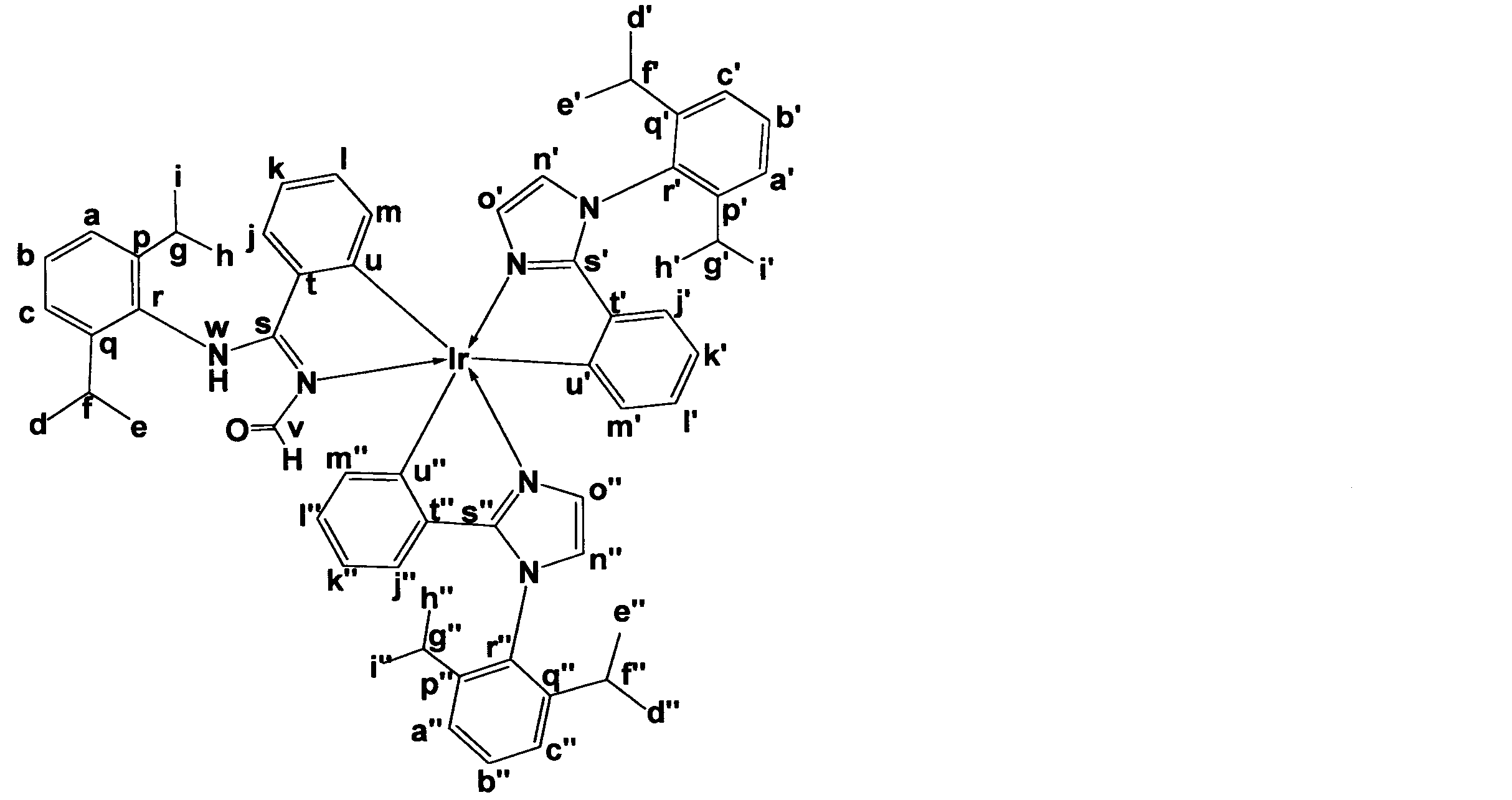
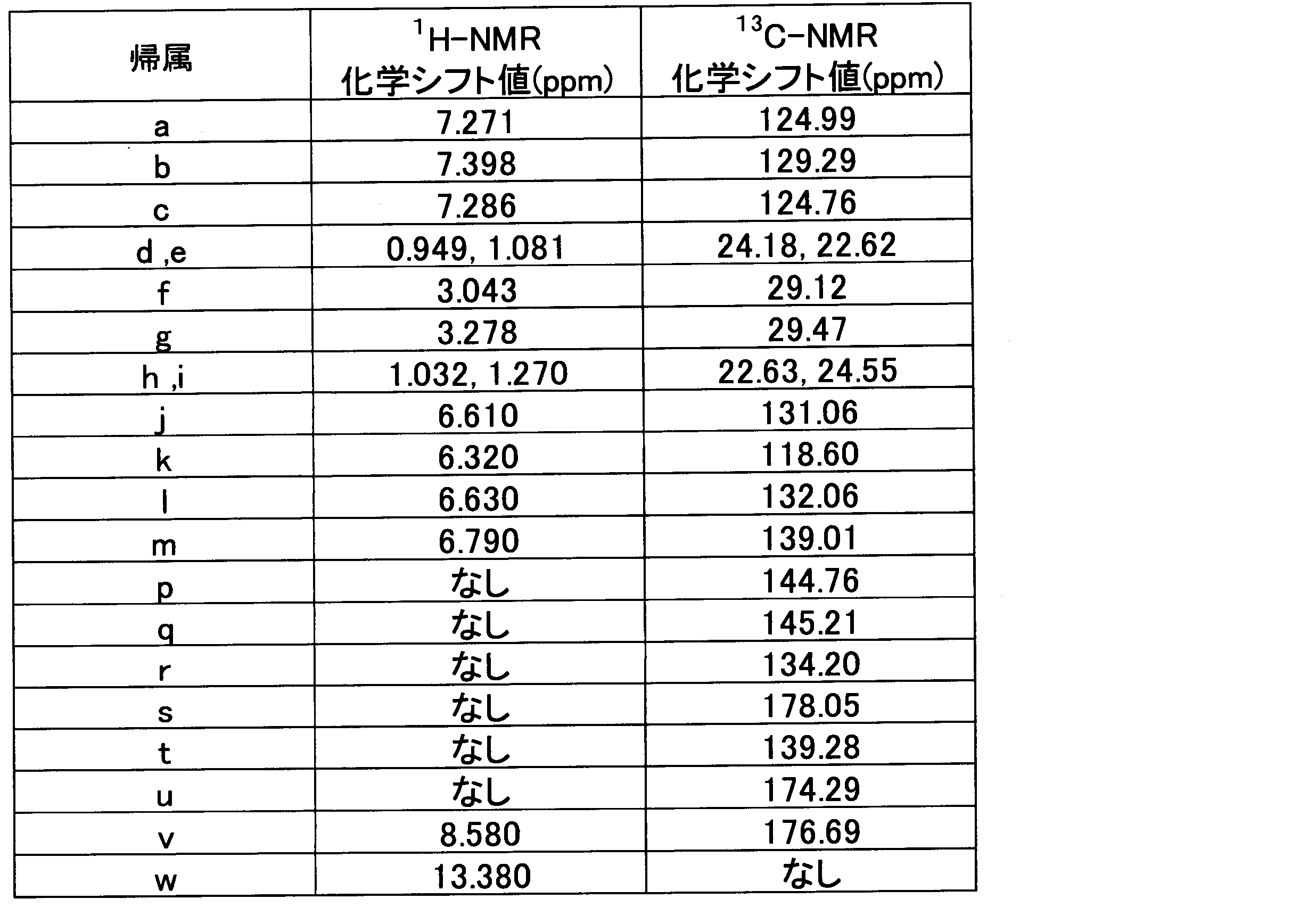
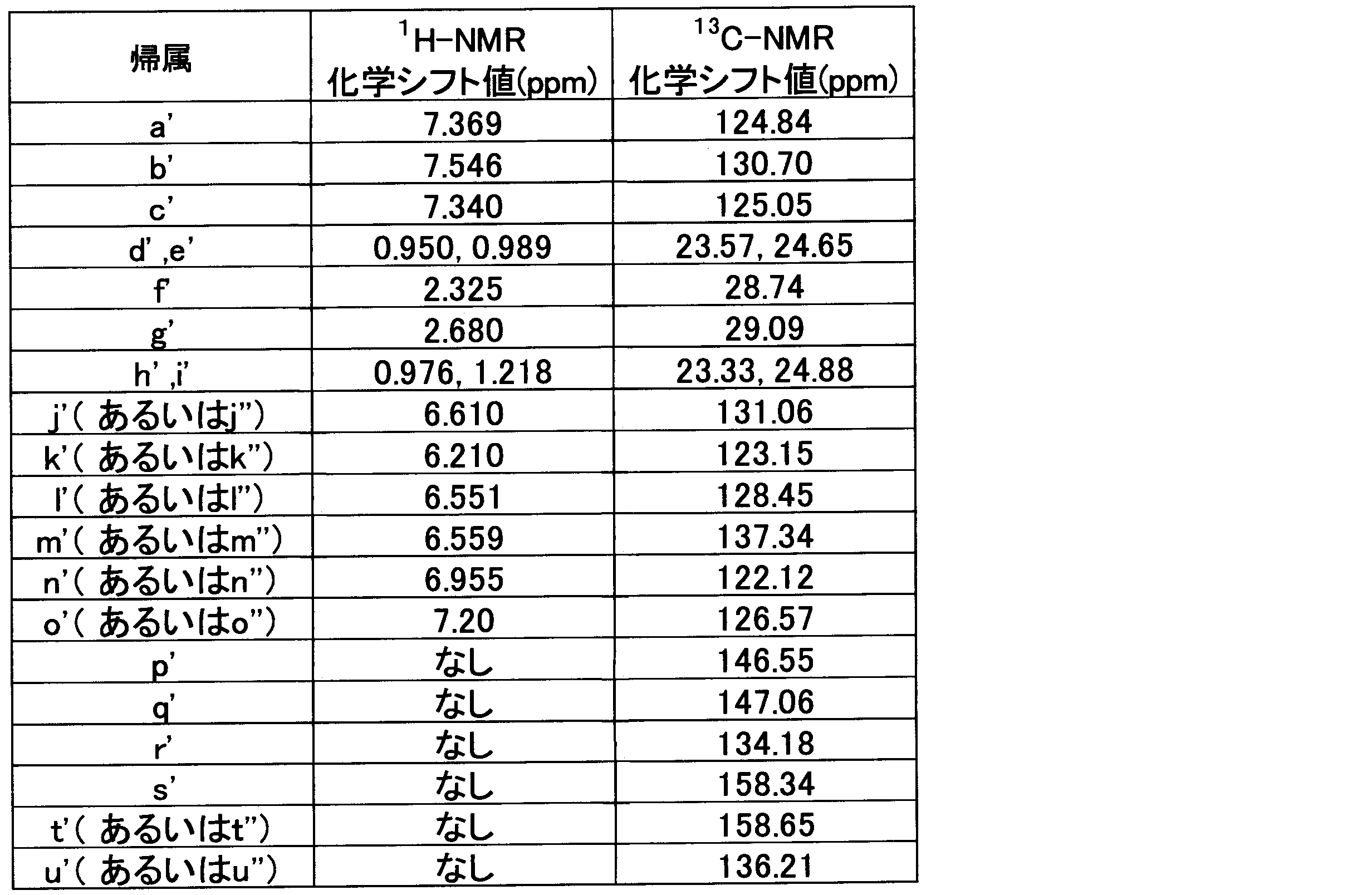
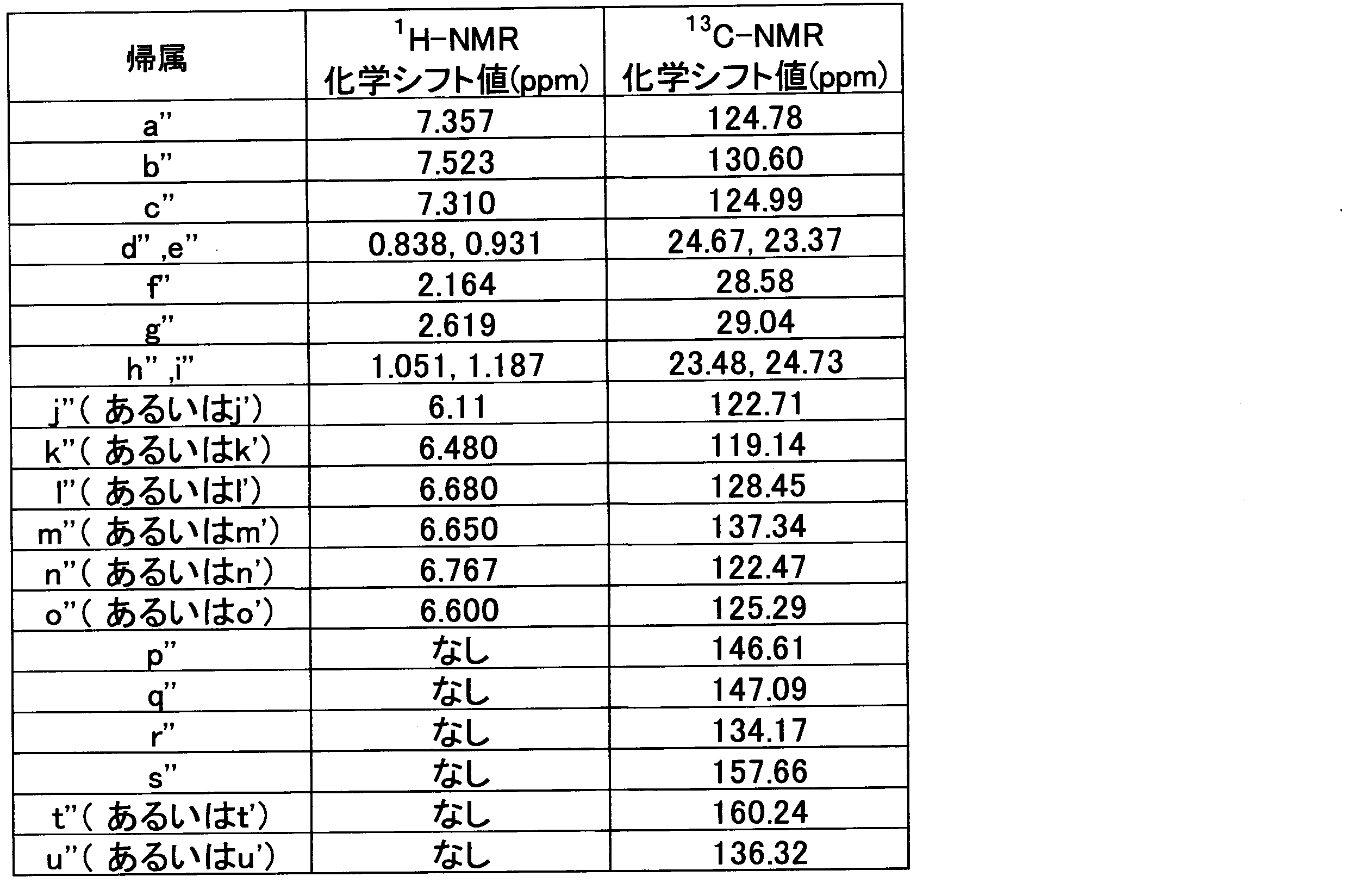
ピークNo.20の不純物の紫外可視吸収スペクトル及び低温(77K)発光スペクトルを図2に示す。
発光スペクトルから、この不純物は623nmに極大発光波長があることがわかった。化合物3は約470nmに極大発光波長を有する青色発光材料であるが、このように高波長側に発光波長を有する三重項エネルギーギャップが著しく小さい材料が不純物として混在することで、発光効率や発光寿命といった有機EL素子の性能を著しく低下させる原因となりうる。従って、高性能化にはこの不純物量をできるだけ少なくすることが重要となる。
尚、紫外可視吸収スペクトル及び低温(77K)発光スペクトルの測定条件は以下のとおりとした。
・紫外可視吸収スペクトル測定
装置:島津 UV3100PC
開始波長:220.0nm
終了波長:800.0nm
溶媒:ジクロロメタン
・低温蛍光スペクトル測定
装置:F-4500形分光蛍光光度計
測定モード:波長スキャン
スキャンモード:蛍光スペクトル
データモード: 蛍光
励起波長:450.0nm
蛍光開始波長:470.0nm
蛍光終了波長:890.0nm
スキャンスピード:240nm/min
初期待ち時間:0s
励起側スリット:5.0nm
蛍光側スリット:5.0nm
溶媒:EPA(温度:77K)
EPA=ジエチルエーテル/n-ペンタン/エタノール=5/5/2(vol比)
発光スペクトルから、この不純物は623nmに極大発光波長があることがわかった。化合物3は約470nmに極大発光波長を有する青色発光材料であるが、このように高波長側に発光波長を有する三重項エネルギーギャップが著しく小さい材料が不純物として混在することで、発光効率や発光寿命といった有機EL素子の性能を著しく低下させる原因となりうる。従って、高性能化にはこの不純物量をできるだけ少なくすることが重要となる。
尚、紫外可視吸収スペクトル及び低温(77K)発光スペクトルの測定条件は以下のとおりとした。
・紫外可視吸収スペクトル測定
装置:島津 UV3100PC
開始波長:220.0nm
終了波長:800.0nm
溶媒:ジクロロメタン
・低温蛍光スペクトル測定
装置:F-4500形分光蛍光光度計
測定モード:波長スキャン
スキャンモード:蛍光スペクトル
データモード: 蛍光
励起波長:450.0nm
蛍光開始波長:470.0nm
蛍光終了波長:890.0nm
スキャンスピード:240nm/min
初期待ち時間:0s
励起側スリット:5.0nm
蛍光側スリット:5.0nm
溶媒:EPA(温度:77K)
EPA=ジエチルエーテル/n-ペンタン/エタノール=5/5/2(vol比)
[化合物3の変性実験]
評価例1
透明ガラス瓶にて、実施例1で得た化合物3(昇華精製前:10mg)を塩化メチレンに溶かし、これにシリカゲル(富士シリシア化学製、PSQ100B(球状))3gを加え、白色蛍光灯の下に12日間、室温にて密封下放置した。
放置後、液の塩化メチレン可溶部と、塩化メチレン洗浄によりシリカゲルから溶出した分を合せ、室温にて溶媒を風乾し、回収した固体について、LC-MSの測定を行なった。
評価例1
透明ガラス瓶にて、実施例1で得た化合物3(昇華精製前:10mg)を塩化メチレンに溶かし、これにシリカゲル(富士シリシア化学製、PSQ100B(球状))3gを加え、白色蛍光灯の下に12日間、室温にて密封下放置した。
放置後、液の塩化メチレン可溶部と、塩化メチレン洗浄によりシリカゲルから溶出した分を合せ、室温にて溶媒を風乾し、回収した固体について、LC-MSの測定を行なった。
評価例2
シリカゲルを富士シリシア化学製 BW-820MHに変更した以外は、上記評価例1と同様に行なった。
シリカゲルを富士シリシア化学製 BW-820MHに変更した以外は、上記評価例1と同様に行なった。
評価例3
シリカゲルを用いなかったこと以外は、上記評価例1と同様に行なった。
シリカゲルを用いなかったこと以外は、上記評価例1と同様に行なった。
評価例4
透明ガラス瓶に代わり、褐色ガラス瓶を用いた以外は、上記評価例3と同様に行なった。
評価例1~4のLC-MSの結果を表11に示す。尚、参考のため、実施例1で合成し、昇華精製をしていない化合物3の結果も示す。また、代表的なピークの結果のみを示す。
透明ガラス瓶に代わり、褐色ガラス瓶を用いた以外は、上記評価例3と同様に行なった。
評価例1~4のLC-MSの結果を表11に示す。尚、参考のため、実施例1で合成し、昇華精製をしていない化合物3の結果も示す。また、代表的なピークの結果のみを示す。
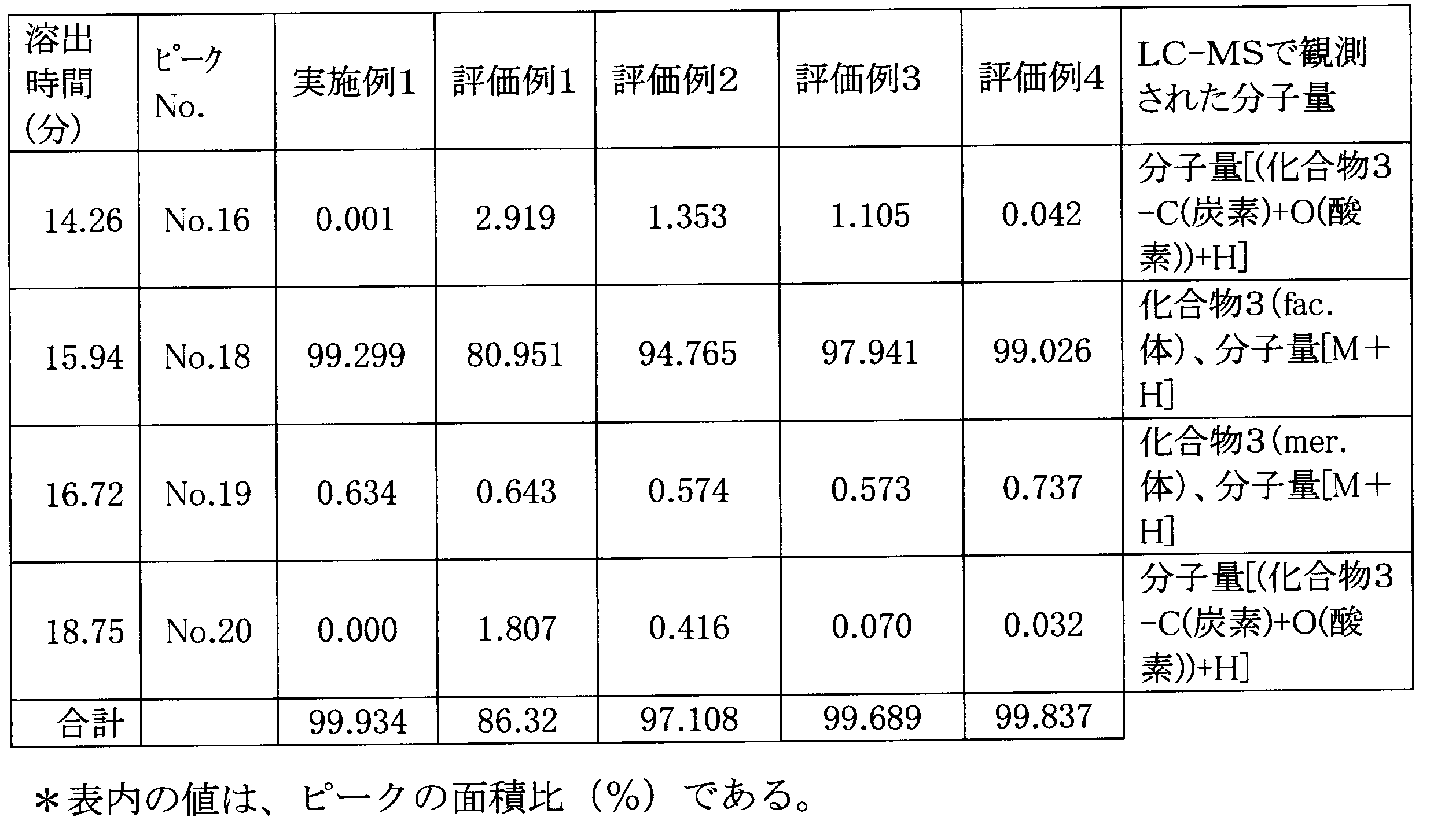
上記結果から、溶媒、光及びシリカゲルの作用により、化合物3(ピークNo.18,19)が変性し、不純物に変化したことが確認できる。
また、評価例4のように、褐色ガラス瓶にて紫外光をカットした場合、不純物への変性反応が抑制されることが分かる。
また、シリカゲルが不純物への変性反応を促進することが確認できる。
また、評価例4のように、褐色ガラス瓶にて紫外光をカットした場合、不純物への変性反応が抑制されることが分かる。
また、シリカゲルが不純物への変性反応を促進することが確認できる。
上記に本発明の実施形態及び/又は実施例を幾つか詳細に説明したが、当業者は、本発明の新規な教示及び効果から実質的に離れることなく、これら例示である実施形態及び/又は実施例に多くの変更を加えることが容易である。従って、これらの多くの変更は本発明の範囲に含まれる。
本願のパリ優先の基礎となる日本出願明細書の内容を全てここに援用する。
本願のパリ優先の基礎となる日本出願明細書の内容を全てここに援用する。
Claims (33)
- 下記式(1)で示される部分構造を含む金属錯体と、不純物を含み、
前記金属錯体の含有量が99.7%以上であり、
前記不純物は、精製時又は保存時に前記金属錯体が変性することによって生成され、
前記不純物の含有量が0.036%以下である金属錯体組成物。

RI及びRIIは、それぞれ独立に、置換もしくは無置換の炭素数1~20のアルキル基、置換もしくは無置換の環形成炭素数3~10のシクロアルキル基、置換もしくは無置換の環形成炭素数3~10のシクロアルケニル基、置換もしくは無置換の環形成炭素数6~50のアリール基、置換もしくは無置換の環形成原子数5~30のヘテロアリール基、置換もしくは無置換のアリールアミノ基、置換もしくは無置換のアラルキル基、置換もしくは無置換のアリールボリル基、又は、置換もしくは無置換のアリールシリル基である。
RIII及びRIVは、それぞれ独立に、水素原子、置換もしくは無置換の炭素数1~20のアルキル基、置換もしくは無置換の環形成炭素数3~10のシクロアルキル基、置換もしくは無置換の環形成炭素数3~10のシクロアルケニル基、置換もしくは無置換の環形成炭素数6~50のアリール基、置換もしくは無置換の環形成原子数5~30のヘテロアリール基、置換もしくは無置換のアリールアミノ基、置換もしくは無置換のアラルキル基、置換もしくは無置換のアリールボリル基、又は、置換もしくは無置換のアリールシリル基である。
RI及びRIIは直接、又は連結基を介して結合していてもよい。
Mは、周期律表第3族から第12族の典型金属又は遷移金属を示す。RI又はRIIのどちらか一方は、Mと共有結合している。
実線は共有結合を示し、矢印は前記Mと括弧内の配位子との配位結合を示す。) - 前記式(1)で示される部分構造を含む金属錯体が、式(1b)で示される部分構造を含む金属錯体である、請求項1に記載の金属錯体組成物。

- 前記式(1)で示される部分構造を含む金属錯体又は(1b)で示される部分構造を含む金属錯体が、下記式(1-1)で示される金属錯体である、請求項1又は2に記載の金属錯体組成物。
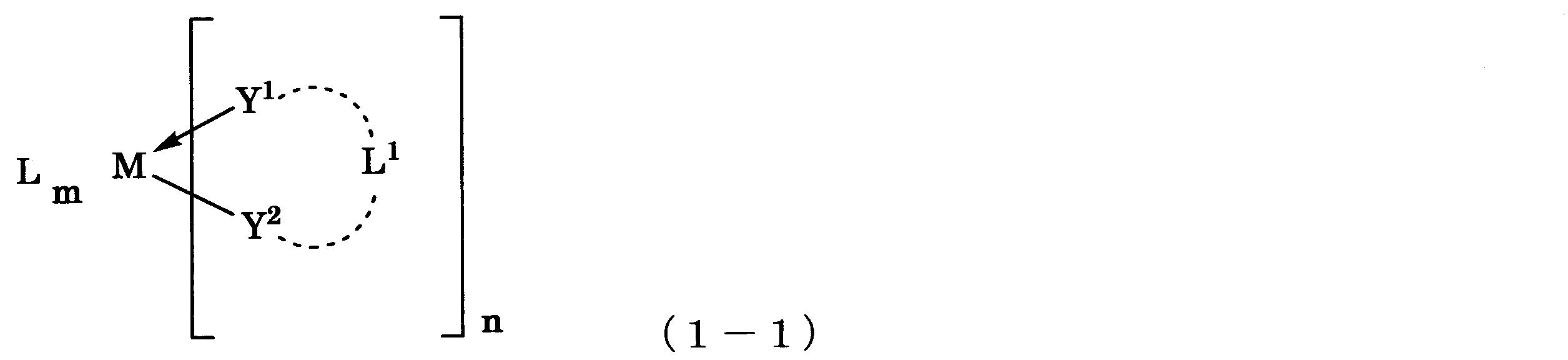
Y1及びY2はそれぞれ独立に、炭素原子、窒素原子又は酸素原子を示し、L1はY1及びY2の連結基で、Y1及びY2とともに2座の配位子(Y1-L1-Y2)を形成する原子群を示す。
Lは下記式(L)で示される配位子である。
mは、1~3の整数であり、nは、0~3の整数である。m+nは1~6である。mが2以上の場合は、2つ以上ある配位子Lは互いに同じでも異なる構造でもよい。また、2つ以上の配位子Lは、直接又は連結基を介して架橋構造を形成してもよい。)
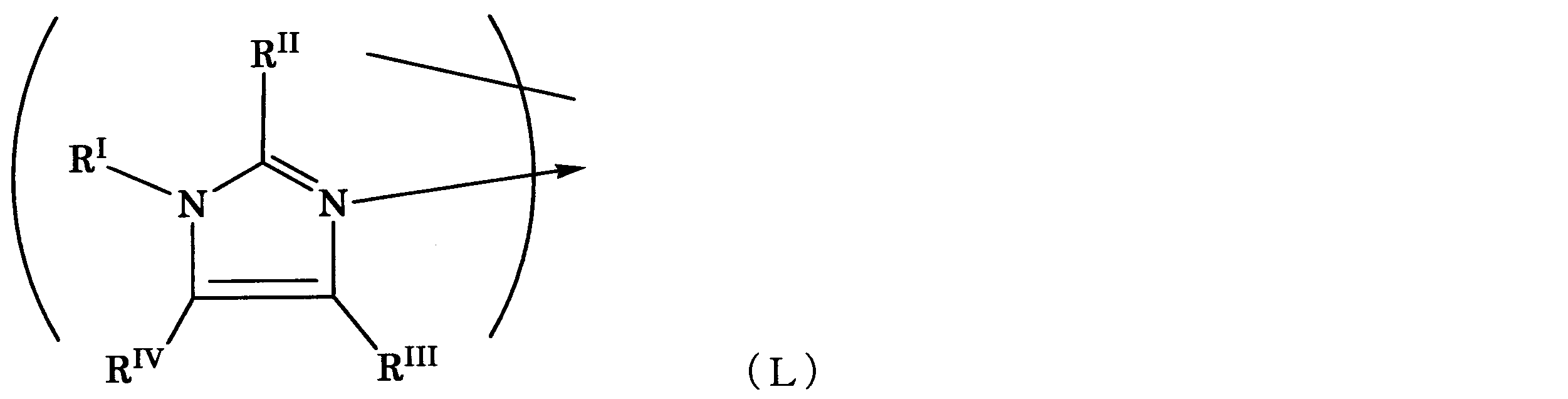
- 前記式(1-1)のLが、下記式(L-1)で示される配位子である、請求項3に記載の金属錯体組成物。

Ar1は、置換基を有する芳香環基又は置換基を有するヘテロ芳香環を示す。
Ar2は金属Mに結合する、置換もしくは無置換の芳香環又は置換もしくは無置換のヘテロ芳香環を示す。) - 前記式(L-1)で示される配位子が、下記式(L-2)で示される配位子である、請求項4に記載の金属錯体組成物。

R1及びR5は、それぞれ、Ar1が結合する窒素原子のβ位に位置し、2級炭素がAr1に結合した置換基を示す。) - 前記式(L-2)で示される配位子が、下記式(L-3)で示される配位子である、請求項5に記載の金属錯体組成物。
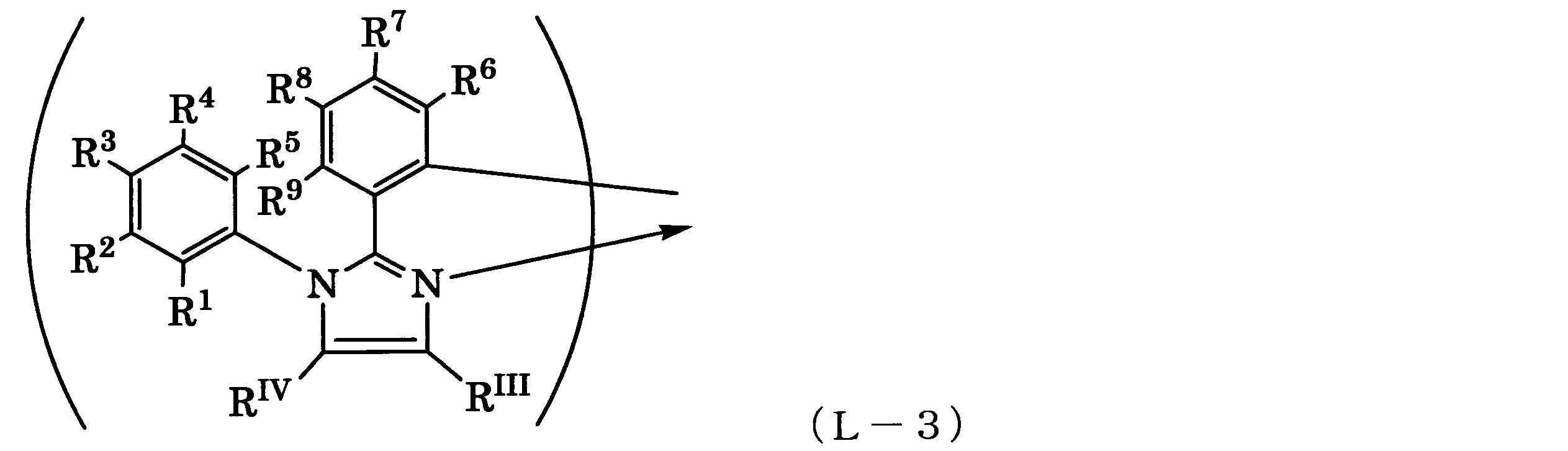
R2~R4、R6~R9はそれぞれ、水素原子又は置換基を示す。R2~R4、R6~R9のうち隣接する基は、互いに結合し環を形成してもよい。) - 前記m+nが2又は3であり、前記Mが二価の白金(Pt)、二価のパラジウム(Pd)、三価のイリジウム(Ir)又は三価のロジウム(Rh)である、請求項3~6のいずれかに記載の金属錯体組成物。
- 前記Mが三価のイリジウム(Ir)である、請求項1~7のいずれかに記載の金属錯体組成物。
- 下記式(1a)で示される部分構造を含む金属錯体と、下記式(2a)で示される部分構造を含む金属錯体である不純物を含み、
前記金属錯体の含有量が99.7%以上であり
前記不純物の含有量が0.036%以下である金属錯体組成物。

RIII及びRIVは、それぞれ独立に、水素原子、置換もしくは無置換の炭素数1~20のアルキル基、置換もしくは無置換の環形成炭素数3~10のシクロアルキル基、置換もしくは無置換の環形成炭素数3~10のシクロアルケニル基、置換もしくは無置換の環形成炭素数6~50のアリール基、置換もしくは無置換の環形成原子数5~30のヘテロアリール基、置換もしくは無置換のアリールアミノ基、置換もしくは無置換のアラルキル基、置換もしくは無置換のアリールボリル基、又は、置換もしくは無置換のアリールシリル基である。
RI及びRIIは直接、又は連結基を介して結合していてもよい。
Mは、周期律表第3族から第12族の典型金属又は遷移金属を示す。RI及びRIIはMと結合していてもよい。
実線は共有結合を示し、矢印は前記Mと括弧内の配位子との配位結合を示す。)

- 前記式(1a)で示される部分構造を含む金属錯体が下記式(1b)で示される部分構造を含む金属錯体であり、
前記式(2a)で示される部分構造を含む金属錯体が、下記式(2b)で示される部分構造を含む金属錯体である、請求項9に記載の金属錯体組成物。
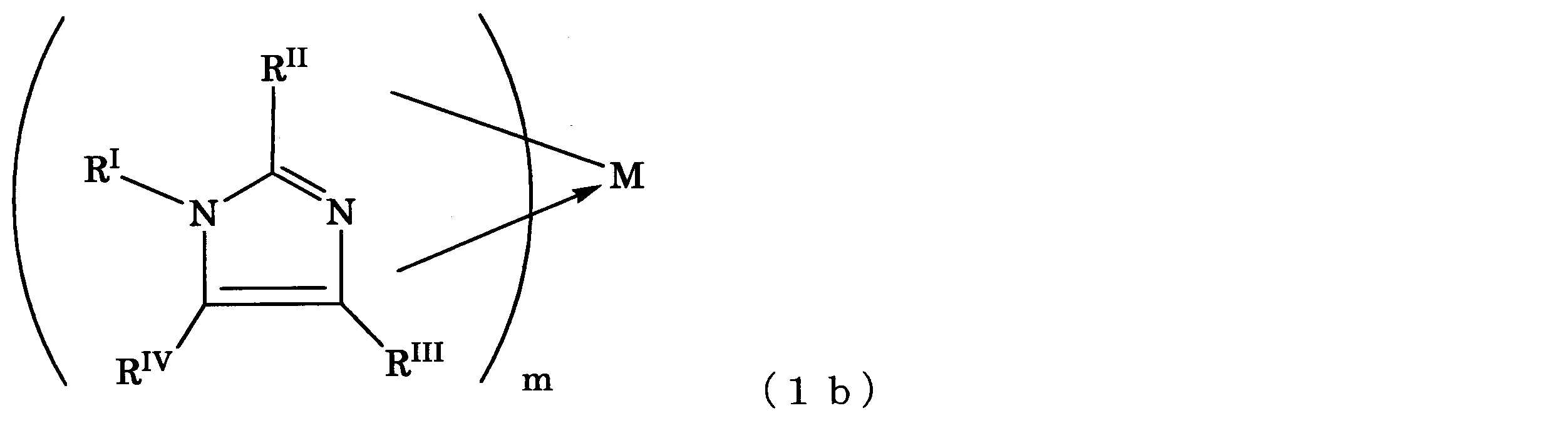
mは1~3の整数である。)

- 前記式(1b)で示される部分構造を含む金属錯体が、下記式(1-1)で示される金属錯体であり、
前記式(2b)で示される部分構造を含む金属錯体が、下記式(2-1)で示される金属錯体である、請求項10に記載の金属錯体組成物。

Y1及びY2はそれぞれ独立に、炭素原子、窒素原子又は酸素原子を示し、L1はY1及びY2の連結基で、Y1及びY2とともに2座の配位子(Y1-L1-Y2)を形成する原子群を示す。
Lは下記式(L)で示される配位子である。
mは、1~3の整数であり、nは、0~3の整数である。m+nは1~6である。mが2以上の場合は、2つ以上ある配位子Lは互いに同じでも異なる構造でもよい。また、2つ以上の配位子Lは、直接又は連結基を介して架橋構造を形成してもよい。)


- 前記式(L)が、下記式(L-1)で示される配位子であり、前記式(L’)が、下記式(L’-1)で示される配位子である、請求項11に記載の金属錯体組成物。
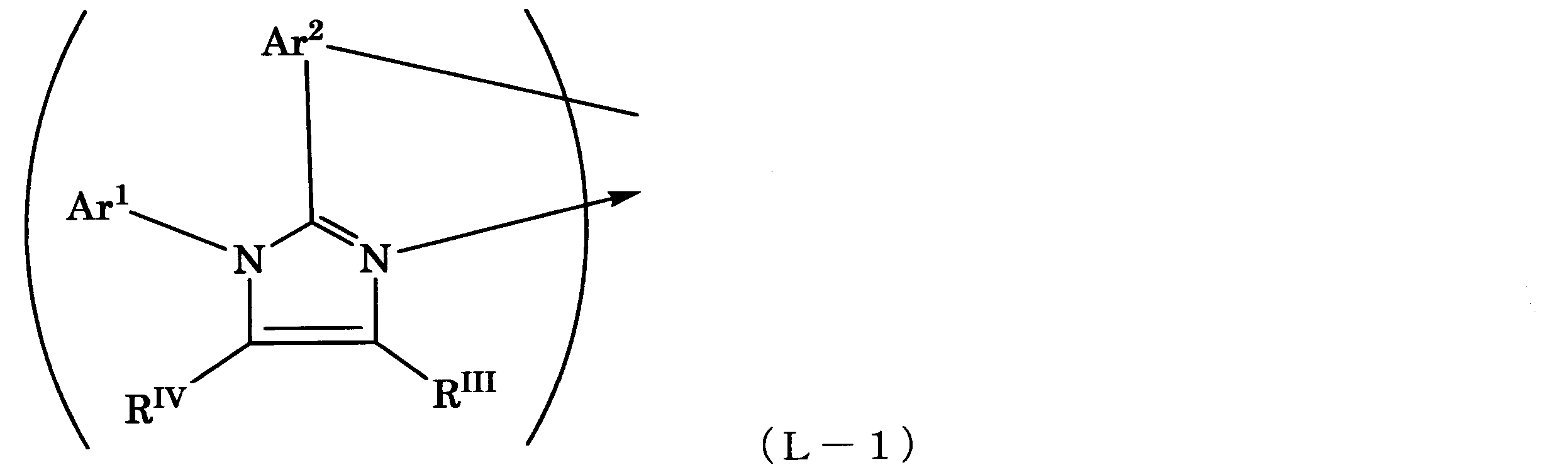
Ar1は、置換基を有する芳香環基又は置換基を有するヘテロ芳香環を示す。
Ar2は金属Mに結合する、置換もしくは無置換の芳香環又は置換もしくは無置換のヘテロ芳香環を示す。)
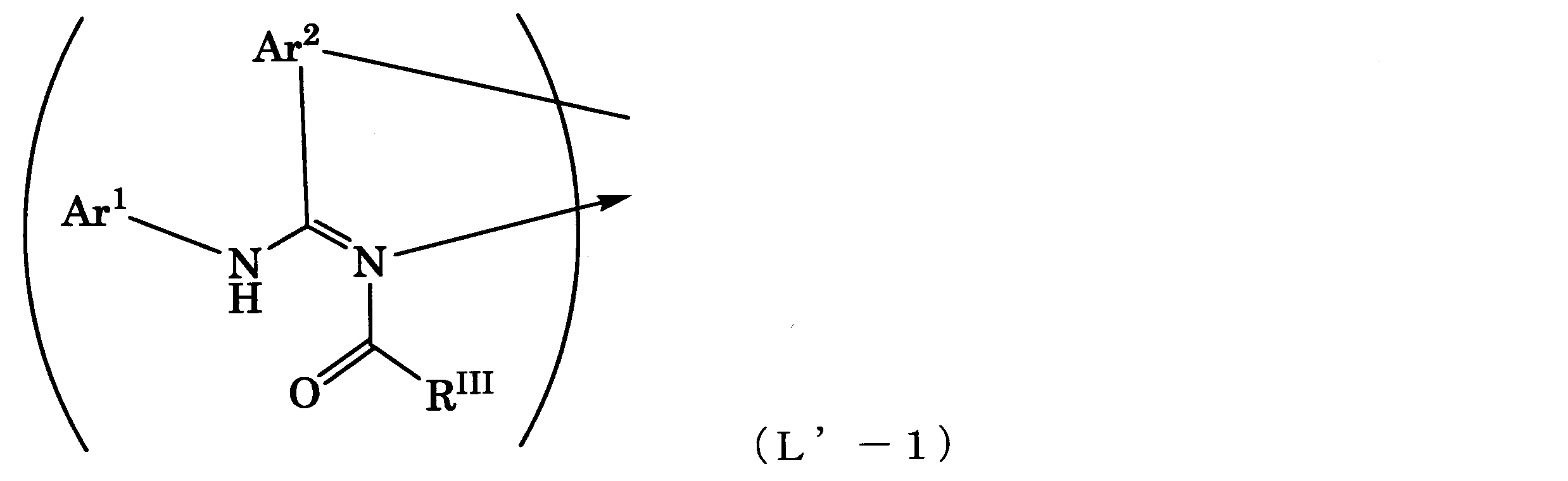
- 前記式(L-1)が、下記式(L-2)で示される配位子であり、前記式(L’-1)が、下記式(L’-2)で示される配位子である、請求項12に記載の金属錯体組成物。
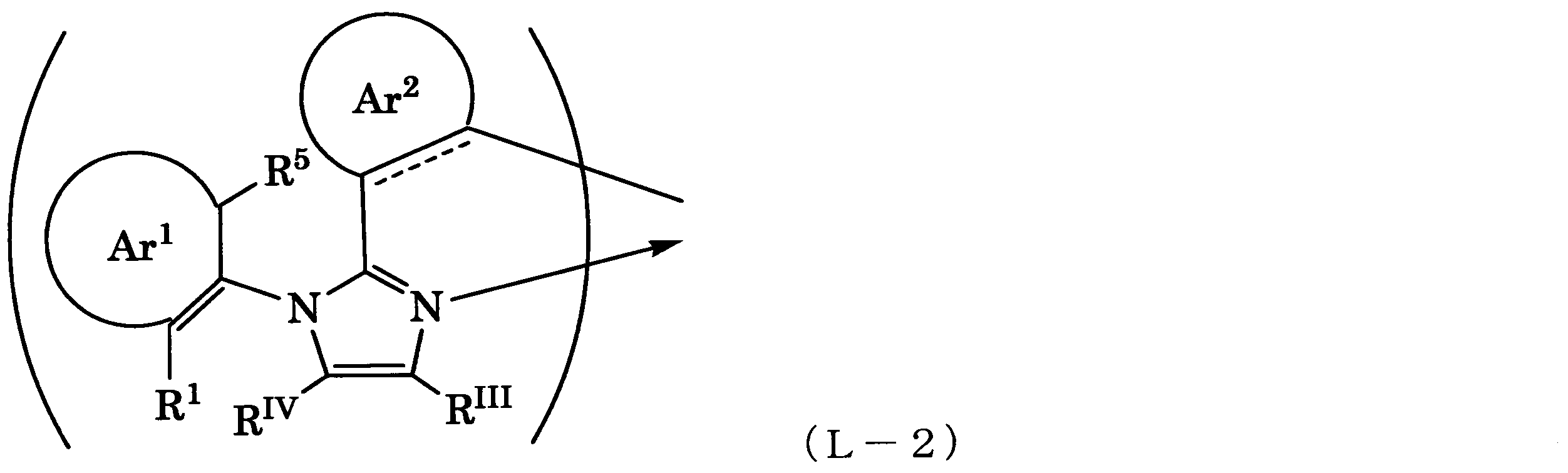
R1及びR5は、それぞれ、Ar1が結合する窒素原子のβ位に位置し、2級炭素がAr1に結合した置換基を示す。)

- 前記式(L-2)が、下記式(L-3)で示される配位子であり、前記式(L’-2)が、下記式(L’-3)で示される配位子である、請求項13に記載の金属錯体組成物。
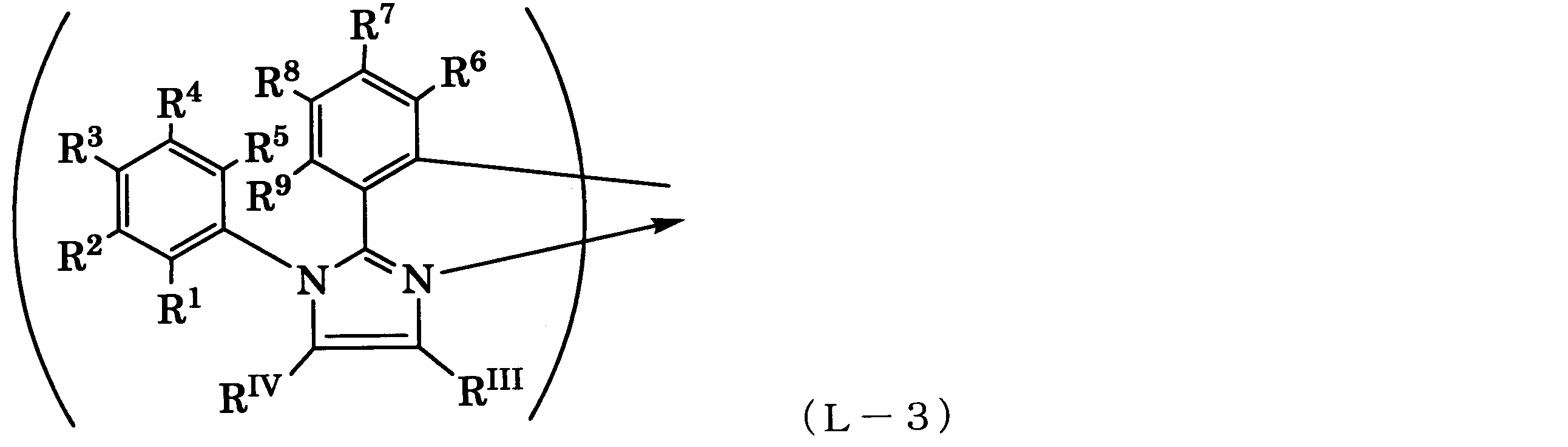
R2~R4、R6~R9はそれぞれ、水素原子又は置換基を示す。R2~R4、R6~R9のうち隣接する基は、互いに結合し環を形成してもよい。)

- 前記m+nが2又は3であり、前記Mが二価の白金(Pt)、二価のパラジウム(Pd)、三価のイリジウム(Ir)又は三価のロジウム(Rh)である、請求項10~14のいずれかに記載の金属錯体組成物。
- 前記Mが三価のイリジウム(Ir)である、請求項15に記載の金属錯体組成物。
- 前記金属錯体が、下記式(1’)で示される金属錯体であり、
前記不純物が下記式(2’)で示される化合物である、請求項16に記載の金属錯体組成物。
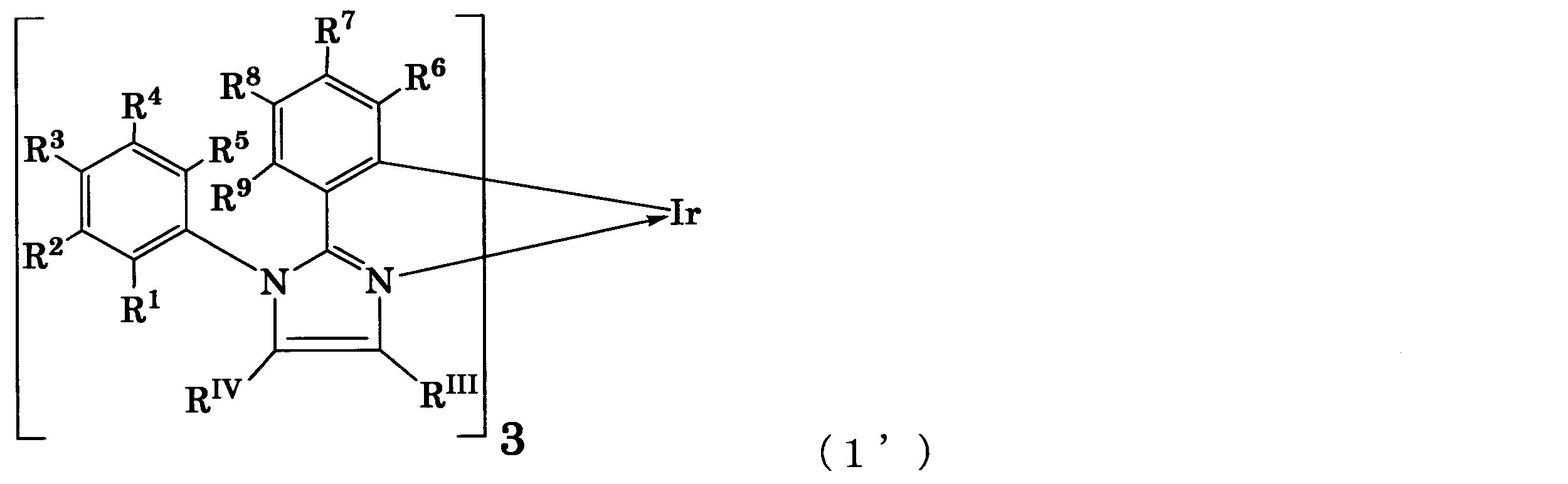
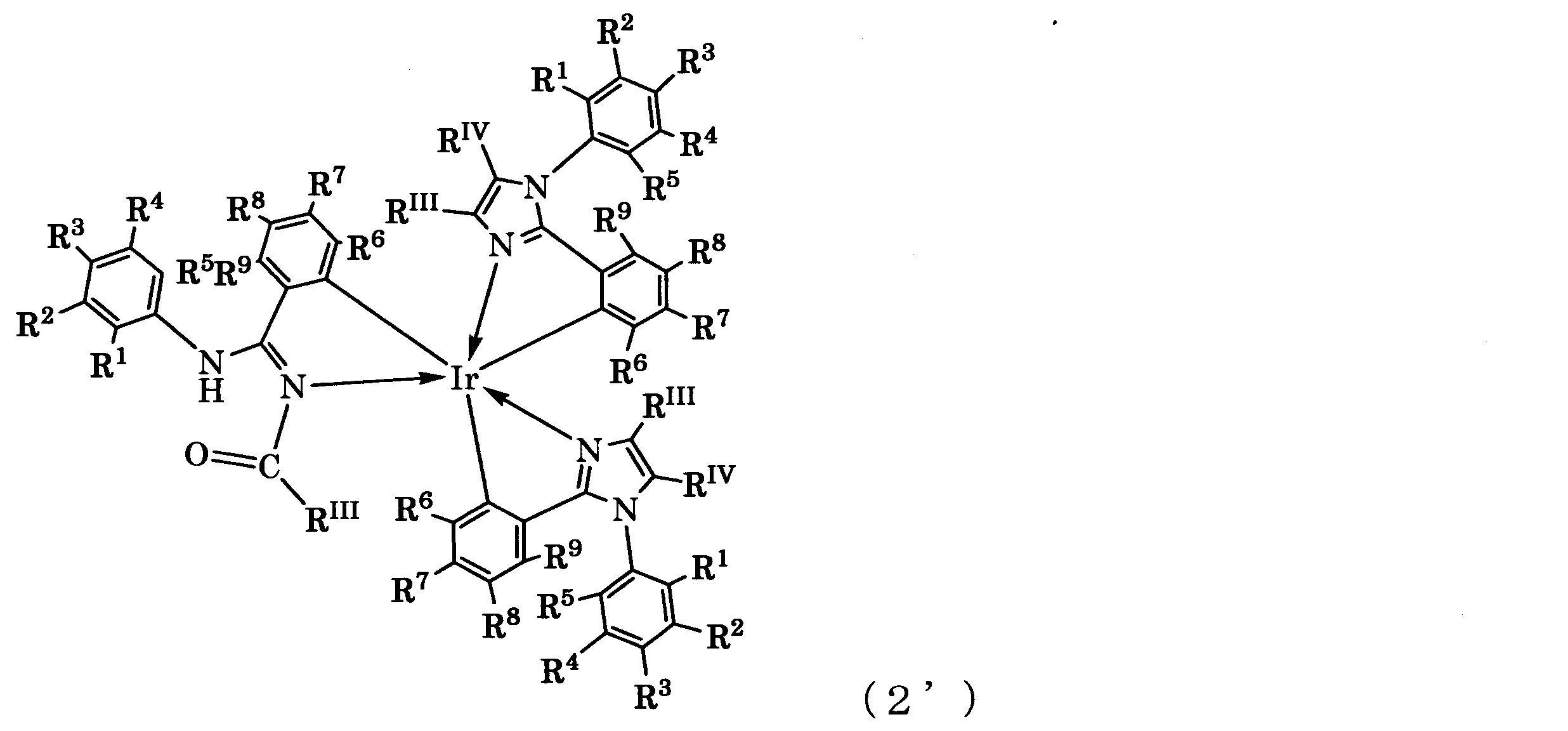
- 下記式(1a)で示される部分構造を含む金属錯体を合成する工程と、
前記金属錯体を精製する工程と、を含み、
前記精製工程は、照度100ルクス以下の環境下で実施し、かつ、再結晶、シリカゲルカラムクロマトグラフィー、昇華、及び液体クロマトグラフィー(LC)装置を用いた分取操作から選択される少なくとも一つの精製法にて、前記金属錯体が変性することによって生成した不純物の含有量が前記金属錯体に対して0.036%以下とする、金属錯体の製造方法。

RIII及びRIVは、それぞれ独立に、水素原子、置換もしくは無置換の炭素数1~20のアルキル基、置換もしくは無置換の環形成炭素数3~10のシクロアルキル基、置換もしくは無置換の環形成炭素数3~10のシクロアルケニル基、置換もしくは無置換の環形成炭素数6~50のアリール基、置換もしくは無置換の環形成原子数5~30のヘテロアリール基、置換もしくは無置換のアリールアミノ基、置換もしくは無置換のアラルキル基、置換もしくは無置換のアリールボリル基、又は、置換もしくは無置換のアリールシリル基である。
RI及びRIIは直接、又は連結基を介して結合していてもよい。
Mは、周期律表第3族から第12族の典型金属又は遷移金属を示す。RI及びRIIはMと結合していてもよい。
実線は共有結合を示し、矢印は前記Mと括弧内の配位子との配位結合を示す。) - 前記式(1a)で示される部分構造を含む金属錯体が、下記式(1b)で示される部分構造を含む金属錯体である、請求項18に記載の金属錯体の製造方法。

mは1~3の整数である。) - 前記金属錯体を合成する工程の最終段階の反応時以降のすべての工程を、照度100ルクス以下の環境下で、かつ、波長480nm以下の光のない環境下で実施する、請求項18又は19に記載の金属錯体の製造方法。
- 前記金属錯体を合成する工程の最終段階の反応時以降のすべての工程を、照度100ルクス以下の環境下で、かつ、波長560nm以下の光のない環境下で実施する、請求項18又は19に記載の金属錯体の製造方法。
- 前記照度を10ルクス以下とする、請求項18~21のいずれかに記載の金属錯体の製造方法。
- 下記式(1a)で示される部分構造を含む金属錯体を合成する工程と、
前記金属錯体を精製する工程と、を含み
下記式(2a)で示される部分構造を含む不純物の含有量を、前記金属錯体に対して0.036%以下とする、金属錯体の製造方法。
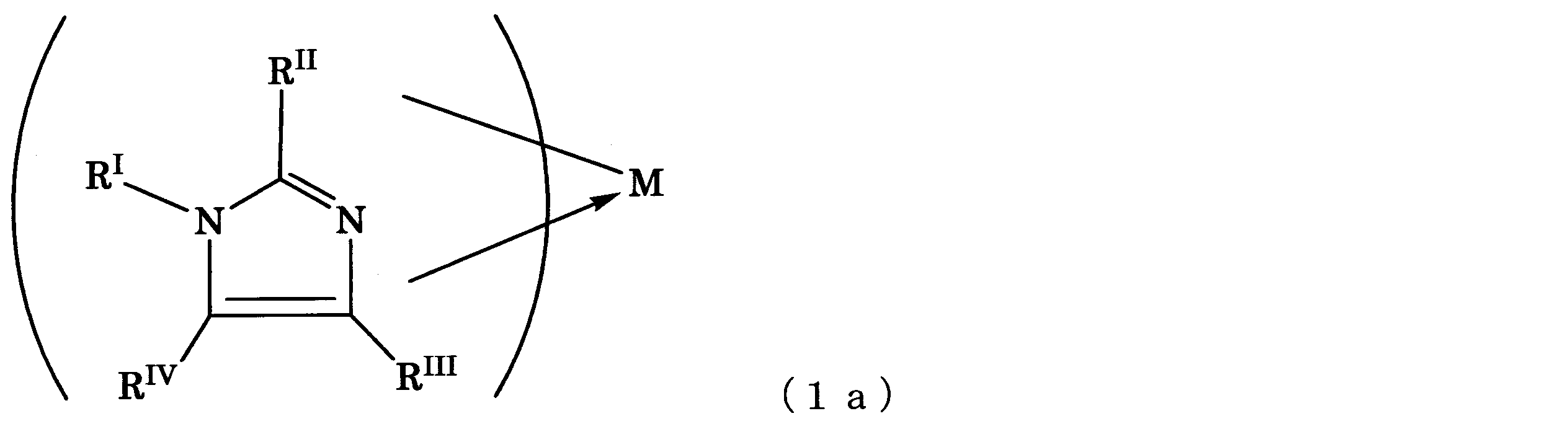
RIII及びRIVは、それぞれ独立に、水素原子、置換もしくは無置換の炭素数1~20のアルキル基、置換もしくは無置換の環形成炭素数3~10のシクロアルキル基、置換もしくは無置換の環形成炭素数3~10のシクロアルケニル基、置換もしくは無置換の環形成炭素数6~50のアリール基、置換もしくは無置換の環形成原子数5~30のヘテロアリール基、置換もしくは無置換のアリールアミノ基、置換もしくは無置換のアラルキル基、置換もしくは無置換のアリールボリル基、又は、置換もしくは無置換のアリールシリル基である。
RI及びRIIは直接、又は連結基を介して結合していてもよい。
Mは、周期律表第3族から第12族の典型金属又は遷移金属を示す。RI及びRIIはMと結合していてもよい。
実線は共有結合を示し、矢印は前記Mと括弧内の配位子との配位結合を示す。)
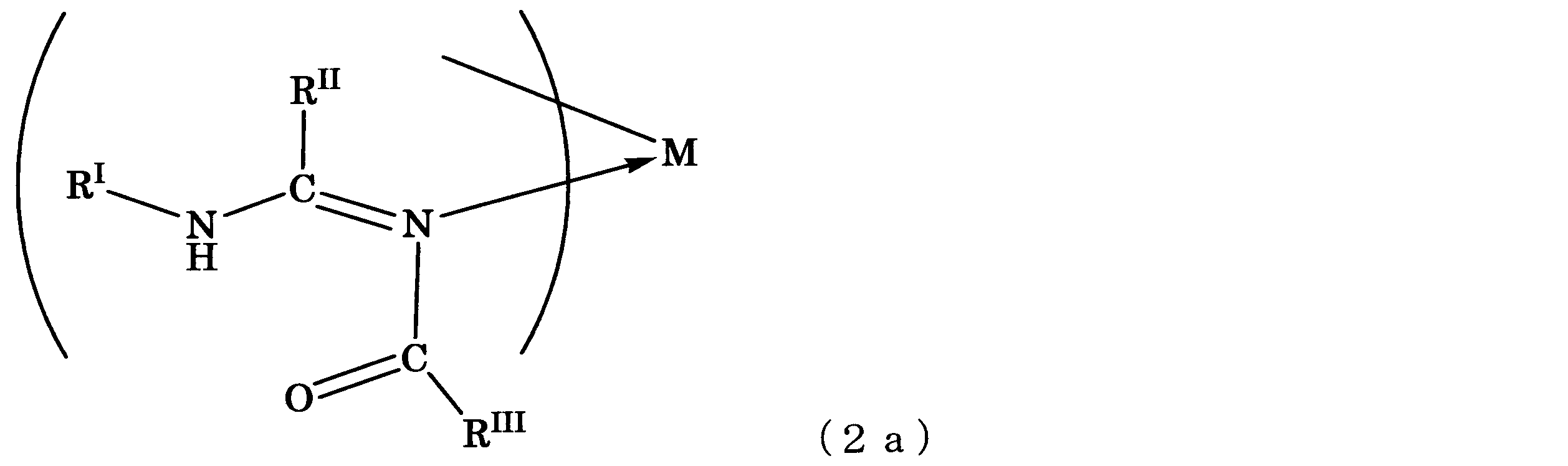
- 前記式(1a)で示される部分構造を含む金属錯体が下記式(1b)で示される部分構造を含む金属錯体であり、
前記式(2a)で示される部分構造を含む不純物が、下記式(2b)で示される部分構造を含む金属錯体である、請求項23に記載の金属錯体の製造方法。

mは1~3の整数である。)

- 前記式(1b)で示される部分構造を含む金属錯体が、下記式(1-1)で示される金属錯体であり、
前記式(2b)で示される部分構造を含む不純物が下記式(2-1)で示される金属錯体である、請求項24に記載の金属錯体の製造方法。

Y1及びY2はそれぞれ独立に、炭素原子、窒素原子又は酸素原子を示し、L1はY1及びY2の連結基で、Y1及びY2とともに2座の配位子(Y1-L1-Y2)を形成する原子群を示す。
Lは下記式(L-1)で示される配位子である。
mは、1~3の整数であり、nは、0~3の整数である。m+nは1~6である。mが2以上の場合は、2つ以上ある配位子Lは互いに同じでも異なる構造でもよい。また、2つ以上の配位子Lは、直接又は連結基を介して架橋構造を形成してもよい。)
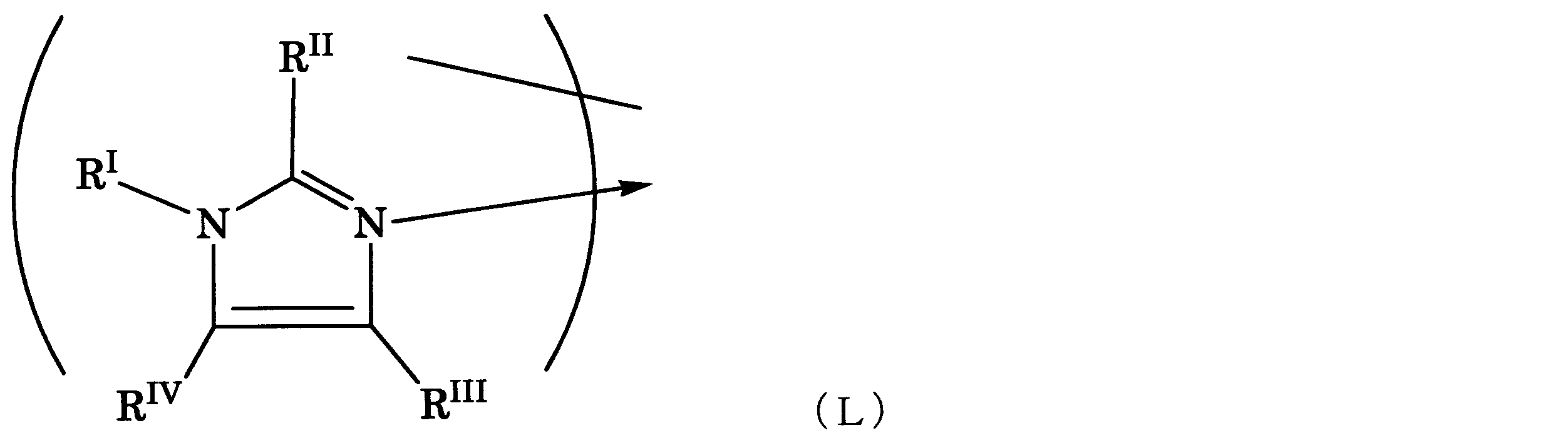
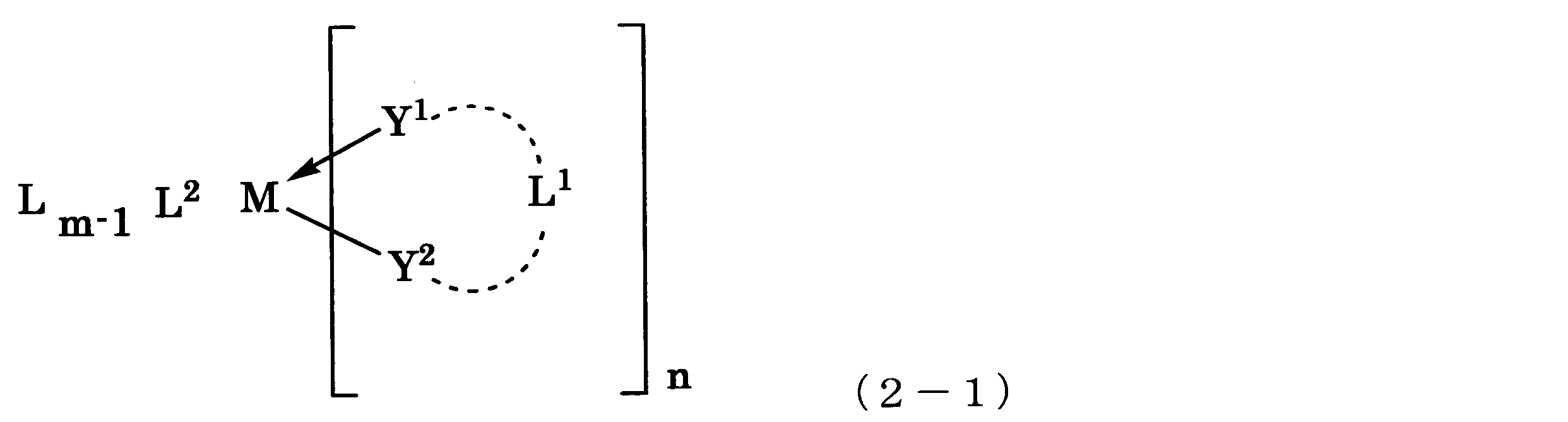
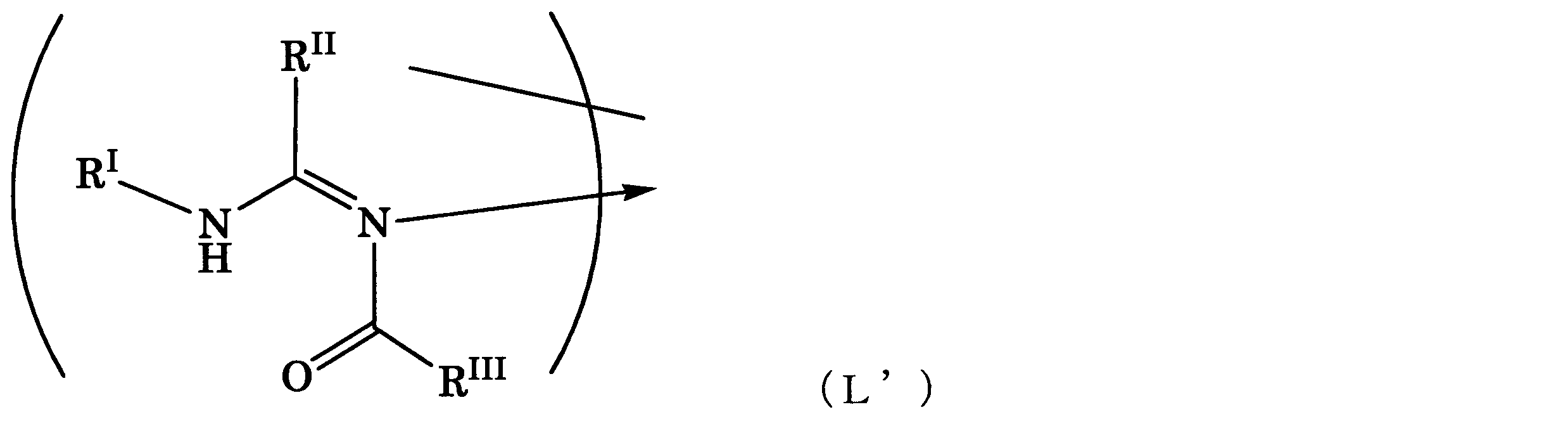
- 前記式(L)が、下記式(L-1)で示される配位子であり、前記式(L’)が、下記式(L’-1)で示される配位子である、請求項25に記載の金属錯体の製造方法。
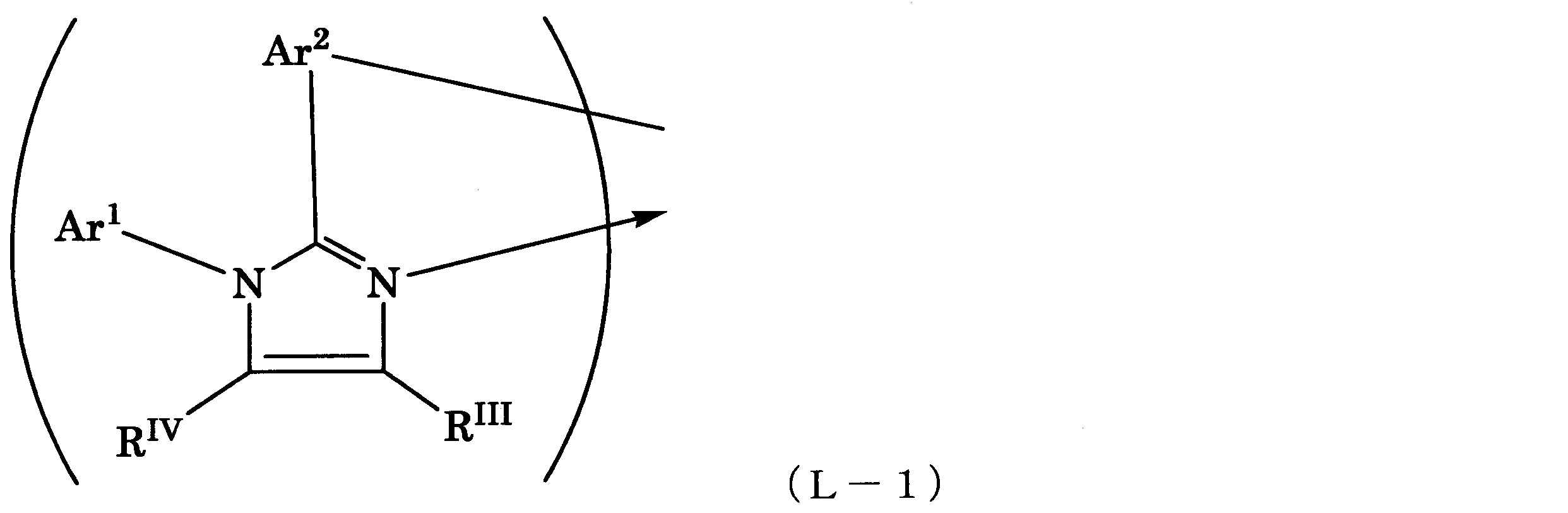
Ar1は、置換基を有する芳香環基又は置換基を有するヘテロ芳香環を示す。
Ar2は金属Mに結合する、置換若しくは無置換の芳香環、又は置換若しくは無置換のヘテロ芳香環を示す。)

- 前記式(L-1)が、下記式(L-2)で示される配位子であり、前記式(L’-1)が、下記式(L’-2)で示される配位子である、請求項26に記載の金属錯体の製造方法。

R1及びR5は、それぞれ、Ar1が結合する窒素原子のβ位に位置し、2級炭素がAr1に結合した置換基を示す。)

- 前記式(L-2)が、下記式(L-3)で示される配位子であり、前記式(L’-2)が、下記式(L’-3)で示される配位子である、請求項27に記載の金属錯体の製造方法。

R2~R4、R6~R9はそれぞれ、水素原子又は置換基を示す。R2~R4、R6~R9のうち隣接する基は、互いに結合し環を形成してもよい。)

- 前記m+nが2又は3であり、前記Mが二価の白金(Pt)、二価のパラジウム(Pd)、三価のイリジウム(Ir)又は三価のロジウム(Rh)である、請求項24~28のいずれかに記載の金属錯体の製造方法。
- 前記Mが三価のイリジウム(Ir)である、請求項29に記載の金属錯体の製造方法。
- 前記金属錯体が、下記式(1’)で示される金属錯体であり、
前記金属錯体の不純物が下記式(2’)で示される化合物である、請求項30に記載の金属錯体の製造方法。
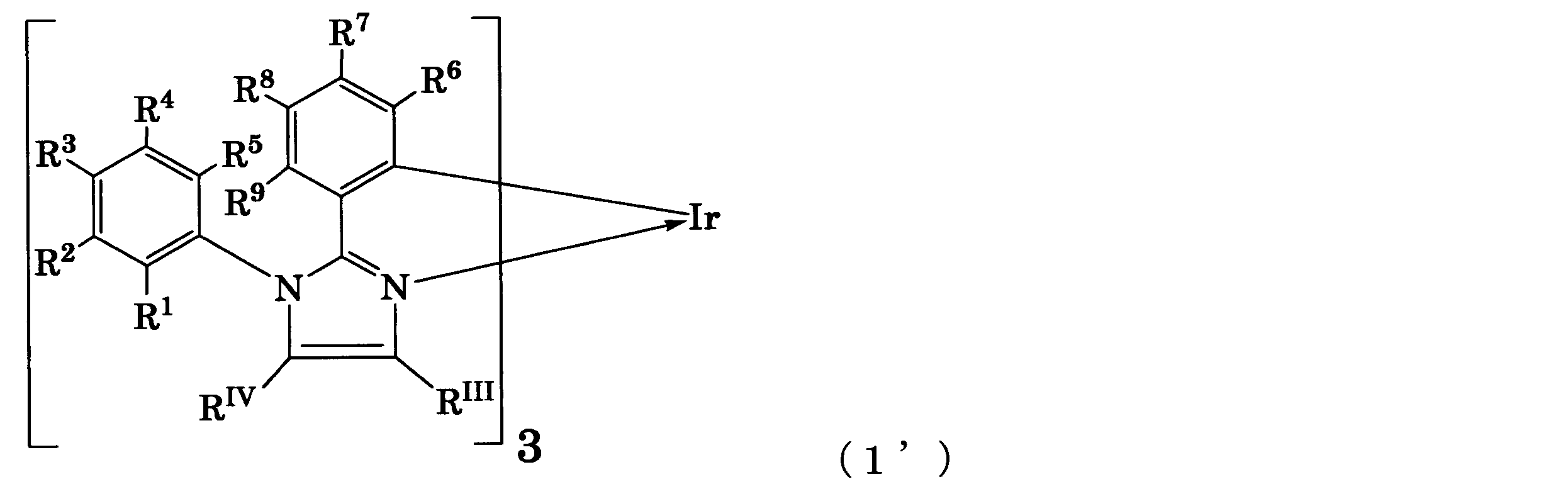

- 陰極と陽極との間に発光層を含む1以上の有機薄膜層を有し、前記有機薄膜層の少なくとも1層が、請求項1~17のいずれかに記載の金属錯体組成物を含有する有機エレクトロルミネッセンス素子。
- 前記発光層が、前記組成物を含有する請求項32に記載の有機エレクトロルミネッセンス素子。
Applications Claiming Priority (2)
| Application Number | Priority Date | Filing Date | Title |
|---|---|---|---|
| JP2013-131138 | 2013-06-21 | ||
| JP2013131138A JP2016169160A (ja) | 2013-06-21 | 2013-06-21 | 金属錯体組成物、及び金属錯体の製造方法 |
Publications (1)
| Publication Number | Publication Date |
|---|---|
| WO2014203540A1 true WO2014203540A1 (ja) | 2014-12-24 |
Family
ID=52104290
Family Applications (1)
| Application Number | Title | Priority Date | Filing Date |
|---|---|---|---|
| PCT/JP2014/003308 Ceased WO2014203540A1 (ja) | 2013-06-21 | 2014-06-19 | 金属錯体組成物、及び金属錯体の製造方法 |
Country Status (2)
| Country | Link |
|---|---|
| JP (1) | JP2016169160A (ja) |
| WO (1) | WO2014203540A1 (ja) |
Cited By (2)
| Publication number | Priority date | Publication date | Assignee | Title |
|---|---|---|---|---|
| US10964902B2 (en) | 2016-01-28 | 2021-03-30 | Sumitomo Chemical Company, Limited | Film production method |
| JPWO2022097665A1 (ja) * | 2020-11-05 | 2022-05-12 |
Families Citing this family (1)
| Publication number | Priority date | Publication date | Assignee | Title |
|---|---|---|---|---|
| JP2018188513A (ja) * | 2017-04-28 | 2018-11-29 | 住友化学株式会社 | 組成物及びそれを用いた発光素子 |
Citations (1)
| Publication number | Priority date | Publication date | Assignee | Title |
|---|---|---|---|---|
| JP2008542203A (ja) * | 2005-05-06 | 2008-11-27 | ユニバーサル ディスプレイ コーポレイション | 安定oled材料及び改善された安定性を有するデバイス |
-
2013
- 2013-06-21 JP JP2013131138A patent/JP2016169160A/ja active Pending
-
2014
- 2014-06-19 WO PCT/JP2014/003308 patent/WO2014203540A1/ja not_active Ceased
Patent Citations (1)
| Publication number | Priority date | Publication date | Assignee | Title |
|---|---|---|---|---|
| JP2008542203A (ja) * | 2005-05-06 | 2008-11-27 | ユニバーサル ディスプレイ コーポレイション | 安定oled材料及び改善された安定性を有するデバイス |
Cited By (6)
| Publication number | Priority date | Publication date | Assignee | Title |
|---|---|---|---|---|
| US10964902B2 (en) | 2016-01-28 | 2021-03-30 | Sumitomo Chemical Company, Limited | Film production method |
| US11770941B2 (en) | 2016-01-28 | 2023-09-26 | Sumitomo Chemical Company, Limited | Film production method |
| JPWO2022097665A1 (ja) * | 2020-11-05 | 2022-05-12 | ||
| WO2022097665A1 (ja) * | 2020-11-05 | 2022-05-12 | キヤノン株式会社 | イリジウム錯体を有する組成物、有機発光素子、表示装置、撮像装置、電子機器、照明装置及び移動体 |
| CN116490588A (zh) * | 2020-11-05 | 2023-07-25 | 佳能株式会社 | 包含铱配合物的组合物、有机发光元件、显示装置、摄像装置、电子装置、照明装置和移动体 |
| EP4242217A4 (en) * | 2020-11-05 | 2024-08-07 | Canon Kabushiki Kaisha | COMPOSITION WITH IRIDIUM COMPLEX, ORGANIC LIGHT-EMITTING ELEMENT, DISPLAY DEVICE, IMAGING DEVICE, ILLUMINATION DEVICE AND MOVING OBJECT |
Also Published As
| Publication number | Publication date |
|---|---|
| JP2016169160A (ja) | 2016-09-23 |
Similar Documents
| Publication | Publication Date | Title |
|---|---|---|
| JP5984689B2 (ja) | 有機金属錯体及びこれを用いた有機発光素子 | |
| KR101757292B1 (ko) | 유기 전계 발광 소자용 재료, 및 유기 전계 발광 소자 | |
| JP7227767B2 (ja) | 有機金属化合物及び有機発光素子並びにそれを含む診断用組成物 | |
| WO2020071478A1 (ja) | 新規化合物、及びそれを含む有機エレクトロルミネッセンス素子用材料 | |
| EP3422431B1 (en) | Organic electroluminescent element and electronic device | |
| JP5729957B2 (ja) | ジベンゾチオフェン化合物およびそれを有する有機発光素子 | |
| EP3705483B1 (en) | Organometallic compound, organic light-emitting device including the same, and electronic apparatus including the organic light-emitting device | |
| JP7109409B2 (ja) | 有機金属化合物とそれを含む有機発光素子及び診断用組成物 | |
| CN104370686A (zh) | 用于电子应用的氘代化合物 | |
| WO2017111036A1 (ja) | 新規な化合物、有機エレクトロルミネッセンス素子用材料及び有機エレクトロルミネッセンス素子 | |
| WO2019240251A1 (ja) | 有機エレクトロルミネッセンス素子及びそれを用いた電子機器 | |
| EP2946421A1 (en) | Organic light-emitting element | |
| CN110386951A (zh) | 有机金属化合物、包括其的有机发光器件、和包括其的诊断组合物 | |
| WO2018084189A1 (ja) | イリジウム錯体の製造方法、イリジウム錯体ならびに該化合物からなる発光材料 | |
| JP2012020947A (ja) | 新規スピロ(アントラセン−9,9’−フルオレン)−10−オン化合物及びこれを有する有機発光素子 | |
| JP6145158B2 (ja) | ヘテロ縮合環を有するアミン化合物及びそれを用いた有機エレクトロルミネッセンス素子 | |
| EP3620460B1 (en) | Organometallic compound, organic light-emitting device including the same, and diagnostic composition including the organometallic compound | |
| WO2014013721A1 (ja) | 含窒素ヘテロ芳香族環化合物、それを用いた有機エレクトロルミネッセンス素子 | |
| WO2014203540A1 (ja) | 金属錯体組成物、及び金属錯体の製造方法 | |
| JP5574860B2 (ja) | ジベンゾスベロン骨格を有する有機発光素子用材料 | |
| WO2014057685A1 (ja) | 有機エレクトロルミネッセンス素子 | |
| JP7600403B2 (ja) | 金属錯体及びその応用 | |
| CN110872327A (zh) | 有机金属化合物、包括其的有机发光器件和诊断组合物 | |
| JP5751984B2 (ja) | 縮合多環化合物及びこれを有する有機発光素子 | |
| JP2015078169A (ja) | 新規な化合物 |
Legal Events
| Date | Code | Title | Description |
|---|---|---|---|
| 121 | Ep: the epo has been informed by wipo that ep was designated in this application |
Ref document number: 14814327 Country of ref document: EP Kind code of ref document: A1 |
|
| NENP | Non-entry into the national phase |
Ref country code: DE |
|
| 122 | Ep: pct application non-entry in european phase |
Ref document number: 14814327 Country of ref document: EP Kind code of ref document: A1 |
|
| NENP | Non-entry into the national phase |
Ref country code: JP |