WO2014148448A1 - 無線ネットワークシステム、端末管理装置、無線中継装置、および通信方法 - Google Patents
無線ネットワークシステム、端末管理装置、無線中継装置、および通信方法 Download PDFInfo
- Publication number
- WO2014148448A1 WO2014148448A1 PCT/JP2014/057206 JP2014057206W WO2014148448A1 WO 2014148448 A1 WO2014148448 A1 WO 2014148448A1 JP 2014057206 W JP2014057206 W JP 2014057206W WO 2014148448 A1 WO2014148448 A1 WO 2014148448A1
- Authority
- WO
- WIPO (PCT)
- Prior art keywords
- wireless
- terminal
- network system
- wireless terminal
- security policy
- Prior art date
- Legal status (The legal status is an assumption and is not a legal conclusion. Google has not performed a legal analysis and makes no representation as to the accuracy of the status listed.)
- Ceased
Links
Images


Classifications
-
- H—ELECTRICITY
- H04—ELECTRIC COMMUNICATION TECHNIQUE
- H04W—WIRELESS COMMUNICATION NETWORKS
- H04W12/00—Security arrangements; Authentication; Protecting privacy or anonymity
- H04W12/08—Access security
-
- H—ELECTRICITY
- H04—ELECTRIC COMMUNICATION TECHNIQUE
- H04B—TRANSMISSION
- H04B7/00—Radio transmission systems, i.e. using radiation field
- H04B7/14—Relay systems
- H04B7/15—Active relay systems
-
- H—ELECTRICITY
- H04—ELECTRIC COMMUNICATION TECHNIQUE
- H04L—TRANSMISSION OF DIGITAL INFORMATION, e.g. TELEGRAPHIC COMMUNICATION
- H04L63/00—Network architectures or network communication protocols for network security
- H04L63/02—Network architectures or network communication protocols for network security for separating internal from external traffic, e.g. firewalls
- H04L63/0227—Filtering policies
- H04L63/0236—Filtering by address, protocol, port number or service, e.g. IP-address or URL
-
- H—ELECTRICITY
- H04—ELECTRIC COMMUNICATION TECHNIQUE
- H04L—TRANSMISSION OF DIGITAL INFORMATION, e.g. TELEGRAPHIC COMMUNICATION
- H04L63/00—Network architectures or network communication protocols for network security
- H04L63/20—Network architectures or network communication protocols for network security for managing network security; network security policies in general
-
- H—ELECTRICITY
- H04—ELECTRIC COMMUNICATION TECHNIQUE
- H04L—TRANSMISSION OF DIGITAL INFORMATION, e.g. TELEGRAPHIC COMMUNICATION
- H04L63/00—Network architectures or network communication protocols for network security
- H04L63/20—Network architectures or network communication protocols for network security for managing network security; network security policies in general
- H04L63/205—Network architectures or network communication protocols for network security for managing network security; network security policies in general involving negotiation or determination of the one or more network security mechanisms to be used, e.g. by negotiation between the client and the server or between peers or by selection according to the capabilities of the entities involved
-
- H—ELECTRICITY
- H04—ELECTRIC COMMUNICATION TECHNIQUE
- H04W—WIRELESS COMMUNICATION NETWORKS
- H04W16/00—Network planning, e.g. coverage or traffic planning tools; Network deployment, e.g. resource partitioning or cells structures
- H04W16/24—Cell structures
- H04W16/26—Cell enhancers or enhancement, e.g. for tunnels, building shadow
-
- H—ELECTRICITY
- H04—ELECTRIC COMMUNICATION TECHNIQUE
- H04W—WIRELESS COMMUNICATION NETWORKS
- H04W48/00—Access restriction; Network selection; Access point selection
- H04W48/08—Access restriction or access information delivery, e.g. discovery data delivery
-
- H—ELECTRICITY
- H04—ELECTRIC COMMUNICATION TECHNIQUE
- H04W—WIRELESS COMMUNICATION NETWORKS
- H04W84/00—Network topologies
- H04W84/02—Hierarchically pre-organised networks, e.g. paging networks, cellular networks, WLAN [Wireless Local Area Network] or WLL [Wireless Local Loop]
- H04W84/10—Small scale networks; Flat hierarchical networks
- H04W84/12—WLAN [Wireless Local Area Networks]
Definitions
- the present invention relates to a technology that allows only terminals that satisfy a predetermined security policy such as not having a security hole to be connected to a wireless network system.
- Smart devices such as smartphones and tablet terminals are rapidly spreading.
- This type of smart device has various functions such as an application program execution function, a communication function, and an imaging function, unlike a conventional PDA (Personal Digital Assistant) or a notebook personal computer.
- PDA Personal Digital Assistant
- this type of smart device is often used not only for personal use but also for user performance, and the introduction of BYOD (Bring Your ⁇ Own Device) is spreading with the spread of smart devices. is there.
- the in-house network laid in the office of the user's office includes a wireless LAN (Local Area Network)
- the smart device owned by the user is connected to the in-house network via the wireless LAN. For example, it is connected and used for the business execution of the user.
- BYOD in order to prevent the invasion of viruses and the leakage of confidential information into the in-house network, it is common to permit connection to the in-house network only for terminal devices that satisfy a predetermined security policy.
- a smart device In the case of a smart device, it is common to connect to a company network via a wireless LAN included in the company network. For this reason, in order to realize BYOD for smart devices, a quarantine system corresponding to a wireless network system such as a wireless LAN is required.
- the quarantine system is a system for checking whether a terminal device to be connected to an in-house network satisfies a predetermined security policy.
- Prior art relating to this type of quarantine system includes techniques disclosed in Patent Document 1 and Non-Patent Document 1.
- Patent Document 1 describes that an in-house network is logically divided using VLAN (Virtual Local Area Network), and one of them is assigned a role of “quarantine VLAN”. According to the technology disclosed in Patent Document 1, when connecting a terminal device to an in-house network, first, it is checked whether the security policy is satisfied by connecting to the quarantine VLAN, and if the security policy is satisfied Quarantine of private terminals is realized by connecting to the VLAN for business execution. On the other hand, in Non-Patent Document 1, dedicated software for real-time monitoring of the connection destination is installed in the terminal, and it is identified whether the connection destination is an in-house network or another network such as a general public line. A technique for preventing leakage of confidential information by switching communication settings of a terminal according to a result (for example, prohibiting web access to the outside while connected to an in-house network) is disclosed.
- VLAN Virtual Local Area Network
- Keizo Nichikawa “MDM, Basic announced to switch work and private mode according to connection destination network”, [online], September 10, 2012, Nikkei BP, March 21, 2013 search , Internet ⁇ URL http://itpro.nikkeibp.co.jp/article/NEWS/20120910/421722/>
- Patent Document 1 has a problem that the system is complicated because the in-house network needs to be divided into a plurality of VLANs, and there is a problem that costs for initial setting and operation increase.
- the technique disclosed in Non-Patent Document 1 has a problem in that since the terminal settings cannot be switched until connection to the in-house network, there is a possibility that connection to the in-house network may be performed with incorrect settings. .
- the present invention has been made in view of the above problems, and an object of the present invention is to provide a technology that allows only wireless terminals satisfying a security policy to be connected to an in-house network without causing a significant increase in cost. To do.
- the present invention provides a wireless network system including a wireless relay device and a terminal management device, wherein the terminal management device communicates with a wireless terminal via a communication network different from the wireless network system, Determining means for determining whether or not the wireless terminal satisfies a predetermined security policy, and for connecting to the wireless relay device to the wireless terminal determined by the determining means that the security policy is satisfied There is provided a wireless network system comprising connection information transmitting means for transmitting connection information.
- connection information is transmitted from the terminal management apparatus to the wireless terminal only when the wireless terminal satisfies the security policy.
- the connection information may be transmitted via a communication network different from that of the wireless network system.
- a wireless terminal cannot connect to a wireless relay device (specifically, a wireless access point device), and therefore it is possible to reliably avoid connection of a wireless terminal that does not satisfy the security policy. it can.
- an in-house network is constructed using the wireless network system of the present invention as a wireless network system for accommodating wireless terminals, only the wireless terminals satisfying the security policy are associated with the in-house network without causing a significant increase in cost. It can be realized to be connected to.
- a detection device that detects that a wireless terminal has entered the service area of the wireless network system
- the terminal management device includes a determination unit that targets the wireless terminal detected by the detection device.
- a mode in which the wireless relay device plays the role of the detection device can be considered.
- the wireless relay device when the wireless relay device is a wireless access point device, the wireless relay device (wireless access point) indicates that the wireless terminal has entered the service area of its own device triggered by reception of a probe request issued from the wireless terminal. Device).
- the wireless relay device wireless access point
- the terminal management apparatus periodically executes a process of communicating with a wireless terminal connected to the wireless relay apparatus via the wireless relay apparatus and performing the determination by the determination unit, and satisfies the security policy.
- a mode is also conceivable in which the terminal management apparatus executes processing for deleting the connection information from the wireless terminal triggered by the determination by the determination means as having disappeared. This is because, according to such an aspect, it is possible to prevent a security hole from being generated due to, for example, changing the setting of the wireless terminal after being connected to the wireless relay device.
- the present invention communicates with a wireless terminal via a communication network different from a wireless network system including a wireless relay device, and whether or not the wireless terminal satisfies a predetermined security policy.
- a terminal management device is provided.
- the present invention provides a wireless relay device included in a wireless network system, wherein a radio wave intensity of a request message received from a wireless terminal exceeds a predetermined threshold, and a terminal identifier of the wireless terminal Is registered in advance, a terminal notifying unit for notifying the higher-level device of the terminal identifier, and an updating unit for updating a filter for restricting a wireless terminal of a communication partner according to an instruction from the higher-level device.
- a wireless relay device is provided.
- the present invention communicates with a wireless terminal via a communication network different from a wireless network system including a wireless relay device, and whether or not the wireless terminal satisfies a predetermined security policy.
- the communication method is characterized by transmitting connection information for connecting to the wireless relay device to a wireless terminal determined to satisfy the security policy.
- the present invention provides a communication method in a wireless relay device included in a wireless network system, wherein a radio wave intensity of a request message received from a wireless terminal exceeds a predetermined threshold, and the wireless terminal If the terminal identifier is registered in advance, the terminal identifier is notified to the host device, and a filter for restricting the wireless terminals that communicate via the wireless relay device is sent from the host device according to the instruction.
- a communication method characterized by updating.
- a MAC address can be given as a specific example of the terminal identifier, and a MAC address filter can be given as a specific example of the filter.
- the wireless relay device is connected to a wireless terminal that has obtained connection information for connecting to the wireless relay device via a communication network different from the wireless network system, and communication between the wireless terminal and the wireless network system is performed. You may further have a communication means to perform.
- a wireless network system included in an in-house network includes a wireless access point device that functions as the wireless relay device and the terminal management device, so that wireless that satisfies the security policy can be achieved without causing a significant increase in cost. Only the terminal can be connected to the in-house network via the wireless network system.
- FIG. 1 is a block diagram illustrating a configuration example of a wireless network system 1 according to an embodiment of the present invention.
- 2 is a block diagram showing a configuration example of a wireless access point device 10 included in the wireless network system 1.
- FIG. 2 is a block diagram showing a configuration example of a terminal management device 50 included in the wireless network system 1.
- FIG. It is a figure which shows the communication sequence in the embodiment. It is a figure which shows the communication sequence in the embodiment.
- FIG. 1 is a block diagram illustrating a configuration example of a communication system including a wireless network system 1 according to an embodiment of the present invention.
- the wireless network system 1 is, for example, a wireless LAN laid in a company office, and forms a corporate network in the company together with a wired LAN (not shown in FIG. 1) laid in the company office.
- the wireless access point device 10 and the AP controller 30 are each connected to the switching hub 20 by a signal line such as a LAN cable.
- each wireless access point device 10-n is laid out in the wireless network system 1 by an area (hereinafter referred to as a service area of the wireless access point apparatus) that can receive each communication radio wave emitted with sufficient intensity. It is arranged in various places inside the company so that the inside of the company can be covered.
- FIG. 2 is a diagram illustrating a configuration example of the wireless access point device 10.
- the wireless access point device 10 includes a control unit 110, a wireless communication I / F unit 120, a storage unit 130, and a bus 140 that mediates data exchange between these components.
- the control unit 110 is a CPU (Central Processing Unit).
- the control unit 110 functions as a control center of the wireless access point device 10 by executing a program stored in the storage unit 130 (more precisely, the nonvolatile storage unit 134).
- the wireless communication I / F unit 120 includes an antenna, a modulation circuit, a demodulation circuit, and the like (all not shown), modulates data received from the control unit 110, superimposes it on a carrier wave, and sends it to a wireless section.
- the data superimposed on the carrier wave received from the wireless section is demodulated and provided to the control unit 110.
- the storage unit 130 includes a volatile storage unit 132 and a nonvolatile storage unit 134.
- the volatile storage unit 132 is, for example, a RAM (Random Access Memory).
- the volatile storage unit 132 is used by the control unit 110 as a work area when executing various programs.
- the nonvolatile storage unit 134 is, for example, an EEPROM (ElectricallyrErasable Programmable Read-Only Memory).
- the nonvolatile storage unit 134 stores data and a program for causing the control unit 110 to execute processing that clearly shows the features of the present embodiment.
- An example of data stored in the non-volatile storage unit 134 is the MAC of all wireless terminals that have been applied for use in business operations among private wireless terminals owned by employees of the company.
- the wireless terminal detects that the transmission source has entered the service area of its own device upon reception of a probe request issued by the wireless terminal, and the wireless terminal A wireless communication program for causing the control unit 110 to execute terminal notification processing for notifying the host device (in this embodiment, the AP controller 30) of the MAC address of the wireless terminal when a use application has been made in advance. .
- the control unit 110 operating according to the wireless communication program also executes a process of updating the MAC address filter in accordance with an instruction given from the AP controller 30 as in the case of a general wireless access point device.
- a probe request refers to a communication message transmitted by a wireless terminal to prompt the nearest wireless access point device to broadcast a network identifier (for example, ESSID).
- the wireless access point device 10 according to the present embodiment is set not to broadcast the network identifier periodically, but also to not broadcast the network identifier or the like even when the probe request is received. This is to prevent unauthorized access due to leakage of the network identifier to a third party or the like.
- the AP controller 30 determines, for each wireless access point device 10-n, the terminal identifier of the wireless terminal connected to the wireless access point device 10-n (information for identifying the wireless terminal, in this embodiment, the MAC address ) And a function of detecting movement of a wireless terminal between wireless access point devices (so-called handover).
- the switching hub 20 is connected to a router 40, and a terminal management device 50 is connected to the router 40.
- a wired LAN that forms an in-house network together with the wireless network system 1 may be connected to the switching hub 20 or may be connected to the router 40.
- the router 40 is connected to the Internet 2. That is, the wireless network system 1 is connected to the Internet 2 via the router 40.
- the Internet 2 is connected to a mobile network 3 compliant with a communication standard such as 3G or LTE (Long Term Evolution).
- the wireless terminal 60 is a smart device owned by an employee of the above company.
- a base station not shown
- a wireless access point device 10-n 10
- a data communication function hereinafter referred to as a second wireless communication function
- the second wireless communication function can be switched on / off according to the user's instruction, and the user is instructed to turn on the second wireless communication function. Then, the wireless terminal 60 transmits the probe request described above.
- the wireless terminal 60 stores information indicating the host name assigned to the terminal management device 50 in advance, specifies the communication address (IP address) of the terminal management device 50 based on the host name, Data communication is performed with the terminal management apparatus 50 via the mobile network 3 and the Internet 2 by the first wireless communication function described above.
- IP address communication address
- the terminal management device 50 is a so-called MDM (Mobile Device Management) server.
- FIG. 3 is a diagram illustrating a configuration example of the terminal management device 50.
- the terminal management device 50 includes a control unit 510, a communication I / F unit 520, a storage unit 530, and a bus 540 that mediates data exchange between these components.
- the terminal management device 50 has a user I / F unit for allowing the operation manager to perform various operations, an external device I / F unit for connecting other devices, and the like.
- the illustration and description are omitted.
- the control unit 510 is a CPU, similar to the control unit 110 in the wireless access point device 10, and executes a program stored in the storage unit 530 (more precisely, the nonvolatile storage unit 534) to execute the terminal management device 50. Acts as a control center for
- the communication I / F unit 520 is a NIC, for example, and is connected to the router 40 via a signal line such as a LAN cable.
- the communication I / F unit 520 gives the data received from the router 40 via the signal line to the control unit 510, and transmits the data received from the control unit 510 via the signal line.
- the storage unit 530 includes a volatile storage unit 532 and a nonvolatile storage unit 534.
- the volatile storage unit 532 is, for example, a RAM.
- the volatile storage unit 532 is used by the control unit 510 as a work area when executing various programs.
- the nonvolatile storage unit 534 is, for example, a hard disk.
- the nonvolatile storage unit 534 stores data and a program for causing the control unit 510 to execute processing that clearly shows the features of the present embodiment.
- An example of data stored in the non-volatile storage unit 534 includes data representing a security policy in the company (hereinafter referred to as security policy data).
- security policy data As specific examples of the security policy data, OS (Operating System) that should be installed in a terminal device connected to the wireless network system 1, data indicating the type and version of application software, and data that should be installed in the terminal device Data indicating application software that is not.
- OS Operating System
- the security policy data is used when it is determined whether or not the wireless terminal that has transmitted the probe request satisfies the security policy (that is, the wireless terminal is quarantined).
- the non-volatile storage unit 534 uses connection information (a network identifier of the wireless network system 1 and wireless communication with the wireless access point device 10) required when connecting a wireless terminal to the wireless access point device 10.
- connection information a network identifier of the wireless network system 1 and wireless communication with the wireless access point device 10.
- Information indicating an encryption method and information indicating a security key for the encryption are also stored in advance (not shown in FIG. 3).
- a quarantine program that causes the control unit 510 to execute a quarantine process that significantly shows the characteristics of the present embodiment can be cited.
- the details will be clarified in the operation example to avoid duplication, but the control unit 510 operating according to the quarantine program is triggered by the notification of the MAC address from the AP controller 30 and the wireless terminal indicated by the MAC address.
- the control unit 510 operating according to the quarantine program also functions as a connection information transmission unit that transmits and stores the connection information via the Internet 2 and the mobile network 3 to the wireless terminal determined to satisfy the security policy. To do.
- the above is the configuration of the wireless network system 1.
- the wireless terminal 60 transmits the above-described probe request (see FIG. 4).
- the control unit 110 of the wireless access point device 10 detects that the wireless terminal 60 has entered the service area of its own device upon reception of the probe request transmitted from the wireless terminal 60, and starts executing the terminal notification process. To do. As shown in FIG. 4, the control unit 110 first determines that the probe request has a predetermined condition A (that is, the radio wave intensity exceeds a predetermined threshold, and that the transmission source has made a use application in advance. It is determined whether it is a terminal) (step SA110).
- a predetermined condition A that is, the radio wave intensity exceeds a predetermined threshold, and that the transmission source has made a use application in advance. It is determined whether it is a terminal
- the control unit 110 determines that the wireless terminal has been applied for in advance.
- the control unit 110 transmits a frame (hereinafter referred to as a MAC address notification frame) in which the transmission source MAC address of the probe request is written in the payload portion to the AP controller 30. (Step SA120).
- the MAC address notification frame transmitted from the wireless access point device 10 in this way is received by the AP controller 30 via the switching hub 20.
- the AP controller 30 notifies the terminal management device 50 of the MAC address written in the received MAC address notification frame via the switching hub 20 and the router 40 (see FIG. 4).
- the control unit 510 of the terminal management device 50 starts executing the quarantine process (step SA200) triggered by the notification of the MAC address.
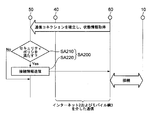
- FIG. 5 is a sequence flowchart showing a communication flow in the quarantine process.
- the control unit 510 of the terminal management device 50 uses the device indicated by the MAC address notified from the AP controller 30 (in this operation example, the wireless terminal 60) as a counterpart device via the Internet 2 and the mobile network 3. Establish a communication connection and acquire status information.
- control unit 510 determines whether or not the state indicated by the state information acquired from wireless terminal 60 satisfies a predetermined security policy (that is, a security policy indicated by security policy data) (step SA210).
- a predetermined security policy that is, a security policy indicated by security policy data
- Control unit 510 establishes a wireless communication connection with wireless access point apparatus 10 only when the state of wireless terminal 60 satisfies the security policy (when the determination result in step SA210 is “Yes”).
- the connection information necessary for the transmission is transmitted to the wireless terminal 60 via the Internet 2 and the mobile network 3 and stored (step SA220).
- the control unit 510 notifies the AP controller 30 of the MAC address of the wireless terminal 60 (not shown in FIG. 5).
- the AP controller 30 receives the MAC address from the terminal management device 50, the AP controller 30 issues an update instruction that instructs to update the MAC address filter so as to permit the connection of the terminal identified by the MAC address to the wireless network system 1.
- the wireless terminal 60 uses the connection information received from the terminal management device 50 to connect to the nearest wireless access point device 10. As described above, in the wireless access point device 10, a MAC address filter is set to permit the connection of the wireless terminal 60. For this reason, the wireless terminal 60 is connected to the wireless network system 1 via the nearest wireless access point device 10. On the other hand, when the state of the wireless terminal 60 does not satisfy the security policy, connection information is not transmitted from the terminal management device 50 to the wireless terminal 60. In addition, the MAC address of the wireless terminal 60 is not notified from the terminal management device 50 to the AP controller 30, and the MAC address filter of the wireless access point device 10 is updated so that the connection of the wireless terminal 60 is permitted. There is nothing. For this reason, the wireless terminal 60 is not connected to the wireless network system 1.
- the wireless terminal 60 is connected to the wireless network system 1 only when the predetermined security policy is satisfied, and the terminal that does not satisfy the security policy is reliably prevented from being connected to the internal network via the wireless network system 1. can do. Even when the wireless terminal 60 is not connected to the wireless network system 1 because the security policy is not satisfied, the wireless terminal 60 is connected to another wireless communication network (for example, WI-FI) different from the wireless network system 1. Of course, it is possible to access the Internet 2 via another wireless communication network or the mobile network 3.
- WI-FI wireless communication network
- the control unit 510 of the terminal management device 50 receives status information from the wireless terminal 60 via the router 40, the switching hub 20, and the wireless access point device 10. Acquire periodically to confirm that the security policy is satisfied.
- the control unit 510 deletes the connection information of the wireless network system 1 from the wireless terminal 60 and further transmits the MAC address of the wireless terminal 60 to the AP controller 30.
- the MAC address filter of each wireless access point device 10 is updated again so as to exclude the wireless terminal 60 from the connection target. It is not preferable from the viewpoint of ensuring security that the wireless terminal that does not satisfy the security policy is continuously connected, and it is to prevent fraud such as changing the setting of the wireless terminal 60 after the connection to the wireless access point apparatus is completed.
- the wireless access point device 10 assigns the MAC address of the wireless terminal 60 to the AP controller. 30 to inquire about the presence or absence of handover.
- the AP controller 30 checks whether or not the wireless terminal 60 has been handed over to another wireless access point device 10, and if not handed over, notifies the terminal management device 50 of the MAC address of the wireless terminal 60. .
- the control unit 510 of the terminal management device 50 communicates with the wireless terminal indicated by the MAC address via the Internet 2 and the mobile network 3 and deletes the connection information stored in the wireless terminal. This is to prevent unauthorized use of connection information distributed on condition that the security policy is satisfied.
- the wireless terminal 60 and the terminal management device via the Internet 2 and the mobile network 3 50 communication needs to be performed frequently, and there is a drawback in that the battery of the wireless terminal 60 is consumed. Therefore, it is preferable to determine whether or not the wireless terminal 60 satisfies the security policy when the wireless terminal 60 enters the company building where the wireless network system 1 is laid as in the above embodiment.
- the wireless network system 1 is configured with the AP controller 30 and the terminal management device 50 as separate devices.
- the communication system may be configured with the two as an integrated device.
- a device having the functions of both the AP controller 30 and the terminal management device 50 is a host device for the wireless access point device 10.
- the wireless access point device determines whether or not the wireless terminal has been applied for in advance.
- the wireless access point device causes the AP controller 30 to perform the determination. May determine whether or not the radio wave intensity of the received probe request exceeds a predetermined threshold value.
- the radio access point device 10 has the radio wave intensity of the probe request received from the wireless terminal exceeding a predetermined threshold, and the MAC address of the wireless terminal (that is, the terminal identifier of the wireless terminal is When it is registered in advance, terminal notification processing for notifying the host device of the MAC address and processing for updating the MAC address filter in response to an instruction from the device are executed. It may be executed by the hub 20 or the router 40. For example, when the router 40 executes these processes, a request message transmitted from the wireless terminal (for example, a request for establishment of a communication connection is made to the counterpart device).
- the radio wave of the request message When a SYN message is received, the radio wave of the request message When the radio field strength is higher than a predetermined threshold and the terminal identifier of the wireless terminal (for example, the IP address of the request message transmission source) is registered in advance.
- the router 40 may be provided with update means for executing processing for updating in accordance with an instruction from the host device, and the router 40 may be a wireless router having the function of a wireless access point device. Also, a wireless switching hub having the function of a wireless access point device may be used.
- the radio field strength of a request message received from a wireless terminal exceeds a predetermined threshold for a wireless relay device (wireless access point device, wireless switching hub, wireless router, etc.) that relays communication between the terminal and the communication partner.
- a terminal notifying means for notifying the higher-level apparatus of the terminal identifier and a filter for restricting the wireless terminals communicating via the own apparatus Any mode may be used as long as it includes an updating unit that updates in accordance with an instruction from the apparatus.
- the wireless network system 1 is configured with the wireless access point device 10 and the terminal management device 50 as separate devices, but the communication system may be configured with both devices as an integrated device. That is, it is not necessary to prepare the terminal management device 50 as separate hardware for terminal management, and it can be set in any device as software, for example.
- a program for causing the terminal management device 50 to realize the function unique to the terminal management device of the present invention is stored in advance in the nonvolatile storage unit 534 of the terminal management device 50.
- the program may be distributed by being written on a computer-readable recording medium such as a CD-ROM, or may be distributed by downloading via a telecommunication line such as the Internet. This is because by operating a general computer in accordance with the program distributed in this way, the computer can function as the terminal management apparatus of the above embodiment.
- the terminal management device 50 in order to enable the wireless terminal 60 to connect to the wireless network system 1 (communication with the wireless access point device 10), the terminal management device 50 connects the wireless terminal 60 via the Internet 2 and the mobile network 3. After the security policy is determined, the connection information necessary for connecting to the wireless access point device 10 when the security policy is satisfied is transmitted from the terminal management device 50 to the wireless terminal 60 via the Internet 2 and the mobile network 3. Gave.
- the communication for determining the security policy and the transmission of connection information necessary for connecting to the wireless access point device 10 are not limited to the Internet 2 and the mobile network 3, but via other communication means. Also good. For example, infrared rays, Bluetooth (registered trademark), or NFC (Near Field Communication) may be used.
Landscapes
- Engineering & Computer Science (AREA)
- Computer Security & Cryptography (AREA)
- Computer Networks & Wireless Communication (AREA)
- Signal Processing (AREA)
- Computer Hardware Design (AREA)
- Computing Systems (AREA)
- General Engineering & Computer Science (AREA)
- Mobile Radio Communication Systems (AREA)
Abstract
Description
(A:構成)
図1は、本発明の一実施形態の無線ネットワークシステム1を含む通信システムの構成例を示すブロック図である。無線ネットワークシステム1は、例えば企業の社屋内に敷設された無線LANであり、当該社屋内に敷設された有線LAN(図1では図示略)とともに上記企業における社内ネットワークを形成する。図1に示すように、無線ネットワークシステム1は、無線アクセスポイント装置10-n(n=1~N:Nは2以上の整数)、スイッチングハブ20、APコントローラ30、ルータ40、および端末管理装置50を含んでいる。なお、以下では、無線アクセスポイント装置10-n(n=1~N)の各々を区別する必要がない場合には「無線アクセスポイント装置10」と表記する。
以上が無線ネットワークシステム1の構成である。
次いで、無線端末60のユーザが出社して業務に従事し、退社するまでの流れに沿って本実施形態の動作を説明する。
以上本発明の実施形態について説明したが、この実施形態を以下のように変形しても勿論良い。
(1)上記実施形態では、無線ネットワークシステム1が敷設された社屋に無線端末60が入ったことを契機として当該無線端末60がセキュリティポリシを満たすか否かを判定し、セキュリティポリシを満たす場合に無線アクセスポイント装置10に接続する際に必要となる接続情報をインターネット2およびモバイル網3経由で端末管理装置50から無線端末60に与えた。しかし、無線端末60が上記社屋内に入る前に(換言すれば、無線アクセスポイント装置10により無線端末60が検知される前に)、無線端末60に接続情報を与えても良い。ただし、この場合は、無線端末60が予め定められたセキュリティポリシを満たすこと、およびその状態が継続していることを確認するために、インターネット2およびモバイル網3経由で無線端末60と端末管理装置50の通信を頻繁に行う必要があり、無線端末60のバッテリの消費が大きくなるという欠点がある。したがって、上記実施形態のように無線ネットワークシステム1が敷設された社屋に無線端末60が入ったことを契機として当該無線端末60がセキュリティポリシを満たすか否かを判定するようにすることが好ましい。
Claims (10)
- 無線中継装置と端末管理装置とを含む無線ネットワークシステムにおいて、
前記端末管理装置は、
当該無線ネットワークシステムとは異なる通信網を介して無線端末と通信し、当該無線端末が予め定められたセキュリティポリシを満たしているか否かを判定する判定手段と、
前記セキュリティポリシを満たしていると前記判定手段により判定された無線端末へ、前記無線中継装置に接続するための接続情報を送信する接続情報送信手段と、を有する
ことを特徴とする無線ネットワークシステム。 - 前記接続情報送信手段は、当該無線ネットワークシステムとは異なる前記通信網経由で前記接続情報を送信する
ことを特徴とする請求項1に記載の無線ネットワークシステム。 - 前記無線ネットワークシステムのサービスエリア内に無線端末が入ったことを検知する検知装置をさらに有し、
前記端末管理装置は、
前記無線ネットワークシステムのサービスエリア内に入ったことが前記検知装置により検知された無線端末を対象として前記判定手段によるセキュリティポリシの判定を行う
ことを特徴とする請求項1に記載の無線ネットワークシステム。 - 前記無線中継装置が前記検知装置として機能する
ことを特徴とする請求項3に記載の無線ネットワークシステム。 - 無線中継装置を含む無線ネットワークシステムとは異なる通信網を介して無線端末と通信し、当該無線端末が予め定められたセキュリティポリシを満たしているか否かを判定する判定手段と、
前記セキュリティポリシを満たしていると前記判定手段により判定された無線端末へ、前記無線中継装置に接続するための接続情報を送信する接続情報送信手段と
を有することを特徴とする端末管理装置。 - 無線ネットワークシステムに含まれる無線中継装置において、
無線端末から受信したリクエストメッセージの電波強度が所定の閾値を上回っており、かつ前記無線端末の端末識別子が予め登録されたものである場合に、前記端末識別子を上位装置へ通知する端末通知手段と、
自装置を介して通信する無線端末を制限するためのフィルタを前記上位装置から指示に応じて更新する更新手段と、
を有することを特徴とする無線中継装置。 - 前記リクエストメッセージはプローブリクエストであり、前記端末識別子はMACアドレスであり、前記フィルタはMACアドレスフィルタである
ことを特徴とする請求項6に記載の無線中継装置。 - 前記無線ネットワークシステムとは異なる通信網を介して当該無線中継装置に接続するための接続情報を得た無線端末と接続し、当該無線端末と前記無線ネットワークシステムによる通信を行う通信手段
をさらに有することを特徴とする請求項6に記載の無線中継装置。 - 無線中継装置を含む無線ネットワークシステムとは異なる通信網を介して無線端末と通信し、当該無線端末が予め定められたセキュリティポリシを満たしているか否かを判定し、
前記セキュリティポリシを満たしていると判定された無線端末へ、前記無線中継装置に接続するための接続情報を送信する
ことを特徴とする通信方法。 - 無線ネットワークシステムに含まれる無線中継装置における通信方法において、
無線端末から受信したリクエストメッセージの電波強度が所定の閾値を上回っており、かつ前記無線端末の端末識別子が予め登録されたものである場合に、前記端末識別子を上位装置へ通知し、
前記無線中継装置を介して通信する無線端末を制限するためのフィルタを前記上位装置から指示に応じて更新する
ことを特徴とする通信方法。
Priority Applications (2)
| Application Number | Priority Date | Filing Date | Title |
|---|---|---|---|
| US14/778,921 US10575177B2 (en) | 2013-03-22 | 2014-03-17 | Wireless network system, terminal management device, wireless relay device, and communications method |
| CN201480017480.0A CN105052177B (zh) | 2013-03-22 | 2014-03-17 | 无线网络系统、终端管理装置、无线中继装置及通信方法 |
Applications Claiming Priority (2)
| Application Number | Priority Date | Filing Date | Title |
|---|---|---|---|
| JP2013059464A JP6163808B2 (ja) | 2013-03-22 | 2013-03-22 | 無線ネットワークシステム、端末管理装置、および無線中継装置 |
| JP2013-059464 | 2013-03-22 |
Publications (1)
| Publication Number | Publication Date |
|---|---|
| WO2014148448A1 true WO2014148448A1 (ja) | 2014-09-25 |
Family
ID=51580127
Family Applications (1)
| Application Number | Title | Priority Date | Filing Date |
|---|---|---|---|
| PCT/JP2014/057206 Ceased WO2014148448A1 (ja) | 2013-03-22 | 2014-03-17 | 無線ネットワークシステム、端末管理装置、無線中継装置、および通信方法 |
Country Status (4)
| Country | Link |
|---|---|
| US (1) | US10575177B2 (ja) |
| JP (1) | JP6163808B2 (ja) |
| CN (1) | CN105052177B (ja) |
| WO (1) | WO2014148448A1 (ja) |
Cited By (2)
| Publication number | Priority date | Publication date | Assignee | Title |
|---|---|---|---|---|
| JP2019526843A (ja) * | 2016-05-23 | 2019-09-19 | サイトリックス システムズ,インコーポレイテッド | ホストされたアプリケーションへの動的アクセス |
| CN111031545A (zh) * | 2019-12-24 | 2020-04-17 | Oppo广东移动通信有限公司 | 无线网络接入控制方法及装置、中继设备和电子设备 |
Families Citing this family (6)
| Publication number | Priority date | Publication date | Assignee | Title |
|---|---|---|---|---|
| JP6550913B2 (ja) | 2015-05-13 | 2019-07-31 | 富士通株式会社 | 通信システム |
| DE102015222308A1 (de) * | 2015-11-12 | 2017-05-18 | Volkswagen Aktiengesellschaft | Vorrichtung, Verfahren und Computerprogramm zur Frequenzbandauswahl |
| JP6822180B2 (ja) * | 2017-02-02 | 2021-01-27 | セイコーエプソン株式会社 | 印刷装置、印刷装置の制御方法、及び、通信システム |
| US10701707B2 (en) * | 2017-03-28 | 2020-06-30 | Arris Enterprises Llc | Allocation of wireless channels for preferred stations |
| CN107196837B (zh) * | 2017-06-16 | 2020-06-16 | 四川省农业科学院服务中心 | 一种基于vlan划分运用的多数据业务综合组网的方法 |
| JP6680345B2 (ja) * | 2018-12-26 | 2020-04-15 | ブラザー工業株式会社 | 通信機器 |
Citations (8)
| Publication number | Priority date | Publication date | Assignee | Title |
|---|---|---|---|---|
| JP2004310581A (ja) * | 2003-04-09 | 2004-11-04 | Nec Corp | ネットワーク接続方法およびネットワークシステム |
| JP2004336538A (ja) * | 2003-05-09 | 2004-11-25 | Ricoh Co Ltd | 無線通信システム、情報処理端末及び赤外線通信装置 |
| JP2005086471A (ja) * | 2003-09-09 | 2005-03-31 | Japan Telecom Co Ltd | 通信制御方法、および、端末装置 |
| JP2005167884A (ja) * | 2003-12-05 | 2005-06-23 | Nec Corp | ネットワークへの接続参加受付システム、ネットワークヘのノード接続方法およびノードの設定方法 |
| JP2007006320A (ja) * | 2005-06-27 | 2007-01-11 | Nakayo Telecommun Inc | 無線lanシステムおよび通信方法 |
| JP2008263445A (ja) * | 2007-04-12 | 2008-10-30 | Docomo Technology Inc | 接続設定システム、認証装置、無線端末、及び接続設定方法 |
| JP2012134703A (ja) * | 2010-12-21 | 2012-07-12 | Kddi Corp | 無線lan接続方法、無線lanクライアント、および無線lanアクセスポイント |
| JP2013507077A (ja) * | 2009-10-06 | 2013-02-28 | モサイド・テクノロジーズ・インコーポレーテッド | セルラーシステムと他の無線システムとの間に相互運用性を実現するシステムおよび方法 |
Family Cites Families (27)
| Publication number | Priority date | Publication date | Assignee | Title |
|---|---|---|---|---|
| US5737691A (en) * | 1995-07-14 | 1998-04-07 | Motorola, Inc. | System and method for allocating frequency channels in a two-way messaging network |
| US6957067B1 (en) * | 2002-09-24 | 2005-10-18 | Aruba Networks | System and method for monitoring and enforcing policy within a wireless network |
| US7448067B2 (en) * | 2002-09-30 | 2008-11-04 | Intel Corporation | Method and apparatus for enforcing network security policies |
| US7440573B2 (en) * | 2002-10-08 | 2008-10-21 | Broadcom Corporation | Enterprise wireless local area network switching system |
| US7277547B1 (en) * | 2002-10-23 | 2007-10-02 | Sprint Spectrum L.P. | Method for automated security configuration in a wireless network |
| US20040213172A1 (en) * | 2003-04-24 | 2004-10-28 | Myers Robert L. | Anti-spoofing system and method |
| US7523484B2 (en) * | 2003-09-24 | 2009-04-21 | Infoexpress, Inc. | Systems and methods of controlling network access |
| US8230480B2 (en) * | 2004-04-26 | 2012-07-24 | Avaya Inc. | Method and apparatus for network security based on device security status |
| US20050266826A1 (en) * | 2004-06-01 | 2005-12-01 | Nokia Corporation | Method for establishing a security association between a wireless access point and a wireless node in a UPnP environment |
| US7499438B2 (en) * | 2005-01-13 | 2009-03-03 | 2Wire, Inc. | Controlling wireless access to a network |
| US20060172736A1 (en) * | 2005-02-01 | 2006-08-03 | Intel Corporation | Methods and apparatus for operating a wireless electronic device having a plurality of communication platforms |
| US7706778B2 (en) * | 2005-04-05 | 2010-04-27 | Assa Abloy Ab | System and method for remotely assigning and revoking access credentials using a near field communication equipped mobile phone |
| JP2006331128A (ja) | 2005-05-26 | 2006-12-07 | Allied Telesis Holdings Kk | 認証サーバ、認証方法、及び認証プログラム |
| EP1860898A4 (en) * | 2005-10-15 | 2008-05-14 | Huawei Tech Co Ltd | METHOD FOR REALIZING THE SECURE UPDATE OF A MOBILE STATION AND THE CORRELATIVE REACTION SYSTEM |
| US20070266422A1 (en) * | 2005-11-01 | 2007-11-15 | Germano Vernon P | Centralized Dynamic Security Control for a Mobile Device Network |
| US7974249B2 (en) * | 2006-03-01 | 2011-07-05 | Dell Products L.P. | Virtual access point for configuration of a LAN |
| KR101359324B1 (ko) * | 2006-03-27 | 2014-02-24 | 텔레콤 이탈리아 소시에떼 퍼 아찌오니 | 이동 통신 장치상의 보안 정책 시행 방법 |
| CA2607823C (en) * | 2006-10-26 | 2014-07-29 | Research In Motion Limited | Transient wlan connection profiles |
| CN101262670B (zh) * | 2007-03-09 | 2012-01-25 | 鸿富锦精密工业(深圳)有限公司 | 移动装置、通信系统及连线建立方法 |
| JP4938520B2 (ja) | 2007-03-22 | 2012-05-23 | シャープ株式会社 | デジタル放送受信機 |
| CN100594690C (zh) | 2007-05-22 | 2010-03-17 | 网御神州科技(北京)有限公司 | 一种安全网关中进行安全策略统一处理的方法及装置 |
| JP5246112B2 (ja) * | 2009-09-07 | 2013-07-24 | ブラザー工業株式会社 | 無線通信装置とコンピュータプログラム |
| US8925042B2 (en) * | 2010-04-30 | 2014-12-30 | T-Mobile Usa, Inc. | Connecting devices to an existing secure wireless network |
| US8699370B2 (en) * | 2010-08-24 | 2014-04-15 | Euclid, Inc. | Method and apparatus for analysis of user traffic within a predefined area |
| US8359016B2 (en) * | 2010-11-19 | 2013-01-22 | Mobile Iron, Inc. | Management of mobile applications |
| US8937534B2 (en) * | 2010-12-08 | 2015-01-20 | At&T Intellectual Property I, L.P. | Remote control of electronic devices via mobile device |
| US8909247B2 (en) * | 2011-11-08 | 2014-12-09 | At&T Mobility Ii Llc | Location based sharing of a network access credential |
-
2013
- 2013-03-22 JP JP2013059464A patent/JP6163808B2/ja active Active
-
2014
- 2014-03-17 CN CN201480017480.0A patent/CN105052177B/zh active Active
- 2014-03-17 US US14/778,921 patent/US10575177B2/en active Active
- 2014-03-17 WO PCT/JP2014/057206 patent/WO2014148448A1/ja not_active Ceased
Patent Citations (8)
| Publication number | Priority date | Publication date | Assignee | Title |
|---|---|---|---|---|
| JP2004310581A (ja) * | 2003-04-09 | 2004-11-04 | Nec Corp | ネットワーク接続方法およびネットワークシステム |
| JP2004336538A (ja) * | 2003-05-09 | 2004-11-25 | Ricoh Co Ltd | 無線通信システム、情報処理端末及び赤外線通信装置 |
| JP2005086471A (ja) * | 2003-09-09 | 2005-03-31 | Japan Telecom Co Ltd | 通信制御方法、および、端末装置 |
| JP2005167884A (ja) * | 2003-12-05 | 2005-06-23 | Nec Corp | ネットワークへの接続参加受付システム、ネットワークヘのノード接続方法およびノードの設定方法 |
| JP2007006320A (ja) * | 2005-06-27 | 2007-01-11 | Nakayo Telecommun Inc | 無線lanシステムおよび通信方法 |
| JP2008263445A (ja) * | 2007-04-12 | 2008-10-30 | Docomo Technology Inc | 接続設定システム、認証装置、無線端末、及び接続設定方法 |
| JP2013507077A (ja) * | 2009-10-06 | 2013-02-28 | モサイド・テクノロジーズ・インコーポレーテッド | セルラーシステムと他の無線システムとの間に相互運用性を実現するシステムおよび方法 |
| JP2012134703A (ja) * | 2010-12-21 | 2012-07-12 | Kddi Corp | 無線lan接続方法、無線lanクライアント、および無線lanアクセスポイント |
Non-Patent Citations (1)
| Title |
|---|
| AKIRA KUBOTA ET AL.: "Development of iNetSec Inspection Center V7.0 -Achieving Smart Device Inspections", PFU TECH. REV., vol. 23, no. 2, 44, November 2012 (2012-11-01), pages 1 - 7 * |
Cited By (2)
| Publication number | Priority date | Publication date | Assignee | Title |
|---|---|---|---|---|
| JP2019526843A (ja) * | 2016-05-23 | 2019-09-19 | サイトリックス システムズ,インコーポレイテッド | ホストされたアプリケーションへの動的アクセス |
| CN111031545A (zh) * | 2019-12-24 | 2020-04-17 | Oppo广东移动通信有限公司 | 无线网络接入控制方法及装置、中继设备和电子设备 |
Also Published As
| Publication number | Publication date |
|---|---|
| CN105052177A (zh) | 2015-11-11 |
| JP2014187453A (ja) | 2014-10-02 |
| JP6163808B2 (ja) | 2017-07-19 |
| US20160050567A1 (en) | 2016-02-18 |
| CN105052177B (zh) | 2018-11-30 |
| US10575177B2 (en) | 2020-02-25 |
Similar Documents
| Publication | Publication Date | Title |
|---|---|---|
| JP6163808B2 (ja) | 無線ネットワークシステム、端末管理装置、および無線中継装置 | |
| EP2561708B1 (en) | Method and apparatus for determining access point service capabilities | |
| EP3777270B1 (en) | Network address policy information received in a pre-associated state | |
| US9762389B2 (en) | Moderation of network and access point selection in an IEEE 802.11 communication system | |
| US7558253B1 (en) | Method and system for disrupting undesirable wireless communication of devices in computer networks | |
| US8555364B2 (en) | System and method for cloning a wi-fi access point | |
| CN104871598B (zh) | 无线接入点 | |
| US20170013447A1 (en) | Wireless association table denial of service prevention | |
| US20150040194A1 (en) | Monitoring of smart mobile devices in the wireless access networks | |
| US20140282905A1 (en) | System and method for the automated containment of an unauthorized access point in a computing network | |
| EP1836830B1 (en) | Controlling wireless access to a network | |
| US7710933B1 (en) | Method and system for classification of wireless devices in local area computer networks | |
| US9794119B2 (en) | Method and system for preventing the propagation of ad-hoc networks | |
| EP4022865B1 (en) | Autonomous policy enforcement point configuration for role based access control | |
| US8516567B2 (en) | Distributed firewalling in a wireless communication network | |
| JP2010016834A (ja) | フィルタリング方法 | |
| JP6052692B1 (ja) | セキュリティ管理方法、プログラム、およびセキュリティ管理システム | |
| US9137663B2 (en) | Radio frequency firewall coordination | |
| US10516998B2 (en) | Wireless network authentication control | |
| JP6531540B2 (ja) | ネットワーク接続装置、ネットワーク接続装置の動作モードを切り替える方法 | |
| JP2006217198A (ja) | 複数のレイヤ2機能を備える無線基地局 | |
| US12149940B2 (en) | Wireless communication method between a client object and a server object | |
| JP2018137529A (ja) | 無線通信システム、無線基地局、および、無線クライアント |
Legal Events
| Date | Code | Title | Description |
|---|---|---|---|
| WWE | Wipo information: entry into national phase |
Ref document number: 201480017480.0 Country of ref document: CN |
|
| 121 | Ep: the epo has been informed by wipo that ep was designated in this application |
Ref document number: 14770209 Country of ref document: EP Kind code of ref document: A1 |
|
| WWE | Wipo information: entry into national phase |
Ref document number: 14778921 Country of ref document: US Ref document number: IDP00201505888 Country of ref document: ID |
|
| NENP | Non-entry into the national phase |
Ref country code: DE |
|
| 122 | Ep: pct application non-entry in european phase |
Ref document number: 14770209 Country of ref document: EP Kind code of ref document: A1 |