WO2014136288A1 - 超電導磁気シールド装置及びその製造方法 - Google Patents
超電導磁気シールド装置及びその製造方法 Download PDFInfo
- Publication number
- WO2014136288A1 WO2014136288A1 PCT/JP2013/071403 JP2013071403W WO2014136288A1 WO 2014136288 A1 WO2014136288 A1 WO 2014136288A1 JP 2013071403 W JP2013071403 W JP 2013071403W WO 2014136288 A1 WO2014136288 A1 WO 2014136288A1
- Authority
- WO
- WIPO (PCT)
- Prior art keywords
- magnetic shield
- superconducting
- axial
- tape
- superconducting material
- Prior art date
- Legal status (The legal status is an assumption and is not a legal conclusion. Google has not performed a legal analysis and makes no representation as to the accuracy of the status listed.)
- Ceased
Links
Images









Classifications
-
- H—ELECTRICITY
- H05—ELECTRIC TECHNIQUES NOT OTHERWISE PROVIDED FOR
- H05K—PRINTED CIRCUITS; CASINGS OR CONSTRUCTIONAL DETAILS OF ELECTRIC APPARATUS; MANUFACTURE OF ASSEMBLAGES OF ELECTRICAL COMPONENTS
- H05K9/00—Screening of apparatus or components against electric or magnetic fields
- H05K9/0073—Shielding materials
- H05K9/0075—Magnetic shielding materials
- H05K9/0077—Magnetic shielding materials comprising superconductors
Definitions
- the present invention relates to a superconducting magnetic shield device that performs magnetic shielding using a high-temperature superconductor and a method for manufacturing the same.
- a weak magnetic field measuring device that measures a weak magnetic field such as a magnetoencephalograph or a magnetocardiograph measures this as a disturbance when an external magnetic field such as geomagnetism is applied. For this reason, the weak magnetic field measurement device is shielded by a magnetic shield device that shields the external magnetic field that becomes a disturbance so that the disturbance does not adversely affect the weak magnetic field measurement device, thereby measuring the weak magnetic field.
- this magnetic shield device there is one in which the entire inner wall of a room in which a weak magnetic field measuring device is installed is made of a magnetic shield material, and this magnetic shield room prevents the influence of an external magnetic field (see Patent Document 1). .
- the magnetic shield room is configured to magnetically shield the entire room, it becomes a large-scale facility.
- This superconducting magnetic shield device has a configuration in which a superconductor having a Meissner effect is disposed on a cylindrical base material, and shields the magnetic field in the target space by the complete diamagnetism of the superconductor when geomagnetism or the like is applied. This makes it possible to measure a weak magnetic field without being affected by an external magnetic field such as geomagnetism.
- JP 2002-291713 A Japanese Patent Laid-Open No. 10-313135
- the superconducting material constituting the superconducting magnetic shield there are a low-temperature superconducting material and a high-temperature superconducting material.
- a low-temperature superconducting material is used as the material of the superconducting magnetic shield
- the superconducting magnetic shield having a large-diameter cylindrical shape can be manufactured relatively easily because the low-temperature superconducting material is easy to mold.
- the cooling temperature is 80 K or less and cooling is easy, but the production of the high-temperature superconducting material is troublesome.
- a high temperature superconducting material is formed on a cylindrical substrate by thermal spraying.
- this work is troublesome and requires a long time for production, and there is a problem that the product cost becomes high.
- the superconducting magnetic shield device requires a size corresponding to this because a person enters the superconducting magnetic shield formed in a cylindrical shape.
- the conventional superconducting magnetic shield using the high-temperature superconducting material cannot be partially repaired because it is an integral body.
- the conventional superconducting magnetic shield device has a problem that the yield is low and the risk relating to manufacturing is high.
- a more detailed object of the present invention is to provide a superconducting magnetic shield device that can facilitate assembly, improve yield, and reduce costs even when a high-temperature superconducting material is used, and a method for manufacturing the same.
- the present invention provides: A transverse magnetic shield made of a superconducting material for transverse direction, which is arranged perpendicularly or inclined with respect to the axial direction of the axial magnetic shield and connected to the axial magnetic shield; A support for supporting the axial magnetic shield and the transverse magnetic shield.
- the superconducting magnetic shield device is configured by the axial magnetic shield and the lateral magnetic shield, the assembly of the superconducting magnetic shield device is facilitated, the yield is improved, and the cost is reduced. In addition, even when an axial magnetic field and a transverse magnetic field are applied, this can be reliably shielded.
- 1 is a perspective view of a superconducting magnetic shield device according to a first embodiment of the present invention.
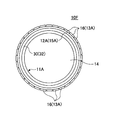
- 1 is a plan view of a superconducting magnetic shield device according to a first embodiment of the present invention.
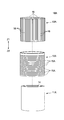
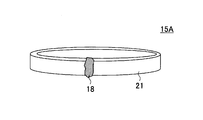
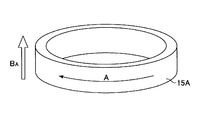
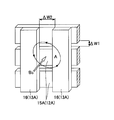
- 1 is an exploded perspective view of a superconducting magnetic shield device according to a first embodiment of the present invention. It is a perspective view which expands and shows the tape-shaped superconducting material for axial directions. It is sectional drawing which expands and shows the joining position of the tape-shaped superconducting material for axial directions, and the tape-shaped superconducting material for horizontal directions. It is a figure which shows the eddy current which generate
- FIG. 1 to 3 show a superconducting magnetic shield device 10A according to the first embodiment of the present invention.
- 1 is a perspective view of a superconducting magnetic shield device 10A
- FIG. 2 is a plan view
- FIG. 3 is an exploded perspective view.
- the superconducting magnetic shield device 10A is applied to a weak magnetic field measurement device that measures a weak magnetic field such as a magnetoencephalograph or a magnetocardiograph.
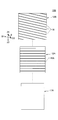
- the superconducting magnetic shield device 10A has a support 11A, an axial magnetic shield 12A, a lateral magnetic shield 13A, and the like.
- the support 11A is disposed on the innermost periphery
- the axial magnetic shield 12A is disposed on the outer periphery thereof
- the lateral magnetic shield 13A is disposed on the outer periphery thereof. Therefore, the superconducting magnetic shield device 10A has a structure in which the support 11A, the axial magnetic shield 12A, and the lateral magnetic shield 13A are overlapped in triplicate.
- the superconducting magnetic shield device 10A has a cylindrical shape as a whole. Therefore, the space part 14 is formed in the central part, and when the superconducting magnetic shield device 10A is applied to a magnetoencephalograph, the magnetoencephalometer is disposed inside the space part 14 and The person's head is inserted.
- each component constituting the superconducting magnetic shield device 10A will be described.
- the support 11A has a cylindrical shape and supports the axial magnetic shield 12A and the lateral magnetic shield 13A.
- the material of the support 11A is not particularly limited, but in the present embodiment, a resin or metal that is nonmagnetic and has good moldability is used. Specifically, FRP (glass fiber reinforced plastic) or the like can be used. Further, a cooling pipe through which a refrigerant for cooling the magnetic shields 12 and 13A flows may be disposed on the inner periphery of the support 11A.
- the axial magnetic shield 12A shields against an axial magnetic field.
- the magnetic field in the axial direction of the cylinder (directions indicated by arrows Z1 and Z2 in the figure) is called the axial magnetic field
- the magnetic field in the direction orthogonal to the axial direction of the cylinder is called the transverse magnetic field.
- a magnetic shield against an axial magnetic field is called an axial magnetic shield
- a magnetic shield against a transverse magnetic field is called a transverse magnetic shield.
- a magnetic field applied from a direction other than the axial direction or the lateral direction can be decomposed into an axial component (axial magnetic field component) and a lateral component (lateral magnetic field component). For this reason, in the following description, only an axial magnetic field and a transverse magnetic field will be described.
- the axial magnetic shield 12A has a configuration in which a plurality of axial tape-like superconducting materials 15A are stacked (stacked) in the axial direction of the support 11A.
- the axial tape-shaped superconducting material 15 ⁇ / b> A may be formed by bending the tape-shaped superconducting material 21 into a ring shape and joining both ends thereof with solder 18.
- the tape-shaped superconducting material 21 a superconducting material whose outer periphery is covered with a metal or a high-temperature superconducting material formed on a metal substrate can be used. Further, as the superconducting material, a high temperature superconducting material having a high critical temperature is used. As this tape-shaped superconducting material 21, for example, DI-BSCCO (product name) manufactured by Sumitomo Electric Industries, Ltd. can be used.
- the tape-shaped superconducting material 21 configured in this way has higher mechanical strength and resistance to distortion than the case of a single superconducting material. For this reason, even if the tape-shaped superconducting material 21 is formed in a loop shape as shown in FIG. 4, the high-temperature superconducting material is not damaged by the distortion, and the yield can be improved. Further, since the tape-shaped superconducting material 21 and the axial tape-shaped superconducting material 15A are easy to handle, the assembly work of the axial magnetic shield 12A can be easily performed.
- the tape-shaped superconducting material 15A for the axial direction configured as described above is fixed to the outer periphery of the support 11A using an adhesive or the like.
- the axial magnetic shield 12A is supported by the support 11A.
- the lateral magnetic shield 13A has a configuration in which a plurality of lateral tape-like superconducting materials 16 are arranged in parallel (arranged in parallel) in the circumferential direction of the support 11A.
- the tape-shaped superconducting material 16 for the lateral direction is configured to cover the outer periphery of the high-temperature superconducting material with a metal, or to form a high-temperature superconducting material on a metal substrate, as with the tape-shaped superconducting material 21 described above. Can be used.
- the transverse magnetic shield 13A is linear unlike the axial magnetic shield 12A. Therefore, the axial magnetic shield 12A and the lateral magnetic shield 13A are configured to extend in directions orthogonal to each other, as shown in FIGS.
- each lateral tape-shaped superconducting material 16 is configured to be parallel to the axial direction. Further, the lateral tape-shaped superconducting material 16 is disposed so as to surround the outer peripheral position of the cylindrical axial magnetic shield 12A.
- each lateral tape-shaped superconducting material 16 is joined to the axial tape-shaped superconducting material 15 ⁇ / b> A constituting each axial magnetic shield 12 ⁇ / b> A by using, for example, solder 19. Electrically connected. That is, the tape-like superconducting material 15A for the axial direction and the tape-like superconducting material 16 for the lateral direction are electrically connected by the solder 19 or the like.
- the axial magnetic shield 12A When an axial magnetic field (B A ) is applied to the superconducting magnetic shield device 10A (see FIG. 6), the axial magnetic shield 12A functions. In other words, when an axial magnetic field (B A ) is applied, an eddy current A is generated in the circumferential direction in each of the axial tape-like superconducting materials 15A constituting the axial magnetic shield 12A, thereby causing an axial magnetic field (B A ). B A ) can be prevented from affecting the space portion 14.
- the transverse magnetic shield 13A functions. That is, when the horizontal direction magnetic field (B S) is applied, axially tape-like superconducting material 15A and lateral tape-like superconducting material 16 as shown in FIG. 7, the horizontal direction magnetic field (B S) An eddy current A flowing in the circular direction around the application position is generated.
- the tape-like superconducting material 15A for the axial direction and the tape-like superconducting material 16 for the lateral direction are electrically connected by the solder 19 (see FIG. 5). Therefore, the eddy current A generated by the transverse magnetic field (B S ) flows inside each tape-shaped superconducting material 15, 16 or across each tape-shaped superconducting material 15, 16. Therefore, according to the superconducting magnetic shield device 10 ⁇ / b > A, it is possible to prevent the lateral magnetic field (B S ) from affecting the space portion 14.
- FIG. 8 shows the shield rate against the transverse magnetic field (B S ) of the superconducting magnetic shield device 10A.
- FIG. 9 shows the shielding rate against the axial magnetic field (B A ) of the superconducting magnetic shield device 10A. The characteristics shown in FIGS. 8 and 9 are all obtained by simulation.
- the horizontal axis is the frequency
- the vertical axis is the shield rate.
- the horizontal axis indicates the frequency for the following reason. That is, in the superconducting magnetic shield device 10A according to the present embodiment, the solder 18 is used to join both ends of the tape-like superconducting material 15A for the axial direction (see FIG. 4), and each of the tape-like superconducting materials 15 and 16 is attached. Solder 19 is also used for joining. That is, the axial magnetic shield 12A and the lateral magnetic shield 13A are not perfect superconductors but include the resistance components of the solders 18 and 19.
- the applied magnetic field is a DC magnetic field
- the axial magnetic shield 12A and the lateral magnetic shield 13A cannot effectively shield them.
- shielding can be performed. 8 to 10 show the frequency of the applied magnetic field as the horizontal axis.
- the frequency of the magnetic field is 1 Hz or more regardless of whether the magnetic field is an axial magnetic field or a longitudinal magnetic field. Therefore, when the shield rate at 1 Hz of the lateral external magnetic field (B S ) in FIG. 8 is seen, it can be seen that the shield rate of the transverse magnetic shield 13A is as high as about 7000. Further, in FIG. 9, when the shield rate at the axial external magnetic field (B A ) at 1 Hz is seen, it can be seen that the shield rate of the axial magnetic shield 12A is as high as about 12,500.
- the superconducting magnetic shield device 10 ⁇ / b> A is effective for both the axial magnetic field (B A ) and the lateral magnetic field (B S ) from the outside. Prove that you can make a good shield.
- the axial magnetic shield 12A is obtained by laminating the axial tape-like superconducting material 15A in the axial direction, and the lateral magnetic shield 13A is provided with the lateral tape-like superconducting material 16 arranged in the circumferential direction. It is a thing. That is, the axial magnetic shield 12A and the lateral magnetic shield 13A are not integrally molded, and a plurality of axial tape-like superconducting materials 15A and lateral tape-like superconducting materials 16 are assembled and joined together. Has been.
- the individual tape-like superconducting materials 15 and 16 can be inspected for quality when the axial magnetic shield 12A and the lateral magnetic shield 13A are manufactured.
- the axial magnetic shield 12A and the lateral magnetic shield 13A after selecting the good tape-shaped superconducting materials 15 and 16.
- the yield can be increased even when the high-temperature superconducting material is used.
- the gap ⁇ W1 inevitably between the adjacent axial tape-like superconducting materials 15A (FIG. 5, FIG. 5). 7 is indicated by an arrow).
- the lateral magnetic shield 13A is configured by arranging the lateral tape-shaped superconducting material 16 side by side, the gap ⁇ W2 inevitably between the adjacent lateral tape-shaped superconducting materials 16 (arrows in FIGS. 2 and 7). Occurs).
- FIG. 10A shows the distance ⁇ W1 between adjacent axial tape-like superconducting materials 15A, the connection resistance of the axial tape-like superconducting material 15A, and the shielding rate of the axial magnetic shield 12A in the axial magnetic shield 12A. Shows the relationship.
- FIG. 10B shows the distance ⁇ W2 between the adjacent lateral tape-shaped superconducting materials 16, the connection resistance of the lateral tape-shaped superconducting material 16, and the shield of the lateral magnetic shield 13A. The relationship with the rate is shown.
- connection resistance that is, the connection resistance of the solder 18
- the shield rate was set to be 1000 or more. That is, the connection resistance of the axial tape-like superconducting material 15A by the solder 18 was set to about 0.1 ⁇ .
- the gap between the axial tape-like superconducting materials 15A laminated in the axial direction was set to 2 mm or less.
- the connection resistance between the axial tape-shaped superconducting material 15A and the lateral tape-shaped superconducting material 16 is set to be equal to that of the lateral magnetic shield 13A.
- the shield rate was set to be 1000 or more. That is, the connection resistance by the solder 19 was set to about 0.1 ⁇ . Further, the gap between the transverse tape-like superconducting materials 16 arranged in parallel in the circumferential direction was set to 2 mm or less.
- the superconducting magnetic shield device 10A is applied to a weak magnetic field measuring device that measures a weak magnetic field such as a magnetoencephalograph or a magnetocardiograph, the external magnetic field can be reliably shielded. Can be accurately measured.
- 11 to 23 show superconducting magnetic shield devices 10B to 10F according to the second to seventh embodiments. 11 to 23, the components corresponding to those of the superconducting magnetic shield device 10A according to the first embodiment shown in FIGS. 1 to 7 are denoted by the same reference numerals, and the description thereof is omitted.
- FIG. 11 shows a superconducting magnetic shield device 10B according to the second embodiment.
- the tape-shaped superconducting material 16 for the lateral direction is arranged in parallel with the axial direction (arrow Z1, Z2 direction) is shown.
- the extending direction of the tape-shaped superconducting material 16 for the lateral direction (the directions of arrows D1 and D2 in the figure) is set in the axial direction (Z1, Z1) of the axial magnetic shield 12A. Z2 direction) was inclined.
- FIG. 11 shows an example in which the lateral tape-shaped superconducting material 16 is inclined at an angle ⁇ with respect to the axial direction.
- FIG. 12 shows a superconducting magnetic shield device 10C according to the third embodiment.
- the superconducting magnetic shield device 10A according to the first embodiment described above has a configuration in which the support 11A is disposed at the innermost peripheral position.
- the support 11B is disposed at the outermost peripheral position.
- the axial magnetic shield 12A is positioned on the innermost periphery
- the lateral magnetic shield 13A is positioned on the outer side
- the support 11B is positioned on the outermost periphery.
- a cooling pipe 17 through which a coolant for cooling the high-temperature superconducting material of the axial magnetic shield 12A and the lateral magnetic shield 13A flows is provided on the outer peripheral surface of the support 11B.
- the cooling pipe 17 is spirally disposed on the outer periphery of the support 11B.
- the cooling pipe 17 is not limited to this.
- the support 11B is disposed on the outermost periphery, and the magnetic shields 12 and 13 are protected by the support 11B because the axial magnetic shield 12A and the lateral magnetic shield 13A are located inside the support 11B. Therefore, even if an unnecessary external force is applied, the magnetic shields 12 and 13 can be prevented from being damaged.
- FIG. 13 is a plan view showing a superconducting magnetic shield device 10D according to the fourth embodiment.
- the plurality of transverse tape-like superconducting materials 16 constituting the transverse magnetic shield 13A are formed in an elongated plate shape and are not bent. It was.
- a predetermined range predetermined range on the Z1 direction side
- a predetermined range on the Z1 direction side above the lateral tape-shaped superconducting material 20 constituting the lateral magnetic shield 13C is bent inward.
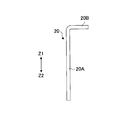
- FIG. 14 is an enlarged view of an example of one lateral tape-shaped superconducting material 20 constituting the superconducting magnetic shield device 10D according to the present embodiment.
- the tape-shaped superconducting material 20 for the lateral direction is configured to have a main body portion 20A and a bent portion 20B which is bent by bending the upper portion thereof. And has a substantially L-shape.
- the bent portion 20B in the lateral tape-shaped superconducting material 20 constituting the transverse magnetic shield 13C, a part of the upper opening of the superconducting magnetic shield device 10D is formed by the bent portion 20B.
- the configuration is closed.
- the shielding effect is greatly increased by covering part of the opening with a superconducting material. Therefore, according to the superconducting magnetic shield device 10D according to the present embodiment, the shielding effect can be further enhanced.
- the bending angle is not limited to the right angle shown in the figure, and can be set as appropriate.
- a plurality of axial tape-like superconducting materials 15A are stacked and arranged along the outer periphery of the support 11A so as to be juxtaposed in the axial direction.
- a plurality of lateral tape-like superconducting materials 16 constituting the lateral magnetic shield 13A are disposed on the outer periphery of the support 11A, and then the lateral tape.
- One tape-shaped superconducting material 15 ⁇ / b> B for axial direction is wound spirally around the superconducting material 16.
- the following method is conceivable as a method for mounting the individual tape-like superconducting material 15A for the axial direction on the support 11A.
- the tape-shaped superconducting material 21 is formed in a ring shape, and this is bonded and fixed to the support 11A over a predetermined range. Subsequently, both end portions of the tape-shaped superconducting material 21 are attached to each other, and the end portions are joined with the solder 18 (see FIG. 4).
- the axial magnetic shield 12A is composed of a single axial tape-shaped superconducting material 15B. Further, the length of the axial magnetic shield 12A is set to a length that allows the support 11A on which the transverse tape-shaped superconducting material 16 is disposed to be spirally wound a plurality of times. Therefore, the axial magnetic shield 12B is mounted on the support 11A by simply winding one axial tape-like superconducting material 15B around the support 11A on which the lateral tape-like superconducting material 16 is disposed. be able to.
- the number of parts can be reduced and the assembling work can be simplified.
- the axial magnetic shield 12B is formed of the single axial tape-like superconducting material 15B and spirally wound around the support 11A. It is good also as a structure which comprises this with the tape-shaped superconducting material for one horizontal direction, and winds this around the support body 11A helically.
- both the axial magnetic shield and the lateral magnetic shield may be formed of a single tape-shaped superconducting material, and both may be wound spirally around the support 11A. With this configuration, it is possible to further simplify the assembly work of the superconducting magnetic shield device.
- each of the axial magnetic shield and the lateral magnetic shield is constituted by one tape-shaped superconducting material.
- the axial magnetic shield and the lateral magnetic shield are composed of a plurality of tape-shaped superconducting materials. It is good also as a structure made into one by connecting.
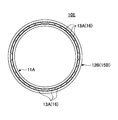
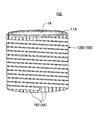
- FIG. 17 is a plan view of the superconducting magnetic shield device 10F
- FIG. 18 is a view showing a cross section of the axial magnetic shield 12A by cutting out a part of the superconducting magnetic shield device 10F.
- the support 11A is not shown.
- the gap between the axial tape-shaped superconducting material 15A constituting the axial magnetic shield 12A is set to 2 mm or less. However, there may be a case where it is necessary to perform a magnetic shield with higher accuracy.
- the superconducting magnetic shield device 10F closes the gap 34 formed between the axial tape-shaped superconducting materials 15A constituting the axial magnetic shield 12A with the closing magnetic shield 30 in order to cope with this. It is a configuration.
- the blocking magnetic shield 30 is disposed inside the axial magnetic shield 12A in this embodiment. However, it is also possible to dispose the closing magnetic shield 30 outside the axial magnetic shield 12A (on the side facing the lateral magnetic shield 13A).
- the closing magnetic shield 30 is composed of a plurality of closing tape-like superconducting materials 32.
- the closing tape-shaped superconducting material 32 the same configuration as the axial tape-shaped superconducting material 15A constituting the axial magnetic shield 12A can be used.
- the closing tape-shaped superconducting material 32 can be formed by bending the tape-shaped superconducting material 21 into a ring shape and joining both ends thereof with the solder 18.
- Each of the closing tape-like superconducting materials 32 constituting the closing magnetic shield 30 has a width (length in the Z1, Z2 direction) larger than the size of the gap 34 between the adjacent axial tape-like superconducting materials 15A. Yes. Further, each closing tape-shaped superconducting material 32 is configured to be electrically joined (for example, soldered) to the axial tape-shaped superconducting material 15A.
- FIG. 19 is a diagram showing the effect of the superconducting magnetic shield device 10F according to the present embodiment.
- the characteristics indicated by the arrow F are the same as the characteristics indicated by the arrow A in FIG. That is, the relationship between the connection resistance and the shield rate when the gap ⁇ W1 of the tape-like superconducting material 15A for the axial direction is 1 mm is shown. As described above, it can be understood that a high shielding effect can be obtained by setting the gap ⁇ W1 of the axial tape-like superconducting material 15A to 1 mm.
- an arrow E in the figure indicates the characteristic of the superconducting magnetic shield device 10F according to the present embodiment in which the gap 34 is closed by the closing magnetic shield 30. It can be seen that the characteristic of the superconducting magnetic shield device 10F is improved by about 10 compared to the characteristic when the gap ⁇ W1 of the axial tape-like superconducting material 15A is 1 mm.
- the superconducting magnetic shield device 10F according to the present embodiment, it is possible to realize high shielding performance while facilitating the assembly work.
- the configuration in which the blocking magnetic shield 30 covering the gap 34 formed in the axial magnetic shield 12A is provided.
- the horizontal tape-shaped superconducting material 16 between the horizontal magnetic shields 13A is provided.
- a closing tape-shaped superconducting material (corresponding to the second closing superconducting material described in the claims) may be disposed so as to close the gap formed by the step (shown by an arrow ⁇ W2 in FIG. 7).
- the closing tape-like superconducting material is formed so as to close only the gap 34 formed between the axial tape-like superconducting materials 15A, or is formed between the lateral tape-like superconducting materials 16.
- a configuration may be provided in which only the gap ( ⁇ W2) is closed, or a configuration in which both the gap 34 and the gap ( ⁇ W2) are further closed.
- the axial magnetic shield 12A is formed by disposing the axial tape-like superconducting material 15A on the support 11A, and then the lateral tape-like tape is formed on the axial magnetic shield 12A.
- the superconducting material 16 is soldered to join the transverse magnetic shield 13A, thereby producing the superconducting magnetic shield device 10A.
- the lattice-shaped magnetic shield 40 having a configuration in which the tape-shaped superconducting material 15A for the axial direction and the tape-shaped superconducting material 16 for the lateral direction are soldered in a lattice shape is manufactured in advance and supported.
- a superconducting magnetic shield device 10F was manufactured by disposing it on the body 11A.
- an example of the manufacturing method of the superconducting magnetic shield device 10F will be described.
- the tape-shaped superconducting materials 21 are arranged in the directions of arrows X1 and X2 in FIG. Subsequently, the tape-shaped superconducting material 21 is arranged in the directions of arrows Y1 and Y2 in FIG. 20 on the tape-shaped superconducting material 21 arranged in this manner.
- the tape-shaped superconducting materials 21 arranged in a row in the X1 and X2 directions constitute a tape-shaped superconducting material 16 for the horizontal direction, and the tape-shaped superconducting materials 21 arranged in a row in the Y1 and Y2 directions are shafts.
- a directional tape-shaped superconducting material 15A is formed. Further, when the tape-shaped superconducting material 21 to be the axial tape-shaped superconducting material 15 ⁇ / b> A is stacked on the tape-shaped superconducting material 21 to be the axial-shaped tape-shaped superconducting material 15 ⁇ / b> A, the tape-shaped superconducting material 21 intersects at a portion where the tape-shaped superconducting material 21 intersects.
- a high melting point solder is disposed.
- the tape-shaped superconducting materials 21 arranged in a grid are subjected to heat treatment in a heating furnace. Thereby, the high melting point solder is melted, and soldering is performed at each crossing portion of each tape-shaped superconducting material 21. Thereby, the tape-shaped superconducting material 15A for the axial direction and the tape-shaped superconducting material 16 for the lateral direction are joined, and the sheet-like lattice-shaped magnetic shield 40 is manufactured (electromagnetic shield forming step).
- the lattice-shaped magnetic shield 40 can be easily manufactured.
- the arrangement process can be performed on a plane such as a base. Therefore, compared with a method in which a large number of tape-like superconducting materials 15A for the axial direction and a tape-like superconducting material 16 for the lateral direction are arranged on the cylindrical support 11A, the process of bringing the tape-like superconducting materials 21 closer to each other is easier. Can be done.
- a gap between adjacent axial tape-like superconductors 15A and a gap between adjacent tape-like superconductors 16 for horizontal direction are widely illustrated.
- the dimension of is about 2mm.
- the lattice-shaped magnetic shield 40 manufactured as described above is mounted by being wound around a support 11A manufactured in advance (mounting process). At this time, the lattice-shaped magnetic shield 40 and the support 11A are fixed using an adhesive or the like.
- the tape-shaped superconducting material 21 is a bendable tape-shaped member, and the lattice-shaped magnetic shield 40 obtained by soldering the tape-shaped superconducting material 21 in a lattice shape is also flexible. Further, since the lattice-shaped magnetic shield 40 has a configuration in which the axial tape-shaped superconducting material 15A and the lateral tape-shaped superconducting material 16 are integrated, the axial tape-shaped superconducting material 15A and the lateral tape-shaped superconducting material 16 are integrated. 16 can be collectively wound around the support 11A.
- the process of mounting the lattice-shaped magnetic shield 40 on the support 11A can be easily performed.
- FIG. 22 shows a state in which both end portions (indicated by arrows P in the drawing) of the axial tape-shaped superconducting material 15A are abutted by the lattice-shaped magnetic shield 40 being wound around the support 11A.
- the axial tape-like superconducting material 15A needs to be electrically joined to effectively shield the axial magnetic field (see FIG. 4).
- solder 45 is disposed at the mating portions.
- the solder 45 is a low melting point solder having a lower melting point than that of the high melting point solder used to join the tape-shaped superconducting material 21 arranged in a grid pattern in the electromagnetic shield forming step.
- the solder 45 is melted to electrically join the butted portions of the tape-shaped superconducting materials 15A for each axial direction (joining step).
- the superconducting magnetic shield device 10G shown in FIG. 23 is manufactured.
- the lattice-shaped magnetic shield 40 can be easily manufactured in the electromagnetic shield forming step as described above. For this reason, it is possible to easily assemble the superconducting magnetic shield device 10G.
Landscapes
- Engineering & Computer Science (AREA)
- Microelectronics & Electronic Packaging (AREA)
- Containers, Films, And Cooling For Superconductive Devices (AREA)
- Superconductor Devices And Manufacturing Methods Thereof (AREA)
- Measurement And Recording Of Electrical Phenomena And Electrical Characteristics Of The Living Body (AREA)
- Shielding Devices Or Components To Electric Or Magnetic Fields (AREA)
Applications Claiming Priority (2)
| Application Number | Priority Date | Filing Date | Title |
|---|---|---|---|
| JP2013043293A JP6211277B2 (ja) | 2012-04-26 | 2013-03-05 | 脳磁計用超電導磁気シールド装置及びその製造方法 |
| JP2013-043293 | 2013-03-05 |
Publications (1)
| Publication Number | Publication Date |
|---|---|
| WO2014136288A1 true WO2014136288A1 (ja) | 2014-09-12 |
Family
ID=51492119
Family Applications (1)
| Application Number | Title | Priority Date | Filing Date |
|---|---|---|---|
| PCT/JP2013/071403 Ceased WO2014136288A1 (ja) | 2013-03-05 | 2013-08-07 | 超電導磁気シールド装置及びその製造方法 |
Country Status (2)
| Country | Link |
|---|---|
| JP (1) | JP6211277B2 (https=) |
| WO (1) | WO2014136288A1 (https=) |
Families Citing this family (2)
| Publication number | Priority date | Publication date | Assignee | Title |
|---|---|---|---|---|
| CN104093297A (zh) * | 2014-06-13 | 2014-10-08 | 中国科学院等离子体物理研究所 | 一种磁屏蔽设备 |
| JP6951235B2 (ja) * | 2017-12-21 | 2021-10-20 | 住友重機械工業株式会社 | 超伝導磁気シールド装置、及び脳磁計装置 |
Citations (5)
| Publication number | Priority date | Publication date | Assignee | Title |
|---|---|---|---|---|
| JPH01152696A (ja) * | 1987-12-09 | 1989-06-15 | Toshiba Corp | 超電導部材 |
| JPH0289399A (ja) * | 1988-04-21 | 1990-03-29 | Kyushu Univ | 磁気シールド法 |
| JPH06216565A (ja) * | 1993-01-19 | 1994-08-05 | Koatsu Gas Kogyo Co Ltd | 帯状超電導シートから形成された超電導磁気遮蔽体 |
| JPH06224036A (ja) * | 1993-01-21 | 1994-08-12 | Koatsu Gas Kogyo Co Ltd | 外部磁気漏洩防止用の超電導磁気遮蔽体 |
| JP2009260363A (ja) * | 2009-06-15 | 2009-11-05 | Nippon Steel Corp | 磁気シールド装置 |
Family Cites Families (1)
| Publication number | Priority date | Publication date | Assignee | Title |
|---|---|---|---|---|
| JP2000021621A (ja) * | 1998-06-29 | 2000-01-21 | Railway Technical Res Inst | 超電導磁石の変動磁界シールド方法 |
-
2013
- 2013-03-05 JP JP2013043293A patent/JP6211277B2/ja active Active
- 2013-08-07 WO PCT/JP2013/071403 patent/WO2014136288A1/ja not_active Ceased
Patent Citations (5)
| Publication number | Priority date | Publication date | Assignee | Title |
|---|---|---|---|---|
| JPH01152696A (ja) * | 1987-12-09 | 1989-06-15 | Toshiba Corp | 超電導部材 |
| JPH0289399A (ja) * | 1988-04-21 | 1990-03-29 | Kyushu Univ | 磁気シールド法 |
| JPH06216565A (ja) * | 1993-01-19 | 1994-08-05 | Koatsu Gas Kogyo Co Ltd | 帯状超電導シートから形成された超電導磁気遮蔽体 |
| JPH06224036A (ja) * | 1993-01-21 | 1994-08-12 | Koatsu Gas Kogyo Co Ltd | 外部磁気漏洩防止用の超電導磁気遮蔽体 |
| JP2009260363A (ja) * | 2009-06-15 | 2009-11-05 | Nippon Steel Corp | 磁気シールド装置 |
Also Published As
| Publication number | Publication date |
|---|---|
| JP2013251527A (ja) | 2013-12-12 |
| JP6211277B2 (ja) | 2017-10-11 |
Similar Documents
| Publication | Publication Date | Title |
|---|---|---|
| JP6507312B2 (ja) | Hts磁石セクション | |
| KR101867122B1 (ko) | 초전도 코일, 초전도 마그넷, 및 초전도 코일의 제조 방법 | |
| KR20090129979A (ko) | 초전도 코일 및 그것에 이용되는 초전도 도체 | |
| JP6211277B2 (ja) | 脳磁計用超電導磁気シールド装置及びその製造方法 | |
| US10043609B2 (en) | Cooling structure for electromagnetic coil, and electromagnetic actuator | |
| JP2019016685A (ja) | 超電導テープと電極との接続構造及び超電導コイル | |
| US10134515B2 (en) | Superconducting magnet device and method for manufacturing the same | |
| JP5937026B2 (ja) | 超電導磁気シールド装置 | |
| CN201319402Y (zh) | 缆线固定装置 | |
| US9378908B2 (en) | Vacuum switching apparatus and contact assembly therefor | |
| WO2014125694A1 (ja) | 超電導磁気シールド装置 | |
| KR100918450B1 (ko) | 극저온 냉각 배관의 온도센서 모듈 | |
| JP5940361B2 (ja) | 超電導電流リードの製造方法及び超電導電流リード及び超電導マグネット装置 | |
| Bondarenko et al. | Technology and Tooling to Manufacture Low-Ohm $(< 2\\hbox {n}\Omega) $ Electrical Joints of the ITER PF1 Coil | |
| JP2010067908A (ja) | 超電導マグネットおよびその製造方法 | |
| CN102789866B (zh) | 连接制冷机一级冷头的柔性导冷装置及其焊接工装 | |
| JP2014049638A (ja) | 超電導コイル、このコイルを用いた超電導マグネット、超電導コイルの製造方法 | |
| US20160131726A1 (en) | Magnetic field generation device | |
| JP2017062982A (ja) | 超電導ケーブル用断熱管及び超電導ケーブル | |
| JP7598578B2 (ja) | 超電導コイル、磁場発生装置、及び、超電導コイル製造方法 | |
| JP6075773B2 (ja) | 超電導磁気シールド装置 | |
| KR101482576B1 (ko) | 초전도 코일 조립체, 그의 조립방법 및 그를 구비한 초전도 회전기 | |
| WO2015182117A1 (ja) | 力センサ及びそれを用いた力検知装置 | |
| JPH0799111A (ja) | 酸化物超電導体を用いた電流リード | |
| JP2014165304A (ja) | 超電導機器 |
Legal Events
| Date | Code | Title | Description |
|---|---|---|---|
| 121 | Ep: the epo has been informed by wipo that ep was designated in this application |
Ref document number: 13876969 Country of ref document: EP Kind code of ref document: A1 |
|
| NENP | Non-entry into the national phase |
Ref country code: DE |
|
| 122 | Ep: pct application non-entry in european phase |
Ref document number: 13876969 Country of ref document: EP Kind code of ref document: A1 |