WO2014132934A1 - 感活性光線性又は感放射線性樹脂組成物、感活性光線性又は感放射線性膜、パターン形成方法、電子デバイス及び電子デバイスの製造方法 - Google Patents
感活性光線性又は感放射線性樹脂組成物、感活性光線性又は感放射線性膜、パターン形成方法、電子デバイス及び電子デバイスの製造方法 Download PDFInfo
- Publication number
- WO2014132934A1 WO2014132934A1 PCT/JP2014/054380 JP2014054380W WO2014132934A1 WO 2014132934 A1 WO2014132934 A1 WO 2014132934A1 JP 2014054380 W JP2014054380 W JP 2014054380W WO 2014132934 A1 WO2014132934 A1 WO 2014132934A1
- Authority
- WO
- WIPO (PCT)
- Prior art keywords
- group
- carbon atoms
- sensitive
- atom
- radiation
- Prior art date
- Legal status (The legal status is an assumption and is not a legal conclusion. Google has not performed a legal analysis and makes no representation as to the accuracy of the status listed.)
- Ceased
Links
- 0 C1C2(C3)C1CC3C*C2 Chemical compound C1C2(C3)C1CC3C*C2 0.000 description 126
- KKDZGTHLOISODY-UHFFFAOYSA-N C(C1)C2C3C1C1C2C1CCC3 Chemical compound C(C1)C2C3C1C1C2C1CCC3 KKDZGTHLOISODY-UHFFFAOYSA-N 0.000 description 1
- JWMYGWVXNOHUBR-UHFFFAOYSA-N C(C1)CC2(C3)C1CC3CCC2 Chemical compound C(C1)CC2(C3)C1CC3CCC2 JWMYGWVXNOHUBR-UHFFFAOYSA-N 0.000 description 1
- VSHDEZHNJCSDFY-UHFFFAOYSA-N C(CC1C2)C2C2C1C1CC2CC1 Chemical compound C(CC1C2)C2C2C1C1CC2CC1 VSHDEZHNJCSDFY-UHFFFAOYSA-N 0.000 description 1
- NNUULSMRBTWJKR-UHFFFAOYSA-N C(Cc1ccccc1)C(c1ccccc1)c1ccccc1 Chemical compound C(Cc1ccccc1)C(c1ccccc1)c1ccccc1 NNUULSMRBTWJKR-UHFFFAOYSA-N 0.000 description 1
- LBLNKDCTCBVCRQ-UHFFFAOYSA-N C(c1ccccc1)=[I]/c1ccccc1 Chemical compound C(c1ccccc1)=[I]/c1ccccc1 LBLNKDCTCBVCRQ-UHFFFAOYSA-N 0.000 description 1
- BYBGSCXPMGPLFP-UHFFFAOYSA-N C1C(C2)CC3C2C13 Chemical compound C1C(C2)CC3C2C13 BYBGSCXPMGPLFP-UHFFFAOYSA-N 0.000 description 1
- WDCBAELLKZPSQD-UHFFFAOYSA-N C1C2C(CC3)CC3C2C1 Chemical compound C1C2C(CC3)CC3C2C1 WDCBAELLKZPSQD-UHFFFAOYSA-N 0.000 description 1
- AIGOAHIDIXDVAT-UHFFFAOYSA-N C1C2C3C2C3C1 Chemical compound C1C2C3C2C3C1 AIGOAHIDIXDVAT-UHFFFAOYSA-N 0.000 description 1
- QQFHDKGHMOYHPI-UHFFFAOYSA-N C1CC2C(CC3)CCC3C2C1 Chemical compound C1CC2C(CC3)CCC3C2C1 QQFHDKGHMOYHPI-UHFFFAOYSA-N 0.000 description 1
- HTEFASNITGSEJD-UHFFFAOYSA-N C1CC2C3C2C3C1 Chemical compound C1CC2C3C2C3C1 HTEFASNITGSEJD-UHFFFAOYSA-N 0.000 description 1
- ZOMUSRMUWWBWRS-UHFFFAOYSA-N CC(C(C)(C)C)c(cc1)ccc1OS(C(C(F)(F)S([N+](C)([O-])S(C(F)(F)F)(=O)=O)(=O)=O)(F)F)(=O)=O Chemical compound CC(C(C)(C)C)c(cc1)ccc1OS(C(C(F)(F)S([N+](C)([O-])S(C(F)(F)F)(=O)=O)(=O)=O)(F)F)(=O)=O ZOMUSRMUWWBWRS-UHFFFAOYSA-N 0.000 description 1
- SUGDDHMZEQUWLY-UHFFFAOYSA-N CC(C(OC1C(CC2)CC2C1)=O)(N)[IH]C Chemical compound CC(C(OC1C(CC2)CC2C1)=O)(N)[IH]C SUGDDHMZEQUWLY-UHFFFAOYSA-N 0.000 description 1
- KHSUHPZEMHPXSV-UHFFFAOYSA-N CC(C)(C1CCCCC1)OC=O Chemical compound CC(C)(C1CCCCC1)OC=O KHSUHPZEMHPXSV-UHFFFAOYSA-N 0.000 description 1
- XWWHNGXZKJKICO-UHFFFAOYSA-N CC(C)CC(C(C)C)c(cc1)ccc1O Chemical compound CC(C)CC(C(C)C)c(cc1)ccc1O XWWHNGXZKJKICO-UHFFFAOYSA-N 0.000 description 1
- FRAAYIYLBFNBJS-UHFFFAOYSA-N CCOC(C)Oc1ccc(C)cc1 Chemical compound CCOC(C)Oc1ccc(C)cc1 FRAAYIYLBFNBJS-UHFFFAOYSA-N 0.000 description 1
- UEHBGFYPCMIJBK-UHFFFAOYSA-N COc1cccc(S(c2cc(OC)ccc2)c2cccc(OC)c2)c1 Chemical compound COc1cccc(S(c2cc(OC)ccc2)c2cccc(OC)c2)c1 UEHBGFYPCMIJBK-UHFFFAOYSA-N 0.000 description 1
- IWDCLRJOBJJRNH-UHFFFAOYSA-N Cc(cc1)ccc1O Chemical compound Cc(cc1)ccc1O IWDCLRJOBJJRNH-UHFFFAOYSA-N 0.000 description 1
- WLZHLUODZMOPSP-UHFFFAOYSA-N Cc(cc1)ccc1[IH](c1ccccc1)=Cc1ccccc1 Chemical compound Cc(cc1)ccc1[IH](c1ccccc1)=Cc1ccccc1 WLZHLUODZMOPSP-UHFFFAOYSA-N 0.000 description 1
- NHGJOHARTYNNHX-UHFFFAOYSA-N Oc(cc1)ccc1S(c1ccccc1)c1ccccc1 Chemical compound Oc(cc1)ccc1S(c1ccccc1)c1ccccc1 NHGJOHARTYNNHX-UHFFFAOYSA-N 0.000 description 1
- ODHKAQHVQPQOFZ-UHFFFAOYSA-N c(cc1)ccc1[I](c1ccccc1)c1ccccc1 Chemical compound c(cc1)ccc1[I](c1ccccc1)c1ccccc1 ODHKAQHVQPQOFZ-UHFFFAOYSA-N 0.000 description 1
Classifications
-
- G—PHYSICS
- G03—PHOTOGRAPHY; CINEMATOGRAPHY; ANALOGOUS TECHNIQUES USING WAVES OTHER THAN OPTICAL WAVES; ELECTROGRAPHY; HOLOGRAPHY
- G03F—PHOTOMECHANICAL PRODUCTION OF TEXTURED OR PATTERNED SURFACES, e.g. FOR PRINTING, FOR PROCESSING OF SEMICONDUCTOR DEVICES; MATERIALS THEREFOR; ORIGINALS THEREFOR; APPARATUS SPECIALLY ADAPTED THEREFOR
- G03F7/00—Photomechanical, e.g. photolithographic, production of textured or patterned surfaces, e.g. printing surfaces; Materials therefor, e.g. comprising photoresists; Apparatus specially adapted therefor
- G03F7/20—Exposure; Apparatus therefor
- G03F7/2041—Exposure; Apparatus therefor in the presence of a fluid, e.g. immersion; using fluid cooling means
-
- C—CHEMISTRY; METALLURGY
- C08—ORGANIC MACROMOLECULAR COMPOUNDS; THEIR PREPARATION OR CHEMICAL WORKING-UP; COMPOSITIONS BASED THEREON
- C08F—MACROMOLECULAR COMPOUNDS OBTAINED BY REACTIONS ONLY INVOLVING CARBON-TO-CARBON UNSATURATED BONDS
- C08F230/00—Copolymers of compounds having one or more unsaturated aliphatic radicals, each having only one carbon-to-carbon double bond, and containing phosphorus, selenium, tellurium or a metal
- C08F230/04—Copolymers of compounds having one or more unsaturated aliphatic radicals, each having only one carbon-to-carbon double bond, and containing phosphorus, selenium, tellurium or a metal containing a metal
- C08F230/08—Copolymers of compounds having one or more unsaturated aliphatic radicals, each having only one carbon-to-carbon double bond, and containing phosphorus, selenium, tellurium or a metal containing a metal containing silicon
- C08F230/085—Copolymers of compounds having one or more unsaturated aliphatic radicals, each having only one carbon-to-carbon double bond, and containing phosphorus, selenium, tellurium or a metal containing a metal containing silicon the monomer being a polymerisable silane, e.g. (meth)acryloyloxy trialkoxy silanes or vinyl trialkoxysilanes
-
- G—PHYSICS
- G03—PHOTOGRAPHY; CINEMATOGRAPHY; ANALOGOUS TECHNIQUES USING WAVES OTHER THAN OPTICAL WAVES; ELECTROGRAPHY; HOLOGRAPHY
- G03F—PHOTOMECHANICAL PRODUCTION OF TEXTURED OR PATTERNED SURFACES, e.g. FOR PRINTING, FOR PROCESSING OF SEMICONDUCTOR DEVICES; MATERIALS THEREFOR; ORIGINALS THEREFOR; APPARATUS SPECIALLY ADAPTED THEREFOR
- G03F7/00—Photomechanical, e.g. photolithographic, production of textured or patterned surfaces, e.g. printing surfaces; Materials therefor, e.g. comprising photoresists; Apparatus specially adapted therefor
- G03F7/004—Photosensitive materials
- G03F7/0045—Photosensitive materials with organic non-macromolecular light-sensitive compounds not otherwise provided for, e.g. dissolution inhibitors
-
- G—PHYSICS
- G03—PHOTOGRAPHY; CINEMATOGRAPHY; ANALOGOUS TECHNIQUES USING WAVES OTHER THAN OPTICAL WAVES; ELECTROGRAPHY; HOLOGRAPHY
- G03F—PHOTOMECHANICAL PRODUCTION OF TEXTURED OR PATTERNED SURFACES, e.g. FOR PRINTING, FOR PROCESSING OF SEMICONDUCTOR DEVICES; MATERIALS THEREFOR; ORIGINALS THEREFOR; APPARATUS SPECIALLY ADAPTED THEREFOR
- G03F7/00—Photomechanical, e.g. photolithographic, production of textured or patterned surfaces, e.g. printing surfaces; Materials therefor, e.g. comprising photoresists; Apparatus specially adapted therefor
- G03F7/004—Photosensitive materials
- G03F7/0046—Photosensitive materials with perfluoro compounds, e.g. for dry lithography
-
- G—PHYSICS
- G03—PHOTOGRAPHY; CINEMATOGRAPHY; ANALOGOUS TECHNIQUES USING WAVES OTHER THAN OPTICAL WAVES; ELECTROGRAPHY; HOLOGRAPHY
- G03F—PHOTOMECHANICAL PRODUCTION OF TEXTURED OR PATTERNED SURFACES, e.g. FOR PRINTING, FOR PROCESSING OF SEMICONDUCTOR DEVICES; MATERIALS THEREFOR; ORIGINALS THEREFOR; APPARATUS SPECIALLY ADAPTED THEREFOR
- G03F7/00—Photomechanical, e.g. photolithographic, production of textured or patterned surfaces, e.g. printing surfaces; Materials therefor, e.g. comprising photoresists; Apparatus specially adapted therefor
- G03F7/004—Photosensitive materials
- G03F7/039—Macromolecular compounds which are photodegradable, e.g. positive electron resists
- G03F7/0392—Macromolecular compounds which are photodegradable, e.g. positive electron resists the macromolecular compound being present in a chemically amplified positive photoresist composition
-
- G—PHYSICS
- G03—PHOTOGRAPHY; CINEMATOGRAPHY; ANALOGOUS TECHNIQUES USING WAVES OTHER THAN OPTICAL WAVES; ELECTROGRAPHY; HOLOGRAPHY
- G03F—PHOTOMECHANICAL PRODUCTION OF TEXTURED OR PATTERNED SURFACES, e.g. FOR PRINTING, FOR PROCESSING OF SEMICONDUCTOR DEVICES; MATERIALS THEREFOR; ORIGINALS THEREFOR; APPARATUS SPECIALLY ADAPTED THEREFOR
- G03F7/00—Photomechanical, e.g. photolithographic, production of textured or patterned surfaces, e.g. printing surfaces; Materials therefor, e.g. comprising photoresists; Apparatus specially adapted therefor
- G03F7/004—Photosensitive materials
- G03F7/039—Macromolecular compounds which are photodegradable, e.g. positive electron resists
- G03F7/0392—Macromolecular compounds which are photodegradable, e.g. positive electron resists the macromolecular compound being present in a chemically amplified positive photoresist composition
- G03F7/0397—Macromolecular compounds which are photodegradable, e.g. positive electron resists the macromolecular compound being present in a chemically amplified positive photoresist composition the macromolecular compound having an alicyclic moiety in a side chain
-
- G—PHYSICS
- G03—PHOTOGRAPHY; CINEMATOGRAPHY; ANALOGOUS TECHNIQUES USING WAVES OTHER THAN OPTICAL WAVES; ELECTROGRAPHY; HOLOGRAPHY
- G03F—PHOTOMECHANICAL PRODUCTION OF TEXTURED OR PATTERNED SURFACES, e.g. FOR PRINTING, FOR PROCESSING OF SEMICONDUCTOR DEVICES; MATERIALS THEREFOR; ORIGINALS THEREFOR; APPARATUS SPECIALLY ADAPTED THEREFOR
- G03F7/00—Photomechanical, e.g. photolithographic, production of textured or patterned surfaces, e.g. printing surfaces; Materials therefor, e.g. comprising photoresists; Apparatus specially adapted therefor
- G03F7/004—Photosensitive materials
- G03F7/09—Photosensitive materials characterised by structural details, e.g. supports, auxiliary layers
- G03F7/11—Photosensitive materials characterised by structural details, e.g. supports, auxiliary layers having cover layers or intermediate layers, e.g. subbing layers
-
- C—CHEMISTRY; METALLURGY
- C08—ORGANIC MACROMOLECULAR COMPOUNDS; THEIR PREPARATION OR CHEMICAL WORKING-UP; COMPOSITIONS BASED THEREON
- C08F—MACROMOLECULAR COMPOUNDS OBTAINED BY REACTIONS ONLY INVOLVING CARBON-TO-CARBON UNSATURATED BONDS
- C08F220/00—Copolymers of compounds having one or more unsaturated aliphatic radicals, each having only one carbon-to-carbon double bond, and only one being terminated by only one carboxyl radical or a salt, anhydride ester, amide, imide or nitrile thereof
- C08F220/02—Monocarboxylic acids having less than ten carbon atoms; Derivatives thereof
- C08F220/10—Esters
- C08F220/22—Esters containing halogen
-
- C—CHEMISTRY; METALLURGY
- C08—ORGANIC MACROMOLECULAR COMPOUNDS; THEIR PREPARATION OR CHEMICAL WORKING-UP; COMPOSITIONS BASED THEREON
- C08F—MACROMOLECULAR COMPOUNDS OBTAINED BY REACTIONS ONLY INVOLVING CARBON-TO-CARBON UNSATURATED BONDS
- C08F220/00—Copolymers of compounds having one or more unsaturated aliphatic radicals, each having only one carbon-to-carbon double bond, and only one being terminated by only one carboxyl radical or a salt, anhydride ester, amide, imide or nitrile thereof
- C08F220/02—Monocarboxylic acids having less than ten carbon atoms; Derivatives thereof
- C08F220/10—Esters
- C08F220/26—Esters containing oxygen in addition to the carboxy oxygen
Definitions
- the present invention relates to an actinic ray-sensitive or radiation-sensitive resin composition, an actinic ray-sensitive or radiation-sensitive film using the same, a pattern formation method, an electronic device, and an electronic device manufacturing method. More specifically, the present invention relates to an ultra-microlithographic process applicable to a manufacturing process of a VLSI and a high-capacity microchip, a process for producing a mold for nanoimprinting, a manufacturing process of a high-density information recording medium, and other photofabrication.
- the present invention relates to an actinic ray-sensitive or radiation-sensitive resin composition suitably used in a process, an actinic ray-sensitive or radiation-sensitive film using the same, a pattern formation method, an electronic device, and a method for manufacturing an electronic device.
- immersion liquid a high refractive index liquid
- Documents 1 to 3 disclose chemically amplified resist compositions having hydrophobicity suitable for immersion exposure.
- the resist composition is hydrophobized in order to improve the problem of pattern collapse due to ultrafine patterning, there is a case where an adverse effect on lithography properties may be observed depending on the hydrophobizing method. It has been found by the present inventors that the affinity and penetrability are lowered, the sensitivity is lowered and roughness characteristics are deteriorated, and development defects are sometimes caused.
- the present invention is excellent in sensitivity, resolution, pattern shape, and development defect suppressing ability, and particularly for EUV exposure, it has excellent ability to suppress pattern shape deterioration (film slippage) due to out-of-band light.
- An object is to provide a light-sensitive or radiation-sensitive resin composition, an actinic light-sensitive or radiation-sensitive film, a pattern forming method, an electronic device, and a method for manufacturing the electronic device.
- R ′ represents a hydrogen atom or an alkyl group.
- L represents a single bond or a divalent linking group.
- R 1 represents a hydrogen atom or a monovalent substituent.
- R 2 represents a monovalent substituent not containing a fluorine atom.
- R 1 and R 2 may be bonded to each other to form a ring together with the oxygen atom in the formula.
- R 3 represents a hydrogen atom, an alkyl group or a cycloalkyl group.
- Ra represents a hydrogen atom, an alkyl group, a cyano group, or a halogen atom.
- L 1 represents a single bond or a divalent linking group.
- R 1 and R 2 each independently represents an alkyl group. However, at least one alkyl group has 2 or more carbon atoms.
- R 11 and R 12 each independently represents an alkyl group, and R 13 represents a hydrogen atom or an alkyl group.
- R 11 and R 12 may be connected to each other to form a ring, and R 11 and R 13 may be connected to each other to form a ring.
- the resin (Aa) is further a fluorine atom, a group having a fluorine atom, a group having a silicon atom, an alkyl group having 6 or more carbon atoms, a cycloalkyl group having 5 or more carbon atoms, or 6 or more carbon atoms.
- Rb represents a hydrogen atom, an alkyl group or a halogen atom.
- S 1a represents a substituent, and when a plurality of S 1a are present, each is independent.
- p represents an integer of 0 to 5.
- Rs represents a chain or cyclic alkylene group, and when there are a plurality of Rs, they may be the same or different.
- Ls represents a single bond, an ether bond, an ester bond, an amide bond, a urethane bond or a urea bond, and when there are a plurality of Ls, they may be the same or different.
- ns represents the number of repeating linking groups represented by-(Rs-Ls)-, and represents an integer of 0 to 5.
- L ky represents an alkylene group, an oxygen atom or a sulfur atom.
- Z ka represents an alkyl group, a cycloalkyl group, an ether group, a hydroxyl group, an amide group, an aryl group, a lactone ring group, or an electron withdrawing group. If Z ka there are a plurality, the plurality of Z ka may be the same or different, may be connected to form a ring Z ka each other.
- nka represents an integer of 0 to 10.
- R kb1 and R kb2 each independently represent a hydrogen atom, an alkyl group, a cycloalkyl group, an aryl group, or an electron withdrawing group, and at least two of R kb1 , R kb2, and R ky5 are connected to each other.
- a ring may be formed.
- nkb represents 0 or 1.
- R ky5 represents an electron withdrawing group.
- actinic ray-sensitive or radiation-sensitive resin composition according to any one of [1] to [5], further comprising a compound that generates an acid upon irradiation with actinic rays or radiation.
- the content of the resin (Aa) is in the range of 0.01 to 30% by mass based on the total solid content in the composition, according to any one of [1] to [7] An actinic ray-sensitive or radiation-sensitive resin composition.
- the content of the resin (Aa) is in the range of 0.01 to 20% by mass based on the total solid content in the composition, according to any one of [1] to [7] An actinic ray-sensitive or radiation-sensitive resin composition.
- the content of the resin (Aa) is in the range of 0.01 to 10% by mass based on the total solid content in the composition, according to any one of [1] to [7] An actinic ray-sensitive or radiation-sensitive resin composition.
- the actinic ray A pattern forming method comprising exposing a light-sensitive or radiation-sensitive film by irradiating with actinic light or radiation and developing the exposed light-sensitive or radiation-sensitive film.
- [15] A semiconductor device manufactured through a process including the pattern forming method according to [13] or [14].
- the present invention is excellent in sensitivity, resolution, pattern shape and ability to suppress development defects, and particularly sensitive to EUV exposure, which has excellent ability to suppress pattern shape deterioration (film slippage) due to out-of-band light. It has become possible to provide a light-sensitive or radiation-sensitive resin composition, an actinic light-sensitive or radiation-sensitive film and a pattern forming method, an electronic device manufacturing method, and an electronic device.
- the notation that does not indicate substitution and non-substitution includes not only those having no substituent but also those having a substituent.
- the “alkyl group” includes not only an alkyl group having no substituent (unsubstituted alkyl group) but also an alkyl group having a substituent (substituted alkyl group).
- active light refers to, for example, an emission line spectrum of a mercury lamp, far ultraviolet rays represented by excimer laser, extreme ultraviolet (EUV) rays, X rays, soft X rays, electron rays (EB). Etc.
- light means actinic rays or radiation.
- the term “exposure” as used herein refers to not only exposure with far ultraviolet rays, X-rays, EUV light, etc., typified by mercury lamps and excimer lasers, but also drawing with particle beams such as electron beams and ion beams, unless otherwise specified. Include in exposure.
- the actinic ray-sensitive or radiation-sensitive resin composition (hereinafter also referred to as “the composition of the present invention”) according to the present invention is represented by the general formula (Aa1) or (Aa2) described later as a repeating unit that decomposes by the action of an acid.
- the resin (Aa) that contains a repeating unit represented by the following formula is unevenly distributed on the surface of the film and forms a protective film, and the solubility in the developer changes due to the action of an acid, which is different from the resin (Aa).
- Resin (Ab) is contained.
- the composition of the present invention comprises at least one selected from a compound that generates an acid upon irradiation with an actinic ray or radiation, an acid proliferating agent, a solvent, a basic compound, a surfactant, and other additives. Furthermore, it contains.
- Resin (Aa) is a resin that contains a repeating unit represented by the following general formula (Aa1) or (Aa2) as a repeating unit that is decomposed by the action of an acid, is unevenly distributed on the film surface by film formation, and forms a protective film. is there.
- a repeating unit represented by the following general formula (Aa1) or (Aa2) as a repeating unit that is decomposed by the action of an acid, is unevenly distributed on the film surface by film formation, and forms a protective film. is there.
- the protective film is formed unevenly distributed on the film surface by the film formation is, for example, the surface static contact angle (contact angle by pure water) of the composition film not added with the resin (Aa) and the resin (Aa).
- the surface static contact angle of the composition film to which () is added is compared, and when the contact angle increases, it can be considered that a protective layer has been formed.
- a resin containing a repeating unit represented by the general formula (Aa1) or (Aa2) having a high reaction rate (sensitivity) to the action of an acid as a compound that is unevenly distributed on the film surface by film formation to form a protective film As a result of the development of Aa), as one of the effects, it has become possible to achieve high sensitivity while improving pattern shape deterioration (film slippage) due to out-band light in EUV lithography.
- R ′ represents a hydrogen atom or an alkyl group.
- L represents a single bond or a divalent linking group.
- R 1 represents a hydrogen atom or a monovalent substituent.
- R 2 represents a monovalent substituent not containing a fluorine atom.
- R 1 and R 2 may be bonded to each other to form a ring together with the oxygen atom in the formula.
- R 3 represents a hydrogen atom, an alkyl group or a cycloalkyl group.
- Ra represents a hydrogen atom, an alkyl group, a cyano group, or a halogen atom.
- L 1 represents a single bond or a divalent linking group.
- R 1 and R 2 each independently represents an alkyl group. However, at least one alkyl group has 2 or more carbon atoms.
- R 11 and R 12 each independently represents an alkyl group, and R 13 represents a hydrogen atom or an alkyl group. Any two of R 11 , R 12 and R 13 may be connected to each other to form a ring.
- a repeating unit represented by the general formula (Aa1) (hereinafter also referred to as “repeating unit (Aa1)”) and a repeating unit represented by the general formula (Aa2) (hereinafter also referred to as “repeating unit (Aa2)”). )
- the resin (Aa) more preferably includes a repeating unit (Aa1).
- the repeating unit (Aa1) and the repeating unit (Aa2) will be described in detail.
- the alkyl group of R ′ is preferably an alkyl group having 1 to 10 carbon atoms, more preferably an alkyl group having 1 to 5 carbon atoms, and an alkyl group having 1 to 3 carbon atoms.
- An alkyl group is more preferable, and an alkyl group having 1 or 2 carbon atoms (that is, a methyl group or an ethyl group) is preferable.
- Specific examples of the alkyl group for R ′ include, for example, methyl group, ethyl group, n-propyl group, isopropyl group, n-butyl group, isobutyl group, sec-butyl group, and t-butyl group. Can do.
- R ′ is preferably a hydrogen atom or an alkyl group having 1 to 5 carbon atoms, more preferably a hydrogen atom or an alkyl group having 1 to 3 carbon atoms, a hydrogen atom, a methyl group or ethyl It is more preferably a group, and particularly preferably a hydrogen atom.
- Examples of the divalent linking group represented by L include an alkylene group, an aromatic ring group, a cycloalkylene group, —COO—L 1 ′ —, —OL 1 ′ —, —CONH—, and two or more thereof.
- Examples include groups formed in combination.
- L 1 ′ is an alkylene group (preferably having 1 to 20 carbon atoms), a cycloalkylene group (preferably having 3 to 20 carbon atoms), a group having a lactone structure, an aromatic ring group, or a combination of an alkylene group and an aromatic ring group Represents a group.
- the alkylene group as the divalent linking group represented by L is preferably an alkylene group having 1 to 8 carbon atoms such as a methylene group, an ethylene group, a propylene group, a butylene group, a hexylene group or an octylene group.
- An alkylene group having 1 to 4 carbon atoms is more preferable, and an alkylene group having 1 or 2 carbon atoms is particularly preferable.
- the cycloalkylene group as the divalent linking group represented by L is preferably a cycloalkylene group having 3 to 20 carbon atoms, for example, a cyclopropylene group, a cyclobutylene group, a cyclopentylene group, a cyclohexylene group. , Cycloheptylene group, cyclooctylene group, norbornylene group or adamantylene group.
- the aromatic ring group as the divalent linking group represented by L is an aromatic ring group having 6 to 18 carbon atoms (more preferably 6 to 10 carbon atoms) such as a benzene ring or a naphthalene ring group, or, for example, thiophene
- Preferred examples include aromatic ring groups including hetero rings such as rings, furan rings, pyrrole rings, benzothiophene rings, benzofuran rings, benzopyrrole rings, triazine rings, imidazole rings, benzimidazole rings, triazole rings, thiadiazole rings, and thiazole rings.
- a benzene ring group is particularly preferable.
- alkylene group, cycloalkylene group and aromatic ring group represented by L 1 ′ are the same as those in the alkylene group, cycloalkylene group and aromatic ring group as the divalent linking group represented by L. .
- any group having a lactone structure can be used.
- a 5- to 7-membered ring lactone structure is preferable, and a bicyclic lactone structure is included in the 5- to 7-membered ring lactone structure.
- a structure in which another ring structure is condensed to form a structure or a spiro structure is preferable.
- KA-1-1 to KA-1-17 described later can be mentioned, and KA-1-1, KA-1-4, KA-1-5, and KA-1-17 are preferable.
- alkylene group and aromatic group in the group in which the alkylene group and the aromatic ring group represented by L 1 ′ are combined are those in the alkylene group and aromatic ring group as the divalent linking group represented by L It is the same.
- L is preferably a single bond, aromatic ring group, norbornane ring group or adamantane ring group, more preferably a single bond, norbornane ring group or adamantane ring group, more preferably a single bond or norbornane ring group, and a single bond Particularly preferred.
- the monovalent substituent for R 1 is preferably a group represented by * —C (R 111 ) (R 112 ) (R 113 ).
- * represents a bond linked to a carbon atom in the repeating unit represented by the general formula (Aa1).
- R 111 to R 113 each independently represents a hydrogen atom, an alkyl group, a cycloalkyl group, an aryl group, an aralkyl group or a heterocyclic group.
- the alkyl group of R 111 to R 113 is preferably an alkyl group having 1 to 15 carbon atoms, more preferably an alkyl group having 1 to 10 carbon atoms, and an alkyl group having 1 to 6 carbon atoms. Is more preferable.
- alkyl group of R 111 to R 113 include, for example, methyl group, ethyl group, propyl group, isopropyl group, n-butyl group, sec-butyl group, t-butyl group, neopentyl group, hexyl group, 2 -Ethylhexyl group, octyl group, dodecyl group and the like can be mentioned, and the alkyl group of R 111 to R 113 is preferably a methyl group, an ethyl group, a propyl group, an isopropyl group or a t-butyl group.
- At least two of R 111 to R 113 each independently represents an alkyl group, a cycloalkyl group, an aryl group, an aralkyl group or a heterocyclic group, and all of R 111 to R 113 are an alkyl group, a cycloalkyl group, It preferably represents an aryl group, an aralkyl group or a heterocyclic group.
- the cycloalkyl group of R 111 to R 113 may be monocyclic or polycyclic, and is preferably a cycloalkyl group having 3 to 15 carbon atoms, and a cycloalkyl group having 3 to 10 carbon atoms.
- An alkyl group is more preferable, and a cycloalkyl group having 3 to 6 carbon atoms is still more preferable.
- cycloalkyl group represented by R 111 to R 113 include, for example, a cyclopropyl group, a cyclobutyl group, a cyclopentyl group, a cyclohexyl group, a cycloheptyl group, a cyclooctyl group, a decahydronaphthyl group, a cyclodecyl group, and a 1-adamantyl group. , 2-adamantyl group, 1-norbornyl group, 2-norbornyl group and the like.
- the cycloalkyl group of R 111 to R 113 is preferably a cyclopropyl group, a cyclopentyl group, or a cyclohexyl group.
- the aryl group of R 111 to R 113 is preferably an aryl group having 6 to 15 carbon atoms, more preferably an aryl group having 6 to 12 carbon atoms, and a plurality of aromatic rings are bonded to each other via a single bond. It also includes linked structures (eg, biphenyl group, terphenyl group). Specific examples of the aryl group of R 111 to R 113 include a phenyl group, a naphthyl group, an anthranyl group, a biphenyl group, a terphenyl group, and the like. The aryl group of R 111 to R 113 is preferably a phenyl group, a naphthyl group, or a biphenyl group.
- the aralkyl group of R 111 to R 113 is preferably an aralkyl group having 6 to 20 carbon atoms, and more preferably an aralkyl group having 7 to 12 carbon atoms.
- Specific examples of the aralkyl group of R 111 to R 113 include a benzyl group, a phenethyl group, a naphthylmethyl group, a naphthylethyl group, and the like.
- the heterocyclic group of R 111 to R 113 is preferably a heterocyclic group having 6 to 20 carbon atoms, and more preferably a heterocyclic group having 6 to 12 carbon atoms.
- Specific examples of the heterocyclic group represented by R 111 to R 113 include, for example, pyridyl group, pyrazyl group, tetrahydrofuranyl group, tetrahydropyranyl group, tetrahydrothiophene group, piperidyl group, piperazyl group, furanyl group, pyranyl group, chromanyl group. Etc.
- the alkyl group, cycloalkyl group, aryl group, aralkyl group and heterocyclic group as R 111 to R 113 may further have a substituent.
- alkyl group as R 111 to R 113 may further have include a cycloalkyl group, an aryl group, an amino group, an amide group, a ureido group, a urethane group, a hydroxy group, a carboxy group, a halogen atom, and an alkoxy group.
- the above substituents may be bonded to each other to form a ring, and examples of the ring when the above substituents are bonded to each other to form a ring include a cycloalkyl group having 3 to 10 carbon atoms or a phenyl group. .
- the carbon number of the substituent that the cycloalkyl group may further have is preferably 1-8.
- Examples of the substituent that the aryl group, aralkyl group and heterocyclic group as R 111 to R 113 may further have include a halogen atom such as a nitro group and a fluorine atom, a carboxyl group, a hydroxyl group, an amino group, a cyano group, and an alkyl group.
- Group preferably 1 to 15 carbon atoms
- alkoxy group preferably 1 to 15 carbon atoms
- cycloalkyl group preferably 3 to 15 carbon atoms
- aryl group preferably 6 to 14 carbon atoms
- alkoxycarbonyl examples thereof include a group (preferably having 2 to 7 carbon atoms), an acyl group (preferably having 2 to 12 carbon atoms), an alkoxycarbonyloxy group (preferably having 2 to 7 carbon atoms), and the like.
- At least two of R 111 to R 113 may form a ring with each other.
- examples of the ring formed include a tetrahydropyran ring, a cyclopentane ring, a cyclohexane ring, an adamantane ring, a norbornene ring, and a norbornane ring.
- These rings may have a substituent, and examples of the substituent that may be included include the alkyl group and the groups described above as specific examples of the substituent that the alkyl group as R 111 to R 113 may further have. Is mentioned.
- examples of the ring formed include an adamantane ring, norbornane ring, norbornene ring, bicyclo [2,2,2] octane ring, bicyclo [3, 1,1] heptane ring.
- an adamantane ring is particularly preferred.
- substituents may be included include the alkyl groups and the groups described above as specific examples of the substituent that the alkyl groups as R 111 to R 113 may further have. It is done.
- the monovalent substituent of R 2 does not contain a fluorine atom. If an electron withdrawing group such as a fluorine atom is included, the reaction rate (sensitivity) to the action of the acid is slow, so the desired performance cannot be achieved, while oxygen and nitrogen also act as electron withdrawing groups. It has been found by the present inventors that the desired performance is obtained even if atoms are included.
- the monovalent substituent of R 2 may be a group consisting of two or more atoms selected from a carbon atom, a hydrogen atom, an oxygen atom, a nitrogen atom, a silicon atom, and a sulfur atom.
- it is a group consisting of two or more atoms selected from a carbon atom, a hydrogen atom, an oxygen atom and a nitrogen atom, more preferably from two or more atoms selected from a carbon atom, a hydrogen atom and an oxygen atom.
- a group consisting of a carbon atom and a hydrogen atom is particularly preferable.
- the monovalent substituent of R 2 is preferably a group represented by * -MQ.
- * Represents a bond connected to an oxygen atom in the general formula (Aa1).
- M represents a single bond or a divalent linking group.
- Q represents an alkyl group, a cycloalkyl group, an aryl group, or a heterocyclic group (not including a fluorine atom).
- the divalent linking group as M is, for example, an alkylene group (preferably an alkylene group having 1 to 8 carbon atoms, such as a methylene group, an ethylene group, a propylene group, a butylene group, a hexylene group or an octylene group), a cycloalkylene group.
- an alkylene group preferably an alkylene group having 1 to 8 carbon atoms, such as a methylene group, an ethylene group, a propylene group, a butylene group, a hexylene group or an octylene group
- a cycloalkylene group preferably an alkylene group having 1 to 8 carbon atoms, such as a methylene group, an ethylene group, a propylene group, a butylene group, a hexylene group or an octylene group
- a cycloalkylene group having 3 to 15 carbon atoms such as a cyclopentylene group or a cyclohexylene group
- R 0 is a hydrogen atom or an alkyl group (for example, an alkyl group having 1 to 8 carbon atoms, specifically, a methyl group, an ethyl group, a propyl group, an n-butyl group, a sec-butyl group, Hexyl group and octyl group).
- M is preferably a single bond, an alkylene group, or a divalent linking group comprising a combination of an alkylene group and at least one of —O—, —CO—, —CS— and —N (R 0 ) —.
- a divalent linking group comprising a bond, an alkylene group, or a combination of an alkylene group and —O— is more preferable.
- R 0 has the same meaning as R 0 described above.
- M may further have a substituent, and the substituent that M may further have is the same as the substituent that the alkyl group of R 111 to R 113 described above may have.
- alkyl group as Q are the same as those described for the alkyl group as R 111 to R 113 described above, for example.
- the cycloalkyl group as Q may be monocyclic or polycyclic.
- the cycloalkyl group preferably has 3 to 10 carbon atoms.
- Examples of the cycloalkyl group include a cyclopropyl group, a cyclobutyl group, a cyclopentyl group, a cyclohexyl group, a cycloheptyl group, a cyclooctyl group, a 1-adamantyl group, a 2-adamantyl group, a 1-norbornyl group, a 2-norbornyl group, Bornyl group, isobornyl group, 4-tetracyclo [6.2.1.1 3,6 .
- a 0 2,7 ] dodecyl group, an 8-tricyclo [5.2.1.0 2,6 ] decyl group, and a 2-bicyclo [2.2.1] heptyl group are preferable.
- a cyclopentyl group, a cyclohexyl group, a 2-adamantyl group, an 8-tricyclo [5.2.1.0 2,6 ] decyl group, and a 2-bicyclo [2.2.1] heptyl group are preferable.
- aryl group as Q are the same as those described for the aryl group as R 111 to R 113 described above, for example.
- heterocyclic group as Q are the same as those described for the heterocyclic group as R 111 to R 113 described above, for example.
- the alkyl group, cycloalkyl group, aryl group and heterocyclic group (not including a fluorine atom) as Q may have a substituent, for example, an alkyl group, a cycloalkyl group, a cyano group, a halogen atom, Examples thereof include a hydroxyl group, an alkoxy group, a carboxyl group, and an alkoxycarbonyl group.
- R 2 is preferably an alkyl group, an alkyl group substituted with a cycloalkyl group, a cycloalkyl group, an aralkyl group, an aryloxyalkyl group or a heterocyclic group (not including a fluorine atom), and an alkyl group or a cycloalkyl group More preferably, it is a group.
- alkyl group substituted by a cycloalkyl group “aralkyl group (arylalkyl group)” and “aryloxyalkyl group” as R 2 are the alkylene group as M, respectively. This is the same as that described in.
- heterocyclic group not including a fluorine atom
- R 2 Specific examples and preferred examples of the heterocyclic group (not including a fluorine atom) as R 2 are the same as those described for the heterocyclic group (not including a fluorine atom) as Q.
- substituent represented by R 2 include a methyl group, an ethyl group, an isopropyl group, a cyclopentyl group, a cyclohexyl group, a cyclohexylethyl group, a 2-adamantyl group, and 8-tricyclo [5.2.1. 0 2,6 ] decyl group, 2-bicyclo [2.2.1] heptyl group, benzyl group, 2-phenethyl group, 2-phenoxyethylene group and the like.
- R 1 and R 2 may be bonded to each other to form a ring (oxygen-containing heterocycle) together with the oxygen atom in the formula.
- the oxygen-containing heterocyclic structure may be any of a monocyclic, polycyclic or spiro ring, and is preferably a monocyclic oxygen-containing heterocyclic structure, preferably having 3 to 10 carbon atoms, more preferably Is 4 or 5.
- M when M is a divalent linking group, Q may be bonded to M via a single bond or another linking group to form a ring.
- the other linking group include an alkylene group (preferably an alkylene group having 1 to 3 carbon atoms), and the ring formed is preferably a 5- or 6-membered ring.
- R 3 is preferably a hydrogen atom or an alkyl group having 1 to 5 carbon atoms, more preferably a hydrogen atom or an alkyl group having 1 to 3 carbon atoms, a hydrogen atom, a methyl group or ethyl It is more preferably a group, and particularly preferably a hydrogen atom.
- one of R 1 and R 3 is preferably a group containing 2 or more carbon atoms.
- the repeating unit represented by the general formula (Aa1) is preferably a repeating unit represented by any one of the following general formulas (Aa1-1) to (Aa1-4).
- R ′ 1 represents a hydrogen atom or a methyl group, and is preferably a methyl group.
- R 11 , R 12 and R 13 has the same meaning as R 1 , R 2 and R 3 in the general formula (Aa1).
- R ′ 2 represents a hydrogen atom or a methyl group, and is preferably a methyl group.
- R 21 , R 22 and R 23 has the same meaning as R 1 , R 2 and R 3 in the general formula (Aa1).
- R ′ 3 represents a hydrogen atom or a methyl group, and is preferably a methyl group.
- R 31 , R 32 and R 33 has the same meaning as R 1 , R 2 and R 3 in the general formula (Aa1).
- L ′ represents a single bond or a divalent linking group.
- the divalent linking group for L ′ include an alkylene group, an aromatic ring group, a cycloalkylene group, —COO-L 1 ′ —, —OL 1 ′ —, —CONH—, and two or more thereof. Examples include groups formed in combination.
- L 1 ′ represents an alkylene group (preferably having a carbon number of 1 to 20), a cycloalkylene group (preferably having a carbon number of 3 to 20), an aromatic ring group, or a combination of an alkylene group and an aromatic ring group.
- L ′ is preferably a single bond.
- R 41 , R 42 and R 43 has the same meaning as R 1 , R 2 and R 3 in the general formula (Aa1).
- the repeating unit represented by the general formula (Aa1) is preferably a repeating unit represented by any one of the general formulas (Aa1-1) to (Aa1-4).
- the repeating unit represented by any one of (Aa1-1) to (Aa1-3) is more preferred, and the repeating unit represented by the general formula (Aa1-1) or (Aa1-3). More preferred is a repeating unit represented by formula (Aa1-1).
- the repeating unit represented by the general formula (Aa1) is also preferably a repeating unit represented by any of the following (Aa1-a) to (Aa1-f).
- R a ′, L a , R 2a and R 1a is the same as R ′, L, R 2 and R 1 in formula (Aa1), and the preferred ranges are also the same.
- R b ′, L b , R 2b and R 3b is the same as R ′, L, R 2 and R 3 in the general formula (Aa1), and preferred ranges are also the same.
- R c ′, L c , R 2c and R 3c is the same as R ′, L, R 2 and R 3 in formula (Aa1), and the preferred ranges are also the same.
- R 1a ′ is the same as R 111 in formula (Aa1), and the preferred range is also the same.
- R d ′, L d , R 2d and R 3d is the same as R ′, L, R 2 and R 3 in the general formula (Aa1), and preferred ranges are also the same.
- R 2a ′ and R 2b ′ is the same as R 111 and R 112 in General Formula (Aa1), and the preferred range is also the same.
- R e ′, L e , R 2e and R 3e is the same as R ′, L, R 2 and R 3 in formula (Aa1), and the preferred range is also the same.
- R 3a ′, R 3b ′ and R 3c ′ is the same as R 111 , R 112 and R 113 in General Formula (Aa1), and the preferred range is also the same.
- R f ′ and L f are the same as R ′ and L in the general formula (Aa1), and preferred ranges are also the same.
- R 3f is the same as R 3 in formula (Aa1), and the preferred range is also the same.
- R 4f represents an atomic group necessary for forming an oxygen-containing heterocyclic ring together with the carbon atom and the oxygen atom in the formula.
- the oxygen-containing heterocyclic structure formed by R 4f together with the carbon atom and the oxygen atom is preferably a monocyclic oxygen-containing heterocyclic structure, and the oxygen-containing heterocyclic ring preferably has 3 to 10 carbon atoms, more preferably 4 or 5.
- the repeating unit represented by the general formula (Aa1) is more preferably a repeating unit represented by any one of the general formulas (Aa1-c) to (Aa1-f).
- a repeating unit represented by formula (Aa1-e) or (Aa1-f) is more preferable.
- Preferred specific examples of each partial structure and each group in the general formula (Aa1) are shown below.
- Preferred specific examples of the partial structure represented by the following general formula (Aa1 ′) in the above general formula (Aa1) are as follows.
- * represents a bond connected to the carbon atom to which R1 and R3 in the general formula (Aa1) are bonded
- R ′ and L are each in the general formula (Aa1).
- R ′ and L are represented.
- R 2 in the general formula (Aa1) Specific examples of R 2 in the general formula (Aa1) are shown below.
- * represents a bond bonded to an oxygen atom in the general formula (Aa1).
- R 4f forms an oxygen-containing group together with the carbon atom and the oxygen atom in the formula
- R 4f forms an oxygen-containing group together with the carbon atom and the oxygen atom in the formula
- * Represents a bond linked to an oxygen atom in the general formula (Aa1-f).
- R 3f is the same as that in formula (Aa1-f).
- repeating unit represented by the general formula (Aa1) Specific examples of the repeating unit represented by the general formula (Aa1) are shown below, but the present invention is not limited thereto.
- the content of the repeating unit represented by the general formula (Aa1) in the resin (Aa) (the total when there are a plurality of types) is 5 to 80 mol% with respect to all the repeating units in the resin (Aa). It is preferably 5 to 60 mol%, more preferably 10 to 40 mol%.
- R 1 and R 2 represent an alkyl group as described above. However, at least one alkyl group has 2 or more carbon atoms. From the viewpoint of more reliably achieving the effects of the present invention, both R 1 and R 2 are preferably alkyl groups having 2 or more carbon atoms, more preferably alkyl groups having 2 to 10 carbon atoms, More preferably, both 1 and R 2 are ethyl groups.
- R 11 and R 12 each independently represent an alkyl group
- R 13 represents a hydrogen atom or an alkyl group.
- the alkyl group as R 11 to R 13 is preferably an alkyl group having 1 to 10 carbon atoms, for example, methyl group, ethyl group, propyl group, isopropyl group, n-butyl group, sec-butyl group, t -Butyl group, neopentyl group, hexyl group, 2-ethylhexyl group, octyl group, dodecyl group and the like.
- the alkyl group for R 11 and R 12 is more preferably an alkyl group having 1 to 4 carbon atoms, still more preferably a methyl group or an ethyl group, and particularly preferably a methyl group.
- R 13 is more preferably a hydrogen atom or a methyl group.
- R 11 and R 12 may be connected to each other to form a ring, and R 11 and R 13 may be connected to each other to form a ring.
- a monocyclic or polycyclic alicyclic hydrocarbon group is preferable, and in particular, R 11 and R 12 are bonded to each other to form a monocyclic or polycyclic alicyclic hydrocarbon group. It is preferable.
- the ring formed by connecting R 11 and R 12 is preferably a 3- to 8-membered ring, more preferably a 5- or 6-membered ring.
- the ring formed by connecting R 11 and R 13 is preferably a 3- to 8-membered ring, more preferably a 5- or 6-membered ring.
- the ring formed by connecting R 11 and R 12 or R 11 and R 13 is more preferably an alicyclic group described later as X in formula (Aa2-1).
- the alkyl group as R 1 , R 2 and R 11 to R 13 may further have a substituent.
- substituents include cycloalkyl groups, aryl groups, amino groups, hydroxy groups, carboxy groups, halogen atoms, alkoxy groups, aralkyloxy groups, thioether groups, acyl groups, acyloxy groups, alkoxycarbonyl groups, cyano groups. Groups and nitro groups.
- the ring formed by connecting R 11 and R 12 and the ring formed by connecting R 11 and R 13 may further have a substituent, and as such a substituent, Alkyl groups (methyl group, ethyl group, propyl group, butyl group, perfluoroalkyl group (for example, trifluoromethyl group) etc.) and alkyl groups as R 1 , R 2 and R 11 to R 13 Specific examples of substituents that can be used include the groups described above.
- the above substituents may be bonded to each other to form a ring, and examples of the ring when the above substituents are bonded to each other to form a ring include a cycloalkyl group having 3 to 10 carbon atoms or a phenyl group. .
- Ra represents a hydrogen atom, an alkyl group, a cyano group, or a halogen atom as described above.
- the alkyl group for Ra is preferably an alkyl group having 1 to 4 carbon atoms and may have a substituent.
- Preferable substituents that the alkyl group of Ra may have include, for example, a hydroxyl group and a halogen atom.
- halogen atom for Ra examples include a fluorine atom, a chlorine atom, a bromine atom, and an iodine atom.
- Ra is preferably a hydrogen atom, a methyl group, a hydroxymethyl group, or a perfluoroalkyl group having 1 to 4 carbon atoms (for example, a trifluoromethyl group), and the glass transition point (Tg) of the resin (A).
- Tg glass transition point
- a methyl group is particularly preferable from the viewpoint of improving resolution and space width roughness.
- Ra is preferably a hydrogen atom.
- L 1 represents a single bond or a divalent linking group as described above.
- L 11 represents an alkylene group, a cycloalkylene group, a divalent aromatic ring group, or a group in which an alkylene group and a divalent aromatic ring group are combined.
- alkylene group for L 1 and L 11 examples include alkylene groups having 1 to 8 carbon atoms such as a methylene group, an ethylene group, a propylene group, a butylene group, a hexylene group, and an octylene group.
- An alkylene group having 1 to 4 carbon atoms is more preferable, and an alkylene group having 1 or 2 carbon atoms is particularly preferable.
- the cycloalkylene group for L 11 is preferably a cycloalkylene group having 3 to 20 carbon atoms, for example, a cyclopropylene group, a cyclobutylene group, a cyclopentylene group, a cyclohexylene group, a cycloheptylene group, a cyclooctylene group. , Norbornylene group or adamantylene group.
- the carbon constituting the ring may be a carbonyl carbon, a heteroatom such as an oxygen atom, an ester bond, and a lactone A ring may be formed.
- a phenylene group such as 1,4-phenylene group, 1,3-phenylene group, 1,2-phenylene group, and 1,4-naphthylene group are preferable, A 1,4-phenylene group is more preferred.
- L 1 is preferably a single bond, a divalent aromatic ring group, a divalent group having a norbornylene group or a divalent group having an adamantylene group, and particularly preferably a single bond.
- the repeating unit represented by the general formula (Aa2) is preferably a repeating unit represented by the following general formula (Aa2-1).
- X represents an alicyclic group.
- R 1, R 2, Ra and L 1 respectively, have the same meaning as R 1, R 2, Ra and L 1 in the general formula (Aa2), specific examples, R 1 also in the general formula (Aa2) for preferred embodiments , R 2 , Ra and L 1 are the same.
- the alicyclic group as X may be monocyclic, polycyclic or bridged, and preferably represents an alicyclic group having 3 to 25 carbon atoms.
- the alicyclic group may have a substituent, and examples of the substituent are the same as the substituents described above as the substituent that the ring formed by connecting R 11 and R 12 may have. Can be mentioned.
- X preferably represents an alicyclic group having 3 to 25 carbon atoms, more preferably an alicyclic group having 5 to 20 carbon atoms, and particularly preferably a cycloalkyl group having 5 to 15 carbon atoms.
- X is preferably a 3- to 8-membered alicyclic group or a condensed ring group thereof, and more preferably a 5- or 6-membered ring or a condensed ring group thereof. Below, the structural example of the alicyclic group as X is shown.
- Preferred examples of the alicyclic group include an adamantyl group, a noradamantyl group, a decalin residue, a tricyclodecanyl group, a tetracyclododecanyl group, a norbornyl group, a cedrol group, a cyclopentyl group, a cyclohexyl group, a cycloheptyl group, A cyclooctyl group, a cyclodecanyl group, and a cyclododecanyl group can be exemplified.
- a cyclohexyl group, a cyclopentyl group, an adamantyl group and a norbornyl group are more preferred, a cyclohexyl group and a cyclopentyl group are more preferred, and a cyclohexyl group is particularly preferred.
- repeating unit represented by the general formula (Aa2) or (Aa2-1) are shown below, but the present invention is not limited thereto.
- the content of the repeating unit represented by the general formula (Aa2) in the resin (Aa) is 5 to 80 mol% with respect to all the repeating units in the resin (Aa). Preferably, it is 5 to 60 mol%, more preferably 10 to 40 mol%.
- the resin (Aa) includes a fluorine atom, a group having a fluorine atom, a group having a silicon atom, an alkyl group having 6 or more carbon atoms, a cycloalkyl group having 5 or more carbon atoms, and a carbon number It may further include a repeating unit (Aa3) having one or more groups selected from the group consisting of 6 or more aryl groups and an aralkyl group having 7 or more carbon atoms.
- This repeating unit (Aa3) is a repeating unit different from the above-described repeating units (Aa1) and (Aa2).
- the repeating unit (Aa3) preferably has a fluorine atom or a group having a fluorine atom. Since the resin (Aa) has a fluorine atom or a group having a fluorine atom, the absorption coefficient of the resin (Aa) with respect to extreme ultraviolet rays is improved, and the resin (Aa) has a property of being unevenly distributed on the resist film surface. Therefore, it is considered that the energy of the extreme ultraviolet light can be efficiently absorbed on the film surface to which the extreme ultraviolet light is more strongly irradiated at the time of exposure, and as a result, the sensitivity is considered to be improved.
- Examples of the group having a fluorine atom include an alkyl group having a fluorine atom, a cycloalkyl group having a fluorine atom, and an aryl group having a fluorine atom.
- the alkyl group having a fluorine atom preferably includes an alkyl group having 1 to 10 carbon atoms, more preferably 1 to 4 carbon atoms, and a straight chain in which at least one hydrogen atom is substituted with a fluorine atom. Or it is a branched alkyl group and may have substituents other than a fluorine atom.
- the cycloalkyl group having a fluorine atom is a monocyclic or polycyclic cycloalkyl group in which at least one hydrogen atom is substituted with a fluorine atom, and may further have a substituent other than a fluorine atom.
- aryl group having a fluorine atom examples include those in which at least one hydrogen atom of an aryl group such as a phenyl group or a naphthyl group is substituted with a fluorine atom, and may further have a substituent other than a fluorine atom. .
- alkyl group having a fluorine atom examples include groups represented by the following general formulas (F2) to (F4).
- the invention is not limited to this.
- R 57 to R 68 each independently represents a hydrogen atom, a fluorine atom or an alkyl group (straight or branched). However, at least one of R 57 to R 61, at least one of R 62 to R 64 , and at least one of R 65 to R 68 are each independently a fluorine atom or at least one hydrogen atom substituted with a fluorine atom. Represents an alkyl group (preferably having 1 to 4 carbon atoms).
- R 57 to R 61 and R 65 to R 67 are preferably fluorine atoms.
- R 62 , R 63 and R 68 are preferably an alkyl group (preferably having 1 to 4 carbon atoms) in which at least one hydrogen atom is substituted with a fluorine atom, and preferably a perfluoroalkyl group having 1 to 4 carbon atoms. Further preferred. R 62 and R 63 may be connected to each other to form a ring.
- Specific examples of the group represented by the general formula (F2) include a p-fluorophenyl group, a pentafluorophenyl group, and a 3,5-di (trifluoromethyl) phenyl group.
- Specific examples of the group represented by the general formula (F3) include trifluoromethyl group, pentafluoropropyl group, pentafluoroethyl group, heptafluorobutyl group, hexafluoroisopropyl group, heptafluoroisopropyl group, hexafluoro (2 -Methyl) isopropyl group, nonafluorobutyl group, octafluoroisobutyl group, nonafluorohexyl group, nonafluoro-t-butyl group, perfluoroisopentyl group, perfluorooctyl group, perfluoro (trimethyl) hexyl group, 2,2 , 3,3-tetrafluorocyclobutyl group, perfluorocyclohexyl group and the like.
- Hexafluoroisopropyl group, heptafluoroisopropyl group, hexafluoro (2-methyl) isopropyl group, octafluoroisobutyl group, nonafluoro-t-butyl group and perfluoroisopentyl group are preferable, and hexafluoroisopropyl group and heptafluoroisopropyl group are preferable. Further preferred.
- Specific examples of the group represented by the general formula (F4) include, for example, —C (CF 3 ) 2 OH, —C (C 2 F 5 ) 2 OH, —C (CF 3 ) (CH 3 ) OH, —CH (CF 3 ) OH and the like can be mentioned, and —C (CF 3 ) 2 OH is preferable.
- Examples of the group having a silicon atom include an alkylsilyl structure (preferably a trialkylsilyl group) and a cyclic siloxane structure.
- alkylsilyl structure or cyclic siloxane structure for W 3 to W 6 include groups represented by the following general formulas (CS-1) to (CS-3).
- R 12 to R 26 each independently represents a linear or branched alkyl group (preferably having 1 to 20 carbon atoms) or a cycloalkyl group (preferably having 3 to 20 carbon atoms).
- L 3 to L 5 each represents a single bond or a divalent linking group.
- the divalent linking group include an alkylene group, a phenylene group, an ether bond, a thioether bond, a carbonyl group, an ester bond, an amide bond, a urethane bond, and a urea bond, or a combination of two or more ( Preferably, the total carbon number is 12 or less).
- N represents an integer of 1 to 5.
- n is preferably an integer of 2 to 4.
- the alkyl group having 6 or more carbon atoms is preferably a linear or branched alkyl group having 6 to 20 carbon atoms, more preferably 6 to 15 carbon atoms, and a substituent (however, a fluorine atom, a fluorine atom) And does not correspond to a group having a silicon atom).
- the cycloalkyl group having 5 or more carbon atoms is preferably a cycloalkyl group having 5 to 20 carbon atoms, more preferably 5 to 15 carbon atoms, and a substituent (provided that a fluorine atom or a fluorine atom is substituted). Or a group having a silicon atom).
- the aryl group having 6 or more carbon atoms is preferably an aryl group having 6 to 20 carbon atoms, more preferably 6 to 15 carbon atoms, and further a substituent (provided that it has a fluorine atom or a fluorine atom). Or a group having a silicon atom).
- the aryl group may be substituted with at least one alkyl group having 3 or more carbon atoms, or at least one cycloalkyl group having 5 or more carbon atoms, and may be substituted with other substituents (however, a fluorine atom). Or a group having a fluorine atom or a group having a silicon atom).
- the alkyl group having 3 or more carbon atoms is preferably a linear or branched alkyl group having 3 to 15 carbon atoms, more preferably 3 to 10 carbon atoms.
- the aryl group substituted with at least one alkyl group having 3 or more carbon atoms the aryl group is preferably substituted with 1 to 9 alkyl groups having 3 or more carbon atoms, and preferably 1 to 7 carbon atoms. It is more preferably substituted with 3 or more alkyl groups, and further preferably substituted with 1 to 5 alkyl groups having 3 or more carbon atoms.
- the cycloalkyl group having 5 or more carbon atoms is preferably a cycloalkyl group having 5 to 20 carbon atoms, more preferably 5 to 15 carbon atoms.
- the aryl group substituted with at least one cycloalkyl group having 5 or more carbon atoms the aryl group is preferably substituted with 1 to 5 cycloalkyl groups having 5 or more carbon atoms. It is more preferably substituted with a cycloalkyl group having 5 or more carbon atoms, and further preferably substituted with 1 to 3 cycloalkyl groups having 5 or more carbon atoms.
- the aralkyl group having 7 or more carbon atoms is preferably an aralkyl group having 7 to 20 carbon atoms, more preferably 7 to 15 carbon atoms, and a substituent (however, a fluorine atom or a group having a fluorine atom). And a group having a silicon atom).
- the resin (Aa) preferably has at least one repeating unit represented by any one of the following general formulas (C-Ia) to (C-Id) as the repeating unit (Aa3).
- R 10 and R 11 each independently represent a hydrogen atom, a fluorine atom, or an alkyl group.
- the alkyl group is preferably a linear or branched alkyl group having 1 to 4 carbon atoms, which may have a substituent, and examples of the alkyl group having a substituent include a fluorinated alkyl group. it can.
- R 10 and R 11 are preferably each independently a hydrogen atom or a methyl group.
- W 3 , W 5 and W 6 are each independently a group having a fluorine atom, a group having a silicon atom, an alkyl group having 6 or more carbon atoms, a cycloalkyl group having 5 or more carbon atoms, or an aryl having 6 or more carbon atoms. And an organic group having at least one selected from the group consisting of a group and an aralkyl group having 7 or more carbon atoms.
- W 4 represents an organic group having one or more selected from the group consisting of a group having a fluorine atom, a group having a silicon atom, an alkyl group having 3 or more carbon atoms, and a cycloalkyl group having 5 or more carbon atoms. .
- Ar 11 represents an (r + 1) -valent aromatic ring group.
- R represents an integer of 1 to 10.
- the divalent aromatic ring group when r is 1 may have a substituent, for example, a phenylene group, a tolylene group, a naphthylene group, an anthracenylene group And arylene groups having 6 to 18 carbon atoms.
- Specific examples of the (r + 1) -valent aromatic ring group in the case where r is an integer of 2 or more include (r-1) arbitrary hydrogen atoms removed from the above-described specific examples of the divalent aromatic ring group.
- the group formed can be preferably mentioned.
- Examples of the group having a fluorine atom for W 3 to W 6 are the same as those described above for the group having a fluorine atom.
- the group having a fluorine atom for W 3 to W 6 may be directly bonded to the repeating units represented by the general formulas (C-Ia) to (C-Id), and further includes an alkylene group, a phenylene group, Via the group selected from the group consisting of an ether bond, a thioether bond, a carbonyl group, an ester bond, an amide bond, a urethane bond and a ureylene bond, or a combination of two or more thereof, the above general formula (C-Ia) It may be bonded to a repeating unit represented by (C-Id).
- Examples of the group having a silicon atom for W 3 to W 6 are the same as those described above for the group having a silicon atom.
- the alkyl group having 6 or more carbon atoms, the cycloalkyl group having 5 or more carbon atoms, the aryl group having 6 or more carbon atoms, and the aralkyl group having 7 or more carbon atoms for W 3 , W 5 , and W 6 are described above. It is the same as that.
- the alkyl group having 3 or more carbon atoms and the cycloalkyl group having 5 or more carbon atoms for W 4 are each represented by “the number of carbon atoms in the aromatic ring group substituted with at least one alkyl group having 3 or more carbon atoms”. This is the same as that described for the “3 or more alkyl group” and the “cycloalkyl group having 5 or more carbon atoms” in the aromatic ring group substituted with at least one cycloalkyl group having 5 or more carbon atoms.
- W 3 , W 5 and W 6 are each independently a group having a silicon atom, an alkyl group having 6 or more carbon atoms, or a carbon number. It is also preferable to represent an organic group having one or more selected from the group consisting of a cycloalkyl group having 5 or more, an aryl group having 6 or more carbon atoms, and an aralkyl group having 7 or more carbon atoms, and W 4 represents a silicon atom It is also preferable to represent an organic group having one or more selected from the group consisting of a group having an alkyl group, an alkyl group having 3 or more carbon atoms, and a cycloalkyl group having 5 or more carbon atoms.
- EUV light extreme ultraviolet
- W 3 , W 5 and W 6 are each independently an organic group having a fluorine atom, an organic group having a silicon atom, an alkyl group having 6 or more carbon atoms, a cycloalkyl group having 5 or more carbon atoms, or a carbon number having 6 or more.
- the exposure source is extreme ultraviolet light (EUV light)
- EUV light an organic group having a silicon atom, 6 carbon atoms or more is preferable. It is also preferably an alkyl group, a cycloalkyl group having 5 or more carbon atoms, an aryl group having 6 or more carbon atoms, or an aralkyl group having 7 or more carbon atoms.
- W 4 is preferably an organic group having a fluorine atom, an organic group having a silicon atom, an alkyl group having 3 or more carbon atoms, or a cycloalkyl group having 5 or more carbon atoms, and the exposure source is extreme ultraviolet light (EUV light).
- EUV light extreme ultraviolet light
- X 1 represents a hydrogen atom, —CH 3 , —F or —CF 3 .
- the resin (Aa) preferably has an aryl group, and more preferably has a repeating unit having an aryl group. Since the resin (Aa) has an aryl group, the aryl group absorbs the out-of-band light of EUV light, and only the surface of the exposed portion is exposed to the out-of-band light, and the surface of the pattern becomes rough ( In particular, in the case of EUV exposure), it is possible to further suppress problems that the cross-sectional shape of the pattern becomes a T-top shape or a reverse taper shape, or the surface of the pattern to be separated does not separate from each other and a bridge portion is generated.
- the repeating unit (Aa3) may have an aryl group, or the resin (Aa) further has a repeating unit other than the repeating unit (Aa3), and the repeating unit has an aryl group. It may be.
- the repeating unit (Aa3) is preferably a repeating unit represented by the following general formula (C-II).
- R 12 represents a hydrogen atom, a methyl group, a trifluoromethyl group, or a fluorine atom.
- W 7 represents an organic group having one or more selected from the group consisting of a group having a fluorine atom, a group having a silicon atom, an alkyl group having 3 or more carbon atoms, and a cycloalkyl group having 5 or more carbon atoms.
- L 1 represents a single bond or a —COOL 2 — group.
- L 2 represents a single bond or an alkylene group.
- n an integer of 1 to 5.
- the group having a fluorine atom and the group having a silicon atom for W 7 are the same as those described above for the group having a fluorine atom and the group having a silicon atom, respectively.
- the alkyl group having 3 or more carbon atoms and the cycloalkyl group having 5 or more carbon atoms for W 7 are each represented by “the number of carbon atoms in the aromatic ring group substituted with at least one alkyl group having 3 or more carbon atoms”.
- W 7 is a trialkylsilyl group, a trialkoxysilyl group, an alkyl group having a trialkylsilyl group, an alkyl group having a trialkoxysilyl group, an alkyl group having 3 or more carbon atoms, or a cycloalkyl group having 5 or more carbon atoms. Preferably there is.
- the carbon number of the alkyl group or alkoxy group bonded to the silicon atom is It is preferably 1 to 5, and more preferably 1 to 3.
- the alkyl group bonded to the trialkylsilyl group or trialkoxysilyl group has 1 to 5 carbon atoms. Preferably, it is preferably 1 to 3.
- R 12 is preferably a hydrogen atom or a methyl group.
- the alkylene group as L 2 is preferably an alkylene group having 1 to 5 carbon atoms, and more preferably an alkylene group having 1 to 3 carbon atoms. L 2 is preferably a single bond.
- W 7 is preferably an organic group having a fluorine atom, an organic group having a silicon atom, an alkyl group having 3 or more carbon atoms, or a cycloalkyl group having 5 or more carbon atoms.
- Specific examples of the repeating unit represented by formula (C-II) are shown below, but are not limited thereto.
- the content of the repeating unit (Aa3) with respect to all the repeating units of the resin (Aa) is preferably 1 to 95 mol%, and 3 to 65 mol%. More preferred is 5 to 35 mol%.
- the resin (Aa) may further contain a repeating unit represented by the following general formula (Aa4) (hereinafter also referred to as “repeating unit (Aa4)”).
- Aa4 a repeating unit represented by the following general formula (Aa4)
- the hydrophobicity can be improved and the uneven distribution can be further improved, and the absorption of the out-band light can be improved.
- Rb represents a hydrogen atom, an alkyl group or a halogen atom.
- S 1a represents a substituent, and when a plurality of S 1a are present, each is independent.
- p represents an integer of 0 to 5.
- Rb in the formula represents a hydrogen atom, an alkyl group or a halogen atom as described above, and the alkyl group may have a substituent.
- Rb is preferably a hydrogen atom, a methyl group, a trifluoromethyl group or a fluorine atom, more preferably a hydrogen atom.
- S 1a represents a substituent as described above.
- substituent represented by S 1a include an alkyl group, a cycloalkyl group, an alkoxy group, an acyl group, an acyloxy group, a halogen atom, a cyano group, an organic group containing a silicon atom, an aryl group, an aryloxy group, and an aralkyl.
- the substituent represented by S 1a may be a group in which the above-described group is bonded to a divalent linking group.
- the divalent linking group include a substituted or unsubstituted alkylene group, Examples thereof include a substituted or unsubstituted cycloalkylene group, —O—, or a divalent linking group obtained by combining a plurality of these.
- the alkyl group represented by S 1a is preferably, for example, an alkyl group having 1 to 20 carbon atoms, and specifically includes a methyl group, an ethyl group, a propyl group, an isopropyl group, an n-butyl group, an isobutyl group. Group, t-butyl group, pentyl group, hexyl group and the like.
- the alkyl group may further have a substituent.
- substituents that may have, for example, halogen atom, alkoxy group, cycloalkyl group, hydroxyl group, nitro group, acyl group, acyloxy group, acylamino group, sulfonylamino group, alkylthio group, arylthio group, aralkylthio group, Examples thereof include heterocyclic residues such as a thiophenecarbonyloxy group, a thiophenemethylcarbonyloxy group, and a pyrrolidone residue, and a substituent having 12 or less carbon atoms is preferable.
- the cycloalkyl group represented by S 1a is preferably, for example, a cycloalkyl group having 3 to 10 carbon atoms, and specifically includes a cyclobutyl group, a cyclopentyl group, a cyclohexyl group, a norbornel group, an adamantyl group, and the like. Can be mentioned.
- the cycloalkyl group may further have a substituent.
- an alkyl group is mentioned.
- an alkoxy group having 1 to 10 carbon atoms is preferable, and specific examples include a methoxy group, an ethoxy group, a propoxy group, and a butoxy group.
- the alkoxy group may have a further substituent, and examples of such a substituent include the same groups as the preferred substituent that the alkyl group as S 1a described above may have.
- acyl group represented by S 1a for example, those having 2 to 10 carbon atoms are preferable, and specific examples include acetyl group, propionyl group, butyryl group, isobutyryl group and the like.
- the acyl group may have a further substituent, and examples of such a substituent include the same groups as the preferable substituent that the alkyl group as S 1a described above may have.
- the acyloxy group represented by S 1a is preferably, for example, one having 2 to 10 carbon atoms.
- Examples of the acyl group in the acyloxy group include the same specific examples as those of the acyl group described above, and the substituents that can be included are also the same.
- aryl group represented by S 1a for example, those having 6 to 10 carbon atoms are preferable, and specific examples include phenyl group, xylyl group, toluyl group, cumenyl group, naphthyl group, anthracenyl group and the like. It is done.
- the aryl group may have a further substituent, and examples of such a substituent include a group similar to the preferable substituent that the alkyl group or cycloalkyl group as S 1a described above may have. Can be mentioned.
- aryloxy group and arylthio group represented by S 1a for example, those having 2 to 10 carbon atoms are preferable.
- Examples of the aryl group in the aryloxy group and the arylthio group include specific examples similar to the above-described aryl group, and the substituents that can be included are also the same.
- aralkyl group represented by S 1a for example, those having 7 to 15 carbon atoms are preferable, and specific examples include a benzyl group. These groups may further have a substituent. Examples of such a substituent include the same groups as the preferable substituents that the alkyl group or cycloalkyl group as S 1a described above may have. Is mentioned.
- aralkyloxy group and aralkylthio group represented by S 1a for example, those having 7 to 15 carbon atoms are preferable.
- examples of the aralkyl group in the aralkyloxy group and the aralkylthio group include specific examples similar to the above-described aralkyl, and the substituents that may be included are also the same.
- the alkylthio group represented by S 1a is preferably, for example, one having 1 to 10 carbon atoms.
- Examples of the alkyl group in the alkylthio group include the same specific examples as the alkyl described above, and the substituents that can be included are also the same.
- Examples of the halogen atom represented by S 1a include a fluorine atom, a chlorine atom, a bromine atom, and an iodine atom.
- a fluorine atom and a chlorine atom are preferable, and a fluorine atom is most preferable.
- the organic group in the organic group containing a silicon atom represented by S 1a is a group containing at least one carbon atom, and an oxygen atom, a nitrogen atom, a sulfur atom, a silicon atom, a halogen atom (for example, a fluorine atom, a chlorine atom) A hetero atom such as an atom or a bromine atom).
- This organic group preferably has 1 to 30 carbon atoms.
- the organic group containing a silicon atom is preferably represented by the following general formula (S).
- R 1 , R 2 and R 3 each independently represents a hydrogen atom, an alkyl group, an alkenyl group, a cycloalkyl group, an alkoxy group, an aryl group, an aralkyl group or a halogen atom.
- L represents a single bond or a divalent linking group.
- alkyl group for R 1 , R 2 and R 3 for example, an alkyl group having 1 to 20 carbon atoms is preferable and may have a substituent.
- alkenyl group for R 1 , R 2 and R 3 for example, an alkenyl group having 2 to 10 carbon atoms is preferable and may have a substituent.
- cycloalkyl group in R 1 , R 2 and R 3 for example, a cycloalkyl group having 3 to 10 carbon atoms is preferable and may have a substituent.
- alkoxy group for R 1 , R 2 and R 3 for example, an alkoxy group having 1 to 10 carbon atoms is preferable and may have a substituent.
- aryl group for R 1 , R 2 and R 3 for example, an aryl group having 6 to 10 carbon atoms is preferable and may have a substituent.
- aralkyl group in R 1 , R 2 and R 3 for example, an aralkyl group having 7 to 15 carbon atoms is preferable and may have a substituent.
- the divalent linking group represented by L include, for example, a substituted or unsubstituted alkylene group, —O—, —S—, — (C ⁇ O) —, or a combination of two or more thereof. Groups.
- S 1a is preferably an alkyl group which may have a substituent, an organic group containing a halogen atom or a silicon atom, and an alkyl group, an alkyl group substituted with a halogen atom, or a silicon atom.
- an alkyl group or a group represented by the following general formula (S-1) is more preferable.
- R 11 , R 21 and R 31 each independently represents an alkyl group.
- L 1 represents a single bond or a divalent linking group.
- the alkyl group as R 11 , R 21 and R 31 has the same definition as the alkyl group as R 1 , R 2 and R 3 in the general formula (S) described above, and a divalent linking group as L 1. Is synonymous with the divalent linking group as L in formula (S).
- p represents an integer of 0 to 5, as described above. p is preferably an integer of 1 to 5.
- repeating unit (Aa4) Specific examples of the repeating unit (Aa4) are shown below, but the present invention is not limited thereto, and the position of the substituent on the benzene ring (corresponding to the S 1a group) is also limited to the following specific examples. It is not what is done.
- the content of the repeating unit (Aa4) is preferably 1 to 99 mol%, more preferably 1 to 70 mol% with respect to all the repeating units in the resin (Aa). %, More preferably 1 to 50 mol%, particularly preferably 1 to 30 mol%.
- the resin (Aa) may further contain a repeating unit (Aa5) having at least two or more polar conversion groups.
- the repeating unit (Aa5) is preferably a repeating unit (Aa5-1) having at least two or more polar conversion groups and at least one of a fluorine atom and a silicon atom on one side chain. That is, it is a repeating unit having a structure having at least one of a fluorine atom and a silicon atom on a side chain having a plurality of polarity converting groups.
- the fluorine atom may be a fluorine atom as an electron withdrawing group in a polarity conversion group described later, or may be a fluorine atom different from the fluorine atom as the electron withdrawing group.
- the repeating unit (Aa5) is a repeating unit (Aa5-2) having at least two or more polar conversion groups and having no fluorine atom and no silicon atom, and the resin (Aa) has a fluorine atom and It is also preferable to further have the above repeating unit (Aa3) having at least one of silicon atoms.
- the repeating unit (Aa5) has at least two or more polar conversion groups on one side chain, and a fluorine atom and a silicon atom on a side chain different from the side chain in the same repeating unit.
- a repeating unit (Aa5-3) having at least one of them is also preferred.
- the side chain having a polarity converting group and the side chain having at least one of a fluorine atom and a silicon atom are in the ⁇ -position via the main chain carbon atom, that is, as shown in the following formula (4): It is preferable that they are in a positional relationship.
- B1 represents a partial structure having a polarity converting group
- B2 represents a partial structure having at least one of a fluorine atom and a silicon atom.
- the polar conversion group is a group that decomposes by the action of an alkali developer and increases the solubility in the alkali developer, and has a structure represented by the general formula (KA-1) or (KB-1). This is a partial structure represented by COO-.
- the lactone structure represented by the general formula (KA-1) can be any group as long as it has a lactone ring, but is preferably a group having a 5- to 7-membered ring lactone structure, and has a 5- to 7-membered structure. Those in which other ring structures are condensed so as to form a bicyclo structure or a spiro structure in the ring lactone structure are preferred.
- ester group for example, —COO— in acrylate
- —COO— in acrylate directly bonded to the main chain of the resin in the repeating unit is not included in the polar conversion group in this case because the function as the polar conversion group is inferior.
- repeating unit (Aa5) may not have two separate entire structures represented by (KA-1) or (KB-1). It is understood that the attractive group includes two polar conversion groups, even if the two ester structures are sandwiched or the form of formula (KY-1) described later.
- the polarity conversion group is more preferably a partial structure represented by —COO— in the structure represented by the general formula (KA-1). preferable.
- Z ka represents an alkyl group, a cycloalkyl group, an ether group, a hydroxyl group, an amide group, an aryl group, a lactone ring group, or an electron withdrawing group, if Z ka there are a plurality, the plurality of Z ka same But it can be different.
- Z ka may be linked together to form a ring.
- the ring formed by linking Z ka together include a cycloalkyl ring and a hetero ring (a cyclic ether ring, a lactone ring, etc.).
- Nka represents an integer from 0 to 10.
- it is an integer of 0 to 8, more preferably an integer of 0 to 5, still more preferably an integer of 1 to 4, and most preferably an integer of 1 to 3.
- the lactone ring is not particularly limited as long as it is a group having a lactone structure, but is preferably a group having a 5- to 7-membered ring lactone structure. Those in which other ring structures are condensed in a form to form are preferable.
- X kb1 and X kb2 are each independently an electron withdrawing group.
- nkb and nkb ′ each independently represents 0 or 1.
- X kb1 and X kb2 are directly connected to an ester group (—COO—).
- R kb1 to R kb4 each independently represents a hydrogen atom, an alkyl group, a cycloalkyl group, an aryl group, or an electron withdrawing group, and at least two of R kb1 , R kb2 and X kb1 are connected to each other to form a ring And at least two of R kb3 , R kb4 and X kb2 may be connected to each other to form a ring.
- the ring that may be formed by linking at least two of R kb3 , R kb4, and X kb2 is preferably a cycloalkyl group or a heterocyclic group, and the heterocyclic group is preferably a lactone ring group.
- the lactone ring include structures represented by formulas (KA-1-1) to (KA-1-17) described later.
- the structure represented by the general formula (KA-1) or (KB-1) is a structure represented by the general formula (KA-1) ( KB- ) when X kb1 and X kb2 are monovalent.
- it does not have a bond as in the structure represented by 1), it is a monovalent or higher-valent partial structure obtained by removing at least one arbitrary hydrogen atom in the structure.
- X kb1 , X kb2 , R kb1 to R kb4 a halogen atom, a cyano group, an oxy group, a carbonyl group, a carbonyloxy group, an oxycarbonyl group, a nitrile group, a nitro group, a sulfonyl group And a sulfinyl group, a halo (cyclo) alkyl group or a haloaryl group represented by —C (R f1 ) (R f2 ) —R f3 , and combinations thereof.
- halo (cyclo) alkyl group represents an alkyl group or a cycloalkyl group that is at least partially halogenated.
- the electron-withdrawing group is a divalent or higher valent group, the remaining bond forms a bond with an arbitrary atom or substituent, and the main chain of the resin (Aa) through a further substituent It may be connected to.
- R f1 represents a halogen atom, a perhaloalkyl group, a perhalocycloalkyl group, or a perhaloaryl group, more preferably a fluorine atom, a perfluoroalkyl group, or a perfluorocycloalkyl group, still more preferably a fluorine atom or a trialkyl group.
- R f2 and R f3 each independently represent a hydrogen atom, a halogen atom or an organic group, and R f2 and R f3 may be linked to form a ring.
- the organic group include an alkyl group, a cycloalkyl group, and an alkoxy group.
- At least two of R f1 to R f3 may be linked to form a ring, and examples of the ring formed include a (halo) cycloalkyl ring and a (halo) aryl ring.
- Examples of the (halo) alkyl group in R f1 to R f3 include an alkyl group in Z ka and a structure in which this is halogenated.
- Examples of the (per) halocycloalkyl group and the (per) haloaryl group in the ring formed by R f1 to R f3 or the combination of R f2 and R f3 include, for example, the cycloalkyl group in Z ka is halogenated. More preferably, a fluorocycloalkyl group represented by -C (n) F (2n-2) H and a perfluoroaryl group represented by -C (n) F (n-1). It is done.
- the number n of carbon atoms is not particularly limited, but preferably 5 to 13 and more preferably 6.
- R f2 represents the same group as R f1 or is linked to R f3 to form a ring.
- the electron withdrawing group is preferably a halogen atom, or a halo (cyclo) alkyl group or haloaryl group represented by —C (R f1 ) (R f2 ) —R f3 , more preferably —C ( CF 3 ) 2 H or —C (CF 3 ) 2 CH 3 .
- a part of fluorine atoms may be substituted with another electron withdrawing group.
- Z ka is preferably an alkyl group, a cycloalkyl group, an ether group, a hydroxyl group or an electron withdrawing group, more preferably an alkyl group, a cycloalkyl group or an electron withdrawing group.
- an ether group the thing substituted by the alkyl group or the cycloalkyl group, ie, the alkyl ether group, etc. are preferable.
- the electron withdrawing group has the same meaning as described above.
- halogen atom as Z ka examples include a fluorine atom, a chlorine atom, a bromine atom and an iodine atom, and a fluorine atom is preferable.
- the alkyl group as Z ka may have a substituent and may be linear or branched.
- the linear alkyl group preferably has 1 to 30 carbon atoms, more preferably 1 to 20 carbon atoms.
- the branched alkyl group preferably has 3 to 30 carbon atoms, more preferably 3 to 20 carbon atoms.
- i-propyl group, i-butyl group, sec-butyl group, t-butyl group, i-pentyl group examples thereof include t-pentyl group, i-hexyl group, t-hexyl group, i-heptyl group, t-heptyl group, i-octyl group, t-octyl group, i-nonyl group, t-decanoyl group and the like.
- Those having 1 to 4 carbon atoms such as methyl group, ethyl group, n-propyl group, i-propyl group, n-butyl group, i-butyl group and t-butyl group are preferred.
- the cycloalkyl group of Z ka may be monocyclic or polycyclic. In the latter case, the cycloalkyl group may be bridged. That is, in this case, the cycloalkyl group may have a bridged structure. Note that some of the carbon atoms in the cycloalkyl group may be substituted with a heteroatom such as an oxygen atom.
- the monocyclic cycloalkyl group preferably has 3 to 8 carbon atoms, and examples thereof include a cyclopropyl group, a cyclobutyl group, a cyclopentyl group, a cyclohexyl group, and a cyclooctyl group.
- Examples of the polycyclic cycloalkyl group include groups having a bicyclo, tricyclo, or tetracyclo structure having 5 or more carbon atoms.
- the polycyclic cycloalkyl group preferably has 6 to 20 carbon atoms.
- an adamantyl group, norbornyl group, isobornyl group, camphanyl group, dicyclopentyl group, ⁇ -pinel group, tricyclodecanyl group , Tetocyclododecyl group and androstanyl group examples of these cycloalkyl groups include those represented by the following formula.
- Preferred examples of the alicyclic moiety include adamantyl group, noradamantyl group, decalin group, tricyclodecanyl group, tetracyclododecanyl group, norbornyl group, cedrol group, cyclohexyl group, cycloheptyl group, cyclooctyl group, cyclodecanyl group. And cyclododecanyl group.
- Examples of the substituent of these alicyclic structures include an alkyl group, a halogen atom, a hydroxyl group, an alkoxy group, a carboxyl group, and an alkoxycarbonyl group.
- the alkyl group is preferably a lower alkyl group such as a methyl group, an ethyl group, a propyl group, an isopropyl group, or a butyl group, and more preferably a methyl group, an ethyl group, a propyl group, or an isopropyl group.
- alkoxy group examples include those having 1 to 4 carbon atoms such as a methoxy group, an ethoxy group, a propoxy group, and a butoxy group.
- substituent that the alkyl group and alkoxy group may have include a hydroxyl group, a halogen atom, and an alkoxy group (preferably having 1 to 4 carbon atoms).
- Examples of the Z ka aryl group include a phenyl group and a naphthyl group.
- substituent that the alkyl group, cycloalkyl group, and aryl group of Z ka may further include, for example, a hydroxyl group; a halogen atom; a nitro group; a cyano group; the above alkyl group; a methoxy group, an ethoxy group, a hydroxyethoxy group, Alkoxy groups such as propoxy group, hydroxypropoxy group, n-butoxy group, isobutoxy group, sec-butoxy group and t-butoxy group; alkoxycarbonyl groups such as methoxycarbonyl group and ethoxycarbonyl group; benzyl group, phenethyl group and cumyl group Aralkyloxy group; Aralkyloxy group; Aralkyloxy group; Acyl group such as formyl group, acetyl group, butyryl group, benzoy
- the receding contact angle with water of the resin composition film after alkali development can be lowered.
- the receding contact angle with water of the resin composition film after alkali development is preferably 50 ° or less, more preferably 40 ° or less at the temperature at the time of exposure, usually room temperature 23 ⁇ 3 ° C. and humidity 45 ⁇ 5%. More preferably, it is 35 ° or less, and most preferably 30 ° or less.
- the receding contact angle is a contact angle measured when the contact line at the droplet-substrate interface recedes, and is useful for simulating the ease of movement of the droplet in a dynamic state. It is generally known. In simple terms, it can be defined as the contact angle when the droplet interface recedes when the droplet discharged from the needle tip is deposited on the substrate and then sucked into the needle again. It can be measured by using a contact angle measuring method generally called an expansion / contraction method.
- the hydrolysis rate of the resin (Aa) with respect to the alkaline developer is preferably 0.001 nm / sec or more, more preferably 0.01 nm / sec or more, and further preferably 0.1 nm / sec or more. Most preferably, it is 1 nm / sec or more.
- the hydrolysis rate of the resin (Aa) with respect to the alkaline developer was 23.degree. C. TMAH (tetramethylammonium hydroxide aqueous solution) (2.38 mass%), and the resin film was formed only with the resin (Aa). This is the rate at which the film thickness decreases.
- TMAH tetramethylammonium hydroxide aqueous solution
- lactone ring structure in formula (KA-1) a group having a lactone structure represented by any of the following (KA-1-1) to (KA-1-17) is more preferable. Further, a group having a lactone structure may be directly bonded to the main chain.
- Preferred lactone structures include (KA-1-1), (KA-1-4), (KA-1-5), (KA-1-6), (KA-1-13), (KA-1 ⁇ 14) and (KA-1-17). Specific examples of the skeleton having a lactone structure are shown below, but are not limited thereto.
- the lactone structure portion may or may not have a substituent.
- Preferred substituents include alkyl groups having 1 to 8 carbon atoms, cycloalkyl groups having 4 to 7 carbon atoms, alkoxy groups having 1 to 8 carbon atoms, alkoxycarbonyl groups having 2 to 8 carbon atoms, carboxyl groups, halogen atoms, Examples include a hydroxyl group, a cyano group, and an acid-decomposable group.
- alkyl group having 1 to 4 carbon atoms More preferred are an alkyl group having 1 to 4 carbon atoms, a cycloalkyl group having 5 to 6 carbon atoms, a cyano group, an alkoxycarbonyl group having 2 to 4 carbon atoms, a carboxyl group, a halogen atom, a hydroxyl group, and an acid-decomposable group.
- substituents When a plurality of substituents are present, they may be the same or different, and the substituents may be bonded to form a ring.
- Some lactone structures have an optically active substance, but any optically active substance may be used.
- One optically active substance may be used alone or a plurality of optically active substances may be mixed and used.
- its optical purity (ee) is preferably 90% or more, more preferably 95% or more, and most preferably 98% or more.
- the structure represented by (KB-1) has a structure in which an electron withdrawing group is present at a position close to the ester structure, and thus has a high polarity conversion ability.
- X kb2 is preferably a halogen atom, or a halo (cyclo) alkyl group or haloaryl group represented by the aforementioned —C (R f1 ) (R f2 ) —R f3 .
- the at least two polarity conversion groups contained in the repeating unit (Aa5) are more preferably a partial structure having two polarity conversion groups represented by the following general formula (KY-1).
- the structure represented by the general formula (KY-1) is a group having a monovalent or higher group in which at least one arbitrary hydrogen atom in the structure is removed.
- R ky1 and R ky4 are each independently a hydrogen atom, halogen atom, alkyl group, cycloalkyl group, carbonyl group, carbonyloxy group, oxycarbonyl group, ether group, hydroxyl group, cyano group, amide group, or aryl group Represents.
- R ky1 and R ky4 may be bonded to the same atom to form a double bond.
- R ky1 and R ky4 are bonded to the same oxygen atom to form a part of a carbonyl group ( ⁇ O). May be formed.
- R ky2 and R ky3 are each independently an electron withdrawing group, or R ky1 and R ky3 are linked to form a lactone ring, and R ky2 is an electron withdrawing group.
- the lactone ring to be formed the structures (KA-1-1) to (KA-1-17) are preferable.
- the electron withdrawing group include the same groups as those of X kb1 in the formula (KB-1), and are preferably a halogen atom or the group represented by —C (R f1 ) (R f2 ) —R f3.
- At least two of R ky1 , R ky3 and R ky4 may be linked to each other to form a monocyclic or polycyclic structure.
- R kb1 to R kb4 , nkb, and nkb ′ are respectively synonymous with those in the formula (KB-1).
- R ky1 and R ky4 include the same groups as Z ka in formula (KA-1).
- the lactone ring formed by linking R ky1 and R ky3 the structures (KA-1-1) to (KA-1-17) are preferable.
- the electron withdrawing group include those similar to X kb1 in formula (KB-1).
- the structure represented by the general formula (KY-1) is more preferably a structure represented by the following general formula (KY-2).
- the structure represented by the general formula (KY-2) is a group having a monovalent or higher group in which at least one arbitrary hydrogen atom in the structure is removed.
- R ky6 to R ky10 are each independently a hydrogen atom, halogen atom, alkyl group, cycloalkyl group, carbonyl group, carbonyloxy group, oxycarbonyl group, ether group, hydroxyl group, cyano group, amide group, or aryl. Represents a group. Two or more of R ky6 to R ky10 may be connected to each other to form a monocyclic or polycyclic structure.
- R ky5 represents an electron withdrawing group.
- the electron withdrawing group include the same groups as those described above for X kb1 in the formula (KB-1), and are preferably a halogen atom or the group represented by —C (R f1 ) (R f2 ) —R f3.
- R kb1 , R kb2 , and nkb have the same meanings as those in formula (KB-1).
- Specific examples of R ky5 to R ky10 include the same groups as Z ka in formula (KA-1).
- the structure represented by the formula (KY-2) is more preferably a partial structure represented by the following general formula (KY-3).
- Rs represents a chain or cyclic alkylene group, and when there are a plurality of Rs, they may be the same or different.
- Ls represents a single bond, an ether bond, an ester bond, an amide bond, a urethane bond or a urea bond, and when there are a plurality of Ls, they may be the same or different.
- ns represents the number of repeating linking groups represented by-(Rs-Ls)-, and represents an integer of 0 to 5.
- L ky represents an alkylene group, an oxygen atom or a sulfur atom.
- Z ka represents an alkyl group, a cycloalkyl group, an ether group, a hydroxyl group, an amide group, an aryl group, a lactone ring group, or an electron withdrawing group. If Z ka there are a plurality, the plurality of Z ka may be the same or different, may be connected to form a ring Z ka each other.
- nka represents an integer of 0 to 10.
- R kb1 and R kb2 each independently represent a hydrogen atom, an alkyl group, a cycloalkyl group, an aryl group, or an electron withdrawing group, and at least two of R kb1 , R kb2, and R ky5 are connected to each other.
- a ring may be formed.
- nkb represents 0 or 1.
- R ky5 represents an electron withdrawing group. * Represents a binding site with the remainder of the repeating unit.
- L ky represents an alkylene group, an oxygen atom, or a sulfur atom as described above.
- Examples of the alkylene group for L ky include a methylene group and an ethylene group.
- L ky is preferably an oxygen atom or a methylene group, and more preferably a methylene group.
- Rs represents a chain or cyclic alkylene group, and when there are a plurality of Rs, they may be the same or different.
- Ls represents a single bond, an ether bond, an ester bond, an amide bond, a urethane bond or a urea bond, and when there are a plurality of Ls, they may be the same or different.
- ns represents the number of repeating linking groups represented by-(Rs-Ls)-, and represents an integer of 0 to 5. ns is preferably 0 or 1.
- the repeating unit (Aa5) preferably has a structure represented by the formula (K0).
- R k1 represents a hydrogen atom, a halogen atom, a hydroxyl group, an alkyl group, a cycloalkyl group, an aryl group, or a group having a polarity converting group.
- R k2 represents an alkyl group, a cycloalkyl group, an aryl group, or a group having a polarity converting group.
- R k1 and R k2 as a whole have two or more polarity conversion groups.
- the ester group directly connected to the main chain of the repeating unit represented by the general formula (K0) is not included in the polar conversion group in the present invention.
- the repeating unit (Aa5) is not limited as long as it is a repeating unit obtained by polymerization, such as addition polymerization, condensation polymerization, addition condensation, etc., but is a repeating unit obtained by addition polymerization of a carbon-carbon double bond. Preferably there is.
- Examples include acrylate-based repeating units (including those having substituents at the ⁇ -position and ⁇ -position), styrene-based repeating units (including those having substituents at the ⁇ -position and ⁇ -position), vinyl ether-based repeating units, norbornene-based Repeating units, maleic acid derivatives (maleic anhydride and derivatives thereof, maleimides, etc.), and the like, acrylate-based repeating units, styrene-based repeating units, vinyl ether-based repeating units, norbornene-based repeating units Preferred are acrylate repeat units, vinyl ether repeat units, and norbornene repeat units, with acrylate repeat units being most preferred.
- the resin (Aa) contained in the actinic ray-sensitive or radiation-sensitive resin composition of the present invention preferably contains a repeating unit having at least one of a fluorine atom and a silicon atom.
- the resin (Aa) is unevenly distributed on the surface layer of the actinic ray-sensitive or radiation-sensitive resin film and the immersion medium is water, the resist film surface with respect to water when the actinic ray-sensitive or radiation-sensitive resin film is used
- the receding contact angle can be improved, and the immersion water followability can be improved.
- the receding contact angle of the actinic ray-sensitive or radiation-sensitive resin film is preferably 60 ° to 90 °, more preferably 65 ° or more, even more preferably at the temperature at the time of exposure, usually room temperature 23 ⁇ 3 ° C. and humidity 45 ⁇ 5%. Is 70 ° or more.
- the content of the resin (Aa) in the actinic ray-sensitive or radiation-sensitive resin composition can be appropriately adjusted and used so that the receding contact angle of the actinic ray-sensitive or radiation-sensitive resin film falls within the above range, Based on the total solid content of the actinic ray-sensitive or radiation-sensitive resin composition, it is preferably 0.01 to 30% by mass, more preferably 0.01 to 20% by mass, and 0.01 to The content is more preferably 10% by mass, particularly preferably 0.1 to 5% by mass.
- the resin (Aa) is ubiquitous at the interface as described above, but unlike the surfactant, it does not necessarily have a hydrophilic group in the molecule, and the polar / nonpolar substance is mixed uniformly. You don't have to contribute.
- the immersion head In the immersion exposure process, the immersion head needs to move on the wafer following the movement of the exposure head to scan the wafer at high speed to form the exposure pattern.
- the contact angle of the immersion liquid with respect to the resist film is important, and the resist is required to follow the high-speed scanning of the exposure head without remaining droplets.
- the resin (Aa) contains at least one of a fluorine atom and a silicon atom, thereby improving the hydrophobicity (water followability) of the resist surface and reducing the development residue (scum).
- the resin (Aa) may be a resin having a plurality of polarity conversion groups and at least one of a fluorine atom and a silicon atom, and the fluorine atom has the general formula (KB) It may be an electron withdrawing group of X kb1 and X kb2 in -1).
- the fluorine atom or silicon atom in the resin (Aa) may be present in the main chain of the resin or may be substituted with a side chain.
- Ra represents a hydrogen atom, a fluorine atom, a methyl group or a trifluoromethyl group.
- the content of the repeating unit (Aa5) is preferably 10 to 90 mol%, more preferably 30 to 85 mol% with respect to all the repeating units in the resin (Aa). %, More preferably 50 to 80 mol%.
- the content of the repeating unit (Aa5-1) is preferably 10 to 90 mol%, more preferably 30 to 85 mol%, still more preferably 50 to 80 mol% with respect to all the repeating units in the resin (Aa).
- the content of the repeating unit (Aa5-2) is preferably 10 to 90 mol%, more preferably 30 to 85 mol%, still more preferably 50 to 80 mol%, based on all repeating units in the resin (Aa).
- the content of the repeating unit (Aa5-3) is preferably 10 to 90 mol%, more preferably 30 to 85 mol%, still more preferably 50 to 80 mol%, based on all repeating units in the resin (Aa).
- the resin (Aa) may further contain a repeating unit corresponding to the polymerizable compound represented by the following general formula (ca-1) or (cb-1).
- A may have a methacryl group which may have a substituent, an acryl group which may have a substituent, or a substituent. Represents a good norbornene group.
- Z 1 each independently represents a single bond, an ether bond (—O—), an ester bond, an amide bond, a urethane bond or a urea bond.
- q is 2 or more, the plurality of groups represented by Z 1 may be the same or different.
- Z 2 each independently represents a single bond or a chain or cyclic alkylene group which may have a substituent.
- q is 2 or more, the plurality of groups represented by Z 2 may be the same or different.
- Ta and Tb are each independently a halogen atom, an alkyl group which may have a substituent, a cycloalkyl group which may have a substituent, an alkoxy group which may have a substituent, a substituent
- An acyl group which may have a group, an alkyloxycarbonyl group which may have a substituent, a carboxy group, a nitrile group, a hydroxyl group, an amide group which may have a substituent or a substituent. Represents an optionally substituted aryl group.
- Tas When there are a plurality of Tas, Tas may be bonded to form a ring.
- Tb When there are a plurality of Tb, Tb may be bonded together to form a condensed ring which may contain a hetero atom together with the benzene ring substituted by Tb.
- Tc is a hydrogen atom, a halogen atom, an alkyl group which may have a substituent, a cycloalkyl group which may have a substituent, a nitrile group, a hydroxyl group or an amide which may have a substituent.
- L represents a carbonyl group, a carbonyloxy group or an ether bond (—O—).
- (L) r represents a group formed by combining L with r, and a plurality of L may be the same or different.
- n represents an integer of 1 to 28.
- n represents an integer of 0 to 11.
- p represents an integer of 0 to 5.
- q represents an integer of 0 to 5.
- r represents an integer of 0 to 5.
- JP-A No. 2010-159413 describe preferred forms, production methods, and specific examples of the polymerizable compounds represented by the general formulas (ca-1) and (cb-1). Can be referred to.
- the content of the repeating unit (Aa6) is preferably 10 to 90 mol% with respect to all the repeating units in the resin (Aa), The amount is preferably 30 to 85 mol%, more preferably 50 to 80 mol%.
- the resin (Aa) may further contain at least one repeating unit (Aa7) derived from a monomer represented by the following general formula (aa1-1).
- Q 1 represents an organic group containing a polymerizable group.
- L 1 and L 2 each independently represents a single bond or a divalent linking group.
- Rf represents an organic group having a fluorine atom.
- the organic group containing a polymerizable group represented by Q 1 in the formula is not particularly limited as long as it is a group containing a polymerizable group.
- the polymerizable group include an acryl group, a methacryl group, a styryl group, a norbornenyl group, a maleimide group, and a vinyl ether group, and an acryl group, a methacryl group, and a styryl group are particularly preferable.
- Examples of the divalent linking group represented by L 1 and L 2 include a substituted or unsubstituted arylene group, a substituted or unsubstituted alkylene group, a substituted or unsubstituted cycloalkylene group, —O—, —CO -Or a divalent linking group obtained by combining a plurality of these.
- arylene group for example, those having 6 to 14 carbon atoms are preferable, and specific examples include phenylene group, naphthylene group, anthrylene group, phenanthrylene group, biphenylene group, terphenylene group and the like.
- alkylene group and cycloalkylene group for example, those having 1 to 15 carbon atoms are preferable, and specific examples include one hydrogen atom in a linear, branched or cyclic alkyl group described below.
- examples include: methyl group, ethyl group, n-propyl group, isopropyl group, n-butyl group, sec-butyl group, tert-butyl group, tert-amyl group, n-pentyl group, n-hexyl group N-heptyl group, n-octyl group, n-nonyl group, n-decyl group, cyclopentyl group, cyclohexyl group, cyclopentylmethyl group, cyclopentylethyl group, cyclopentylbutyl group, cyclohexylmethyl group, cyclohexylethyl group, cyclohexylbutyl group
- Examples of the substituent that the arylene group, alkylene group, and cycloalkylene group may have include an alkyl group, an aralkyl group, an alkoxy group, and a fluorine atom.
- L 1 is more preferably a single bond, a phenylene group, an ether group, a carbonyl group, or a carbonyloxy group
- L 2 is more preferably an alkylene group, an ether group, a carbonyl group, or a carbonyloxy group.
- the organic group in the organic group having a fluorine atom as Rf is a group containing at least one carbon atom, and an organic group containing a carbon-hydrogen bond portion is preferable.
- Rf is, for example, an alkyl group substituted with a fluorine atom or a cycloalkyl group substituted with a fluorine atom.
- the repeating unit (Aa7) is preferably a repeating unit represented by the following general formula (aa1-2-1) or (aa1-3-1).
- Ra 1 and Ra 2 each independently represents a hydrogen atom or an alkyl group. Ra 1 and Ra 2 are preferably a hydrogen atom or a methyl group.
- L 21 and L 22 each independently represent a single bond or a divalent linking group, and have the same meaning as L 2 in formula (aa1-1) described above.
- Rf 1 and Rf 2 each independently represents an organic group having a fluorine atom, and have the same meaning as Rf in formula (aa1-1).
- the repeating unit (Aa7) is preferably a repeating unit represented by the following general formula (aa1-2-2) or (aa1-3-2).
- Ra 1 and Ra 2 each independently represents a hydrogen atom or an alkyl group.
- R 1 , R 2 , R 3 and R 4 each independently represents a hydrogen atom or an alkyl group.
- m 1 and m 2 each independently represents an integer of 0 to 5.
- Rf 1 and Rf 2 each independently represents an organic group having a fluorine atom.
- Ra 1 and Ra 2 are preferably a hydrogen atom or a methyl group.
- the alkyl group represented by R 1 , R 2 , R 3 and R 4 for example, a linear or branched alkyl group having 1 to 10 carbon atoms is preferable, and specific examples include a methyl group, an ethyl group, Examples include propyl group, isopropyl group, butyl group, t-butyl group and the like.
- This alkyl group may have a substituent, and examples of the substituent include an alkoxy group, an aryl group, and a halogen atom.
- n 1 and m 2 are preferably integers of 0 to 3, more preferably 0 or 1, and most preferably 1.
- the organic group having a fluorine atom as Rf 1 and Rf 2 has the same meaning as Rf in formula (aa1-1).
- the repeating unit (Aa7) is preferably a repeating unit represented by the following general formula (aa1-2-3) or (aa1-3-3).
- Ra 1 represents a hydrogen atom or a methyl group.
- Rf 1 and Rf 2 each independently represents an organic group having a fluorine atom, and have the same meaning as Rf in formula (aa1-1).
- repeating unit (Aa7) Specific examples of the repeating unit (Aa7) are shown below, but the present invention is not limited thereto.
- the content of the repeating unit (Aa7) is preferably 10 to 90 mol% with respect to all the repeating units in the resin (Aa), The amount is preferably 30 to 85 mol%, more preferably 50 to 80 mol%.
- the resin (Aa) may further have at least one group selected from the following groups (x) to (z).
- the fluorine atom content is preferably 5 to 80% by mass and more preferably 10 to 80% by mass with respect to the molecular weight of the resin (Aa).
- the repeating unit containing a fluorine atom is preferably 10 to 100% by mass, more preferably 30 to 100% by mass with respect to all the repeating units in the resin (Aa).
- the content of the silicon atom is preferably 2 to 50% by mass and more preferably 2 to 30% by mass with respect to the molecular weight of the resin (Aa).
- the repeating unit containing a silicon atom is preferably 10 to 90% by mass, more preferably 20 to 80% by mass with respect to all the repeating units of the resin (Aa).
- the standard polystyrene equivalent weight average molecular weight of the resin (Aa) is preferably 1,000 to 100,000, more preferably 1,000 to 50,000, and still more preferably 2,000 to 20,000.
- the molecular weight distribution (Mw / Mn, also referred to as dispersity) is preferably in the range of 1 to 3, more preferably 1 to 2, and still more preferably from the viewpoints of resolution, resist shape, resist pattern sidewall, roughness, and the like. It is in the range of 1 to 1.8, most preferably 1 to 1.5.
- the resin (Aa) various commercially available products can be used, or they can be synthesized according to a conventional method (for example, radical polymerization or anionic polymerization). For example, it can be synthesized by the same method as the general synthesis method of the resin (Ab) described in the resin (Ab) described later.
- a conventional method for example, radical polymerization or anionic polymerization.
- it can be synthesized by the same method as the general synthesis method of the resin (Ab) described in the resin (Ab) described later.
- resin (Aa) Although the specific example of resin (Aa) is shown below, this invention is not limited to this.
- Resin (Ab) whose solubility in a developing solution is changed by the action of an acid
- the composition according to the present invention contains a resin (Ab) whose solubility in a developer is changed by the action of an acid.
- Resin (Ab) is a resin whose solubility in a developer changes due to the action of an acid. Specifically, the solubility in an alkali developer increases due to the action of an acid, or an organic solvent as a main component. Solubility in developer decreases.
- the resin (Ab) is preferably insoluble or hardly soluble in an alkaline developer.
- the resin (Ab) preferably has a repeating unit having an acid-decomposable group.
- Examples of the acid-decomposable group include a group in which a hydrogen atom of an alkali-soluble group such as a carboxyl group, a phenolic hydroxyl group, a sulfonic acid group, or a thiol group is protected with a group capable of leaving by the action of an acid. .
- Examples of the group capable of leaving by the action of an acid include —C (R 36 ) (R 37 ) (R 38 ), —C (R 36 ) (R 37 ) (OR 39 ), —C ( ⁇ O) — OC (R 36 ) (R 37 ) (R 38 ), —C (R 01 ) (R 02 ) (OR 39 ), —C (R 01 ) (R 02 ) —C ( ⁇ O) —O— C (R 36 ) (R 37 ) (R 38 ) and the like can be mentioned.
- R 36 to R 39 each independently represents an alkyl group, a cycloalkyl group, an aryl group, an aralkyl group or an alkenyl group.
- R 36 and R 37 may be bonded to each other to form a ring.
- R 01 and R 02 each independently represents a hydrogen atom, an alkyl group, a cycloalkyl group, an aryl group, an aralkyl group or an alkenyl group.
- the resin (Ab) preferably contains at least one repeating unit represented by the following general formulas (A1) and (A2).
- n represents an integer of 1 to 5
- m represents an integer of 0 to 4 that satisfies the relationship 1 ⁇ m + n ⁇ 5.
- S 1 represents a substituent (excluding a hydrogen atom), and when m is 2 or more, the plurality of S 1 may be the same as or different from each other.
- a 1 represents a hydrogen atom or a group capable of leaving by the action of an acid. However, at least one A 1 represents a group capable of leaving by the action of an acid.
- n ⁇ 2 the plurality of A 1 may be the same as or different from each other.
- X is a hydrogen atom, alkyl group, hydroxyl group, alkoxy group, halogen atom, cyano group, nitro group, acyl group, acyloxy group, cycloalkyl group, cycloalkyloxy group, aryl group, carboxy group, alkyloxycarbonyl group, alkyl Represents a carbonyloxy group or an aralkyl group; T represents a single bond or a divalent linking group.
- a 2 represents a group capable of leaving by the action of an acid.
- n represents an integer of 1 to 5, preferably 1 or 2, and particularly preferably 1.
- m represents an integer of 0 to 4 that satisfies the relationship of 1 ⁇ m + n ⁇ 5, preferably 0 to 2, more preferably 0 or 1, and particularly preferably 0.
- S 1 represents a substituent (excluding a hydrogen atom) as described above. Examples of the substituent include those similar to the substituents described for S 1 in the general formula (Ab3) to be described later.
- a 1 represents a hydrogen atom or a group capable of leaving by the action of an acid, and at least one A 1 is a group capable of leaving by the action of an acid.
- Examples of the group capable of leaving by the action of an acid include tertiary alkyl groups such as t-butyl group and t-amyl group, t-butoxycarbonyl group, t-butoxycarbonylmethyl group, and formula —C (L 1 ) (L 2 ) —O—Z 2 represents an acetal group.
- L 1 and L 2 each independently represent a hydrogen atom, an alkyl group, a cycloalkyl group, or an aralkyl group.
- Z 2 represents an alkyl group, a cycloalkyl group, or an aralkyl group.
- Z 2 and L 1 may be bonded to each other to form a 5-membered or 6-membered ring.
- the alkyl group may be a linear alkyl group or a branched alkyl group.
- the linear alkyl group those having 1 to 30 carbon atoms are preferable, and those having 1 to 20 carbon atoms are more preferable.
- Examples of such linear alkyl groups include methyl, ethyl, n-propyl, n-butyl, sec-butyl, t-butyl, n-pentyl, n-hexyl, n- Examples include heptyl group, n-octyl group, n-nonyl group and n-decanyl group.
- the branched alkyl group preferably has 3 to 30 carbon atoms, more preferably 3 to 20 carbon atoms.
- Examples of such branched alkyl groups include i-propyl group, i-butyl group, t-butyl group, i-pentyl group, t-pentyl group, i-hexyl group, t-hexyl group, i-heptyl group. , T-heptyl group, i-octyl group, t-octyl group, inonyl group and t-decanoyl group.
- alkyl groups may further have a substituent.
- substituents include a hydroxyl group; a halogen atom such as a fluorine, chlorine, bromine and iodine atom; a nitro group; a cyano group; an amide group; a sulfonamide group; a methyl group, an ethyl group, a propyl group, an isopropyl group, n- Alkyl groups such as butyl, sec-butyl, hexyl, 2-ethylhexyl, octyl and dodecyl; alkoxy groups such as methoxy, ethoxy, hydroxyethoxy, propoxy, hydroxypropoxy and butoxy; Examples include alkoxycarbonyl groups such as methoxycarbonyl group and ethoxycarbonyl group; acyl groups such as formyl group, acetyl group and benzoyl group; acyloxy groups such as acetoxy group
- an ethyl group, an isopropyl group, an isobutyl group, a cyclohexylethyl group, a phenylmethyl group, or a phenylethyl group is particularly preferable.
- the cycloalkyl group may be monocyclic or polycyclic. In the latter case, the cycloalkyl group may be bridged. That is, in this case, the cycloalkyl group may have a bridged structure. A part of carbon atoms in the cycloalkyl group may be substituted with a hetero atom such as an oxygen atom.
- the monocyclic cycloalkyl group preferably has 3 to 8 carbon atoms.
- Examples of such a cycloalkyl group include a cyclopropyl group, a cyclopentyl group, a cyclohexyl group, a cyclobutyl group, and a cyclooctyl group.
- Examples of the polycyclic cycloalkyl group include groups having a bicyclo, tricyclo or tetracyclo structure.
- the polycyclic cycloalkyl group preferably has 6 to 20 carbon atoms.
- Examples of such a cycloalkyl group include an adamantyl group, norbornyl group, isobornyl group, camphanyl group, dicyclopentyl group, ⁇ ⁇ ⁇ -pinanyl group, tricyclodecanyl group, tetocyclododecyl group and androstanyl group.
- Examples of the aralkyl group in L 1 , L 2 and Z 2 include those having 7 to 15 carbon atoms such as benzyl group and phenethyl group.
- aralkyl groups may further have a substituent.
- substituents include an alkoxy group, a hydroxyl group, a halogen atom, a nitro group, an acyl group, an acylamino group, a sulfonylamino group, an alkylthio group, an arylthio group, and an aralkylthio group.
- the aralkyl group having a substituent include an alkoxybenzyl group, a hydroxybenzyl group, and a phenylthiophenethyl group.
- carbon number of the substituent which these aralkyl groups may have is preferably 12 or less.
- Examples of the 5-membered or 6-membered ring that can be formed by bonding Z 2 and L 1 to each other include a tetrahydropyran ring and a tetrahydrofuran ring. Of these, a tetrahydropyran ring is particularly preferred.
- Z 2 is preferably a linear or branched alkyl group. Thereby, the effect of the present invention becomes more remarkable.
- the specific example of the repeating unit represented by general formula (A1) below is given, it is not limited to these.
- X is hydrogen atom, alkyl group, hydroxyl group, alkoxy group, halogen atom, cyano group, nitro group, acyl group, acyloxy group, cycloalkyl group, cycloalkyloxy group, aryl group, carboxy group, alkyl as described above.
- An oxycarbonyl group, an alkylcarbonyloxy group or an aralkyl group is represented.
- the alkyl group as X may have a substituent and may be linear or branched.
- the straight chain alkyl group preferably has 1 to 30 carbon atoms, more preferably 1 to 20 carbon atoms, and examples thereof include a methyl group, an ethyl group, an n-propyl group, an n-butyl group, a sec-butyl group, and a t-butyl group.
- the branched alkyl group preferably has 3 to 30 carbon atoms, more preferably 3 to 20 carbon atoms, such as i-propyl group, i-butyl group, t-butyl group, i-pentyl group, t-pentyl group, Examples include i-hexyl group, t-hexyl group, i-heptyl group, t-heptyl group, i-octyl group, t-octyl group, i-nonyl group, t-decanoyl group and the like.
- the alkoxy group as X may have a substituent, for example, the above alkoxy group having 1 to 8 carbon atoms, for example, methoxy group, ethoxy group, propoxy group, butoxy group, pentyloxy group, hexyloxy group And a cyclohexyloxy group.
- halogen atom as X examples include a fluorine atom, a chlorine atom, a bromine atom and an iodine atom, and a fluorine atom is preferred.
- the acyl group as X may have a substituent, for example, an acyl group having 2 to 8 carbon atoms, specifically, a formyl group, acetyl group, propanoyl group, butanoyl group, pivaloyl group Preferred examples include benzoyl group.
- the acyloxy group as X may have a substituent, and is preferably an acyloxy group having 2 to 8 carbon atoms.
- An oxy group, an octanoyloxy group, a benzoyloxy group, etc. can be mentioned.
- the cycloalkyl group as X may have a substituent, may be monocyclic, polycyclic, or bridged.
- the cycloalkyl group may have a bridged structure.
- the monocyclic type is preferably a cycloalkyl group having 3 to 8 carbon atoms, and examples thereof include a cyclopropyl group, a cyclopentyl group, a cyclohexyl group, a cyclobutyl group, and a cyclooctyl group.
- Examples of the polycyclic type include groups having a bicyclo, tricyclo or tetracyclo structure having 5 or more carbon atoms, and a cycloalkyl group having 6 to 20 carbon atoms is preferable.
- an adamantyl group, norbornyl group, isobornyl group examples thereof include a camphanyl group, a dicyclopentyl group, an ⁇ -pinanyl group, a tricyclodecanyl group, a tetocyclododecyl group, and an androstanyl group.
- a part of carbon atoms in the cycloalkyl group may be substituted with a hetero atom such as an oxygen atom.
- the aryl group as X may have a substituent and preferably has 6 to 14 carbon atoms, and examples thereof include a phenyl group, a xylyl group, a toluyl group, a cumenyl group, a naphthyl group, and an anthracenyl group. .
- the alkyloxycarbonyl group as X may have a substituent and preferably has 2 to 8 carbon atoms, and examples thereof include a methoxycarbonyl group, an ethoxycarbonyl group, and a propoxycarbonyl group.
- the alkylcarbonyloxy group as X may have a substituent and preferably has 2 to 8 carbon atoms, and examples thereof include a methylcarbonyloxy group and an ethylcarbonyloxy group.
- the aralkyl group as X may have a substituent, and is preferably an aralkyl group having 7 to 16 carbon atoms, for example, a benzyl group.
- alkyl group, alkoxy group, acyl group, cycloalkyl group, aryl group, alkyloxycarbonyl group, alkylcarbonyloxy group, aralkyl group as X may further have include a hydroxyl group, a fluorine atom, chlorine Atom, bromine atom, iodine atom, alkyl group, hydroxyl group, alkoxy group, halogen atom, cyano group, nitro group, acyl group, acyloxy group, cycloalkyl group, aryl group, carboxyl group, alkyloxycarbonyl group, alkylcarbonyloxy group Or an aralkyl group etc. are mentioned.
- T represents a single bond or a divalent linking group as described above.
- the divalent linking group for T include an alkylene group, —COO—Rt— group, —O—Rt— group, and the like.
- Rt represents an alkylene group or a cycloalkylene group.
- T is preferably a single bond or a —COO—Rt— group.
- Rt is preferably an alkylene group having 1 to 5 carbon atoms, more preferably a —CH 2 — group or a — (CH 2 ) 3 — group.
- a 2 represents a group capable of leaving by the action of an acid as described above. That is, the repeating unit represented by the general formula (A2) has a group represented by “—COOA 2 ” as an acid-decomposable group.
- the A 2 for example, those previously described for A 1 in the general formula (A1) similar to the.
- a 2 is preferably a hydrocarbon group (preferably having a carbon number of 20 or less, more preferably 4 to 12), and a t-butyl group, a t-amyl group, or a hydrocarbon group having an alicyclic structure (for example, an alicyclic group).
- the group itself and a group in which an alicyclic group is substituted on the alkyl group) are more preferable.
- a 2 is preferably a tertiary alkyl group or a tertiary cycloalkyl group.
- the alicyclic structure may be monocyclic or polycyclic. Specific examples include monocyclo, bicyclo, tricyclo, and tetracyclo structures having 5 or more carbon atoms. The number of carbon atoms is preferably 6-30, and particularly preferably 7-25. These hydrocarbon groups having an alicyclic structure may have a substituent. Examples of the alicyclic structure include the alicyclic structures (1) to (50) given as examples of the cycloalkyl group of Z ka in the general formula (KA-1) in the above resin (Aa). . Further, specific examples of preferred alicyclic structures and specific examples of substituents that the alicyclic structure may have are the same as the specific examples described in the alicyclic structure as Z ka in the general formula (KA-1). Examples are given.
- R 11 represents a methyl group, an ethyl group, an n-propyl group, an isopropyl group, an n-butyl group, an isobutyl group or a sec-butyl group
- Z represents an alicyclic hydrocarbon group together with a carbon atom. Represents the necessary atomic group.
- R 12 to R 16 each independently represents a linear or branched alkyl group or alicyclic hydrocarbon group having 1 to 4 carbon atoms, provided that at least one of R 12 to R 14 , or Either R 15 or R 16 represents an alicyclic hydrocarbon group.
- R 17 to R 21 each independently represents a hydrogen atom, a linear or branched alkyl group having 1 to 4 carbon atoms, or an alicyclic hydrocarbon group, provided that at least one of R 17 to R 21 Represents an alicyclic hydrocarbon group.
- R 19 or R 21 represents a linear or branched alkyl group or alicyclic hydrocarbon group having 1 to 4 carbon atoms.
- R 22 to R 25 each independently represents a hydrogen atom, a linear or branched alkyl group having 1 to 4 carbon atoms, or an alicyclic hydrocarbon group, provided that at least one of R 22 to R 25 Represents an alicyclic hydrocarbon group.
- R 23 and R 24 may be bonded to each other to form a ring.
- the alkyl group for R 12 to R 25 may be either substituted or unsubstituted, and is a linear or branched alkyl group having 1 to 4 carbon atoms Represents.
- the alkyl group include a methyl group, an ethyl group, an n-propyl group, an isopropyl group, an n-butyl group, an isobutyl group, a sec-butyl group, and a t-butyl group.
- the further substituent of the alkyl group includes an alkoxy group having 1 to 4 carbon atoms, a halogen atom (fluorine atom, chlorine atom, bromine atom, iodine atom), acyl group, acyloxy group, cyano group, hydroxyl group, A carboxy group, an alkoxycarbonyl group, a nitro group, etc. can be mentioned.
- Examples of the alicyclic hydrocarbon group in R 11 to R 25 or the alicyclic hydrocarbon group formed by Z and a carbon atom include those described above as the alicyclic structure.
- the repeating unit represented by the general formula (A2) is preferably a repeating unit represented by the following formula.
- repeating unit represented by the general formula (A2) is preferably a repeating unit represented by the following general formula (A3) in another embodiment.
- AR represents an aryl group.
- Rn represents an alkyl group, a cycloalkyl group, or an aryl group. Rn and AR may be bonded to each other to form a non-aromatic ring.
- R represents a hydrogen atom, an alkyl group, a cycloalkyl group, a halogen atom, a cyano group or an alkyloxycarbonyl group.
- the repeating unit represented by formula (A3) will be described in detail.
- AR represents an aryl group as described above.
- the aryl group for AR is preferably a group having 6 to 20 carbon atoms, such as a phenyl group, a naphthyl group, an anthryl group, or a fluorene group, and more preferably a group having 6 to 15 carbon atoms.
- AR is a naphthyl group, anthryl group or fluorene group
- this carbon atom may be bonded to the ⁇ -position of the naphthyl group or may be bonded to the ⁇ -position.
- AR is an anthryl group
- this carbon atom may be bonded to the 1-position, the 2-position, or the 9-position of the anthryl group.
- the aryl group as AR may have one or more substituents.
- substituents include, for example, methyl group, ethyl group, propyl group, isopropyl group, n-butyl group, isobutyl group, t-butyl group, pentyl group, hexyl group, octyl group and dodecyl group.
- a linear or branched alkyl group having 1 to 5 carbon atoms and an alkoxy group containing the alkyl group moiety are preferable, and a paramethyl group
- the aryl group as AR has a plurality of substituents
- at least two of the plurality of substituents may be bonded to each other to form a ring.
- the ring is preferably a 5- to 8-membered ring, more preferably a 5- or 6-membered ring.
- this ring may be a heterocycle containing a heteroatom such as an oxygen atom, a nitrogen atom, or a sulfur atom as a ring member.
- this ring may have a substituent.
- this substituent the thing similar to what is mentioned later about the further substituent which Rn may have is mentioned.
- the repeating unit represented by the general formula (A3) preferably contains two or more aromatic rings from the viewpoint of roughness performance.
- the number of aromatic rings contained in this repeating unit is usually preferably 5 or less, and more preferably 3 or less.
- AR preferably contains two or more aromatic rings, and AR is more preferably a naphthyl group or a biphenyl group.
- the number of aromatic rings possessed by AR is usually preferably 5 or less, and more preferably 3 or less.
- Rn represents an alkyl group, a cycloalkyl group, or an aryl group.
- the alkyl group of Rn may be a straight chain alkyl group or a branched chain alkyl group.
- the alkyl group is preferably a methyl group, ethyl group, propyl group, isopropyl group, n-butyl group, isobutyl group, t-butyl group, pentyl group, hexyl group, cyclohexyl group, octyl group, dodecyl group, etc. Examples thereof include those having 1 to 20 carbon atoms.
- the alkyl group of Rn preferably has 1 to 5 carbon atoms, and more preferably has 1 to 3 carbon atoms.
- Examples of the cycloalkyl group represented by Rn include those having 3 to 15 carbon atoms such as a cyclopentyl group and a cyclohexyl group.
- aryl group of Rn for example, those having 6 to 14 carbon atoms such as phenyl group, xylyl group, toluyl group, cumenyl group, naphthyl group and anthryl group are preferable.
- Each of the alkyl group, cycloalkyl group and aryl group as Rn may further have a substituent.
- substituents include an alkoxy group, a hydroxyl group, a halogen atom, a nitro group, an acyl group, an acyloxy group, an acylamino group, a sulfonylamino group, a dialkylamino group, an alkylthio group, an arylthio group, an aralkylthio group, and a thiophenecarbonyloxy group.
- Thiophenemethylcarbonyloxy group and heterocyclic residues such as pyrrolidone residues.
- an alkoxy group, a hydroxyl group, a halogen atom, a nitro group, an acyl group, an acyloxy group, an acylamino group, and a sulfonylamino group are particularly preferable.
- R represents a hydrogen atom, an alkyl group, a cycloalkyl group, a halogen atom, a cyano group or an alkyloxycarbonyl group as described above.
- alkyl group and cycloalkyl group of R include the same as those described above for Rn.
- Each of these alkyl groups and cycloalkyl groups may have a substituent. Examples of this substituent include the same as those described above for Rn.
- R is an alkyl group or a cycloalkyl group having a substituent
- particularly preferable R is, for example, a trifluoromethyl group, an alkyloxycarbonylmethyl group, an alkylcarbonyloxymethyl group, a hydroxymethyl group, or an alkoxymethyl group.
- R is, for example, a trifluoromethyl group, an alkyloxycarbonylmethyl group, an alkylcarbonyloxymethyl group, a hydroxymethyl group, or an alkoxymethyl group.
- halogen atom for R examples include a fluorine atom, a chlorine atom, a bromine atom, and an iodine atom.
- a fluorine atom is particularly preferable.
- alkyl group moiety contained in the alkyloxycarbonyl group of R for example, the configuration described above as the alkyl group of R can be employed.
- Rn and AR are preferably bonded to each other to form a non-aromatic ring, and in particular, roughness performance can be further improved.
- the non-aromatic ring that may be formed by bonding Rn and AR is preferably a 5- to 8-membered ring, more preferably a 5- or 6-membered ring.
- the non-aromatic ring may be an aliphatic ring or a heterocycle containing a hetero atom such as an oxygen atom, a nitrogen atom, or a sulfur atom as a ring member.
- the non-aromatic ring may have a substituent.
- this substituent the thing similar to having demonstrated previously about the further substituent which Rn may have is mentioned, for example.
- the specific example of the monomer corresponding to the repeating unit represented by general formula (A2) and the specific example of this repeating unit are given to the following, it is not limited to these.
- the repeating unit shown below is more preferable.
- the repeating unit represented by the general formula (A2) is preferably a repeating unit of t-butyl methacrylate or ethylcyclopentyl methacrylate.
- the monomer corresponding to the repeating unit represented by the general formula (A2) includes (meth) acrylic acid chloride and an alcohol compound in a solvent such as THF, acetone and methylene chloride, and a basic catalyst such as triethylamine, pyridine and DBU. It can be synthesized by esterification below. A commercially available product may be used.
- the resin (Ab) may further contain a repeating unit represented by the following general formula (A5).
- X is a hydrogen atom, alkyl group, hydroxyl group, alkoxy group, halogen atom, cyano group, nitro group, acyl group, acyloxy group, cycloalkyl group, aryl group, carboxyl group, alkyloxycarbonyl group, alkylcarbonyloxy group, or Represents an aralkyl group and is the same as X in formula (A2b).
- a 4 represents a hydrocarbon group that is not eliminated by the action of an acid.
- examples of the hydrocarbon group that is not eliminated by the action of the acid A 4 include hydrocarbon groups other than the acid-decomposable groups, such as an alkyl that is not eliminated by the action of the acid.
- a group preferably having 1 to 15 carbon atoms
- a cycloalkyl group preferably having 3 to 15 carbon atoms
- an aryl group preferably having 6 to 15 carbon atoms which is not eliminated by the action of an acid, etc.
- the hydrocarbon group that is not eliminated by the action of the acid of A 4 may be further substituted with a hydroxyl group, an alkyl group, a cycloalkyl group, an aryl group, or the like.
- the resin (Ab) further has a repeating unit represented by the general formula (A6).
- R 2 represents a hydrogen atom, a methyl group, a cyano group, a halogen atom, or a perfluoro group having 1 to 4 carbon atoms.
- R 3 represents a hydrogen atom, an alkyl group, a cycloalkyl group, a halogen atom, an aryl group, an alkoxy group or an acyl group.
- q represents an integer of 0 to 4.
- Ar represents a q + 2 valent aromatic ring.
- W represents a group or a hydrogen atom that is not decomposed by the action of an acid.
- a benzene ring, a naphthalene ring and an anthracene ring are preferable, and a benzene ring is more preferable.
- W represents a group that is not decomposed by the action of an acid (also referred to as an acid-stable group), and examples include groups other than the above-mentioned acid-decomposable groups. Specifically, a halogen atom, an alkyl group, a cycloalkyl group, an alkenyl group, An aryl group, an acyl group, an alkylamide group, an arylamidomethyl group, an arylamide group, etc. are mentioned.
- the acid stabilizing group is preferably an acyl group or an alkylamide group, more preferably an acyl group, an alkylcarbonyloxy group, an alkyloxy group, a cycloalkyloxy group, or an aryloxy group.
- the alkyl group is preferably an alkyl group having 1 to 4 carbon atoms such as methyl group, ethyl group, propyl group, n-butyl group, sec-butyl group and t-butyl group.
- the alkyl group those having 3 to 10 carbon atoms such as cyclopropyl group, cyclobutyl group, cyclohexyl group and adamantyl group are preferable.
- alkenyl groups carbon numbers such as vinyl group, propenyl group, allyl group and butenyl group are preferred.
- W may be at any position on the benzene ring, but is preferably a meta position or a para position of the styrene skeleton, particularly preferably a para position. Specific examples of the repeating unit represented by formula (A6) are shown below, but are not limited thereto.
- the resin (Ab) preferably further has a repeating unit composed of a (meth) acrylic acid derivative that is not decomposed by the action of an acid.
- a repeating unit composed of a (meth) acrylic acid derivative that is not decomposed by the action of an acid.
- the content of the repeating unit having an acid-decomposable group in the resin (Ab) is preferably from 5 to 95 mol%, more preferably from 10 to 60 mol%, particularly preferably from 15 to 50 mol%, based on all repeating units. It is.
- the content of the repeating unit represented by the general formula (A1) in the resin (Ab) is preferably 0 to 90 mol%, more preferably 10 to 70 mol%, and particularly preferably 20 to 20 mol% in all repeating units. 50 mol%.
- the content of the repeating unit represented by the general formula (A2) in the resin (Ab) is preferably 0 to 90 mol%, more preferably 5 to 75 mol%, and particularly preferably 10 to 60 mol%.
- the content of the repeating unit represented by the general formula (A3) in the resin (Ab) is preferably from 0 to 90 mol%, more preferably from 5 to 75 mol%, particularly preferably from 10 to 10 in all repeating units. 60 mol%.
- the content of the repeating unit represented by the general formula (A5) in the resin (Ab) is preferably 0 to 50 mol%, more preferably 0 to 40 mol%, particularly preferably 0 to 30 mol%.
- the resin (Ab) may further have a repeating unit represented by the general formula (A6), which is preferable from the viewpoints of improving the film quality and suppressing the decrease in the film thickness of the unexposed area.
- the content of the repeating unit represented by the general formula (A5) is preferably 0 to 50% by mole, more preferably 0 to 40% by mole, and particularly preferably 0 to 40% by mole in each of all the repeating units. 30 mol%.
- the resin (Ab) is copolymerized with other polymerizable monomers suitable so that an alkali-soluble group such as a phenolic hydroxyl group or a carboxyl group can be introduced in order to maintain good developability for an alkali developer.
- an alkali-soluble group such as a phenolic hydroxyl group or a carboxyl group
- other hydrophobic polymerizable monomers such as alkyl acrylate and alkyl methacrylate may be copolymerized.
- the monomer corresponding to the repeating unit represented by the general formula (A2) includes (meth) acrylic acid chloride and an alcohol compound in a solvent such as THF, acetone and methylene chloride, and a basic catalyst such as triethylamine, pyridine and DBU. It can be synthesized by esterification below. A commercially available product may be used.
- the monomer corresponding to the repeating unit represented by the general formula (A1) is a hydroxy-substituted styrene monomer and a vinyl ether compound in a solvent such as THF and methylene chloride, such as p-toluenesulfonic acid and p-toluenesulfonic acid pyridine salt. It can be synthesized by acetalization in the presence of an acidic catalyst or by t-Boc protection using t-butyl dicarbonate in the presence of a basic catalyst such as triethylamine, pyridine, DBU or the like. A commercially available product may be used.
- the resin (Ab) preferably has a repeating unit represented by the following general formula (A).
- R 21 , R 22 and R 23 each independently represents a hydrogen atom, an alkyl group, a halogen atom, a cyano group or an alkoxycarbonyl group.
- R 22 may be bonded to Ar 2 to form a ring, in which case R 22 represents a single bond or an alkylene group.
- X 2 represents a single bond, —COO—, or —CONR 30 —
- R 30 represents a hydrogen atom or an alkyl group.
- L 2 represents a single bond or an alkylene group.
- Ar 2 represents an (n + 1) -valent aromatic ring group, and represents an (n + 2) -valent aromatic ring group when bonded to R 22 to form a ring.
- N represents an integer of 1 to 4.
- the alkyl group of R 21 , R 22 and R 23 in the general formula (A) is preferably a methyl group, ethyl group, propyl group, isopropyl group, n-butyl group, sec which may have a substituent.
- -Alkyl groups having 20 or less carbon atoms such as butyl group, hexyl group, 2-ethylhexyl group, octyl group and dodecyl group, more preferably alkyl groups having 8 or less carbon atoms, particularly preferably alkyl groups having 3 or less carbon atoms Is mentioned.
- alkyl group contained in the alkoxycarbonyl group the same alkyl groups as those described above for R 21 , R 22 and R 23 are preferable.
- halogen atom examples include a fluorine atom, a chlorine atom, a bromine atom and an iodine atom, and a fluorine atom is particularly preferable.
- Preferred substituents in each of the above groups include, for example, alkyl groups, cycloalkyl groups, aryl groups, amino groups, amide groups, ureido groups, urethane groups, hydroxyl groups, carboxyl groups, halogen atoms, alkoxy groups, thioether groups, acyls. Groups, acyloxy groups, alkoxycarbonyl groups, cyano groups, nitro groups and the like, and the substituent preferably has 8 or less carbon atoms.
- Ar 2 represents an (n + 1) -valent aromatic ring group.
- the divalent aromatic ring group in the case where n is 1 may have a substituent, for example, an arylene group having 6 to 18 carbon atoms such as a phenylene group, a tolylene group, a naphthylene group, an anthracenylene group, or the like.
- Examples of preferred aromatic ring groups include heterocycles such as thiophene, furan, pyrrole, benzothiophene, benzofuran, benzopyrrole, triazine, imidazole, benzimidazole, triazole, thiadiazole, thiazole.
- n + 1) -valent aromatic ring group in the case where n is an integer of 2 or more include (n-1) arbitrary hydrogen atoms removed from the above-described specific examples of the divalent aromatic ring group.
- the group formed can be preferably mentioned.
- the (n + 1) -valent aromatic ring group may further have a substituent.
- R 30 represents a hydrogen atom, an alkyl group
- the alkyl group for R 30 in, the same as the alkyl group of R 21 ⁇ R 23.
- X 2 is preferably a single bond, —COO— or —CONH—, more preferably a single bond or —COO—.
- the alkylene group for L 2 is preferably an alkylene group having 1 to 8 carbon atoms such as an optionally substituted methylene group, ethylene group, propylene group, butylene group, hexylene group and octylene group.
- Ar 2 is more preferably an aromatic ring group having 6 to 18 carbon atoms which may have a substituent, particularly preferably a benzene ring group, a naphthalene ring group or a biphenylene ring group.
- This repeating unit preferably has a hydroxystyrene structure. That is, Ar 2 is preferably a benzene ring group.
- repeating unit represented by formula (A) is shown below, but the present invention is not limited thereto.
- a represents 1 or 2.
- the repeating unit represented by the general formula (A) is preferably a repeating unit represented by the following formula (Ab1) or Ab2), and more preferably a repeating unit represented by the formula (A1). .
- R 23 has the same meaning as R 23 in the general formula (A).
- the resin (Ab) may contain two or more types of repeating units represented by the general formula (A).
- the resin (Ab) preferably contains a repeating unit represented by the following general formula (Ab3).
- n represents an integer of 1 to 5
- m represents an integer of 0 to 4 that satisfies the relationship 1 ⁇ m + n ⁇ 5.
- n is preferably 1 or 2, more preferably 1.
- m is preferably 0 to 2, more preferably 0 or 1, and particularly preferably 0.
- S 1 represents a substituent.
- the plurality of S 1 may be the same as or different from each other.
- the substituent represented by S 1 include an alkyl group, an alkoxy group, an acyl group, an acyloxy group, an aryl group, an aryloxy group, an aralkyl group, an aralkyloxy group, a hydroxy group, a halogen atom, a cyano group, and a nitro group.
- alkyl group and a cycloalkyl group a methyl group, an ethyl group, a propyl group, an isopropyl group, an n-butyl group, an isobutyl group, a t-butyl group, a pentyl group, a cyclopentyl group, a hexyl group, a cyclohexyl group, an octyl group
- a linear or branched alkyl group having 1 to 20 carbon atoms such as a dodecyl group or a cycloalkyl group is preferable. These groups may further have a substituent.
- substituents that may be included are alkyl group, alkoxy group, hydroxyl group, halogen atom, nitro group, acyl group, acyloxy group, acylamino group, sulfonylamino group, alkylthio group, arylthio group, aralkylthio group, thiophenecarbonyloxy Group, a thiophenemethylcarbonyloxy group, a heterocyclic residue such as a pyrrolidone residue, and the like, and a substituent having 12 or less carbon atoms is preferable.
- alkyl group having a substituent examples include a cyclohexylethyl group, an alkylcarbonyloxymethyl group, an alkylcarbonyloxyethyl group, a cycloalkylcarbonyloxymethyl group, a cycloalkylcarbonyloxyethyl group, an arylcarbonyloxyethyl group, and an aralkylcarbonyloxyethyl group.
- alkyl group and cycloalkyl group in these groups are not particularly limited, and may further have a substituent such as the aforementioned alkyl group, cycloalkyl group, or alkoxy group.
- alkylcarbonyloxyethyl group and cycloalkylcarbonyloxyethyl group examples include a cyclohexylcarbonyloxyethyl group, a t-butylcyclohexylcarbonyloxyethyl group, and an n-butylcyclohexylcarbonyloxyethyl group.
- the aryl group is not particularly limited, but generally includes those having 6 to 14 carbon atoms such as phenyl group, xylyl group, toluyl group, cumenyl group, naphthyl group, anthracenyl group and the like, and further the above-mentioned alkyl group and cycloalkyl group. And may have a substituent such as an alkoxy group.
- the aryloxyethyl group include a phenyloxyethyl group, a cyclohexylphenyloxyethyl group, and the like. These groups may further have a substituent.
- Aralkyl is not particularly limited, and examples thereof include a benzyl group.
- examples of the aralkylcarbonyloxyethyl group include a benzylcarbonyloxyethyl group. These groups may further have a substituent.
- Examples of the repeating unit represented by the general formula (Ab3) include the following.
- the resin (Ab) contains at least a repeating unit represented by the following formula as the repeating unit represented by the general formula (Ab3).
- the content of the repeating unit represented by the general formula (A) in the resin (Ab) is high resolution, sensitivity, PEB temperature dependency and dry etching resistance, and good pattern shape. Is more preferably from 10 mol% to 75 mol%, and more preferably from 15 mol% to 70 mol%, based on all the repeating units in the resin (Ab). More preferably, it is 20 mol% or more and 65 mol% or less.
- the content of the repeating unit represented by the general formula (Ab3) in the resin (Ab) is preferably 0 to 90 mol%, more preferably 5 to 80 mol%, based on all repeating units in the resin (Ab). More preferably, it is 10 to 70 mol%, and particularly preferably 20 to 60 mol%.
- the resin (Ab) preferably has a repeating unit represented by the following general formula.
- j represents an integer of 0 to 3, preferably an integer of 0 to 2, and more preferably 0 or 1.
- repeating unit represented by these general formulas include the following.
- the resin (Ab) is a repeating unit (B) (hereinafter referred to as “acid generating repeating unit (B)” or “repeating” having a structural site that decomposes upon irradiation with actinic rays or radiation to generate an acid.
- This structural site may be, for example, a structural site that generates an acid anion in the repeating unit (B) by being decomposed by irradiation with an actinic ray or radiation, or the repeating unit (B ) May be a structural site that generates a cation structure.
- this structural part is preferably an ionic structural part having a sulfonium salt structure or an iodonium salt structure, for example.
- This structural part may be, for example, the same structural part as the structural part represented by A in the general formulas (B1), (B2), and (B3) described below.
- the repeating unit (B) is preferably at least one selected from the group consisting of repeating units represented by the following general formulas (B1), (B2), and (B3).
- the repeating unit represented by the following general formula (B1) or (B3) is more preferable, and the repeating unit represented by the following general formula (B1) is particularly preferable.
- A represents a structural site that decomposes upon irradiation with actinic rays or radiation to generate an acid anion.
- R 04 , R 05 and R 07 to R 09 each independently represent a hydrogen atom, an alkyl group, a cycloalkyl group, a halogen atom, a cyano group or an alkoxycarbonyl group.
- R 06 represents a cyano group, a carboxy group, —CO—OR 25 or —CO—N (R 26 ) (R 27 ).
- R 25 represents an alkyl group, a cycloalkyl group, an alkenyl group, a cycloalkenyl group, an aryl group or an aralkyl group.
- R 26 and R 27 each independently represents a hydrogen atom, an alkyl group, a cycloalkyl group, an alkenyl group, a cycloalkenyl group, an aryl group or an aralkyl group.
- R 26 and R 27 may be bonded to each other to form a ring together with the nitrogen atom.
- X 1 , X 2 and X 3 are each independently a single bond, an arylene group, an alkylene group, a cycloalkylene group, —O—, —SO 2 —, —CO—, —N (R 33 ) —, or these Represents a divalent linking group in combination of a plurality.
- R 33 represents a hydrogen atom, an alkyl group, a cycloalkyl group, an alkenyl group, a cycloalkenyl group, an aryl group or an aralkyl group.
- the alkyl group for R 04 , R 05 and R 07 to R 09 is preferably those having 20 or less carbon atoms, and more preferably those having 8 or less carbon atoms.
- Examples of such an alkyl group include a methyl group, an ethyl group, a propyl group, an isopropyl group, an n-butyl group, a sec-butyl group, a hexyl group, a 2-ethylhexyl group, an octyl group, and a dodecyl group. These alkyl groups may further have a substituent.
- the cycloalkyl group of R 04 , R 05 and R 07 to R 09 may be monocyclic or polycyclic. This cycloalkyl group preferably has 3 to 8 carbon atoms. Examples of such a cycloalkyl group include a cyclopropyl group, a cyclopentyl group, and a cyclohexyl group.
- Examples of the halogen atom for R 04 , R 05 and R 07 to R 09 include a fluorine atom, a chlorine atom, a bromine atom and an iodine atom. Of these, a fluorine atom is particularly preferable.
- alkyl group contained in the alkoxycarbonyl group of R 04, R 05 and R 07 ⁇ R 09 for example, those previously mentioned as the alkyl group of R 04, R 05 and R 07 ⁇ R 09 are preferred.
- alkyl groups for R 25 to R 27 and R 33 for example, those previously mentioned as the alkyl groups for R 04 , R 05 and R 07 to R 09 are preferable.
- cycloalkyl group represented by R 25 to R 27 and R 33 for example, those listed above as the cycloalkyl groups represented by R 04 , R 05 and R 07 to R 09 are preferable.
- alkenyl group for R 25 to R 27 and R 33 those having 2 to 6 carbon atoms are preferable.
- alkenyl group examples include a vinyl group, a propenyl group, an allyl group, a butenyl group, a pentenyl group, and a hexenyl group.
- the cycloalkenyl group for R 25 to R 27 and R 33 is preferably one having 3 to 6 carbon atoms.
- Examples of such a cycloalkenyl group include a cyclohexenyl group.
- the aryl group of R 25 to R 27 and R 33 may be a monocyclic aromatic group or a polycyclic aromatic group. This aryl group is preferably one having 6 to 14 carbon atoms. This aryl group may further have a substituent. In addition, aryl groups may be bonded to each other to form a multicycle. Examples of the aryl group of R 25 to R 27 and R 33 include a phenyl group, a tolyl group, a chlorophenyl group, a methoxyphenyl group, and a naphthyl group.
- the aralkyl group for R 25 to R 27 and R 33 is preferably one having 7 to 15 carbon atoms. This aralkyl group may further have a substituent. Examples of the aralkyl group of R 25 to R 27 and R 33 include a benzyl group, a phenethyl group, and a cumyl group.
- the ring formed by combining R 26 and R 27 together with the nitrogen atom is preferably a 5- to 8-membered ring, and specific examples include pyrrolidine, piperidine, and piperazine.
- the arylene group of X 1 to X 3 is preferably an arylene group having 6 to 14 carbon atoms.
- Examples of such an arylene group include a phenylene group, a tolylene group, and a naphthylene group. These arylene groups may further have a substituent.
- the alkylene group for X 1 to X 3 is preferably an alkylene group having 1 to 8 carbon atoms.
- Examples of such an alkylene group include a methylene group, an ethylene group, a propylene group, a butylene group, a hexylene group, and an octylene group. These alkylene groups may further have a substituent.
- the cycloalkylene group represented by X 1 to X 3 is preferably one having 5 to 8 carbon atoms.
- Examples of such a cycloalkylene group include a cyclopentylene group and a cyclohexylene group. These cycloalkylene groups may further have a substituent.
- Preferred substituents that each group in the general formulas (B1) to (B3) may have include, for example, a hydroxyl group; a halogen atom (fluorine, chlorine, bromine, iodine); a nitro group; a cyano group; an amide group; Groups; alkyl groups previously mentioned as R04, R05 and R07 to R09; alkoxy groups such as methoxy, ethoxy, hydroxyethoxy, propoxy, hydroxypropoxy, and butoxy; methoxycarbonyl, ethoxycarbonyl, etc.
- alkoxy group such as a formyl group, an acetyl group and a benzoyl group; an acyloxy group such as an acetoxy group and a butyryloxy group; and a carboxy group.
- substituents preferably have 8 or less carbon atoms.
- A represents a structural site that decomposes upon irradiation with actinic rays or radiation to generate an acid anion.
- photoinitiator of photocationic polymerization, photoinitiator of photoradical polymerization, photodecoloration of pigments examples thereof include structural sites possessed by compounds that generate acid by known light used in agents, photochromic agents, and microresists.
- part provided with the sulfonium salt structure or the iodonium salt structure is more preferable. More specifically, A is preferably a group represented by the following general formula (ZI) or (ZII).
- R 201 , R 202 and R 203 each independently represents an organic group.
- the organic group as R 201 , R 202 and R 203 generally has 1 to 30 carbon atoms, preferably 1 to 20 carbon atoms.
- Two of R 201 to R 203 may be bonded to form a ring structure, and the ring may contain an oxygen atom, a sulfur atom, an ester bond, an amide bond, or a carbonyl group.
- Examples of the group formed by combining two of R 201 to R 203 include alkylene groups such as a butylene group and a pentylene group.
- Z ⁇ represents an acid anion generated by decomposition upon irradiation with actinic rays or radiation.
- Z ⁇ is preferably a non-nucleophilic anion.
- the non-nucleophilic anion include a sulfonate anion, a carboxylate anion, a sulfonylimide anion, a bis (alkylsulfonyl) imide anion, and a tris (alkylsulfonyl) methyl anion.
- the non-nucleophilic anion means an anion having a very low ability to cause a nucleophilic reaction.
- a non-nucleophilic anion is used, degradation with time due to intramolecular nucleophilic reaction can be suppressed. This makes it possible to improve the temporal stability of the resin and the composition.
- Examples of the organic group for R 201 , R 202 and R 203 include corresponding groups in the groups represented by (ZI-1), (ZI-2) and (ZI-3) described later.
- More preferred examples of the group represented by (ZI) include the (ZI-1) group, (ZI-2) group, (ZI-3) group and (ZI-4) group described below.
- the (ZI-1) group is a group having arylsulfonium as a cation, wherein at least one of R 201 to R 203 in the general formula (ZI) is an aryl group.
- R 201 to R 203 may be an aryl group, or a part of R 201 to R 203 may be an aryl group and the rest may be an alkyl group or a cycloalkyl group.
- Examples of the (ZI-1) group include groups corresponding to triarylsulfonium, diarylalkylsulfonium, aryldialkylsulfonium, diarylcycloalkylsulfonium, and aryldicycloalkylsulfonium.
- the aryl group in arylsulfonium is preferably a phenyl group or a naphthyl group, and more preferably a phenyl group.
- the aryl group may have a heterocyclic structure containing a hetero atom such as an oxygen atom, a nitrogen atom and a sulfur atom. Examples of this heterocyclic structure include pyrrole, furan, thiophene, indole, benzofuran and benzothiophene.
- these aryl groups may be the same as or different from each other.
- the alkyl group or cycloalkyl group that arylsulfonium has as necessary is preferably a linear or branched alkyl group having 1 to 15 carbon atoms or a cycloalkyl group having 3 to 15 carbon atoms.
- Examples of such an alkyl group or cycloalkyl group include a methyl group, an ethyl group, a propyl group, an n-butyl group, a sec-butyl group, a t-butyl group, a cyclopropyl group, a cyclobutyl group, and a cyclohexyl group.
- the aryl group, alkyl group or cycloalkyl group of R 201 to R 203 is an alkyl group (eg, having 1 to 15 carbon atoms), a cycloalkyl group (eg, having 3 to 15 carbon atoms), an aryl group (eg, having 6 to 14 carbon atoms).
- An alkoxy group for example, having 1 to 15 carbon atoms
- a halogen atom, a hydroxyl group or a phenylthio group may be used as a substituent.
- Preferred examples of the substituent include a linear or branched alkyl group having 1 to 12 carbon atoms, a cycloalkyl group having 3 to 12 carbon atoms, and a linear, branched or cyclic alkoxy group having 1 to 12 carbon atoms. It is done. More preferable substituents include, for example, an alkyl group having 1 to 4 carbon atoms and an alkoxy group having 1 to 4 carbon atoms.
- the substituent may be substituted with any one of three R 201 to R 203 , or may be substituted with two or more of these.
- R 201 to R 203 are a phenyl group, these substituents are preferably substituted at the p-position of the phenyl group.
- the (ZI-2) group is a group in which R 201 to R 203 in the general formula (ZI) each independently represents an organic group having no aromatic ring.
- the aromatic ring includes a heterocycle containing a hetero atom.
- the organic group not containing an aromatic ring as R 201 to R 203 generally has 1 to 30 carbon atoms, and preferably 1 to 20 carbon atoms.
- R 201 to R 203 are each independently preferably an alkyl group, a cycloalkyl group, an allyl group, or a vinyl group, more preferably a linear or branched 2-oxoalkyl group, 2-oxocyclo group.
- the alkyl group and cycloalkyl group represented by R 201 to R 203 are preferably a linear or branched alkyl group having 1 to 10 carbon atoms (for example, a methyl group, an ethyl group, a propyl group, a butyl group, or a pentyl group), and And a cycloalkyl group having 3 to 10 carbon atoms (for example, a cyclopentyl group, a cyclohexyl group, or a norbornyl group). More preferable examples of the alkyl group include a 2-oxoalkyl group and an alkoxycarbonylmethyl group.
- the cycloalkyl group is more preferably a 2-oxocycloalkyl group.
- the 2-oxoalkyl group may be linear or branched.
- the 2-oxoalkyl group is preferably a group having> C ⁇ O at the 2-position of the above alkyl group.
- the 2-oxocycloalkyl group is preferably a group having> C ⁇ O at the 2-position of the above cycloalkyl group.
- the alkoxy group in the alkoxycarbonylmethyl group is preferably an alkoxy group having 1 to 5 carbon atoms (for example, a methoxy group, an ethoxy group, a propoxy group, a butoxy group or a pentoxy group).
- R 201 to R 203 may be further substituted with, for example, a halogen atom, an alkoxy group (eg, having 1 to 5 carbon atoms), a hydroxyl group, a cyano group, or a nitro group.
- the (ZI-3) group is a group represented by the following general formula (ZI-3), which is a group having a phenacylsulfonium salt structure.
- R 1c to R 5c each independently represents a hydrogen atom, an alkyl group, a cycloalkyl group, an alkoxy group, or a halogen atom.
- R 6c and R 7c each independently represents a hydrogen atom, an alkyl group or a cycloalkyl group.
- R x and R y each independently represents an alkyl group, a cycloalkyl group, an allyl group, or a vinyl group.
- R 1c to R 5c , R 6c and R 7c , and R x and R y may be bonded to each other to form a ring structure.
- This ring structure may contain an oxygen atom, a sulfur atom, an ester bond and / or an amide bond. Examples of the group formed by bonding these to each other include a butylene group and a pentylene group.
- Zc ⁇ represents a non-nucleophilic anion, and examples thereof include the same as Z ⁇ in general formula (ZI).
- the (ZI-4) group is a group represented by the following general formula (ZI-4). This group is effective for suppressing outgas.
- R 1 to R 13 each independently represents a hydrogen atom or a substituent. At least one of R 1 to R 13 is preferably a substituent containing an alcoholic hydroxyl group.
- alcoholic hydroxyl group means a hydroxyl group bonded to a carbon atom of an alkyl group.
- Z is a single bond or a divalent linking group.
- Z c - represents a non-nucleophilic anion, for example, Z in formula (ZI) - include the same one.
- R 1 to R 13 are substituents containing an alcoholic hydroxyl group
- R 1 to R 13 are preferably groups represented by — (WY).
- Y is an alkyl group substituted with a hydroxyl group
- W is a single bond or a divalent linking group.
- Preferred examples of the alkyl group represented by Y include an ethyl group, a propyl group, and an isopropyl group.
- Y particularly preferably includes a structure represented by —CH 2 CH 2 OH.
- the divalent linking group represented by W is not particularly limited, but preferably a single bond, an alkoxy group, an acyloxy group, an acylamino group, an alkyl and arylsulfonylamino group, an alkylthio group, an alkylsulfonyl group, an acyl group, A divalent group in which an arbitrary hydrogen atom in an alkoxycarbonyl group or a carbamoyl group is replaced by a single bond, and more preferably an arbitrary hydrogen atom in a single bond, an acyloxy group, an alkylsulfonyl group, an acyl group or an alkoxycarbonyl group. It is a divalent group replaced by a single bond.
- R 1 to R 13 are substituents containing an alcoholic hydroxyl group
- the number of carbon atoms contained is preferably 2 to 10, more preferably 2 to 6, and particularly preferably 2 to 4.
- the substituent containing an alcoholic hydroxyl group as R 1 to R 13 may have two or more alcoholic hydroxyl groups.
- the number of alcoholic hydroxyl groups having a substituent containing an alcoholic hydroxyl group as R 1 to R 13 is 1 to 6, preferably 1 to 3, and more preferably 1.
- the number of alcoholic hydroxyl groups contained in the (ZI-4) group is preferably 1 to 10, more preferably 1 to 6, more preferably 1 to 3 in total for all of R 1 to R 13. .
- R 1 to R 13 are, for example, a hydrogen atom, a halogen atom, an alkyl group, a cycloalkyl group, an alkenyl group, a cycloalkenyl group, an alkynyl group, an aryl group, a complex Ring group, cyano group, nitro group, carboxy group, alkoxy group, aryloxy group, silyloxy group, heterocyclic oxy group, acyloxy group, carbamoyloxy group, alkoxycarbonyloxy group, aryloxycarbonyloxy group, amino group (anilino group) ), Ammonio group, acylamino group, aminocarbonylamino group, alkoxycarbonylamino group, aryloxycarbonylamino group, sulfamoylamino group, alkyl and arylsulfonylamino group, mercapto group, alkyl
- R 1 to R 13 are preferably a hydrogen atom, a halogen atom, an alkyl group, a cycloalkyl group, a cyano group, an alkoxy group, an acyloxy group, an acylamino group, an amino group.
- R 1 to R 13 do not contain an alcoholic hydroxyl group
- R 1 to R 13 are particularly preferably a hydrogen atom, an alkyl group, a cycloalkyl group, a halogen atom or an alkoxy group.
- R 1 to R 13 may be bonded to each other to form a ring structure.
- This ring structure includes aromatic and non-aromatic hydrocarbon rings and heterocycles. These ring structures may be further combined to form a condensed ring.
- the (ZI-4) group preferably has a structure in which at least one of R 1 to R 13 contains an alcoholic hydroxyl group, and more preferably at least one of R 9 to R 13 is an alcoholic group. It has a structure containing a hydroxyl group.
- Z represents a single bond or a divalent linking group as described above.
- the divalent linking group include an alkylene group, an arylene group, a carbonyl group, a sulfonyl group, a carbonyloxy group, a carbonylamino group, a sulfonylamide group, an ether bond, a thioether bond, an amino group, a disulfide group, an acyl group, Examples thereof include an alkylsulfonyl group, —CH ⁇ CH—, an aminocarbonylamino group, and an aminosulfonylamino group.
- This divalent linking group may have a substituent.
- substituents include those similar to those listed above for R 1 to R 13 .
- Z is preferably a single bond, an ether bond or a thioether bond, and particularly preferably a single bond.
- R 204 and R 205 each independently represents an aryl group, an alkyl group, or a cycloalkyl group. Specific examples and preferred embodiments of the aryl group, alkyl group and cycloalkyl group of R 204 and R 205 are the same as those described for R 201 to R 203 in the aforementioned compound (ZI-1).
- the aryl group, alkyl group, and cycloalkyl group of R 204 and R 205 may have a substituent.
- this substituent include the same as those described for R 201 to R 203 in the aforementioned compound (ZI-1).
- Z ⁇ represents an acid anion generated by decomposition upon irradiation with actinic rays or radiation, and is preferably a non-nucleophilic anion, and examples thereof include the same as Z ⁇ in formula (ZI).
- Preferred examples of A also include groups represented by the following general formula (ZCI) or (ZCII).
- R 301 and R 302 each independently represents an organic group.
- the organic group generally has 1 to 30 carbon atoms, preferably 1 to 20 carbon atoms.
- R 301 and R 302 may be bonded to each other to form a ring structure.
- This ring structure may contain at least one of an oxygen atom, a sulfur atom, an ester bond, an amide bond and a carbonyl group in the ring.
- Examples of the group that can be formed by bonding R 301 and R 302 to each other include alkylene groups such as a butylene group and a pentylene group.
- Examples of the organic group for R 301 and R 302 include an aryl group, an alkyl group, and a cycloalkyl group that are mentioned as examples of R 201 to R 203 in General Formula (ZI).
- M represents an atomic group that forms an acid by addition of a proton. More specifically, a structure represented by any one of the general formulas AN1 to AN3 described later can be given. Of these, the structure represented by the general formula AN1 is particularly preferable.
- R 303 represents an organic group.
- the organic group as R 303 generally has 1 to 30 carbon atoms, preferably 1 to 20 carbon atoms.
- Specific examples of the organic group for R 303 include an aryl group, an alkyl group, a cycloalkyl group, and the like given as specific examples of R 204 and R 205 in the general formula (ZII).
- examples of the structural site that generates an acid upon irradiation with actinic rays or radiation include a structural site that becomes a sulfonic acid precursor contained in the following photoacid generator.
- examples of the photoacid generator include the following compounds (1) to (3).
- the repeating unit (B) has a structural portion that is converted into an acid anion by irradiation with actinic rays or radiation.
- a in the general formulas (B1) to (B3) is preferably a structural site that is converted to an acid anion by irradiation with actinic rays or radiation.
- the repeating unit (B) has a structure in which an acid anion is generated in the side chain of the resin by irradiation with actinic rays or radiation.
- X 11 represents —O—, —S—, —CO—, —SO 2 —, —NR— (R represents a hydrogen atom or an alkyl group), a divalent nitrogen-containing non-aromatic heterocyclic group, or these Represents a combined group.
- X 12 and X 13 each independently represent a single bond, —O—, —S—, —CO—, —SO 2 —, —NR— (R represents a hydrogen atom or an alkyl group), divalent nitrogen-containing non- An aromatic heterocyclic group or a group obtained by combining them is represented.
- the alkyl group of R may be linear or branched. Moreover, the alkyl group of R may further have a substituent.
- the alkyl group preferably has 20 or less carbon atoms, more preferably 8 or less carbon atoms, and still more preferably 3 or less carbon atoms. Examples of such an alkyl group include a methyl group, an ethyl group, a propyl group, and an isopropyl group.
- R is particularly preferably a hydrogen atom, a methyl group or an ethyl group.
- the divalent nitrogen-containing non-aromatic heterocyclic group means a non-aromatic heterocyclic group having at least one nitrogen atom, preferably 3 to 8 members.
- X 11 is more preferably —O—, —CO—, —NR— (R is a hydrogen atom or an alkyl group) or a combination thereof, and —COO— or —CONR— (R is hydrogen) Particularly preferred is an atom or an alkyl group.
- L 11 represents an alkylene group, an alkenylene group, a divalent aliphatic hydrocarbon ring group, or a group obtained by combining two or more thereof.
- two or more groups to be combined may be the same as each other or different from each other.
- These groups include O—, —S—, —CO—, —SO 2 —, —NR— (where R is a hydrogen atom or an alkyl group), a divalent nitrogen-containing non-aromatic heterocyclic group, a divalent They may be linked via an aromatic ring group or a group obtained by combining these.
- the alkylene group for L 11 may be linear or branched.
- the alkylene group preferably has 1 to 8 carbon atoms, more preferably 1 to 6 carbon atoms, and still more preferably 1 to 4 carbon atoms.
- alkenylene group for L 11 for example, a group having a double bond at any position of the above alkylene group can be mentioned.
- the divalent aliphatic hydrocarbon ring group as L 11 may be monocyclic or polycyclic.
- the divalent aliphatic hydrocarbon ring group preferably has 5 to 12 carbon atoms, and more preferably has 6 to 10 carbon atoms.
- the divalent aromatic ring group as the linking group may be an arylene group or a heteroarylene group.
- the aromatic ring group preferably has 6 to 14 carbon atoms. This aromatic ring group may further have a substituent.
- —NR— as a linking group and a divalent nitrogen-containing non-aromatic heterocyclic group are the same as those in X 11 described above, for example.
- L 11 is an alkylene group, a divalent aliphatic hydrocarbon ring group, or a combination of an alkylene group and a divalent aliphatic hydrocarbon ring group via —OCO—, —O— or —CONH—.
- Groups for example, -alkylene group-O-alkylene group-, -alkylene group-OCO-alkylene group- or -divalent aliphatic hydrocarbon ring group-O-alkylene group-, -alkylene group-CONH-alkylene group- Is particularly preferred.
- —NR— and divalent nitrogen-containing non-aromatic heterocyclic group in X 12 and X 13 are the same as those in X 11 described above, and preferred examples are also the same.
- X 12 is more preferably a single bond, —S—, —O—, —CO—, —SO 2 — or a combination thereof, and is a single bond, —S—, —OCO— or —OSO 2 —. Is particularly preferred.
- X 13 is more preferably —O—, —CO—, —SO 2 —, or a combination of these, and —OSO 2 — is particularly preferred.
- Ar 1 represents a divalent aromatic ring group.
- the divalent aromatic ring group may be an arylene group or a heteroarylene group.
- This divalent aromatic ring group may further have a substituent. Examples of the substituent include an alkyl group, an alkoxy group, and an aryl group.
- Ar 1 is more preferably an arylene group having 6 to 18 carbon atoms which may have a substituent, or an aralkylene group in which an arylene group having 6 to 18 carbon atoms and an alkylene having 1 to 4 carbon atoms are combined.
- a phenylene group, a naphthylene group, a biphenylene group, or a phenylene group substituted with a phenyl group is particularly preferable.
- L 12 represents an alkylene group, an alkenylene group, a divalent aliphatic hydrocarbon ring group, a divalent aromatic ring group, or a group obtained by combining two or more of these, and these groups are a part of hydrogen atoms or All are substituted with a substituent selected from a fluorine atom, a fluorinated alkyl group, a nitro group, and a cyano group.
- two or more groups to be combined may be the same as each other or different from each other.
- These groups include —O—, —S—, —CO—, —SO 2 —, —NR— (where R is a hydrogen atom or an alkyl group), a divalent nitrogen-containing non-aromatic heterocyclic group, divalent May be connected via a group of aromatic rings or a combination thereof.
- L 12 an alkylene group, a divalent aromatic ring group, or a combination thereof, in which some or all of the hydrogen atoms are substituted with a fluorine atom or a fluorinated alkyl group (more preferably a perfluoroalkyl group) A group is more preferable, and an alkylene group or a divalent aromatic ring group in which part or all of the hydrogen atoms are substituted with fluorine atoms is particularly preferable.
- L 12 is particularly preferably an alkylene group or a divalent aromatic ring group in which 30 to 100% of the number of hydrogen atoms are substituted with fluorine atoms.
- the alkylene group for L 12 may be linear or branched.
- the alkylene group preferably has 1 to 6 carbon atoms, and more preferably 1 to 4 carbon atoms.
- Examples of the alkenylene group for L 12 include a group having a double bond at an arbitrary position of the alkylene group.
- the divalent aliphatic hydrocarbon ring group represented by L 12 may be monocyclic or polycyclic.
- the divalent aliphatic hydrocarbon ring group preferably has 3 to 17 carbon atoms.
- Examples of the divalent aromatic ring group for L 12 include the same groups as those described above as the linking group for L 11 .
- linking group —NR— and the divalent nitrogen-containing non-aromatic heterocyclic group in L 12 include the same specific examples as in X 11 described above, and preferred examples are also the same.
- Z 1 represents a site that becomes a sulfonic acid group upon irradiation with actinic rays or radiation, and specifically includes, for example, a structure represented by the above formula (ZI).
- Ar 2 represents a divalent aromatic ring group.
- the divalent aromatic ring group may be an arylene group or a heteroarylene group. These divalent aromatic ring groups preferably have 6 to 18 carbon atoms. These divalent aromatic ring groups may further have a substituent.
- X 21 represents —O—, —S—, —CO—, —SO 2 —, —NR— (R represents a hydrogen atom or an alkyl group), a divalent nitrogen-containing non-aromatic heterocyclic group, or these Represents a combined group.
- R represents a hydrogen atom or an alkyl group
- a divalent nitrogen-containing non-aromatic heterocyclic group or these Represents a combined group.
- Examples of —NR— and a divalent nitrogen-containing non-aromatic heterocyclic group in X 21 include the same as those described above for X 11 .
- X 22 represents a single bond, —O—, —S—, —CO—, —SO 2 —, —NR— (R represents a hydrogen atom or an alkyl group), a divalent nitrogen-containing non-aromatic heterocyclic group, or And represents a combination of these.
- R represents a hydrogen atom or an alkyl group
- a divalent nitrogen-containing non-aromatic heterocyclic group or And represents a combination of these.
- Examples of —NR— and a divalent nitrogen-containing non-aromatic heterocyclic group in X 22 include the same as those described above for X 11 .
- X 22 is more preferably —O—, —S—, —CO—, —SO 2 —, or a combination thereof, and particularly preferably —O—, —OCO—, or —OSO 2 —.
- L 21 represents a single bond, an alkylene group, an alkenylene group, a divalent aliphatic hydrocarbon ring group, a divalent aromatic ring group, or a group obtained by combining two or more thereof.
- two or more groups to be combined may be the same as each other or different from each other. These groups include —O—, —S—, —CO—, —SO 2 —, —NR— (where R is a hydrogen atom or an alkyl group), a divalent nitrogen-containing non-aromatic heterocyclic group, divalent May be connected via a group of aromatic rings or a combination thereof.
- Examples of the alkylene group, alkenylene group, and divalent aliphatic hydrocarbon ring group for L 21 include the same groups as those described above for L 11 .
- the divalent aromatic ring group of L 21 may be an arylene group or a heteroarylene group.
- the divalent aromatic ring group preferably has 6 to 14 carbon atoms.
- Examples of —NR— and divalent nitrogen-containing non-aromatic heterocyclic group in L 21 include the same as those described above for X 11 .
- L 21 represents a single bond, an alkylene group, a divalent aliphatic hydrocarbon ring group, a divalent aromatic ring group, or a group in which two or more of these are combined (for example, -alkylene group-divalent aromatic ring group- Or a divalent aliphatic hydrocarbon ring group-alkylene group-), or a group in which two or more of these are combined through a linking group such as —OCO—, —COO—, —O— and —S— ( For example, -alkylene group-OCO-2 valent aromatic ring group-, -alkylene group-S-2 valent aromatic ring group-, or -alkylene group-O-alkylene group-2 valent aromatic ring group-) Particularly preferred.
- L 22 represents an alkylene group, an alkenylene group, a divalent aliphatic hydrocarbon ring group, a divalent aromatic ring group, or a group obtained by combining two or more of these, and these groups are a part of hydrogen atoms or All may be substituted with a substituent selected from a fluorine atom, a fluorinated alkyl group, a nitro group, and a cyano group.
- two or more groups to be combined may be the same as each other or different from each other.
- These groups include —O—, S—, —CO—, —SO 2 —, —NR— (where R is a hydrogen atom or an alkyl group), a divalent nitrogen-containing non-aromatic heterocyclic group, a divalent They may be linked via an aromatic ring group or a group obtained by combining these.
- L 22 is an alkylene group, a divalent aromatic ring group, or a combination of these, in which part or all of the hydrogen atoms are substituted with a fluorine atom or a fluorinated alkyl group (more preferably a perfluoroalkyl group).
- a fluorine atom or a fluorinated alkyl group more preferably a perfluoroalkyl group.
- an alkylene group or a divalent aromatic ring group in which part or all of the hydrogen atoms are substituted with fluorine atoms is particularly preferable.
- alkylene group examples include L 12 in the general formula (L1). The same group as the specific example illustrated previously is mentioned.
- linking group —NR— and the divalent nitrogen-containing non-aromatic heterocyclic group in L 22 include the same specific examples as in X 11 described above, and preferred examples are also the same.
- Z 2 represents a site that becomes a sulfonic acid group upon irradiation with actinic rays or radiation. Specific examples of Z 2 are the same as those described above for Z 1.
- X 31 and X 32 each independently represent a single bond, —O—, —S—, —CO—, —SO 2 —, —NR— (R represents a hydrogen atom or an alkyl group), divalent nitrogen-containing non- An aromatic heterocyclic group or a group obtained by combining them is represented.
- Examples of —NR— and a divalent nitrogen-containing non-aromatic heterocyclic group in each of X 31 and X 32 include the same as those described above for X 11 .
- X 31 is preferably a single bond, —O—, —CO—, —NR— (where R is a hydrogen atom or an alkyl group), or a combination thereof, and more preferably a single bond, —COO— or —CONR— (R is a hydrogen atom or an alkyl group) is particularly preferred.
- X 32 is more preferably —O—, —S—, —CO—, —SO 2 —, a divalent nitrogen-containing non-aromatic heterocyclic group, or a combination thereof, —O—, — OCO— or —OSO 2 — is particularly preferred.
- L 31 represents a single bond, an alkylene group, an alkenylene group, a divalent aliphatic hydrocarbon ring group, a divalent aromatic ring group, or a group obtained by combining two or more thereof.
- two or more groups to be combined may be the same or different from each other.
- these groups include —O—, —S—, —CO—, —SO 2 —, —NR— (where R is a hydrogen atom or an alkyl group), a divalent nitrogen-containing non-aromatic heterocyclic group, divalent May be linked via a group of these aromatic rings or a combination thereof.
- alkylene group, alkenylene group, divalent aliphatic hydrocarbon ring group, and divalent aromatic ring group of L 31 include the same as those described above for L 21 .
- linking group —NR— and the divalent nitrogen-containing non-aromatic heterocyclic group in L 31 include the same specific examples as those in X 11 described above, and preferred examples are also the same.
- L 32 represents an alkylene group, an alkenylene group, a divalent aliphatic hydrocarbon ring group, a divalent aromatic ring group, or a group obtained by combining two or more of these.
- two or more groups to be combined may be the same as each other or different from each other.
- These groups include —O—, —S—, —CO—, —SO 2 —, —NR— (where R is a hydrogen atom or an alkyl group), a divalent nitrogen-containing non-aromatic heterocyclic group, divalent May be connected via a group of aromatic rings or a combination thereof.
- L 32 is an alkylene group, alkenylene group, divalent aliphatic hydrocarbon ring group, divalent aromatic ring group, or a combination of two or more thereof, wherein a part or all of the hydrogen atoms are fluorine atoms, It is preferably substituted with a substituent selected from a fluorinated alkyl group, a nitro group, and a cyano group.
- L 32 is an alkylene group, a divalent aromatic ring group, or a combination of these, in which part or all of the hydrogen atoms are substituted with a fluorine atom or a fluorinated alkyl group (more preferably a perfluoroalkyl group).
- a fluorine atom or a fluorinated alkyl group more preferably a perfluoroalkyl group.
- an alkylene group or a divalent aromatic ring group in which part or all of the hydrogen atoms are substituted with fluorine atoms is particularly preferable.
- L 32 alkylene group, alkenylene group, divalent aliphatic hydrocarbon ring group, divalent aromatic ring group, and a group obtained by combining two or more of these include L 12 described above. The same thing is mentioned.
- Specific examples of the linking group —NR— and divalent nitrogen-containing non-aromatic heterocyclic group in L 32 include the same specific examples as those described above for X 11 , and preferred examples are also the same.
- the alkylene group represented by R 32 has 1 carbon atom Is preferably 1 to 8, more preferably 1 to 4 carbon atoms, and still more preferably 1 to 2 carbon atoms.
- Z 3 represents an onium salt that becomes an imido acid group or a methide acid group by irradiation with actinic rays or radiation.
- the onium salt represented by Z 3 is preferably a sulfonium salt or an iodonium salt, and a structure represented by the following general formula (ZIII) or (ZIV) is preferred.
- Z 1 , Z 2 , Z 3 , Z 4 , and Z 5 each independently represent —CO— or —SO 2 —, and more preferably —SO 2 —. It is.
- Rz 1 , Rz 2 and Rz 3 each independently represents an alkyl group, a monovalent aliphatic hydrocarbon ring group, an aryl group or an aralkyl group.
- the alkyl groups of Rz 1 , Rz 2 and Rz 3 may be linear or branched.
- the alkyl group preferably has 1 to 8 carbon atoms, more preferably 1 to 6 carbon atoms, and still more preferably 1 to 4 carbon atoms.
- the monovalent aliphatic hydrocarbon ring group represented by Rz 1 , Rz 2 and Rz 3 preferably has 3 to 10 carbon atoms, and more preferably 3 to 6 carbon atoms.
- the aryl group of Rz 1 , Rz 2 and Rz 3 preferably has 6 to 18 carbon atoms, more preferably an aryl group having 6 to 10 carbon atoms.
- a phenyl group is particularly preferable.
- Preferable examples of the aralkyl group of Rz 1 , Rz 2 and Rz 3 include those in which an alkylene group having 1 to 8 carbon atoms and the aryl group are bonded.
- An aralkyl group formed by bonding an alkylene group having 1 to 6 carbon atoms and the aryl group is more preferable, and an aralkyl group formed by bonding an alkylene group having 1 to 4 carbon atoms and the aryl group is particularly preferable.
- a + represents a sulfonium cation or an iodonium cation.
- Preferable examples of A + include a sulfonium cation in the general formula (ZI) or an iodonium cation structure in the general formula (ZII).
- repeating unit (B) Specific examples of the repeating unit (B) are shown below, but the scope of the present invention is not limited thereto.
- the content of the repeating unit (B) in the resin (Ab) is 0.1 to 80 mol% with respect to all the repeating units in the resin (Ab). Preferably, it is 0.5 to 60 mol%, and more preferably 1 to 40 mol%.
- the weight average molecular weight (Mw) of the resin (Ab) is preferably in the range of 1000 to 200,000, respectively. 200,000 or less is preferable from the viewpoint of the dissolution rate and sensitivity of the resin itself with respect to alkali.
- the dispersity (Mw / Mn) is preferably 1.0 to 3.0, more preferably 1.0 to 2.5, and particularly preferably 1.0 to 2.0.
- the weight average molecular weight (Mw) of the resin is preferably in the range of 1,000 to 200,000, more preferably in the range of 1,000 to 100,000, and particularly preferably 1,000. It is in the range of ⁇ 50,000, and most preferably in the range of 1,000 to 25,000.
- the weight average molecular weight is defined by a polystyrene conversion value of gel permeation chromatography.
- the weight average molecular weight (Mw) and the number average molecular weight (Mn) of the resin (Ab) are, for example, HLC-8120 (manufactured by Tosoh Corporation), and TSK gel Multipore HXL-M (Tosoh Corporation) 7.8 mm ID ⁇ 30.0 cm can be obtained by using THF (tetrahydrofuran) as an eluent.
- (Ab) can use various commercially available products, and can be synthesized according to a conventional method (for example, radical polymerization or anionic polymerization method).
- a conventional method for example, radical polymerization or anionic polymerization method.
- a monomer polymerization method in which a monomer species and an initiator are dissolved in a solvent and the polymerization is performed by heating, and a solution of the monomer species and the initiator is dropped into the heating solvent over 1 to 10 hours.
- the dropping polymerization method is added, and the dropping polymerization method is preferable.
- reaction solvent examples include ethers such as tetrahydrofuran, 1,4-dioxane, diisopropyl ether, ketones such as methyl ethyl ketone and methyl isobutyl ketone, ester solvents such as ethyl acetate, amide solvents such as dimethylformamide and dimethylacetamide, Further, the composition of the present invention such as propylene glycol monomethyl ether acetate (PGMEA, also known as 1-methoxy-2-acetoxypropane), propylene glycol monomethyl ether (PGME, also known as 1-methoxy-2-propanol), and cyclohexanone described later is used. Solvents that dissolve are mentioned. More preferably, the polymerization is performed using the same solvent as the solvent used in the actinic ray-sensitive or radiation-sensitive resin composition of the present invention. Thereby, the generation of particles during storage can be suppressed.
- ethers such as tetrahydrofuran
- the resin (Ab) is preferably polymerized by a known anionic polymerization method or radical polymerization method.
- the anionic polymerization method is usually performed at a temperature of ⁇ 100 to 90 ° C. in an organic solvent under an inert gas atmosphere such as nitrogen or argon using an alkali metal or an organic alkali metal as a polymerization initiator.
- a block copolymer is obtained by sequentially adding monomers to the reaction system for polymerization, and a random copolymer is obtained by adding a mixture of monomers to the reaction system for polymerization. can get.
- alkali metal of the polymerization initiator examples include lithium, sodium, potassium, cesium and the like
- organic alkali metal examples include alkylated products, allylated products and arylated products of the alkali metals, specifically Is ethyl lithium, n-butyl lithium, sec-butyl lithium, tert-butyl lithium, ethyl sodium, lithium biphenyl, lithium naphthalene, lithium triphenyl, sodium naphthalene, ⁇ -methylstyrene sodium dianion, 1,1-diphenylhexyl lithium 1,1-diphenyl-3-methylpentyl lithium and the like.
- the radical polymerization method is a known radical polymerization start such as azo compounds such as azobisisobutyronitrile and azobisisovaleronitrile, and organic oxides such as benzoyl peroxide, methyl ethyl ketone peroxide and cumene hydroperoxide.
- a known chain transfer agent such as 1-dodecanethiol is used in combination with an inert gas atmosphere such as nitrogen or argon in an organic solvent at a temperature of 50 to 200 ° C. .
- organic solvent examples include aliphatic hydrocarbons such as n-hexane and n-heptane, alicyclic hydrocarbons such as cyclohexane and cyclopentane, aromatic hydrocarbons such as benzene and toluene, and ketones such as methyl ethyl ketone and cyclohexanone.
- Polyhydric alcohol derivatives, ethers such as diethyl ether, tetrahydrofuran and dioxane, anisole, It can be mentioned organic solvents which are usually used in anionic polymerization such as methylated phosphoramide, which are used as a single solvent or two or more kinds of mixed solvents. More preferable solvents include propylene glycol monomethyl ether acetate, propylene glycol monomethyl ether, and cyclohexanone.
- an azo initiator is preferable, and an azo initiator having an ester group, a cyano group, or a carboxyl group is preferable.
- Preferred initiators include azobisisobutyronitrile, azobisdimethylvaleronitrile, dimethyl 2,2'-azobis (2-methylpropionate) and the like.
- the concentration of the reaction is usually 5 to 50% by mass, preferably 30 to 50% by mass.
- the reaction temperature is usually 10 ° C. to 150 ° C., preferably 30 ° C. to 120 ° C., more preferably 60 to 100 ° C.
- Resin (Ab) having a dispersity of 2.0 or less can be synthesized by performing radical polymerization using an azo polymerization initiator. Further preferred resin (Ab) having a dispersity of 1.0 to 1.5 can be synthesized by living radical polymerization, for example.
- Purification can be accomplished by a liquid-liquid extraction method that removes residual monomers and oligomer components by combining water and an appropriate solvent, and a purification method in a solution state such as ultrafiltration that extracts and removes only those having a specific molecular weight or less.
- Reprecipitation method that removes residual monomer by coagulating resin in poor solvent by dripping resin solution into poor solvent and purification in solid state such as washing filtered resin slurry with poor solvent
- a normal method such as a method can be applied.
- the resin is precipitated as a solid by contacting a solvent (poor solvent) in which the resin is hardly soluble or insoluble in a volume amount of 10 times or less, preferably 10 to 5 times the volume of the reaction solution.
- the solvent (precipitation or reprecipitation solvent) used in the precipitation or reprecipitation operation from the polymer solution may be a poor solvent for the polymer, and may be a hydrocarbon, halogenated hydrocarbon, nitro, depending on the type of polymer.
- a compound, ether, ketone, ester, carbonate, alcohol, carboxylic acid, water, a mixed solvent containing these solvents, and the like can be appropriately selected for use.
- a precipitation or reprecipitation solvent a solvent containing at least an alcohol (particularly methanol or the like) or water is preferable.
- the amount of the precipitation or reprecipitation solvent used can be appropriately selected in consideration of efficiency, yield, and the like, but generally, 100 to 10,000 parts by mass, preferably 200 to 2000 parts by mass with respect to 100 parts by mass of the polymer solution, More preferably, it is 300 to 1000 parts by mass.
- the temperature at the time of precipitation or reprecipitation can be appropriately selected in consideration of efficiency and operability, but is usually about 0 to 50 ° C., preferably around room temperature (for example, about 20 to 35 ° C.).
- the precipitation or reprecipitation operation can be performed by a known method such as a batch method or a continuous method using a conventional mixing vessel such as a stirring tank.
- Precipitated or re-precipitated polymer is usually subjected to conventional solid-liquid separation such as filtration and centrifugation, and dried before use. Filtration is performed using a solvent-resistant filter medium, preferably under pressure. Drying is performed at a temperature of about 30 to 100 ° C., preferably about 30 to 50 ° C. under normal pressure or reduced pressure (preferably under reduced pressure).
- the resin may be dissolved again in a solvent, and the resin may be brought into contact with a hardly soluble or insoluble solvent. That is, after completion of the radical polymerization reaction, a solvent in which the polymer is hardly soluble or insoluble is brought into contact, the resin is precipitated (step a), the resin is separated from the solution (step b), and dissolved again in the solvent. (Step c), and then contact the resin solution A with a solvent in which the resin is hardly soluble or insoluble in a volume amount less than 10 times that of the resin solution A (preferably 5 times or less volume). This may be a method including precipitating a resin solid (step d) and separating the precipitated resin (step e).
- a resin having no aromatic ring as the resin (Ab) from the viewpoint of transparency to the ArF excimer laser.
- a resin (Ab) suitable for ArF excimer laser exposure for example, a resin (A ′) described in paragraphs 0446 to 0477 of JP2013-15590A can be used.
- the total content of the resin (Ab) is usually 10 to 99% by mass, preferably 20 to 99% by mass, particularly preferably 30 to 99% by mass, based on the total solid content of the composition of the present invention. %. Although the specific example of resin (Ab) is shown below, it is not limited to these.
- the content of the repeating unit containing a fluorine atom is preferably 1 mol% or less, and more preferably no fluorine atom is contained.
- the content of the repeating unit other than the repeating unit (B) and containing a fluorine atom is more preferably 1 mol% or less. Most preferably, no atoms are contained.
- the composition of the present invention includes a compound that generates acid upon irradiation with actinic ray or radiation (hereinafter also referred to as “acid generator”). May be contained.
- the acid generator is not particularly limited as long as it is a publicly known acid generator, but upon irradiation with actinic rays or radiation, at least any of organic acids such as sulfonic acid, bis (alkylsulfonyl) imide, and tris (alkylsulfonyl) methide. Compounds that generate such are preferred.
- More preferred examples include compounds represented by the following general formulas (ZI), (ZII), and (ZIII).
- R 201 , R 202 and R 203 each independently represents an organic group.
- the organic group as R 201 , R 202 and R 203 generally has 1 to 30 carbon atoms, preferably 1 to 20 carbon atoms.
- Two of R 201 to R 203 may be bonded to form a ring structure, and the ring may contain an oxygen atom, a sulfur atom, an ester bond, an amide bond, or a carbonyl group.
- Examples of the group formed by combining two members out of R 201 to R 203 include an alkylene group (eg, butylene group, pentylene group).
- Z ⁇ represents a non-nucleophilic anion (an anion having an extremely low ability to cause a nucleophilic reaction).
- Non-nucleophilic anions include, for example, sulfonate anions (aliphatic sulfonate anions, aromatic sulfonate anions, camphor sulfonate anions, etc.), carboxylate anions (aliphatic carboxylate anions, aromatic carboxylate anions, aralkyls). Carboxylate anion, etc.), sulfonylimide anion, bis (alkylsulfonyl) imide anion, tris (alkylsulfonyl) methide anion and the like.
- the aliphatic moiety in the aliphatic sulfonate anion and aliphatic carboxylate anion may be an alkyl group or a cycloalkyl group, preferably a linear or branched alkyl group having 1 to 30 carbon atoms and a carbon number. Examples include 3 to 30 cycloalkyl groups.
- the aromatic group in the aromatic sulfonate anion and aromatic carboxylate anion is preferably an aryl group having 6 to 14 carbon atoms, such as a phenyl group, a tolyl group, and a naphthyl group.
- the alkyl group, cycloalkyl group and aryl group mentioned above may have a substituent. Specific examples thereof include nitro groups, halogen atoms such as fluorine atoms, carboxyl groups, hydroxyl groups, amino groups, cyano groups, alkoxy groups (preferably having 1 to 15 carbon atoms), cycloalkyl groups (preferably having 3 to 15 carbon atoms). ), An aryl group (preferably 6 to 14 carbon atoms), an alkoxycarbonyl group (preferably 2 to 7 carbon atoms), an acyl group (preferably 2 to 12 carbon atoms), an alkoxycarbonyloxy group (preferably 2 to 2 carbon atoms).
- an alkylthio group preferably 1 to 15 carbon atoms
- an alkylsulfonyl group preferably 1 to 15 carbon atoms
- an alkyliminosulfonyl group preferably 2 to 15 carbon atoms
- an aryloxysulfonyl group preferably a carbon atom Number 6 to 20
- alkylaryloxysulfonyl group preferably having 7 to 20 carbon atoms
- cycloalkylary Examples thereof include an oxysulfonyl group (preferably having 10 to 20 carbon atoms), an alkyloxyalkyloxy group (preferably having 5 to 20 carbon atoms), a cycloalkylalkyloxyalkyloxy group (preferably having 8 to 20 carbon atoms), and the like.
- examples of the substituent further include an alkyl group (preferably having a carbon number of 1 to 15).
- aralkyl group in the aralkyl carboxylate anion preferably an aralkyl group having 7 to 12 carbon atoms such as benzyl group, phenethyl group, naphthylmethyl group, naphthylethyl group, naphthylbutyl group and the like can be mentioned.
- Examples of the sulfonylimide anion include saccharin anion.
- the alkyl group in the bis (alkylsulfonyl) imide anion and tris (alkylsulfonyl) methide anion is preferably an alkyl group having 1 to 5 carbon atoms.
- substituents for these alkyl groups include halogen atoms, alkyl groups substituted with halogen atoms, alkoxy groups, alkylthio groups, alkyloxysulfonyl groups, aryloxysulfonyl groups, cycloalkylaryloxysulfonyl groups, and the like.
- a fluorine atom or an alkyl group substituted with a fluorine atom is preferred.
- alkyl groups in the bis (alkylsulfonyl) imide anion may be bonded to each other to form a ring structure. This increases the acid strength.
- non-nucleophilic anions examples include fluorinated phosphorus (eg, PF 6 ⁇ ), fluorinated boron (eg, BF 4 ⁇ ), fluorinated antimony (eg, SbF 6 ⁇ ), and the like. .
- non-nucleophilic anion examples include an aliphatic sulfonate anion in which at least ⁇ -position of the sulfonic acid is substituted with a fluorine atom, an aromatic sulfonate anion substituted with a fluorine atom or a group having a fluorine atom, and an alkyl group having a fluorine atom And a tris (alkylsulfonyl) methide anion in which the alkyl group is substituted with a fluorine atom.
- the non-nucleophilic anion is more preferably a perfluoroaliphatic sulfonate anion (more preferably 4 to 8 carbon atoms), a benzenesulfonate anion having a fluorine atom, still more preferably a nonafluorobutanesulfonate anion, or perfluorooctane.
- the pKa of the generated acid is preferably ⁇ 1 or less in order to improve sensitivity.
- anion represented with the following general formula (AN1) is also mentioned as a preferable aspect.
- Xf each independently represents a fluorine atom or an alkyl group substituted with at least one fluorine atom.
- R 1 and R 2 each independently represent a hydrogen atom, a fluorine atom or an alkyl group, and when there are a plurality of R 1 and R 2 , they may be the same or different.
- L represents a divalent linking group, and when there are a plurality of L, L may be the same or different.
- A represents a cyclic organic group.
- x represents an integer of 1 to 20
- y represents an integer of 0 to 10
- z represents an integer of 0 to 10.
- the alkyl group in the alkyl group substituted with the fluorine atom of Xf preferably has 1 to 10 carbon atoms, more preferably 1 to 4 carbon atoms.
- the alkyl group substituted with a fluorine atom of Xf is preferably a perfluoroalkyl group.
- Xf is preferably a fluorine atom or a perfluoroalkyl group having 1 to 4 carbon atoms.
- Specific examples of Xf include fluorine atom, CF 3 , C 2 F 5 , C 3 F 7 , C 4 F 9 , CH 2 CF 3 , CH 2 CH 2 CF 3 , CH 2 C 2 F 5 , CH 2 CH 2 C 2 F 5 , CH 2 C 3 F 7 , CH 2 CH 2 C 3 F 7 , CH 2 C 4 F 9 , CH 2 CH 2 C 4 F 9 may be mentioned, among which a fluorine atom and CF 3 are preferable.
- both Xf are fluorine atoms.
- the alkyl group of R 1 and R 2 may have a substituent (preferably a fluorine atom), and preferably has 1 to 4 carbon atoms. More preferred is a perfluoroalkyl group having 1 to 4 carbon atoms. Specific examples of the alkyl group having a substituent for R 1 and R 2 include CF 3 , C 2 F 5 , C 3 F 7 , C 4 F 9 , C 5 F 11 , C 6 F 13 , and C 7 F 15.
- R 1 and R 2 are preferably a fluorine atom or CF 3 .
- x is preferably from 1 to 10, and more preferably from 1 to 5.
- y is preferably 0 to 4, more preferably 0.
- z is preferably 0 to 5, and more preferably 0 to 3.
- the divalent linking group of L is not particularly limited, and is —COO—, —OCO—, —CO—, —O—, —S—, —SO—, —SO 2 —, an alkylene group, a cycloalkylene group, An alkenylene group or a linking group in which a plurality of these groups are linked can be exemplified, and a linking group having a total carbon number of 12 or less is preferred.
- —COO—, —OCO—, —CO—, and —O— are preferable, and —COO— and —OCO— are more preferable.
- the cyclic organic group of A is not particularly limited as long as it has a cyclic structure, and is not limited to alicyclic groups, aryl groups, and heterocyclic groups (not only those having aromaticity but also aromaticity). And the like).
- the alicyclic group may be monocyclic or polycyclic, and may be a monocyclic cycloalkyl group such as a cyclopentyl group, a cyclohexyl group, or a cyclooctyl group, a norbornyl group, a tricyclodecanyl group, a tetracyclodecanyl group, or a tetracyclododecane group.
- a polycyclic cycloalkyl group such as a nyl group and an adamantyl group is preferred.
- an alicyclic group having a bulky structure having 7 or more carbon atoms such as a norbornyl group, a tricyclodecanyl group, a tetracyclodecanyl group, a tetracyclododecanyl group, an adamantyl group, or the like is present in the film in the post-exposure heating step. Diffusivity can be suppressed, which is preferable from the viewpoint of improving MEEF.
- Examples of the aryl group include a benzene ring, a naphthalene ring, a phenanthrene ring, and an anthracene ring.
- Examples of the heterocyclic group include those derived from a furan ring, a thiophene ring, a benzofuran ring, a benzothiophene ring, a dibenzofuran ring, a dibenzothiophene ring, and a pyridine ring. Of these, those derived from a furan ring, a thiophene ring and a pyridine ring are preferred.
- examples of the cyclic organic group may include a lactone structure, and specific examples include those represented by the general formulas (LC1-1) to (LC1-17) that the above-described resin (P) may have. Can be mentioned.
- the cyclic organic group may have a substituent, and examples of the substituent include an alkyl group (which may be linear, branched or cyclic, preferably having 1 to 12 carbon atoms), cyclo Alkyl group (which may be monocyclic, polycyclic or spiro ring, preferably having 3 to 20 carbon atoms), aryl group (preferably having 6 to 14 carbon atoms), hydroxy group, alkoxy group, ester group, amide Group, urethane group, ureido group, thioether group, sulfonamide group, sulfonic acid ester group and the like.
- the carbon constituting the cyclic organic group (carbon contributing to ring formation) may be a carbonyl carbon.
- Examples of the organic group for R 201 , R 202, and R 203 include an aryl group, an alkyl group, and a cycloalkyl group.
- R 201 , R 202 and R 203 at least one is preferably an aryl group, more preferably all three are aryl groups.
- aryl group in addition to a phenyl group, a naphthyl group, and the like, a heteroaryl group such as an indole residue and a pyrrole residue can be used.
- Preferred examples of the alkyl group and cycloalkyl group represented by R 201 to R 203 include a straight-chain or branched alkyl group having 1 to 10 carbon atoms and a cycloalkyl group having 3 to 10 carbon atoms.
- alkyl group More preferable examples of the alkyl group include a methyl group, an ethyl group, an n-propyl group, an i-propyl group, and an n-butyl group. More preferable examples of the cycloalkyl group include a cyclopropyl group, a cyclobutyl group, a cyclopentyl group, a cyclohexyl group, and a cycloheptyl group. These groups may further have a substituent.
- substituents examples include nitro groups, halogen atoms such as fluorine atoms, carboxyl groups, hydroxyl groups, amino groups, cyano groups, alkoxy groups (preferably having 1 to 15 carbon atoms), cycloalkyl groups (preferably having 3 to 15 carbon atoms). ), An aryl group (preferably 6 to 14 carbon atoms), an alkoxycarbonyl group (preferably 2 to 7 carbon atoms), an acyl group (preferably 2 to 12 carbon atoms), an alkoxycarbonyloxy group (preferably 2 to 2 carbon atoms). 7) and the like, but are not limited thereto.
- halogen atoms such as fluorine atoms, carboxyl groups, hydroxyl groups, amino groups, cyano groups, alkoxy groups (preferably having 1 to 15 carbon atoms), cycloalkyl groups (preferably having 3 to 15 carbon atoms).
- An aryl group preferably 6 to 14 carbon atoms
- an alkoxycarbonyl group preferably 2
- R 1a to R 13a each independently represents a hydrogen atom or a substituent.
- R 1a to R 13a are preferably not hydrogen atoms, and more preferably any one of R 9a to R 13a is not a hydrogen atom.
- Za is a single bond or a divalent linking group.
- X ⁇ has the same meaning as Z ⁇ in formula (ZI).
- R 1a to R 13a are not a hydrogen atom include halogen atoms, linear, branched, and cyclic alkyl groups, alkenyl groups, alkynyl groups, aryl groups, heterocyclic groups, cyano groups, nitro groups, and carboxyl groups.
- R 1a to R 13a are not a hydrogen atom, it is preferably a linear, branched or cyclic alkyl group substituted with a hydroxyl group.
- Examples of the divalent linking group for Za include an alkylene group, an arylene group, a carbonyl group, a sulfonyl group, a carbonyloxy group, a carbonylamino group, a sulfonylamide group, an ether bond, a thioether bond, an amino group, a disulfide group, and — (CH 2 ) N —CO—, — (CH 2 ) n —SO 2 —, —CH ⁇ CH—, aminocarbonylamino group, aminosulfonylamino group and the like (n is an integer of 1 to 3).
- R 204 to R 207 each independently represents an aryl group, an alkyl group, or a cycloalkyl group.
- the aryl group, alkyl group, and cycloalkyl group of R 204 to R 207 are the same as the aryl group described as the aryl group, alkyl group, and cycloalkyl group of R 201 to R 203 in the aforementioned compound (ZI).
- the aryl group, alkyl group, and cycloalkyl group of R 204 to R 207 may have a substituent.
- this substituent include those that the aryl group, alkyl group, and cycloalkyl group of R 201 to R 203 in the aforementioned compound (ZI) may have.
- Z ⁇ represents a non-nucleophilic anion, and examples thereof include the same as the non-nucleophilic anion of Z ⁇ in formula (ZI).
- Examples of the acid generator further include compounds represented by the following general formulas (ZIV), (ZV), and (ZVI).
- Ar 3 and Ar 4 each independently represents an aryl group.
- R 208 , R 209 and R 210 each independently represents an alkyl group, a cycloalkyl group or an aryl group.
- A represents an alkylene group, an alkenylene group or an arylene group.
- Specific examples of the aryl group represented by Ar 3 , Ar 4 , R 208 , R 209, and R 210 are the same as the specific examples of the aryl group represented by R 201 , R 202, and R 203 in the general formula (ZI). Can be mentioned.
- alkyl group and cycloalkyl group represented by R 208 , R 209 and R 210 include specific examples of the alkyl group and cycloalkyl group represented by R 201 , R 202 and R 203 in the general formula (ZI), respectively. The same can be mentioned.
- the alkylene group of A is an alkylene group having 1 to 12 carbon atoms (for example, methylene group, ethylene group, propylene group, isopropylene group, butylene group, isobutylene group, etc.), and the alkenylene group of A is 2 carbon atoms.
- To 12 alkenylene groups for example, ethenylene group, propenylene group, butenylene group, etc.
- the arylene group of A is an arylene group having 6 to 10 carbon atoms (for example, phenylene group, tolylene group, naphthylene group, etc.)
- acid generators particularly preferred examples are given below.
- An acid generator can be used individually by 1 type or in combination of 2 or more types.
- the content of the photoacid generator is preferably 0.1 to 50% by mass, more preferably 0.5 to 45% by mass, and still more preferably 1 based on the total solid content of the composition. ⁇ 40% by weight.
- the actinic ray-sensitive or radiation-sensitive composition of the present invention further comprises a compound that decomposes by the action of an acid to generate an acid (hereinafter referred to as an acid proliferating agent). 1 type or 2 types or more).
- the acid generated by the acid proliferating agent is preferably sulfonic acid, methide acid or imide acid.
- the content of the acid proliferating agent is preferably 0.1 to 50% by mass, more preferably 0.5 to 30% by mass, based on the total solid content of the composition, and 1.0 to More preferably, it is 20 mass%.
- solvent that can be used in preparing the composition of the present invention is not particularly limited as long as it dissolves each component.
- alkylene glycol monoalkyl ether carboxylate propylene glycol monomethyl ether acetate (PGMEA; also known as 1-methoxy-2-acetoxypropane
- alkylene glycol monoalkyl ether propylene glycol monomethyl ether (PGME; 1-methoxy-2-propanol), etc.
- lactate alkyl ester ethyl lactate, methyl lactate, etc.
- a cyclic lactone ⁇ -butyrolactone, preferably 4 to 10 carbon atoms
- a chain or cyclic ketone (2-heptanone, cyclohexanone, etc. preferably 4 to 10 carbon atoms
- an alkylene carbonate ethylene carbonate
- alkyl acetate such as carboxylic acid alkyl (butyl acetate is preferred), and the like alkoxy alkyl acetates (ethyl ethoxypropionate).
- Other usable solvents include, for example, the solvents described in US Patent Application Publication No. 2008 / 0248425A1 after [0244].
- alkylene glycol monoalkyl ether carboxylate and alkylene glycol monoalkyl ether are preferred.
- solvents may be used alone or in combination of two or more.
- the mass ratio of the solvent having a hydroxyl group and the solvent having no hydroxyl group is from 1/99 to 99/1, preferably from 10/90 to 90/10, more preferably from 20/80 to 60/40.
- the solvent having a hydroxyl group is preferably an alkylene glycol monoalkyl ether, and the solvent having no hydroxyl group is preferably an alkylene glycol monoalkyl ether carboxylate.
- the actinic ray-sensitive or radiation-sensitive resin composition according to the present invention may further contain a basic compound.
- the basic compound is preferably a compound having a stronger basicity than phenol.
- this basic compound is preferably an organic basic compound, and more preferably a nitrogen-containing basic compound.
- nitrogen-containing basic compound that can be used is not particularly limited, for example, compounds classified into the following (1) to (7) can be used.
- Each R independently represents a hydrogen atom or an organic group. However, at least one of the three Rs is an organic group. This organic group is a linear or branched alkyl group, a monocyclic or polycyclic cycloalkyl group, an aryl group, or an aralkyl group.
- the carbon number of the alkyl group as R is not particularly limited, but is usually 1 to 20, preferably 1 to 12.
- the carbon number of the cycloalkyl group as R is not particularly limited, but is usually 3 to 20, and preferably 5 to 15.
- the number of carbon atoms of the aryl group as R is not particularly limited, but is usually 6 to 20, and preferably 6 to 10. Specific examples include a phenyl group and a naphthyl group.
- the carbon number of the aralkyl group as R is not particularly limited, but is usually 7 to 20, preferably 7 to 11. Specific examples include a benzyl group.
- a hydrogen atom may be substituted with a substituent.
- substituents include an alkyl group, a cycloalkyl group, an aryl group, an aralkyl group, a hydroxy group, a carboxy group, an alkoxy group, an aryloxy group, an alkylcarbonyloxy group, and an alkyloxycarbonyl group.
- Specific examples of the compound represented by the general formula (BS-1) include tri-n-butylamine, tri-n-pentylamine, tri-n-octylamine, tri-n-decylamine, triisodecylamine, dicyclohexyl.
- preferred basic compounds represented by the general formula (BS-1) include those in which at least one R is an alkyl group substituted with a hydroxy group. Specific examples include triethanolamine and N, N-dihydroxyethylaniline.
- the alkyl group as R may have an oxygen atom in the alkyl chain. That is, an oxyalkylene chain may be formed.
- an oxyalkylene chain As the oxyalkylene chain, —CH 2 CH 2 O— is preferable.
- tris (methoxyethoxyethyl) amine and compounds exemplified in the 60th and subsequent lines of column 3 of US6040112 can be mentioned.
- Examples of the basic compound represented by the general formula (BS-1) include the following.
- This nitrogen-containing heterocyclic ring may have aromaticity or may not have aromaticity. Moreover, you may have two or more nitrogen atoms. Furthermore, you may contain hetero atoms other than nitrogen. Specifically, for example, compounds having an imidazole structure (2-phenylbenzimidazole, 2,4,5-triphenylimidazole, etc.), compounds having a piperidine structure [N-hydroxyethylpiperidine and bis (1,2,2) , 6,6-pentamethyl-4-piperidyl) sebacate], compounds having a pyridine structure (such as 4-dimethylaminopyridine), and compounds having an antipyrine structure (such as antipyrine and hydroxyantipyrine).
- a compound having two or more ring structures is also preferably used.
- Specific examples include 1,5-diazabicyclo [4.3.0] non-5-ene and 1,8-diazabicyclo [5.4.0] -undec-7-ene.
- An amine compound having a phenoxy group is a compound having a phenoxy group at the terminal opposite to the N atom of the alkyl group contained in the amine compound.
- the phenoxy group is, for example, a substituent such as an alkyl group, an alkoxy group, a halogen atom, a cyano group, a nitro group, a carboxy group, a carboxylic acid ester group, a sulfonic acid ester group, an aryl group, an aralkyl group, an acyloxy group, and an aryloxy group. You may have.
- This compound more preferably has at least one oxyalkylene chain between the phenoxy group and the nitrogen atom.
- the number of oxyalkylene chains in one molecule is preferably 3 to 9, and more preferably 4 to 6.
- —CH 2 CH 2 O— is particularly preferable.
- the amine compound having a phenoxy group is prepared by reacting, for example, a primary or secondary amine having a phenoxy group with a haloalkyl ether, and adding an aqueous solution of a strong base such as sodium hydroxide, potassium hydroxide or tetraalkylammonium. And then extracted with an organic solvent such as ethyl acetate and chloroform.
- the amine compound having a phenoxy group reacts by heating a primary or secondary amine and a haloalkyl ether having a phenoxy group at the terminal, and a strong base such as sodium hydroxide, potassium hydroxide or tetraalkylammonium. It can also be obtained by adding an aqueous solution and then extracting with an organic solvent such as ethyl acetate and chloroform.
- ammonium salt As the basic compound, an ammonium salt can also be used as appropriate.
- the anion of the ammonium salt include halides, sulfonates, borates, and phosphates. Of these, halides and sulfonates are particularly preferred.
- halide chloride, bromide and iodide are particularly preferable.
- sulfonate an organic sulfonate having 1 to 20 carbon atoms is particularly preferable.
- examples of the organic sulfonate include alkyl sulfonates having 1 to 20 carbon atoms and aryl sulfonates.
- the alkyl group contained in the alkyl sulfonate may have a substituent.
- substituents include a fluorine atom, a chlorine atom, a bromine atom, an alkoxy group, an acyl group, and an aryl group.
- alkyl sulfonate examples include methane sulfonate, ethane sulfonate, butane sulfonate, hexane sulfonate, octane sulfonate, benzyl sulfonate, trifluoromethane sulfonate, pentafluoroethane sulfonate, and nonafluorobutane sulfonate.
- aryl group contained in the aryl sulfonate examples include a phenyl group, a naphthyl group, and an anthryl group. These aryl groups may have a substituent.
- this substituent for example, a linear or branched alkyl group having 1 to 6 carbon atoms and a cycloalkyl group having 3 to 6 carbon atoms are preferable. Specifically, for example, methyl, ethyl, n-propyl, isopropyl, n-butyl, i-butyl, t-butyl, n-hexyl and cyclohexyl groups are preferred.
- the other substituent include an alkoxy group having 1 to 6 carbon atoms, a halogen atom, cyano, nitro, an acyl group, and an acyloxy group.
- the ammonium salt may be hydroxide or carboxylate.
- the ammonium salt is a tetraalkylammonium hydroxide having 1 to 8 carbon atoms (tetramethylammonium hydroxide, tetraethylammonium hydroxide, tetra- (n-butyl) ammonium hydroxide, etc.). It is particularly preferred.
- Preferred basic compounds include, for example, guanidine, aminopyridine, aminoalkylpyridine, aminopyrrolidine, indazole, imidazole, pyrazole, pyrazine, pyrimidine, purine, imidazoline, pyrazoline, piperazine, aminomorpholine and aminoalkylmorpholine. . These may further have a substituent.
- Preferred substituents include, for example, amino group, aminoalkyl group, alkylamino group, aminoaryl group, arylamino group, alkyl group, alkoxy group, acyl group, acyloxy group, aryl group, aryloxy group, nitro group, hydroxyl group And a cyano group.
- Particularly preferable basic compounds include, for example, guanidine, 1,1-dimethylguanidine, 1,1,3,3-tetramethylguanidine, imidazole, 2-methylimidazole, 4-methylimidazole, N-methylimidazole, 2 -Phenylimidazole, 4,5-diphenylimidazole, 2,4,5-triphenylimidazole, 2-aminopyridine, 3-aminopyridine, 4-aminopyridine, 2-dimethylaminopyridine, 4-dimethylaminopyridine, 2- Diethylaminopyridine, 2- (aminomethyl) pyridine, 2-amino-3-methylpyridine, 2-amino-4-methylpyridine, 2-amino5-methylpyridine, 2-amino-6-methylpyridine, 3-aminoethyl Pyridine, 4-aminoethylpyridine, 3-a Nopyrrolidine, piperazine, N- (2-aminoethyl) piperazine,
- a compound having a proton acceptor functional group and generating a compound which is decomposed by irradiation with actinic rays or radiation to decrease or disappear the proton acceptor property or change from proton acceptor property to acidity PA
- the composition according to the present invention has a proton acceptor functional group as a basic compound, and is decomposed by irradiation with actinic rays or radiation, resulting in a decrease, disappearance, or a proton acceptor property. It may further contain a compound that generates a compound that has been changed to an acid [hereinafter also referred to as compound (PA)].
- the proton acceptor functional group is a functional group having electrons or a group capable of electrostatically interacting with protons.
- a functional group having a macrocyclic structure such as a cyclic polyether or a ⁇ -conjugated group. It means a functional group having a nitrogen atom with an unshared electron pair that does not contribute.
- the nitrogen atom having an unshared electron pair that does not contribute to ⁇ conjugation is, for example, a nitrogen atom having a partial structure represented by the following general formula.
- Examples of a preferable partial structure of the proton acceptor functional group include a crown ether, an azacrown ether, a primary to tertiary amine, a pyridine, an imidazole, and a pyrazine structure.
- the compound (PA) is decomposed by irradiation with actinic rays or radiation to generate a compound whose proton acceptor property is lowered, disappeared, or changed from proton acceptor property to acidity.
- the decrease or disappearance of the proton acceptor property or the change from the proton acceptor property to the acid is a change in the proton acceptor property caused by the addition of a proton to the proton acceptor functional group.
- a proton adduct is formed from a compound having a proton acceptor functional group (PA) and a proton, the equilibrium constant in the chemical equilibrium is reduced.
- a compound (PA) other than the compound that generates the compound represented by the general formula (PA-1) can be appropriately selected.
- an ionic compound that has a proton acceptor moiety in the cation moiety may be used.
- a compound represented by the following general formula (7) is exemplified.
- A represents a sulfur atom or an iodine atom.
- M represents 1 or 2
- n 1 or 2.
- A is a sulfur atom
- m + n 3
- A is an iodine atom
- m + n 2.
- R represents an aryl group
- R N represents an aryl group substituted with a proton acceptor functional group.
- X ⁇ represents a counter anion
- X ⁇ include those similar to X— in the general formula (ZI) described above.
- aryl group of R and R N is a phenyl group are preferably exemplified.
- proton acceptor functional group possessed by RN are the same as the proton acceptor functional group described in the above formula (PA-1).
- the compounding ratio of the compound (PA) in the whole composition is preferably 0.1 to 10% by mass, more preferably 1 to 8% by mass in the total solid content.
- composition of the present invention may further contain a guanidine compound having a structure represented by the following formula.
- the guanidine compound exhibits strong basicity because the positive charge of the conjugate acid is dispersed and stabilized by three nitrogens.
- the basicity of the guanidine compound (A) of the present invention is preferably such that the pKa of the conjugate acid is 6.0 or more, and 7.0 to 20.0 is high in neutralization reactivity with the acid, It is preferable because of excellent roughness characteristics, and more preferably 8.0 to 16.0.
- pKa means pKa in an aqueous solution, and is described in, for example, Chemical Handbook (II) (4th revised edition, 1993, edited by The Chemical Society of Japan, Maruzen Co., Ltd.). The lower the value, the higher the acid strength. Specifically, pKa in an aqueous solution can be actually measured by measuring an acid dissociation constant at 25 ° C. using an infinitely diluted aqueous solution, and using the software package 1 below, A value based on a database of constants and known literature values can also be obtained by calculation. The values of pKa described in this specification all indicate values obtained by calculation using this software package.
- log P is a logarithmic value of n-octanol / water partition coefficient (P), and is an effective parameter that can characterize the hydrophilicity / hydrophobicity of a wide range of compounds.
- P n-octanol / water partition coefficient
- the distribution coefficient is obtained by calculation without experimentation.
- CSChemDrawUltraVer The value calculated by 8.0 software package (Crippen's fragmentation method) is shown.
- logP of the guanidine compound (A) is 10 or less. By being below the above value, it can be contained uniformly in the resist film.
- the log P of the guanidine compound (A) is preferably in the range of 2 to 10, more preferably in the range of 3 to 8, and still more preferably in the range of 4 to 8.
- the guanidine compound (A) in the present invention preferably has no nitrogen atom other than the guanidine structure.
- Low molecular weight compound having a nitrogen atom and having a group capable of leaving by the action of an acid comprises a low molecular weight compound having a nitrogen atom and having a group capable of leaving by the action of an acid (hereinafter referred to as “low molecular compound”
- low molecular compound it is possible to contain “low molecular compound (D)” or “compound (D)”.
- the low molecular compound (D) preferably has basicity after the group capable of leaving by the action of an acid is eliminated.
- the group capable of leaving by the action of an acid is not particularly limited, but is preferably an acetal group, a carbonate group, a carbamate group, a tertiary ester group, a tertiary hydroxyl group, or a hemiaminal ether group, and a carbamate group or a hemiaminal ether group. It is particularly preferred.
- the molecular weight of the low molecular compound (D) having a group capable of leaving by the action of an acid is preferably 100 to 1000, more preferably 100 to 700, and particularly preferably 100 to 500.
- the compound (D) is preferably an amine derivative having a group on the nitrogen atom that is eliminated by the action of an acid.
- Compound (D) may have a carbamate group having a protecting group on the nitrogen atom.
- the protecting group constituting the carbamate group can be represented by the following general formula (d-1).
- R ′ each independently represents a hydrogen atom, a linear or branched alkyl group, a cycloalkyl group, an aryl group, an aralkyl group, or an alkoxyalkyl group. R ′ may be bonded to each other to form a ring.
- R ′ is preferably a linear or branched alkyl group, cycloalkyl group, or aryl group. More preferably, it is a linear or branched alkyl group or cycloalkyl group.
- the compound (D) can also be constituted by arbitrarily combining the basic compound and the structure represented by the general formula (d-1).
- the compound (D) has a structure represented by the following general formula (D).
- the compound (D) may correspond to the basic compound as long as it is a low molecular compound having a group capable of leaving by the action of an acid.
- Ra represents a hydrogen atom, an alkyl group, a cycloalkyl group, an aryl group or an aralkyl group.
- n 2
- the two Ras may be the same or different, and the two Ras are bonded to each other to form a divalent heterocyclic hydrocarbon group (preferably having 20 or less carbon atoms) or a derivative thereof. May be formed.
- Rb each independently represents a hydrogen atom, an alkyl group, a cycloalkyl group, an aryl group, an aralkyl group or an alkoxyalkyl group.
- Rb when one or more Rb is a hydrogen atom, at least one of the remaining Rb is a cyclopropyl group, a 1-alkoxyalkyl group or an aryl group.
- At least two Rb may combine to form an alicyclic hydrocarbon group, an aromatic hydrocarbon group, a heterocyclic hydrocarbon group or a derivative thereof.
- N represents an integer of 0 to 2
- m represents an integer of 1 to 3
- n + m 3.
- the alkyl group, cycloalkyl group, aryl group, and aralkyl group represented by Ra and Rb are functional groups such as hydroxyl group, cyano group, amino group, pyrrolidino group, piperidino group, morpholino group, and oxo group.
- An alkoxy group and a halogen atom may be substituted. The same applies to the alkoxyalkyl group represented by Rb.
- alkyl group, cycloalkyl group, aryl group, and aralkyl group of Ra and / or Rb (these alkyl group, cycloalkyl group, aryl group, and aralkyl group are substituted with the above functional group, alkoxy group, or halogen atom).
- a group derived from a linear or branched alkane such as methane, ethane, propane, butane, pentane, hexane, heptane, octane, nonane, decane, undecane, dodecane, etc.
- a group derived from these alkanes for example, A group substituted with one or more cycloalkyl groups such as a cyclobutyl group, a cyclopentyl group, and a cyclohexyl group
- a group derived from a cycloalkane such as cyclobutane, cyclopentane, cyclohexane, cycloheptane, cyclooctane, norbornane, adamantane, noradamantane, a group derived from these cycloalkanes, for example, a methyl group, an ethyl group, an cycloalkyl
- Examples of the divalent heterocyclic hydrocarbon group (preferably having a carbon number of 1 to 20) or a derivative thereof formed by bonding of Ra to each other include, for example, pyrrolidine, piperidine, morpholine, 1, 4, 5 , 6-tetrahydropyrimidine, 1,2,3,4-tetrahydroquinoline, 1,2,3,6-tetrahydropyridine, homopiperazine, 4-azabenzimidazole, benzotriazole, 5-azabenzotriazole, 1H-1, 2,3-triazole, 1,4,7-triazacyclononane, tetrazole, 7-azaindole, indazole, benzimidazole, imidazo [1,2-a] pyridine, (1S, 4S)-(+)-2 , 5-diazabicyclo [2.2.1] heptane, 1,5,7-triazabicyclo [4.4.0] dec-5-e Derived from heterocyclic compounds such as, indole, indoline
- a particularly preferred compound (D) in the present invention is specifically shown, but the present invention is not limited thereto.
- the compound represented by the general formula (D) can be synthesized based on JP-A 2007-298569, JP-A 2009-199021 and the like.
- the low molecular compound (D) can be used singly or in combination of two or more.
- the composition of the present invention may or may not contain the low molecular compound (D), but when it is contained, the content of the compound (D) is the total solid of the composition combined with the basic compound described above.
- the amount is usually 0.001 to 20% by mass, preferably 0.001 to 10% by mass, and more preferably 0.01 to 5% by mass, based on the minute.
- the molar ratio is preferably 2.5 or more from the viewpoint of sensitivity and resolution, and is preferably 300 or less from the viewpoint of suppressing the reduction in resolution due to the thickening of the resist pattern over time until post-exposure heat treatment.
- the acid generator / [compound (D) + basic compound] (molar ratio) is more preferably 5.0 to 200, still more preferably 7.0 to 150.
- examples of compounds that can be used in the composition according to the present invention include compounds synthesized in Examples of JP-A No. 2002-363146, compounds described in Paragraph 0108 of JP-A No. 2007-298569, and the like. It is done.
- a photosensitive basic compound may be used as the basic compound.
- the photosensitive basic compound include JP-T-2003-524799 and J. Photopolym. Sci & Tech. Vol. 8, P.I. 543-553 (1995) and the like can be used.
- the molecular weight of the basic compound is usually 100 to 1500, preferably 150 to 1300, and more preferably 200 to 1000.
- composition according to the present invention contains a basic compound
- its content is preferably 0.01 to 8.0% by mass based on the total solid content of the composition, preferably 0.1 to The content is more preferably 5.0% by mass, and particularly preferably 0.2 to 4.0% by mass.
- the molar ratio of the basic compound to the photoacid generator is preferably 0.01 to 10, more preferably 0.05 to 5, and still more preferably 0.1 to 3. If this molar ratio is excessively increased, sensitivity and / or resolution may be reduced. If this molar ratio is excessively small, there is a possibility that pattern thinning occurs between exposure and heating (post-bake). More preferably, it is 0.05-5, and still more preferably 0.1-3.
- the photoacid generator at the molar ratio is based on the total amount of the repeating unit (B) of the resin and the photoacid generator that the resin may further contain.
- the actinic ray-sensitive or radiation-sensitive resin composition according to the present invention may further contain a surfactant.
- a surfactant fluorine-based and / or silicon-based surfactants are particularly preferable.
- fluorine-based and / or silicon-based surfactant examples include Megafac F176 and Megafac R08 manufactured by Dainippon Ink and Chemicals, PF656 and PF6320 manufactured by OMNOVA, and Troisol S manufactured by Troy Chemical Co., Ltd. -366, Fluorard FC430 manufactured by Sumitomo 3M Limited, and polysiloxane polymer KP-341 manufactured by Shin-Etsu Chemical Co., Ltd.
- Surfactants other than fluorine and / or silicon may be used.
- examples of the surfactant include nonionic surfactants such as polyoxyethylene alkyl ethers and polyoxyethylene alkyl aryl ethers.
- surfactants can be used as appropriate.
- surfactant that can be used include surfactants described in [0273] and after in US 2008 / 0248425A1.
- One type of surfactant may be used alone, or two or more types may be used in combination.
- the amount used is preferably from 0.0001 to 2% by mass, more preferably from 0.001 to 2%, based on the total solid content of the composition. 1% by mass.
- composition of the present invention has a molecular weight of 3000 or less as described in carboxylic acids, carboxylic acid onium salts, Proceeding of SPIE, 2724, 355 (1996), etc.
- a blocking compound, a dye, a plasticizer, a photosensitizer, a light absorber, an antioxidant, and the like can be appropriately contained.
- carboxylic acid is preferably used for improving the performance.
- aromatic carboxylic acids such as benzoic acid and naphthoic acid are preferable.
- the content of the carboxylic acid is preferably 0.01 to 10% by mass, more preferably 0.01 to 5% by mass, and still more preferably 0.01 to 3% by mass in the total solid content of the composition.
- the actinic ray-sensitive or radiation-sensitive resin composition in the present invention is preferably used in a film thickness of 10 to 250 nm, more preferably in a film thickness of 20 to 200 nm, from the viewpoint of improving resolution. Preferably, it is preferably used at 30 to 100 nm.
- Such a film thickness can be obtained by setting the solid content concentration in the composition to an appropriate range to give an appropriate viscosity and improving the coating property and film forming property.
- the solid content concentration of the actinic ray-sensitive or radiation-sensitive resin composition in the present invention is usually 1.0 to 10% by mass, preferably 2.0 to 5.7% by mass, more preferably 2.0. Is 5.3 mass%.
- the solid content concentration is 10% by mass or less, preferably 5.7% by mass or less, which suppresses aggregation of the material in the resist solution, particularly the photoacid generator. As a result, it is considered that a uniform resist film was formed.
- the solid content concentration is a weight percentage of the weight of other resist components excluding the solvent with respect to the total weight of the actinic ray-sensitive or radiation-sensitive resin composition.
- the above components are dissolved in a predetermined organic solvent, preferably the mixed solvent, filtered, and then applied onto a predetermined support (substrate).
- a predetermined organic solvent preferably the mixed solvent
- the pore size of the filter used for filter filtration is preferably 0.1 ⁇ m or less, more preferably 0.05 ⁇ m or less, and still more preferably 0.03 ⁇ m or less made of polytetrafluoroethylene, polyethylene, or nylon.
- filter filtration for example, as in JP-A-2002-62667, circulation filtration may be performed, or filtration may be performed by connecting a plurality of types of filters in series or in parallel.
- the composition may be filtered multiple times. Furthermore, you may perform a deaeration process etc. with respect to a composition before and behind filter filtration.
- the present invention relates to an actinic ray-sensitive or radiation-sensitive film formed using the above-described composition of the present invention. Moreover, the pattern formation method of this invention has the process of exposing and developing the said actinic-light sensitive or radiation sensitive film
- composition according to the present invention is typically used as follows. That is, the composition according to the present invention is typically applied on a support such as a substrate to form a film.
- the thickness of this film is preferably 0.02 to 0.1 ⁇ m.
- spin coating is preferable, and the rotation speed is preferably 1000 to 3000 rpm.
- This composition can be used, for example, on a substrate used in the manufacture of precision integrated circuit elements, imprint molds, etc. (eg, silicon / silicon dioxide coating, silicon nitride and chromium deposited quartz substrates, etc.) It is applied using a coater or the like. Thereafter, this is dried to form an actinic ray-sensitive or radiation-sensitive film (hereinafter also referred to as a resist film).
- a known antireflection film can be applied in advance.
- the actinic ray-sensitive or radiation-sensitive film is irradiated with actinic rays or radiation, and preferably baked (usually 80 to 150 ° C., more preferably 90 to 130 ° C.), followed by development. By performing baking, a more favorable pattern can be obtained.
- actinic rays or radiation examples include infrared light, visible light, ultraviolet light, far ultraviolet light, X-rays, and electron beams.
- actinic rays or radiation for example, those having a wavelength of 250 nm or less, particularly 220 nm or less are more preferable.
- actinic rays or radiation include KrF excimer laser (248 nm), ArF excimer laser (193 nm), F 2 excimer laser (157 nm), X-rays, and electron beams.
- Preferable actinic rays or radiations include, for example, KrF excimer laser, electron beam, X-ray and EUV light. More preferred are electron beam, X-ray and EUV light.
- the present invention also relates to an actinic ray-sensitive or radiation-sensitive resin composition for KrF excimer laser, electron beam, X-ray or EUV light (more preferably for electron beam, X-ray or EUV light).
- an alkali developer is usually used.
- the alkali developer include inorganic alkalis such as sodium hydroxide, potassium hydroxide, sodium carbonate, sodium silicate, sodium metasilicate and aqueous ammonia, primary amines such as ethylamine and n-propylamine, diethylamine and Secondary amines such as di-n-butylamine, tertiary amines such as triethylamine and methyldiethylamine, alcohol amines such as dimethylethanolamine and triethanolamine, and fourth amines such as tetramethylammonium hydroxide and tetraethylammonium hydroxide.
- examples include alkaline aqueous solutions containing a quaternary ammonium salt or cyclic amines such as pyrrole and pihelidine.
- An appropriate amount of alcohols and / or surfactant may be added to the alkaline developer.
- concentration of the alkali developer is usually from 0.1 to 20% by mass.
- PH of alkaline developer Is usually 10.0 to 15.0.
- composition of the present invention can also be used in a process of obtaining a negative pattern by coating, forming a film, and exposing, and then developing using a developer containing an organic solvent as a main component.
- a process described in JP 2010-217884 A can be used.
- Organic solvents include polar solvents such as ester solvents (eg, butyl acetate, ethyl acetate, etc.), ketone solvents (eg, 2-heptanone, cyclohexanone, etc.), alcohol solvents, amide solvents, ether solvents, etc.
- polar solvents such as ester solvents (eg, butyl acetate, ethyl acetate, etc.), ketone solvents (eg, 2-heptanone, cyclohexanone, etc.), alcohol solvents, amide solvents, ether solvents, etc.
- hydrocarbon solvents can be used.
- the water content of the organic developer as a whole is preferably less than 10% by mass, and more preferably substantially free of moisture.
- the organic developer may have a basic compound, and specific examples include compounds described as basic compounds that can be included in the resin composition of the present invention. “A double development process combining organic solvent development and alkali development may be performed.
- an imprint mold may be produced using the composition according to the present invention.
- Japanese Patent No. 4109085 Japanese Patent Application Laid-Open No. 2008-162101, and “Nanoimprint Basics and Technology”. See “Development and Application Development-Nanoimprint Substrate Technology and Latest Technology Development-Editing: Yoshihiko Hirai (Frontier Publishing)”.
- Resin (Aa-22) was synthesized according to the following scheme. 0.43 g of compound (1), 13.32 g of compound (2), 0.94 g of compound (3), and 0.55 g of polymerization initiator V-601 (manufactured by Wako Pure Chemical Industries, Ltd.) Were dissolved in 66.60 g of cyclohexanone. 16.65 g of cyclohexanone was placed in the reaction vessel and dropped into the system at 85 ° C. over 4 hours under a nitrogen gas atmosphere. The reaction solution was heated and stirred for 2 hours, and then allowed to cool to room temperature.
- the photoacid generator was appropriately selected from the acid generators z1 to z143 listed above.
- the compound (N-7) corresponds to the compound (PA) described above, and was synthesized based on the description in [0354] of JP-A-2006-330098.
- W-1 Megafuck R08 (Dainippon Ink & Chemicals, Inc .; fluorine and silicon)
- W-2 Polysiloxane polymer KP-341 (manufactured by Shin-Etsu Chemical Co., Ltd .; silicon-based)
- W-3 Troisol S-366 (manufactured by Troy Chemical Co., Ltd .; fluorine-based)
- W-4 PF6320 (manufactured by OMNOVA; fluorine-based) ⁇ Electron Beam (EB) Exposure>
- Examples 1A to 41A, Comparative Examples 1A to 5A (1) Preparation and application of coating solution of actinic ray-sensitive or radiation-sensitive resin composition
- a coating solution composition having a solid content concentration of 3% by mass having the composition shown in the table below is precisely filtered with a membrane filter having a pore size of 0.1 ⁇ m. Filtration gave an actin
- This actinic ray-sensitive or radiation-sensitive resin composition is applied onto a 6-inch Si wafer that has been previously treated with hexamethyldisilazane (HMDS) using a spin coater Mark8 manufactured by Tokyo Electron, and heated at 100 ° C. for 60 seconds. It dried on the plate and obtained the resist film with a film thickness of 100 nm.
- HMDS hexamethyldisilazane
- Film verification rate (%) (applied film thickness 100 nm ⁇ pattern height) / applied film thickness 100 nm ⁇ 100 A: Less than 5.0% B: 5.0% or more and less than 10.0% C: 10.0% or more and less than 15.0% D: 15.0% or more and less than 20.0% E: 20.0% or more ⁇ Extreme Ultraviolet (EUV) Exposure> (Examples 1B to 41B, Comparative Examples 1B to 5B) (1) Preparation and application of actinic ray-sensitive or radiation-sensitive resin composition coating liquid composition having a composition shown in the table below and having a solid content concentration of 1.5% by mass, a membrane filter having a pore size of 0.05 ⁇ m Was subjected to microfiltration to obtain an actinic ray-sensitive or radiation-sensitive resin composition (resist composition) solution.
- EUV Ultraviolet
- This actinic ray-sensitive or radiation-sensitive resin composition is applied onto a 6-inch Si wafer that has been previously treated with hexamethyldisilazane (HMDS) using a spin coater Mark8 manufactured by Tokyo Electron, and hot at 100 ° C. for 60 seconds. It dried on the plate and obtained the resist film with a film thickness of 50 nm.
- HMDS hexamethyldisilazane
- Film verification rate (%) (applied film thickness 50 nm ⁇ pattern height) / applied film thickness 50 nm ⁇ 100 A: Less than 5.0% B: 5.0% or more and less than 10.0% C: 10.0% or more and less than 15.0% D: 15.0% or more and less than 20.0% E: 20.0% or more ⁇ Development defects> (Examples 1C to 41C, Comparative Examples 1C to 5C)
- the positive resist solution prepared as described above was applied uniformly onto a substrate coated with a 60 nm antireflection film (DUV44 manufactured by Brewer Sciences) using a spin coater Mark8 manufactured by Tokyo Electron, and was applied at 130 ° C. for 60 seconds.
Landscapes
- Physics & Mathematics (AREA)
- General Physics & Mathematics (AREA)
- Spectroscopy & Molecular Physics (AREA)
- Chemical & Material Sciences (AREA)
- Health & Medical Sciences (AREA)
- Chemical Kinetics & Catalysis (AREA)
- Medicinal Chemistry (AREA)
- Polymers & Plastics (AREA)
- Organic Chemistry (AREA)
- Structural Engineering (AREA)
- Engineering & Computer Science (AREA)
- Architecture (AREA)
- Materials For Photolithography (AREA)
- Exposure And Positioning Against Photoresist Photosensitive Materials (AREA)
- Addition Polymer Or Copolymer, Post-Treatments, Or Chemical Modifications (AREA)
Abstract
本発明により、酸の作用により分解する繰り返し単位として下記一般式(Aa1)又は(Aa2)で表される繰り返し単位を含み、製膜により膜表面に偏在し、保護膜を形成する樹脂(Aa)と、樹脂(Aa)とは異なる、酸の作用により現像液に対する溶解性が変化する樹脂(Ab)を含有する感活性光線性又は感放射線性樹脂組成物が提供される。
Description
本発明は、感活性光線性又は感放射線性樹脂組成物、それを用いた感活性光線性又は感放射線性膜、パターン形成方法、電子デバイス及び電子デバイスの製造方法に関する。より詳細には、本発明は、超LSI及び高容量マイクロチップの製造プロセス、ナノインプリント用モールド作成プロセス並びに高密度情報記録媒体の製造プロセス等に適用可能な超マイクロリソグラフィプロセス、並びにその他のフォトファブリケーションプロセスに好適に用いられる感活性光線性又は感放射線性樹脂組成物、それを用いた感活性光線性又は感放射線性膜、パターン形成方法、電子デバイス及び電子デバイスの製造方法に関する。
従来、ICやLSIなどの半導体デバイスの製造プロセスにおいては、フォトレジスト組成物を用いたリソグラフィーによる微細加工が行われている。近年、集積回路の高集積化に伴い、サブミクロン領域やクオーターミクロン領域の超微細パターン形成が要求されるようになってきている。それに伴い、露光波長もg線からi線に、更にKrFエキシマレーザー光に、というように短波長化の傾向が見られ、現在では193nm波長を有するArFエキシマレーザーを光源とする露光機が開発されている。また、更に解像力を高める技術として、従来から投影レンズと試料の間に高屈折率の液体(以下、「液浸液」ともいう)で満たす、所謂、液浸法の開発が進み、例えば、特許文献1~3には、液浸露光用として好適な疎水性を有する化学増幅型レジスト組成物が開示されている。
また、現在では、エキシマレーザー光以外にも、電子線、X線及び極紫外線(EUV光)等を用いたリソグラフィーも開発が進んでいる。これに伴い、各種の放射線に有効に感応し、感度及び解像度に優れた化学増幅型レジスト組成物が開発されている。これら電子線やX線、あるいはEUVリソグラフィーは、次世代若しくは次々世代のパターン形成技術として位置付けられ、高感度、高解像性のレジスト組成物が望まれている。特にウェハー処理時間の短縮化のため、高感度化は非常に重要な課題であるが、高感度化を追求しようとすると、0.25μm以下の超微細領域では、解像力が低下するだけでなく、パターン微細化に伴うパターン倒れの問題が顕著となる。
更に、EUV光リソグラフィーにおいては、露光光源からのアウトバンド光(EUVの波長以外の紫外線)が発生し、パターン形状を劣化させることが知られている(例えば、非特許文献1および2を参照)。
Proc. of SPIE Vol. 7273, 72731W, 2009
Proc. of SPIE Vol. 7636, 763626, 2010
パターンの超微細化に伴うパターン倒れの問題を改善するために、レジスト組成物を疎水化した場合、疎水化の方法によってはリソグラフィー特性に対する悪影響がみられる場合があり、例えば、アルカリ現像液との親和性、浸透性が低下し、感度低下やラフネス特性が悪化したり、現像欠陥が引き起こされる場合があることが本発明者らにより見出された。
したがって、感度、解像性、パターン形状及び現像欠陥の抑制能に優れ、且つ、EUV露光に対してはアウトバンド光によるパターン形状の劣化(膜べり)を抑制することが可能な感活性光線性又は感放射線性樹脂組成物の開発が望まれる。
本発明は、感度、解像性、パターン形状及び現像欠陥の抑制能に優れ、且つ、特にEUV露光に対してはアウトバンド光によるパターン形状の劣化(膜べり)の抑制能に優れた感活性光線性又は感放射線性樹脂組成物、感活性光線性又は感放射線性膜及びパターン形成方法、並びに、電子デバイス及び電子デバイスの製造方法を提供することを目的とする。
本発明は、例えば、以下の通りである。
[1] 酸の作用により分解する繰り返し単位として下記一般式(Aa1)又は(Aa2)で表される繰り返し単位を含み、製膜により膜表面に偏在し、保護膜を形成する樹脂(Aa)と、樹脂(Aa)とは異なる、酸の作用により現像液に対する溶解性が変化する樹脂(Ab)を含有する感活性光線性又は感放射線性樹脂組成物。

[1] 酸の作用により分解する繰り返し単位として下記一般式(Aa1)又は(Aa2)で表される繰り返し単位を含み、製膜により膜表面に偏在し、保護膜を形成する樹脂(Aa)と、樹脂(Aa)とは異なる、酸の作用により現像液に対する溶解性が変化する樹脂(Ab)を含有する感活性光線性又は感放射線性樹脂組成物。
一般式(Aa1)中、
R’は水素原子又はアルキル基を表す。
Lは単結合又は2価の連結基を表す。
R1は水素原子又は1価の置換基を表す。
R2は、フッ素原子を含まない1価の置換基を表す。R1とR2とが互いに結合し、式中の酸素原子と共に環を形成してもよい。
R3は水素原子、アルキル基又はシクロアルキル基を表す。
R’は水素原子又はアルキル基を表す。
Lは単結合又は2価の連結基を表す。
R1は水素原子又は1価の置換基を表す。
R2は、フッ素原子を含まない1価の置換基を表す。R1とR2とが互いに結合し、式中の酸素原子と共に環を形成してもよい。
R3は水素原子、アルキル基又はシクロアルキル基を表す。
一般式(Aa2)中、
Raは水素原子、アルキル基、シアノ基又はハロゲン原子を表す。
L1は単結合又は2価の連結基を表す。
R1及びR2はそれぞれ独立にアルキル基を表す。但し、少なくとも一方のアルキル基が有する炭素数は2以上である。
R11及びR12はそれぞれ独立にアルキル基を表し、R13は水素原子又はアルキル基を表す。R11及びR12は互いに連結して環を形成してもよく、R11及びR13は互いに連結して環を形成してもよい。
Raは水素原子、アルキル基、シアノ基又はハロゲン原子を表す。
L1は単結合又は2価の連結基を表す。
R1及びR2はそれぞれ独立にアルキル基を表す。但し、少なくとも一方のアルキル基が有する炭素数は2以上である。
R11及びR12はそれぞれ独立にアルキル基を表し、R13は水素原子又はアルキル基を表す。R11及びR12は互いに連結して環を形成してもよく、R11及びR13は互いに連結して環を形成してもよい。
[2] 一般式(Aa1)中のR2により表される置換基が、炭素原子と水素原子からなる炭化水素基である、[1]に記載の感活性光線性又は感放射線性樹脂組成物。
[3] 樹脂(Aa)が、さらに、フッ素原子、フッ素原子を有する基、珪素原子を有する基、炭素数が6以上のアルキル基、炭素数が5以上のシクロアルキル基、炭素数が6以上のアリール基、及び、炭素数が7以上のアラルキル基からなる群より選択される1つ以上の基を有する繰り返し単位(Aa3)を含む、[1]又は[2]に記載の感活性光線性又は感放射線性樹脂組成物。
[4] 樹脂(Aa)が、さらに下記一般式(Aa4)で表される繰り返し単位を含む、[1]~[3]のいずれか1項に記載の感活性光線性又は感放射線性樹脂組成物。
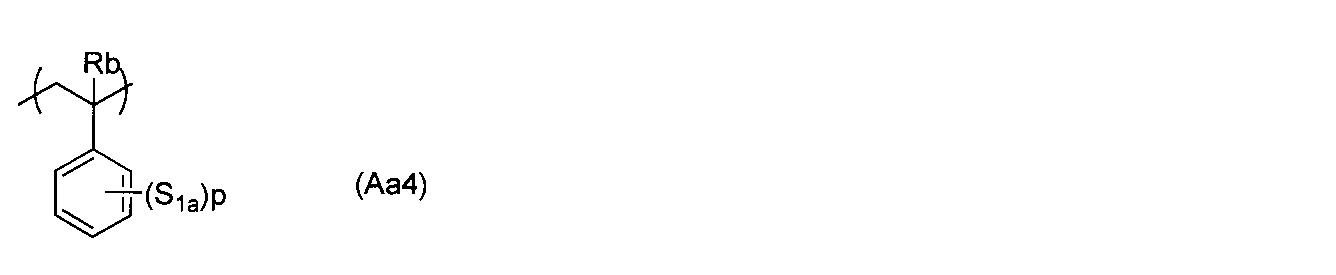
一般式(aa2-1)中、
Rbは、水素原子、アルキル基又はハロゲン原子を表す。
S1aは置換基を表し、複数存在する場合は各々独立である。
pは0~5の整数を表す。
Rbは、水素原子、アルキル基又はハロゲン原子を表す。
S1aは置換基を表し、複数存在する場合は各々独立である。
pは0~5の整数を表す。
[5] 樹脂(Aa)が、さらに下記一般式(KY-3)で表される構造を有する繰り返し単位を含む、[1]~[4]のいずれか1項に記載の感活性光線性又は感放射線性樹脂組成物。
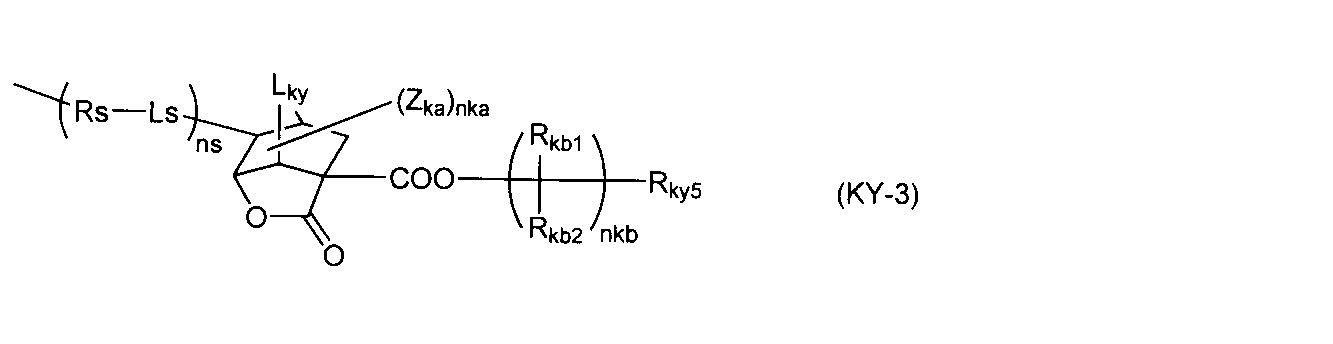
一般式(KY-3)中、
Rsは、鎖状若しくは環状アルキレン基を表し、複数個ある場合は、同じでも異なっていてもよい。
Lsは、単結合、エーテル結合、エステル結合、アミド結合、ウレタン結合又はウレア結合を表し、複数ある場合は、同じでも異なっていてもよい。
nsは、-(Rs-Ls)-で表される連結基の繰り返し数を表し、0~5の整数を表す。
Lkyはアルキレン基、酸素原子又は硫黄原子を表す。
Zkaは、アルキル基、シクロアルキル基、エーテル基、ヒドロキシル基、アミド基、アリール基、ラクトン環基、又は電子求引性基を表す。Zkaが複数存在する場合、複数のZkaは同じでも異なっていてもよく、Zka同士が連結して環を形成してもよい。
nkaは、0~10の整数を表す。
Rkb1及びRkb2は、各々独立して、水素原子、アルキル基、シクロアルキル基、アリール基、又は電子求引性基を表し、Rkb1、Rkb2及びRky5の少なくとも2つが互いに連結して環を形成していてもよい。
nkbは、0又は1を表す。
Rky5は電子求引性基を表す。
Rsは、鎖状若しくは環状アルキレン基を表し、複数個ある場合は、同じでも異なっていてもよい。
Lsは、単結合、エーテル結合、エステル結合、アミド結合、ウレタン結合又はウレア結合を表し、複数ある場合は、同じでも異なっていてもよい。
nsは、-(Rs-Ls)-で表される連結基の繰り返し数を表し、0~5の整数を表す。
Lkyはアルキレン基、酸素原子又は硫黄原子を表す。
Zkaは、アルキル基、シクロアルキル基、エーテル基、ヒドロキシル基、アミド基、アリール基、ラクトン環基、又は電子求引性基を表す。Zkaが複数存在する場合、複数のZkaは同じでも異なっていてもよく、Zka同士が連結して環を形成してもよい。
nkaは、0~10の整数を表す。
Rkb1及びRkb2は、各々独立して、水素原子、アルキル基、シクロアルキル基、アリール基、又は電子求引性基を表し、Rkb1、Rkb2及びRky5の少なくとも2つが互いに連結して環を形成していてもよい。
nkbは、0又は1を表す。
Rky5は電子求引性基を表す。
[6] 活性光線又は放射線の照射により酸を発生する化合物を更に含有する、[1]~[5]のいずれか1項に記載の感活性光線性又は感放射線性樹脂組成物。
[7] 樹脂(Ab)が、活性光線又は放射線の照射により酸を発生する構造部位を備えた繰り返し単位(B)を含む、[1]~[6]のいずれか1項に記載の感活性光線性又は感放射線性樹脂組成物。
[8] 樹脂(Aa)の含有率が、該組成物中の全固形分を基準として0.01~30質量%の範囲である、[1]~[7]のいずれか1項に記載の感活性光線性又は感放射線性樹脂組成物。
[9] 樹脂(Aa)の含有率が、該組成物中の全固形分を基準として0.01~20質量%の範囲である、[1]~[7]のいずれか1項に記載の感活性光線性又は感放射線性樹脂組成物。
[10] 樹脂(Aa)の含有率が、該組成物中の全固形分を基準として0.01~10質量%の範囲である、[1]~[7]のいずれか1項に記載の感活性光線性又は感放射線性樹脂組成物。
[11] 樹脂(Aa)の含有率が、該組成物中の全固形分を基準として0.01~5質量%の範囲である、[1]~[7]のいずれか1項に記載の感活性光線性又は感放射線性樹脂組成物。
[12] [1]~[11]のいずれか1項に記載の感活性光線性又は感放射性樹脂組成物を用いて形成された感活性光線性又は感放射線性膜。
[13] [1]~[11]のいずれか1項に記載の感活性光線性又は感放射線性樹脂組成物を用いて感活性光線性又は感放射線性膜を形成すること、前記感活性光線性又は感放射線性膜に活性光線又は放射線を照射して露光すること、露光した前記感活性光線性または感放射線性膜を現像することを含むパターン形成方法。
[14] 前記活性光線又は放射線として電子線又は極紫外線が用いられる、[13]に記載のパターン形成方法。
[15] [13]又は[14]に記載のパターン形成方法を含む工程を経て製造される半導体デバイス。
[16] [13]又は[14]に記載のパターン形成方法を含む、電子デバイスの製造方法。
[16] [13]又は[14]に記載のパターン形成方法を含む、電子デバイスの製造方法。
本発明により、感度、解像性、パターン形状及び現像欠陥の抑制能に優れ、且つ、特にEUV露光に対してはアウトバンド光によるパターン形状の劣化(膜べり)の抑制能に優れた感活性光線性又は感放射線性樹脂組成物、感活性光線性又は感放射線性膜及びパターン形成方法、並びに、電子デバイスの製造方法及び電子デバイスを提供することが可能となった。
本明細書に於ける基(原子団)の表記に於いて、置換及び無置換を記していない表記は置換基を有さないものと共に置換基を有するものをも包含するものである。例えば「アルキル基」とは、置換基を有さないアルキル基(無置換アルキル基)のみならず、置換基を有するアルキル基(置換アルキル基)をも包含するものである。
なお、ここで「活性光線」又は「放射線」とは、例えば、水銀灯の輝線スペクトル、エキシマレーザーに代表される遠紫外線、極紫外(EUV)線、X線、軟X線、電子線(EB)等を意味する。また、本発明において光とは、活性光線又は放射線を意味する。
また、ここで「露光」とは、特に断らない限り、水銀灯、エキシマレーザーに代表される遠紫外線、X線、EUV光などによる露光のみならず、電子線、イオンビーム等の粒子線による描画も露光に含める。
以下、本発明の実施形態について詳細に説明する。
<感活性光線性又は感放射線性樹脂組成物>
本発明に係る感活性光線性又は感放射線性樹脂組成物(以下、「本発明の組成物」などともいう)は、酸の作用により分解する繰り返し単位として後述する一般式(Aa1)又は(Aa2)で表される繰り返し単位を含み、製膜により膜表面に偏在し、保護膜を形成する樹脂(Aa)と、樹脂(Aa)とは異なる、酸の作用により現像液に対する溶解性が変化する樹脂(Ab)を含有する。
以下、本発明の実施形態について詳細に説明する。
<感活性光線性又は感放射線性樹脂組成物>
本発明に係る感活性光線性又は感放射線性樹脂組成物(以下、「本発明の組成物」などともいう)は、酸の作用により分解する繰り返し単位として後述する一般式(Aa1)又は(Aa2)で表される繰り返し単位を含み、製膜により膜表面に偏在し、保護膜を形成する樹脂(Aa)と、樹脂(Aa)とは異なる、酸の作用により現像液に対する溶解性が変化する樹脂(Ab)を含有する。
本発明の組成物は、一態様において、活性光線又は放射線の照射により酸を発生する化合物、酸増殖剤、溶剤、塩基性化合物、界面活性剤及びその他の添加物から選択される少なくとも1つを更に含有する。
以下、これら各成分について説明する。
[1]樹脂(Aa)
樹脂(Aa)は、酸の作用により分解する繰り返し単位として下記一般式(Aa1)又は(Aa2)で表される繰り返し単位を含み、製膜により膜表面に偏在し、保護膜を形成する樹脂である。ここで、製膜により膜表面に偏在し、保護膜を形成したかどうかは、例えば、樹脂(Aa)を添加しない組成物膜の表面静止接触角(純水による接触角)と、樹脂(Aa)を添加した組成物膜の表面静止接触角とを比較して、その接触角が上昇した場合、保護層が形成されたとみなすことができる。
樹脂(Aa)は、酸の作用により分解する繰り返し単位として下記一般式(Aa1)又は(Aa2)で表される繰り返し単位を含み、製膜により膜表面に偏在し、保護膜を形成する樹脂である。ここで、製膜により膜表面に偏在し、保護膜を形成したかどうかは、例えば、樹脂(Aa)を添加しない組成物膜の表面静止接触角(純水による接触角)と、樹脂(Aa)を添加した組成物膜の表面静止接触角とを比較して、その接触角が上昇した場合、保護層が形成されたとみなすことができる。
単に、酸の作用により現像液に対する溶解性が変化する化合物であって、製膜により膜表面に偏在して保護膜を形成する化合物を用いても、EUVリソグラフィーにおけるアウトバンド光(EUVの波長以外の紫外線)によるパターン形状劣化(膜べり)をある程度改善することはできても、感度低下が生じることが本発明者等により見出された。そこで、製膜により膜表面に偏在して保護膜を形成する化合物として、酸の作用に対する反応速度(感度)が高い、一般式(Aa1)又は(Aa2)で表される繰り返し単位を含む樹脂(Aa)を開発したところ、効果の一つとして、EUVリソグラフィーにおけるアウトバンド光によるパターン形状劣化(膜べり)を改善しつつ、高感度化を達成することが可能となったものである。
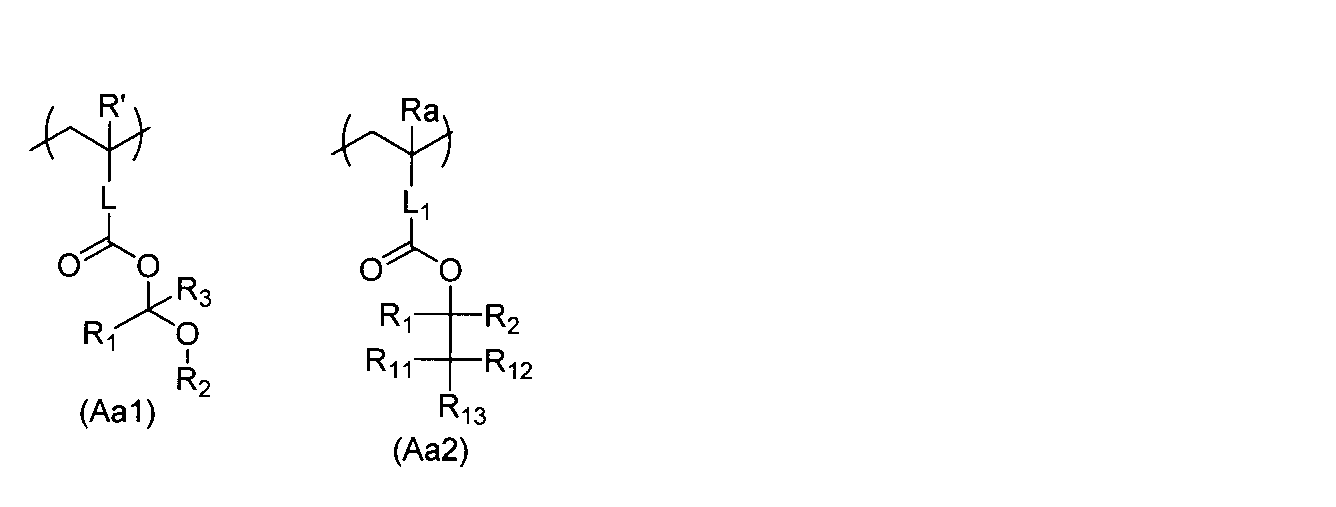
一般式(Aa1)中、
R’は水素原子又はアルキル基を表す。
Lは単結合又は2価の連結基を表す。
R1は水素原子又は1価の置換基を表す。
R2は、フッ素原子を含まない1価の置換基を表す。R1とR2とが互いに結合し、式中の酸素原子と共に環を形成してもよい。
R3は水素原子、アルキル基又はシクロアルキル基を表す。
R’は水素原子又はアルキル基を表す。
Lは単結合又は2価の連結基を表す。
R1は水素原子又は1価の置換基を表す。
R2は、フッ素原子を含まない1価の置換基を表す。R1とR2とが互いに結合し、式中の酸素原子と共に環を形成してもよい。
R3は水素原子、アルキル基又はシクロアルキル基を表す。
一般式(Aa2)中、
Raは水素原子、アルキル基、シアノ基又はハロゲン原子を表す。
L1は単結合又は2価の連結基を表す。
R1及びR2はそれぞれ独立にアルキル基を表す。但し、少なくとも一方のアルキル基が有する炭素数は2以上である。
Raは水素原子、アルキル基、シアノ基又はハロゲン原子を表す。
L1は単結合又は2価の連結基を表す。
R1及びR2はそれぞれ独立にアルキル基を表す。但し、少なくとも一方のアルキル基が有する炭素数は2以上である。
R11及びR12はそれぞれ独立にアルキル基を表し、R13は水素原子又はアルキル基を表す。R11、R12及びR13のいずれか2つは互いに連結して環を形成してもよい。
一般式(Aa1)で表される繰り返し単位(以下、「繰り返し単位(Aa1)」ともいう。)と、一般式(Aa2)で表される繰り返し単位(以下、「繰り返し単位(Aa2)」ともいう。)は、上述した通り、いずれも酸の作用に対する反応速度が高いが、繰り返し単位(Aa1)の方が酸の作用に対する反応速度がより高い。したがって、高感度化の観点からは、樹脂(Aa)は繰り返し単位(Aa1)を含むことがより好ましい。
以下、繰り返し単位(Aa1)及び繰り返し単位(Aa2)について詳細に説明する。
以下、繰り返し単位(Aa1)及び繰り返し単位(Aa2)について詳細に説明する。
<繰り返し単位(Aa1)>
まず、一般式(Aa1)で表される繰り返し単位について説明する。

まず、一般式(Aa1)で表される繰り返し単位について説明する。
上記一般式(Aa1)において、R’のアルキル基は、炭素数1~10のアルキル基であることが好ましく、炭素数1~5のアルキル基であることがより好ましく、炭素数1~3のアルキル基であることが更に好ましく、炭素数1又は2のアルキル基(すなわち、メチル基又はエチル基)であることが好ましい。R’のアルキル基の具体例としては、例えば、メチル基、エチル基、n-プロピル基、イソプロピル基、n-ブチル基、イソブチル基、sec-ブチル基、及び、t-ブチル基などを挙げることができる。
R’は、水素原子、又は、炭素数1~5のアルキル基であることが好ましく、水素原子、又は、炭素数1~3のアルキル基であることがより好ましく、水素原子、メチル基又はエチル基であることが更に好ましく、水素原子であることが特に好ましい。
Lで表される2価の連結基としては、アルキレン基、芳香環基、シクロアルキレン基、-COO-L1’-、-O-L1’-、-CONH-、これらの2つ以上を組み合わせて形成される基等が挙げられる。ここで、L1’はアルキレン基(好ましくは炭素数1~20)、シクロアルキレン基(好ましくは炭素数3~20)、ラクトン構造を有する基、芳香環基、アルキレン基と芳香環基を組み合わせた基を表す。
Lで表される2価の連結基としてのアルキレン基としては、好ましくはメチレン基、エチレン基、プロピレン基、ブチレン基、ヘキシレン基、オクチレン基等の炭素数1~8のアルキレン基が挙げられる。炭素数1~4のアルキレン基がより好ましく、炭素数1又は2のアルキレン基が特に好ましい。
Lで表される2価の連結基としてのシクロアルキレン基は、炭素数3~20のシクロアルキレン基であることが好ましく、例えば、シクロプロピレン基、シクロブチレン基、シクロペンチレン基、シクロヘキシレン基、シクロヘプチレン基、シクロオクチレン基、ノルボルニレン基又はアダマンチレン基が挙げられる。
Lで表される2価の連結基としての芳香環基は、ベンゼン環、ナフタレン環基などの炭素数6~18(より好ましくは炭素数6~10)の芳香環基、あるいは、例えば、チオフェン環、フラン環、ピロール環、ベンゾチオフェン環、ベンゾフラン環、ベンゾピロール環、トリアジン環、イミダゾール環、ベンゾイミダゾール環、トリアゾール環、チアジアゾール環、チアゾール環等のヘテロ環を含む芳香環基を好ましい例として挙げることができ、ベンゼン環基であることが特に好ましい。
L1’が表すアルキレン基、シクロアルキレン基及び芳香環基の定義及び好ましい範囲は、Lで表される2価の連結基としてのアルキレン基、シクロアルキレン基及び芳香環基におけるものと同様である。
L1’が表すラクトン構造を有する基としては、ラクトン構造を有していればいずれでも用いることができるが、好ましくは5~7員環ラクトン構造であり、5~7員環ラクトン構造にビシクロ構造、スピロ構造を形成する形で他の環構造が縮環しているものが好ましい。例えば、後述のKA-1-1~KA-1-17を挙げることができるが、KA-1-1、KA-1-4、KA-1-5、KA-1-17好ましい。
L1’が表すアルキレン基と芳香環基を組み合わせた基におけるアルキレン基及び芳香族基の定義及び好ましい範囲は、Lで表される2価の連結基としてのアルキレン基及び芳香環基におけるものと同様である。
Lは、単結合、芳香環基、ノルボルナン環基又はアダマンタン環基であることが好ましく、単結合、ノルボルナン環基又はアダマンタン環基がより好ましく、単結合又はノルボルナン環基が更に好ましく、単結合が特に好ましい。
R1の1価の置換基としては、*-C(R111)(R112)(R113)で表される基であることが好ましい。*は一般式(Aa1)で表される繰り返し単位内の炭素原子に連結する結合手を表す。R111~R113はそれぞれ独立に、水素原子、アルキル基、シクロアルキル基、アリール基、アラルキル基又はヘテロ環基を表す。
R111~R113のアルキル基は、炭素数1~15のアルキル基であることが好ましく、炭素数1~10のアルキル基であることがより好ましく、炭素数1~6のアルキル基であることが更に好ましい。R111~R113のアルキル基の具体例としては、例えば、メチル基、エチル基、プロピル基、イソプロピル基、n-ブチル基、sec-ブチル基、t-ブチル基、ネオペンチル基、ヘキシル基、2-エチルヘキシル基、オクチル基及びドデシル基などを挙げることができ、R111~R113のアルキル基は、メチル基、エチル基、プロピル基、イソプロピル基又はt-ブチル基であることが好ましい。
R111~R113の少なくとも2つは、それぞれ独立に、アルキル基、シクロアルキル基、アリール基、アラルキル基又はヘテロ環基を表し、R111~R113の全てが、アルキル基、シクロアルキル基、アリール基、アラルキル基又はヘテロ環基を表すことが好ましい。
R111~R113のシクロアルキル基は、単環型であっても、多環型であってもよく、炭素数3~15のシクロアルキル基であることが好ましく、炭素数3~10のシクロアルキル基であることがより好ましく、炭素数3~6のシクロアルキル基であることが更に好ましい。R111~R113のシクロアルキル基の具体例としては、例えば、シクロプロピル基、シクロブチル基、シクロペンチル基、シクロヘキシル基、シクロヘプチル基、シクロオクチル基、デカヒドロナフチル基、シクロデシル基、1-アダマンチル基、2-アダマンチル基、1-ノルボルニル基、及び、2-ノルボルニル基などを挙げることができる。R111~R113のシクロアルキル基は、シクロプロピル基、シクロペンチル基、又は、シクロヘキシル基であることが好ましい。
R111~R113のアリール基は、炭素数6~15のアリール基であることが好ましく、炭素数6~12のアリール基であることがより好ましく、複数の芳香環が単結合を介して互いに連結された構造(例えば、ビフェニル基、ターフェニル基)も含む。R111~R113のアリール基の具体例としては、例えば、フェニル基、ナフチル基、アントラニル基、ビフェニル基、ターフェニル基等が挙げられる。R111~R113のアリール基は、フェニル基、ナフチル基、又は、ビフェニル基であることが好ましい。
R111~R113のアラルキル基は、炭素数6~20のアラルキル基であることが好ましく、炭素数7~12のアラルキル基であることより好ましい。R111~R113のアラルキル基の具体例としては、例えば、ベンジル基、フェネチル基、ナフチルメチル基、ナフチルエチル基等が挙げられる。
R111~R113のヘテロ環基は、炭素数6~20のヘテロ環基であることが好ましく、炭素数6~12のヘテロ環基であることがより好ましい。R111~R113のヘテロ環基の具体例としては、例えば、ピリジル基、ピラジル基、テトラヒドロフラニル基、テトラヒドロピラニル基、テトラヒドロチオフェン基、ピペリジル基、ピペラジル基、フラニル基、ピラニル基、クロマニル基等が挙げられる。
R111~R113としてのアルキル基、シクロアルキル基、アリール基、アラルキル基及びヘテロ環基は、置換基を更に有していてもよい。
R111~R113としてのアルキル基が更に有し得る置換基としては、例えば、シクロアルキル基、アリール基、アミノ基、アミド基、ウレイド基、ウレタン基、ヒドロキシ基、カルボキシ基、ハロゲン原子、アルコキシ基、アラルキルオキシ基、チオエーテル基、アシル基、アシロキシ基、アルコキシカルボニル基、シアノ基及びニトロ基などが挙げられる。上記置換基同士が互いに結合して環を形成してもよく、上記置換基同士が互いに結合して環を形成するときの環は、炭素数3~10のシクロアルキル基又はフェニル基が挙げられる。
R111~R113としてのシクロアルキル基が更に有し得る置換基としては、アルキル基、及び、R111~R113としてのアルキル基が更に有し得る置換基の具体例として前述した各基が挙げられる。
なお、シクロアルキル基が更に有し得る置換基の炭素数は、好ましくは、1~8である。
R111~R113としてのアリール基、アラルキル基及びヘテロ環基が更に有し得る置換基としては、例えば、ニトロ基、フッ素原子等のハロゲン原子、カルボキシル基、水酸基、アミノ基、シアノ基、アルキル基(好ましくは炭素数1~15)、アルコキシ基(好ましくは炭素数1~15)、シクロアルキル基(好ましくは炭素数3~15)、アリール基(好ましくは炭素数6~14)、アルコキシカルボニル基(好ましくは炭素数2~7)、アシル基(好ましくは炭素数2~12)、及びアルコキシカルボニルオキシ基(好ましくは炭素数2~7)などが挙げられる。
R111~R113の少なくとも2つは、互いに環を形成していてもよい。
R111~R113の少なくとも2つが互いに結合して環を形成する場合、形成される環としては、例えばテトラヒドロピラン環、シクロペンタン環、シクロヘキサン環、アダマンタン環、ノルボルネン環、ノルボルナン環などが挙げられる。これらの環は置換基を有しても良く、有し得る置換基としては、アルキル基、及び、R111~R113としてのアルキル基が更に有し得る置換基の具体例として前述した各基が挙げられる。
R111~R113の少なくとも2つが互いに結合して環を形成する場合、形成される環としては、例えばテトラヒドロピラン環、シクロペンタン環、シクロヘキサン環、アダマンタン環、ノルボルネン環、ノルボルナン環などが挙げられる。これらの環は置換基を有しても良く、有し得る置換基としては、アルキル基、及び、R111~R113としてのアルキル基が更に有し得る置換基の具体例として前述した各基が挙げられる。
R111~R113の全てが互いに結合して環を形成する場合、形成される環としては、例えばアダマンタン環、ノルボルナン環、ノルボルネン環、ビシクロ[2,2,2]オクタン環、ビシクロ[3,1,1]ヘプタン環が挙げられる。中でもアダマンタン環が特に好ましい。これらは置換基を有しても良く、有し得る置換基としては、アルキル基、及び、R111~R113としてのアルキル基が更に有し得る置換基の具体例として前述した各基が挙げられる。
R2の1価の置換基は、フッ素原子を含まない。フッ素原子のような電子求引基を含むと、酸の作用に対する反応速度(感度)が遅くなるため、所望の性能がでず、一方、酸素や窒素も電子求引基として働くが、これらの原子を含んでいても所望とされる性能がでることが本発明者らにより見出された。
本発明の一形態において、R2の1価の置換基は、炭素原子、水素原子、酸素原子、窒素原子、ケイ素原子及び硫黄原子から選択される2種以上の原子からなる基であることが好ましく、炭素原子、水素原子、酸素原子及び窒素原子から選択される2種以上の原子からなる基であることがより好ましく、炭素原子、水素原子及び酸素原子から選択される2種以上の原子からなる基であることが更に好ましく、炭素原子及び水素原子からなる基であることが特に好ましい。
本発明の一形態において、R2の1価の置換基は、*-M-Qで表される基であることが好ましい。*は一般式(Aa1)中の酸素原子に連結する結合手を表す。Mは、単結合又は2価の連結基を表す。Qは、アルキル基、シクロアルキル基、アリール基又はヘテロ環基(フッ素原子は含まない)を表す。
Mとしての2価の連結基は、例えば、アルキレン基(好ましくは炭素数1~8のアルキレン基、例えば、メチレン基、エチレン基、プロピレン基、ブチレン基、ヘキシレン基又はオクチレン基)、シクロアルキレン基(好ましくは炭素数3~15のシクロアルキレン基、例えば、シクロペンチレン基又はシクロヘキシレン基)、-S-、-O-、-CO-、-CS-、-SO2-、-N(R0)-、又はこれらの2種以上の組み合わせであり、総炭素数が20以下のものが好ましい。ここで、R0は、水素原子又はアルキル基(例えば炭素数1~8のアルキル基であって、具体的には、メチル基、エチル基、プロピル基、n-ブチル基、sec-ブチル基、ヘキシル基及びオクチル基等)である。
Mは、単結合、アルキレン基、又は、アルキレン基と-O-、-CO-、-CS-及び-N(R0)-の少なくとも一つとの組み合わせからなる2価の連結基が好ましく、単結合、アルキレン基、又はアルキレン基と-O-との組み合わせからなる2価の連結基がより好ましい。ここで、R0は上述のR0と同義である。
Mは置換基を更に有していてもよく、Mが更に有し得る置換基は、上述したR111~R113のアルキル基が有し得る置換基と同様である。
Qとしてのアルキル基の具体例及び好ましい例は、例えば、上述したR111~R113としてのアルキル基について記載したものと同様である。
Qとしてのシクロアルキル基は、単環型であってもよく、多環型であってもよい。このシクロアルキル基の炭素数は、好ましくは3~10とする。このシクロアルキル基としては、例えば、シクロプロピル基、シクロブチル基、シクロペンチル基、シクロヘキシル基、シクロヘプチル基、シクロオクチル基、1-アダマンチル基、2-アダマンチル基、1-ノルボルニル基、2-ノルボルニル基、ボルニル基、イソボルニル基、4-テトラシクロ[6.2.1.13,6.02,7]ドデシル基、8-トリシクロ[5.2.1.02,6]デシル基、2-ビシクロ[2.2.1]ヘプチル基が挙げられる。中でも、シクロペンチル基、シクロヘキシル基、2-アダマンチル基、8-トリシクロ[5.2.1.02,6]デシル基、2-ビシクロ[2.2.1]ヘプチル基が好ましい。
Qとしてのアリール基の具体例及び好ましい例は、例えば、上述したR111~R113としてのアリール基について説明したものと同様である。
Qとしてのヘテロ環基の具体例及び好ましい例は、例えば、上述したR111~R113としてのヘテロ環基について説明したものと同様である。
Qとしてのアルキル基、シクロアルキル基、アリール基及びヘテロ環基(フッ素原子は含まない)は、置換基を有していてもよく、例えば、アルキル基、シクロアルキル基、シアノ基、ハロゲン原子、水酸基、アルコキシ基、カルボキシル基、アルコキシカルボニル基が挙げられる。
R2は、アルキル基、シクロアルキル基で置換されたアルキル基、シクロアルキル基、アラルキル基、アリールオキシアルキル基又はヘテロ環基(フッ素原子は含まない)であることが好ましく、アルキル基又はシクロアルキル基であることがより好ましい。R2としてのアルキル基、R2としての「シクロアルキル基」及び「シクロアルキル基で置換されたアルキル基」におけるシクロアルキル基、並びに、R2で表される基としての「アラルキル基(アリールアルキル基)」及び「アリールオキシアルキル基」におけるアリール基の具体例及び好ましい例は、それぞれ、Qとしてのアルキル基、シクロアルキル基、及び、アリール基で説明したものと同様である。
R2としての「シクロアルキル基で置換されたアルキル基」、「アラルキル基(アリールアルキル基)」及び「アリールオキシアルキル基」におけるアルキル部位の具体例及び好ましい例は、それぞれ、Mとしてのアルキレン基で説明したものと同様である。
R2としてのヘテロ環基(フッ素原子は含まない)の具体例及び好ましい例は、Qとしてのヘテロ環基(フッ素原子は含まない)で説明したものと同様である。
R2が表す置換基には、具体的には、例えば、メチル基、エチル基、イソプロピル基、シクロペンチル基、シクロヘキシル基、シクロヘキシルエチル基、2-アダマンチル基、8-トリシクロ[5.2.1.02,6]デシル基、2-ビシクロ[2.2.1]ヘプチル基、ベンジル基、2-フェネチル基、2-フェノキシエチレン基等が挙げられる。
R1とR2とは互いに結合し、式中の酸素原子と共に環(含酸素複素環)を形成してもよい。含酸素複素環構造としては、単環、多環又はスピロ環のいずれであっても良く、好ましくは、単環の含酸素複素環構造であり、その炭素数は好ましくは3~10、より好ましくは4又は5である。
また、上記したように、Mが2価の連結基である場合、Qは単結合又は別の連結基を介してMに結合し、環を形成しても良い。上記別の連結基としては、アルキレン基(好ましくは炭素数1~3のアルキレン基)が挙げられ、形成される環は、5又は6員環であることが好ましい。
R3は、水素原子、又は、炭素数1~5のアルキル基であることが好ましく、水素原子、又は、炭素数1~3のアルキル基であることがより好ましく、水素原子、メチル基又はエチル基であることが更に好ましく、水素原子であることが特に好ましい。
本発明の一形態において、R1及びR3の一方は、炭素原子を2以上含む基であることが好ましい。
一般式(Aa1)で表される繰り返し単位は、下記一般式(Aa1-1)~(Aa1-4)のいずれか1つで表される繰り返し単位であることが好ましい。
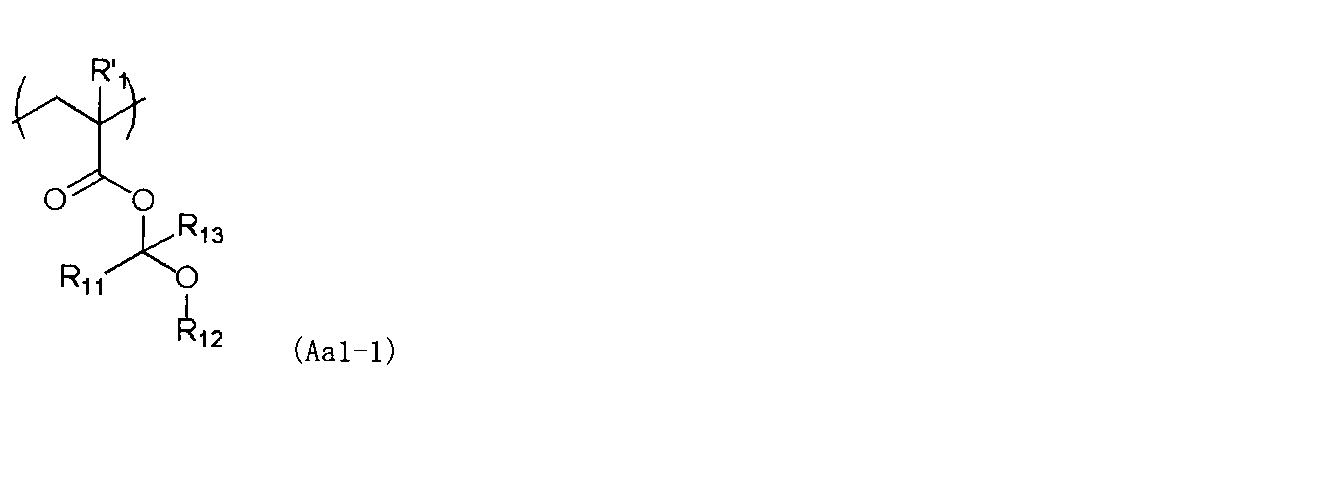
一般式(Aa1-1)中、
R’1は水素原子又はメチル基を表し、メチル基であることが好ましい。
R’1は水素原子又はメチル基を表し、メチル基であることが好ましい。
R11、R12及びR13の各々は、上記一般式(Aa1)におけるR1、R2及びR3と同義である。
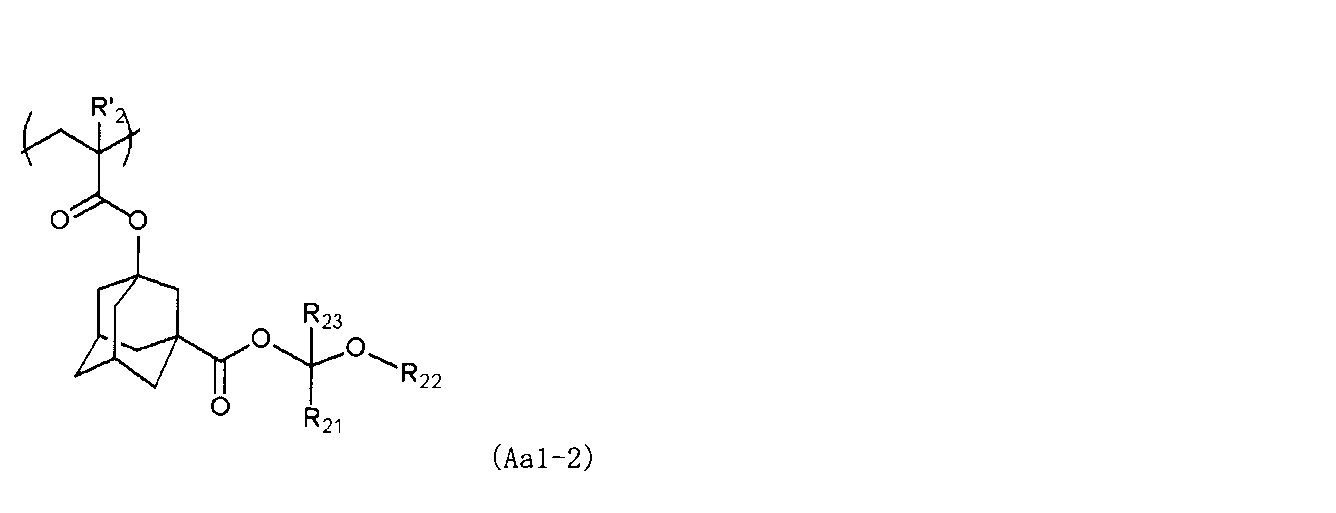
一般式(Aa1-2)中、
R’2は水素原子又はメチル基を表し、メチル基であることが好ましい。
R21、R22及びR23の各々は、上記一般式(Aa1)におけるR1、R2及びR3と同義である。

R’2は水素原子又はメチル基を表し、メチル基であることが好ましい。
R21、R22及びR23の各々は、上記一般式(Aa1)におけるR1、R2及びR3と同義である。
一般式(Aa1-3)中、
R’3は水素原子又はメチル基を表し、メチル基であることが好ましい。
R’3は水素原子又はメチル基を表し、メチル基であることが好ましい。
R31、R32及びR33の各々は、上記一般式(Aa1)におけるR1、R2及びR3と同義である。
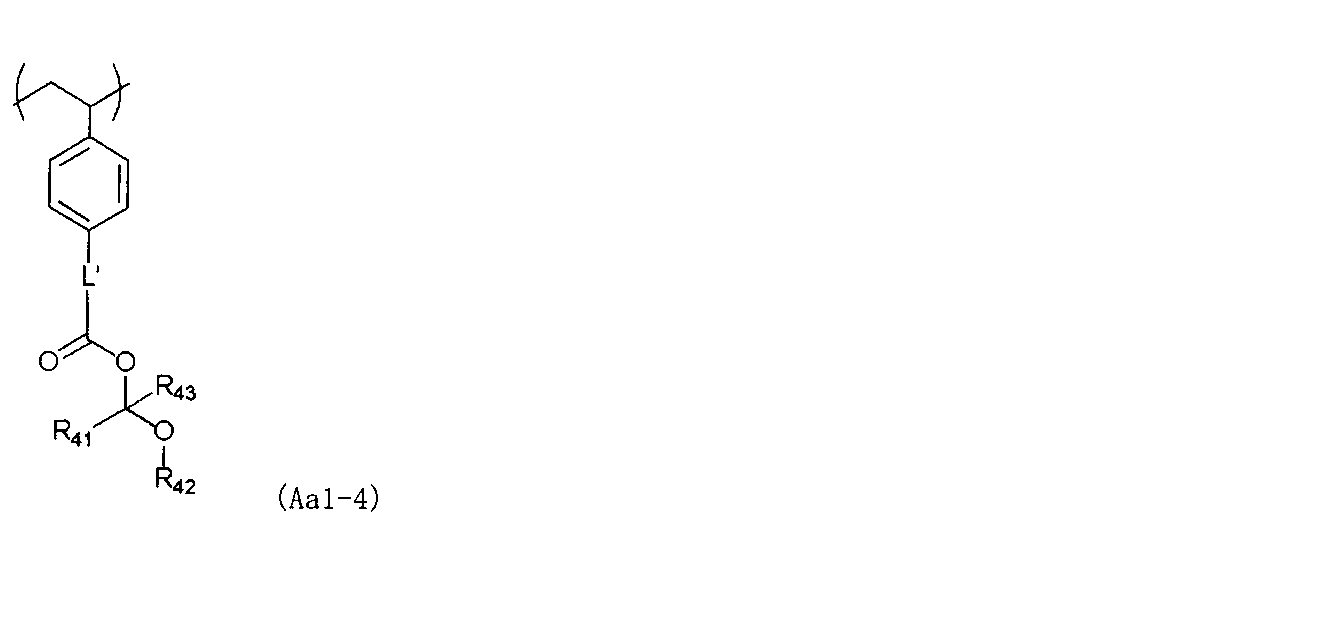
一般式(Aa1-4)中、
L’は単結合、又は2価の連結基を表す。L’の2価の連結基としては、例えば、アルキレン基、芳香環基、シクロアルキレン基、-COO-L1’-、-O-L1’-、-CONH-、これらの2つ以上を組み合わせて形成される基等が挙げられる。ここで、L1’はアルキレン基(好ましくは炭素数1~20)、シクロアルキレン基(好ましくは炭素数3~20)、芳香環基、アルキレン基と芳香環基を組み合わせた基を表す。L’は、単結合であることが好ましい。
L’は単結合、又は2価の連結基を表す。L’の2価の連結基としては、例えば、アルキレン基、芳香環基、シクロアルキレン基、-COO-L1’-、-O-L1’-、-CONH-、これらの2つ以上を組み合わせて形成される基等が挙げられる。ここで、L1’はアルキレン基(好ましくは炭素数1~20)、シクロアルキレン基(好ましくは炭素数3~20)、芳香環基、アルキレン基と芳香環基を組み合わせた基を表す。L’は、単結合であることが好ましい。
R41、R42及びR43の各々は、上記一般式(Aa1)におけるR1、R2及びR3と同義である。
本発明の一態様において、一般式(Aa1)で表される繰り返し単位は、一般式(Aa1-1)~(Aa1-4)のいずれかで表される繰り返し単位であることが好ましく、一般式(Aa1-1)~(Aa1-3)のいずれかで表される繰り返し単位であることがより好ましく、一般式(Aa1-1)又は(Aa1-3)で表される繰り返し単位であることが更に好ましく、一般式(Aa1-1)で表される繰り返し単位であることが特に好ましい。
一般式(Aa1)で表される繰り返し単位は、下記(Aa1-a)~(Aa1-f)のいずれかで表される繰り返し単位であることも好ましい。

一般式(Aa1-a)中、
Ra’、La、R2a及びR1aの各々は一般式(Aa1)におけるR’、L、R2及びR1と同様であり、また好ましい範囲も同様である。
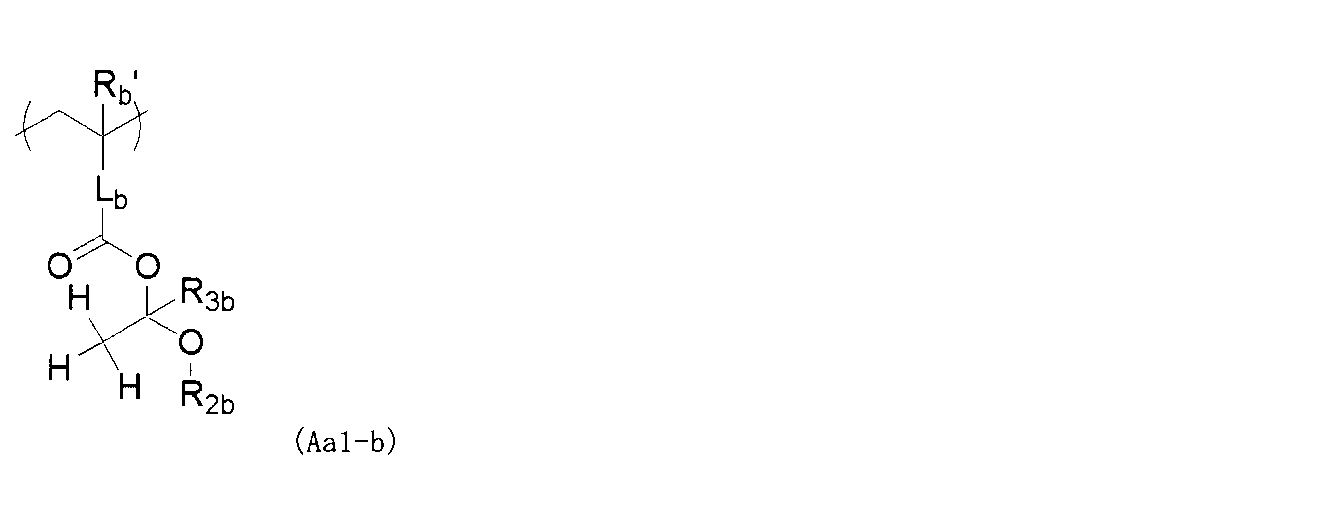
Ra’、La、R2a及びR1aの各々は一般式(Aa1)におけるR’、L、R2及びR1と同様であり、また好ましい範囲も同様である。
一般式(Aa1―b)中、
Rb’、Lb、R2b及びR3bの各々は一般式(Aa1)におけるR’、L、R2及びR3と同様であり、また好ましい範囲も同様である。

Rb’、Lb、R2b及びR3bの各々は一般式(Aa1)におけるR’、L、R2及びR3と同様であり、また好ましい範囲も同様である。
一般式(Aa1-c)中、
Rc’、Lc、R2c及びR3cの各々は一般式(Aa1)におけるR’、L、R2及びR3と同様であり、また好ましい範囲も同様である。
R1a’は一般式(Aa1)におけるR111と同様であり、また好ましい範囲も同様である。
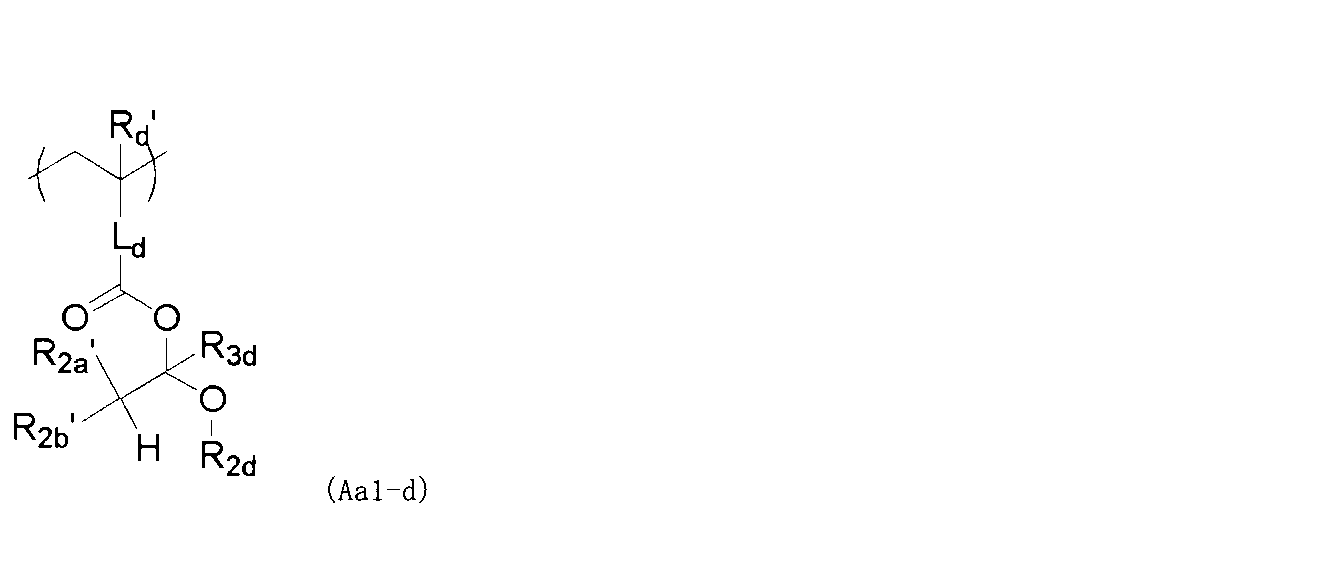
Rc’、Lc、R2c及びR3cの各々は一般式(Aa1)におけるR’、L、R2及びR3と同様であり、また好ましい範囲も同様である。
R1a’は一般式(Aa1)におけるR111と同様であり、また好ましい範囲も同様である。
一般式(Aa1―d)中、
Rd’、Ld、R2d及びR3dの各々は一般式(Aa1)におけるR’、L、R2及びR3と同様であり、また好ましい範囲も同様である。
R2a’及びR2b’の各々は、一般式(Aa1)におけるR111及びR112と同様であり、また好ましい範囲も同様である。
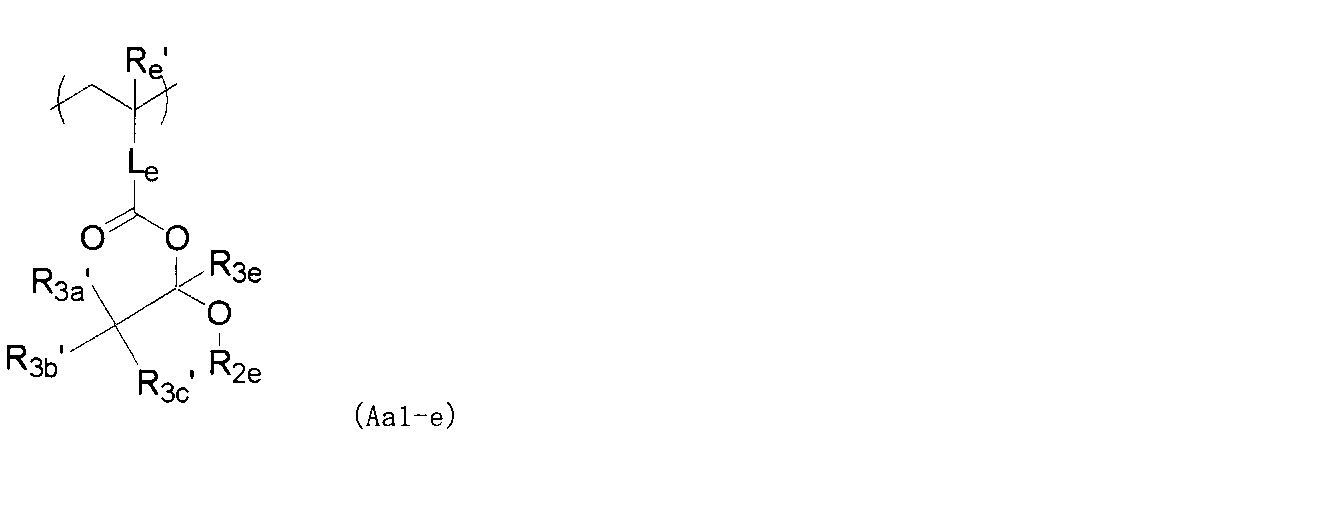
Rd’、Ld、R2d及びR3dの各々は一般式(Aa1)におけるR’、L、R2及びR3と同様であり、また好ましい範囲も同様である。
R2a’及びR2b’の各々は、一般式(Aa1)におけるR111及びR112と同様であり、また好ましい範囲も同様である。
一般式(Aa1-e)中、
Re’、Le、R2e及びR3eの各々は一般式(Aa1)におけるR’、L、R2及びR3と同様であり、また好ましい範囲も同様である。
R3a’、R3b’及びR3c’の各々は、一般式(Aa1)におけるR111、R112及びR113と同様であり、また好ましい範囲も同様である。

Re’、Le、R2e及びR3eの各々は一般式(Aa1)におけるR’、L、R2及びR3と同様であり、また好ましい範囲も同様である。
R3a’、R3b’及びR3c’の各々は、一般式(Aa1)におけるR111、R112及びR113と同様であり、また好ましい範囲も同様である。
一般式(Aa1―f)中、
Rf’及びLfは一般式(Aa1)におけるR’及びLと同様であり、また好ましい範囲も同様である。
Rf’及びLfは一般式(Aa1)におけるR’及びLと同様であり、また好ましい範囲も同様である。
R3fは、一般式(Aa1)におけるR3と同様であり、また好ましい範囲も同様である。
R4fは、式中の炭素原子及び酸素原子とともに含酸素複素環を形成するのに必要な原子団を表す。R4fが炭素原子及び酸素原子とともに形成する含酸素複素環構造としては、好ましくは、単環の含酸素複素環構造であり、含酸素複素環の炭素数は好ましくは3~10、より好ましくは4又は5である。
本発明の一態様において、一般式(Aa1)で表される繰り返し単位は、一般式(Aa1-c)~(Aa1-f)のうちいずれか1つで表される繰り返し単位であることがより好ましく、一般式(Aa1-e)又は(Aa1-f)で表される繰り返し単位であることが更に好ましい。
上記一般式(Aa1)における、各部分構造及び各基の好ましい具体例を以下に示す。
上記一般式(Aa1)における、下記一般式(Aa1’)で表される部分構造の好ましい具体例は以下の通りである。一般式(Aa1’)及び具体例中、*は上記一般式(Aa1)におけるR1及びR3が結合した炭素原子に連結する結合手を表し、R’及びLは各々、一般式(Aa1)中のR’及びLを表す。

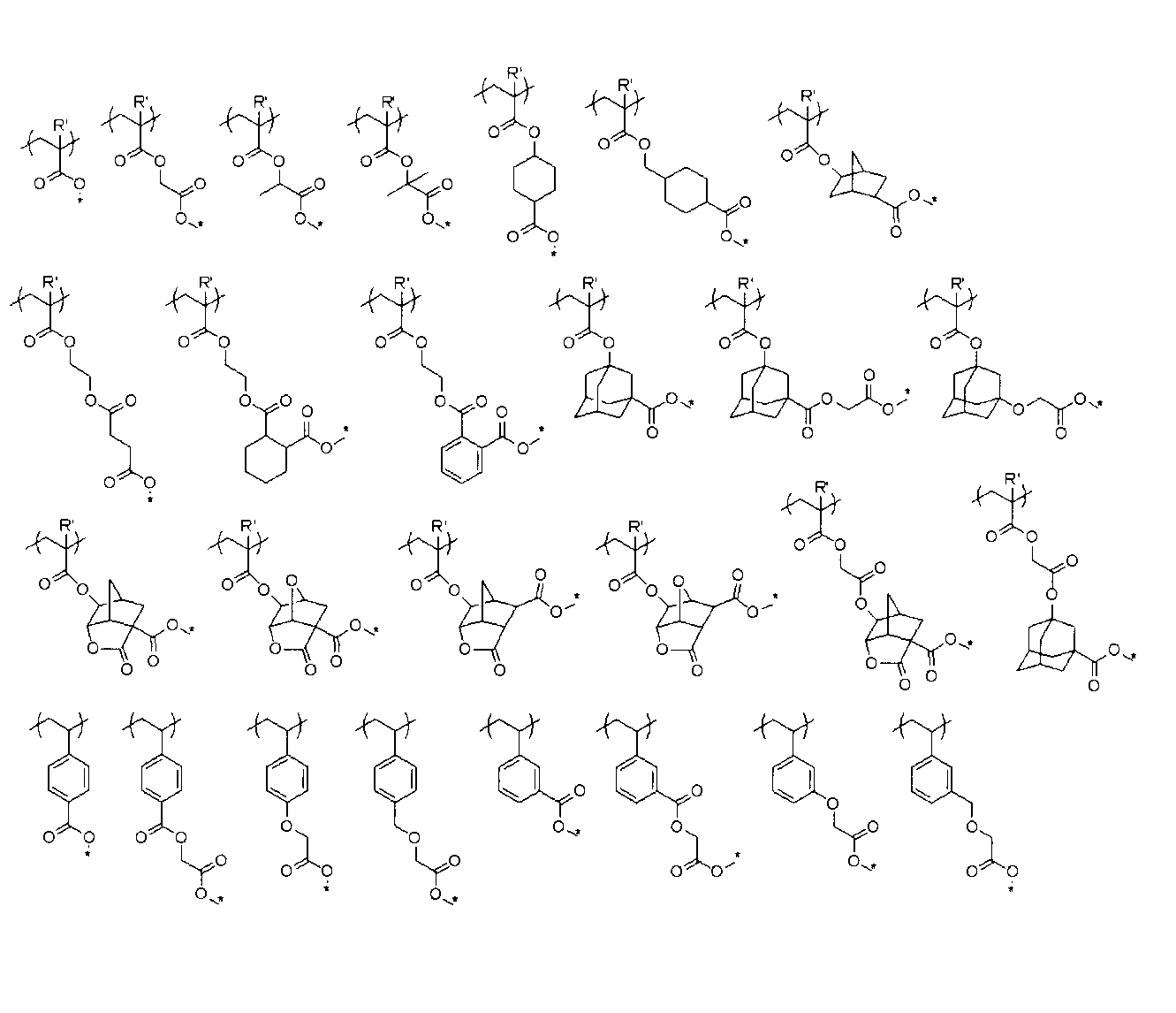
上記一般式(Aa1)における、下記一般式(Aa1’)で表される部分構造の好ましい具体例は以下の通りである。一般式(Aa1’)及び具体例中、*は上記一般式(Aa1)におけるR1及びR3が結合した炭素原子に連結する結合手を表し、R’及びLは各々、一般式(Aa1)中のR’及びLを表す。
上記一般式(Aa1)におけるR1の1価の置換基の具体例としては、以下のものが挙げられる。*は一般式(Aa1)中の炭素原子に連結する結合手を表す。
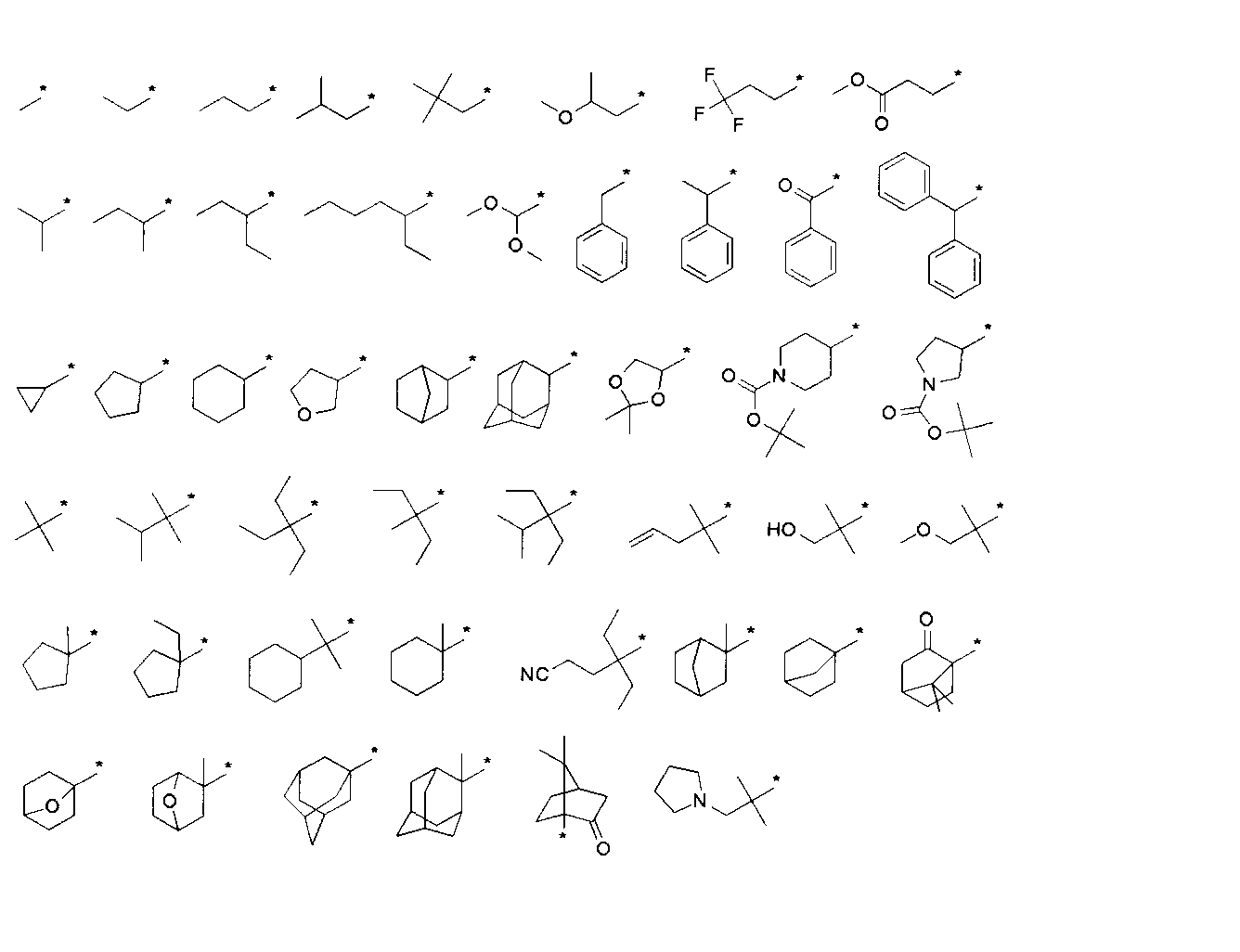
上記一般式(Aa1)におけるR2の具体例を示す。以下の具体例中、*は、一般式(Aa1)における酸素原子に結合する結合手を表す。

上記一般式(Aa1)で表される繰り返し単位が、上記一般式(Aa1-f)で表される繰り返し単位である場合における、R4fが、式中の炭素原子及び酸素原子と共に形成する含酸素複素環の具体例を以下に示す。*は、一般式(Aa1-f)における酸素原子に連結する結合手を表す。R3fは、一般式(Aa1-f)におけるものと同様である。
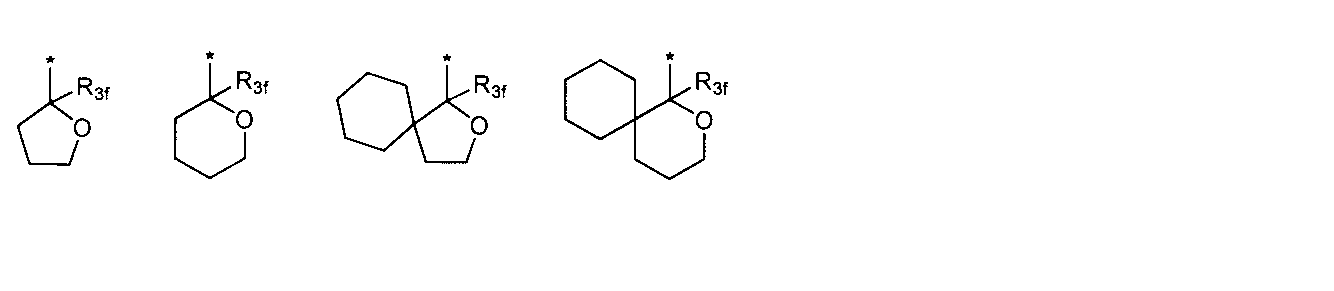
以下に、上記一般式(Aa1)で表される繰り返し単位の具体例を示すが、本発明はこれらに限定されるものではない。
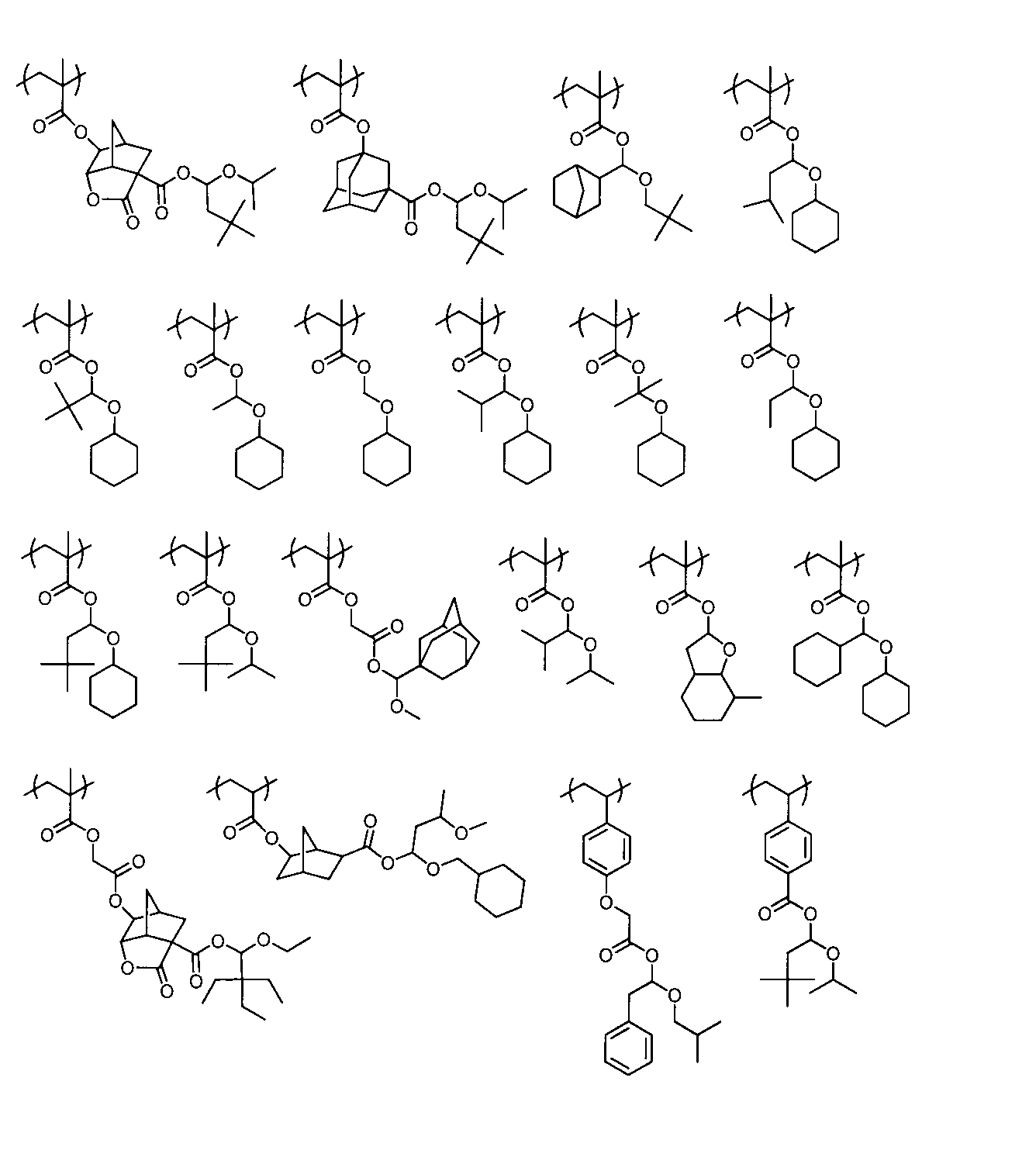
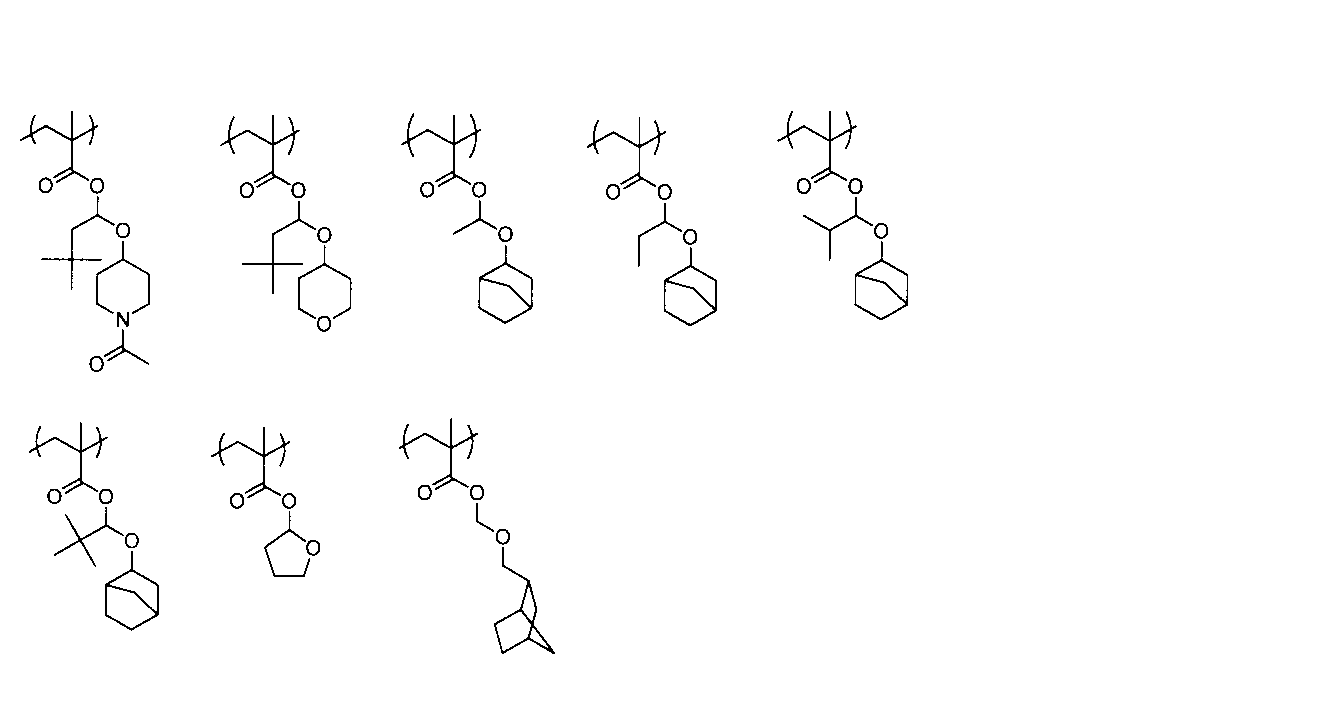
樹脂(Aa)における上記一般式(Aa1)で表される繰り返し単位の含有率(複数種類含有する場合はその合計)は、前記樹脂(Aa)中の全繰り返し単位に対して5~80モル%であることが好ましく、5~60モル%であることがより好ましく、10~40モル%であることが更に好ましい。
<繰り返し単位(Aa2)>
次に、一般式(Aa2)で表される繰り返し単位について詳細に説明する。

次に、一般式(Aa2)で表される繰り返し単位について詳細に説明する。
一般式(Aa2)において、R1及びR2は、上述したように、アルキル基を表す。但し、少なくとも一方のアルキル基が有する炭素数は2以上である。本発明の効果をより確実に達成する観点から、R1及びR2の双方が炭素数2以上のアルキル基であることが好ましく、炭素数2~10のアルキル基であることがより好ましく、R1及びR2のいずれもがエチル基であることが更に好ましい。
一般式(Aa2)おいて、上述したように、R11及びR12はそれぞれ独立にアルキル基を表し、R13は水素原子又はアルキル基を表す。R11~R13としてのアルキル基は、炭素数1~10のアルキル基であることが好ましく、例えば、メチル基、エチル基、プロピル基、イソプロピル基、n-ブチル基、sec-ブチル基、t-ブチル基、ネオペンチル基、ヘキシル基、2-エチルヘキシル基、オクチル基及びドデシル基などが挙げられる。
R11及びR12についてのアルキル基としては、炭素数1~4のアルキル基であることがより好ましく、メチル基又はエチル基であることが更に好ましく、メチル基であることが特に好ましい。
R13としては水素原子又はメチル基であることがより好ましい。
R13としては水素原子又はメチル基であることがより好ましい。
上述したように、R11及びR12は互いに連結して環を形成してもよく、R11及びR13は互いに連結して環を形成してもよい。形成される環としては、例えば、単環又は多環の脂環式炭化水素基が好ましく、特にR11及びR12が互いに結合して単環又は多環の脂環式炭化水素基を形成することが好ましい。
R11及びR12が連結して形成する環としては、3~8員環であることが好ましく、5又は6員環であることがより好ましい。
R11及びR13が連結して形成する環としては、3~8員環であることが好ましく、5又は6員環であることがより好ましい。
R11及びR12、もしくは、R11及びR13が連結して形成する環としては、一般式(Aa2-1)のXとして後述する脂環式基であることが更に好ましい。
R1、R2及びR11~R13としてのアルキル基は、置換基を更に有していてもよい。このような置換基としては、例えば、シクロアルキル基、アリール基、アミノ基、ヒドロキシ基、カルボキシ基、ハロゲン原子、アルコキシ基、アラルキルオキシ基、チオエーテル基、アシル基、アシロキシ基、アルコキシカルボニル基、シアノ基及びニトロ基などが挙げられる。
また、R11及びR12が連結して形成する環、並びに、R11及びR13が連結して形成する環は、置換基を更に有していてもよく、そのような置換基としては、アルキル基(メチル基、エチル基、プロピル基、ブチル基、パーフルオロアルキル基(例えば、トリフルオロメチル基)等)、及び、R1、R2及びR11~R13としてのアルキル基が更に有し得る置換基の具体例として上述した各基が挙げられる。
上記置換基同士が互いに結合して環を形成してもよく、上記置換基同士が互いに結合して環を形成するときの環は、炭素数3~10のシクロアルキル基又はフェニル基が挙げられる。
Raは、上述したように、水素原子、アルキル基、シアノ基又はハロゲン原子を表す。
Raについてのアルキル基は、炭素数1~4のアルキル基であることが好ましく、置換基を有していてもよい。
Raのアルキル基が有していてもよい好ましい置換基としては、例えば、水酸基、ハロゲン原子が挙げられる。
Raのアルキル基が有していてもよい好ましい置換基としては、例えば、水酸基、ハロゲン原子が挙げられる。
Raのハロゲン原子としては、フッ素原子、塩素原子、臭素原子、沃素原子を挙げることができる。
Raとして、好ましくは、水素原子、メチル基、ヒドロキシメチル基、炭素数1~4のパーフルオロアルキル基(例えば、トリフルオロメチル基)であることが好ましく、樹脂(A)のガラス転移点(Tg)を向上させ、解像力、スペースウィズスラフネスを向上させる観点からメチル基であることが特に好ましい。
ただし、以下に説明するL1がフェニレン基の場合、Raは水素原子であることも好ましい。
L1は、上述したように、単結合又は2価の連結基を表す。
L1で表される2価の連結基としては、アルキレン基、2価の芳香環基、-COO-L11-、-O-L11-、これらの2つ以上を組み合わせて形成される基等が挙げられる。ここで、L11はアルキレン基、シクロアルキレン基、2価の芳香環基、アルキレン基と2価の芳香環基を組み合わせた基を表す。
L1で表される2価の連結基としては、アルキレン基、2価の芳香環基、-COO-L11-、-O-L11-、これらの2つ以上を組み合わせて形成される基等が挙げられる。ここで、L11はアルキレン基、シクロアルキレン基、2価の芳香環基、アルキレン基と2価の芳香環基を組み合わせた基を表す。
L1及びL11についてのアルキレン基としては、メチレン基、エチレン基、プロピレン基、ブチレン基、ヘキシレン基、オクチレン基等の炭素数1~8のアルキレン基が挙げられる。炭素数1~4のアルキレン基がより好ましく、炭素数1又は2のアルキレン基が特に好ましい。
L11についてのシクロアルキレン基は、炭素数3~20のシクロアルキレン基であることが好ましく、例えば、シクロプロピレン基、シクロブチレン基、シクロペンチレン基、シクロヘキシレン基、シクロヘプチレン基、シクロオクチレン基、ノルボルニレン基又はアダマンチレン基が挙げられる。
L11についてのシクロアルキレン基は、環を構成する炭素(環形成に寄与する炭素)は、カルボニル炭素であってもよく、酸素原子等のヘテロ原子であってもよく、エステル結合を含有しラクトン環を形成していても良い。
L1及びL11についての2価の芳香環基としては、1,4-フェニレン基、1,3-フェニレン基、1,2-フェニレン基等のフェニレン基、1,4-ナフチレン基が好ましく、1,4-フェニレン基がより好ましい。
L1は、単結合、2価の芳香環基、ノルボルニレン基を有する2価の基又はアダマンチレン基を有する2価の基であることが好ましく、単結合であることが特に好ましい。
L1についての2価の連結基として好ましい具体例を以下に例示するが、本発明はこれらに限定されるものではない。
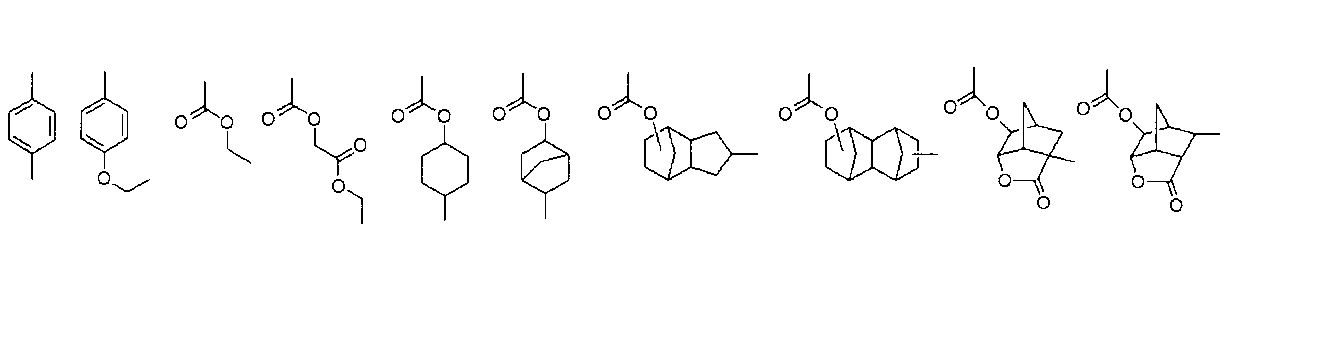
本発明の一形態において、前記一般式(Aa2)で表される繰り返し単位は、下記一般式(Aa2-1)で表される繰り返し単位であることが好ましい。

上記一般式(Aa2-1)中、
Xは、脂環式基を表す。
Xは、脂環式基を表す。
R1、R2、Ra及びL1は、それぞれ、一般式(Aa2)におけるR1、R2、Ra及びL1と同義であり、具体例、好ましい例についても一般式(Aa2)におけるR1、R2、Ra及びL1と同様である。
Xとしての脂環式基は、単環、多環、有橋式であってもよく、好ましくは炭素数3~25の脂環式基を表す。
また、脂環式基は置換基を有してもよく、置換基としては、例えば、R11及びR12が連結して形成する環が有し得る置換基として前述した置換基と同様のものを挙げることができる。
Xは、好ましくは炭素数3~25の脂環式基を表し、より好ましくは炭素数5~20の脂環式基を表し、特に好ましくは炭素数5~15のシクロアルキル基である。
また、Xは3~8員環の脂環式基又はその縮合環基であることが好ましく、5又は6員環又はその縮合環基であることが更に好ましい。
以下に、Xとしての脂環基の構造例を示す。
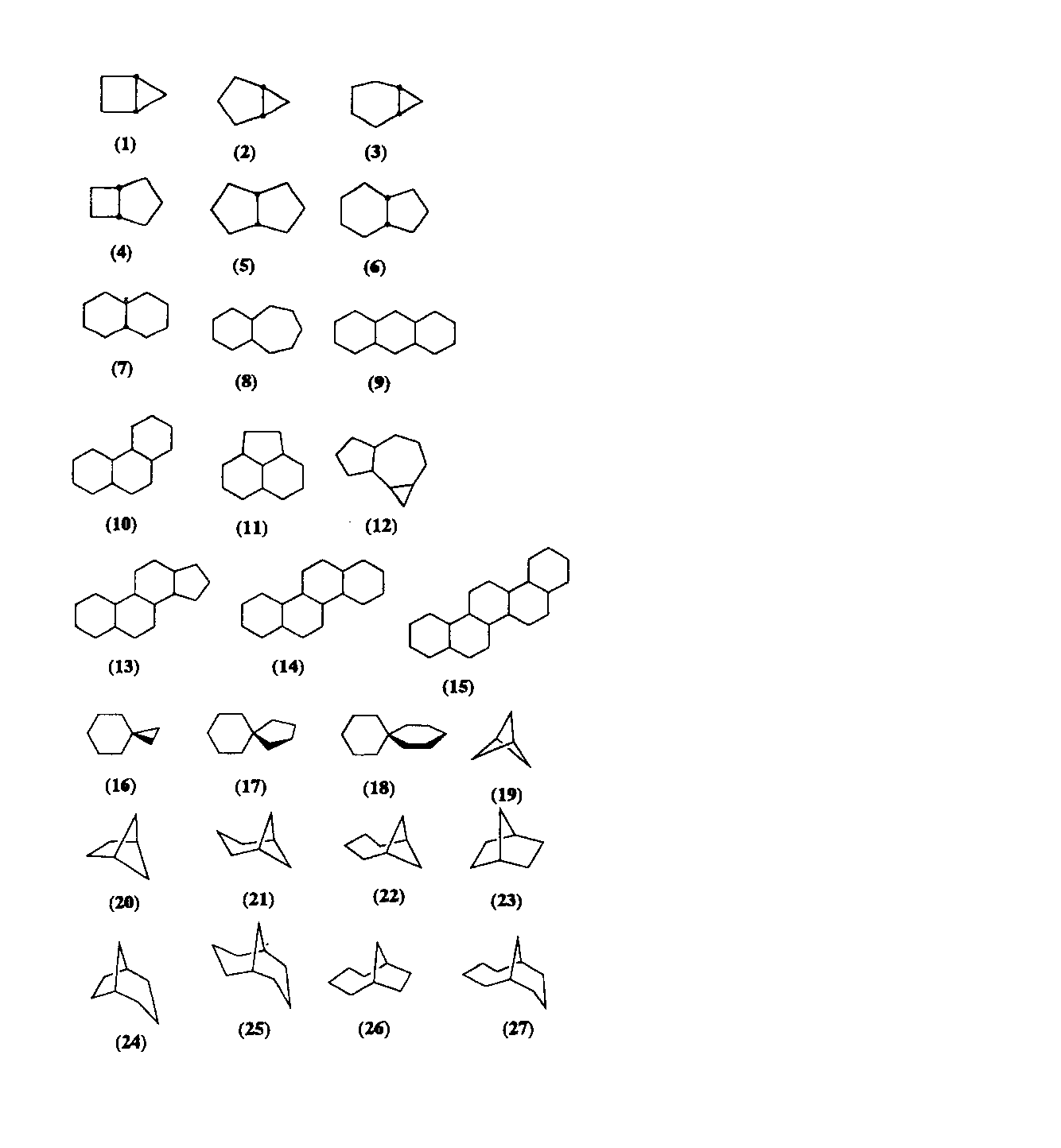

また、Xは3~8員環の脂環式基又はその縮合環基であることが好ましく、5又は6員環又はその縮合環基であることが更に好ましい。
以下に、Xとしての脂環基の構造例を示す。
上記脂環式基の好ましいものとしては、アダマンチル基、ノルアダマンチル基、デカリン残基、トリシクロデカニル基、テトラシクロドデカニル基、ノルボルニル基、セドロール基、シクロペンチル基、シクロヘキシル基、シクロヘプチル基、シクロオクチル基、シクロデカニル基、シクロドデカニル基を挙げることができる。シクロヘキシル基、シクロペンチル基、アダマンチル基、ノルボルニル基であることがより好ましく、シクロヘキシル基、シクロペンチル基であることが更に好ましく、シクロヘキシル基であることが特に好ましい。
以下に、上記一般式(Aa2)又は(Aa2-1)で表される繰り返し単位の具体例を示すが、本発明はこれらに限定されるものではない。
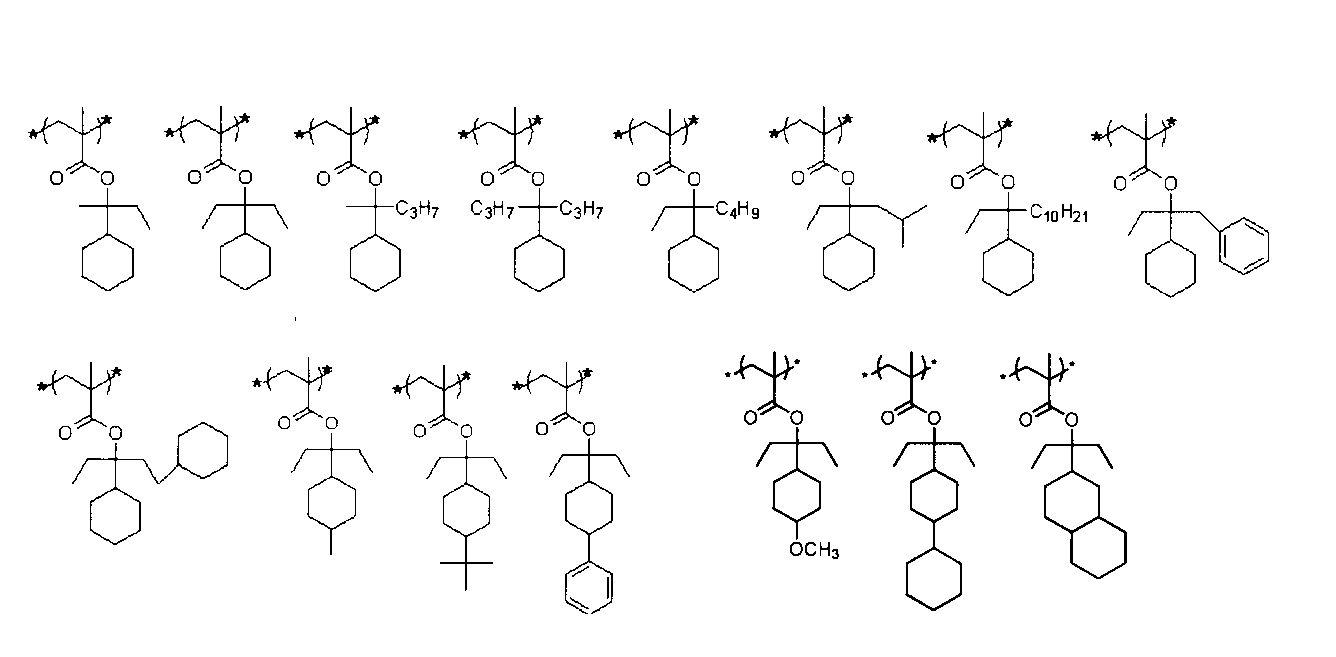

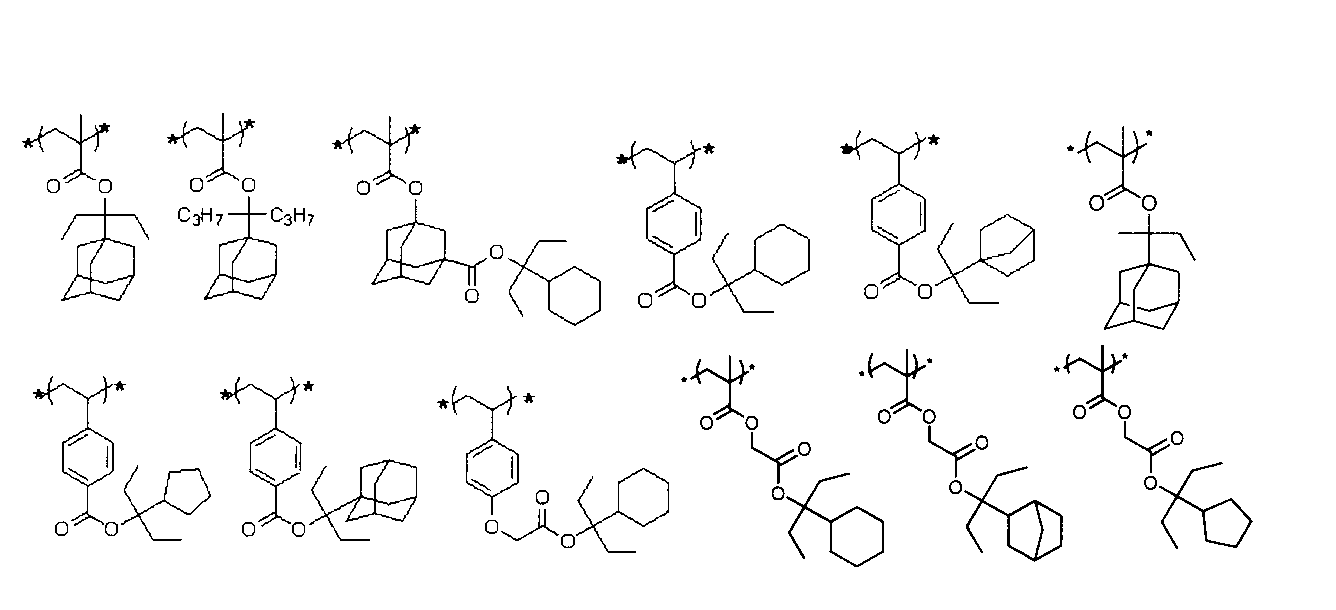
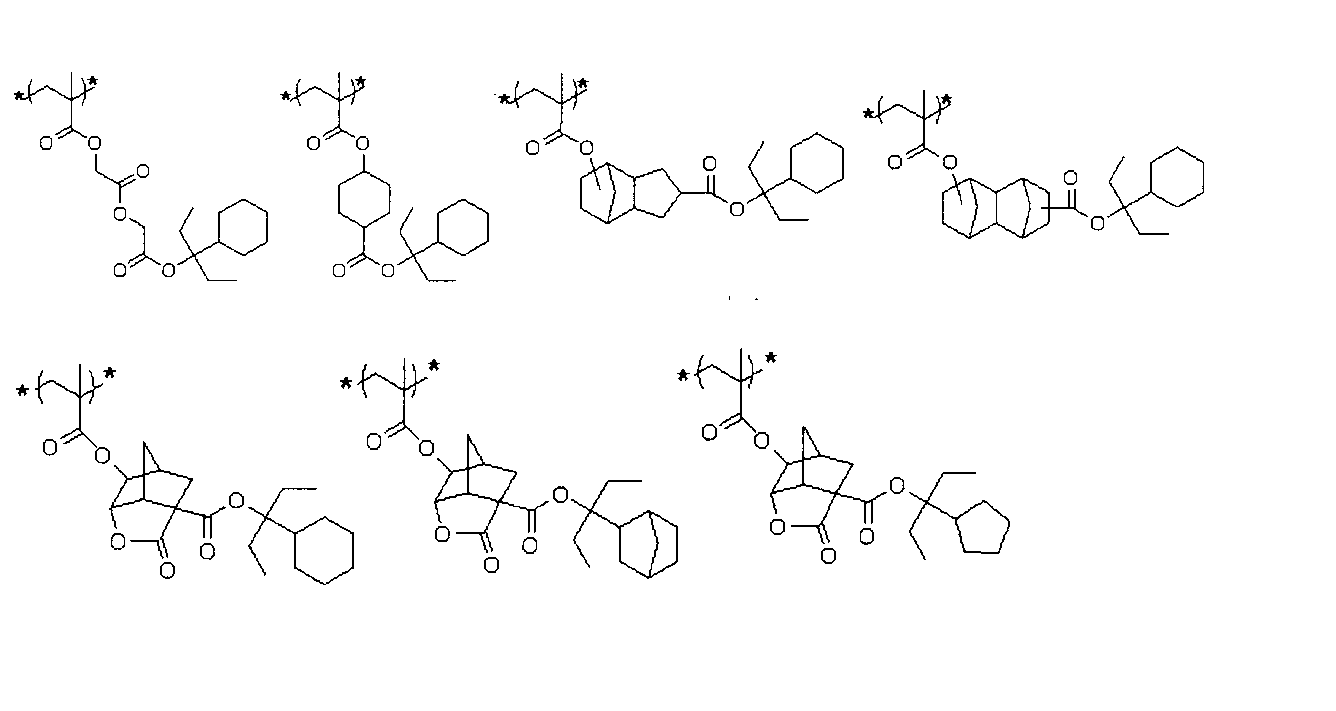
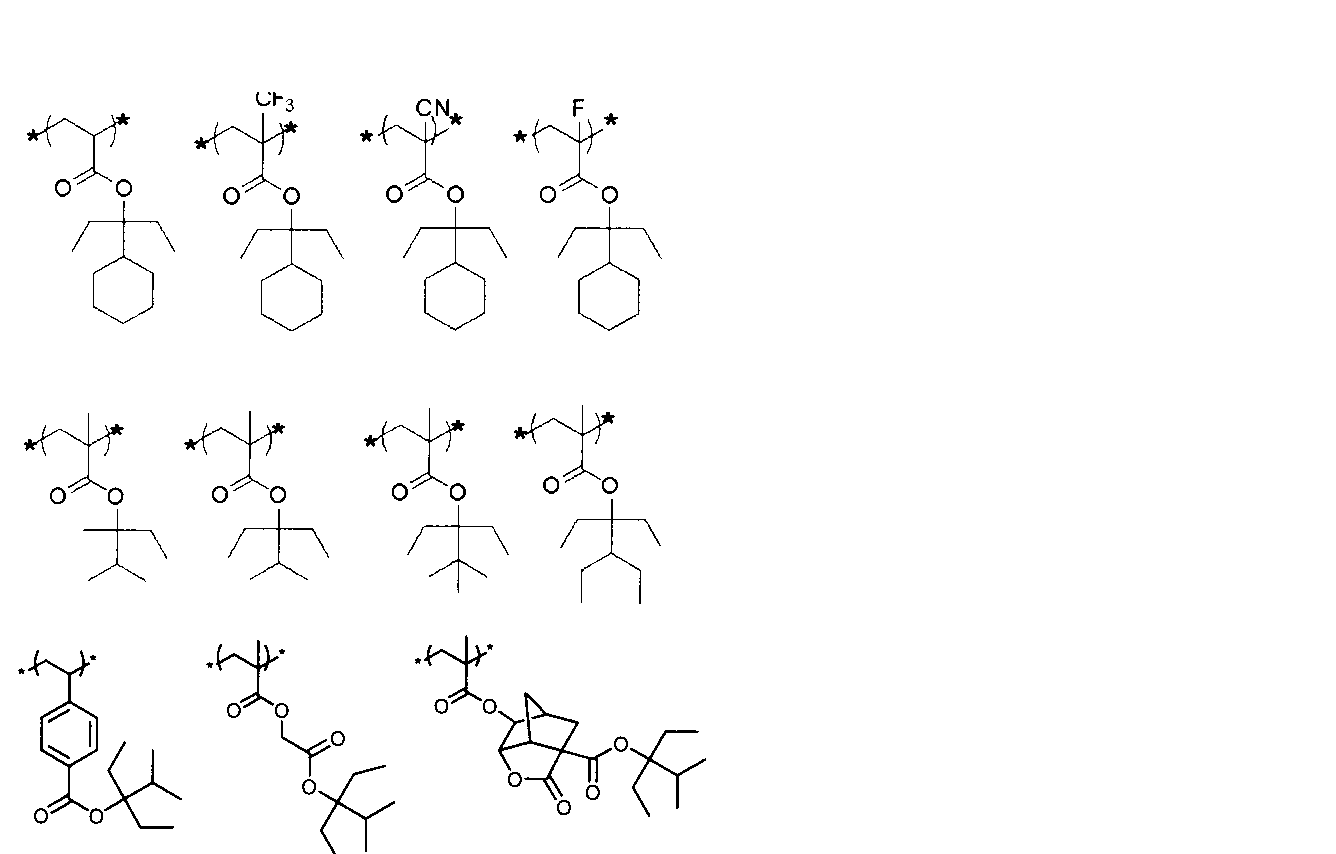
樹脂(Aa)における上記一般式(Aa2)で表される繰り返し単位の含有率(複数種類含有する場合はその合計)は、樹脂(Aa)中の全繰り返し単位に対して5~80モル%であることが好ましく、5~60モル%であることがより好ましく、10~40モル%であることが更に好ましい。
<繰り返し単位(Aa3)>
本発明の一形態において、樹脂(Aa)は、フッ素原子、フッ素原子を有する基、珪素原子を有する基、炭素数が6以上のアルキル基、炭素数が5以上のシクロアルキル基、炭素数が6以上のアリール基、及び、炭素数が7以上のアラルキル基からなる群より選択される1つ以上の基を有する繰り返し単位(Aa3)を更に含んでもよい。この繰り返し単位(Aa3)は、上述した繰り返し単位(Aa1)及び(Aa2)とは異なる繰り返し単位である。
本発明の一形態において、樹脂(Aa)は、フッ素原子、フッ素原子を有する基、珪素原子を有する基、炭素数が6以上のアルキル基、炭素数が5以上のシクロアルキル基、炭素数が6以上のアリール基、及び、炭素数が7以上のアラルキル基からなる群より選択される1つ以上の基を有する繰り返し単位(Aa3)を更に含んでもよい。この繰り返し単位(Aa3)は、上述した繰り返し単位(Aa1)及び(Aa2)とは異なる繰り返し単位である。
感度の観点から、繰り返し単位(Aa3)は、フッ素原子、又は、フッ素原子を有する基を有することが好ましい。樹脂(Aa)がフッ素原子、又は、フッ素原子を有する基を有することにより、樹脂(Aa)の極紫外線に対する吸収係数が向上し、また樹脂(Aa)はレジスト膜表面に偏在する性質を有しているため、露光時に極紫外線がより強く照射される膜表面において、上記極紫外線のエネルギーを効率的に吸収することが可能となり、結果として感度が向上するものと考えられる。
フッ素原子を有する基としては、フッ素原子を有するアルキル基、フッ素原子を有するシクロアルキル基、又は、フッ素原子を有するアリール基などが挙げられる。
フッ素原子を有するアルキル基としては、好ましくは炭素数1~10、より好ましくは炭素数1~4のフッ素原子を有するアルキル基が挙げられ、少なくとも1つの水素原子がフッ素原子で置換された直鎖又は分岐アルキル基であり、更にフッ素原子以外の置換基を有していてもよい。
フッ素原子を有するシクロアルキル基としては、少なくとも1つの水素原子がフッ素原子で置換された単環又は多環のシクロアルキル基であり、更にフッ素原子以外の置換基を有していてもよい。
フッ素原子を有するアリール基としては、フェニル基、ナフチル基などのアリール基の少なくとも1つの水素原子がフッ素原子で置換されたものが挙げられ、更にフッ素原子以外の置換基を有していてもよい。
フッ素原子を有するアルキル基、フッ素原子を有するシクロアルキル基、及びフッ素原子を有するアリール基として、好ましくは、下記一般式(F2)~(F4)で表される基を挙げることができるが、本発明は、これに限定されるものではない。
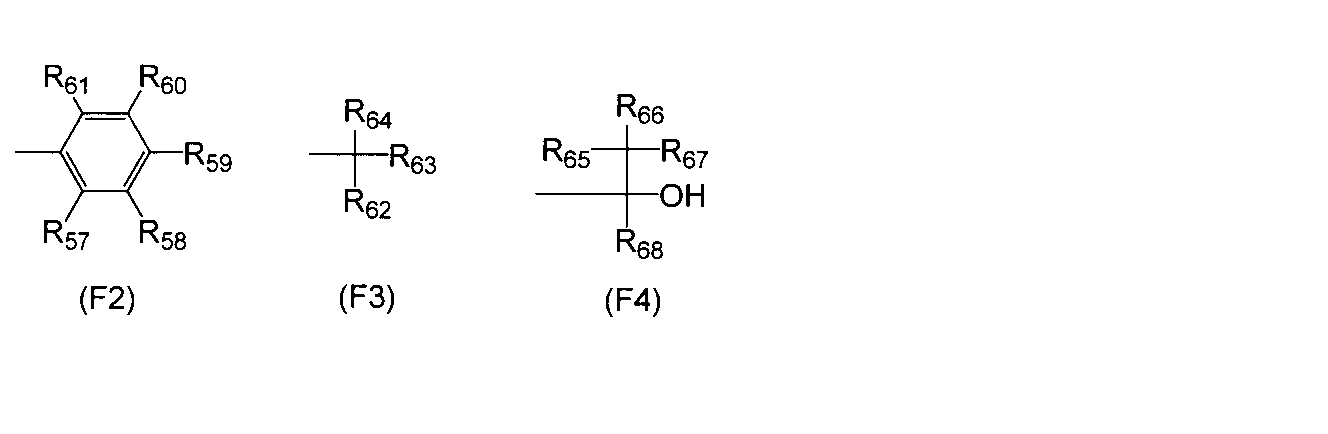
一般式(F2)~(F4)中、
R57~R68は、それぞれ独立に、水素原子、フッ素原子又はアルキル基(直鎖若しくは分岐)を表す。但し、R57~R61少なくとも1つ、R62~R64の少なくとも1つ、及びR65~R68の少なくとも1つは、それぞれ独立に、フッ素原子又は少なくとも1つの水素原子がフッ素原子で置換されたアルキル基(好ましくは炭素数1~4)を表す。
R57~R68は、それぞれ独立に、水素原子、フッ素原子又はアルキル基(直鎖若しくは分岐)を表す。但し、R57~R61少なくとも1つ、R62~R64の少なくとも1つ、及びR65~R68の少なくとも1つは、それぞれ独立に、フッ素原子又は少なくとも1つの水素原子がフッ素原子で置換されたアルキル基(好ましくは炭素数1~4)を表す。
R57~R61及びR65~R67は、全てがフッ素原子であることが好ましい。R62、R63及びR68は、少なくとも1つの水素原子がフッ素原子で置換されたアルキル基(好ましくは炭素数1~4)が好ましく、炭素数1~4のパーフルオロアルキル基であることが更に好ましい。R62とR63は、互いに連結して環を形成してもよい。
一般式(F2)で表される基の具体例としては、例えば、p-フルオロフェニル基、ペンタフルオロフェニル基、3,5-ジ(トリフルオロメチル)フェニル基等が挙げられる。
一般式(F3)で表される基の具体例としては、トリフルオロメチル基、ペンタフルオロプロピル基、ペンタフルオロエチル基、ヘプタフルオロブチル基、ヘキサフルオロイソプロピル基、ヘプタフルオロイソプロピル基、ヘキサフルオロ(2-メチル)イソプロピル基、ノナフルオロブチル基、オクタフルオロイソブチル基、ノナフルオロヘキシル基、ノナフルオロ-t-ブチル基、パーフルオロイソペンチル基、パーフルオロオクチル基、パーフルオロ(トリメチル)ヘキシル基、2,2,3,3-テトラフルオロシクロブチル基、パーフルオロシクロヘキシル基などが挙げられる。ヘキサフルオロイソプロピル基、ヘプタフルオロイソプロピル基、ヘキサフルオロ(2-メチル)イソプロピル基、オクタフルオロイソブチル基、ノナフルオロ-t-ブチル基、パーフルオロイソペンチル基が好ましく、ヘキサフルオロイソプロピル基、ヘプタフルオロイソプロピル基が更に好ましい。
一般式(F4)で表される基の具体例としては、例えば、-C(CF3)2OH、-C(C2F5)2OH、-C(CF3)(CH3)OH、-CH(CF3)OH等が挙げられ、-C(CF3)2OHが好ましい。
珪素原子を有する基としては、アルキルシリル構造(好ましくはトリアルキルシリル基)、環状シロキサン構造などが挙げられる。
W3~W6についてのアルキルシリル構造、又は環状シロキサン構造としては、具体的には、下記一般式(CS-1)~(CS-3)で表される基などが挙げられる。

一般式(CS-1)~(CS-3)に於いて、
R12~R26は、各々独立に、直鎖若しくは分岐アルキル基(好ましくは炭素数1~20)又はシクロアルキル基(好ましくは炭素数3~20)を表す。
R12~R26は、各々独立に、直鎖若しくは分岐アルキル基(好ましくは炭素数1~20)又はシクロアルキル基(好ましくは炭素数3~20)を表す。
L3~L5は、単結合又は2価の連結基を表す。2価の連結基としては、アルキレン基、フェニレン基、エーテル結合、チオエーテル結合、カルボニル基、エステル結合、アミド結合、ウレタン結合、及びウレア結合よりなる群から選択される単独或いは2つ以上の組み合わせ(好ましくは総炭素数12以下)が挙げられる。
nは、1~5の整数を表す。nは、好ましくは、2~4の整数である。
炭素数が6以上のアルキル基としては、好ましくは炭素数6~20、より好ましくは炭素数6~15の直鎖又は分岐アルキル基を挙げられ、更に、置換基(ただし、フッ素原子、フッ素原子を有する基、及び、珪素原子を有する基には相当しない)を有していてもよい。
炭素数が5以上のシクロアルキル基としては、好ましくは、炭素数5~20、より好ましくは炭素数5~15のシクロアルキル基が挙げられ、更に、置換基(ただし、フッ素原子、フッ素原子を有する基、及び、珪素原子を有する基には相当しない)を有していてもよい。
炭素数が6以上のアリール基としては、好ましくは、炭素数6~20、より好ましくは、炭素数6~15のアリール基が挙げられ、更に、置換基(ただし、フッ素原子、フッ素原子を有する基、及び、珪素原子を有する基には相当しない)を有していてもよい。
このアリール基は、少なくとも1つの炭素数3以上のアルキル基、又は、少なくとも1つの炭素数5以上のシクロアルキル基で置換されていてもよく、更にこれら以外の他の置換基(ただし、フッ素原子、フッ素原子を有する基、及び、珪素原子を有する基には相当しない)で置換されていてもよい。
上記炭素数3以上のアルキル基としては、好ましくは、炭素数3~15、より好ましくは炭素数3~10の直鎖又は分岐アルキル基が挙げられる。少なくとも1個の炭素数3以上のアルキル基で置換されたアリール基において、アリール基は、1~9個の炭素数3以上のアルキル基により置換されることが好ましく、1~7個の炭素数3以上のアルキル基により置換されることがより好ましく、1~5個の炭素数3以上のアルキル基により置換されることが更に好ましい。
上記炭素数5以上のシクロアルキル基としては、好ましくは、炭素数5~20、より好ましくは炭素数5~15のシクロアルキル基が挙げられる。少なくとも1個の炭素数5以上のシクロアルキル基で置換されたアリール基において、アリール基は、1~5個の炭素数5以上のシクロアルキル基により置換されることが好ましく、1~4個の炭素数5以上のシクロアルキル基により置換されることがより好ましく、1~3個の炭素数5以上のシクロアルキル基により置換されることが更に好ましい。
炭素数が7以上のアラルキル基としては、好ましくは、炭素数7~20、より好ましくは炭素数7~15のアラルキル基が挙げられ、更に、置換基(ただし、フッ素原子、フッ素原子を有する基、及び、珪素原子を有する基には相当しない)を有していてもよい。
樹脂(Aa)は、上記繰り返し単位(Aa3)として、下記一般式(C-Ia)~(C-Id)のいずれかで表される繰り返し単位を少なくとも1種有することが好ましい。
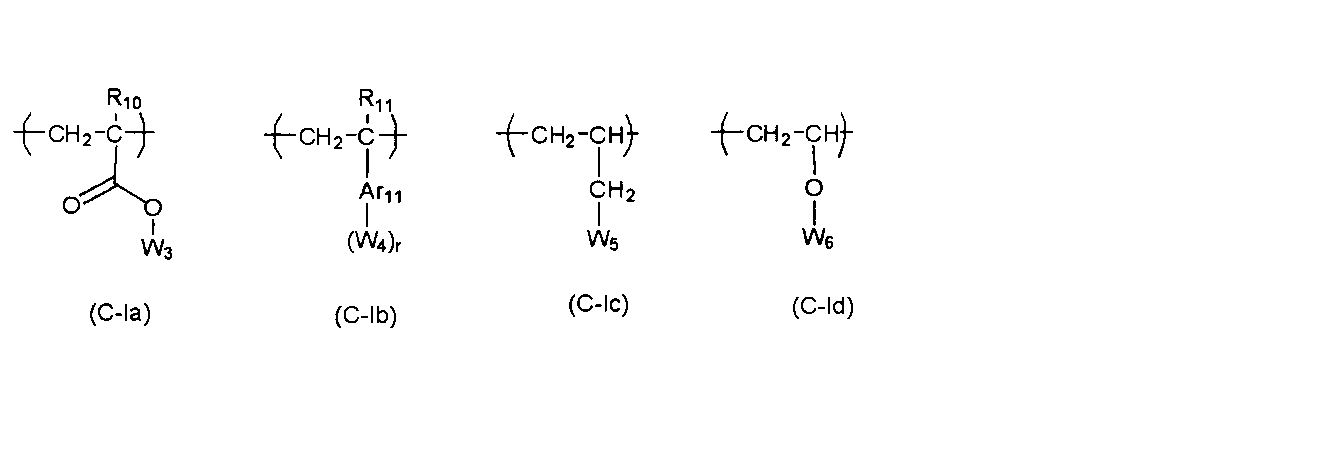
式中、R10及びR11は、各々独立に、水素原子、フッ素原子、又は、アルキル基を表す。該アルキル基は、好ましくは炭素数1~4の直鎖又は分岐のアルキル基であり、置換基を有していてもよく、置換基を有するアルキル基としては特にフッ素化アルキル基を挙げることができる。R10及びR11は、各々独立に、水素原子、又は、メチル基であることが好ましい。
W3、W5及びW6は、それぞれ独立して、フッ素原子を有する基、珪素原子を有する基、炭素数6以上のアルキル基、炭素数5以上のシクロアルキル基、炭素数6以上のアリール基、及び、炭素数7以上のアラルキル基からなる群より選択される1つ以上を有する有機基を表す。
W4は、フッ素原子を有する基、珪素原子を有する基、炭素数3以上のアルキル基、及び、炭素数5以上のシクロアルキル基からなる群より選択される1つ以上を有する有機基を表す。
Ar11は、(r+1)価の芳香環基を表す。
rは、1~10の整数を表す。
(r+1)価の芳香環基Ar11として、rが1である場合における2価の芳香環基は、置換基を有していてもよく、例えば、フェニレン基、トリレン基、ナフチレン基、アントラセニレン基などの炭素数6~18のアリーレン基などが挙げられる。
rが2以上の整数である場合における(r+1)価の芳香環基の具体例としては、2価の芳香環基の上記した具体例から、(r-1)個の任意の水素原子を除してなる基を好適に挙げることができる。
W3~W6についてのフッ素原子を有する基としては、前記したフッ素原子を有する基で挙げたものと同様である。
W3~W6についてのフッ素原子を有する基は、前記一般式(C-Ia)~(C-Id)で表される繰り返し単位に直接結合しても良く、更に、アルキレン基、フェニレン基、エーテル結合、チオエーテル結合、カルボニル基、エステル結合、アミド結合、ウレタン結合及びウレイレン結合よりなる群から選択される基、或いはこれらの2つ以上を組み合わせた基を介して前記一般式(C-Ia)~(C-Id)で表される繰り返し単位に結合しても良い。
W3~W6についての珪素原子を有する基としては、前記した珪素原子を有する基で挙げたものと同様である。
W3、W5、W6についての炭素数6以上のアルキル基、炭素数5以上のシクロアルキル基、炭素数6以上のアリール基、及び、炭素数7以上のアラルキル基は、それぞれ、前述したものと同様である。
W4についての炭素数3以上のアルキル基、及び、炭素数5以上のシクロアルキル基は、それぞれ、前記の少なくとも1個の炭素数3以上のアルキル基で置換された芳香環基における「炭素数3以上のアルキル基」、及び、前記の少なくとも1個の炭素数5以上のシクロアルキル基で置換された芳香環基における「炭素数5以上のシクロアルキル基」に関して説明したものと同様である。
露光源が極紫外線(EUV光)である場合は、上記した理由により、W3、W5及びW6は、それぞれ独立して、珪素原子を有する基、炭素数6以上のアルキル基、炭素数5以上のシクロアルキル基、炭素数6以上のアリール基、及び、炭素数7以上のアラルキル基からなる群より選択される1つ以上を有する有機基を表すことも好ましく、W4は、珪素原子を有する基、炭素数3以上のアルキル基、及び、炭素数5以上のシクロアルキル基からなる群より選択される1つ以上を有する有機基を表すことも好ましい。
W3、W5及びW6は、それぞれ独立して、フッ素原子を有する有機基、珪素原子を有する有機基、炭素数6以上のアルキル基、炭素数5以上のシクロアルキル基、炭素数6以上のアリール基、又は、炭素数7以上のアラルキル基であることが好ましく、露光源が極紫外線(EUV光)である場合は、上記した理由により、珪素原子を有する有機基、炭素数6以上のアルキル基、炭素数5以上のシクロアルキル基、炭素数6以上のアリール基、又は、炭素数7以上のアラルキル基であることも好ましい。
W4は、フッ素原子を有する有機基、珪素原子を有する有機基、炭素数3以上のアルキル基、又は、炭素数5以上のシクロアルキル基であることが好ましく、露光源が極紫外線(EUV光)である場合は、上記した理由により、珪素原子を有する有機基、炭素数3以上のアルキル基、又は、炭素数5以上のシクロアルキル基であることも好ましい。
以下、前記一般式(C-Ia)~(C-Id)のいずれかで表される繰り返し単位の具体例を示すが、本発明は、これに限定されるものではない。
具体例中、X1は、水素原子、-CH3、-F又は-CF3を表す。


具体例中、X1は、水素原子、-CH3、-F又は-CF3を表す。
樹脂(Aa)は、アリール基を有することが好ましく、アリール基を有する繰り返し単位を有することがより好ましい。樹脂(Aa)がアリール基を有することにより、アリール基が、EUV光のアウトオブバンド光を吸収し、露光部の表面のみが、アウトオブバンド光によって感光して、パターンの表面が荒れたり(特に、EUV露光の場合)、パターンの断面形状がT-top形状や逆テーパ形状になったり、分離すべきパターンの表面同士が分離せずに、ブリッジ部が発生するという不具合をより抑制できる。
この場合、前記繰り返し単位(Aa3)がアリール基を有してもよく、あるいは、樹脂(Aa)が更に前記繰り返し単位(Aa3)以外の繰り返し単位を有するとともに、該繰り返し単位がアリール基を有していてもよい。
前記繰り返し単位(Aa3)がアリール基を有する場合における繰り返し単位(Aa3)は、下記一般式(C-II)で表される繰り返し単位であることが好ましい。

上記一般式中、
R12は水素原子、メチル基、トリフルオロメチル基、又は、フッ素原子を表す。
W7は、フッ素原子を有する基、珪素原子を有する基、炭素数3以上のアルキル基、炭素数5以上のシクロアルキル基からなる群より選択される1つ以上を有する有機基を表す。
R12は水素原子、メチル基、トリフルオロメチル基、又は、フッ素原子を表す。
W7は、フッ素原子を有する基、珪素原子を有する基、炭素数3以上のアルキル基、炭素数5以上のシクロアルキル基からなる群より選択される1つ以上を有する有機基を表す。
L1は単結合、又は、-COOL2-基を表す。L2は、単結合又はアルキレン基を表す。
nは、1~5の整数を表す。
W7についてのフッ素原子を有する基、及び、珪素原子を有する基としては、それぞれ、前記したフッ素原子を有する基、及び、珪素原子を有する基で挙げたものと同様である。 W7についての炭素数3以上のアルキル基、及び、炭素数5以上のシクロアルキル基は、それぞれ、前記の少なくとも1個の炭素数3以上のアルキル基で置換された芳香環基における「炭素数3以上のアルキル基」、及び、前記の少なくとも1個の炭素数5以上のシクロアルキル基で置換された芳香環基における「炭素数5以上のシクロアルキル基」に関して説明したものと同様である。
W7についてのフッ素原子を有する基、及び、珪素原子を有する基としては、それぞれ、前記したフッ素原子を有する基、及び、珪素原子を有する基で挙げたものと同様である。 W7についての炭素数3以上のアルキル基、及び、炭素数5以上のシクロアルキル基は、それぞれ、前記の少なくとも1個の炭素数3以上のアルキル基で置換された芳香環基における「炭素数3以上のアルキル基」、及び、前記の少なくとも1個の炭素数5以上のシクロアルキル基で置換された芳香環基における「炭素数5以上のシクロアルキル基」に関して説明したものと同様である。
W7はトリアルキルシリル基、トリアルコキシシリル基、トリアルキルシリル基を有するアルキル基、トリアルコキシシリル基を有するアルキル基、炭素数3以上のアルキル基、又は、炭素数5以上のシクロアルキル基であることが好ましい。
W7としてのトリアルキルシリル基、トリアルコキシシリル基、トリアルキルシリル基を有するアルキル基、及び、トリアルコキシシリル基を有するアルキル基において、珪素原子に結合するアルキル基又はアルコキシ基の炭素数は、1~5であることが好ましく、1~3であることがより好ましい。
また、W7としてのトリアルキルシリル基を有するアルキル基、及び、トリアルコキシシリル基を有するアルキル基において、トリアルキルシリル基又はトリアルコキシシリル基に結合するアルキル基の炭素数は、1~5であることが好ましく、1~3であることがより好ましい。
R12は水素原子またはメチル基であることが好ましい。
L2としてのアルキレン基は、炭素数1~5のアルキレン基であることが好ましく、炭素数1~3のアルキレン基であることがより好ましい。L2は単結合であることが好ましい。
L2としてのアルキレン基は、炭素数1~5のアルキレン基であることが好ましく、炭素数1~3のアルキレン基であることがより好ましい。L2は単結合であることが好ましい。
W7は、フッ素原子を有する有機基、珪素原子を有する有機基、炭素数3以上のアルキル基、又は、炭素数5以上のシクロアルキル基であることが好ましい。
以下に一般式(C-II)で表される繰り返し単位の具体例を示すが、これらに限定されるものではない。

以下に一般式(C-II)で表される繰り返し単位の具体例を示すが、これらに限定されるものではない。
樹脂(Aa)が繰り返し単位(Aa3)を含有する場合、繰り返し単位(Aa3)の樹脂(Aa)の全繰り返し単位に対する含有率は、1~95モル%であることが好ましく、3~65モル%であることがより好ましく、5~35モル%であることが更に好ましい。
<繰り返し単位(Aa4)>
本発明の一形態において、樹脂(Aa)は、下記一般式(Aa4)で表される繰り返し単位(以下、「繰り返し単位(Aa4)」ともいう)を更に含有してもよい。樹脂(Aa)が繰り返し単位(Aa4)を含有することにより、疎水性が向上して偏在性をさらに向上させることができ、アウトバンド光の吸収を向上させることができる。
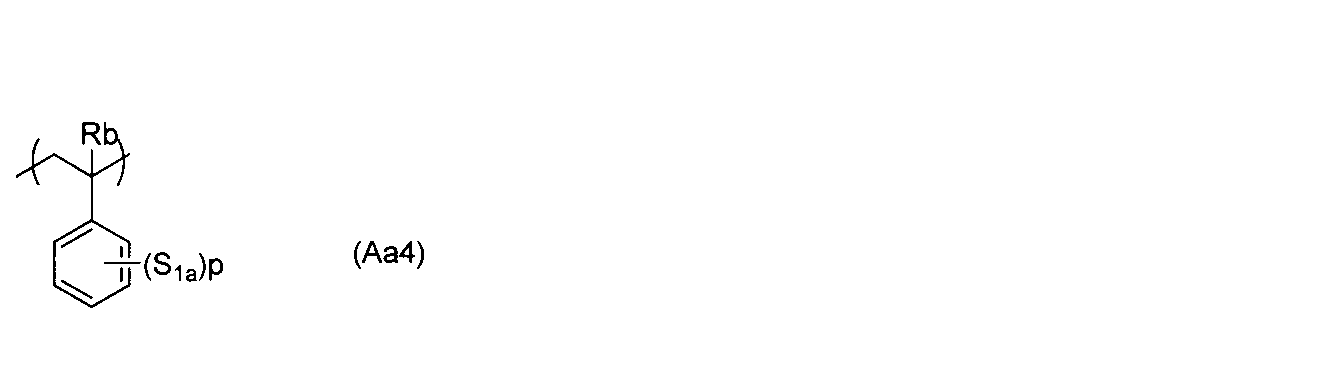
本発明の一形態において、樹脂(Aa)は、下記一般式(Aa4)で表される繰り返し単位(以下、「繰り返し単位(Aa4)」ともいう)を更に含有してもよい。樹脂(Aa)が繰り返し単位(Aa4)を含有することにより、疎水性が向上して偏在性をさらに向上させることができ、アウトバンド光の吸収を向上させることができる。
一般式(Aa4)中、
Rbは、水素原子、アルキル基又はハロゲン原子を表す。
S1aは置換基を表し、複数存在する場合は各々独立である。
pは0~5の整数を表す。
Rbは、水素原子、アルキル基又はハロゲン原子を表す。
S1aは置換基を表し、複数存在する場合は各々独立である。
pは0~5の整数を表す。
一般式(Aa4)について詳細に説明する。
式中のRbは、上述したように、水素原子、アルキル基又はハロゲン原子を表し、アルキル基は置換基を有していてもよい。
Rbとして、好ましくは、水素原子、メチル基、トリフルオロメチル基、フッ素原子が挙げられ、より好ましくは水素原子である。
式中のRbは、上述したように、水素原子、アルキル基又はハロゲン原子を表し、アルキル基は置換基を有していてもよい。
Rbとして、好ましくは、水素原子、メチル基、トリフルオロメチル基、フッ素原子が挙げられ、より好ましくは水素原子である。
S1aは、上述したように、置換基を表す。
S1aにより表される置換基としては、例えば、アルキル基、シクロアルキル基、アルコキシ基、アシル基、アシルオキシ基、ハロゲン原子、シアノ基、珪素原子を含む有機基、アリール基、アリールオキシ基、アラルキル基、アラルキルオキシ基、ヒドロキシ基、ニトロ基、スルホニルアミノ基、アルキルチオ基、アリールチオ基、アラルキルチオ基等が挙げられる。
S1aにより表される置換基としては、例えば、アルキル基、シクロアルキル基、アルコキシ基、アシル基、アシルオキシ基、ハロゲン原子、シアノ基、珪素原子を含む有機基、アリール基、アリールオキシ基、アラルキル基、アラルキルオキシ基、ヒドロキシ基、ニトロ基、スルホニルアミノ基、アルキルチオ基、アリールチオ基、アラルキルチオ基等が挙げられる。
S1aにより表される置換基は、また、上述した基が、2価の連結基に結合した基であってもよく、2価の連結基としては、例えば、置換又は無置換のアルキレン基、置換又は無置換のシクロアルキレン基、-O-、もしくはこれらの複数を組み合わせた2価の連結基が挙げられる。
S1aにより表されるアルキル基としては、例えば、炭素原子数が1~20個のアルキル基が好ましく、具体的には、メチル基、エチル基、プロピル基、イソプロピル基、n-ブチル基、イソブチル基、t-ブチル基、ペンチル基、ヘキシル基などが挙げられる。アルキル基は、更に置換基を有していてもよい。更に有し得る好ましい置換基としては、例えば、ハロゲン原子、アルコキシ基、シクロアルキル基、水酸基、ニトロ基、アシル基、アシルオキシ基、アシルアミノ基、スルホニルアミノ基、アルキルチオ基、アリールチオ基、アラルキルチオ基、チオフェンカルボニルオキシ基、チオフェンメチルカルボニルオキシ基、ピロリドン残基等のヘテロ環残基などが挙げられ、好ましくは、炭素数12以下の置換基である。
S1aにより表されるシクロアルキル基としては、例えば、炭素原子数が3~10個のシクロアルキル基が好ましく、具体的には、シクロブチル基、シクロペンチル基、シクロヘキシル基、ノルボルネル基、アダマンチル基等が挙げられる。シクロアルキル基は、更に置換基を有していてもよい。更に有し得る好ましい置換基としては、例えば、上述したS1aとしてのアルキル基が有し得る置換基に加え、アルキル基が挙げられる。
S1aにより表されるアルコキシ基としては、例えば、炭素原子数が1~10個のアルコキシ基が好ましく、具体的には、メトキシ基、エトキシ基、プロポキシ基、ブトキシ基等が挙げられる。アルコキシ基は、更なる置換基を有していてもよく、そのような置換基としては、例えば、上述したS1aとしてのアルキル基が有し得る好ましい置換基と同様の基が挙げられる。
S1aにより表されるアシル基としては、例えば、炭素原子数2~10個のものが好ましく、具体的には、アセチル基、プロピオニル基、ブチリル基、イソブチリル基等が挙げられる。アシル基は、更なる置換基を有していてもよく、そのような置換基としては、例えば、上述したS1aとしてのアルキル基が有し得る好ましい置換基と同様の基が挙げられる。
S1aにより表されるアシルオキシ基としては、例えば、炭素原子数2~10個のものが好ましい。アシルオキシ基におけるアシル基としては、例えば、上述したアシル基と同様の具体例が挙げられ、有し得る置換基も同様である。
S1aにより表されるアリール基としては、例えば、炭素原子数6~10個のものが好ましく、具体的には、フェニル基、キシリル基、トルイル基、クメニル基、ナフチル基、アントラセニル基等が挙げられる。アリール基は、更なる置換基を有していてもよく、そのような置換基としては、例えば、上述したS1aとしてのアルキル基又はシクロアルキル基が有し得る好ましい置換基と同様の基が挙げられる。
S1aにより表されるアリールオキシ基、アリールチオ基としては、例えば、炭素原子数2~10個のものが好ましい。アリールオキシ基及びアリールチオ基におけるアリール基としては、例えば、上述したアリール基と同様の具体例が挙げられ、有し得る置換基も同様である。
S1aにより表されるアラルキル基としては、例えば、炭素原子数7~15個のものが好ましく、具体的には、ベンジル基等が挙げられる。これらの基は、更なる置換基を有していてもよく、そのような置換基としては、例えば、上述したS1aとしてのアルキル基又はシクロアルキル基が有し得る好ましい置換基と同様の基が挙げられる。
S1aにより表されるアラルキルオキシ基、アラルキルチオ基としては、例えば、炭素原子数7~15個のものが好ましい。アラルキルオキシ基及びアラルキルチオ基におけるアラルキル基としては、例えば、上述したアラルキルと同様の具体例が挙げられ、有し得る置換基も同様である。
S1aにより表されるアルキルチオ基としては、例えば、炭素原子数1~10個のものが好ましい。アルキルチオ基におけるアルキル基としては、例えば、上述したアルキルと同様の具体例が挙げられ、有し得る置換基も同様である。
S1aにより表されるハロゲン原子としては、フッ素原子、塩素原子、臭素原子、沃素原子が挙げられ、フッ素原子及び塩素原子が好ましく、フッ素原子が最も好ましい。
S1aにより表される、珪素原子を含む有機基における有機基は、炭素原子を少なくとも1つ含む基であり、酸素原子、窒素原子、硫黄原子、珪素原子、ハロゲン原子(例えば、フッ素原子、塩素原子、臭素原子等)などのヘテロ原子を含んでいてもよい。この有機基は、炭素原子数が1~30個であることが好ましい。
珪素原子を含む有機基は、一態様において、下記一般式(S)で表されることが好ましい。
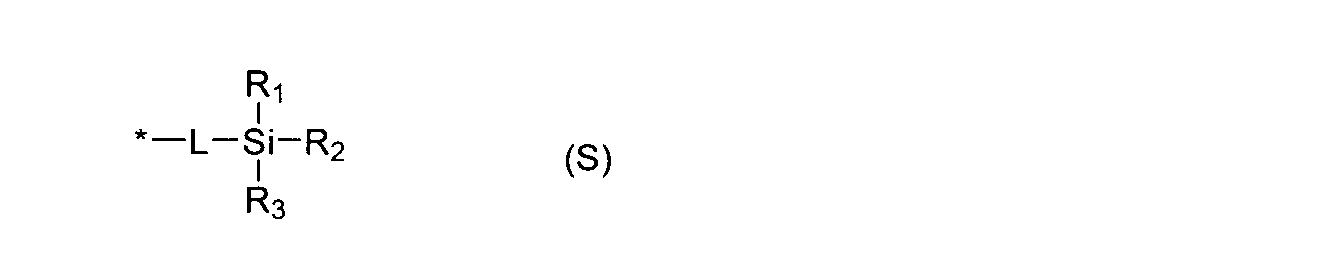
式中、
R1、R2及びR3は、各々独立に、水素原子、アルキル基、アルケニル基、シクロアルキル基、アルコキシ基、アリール基、アラルキル基、ハロゲン原子を表す。
Lは単結合又は2価の連結基を表す。
R1、R2及びR3は、各々独立に、水素原子、アルキル基、アルケニル基、シクロアルキル基、アルコキシ基、アリール基、アラルキル基、ハロゲン原子を表す。
Lは単結合又は2価の連結基を表す。
R1、R2及びR3におけるアルキル基としては、例えば、炭素原子数が1~20のアルキル基が好ましく、置換基を有していてもよい。
R1、R2及びR3におけるアルケニル基としては、例えば、炭素原子数が2~10のアルケニル基が好ましく、置換基を有していてもよい。
R1、R2及びR3におけるシクロアルキル基としては、例えば、炭素原子数が3~10のシクロアルキル基が好ましく、置換基を有していてもよい。
R1、R2及びR3におけるアルコキシ基としては、例えば、炭素原子数が1~10のアルコキシ基が好ましく、置換基を有していてもよい。
R1、R2及びR3におけるアリール基としては、例えば、炭素原子数が6~10のアリール基が好ましく、置換基を有していてもよい。
R1、R2及びR3におけるアラルキル基としては、例えば、炭素原子数が7~15のアラルキル基が好ましく、置換基を有していてもよい。
Lにより表される2価の連結基としては、例えば、置換又は無置換のアルキレン基、-O-、-S-、-(C=O)-、又はこれらの複数を組み合わせた2価の連結基が挙げられる。
R1、R2及びR3におけるアルケニル基としては、例えば、炭素原子数が2~10のアルケニル基が好ましく、置換基を有していてもよい。
R1、R2及びR3におけるシクロアルキル基としては、例えば、炭素原子数が3~10のシクロアルキル基が好ましく、置換基を有していてもよい。
R1、R2及びR3におけるアルコキシ基としては、例えば、炭素原子数が1~10のアルコキシ基が好ましく、置換基を有していてもよい。
R1、R2及びR3におけるアリール基としては、例えば、炭素原子数が6~10のアリール基が好ましく、置換基を有していてもよい。
R1、R2及びR3におけるアラルキル基としては、例えば、炭素原子数が7~15のアラルキル基が好ましく、置換基を有していてもよい。
Lにより表される2価の連結基としては、例えば、置換又は無置換のアルキレン基、-O-、-S-、-(C=O)-、又はこれらの複数を組み合わせた2価の連結基が挙げられる。
S1aは、一態様において、置換基を有していてもよいアルキル基、ハロゲン原子又は珪素原子を含む有機基であることが好ましく、アルキル基、ハロゲン原子で置換されたアルキル基、又は珪素原子を含む有機基であることがより好ましく、アルキル基又は下記一般式(S-1)で表される基であることが更に好ましい。

式中、
R11、R21及びR31は、各々独立に、アルキル基を表す。
L1は単結合又は2価の連結基を表す。
R11、R21及びR31は、各々独立に、アルキル基を表す。
L1は単結合又は2価の連結基を表す。
R11、R21及びR31としてのアルキル基は、先に述べた一般式(S)におけるR1、R2及びR3としてのアルキル基と同義であり、L1としての2価の連結基は、一般式(S)におけるLとしての2価の連結基と同義である。
pは、上述したように、0~5の整数を表す。pは、好ましくは1~5の整数である。
pは、上述したように、0~5の整数を表す。pは、好ましくは1~5の整数である。
以下に、繰り返し単位(Aa4)の具体例を示すが、本発明はこれらに限定されるものではなく、また、ベンゼン環上の置換基(S1a基に対応)の位置も下記具体例に限定されるものでない。
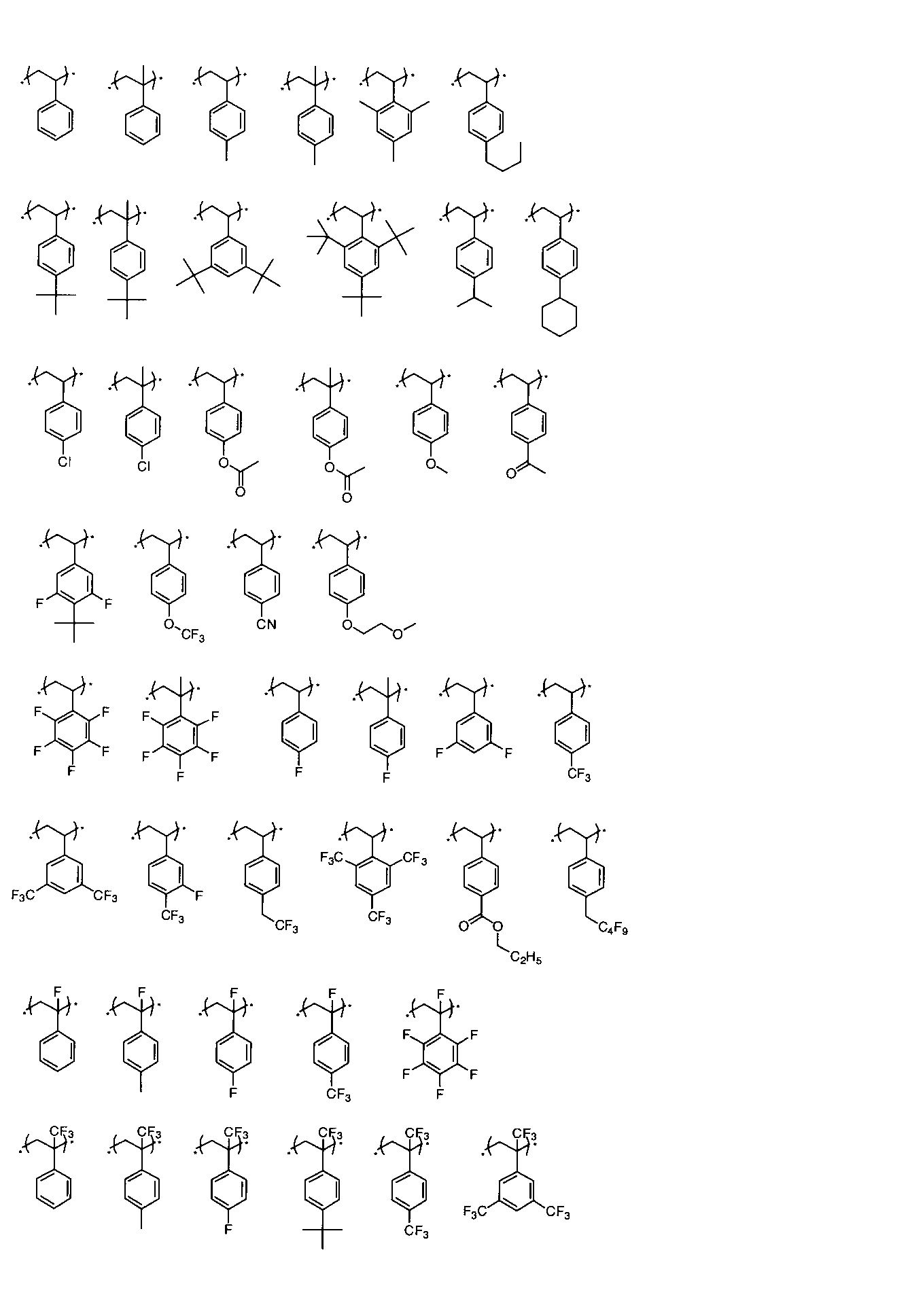
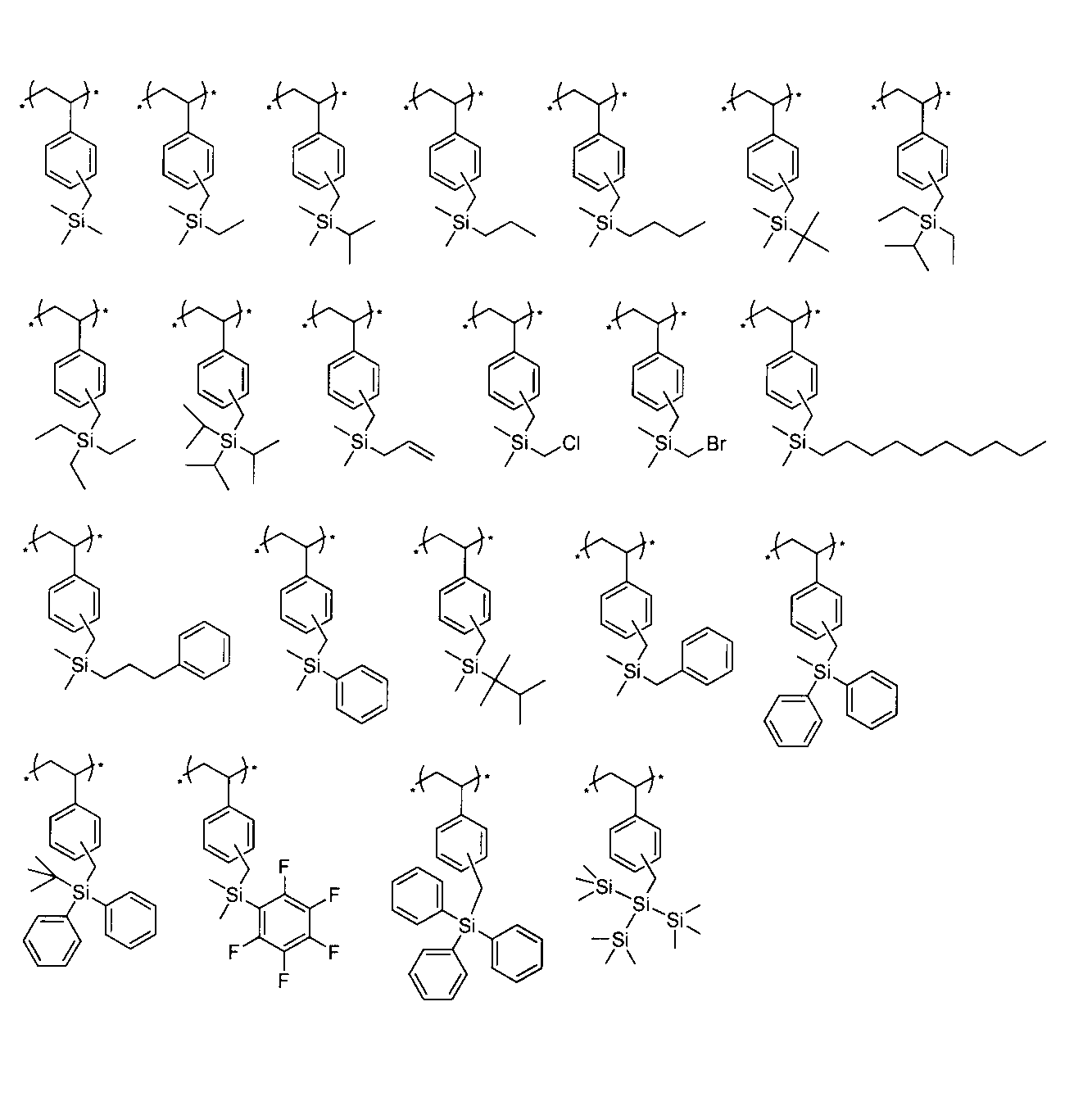
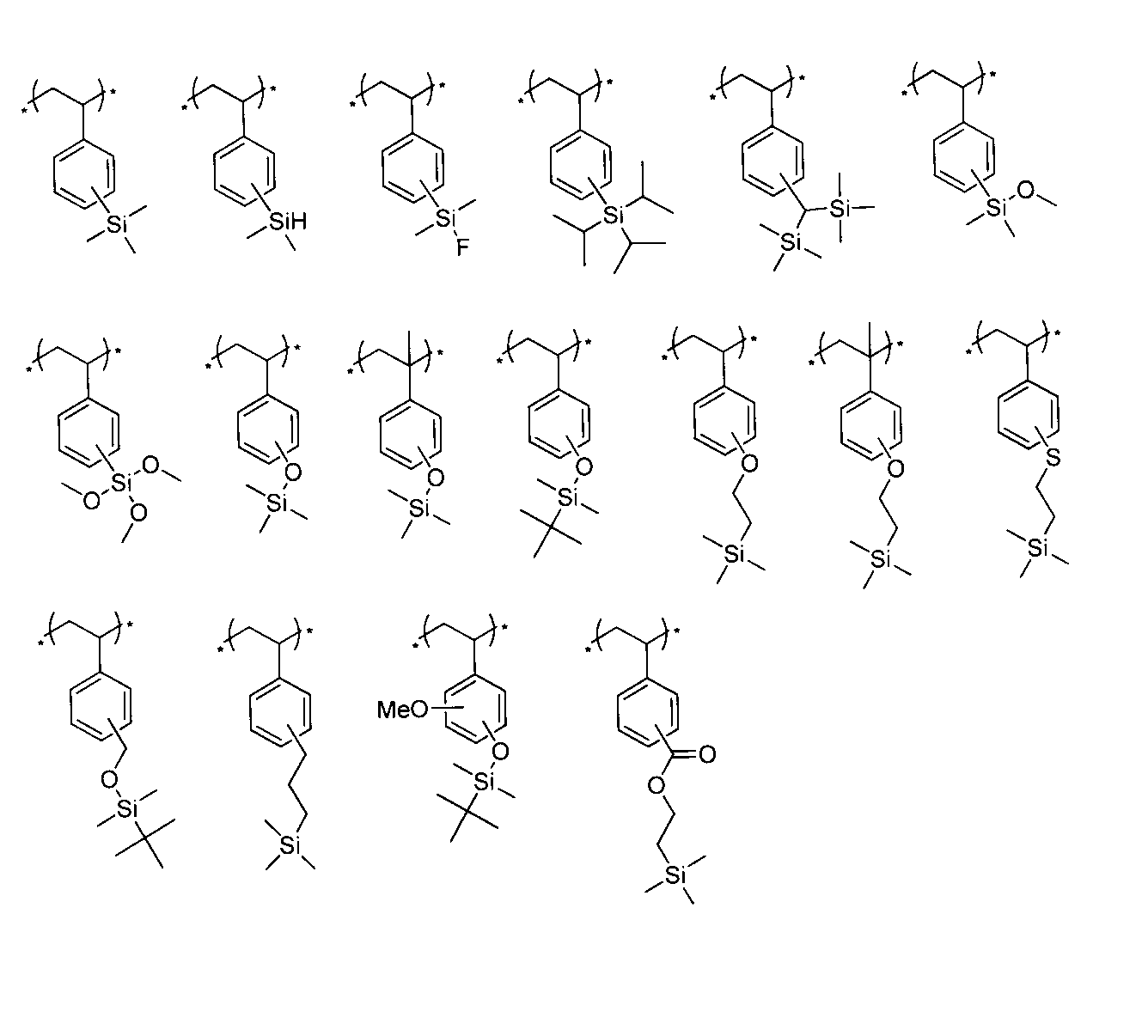
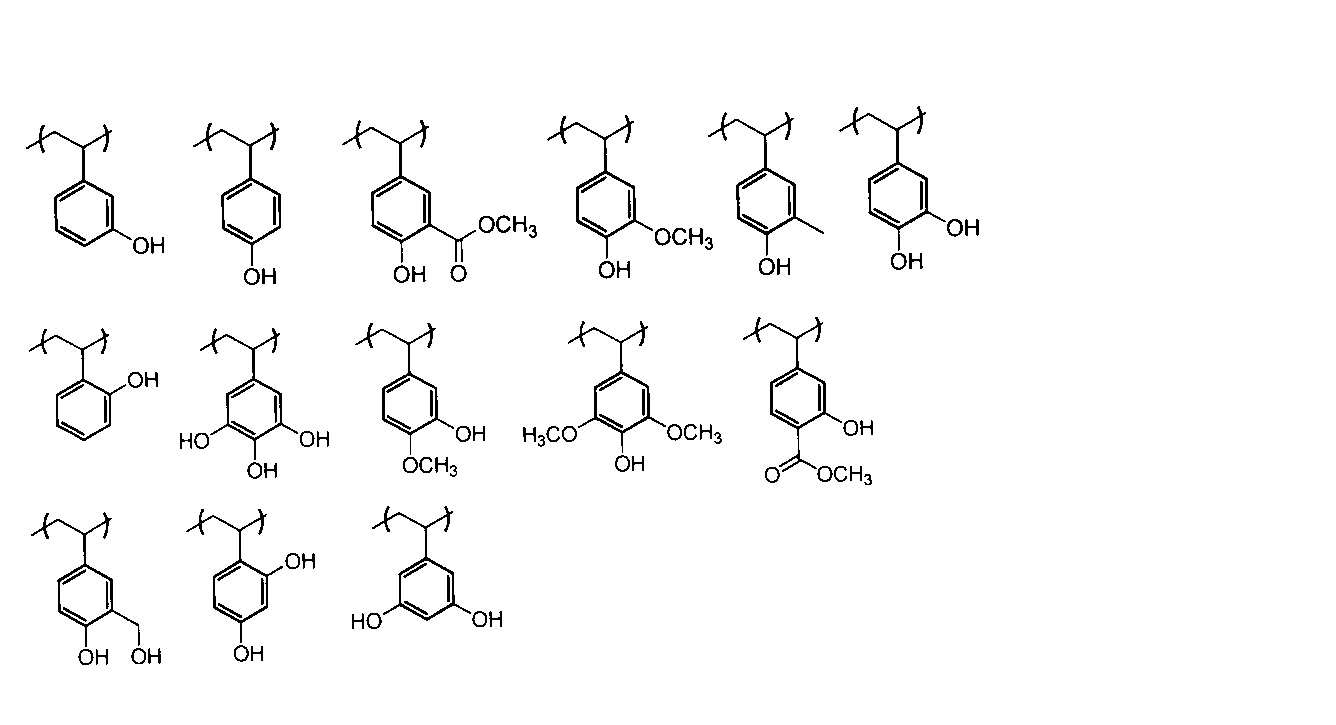

樹脂(Aa)が繰り返し単位(Aa4)を含有する場合、繰り返し単位(Aa4)の含有率は、樹脂(Aa)中の全繰り返し単位に対し、1~99mol%が好ましく、より好ましくは1~70mol%であり、更に好ましくは1~50mol%であり、特に好ましくは1~30mol%である。
<繰り返し単位(Aa5)>
本発明の一形態において、樹脂(Aa)は、少なくとも2つ以上の極性変換基を有する繰り返し単位(Aa5)を更に含有してもよい。
本発明の一形態において、樹脂(Aa)は、少なくとも2つ以上の極性変換基を有する繰り返し単位(Aa5)を更に含有してもよい。
繰り返し単位(Aa5)が、1つの側鎖上に、少なくとも2つ以上の極性変換基と、フッ素原子及び珪素原子の少なくともいずれかと、を有する繰り返し単位(Aa5-1)であることが好ましい。即ち、複数の極性変換基を有する側鎖上に、フッ素原子及び珪素原子の少なくともいずれかを有する構造をもつ繰り返し単位である。なお、フッ素原子は、後述する極性変換基における電子求引性基としてのフッ素原子であっても、該電子求引性基としてのフッ素原子とは異なるフッ素原子であってもよい。
また、繰り返し単位(Aa5)が、少なくとも2つ以上の極性変換基を有し、かつ、フッ素原子及び珪素原子を有さない繰り返し単位(Aa5-2)であり、樹脂(Aa)がフッ素原子及び珪素原子の少なくともいずれかを有する上掲の繰り返し単位(Aa3)を更に有することも好ましい。
あるいは、繰り返し単位(Aa5)が、1つの側鎖上に少なくとも2つ以上の極性変換基を有し、かつ、同一繰り返し単位内の前記側鎖と異なる側鎖上に、フッ素原子及び珪素原子の少なくともいずれかを有する繰り返し単位(Aa5-3)であることも好ましい。この場合、極性変換基を有する側鎖とフッ素原子及び珪素原子の少なくともいずれかを有する側鎖とは、主鎖の炭素原子を介してα位の位置関係、すなわち下記式(4)のような位置関係にあることが好ましい。式中、B1は極性変換基を有する部分構造、B2はフッ素原子及び珪素原子の少なくともいずれかを有する部分構造を表す。

これら樹脂(Aa)の態様のうち、繰り返し単位(Aa5-1)を有することがより好ましい。
ここで、極性変換基とは、アルカリ現像液の作用により分解し、アルカリ現像液中での溶解度が増大する基であり、一般式(KA-1)又は(KB-1)で示す構造における-COO-で表される部分構造である。
一般式(KA-1)で表すラクトン構造は、ラクトン環を有していればいずれの基でも用いることができるが、好ましくは5~7員環ラクトン構造を有する基であり、5~7員環ラクトン構造にビシクロ構造、スピロ構造を形成する形で他の環構造が縮環しているものが好ましい。
なお、繰り返し単位における樹脂の主鎖に直結のエステル基(例えばアクリレートにおける-COO-)は極性変換基としての機能が劣るため、本件における極性変換基には含まれない。
また、繰り返し単位(Aa5)は、(KA-1)又は(KB-1)で表される構造全体を別個に2つ有していなくてもよく、一部を重複して、例えば1つの電子求引性基を2つのエステル構造が挟む形であっても、後述する式(KY-1)の形態であっても、2つの極性変換基を含むと解する。
また、繰り返し単位(Aa5-2)及び繰り返し単位(Aa5-3)においては、極性変換基が、一般式(KA-1)で示す構造における-COO-で表される部分構造であることがより好ましい。

一般式(KA-1)中、
Zkaは、アルキル基、シクロアルキル基、エーテル基、ヒドロキシル基、アミド基、アリール基、ラクトン環基、又は電子求引性基を表し、Zkaが複数存在する場合、複数のZkaは同じでも異なっていてもよい。
Zkaは、アルキル基、シクロアルキル基、エーテル基、ヒドロキシル基、アミド基、アリール基、ラクトン環基、又は電子求引性基を表し、Zkaが複数存在する場合、複数のZkaは同じでも異なっていてもよい。
Zka同士が連結して環を形成しても良い。Zka同士が連結して形成する環としては、例えば、シクロアルキル環、ヘテロ環(環状エーテル環、ラクトン環など)が挙げられる。
nkaは0~10の整数を表す。好ましくは0~8の整数、より好ましくは0~5の整数、更に好ましくは1~4の整数、最も好ましくは1~3の整数である。
Qは、式中の原子と共にラクトン環を形成するのに必要な原子群を表す。ラクトン環は、上述したように、ラクトン構造を有する基であれば特に限定されないが、好ましくは5~7員環ラクトン構造を有する基であり、5~7員環ラクトン構造にビシクロ構造、スピロ構造を形成する形で他の環構造が縮環しているものが好ましい。
一般式(KB-1)中、
Xkb1、Xkb2は各々独立して電子求引性基である。
Xkb1、Xkb2は各々独立して電子求引性基である。
nkb、nkb’は各々独立して0又は1を表す。なお、nkb、nkb’が0の場合、Xkb1、Xkb2はエステル基(-COO-)と直結していることを表す。
Rkb1~Rkb4は、各々独立して水素原子、アルキル基、シクロアルキル基、アリール基、又は電子求引性基を表し、Rkb1、Rkb2及びXkb1の少なくとも2つが互いに連結して環を形成していてもよく、Rkb3、Rkb4及びXkb2の少なくとも2つが互いに連結して環を形成していてもよい。
Rkb3、Rkb4及びXkb2の少なくとも2つが互いに連結して形成してもよい環としては、好ましくはシクロアルキル基又はヘテロ環基が挙げられ、ヘテロ環基としてはラクトン環基が好ましい。ラクトン環としては、例えば後述する式(KA-1-1)~(KA-1-17)で表わされる構造が挙げられる。
なお、一般式(KA-1)又は(KB-1)で表される構造は、一般式(KA-1)で表される構造、Xkb1、Xkb2が1価である場合の(KB-1)で表される構造の場合のように、結合手を有しない場合は、該構造における任意の水素原子を少なくとも1つ除いた1価以上の部分構造である。
Zka、Xkb1、Xkb2、Rkb1~Rkb4における電子求引性基としては、ハロゲン原子、シアノ基、オキシ基、カルボニル基、カルボニルオキシ基、オキシカルボニル基、ニトリル基、ニトロ基、スルホニル基、スルフィニル基、又は、-C(Rf1)(Rf2)-Rf3で表されるハロ(シクロ)アルキル基又はハロアリール基、及びこれらの組み合わせをあげることができる。
なお、「ハロ(シクロ)アルキル基」とは、少なくとも一部がハロゲン化したアルキル基及びシクロアルキル基を表す。電子求引性基が2価以上の基である場合、残る結合手は、任意の原子又は置換基との結合を形成するものであり、更なる置換基を介して樹脂(Aa)の主鎖に連結していてもよい。
ここでRf1はハロゲン原子、パーハロアルキル基、パーハロシクロアルキル基、又はパーハロアリール基を表し、より好ましくはフッ素原子、パーフルオロアルキル基又はパーフルオロシクロアルキル基、更に好ましくはフッ素原子又はトリフルオロメチル基を表す。
Rf2、Rf3は各々独立して水素原子、ハロゲン原子又は有機基を表し、Rf2とRf3とが連結して環を形成してもよい。有機基としては例えばアルキル基、シクロアルキル基、アルコキシ基等を表す。
Rf1~Rf3の少なくとも2つは連結して環を形成してもよく、形成する環としては、(ハロ)シクロアルキル環、(ハロ)アリール環等が挙げられる。
Rf1~Rf3における(ハロ)アルキル基としては、例えば前記Zkaにおけるアルキル基、及びこれがハロゲン化した構造が挙げられる。
Rf1~Rf3における、又は、Rf2とRf3とが連結して形成する環における(パー)ハロシクロアルキル基及び(パー)ハロアリール基としては、例えば前記Zkaにおけるシクロアルキル基がハロゲン化した構造、より好ましくは-C(n)F(2n-2)Hで表されるフルオロシクロアルキル基、及び、-C(n)F(n-1)で表されるパーフルオロアリール基が挙げられる。ここで炭素数nは特に限定されないが、5~13のものが好ましく、6がより好ましい。
Rf2、はRf1と同様の基を表すか、又はRf3と連結して環を形成していることがより好ましい。
電子求引性基としては、好ましくはハロゲン原子、又は、-C(Rf1)(Rf2)-Rf3で表されるハロ(シクロ)アルキル基又はハロアリール基であり、より好ましくは-C(CF3)2H又は-C(CF3)2CH3である。
なお、上記電子求引性基は、一部のフッ素原子が別の電子求引性基で置換されていてもよい。
Zkaは好ましくは、アルキル基、シクロアルキル基、エーテル基、ヒドロキシル基、又は電子求引性基であり、より好ましくは、アルキル基、シクロアルキル基又は電子求引性基である。なお、エーテル基としては、アルキル基又はシクロアルキル基等で置換されたもの、すなわち、アルキルエーテル基等が好ましい。電子求引性基は前記と同義である。
Zkaとしてのハロゲン原子はフッ素原子、塩素原子、臭素原子及びヨウ素原子等が挙げられ、フッ素原子が好ましい。
Zkaとしてのアルキル基は置換基を有していてもよく、直鎖、分岐のいずれでもよい。直鎖アルキル基としては、好ましくは炭素数1~30、更に好ましくは1~20であり、例えば、メチル基、エチル基、n-プロピル基、n-ブチル基、n-ペンチル基、n-ヘキシル基、n-ヘプチル基、n-オクチル基、n-ノニル基、n-デカニル基等が挙げられる。分岐アルキル基としては、好ましくは炭素数3~30、更に好ましくは3~20であり、例えば、i-プロピル基、i-ブチル基、sec-ブチル基、t-ブチル基、i-ペンチル基、t-ペンチル基、i-ヘキシル基、t-ヘキシル基、i-ヘプチル基、t-ヘプチル基、i-オクチル基、t-オクチル基、i-ノニル基、t-デカノイル基等が挙げられる。メチル基、エチル基、n-プロピル基、i-プロピル基、n-ブチル基、i-ブチル基、t-ブチル基などの炭素数1~4のものが好ましい。
Zkaのシクロアルキル基は、単環型であってもよく、多環型であってもよい。後者の場合、シクロアルキル基は、有橋式であってもよい。即ち、この場合、シクロアルキル基は、橋かけ構造を有していてもよい。なお、シクロアルキル基中の炭素原子の一部は、酸素原子等のヘテロ原子によって置換されていてもよい。
単環型のシクロアルキル基としては、炭素数が3~8のものが好ましく、例えば、シクロプロピル基、シクロブチル基、シクロペンチル基、シクロヘキシル基及びシクロオクチル基が挙げられる。
多環型のシクロアルキル基としては、例えば、炭素数が5以上のビシクロ、トリシクロ又はテトラシクロ構造を有する基が挙げられる。この多環型のシクロアルキル基は、炭素数が6~20であることが好ましく、例えば、アダマンチル基、ノルボルニル基、イソボロニル基、カンファニル基、ジシクロペンチル基、α-ピネル基、トリシクロデカニル基、テトシクロドデシル基及びアンドロスタニル基が挙げられる。
これらシクロアルキル基としては、例えば、下式により表されるものが挙げられる。
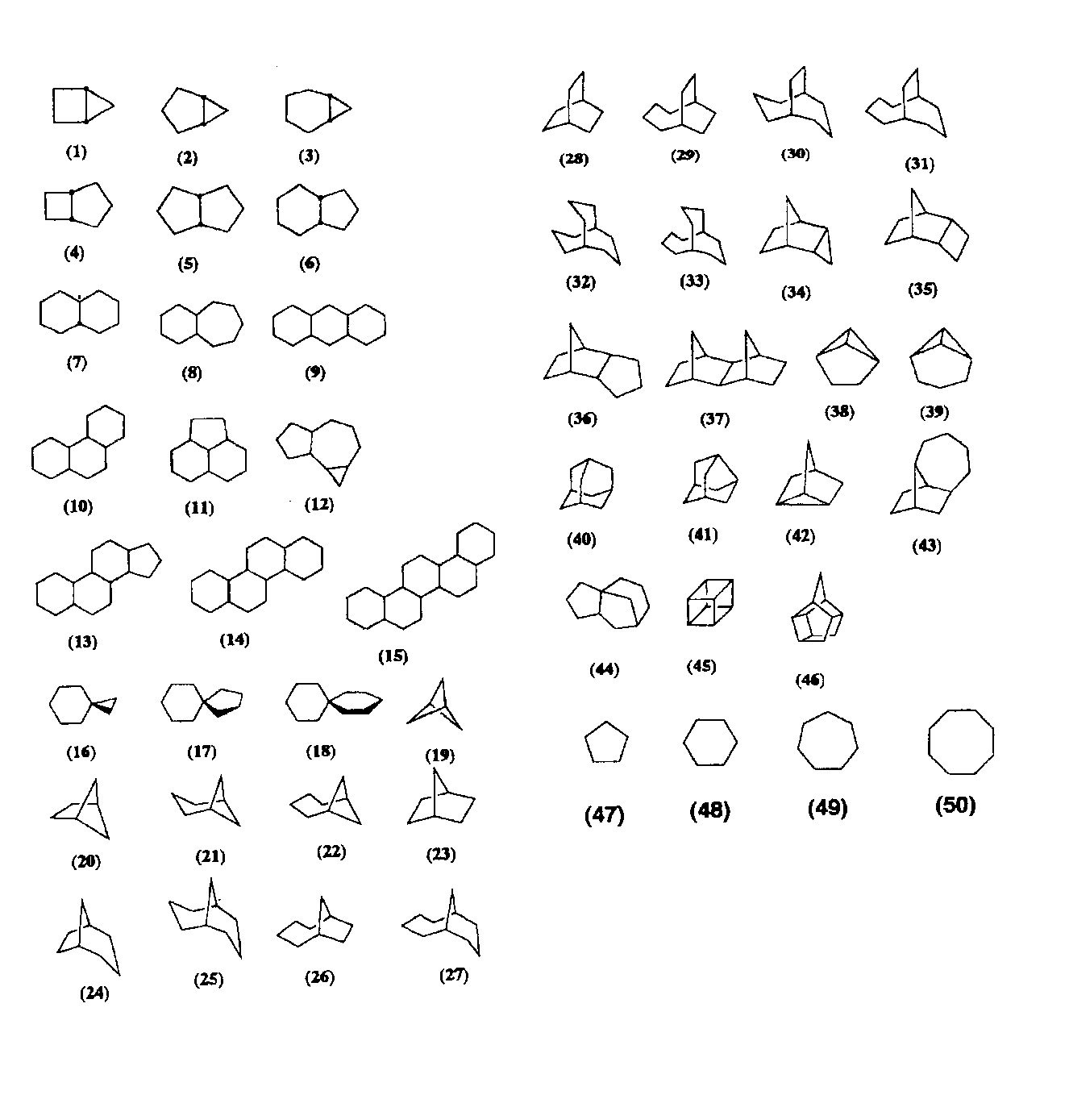
これらシクロアルキル基としては、例えば、下式により表されるものが挙げられる。
上記脂環部分の好ましいものとしては、アダマンチル基、ノルアダマンチル基、デカリン基、トリシクロデカニル基、テトラシクロドデカニル基、ノルボルニル基、セドロール基、シクロヘキシル基、シクロヘプチル基、シクロオクチル基、シクロデカニル基、シクロドデカニル基を挙げることができる。より好ましくは、アダマンチル基、デカリン基、ノルボルニル基、セドロール基、シクロヘキシル基、シクロヘプチル基、シクロオクチル基、シクロデカニル基、シクロドデカニル基、トリシクロデカニル基である。
これらの脂環式構造の置換基としては、アルキル基、ハロゲン原子、水酸基、アルコキシ基、カルボキシル基、アルコキシカルボニル基が挙げられる。アルキル基としてはメチル基、エチル基、プロピル基、イソプロピル基、ブチル基等の低級アルキル基が好ましく、更に好ましくはメチル基、エチル基、プロピル基、イソプロピル基を表す。上記アルコキシ基としては、好ましくはメトキシ基、エトキシ基、プロポキシ基、ブトキシ基等の炭素数1~4個のものを挙げることができる。アルキル基及びアルコキシ基が有してもよい置換基としては、水酸基、ハロゲン原子、アルコキシ基(好ましくは炭素数1~4)等を挙げることができる。
Zkaのアリール基としては、例えば、フェニル基及びナフチル基が挙げられる。
Zkaのアルキル基、シクロアルキル基及びアリール基が更に有し得る置換基としては、例えば、水酸基;ハロゲン原子;ニトロ基;シアノ基;上記のアルキル基;メトキシ基、エトキシ基、ヒドロキシエトキシ基、プロポキシ基、ヒドロキシプロポキシ基、n-ブトキシ基、イソブトキシ基、sec-ブトキシ基及びt-ブトキシ基等のアルコキシ基;メトキシカルボニル基及びエトキシカルボニル基等のアルコキシカルボニル基;ベンジル基、フェネチル基及びクミル基等のアラルキル基;アラルキルオキシ基;ホルミル基、アセチル基、ブチリル基、ベンゾイル基、シアナミル基及びバレリル基等のアシル基;ブチリルオキシ基等のアシロキシ基;アルケニル基;ビニルオキシ基、プロペニルオキシ基、アリルオキシ基及びブテニルオキシ基等のアルケニルオキシ基;上記のアリール基;フェノキシ基等のアリールオキシ基;並びに、ベンゾイルオキシ基等のアリールオキシカルボニル基が挙げられる。
Zkaのアルキル基、シクロアルキル基及びアリール基が更に有し得る置換基としては、例えば、水酸基;ハロゲン原子;ニトロ基;シアノ基;上記のアルキル基;メトキシ基、エトキシ基、ヒドロキシエトキシ基、プロポキシ基、ヒドロキシプロポキシ基、n-ブトキシ基、イソブトキシ基、sec-ブトキシ基及びt-ブトキシ基等のアルコキシ基;メトキシカルボニル基及びエトキシカルボニル基等のアルコキシカルボニル基;ベンジル基、フェネチル基及びクミル基等のアラルキル基;アラルキルオキシ基;ホルミル基、アセチル基、ブチリル基、ベンゾイル基、シアナミル基及びバレリル基等のアシル基;ブチリルオキシ基等のアシロキシ基;アルケニル基;ビニルオキシ基、プロペニルオキシ基、アリルオキシ基及びブテニルオキシ基等のアルケニルオキシ基;上記のアリール基;フェノキシ基等のアリールオキシ基;並びに、ベンゾイルオキシ基等のアリールオキシカルボニル基が挙げられる。
極性変換基がアルカリ現像液の作用により分解し極性変換がなされることによって、アルカリ現像後の樹脂組成物膜の水との後退接触角を下げることが出来る。
アルカリ現像後の樹脂組成物膜の水との後退接触角は、露光時の温度、通常室温23±3℃、湿度45±5%において50°以下であることが好ましく、より好ましくは40°以下、更に好ましくは35°以下、最も好ましくは30°以下である。
後退接触角とは、液滴-基板界面での接触線が後退する際に測定される接触角であり、動的な状態での液滴の移動しやすさをシミュレートする際に有用であることが一般に知られている。簡易的には、針先端から吐出した液滴を基板上に着滴させた後、その液滴を再び針へと吸い込んだときの、液滴の界面が後退するときの接触角として定義でき、一般に拡張収縮法と呼ばれる接触角の測定方法を用いて測定することができる。
樹脂(Aa)のアルカリ現像液に対する加水分解速度は0.001nm/sec以上であることが好ましく、0.01nm/sec以上であることがより好ましく、0.1nm/sec以上であることが更に好ましく、1nm/sec以上であることが最も好ましい。
ここで樹脂(Aa)のアルカリ現像液に対する加水分解速度は23℃のTMAH(テトラメチルアンモニウムハイドロオキサイド水溶液)(2.38質量%)に対して、樹脂(Aa)のみで樹脂膜を製膜した際の膜厚が減少する速度である。
一般式(KA-1)におけるラクトン環構造としては、下記(KA-1-1)~(KA-1-17)のいずれかで表されるラクトン構造を有する基がより好ましい。また、ラクトン構造を有する基が主鎖に直接結合していてもよい。好ましいラクトン構造としては、(KA-1-1)、(KA-1-4)、(KA-1-5)、(KA-1-6)、(KA-1-13)、(KA-1-14)、(KA-1-17)である。
以下、ラクトン構造を有する骨格の具体例を示すが、これに限定されるものではない。

以下、ラクトン構造を有する骨格の具体例を示すが、これに限定されるものではない。
ラクトン構造部分は、置換基を有していても有していなくてもよい。好ましい置換基としては、炭素数1~8のアルキル基、炭素数4~7のシクロアルキル基、炭素数1~8のアルコキシ基、炭素数2~8のアルコキシカルボニル基、カルボキシル基、ハロゲン原子、水酸基、シアノ基、酸分解性基などが挙げられる。より好ましくは炭素数1~4のアルキル基、炭素数5~6のシクロアルキル基、シアノ基、炭素数2~4のアルコキシカルボニル基、カルボキシル基、ハロゲン原子、水酸基、酸分解性基である。置換基が複数存在する場合は、同一でも異なっていてもよく、置換基同士が結合して環を形成してもよい。
ラクトン構造は光学活性体が存在するものもあるが、いずれの光学活性体を用いてもよい。また、1種の光学活性体を単独で用いても、複数の光学活性体を混合して用いてもよい。1種の光学活性体を主に用いる場合、その光学純度(ee)が90%以上のものが好ましく、より好ましくは95%以上、最も好ましくは98%以上である。
上記(KB-1)で表される構造は、エステル構造に近い位置に電子求引性基が存在する構造を有するため、高い極性変換能を有する。
Xkb2は好ましくはハロゲン原子、又は、前記-C(Rf1)(Rf2)-Rf3で表されるハロ(シクロ)アルキル基又はハロアリール基である。
Xkb2は好ましくはハロゲン原子、又は、前記-C(Rf1)(Rf2)-Rf3で表されるハロ(シクロ)アルキル基又はハロアリール基である。
繰り返し単位(Aa5)が有する少なくとも2つの極性変換基は、下記一般式(KY-1)で示す、2つの極性変換基を有する部分構造であることがより好ましい。なお、一般式(KY-1)で表される構造は、該構造における任意の水素原子を少なくとも1つ除いた1価以上の基を有する基である。
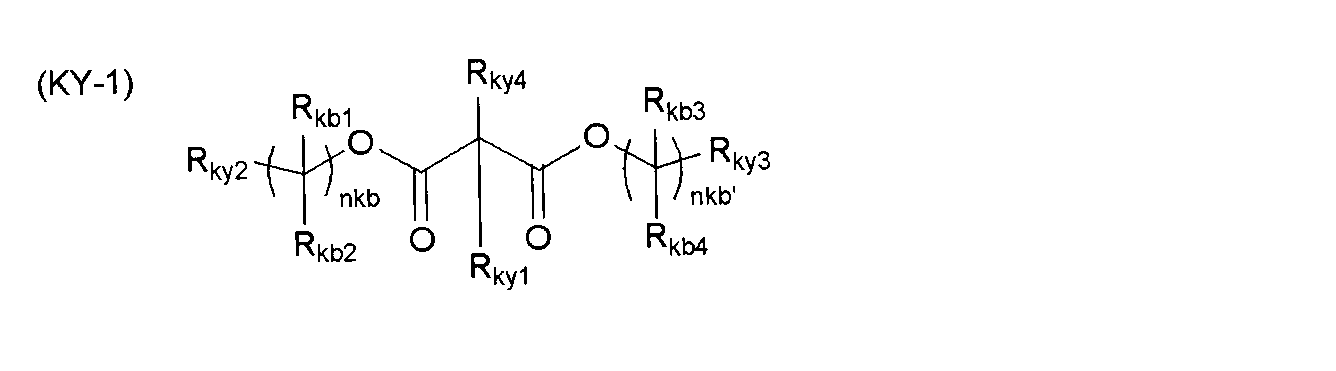
一般式(KY-1)において、
Rky1、Rky4はそれぞれ独立して、水素原子、ハロゲン原子、アルキル基、シクロアルキル基、カルボニル基、カルボニルオキシ基、オキシカルボニル基、エーテル基、ヒドロキシル基、シアノ基、アミド基、又はアリール基を表す。或いは、Rky1、Rky4が同一の原子と結合して二重結合を形成していてもよく、例えばRky1、Rky4が同一の酸素原子と結合してカルボニル基の一部(=O)を形成してもよい。
Rky1、Rky4はそれぞれ独立して、水素原子、ハロゲン原子、アルキル基、シクロアルキル基、カルボニル基、カルボニルオキシ基、オキシカルボニル基、エーテル基、ヒドロキシル基、シアノ基、アミド基、又はアリール基を表す。或いは、Rky1、Rky4が同一の原子と結合して二重結合を形成していてもよく、例えばRky1、Rky4が同一の酸素原子と結合してカルボニル基の一部(=O)を形成してもよい。
Rky2、Rky3はそれぞれ独立して電子求引性基であるか、又はRky1とRky3が連結してラクトン環を形成するとともにRky2が電子求引性基である。形成するラクトン環としては、前記(KA-1-1)~(KA-1-17)の構造が好ましい。電子求引性基としては、前記式(KB-1)におけるXkb1と同様のものが挙げられ、好ましくはハロゲン原子、又は、前記-C(Rf1)(Rf2)-Rf3で表されるハロ(シクロ)アルキル基又はハロアリール基である。
Rky1、Rky3及びRky4の少なくとも2つが互いに連結して単環又は多環構造を形成しても良い。
Rkb1~Rkb4、nkb、nkb’は各々前記式(KB-1)におけるものと同義である。
Rky1、Rky4は具体的には式(KA-1)におけるZkaと同様の基が挙げられる。
Rky1とRky3が連結して形成するラクトン環としては、前記(KA-1-1)~(KA-1-17)の構造が好ましい。電子求引性基としては、前記式(KB-1)におけるXkb1と同様のものが挙げられる。
Rky1とRky3が連結して形成するラクトン環としては、前記(KA-1-1)~(KA-1-17)の構造が好ましい。電子求引性基としては、前記式(KB-1)におけるXkb1と同様のものが挙げられる。
一般式(KY-1)で表わされる構造としては、下記一般式(KY-2)で示す構造であることがより好ましい。なお、一般式(KY-2)で表される構造は、該構造における任意の水素原子を少なくとも1つ除いた1価以上の基を有する基である。
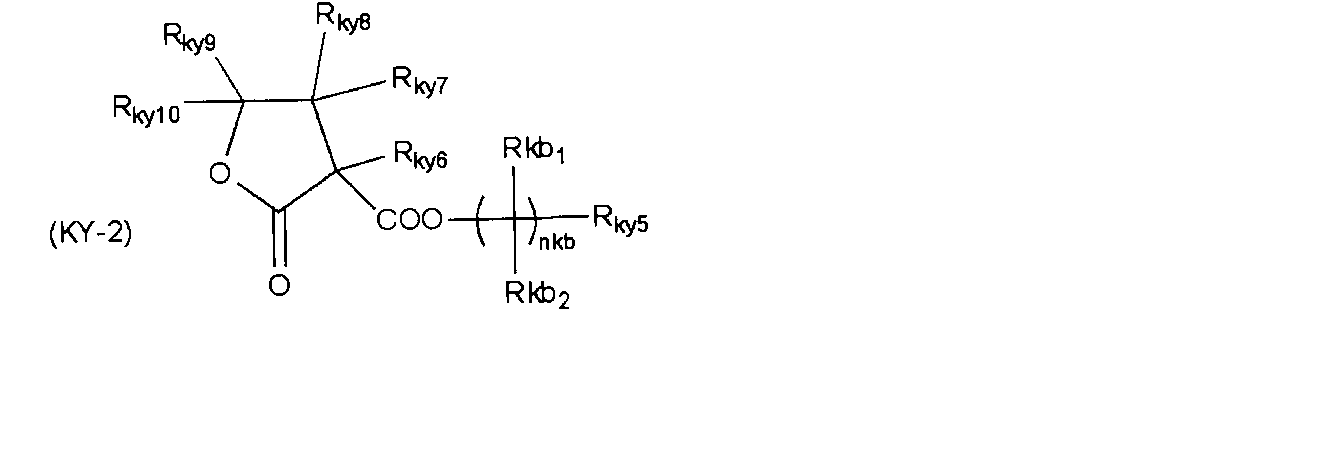
式(KY-2)中、
Rky6~Rky10は、各々独立して、水素原子、ハロゲン原子、アルキル基、シクロアルキル基、カルボニル基、カルボニルオキシ基、オキシカルボニル基、エーテル基、ヒドロキシル基、シアノ基、アミド基、又はアリール基を表す。
Rky6~Rky10は、2つ以上が互いに連結して単環又は多環構造を形成しても良い。
Rky6~Rky10は、各々独立して、水素原子、ハロゲン原子、アルキル基、シクロアルキル基、カルボニル基、カルボニルオキシ基、オキシカルボニル基、エーテル基、ヒドロキシル基、シアノ基、アミド基、又はアリール基を表す。
Rky6~Rky10は、2つ以上が互いに連結して単環又は多環構造を形成しても良い。
Rky5は電子求引性基を表す。電子求引性基は前記式(KB-1)におけるXkb1におけるものと同様のものが挙げられ、好ましくはハロゲン原子、又は、前記-C(Rf1)(Rf2)-Rf3で表されるハロ(シクロ)アルキル基又はハロアリール基である。
Rkb1、Rkb2、nkbは各々前記式(KB-1)におけるものと同義である。
Rky5~Rky10は具体的には式(KA-1)におけるZkaと同様の基が挙げられる。
Rkb1、Rkb2、nkbは各々前記式(KB-1)におけるものと同義である。
Rky5~Rky10は具体的には式(KA-1)におけるZkaと同様の基が挙げられる。
式(KY-2)で表される構造は、下記一般式(KY-3)で示す部分構造であることがより好ましい。

一般式(KY-3)中、
Rsは、鎖状若しくは環状アルキレン基を表し、複数個ある場合は、同じでも異なっていてもよい。
Lsは、単結合、エーテル結合、エステル結合、アミド結合、ウレタン結合又はウレア結合を表し、複数ある場合は、同じでも異なっていてもよい。
nsは、-(Rs-Ls)-で表される連結基の繰り返し数を表し、0~5の整数を表す。
Lkyはアルキレン基、酸素原子又は硫黄原子を表す。
Rsは、鎖状若しくは環状アルキレン基を表し、複数個ある場合は、同じでも異なっていてもよい。
Lsは、単結合、エーテル結合、エステル結合、アミド結合、ウレタン結合又はウレア結合を表し、複数ある場合は、同じでも異なっていてもよい。
nsは、-(Rs-Ls)-で表される連結基の繰り返し数を表し、0~5の整数を表す。
Lkyはアルキレン基、酸素原子又は硫黄原子を表す。
Zkaは、アルキル基、シクロアルキル基、エーテル基、ヒドロキシル基、アミド基、アリール基、ラクトン環基、又は電子求引性基を表す。Zkaが複数存在する場合、複数のZkaは同じでも異なっていてもよく、Zka同士が連結して環を形成してもよい。
nkaは、0~10の整数を表す。
Rkb1及びRkb2は、各々独立して、水素原子、アルキル基、シクロアルキル基、アリール基、又は電子求引性基を表し、Rkb1、Rkb2及びRky5の少なくとも2つが互いに連結して環を形成していてもよい。
nkbは、0又は1を表す。
Rky5は電子求引性基を表す。
*は、繰り返し単位の残部との結合部位を表す。
nkaは、0~10の整数を表す。
Rkb1及びRkb2は、各々独立して、水素原子、アルキル基、シクロアルキル基、アリール基、又は電子求引性基を表し、Rkb1、Rkb2及びRky5の少なくとも2つが互いに連結して環を形成していてもよい。
nkbは、0又は1を表す。
Rky5は電子求引性基を表す。
*は、繰り返し単位の残部との結合部位を表す。
一般式(KY-3)について更に詳細に説明する。
Zka、nkaは各々、前記一般式(KA-1)と同義である。Rky5は前記式(KY-2)と同義である。
Rkb1、Rkb2、nkbは各々前記式(KB-1)におけるものと同義である。
Lkyは、上述の通り、アルキレン基、酸素原子又は硫黄原子を表す。Lkyのアルキレン基としてはメチレン基、エチレン基等が挙げられる。Lkyは酸素原子又はメチレン基であることが好ましく、メチレン基であることが更に好ましい。
Zka、nkaは各々、前記一般式(KA-1)と同義である。Rky5は前記式(KY-2)と同義である。
Rkb1、Rkb2、nkbは各々前記式(KB-1)におけるものと同義である。
Lkyは、上述の通り、アルキレン基、酸素原子又は硫黄原子を表す。Lkyのアルキレン基としてはメチレン基、エチレン基等が挙げられる。Lkyは酸素原子又はメチレン基であることが好ましく、メチレン基であることが更に好ましい。
Rsは、上述の通り、鎖状若しくは環状アルキレン基を表し、複数個ある場合は、同じでも異なっていてもよい。
Lsは、上述の通り、単結合、エーテル結合、エステル結合、アミド結合、ウレタン結合又はウレア結合を表し、複数ある場合は、同じでも異なっていてもよい。
nsは、-(Rs-Ls)-で表される連結基の繰り返し数を表し、0~5の整数を表す。nsは、好ましくは0又は1である。
Lsは、上述の通り、単結合、エーテル結合、エステル結合、アミド結合、ウレタン結合又はウレア結合を表し、複数ある場合は、同じでも異なっていてもよい。
nsは、-(Rs-Ls)-で表される連結基の繰り返し数を表し、0~5の整数を表す。nsは、好ましくは0又は1である。
繰り返し単位(Aa5)は式(K0)で示される構造を有することが好ましい。
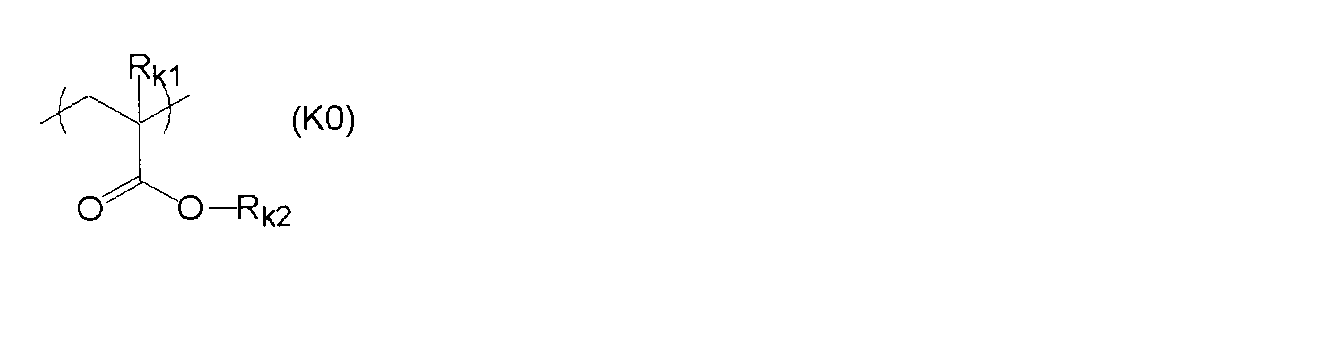
式中、Rk1は水素原子、ハロゲン原子、水酸基、アルキル基、シクロアルキル基、アリール基又は極性変換基を有する基を表す。
Rk2はアルキル基、シクロアルキル基、アリール基又は極性変換基を有する基を表す。但し、Rk1、Rk2は、全体として、極性変換基を2つ以上有する。
なお、一般式(K0)に示されている繰り返し単位の主鎖に直結しているエステル基は、前述したように、本発明における極性変換基には含まれない。
Rk2はアルキル基、シクロアルキル基、アリール基又は極性変換基を有する基を表す。但し、Rk1、Rk2は、全体として、極性変換基を2つ以上有する。
なお、一般式(K0)に示されている繰り返し単位の主鎖に直結しているエステル基は、前述したように、本発明における極性変換基には含まれない。
繰り返し単位(Aa5)は、付加重合、縮合重合、付加縮合、等、重合により得られる繰り返し単位であれば限定されるものではないが、炭素-炭素2重結合の付加重合により得られる繰り返し単位であることが好ましい。例として、アクリレート系繰り返し単位(α位、β位に置換基を有する系統も含む)、スチレン系繰り返し単位(α位、β位に置換基を有する系統も含む)、ビニルエーテル系繰り返し単位、ノルボルネン系繰り返し単位、マレイン酸誘導体(マレイン酸無水物やその誘導体、マレイミド、等)の繰り返し単位、等を挙げることが出来、アクリレート系繰り返し単位、スチレン系繰り返し単位、ビニルエーテル系繰り返し単位、ノルボルネン系繰り返し単位が好ましく、アクリレート系繰り返し単位、ビニルエーテル系繰り返し単位、ノルボルネン系繰り返し単位が好ましく、アクリレート系繰り返し単位が最も好ましい。
また、本発明の感活性光線性又は感放射線性樹脂組成物に含まれる樹脂(Aa)は、フッ素原子及びケイ素原子の少なくともいずれかを有する繰り返し単位を含有することが好ましい。
これにより、感活性光線性又は感放射線性樹脂膜表層に樹脂(Aa)が偏在化し、液浸媒体が水の場合、感活性光線性又は感放射線性樹脂膜とした際の水に対するレジスト膜表面の後退接触角を向上させ、液浸水追随性を向上させることができる。
感活性光線性又は感放射線性樹脂膜の後退接触角は露光時の温度、通常室温23±3℃、湿度45±5%において60°~90°が好ましく、より好ましくは65°以上、更に好ましくは70°以上である。
感活性光線性又は感放射線性樹脂組成物中の樹脂(Aa)の含有率は、感活性光線性又は感放射線性樹脂膜の後退接触角が前記範囲になるよう適宜調整して使用できるが、感活性光線性又は感放射線性樹脂組成物の全固形分を基準として、0.01~30質量%であることが好ましく、0.01~20質量%であることがより好ましく、0.01~10質量%であることが更に好ましく、特に好ましくは0.1~5質量%である。樹脂(Aa)は前述のように界面に遍在するものであるが、界面活性剤とは異なり、必ずしも分子内に親水基を有する必要はなく、極性/非極性物質を均一に混合することに寄与しなくても良い。
液浸露光工程に於いては、露光ヘッドが高速でウエハ上をスキャンし露光パターンを形成していく動きに追随して、液浸液がウエハ上を動く必要があるので、動的な状態に於けるレジスト膜に対する液浸液の接触角が重要になり、液滴が残存することなく、露光ヘッドの高速なスキャンに追随する性能がレジストには求められる。
本発明の一形態において、樹脂(Aa)として、フッ素原子及び珪素原子の少なくともいずれかを有することで、レジスト表面の疎水性(水追従性)が向上し、現像残渣(スカム)が低減する。
なお、本発明の一形態において、樹脂(Aa)は極性変換基を複数有し、かつ、フッ素原子及び珪素原子の少なくともいずれかを有する樹脂であり得るが、該フッ素原子は、一般式(KB-1)におけるXkb1、Xkb2の電子求引性基であってもよい。
本発明の一形態において、樹脂(Aa)に於けるフッ素原子又は珪素原子は、樹脂の主鎖中に有していても、側鎖に置換していてもよい。
以下、繰り返し単位(Aa5)の具体例を示すが、本発明は、これに限定されるものではない。Raは水素原子、フッ素原子、メチル基又はトリフルオロメチル基を表す。
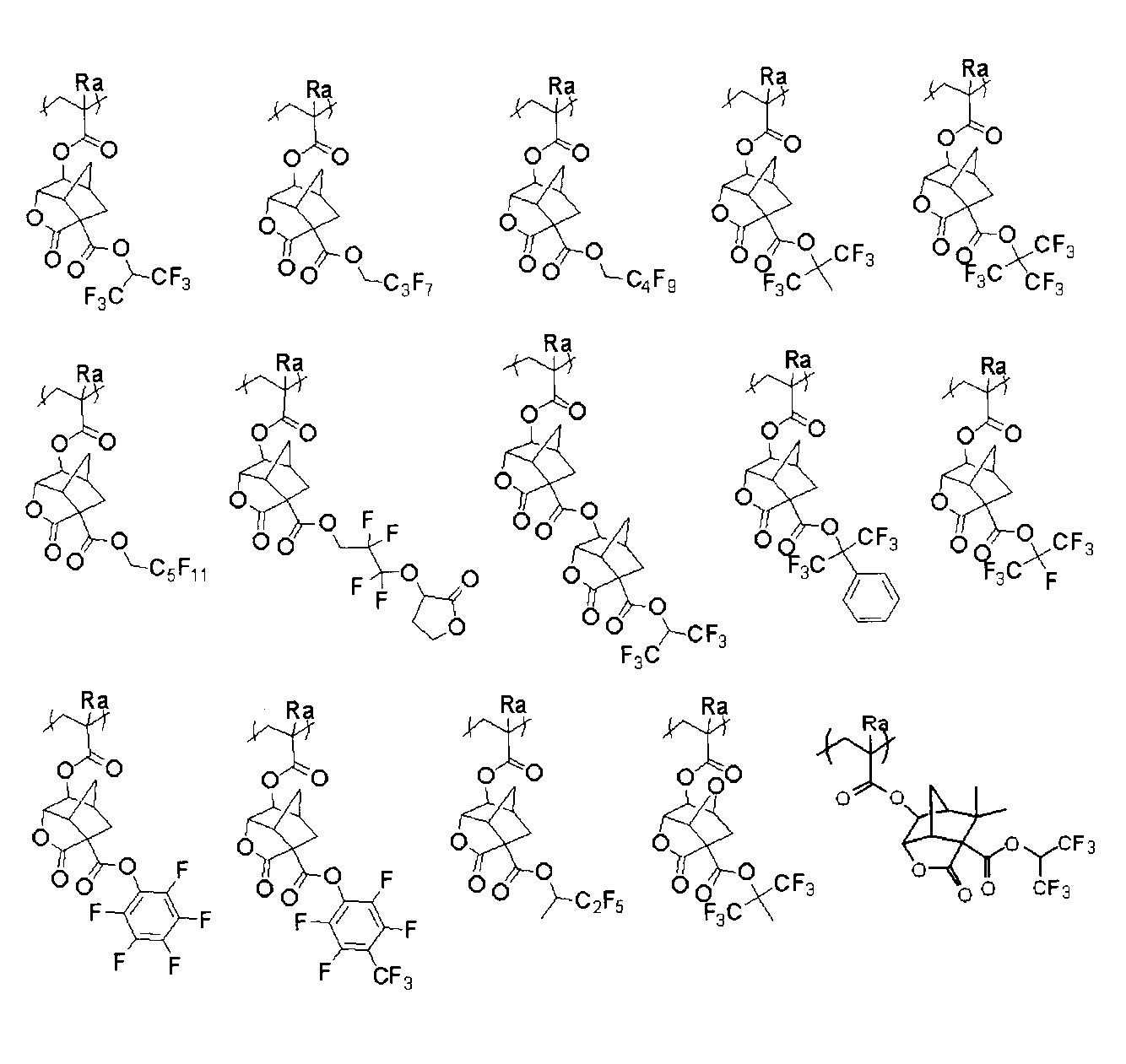


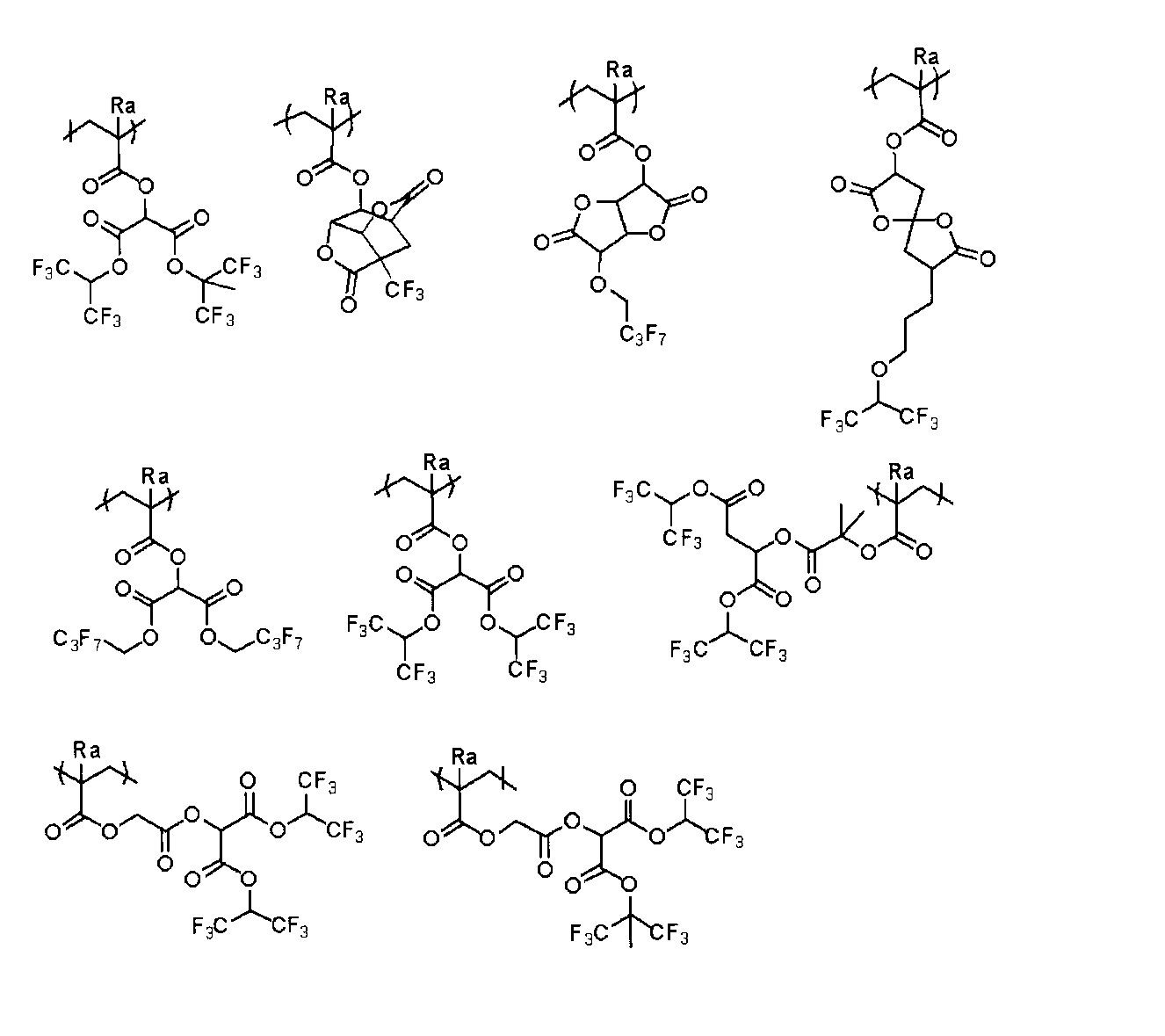

樹脂(Aa)が繰り返し単位(Aa5)を含有する場合、繰り返し単位(Aa5)の含有率は、樹脂(Aa)中の全繰り返し単位に対し、10~90mol%が好ましく、より好ましくは30~85mol%、更に好ましくは50~80mol%である。
繰り返し単位(Aa5-1)の含有率は、樹脂(Aa)中の全繰り返し単位に対し、10~90mol%が好ましく、より好ましくは30~85mol%、更に好ましくは50~80mol%である。
繰り返し単位(Aa5-2)の含有率は、樹脂(Aa)中の全繰り返し単位に対し、10~90mol%が好ましく、より好ましくは30~85mol%、更に好ましくは50~80mol%である。
繰り返し単位(Aa5-3)の含有率は、樹脂(Aa)中の全繰り返し単位に対し、10~90mol%が好ましく、より好ましくは30~85mol%、更に好ましくは50~80mol%である。
<繰り返し単位(Aa6)>
本発明の一形態において、樹脂(Aa)は、下記一般式(ca-1)又は(cb-1)で表される重合性化合物に対応する繰り返し単位を更に含有していてもよい。

本発明の一形態において、樹脂(Aa)は、下記一般式(ca-1)又は(cb-1)で表される重合性化合物に対応する繰り返し単位を更に含有していてもよい。
一般式(ca-1)及び(cb-1)において、Aは、置換基を有していてもよいメタクリル基、置換基を有していてもよいアクリル基又は置換基を有していてもよいノルボルネン基を表す。
Z1は、それぞれ独立に、単結合、エーテル結合(-O-)、エステル結合、アミド結合、ウレタン結合又はウレア結合を表す。qが2以上の場合、Z1で表される複数の基は、同一であっても異なっていてもよい。
Z2は、それぞれ独立に、単結合又は置換基を有していてもよい鎖状若しくは環状アルキレン基を表す。qが2以上の場合、Z2で表される複数の基は、同一であっても異なっていてもよい。
Ta及びTbは、それぞれ独立に、ハロゲン原子、置換基を有していてもよいアルキル基、置換基を有していてもよいシクロアルキル基、置換基を有していてもよいアルコキシ基、置換基を有していてもよいアシル基、置換基を有していてもよいアルキルオキシカルボニル基、カルボキシ基、ニトリル基、ヒドロキシル基、置換基を有していてもよいアミド基又は置換基を有していてもよいアリール基を表す。
Taが複数個ある場合には、Ta同士が結合して、環を形成しても良い。
Tbが複数個ある場合には、Tb同士が結合して、Tbが置換するベンゼン環とともに、ヘテロ原子を含んでいてもよい縮合環を形成しても良い。
Tcは、水素原子、ハロゲン原子、置換基を有していてもよいアルキル基、置換基を有していてもよいシクロアルキル基、ニトリル基、ヒドロキシル基、置換基を有していてもよいアミド基又は置換基を有していてもよいアリール基を表す。
Lはカルボニル基、カルボニルオキシ基又はエーテル結合(-O-)を表す。rが2以上の整数である場合には、(L)rは、Lがr個で組み合わされてなる基を示し、複数のLは同一であっても、異なっていてもよい。
mは、1~28の整数を表す。
nは、0~11の整数を表す。
pは、0~5の整数を表す。
qは、0~5の整数を表す。
rは、0~5の整数を表す。
nは、0~11の整数を表す。
pは、0~5の整数を表す。
qは、0~5の整数を表す。
rは、0~5の整数を表す。
一般式(ca-1)及び(cb-1)で表される重合性化合物の好ましい形態、製造方法、並びに、具体例については、特開2010-159413号公報の段落[0026]~[0053]の記載を参照することができる。
樹脂(Aa)が繰り返し単位(Aa6)を含有している場合、繰り返し単位(Aa6)の含有率は、樹脂(Aa)中の全繰り返し単位に対し、10~90mol%であることが好ましく、より好ましくは30~85mol%であり、更に好ましくは50~80mol%である。
<繰り返し単位(Aa7)>
本発明の一形態において、樹脂(Aa)は、下記一般式(aa1-1)で表されるモノマーに由来する少なくとも1種の繰り返し単位(Aa7)を更に含有してもよい。
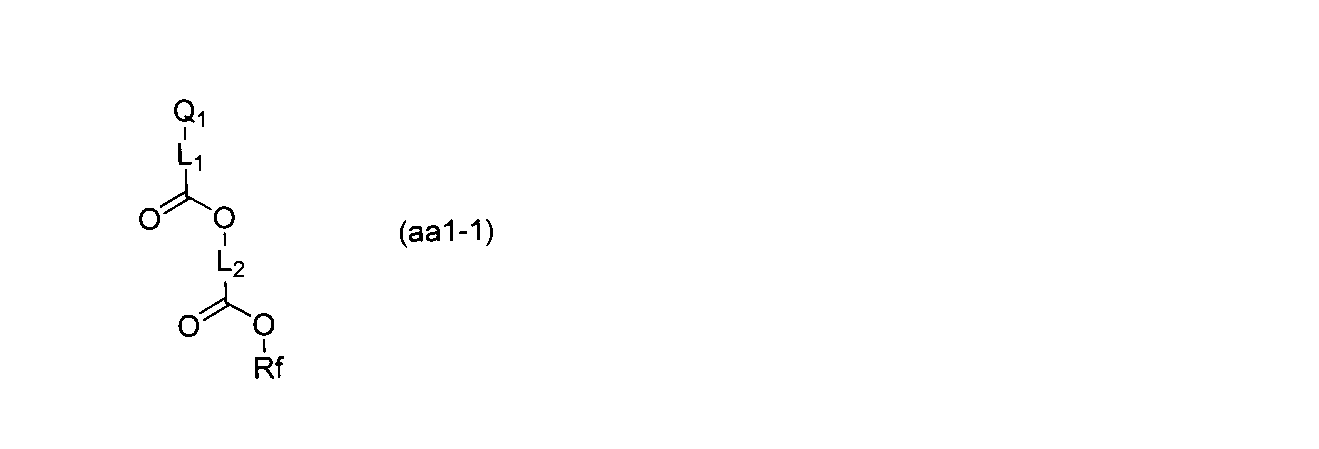
本発明の一形態において、樹脂(Aa)は、下記一般式(aa1-1)で表されるモノマーに由来する少なくとも1種の繰り返し単位(Aa7)を更に含有してもよい。
一般式(aa1-1)中、
Q1は、重合性基を含む有機基を表す。
L1及びL2は、各々独立して、単結合または2価の連結基を表す。
Rfはフッ素原子を有する有機基を表す。
式中のQ1により表される重合性基を含む有機基は、重合性基を含む基であれば特に限定されるものではない。重合性基として、例えば、アクリル基、メタクリル基、スチリル基、ノルボルネニル基、マレイミド基、ビニルエーテル基等が挙げられ、アクリル基、メタクリル基、及びスチリル基が特に好ましい。
Q1は、重合性基を含む有機基を表す。
L1及びL2は、各々独立して、単結合または2価の連結基を表す。
Rfはフッ素原子を有する有機基を表す。
式中のQ1により表される重合性基を含む有機基は、重合性基を含む基であれば特に限定されるものではない。重合性基として、例えば、アクリル基、メタクリル基、スチリル基、ノルボルネニル基、マレイミド基、ビニルエーテル基等が挙げられ、アクリル基、メタクリル基、及びスチリル基が特に好ましい。
L1及びL2により表される2価の連結基としては、例えば、置換又は無置換のアリーレン基、置換又は無置換のアルキレン基、置換又は無置換のシクロアルキレン基、-O-、-CO-、又はこれらの複数を組み合わせた2価の連結基が挙げられる。
アリーレン基としては、例えば、炭素数が6~14個のものが好ましく、具体例としては、フェニレン基、ナフチレン基、アントリレン基、フェナントリレン基、ビフェニレン基、ターフェニレン基等が挙げられる。
アルキレン基及びシクロアルキレン基としては、例えば、炭素数が1~15のものが好ましく、具体例としては、次に挙げる直鎖状、分岐状又は環状のアルキル基中の水素原子を1個引き抜いた形式のものが挙げられる:メチル基、エチル基、n-プロピル基、イソプロピル基、n-ブチル基、sec-ブチル基、tert-ブチル基、tert-アミル基、n-ペンチル基、n-ヘキシル基、n-ヘプチル基、n-オクチル基、n-ノニル基、n-デシル基、シクロペンチル基、シクロヘキシル基、シクロペンチルメチル基、シクロペンチルエチル基、シクロペンチルブチル基、シクロヘキシルメチル基、シクロヘキシルエチル基、シクロヘキシルブチル基、アダマンチル基。
上記アリーレン基、アルキレン基及びシクロアルキレン基が有し得る置換基としては、例えば、アルキル基、アラルキル基、アルコキシ基、フッ素原子等が挙げられる。
本発明の一態様において、L1は、単結合、フェニレン基、エーテル基、カルボニル基、カルボニルオキシ基がより好ましく、L2は、アルキレン基、エーテル基、カルボニル基、カルボニルオキシ基がより好ましい。
Rfとしてのフッ素原子を有する有機基における有機基は、炭素原子を少なくとも1つ含む基であり、炭素-水素結合部分を含む有機基が好ましい。Rfは、例えば、フッ素原子で置換されたアルキル基又はフッ素原子で置換されたシクロアルキル基である。
繰り返し単位(Aa7)は、一態様において、下記一般式(aa1-2-1)又は(aa1-3-1)で表される繰り返し単位であることが好ましい。
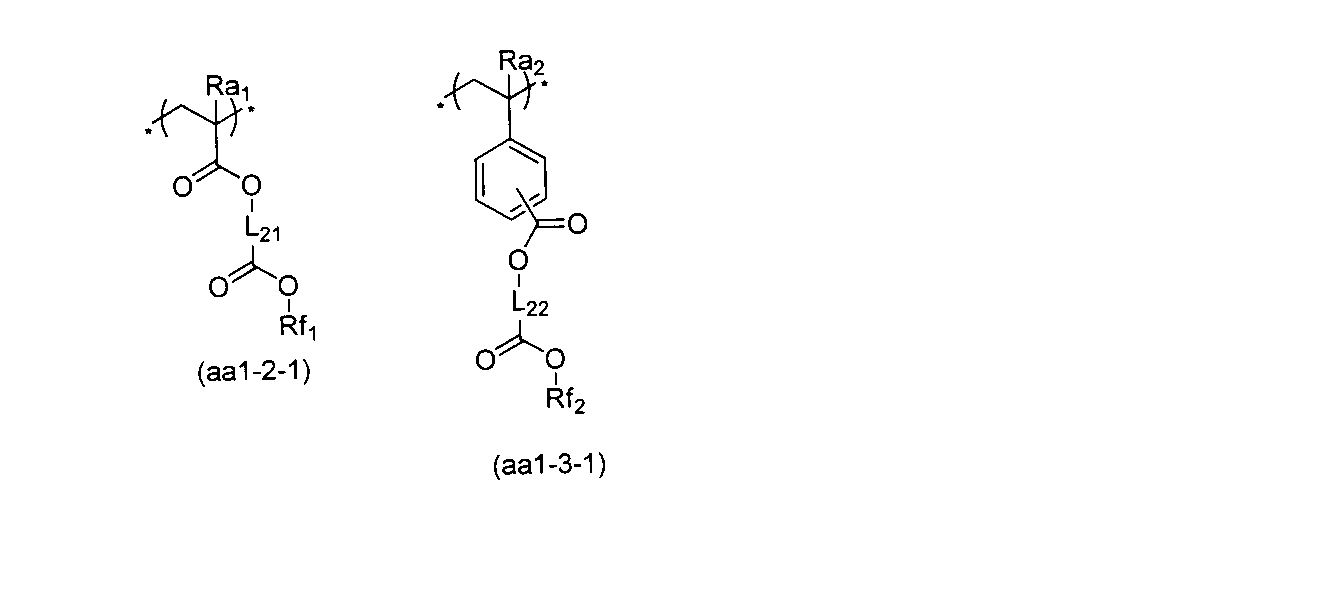
一般式(aa1-2-1)及び(aa1-3-1)中、
Ra1及びRa2は、各々独立に、水素原子又はアルキル基を表す。Ra1及びRa2は、好ましくは、水素原子又はメチル基である。
L21及びL22は、各々独立に、単結合または2価の連結基を表し、先に説明した一般式(aa1-1)におけるL2と同義である。
Rf1及びRf2は、各々独立に、フッ素原子を有する有機基を表し、一般式(aa1-1)におけるRfと同義である。
Ra1及びRa2は、各々独立に、水素原子又はアルキル基を表す。Ra1及びRa2は、好ましくは、水素原子又はメチル基である。
L21及びL22は、各々独立に、単結合または2価の連結基を表し、先に説明した一般式(aa1-1)におけるL2と同義である。
Rf1及びRf2は、各々独立に、フッ素原子を有する有機基を表し、一般式(aa1-1)におけるRfと同義である。
また、繰り返し単位(Aa7)は、一態様において、下記一般式(aa1-2-2)又は(aa1-3-2)で表される繰り返し単位であることが好ましい。
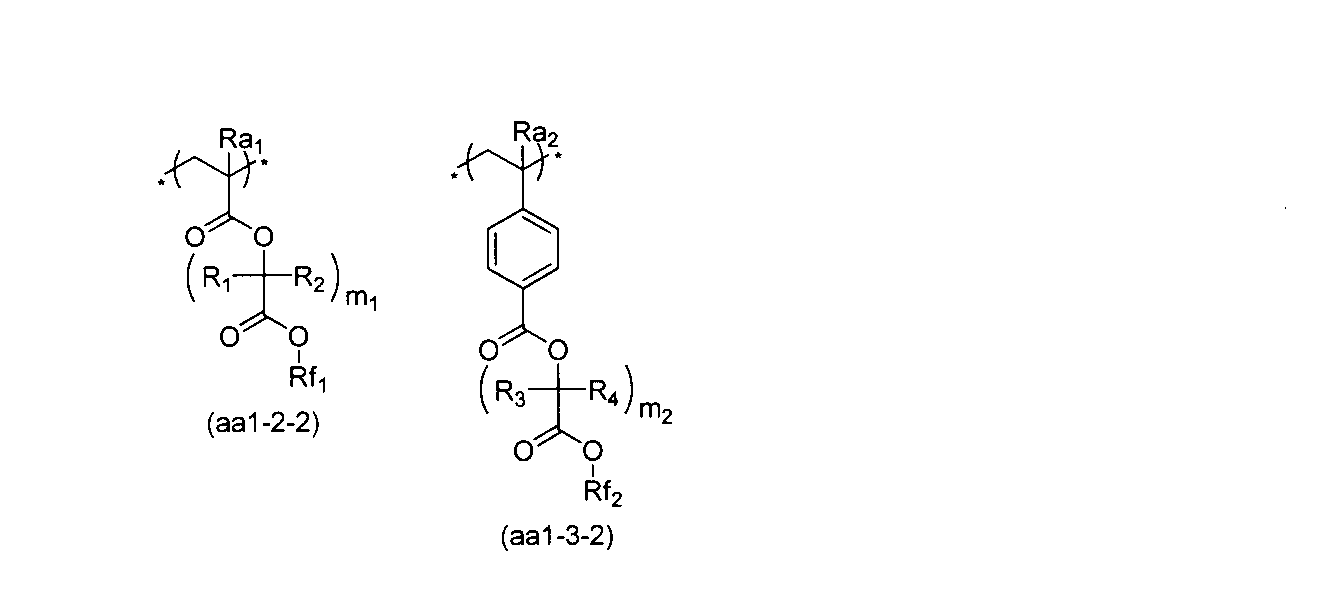
一般式(aa1-2-2)及び(aa1-3-2)中、
Ra1及びRa2は、各々独立に、水素原子又はアルキル基を表す。
R1、R2、R3及びR4は、各々独立に、水素原子またはアルキル基を表す。
m1及びm2は、各々独立に、0~5の整数を表す。
Rf1及びRf2は、各々独立に、フッ素原子を有する有機基を表す。
Ra1及びRa2は、各々独立に、水素原子又はアルキル基を表す。
R1、R2、R3及びR4は、各々独立に、水素原子またはアルキル基を表す。
m1及びm2は、各々独立に、0~5の整数を表す。
Rf1及びRf2は、各々独立に、フッ素原子を有する有機基を表す。
Ra1及びRa2は、好ましくは、水素原子又はメチル基である。
R1、R2、R3及びR4により表されるアルキル基としては、例えば、炭素数1~10の直鎖又は分岐鎖のアルキル基が好ましく、具体例としては、メチル基、エチル基、プロピル基、イソプロピル基、ブチル基、t-ブチル基等が挙げられる。このアルキル基は、置換基を有していてもよく、置換基としては、例えば、アルコキシ基、アリール基、ハロゲン原子等が挙げられる。
R1、R2、R3及びR4により表されるアルキル基としては、例えば、炭素数1~10の直鎖又は分岐鎖のアルキル基が好ましく、具体例としては、メチル基、エチル基、プロピル基、イソプロピル基、ブチル基、t-ブチル基等が挙げられる。このアルキル基は、置換基を有していてもよく、置換基としては、例えば、アルコキシ基、アリール基、ハロゲン原子等が挙げられる。
m1及びm2は、好ましくは0~3の整数であり、より好ましくは0又は1であり、最も好ましくは1である。
Rf1及びRf2としてのフッ素原子を有する有機基は、一般式(aa1-1)におけるRfと同義である。
Rf1及びRf2としてのフッ素原子を有する有機基は、一般式(aa1-1)におけるRfと同義である。
また、繰り返し単位(Aa7)は、一態様において、下記一般式(aa1-2-3)又は(aa1-3-3)で表される繰り返し単位であることが好ましい。

一般式(aa1-2-3)及び(aa1-3-3)中、
Ra1は水素原子又はメチル基を表す。
Rf1及びRf2は、各々独立に、フッ素原子を有する有機基を表し、一般式(aa1-1)におけるRfと同義である。
Ra1は水素原子又はメチル基を表す。
Rf1及びRf2は、各々独立に、フッ素原子を有する有機基を表し、一般式(aa1-1)におけるRfと同義である。
以下に、繰り返し単位(Aa7)の具体例を示すが、本発明はこれに限定されるものではない。
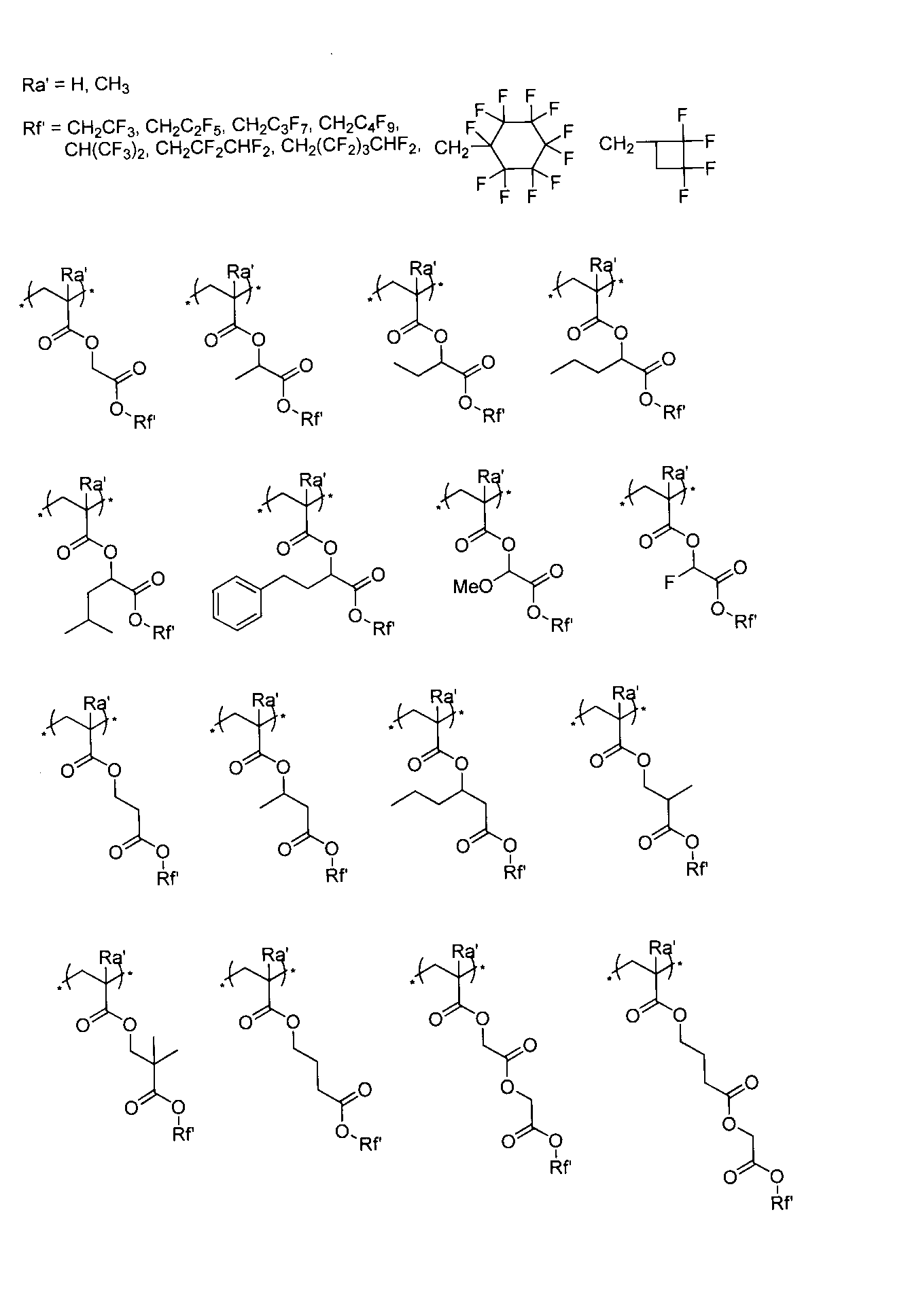
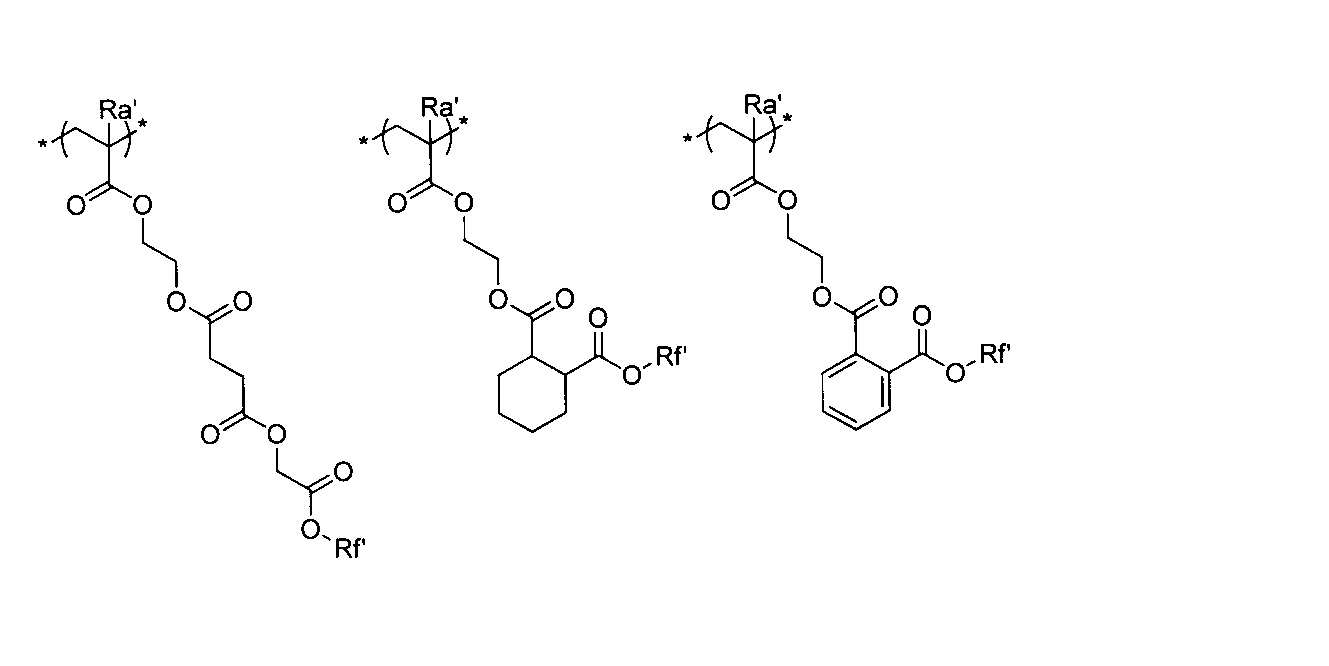

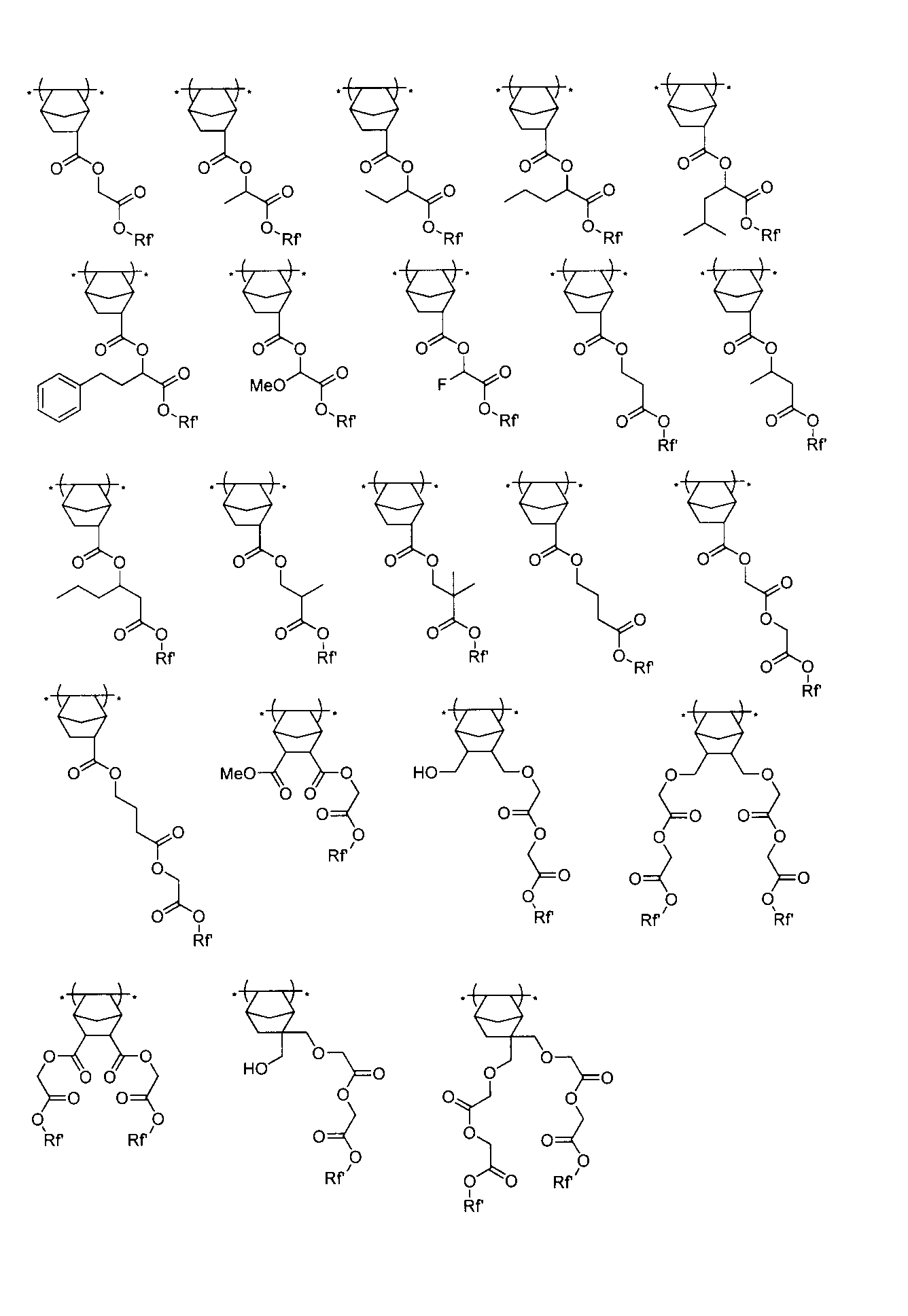
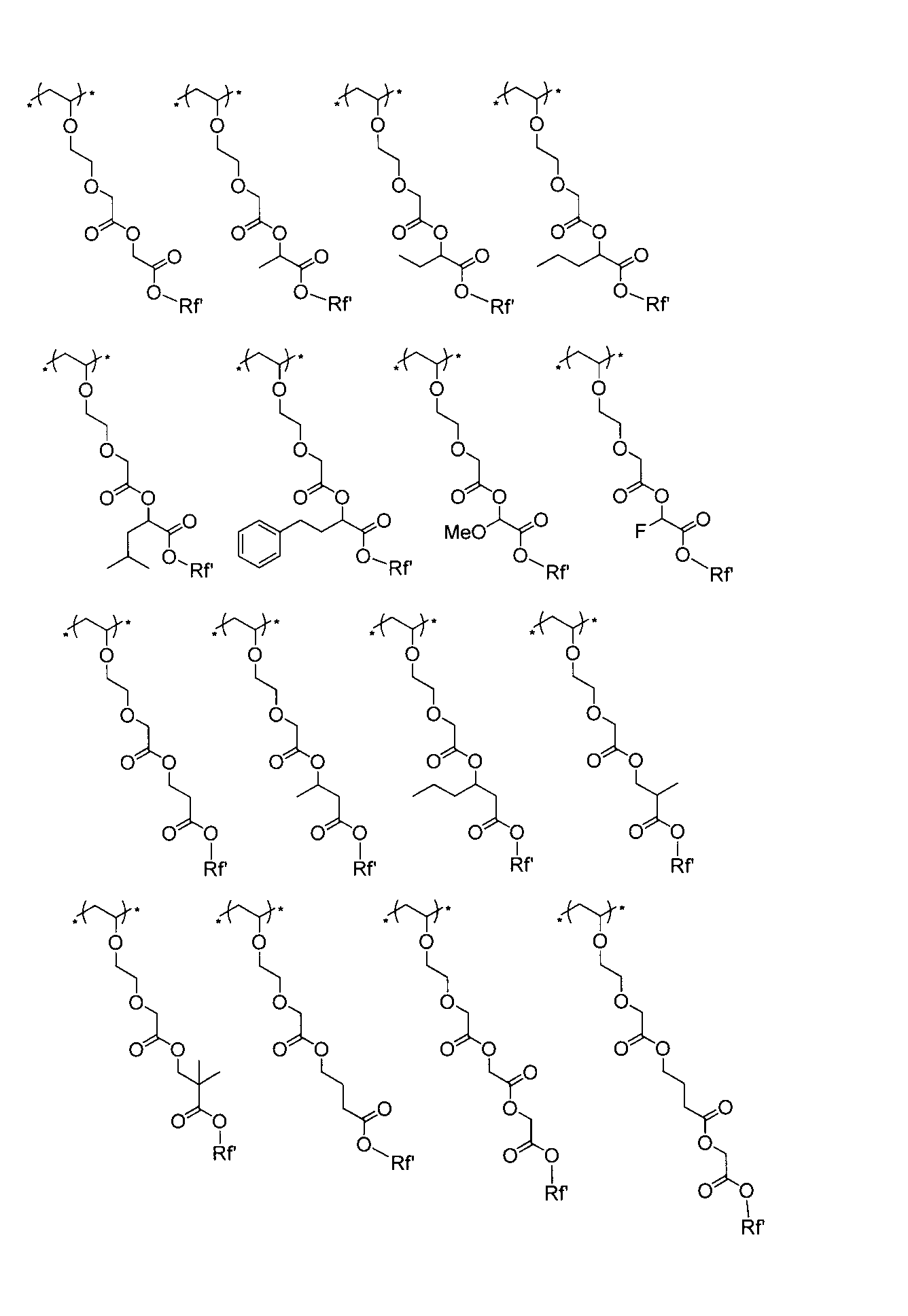
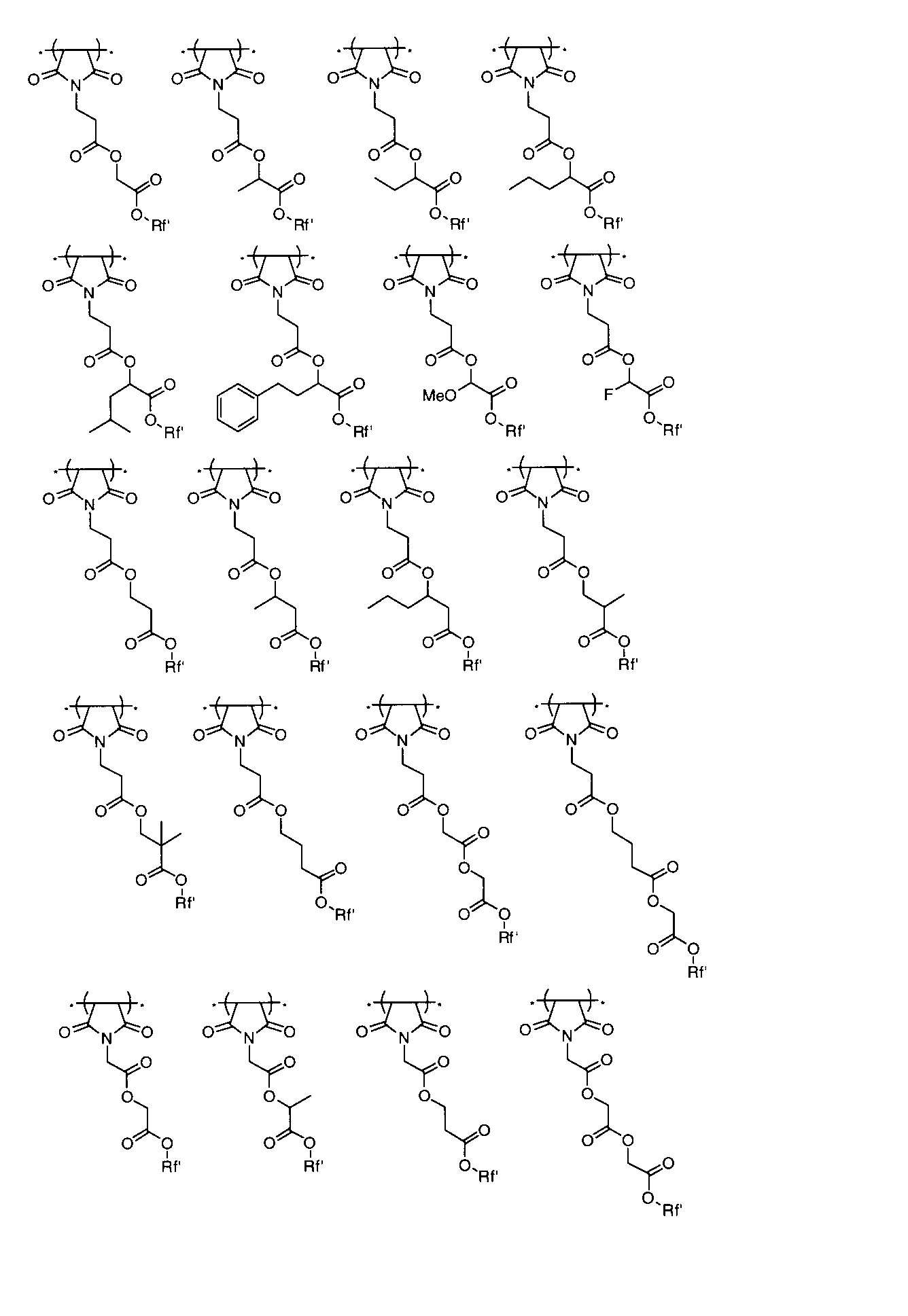
樹脂(Aa)が繰り返し単位(Aa7)を含有している場合、繰り返し単位(Aa7)の含有率は、樹脂(Aa)中の全繰り返し単位に対し、10~90mol%であることが好ましく、より好ましくは30~85mol%であり、更に好ましくは50~80mol%である。
樹脂(Aa)は、一形態において、更に下記(x)~(z)の群から選ばれる基の少なくとも1つを有していてもよい。
(x)アルカリ可溶性基、
(y)アルカリ現像液の作用により分解し、アルカリ現像液中での溶解度が増大する基、
(z)酸の作用により分解する基。
(x)~(z)の基については、特開2011-118318号公報の段落[0323]~[0358]の記載を参照することができる。
(y)アルカリ現像液の作用により分解し、アルカリ現像液中での溶解度が増大する基、
(z)酸の作用により分解する基。
(x)~(z)の基については、特開2011-118318号公報の段落[0323]~[0358]の記載を参照することができる。
樹脂(Aa)がフッ素原子を有する場合、フッ素原子の含有率は、樹脂(Aa)の分子量に対し、5~80質量%であることが好ましく、10~80質量%であることがより好ましい。また、フッ素原子を含む繰り返し単位が、樹脂(Aa)中の全繰り返し単位に対し、10~100質量%であることが好ましく、30~100質量%であることがより好ましい。
樹脂(Aa)が珪素原子を有する場合、珪素原子の含有率は、樹脂(Aa)の分子量に対し、2~50質量%であることが好ましく、2~30質量%であることがより好ましい。また、珪素原子を含む繰り返し単位は、樹脂(Aa)の全繰り返し単位に対し、10~90質量%であることが好ましく、20~80質量%であることがより好ましい。
樹脂(Aa)の標準ポリスチレン換算の重量平均分子量は、好ましくは1,000~100,000で、より好ましくは1,000~50,000、更により好ましくは2,000~20,000である。
樹脂(Aa)は、後述する樹脂(Ab)と同様、金属等の不純物が少ないのは当然のことながら、残留単量体やオリゴマー成分が0~10質量%であることが好ましく、より好ましくは0~5質量%、0~1質量%が更により好ましい。それにより、液中異物や感度等の経時変化のないレジスト組成物が得られる。また、解像度、レジスト形状、レジストパターンの側壁、ラフネスなどの点から、分子量分布(Mw/Mn、分散度ともいう)は、1~3の範囲が好ましく、より好ましくは1~2、更に好ましくは1~1.8、最も好ましくは1~1.5の範囲である。
樹脂(Aa)は、各種市販品を利用することもできるし、常法に従って(例えばラジカル重合又はアニオン重合)合成することができる。例えば、後述する樹脂(Ab)において記載する樹脂(Ab)の一般的な合成方法と同様の方法で合成することが可能である。
以下に樹脂(Aa)の具体例を示すが、本発明はこれに限定されない。

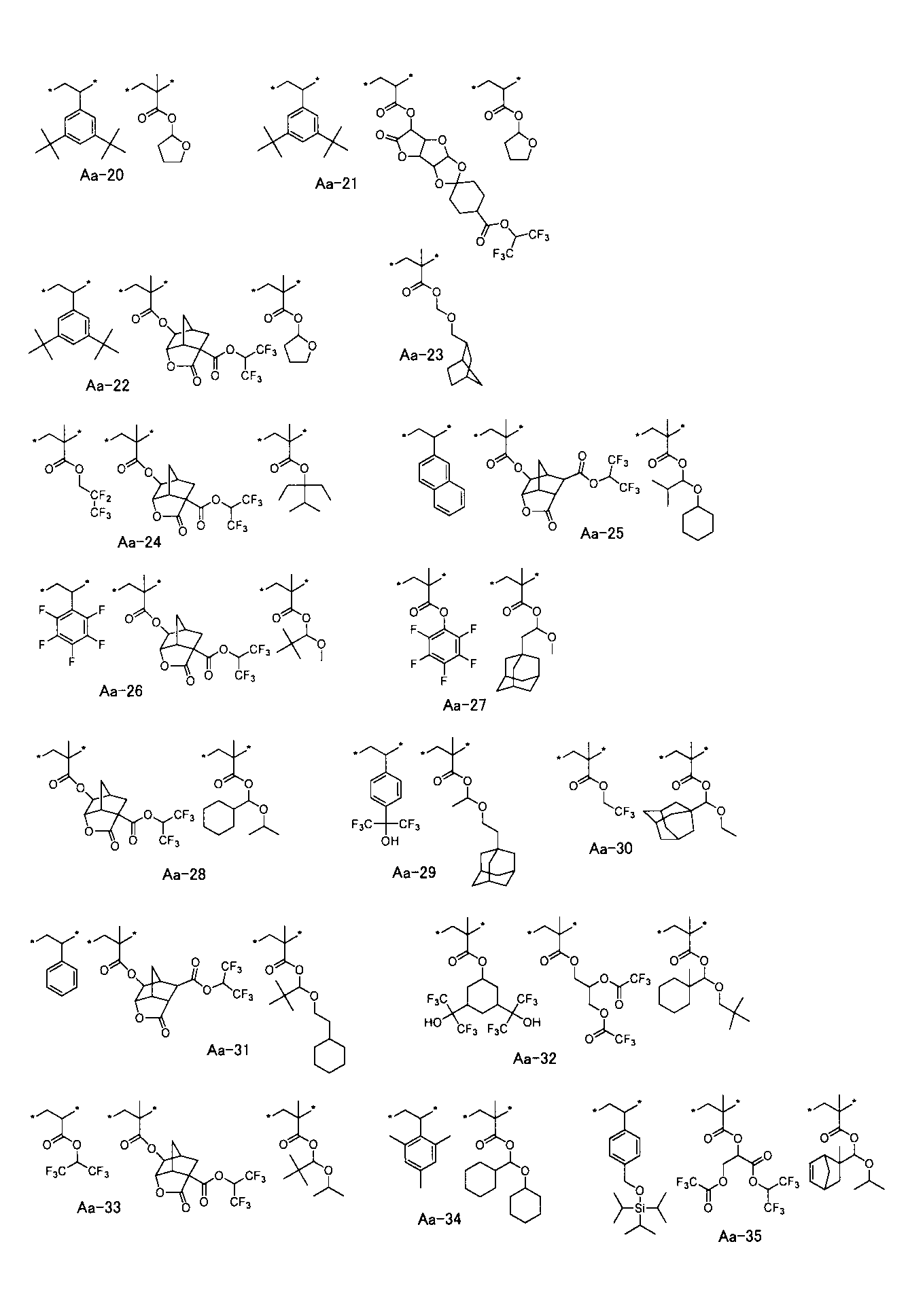
[2]酸の作用により現像液に対する溶解性が変化する樹脂(Ab)
本発明に係る組成物は、酸の作用により現像液に対する溶解性が変化する樹脂(Ab)を含有する。
樹脂(Ab)は、酸の作用により現像液に対する溶解性が変化する樹脂であり、具体的には、酸の作用により、アルカリ現像液に対する溶解度が増大し、あるいは、有機溶剤を主成分とする現像液に対する溶解度が減少する。
本発明に係る組成物は、酸の作用により現像液に対する溶解性が変化する樹脂(Ab)を含有する。
樹脂(Ab)は、酸の作用により現像液に対する溶解性が変化する樹脂であり、具体的には、酸の作用により、アルカリ現像液に対する溶解度が増大し、あるいは、有機溶剤を主成分とする現像液に対する溶解度が減少する。
樹脂(Ab)は好ましくはアルカリ現像液に不溶又は難溶性である。
樹脂(Ab)は、酸分解性基を有する繰り返し単位を有することが好ましい。
樹脂(Ab)は、酸分解性基を有する繰り返し単位を有することが好ましい。
酸分解性基としては、例えば、カルボキシル基、フェノール性水酸基、スルホン酸基、チオール基等のアルカリ可溶性基の水素原子が、酸の作用により脱離する基で保護された基を挙げることができる。
酸の作用により脱離する基としては、例えば、-C(R36)(R37)(R38)、-C(R36)(R37)(OR39)、-C(=O)-O-C(R36)(R37)(R38)、-C(R01)(R02)(OR39)、-C(R01)(R02)-C(=O)-O-C(R36)(R37)(R38)等を挙げることができる。
式中、R36~R39は、各々独立に、アルキル基、シクロアルキル基、アリール基、アラルキル基又はアルケニル基表す。R36とR37とは、互いに結合して環を形成してもよい。R01~R02は、各々独立に、水素原子、アルキル基、シクロアルキル基、アリール基、アラルキル基又はアルケニル基を表す。
樹脂(Ab)は、一態様において、下記一般式(A1)及び(A2)で表される繰り返し単位の少なくとも1種を含有することが好ましい。
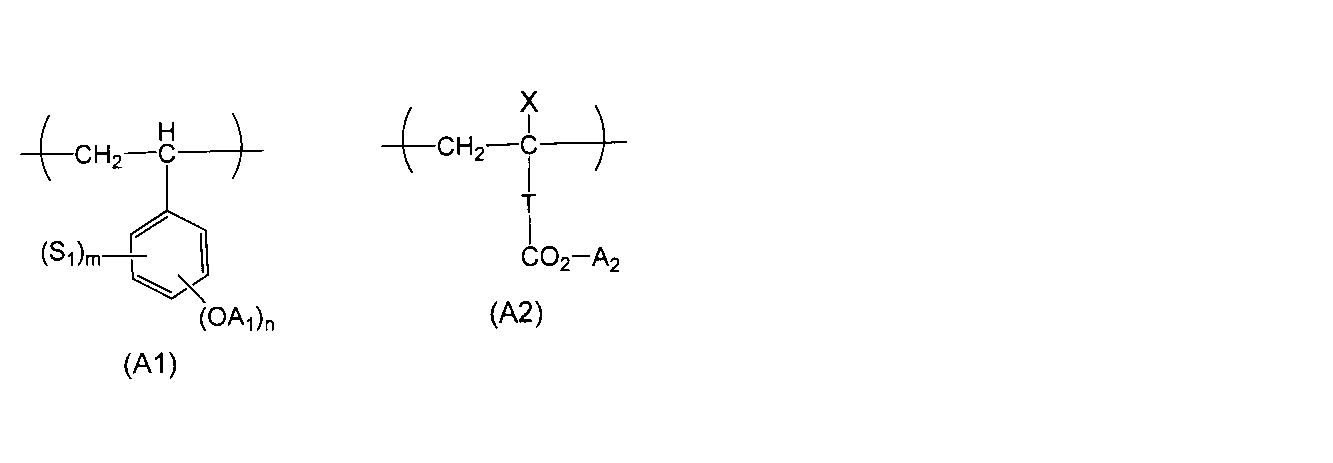
一般式(A1)中、
nは1~5の整数を表し、mは1≦m+n≦5なる関係を満足する0~4の整数を表す。
S1は、置換基(水素原子を除く)を表し、mが2以上の場合には、複数のS1は互いに同一であってもよく、互いに異なっていてもよい。
A1は、水素原子又は酸の作用により脱離する基を表す。但し、少なくとも1つのA1は酸の作用により脱離する基を表す。n≧2の場合には、複数のA1は、互いに同一であってもよく、互いに異なっていてもよい。
nは1~5の整数を表し、mは1≦m+n≦5なる関係を満足する0~4の整数を表す。
S1は、置換基(水素原子を除く)を表し、mが2以上の場合には、複数のS1は互いに同一であってもよく、互いに異なっていてもよい。
A1は、水素原子又は酸の作用により脱離する基を表す。但し、少なくとも1つのA1は酸の作用により脱離する基を表す。n≧2の場合には、複数のA1は、互いに同一であってもよく、互いに異なっていてもよい。
一般式(A2)中、
Xは、水素原子、アルキル基、水酸基、アルコキシ基、ハロゲン原子、シアノ基、ニトロ基、アシル基、アシロキシ基、シクロアルキル基、シクロアルキルオキシ基、アリール基、カルボキシ基、アルキルオキシカルボニル基、アルキルカルボニルオキシ基又はアラルキル基を表す。
Tは、単結合又は2価の連結基を表す。
A2は、酸の作用により脱離する基を表す。
Xは、水素原子、アルキル基、水酸基、アルコキシ基、ハロゲン原子、シアノ基、ニトロ基、アシル基、アシロキシ基、シクロアルキル基、シクロアルキルオキシ基、アリール基、カルボキシ基、アルキルオキシカルボニル基、アルキルカルボニルオキシ基又はアラルキル基を表す。
Tは、単結合又は2価の連結基を表す。
A2は、酸の作用により脱離する基を表す。
まず、一般式(A1)により表される繰り返し単位について説明する。
nは、上述したように、1~5の整数を表し、好ましくは1又は2であり、特に好ましくは1である。
mは、上述したように、1≦m+n≦5なる関係を満足する0~4の整数を表し、好ましくは0~2であり、より好ましくは0又は1であり、特に好ましくは0である。
S1は、上述したように、置換基(水素原子を除く)を表す。この置換基としては、例えば、後述する一般式(Ab3)におけるS1について説明する置換基と同様のものが挙げられる。
nは、上述したように、1~5の整数を表し、好ましくは1又は2であり、特に好ましくは1である。
mは、上述したように、1≦m+n≦5なる関係を満足する0~4の整数を表し、好ましくは0~2であり、より好ましくは0又は1であり、特に好ましくは0である。
S1は、上述したように、置換基(水素原子を除く)を表す。この置換基としては、例えば、後述する一般式(Ab3)におけるS1について説明する置換基と同様のものが挙げられる。
A1は、上述したように、水素原子又は酸の作用により脱離する基を表し、少なくとも1つのA1は酸の作用により脱離する基である。
酸の作用により脱離する基としては、例えば、t-ブチル基及びt-アミル基等の3級アルキル基、t-ブトキシカルボニル基、t-ブトキシカルボニルメチル基、並びに、式-C(L1)(L2)-O-Z2により表されるアセタール基が挙げられる。
以下、式-C(L1)(L2)-O-Z2により表されるアセタール基について説明する。式中、L1及びL2は、各々独立に、水素原子、アルキル基、シクロアルキル基又はアラルキル基を表す。Z2は、アルキル基、シクロアルキル基又はアラルキル基を表す。なお、Z2とL1とは、互いに結合して、5員又は6員環を形成していてもよい。
アルキル基は、直鎖アルキル基であってもよく、分岐鎖アルキル基であってもよい。
直鎖アルキル基としては、炭素数が1~30のものが好ましく、炭素数が1~20のものがより好ましい。このような直鎖アルキル基としては、例えば、メチル基、エチル基、n-プロピル基、n-ブチル基、sec-ブチル基、t-ブチル基、n-ペンチル基、n-ヘキシル基、n-ヘプチル基、n-オクチル基、n-ノニル基及びn-デカニル基が挙げられる。
直鎖アルキル基としては、炭素数が1~30のものが好ましく、炭素数が1~20のものがより好ましい。このような直鎖アルキル基としては、例えば、メチル基、エチル基、n-プロピル基、n-ブチル基、sec-ブチル基、t-ブチル基、n-ペンチル基、n-ヘキシル基、n-ヘプチル基、n-オクチル基、n-ノニル基及びn-デカニル基が挙げられる。
分岐鎖アルキル基としては、炭素数が3~30のものが好ましく、炭素数が3~20のものがより好ましい。このような分岐鎖アルキル基としては、例えば、i-プロピル基、i-ブチル基、t-ブチル基、i-ペンチル基、t-ペンチル基、i-ヘキシル基、tヘキシル基、i-ヘプチル基、t-ヘプチル基、i-オクチル基、t-オクチル基、iノニル基及びt-デカノイル基が挙げられる。
これらアルキル基は、置換基を更に有していてもよい。この置換基としては、例えば、水酸基;フッ素、塩素、臭素及びヨウ素原子等のハロゲン原子;ニトロ基;シアノ基;アミド基;スルホンアミド基;メチル基、エチル基、プロピル基、イソプロピル基、n-ブチル基、sec-ブチル基、ヘキシル基、2-エチルヘキシル基、オクチル基及びドデシル基等のアルキル基;メトキシ基、エトキシ基、ヒドロキシエトキシ基、プロポキシ基、ヒドロキシプロポキシ基及びブトキシ基等のアルコキシ基;メトキシカルボニル基及びエトキシカルボニル基等のアルコキシカルボニル基;ホルミル基、アセチル基及びベンゾイル基等のアシル基;アセトキシ基及びブチリルオキシ基等のアシロキシ基、並びにカルボキシ基が挙げられる。
アルキル基としては、エチル基、イソプロピル基、イソブチル基、シクロヘキシルエチル基、フェニルメチル基又はフェニルエチル基が特に好ましい。
シクロアルキル基は、単環型であってもよく、多環型であってもよい。後者の場合、シクロアルキル基は、有橋式であってもよい。即ち、この場合、シクロアルキル基は、橋かけ構造を有していてもよい。なお、シクロアルキル基中の炭素原子の一部は、酸素原子等のヘテロ原子によって置換されていてもよい。
単環型のシクロアルキル基としては、炭素数3~8のものが好ましい。このようなシクロアルキル基としては、例えば、シクロプロピル基、シクロペンチル基、シクロヘキシル基、シクロブチル基及びシクロオクチル基が挙げられる。
多環型のシクロアルキル基としては、例えば、ビシクロ、トリシクロ又はテトラシクロ構造を有する基が挙げられる。多環型のシクロアルキル基としては、炭素数が6~20のものが好ましい。このようなシクロアルキル基としては、例えば、アダマンチル基、ノルボルニル基、イソボロニル基、カンファニル基、ジシクロペンチル基、 α-ピナニル基、トリシクロデカニル基、テトシクロドデシル基及びアンドロスタニル基が挙げられる。
L1、L2及びZ2におけるアラルキル基としては、例えば、ベンジル基及びフェネチル基等の炭素数が7~15のものが挙げられる。
これらアラルキル基は、置換基を更に有していてもよい。この置換基としては、好ましくは、アルコキシ基、水酸基、ハロゲン原子、ニトロ基、アシル基、アシルアミノ基、スルホニルアミノ基、アルキルチオ基、アリールチオ基及びアラルキルチオ基が挙げられる。置換基を有するアラルキル基としては、例えば、アルコキシベンジル基、ヒドロキシベンジル基及びフェニルチオフェネチル基が挙げられる。なお、これらアラルキル基が有し得る置換基の炭素数は、好ましくは12以下である。
Z2とL1とが互いに結合して形成し得る5員又は6員環としては、例えば、テトラヒドロピラン環及びテトラヒドロフラン環が挙げられる。これらのうち、テトラヒドロピラン環が特に好ましい。
Z2は、直鎖又は分岐鎖状のアルキル基であることが好ましい。これにより、本発明の効果が一層顕著になる。
以下に、一般式(A1)により表される繰り返し単位の具体例を挙げるが、これらに限定されるものではない。

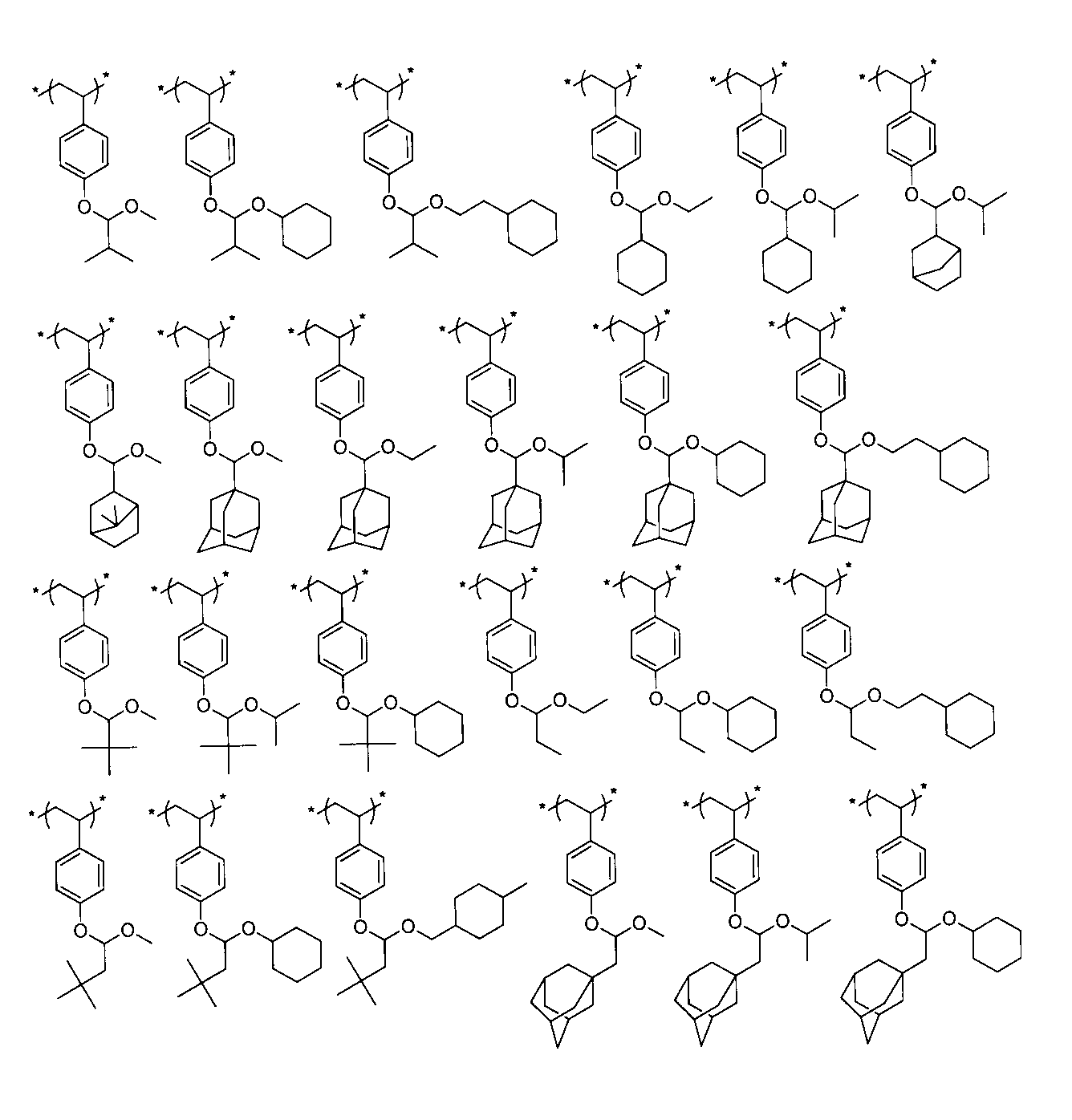
以下に、一般式(A1)により表される繰り返し単位の具体例を挙げるが、これらに限定されるものではない。
次に、一般式(A2)により表される繰り返し単位について説明する。
Xは、上述したように、水素原子、アルキル基、水酸基、アルコキシ基、ハロゲン原子、シアノ基、ニトロ基、アシル基、アシロキシ基、シクロアルキル基、シクロアルキルオキシ基、アリール基、カルボキシ基、アルキルオキシカルボニル基、アルキルカルボニルオキシ基又はアラルキル基を表す。
Xは、上述したように、水素原子、アルキル基、水酸基、アルコキシ基、ハロゲン原子、シアノ基、ニトロ基、アシル基、アシロキシ基、シクロアルキル基、シクロアルキルオキシ基、アリール基、カルボキシ基、アルキルオキシカルボニル基、アルキルカルボニルオキシ基又はアラルキル基を表す。
Xとしてのアルキル基は、置換基を有していてもよく、直鎖、分岐のいずれでもよい。直鎖アルキル基としては、好ましくは炭素数1~30、さらに好ましくは1~20であり、例えば、メチル基、エチル基、n-プロピル基、n-ブチル基、sec-ブチル基、t-ブチル基、n-ペンチル基、n-ヘキシル基、n-ヘプチル基、n-オクチル基、n-ノニル基、n-デカニル基等が挙げられる。分岐アルキル基としては、好ましくは炭素数3~30、さらに好ましくは3~20であり、例えば、i-プロピル基、i-ブチル基、t-ブチル基、i-ペンチル基、t-ペンチル基、i-ヘキシル基、t-ヘキシル基、i-ヘプチル基、t-ヘプチル基、i-オクチル基、t-オクチル基、i-ノニル基、t-デカノイル基等が挙げられる。
Xとしてのアルコキシ基は、置換基を有していてもよく、例えば炭素数1~8の上記アルコキシ基であり、例えばメトキシ基、エトキシ基、プロポキシ基、ブトキシ基、ペンチルオキシ基、ヘキシルオキシ基、シクロヘキシルオキシ基等を挙げることができる。
Xとしてのハロゲン原子としては、フッ素原子、塩素原子、臭素原子及びヨウ素原子が挙げられ、フッ素原子が好ましい。
Xとしてのアシル基は、置換基を有していてもよく、例えば炭素数2~8個のアシル基であって、具体的には、ホルミル基、アセチル基、プロパノイル基、ブタノイル基、ピバロイル基、ベンゾイル基等を好ましく挙げることができる。
Xとしてのアシロキシ基は、置換基を有していてもよく、好ましくは炭素数2~8のアシロキシ基であり、例えば、アセトキシ基、プロピオニルオキシ基、ブチルリオキシ基、バレリルオキシ基、ピバロイルオキシ基、ヘキサノイルオキシ基、オクタノイルオキシ基、ベンゾイルオキシ基等を挙げることができる。
Xとしてのシクロアルキル基は、置換基を有していてもよく、単環型でもよく、多環型でもよく、有橋式であってもよい。例えば、シクロアルキル基は橋かけ構造を有していてもよい。単環型としては、炭素数3~8のシクロアルキル基が好ましく、例えば、シクロプロピル基、シクロペンチル基、シクロヘキシル基、シクロブチル基、シクロオクチル基等を挙げることができる。多環型としては、炭素数5以上のビシクロ、トリシクロ、テトラシクロ構造等を有する基を挙げることができ、炭素数6~20のシクロアルキル基が好ましく、例えば、アダマンチル基、ノルボルニル基、イソボロニル基、カンファニル基、ジシクロペンチル基、α-ピナニル基、トリシクロデカニル基、テトシクロドデシル基、アンドロスタニル基等を挙げることができる。尚、シクロアルキル基中の炭素原子の一部が、酸素原子等のヘテロ原子によって置換されていてもよい。
Xとしてのアリール基は、置換基を有していてもよく、好ましくは炭素数6~14であり、例えば、フェニル基、キシリル基、トルイル基、クメニル基、ナフチル基、アントラセニル基等が挙げられる。
Xとしてのアルキルオキシカルボニル基は、置換基を有していてもよく、好ましくは炭素数2~8であり、例えば、メトキシカルボニル基、エトキシカルボニル基、プロポキシカルボニル基を挙げることができる。
Xとしてのアルキルカルボニルオキシ基は、置換基を有していてもよく、好ましくは炭素数2~8であり、例えば、メチルカルボニルオキシ基、エチルカルボニルオキシ基を挙げることができる。
Xとしてのアラルキル基は、置換基を有していてもよく、好ましくは炭素数7~16のアラルキル基である、例えば、ベンジル基を挙げることができる。
Xとしてのアルキル基、アルコキシ基、アシル基、シクロアルキル基、アリール基、アルキルオキシカルボニル基、アルキルカルボニルオキシ基、アラルキル基が更に有していてもよい置換基としては、水酸基、フッ素原子、塩素原子、臭素原子、沃素原子、アルキル基、水酸基、アルコキシ基、ハロゲン原子、シアノ基、ニトロ基、アシル基、アシロキシ基、シクロアルキル基、アリール基、カルボキシル基、アルキルオキシカルボニル基、アルキルカルボニルオキシ基又はアラルキル基などが挙げられる。
Tは、上述したように、単結合又は2価の連結基を表す。
Tの2価の連結基としては、アルキレン基、-COO-Rt-基、-O-Rt-基等が挙げられる。式中、Rtは、アルキレン基又はシクロアルキレン基を表す。
Tは、単結合又は-COO-Rt-基が好ましい。Rtは、炭素数1~5のアルキレン基が好ましく、-CH2-基、-(CH2)3-基がより好ましい。
Tの2価の連結基としては、アルキレン基、-COO-Rt-基、-O-Rt-基等が挙げられる。式中、Rtは、アルキレン基又はシクロアルキレン基を表す。
Tは、単結合又は-COO-Rt-基が好ましい。Rtは、炭素数1~5のアルキレン基が好ましく、-CH2-基、-(CH2)3-基がより好ましい。
A2は、上述したように、酸の作用により脱離する基を表す。即ち、一般式(A2)により表される繰り返し単位は、酸分解性基として、「-COOA2」により表される基を備えている。A2としては、例えば、先に一般式(A1)におけるA1について説明したのと同様のものが挙げられる。
A2は炭化水素基(好ましくは炭素数20以下、より好ましくは4~12)であることが好ましく、t-ブチル基、t-アミル基、脂環構造を有する炭化水素基(例えば、脂環基自体、及び、アルキル基に脂環基が置換した基)がより好ましい。
A2は、3級のアルキル基又は3級のシクロアルキル基であることが好ましい。
A2は、3級のアルキル基又は3級のシクロアルキル基であることが好ましい。
脂環構造は、単環でも、多環でもよい。具体的には、炭素数5以上のモノシクロ、ビシクロ、トリシクロ、テトラシクロ構造等を挙げることができる。その炭素数は6~30個が好ましく、特に炭素数7~25個が好ましい。これらの脂環構造を有する炭化水素基は置換基を有していてもよい。
脂環構造の例としては、上掲の樹脂(Aa)において、一般式(KA-1)中のZkaのシクロアルキル基の例として挙げた脂環構造(1)~(50)が挙げられる。また、好ましい脂環構造の具体例、並びに、脂環構造が有し得る置換基の具体例としても、一般式(KA-1)中のZkaとしての脂環構造において説明した具体例と同様の例が挙げられる。
脂環構造の例としては、上掲の樹脂(Aa)において、一般式(KA-1)中のZkaのシクロアルキル基の例として挙げた脂環構造(1)~(50)が挙げられる。また、好ましい脂環構造の具体例、並びに、脂環構造が有し得る置換基の具体例としても、一般式(KA-1)中のZkaとしての脂環構造において説明した具体例と同様の例が挙げられる。
脂環構造を有する酸分解性基としては、下記一般式(pI)~一般式(pV)で示される基が好ましい。
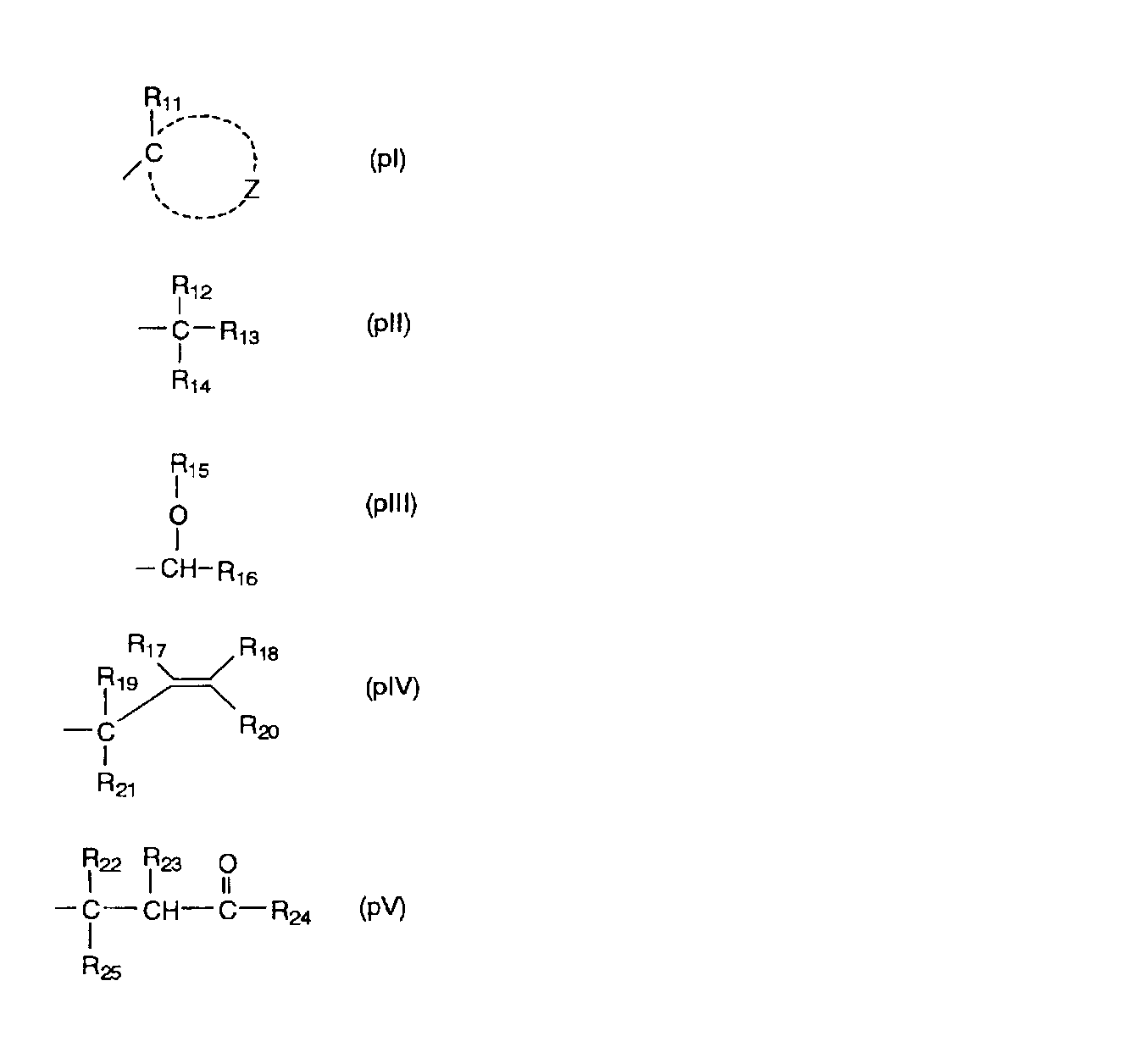
上記一般式(pI)~(pV)中、
R11は、メチル基、エチル基、n-プロピル基、イソプロピル基、n-ブチル基、イソブチル基又はsec-ブチル基を表し、Zは、炭素原子とともに脂環式炭化水素基を形成するのに必要な原子団を表す。
R11は、メチル基、エチル基、n-プロピル基、イソプロピル基、n-ブチル基、イソブチル基又はsec-ブチル基を表し、Zは、炭素原子とともに脂環式炭化水素基を形成するのに必要な原子団を表す。
R12~R16は、各々独立に、炭素数1~4個の、直鎖もしくは分岐のアルキル基又は脂環式炭化水素基を表し、但し、R12~R14のうち少なくとも1つ、もしくはR15、R16のいずれかは脂環式炭化水素基を表す。
R17~R21は、各々独立に、水素原子、炭素数1~4個の、直鎖もしくは分岐のアルキル基又は脂環式炭化水素基を表し、但し、R17~R21のうち少なくとも1つは脂環式炭化水素基を表す。また、R19、R21のいずれかは炭素数1~4個の、直鎖もしくは分岐のアルキル基又は脂環式炭化水素基を表す。
R22~R25は、各々独立に、水素原子、炭素数1~4個の、直鎖もしくは分岐のアルキル基又は脂環式炭化水素基を表し、但し、R22~R25のうち少なくとも1つは脂環式炭化水素基を表す。また、R23とR24は、互いに結合して環を形成していてもよい。
一般式(pI)~(pV)において、R12~R25におけるアルキル基としては、置換もしくは非置換のいずれであってもよい、1~4個の炭素原子を有する直鎖もしくは分岐のアルキル基を表す。そのアルキル基としては、例えばメチル基、エチル基、n-プロピル基、イソプロピル基、n-ブチル基、イソブチル基、sec-ブチル基、t-ブチル基等が挙げられる。
また、上記アルキル基の更なる置換基としては、炭素数1~4個のアルコキシ基、ハロゲン原子(フッ素原子、塩素原子、臭素原子、ヨウ素原子)、アシル基、アシロキシ基、シアノ基、水酸基、カルボキシ基、アルコキシカルボニル基、ニトロ基等を挙げることができる。
R11~R25における脂環式炭化水素基或いはZと炭素原子が形成する脂環式炭化水素基としては、先に脂環構造として述べたものが挙げられる。
一般式(A2)で表される繰り返し単位は、一形態において、下式で表される繰り返し単位である場合が好ましい。

また、一般式(A2)で表される繰り返し単位は、他の形態において、以下に示す一般式(A3)で表される繰り返し単位である場合も好ましい。
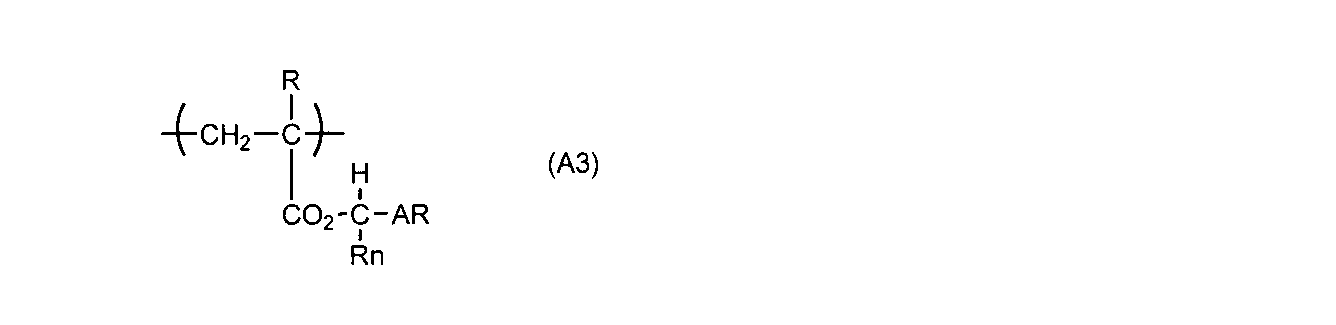
一般式(A3)中、
ARは、アリール基を表す。
ARは、アリール基を表す。
Rnは、アルキル基、シクロアルキル基又はアリール基を表す。RnとARとは互いに結合して非芳香族環を形成してもよい。
Rは、水素原子、アルキル基、シクロアルキル基、ハロゲン原子、シアノ基又はアルキルオキシカルボニル基を表す。
一般式(A3)により表される繰り返し単位について詳細に説明する。
ARは、上述したようにアリール基を表す。ARのアリール基としては、フェニル基、ナフチル基、アントリル基、又は、フルオレン基等の炭素数6~20のものが好ましく、炭素数6~15のものがより好ましい。
Rは、水素原子、アルキル基、シクロアルキル基、ハロゲン原子、シアノ基又はアルキルオキシカルボニル基を表す。
一般式(A3)により表される繰り返し単位について詳細に説明する。
ARは、上述したようにアリール基を表す。ARのアリール基としては、フェニル基、ナフチル基、アントリル基、又は、フルオレン基等の炭素数6~20のものが好ましく、炭素数6~15のものがより好ましい。
ARがナフチル基、アントリル基又はフルオレン基である場合、Rnが結合している炭素原子とARとの結合位置には、特に制限はない。例えば、ARがナフチル基である場合、この炭素原子は、ナフチル基のα位に結合していてもよく、β位に結合していてもよい。或いは、ARがアントリル基である場合、この炭素原子は、アントリル基の1位に結合していてもよく、2位に結合していてもよく、9位に結合していてもよい。
ARとしてのアリール基は、1以上の置換基を有していてもよい。このような置換基の具体例としては、例えば、メチル基、エチル基、プロピル基、イソプロピル基、n-ブチル基、イソブチル基、t-ブチル基、ペンチル基、ヘキシル基、オクチル基及びドデシル基等の炭素数が1~20の直鎖又は分岐鎖アルキル基、これらアルキル基部分を含んだアルコキシ基、シクロペンチル基及びシクロヘキシル基等のシクロアルキル基、これらシクロアルキル基部分を含んだシクロアルコキシ基、水酸基、ハロゲン原子、アリール基、シアノ基、ニトロ基、アシル基、アシルオキシ基、アシルアミノ基、スルホニルアミノ基、アルキルチオ基、アリールチオ基、アラルキルチオ基、チオフェンカルボニルオキシ基、チオフェンメチルカルボニルオキシ基、及びピロリドン残基等のヘテロ環残基が挙げられる。この置換基としては、炭素数1~5の直鎖若しくは分岐鎖アルキル基、これらアルキル基部分を含んだアルコキシ基が好ましく、パラメチル基又はパラメトキシ基がより好ましい。
ARとしてのアリール基が、複数の置換基を有する場合、複数の置換基のうちの少なくとも2つが互いに結合して環を形成しても良い。環は、5~8員環であることが好ましく、5又は6員環であることがより好ましい。また、この環は、環員に酸素原子、窒素原子、硫黄原子等のヘテロ原子を含むヘテロ環であってもよい。
更に、この環は、置換基を有していてもよい。この置換基としては、Rnが有していてもよい更なる置換基について後述するものと同様のものが挙げられる。
また、一般式(A3)により表される繰り返し単位は、ラフネス性能の観点から、2個以上の芳香環を含有ことが好ましい。この繰り返し単位が有する芳香環の個数は、通常、5個以下であることが好ましく、3個以下であることがより好ましい。
また、一般式(A3)により表される繰り返し単位において、ラフネス性能の観点から、ARは2個以上の芳香環を含有することがより好ましく、ARがナフチル基又はビフェニル基であることが更に好ましい。ARが有する芳香環の個数は、通常、5個以下であることが好ましく、3個以下であることがより好ましい。
Rnは、上述したように、アルキル基、シクロアルキル基又はアリール基を表す。
Rnのアルキル基は、直鎖アルキル基であってもよく、分岐鎖アルキル基であってもよい。このアルキル基としては、好ましくは、メチル基、エチル基、プロピル基、イソプロピル基、n-ブチル基、イソブチル基、t-ブチル基、ペンチル基、ヘキシル基、シクロヘキシル基、オクチル基及びドデシル基等の炭素数が1~20のものが挙げられる。Rnのアルキル基は、炭素数1~5のものが好ましく、炭素数1~3のものがより好ましい。
Rnのアルキル基は、直鎖アルキル基であってもよく、分岐鎖アルキル基であってもよい。このアルキル基としては、好ましくは、メチル基、エチル基、プロピル基、イソプロピル基、n-ブチル基、イソブチル基、t-ブチル基、ペンチル基、ヘキシル基、シクロヘキシル基、オクチル基及びドデシル基等の炭素数が1~20のものが挙げられる。Rnのアルキル基は、炭素数1~5のものが好ましく、炭素数1~3のものがより好ましい。
Rnのシクロアルキル基としては、例えば、シクロペンチル基及びシクロヘキシル基等の炭素数が3~15のものが挙げられる。
Rnのアリール基としては、例えば、フェニル基、キシリル基、トルイル基、クメニル基、ナフチル基及びアントリル基等の炭素数が6~14のものが好ましい。
Rnとしてのアルキル基、シクロアルキル基及びアリール基の各々は、置換基を更に有していてもよい。この置換基としては、例えば、アルコキシ基、水酸基、ハロゲン原子、ニトロ基、アシル基、アシルオキシ基、アシルアミノ基、スルホニルアミノ基、ジアルキルアミノ基、アルキルチオ基、アリールチオ基、アラルキルチオ基、チオフェンカルボニルオキシ基、チオフェンメチルカルボニルオキシ基、及びピロリドン残基等のヘテロ環残基が挙げられる。中でも、アルコキシ基、水酸基、ハロゲン原子、ニトロ基、アシル基、アシルオキシ基、アシルアミノ基及びスルホニルアミノ基が特に好ましい。
Rは、上述したように、水素原子、アルキル基、シクロアルキル基、ハロゲン原子、シアノ基又はアルキルオキシカルボニル基を表す。
Rのアルキル基及びシクロアルキル基としては、例えば、先にRnについて説明したのと同様のものが挙げられる。これらアルキル基及びシクロアルキル基の各々は、置換基を有していてもよい。この置換基としては、例えば、先にRnについて説明したのと同様のものが挙げられる。
Rが置換基を有するアルキル基又はシクロアルキル基である場合、特に好ましいRとしては、例えば、トリフルオロメチル基、アルキルオキシカルボニルメチル基、アルキルカルボニルオキシメチル基、ヒドロキシメチル基、及びアルコキシメチル基が挙げられる。
Rのハロゲン原子としては、フッ素原子、塩素原子、臭素原子及びヨウ素原子が挙げられる。中でも、フッ素原子が特に好ましい。
Rのアルキルオキシカルボニル基に含まれるアルキル基部分としては、例えば、先にRのアルキル基として挙げた構成を採用することができる。
RnとARとが互いに結合して非芳香族環を形成することが好ましく、これにより、特に、ラフネス性能をより向上させることができる。
RnとARとは互いに結合して形成しても良い非芳香族環としては、5~8員環であることが好ましく、5又は6員環であることがより好ましい。
RnとARとは互いに結合して形成しても良い非芳香族環としては、5~8員環であることが好ましく、5又は6員環であることがより好ましい。
非芳香族環は、脂肪族環であっても、環員として酸素原子、窒素原子、硫黄原子等のヘテロ原子を含むヘテロ環であってもよい。
非芳香族環は、置換基を有していてもよい。この置換基としては、例えば、Rnが有していてもよい更なる置換基について先に説明したのと同様のものが挙げられる。
以下に、一般式(A2)により表される繰り返し単位に対応したモノマーの具体例、及び、該繰り返し単位の具体例を挙げるが、これらに限定されるものではない。


非芳香族環は、置換基を有していてもよい。この置換基としては、例えば、Rnが有していてもよい更なる置換基について先に説明したのと同様のものが挙げられる。
以下に、一般式(A2)により表される繰り返し単位に対応したモノマーの具体例、及び、該繰り返し単位の具体例を挙げるが、これらに限定されるものではない。
以下に、一般式(A3)により表される繰り返し単位の構造の具体例を挙げるが、これらに限定されるものではない。
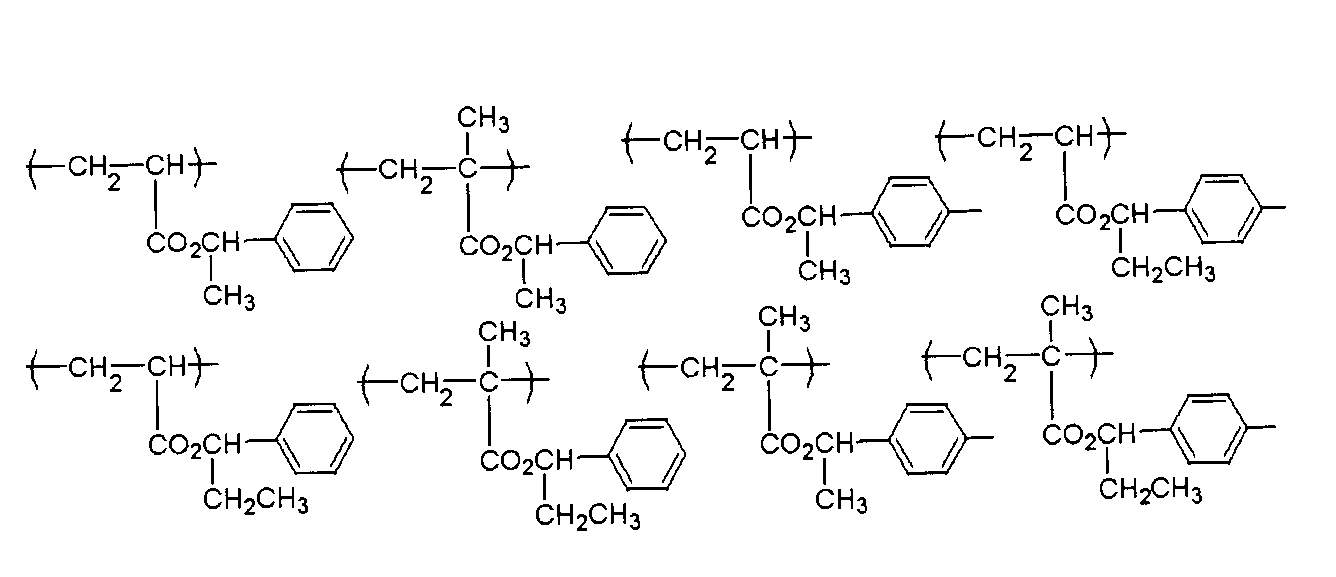

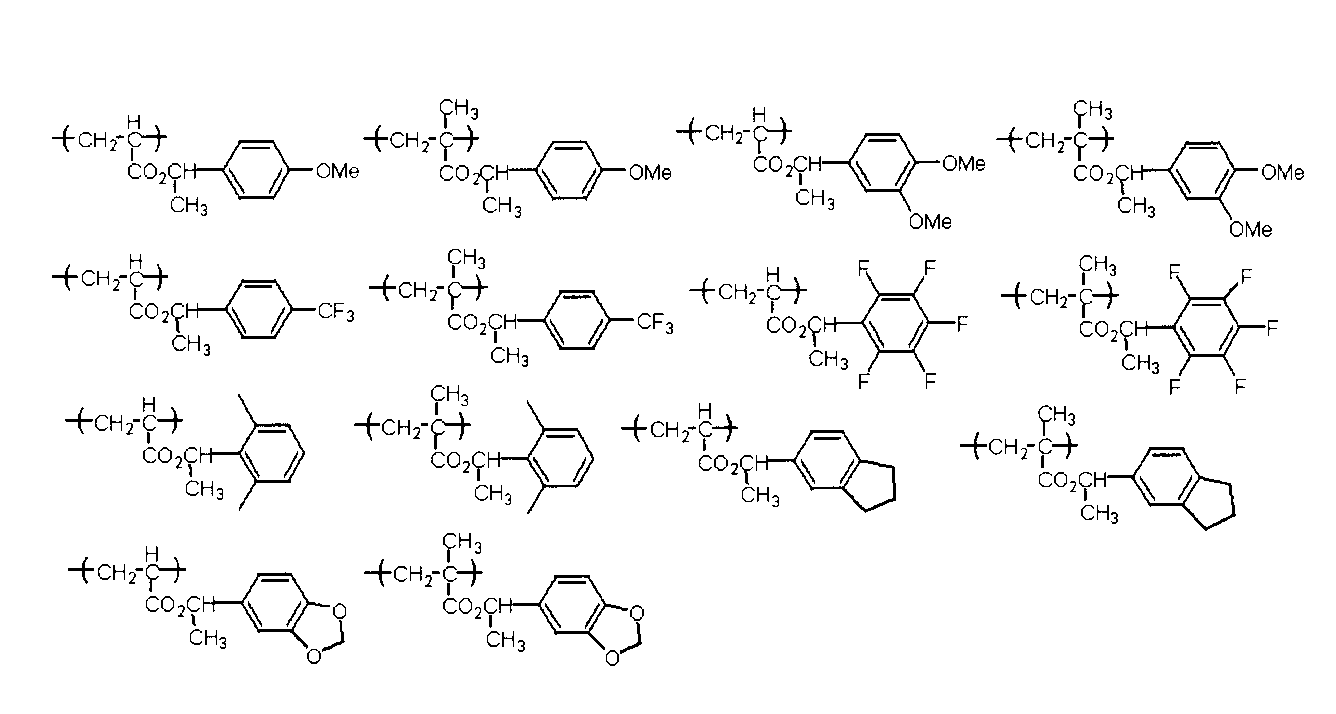

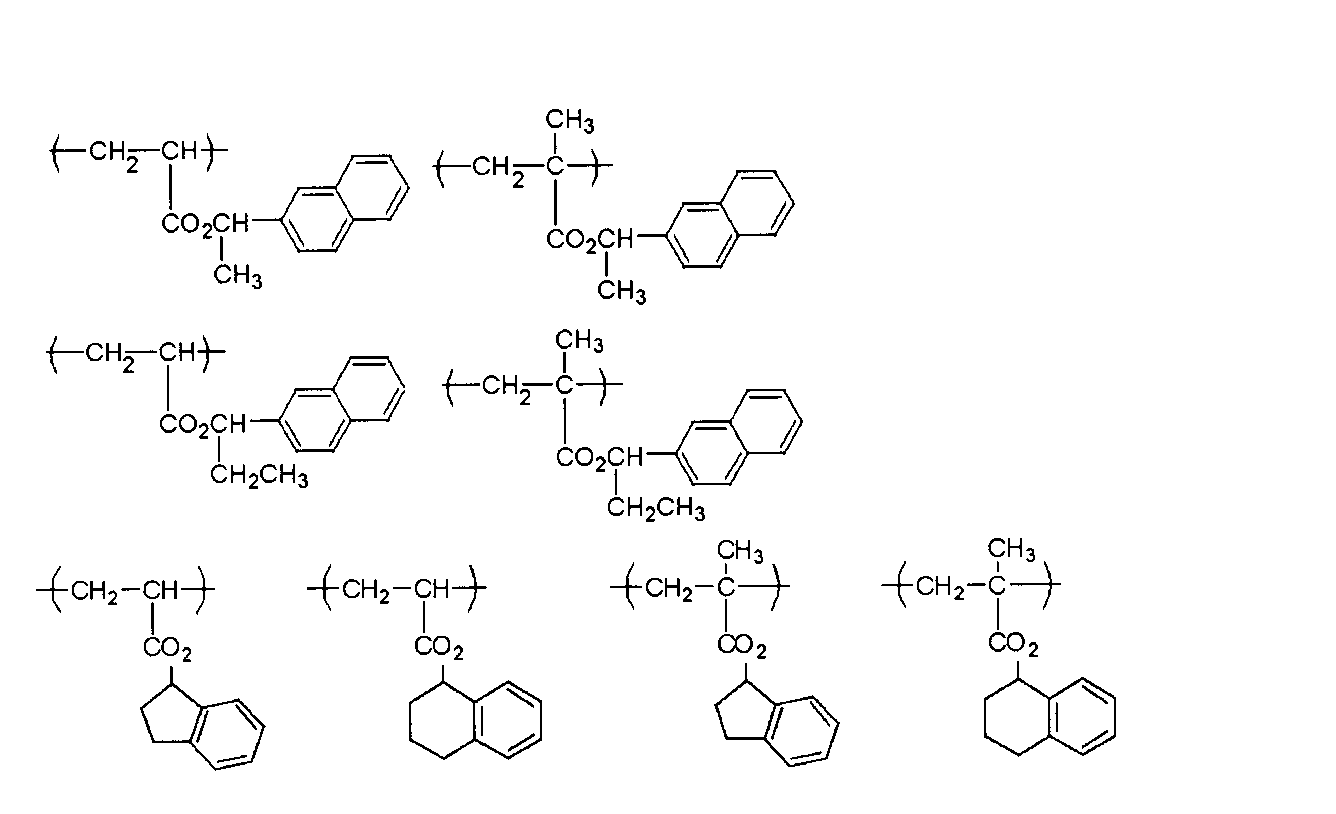
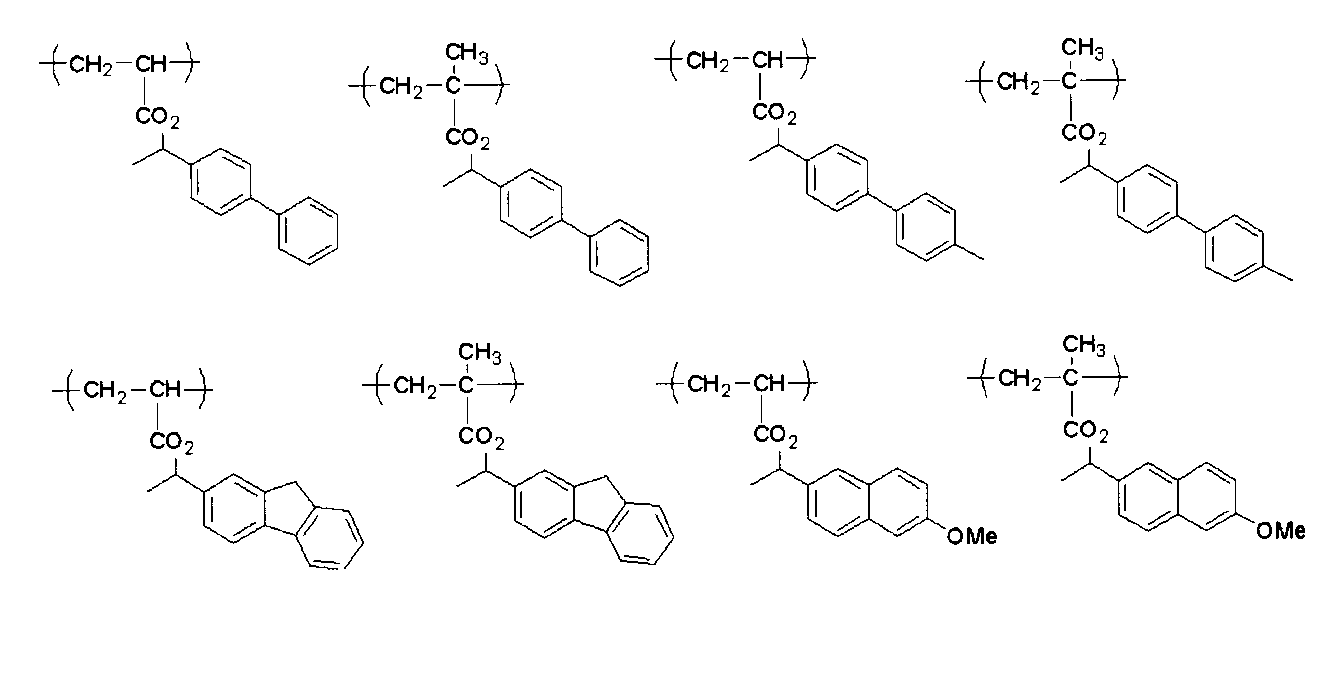

中でも、下記に示す繰り返し単位がより好ましい。
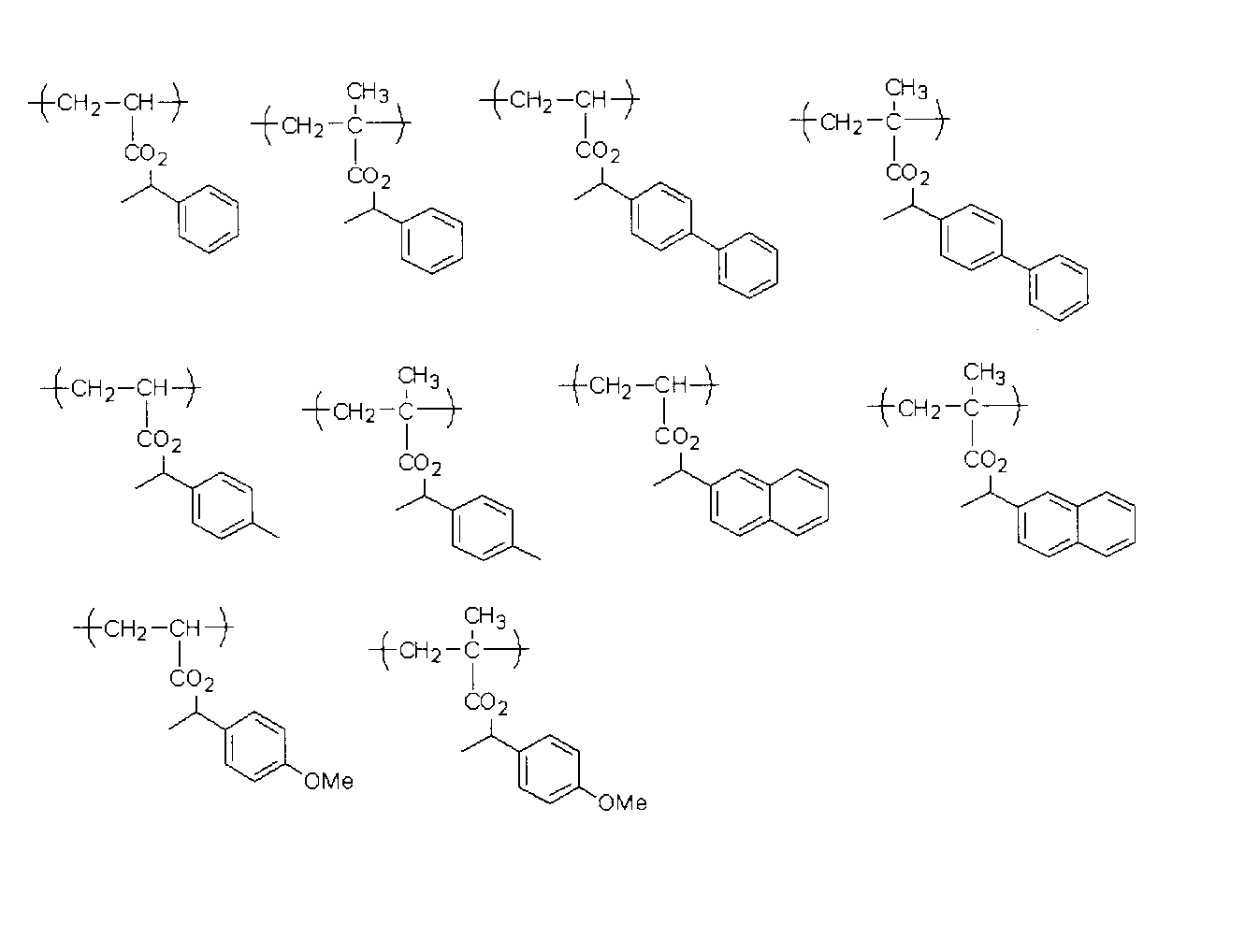
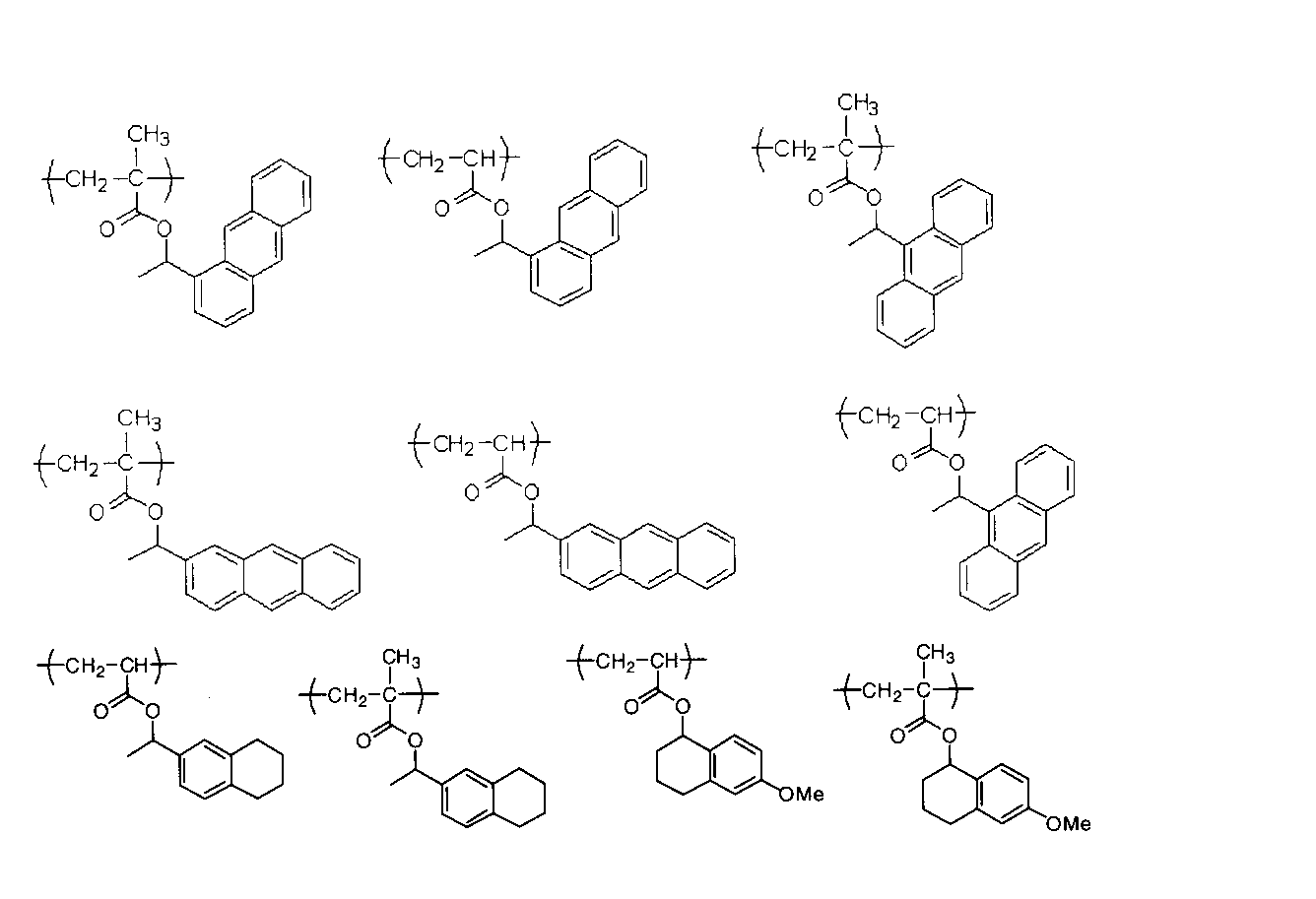
一般式(A2)により表される繰り返し単位は、一形態において、t-ブチルメタクリレート又はエチルシクロペンチルメタクリレートの繰り返し単位であることが好ましい。
一般式(A2)で表される繰り返し単位に対応するモノマーは、THF、アセトン、塩化メチレン等の溶媒中、(メタ)アクリル酸クロリドとアルコール化合物を、トリエチルアミン、ピリジン、DBU等の塩基性触媒存在下でエステル化させることにより合成することができる。なお、市販のものを用いてもよい。
樹脂(Ab)は、更に、下記一般式(A5)で表される繰り返し単位を含有していてもよい。

式(A5)中、
Xは、水素原子、アルキル基、水酸基、アルコキシ基、ハロゲン原子、シアノ基、ニトロ基、アシル基、アシロキシ基、シクロアルキル基、アリール基、カルボキシル基、アルキルオキシカルボニル基、アルキルカルボニルオキシ基、又はアラルキル基を表し、一般式(A2b)に於けるXと同様のものである。
A4は、酸の作用により脱離しない炭化水素基を表す。
Xは、水素原子、アルキル基、水酸基、アルコキシ基、ハロゲン原子、シアノ基、ニトロ基、アシル基、アシロキシ基、シクロアルキル基、アリール基、カルボキシル基、アルキルオキシカルボニル基、アルキルカルボニルオキシ基、又はアラルキル基を表し、一般式(A2b)に於けるXと同様のものである。
A4は、酸の作用により脱離しない炭化水素基を表す。
一般式(A5)に於ける、A4の酸の作用により脱離しない炭化水素基としては、上記の酸分解性基以外の炭化水素基が挙げられ、例えば、酸の作用により脱離しないアルキル基(好ましくは炭素数1~15)、酸の作用により脱離しないシクロアルキル基(好ましくは炭素数3~15)、酸の作用により脱離しないアリール基(好ましくは炭素数6~15)等を挙げることができる。
A4の酸の作用により脱離しない炭化水素基は、更に、水酸基、アルキル基、シクロアルキル基、アリール基等で置換されていてもよい。
樹脂(Ab)は、更に一般式(A6)で表される繰り返し単位を有することも好ましい。

一般式(A6)中、
R2は、水素原子、メチル基、シアノ基、ハロゲン原子又は炭素数1~4のペルフルオロ基を表す。
R3は、水素原子、アルキル基、シクロアルキル基、ハロゲン原子、アリール基、アルコキシ基又はアシル基を表す。
qは、0~4の整数を表す。
Arは、q+2価の芳香環を表す。
Wは、酸の作用により分解しない基又は水素原子を表す。
R2は、水素原子、メチル基、シアノ基、ハロゲン原子又は炭素数1~4のペルフルオロ基を表す。
R3は、水素原子、アルキル基、シクロアルキル基、ハロゲン原子、アリール基、アルコキシ基又はアシル基を表す。
qは、0~4の整数を表す。
Arは、q+2価の芳香環を表す。
Wは、酸の作用により分解しない基又は水素原子を表す。
Arにより表される芳香環としては、ベンゼン環、ナフタレン環、アントラセン環が好ましく、ベンゼン環であることがより好ましい。
Wは酸の作用により分解しない基(酸安定基ともいう)を表すが、上記の酸分解性基以外の基が挙げられ、具体的にはハロゲン原子、アルキル基、シクロアルキル基、アルケニル基、アリール基、アシル基、アルキルアミド基、アリールアミドメチル基、アリールアミド基等が挙げられる。酸安定基としては、好ましくはアシル基、アルキルアミド基であり、より好ましくはアシル基、アルキルカルボニルオキシ基、アルキルオキシ基、シクロアルキルオキシ基、アリールオキシ基である。
Wの酸安定基において、アルキル基としては、メチル基、エチル基、プロピル基、n-ブチル基、sec-ブチル基、t-ブチル基の様な炭素数1~4個のものが好ましく、シクロアルキル基としてはシクロプロピル基、シクロブチル基、シクロヘキシル基、アダマンチル基の様な炭素数3~10個のものが好ましく、アルケニル基としてはビニル基、プロペニル基、アリル基、ブテニル基の様な炭素数2~4個のものが好ましく、アルケニル基としてはビニル基、プロペニル基、アリル基、ブテニル基の様な炭素数2~4個のものが好ましく、アリール基としてはフェニル基、キシリル基、トルイル基、クメニル基、ナフチル基、アントラセニル基の様な炭素数6~14個のものが好ましい。Wはベンゼン環上のどの位置にあってもよいが、好ましくはスチレン骨格のメタ位かパラ位であり、特に好ましくはパラ位である。
以下に、一般式(A6)で表される繰り返し単位の具体例を挙げるがこれらに限定するものではない。

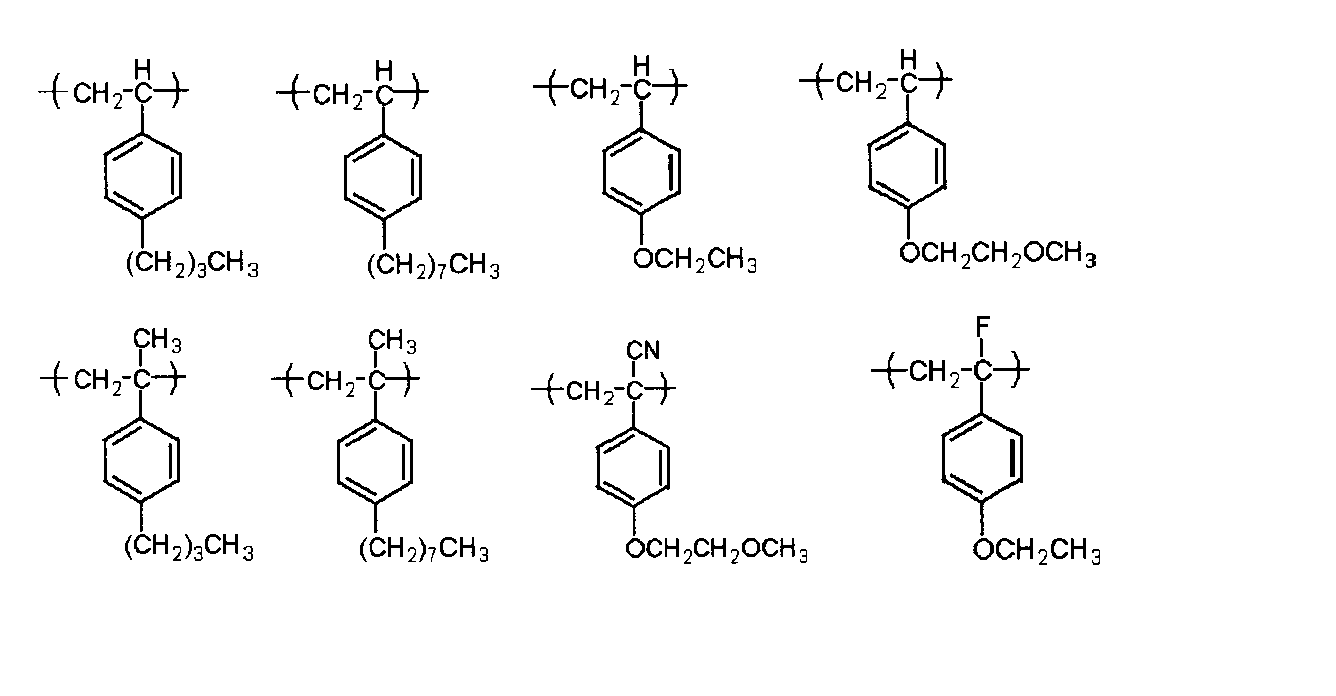

以下に、一般式(A6)で表される繰り返し単位の具体例を挙げるがこれらに限定するものではない。
樹脂(Ab)は、更に酸の作用により分解しない(メタ)アクリル酸誘導体からなる繰り返し単位を有することも好ましい。以下に具体例を挙げるがこれに限定するものではない。
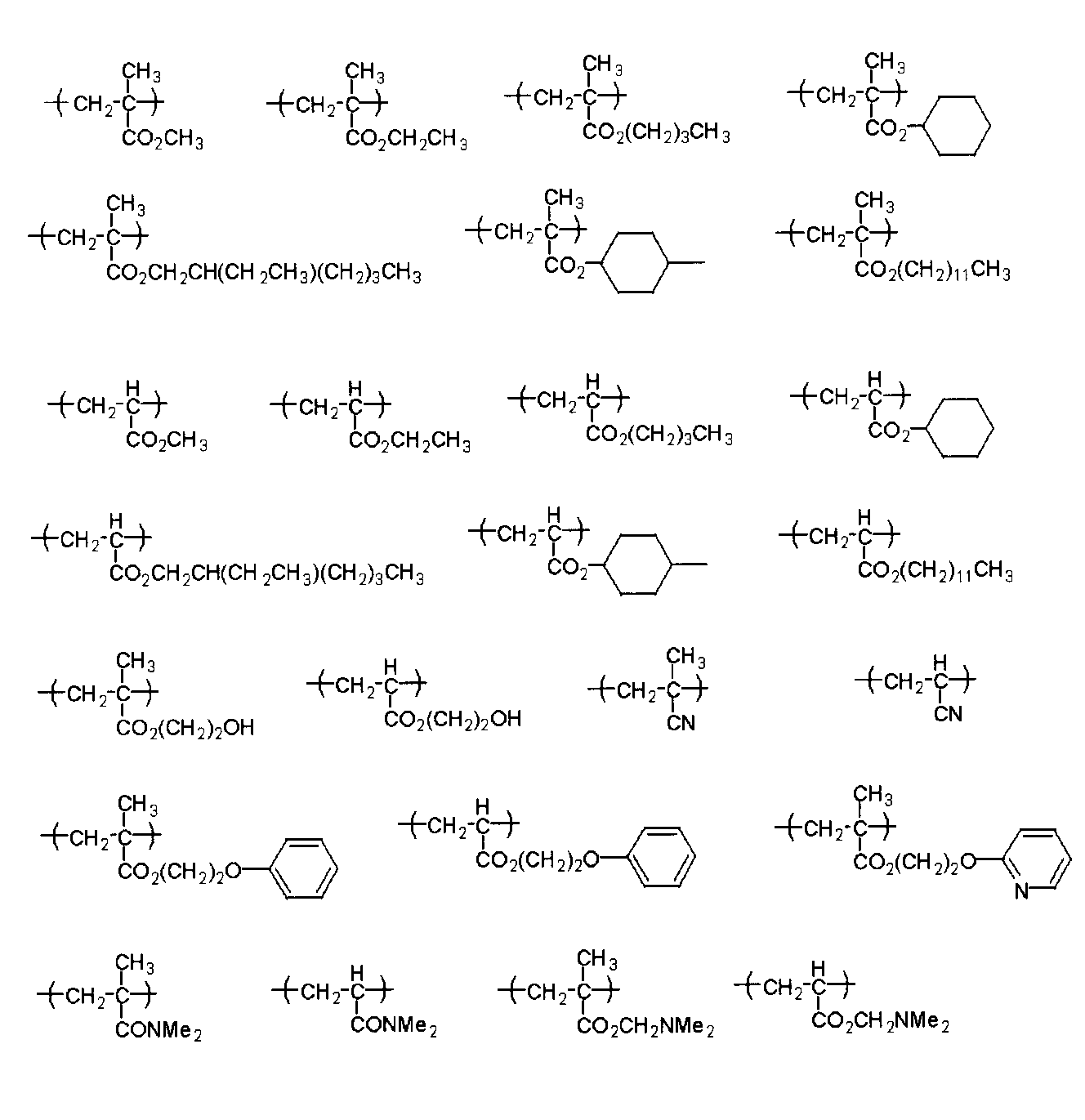
樹脂(Ab)における酸分解性基を有する繰り返し単位の含有率は、全繰り返し単位中、5~95モル%が好ましく、より好ましくは10~60モル%であり、特に好ましくは15~50モル%である。
樹脂(Ab)における一般式(A1)で表される繰り返し単位の含有率は、全繰り返し単位中、0~90モル%が好ましく、より好ましくは10~70モル%であり、特に好ましくは20~50モル%である。
樹脂(Ab)における一般式(A2)で表される繰り返し単位の含有率は、全繰り返し単位中、0~90モル%が好ましく、より好ましくは5~75モル%であり、特に好ましくは10~60モル%である。
樹脂(Ab)における一般式(A2)で表される繰り返し単位の含有率は、全繰り返し単位中、0~90モル%が好ましく、より好ましくは5~75モル%であり、特に好ましくは10~60モル%である。
樹脂(Ab)における一般式(A3)で表される繰り返し単位の含有率は、全繰り返し単位中、0~90モル%が好ましく、より好ましくは5~75モル%であり、特に好ましくは10~60モル%である。
樹脂(Ab)における一般式(A5)で表される繰り返し単位の含有率は、全繰り返し単位中、0~50モル%が好ましく、より好ましくは0~40モル%であり、特に好ましくは0~30モル%である。
樹脂(Ab)は、更に一般式(A6)で表される繰返し単位を有していてもよく、膜質向上、未露光部の膜減り抑制等の観点から好ましい。一般式(A5)で表される繰り返し単位の含有率は、それぞれの全繰り返し単位中、0~50モル%であることが好ましく、より好ましくは0~40モル%であり、特に好ましくは0~30モル%である。
また、樹脂(Ab)は、アルカリ現像液に対する良好な現像性を維持するために、アルカリ可溶性基、例えばフェノール性水酸基、カルボキシル基が導入され得るように適切な他の重合性モノマーが共重合されていてもよいし、膜質向上のためにアルキルアクリレートやアルキルメタクリレートのような疎水性の他の重合性モノマーが共重合されてもよい。
一般式(A2)で表される繰り返し単位に対応するモノマーは、THF、アセトン、塩化メチレン等の溶媒中、(メタ)アクリル酸クロリドとアルコール化合物を、トリエチルアミン、ピリジン、DBU等の塩基性触媒存在下でエステル化させることにより合成することができる。なお、市販のものを用いてもよい。
一般式(A1)で表される繰り返し単位に対応するモノマーは、THF、塩化メチレン等の溶媒中、ヒドロキシ置換スチレンモノマーとビニルエーテル化合物を、p-トルエンスルホン酸、p-トルエンスルホン酸ピリジン塩等の酸性触媒存在下でアセタール化させること、または、二炭酸t-ブチルを用いてトリエチルアミン、ピリジン、DBU等の塩基性触媒存在下でt-Boc保護化する事により合成することができる。なお、市販のものを用いてもよい。
樹脂(Ab)は、下記一般式(A)で表される繰り返し単位を有することが好ましい。

上記一般式中、
R21、R22及びR23は、各々独立に、水素原子、アルキル基、ハロゲン原子、シアノ基又はアルコキシカルボニル基を表す。但し、R22はAr2と結合して環を形成していてもよく、その場合のR22は単結合又はアルキレン基を表す。
R21、R22及びR23は、各々独立に、水素原子、アルキル基、ハロゲン原子、シアノ基又はアルコキシカルボニル基を表す。但し、R22はAr2と結合して環を形成していてもよく、その場合のR22は単結合又はアルキレン基を表す。
X2は、単結合、-COO-、又は-CONR30-を表し、R30は、水素原子又はアルキル基を表す。
L2は、単結合又はアルキレン基を表す。
Ar2は、(n+1)価の芳香環基を表し、R22と結合して環を形成する場合には(n+2)価の芳香環基を表す。
nは、1~4の整数を表す。
上記一般式(A)におけるR21、R22及びR23のアルキル基としては、好ましくは置換基を有していても良いメチル基、エチル基、プロピル基、イソプロピル基、n-ブチル基、sec-ブチル基、ヘキシル基、2-エチルヘキシル基、オクチル基、ドデシル基など炭素数20以下のアルキル基が挙げられ、より好ましくは炭素数8以下のアルキル基、特に好ましくは炭素数3以下のアルキル基が挙げられる。
アルコキシカルボニル基に含まれるアルキル基としては、上記R21、R22及びR23におけるアルキル基と同様のものが好ましい。
ハロゲン原子としては、フッ素原子、塩素原子、臭素原子及びヨウ素原子が挙げられ、フッ素原子が特に好ましい。
上記各基における好ましい置換基としては、例えば、アルキル基、シクロアルキル基、アリール基、アミノ基、アミド基、ウレイド基、ウレタン基、ヒドロキシル基、カルボキシル基、ハロゲン原子、アルコキシ基、チオエーテル基、アシル基、アシロキシ基、アルコキシカルボニル基、シアノ基、ニトロ基等を挙げることができ、置換基の炭素数は8以下が好ましい。
Ar2は、(n+1)価の芳香環基を表す。nが1である場合における2価の芳香環基は、置換基を有していてもよく、例えば、フェニレン基、トリレン基、ナフチレン基、アントラセニレン基などの炭素数6~18のアリーレン基、あるいは、例えば、チオフェン、フラン、ピロール、ベンゾチオフェン、ベンゾフラン、ベンゾピロール、トリアジン、イミダゾール、ベンゾイミダゾール、トリアゾール、チアジアゾール、チアゾール等のヘテロ環を含む芳香環基を好ましい例として挙げることができる。
nが2以上の整数である場合における(n+1)価の芳香環基の具体例としては、2価の芳香環基の上記した具体例から、(n-1)個の任意の水素原子を除してなる基を好適に挙げることができる。
(n+1)価の芳香環基は、更に置換基を有していても良い。
X2により表わされる-CONR30-(R30は、水素原子、アルキル基を表す)におけるR30のアルキル基としては、R21~R23のアルキル基と同様のものが挙げられる。
X2としては、単結合、-COO-、-CONH-が好ましく、単結合、-COO-がより好ましい。
L2におけるアルキレン基としては、好ましくは置換基を有していてもよいメチレン基、エチレン基、プロピレン基、ブチレン基、ヘキシレン基、オクチレン基等の炭素数1~8個のものが挙げられる。
Ar2としては、置換基を有していても良い炭素数6~18の芳香環基がより好ましく、ベンゼン環基、ナフタレン環基、ビフェニレン環基が特に好ましい。
この繰り返し単位は、ヒドロキシスチレン構造を備えていることが好ましい。即ち、Ar2は、ベンゼン環基であることが好ましい。
以下に、一般式(A)で表される繰り返し単位の具体例を示すが、本発明はこれらに限定されるものではない。式中、aは1又は2を表す。
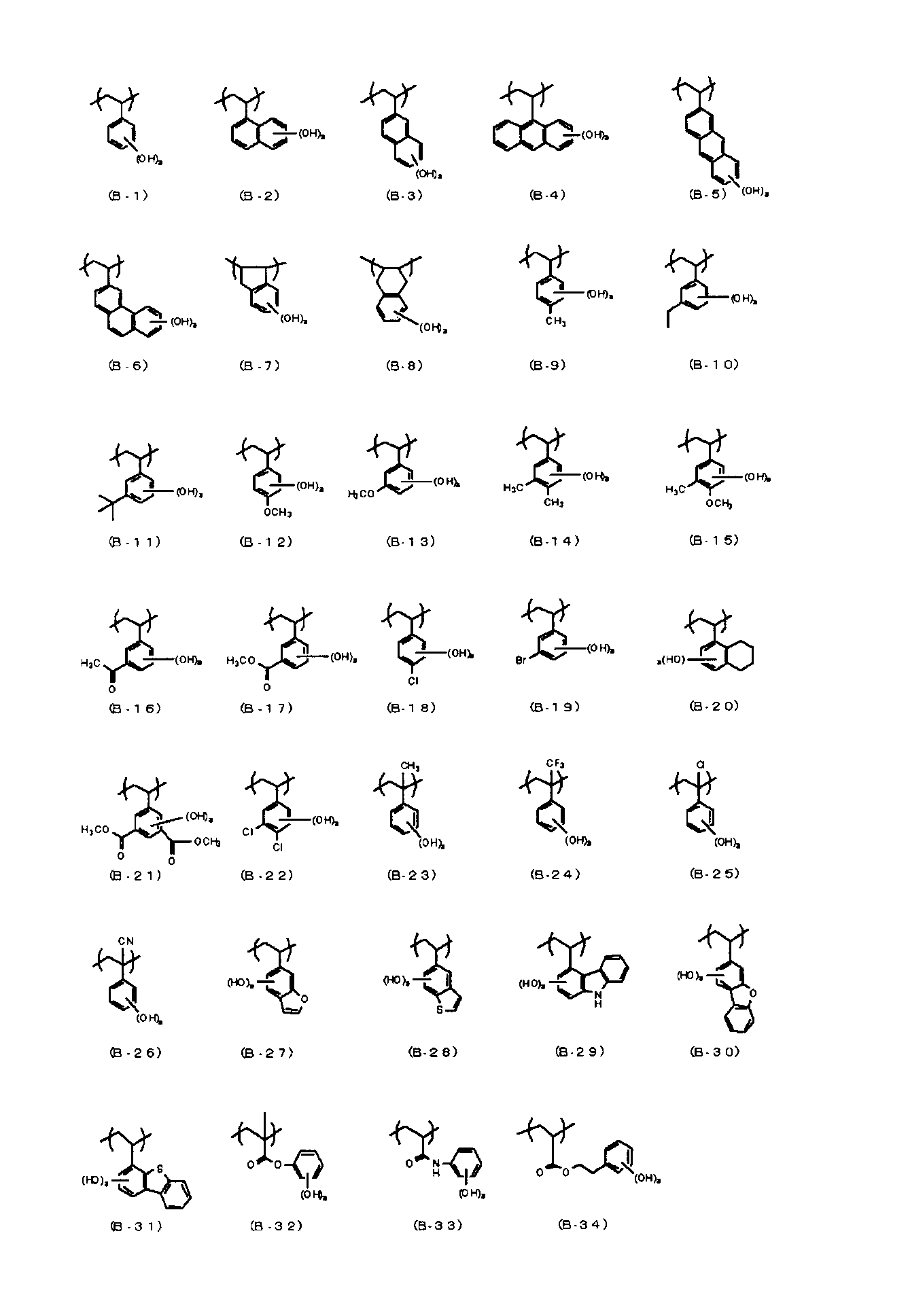

前記一般式(A)で表される繰り返し単位は、下記式(Ab1)又はAb2)で表される繰り返し単位であることが好ましく、式(A1)で表される繰り返し単位であることが更に好ましい。
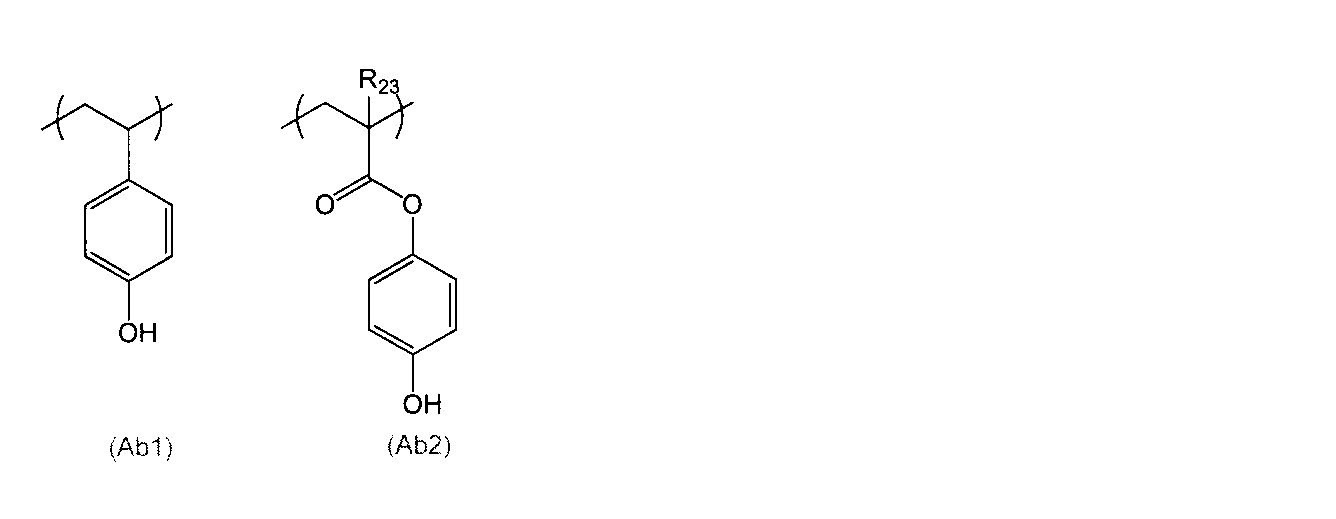
式(Ab2)中、R23は、一般式(A)におけるR23と同義である。
樹脂(Ab)は、一般式(A)で表される繰り返し単位を2種類以上含んでいてもよい。
樹脂(Ab)は、一般式(A)で表される繰り返し単位を2種類以上含んでいてもよい。
樹脂(Ab)は、一態様において、下記一般式(Ab3)で表される繰り返し単位を含有することが好ましい。
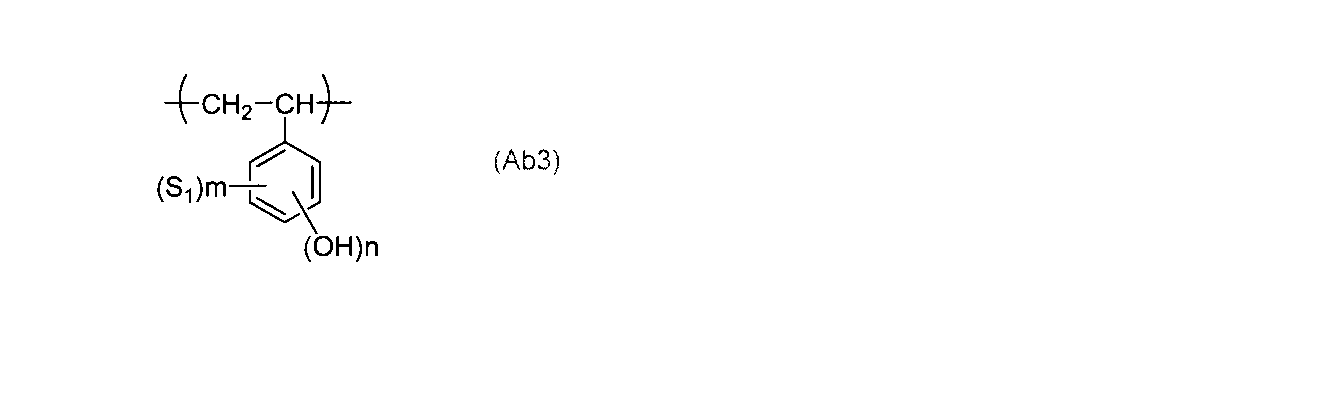
式中、nは1~5の整数を表し、mは1≦m+n≦5なる関係を満足する0~4の整数を表す。nは、好ましくは1又は2であり、より好ましくは1である。mは、好ましくは0~2であり、より好ましくは0又は1であり、特に好ましくは0である。
S1は置換基を表す。mが2以上の場合、複数のS1は互いに同一であってもよく、異なっていてもよい。
S1により表される置換基としては、例えば、アルキル基、アルコキシ基、アシル基、アシロキシ基、アリール基、アリールオキシ基、アラルキル基、アラルキルオキシ基、ヒドロキシ基、ハロゲン原子、シアノ基、ニトロ基、スルホニルアミノ基、アルキルチオ基、アリールチオ基、アラルキルチオ基が挙げられる。
S1により表される置換基としては、例えば、アルキル基、アルコキシ基、アシル基、アシロキシ基、アリール基、アリールオキシ基、アラルキル基、アラルキルオキシ基、ヒドロキシ基、ハロゲン原子、シアノ基、ニトロ基、スルホニルアミノ基、アルキルチオ基、アリールチオ基、アラルキルチオ基が挙げられる。
たとえばアルキル基、シクロアルキル基としては、メチル基、エチル基、プロピル基、イソプロピル基、n-ブチル基、イソブチル基、t-ブチル基、ペンチル基、シクロペンチル基、ヘキシル基、シクロヘキシル基、オクチル基、ドデシル基などの炭素数1~20個の直鎖若しくは分岐状アルキル基、シクロアルキル基が好ましい。これらの基は更に置換基を有していても良い。
更に有し得る好ましい置換基としては、アルキル基、アルコキシ基、水酸基、ハロゲン原子、ニトロ基、アシル基、アシルオキシ基、アシルアミノ基、スルホニルアミノ基、アルキルチオ基、アリールチオ基、アラルキルチオ基、チオフェンカルボニルオキシ基、チオフェンメチルカルボニルオキシ基、ピロリドン残基等のヘテロ環残基などが挙げられ、好ましくは、炭素数12以下の置換基である。
置換基を有するアルキル基として、例えばシクロヘキシルエチル基、アルキルカルボニルオキシメチル基、アルキルカルボニルオキシエチル基、シクロアルキルカルボニルオキシメチル基、シクロアルキルカルボニルオキシエチル基、アリールカルボニルオキシエチル基、アラルキルカルボニルオキシエチル基、アルキルオキシメチル基、シクロアルキルオキシメチル基、アリールオキシメチル基、アラルキルオキシメチル基、アルキルオキシエチル基、シクロアルキルオキシエチル基、アリールオキシエチル基、アラルキルオキシエチル基、アルキルチオメチル基、シクロアルキルチオメチル基、アリールチオメチル基、アラルキルチオメチル基、アルキルチオエチル基、シクロアルキルチオエチル基、アリールチオエチル基、アラルキルチオエチル基等が挙げられる。
これらの基におけるアルキル基、シクロアルキル基は特に限定されず、更に前述のアルキル基、シクロアルキル基、アルコキシ基等の置換基を有してもよい。
上記アルキルカルボニルオキシエチル基、シクロアルキルカルボニルオキシエチル基の例としては、シクロヘキシルカルボニルオキシエチル基、t-ブチルシクロヘキシルカルボニルオキシエチル基、n-ブチルシクロヘキシルカルボニルオキシエチル基等を挙げることができる。
アリール基も特に限定されないが、一般的にフェニル基、キシリル基、トルイル基、クメニル基、ナフチル基、アントラセニル基等の炭素数6~14のものが挙げられ、更に前述のアルキル基、シクロアルキル基、アルコキシ基等の置換基を有してもよい。
上記アリールオキシエチル基の例としては、フェニルオキシエチル基、シクロヘキシルフェニルオキシエチル基等を挙げることができる。これらの基はさらに置換基を有していても良い。
上記アリールオキシエチル基の例としては、フェニルオキシエチル基、シクロヘキシルフェニルオキシエチル基等を挙げることができる。これらの基はさらに置換基を有していても良い。
アラルキルも特に限定されないが、ベンジル基などを挙げることができる。
上記アラルキルカルボニルオキシエチル基の例としては、ベンジルカルボニルオキシエチル基等を挙げることができる。これらの基はさらに置換基を有していても良い。
上記アラルキルカルボニルオキシエチル基の例としては、ベンジルカルボニルオキシエチル基等を挙げることができる。これらの基はさらに置換基を有していても良い。
一般式(Ab3)により表される繰り返し単位としては、例えば、以下のものが挙げられる。

樹脂(Ab)は、一形態において、一般式(Ab3)で表される繰り返し単位として、少なくとも下式で表される繰り返し単位を含有する。

樹脂(Ab)における一般式(A)で表される繰り返し単位の含有率(複数種類含有する場合はその合計)は、高い解像力、感度、PEB温度依存性及びドライエッチング耐性、並びに良好なパターン形状をより確実に達成する観点から、前記樹脂(Ab)中の全繰り返し単位に対して10モル%以上75モル%以下であることが好ましく、15モル%以上70モル%以下であることがより好ましく、20モル%以上65モル%以下であることが更に好ましい。
樹脂(Ab)における、一般式(Ab3)で表される繰り返し単位の含有率は、樹脂(Ab)中の全繰り返し単位に対し、0~90mol%が好ましく、より好ましくは5~80mol%であり、更に好ましくは10~70mol%であり、特に好ましくは20~60mol%である。
樹脂(Ab)においては、下記一般式で表される繰り返し単位を有することも好ましい。下記一般式中、jは0~3の整数を表し、好ましくは0~2の整数であり、より好ましくは0又は1である。

これら一般式により表される繰り返し単位として、以下の具体例が挙げられる。

樹脂(Ab)は、一態様において、活性光線又は放射線の照射により分解して酸を発生する構造部位を備えた繰り返し単位(B)(以下において、「酸発生繰り返し単位(B)」又は「繰り返し単位(B)」という)を含んでいてもよい。
この構造部位は、例えば、活性光線又は放射線の照射により分解することにより、繰り返し単位(B)中に酸アニオンを生じさせる構造部位であってもよいし、酸アニオンを放出して繰り返し単位(B)中にカチオン構造を生じさせる構造部位であってもよい。
この構造部位は、例えば、活性光線又は放射線の照射により分解することにより、繰り返し単位(B)中に酸アニオンを生じさせる構造部位であってもよいし、酸アニオンを放出して繰り返し単位(B)中にカチオン構造を生じさせる構造部位であってもよい。
また、この構造部位は、例えば、スルホニウム塩構造又はヨードニウム塩構造を備えたイオン性構造部位であることが好ましい。
この構造部位は、例えば、以下に説明する一般式(B1)、(B2)及び(B3)中のAにより表される構造部位と同様の構造部位であってもよい。
繰り返し単位(B)は、一態様において、下記一般式(B1)、(B2)及び(B3)で表される繰り返し単位からなる群より選択される少なくとも1つであることが好ましい。これらのうち、下記一般式(B1)又は(B3)により表される繰り返し単位がより好ましく、下記一般式(B1)により表される繰り返し単位が特に好ましい。
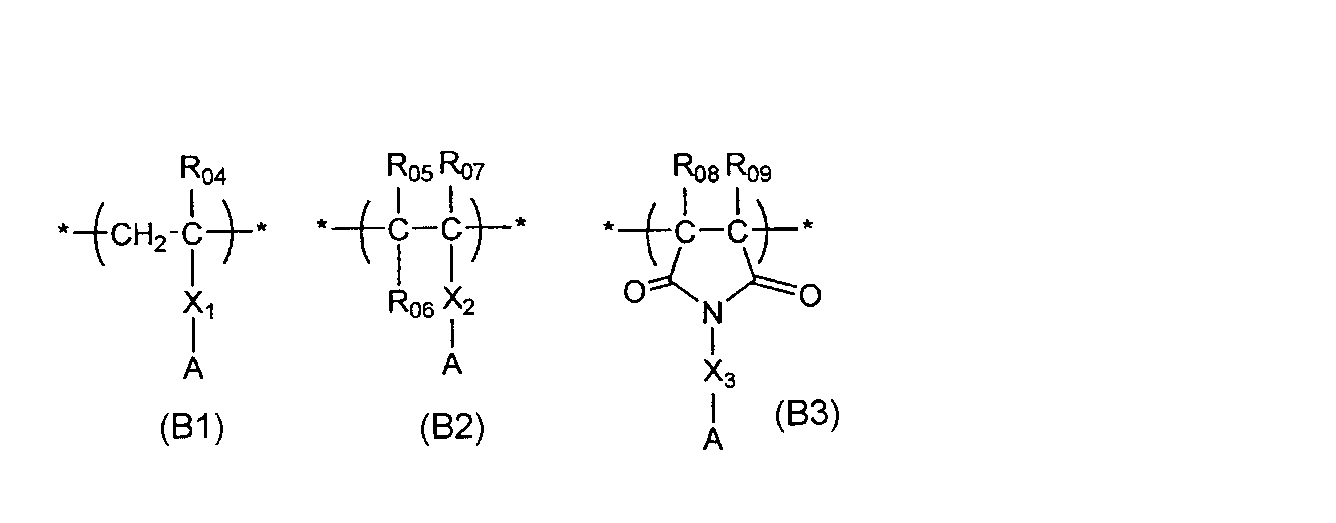
一般式(B1)、(B2)及び(B3)中、
Aは、活性光線又は放射線の照射により分解して酸アニオンを発生する構造部位を表す。
R04、R05及びR07~R09は、各々独立に、水素原子、アルキル基、シクロアルキル基、ハロゲン原子、シアノ基又はアルコキシカルボニル基を表す。
R06は、シアノ基、カルボキシ基、-CO-OR25又は-CO-N(R26)(R27)を表す。R25は、アルキル基、シクロアルキル基、アルケニル基、シクロアルケニル基、アリール基又はアラルキル基を表す。R26及びR27は、各々独立に、水素原子、アルキル基、シクロアルキル基、アルケニル基、シクロアルケニル基、アリール基又はアラルキル基を表す。R26とR27とは、互いに結合して、窒素原子と共に環を形成していてもよい。
Aは、活性光線又は放射線の照射により分解して酸アニオンを発生する構造部位を表す。
R04、R05及びR07~R09は、各々独立に、水素原子、アルキル基、シクロアルキル基、ハロゲン原子、シアノ基又はアルコキシカルボニル基を表す。
R06は、シアノ基、カルボキシ基、-CO-OR25又は-CO-N(R26)(R27)を表す。R25は、アルキル基、シクロアルキル基、アルケニル基、シクロアルケニル基、アリール基又はアラルキル基を表す。R26及びR27は、各々独立に、水素原子、アルキル基、シクロアルキル基、アルケニル基、シクロアルケニル基、アリール基又はアラルキル基を表す。R26とR27とは、互いに結合して、窒素原子と共に環を形成していてもよい。
X1、X2及びX3は、各々独立に、単結合、アリーレン基、アルキレン基、シクロアルキレン基、-O-、-SO2-、-CO-、-N(R33)-又はこれらの複数を組み合わせた2価の連結基を表す。R33は、水素原子、アルキル基、シクロアルキル基、アルケニル基、シクロアルケニル基、アリール基又はアラルキル基を表す。
R04、R05及びR07~R09のアルキル基としては、炭素数が20以下のものが好ましく、炭素数が8以下のものがより好ましい。このようなアルキル基としては、例えば、メチル基、エチル基、プロピル基、イソプロピル基、n-ブチル基、sec-ブチル基、ヘキシル基、2-エチルヘキシル基、オクチル基、及びドデシル基が挙げられる。なお、これらアルキル基は、置換基を更に有していてもよい。
R04、R05及びR07~R09のシクロアルキル基は、単環型であっても、多環型であってもよい。このシクロアルキル基としては、炭素数が3~8のものが好ましい。このようなシクロアルキル基としては、例えば、シクロプロピル基、シクロペンチル基及びシクロヘキシル基が挙げられる。
R04、R05及びR07~R09のハロゲン原子としては、フッ素原子、塩素原子、臭素原子及びヨウ素原子が挙げられる。これらのうち、フッ素原子が特に好ましい。
R04、R05及びR07~R09のアルコキシカルボニル基に含まれるアルキル基としては、例えば、先にR04、R05及びR07~R09のアルキル基として挙げたものが好ましい。
R25~R27及びR33のアルキル基としては、例えば、先にR04、R05及びR07~R09のアルキル基として挙げたものが好ましい。
R25~R27及びR33のシクロアルキル基としては、例えば、先にR04、R05及びR07~R09のシクロアルキル基として挙げたものが好ましい。
R25~R27及びR33のシクロアルキル基としては、例えば、先にR04、R05及びR07~R09のシクロアルキル基として挙げたものが好ましい。
R25~R27及びR33のアルケニル基としては、炭素数が2~6のものが好ましい。このようなアルケニル基としては、例えば、ビニル基、プロペニル基、アリル基、ブテニル基、ペンテニル基及びヘキセニル基が挙げられる。
R25~R27及びR33のシクロアルケニル基としては、炭素数が3~6のものが好ましい。このようなシクロアルケニル基としては、例えば、シクロヘキセニル基が挙げられる。
R25~R27及びR33のアリール基は、単環の芳香族基であってもよく、多環の芳香族基であってもよい。このアリール基としては、炭素数が6~14のものが好ましい。このアリール基は、置換基を更に有していてもよい。また、アリール基同士が互いに結合して、複環を形成していてもよい。R25~R27及びR33のアリール基としては、例えば、フェニル基、トリル基、クロロフェニル基、メトキシフェニル基及びナフチル基が挙げられる。
R25~R27及びR33のアラルキル基としては、炭素数が7~15のものが好ましい。このアラルキル基は、置換基を更に有していてもよい。R25~R27及びR33のアラルキル基としては、例えば、ベンジル基、フェネチル基及びクミル基が挙げられる。
R26とR27とが互いに結合して窒素原子と共に形成する環としては、5~8員環が好ましく、具体的には、例えば、ピロリジン、ピペリジン及びピペラジンが挙げられる。
X1~X3のアリーレン基としては、炭素数が6~14のものが好ましい。このようなアリーレン基としては、例えば、フェニレン基、トリレン基及びナフチレン基が挙げられる。これらアリーレン基は、置換基を更に有していてもよい。
X1~X3のアルキレン基としては、炭素数が1~8のものが好ましい。このようなアルキレン基としては、例えば、メチレン基、エチレン基、プロピレン基、ブチレン基、ヘキシレン基及びオクチレン基が挙げられる。これらアルキレン基は、置換基を更に有していてもよい。
X1~X3のシクロアルキレン基としては、炭素数が5~8のものが好ましい。このようなシクロアルキレン基としては、例えば、シクロペンチレン基及びシクロヘキシレン基が挙げられる。これらシクロアルキレン基は、置換基を更に有していてもよい。
上記一般式(B1)~(B3)における各基が有し得る好ましい置換基としては、例えば、水酸基;ハロゲン原子(フッ素、塩素、臭素、ヨウ素);ニトロ基;シアノ基;アミド基;スルホンアミド基;先にR04、R05及びR07~R09として挙げたアルキル基;メトキシ基、エトキシ基、ヒドロキシエトキシ基、プロポキシ基、ヒドロキシプロポキシ基、及びブトキシ基等のアルコキシ基;メトキシカルボニル基及びエトキシカルボニル基等のアルコキシカルボニル基;ホルミル基、アセチル基及びベンゾイル基等のアシル基;アセトキシ基及びブチリルオキシ基等のアシロキシ基、並びにカルボキシ基が挙げられる。これら置換基は、炭素数が8以下であることが好ましい。
Aは、活性光線又は放射線の照射により分解して酸アニオンを発生する構造部位を表し、具体的には、光カチオン重合の光開始剤、光ラジカル重合の光開始剤、色素類の光消色剤、光変色剤、及びマイクロレジスト等に使用されている公知の光により酸を発生する化合物が有する構造部位が挙げられる。
また、Aとしては、スルホニウム塩構造又はヨードニウム塩構造を備えたイオン性構造部位がより好ましい。より具体的には、Aとして、下記一般式(ZI)又は(ZII)で表される基が好ましい。
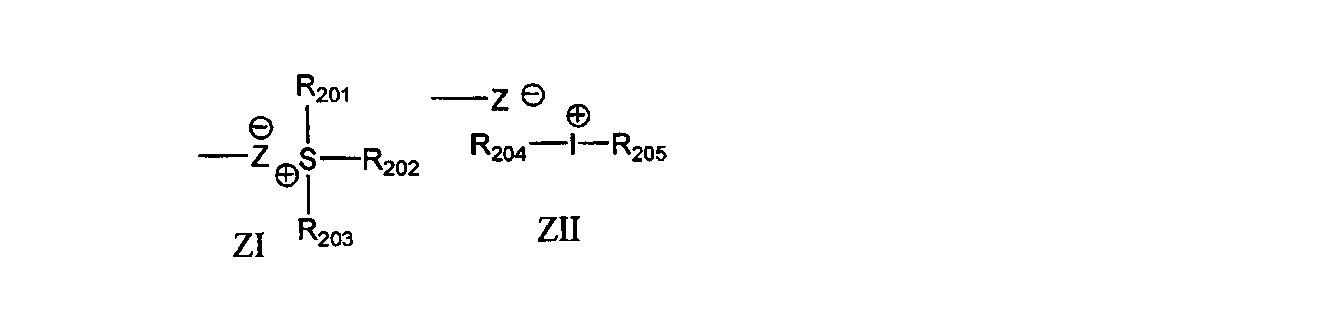
一般式(ZI)中、
R201、R202及びR203は、各々独立に、有機基を表す。
R201、R202及びR203としての有機基の炭素数は、一般的には1~30であり、好ましくは1~20である。また、R201~R203のうち2つが結合して環構造を形成してもよく、環内に酸素原子、硫黄原子、エステル結合、アミド結合、カルボニル基を含んでいてもよい。R201~R203の内の2つが結合して形成する基としては、例えば、ブチレン基及びペンチレン基等のアルキレン基が挙げられる。
R201、R202及びR203は、各々独立に、有機基を表す。
R201、R202及びR203としての有機基の炭素数は、一般的には1~30であり、好ましくは1~20である。また、R201~R203のうち2つが結合して環構造を形成してもよく、環内に酸素原子、硫黄原子、エステル結合、アミド結合、カルボニル基を含んでいてもよい。R201~R203の内の2つが結合して形成する基としては、例えば、ブチレン基及びペンチレン基等のアルキレン基が挙げられる。
Z-は、活性光線又は放射線の照射により分解して発生する酸アニオンを表す。Z-は、非求核性アニオンであることが好ましい。非求核性アニオンとしては、例えば、スルホン酸アニオン、カルボン酸アニオン、スルホニルイミドアニオン、ビス(アルキルスルホニル)イミドアニオン、及びトリス(アルキルスルホニル)メチルアニオンが挙げられる。
なお、非求核性アニオンとは、求核反応を起こす能力が著しく低いアニオンを意味している。非求核性アニオンを用いると、分子内求核反応による経時分解を抑制することができる。これにより樹脂及び組成物の経時安定性を向上させることが可能となる。
R201、R202及びR203の有機基としては、例えば、後述する(ZI-1)、(ZI-2)、(ZI-3)で表される基における対応する基が挙げられる。
更に好ましい(ZI)で表される基として、以下に説明する(ZI-1)基、(ZI-2)基、(ZI-3)基及び(ZI-4)基を挙げることができる。
(ZI-1)基は、上記一般式(ZI)におけるR201~R203の少なくとも1つがアリール基である、アリールスルホニウムをカチオンとする基である。
R201~R203の全てがアリール基でもよいし、R201~R203の一部がアリール基で、残りがアルキル基又はシクロアルキル基でもよい。
(ZI-1)基としては、例えば、トリアリールスルホニウム、ジアリールアルキルスルホニウム、アリールジアルキルスルホニウム、ジアリールシクロアルキルスルホニウム、及びアリールジシクロアルキルスルホニウムのそれぞれに相当する基が挙げられる。
アリールスルホニウムにおけるアリール基としては、フェニル基又はナフチル基が好ましく、フェニル基がより好ましい。アリール基は、酸素原子、窒素原子及び硫黄原子等のヘテロ原子を含んだ複素環構造を有していてもよい。この複素環構造としては、例えば、ピロール、フラン、チオフェン、インドール、ベンゾフラン及びベンゾチオフェンが挙げられる。アリールスルホニウムが2つ以上のアリール基を有する場合、これらアリール基は、互いに同一であってもよく、互いに異なっていてもよい。
アリールスルホニウムが必要に応じて有しているアルキル基又はシクロアルキル基は、炭素数1~15の直鎖若しくは分岐アルキル基、又は、炭素数3~15のシクロアルキル基が好ましい。このようなアルキル基又はシクロアルキル基としては、例えば、メチル基、エチル基、プロピル基、n-ブチル基、sec-ブチル基、t-ブチル基、シクロプロピル基、シクロブチル基及びシクロヘキシル基が挙げられる。
R201~R203のアリール基、アルキル基又はシクロアルキル基は、アルキル基(例えば炭素数1~15)、シクロアルキル基(例えば炭素数3~15)、アリール基(例えば炭素数6~14)、アルコキシ基(例えば炭素数1~15)、ハロゲン原子、水酸基又はフェニルチオ基を置換基として有してもよい。
好ましい置換基としては、例えば、炭素数1~12の直鎖又は分岐アルキル基、炭素数3~12のシクロアルキル基、及び、炭素数1~12の直鎖、分岐又は環状のアルコキシ基が挙げられる。より好ましい置換基としては、例えば、炭素数1~4のアルキル基、及び、炭素数1~4のアルコキシ基が挙げられる。置換基は、3つのR201~R203のうちの何れか1つに置換していてもよいし、これらの2つ以上に置換していてもよい。また、R201~R203がフェニル基の場合、これら置換基は、フェニル基のp-位に置換していることが好ましい。
次に、(ZI-2)基について説明する。
(ZI-2)基は、一般式(ZI)におけるR201~R203が、各々独立に、芳香環を有さない有機基を表す基である。ここで、芳香環には、ヘテロ原子を含んだ複素環も含まれる。
(ZI-2)基は、一般式(ZI)におけるR201~R203が、各々独立に、芳香環を有さない有機基を表す基である。ここで、芳香環には、ヘテロ原子を含んだ複素環も含まれる。
R201~R203としての芳香環を含有しない有機基は、炭素数が一般的には1~30であり、好ましくは1~20である。
R201~R203は、各々独立に、好ましくは、アルキル基、シクロアルキル基、アリル基、又はビニル基であり、より好ましくは、直鎖若しくは分岐鎖の2-オキソアルキル基、2-オキソシクロアルキル基又はアルコキシカルボニルメチル基であり、更に好ましくは、直鎖又は分岐鎖の2-オキソアルキル基である。
R201~R203のアルキル基及びシクロアルキル基としては、好ましくは、炭素数1~10の直鎖又は分岐アルキル基(例えば、メチル基、エチル基、プロピル基、ブチル基若しくはペンチル基)、及び、炭素数3~10のシクロアルキル基(例えば、シクロペンチル基、シクロヘキシル基若しくはノルボニル基)が挙げられる。このアルキル基としては、より好ましくは、2-オキソアルキル基及びアルコキシカルボニルメチル基が挙げられる。シクロアルキル基としては、より好ましくは、2-オキソシクロアルキル基が挙げられる。
2-オキソアルキル基は、直鎖状であってもよく、分岐鎖状であってもよい。2-オキソアルキル基としては、好ましくは、上記のアルキル基の2位に>C=Oを有する基が挙げられる。2-オキソシクロアルキル基としては、好ましくは、上記のシクロアルキル基の2位に>C=Oを有する基が挙げられる。
アルコキシカルボニルメチル基におけるアルコキシ基としては、好ましくは、炭素数1~5のアルコキシ基(例えば、メトキシ基、エトキシ基、プロポキシ基、ブトキシ基又はペントキシ基)が挙げられる。
R201~R203は、例えば、ハロゲン原子、アルコキシ基(例えば炭素数1~5)、水酸基、シアノ基又はニトロ基によって更に置換されていてもよい。
次いで、(ZI-3)基について説明する。
(ZI-3)基とは、以下の一般式(ZI-3)で表される基であり、フェナシルスルフォニウム塩構造を有する基である。

(ZI-3)基とは、以下の一般式(ZI-3)で表される基であり、フェナシルスルフォニウム塩構造を有する基である。
一般式(ZI-3)中、R1c~R5cは、各々独立に、水素原子、アルキル基、シクロアルキル基、アルコキシ基又はハロゲン原子を表す。
R6c及びR7cは、各々独立に、水素原子、アルキル基又はシクロアルキル基を表す。
Rx及びRyは、各々独立に、アルキル基、シクロアルキル基、アリル基又はビニル基を表す。
R6c及びR7cは、各々独立に、水素原子、アルキル基又はシクロアルキル基を表す。
Rx及びRyは、各々独立に、アルキル基、シクロアルキル基、アリル基又はビニル基を表す。
R1c~R5cのうちの2以上、R6c及びR7c、並びに、Rx及びRyは、それぞれ、互いに結合して、環構造を形成していてもよい。この環構造は、酸素原子、硫黄原子、エステル結合及び/又はアミド結合を含んでいてもよい。これらが互いに結合して形成する基としては、例えば、ブチレン基及びペンチレン基が挙げられる。
Zc-は、非求核性アニオンを表し、例えば、一般式(ZI)におけるZ-と同様のものが挙げられる。
一般式(ZI-3)のカチオン部の具体的構造としては、特開2004-233661号公報の段落0047及び0048、並びに、特開2003-35948号公報の段落0040~0046に例示されている酸発生剤のカチオン部の構造を参照されたい。
続いて、(ZI-4)基について説明する。
(ZI-4)基とは、以下の一般式(ZI-4)により表される基である。この基は、アウトガスの抑制に有効である。

(ZI-4)基とは、以下の一般式(ZI-4)により表される基である。この基は、アウトガスの抑制に有効である。
一般式(ZI-4)中、R1~R13は、各々独立に、水素原子又は置換基を表す。
R1~R13のうち少なくとも1つは、アルコール性水酸基を含む置換基であることが好ましい。なお、ここで「アルコール性水酸基」とは、アルキル基の炭素原子に結合した水酸基を意味している。
Zは、単結合又は2価の連結基である。
Zc -は、非求核性アニオンを表し、例えば、一般式(ZI)におけるZ-と同様のものが挙げられる。
R1~R13のうち少なくとも1つは、アルコール性水酸基を含む置換基であることが好ましい。なお、ここで「アルコール性水酸基」とは、アルキル基の炭素原子に結合した水酸基を意味している。
Zは、単結合又は2価の連結基である。
Zc -は、非求核性アニオンを表し、例えば、一般式(ZI)におけるZ-と同様のものが挙げられる。
R1~R13がアルコール性水酸基を含む置換基である場合、R1~R13は-(WY)により表される基であることが好ましい。ここで、Yは水酸基で置換されたアルキル基であり、Wは単結合又は2価の連結基である。
Yにより表されるアルキル基の好ましい例としては、エチル基、プロピル基及びイソプロピル基が挙げられる。Yは、特に好ましくは、-CH2CH2OHにより表される構造を含んでいる。
Wにより表される2価の連結基としては、特に制限は無いが、好ましくは単結合、アルコキシ基、アシルオキシ基、アシルアミノ基、アルキル及びアリールスルホニルアミノ基、アルキルチオ基、アルキルスルホニル基、アシル基、アルコキシカルボニル基又はカルバモイル基における任意の水素原子を単結合で置き換えた2価の基であり、更に好ましくは、単結合、アシルオキシ基、アルキルスルホニル基、アシル基又はアルコキシカルボニル基における任意の水素原子を単結合で置き換えた2価の基である。
R1~R13がアルコール性水酸基を含む置換基である場合、含まれる炭素数は、好ましくは2~10であり、更に好ましくは2~6であり、特に好ましくは2~4である。
R1~R13としてのアルコール性水酸基を含む置換基は、アルコール性水酸基を2つ以上有していてもよい。R1~R13としてのアルコール性水酸基を含む置換基の有するアルコール性水酸基の数は、1~6であり、好ましくは1~3であり、更に好ましくは1である。
(ZI-4)基が含んでいるアルコール性水酸基の数は、R1~R13すべて合わせて好ましくは1~10であり、より好ましくは1~6であり、更に好ましくは1~3である。
R1~R13がアルコール性水酸基を含有しない場合、R1~R13は、例えば、水素原子、ハロゲン原子、アルキル基、シクロアルキル基、アルケニル基、シクロアルケニル基、アルキニル基、アリール基、複素環基、シアノ基、ニトロ基、カルボキシ基、アルコキシ基、アリールオキシ基、シリルオキシ基、複素環オキシ基、アシルオキシ基、カルバモイルオキシ基、アルコキシカルボニルオキシ基、アリールオキシカルボニルオキシ基、アミノ基(アニリノ基を含む)、アンモニオ基、アシルアミノ基、アミノカルボニルアミノ基、アルコキシカルボニルアミノ基、アリールオキシカルボニルアミノ基、スルファモイルアミノ基、アルキル及びアリールスルホニルアミノ基、メルカプト基、アルキルチオ基、アリールチオ基、複素環チオ基、スルファモイル基、スルホ基、アルキル及びアリールスルフィニル基、アルキル及びアリールスルホニル基、アシル基、アリールオキシカルボニル基、アルコキシカルボニル基、カルバモイル基、アリール及び複素環アゾ基、イミド基、ホスフィノ基、ホスフィニル基、ホスフィニルオキシ基、ホスフィニルアミノ基、ホスホノ基、シリル基、ヒドラジノ基、ウレイド基、ボロン酸基〔-B(OH)2〕、ホスファト基〔-OPO(OH)2〕、スルファト基(-OSO3H)、並びに、他の公知の置換基が挙げられる。
R1~R13がアルコール性水酸基を含有しない場合、R1~R13は、好ましくは、水素原子、ハロゲン原子、アルキル基、シクロアルキル基、シアノ基、アルコキシ基、アシルオキシ基、アシルアミノ基、アミノカルボニルアミノ基、アルコキシカルボニルアミノ基、アルキル及びアリールスルホニルアミノ基、アルキルチオ基、スルファモイル基、アルキル及びアリールスルホニル基、アルコキシカルボニル基又はカルバモイル基である。
R1~R13がアルコール性水酸基を含有しない場合、R1~R13は、特に好ましくは水素原子、アルキル基、シクロアルキル基、ハロゲン原子又はアルコキシ基である。
R1~R13のうちの隣接する2つが互いに結合して、環構造を形成してもよい。この環構造には、芳香族及び非芳香族の炭化水素環並びに複素環が含まれる。これら環構造は、更に組み合わされて、縮合環を形成していてもよい。
(ZI-4)基は、好ましくは、R1~R13のうち少なくとも1つがアルコール性水酸基を含んだ構造を有しており、更に好ましくは、R9~R13のうち少なくとも1つがアルコール性水酸基を含んだ構造を有している。
Zは、上述したように、単結合又は2価の連結基を表している。この2価の連結基としては、例えば、アルキレン基、アリーレン基、カルボニル基、スルホニル基、カルボニルオキシ基、カルボニルアミノ基、スルホニルアミド基、エーテル結合、チオエーテル結合、アミノ基、ジスルフィド基、アシル基、アルキルスルホニル基、-CH=CH-、アミノカルボニルアミノ基及びアミノスルホニルアミノ基が挙げられる。
この2価の連結基は、置換基を有していてもよい。これらの置換基としては、例えば、先にR1~R13について列挙したのと同様のものが挙げられる。
Zは、好ましくは、単結合、エーテル結合又はチオエーテル結合であり、特に好ましくは、単結合である。
次に、一般式(ZII)について説明する。
一般式(ZII)中、R204及びR205は、各々独立に、アリール基、アルキル基又はシクロアルキル基を表す。
R204及びR205のアリール基、アルキル基、シクロアルキル基の具体例及び好ましい態様等は、前述の化合物(ZI-1)におけるR201~R203について説明したものと同様である。
一般式(ZII)中、R204及びR205は、各々独立に、アリール基、アルキル基又はシクロアルキル基を表す。
R204及びR205のアリール基、アルキル基、シクロアルキル基の具体例及び好ましい態様等は、前述の化合物(ZI-1)におけるR201~R203について説明したものと同様である。
R204及びR205のアリール基、アルキル基、シクロアルキル基は、置換基を有していてもよい。この置換基としても、前述の化合物(ZI-1)におけるR201~R203について説明したものと同様のものが挙げられる。
Z-は、活性光線又は放射線の照射により分解して発生する酸アニオンを示し、非求核性アニオンが好ましく、例えば、一般式(ZI)におけるZ-と同様のものが挙げられ
る。
る。
Aの好ましい例としては、下記一般式(ZCI)又は(ZCII)で表される基も挙げられる。
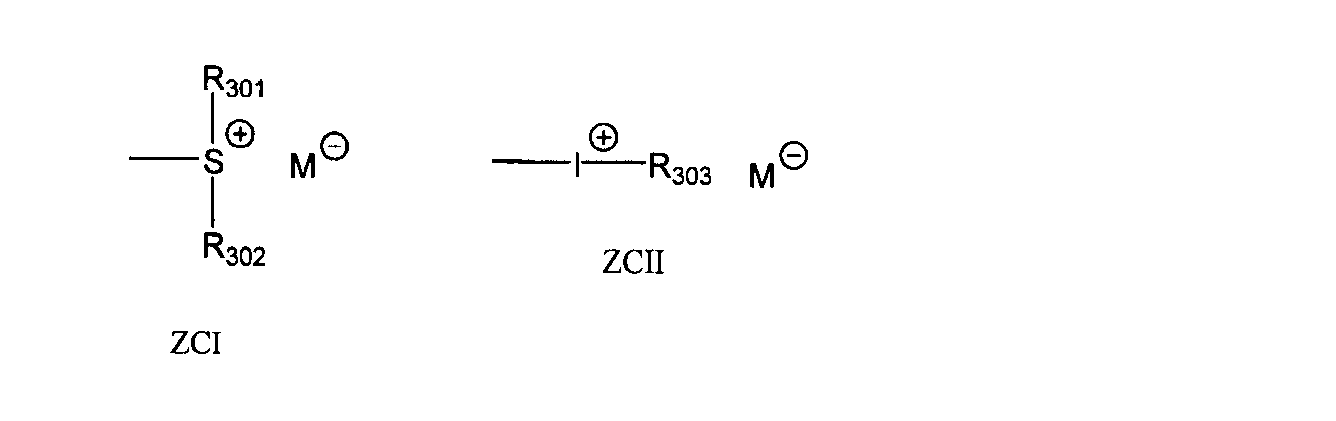
上記一般式(ZCI)及び(ZCII)中、
R301及びR302は、各々独立に、有機基を表す。この有機基の炭素数は、一般的には1~30であり、好ましくは1~20である。R301及びR302は、互いに結合して、環構造を形成していてもよい。この環構造は、環内に酸素原子、硫黄原子、エステル結合、アミド結合及びカルボニル基の少なくとも1つを含んでいてもよい。R301及びR302とが互いに結合して形成し得る基としては、ブチレン基及びペンチレン基等のアルキレン基が挙げられる。
R301及びR302は、各々独立に、有機基を表す。この有機基の炭素数は、一般的には1~30であり、好ましくは1~20である。R301及びR302は、互いに結合して、環構造を形成していてもよい。この環構造は、環内に酸素原子、硫黄原子、エステル結合、アミド結合及びカルボニル基の少なくとも1つを含んでいてもよい。R301及びR302とが互いに結合して形成し得る基としては、ブチレン基及びペンチレン基等のアルキレン基が挙げられる。
R301及びR302の有機基としては、例えば、一般式(ZI)におけるR201~R203の例として挙げたアリール基、アルキル基及びシクロアルキル基が挙げられる。
Mは、プロトンが付加されることにより酸を形成する原子団を表す。より具体的には、後述する一般式AN1~AN3の何れかにより表される構造が挙げられる。これらのうち、一般式AN1により表される構造が特に好ましい。
R303は有機基を表す。R303としての有機基の炭素数は、一般的に1~30、好ましくは1~20である。R303の有機基として具体的には、例えば前記一般式(ZII)におけるR204、R205の具体例として挙げたアリール基、アルキル基、シクロアルキル基等を挙げることができる。
また、活性光線又は放射線の照射により酸を発生する構造部位としては、例えば、下記光酸発生剤が有しているスルホン酸前駆体となる構造部位を挙げることができる。この光酸発生剤としては、例えば、以下の(1)~(3)の化合物が挙げられる。
(1)M.TUNOOKAetal.,PolymerPreprintsJapan,35(8);G.Berneretal.,J.Rad.Curing,13(4);W.J.Mijsetal.,CoatingTechnol.,55
(697),45(1983);H.Adachietal.,PolymerPreprints,Japan,37(3);欧州特許第0199,672号、同84515号、同199,672号、同044,115号、同0101,122号、米国特許第618,564号、同4,371,605号、同4,431,774号の各明細書、特開昭64-18143号、特開平2-245756号、及び特開平4-365048号等の各公報に記載のイミノスルフォネ-ト等に代表される光分解してスルホン酸を発生する化合物。
(697),45(1983);H.Adachietal.,PolymerPreprints,Japan,37(3);欧州特許第0199,672号、同84515号、同199,672号、同044,115号、同0101,122号、米国特許第618,564号、同4,371,605号、同4,431,774号の各明細書、特開昭64-18143号、特開平2-245756号、及び特開平4-365048号等の各公報に記載のイミノスルフォネ-ト等に代表される光分解してスルホン酸を発生する化合物。
(2)特開昭61-166544号公報等に記載のジスルホン化合物。
(3)V.N.R.Pillai,Synthesis,(1),1(1980);A.Abadetal,TetrahedronLett.,(47)4555(1971);D.H.R.Bartonetal.,J.Chem.Soc.,(C),329(1970);米国特許第3,779,778号;及び欧州特許第126,712号等に記載の光により酸を発生する化合物。
(3)V.N.R.Pillai,Synthesis,(1),1(1980);A.Abadetal,TetrahedronLett.,(47)4555(1971);D.H.R.Bartonetal.,J.Chem.Soc.,(C),329(1970);米国特許第3,779,778号;及び欧州特許第126,712号等に記載の光により酸を発生する化合物。
繰り返し単位(B)は、活性光線又は放射線の照射により酸アニオンへと変換される構造部位を備えていることが好ましい。例えば、上記一般式(B1)~(B3)におけるAは、活性光線又は放射線の照射により酸アニオンへと変換される構造部位であることが好ましい。
即ち、繰り返し単位(B)は、活性光線又は放射線の照射により樹脂の側鎖に酸アニオンを生じる構造であることがより好ましい。このような構造を採用すると、発生した酸アニオンの拡散が抑制され、解像度及びラフネス特性等を更に向上させることが可能となる。
一般式(B1)における部位-X1-A、一般式(B2)における部位-X2-A、及び一般式(B3)における部位-X3-Aの各々は、下記一般式(L1)、(L2)及び(L3)の何れかにより表されることが好ましい。
-X11-L11-X12-Ar1-X13-L12-Z1(L1)
-Ar2-X21-L21-X22-L22-Z2(L2)
-X31-L31-X32-L32-Z3(L3)
まず、一般式(L1)により表される部位について説明する。
X11は、-O-、-S-、-CO-、-SO2-、-NR-(Rは水素原子若しくはアルキル基)、2価の窒素含有非芳香族複素環基、又は、これらを組み合わせた基を表す。
X12及びX13は、各々独立に、単結合、-O-、-S-、-CO-、-SO2-、-NR-(Rは水素原子若しくはアルキル基)、2価の窒素含有非芳香族複素環基、又は、これらを組み合わせた基を表す。
-Ar2-X21-L21-X22-L22-Z2(L2)
-X31-L31-X32-L32-Z3(L3)
まず、一般式(L1)により表される部位について説明する。
X11は、-O-、-S-、-CO-、-SO2-、-NR-(Rは水素原子若しくはアルキル基)、2価の窒素含有非芳香族複素環基、又は、これらを組み合わせた基を表す。
X12及びX13は、各々独立に、単結合、-O-、-S-、-CO-、-SO2-、-NR-(Rは水素原子若しくはアルキル基)、2価の窒素含有非芳香族複素環基、又は、これらを組み合わせた基を表す。
Rのアルキル基は、直鎖状であってもよく、分岐鎖状であってもよい。また、Rのアルキル基は、置換基を更に有していてもよい。このアルキル基は、炭素数が20以下であることが好ましく、炭素数が8以下であることがより好ましく、炭素数が3以下であることが更に好ましい。このようなアルキル基としては、例えば、メチル基、エチル基、プロピル基、イソプロピル基が挙げられる。Rとしては、水素原子、メチル基又はエチル基が特に好ましい。
なお、2価の窒素含有非芳香族複素環基とは、少なくとも1個の窒素原子を有する、好ましくは3~8員の非芳香族複素環基を意味する。
X11は、-O-、-CO-、-NR-(Rは水素原子若しくはアルキル基)、又は、これらを組み合わせた基であることがより好ましく、-COO-又は-CONR-(Rは水素原子若しくはアルキル基)であることが特に好ましい。
L11は、アルキレン基、アルケニレン基、2価の脂肪族炭化水素環基、又はこれらの2以上を組み合わせた基を表す。上記の組み合わせた基において、組み合わされる2以上の基は、互いに同一であってもよく、互いに異なっていてもよい。また、これら基は、O-、-S-、-CO-、-SO2-、-NR-(Rは水素原子若しくはアルキル基)、2価の窒素含有非芳香族複素環基、2価の芳香環基、又は、これらを組み合わせた基を介して連結されていてもよい。
L11のアルキレン基は、直鎖状であってもよく、分岐鎖状であってもよい。このアルキレン基としては、炭素数が1~8のものが好ましく、炭素数1~6のものがより好ましく、炭素数が1~4のものが更に好ましい。
L11のアルケニレン基としては、例えば、上記のアルキレン基の任意の位置に二重結合を備えた基が挙げられる。
L11としての2価の脂肪族炭化水素環基は、単環型であってもよく、多環型であってもよい。この2価の脂肪族炭化水素環基としては、炭素数が5~12のものが好ましく、炭素数が6~10のものがより好ましい。
連結基としての2価の芳香環基は、アリーレン基であってもよく、ヘテロアリーレン基であってもよい。この芳香環基は、炭素数が6~14であることが好ましい。この芳香環基は、置換基を更に有していてもよい。
また、連結基としての-NR-及び2価の窒素含有非芳香族複素環基は、例えば、上述したX11における各々と同様である。
L11としては、アルキレン基、2価の脂肪族炭化水素環基、又は、-OCO-、-O-若しくは-CONH-を介してアルキレン基と2価の脂肪族炭化水素環基とを組み合わせた基(例えば、-アルキレン基-O-アルキレン基-、-アルキレン基-OCO-アルキレン基-若しくは-2価の脂肪族炭化水素環基-O-アルキレン基-、-アルキレン基-CONH-アルキレン基-)が特に好ましい。
X12及びX13における-NR-及び2価の窒素含有非芳香族複素環基としては、上述したX11における各々と同様の具体例が挙げられ、好ましい例も同様である。
X12としては、単結合、-S-、-O-、-CO-、-SO2-、又はこれらを組み合わせた基がより好ましく、単結合、-S-、-OCO-又は-OSO2-が特に好ましい。
X13としては、-O-、-CO-、-SO2-、又は、これらを組み合わせた基がより好ましく、-OSO2-が特に好ましい。
Ar1は、2価の芳香環基を表す。2価の芳香環基は、アリーレン基であってもよく、ヘテロアリーレン基であってもよい。この2価の芳香環基は、置換基を更に有していてもよい。この置換基としては、例えば、アルキル基、アルコキシ基及びアリール基が挙げられる。
Ar1としては、置換基を有していてもよい炭素数6~18のアリーレン基、又は、炭素数6~18のアリーレン基と炭素数1~4のアルキレンよを組み合わせたアラルキレン基がより好ましく、フェニレン基、ナフチレン基、ビフェニレン基、又は、フェニル基で置換されたフェニレン基が特に好ましい。
L12は、アルキレン基、アルケニレン基、2価の脂肪族炭化水素環基、2価の芳香環基、又はこれらの2以上を組み合わせた基を表し、これらの基は、水素原子の一部又は全部が、フッ素原子、フッ化アルキル基、ニトロ基、及びシアノ基から選択される置換基で置換されている。上記の組み合わせた基において、組み合わされる2以上の基は、互いに同一であってもよく、互いに異なっていてもよい。また、これら基は、-O-、-S-、-CO-、-SO2-、-NR-(Rは水素原子若しくはアルキル基)、2価の窒素含有非芳香族複素環基、2価の芳香環基、又は、これらを組み合わせた基を介して連結されていてもよい。
L12としては、水素原子の一部又は全部が、フッ素原子若しくはフッ化アルキル基(より好ましくはペルフルオロアルキル基)で置換された、アルキレン基、2価の芳香環基、又は、これらを組み合わせた基がより好ましく、水素原子の一部又は全部がフッ素原子で置換された、アルキレン基又は2価の芳香環基が特に好ましい。L12としては、水素原子数の30~100%がフッ素原子で置換されたアルキレン基又は2価の芳香環基が特に好ましい。
L12のアルキレン基は、直鎖状であってもよく、分岐鎖状であってもよい。このアルキレン基は、炭素数が1~6であることが好ましく、炭素数が1~4であることがより好ましい。
L12のアルケニレン基としては、例えば、上記アルキレン基の任意の位置に二重結合を備えた基が挙げられる。
L12の2価の脂肪族炭化水素環基は、単環型であってもよく、多環型であってもよい。この2価の脂肪族炭化水素環基としては、炭素数が3~17のものが好ましい。
L12の2価の芳香環基としては、例えば、先にL11における連結基として説明したのと同様のものが挙げられる。
また、L12における連結基の-NR-及び2価の窒素含有非芳香族複素環基としては、上述したX11における各々と同様の具体例が挙げられ、好ましい例も同様である。
Z1は、活性光線又は放射線の照射によりスルホン酸基となる部位を表し、具体的には、例えば、上記式(ZI)により表される構造が挙げられる。
次に、一般式(L2)により表される部位について説明する。
Ar2は、2価の芳香環基を表す。2価の芳香環基は、アリーレン基であってもよく、ヘテロアリーレン基であってもよい。これら2価の芳香環基は、炭素数が6~18であることが好ましい。これら2価の芳香環基は、置換基を更に有していてもよい。
Ar2は、2価の芳香環基を表す。2価の芳香環基は、アリーレン基であってもよく、ヘテロアリーレン基であってもよい。これら2価の芳香環基は、炭素数が6~18であることが好ましい。これら2価の芳香環基は、置換基を更に有していてもよい。
X21は、-O-、-S-、-CO-、-SO2-、-NR-(Rは水素原子若しくはアルキル基)、2価の窒素含有非芳香族複素環基、又は、これらを組み合わせた基を表す。
X21における-NR-及び2価の窒素含有非芳香族複素環基としては、例えば、先にX11について説明したのと同様のものが挙げられる。
X21における-NR-及び2価の窒素含有非芳香族複素環基としては、例えば、先にX11について説明したのと同様のものが挙げられる。
X21としては、-O-、-S-、-CO-、-SO2-、又は、これらを組み合わせた基がより好ましく、-O-、-OCO-又は-OSO2-が特に好ましい。
X22は、単結合、-O-、-S-、-CO-、-SO2-、-NR-(Rは水素原子若しくはアルキル基)、2価の窒素含有非芳香族複素環基、又は、これらを組み合わせた基を表す。X22における-NR-及び2価の窒素含有非芳香族複素環基としては、例えば、先にX11について説明したのと同様のものが挙げられる。
X22としては、-O-、-S-、-CO-、-SO2-、又は、これらを組み合わせた基がより好ましく、-O-、-OCO-又は-OSO2-が特に好ましい。
L21は、単結合、アルキレン基、アルケニレン基、2価の脂肪族炭化水素環基、2価の芳香環基、又はこれらの2以上を組み合わせた基を表す。上記の組み合わせた基において、組み合わされる2以上の基は、互いに同一であってもよく、互いに異なっていてもよい。また、これら基は、-O-、-S-、-CO-、-SO2-、-NR-(Rは水素原子若しくはアルキル基)、2価の窒素含有非芳香族複素環基、2価の芳香環基、又は、これらを組み合わせた基を介して連結されていてもよい。
L21のアルキレン基、アルケニレン基、及び2価の脂肪族炭化水素環基としては、例えば、先にL11における各々について説明したのと同様のものが挙げられる。
L21の2価の芳香環基は、アリーレン基であってもよく、ヘテロアリーレン基であってもよい。この2価の芳香環基は、炭素数が6~14であることが好ましい。
L21における-NR-及び2価の窒素含有非芳香族複素環基としては、例えば、先にX11について説明したのと同様のものが挙げられる。
L21としては、単結合、アルキレン基、2価の脂肪族炭化水素環基、2価の芳香環基、これらの2以上を組み合わせた基(例えば、-アルキレン基-2価の芳香環基-若しくは-2価の脂肪族炭化水素環基-アルキレン基-)、又は、-OCO-、-COO-、-O-及び-S-等の連結基を介してこれらの2以上を組み合わせた基(例えば、-アルキレン基-OCO-2価の芳香環基-、-アルキレン基-S-2価の芳香環基-、若しくは、-アルキレン基-O-アルキレン基-2価の芳香環基-)が特に好ましい。
L22は、アルキレン基、アルケニレン基、2価の脂肪族炭化水素環基、2価の芳香環基、又はこれらの2以上を組み合わせた基を表し、これらの基は、水素原子の一部又は全部が、フッ素原子、フッ化アルキル基、ニトロ基、及びシアノ基から選択される置換基で置換されていてもよい。上記の組み合わせた基において、組み合わされる2以上の基は、互いに同一であってもよく、互いに異なっていてもよい。また、これら基は、-O-、S-、-CO-、-SO2-、-NR-(Rは水素原子若しくはアルキル基)、2価の窒素含有非芳香族複素環基、2価の芳香環基、又は、これらを組み合わせた基を介して連結されていてもよい。
L22としては、水素原子の一部又は全部が、フッ素原子又はフッ化アルキル基(より好ましくはペルフルオロアルキル基)で置換された、アルキレン基、2価の芳香環基、又はこれらを組み合わせた基がより好ましく、水素原子の一部又は全部がフッ素原子で置換された、アルキレン基又は2価の芳香環基が特に好ましい。
L22により表わされるアルキレン基、アルケニレン基、基脂肪族炭化水素環基、2価の芳香環基、及び、これらの2以上を組み合わせた基の具体例としては、一般式(L1)においてL12として先に例示した具体例と同様の基が挙げられる。
また、L22における連結基の-NR-及び2価の窒素含有非芳香族複素環基としては、上述したX11における各々と同様の具体例が挙げられ、好ましい例も同様である。
Z2は、活性光線又は放射線の照射によりスルホン酸基となる部位を表す。Z2の具体例としては、先にZ1について説明したのと同様のものが挙げられる。
続いて、一般式(L3)により表される部位について説明する。
X31及びX32は、各々独立に、単結合、-O-、-S-、-CO-、-SO2-、-NR-(Rは水素原子若しくはアルキル基)、2価の窒素含有非芳香族複素環基、又は、これらを組み合わせた基を表す。
X31及びX32は、各々独立に、単結合、-O-、-S-、-CO-、-SO2-、-NR-(Rは水素原子若しくはアルキル基)、2価の窒素含有非芳香族複素環基、又は、これらを組み合わせた基を表す。
X31及びX32の各々における-NR-及び2価の窒素含有非芳香族複素環基としては、例えば、先にX11について説明したのと同様のものが挙げられる。
X31としては、単結合、-O-、-CO-、-NR-(Rは水素原子若しくはアルキル基)、又は、これらを組み合わせた基がより好ましく、単結合、-COO-又は-CONR-(Rは水素原子若しくはアルキル基)が特に好ましい。
X32としては、-O-、-S-、-CO-、-SO2-、2価の窒素含有非芳香族複素環基、又は、これらを組み合わせた基がより好ましく、-O-、-OCO-又は-OSO2-が特に好ましい。
L31は、単結合、アルキレン基、アルケニレン基、2価の脂肪族炭化水素環基、2価の芳香環基、又はこれらの2以上を組み合わせた基を表す。上記の組み合わせた基において、組み合わされる2以上の基は、互いに同一であってもよく、互いに異なっていてもよい。また、これら基は、-O-、-S-、-CO-、-SO2-、-NR-(Rは水素原子若しくはアルキル基)、2価の窒素含有非芳香族複素環基、2価の芳香環基、又は、これらを組み合わせた基を介して連結されていてもよい。
L31のアルキレン基、アルケニレン基、2価の脂肪族炭化水素環基、及び2価の芳香環基としては、例えば、先にL21について説明したのと同様のものが挙げられる。
また、L31における連結基の-NR-及び2価の窒素含有非芳香族複素環基としては、上述したX11における各々と同様の具体例が挙げられ、好ましい例も同様である。
L32は、アルキレン基、アルケニレン基、2価の脂肪族炭化水素環基、2価の芳香環基、又は、これらの2以上を組み合わせた基を表す。上記の組み合わせた基において、組み合わされる2以上の基は、互いに同一であってもよく、互いに異なっていてもよい。また、これら基は、-O-、-S-、-CO-、-SO2-、-NR-(Rは水素原子若しくはアルキル基)、2価の窒素含有非芳香族複素環基、2価の芳香環基、又は、これらを組み合わせた基を介して連結されていてもよい。
L32のアルキレン基、アルケニレン基、2価の脂肪族炭化水素環基、2価の芳香環基、又は、これらの2以上を組み合わせた基は、水素原子の一部又は全部が、フッ素原子、フッ化アルキル基、ニトロ基、及びシアノ基から選択される置換基で置換されていることが好ましい。
L32としては、水素原子の一部又は全部が、フッ素原子若しくはフッ化アルキル基(より好ましくはペルフルオロアルキル基)で置換された、アルキレン基、2価の芳香環基、又はこれらを組み合わせた基がより好ましく、水素原子の一部又は全部がフッ素原子で置換された、アルキレン基又は2価の芳香環基が特に好ましい。
L32のアルキレン基、アルケニレン基、2価の脂肪族炭化水素環基、2価の芳香環基、及び、これらの2以上を組み合わせた基としては、例えば、先にL12について説明したのと同様のものが挙げられる。L32における連結基の-NR-及び2価の窒素含有非芳香族複素環基としては、上述したX11における各々と同様の具体例が挙げられ、好ましい例も同様である。
また、X3が単結合でありかつL31が芳香環基である場合において、R32がL31の芳香環基と環を形成する場合、R32により表わされるアルキレン基は、炭素数が1~8であることが好ましく、炭素数が1~4のものがより好ましく、炭素数が1~2のものが更に好ましい。
Z3は、活性光線又は放射線の照射により、イミド酸基又はメチド酸基となるオニウム塩を表す。Z3により表わされるオニウム塩としては、スルホニウム塩あるいはヨードニウム塩が好ましく、下記一般式(ZIII)又は(ZIV)により表される構造が好ましい。
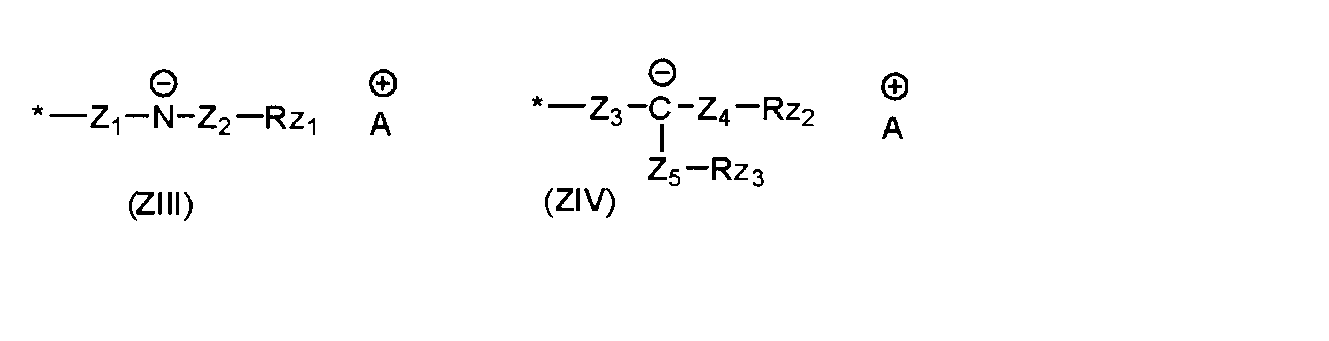
一般式(ZIII)及び(ZIV)中、Z1、Z2、Z3、Z4、Z5は、各々独立に、-CO-又は-SO2-を表し、より好ましくは、-SO2-である。
Rz1、Rz2及びRz3は、各々独立に、アルキル基、1価の脂肪族炭化水素環基、アリール基、又はアラルキル基を表す。水素原子の一部又は全部がフッ素原子又はフルオロアルキル基(より好ましくはペルフルオロアルキル基)で置換された態様がより好ましい。
Rz1、Rz2及びRz3のアルキル基は、直鎖状であってもよく、分岐鎖状であってもよい。このアルキル基は、炭素数が1~8であることが好ましく、炭素数が1~6であることがより好ましく、炭素数が1~4であることが更に好ましい。
Rz1、Rz2及びRz3の1価の脂肪族炭化水素環基は、炭素数が3~10であることが好ましく、炭素数が3~6であることがより好ましい。
Rz1、Rz2及びRz3のアリール基は、炭素数が6~18であることが好ましく、炭素数が6~10のアリール基であることがより好ましい。このアリール基としては、フェニル基が特に好ましい。
Rz1、Rz2及びRz3のアラルキル基の好ましい例としては、炭素数1~8のアルキレン基と上記アリール基とが結合したものが挙げられる。炭素数1~6のアルキレン基と上記アリール基とが結合してなるアラルキル基がより好ましく、炭素数1~4のアルキレン基と上記アリール基とが結合してなるアラルキル基が特に好ましい。
A+は、スルホニウムカチオン又はヨードニウムカチオンを表す。A+の好ましい例としては、一般式(ZI)におけるスルホニウムカチオン又は一般式(ZII)におけるヨードニウムカチオン構造が挙げられる。
以下に繰り返し単位(B)の具体例を挙げるが、本発明の範囲は、これらに限定されるものではない。
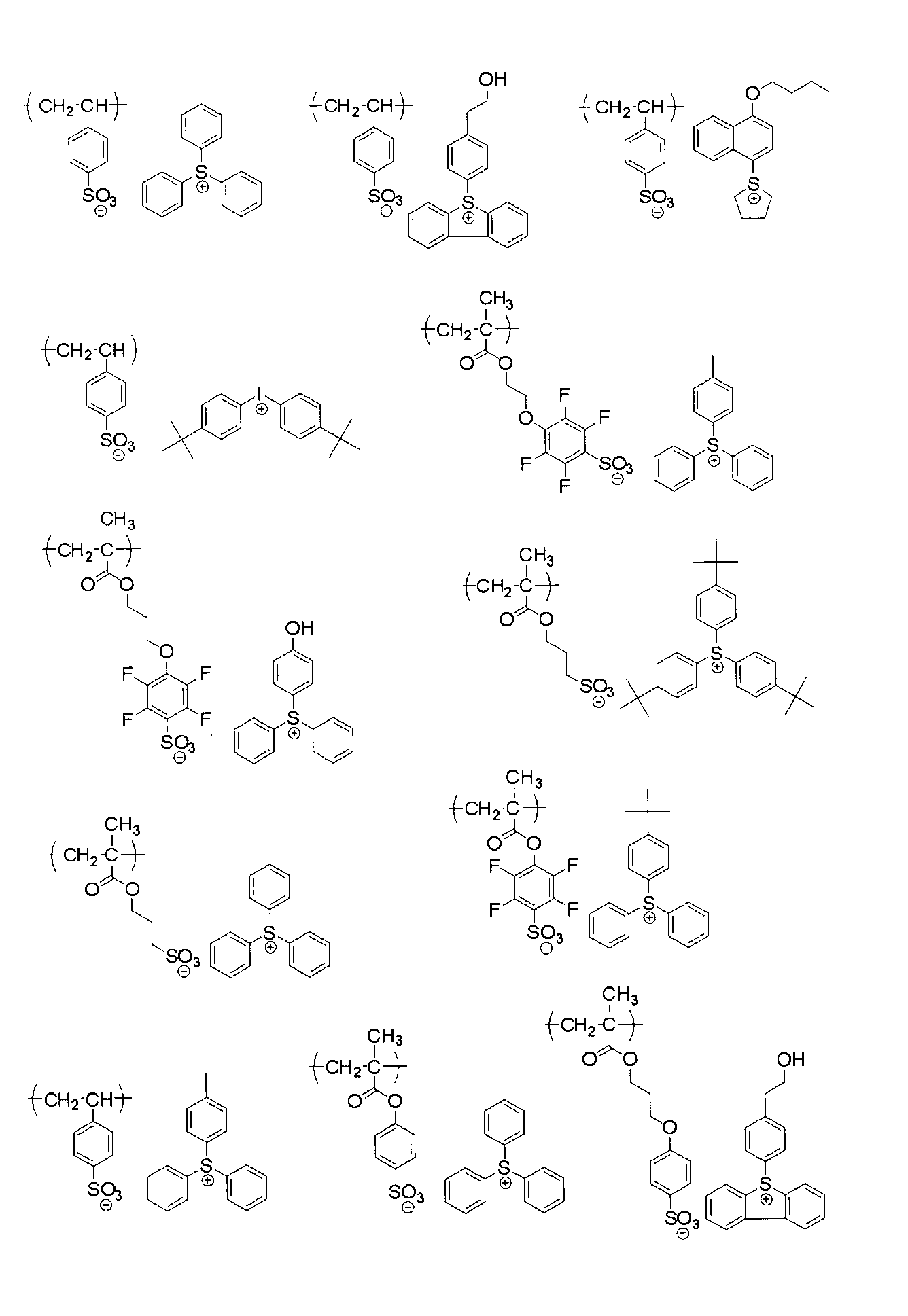


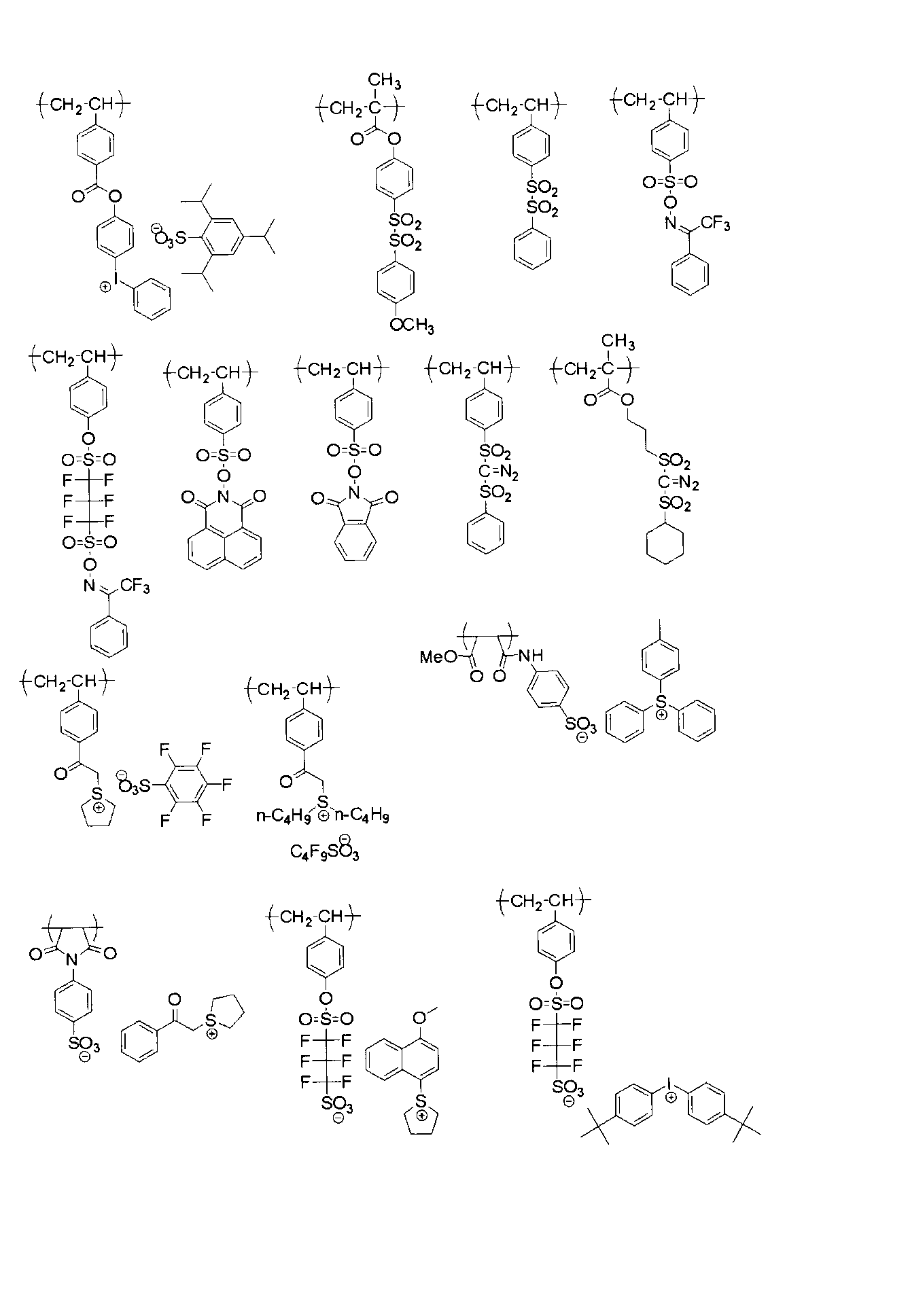
樹脂(Ab)が繰り返し単位(B)を含有する場合、樹脂(Ab)における、繰り返し単位(B)の含有率は、樹脂(Ab)中の全繰り返し単位に対し、0.1~80mol%が好ましく、より好ましくは0.5~60mol%であり、更に好ましくは1~40mol%である。
樹脂(Ab)の重量平均分子量(Mw)は、それぞれ1000~200,000の範囲であることが好ましい。樹脂自体のアルカリに対する溶解速度、感度の点から200,000以下が好ましい。分散度(Mw/Mn)は、1.0~3.0であることが好ましく、より好ましくは1.0~2.5、特に好ましくは、1.0~2.0である。
その中で、樹脂の重量平均分子量(Mw)は、1,000~200,000の範囲であることが好ましく、さらに好ましくは1,000~100,000の範囲であり、特に好ましくは1,000~50,000の範囲であり、最も好ましくは1,000~25,000の範囲である。
ここで、重量平均分子量は、ゲルパーミエーションクロマトグラフィーのポリスチレン換算値をもって定義される。詳細には、樹脂(Ab)の重量平均分子量(Mw)及び数平均分子量(Mn)は、例えば、HLC-8120(東ソー(株)製)を用い、カラムとしてTSK gel Multipore HXL-M(東ソー(株)製、7.8mmID×30.0cmを、溶離液としてTHF(テトラヒドロフラン)を用いることによって求めることができる。
ここで、重量平均分子量は、ゲルパーミエーションクロマトグラフィーのポリスチレン換算値をもって定義される。詳細には、樹脂(Ab)の重量平均分子量(Mw)及び数平均分子量(Mn)は、例えば、HLC-8120(東ソー(株)製)を用い、カラムとしてTSK gel Multipore HXL-M(東ソー(株)製、7.8mmID×30.0cmを、溶離液としてTHF(テトラヒドロフラン)を用いることによって求めることができる。
(Ab)は、各種市販品を利用することもできるし、常法に従って(例えばラジカル重合又はアニオン重合法)合成することができる。例えば、一般的合成方法としては、モノマー種及び開始剤を溶剤に溶解させ、加熱することにより重合を行う一括重合法、加熱溶剤にモノマー種と開始剤の溶液を1~10時間かけて滴下して加える滴下重合法などが挙げられ、滴下重合法が好ましい。反応溶媒としては、例えばテトラヒドロフラン、1,4-ジオキサン、ジイソプロピルエーテルなどのエーテル類やメチルエチルケトン、メチルイソブチルケトンのようなケトン類、酢酸エチルのようなエステル溶媒、ジメチルホルムアミド、ジメチルアセトアミドなどのアミド溶剤、更には後述のプロピレングリコールモノメチルエーテルアセテート(PGMEA、別名1-メトキシ-2-アセトキシプロパン)、プロピレングリコールモノメチルエーテル(PGME、別名1-メトキシ-2-プロパノール)、シクロヘキサノンのような本発明の組成物を溶解する溶媒が挙げられる。より好ましくは本発明の感活性光線性又は感放射線性樹脂組成物に用いられる溶剤と同一の溶剤を用いて重合することが好ましい。これにより保存時のパーティクルの発生が抑制できる。
樹脂(Ab)は、公知のアニオン重合法またはラジカル重合法などで重合することが好ましい。
アニオン重合法は、アルカリ金属又は有機アルカリ金属を重合開始剤として、通常、窒素、アルゴン等の不活性ガス雰囲気下、有機溶媒中において、-100~90℃の温度で行なわれる。そして、共重合においては、モノマー類を反応系に逐次添加して重合することによりブロック共重合体が、また、各モノマー類の混合物を反応系に添加して重合することによりランダム共重合体が得られる。
アニオン重合法は、アルカリ金属又は有機アルカリ金属を重合開始剤として、通常、窒素、アルゴン等の不活性ガス雰囲気下、有機溶媒中において、-100~90℃の温度で行なわれる。そして、共重合においては、モノマー類を反応系に逐次添加して重合することによりブロック共重合体が、また、各モノマー類の混合物を反応系に添加して重合することによりランダム共重合体が得られる。
上記重合開始剤のアルカリ金属としては、リチウム、ナトリウム、カリウム、セシウム等が挙げられ、有機アルカリ金属としては、上記アルカリ金属のアルキル化物、アリル化物およびアリール化物が使用することができ、具体的には、エチルリチウム、n-ブチルリチウム、sec-ブチルリチウム、tert-ブチルリチウム、エチルナトリウム、リチウムビフェニル、リチウムナフタレン、リチウムトリフェニル、ナトリウムナフタレン、α-メチルスチレンナトリウムジアニオン、1、1-ジフェニルヘキシルリチウム、1、1-ジフェニル-3-メチルペンチルリチウム等を挙げることができる。
ラジカル重合法は、アゾビスイソブチロニトリル、アゾビスイソバレロニトリル等のアゾ化合物や、過酸化ベンゾイル、メチルエチルケトンパーオキサイド、クメンハイドロパーオキサイド、等の有機化酸化物のような公知のラジカル重合開始剤を用い、必要に応じて、1-ドデカンチオール等の公知の連鎖移動剤を併用して、窒素、アルゴン等の不活性ガス雰囲気下、有機溶媒中において、50~200℃の温度で行なわれる。
有機溶媒としては、n-ヘキサン、n-ヘプタン等の脂肪族炭化水素類、シクロヘキサン、シクロペンタン等の脂環族炭化水素類、ベンゼン、トルエン等の芳香族炭化水素類、メチルエチルケトン、シクロヘキサノン等のケトン類、プロピレングリコールモノメチルエーテルアセテート、プロピレングリコールモノメチルエーテル、エチレングリコールモノブチルエーテルアセテート、エチレングリコールモノブチルエーテル、エチレングリコールモノエチルエーテルアセテート、エチレングリコールモノエチルエーテル、プロピレングリコールモノエチルエーテルアセテート、プロピレングリコールモノエチルエーテル等の多価アルコール誘導体類、ジエチルエーテル、テトラヒドロフラン、ジオキサン等のエーテル類、アニソール、ヘキサメチルホスホルアミド等の通常アニオン重合において使用される有機溶媒を挙げることができ、これらは単独溶媒又は二種以上の混合溶媒として使用される。より好ましい溶剤として、プロピレングリコールモノメチルエーテルアセテート、プロピレングリコールモノメチルエーテル、シクロヘキサノンが挙げられる。
ラジカル開始剤としてはアゾ系開始剤が好ましく、エステル基、シアノ基、カルボキシル基を有するアゾ系開始剤が好ましい。好ましい開始剤としては、アゾビスイソブチロニトリル、アゾビスジメチルバレロニトリル、ジメチル2,2’-アゾビス(2-メチルプロピオネート)などが挙げられる。反応の濃度は通常5~50質量%であり、好ましくは30~50質量%である。反応温度は、通常10℃~150℃であり、好ましくは30℃~120℃、更に好ましくは60~100℃である。アゾ系重合開始剤を用いてラジカル重合を行うことで分散度2.0以下の樹脂(Ab)を合成することができる。さらに好ましい分散度1.0~1.5の樹脂(Ab)は例えばリビングラジカル重合によって合成可能である。
反応終了後、室温まで放冷し、精製する。精製は、水洗や適切な溶媒を組み合わせることにより残留単量体やオリゴマー成分を除去する液々抽出法、特定の分子量以下のもののみを抽出除去する限外濾過等の溶液状態での精製方法や、樹脂溶液を貧溶媒へ滴下することで樹脂を貧溶媒中に凝固させることにより残留単量体等を除去する再沈澱法やろ別した樹脂スラリーを貧溶媒で洗浄する等の固体状態での精製方法等の通常の方法を適用できる。たとえば、上記樹脂が難溶あるいは不溶の溶媒(貧溶媒)を、該反応溶液の10倍以下の体積量、好ましくは10~5倍の体積量で、接触させることにより樹脂を固体として析出させる。
ポリマー溶液からの沈殿又は再沈殿操作の際に用いる溶媒(沈殿又は再沈殿溶媒)としては、該ポリマーの貧溶媒であればよく、ポリマーの種類に応じて、炭化水素、ハロゲン化炭化水素、ニトロ化合物、エーテル、ケトン、エステル、カーボネート、アルコール、カルボン酸、水、これらの溶媒を含む混合溶媒等の中から適宜選択して使用できる。これらの中でも、沈殿又は再沈殿溶媒として、少なくともアルコール(特に、メタノールなど)又は水を含む溶媒が好ましい。
沈殿又は再沈殿溶媒の使用量は、効率や収率等を考慮して適宜選択できるが、一般には、ポリマー溶液100質量部に対して、100~10000質量部、好ましくは200~2000質量部、更に好ましくは300~1000質量部である。
沈殿又は再沈殿する際の温度としては、効率や操作性を考慮して適宜選択できるが、通常0~50℃程度、好ましくは室温付近(例えば20~35℃程度)である。沈殿又は再沈殿操作は、攪拌槽などの慣用の混合容器を用い、バッチ式、連続式等の公知の方法により行うことができる。
沈殿又は再沈殿したポリマーは、通常、濾過、遠心分離等の慣用の固液分離に付し、乾燥して使用に供される。濾過は、耐溶剤性の濾材を用い、好ましくは加圧下で行われる。乾燥は、常圧又は減圧下(好ましくは減圧下)、30~100℃程度、好ましくは30~50℃程度の温度で行われる。
なお、一度、樹脂を析出させて、分離した後に、再び溶媒に溶解させ、該樹脂が難溶あるいは不溶の溶媒と接触させてもよい。即ち、上記ラジカル重合反応終了後、該ポリマーが難溶あるいは不溶の溶媒を接触させ、樹脂を析出させ(工程a)、樹脂を溶液から分離し(工程b)、改めて溶媒に溶解させ樹脂溶液Aを調製(工程c)、その後、該樹脂溶液Aに、該樹脂が難溶あるいは不溶の溶媒を、樹脂溶液Aの10倍未満の体積量(好ましくは5倍以下の体積量)で、接触させることにより樹脂固体を析出させ(工程d)、析出した樹脂を分離する(工程e)ことを含む方法でもよい。
また、本発明のポジ型レジストをArFエキシマレーザーで露光する際には、ArFエキシマレーザーに対する透明性の観点から、樹脂(Ab)として芳香環を有さない樹脂を用いることが好ましい。ArFエキシマレーザー露光に好適な樹脂(Ab)としては、例えば、特開2013-15590号公報の段落0446~0477に記載の樹脂(A‘)を用いることができる。
樹脂(Ab)は、2種類以上組み合わせて使用してもよい。
樹脂(Ab)の含有率は、総量として、本発明の組成物の全固形分に対し、通常10~99質量%であり、好ましくは20~99質量%であり、特に好ましくは30~99質量%である。
以下に樹脂(Ab)の具体例を以下に示すがこれらに限定するものではない。

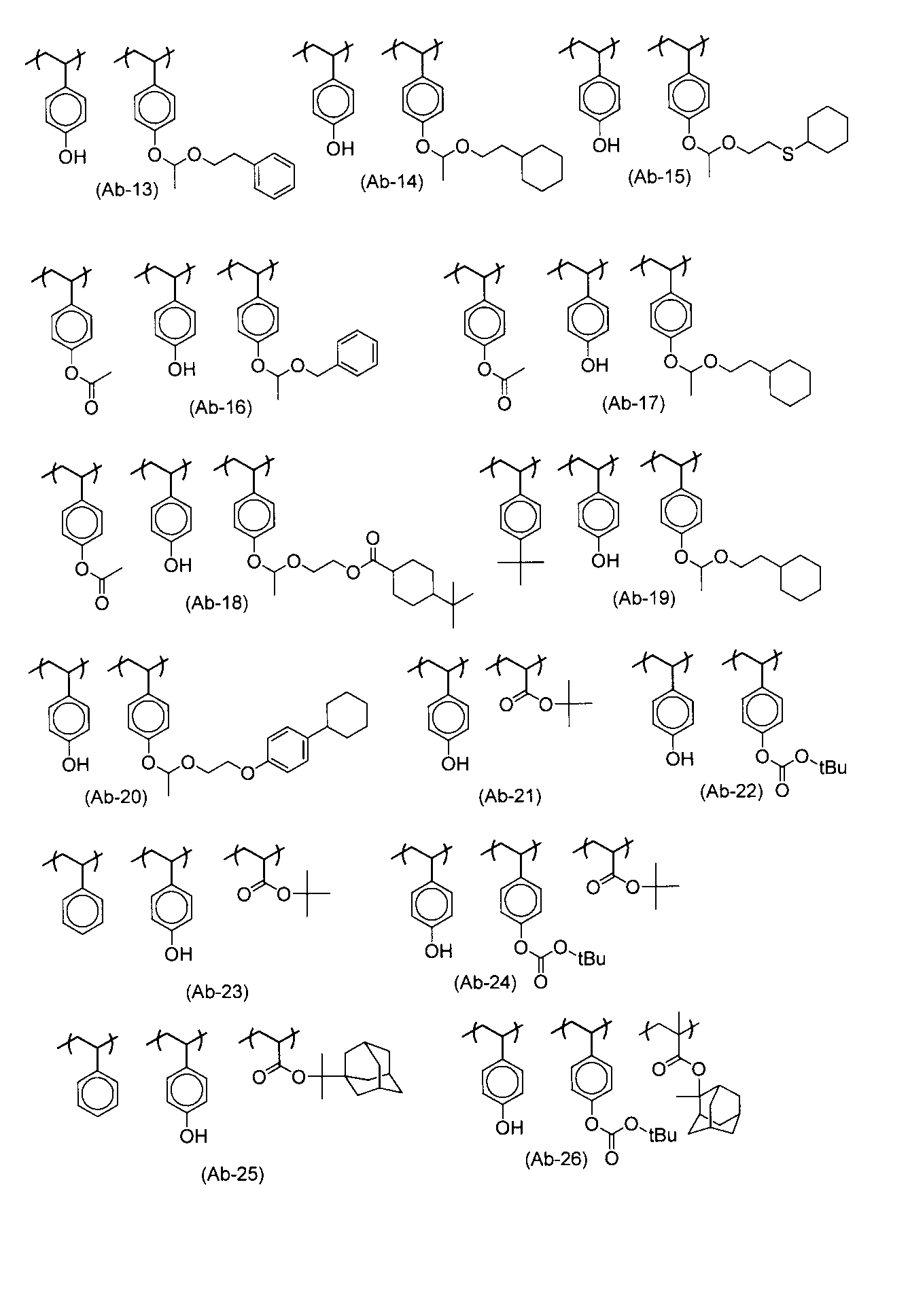
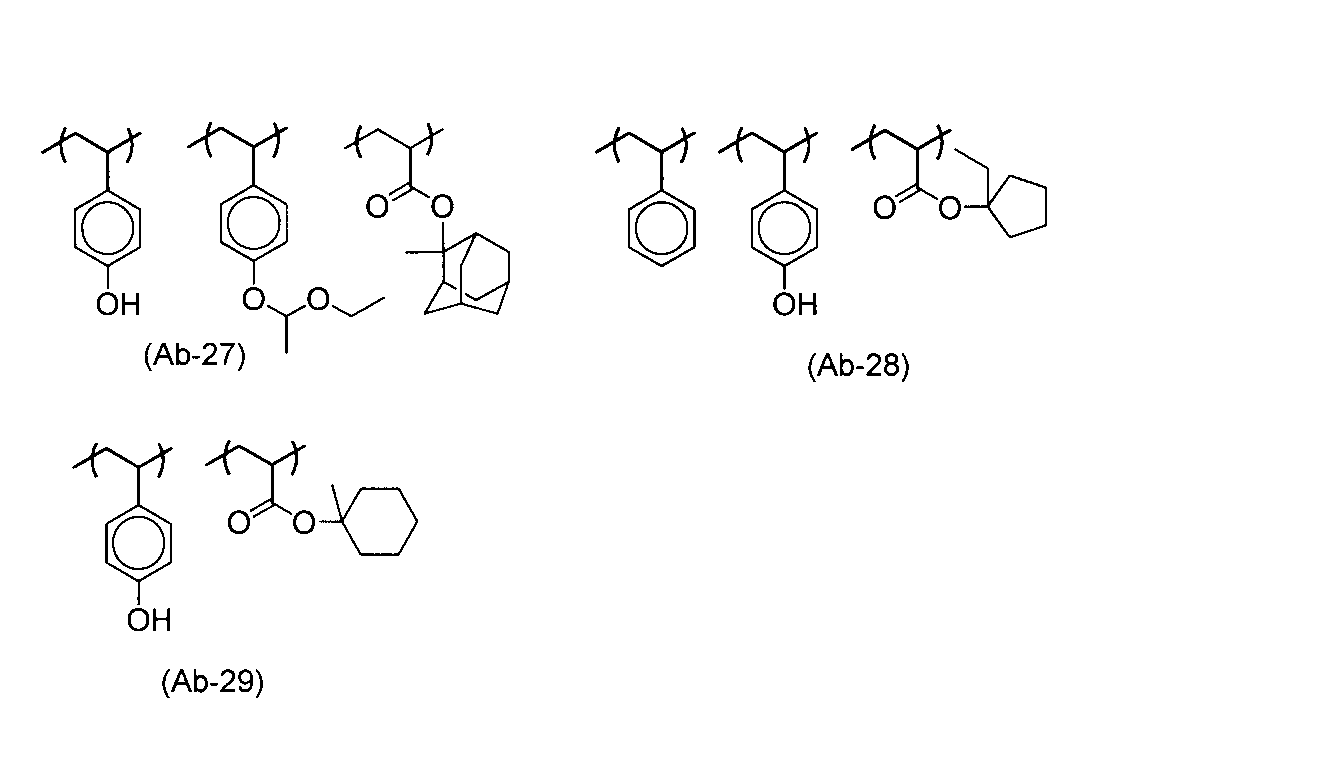

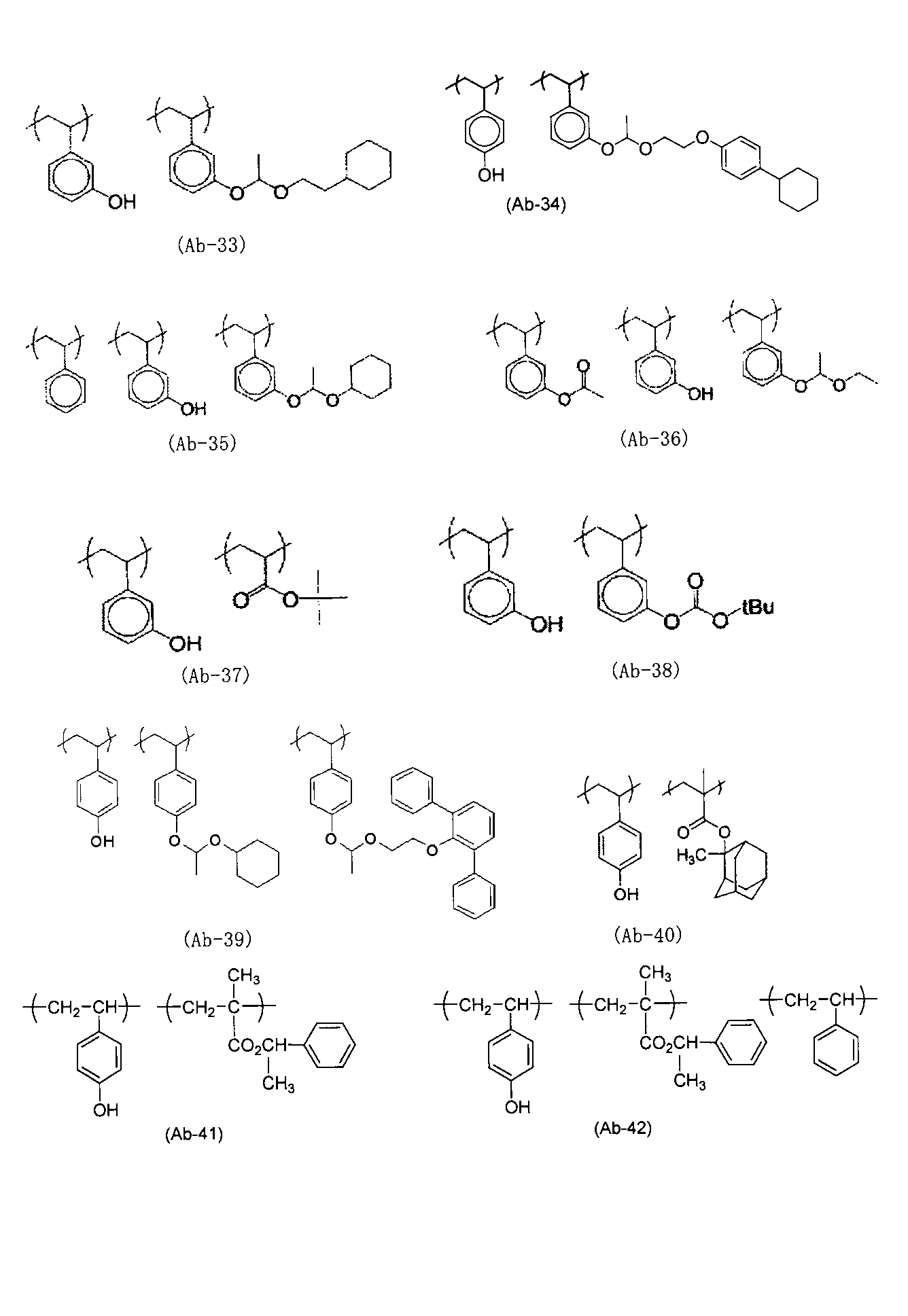
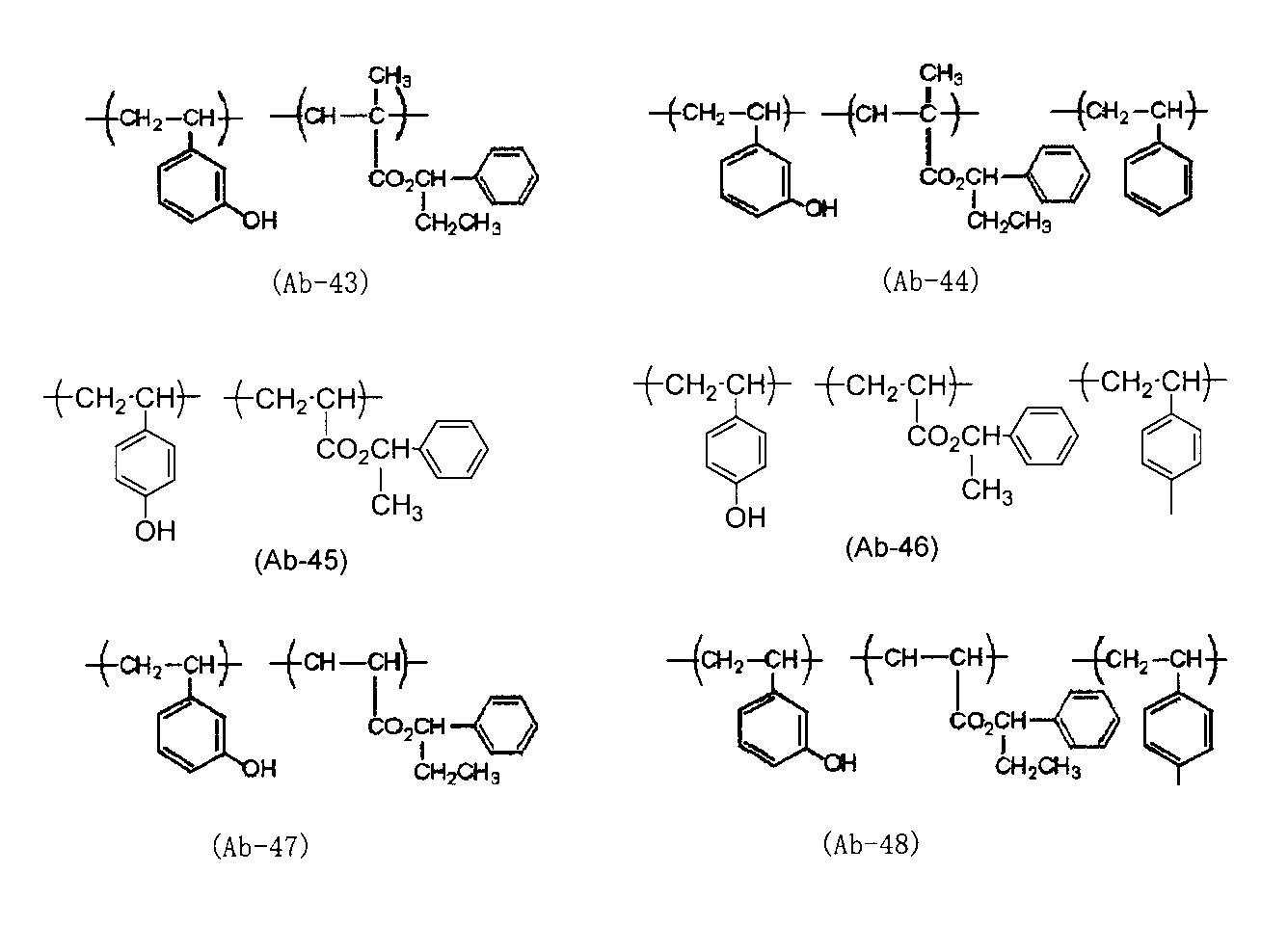

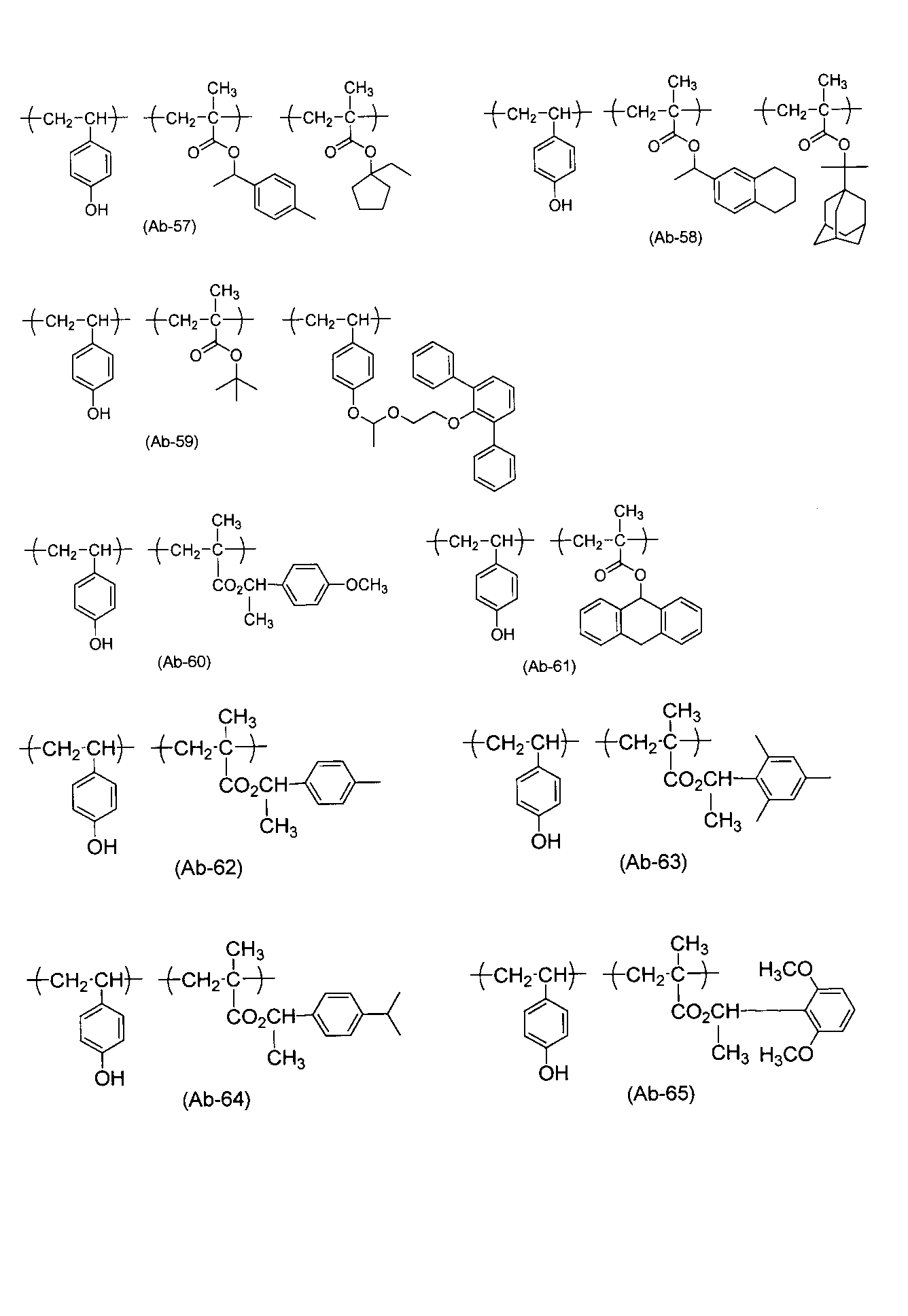
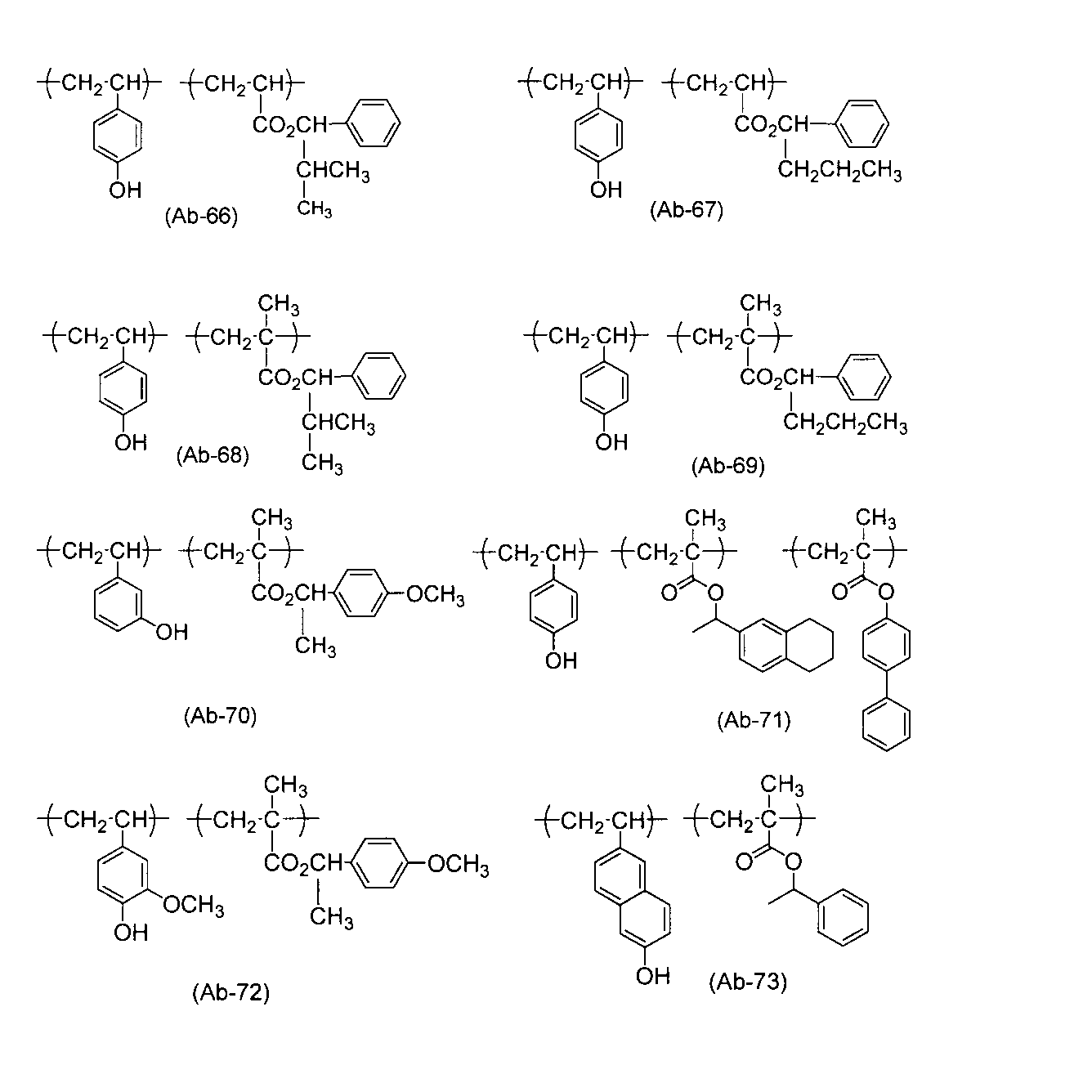
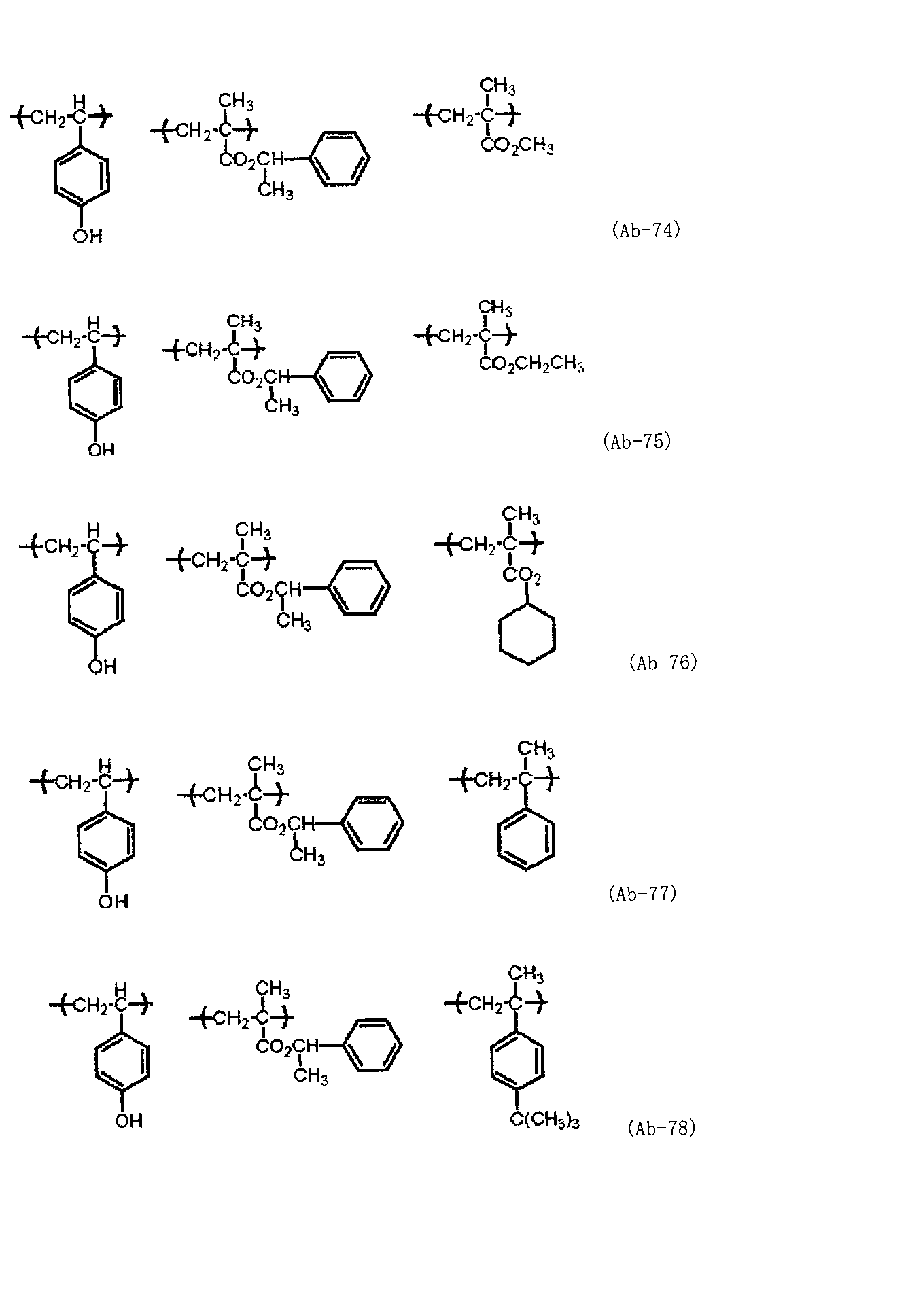

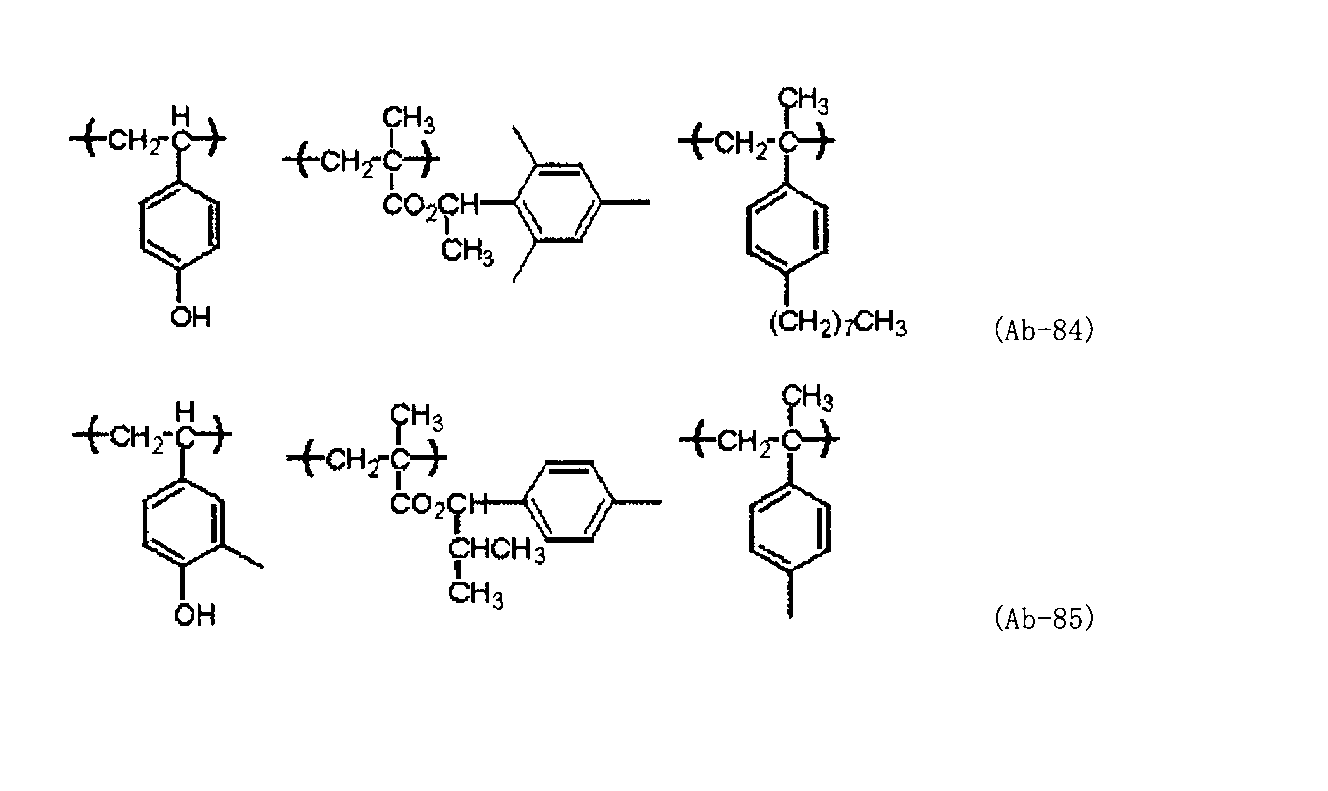
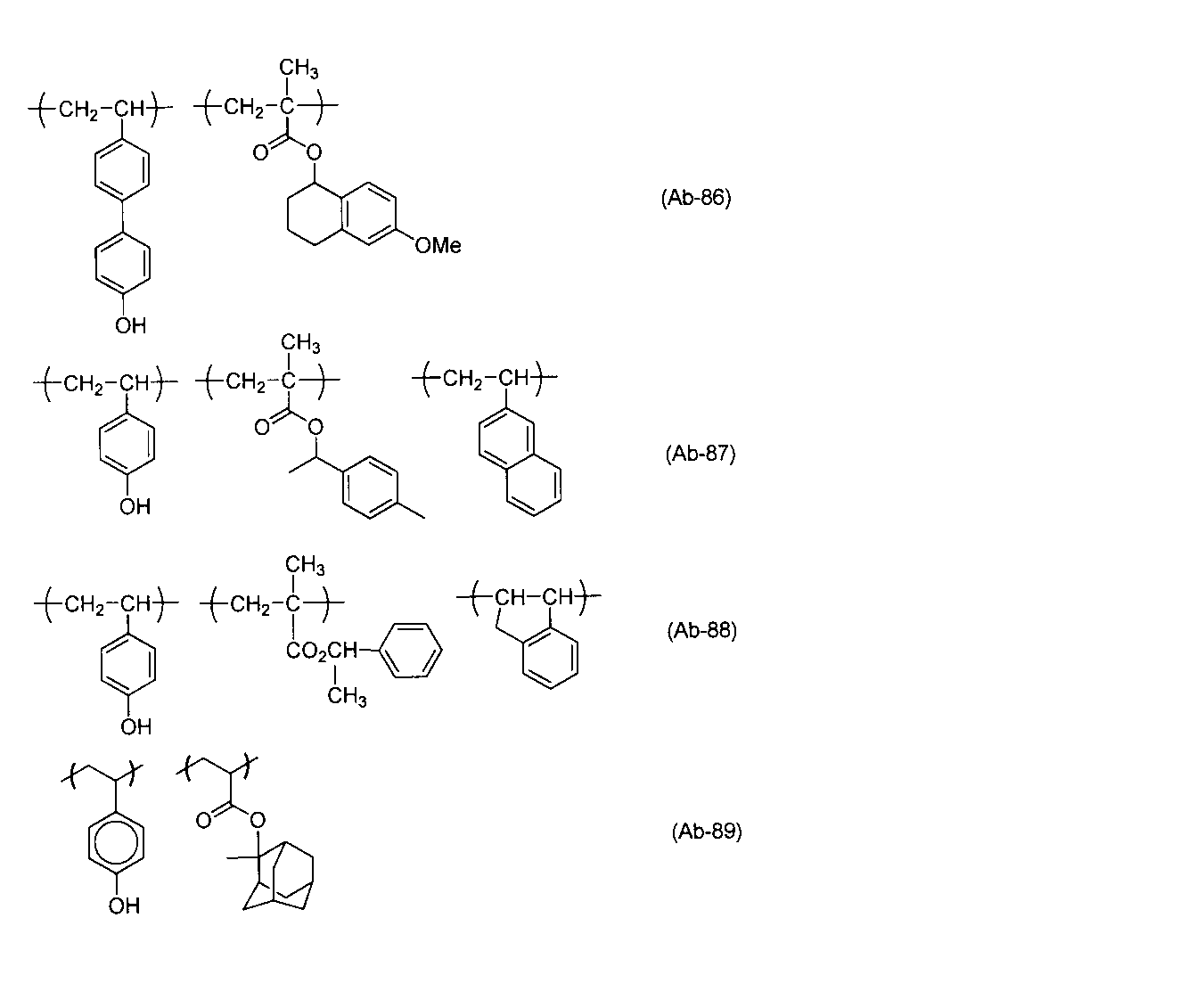

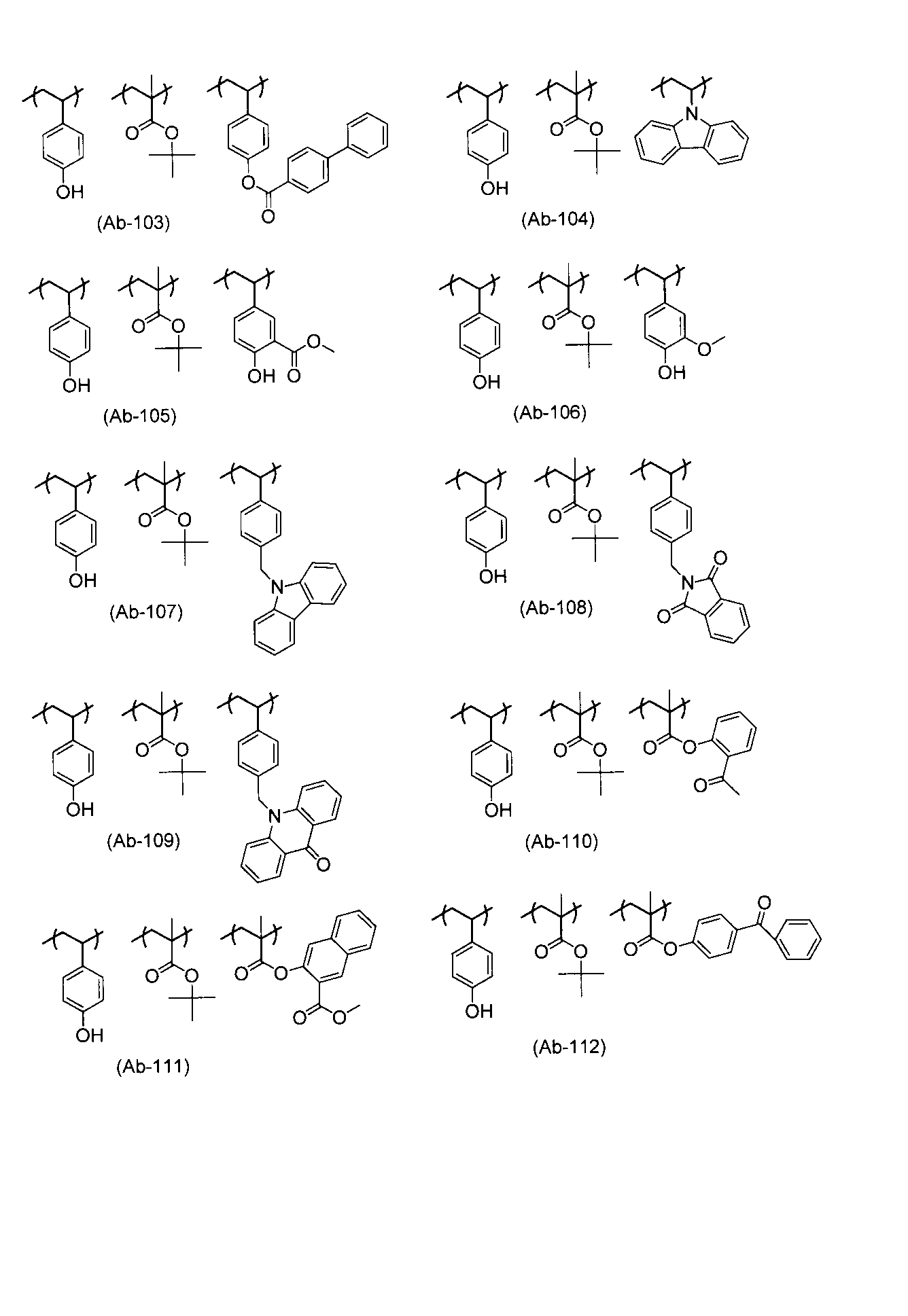


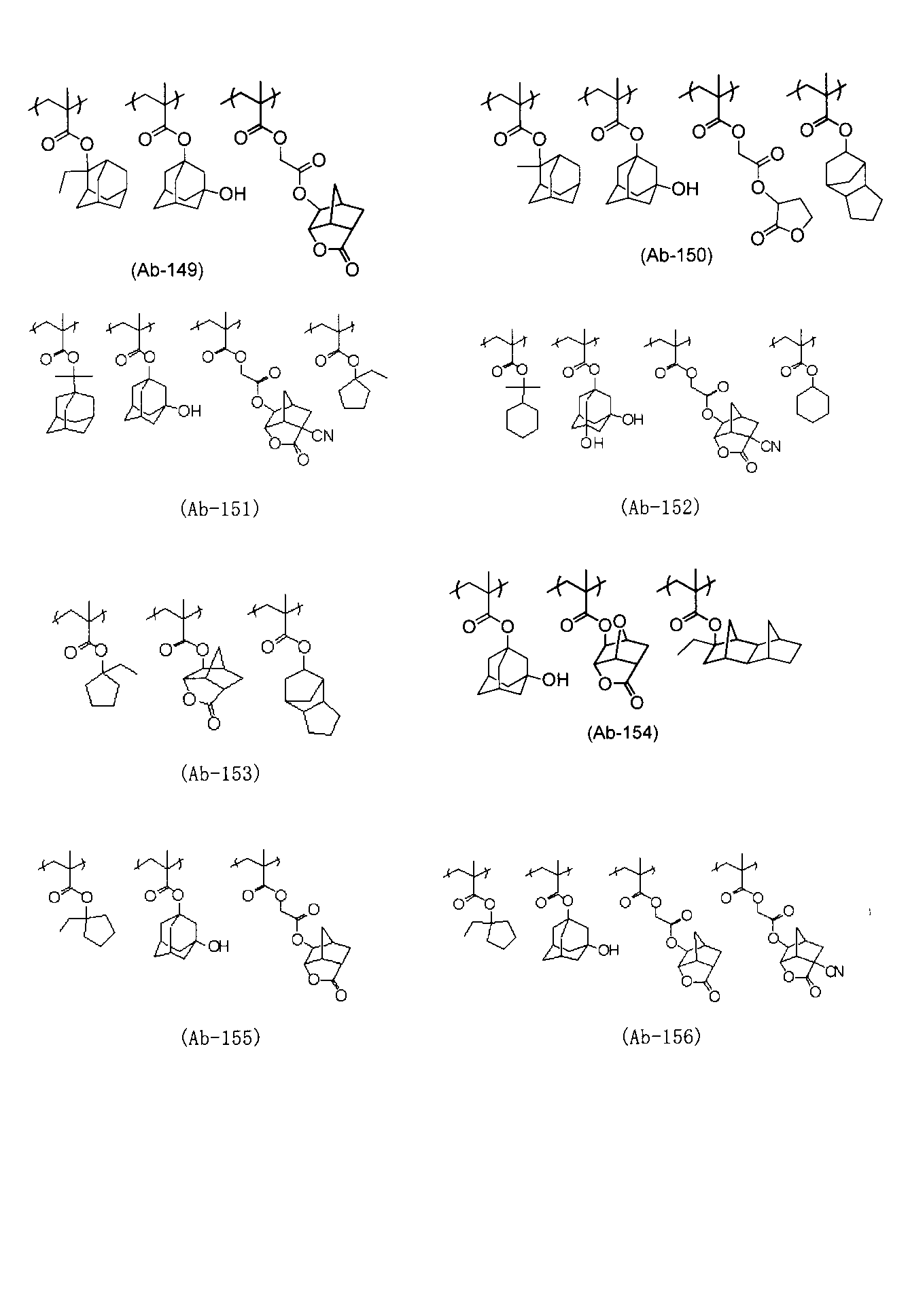

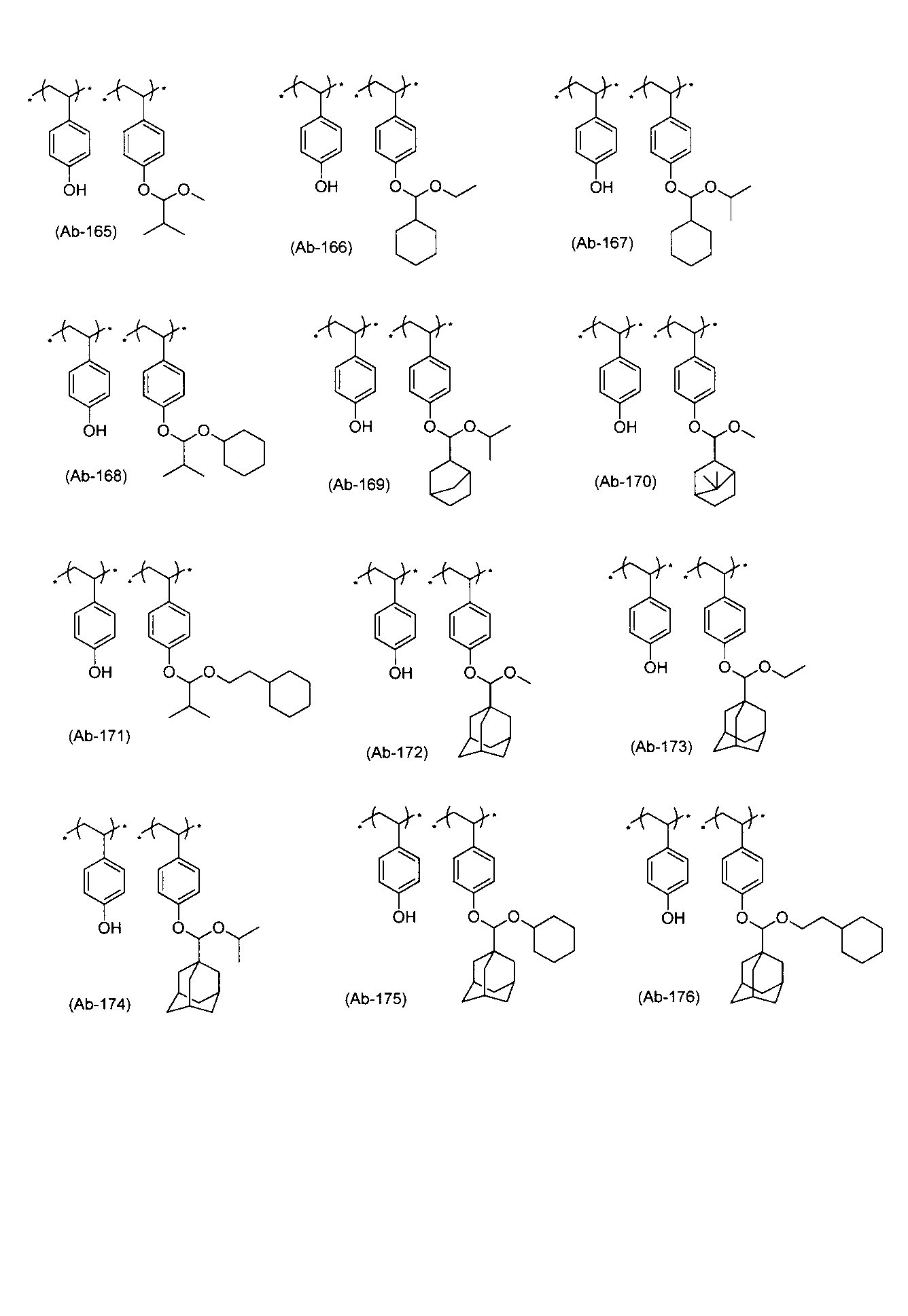
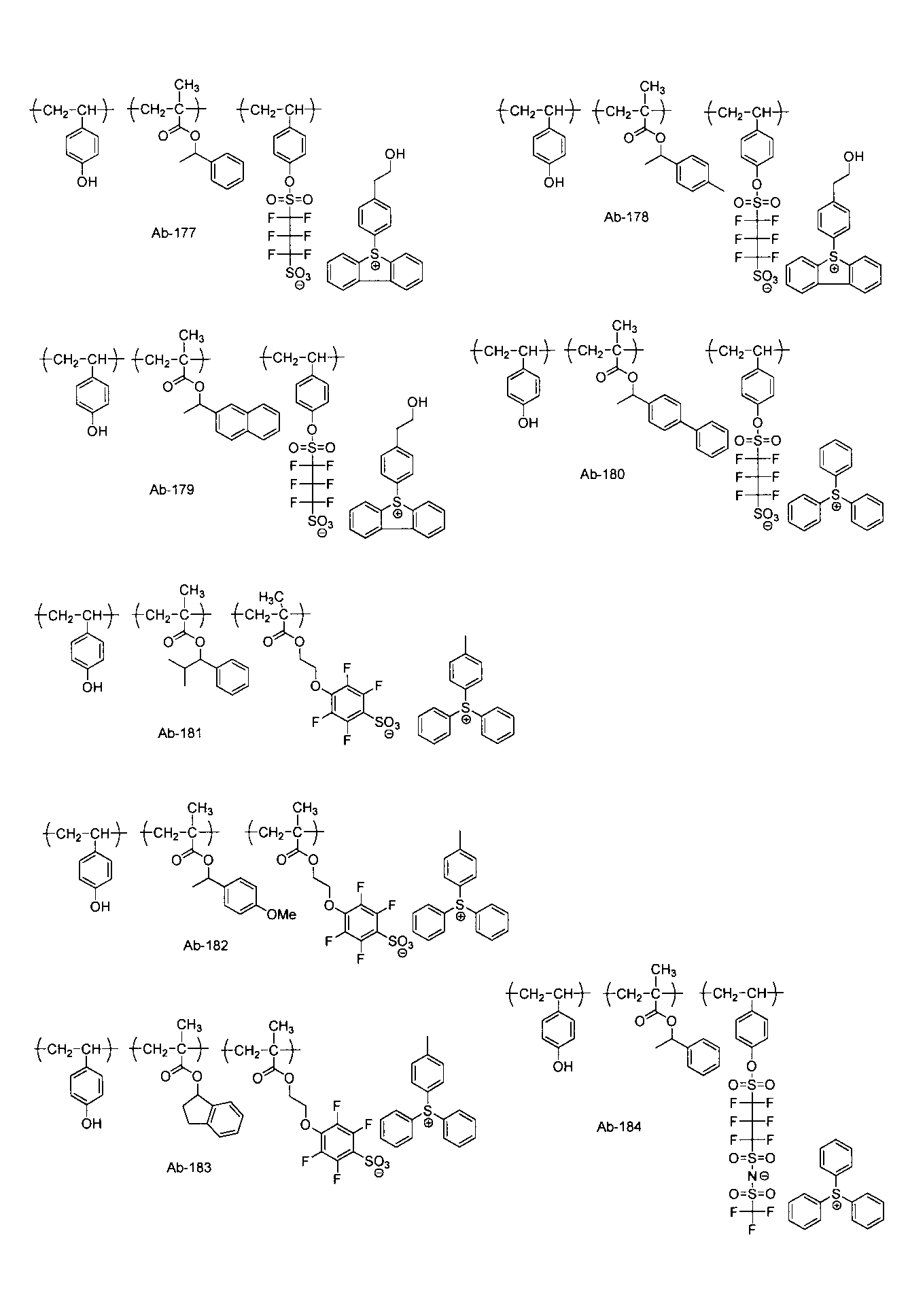
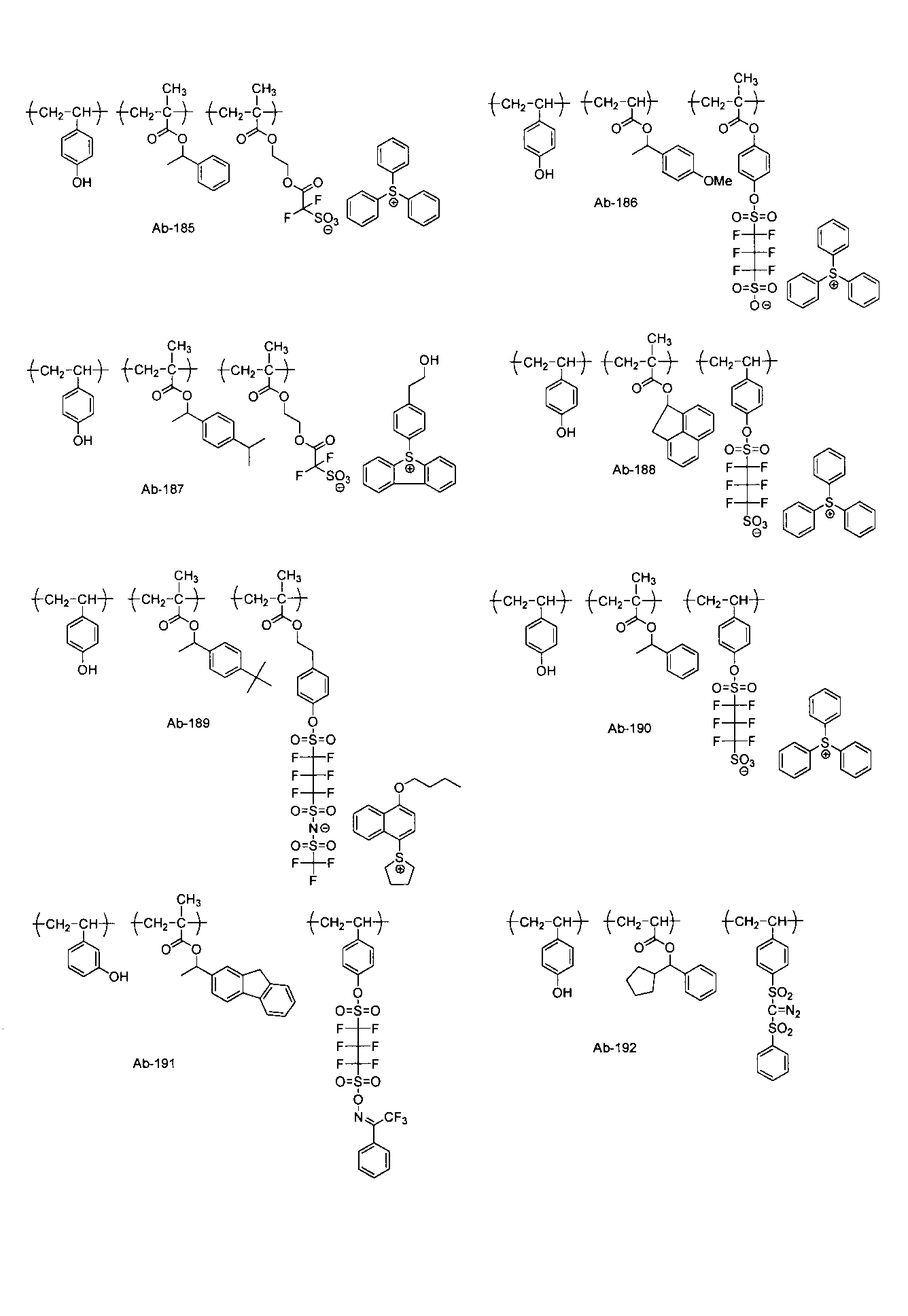
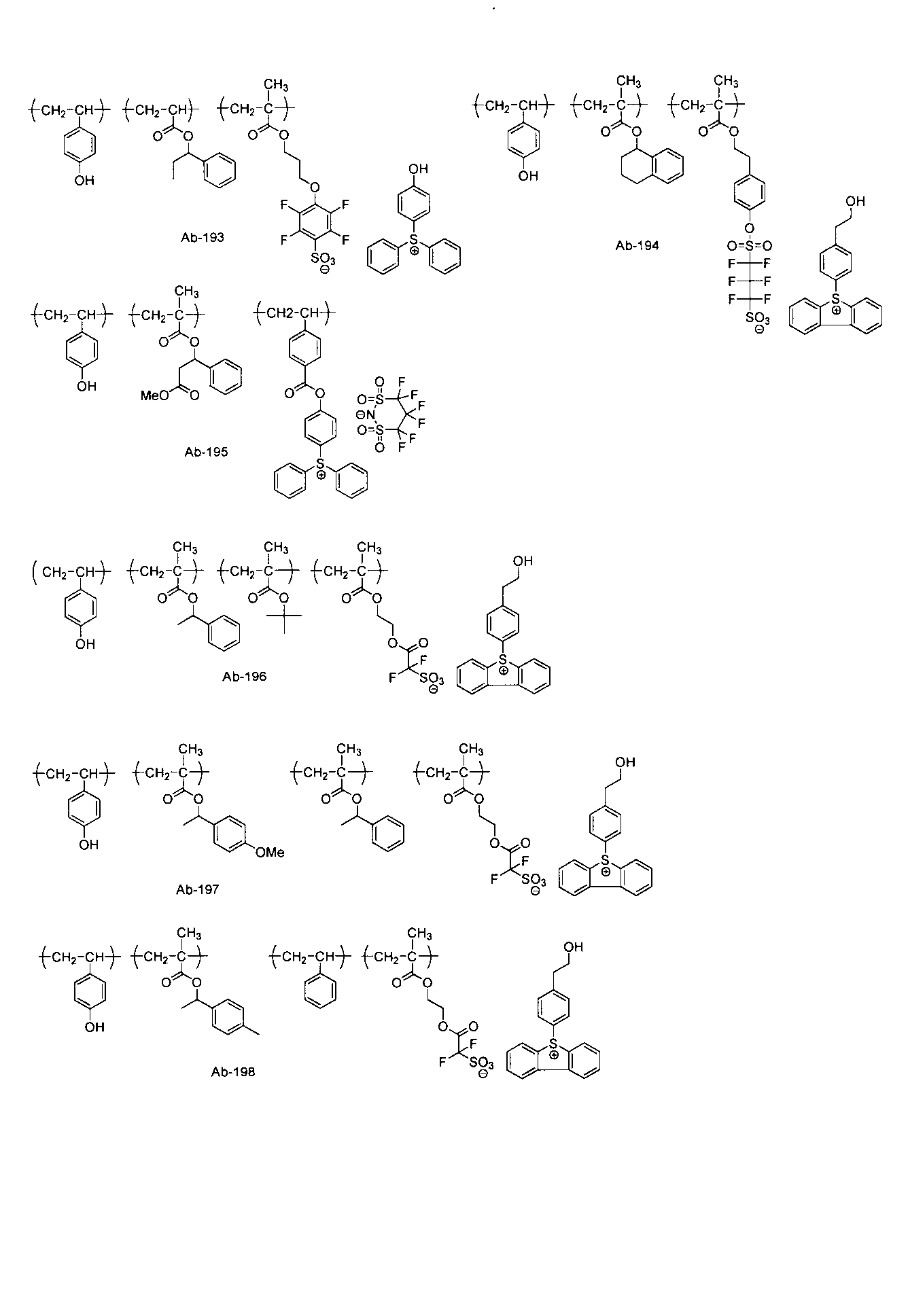
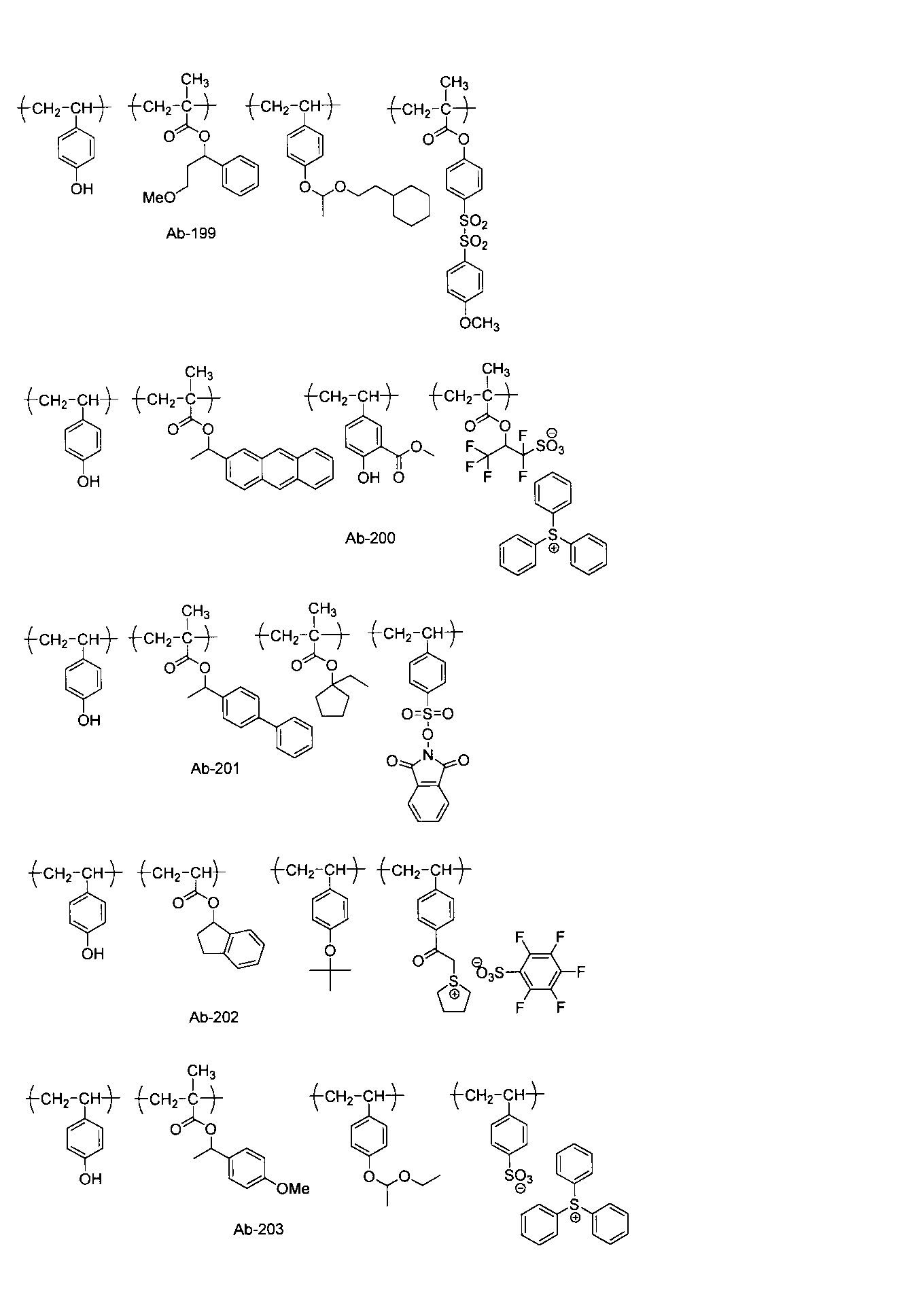


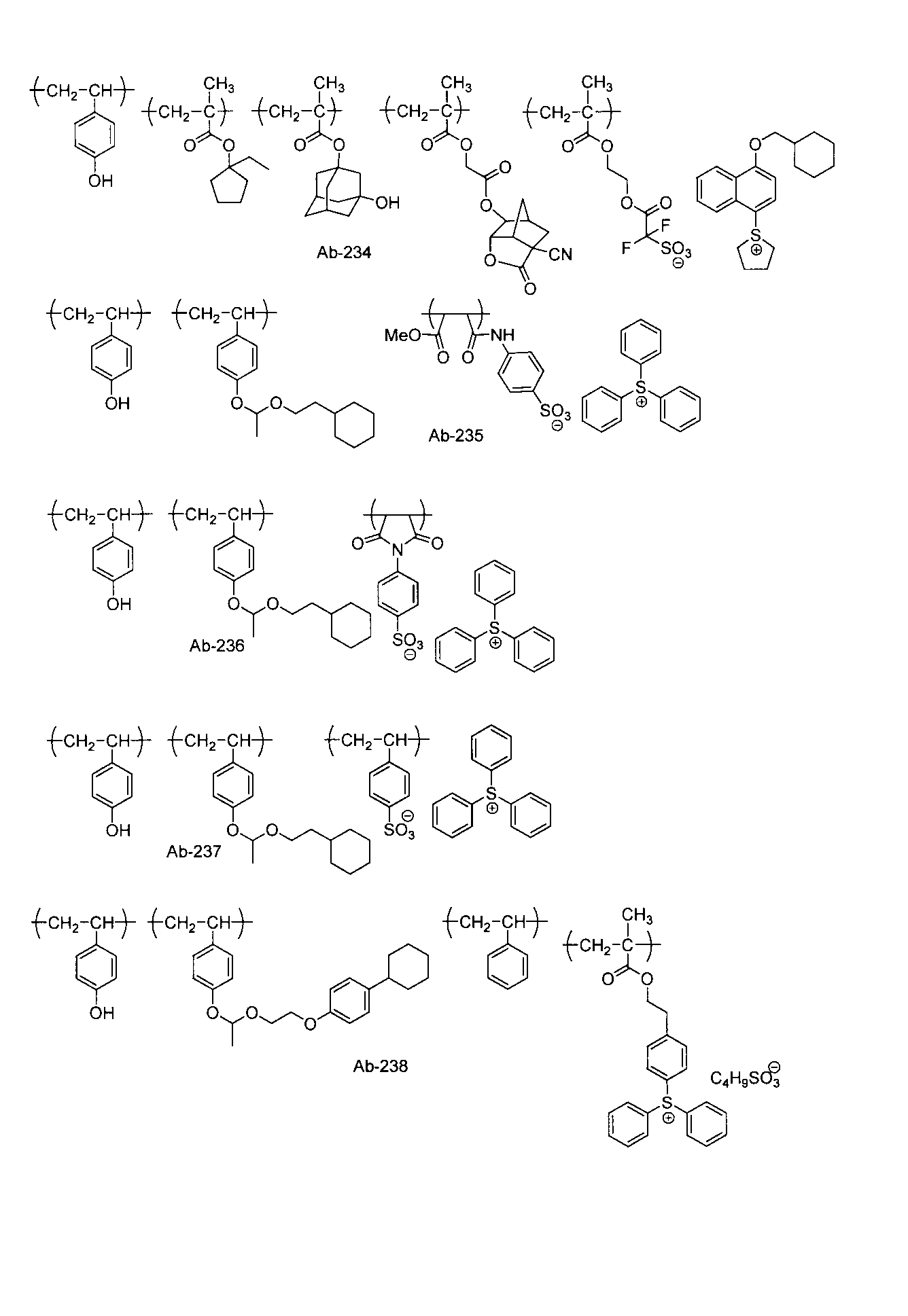
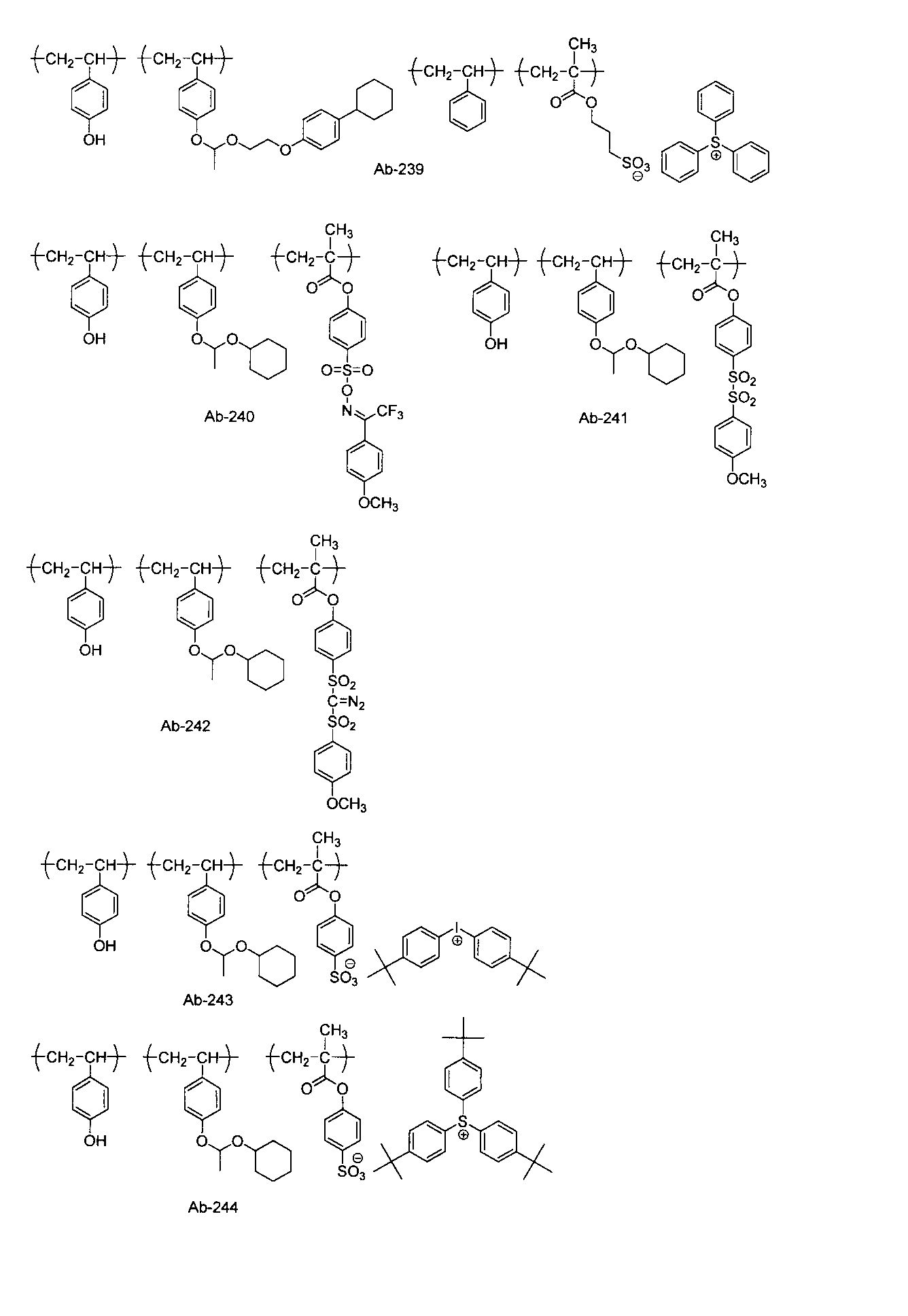


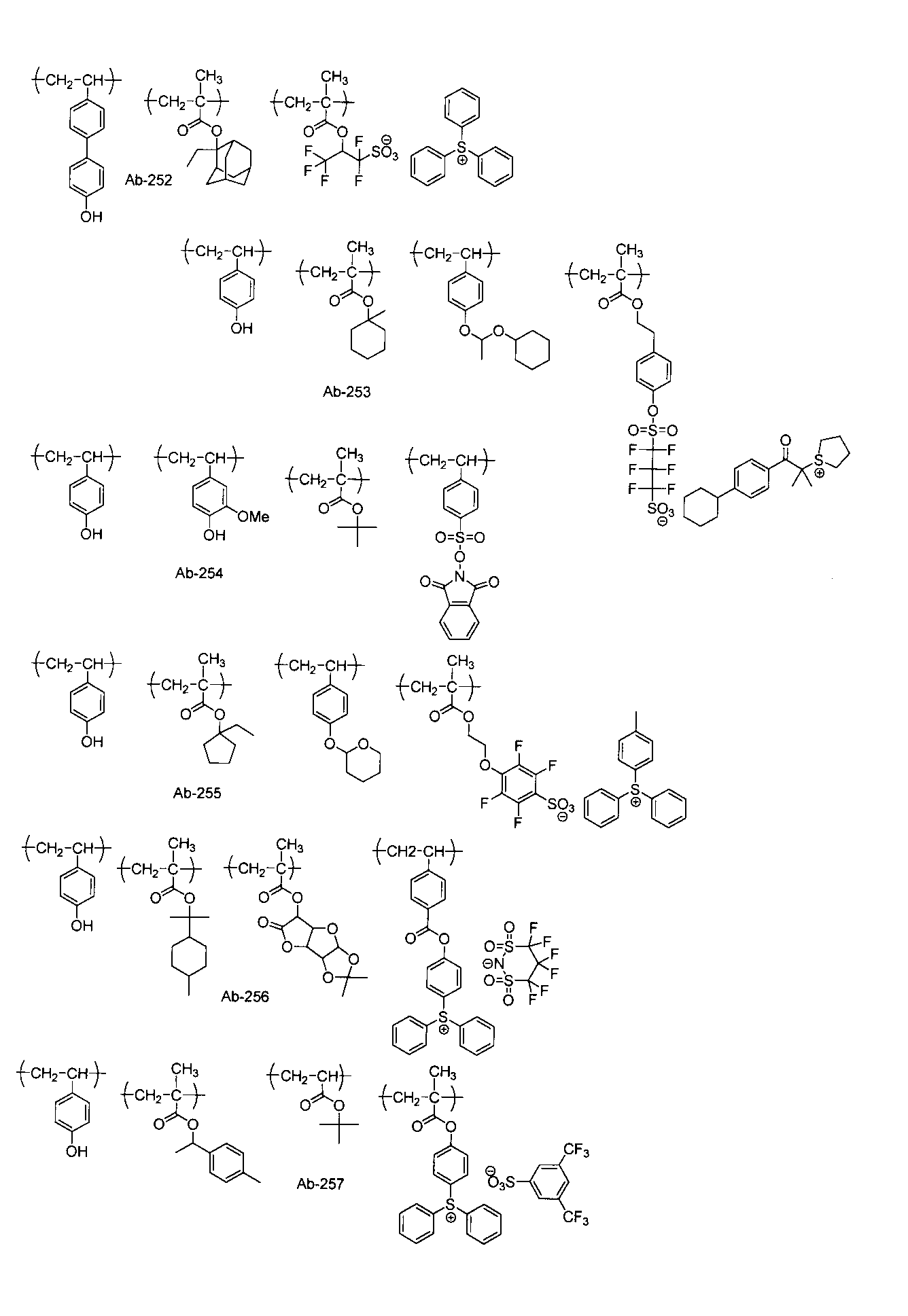

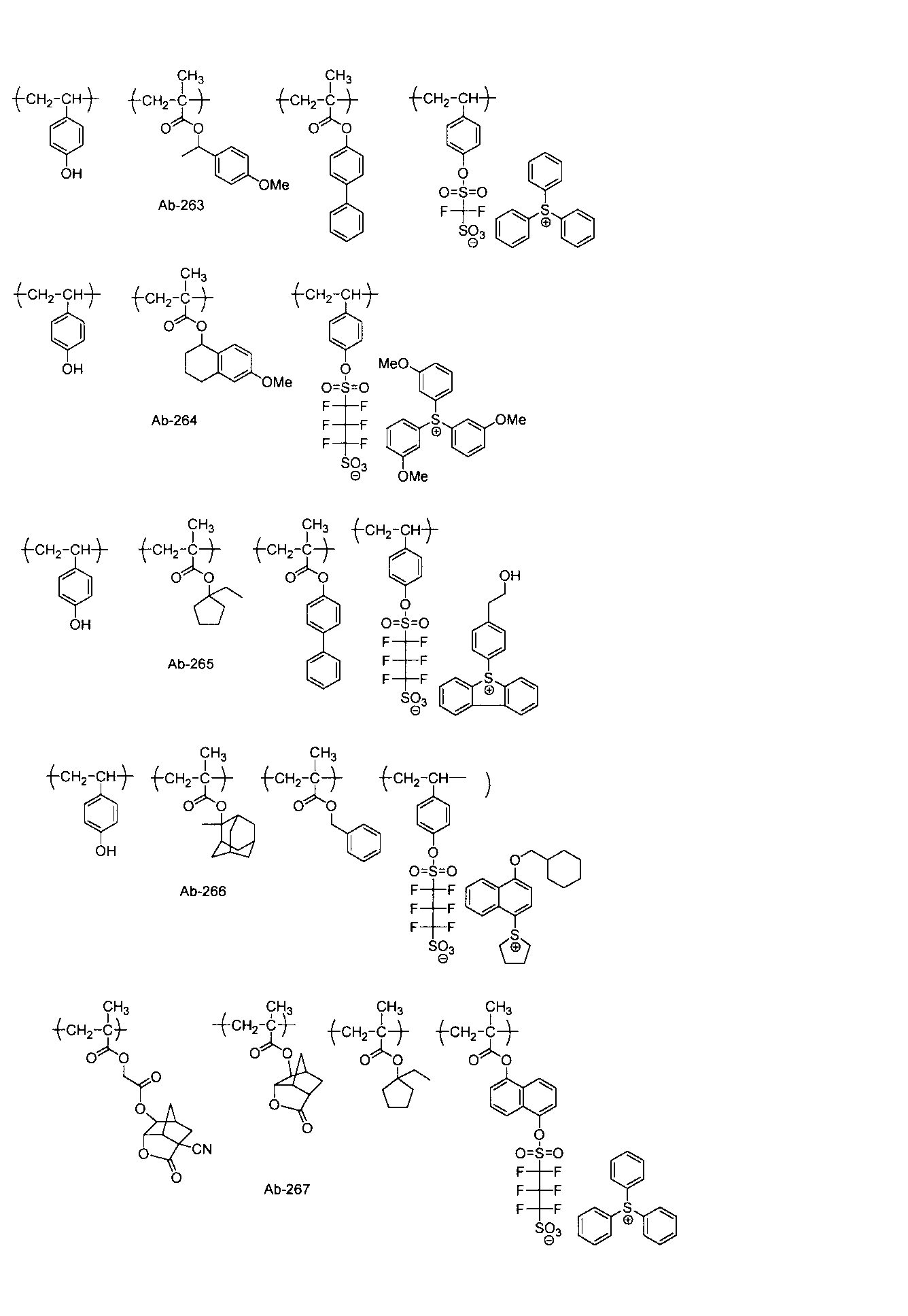
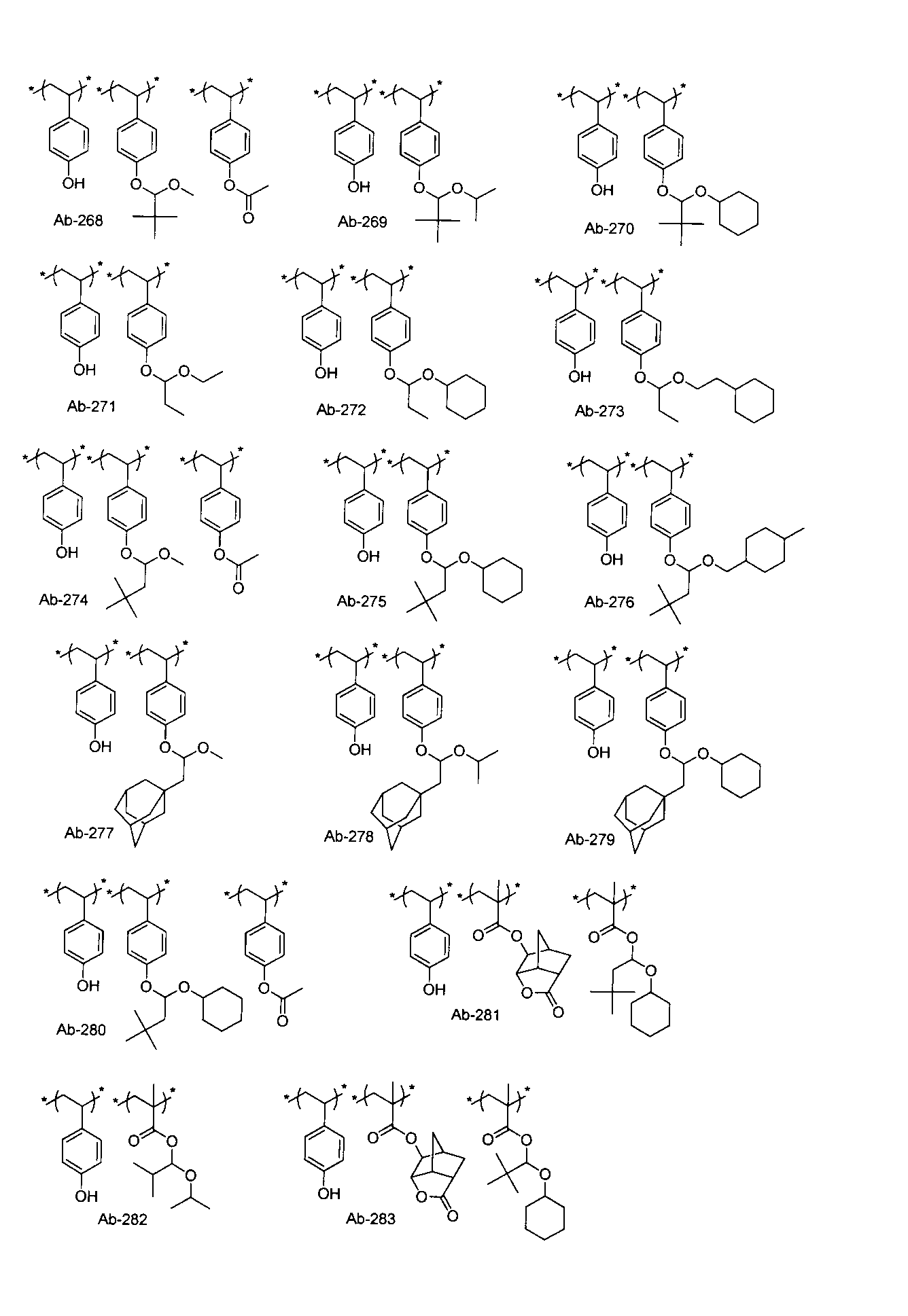
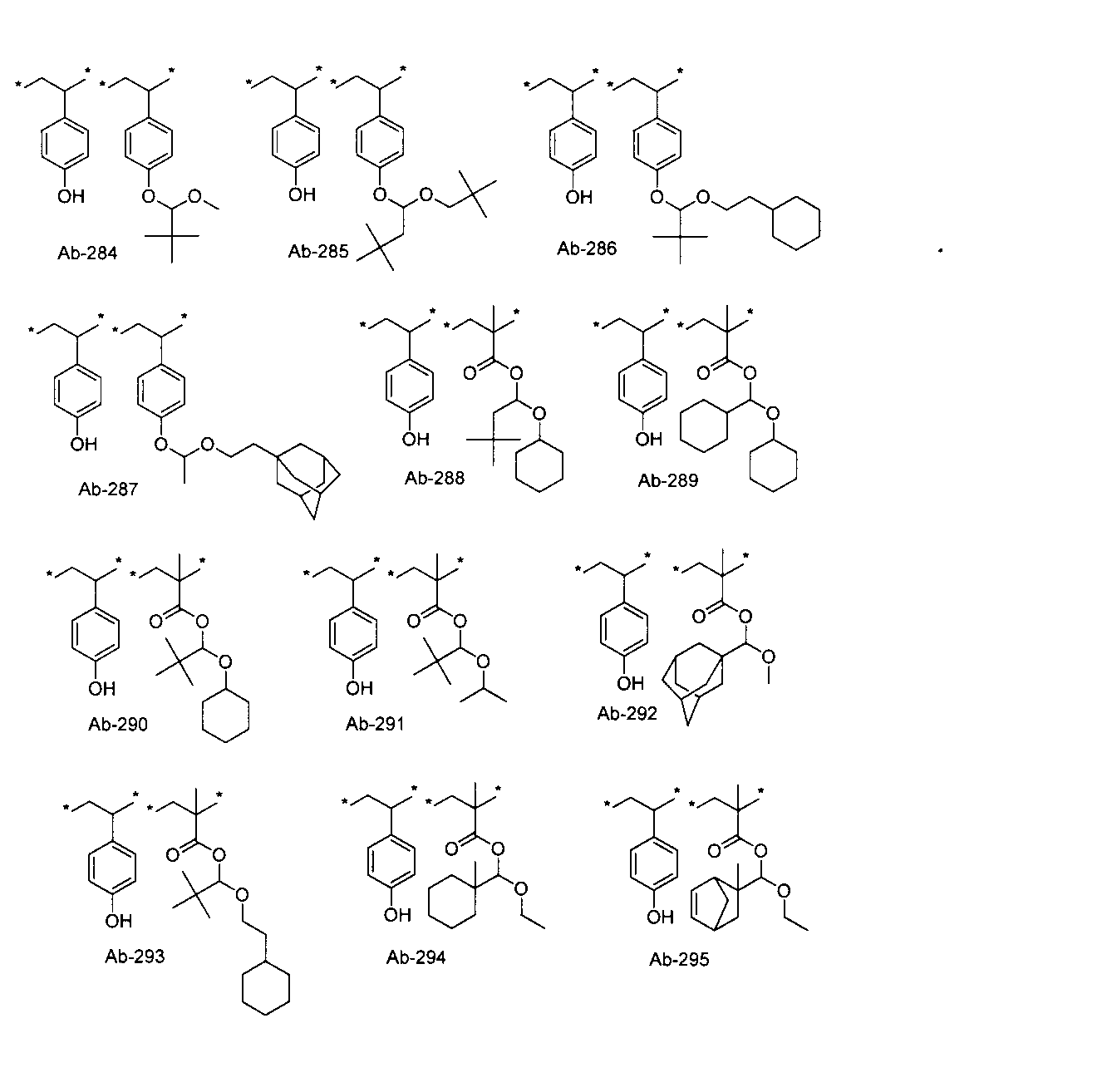

樹脂(Ab)の含有率は、総量として、本発明の組成物の全固形分に対し、通常10~99質量%であり、好ましくは20~99質量%であり、特に好ましくは30~99質量%である。
以下に樹脂(Ab)の具体例を以下に示すがこれらに限定するものではない。
樹脂(Ab)が酸発生繰り返し単位(B)を含有しない場合は、フッ素原子を含む繰り返し単位の含有率は1モル%以下であることが好ましく、フッ素原子は含有しないことがより好ましい。樹脂(Ab)が繰り返し単位(B)を有する場合は、繰り返し単位(B)以外の繰り返し単位であって、フッ素原子を含む繰り返し単位の含有率は1モル%以下であることが更に好ましく、フッ素原子は含有しないことが最も好ましい。
[3]活性光線又は放射線の照射により酸を発生する化合物
本発明の組成物は、一態様において、活性光線又は放射線の照射により酸を発生する化合物(以下、「酸発生剤」ともいう)を含有し得る。
酸発生剤としては、公知のものであれば特に限定されないが、活性光線又は放射線の照射により、有機酸、例えば、スルホン酸、ビス(アルキルスルホニル)イミド、又はトリス(アルキルスルホニル)メチドの少なくともいずれかを発生する化合物が好ましい。
本発明の組成物は、一態様において、活性光線又は放射線の照射により酸を発生する化合物(以下、「酸発生剤」ともいう)を含有し得る。
酸発生剤としては、公知のものであれば特に限定されないが、活性光線又は放射線の照射により、有機酸、例えば、スルホン酸、ビス(アルキルスルホニル)イミド、又はトリス(アルキルスルホニル)メチドの少なくともいずれかを発生する化合物が好ましい。
より好ましくは下記一般式(ZI)、(ZII)、(ZIII)で表される化合物を挙げることができる。
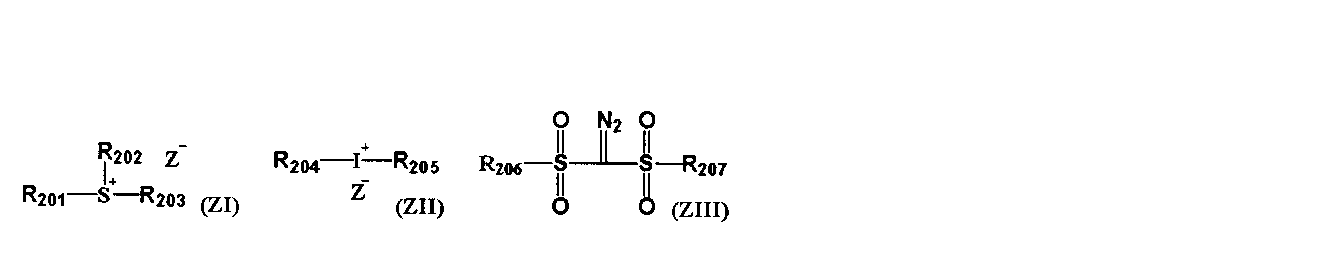
上記一般式(ZI)において、
R201、R202及びR203は、各々独立に、有機基を表す。
R201、R202及びR203としての有機基の炭素数は、一般的に1~30、好ましくは1~20である。
また、R201~R203のうち2つが結合して環構造を形成してもよく、環内に酸素原子、硫黄原子、エステル結合、アミド結合、カルボニル基を含んでいてもよい。R201~R203の内の2つが結合して形成する基としては、アルキレン基(例えば、ブチレン基、ペンチレン基)を挙げることができる。
Z-は、非求核性アニオン(求核反応を起こす能力が著しく低いアニオン)を表す。
R201、R202及びR203は、各々独立に、有機基を表す。
R201、R202及びR203としての有機基の炭素数は、一般的に1~30、好ましくは1~20である。
また、R201~R203のうち2つが結合して環構造を形成してもよく、環内に酸素原子、硫黄原子、エステル結合、アミド結合、カルボニル基を含んでいてもよい。R201~R203の内の2つが結合して形成する基としては、アルキレン基(例えば、ブチレン基、ペンチレン基)を挙げることができる。
Z-は、非求核性アニオン(求核反応を起こす能力が著しく低いアニオン)を表す。
非求核性アニオンとしては、例えば、スルホン酸アニオン(脂肪族スルホン酸アニオン、芳香族スルホン酸アニオン、カンファースルホン酸アニオンなど)、カルボン酸アニオン(脂肪族カルボン酸アニオン、芳香族カルボン酸アニオン、アラルキルカルボン酸アニオンなど)、スルホニルイミドアニオン、ビス(アルキルスルホニル)イミドアニオン、トリス(アルキルスルホニル)メチドアニオン等を挙げられる。
脂肪族スルホン酸アニオン及び脂肪族カルボン酸アニオンにおける脂肪族部位は、アルキル基であってもシクロアルキル基であってもよく、好ましくは炭素数1~30の直鎖又は分岐のアルキル基及び炭素数3~30のシクロアルキル基が挙げられる。
芳香族スルホン酸アニオン及び芳香族カルボン酸アニオンにおける芳香族基としては、好ましくは炭素数6~14のアリール基、例えば、フェニル基、トリル基、ナフチル基等を挙げることができる。
上記で挙げたアルキル基、シクロアルキル基及びアリール基は、置換基を有していてもよい。この具体例としては、ニトロ基、フッ素原子などのハロゲン原子、カルボキシル基、水酸基、アミノ基、シアノ基、アルコキシ基(好ましくは炭素数1~15)、シクロアルキル基(好ましくは炭素数3~15)、アリール基(好ましくは炭素数6~14)、アルコキシカルボニル基(好ましくは炭素数2~7)、アシル基(好ましくは炭素数2~12)、アルコキシカルボニルオキシ基(好ましくは炭素数2~7)、アルキルチオ基(好ましくは炭素数1~15)、アルキルスルホニル基(好ましくは炭素数1~15)、アルキルイミノスルホニル基(好ましくは炭素数2~15)、アリールオキシスルホニル基(好ましくは炭素数6~20)、アルキルアリールオキシスルホニル基(好ましくは炭素数7~20)、シクロアルキルアリールオキシスルホニル基(好ましくは炭素数10~20)、アルキルオキシアルキルオキシ基(好ましくは炭素数5~20)、シクロアルキルアルキルオキシアルキルオキシ基(好ましくは炭素数8~20)等を挙げることができる。各基が有するアリール基及び環構造については、置換基として更にアルキル基(好ましくは炭素数1~15)を挙げることができる。
アラルキルカルボン酸アニオンにおけるアラルキル基としては、好ましくは炭素数7~12のアラルキル基、例えば、ベンジル基、フェネチル基、ナフチルメチル基、ナフチルエチル基、ナフチルブチル基等を挙げることができる。
スルホニルイミドアニオンとしては、例えば、サッカリンアニオンを挙げることができる。
ビス(アルキルスルホニル)イミドアニオン、トリス(アルキルスルホニル)メチドアニオンにおけるアルキル基は、炭素数1~5のアルキル基が好ましい。これらのアルキル基の置換基としてはハロゲン原子、ハロゲン原子で置換されたアルキル基、アルコキシ基、アルキルチオ基、アルキルオキシスルホニル基、アリールオキシスルホニル基、シクロアルキルアリールオキシスルホニル基等を挙げることができ、フッ素原子又はフッ素原子で置換されたアルキル基が好ましい。
また、ビス(アルキルスルホニル)イミドアニオンにおけるアルキル基は、互いに結合して環構造を形成してもよい。これにより、酸強度が増加する。
その他の非求核性アニオンとしては、例えば、弗素化燐(例えば、PF6
-)、弗素化硼素(例えば、BF4
-)、弗素化アンチモン(例えば、SbF6
-)等を挙げることができる。
非求核性アニオンとしては、スルホン酸の少なくともα位がフッ素原子で置換された脂肪族スルホン酸アニオン、フッ素原子又はフッ素原子を有する基で置換された芳香族スルホン酸アニオン、アルキル基がフッ素原子で置換されたビス(アルキルスルホニル)イミドアニオン、アルキル基がフッ素原子で置換されたトリス(アルキルスルホニル)メチドアニオンが好ましい。非求核性アニオンとして、より好ましくはパーフロロ脂肪族スルホン酸アニオン(更に好ましくは炭素数4~8)、フッ素原子を有するベンゼンスルホン酸アニオン、更により好ましくはノナフロロブタンスルホン酸アニオン、パーフロロオクタンスルホン酸アニオン、ペンタフロロベンゼンスルホン酸アニオン、3,5-ビス(トリフロロメチル)ベンゼンスルホン酸アニオンである。
酸強度の観点からは、発生酸のpKaが-1以下であることが、感度向上のために好ましい。
酸強度の観点からは、発生酸のpKaが-1以下であることが、感度向上のために好ましい。
また、非求核性アニオンとしては、以下の一般式(AN1)で表されるアニオンも好ましい態様として挙げられる。

式中、
Xfは、それぞれ独立に、フッ素原子、又は少なくとも1つのフッ素原子で置換されたアルキル基を表す。
R1、R2は、それぞれ独立に、水素原子、フッ素原子、又は、アルキル基を表し、複数存在する場合のR1、R2は、それぞれ同一でも異なっていてもよい。
Lは、二価の連結基を表し、複数存在する場合のLは同一でも異なっていてもよい。
Aは、環状の有機基を表す。
xは1~20の整数を表し、yは0~10の整数を表し、zは0~10の整数を表す。
Xfは、それぞれ独立に、フッ素原子、又は少なくとも1つのフッ素原子で置換されたアルキル基を表す。
R1、R2は、それぞれ独立に、水素原子、フッ素原子、又は、アルキル基を表し、複数存在する場合のR1、R2は、それぞれ同一でも異なっていてもよい。
Lは、二価の連結基を表し、複数存在する場合のLは同一でも異なっていてもよい。
Aは、環状の有機基を表す。
xは1~20の整数を表し、yは0~10の整数を表し、zは0~10の整数を表す。
一般式(AN1)について、更に詳細に説明する。
Xfのフッ素原子で置換されたアルキル基におけるアルキル基としては、好ましくは炭素数1~10であり、より好ましくは炭素数1~4である。また、Xfのフッ素原子で置換されたアルキル基は、パーフルオロアルキル基であることが好ましい。
Xfのフッ素原子で置換されたアルキル基におけるアルキル基としては、好ましくは炭素数1~10であり、より好ましくは炭素数1~4である。また、Xfのフッ素原子で置換されたアルキル基は、パーフルオロアルキル基であることが好ましい。
Xfとして好ましくは、フッ素原子又は炭素数1~4のパーフルオロアルキル基である。Xfの具体的としては、フッ素原子、CF3、C2F5、C3F7、C4F9、CH2CF3、CH2CH2CF3、CH2C2F5、CH2CH2C2F5、CH2C3F7、CH2CH2C3F7、CH2C4F9、CH2CH2C4F9が挙げられ、中でもフッ素原子、CF3が好ましい。特に、双方のXfがフッ素原子であることが好ましい。
R1、R2のアルキル基は、置換基(好ましくはフッ素原子)を有していてもよく、炭素数1~4のものが好ましい。更に好ましくは炭素数1~4のパーフルオロアルキル基である。R1、R2の置換基を有するアルキル基の具体例としては、CF3、C2F5、C3F7、C4F9、C5F11、C6F13、C7F15、C8F17、CH2CF3、CH2CH2CF3、CH2C2F5、CH2CH2C2F5、CH2C3F7、CH2CH2C3F7、CH2C4F9、CH2CH2C4F9が挙げられ、中でもCF3が好ましい。
R1、R2としては、好ましくはフッ素原子又はCF3である。
R1、R2としては、好ましくはフッ素原子又はCF3である。
xは1~10が好ましく、1~5がより好ましい。
yは0~4が好ましく、0がより好ましい。
zは0~5が好ましく、0~3がより好ましい。
Lの2価の連結基としては特に限定されず、―COO-、-OCO-、-CO-、-O-、-S―、-SO―、―SO2-、アルキレン基、シクロアルキレン基、アルケニレン基又はこれらの複数が連結した連結基などを挙げることができ、総炭素数12以下の連結基が好ましい。このなかでも―COO-、-OCO-、-CO-、-O-が好ましく、―COO-、-OCO-がより好ましい。
yは0~4が好ましく、0がより好ましい。
zは0~5が好ましく、0~3がより好ましい。
Lの2価の連結基としては特に限定されず、―COO-、-OCO-、-CO-、-O-、-S―、-SO―、―SO2-、アルキレン基、シクロアルキレン基、アルケニレン基又はこれらの複数が連結した連結基などを挙げることができ、総炭素数12以下の連結基が好ましい。このなかでも―COO-、-OCO-、-CO-、-O-が好ましく、―COO-、-OCO-がより好ましい。
Aの環状の有機基としては、環状構造を有するものであれば特に限定されず、脂環基、アリール基、複素環基(芳香族性を有するものだけでなく、芳香族性を有さないものも含む)等が挙げられる。
脂環基としては、単環でも多環でもよく、シクロペンチル基、シクロヘキシル基、シクロオクチル基などの単環のシクロアルキル基、ノルボルニル基、トリシクロデカニル基、テトラシクロデカニル基、テトラシクロドデカニル基、アダマンチル基などの多環のシクロアルキル基が好ましい。中でも、ノルボルニル基、トリシクロデカニル基、テトラシクロデカニル基、テトラシクロドデカニル基、アダマンチル基等の炭素数7以上のかさ高い構造を有する脂環基が、露光後加熱工程での膜中拡散性を抑制でき、MEEF向上の観点から好ましい。
アリール基としては、ベンゼン環、ナフタレン環、フェナンスレン環、アントラセン環が挙げられる。
複素環基としては、フラン環、チオフェン環、ベンゾフラン環、ベンゾチオフェン環、ジベンゾフラン環、ジベンゾチオフェン環、ピリジン環由来のものが挙げられる。中でもフラン環、チオフェン環、ピリジン環由来のものが好ましい。
複素環基としては、フラン環、チオフェン環、ベンゾフラン環、ベンゾチオフェン環、ジベンゾフラン環、ジベンゾチオフェン環、ピリジン環由来のものが挙げられる。中でもフラン環、チオフェン環、ピリジン環由来のものが好ましい。
また、環状の有機基としては、ラクトン構造も挙げることができ、具体例としては、前述の樹脂(P)が有していてもよい一般式(LC1-1)~(LC1-17)で表されるラクトン構造を挙げることができる。
上記環状の有機基は、置換基を有していてもよく、該置換基としては、アルキル基(直鎖、分岐、環状のいずれであっても良く、炭素数1~12が好ましい)、シクロアルキル基(単環、多環、スピロ環のいずれであっても良く、炭素数3~20が好ましい)、アリール基(炭素数6~14が好ましい)、ヒドロキシ基、アルコキシ基、エステル基、アミド基、ウレタン基、ウレイド基、チオエーテル基、スルホンアミド基、スルホン酸エステル基等が挙げられる。なお、環状の有機基を構成する炭素(環形成に寄与する炭素)はカルボニル炭素であっても良い。
R201、R202及びR203の有機基としては、アリール基、アルキル基、シクロアルキル基などが挙げられる。
R201、R202及びR203のうち、少なくとも1つがアリール基であることが好ましく、三つ全てがアリール基であることがより好ましい。アリール基としては、フェニル基、ナフチル基などの他に、インドール残基、ピロール残基などのヘテロアリール基も可能である。R201~R203のアルキル基及びシクロアルキル基としては、好ましくは、炭素数1~10の直鎖又は分岐アルキル基、炭素数3~10のシクロアルキル基を挙げることができる。アルキル基として、より好ましくはメチル基、エチル基、n-プロピル基、i-プロピル基、n-ブチル基等を挙げることができる。シクロアルキル基として、より好ましくは、シクロプロピル基、シクロブチル基、シクロペンチル基、シクロヘキシル基、シクロへプチル基等を挙げることができる。これらの基は更に置換基を有していてもよい。その置換基としては、ニトロ基、フッ素原子などのハロゲン原子、カルボキシル基、水酸基、アミノ基、シアノ基、アルコキシ基(好ましくは炭素数1~15)、シクロアルキル基(好ましくは炭素数3~15)、アリール基(好ましくは炭素数6~14)、アルコキシカルボニル基(好ましくは炭素数2~7)、アシル基(好ましくは炭素数2~12)、アルコキシカルボニルオキシ基(好ましくは炭素数2~7)等が挙げられるが、これらに限定されるものではない。
また、R201~R203のうち2つが結合して環構造を形成する場合、以下の一般式(A1)で表される構造であることが好ましい。
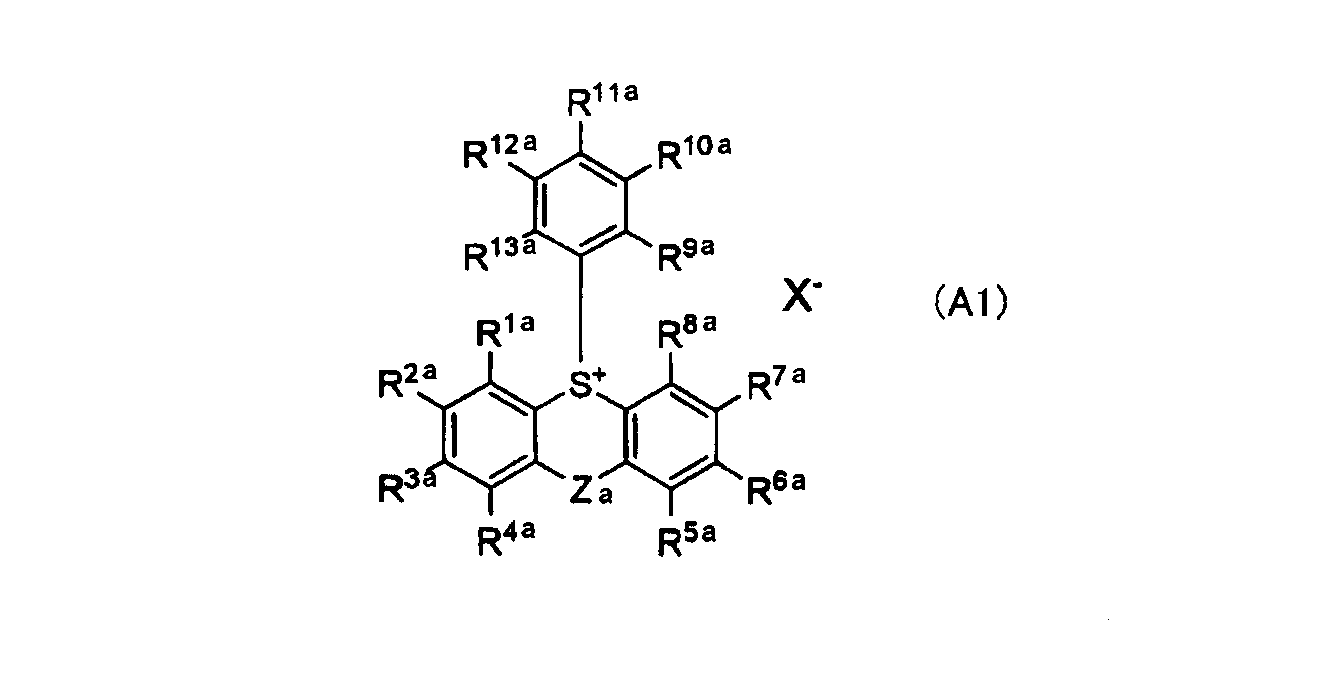
一般式(A1)中、
R1a~R13aは、各々独立に、水素原子又は置換基を表す。
R1a~R13aは、各々独立に、水素原子又は置換基を表す。
R1a~R13aのうち、1~3つが水素原子でないことが好ましく、R9a~R13aのいずれか1つが水素原子でないことがより好ましい。
Zaは、単結合又は2価の連結基である。
X-は、一般式(ZI)におけるZ-と同義である。
R1a~R13aが水素原子でない場合の具体例としては、ハロゲン原子、直鎖、分岐、環状のアルキル基、アルケニル基、アルキニル基、アリール基、複素環基、シアノ基、ニトロ基、カルボキシル基、アルコキシ基、アリールオキシ基、シリルオキシ基、ヘテロ環オキシ基、アシルオキシ基、カルバモイルオキシ基、アルコキシカルボニルオキシ基、アリールオキシカルボニルオキシ基、アミノ基(アニリノ基を含む)、アンモニオ基、アシルアミノ基、アミノカルボニルアミノ基、アルコキシカルボニルアミノ基、アリールオキシカルボニルアミノ基、スルファモイルアミノ基、アルキル及びアリールスルホニルアミノ基、メルカプト基、アルキルチオ基、アリールチオ基、ヘテロ環チオ基、スルファモイル基、スルホ基、アルキル及びアリールスルフィニル基、アルキル及びアリールスルホニル基、アシル基、アリールオキシカルボニル基、アルコキシカルボニル基、カルバモイル基、アリール及びヘテロ環アゾ基、イミド基、ホスフィノ基、ホスフィニル基、ホスフィニルオキシ基、ホスフィニルアミノ基、ホスホノ基、シリル基、ヒドラジノ基、ウレイド基、ボロン酸基(-B(OH)2)、ホスファト基(-OPO(OH)2)、スルファト基(-OSO3H)、その他の公知の置換基が例として挙げられる。
R1a~R13aが水素原子でない場合としては、水酸基で置換された直鎖、分岐、環状のアルキル基であることが好ましい。
Zaの2価の連結基としては、アルキレン基、アリーレン基、カルボニル基、スルホニル基、カルボニルオキシ基、カルボニルアミノ基、スルホニルアミド基、エーテル結合、チオエーテル結合、アミノ基、ジスルフィド基、-(CH2)n-CO-、-(CH2)n-SO2-、-CH=CH-、アミノカルボニルアミノ基、アミノスルホニルアミノ基等が挙げられる(nは1~3の整数)。
なお、R201、R202及びR203のうち、少なくとも1つがアリール基でない場合の好ましい構造としては、特開2004-233661号公報の段落0046、0047、0048、特開2003-35948号公報の段落0040~0046、米国特許出願公開第2003/0224288A1号明細書に式(I-1)~(I-70)として例示されている化合物、米国特許出願公開第2003/0077540A1号明細書に式(IA-1)~(IA-54)、式(IB-1)~(IB-24)として例示されている化合物等のカチオン構造を挙げることができる。
一般式(ZII)、(ZIII)中、
R204~R207は、各々独立に、アリール基、アルキル基又はシクロアルキル基を表す。
R204~R207は、各々独立に、アリール基、アルキル基又はシクロアルキル基を表す。
R204~R207のアリール基、アルキル基、シクロアルキル基としては、前述の化合物(ZI)におけるR201~R203のアリール基、アルキル基、シクロアルキル基として説明したアリール基と同様である。
R204~R207のアリール基、アルキル基、シクロアルキル基は、置換基を有していてもよい。この置換基としても、前述の化合物(ZI)におけるR201~R203のアリール基、アルキル基、シクロアルキル基が有していてもよいものが挙げられる。
Z-は、非求核性アニオンを表し、一般式(ZI)に於けるZ-の非求核性アニオンと同様のものを挙げることができる。
酸発生剤として、更に、下記一般式(ZIV)、(ZV)、(ZVI)で表される化合物も挙げられる。

一般式(ZIV)~(ZVI)中、
Ar3及びAr4は、各々独立に、アリール基を表す。
R208、R209及びR210は、各々独立に、アルキル基、シクロアルキル基又はアリール基を表す。
Aは、アルキレン基、アルケニレン基又はアリーレン基を表す。
Ar3、Ar4、R208、R209及びR210のアリール基の具体例としては、上記一般式(ZI)におけるR201、R202及びR203としてのアリール基の具体例と同様のものを挙げることができる。
Ar3及びAr4は、各々独立に、アリール基を表す。
R208、R209及びR210は、各々独立に、アルキル基、シクロアルキル基又はアリール基を表す。
Aは、アルキレン基、アルケニレン基又はアリーレン基を表す。
Ar3、Ar4、R208、R209及びR210のアリール基の具体例としては、上記一般式(ZI)におけるR201、R202及びR203としてのアリール基の具体例と同様のものを挙げることができる。
R208、R209及びR210のアルキル基及びシクロアルキル基の具体例としては、それぞれ、上記一般式(ZI)におけるR201、R202及びR203としてのアルキル基及びシクロアルキル基の具体例と同様のものを挙げることができる。
Aのアルキレン基としては、炭素数1~12のアルキレン基(例えば、メチレン基、エチレン基、プロピレン基、イソプロピレン基、ブチレン基、イソブチレン基など)を、Aのアルケニレン基としては、炭素数2~12のアルケニレン基(例えば、エテニレン基、プロペニレン基、ブテニレン基など)を、Aのアリーレン基としては、炭素数6~10のアリーレン基(例えば、フェニレン基、トリレン基、ナフチレン基など)を、それぞれ挙げることができる。
酸発生剤の中で、特に好ましい例を以下に挙げる。
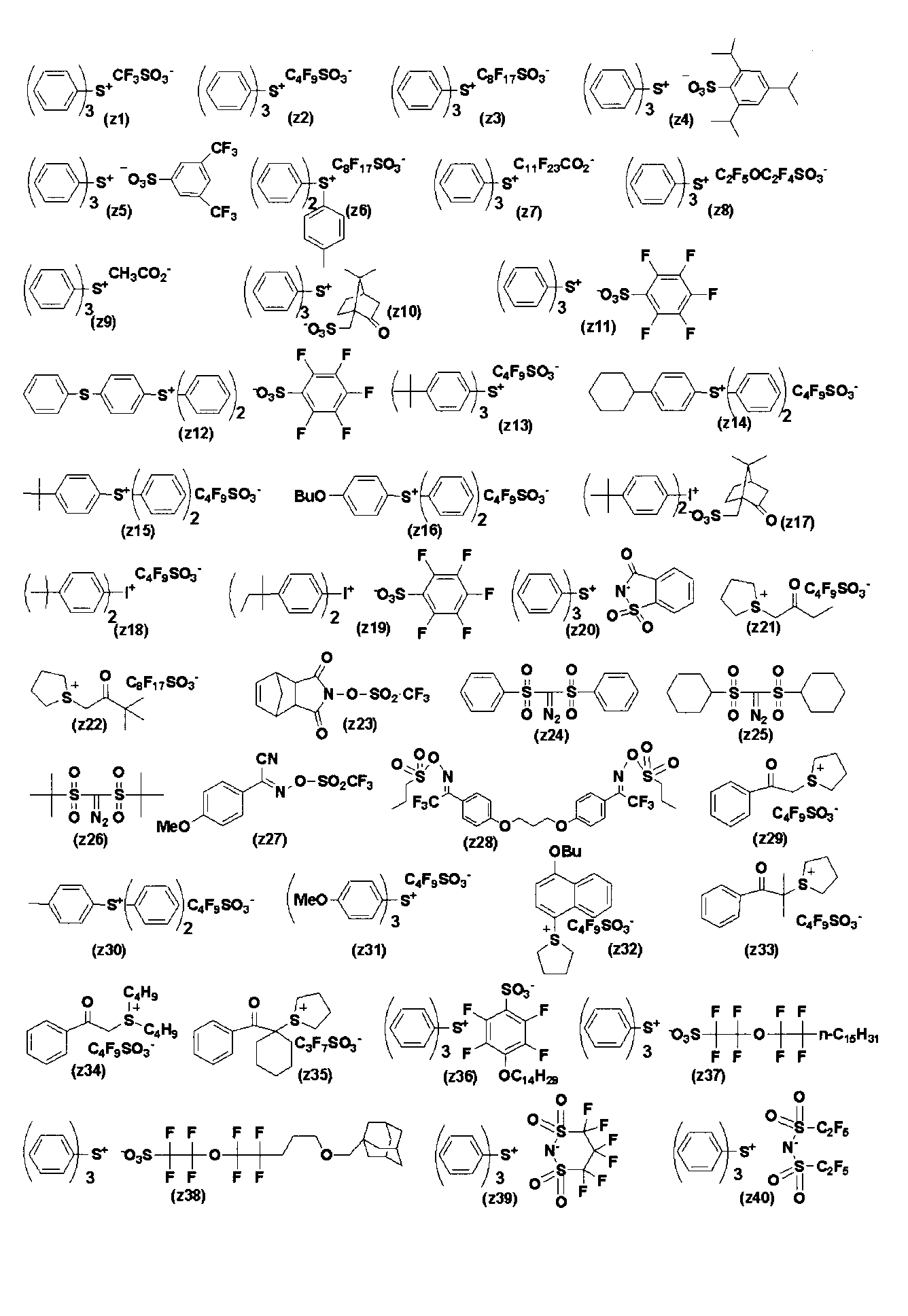
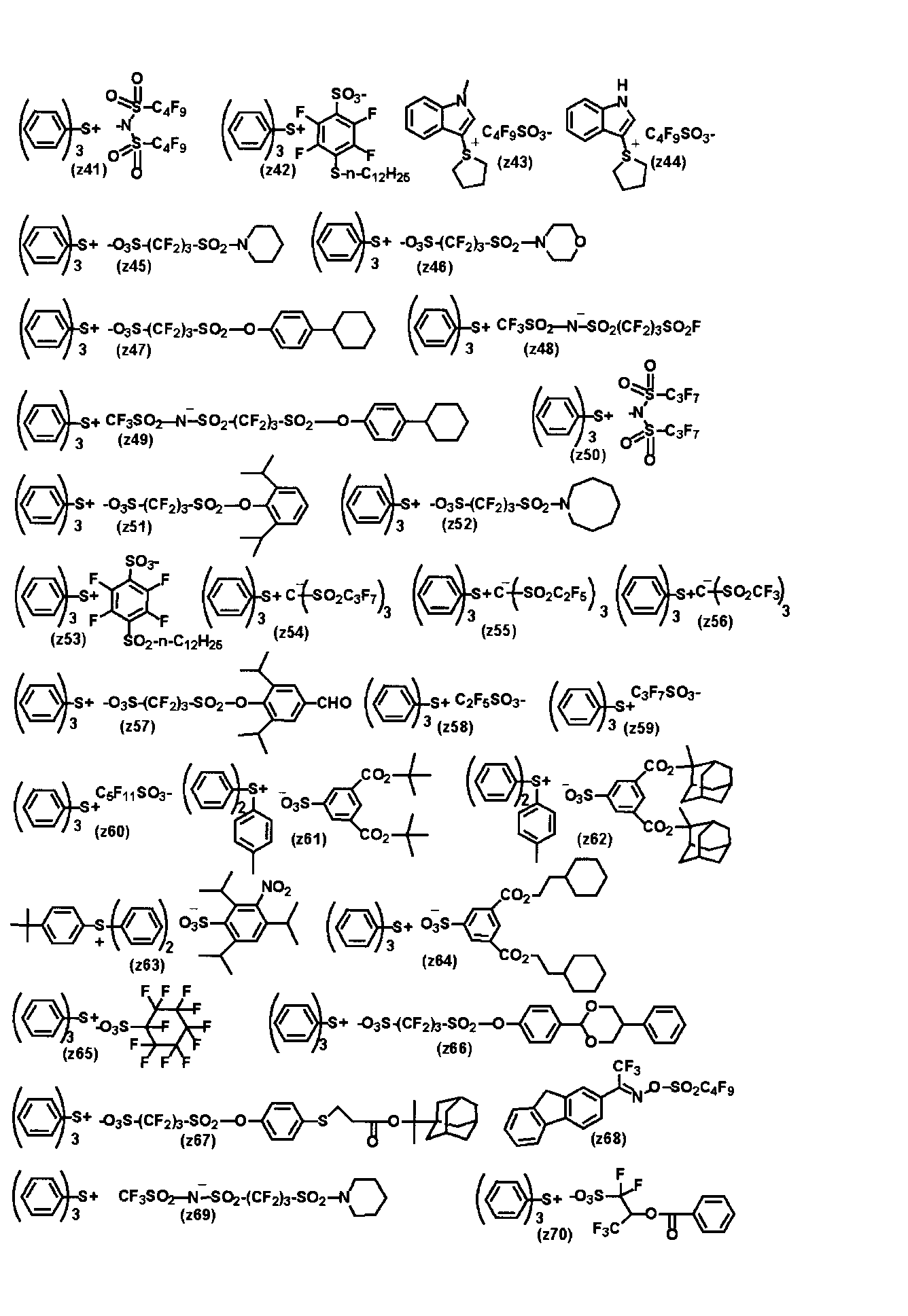
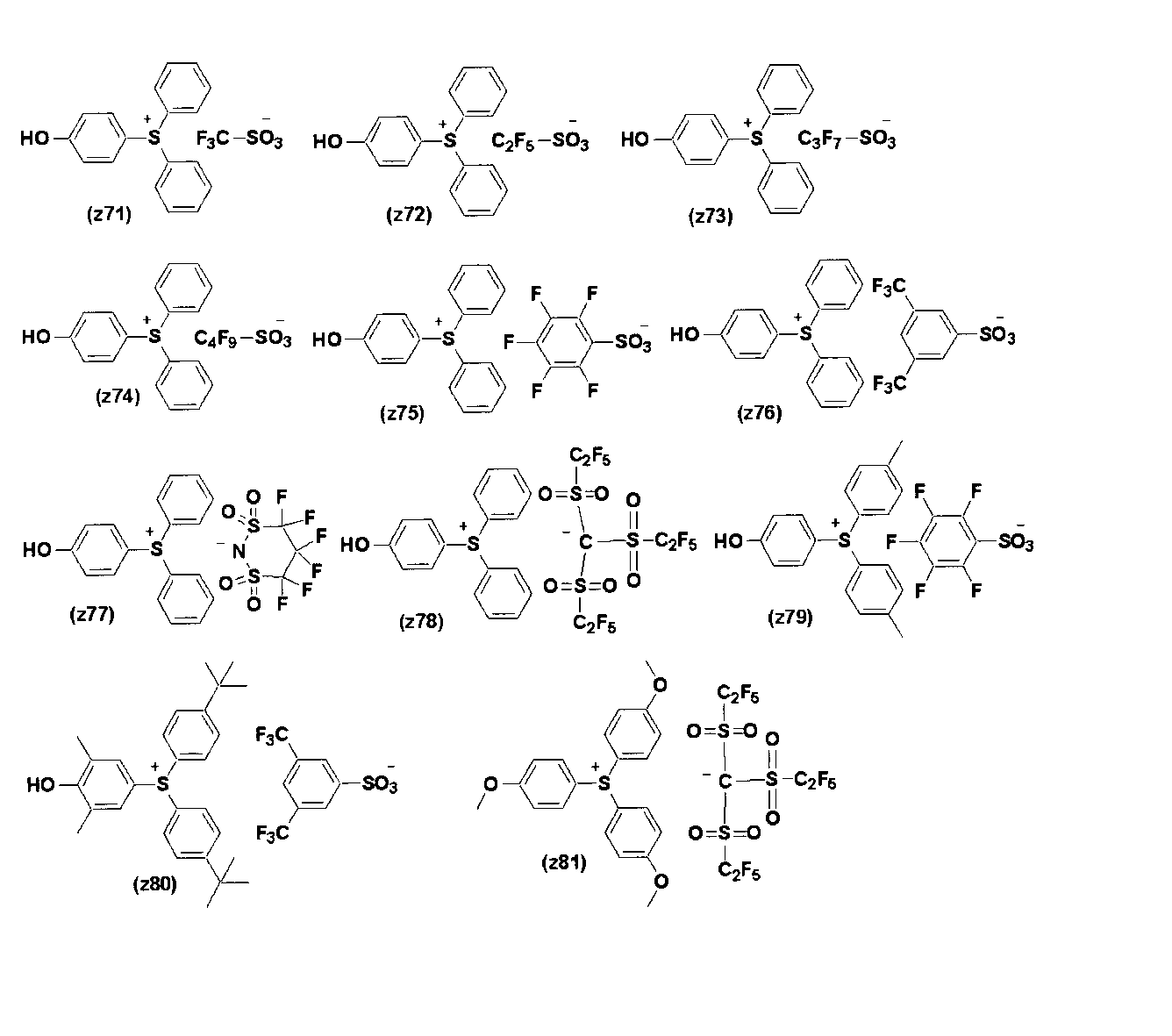
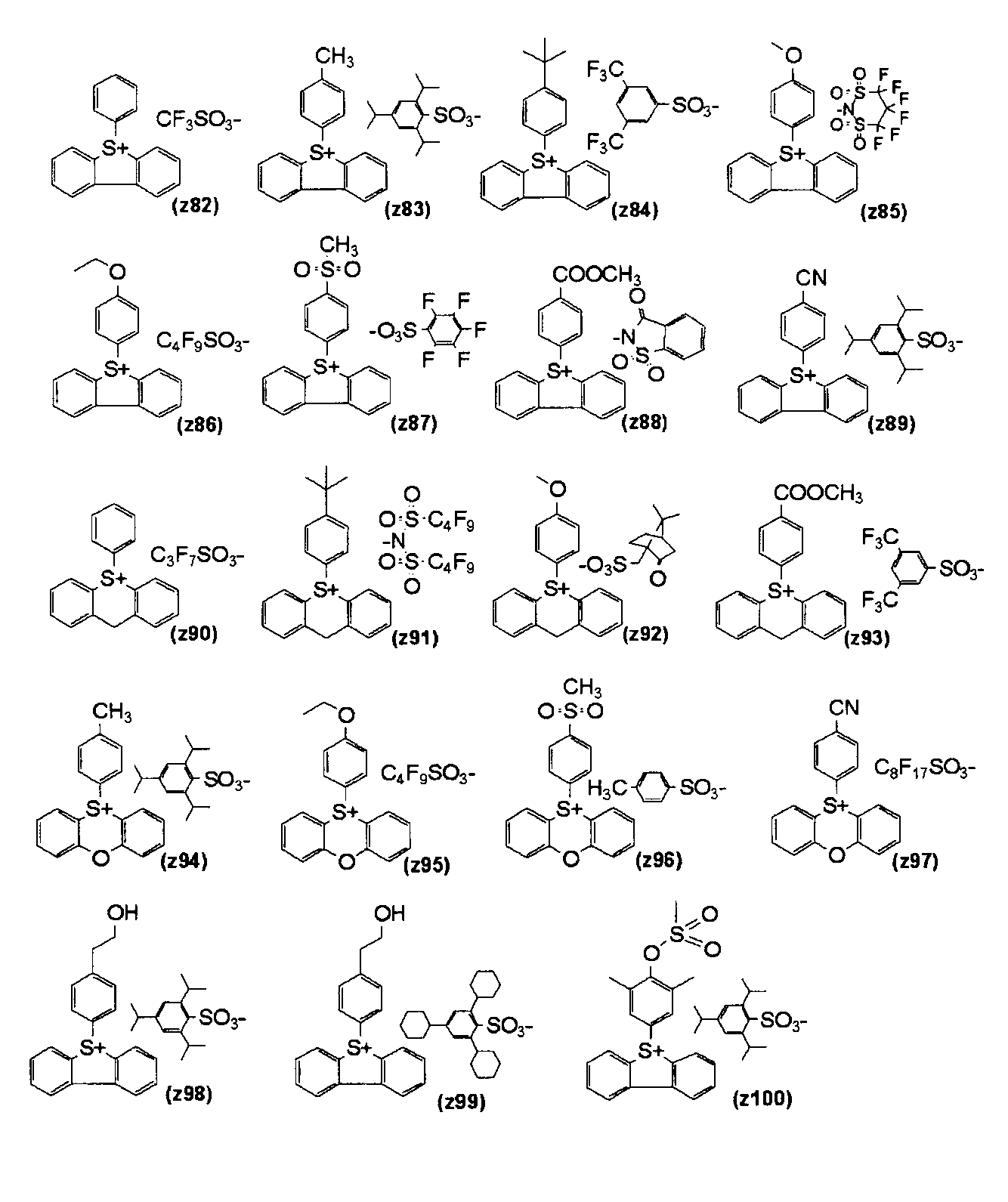
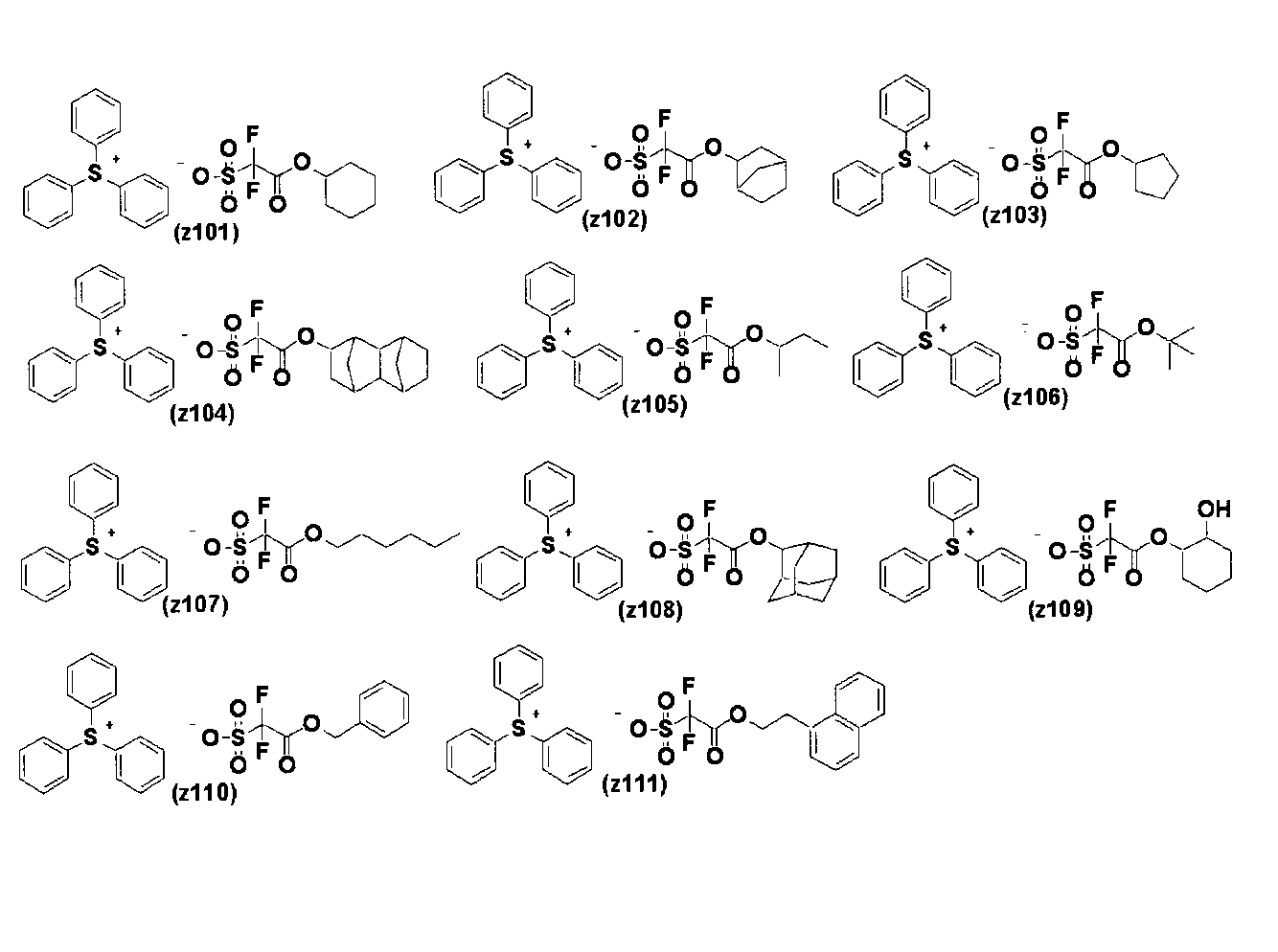
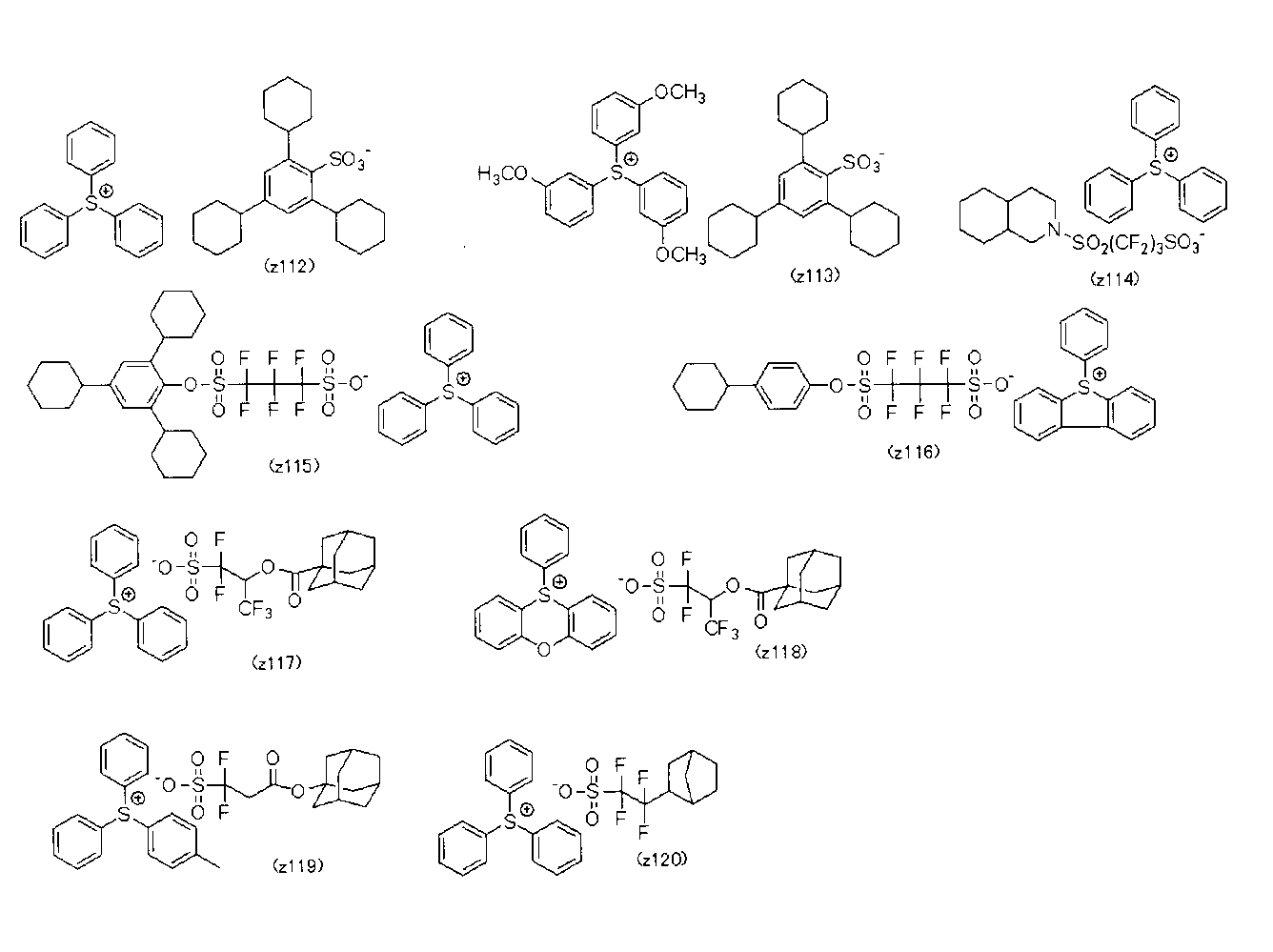


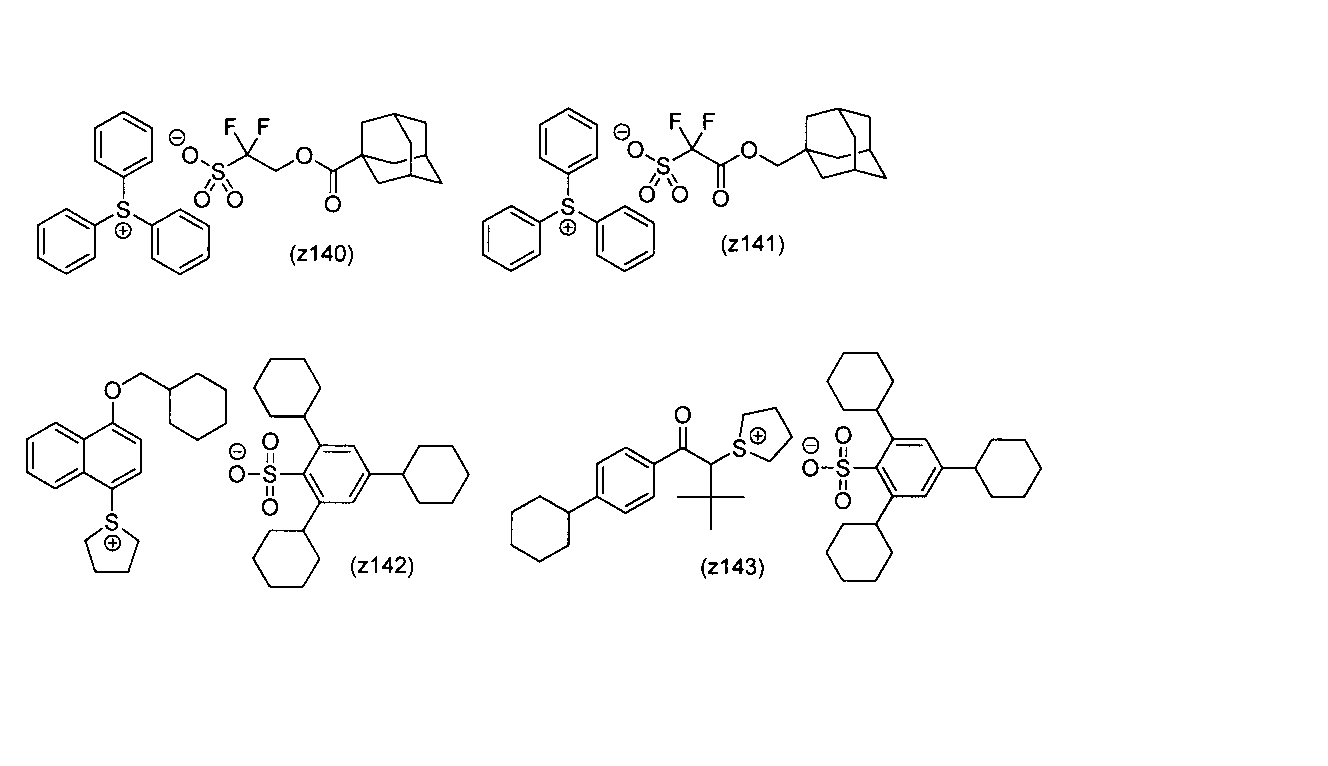
酸発生剤の中で、特に好ましい例を以下に挙げる。
酸発生剤は、1種類単独で又は2種類以上を組み合わせて使用することができる。
また、光酸発生剤の含有率は、組成物の全固形分を基準として、好ましくは0.1~50質量%であり、より好ましくは0.5~45質量%であり、更に好ましくは1~40質量%である。
また、光酸発生剤の含有率は、組成物の全固形分を基準として、好ましくは0.1~50質量%であり、より好ましくは0.5~45質量%であり、更に好ましくは1~40質量%である。
[4]酸の作用により分解して酸を発生する化合物
本発明の感活性光線性又は感放射線性組成物は、更に、酸の作用により分解して酸を発生する化合物(以下、酸増殖剤とも表記する)を1種又は2種以上含んでいてもよい。酸増殖剤が発生する酸は、スルホン酸、メチド酸又はイミド酸であることが好ましい。酸増殖剤の含有量としては、組成物の全固形分を基準として、0.1~50質量%であることが好ましく、0.5~30質量%であることがより好ましく、1.0~20質量%であることが更に好ましい。
本発明の感活性光線性又は感放射線性組成物は、更に、酸の作用により分解して酸を発生する化合物(以下、酸増殖剤とも表記する)を1種又は2種以上含んでいてもよい。酸増殖剤が発生する酸は、スルホン酸、メチド酸又はイミド酸であることが好ましい。酸増殖剤の含有量としては、組成物の全固形分を基準として、0.1~50質量%であることが好ましく、0.5~30質量%であることがより好ましく、1.0~20質量%であることが更に好ましい。
酸増殖剤と酸発生剤との量比(組成物中の全固形分を基準にした酸増殖剤の固形分量/組成物中の全固形分を基準にした酸発生剤の固形分量)としては、特に制限されないが、0.01~50が好ましく、0.1~20がより好ましく、0.2~1.0が特に好ましい。
以下に本発明に用いることができる化合物の例を示すが、これらに限定されるものではない。

[5]溶剤
本発明の組成物を調製する際に使用できる溶剤としては、各成分を溶解するものである限り特に限定されないが、例えば、アルキレングリコールモノアルキルエーテルカルボキシレート(プロピレングリコールモノメチルエーテルアセテート(PGMEA;別名1-メトキシ-2-アセトキシプロパン)など)、アルキレングリコールモノアルキルエーテル(プロピレングリコールモノメチルエーテル(PGME;1-メトキシ-2-プロパノール)など)、乳酸アルキルエステル(乳酸エチル、乳酸メチルなど)、環状ラクトン(γ-ブチロラクトンなど、好ましくは炭素数4~10)、鎖状又は環状のケトン(2-ヘプタノン、シクロヘキサノンなど、好ましくは炭素数4~10)、アルキレンカーボネート(エチレンカーボネート、プロピレンカーボネートなど)、カルボン酸アルキル(酢酸ブチルなどの酢酸アルキルが好ましい)、アルコキシ酢酸アルキル(エトキシプロピオン酸エチル)などが挙げられる。その他使用可能な溶媒として、例えば、米国特許出願公開第2008/0248425A1号明細書の[0244]以降に記載されている溶剤などが挙げられる。
本発明の組成物を調製する際に使用できる溶剤としては、各成分を溶解するものである限り特に限定されないが、例えば、アルキレングリコールモノアルキルエーテルカルボキシレート(プロピレングリコールモノメチルエーテルアセテート(PGMEA;別名1-メトキシ-2-アセトキシプロパン)など)、アルキレングリコールモノアルキルエーテル(プロピレングリコールモノメチルエーテル(PGME;1-メトキシ-2-プロパノール)など)、乳酸アルキルエステル(乳酸エチル、乳酸メチルなど)、環状ラクトン(γ-ブチロラクトンなど、好ましくは炭素数4~10)、鎖状又は環状のケトン(2-ヘプタノン、シクロヘキサノンなど、好ましくは炭素数4~10)、アルキレンカーボネート(エチレンカーボネート、プロピレンカーボネートなど)、カルボン酸アルキル(酢酸ブチルなどの酢酸アルキルが好ましい)、アルコキシ酢酸アルキル(エトキシプロピオン酸エチル)などが挙げられる。その他使用可能な溶媒として、例えば、米国特許出願公開第2008/0248425A1号明細書の[0244]以降に記載されている溶剤などが挙げられる。
上記のうち、アルキレングリコールモノアルキルエーテルカルボキシレート及びアルキレングリコールモノアルキルエーテルが好ましい。
これら溶媒は、単独で用いても2種以上を混合して用いてもよい。2種以上を混合する場合、水酸基を有する溶剤と水酸基を有しない溶剤とを混合することが好ましい。水酸基を有する溶剤と水酸基を有しない溶剤との質量比は、1/99~99/1、好ましくは10/90~90/10、更に好ましくは20/80~60/40である。
水酸基を有する溶剤としてはアルキレングリコールモノアルキルエーテルが好ましく、水酸基を有しない溶剤としてはアルキレングリコールモノアルキルエーテルカルボキシレートが好ましい。
[6]塩基性化合物
本発明に係る感活性光線性又は感放射線性樹脂組成物は、塩基性化合物を更に含んでいてもよい。塩基性化合物は、好ましくは、フェノールと比較して塩基性がより強い化合物である。また、この塩基性化合物は、有機塩基性化合物であることが好ましく、含窒素塩基性化合物であることが更に好ましい。
本発明に係る感活性光線性又は感放射線性樹脂組成物は、塩基性化合物を更に含んでいてもよい。塩基性化合物は、好ましくは、フェノールと比較して塩基性がより強い化合物である。また、この塩基性化合物は、有機塩基性化合物であることが好ましく、含窒素塩基性化合物であることが更に好ましい。
使用可能な含窒素塩基性化合物は特に限定されないが、例えば、以下の(1)~(7)に分類される化合物を用いることができる。
(1)一般式(BS-1)により表される化合物

一般式(BS-1)中、
Rは、各々独立に、水素原子又は有機基を表す。但し、3つのRのうち少なくとも1つは有機基である。この有機基は、直鎖若しくは分岐鎖のアルキル基、単環若しくは多環のシクロアルキル基、アリール基又はアラルキル基である。
Rは、各々独立に、水素原子又は有機基を表す。但し、3つのRのうち少なくとも1つは有機基である。この有機基は、直鎖若しくは分岐鎖のアルキル基、単環若しくは多環のシクロアルキル基、アリール基又はアラルキル基である。
Rとしてのアルキル基の炭素数は、特に限定されないが、通常1~20であり、好ましくは1~12である。
Rとしてのシクロアルキル基の炭素数は、特に限定されないが、通常3~20であり、好ましくは5~15である。
Rとしてのアリール基の炭素数は、特に限定されないが、通常6~20であり、好ましくは6~10である。具体的には、フェニル基及びナフチル基等が挙げられる。
Rとしてのアラルキル基の炭素数は、特に限定されないが、通常7~20であり、好ましくは7~11である。具体的には、ベンジル基等が挙げられる。
Rとしてのアルキル基、シクロアルキル基、アリール基及びアラルキル基は、水素原子が置換基により置換されていてもよい。この置換基としては、例えば、アルキル基、シクロアルキル基、アリール基、アラルキル基、ヒドロキシ基、カルボキシ基、アルコキシ基、アリールオキシ基、アルキルカルボニルオキシ基及びアルキルオキシカルボニル基等が挙げられる。
なお、一般式(BS-1)により表される化合物では、Rのうち少なくとも2つが有機基であることが好ましい。
一般式(BS-1)により表される化合物の具体例としては、トリ-n-ブチルアミン、トリ-n-ペンチルアミン、トリ-n-オクチルアミン、トリ-n-デシルアミン、トリイソデシルアミン、ジシクロヘキシルメチルアミン、テトラデシルアミン、ペンタデシルアミン、ヘキサデシルアミン、オクタデシルアミン、ジデシルアミン、メチルオクタデシルアミン、ジメチルウンデシルアミン、N,N-ジメチルドデシルアミン、メチルジオクタデシルアミン、N,N-ジブチルアニリン、N,N-ジヘキシルアニリン、2,6-ジイソプロピルアニリン、及び2,4,6-トリ(t-ブチル)アニリンが挙げられる。
また、一般式(BS-1)により表される好ましい塩基性化合物として、少なくとも1つのRがヒドロキシ基で置換されたアルキル基であるものが挙げられる。具体的には、例えば、トリエタノールアミン及びN,N-ジヒドロキシエチルアニリンが挙げられる。
なお、Rとしてのアルキル基は、アルキル鎖中に酸素原子を有していてもよい。即ち、オキシアルキレン鎖が形成されていてもよい。オキシアルキレン鎖としては、-CH2CH2O-が好ましい。具体的には、例えば、トリス(メトキシエトキシエチル)アミン、及び、US6040112号明細書のカラム3の60行目以降に例示されている化合物が挙げられる。
一般式(BS-1)で表される塩基性化合物としては、例えば、以下のものが挙げられる。


(2)含窒素複素環構造を有する化合物
この含窒素複素環は、芳香族性を有していてもよく、芳香族性を有していなくてもよい。また、窒素原子を複数有していてもよい。更に、窒素以外のヘテロ原子を含有していてもよい。具体的には、例えば、イミダゾール構造を有する化合物(2-フェニルベンゾイミダゾール、2,4,5-トリフェニルイミダゾールなど)、ピペリジン構造を有する化合物〔N-ヒドロキシエチルピペリジン及びビス(1,2,2,6,6-ペンタメチル-4-ピペリジル)セバケートなど〕、ピリジン構造を有する化合物(4-ジメチルアミノピリジンなど)、並びにアンチピリン構造を有する化合物(アンチピリン及びヒドロキシアンチピリンなど)が挙げられる。
この含窒素複素環は、芳香族性を有していてもよく、芳香族性を有していなくてもよい。また、窒素原子を複数有していてもよい。更に、窒素以外のヘテロ原子を含有していてもよい。具体的には、例えば、イミダゾール構造を有する化合物(2-フェニルベンゾイミダゾール、2,4,5-トリフェニルイミダゾールなど)、ピペリジン構造を有する化合物〔N-ヒドロキシエチルピペリジン及びビス(1,2,2,6,6-ペンタメチル-4-ピペリジル)セバケートなど〕、ピリジン構造を有する化合物(4-ジメチルアミノピリジンなど)、並びにアンチピリン構造を有する化合物(アンチピリン及びヒドロキシアンチピリンなど)が挙げられる。
また、環構造を2つ以上有する化合物も好適に用いられる。具体的には、例えば、1,5-ジアザビシクロ[4.3.0]ノナ-5-エン及び1,8-ジアザビシクロ〔5.4.0〕-ウンデカ-7-エンが挙げられる。
(3)フェノキシ基を有するアミン化合物
フェノキシ基を有するアミン化合物とは、アミン化合物が含んでいるアルキル基のN原子と反対側の末端にフェノキシ基を備えた化合物である。フェノキシ基は、例えば、アルキル基、アルコキシ基、ハロゲン原子、シアノ基、ニトロ基、カルボキシ基、カルボン酸エステル基、スルホン酸エステル基、アリール基、アラルキル基、アシロキシ基及びアリールオキシ基等の置換基を有していてもよい。
フェノキシ基を有するアミン化合物とは、アミン化合物が含んでいるアルキル基のN原子と反対側の末端にフェノキシ基を備えた化合物である。フェノキシ基は、例えば、アルキル基、アルコキシ基、ハロゲン原子、シアノ基、ニトロ基、カルボキシ基、カルボン酸エステル基、スルホン酸エステル基、アリール基、アラルキル基、アシロキシ基及びアリールオキシ基等の置換基を有していてもよい。
この化合物は、より好ましくは、フェノキシ基と窒素原子との間に、少なくとも1つのオキシアルキレン鎖を有している。1分子中のオキシアルキレン鎖の数は、好ましくは3~9個、更に好ましくは4~6個である。オキシアルキレン鎖の中でも-CH2CH2O-が特に好ましい。
具体例としては、2-[2-{2―(2,2―ジメトキシ-フェノキシエトキシ)エチル}-ビス-(2-メトキシエチル)]-アミン、及び、US2007/0224539A1号明細書の段落[0066]に例示されている化合物(C1-1)~(C3-3)が挙げられる。
フェノキシ基を有するアミン化合物は、例えば、フェノキシ基を有する1級又は2級アミンとハロアルキルエーテルとを加熱して反応させ、水酸化ナトリウム、水酸化カリウム及びテトラアルキルアンモニウム等の強塩基の水溶液を添加した後、酢酸エチル及びクロロホルム等の有機溶剤で抽出することにより得られる。また、フェノキシ基を有するアミン化合物は、1級又は2級アミンと、末端にフェノキシ基を有するハロアルキルエーテルとを加熱して反応させ、水酸化ナトリウム、水酸化カリウム及びテトラアルキルアンモニウム等の強塩基の水溶液を添加した後、酢酸エチル及びクロロホルム等の有機溶剤で抽出することによって得ることもできる。
(4)アンモニウム塩
塩基性化合物として、アンモニウム塩も適宜用いることができる。アンモニウム塩のアニオンとしては、例えば、ハライド、スルホネート、ボレート及びフォスフェートが挙げられる。これらのうち、ハライド及びスルホネートが特に好ましい。
塩基性化合物として、アンモニウム塩も適宜用いることができる。アンモニウム塩のアニオンとしては、例えば、ハライド、スルホネート、ボレート及びフォスフェートが挙げられる。これらのうち、ハライド及びスルホネートが特に好ましい。
ハライドとしては、クロライド、ブロマイド及びアイオダイドが特に好ましい。
スルホネートとしては、炭素数1~20の有機スルホネートが特に好ましい。有機スルホネートとしては、例えば、炭素数1~20のアルキルスルホネート及びアリールスルホネートが挙げられる。
スルホネートとしては、炭素数1~20の有機スルホネートが特に好ましい。有機スルホネートとしては、例えば、炭素数1~20のアルキルスルホネート及びアリールスルホネートが挙げられる。
アルキルスルホネートに含まれるアルキル基は、置換基を有していてもよい。この置換基としては、例えば、フッ素原子、塩素原子、臭素原子、アルコキシ基、アシル基及びアリール基が挙げられる。アルキルスルホネートとして、具体的には、メタンスルホネート、エタンスルホネート、ブタンスルホネート、ヘキサンスルホネート、オクタンスルホネート、ベンジルスルホネート、トリフルオロメタンスルホネート、ペンタフルオロエタンスルホネート及びノナフルオロブタンスルホネートが挙げられる。
アリールスルホネートに含まれるアリール基としては、例えば、フェニル基、ナフチル基及びアントリル基が挙げられる。これらアリール基は、置換基を有していてもよい。この置換基としては、例えば、炭素数1~6の直鎖若しくは分岐鎖アルキル基及び炭素数3~6のシクロアルキル基が好ましい。具体的には、例えば、メチル、エチル、n-プロピル、イソプロピル、n-ブチル、i-ブチル、t-ブチル、n-ヘキシル及びシクロヘキシル基が好ましい。他の置換基としては、炭素数1~6のアルコキシ基、ハロゲン原子、シアノ、ニトロ、アシル基及びアシロキシ基が挙げられる。
このアンモニウム塩は、ヒドロキシド又はカルボキシレートであってもよい。この場合、このアンモニウム塩は、炭素数1~8のテトラアルキルアンモニウムヒドロキシド(テトラメチルアンモニウムヒドロキシド及びテトラエチルアンモニウムヒドロキシド、テトラ-(n-ブチル)アンモニウムヒドロキシド等のテトラアルキルアンモニウムヒドロキシドであることが特に好ましい。
好ましい塩基性化合物としては、例えば、グアニジン、アミノピリジン、アミノアルキルピリジン、アミノピロリジン、インダゾール、イミダゾール、ピラゾール、ピラジン、ピリミジン、プリン、イミダゾリン、ピラゾリン、ピペラジン、アミノモルフォリン及びアミノアルキルモルフォリンが挙げられる。これらは、置換基を更に有していてもよい。
好ましい置換基としては、例えば、アミノ基、アミノアルキル基、アルキルアミノ基、アミノアリール基、アリールアミノ基、アルキル基、アルコキシ基、アシル基、アシロキシ基、アリール基、アリールオキシ基、ニトロ基、水酸基及びシアノ基が挙げられる。
特に好ましい塩基性化合物としては、例えば、グアニジン、1,1-ジメチルグアニジン、1,1,3,3,-テトラメチルグアニジン、イミダゾール、2-メチルイミダゾール、4-メチルイミダゾール、N-メチルイミダゾール、2-フェニルイミダゾール、4,5-ジフェニルイミダゾール、2,4,5-トリフェニルイミダゾール、2-アミノピリジン、3-アミノピリジン、4-アミノピリジン、2-ジメチルアミノピリジン、4-ジメチルアミノピリジン、2-ジエチルアミノピリジン、2-(アミノメチル)ピリジン、2-アミノ-3-メチルピリジン、2-アミノ-4-メチルピリジン、2-アミノ5-メチルピリジン、2-アミノ-6-メチルピリジン、3-アミノエチルピリジン、4-アミノエチルピリジン、3-アミノピロリジン、ピペラジン、N-(2-アミノエチル)ピペラジン、N-(2-アミノエチル)ピペリジン、4-アミノ-2,2,6,6テトラメチルピペリジン、4-ピペリジノピペリジン、2-イミノピペリジン、1-(2-アミノエチル)ピロリジン、ピラゾール、3-アミノ-5-メチルピラゾール、5-アミノ-3-メチル-1-p-トリルピラゾール、ピラジン、2-(アミノメチル)-5メチルピラジン、ピリミジン、2,4-ジアミノピリミジン、4,6-ジヒドロキシピリミジン、2-ピラゾリン、3-ピラゾリン、N-アミノモルフォリン及びN-(2-アミノエチル)モルフォリンが挙げられる。
(5)プロトンアクセプター性官能基を有し、かつ、活性光線又は放射線の照射により分解してプロトンアクセプター性が低下、消失、又はプロトンアクセプター性から酸性に変化した化合物を発生する化合物(PA)
本発明に係る組成物は、塩基性化合物として、プロトンアクセプター性官能基を有し、かつ、活性光線又は放射線の照射により分解してプロトンアクセプター性が低下、消失、又はプロトンアクセプター性から酸性に変化した化合物を発生する化合物〔以下、化合物(PA)ともいう〕を更に含んでいてもよい。
本発明に係る組成物は、塩基性化合物として、プロトンアクセプター性官能基を有し、かつ、活性光線又は放射線の照射により分解してプロトンアクセプター性が低下、消失、又はプロトンアクセプター性から酸性に変化した化合物を発生する化合物〔以下、化合物(PA)ともいう〕を更に含んでいてもよい。
プロトンアクセプター性官能基とは、プロトンと静電的に相互作用し得る基或いは電子を有する官能基であって、例えば、環状ポリエーテル等のマクロサイクリック構造を有する官能基や、 π共役に寄与しない非共有電子対をもった窒素原子を有する官能基を意味
する。π共役に寄与しない非共有電子対を有する窒素原子とは、例えば、下記一般式に示す部分構造を有する窒素原子である。

する。π共役に寄与しない非共有電子対を有する窒素原子とは、例えば、下記一般式に示す部分構造を有する窒素原子である。
プロトンアクセプター性官能基の好ましい部分構造として、例えば、クラウンエーテル、アザクラウンエーテル、1~3級アミン、ピリジン、イミダゾール、ピラジン構造などを挙げることができる。
化合物(PA)は、活性光線又は放射線の照射により分解してプロトンアクセプター性が低下、消失、又はプロトンアクセプター性から酸性に変化した化合物を発生する。ここで、プロトンアクセプター性の低下、消失、又はプロトンアクセプター性から酸性への変化とは、プロトンアクセプター性官能基にプロトンが付加することに起因するプロトンアクセプター性の変化であり、具体的には、プロトンアクセプター性官能基を有する化合物(PA)とプロトンからプロトン付加体が生成する時、その化学平衡に於ける平衡定数が減少することを意味する。
以下、化合物(PA)の具体例を示すが、これらに限定されるものではない。
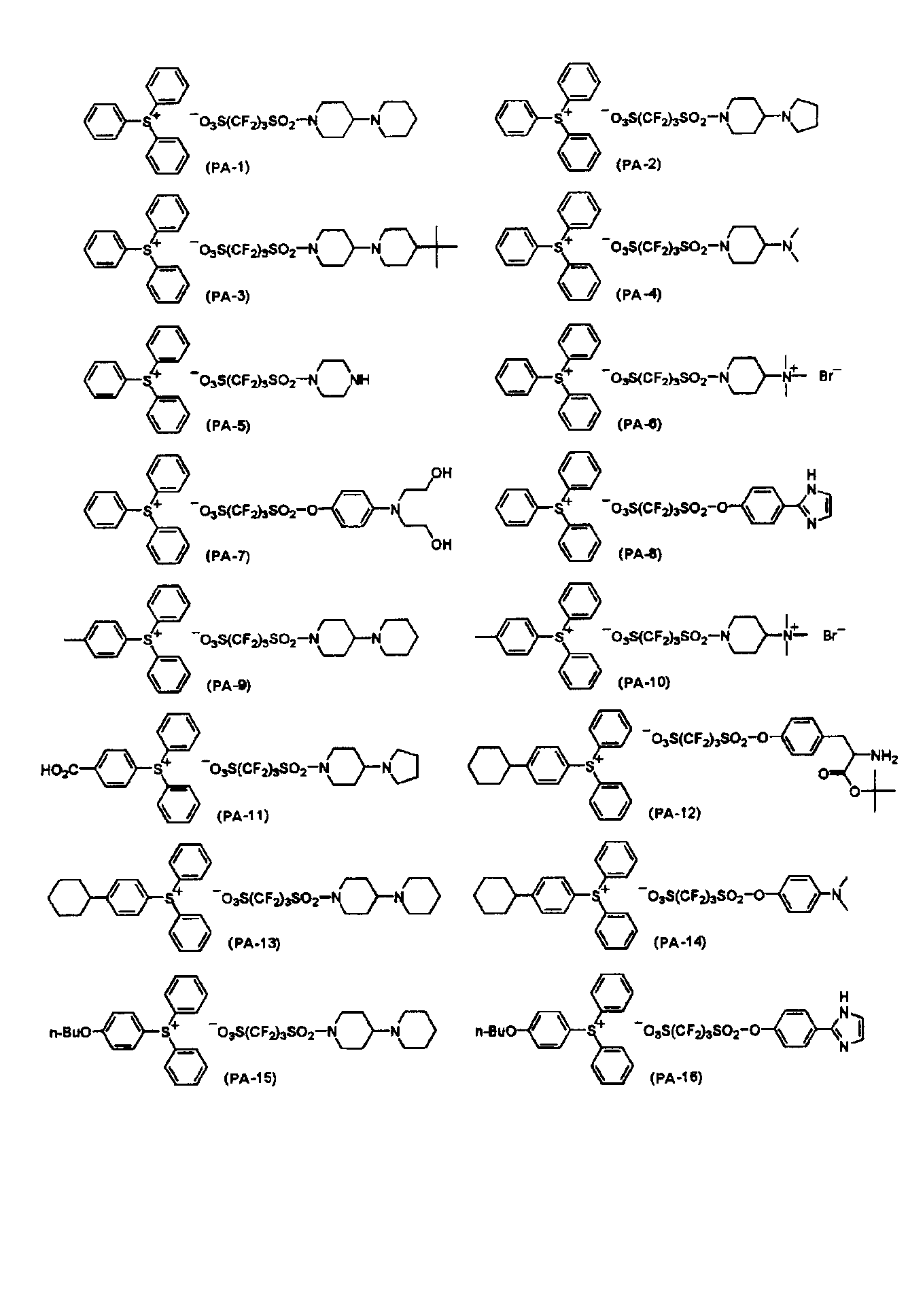
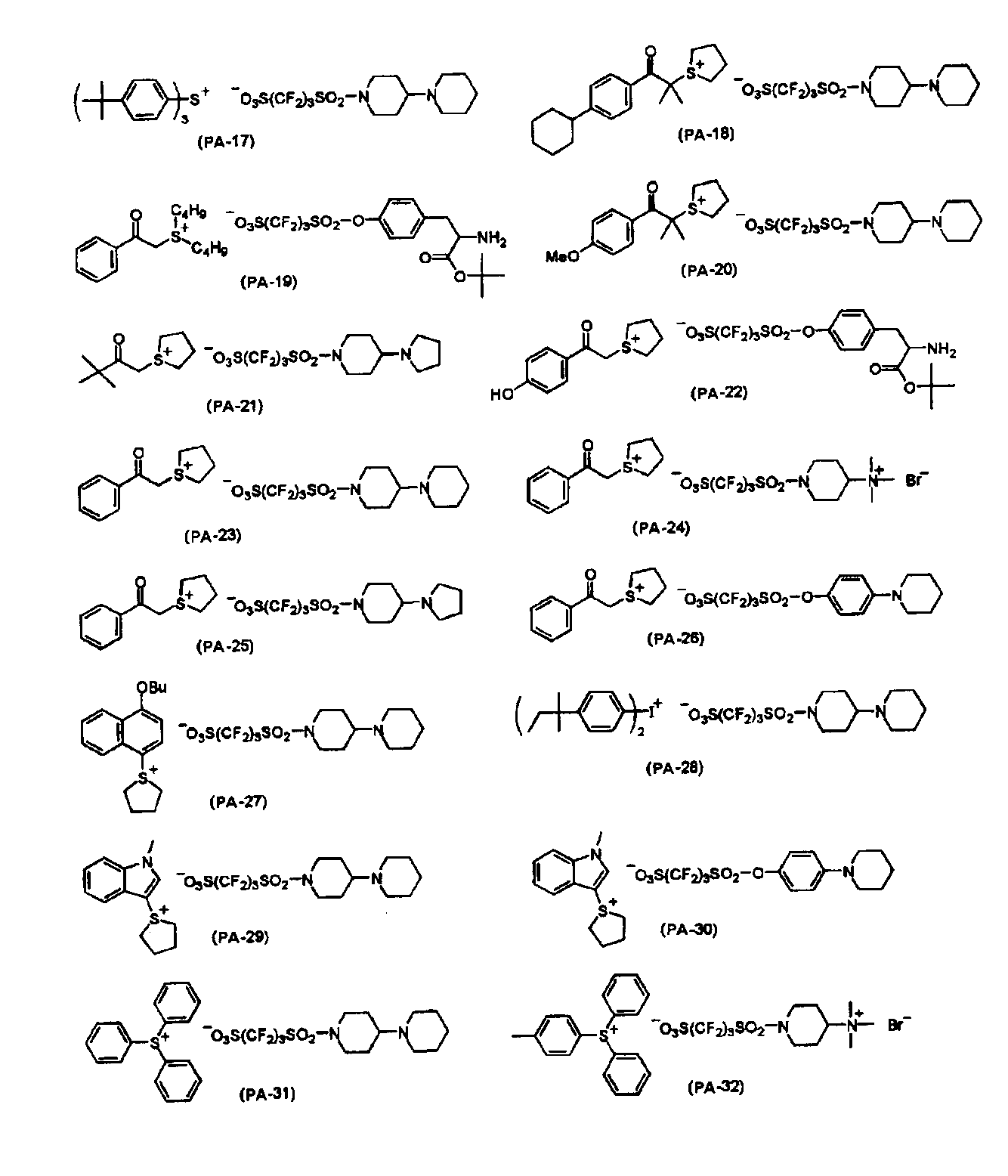


また、本発明においては、一般式(PA-1)で表される化合物を発生する化合物以外の化合物(PA)も適宜選択可能である。例えば、イオン性化合物であって、カチオン部にプロトンアクセプター部位を有する化合物を用いてもよい。より具体的には、下記一般式(7)で表される化合物などが挙げられる。
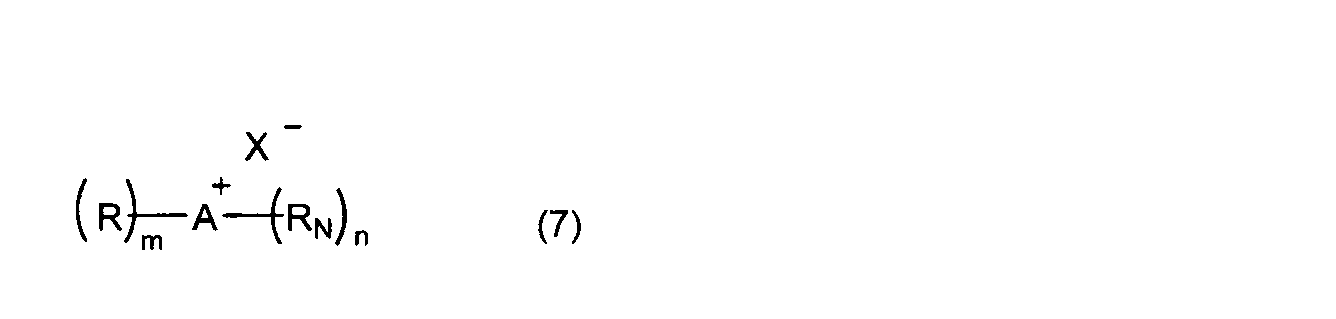
式中、Aは硫黄原子又はヨウ素原子を表す。
mは1又は2を表し、nは1又は2を表す。但し、Aが硫黄原子の時、m+n=3、Aがヨウ素原子の時、m+n=2である。
Rは、アリール基を表す。
RNは、プロトンアクセプター性官能基で置換されたアリール基を表す。
X-は、対アニオンを表す。
X-の具体例としては、上述した一般式(ZI)におけるX-と同様のものが挙げられる。
R及びRNのアリール基の具体例としては、フェニル基が好ましく挙げられる。
RNが有するプロトンアクセプター性官能基の具体例としては、前述の式(PA-1)で説明したプロトンアクセプター性官能基と同様である。
本発明の組成物において、化合物(PA)の組成物全体中の配合率は、全固形分中0.1~10質量%が好ましく、より好ましくは1~8質量%である。
(6)グアニジン化合物
本発明の組成物は、下式で表される構造を有するグアニジン化合物を更に含有していてもよい。
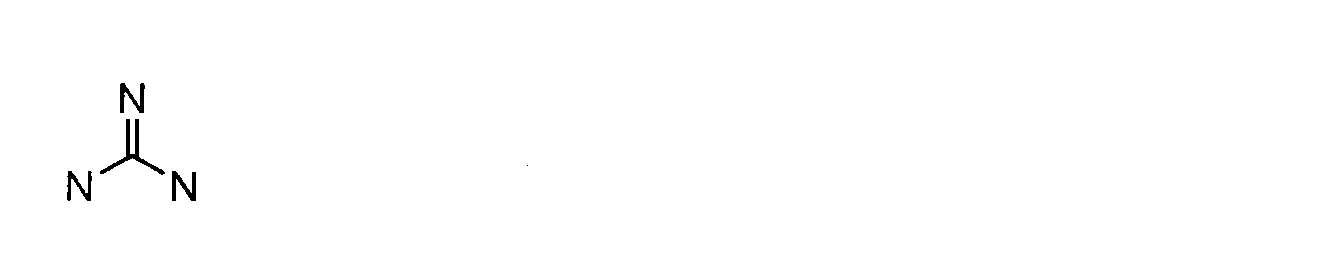
本発明の組成物は、下式で表される構造を有するグアニジン化合物を更に含有していてもよい。
グアニジン化合物は3つの窒素によって共役酸のプラスの電荷が分散安定化されるた
め、強い塩基性を示す。
め、強い塩基性を示す。
本発明のグアニジン化合物(A)の塩基性としては、共役酸のpKaが6.0以上であることが好ましく、7.0~20.0であることが酸との中和反応性が高く、ラフネス特性に優れるため好ましく、8.0~16.0であることがより好ましい。
このような強い塩基性のため、酸の拡散性を抑制し、優れたパターン形状の形成に寄与することができる。
なお、ここで「pKa」とは、水溶液中でのpKaのことを表し、例えば、化学便覧(II)(改訂4版、1993年、日本化学会編、丸善株式会社)に記載のものであり、この値が低いほど酸強度が大きいことを示している。水溶液中でのpKaは、具体的には、無限希釈水溶液を用い、25℃での酸解離定数を測定することにより実測することができ、また、下記ソフトウェアパッケージ1を用いて、ハメットの置換基定数及び公知文献値のデータベースに基づいた値を、計算により求めることもできる。本明細書中に記載したpKaの値は、全て、このソフトウェアパッケージを用いて計算により求めた値を示している。
ソフトウェアパッケージ1:AdvancedChemistryDevelopment(ACD/Labs)SoftwareV8.14forSolaris(1994-2007ACD/Labs)。
本発明において、logPとは、n-オクタノール/水分配係数(P)の対数値であり、広範囲の化合物に対し、その親水性/疎水性を特徴づけることのできる有効なパラメータである。一般的には実験によらず計算によって分配係数は求められ、本発明においては、CSChemDrawUltraVer.8.0softwarepackage(Crippen’sfragmentationmethod)により計算された値を示す。
また、グアニジン化合物(A)のlogPが10以下であることが好ましい。上記値以下であることによりレジスト膜中に均一に含有させることができる。
本発明におけるグアニジン化合物(A)のlogPは2~10の範囲であることが好ましく、3~8の範囲であることがより好ましく、4~8の範囲であることが更に好ましい。
また、本発明におけるグアニジン化合物(A)はグアニジン構造以外に窒素原子を有さないことが好ましい。
以下、グアニジン化合物の具体例を示すが、これらに限定されるものではない。
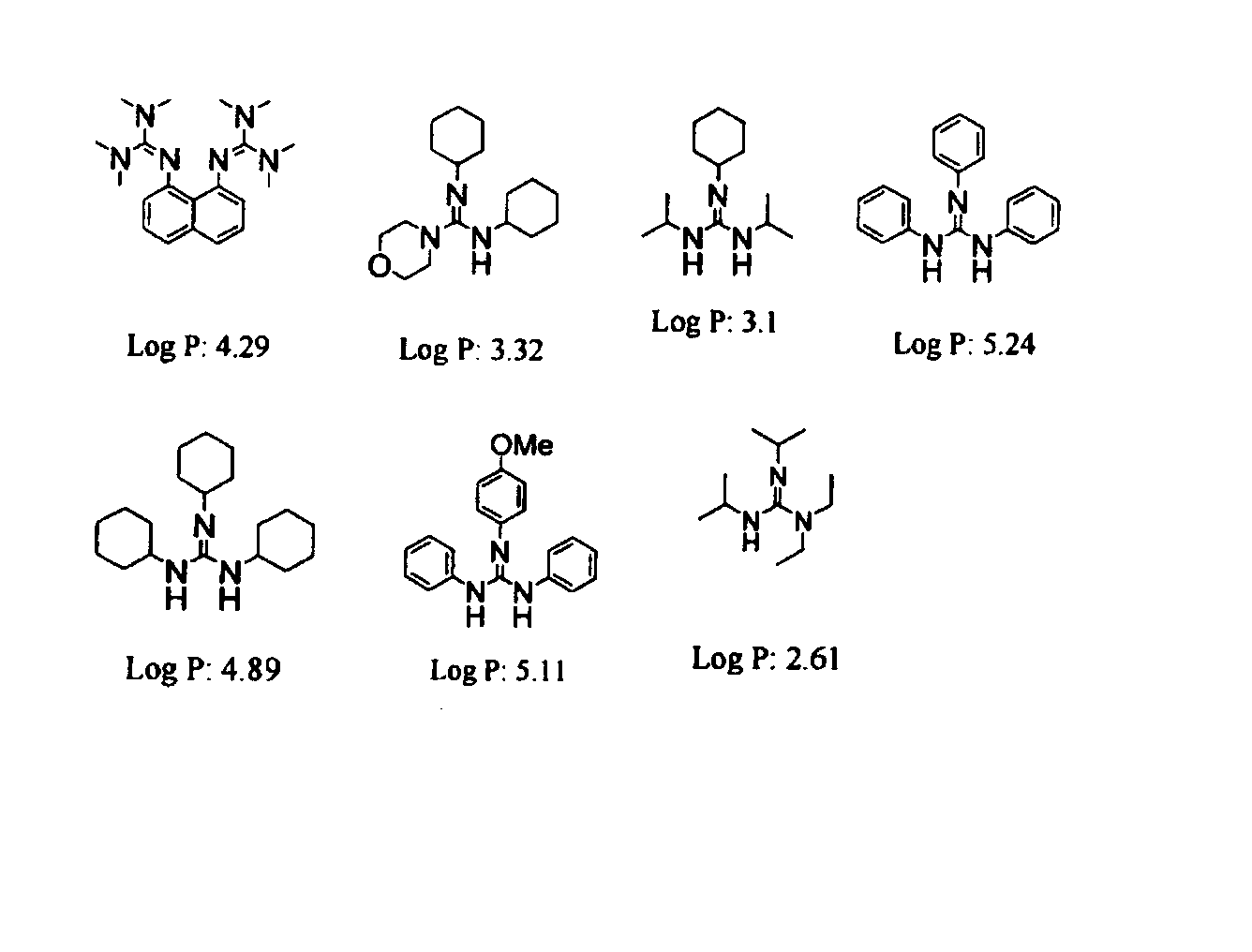

(7) 窒素原子を有し、酸の作用により脱離する基を有する低分子化合物
本発明の組成物は、窒素原子を有し、酸の作用により脱離する基を有する低分子化合物(以下において、「低分子化合物(D)」又は「化合物(D)」ともいう)を含有することができる。低分子化合物(D)は、酸の作用により脱離する基が脱離した後は、塩基性を有することが好ましい。
本発明の組成物は、窒素原子を有し、酸の作用により脱離する基を有する低分子化合物(以下において、「低分子化合物(D)」又は「化合物(D)」ともいう)を含有することができる。低分子化合物(D)は、酸の作用により脱離する基が脱離した後は、塩基性を有することが好ましい。
酸の作用により脱離する基としては特に限定されないが、アセタール基、カルボネート基、カルバメート基、3級エステル基、3級水酸基、ヘミアミナールエーテル基が好ましく、カルバメート基、ヘミアミナールエーテル基であることが特に好ましい。
酸の作用により脱離する基を有する低分子化合物(D)の分子量は、100~1000が好ましく、100~700がより好ましく、100~500が特に好ましい。
化合物(D)としては、酸の作用により脱離する基を窒素原子上に有するアミン誘導体が好ましい。
化合物(D)は、窒素原子上に保護基を有するカルバメート基を有しても良い。カルバメート基を構成する保護基としては、下記一般式(d-1)で表すことができる。
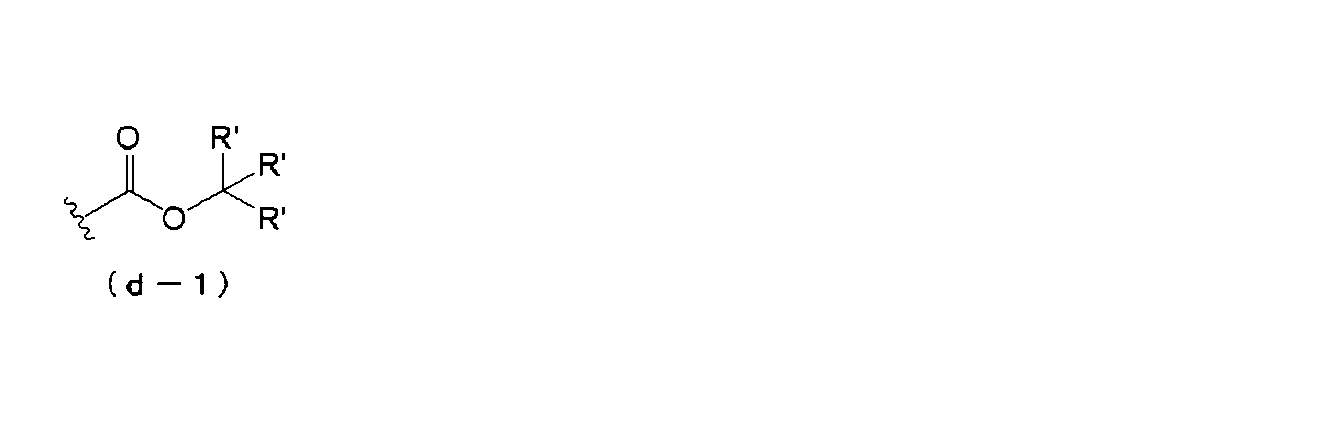
一般式(d-1)において、
R’は、それぞれ独立に、水素原子、直鎖状又は分岐状アルキル基、シクロアルキル基、アリール基、アラルキル基、又はアルコキシアルキル基を表す。R’は相互に結合して環を形成していても良い。
R’は、それぞれ独立に、水素原子、直鎖状又は分岐状アルキル基、シクロアルキル基、アリール基、アラルキル基、又はアルコキシアルキル基を表す。R’は相互に結合して環を形成していても良い。
R’として好ましくは、直鎖状、又は分岐状のアルキル基、シクロアルキル基、アリール基である。より好ましくは、直鎖状、又は分岐状のアルキル基、シクロアルキル基である。
このような基の具体的な構造を以下に示す。

化合物(D)は、塩基性化合物と一般式(d-1)で表される構造を任意に組み合わせることで構成することも出来る。
化合物(D)は、下記一般式(D)で表される構造を有するものであることが特に好ましい。
なお、化合物(D)は、酸の作用により脱離する基を有する低分子化合物であるかぎり、前記の塩基性化合物に相当するものであってもよい。

一般式(D)において、Raは、水素原子、アルキル基、シクロアルキル基、アリール基又はアラルキル基を示す。また、n=2のとき、2つのRaは同じでも異なっていてもよく、2つのRaは相互に結合して、2価の複素環式炭化水素基(好ましくは炭素数20以下)若しくはその誘導体を形成していてもよい。
Rbは、それぞれ独立に、水素原子、アルキル基、シクロアルキル基、アリール基、アラルキル基、アルコキシアルキル基を示す。但し、-C(Rb)(Rb)(Rb)において、1つ以上のRbが水素原子のとき、残りのRbの少なくとも1つはシクロプロピル基、1-アルコキシアルキル基又はアリール基である。
少なくとも2つのRbが結合して脂環式炭化水素基、芳香族炭化水素基、複素環式炭化水素基若しくはその誘導体を形成していてもよい。
nは0~2の整数を表し、mは1~3の整数を表し、n+m=3である。
一般式(D)において、Ra及びRbが示すアルキル基、シクロアルキル基、アリール基、アラルキル基は、ヒドロキシル基、シアノ基、アミノ基、ピロリジノ基、ピペリジノ基、モルホリノ基、オキソ基等の官能基、アルコキシ基、ハロゲン原子で置換されていてもよい。Rbが示すアルコキシアルキル基についても同様である。
前記Ra及び/又はRbのアルキル基、シクロアルキル基、アリール基、及びアラルキル基(これらのアルキル基、シクロアルキル基、アリール基、及びアラルキル基は、上記官能基、アルコキシ基、ハロゲン原子で置換されていてもよい)としては、
例えば、メタン、エタン、プロパン、ブタン、ペンタン、ヘキサン、ヘプタン、オクタン、ノナン、デカン、ウンデカン、ドデカン等の直鎖状、分岐状のアルカンに由来する基、これらのアルカンに由来する基を、例えば、シクロブチル基、シクロペンチル基、シクロヘキシル基等のシクロアルキル基の1種以上或いは1個以上で置換した基、
シクロブタン、シクロペンタン、シクロヘキサン、シクロヘプタン、シクロオクタン、ノルボルナン、アダマンタン、ノラダマンタン等のシクロアルカンに由来する基、これらのシクロアルカンに由来する基を、例えば、メチル基、エチル基、n-プロピル基、i-プロピル基、n-ブチル基、2-メチルプロピル基、1-メチルプロピル基、t-ブチル基等の直鎖状、分岐状のアルキル基の1種以上或いは1個以上で置換した基、
ベンゼン、ナフタレン、アントラセン等の芳香族化合物に由来する基、これらの芳香族化合物に由来する基を、例えば、メチル基、エチル基、n-プロピル基、i-プロピル基、n-ブチル基、2-メチルプロピル基、1-メチルプロピル基、t-ブチル基等の直鎖状、分岐状のアルキル基の1種以上或いは1個以上で置換した基、
ピロリジン、ピペリジン、モルホリン、テトラヒドロフラン、テトラヒドロピラン、インドール、インドリン、キノリン、パーヒドロキノリン、インダゾール、ベンズイミダゾール等の複素環化合物に由来する基、これらの複素環化合物に由来する基を直鎖状、分岐状のアルキル基或いは芳香族化合物に由来する基の1種以上或いは1個以上で置換した基、直鎖状、分岐状のアルカンに由来する基・シクロアルカンに由来する基をフェニル基、ナフチル基、アントラセニル基等の芳香族化合物に由来する基の1種以上或いは1個以上で置換した基等或いは前記の置換基がヒドロキシル基、シアノ基、アミノ基、ピロリジノ基、ピペリジノ基、モルホリノ基、オキソ基等の官能基で置換された基等が挙げられる。
例えば、メタン、エタン、プロパン、ブタン、ペンタン、ヘキサン、ヘプタン、オクタン、ノナン、デカン、ウンデカン、ドデカン等の直鎖状、分岐状のアルカンに由来する基、これらのアルカンに由来する基を、例えば、シクロブチル基、シクロペンチル基、シクロヘキシル基等のシクロアルキル基の1種以上或いは1個以上で置換した基、
シクロブタン、シクロペンタン、シクロヘキサン、シクロヘプタン、シクロオクタン、ノルボルナン、アダマンタン、ノラダマンタン等のシクロアルカンに由来する基、これらのシクロアルカンに由来する基を、例えば、メチル基、エチル基、n-プロピル基、i-プロピル基、n-ブチル基、2-メチルプロピル基、1-メチルプロピル基、t-ブチル基等の直鎖状、分岐状のアルキル基の1種以上或いは1個以上で置換した基、
ベンゼン、ナフタレン、アントラセン等の芳香族化合物に由来する基、これらの芳香族化合物に由来する基を、例えば、メチル基、エチル基、n-プロピル基、i-プロピル基、n-ブチル基、2-メチルプロピル基、1-メチルプロピル基、t-ブチル基等の直鎖状、分岐状のアルキル基の1種以上或いは1個以上で置換した基、
ピロリジン、ピペリジン、モルホリン、テトラヒドロフラン、テトラヒドロピラン、インドール、インドリン、キノリン、パーヒドロキノリン、インダゾール、ベンズイミダゾール等の複素環化合物に由来する基、これらの複素環化合物に由来する基を直鎖状、分岐状のアルキル基或いは芳香族化合物に由来する基の1種以上或いは1個以上で置換した基、直鎖状、分岐状のアルカンに由来する基・シクロアルカンに由来する基をフェニル基、ナフチル基、アントラセニル基等の芳香族化合物に由来する基の1種以上或いは1個以上で置換した基等或いは前記の置換基がヒドロキシル基、シアノ基、アミノ基、ピロリジノ基、ピペリジノ基、モルホリノ基、オキソ基等の官能基で置換された基等が挙げられる。
また、前記Raが相互に結合して、形成する2価の複素環式炭化水素基(好ましくは炭素数1~20)若しくはその誘導体としては、例えば、ピロリジン、ピペリジン、モルホリン、1,4,5,6-テトラヒドロピリミジン、1,2,3,4-テトラヒドロキノリン、1,2,3,6-テトラヒドロピリジン、ホモピペラジン、4-アザベンズイミダゾール、ベンゾトリアゾール、5-アザベンゾトリアゾール、1H-1,2,3-トリアゾール、1,4,7-トリアザシクロノナン、テトラゾール、7-アザインドール、インダゾール、ベンズイミダゾール、イミダゾ[1,2-a]ピリジン、(1S,4S)-(+)-2,5-ジアザビシクロ[2.2.1]ヘプタン、1,5,7-トリアザビシクロ[4.4.0]デック-5-エン、インドール、インドリン、1,2,3,4-テトラヒドロキノキサリン、パーヒドロキノリン、1,5,9-トリアザシクロドデカン等の複素環式化合物に由来する基、これらの複素環式化合物に由来する基を直鎖状、分岐状のアルカンに由来する基、シクロアルカンに由来する基、芳香族化合物に由来する基、複素環化合物に由来する基、ヒドロキシル基、シアノ基、アミノ基、ピロリジノ基、ピペリジノ基、モルホリノ基、オキソ基等の官能基の1種以上或いは1個以上で置換した基等が挙げられる。
本発明における特に好ましい化合物(D)を具体的に示すが、本発明は、これに限定されるものではない。

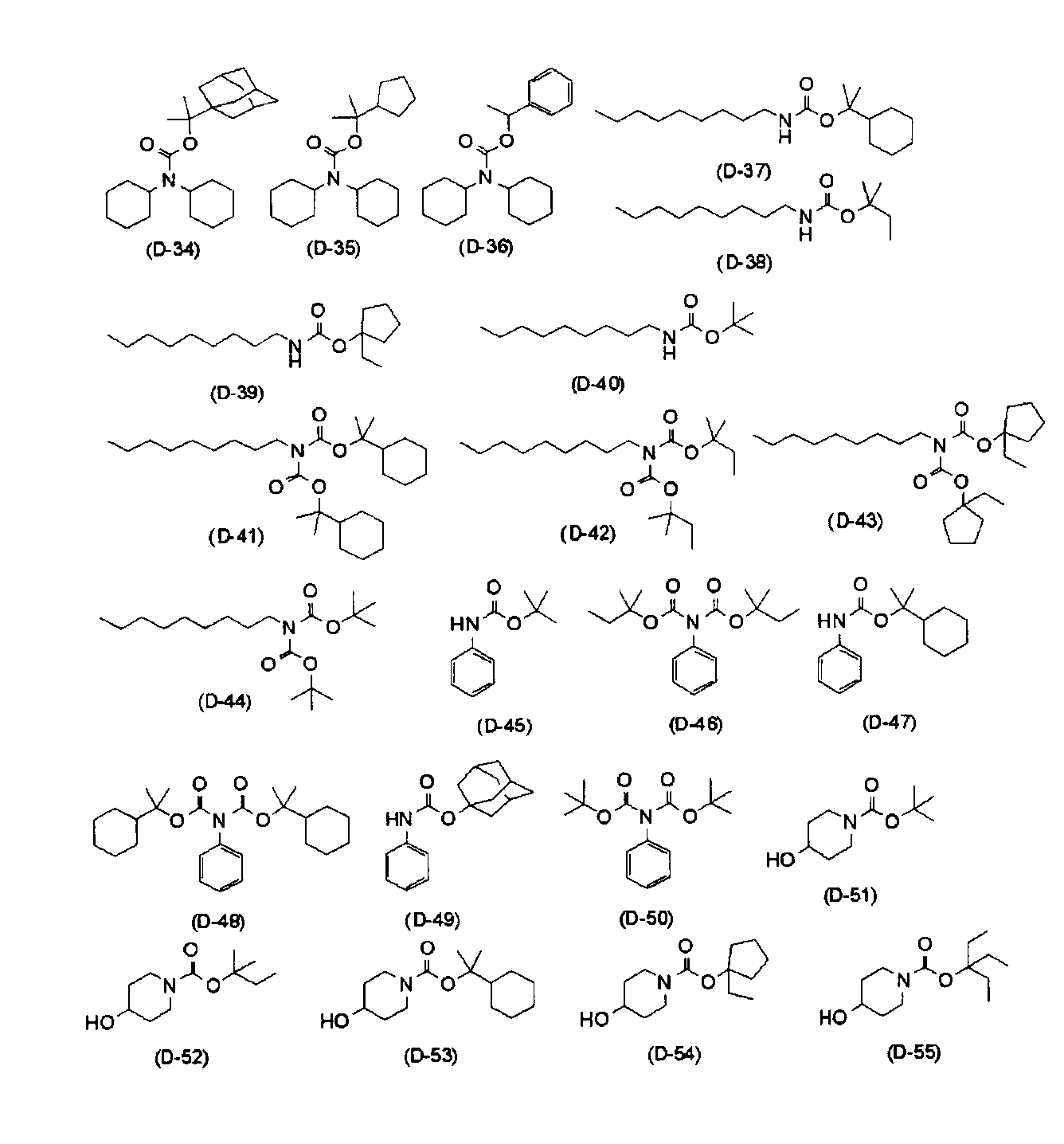

一般式(D)で表される化合物は、特開2007-298569号公報、特開2009-199021号公報などに基づき合成することができる。
本発明において、低分子化合物(D)は、一種単独でも又は2種以上を混合しても使用することができる。
本発明の組成物は、低分子化合物(D)を含有してもしなくてもよいが、含有する場合、化合物(D)の含有量は、上述した塩基性化合物と合わせた組成物の全固形分を基準として、通常、0.001~20質量%、好ましくは0.001~10質量%、より好ましくは0.01~5質量%である。
また、本発明の組成物が酸発生剤を含有する場合、酸発生剤と化合物(D)の組成物中の使用割合は、酸発生剤/[化合物(D)+下記塩基性化合物](モル比)=2.5~300であることが好ましい。即ち、感度、解像度の点からモル比が2.5以上が好ましく、露光後加熱処理までの経時でのレジストパターンの太りによる解像度の低下抑制の点から300以下が好ましい。酸発生剤/[化合物(D)+上記塩基性化合物](モル比)は、より好ましくは5.0~200、更に好ましくは7.0~150である。
その他、本発明に係る組成物に使用可能なものとして、特開2002-363146号公報の実施例で合成されている化合物、及び特開2007-298569号公報の段落0108に記載の化合物等が挙げられる。
塩基性化合物として、感光性の塩基性化合物を用いてもよい。感光性の塩基性化合物としては、例えば、特表2003-524799号公報、及び、J.Photopolym.Sci&Tech.Vol.8,P.543-553(1995)等に記載の化合物を用いることができる。
塩基性化合物の分子量は、通常は100~1500であり、好ましくは150~1300であり、より好ましくは200~1000である。
これらの塩基性化合物は、1種類を単独で用いてもよく、2種類以上を組み合わせて用いてもよい。
本発明に係る組成物が塩基性化合物を含んでいる場合、その含有量は、組成物の全固形分を基準として、0.01~8.0質量%であることが好ましく、0.1~5.0質量%であることがより好ましく、0.2~4.0質量%であることが特に好ましい。
塩基性化合物の光酸発生剤に対するモル比は、好ましくは0.01~10とし、より好ましくは0.05~5とし、更に好ましくは0.1~3とする。このモル比を過度に大きくすると、感度及び/又は解像度が低下する場合がある。このモル比を過度に小さくすると、露光と加熱(ポストベーク)との間において、パターンの細りを生ずる可能性がある。より好ましくは0.05~5、更に好ましくは0.1~3である。なお、上記モル比における光酸発生剤とは、上記樹脂の繰り返し単位(B)と上記樹脂が更に含んでいてもよい光酸発生剤との合計の量を基準とするものである。
[7]界面活性剤
本発明に係る感活性光線性又は感放射線性樹脂組成物は、界面活性剤を更に含んでいてもよい。この界面活性剤としては、フッ素系及び/又はシリコン系界面活性剤が特に好ましい。
本発明に係る感活性光線性又は感放射線性樹脂組成物は、界面活性剤を更に含んでいてもよい。この界面活性剤としては、フッ素系及び/又はシリコン系界面活性剤が特に好ましい。
フッ素系及び/又はシリコン系界面活性剤としては、例えば、大日本インキ化学工業(株)製のメガファックF176及びメガファックR08、OMNOVA社製のPF656及びPF6320、トロイケミカル(株)製のトロイゾルS-366、住友スリーエム(株)製のフロラードFC430、並びに、信越化学工業(株)製のポリシロキサンポリマーKP-341が挙げられる。
フッ素系及び/又はシリコン系以外の界面活性剤を使用してもよい。この界面活性剤としては、例えば、ポリオキシエチレンアルキルエーテル類及びポリオキシエチレンアルキルアリールエーテル類等のノニオン系界面活性剤が挙げられる。
その他、公知の界面活性剤を適宜使用することができる。使用可能な界面活性剤としては、例えば、米国特許2008/0248425A1号明細書の[0273]以降に記載の界面活性剤が挙げられる。
界面活性剤は、1種類を単独で使用してもよいし、2種類以上を組み合わせて使用してもよい。
本発明に係る組成物が界面活性剤を更に含んでいる場合、その使用量は、組成物の全固形分を基準として、好ましくは0.0001~2質量%とし、より好ましくは0.001~1質量%とする。
本発明に係る組成物が界面活性剤を更に含んでいる場合、その使用量は、組成物の全固形分を基準として、好ましくは0.0001~2質量%とし、より好ましくは0.001~1質量%とする。
[8] その他の添加剤
本発明の組成物は、上記に説明した成分以外にも、カルボン酸、カルボン酸オニウム塩、Proceeding of SPIE, 2724,355 (1996)等に記載の分子量3000以下の溶解阻止化合物、染料、可塑剤、光増感剤、光吸収剤、酸化防止剤などを適宜含有することができる。
本発明の組成物は、上記に説明した成分以外にも、カルボン酸、カルボン酸オニウム塩、Proceeding of SPIE, 2724,355 (1996)等に記載の分子量3000以下の溶解阻止化合物、染料、可塑剤、光増感剤、光吸収剤、酸化防止剤などを適宜含有することができる。
特にカルボン酸は、性能向上のために好適に用いられる。カルボン酸としては、安息香酸、ナフトエ酸などの、芳香族カルボン酸が好ましい。
カルボン酸の含有量は、組成物の全固形分濃度中、0.01~10質量%が好ましく、より好ましくは0.01~5質量%、更に好ましくは0.01~3質量%である。
本発明における感活性光線性又は感放射線性樹脂組成物は、解像力向上の観点から、膜厚10~250nmで使用されることが好ましく、より好ましくは、膜厚20~200nmで使用されることが好ましく、更に好ましくは30~100nmで使用されることが好ましい。組成物中の固形分濃度を適切な範囲に設定して適度な粘度をもたせ、塗布性、製膜性を向上させることにより、このような膜厚とすることができる。
本発明における感活性光線性又は感放射線性樹脂組成物の固形分濃度は、通常1.0~10質量%であり、好ましくは、2.0~5.7質量%、更に好ましくは2.0~5.3質量%である。固形分濃度を前記範囲とすることで、レジスト溶液を基板上に均一に塗布することができ、更にはラインウィズスラフネスに優れたレジストパターンを形成することが可能になる。その理由は明らかではないが、恐らく、固形分濃度を10質量%以下、好ましくは5.7質量%以下とすることで、レジスト溶液中での素材、特には光酸発生剤の凝集が抑制され、その結果として、均一なレジスト膜が形成できたものと考えられる。
固形分濃度とは、感活性光線性又は感放射線性樹脂組成物の総重量に対する、溶剤を除く他のレジスト成分の重量の重量百分率である。
本発明における感活性光線性又は感放射線性樹脂組成物は、上記の成分を所定の有機溶剤、好ましくは前記混合溶剤に溶解し、フィルター濾過した後、所定の支持体(基板)上に塗布して用いる。フィルター濾過に用いるフィルターのポアサイズは0.1μm以下、より好ましくは0.05μm以下、更に好ましくは0.03μm以下のポリテトラフロロエチレン製、ポリエチレン製、ナイロン製のものが好ましい。フィルター濾過においては、例えば特開2002-62667号公報のように、循環的な濾過を行ったり、複数種類のフィルターを直列又は並列に接続して濾過を行ったりしてもよい。また、組成物を複数回濾過してもよい。更に、フィルター濾過の前後で、組成物に対して脱気処理などを行ってもよい。
<パターン形成方法>
本発明は、上記した本発明の組成物を用いて形成された感活性光線性又は感放射線性膜に関する。また、本発明のパターン形成方法は、上記感活性光線性又は感放射線性膜を、露光、現像する工程を有している。
本発明は、上記した本発明の組成物を用いて形成された感活性光線性又は感放射線性膜に関する。また、本発明のパターン形成方法は、上記感活性光線性又は感放射線性膜を、露光、現像する工程を有している。
本発明に係る組成物は、典型的には、以下のようにして用いられる。即ち、本発明に係る組成物は、典型的には、基板等の支持体上に塗布されて、膜を形成する。この膜の厚みは、0.02~0.1μmが好ましい。基板上に塗布する方法としては、スピン塗布が好ましく、その回転数は1000~3000rpmが好ましい。
この組成物は、例えば、精密集積回路素子やインプリント用モールドなどの製造等に使用される基板(例:シリコン/二酸化シリコン被覆、窒化シリコン及びクロム蒸着された石英基板など)上に、スピナー及びコーター等を用いて塗布される。その後、これを乾燥させて、感活性光線性又は感放射線性の膜(以下、レジスト膜ともいう)を形成する。なお、公知の反射防止膜を予め塗設することもできる。
次いで、上記の感活性光線性又は感放射線性膜に活性光線又は放射線を照射し、好ましくはベーク(通常80~150℃、より好ましくは90~130℃)を行った後、現像する。ベークを行うことにより、更に良好なパターンを得ることが可能となる。
活性光線又は放射線としては、例えば、赤外光、可視光、紫外光、遠紫外光、X線、及び電子線が挙げられる。これら活性光線又は放射線としては、例えば250nm以下、特には220nm以下の波長を有したものがより好ましい。このような活性光線又は放射線としては、例えば、KrFエキシマレーザー(248nm)、ArFエキシマレーザー(193nm)、F2エキシマレーザー(157nm)、X線、及び電子線が挙げられる。好ましい活性光線又は放射線としては、例えば、KrFエキシマーレーザー、電子線、X線及びEUV光が挙げられる。より好ましくは、電子線、X線及びEUV光である。
すなわち、本発明は、KrFエキシマーレーザー、電子線、X線又はEUV光用(より好ましくは電子線、X線又はEUV光用)感活性光線性又は感放射線性樹脂組成物にも関する。
現像工程では、通常、アルカリ現像液を用いる。
アルカリ現像液としては、例えば、水酸化ナトリウム、水酸化カリウム、炭酸ナトリウム、ケイ酸ナトリウム、メタケイ酸ナトリウム及びアンモニア水等の無機アルカリ類、エチルアミン及びn-プロピルアミン等の第一アミン類、ジエチルアミン及びジ-n-ブチルアミン等の第二アミン類、トリエチルアミン及びメチルジエチルアミン等の第三アミン類、ジメチルエタノールアミン及びトリエタノールアミン等のアルコールアミン類、テトラメチルアンモニウムヒドロキシド及びテトラエチルアンモニウムヒドロキシド等の第四級アンモニウム塩、又は、ピロール及びピヘリジン等の環状アミン類を含んだアルカリ性水溶液が挙げられる。
アルカリ現像液としては、例えば、水酸化ナトリウム、水酸化カリウム、炭酸ナトリウム、ケイ酸ナトリウム、メタケイ酸ナトリウム及びアンモニア水等の無機アルカリ類、エチルアミン及びn-プロピルアミン等の第一アミン類、ジエチルアミン及びジ-n-ブチルアミン等の第二アミン類、トリエチルアミン及びメチルジエチルアミン等の第三アミン類、ジメチルエタノールアミン及びトリエタノールアミン等のアルコールアミン類、テトラメチルアンモニウムヒドロキシド及びテトラエチルアンモニウムヒドロキシド等の第四級アンモニウム塩、又は、ピロール及びピヘリジン等の環状アミン類を含んだアルカリ性水溶液が挙げられる。
アルカリ現像液には、適当量のアルコール類及び/又は界面活性剤を添加してもよい。
アルカリ現像液の濃度は、通常は0.1~20質量%である。アルカリ現像液のpH
は、通常は10.0~15.0である。
アルカリ現像液の濃度は、通常は0.1~20質量%である。アルカリ現像液のpH
は、通常は10.0~15.0である。
本発明の組成物は、塗布、製膜、露光した後に、有機溶剤を主成分とする現像液を用いて現像し、ネガ型パターンを得るプロセスにも用いることができる。このようなプロセスとしては例えば特開2010-217884号公報に記載されているプロセスを用いることができる。
有機系現像液としては、エステル系溶剤(例えば、酢酸ブチル、酢酸エチルなど)、ケトン系溶剤(例えば、2-ヘプタノン、シクロヘキサノンなど)、アルコール系溶剤、アミド系溶剤、エーテル系溶剤等の極性溶剤及び炭化水素系溶剤を用いることができる。有機系現像液全体としての含水率は10質量%未満であることが好ましく、実質的に水分を含有しないことがより好ましい。
有機系現像液は塩基性化合物を有していてもよく、具体的には本発明の樹脂組成物が含みうる塩基性化合物として記載した化合物が挙げられる。」「有機溶剤現像とアルカリ現像を組み合わせた二重現像プロセスを行ってもよい。
なお、本発明に係る組成物を用いてインプリント用モールドを作製してもよく、その詳細については、例えば、特許第4109085号公報、特開2008-162101号公報、及び「ナノインプリントの基礎と技術開発・応用展開―ナノインプリントの基板技術と最新の技術展開―編集:平井義彦(フロンティア出版)」を参照されたい。
以下、本発明の態様を実施例により更に詳細に説明するが、本発明の内容がこれにより限定されるものではない。
〔合成例1:樹脂(Aa-22)〕
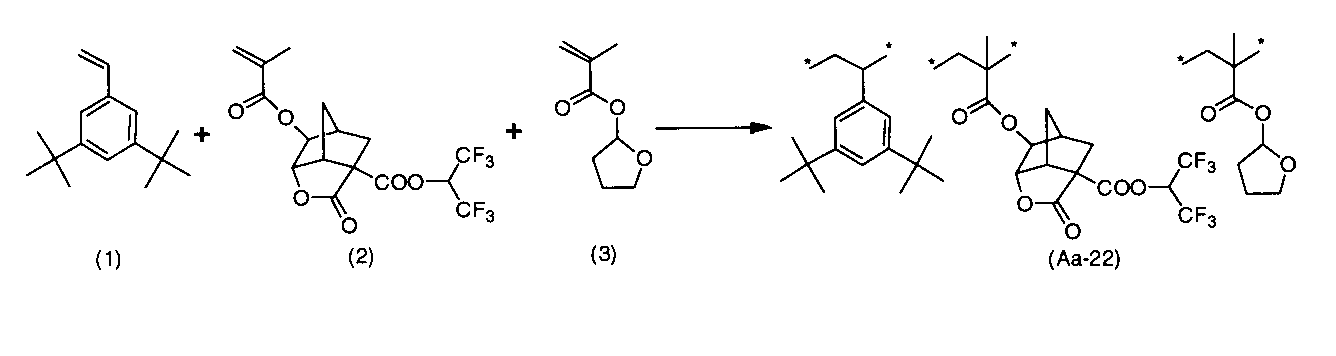
〔合成例1:樹脂(Aa-22)〕
樹脂(Aa-22)を、下記スキームに従って合成した。
0.43gの化合物(1)と、13.32gの化合物(2)と、0.94gの化合物(3)と、0.55gの重合開始剤V-601(和光純薬工業(株)製)とを、66.60gのシクロヘキサノンに溶解させた。反応容器中に16.65gのシクロヘキサノンを入れ、窒素ガス雰囲気下、85℃の系中に4時間かけて滴下した。反応溶液を2時間に亘って加熱撹拌した後、これを室温まで放冷した。
0.43gの化合物(1)と、13.32gの化合物(2)と、0.94gの化合物(3)と、0.55gの重合開始剤V-601(和光純薬工業(株)製)とを、66.60gのシクロヘキサノンに溶解させた。反応容器中に16.65gのシクロヘキサノンを入れ、窒素ガス雰囲気下、85℃の系中に4時間かけて滴下した。反応溶液を2時間に亘って加熱撹拌した後、これを室温まで放冷した。
上記反応溶液を、1000gのヘプタン/酢酸エチル=8/2中に滴下し、ポリマーを沈殿させ、ろ過した。300gのヘプタン/酢酸エチル=8/2を用いて、ろ過した固体のかけ洗いを行なった。その後、洗浄後の固体を減圧乾燥に供して、9.10gの樹脂(Aa-22)を得た。
この樹脂(Aa-22)について、GPC(東ソー株式会社製;HLC-8120;Tsk gel Multipore HXL-M)を用い、溶媒としてTHFを使用して重量平均分子量及び分散度を測定した。また、NMR(ブルカー・バイオスピン株式会社製;AVANCEIII400型)を用い、1H-NMR又は13C-NMRで組成比を算出した。その結果を表1に示す。
〔合成例2:樹脂(Aa-2)〕
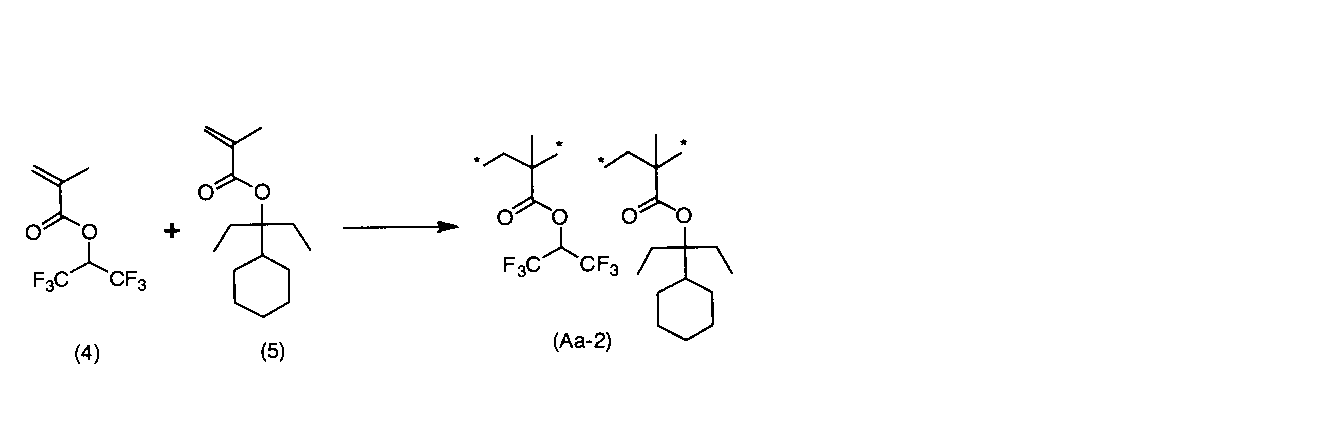
7.08gの化合物(4)と、4.77gの化合物(5)と、0.58gの重合開始剤V-601(和光純薬工業(株)製)とを、43.65gのシクロヘキサノンに溶解させた。反応容器中に23.50gのシクロヘキサノンを入れ、窒素ガス雰囲気下、85℃の系中に4時間かけて滴下した。反応溶液を2時間に亘って加熱撹拌した後、これを室温まで放冷した。
上記反応溶液を、1000gのヘプタン/酢酸エチル=9/1中に滴下し、ポリマーを沈殿させ、ろ過した。300gのヘプタン/酢酸エチル=9/1を用いて、ろ過した固体のかけ洗いを行なった。その後、洗浄後の固体を減圧乾燥に供して、5.57gの樹脂(Aa-2)を得た。
この樹脂(Aa-2)について、合成例1で述べた方法と同様の方法で、重量平均分子量、分散度及び組成比を測定した。その結果を表1に示す。
〔その他の樹脂(Aa)〕
先に挙げた樹脂(Aa-1)~(Aa-35)の中から、表1に示す樹脂の各々を、合成例1又は2で述べた方法と同様の方法で合成した。更に、比較用として、以下に示す樹脂(Aa´-1)、(Aa´-2)、(Aa´-3)及び(Aa´-4)を合成した。また、これら樹脂について、合成例1で述べた方法と同様の方法で重量平均分子量、分散度及び組成比を測定した。その結果を表1に示す。
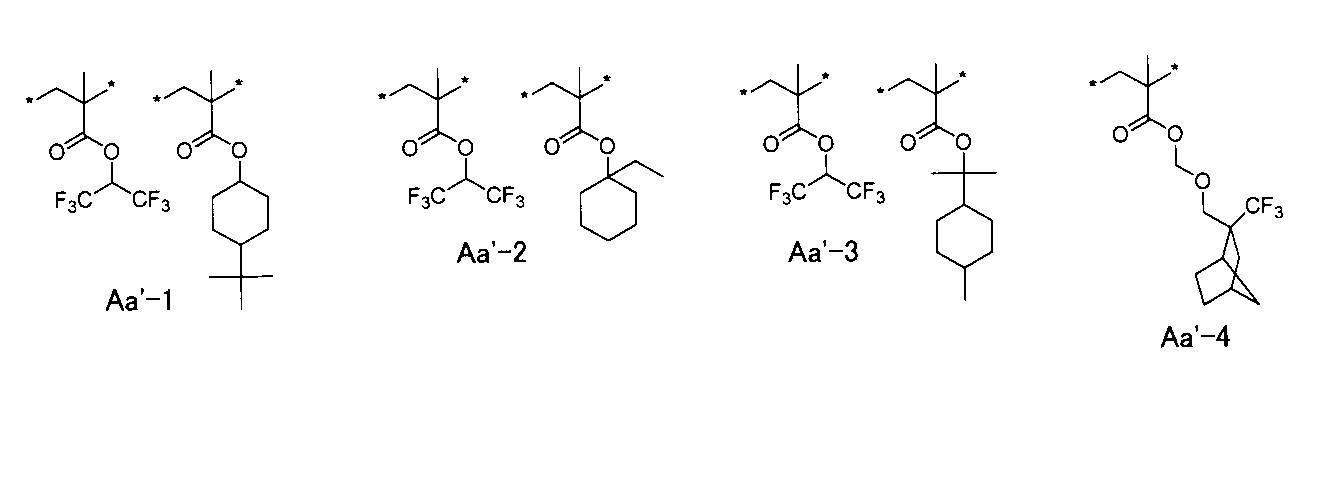

先に挙げた樹脂(Aa-1)~(Aa-35)の中から、表1に示す樹脂の各々を、合成例1又は2で述べた方法と同様の方法で合成した。更に、比較用として、以下に示す樹脂(Aa´-1)、(Aa´-2)、(Aa´-3)及び(Aa´-4)を合成した。また、これら樹脂について、合成例1で述べた方法と同様の方法で重量平均分子量、分散度及び組成比を測定した。その結果を表1に示す。
〔合成例3:樹脂(Ab-289)〕
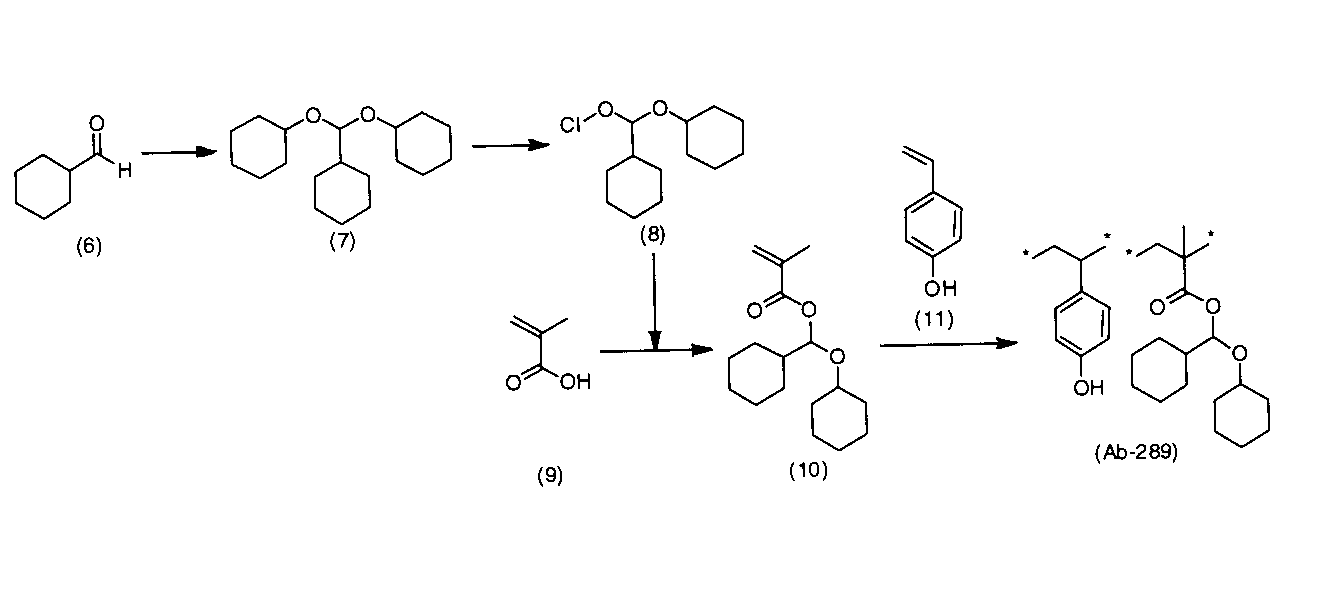
46.50gの化合物(6)を263.5gのn-ヘキサンに溶解させ、87.19gのシクロヘキサノール、46.50gの無水硫酸マグネシウム、4.81gの10-カンファースルホン酸を加えて、室温で6時間攪拌した。10.49gのトリエチルアミンを加えて、10分間攪拌した後、ろ過して固体を取り除いた。400gの酢酸エチルを加えて、有機層を200gのイオン交換水で5回洗浄した後、無水硫酸マグネシウムで乾燥し、溶媒を留去して、化合物(7)含有溶液を116.27g得た。
化合物(7)含有溶液41.19gに、8.80gの塩化アセチルを加えて、室温で2時間攪拌して、化合物(8)含有溶液を49.99g得た。
7.40gの化合物(9)を79.93gの脱水テトラヒドロフランに溶解させ、7.40gの無水硫酸マグネシウム、60.89gのトリエチルアミンを加えて、窒素雰囲気下で攪拌した。0℃に冷却し、49.99gの化合物(8)含有溶液を滴下し、室温で3時間攪拌した後、ろ過して固体を取り除いた。400gの酢酸エチルを加えて、有機層を200gのイオン交換水で5回洗浄した後、無水硫酸マグネシウムで乾燥し、溶媒を留去した。カラムクロマトグラフィーで単離精製し、23.91gの化合物(10)を得た。
6.61gの化合物(11)(50.00質量%シクロヘキサノン溶液)と、6.31gの化合物(10)と、0.35gの重合開始剤V-601(和光純薬工業(株)製)とを、32.10gのシクロヘキサノンに溶解させた。反応容器中に19.07gのシクロヘキサノンを入れ、窒素ガス雰囲気下、85℃の系中に4時間かけて滴下した。反応溶液を2時間に亘って加熱撹拌した後、これを室温まで放冷した。
上記反応溶液を、450gのヘプタン/酢酸エチル=9/1(質量比)中に滴下し、ポリマーを沈殿させ、ろ過した。200gのヘプタン/酢酸エチル=9/1(質量比)を用いて、ろ過した固体のかけ洗いを行なった。その後、洗浄後の固体を減圧乾燥に供して、4.90gの樹脂(Ab-289)を得た。
〔その他の樹脂(Ab)〕
先に挙げた樹脂(Ab-1)~(Ab-311)の中から、表2に示す樹脂の各々を、合成例3で述べた方法と同様の方法で合成した。また、これら樹脂について、合成例1で述べた方法と同様の方法で重量平均分子量、分散度及び組成比を測定した。その結果を表2に示す。

先に挙げた樹脂(Ab-1)~(Ab-311)の中から、表2に示す樹脂の各々を、合成例3で述べた方法と同様の方法で合成した。また、これら樹脂について、合成例1で述べた方法と同様の方法で重量平均分子量、分散度及び組成比を測定した。その結果を表2に示す。
〔光酸発生剤〕
光酸発生剤としては先に挙げた酸発生剤z1~z143から適宜選択して用いた。
光酸発生剤としては先に挙げた酸発生剤z1~z143から適宜選択して用いた。
〔塩基性化合物〕
塩基性化合物としては、下記化合物(N-1)~(N-10)の何れかを用いた。
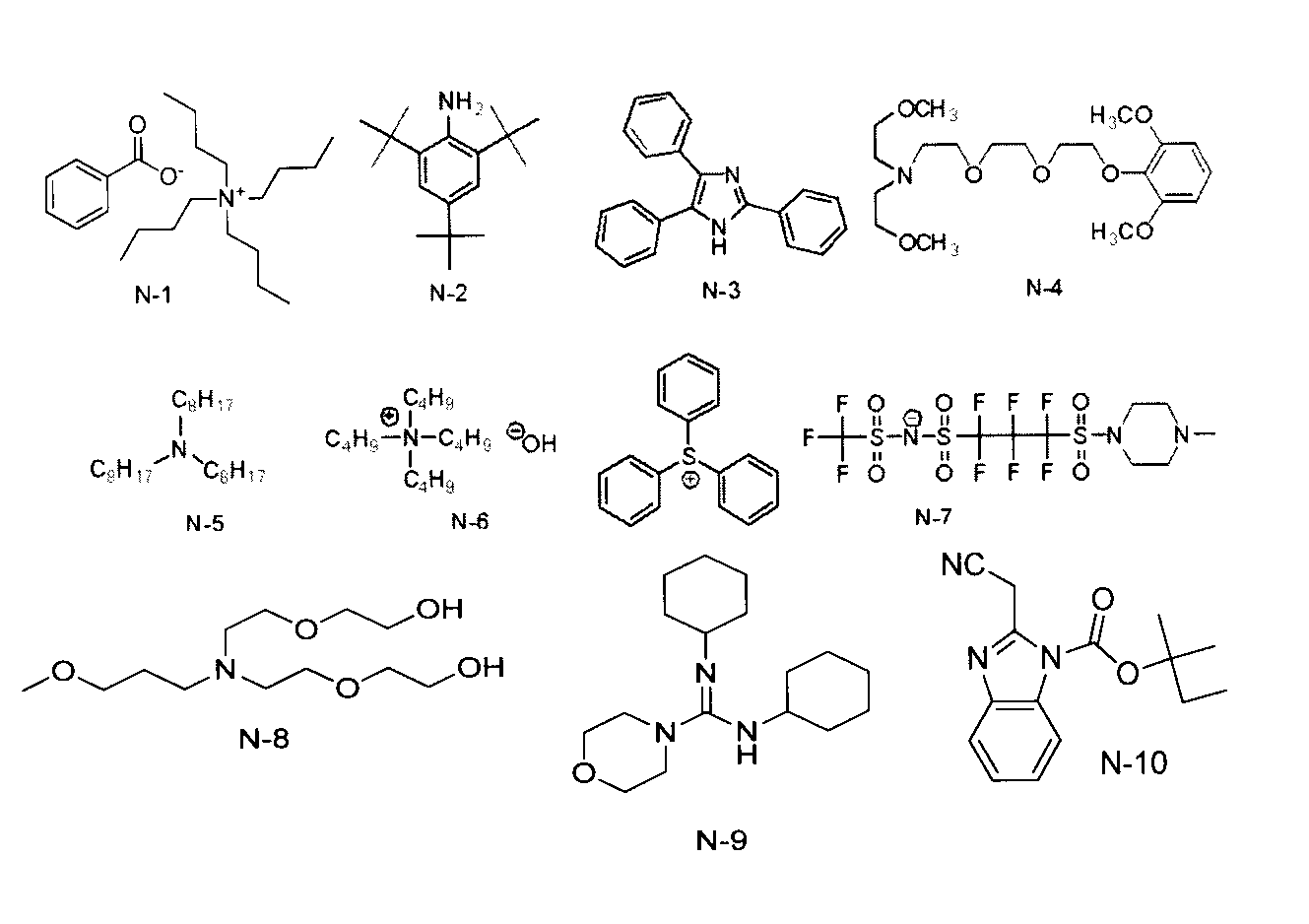
塩基性化合物としては、下記化合物(N-1)~(N-10)の何れかを用いた。
なお、上記化合物(N-7)は、上述した化合物(PA)に該当するものであり、特開2006-330098号公報の[0354]の記載に基づいて合成した。
〔界面活性剤〕
界面活性剤としては、下記W-1~W-4を用いた。
W-1:メガファックR08(大日本インキ化学工業(株)製;フッ素及びシリコン系)
W-2:ポリシロキサンポリマーKP-341(信越化学工業(株)製;シリコン系)
W-3:トロイゾルS-366(トロイケミカル(株)製;フッ素系)
W-4:PF6320(OMNOVA社製;フッ素系)
<電子線(EB)露光>(実施例1A~41A、比較例1A~5A)
(1)感活性光線性又は感放射線性樹脂組成物の塗液調製及び塗設
下表に示した組成を有する固形分濃度3質量%の塗液組成物を0.1μm孔径のメンブレンフィルターで精密ろ過して、感活性光線性又は感放射線性樹脂組成物(レジスト組成物)溶液を得た。
界面活性剤としては、下記W-1~W-4を用いた。
W-1:メガファックR08(大日本インキ化学工業(株)製;フッ素及びシリコン系)
W-2:ポリシロキサンポリマーKP-341(信越化学工業(株)製;シリコン系)
W-3:トロイゾルS-366(トロイケミカル(株)製;フッ素系)
W-4:PF6320(OMNOVA社製;フッ素系)
<電子線(EB)露光>(実施例1A~41A、比較例1A~5A)
(1)感活性光線性又は感放射線性樹脂組成物の塗液調製及び塗設
下表に示した組成を有する固形分濃度3質量%の塗液組成物を0.1μm孔径のメンブレンフィルターで精密ろ過して、感活性光線性又は感放射線性樹脂組成物(レジスト組成物)溶液を得た。
この感活性光線性又は感放射線性樹脂組成物を、予めヘキサメチルジシラザン(HMDS)処理を施した6インチSiウェハ上に東京エレクトロン製スピンコーターMark8を用いて塗布し、100℃、60秒間ホットプレート上で乾燥して、膜厚100nmのレジスト膜を得た。
(2)EB露光及び現像
上記(1)で得られたレジスト膜が塗布されたウェハを、電子線描画装置((株)日立製作所製HL750、加速電圧50KeV)を用いて、パターン照射を行った。この際、1:1のラインアンドスペースが形成されるように描画を行った。電子線描画後、ホットプレート上で、100℃で90秒間加熱した後、2.38質量%のテトラメチルアンモニウムハイドロオキサイド(TMAH)水溶液を用いて60秒間浸漬した後、30秒間、水でリンスした。その後、4000rpmの回転数で30秒間ウェハを回転させた後、95℃で60秒間加熱を行うことにより、線幅100の1:1ラインアンドスペースパターンのレジストパターンを得た。
上記(1)で得られたレジスト膜が塗布されたウェハを、電子線描画装置((株)日立製作所製HL750、加速電圧50KeV)を用いて、パターン照射を行った。この際、1:1のラインアンドスペースが形成されるように描画を行った。電子線描画後、ホットプレート上で、100℃で90秒間加熱した後、2.38質量%のテトラメチルアンモニウムハイドロオキサイド(TMAH)水溶液を用いて60秒間浸漬した後、30秒間、水でリンスした。その後、4000rpmの回転数で30秒間ウェハを回転させた後、95℃で60秒間加熱を行うことにより、線幅100の1:1ラインアンドスペースパターンのレジストパターンを得た。
(3)レジストパターンの評価
(3-1)感度
線幅100nmのライン/スペース=1:1のパターンを解像する時の照射エネルギーを感度(Eop)とした。この値が小さいほど性能が良好であることを示す。
(3-1)感度
線幅100nmのライン/スペース=1:1のパターンを解像する時の照射エネルギーを感度(Eop)とした。この値が小さいほど性能が良好であることを示す。
(3-2)パターン形状
上記感度を示す露光量における線幅100nmのライン:スペース=1:1のパターンの断面形状を走査型電子顕微鏡((株)日立製作所製S-4300)を用いて観察し、下記5段階評価を行った。
上記感度を示す露光量における線幅100nmのライン:スペース=1:1のパターンの断面形状を走査型電子顕微鏡((株)日立製作所製S-4300)を用いて観察し、下記5段階評価を行った。
A:ブリッジなし
B:AとCの間
C:ややブリッジ
D:CとEの間
E:ブリッジ
(3-3)膜ベリ
下式により膜べりを評価した。膜ベリ率(%)が小さいほど、パターンの残膜が良好で、解像性が優れていることを意味する。
膜ベリ率(%)=(塗布膜厚100nm-パターン高さ)/塗布膜厚100nm×100
A:5.0%未満
B:5.0%以上10.0%未満
C:10.0%以上15.0%未満
D:15.0%以上20.0%未満
E:20.0%以上
<極紫外線(EUV)露光>(実施例1B~41B、比較例1B~5B)
(1)感活性光線性又は感放射線性樹脂組成物の塗液調製及び塗設
下表に示した組成を有する固形分濃度1.5質量%の塗液組成物を0.05μm孔径のメンブレンフィルターで精密ろ過して、感活性光線性又は感放射線性樹脂組成物(レジスト組成物)溶液を得た。
B:AとCの間
C:ややブリッジ
D:CとEの間
E:ブリッジ
(3-3)膜ベリ
下式により膜べりを評価した。膜ベリ率(%)が小さいほど、パターンの残膜が良好で、解像性が優れていることを意味する。
膜ベリ率(%)=(塗布膜厚100nm-パターン高さ)/塗布膜厚100nm×100
A:5.0%未満
B:5.0%以上10.0%未満
C:10.0%以上15.0%未満
D:15.0%以上20.0%未満
E:20.0%以上
<極紫外線(EUV)露光>(実施例1B~41B、比較例1B~5B)
(1)感活性光線性又は感放射線性樹脂組成物の塗液調製及び塗設
下表に示した組成を有する固形分濃度1.5質量%の塗液組成物を0.05μm孔径のメンブレンフィルターで精密ろ過して、感活性光線性又は感放射線性樹脂組成物(レジスト組成物)溶液を得た。
この感活性光線性又は感放射線性樹脂組成物を、予めヘキサメチルジシラザン(HMDS)処理を施した6インチSiウェハ上に東京エレクトロン製スピンコーターMark8を用いて塗布し、100℃で60秒間ホットプレート上で乾燥して、膜厚50nmのレジスト膜を得た。
(2)EUV露光及び現像
上記(1)で得られたレジスト膜の塗布されたウェハを、EUV露光装置(Exitech社製 Micro Exposure Tool、NA0.3、Quadrupole、アウターシグマ0.68、インナーシグマ0.36)を用い、露光マスク(ライン/スペース=1/1)を使用して、パターン露光を行った。露光後、ホットプレート上で、100℃で90秒間加熱した後、2.38質量%のテトラメチルアンモニウムハイドロオキサイド(TMAH)水溶液を用いて60秒間浸漬した後、30秒間、水でリンスした。その後、4000rpmの回転数で30秒間ウェハを回転させた後、95℃で60秒間ベークを行なうことにより、線幅50nmの1:1ラインアンドスペースパターンのレジストパターンを得た。
上記(1)で得られたレジスト膜の塗布されたウェハを、EUV露光装置(Exitech社製 Micro Exposure Tool、NA0.3、Quadrupole、アウターシグマ0.68、インナーシグマ0.36)を用い、露光マスク(ライン/スペース=1/1)を使用して、パターン露光を行った。露光後、ホットプレート上で、100℃で90秒間加熱した後、2.38質量%のテトラメチルアンモニウムハイドロオキサイド(TMAH)水溶液を用いて60秒間浸漬した後、30秒間、水でリンスした。その後、4000rpmの回転数で30秒間ウェハを回転させた後、95℃で60秒間ベークを行なうことにより、線幅50nmの1:1ラインアンドスペースパターンのレジストパターンを得た。
(3)レジストパターンの評価
(3-1)感度
線幅50nmのライン/スペース=1:1のパターンを解像する時の照射エネルギーを感度(Eop)とした。この値が小さいほど性能が良好であることを示す。
(3-1)感度
線幅50nmのライン/スペース=1:1のパターンを解像する時の照射エネルギーを感度(Eop)とした。この値が小さいほど性能が良好であることを示す。
(3-2)パターン形状
上記感度を示す露光量における線幅50nmのライン:スペース=1:1のパターンの断面形状を走査型電子顕微鏡((株)日立製作所製S-4300)を用いて観察し、下記5段階評価を行った。
上記感度を示す露光量における線幅50nmのライン:スペース=1:1のパターンの断面形状を走査型電子顕微鏡((株)日立製作所製S-4300)を用いて観察し、下記5段階評価を行った。
A:ブリッジなし
B:AとCの間
C:ややブリッジ
D:CとEの間
E:ブリッジ
(3-3)膜ベリ
下式により膜べりを評価した。膜ベリ率(%)が小さいほど、パターンの残膜が良好で、解像性が優れていることを意味する。
膜ベリ率(%)=(塗布膜厚50nm-パターン高さ)/塗布膜厚50nm×100
A:5.0%未満
B:5.0%以上10.0%未満
C:10.0%以上15.0%未満
D:15.0%以上20.0%未満
E:20.0%以上
<現像欠陥>(実施例1C~41C、比較例1C~5C)
上記のように調製したポジ型レジスト液を東京エレクトロン製スピンコーターMark8を利用して、60nmの反射防止膜(ブリューワーサイセンス製DUV44)を塗布した基板上に均一に塗布し、130℃で60秒間加熱乾燥を行い、平均膜厚60nmのポジ型レジスト膜を形成した。このレジスト膜に対し、KrFエキシマレーザースキャナー(ASML製、PAS5500/850C波長248nm)を用いて、ウェハー全面を15mm角の面積でオープンフレームの露光部と未露光部を交互に露光するチェッカーフラッグ露光した(露光条件:NA=0.80、σ=0.89、20mJ)。照射後に110℃、60秒間ベークし、2.38質量%テトラメチルアンモニウムハイドロオキサイド(TMAH)水溶液を用いて60秒間浸漬した後、30秒間、水でリンスして乾燥した。得られたパターンを下記の方法で評価した。
また、レジスト膜の膜厚がゼロとなる感度E0を測定した。
B:AとCの間
C:ややブリッジ
D:CとEの間
E:ブリッジ
(3-3)膜ベリ
下式により膜べりを評価した。膜ベリ率(%)が小さいほど、パターンの残膜が良好で、解像性が優れていることを意味する。
膜ベリ率(%)=(塗布膜厚50nm-パターン高さ)/塗布膜厚50nm×100
A:5.0%未満
B:5.0%以上10.0%未満
C:10.0%以上15.0%未満
D:15.0%以上20.0%未満
E:20.0%以上
<現像欠陥>(実施例1C~41C、比較例1C~5C)
上記のように調製したポジ型レジスト液を東京エレクトロン製スピンコーターMark8を利用して、60nmの反射防止膜(ブリューワーサイセンス製DUV44)を塗布した基板上に均一に塗布し、130℃で60秒間加熱乾燥を行い、平均膜厚60nmのポジ型レジスト膜を形成した。このレジスト膜に対し、KrFエキシマレーザースキャナー(ASML製、PAS5500/850C波長248nm)を用いて、ウェハー全面を15mm角の面積でオープンフレームの露光部と未露光部を交互に露光するチェッカーフラッグ露光した(露光条件:NA=0.80、σ=0.89、20mJ)。照射後に110℃、60秒間ベークし、2.38質量%テトラメチルアンモニウムハイドロオキサイド(TMAH)水溶液を用いて60秒間浸漬した後、30秒間、水でリンスして乾燥した。得られたパターンを下記の方法で評価した。
また、レジスト膜の膜厚がゼロとなる感度E0を測定した。
上記の実効感度E0において、マスクサイズ0.15μmのパターンをウエハ面内78箇所露光した。この得られたパターン付きウエハをケーエルエー・テンコール(株)製KLA-2360により現像欠陥数を測定した。この際の検査面積は計205cm2、ピクセルサイズ0.25μm、スレッシュホールド=30、検査光は可視光を用いた。得られた数値を検査面積で割った値を欠陥数(個/cm2)として評価した。値が1.0未満のものをA、1.0以上3.0未満のものをB、3.0以上5.0未満のものをC、5.0以上10.0未満のものをD、10.0以上のものをEとした。値が小さいほど良好な性能であることを示す。結果を表5に示した。


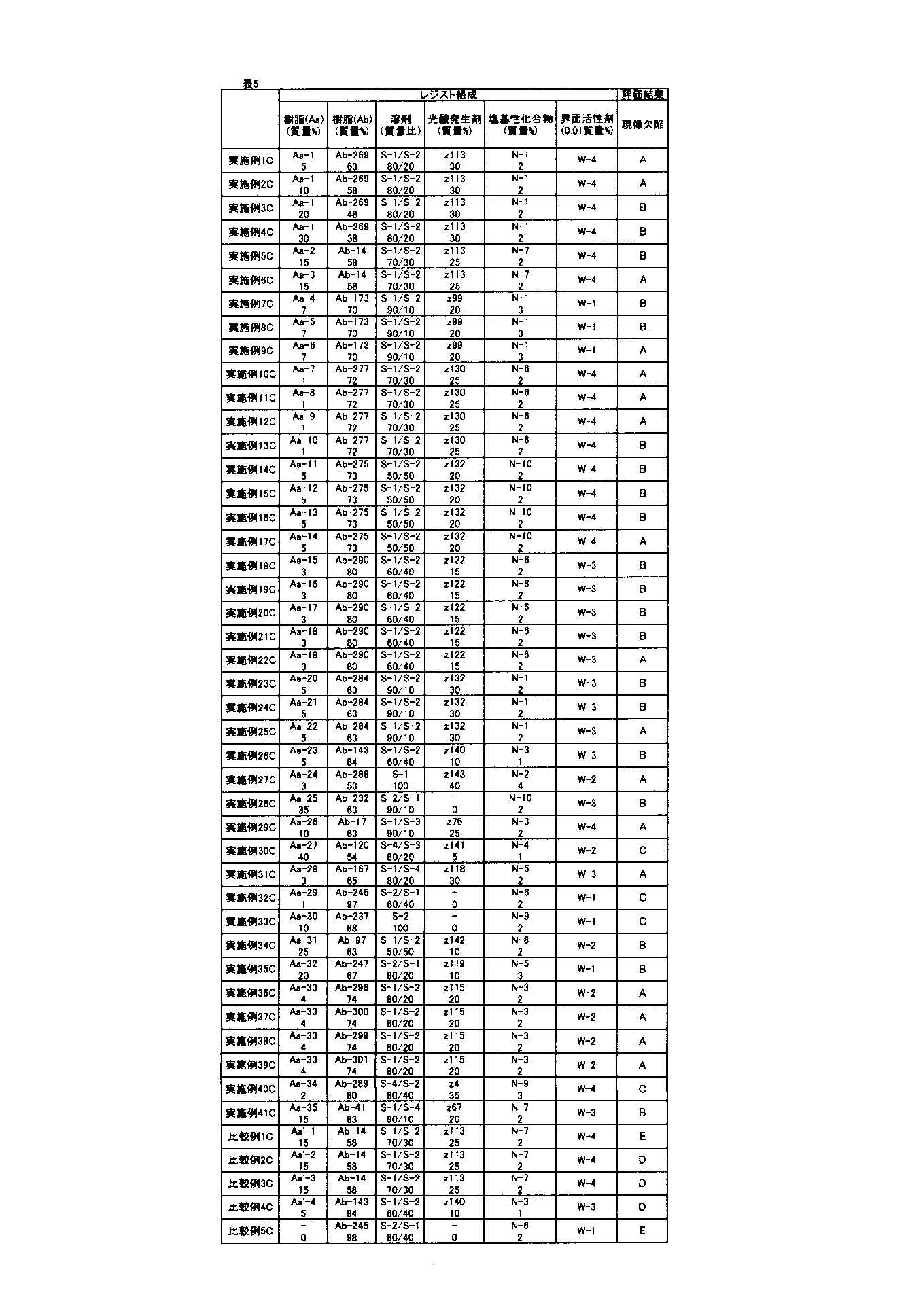
Claims (16)
- 酸の作用により分解する繰り返し単位として下記一般式(Aa1)又は(Aa2)で表される繰り返し単位を含み、製膜により膜表面に偏在し、保護膜を形成する樹脂(Aa)と、樹脂(Aa)とは異なる、酸の作用により現像液に対する溶解性が変化する樹脂(Ab)を含有する感活性光線性又は感放射線性樹脂組成物。

R’は水素原子又はアルキル基を表す。
Lは単結合又は2価の連結基を表す。
R1は水素原子又は1価の置換基を表す。
R2は、フッ素原子を含まない1価の置換基を表す。R1とR2とが互いに結合し、式中の酸素原子と共に環を形成してもよい。
R3は水素原子、アルキル基又はシクロアルキル基を表す。
一般式(Aa2)中、
Raは水素原子、アルキル基、シアノ基又はハロゲン原子を表す。
L1は単結合又は2価の連結基を表す。
R1及びR2はそれぞれ独立にアルキル基を表す。但し、少なくとも一方のアルキル基が有する炭素数は2以上である。
R11及びR12はそれぞれ独立にアルキル基を表し、R13は水素原子又はアルキル基を表す。R11及びR12は互いに連結して環を形成してもよく、R11及びR13は互いに連結して環を形成してもよい。 - 一般式(Aa1)中のR2により表される置換基が、炭素原子と水素原子からなる炭化水素基である、請求項1に記載の感活性光線性又は感放射線性樹脂組成物。
- 樹脂(Aa)が、さらに、フッ素原子、フッ素原子を有する基、珪素原子を有する基、炭素数が6以上のアルキル基、炭素数が5以上のシクロアルキル基、炭素数が6以上のアリール基、及び、炭素数が7以上のアラルキル基からなる群より選択される1つ以上の基を有する繰り返し単位(Aa3)を含む、請求項1に記載の感活性光線性又は感放射線性樹脂組成物。
- 樹脂(Aa)が、さらに下記一般式(Aa4)で表される繰り返し単位を含む、請求項1に記載の感活性光線性又は感放射線性樹脂組成物。

Rbは、水素原子、アルキル基又はハロゲン原子を表す。
S1aは置換基を表し、複数存在する場合は各々独立である。
pは0~5の整数を表す。 - 樹脂(Aa)が、さらに下記一般式(KY-3)で表される構造を有する繰り返し単位を含む、請求項1に記載の感活性光線性又は感放射線性樹脂組成物。

Rsは、鎖状若しくは環状アルキレン基を表し、複数個ある場合は、同じでも異なっていてもよい。
Lsは、単結合、エーテル結合、エステル結合、アミド結合、ウレタン結合又はウレア結合を表し、複数ある場合は、同じでも異なっていてもよい。
nsは、-(Rs-Ls)-で表される連結基の繰り返し数を表し、0~5の整数を表す。
Lkyはアルキレン基、酸素原子又は硫黄原子を表す。
Zkaは、アルキル基、シクロアルキル基、エーテル基、ヒドロキシル基、アミド基、アリール基、ラクトン環基、又は電子求引性基を表す。Zkaが複数存在する場合、複数のZkaは同じでも異なっていてもよく、Zka同士が連結して環を形成してもよい。
nkaは、0~10の整数を表す。
Rkb1及びRkb2は、各々独立して、水素原子、アルキル基、シクロアルキル基、アリール基、又は電子求引性基を表し、Rkb1、Rkb2及びRky5の少なくとも2つが互いに連結して環を形成していてもよい。
nkbは、0又は1を表す。
Rky5は電子求引性基を表す。 - 活性光線又は放射線の照射により酸を発生する化合物を更に含有する、請求項1に記載の感活性光線性又は感放射線性樹脂組成物。
- 樹脂(Ab)が、活性光線又は放射線の照射により酸を発生する構造部位を備えた繰り返し単位(B)を含む、請求項1に記載の感活性光線性又は感放射線性樹脂組成物。
- 樹脂(Aa)の含有率が、該組成物中の全固形分を基準として0.01~30質量%の範囲である、請求項1に記載の感活性光線性又は感放射線性樹脂組成物。
- 樹脂(Aa)の含有率が、該組成物中の全固形分を基準として0.01~20質量%の範囲である、請求項1に記載の感活性光線性又は感放射線性樹脂組成物。
- 樹脂(Aa)の含有率が、該組成物中の全固形分を基準として0.01~10質量%の範囲である、請求項1に記載の感活性光線性又は感放射線性樹脂組成物。
- 樹脂(Aa)の含有率が、該組成物中の全固形分を基準として0.01~5質量%の範囲である、請求項1に記載の感活性光線性又は感放射線性樹脂組成物。
- 請求項1に記載の感活性光線性又は感放射性樹脂組成物を用いて形成された感活性光線性又は感放射線性膜。
- 請求項1に記載の感活性光線性又は感放射線性樹脂組成物を用いて感活性光線性又は感放射線性膜を形成すること、前記感活性光線性又は感放射線性膜に活性光線又は放射線を照射して露光すること、露光した前記感活性光線性または感放射線性膜を現像することを含むパターン形成方法。
- 前記活性光線又は放射線として電子線又は極紫外線が用いられる、請求項13に記載のパターン形成方法。
- 請求項13に記載のパターン形成方法を含む工程を経て製造される半導体デバイス。
- 請求項13に記載のパターン形成方法を含む、電子デバイスの製造方法。
Applications Claiming Priority (2)
| Application Number | Priority Date | Filing Date | Title |
|---|---|---|---|
| JP2013-040047 | 2013-02-28 | ||
| JP2013040047A JP6014517B2 (ja) | 2013-02-28 | 2013-02-28 | 感活性光線性又は感放射線性樹脂組成物、感活性光線性又は感放射線性膜、パターン形成方法及び電子デバイスの製造方法 |
Publications (1)
| Publication Number | Publication Date |
|---|---|
| WO2014132934A1 true WO2014132934A1 (ja) | 2014-09-04 |
Family
ID=51428198
Family Applications (1)
| Application Number | Title | Priority Date | Filing Date |
|---|---|---|---|
| PCT/JP2014/054380 Ceased WO2014132934A1 (ja) | 2013-02-28 | 2014-02-24 | 感活性光線性又は感放射線性樹脂組成物、感活性光線性又は感放射線性膜、パターン形成方法、電子デバイス及び電子デバイスの製造方法 |
Country Status (3)
| Country | Link |
|---|---|
| JP (1) | JP6014517B2 (ja) |
| TW (1) | TWI589991B (ja) |
| WO (1) | WO2014132934A1 (ja) |
Cited By (2)
| Publication number | Priority date | Publication date | Assignee | Title |
|---|---|---|---|---|
| JP2017043662A (ja) * | 2015-08-24 | 2017-03-02 | 信越化学工業株式会社 | 導電性ポリマー複合体及び基板 |
| US20170299963A1 (en) * | 2016-04-14 | 2017-10-19 | Shin-Etsu Chemical Co., Ltd. | Monomer, polymer, resist composition, and patterning process |
Families Citing this family (7)
| Publication number | Priority date | Publication date | Assignee | Title |
|---|---|---|---|---|
| JP6520490B2 (ja) * | 2015-07-08 | 2019-05-29 | 信越化学工業株式会社 | パターン形成方法 |
| WO2017057192A1 (ja) | 2015-09-30 | 2017-04-06 | 富士フイルム株式会社 | 樹脂膜、着色感光性組成物、樹脂膜の製造方法、カラーフィルタ、遮光膜、固体撮像素子、及び、画像表示装置 |
| KR102125252B1 (ko) | 2015-12-25 | 2020-06-22 | 후지필름 가부시키가이샤 | 감활성광선성 또는 감방사선성 수지 조성물, 감활성광선성 또는 감방사선성막, 패턴 형성 방법, 및 전자 디바이스의 제조 방법 |
| JP7058217B2 (ja) * | 2016-06-30 | 2022-04-21 | 富士フイルム株式会社 | パターン形成方法、電子デバイスの製造方法、感活性光線性又は感放射線性樹脂組成物、及び、レジスト膜 |
| KR102323057B1 (ko) * | 2016-12-22 | 2021-11-08 | 후지필름 가부시키가이샤 | 감활성광선성 또는 감방사선성 수지 조성물, 감활성광선성 또는 감방사선성막, 패턴 형성 방법, 전자 디바이스의 제조 방법 및 광산발생제 |
| KR102748487B1 (ko) * | 2023-01-05 | 2025-01-03 | 유한회사 디씨티머티리얼 | 포토레지스트 패턴 개선용 조성물 및 이를 이용한 포토레지스트 패턴 형성 방법 |
| WO2025263601A1 (ja) * | 2024-06-21 | 2025-12-26 | 富士フイルム株式会社 | 感活性光線性又は感放射線性樹脂組成物、感活性光線性又は感放射線性膜、パターン形成方法及び電子デバイスの製造方法 |
Citations (8)
| Publication number | Priority date | Publication date | Assignee | Title |
|---|---|---|---|---|
| JP2007304537A (ja) * | 2005-07-26 | 2007-11-22 | Fujifilm Corp | ポジ型レジスト組成物およびそれを用いたパターン形成方法 |
| JP2010250072A (ja) * | 2009-04-15 | 2010-11-04 | Fujifilm Corp | 感活性光線又は感放射線樹脂組成物、及びそれを用いたパターン形成方法 |
| JP2011118318A (ja) * | 2008-12-12 | 2011-06-16 | Fujifilm Corp | 感活性光線性又は感放射線性樹脂組成物、及びそれを用いたパターン形成方法 |
| JP2011248019A (ja) * | 2010-05-25 | 2011-12-08 | Fujifilm Corp | パターン形成方法及び感活性光線性又は感放射線性樹脂組成物 |
| JP2012133054A (ja) * | 2010-12-20 | 2012-07-12 | Fujifilm Corp | 感活性光線性又は感放射線性樹脂組成物並びに該組成物を用いたレジスト膜及びパターン形成方法 |
| JP2012137686A (ja) * | 2010-12-27 | 2012-07-19 | Fujifilm Corp | 感活性光線性又は感放射線性樹脂組成物、感活性光線性又は感放射線性膜及びパターン形成方法 |
| JP2013015590A (ja) * | 2011-06-30 | 2013-01-24 | Fujifilm Corp | 感活性光線性又は感放射線性樹脂組成物、並びに、それを用いた感活性光線性又は感放射線性膜及びパターン形成方法 |
| JP2013083966A (ja) * | 2011-09-30 | 2013-05-09 | Fujifilm Corp | 感活性光線性又は感放射線性樹脂組成物、並びに、それを用いた感活性光線性又は感放射線性膜及びパターン形成方法 |
-
2013
- 2013-02-28 JP JP2013040047A patent/JP6014517B2/ja active Active
-
2014
- 2014-02-24 WO PCT/JP2014/054380 patent/WO2014132934A1/ja not_active Ceased
- 2014-02-27 TW TW103106626A patent/TWI589991B/zh active
Patent Citations (8)
| Publication number | Priority date | Publication date | Assignee | Title |
|---|---|---|---|---|
| JP2007304537A (ja) * | 2005-07-26 | 2007-11-22 | Fujifilm Corp | ポジ型レジスト組成物およびそれを用いたパターン形成方法 |
| JP2011118318A (ja) * | 2008-12-12 | 2011-06-16 | Fujifilm Corp | 感活性光線性又は感放射線性樹脂組成物、及びそれを用いたパターン形成方法 |
| JP2010250072A (ja) * | 2009-04-15 | 2010-11-04 | Fujifilm Corp | 感活性光線又は感放射線樹脂組成物、及びそれを用いたパターン形成方法 |
| JP2011248019A (ja) * | 2010-05-25 | 2011-12-08 | Fujifilm Corp | パターン形成方法及び感活性光線性又は感放射線性樹脂組成物 |
| JP2012133054A (ja) * | 2010-12-20 | 2012-07-12 | Fujifilm Corp | 感活性光線性又は感放射線性樹脂組成物並びに該組成物を用いたレジスト膜及びパターン形成方法 |
| JP2012137686A (ja) * | 2010-12-27 | 2012-07-19 | Fujifilm Corp | 感活性光線性又は感放射線性樹脂組成物、感活性光線性又は感放射線性膜及びパターン形成方法 |
| JP2013015590A (ja) * | 2011-06-30 | 2013-01-24 | Fujifilm Corp | 感活性光線性又は感放射線性樹脂組成物、並びに、それを用いた感活性光線性又は感放射線性膜及びパターン形成方法 |
| JP2013083966A (ja) * | 2011-09-30 | 2013-05-09 | Fujifilm Corp | 感活性光線性又は感放射線性樹脂組成物、並びに、それを用いた感活性光線性又は感放射線性膜及びパターン形成方法 |
Cited By (3)
| Publication number | Priority date | Publication date | Assignee | Title |
|---|---|---|---|---|
| JP2017043662A (ja) * | 2015-08-24 | 2017-03-02 | 信越化学工業株式会社 | 導電性ポリマー複合体及び基板 |
| US20170299963A1 (en) * | 2016-04-14 | 2017-10-19 | Shin-Etsu Chemical Co., Ltd. | Monomer, polymer, resist composition, and patterning process |
| US10054853B2 (en) * | 2016-04-14 | 2018-08-21 | Shin-Etsu Chemical Co., Ltd. | Monomer, polymer, resist composition, and patterning process |
Also Published As
| Publication number | Publication date |
|---|---|
| JP6014517B2 (ja) | 2016-10-25 |
| TWI589991B (zh) | 2017-07-01 |
| JP2014167579A (ja) | 2014-09-11 |
| TW201443558A (zh) | 2014-11-16 |
Similar Documents
| Publication | Publication Date | Title |
|---|---|---|
| JP5740375B2 (ja) | 感活性光線性又は感放射線性樹脂組成物、並びに、それを用いた感活性光線性又は感放射線性膜及びパターン形成方法 | |
| JP5789623B2 (ja) | 感活性光線性又は感放射線性樹脂組成物、並びにそれを用いた感活性光線性又は感放射線性膜及びパターン形成方法 | |
| JP5719612B2 (ja) | 感活性光線性又は感放射線性樹脂組成物及びそれを用いたパターン形成方法 | |
| JP5965855B2 (ja) | 感活性光線性又は感放射線性樹脂組成物、それを用いたレジスト膜、パターン形成方法、及び電子デバイスの製造方法、並びに樹脂 | |
| JP6014517B2 (ja) | 感活性光線性又は感放射線性樹脂組成物、感活性光線性又は感放射線性膜、パターン形成方法及び電子デバイスの製造方法 | |
| JP5292377B2 (ja) | 感活性光線性又は感放射線性樹脂組成物、並びに、それを用いた感活性光線性又は感放射線性膜及びパターン形成方法 | |
| JP5894953B2 (ja) | 感活性光線性又は感放射線性樹脂組成物、それを用いたレジスト膜、パターン形成方法、及び電子デバイスの製造方法 | |
| JP5572404B2 (ja) | 感活性光線性又は感放射線性樹脂組成物及びそれを用いたパターン形成方法 | |
| JP6134539B2 (ja) | 感活性光線性又は感放射線性樹脂組成物、感活性光線性又は感放射線性膜、パターン形成方法及び電子デバイスの製造方法 | |
| JP2014041327A (ja) | 感活性光線性又は感放射線性樹脂組成物、それを用いたレジスト膜、パターン形成方法、電子デバイスの製造方法、及び電子デバイス | |
| JP5658961B2 (ja) | 感活性光線性又は感放射線性樹脂組成物、感活性光線性又は感放射線性膜、及びパターン形成方法 | |
| JP2012093737A (ja) | 感活性光線性又は感放射線性樹脂組成物、並びに、それを用いた感活性光線性又は感放射線性膜、及び、パターン形成方法 | |
| JP6722665B2 (ja) | 感活性光線性又は感放射線性樹脂組成物、感活性光線性又は感放射線性膜、感活性光線性又は感放射線性膜を備えたマスクブランクス、パターン形成方法、及び電子デバイスの製造方法 | |
| JP2013015572A (ja) | 感活性光線性又は感放射線性樹脂組成物、並びに、それを用いた感活性光線性又は感放射線性膜及びパターン形成方法 | |
| WO2016136481A1 (ja) | パターン形成方法、感活性光線性又は感放射線性樹脂組成物、感活性光線性又は感放射線性膜、これらを用いた電子デバイスの製造方法、及び、電子デバイス | |
| JP2014178542A (ja) | パターン形成方法、組成物キット、及びレジスト膜、並びにこれらを用いた電子デバイスの製造方法、及び電子デバイス | |
| KR101771177B1 (ko) | 패턴형성방법, 감전자선성 또는 감극자외선성 수지 조성물, 그것을 사용한 레지스트 막, 전자 디바이스의 제조방법, 및 전자 디바이스 | |
| JP2013015590A (ja) | 感活性光線性又は感放射線性樹脂組成物、並びに、それを用いた感活性光線性又は感放射線性膜及びパターン形成方法 | |
| JP5723854B2 (ja) | 感活性光線性又は感放射線性樹脂組成物、並びに、それを用いた感活性光線性又は感放射線性膜及びパターン形成方法 |
Legal Events
| Date | Code | Title | Description |
|---|---|---|---|
| 121 | Ep: the epo has been informed by wipo that ep was designated in this application |
Ref document number: 14757510 Country of ref document: EP Kind code of ref document: A1 |
|
| NENP | Non-entry into the national phase |
Ref country code: DE |
|
| 122 | Ep: pct application non-entry in european phase |
Ref document number: 14757510 Country of ref document: EP Kind code of ref document: A1 |