WO2014112189A1 - 果菜類の栽培方法 - Google Patents
果菜類の栽培方法 Download PDFInfo
- Publication number
- WO2014112189A1 WO2014112189A1 PCT/JP2013/080455 JP2013080455W WO2014112189A1 WO 2014112189 A1 WO2014112189 A1 WO 2014112189A1 JP 2013080455 W JP2013080455 W JP 2013080455W WO 2014112189 A1 WO2014112189 A1 WO 2014112189A1
- Authority
- WO
- WIPO (PCT)
- Prior art keywords
- light
- red light
- irradiating
- flower buds
- blue light
- Prior art date
- Legal status (The legal status is an assumption and is not a legal conclusion. Google has not performed a legal analysis and makes no representation as to the accuracy of the status listed.)
- Ceased
Links
Images

Classifications
-
- A—HUMAN NECESSITIES
- A01—AGRICULTURE; FORESTRY; ANIMAL HUSBANDRY; HUNTING; TRAPPING; FISHING
- A01G—HORTICULTURE; CULTIVATION OF VEGETABLES, FLOWERS, RICE, FRUIT, VINES, HOPS OR SEAWEED; FORESTRY; WATERING
- A01G22/00—Cultivation of specific crops or plants not otherwise provided for
-
- A—HUMAN NECESSITIES
- A01—AGRICULTURE; FORESTRY; ANIMAL HUSBANDRY; HUNTING; TRAPPING; FISHING
- A01G—HORTICULTURE; CULTIVATION OF VEGETABLES, FLOWERS, RICE, FRUIT, VINES, HOPS OR SEAWEED; FORESTRY; WATERING
- A01G7/00—Botany in general
- A01G7/04—Electric or magnetic or acoustic treatment of plants for promoting growth
- A01G7/045—Electric or magnetic or acoustic treatment of plants for promoting growth with electric lighting
-
- Y—GENERAL TAGGING OF NEW TECHNOLOGICAL DEVELOPMENTS; GENERAL TAGGING OF CROSS-SECTIONAL TECHNOLOGIES SPANNING OVER SEVERAL SECTIONS OF THE IPC; TECHNICAL SUBJECTS COVERED BY FORMER USPC CROSS-REFERENCE ART COLLECTIONS [XRACs] AND DIGESTS
- Y02—TECHNOLOGIES OR APPLICATIONS FOR MITIGATION OR ADAPTATION AGAINST CLIMATE CHANGE
- Y02P—CLIMATE CHANGE MITIGATION TECHNOLOGIES IN THE PRODUCTION OR PROCESSING OF GOODS
- Y02P60/00—Technologies relating to agriculture, livestock or agroalimentary industries
- Y02P60/14—Measures for saving energy, e.g. in green houses
Definitions
- the present invention relates to a method for growing fruit vegetables.
- Patent Document 1 proposes a light source that irradiates light energy for cultivation and tissue culture.
- an object of the present invention is to provide a method for growing fruit vegetables that can harvest fruit vegetables early.
- the step of irradiating germinated fruits and vegetables with red light and the step of irradiating the germinated fruits and vegetables with blue light separately to differentiate the flower buds there is provided a method for cultivating fruit vegetables characterized by having a step of irradiating light to the differentiated fruit vegetables using a fluorescent lamp.
- the step of irradiating germinated fruits and vegetables with red light and the step of irradiating the germinated fruits and vegetables with blue light separately to differentiate the flower buds There is provided a method for cultivating fruit vegetables characterized by having a step of simultaneously irradiating differentiated fruit vegetables with red light and blue light.
- the step of irradiating germinated fruits and vegetables with red light and the step of irradiating the germinated fruits and vegetables with blue light separately to differentiate the flower buds there is provided a method for cultivating fruit vegetables characterized by having a step of irradiating differentiated fruit vegetables with sunlight. In this case, you may irradiate the fruit vegetables which the said flower bud differentiated in a greenhouse. Moreover, the cultivation method of fruit vegetables may further have the process of irradiating the fruit vegetables which the said flower bud differentiated using a fluorescent lamp. The method for cultivating fruit vegetables may further include a step of simultaneously irradiating the fruit vegetables with differentiated flower buds with red light and blue light.
- the method for cultivating fruit vegetables is a process of differentiating flower buds by separately performing a procedure of irradiating germinated fruit vegetables with red light and a procedure of irradiating germinated fruit vegetables with blue light, and fruit vegetables with differentiated flower buds.
- the method includes irradiating light using a fluorescent lamp.
- Fruits and vegetables mean plants that eat fruits or seeds in vegetables.
- Fruits and vegetables include, for example, tomato, melon, cucumber, strawberry, pumpkin, watermelon, eggplant, bell pepper, okra, sweet bean, broad bean, pea, shrimp, corn and the like.
- Fruit vegetables are cultivated for a long time, so plant factories are required to promote the growth of fruit vegetables.
- Fruits and vegetables must go through two growth phases before harvesting: a vegetative growth phase (for example, increased leaf) and a reproductive growth phase (for example, flower bud differentiation, flowering, fruit growth). Compared with, the growing process is complicated, so the number of cultivation days for one crop is longer.
- the enforcement law has a high effect of promoting the growth of fruit vegetables after germination until the flower buds differentiate, the effect of promoting the growth of fruit vegetables after the flower buds differentiate is reduced. For this reason, in the cultivation of fruit vegetables, after the germination, until the flower buds are differentiated, the growth is promoted by the enforcement law, and after the flower buds are differentiated, the growth is promoted by irradiating light with a fluorescent lamp. Thus, it is possible to efficiently grow fruit vegetables before and after the flower buds are differentiated.
- the enforcement law refers to the procedure of irradiating germinated plants with red light (hereinafter also referred to as “red light irradiation procedure”) and the procedure of irradiating germinated plants with blue light (hereinafter referred to as “blue light irradiation procedure”). Is also a plant cultivation method in which the plant growth is carried out separately and can promote plant growth.
- red light irradiation procedure and the blue light irradiation procedure may be performed once or more after the germination until the flower buds are differentiated.
- the period in which the red light irradiation procedure and the blue light irradiation procedure are separately performed includes a period until the flower buds are differentiated after germination, and may include a part of the period after the flower buds are differentiated.
- the period in which the red light irradiation procedure and the blue light irradiation procedure are independently performed can be arbitrarily set as long as the fruits and vegetables before and after the flower buds are differentiated can be efficiently grown, and the time (h) May be a unit of time length, day may be a unit of time length, and minute (min) may be a unit of time length, but 3 hours. Preferably it is ⁇ 48 hours.
- the method of performing a red light irradiation procedure and a blue light irradiation procedure separately does not include the method of blinking red light and blue light at a frequency of 1 Hz or more.
- the red light irradiation procedure and the blue light irradiation procedure may be performed alternately. Between both the procedures, the procedure of irradiating the germinated plant with red light and blue light simultaneously, or the procedure of not irradiating the germinated plant with light. May be provided.
- Red light means light having a wavelength of 600 nm to 730 nm, and the center wavelength is preferably 645 nm to 680 nm.
- Blue light means light having a wavelength of 400 nm to 515 nm, and the center wavelength is preferably 450 nm.
- the red light may have a predetermined wavelength range with a center wavelength of 645 nm to 680 nm.
- Blue light may have a predetermined wavelength range with a center wavelength of 450 nm.
- the wavelength range is ⁇ 30 nm, preferably ⁇ 20 nm, and more preferably ⁇ 10 nm.
- the photosynthetic photon flux density (PPFD) of red light and blue light is 1 ⁇ molm ⁇ 2 s ⁇ 1 to 1000 ⁇ molm ⁇ 2 s ⁇ 1 , and is 10 ⁇ molm ⁇ 2 s ⁇ 1 to 500 ⁇ molm ⁇ 2 s ⁇ 1. It is preferably 50 ⁇ molm ⁇ 2 s ⁇ 1 to 250 ⁇ molm ⁇ 2 s ⁇ 1 .
- a known light source can be used as the light source for red light and blue light.
- a light emitting diode LED: It is preferable to use an optical semiconductor element such as a light emitting diode (LD) or a laser diode (LD).
- LD light emitting diode
- LD laser diode
- the EL may be an organic EL or an inorganic EL.
- the irradiation light irradiated to the sprouted fruit vegetables only needs to contain red light, and the photosynthesis photon flux density ratio of red light to the irradiation light (or the emission intensity ratio of red light) is 60%. If it is above, it may further contain light other than red light such as blue light, but the emission intensity ratio of red light is preferably 100%.
- the emission intensity ratio of red light in the red light irradiation procedure is less than 60%, the effect of promoting the growth of fruit vegetables until the flower buds are differentiated decreases.
- the ratio of the photosynthetic photon flux density of blue light to the irradiated light in the red light irradiation procedure is 30% or less, preferably 20% or less, and more preferably 0%. .
- the emission intensity ratio of blue light in the red light irradiation procedure exceeds 30%, the effect of promoting the growth of fruit vegetables until the flower buds are differentiated may be reduced.
- the irradiation light in the red light irradiation procedure for example, light having a light emission intensity ratio of 60%, 20%, and 20% of red light, far red light having a wavelength of 720 nm to 780 nm, and blue light can be used. .
- the irradiation light irradiated on the sprouted fruit vegetables only needs to contain blue light, and the ratio of the photosynthetic photon flux density of blue light to the irradiation light (or the emission intensity ratio of blue light). If it is 60% or more, it may further contain light other than blue light such as red light, but the emission intensity ratio of blue light is preferably 100%. When the emission intensity ratio of blue light in the blue light irradiation procedure is less than 60%, the effect of promoting the growth of fruit vegetables until the flower buds are differentiated decreases.
- the ratio of the photosynthetic photon flux density of red light to the irradiated light in the blue light irradiation procedure is 30% or less, preferably 20% or less, and more preferably 0%. . If the emission intensity ratio of red light in the blue light irradiation procedure exceeds 30%, the effect of promoting the growth of fruit vegetables until the flower buds are differentiated may be reduced.
- the irradiating light in the blue light irradiating procedure for example, blue light, light whose intensity ratio of far-red light having a wavelength of 720 nm to 780 nm and red light is 60%, 20% and 20% can be used, respectively. .
- Fruits and vegetables with differentiated flower buds are irradiated with light using fluorescent lamps. This is more effective in promoting growth by irradiating light with fluorescent lamps than the effect of promoting growth under the enforcement law. This is because it becomes higher.
- red light and blue light may be irradiated simultaneously.
- green light with a wavelength of 515 nm to 580 nm and far red light with a wavelength of 720 nm to 780 nm the fruit and vegetables before and after the flower buds are differentiated can be efficiently obtained as in the case of irradiating light with a fluorescent lamp. Can be grown.
- the emission intensity ratio of red light is 30% to 80%, preferably 40% to 60%, and more preferably 50%. If the emission intensity ratio of red light is less than 30% or exceeds 80%, the effect of promoting the growth of fruit vegetables with differentiated flower buds may be reduced.
- the emission intensity ratio of blue light is 10% to 60%, preferably 20% to 50%, and more preferably 30%.
- the emission intensity ratio of blue light is less than 10% or exceeds 60%, the effect of promoting the growth of fruit vegetables with differentiated flower buds may be reduced.
- irradiation light for example, light whose emission intensity ratios of red light, blue light, green light and far red light are 50%, 30%, 10% and 10%, respectively, can be used.
- sunlight may be irradiated.
- the fruit and vegetables before and after a flower bud differentiates can be efficiently grown like the case where light is irradiated using a fluorescent lamp.
- a fluorescent lamp When light is irradiated using a fluorescent lamp, fruits and vegetables can be cultivated in a completely sealed clean room. For this reason, invasion of pests and the like can be suppressed, and cultivation without pesticides is possible.
- light may be irradiated using a multicolor LED light source including red light and blue light.
- a multicolor LED light source multiple types of LEDs are turned on simultaneously, red light having a wavelength of 660 nm, blue light having a wavelength of 450 nm, green light having a wavelength of 525 nm, far red light having a wavelength of 730 nm, wavelength
- a light source capable of emitting light such as violet light having a wavelength of 410 nm can be used.
- light may be irradiated using a multicolor light source that combines an LED and a phosphor.
- Figure 1 shows an example of a lamp used in the enforcement law.
- the lamp 1 is provided with a light irradiation unit 11 in which a red light emitting element 2 and a blue light emitting element 3 are arranged linearly or in a planar shape.
- the lamp 1 can emit red light from the light emitting element 2 or blue light from the light emitting element 3 by energizing the electrodes 41, 42 or 43, 44, for example.
- two rows of light emitting elements 2 and 3 are provided in the light irradiation unit 11, but three or more rows may be provided.
- the number ratio of the red light emitting element 2 and the blue light emitting element 3 is preferably in the range of 2: 1 to 5: 1. This is because the growth rate of fruits and vegetables tends to increase when the emission intensity of red light is higher than the emission intensity of blue light.
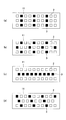
- FIG. 2A to 2D show arrangement examples of the red light emitting element 2 and the blue light emitting element 3 in the lamp 1.
- FIG. 2A to 2D show an arrangement example in which the light emitting unit 11 is provided with three rows of light emitting elements 2 and 3.
- the red light emitting element 2 is indicated by ⁇
- the blue light emitting element 3 is indicated by ⁇ .
- 2A to 2D show examples in which the number ratio of the red light emitting element 2 and the blue light emitting element 3 is 2: 1.
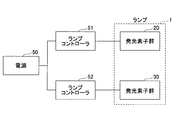
- FIG. 3 is a block diagram illustrating an example of a lamp control system including a lamp controller.
- the power supply voltage from the power supply 50 is supplied to the lamp controllers 51 and 52.
- the lamp controller 51 controls the light emission intensity of the plurality of red light emitting elements 2 forming the red light emitting element group 20 in the lamp 1.
- the lamp controller 52 controls the emission intensity of the plurality of blue light emitting elements 3 forming the blue light emitting element group 30 in the lamp 1.
- the control of the red light emitting element group 20 by the lamp controller 51 and the control of the blue light emitting element group 30 by the lamp controller 52 can be performed separately and independently.
- the red light emitting element group 20 and the blue light emitting element group 30 may be controlled separately and independently by a single controller. In this case, the single controller may control the on / off state of the fluorescent lamp described later.
- the emission intensity ratio of blue light and red light emitted from the lamp 1 can be made more suitable for plant growth.
- the light emission intensity ratio between the red light and the blue light of the lamp 1 is 2: 1.
- the light emission intensity ratio of the red light and the blue light of the lamp 1 is 4: 1.
- the lamp 1 When the lamp 1 is used, it is possible to promote the growth of fruit vegetables from germination until the flower buds are differentiated according to the enforcement law.
- Germinated Arabidopsis was placed in each artificial meteorograph with different light sources and allowed to grow for 49 days. At this time, the environment of the artificial weather device was the same except for the light source, the air temperature was 25 ° C. to 27 ° C., and the humidity was 50% RH.
- Test Example 1 In the case of Test Example 1, as a light source, a red LED HRP-350F (manufactured by Showa Denko KK) having a center wavelength of 660 nm and a blue LED GM2LR450G (manufactured by Showa Denko KK) having a center wavelength of 450 nm are used as one light source.
- the germinated Arabidopsis was grown for 49 days according to the Enforcement Law using the lamp mounted in the above. The number of red LEDs mounted in the lamp was 320, and the number of blue LEDs mounted was 160.
- the photosynthesis photon flux density of the red LED was set to 200 ⁇ molm ⁇ 2 s ⁇ 1
- the photosynthesis photon flux density of the blue LED was set to 100 ⁇ molm ⁇ 2 s ⁇ 1 .
- each procedure of the red light irradiation procedure and the blue light irradiation procedure was alternately and continuously performed in 12 hours.
- Test Example 2 germinated Arabidopsis was grown in the same manner as in Test Example 1 except that a fluorescent lamp was used as the light source and light was continuously irradiated.
- the photosynthetic photon flux density of the fluorescent lamp was set to 150 ⁇ molm ⁇ 2 s ⁇ 1 .
- Test Example 3 germinated Arabidopsis was performed in the same manner as in Test Example 1 except that each procedure of the procedure of simultaneously irradiating red light and blue light and the procedure of not irradiating light were alternately performed in 12 hours. Was grown.
- Table 1 shows the results of examining the number of days until flower buds differentiate, the length of main flower stems, the number of pods and the number of true leaves.
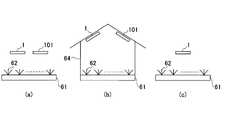
- FIG. 4 is a schematic diagram for explaining an example of cultivating Arabidopsis on a growing peat van.
- the positional relationship between the lamp 1 or the lamp 1 and the fluorescent lamp 101 and the Arabidopsis 62 cultivated on the growing peat van 61 is schematically shown.
- the arrangement of the lamp 1 or the lamp 1 and the fluorescent lamp 101 is as follows. If it is a position which can irradiate light to the Arabidopsis 62 to grow, it will not specifically limit.
- Example 1 In the case of Example 1, after the flower buds were differentiated (30 days in this example), the enforcement law was stopped, and a fluorescent lamp was used as a light source, and light was irradiated to the Arabidopsis with the flower buds differentiated for 10 days. Arabidopsis was cultivated in the same manner as in Example 1. The photosynthetic photon flux density of the fluorescent lamp was set to 150 ⁇ molm ⁇ 2 s ⁇ 1 .
- FIG. 4 shows an example which grows the Arabidopsis 62 on the breeding peat van 61 using the lamp 1 and the fluorescent lamp 101 in the first embodiment.
- Example 2 In the case of Example 2, after the flower buds were differentiated (30 days in this example), the enforcement law was stopped, the Arabidopsis with the differentiated flower buds was transferred into a greenhouse, and cultivated for 10 days. Then, Arabidopsis was cultivated. At this time, during the day, the Arabidopsis with differentiated flower buds was irradiated with sunlight, and after sunset (from 7:00 pm to 5:00 am the next morning), the Arabidopsis with differentiated flower buds was irradiated with light using a fluorescent lamp. The photosynthetic photon flux density of the fluorescent lamp was set to 150 ⁇ molm ⁇ 2 s ⁇ 1 . 4, (b) shows an example of cultivating Arabidopsis 62 on the growing peat van 61 using the lamp 1 and the fluorescent lamp 101 in the greenhouse 64 in the second embodiment.
- Example 3 In the case of Example 3, after the flower buds were differentiated (30 days in this example), the enforcement law was stopped, and the Arabidopsis with the differentiated flower buds were simultaneously irradiated with red light and blue light for 10 days. Similarly, Arabidopsis was cultivated. After the flower buds were differentiated (in this example, after 30 days), the photosynthetic photon flux density of the red LED and the blue LED was 75 ⁇ molm ⁇ 2 s ⁇ 1 , respectively. 4, (c) shows an example of cultivating the Arabidopsis 62 on the growing peat van 61 using the lamp 1 in Example 3.
- Example 2 the arrangement shown in (c) or (a) of FIG. 4 is used until the flower buds are differentiated, and after the enforcement law is stopped, the arrangement of (b) of FIG. Irradiation and irradiation of the fluorescent lamp 101 may be used. In this case, the lamp 1 in the greenhouse 64 can be omitted.
- Example 2 the arrangement shown in FIG. 4A is used until the flower buds are differentiated. After the enforcement law is stopped, the arrangement shown in FIG. 4B is used to irradiate sunlight.
- the irradiation of the fluorescent lamp 101 may be used by using the arrangement of FIG. In this case, the lamp 1 and the fluorescent lamp 101 in the greenhouse 64 can be omitted.
- the arrangement shown in (c) or (a) of FIG. 4 is used until the flower buds are differentiated, and after the enforcement law is stopped, the arrangement of (b) of FIG. 4 is used.
- the arrangement of FIG. 4B may be used instead of the irradiation of the fluorescent lamp 101, and simultaneous irradiation of red light and blue light by the lamp 1 may be used.
- the fluorescent lamp 101 in the greenhouse 64 can be omitted.
- Comparative Example 1 Arabidopsis was cultivated in the same manner as in Test Example 2 except that the number of cultivation days was changed to 40 days.
- Comparative Example 2 Arabidopsis was cultivated in the same manner as in Test Example 3 except that the number of cultivation days was changed to 40 days.
- Table 2 shows the results of the determination of the fresh weight of the above-ground parts of Arabidopsis in Examples 1 to 3 and Comparative Examples 1 and 2.
Landscapes
- Life Sciences & Earth Sciences (AREA)
- Botany (AREA)
- Environmental Sciences (AREA)
- Biodiversity & Conservation Biology (AREA)
- Ecology (AREA)
- Forests & Forestry (AREA)
- Cultivation Of Plants (AREA)
- Greenhouses (AREA)
- Non-Portable Lighting Devices Or Systems Thereof (AREA)
- Led Device Packages (AREA)
Priority Applications (2)
| Application Number | Priority Date | Filing Date | Title |
|---|---|---|---|
| US14/651,268 US20150313091A1 (en) | 2013-01-15 | 2013-11-11 | Method for cultivating fruit vegetable |
| EP13871476.1A EP2946654B1 (en) | 2013-01-15 | 2013-11-11 | Method for cultivating fruit or vegetable |
Applications Claiming Priority (4)
| Application Number | Priority Date | Filing Date | Title |
|---|---|---|---|
| JP2013004784 | 2013-01-15 | ||
| JP2013-004784 | 2013-01-15 | ||
| JP2013017627A JP5723898B2 (ja) | 2013-01-15 | 2013-01-31 | 果菜類の栽培方法 |
| JP2013-017627 | 2013-01-31 |
Publications (1)
| Publication Number | Publication Date |
|---|---|
| WO2014112189A1 true WO2014112189A1 (ja) | 2014-07-24 |
Family
ID=51209301
Family Applications (1)
| Application Number | Title | Priority Date | Filing Date |
|---|---|---|---|
| PCT/JP2013/080455 Ceased WO2014112189A1 (ja) | 2013-01-15 | 2013-11-11 | 果菜類の栽培方法 |
Country Status (4)
| Country | Link |
|---|---|
| US (1) | US20150313091A1 (enExample) |
| EP (1) | EP2946654B1 (enExample) |
| JP (1) | JP5723898B2 (enExample) |
| WO (1) | WO2014112189A1 (enExample) |
Cited By (3)
| Publication number | Priority date | Publication date | Assignee | Title |
|---|---|---|---|---|
| CN106386149A (zh) * | 2016-10-22 | 2017-02-15 | 侯亮 | 一种西瓜增甜高产种植方法 |
| CN107135856A (zh) * | 2017-06-19 | 2017-09-08 | 扬州大学 | 一种小棚升温保温装置及基于该装置的大棚茄子越冬栽培管理方法 |
| CN115486335A (zh) * | 2022-11-03 | 2022-12-20 | 中国农业科学院都市农业研究所 | 一种番茄快繁加代方法 |
Families Citing this family (15)
| Publication number | Priority date | Publication date | Assignee | Title |
|---|---|---|---|---|
| JP6118239B2 (ja) * | 2013-11-29 | 2017-04-19 | 雅敏 堀 | 害虫の防除方法及び防除装置 |
| WO2015103310A1 (en) | 2013-12-31 | 2015-07-09 | Dispersolar, Llc | Harvesting, transmission, spectral modification and delivery of sunlight to shaded areas of plants |
| WO2016054268A1 (en) * | 2014-09-30 | 2016-04-07 | MJAR Holdings, LLC | Methods of growing cannabaceae plants using artificial lighting |
| JP6376496B2 (ja) * | 2014-12-02 | 2018-08-22 | パナソニックIpマネジメント株式会社 | 光源ユニットおよび照明器具 |
| JP6593690B2 (ja) * | 2015-09-01 | 2019-10-23 | パナソニックIpマネジメント株式会社 | 鮮度保持方法、鮮度保持装置、収納庫、及び、陳列装置 |
| CN105993486B (zh) * | 2016-05-26 | 2018-12-18 | 江苏沿江地区农业科学研究所 | 一种大棚内蚕豆-大叶枸杞-茗荷-丝瓜-番茄多元化种植方法 |
| JP2018019667A (ja) | 2016-08-05 | 2018-02-08 | パナソニックIpマネジメント株式会社 | 照明システム、照明制御方法及び植物栽培器 |
| CN106342506A (zh) * | 2016-08-20 | 2017-01-25 | 余敏敏 | 一种降低茄子猝倒病的育苗方法 |
| US20180249642A1 (en) * | 2017-03-06 | 2018-09-06 | Lun Huang | Method and apparatus based on laser for providing high growth, high density plantation system |
| CN109192843B (zh) * | 2018-07-10 | 2019-08-13 | 旭宇光电(深圳)股份有限公司 | 植物生长用发光二极管 |
| US20220061227A1 (en) * | 2019-01-21 | 2022-03-03 | Growor, Inc. | Devices for an optimized, high-intensity, horticultural, led luminaire having a regulated photosynthetic flux density |
| JP7137739B2 (ja) * | 2019-03-14 | 2022-09-15 | タキイ種苗株式会社 | 植物における水疱症の抑制方法、植物の生産方法及び植物における水疱症の抑制装置 |
| USD1028646S1 (en) | 2021-04-30 | 2024-05-28 | Opti-Harvest, Inc. | Canopy unit for light harvesting |
| CN117546695A (zh) * | 2022-08-05 | 2024-02-13 | 浙江省农业科学院 | 一种设施栽培杨梅的补光方法 |
| CN117099584A (zh) * | 2023-10-07 | 2023-11-24 | 宁夏大学 | 一种缩短西瓜生育周期的方法 |
Citations (5)
| Publication number | Priority date | Publication date | Assignee | Title |
|---|---|---|---|---|
| JPH08103167A (ja) | 1994-10-05 | 1996-04-23 | Kensei Okamoto | 植物栽培用光源 |
| JP2008142005A (ja) * | 2006-12-08 | 2008-06-26 | Univ Of Tsukuba | 植物栽培方法 |
| JP2009089631A (ja) * | 2007-10-05 | 2009-04-30 | Graduate School For The Creation Of New Photonics Industries | 植物栽培装置 |
| JP2011109921A (ja) * | 2009-11-24 | 2011-06-09 | Mitsubishi Plastics Inc | 農作物育成用照明ユニット、それを用いた農作物育成用照明システム及びこれらを用いた農作物育成方法 |
| JP2013005741A (ja) * | 2011-06-23 | 2013-01-10 | Citizen Holdings Co Ltd | 植物育成装置 |
Family Cites Families (13)
| Publication number | Priority date | Publication date | Assignee | Title |
|---|---|---|---|---|
| US3930335A (en) * | 1973-04-02 | 1976-01-06 | Controlled Environment Systems, Inc. | Plant growth system |
| KR20070086651A (ko) * | 2003-05-23 | 2007-08-27 | 스태니슬로 카르핀스키 | 400 nm 내지 700nm의 파장의 광선을 주사하여 식물세포 내의 식물성 화학물질의 농도를 변경하는 방법 및기구 |
| JP2005052105A (ja) * | 2003-08-06 | 2005-03-03 | Paiteku Osaka Kk | 光源装置および植物の栽培方法 |
| US9445551B2 (en) * | 2008-05-22 | 2016-09-20 | Fionia Lighting Aps | Method and apparatus for using light emitting diodes in a greenhouse setting |
| CN101852368B (zh) * | 2010-01-28 | 2011-07-27 | 杭州汉徽光电科技有限公司 | 一种用于兰科植物组培的led混光灯具 |
| US20120054061A1 (en) * | 2010-08-26 | 2012-03-01 | Fok Philip E | Produce production system and process |
| JP6012928B2 (ja) * | 2011-03-01 | 2016-10-25 | 公立大学法人大阪府立大学 | 植物栽培方法及び体内時計最適化植物栽培装置 |
| JP2012157331A (ja) * | 2011-02-02 | 2012-08-23 | Japan Carlit Co Ltd:The | 植物の花芽形成の制御方法および制御装置 |
| ES2894833T3 (es) * | 2011-03-17 | 2022-02-16 | Valoya Oy | Dispositivo y método de iluminación de plantas para cámaras de crecimiento oscuras |
| US10798878B2 (en) * | 2012-09-04 | 2020-10-13 | Signify Holding B.V. | Horticulture lighting system and horticulture production facility using such horticulture lighting system |
| EP2710883A1 (en) * | 2012-09-24 | 2014-03-26 | Heliospectra AB | Spectrum optimization for artificial illumination |
| ES2625058T3 (es) * | 2012-12-21 | 2017-07-18 | Philips Lighting Holding B.V | Interfaz de iluminación para horticultura para interconectar al menos un sistema de iluminación |
| JP6268516B2 (ja) * | 2013-11-13 | 2018-01-31 | パナソニックIpマネジメント株式会社 | 作物育成システム |
-
2013
- 2013-01-31 JP JP2013017627A patent/JP5723898B2/ja not_active Expired - Fee Related
- 2013-11-11 WO PCT/JP2013/080455 patent/WO2014112189A1/ja not_active Ceased
- 2013-11-11 EP EP13871476.1A patent/EP2946654B1/en active Active
- 2013-11-11 US US14/651,268 patent/US20150313091A1/en not_active Abandoned
Patent Citations (5)
| Publication number | Priority date | Publication date | Assignee | Title |
|---|---|---|---|---|
| JPH08103167A (ja) | 1994-10-05 | 1996-04-23 | Kensei Okamoto | 植物栽培用光源 |
| JP2008142005A (ja) * | 2006-12-08 | 2008-06-26 | Univ Of Tsukuba | 植物栽培方法 |
| JP2009089631A (ja) * | 2007-10-05 | 2009-04-30 | Graduate School For The Creation Of New Photonics Industries | 植物栽培装置 |
| JP2011109921A (ja) * | 2009-11-24 | 2011-06-09 | Mitsubishi Plastics Inc | 農作物育成用照明ユニット、それを用いた農作物育成用照明システム及びこれらを用いた農作物育成方法 |
| JP2013005741A (ja) * | 2011-06-23 | 2013-01-10 | Citizen Holdings Co Ltd | 植物育成装置 |
Non-Patent Citations (1)
| Title |
|---|
| See also references of EP2946654A4 * |
Cited By (4)
| Publication number | Priority date | Publication date | Assignee | Title |
|---|---|---|---|---|
| CN106386149A (zh) * | 2016-10-22 | 2017-02-15 | 侯亮 | 一种西瓜增甜高产种植方法 |
| CN107135856A (zh) * | 2017-06-19 | 2017-09-08 | 扬州大学 | 一种小棚升温保温装置及基于该装置的大棚茄子越冬栽培管理方法 |
| CN115486335A (zh) * | 2022-11-03 | 2022-12-20 | 中国农业科学院都市农业研究所 | 一种番茄快繁加代方法 |
| CN115486335B (zh) * | 2022-11-03 | 2023-07-07 | 中国农业科学院都市农业研究所 | 一种番茄快繁加代方法 |
Also Published As
| Publication number | Publication date |
|---|---|
| EP2946654A1 (en) | 2015-11-25 |
| JP2014155436A (ja) | 2014-08-28 |
| EP2946654A4 (en) | 2016-11-16 |
| JP5723898B2 (ja) | 2015-05-27 |
| EP2946654B1 (en) | 2020-04-01 |
| US20150313091A1 (en) | 2015-11-05 |
Similar Documents
| Publication | Publication Date | Title |
|---|---|---|
| JP5723898B2 (ja) | 果菜類の栽培方法 | |
| EP2761995B1 (en) | Plant cultivation lamp and plant cultivation method using the same | |
| JP6325771B2 (ja) | 植物育成用照明装置を用いた栽培方法および植物育成用照明装置 | |
| JP5779604B2 (ja) | 植物栽培方法 | |
| JP6444611B2 (ja) | 植物栽培方法 | |
| WO2018143407A1 (en) | Method for cultivating plant seedling by artificial light | |
| JP5102190B2 (ja) | 植物栽培方法 | |
| JP5723903B2 (ja) | 植物栽培方法 | |
| JP5723900B2 (ja) | 植物栽培方法 | |
| Lalge et al. | The effects of red, blue and white light on the growth and development of Cannabis sativa L | |
| JP2011109934A (ja) | 植物栽培方法 | |
| JP6005787B2 (ja) | 果菜類の栽培方法 | |
| US9241445B2 (en) | Method for cultivating plant | |
| TW201803442A (zh) | 利用人造光之菠菜栽培法 | |
| JP2001258389A (ja) | 植物栽培方法 | |
| US9392751B2 (en) | Method for cultivating plant | |
| RU2715604C1 (ru) | Способ получения оздоровленных миниклубней картофеля | |
| JP5376667B2 (ja) | 花卉の育苗方法および育苗システム | |
| JP4159485B2 (ja) | アブラナ科植物の花芽誘導方法 | |
| EP4523518A1 (en) | Method for growing fruit vegetable plant, apparatus for growing fruit vegetable plant, and tomato plant | |
| JP2022184287A (ja) | エディブルフラワー用ビオラの栽培方法 |
Legal Events
| Date | Code | Title | Description |
|---|---|---|---|
| 121 | Ep: the epo has been informed by wipo that ep was designated in this application |
Ref document number: 13871476 Country of ref document: EP Kind code of ref document: A1 |
|
| WWE | Wipo information: entry into national phase |
Ref document number: 14651268 Country of ref document: US |
|
| WWE | Wipo information: entry into national phase |
Ref document number: 2013871476 Country of ref document: EP |
|
| NENP | Non-entry into the national phase |
Ref country code: DE |