WO2014087656A1 - エステル系樹脂製医療機器の滅菌方法 - Google Patents
エステル系樹脂製医療機器の滅菌方法 Download PDFInfo
- Publication number
- WO2014087656A1 WO2014087656A1 PCT/JP2013/007160 JP2013007160W WO2014087656A1 WO 2014087656 A1 WO2014087656 A1 WO 2014087656A1 JP 2013007160 W JP2013007160 W JP 2013007160W WO 2014087656 A1 WO2014087656 A1 WO 2014087656A1
- Authority
- WO
- WIPO (PCT)
- Prior art keywords
- medical device
- gas
- ester
- hollow fiber
- ester resin
- Prior art date
- Legal status (The legal status is an assumption and is not a legal conclusion. Google has not performed a legal analysis and makes no representation as to the accuracy of the status listed.)
- Ceased
Links
Classifications
-
- A—HUMAN NECESSITIES
- A61—MEDICAL OR VETERINARY SCIENCE; HYGIENE
- A61L—METHODS OR APPARATUS FOR STERILISING MATERIALS OR OBJECTS IN GENERAL; DISINFECTION, STERILISATION OR DEODORISATION OF AIR; CHEMICAL ASPECTS OF BANDAGES, DRESSINGS, ABSORBENT PADS OR SURGICAL ARTICLES; MATERIALS FOR BANDAGES, DRESSINGS, ABSORBENT PADS OR SURGICAL ARTICLES
- A61L2/00—Disinfection or sterilisation of materials or objects, in general; Accessories therefor
- A61L2/02—Disinfection or sterilisation of materials or objects, in general; Accessories therefor using physical processes
- A61L2/08—Radiation
- A61L2/081—Gamma radiation
-
- A—HUMAN NECESSITIES
- A61—MEDICAL OR VETERINARY SCIENCE; HYGIENE
- A61L—METHODS OR APPARATUS FOR STERILISING MATERIALS OR OBJECTS IN GENERAL; DISINFECTION, STERILISATION OR DEODORISATION OF AIR; CHEMICAL ASPECTS OF BANDAGES, DRESSINGS, ABSORBENT PADS OR SURGICAL ARTICLES; MATERIALS FOR BANDAGES, DRESSINGS, ABSORBENT PADS OR SURGICAL ARTICLES
- A61L2103/00—Materials or objects being the target of disinfection or sterilisation
- A61L2103/05—Living organisms or biological materials
-
- A—HUMAN NECESSITIES
- A61—MEDICAL OR VETERINARY SCIENCE; HYGIENE
- A61L—METHODS OR APPARATUS FOR STERILISING MATERIALS OR OBJECTS IN GENERAL; DISINFECTION, STERILISATION OR DEODORISATION OF AIR; CHEMICAL ASPECTS OF BANDAGES, DRESSINGS, ABSORBENT PADS OR SURGICAL ARTICLES; MATERIALS FOR BANDAGES, DRESSINGS, ABSORBENT PADS OR SURGICAL ARTICLES
- A61L2103/00—Materials or objects being the target of disinfection or sterilisation
- A61L2103/05—Living organisms or biological materials
- A61L2103/09—Blood or products thereof
-
- A—HUMAN NECESSITIES
- A61—MEDICAL OR VETERINARY SCIENCE; HYGIENE
- A61L—METHODS OR APPARATUS FOR STERILISING MATERIALS OR OBJECTS IN GENERAL; DISINFECTION, STERILISATION OR DEODORISATION OF AIR; CHEMICAL ASPECTS OF BANDAGES, DRESSINGS, ABSORBENT PADS OR SURGICAL ARTICLES; MATERIALS FOR BANDAGES, DRESSINGS, ABSORBENT PADS OR SURGICAL ARTICLES
- A61L2202/00—Aspects relating to methods or apparatus for disinfecting or sterilising materials or objects
- A61L2202/10—Apparatus features
- A61L2202/18—Aseptic storing means
- A61L2202/181—Flexible packaging means, e.g. permeable membranes, paper
Definitions
- the present invention relates to a method for sterilizing a medical device (ester-based resin medical device) manufactured by an ester resin by irradiation with radiation.
- Ester-based resin having an ester bond in the molecule has been conventionally used in various medical devices.
- Ester-based resins have various physical properties that are easy to use in medical devices, are excellent in moldability and workability compared to glass and the like, are lightweight and relatively inexpensive.
- a blood treatment device As an example of a medical device, a blood treatment device is used.
- dialysis membranes and ultrafiltration membranes are used as separation materials for the purpose of removing uremic toxins and waste products in the blood.
- Modules blood treatment devices
- hemodialyzers, hemofilters or hemodialyzers are widely used.
- cellulosic natural materials or various synthetic polymers are used for the dialysis membrane and the ultrafiltration membrane.
- a module (hollow fiber blood treatment device) using a hollow fiber membrane as a separation material has reduced extracorporeal blood volume, high substance removal efficiency in blood, and productivity during module production. Because it has advantages, it is highly important in the field of dialyzers.
- the sterilization method by irradiation wraps the hollow fiber type blood treatment device. Since it can be treated as it is and has an excellent sterilization effect, it is adopted as one of the preferred sterilization methods.
- this sterilization method some members constituting the hollow fiber type blood treatment device may be deteriorated or a by-product may be generated by irradiation of radiation. Therefore, conventionally, there has been known a technique for suppressing deterioration of a hollow fiber blood processing device or generation of by-products even when sterilization by irradiation is performed.
- Patent Document 1 in order to suppress the generation of harmful by-products while maintaining the efficiency of sterilization by irradiation, while maintaining the atmosphere in the package in a state where the oxygen concentration is reduced, A sterilization method including a step of performing radiation sterilization on the body and a step of reducing the oxygen concentration with an oxygen scavenger while maintaining the sterilized state of the package after radiation sterilization has been proposed.
- Patent Document 2 in a semipermeable membrane containing a hydrophobic polymer and a hydrophilic polymer, in order to suppress the decomposition of these polymers and to suppress the elution of the hydrophilic polymer, A sterilization method has been proposed in which 100% to 600% of water is hydrated with respect to its own weight, and the inside of the dialyzer is made an inert gas atmosphere followed by gamma irradiation.
- acetyl cellulose which is a derivative of cellulose
- Acetyl cellulose is an ester resin in which acetic acid is ester-bonded to a hydroxy group (—OH) in a cellulose molecule.
- a part of acetylcellulose is decomposed by the irradiation of radiation to generate acetic acid.
- the permeate is preferably as neutral as possible, the pH of the permeate that has permeated through the hollow fiber may be biased to the acidic side (the pH may be lowered) due to the generation of acetic acid.
- disassembly by irradiation of an acetylcellulose will also cause deterioration of a hollow fiber.
- the present invention has been made in order to solve such problems, and in the case of sterilizing a medical device made of an ester resin such as a hollow fiber type blood treatment device equipped with a hollow fiber made of acetyl cellulose by irradiation with radiation.
- Another object of the present invention is to propose a sterilization method capable of effectively suppressing the generation of by-products such as acetic acid (carboxylic acid) due to degradation and decomposition of ester resins.
- the ester resin medical device sterilization method seals an ester resin medical device in a packaging material made of a gas-impermeable material.
- the device is configured to irradiate the radiation after at least reducing gas is sealed in the device.
- the sterilization treatment by irradiation with radiation after sealing the reducing gas suppresses the deterioration of the ester resin constituting the medical device, and effectively generates by-products due to the decomposition of the ester resin. Can be suppressed. As a result, it is possible to avoid deterioration in the quality of the ester-based resin medical device after sterilization.
- the reducing gas may be hydrogen gas, and an oxygen scavenger may be further enclosed in the medical device package.
- the packaging material may be a film having gas impermeability, and the inert gas may be nitrogen gas.
- a hollow fiber blood processing device including a hollow fiber made of acetyl cellulose.
- the ester-based resin medical device in the present invention is made of an ester-based resin and includes various devices used for medical purposes.
- a typical example is a blood treatment device, but is not limited to a medical device made of ester resin, and for example, a bag containing a drug solution to be administered into a living body can be used.
- the present invention will be specifically described by taking a blood processing device as an example of a medical device made of ester resin.
- a blood treatment device refers to a medical instrument used for hemodialysis, blood filtration, hemodiafiltration, plasma component fractionation, plasma separation, etc.
- the hollow fiber blood treatment device in the present invention refers to various synthetic resins, etc.
- the hollow fiber needs to be excellent in the property of selectively permeating substances in blood and in biocompatibility such as antithrombotic properties.
- acetyl cellulose which is an ester resin and is a cellulose derivative, is used as a hollow fiber material that satisfies these conditions.
- acetylcellulose is typically triacetylcellulose (TAC) obtained by acetylating all three hydroxy groups contained in a glucose unit of cellulose (acetic acid is ester-bonded to hydroxy groups).
- TAC triacetylcellulose
- acetic acid is ester-bonded to hydroxy groups
- it may be diacetyl cellulose or the like, which is obtained by hydrolyzing the ester bond of some acetyl groups and returning them to hydroxy groups.
- TAC triacetylcellulose
- these acetyl celluloses are the main components, and other resins and the like are subcomponents. It may be an acetylcellulose composition.
- the ester resin in the present invention is not limited to acetylcellulose, and includes a hydroxy group in the molecule and a structure in which the hydroxy group is ester-bonded (condensed) with an acid such as a carboxylic acid, that is, an ester in the molecule. Any other known resin can be suitably used as long as it includes a bond.
- sterilization is performed by irradiating with radiation. By irradiation with this radiation, the ester bond portion is cleaved, and the acid component such as acetic acid (carboxylic acid) may be released (free) as a by-product. If there is, any well-known ester resin is contained in the irradiation target object in this invention.
- the inner diameter of the hollow fiber used in the hollow fiber type blood treatment device is preferably in the range of 100 ⁇ m to 300 ⁇ m, more preferably in the range of 120 to 250 ⁇ m.
- the film thickness of the hollow fiber is preferably in the range of 10 to 50 ⁇ m, and more preferably in the range of 10 to 30 ⁇ m.
- a method for modularizing a blood treatment device using the hollow fiber described above is not particularly limited.
- the hollow fiber is generally bundled from 7,000 to 12,000 to form a hollow fiber bundle, and the cylindrical shape of the blood treatment device is used.
- the potting agent such as polyurethane
- the excess potting agent is cut and removed together with both ends of the hollow fiber bundle, the hollow fiber end face is opened, and the header is attached Is mentioned.
- the specific configuration of various members constituting the hollow fiber blood processing device is not particularly limited, and known members can be suitably used.
- members other than the hollow fiber for example, a cylindrical container, a potting agent, etc., those which are not easily deteriorated by radiation may be used.
- the material of the cylindrical container include polycarbonate and polypropylene
- examples of the material of the potting agent include polyurethane, epoxy resin, and silicone resin, but are not particularly limited.
- a medical device package is obtained by sealing the hollow fiber blood treatment device having the above-described configuration with a packaging material made of a gas-impermeable material.
- the medical device package has at least a reducing property.
- a gas is enclosed, preferably an oxygen scavenger.
- the packaging material that seals the hollow fiber blood processing device only needs to be made of a gas-impermeable material.
- the gas-impermeable material is not particularly limited as long as it is a film or sheet having an oxygen permeability of 1 cm 3 / (m 2 ⁇ 24 h ⁇ atm) or less and a water vapor permeability of 5 g / (m 2 ⁇ 24 h ⁇ atm).
- a laminate film or sheet having a multilayer structure including an aluminum layer is particularly preferably used.
- the aluminum layer here may be an aluminum foil or an aluminum vapor deposition layer.
- an aluminum layer may be comprised from 100% aluminum, and may be comprised with a well-known aluminum alloy.
- the laminate film (or sheet) including an aluminum layer include, for example, a polyester layer / aluminum layer / polyethylene layer three-layer structure, and a polyethylene terephthalate layer / aluminum layer / polyethylene layer three-layer structure. , Polyethylene terephthalate layer / polyethylene layer / aluminum layer / polyethylene layer four-layer structure, nylon layer / polyethylene layer / aluminum layer / polyethylene layer four-layer structure, and the like. In addition, each layer of these multilayer structures is described in order from the outside to the inside.
- the intermediate layer is an aluminum layer excellent in gas impermeability
- the outer side and the inner side are resin layers. Therefore, both the gas impermeability and the heat sealability are obtained. Function can be realized.
- the packaging material having the above-described configuration is configured, for example, in a bag shape, and the bag-shaped packaging material (bag-shaped body) accommodates an ester-based resin medical device such as a hollow fiber blood treatment device inside, and
- the medical device package can be obtained by sealing the opening with the reducing gas introduced.
- the sealing method for the bag-like body include, but are not limited to, a heat sealing method, an impulse sealing method, a fusing sealing method, a frame sealing method, an ultrasonic sealing method, and a high frequency sealing method.
- At least reducing gas is enclosed in a medical device (medical device in a medical device package) packaged with a packaging material. If the reducing gas is present in the medical device, deterioration of acetyl cellulose and generation of acetic acid can be effectively suppressed even when irradiated with radiation.
- hydrogen gas is particularly preferably used in the present invention, but may be a reducing gas such as carbon monoxide, hydrogen sulfide, or formaldehyde.
- an inert gas in addition to the reducing gas, an inert gas can be enclosed in the medical device.
- a mixed gas of a reducing gas and an inert gas may be enclosed in the medical device.
- the method for encapsulating the reducing gas or the mixed gas in the medical device is not particularly limited, and a known encapsulation method such as a nozzle method or a chamber method is preferably used.
- the reducing gas is hydrogen gas because the concentration of the hydrogen gas can be lowered to reduce the combustibility or explosiveness.
- the inert gas are not particularly limited, and examples thereof include nitrogen gas, argon gas, helium gas, carbon dioxide (carbon dioxide gas), and the like. Among these, nitrogen gas is preferably used because of its low cost.
- the concentration of the reducing gas in the mixed gas is not particularly limited, but if the reducing gas is hydrogen gas, it may be at least 5% by volume or less, preferably around 2% (in the range of 1 to 3%). If it is. If the concentration of the reducing gas is within this range, the flammability of the mixed gas in the medical device can be effectively reduced.
- the oxygen absorber is further enclosed in the medical device. Since there is a possibility that oxygen is slightly contained inside the medical device, the internal oxygen can be selectively removed by enclosing the oxygen scavenger. Therefore, the possibility that internal oxygen molecules become oxygen radicals by irradiation can be greatly reduced. As a result, it is possible to effectively suppress the deterioration of the ester resin and the generation of by-products caused by oxygen radicals. In addition, deterioration due to oxidation of the ester resin medical device due to the presence of oxygen can be effectively suppressed before and after irradiation with radiation.
- the oxygen scavenger used in the present invention is not particularly limited, and specifically, for example, sulfite, bisulfite, dithionite, hydroquinone, catechol, resorcin, pyrogallol, gallic acid, longgarit, ascorbic acid and Examples thereof include metal powders such as salts thereof, sorbose, glucose, lignin, dibutylhydroxytoluene, dibutylhydroxyanisole, ferrous salt, and iron powder. These oxygen scavengers may be used alone or in combination of two or more.
- the oxygen scavenger is mainly composed of metal powder, an oxidation catalyst such as a known metal halogen compound may be added as necessary.
- the oxygen scavenger may contain a deodorizer, a deodorizer, and other functional fillers.
- the shape of the oxygen scavenger is not particularly limited.
- the oxygen scavenger may be in the form of powder, granules, lumps, or sheets, and the oxygen scavenger is dispersed in a thermoplastic resin to form a sheet. Or what was shape
- the medical device package having the above-described configuration is sterilized by irradiating it with radiation.
- the radiation used for sterilization in the present invention refers to electromagnetic waves or particle beams such as alpha rays, beta rays, gamma rays, electron rays, proton rays, neutron rays.
- gamma rays are preferably used because of sterilization efficiency and ease of handling.
- the radiation dose applied to the medical device package may be within the range where sterilization is possible, but generally within the range of 10 to 50 kGy and within the range of 10 to 30 kGy. preferable. If the irradiation dose is too small, a sufficient sterilizing effect may not be obtained. Conversely, if the irradiation dose is too high, the dose is too strong, so an ester resin member (for example, hollow fiber) or ester resin is used. Other members of the medical device may be excessively deteriorated or decomposed.
- Irradiation of radiation to the medical device package may be performed at least in a state where the ester-based resin medical device and the reducing gas are sealed, and other conditions are not particularly limited.
- the time from sealing to irradiation is too long, germs may grow in the medical device package, so at the latest, preferably after sealing, preferably within 10 days, more preferably within 7 days, Preferably, radiation may be applied within 5 days.
- Dialysis test and evaluation of dialysis membrane In accordance with “3. Dialysis membrane eluate test” in the dialysis-type artificial kidney device approval standard (Yakuhoku No. 494), the eluate test was performed in the following procedure to evaluate the eluate.
- the hollow fiber blood treatment device was taken out from the medical device package, the main body case was cut with an ultrasonic cutter, and the hollow fiber was taken out from the main body case.
- the hollow fiber taken out was cut into a length of 2 cm with a microtome and weighed to an amount of 1.5 g to obtain a hollow fiber sample.
- the hollow fiber sample was added to an Erlenmeyer flask containing 150 mL of distilled water, and heated at 70 ° C. for 1 hour using a constant temperature water bath. After finishing the heating and cooling, a sample liquid was collected from the Erlenmeyer flask, and distilled water was added to make 150 mL, which was used as a test solution. In addition, for comparison between pH measurement and ultraviolet absorption spectrum measurement, a blank test liquid (blank) obtained by the same procedure using only distilled water was also prepared.
- UV220 nm the appearance, abalone, pH, and ultraviolet absorption spectrum (UV220 nm) were evaluated or measured according to the standard.
- pH, (DELTA) pH which deducted pH of each test liquid from blank pH was computed and evaluated.
- the appearance was evaluated as “ ⁇ ” when the test solution was almost colorless and transparent, and no foreign matter was observed with the naked eye, and “X” was evaluated otherwise.
- Awachi was evaluated as “ ⁇ ” when the foam almost disappeared within 3 minutes, and “X” was evaluated otherwise.
- the pH of the test solution was measured using a pH meter (product name: F-24) manufactured by Horiba, Ltd., and the ultraviolet absorption spectrum of the test solution was a spectrophotometer (product name: product of Hitachi, Ltd.). U-3000).
- elution of heavy metals was evaluated as specified.
- elution of zinc or copper was performed by PerkinElmer Co., Ltd. without pretreatment of the test solution.
- ICP emission spectroscopic analyzer product name: OPTIMA8300.
- OPTIMA8300 ICP emission spectroscopic analyzer
- Example 1 As a packaging material made of a gas-impermeable material, a bag-like body of a laminate film (made by Toppan Printing Co., Ltd.) having a three-layer structure of polyethylene terephthalate film / aluminum foil or vapor deposition film / polyethylene film is used from the outside, and a hollow fiber As a type blood treatment device, a triacetate hollow fiber dialyzer (model No. FB-150G) manufactured by Nipro Co., Ltd. is used, and as an oxygen scavenger, an iron powder type oxygen scavenger manufactured by Iris Fine Products Co., Ltd. Product name: Sansocut (registered trademark) was used.
- the obtained sample was sealed and allowed to stand at room temperature for 48 hours or more. Thereafter, sterilization was performed by irradiating the sample with 15 kGy of gamma rays (sterilization was carried out by Koga Isotope, Inc.). The sample after sterilization was subjected to a dialysis membrane eluate test and evaluation as described above. The results are shown in Table 1.
- Example 2 Except that the oxygen scavenger was not enclosed in the bag-like body, a total of three samples of the medical device package were prepared in the same manner as in Example 1 (samples x1, x2, and x3).
- Comparative Example 1 Except for not performing degassing and filling of the mixed gas in the bag-like body, a total of three comparative samples of the medical device package were prepared (samples x1, x2, and x3).
- Example 2 As a hollow fiber blood treatment device, Polyneflon (registered trademark) PES-S ⁇ (model No. PES-11S ⁇ ), which is a polyethersulfone dialyzer manufactured by Nipro Corporation, was used.
- AGELESS registered trademark
- 5% by volume of hydrogen gas / 95% by volume of nitrogen gas is used as a mixed gas
- Comparative Example 3 Except that the oxygen scavenger was not encapsulated in the bag-like body, the same as in Comparative Example 2 (that is, the polynephron (registered trademark) PES-S ⁇ was used as a hollow fiber blood treatment device, and Except for using 5% by volume of hydrogen gas / 95% by volume of nitrogen gas as the mixed gas, in the same manner as in Example 2 above, a total of three comparative samples of medical device packaging were prepared (samples x1, x2). And x3).
- Comparative Example 4 The polynephron (registered trademark) PES was used in the same manner as in the comparative example 2 except that the bag-shaped body was not evacuated and filled with a mixed gas, and was normally sterilized (that is, as a hollow fiber blood treatment device.
- a total of three comparative samples of medical device packaging were prepared (samples x1, x2, and x3).
- Example 1 since there was no remarkable difference in a result, it is judged that the decomposition
- ⁇ pH and ultraviolet absorption spectrum of Example 1 in which the oxygen scavenger was encapsulated were lower than those in Example 2 in which the oxygen scavenger was encapsulated, in the present invention, at least reducing property was obtained. It turns out that decomposition
- Examples 1 and 2 and Comparative Example 1 shown in Table 1 are examples using a hollow fiber type blood treatment device having a hollow fiber made of ester resin as described above.
- Comparative Examples 2 to 4 and Reference Example shown in Table 2 are all examples using a hollow fiber type blood treatment device not provided with ester resin hollow fibers.
- Comparative Example 2 corresponds to Example 1
- Comparative Example 3 corresponds to Example 2
- Comparative Example 4 corresponds to Comparative Example 1.
- the reference example is an example that is not sterilized, it is a standard for evaluating the results of Comparative Examples 2 to 4.
- ⁇ pH of Comparative Examples 2 to 4 As shown in Table 2, all ⁇ pH of Comparative Examples 2 to 4 are larger than those of the Reference Example, but compared to ⁇ pH of Comparative Example 3, Comparative Example 2 and 4 has the same ⁇ pH and shows a large value (average values are 0.06 for Reference Example, 0.50 for Comparative Example 2, 0.34 for Comparative Example 3, and 0.54 for Comparative Example 4). On the other hand, in Examples 1 and 2, ⁇ pH is almost the same value, which is smaller than Comparative Example 1.
- the ultraviolet absorption spectra of Comparative Examples 2 to 4 are different from ⁇ pH, and the ultraviolet absorption spectra of Comparative Examples 2 and 4 are lower than the ultraviolet absorption spectra of the reference examples. Only the ultraviolet absorption spectrum of Comparative Example 3 has a higher value than the ultraviolet absorption spectrum of the Reference Example (average values are 0.133 for Reference Example, 0.074 for Comparative Example 2, 0.02 for Comparative Example 3). 231 and Comparative Example 4 is 0.076). On the other hand, in Examples 1 and 2, the ultraviolet absorption spectrum shows almost the same value, which is lower than that in Comparative Example 1.
- the deterioration of the ester resin such as acetyl cellulose constituting the hollow fiber is suppressed by enclosing the reducing gas and then performing the sterilization treatment by irradiation with radiation.
- Generation of by-products such as acetic acid (carboxylic acid) due to decomposition can be effectively suppressed.
- acetic acid or the like (carboxylic acid) released by decomposition has an unintended effect on the medicine contained in the medical device, the medicine used at the time of use, or blood.
- the present invention relates to sterilization of an ester resin medical device including a member made of an ester resin that may be deteriorated or decomposed by irradiation, such as a hollow fiber blood treatment device including a hollow fiber made of acetyl cellulose. It can be suitably used widely in the field of production.
Landscapes
- Health & Medical Sciences (AREA)
- Epidemiology (AREA)
- Life Sciences & Earth Sciences (AREA)
- Animal Behavior & Ethology (AREA)
- General Health & Medical Sciences (AREA)
- Public Health (AREA)
- Veterinary Medicine (AREA)
- External Artificial Organs (AREA)
- Apparatus For Disinfection Or Sterilisation (AREA)
- Separation Using Semi-Permeable Membranes (AREA)
Abstract
Description
透析型人工腎臓装置承認基準(薬発第494号)の「3.透析膜の溶出物試験」にしたがって、次のような手順で溶出物試験を行い、溶出物についての評価を行った。
ガス不透過性材料製の包装材として、外側からポリエチレンテレフタレートフィルム/アルミニウム箔または蒸着膜/ポリエチレンフィルムの3層構造を有するラミネートフィルム(凸版印刷(株)製)の袋状体を用い、中空糸型血液処理器としては、ニプロ(株)製のトリアセテートホローファイバーダイアライザー(モデルNo.FB-150G)を用い、脱酸素剤として、アイリスファイン・プロダクツ(株)製の鉄粉系脱酸素剤である商品名:サンソカット(登録商標)を用いた。
袋状体内に脱酸素剤を封入しなかった以外は、前記実施例1と同様にして、医療機器包装体のサンプルを合計3個作製した(サンプルx1,x2およびx3)。
袋状体内の脱気および混合ガスの充填を行わなかった以外は、前記実施例と同様にして、医療機器包装体の比較サンプルを合計3個作製した(サンプルx1,x2およびx3)。

(比較例2)
中空糸型血液処理器として、ニプロ(株)製のポリエーテルスルホンダイアライザーであるポリネフロン(登録商標)PES-Sα(モデルNo.PES-11Sα)を用いたこと、脱酸素剤として、三菱ガス化学(株)製の鉄粉系脱酸素剤である商品名:エージレス(登録商標)を用いたこと、並びに、混合ガスとして、水素ガス5体積%/窒素ガス95体積%を用いたこと以外は、前記実施例1と同様にして、医療機器包装体の比較サンプルを合計3個作製した(サンプルx1,x2およびx3)。
袋状体内に脱酸素剤を封入しなかった以外は、前記比較例2と同様にして(つまり、中空糸型血液処理器として、前記ポリネフロン(登録商標)PES-Sαを用いたこと、並びに、混合ガスとして、水素ガス5体積%/窒素ガス95体積%を用いたこと以外は、前記実施例2と同様にして)、医療機器包装体の比較サンプルを合計3個作製した(サンプルx1,x2およびx3)。
袋状体内の脱気および混合ガスの充填を行わず、通常滅菌処理を行った以外は、前記比較例2と同様にして(つまり、中空糸型血液処理器として、前記ポリネフロン(登録商標)PES-Sαを用いたこと以外は、前記比較例1と同様にして)、医療機器包装体の比較サンプルを合計3個作製した(サンプルx1,x2およびx3)。
比較例4と同様に合計3個の比較サンプルを作製し(サンプルx1,x2およびx3)、滅菌処理を行わずに、透析膜の溶出物試験(ΔpHおよび紫外吸収スペクトル(UV220nm)の測定のみ)を行った。その結果を表2に示す。
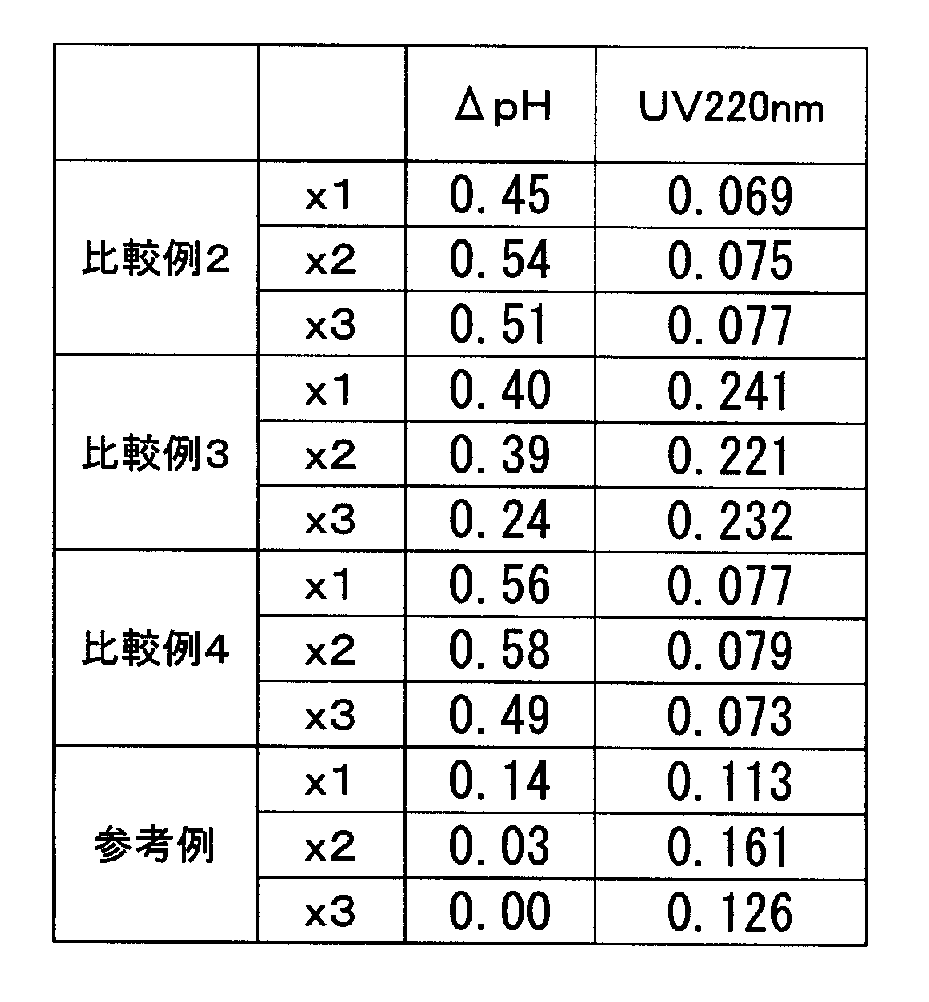
(実施例、比較例、および参考例の対比)
表1に示すように、実施例1、2および比較例1のいずれのサンプルも、外観、あわだち、および重金属の溶出については「×」がなかったが、ΔpHについては、実施例1、2よりも比較例1の方が大きな値となり(平均値では、実施例1が1.01、実施例2が1.02、比較例1が1.35)、紫外吸収スペクトルについては、実施例1、2よりも比較例の方が高い値となった(平均値では、実施例1が0.023、実施例2が0.026、比較例が0.030)。
Claims (6)
- エステル系樹脂製医療機器を、ガス不透過性材料製の包装材内に密封することにより、医療機器包装体を得て、当該医療機器包装体に対して、放射線を照射することにより、前記医療機器包装体内を滅菌する、エステル系樹脂製医療機器の滅菌方法であって、
前記エステル系樹脂製医療機器内に少なくとも還元性ガスを封入した上で、前記放射線を照射することを特徴とする、
エステル系樹脂製医療機器の滅菌方法。 - 前記還元性ガスが水素ガスであることを特徴とする、
請求項1に記載のエステル系樹脂製医療機器の滅菌方法。 - 前記医療機器包装体内には、さらに脱酸素剤が封入されていることを特徴とする、
請求項1に記載のエステル系樹脂製医療機器の滅菌方法。 - 前記医療機器包装体内には、前記還元性ガスおよび不活性ガスの混合ガスが封入されていることを特徴とする、
請求項1ないし3のいずれか1項に記載のエステル系樹脂製医療機器の滅菌方法。 - 前記包装材が、ガス不透過性を備えたフィルムであり、
前記不活性ガスが窒素ガスであることを特徴とする、
請求項4に記載のエステル系樹脂製医療機器の滅菌方法。 - 前記エステル系樹脂製医療機器が、アセチルセルロース製の中空糸を備える中空糸型血液処理器であることを特徴とする、
請求項1ないし5のいずれか1項に記載のエステル系樹脂製医療機器の滅菌方法。
Priority Applications (3)
| Application Number | Priority Date | Filing Date | Title |
|---|---|---|---|
| CN201380063415.7A CN104822394B (zh) | 2012-12-07 | 2013-12-05 | 由酯类树脂制成的医疗器械的灭菌方法 |
| JP2014550932A JP6168065B2 (ja) | 2012-12-07 | 2013-12-05 | エステル系樹脂製医療機器の滅菌方法 |
| US14/650,247 US20150306260A1 (en) | 2012-12-07 | 2013-12-05 | Method for sterilizing medical device made of ester resin |
Applications Claiming Priority (2)
| Application Number | Priority Date | Filing Date | Title |
|---|---|---|---|
| JP2012-268148 | 2012-12-07 | ||
| JP2012268148 | 2012-12-07 |
Publications (1)
| Publication Number | Publication Date |
|---|---|
| WO2014087656A1 true WO2014087656A1 (ja) | 2014-06-12 |
Family
ID=50883096
Family Applications (1)
| Application Number | Title | Priority Date | Filing Date |
|---|---|---|---|
| PCT/JP2013/007160 Ceased WO2014087656A1 (ja) | 2012-12-07 | 2013-12-05 | エステル系樹脂製医療機器の滅菌方法 |
Country Status (4)
| Country | Link |
|---|---|
| US (1) | US20150306260A1 (ja) |
| JP (1) | JP6168065B2 (ja) |
| CN (1) | CN104822394B (ja) |
| WO (1) | WO2014087656A1 (ja) |
Citations (4)
| Publication number | Priority date | Publication date | Assignee | Title |
|---|---|---|---|---|
| JPH01158958A (ja) * | 1987-12-16 | 1989-06-22 | Nippon Medical Supply Corp | 医療用具の放射線滅菌方法 |
| JPH0318371A (ja) * | 1989-06-15 | 1991-01-25 | Nippon Medical Supply Corp | 医療用具の放射線滅菌方法 |
| JP2005095271A (ja) * | 2003-09-24 | 2005-04-14 | Nipro Corp | 中空糸型血液処理器の滅菌包装方法 |
| JP2008173287A (ja) * | 2007-01-18 | 2008-07-31 | Asahi Kasei Kuraray Medical Co Ltd | 中空糸膜型血液浄化器の照射滅菌方法および中空糸膜型血液浄化器 |
Family Cites Families (7)
| Publication number | Priority date | Publication date | Assignee | Title |
|---|---|---|---|---|
| JP4211168B2 (ja) * | 1999-12-21 | 2009-01-21 | 東レ株式会社 | 透析器の製造方法および滅菌法 |
| NZ527014A (en) * | 2001-01-04 | 2005-06-24 | Osteotech Inc | Method for sterilizing bioactive materials by irradiating in the presence of hydrogen gas |
| JP4453248B2 (ja) * | 2001-12-19 | 2010-04-21 | 東レ株式会社 | 中空糸膜および中空糸膜モジュールの製造方法 |
| US7357895B2 (en) * | 2002-01-04 | 2008-04-15 | Osteotech, Inc. | Method for sterilizing bioactive materials |
| US20080000830A1 (en) * | 2004-08-10 | 2008-01-03 | Kimihiro Mabuchi | Highly Water Permeable Hollow Fiber Membrane Type Blood Purifier and Process for Manufacturing the Same |
| JP4731875B2 (ja) * | 2004-10-15 | 2011-07-27 | 東洋紡績株式会社 | 血液浄化器の滅菌方法および血液浄化器包装体 |
| KR100794632B1 (ko) * | 2007-01-19 | 2008-01-14 | 주식회사 에프에스코리아 | 멸균 포장용기 및 이를 이용한 포장방법 |
-
2013
- 2013-12-05 WO PCT/JP2013/007160 patent/WO2014087656A1/ja not_active Ceased
- 2013-12-05 JP JP2014550932A patent/JP6168065B2/ja active Active
- 2013-12-05 US US14/650,247 patent/US20150306260A1/en not_active Abandoned
- 2013-12-05 CN CN201380063415.7A patent/CN104822394B/zh active Active
Patent Citations (4)
| Publication number | Priority date | Publication date | Assignee | Title |
|---|---|---|---|---|
| JPH01158958A (ja) * | 1987-12-16 | 1989-06-22 | Nippon Medical Supply Corp | 医療用具の放射線滅菌方法 |
| JPH0318371A (ja) * | 1989-06-15 | 1991-01-25 | Nippon Medical Supply Corp | 医療用具の放射線滅菌方法 |
| JP2005095271A (ja) * | 2003-09-24 | 2005-04-14 | Nipro Corp | 中空糸型血液処理器の滅菌包装方法 |
| JP2008173287A (ja) * | 2007-01-18 | 2008-07-31 | Asahi Kasei Kuraray Medical Co Ltd | 中空糸膜型血液浄化器の照射滅菌方法および中空糸膜型血液浄化器 |
Also Published As
| Publication number | Publication date |
|---|---|
| JP6168065B2 (ja) | 2017-07-26 |
| JPWO2014087656A1 (ja) | 2017-01-05 |
| CN104822394B (zh) | 2018-04-20 |
| CN104822394A (zh) | 2015-08-05 |
| US20150306260A1 (en) | 2015-10-29 |
Similar Documents
| Publication | Publication Date | Title |
|---|---|---|
| US10137234B2 (en) | Method for sterilizing blood purifier and blood purifier package | |
| US9987409B2 (en) | Blood purifier and blood purifier package | |
| US9987408B2 (en) | Blood purifier package and process for manufacturing the same | |
| CN100563732C (zh) | 中空纤维血液加工设备及对该设备进行包装和灭菌的方法 | |
| JPH0550946B2 (ja) | ||
| JP4984033B2 (ja) | 重炭酸塩含有薬液を充填した容器収納体 | |
| JP6168065B2 (ja) | エステル系樹脂製医療機器の滅菌方法 | |
| JP2005066389A (ja) | 選択透過性分離膜の保存パックおよび保存方法 | |
| JP4738729B2 (ja) | 中空糸型血液処理器の滅菌包装方法 | |
| JP2008173287A (ja) | 中空糸膜型血液浄化器の照射滅菌方法および中空糸膜型血液浄化器 | |
| JP4738728B2 (ja) | 中空糸型血液処理器及びその滅菌包装方法 | |
| JP2000218140A (ja) | 膜を組み込んだモジュ―ルおよびその製造法 |
Legal Events
| Date | Code | Title | Description |
|---|---|---|---|
| 121 | Ep: the epo has been informed by wipo that ep was designated in this application |
Ref document number: 13861046 Country of ref document: EP Kind code of ref document: A1 |
|
| ENP | Entry into the national phase |
Ref document number: 2014550932 Country of ref document: JP Kind code of ref document: A |
|
| WWE | Wipo information: entry into national phase |
Ref document number: 14650247 Country of ref document: US |
|
| NENP | Non-entry into the national phase |
Ref country code: DE |
|
| 122 | Ep: pct application non-entry in european phase |
Ref document number: 13861046 Country of ref document: EP Kind code of ref document: A1 |