WO2014080983A1 - 糖鎖修飾三量体構造オリゴヌクレオチド及びその使用 - Google Patents
糖鎖修飾三量体構造オリゴヌクレオチド及びその使用 Download PDFInfo
- Publication number
- WO2014080983A1 WO2014080983A1 PCT/JP2013/081399 JP2013081399W WO2014080983A1 WO 2014080983 A1 WO2014080983 A1 WO 2014080983A1 JP 2013081399 W JP2013081399 W JP 2013081399W WO 2014080983 A1 WO2014080983 A1 WO 2014080983A1
- Authority
- WO
- WIPO (PCT)
- Prior art keywords
- oligonucleotide
- seq
- modified
- sugar chain
- influenza
- Prior art date
- Legal status (The legal status is an assumption and is not a legal conclusion. Google has not performed a legal analysis and makes no representation as to the accuracy of the status listed.)
- Ceased
Links
Images




Classifications
-
- G—PHYSICS
- G01—MEASURING; TESTING
- G01N—INVESTIGATING OR ANALYSING MATERIALS BY DETERMINING THEIR CHEMICAL OR PHYSICAL PROPERTIES
- G01N33/00—Investigating or analysing materials by specific methods not covered by groups G01N1/00 - G01N31/00
- G01N33/48—Biological material, e.g. blood, urine; Haemocytometers
- G01N33/50—Chemical analysis of biological material, e.g. blood, urine; Testing involving biospecific ligand binding methods; Immunological testing
- G01N33/53—Immunoassay; Biospecific binding assay; Materials therefor
- G01N33/569—Immunoassay; Biospecific binding assay; Materials therefor for microorganisms, e.g. protozoa, bacteria, viruses
- G01N33/56983—Viruses
-
- A—HUMAN NECESSITIES
- A61—MEDICAL OR VETERINARY SCIENCE; HYGIENE
- A61K—PREPARATIONS FOR MEDICAL, DENTAL OR TOILETRY PURPOSES
- A61K31/00—Medicinal preparations containing organic active ingredients
- A61K31/70—Carbohydrates; Sugars; Derivatives thereof
- A61K31/7088—Compounds having three or more nucleosides or nucleotides
-
- A—HUMAN NECESSITIES
- A61—MEDICAL OR VETERINARY SCIENCE; HYGIENE
- A61P—SPECIFIC THERAPEUTIC ACTIVITY OF CHEMICAL COMPOUNDS OR MEDICINAL PREPARATIONS
- A61P31/00—Antiinfectives, i.e. antibiotics, antiseptics, chemotherapeutics
- A61P31/12—Antivirals
- A61P31/14—Antivirals for RNA viruses
- A61P31/16—Antivirals for RNA viruses for influenza or rhinoviruses
-
- C—CHEMISTRY; METALLURGY
- C07—ORGANIC CHEMISTRY
- C07H—SUGARS; DERIVATIVES THEREOF; NUCLEOSIDES; NUCLEOTIDES; NUCLEIC ACIDS
- C07H19/00—Compounds containing a hetero ring sharing one ring hetero atom with a saccharide radical; Nucleosides; Mononucleotides; Anhydro-derivatives thereof
- C07H19/02—Compounds containing a hetero ring sharing one ring hetero atom with a saccharide radical; Nucleosides; Mononucleotides; Anhydro-derivatives thereof sharing nitrogen
- C07H19/04—Heterocyclic radicals containing only nitrogen atoms as ring hetero atom
- C07H19/06—Pyrimidine radicals
- C07H19/073—Pyrimidine radicals with 2-deoxyribosyl as the saccharide radical
-
- C—CHEMISTRY; METALLURGY
- C07—ORGANIC CHEMISTRY
- C07H—SUGARS; DERIVATIVES THEREOF; NUCLEOSIDES; NUCLEOTIDES; NUCLEIC ACIDS
- C07H21/00—Compounds containing two or more mononucleotide units having separate phosphate or polyphosphate groups linked by saccharide radicals of nucleoside groups, e.g. nucleic acids
-
- C—CHEMISTRY; METALLURGY
- C07—ORGANIC CHEMISTRY
- C07H—SUGARS; DERIVATIVES THEREOF; NUCLEOSIDES; NUCLEOTIDES; NUCLEIC ACIDS
- C07H21/00—Compounds containing two or more mononucleotide units having separate phosphate or polyphosphate groups linked by saccharide radicals of nucleoside groups, e.g. nucleic acids
- C07H21/04—Compounds containing two or more mononucleotide units having separate phosphate or polyphosphate groups linked by saccharide radicals of nucleoside groups, e.g. nucleic acids with deoxyribosyl as saccharide radical
-
- G—PHYSICS
- G01—MEASURING; TESTING
- G01N—INVESTIGATING OR ANALYSING MATERIALS BY DETERMINING THEIR CHEMICAL OR PHYSICAL PROPERTIES
- G01N2333/00—Assays involving biological materials from specific organisms or of a specific nature
- G01N2333/005—Assays involving biological materials from specific organisms or of a specific nature from viruses
- G01N2333/08—RNA viruses
- G01N2333/11—Orthomyxoviridae, e.g. influenza virus
Definitions
- the present invention relates to a sugar chain-modified trimeric structure oligonucleotide and use of the sugar chain-modified trimer structure oligonucleotide.
- Influenza virus is the most feared pandemic virus and is covered with an enzyme called sialidase (neuraminidase: NA) and a protein called hemagglutinin (HA). Tamiflu (trade name), which is the mainstream of current therapeutic drugs, inhibits NA enzyme activity.
- NA neuroaminidase
- HA hemagglutinin
- Tamiflu trade name
- HA is commercially available as a vaccine
- antibodies that bind to HA are commercially available as virus removal sheets by immobilizing them on a filter.
- the mutation rate of this virus is so fast that the structure of NA and HA changes over time, making it difficult to prevent, diagnose and treat influenza.
- Sialyl lactose a sialic acid-containing complex sugar chain
- a receptor for influenza A is known as a receptor for influenza A and is expected as an agent for preventing infection of influenza A (Non-patent Document 1).
- the anti-adhesion effect of sialyl lactose on influenza virus is not exerted unless the administration is extremely high at 0.1% or more of sialyl lactose per unit volume.
- Non-Patent Document 1 sialyllactose bonded to polystyrene (patent document 1, non-patent document 2), sialoglycosylated polymer in which sialoglycochain is bonded to ⁇ -polyglutamic acid (patent document 2), polymer such as polyacrylamide To which ⁇ -sialoside group is bound (non-patent document 3), sialyl lactose bound to a polypeptide (non-patent document 4), and sialyl lactose having a dendrimer structure with carbosilane as a core (non-patent document 4) Patent Document 5), polyvalent antiviral inhibitors containing sialic acid (Non-Patent Document 6), and the like.
- a method for preparing a sugar-modified nucleic acid there is disclosed a method for preparing a novel oligonucleotide sugar conjugate in which an arbitrary position is selectively substituted with a sugar (Patent Document 3).
- the sugar-modified nucleic acid disclosed here is a sugar-bound uridine in which sugar and uridine are bound via a spacer.
- galactose is disclosed as the sugar.
- nucleic acids modified with sialic acid there are no reports on nucleic acids modified with sialic acid.
- Non-patent Document 7 a sugar chain-modified trimeric oligonucleotide modified with maltose or mannose is disclosed.
- modified oligonucleotides modified with sialic acid there are no reports on modified oligonucleotides modified with sialic acid.
- An object of the present invention is to provide a sugar chain-modified oligonucleotide capable of binding to various influenza viruses with a high binding constant regardless of the mutation of sialidase (NA) or hemagglutinin (HA) of influenza virus. .
- influenza virus HA has three sites that bind sialic acid, which is a component of complex carbohydrates.
- sialic acid which is a component of complex carbohydrates.
- a sugar chain-modified trimeric oligonucleotide comprising a sugar-modified nucleic acid capable of binding to the hemagglutinin sugar chain binding site of influenza A and having the following characteristics: 1)
- the oligonucleotide basic unit oligonucleotide forming the trimer structure is an oligonucleotide containing a sugar-modified nucleic acid formed by binding sialic acid via a linker, 2) One molecule of the basic unit oligonucleotide is linked to the other two molecules of the basic unit oligonucleotide by partially forming a double-stranded oligonucleotide to form a trimer. 2.
- a portion where one molecule of the basic unit oligonucleotide contained in the sugar chain-modified trimeric structure oligonucleotide is linked with another single molecule of the basic unit oligonucleotide by forming a double-stranded oligonucleotide is 3-12. 2.
- the basic unit oligonucleotide of the sugar chain-modified trimer structure oligonucleotide consists of a sequence containing any one of the base sequences selected from the base sequences shown in SEQ ID NOs: 1 to 6 and 10 to 15 below, Or the sugar chain-modified trimeric oligonucleotide according to 2: (SEQ ID NO: 1) 5'-ATCACGCTG-3 ' (SEQ ID NO: 2) 5'-GACTTGCGA-3 ' (SEQ ID NO: 3) 5'-TCGCAAGTC-3 ' (SEQ ID NO: 4) 5'-TCGCAGGTA-3 ' (SEQ ID NO: 5) 5'-TACCTGCGA-3 ' (SEQ ID NO: 6) 5'-CAGCGTGAT-3 ' (SEQ ID NO: 10) 5'-CAGCG-3 ' (SEQ ID NO: 11) 5'-UGCGA-3 ' (SEQ ID NO: 12) 5'-CGCUG-3 ' (SEQ
- the basic unit oligonucleotide of the sugar chain-modified trimeric structure oligonucleotide is selected from the following base sequences shown in SEQ ID NOs: 19 to 23, and includes any base sequence selected from the following:
- a method for treating and / or preventing influenza which comprises using the anti-influenza agent according to item 7 or 8. 10. 7. A solid phase carrier on which the sugar chain-modified trimeric oligonucleotide according to any one of 1 to 6 above is immobilized as an influenza virus capture agent. 11. 11. The solid phase carrier according to 10 above, wherein the solid phase carrier to which the influenza virus capturing agent is fixed is a cloth, a nonwoven fabric, or a plastic material. 12 12. A method for examining influenza virus, comprising using the solid phase carrier according to item 10 or 11 above.
- the sugar chain-modified trimeric oligonucleotide of the present invention can be used as an anti-influenza agent. Specifically, it can be used as an influenza therapeutic agent or an influenza virus capture agent.
- Tamiflu the mainstream of influenza drugs, can inhibit influenza infection at a concentration of 1 nM.
- the sugar chain-modified trimeric oligonucleotide of the present invention binds to influenza virus with a binding constant of 10 8 M ⁇ 1 and can inhibit infection at 10 nM, and is a therapeutic drug comparable to Tamiflu (trade name). It can be.
- the sugar chain-modified trimeric oligonucleotide of the present invention targets the sialic acid binding site of HA, which is less mutated than influenza virus, it can adsorb and bind to any mutated virus. Performance can be maintained.
- a solid phase carrier to which the sugar chain-modified trimer structure oligonucleotide of the present invention is appropriately fixed can be used.
- the immobilization method can be based on the immobilization method of the oligonucleotide to the solid phase carrier. Examples of the solid phase carrier include cloth, nonwoven fabric, and plastic material.
- the influenza capture agent in which the sugar chain-modified trimer structure oligonucleotide is immobilized on a solid phase carrier can be used for influenza capture filters, masks, mask materials, and influenza detection carriers.
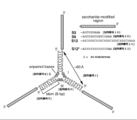
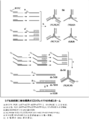
- Example 1 is a diagram showing specific structures with different arm lengths and sugar modification sites for sialyl lactose-modified trimeric oligonucleotides of the present invention.
- Example 1 It is a figure which shows the synthetic scheme of the sialyl lactose modification trimer structure oligonucleotide of this invention.
- Example 1 It is a figure which shows an example of the specific structure of a loop type sialyl lactose modification trimer structure oligonucleotide.
- Example 2 It is a photograph figure which shows the result of having confirmed the inhibitory effect with respect to the hemagglutination reaction of influenza virus and an avian erythrocyte about the sugar chain modification trimer structure oligonucleotide of this invention.
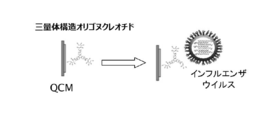
- Example 3 It is a figure which shows a crystal oscillation microbalance (QCM) measurement scheme.
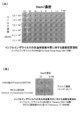
- Example 4 It is a figure which shows the result of having confirmed the binding ability of the sugar chain modification trimer structure oligonucleotide and influenza virus by QCM measurement.
- Example 4) It is a photograph figure which shows the result of having confirmed the infection inhibitory effect of the sugar chain modification trimer structure oligonucleotide in the infection to the MDCK cell of influenza virus.
- Example 5 It is a figure which shows a crystal oscillation microbalance
- the present invention relates to a “sugar chain-modified trimeric oligonucleotide” comprising the sugar-modified nucleic acid capable of binding to the hemagglutinin sugar chain-binding site of influenza A and having the following characteristics 1) and 2): Use of sugar chain-modified trimeric oligonucleotides ".
- the “basic unit oligonucleotide” forming a sugar chain-modified trimeric oligonucleotide is an oligonucleotide containing a “sugar-modified nucleic acid” formed by binding sialic acid via a linker, 2) One molecule of the basic unit oligonucleotide is linked to the other two molecules of the basic unit oligonucleotide by partially forming a double-stranded oligonucleotide to form a trimer.
- the “sugar-modified nucleic acid” those disclosed in Patent Document 4 shown in the background art column can be used. Specifically, it is as follows. The method for preparing the sugar-modified nucleic acid is as detailed in Patent Document 4.
- the “sugar chain-modified trimeric structure oligonucleotide” may have a structure in which an arm is formed and a single-stranded oligonucleotide protrudes as shown in FIG. , (Ii) may be a loop.
- (Ii) may be a loop.
- the structure (ii) it is also referred to as a “loop-type trimer structure oligonucleotide” in the present specification.
- the “basic unit oligonucleotide” refers to a single-stranded oligonucleotide that is fundamental for forming a sugar chain-modified trimeric oligonucleotide.
- the sugar chain-modified trimeric oligonucleotide of the present invention can be prepared by partially complementaryly associating basic unit oligonucleotides having base sequences complementary to each other with respect to the three basic unit oligonucleotides. .
- the structure of the basic unit oligonucleotide is preferably a structure that has a low possibility of mis-annealing and can form a stable complex at room temperature.
- the basic unit oligonucleotide may have the same nucleic acid sequence, sugar chain modification site, number of sugar chain modifications, etc., or may have an independent structure.
- the base sequence constituting the basic unit oligonucleotide can be designed as appropriate.
- double-stranded arm the site of the double-stranded oligonucleotide in which the basic unit oligonucleotide is complementarily associated with the other basic unit oligonucleotide.
- the sialic acid modification site in the sugar chain-modified trimeric oligonucleotide is preferably designed according to the three sialic acid binding sites of HA of influenza A virus.
- the distance between the sialic acid binding sites of HA of influenza A virus is revealed to be approximately 50 to 70 ohm strong ( ⁇ ) from X-ray crystal structure analysis. Therefore, in the present invention, the distance between sugar chain binding sites by the sugar chain-modified trimeric oligonucleotide can be designed to be 20 to 100 mm, preferably 50 to 70 mm.
- This interval is a double of 5 to 10 base pairs (hereinafter sometimes simply referred to as “bp”) from the center of the basic unit oligonucleotide junction in the sugar chain-modified trimeric oligonucleotide of the present invention.
- This corresponds to the distance between the ends when the chain arms extend planarly and symmetrically. That is, the length of the double-stranded arm oligonucleotide can be 3 to 12 bases long, preferably 5 to 9 bases long, and most preferably 5 bases long.
- the length of the basic unit oligonucleotide in the present invention can be about 15 to 150 bases long, preferably about 15 to 100 bases long, more preferably about 15 to 80 bases long. Can do.
- the basic unit oligonucleotide can contain about 1 to 70, preferably about 1 to 50, more preferably 1 to 15 sugar-modified nucleic acids.
- 1 to 7, preferably 1 to 7, as shown in FIG. It is preferred to introduce 2 to 4, more preferably 2 unpaired bases. Any nucleic acid may be used as long as it has an unpaired base, and examples thereof include adenine.
- the basic unit oligonucleotide comprises a sequence comprising any one of the base sequences shown in SEQ ID NOs: 1 to 18 below, and forms a double-stranded arm for forming a trimeric oligonucleotide Need only have complementary structures to each other.
- the structure shown in FIG. 1 (i) for example, as shown in FIG. 2, it may be a sequence containing a combination of any of the base sequences shown in SEQ ID NOS: 1 to 6 below.
- it can be an oligonucleotide containing the base sequence shown in SEQ ID NO: 7, 8, or 9 independently.
- the structure (ii) for example, as shown in FIG.
- the structure of the basic unit oligonucleotide for forming the sugar chain-modified trimeric structure oligonucleotide of the present invention is not limited to one containing any of the sequences specifically specified below. It is.
- the basic unit oligonucleotide of the sugar chain-modified trimeric structure oligonucleotide includes an oligonucleotide containing a “sugar-modified nucleic acid” in the base sequence.
- a “sugar-modified nucleic acid” in the base sequence.
- it may contain any base sequence selected from the base sequences shown in SEQ ID NOs: 19 to 23 below.
- each n can be independently an adenine (A), guanine (G), cytidine (C), or a sugar-modified nucleic acid formed by binding sialic acid via a linker.
- A adenine
- G guanine
- C cytidine
- the oligonucleotide containing the “sugar-modified nucleic acid” in the base sequence is in principle a single-stranded oligonucleotide chain.
- SEQ ID NO: 19 5'-AnCnGnAAA-3 '
- SEQ ID NO: 20 5'-AnCnGnCnGnCnAAA-3 '
- SEQ ID NO: 21 5'-AnCnGnCnGnCnGnCnGnCnGnCnGnCnGnCnGnCnGnCnAA-3 '
- SEQ ID NO: 22 5'-AnnnnnnnnnnnnAA-3 '
- SEQ ID NO: 23 5′-nnnnn-3 ′
- the sugar in the “sugar modified nucleic acid” can be sialic acid or sialyl lactose.
- the sugar when the sugar is sialyl lactose, it can be 2-6 sialyl lactose or 2-3 sialyl lactose.
- HA of human-derived influenza virus recognizes ⁇ 2 ⁇ 6 linked sialic acid and lactose (Gal ⁇ 1 ⁇ 4Glc), that is, ⁇ 2-6 type sialyl lactose '', HA of avian-derived influenza virus is the same It is known to recognize ⁇ 2- ⁇ 3-linked, ie “2-3 type sialyl lactose”. Therefore, when the sugar in the sugar-modified nucleic acid of the present invention is sialyl lactose, the type can be appropriately selected as necessary.
- the nucleic acid may be any of deoxyribonucleotides, ribonucleotides, and artificial nucleic acids, and is not particularly limited and can be appropriately selected depending on the application.
- a natural nucleic acid that is degraded by a nuclease or the like at an appropriate time is preferable.
- an artificial nucleic acid having excellent stability may be used.
- the base type contained in the nucleic acid may be a pyrimidine base or a purine base, but is preferably a pyrimidine base. Accordingly, examples of the nucleoside constituting the nucleic acid include uridine, thymidine, and cytidine, and particularly preferably uridine.
- the linker binds sugar and nucleic acid, has a soft structure and has flexibility, and is preferably hydrophobic.
- Examples include alkanes having 1 to 10 carbon atoms, ethers, esters or amides, and may contain aromatic hydrocarbons.
- Examples of preferred linkers include linear alkanes such as ethane, propane, n-butane, n-pentane, n-hexane, and ethylene glycol.
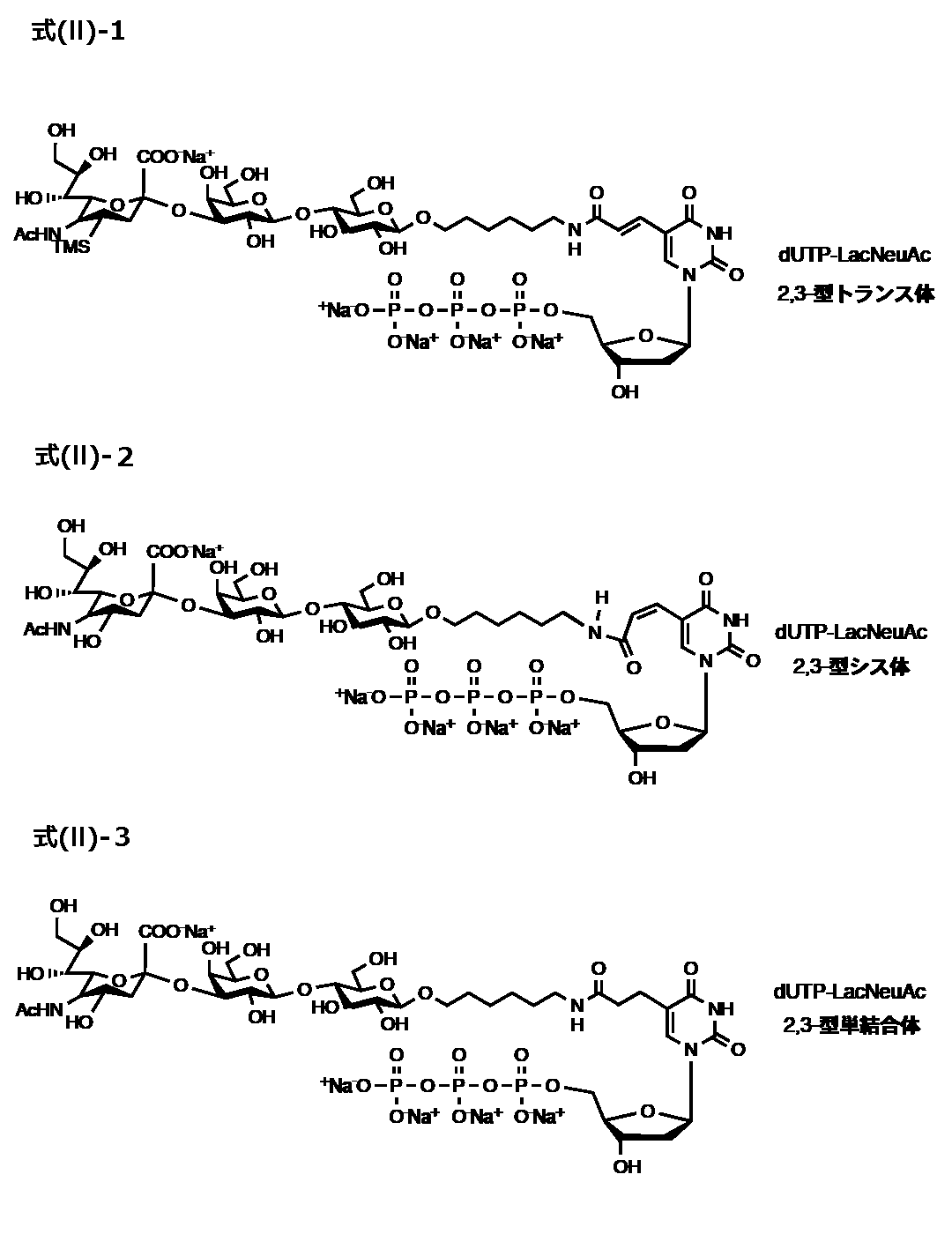
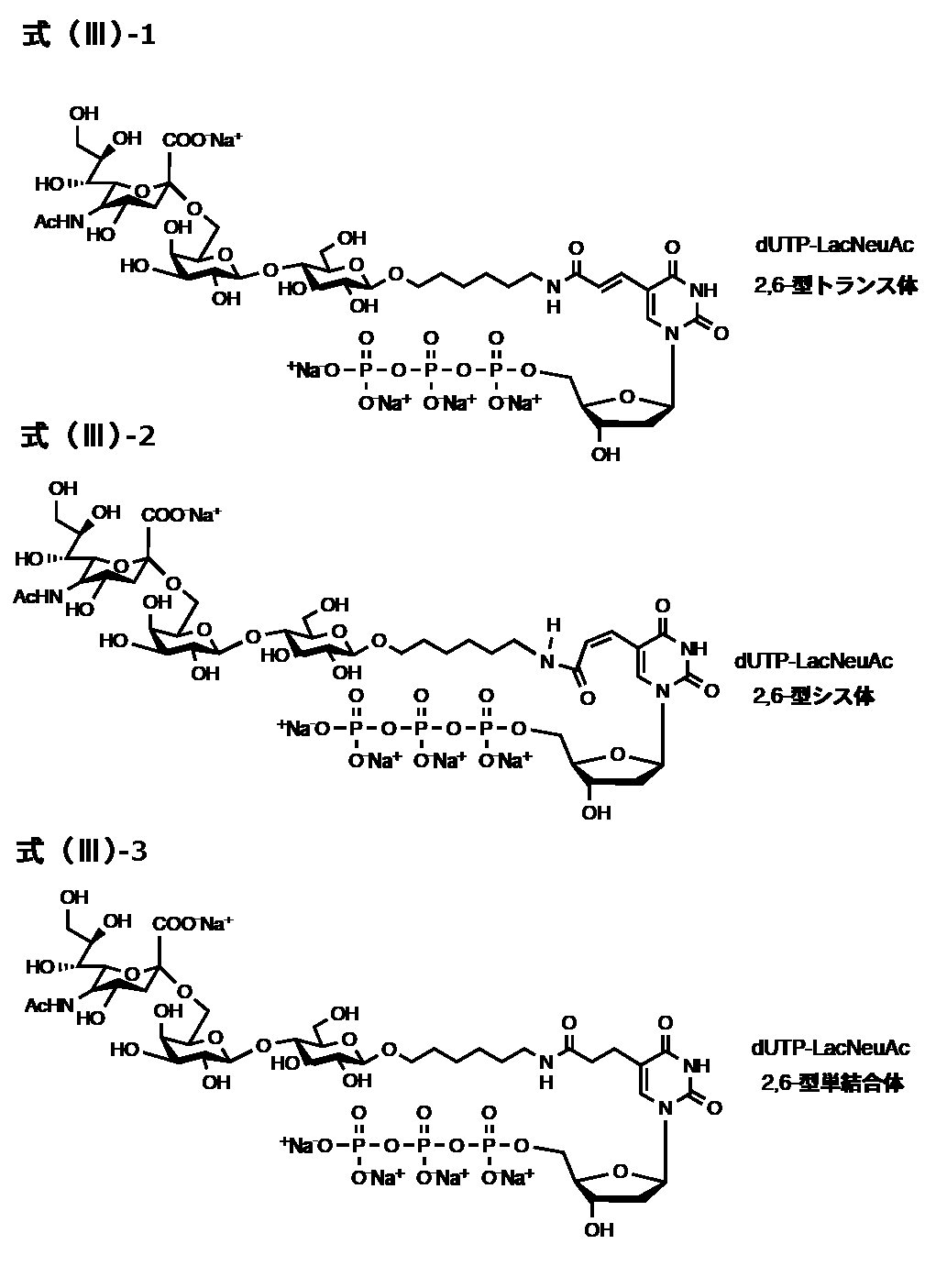
- “sugar-modified nucleic acid” of the present invention include compounds represented by the following formulas (I) to (III). Each of the compounds represented by the formulas may be a trans isomer, a cis isomer, or a single bond.
- the basic unit oligonucleotide of the present invention can be prepared using the above-mentioned sugar-modified nucleic acid using the method described in Patent Document 4, such as DNA polymerase.
- DNA polymerase based on the sugar-modified nucleic acid of the present invention and dNTP as a substrate.
- DNA polymerase those known per se can be used.
- commercially available DNA polymerases such as KOD Dash (R) (Toyobo) and Vent (R) (exo-) DNA polymerase (New England BioLabs) Many types of enzymes belonging to Family B type can be used.
- the nucleic acid amplification method is not particularly limited, but, for example, PCR (Polymerase Chain ⁇ Reaction) method, LAMP method, TMA (Transcription Mediated Amplification) method, NASBA (Nucleic Acid Sequence-Based Amplification) method, LCR (Ligase Chain Reaction) method
- PCR Polymerase Chain ⁇ Reaction
- LAMP Long Term Evolution
- TMA Transcription Mediated Amplification
- NASBA Nucleic Acid Sequence-Based Amplification
- LCR Low-Ligase Chain Reaction
- the sugar-modified nucleic acid in a template oligonucleotide, by arranging a nucleotide complementary to a sugar chain-modified nucleic acid at a desired position, the sugar-modified nucleic acid can be arranged at a desired position in the amplified oligonucleotide.
- an oligonucleotide having the following base sequence can be used, but is not limited thereto.
- SEQ ID NO: 24 5'-TTTACAGAT TCGCAAGTCTTCAGCGTGAT
- SEQ ID NO: 25 5'-TTTACAGAT TACCTGCGATTGACTTGCGA
- SEQ ID NO: 26 5'-TTTACAGAT ATCACGCTGTTTCGCAGGTA
- SEQ ID NO: 27 5'-TTTAGACAGACAGAT TCGCAAGTCTTCAGCGTGAT
- SEQ ID NO: 28 5'-TTTAGACAGACAGAT TACCTGCGATTGACTTGCGA
- SEQ ID NO: 29 5'-TTTAGACAGACAGAT ATCACGCTGTTTCGCAGGTA
- SEQ ID NO: 30 5'-TTTAGACAGACAGAT TCGCAAGTCTTCAGCGTGAT
- an oligonucleotide having the following base sequence can be used, but is not limited thereto.
- SEQ ID NO: 7 5'-ATCACGCTGAAGACTTGCGA (SEQ ID NO: 8) 5'-TCGCAAGTCAATCGCAGGTA (SEQ ID NO: 9) 5'-TACCTGCGAAACAGCGTGAT (SEQ ID NO: 34) 5'-TTTAGACAGACAGATATCACGCTGAAGACTTGCGA (SEQ ID NO: 35) 5'-TTTAGACAGACAGATTCGCAAGTCAATCGCAGGTA (SEQ ID NO: 36) 5'-TTTAGACAGACAGATTACCTGCGAAACAGCGTGAT (SEQ ID NO: 37) 5'-TATATATAUACAGCG
- the present invention also extends to an anti-influenza agent containing the above sugar chain-modified trimeric oligonucleotide as an active ingredient.
- anti-influenza agents include influenza treatment agents and influenza virus capture agents.
- influenza therapeutic agent it can bind to the influenza virus HA in vivo and prevent the influenza virus from entering the cells.
- influenza virus capture agent the said virus can be captured not only in the living body. For example, by fixing the sugar chain-modified trimeric oligonucleotide of the present invention to a filter or the like, a material for removing influenza virus can be obtained.
- the sugar chain-modified trimer structure oligonucleotide of the present invention to a material such as a mask, the entry of influenza virus from the outside is prevented, or the virus scatters outside from, for example, an influenza virus-infected patient. Can be prevented. Moreover, it can also be used as a reagent for influenza testing, which can detect influenza in a sample by the influenza virus capturing action.
- the anti-influenza agent containing the sugar chain-modified trimeric oligonucleotide of the present invention as an active ingredient can contain necessary additives as appropriate depending on the use such as an influenza therapeutic agent or influenza capture agent.
- a necessary additive that is, a pharmaceutically acceptable additive
- the additive include excipients, binders, lubricants, disintegrating agents, coloring agents, flavoring agents, emulsifiers, surfactants, solubilizers, suspending agents, etc.
- examples include tonicity agents, buffering agents, preservatives, antioxidants, stabilizers, absorption promoters, and the like, and these can be used in appropriate combinations as desired.
- Examples of the above additives are given below.
- Examples of the excipient include lactose, sucrose, glucose, corn starch, mannitol, sorbitol, starch, pregelatinized starch, dextrin, crystalline cellulose, light anhydrous silicic acid, aluminum silicate, calcium silicate, magnesium metasilicate aluminate, phosphorus
- An example is calcium oxyhydrogen.
- binder examples include polyvinyl alcohol, methylcellulose, ethylcellulose, gum arabic, tragacanth, gelatin, shellac, hydroxypropylmethylcellulose, hydroxypropylcellulose, sodium carboxymethylcellulose, polyvinylpyrrolidone, and macrogol.
- lubricant examples include magnesium stearate, calcium stearate, sodium stearyl fumarate, talc, polyethylene glycol and colloidal silica.
- Disintegrants include crystalline cellulose, agar, gelatin, calcium carbonate, sodium bicarbonate, calcium citrate, dextrin, pectin, low substituted hydroxypropylcellulose, carboxymethylcellulose, carboxymethylcellulose calcium, croscarmellose sodium, carboxymethyl starch, A sodium carboxymethyl starch is mentioned.
- the coloring agent include iron sesquioxide, yellow sesquioxide, carmine, caramel, ⁇ -carotene, titanium oxide, talc, riboflavin sodium phosphate, yellow aluminum lake, and the like that are permitted to be added to pharmaceuticals. .
- flavoring agents include cocoa powder, mint brain, fragrance powder, mint oil, dragon brain and cinnamon powder.
- emulsifier or surfactant include stearyl triethanolamine, sodium lauryl sulfate, laurylaminopropionic acid, lecithin, glyceryl monostearate, sucrose fatty acid ester, and glycerin fatty acid ester.
- solubilizer include polyethylene glycol, propylene glycol, benzyl benzoate, ethanol, cholesterol, triethanolamine, sodium carbonate, sodium citrate, polysorbate 80, and nicotinamide.
- suspending agent examples include hydrophilic polymers such as polyvinyl alcohol, polyvinyl pyrrolidone, methyl cellulose, hydroxymethyl cellulose, hydroxyethyl cellulose, and hydroxypropyl cellulose in addition to the surfactant.
- hydrophilic polymers such as polyvinyl alcohol, polyvinyl pyrrolidone, methyl cellulose, hydroxymethyl cellulose, hydroxyethyl cellulose, and hydroxypropyl cellulose in addition to the surfactant.
- Examples of isotonic agents include glucose, sodium chloride, mannitol, and sorbitol.
- the buffer include buffers such as phosphate, acetate, carbonate, citrate.
- Examples of the preservative include methyl paraben, propyl paraben, chlorobutanol, benzyl alcohol, phenethyl alcohol, dehydroacetic acid, and sorbic acid.
- Antioxidants include sulfate, ascorbic acid, and ⁇ -tocopherol.
- Stabilizers include those commonly used in medicine.
- Absorption promoters include those commonly used in medicine. Moreover, you may mix
- the preparation examples include tablets, powders, granules, fine granules, capsules, syrups, troches, inhalants, and other oral preparations; suppositories, ointments, eye ointments, tapes, eye drops, External preparations such as nasal drops, ear drops, poultices, lotions, and injections can be mentioned.
- the oral preparation can be formulated by appropriately combining the additives. In addition, you may coat these surfaces as needed.
- the above external preparations are particularly excipients, binders, flavoring agents, emulsifiers, surfactants, solubilizers, suspending agents, isotonic agents, preservatives, antioxidants, A stabilizer or an absorption accelerator can be formulated in combination as appropriate.
- the injection is an emulsifier, surfactant, solubilizer, suspending agent, isotonic agent, buffer, preservative, antioxidant, stabilizer, or absorption enhancer. It can be formulated by appropriately combining.
- the dose of the sugar-modified nucleic acid contained in the sugar chain-modified trimeric oligonucleotide can be appropriately determined.
- the dosage and administration method can be determined as appropriate.
- the preferred dosage is usually 10 to 1000 mg / day, preferably 15 to 700 mg / day, more preferably 30 to 300 mg / day (as a sugar-modified nucleic acid) per adult (body weight 60 kg). For example, 200 mg / day).
- the dose and administration period can be appropriately set in consideration of the therapeutic effect of inflammation and the patient's condition.
- a sugar chain-modified trimeric oligonucleotide is appropriately fixed to a solid phase carrier such as a filter, a mask material or a solid phase.
- a solid phase carrier such as a filter, a mask material or a solid phase.
- immobilization methods can be immobilized according to the oligonucleotide immobilization method.
- the present invention extends to a solid phase carrier containing a sugar chain-modified trimeric oligonucleotide as an active ingredient and having an influenza virus capture agent immobilized thereon.
- the solid phase carrier include cloth, non-woven fabric, and plastic material.
- Specific examples include filters, masks, mask materials, and influenza detection carriers.
- the present invention extends to a method for treating and / or preventing influenza by using a solid phase carrier on which an anti-influenza agent or the above-described influenza virus capture agent is immobilized.
- a solid phase carrier on which an anti-influenza agent or the above-described influenza virus capture agent is immobilized.
- an anti-influenza agent as a pharmaceutical, it is possible to treat and / or prevent a disease associated with influenza infection by using a filter, a mask, or a mask material.
- the solid phase carrier is an influenza detection carrier, it can be used for influenza testing.
- the present invention extends to a method for testing influenza.
- Example 1 Preparation of sugar chain-modified trimeric oligonucleotide (1) Sialyl lactose-modified nucleic acid
- sialyl lactose-modified nucleic acid As a sugar chain-modified nucleic acid, the following sialyl lactose modification was performed by the technique described in Patent Document 4. Nucleotide triphosphate (dUTP-Sialyllac) was synthesized.
- SEQ ID NO: 7 5'-ATCACGCTGAAGACTTGCGA-3 '
- SEQ ID NO: 8 5'-TCGCAAGTCAATCGCAGGTA-3 '
- SEQ ID NO: 9 5'-TACCTGCGAAACAGCGTGAT-3 '
- sialyl lactose-modified trimeric oligonucleotides Each sialyl lactose-modified trimeric oligonucleotide is based on the junction structure of oligonucleotide chains I, II, III, and 2 in the binding region. Each has unpaired bases (A) and 9 base pairs (9 bp) double-stranded arms ( Figure 2). Furthermore, various sialyl lactose-modified trimeric oligonucleotides with different basic unit oligonucleotide length, sugar modification degree, and arm structure were shown (FIG. 3).
- the structures S3, S6, dsa-S6, and S12 have a structure in which 3, 6, 6, and 12 sialyl lactose chains can be arranged on the arms, respectively.
- the structures S3, S6, and S12 have the base sequences shown in SEQ ID NOs: 19-22.
- Sialyl lactose chains are arranged at every base in the structures S3, S6, S12 and dsa-S6.
- dsa-S6 has an additional sequence (5′-TTTAGACAGACAGAT-3 ′: SEQ ID NO: 38) complementary to the sugar chain modification region at the 5 ′ end of each chain shown in FIG. stem) was completely double-stranded.
- FIG. 4 shows a synthesis scheme of sialyl lactose-modified trimeric oligonucleotides necessary for constructing the above structure, and Table 1 and Table 3 show the template DNA (template oligonucleotide) and primer sequences used for the preparation. It was shown in 2.
- oligonucleotide strands to construct sialyl lactose modified trimeric oligonucleotides with single stranded sialyl lactose modified arms was performed by asymmetric PCR.
- a set of templates (templates) suitable for amplifying each oligonucleotide strand (T13-15- (A3, A6, A12); 0.1 pmol / l), primer (P13-15; 3 pmol / ⁇ l), KOD Dash (R) (Toyobo) buffer (1/10 volume), dNTP (natural type: dATP + dCTP + dGTP + dTTP; sialyl lactose modified type: dATP + dCTP + dGTP + dUTP-SL; 0.2 mM), MilliQ water , KOD Dash (R) (Toyobo) (0.005 U / ⁇ l) (reaction volume 400-800 ⁇ l) and asymmetric PCR (
- a sugar chain-modified dsDNA was prepared by a primer extension reaction using 3 phosphorylated template DNA, and then the sugar chain-modified chain was isolated by denaturing gel electrophoresis. Released.
- Example 1 Inhibitory binding constant (K i HAI ) against influenza hemagglutinin (HA) Inhibitory binding constants (K i HAI ) of sialyl lactose modified trimeric oligonucleotides (S3, S6, dsa-S6, Stem7) and loop sialyl lactose modified trimeric oligonucleotides (3Loop-A5) to influenza HA This was confirmed by a hemagglutination inhibition experiment.
- Influenza virus A / PR / 8/34 (H1N1) and sialyl lactose-modified otigonucleotide were incubated at 37 ° C. for 1 hour, added with avian erythrocytes, and further incubated at 4 ° C. for 1 hour.
- the results are summarized in Table 3.
- the inhibition binding constant of S6 (SL, SL, SL), in which six sialyl lactoses are introduced into all three arms, is 15 nM, which is about 3 compared to S6 (SL, SL, 0) (45 nM). It showed twice higher affinity. In S6 (0,0,0) containing no sugar chain, the affinity was remarkably decreased at 1000 nM or more.
- This sugar chain-dependent affinity change in the arm is such that sialyl lactose chains distributed in three directions according to the trimeric structure efficiently approach the binding site of HA having the same topology and bind at three points. It was thought that it was possible.
- Sialyl lactose modified S6 (SL, SL, SL) and dsa-S6 (SL, SL, SL) all have the same number of sialyl lactoses, but their spatial arrangements are different.
- S6 (SL, SL, SL) has a rigid junction structure and a flexible sugar chain-modified arm, while dsa-S6 (SL, SL, SL) has a double-stranded arm. Because of the design, the sialyl lactose chain is forced to be oriented helically on the arm.
- the pitch of the helix is approximately 3.4 nm / 10 bp, so there are two types of sugar chain-modified oligonucleotides having the above structural characteristics.
- the coupling constant was S6 (SL, SL, SL) (15 nM)> dsa-S6 (200 nM). This is because single-stranded DNA, which is more flexible at the sugar chain modification site, is more advantageous for binding to HA, and sugar chains oriented along the double helix are efficient sugars to the binding site of HA. It appears to be preventing the chains from joining.
- trimer structure oligonucleotides have 9-bp and 7-bp arms, but it is difficult to make the arm shorter than this from the viewpoint of the stability of the trimer structure oligonucleotide.
- the loop-type trimer structure oligonucleotide (3Loop-A5) achieved 5 nM, which is two times the affinity improvement compared to the trimer structure oligonucleotide-type DNA (Stem7).
- the affinity to influenza HA was evaluated from hemagglutination inhibition experiments, and the relationship between spatial sugar chain distribution and orientation and binding affinity was clarified.
- HA hemagglutinin
- the spatial arrangement of sialyl lactose and the geometrical fit of the topology of the binding site of hemagglutinin are important factors. It was confirmed.
- Sialyl lactose-modified trimeric oligonucleotides have both rigidity and flexibility, and it is considered that sialyl lactose modified to single-stranded DNA binds at three sialyl lactose binding sites of HA.
- loop type trimer structure oligonucleotide sequence in which the arm was shortened and sialyl lactose was arranged at the loop site showed the highest affinity. This is probably because by shortening the arm, it became possible to better match the three sialyl lactose binding sites of HA.
- the cell was heated at a rate of 0.5-1 ° C./min in the range of 20-70 ° C. in a low-temperature constant temperature circulator, and absorbance at 260 nm was recorded at 0.5 ° C. intervals.
- the results are shown in Table 4.
- Tm increased from 0 to 1 unpaired base, Tm increased by 1 to 3 ° C. This is thought to be due to the elimination of structural distortion in the junction region by the introduction of unpaired bases. In two unpaired bases, Tm exceeded 40 ° C, and it was considered that 100% trimer was formed under the condition of 30 ° C or less.
- Example 3 Aggregation inhibitory activity in hemagglutination of influenza virus
- sialyllactose-modified trimeric oligonucleotides were confirmed to have an inhibitory effect on hemagglutination reaction between influenza virus and avian erythrocytes.
- influenza viruses include influenza virus type A H1N1 (A / PuertoRico / 8/34 strain), H3N2 type (A / panama / 2007 / 99 strain), H5N2 type (A / Duck / Hong Kong / 342/78 strain) or H1N1 type (A / Yokohama / 77/2008 strain) which is a Tamiflu (trade name) resistant strain.
- D-PBS ( ⁇ ) buffer Dulbecco's PBS ( ⁇ ) buffer
- FIG. 6 shows the aggregation inhibition behavior when the H5N2 type, H3N2 type, and Tamiflu (trade name) resistant strain H1N1 type are used.
- Example 4 Evaluation of binding ability to influenza virus by QCM measurement
- the sialyl lactose modified trimer structure oligonucleotide uses Stem7 shown in Table 3, and influenza viruses include influenza virus type A H1N1 (A / PuertoRico / 8/34 strain), H3N2 type (A / panama / 2007/99) Strain) or influenza B type (B / Yamanashi / 166/98 strain).
- a crystal oscillator is a structure in which a metal thin film is attached to both sides of a slice of a crystal crystal cut into a very thin plate.
- an alternating electric field is applied to each metal thin film, it vibrates at a certain frequency. Show properties.
- a nanogram substance is adsorbed on the metal thin film, the frequency decreases in proportion to the mass of the substance. Measuring the binding ability using such a principle is called QCM method.
- measurement was performed at a fundamental frequency of 27 MHz.
- the specific measurement method by QCM was referred to Y.Okahata, Y. Ebara et. Al. Anal. Chem, 70, 1288-1296 (1998).
- the electrode was washed with distilled water, 20 ⁇ l of 1 ⁇ g / ⁇ l streptavidin solution was added and incubated for 40 minutes, and then 10 ⁇ l of 1 M ethanolamine / HCl (pH 8.0) was added and incubated for 30 minutes.
- the electrode was washed with D-PBS (-) buffer, immersed in a 2 ml cell containing 1.8 ml of D-PBS (-) buffer, and after the frequency was stabilized, Stem7 solution modified with Biotin was added. . When a certain frequency (about 100 Hz) decreased, the electrode was pulled up from the cell and immediately washed with D-PBS (-) buffer.
- the buffer solution in the cell was changed, and the electrode was immersed again to stabilize the frequency. Thereafter, an influenza virus solution (final concentration 10 6 pfu / ml) was added to the cell, and the binding behavior of influenza virus was observed (FIG. 7).
- an influenza virus solution final concentration 10 6 pfu / ml
- Stem7 is not only influenza type A (H1N1 type A / PuertoRico / 8/34 /, H3N2 type A / panama / 2007/99) but also any type of influenza B virus (B / Yamanashi / 166/98) It was also confirmed that it binds with the same affinity (FIG. 8).
- Example 5 Infection inhibition evaluation experiment in infection of MDCK cells with influenza virus Infection of sialyllactose-modified trimeric oligonucleotide in infection of MDCK (Madin-Darby canine kidney) cells (derived from canine kidney) with influenza virus Inhibition was confirmed.
- Stem7 shown in Table 3 was used as the sialyllactose-modified trimer structure oligonucleotide, and influenza virus type A H1N1 (A / PuertoRico / 8/34 strain) was used as the influenza virus.
- MDCK cells in a 24-well plate were infected with 100 ⁇ l of the virus and Stem7-containing solution prepared above, incubated at room temperature on a rocking shaker, and observed with a microscope after a certain time.
- cell death was suppressed (c) when Stem7 20 nM was added, compared to the state (b) in which the cells were killed by the virus. That is, it was confirmed that Stem7 effectively inhibits influenza virus cell infection (FIG. 9).
- the sugar chain-modified trimeric oligonucleotide of the present invention can be used as an anti-influenza agent, and specifically useful as an influenza therapeutic agent or influenza virus capture agent.
- the sugar chain-modified trimeric oligonucleotide of the present invention binds to influenza virus with a binding constant of 10 8 M ⁇ 1 and can inhibit infection at 5 nM, and is a therapeutic drug comparable to Tamiflu (trade name). It can be. Furthermore, since the sugar chain-modified trimeric oligonucleotide of the present invention targets the sialic acid binding site of HA, which is less mutated than influenza virus, it can adsorb and bind to any mutated virus. Performance can be maintained.
- the dose of the sugar-modified nucleic acid contained in the sugar chain-modified trimeric oligonucleotide can be appropriately determined.
- a solid phase carrier to which the sugar chain-modified trimer structure oligonucleotide of the present invention is appropriately fixed can be used.
- the immobilization method can be based on the immobilization method of the oligonucleotide to the solid phase carrier.
- the solid phase carrier include cloth, nonwoven fabric, and plastic material.
- the influenza capture agent in which the sugar chain-modified trimer structure oligonucleotide is immobilized on a solid phase carrier can be used for influenza capture filters, masks, mask materials, and influenza detection carriers.
Landscapes
- Health & Medical Sciences (AREA)
- Life Sciences & Earth Sciences (AREA)
- Chemical & Material Sciences (AREA)
- Molecular Biology (AREA)
- Organic Chemistry (AREA)
- Biochemistry (AREA)
- Engineering & Computer Science (AREA)
- General Health & Medical Sciences (AREA)
- Virology (AREA)
- Biotechnology (AREA)
- Genetics & Genomics (AREA)
- Immunology (AREA)
- Medicinal Chemistry (AREA)
- Pharmacology & Pharmacy (AREA)
- Veterinary Medicine (AREA)
- Biomedical Technology (AREA)
- Public Health (AREA)
- Hematology (AREA)
- Animal Behavior & Ethology (AREA)
- Urology & Nephrology (AREA)
- Food Science & Technology (AREA)
- Nuclear Medicine, Radiotherapy & Molecular Imaging (AREA)
- General Physics & Mathematics (AREA)
- Pathology (AREA)
- Pulmonology (AREA)
- Communicable Diseases (AREA)
- Oncology (AREA)
- Chemical Kinetics & Catalysis (AREA)
- General Chemical & Material Sciences (AREA)
- Analytical Chemistry (AREA)
- Physics & Mathematics (AREA)
- Microbiology (AREA)
- Cell Biology (AREA)
- Tropical Medicine & Parasitology (AREA)
- Epidemiology (AREA)
- Pharmaceuticals Containing Other Organic And Inorganic Compounds (AREA)
- Saccharide Compounds (AREA)
- Measuring Or Testing Involving Enzymes Or Micro-Organisms (AREA)
Abstract
インフルエンザウイルスのシアリダーゼ(NA)やヘマグルチニン(HA)の変異に関わらず、高い結合定数で、種々のインフルエンザウイルスに対して結合しうる糖鎖修飾オリゴヌクレオチドを提供する。糖鎖修飾三量体構造オリゴヌクレオチドによる。より詳しくは、A型インフルエンザウイルスのヘマグルチニン(HA)に存在するシアル酸結合部位に結合する糖鎖修飾三量体構造オリゴヌクレオチドによる。より詳しくは、以下の1)及び2)の特徴を有する糖鎖修飾三量体構造オリゴヌクレオチドによる。1)三量体構造を形成するオリゴヌクレオチドの基本単位オリゴヌクレオチドが、シアル酸がリンカーを介して結合してなる糖修飾核酸を含むオリゴヌクレオチドである。2)一分子の基本単位オリゴヌクレオチドが、他の二分子の基本単位オリゴヌクレオチドと部分的に二本鎖オリゴヌクレオチドを形成することで連結し、三量体を形成している。
Description
本発明は、糖鎖修飾三量体構造オリゴヌクレオチド及び当該糖鎖修飾三量体構造オリゴヌクレオチドの使用に関する。
本出願は、参照によりここに援用されるところの日本出願、特願2012-256216号優先権を請求する。
インフルエンザウイルスは、パンデミックが最も危惧されているウイルスであり、シアリダーゼ(ノイラミニダーゼ:NA)という酵素とヘマグルチニン(HA)というタンパク質によって覆われている。NAの酵素活性を阻害するのが、現在の治療薬の主流である、タミフル(商品名)である。また、HAはワクチンとして、またHAに結合する抗体は、フィルターなどに固定化することによりウイルスの除去シートなどとして市販されている。しかし、このウイルスの変異速度は非常に早いため、NAやHAの構造が時間と共に変わっていくことが、インフルエンザの予防、診断、治療を困難にしている。
一方、NAやHAが変異によってその全体の構造が変化していく中で、HAのシアル酸と結合する部位はほとんどアミノ酸残基が変異しないことが知られている。そこで,この変異の少ないHAのシアル酸結合部位に注目することにより、あらゆる型のインフルエンザウイルスに対して予防、診断、治療が可能な材料が作製可能であると考えられる。
シアル酸含有複合糖鎖であるシアリルラクトースは、A型インフルエンザのレセプターとして知られており、A型インフルエンザの感染予防剤として期待されている(非特許文献1)。しかし、シアリルラクトースのインフルエンザウイルスに対する付着阻止効果は、単位容積当たりシアリルラクトース0.1 %以上と極めて高い投与でなければ発揮されない。
シアリル酸などの糖鎖によるインフルエンザ感染阻止作用に対する試みは多く報告されている。例えば、シアリルラクトースをポリスチレンに結合させたもの(特許文献1、非特許文献2)、γ‐ポリグルタミン酸にシアロ糖鎖を結合させたシアロ糖鎖含有ポリマー(特許文献2)、ポリアクリルアミドなどのポリマーにα‐シアロシドグループを結合させたもの(非特許文献3)、シアリルラクトースをポリペプチドに結合させたもの(非特許文献4)、シアリルラクトースをカルボシランをコアとするデンドリマー構造としたもの(非特許文献5)、シアル酸を含むポリバレント抗ウイルス阻害剤(非特許文献6)などが挙げられる。しかしながら、上記については、分子量の制御、糖鎖の数、糖鎖の配向を制御することが合成上困難である。また、ポリスチレンやポリアクリルアミドなどの合成高分子に共有結合させた糖鎖修飾合成高分子の場合は、高濃度で使用すると生体毒性を示す危険性がある。
糖修飾核酸の調製方法として、任意の位置が選択的に糖で置換された、新規なオリゴヌクレオチド糖コンジュゲートの調製方法について開示がある(特許文献3)。ここで開示される糖修飾核酸は、糖とウリジンがスペーサーを介して結合している糖結合ウリジンである。また、糖としては、ガラクトースが開示されている。しかしながら、シアル酸で修飾した核酸についての報告はない。
「糖修飾DNAとレクチンの相互作用におけるリンカー構造の影響」について、報告がある。細胞表面上に存在する糖鎖と糖鎖認識タンパク質であるレクチンとの相互作用は、ウイルスの感染、細胞接着、癌の転移、炎症等の臨床上重要な生理現象において、重要な役割を果たしていることが明らかになっている。そこで、コンカナバリンAをターゲットレクチンとしてFITCでラベルした3-マルトース修飾DNA(オリゴヌクレオチド)を合成し、コンカナバリンAとの相互作用を調べた例が報告されている(非特許文献7)。ここでは、マルトース若しくはマンノースを修飾した糖鎖修飾三量体構造オリゴヌクレオチドが開示されている。しかしながら、シアル酸で修飾した修飾オリゴヌクレオチドについての報告はない。
一方、インフルエンザウイルスに対してウイルス変異の影響を受けることなく結合定数の高い抗インフルエンザ剤を提供することを目的とし、糖としてシアル酸を含むことを特徴とする糖修飾核酸について開示がある(特許文献4)。しかしながら、特許文献4に示す糖修飾核酸よりもさらに結合定数の高い抗インフルエンザ剤の開発が求められている。
Nature, 333, pp. 426-431 (1988)
Glycoconjugate Journal 15, 1047-1054 (1998)
J. Med. Chem., 37, 3419-3433 (1994)
Angew. Chem. Int. Ed., 42, 5186-5189 (2003)
Bioorganic & Medicinal Chemistry letters, 18, 4405-4408 (2008)
Med. Chem. Res., 18, 477-494 (2009)
日本化学会第89春季年会(2009)予稿集 1J5-06
本発明は、インフルエンザウイルスのシアリダーゼ(NA)やヘマグルチニン(HA)の変異に関わらず、高い結合定数で、種々のインフルエンザウイルスに対して結合しうる糖鎖修飾オリゴヌクレオチドを提供することを課題とする。
本発明者らは、インフルエンザウイルスのHAには複合糖質の構成成分であるシアル酸を結合する部位が3箇所あることに着目した。上記課題を解決するために鋭意検討を重ねた結果、糖鎖修飾三量体構造オリゴヌクレオチドは、インフルエンザウイルスのHAに効果的に結合しうることを見出し、本発明を完成した。
すなわち本発明は、以下よりなる。
1.A型インフルエンザのヘマグルチニン糖鎖結合部位と結合しうる糖修飾核酸を含み、以下の特徴を有する糖鎖修飾三量体構造オリゴヌクレオチド:
1)三量体構造を形成するオリゴヌクレオチドの基本単位オリゴヌクレオチドが、シアル酸がリンカーを介して結合してなる糖修飾核酸を含むオリゴヌクレオチドであり、
2)一分子の基本単位オリゴヌクレオチドが、他の二分子の基本単位オリゴヌクレオチドと部分的に二本鎖オリゴヌクレオチドを形成することで連結し、三量体を形成している。
2.前記糖鎖修飾三量体構造オリゴヌクレオチドに含まれる一分子の基本単位オリゴヌクレオチドが、他の一分子の基本単位オリゴヌクレオチドと二本鎖オリゴヌクレオチドを形成することにより連結する部分が、3~12塩基長の核酸配列からなる、前項1に記載の糖鎖修飾三量体構造オリゴヌクレオチド。
3.前記糖鎖修飾三量体構造オリゴヌクレオチドの基本単位オリゴヌクレオチドが、以下の配列番号1~6及び10~15に示す塩基配列より選択される、いずれかの塩基配列を含む配列からなる、前項1又は2に記載の糖鎖修飾三量体構造オリゴヌクレオチド:
(配列番号1)5'-ATCACGCTG-3'
(配列番号2)5'-GACTTGCGA-3'
(配列番号3)5'-TCGCAAGTC-3'
(配列番号4)5'-TCGCAGGTA-3'
(配列番号5)5'-TACCTGCGA-3'
(配列番号6)5'-CAGCGTGAT-3'
(配列番号10)5'-CAGCG-3'
(配列番号11)5'-UGCGA-3'
(配列番号12)5'-CGCUG-3'
(配列番号13)5'-GACUU-3'
(配列番号14)5'-AAGUC-3'
(配列番号15)5'-UCGCA-3'
4.さらに、前記糖鎖修飾三量体構造オリゴヌクレオチドの基本単位オリゴヌクレオチドが、以下の配列番号19~23に示す塩基配列より選択される、以下より選択される、いずれかの塩基配列を含む、前項3に記載の糖鎖修飾三量体構造オリゴヌクレオチド:
(配列番号19)5'-AnCnGnAAA-3'
(配列番号20)5'-AnCnGnCnGnCnAAA-3'
(配列番号21)5'-AnCnGnCnGnCnGnCnGnCnGnCnAAA-3'
(配列番号22)5'-AnnnnnnnnnnnnAA-3'
(配列番号23)5'-nnnnn-3'
[nは各々独立して、アデニン(A)、グアニン(G)、シチジン(C)、又は、シアル酸がリンカーを介して結合してなる糖修飾核酸である。]
5.シアル酸が、シアリルラクトースである、前項1~4のいずれか1に記載の糖鎖修飾三量体構造オリゴヌクレオチド。
6.前記シアリルラクトースが、2-6型シアリルラクトース又は2-3型シアリルラクトースである、前項7に記載の糖鎖修飾三量体構造オリゴヌクレオチド。
7.前項1~6のいずれか1に記載の糖鎖修飾三量体構造オリゴヌクレオチドを有効成分として含む抗インフルエンザ剤。
8.抗インフルエンザ剤が、インフルエンザ治療剤又はインフルエンザウイルス捕捉剤である、前項7に記載の抗インフルエンザ剤。
9.前項7又は8に記載の抗インフルエンザ剤を使用することを特徴とするインフルエンザの治療及び/又は予防方法。
10.前項1~6のいずれかに記載の糖鎖修飾三量体構造オリゴヌクレオチドをインフルエンザウイルス捕捉剤として固定された固相担体。
11.インフルエンザウイルス捕捉剤が固定された固相担体が、布、不織布、プラスチック材料である前項10に記載の固相担体。
12.前項10又は11に記載の固相担体を用いることを特徴とする、インフルエンザウイルスの検査方法。
1.A型インフルエンザのヘマグルチニン糖鎖結合部位と結合しうる糖修飾核酸を含み、以下の特徴を有する糖鎖修飾三量体構造オリゴヌクレオチド:
1)三量体構造を形成するオリゴヌクレオチドの基本単位オリゴヌクレオチドが、シアル酸がリンカーを介して結合してなる糖修飾核酸を含むオリゴヌクレオチドであり、
2)一分子の基本単位オリゴヌクレオチドが、他の二分子の基本単位オリゴヌクレオチドと部分的に二本鎖オリゴヌクレオチドを形成することで連結し、三量体を形成している。
2.前記糖鎖修飾三量体構造オリゴヌクレオチドに含まれる一分子の基本単位オリゴヌクレオチドが、他の一分子の基本単位オリゴヌクレオチドと二本鎖オリゴヌクレオチドを形成することにより連結する部分が、3~12塩基長の核酸配列からなる、前項1に記載の糖鎖修飾三量体構造オリゴヌクレオチド。
3.前記糖鎖修飾三量体構造オリゴヌクレオチドの基本単位オリゴヌクレオチドが、以下の配列番号1~6及び10~15に示す塩基配列より選択される、いずれかの塩基配列を含む配列からなる、前項1又は2に記載の糖鎖修飾三量体構造オリゴヌクレオチド:
(配列番号1)5'-ATCACGCTG-3'
(配列番号2)5'-GACTTGCGA-3'
(配列番号3)5'-TCGCAAGTC-3'
(配列番号4)5'-TCGCAGGTA-3'
(配列番号5)5'-TACCTGCGA-3'
(配列番号6)5'-CAGCGTGAT-3'
(配列番号10)5'-CAGCG-3'
(配列番号11)5'-UGCGA-3'
(配列番号12)5'-CGCUG-3'
(配列番号13)5'-GACUU-3'
(配列番号14)5'-AAGUC-3'
(配列番号15)5'-UCGCA-3'
4.さらに、前記糖鎖修飾三量体構造オリゴヌクレオチドの基本単位オリゴヌクレオチドが、以下の配列番号19~23に示す塩基配列より選択される、以下より選択される、いずれかの塩基配列を含む、前項3に記載の糖鎖修飾三量体構造オリゴヌクレオチド:
(配列番号19)5'-AnCnGnAAA-3'
(配列番号20)5'-AnCnGnCnGnCnAAA-3'
(配列番号21)5'-AnCnGnCnGnCnGnCnGnCnGnCnAAA-3'
(配列番号22)5'-AnnnnnnnnnnnnAA-3'
(配列番号23)5'-nnnnn-3'
[nは各々独立して、アデニン(A)、グアニン(G)、シチジン(C)、又は、シアル酸がリンカーを介して結合してなる糖修飾核酸である。]
5.シアル酸が、シアリルラクトースである、前項1~4のいずれか1に記載の糖鎖修飾三量体構造オリゴヌクレオチド。
6.前記シアリルラクトースが、2-6型シアリルラクトース又は2-3型シアリルラクトースである、前項7に記載の糖鎖修飾三量体構造オリゴヌクレオチド。
7.前項1~6のいずれか1に記載の糖鎖修飾三量体構造オリゴヌクレオチドを有効成分として含む抗インフルエンザ剤。
8.抗インフルエンザ剤が、インフルエンザ治療剤又はインフルエンザウイルス捕捉剤である、前項7に記載の抗インフルエンザ剤。
9.前項7又は8に記載の抗インフルエンザ剤を使用することを特徴とするインフルエンザの治療及び/又は予防方法。
10.前項1~6のいずれかに記載の糖鎖修飾三量体構造オリゴヌクレオチドをインフルエンザウイルス捕捉剤として固定された固相担体。
11.インフルエンザウイルス捕捉剤が固定された固相担体が、布、不織布、プラスチック材料である前項10に記載の固相担体。
12.前項10又は11に記載の固相担体を用いることを特徴とする、インフルエンザウイルスの検査方法。
本発明の糖鎖修飾三量体構造オリゴヌクレオチドは、抗インフルエンザ剤として使用することができる。具体的にはインフルエンザ治療剤又はインフルエンザウイルス捕捉剤として使用することができる。現在、インフルエンザ治療薬の主流であるタミフル(商品名)は、1 nMの濃度でインフルエンザの感染を阻害することができる。一方、本発明の糖鎖修飾三量体構造オリゴヌクレオチドは、108 M-1の結合定数でインフルエンザウイルスと結合し、10 nMで感染を阻害できることとなり、タミフル(商品名)に匹敵する治療薬となりうる。さらに、本発明の糖鎖修飾三量体構造オリゴヌクレオチドは、インフルエンザウイルスに対して変異の少ないHAのシアル酸結合部位をターゲットにするため、どのように変異したウイルスに対しても、吸着、結合能を維持することができる。
本発明の糖鎖修飾三量体構造オリゴヌクレオチドをインフルエンザ捕捉剤として生体外で使用する場合は、本発明の糖鎖修飾三量体構造オリゴヌクレオチドを適宜固定した固相担体を使用することができる。固定方法は、オリゴヌクレオチドの固相担体への固定方法に準ずることができる。固相担体としては、例えば布、不織布、プラスチック材料などが挙げられる。糖鎖修飾三量体構造オリゴヌクレオチドを固相担体に固定したインフルエンザ捕捉剤は、インフルエンザ捕捉用のフィルター、マスク、マスク材料やインフルエンザ検出用担体に利用することができる。
本発明の糖鎖修飾三量体構造オリゴヌクレオチドをインフルエンザ捕捉剤として生体外で使用する場合は、本発明の糖鎖修飾三量体構造オリゴヌクレオチドを適宜固定した固相担体を使用することができる。固定方法は、オリゴヌクレオチドの固相担体への固定方法に準ずることができる。固相担体としては、例えば布、不織布、プラスチック材料などが挙げられる。糖鎖修飾三量体構造オリゴヌクレオチドを固相担体に固定したインフルエンザ捕捉剤は、インフルエンザ捕捉用のフィルター、マスク、マスク材料やインフルエンザ検出用担体に利用することができる。
本発明は、A型インフルエンザのヘマグルチニン糖鎖結合部位と結合しうる糖修飾核酸を含み、以下の1)及び2)の特徴を有する「糖鎖修飾三量体構造オリゴヌクレオチド」に関し、及び当該「糖鎖修飾三量体構造オリゴヌクレオチドの使用」に関する。
1)糖鎖修飾三量体構造オリゴヌクレオチドを形成する「基本単位オリゴヌクレオチド」が、シアル酸がリンカーを介して結合してなる「糖修飾核酸」を含むオリゴヌクレオチドであり、
2)一分子の基本単位オリゴヌクレオチドが、他の二分子の基本単位オリゴヌクレオチドと部分的に二本鎖オリゴヌクレオチドを形成することで連結し、三量体を形成している。当該「糖修飾核酸」については、背景技術の欄に示す特許文献4に開示されているものを利用することができる。具体的には、以下のとおりである。また、糖修飾核酸の調製方法は、特許文献4に詳述のとおりである。
1)糖鎖修飾三量体構造オリゴヌクレオチドを形成する「基本単位オリゴヌクレオチド」が、シアル酸がリンカーを介して結合してなる「糖修飾核酸」を含むオリゴヌクレオチドであり、
2)一分子の基本単位オリゴヌクレオチドが、他の二分子の基本単位オリゴヌクレオチドと部分的に二本鎖オリゴヌクレオチドを形成することで連結し、三量体を形成している。当該「糖修飾核酸」については、背景技術の欄に示す特許文献4に開示されているものを利用することができる。具体的には、以下のとおりである。また、糖修飾核酸の調製方法は、特許文献4に詳述のとおりである。
本明細書において、「糖鎖修飾三量体構造オリゴヌクレオチド」は、図1の(i)のようにアームが形成されており、一本鎖のオリゴヌクレオチドが突出した構造であってもよいし、(ii)のように、ループ状であってもよい。特に(ii)の構造のみをさす場合、本明細書において「ループ型三量体構造オリゴヌクレオチド」ともいう。
上記において、「基本単位オリゴヌクレオチド」とは、糖鎖修飾三量体構造オリゴヌクレオチドを形成するのに基本となる一本鎖のオリゴヌクレオチドをいう。本発明の糖鎖修飾三量体構造オリゴヌクレオチドは、3本の基本単位オリゴヌクレオチドについて、互いに相補的な塩基配列を有する基本単位オリゴヌクレオチドを部分的に相補会合させることで、調製することができる。この場合に、基本単位オリゴヌクレオチドの構造は、ミスアニーリングの可能性が少なく、室温において安定な複合体を形成できる構造であることが好ましい。基本単位オリゴヌクレオチドは、上述の限りにおいて、核酸配列や糖鎖修飾部位、糖鎖修飾数などは各々同一であってもよいし、独立した構造であってもよい。基本単位オリゴヌクレオチドを構成する塩基配列は、適宜設計することができる。
本明細書において、糖鎖修飾三量体構造オリゴヌクレオチドのうち、基本単位オリゴヌクレオチドが他の基本単位オリゴヌクレオチドと相補会合した二重鎖オリゴヌクレオチドの部位を、本明細書において「二重鎖アーム」ということとする。
糖鎖修飾三量体構造オリゴヌクレオチドにおけるシアル酸の修飾部位は、A型インフルエンザウイルスのHAの3つのシアル酸結合サイトに応じて設計されるのが好適である。A型インフルエンザウイルスのHAのシアル酸結合サイト間の距離は、X線結晶構造解析からおよそ50~70オームストロング(Å)であることが明らかとなっている。そこで、本発明では糖鎖修飾三量体構造オリゴヌクレオチドによる糖鎖結合サイト間の距離は、20~100Å、好ましくは50~70Åとなるように設計することができる。この間隔は、本発明の糖鎖修飾三量体構造オリゴヌクレオチドにおける基本単位オリゴヌクレオチドの結合(Junction)の中心から5~10塩基対(以下、単に「bp」という場合もある。)の二重鎖アームが平面的かつ対称的に伸びた場合の末端間の距離に相当する。すなわち、二重鎖アームのオリゴヌクレオチドの長さは3~12塩基長とすることができ、好ましくは5~9塩基長とすることができ、最も好ましくは5塩基長である。
本発明における基本単位オリゴヌクレオチドの長さは、約15~150塩基長とすることができ、好ましくは約15~100塩基長とすることができ、より好ましくは約15~80塩基長とすることができる。また、基本単位オリゴヌクレオチドには、約1~70個、好ましくは約1~50個、より好ましくは1~15個の糖修飾核酸を含ませることができる。さらに、本発明のシアリルラクトース修飾三量体構造オリゴヌクレオチドの安定性やアームの可動性を考慮すると、基本単位オリゴヌクレオチドの連結領域に、図2に示すように、例えば1~7個、好ましくは2~4個、より好ましくは2個の不対合塩基を導入するのが好適である。不対合塩基を有する核酸であれば、どのような核酸であってもよいが、例えばアデニンなどが挙げられる。
基本単位オリゴヌクレオチドは、具体的には、以下の配列番号1~18に示すいずれかの塩基配列を含む配列からなり、三量体構造オリゴヌクレオチドを形成するための二重鎖アームを形成する部位は、互いに相補的な構造を有していればよい。具体的には、図1の(i)の構造の場合には、例えば図2に示すように、以下の配列番号1~6に示すいずれかの塩基配列を組み合わせて含む配列とすることができる。より具体的には、それぞれ独立して配列番号7、8、又は9に示す塩基配列を含むオリゴヌクレオチドとすることができる。(ii)の構造の場合には、例えば図5に示すように、以下の配列番号10~15に示すいずれかの塩基配列を組み合わせて含む配列からなる。より具体的にはそれぞれ独立して配列番号16、17、又は18に示す塩基配列を含むオリゴヌクレオチドとすることができる。例えば、配列番号1~6、10~15に示すいずれかの配列の部分若しくは全部は、それぞれ相補的な配列と共に二重鎖アームを形成することができる。本発明の糖鎖修飾三量体構造オリゴヌクレオチドを形成するための基本単位オリゴヌクレオチドの構造は、以下に具体的に特定されるいずれかの配列を含むものに限定されるものではないことは明らかである。
(配列番号1)5'-ATCACGCTG-3'
(配列番号2)5'-GACTTGCGA-3'
(配列番号3)5'-TCGCAAGTC-3'
(配列番号4)5'-TCGCAGGTA-3'
(配列番号5)5'-TACCTGCGA-3'
(配列番号6)5'-CAGCGTGAT-3'
(配列番号7)5'-ATCACGCTGAAGACTTGCGA-3'
(配列番号8)5'-TCGCAAGTCAATCGCAGGTA-3'
(配列番号9)5'-TACCTGCGAAACAGCGTGAT-3'
(配列番号10)5'-CAGCG-3'
(配列番号11)5'-UGCGA-3'
(配列番号12)5'-CGCUG-3'
(配列番号13)5'-GACUU-3'
(配列番号14)5'-AAGUC-3'
(配列番号15)5'-UCGCA-3'
(配列番号16)5'-UGCGAAACAGCG-3'
(配列番号17)5'-CGCUGAAGACUU-3'
(配列番号18)5'-AAGUCAAUCGCA-3'
(配列番号2)5'-GACTTGCGA-3'
(配列番号3)5'-TCGCAAGTC-3'
(配列番号4)5'-TCGCAGGTA-3'
(配列番号5)5'-TACCTGCGA-3'
(配列番号6)5'-CAGCGTGAT-3'
(配列番号7)5'-ATCACGCTGAAGACTTGCGA-3'
(配列番号8)5'-TCGCAAGTCAATCGCAGGTA-3'
(配列番号9)5'-TACCTGCGAAACAGCGTGAT-3'
(配列番号10)5'-CAGCG-3'
(配列番号11)5'-UGCGA-3'
(配列番号12)5'-CGCUG-3'
(配列番号13)5'-GACUU-3'
(配列番号14)5'-AAGUC-3'
(配列番号15)5'-UCGCA-3'
(配列番号16)5'-UGCGAAACAGCG-3'
(配列番号17)5'-CGCUGAAGACUU-3'
(配列番号18)5'-AAGUCAAUCGCA-3'
さらに、前記糖鎖修飾三量体構造オリゴヌクレオチドの基本単位オリゴヌクレオチドには、「糖修飾核酸」を塩基配列中に含むオリゴヌクレオチドが含まれる。例えば、以下の配列番号19~23に示す塩基配列より選択される、いずれかの塩基配列を含んでいてもよい。この場合において、nは各々独立して、アデニン(A)、グアニン(G)、シチジン(C)、又は、シアル酸がリンカーを介して結合してなる糖修飾核酸とすることができる。図1における(i)又は(ii)の何れの構造の場合にも、「糖修飾核酸」を塩基配列中に含むオリゴヌクレオチドは、原則として一本鎖のオリゴヌクレオチド鎖である。
(配列番号19)5'-AnCnGnAAA-3'
(配列番号20)5'-AnCnGnCnGnCnAAA-3'
(配列番号21)5'-AnCnGnCnGnCnGnCnGnCnGnCnAAA-3'
(配列番号22)5'-AnnnnnnnnnnnnAA-3'
(配列番号23)5'-nnnnn-3'
(配列番号19)5'-AnCnGnAAA-3'
(配列番号20)5'-AnCnGnCnGnCnAAA-3'
(配列番号21)5'-AnCnGnCnGnCnGnCnGnCnGnCnAAA-3'
(配列番号22)5'-AnnnnnnnnnnnnAA-3'
(配列番号23)5'-nnnnn-3'
「糖修飾核酸」における糖は、シアル酸又はシアリルラクトースとすることができる。また、糖がシアリルラクトースの場合は、2-6型シアリルラクトース又は2-3型シアリルラクトースとすることができる。ヒト由来のインフルエンザウイルスのHAは、シアル酸とラクトース(Galβ1→4Glc)とがα2→6結合したもの、即ち「2-6型シアリルラクトース」を認識し、トリ由来のインフルエンザウイルスのHAは、同様にα2→3結合したもの、即ち「2-3型シアリルラクトース」を認識することが知られている。従って、本発明の糖修飾核酸における糖がシアリルラクトースの場合、その型は、必要に応じて適宜選択することができる。
前記核酸は、デオキシリボヌクレオチド、リボヌクレオチド、人工核酸のいずれであってもよく、特に限定されず、用途により適宜選択することができる。例えば、当該糖鎖修飾三量体構造オリゴヌクレオチドをインフルエンザ治療薬のように、生体に用いる場合には、適当な時期にヌクレアーゼなどによって分解される天然型の核酸が好ましい。また、当該糖鎖修飾三量体構造オリゴヌクレオチドを、フィルターやマスクなどの固相担体に固定する場合などは、安定性の優れた人工核酸を用いてもよい。当該核酸に含まれる塩基の型は、ピリミジン塩基であってもよいし、プリン塩基であってもよいが、好ましくはピリミジン塩基である。従って、核酸を構成するヌクレオシドとしては、例えばウリジン、チミジン、シチジンが挙げられ、特に好適にはウリジンが挙げられる。
前記リンカーは、糖と核酸を結合させるものであり、柔らかい構造を賦与してフレキシビリティーを持たせる作用を有するもので、疎水性であることが好ましい。例えば、炭素数1から10のアルカン、エーテル、エステル又はアミドなどが挙げられ、芳香族系炭化水素などを含んでいてもよい。好ましいリンカーの例としては、エタン、プロパン、n-ブタン、n-ペンタン、n-ヘキサン等の直鎖状アルカン、及びエチレングリコールなどが挙げられる。
本発明の「糖修飾核酸」の例として、具体的には以下の式(I)~式(III)に示す化合物が挙げられる。各式で表される化合物は、各々トランス体、シス体又は単結合体のいずれであってもよい。

本発明の基本単位オリゴヌクレオチドは、上述の糖修飾核酸を用いて特許文献4に記載の方法、例えばDNAポリメラーゼを用いて調製することができる。例えば、基質としての本発明の糖修飾核酸及びdNTPを基にして、DNAポリメラーゼを用いて調製することができる。DNAポリメラーゼとしては、自体公知のものを使用することができ、例えば市販のDNAポリメラーゼとして、KOD Dash(R)(東洋紡)やVent(R)(exo-) DNA ポリメラーゼ(New England BioLabs)のようなFamily B型に属する多くの種類の酵素を使用することができる。
具体的には、鋳型DNAを基にして、核酸増幅方法により調製することができる。核酸増幅方法については、特に限定されないが、例えばPCR(Polymerase Chain Reaction)法、LAMP法、TMA(Transcription Mediated Amplification)法、NASBA(Nucleic Acid Sequence-Based Amplification)法や、LCR(Ligase Chain Reaction)法などが挙げられ、特にPCR法やLAMP法などが好適に用いられる。このような核酸増幅方法により、所望の配列のオリゴヌクレオチドを調製することができる。例えば、鋳型オリゴヌクレオチドにおいて、糖鎖修飾核酸に対する相補的なヌクレオチドを所望の位置に配置させることで、増幅されたオリゴヌクレオチドには、所望の位置に糖修飾核酸を配置させることができる。
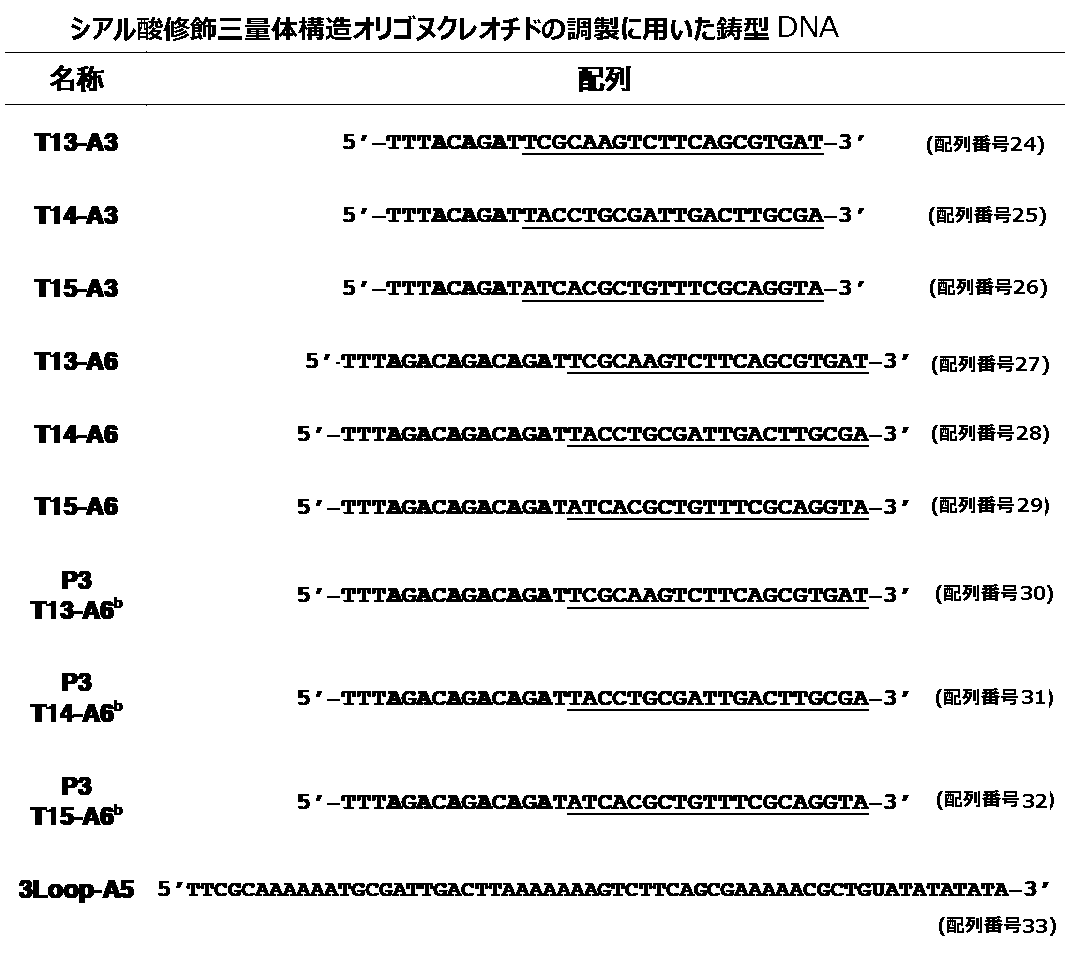
本発明の基本単位オリゴヌクレオチドを調製するために使用可能な鋳型DNAとして、以下に示す塩基配列からなるオリゴヌクレオチドを使用することができるが、これらに限定されるものではない。
(配列番号24)5'-TTTACAGATTCGCAAGTCTTCAGCGTGAT
(配列番号25)5'-TTTACAGATTACCTGCGATTGACTTGCGA
(配列番号26)5'-TTTACAGATATCACGCTGTTTCGCAGGTA
(配列番号27)5'-TTTAGACAGACAGATTCGCAAGTCTTCAGCGTGAT
(配列番号28)5'-TTTAGACAGACAGATTACCTGCGATTGACTTGCGA
(配列番号29)5'-TTTAGACAGACAGATATCACGCTGTTTCGCAGGTA
(配列番号30)5'-TTTAGACAGACAGATTCGCAAGTCTTCAGCGTGAT
(配列番号31)5'-TTTAGACAGACAGATTACCTGCGATTGACTTGCGA
(配列番号32)5'-TTTAGACAGACAGATATCACGCTGTTTCGCAGGTA
(配列番号33)5'-TTCGCAAAAAATGCGATTGACTTAAAAAAAGTCTTCAGCGAAAAACGCTGUATATATATA
(配列番号24)5'-TTTACAGATTCGCAAGTCTTCAGCGTGAT
(配列番号25)5'-TTTACAGATTACCTGCGATTGACTTGCGA
(配列番号26)5'-TTTACAGATATCACGCTGTTTCGCAGGTA
(配列番号27)5'-TTTAGACAGACAGATTCGCAAGTCTTCAGCGTGAT
(配列番号28)5'-TTTAGACAGACAGATTACCTGCGATTGACTTGCGA
(配列番号29)5'-TTTAGACAGACAGATATCACGCTGTTTCGCAGGTA
(配列番号30)5'-TTTAGACAGACAGATTCGCAAGTCTTCAGCGTGAT
(配列番号31)5'-TTTAGACAGACAGATTACCTGCGATTGACTTGCGA
(配列番号32)5'-TTTAGACAGACAGATATCACGCTGTTTCGCAGGTA
(配列番号33)5'-TTCGCAAAAAATGCGATTGACTTAAAAAAAGTCTTCAGCGAAAAACGCTGUATATATATA
またプライマーとして、例えば以下に示す塩基配列からなるオリゴヌクレオチドを利用することができるが、これらに限定されるものではない。
(配列番号7)5'-ATCACGCTGAAGACTTGCGA
(配列番号8)5'-TCGCAAGTCAATCGCAGGTA
(配列番号9)5'-TACCTGCGAAACAGCGTGAT
(配列番号34)5'-TTTAGACAGACAGATATCACGCTGAAGACTTGCGA
(配列番号35)5'-TTTAGACAGACAGATTCGCAAGTCAATCGCAGGTA
(配列番号36)5'-TTTAGACAGACAGATTACCTGCGAAACAGCGTGAT
(配列番号37)5'-TATATATAUACAGCG
(配列番号7)5'-ATCACGCTGAAGACTTGCGA
(配列番号8)5'-TCGCAAGTCAATCGCAGGTA
(配列番号9)5'-TACCTGCGAAACAGCGTGAT
(配列番号34)5'-TTTAGACAGACAGATATCACGCTGAAGACTTGCGA
(配列番号35)5'-TTTAGACAGACAGATTCGCAAGTCAATCGCAGGTA
(配列番号36)5'-TTTAGACAGACAGATTACCTGCGAAACAGCGTGAT
(配列番号37)5'-TATATATAUACAGCG
本発明は、上記糖鎖修飾三量体構造オリゴヌクレオチドを有効成分として含む抗インフルエンザ剤にも及ぶ。抗インフルエンザ剤としては、例えばインフルエンザ治療剤やインフルエンザウイルス捕捉剤が挙げられる。インフルエンザ治療剤の場合は、生体内でインフルエンザウイルスのHAと結合し、インフルエンザウイルスが細胞内に侵入するのを阻止することができる。また、インフルエンザウイルス捕捉剤としては、生体内に限らず当該ウイルスを捕捉することができる。例えば、本発明の糖鎖修飾三量体構造オリゴヌクレオチドをフィルター等に固定することで、インフルエンザウイルスを除去する材料とすることができる。また、本発明の糖鎖修飾三量体構造オリゴヌクレオチドをマスク等の材料に固定することで、外部からのインフルエンザウイルスの侵入を阻止したり、例えばインフルエンザウイルスの感染患者から外部へウイルスが飛散するのを阻止することができる。また、インフルエンザウイルス捕捉作用により、検体中のインフルエンザを検出しうる、インフルエンザ検査用試薬として使用することもできる。
本発明の糖鎖修飾三量体構造オリゴヌクレオチドを有効成分として含む抗インフルエンザ剤には、インフルエンザ治療薬又はインフルエンザ捕捉剤等の用途に応じて、適宜必要な添加剤等を含めることができる。
インフルエンザ治療薬とする場合は、必要な添加剤、即ち薬学的に許容しうる添加剤を混和し製剤化して使用することができる。上記添加剤としては、一般に医薬に使用される、賦形剤、結合剤、滑沢剤、崩壊剤、着色剤、矯味矯臭剤、乳化剤、界面活性剤、溶解補助剤、懸濁化剤、等張化剤、緩衝剤、防腐剤、抗酸化剤、安定化剤、吸収促進剤等を挙げることができ、所望により、これらを適宜組み合わせて使用することもできる。
以下に上記添加剤の例を挙げる。賦形剤としては、例えば乳糖、白糖、ブドウ糖、コーンスターチ、マンニトール、ソルビトール、デンプン、α化デンプン、デキストリン、結晶セルロース、軽質無水ケイ酸、ケイ酸アルミニウム、ケイ酸カルシウム、メタケイ酸アルミン酸マグネシウム、リン酸水素カルシウムが挙げられる。
結合剤としては、例えばポリビニルアルコール、メチルセルロース、エチルセルロース、アラビアゴム、トラガント、ゼラチン、シェラック、ヒドロキシプロピルメチルセルロース、ヒドロキシプロピルセルロース、カルボキシメチルセルロースナトリウム、ポリビニルピロリドン、マクロゴールが挙げられる。滑沢剤としては、ステアリン酸マグネシウム、ステアリン酸カルシウム、フマル酸ステアリルナトリウム、タルク、ポリエチレングリコール、コロイドシリカが挙げられる。崩壊剤としては、結晶セルロース、寒天、ゼラチン、炭酸カルシウム、炭酸水素ナトリウム、クエン酸カルシウム、デキストリン、ペクチン、低置換度ヒドロキシプロピルセルロース、カルボキシメチルセルロース、カルボキシメチルセルロースカルシウム、クロスカルメロースナトリウム、カルボキシメチルスターチ、カルボキシメチルスターチナトリウムが挙げられる。着色剤としては三二酸化鉄、黄色三二酸化鉄、カルミン、カラメル、β-カロチン、酸化チタン、タルク、リン酸リボフラビンナトリウム、黄色アルミニウムレーキ等、医薬品に添加することが許可されているものが挙げられる。
矯味矯臭剤としては、ココア末、ハッカ脳、芳香散、ハッカ油、竜脳、桂皮末が挙げられる。乳化剤又は界面活性剤としては、ステアリルトリエタノールアミン、ラウリル硫酸ナトリウム、ラウリルアミノプロピオン酸、レシチン、モノステアリン酸グリセリン、ショ糖脂肪酸エステル、グリセリン脂肪酸エステルが挙げられる。溶解補助剤としては、ポリエチレングリコール、プロピレングリコール、安息香酸ベンジル、エタノール、コレステロール、トリエタノールアミン、炭酸ナトリウム、クエン酸ナトリウム、ポリソルベート80、ニコチン酸アミドが挙げられる。懸濁化剤としては、前記界面活性剤のほか、例えばポリビニルアルコール、ポリビニルピロリドン、メチルセルロース、ヒドロキシメチルセルロース、ヒドロキシエチルセルロース、ヒドロキシプロピルセルロース等の親水性高分子が挙げられる。
等張化剤としては、ブドウ糖、塩化ナトリウム、マンニトール、ソルビトールが挙げられる。緩衝剤としてはリン酸塩、酢酸塩、炭酸塩、クエン酸塩などの緩衝液が挙げられる。防腐剤としてはメチルパラベン、プロピルパラベン、クロロブタノール、ベンジルアルコール、フェネチルアルコール、デヒドロ酢酸、ソルビン酸が挙げられる。抗酸化剤としては硫酸塩、アスコルビン酸、α-トコフェロールが挙げられる。安定化剤としては一般に医薬に使用されるものが挙げられる。吸収促進剤としては一般に医薬に使用されるものが挙げられる。また、必要に応じて、ビタミン類、アミノ酸等の成分を配合してもよい。
また、上記製剤としては、錠剤、散剤、顆粒剤、細粒剤、カプセル剤、シロップ剤、トローチ剤、吸入剤等の経口剤;坐剤、軟膏剤、眼軟膏剤、テープ剤、点眼剤、点鼻剤、点耳剤、パップ剤、ローション剤等の外用剤又は注射剤を挙げることができる。上記経口剤は、上記添加剤を適宜組み合わせて製剤化することができる。なお、必要に応じてこれらの表面をコーティングしてもよい。上記外用剤は、上記添加剤のうち、特に賦形剤、結合剤、矯味矯臭剤、乳化剤、界面活性剤、溶解補助剤、懸濁化剤、等張化剤、防腐剤、抗酸化剤、安定化剤又は吸収促進剤を適宜組み合わせて製剤化することができる。上記注射剤は、上記添加剤のうち、特に乳化剤、界面活性剤、溶解補助剤、懸濁化剤、等張化剤、緩衝剤、防腐剤、抗酸化剤、安定化剤又は吸収促進剤を適宜組み合わせて製剤化することができる。
また、本発明の抗インフルエンザ剤をインフルエンザ治療薬として使用する場合は、糖鎖修飾三量体構造オリゴヌクレオチドに含まれる糖修飾核酸の投与量は適宜決定することができる。例えばヒトに投与する場合、投与量や投与方法は適宜決定することができる。好ましい投与量は、糖修飾核酸として、成人(体重60 kg)あたり、通常、10~1000 mg/日であり、好ましくは15~700 mg/日であり、さらに好ましくは30~300 mg/日(例えば200 mg/日)である。投与量及び投与期間は、炎症の治療効果と患者の状態を勘案しながら、適宜設定することができる。
本発明の抗インフルエンザ剤をインフルエンザ捕捉剤として、生体外で使用する場合は、上述の他、フィルター、マスク材料、固相などの固相担体に、糖鎖修飾三量体構造オリゴヌクレオチドを適宜固定することもできる。これらの固定の方法は、オリゴヌクレオチドの固定方法に準じて固定することができる。本発明は、糖鎖修飾三量体構造オリゴヌクレオチドを有効成分として含み、インフルエンザウイルス捕捉剤が固定された固相担体に及ぶ。固相担体としては、具体的には、布、不織布、プラスチック材料などが挙げられ、具体的には、フィルター、マスク、マスク材料やインフルエンザ検出用担体が挙げられる。
本発明は、抗インフルエンザ剤や上述インフルエンザウイルス捕捉剤が固定された固相担体を用いることによる、インフルエンザの治療及び/又は予防方法にも及ぶ。例えば、抗インフルエンザ剤を医薬品として使用するほか、フィルター、マスク、マスク材料を用いることにより、インフルエンザ感染に伴う疾患に対して治療及び/又は予防することができる。また、固相担体がインフルエンザ検出用担体の場合には、インフルエンザの検査のために使用することができる。本発明は、インフルエンザの検査方法にも及ぶ。
本発明の理解を深めるために、以下の実施例により更に詳細に説明するが、本発明はこれら実施例に限定されるものではないことは明らかである。
(実施例1)糖鎖修飾三量体構造オリゴヌクレオチドの調製
(1)シアリルラクトース修飾核酸
本実施例では、糖鎖修飾核酸として、特許文献4に記載された手法により、以下に示すシアリルラクトース修飾ヌクレオチド3リン酸(dUTP-Sialyllac)を合成した。

(1)シアリルラクトース修飾核酸
本実施例では、糖鎖修飾核酸として、特許文献4に記載された手法により、以下に示すシアリルラクトース修飾ヌクレオチド3リン酸(dUTP-Sialyllac)を合成した。
(2)糖鎖修飾オリゴヌクレオチドの設計
本実施例では、図2に示す糖鎖修飾三量体構造オリゴヌクレオチド構造に適した塩基配列の配列番号7~9に示す塩基配列ならなる各オリゴヌクレオチドを設計した。
具体的には、
(配列番号7)5'-ATCACGCTGAAGACTTGCGA-3'
(配列番号8)5'-TCGCAAGTCAATCGCAGGTA-3'
(配列番号9)5'-TACCTGCGAAACAGCGTGAT-3'
本実施例では、図2に示す糖鎖修飾三量体構造オリゴヌクレオチド構造に適した塩基配列の配列番号7~9に示す塩基配列ならなる各オリゴヌクレオチドを設計した。
具体的には、
(配列番号7)5'-ATCACGCTGAAGACTTGCGA-3'
(配列番号8)5'-TCGCAAGTCAATCGCAGGTA-3'
(配列番号9)5'-TACCTGCGAAACAGCGTGAT-3'
(3)シアリルラクトース修飾三量体構造オリゴヌクレオチドの設計と調製
各シアリルラクトース修飾三量体構造オリゴヌクレオチドは、オリゴヌクレオチド鎖I, II, IIIを結合(Junction)構造の基礎とし、結合領域に2個ずつの不対合塩基(A)及び9塩基対(9 bp)の二重鎖アームを有する(図2)。さらに、基本単位オリゴヌクレオチドの長さ、糖修飾度、アームの構造の異なるさまざまなシアリルラクトース修飾三量体構造オリゴヌクレオチドを示した(図3)。構造体S3, S6, dsa-S6, S12はそれぞれアームに3, 6, 6, 12個のシアリルラクトース鎖を配置することができる構造からなる。構造体S3, S6, S12の構造は、配列番号19~22に示す塩基配列からなる。シアリルラクトース鎖は、構造体S3, S6, S12及びdsa-S6では一塩基ごとに配置される。dsa-S6は、図3に示す各鎖の5'末端に糖鎖修飾領域と相補的な追加の配列(5'-TTTAGACAGACAGAT-3':配列番号38)を有することで、二重鎖アーム(stem)の部位を完全に二重鎖にした。Stem7は三量体構造オリゴヌクレオチドのアームの長さを9 bpから7 bpへと短くした。
以上の構造体を構築するために必要なシアリルラクトース修飾三量体構造オリゴヌクレオチドの合成スキームを図4に、その調製に用いられた鋳型DNA(鋳型オリゴヌクレオチド)とプライマーの配列を表1、表2に示した。
各シアリルラクトース修飾三量体構造オリゴヌクレオチドは、オリゴヌクレオチド鎖I, II, IIIを結合(Junction)構造の基礎とし、結合領域に2個ずつの不対合塩基(A)及び9塩基対(9 bp)の二重鎖アームを有する(図2)。さらに、基本単位オリゴヌクレオチドの長さ、糖修飾度、アームの構造の異なるさまざまなシアリルラクトース修飾三量体構造オリゴヌクレオチドを示した(図3)。構造体S3, S6, dsa-S6, S12はそれぞれアームに3, 6, 6, 12個のシアリルラクトース鎖を配置することができる構造からなる。構造体S3, S6, S12の構造は、配列番号19~22に示す塩基配列からなる。シアリルラクトース鎖は、構造体S3, S6, S12及びdsa-S6では一塩基ごとに配置される。dsa-S6は、図3に示す各鎖の5'末端に糖鎖修飾領域と相補的な追加の配列(5'-TTTAGACAGACAGAT-3':配列番号38)を有することで、二重鎖アーム(stem)の部位を完全に二重鎖にした。Stem7は三量体構造オリゴヌクレオチドのアームの長さを9 bpから7 bpへと短くした。
以上の構造体を構築するために必要なシアリルラクトース修飾三量体構造オリゴヌクレオチドの合成スキームを図4に、その調製に用いられた鋳型DNA(鋳型オリゴヌクレオチド)とプライマーの配列を表1、表2に示した。
一本鎖のシアリルラクトース修飾アームを有するシアリルラクトース修飾三量体構造オリゴヌクレオチドを構築するためのオリゴヌクレオチド鎖の合成は、非対称PCRにより行われた。それぞれのオリゴヌクレオチド鎖を増幅するのに適当なセットの鋳型(テンプレート)(T13-15-(A3, A6, A12); 0.1 pmol/ l), プライマー (P13-15; 3 pmol/μl), KOD Dash(R)(東洋紡)緩衝液 (1/10体積), dNTP (天然型: dATP+dCTP+dGTP+dTTP; シアリルラクトース修飾型: dATP+dCTP+dGTP+dUTP-SL; 0.2 mM), MilliQ水, KOD Dash(R)(東洋紡)(0.005 U/μl)を混合(反応液量400-800μl)し、非対称PCR(94℃/30秒、55℃/30秒、74℃/1 分; 15-17 サイクル)を行った。
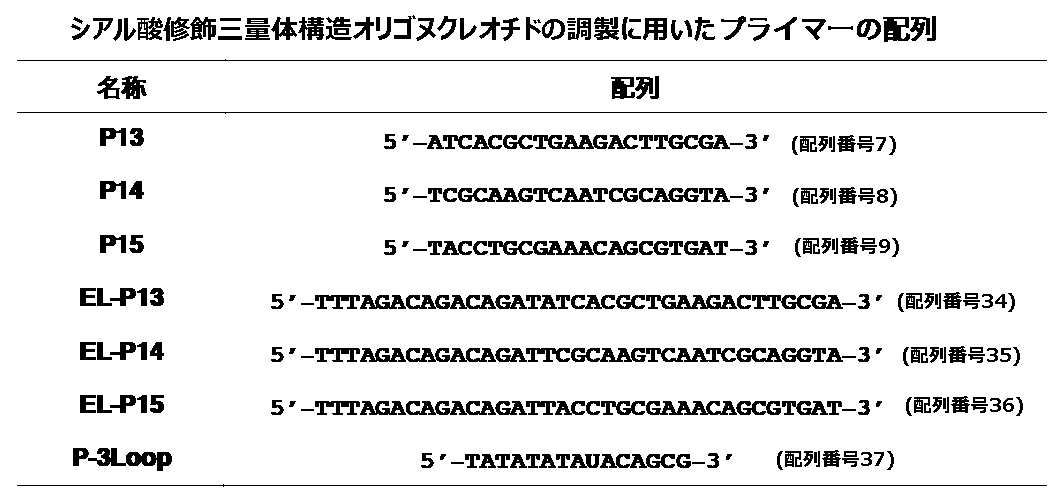
アームdsa-S6を構築するためのオリゴヌクレオチド鎖を調製するために、3 リン酸化鋳型DNAを用いたプライマー伸長反応によって糖鎖修飾dsDNAを調製し、その後変性ゲル電気泳動によって糖鎖修飾鎖を単離した。P3 T(13, 14, 15)-A6 (0.8 pmol/μl), EL-P(13, 14, 15) (0.8 pmol/μl), KOD Dash(R)(東洋紡)緩衝液, dATP+dCTP+dGTP+dUTP-SL (0.2 mM), MilliQ水, KOD Dash(R)(東洋紡) (0.005 U/μl)を混合(反応液量400μl)し、50℃で1時間インキュベートした。反応後の溶液に20 mg/mlグリコーゲン溶液1μlを添加し、エタノール沈殿を行った。8 M尿素BPB溶液(8 M尿素, 0.05%BPB, 10%グリセロール, 0.5×TBE) 200μlを添加し、沈殿を溶解させた。95℃ 5分の加熱変性を行った後、8 M尿素15%PAGEにかけ、目的産物である糖鎖修飾鎖を分離し、ゲルから切り出した。QIAEX II(R)(QIAGEN)を用いて、UV吸光度測定によってオリゴヌクレオチド鎖を定量した。
シアリルラクトース修飾三量体構造オリゴヌクレオチドの構築の確認は、電気泳動により行った。修飾鎖と天然鎖を適切な組み合わせで混合した後、遠心濃縮により溶液を乾固させた。残渣に、ブロモフェノールブルー(PBP)を含む緩衝液を添加して溶解させ、15%PAGE(89 mM Tris-borate, 150 mM NaCl, 20-25℃)により分析した。
(実施例2)ループ型シアリルラクトース修飾三量体構造オリゴヌクレオチドの調製
分子内で二重鎖アーム及びループ構造を形成するループ型三量体構造オリゴヌクレオチド(3Loop-A5)を設計した(図5参照)。その下記配列番号39で示す塩基配列のうち、下線部で示されるループ部位にシアリルラクトース残基を導入することにより、シアリルラクトース残基の空間的な配置を制御した。
オリゴヌクレオチドの合成は、実施例1と同手法により行った。
(配列番号39)5'-ACAGCGUUUUUCGCUGAAGACUUUUUUUAAGUCAAUCGCAUUUUUGCGAA-3'
分子内で二重鎖アーム及びループ構造を形成するループ型三量体構造オリゴヌクレオチド(3Loop-A5)を設計した(図5参照)。その下記配列番号39で示す塩基配列のうち、下線部で示されるループ部位にシアリルラクトース残基を導入することにより、シアリルラクトース残基の空間的な配置を制御した。
オリゴヌクレオチドの合成は、実施例1と同手法により行った。
(配列番号39)5'-ACAGCGUUUUUCGCUGAAGACUUUUUUUAAGUCAAUCGCAUUUUUGCGAA-3'
(実験例1)インフルエンザヘマグルチニン(HA)に対する阻害結合定数(Ki
HAI)
シアリルラクトース修飾三量体構造オリゴヌクレオチド(S3, S6, dsa-S6, Stem7)及びループ型シアリルラクトース修飾三量体構造オリゴヌクレオチド(3Loop-A5)のインフルエンザHAに対する阻害結合定数(Ki HAI)を赤血球凝集阻害実験により確認した。
シアリルラクトース修飾三量体構造オリゴヌクレオチド(S3, S6, dsa-S6, Stem7)及びループ型シアリルラクトース修飾三量体構造オリゴヌクレオチド(3Loop-A5)のインフルエンザHAに対する阻害結合定数(Ki HAI)を赤血球凝集阻害実験により確認した。
インフルエンザウイルスA/PR/8/34(H1N1)とシアリルラクトース修飾オチゴヌクレオチドを37℃で1時間インキュベートし、トリ赤血球を添加後さらに4℃で1時間インキュベートした。結果を表3にまとめた。 3本すべてのアームに6個ずつシアリルラクトースが導入されているS6(SL,SL,SL)の阻害結合定数は15 nMとなり、S6(SL,SL,0)(45 nM)と比べて約3倍高い親和性を示した。糖鎖の含まれていないS6(0,0,0)では、1000 nM以上であり親和性は著しく減少した。このようなアームにおける糖鎖に依存した親和性の変化は、三量体構造に従って3方向に分配されたシアリルラクトース鎖が同じトポロジーを有するHAの結合サイトに効率的に接近し、3点で結合できたことによると考えられた。
次に、S3, S6の(SL,SL,SL)型の親和性を比較することで、アームを伸ばし糖鎖を増やすことによって、また糖鎖の密度を変えることによって親和性がどのように変化するかを調べた。HAに対する親和性は、S3, S6で共に15 nMで同等であった。つまり、単にアームを伸ばし糖鎖を増やすことは親和性に大きな影響を与えなかった。これは、(SL,SL,SL)型の各構造体の糖鎖は、すでにHAの3点の結合サイトに結合しているために、それ以上に増やされた糖鎖は結合には関与できず、親和性の向上に寄与しなかったことを示すものと考えられる。
シアリルラクトース修飾S6(SL,SL,SL), dsa-S6(SL,SL,SL)はいずれもシアリルラクトースの数は18個で共通であるが、その空間的な配置が異なっている。S6(SL,SL,SL)は剛直な結合(Junction)構造とフレキシブルな糖鎖修飾アームを有している一方、dsa-S6(SL,SL,SL)はアームが二重鎖を巻くように設計されているためにシアリルラクトース鎖はアーム上でらせん状に配向することを余儀なくさせられる。標準的なB型DNAであれば、らせんのピッチはおよそ3.4 nm/10 bpであるので、以上のような構造的な特徴を有する2種類の糖鎖修飾オリゴヌクレオチドであるが、それらのHAに対する結合定数は、S6(SL,SL,SL)(15 nM) > dsa-S6(200 nM)となった。これは、糖鎖修飾部位はよりフレキシブルな一本鎖DNAの方がHAとの結合には有利であり、二重らせんに沿って配向する糖鎖は、HAの結合サイトへの効率的な糖鎖の結合を妨げているように見える。
シアリルラクトース修飾三量体構造オリゴヌクレオチドのアームの長さを9 bpから7 bpへと短くしたStem7は赤血球凝集阻害濃度が10 nMまで低下し、親和性は増大した。
これらの三量体構造オリゴヌクレオチドは9 bpおよび7 bpのアームを有しているが、これよりアームを短くすることは三量体構造オリゴヌクレオチドの安定性の点から困難である。ループ型三量体構造オリゴヌクレオチド(3Loop-A5)では 5 nMと、三量体構造オリゴヌクレオチド型DNA(Stem7)に比べさらに2倍の親和性の向上が達成された。

赤血球凝集阻害実験からインフルエンザHAに対する親和性を評価し、空間的な糖鎖分布や配向と結合親和性の関係を明らかにした。インフルエンザヘマグルチニン(HA)と多点で効果的に相互作用(クラスター効果)させるためには、シアリルラクトースの空間的な配置とヘマグルチニンの結合サイトのトポロジーの幾何的な適合が重要なファクターであることが確かめられた。シアリルラクトース修飾三量体構造オリゴヌクレオチドは剛直性と柔軟性を兼ね備え、一本鎖DNAに修飾されたシアリルラクトースが、HAの3つのシアリルラクトース結合部位で結合すると考えられる。また、アームをより短くし、シアリルラクトースをループ部位に配置したループ型三量体構造オリゴヌクレオチド配列は最も高い親和性を示した。アームをより短くすることにより、HAの3つのシアリルラクトース結合部位とより適合することが可能になったためと考えられる。
(参考例1)三量体構造オリゴヌクレオチドの電気泳動分析
各塩基長(mer)の異なるオリゴヌクレオチド-7-9 (19 mer), 10-12 (18 mer), 13-15 (20 mer)のそれぞれで、各オリゴヌクレオチド鎖(6 pmol)を組合わせて混合し、80℃/5分、20℃/5分(スロープ 60分)のアニーリング処理を行った後、20%PAGEにより分析した。分析の結果、不対合塩基数にかかわらず、一本のオリゴヌクレオチド鎖を単独で泳動した場合、二本を混合した場合、三本を混合した場合で、それぞれ単量体、二量体、三量体に対応するバンドが観察されたことから、意図した複合体が形成できていると考えられた。
各塩基長(mer)の異なるオリゴヌクレオチド-7-9 (19 mer), 10-12 (18 mer), 13-15 (20 mer)のそれぞれで、各オリゴヌクレオチド鎖(6 pmol)を組合わせて混合し、80℃/5分、20℃/5分(スロープ 60分)のアニーリング処理を行った後、20%PAGEにより分析した。分析の結果、不対合塩基数にかかわらず、一本のオリゴヌクレオチド鎖を単独で泳動した場合、二本を混合した場合、三本を混合した場合で、それぞれ単量体、二量体、三量体に対応するバンドが観察されたことから、意図した複合体が形成できていると考えられた。
(参考例2)三量体構造オリゴヌクレオチドの融解温度(Tm)分析
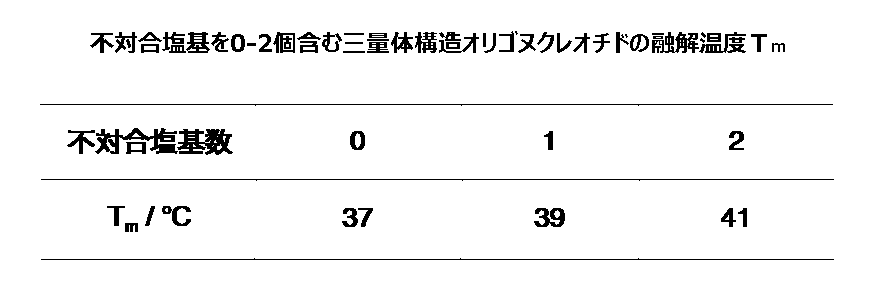
三量体構造オリゴヌクレオチドの安定性を評価するためにUV融解実験を行った。測定用緩衝液は、NaH2PO4/Na2HPO4 (pH 7.0), 150 mM NaClを基本組成とした。各オリゴヌクレオチド鎖 1.3 nmolを緩衝液1.3 mlに溶解し(3μM)、事前に80℃/5分、4℃/5分(スロープ 60分)のアニーリング処理を行った。測定には光路長1cmの石英セルを用いた。セルは、低温恒温循環槽により20-70℃の範囲で0.5~1℃/分の速度で昇温し、0.5℃間隔で260 nmの吸光度を記録した。
結果を表4に示した。不対合塩基0個から1個ずつ増やすに従ってTmは1~3℃上昇した。これは、不対合塩基の導入によって結合(Junction)領域での構造的なひずみが解消されたことによると考えられる。不対合塩基2個においてTmは40℃を超えており、30℃以下の条件であれば、100%三量体を形成していると考えられた。
三量体構造オリゴヌクレオチドの安定性を評価するためにUV融解実験を行った。測定用緩衝液は、NaH2PO4/Na2HPO4 (pH 7.0), 150 mM NaClを基本組成とした。各オリゴヌクレオチド鎖 1.3 nmolを緩衝液1.3 mlに溶解し(3μM)、事前に80℃/5分、4℃/5分(スロープ 60分)のアニーリング処理を行った。測定には光路長1cmの石英セルを用いた。セルは、低温恒温循環槽により20-70℃の範囲で0.5~1℃/分の速度で昇温し、0.5℃間隔で260 nmの吸光度を記録した。
結果を表4に示した。不対合塩基0個から1個ずつ増やすに従ってTmは1~3℃上昇した。これは、不対合塩基の導入によって結合(Junction)領域での構造的なひずみが解消されたことによると考えられる。不対合塩基2個においてTmは40℃を超えており、30℃以下の条件であれば、100%三量体を形成していると考えられた。
(実施例3)インフルエンザウイルスの赤血球凝集作用における凝集阻害活性
本実施例ではシアリルラクトース修飾三量体構造オリゴヌクレオチドについて、インフルエンザウイルスとトリ赤血球との赤血球凝集反応に対する阻害効果を確認した。シアリルラクトース修飾三量体構造オリゴヌクレオチドは、表3に示すStem7を用い、インフルエンザウイルスは、インフルエンザウイルスA型のH1N1型(A/PuertoRico/8/34株)、H3N2型(A/panama/2007/99株)、H5N2型(A/Duck/Hong Kong/342/78株)又はタミフル(商品名)耐性株であるH1N1型(A/Yokohama/77/2008株)を用いた。
本実施例ではシアリルラクトース修飾三量体構造オリゴヌクレオチドについて、インフルエンザウイルスとトリ赤血球との赤血球凝集反応に対する阻害効果を確認した。シアリルラクトース修飾三量体構造オリゴヌクレオチドは、表3に示すStem7を用い、インフルエンザウイルスは、インフルエンザウイルスA型のH1N1型(A/PuertoRico/8/34株)、H3N2型(A/panama/2007/99株)、H5N2型(A/Duck/Hong Kong/342/78株)又はタミフル(商品名)耐性株であるH1N1型(A/Yokohama/77/2008株)を用いた。
0.2×10⁵~6.25×10⁵ pfu/ml の濃度範囲のインフルエンザウイルス、0μM~5μM の濃度範囲のStem7、及びD-PBS(-)緩衝液(Dulbecco's PBS(-))(pH 7.4)を、各々50μlずつ96-ウェルプレート上で混合し、37℃で30 分間インキュベートした。その後、D-PBS(-)緩衝液で1/100~1/400に希釈したトリ赤血球溶液を50μl添加し、37℃でさらに60 分間インキュベートした。
Stem7濃度を変化させ、赤血球凝集反応が生じる濃度と阻害される濃度の境界を赤血球凝集阻害濃度であると評価した。その結果、Stem7濃度が数十nM以下であっても、インフルエンザウイルスについて血球凝集阻害効果が認められた。図6にH5N2型、H3N2型及びタミフル(商品名)耐性株H1N1型を用いた場合の凝集阻害挙動を示した。
(実施例4)QCM測定によるインフルエンザウイルスとの結合能評価
本実施例では水晶発振マイクロバランス(Quartz Crystal Microbalance:QCM)測定によるシアリルラクトース修飾三量体構造オリゴヌクレオチドとインフルエンザウイルスとの結合能を確認した。シアリルラクトース修飾三量体構造オリゴヌクレオチドは表3に示すStem7を用い、インフルエンザウイルスは、インフルエンザウイルスA型のH1N1型(A/PuertoRico/8/34株)、H3N2型(A/panama/2007/99株)又はインフルエンザB型(B/Yamanashi/166/98株)を用いた。水晶発振子とは、水晶の結晶を極薄い板状に切り出した切片の両側に金属薄膜を取り付けた構造をしたもので、それぞれの金属薄膜に交流電場を印加するとある一定の振動数で振動する性質を示す。金属薄膜上にナノグラム程度の物質が吸着すると物質の質量に比例して振動数が減少する。このような原理を利用して結合能等を測定することをQCM法という。本実施例では、基本振動数27 MHzで測定した。QCMによる具体的な測定手法は、Y.Okahata, Y. Ebara et. al. Anal. Chem, 70, 1288-1296 (1998)を参照した。
本実施例では水晶発振マイクロバランス(Quartz Crystal Microbalance:QCM)測定によるシアリルラクトース修飾三量体構造オリゴヌクレオチドとインフルエンザウイルスとの結合能を確認した。シアリルラクトース修飾三量体構造オリゴヌクレオチドは表3に示すStem7を用い、インフルエンザウイルスは、インフルエンザウイルスA型のH1N1型(A/PuertoRico/8/34株)、H3N2型(A/panama/2007/99株)又はインフルエンザB型(B/Yamanashi/166/98株)を用いた。水晶発振子とは、水晶の結晶を極薄い板状に切り出した切片の両側に金属薄膜を取り付けた構造をしたもので、それぞれの金属薄膜に交流電場を印加するとある一定の振動数で振動する性質を示す。金属薄膜上にナノグラム程度の物質が吸着すると物質の質量に比例して振動数が減少する。このような原理を利用して結合能等を測定することをQCM法という。本実施例では、基本振動数27 MHzで測定した。QCMによる具体的な測定手法は、Y.Okahata, Y. Ebara et. al. Anal. Chem, 70, 1288-1296 (1998)を参照した。
Stem7固定化電極の調製スキームは以下の通りである。ピラニア(piranha)溶液(H2O2 : H2SO4 = 1 : 3)を、基本振動数27 MHz の水晶発振子の金電極上に1 滴添加して10 分間、25℃でインキュベートした。電極を蒸留水で洗い、10 mM 3,3'-ジチオジプロピオン酸エタノール溶液20 μl を添加し、20 分間インキュベートした。電極を蒸留水で洗い、100 mg/ml NHS/100 mg/ml EDCの 1 : 1 混合溶液を50 μl添加し、30 分間インキュベートした。電極を蒸留水で洗い、1μg/μl ストレプトアビジン溶液20 μlを添加し40 分間インキュベートした後、1 Mエタノールアミン・HCl(pH8.0)10 μlを添加して30 分間インキュベートした。電極をD-PBS(-)緩衝液で洗い、D-PBS(-)緩衝液1.8 mlを入れた2 ml セル中に浸し、振動数が安定した後、Biotinで修飾されたStem7溶液を添加した。一定の振動数(約100 Hz)減少したところで、電極をセルから引き上げ、すみやかにD-PBS(-)緩衝液で洗浄した。セル内の緩衝液を交換し、再び電極を浸して振動数を安定させた。その後、インフルエンザウイルス溶液(最終濃度106 pfu/ml)をセルに添加し、インフルエンザウイルスの結合挙動を観察した(図7)。その結果、Stem7はインフルエンザA型(H1N1型A/PuertoRico/8/34/、H3N2型A/panama/2007/99)だけでなく、インフルエンザB型(B/Yamanashi/166/98)のいずれのウイルスに対しても同等の親和性で結合することが確認された(図8)。
(実施例5)インフルエンザウイルスのMDCK 細胞への感染における感染阻害評価実験
インフルエンザウイルスのMDCK(Madin-Darby canine kidney)細胞(イヌ腎臓由来)への感染におけるシアリルラクトース修飾三量体構造オリゴヌクレオチドの感染阻害を確認した。シアリルラクトース修飾三量体構造オリゴヌクレオチドは表3に示すStem7を用い、インフルエンザウイルスは、インフルエンザウイルスA型のH1N1型(A/PuertoRico/8/34株)を用いた。
インフルエンザウイルスのMDCK(Madin-Darby canine kidney)細胞(イヌ腎臓由来)への感染におけるシアリルラクトース修飾三量体構造オリゴヌクレオチドの感染阻害を確認した。シアリルラクトース修飾三量体構造オリゴヌクレオチドは表3に示すStem7を用い、インフルエンザウイルスは、インフルエンザウイルスA型のH1N1型(A/PuertoRico/8/34株)を用いた。
24ウェルプレートにMDCK 細胞(4.0×10⁵ cell/ml)を400μlずつ播種し、5%C02、37℃で半日インキュベートし、その後各ウェル内の細胞をD-PBS(-)緩衝液にて2回洗浄した。一方、DMEMにて希釈したインフルエンザウイルス5.3×105 pfu/well のウイルス溶液90μlに対して、同じくDMEMにて希釈したStem7溶液を10μlずつ加え、室温で30分放置した。24ウェルプレート中の、MDCK細胞に対して、上記で調製したウイルス及びStem7を含む溶液を100μl感染させ、ロッキングシェーカー上にて室温でインキュベー卜し、一定時間後に顕微鏡観察した。その結果、細胞がウイルスにより死滅した(b)の状態に比べ、Stem7 20 nMを添加した場合は、細胞死が抑制された(c)。すなわち、Stem7は、インフルエンザウイルスの細胞感染を効果的に阻害することが確認された(図9)。
以上詳述したように、本発明の糖鎖修飾三量体構造オリゴヌクレオチドは、抗インフルエンザ剤として使用することができ、具体的にはインフルエンザ治療剤又はインフルエンザウイルス捕捉剤として有用である。
現在、インフルエンザ治療薬の主流であるタミフル(商品名)は、1 nMの濃度でインフルエンザの感染を阻害することができる。一方、本発明の糖鎖修飾三量体構造オリゴヌクレオチドにより、108 M-1の結合定数でインフルエンザウイルスと結合し、5 nMで感染を阻害できることとなり、タミフル(商品名)に匹敵する治療薬となりうる。さらに、本発明の糖鎖修飾三量体構造オリゴヌクレオチドは、インフルエンザウイルスに対して変異の少ないHAのシアル酸結合部位をターゲットにするため、どのように変異したウイルスに対しても、吸着、結合能を維持することができる。
また、本発明の抗インフルエンザ剤をインフルエンザ治療薬として使用する場合は、糖鎖修飾三量体構造オリゴヌクレオチドに含まれる糖修飾核酸の投与量は適宜決定することができる。
本発明の糖鎖修飾三量体構造オリゴヌクレオチドをインフルエンザ捕捉剤として生体外で使用する場合は、本発明の糖鎖修飾三量体構造オリゴヌクレオチドを適宜固定した固相担体を使用することができる。固定方法は、オリゴヌクレオチドの固相担体への固定方法に準ずることができる。固相担体としては、例えば布、不織布、プラスチック材料などが挙げられる。糖鎖修飾三量体構造オリゴヌクレオチドを固相担体に固定したインフルエンザ捕捉剤は、インフルエンザ捕捉用のフィルター、マスク、マスク材料やインフルエンザ検出用担体に利用することができる。
Claims (12)
- A型インフルエンザのヘマグルチニン糖鎖結合部位と結合しうる糖修飾核酸を含み、以下の特徴を有する糖鎖修飾三量体構造オリゴヌクレオチド:
1)三量体構造を形成するオリゴヌクレオチドの基本単位オリゴヌクレオチドが、シアル酸がリンカーを介して結合してなる糖修飾核酸を含むオリゴヌクレオチドであり、
2)一分子の基本単位オリゴヌクレオチドが、他の二分子の基本単位オリゴヌクレオチドと部分的に二本鎖オリゴヌクレオチドを形成することで連結し、三量体を形成している。 - 前記糖鎖修飾三量体構造オリゴヌクレオチドに含まれる一分子の基本単位オリゴヌクレオチドが、他の一分子の基本単位オリゴヌクレオチドと二本鎖オリゴヌクレオチドを形成することにより連結する部分が、3~12塩基長の核酸配列からなる、請求項1に記載の糖鎖修飾三量体構造オリゴヌクレオチド。
- 前記糖鎖修飾三量体構造オリゴヌクレオチドの基本単位オリゴヌクレオチドが、以下の配列番号1~6及び10~15に示す塩基配列より選択される、いずれかの塩基配列を含む配列からなる、請求項1又は2に記載の糖鎖修飾三量体構造オリゴヌクレオチド:
(配列番号1)5'-ATCACGCTG-3'
(配列番号2)5'-GACTTGCGA-3'
(配列番号3)5'-TCGCAAGTC-3'
(配列番号4)5'-TCGCAGGTA-3'
(配列番号5)5'-TACCTGCGA-3'
(配列番号6)5'-CAGCGTGAT-3'
(配列番号10)5'-CAGCG-3'
(配列番号11)5'-UGCGA-3'
(配列番号12)5'-CGCUG-3'
(配列番号13)5'-GACUU-3'
(配列番号14)5'-AAGUC-3'
(配列番号15)5'-UCGCA-3' - さらに、前記糖鎖修飾三量体構造オリゴヌクレオチドの基本単位オリゴヌクレオチドが、以下の配列番号19~23に示す塩基配列より選択される、以下より選択される、いずれかの塩基配列を含む、請求項3に記載の糖鎖修飾三量体構造オリゴヌクレオチド:
(配列番号19)5'-AnCnGnAAA-3'
(配列番号20)5'-AnCnGnCnGnCnAAA-3'
(配列番号21)5'-AnCnGnCnGnCnGnCnGnCnGnCnAAA-3'
(配列番号22)5'-AnnnnnnnnnnnnAA-3'
(配列番号23)5'-nnnnn-3'
[nは各々独立して、アデニン(A)、グアニン(G)、シチジン(C)、又は、シアル酸がリンカーを介して結合してなる糖修飾核酸である。] - シアル酸が、シアリルラクトースである、請求項1~4のいずれか1に記載の糖鎖修飾三量体構造オリゴヌクレオチド。
- 前記シアリルラクトースが、2-6型シアリルラクトース又は2-3型シアリルラクトースである、請求項7に記載の糖鎖修飾三量体構造オリゴヌクレオチド。
- 請求項1~6のいずれか1に記載の糖鎖修飾三量体構造オリゴヌクレオチドを有効成分として含む抗インフルエンザ剤。
- 抗インフルエンザ剤が、インフルエンザ治療剤又はインフルエンザウイルス捕捉剤である、請求項7に記載の抗インフルエンザ剤。
- 請求項7又は8に記載の抗インフルエンザ剤を使用することを特徴とするインフルエンザの治療及び/又は予防方法。
- 請求項1~6のいずれかに記載の糖鎖修飾三量体構造オリゴヌクレオチドをインフルエンザウイルス捕捉剤として固定された固相担体。
- インフルエンザウイルス捕捉剤が固定された固相担体が、布、不織布、プラスチック材料である請求項10に記載の固相担体。
- 請求項10又は11に記載の固相担体を用いることを特徴とする、インフルエンザウイルスの検査方法。
Priority Applications (1)
| Application Number | Priority Date | Filing Date | Title |
|---|---|---|---|
| JP2014548615A JPWO2014080983A1 (ja) | 2012-11-22 | 2013-11-21 | 糖鎖修飾三量体構造オリゴヌクレオチド及びその使用 |
Applications Claiming Priority (2)
| Application Number | Priority Date | Filing Date | Title |
|---|---|---|---|
| JP2012-256216 | 2012-11-22 | ||
| JP2012256216 | 2012-11-22 |
Publications (1)
| Publication Number | Publication Date |
|---|---|
| WO2014080983A1 true WO2014080983A1 (ja) | 2014-05-30 |
Family
ID=50776161
Family Applications (1)
| Application Number | Title | Priority Date | Filing Date |
|---|---|---|---|
| PCT/JP2013/081399 Ceased WO2014080983A1 (ja) | 2012-11-22 | 2013-11-21 | 糖鎖修飾三量体構造オリゴヌクレオチド及びその使用 |
Country Status (2)
| Country | Link |
|---|---|
| JP (1) | JPWO2014080983A1 (ja) |
| WO (1) | WO2014080983A1 (ja) |
Cited By (2)
| Publication number | Priority date | Publication date | Assignee | Title |
|---|---|---|---|---|
| US9624272B2 (en) | 2013-03-14 | 2017-04-18 | University Of Washington Through Its Center For Commercialization | Polypeptides for treating and/or limiting influenza infection |
| CN118806931A (zh) * | 2024-09-18 | 2024-10-22 | 长春理工大学 | 唾液酸修饰CuS抗流感病毒H3N2纳米材料及其制备方法和应用 |
Citations (1)
| Publication number | Priority date | Publication date | Assignee | Title |
|---|---|---|---|---|
| JP2012056904A (ja) * | 2010-09-10 | 2012-03-22 | Kobe Univ | 糖鎖修飾核酸及びその使用 |
-
2013
- 2013-11-21 JP JP2014548615A patent/JPWO2014080983A1/ja active Pending
- 2013-11-21 WO PCT/JP2013/081399 patent/WO2014080983A1/ja not_active Ceased
Patent Citations (1)
| Publication number | Priority date | Publication date | Assignee | Title |
|---|---|---|---|---|
| JP2012056904A (ja) * | 2010-09-10 | 2012-03-22 | Kobe Univ | 糖鎖修飾核酸及びその使用 |
Non-Patent Citations (7)
| Title |
|---|
| MASAYUKI MATSUI ET AL.: "Multivalent Interaction between Saccharide-Modified 3-Way Junction DNA and Lectin", THE 86TH ANNUAL MEETING OF THE CHEMICAL SOCIETY OF JAPAN IN SPRING KOEN YOKOSHU II, 2006, pages 853 * |
| MASAYUKI MATSUI ET AL.: "Tosa Shushoku 3-Way Junction DNA no Kochiku to Lectin Ketsugono no Hyoka", BIO KANREN KAGAKU GODO SYMPOSIUM KOEN YOSHISHU, 2006, pages 229, KOEN 2D - 03 * |
| MASAYUKI MATSUI ET AL.: "Tosa Shushoku 3-Way Junction DNA to Lectin no Sogo Sayo no Kaiseki", THE 87TH ANNUAL MEETING OF THE CHEMICAL SOCIETY OF JAPAN IN SPRING KOEN YOKOSHU II, 2007, pages 1275, KOEN 4J1 - 36 * |
| TERU KATO ET AL.: "Interaction of three-way DNA junctions with steroids", THE 79TH ANNUAL MEETING OF THE CHEMICAL SOCIETY OF JAPAN IN SPRING KOEN YOKOSHU II, 2001, pages 951 * |
| YASUHITO EBARA ET AL.: "Influenza Kansen Sogaino o Yusuru Sialic Acid Shushoku Kakusan no Gosei", BIO KANREN KAGAKU SYMPOSIUM KOEN YOSHISHU, 2010, pages 30, KOEN 2B - 09 * |
| YASUHITO EBARA ET AL.: "Influenza Kansen Sogaino o Yusuru Sialyllactose Shushoku DNA no Gosei", BIO KANREN KAGAKU SYMPOSIUM KOEN YOKOSHU, 2011, pages 74, KOEN 3C - 11 * |
| YASUHITO EBARA ET AL.: "Sialyllactose Shushoku DNA no Influenza Kansen Sogaino Hyoka", THE 91ST ANNUAL MEETING OF THE CHEMICAL SOCIETY OF JAPAN IN SPRING KOEN YOKOSHU III, 2011, pages 693, KOEN 2B2 - 17 * |
Cited By (2)
| Publication number | Priority date | Publication date | Assignee | Title |
|---|---|---|---|---|
| US9624272B2 (en) | 2013-03-14 | 2017-04-18 | University Of Washington Through Its Center For Commercialization | Polypeptides for treating and/or limiting influenza infection |
| CN118806931A (zh) * | 2024-09-18 | 2024-10-22 | 长春理工大学 | 唾液酸修饰CuS抗流感病毒H3N2纳米材料及其制备方法和应用 |
Also Published As
| Publication number | Publication date |
|---|---|
| JPWO2014080983A1 (ja) | 2017-01-05 |
Similar Documents
| Publication | Publication Date | Title |
|---|---|---|
| US12239655B2 (en) | Combined modalities for nucleosides and/or NADPH oxidase (NOX) inhibitors as myeloid-specific antiviral agents | |
| TWI537005B (zh) | 抗病毒藥劑之目標細胞內投遞 | |
| JP2024513571A (ja) | 抗ウイルス剤としてのチオヌクレオシド | |
| CA3139977A1 (en) | Peptidomimetics for the treatment of coronavirus and picornavirus infections | |
| TW202227084A (zh) | 用於sars-cov-2突變株治療之niran干擾藥物 | |
| TW201134482A (en) | Aptamers to β -NGF and their use in treating β -NGF mediated diseases and disorders | |
| JP7742485B2 (ja) | 顔面肩甲上腕型筋ジストロフィーを処置する組成物および方法 | |
| JP2008255121A (ja) | 抗b型肝炎ウイルス活性を有するヌクレオシド | |
| CN105377867A (zh) | I型干扰素的环状二核苷酸诱导 | |
| KR20220156867A (ko) | 안면견갑상완 근이영양증의 치료용 조성물 및 방법 | |
| JP7510181B2 (ja) | 殺ウイルス性ナノ粒子及びインフルエンザウイルスに対するその使用 | |
| AU2003255468B2 (en) | Prophylaxis and treatment of infectious diseases | |
| EP4172337A1 (en) | Aptamers for personal health care applications | |
| WO2014080983A1 (ja) | 糖鎖修飾三量体構造オリゴヌクレオチド及びその使用 | |
| CN116605906B (zh) | 硫化铋银纳米材料的合成方法及其抗病毒应用 | |
| JP2013512222A (ja) | シアロキメラ化合物 | |
| JP2016533190A5 (ja) | ||
| JP6910043B2 (ja) | ヘマグルチニン結合ペプチド、および、これを含むインフルエンザウイルス感染症の予防・治療薬 | |
| US11236343B2 (en) | Method for producing dextran polymer-based, amplified nucleic acid aptamer nanoconstruct selectively capturing target molecule | |
| JP5788653B2 (ja) | 糖鎖修飾ヌクレオチド及びその使用 | |
| JP2008505912A (ja) | 全血及び血漿におけるatiiiの直接的活性化法 | |
| HK40093418A (zh) | 用於个人医疗保健应用的适配体 | |
| US20240207296A1 (en) | Viral receptor bound with sialic acid compounds | |
| KR102238589B1 (ko) | 조류 인플루엔자 바이러스 감염 질환의 예방 또는 치료용 약학 조성물 | |
| KR20250053865A (ko) | 바이러스 감염의 치료를 위한 rock2 억제제 |
Legal Events
| Date | Code | Title | Description |
|---|---|---|---|
| 121 | Ep: the epo has been informed by wipo that ep was designated in this application |
Ref document number: 13856343 Country of ref document: EP Kind code of ref document: A1 |
|
| DPE1 | Request for preliminary examination filed after expiration of 19th month from priority date (pct application filed from 20040101) | ||
| ENP | Entry into the national phase |
Ref document number: 2014548615 Country of ref document: JP Kind code of ref document: A |
|
| NENP | Non-entry into the national phase |
Ref country code: DE |
|
| 122 | Ep: pct application non-entry in european phase |
Ref document number: 13856343 Country of ref document: EP Kind code of ref document: A1 |