WO2014073643A1 - Ctコロノグラフィに用いられる経口投与用液剤及び消化管造影用組成物 - Google Patents
Ctコロノグラフィに用いられる経口投与用液剤及び消化管造影用組成物 Download PDFInfo
- Publication number
- WO2014073643A1 WO2014073643A1 PCT/JP2013/080254 JP2013080254W WO2014073643A1 WO 2014073643 A1 WO2014073643 A1 WO 2014073643A1 JP 2013080254 W JP2013080254 W JP 2013080254W WO 2014073643 A1 WO2014073643 A1 WO 2014073643A1
- Authority
- WO
- WIPO (PCT)
- Prior art keywords
- oral administration
- barium
- liquid
- colonography
- water
- Prior art date
- Legal status (The legal status is an assumption and is not a legal conclusion. Google has not performed a legal analysis and makes no representation as to the accuracy of the status listed.)
- Ceased
Links
Images
Classifications
-
- A—HUMAN NECESSITIES
- A61—MEDICAL OR VETERINARY SCIENCE; HYGIENE
- A61K—PREPARATIONS FOR MEDICAL, DENTAL OR TOILETRY PURPOSES
- A61K49/00—Preparations for testing in vivo
- A61K49/04—X-ray contrast preparations
- A61K49/0404—X-ray contrast preparations containing barium sulfate
-
- A—HUMAN NECESSITIES
- A61—MEDICAL OR VETERINARY SCIENCE; HYGIENE
- A61K—PREPARATIONS FOR MEDICAL, DENTAL OR TOILETRY PURPOSES
- A61K47/00—Medicinal preparations characterised by the non-active ingredients used, e.g. carriers or inert additives; Targeting or modifying agents chemically bound to the active ingredient
- A61K47/30—Macromolecular organic or inorganic compounds, e.g. inorganic polyphosphates
- A61K47/34—Macromolecular compounds obtained otherwise than by reactions only involving carbon-to-carbon unsaturated bonds, e.g. polyesters, polyamino acids, polysiloxanes, polyphosphazines, copolymers of polyalkylene glycol or poloxamers
-
- A—HUMAN NECESSITIES
- A61—MEDICAL OR VETERINARY SCIENCE; HYGIENE
- A61K—PREPARATIONS FOR MEDICAL, DENTAL OR TOILETRY PURPOSES
- A61K9/00—Medicinal preparations characterised by special physical form
- A61K9/0012—Galenical forms characterised by the site of application
- A61K9/0053—Mouth and digestive tract, i.e. intraoral and peroral administration
-
- A—HUMAN NECESSITIES
- A61—MEDICAL OR VETERINARY SCIENCE; HYGIENE
- A61K—PREPARATIONS FOR MEDICAL, DENTAL OR TOILETRY PURPOSES
- A61K9/00—Medicinal preparations characterised by special physical form
- A61K9/14—Particulate form, e.g. powders, Processes for size reducing of pure drugs or the resulting products, Pure drug nanoparticles
-
- A—HUMAN NECESSITIES
- A61—MEDICAL OR VETERINARY SCIENCE; HYGIENE
- A61K—PREPARATIONS FOR MEDICAL, DENTAL OR TOILETRY PURPOSES
- A61K47/00—Medicinal preparations characterised by the non-active ingredients used, e.g. carriers or inert additives; Targeting or modifying agents chemically bound to the active ingredient
- A61K47/30—Macromolecular organic or inorganic compounds, e.g. inorganic polyphosphates
- A61K47/36—Polysaccharides; Derivatives thereof, e.g. gums, starch, alginate, dextrin, hyaluronic acid, chitosan, inulin, agar or pectin
-
- A—HUMAN NECESSITIES
- A61—MEDICAL OR VETERINARY SCIENCE; HYGIENE
- A61K—PREPARATIONS FOR MEDICAL, DENTAL OR TOILETRY PURPOSES
- A61K47/00—Medicinal preparations characterised by the non-active ingredients used, e.g. carriers or inert additives; Targeting or modifying agents chemically bound to the active ingredient
- A61K47/30—Macromolecular organic or inorganic compounds, e.g. inorganic polyphosphates
- A61K47/36—Polysaccharides; Derivatives thereof, e.g. gums, starch, alginate, dextrin, hyaluronic acid, chitosan, inulin, agar or pectin
- A61K47/38—Cellulose; Derivatives thereof
-
- A—HUMAN NECESSITIES
- A61—MEDICAL OR VETERINARY SCIENCE; HYGIENE
- A61K—PREPARATIONS FOR MEDICAL, DENTAL OR TOILETRY PURPOSES
- A61K9/00—Medicinal preparations characterised by special physical form
- A61K9/0087—Galenical forms not covered by A61K9/02 - A61K9/7023
- A61K9/0095—Drinks; Beverages; Syrups; Compositions for reconstitution thereof, e.g. powders or tablets to be dispersed in a glass of water; Veterinary drenches
Definitions
- the present invention relates to a solution for oral administration containing barium, which is used for pretreatment of CT colonography, and a composition for gastrointestinal imaging used for the preparation of the solution for oral administration.
- CT colonography Large intestine examination (CT colonography) by computed tomography (CT) is an examination method that is becoming common with the development of helical CT and multi-row detector CT.
- CT colonography the stool in the large intestine is washed by intestinal tract washing, and then CT imaging is performed in a state where the colon cavity is expanded with air, and an image based on a slight X-ray contrast difference between the large intestine tissue and air. Information is configured and processed (see Non-Patent Document 1, for example).
- an intestinal irrigation method using an oral intestinal irrigant is widely used.
- an intestinal lavage solution prepared by dissolving a powdered composition composed of an electrolyte or the like in a certain amount, for example, about 2 L of water, is taken over 2 to 4 hours.
- a method is used in which a contrast medium is administered together with an intestinal irrigation solution to electronically erase residual water and stored liquid in the large intestine. Since the residual water or liquid residue reservoir is tagged (tagging) with a contrast agent such as barium or iodine compound and the CT value (luminance value) increases, it can be distinguished from a polyp lesion not labeled with the contrast agent.
- Barium and iodine compounds are mainly used as contrast agents for pretreatment of CT colonography.
- Water-insoluble barium is less likely to mix with residues in the stomach and digestive tract than iodine compounds, and may precipitate in residual water in the intestinal tract.
- iodine compounds may precipitate in residual water in the intestinal tract.
- barium is precipitated in the residual water, a gradient is generated in the CT value of the residual liquid, so that it is difficult to electronically erase a region having a low CT value in the residual water from the CT image. For this reason, barium which is easy to mix with the residue and hardly precipitates in the intestinal tract is demanded.
- CT colonography in order to use CT colonography as a mass screening or a medical checkup, it is desirable to improve the acceptability of the subject while maintaining the quality of the inspection accuracy.
- a large amount of about 2 L of intestinal lavage fluid must be taken within a few hours in order to sufficiently cleanse and remove intestinal contents such as stool.
- the subject is burdened with a large burden, which is a problem.
- a liquid preparation for oral administration in CT colonography digestive tract imaging which contains an iodine compound, an electrolyte, a water-soluble polymer and / or a saccharide, the day before CT colonography .
- a method of using a liquid for oral administration in which 300 to 1200 mL is taken at a time or divided into a plurality of times for pretreatment of CT colonography has been disclosed (for example, see Patent Document 1).
- this method only needs to eliminate solid residues from the image of the inside of the intestine, and the residue in which the solid residue or solid residue changed into a liquid or gel remains in the intestine.
- An object of the present invention is to provide a solution for oral administration containing barium which is easily mixed with a residue and hardly precipitates in the intestinal tract.
- the present invention uses barium as a contrast agent, reduces the dose of the intestinal lavage fluid in the intestinal pretreatment without sacrificing the inspection accuracy and prolongs the time required for the pretreatment, and burdens the subject.
- Another object of the present invention is to provide a liquid for oral administration and a composition for contrasting the digestive tract that can be reduced.
- the liquid for oral administration according to the first aspect of the present invention contains barium sulfate, one or more thickeners selected from the group consisting of natural polysaccharides and cellulose polymers, and has a viscosity.
- shear rate 21.54s -1 100mPa ⁇ s or more at a 5 ⁇ 90 mPa ⁇ s at a shear rate 464.1S -1
- cumulative volume distribution of the barium sulfate, the particle diameter D10 as a 10% cumulative 0. 30 to 0.80 ⁇ m and a cumulative particle size D90 of 90% is 1.0 to 10 ⁇ m.
- the barium sulfate concentration is preferably 0.15 to 0.35 g / mL.
- the viscosity at a shear rate of 21.54 s ⁇ 1 is preferably 350 mPa ⁇ s or more.
- the volumetric distribution of the barium sulfate is 10% and the particle diameter D10 is 0.30 to 0.50 ⁇ m, and the cumulative is 90%.
- the particle diameter D90 is preferably 1.00 to 2.00 ⁇ m.
- [5] The liquid for oral administration according to any one of [1] to [4], wherein the thickener is guar gum, carrageenan, xanthan gum, fenugreek gum, pectin, pullulan, gum arabic, dextran, dextrin, polydextrose, One or more selected from the group consisting of hydroxyethyl starch, carboxymethylcellulose and salts thereof, hydroxypropylcellulose, tragacanth gum, sodium alginate, sodium chondroitin sulfate, locust bin gum, gellan gum, croscarmellose sodium, and crystalline cellulose carmellose sodium It is preferable that [6]
- the liquid for oral administration according to any one of [1] to [5] is preferably used for a pretreatment for CT colonographic gastrointestinal imaging.
- the liquid for oral administration according to the second aspect of the present invention is a liquid for oral administration in gastrointestinal imaging of CT colonography, and contains barium and a water-soluble polymer or salt laxative, and CT colonography
- the day before the administration, 50 to 2000 mL is taken once or divided into several times.
- the liquid preparation for oral administration according to [7] is preferably taken 70 to 900 mL at a time or divided into a plurality of times the day before CT colonography.
- the barium is preferably barium sulfate.
- the water-soluble polymer is polyethylene glycol, polydextrose, dextran, dextrin, hydroxyethyl starch, gum arabic, pullulan, pectin, albumin , Carboxymethylcellulose and salts thereof, carrageenan, xanthan gum, tragacanth gum, croscarmellose sodium, and crystalline cellulose / carmellose sodium are preferably used.
- the osmotic pressure is preferably 200 to 900 mOsm / L.
- the barium content is preferably 8.3 to 2000 mg / mL.
- the barium concentration is preferably 0.10 to 0.35 g / mL.
- viscosity 350 mPa ⁇ s or higher at a shear rate 21.54S -1, is preferably 5 ⁇ 90 mPa ⁇ s at a shear rate 464.1s -1.
- the volumetric distribution of the barium is 10% cumulative and the particle diameter D10 is 0.30 to 0.50 ⁇ m, and the cumulative is 90%.
- the particle diameter D90 is preferably 1.00 to 2.00 ⁇ m.
- the liquid for oral administration according to any one of [7] to [16] preferably further contains at least one selected from the group consisting of dimethylpolysiloxane and a gastrointestinal function promoter.
- the composition for gastrointestinal imaging according to the third aspect of the present invention contains barium and a water-soluble polymer or a salt laxative, and is dissolved in water so that the barium content is 8.3 to 2000 mg. As a / mL aqueous solution, 50 to 2000 mL is taken once or divided into a plurality of times the day before CT colonography.
- composition for gastrointestinal imaging of [18] is dissolved in water to form an aqueous solution having a barium content of 8.3 to 2000 mg / mL, and 70 to 900 mL at a time on the day before CT colonography. Or it is preferable to take in multiple times.
- the barium is preferably barium sulfate.
- composition for gastrointestinal tract imaging containing an electrolyte so that the osmotic pressure is 200 to 900 mOsm / L when dissolved in water, Selected from the group consisting of dextrose, dextran, dextrin, hydroxyethyl starch, gum arabic, pullulan, pectin, albumin, carboxymethylcellulose and its salts, carrageenan, xanthan gum, tragacanth gum, croscarmellose sodium, and crystalline cellulose carmellose sodium It is preferable to contain one or more water-soluble polymers, or one or more salt laxatives selected from the group consisting of magnesium citrate, sodium dihydrogen phosphate, and disodium hydrogen phosphate.
- composition for gastrointestinal imaging according to any one of [18] to [21] preferably further contains one or more selected from the group consisting of dimethylpolysiloxane and a gastrointestinal function promoter. .
- the barium volume cumulative distribution has a cumulative particle diameter D10 of 0.30 to 0.50 ⁇ m and a cumulative 90%. %, The particle diameter D90 is preferably 1.00 to 2.00 ⁇ m.
- the pretreatment agent for CT colonography is a combination of barium and a water-soluble polymer or a salt laxative, and the water-soluble polymer is used on the day before CT colonography. Alternatively, 50 to 2000 mL of an aqueous solution in which a salt laxative is dissolved in water and the barium are each taken once or divided into a plurality of times.
- the water-soluble polymer or salt laxative dissolved in water and the barium are preferably taken within 30 minutes. .
- the total dose of the aqueous solution on the day before CT colonography is preferably 70 to 900 mL.
- the barium has a volume cumulative distribution of 10% and a particle diameter D10 of 0.30 to 0.00.
- a liquid for oral administration according to the fifth aspect of the present invention is a liquid for oral administration in CT colonography, and contains a water-soluble polymer or a salt laxative, and the day before CT colonography. 50 to 2000 mL is taken together with barium or independently of barium in one time or divided into a plurality of times.
- the liquid for oral administration according to the first aspect of the present invention by using the liquid for oral administration according to the first aspect of the present invention, residual water in the intestinal tract can be sufficiently and uniformly labeled with barium to the lower part of the large intestine. .
- the liquid for oral administration according to the second aspect of the present invention, the liquid for oral administration according to the fifth aspect, or the CT colonography according to the fourth aspect of the present invention By using the treatment agent, the burden on the subject can be remarkably reduced without sacrificing the quality of inspection accuracy. That is, the liquid for oral administration according to the second aspect of the present invention has a dose that is sufficiently small compared to the normal volume (2 L) of the oral intestinal cleanser used in the conventional large intestine examination.
- the hospital inspection system has succeeded in setting the number of days for pretreatment to only one day before the examination, and as a system for group examinations and clinical examinations, many patients can be examined easily and in a short time. Can also be incorporated.
- the composition for gastrointestinal tract contrast according to the third aspect of the present invention the liquid for oral administration according to the second aspect of the present invention can be prepared in a simple and excellent preparation feeling. .
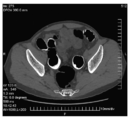
- FIG. 10 is a CT image of the supine position of the descending colon imaged in Example 4.
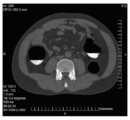
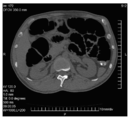
- Example 5 it is a CT image of the supine position of the descending colon imaged after taking barium prototype liquid b on the previous day.
- liquid preparation A for oral administration The liquid for oral administration according to the first aspect of the present invention (hereinafter sometimes referred to as “liquid A for oral administration”) is a powder, barium sulfate having a specific particle size distribution, natural polysaccharide and cellulose. It is a slurry that contains one or more thickeners selected from the group consisting of polymer series and has a viscosity within a specific range.
- the volume cumulative distribution of barium sulfate contained in the liquid preparation A for oral administration according to the present invention has a cumulative particle diameter D10 (hereinafter simply referred to as “particle diameter D10”) of 0.30 to 0.80 ⁇ m.
- the 90% particle diameter D90 (hereinafter simply referred to as “particle diameter D90”) is 1.0 to 10 ⁇ m. Since the liquid A for oral administration according to the present invention uses barium sulfate having a small size and a narrow particle size distribution, precipitation hardly occurs in residual water in the intestinal tract, and the label becomes uneven. hard.
- the barium sulfate preferably has a particle diameter D10 of 0.30 to 0.50 ⁇ m, more preferably 0.30 to 0.43 ⁇ m.
- the barium sulfate preferably has a particle diameter D90 of 1.0 to 4.0 ⁇ m, and more preferably 1.0 to 2.0 ⁇ m.
- the particle size distribution of barium sulfate means the volume cumulative distribution by the laser diffraction scattering type particle size distribution measuring method.
- the liquid preparation A for oral administration according to the present invention contains one or more thickeners selected from the group consisting of natural polysaccharides and cellulose polymers in order to adjust the flow characteristics.
- the natural polysaccharide and cellulose polymer are not particularly limited as long as they are edible, but water-soluble ones are preferable.
- the liquid preparation A for oral administration according to the present invention may contain only one type of thickener, or may contain two or more types in combination in order to have the above-mentioned viscosity characteristics.
- Examples of the natural polysaccharide include guar gum, carrageenan, xanthan gum, fenugreek gum, pectin, pullulan, gum arabic, dextran, dextrin, polydextrose, hydroxyethyl starch, tragacanth gum, sodium alginate, sodium chondroitin sulfate, locust bin gum, gellan gum, Or croscarmellose sodium is mentioned.
- Examples of the cellulose polymer include carboxymethylcellulose salts such as carboxymethylcellulose and carboxymethylcellulose sodium, hydroxypropylcellulose, and crystalline cellulose / carmellose sodium.
- the solution A for oral administration according to the present invention can be prepared, for example, by dissolving or dispersing the barium sulfate having the specific size and the thickener in an aqueous medium.
- the aqueous medium is not particularly limited as long as it is an edible aqueous medium that is inert to barium sulfate, and may be mere water or an oral rehydration solution.
- Contrast agent containing barium sulfate as an active ingredient is added to the liquid oral intestinal cleanser (intestinal lavage fluid) used when performing intestinal lavage as a pretreatment for endoscopy, enema X-ray examination, and CT colonography It may be what you did. That is, the liquid for oral administration according to the present invention is prepared by mixing the barium sulfate with an oral intestinal cleanser and mixing the thickener as necessary to have the specific flow characteristics. A.
- Such an oral intestinal cleanser is not particularly limited as long as it contains at least one of a water-soluble polymer and a salt laxative, but the osmotic pressure at the time of taking is 200 to 900 mOsm / L (preferably 250 to 570 mOsm / L, more preferably 250 to 440 mOsm / L, more preferably 250 to 320 mOsm / L), preferably containing an electrolyte, and further containing a sweetener and / or a fragrance. preferable.
- a composition comprising a combination of polyethylene glycol and an electrolyte (for example, “NIFREC (registered trademark)” blended internal preparation (for example, manufactured by Ajinomoto Pharmaceutical Co., Ltd.) according to the invention disclosed in JP-A-1-125319 )),
- a composition comprising a combination of at least one water-soluble polymer selected from dextran, dextrin, hydroxyethyl starch, polydextrose, gum arabic, and pectin and an electrolyte (JP-A-2-25424, JP-A-2- 3-206046), a composition composed of a combination of erythritol or xylitol and an electrolyte (Japanese Patent Laid-Open No.
- compositions composed of a combination of fructooligosaccharide and an electrolyte Japanese Patent Laid-Open No. 3-2912248
- Lactitol, maltitol and carboxymethylcellulose A composition containing at least one selected from the above and an electrolyte (Japanese Patent Laid-Open No. 5-255092), magnesium citrate (Japanese Patent Laid-Open No. 5-306221), sodium dihydrogen phosphate, disodium hydrogen phosphate, etc.
- An isotonic aqueous solution using a salt laxative and an isotonic agent eg, Magcolol (registered trademark) P
- an isotonic agent eg, Magcolol (registered trademark) P
- magnesium citrate e.g., Horai Yakuhin Kogyo Co., Ltd.
- the concentration of barium sulfate in Solution A for oral administration according to the present invention is preferably 0.15 to 0.35 g / mL, more preferably 0.15 to 0.30 g / mL, and 0.15 to 0.28 g / mL. Is more preferable, and 0.15-0.25 g / mL is still more preferable.
- the concentration range is lower than the conventional barium preparation. Since the total amount of barium sulfate required to label residues and residual water in the intestinal tract is almost fixed, the higher the concentration of barium sulfate, the more generally it is taken to label residues and residual water in the intestinal tract. The smaller the amount of liquid to be obtained and the lower the barium sulfate concentration, the larger the amount of liquid to take.
- Solutions A for oral administration according to the present invention has a viscosity, 100 mPa ⁇ s or higher at a shear rate 21.54S -1, having a flow characteristic which is 5 ⁇ 90 mPa ⁇ s at a shear rate 464.1s -1. That is, the liquid A for oral administration has a fluidity characteristic that the fluidity is higher than that of the conventional barium preparation at a high shear rate, and the viscosity is sufficiently high at a low shear rate.
- the viscosity of the liquid A for oral administration at a shear rate of 21.54 s ⁇ 1 is preferably 150 mPa ⁇ s or more, more preferably 250 mPa ⁇ s or more, further preferably 350 mPa ⁇ s or more, More preferably, it is 350 to 750 mPa ⁇ s, and particularly preferably 350 to 500 mPa ⁇ s.
- the viscosity of the liquid A for oral administration at a shear rate of 464.1 s ⁇ 1 is preferably 10 to 70 mPa ⁇ s, more preferably 10 to 60 mPa ⁇ s, and more preferably 20 to 60 mPa ⁇ s. Further preferred.
- the viscosity of the liquid A for oral administration can be adjusted by appropriately adjusting the concentration of barium sulfate to be contained, the composition of the aqueous medium in which barium sulfate is dispersed, the type and blending amount of the thickener used.
- the viscosity at each shear rate of the liquid agent containing barium sulfate is changed continuously within a range of 0.01 to 1000 s ⁇ 1 using a rotational viscometer. Measured value.
- a cone-plate rotational viscometer “MCR 300” manufactured by Anton Paar Co., Ltd.
- a cone plate “CP50-2” were used, and a sample (1.2 mL) was measured at a shear rate of 0.01 at 25 ° C. Measurement is performed while continuously changing within a range of ⁇ 1000 s ⁇ 1 .
- the liquid preparation A for oral administration according to the present invention may contain other components other than the barium sulfate, the thickener, and the aqueous medium as long as the effects according to the present invention are not inhibited.
- the other components include those similar to the liquid preparation B for oral administration described later.
- the liquid preparation A for oral administration according to the present invention is preferably used for pretreatment for gastrointestinal imaging of CT colonography.
- Solution A for oral administration can be used in the same manner as other contrast agents used for CT colonography pretreatment.
- the liquid A for oral administration may be administered 10 to 100 mL of the liquid A for oral administration after the intestinal tract is washed by taking about 1 to 2 L of the oral intestinal rinsing agent on the day of CT colonography examination, Oral intestinal irrigation and residue labeling may be performed simultaneously by taking about 1-2 L of liquid A for oral administration prepared by mixing the above-mentioned barium sulfate or the like with an oral intestinal irrigant.
- 10 to 100 mL of oral administration liquid A may be taken between dinner and bedtime the day before CT colonography examination, and may be the same as the mode of administration of oral administration liquid B described later. . That is, 50 to 2000 mL (preferably 50 to 1200 mL, more preferably 70 to 900 mL) of liquid preparation A for oral administration prepared by mixing the above-mentioned barium sulfate or the like with an oral intestinal rinsing agent is prepared on the day before the CT colonography examination. It may be taken once or divided into several times.
- liquid B for oral administration is a liquid for oral administration in gastrointestinal tract imaging of CT colonography, and is composed of barium and water-soluble.
- a functional polymer or a salt laxative, and the day before CT colonography, 50 to 2000 mL, preferably 50 to 1200 mL, more preferably 70 to 900 mL, and even more preferably 100 to 900 mL are divided into one or more times. It is characterized by being taken.
- 50 to 2000 mL may be taken the day before CT colonography. It may be taken in multiple doses or may be taken in multiple doses. For example, 100 to 900 mL may be taken in 2 to 3 divided doses, or 100 to 400 mL may be taken in a single dose.
- the dose per dose may be taken at once, or may be taken in small portions within 30 minutes.
- the amount of solution B for oral administration according to the present invention to be taken the day before CT colonography is within the range of 50 to 2000 mL (preferably 50 to 1200 mL, more preferably 70 to 900 mL), It can be determined according to age, weight, condition, and the like.
- it may be taken after meals, may be taken before meals or at the same time as meals, and may be taken after waking up, between meals or before falling asleep. When the total dose is lower, it is preferable to take two to three doses rather than one dose.
- the solid residue in the intestinal tract can be sufficiently labeled, and the captured image can be used for diagnosis and the like.
- the oral administration liquid B according to the present invention it is preferable to take sufficient water. For example, on the day before CT colonography, it is preferable to take about 50 to 300 mL of water after taking the oral administration liquid B according to the present invention.
- the liquid preparation B for oral administration according to the present invention uses barium as a contrast agent.
- Barium has a high CT value and can sufficiently tag the entire large intestine with a relatively small dose.
- Barium used in the liquid preparation B for oral administration according to the present invention is barium generally used for colon examination such as CT colonography and enema X-ray examination such as barium sulfate.
- Specific examples of the barium include barium sulfate preparations such as Bamster S200 (manufactured by Kyosei Pharmaceutical Co., Ltd.) and Baritogen (registered trademark) CT (manufactured by Fushimi Pharmaceutical Co., Ltd.).
- the specific particle size distribution used in the liquid A for oral administration (specifically, the particle diameter D10 is 0.3 to 0.5 ⁇ m, and the cumulative is 90%. It is preferable to use barium having a particle size distribution with a particle diameter D90 of 1.0 to 2.0 ⁇ m. In this case, it is particularly preferable that the composition be contained so as to have the same flow characteristics and barium concentration as the liquid A for oral administration.
- the barium and the target substance (residue) due to stomach and intestinal movement can be mixed more efficiently.
- the entire large intestine can be labeled more uniformly by suppressing sedimentation of barium sulfate in the residual water in the intestinal tract.
- the CT value of the liquid residue reservoir can be adjusted by the barium content and the dose of the liquid B for oral administration according to the present invention taken the day before CT colonography.
- the barium content of the liquid B for oral administration according to the present invention can be appropriately adjusted in consideration of the dose, the CT value of the residue in the CT colonography after taking, the condition of the subject, and the like.
- the barium content of the liquid B for oral administration according to the present invention is preferably such that the CT value of the residue is 300 HU or more in CT colonography when pretreatment is performed using the liquid for oral administration.
- the dose can be determined in consideration of the administration mode so that each region in the gastrointestinal tract can be kept uniformly in the range of 300 HU to 700 HU.
- the barium content of the liquid B for oral administration according to the present invention is preferably 8.3 to 2000 mg / mL as the barium sulfate concentration.
- the day before CT colonography 750 mL of 2.1 w / v% (0.021 g / mL) barium sulfate suspension was taken in three doses, or the day before CT colonography.
- CT colonography was possible when 50 mL of 40 w / v% (0.4 g / mL) barium sulfate suspension was taken in three portions (American Journal of Roentgenology, .Vol. 183, no. 4, p945-948).
- the total dose of barium taken by taking the oral administration solution B according to the present invention on the day before CT colonography is preferably 6 to 600 g, more preferably 10 to 100 g, as barium sulfate.
- the liquid B for oral administration according to the present invention contains, in particular, barium sulfate having a particle size D10 of 0.3 to 0.5 ⁇ m and a cumulative particle size D90 of 90% to 1.0 to 2.0 ⁇ m. cage, and viscosity, 350 mPa ⁇ s or higher at a shear rate 21.54S -1, it is preferable in 5 ⁇ 90 mPa ⁇ s or higher at a shear rate 464.1s -1.
- the concentration of barium sulfate in Solution B for oral administration is preferably 0.15 to 0.35 g / mL, more preferably 0.15 to 0.30 g / mL, and 0.15 to 0 More preferably, it is .28 g / mL, even more preferably 0.15 to 0.25 g / mL.
- the liquid preparation B for oral administration according to the present invention contains at least one of a water-soluble polymer and a salt laxative in addition to barium.
- a water-soluble polymer and a salt laxative in addition to barium.
- barium and a water-soluble polymer are included.
- the liquid B for oral administration according to the present invention may contain both a water-soluble polymer and a salt laxative.
- water-soluble polymer examples include polyethylene glycol, polydextrose, dextran, dextrin, hydroxyethyl starch, gum arabic, pullulan, pectin, carboxymethylcellulose, carboxymethylcellulose sodium, and other carboxymethylcellulose.
- examples thereof include salts, carrageenan, xanthan gum, tragacanth gum, croscarmellose sodium, crystalline cellulose and carmellose sodium.
- a water-soluble polymer selected from the group consisting of polyethylene glycol, polydextrose, dextran, hydroxyethyl starch, gum arabic, pullulan and pectin is preferable in terms of pharmaceutical stability and the like, and contains polyethylene glycol. It is particularly preferred.
- the molecular weight of polyethylene glycol is preferably from 2000 to 8000, more preferably from 3000 to 7000.
- salt laxative contained in the liquid B for oral administration according to the present invention examples include magnesium citrate, sodium dihydrogen phosphate, disodium hydrogen phosphate and the like.
- concentration of the salt laxative is not particularly limited as long as it has a laxative effect, and can be appropriately adjusted in consideration of the type of salt laxative, the condition of the subject to be taken, and the like.
- sodium ion is 60 mEq / L
- potassium ion is 20 mEq / L
- magnesium ion is 3 mEq / L
- chloride ion is 50 mEq / L
- phosphate is 10 mmol / L
- citrate ion is 35 mEq / L
- lactate ion is If it is 20 mEq / L, the balance of the electrolyte in the living body is not excessively affected. For this reason, a salt laxative is added so that the content in the liquid B for oral administration according to the present invention is higher than these concentrations.
- the osmotic pressure of the liquid B for oral administration according to the present invention is preferably 200 to 570 mOsm / L, more preferably 200 to 440 mOsm / L, and further preferably 250 to 320 mOsm / L.
- the liquid preparation B for oral administration according to the present invention is more preferably adjusted to an isotonic range of 280 to 320 mOsm / L or an osmotic pressure range close to isotonicity.
- the liquid preparation B for oral administration according to the present invention may be a preparation that adjusts the osmotic pressure in the intestinal tract together with taking water or the like, for example, the intestinal rinsing liquid described in Japanese Patent No. 4131266. .
- the osmotic pressure of the liquid B for oral administration according to the present invention is higher than the osmotic pressure range, for example, 900 mOsm / L or less, preferably 850 mOsm / L or less. More preferably, the osmotic pressure may be 700 mOsm / L or less. That is, the osmotic pressure of the oral administration liquid B according to the present invention is preferably 200 to 900 mOsm / L.
- the liquid preparation B for oral administration according to the present invention preferably contains an electrolyte in order to adjust to a desired osmotic pressure.
- the type and amount of the electrolyte contained in the liquid for oral administration according to the present invention are appropriately selected so that the osmotic pressure of the liquid for oral administration falls within the above range.
- the electrolyte refers to a substance that is dissociated into an ion in a solution, and includes Na + , K + , Ca 2+ , Mg 2+ , Cl ⁇ , HCO 3 ⁇ , SO 4 2 ⁇ , HPO 4 2 ⁇ , an organic acid group, An organic base etc. can be mentioned.
- a salt laxative is also included in the electrolyte.
- Examples of the electrolyte contained in the liquid B for oral administration according to the present invention include the same electrolytes used for electrolyte infusions administered intravenously.
- sodium ion sources include sodium chloride, sodium acetate, sodium citrate, sodium dihydrogen phosphate, disodium hydrogen phosphate, sodium sulfate, sodium lactate and the like
- potassium ion sources include potassium chloride.
- calcium ion sources include calcium chloride, calcium gluconate, calcium pantothenate, calcium lactate, calcium acetate Calcium glycerophosphate, etc.
- magnesium ion sources include magnesium sulfate, magnesium chloride, magnesium acetate, magnesium citrate, etc.
- phosphate ion sources include sodium dihydrogen phosphate, sodium dihydrogen phosphate Sodium glycerophosphate, sodium chloride, potassium chloride, calcium chloride, magnesium chloride and the like as the chloride ion source, and sodium bicarbonate as the bicarbonate ion source.
- the liquid preparation B for oral administration according to the present invention preferably further contains a thickener.
- a thickener By increasing the viscosity, it is possible to suppress the precipitation of barium sulfate in the intestinal tract.
- the thickener added to the liquid B for oral administration according to the present invention is not particularly limited as long as it can be taken orally and does not cause a special reaction with various components such as barium sulfate. , Can be appropriately selected from known thickeners.
- the liquid preparation B for oral administration according to the present invention may further contain a saccharide.
- a saccharide especially as a liquid B for oral administration preferable for CT colonography pretreatment performed as a screening test, a mixture of an electrolyte and a saccharide because of excellent patient acceptability including formulation stability and ease of administration. It is also preferable to add.
- the saccharide contained in the oral administration liquid B according to the present invention may be either sugar or sugar alcohol.
- Specific examples of the saccharide contained in the liquid preparation B for oral administration according to the present invention include sucrose, sorbitol, xylitol, erythritol, mannitol, trehalose, lactitol, lactose, maltitol, palatinose, raffinose, glycerin and the like. be able to.
- xylitol, sorbitol, lactulose, lactitol and raffinose are particularly preferable for reasons such as formulation stability and patient acceptability including ease of administration.
- the sum of the blending amounts of the water-soluble polymer and the electrolyte in the solution B for oral administration according to the present invention or the sum of the blending amounts of the water-soluble polymer, the electrolyte and the saccharide is, for example, 2 in a 400 mL liquid preparation. ⁇ 40 grams, preferably 10-30 grams.
- the liquid B for oral administration has Na + : 30 to 150 mEq / L, K + It is preferable to add an electrolyte such that: 3 to 20 mEq / L, Cl ⁇ : 20 to 70 mEq / L, and HCO 3 ⁇ : 10 to 50 mEq / L.
- the magnesium ion concentration in the liquid B for oral administration is adjusted so as to be 40 to 120 mEq / L.
- the sulfate ion concentration in the liquid B for oral administration is adjusted and adjusted so as to be 40 to 120 mEq / L.
- the amount of saccharides used is 2 to 40 grams, preferably 5 to 10 grams, in 400 mL of oral administration solution B.
- the liquid preparation B for oral administration according to the present invention preferably further contains a gastrointestinal function promoter in addition to barium and a water-soluble polymer (or salt laxative).
- the gastrointestinal function promoter facilitates excretion of the liquid for oral administration taken or a mixture of the liquid for oral administration and intestinal contents, and can reduce the amount of residues in the intestinal tract during CT colonography.
- Examples of the gastrointestinal function promoter to be contained in the liquid preparation B for oral administration according to the present invention include serotonin 5-HT 4 receptor stimulants.
- Serotonin 5-HT 4 receptor stimulants include benzamide derivatives represented by the general formula described in Japanese Patent Publication No. 3-54937 “Claims” including mosapride citrate, cisapride, metroclopra A mid and the like can be mentioned.
- mosapride citrate is most preferable because it has few side effects such as induction of arrhythmia (Medical Review Co., Ltd., 1998, “Mosaprid and gastrointestinal motility”).
- the mosapride citrate is appropriately adjusted so that the daily dose (that is, the amount used in the pretreatment for one CT colonography) is 5 to 40 mg, and the liquid B for oral administration according to the present invention is used. It is preferable to contain.
- a widely used colonic irritant laxative can also be included in the liquid B for oral administration according to the present invention as a gastrointestinal function promoter.
- the colonic stimulant laxative include sodium picosulfate, bisacodyl, sennoside and the like.
- the colon-irritating laxative is used so that the amount used in the pretreatment for one CT colonography is the prescribed daily dose of the preparation, or as the pretreatment for the colon test.
- the liquid can be contained in the liquid B for oral administration according to the present invention by adjusting it appropriately so as to be a prescribed amount.
- picosulfate sodium is appropriately adjusted so that the daily dose (ie, the amount used in the pretreatment for one CT colonography) is 5 to 150 mg, and the liquid for oral administration according to the present invention It is preferable to contain in B.
- the oral administration solution B according to the present invention preferably further contains dimethylpolysiloxane in addition to barium and water-soluble polymer (or salt laxative). Since dimethylpolysiloxane exhibits a defoaming action on bubbles in foamy mucus, it is possible to improve the accuracy and efficiency of reading lesions from captured images.
- dimethylpolysiloxane contained in the liquid B for oral administration according to the present invention include “Gascon (registered trademark)” marketed as a gastrointestinal gas disinfectant.
- the amount of dimethylpolysiloxane contained in the solution B for oral administration according to the present invention is such that the daily dose in an adult (that is, the amount used in the pretreatment for one CT colonography) is 30 to 120 mg, preferably It is preferably adjusted to 40 to 80 mg and contained in the liquid B for oral administration according to the present invention.
- the liquid B for oral administration according to the present invention containing no dimethylpolysiloxane and the liquid containing dimethylpolysiloxane were each independently orally divided into a plurality of times. You may take it.
- the fragrance contained in the liquid B for oral administration according to the present invention is not particularly limited as long as it masks the odor caused by the water-soluble polymer or electrolyte when the liquid for oral administration is taken orally. It is not a thing.
- food flavors are suitable, and fruit flavors are particularly suitable.
- fruit flavors include flavors such as lemon, orange, grapefruit, lemon lime, mandarin orange, persimmon, strawberry, cherry, apple, apricot and raspberry.
- citrus liquid fragrances such as lemon, orange, grapefruit and lemon lime are optimal because they give a refreshing feel.
- flavor the essential oil obtained from these fruits by the pressing method or steam distillation can be used.
- Limonene, citral, citronellal, linalool, octanal, etc. can be used alone or in combination. Among them, it is preferable to use a citrus fragrance containing limonene. Such fragrances are commercially available from fragrance manufacturers, and it is practical to use them.
- the liquid fragrance includes a water-soluble liquid fragrance in which the fragrance component is extracted or dissolved with hydrous alcohol, and an oil-soluble liquid fragrance in which the fragrance component is dissolved in an oily solvent. Furthermore, what added the preservative etc. to the fragrance
- flavor component (essential oil) is also contained. From the viewpoint of storage stability, it is preferable to use oil-soluble or essential oil-derived fragrances as liquid fragrances, rather than water-soluble liquid fragrances.
- the sweetener used in the present invention makes it easy to drink when taking a liquid for oral administration.
- a sweetener there must be no or very little generation of hydrogen gas or methane gas in the intestine.
- saccharides especially sucrose (purified) White sugar
- saccharides may be positively added to improve the feeling of taking the solution and replenishing energy.
- the preferred amount of these sweeteners is 0.001 to 3% by mass of the solution for oral administration. More preferably, the content is 0.01 to 0.3% by mass.
- the liquid preparation B for oral administration according to the present invention can contain other components as long as the effects according to the present invention are not inhibited.
- the liquid B for oral administration according to the present invention may contain ascorbic acid and / or one or more salts thereof (ascorbate component).
- the ascorbate component is preferably added in the range of 4 to 15 g per 1 L of oral administration liquid B according to the present invention.
- the liquid B for oral administration according to the present invention further contains an ascorbate component.
- Preferred salts of ascorbic acid are alkali metal salts and alkaline earth metal salts such as sodium ascorbate, potassium ascorbate, magnesium ascorbate and calcium ascorbate.
- a particularly preferred salt of ascorbic acid is sodium ascorbate.
- the ascorbate component includes both ascorbic acid and one or more salts thereof.
- ascorbic acid and its salts are present in a weight ratio in the range of 1: 9 to 9: 1.
- Ascorbic acid and its salts may actually be provided as hydrates. If hydrates are used, the weights and / or weight ratios mentioned here are the weights and / or weight ratios of ascorbic acid or its salts excluding hydrated water.
- ascorbic acid and its salts are in the range of 2: 8 to 8: 2, more preferably 3: 7 to 7: 3, even more preferably 4: 6 to 6: 4, for example 4.7: Present in a weight ratio of 5.9.
- the liquid preparation B for oral administration according to the present invention is a liquid oral intestinal cleanser (intestinal lavage fluid) used when performing intestinal lavage as a pretreatment for colonoscopy, enema X-ray examination, and CT colonography
- a contrast agent containing barium as an active ingredient may be added. That is, a solution obtained by mixing a barium contrast agent with an oral intestinal rinsing agent can be used as the liquid B for oral administration according to the present invention.
- an oral intestinal rinsing agent for example, those mentioned in the above-mentioned solution A for oral administration can be used.
- the liquid preparation B for oral administration according to the present invention has a form filled in a metal container such as an aluminum can, a flexible container such as a glass container or a plastic container, or a rigid or semi-rigid container, like other liquid preparations. It may be taken.
- a metal container such as an aluminum can
- a flexible container such as a glass container or a plastic container
- a rigid or semi-rigid container like other liquid preparations. It may be taken.
- the plastic container include a container formed of a polyolefin-based thermoplastic resin film.
- rigid or semi-rigid containers include PET bottles manufactured from polyethylene terephthalate.
- the liquid B for oral administration according to the present invention when the liquid B for oral administration according to the present invention contains sodium hydrogen carbonate as a component, it may react with moisture in the air during storage to generate carbon dioxide. Therefore, in this case, the liquid B for oral administration according to the present invention has a low gas permeability (preferably, 20 cc / m 2 ⁇ day ⁇ atm (25 ° C. or less)) such as an aluminum can. It is preferable to fill a metal can, a glass container, a metal bag-like container such as aluminum lined with a thermoplastic resin, or the like. When a container having a high gas permeability is filled, the container may be externally packaged with a package having a lower gas permeability.
- a low gas permeability preferably, 20 cc / m 2 ⁇ day ⁇ atm (25 ° C. or less
- the container is filled with a gas having a high partial pressure of carbon dioxide gas in order to suppress the temporal change in the sodium bicarbonate concentration. It is preferable to keep it.
- the liquid for oral administration according to the present invention can be prepared by preparing a concentrated liquid containing each component in advance and diluting with an appropriate amount of water at the time of taking.
- the concentrated liquid of each component may take a form filled in an aluminum can, a flexible container, a rigid or semi-rigid container.
- the concentrated solution is naturally sterilized or sterilized by a conventional method (Japanese Patent Laid-Open Nos. 9-58747, 8-253220, etc.).
- each powdered, tableted or granulated component can also be prepared by preparing each powdered, tableted or granulated component and dissolving and suspending them in an appropriate amount of water at the time of taking.
- a composition in which two or more kinds of components are mixed in advance may be prepared, and the composition and other components may be dissolved and suspended in an appropriate amount of water at the time of taking.
- a liquid preparation B for oral administration according to the present invention is prepared by dissolving and suspending an internal preparation (manufactured by Ajinomoto Pharmaceutical Co., Inc.) and a contrast medium containing barium as an active ingredient in a predetermined amount of water at the time of taking. can do.
- an internal preparation manufactured by Ajinomoto Pharmaceutical Co., Inc.
- a contrast medium containing barium as an active ingredient in a predetermined amount of water at the time of taking. can do.
- it may replace with a powder formulation and you may use what was formulated into the dosage form of the tablet or the granule.
- a composition containing at least one of a water-soluble polymer and a salt laxative and barium is prepared in advance.
- the composition and other ingredients such as sweeteners and fragrances may be dissolved in an appropriate amount of water.
- compositions for gastrointestinal imaging according to the present invention contain 50 to 2000 mL (preferably, a solution obtained by suspending or diluting in water, containing barium, at least one of a water-soluble polymer and a salt laxative. Is 50 to 1200 mL, more preferably 70 to 900 mL), which is characterized in that it is taken once or divided into a plurality of times the day before CT colonography.
- compositions containing components such as electrolytes other than salt laxatives, dimethylpolysiloxane, gastrointestinal function promoters, sweeteners, and fragrances are also included in the composition for gastrointestinal tract imaging according to the present invention.
- the osmotic pressure of the aqueous solution obtained by dissolving or diluting the composition for digestive tract imaging according to the present invention in water is preferably 200 to 900 mOsm / L, more preferably 200 to 570 mOsm / L. Preferably, it is 200 to 440 mOsm / L.
- Aqueous solution obtainable by the GI series composition according to the present invention is dissolved or diluted in water has a viscosity, 350 mPa ⁇ s or higher at a shear rate 21.54s -1, 5 ⁇ at a shear rate 464.1S -1 It is preferably 90 mPa ⁇ s.
- composition for gastrointestinal tract contrast according to the present invention is a mixture of components excluding barium constituting the liquid B for oral administration according to the present invention after the particle diameter is adjusted so that each component can be mixed. It is preferable that
- composition containing all the components constituting the liquid preparation B for oral administration according to the present invention is a daily dose or a plurality of doses for ease of use and convenience of use. In the case of taking in divided doses, it is preferable to adjust the dose so that the amount of one dose is the content per package.
- the composition for gastrointestinal tract contrast according to the present invention is filled into a package such as a metal bag or can such as aluminum lined with a thermoplastic resin, or a plastic package formed with a thermoplastic resin.
- a package such as a metal bag or can such as aluminum lined with a thermoplastic resin, or a plastic package formed with a thermoplastic resin.
- the composition for gastrointestinal imaging according to the present invention contains a component that may be adsorbed on the package or a component that may be permeated and dissipated from the package such as gas or volatile component, the inner surface of the package
- the thickness of the resin layer as well as the area of the resin will affect the amount of adsorption and permeation, so that the sealing strength of the packaging does not decrease and a sufficient amount of components remain during use. Need to be set.
- the gas permeability of the package is preferably 20 cc / m 2 ⁇ day ⁇ atm (25 ° C.) or less.
- composition for gastrointestinal tract contrast according to the present invention can be transferred from a packaged body to a container and suspended with water.
- the package itself is a plastic container that can hold the necessary suspending water (for example, 50 to 2000 mL, preferably 50 to 1200 mL, more preferably 70 to 900 mL), and water is put directly into the package at the time of use. Suspending and taking this is convenient because it is not necessary to prepare a separate container for suspension.
- the plastic container is preferably formed of a polyolefin-based thermoplastic resin.
- the polyolefin-based thermoplastic resin include polyethylene and polypropylene.
- Soft polyolefin has good adhesion between resins necessary for molding of a container, but has high gas adsorbability / permeability.
- hard polyolefin has low gas adsorbability / permeability but poor adhesion between resins. Therefore, in order to satisfy both the molding requirements and the gas adsorption / permeability requirements, a soft polyolefin is used for the inner layer (the surface in contact with the composition for gastrointestinal tract contrast), and a hard polyolefin is further formed thereon.
- the innermost layer (the surface in contact with the composition for gastrointestinal tract contrast) is composed of soft polyolefin, hard polyolefin on the outer side, and soft polyolefin on the outer side to make a total of three layers.
- the thickness of the innermost layer is preferably made of a polyolefin-based thermoplastic resin of 100 ⁇ m or less, preferably 50 ⁇ m, in order to suppress a decrease due to adsorption or permeation of various components.
- the total thickness is set to 70 to 200 ⁇ m, and the thickness of each of the inner layer and the outer layer is set to 35 to 100 ⁇ m. Is preferred.
- the total thickness is 70 to 200 ⁇ m
- the thickness of the layer is preferably 15 to 70 ⁇ m, particularly 20 to 40 ⁇ m.
- thermoplastic resin such as polyethylene terephthalate or polyamide
- a thermoplastic resin such as polyethylene terephthalate or polyamide
- the shape of the package is not particularly limited, but if it is also used as a plastic container that can store suspending water, it is equipped with a suspending water inlet and a bottom surface is provided so that it can stand when suspended. Is preferred. Considering the convenience of manufacturing, it has two vertically long triangular side walls that are longer than the bottom, an inlet attached to the upper part of the side wall, and a bamboo leaf attached to the lower part of the side wall. What has a bottom face is preferable.
- the two side walls and the bottom are made of flexible plastic, the inlet is made of hard plastic, and the inlet is covered.
- the side wall and bottom of the two sheets are made of flexible plastic, and the bottom is folded inside until the suspension water is added.
- the two side walls are preferably made of a transparent or translucent plastic so that the inner volume can be visually confirmed.
- composition for gastrointestinal imaging according to the present invention can be prepared by mixing predetermined components by a conventionally known method.
- the package When filling the package, it is more convenient to store and transport the air as much as possible because it can prevent deterioration of quality of the active ingredient unstable to oxygen over time and is not bulky.
- the package when long-term storage is required, the package can be further sealed in a gas-impermeable exterior bag formed of an aluminum laminate film or the like.
- kits or packaged products Each component and composition used for preparing the liquid preparation B for oral administration according to the present invention, including the composition for gastrointestinal tract imaging according to the fourth aspect of the present invention, is one kit or packaged product. It is preferable that For example, a combination of the aforementioned oral intestinal cleansing agent and a barium contrast agent, a combination of barium and a water-soluble polymer prepared separately, and a barium prepared separately.
- Pre-treatment agents for CT colonography such as those that can be combined with salt laxatives, and those that are combined separately so that barium, water-soluble polymer and salt laxative can be combined It can be.
- kits or packaged products are not particularly limited in its production and can be appropriately performed by a conventional method. That is, each component and composition used for preparing at least the liquid preparation B for oral administration according to the present invention may be included in one packaging form. These kits and packages preferably contain instructions for taking the order, how to take it, symptoms that should be stopped, and notes that describe the response to side effects. In addition, cups, dose check sheets, watches, suspensions, etc. can be placed.
- an osmotic pressure of 200 to 900 mOsm / L (containing an electrolyte and a water-soluble polymer (optionally sugars, dimethylpolysiloxane, and a gastrointestinal function promoter) is suspended in a predetermined amount of water.
- a powder preparation capable of preparing an intestinal irrigation solution (preferably 200 to 570 mOsm / L, more preferably 200 to 440 mOsm / L) is filled in a plastic container (see JP-A-4-259461), and barium is filled in the container.
- a form in which the blister pack-attached plastic container is inserted into a gastrointestinal contrast composition suspending container or attached to the outer wall is useful. When the suspension container is filled with a suspension liquid such as mineral water in advance, the convenience is further enhanced.
- the blister pack may be attached to a container filled with an intestinal tract washing solution of 200 to 440 mOsm / L).
- each component and composition of the liquid B for oral administration according to the present invention can be accommodated in three compartments, which are also referred to as a triple bag, which are partitioned by a fusion plastic flexible bag.
- a kit bag can be given.
- This kit bag can be prepared by orally pressing with a hand or the like at the time of use to peel off the intermediate fused portion and mixing each component or composition of powder and its suspension to prepare a liquid for oral administration. Has characteristics. If instructions and cautions are printed on the surface of the kit bag, a single bag can be made into a kit (Japanese Patent Application No. 2000-2619).
- the contrast medium stimulates inflammation of the intestinal mucosa, and there is a concern about adverse effects on diseased areas such as ulcers, so steroids should be included in kits or packages to prevent inflammation. May be.
- the pretreatment drug according to the present invention is a combination of barium and a water-soluble polymer or salt laxative.
- barium and the water-soluble polymer or salt laxative are prepared as separate liquids, and are taken once or divided into multiple doses on the day before CT colonography.
- the total dose of barium and a water-soluble polymer (or salt laxative) on the day before CT colonography is the same as when taken as the liquid B for oral administration according to the present invention.
- the total dose on the day before CT colonography of a liquid preparation containing a water-soluble polymer or a salt laxative is 50 to 2000 mL, more preferably 50 to 1200 mL, still more preferably 70 to 900 mL, still more preferably 100 to 900 mL. 100 to 450 mL is particularly preferable.
- the total dose of the liquid preparation containing barium the day before CT colonography is preferably 6 to 600 g, more preferably 10 to 100 g, as barium sulfate.
- Solution B for oral administration according to the present invention is a solution containing barium and a water-soluble polymer or salt laxative, but a suspension of barium and a solution containing a water-soluble polymer or salt laxative, Even if each dose is taken separately, if the total dose of barium and a water-soluble polymer (or salt laxative) on the day before CT colonography is similar, the solution B for oral administration according to the present invention is taken The same effect can be obtained.
- the solution containing barium is preferably taken at least 30 minutes before or after taking a solution containing a water-soluble polymer or salt laxative, and more preferably taken continuously. In addition, it is preferable to take about 50 to 300 mL of water after taking a solution containing barium.
- the number of times the solution containing barium is taken and the number of times the solution containing a water-soluble polymer or salt laxative is taken May be the same or different.
- a solution containing a water-soluble polymer or a salt laxative and a solution containing barium may be taken continuously three times a day, and only a solution containing a water-soluble polymer or a salt laxative is divided into three times. One of them may be taken together with the whole liquid containing barium.
- the liquid agent containing barium has a volume cumulative distribution of 10% cumulative particle diameter D10 of 0.30 to 0.50 ⁇ m and a cumulative 90% cumulative particle diameter D90 of 1.00 to 2.00 ⁇ m. hints, viscosity, 350 mPa ⁇ s or higher at a shear rate 21.54S -1, solutions are preferred 5 ⁇ 90 mPa ⁇ s at a shear rate 464.1S -1, the liquid for oral administration a more preferred.
- Example 1 On the day before the examination of CT colonography, a liquid for oral administration intended to be taken in a single dose or in multiple doses of 50 to 1200 mL was prepared as follows. First, 1 bag (137.155 g) of an oral intestinal detergent (trade name: “NIFREC (registered trademark)” blended internal preparation, Ajinomoto Pharmaceutical Co., Inc.) was dissolved in water to make 2 L.
- an oral intestinal detergent trade name: “NIFREC (registered trademark)” blended internal preparation, Ajinomoto Pharmaceutical Co., Inc.
- gastrointestinal contrast X-ray contrast medium (trade name: Bamster S200, manufactured by Kyosei Pharmaceutical Co., Ltd.) containing barium sulfate at a concentration of 200 w / v% is added to 1800 mL of this solution, and the barium sulfate concentration is 20 w / v. % (0.2 g / mL) was prepared for oral administration. Furthermore, in the same manner as in the above preparation method, a liquid for oral administration having a barium sulfate concentration of 2, 5, 8, 10 w / v% (0.02, 0.05, 0.08, 0.1 g / mL) is obtained. Each was prepared.
- Example 2 By filling 300 mL of the liquid for oral administration with a barium sulfate concentration of 10 w / v% (0.1 g / mL) prepared in Example 1 into a polyethylene flexible container and sealing it, CT colonography A liquid for oral administration was prepared for multiple doses, each capable of taking 100 mL after morning, noon, and evening meal the day before the test.
- the flexible container made of polyethylene filled with the liquid for oral administration is a multilayer film made of an aluminum vapor-deposited film having low gas permeability so that the concentration of sodium bicarbonate contained in the liquid for oral administration does not fluctuate. Sealed in an outer packaging bag and sealed. Carbon dioxide gas was sealed together with air in the space between the flexible container made of polyethylene and the outer packaging bag so that the sodium bicarbonate concentration contained in the liquid for oral administration did not fluctuate over time.
- Example 3 On the day before the examination of CT colonography, a liquid for oral administration intended to be taken in a single dose or in multiple doses of 50 to 1200 mL was prepared as follows. First, 2 bags (200 g) of a laxative for pretreatment for colon examination / abdominal surgery (trade name: “Magcolol (registered trademark) P”, manufactured by Horii Pharmaceutical Co., Ltd.) were dissolved in water to make 3600 mL.
- a laxative for pretreatment for colon examination / abdominal surgery trade name: “Magcolol (registered trademark) P”, manufactured by Horii Pharmaceutical Co., Ltd.
- gastrointestinal contrast X-ray contrast medium (trade name: Bamster S200, manufactured by Kyosei Pharmaceutical Co., Ltd.) containing barium sulfate at a concentration of 200 w / v% is added to 1800 mL of this solution, and the barium sulfate concentration is 20 w / v. % (0.2 g / mL) was prepared for oral administration. Furthermore, in the same manner as in the above preparation method, a liquid for oral administration having a barium sulfate concentration of 2, 5, 8, 10 w / v% (0.02, 0.05, 0.08, 0.1 g / mL) is obtained. Each was prepared.
- Example 4 For men in their 50s, 100 mL of oral intestinal cleanser solution (oral intestinal cleanser (trade name: Nifleck (trade name)) after breakfast, lunch and dinner on the day before CT colonography (no special dietary restrictions) Registered trademark) "internal preparation, manufactured by Ajinomoto Pharmaceutical Co., Ltd.) 1 bag (137.155 g) dissolved in water to make 2 L], and gastrointestinal X-ray contrast medium containing 100 w / v% barium sulfate (Product name: “Valitogen (registered trademark) sol”, manufactured by Fushimi Pharmaceutical Co., Ltd.) 8 mL (14.2 g) was taken.
- Meals on the day before the test are not so-called test meals, but remain vegetables and fruits (excluding paste and juice), seaweeds (seaweed, kelp, hijiki, etc.), mushrooms (shiitake, shimeji, enoki, etc.), It was a normal meal, except that care was taken not to eat legumes (green soybeans, black beans, etc.), shirataki, and konjac.
- the subject excreted solid stool before the examination on the day of the examination, but the stool was white grayish brown, and barium was almost uniformly dispersed. *
- FIG. 1 shows a CT image of the supine position of the descending colon.
- FIG. 1 shows a CT image of the supine position of the descending colon.
- the residue was almost uniformly labeled with barium. The residue could be identified. That is, it can be seen that CT colonography can be performed even when the stool is not forcibly defecationed by a laxative or the like by performing pretreatment using a pretreatment agent for CT colonography according to the present invention. It was.
- Example 5 ⁇ Preparation of barium prototype solution>
- a liquid preparation for oral administration containing two types of barium sulfate having different flow characteristics was prepared in order to be taken on the day before the CT colonography examination.
- barium sulfate having a particle diameter D10 of 0.39 ⁇ m and a particle diameter D90 of 1.35 ⁇ m is dispersed in an aqueous solution containing a natural polysaccharide and carboxymethylcellulose, and a barium sulfate concentration of 0.25 g /
- Two types of mL barium prototype solution were prepared.
- the flow characteristics of these barium prototype solutions a and b were prepared as shown in Table 1 by appropriately adjusting the concentrations of the natural polysaccharide and carboxymethylcellulose.
- the particle size distribution of barium sulfate was measured using a laser diffraction / scattering particle size distribution measuring device “Microtrac MT3300EX2” (manufactured by Nikkiso Co., Ltd.). A sample (about 0.45 ⁇ L) was mixed with 2 mL of a 2 mass% sodium hexametaphosphate solution, and after applying built-in ultrasonic waves for 3 minutes, the particle size distribution was measured.
- the viscosity of the barium prototype solution at shear rates of 21.54 s -1 and 464.1 s -1 was measured using a cone - plate type rotational viscometer "MCR 300" (manufactured by Anton Paar Co., Ltd.). Specifically, a cone plate “CP50-2” was used, and a sample (1.2 mL) was measured at 25 ° C. by continuously changing the shear rate within a range of 0.01 to 1000 s ⁇ 1 ( 31 points).
- the meal the day before the inspection was a so-called inspection meal (curry rice, oyakodon, corn soup).
- the test foods include vegetables and fruits that remain in shape (excluding paste and juice), seaweeds (seaweed, kelp, hijiki, etc.), mushrooms (shiitake, shimeji, enoki, etc.), beans (green soybeans, black beans, etc.)
- the food was cooked so that it would have the same diet as the normal diet, except that it did not include meals containing shirataki and konjac.
- FIG. 2 shows a CT image of the supine position of the descending colon.
- the residue is uniformly labeled with barium, and it is possible to visually distinguish the tissue from the stool mass and the retained residue. It was. Further, the residue was not a solid but a liquid that was uniformly labeled. Therefore, a good CT image in which the inner wall of the intestinal tract was clearly drawn was obtained.
- Example 6 The taken barium solution is present in the intestinal tract in a state diluted with body fluids or water taken at the same time. Then, about the barium trial solution a prepared in Example 5, the ease of precipitation in the stationary state after dilution was investigated.
- the particle diameter D10 and the particle diameter D90 are the values shown in Table 2, and the barium prototype solutions c and d whose viscosity is the value shown in Table 1 were also measured in the same manner.
- the particle size distribution and viscosity of the barium prototype solutions c and d were measured in the same manner as in Example 5.
- a daily dose (24 g in terms of barium sulfate) of each barium sample (barium prototype solution a, c, d) was added to water and a suspension adjusted to 2 L (barium sulfate concentration: 12 g / L) was prepared. Prepared. 100 mL each of this suspension was dispensed into a 100 mL graduated cylinder and allowed to stand at room temperature for 12 hours. After standing, the amount of supernatant (amount of barium sulfate precipitated and became transparent) was measured from the scale of the graduated cylinder. The measurement results are shown in Table 4 together with the liquid amount (“addition amount” in the table) of each barium sample required for preparing 2 L of an aqueous solution having a barium sulfate concentration of 12 g / L.
- each barium sample barium prototype solution a, c, d
- an oral intestinal cleanser trade name: “NIFLEC (registered trademark)” internal preparation
- Ajinomoto A suspension barium sulfate concentration: 12 g / L
- dissolving 1 bag 137.155 g
- Pharmaceutical Co., Ltd. in water to 2 L was prepared.
- 100 mL each of this suspension was dispensed into a 100 mL graduated cylinder, allowed to stand at room temperature for 12 hours, and then the amount of supernatant (amount of barium precipitated and became transparent) was measured from the scale of the graduated cylinder.
- Table 4 shows the measurement results.
- the solution for oral administration according to the present invention can be suitably used for CT colonography pretreatment, and can be used in the field of clinical examination such as colorectal screening, particularly in primary screening examination such as mass screening.
Landscapes
- Health & Medical Sciences (AREA)
- Life Sciences & Earth Sciences (AREA)
- Epidemiology (AREA)
- Animal Behavior & Ethology (AREA)
- General Health & Medical Sciences (AREA)
- Public Health (AREA)
- Veterinary Medicine (AREA)
- Chemical & Material Sciences (AREA)
- Pharmacology & Pharmacy (AREA)
- Medicinal Chemistry (AREA)
- Inorganic Chemistry (AREA)
- Bioinformatics & Cheminformatics (AREA)
- Nutrition Science (AREA)
- Physiology (AREA)
- Proteomics, Peptides & Aminoacids (AREA)
- Engineering & Computer Science (AREA)
- Medicines Containing Antibodies Or Antigens For Use As Internal Diagnostic Agents (AREA)
Abstract
残渣と混ざりやすく、かつ腸管内で沈殿し難いバリウムを含有する経口投与用液剤、並びに、腸管前処置における腸管洗浄液の服用量を低減できる、バリウムを含有する経口投与用液剤及び消化管造影用組成物を提供する。すなわち、バリウムと、天然多糖類及びセルロース系高分子からなる群より選択される1種以上の増粘剤を含有し、粘度が、せん断速度21.54s-1において100mPa・s以上、せん断速度464.1s-1において5~90mPa・sであり、前記バリウムの体積累積分布が、粒子径D10が0.30~0.80μm、粒子径D90が1.0~10μmである経口投与用液剤;CTコロノグラフィの消化管造影における経口投与用液剤であって、バリウムと、水溶性高分子又は塩類下剤とを含有し、CTコロノグラフィの前日に、50~2000mLを1回で又は複数回に分けて服用される経口投与用液剤を提供する。
Description
本発明は、CTコロノグラフィの前処置に用いられる、バリウムを含有する経口投与用液剤、及び当該経口投与用液剤の調製に用いられる消化管造影用組成物に関する。
本願は、2012年11月9日に、日本に出願された特願2012-247927号に基づき優先権を主張し、その内容をここに援用する。
本願は、2012年11月9日に、日本に出願された特願2012-247927号に基づき優先権を主張し、その内容をここに援用する。
コンピュータ断層撮影(CT)による大腸検査(CTコロノグラフィ)は、ヘリカルCTや多列検出器CTの開発によって、一般化しつつある検査法である。CTコロノグラフィは、腸管洗浄により大腸内の便塊を洗浄した後、空気で大腸内腔を拡張させた状態でCT撮影を行い、大腸組織と空気の僅かなX線コントラストの違いをもとに画像情報が構成、処理される(例えば、非特許文献1参照。)。
腸管前処置の方法としては、経口腸管洗浄剤による腸管洗浄法が広く用いられている。経口腸管洗浄法は、一例として、電解質等からなる粉末状組成物を一定量、例えば2L程度の水で溶解して調製した腸管洗浄液を2~4時間かけて服用する。大量の経口腸管洗浄液を使用した場合には、残便を少なくすることができるが、液状残渣が多くなる。そこで、腸管洗浄液と共に造影剤を投与することにより、大腸内の残水や貯留液を電子的に消去する(electronic cleansing)方法が用いられている。バリウムやヨード化合物等の造影剤により残水や液状残渣貯留部が標識(タギング)されてCT値(輝度値)が上がるため、造影剤に標識されないポリープ病変と区別することができる。
CTコロノグラフィの前処置に用いる造影剤としては、バリウムやヨード化合物が主に使用されている。水に不溶性のバリウムは、ヨード化合物よりも胃や消化管内で残渣と混ざりにくく、かつ腸管内の残水中で沈殿してしまう場合がある。残水中でバリウムが沈殿すると、残液のCT値に勾配が生じるため、CT画像から当該残水中のCT値が低い領域を電子的に消去することが困難となる。このため、残渣と混ざりやすく、かつ腸管内で沈殿し難いバリウムが求められている。
一方で、CTコロノグラフィを集団検診や人間ドック検査として利用するためには、検査精度の質を保ちつつ、被検者の受容性を高めることが望まれる。具体的には、従来のCTコロノグラフィの腸管前処置法では、便塊等の腸管内容物の洗浄除去を充分に行うため、数時間で約2L程度の大量の腸管洗浄液を服用しなければならず、被験者に大きな負担が課されており、問題となる。
最近、当該負担を軽減する方法として、CTコロノグラフィの消化管造影における経口投与用液剤であって、ヨード化合物と、電解質と、水溶性高分子及び/又は糖類とを含有し、CTコロノグラフィの前日に、300~1200mLを1回で又は複数回に分けて服用される経口投与用液剤を、CTコロノグラフィの前処置に用いる方法が開示された(例えば、特許文献1参照。)。当該方法は、CTコロノグラフィの検査精度を向上させるためには、腸管内部を撮像した画像から固形残渣を排除できればよく、腸管内部に固形残渣や固形残渣が液体状やジェル状に変化した残渣が残存していたとしても、これらの残渣が造影剤により良好に標識されていれば、固形残渣の大部分が完全に除去されている場合と同様に高い抽出能を維持できるという知見に基づくものであり、検査精度を犠牲にせず、また前処置に要する時間を長期化することなく、腸管前処置における腸管洗浄液の服用量を低減し、被験者の負担を少なくすることができる。
Liang, J.Z.著、「3.大腸仮想内視鏡:大腸の新たな検査法(Virtual colonoscopy: An Alternative Approach to Examination of the Entire Colon)」、INNERVISION、2001年、第16巻、第10号、第40~44ページ。
本発明は、残渣と混ざりやすく、かつ腸管内で沈殿し難いバリウムを含有する経口投与用液剤の提供を目的とする。
また、本発明は、造影剤としてバリウムを用い、検査精度を犠牲にせず、また前処置に要する時間を長期化することなく、腸管前処置における腸管洗浄液の服用量を低減し、被験者の負担を少なくすることができる経口投与用液剤及び消化管造影用組成物の提供をも目的とする。
また、本発明は、造影剤としてバリウムを用い、検査精度を犠牲にせず、また前処置に要する時間を長期化することなく、腸管前処置における腸管洗浄液の服用量を低減し、被験者の負担を少なくすることができる経口投与用液剤及び消化管造影用組成物の提供をも目的とする。
すなわち、本発明は、下記の経口投与用液剤、消化管造影用組成物、及び前処置用薬剤を提供するものである。
[1] 本発明の第一の態様に係る経口投与用液剤は、硫酸バリウムと、天然多糖類及びセルロース系高分子からなる群より選択される1種以上の増粘剤を含有し、粘度が、せん断速度21.54s-1において100mPa・s以上、せん断速度464.1s-1において5~90mPa・sであり、前記硫酸バリウムの体積累積分布が、累積10%となる粒子径D10が0.30~0.80μm、累積90%となる粒子径D90が1.0~10μmであることを特徴とする。
[2] 前記[1]の経口投与用液剤において、前記硫酸バリウム濃度が0.15~0.35g/mLであることが好ましい。
[3] 前記[1]又は[2]の経口投与用液剤において、せん断速度21.54s-1における粘度が350mPa・s以上であることが好ましい。
[4] 前記[1]~[3]のいずれかの経口投与用液剤において、前記硫酸バリウムの体積累積分布が、累積10%となる粒子径D10が0.30~0.50μm、累積90%となる粒子径D90が1.00~2.00μmであることが好ましい。
[5] 前記[1]~[4]のいずれかの経口投与用液剤において、前記増粘剤が、グアーガム、カラギーナン、キサンタンガム、フェヌグリークガム、ペクチン、プルラン、アラビアゴム、デキストラン、デキストリン、ポリデキストロース、ヒドロキシエチルスターチ、カルボキシメチルセルロース及びその塩類、ヒドロキシプロピルセルロース、トラガントガム、アルギン酸ナトリウム、コンドロイチン硫酸ナトリウム、ローカストビンガム、ジェランガム、クロスカルメロースナトリウム、並びに結晶セルロース・カルメロースナトリウムからなる群より選択される1種類以上であることが好ましい。
[6] 前記[1]~[5]のいずれかの経口投与用液剤は、CTコロノグラフィの消化管造影のための前処置に使用されることが好ましい。
[7] 本発明の第二の態様に係る経口投与用液剤は、CTコロノグラフィの消化管造影における経口投与用液剤であって、バリウムと、水溶性高分子又は塩類下剤とを含有し、CTコロノグラフィの前日に、50~2000mLを1回で又は複数回に分けて服用されることを特徴とする。
[8] 前記[7]の経口投与用液剤は、CTコロノグラフィの前日に、70~900mLを1回で又は複数回に分けて服用されることが好ましい。
[9] 前記[7]又は[8]の経口投与用液剤において、前記バリウムが、硫酸バリウムであることが好ましい。
[10] 前記[7]~[9]のいずれかの経口投与用液剤において、前記水溶性高分子が、ポリエチレングリコール、ポリデキストロース、デキストラン、デキストリン、ヒドロキシエチルスターチ、アラビアゴム、プルラン、ペクチン、アルブミン、カルボキシメチルセルロース及びその塩類、カラギーナン、キサンタンガム、トラガントガム、クロスカルメロースナトリウム、並びに結晶セルロース・カルメロースナトリウムからなる群より選択される1種類以上であることが好ましい。
[11] 前記[7]~[10]のいずれかの経口投与用液剤において、浸透圧が200~900mOsm/Lであることが好ましい。
[12] 前記[7]~[11]のいずれかの経口投与用液剤において、さらに、シュクロース、ソルビトール、キシリトール、エリトリトール、マンニトール、トレハロース、ラクチトール、ラクチュロース、マルチトール、パラチノース、ラフィノース及びグリセリンからなる群より選択される1種以上の糖類を含有することが好ましい。
[13] 前記[7]~[12]のいずれかの経口投与用液剤において、前記バリウムの含有量が8.3~2000mg/mLであることが好ましい。
[14] 前記[7]~[13]のいずれかの経口投与用液剤において、前記バリウム濃度が0.10~0.35g/mLであることが好ましい。
[15] 前記[14]の経口投与用液剤において、粘度が、せん断速度21.54s-1において350mPa・s以上、せん断速度464.1s-1において5~90mPa・sであることが好ましい。
[16] 前記[7]~[15]のいずれかの経口投与用液剤において、前記バリウムの体積累積分布が、累積10%となる粒子径D10が0.30~0.50μm、累積90%となる粒子径D90が1.00~2.00μmであることが好ましい。
[17] 前記[7]~[16]のいずれかの経口投与用液剤において、さらに、ジメチルポリシロキサン及び消化管機能促進剤からなる群より選択される1種以上を含有することが好ましい。
[18] 本発明の第三の態様に係る消化管造影用組成物は、バリウムと、水溶性高分子又は塩類下剤とを含有し、水に溶解させて、バリウム含有量が8.3~2000mg/mLの水溶液として、CTコロノグラフィの前日に、50~2000mLを1回で又は複数回に分けて服用されることを特徴とする。
[19] 前記[18]の消化管造影用組成物は、水に溶解させて、バリウム含有量が8.3~2000mg/mLの水溶液として、CTコロノグラフィの前日に、70~900mLを1回で又は複数回に分けて服用されることが好ましい。
[20] 前記[18]又は[19]の消化管造影用組成物において、前記バリウムが、硫酸バリウムであることが好ましい。
[21] 前記[18]~[20]のいずれかの消化管造影用組成物において、水に溶解したとき、浸透圧が200~900mOsm/Lとなるように電解質を含有し、ポリエチレングリコール、ポリデキストロース、デキストラン、デキストリン、ヒドロキシエチルスターチ、アラビアゴム、プルラン、ペクチン、アルブミン、カルボキシメチルセルロース及びその塩類、カラギーナン、キサンタンガム、トラガントガム、クロスカルメロースナトリウム、並びに結晶セルロース・カルメロースナトリウムからなる群より選択される1種類以上の水溶性高分子、又はクエン酸マグネシウム、リン酸二水素ナトリウム、及びリン酸水素二ナトリウムからなる群より選択される1種類以上の塩類下剤を含有することが好ましい。
[22] 前記[18]~[21]のいずれかの消化管造影用組成物において、さらに、ジメチルポリシロキサン及び消化管機能促進剤からなる群より選択される1種以上を含有することが好ましい。
[23] 前記[18]~[22]のいずれかの消化管造影用組成物において、前記バリウムの体積累積分布が、累積10%となる粒子径D10が0.30~0.50μm、累積90%となる粒子径D90が1.00~2.00μmであることが好ましい。
[24] 前記[23]の消化管造影用組成物としては、液状であり、かつ粘度が、せん断速度21.54s-1において350mPa・s以上、せん断速度464.1s-1において5~90mPa・sであることが好ましい。
[25] 本発明の第四の態様に係るCTコロノグラフィのための前処置用薬剤は、バリウムと、水溶性高分子又は塩類下剤とを組み合わせてなり、CTコロノグラフィの前日に、前記水溶性高分子又は塩類下剤を水に溶解させた水溶液50~2000mLと、前記バリウムとが、それぞれ1回で又は複数回に分けて服用されることを特徴とする。
[26] 前記[25]のCTコロノグラフィのための前処置用薬剤においては、水に溶解させた前記水溶性高分子又は塩類下剤と、前記バリウムとが、30分間以内に服用されることが好ましい。
[27] 前記[25]又は[26]のCTコロノグラフィのための前処置用薬剤において、CTコロノグラフィの前日の前記水溶液の総服用量が70~900mLであることが好ましい。
[28] 前記[25]~[27]のいずれかのCTコロノグラフィのための前処置用薬剤において、前記バリウムが、体積累積分布が、累積10%となる粒子径D10が0.30~0.50μm、累積90%となる粒子径D90が1.00~2.00μmである硫酸バリウムであり、粘度が、せん断速度21.54s-1において350mPa・s以上、せん断速度464.1s-1において5~90mPa・sの液剤であることが好ましい。
[29] 本発明の第五の態様に係る経口投与用液剤は、CTコロノグラフィの消化管造影における経口投与用液剤であって、水溶性高分子又は塩類下剤とを含有し、CTコロノグラフィの前日に、バリウムと共に又はバリウムとは独立して、50~2000mLを1回で又は複数回に分けて服用されることを特徴とする。
[1] 本発明の第一の態様に係る経口投与用液剤は、硫酸バリウムと、天然多糖類及びセルロース系高分子からなる群より選択される1種以上の増粘剤を含有し、粘度が、せん断速度21.54s-1において100mPa・s以上、せん断速度464.1s-1において5~90mPa・sであり、前記硫酸バリウムの体積累積分布が、累積10%となる粒子径D10が0.30~0.80μm、累積90%となる粒子径D90が1.0~10μmであることを特徴とする。
[2] 前記[1]の経口投与用液剤において、前記硫酸バリウム濃度が0.15~0.35g/mLであることが好ましい。
[3] 前記[1]又は[2]の経口投与用液剤において、せん断速度21.54s-1における粘度が350mPa・s以上であることが好ましい。
[4] 前記[1]~[3]のいずれかの経口投与用液剤において、前記硫酸バリウムの体積累積分布が、累積10%となる粒子径D10が0.30~0.50μm、累積90%となる粒子径D90が1.00~2.00μmであることが好ましい。
[5] 前記[1]~[4]のいずれかの経口投与用液剤において、前記増粘剤が、グアーガム、カラギーナン、キサンタンガム、フェヌグリークガム、ペクチン、プルラン、アラビアゴム、デキストラン、デキストリン、ポリデキストロース、ヒドロキシエチルスターチ、カルボキシメチルセルロース及びその塩類、ヒドロキシプロピルセルロース、トラガントガム、アルギン酸ナトリウム、コンドロイチン硫酸ナトリウム、ローカストビンガム、ジェランガム、クロスカルメロースナトリウム、並びに結晶セルロース・カルメロースナトリウムからなる群より選択される1種類以上であることが好ましい。
[6] 前記[1]~[5]のいずれかの経口投与用液剤は、CTコロノグラフィの消化管造影のための前処置に使用されることが好ましい。
[7] 本発明の第二の態様に係る経口投与用液剤は、CTコロノグラフィの消化管造影における経口投与用液剤であって、バリウムと、水溶性高分子又は塩類下剤とを含有し、CTコロノグラフィの前日に、50~2000mLを1回で又は複数回に分けて服用されることを特徴とする。
[8] 前記[7]の経口投与用液剤は、CTコロノグラフィの前日に、70~900mLを1回で又は複数回に分けて服用されることが好ましい。
[9] 前記[7]又は[8]の経口投与用液剤において、前記バリウムが、硫酸バリウムであることが好ましい。
[10] 前記[7]~[9]のいずれかの経口投与用液剤において、前記水溶性高分子が、ポリエチレングリコール、ポリデキストロース、デキストラン、デキストリン、ヒドロキシエチルスターチ、アラビアゴム、プルラン、ペクチン、アルブミン、カルボキシメチルセルロース及びその塩類、カラギーナン、キサンタンガム、トラガントガム、クロスカルメロースナトリウム、並びに結晶セルロース・カルメロースナトリウムからなる群より選択される1種類以上であることが好ましい。
[11] 前記[7]~[10]のいずれかの経口投与用液剤において、浸透圧が200~900mOsm/Lであることが好ましい。
[12] 前記[7]~[11]のいずれかの経口投与用液剤において、さらに、シュクロース、ソルビトール、キシリトール、エリトリトール、マンニトール、トレハロース、ラクチトール、ラクチュロース、マルチトール、パラチノース、ラフィノース及びグリセリンからなる群より選択される1種以上の糖類を含有することが好ましい。
[13] 前記[7]~[12]のいずれかの経口投与用液剤において、前記バリウムの含有量が8.3~2000mg/mLであることが好ましい。
[14] 前記[7]~[13]のいずれかの経口投与用液剤において、前記バリウム濃度が0.10~0.35g/mLであることが好ましい。
[15] 前記[14]の経口投与用液剤において、粘度が、せん断速度21.54s-1において350mPa・s以上、せん断速度464.1s-1において5~90mPa・sであることが好ましい。
[16] 前記[7]~[15]のいずれかの経口投与用液剤において、前記バリウムの体積累積分布が、累積10%となる粒子径D10が0.30~0.50μm、累積90%となる粒子径D90が1.00~2.00μmであることが好ましい。
[17] 前記[7]~[16]のいずれかの経口投与用液剤において、さらに、ジメチルポリシロキサン及び消化管機能促進剤からなる群より選択される1種以上を含有することが好ましい。
[18] 本発明の第三の態様に係る消化管造影用組成物は、バリウムと、水溶性高分子又は塩類下剤とを含有し、水に溶解させて、バリウム含有量が8.3~2000mg/mLの水溶液として、CTコロノグラフィの前日に、50~2000mLを1回で又は複数回に分けて服用されることを特徴とする。
[19] 前記[18]の消化管造影用組成物は、水に溶解させて、バリウム含有量が8.3~2000mg/mLの水溶液として、CTコロノグラフィの前日に、70~900mLを1回で又は複数回に分けて服用されることが好ましい。
[20] 前記[18]又は[19]の消化管造影用組成物において、前記バリウムが、硫酸バリウムであることが好ましい。
[21] 前記[18]~[20]のいずれかの消化管造影用組成物において、水に溶解したとき、浸透圧が200~900mOsm/Lとなるように電解質を含有し、ポリエチレングリコール、ポリデキストロース、デキストラン、デキストリン、ヒドロキシエチルスターチ、アラビアゴム、プルラン、ペクチン、アルブミン、カルボキシメチルセルロース及びその塩類、カラギーナン、キサンタンガム、トラガントガム、クロスカルメロースナトリウム、並びに結晶セルロース・カルメロースナトリウムからなる群より選択される1種類以上の水溶性高分子、又はクエン酸マグネシウム、リン酸二水素ナトリウム、及びリン酸水素二ナトリウムからなる群より選択される1種類以上の塩類下剤を含有することが好ましい。
[22] 前記[18]~[21]のいずれかの消化管造影用組成物において、さらに、ジメチルポリシロキサン及び消化管機能促進剤からなる群より選択される1種以上を含有することが好ましい。
[23] 前記[18]~[22]のいずれかの消化管造影用組成物において、前記バリウムの体積累積分布が、累積10%となる粒子径D10が0.30~0.50μm、累積90%となる粒子径D90が1.00~2.00μmであることが好ましい。
[24] 前記[23]の消化管造影用組成物としては、液状であり、かつ粘度が、せん断速度21.54s-1において350mPa・s以上、せん断速度464.1s-1において5~90mPa・sであることが好ましい。
[25] 本発明の第四の態様に係るCTコロノグラフィのための前処置用薬剤は、バリウムと、水溶性高分子又は塩類下剤とを組み合わせてなり、CTコロノグラフィの前日に、前記水溶性高分子又は塩類下剤を水に溶解させた水溶液50~2000mLと、前記バリウムとが、それぞれ1回で又は複数回に分けて服用されることを特徴とする。
[26] 前記[25]のCTコロノグラフィのための前処置用薬剤においては、水に溶解させた前記水溶性高分子又は塩類下剤と、前記バリウムとが、30分間以内に服用されることが好ましい。
[27] 前記[25]又は[26]のCTコロノグラフィのための前処置用薬剤において、CTコロノグラフィの前日の前記水溶液の総服用量が70~900mLであることが好ましい。
[28] 前記[25]~[27]のいずれかのCTコロノグラフィのための前処置用薬剤において、前記バリウムが、体積累積分布が、累積10%となる粒子径D10が0.30~0.50μm、累積90%となる粒子径D90が1.00~2.00μmである硫酸バリウムであり、粘度が、せん断速度21.54s-1において350mPa・s以上、せん断速度464.1s-1において5~90mPa・sの液剤であることが好ましい。
[29] 本発明の第五の態様に係る経口投与用液剤は、CTコロノグラフィの消化管造影における経口投与用液剤であって、水溶性高分子又は塩類下剤とを含有し、CTコロノグラフィの前日に、バリウムと共に又はバリウムとは独立して、50~2000mLを1回で又は複数回に分けて服用されることを特徴とする。
CTコロノグラフィの前処置において、本発明の第一の態様に係る経口投与用液剤を用いることにより、腸管内の残水等を、大腸の下方まで充分にかつ均一にバリウムにて標識することができる。
また、CTコロノグラフィの前処置において、本発明の第二の態様に係る経口投与用液剤、第五の態様に係る経口投与用液剤、又は本発明の第四の態様に係るCTコロノグラフィのための前処置用薬剤を用いることにより、検査精度の質を犠牲にすることなく、被験者の負担を顕著に軽減することができる。すなわち、本発明の第二の態様に係る経口投与用液剤は、従来の大腸検査で使用される経口腸管洗浄剤の通常容量(2L)に比較して、1回当たりの服用量が十分に少ないため、短時間で服用することができ、被験者の負担が少ない。さらに、前処置にかける日数を検査前日の1日のみとすることに成功したものであり、集団検診や人間ドックの検査システムとして多くの患者を簡便且つ短時間で検査可能なように、病院検査システムに組み込むこともできる。
また、本発明の第三の態様に係る消化管造影用組成物を用いることにより、本発明の第二の態様に係る経口投与用液剤を簡便且つ服用感の優れた製剤に調製することができる。
また、CTコロノグラフィの前処置において、本発明の第二の態様に係る経口投与用液剤、第五の態様に係る経口投与用液剤、又は本発明の第四の態様に係るCTコロノグラフィのための前処置用薬剤を用いることにより、検査精度の質を犠牲にすることなく、被験者の負担を顕著に軽減することができる。すなわち、本発明の第二の態様に係る経口投与用液剤は、従来の大腸検査で使用される経口腸管洗浄剤の通常容量(2L)に比較して、1回当たりの服用量が十分に少ないため、短時間で服用することができ、被験者の負担が少ない。さらに、前処置にかける日数を検査前日の1日のみとすることに成功したものであり、集団検診や人間ドックの検査システムとして多くの患者を簡便且つ短時間で検査可能なように、病院検査システムに組み込むこともできる。
また、本発明の第三の態様に係る消化管造影用組成物を用いることにより、本発明の第二の態様に係る経口投与用液剤を簡便且つ服用感の優れた製剤に調製することができる。
[経口投与用液剤A]
本発明の第一の態様に係る経口投与用液剤(以下、「経口投与用液剤A」ということがある。)は粉体であり、特定の粒度分布を有する硫酸バリウムと、天然多糖類及びセルロース系高分子からなる群より選択される1種以上の増粘剤を含有し、粘度が特定の範囲内であるスラリーである。
本発明の第一の態様に係る経口投与用液剤(以下、「経口投与用液剤A」ということがある。)は粉体であり、特定の粒度分布を有する硫酸バリウムと、天然多糖類及びセルロース系高分子からなる群より選択される1種以上の増粘剤を含有し、粘度が特定の範囲内であるスラリーである。
腸管内の残渣、残便を硫酸バリウムで標識させるときに、標識を均一に行うことが、良好な画像に繋がる条件の一つである。その際、粘性をできるだけ低くすることにより、 胃や腸の運動による硫酸バリウムと標識目的物(残渣)との混合を効率的に行い、硫酸バリウム粒子をできるだけ小さくすることにより硫酸バリウムの沈降を抑えて標識が不均一にならないようにできる。 ここでは、硫酸バリウムの粒子と粘度の条件を示しているが、他の製剤特徴をさらに組み合わせることにより、粘度と粒度の条件も様々に組み合わせることも可能である。
本発明に係る経口投与用液剤Aが含有する硫酸バリウムの体積累積分布は、累積10%となる粒子径D10(以下、単に「粒子径D10」という。)が0.30~0.80μm、累積90%となる粒子径D90(以下、単に「粒子径D90」という。)が1.0~10μmである。本発明に係る経口投与用液剤Aは、大きさが小さく、かつ粒度分布の分布幅も狭い硫酸バリウムを用いているため、腸管内の残水等において沈殿が生じ難く、標識が不均一になり難い。当該硫酸バリウムとしては、粒子径D10が0.30~0.50μmであるものが好ましく、0.30~0.43μmであるものがより好ましい。また、当該硫酸バリウムとしては、粒子径D90が1.0~4.0μmであるものが好ましく、1.0~2.0μmであるものがより好ましい。なお、本発明及び本願明細書において、硫酸バリウムの粒度分布は、レーザー回折散乱式粒度分布測定法による体積累積分布を意味する。
本発明に係る経口投与用液剤Aは、流動特性を調製するために、天然多糖類及びセルロース系高分子からなる群より選択される1種以上の増粘剤を含有する。当該天然多糖類やセルロース系高分子としては、可食性のものであれば特に限定されるものではないが、水溶性のものが好ましい。本発明に係る経口投与用液剤Aは、1種類の増粘剤のみを含有していてもよく、前記粘度特性を持つために2種類以上を組み合わせて含有していてもよい。
当該天然多糖類としては、例えば、グアーガム、カラギーナン、キサンタンガム、フェヌグリークガム、ペクチン、プルラン、アラビアゴム、デキストラン、デキストリン、ポリデキストロース、ヒドロキシエチルスターチ、トラガントガム、アルギン酸ナトリウム、コンドロイチン硫酸ナトリウム、ローカストビンガム、ジェランガム、又はクロスカルメロースナトリウムが挙げられる。また、当該セルロース系高分子としては、カルボキシメチルセルロース、カルボキシメチルセルロースナトリウム等のカルボキシメチルセルロース塩類、ヒドロキシプロピルセルロース、又は結晶セルロース・カルメロースナトリウムが挙げられる。
本発明に係る経口投与用液剤Aは、例えば、前記の特定の大きさの硫酸バリウムと前記増粘剤とを、水性媒体に溶解又は分散させることにより調製することができる。当該水性媒体としては、硫酸バリウムに対して不活性である可食性の水性媒体であれば特に限定されるものではなく、単なる水であってもよく、経口補水液であってもよく、大腸内視鏡検査、注腸X線検査、及びCTコロノグラフィのための前処置として腸管洗浄を行う際に用いられる液状の経口腸管洗浄剤(腸管洗浄液)に、硫酸バリウムを有効成分とする造影剤を添加したものであってもよい。すなわち、経口腸管洗浄剤に前記硫酸バリウムを混合し、必要に応じて前記増粘剤を混合して、前記の特定の流動特性を有するように調製したものを、本発明に係る経口投与用液剤Aとすることができる。
このような経口腸管洗浄剤としては、水溶性高分子及び塩類下剤の少なくとも一方を含有するものであれば特に限定されるものではないが、服用時の浸透圧が200~900mOsm/L(好ましくは250~570mOsm/L、より好ましくは250~440mOsm/L、さらに好ましくは250~320mOsm/L)となるように電解質を含むものが好ましく、さらに甘味料及び/又は香料を含有するものであるものも好ましい。具体的には、例えば、ポリエチレングリコールと電解質との組合せの組成からなるもの(例えば特開平1-125319号公報に開示の発明に係わる「ニフレック(登録商標)」配合内用剤(味の素製薬社製))、デキストラン、デキストリン、ヒドロキシエチルスターチ、ポリデキストロース、アラビアゴム及びペクチンから選ばれる少なくとも1種の水溶性高分子と電解質との組合せの組成からなるもの(特開平2-25424号公報、特開平3-206046号公報)、エリトリトール又はキシリトールと電解質との組合せの組成からなるもの(特開平3-284620号公報)、フラクトオリゴ糖と電解質との組合せの組成からなるもの(特開平3-291228号公報)、ラクチトール、マルチトール及びカルボキシメチルセルロースから選ばれる少なくとも1種と電解質とを含有する組成物(特開平5-255092号公報)、クエン酸マグネシウム(特開平5-306221号公報)、リン酸二水素ナトリウム、リン酸水素二ナトリウム等の塩類下剤と等張化剤とを使用して等張水溶液としたもの(例えば、クエン酸マグネシウムを塩類下剤とする大腸検査・腹部外科手術前処置用下剤「マグコロール(登録商標)P」(堀井薬品工業株式会社製))等を挙げることができる。
本発明に係る経口投与用液剤Aにおける硫酸バリウム濃度としては、0.15~0.35g/mLが好ましく、0.15~0.30g/mLがより好ましく、0.15~0.28g/mLがさらに好ましく、0.15~0.25g/mLがよりさらに好ましい。当該濃度範囲は、従来のバリウム製剤よりも低濃度である。腸管内の残渣や残水を標識するために必要な総硫酸バリウム量はほぼ決まっているため、一般的に、硫酸バリウムの濃度が濃いほど、腸管内の残渣や残水を標識するために服用すべき液量が少量になり、硫酸バリウム濃度が低いほど、服用する液量が多くなる。
本発明に係る経口投与用液剤Aは、粘度が、せん断速度21.54s-1において100mPa・s以上、せん断速度464.1s-1において5~90mPa・sである流動特性を有する。すなわち、経口投与用液剤Aは、せん断速度が高い状態では従来のバリウム製剤よりも流動性が高く、せん断速度が低い状態では充分に粘性が高いという流動特性を有する。経口投与用液剤Aのせん断速度21.54s-1における粘度としては、150mPa・s以上であることが好ましく、250mPa・s以上であることがより好ましく、350mPa・s以上であることがさらに好ましく、350~750mPa・sであることがよりさらに好ましく、350~500mPa・sであることが特に好ましい。経口投与用液剤Aのせん断速度464.1s-1における粘度としては、10~70mPa・sであることが好ましく、10~60mPa・sであることがより好ましく、20~60mPa・sであることがさらに好ましい。
経口投与用液剤Aの粘度は、含有させる硫酸バリウムの濃度、硫酸バリウムを分散させる水性媒体の組成、使用する増粘剤の種類や配合量等を適宜調整することにより、調整することができる。なお、本発明及び本願明細書において、硫酸バリウムを含有する液剤の各せん断速度における粘度は、回転粘度計を用いて、せん断速度を0.01~1000s-1の範囲内で連続的に変化させて測定した値である。例えば、円すい-平板形回転粘度計「MCR 300」(株式会社Anton Paar製)とコーンプレート「CP50-2」を使用し、試料(1.2mL)を、25℃にてせん断速度を0.01~1000s-1の範囲内で連続的に変化させて測定する。
本発明に係る経口投与用液剤Aには、本発明に係る効果を阻害しない限りにおいて、前記硫酸バリウム、前記増粘剤、及び前記水性媒体以外のその他の成分を含有させることができる。当該他の成分としては、後記の経口投与用液剤Bと同様のものが挙げられる。
本発明に係る経口投与用液剤Aは、好ましくは、CTコロノグラフィの消化管造影のための前処置に使用される。経口投与用液剤Aは、CTコロノグラフィの前処置に使用される他の造影剤と同様に使用することができる。例えば、経口投与用液剤Aは、CTコロノグラフィの検査当日に、1~2L程度の経口腸管洗浄剤を服用して腸管を洗浄した後に10~100mLの経口投与用液剤Aを服用してもよく、経口腸管洗浄剤に前記硫酸バリウム等を混合することにより調製した1~2L程度の経口投与用液剤Aを服用して、腸管洗浄と残渣標識を同時に行ってもよい。また、CTコロノグラフィの検査の前日の夕食後から就寝までの間に、10~100mLの経口投与用液剤Aを服用してもよく、後記の経口投与用液剤Bの服用態様と同様にしてもよい。すなわち、経口腸管洗浄剤に前記硫酸バリウム等を混合することにより調製した50~2000mL(好ましくは50~1200mL、より好ましくは70~900mL)の経口投与用液剤Aを、CTコロノグラフィの検査の前日に1回で又は複数回に分けて服用してもよい。
[経口投与用液剤B]
本発明の第二の態様に係る経口投与用液剤(以下、「経口投与用液剤B」ということがある。)は、CTコロノグラフィの消化管造影における経口投与用液剤であって、バリウムと、水溶性高分子又は塩類下剤とを含有し、CTコロノグラフィの前日に、50~2000mL、好ましくは50~1200mL、より好ましくは70~900mL、さらに好ましくは100~900mLを1回で又は複数回に分けて服用されることを特徴とする。
本発明の第二の態様に係る経口投与用液剤(以下、「経口投与用液剤B」ということがある。)は、CTコロノグラフィの消化管造影における経口投与用液剤であって、バリウムと、水溶性高分子又は塩類下剤とを含有し、CTコロノグラフィの前日に、50~2000mL、好ましくは50~1200mL、より好ましくは70~900mL、さらに好ましくは100~900mLを1回で又は複数回に分けて服用されることを特徴とする。
本発明に係る経口投与用液剤Bの服用の態様は、CTコロノグラフィの前日に、50~2000mL(好ましくは50~1200mL、より好ましくは70~900mL)を服用されればよく、50~2000mLを1回で服用してもよく、複数回に分けて服用してもよい。例えば、100~900mLを2~3回に分けて服用してもよく、100~400mLを1回で服用することもできる。
また、1回当たりの服用量を、一気に服用してもよく、30分間以内で少量ずつ継続して服用してもよい。なお、CTコロノグラフィの前日に服用される本発明に係る経口投与用液剤Bの量は、50~2000mL(好ましくは50~1200mL、より好ましくは70~900mL)の範囲内で、CTコロノグラフィの被験者の年齢や体重、状態等に応じて決定することができる。また、食後に服用してもよく、食前や食事と同時に服用してもよく、起床後や食間、入眠前に服用してもよい。総服用量がより低容量の場合には、1回で服用するよりも、2~3回に分けて服用することが好ましい。服用者の便通の状態によっては、服用量が低容量の場合には、腸管内に比較的多くの固形残渣が残留してしまう場合があるが、本発明に係る経口投与用液剤Bに充分な量のバリウムを含有させておくことにより、腸管内の固形残渣を充分に標識でき、撮像された画像を診断等に用いることができる。
なお、本発明に係る経口投与用液剤Bの服用時には、水分を充分に摂取することが好ましい。例えば、CTコロノグラフィの前日に、本発明に係る経口投与用液剤Bを服用した後、50~300mL程度の水分を摂取することが好ましい。
<バリウム>
本発明に係る経口投与用液剤Bは、造影剤としてバリウムを用いる。バリウムは、CT値が高く、比較的少量の服用で大腸全体を充分にタギングすることができる。本発明に係る経口投与用液剤Bにおいて用いられるバリウムは、硫酸バリウム等の一般的にCTコロノグラフィや注腸X線検査等の大腸検査に使用されるバリウムである。当該バリウムとしては、具体的には、バムスターS200(共成製薬株式会社製)、バリトゲン(登録商標)CT(株式会社伏見製薬所製)等の硫酸バリウム製剤が挙げられる。
本発明に係る経口投与用液剤Bは、造影剤としてバリウムを用いる。バリウムは、CT値が高く、比較的少量の服用で大腸全体を充分にタギングすることができる。本発明に係る経口投与用液剤Bにおいて用いられるバリウムは、硫酸バリウム等の一般的にCTコロノグラフィや注腸X線検査等の大腸検査に使用されるバリウムである。当該バリウムとしては、具体的には、バムスターS200(共成製薬株式会社製)、バリトゲン(登録商標)CT(株式会社伏見製薬所製)等の硫酸バリウム製剤が挙げられる。
腸管内の残渣、残便を硫酸バリウムで標識させるときに、標識を均一に行うことが良好な画像に繋がる条件の一つである。このため、本発明に係る経口投与用液剤Bにおいては、前記経口投与用液剤Aにおいて用いられる特定の粒度分布(具体的には、粒子径D10が0.3~0.5μm、累積90%となる粒子径D90が1.0~2.0μmである粒度分布)を有するバリウムを用いることが好ましい。この場合、前記経口投与用液剤Aと同等の流動特性やバリウム濃度となるように含有させることが特に好ましい。経口投与用液剤Aと同様のバリウムを用いることにより、経口投与用液剤Bを服用した場合に、胃や腸の運動によるバリウムと標識目的物(残渣)との混合をより効率的に行うことができ、かつ腸管内の残水における硫酸バリウムの沈降を抑えて、大腸全体をより均一に標識することができる。
液状残渣貯留部のCT値は、CTコロノグラフィの前日に服用される本発明に係る経口投与用液剤Bのバリウム含有量及び服用量によって調整することができる。このため、本発明に係る経口投与用液剤Bのバリウム含有量は、服用量や、服用後のCTコロノグラフィにおける残渣のCT値、被験者の状態等を考慮して適宜調整することができる。例えば、本発明に係る経口投与用液剤Bのバリウム含有量は、当該経口投与用液剤を用いて前処置を行った場合のCTコロノグラフィにおいて、残渣のCT値が300HU以上となるように、好ましくは消化管内の各部位で300HU~700HUの範囲で均一に保たれるように、服用態様を考慮しつつ決定することができる。具体的には、本発明に係る経口投与用液剤Bのバリウム含有量は、硫酸バリウム濃度として、8.3~2000mg/mLであることが好ましい。実際に、ヒトにおいて、CTコロノグラフィの前日に、750mLの2.1w/v%(0.021g/mL)の硫酸バリウム懸濁液を3回に分けて服用した場合や、同じくCTコロノグラフィの前日に、50mLの40w/v%(0.4g/mL)の硫酸バリウム懸濁液を3回に分けて服用した場合に、CTコロノグラフィが可能であったとの報告がある(American Journal of Roentgenology, Vol.183, no.4, p945-948)。CTコロノグラフィの前日に本発明に係る経口投与用液剤Bを服用することにより摂取されるバリウムの総服用量は、硫酸バリウムとして6~600gが好ましく、10~100gがより好ましい。
本発明に係る経口投与用液剤Bとしては、特に、粒子径D10が0.3~0.5μm、累積90%となる粒子径D90が1.0~2.0μmである硫酸バリウムを含有しており、かつ粘度が、せん断速度21.54s-1において350mPa・s以上、せん断速度464.1s-1において5~90mPa・s以上であるものが好ましい。この場合の経口投与用液剤Bにおける硫酸バリウム濃度は、0.15~0.35g/mLであることが好ましく、0.15~0.30g/mLであることがより好ましく、0.15~0.28g/mLであることがさらに好ましく、0.15~0.25g/mLであることがよりさらに好ましい。
本発明に係る経口投与用液剤Bは、バリウムに加えて、水溶性高分子と塩類下剤の少なくともいずれか一方を含む。本発明においては、被験者に対する負担がより軽減されるため、バリウムと水溶性高分子とを含むことが好ましい。なお、本発明に係る経口投与用液剤Bは、水溶性高分子と塩類下剤の両方を含んでいてもよい。
<水溶性高分子>
本発明に係る経口投与用液剤Bに含有させる水溶性高分子としては、ポリエチレングリコール、ポリデキストロース、デキストラン、デキストリン、ヒドロキシエチルスターチ、アラビアゴム、プルラン、ペクチン、カルボキシメチルセルロース、カルボキシメチルセルロースナトリウム等のカルボキシメチルセルロース塩類、カラギーナン、キサンタンガム、トラガントガム、クロスカルメロースナトリウム、結晶セルロース・カルメロースナトリウム等を挙げることができる。これらの中でも、ポリエチレングリコール、ポリデキストロース、デキストラン、ヒドロキシエチルスターチ、アラビアゴム、プルラン及びペクチンからなる群より選択される水溶性高分子が、製剤的安定性等の面から好ましく、ポリエチレングリコールを含有することが特に好ましい。ポリエチレングリコールの分子量としては2000から8000のものが好ましく、3000から7000の範囲のものを使用することがより好ましい。
本発明に係る経口投与用液剤Bに含有させる水溶性高分子としては、ポリエチレングリコール、ポリデキストロース、デキストラン、デキストリン、ヒドロキシエチルスターチ、アラビアゴム、プルラン、ペクチン、カルボキシメチルセルロース、カルボキシメチルセルロースナトリウム等のカルボキシメチルセルロース塩類、カラギーナン、キサンタンガム、トラガントガム、クロスカルメロースナトリウム、結晶セルロース・カルメロースナトリウム等を挙げることができる。これらの中でも、ポリエチレングリコール、ポリデキストロース、デキストラン、ヒドロキシエチルスターチ、アラビアゴム、プルラン及びペクチンからなる群より選択される水溶性高分子が、製剤的安定性等の面から好ましく、ポリエチレングリコールを含有することが特に好ましい。ポリエチレングリコールの分子量としては2000から8000のものが好ましく、3000から7000の範囲のものを使用することがより好ましい。
<塩類下剤>
本発明に係る経口投与用液剤Bに含有させる塩類下剤としては、クエン酸マグネシウム、リン酸二水素ナトリウム、リン酸水素二ナトリウム等を挙げることができる。塩類下剤の濃度は、緩下作用を奏することが可能な濃度であれば特に限定されるものではなく、塩類下剤の種類や服用する被験者の状態等を考慮して適宜調整することができる。例えば、ナトリウムイオンは60mEq/L、カリウムイオンは20mEq/L、マグネシウムイオンは3mEq/L、塩化物イオンは50mEq/L、リン酸塩は10mmol/L、クエン酸イオンは35mEq/L、乳酸イオンは20mEq/Lであれば、生体内の電解質のバランスに過度の影響を与えることはない。このため、塩類下剤は、本発明に係る経口投与用液剤B中の含有量がこれらの濃度よりも高くなるように添加する。
本発明に係る経口投与用液剤Bに含有させる塩類下剤としては、クエン酸マグネシウム、リン酸二水素ナトリウム、リン酸水素二ナトリウム等を挙げることができる。塩類下剤の濃度は、緩下作用を奏することが可能な濃度であれば特に限定されるものではなく、塩類下剤の種類や服用する被験者の状態等を考慮して適宜調整することができる。例えば、ナトリウムイオンは60mEq/L、カリウムイオンは20mEq/L、マグネシウムイオンは3mEq/L、塩化物イオンは50mEq/L、リン酸塩は10mmol/L、クエン酸イオンは35mEq/L、乳酸イオンは20mEq/Lであれば、生体内の電解質のバランスに過度の影響を与えることはない。このため、塩類下剤は、本発明に係る経口投与用液剤B中の含有量がこれらの濃度よりも高くなるように添加する。
<浸透圧>
本発明に係る経口投与用液剤Bの浸透圧は、200~570mOsm/Lであることが好ましく、200~440mOsm/Lであることがより好ましく、250~320mOsm/Lがさらに好ましい。浸透圧を当該範囲内とすることにより、当該経口投与用液剤を服用することによる生体内の血清電解質バランスと浸透圧の変動を最小限に抑えることができる。本発明に係る経口投与用液剤Bとしては、280~320mOsm/Lの等張、若しくは等張に近い浸透圧範囲に調整することがより好ましい。
本発明に係る経口投与用液剤Bの浸透圧は、200~570mOsm/Lであることが好ましく、200~440mOsm/Lであることがより好ましく、250~320mOsm/Lがさらに好ましい。浸透圧を当該範囲内とすることにより、当該経口投与用液剤を服用することによる生体内の血清電解質バランスと浸透圧の変動を最小限に抑えることができる。本発明に係る経口投与用液剤Bとしては、280~320mOsm/Lの等張、若しくは等張に近い浸透圧範囲に調整することがより好ましい。
本発明に係る経口投与用液剤Bは、例えば特許第4131266号公報に記載の腸管洗浄液のように、水等の服用と併用して腸管内の浸透圧を調製するような製剤であってもよい。このように水等と併用して服用する場合、例えば、本発明に係る経口投与用液剤Bの浸透圧を、前記浸透圧範囲より高浸透圧、例えば900mOsm/L以下、好ましくは850mOsm/L以下、より好ましくは700mOsm/L以下の浸透圧としてもよい。すなわち、本発明に係る経口投与用液剤Bの浸透圧としては、200~900mOsm/Lであることが好ましい。
本発明に係る経口投与用液剤Bは、所望の浸透圧に調整するために、電解質を含むことが好ましい。本発明に係る経口投与用液剤に含有させる電解質の種類と配合量は、経口投与用液剤の浸透圧が前記範囲内となるように、適宜選択される。
電解質とは、溶液中で解離してイオンとなる物質をいい、Na+、K+、Ca2+、Mg2+、Cl-、HCO3
-、SO4
2-、HPO4
2-、有機酸基、有機塩基等を挙げることができる。例えば、塩類下剤も電解質に含まれる。本発明に係る経口投与用液剤Bに含有させる電解質としては、静脈投与される電解質輸液等に用いられる電解質と同様のものを挙げることができる。より具体的には、ナトリウムイオン源としては、塩化ナトリウム、酢酸ナトリウム、クエン酸ナトリウム、リン酸二水素ナトリウム、リン酸水素二ナトリウム、硫酸ナトリウム、乳酸ナトリウムなどが、カリウムイオン源としては、塩化カリウム、酢酸カリウム、クエン酸カリウム、リン酸二水素カリウム、リン酸水素二カリウム、硫酸カリウム、乳酸カリウムなどが、カルシウムイオン源としては、塩化カルシウム、グルコン酸カルシウム、パントテン酸カルシウム、乳酸カルシウム、酢酸カルシウム、グリセロリン酸カルシウムなどが、マグネシウムイオン源としては、硫酸マグネシウム、塩化マグネシウム、酢酸マグネシウム、クエン酸マグネシウムなどが、リン酸イオン源としては、リン酸二水素ナトリウム、リン酸水素二ナトリウム、グリセロリン酸ナトリウムなどが、塩素イオン源としては、塩化ナトリウム、塩化カリウム、塩化カルシウム、塩化マグネシウムなどが、また重炭酸イオン源としては、炭酸水素ナトリウムなどがそれぞれ例示され、これらの化合物は水和物の形態であってもよい。
<増粘剤>
バリウムとして硫酸バリウムを含有する場合、本発明に係る経口投与用液剤Bは、さらに、増粘剤を含有することが好ましい。粘性が高められることにより、腸管内において、硫酸バリウムが沈殿することを抑制できる。本発明に係る経口投与用液剤Bに添加される増粘剤としては、経口摂取可能であり、かつ硫酸バリウム等の各種成分と特段の反応を生じないものであれば特に限定されるものではなく、公知の増粘剤の中から適宜選択して用いることができる。具体的には、グアーガム、カラギーナン、キサンタンガム、フェヌグリークガム、ペクチン、プルラン、アラビアゴム、デキストラン、デキストリン、ポリデキストロース、ヒドロキシエチルスターチ、カルボキシメチルセルロース、カルボキシメチルセルロースナトリウム(CMC-Na)等のカルボキシメチルセルロース塩類、ヒドロキシプロピルセルロース、トラガントガム、アルギン酸ナトリウム、コンドロイチン硫酸ナトリウム、ローカストビンガム、ジェランガム、クロスカルメロースナトリウム、結晶セルロース・カルメロースナトリウム等を挙げることができる。
バリウムとして硫酸バリウムを含有する場合、本発明に係る経口投与用液剤Bは、さらに、増粘剤を含有することが好ましい。粘性が高められることにより、腸管内において、硫酸バリウムが沈殿することを抑制できる。本発明に係る経口投与用液剤Bに添加される増粘剤としては、経口摂取可能であり、かつ硫酸バリウム等の各種成分と特段の反応を生じないものであれば特に限定されるものではなく、公知の増粘剤の中から適宜選択して用いることができる。具体的には、グアーガム、カラギーナン、キサンタンガム、フェヌグリークガム、ペクチン、プルラン、アラビアゴム、デキストラン、デキストリン、ポリデキストロース、ヒドロキシエチルスターチ、カルボキシメチルセルロース、カルボキシメチルセルロースナトリウム(CMC-Na)等のカルボキシメチルセルロース塩類、ヒドロキシプロピルセルロース、トラガントガム、アルギン酸ナトリウム、コンドロイチン硫酸ナトリウム、ローカストビンガム、ジェランガム、クロスカルメロースナトリウム、結晶セルロース・カルメロースナトリウム等を挙げることができる。
<糖類>
本発明に係る経口投与用液剤Bは、さらに糖類を含んでいてもよい。特にスクリーニング検査として行われるCTコロノグラフィの前処置に好ましい経口投与用液剤Bとしては、製剤安定性や、服用の容易性等を含めた患者受容性が優れているとの理由から電解質と糖類の混合物を添加することも好ましい。
本発明に係る経口投与用液剤Bは、さらに糖類を含んでいてもよい。特にスクリーニング検査として行われるCTコロノグラフィの前処置に好ましい経口投与用液剤Bとしては、製剤安定性や、服用の容易性等を含めた患者受容性が優れているとの理由から電解質と糖類の混合物を添加することも好ましい。
本発明に係る経口投与用液剤Bに含有させる糖類としては、糖と糖アルコールのいずれであってもよい。本発明に係る経口投与用液剤Bに含有させる糖類としては、具体的には、シュクロース、ソルビトール、キシリトール、エリトリトール、マンニトール、トレハロース、ラクチトール、ラクチェロース、マルチトール、パラチノース、ラフィノース、グリセリンなどを挙げることができる。これらの中では、キシリトール、ソルビトール、ラクチュロース、ラクチトール及びラフィノースが、製剤安定性や、服用の容易性等を含めた患者受容性等の理由から特に好ましい。
<配合>
本発明に係る経口投与用液剤Bにおける水溶性高分子及び電解質の配合量の和、又は、水溶性高分子、電解質、及び糖類の配合量の総和としては、例えば400mLの液状製剤中に、2~40グラム、好ましくは10~30グラムである。腸管から吸収される電解質量と腸管内に分泌される電解質量を相殺させて血清電解質バランスを維持するため、本発明に係る経口投与用液剤Bが、Na+:30~150mEq/L、K+:3~20mEq/L、Cl-:20~70mEq/L、そしてHCO3 -:10~50mEq/Lとなるように電解質を添加することが好ましい。腸管での水分及び電解質の吸収を抑制するために、経口投与用液剤Bにはこれらの電解質の他にも、マグネシウムイオン、硫酸イオンのような難吸収性イオンを添加することが好ましい。マグネシウムイオンの場合は、経口投与用液剤B中のマグネシウムイオン濃度が40~120mEq/Lとなるよう調整して配合させることが好ましい。硫酸イオンの場合は、経口投与用液剤B中の硫酸イオン濃度が、40~120mEq/Lとなるよう調整して配合させることが好ましい。電解質及び水溶性高分子に加えて、さらに糖類を用いる場合、糖類の使用量は、400mLの経口投与用液剤B中に2~40グラム、好ましくは5~10グラムである。
本発明に係る経口投与用液剤Bにおける水溶性高分子及び電解質の配合量の和、又は、水溶性高分子、電解質、及び糖類の配合量の総和としては、例えば400mLの液状製剤中に、2~40グラム、好ましくは10~30グラムである。腸管から吸収される電解質量と腸管内に分泌される電解質量を相殺させて血清電解質バランスを維持するため、本発明に係る経口投与用液剤Bが、Na+:30~150mEq/L、K+:3~20mEq/L、Cl-:20~70mEq/L、そしてHCO3 -:10~50mEq/Lとなるように電解質を添加することが好ましい。腸管での水分及び電解質の吸収を抑制するために、経口投与用液剤Bにはこれらの電解質の他にも、マグネシウムイオン、硫酸イオンのような難吸収性イオンを添加することが好ましい。マグネシウムイオンの場合は、経口投与用液剤B中のマグネシウムイオン濃度が40~120mEq/Lとなるよう調整して配合させることが好ましい。硫酸イオンの場合は、経口投与用液剤B中の硫酸イオン濃度が、40~120mEq/Lとなるよう調整して配合させることが好ましい。電解質及び水溶性高分子に加えて、さらに糖類を用いる場合、糖類の使用量は、400mLの経口投与用液剤B中に2~40グラム、好ましくは5~10グラムである。
<消化管機能促進剤>
本発明に係る経口投与用液剤Bは、バリウム、水溶性高分子(又は塩類下剤)に加えて、さらに、消化管機能促進剤を含有していることが好ましい。消化管機能促進剤により、服用された経口投与用液剤や、当該経口投与用液剤と腸管内容物との混合物が、排泄され易くなり、CTコロノグラフィ時に腸管内残渣の量を低減させることができる。
本発明に係る経口投与用液剤Bは、バリウム、水溶性高分子(又は塩類下剤)に加えて、さらに、消化管機能促進剤を含有していることが好ましい。消化管機能促進剤により、服用された経口投与用液剤や、当該経口投与用液剤と腸管内容物との混合物が、排泄され易くなり、CTコロノグラフィ時に腸管内残渣の量を低減させることができる。
本発明に係る経口投与用液剤Bに含有させる消化管機能促進剤としては、セロトニン5-HT4受容体刺激剤が挙げられる。セロトニン5-HT4受容体刺激剤としては、クエン酸モサプリドを含む特公平3-54937号公報「特許請求の範囲」第1項に記載の一般式で表されるベンズアミド誘導体、シサプリド、メトロクロプラミドなどを挙げることができる。これらの化合物のなかでは、不整脈誘発等の副作用の少ない点で、クエン酸モサプリドが最も好ましい((株)メディカルレビュー社、1998年発行、「モサプリドと消化管運動」)。クエン酸モサプリドは、一日当たりの服用量(すなわち、1回のCTコロノグラフィのための前処置における使用量)が5~40mgとなるように適宜調整して、本発明に係る経口投与用液剤Bに含有させることが好ましい。
汎用されている大腸刺激性下剤も、消化管機能促進剤として本発明に係る経口投与用液剤Bに含有させることができる。大腸刺激性下剤としては、例えば、ピコスルファートナトリウム、ビサコジル、センノシド等が挙げられる。大腸刺激性下剤は、1回のCTコロノグラフィのための前処置における使用量が、当該製剤の規定されている一日当たりの服用量となるように、又は大腸検査の前処置のための服用量として規定されている量となるように、適宜調整して、本発明に係る経口投与用液剤Bに含有させることができる。例えばピコスルファートナトリウムは、一日当たりの服用量(すなわち、1回のCTコロノグラフィのための前処置における使用量)が5~150mgとなるように適宜調整して、本発明に係る経口投与用液剤Bに含有させることが好ましい。
<ジメチルポリシロキサン>
本発明に係る経口投与用液剤Bは、バリウム、水溶性高分子(又は塩類下剤)に加えて、さらにジメチルポリシロキサンを含有することも好ましい。有泡性粘液中の泡に対してジメチルポリシロキサンが消泡作用を示すため、撮影した映像からの病変の読み取り精度及び読み取り効率を改善することができる。本発明に係る経口投与用液剤Bに含有させるジメチルポリシロキサンとしては、消化管内ガス駆除剤として市販されている「ガスコン(登録商標)」等が挙げられる。本発明に係る経口投与用液剤Bに含有させるジメチルポリシロキサンの量は、成人における一日当たりの服用量(すなわち、1回のCTコロノグラフィのための前処置における使用量)が30~120mg、好ましくは40~80mgとなるように適宜調整して、本発明に係る経口投与用液剤Bに含有させることが好ましい。なお、CTコロノグラフィの前日に、ジメチルポリシロキサンを含有していない本発明に係る経口投与用液剤Bと、ジメチルポリシロキサンを含む液剤とをそれぞれ独立して、1回で又は複数回に分けて経口的に服用してもよい。
本発明に係る経口投与用液剤Bは、バリウム、水溶性高分子(又は塩類下剤)に加えて、さらにジメチルポリシロキサンを含有することも好ましい。有泡性粘液中の泡に対してジメチルポリシロキサンが消泡作用を示すため、撮影した映像からの病変の読み取り精度及び読み取り効率を改善することができる。本発明に係る経口投与用液剤Bに含有させるジメチルポリシロキサンとしては、消化管内ガス駆除剤として市販されている「ガスコン(登録商標)」等が挙げられる。本発明に係る経口投与用液剤Bに含有させるジメチルポリシロキサンの量は、成人における一日当たりの服用量(すなわち、1回のCTコロノグラフィのための前処置における使用量)が30~120mg、好ましくは40~80mgとなるように適宜調整して、本発明に係る経口投与用液剤Bに含有させることが好ましい。なお、CTコロノグラフィの前日に、ジメチルポリシロキサンを含有していない本発明に係る経口投与用液剤Bと、ジメチルポリシロキサンを含む液剤とをそれぞれ独立して、1回で又は複数回に分けて経口的に服用してもよい。
<甘味料・香料>
バリウム、水溶性高分子、及び電解質は、特有の味や臭いを有している場合が多い。そこで、本発明に係る経口投与用液剤Bには、矯味や矯臭手段を施すことが好ましい。具体的には、甘味料や香料を配合することができる。
バリウム、水溶性高分子、及び電解質は、特有の味や臭いを有している場合が多い。そこで、本発明に係る経口投与用液剤Bには、矯味や矯臭手段を施すことが好ましい。具体的には、甘味料や香料を配合することができる。
本発明に係る経口投与用液剤Bに含有させる香料としては、経口で経口投与用液剤を摂取する際の水溶性高分子や電解質に起因する臭いをマスクするものであればよく、特に限定されるものではない。本発明においては、食品香料が適当であり、特に果物の香料が適している。果物香料としては、レモン、オレンジ、グレープフルーツ、レモンライム、マンダリンオレンジ、葡萄、いちご、さくらんぼ、林檎、杏、ラズベリー等の香料が挙げられる。そのうちでもレモン、オレンジ、グレープフルーツ、レモンライムのような柑橘系の液体香料は、さわやかな飲み心地を与えられるため最適である。液体香料としては、これらの果物から圧搾法や水蒸気蒸留によって得られる精油を用いることができる。また、リモネン、シトラール、シトロネラール、リナロール、オクタナール等を単独にあるいは配合して用いることができる。なかでもリモネンを含む柑橘系の香料を使用することが好ましい。このような香料は香料メーカーから市販されており、それを用いることが実際的である。なお、液体香料には、香料成分を含水アルコール等で抽出したり溶解させたりした水溶性の液体香料、及び香料成分を油性溶剤に溶かした油溶性の液体香料が含まれる。さらに香料成分(精油)に保存剤等を加えたものも含まれる。液体香料としては、保存安定性の点から、水溶性の液体香料より、油溶性若しくは精油由来の香料を用いることが好ましい。
本発明で用いる甘味料は、経口投与用液剤を服用する際に飲みやすくするものである。甘味料としては、腸内において水素ガスやメタンガスの発生がないか極めて少ないものでなければならない。但し、CTコロノグラフィの撮像後に内視鏡検査を実施して、内視鏡検査と同時にポリープを電気的に切除する手技(内視鏡的ポリペクトミー)をとらない場合は、糖類、特にシュクロース(精製白糖)を積極的に添加して、液剤の服用感と、エネルギー補給とを改善してもよい。腸内において水素ガスやメタンガスの発生が無い、若しくは極めて少ない甘味料としては、具体的には、サッカリン、サッカリンナトリウム、アセスルファム-K、チクラメート(シクロヘキシルスルファミン酸ナトリウム)、アスパルテーム等を単独若しくは組み合わせて用いることが好ましい。これらの甘味料の好ましい添加量は、経口投与用液剤の0.001~3質量%である。より好ましくは0.01~0.3質量%である。
<その他の成分>
本発明に係る経口投与用液剤Bには、本発明に係る効果を阻害しない限りにおいて、その他の成分を含有させることができる。例えば、本発明に係る経口投与用液剤Bには、アスコルビン酸及び/又はその1種以上の塩(アスコルベート成分)を含有させてもよい。例えば、アスコルベート成分は、本発明に係る経口投与用液剤B1L当たり4~15gの範囲内で添加することが好ましい。特に、CTコロノグラフィの前日に服用する総量が、比較的低容量の場合には、本発明に係る経口投与用液剤Bは、さらにアスコルベート成分を含有していることが好ましい。
本発明に係る経口投与用液剤Bには、本発明に係る効果を阻害しない限りにおいて、その他の成分を含有させることができる。例えば、本発明に係る経口投与用液剤Bには、アスコルビン酸及び/又はその1種以上の塩(アスコルベート成分)を含有させてもよい。例えば、アスコルベート成分は、本発明に係る経口投与用液剤B1L当たり4~15gの範囲内で添加することが好ましい。特に、CTコロノグラフィの前日に服用する総量が、比較的低容量の場合には、本発明に係る経口投与用液剤Bは、さらにアスコルベート成分を含有していることが好ましい。
好ましいアスコルビン酸の塩は、アルカリ金属塩及びアルカリ土類金属塩、例えば、アスコルビン酸ナトリウム、アスコルビン酸カリウム、アスコルビン酸マグネシウム及びアスコルビン酸カルシウムである。特に好ましいアスコルビン酸の塩は、アスコルビン酸ナトリウムである。好ましくは、アスコルベート成分は、アスコルビン酸及びその1種以上の塩の両方を含む。好ましくは、アスコルビン酸及びその塩は、1:9ないし9:1の範囲内の重量比で存在する。アスコルビン酸及びその塩は、実際には、水和物として提供され得る。水和物が使用されるならば、ここで言及された重量及び/又は重量比は、水和水を除いたアスコルビン酸又はその塩の重量及び/又は重量比である。好ましくは、アスコルビン酸及びその塩は、2:8ないし8:2、より好ましくは3:7ないし7:3、更により好ましくは4:6ないし6:4の範囲内、例えば、4.7:5.9の重量比で存在する。
<経口腸管洗浄剤と造影剤>
本発明に係る経口投与用液剤Bは、大腸内視鏡検査、注腸X線検査、及びCTコロノグラフィのための前処置として腸管洗浄を行う際に用いられる液状の経口腸管洗浄剤(腸管洗浄液)に、バリウムを有効成分とする造影剤を添加したものであってもよい。すなわち、経口腸管洗浄剤にバリウム造影剤を混合したものを、本発明に係る経口投与用液剤Bとすることができる。このような経口腸管洗浄剤としては、例えば、前記経口投与用液剤Aで挙げられたものを使用することができる。
本発明に係る経口投与用液剤Bは、大腸内視鏡検査、注腸X線検査、及びCTコロノグラフィのための前処置として腸管洗浄を行う際に用いられる液状の経口腸管洗浄剤(腸管洗浄液)に、バリウムを有効成分とする造影剤を添加したものであってもよい。すなわち、経口腸管洗浄剤にバリウム造影剤を混合したものを、本発明に係る経口投与用液剤Bとすることができる。このような経口腸管洗浄剤としては、例えば、前記経口投与用液剤Aで挙げられたものを使用することができる。
<容器>
本発明に係る経口投与用液剤Bは、他の液剤と同様に、アルミ缶等の金属製容器、ガラス製容器、プラスチック容器等の可撓性容器、剛性若しくは準剛性の容器に充填した形態をとってもよい。プラスチック容器としては、ポリオレフィン系の熱可塑性樹脂フィルムで形成される容器等が挙げられる。また、剛性若しくは準剛性の容器としては、ポリエチレンテレフタレートを材料として製造されるPETボトル等が挙げられる。
本発明に係る経口投与用液剤Bは、他の液剤と同様に、アルミ缶等の金属製容器、ガラス製容器、プラスチック容器等の可撓性容器、剛性若しくは準剛性の容器に充填した形態をとってもよい。プラスチック容器としては、ポリオレフィン系の熱可塑性樹脂フィルムで形成される容器等が挙げられる。また、剛性若しくは準剛性の容器としては、ポリエチレンテレフタレートを材料として製造されるPETボトル等が挙げられる。
特に、本発明に係る経口投与用液剤Bが炭酸水素ナトリウムを成分として含有する場合、保存中に空気中の水分と反応して炭酸ガスが発生するおそれがある。このため、この場合には、本発明に係る経口投与用液剤Bは、ガス透過度が低い(好ましくは、20cc/m2・day・atm(25℃)以下)容器、例えば、アルミ缶等の金属製缶、ガラス製容器、熱可塑性樹脂で内張りしたアルミニウム等の金属製の袋状容器等に充填されることが好ましい。ガス透過度の高い容器に充填した場合には、当該容器をさらにガス透過度の低い包装体で外包装すればよい。
その他、本発明に係る経口投与用液剤Bが炭酸水素ナトリウムを成分として含有する場合には、炭酸水素ナトリウム濃度の経時的変動を抑制するため、容器内を炭酸ガス分圧の高いガスで充填しておくことが好ましい。
<用時調製>
本発明に係る経口投与用液剤は、予め各成分を含有する濃縮液を調製し、服用時に適当量の水で希釈することにより調製することができる。各成分の濃縮液は、アルミ缶、可撓性容器、剛性若しくは準剛性の容器に充填した形態をとってもよい。この際、濃縮液は常法により殺菌あるいは滅菌されることはもちろんである(特開平9-58747号公報、特開平8-253220号公報など)。
本発明に係る経口投与用液剤は、予め各成分を含有する濃縮液を調製し、服用時に適当量の水で希釈することにより調製することができる。各成分の濃縮液は、アルミ缶、可撓性容器、剛性若しくは準剛性の容器に充填した形態をとってもよい。この際、濃縮液は常法により殺菌あるいは滅菌されることはもちろんである(特開平9-58747号公報、特開平8-253220号公報など)。
また、それぞれ粉末化、錠剤化、若しくは粒状化された各成分を用意し、これらを服用時に適当量の水に溶解・懸濁させることによっても調製することができる。2種類以上の成分を予め混合した組成物を調製しておき、服用時に、当該組成物とその他の成分とを適当量の水に溶解・懸濁させてもよい。
例えば、水溶性高分子及び塩類下剤の少なくとも一方と、必要に応じて塩類下剤以外の電解質を含有し、所定量の水に溶解させることによって浸透圧が200~900mOsm/L(好ましくは、200~570mOsm/L、より好ましくは200~440mOsm/L)である腸管洗浄液を調製することができる粉末製剤(例えば、前掲特開平1-125319号公報記載の発明に係わる前掲「ニフレック(登録商標)」配合内用剤(味の素製薬社製))と、バリウムを有効成分とする造影剤とを、共に服用時に所定量の水に溶解・懸濁させることにより、本発明に係る経口投与用液剤Bを調製することができる。なお、粉末製剤に代えて、錠剤又は顆粒剤の剤形に製剤化したものを用いてもよい。
その他、水溶性高分子と塩類下剤の少なくとも一方とバリウム(必要に応じて、塩類下剤以外の電解質、ジメチルポリシロキサン、及び消化管機能促進剤)を含有する組成物を予め調製しておき、服用時に、当該組成物と甘味料や香料といったその他の成分とを適当量の水に溶解させてもよい。経口腸管洗浄剤や造影剤の有効成分を予め一の組成物として調製しておき、且つ甘味料や香料のような矯味矯臭作用を有する成分を個別に調整可能としておくことにより、所望の味や臭いを有する経口投与用液剤Bをより簡便に調製することができる。
[消化管造影用組成物]
本発明の第三の態様に係る経口投与用液剤Bを構成する成分のうち、バリウムと、水溶性高分子又は塩類下剤とを少なくとも含む組成物を、本発明に係る消化管造影用組成物という。すなわち、本発明に係る消化管造影用組成物は、バリウムと、水溶性高分子と塩類下剤の少なくとも一方とを含有し、水に懸濁又は希釈させて得られた溶液の50~2000mL(好ましくは50~1200mL、より好ましくは70~900mL)が、CTコロノグラフィの前日に1回で又は複数回に分けて服用されることを特徴とする。なお、塩類下剤以外の電解質、ジメチルポリシロキサン、消化管機能促進剤、甘味料、香料等の成分をも含む組成物も、本発明に係る消化管造影用組成物に含まれる。また、本発明に係る消化管造影用組成物を水に溶解又は希釈させることにより得られる水溶液の浸透圧は、200~900mOsm/Lであることが好ましく、200~570mOsm/Lであることがより好ましく、200~440mOsm/Lであることがさらに好ましい。本発明に係る消化管造影用組成物を水に溶解又は希釈させることにより得られる水溶液は、粘度が、せん断速度21.54s-1において350mPa・s以上、せん断速度464.1s-1において5~90mPa・sであることが好ましい。
本発明の第三の態様に係る経口投与用液剤Bを構成する成分のうち、バリウムと、水溶性高分子又は塩類下剤とを少なくとも含む組成物を、本発明に係る消化管造影用組成物という。すなわち、本発明に係る消化管造影用組成物は、バリウムと、水溶性高分子と塩類下剤の少なくとも一方とを含有し、水に懸濁又は希釈させて得られた溶液の50~2000mL(好ましくは50~1200mL、より好ましくは70~900mL)が、CTコロノグラフィの前日に1回で又は複数回に分けて服用されることを特徴とする。なお、塩類下剤以外の電解質、ジメチルポリシロキサン、消化管機能促進剤、甘味料、香料等の成分をも含む組成物も、本発明に係る消化管造影用組成物に含まれる。また、本発明に係る消化管造影用組成物を水に溶解又は希釈させることにより得られる水溶液の浸透圧は、200~900mOsm/Lであることが好ましく、200~570mOsm/Lであることがより好ましく、200~440mOsm/Lであることがさらに好ましい。本発明に係る消化管造影用組成物を水に溶解又は希釈させることにより得られる水溶液は、粘度が、せん断速度21.54s-1において350mPa・s以上、せん断速度464.1s-1において5~90mPa・sであることが好ましい。
本発明に係る消化管造影用組成物としては、本発明に係る経口投与用液剤Bを構成するバリウムを除く成分を、各成分が混合可能なように粒子径を調整された後に混合されたものであることが好ましい。
バリウムを初めとする本発明に係る経口投与用液剤Bを構成する全成分を含有する組成物は、服用の容易性や使用の便宜性を図るためには、1日の服用量、若しくは、複数回に分けて服用する場合には1回の服用量が包装物1個当たりの内容量となるように調整されることが好ましい。
<包装体>
本発明に係る消化管造影用組成物は、熱可塑性樹脂で内張りしたアルミニウム等の金属製の袋ないし缶のような包装体、若しくは熱可塑性樹脂で形成したプラスチック製の包装体に充填される。本発明に係る消化管造影用組成物に、包装体に吸着するおそれのある成分や、ガスや揮発性成分等の包装体から透過散逸するおそれのある成分が含まれている場合、包装体内面の面積と共に樹脂層の厚みも吸着量及び透過散逸量を左右するため、包装体のシール強度の低下を招かず、しかも使用時に十分な量の成分が残存するような範囲に樹脂層の厚み等を設定する必要がある。
本発明に係る消化管造影用組成物は、熱可塑性樹脂で内張りしたアルミニウム等の金属製の袋ないし缶のような包装体、若しくは熱可塑性樹脂で形成したプラスチック製の包装体に充填される。本発明に係る消化管造影用組成物に、包装体に吸着するおそれのある成分や、ガスや揮発性成分等の包装体から透過散逸するおそれのある成分が含まれている場合、包装体内面の面積と共に樹脂層の厚みも吸着量及び透過散逸量を左右するため、包装体のシール強度の低下を招かず、しかも使用時に十分な量の成分が残存するような範囲に樹脂層の厚み等を設定する必要がある。
特に、有効成分として炭酸水素ナトリウムを含む場合、空気中の水分と反応して経時的に炭酸ガスを発生する。そこで、炭酸ガスの包装体からの散逸及び炭酸水素ナトリウム含量の低下を防止するために、包装体のガス透過度は20cc/m2・day・atm(25℃)以下であることが好ましい。
本発明に係る消化管造影用組成物は、包装体から容器に移して水で懸濁して服用することができる。しかし、包装体自身を必要な懸濁用水(例えば50~2000mL、好ましくは50~1200mL、より好ましくは70~900mL)を収納できるプラスチック製の容器とし、使用時に包装体の中に直接水を入れて懸濁し服用すれば、懸濁用の容器を別途準備する必要がなくなるので便利である。また、包装体には分割服用する一回当たりの服用量が目視できる目盛りを表示することが好ましい。
この場合のプラスチック容器としては、ポリオレフィン系の熱可塑性樹脂で形成されることが好ましい。ポリオレフィン系の熱可塑性樹脂としては、ポリエチレン、ポリプロピレンを挙げることができる。軟質ポリオレフィンは、容器の成型上必要な樹脂同士の接着性がよいが、ガス吸着性/透過性が高い。一方、硬質ポリオレフィンは、ガス吸着性/透過性は低いが、樹脂同士の接着性が悪い。したがって、成型上の要件とガス吸着性/透過性の要件の両者を満足させるためには、内層(消化管造影用組成物と接触する面)には軟質ポリオレフィンを用い、その上に硬質ポリオレフィンを重層させれば、全体としてガス吸着性/透過性が低く、接着性(成形性)が良く、しかも懸濁用容器としても兼用できる大容量の包装体とすることができる。さらに、最内層(消化管造影用組成物と接触する面)に軟質ポリオレフィン、その外側に硬質ポリオレフィン、さらにその外側に軟質ポリオレフィンを重層して、合計3層としたものが特に好ましい。
最内層には軟質ポリエチレン、特に直鎖状ポリエチレンを用いることが好ましい。その場合の最内層の厚みは、各種成分の吸着あるいは透過散逸による減少を抑えるため、100μm以下、好ましくは50μmのポリオレフィン系の熱可塑性樹脂で形成されることが好ましい。軟質ポリオレフィンからなる内層と硬質ポリオレフィンからなる外層の2層でプラスチック製の包装体を形成する場合には、合計の厚みが70~200μmとし、内層及び外層のそれぞれの厚みを35~100μmとするのが好ましい。軟質ポリオレフィンを最内層とし、その外側に硬質ポリオレフィンをさらにその外側に軟質ポリオレフィンを重層して3層からなるプラスチック製の包装体を形成する場合には、合計の厚みが70~200μmとし、それぞれの層の厚みを15~70μm、特に20~40μmとするのが好ましい。
前記の2層若しくは3層のポリエチレン層の更に外側に、ポリエチレンテレフタレート、ポリアミド等の熱可塑性樹脂を積層して、包装体の落下衝撃や突き刺しに対する強度を高めた包装体を形成することが好ましい。
包装体の形状は特に問わないが、懸濁用水を収納できるプラスチック製の容器を兼用する場合には、懸濁用水の注入口を備え、懸濁した場合にそれを立てられるような底面を設けるのが好ましい。製造の便を考慮すると、底辺よりも高さの長い縦長のほぼ三角形の2枚の側壁、その側壁の上部に付けた注入口、その側壁の下部に付けた椿の葉のような形状を有する底面を有するものが好ましい。2枚の側壁と底面は柔軟性のあるプラスチックで構成し、注入口は硬いプラスチックで構成し、注入口には蓋を付ける。2枚の側壁と底面を柔軟性のあるプラスチックで構成し、底面は懸濁用水を入れるまでは内部に折りたためる構造とすることにより、懸濁用水を注入する迄は、包装体(容器)から空気を排除しておけば全体をコンパクトにできるため、貯蔵、輸送に好都合である。2枚の側壁は内容量が眼で確認できるように透明又は半透明のプラスチックで構成するのが好ましい。その側壁には懸濁用水の量を示す目盛りを付すことにより、懸濁用水の注入に計量器を必要とせず、服用に際して服用量を眼で確認できる。
本発明に係る消化管造影用組成物は、所定の成分を従来公知の方法で混合して調製することができる。包装体に充填する場合には、空気をできるだけ排除しておくほうが、酸素に不安定な有効成分の経時的な品質劣化を防止でき、嵩張らないので保存、輸送に便利である。 また、長期保存が必要な場合には、本包装体をさらにアルミラミネートフィルム等で形成したガス非透過性の外装用袋に入れ密封することができる。
[キット又は包装品]
本発明の第四の態様に係る消化管造影用組成物を初めとする、本発明に係る経口投与用液剤Bを調製するために用いられる各成分及び組成物等は、一のキット又は包装品とすることが好ましい。例えば、前述の経口腸管洗浄剤とバリウム造影剤とを組み合わせたものや、それぞれ別個に調製されたバリウムと水溶性高分子とを配合可能なように組み合わせたもの、それぞれ別個に調製されたバリウムと塩類下剤とを配合可能なように組み合わせたもの、それぞれ別個に調製されたバリウムと水溶性高分子と塩類下剤とを配合可能なように組み合わせたものなどを、CTコロノグラフィのための前処置用薬剤とすることができる。
本発明の第四の態様に係る消化管造影用組成物を初めとする、本発明に係る経口投与用液剤Bを調製するために用いられる各成分及び組成物等は、一のキット又は包装品とすることが好ましい。例えば、前述の経口腸管洗浄剤とバリウム造影剤とを組み合わせたものや、それぞれ別個に調製されたバリウムと水溶性高分子とを配合可能なように組み合わせたもの、それぞれ別個に調製されたバリウムと塩類下剤とを配合可能なように組み合わせたもの、それぞれ別個に調製されたバリウムと水溶性高分子と塩類下剤とを配合可能なように組み合わせたものなどを、CTコロノグラフィのための前処置用薬剤とすることができる。
このようなキットや包装品は、その作製には特別の制限はなく、適宜常法によることができる。すなわち、一つの包装形態において少なくとも本発明に係る経口投与用液剤Bを調製するために用いられる各成分及び組成物が含まれておればよい。これらのキットや包装品には、服用順序、服用方法を記載した指示書、服用を中止しなければならない症状、副作用時の対応が記載された注意書きを入れることが好ましい。さらに、コップ、服用量のチェックシート、時計、懸濁用液などを入れておくことができる。
一例として、電解質及び水溶性高分子(必要に応じて糖類、ジメチルポリシロキサン、及び消化管機能促進剤)を含有し、所定量の水に懸濁させることによって浸透圧が200~900mOsm/L(好ましくは200~570mOsm/L、より好ましくは200~440mOsm/L)である腸管洗浄液を調製することができる粉末製剤をプラスチック容器に充填し(特開平4-259461号公報参照)、当該容器にバリウムを含む液剤や錠剤、並びに服用手順が記載された指示書及び副作用の症状とその対処法が記載された注意書きが分離収納されたブリスターパックを取り外し可能に装着する。前記ブリスターパック付プラスチック容器を消化管造影用組成物懸濁用の容器に挿入あるいは外壁に取り付ける形態が有用である。前記懸濁用の容器にあらかじめミネラルウオーター等の懸濁用液を充填しておくと更に便宜性が高まる。
また、電解質及び水溶性高分子(必要に応じて糖類、ジメチルポリシロキサン、及び消化管機能促進剤)を含有し、浸透圧が200~900mOsm/L(好ましくは200~570mOsm/L、より好ましくは200~440mOsm/L)である腸管洗浄液が充填された容器に前記ブリスターパックを取り付けてもよい。
他の例として、トリプルバッグとも称すべき、可撓性のプラスチック製バッグを融着部によって仕切られた3個の区画に、本発明に係る経口投与用液剤Bの各成分及び組成物を収容できるようにしたキット用バッグを良い例として挙げることができる。このキット用バッグは、使用時に手等で押圧することによって中間の融着部を剥離し、粉末の各成分又は組成物とその懸濁液を混合して経口投与用液剤を調製することができる特徴を有している。そして、このキット用バッグの表面に指示書、注意書きを印刷しておけば、バッグひと袋でキット化できる(意願2000-2619号)。
炎症性腸疾患患者においては、造影剤が腸管粘膜の炎症を刺激し、潰瘍部等の疾患部への悪影響が懸念されるため、キット又は包装品には、炎症防止の目的でステロイド剤を入れても良い。
[前処置用薬剤]
本発明に係る前処置用薬剤は、バリウムと、水溶性高分子又は塩類下剤とを組み合わせてなる。当該前処置用薬剤においては、バリウムと、水溶性高分子又は塩類下剤とは、それぞれ別個の液剤として調製され、CTコロノグラフィの前日に、それぞれ1回で又は複数回に分けて服用される。CTコロノグラフィの前日における、バリウムと水溶性高分子(又は塩類下剤)の総服用量は、本発明に係る経口投与用液剤Bとして服用した場合と同様である。すなわち、水溶性高分子又は塩類下剤を含む液剤のCTコロノグラフィの前日の総服用量は、50~2000mLであり、50~1200mLがより好ましく、70~900mLがさらに好ましく、100~900mLがよりさらに好ましく、100~450mLが特に好ましい。また、バリウムを含む液剤のCTコロノグラフィの前日の総服用量は、硫酸バリウムとして6~600gが好ましく、10~100gがより好ましい。
本発明に係る前処置用薬剤は、バリウムと、水溶性高分子又は塩類下剤とを組み合わせてなる。当該前処置用薬剤においては、バリウムと、水溶性高分子又は塩類下剤とは、それぞれ別個の液剤として調製され、CTコロノグラフィの前日に、それぞれ1回で又は複数回に分けて服用される。CTコロノグラフィの前日における、バリウムと水溶性高分子(又は塩類下剤)の総服用量は、本発明に係る経口投与用液剤Bとして服用した場合と同様である。すなわち、水溶性高分子又は塩類下剤を含む液剤のCTコロノグラフィの前日の総服用量は、50~2000mLであり、50~1200mLがより好ましく、70~900mLがさらに好ましく、100~900mLがよりさらに好ましく、100~450mLが特に好ましい。また、バリウムを含む液剤のCTコロノグラフィの前日の総服用量は、硫酸バリウムとして6~600gが好ましく、10~100gがより好ましい。
本発明に係る経口投与用液剤Bは、バリウムと、水溶性高分子又は塩類下剤とを含有する液剤であるが、バリウムの懸濁液と、水溶性高分子又は塩類下剤を含む液剤とを、それぞれ別個に服用した場合でも、CTコロノグラフィの前日における、バリウムと水溶性高分子(又は塩類下剤)の総服用量が同程度であるならば、本発明に係る経口投与用液剤Bを服用した場合と同様の効果が得られる。
バリウムを含む液剤は、水溶性高分子又は塩類下剤を含む液剤の服用前又は服用後少なくとも30分間以内に服用されることが好ましく、連続して服用されることがより好ましい。また、バリウムを含む液剤を服用後には、50~300mL程度の水分を摂取することが好ましい。
バリウムを含む液剤と、水溶性高分子又は塩類下剤を含む液剤とを、複数回に分けて服用する場合、バリウムを含む液剤の服用回数と、水溶性高分子又は塩類下剤を含む液剤の服用回数とは同じであってもよく、異なっていてもよい。例えば、一日3回、水溶性高分子又は塩類下剤を含む液剤とバリウムを含む液剤とを連続して服用してもよく、水溶性高分子又は塩類下剤を含む液剤のみを3回に分けて服用し、そのうちの1回は、バリウムを含む液剤全量を共に服用する、としてもよい。当該バリウムを含む液剤としては、体積累積分布が、累積10%となる粒子径D10が0.30~0.50μm、累積90%となる粒子径D90が1.00~2.00μmである硫酸バリウムを含み、粘度が、せん断速度21.54s-1において350mPa・s以上、せん断速度464.1s-1において5~90mPa・sの液剤が好ましく、前記経口投与用液剤Aがより好ましい。
次に実施例等を示して本発明をさらに詳細に説明するが、本発明はこれらに限定されるものではない。
[実施例1]
CTコロノグラフィの検査前日に、50~1200mLを1回で又は複数回に分けて服用されることを目的とする経口投与用液剤を、以下のようにして調製した。まず、経口腸管洗浄剤(商品名:「ニフレック(登録商標)」配合内用剤、味の素製薬株式会社製)1袋(137.155g)を水に溶解して2Lとした。この溶解液1800mLに、硫酸バリウムを200w/v%の濃度で含む消化管造影用X線造影剤(商品名:バムスターS200、共成製薬株式会社製)を200mL加え、硫酸バリウム濃度が20w/v%(0.2g/mL)となる経口投与用液剤を調製した。さらに、前記調製法と同様にして、硫酸バリウム濃度が2、5、8、10w/v%(0.02、0.05、0.08、0.1g/mL)となる経口投与用液剤をそれぞれ調製した。
CTコロノグラフィの検査前日に、50~1200mLを1回で又は複数回に分けて服用されることを目的とする経口投与用液剤を、以下のようにして調製した。まず、経口腸管洗浄剤(商品名:「ニフレック(登録商標)」配合内用剤、味の素製薬株式会社製)1袋(137.155g)を水に溶解して2Lとした。この溶解液1800mLに、硫酸バリウムを200w/v%の濃度で含む消化管造影用X線造影剤(商品名:バムスターS200、共成製薬株式会社製)を200mL加え、硫酸バリウム濃度が20w/v%(0.2g/mL)となる経口投与用液剤を調製した。さらに、前記調製法と同様にして、硫酸バリウム濃度が2、5、8、10w/v%(0.02、0.05、0.08、0.1g/mL)となる経口投与用液剤をそれぞれ調製した。
[実施例2]
実施例1において調製した硫酸バリウム濃度が10w/v%(0.1g/mL)となる経口投与用液剤のうち300mLを、ポリエチレン製の可撓性容器に充填し密封することにより、CTコロノグラフィの検査前日の朝、昼、晩の食事後にそれぞれ100mLを服用可能な複数回服用用の経口投与用液剤を調製した。この経口投与用液剤が充填されたポリエチレン製の可撓性容器は、当該経口投与用液剤に含まれる炭酸水素ナトリウムの濃度が変動しないように、ガス透過性が低いアルミ蒸着フィルムからなる多層フィルムの外包装袋に封入し、密閉した。ポリエチレン製の可撓性容器と外包装袋の間の空間には、本経口投与用液剤に含まれる炭酸水素ナトリウム濃度が経日的に変動しないように、炭酸ガスを空気と共に封入した。
実施例1において調製した硫酸バリウム濃度が10w/v%(0.1g/mL)となる経口投与用液剤のうち300mLを、ポリエチレン製の可撓性容器に充填し密封することにより、CTコロノグラフィの検査前日の朝、昼、晩の食事後にそれぞれ100mLを服用可能な複数回服用用の経口投与用液剤を調製した。この経口投与用液剤が充填されたポリエチレン製の可撓性容器は、当該経口投与用液剤に含まれる炭酸水素ナトリウムの濃度が変動しないように、ガス透過性が低いアルミ蒸着フィルムからなる多層フィルムの外包装袋に封入し、密閉した。ポリエチレン製の可撓性容器と外包装袋の間の空間には、本経口投与用液剤に含まれる炭酸水素ナトリウム濃度が経日的に変動しないように、炭酸ガスを空気と共に封入した。
[実施例3]
CTコロノグラフィの検査前日に、50~1200mLを1回で又は複数回に分けて服用されることを目的とする経口投与用液剤を、以下のようにして調製した。まず、大腸検査・腹部外科手術前処置用下剤(商品名:「マグコロール(登録商標)P」、堀井薬品工業株式会社製)2袋(200g)を水に溶解して3600mLとした。この溶解液1800mLに、硫酸バリウムを200w/v%の濃度で含む消化管造影用X線造影剤(商品名:バムスターS200、共成製薬株式会社製)を200mL加え、硫酸バリウム濃度が20w/v%(0.2g/mL)となる経口投与用液剤を調製した。さらに、前記調製法と同様にして、硫酸バリウム濃度が2、5、8、10w/v%(0.02、0.05、0.08、0.1g/mL)となる経口投与用液剤をそれぞれ調製した。
CTコロノグラフィの検査前日に、50~1200mLを1回で又は複数回に分けて服用されることを目的とする経口投与用液剤を、以下のようにして調製した。まず、大腸検査・腹部外科手術前処置用下剤(商品名:「マグコロール(登録商標)P」、堀井薬品工業株式会社製)2袋(200g)を水に溶解して3600mLとした。この溶解液1800mLに、硫酸バリウムを200w/v%の濃度で含む消化管造影用X線造影剤(商品名:バムスターS200、共成製薬株式会社製)を200mL加え、硫酸バリウム濃度が20w/v%(0.2g/mL)となる経口投与用液剤を調製した。さらに、前記調製法と同様にして、硫酸バリウム濃度が2、5、8、10w/v%(0.02、0.05、0.08、0.1g/mL)となる経口投与用液剤をそれぞれ調製した。
[実施例4]
50歳代の男性に、CTコロノグラフィ検査前日(特段の食事制限はなし。)の朝食、昼食、及び夕食の毎食後に、経口腸管洗浄剤の溶解液100mL[経口腸管洗浄剤(商品名:「ニフレック(登録商標)」配合内用剤、味の素製薬株式会社製)1袋(137.155g)を水に溶解して2Lとした溶液]と、硫酸バリウムを100w/v%含有する消化管X線造影剤(商品名:「バリトゲン(登録商標)ゾル」、株式会社伏見製薬所製)8mL(14.2g)を服用させた。バリウム服用後には必ず水を260mL摂取させたが、それ以外は自由に摂水させた。被検者が検査前日に服用した水分は、バリウム服用後に摂取した水分(260mL×3回の量)を含め、約2Lであった。CTコロノグラフィ検査当日は、検査終了後まで絶食させた。
50歳代の男性に、CTコロノグラフィ検査前日(特段の食事制限はなし。)の朝食、昼食、及び夕食の毎食後に、経口腸管洗浄剤の溶解液100mL[経口腸管洗浄剤(商品名:「ニフレック(登録商標)」配合内用剤、味の素製薬株式会社製)1袋(137.155g)を水に溶解して2Lとした溶液]と、硫酸バリウムを100w/v%含有する消化管X線造影剤(商品名:「バリトゲン(登録商標)ゾル」、株式会社伏見製薬所製)8mL(14.2g)を服用させた。バリウム服用後には必ず水を260mL摂取させたが、それ以外は自由に摂水させた。被検者が検査前日に服用した水分は、バリウム服用後に摂取した水分(260mL×3回の量)を含め、約2Lであった。CTコロノグラフィ検査当日は、検査終了後まで絶食させた。
検査前日の食事は、いわゆる検査食ではなく、形が残る野菜や果物(ペースト状やジュースを除く。)、海藻類(ワカメ、昆布、ひじきなど)、きのこ類(シイタケ、シメジ、えのきなど)、豆類(枝豆、黒豆など)、しらたき、及びこんにゃくを含む食事を摂らないように注意した以外は、通常の食事であった。被検者は、検査当日の検査前に固形の便を排泄したが、当該便は、白灰色がかった茶色であり、ほぼ均一にバリウムが分散しているように見えた。
CT撮影は、128スライスCT装置HDCT VEO型(GEヘルスケア株式会社製)を使用し、経肛門的に炭酸ガス注入して、仰臥位と伏臥位について撮像した。検査当日に固形便の排泄があったことから、大腸内に便塊が残存していることが予測されたものの、炭酸ガスの送気に問題は無く、スムーズな送気が可能であった。図1に、下行結腸の仰臥位のCT画像を示す。図1に示されるように、下行結腸においても、腸管壁の一部にバリウムの付着が観察されたものの、残渣はバリウムによってほぼ均質に標識されており、視覚的には組織と便塊や貯留残渣を識別することができた。すなわち、本発明に係るCTコロノグラフィのための前処置用薬剤等を用いて前処置を行うことにより、下剤等によって強制的に排便させない場合であっても、CTコロノグラフィを実施可能であることがわかった。
なお、本実施例では、硫酸バリウム8mLを服用後、速やかに経口腸管洗浄剤の溶解液100mLを服用し、その後水260mLを摂取したが、経口腸管洗浄剤の溶解液100mLと硫酸バリウム8mLを予め混合した混合液を服用し、その後水260mLを摂取した場合でも、同様の結果が得られる。
[実施例5]
<バリウム試作液剤の調製>
まず、CTコロノグラフィ検査前日に服用させるために、流動特性が異なる2種類の硫酸バリウムを含有する経口投与用液剤を調製した。
具体的には、粒子径D10が0.39μm、粒子径D90が1.35μmである硫酸バリウムを、天然多糖類、及びカルボキシメチルセルロースを含有させた水溶液に分散させて、硫酸バリウム濃度0.25g/mLのバリウム試作液剤を2種類調製した。これらのバリウム試作液剤a及びbの流動特性は、天然多糖類、及びカルボキシメチルセルロースの濃度を適宜調整することにより、表1となるように調製した。
<バリウム試作液剤の調製>
まず、CTコロノグラフィ検査前日に服用させるために、流動特性が異なる2種類の硫酸バリウムを含有する経口投与用液剤を調製した。
具体的には、粒子径D10が0.39μm、粒子径D90が1.35μmである硫酸バリウムを、天然多糖類、及びカルボキシメチルセルロースを含有させた水溶液に分散させて、硫酸バリウム濃度0.25g/mLのバリウム試作液剤を2種類調製した。これらのバリウム試作液剤a及びbの流動特性は、天然多糖類、及びカルボキシメチルセルロースの濃度を適宜調整することにより、表1となるように調製した。

なお、硫酸バリウムの粒度分布は、レーザー回折散乱式粒度分布測定装置「Microtrac MT3300EX2」(日機装株式会社製)を用いて測定した。試料(約0.45μL)を2質量%ヘキサメタリン酸ナトリウム溶液2mLと混合した後、内蔵超音波を3分間かけた後、粒度分布を測定した。
また、バリウム試作液剤のせん断速度21.54s-1及び464.1s-1における粘度は、円すい-平板形回転粘度計「MCR 300」(株式会社Anton Paar製)を用いて測定した。具体的には、コーンプレート「CP50-2」 を使用し、試料(1.2mL)を、25℃にてせん断速度を0.01~1000s-1の範囲内で連続的に変化させて測定(31点測定)した。
40歳代の男性に、CTコロノグラフィ検査前日の朝食、昼食、及び夕食の毎食後に、経口腸管洗浄剤の溶解液を100mL[大腸検査・腹部外科手術前処置用下剤(商品名:「マグコロール(登録商標)P」、堀井薬品工業株式会社製)1袋(100g)を水に溶解して1800mLとした溶液]と、前記バリウム試作液剤aを40mL、服用させた。バリウム試作液剤a服用後には必ず水を260mL摂取させたが、それ以外は自由に摂水させたところ、被検者が検査前日に服用した水分は、バリウム服用後に摂取した水分(260mL×3回の量)を含めて約2Lであった。CTコロノグラフィ検査当日は、検査終了後まで絶食させた。被検者は、検査当日の検査前に軟様便を排泄したが、当該便は、白灰色がかった茶色であり、ほぼ均一にバリウムが分散しているように見えた。
なお、検査前日の食事は、いわゆる検査食(カレーライス、親子丼、コーンスープ)であった。当該検査食は、形が残る野菜や果物(ペースト状やジュースを除く。)、海藻類(ワカメ、昆布、ひじきなど)、きのこ類(シイタケ、シメジ、えのきなど)、豆類(枝豆、黒豆など)、しらたき、及びこんにゃくを含む食事を摂らないようにした以外は通常の食生活と同様の食事となるように調理されたものであった。
CT撮影は、64列マルチスライスCT装置「東芝スキャナAquilion(登録商標)TSX-101A」(東芝メディカルシステムズ株式会社製)を使用し、経肛門的に炭酸ガス注入して、仰臥位と伏臥位について撮像した。図2に、下行結腸の仰臥位のCT画像を示す。図2に示されるように、下行結腸においても、腸管壁にバリウムの付着はなく、残渣はバリウムによって均質に標識されており、視覚的には組織と便塊や貯留残渣を識別することができた。また、残渣は固形ではなく、均一に標識された液状であり、このため、腸管内壁が明瞭に描き出された、良好なCT画像が得られた。液状残渣であれば、体位変換により残渣が移動し、事実上残渣を完全に除去したことと同等に扱うことができたためである。すなわち、本発明に係る経口投与用液剤Bを用いて前処置を行うことにより、食事による残渣を均一に標識出来、下剤等によって強制的に排便させない場合であっても、CTコロノグラフィを良好に実施可能であることがわかった。
バリウム試作液剤aに代えてバリウム試作液剤bを用いた以外は同様にして、検査前日に経口腸管洗浄剤の溶解液とバリウム試作液剤を服用した後、CTコロノグラフィ検査を実施した。CT撮影の結果を図3に示す。図3に示すように、バリウム試作液剤bを用いた場合には、腸内の残水中でバリウムが沈殿してしまっていた。
[実施例6]
服用されたバリウム溶液は、腸管内では、体液や同時に摂取する水分等により希釈された状態で存在する。そこで、実施例5において調製したバリウム試作液剤aについて、希釈後の静置状態における沈殿しやすさを調べた。比較対象として、粒子径D10及び粒子径D90が表2に示す値であり、粘度が表1に示す値であるバリウム試作液剤c及びdについても同様に測定した。なお、バリウム試作液剤c及びdの粒度分布と粘度は、実施例5と同様にして測定した。
服用されたバリウム溶液は、腸管内では、体液や同時に摂取する水分等により希釈された状態で存在する。そこで、実施例5において調製したバリウム試作液剤aについて、希釈後の静置状態における沈殿しやすさを調べた。比較対象として、粒子径D10及び粒子径D90が表2に示す値であり、粘度が表1に示す値であるバリウム試作液剤c及びdについても同様に測定した。なお、バリウム試作液剤c及びdの粒度分布と粘度は、実施例5と同様にして測定した。
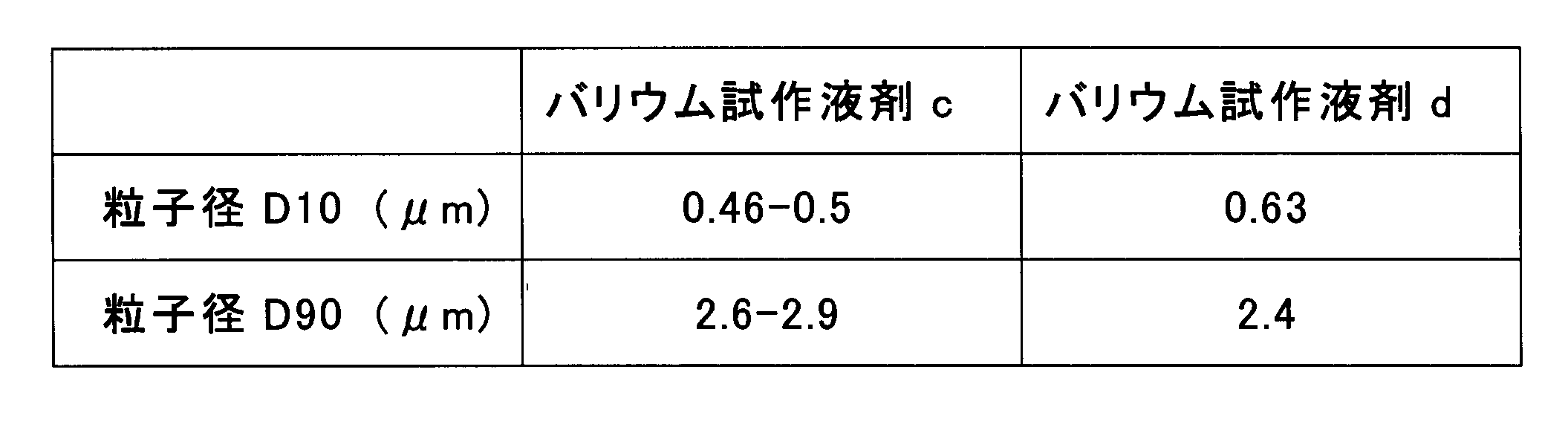

各バリウム試料(バリウム試作液剤a、c、d)の1日分の投与量(硫酸バリウム換算で24g)を水に添加し、2Lに調整した懸濁液(硫酸バリウム濃度:12g/L)を調製した。この懸濁液を100mLメスシリンダーにそれぞれ100mLずつ分注し、12時間室温で静置した。静置後、メスシリンダーの目盛から、上澄み量(硫酸バリウムが沈殿して透明になった量)を測定した。測定結果を、硫酸バリウム濃度12g/Lの水溶液2Lを調製するために要した各バリウム試料の液量(表中、「添加量」)と共に表4に示す。
また、各バリウム試料(バリウム試作液剤a、c、d)の1日分の投与量(バリウム換算で24g)と経口腸管洗浄剤(商品名:「ニフレック(登録商標)」配合内用剤、味の素製薬株式会社製)1袋(137.155g)を水に溶解して2Lに調整した懸濁液(硫酸バリウム濃度:12g/L)を調製した。この懸濁液を100mLメスシリンダーにそれぞれ100mLずつ分注し、12時間室温で静置した後、メスシリンダーの目盛から、上澄み量(バリウムが沈殿して透明になった量)を測定した。測定結果を表4に示す。
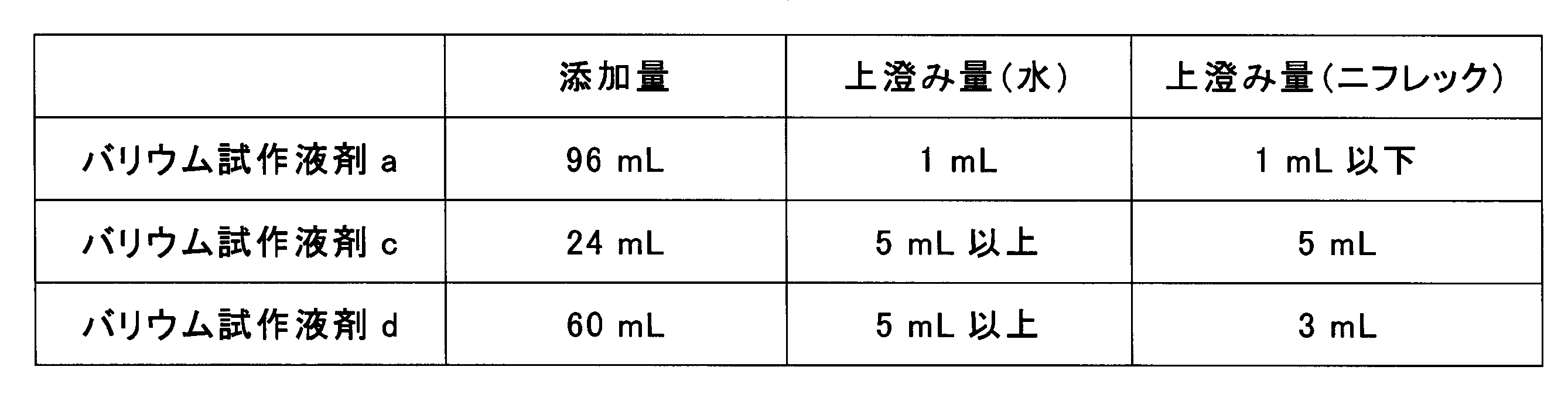
いずれのバリウム試料でも、希釈した状態で12時間静置した後でもほとんどバリウムの沈降はみられなかったことから、腸管内において希釈された状態であっても、バリウムは沈殿し難く、残水をほぼ均一に標識し得ることがわかった。特に、バリウム試作液剤aは、いずれの市販液剤よりも上澄み量が明らかに少なく、静置状態におけるバリウムの分散安定性が非常に優れていることがわかった。また、水で希釈した場合よりも、経口腸管洗浄剤により希釈した場合のほうが上澄み量が少なかったことから、CTコロノグラフィの前処置として本発明に係る経口投与用液剤Aや経口投与用液剤Bを服用する際には、水よりもニフレック等の経口腸管洗浄剤と共に服用することが好ましいことがわかった。
本発明に係る経口投与用液剤等は、CTコロノグラフィの前処置に好適に用いることができ、大腸検診等の臨床検査の分野、特に集団検診等の一次スクリーニング検査で利用が可能である。
Claims (29)
- 硫酸バリウムと、天然多糖類及びセルロース系高分子からなる群より選択される1種以上の増粘剤を含有し、
粘度が、せん断速度21.54s-1において100mPa・s以上、せん断速度464.1s-1において5~90mPa・sであり、
前記硫酸バリウムの体積累積分布が、累積10%となる粒子径D10が0.30~0.80μm、累積90%となる粒子径D90が1.0~10μmであることを特徴とする、経口投与用液剤。 - 前記硫酸バリウムの濃度が0.15~0.35g/mLである、請求項1に記載の経口投与用液剤。
- せん断速度21.54s-1における粘度が350mPa・s以上である、請求項1又は2に記載の経口投与用液剤。
- 前記硫酸バリウムの体積累積分布が、累積10%となる粒子径D10が0.30~0.50μm、累積90%となる粒子径D90が1.00~2.00μmである、請求項1~3のいずれか一項に記載の経口投与用液剤。
- 前記増粘剤が、グアーガム、カラギーナン、キサンタンガム、フェヌグリークガム、ペクチン、プルラン、アラビアゴム、デキストラン、デキストリン、ポリデキストロース、ヒドロキシエチルスターチ、カルボキシメチルセルロース及びその塩類、ヒドロキシプロピルセルロース、トラガントガム、アルギン酸ナトリウム、コンドロイチン硫酸ナトリウム、ローカストビンガム、ジェランガム、クロスカルメロースナトリウム、並びに結晶セルロース・カルメロースナトリウムからなる群より選択される1種類以上である、請求項1~4のいずれか一項に記載の経口投与用液剤。
- CTコロノグラフィの消化管造影のための前処置に使用される、請求項1~5のいずれか一項に記載の経口投与用液剤。
- CTコロノグラフィの消化管造影における経口投与用液剤であって、
バリウムと、水溶性高分子又は塩類下剤とを含有し、
CTコロノグラフィの前日に、50~2000mLを1回で又は複数回に分けて服用されることを特徴とする経口投与用液剤。 - CTコロノグラフィの前日に、70~900mLを1回で又は複数回に分けて服用される、請求項7記載の経口投与用液剤。
- 前記バリウムが、硫酸バリウムである、請求項7又は8記載の経口投与用液剤。
- 前記水溶性高分子が、ポリエチレングリコール、ポリデキストロース、デキストラン、デキストリン、ヒドロキシエチルスターチ、アラビアゴム、プルラン、ペクチン、アルブミン、カルボキシメチルセルロース及びその塩類、カラギーナン、キサンタンガム、トラガントガム、クロスカルメロースナトリウム、並びに結晶セルロース・カルメロースナトリウムからなる群より選択される1種類以上である、請求項7~9のいずれか一項に記載の経口投与用液剤。
- 浸透圧が200~900mOsm/Lである、請求項7~10のいずれか一項に記載の経口投与用液剤。
- さらに、シュクロース、ソルビトール、キシリトール、エリトリトール、マンニトール、トレハロース、ラクチトール、ラクチュロース、マルチトール、パラチノース、ラフィノース及びグリセリンからなる群より選択される1種以上の糖類を含有する、請求項7~11のいずれか一項に記載の経口投与用液剤。
- 前記バリウムの含有量が8.3~2000mg/mLである、請求項7~12のいずれか一項に記載の経口投与用液剤。
- 前記バリウム濃度が、硫酸バリウムとして0.15~0.35g/mLである、請求項7~12のいずれか一項に記載の経口投与用液剤。
- 粘度が、せん断速度21.54s-1において350mPa・s以上、せん断速度464.1s-1において5~90mPa・sである、請求項14に記載の経口投与用液剤。
- 前記バリウムの体積累積分布が、累積10%となる粒子径D10が0.30~0.50μm、累積90%となる粒子径D90が1.00~2.00μmである、請求項7~15のいずれか一項に記載の経口投与用液剤。
- さらに、ジメチルポリシロキサン及び消化管機能促進剤からなる群より選択される1種以上を含有する、請求項7~16のいずれか一項に記載の経口投与用液剤。
- バリウムと、水溶性高分子又は塩類下剤とを含有し、
水に溶解させて、バリウム含有量が8.3~2000mg/mLの水溶液として、CTコロノグラフィの前日に、50~2000mLを1回で又は複数回に分けて服用されることを特徴とする消化管造影用組成物。 - 水に溶解させて、バリウム含有量が8.3~2000mg/mLの水溶液として、CTコロノグラフィの前日に、70~900mLを1回で又は複数回に分けて服用される、請求項18記載の消化管造影用組成物。
- 前記バリウムが、硫酸バリウムである、請求項18又は19記載の消化管造影用組成物。
- 水に溶解したとき、浸透圧が200~900mOsm/Lとなるように電解質を含有し、
ポリエチレングリコール、ポリデキストロース、デキストラン、デキストリン、ヒドロキシエチルスターチ、アラビアゴム、プルラン、ペクチン、アルブミン、カルボキシメチルセルロース及びその塩類、カラギーナン、キサンタンガム、トラガントガム、クロスカルメロースナトリウム、並びに結晶セルロース・カルメロースナトリウムからなる群より選択される1種類以上の水溶性高分子、又は
クエン酸マグネシウム、リン酸二水素ナトリウム、及びリン酸水素二ナトリウムからなる群より選択される1種類以上の塩類下剤を含有する、請求項18~20のいずれか一項に記載の消化管造影用組成物。 - さらに、ジメチルポリシロキサン及び消化管機能促進剤からなる群より選択される1種以上を含有する、請求項18~21のいずれか一項に記載の消化管造影用組成物。
- 前記バリウムの体積累積分布が、累積10%となる粒子径D10が0.30~0.50μm、累積90%となる粒子径D90が1.00~2.00μmである、請求項18~22のいずれか一項に記載の消化管造影用組成物。
- 液状であり、かつ粘度が、せん断速度21.54s-1において350mPa・s以上、せん断速度464.1s-1において5~90mPa・sである、請求項23に記載の消化管造影用組成物。
- バリウムと、水溶性高分子又は塩類下剤とを組み合わせてなり、
CTコロノグラフィの前日に、前記水溶性高分子又は塩類下剤を水に溶解させた水溶液50~2000mLと、前記バリウムとが、それぞれ1回で又は複数回に分けて服用されることを特徴とする、CTコロノグラフィのための前処置用薬剤。 - 水に溶解させた前記水溶性高分子又は塩類下剤と、前記バリウムとが、30分間以内に服用される、請求項25に記載のCTコロノグラフィのための前処置用薬剤。
- CTコロノグラフィの前日の前記水溶液の総服用量が70~900mLである、請求項25又は26に記載のCTコロノグラフィのための前処置用薬剤。
- 前記バリウムが、体積累積分布が、累積10%となる粒子径D10が0.30~0.50μm、累積90%となる粒子径D90が1.00~2.00μmである硫酸バリウムであり、
粘度が、せん断速度21.54s-1において350mPa・s以上、せん断速度464.1s-1において5~90mPa・sの液剤である、請求項25~27のいずれか一項に記載のCTコロノグラフィのための前処置用薬剤。 - CTコロノグラフィの消化管造影における経口投与用液剤であって、
水溶性高分子又は塩類下剤とを含有し、
CTコロノグラフィの前日に、バリウムと共に又はバリウムとは独立して、50~2000mLを1回で又は複数回に分けて服用されることを特徴とする経口投与用液剤。
Priority Applications (2)
| Application Number | Priority Date | Filing Date | Title |
|---|---|---|---|
| JP2014545768A JP6441678B2 (ja) | 2012-11-09 | 2013-11-08 | Ctコロノグラフィに用いられる経口投与用液剤及び消化管造影用組成物 |
| US14/706,533 US20150343096A1 (en) | 2012-11-09 | 2015-05-07 | Liquid preparation for oral administration for use in ct colonography, and composition for imaging digestive tract |
Applications Claiming Priority (2)
| Application Number | Priority Date | Filing Date | Title |
|---|---|---|---|
| JP2012-247927 | 2012-11-09 | ||
| JP2012247927 | 2012-11-09 |
Related Child Applications (1)
| Application Number | Title | Priority Date | Filing Date |
|---|---|---|---|
| US14/706,533 Continuation US20150343096A1 (en) | 2012-11-09 | 2015-05-07 | Liquid preparation for oral administration for use in ct colonography, and composition for imaging digestive tract |
Publications (1)
| Publication Number | Publication Date |
|---|---|
| WO2014073643A1 true WO2014073643A1 (ja) | 2014-05-15 |
Family
ID=50684737
Family Applications (1)
| Application Number | Title | Priority Date | Filing Date |
|---|---|---|---|
| PCT/JP2013/080254 Ceased WO2014073643A1 (ja) | 2012-11-09 | 2013-11-08 | Ctコロノグラフィに用いられる経口投与用液剤及び消化管造影用組成物 |
Country Status (3)
| Country | Link |
|---|---|
| US (1) | US20150343096A1 (ja) |
| JP (1) | JP6441678B2 (ja) |
| WO (1) | WO2014073643A1 (ja) |
Cited By (2)
| Publication number | Priority date | Publication date | Assignee | Title |
|---|---|---|---|---|
| CN109432448A (zh) * | 2018-11-29 | 2019-03-08 | 天津凯茵科技有限公司 | 一种用于x射线检查的胃肠造影剂 |
| CN109432447A (zh) * | 2018-11-29 | 2019-03-08 | 天津凯茵科技有限公司 | 用于消化道x射线检查的造影剂 |
Families Citing this family (1)
| Publication number | Priority date | Publication date | Assignee | Title |
|---|---|---|---|---|
| US9907912B2 (en) | 2014-09-26 | 2018-03-06 | John B. RANSOME | Gelatin bowel prep with syringe for colonoscopy |
Citations (3)
| Publication number | Priority date | Publication date | Assignee | Title |
|---|---|---|---|---|
| JP2002053496A (ja) * | 2000-05-30 | 2002-02-19 | Ajinomoto Faruma Kk | X線造影剤の造影能改善剤ならびに腸管洗浄配合剤および腸管洗浄用キット |
| JP2010077159A (ja) * | 2002-04-06 | 2010-04-08 | Bracco Diagnostics Inc | 結腸残留物標識付加システム |
| WO2012046847A1 (ja) * | 2010-10-08 | 2012-04-12 | 味の素株式会社 | Ctコロノグラフィに用いられる経口投与用液剤及び消化管造影用組成物 |
-
2013
- 2013-11-08 WO PCT/JP2013/080254 patent/WO2014073643A1/ja not_active Ceased
- 2013-11-08 JP JP2014545768A patent/JP6441678B2/ja active Active
-
2015
- 2015-05-07 US US14/706,533 patent/US20150343096A1/en not_active Abandoned
Patent Citations (3)
| Publication number | Priority date | Publication date | Assignee | Title |
|---|---|---|---|---|
| JP2002053496A (ja) * | 2000-05-30 | 2002-02-19 | Ajinomoto Faruma Kk | X線造影剤の造影能改善剤ならびに腸管洗浄配合剤および腸管洗浄用キット |
| JP2010077159A (ja) * | 2002-04-06 | 2010-04-08 | Bracco Diagnostics Inc | 結腸残留物標識付加システム |
| WO2012046847A1 (ja) * | 2010-10-08 | 2012-04-12 | 味の素株式会社 | Ctコロノグラフィに用いられる経口投与用液剤及び消化管造影用組成物 |
Non-Patent Citations (4)
| Title |
|---|
| KIM,M.J. ET AL.: "Efficacy of Barium-Based Fecal Tagging for CT Colonography: a Comparison between the Use of High and Low Density Barium Suspensions in a Korean Population - a Preliminary Study", KOR. J. RADIOL., vol. 10, no. 1, February 2009 (2009-02-01), pages 25 - 33 * |
| LEFERE,F.A. ET AL.: "Dietary Fecal Tagging as a Cleansing Method before CT Colonography: Initial Results - Polyp Detection and Patient Acceptance", RADIOLOGY, no. 224, 2, August 2002 (2002-08-01), pages 393 - 403 * |
| TAMAKI ICHIKAWA ET AL.: "Atarashii Shoka Gazo Shindan ''3 CT colonogeraphy no Aratana Shindan Gijutsu (1) - Zenshochi (fecal tagging & electronic cleansing)''", CLINICAL GASTROENTEROLOGY, vol. 25, no. 7, May 2010 (2010-05-01), pages 890 - 895 * |
| TAMAKI ICHIKAWA: "III CT Colonography ni Okeru Zenshochiho no Doko ''2. Tagging Zenshochiho - Barium o Shiyo shita fecal tagging o Chushin ni''", INNERVISION, vol. 25, no. 3, March 2010 (2010-03-01), pages 19 - 22 * |
Cited By (3)
| Publication number | Priority date | Publication date | Assignee | Title |
|---|---|---|---|---|
| CN109432448A (zh) * | 2018-11-29 | 2019-03-08 | 天津凯茵科技有限公司 | 一种用于x射线检查的胃肠造影剂 |
| CN109432447A (zh) * | 2018-11-29 | 2019-03-08 | 天津凯茵科技有限公司 | 用于消化道x射线检查的造影剂 |
| CN109432447B (zh) * | 2018-11-29 | 2021-07-23 | 西南医科大学附属中医医院 | 用于消化道x射线检查的造影剂 |
Also Published As
| Publication number | Publication date |
|---|---|
| JP6441678B2 (ja) | 2018-12-19 |
| JPWO2014073643A1 (ja) | 2016-09-08 |
| US20150343096A1 (en) | 2015-12-03 |
Similar Documents
| Publication | Publication Date | Title |
|---|---|---|
| JP5910501B2 (ja) | Ctコロノグラフィに用いられる経口投与用液剤及び消化管造影用組成物 | |
| JP5870119B2 (ja) | 腸洗浄のための、方法、組成物、およびパッケージ | |
| AU2010239378B2 (en) | Colon lavage system | |
| PT2233147E (pt) | Solução de sal para limpeza do cólon | |
| CN103402512A (zh) | 结肠镜检查——制剂 | |
| JP6441678B2 (ja) | Ctコロノグラフィに用いられる経口投与用液剤及び消化管造影用組成物 | |
| JP2011241202A (ja) | Ctコロノグラフィにおける消化管の病変検出不能領域減少剤ならびに腸管洗浄用配合剤、同組成物および腸管洗浄用キットまたは包装品 | |
| JP2013516390A (ja) | 緩下作用がある電解質及び炭水化物を含むエネルギー性栄養組成物 | |
| JP5206616B2 (ja) | Ctコロノグラフィにおける消化管造影用組成物 | |
| JP4670229B2 (ja) | Ctコロノグラフィにおける消化管造影用組成物 | |
| US20130052143A1 (en) | Liquid preparation for oral administration to be used in ct colonography, and composition for digestive tract imaging | |
| JP2005187448A (ja) | 腸管洗浄用組成物 | |
| JP5375862B2 (ja) | 腸管洗浄用組成物 | |
| JP5696326B2 (ja) | Ctコロノグラフィ検査用医薬 | |
| JP2013060441A (ja) | Ctコロノグラフィに用いられる経口投与用液剤及び消化管造影用製剤 | |
| JP2002053496A (ja) | X線造影剤の造影能改善剤ならびに腸管洗浄配合剤および腸管洗浄用キット | |
| JP5505454B2 (ja) | Ctコロノグラフィにおける消化管造影用組成物 | |
| ES2928719T3 (es) | Procedimiento de limpieza del colon | |
| HK1167572B (en) | Colon lavage system | |
| HK1167572A (en) | Colon lavage system |
Legal Events
| Date | Code | Title | Description |
|---|---|---|---|
| 121 | Ep: the epo has been informed by wipo that ep was designated in this application |
Ref document number: 13854030 Country of ref document: EP Kind code of ref document: A1 |
|
| ENP | Entry into the national phase |
Ref document number: 2014545768 Country of ref document: JP Kind code of ref document: A |
|
| NENP | Non-entry into the national phase |
Ref country code: DE |
|
| 122 | Ep: pct application non-entry in european phase |
Ref document number: 13854030 Country of ref document: EP Kind code of ref document: A1 |