WO2014054543A1 - ハイパイル布帛及びその製造方法 - Google Patents
ハイパイル布帛及びその製造方法 Download PDFInfo
- Publication number
- WO2014054543A1 WO2014054543A1 PCT/JP2013/076370 JP2013076370W WO2014054543A1 WO 2014054543 A1 WO2014054543 A1 WO 2014054543A1 JP 2013076370 W JP2013076370 W JP 2013076370W WO 2014054543 A1 WO2014054543 A1 WO 2014054543A1
- Authority
- WO
- WIPO (PCT)
- Prior art keywords
- fiber
- pile
- ground
- pile fabric
- adhesive resin
- Prior art date
- Legal status (The legal status is an assumption and is not a legal conclusion. Google has not performed a legal analysis and makes no representation as to the accuracy of the status listed.)
- Ceased
Links
Images
Classifications
-
- D—TEXTILES; PAPER
- D03—WEAVING
- D03D—WOVEN FABRICS; METHODS OF WEAVING; LOOMS
- D03D27/00—Woven pile fabrics
- D03D27/02—Woven pile fabrics wherein the pile is formed by warp or weft
-
- D—TEXTILES; PAPER
- D04—BRAIDING; LACE-MAKING; KNITTING; TRIMMINGS; NON-WOVEN FABRICS
- D04B—KNITTING
- D04B1/00—Weft knitting processes for the production of fabrics or articles not dependent on the use of particular machines; Fabrics or articles defined by such processes
- D04B1/02—Pile fabrics or articles having similar surface features
- D04B1/025—Pile fabrics or articles having similar surface features incorporating loose fibres, e.g. high-pile fabrics or artificial fur
-
- D—TEXTILES; PAPER
- D06—TREATMENT OF TEXTILES OR THE LIKE; LAUNDERING; FLEXIBLE MATERIALS NOT OTHERWISE PROVIDED FOR
- D06N—WALL, FLOOR, OR LIKE COVERING MATERIALS, e.g. LINOLEUM, OILCLOTH, ARTIFICIAL LEATHER, ROOFING FELT, CONSISTING OF A FIBROUS WEB COATED WITH A LAYER OF MACROMOLECULAR MATERIAL; FLEXIBLE SHEET MATERIAL NOT OTHERWISE PROVIDED FOR
- D06N7/00—Flexible sheet materials not otherwise provided for, e.g. textile threads, filaments, yarns or tow, glued on macromolecular material
- D06N7/0063—Floor covering on textile basis comprising a fibrous top layer being coated at the back with at least one polymer layer, e.g. carpets, rugs, synthetic turf
- D06N7/0065—Floor covering on textile basis comprising a fibrous top layer being coated at the back with at least one polymer layer, e.g. carpets, rugs, synthetic turf characterised by the pile
-
- D—TEXTILES; PAPER
- D06—TREATMENT OF TEXTILES OR THE LIKE; LAUNDERING; FLEXIBLE MATERIALS NOT OTHERWISE PROVIDED FOR
- D06N—WALL, FLOOR, OR LIKE COVERING MATERIALS, e.g. LINOLEUM, OILCLOTH, ARTIFICIAL LEATHER, ROOFING FELT, CONSISTING OF A FIBROUS WEB COATED WITH A LAYER OF MACROMOLECULAR MATERIAL; FLEXIBLE SHEET MATERIAL NOT OTHERWISE PROVIDED FOR
- D06N7/00—Flexible sheet materials not otherwise provided for, e.g. textile threads, filaments, yarns or tow, glued on macromolecular material
- D06N7/0063—Floor covering on textile basis comprising a fibrous top layer being coated at the back with at least one polymer layer, e.g. carpets, rugs, synthetic turf
- D06N7/0071—Floor covering on textile basis comprising a fibrous top layer being coated at the back with at least one polymer layer, e.g. carpets, rugs, synthetic turf characterised by their backing, e.g. pre-coat, back coating, secondary backing, cushion backing
-
- D—TEXTILES; PAPER
- D10—INDEXING SCHEME ASSOCIATED WITH SUBLASSES OF SECTION D, RELATING TO TEXTILES
- D10B—INDEXING SCHEME ASSOCIATED WITH SUBLASSES OF SECTION D, RELATING TO TEXTILES
- D10B2321/00—Fibres made from polymers obtained by reactions only involving carbon-to-carbon unsaturated bonds
- D10B2321/10—Fibres made from polymers obtained by reactions only involving carbon-to-carbon unsaturated bonds polymers of unsaturated nitriles, e.g. polyacrylonitrile, polyvinylidene cyanide
-
- D—TEXTILES; PAPER
- D10—INDEXING SCHEME ASSOCIATED WITH SUBLASSES OF SECTION D, RELATING TO TEXTILES
- D10B—INDEXING SCHEME ASSOCIATED WITH SUBLASSES OF SECTION D, RELATING TO TEXTILES
- D10B2321/00—Fibres made from polymers obtained by reactions only involving carbon-to-carbon unsaturated bonds
- D10B2321/10—Fibres made from polymers obtained by reactions only involving carbon-to-carbon unsaturated bonds polymers of unsaturated nitriles, e.g. polyacrylonitrile, polyvinylidene cyanide
- D10B2321/101—Fibres made from polymers obtained by reactions only involving carbon-to-carbon unsaturated bonds polymers of unsaturated nitriles, e.g. polyacrylonitrile, polyvinylidene cyanide modacrylic
-
- D—TEXTILES; PAPER
- D10—INDEXING SCHEME ASSOCIATED WITH SUBLASSES OF SECTION D, RELATING TO TEXTILES
- D10B—INDEXING SCHEME ASSOCIATED WITH SUBLASSES OF SECTION D, RELATING TO TEXTILES
- D10B2403/00—Details of fabric structure established in the fabric forming process
- D10B2403/01—Surface features
- D10B2403/011—Dissimilar front and back faces
- D10B2403/0111—One hairy surface, e.g. napped or raised
-
- D—TEXTILES; PAPER
- D10—INDEXING SCHEME ASSOCIATED WITH SUBLASSES OF SECTION D, RELATING TO TEXTILES
- D10B—INDEXING SCHEME ASSOCIATED WITH SUBLASSES OF SECTION D, RELATING TO TEXTILES
- D10B2501/00—Wearing apparel
- D10B2501/04—Outerwear; Protective garments
- D10B2501/044—Fur garments; Garments of fur substitutes
Definitions
- the present invention relates to a napped pile fabric and a method for producing the same, and more particularly to a high pile fabric and a method for producing the same.
- napped pile fabric has been known as a fabric that looks like fur under the names of imitation fur, faux fur, bore, and the like. They are made from pile knitted fabrics and pile fabrics. In the case of a knitted pile, knitting is mainly performed by a seal milling machine and a sliver knit machine (circular knitting machine), and in both cases, pile fibers are cut. When knitting with a double raschel machine of a warp knitting machine, knitting is performed by forming the ground texture double and simultaneously tying the binding yarn between the ground textures and cutting the middle of the binding yarn.
- Non-Patent Document 1 Non-Patent Document 1
- these woven and knitted fabrics have a problem that they have a lot of hair loss. If there is a lot of hair loss, it will stick to the inner garment or drop off on the floor, which will cause poor appearance and hygienic problems.
- pile fibers that are knitted along the loop of the ground yarn of the knitted fabric, and the friction resistance between the ground yarn and the pile fiber is small. There is a problem that the single fiber constituting the pile fiber is likely to fall off simply by pulling one end of the wire.
- Measures for improvement include a proposal for mixing low-melting fibers with pile fibers (Patent Document 1), a proposal for mixing low-melting fibers with ground yarn constituting the ground structure (Patent Documents 2 and 3), and the like.
- Patent Document 1 a proposal for mixing low-melting fibers with pile fibers
- Patent Documents 2 and 3 a proposal for mixing low-melting fibers with ground yarn constituting the ground structure
- both of these proposals heat the entire fabric at a temperature equal to or higher than the melting point of the low-melting fiber, so that the entire ground texture or the pile fiber is also fused, resulting in a rough texture. is there.
- Patent Document 4 in the napped pile fabric using specific fibers, only the specific portion of the pile fibers on the non-napped surface is thermocompression bonded, so that the texture of the napped surface is not impaired.
- a napped pile fabric that prevents the pile fibers from coming off is proposed.
- the napped pile fabric proposed in Citation 4 has a problem that the non-raised surface subjected to thermocompression bonding becomes hard and the fabric is likely to be wrinkled.
- the raised pile fabric having wrinkles has a poor appearance on the raised surface, and its commercial value may be significantly reduced.
- the present invention provides a high pile fabric that prevents the pile fibers from coming off without impairing the texture while maintaining the flexibility of the high pile fabric, and a method for producing the same.
- One of the embodiments of the present invention includes a ground fabric and a pile fiber that is entangled with the ground yarn constituting the ground tissue and is raised on the raised surface of the ground tissue, and the pile fiber is an acrylic fiber and / or an acrylic fiber
- An adhesive resin composition having a glass transition point of ⁇ 100 ° C. or higher and 10 ° C.
- the adhesive resin composition comprises at least one adhesive resin selected from the group consisting of styrene butadiene rubber, acrylonitrile butadiene rubber, vinyl acetate resin, acrylate resin, and polyurethane resin. It is preferable to include. More preferably, the adhesive resin composition contains one or more acrylic ester resins.
- the pile fiber is preferably an acrylic fiber. It is preferable that the fiber which comprises the said ground structure is comprised by the polyester fiber and / or the cellulose fiber.
- Another embodiment of the present invention is a high pile product obtained by processing the above high pile fabric.
- Another embodiment of the present invention includes a ground fabric and a pile fiber that is entangled with a ground yarn constituting the ground tissue and is raised on a raised surface of the ground tissue, the pile fiber being an acrylic fiber and / or In a high pile fabric that includes acrylic fibers, and the pile fibers have a softening point lower than that of the fibers constituting the ground structure, the glass transition point has a glass transition point of ⁇ 100 ° C. to 10 ° C.
- the high pile fabric to which the adhesive resin composition was adhered was entangled with the ground yarn constituting the ground structure from the non-raised surface side of the ground texture.
- the pile fibers at least a part of the pile fibers outside the ground yarn constituting the ground structure is subjected to thermocompression bonding with the adhesive resin composition, and the pile fibers raised on the raised surface of the ground structure are not fused. Special It is a high-pile fabric manufacturing method of the.
- the adhesive resin is adhered by at least one adhesive selected from the group consisting of styrene butadiene rubber, acrylonitrile butadiene rubber, vinyl acetate resin, acrylate resin, and polyurethane resin. It is preferable to use a latex, emulsion, or dispersion of a conductive resin, and it is more preferable to use a latex of one or more acrylic ester resins.
- the pile fiber is preferably an acrylic fiber. It is preferable that the fibers constituting the ground texture are polyester fibers and / or cellulosic fibers.
- a high-pile fabric that has a good appearance and texture, suppresses hair loss, has a soft non-raised surface, and does not easily wrinkle, and a high-pile product obtained by processing the high-pile fabric.
- An adhesive resin composition having a transition point of ⁇ 100 ° C. or more and 10 ° C. or less is attached to 30 g / m 2 or more and 300 g / m 2 or less, and from the non-raised surface side of the ground tissue of the high pile fabric to which the adhesive resin composition is attached.
- the high pile fabric of the present invention is a pile knitted fabric, and the ground texture is a knitted ground texture.
- the high pile fabric of the present invention includes a knitted ground structure and pile fibers that are tangled with the ground yarn constituting the ground structure and are raised on the surface of the ground structure.
- a knitted fabric is generally a fabric in which one or more yarns create a loop and continue to make the next new loop by hooking on the loop, and then making the loop continuous in a plane. is there.
- a warp knitted fabric is a fabric in which a number of warp yarns arranged in an orderly manner are connected to each other by adjacent loops to form a fabric.
- flat knitting knitting methods include flat knitting, rubber knitting, pearl knitting and the like, and warp knitting knitting methods include denby knitting, cord knitting, atlas knitting, chain knitting and the like.
- weft knitted fabric is preferable from the viewpoint of merchantability and productivity.
- the pile fibers may be arranged with respect to the knitted fabric of the ground structure so that the pile fibers may be entangled with all the loops of the ground yarn constituting the knitted fabric of the ground structure, or the ground yarn constituting the knitted fabric. Of these loops, the pile fibers may be arranged so as not to be entangled in the wale direction and / or the course direction.
- the fiber constituting the ground yarn is not particularly limited as long as the softening point is higher than the pile fiber described later.
- a polyester fiber, a cellulose fiber, etc. are mentioned.
- the polyester fibers include synthetic fibers obtained by spinning a resin composition containing a polyester resin such as polyethylene terephthalate.
- the cellulosic fiber include cotton.
- the pile fiber preferably includes an acrylic fiber and / or an acrylic fiber (hereinafter sometimes abbreviated as “acrylic fiber”).
- acrylic fiber an acrylic fiber and / or an acrylic fiber (hereinafter sometimes abbreviated as “acrylic fiber”).
- a high pile fabric excellent in texture can be obtained.
- a thermoplastic fiber is used as a pile fiber and polishing is performed at a temperature equal to or higher than the melting point or softening point of the thermoplastic fiber, the pile fiber on the surface of the high pile fabric is burnt or melted, A high pile fabric having good appearance and texture cannot be obtained.
- polishing is performed at a temperature below the glass transition point of the thermoplastic fiber, the pile fiber on the surface of the high pile fabric will not be crimped, so that a high pile fabric having a good appearance and texture cannot be obtained.
- the crimp of the acrylic (based) fiber extends even at a temperature below the melting point. Since the glass transition point of the acrylic (based) fiber is about 100 ° C. and the softening point is about 150 to 230 ° C., when acrylic (based) fiber is used for the pile fiber, the glass transition point is higher than the glass transition point and lower than the softening point. Polishing can be performed at a temperature, for example, 100 to 150 ° C. Furthermore, since crimps of acrylic (based) fibers tend to be stretched more easily than fibers of other materials, a high pile fabric having a good appearance and texture can be obtained.
- the pile fiber may include a synthetic fiber obtained by spinning a resin composition containing a polyester resin such as polyethylene terephthalate or polytrimethylene terephthalate or other synthetic fiber within a range that does not impair the effects of the present invention. Good.
- the pile fiber is not particularly limited as long as it is a ground yarn constituting the ground structure and has a softening point lower than that of the fiber constituting the ground yarn, but the difference between the softening point of the fiber constituting the ground yarn and the pile fiber is not limited. Is preferably 10 ° C. or higher, more preferably 20 ° C. or higher, and particularly preferably 30 ° C. or higher. If there is a difference of 10 ° C. or more, only the pile fibers arranged on the outside of the ground yarn on the non-raised surface of the ground tissue are subjected to thermocompression bonding, and the pile fibers raised on the surface of the ground tissue are thermocompression bonded. It is easier to avoid (no fusion).
- the whole pile fiber may be a fiber softened at a predetermined temperature, or may be a mixed fiber of fibers softened at different temperatures. And when the pile fiber is a mixed fiber of fibers that soften at different temperatures, 20% by weight or more of fibers that soften at a relatively low temperature are mixed, and the fibers that soften at a relatively low temperature are thermocompression bonded. More preferably, 50% by weight or more of fibers that soften at a relatively low temperature are mixed.
- the softening point is a softening temperature before melting or decomposition.
- the softening point of acrylic fibers is 190 to 232 ° C.
- the softening point of acrylic fibers is 150 to 220 ° C. (“Chemical Dictionary”, Kyoritsu Shuppan, pages 727 to 729, issued June 1, 1993, hereinafter “ Literature value ”).
- the acrylic fiber refers to a fiber composed of a polymer obtained by polymerizing a composition containing 85% by weight or more of acrylonitrile.
- the acrylic fiber is composed of a polymer obtained by polymerizing a composition containing acrylonitrile in an amount of 35% by weight to less than 85% by weight and other copolymerizable monomer in an amount of more than 15% by weight and 65% by weight or less. Refers to the fibers that are made.
- the other copolymerizable monomer is not particularly limited as long as it is a monomer copolymerizable with acrylonitrile.
- vinyl halides typified by vinyl chloride and vinyl bromide
- vinylidene halides typified by vinylidene chloride and vinylidene bromide
- allyl sulfonic acid methallyl sulfonic acid, styrene sulfonic acid, isoprene sulfonic acid, 2 -Sulphonic acid-containing monomers represented by acrylamido-2-methylpropanesulfonic acid and the like, and metal salts and amine salts of these sulfonic acid-containing monomers
- Base Vinyl monomers and anionic vinyl monomers such as sodium, potassium or ammonium salts thereof; cationic vinyl typified by quaternized aminoalkyl ester of acrylic acid, quaternized aminoalkyl ester of methacrylic acid, etc.
- the other copolymerizable monomer it is preferable to use one or more monomers selected from the group consisting of vinyl halides, vinylidene halides and metal salts of sulfonic acid-containing monomers, and vinyl chloride, vinylidene chloride and styrene sulfonic acid are used. It is more preferable to use one or more monomers selected from the group consisting of sodium.
- Modaacryl fiber is a polymer containing a composition containing acrylonitrile in an amount of 35 wt% to less than 85 wt%, and a total of more than 15 wt% and 65 wt% of vinyl chloride and / or vinylidene chloride and other copolymerizable monomers. It is a fiber composed of a polymer obtained as described above.
- the combination of the types of fibers and pile fibers constituting the ground yarn is not particularly limited as long as the above conditions are satisfied, but specific examples thereof are shown below.
- a polyethylene terephthalate (PET, softening point of about 258 ° C.) fiber is used as a fiber constituting the ground yarn
- PET polyethylene terephthalate
- acrylic fiber the following fibers can be preferably used.
- Vinyl chloride-acrylonitrile fiber for example, Kaneka Corporation, trade name “Kanekaron”, softening point 150 to 220 ° C., literature value
- Vinylidene chloride-acrylonitrile fiber softening point 150-220 ° C, literature value
- an acrylic fiber is preferably used as the pile fiber.
- the acrylic fiber include Exlan Co., Ltd., trade name “Exlan K691” (softening point 190 to 232 ° C., literature value), and the like.
- the pile fiber has a softening point lower than that of the fiber constituting the ground yarn (ground texture) as described above, and among the pile fibers entangled with the ground yarn, the pile fiber has a non-raised surface of the ground texture than the ground yarn.
- At least some of the outer pile fibers are thermocompression bonded, and the pile fibers raised on the raised surface of the ground tissue are not thermocompression bonded (not fused).
- the means is not particularly limited as long as the pile fibers raised on the raised surface of the ground tissue are not thermocompression bonded, and at least a part of the pile fibers outside the ground yarn can be thermocompression bonded, but the non-raised surface side of the ground tissue is not limited. That is, it is preferable to perform the thermocompression treatment at a temperature not lower than the softening point of the pile fiber and lower than the softening point of the fiber constituting the ground yarn from the non-raised surface side of the high pile fabric.
- the outside of the ground yarn on the non-raised surface of the ground structure means the non-raised surface side when the surface where the pile fiber of the high pile fabric is raised is the surface, and is outside the ground yarn. is there.
- the pile fiber entangled with the ground yarn may include some fibers that have bite into the ground yarn, but the remaining portion is present outside the ground yarn.
- the pile fibers outside the ground yarn are thermocompression bonded together with the adhesive resin composition.
- the adhesive resin composition is interposed between the thermocompressed pile fibers. The composition has entered.
- each of the adjacent pile fibers is connected directly or via an adhesive resin composition to form a lump, and among the pile fibers
- Each of the pile fibers in the vicinity of the outermost side to the ground yarn is connected to each other directly or via an adhesive resin composition, and the pile fibers on the inner side of the pile fiber are pressed against and ground together with the ground yarn.
- Examples include a mode of forming a lump, a mode in which unsoftened fibers of pile fibers are joined together via a softened fiber and / or an adhesive resin composition to form a lump.
- thermocompression bonding as a result of thermocompression bonding, the bulkiness of pile fibers outside a certain ground yarn is smaller than the state before thermocompression bonding,
- the non-raised surface of the high pile fabric has a smooth appearance (a state in which the fluffing of the pile fiber on the non-raised surface of the ground fabric is significantly reduced). Since the pile fibers are thermocompression bonded together with the adhesive resin composition, the probability that the pile fibers are directly connected and thermocompression bonded is low, and most of the pile fibers are connected via the adhesive resin composition. It is thermocompression bonded.
- the high pile fabric of the present invention at least a part of the pile fibers outside the ground yarn and the adhesive resin composition are both thermocompression bonded to form a thermocompression bonding portion and thermocompression bonded to the ground structure.
- the pile fibers outside the ground yarn is thermocompression bonded with the adhesive resin composition as described above, but from the viewpoint of obtaining a more excellent hair loss prevention effect. It is preferable that all pile fibers outside the ground yarn are thermocompression bonded together with the adhesive resin composition.
- a pile fiber having a non-raised surface is thermocompression bonded with an adhesive resin composition having a glass transition point of ⁇ 100 ° C. to 10 ° C. having a low glass transition point, so that the non-raised surface is soft and hardly wrinkled.
- a high pile fabric can be obtained.
- an adhesive resin is attached to the non-raised surface of the high pile fabric, and the pile fiber existing on the non-raised surface is bonded and fixed to the ground yarn with an adhesive resin. Prevent hair loss. At that time, a resin having a high glass transition point is usually used in order to enhance the effect of preventing the pile fibers from falling out.
- the pile fiber bristle is based on the new finding that the non-raised surface becomes flexible while reliably preventing slipping.
- thermoplastic fiber When non-raised surface of high pile fabric using thermoplastic fiber as pile fiber is subjected to thermocompression treatment at a temperature higher than the melting point or softening point of thermoplastic fiber without adhering the adhesive resin composition, it is present on the non-raised surface.
- the thermoplastic fiber is easily thermocompression-bonded to form a single sheet. Furthermore, since the glass transition point of a general thermoplastic fiber is not less than room temperature (the glass transition point of acrylic fiber and acrylic fiber is about 100 ° C.), when formed into a sheet, it feels very hard at room temperature. .
- thermocompression treatment is performed after adhering an adhesive resin composition having a glass transition point lower than room temperature to the non-raised surface of the high pile fabric.
- the non-raised surface of the high pile fabric becomes soft, wrinkles are less likely to occur in the high pile fabric, and the merchantability increases.
- an adhesive resin composition having a glass transition point higher than room temperature since a resin having a glass transition point higher than room temperature feels hard at room temperature, the pile fiber may be subjected to thermocompression treatment together with the adhesive resin composition. The non-raised surface of the high pile fabric feels hard.
- the above-mentioned adhesive resin composition preferably has a glass transition point of ⁇ 50 ° C. or more and 0 ° C. or less from the viewpoint of productivity and cost.
- the adhesive resin composition may have a glass transition point of ⁇ 100 ° C. to 10 ° C., and is not particularly limited.
- a composition comprising one or more adhesive resins selected from the group consisting of styrene butadiene rubber (SBR), acrylonitrile butadiene rubber (NBR), vinyl acetate resin, acrylic ester resin, polyurethane resin, and the like.
- SBR styrene butadiene rubber
- NBR acrylonitrile butadiene rubber
- vinyl acetate resin acrylic ester resin
- polyurethane resin polyurethane resin
- the adhesive resin composition contains an adhesive resin as a main component.
- the main component refers to a component contained in an amount of 80% by weight or more, preferably 90% by weight or more, and more preferably 95% by weight.
- the said adhesive resin composition contains an emulsifier, surfactant, etc. in addition to adhesive resin.
- the said adhesive resin composition may be used only by one type, and may be used even if it combines several types.
- the adhesion of the adhesive resin composition is one or more selected from the group consisting of styrene butadiene rubber (SBR), acrylonitrile butadiene rubber (NBR), vinyl acetate resin, acrylate resin, polyurethane resin, and the like. It can be carried out using latex, emulsion, dispersion, etc. of the adhesive resin. Preferably, it is performed using a latex of one or more acrylic ester resins. In the latex, emulsion or dispersion of the adhesive resin, the solid content including the adhesive resin and the emulsifier corresponds to the adhesive resin composition.
- the adhesion amount of the adhesive resin composition is 30 on the non-raised surface (of the ground texture) of the high pile fabric. About 300 g / m 2 . If the adhesive resin composition is attached to the non-raised surface of the high pile fabric at about 30 to 300 g / m 2 , the pile fiber is fixed to the ground yarn, and in the manufacturing process such as the brushing process or the polishing process until the thermocompression treatment is performed. Since the ground structure of the high pile fabric is less likely to break, it becomes easy to obtain a high pile fabric having a good appearance and good hair removal.
- the adhesion amount of the adhesive resin composition is 30 g / m 2 or more, the non-raised surface of the high pile fabric becomes soft, and wrinkles are hardly generated on the high pile fabric. Further, when the adhesion amount of the adhesive resin composition is 300 g / m 2 or less, it is easy to obtain an effect commensurate with the adhesion amount in hardness and wrinkle resistance, and cost performance is good.
- Adhesion amount of the adhesive resin composition is preferably from the viewpoint of cost 40 g / m 2 or more 150 g / m 2 or less, more preferably less than 40 g / m 2 or more 100 g / m 2, More preferably, it is 40 g / m 2 or more and 95 g / m 2 or less.
- Adhesion amount of the adhesive resin composition is preferably from the viewpoint of compatibility of stickiness and softness of the non-napped surface of the high pile fabric is less than 40 g / m 2 or more 100g / m 2, 40g / m 2 or more 95 g / More preferably, it is m 2 or less.
- the weight average value of the glass transition point of each adhesive resin composition is within the above temperature range.
- the adhesive resin composition A having a glass transition point of ⁇ 50 ° C. is 50% by weight
- the adhesive resin composition B having a glass transition point of ⁇ 110 ° C. is 25% by weight
- the glass transition point of the adhesive resin composition is ⁇ 45 ° C. (the glass of the adhesive resin composition).
- Transition point [glass transition point of adhesive resin composition A ⁇ weight% of adhesive resin composition A / 100] + [glass transition point of adhesive resin composition B ⁇ weight% of adhesive resin composition B / 100] + [Glass transition point of adhesive resin composition C ⁇ weight% of adhesive resin composition C / 100])).
- the glass transition point of the adhesive resin composition can be measured by a thermomechanical analyzer (TMA) that measures changes in mechanical properties while slowly raising or lowering the temperature of the sample, or while slowly raising or lowering the temperature of the sample.
- TMA thermomechanical analyzer
- DSC differential scanning calorimetry
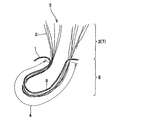
- FIG. 1 is a schematic diagram for explaining the positional relationship between a ground yarn and pile fibers entangled with the ground yarn in one embodiment of the high pile fabric of the present invention.
- the high pile fabric 5 is spread on the ground yarn 1 constituting the knitted loop 6 and the raised surface 7 of the ground structure (high pile fabric 5) entangled with the loop 6 of the ground yarn 1 and the raised pile 3 It is comprised by the pile fiber 2 which forms.
- the non-raised surface 8 of the ground structure (high pile fabric 5) at least a part of the pile fiber 2 is thermocompression bonded with the adhesive resin composition (not shown) outside the ground yarn 1 to constitute the thermocompression bonding portion 4.
- the base yarn 1 is thermocompression bonded.
- FIG. 1 schematically shows a positional relationship in which pile fibers 2 are generally stacked on the lower side of the ground yarn 1, but in this figure, the outside of the ground yarn 1 is generally a diagram of the ground yarn 1. The lower part in 1 is meant.
- the high-pile fabric of the present invention is suitable as a fabric for various uses such as clothing and rugs, because the pile fiber can be prevented from being loosened and the texture and flexibility of the high-pile fabric are maintained. And can be processed into various high pile products.
- Specific examples of the high pile product include, but are not limited to, imitation fur or fake fur, car seat, carpet and the like.
- thermocompression bonding is performed at a temperature not lower than the softening point of the pile fiber and lower than the softening point of the fiber constituting the ground yarn from the non-raised surface side of the high pile fabric (ground texture) to which the adhesive resin composition is adhered. I do.
- the thermocompression treatment is carried out from the non-raised surface side of the high pile fabric (ground structure) to which the adhesive resin composition is adhered, and the softening point of the fiber constituting the ground yarn is higher than the softening point of the pile fiber.
- the contact heating and pressurization can be performed, for example, by placing the non-raised surface of the high pile fabric in contact with a heating roll or a hot plate and pressurizing with a rubber roll or the like.
- a heating roll or a hot plate a short-time contact heating and pressing treatment can be performed, and at least a part of the pile fibers outside the ground yarn can be thermocompression bonded on the non-raised surface of the ground texture.
- the pile fiber raised on the raised surface of the ground tissue does not melt.
- the pile fiber side raised on the raised surface of the high pile fabric is cooled when the thermocompression treatment is performed from the non-raised surface side of the ground structure and / or after the thermocompression treatment. Moreover, it is preferable to cool from the non-raised surface side of the ground tissue after contact heating and pressurization from the non-raised surface side of the ground tissue.
- the cooling means it is preferable to cool the raised surface and / or the non-raised surface of the high pile fabric with a cooling roll in which water having a water temperature of 30 ° C. or less is passed. The temperature of the water that is passed through the cooling roll is preferably 10 ° C. or higher from the viewpoint of productivity. With such cooling, dimensional stability can be maintained and thermal damage to the pile fibers can be reduced.
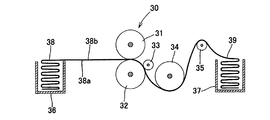
- FIG. 2 is a production process diagram schematically showing a process of heating and pressing the high pile fabric to which the adhesive resin composition is adhered at a predetermined temperature from the non-raised surface side.
- the processing device 30 used for the thermocompression treatment pressurizes the heating roll 31 coated with a fluororesin such as polytetrafluoroethylene and the heating roll 31, and allows 30 ° C. cooling water to pass inside.
- the high pile fabric original fabric (high pile fabric to which the adhesive resin composition is adhered) 38 is led out from the container 36, the non-raised surface 38 b comes into contact with the heating roll 31, and the raised surface (raised pile side) 38 a is on the cooling rubber roll 32. Supply in contact. Further, the non-raised surface 38b is cooled by the metal cooling roll 34 after being subjected to contact heating and pressure treatment.
- the processed high pile fabric 39 is stored in the container 37. Note that the contact heating and pressurizing treatment is not limited to the processing apparatus shown in FIG. 2, and is performed by using an apparatus, a hot plate, and other apparatuses in which a part of the configuration of the processing apparatus shown in FIG. 2 is changed. Also good.
- the heating temperature may be higher than the softening point of the pile fiber and lower than the softening point of the fiber constituting the ground yarn, and the applied pressure is 0.01 to 100 kgf / cm 2 (0.98 KPa in terms of linear pressure). 9.8 MPa), the feed rate of the original fabric is preferably 0.1 to 20 m / min, and the contact time of the heater (heating roll or the like) is preferably 1 to 60 seconds. Also, from the viewpoint of reducing damage on the surface of the high pile fabric, the applied pressure is 2.0 to 50 kgf / cm 2 (0.20 to 4.9 MPa) in terms of linear pressure, and the heater contact time is 1 to 10 seconds. Is more preferable.
- the high pile fabric contracts in the wale direction during the thermocompression treatment, it may be stretched in the wale direction after the thermocompression treatment.
- the stretching treatment method and conditions are as follows: The both ends (cloth ears) of the high pile fabric in the wale direction are gripped and pulled in the wale direction so that the stretch ratio of the length in the wale direction is about 5 to 20%. More preferably, it is about 7 to 15%, more preferably about 8 to 12%.
- the stretching treatment is preferably performed at 90 to 150 ° C, more preferably 100 to 130 ° C, and further preferably 105 to 120 ° C.
- Such a stretching treatment can be performed using a known device such as a tenter.
- the tenter is generally used to heat and set the fabric to a predetermined width while holding both the fabric ears while heating at a predetermined temperature. As such, it may be heated or not.
- the above stretching treatment is performed while heating the high pile fabric, it is preferably performed at the minimum necessary temperature and the minimum necessary air volume so as not to damage the surface of the high pile fabric.
- the hardness value of the non-raised surface of the high pile fabric is preferably 30 or less, and preferably 25 or less. Is more preferable.
- the hardness value of the non-raised surface of the high pile fabric can be measured as described later.
- Example 3 Hardness measurement of non-raised surface of high pile fabric Using a measuring instrument in which a weight of 200 g was further added to the body of a hardness measuring instrument (Teclock, model “GS-754G”, conforming to ASTM D 2240) The hardness of the five non-raised surfaces of the high pile fabric (150 mm ⁇ 150 mm) was measured, and the arithmetic average value was taken as the hardness value of the non-raised surface of the high pile fabric. The higher the hardness value, the harder the non-raised surface of the high pile fabric. Furthermore, there is a correlation between the hardness of the non-raised surface of the high pile fabric and the tendency of the high pile fabric to be wrinkled, and the softer the non-raised surface is, the less likely to wrinkle.
- Example 4 Evaluation of High-pile Fabric Wrinkle Resistance (Hardness of Non-Raised Surface) Based on the hardness value of the non-raised surface of the high-pile fabric obtained in Experimental Example 3, the rank was divided into the following four levels. The hardness of the non-raised surface of the high pile fabric and the wrinkle resistance of the high pile fabric were evaluated.
- a general high-pile fabric means a high-pile fabric that is applied with about 50 g / m 2 of an adhesive resin composition having a Tg of about 0 ° C. on the non-raised surface and is not thermocompression-bonded.
- the hardness is similar to the hardness of the non-raised surface of a general high pile fabric, and the high pile fabric does not wrinkle. It can be used without any problems even in clothing applications that require drape.
- C The hardness value of the non-raised surface of the high pile fabric exceeds 30 and is 40 or less. The hardness of the non-raised surface of a general high pile fabric is harder, and wrinkles are likely to occur in the high pile fabric.
- D The hardness value of the non-raised surface of the high pile fabric exceeds 40.
- the hardness of the non-raised surface of a general high pile fabric is much harder and wrinkles occur in the high pile fabric. Cannot be used for clothing applications that require drape.
- Example 6 Method for Measuring Glass Transition Point of Adhesive Resin Composition
- Liquid adhesive resin composition (latex of adhesive resin) was dried and solidified at 110 ° C., and the remaining solid content (adhesive resin composition) ) 5 mg is set in aluminum Crimping Cover 5 ⁇ (manufactured by Seiko Instruments Inc.), and using a differential scanning calorimeter (Seiko Instruments Inc., model number “DSC6100”), the heating rate is 20 ° C./min. It was determined by DSC analysis under measurement conditions.
- Pile fiber (1) Trade name “Kanekaron RCL” (hereinafter referred to as RCL; manufactured by Kaneka Corporation): acrylic fiber (vinyl chloride-acrylonitrile fiber), softening point 180-190 ° C., fineness 3.3 dtex (2) Trade name “Kanekaron AH” (hereinafter referred to as AH; manufactured by Kaneka Corporation): acrylic fiber (vinyl chloride-acrylonitrile fiber), softening point 180-190 ° C., fineness 3.3 dtex 2.
- Ground tissue constituent fiber ground yarn
- Polyester fiber yarn A multifilament having a total fineness of 334 dtex (a fiber yarn in which two filaments having a fineness of 167 dtex made of 50 polyester single fibers were aligned) was used.
- the softening point is 258 ° C.
- the softening point of the fiber described above is that the fiber 1 g is opened, placed on a hot plate heated to an arbitrary temperature, and pressed with a pressure roll at a pressure (nip pressure) of 0.07 kgf / cm 2 for 3 seconds. Is the temperature at which the single fibers on the surface in contact with the hot plate soften and bond to form a plate.
- Example 1 Using a sliver knit machine (circular knitting machine) for producing a faux fur, using the above polyester fiber yarn as the ground yarn, supplying a pile fiber sliver (10-14 g / m) consisting of 100% by weight of RCL, A high pile fabric was knitted. The number of loops of the wales of the ground texture was 16 to 17 / inch, the number of loops of the course was 22 to 33 / inch, and the other conditions were as shown in Table 1 below. Next, the pile fiber on the raised surface of the high pile fabric was prepared by polishing and shearing. Specifically, first, polishing was performed twice at 120 ° C., and then shearing was performed twice.
- Latex of acrylic ester resin (adhesive resin) mainly composed of acrylic ester resin (“Marposol M1-K”, manufactured by Matsumoto Yushi Seiyaku Co., Ltd., acrylic ester resin on the non-raised surface of the high pile fabric.
- the amount of the ester-based resin composition was impregnated and adhered so as to be 40 g / m 2 .
- the high pile fabric was dried for 3 minutes while stretching the width to 160 cm at a dryer internal temperature of 125 ° C., and cooled to 80 ° C. or lower while maintaining the width at 160 cm.
- the pile fiber on the surface was brushed 3 times.
- the non-raised surface of the high pile fabric (width 160 cm) to which the obtained adhesive resin composition (acrylic ester resin composition) was attached was measured using a contact heating and pressing apparatus shown in FIG.
- the contact heating and pressing treatment was performed under the conditions of 215 ° C., a contact time of the heating roll and the high pile fabric for 3 seconds, and a nip pressure between the heating roll and the cooling rubber roll of 50 kgf / cm 2 (4.9 MPa).
- the fabric width of the high pile fabric contracted to 135 cm.
- the high pile fabric was dried for 3 minutes while stretching the width to 160 cm at an internal temperature of 125 ° C., and cooled to 80 ° C. or less while maintaining the width at 160 cm.
- pile fibers on the raised surface of the pile fabric were prepared by polishing, brushing and shearing. Specifically, brushing is performed twice, followed by polishing once at 155 ° C., 150 ° C., 145 ° C., 130 ° C. and 120 ° C., then shearing twice, and finally at 100 ° C. Polishing was performed twice. Finally, a high pile fabric having a basis weight of 700 g / m 2 and a pile fiber length of 20 mm was obtained.
- Example 2 A high pile fabric was produced by the method shown in Example 1 except that the latex of the adhesive resin was impregnated and adhered so that the solid content concentration (adhesion amount of the adhesive resin composition) was 75 g / m 2 .
- Example 3 A high pile fabric was produced by the method shown in Example 1 except that the latex of the adhesive resin was impregnated and adhered so that the solid content concentration (adhesion amount of the adhesive resin composition) was 165 g / m 2 .
- Example 4 A high pile fabric was produced by the method shown in Example 1, except that the latex of the adhesive resin was impregnated and adhered so that the solid content concentration (adhesion amount of the adhesive resin composition) was 250 g / m 2 .
- Example 5 Example except that pile fiber sliver (10-14 g / m) consisting of 100% by weight of AH was supplied instead of using pile fiber sliver (10-14 g / m) consisting of 100% by weight RCL, and high pile fabric was knitted. A high pile fabric was produced by the method shown in FIG.
- Example 6 Example except that pile fiber sliver (10-14 g / m) consisting of 100% by weight of AH was supplied instead of using pile fiber sliver (10-14 g / m) consisting of 100% by weight RCL, and high pile fabric was knitted. A high pile fabric was produced by the method shown in FIG.
- Example 7 As an adhesive resin latex, instead of “Marposol M1-K”, an acrylic ester resin latex “Marposol F700” (Matsumoto Yushi Seiyaku Co., Ltd., acrylate ester resin) containing an acrylic ester resin as a main component A high pile fabric was produced by the method shown in Example 2 except that the emulsion copolymer latex (Tg: ⁇ 43 ° C., solid content concentration: 39.2 wt%) was used.
- Tg ⁇ 43 ° C., solid content concentration: 39.2 wt%
- Example 8 A high pile fabric was produced by the method shown in Example 3 except that “Marposol F700” was used instead of “Marposol M1-K” as the adhesive resin latex.
- Example 9 A high pile fabric was produced by the method shown in Example 4 except that “Marposol F700” was used instead of “Marposol M1-K” as the adhesive resin latex.
- Example 10 Example except that pile fiber sliver (10-14 g / m) consisting of 100% by weight of AH was supplied instead of using pile fiber sliver (10-14 g / m) consisting of 100% by weight RCL, and high pile fabric was knitted. A high pile fabric was produced by the method shown in FIG.
- Example 11 Example except that pile fiber sliver (10-14 g / m) consisting of 100% by weight of AH was supplied instead of using pile fiber sliver (10-14 g / m) consisting of 100% by weight RCL, and high pile fabric was knitted. A high pile fabric was produced by the method shown in FIG.
- Example 12 As an adhesive resin latex, instead of “Marposol M1-K”, “Marposol M1-K” is 80% by weight in solid content and an acrylic ester resin latex containing “acrylic ester resin” as a main component “ "TEB-3K” (manufactured by Matsumoto Yushi Seiyaku Co., Ltd., emulsion copolymer latex of acrylic ester resin, Tg: 14 ° C, solid content concentration: 39.1 wt%) is used by mixing 20 wt% in solid content concentration A high pile fabric was produced by the method shown in Example 2 except for the above.
- Example 13 As the adhesive resin latex, instead of “Marposol M1-K”, “Marposol M1-K” was used by mixing 80 wt% in solid concentration and “TEB-3K” in 20 wt% in solid concentration. Except for the above, a high pile fabric was produced by the method shown in Example 3.
- Example 14 As the adhesive resin latex, instead of “Marposol M1-K”, “Marposol M1-K” was used by mixing 80 wt% in solid concentration and “TEB-3K” in 20 wt% in solid concentration. Except for the above, a high pile fabric was produced by the method shown in Example 4.
- Example 15 Example except that pile fiber sliver (10-14 g / m) consisting of 100% by weight of AH was supplied instead of using pile fiber sliver (10-14 g / m) consisting of 100% by weight RCL, and high pile fabric was knitted. A high pile fabric was produced by the method shown in FIG.
- Example 16 Example except that pile fiber sliver (10-14 g / m) consisting of 100% by weight of AH was supplied instead of using pile fiber sliver (10-14 g / m) consisting of 100% by weight RCL, and high pile fabric was knitted. A high pile fabric was produced by the method shown in FIG.
- Example 17 Instead of using “Marposol M1-K” as a solid concentration of 80% by weight and “TEB-3K” as a solid concentration of 20% by weight as a latex of an adhesive resin, “Marposol M1-K” is used as a solid.
- a high pile fabric was produced by the method shown in Example 15, except that 50% by weight of the partial concentration and 50% by weight of “TEB-3K” were mixed and used.
- Example 18 As an adhesive resin latex, instead of “Marposol M1-K”, an acrylonitrile butadiene rubber latex “NIPOL 1571C2” (manufactured by Zeon Corporation, acrylonitrile butadiene rubber emulsion copolymer latex, Tg : ⁇ 10 ° C., solid content concentration: 45.1% by weight), a high pile fabric was produced by the method shown in Example 2.
- Example 19 A high pile fabric was produced by the method shown in Example 3 except that “NIPOL 1571C2” was used instead of “Marposol M1-K” as the adhesive resin latex.
- Example 20 As a latex of adhesive resin, “NIPOL LX426” (made by Nippon Zeon Co., Ltd., emulsion copolymer latex of styrene butadiene rubber, Tg: ⁇ 39 ° C., which is mainly composed of styrene butadiene rubber instead of “Marposol M1-K”, A high pile fabric was produced by the method shown in Example 2 except that the solid content concentration was 50.0% by weight.
- Example 21 A high pile fabric was produced by the method shown in Example 3, except that “NIPOL LX426” was used instead of “Marposol M1-K” as the adhesive resin latex.
- Example 22 A high pile fabric was produced by the method shown in Example 1 except that the latex of the adhesive resin was impregnated and adhered so that the solid content concentration (adhesion amount of the adhesive resin composition) was 60 g / m 2 .
- Example 23 As the adhesive resin latex, instead of “Marposol M1-K”, “Marposol M1-K” was used by mixing 80 wt% in solid concentration and “TEB-3K” in 20 wt% in solid concentration. Except for the above, a high pile fabric was produced by the method shown in Example 1.
- Example 24 As the adhesive resin latex, instead of “Marposol M1-K”, “Marposol M1-K” was used by mixing 80 wt% in solid concentration and “TEB-3K” in 20 wt% in solid concentration. Except for the above, a high pile fabric was produced by the method shown in Example 22.
- Example 1 A high pile fabric was prepared by the method shown in Example 1 except that the latex of the adhesive resin was impregnated and adhered so that the solid content concentration (adhesion amount of the adhesive resin composition) was 25 g / m 2 .
- Example 2 A high pile fabric was produced by the method shown in Example 7 except that the latex of the adhesive resin was impregnated and adhered so that the solid content concentration (adhesion amount of the adhesive resin composition) was 25 g / m 2 .
- Example 3 A high pile fabric was produced by the method shown in Example 12 except that the latex of the adhesive resin was impregnated and adhered so that the solid content concentration (adhesion amount of the adhesive resin composition) was 25 g / m 2 .
- Comparative Example 4 A high pile fabric was produced by the method shown in Comparative Example 1 except that “TEB-3K” was used in place of “Marposol M1-K” as the adhesive resin latex.
- Example 5 A high pile fabric was produced by the method shown in Example 2 except that “TEB-3K” was used in place of “Marposol M1-K” as the adhesive resin latex.
- Example 6 A high pile fabric was produced by the method shown in Example 3 except that “TEB-3K” was used in place of “Marposol M1-K” as the adhesive resin latex.
- Example 7 A high pile fabric was produced by the method shown in Example 4 except that “TEB-3K” was used in place of “Marposol M1-K” as the adhesive resin latex.
- Example 8 A high pile fabric was produced by the method shown in Example 5 except that “TEB-3K” was used in place of “Marposol M1-K” as the adhesive resin latex.
- Example 9 A high pile fabric was produced by the method shown in Example 6 except that “TEB-3K” was used in place of “Marposol M1-K” as the adhesive resin latex.
- an adhesive resin composition having a glass transition point of ⁇ 100 ° C. or more and 10 ° C. or less adheres to the non-napped surface of the ground tissue of 30 g / m 2 or more and 300 g / m 2 or less.
- the high pile fabrics of Examples 1 to 24 had a soft non-raised surface and good wrinkle resistance.
- the high pile fabrics of Comparative Examples 1 to 3 in which the adhesive resin composition having a glass transition point of ⁇ 100 ° C. or more and 10 ° C.
Landscapes
- Engineering & Computer Science (AREA)
- Textile Engineering (AREA)
- Knitting Of Fabric (AREA)
- Woven Fabrics (AREA)
- Treatments For Attaching Organic Compounds To Fibrous Goods (AREA)
Description
本発明は、立毛パイル布帛及びその製造方法に関し、詳細にはハイパイル布帛及びその製造方法に関するものである。
従来から立毛パイル布帛は、イミテーションファー又はフェイクファー、ボア等の名称で毛皮に似せた外観の布帛として知られている。これらはパイル編物、パイル織物から作られる。編みパイルの場合は、主としてシールフライス機、スライバーニット機(丸編機)で編み立てられ、いずれもパイル繊維がカットされている。たて編機のダブルラッシェル機で編み立てる場合は、地組織をダブルで形成すると同時に地組織間に接結糸を絡ませて、接結糸の中間をカットすることにより編成される。製織法の場合は、ベルベット織機、モケット織機を使用して上下2枚の地組織とこの間に接結糸を絡ませ、上下の基布の間をナイフでカットすることにより、2枚の織物を同時に織り上げる(非特許文献1)。しかし、これらの織編物は共通して抜け毛が多いという問題がある。抜け毛が多いと、中着に付着したり、床に脱落したりして見映えが悪く、衛生的にも問題がある。
立毛パイル布帛のなかでも特にハイパイル布帛は、パイル繊維がメリヤスの地組織の地糸のループに沿って編み込まれており、地糸とパイル繊維との摩擦抵抗が小さいため、ほんの小さな力でパイル繊維の一端を引っ張るだけでパイル繊維を構成する単繊維の脱落が起こりやすいという問題がある。
この改善策として、パイル繊維に低融点繊維を混合する提案(特許文献1)、地組織を構成する地糸に低融点繊維を混合する提案(特許文献2、3)等がある。しかし、これらの提案はいずれも布帛全体を上記低融点繊維の融点以上の温度にて加熱するため、地組織全体又はパイル繊維も融着してしまい、粗硬な風合いになってしまうという問題がある。
上記の問題点を解決するために、特許文献4では、特定の繊維を用いた立毛パイル布帛において、非立毛面におけるパイル繊維の特定部分のみを熱圧着することにより、立毛面の風合いを損なわずにパイル繊維の毛抜けを防止した立毛パイル布帛を提案している。
繊維学会編「第3版繊維便覧」、丸善、平成16年12月15日発行、341-342頁
しかし、本出願人は、引用文献4に提案された立毛パイル布帛は、熱圧着された非立毛面が硬くなり、布帛にシワが生じ易くなるという問題があることを見出した。衣料用途等では、シワが生じた立毛パイル布帛は立毛面の見栄えが悪くなるため、その商品価値は著しく低下することがある。
本発明は、ハイパイル布帛の柔軟性を保持しつつ、風合いを損なわずにパイル繊維の毛抜けを防止したハイパイル布帛及びその製造方法を提供する。
本発明の実施形態の一つは、地組織と、上記地組織を構成する地糸に絡みかつ上記地組織の立毛面に立毛するパイル繊維を含み、上記パイル繊維はアクリル繊維及び/又はアクリル系繊維を含み、上記パイル繊維は上記地組織を構成する繊維よりも軟化点が低いハイパイル布帛において、上記地組織の非立毛面に、ガラス転移点が-100℃以上10℃以下の接着性樹脂組成物が30g/m2以上300g/m2以下付着しており、上記地組織を構成する地糸に絡んだパイル繊維のうち、上記地組織を構成する地糸より外側の少なくとも一部のパイル繊維が上記接着性樹脂組成物と共に熱圧着され、上記地組織の立毛面に立毛するパイル繊維は融着していないことを特徴とするハイパイル布帛である。
上記ハイパイル布帛において、上記接着性樹脂組成物が、スチレンブタジエンゴム、アクリロニトリルブタジエンゴム、酢酸ビ二ル系樹脂、アクリル酸エステル系樹脂及びポリウレタン系樹脂からなる群から選ばれる少なくとも一つの接着性樹脂を含むことが好ましい。上記接着性樹脂組成物が、一つ以上のアクリル酸エステル系樹脂を含むことがより好ましい。上記パイル繊維は、アクリル系繊維であることが好ましい。上記地組織を構成する繊維は、ポリエステル系繊維及び/又はセルロース系繊維で構成されていることが好ましい。
本発明の別の実施形態の一つは、上記のハイパイル布帛を加工して得られることを特徴とするハイパイル製品である。
本発明の別の実施形態の一つは、地組織と、上記地組織を構成する地糸に絡みかつ上記地組織の立毛面に立毛するパイル繊維を含み、上記パイル繊維はアクリル繊維及び/又はアクリル系繊維を含み、上記パイル繊維は上記地組織を構成する繊維よりも軟化点が低いハイパイル布帛において、上記地組織の非立毛面に、ガラス転移点が-100℃以上10℃以下の接着性樹脂組成物を30g/m2以上300g/m2以下付着し、上記接着性樹脂組成物が付着されたハイパイル布帛の地組織の非立毛面側から、上記地組織を構成する地糸に絡んだパイル繊維のうち、上記地組織を構成する地糸より外側の少なくとも一部のパイル繊維を上記接着性樹脂組成物と共に熱圧着させ、上記地組織の立毛面に立毛するパイル繊維は融着させないことを特徴とするハイパイル布帛の製造方法である。
上記ハイパイル布帛の製造方法において、上記接着性樹脂の付着は、スチレンブタジエンゴム、アクリロニトリルブタジエンゴム、酢酸ビ二ル系樹脂、アクリル酸エステル系樹脂及びポリウレタン系樹脂からなる群から選ばれる少なくとも一つの接着性樹脂のラテックス、エマルジョン、又はディスパージョンを用いて行うことが好ましく、一つ以上のアクリル酸エステル系樹脂のラテックスを用いて行うことがより好ましい。上記パイル繊維がアクリル系繊維であることが好ましい。上記地組織を構成する繊維がポリエステル系繊維及び/又はセルロース系繊維であることが好ましい。
本発明によれば、外観、風合いが良好で毛抜けが抑制され、かつ、非立毛面が柔らかく、シワが生じ難いハイパイル布帛及びそのハイパイル布帛を加工して得られるハイパイル製品を提供することができる。
本発明者らは、上記問題を解決するため鋭意検討を行った結果、ハイパイル布帛の非立毛面を特定の構成にすることで、詳細には、ハイパイル布帛の地組織の非立毛面に、ガラス転移点が-100℃以上10℃以下の接着性樹脂組成物を30g/m2以上300g/m2以下付着させ、接着性樹脂組成物を付着させたハイパイル布帛の地組織の非立毛面側から、上記地組織を構成する地糸に絡んだパイル繊維のうち、上記地組織を構成する地糸より外側の少なくとも一部のパイル繊維を上記接着性樹脂組成物と共に熱圧着させつつ、上記地組織の立毛面に立毛するパイル繊維は融着させないことにより、風合いが良好で毛抜けが抑制され、かつ、非立毛面が柔らかく、シワが生じ難いハイパイル布帛が得られることを見出し、本発明に至った。
本発明のハイパイル布帛は、パイル編物であり、地組織はメリヤスの地組織となる。詳細には、本発明のハイパイル布帛は、メリヤスの地組織と、該地組織を構成する地糸に絡みつつ上記地組織の表面に立毛するパイル繊維とを含む。本発明において地組織がメリヤスであるので、伸縮性に優れる組織を構成することができる。メリヤスは、一般に、1本又は2本以上の糸がループをつくり、そのループに引っかけて、次の新しいループをつくることを継続し、順次ループを平面状に連続させて布地を形成したものである。そして、糸がループをつくりながら左右に往復して平面状の布地を形成するか、らせん状に進行して筒状の布地を形成するか等により横方向に進行していくものを横編みメリヤス、整然と配列した多数の各経(たて)糸がループをつくりながら、隣接する左右の経糸とループで連結されて布地を形成するものを経編みメリヤスという。また、横編みメリヤスには、平編み、ゴム編み、パール編み等の編み方があり、経編みメリヤスには、デンビー編み、コード編み、アトラス編み、鎖編み等の編み方がある。ハイパイル布帛の地組織の編み方としては、商品性、生産性の観点から、横編みメリヤスが好ましい。
本発明では、パイル繊維の地組織のメリヤスに対する配置としては、地組織のメリヤスを構成する地糸の各ループの全てにパイル繊維が絡むように配置しても良いし、メリヤスを構成する地糸の各ループのうち、ウェール方向及び/又はコース方向においてパイル繊維の絡んでいない部分を有するように配置しても良い。
上記地糸(地組織)を構成する繊維としては、後述するパイル繊維より軟化点が高ければ良く、特に限定はない。例えば、ポリエステル系繊維やセルロース系繊維等が挙げられる。ポリエステル系繊維としては、例えば、ポリエチレンテレフタレート等のポリエステル樹脂を含む樹脂組成物を紡糸して得られる合成繊維等が挙げられる。セルロース系繊維としては、例えば、コットン等が挙げられる。
上記パイル繊維は、アクリル繊維及び/又はアクリル系繊維(以下、アクリル(系)繊維と略記する場合がある。)を含むことが好ましい。これにより、風合いに優れたハイパイル布帛が得られる。一般的には、熱可塑性繊維をパイル繊維として用い、該熱可塑性繊維の融点又は軟化点以上の温度でポリッシング加工を行うと、ハイパイル布帛表面のパイル繊維は焦げたり、溶融したりしてしまい、良好な外観と風合いを有するハイパイル布帛が得られない。また、熱可塑性繊維のガラス転移点以下の温度でポリッシング加工を行うと、ハイパイル布帛表面のパイル繊維の捲縮が伸びないため良好な外観と風合いを有するハイパイル布帛が得られない。これに対し、アクリル(系)繊維の捲縮は融点未満の温度でも伸びる。そして、アクリル(系)繊維のガラス転移点は約100℃、軟化点は約150~230℃であることから、パイル繊維にアクリル(系)繊維を用いる場合、ガラス転移点以上、軟化点以下の温度、例えば100~150℃でポリッシング加工を行うことができる。さらに、アクリル(系)繊維の捲縮は、他素材の繊維と比較して伸びやすい傾向にあることから、良好な外観と風合いを有するハイパイル布帛が得られる。
また、上記パイル繊維は、本発明の効果を阻害しない範囲内において、ポリエチレンテレフタレート、ポリトリメチレンテレタレート等のポリエステル樹脂を含む樹脂組成物を紡糸してなる合成繊維やその他の合成繊維を含んでもよい。
上記パイル繊維は、地組織を構成する地糸であって該地糸を構成する繊維よりも軟化点が低ければ良く特に限定されないが、地糸を構成する繊維と上記パイル繊維の軟化点の差は、好ましくは10℃以上であり、より好ましくは20℃以上、特に好ましくは30℃以上である。10℃以上の差があると、上記地組織の非立毛面で地糸より外側に配置された少なくとも一部のパイル繊維のみを熱圧着させ、上記地組織の表面に立毛するパイル繊維を熱圧着させない(融着させない)ことがより容易となる。
上記パイル繊維は全量所定の温度で軟化する繊維であっても良く、異なる温度で軟化する繊維の混合繊維であっても良い。そして、パイル繊維が異なる温度で軟化する繊維の混合繊維である場合は、相対的に低い温度で軟化する繊維を20重量%以上混合し、相対的に低い温度で軟化する繊維を熱圧着させることが好ましく、より好ましくは相対的に低い温度で軟化する繊維が50重量%以上混合されている。
本発明において、軟化点とは、融解又は分解する前の軟化温度である。例えばアクリル繊維の軟化点は190~232℃、アクリル系繊維の軟化点は150~220℃である(「化学大辞典」、共立出版、727~729頁、1993年6月1日発行。以下「文献値」という。)。
本発明において、アクリル繊維とは、アクリロニトリルを85重量%以上含む組成物を重合して得られる重合体で構成される繊維をいう。また、アクリル系繊維とは、アクリロニトリルを35重量%以上85重量%未満と、その他の共重合可能なモノマーを15重量%より多く65重量%以下含む組成物を重合して得られる重合体で構成される繊維をいう。
本発明において、その他の共重合可能なモノマーは、アクリロニトリルと共重合可能なモノマーであれば良く、特に限定されない。例えば、塩化ビニル、臭化ビニル等に代表されるハロゲン化ビニル;塩化ビニリデン、臭化ビニリデン等に代表されるハロゲン化ビニリデン;アリルスルホン酸、メタリルスルホン酸、スチレンスルホン酸、イソプレンスルホン酸、2-アクリルアミド-2-メチルプロパンスルホン酸等に代表されるスルホン酸含有モノマー及びこれらのスルホン酸含有モノマーの金属塩類、アミン塩類;アクリル酸及びメタクリル酸の低級アルキルエステル、N-アルキル置換したアミノアルキルエステル、N,N-アルキル置換したアミノアルキルエステル及びグリシジルエステル;アクリルアミド、メタクリルアミド及びそれらのN-アルキル置換体、N,N-アルキル置換体;アクリル酸、メタクリル酸、イタコン酸等に代表されるカルボキシル基含有ビニル単量体及びそれらのナトリウム、カリウム又はアンモニウム塩等のアニオン性ビニル単量体;アクリル酸の4級化アミノアルキルエステル、メタクリル酸の4級化アミノアルキルエステル等に代表されるカチオン性ビニル単量体;ビニル基含有低級アルキルエーテル;酢酸ビニルに代表されるビニル基含有低級カルボン酸エステル;及びスチレン等を挙げることができる。これらのモノマーを単独又は2種以上混合して用いることができる。
その他の共重合可能なモノマーとしては、ハロゲン化ビニル、ハロゲン化ビニリデン及びスルホン酸含有モノマーの金属塩類からなる群から選ばれる一種以上のモノマーを用いることが好ましく、塩化ビニル、塩化ビニリデン及びスチレンスルホン酸ナトリウムからなる群から選ばれる一種以上のモノマーを用いることがより好ましい。
アクリル系繊維としては、モダアクリル繊維を用いることが好ましい。モダアクリル繊維とは、アクリロニトリルを35重量%以上85重量%未満含み、塩化ビニル及び/又は塩化ビニリデンと、その他の共重合可能なモノマーを合計で15重量%より多く65重量%以下含む組成物を重合して得られる重合体で構成されている繊維をいう。
本発明において、地糸を構成する繊維とパイル繊維との種類の組み合わせは、上記の条件を満足すれば、特に限定はないが、以下にその具体例を示す。
地糸を構成する繊維として、例えばポリエチレンテレフタレート(PET、軟化点約258℃)繊維を用いる場合、パイル繊維としては、アクリル系繊維、又は、アクリル系繊維とアクリル繊維の混合繊維を用いることが好ましい。また、アクリル系繊維としては、好ましくは以下の繊維を用いることができる。
(1)塩化ビニル-アクリロニトリル系繊維(例えば、株式会社カネカ製、商品名「カネカロン」、軟化点150~220℃、文献値)
(2)塩化ビニリデン-アクリロニトリル系繊維(軟化点150~220℃、文献値)
(2)塩化ビニリデン-アクリロニトリル系繊維(軟化点150~220℃、文献値)
地糸を構成する繊維として、例えばコットン(木綿、軟化点なし)繊維を用いる場合、パイル繊維としては、アクリル繊維を用いることが好ましい。また、アクリル繊維としては、例えば、株式会社エクスラン製、商品名「エクスランK691」(軟化点190~232℃、文献値)等が挙げられる。
本発明では、上記パイル繊維は、上記のように地糸(地組織)を構成する繊維よりも軟化点が低く、地糸に絡んだパイル繊維のうち、地組織の非立毛面で地糸より外側の少なくとも一部のパイル繊維は熱圧着され、上記地組織の立毛面に立毛するパイル繊維は熱圧着していない(融着していない)。この手段としては、上記地組織の立毛面に立毛するパイル繊維は熱圧着せず、地糸より外側の少なくとも一部のパイル繊維を熱圧着できれば、特に限定されないが、地組織の非立毛面側、即ちハイパイル布帛の非立毛面側からパイル繊維の軟化点以上、かつ地糸を構成する繊維の軟化点未満の温度で熱圧着処理することが好ましい。
本発明において、地組織の非立毛面で地糸より外側とは、ハイパイル布帛のパイル繊維が立毛している面を表面としたときの非立毛面側であって、地糸より外側のことである。また、地糸に絡むパイル繊維は、一部の繊維が地糸に食い込んでいる場合もあるが、残りの部分が地糸より外側に存在していれば、これを含む。
本発明のハイパイル布帛では、地糸より外側の少なくとも一部のパイル繊維は接着性樹脂組成物と共に熱圧着されている。具体的には、本発明のハイパイル布帛では、地糸より外側の少なくとも一部のパイル繊維は接着性樹脂組成物と共に熱圧着されており、熱圧着されたパイル繊維の間には、接着性樹脂組成物が入り込んでいる。パイル繊維が熱圧着されている態様としては、隣接するパイル繊維の1本1本が各々直接又は接着性樹脂組成物を介して連結して塊を形成している態様や、パイル繊維のうちの地糸に対して最も外側近傍のパイル繊維の1本1本が各々直接又は接着性樹脂組成物を介して連結すると共に、それより内側のパイル繊維を地糸との間に圧接して纏まって塊を形成している態様、パイル繊維のうちの軟化していない繊維が軟化した繊維及び/又は接着性樹脂組成物を介して連結して纏まって塊を形成している態様等が挙げられるが、これらに限定されるわけではない。また、熱圧着されている態様の何れの場合も、熱圧着される結果、ある地糸より外側のパイル繊維の嵩高さは、熱圧着される前の状態に比して小さくなっていると共に、ハイパイル布帛の非立毛面は平滑な外観(パイル繊維の地組織非立毛面における毛羽立ちが顕著に低減された状態)を呈する。なお、パイル繊維は接着性樹脂組成物と共に熱圧着されているので、パイル繊維同士が直接連結され熱圧着される確率は低く、パイル繊維の大部分は、接着性樹脂組成物を介して連結され熱圧着されている。本発明のハイパイル布帛では、地糸より外側の少なくとも一部のパイル繊維と接着性樹脂組成物は共に熱圧着されて熱圧着部を形成し、地組織に熱圧着されている。
本発明のハイパイル布帛においては、上記のように地糸より外側の少なくとも一部のパイル繊維が接着性樹脂組成物と共に熱圧着されていれば良いが、より優れた毛抜け防止効果を得る観点からは、地糸より外側の全てのパイル繊維が接着性樹脂組成物と共に熱圧着されていることが好ましい。
本発明では、非立毛面のパイル繊維をガラス転移点が-100℃以上10℃以下のガラス転移点が低い接着性樹脂組成物と共に熱圧着させることで、非立毛面が柔らかく、シワになり難いハイパイル布帛を得ることができる。
一般的な方法では、ハイパイル布帛を製造する際、接着性樹脂をハイパイル布帛の非立毛面に付着させ、非立毛面に存在するパイル繊維を地糸に接着性樹脂で接着固定することによりパイル繊維の毛抜けを防止する。その際、パイル繊維の毛抜けを防止する効果を高めるために、通常、ガラス転移点の高い樹脂が用いられる。
これに対し、本願は、従来とは異なり、ガラス転移点が低い接着性樹脂組成物をハイパイル布帛の非立毛面に付着させて非立毛面に存在するパイル繊維と共に熱圧着すると、パイル繊維の毛抜けを確実に防止しつつ、非立毛面が柔軟になるという新たな知見に基づいている。
熱可塑性繊維をパイル繊維に用いたハイパイル布帛の非立毛面に、接着性樹脂組成物を付着しないで熱可塑性繊維の融点又は軟化点以上の温度で熱圧着処理を施すと、非立毛面に存在する熱可塑性繊維が熱圧着され一枚のシート状になりやすい。さらに、一般的な熱可塑性繊維のガラス転移点は常温以上(アクリル繊維及びアクリル系繊維のガラス転移点は約100℃)であることから、シート状に形成されると常温では非常に硬く感じられる。
本発明では、上記の現象に対して、ハイパイル布帛の非立毛面に、ガラス転移点が常温より低い接着性樹脂組成物を付着させた後に熱圧着処理を施している。これにより、非立毛面に存在するパイル繊維間にガラス転移点の低い接着性樹脂組成物が入り込むことから、パイル繊維同士が直接熱圧着されて一枚のシート状になる確率が小さくなる。そして、ガラス転移点が常温より低い接着性樹脂組成物は常温でも柔軟性を有するため、パイル繊維が接着性樹脂組成物と共に熱圧着されたハイパイル布帛の非立毛面は柔らかく感じられる。また、ハイパイル布帛の非立毛面が柔らかくなると、ハイパイル布帛にシワが生じ難くなり商品性も高くなる。一方、ガラス転移点が常温より高い接着性樹脂組成物を使用した場合、ガラス転移点が常温より高い樹脂は常温で硬く感じられるため、パイル繊維を接着性樹脂組成物と共に熱圧着処理しても、ハイパイル布帛の非立毛面は硬く感じられる。
上記接着性樹脂組成物は、生産性、コストの面から、ガラス転移点が-50℃以上0℃以下であることが好ましい。
上記接着性樹脂組成物は、ガラス転移点が-100℃~10℃であれば良く、特に限定はない。例えば、スチレンブタジエンゴム(SBR)、アクリロニトリルブタジエンゴム(NBR)、酢酸ビ二ル系樹脂、アクリル酸エステル系樹脂及びポリウレタン系樹脂などからなる群から選ばれる一つ以上の接着性樹脂を含む組成物を用いることができる。好ましくは、一つ以上のアクリル酸エステル系樹脂を含む組成物を用いることができる。上記接着性樹脂組成物は、接着性樹脂を主成分とする。本発明において、主成分とは、80重量%以上含まれている成分をいい、90重量%以上含まれていることが好ましく、95重量%含まれていることがより好ましい。上記接着性樹脂組成物は、接着性樹脂に加えて、乳化剤、界面活性剤などを含む。上記接着性樹脂組成物は、一種類のみで使用しても良いし、数種類組み合わせても使用しても良い。上記接着性樹脂組成物の付着は、スチレンブタジエンゴム(SBR)、アクリロニトリルブタジエンゴム(NBR)、酢酸ビ二ル系樹脂、アクリル酸エステル系樹脂及びポリウレタン系樹脂などからなる群から選ばれる一つ以上の接着性樹脂のラテックス、エマルジョン、ディスパージョン等を使用して行うことができる。好ましくは、一つ以上のアクリル酸エステル系樹脂のラテックスを用いて行う。上記接着性樹脂のラテックス、エマルジョン又はディスパージョンにおいて、接着性樹脂や乳化剤などを含む固形分が接着性樹脂組成物に該当する。
接着性樹脂組成物の付着量は、ハイパイル布帛の非立毛面に存在するパイル繊維間に十分に接着性樹脂組成物を含浸させる観点から、ハイパイル布帛の(地組織の)非立毛面において、30~300g/m2程度である。ハイパイル布帛の非立毛面に接着性樹脂組成物を30~300g/m2程度付着させれば、地糸にパイル繊維が固定され、熱圧着処理するまでのブラッシング工程やポリッシング工程等の製造工程でハイパイル布帛の地組織が壊れにくくなることから、良好な外観と良好な毛抜け性を有するハイパイル布帛が得られ易くなる。接着性樹脂組成物の付着量が30g/m2以上であると、ハイパイル布帛の非立毛面が柔らかくなり、ハイパイル布帛にシワが生じ難い。また、接着性樹脂組成物の付着量が300g/m2以下であると、硬さや耐シワ性において付着量に見合う効果が得られやすく、コストパフォーマンスが良い。接着性樹脂組成物の付着量は、生産性、コストの面から40g/m2以上150g/m2以下であることが好ましく、40g/m2以上100g/m2未満であることがより好ましく、40g/m2以上95g/m2以下であることがさらに好ましい。接着性樹脂組成物の付着量は、ハイパイル布帛の非立毛面の柔軟性とべたつきの両立という観点から、40g/m2以上100g/m2未満であることが好ましく、40g/m2以上95g/m2以下であることがより好ましい。
複数の接着性樹脂組成物の混合物を使用する場合、それぞれの接着性樹脂組成物のガラス転移点の重量平均値が上記の温度範囲であれば本発明に好適に用いることができる。例えば、ガラス転移点が-50℃の接着性樹脂組成物Aが50重量%、ガラス転移点が-110℃の接着性樹脂組成物Bが25重量%、ガラス転移点が30℃の接着性樹脂組成物Cが25重量%混在する接着性樹脂組成物の混合物の場合、接着性樹脂組成物(接着性樹脂組成物の混合物)のガラス転移点は-45℃となり(接着性樹脂組成物のガラス転移点=〔接着性樹脂組成物Aのガラス転移点×接着性樹脂組成物Aの重量%/100〕+〔接着性樹脂組成物Bのガラス転移点×接着性樹脂組成物Bの重量%/100〕+〔接着性樹脂組成物Cのガラス転移点×接着性樹脂組成物Cの重量%/100〕)、本発明に適用できる。
接着性樹脂組成物のガラス転移点は、試料の温度をゆっくりと上昇又は下降させながら力学的物性の変化を測定する熱機械分析装置(TMA)や、試料の温度をゆっくりと上昇又は下降させながら吸熱や発熱を測定する示差走査熱量測定(DSC)で測定することができるが、これらの測定方法に限定されない。
以下、図面を用いて、本発明のハイパイル布帛を説明する。
図1は、本発明のハイパイル布帛の一実施例における地糸と地糸に絡むパイル繊維との位置関係を説明するための模式図である。図1に示すように、ハイパイル布帛5は、メリヤスのループ6を構成する地糸1と、地糸1のループ6に絡み地組織(ハイパイル布帛5)の立毛面7で開繊され立毛パイル3を形成しているパイル繊維2で構成される。また、地組織(ハイパイル布帛5)の非立毛面8において、地糸1の外側でパイル繊維2の少なくとも一部は接着性樹脂組成物(図示なし)と共に熱圧着されて熱圧着部4を構成し、地糸1に熱圧着されている。なお、図1は、概ね、地糸1の下側にパイル繊維2を重ねるような位置関係を模式的に示しているが、本図において地糸1の外側とは、概ね地糸1の図1における下側の部分を意味する。
上述したように、本発明のハイパイル布帛は、パイル繊維の毛抜けが防止されつつ、ハイパイル布帛としての風合いや柔軟性が保持されていることから、服飾用、敷物用等各種用途の生地として好適に使用し、種々のハイパイル製品に加工することができる。上記ハイパイル製品としては、具体的には、イミテーションファー又はフェイクファー、カーシート、カーペット等が例示できるが、これらに限定されるものではない。
本発明では、接着性樹脂組成物を付着させたハイパイル布帛(地組織)の非立毛面側から、上記パイル繊維の軟化点以上、かつ地糸を構成する繊維の軟化点未満の温度で熱圧着を行う。これにより、上記地糸に絡んだパイル繊維のうち、上記地糸より外側の少なくとも一部のパイル繊維が接着性樹脂組成物と共に熱圧着される。熱圧着処理は、具体的には、接着性樹脂組成物を付着させたハイパイル布帛(地組織)の非立毛面側から、上記パイル繊維の軟化点以上、かつ地糸を構成する繊維の軟化点未満の温度で、上記地組織を構成する地糸に絡んだパイル繊維のうち、上記地組織を構成する地糸より外側の少なくとも一部のパイル繊維を接着性樹脂組成物と共に接触加熱加圧することで行うことが好ましい。上記接触加熱加圧は、例えば、加熱ロール又はホットプレートにハイパイル布帛の非立毛面を接触するように配置し、ゴムロールなどにより加圧することにより行うことができる。加熱ロール又はホットプレートを用いる場合、短時間の接触加熱加圧処理を行うことができ、地組織の非立毛面において地糸より外側の少なくとも一部のパイル繊維のみを熱圧着することができる。そして、ハイパイル布帛の立毛面のパイル繊維が溶融するほどの加熱はしないため、地組織の立毛面に立毛するパイル繊維は溶融しない。
上記地組織の非立毛面側から熱圧着処理する際及び/又は熱圧着処理した後、ハイパイル布帛の立毛面に立毛するパイル繊維側は冷却することが好ましい。また、上記地組織の非立毛面側から接触加熱加圧した後、上記地組織の非立毛面側から冷却することが好ましい。上記冷却手段として、ハイパイル布帛の立毛面及び/又は非立毛面を水温30℃以下の水を通水させた冷却ロールで冷却することが好ましい。上記冷却ロールに通水させる水の水温は、生産性の観点から、10℃以上であることが好ましい。このような冷却をすると、寸法安定性が保持でき、かつパイル繊維への熱ダメージも軽減させることができる。
本発明のハイパイル布帛の製造方法の一例を、図を用いてさらに詳細に説明する。
図2は、接着性樹脂組成物を付着させたハイパイル布帛を非立毛面側から所定温度で接触加熱加圧する工程を模式的に示した製造工程図である。熱圧着処理(接触加熱加圧処理)に使用する加工装置30は、ポリテトラフルオロエチレン等のフッ素樹脂をコーティングした加熱ロール31と、加熱ロール31に加圧し、内部に30℃の冷却水が通水する冷却ゴムロール32と、冷却ゴムロール32に加圧し、内部に30℃の冷却水が通水する金属冷却ロール33、内部に30℃の冷却水が通水する金属冷却ロール34と、ガイドロール35を含む。ハイパイル布帛原反(接着性樹脂組成物を付着させたハイパイル布帛)38は容器36から導き出され、非立毛面38bが加熱ロール31に接触し、立毛面(立毛パイル側)38aが冷却ゴムロール32に接触するように供給する。また、非立毛面38bは接触加熱加圧処理された後、金属冷却ロール34で冷却される。加工の終了したハイパイル布帛39は、容器37に収納される。なお、接触加熱加圧処理は、図2に示した加工装置に限定されず、図2に示した加工装置の一部の構成を変更した装置、ホットプレート、及びその他の装置を用いて行っても良い。例えば、冷却ゴムロール32の代わりに冷却しないゴムロールを用いることが可能であり、金属冷却ロール33は省略しても良い。接触加熱加圧処理において、加熱温度はパイル繊維の軟化点以上かつ地糸を構成する繊維の軟化点未満であれば良く、加圧力は線圧で0.01~100Kgf/cm2(0.98KPa~9.8MPa)、原反の供給速度は0.1~20m/分、ヒーター(加熱ロールなど)接触時間は1~60秒間であることが好ましい。また、ハイパイル布帛の表面のダメージを軽減するという観点から、加圧力は線圧で2.0~50Kgf/cm2(0.20~4.9MPa)、ヒーター接触時間は1~10秒間であることがより好ましい。
本発明では、熱圧着処理の際、ハイパイル布帛がウェール方向に収縮することから、熱圧着処理後、ウェール方向に延伸処理しても良い。
延伸処理の方法、条件としては、ハイパイル布帛のウェール方向の両側端部(布耳部)を把持して、ウェール方向長さの延伸率が5~20%程度になるようにウェール方向に引張ることが好ましく、より好ましくは7~15%程度、さらに好ましくは8~12%程度である。ウェール方向長さの延伸率は、下記式で示されるものである。
ウェール方向長さの延伸率(%)=[(延伸後のウェール方向長さ-延伸前のウェール方向長さ)/延伸前のウェール方向長さ]×100
ウェール方向長さの延伸率(%)=[(延伸後のウェール方向長さ-延伸前のウェール方向長さ)/延伸前のウェール方向長さ]×100
また、延伸処理の際に加熱する場合は、90~150℃で延伸処理するのが好ましく、100~130℃がより好ましく、105~120℃がさらに好ましい。
このような延伸処理は、例えばテンター等の公知の装置を用いて行うことができる。テンターは、一般的には、所定の温度で加熱しながら、布帛の両布耳部を保持して布帛を所定の幅に拡幅して熱セットするのに用いられるが、本発明では、上記のように、加熱しても加熱しなくても良い。また、テンターでは、布帛の布耳部を保持する方式としてクリップテンター方式とピンテンター方式があり、何れを採用しても良いが、工程の安定性及び/又は生産性の観点から、ピンテンター方式を採用するのが好ましい。
上記延伸処理を、ハイパイル布帛を加熱しながら行う場合は、ハイパイル布帛の表面にダメージを与えないよう、必要最小限の温度、必要最小限の風量で行うことが好ましい。
本発明のハイパイル布帛は、非立毛面が柔軟であり、耐シワ性に優れるという観点から、ハイパイル布帛の非立毛面の硬さの値が、30以下であることが好ましく、25以下であることがより好ましい。ハイパイル布帛の非立毛面の硬さの値は、後述する通りに測定することができる。なお、ハイパイル布帛の非立毛面の硬さと、ハイパイル布帛の耐シワ性には相関があり、ハイパイル布帛の非立毛面が柔らかいほどハイパイル布帛がシワになり難い。
以下、実施例により本発明をさらに具体的に説明するが、本発明は、下記の実施例に限定されるものではない。
<測定方法及び評価基準>
(実験例1)毛抜け量測定
ハイパイル布帛の表面をゴム製の刷毛(商品名「プレスケールマット」、粒の直径5mm、縦4cm、横10.5cm、富士フィルム社製)を使用し、600g(14.3kg/cm2)の一定荷重をかけながら、ストローク幅20cm、毛並の順方向に10回、逆方向に10回こすり、粘着テープで抜け毛を回収し、その重量を1m2あたりに換算して毛抜け量とした。
(実験例1)毛抜け量測定
ハイパイル布帛の表面をゴム製の刷毛(商品名「プレスケールマット」、粒の直径5mm、縦4cm、横10.5cm、富士フィルム社製)を使用し、600g(14.3kg/cm2)の一定荷重をかけながら、ストローク幅20cm、毛並の順方向に10回、逆方向に10回こすり、粘着テープで抜け毛を回収し、その重量を1m2あたりに換算して毛抜け量とした。
(実験例2)毛抜け評価
実験例1で得られた毛抜け量に基いて、以下のように4段階のランクで毛抜け評価を行った。
A:0.3g/m2以下(非常に良好なレベル)
B:0.3g/m2を超え0.6g/m2以下(良好なレベル)
C:0.6g/m2を超え1.0g/m2以下(やや不良レベル)
D:1.0g/m2を超える(不良レベル)
実験例1で得られた毛抜け量に基いて、以下のように4段階のランクで毛抜け評価を行った。
A:0.3g/m2以下(非常に良好なレベル)
B:0.3g/m2を超え0.6g/m2以下(良好なレベル)
C:0.6g/m2を超え1.0g/m2以下(やや不良レベル)
D:1.0g/m2を超える(不良レベル)
(実験例3)ハイパイル布帛の非立毛面の硬さ測定
硬度測定器(Teclock社製、型式「GS-754G」、ASTM D 2240準拠)の本体に更に200gの重りを付加した測定器を用いて、ハイパイル布帛(150mm×150mm)の非立毛面5箇所の硬度を測定し、その算術平均値をハイパイル布帛の非立毛面の硬さの値とした。硬さの値が大きいほどハイパイル布帛の非立毛面は硬くなる傾向にある。さらに、ハイパイル布帛の非立毛面の硬さと、ハイパイル布帛のシワになりやすさには相関があり、非立毛面が柔らかいほどシワになり難い。
硬度測定器(Teclock社製、型式「GS-754G」、ASTM D 2240準拠)の本体に更に200gの重りを付加した測定器を用いて、ハイパイル布帛(150mm×150mm)の非立毛面5箇所の硬度を測定し、その算術平均値をハイパイル布帛の非立毛面の硬さの値とした。硬さの値が大きいほどハイパイル布帛の非立毛面は硬くなる傾向にある。さらに、ハイパイル布帛の非立毛面の硬さと、ハイパイル布帛のシワになりやすさには相関があり、非立毛面が柔らかいほどシワになり難い。
(実験例4)ハイパイル布帛の耐シワ性(非立毛面の硬さ)評価
実験例3で得られたハイパイル布帛の非立毛面の硬さの値に基づいて、下記のように4段階のランクでハイパイル布帛の非立毛面の硬さ及びハイパイル布帛の耐シワ性を評価した。なお、下記において、一般的なハイパイル布帛とは、非立毛面にTgが0℃程度の接着性樹脂組成物が50g/m2程度塗布され、熱圧着処理されていないハイパイル布帛を意味する。
A:ハイパイル布帛の非立毛面の硬さの値が25以下
一般的なハイパイル布帛の非立毛面の硬さと同程度であり、ハイパイル布帛にシワが生じない。ドレープ性の必要な衣料用途等でも、問題なく使用可能である。
B:ハイパイル布帛の非立毛面の硬さの値が25を超え30以下
一般的なハイパイル布帛の非立毛面の硬さよりやや硬いが、ハイパイル布帛にシワが生じ難い。ドレープ性の必要な衣料用途等でも問題なく使用可能。
C:ハイパイル布帛の非立毛面の硬さの値が30を超え40以下
一般的なハイパイル布帛の非立毛面の硬さより硬く、ハイパイル布帛にシワが生じ易い。ドレープ性の必要な衣料用途等では使用困難。
D:ハイパイル布帛の非立毛面の硬さの値が40を超える
一般的なハイパイル布帛の非立毛面の硬さより非常に硬く、ハイパイル布帛にシワが生じる。ドレープ性の必要な衣料用途等では使用不可能。
実験例3で得られたハイパイル布帛の非立毛面の硬さの値に基づいて、下記のように4段階のランクでハイパイル布帛の非立毛面の硬さ及びハイパイル布帛の耐シワ性を評価した。なお、下記において、一般的なハイパイル布帛とは、非立毛面にTgが0℃程度の接着性樹脂組成物が50g/m2程度塗布され、熱圧着処理されていないハイパイル布帛を意味する。
A:ハイパイル布帛の非立毛面の硬さの値が25以下
一般的なハイパイル布帛の非立毛面の硬さと同程度であり、ハイパイル布帛にシワが生じない。ドレープ性の必要な衣料用途等でも、問題なく使用可能である。
B:ハイパイル布帛の非立毛面の硬さの値が25を超え30以下
一般的なハイパイル布帛の非立毛面の硬さよりやや硬いが、ハイパイル布帛にシワが生じ難い。ドレープ性の必要な衣料用途等でも問題なく使用可能。
C:ハイパイル布帛の非立毛面の硬さの値が30を超え40以下
一般的なハイパイル布帛の非立毛面の硬さより硬く、ハイパイル布帛にシワが生じ易い。ドレープ性の必要な衣料用途等では使用困難。
D:ハイパイル布帛の非立毛面の硬さの値が40を超える
一般的なハイパイル布帛の非立毛面の硬さより非常に硬く、ハイパイル布帛にシワが生じる。ドレープ性の必要な衣料用途等では使用不可能。
(実験例5)外観と風合いの評価
下記のように4段階のランクでハイパイル布帛の立毛面の外観と風合いを評価した。
A:地組織の表面に立毛するパイル繊維には融着はなく、熱処理をしないパイル布帛と同等レベル
B:ランクAに比べるとやや劣るが地組織の表面に立毛するパイル繊維には融着はなく、実用的には問題ないレベル
C:やや粗硬であり、実用的に問題あり(不合格)
D:極めて粗硬であり、実用化できない(不合格)
下記のように4段階のランクでハイパイル布帛の立毛面の外観と風合いを評価した。
A:地組織の表面に立毛するパイル繊維には融着はなく、熱処理をしないパイル布帛と同等レベル
B:ランクAに比べるとやや劣るが地組織の表面に立毛するパイル繊維には融着はなく、実用的には問題ないレベル
C:やや粗硬であり、実用的に問題あり(不合格)
D:極めて粗硬であり、実用化できない(不合格)
(実験例6)接着性樹脂組成物のガラス転移点の測定方法
液状の接着性樹脂組成物(接着性樹脂のラテックス)を110℃で乾燥、固化させ、残った固形分(接着性樹脂組成物)5mgをアルミニウム製のCrimping Cover 5φ(セイコーインスツル株式会社製)にセットし、示差走査熱量装置(セイコーインスツル株式会社製、型番「DSC6100」)を用いて、昇温速度20℃/分の測定条件でDSC分析により求めた。
液状の接着性樹脂組成物(接着性樹脂のラテックス)を110℃で乾燥、固化させ、残った固形分(接着性樹脂組成物)5mgをアルミニウム製のCrimping Cover 5φ(セイコーインスツル株式会社製)にセットし、示差走査熱量装置(セイコーインスツル株式会社製、型番「DSC6100」)を用いて、昇温速度20℃/分の測定条件でDSC分析により求めた。
(実験例7)べたつきの評価
下記のように4段階のランクでハイパイル布帛の非立毛面のべたつきを評価した。
A:非立毛面にべたつきは感じられず、実用的に問題ない。
B:非立毛面にややべたつきが感じられるが、実用的に問題ない。
C:非立毛面にべたつきが感じられ、実用的に問題がある。
D:非立毛面に非常にべたつきが感じられ、実用化できない。
下記のように4段階のランクでハイパイル布帛の非立毛面のべたつきを評価した。
A:非立毛面にべたつきは感じられず、実用的に問題ない。
B:非立毛面にややべたつきが感じられるが、実用的に問題ない。
C:非立毛面にべたつきが感じられ、実用的に問題がある。
D:非立毛面に非常にべたつきが感じられ、実用化できない。
<繊維>
1.パイル繊維
(1)商品名「カネカロンRCL」(以下、RCLと記す。株式会社カネカ製):アクリル系繊維(塩化ビニル-アクリロニトリル系繊維)、軟化点180~190℃、繊度3.3dtex
(2)商品名「カネカロンAH」(以下、AHと記す。株式会社カネカ製):アクリル系繊維(塩化ビニル-アクリロニトリル系繊維)、軟化点180~190℃、繊度3.3dtex
2.地組織構成繊維(地糸)
(3)ポリエステル繊維糸
トータル繊度334dtexのマルチフィラメント(50本のポリエステル単繊維からなる繊度167dtexのフィラメントを2本引き揃えた繊維糸)を使用した。軟化点は258℃である。
なお、上述した繊維の軟化点は、繊維1gを開繊し、任意の温度に加熱したホットプレート上に置き、加圧ロールで0.07Kgf/cm2の圧力(ニップ圧)で3秒間加圧した時に、ホットプレートと接触した面の単繊維がそれぞれ軟化して結合し板状になる時の温度である。
1.パイル繊維
(1)商品名「カネカロンRCL」(以下、RCLと記す。株式会社カネカ製):アクリル系繊維(塩化ビニル-アクリロニトリル系繊維)、軟化点180~190℃、繊度3.3dtex
(2)商品名「カネカロンAH」(以下、AHと記す。株式会社カネカ製):アクリル系繊維(塩化ビニル-アクリロニトリル系繊維)、軟化点180~190℃、繊度3.3dtex
2.地組織構成繊維(地糸)
(3)ポリエステル繊維糸
トータル繊度334dtexのマルチフィラメント(50本のポリエステル単繊維からなる繊度167dtexのフィラメントを2本引き揃えた繊維糸)を使用した。軟化点は258℃である。
なお、上述した繊維の軟化点は、繊維1gを開繊し、任意の温度に加熱したホットプレート上に置き、加圧ロールで0.07Kgf/cm2の圧力(ニップ圧)で3秒間加圧した時に、ホットプレートと接触した面の単繊維がそれぞれ軟化して結合し板状になる時の温度である。
(実施例1)
フェイクファーを作製するためのスライバーニット機(丸編機)を使用して、地糸として上記のポリエステル繊維糸を使い、RCL100重量%からなるパイル繊維スライバー(10~14g/m)を供給し、ハイパイル布帛を編み立てた。地組織のウェールのループ数は16~17個/インチ、コースのループ数は22~33個/インチとし、その他は下記表1に示した条件とした。次に、ハイパイル布帛の立毛面のパイル繊維をポリッシング及びシャーリングにより整えた。具体的には、先ずは120℃でポリッシングを2回行い、次いでシャーリングを2回行った。
フェイクファーを作製するためのスライバーニット機(丸編機)を使用して、地糸として上記のポリエステル繊維糸を使い、RCL100重量%からなるパイル繊維スライバー(10~14g/m)を供給し、ハイパイル布帛を編み立てた。地組織のウェールのループ数は16~17個/インチ、コースのループ数は22~33個/インチとし、その他は下記表1に示した条件とした。次に、ハイパイル布帛の立毛面のパイル繊維をポリッシング及びシャーリングにより整えた。具体的には、先ずは120℃でポリッシングを2回行い、次いでシャーリングを2回行った。
上記ハイパイル布帛の非立毛面にアクリル酸エステル系樹脂を主成分とするアクリル酸エステル系樹脂(接着性樹脂)のラテックス(「マーポゾールM1-K」、松本油脂製薬株式会社製、アクリル酸エステル系樹脂の乳化共重合ラテックス、Tg:-14℃、固形分濃度:38.9重量%)を水でラテックス濃度が12重量%の水溶液(乳化物)になるよう希釈したものを固形分濃度(アクリル酸エステル系樹脂組成物の付着量)が40g/m2になるように含浸付着させた。その後、ピンテンター乾燥機を用いて、乾燥機内温度125℃で、巾を160cmに延伸しながら、ハイパイル布帛を3分間乾燥させ、巾を160cmに保持したまま80℃以下に冷却した後、ハイパイル布帛立毛面のパイル繊維を3回ブラッシングした。
得られた接着性樹脂組成物(アクリル酸エステル系樹脂組成物)が付着されたハイパイル布帛(巾160cm)の非立毛面を図2に示した接触加熱加圧装置を用いて加熱ロールの温度が215℃、加熱ロールとハイパイル布帛の接触時間が3秒、加熱ロールと冷却ゴムロールのニップ圧が50Kgf/cm2(4.9MPa)の条件で接触加熱加圧処理を行なった。その際、ハイパイル布帛の生地幅は135cmに収縮した。その後、ピンテンター乾燥機を用いて、乾燥機内温度125℃で、巾を160cmに延伸しながら、ハイパイル布帛を3分間乾燥させ、巾を160cmに保持したまま80℃以下に冷却した。
得られたハイパイル布帛において、パイル布帛の立毛面のパイル繊維をポリッシング、ブラッシング及びシャーリングにより整えた。具体的には、先ずはブラッシングを2回行ない、続いて155℃、150℃、145℃、130℃及び120℃でそれぞれ1回ずつポリッシングを行い、その後シャーリングを2回行い、最後に100℃でポリッシングを2回行った。最終的に、目付700g/m2、立毛部のパイル繊維の長さ20mmのハイパイル布帛を得た。
(実施例2)
接着性樹脂のラテックスを固形分濃度(接着性樹脂組成物の付着量)が75g/m2になるように含浸付着させた以外は、実施例1に示す方法でハイパイル布帛を作製した。
接着性樹脂のラテックスを固形分濃度(接着性樹脂組成物の付着量)が75g/m2になるように含浸付着させた以外は、実施例1に示す方法でハイパイル布帛を作製した。
(実施例3)
接着性樹脂のラテックスを固形分濃度(接着性樹脂組成物の付着量)が165g/m2になるように含浸付着させた以外は、実施例1に示す方法でハイパイル布帛を作製した。
接着性樹脂のラテックスを固形分濃度(接着性樹脂組成物の付着量)が165g/m2になるように含浸付着させた以外は、実施例1に示す方法でハイパイル布帛を作製した。
(実施例4)
接着性樹脂のラテックスを固形分濃度(接着性樹脂組成物の付着量)が250g/m2になるように含浸付着させた以外は、実施例1に示す方法でハイパイル布帛を作製した。
接着性樹脂のラテックスを固形分濃度(接着性樹脂組成物の付着量)が250g/m2になるように含浸付着させた以外は、実施例1に示す方法でハイパイル布帛を作製した。
(実施例5)
RCL100重量%からなるパイル繊維スライバー(10~14g/m)を使用する代わりにAH100重量%からなるパイル繊維スライバー(10~14g/m)を供給し、ハイパイル布帛を編み立てた以外は、実施例2に示す方法でハイパイル布帛を作製した。
RCL100重量%からなるパイル繊維スライバー(10~14g/m)を使用する代わりにAH100重量%からなるパイル繊維スライバー(10~14g/m)を供給し、ハイパイル布帛を編み立てた以外は、実施例2に示す方法でハイパイル布帛を作製した。
(実施例6)
RCL100重量%からなるパイル繊維スライバー(10~14g/m)を使用する代わりにAH100重量%からなるパイル繊維スライバー(10~14g/m)を供給し、ハイパイル布帛を編み立てた以外は、実施例3に示す方法でハイパイル布帛を作製した。
RCL100重量%からなるパイル繊維スライバー(10~14g/m)を使用する代わりにAH100重量%からなるパイル繊維スライバー(10~14g/m)を供給し、ハイパイル布帛を編み立てた以外は、実施例3に示す方法でハイパイル布帛を作製した。
(実施例7)
接着性樹脂のラテックスとして、「マーポゾールM1-K」の代わりにアクリル酸エステル系樹脂を主成分とするアクリル酸エステル系樹脂のラテックス「マーポゾールF700」(松本油脂製薬株式会社製、アクリル酸エステル系樹脂の乳化共重合ラテックス、Tg:-43℃、固形分濃度:39.2重量%)を用いた以外は、実施例2に示す方法でハイパイル布帛を作製した。
接着性樹脂のラテックスとして、「マーポゾールM1-K」の代わりにアクリル酸エステル系樹脂を主成分とするアクリル酸エステル系樹脂のラテックス「マーポゾールF700」(松本油脂製薬株式会社製、アクリル酸エステル系樹脂の乳化共重合ラテックス、Tg:-43℃、固形分濃度:39.2重量%)を用いた以外は、実施例2に示す方法でハイパイル布帛を作製した。
(実施例8)
接着性樹脂のラテックスとして、「マーポゾールM1-K」の代わりに「マーポゾールF700」を用いた以外は、実施例3に示す方法でハイパイル布帛を作製した。
接着性樹脂のラテックスとして、「マーポゾールM1-K」の代わりに「マーポゾールF700」を用いた以外は、実施例3に示す方法でハイパイル布帛を作製した。
(実施例9)
接着性樹脂のラテックスとして、「マーポゾールM1-K」の代わりに「マーポゾールF700」を用いた以外は、実施例4に示す方法でハイパイル布帛を作製した。
接着性樹脂のラテックスとして、「マーポゾールM1-K」の代わりに「マーポゾールF700」を用いた以外は、実施例4に示す方法でハイパイル布帛を作製した。
(実施例10)
RCL100重量%からなるパイル繊維スライバー(10~14g/m)を使用する代わりにAH100重量%からなるパイル繊維スライバー(10~14g/m)を供給し、ハイパイル布帛を編み立てた以外は、実施例7に示す方法でハイパイル布帛を作製した。
RCL100重量%からなるパイル繊維スライバー(10~14g/m)を使用する代わりにAH100重量%からなるパイル繊維スライバー(10~14g/m)を供給し、ハイパイル布帛を編み立てた以外は、実施例7に示す方法でハイパイル布帛を作製した。
(実施例11)
RCL100重量%からなるパイル繊維スライバー(10~14g/m)を使用する代わりにAH100重量%からなるパイル繊維スライバー(10~14g/m)を供給し、ハイパイル布帛を編み立てた以外は、実施例8に示す方法でハイパイル布帛を作製した。
RCL100重量%からなるパイル繊維スライバー(10~14g/m)を使用する代わりにAH100重量%からなるパイル繊維スライバー(10~14g/m)を供給し、ハイパイル布帛を編み立てた以外は、実施例8に示す方法でハイパイル布帛を作製した。
(実施例12)
接着性樹脂のラテックスとして、「マーポゾールM1-K」の代わりに、「マーポゾールM1-K」を固形分濃度で80重量%とアクリル酸エステル系樹脂を主成分とするアクリル酸エステル系樹脂のラテックス「TEB-3K」(松本油脂製薬株式会社製、アクリル酸エステル系樹脂の乳化共重合ラテックス、Tg:14℃、固形分濃度:39.1重量%)を固形分濃度で20重量%混合して用いた以外は、実施例2に示す方法でハイパイル布帛を作製した。
接着性樹脂のラテックスとして、「マーポゾールM1-K」の代わりに、「マーポゾールM1-K」を固形分濃度で80重量%とアクリル酸エステル系樹脂を主成分とするアクリル酸エステル系樹脂のラテックス「TEB-3K」(松本油脂製薬株式会社製、アクリル酸エステル系樹脂の乳化共重合ラテックス、Tg:14℃、固形分濃度:39.1重量%)を固形分濃度で20重量%混合して用いた以外は、実施例2に示す方法でハイパイル布帛を作製した。
(実施例13)
接着性樹脂のラテックスとして、「マーポゾールM1-K」の代わりに、「マーポゾールM1-K」を固形分濃度で80重量%と「TEB-3K」を固形分濃度で20重量%混合して用いた以外は、実施例3に示す方法でハイパイル布帛を作製した。
接着性樹脂のラテックスとして、「マーポゾールM1-K」の代わりに、「マーポゾールM1-K」を固形分濃度で80重量%と「TEB-3K」を固形分濃度で20重量%混合して用いた以外は、実施例3に示す方法でハイパイル布帛を作製した。
(実施例14)
接着性樹脂のラテックスとして、「マーポゾールM1-K」の代わりに、「マーポゾールM1-K」を固形分濃度で80重量%と「TEB-3K」を固形分濃度で20重量%混合して用いた以外は、実施例4に示す方法でハイパイル布帛を作製した。
接着性樹脂のラテックスとして、「マーポゾールM1-K」の代わりに、「マーポゾールM1-K」を固形分濃度で80重量%と「TEB-3K」を固形分濃度で20重量%混合して用いた以外は、実施例4に示す方法でハイパイル布帛を作製した。
(実施例15)
RCL100重量%からなるパイル繊維スライバー(10~14g/m)を使用する代わりにAH100重量%からなるパイル繊維スライバー(10~14g/m)を供給し、ハイパイル布帛を編み立てた以外は、実施例12に示す方法でハイパイル布帛を作製した。
RCL100重量%からなるパイル繊維スライバー(10~14g/m)を使用する代わりにAH100重量%からなるパイル繊維スライバー(10~14g/m)を供給し、ハイパイル布帛を編み立てた以外は、実施例12に示す方法でハイパイル布帛を作製した。
(実施例16)
RCL100重量%からなるパイル繊維スライバー(10~14g/m)を使用する代わりにAH100重量%からなるパイル繊維スライバー(10~14g/m)を供給し、ハイパイル布帛を編み立てた以外は、実施例13に示す方法でハイパイル布帛を作製した。
RCL100重量%からなるパイル繊維スライバー(10~14g/m)を使用する代わりにAH100重量%からなるパイル繊維スライバー(10~14g/m)を供給し、ハイパイル布帛を編み立てた以外は、実施例13に示す方法でハイパイル布帛を作製した。
(実施例17)
接着性樹脂のラテックスとして、「マーポゾールM1-K」を固形分濃度で80重量%と「TEB-3K」を固形分濃度で20重量%混合して用いる代わりに、「マーポゾールM1-K」を固形分濃度で50重量%と「TEB-3K」を固形分濃度で50重量%混合して用いた以外は、実施例15に示す方法でハイパイル布帛を作製した。
接着性樹脂のラテックスとして、「マーポゾールM1-K」を固形分濃度で80重量%と「TEB-3K」を固形分濃度で20重量%混合して用いる代わりに、「マーポゾールM1-K」を固形分濃度で50重量%と「TEB-3K」を固形分濃度で50重量%混合して用いた以外は、実施例15に示す方法でハイパイル布帛を作製した。
(実施例18)
接着性樹脂のラテックスとして、「マーポゾールM1-K」の代わりにアクリロニトリルブタジエンゴムを主成分とするアクリロニトリルブタジエンゴムのラテックス「NIPOL 1571C2」(日本ゼオン株式会社製、アクリロニトリルブタジエンゴムの乳化共重合ラテックス、Tg:-10℃、固形分濃度:45.1重量%)を用いた以外は、実施例2に示す方法でハイパイル布帛を作製した。
接着性樹脂のラテックスとして、「マーポゾールM1-K」の代わりにアクリロニトリルブタジエンゴムを主成分とするアクリロニトリルブタジエンゴムのラテックス「NIPOL 1571C2」(日本ゼオン株式会社製、アクリロニトリルブタジエンゴムの乳化共重合ラテックス、Tg:-10℃、固形分濃度:45.1重量%)を用いた以外は、実施例2に示す方法でハイパイル布帛を作製した。
(実施例19)
接着性樹脂のラテックスとして、「マーポゾールM1-K」の代わりに「NIPOL 1571C2」を用いた以外は、実施例3に示す方法でハイパイル布帛を作製した。
接着性樹脂のラテックスとして、「マーポゾールM1-K」の代わりに「NIPOL 1571C2」を用いた以外は、実施例3に示す方法でハイパイル布帛を作製した。
(実施例20)
接着性樹脂のラテックスとして、「マーポゾールM1-K」の代わりにスチレンブタジエンゴムを主成分とする「NIPOL LX426」(日本ゼオン株式会社製、スチレンブタジエンゴムの乳化共重合ラテックス、Tg:-39℃、固形分濃度:50.0重量%)を用いた以外は、実施例2に示す方法でハイパイル布帛を作製した。
接着性樹脂のラテックスとして、「マーポゾールM1-K」の代わりにスチレンブタジエンゴムを主成分とする「NIPOL LX426」(日本ゼオン株式会社製、スチレンブタジエンゴムの乳化共重合ラテックス、Tg:-39℃、固形分濃度:50.0重量%)を用いた以外は、実施例2に示す方法でハイパイル布帛を作製した。
(実施例21)
接着性樹脂のラテックスとして、「マーポゾールM1-K」の代わりに「NIPOL LX426」を用いた以外は、実施例3に示す方法でハイパイル布帛を作製した。
接着性樹脂のラテックスとして、「マーポゾールM1-K」の代わりに「NIPOL LX426」を用いた以外は、実施例3に示す方法でハイパイル布帛を作製した。
(実施例22)
接着性樹脂のラテックスを固形分濃度(接着性樹脂組成物の付着量)が60g/m2になるように含浸付着させた以外は、実施例1に示す方法でハイパイル布帛を作製した。
接着性樹脂のラテックスを固形分濃度(接着性樹脂組成物の付着量)が60g/m2になるように含浸付着させた以外は、実施例1に示す方法でハイパイル布帛を作製した。
(実施例23)
接着性樹脂のラテックスとして、「マーポゾールM1-K」の代わりに、「マーポゾールM1-K」を固形分濃度で80重量%と「TEB-3K」を固形分濃度で20重量%混合して用いた以外は、実施例1に示す方法でハイパイル布帛を作製した。
接着性樹脂のラテックスとして、「マーポゾールM1-K」の代わりに、「マーポゾールM1-K」を固形分濃度で80重量%と「TEB-3K」を固形分濃度で20重量%混合して用いた以外は、実施例1に示す方法でハイパイル布帛を作製した。
(実施例24)
接着性樹脂のラテックスとして、「マーポゾールM1-K」の代わりに、「マーポゾールM1-K」を固形分濃度で80重量%と「TEB-3K」を固形分濃度で20重量%混合して用いた以外は、実施例22に示す方法でハイパイル布帛を作製した。
接着性樹脂のラテックスとして、「マーポゾールM1-K」の代わりに、「マーポゾールM1-K」を固形分濃度で80重量%と「TEB-3K」を固形分濃度で20重量%混合して用いた以外は、実施例22に示す方法でハイパイル布帛を作製した。
(比較例1)
接着性樹脂のラテックスを固形分濃度(接着性樹脂組成物の付着量)が25g/m2になるように含浸付着させた以外は、実施例1に示す方法でハイパイル布帛を作製した。
接着性樹脂のラテックスを固形分濃度(接着性樹脂組成物の付着量)が25g/m2になるように含浸付着させた以外は、実施例1に示す方法でハイパイル布帛を作製した。
(比較例2)
接着性樹脂のラテックスを固形分濃度(接着性樹脂組成物の付着量)が25g/m2になるように含浸付着させた以外は、実施例7に示す方法でハイパイル布帛を作製した。
接着性樹脂のラテックスを固形分濃度(接着性樹脂組成物の付着量)が25g/m2になるように含浸付着させた以外は、実施例7に示す方法でハイパイル布帛を作製した。
(比較例3)
接着性樹脂のラテックスを固形分濃度(接着性樹脂組成物の付着量)が25g/m2になるように含浸付着させた以外は、実施例12に示す方法でハイパイル布帛を作製した。
接着性樹脂のラテックスを固形分濃度(接着性樹脂組成物の付着量)が25g/m2になるように含浸付着させた以外は、実施例12に示す方法でハイパイル布帛を作製した。
(比較例4)
接着性樹脂のラテックスとして、「マーポゾールM1-K」の代わりに「TEB-3K」を用いた以外は、比較例1に示す方法でハイパイル布帛を作製した。
接着性樹脂のラテックスとして、「マーポゾールM1-K」の代わりに「TEB-3K」を用いた以外は、比較例1に示す方法でハイパイル布帛を作製した。
(比較例5)
接着性樹脂のラテックスとして、「マーポゾールM1-K」の代わりに「TEB-3K」を用いた以外は、実施例2に示す方法でハイパイル布帛を作製した。
接着性樹脂のラテックスとして、「マーポゾールM1-K」の代わりに「TEB-3K」を用いた以外は、実施例2に示す方法でハイパイル布帛を作製した。
(比較例6)
接着性樹脂のラテックスとして、「マーポゾールM1-K」の代わりに「TEB-3K」を用いた以外は、実施例3に示す方法でハイパイル布帛を作製した。
接着性樹脂のラテックスとして、「マーポゾールM1-K」の代わりに「TEB-3K」を用いた以外は、実施例3に示す方法でハイパイル布帛を作製した。
(比較例7)
接着性樹脂のラテックスとして、「マーポゾールM1-K」の代わりに「TEB-3K」を用いた以外は、実施例4に示す方法でハイパイル布帛を作製した。
接着性樹脂のラテックスとして、「マーポゾールM1-K」の代わりに「TEB-3K」を用いた以外は、実施例4に示す方法でハイパイル布帛を作製した。
(比較例8)
接着性樹脂のラテックスとして、「マーポゾールM1-K」の代わりに「TEB-3K」を用いた以外は、実施例5に示す方法でハイパイル布帛を作製した。
接着性樹脂のラテックスとして、「マーポゾールM1-K」の代わりに「TEB-3K」を用いた以外は、実施例5に示す方法でハイパイル布帛を作製した。
(比較例9)
接着性樹脂のラテックスとして、「マーポゾールM1-K」の代わりに「TEB-3K」を用いた以外は、実施例6に示す方法でハイパイル布帛を作製した。
接着性樹脂のラテックスとして、「マーポゾールM1-K」の代わりに「TEB-3K」を用いた以外は、実施例6に示す方法でハイパイル布帛を作製した。
<評価>
上記の実施例1~24、比較例1~9で得られたハイパイル布帛を上記の実験例1~7の方法で、毛抜け量及び非立毛面の硬さの値を測定し、毛抜け、耐シワ性(非立毛面の硬さ)、を評価し、さらに、立毛面の外観と風合いを、非立毛面のべたつきを評価した。その結果を下記表1に示す。
上記の実施例1~24、比較例1~9で得られたハイパイル布帛を上記の実験例1~7の方法で、毛抜け量及び非立毛面の硬さの値を測定し、毛抜け、耐シワ性(非立毛面の硬さ)、を評価し、さらに、立毛面の外観と風合いを、非立毛面のべたつきを評価した。その結果を下記表1に示す。

上記表1の結果から分かるように、地組織の非立毛面に、ガラス転移点が-100℃以上10℃以下の接着性樹脂組成物が30g/m2以上300g/m2以下付着している実施例1~24のハイパイル布帛は、非立毛面が柔らかく、耐シワ性が良好であった。一方、地組織の非立毛面に、ガラス転移点が-100℃以上10℃以下の接着性樹脂組成物が30g/m2より少なく付着している比較例1~3のハイパイル布帛と、地組織の非立毛面に、ガラス転移点が10℃を超える接着性樹脂組成物が付着している比較例4~9のハイパイル布帛は、非立毛面が硬く、耐シワ性が悪かった。
1 地糸
2 パイル繊維
3 立毛パイル
4 熱圧着部
5 ハイパイル布帛
6 ループ
7 立毛面
8 非立毛面
30 加工装置
31 加熱ロール
32 冷却ゴムロール
33、34 金属冷却ロール
35 ガイドロール
36、37 容器
38 ハイパイル布帛原反
38a 立毛面
38b 非立毛面
39 ハイパイル布帛
2 パイル繊維
3 立毛パイル
4 熱圧着部
5 ハイパイル布帛
6 ループ
7 立毛面
8 非立毛面
30 加工装置
31 加熱ロール
32 冷却ゴムロール
33、34 金属冷却ロール
35 ガイドロール
36、37 容器
38 ハイパイル布帛原反
38a 立毛面
38b 非立毛面
39 ハイパイル布帛
Claims (11)
- 地組織と、前記地組織を構成する地糸に絡みかつ前記地組織の立毛面に立毛するパイル繊維を含み、前記パイル繊維はアクリル繊維及び/又はアクリル系繊維を含み、前記パイル繊維は前記地組織を構成する繊維よりも軟化点が低いハイパイル布帛において、
前記地組織の非立毛面に、ガラス転移点が-100℃以上10℃以下の接着性樹脂組成物が30g/m2以上300g/m2以下付着しており、前記地糸に絡んだパイル繊維のうち、前記地糸より外側の少なくとも一部のパイル繊維は前記接着性樹脂組成物と共に熱圧着されており、前記地組織の立毛面に立毛するパイル繊維は融着していないことを特徴とするハイパイル布帛。 - 前記接着性樹脂組成物が、スチレンブタジエンゴム、アクリロニトリルブタジエンゴム、酢酸ビ二ル系樹脂、アクリル酸エステル系樹脂及びポリウレタン系樹脂からなる群から選ばれる少なくとも一つの接着性樹脂を含む請求項1に記載のハイパイル布帛。
- 前記接着性樹脂組成物が、一つ以上のアクリル酸エステル系樹脂を含む請求項1又は2に記載のハイパイル布帛。
- 前記パイル繊維がアクリル系繊維である請求項1~3の何れか1項に記載のハイパイル布帛。
- 前記地組織を構成する繊維がポリエステル系繊維及び/又はセルロース系繊維である請求項1~4の何れか1項に記載のハイパイル布帛。
- 請求項1~5の何れか1項に記載のハイパイル布帛を加工して得られることを特徴とするハイパイル製品。
- 地組織と、前記地組織を構成する地糸に絡みかつ前記地組織の立毛面に立毛するパイル繊維を含み、前記パイル繊維はアクリル繊維及び/又はアクリル系繊維を含み、前記パイル繊維は前記地組織を構成する繊維よりも軟化点が低いハイパイル布帛において、
前記地組織の非立毛面に、ガラス転移点が-100℃以上10℃以下の接着性樹脂組成物を30g/m2以上300g/m2以下付着し、
前記接着性樹脂組成物が付着されたハイパイル布帛の地組織の非立毛面側から、前記地組織を構成する地糸に絡んだパイル繊維のうち、前記地組織を構成する地糸より外側の少なくとも一部のパイル繊維を前記接着性樹脂組成物と共に熱圧着させ、前記地組織の立毛面に立毛するパイル繊維は融着させないことを特徴とするハイパイル布帛の製造方法。 - 前記接着性樹脂組成物の付着は、スチレンブタジエンゴム、アクリロニトリルブタジエンゴム、酢酸ビ二ル系樹脂、アクリル酸エステル系樹脂、及びポリウレタン系樹脂からなる群から選ばれる少なくとも一つの接着性樹脂のラテックス、エマルジョン又はディスパージョンを用いて行う請求項7に記載のハイパイル布帛の製造方法。
- 前記接着性樹脂組成物の付着は、一つ以上のアクリル酸エステル系樹脂のラテックスを用いて行う請求項7又は8に記載のハイパイル布帛の製造方法。
- 前記パイル繊維がアクリル系繊維である請求項7~9の何れか1項に記載のハイパイル布帛の製造方法。
- 前記地組織を構成する繊維がポリエステル系繊維及び/又はセルロース系繊維である請求項7~10の何れか1項に記載のハイパイル布帛の製造方法。
Applications Claiming Priority (2)
| Application Number | Priority Date | Filing Date | Title |
|---|---|---|---|
| JP2012-220570 | 2012-10-02 | ||
| JP2012220570A JP2015232184A (ja) | 2012-10-02 | 2012-10-02 | ハイパイル布帛及びその製造方法 |
Publications (1)
| Publication Number | Publication Date |
|---|---|
| WO2014054543A1 true WO2014054543A1 (ja) | 2014-04-10 |
Family
ID=50434871
Family Applications (1)
| Application Number | Title | Priority Date | Filing Date |
|---|---|---|---|
| PCT/JP2013/076370 Ceased WO2014054543A1 (ja) | 2012-10-02 | 2013-09-27 | ハイパイル布帛及びその製造方法 |
Country Status (2)
| Country | Link |
|---|---|
| JP (1) | JP2015232184A (ja) |
| WO (1) | WO2014054543A1 (ja) |
Cited By (6)
| Publication number | Priority date | Publication date | Assignee | Title |
|---|---|---|---|---|
| WO2017022625A1 (ja) * | 2015-07-31 | 2017-02-09 | 株式会社カネカ | パイル布帛及びその製造方法 |
| WO2020198179A1 (en) | 2019-03-25 | 2020-10-01 | Arkema France | Highly efficient impact modifier and polymeric compositions |
| US11891466B2 (en) | 2022-03-04 | 2024-02-06 | Trinseo Europe Gmbh | Heat resistant PMMA copolymers having high temperature and high humidity environmental stability for electronic component applications |
| CN117801189A (zh) * | 2022-09-23 | 2024-04-02 | 中国石油天然气股份有限公司 | 高分子阻尼溴化剂及高阻尼溴化丁基橡胶的制备 |
| US12325765B2 (en) | 2019-04-04 | 2025-06-10 | Trinseo Europe Gmbh | Hydrophobic high heat optical acrylic copolymers |
| US12497474B2 (en) | 2019-04-04 | 2025-12-16 | Trinseo Europe Gmbh | Impact resistant hydrophobic high heat optical acrylic copolymers |
Citations (2)
| Publication number | Priority date | Publication date | Assignee | Title |
|---|---|---|---|---|
| JP2002194671A (ja) * | 2000-12-21 | 2002-07-10 | Kanegafuchi Chem Ind Co Ltd | 立毛繊維製品の脱毛防止方法 |
| WO2011055455A1 (ja) * | 2009-11-09 | 2011-05-12 | 株式会社カネカ | パイル布帛及びその製造方法 |
-
2012
- 2012-10-02 JP JP2012220570A patent/JP2015232184A/ja active Pending
-
2013
- 2013-09-27 WO PCT/JP2013/076370 patent/WO2014054543A1/ja not_active Ceased
Patent Citations (2)
| Publication number | Priority date | Publication date | Assignee | Title |
|---|---|---|---|---|
| JP2002194671A (ja) * | 2000-12-21 | 2002-07-10 | Kanegafuchi Chem Ind Co Ltd | 立毛繊維製品の脱毛防止方法 |
| WO2011055455A1 (ja) * | 2009-11-09 | 2011-05-12 | 株式会社カネカ | パイル布帛及びその製造方法 |
Cited By (7)
| Publication number | Priority date | Publication date | Assignee | Title |
|---|---|---|---|---|
| WO2017022625A1 (ja) * | 2015-07-31 | 2017-02-09 | 株式会社カネカ | パイル布帛及びその製造方法 |
| JPWO2017022625A1 (ja) * | 2015-07-31 | 2018-05-31 | 株式会社カネカ | パイル布帛及びその製造方法 |
| WO2020198179A1 (en) | 2019-03-25 | 2020-10-01 | Arkema France | Highly efficient impact modifier and polymeric compositions |
| US12325765B2 (en) | 2019-04-04 | 2025-06-10 | Trinseo Europe Gmbh | Hydrophobic high heat optical acrylic copolymers |
| US12497474B2 (en) | 2019-04-04 | 2025-12-16 | Trinseo Europe Gmbh | Impact resistant hydrophobic high heat optical acrylic copolymers |
| US11891466B2 (en) | 2022-03-04 | 2024-02-06 | Trinseo Europe Gmbh | Heat resistant PMMA copolymers having high temperature and high humidity environmental stability for electronic component applications |
| CN117801189A (zh) * | 2022-09-23 | 2024-04-02 | 中国石油天然气股份有限公司 | 高分子阻尼溴化剂及高阻尼溴化丁基橡胶的制备 |
Also Published As
| Publication number | Publication date |
|---|---|
| JP2015232184A (ja) | 2015-12-24 |
Similar Documents
| Publication | Publication Date | Title |
|---|---|---|
| JP5461572B2 (ja) | パイル布帛及びその製造方法 | |
| TWI731000B (zh) | 平面扣具及纖維製品 | |
| TW201638413A (zh) | 包含低熔纖維之易於定型的伸縮織物 | |
| JP2015232184A (ja) | ハイパイル布帛及びその製造方法 | |
| JP7441670B2 (ja) | 合成皮革 | |
| JP7049267B2 (ja) | 立毛調人工皮革、ポリエステル繊維、及び不織布 | |
| CN101031679A (zh) | 因水润湿而透气性提高的含卷缩复合纤维织编物及衣服 | |
| JP2012233284A (ja) | ハイパイル布帛およびその製造方法 | |
| JP2007182650A (ja) | 熱融着ポリウレタン弾性繊維混用緯編地及び該緯編地を使用した衣類、並びに該緯編地の製造方法 | |
| JP6672307B2 (ja) | パイル布帛及びその製造方法 | |
| JP5687585B2 (ja) | 発汗時に快適な衣料用編物 | |
| WO2008018122A1 (fr) | Tricot extensible absorbant l'eau | |
| JP7267820B2 (ja) | 滑り止め布帛を用いてなるシューズ用インソール | |
| JP6429391B2 (ja) | パイル緯編物 | |
| JP6679230B2 (ja) | ダブル丸編地 | |
| JP2019180838A (ja) | 面ファスナーおよび繊維製品 | |
| JP2023162638A (ja) | シルク積層シート及びその製造方法 | |
| CN220763747U (zh) | 一种高弹性无纺布复合面料 | |
| CN104695159B (zh) | 绒头布帛的加工装置 | |
| JP6137897B2 (ja) | 布帛の膠着処理方法 | |
| JP6687201B2 (ja) | ポリアミド繊維 | |
| TW202517852A (zh) | 毛絨紗、布帛及衣料製品 | |
| JP2017217913A (ja) | 積層生地、及びその製造方法 | |
| JP2015045102A (ja) | 編地 | |
| JP2013036151A (ja) | インサイドベルト用接着不織布及び複合インサイドベルト |
Legal Events
| Date | Code | Title | Description |
|---|---|---|---|
| 121 | Ep: the epo has been informed by wipo that ep was designated in this application |
Ref document number: 13843753 Country of ref document: EP Kind code of ref document: A1 |
|
| NENP | Non-entry into the national phase |
Ref country code: DE |
|
| 122 | Ep: pct application non-entry in european phase |
Ref document number: 13843753 Country of ref document: EP Kind code of ref document: A1 |
|
| NENP | Non-entry into the national phase |
Ref country code: JP |