WO2014038802A1 - 무가압함침법을 이용한 알루미늄 기지 복합재료의 제조방법 - Google Patents
무가압함침법을 이용한 알루미늄 기지 복합재료의 제조방법 Download PDFInfo
- Publication number
- WO2014038802A1 WO2014038802A1 PCT/KR2013/007495 KR2013007495W WO2014038802A1 WO 2014038802 A1 WO2014038802 A1 WO 2014038802A1 KR 2013007495 W KR2013007495 W KR 2013007495W WO 2014038802 A1 WO2014038802 A1 WO 2014038802A1
- Authority
- WO
- WIPO (PCT)
- Prior art keywords
- aluminum
- preform
- mixture
- reaction
- matrix composite
- Prior art date
- Legal status (The legal status is an assumption and is not a legal conclusion. Google has not performed a legal analysis and makes no representation as to the accuracy of the status listed.)
- Ceased
Links
Images





Classifications
-
- C—CHEMISTRY; METALLURGY
- C23—COATING METALLIC MATERIAL; COATING MATERIAL WITH METALLIC MATERIAL; CHEMICAL SURFACE TREATMENT; DIFFUSION TREATMENT OF METALLIC MATERIAL; COATING BY VACUUM EVAPORATION, BY SPUTTERING, BY ION IMPLANTATION OR BY CHEMICAL VAPOUR DEPOSITION, IN GENERAL; INHIBITING CORROSION OF METALLIC MATERIAL OR INCRUSTATION IN GENERAL
- C23C—COATING METALLIC MATERIAL; COATING MATERIAL WITH METALLIC MATERIAL; SURFACE TREATMENT OF METALLIC MATERIAL BY DIFFUSION INTO THE SURFACE, BY CHEMICAL CONVERSION OR SUBSTITUTION; COATING BY VACUUM EVAPORATION, BY SPUTTERING, BY ION IMPLANTATION OR BY CHEMICAL VAPOUR DEPOSITION, IN GENERAL
- C23C30/00—Coating with metallic material characterised only by the composition of the metallic material, i.e. not characterised by the coating process
- C23C30/005—Coating with metallic material characterised only by the composition of the metallic material, i.e. not characterised by the coating process on hard metal substrates
-
- B—PERFORMING OPERATIONS; TRANSPORTING
- B22—CASTING; POWDER METALLURGY
- B22D—CASTING OF METALS; CASTING OF OTHER SUBSTANCES BY THE SAME PROCESSES OR DEVICES
- B22D19/00—Casting in, on, or around objects which form part of the product
-
- B—PERFORMING OPERATIONS; TRANSPORTING
- B22—CASTING; POWDER METALLURGY
- B22D—CASTING OF METALS; CASTING OF OTHER SUBSTANCES BY THE SAME PROCESSES OR DEVICES
- B22D19/00—Casting in, on, or around objects which form part of the product
- B22D19/14—Casting in, on, or around objects which form part of the product the objects being filamentary or particulate in form
-
- B—PERFORMING OPERATIONS; TRANSPORTING
- B22—CASTING; POWDER METALLURGY
- B22D—CASTING OF METALS; CASTING OF OTHER SUBSTANCES BY THE SAME PROCESSES OR DEVICES
- B22D21/00—Casting non-ferrous metals or metallic compounds so far as their metallurgical properties are of importance for the casting procedure; Selection of compositions therefor
- B22D21/02—Casting exceedingly oxidisable non-ferrous metals, e.g. in inert atmosphere
- B22D21/04—Casting aluminium or magnesium
-
- B—PERFORMING OPERATIONS; TRANSPORTING
- B22—CASTING; POWDER METALLURGY
- B22D—CASTING OF METALS; CASTING OF OTHER SUBSTANCES BY THE SAME PROCESSES OR DEVICES
- B22D23/00—Casting processes not provided for in groups B22D1/00 - B22D21/00
- B22D23/04—Casting by dipping
-
- C—CHEMISTRY; METALLURGY
- C22—METALLURGY; FERROUS OR NON-FERROUS ALLOYS; TREATMENT OF ALLOYS OR NON-FERROUS METALS
- C22C—ALLOYS
- C22C1/00—Making non-ferrous alloys
- C22C1/10—Alloys containing non-metals
- C22C1/1036—Alloys containing non-metals starting from a melt
- C22C1/1057—Reactive infiltration
-
- C—CHEMISTRY; METALLURGY
- C23—COATING METALLIC MATERIAL; COATING MATERIAL WITH METALLIC MATERIAL; CHEMICAL SURFACE TREATMENT; DIFFUSION TREATMENT OF METALLIC MATERIAL; COATING BY VACUUM EVAPORATION, BY SPUTTERING, BY ION IMPLANTATION OR BY CHEMICAL VAPOUR DEPOSITION, IN GENERAL; INHIBITING CORROSION OF METALLIC MATERIAL OR INCRUSTATION IN GENERAL
- C23C—COATING METALLIC MATERIAL; COATING MATERIAL WITH METALLIC MATERIAL; SURFACE TREATMENT OF METALLIC MATERIAL BY DIFFUSION INTO THE SURFACE, BY CHEMICAL CONVERSION OR SUBSTITUTION; COATING BY VACUUM EVAPORATION, BY SPUTTERING, BY ION IMPLANTATION OR BY CHEMICAL VAPOUR DEPOSITION, IN GENERAL
- C23C2/00—Hot-dipping or immersion processes for applying the coating material in the molten state without affecting the shape; Apparatus therefor
- C23C2/04—Hot-dipping or immersion processes for applying the coating material in the molten state without affecting the shape; Apparatus therefor characterised by the coating material
- C23C2/12—Aluminium or alloys based thereon
-
- C—CHEMISTRY; METALLURGY
- C23—COATING METALLIC MATERIAL; COATING MATERIAL WITH METALLIC MATERIAL; CHEMICAL SURFACE TREATMENT; DIFFUSION TREATMENT OF METALLIC MATERIAL; COATING BY VACUUM EVAPORATION, BY SPUTTERING, BY ION IMPLANTATION OR BY CHEMICAL VAPOUR DEPOSITION, IN GENERAL; INHIBITING CORROSION OF METALLIC MATERIAL OR INCRUSTATION IN GENERAL
- C23C—COATING METALLIC MATERIAL; COATING MATERIAL WITH METALLIC MATERIAL; SURFACE TREATMENT OF METALLIC MATERIAL BY DIFFUSION INTO THE SURFACE, BY CHEMICAL CONVERSION OR SUBSTITUTION; COATING BY VACUUM EVAPORATION, BY SPUTTERING, BY ION IMPLANTATION OR BY CHEMICAL VAPOUR DEPOSITION, IN GENERAL
- C23C22/00—Chemical surface treatment of metallic material by reaction of the surface with a reactive liquid, leaving reaction products of surface material in the coating, e.g. conversion coatings, passivation of metals
- C23C22/70—Chemical surface treatment of metallic material by reaction of the surface with a reactive liquid, leaving reaction products of surface material in the coating, e.g. conversion coatings, passivation of metals using melts
-
- C—CHEMISTRY; METALLURGY
- C23—COATING METALLIC MATERIAL; COATING MATERIAL WITH METALLIC MATERIAL; CHEMICAL SURFACE TREATMENT; DIFFUSION TREATMENT OF METALLIC MATERIAL; COATING BY VACUUM EVAPORATION, BY SPUTTERING, BY ION IMPLANTATION OR BY CHEMICAL VAPOUR DEPOSITION, IN GENERAL; INHIBITING CORROSION OF METALLIC MATERIAL OR INCRUSTATION IN GENERAL
- C23C—COATING METALLIC MATERIAL; COATING MATERIAL WITH METALLIC MATERIAL; SURFACE TREATMENT OF METALLIC MATERIAL BY DIFFUSION INTO THE SURFACE, BY CHEMICAL CONVERSION OR SUBSTITUTION; COATING BY VACUUM EVAPORATION, BY SPUTTERING, BY ION IMPLANTATION OR BY CHEMICAL VAPOUR DEPOSITION, IN GENERAL
- C23C22/00—Chemical surface treatment of metallic material by reaction of the surface with a reactive liquid, leaving reaction products of surface material in the coating, e.g. conversion coatings, passivation of metals
- C23C22/73—Chemical surface treatment of metallic material by reaction of the surface with a reactive liquid, leaving reaction products of surface material in the coating, e.g. conversion coatings, passivation of metals characterised by the process
-
- C—CHEMISTRY; METALLURGY
- C23—COATING METALLIC MATERIAL; COATING MATERIAL WITH METALLIC MATERIAL; CHEMICAL SURFACE TREATMENT; DIFFUSION TREATMENT OF METALLIC MATERIAL; COATING BY VACUUM EVAPORATION, BY SPUTTERING, BY ION IMPLANTATION OR BY CHEMICAL VAPOUR DEPOSITION, IN GENERAL; INHIBITING CORROSION OF METALLIC MATERIAL OR INCRUSTATION IN GENERAL
- C23C—COATING METALLIC MATERIAL; COATING MATERIAL WITH METALLIC MATERIAL; SURFACE TREATMENT OF METALLIC MATERIAL BY DIFFUSION INTO THE SURFACE, BY CHEMICAL CONVERSION OR SUBSTITUTION; COATING BY VACUUM EVAPORATION, BY SPUTTERING, BY ION IMPLANTATION OR BY CHEMICAL VAPOUR DEPOSITION, IN GENERAL
- C23C26/00—Coating not provided for in groups C23C2/00 - C23C24/00
- C23C26/02—Coating not provided for in groups C23C2/00 - C23C24/00 applying molten material to the substrate
Definitions
- the present invention relates to a method for producing an aluminum matrix composite material which improves mechanical properties by distributing a non-metallic material such as ceramic as a reinforcing phase (or reinforcing material) on an aluminum matrix, and more specifically, an aluminum matrix using a pressureless impregnation method. It relates to a method for producing a composite material.
- Aluminum base composite material is a distribution of non-metal materials such as ceramics in the base made of pure aluminum or aluminum alloy as reinforcement phase.It is lightweight, has high strength and rigidity, and has excellent wear resistance and high temperature characteristics. It is expected to be used in electrical and electronic materials.
- the mechanical properties of metal base composites are greatly influenced by the type, size, shape, volume fraction, and interfacial properties of matrix / reinforcement materials.
- the composite reinforcing material is manufactured by injecting the ceramic reinforcing material into the liquid base metal from the outside, it is not easy to inject the ceramic reinforcing material into the molten metal due to the low wettability between the ceramic reinforcing material and the base metal.
- a pressure infiltration process was developed.
- a preform of a reinforcement powder was prepared and injected with molten aluminum (hereinafter referred to as aluminum for convenience only, and aluminum refers to aluminum and an aluminum alloy). After that, it is pressurized at high pressure (using mechanical or gas pressure) to fill the molten aluminum into the preform.
- This method has the advantage that it can be manufactured in a short time, but there is a problem that a large complex device is required to pressurize.
- DIMOX direct melt oxidation
- This process is a method of producing metal / ceramic composites by inducing oxidation reaction at the interface between molten metal and preform to spontaneously produce and grow oxides (Urquhart, Mat. Sci. Eng. A144, 1991, 75-82).
- this process has the disadvantage that the molten metal temperature is as high as 1200 °C and the manufacturing time is about 24 hours long.
- the present invention is to solve a number of problems including the above problems, the aluminum base composite material by impregnating the aluminum into the preform within a short time without a configuration to press using a special device compared to the conventional pressure impregnation method It provides a method of manufacturing.
- these problems are exemplary, and the scope of the present invention is not limited thereby.
- the method comprising the steps of preparing a preform consisting of a mixture of raw material powder capable of forming a ceramic through a combustion synthesis reaction; Immersing the preform in the molten aluminum, so that a portion of the preform is exposed to the external environment without being immersed in the aluminum molten metal; And impregnating molten aluminum into the preform while causing a combustion synthesis reaction in the preform.
- a method of manufacturing an aluminum matrix composite material using a pressureless impregnation method is provided.
- Impregnating the molten aluminum may further include the step of igniting the preform.
- the method may further include immersing the entire preform with the molten aluminum after the impregnation of the molten aluminum.
- the mixture of the raw powder is a mixture of Ti and B 4 C powder, a mixture of Al and B 2 O 3 and C, a mixture of Al and B 2 O 3 and TiO 2 , a mixture of Ti and C, Al and TiO 2 and C May be any one of a mixture of, a mixture of Al, Ti, and B 2 O 3 , and a mixture of Al, TiO 2, and B 4 C.
- the mixture of the raw material powder may further include an excess of aluminum powder in addition to the stoichiometry required for the combustion synthesis reaction between the raw material powder forming the mixture.
- the mixture of the raw material powder may further include a reaction accelerator capable of causing an exothermic reaction with aluminum
- the reaction accelerator may include any one or more of copper oxide, manganese oxide, iron oxide, nickel oxide. .
- the mixture of the raw material powder may be one in which the non-metal raw material powder of the raw material powder constituting the mixture is added in excess of the stoichiometry required for the combustion synthesis reaction in order to induce a partial combustion synthesis reaction.
- the raw powder mixture may further include a metal compound powder that does not participate in the combustion synthesis reaction, and the metal compound may include any one or more of B 4 C, SiC, TiC, and Al 2 O 3 .
- the aluminum molten metal may be in the range of 750 °C to 950 °C.
- the present invention made as described above, by using the combustion synthesis reaction of the preform, it is possible to produce an aluminum matrix composite material by impregnating aluminum into the preform within a short time without a special device compared to the conventional pressure impregnation method. . Therefore, it is economical in terms of equipment and cost compared to the conventional pressure impregnation process. In addition, since the process is completed in a short time within a few minutes at low aluminum molten metal temperature in the air, compared to the conventional pressureless impregnation process that requires a long time, there is an advantage that can significantly shorten the process time and lower the process temperature.
- the metal composite material produced by this process is lightweight, has excellent mechanical properties such as elastic modulus and hardness, and has excellent thermal stability, so that it can be used for parts requiring high hardness, high rigidity, and thermal stability.
- the effects of the present invention are not limited to those mentioned above, and other effects, which are not mentioned above, will be clearly understood by those skilled in the art from the following description.
- FIG. 1 is a schematic view of a method for producing an aluminum matrix composite material according to the present invention.
- Figure 2 is a schematic diagram showing the impregnation process in the preform.
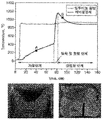
- 3 is a graph showing the temperature change of the preform in the molten aluminum.
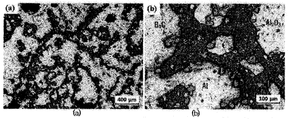
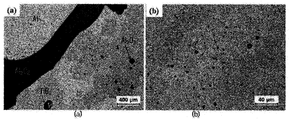
- 5 to 8 are the results of observing the microstructure of the aluminum matrix composite prepared according to the experimental example of the present invention.
- FIG. 9 is a perspective view of a ring type holder for fixing a preform.
- FIG. 10 shows a step of immersing the preform in the molten aluminum using a ring type holder.
- Combustion synthesis reaction means a reaction that continues as the reaction propagates spontaneously by the heat of reaction generated by the self-reaction between the raw material powders forming the mixture.
- hard ceramic materials such as carbides, oxides and borides of metals may be formed.
- the interface bonding force of the matrix / reinforced phase is excellent because it is thermodynamically stable and the interface of the reinforcement phase is clean.
- the mechanical properties of metal base composites prepared by the combustion synthesis reaction have superior mechanical properties compared to composites prepared by injecting reinforcing materials from the outside.
- the preform 100 is manufactured using a mixture of raw powders capable of forming a hard ceramic used as a reinforcing material through a combustion synthesis reaction.
- the preform 100 may be prepared in a pellet form by mixing the raw material powders constituting the mixture in an apparatus such as a ball mill and then pressing by pressing. .
- the preform 100 is introduced into a crucible 120 in which the aluminum molten metal 110 in which aluminum or an aluminum alloy is dissolved is immersed in the aluminum molten metal 110.
- the molten aluminum 110 is pure aluminum dissolved or added elements of conventional aluminum alloys (Mg, Si, Cu, Mn, Cr, Zn, Ni, Ti, Fe, Sn, Li). Etc.) refers to all of the dissolved aluminum alloy.
- a portion of the preform is not immersed in the molten aluminum 110, but immersed so as to be exposed to the external environment, for example, the atmosphere.
- the upper surface of the preform 100 may be exposed above the molten surface so that the upper surface of the preform 100 may not be immersed in the molten aluminum 110.
- the preform 100 injected into the molten aluminum 110 receives heat from the molten aluminum 100 and is heated, causing a combustion synthesis reaction to occur within several tens of seconds. As such combustion synthesis occurs, impregnation of molten aluminum into the preform 100 occurs due to a pressure difference between the inside and the outside of the preform 100. When the impregnation of the preform 100 is completed, it is delivered from the molten aluminum 110 and solidified to manufacture an aluminum matrix composite material.
- the preform 100 having pores therein forms a hard ceramic such as carbides, oxides, and borides of metals by combustion synthesis reaction, and the molten aluminum is impregnated between the pores therein. Accordingly, an aluminum matrix composite material in which hard ceramics are distributed on the aluminum matrix is manufactured.
- an important factor inducing the impregnation of the molten metal into the preform 100 is a pressure difference, and two basic principles for generating the same are as follows.
- Preforms made from raw powders usually have a density of 50-80% of theoretical density. That is, the rest (20-50%) inevitably occupies the interior space of the air. In addition, moisture, gas, and the like are adsorbed on the surface of the raw material powder.
- the preform is brought into contact with the molten metal and the temperature of the preform rises or the temperature inside the preform rises due to the reaction heat generated by the combustion synthesis reaction, the air, moisture, and adsorbent gas present in the preform are thermally activated. . In an environment where activated air, moisture, adsorbed gas, etc. are easily removed from the preform, the interior of the preform may be temporarily in a low pressure state close to vacuum.
- a vacuum generator is used to force a vacuum in the opposite side of the melt to generate a pressure difference.
- only the preform is brought into contact with the molten metal to spontaneously make the inside of the preform close to a vacuum state by the heat of reaction synthesis.
- FIG. 1 shows a schematic diagram of the molten metal impregnated by the capillary pressure.
- Equation 1 when the contact angle ⁇ is greater than 90 o , P C has a negative value, meaning that the capillary pressure cannot penetrate the inside of the structure, and the liquid must be injected by applying pressure from the outside. do. That is, the molten metal may not be spontaneously impregnated into the preform, and may be impregnated by adding an external pressure larger than that corresponding thereto.
- the contact angle between the molten aluminum and the ceramic particles has a value larger than 90 ° .
- the contact angle is not a physically constant value but a value that varies with time and temperature. For example, when molten aluminum is in contact with B 4 C for 1 second at 900 ° C., the contact angle is 100 o. However , if it is maintained for 1 hour at that temperature, the contact angle is reduced to 90 o .
- the visual contact angle decreases below 60 o (Q. Lin, Scripta Mat., 60, 2009, 960-963). In other words, by increasing the temperature of the liquid (or melt) it is possible to reduce the contact angle to 90 ° or less, it is possible to spontaneously impregnate the melt into the preform using this.
- the present invention can easily create a vacuum pressure and capillary pressure by using a combustion synthesis reaction, it can be used to produce an aluminum matrix composite material by spontaneously impregnating the molten aluminum into the preform.
- a part of the preform 100 is exposed to the external environment without being immersed in the aluminum molten metal 110, and the other part is exposed to the aluminum molten metal 110. It must be in direct contact with the molten aluminum 100. This is an exposed portion of the preform 100 that is not immersed in the molten aluminum, and helps the air, the adsorbed gas, etc. inside the preform 100 to easily escape, and the molten aluminum to the surface in contact with the aluminum molten metal 110. This is because the impregnation becomes easier than this. This impregnation step may be performed in a low pressure or vacuum atmosphere, as well as when the external environment is the atmosphere.
- the combustion synthesis reaction may proceed rapidly to ignite the preform.
- impregnation of molten aluminum proceeds rapidly due to the rapid combustion synthesis reaction.
- the mixture of raw material powder which can prepare the preform is a combination of at least one or more of hard ceramics, such as carbides, oxides and borides of metals, in which the product produced at the aluminum alloy base after the combustion synthesis reaction is capable of a combustion synthesis reaction itself. It does not limit if it includes a product consisting of.
- Formulas (2) to (8) show examples of the combustion synthesis reaction usable in the present invention.
- the left side is raw materials constituting the preform
- the right side of the reaction product is a product produced by the combustion synthesis reaction, which corresponds to the strengthening phase of the composite material.
- Table 1 shows the results of calculating the volume shrinkage caused by the reaction.
- volume shrinkage of about 19-33% occurs due to the combustion reaction synthesis, and aluminum molten metal may spontaneously be impregnated into these spaces after the combustion synthesis reaction.
- Table 2 shows the adiabatic temperature due to the reaction heat generated by the reaction, it can be seen that the adiabatic temperature rises due to the generation of high reaction heat.
- the mixture of the raw material powder may further include an excess of aluminum powder in addition to the stoichiometry required for the combustion synthesis reaction between the raw material powder forming the mixture.
- the reaction of Formulas (2) to (8) is a reaction using aluminum as an intermediate medium.
- the reaction of Formula (5) is completed after the intermediate reaction as in Formula (9). , Al entered into the intermediate is reduced to the same amount as the first.
- Aluminum powder that may be added in excess may have a range of 0.5 mol to 15 mol depending on the type of reaction.
- the reaction with aluminum may further include a reaction accelerator capable of quickly generating a large amount of heat during the reaction.
- a reaction promoter having high reactivity with aluminum may be additionally added to the reactions of formulas (2) to (8) to further promote the reactions of formulas (2) to (8) in the aluminum molten metal.
- the reaction promoter may be a metal oxide, and may include, for example, any one or more of Cu oxide (CuO), Mn oxide (MnO), Fe oxide (FeO), and Ni oxide (NiO). Table 3 shows the change of the thermal insulation temperature due to the reaction between the oxide and aluminum.
- CuO which is a Cu oxide
- CuO is an oxide that exhibits a large exothermic reaction when reacted with aluminum. The following reaction occurs.
- the amount of the reaction accelerator to be added is preferably added in an amount of 0.01 to 3 moles based on the mole content. As the content of the reaction accelerator increases, the reaction is accelerated as it is increased. However, when excessively added, metal components generated by decomposition of the reaction accelerator, for example, CuO, remain in the aluminum molten metal, and Al is unnecessary. It is possible to increase the content of 2 O 3 .
- the temperature of the molten aluminum in the range of 750 °C to 950 °C. Below 750 ° C., impregnation with molten aluminum may not occur well.
- the reaction heat absorption occurs to reduce the adiabatic temperature. In this case, the combustion synthesis reaction may take a long time or may not occur. Therefore, in consideration of this point, it is preferable to maintain the temperature of the molten aluminum at 750 ° C or higher.
- the hydrogen gas content in the aluminum molten metal inevitably increases, thereby increasing the frequency of generation of pores in the impregnated preform after completion of the process.
- the need for additional equipment to raise the temperature also increases production costs and complicates the process. Therefore, in this embodiment, it is preferable to perform the process at the temperature of the molten aluminum below 950 degreeC, strictly 920 degreeC or less.
- the preform 100 before finally solidified by drying in the aluminum molten metal 110 may further include the step of completely putting the whole in the aluminum molten metal 110 and to maintain in the aluminum molten metal 110 for a predetermined time. This may be a finishing step to more immersed molten aluminum into the preform 100.
- a holder for stably holding the preform 100 may be used.
- a ring type holder supporting only an outer portion of the preform may be manufactured to facilitate the operation.
- the holder has a wide contact surface with the molten metal to facilitate impregnation of the molten metal, and is easily applied to an indeterminate shape of the preform, and the molten metal can be filled in the upper part of the holder, thereby not solidifying inside the preform. Out of the preform can be prevented during the solidification.
- a tube type holder may be used in which only the upper and lower portions of the space in which the preform is mounted are opened. The use of this holder has the advantage of maintaining the shape of the preform more completely.
- the mixture of the raw material powder in order to induce a partial combustion synthesis reaction, the raw material powder, which is a nonmetal, of the raw material powder forming the mixture may be added in excess of the stoichiometry required for the combustion synthesis reaction. In some cases, however, it is also possible to induce partial reactions and to leave the reactants.
- Equations 11 and 12 the excess of B 4 C is added to partially react the added B 4 C (see Equations 11 and 12 below).
- excess B 4 C can be left in the preform.
- the mixture of the raw material powder may further include a stable metal compound powder that does not participate in the combustion synthesis reaction.
- a stable metal compound powder that does not participate in the combustion synthesis reaction.
- B 4 C, SiC, TiC, Al 2 O 3, etc. are added in excess. Equations 13 and 14 below illustrate the case where B 4 C and SiC are added to (Equation 3).
- the stable compound added excessively to induce partial reaction does not directly participate in the reaction, and as shown in FIG. 2, the preform may be more stably maintained in the preform, as shown in FIG. 2.
- Air, moisture, adsorption gas, etc. can be more easily removed, and because it is a reinforcing phase having excellent characteristics per se, it plays a role of improving the properties of the metal composite material to be produced.
- Table 4 shows the composition of the raw powder according to Experimental Examples 1 and 2 of the present invention.
- the raw material powder having the composition shown in Experimental Example 1 was dried at a temperature of 180 ° C. for 1 hour, and then mixed using a ball mill.
- the pre-molded product was prepared by compressing the mixed powder by a press apparatus, and the pressing force was adjusted during production so that the density of the pre-formed product became 60% of the theoretical density.
- the prepared preform was 35 mm in diameter and 28 mm thick.
- a plurality of preforms having the same composition were prepared in the same manner as described above.
- the prepared preforms were put in a molten aluminum kept at 900 ° C. in the air, and the preforms were exposed to the surface of the melt as shown in FIG. 1. After the preform was ignited in the aluminum molten metal, the preform was completely immersed into the aluminum molten metal, stabilized for 3 minutes, and then removed from the aluminum molten metal and solidified in the atmosphere.
- FIG. 3 shows the results, when the preform is added to the melt temperature of the preform gradually increases (heating step), after about 74 seconds elapsed by the reaction inside the preform, the preform is on fire and ignited It can be seen that the temperature rises rapidly (about 1156 ° C.) (ignition and impregnation step). In the next stabilization step it can be seen that the preform is close to the temperature of the aluminum molten metal.
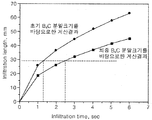
- the relationship between the infiltration length and the infiltration time of the composition of the preform of Experimental Example 1 was determined by the size of the initial B 4 C powder and the final B 4 C powder.
- Theoretically calculated based on the size of. 4 is a diagram showing the result, it was calculated that the impregnation is completed within 2-3 seconds in the theoretical calculation.
- 5A and 5B show the preforms of Experimental Example 1 in which the impregnation was completed in half, and the microstructures were observed at low and high magnifications. It can be seen that the molten aluminum has been successfully impregnated to have a healthy structure with little pores therein.
- this experimental example since partial reaction was used, a large amount of B 4 C remained in the microstructure, and it was found that a fine brown TiB 2 phase was produced by the reaction around B 4 C. The characteristics were measured for this test piece, and the results are shown in Table 5.
- This specimen is a composite material composed of Al-TiB 2 -B 4 C, has a light density with a density of 2.94 g / cc, an elastic modulus of 158 GPa and a hardness of 166 kg f / mm 2 (1.63 GPa).
- the low coefficient of thermal expansion of 9.4ppm / K is expected to be used for parts requiring high hardness, high rigidity and thermal stability.
- the preforms were prepared in the same manner as in Experimental Example 1, and then impregnated in the molten aluminum.
- 6A and 6B show the preforms of Experimental Example 2 cut in half and microstructures were observed at low and high magnifications, respectively. It can be seen that the molten aluminum has been successfully impregnated to have a healthy structure with little pores therein. Because this experiment used the complete reaction, B 4 C did not remain in the microstructure and reacted with each other to make a reaction product.
- a brown TiB 2 phase with a fine thickness of about 1 ⁇ m and a fine gray TiC phase with a fine thickness of about 1 ⁇ m were successfully produced. I could see.
- Table 6 shows the composition of the raw material powders according to Experimental Example 5 and Experimental Example 6.
- the test similar to Experimental Example 2 was performed using the raw material powder of the composition shown in Table 6.
- 7A and 7B show the preforms of Experimental Example 5 cut in half to observe the microstructures at low and high magnifications, respectively. It was found that the molten aluminum was successfully impregnated to have a healthy structure with little pores therein, and by reaction, a dark gray Al 2 O 3 phase existed in the form of a network and light gray with a square shape around it. It can be seen that the B 4 C phase of.
- Table 7 shows the composition of the raw material powders according to Experimental Example 8 and Experimental Example 9.
- the test similar to Experimental Example 2 was performed using the raw material powder of the composition shown in Table 7.
- 8A and 8B show the microstructures of the preforms of Experimental Example 8 cut in half and low and high magnification, respectively. It was found that the molten aluminum was successfully impregnated to have a healthy structure with little pores therein. The reaction resulted in a dark gray coarse Al 2 O 3 phase and a fine brown TiB 2 phase as small as 1 ⁇ m. I could see that.
- preform 110 molten aluminum
Landscapes
- Chemical & Material Sciences (AREA)
- Engineering & Computer Science (AREA)
- Mechanical Engineering (AREA)
- Materials Engineering (AREA)
- Metallurgy (AREA)
- Organic Chemistry (AREA)
- Chemical Kinetics & Catalysis (AREA)
- General Chemical & Material Sciences (AREA)
- Manufacture Of Alloys Or Alloy Compounds (AREA)
Abstract
본 발명은 기존의 가압함침법에 비해 특별한 장치를 이용하여 가압하는 구성없이도 빠른 시간 내에 예비성형체 내부로 알루미늄을 함침시켜 알루미늄 기지 복합재료를 제조하는 방법을 제공한다. 본 발명의 일관점에 의하면, 연소합성반응을 통해 세라믹을 형성할 수 있는 원료분말의 혼합체로 이루어진 예비성형체를 준비하는 단계; 상기 예비성형체를 상기 알루미늄 용탕에 침지시키되, 상기 예비성형체의 일부분을 상기 알루미늄 용탕에 침지되지 않고 외부환경에 노출되도록 침지시키는 단계; 및 상기 예비성형체 내부에서 연소합성반응을 일으키면서 상기 예비성형체 내부로 용융 알루미늄을 함침시키는 단계;를 포함하는, 무가압함침법을 이용한 알루미늄 기지 복합재료의 제조방법이 제공된다.
Description
본 발명은 세라믹과 같은 비금속 재료를 알루미늄 기지 상에 강화상(또는 강화재)으로 분포시켜 기계적 특성을 향상시키는 알루미늄 기지 복합재료의 제조방법에 대한 것으로서, 더욱 상세하게는 무가압함침법을 이용한 알루미늄 기지 복합재료의 제조방법에 대한 것이다.
알루미늄 기지 복합재료는 순수 알루미늄 또는 알루미늄 합금으로 이루어진 기지 내에 세라믹과 같은 비금속 재료를 강화상으로 분포시킨 것으로서, 경량이면서 강도 및 강성이 높고 내마모성과 고온특성이 우수하기 때문에 수송기기용 구조재료, 기계산업소재, 전기전자재료 등으로의 사용이 기대되고 있다.
금속기지 복합재료의 기계적 특성은 첨가되는 강화재의 종류, 크기, 형상, 부피분율, 기지/강화재의 계면 특성 등에 큰 영향을 받는다. 액상의 기지금속에 세라믹 강화재를 외부에서 주입하여 복합재료를 제조할 경우, 세라믹 강화재와 기지금속간의 낮은 젖음성으로 인하여 세라믹 강화재를 용탕 내에 주입하기가 용이하지 않았다.
이러한 문제점을 해결하기 위하여 가압함침(pressure infiltration) 공정이 개발되었는데, 먼저 강화재 분말의 예비성형체를 제조하고 여기에 알루미늄(편의상 알루미늄으로만 기재하며 이하, 알루미늄은 알루미늄 및 알루미늄 합금을 지칭함) 용탕을 주입한 후 높은 압력(기계적 또는 가스압 등을 이용하여)으로 가압하여 예비성형체 내부로 알루미늄 용탕을 채워 넣는 방법이다. 이 방법은 단시간 내에 제조가 가능하다는 장점은 있으나, 가압을 하기 위하여 대형의 복잡한 장치가 필요한 문제가 있다.
가압함침 공정을 개선하기 위하여 무가압함침(pressureless infiltration) 공정이 개발되었는데, 이중에 대표적인 것이 Lanxide사에서 개발한 DIMOX(direct melt oxidation) 공정이다. 이 공정은 용탕과 예비성형체 계면에서 산화반응을 유도하여 산화생성물이 자발적으로 생성되어 성장하도록하여 금속/세라믹의 복합재를 제조하는 방법이다(Urquhart, Mat. Sci. Eng. A144, 1991, 75-82) 하지만 이 공정은 용탕온도가 1200℃ 정도로 높고, 제조 시간이 24시간 정도 길다고 하는 단점이 있다.
본 발명은 상기와 같은 문제점을 포함하여 여러 문제점들을 해결하기 위한 것으로서, 기존의 가압함침법에 비해 특별한 장치를 이용하여 가압하는 구성없이도 빠른 시간 내에 예비성형체 내부로 알루미늄을 함침시켜 알루미늄 기지 복합재료를 제조하는 방법을 제공한다. 그러나 이러한 과제는 예시적인 것으로, 이에 의해 본 발명의 범위가 한정되는 것은 아니다.
본 발명의 일관점에 의하면, 연소합성반응을 통해 세라믹을 형성할 수 있는 원료분말의 혼합체로 이루어진 예비성형체를 준비하는 단계; 상기 예비성형체를 상기 알루미늄 용탕에 침지시키되, 상기 예비성형체의 일부분을 상기 알루미늄 용탕에 침지되지 않고 외부환경에 노출되도록 침지시키는 단계; 및 상기 예비성형체 내부에서 연소합성반응을 일으키면서 상기 예비성형체 내부로 용융 알루미늄을 함침시키는 단계;를 포함하는, 무가압함침법을 이용한 알루미늄 기지 복합재료의 제조방법이 제공된다.
상기 용융 알루미늄을 함침시키는 단계는 상기 예비성형체가 발화되는 단계를 더 포함할 수 있다.
또한 상기 용융 알루미늄을 함침시키는 단계 이후에 상기 알루미늄 용탕으로 상기 예비성형체 전체를 침지시키는 단계를 더 포함할 수 있다.
상기 원료분말의 혼합체는 Ti와 B4C 분말의 혼합체, Al와 B2O3와 C의 혼합체, Al과 B2O3와 TiO2의 혼합체, Ti와 C의 혼합체, Al과 TiO2와 C의 혼합체, Al과 Ti와 B2O3의 혼합체, Al과 TiO2와 B4C의 혼합체 중 어느 하나일 수 있다.
상기 원료분말의 혼합체는, 상기 혼합체를 이루는 원료분말 간의 연소합성반응에 필요한 화학양론 이외에 알루미늄 분말을 과잉으로 더 포함할 수 있다. 이 경우, 상기 원료분말의 혼합체는 알루미늄과 발열반응을 일으킬 수 있는 반응촉진제를 더 포함할 수 있으며, 상기 반응촉진제는 구리산화물, 망간산화물, 철산화물, 니켈산화물 중 어느 하나 이상을 포함할 수 있다.
상기 원료분말의 혼합체는, 부분 연소합성반응을 유도하기 위하여 상기 혼합체를 이루는 원료분말 중 비금속인 원료분말이 상기 연소합성반응에 필요한 화학양론 이상으로 과잉 첨가된 것일 수 있다.
또는 상기 원료분말의 혼합체는 연소합성반응에 참여하지 않는 금속화합물분말을 더 포함할 수 있으며, 상기 금속화합물은 B4C, SiC, TiC, Al2O3 중 어느 하나 이상을 포함할 수 있다.
한편, 상기 알루미늄 용탕의 온도는 750℃ 내지 950℃ 범위일 수 있다.
상기한 바와 같이 이루어진 본 발명에 따르면, 예비성형체의 연소합성반응을 이용함으로써 기존의 가압함침법에 비해 특별한 장치가 없어도 빠른 시간 내에 예비성형체 내부로 알루미늄을 함침시켜 알루미늄 기지 복합재료를 제조할 수 있다. 따라서 기존의 가압함침 공정에 비하여 장치적인 면과 비용적인 면에서 경제적이다. 또한, 대기 중 낮은 알루미늄 용탕온도에서 수분 이내의 단시간에 공정이 완료되기 때문에 장시간을 요하는 기존의 무가압함침 공정에 비하여 공정시간을 현저히 단축시키고 공정온도도 낮게 할 수 있는 장점이 있다. 이 공정으로 제조된 금속복합재료는 경량이며, 탄성계수, 경도 등의 기계적 특성이 우수하고 열적안정성이 우수하여 고경도-고강성-열적안정성이 필요한 부품에 활용하는 것이 가능하다. 본 발명의 효과는 이상에서 언급한 것으로 제한되지 않으며, 언급되지 않은 또 다른 효과들은 아래의 기재로부터 본 발명이 속하는 기술분야의 통상의 지식을 가진 자에게 명확하게 이해될 수 있을 것이다.
도 1은 본 발명을 따르는 알루미늄 기지 복합재료의 제조방법의 모식도이다.
도 2는 예비성형체에서의 함침과정을 나타내는 모식도이다.
도 3은 알루미늄 용탕 내에서의 예비성형체의 온도변화를 나타낸 그래프이다.
도 4는 함침거리-함침시간의 관계를 이론적으로 계산한 그래프이다.
도 5 내지 도 8은 본 발명의 실험예에 따라 제조된 알루미늄 기지 복합재료의 미세조직을 관찰한 결과이다.
도 9는 예비성형체를 고정시키기 위한 링 타입 홀더의 사시도이다.
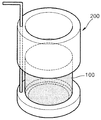
도 10은 링 타입 홀더를 이용하여 예비성형체를 알루미늄 용탕에 침지시키는 단계를 나타낸 것이다.
이하, 첨부된 도면들을 참조하여 본 발명의 실시예를 상세히 설명하면 다음과 같다. 그러나 본 발명은 이하에서 개시되는 실시예에 한정되는 것이 아니라 서로 다른 다양한 형태로 구현될 수 있는 것으로, 이하의 실시예는 본 발명의 개시가 완전하도록 하며, 통상의 지식을 가진 자에게 발명의 범주를 완전하게 알려주기 위해 제공되는 것이다. 또한 설명의 편의를 위하여 도면에서는 구성 요소들이 그 크기가 과장 또는 축소될 수 있다.
도 1에는 본 발명을 따르는 알루미늄 기지 복합재료의 제조방법의 모식도가 나타나 있다. 도 1을 참조하면, 연소합성반응이 가능한 원료분말의 혼합체를 이용하여 제조한 예비성형체(100)가 제공된다. 연소합성반응(혹은 자전연소반응이라고도 함)은 혼합체를 이루는 원료분말 간의 자체 반응에 의해 생성된 반응열에 의해 자발적으로 반응이 전파되면서 지속되는 반응을 의미한다. 이와 같은 연소합성반응의 결과물로서 금속의 탄화물, 산화물, 붕화물과 같은 경질의 세라믹 물질이 형성될 수 있다. 연소합성반응을 이용하여 알루미늄 기지 상에 경질의 세라믹 물질을 강화상으로 생성시킬 경우에는 열역학적으로 안정하고, 강화상의 계면이 깨끗하기 때문에 기지/강화상의 계면 결합력이 우수하다. 이러한 이유로 연소합성반응을 이용하여 제조한 금속기지 복합재료의 기계적 특성은 외부에서 강화재를 주입하여 제조한 복합재료에 비하여 우수한 기계적 특성을 갖는다.
예비성형체(100)는 연소합성반응을 통해 강화재로 이용되는 경질의 세라믹 형성이 가능한 원료분말의 혼합체를 이용하여 제조한다. 예를 들어, 예비성형체(100)는, 상기 혼합체를 구성하는 원료분말들을 볼-밀(ball-mill) 등과 같은 장치에서 혼합한 후 프레스로 가압성형하여 펠렛(pellet)형태로 제조한 것일 수 있다.
이러한 예비성형체(100)를 알루미늄 또는 알루미늄 합금이 용해되어 있는 알루미늄 용탕(110)이 담겨진 도가니(120) 내에 투입하여 알루미늄 용탕(110) 내부로 침지시킨다. 본 명세서 및 특허청구범위에서 알루미늄 용탕(110)은 순수한 알루미늄이 용해된 것이거나, 통상적인 알루미늄 합금의 첨가원소(Mg, Si, Cu, Mn, Cr, Zn, Ni, Ti, Fe, Sn, Li 등)가 추가된 알루미늄 합금이 용해된 것을 모두 지칭한다.
이때 예비성형체의 일부분이 알루미늄 용탕(110)에 침지되지 않고 외부환경, 예를 들어 대기 중에 노출되도록 침지시킨다. 대표적으로 도 1과 같이, 예비성형체(100)의 상부 표면은 용탕 표면 위로 노출되게 함으로써 예비성형체(100)의 상부 표면은 알루미늄 용탕(110)에 침지되지 않게 할 수 있다.
알루미늄 용탕(110)에 주입된 예비성형체(100)는 알루미늄 용탕(100)으로부터 열을 받아 가열되면서 수 십초 길게는 수 분 이내에 연소합성반응이 일어나게 된다. 이러한 연소합성이 일어나면서 이와 동시에 예비성형체(100) 내부와 외부와의 압력차이로 인하여 예비성형체(100) 내부로 용융 알루미늄의 함침이 일어나게 된다. 예비성형체(100)의 함침이 완료되면 이를 알루미늄 용탕(110)에서 건져낸 후 응고시켜 알루미늄 기지 복합재료를 제조하게 된다.
본 발명에 의할 시 내부에 기공을 가지는 예비성형체(100)는 연소합성반응에 의해 금속의 탄화물, 산화물, 붕화물과 같은 경질의 세라믹을 형성하게 되며, 상기 내부의 기공 사이로 용융 알루미늄이 함침됨에 따라 알루미늄 기지 상에 경질 세라믹이 분포되어 있는 알루미늄 기지 복합재료가 제조되게 된다.
본 발명에서 예비성형체(100) 내부로 용탕의 함침을 유도하는 중요한 인자는 압력 차이이며, 이를 만들어 내는 기본 원리는 다음의 두 가지이다.
(1) 예비성형체(100) 내외부의 압력차이 발생
원료분말로 만들어진 예비성형체는 보통 이론밀도의 50-80% 정도의 밀도를 갖는다. 즉, 나머지(20-50%)는 불가피하게 공기 등이 내부의 공간을 점유하고 있다. 또한, 원료분말 표면에는 수분이나 가스 등이 흡착되어 있다. 예비성형체를 용탕에 접촉시켜 예비성형체의 온도가 올라가거나, 연소합성반응으로 발생하는 반응열로 인해 예비성형체 내부의 온도가 올라가면, 예비성형체 내부에 존재하는 공기, 수분, 흡착 가스 등은 열적으로 활성화된다. 활성화된 공기, 수분, 흡착 가스 등이 예비성형체에서 용이하게 제거되는 환경에서는 예비성형체 내부가 일시적으로 진공에 가까운 낮은 압력 상태가 될 수 있다.
또한, 예비성형체 내부의 분말의 반응에 의하여 연소합성반응이 진행되면 부피수축에 의한 진공상태의 내부공간이 만들어진다. 원료분말과 반응합성으로 생성되는 생성분말은 그 부피가 동일하지 않은데, 일반적으로 생성분말의 부피가 원료분말에 비하여 작은 부피를 갖는다. 이로 인해 예비성형체 내부에 추가적인 진공상태의 공간이 만들어진다. 따라서 상기의 두 인자에 의해 예비성형체 내부와 외부에 압력차이가 발생하게 되며, 이 공간으로 알루미늄 용탕의 함침이 자발적으로 일어난다.
종래에는 진공발생장치를 이용하여 용탕의 반대편에서 강제로 진공상태를 만들어주어 압력 차이를 발생시켰다. 이에 비해 본 발명에서는 단지 예비성형체를 용탕과 접촉시켜 반응합성열로 자발적으로 예비성형체 내부를 진공상태에 가깝게 만들어 줄 수 있게 된다.
(2) 모세관 압력 (capillary pressure) 작용
기공을 갖는 구조체가 액체와 맞닿아 있을 때 모세관 현상으로 액체가 구조체 내부로 빨려들게 되며, 따라서 상기 구조체는 액체에 함침될 수 있다. 이 때 작용하는 압력은 다음의 식(1)과 같이 표현될 수 있다.
[식 1]

여기서 PC는 모세관 압력, γlv는 액체의 표면장력, θ는 액체와 고체사이의 접촉각, rC는 모세관 반경이다. 도 2에 모세관 압력에 의해 용탕이 함침되는 모식도를 나타내었다. 식 1에서 보는 바와 같이 접촉각 θ가 90o보다 클 때, PC는 음의 값을 가지며, 모세관 압력으로는 액체가 구조체 내부로 스며들 수 없으며, 외부에서 압력을 가해서 액체를 주입해야한다는 것을 의미한다. 즉, 금속 용탕을 예비성형체 내부로 자발적으로 함침시킬 수 없으며, 이에 해당하는 것보다 큰 외부압력을 부가하여 함침을 시킬 수 있다. 반면, 접촉각 θ가 90o보다 작을 때에는, PC는 양의 값을 가지며, 모세관 압력으로 액체가 구조체 내부로 자발적으로 스며들게 된다. 즉, 금속 용탕을 예비성형체 내부로 자발적으로 함침시킬 수 있다.
일반적으로 알루미늄 용탕과 세라믹 입자의 접촉각은 90o보다 큰 값을 가진다. 하지만 접촉각은 물리적으로 일정하게 정해진 값이 아니며 시간과 온도에 따라 달라지는 값이다. 가령, 용융 알루미늄과 B4C가 접촉하는 경우 900℃에서 1초 유지한 경우 접촉각은 100o이나, 그 온도에서 1시간을 유지하면 90o로 감소하며, 온도를 증가시켜 1200℃에서 1초 유지시 접촉각은 60o이하로 감소한다 (Q. Lin, Scripta Mat., 60, 2009, 960-963). 즉, 액체(또는 용탕)의 온도를 증가시키면 접촉각을 90o 이하로 감소시키는 것이 가능하고, 이를 이용하여 용탕을 예비성형체 내부로 자발적으로 함침시키는 것이 가능하다.
본 발명은 연소합성반응을 이용하여 진공에 의한 압력과 모세관 압력을 용이하게 만들어 낼 수 있으며, 이를 이용하여 알루미늄 용탕을 자발적으로 예비성형체 내부로 함침시켜 알루미늄 기지 복합재료를 제조할 수 있다.
상술한 바와 같이 도 1을 참조하면, 알루미늄 용탕(110) 내에서 예비성형체(100)의 일부분은 알루미늄 용탕(110)에 침지되지 않고 외부환경에 노출되며, 그 외의 부분은 알루미늄 용탕(110)에 잠겨 알루미늄 용탕(100)과 직접 접촉하여야 한다. 이는 예비성형체(100) 중 알루미늄 용탕에 침지되지 않고 노출된 부분으로 예비성형체(100) 내부의 공기, 흡착 가스 등이 용이하게 빠져 나가게 하는 것을 도우며, 알루미늄 용탕(110)과 접촉된 면으로 용융 알루미늄이 보다 용이하게 함침이 되기 때문이다. 이러한 함침단계는 외부환경이 대기인 경우는 물론, 대기보다 낮은 저압 또는 진공분위기에서 이루어져도 무방하다.
용융 알루미늄을 예비성형체 내부로 함침시키는 단계에서는 연소합성반응이 급격하게 진행되면서 예비성형체의 발화가 일어날 수 있다. 이러한 발화가 발생되는 경우에는 급격한 연소합성반응에 기인하여 용융 알루미늄의 함침이 급속하게 진행되게 된다.
예비성형체를 제조할 수 있는 원료분말의 혼합체는 그 자체가 연소합성반응이 가능하면서 연소합성반응 후에 알루미늄 합금 기지에 생성되는 생성물이 금속의 탄화물, 산화물, 붕화물과 같은 경질 세라믹 중 적어도 하나 이상의 조합으로 이루어진 생성물을 포함하는 것이면 제한을 두지 않는다. 식 (2) 내지 식 (8)에는 본 발명에서 이용 가능한 연소합성반응의 예가 나타나 있다.
3Ti + B4C → 2TiB2 + TiC (식 2)
4Al + 2B2O3 + C → B4C + 2Al2O3 (식 3)
10Al + 3TiO2 + 3B2O3 → 2TiB2 + 5Al2O3 (식 4)
Ti + C → TiC (식 5)
4Al + 3TiO2 + 3C → 3TiC + 2Al2O3 (식 6)
2Al + Ti + B2O3 → TiB2 + Al2O3 (식 7)
4Al + 3TiO2 + B4C → 2TiB2 + TiC + 2Al2O3 (식 8)
상기 (식 2) 내지 (식 8)의 반응식에서 왼쪽은 예비성형체를 구성하는 원료들이며, 반응식의 오른쪽이 연소합성반응으로 생성되는 생성물로 복합재료의 강화상에 해당된다. 표 1은 상기 반응으로 인하여 발생하는 부피 수축을 계산한 결과이다.
표 1
| 반응식 | 부피수축율 (%) |
| 식2 | 19.7 |
| 식3 | 26.7 |
| 식4 | 33.0 |
| 식5 | 23.5 |
| 식6 | 21.7 |
| 식7 | 28.9 |
| 식8 | 20.0 |
반응에 따라 다소 차이는 있지만 연소반응합성으로 인하여 19-33% 정도의 부피 수축이 발생하는 것을 알 수 있고, 연소합성반응 후에 이들 공간으로 알루미늄 용탕이 자발적으로 함침될 수 있다.
표 2는 상기 반응에 의해 발생하는 반응열에 의한 단열 온도를 보여주는 것으로, 높은 반응열의 발생으로 인하여 단열 온도가 상승하는 것을 알 수 있다.
표 2
| 반응식 | 단열온도(K) |
| 식2 | 3304 |
| 식3 | 2323 |
| 식4 | 2682 |
| 식5 | 3441 |
| 식6 | 2368 |
| 식7 | 3054 |
| 식8 | 2522 |
본 발명에 있어 상기 원료분말의 혼합체는, 상기 혼합체를 이루는 원료분말 간의 연소합성반응에 필요한 화학양론 이외에 알루미늄 분말을 과잉으로 더 포함할 수 있다. 이는 상기 식 (2) 내지 식 (8)의 반응이 알루미늄을 중간매개체로 하는 반응이기 때문인데, 일례로 식 (5)의 반응은 식 (9)와 같이 중간반응을 거친 후 최종 반응이 완료되며, 중간매개체로 들어간 Al은 처음과 동일한 양으로 환원된다.
(13/3)Al + Ti + C → Al3Ti + (1/3)Al4C3 → TiC + (13/3)Al (식 9)
따라서 (식 2) 내지 (식 8)의 좌변(즉, 원료분말)에 알루미늄 분말을 과잉으로 첨가함으로써 보다 활발한 연소합성반응을 유도할 수 있다. 과잉으로 첨가될 수 있는 알루미늄 분말은 반응의 종류에 따라 0.5mol 내지 15mol의 범위를 가질 수 있다.
본 발명에 있어, 상기 원료분말의 혼합체에 과잉의 알루미늄 분말이 포함되어 있는 경우에는, 알루미늄과 반응이 빠르고, 반응시에 큰 발열량을 발생시킬 수 있는 반응촉진제를 더 포함할 수 있다. 예를 들어, 알루미늄과 반응성이 높은 반응촉진제를 (식 2) 내지 (식 8)의 반응에 부가적으로 첨가하여 알루미늄 용탕에서 (식 2) 내지 (식 8)의 반응을 더욱 촉진시킬 수 있다. 이러한 반응촉진제는 금속산화물일 수 있으며, 예를 들어 Cu 산화물(CuO), Mn 산화물(MnO), Fe 산화물(FeO), Ni 산화물(NiO) 중 어느 하나 이상을 포함할 수 있다. 표 3에는 상기 산화물과 알루미늄과의 반응에 의한 단열온도의 변화가 나타나 있다.
표 3
| 반응식 | 단열온도(K) |
| Cu 산화물 | 3044 |
| Ni 산화물 | 3183 |
| Mn 산화물 | 2474 |
| Fe 산화물 | 3133 |
일례로 Cu 산화물인 CuO는 알루미늄과 반응할 때 큰 발열반응을 나타내는 산화물로서, 다음의 반응이 발생한다.
2Al + 3CuO → Al2O3 + 3Cu (식 10)
(식 10)의 반응에 의한 단열온도를 계산하면 3044K에 이르는 것을 알 수 있으며(표 3 참조), CuO의 첨가로 (식2) 내지 (식8)의 반응이 촉진될 수 있다.
첨가되는 반응촉진제의 함량은 몰(mole)함량 기준으로 0.01 내지 3몰의 함량을 추가하는 것이 바람직하다. 반응촉진제의 첨가함량이 증가하면 증가할수록 반응은 촉진되지만, 지나치게 첨가하는 경우에는 반응촉진제의 분해로 의해 생성된 금속성분, 예를 들어 CuO의 경우에는 Cu가 알루미늄 용탕에 잔존하게 되며, 불필요하게 Al2O3의 함량을 증가시킬 수 있다.
본 발명에서는 알루미늄 용탕의 온도를 750℃내지 950℃범위에서 유지할 수 있다. 750℃ 미만에서는 용융 알루미늄에 의한 함침이 잘 일어나지 않을 수 있다. 특히 원료분말의 혼합체가 알루미늄 분말을 과잉으로 포함하는 경우에는 상기 알루미늄 분말에 의해 연소합성반응의 희석화됨에 따라 반응열 흡수가 발생되어 단열온도를 감소시킬 수 있다. 이 경우 연소합성반응의 시간이 길어지거나 반응이 일어나지 않는 경우가 발생할 수도 있다. 따라서 이러한 점까지 고려할 때 알루미늄 용탕의 온도는 750℃ 이상으로 유지하는 것이 바람직하다. 한편, 알루미늄 용탕의 온도가 증가하면 알루미늄 용탕 내부의 수소가스 함량이 필연적으로 증가됨에 따라 공정이 완료된 후 함침된 예비성형체 내부에는 기공의 발생 빈도가 증가하게 된다. 또한 온도를 상승시키기 위한 추가적인 장치의 필요성으로 인해 생산비용이 증가되고 공정이 복잡해지게 된다. 따라서 본 실시예에서는 알루미늄 용탕의 온도를 950℃이하, 엄격하게는 920℃이하에서 공정을 실시하는 것이 바람직하다.
한편, 본 실시예는 예비성형체(100)의 일부를 외부환경에 노출시킨 상태에서 내부로 용융 알루미늄을 함침시키는 단계가 완료된 후, 최종적으로 알루미늄 용탕(110)에서 건져 응고하기 전에 예비성형체(100) 전체를 알루미늄 용탕(110)에 완전히 집어넣고 일정 시간 동안 알루미늄 용탕(110)에서 유지하여 안정화시키는 단계를 더 포함할 수 있다. 이는 용융 알루미늄이 예비성형체(100) 내부로 더욱 확실하게 함침되게 하기 위한 마무리 단계일 수 있다.
이러한 본 발명에 따른 일련의 과정을 보다 용이하게 수행하기 위하여 예비성형체(100)를 안정적으로 잡아주기 위한 홀더(holder)를 이용할 수 있다. 일예로서, 도 9 및 도 10에 나타낸 바와 같이 작업을 용이하게 하기 위하여 예비성형체의 외곽만 지탱해주는 링 타입 홀더(ring type holder)를 제작하여 사용할 수 있다. 이 홀더의 경우 용탕과의 접촉면이 넓어 용탕의 함침이 용이하고, 부정형(不定形)의 예비성형체 형상에도 쉽게 적용이 되며, 홀더 상부에 용탕을 채울 수 있어, 예비성형체 내부에서 응고가 되지 않은 용탕이 응고 시에 예비성형체 외부로 빠져나오는 것을 방지할 수 있다. 다른 예로서 예비성형체가 장착되는 공간의 상부 및 하부만 개방되어 있는 튜브 타입 홀더(tube type holder)를 사용할 수도 있다. 이 홀더를 사용할 경우 예비성형체의 형상을 보다 완전하게 유지할 수 있는 장점이 있다.
또한 본 발명에서 상기 원료분말의 혼합체는, 부분 연소합성반응을 유도하기 위하여 상기 혼합체를 이루는 원료분말 중 비금속인 원료분말이 상기 연소합성반응에 필요한 화학양론 이상으로 과잉 첨가된 것일 수 있다. 하지만 경우에 따라 부분반응을 유도하여 반응물을 잔존시키는 것도 가능하다.
예를 들어, 식 2 및 식 8과 같이 반응물로 B4C 분말을 사용하는 경우, B4C를 과잉으로 첨가하여 첨가된 B4C를 부분적으로만 반응시키고(아래 식 11 및 식 12 참조), 과잉으로 첨가된 B4C는 예비성형체 내부에 잔존시키는 것도 가능하다.
3Ti + (1+x)B4C → 2TiB2 + TiC + xB4C (식 11)
4Al + 3TiO2 + (1+x)B4C → 2TiB2 + TiC + 2Al2O3 + xB4C (식 12)
다른 예로서 상기 원료분말의 혼합체는 연소합성반응에 참여하지 않는 안정한 금속화합물분말을 더 포함할 수 있다. 예를 들어, (식 3)에서 B4C나 SiC, TiC, Al2O3 등을 과잉으로 첨가하는 것이다. 아래 식 13 및 식 14에는 (식3)에 B4C 및 SiC를 첨가한 경우를 예시하고 있다.
4Al + 2B2O3 + C + xB4C → (1+x)B4C + 2Al2O3 (식13)
4Al + 2B2O3 + C + SiC → SiC + B4C + 2Al2O3 (식14)
상기와 같이 부분반응을 유도하기 위하여 과잉으로 첨가되는 안정한 화합물은 반응에 직접 관여하지 않으며, 도 2에서 보는 바와 같이 예비성형체 내부에서 예비성형체의 형태를 보다 안정적으로 유지해줄 수 있기 때문에 예비성형체 내부의 공기, 수분, 흡착 가스등이 보다 용이하게 제거되는 역할을 할 수 있으며, 그 자체가 우수한 특성을 갖는 강화상이기 때문에 제조되는 금속복합재의 특성을 향상시킬 수 있는 역할을 한다.
이하, 본 발명의 이해를 돕기 위해서 실험예를 제공한다. 다만, 하기의 실험예들은 본 발명의 이해를 돕기 위한 것일 뿐, 본 발명이 아래의 실험예들에 의해서 한정되는 것은 아니다.
표 4에는 본 발명의 실험예 1 및 2를 따르는 원료분말의 조성이 나타나 있다.
표 4
| No. | 기본첨가 성분 및 함량 (mole) | 과잉첨가 성분 및 함량 (mole) | 결과 | ||||
| Ti | B4C | Al | CuO | B4C | 함침 여부 | 생성상 | |
| 실험예1 | 3 | 1 | 6 | 0.4 | 3 | 성공 | TiB2, B4C |
| 실험예2 | 3 | 1 | 1 | 0.1 | 0 | 성공 | TiB2, B4C, TiC |
실험예 1에 나타낸 조성의 원료분말을 180℃의 온도에서 1시간동안 유지하여 건조시킨 후 볼-밀을 이용하여 혼합하였다. 혼합된 분말을 프레스 장치로 압축하여 예비성형체를 제조하였는데, 제조시 가압력을 조절하여 예비성형체의 밀도가 이론밀도의 60%가 되게 하였다. 제조된 예비성형체의 크기는 직경 35mm, 두께 28mm이었다. 상기와 같은 방법으로 동일한 조성을 갖는 예비성형체를 복수개로 준비하였다.
제조된 예비성형체들을 대기 중에서 900℃로 유지되고 있는 알루미늄의 용탕에 투입하였으며, 투입 시 예비성형체의 표면이 도 1과 같이 용탕 표면에 노출되도록 하였다. 예비성형체가 알루미늄 용탕 내에서 발화된 후 예비성형체를 알루미늄 용탕 내부로 완전히 침지시켜 3분간 안정화 처리 후 알루미늄 용탕에서 꺼내 대기 중에서 응고시켰다.
일부의 예비성형체는 예비성형체 상부에 구멍을 뚫은 후 열전대(thermocouple)를 장착하여 알루미늄 용탕과 예비성형체의 온도 변화를 직접 측정하였다. 도 3은 그 결과를 보여주는 것으로, 예비성형체를 용탕에 투입하면 예비성형체의 온도가 서서히 증가하다가(가열단계) 약 74초가 경과하면 예비성형체 내부의 반응으로 예비성형에 불이 붙어 발화되면서 예비성형체의 온도가 급격히 상승(약 1156℃)하는 것을 알 수 있다(발화 및 함침단계). 다음 안정화 단계에서는 예비성형체가 알루미늄 용탕의 온도에 근접하게 됨을 알 수 있다.
알루미늄 용탕에 첨가된 예비성형체 중 일부는 발화 직전(도 3의 A) 및 직후(도 3의 B)에 알루미늄 용탕에서 건져 내어 물속에 바로 급냉시킨 후 함침여부를 관찰하였다. 관찰결과, 예비성형체에 발화 직전에 건져낸 예비성형체에는 알루미늄이 함침이 되지 않았지만, 예비성형체에 발화 직후에는 예비성형체 내부로 알루미늄이 완전히 함침된 것을 확인할 수 있다. 즉, 예비성형체가 발화되면 아주 빠른 시간에 예비성형체 내부로 알루미늄의 함침이 일어나는 것을 확인할 수 있으며, 예비성형체의 가열단계, 발화 및 함침단계, 안정화단계를 모두 포함하여도 전체적인 공정이 5분 이내에 대기 중에서 용이하게 완료될 수 있음을 확인할 수 있다. 이상의 시험 결과가 이론적으로 가능한가를 검증하기 위하여 실험예 1의 예비성형체의 조성에 대하여 함침거리(infiltration length)-함침시간(infiltration time)의 관계를 초기 B4C분말의 크기 및 최종 B4C 분말의 크기를 기초로 이론적으로 계산하였다. 도 4는 그 결과를 보여주는 그림으로, 이론적으로 계산 시에 2-3초 이내에 함침이 완료되는 것으로 계산되었다.
도 5a 및 도5b는 각각 함침이 완료된 실험예 1의 예비성형체를 반으로 절단하여 미세조직을 저배율과 고배율로 관찰한 것이다. 알루미늄 용탕이 성공적으로 함침되어 내부에 기공이 거의 없는 건전한 조직을 갖는 것을 알 수 있다. 이 실험예는 부분반응을 이용하였기 때문에 미세조직에 다량의 B4C가 잔류하는 것을 관찰할 수 있으며, B4C 주위로 반응에 의하여 미세한 갈색의 TiB2상이 생성된 것을 알 수 있었다. 이 시험편에 대하여 특성을 측정하였는데, 그 결과를 표5에 나타내었다. 이 시험편은 Al-TiB2-B4C로 구성된 복합재료로 밀도가 2.94g/cc로 경량이며, 탄성계수가 158GPa, 경도가 166kgf/mm2(1.63GPa)로 우수한 기계적 특성을 보이고 있으며, 열팽창계수가 9.4ppm/K로 낮은 값을 나타내어 고경도-고강성-열적안정성이 필요한 부품에 활용하는 것이 가능할 것으로 기대된다.
표 5
| 항목 | 측정치 |
| 밀도 | 2.94g/cc |
| 탄성계수 | 158GPa |
| 경도 | 166kgf/mm2(1.63GPa) |
| 열팽창계수 | 9.4ppm/K |
실험예 2를 따르는 조성에 대해서도 실험예 1과 동일한 방법으로 예비성형체를 제조한 후 알루미늄 용탕에서 함침시켰다. 도 6a 및 6b는 각각 실험예 2의 예비성형체를 반으로 절단하여 미세조직을 저배율과 고배율로 관찰한 것이다. 알루미늄 용탕이 성공적으로 함침되어 내부에 기공이 거의 없는 건전한 조직을 갖는 것을 알 수 있다. 이 실험예는 완전반응을 이용하였기 때문에 미세조직에 B4C가 잔류하지 않고 모두 반응하여 반응생성물을 만들게 되는데, 1㎛ 정도로 미세한 갈색의 TiB2상과 1㎛ 정도로 미세한 회색의 TiC상이 성공적으로 생성된 것을 알 수 있었다.
표 6에는 실험예 5 및 실험예 6을 따르는 원료분말의 조성이 나타나 있다. 표 6에 나타낸 조성의 원료분말을 사용하여 실험예 2와 동일한 시험을 실시하였다. 도 7a 및 7b는 각각 실험예5의 예비성형체를 반으로 절단하여 미세조직을 저배율과 고배율로 관찰한 것이다. 알루미늄 용탕이 성공적으로 함침되어 내부에 기공이 거의 없는 건전한 조직을 갖는 것을 알 수 있었으며, 반응에 의하여 미세조직에 진한 회색의 Al2O3상이 network 형태로 존재하고 이 주위를 따라 각형을 갖는 연한 회색의 B4C상이 생성된 것을 알 수 있었다.
표 6
| No. | 기본첨가 성분 및 함량 (mole) | 과잉첨가 성분 및 함량 (mole) | 결과 | |||||
| Al | B2O3 | C | Al | CuO | B4C | 함침 여부 | 생성상 | |
| 실험예5 | 4 | 2 | 1 | 3 | 1.5 | 0 | 성공 | Al2O3, B4C |
| 실험예6 | 4 | 2 | 1 | 5 | 1 | 1 | 성공 | Al2O3, B4C |
표 7에는 실험예 8 및 실험예 9을 따르는 원료분말의 조성이 나타나 있다. 표 7에 나타낸 조성의 원료분말을 사용하여 실험예 2와 동일한 시험을 실시하였다. 도 8a 및 8b는 각각 실험예 8의 예비성형체를 반으로 절단하여 저배율과 고배율로 미세조직을 관찰한 것이다. 알루미늄 용탕이 성공적으로 함침되어 내부에 기공이 거의 없는 건전한 조직을 갖는 것을 알 수 있었으며, 반응에 의하여 미세조직에 진한회색의 조대한 Al2O3상과 1㎛ 정도로 미세한 갈색의 TiB2상이 생성된 것을 알 수 있었다.
표 7
| No. | 기본첨가 성분 및 함량 (mole) | 과잉첨가 성분 및 함량 (mole) | 결과 | |||||
| Al | TiO2 | B2O3 | Al | CuO | B4C | 함침 여부 | 생성상 | |
| 실험예8 | 10 | 3 | 3 | 8 | 1.5 | 0 | 성공 | Al2O3, TiB2, |
| 실험예9 | 10 | 3 | 3 | 8 | 1.5 | 1 | 성공 | Al2O3,TiB2, B4C |
본 발명은 도면에 도시된 실시예를 참고로 설명되었으나 이는 예시적인 것에 불과하며, 당해 기술분야에서 통상의 지식을 가진 자라면 이로부터 다양한 변형 및 균등한 다른 실시예가 가능하다는 점을 이해할 것이다. 따라서 본 발명의 진정한 기술적 보호 범위는 첨부된 특허청구범위의 기술적 사상에 의하여 정해져야 할 것이다.
(부호의 설명)
100: 예비성형체 110: 알루미늄 용탕
120: 도가니
Claims (11)
- 연소합성반응을 통해 세라믹을 형성할 수 있는 원료분말의 혼합체로 이루어진 예비성형체를 준비하는 단계;상기 예비성형체를 상기 알루미늄 용탕에 침지시키되, 상기 예비성형체의 일부분을 상기 알루미늄 용탕에 침지되지 않고 외부환경에 노출되도록 침지시키는 단계; 및상기 예비성형체 내부에서 연소합성반응을 일으키면서 상기 예비성형체 내부로 용융 알루미늄을 함침시키는 단계;를 포함하는, 무가압함침법을 이용한 알루미늄 기지 복합재료의 제조방법.
- 제1항에 있어서,상기 용융 알루미늄을 함침시키는 단계는 상기 예비성형체가 발화되는 단계를 더 포함하는, 무가압함침법을 이용한 알루미늄 기지 복합재료의 제조방법.
- 제1항에 있어서,상기 용융 알루미늄을 함침시키는 단계 이후에 상기 알루미늄 용탕으로 상기 예비성형체 전체를 침지시키는 단계를 더 포함하는, 무가압함침법을 이용한 알루미늄 기지 복합재료의 제조방법.
- 제1항에 있어서,상기 원료분말의 혼합체는 Ti와 B4C 분말의 혼합체, Al와 B2O3와 C의 혼합체, Al과 B2O3와 TiO2의 혼합체, Ti와 C의 혼합체, Al과 TiO2와 C의 혼합체, Al과 Ti와 B2O3의 혼합체, Al과 TiO2와 B4C의 혼합체 중 어느 하나인, 무가압함침법을 이용한 알루미늄 기지 복합재료의 제조방법.
- 제1항에 있어서,상기 원료분말의 혼합체는, 상기 혼합체를 이루는 원료분말 간의 연소합성반응에 필요한 화학양론 이외에 알루미늄 분말을 과잉으로 더 포함하는, 무가압함침법을 이용한 알루미늄 기지 복합재료의 제조방법.
- 제5항에 있어서,상기 원료분말의 혼합체는 알루미늄과 발열반응을 일으킬 수 있는 반응촉진제를 더 포함하는, 무가압함침법을 이용한 알루미늄 기지 복합재료의 제조방법.
- 제6항에 있어서, 상기 반응촉진제는 구리산화물, 망간산화물, 철산화물, 니켈산화물 중 어느 하나 이상을 포함하는, 무가압함침법을 이용한 알루미늄 기지 복합재료의 제조방법.
- 제1항에 있어서,상기 원료분말의 혼합체는, 부분 연소합성반응을 유도하기 위하여 상기 혼합체를 이루는 원료분말 중 비금속인 원료분말이 상기 연소합성반응에 필요한 화학양론 이상으로 과잉 첨가된 것인, 무가압함침법을 이용한 알루미늄 기지 복합재료의 제조방법.
- 제1항에 있어서,상기 원료분말의 혼합체는 연소합성반응에 참여하지 않는 안정한 금속화합물분말을 더 포함하는, 무가압함침법을 이용한 알루미늄 기지 복합재료의 제조방법.
- 제9항에 있어서,상기 안정한 금속화합물은 B4C, SiC, TiC, Al2O3 중 어느 하나 이상을 포함하는, 무가압함침법을 이용한 알루미늄 기지 복합재료의 제조방법.
- 제1항에 있어서,상기 알루미늄 용탕의 온도는 750℃ 내지 950℃ 범위인, 무가압함침법을 이용한 알루미늄 기지 복합재료의 제조방법.
Priority Applications (1)
| Application Number | Priority Date | Filing Date | Title |
|---|---|---|---|
| US14/426,278 US20150218707A1 (en) | 2012-09-06 | 2013-08-21 | Method for preparing aluminum matrix composite using no pressure infiltration |
Applications Claiming Priority (2)
| Application Number | Priority Date | Filing Date | Title |
|---|---|---|---|
| KR10-2012-0099026 | 2012-09-06 | ||
| KR1020120099026A KR101409294B1 (ko) | 2012-09-06 | 2012-09-06 | 무가압함침법을 이용한 알루미늄 기지 복합재료의 제조방법 |
Publications (1)
| Publication Number | Publication Date |
|---|---|
| WO2014038802A1 true WO2014038802A1 (ko) | 2014-03-13 |
Family
ID=50237371
Family Applications (1)
| Application Number | Title | Priority Date | Filing Date |
|---|---|---|---|
| PCT/KR2013/007495 Ceased WO2014038802A1 (ko) | 2012-09-06 | 2013-08-21 | 무가압함침법을 이용한 알루미늄 기지 복합재료의 제조방법 |
Country Status (3)
| Country | Link |
|---|---|
| US (1) | US20150218707A1 (ko) |
| KR (1) | KR101409294B1 (ko) |
| WO (1) | WO2014038802A1 (ko) |
Cited By (4)
| Publication number | Priority date | Publication date | Assignee | Title |
|---|---|---|---|---|
| CN106735100A (zh) * | 2016-11-10 | 2017-05-31 | 西安交通大学 | 一种基于化学法活化处理的zta颗粒增强钢铁基复合衬板的制备方法 |
| CN107353008A (zh) * | 2017-06-20 | 2017-11-17 | 西安交通大学 | 一种层状金属‑陶瓷复合材料零件的制备方法 |
| CN110842177A (zh) * | 2019-12-04 | 2020-02-28 | 山东汇丰铸造科技股份有限公司 | 一种大型卷扬机用高耐磨球墨铸铁卷筒及其制造方法 |
| CN113560541A (zh) * | 2021-07-13 | 2021-10-29 | 珠海亿特立新材料有限公司 | 一种铝碳化硅大功率led散热器及其制备方法 |
Families Citing this family (1)
| Publication number | Priority date | Publication date | Assignee | Title |
|---|---|---|---|---|
| KR101822276B1 (ko) * | 2016-04-28 | 2018-01-25 | 현대자동차주식회사 | 자동차용 실린더 블록 제조방법 |
Citations (4)
| Publication number | Priority date | Publication date | Assignee | Title |
|---|---|---|---|---|
| US5000246A (en) * | 1988-11-10 | 1991-03-19 | Lanxide Technology Company, Lp | Flotation process for the formation of metal matrix composite bodies |
| JPH10102163A (ja) * | 1996-09-24 | 1998-04-21 | Hiroshima Pref Gov | 金属間化合物強化マグネシウム基複合材料及びその製造方法 |
| JP2000271728A (ja) * | 1999-03-25 | 2000-10-03 | Toyota Motor Corp | 無加圧含浸浸透法による複合素材の製造方法 |
| JP2001316785A (ja) * | 2000-04-28 | 2001-11-16 | Univ Hiroshima | 多孔質プリフォーム、金属基複合材料及びそれらの製造方法 |
Family Cites Families (3)
| Publication number | Priority date | Publication date | Assignee | Title |
|---|---|---|---|---|
| US4376803A (en) * | 1981-08-26 | 1983-03-15 | The Aerospace Corporation | Carbon-reinforced metal-matrix composites |
| DE3381519D1 (de) * | 1983-02-16 | 1990-06-07 | Moltech Invent Sa | Gesinterte metall-keramikverbundwerkstoffe und ihre herstellung. |
| US5848349A (en) * | 1993-06-25 | 1998-12-08 | Lanxide Technology Company, Lp | Method of modifying the properties of a metal matrix composite body |
-
2012
- 2012-09-06 KR KR1020120099026A patent/KR101409294B1/ko not_active Expired - Fee Related
-
2013
- 2013-08-21 US US14/426,278 patent/US20150218707A1/en not_active Abandoned
- 2013-08-21 WO PCT/KR2013/007495 patent/WO2014038802A1/ko not_active Ceased
Patent Citations (4)
| Publication number | Priority date | Publication date | Assignee | Title |
|---|---|---|---|---|
| US5000246A (en) * | 1988-11-10 | 1991-03-19 | Lanxide Technology Company, Lp | Flotation process for the formation of metal matrix composite bodies |
| JPH10102163A (ja) * | 1996-09-24 | 1998-04-21 | Hiroshima Pref Gov | 金属間化合物強化マグネシウム基複合材料及びその製造方法 |
| JP2000271728A (ja) * | 1999-03-25 | 2000-10-03 | Toyota Motor Corp | 無加圧含浸浸透法による複合素材の製造方法 |
| JP2001316785A (ja) * | 2000-04-28 | 2001-11-16 | Univ Hiroshima | 多孔質プリフォーム、金属基複合材料及びそれらの製造方法 |
Cited By (5)
| Publication number | Priority date | Publication date | Assignee | Title |
|---|---|---|---|---|
| CN106735100A (zh) * | 2016-11-10 | 2017-05-31 | 西安交通大学 | 一种基于化学法活化处理的zta颗粒增强钢铁基复合衬板的制备方法 |
| CN106735100B (zh) * | 2016-11-10 | 2018-07-17 | 西安交通大学 | 一种基于化学法活化处理的zta颗粒增强钢铁基复合衬板的制备方法 |
| CN107353008A (zh) * | 2017-06-20 | 2017-11-17 | 西安交通大学 | 一种层状金属‑陶瓷复合材料零件的制备方法 |
| CN110842177A (zh) * | 2019-12-04 | 2020-02-28 | 山东汇丰铸造科技股份有限公司 | 一种大型卷扬机用高耐磨球墨铸铁卷筒及其制造方法 |
| CN113560541A (zh) * | 2021-07-13 | 2021-10-29 | 珠海亿特立新材料有限公司 | 一种铝碳化硅大功率led散热器及其制备方法 |
Also Published As
| Publication number | Publication date |
|---|---|
| US20150218707A1 (en) | 2015-08-06 |
| KR20140033586A (ko) | 2014-03-19 |
| KR101409294B1 (ko) | 2014-06-24 |
Similar Documents
| Publication | Publication Date | Title |
|---|---|---|
| WO2014038802A1 (ko) | 무가압함침법을 이용한 알루미늄 기지 복합재료의 제조방법 | |
| TW539612B (en) | Composite carbonaceous heat insulator | |
| JP3491902B2 (ja) | 繊維複合材料及びその製造方法 | |
| CN101296971A (zh) | 碳化硅前体及其用途 | |
| FI91724C (fi) | Menetelmä metallimatriisikomposiitin valmistamiseksi negatiivista seosmuottia käyttäen | |
| JPS5830264B2 (ja) | キンゾクチツカブツシヨウケツセイケイタイノセイゾウホウホウ | |
| JP4647370B2 (ja) | 繊維強化炭化ケイ素複合材料及びその製造方法 | |
| CN101818048A (zh) | 一种铜硅合金改性炭/陶摩擦材料的制备方法 | |
| JP5068218B2 (ja) | 炭素繊維強化炭化ケイ素複合材料およびその製造方法 | |
| DE69211059T2 (de) | Borsilazane als Binder zur Herstellung gesinterter Siliciumcarbidmonolithe | |
| WO2022102805A1 (ko) | Tic 입자 강화 fe계 복합재료 및 그 제조방법 | |
| CA1182281A (en) | Process for the production of silicon nitride type molded bodies and the molded bodies produced | |
| WO2019231045A1 (ko) | 내 산화층이 형성된 탄화규소 소결체 및 이의 제조방법 | |
| JPH0585513B2 (ko) | ||
| WO2022092361A1 (ko) | 고체적율 알루미늄 복합재 및 그 제조방법 | |
| JPS6374978A (ja) | セラミツクス複合体 | |
| WO2012015258A2 (en) | Method for manufacturing silicon carbide sintered material using ball | |
| JP3570676B2 (ja) | セラミックス多孔体及びその製造方法 | |
| JPS6212191B2 (ko) | ||
| JPH09268079A (ja) | セラミックス基繊維複合材料およびその製造方法 | |
| Zhong et al. | Fabrication of porous boron nitride by using polyborazylene as precursor, polymethylmeth-acrylate as reaction agent | |
| JP2000288714A (ja) | 金属−セラミックス複合材料の製造方法 | |
| JPS60131862A (ja) | 高強度炭化けい素基焼結体 | |
| JPS60186473A (ja) | 窒化珪素焼結体の製造方法 | |
| JPS6323154B2 (ko) |
Legal Events
| Date | Code | Title | Description |
|---|---|---|---|
| 121 | Ep: the epo has been informed by wipo that ep was designated in this application |
Ref document number: 13834508 Country of ref document: EP Kind code of ref document: A1 |
|
| WWE | Wipo information: entry into national phase |
Ref document number: 14426278 Country of ref document: US |
|
| NENP | Non-entry into the national phase |
Ref country code: DE |
|
| 122 | Ep: pct application non-entry in european phase |
Ref document number: 13834508 Country of ref document: EP Kind code of ref document: A1 |