WO2014034296A1 - 希土類分離法及び希土類分離装置 - Google Patents
希土類分離法及び希土類分離装置 Download PDFInfo
- Publication number
- WO2014034296A1 WO2014034296A1 PCT/JP2013/069091 JP2013069091W WO2014034296A1 WO 2014034296 A1 WO2014034296 A1 WO 2014034296A1 JP 2013069091 W JP2013069091 W JP 2013069091W WO 2014034296 A1 WO2014034296 A1 WO 2014034296A1
- Authority
- WO
- WIPO (PCT)
- Prior art keywords
- rare earth
- tank
- rare
- aqueous solution
- polymer
- Prior art date
- Legal status (The legal status is an assumption and is not a legal conclusion. Google has not performed a legal analysis and makes no representation as to the accuracy of the status listed.)
- Ceased
Links
Images




Classifications
-
- C—CHEMISTRY; METALLURGY
- C22—METALLURGY; FERROUS OR NON-FERROUS ALLOYS; TREATMENT OF ALLOYS OR NON-FERROUS METALS
- C22B—PRODUCTION AND REFINING OF METALS; PRETREATMENT OF RAW MATERIALS
- C22B59/00—Obtaining rare earth metals
-
- C—CHEMISTRY; METALLURGY
- C02—TREATMENT OF WATER, WASTE WATER, SEWAGE, OR SLUDGE
- C02F—TREATMENT OF WATER, WASTE WATER, SEWAGE, OR SLUDGE
- C02F1/00—Treatment of water, waste water, or sewage
- C02F1/52—Treatment of water, waste water, or sewage by flocculation or precipitation of suspended impurities
- C02F1/54—Treatment of water, waste water, or sewage by flocculation or precipitation of suspended impurities using organic material
- C02F1/56—Macromolecular compounds
-
- C—CHEMISTRY; METALLURGY
- C22—METALLURGY; FERROUS OR NON-FERROUS ALLOYS; TREATMENT OF ALLOYS OR NON-FERROUS METALS
- C22B—PRODUCTION AND REFINING OF METALS; PRETREATMENT OF RAW MATERIALS
- C22B3/00—Extraction of metal compounds from ores or concentrates by wet processes
- C22B3/20—Treatment or purification of solutions, e.g. obtained by leaching
-
- C—CHEMISTRY; METALLURGY
- C02—TREATMENT OF WATER, WASTE WATER, SEWAGE, OR SLUDGE
- C02F—TREATMENT OF WATER, WASTE WATER, SEWAGE, OR SLUDGE
- C02F2103/00—Nature of the water, waste water, sewage or sludge to be treated
- C02F2103/10—Nature of the water, waste water, sewage or sludge to be treated from quarries or from mining activities
-
- Y—GENERAL TAGGING OF NEW TECHNOLOGICAL DEVELOPMENTS; GENERAL TAGGING OF CROSS-SECTIONAL TECHNOLOGIES SPANNING OVER SEVERAL SECTIONS OF THE IPC; TECHNICAL SUBJECTS COVERED BY FORMER USPC CROSS-REFERENCE ART COLLECTIONS [XRACs] AND DIGESTS
- Y02—TECHNOLOGIES OR APPLICATIONS FOR MITIGATION OR ADAPTATION AGAINST CLIMATE CHANGE
- Y02P—CLIMATE CHANGE MITIGATION TECHNOLOGIES IN THE PRODUCTION OR PROCESSING OF GOODS
- Y02P10/00—Technologies related to metal processing
- Y02P10/20—Recycling
Definitions
- the present invention relates to a rare earth separation method and a rare earth separation apparatus.
- rare earth elements such as neodymium and dysprosium are separated and recovered from used motors and other rare earth magnets for recycling
- a large amount of shavings (sludge), etc. generated in the magnet grinding process, etc. are generated in the magnet factory.
- scarce resources can be used effectively.
- a technique that can recycle rare earth elements from such a rare earth magnet a technique (solvent extraction method) in which sludge is leached with an acid and then extracted with a solvent has been used.
- this method uses an extremely high concentration of strong acid or highly volatile organic solvent, and thus has a considerable impact on the global environment.
- the separation rate at one time is not sufficient, multi-stage separation is required, so that the cost is generally high. Therefore, the cost of solvent extraction accounts for 80% of the cost of separating rare earth elements. Therefore, a rare earth separation method such as the following patent document has been proposed.
- neodymium and dysprosium contained in a rare earth magnet can be separated at a high separation rate.
- the content of the rare earth element to be obtained may be small, and a multi-stage process is necessary in which the rare earth element to be obtained is gradually concentrated by performing a separation operation many times.
- Patent Document 1 does not consider the amount of flocculant added for each separation operation, so there is a problem in improving the separation rate of the rare earth element to be obtained.
- An object of the present invention is to improve the separation rate of rare earth elements to be obtained.
- the present invention includes a step of adding an organic substance having an amino group and a polymer having a carboxyl group to a solution containing plural kinds of rare earths to form an aggregate, and the plural kinds of rare earths. Separating the agglomerates from the solution containing, forming a rare earth hydroxide by adding a base to the separated agglomerates, and forming a solution by adding an acid to the rare earth hydroxide And performing a separation process n times (where n is 2 or more), and each of a plurality of rare earths contained in the melt in the n-1th separation process and a total content thereof Determining the addition amount of the organic substance having an amino group and the polymer having a carboxyl group in the n-th separation step based on each of the contents and the total content, To have And butterflies.
- the present invention provides a first tank provided with an aqueous solution of an organic substance having an amino group, a second tank provided with an aqueous solution of a polymer having a carboxyl group, a solution containing a plurality of rare earths, A first reaction tank in which an aqueous solution of an organic substance having an amino group charged from one tank and an aqueous solution of a polymer having a carboxyl group charged from the second tank are mixed to form an aggregate.
- a separation device for separating the aggregates from the solution containing the plurality of rare earths, a third tank having a basic aqueous solution, a fourth tank having an acidic aqueous solution, and the separated aggregates
- a second reaction tank that mixes the basic aqueous solution charged from the third tank and the acidic aqueous solution charged from the fourth tank to form a lysate; and Multiple species included
- a measuring device for determining the content and total content of each rare earth, the organic material having the amino group and the carboxyl group to be added to the melt based on the content and the total content of each
- an analysis device having a database for determining the amount of addition with the polymer.
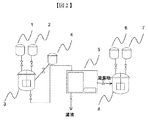
- the flowchart of separation operation The apparatus schematic at the time of isolate
- Mapping of optimal values of PC / PA ratio and PA / RE ratio Mapping of optimal values of PC / PA ratio and PA / RE ratio.
- FIG. 1 shows a flowchart of the separation operation.
- the carboxyl group and the amino group are ionically bonded to cause an agglomeration reaction.
- the rare earth metal ions there are types that are easily trapped by the aggregates and types that are not easily trapped, so the rare earth metals can be separated from each other by separating the precipitate and the supernatant that remains in the solution without being trapped. Can be separated.
- the rare earth that is easily trapped by the aggregates is referred to as a first group
- the rare earth that is not easily trapped is referred to as a second group.
- dysprosium is used as the first group rare earth and neodymium is used as the second group rare earth
- neodymium is used as the second group rare earth
- lanthanum (La), cerium (Ce), europium (Eu), and terbium used in phosphors (Tb) and the like can also separate rare earths using the same principle.
- dysprosium and neodymium since dysprosium is more easily taken into the aggregate, the aggregate containing a large amount of dysprosium is generated and precipitated. As a result, a large amount of neodymium remains in the filtrate, and dysprosium and neodymium are separated.
- the agglomerates Before forming the agglomerates, by adding an inorganic salt typified by alkali halide such as sodium chloride, potassium chloride, ammonium chloride, calcium chloride to the metal-containing solution in advance, It may be easy to precipitate.
- the aggregate can be further easily precipitated by performing a centrifugal separation when separating the aggregate and the liquid phase.
- the separation of the first group and the second group of rare earths may not be sufficient because the second group of rare earths may remain in the aggregates only by separating the aggregates and the liquid phase in the above process. Therefore, the first group and the second group of rare earths are further separated from the aggregate after separation.
- a base is added to the aggregate after separation to form a rare earth hydroxide, and the hydroxide is dissolved using an acid such as hydrochloric acid.
- an acid such as hydrochloric acid.
- a neutralization reaction occurs, and an inorganic salt such as sodium chloride is generated. Therefore, a salting-out effect is also generated here and the hydroxide is easily precipitated.
- a process surrounded by a broken line in FIG. 1 is a single separation operation. By performing the above treatment again on this solution, the separation rate of the first group of rare earths separated from the solution containing a plurality of types of rare earths is improved.
- the first group of rare earths to be collected is gradually concentrated by sequentially repeating the single separation operation described above.
- the content of rare earth contained in the acid-dissolved lysate (the lysate obtained at the end of the separation operation) is unknown, an appropriate amount of flocculant, base, and acid are added in the next separation operation.
- the separation rate may decrease and the yield may decrease. Therefore, in the present invention, when the separation operation is repeated, the rare earth content contained in the solution obtained in the immediately preceding separation operation is obtained, and the addition amount of the flocculant to be added this time is obtained based on this content.
- a flocculant addition amount that maximizes the separation rate and yield with respect to the rare earth content is obtained in advance.
- Fig. 2 shows a schematic view of the apparatus for separating the aggregates.
- 1 is a first tank containing an aqueous solution of an organic substance having an amino group
- 2 is a second tank containing an aqueous solution of a polymer having a carboxyl group
- 3 is a plurality of first and second groups.
- 4 is an inorganic salt tank containing an aqueous solution of an inorganic salt
- 5 is a separation device
- 6 is a third tank containing a basic aqueous solution
- 7 Is a fourth tank containing an acidic aqueous solution
- 8 is a second reaction vessel for mixing the aggregate, the basic aqueous solution and the acidic aqueous solution.
- Examples of the polymer having a carboxyl group include polyacrylic acid, polyaspartic acid, polyglutamic acid, and cation exchange resin.
- Examples of the organic substance having an amino group include polyethyleneimine, polyvinylamine, chitosan, polylysine, polyarginine, polyallylamine, and anion exchange resin.
- a mixed solution of dysprosium, neodymium and neutral water is put in the first reaction tank. This is premixed with an inorganic salt of about 1-7% by weight.
- a polymer having a carboxyl group and an organic substance having an amino group as an aggregating agent are added.
- dysprosium and neodymium since dysprosium is more easily taken into the aggregate, an aggregate containing a large amount of dysprosium is generated and precipitated. As a result, a large amount of neodymium remains in the filtrate, and dysprosium and neodymium are separated.
- the inorganic salt is added to the solution, an environment in which precipitation is likely to occur due to the salting out effect is obtained.
- the contents of the reaction vessel are transferred to a separation device and separated into aggregates and filtrate. When it is centrifuged, it is separated quickly.
- the agglomerate is transferred to the second reaction tank and a base is added from the third tank, the agglomerate is decomposed and precipitation of the first group rare earth hydroxide occurs. Further, when acid is added from the fourth tank, the precipitate dissolves.
- a measuring device (not shown) for determining the amount of rare earth contained in the melt and an analyzer (not shown) having a database for determining the amount of the flocculant to be added to the melt based on the amount of rare earth are the second reactor. It may be installed anywhere inside or outside. If the separation device used here is a continuous centrifugal separator, it can cope with a large amount of processing.
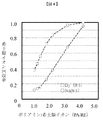
- FIG. 3 shows the yield of each rare earth with respect to the added amount of polyamine (PA) when a solution containing dysprosium (Dy) and neodymium (Nd) is used.
- the horizontal axis represents the polyamine addition amount relative to the rare earth (RE) ion amount in the solution, and the polyamine addition amount is normalized with respect to the rare earth content.
- the yield of rare earth ions on the vertical axis indicates the amount of each of Dy and Nd contained in the aggregate. This amount is a result of hydroxylating the obtained aggregate and then dissolving it with an acid, and analyzing it using ICP-AES emission spectrometry.
- FIG. 3 shows the case where the abundance ratio of Dy and Nd in the solution is 1: 9.
- Dy has a recovery rate of about 90% (0.9) when PA / RE is about 1.8 and almost 100% at 4.0, whereas Nd has a recovery rate of 90 only after PA / RE exceeds 4.0. %.
- the amount of polyamine added is too small relative to the amount of rare earth contained in the solution, Dy can hardly be recovered as aggregates, and Dy and Nd remain in the liquid phase.
- the amount of polyamine is too large, the amount of Dy recovered increases, but Nd is also recovered as an aggregate and hardly separated. Therefore, if the PA / RE is in the range of 1.8 to 4.0, the difference in yield between Dy and Nd becomes large, so Dy is trapped in the aggregates, while Nd is difficult to trap.
- FIG. 4 shows the case where the abundance ratio of Dy and Nd is 5: 5.
- the Dy yield becomes 90% or more only when PA / RE is 2.6 or more.
- the Nd recovery rate is as low as 60%, the separation rate can be increased. Therefore, it can be seen that the ratio of PA to be added also changes as the ratio of Dy to Nd in the solution changes.
- FIG. 5A shows the case where Dy / Nd in the solution is 1/9 and 2/8
- FIG. 5b shows the case where Dy / Nd in the solution is 4/6 and 6/4.
- the optimum addition amounts of polyamine and polycarboxylic acid were determined for the two axes of PA / RE and PC / PA.
- the optimum region for each density index is indicated by hatching.
- the optimum amount of flocculant to be added relative to the rare earth concentration can be determined. Since the above database is discrete with respect to the rare earth content, when the result of measurement by ICP-AES reveals that the solution has a composition that does not have a database, the arithmetic average is calculated from the combination of the compositions that are stored in the database. Determine the amount of addition. For example, the concentration data held is obtained by interpolation or extrapolation.
- the first group rare earth is dysprosium
- the second group rare earth is neodymium
- the concentration ratio Dy: Nd of dysprosium and neodymium is 12.5%: 87.5%, each having a concentration of 500 ppm (pH is 3 ⁇ 7) will be described as the solution to be separated.
- aggregating agents polyacrylic acid as a polymer having a carboxyl group and polyallylamine as an organic substance having an amino group, were used to form an aqueous solution of 30% or less.
- the solution to be separated is first weighed in a reaction tank by a predetermined weight, and the solution is stirred for 1-2 minutes while adding sodium chloride (NaCl) as an inorganic salt to 1% by weight. did. Subsequently, a predetermined weight of the flocculant was dropped into the reaction vessel in the order of polyacrylic acid aqueous solution and polyallylamine. As the solution was dropped, flesh-colored aggregates were generated in the white solution, and finally flesh-colored aggregates were formed.
- NaCl sodium chloride
- the aggregates generated as described above contain a large amount of water
- a solution containing the aggregates is distributed from the reaction tank to a 250 mL centrifuge tube at 110 mL or less, and each centrifuge tube is distributed. Water was added so that the same weight was obtained with an error of 3 mg, and the mixture was rotated by a centrifugal separator at 11000 rpm for 60 minutes. Aggregates hardened in the centrifuge tube, and the filtrate could be easily separated with a dropper. Thereby, it separated into the aggregate and the filtrate.
- aqueous base solution such as sodium hydroxide and an acid such as mineral acid
- sodium chloride was appropriately added so as to be about 1% by weight, and the solution was stirred for 1-2 minutes while adjusting the total amount to 1% by weight. This operation produced dysprosium hydroxide as a slightly purple first group rare earth hydroxide in the white solution in the reaction vessel.
- the hydroxide generated as described above contains a large amount of water
- a solution containing aggregates is distributed from the reaction tank to a 250 mL centrifuge tube at 110 mL or less, and each centrifuge tube is distributed. Then, water was added so that the same weight was obtained with an error of 3 mg, and the mixture was rotated at 11000 rpm for 60 minutes by a centrifugal separator.
- the dysprosium hydroxide solidified hard in the centrifuge tube, and the filtrate could be easily separated with a dropper.
- dysprosium hydroxide This separated into dysprosium hydroxide and filtrate.
- ICP-AES Inductively Coupled Plasma Emission Spectroscopy
- the main component was dysprosium hydroxide with a Dy concentration of 19.8% and a recovery rate of 99.8 %Met.
- TOC Total Organic Carbon
- FIG. 6 shows the results of the Dy concentration and the recovery rate with respect to the number of separation stages.
Landscapes
- Engineering & Computer Science (AREA)
- Chemical & Material Sciences (AREA)
- Environmental & Geological Engineering (AREA)
- Organic Chemistry (AREA)
- Life Sciences & Earth Sciences (AREA)
- Materials Engineering (AREA)
- Manufacturing & Machinery (AREA)
- Geology (AREA)
- Mechanical Engineering (AREA)
- Metallurgy (AREA)
- General Life Sciences & Earth Sciences (AREA)
- Geochemistry & Mineralogy (AREA)
- Hydrology & Water Resources (AREA)
- Water Supply & Treatment (AREA)
- Separation Of Suspended Particles By Flocculating Agents (AREA)
- Manufacture And Refinement Of Metals (AREA)
- Removal Of Specific Substances (AREA)
Description
本発明は、希土類分離法及び希土類分離装置に関する。
使用済みのモータ等の希土類磁石からネオジムやジスプロシウムなどの希土類元素分離回収してリサイクルする場合、磁石工場内では磁石の研削工程などで発生する削り粉(スラッジ)等が大量に生成されるため、これらもリサイクルすることにより希少な資源を有効に使用できる。このような希土類磁石から希土類元素をリサイクルできる手法として、古くから、スラッジを酸で浸出し、次いで溶媒によって抽出する手法(溶媒抽出法)が用いられている。しかしながらこの方法ではきわめて高濃度の強酸や揮発性の高い有機溶剤を使用するため地球環境に与える影響が少なくない。また一回の分離率が十分でないため多段の分離を要することから、一般にコストが高い。よって、溶媒抽出によるコストは希土類元素の分離のコストの8割を占める。そこで下記特許文献のような希土類分離方法が提案されている。
上記特許文献1を用いることにより、例えば希土類磁石中に含まれるネオジムとジスプロシウムを高い分離率で分離することが可能である。しかしながら、実際は得たい希土類の含有量が少ない場合もあり、何度も分離操作して、徐々に得たい希土類を濃縮していく多段の工程が必要となる。
上記特許文献1では、分離操作ごとに必要な凝集剤の添加量について考慮していないので、得たい希土類の分離率を向上することについて課題がある。
本発明の目的は、得たい希土類の分離率を向上することにある。
上記目的を達成するために、本発明は、複数種の希土類を含む溶液にアミノ基を有する有機物とカルボキシル基を有する高分子とを添加して凝集物を形成する工程と、前記複数種の希土類を含む溶液から前記凝集物を分離する工程と、分離された前記凝集物に塩基を添加して希土類水酸化物を形成する工程と、前記希土類水酸化物に酸を添加して溶解物を形成する工程と、を備える分離過程をn回(nは2以上)行い、n-1回目の前記分離過程における前記溶解物に含まれる複数種の希土類の各々の含有量と合計の含有量とを求める工程と、前記各々の含有量と前記合計の含有量とに基づいてn回目の前記分離過程における前記アミノ基を有する有機物と前記カルボキシル基を有する高分子との添加量を決定する工程と、を備えることを特徴とする。
また、本発明は、アミノ基を有する有機物の水溶液を備えた第1のタンクと、カルボキシル基を有する高分子の水溶液を備えた第2のタンクと、複数種の希土類を含む溶液と、前記第1のタンクから投入される前記アミノ基を有する有機物の水溶液と、前記第2のタンクから投入される前記カルボキシル基を有する高分子の水溶液とを混合して凝集物を形成する第1の反応槽と、前記複数種の希土類を含む溶液から前記凝集物を分離する分離装置と、塩基性水溶液を備えた第3のタンクと、酸性水溶液を備えた第4のタンクと、分離された前記凝集物と、前記第3のタンクから投入される前記塩基性水溶液と、前記第4のタンクから投入される前記酸性水溶液とを混合して溶解物を形成する第2の反応槽と、 前記溶解物に含まれる複数種の希土類の各々の含有量と合計の含有量とを求める測定装置と、前記各々の含有量と前記合計の含有量とに基づいて前記溶解物に添加する前記アミノ基を有する有機物と前記カルボキシル基を有する高分子との添加量を決定するデータベースを備えた解析装置と、を備えることを特徴とする。
本発明によれば、得たい希土類の分離率を向上することができる。
まず、一回の分離操作について説明する。図1に、分離操作のフロー図を示す。
複数種の希土類を含む溶液にカルボキシル基を有する高分子(ポリカルボン酸)とアミノ基を有する有機物(ポリアミン)を添加すると、カルボキシル基とアミノ基とがイオン結合して凝集反応が生じる。希土類金属イオンの大きさに応じて凝集物にトラップされやすい種類とトラップされにくい種類があるため、沈殿物とトラップされず溶液中に残ったままの上澄みとに分離することで、希土類金属同士を分離することができる。本発明では凝集物にトラップされやすい希土類を第一群、トラップされにくい希土類を第二群と称する。
ここでは第一群の希土類としてジスプロシウム、第二群の希土類としてネオジムを用いた例について示すが、これ以外に例えば蛍光体で用いられるランタン(La)、セリウム(Ce)、ユウロピウム(Eu)、テルビウム(Tb)等でも同様の原理を用いて希土類同士を分離することができる。
ジスプロシウムとネオジムとでは、ジスプロシウムの方が凝集物に取り込まれやすいので、ジスプロシウムを多く含む凝集物が発生して沈殿する。その結果濾液にはネオジムが多く残留し、ジスプロシウムとネオジムが分離される。
凝集物を形成する前に、予め金属を含む溶液に塩化ナトリウム、塩化カリウム、塩化アンモニウム、塩化カルシウムなどのハロゲン化アルカリに代表される無機塩を加えておくことにより、塩析効果で凝集物を沈殿させやすくしてもよい。また、凝集物と液相とを分離する際に遠心分離を行うことで凝集物を更に沈殿させやすくすることもできる。
上記工程で凝集物と液相とを分離しただけでは凝集物中に第二群の希土類も残る場合があり、第一群と第二群の希土類の分離率が十分でない。そのため、分離後の凝集物から更に第一群と第二群の希土類とを分離する。分離後の凝集物に塩基を加えて希土類の水酸化物を生成し、塩酸等の酸を用いて水酸化物を溶解する。塩基と酸を加えることで中和反応が生じ、塩化ナトリウムなどの無機塩が発生するので、ここでも塩析効果が生じて水酸化物が沈殿しやすくなる。図1の破線で囲った工程を一回の分離操作とする。この溶液に対し、再度上記の処理を実施することで、複数種の希土類が含まれる溶液から分離される第一群の希土類の分離率が向上する。
以上に示す一回の分離操作を順次繰り返すことにより、回収対象である第一群の希土類が次第に濃縮される。ここで、酸で溶解した溶解物(分離操作の最後に得られる溶解物)に含まれる希土類の含有量が不明であると、次の分離操作において適切な量の凝集剤、塩基、酸を添加できず、分離率が低下したり、収率が低下することがある。そのため本発明では、分離操作を繰り返す場合に、直前の分離操作で得られた溶液に含まれる希土類の含有量を求め、この含有量に基づいて今回添加すべき凝集剤の添加量を求める。添加量を最適化するため、予め希土類含有量に対して分離率や収率が最大となる凝集剤添加量を予め求めておく。
図2に凝集物を分離する際の装置概略図を示す。
図2において1はアミノ基を有する有機物の水溶液が入った第1のタンク、2はカルボキシル基を有する高分子の水溶液が入った第2のタンク、3は第一群及び第二群からなる複数種の希土類を含む溶液が入っている第1の反応槽、4は無機塩の水溶液が入った無機塩のタンク、5は分離装置、6は塩基性の水溶液が入った第3のタンク、7は酸性の水溶液が入った第4のタンク、8は凝集物と塩基性の水溶液と酸性の水溶液を混合する第2の反応槽である。カルボキシル基を有する高分子としてポリアクリル酸、ポリアスパラギン酸、ポリグルタミン酸、陽イオン交換樹脂などが挙げられる。アミノ基を有する有機物としてはポリエチレンイミン、ポリビニルアミン、キトサン、ポリリシン、ポリアルギニン、ポリアリルアミン、陰イオン交換樹脂などが挙げられる。
図2においてジスプロシウム、ネオジム、中性水の混合溶液を第1の反応槽に入れておく。これに無機塩を1-7重量%程度、予め混合する。次いで凝集剤であるカルボキシル基を有する高分子、アミノ基を有する有機物を投入する。ジスプロシウムとネオジムとでは、ジスプロシウムの方が凝集物に取り込まれやすいので、ジスプロシウムを多く含む凝集物が発生して沈殿する。その結果濾液にはネオジムが多く残留し、ジスプロシウムとネオジムが分離される。この時無機塩が溶液に加えられているので、塩析効果で沈殿が発生しやすい環境になる。
更に分離装置へ反応槽の内容物を移し凝集物と濾液に分離する。遠心分離を行うと、迅速に分離される。凝集物を第2の反応槽に移し、第3のタンクから塩基を加えると凝集物が分解した後、第一群希土類の水酸化物の沈殿が発生する。さらに第4のタンクから酸を加えると沈殿が溶解する。溶解物に含まれる希土類量を求める測定装置(図示なし)と、この希土類量に基づいて溶解物に添加する凝集剤量を決定するデータベースを備える解析装置(図示なし)は、第2の反応槽の内外のどこに設置されていてもよい。ここで用いる分離装置は、連続型の遠心分離装置であると大量な処理時にも対応可能である。
図3は、ジスプロシウム(Dy)とネオジム(Nd)が含まれた溶液を用いる場合の、ポリアミン(PA)添加量に対する各希土類の収率を示す。横軸は溶液中の希土類(RE)イオン量に対するポリアミン添加量であり、ポリアミン添加量が希土類の含有量に対して規格化してある。また、縦軸の希土類イオンの収率は、凝集物中に含まれるDyとNdの各々の量を示している。この量は、得られた凝集物を水酸化した後に酸で溶解し、ICP-AES発光分析法を用いて分析した結果である。また図3は、溶液中のDyとNdの存在比が1:9の場合について示す。
図3によれば、DyはPA/REが1.8程度から回収率90%(0.9)を超え、4.0でほぼ100%となるが、一方、NdはPA/REが4.0を超えて初めて回収率90%となる。溶液に含まれる希土類の量に対してポリアミンの添加量が少なすぎると凝集物としてDyをほとんど回収できず液相にDyとNdが残ったままとなる。逆にポリアミンが多すぎるとDyの回収量は増えるがNdも凝集物として回収してしまい、ほとんど分離できない。従って、PA/REが1.8~4.0の領域であればDyとNdの収率の差が大きくなるので、Dyは凝集物にトラップされる一方で、Ndはトラップされにくいため、DyとNdとの分離率が大きくなる。さらに好ましくは、Dyの収率が95%を超えるPA/RE=2.4~4.0とすることにより、Dyの収率を落とすことなく分離率を大きくすることができる。極力分離回数を減らすためにはNdの回収率が低く、Dyの回収率が高いPA添加量を選択することが好ましい。従って、この場合PA/RE=2.4~3.2とすることがより好ましい。
次に、図4に、DyとNdの存在比が5:5の場合について示す。
この場合、図3の場合と異なり、PA/REが2.6以上で初めてDy収率が90%以上となる。このときNd回収率は60%と低いため、分離率を大きくすることが可能である。従って、溶液中のDyとNdの比が変わることにより添加すべきPAの比も変わることが分かる。
このようにしていくつかのDyとNdの比の溶液に対して図3、4と同様の希土類イオン回収率を予め計測してデータベース化しておき、現在の液中(酸で水酸化物を溶かした溶液中)の全希土類濃度と各希土類濃度を測定することにより、最適なポリアミン添加量が決定できる。
次に、ポリカルボン酸の最適な添加量についても検討した。図5a、bは横軸がポリアミン添加量で縦軸がポリアミンとポリカルボン酸(PC)の比である。図5aでは溶液中のDy/Ndが1/9と2/8、図5bでは溶液中のDy/Ndが4/6と6/4の場合について示す。PA/REとPC/PAの2軸に対して最適なポリアミンとポリカルボン酸の添加量を求めた。
図5a、bでは、各濃度の指標に対して最適な領域をハッチングにて示してある。図5a、bに示すデータベースを分離過程で使用することにより、希土類濃度に対して添加する凝集剤の最適量を求めることができる。
上記データベースは希土類含有量に対して離散的であるため、ICP-AESによる測定の結果、データベースを保有しない組成の溶液と判明した際には、データベースで保有している組成の組み合わせから算術平均により添加量を求める。たとえば、保有する濃度のデータを内挿、もしくは外挿により求める。
上記データベースは希土類含有量に対して離散的であるため、ICP-AESによる測定の結果、データベースを保有しない組成の溶液と判明した際には、データベースで保有している組成の組み合わせから算術平均により添加量を求める。たとえば、保有する濃度のデータを内挿、もしくは外挿により求める。
ここでは、二種類の希土類溶液から第一群希土類を選択的に凝集沈殿させる手順を示す。本実施例では、上記第一群希土類がジスプロシウム、上記第二群希土類がネオジムで、ジスプロシウムとネオジムの濃度比Dy:Ndが12.5%:87.5%、それぞれ500 ppmの濃度である水溶液(pHは3~7)を分離対象溶液とした場合について述べる。
ここではカルボキシル基を有する高分子としてポリアクリル酸、アミノ基を有する有機物としてポリアリルアミンの2種類の凝集剤を用い、それぞれ30%以下の水溶液とした。
図1に示したスキームに従い、分離対象溶液を所定の重量だけまず反応槽に秤取し、先に無機塩として塩化ナトリウム(NaCl)を1重量%になるよう加えながら溶液を1-2分攪拌した。続いて凝集剤をポリアクリル酸水溶液、ポリアリルアミンの順で所定重量だけ反応槽に滴下した。滴下に伴い白色溶液中に肌色の凝集物が発生し、最終的に肌色の凝集物が生じた。
上記のようにして生成させた凝集物は大量の水分を含んでいるため、本実施例では凝集物を含む溶液を反応槽から250mL遠沈管に110mL以下で分配し、それぞれの遠沈管に対して誤差3mgで同じ重量になるように水を入れて、遠心分離装置で毎分11000回転、60分回転させた。凝集物は遠沈管内に硬く凝固し、濾液の分離はスポイトで容易に行えた。これにより凝集物と濾液に分離された。
更に凝集物に水酸化ナトリウムなどの塩基水溶液と鉱酸などの酸を注入すると、希土類混合物の水酸化物と中和による塩化ナトリウムとが生成された。更に1重量%程度になるよう適宜塩化ナトリウムを添加して合計量が1重量%となるように調整しながら溶液を1-2分攪拌した。この操作により反応槽内の白色溶液中にやや紫色の第一群希土類水酸化物としてジスプロシウム水酸化物が生じた。
上記のようにして生成させた水酸化物は大量の水分を含んでいるため、本実施例では凝集物を含む溶液を反応槽から250mL遠沈管に110mL以下で分配し、それぞれの遠沈管に対して誤差3mgで同じ重量になるように水を入れて、遠心分離装置で毎分11000回転、60分回転させた。ジスプロシウム水酸化物は遠沈管内に硬く凝固し、濾液の分離はスポイトで容易に行えた。
これによりジスプロシウム水酸化物と濾液に分離された。ジスプロシウム水酸化物をICP-AES(誘導結合プラズマ発光分光:Inductively Coupled Plasma-Atomic Emission Spectrometry)元素分析にて組成を調べた結果、主成分は水酸化ジスプロシウムでDy濃度は19.8%、回収率は99.8%であった。またTOC(全有機炭素:Total Organic Carbon)分析の結果有機物起因の微量の炭素が検出された。この炭素量の由来はジスプロシウムが有機化合物凝集物から水酸化物に組成変化する際、水酸化物のゲル状表面に吸着されたポリアクリル酸またはポリアリルアミンであった。
このICP-AESで得られた分析結果と、図3~5で示したプロットより、最適な二段目のポリアミン、ポリカルボン酸添加量を求め、二回目の凝集操作を同様に行った。二回目終了後のDy濃度は25.3%、回収率は99.8%であった。
以上のように操作を繰り返した結果、11段目にはDy濃度70.1%、回収率60.1%を達成できた。以上の分離段数に対するDy濃度と回収率の結果を図6に示す。
1 第1のタンク
2 第2のタンク
3 第1の反応槽
4 無機塩のタンク
5 分離装置
6 第3のタンク
7 第4のタンク
8 第2の反応槽
2 第2のタンク
3 第1の反応槽
4 無機塩のタンク
5 分離装置
6 第3のタンク
7 第4のタンク
8 第2の反応槽
Claims (9)
- 複数種の希土類を含む溶液にアミノ基を有する有機物とカルボキシル基を有する高分子とを添加して凝集物を形成する工程と、
前記複数種の希土類を含む溶液から前記凝集物を分離する工程と、
分離された前記凝集物に塩基を添加して希土類水酸化物を形成する工程と、
前記希土類水酸化物に酸を添加して溶解物を形成する工程と、
を備える分離過程をn回(nは2以上)行い、
n-1回目の前記分離過程における前記溶解物に含まれる複数種の希土類の各々の含有量と合計の含有量とを求める工程と、
前記各々の含有量と前記合計の含有量とに基づいてn回目の前記分離過程における前記アミノ基を有する有機物と前記カルボキシル基を有する高分子との添加量を決定する工程と、
を備えることを特徴とする希土類分離法。 - 請求項1において、前記アミノ基を有する有機物と前記カルボキシル基を有する高分子との添加量を決定する工程が、予め定められたデータベースを参照することを特徴とする希土類分離法。
- 請求項2において、前記データベースには前記複数種の希土類の組成の組み合わせが複数保有されていることを特徴とする希土類分離法。
- 請求項1において、前記複数種の希土類にはジスプロシウムとネオジムとが含まれることを特徴とする希土類分離法。
- 請求項1において、前記アミノ基を有する有機物がポリアミンであり、前記カルボキシル基を有する高分子がポリカルボン酸であることを特徴とする希土類分離法。
- アミノ基を有する有機物の水溶液を備えた第1のタンクと、
カルボキシル基を有する高分子の水溶液を備えた第2のタンクと、
複数種の希土類を含む溶液と、前記第1のタンクから投入される前記アミノ基を有する有機物の水溶液と、前記第2のタンクから投入される前記カルボキシル基を有する高分子の水溶液とを混合して凝集物を形成する第1の反応槽と、
前記複数種の希土類を含む溶液から前記凝集物を分離する分離装置と、
塩基性水溶液を備えた第3のタンクと、
酸性水溶液を備えた第4のタンクと、
分離された前記凝集物と、前記第3のタンクから投入される前記塩基性水溶液と、前記第4のタンクから投入される前記酸性水溶液とを混合して溶解物を形成する第2の反応槽と、
前記溶解物に含まれる複数種の希土類の各々の含有量と合計の含有量とを求める測定装置と、
前記各々の含有量と前記合計の含有量とに基づいて前記溶解物に添加する前記アミノ基を有する有機物と前記カルボキシル基を有する高分子との添加量を決定するデータベースを備えた解析装置と、
を備えることを特徴とする希土類分離装置。 - 請求項6において、前記データベースには前記複数種の希土類の組成の組み合わせが複数保有されていることを特徴とする希土類分離装置。
- 請求項6において、前記複数種の希土類にはジスプロシウムとネオジムとが含まれることを特徴とする希土類分離装置。
- 請求項6において、前記アミノ基を有する有機物がポリアミンであり、前記カルボキシル基を有する高分子がポリカルボン酸であることを特徴とする希土類分離装置。
Applications Claiming Priority (2)
| Application Number | Priority Date | Filing Date | Title |
|---|---|---|---|
| JP2012188198A JP2014043634A (ja) | 2012-08-29 | 2012-08-29 | 希土類分離法及び希土類分離装置 |
| JP2012-188198 | 2012-08-29 |
Publications (1)
| Publication Number | Publication Date |
|---|---|
| WO2014034296A1 true WO2014034296A1 (ja) | 2014-03-06 |
Family
ID=50183116
Family Applications (1)
| Application Number | Title | Priority Date | Filing Date |
|---|---|---|---|
| PCT/JP2013/069091 Ceased WO2014034296A1 (ja) | 2012-08-29 | 2013-07-12 | 希土類分離法及び希土類分離装置 |
Country Status (2)
| Country | Link |
|---|---|
| JP (1) | JP2014043634A (ja) |
| WO (1) | WO2014034296A1 (ja) |
Cited By (1)
| Publication number | Priority date | Publication date | Assignee | Title |
|---|---|---|---|---|
| FR3162742A1 (fr) * | 2024-06-03 | 2025-12-05 | S.N.F. Sa | Procede de separation de terres rares en melange en solution aqueuse |
Families Citing this family (1)
| Publication number | Priority date | Publication date | Assignee | Title |
|---|---|---|---|---|
| JP6088386B2 (ja) * | 2013-08-22 | 2017-03-01 | 株式会社日立製作所 | 水処理方法及び有機酸の凝集剤 |
Citations (3)
| Publication number | Priority date | Publication date | Assignee | Title |
|---|---|---|---|---|
| JP2011132573A (ja) * | 2009-12-25 | 2011-07-07 | Hitachi Ltd | 金属回収用薬剤,金属回収方法および金属回収用薬剤を用いた金属分離回収装置 |
| JP2012030139A (ja) * | 2010-07-28 | 2012-02-16 | Hitachi Ltd | 希土類金属凝集剤 |
| JP2013194272A (ja) * | 2012-03-19 | 2013-09-30 | Hitachi Ltd | 希土類分離回収方法およびこれを用いた装置 |
-
2012
- 2012-08-29 JP JP2012188198A patent/JP2014043634A/ja active Pending
-
2013
- 2013-07-12 WO PCT/JP2013/069091 patent/WO2014034296A1/ja not_active Ceased
Patent Citations (3)
| Publication number | Priority date | Publication date | Assignee | Title |
|---|---|---|---|---|
| JP2011132573A (ja) * | 2009-12-25 | 2011-07-07 | Hitachi Ltd | 金属回収用薬剤,金属回収方法および金属回収用薬剤を用いた金属分離回収装置 |
| JP2012030139A (ja) * | 2010-07-28 | 2012-02-16 | Hitachi Ltd | 希土類金属凝集剤 |
| JP2013194272A (ja) * | 2012-03-19 | 2013-09-30 | Hitachi Ltd | 希土類分離回収方法およびこれを用いた装置 |
Cited By (2)
| Publication number | Priority date | Publication date | Assignee | Title |
|---|---|---|---|---|
| FR3162742A1 (fr) * | 2024-06-03 | 2025-12-05 | S.N.F. Sa | Procede de separation de terres rares en melange en solution aqueuse |
| EP4660333A1 (en) * | 2024-06-03 | 2025-12-10 | Snf Sa | Process for separating rare-earth metals in admixture in aqueous solution |
Also Published As
| Publication number | Publication date |
|---|---|
| JP2014043634A (ja) | 2014-03-13 |
Similar Documents
| Publication | Publication Date | Title |
|---|---|---|
| Wang et al. | Recovery of rare earth elements with ionic liquids | |
| Tunsu et al. | A hydrometallurgical process for the recovery of rare earth elements from fluorescent lamp waste fractions | |
| Hermassi et al. | Impact of functional group types in ion exchange resins on rare earth element recovery from treated acid mine waters | |
| Vargas et al. | Solvent extraction in extended hydrogen bonded fluids–separation of Pt (IV) from Pd (II) using TOPO-based type V DES | |
| CN104087755B (zh) | 一种钕铁硼废料中稀土元素的回收方法 | |
| Schaeffer et al. | Recovery of an yttrium europium oxide phosphor from waste fluorescent tubes using a Brønsted acidic ionic liquid, 1‐methylimidazolium hydrogen sulfate | |
| CN110392742A (zh) | 用深共熔溶剂提取稀土元素 | |
| US20150315053A1 (en) | Method for removing cesium ions in aqueous solution employing magnetic particles | |
| JP6173396B2 (ja) | 原発の重大事故時に発生する放射性廃液の処理方法及び処理装置 | |
| CN109554556B (zh) | 一种稀土元素的萃取分离方法 | |
| Qiu-Hua et al. | Classification and high efficient leaching of ion adsorption rare earth based on its pH dependence | |
| CN108455717A (zh) | 含锑水的处理方法和含锑水的处理装置 | |
| WO2014021119A1 (ja) | 希土類元素の分離回収方法及び分離回収装置 | |
| JP5677345B2 (ja) | 希土類分離回収方法およびこれを用いた装置 | |
| US9376736B2 (en) | Method for separating and recovering rare-earth elements | |
| WO2014034296A1 (ja) | 希土類分離法及び希土類分離装置 | |
| CN102191380A (zh) | 回收钴的方法 | |
| KR102416448B1 (ko) | 중금속의 분리방법 | |
| WO2014066668A1 (en) | Method for rare earth and actinide element recovery, extraction and separations from natural and recycled resources | |
| JP2005296811A (ja) | 金属イオンの分離方法 | |
| JP6647060B2 (ja) | NdとDyの分離、回収方法 | |
| Zhao et al. | Extraction of rare earths by undiluted [P666, 14][NO3] and DEHEHP, and the recovery of rare earths from lamp phosphors | |
| GB2604810A (en) | Dissolution process | |
| KR101395052B1 (ko) | 희토류금속 추출 방법 | |
| Iannicelli Zubiani et al. | Recovery of rare earths and precious metals from waste electrical and electronic equipment by acid leaching and immobilized chelating agents |
Legal Events
| Date | Code | Title | Description |
|---|---|---|---|
| 121 | Ep: the epo has been informed by wipo that ep was designated in this application |
Ref document number: 13833930 Country of ref document: EP Kind code of ref document: A1 |
|
| NENP | Non-entry into the national phase |
Ref country code: DE |
|
| 122 | Ep: pct application non-entry in european phase |
Ref document number: 13833930 Country of ref document: EP Kind code of ref document: A1 |