WO2014015351A1 - Flame resistant fabric for protective clothing - Google Patents
Flame resistant fabric for protective clothing Download PDFInfo
- Publication number
- WO2014015351A1 WO2014015351A1 PCT/AT2013/000106 AT2013000106W WO2014015351A1 WO 2014015351 A1 WO2014015351 A1 WO 2014015351A1 AT 2013000106 W AT2013000106 W AT 2013000106W WO 2014015351 A1 WO2014015351 A1 WO 2014015351A1
- Authority
- WO
- WIPO (PCT)
- Prior art keywords
- flame resistant
- fibre
- fibres
- fabric
- fabric according
- Prior art date
- Legal status (The legal status is an assumption and is not a legal conclusion. Google has not performed a legal analysis and makes no representation as to the accuracy of the status listed.)
- Ceased
Links
Classifications
-
- D—TEXTILES; PAPER
- D02—YARNS; MECHANICAL FINISHING OF YARNS OR ROPES; WARPING OR BEAMING
- D02G—CRIMPING OR CURLING FIBRES, FILAMENTS, THREADS, OR YARNS; YARNS OR THREADS
- D02G3/00—Yarns or threads, e.g. fancy yarns; Processes or apparatus for the production thereof, not otherwise provided for
- D02G3/44—Yarns or threads characterised by the purpose for which they are designed
- D02G3/443—Heat-resistant, fireproof or flame-retardant yarns or threads
-
- D—TEXTILES; PAPER
- D03—WEAVING
- D03D—WOVEN FABRICS; METHODS OF WEAVING; LOOMS
- D03D15/00—Woven fabrics characterised by the material, structure or properties of the fibres, filaments, yarns, threads or other warp or weft elements used
- D03D15/50—Woven fabrics characterised by the material, structure or properties of the fibres, filaments, yarns, threads or other warp or weft elements used characterised by the properties of the yarns or threads
- D03D15/513—Woven fabrics characterised by the material, structure or properties of the fibres, filaments, yarns, threads or other warp or weft elements used characterised by the properties of the yarns or threads heat-resistant or fireproof
-
- A—HUMAN NECESSITIES
- A41—WEARING APPAREL
- A41D—OUTERWEAR; PROTECTIVE GARMENTS; ACCESSORIES
- A41D31/00—Materials specially adapted for outerwear
- A41D31/04—Materials specially adapted for outerwear characterised by special function or use
- A41D31/06—Thermally protective, e.g. insulating
-
- A—HUMAN NECESSITIES
- A62—LIFE-SAVING; FIRE-FIGHTING
- A62B—DEVICES, APPARATUS OR METHODS FOR LIFE-SAVING
- A62B17/00—Protective clothing affording protection against heat or harmful chemical agents or for use at high altitudes
-
- D—TEXTILES; PAPER
- D10—INDEXING SCHEME ASSOCIATED WITH SUBLASSES OF SECTION D, RELATING TO TEXTILES
- D10B—INDEXING SCHEME ASSOCIATED WITH SUBLASSES OF SECTION D, RELATING TO TEXTILES
- D10B2201/00—Cellulose-based fibres, e.g. vegetable fibres
- D10B2201/20—Cellulose-derived artificial fibres
- D10B2201/22—Cellulose-derived artificial fibres made from cellulose solutions
-
- D—TEXTILES; PAPER
- D10—INDEXING SCHEME ASSOCIATED WITH SUBLASSES OF SECTION D, RELATING TO TEXTILES
- D10B—INDEXING SCHEME ASSOCIATED WITH SUBLASSES OF SECTION D, RELATING TO TEXTILES
- D10B2211/00—Protein-based fibres, e.g. animal fibres
- D10B2211/01—Natural animal fibres, e.g. keratin fibres
- D10B2211/04—Silk
-
- D—TEXTILES; PAPER
- D10—INDEXING SCHEME ASSOCIATED WITH SUBLASSES OF SECTION D, RELATING TO TEXTILES
- D10B—INDEXING SCHEME ASSOCIATED WITH SUBLASSES OF SECTION D, RELATING TO TEXTILES
- D10B2331/00—Fibres made from polymers obtained otherwise than by reactions only involving carbon-to-carbon unsaturated bonds, e.g. polycondensation products
- D10B2331/02—Fibres made from polymers obtained otherwise than by reactions only involving carbon-to-carbon unsaturated bonds, e.g. polycondensation products polyamides
- D10B2331/021—Fibres made from polymers obtained otherwise than by reactions only involving carbon-to-carbon unsaturated bonds, e.g. polycondensation products polyamides aromatic polyamides, e.g. aramides
Definitions
- a new flame resistant fabric has been invented that uses the properties of known flame resistant fibres combined with non-flame resistant natural fibres to produce a fabric with exceptional resistance to flame, superior heat protective properties, surprising physical properties and enhanced comfort to the user compared to other flame resistant fabrics.
- “Flame resistance” is a characteristic of a material such as a fibre or fabric that does not burn in a normal air atmosphere. When exposed to a flame, it will not support combustion when the flame is removed. "Flame resistance” should not be confused with “flame retardant” which is a term used to describe a chemical substance that imparts flame resistance to fabric. Flame retardant is also used to describe fabrics which exhibit a reduced rate of burning but may not offer any protection to the user from flames.
- flame resistant fabrics especially those made from flame resistant fibres can be used to give protection against exposure to flame. It is normal practice that fire fighters wear garments, that will protect the user from flame in a hazardous situation. The garment is expected to prevent direct exposure to flames of the clothed user's skin, thereby reducing the risk of suffering burn injuries.
- Protective clothing for molten metal splash protection is used by welders and metal industry workers. In the metal industry high levels of energy are used to melt metal and to create electric arcs. Therefore protective clothing is needed to protect against liquid metal splashes and against electric arcs. Utility personnel working on high voltage installations may be exposed to small metal splashes, when electric arc is produced accidentally.
- cellulosic fibres can give enhanced comfort compared to synthetic fibres. This is, because cellulosic fibres are hydrophilic and absorb moisture vapour and liquid water. Controlling the movement and distribution of water in the fabric is an inherent property of a cellulosic fibre.
- fabrics are expected to be unaffected by all activities that they are subjected to. This means they need to have high tear strength, high abrasion resistance and good resistance to snagging.
- Fabrics also need to retain their appearance over a prolonged period of use and care. Therefore fabrics need to be washable and have good washing stability, low shrinkage, good pilling performance, and good colour fastness to washing and light.
- This invention is a flame resistant fabric suitable for use in garments intended to protect people involved in motor sports, Fire Fighters, workers in the petrochemical, metal industry and the utility industry from accidental exposure to flame, molten metal and electric arcs.
- the fabric produces garments which are comfortable to wear, have a minimal effect on the physiological
- Textile materials vary considerably in their ability to resist flame and hence protect underlying materials. Most fabrics made from natural fibres and from synthetic fibres will burn when exposed to flame. The rate of burn and ease of ignition are determined primarily by the chemical nature of the polymer from which the fibre is made and the construction of the fabric. Many polymers, such as cellulose, polyester and nylon will burn readily. The rate of bum is lower the heavier a fabric is. Wool is the most common natural fibre which has flame resistant properties to some degree - heavy weight wool fabrics will not burn readily and are used in firefighter's clothing historically.
- Fabrics for protection against molten metal splash as used in the metal industry including welding applications are often extremely heavy and stiff. Fabric weights ranging from 330 to 600g/m 2 . They are made from materials such as flame resistant treated cotton.
- Fabrics can be treated to make them flame resistant by applying an
- the first FR treated fabrics used inorganic salts such as aluminium hydroxide, antimony trioxide and borates to make cotton fabrics flame resistant. These were effective but were non-durable to washing. Organic phosphorous containing compounds that are reacted onto the cotton either by grafting or network formation are more durable and are widely used. Two of the leading brand names are Proban® and Pyrovatex®. While these finishes are durable, they can be removed by harsh chemical treatments and the level of finish reduces with the number of washing cycles. The finish application has an adverse stiffening effect on the fabric. Fabrics of this type are in use for protection from flame, molten metal splash and electric arc. When exposed to flame, molten metal or electric arcs, fabrics of this type will not burn, but become highly embrittled and may break open leaving the wearer's skin exposed to the hazard.
- inorganic salts such as aluminium hydroxide, antimony trioxide and borates to make cotton fabrics flame resistant. These were effective but were non-durable to washing.
- the first flame resistant man made cellulosic fibres produced were made by the viscose process.
- a high viscosity liquid flame resistant additive was dispersed in the spinning solution prior to extrusion of the fibre.
- the liquid was trapped in the cellulose by physical means as very small bubbles.
- the result was effective as a flame resistant fibre, but the additive could be removed by repeated washing.
- the strength of the fibre is reduced in proportion to the amount of additive included.
- the additive was withdrawn from the market due to safety concerns and production of the fibre was discontinued.
- An improved flame resistant viscose fibre can be produced by using a solid pigment flame retardant.
- Fibre of this type will be referred to as FR viscose.
- the pigment is finely ground and mixed with the spinning solution prior to extrusion of the fibre. The result is a dispersion of the insoluble particulate additive in the fibre.
- the strength of the fibre is reduced in proportion to the amount of additive included. All of the cellulose in the fibre contains some of the additive and the additive cannot be removed by washing or normal fabric dyeing or finishing processes. Hence the result of the process is an inherently flame resistant fibre.
- a well-known fibre of this kind is Visil®, which contains silica pigment flame retardant.
- a further improvement can be achieved by incorporating the solid pigment flame retardant in the spinning solution used to produce modal fibre.
- the modal process is a modified viscose process designed to produce a fibre with a higher strength and higher wet modulus than normal viscose.
- the resultant fibre containing the flame retardant pigment is inherently flame resistant. It is stronger than fibre produced by the viscose process and gives fabrics with higher strength and better stability. Fibre of this type will be referred to as FR Modal but note that the properties of the fibre do not conform to the B1SFA definition of modal fibre.
- Proven flame retardant pigments for this kind of fibres are organic phosphorous compounds and a preferred pigment is Exolit® 5060 (2 , -oxybis[5,5-dimethyl-1 ,3,2-dioxaphosphohnane]2,2'disulfide).
- FR Modal is used in 100% form in only a few applications in the field of apparel such as metallised fabrics or fabrics which are mixtures of two or more yarns. On its own its performance is inadequate in a number of respects compared to other products.
- Lyocell fibres can be made flame resistant. Due to the different manufacturing conditions usually different pigments are suitable. Fibre of this type will be referred to as Lyocell FR.
- An alternative approach to producing an FR fibre is to modify the polymer from which the fibre is made so that it is inherently flame resistant but can still be formed into a fibre. There are many examples of such fibres but the leading ones being used in personal protective clothing are meta-aramid, para-aramid, Polybenzimidazole (PBI), FR polyester and modacrylic.
- Flame resistant fibres can often be used on their own to make fabrics which function well. They can also be used in blends with each other and with non flame resistant fibres to produce fabrics. Such blend fabrics can have properties which are a combination of the properties of the component fibres. There are many flame resistant fabrics available in the market.
- FR treated cotton and cotton blend fabrics give poor to medium performance, fair comfort, relatively easy processing and are the most affordable.
- Modacrylic blends give fair performance but poor comfort and cost more.
- Aramid fabrics give good performance and washing performance but are not comfortable and are expensive. Furthermore, aramid fabrics are difficult to dye with poor colour, light and rubbing fastness properties. None of the fabrics currently available are rated as good for metal splash or for electric arc. Only the meta-aramid/FR Modal fabric is rated as good for break open behaviour. Each of the currently available fabrics has deficiencies in one or more respects. No single fabric has given good all-round performance, protection, comfort, processability and care properties at a reasonable cost. This is the target of the invention. Objective
- the objective of this invention is to produce a fabric for use in personal protective clothing which resolves the deficiencies of the prior art described above. It should show excellent performance in terms of safety of the user, especially in respect of heat and flame protection. It should also have better comfort and aesthetic properties than current products to ensure that garments made from it have all of the required performance for the intended applications.
- o Fabric can be piece dyed
- a flame resistant fabric for use in personal protective clothing which provides a high level of protection from flames and other sources of heat and which is characterized in that it contains a first fibre component which is a flame resistant fibre and a second fibre component which is silk.
- the term "fibre” has to be understood as either “staple fibre” or “filament”. Therefore the flame resistant fibres according to the invention can be either staple fibres or filaments.
- the flame resistant fibres are inherently flame resistant fibres. More preferably the flame resistant fibres are flame resistant cellulosic fibres.
- the flame resistant cellulosic fibres are chosen from the group consisting of FR Modal, FR viscose, FR Lyocell fibers and blends thereof.
- the FR cellulosic fibre is a cellulosic fibre that has been made flame resistant by addition of an FR agent during or after fibre production. More specifically the FR cellulosic fibres of the yarn are FR Modal fibres.
- the flame resistant fibres are chosen from the group consisting of para-aramid, meta-aramid, aromatic PES, PBI, Modacryl and blends of these fibres.
- the high temperature resistant polymer fibres are para-aramid or meta-aramid fibres.
- the silk can be in the form of either staple fibres or filament. While silk originally is produced as endless fibres and therefore would usually be in filament form, silk staple fibres are also available which are chopped filaments.
- the fabric additionally contains a third fibre component which is a polymer fibre.
- the polymer fibre is a flame resistant synthetic polymer fibre, more preferably chosen from the group consisting of para-aramid, meta-aramid, aromatic PES, PBI, PVA, Modacryl and blends of these fibres.
- the polymer fibre can be a non-FR cellulosic fibre, chosen from the group consisting of cotton, viscose, modal, lyocell, hemp, linen, jute, ramie and sisal.
- the polymer fibre can be a non-FR synthetic fibre, chosen from the group consisting of polyamides (PA).
- the construction can consist of a yarn which is an intimate blend containing the first fibre component and the second fibre component.
- the yarn additionally contains the third fibre component.
- the blend ratio of the yarn is preferably:
- % always means “weight-%”.
- one suitable specific blend ratio is 45 % FR Modal, 5% flame resistant synthetic polymer fibres and 50% silk. It is surprising that a fabric with this fibre composition can give such
- the fabric of the invention contains a high percentage of FR cellulosic fibre and silk, yet performs better than currently available fabrics made using a high percentage or even 100% of aramid fibre.
- a flame resistant fabric characterized in that its construction contains a first yarn consisting of the first fibre component and a second yarn which is 100% silk filament.
- Another preferred embodiment of the fabric according to the invention is characterized in that its construction contains a first yarn which is an intimate blend of the first fibre component staple fibre and the third fibre component staple fibre and a second yarn which is 100% silk filament.
- Another preferred embodiment of the fabric according to the invention is characterized in that its construction contains a first yarn which is 100% first fibre component filament and a second yarn which is 100% silk filament.
- the fabric according to the invention preferably has a silk content of 10 to 50 weight-%. More preferably the blend ratio is in the range of 10 to 50 weight-% flame resistant cellulosic fibres, 0 to 30 weight-% flame resistant polymer fibres and 10 to 50 weight-% silk staple fibres.
- one or more of the individual fibre components can be dope dyed, or stock dyed staple fibre or dyed tops, yarn or fabric. Flame resistant polymer fibres can be either dope dyed or dyed in flock or tops state.
- the fabric according to the invention can be produced by weaving or knitting technology. It can also be produced by a non woven fabric production method.
- Anti static properties of the fabric can be achieved by adding 1 to 5% antistatic staple fibre to the blend or by creating an antistatic grid by including in the fabric yarns consisting of a ground yarn twisted with antistatic continuous filament yarns.
- the product of the invention is a fabric consisting of a yarn, which is a blend of FR Modal, and a para-aramid or meta-aramid or a blend of the two aramids and silk.
- the fabric may be woven, knitted or produced with non-woven technologies.
- the woven fabric has a warp and weft composed of the blend yarn.
- the materials can also be introduced separately in the fabric by means of different warp and weft yarns.
- the warp yarn can consist of a FR Modal / para-aramid blend and the weft can be a silk staple fiber or filament yarn.
- the yarn is produced from staple fibre by spinning the yarn using conventional techniques such as ring spinning, airjet, open end spinning, vortex spinning, worsted spinning, semi-worsted spinning or any of the variations on these used in the yarn spinning industry including stretch breaking technology.
- the staple length of the fibres for the primary yarn may be between 35 mm up to 160 mm. The staple length will need to be appropriate to the spinning system selected. Filament fibers can be introduced in twisted yarn form.
- blend yarn according to the invention for a preferred embodiment of blend yarn according to the invention, during the preparatory processes prior to spinning the FR Modal fibre, the para- aramid fibre and the silk fibres are blended together in the required
- the yarn is an intimate blend of the three fibres with each of the fibres well dispersed throughout the final yarn. This blending can be done during opening of the fibres, during carding or during drawing of the sliver.
- the blend ratio of the yarn according to the invention is preferably
- Anti static properties of the fabric can be added by blending 1 to 5% antistatic fibre in or by creating an anti static grid in the fabric using yarns that are made by twisting the ground yarn with antistatic continuous filament yarns.
- the proportion of para-aramid fibre in the yarn may be up to 30%, but the cost of the fabric increases with increasing para-aramid content with no
- the fabric weight, construction and weave of the woven fabric are selected to deliver a fabric of the style and properties required for the application.
- the fabric construction may be a plain weave, twill, hopsack, satin, sateen or any other weave which is appropriate to a protective clothing application.
- the fabric may be a lightweight (i. e. a weight per unit area of 90 to 150 g/m 2 ) plain weave for shirting applications, racing suits, flight suits, lining fabrics, etc.. It may be a medium weight (i. e. a weight per unit area of 150 to 230 g/m 2 ) twill weave for trousers. It may also be a heavyweight (i.
- a weight per unit area of 230 to 400 g/m 2 twill weave for jackets and other outerwear.
- the basic principle of the invention can be incorporated in a wide variety of fabrics. 400 g/m 2 is especially necessary in the case of molten metal splash. It will work regardless of the weave or construction, provided the correct blends and arrangements of yarns are used.
- the fabric of the invention may also be produced using a nonwoven fabric production method.
- the fibre components are blended together and made into a nonwoven fabric without first spinning a yarn.
- An example of such a fabric is a needle felt fabric where the individual fibre components are mixed together in a blending device and then carded, cross laid and needled to give a fabric.
- Such a fabric is of use as an insulating liner in a garment or could be used to make simple garments such as aprons.
- a woven or laid grid yarn construction can be introduced in scrim form.
- Other suitable technical possibilities for such fabrics are spunlace water jet entanglement nonwoven fabrics.
- the product of this invention is intended to be used as one of the primary components of clothing for personal protection in situations where there is a risk of exposure to flame, electric arc, liquid metal splash and heat.
- the fabric is used to make garments, that cover the body of the user to protect the skin from exposure to flames or other sources of heat, electric arc and liquid metal splash that would cause injury.
- Garments are usually made by assembling cut shaped pieces of fabric by sewing them together.
- the product of this invention may be the sole fabric used in making a garment or may be one component of a garment; the other components consisting of fabrics of different design and purpose. It may also be combined with other fabrics by laminating prior to cutting the shaped pieces for garment assembly.
- the product of this invention may be used as a layer of fabric on the inside of a garment (innermost lining fabric) It may be used as a layer on the outside of a garment or it may be used as an internal component between two or more other fabrics. It may also be used to provide more than one layer in the garment. For example it could be used as the inner layer of the garment and as the outer layer of the garment with a third layer of a flame resistant wadding between the inner and outer layers.
- the fabric of the invention may be used for the production of all types of garments where protection from flames is a primary purpose. It can be used for jackets, coats, trousers, shirts, polos, sweaters and jumpers, sweatshirts, T-shirts, socks, aprons, gloves and gauntlets, hoods for head protection other headwear and any other garment that may be worn for the purpose of protecting the wearer from flame and similar hazards.
- One specific use is woven fabrics for race wear, i. e. in Formula 1 automobile racing.
- the fabric may also be used in other articles which are intended to provide protection of people or property from exposure to flame such as shoe and boot
- Coloured fabrics for the intended applications are preferably achieved by using partly spun dyed fibres, by piece dyeing or by printing, but in general all dyeing techniques are applicable.
- a plain weave fabric was woven from the following components:
- Yarn A Nm 70/2 worsted spun yarn in which 5% of the fibre was longstaple para-aramid fiber (staple fiber type), 45% of the fibre was 2.2 dtex Lenzing FR® (1/3 with 75 mm and 2/3 with 90 mm staple length), 50% of the fibre was Mulberry Silk average length 70/75 mm 1 1 -12, 5 microns .
- Lenzing FR® is an FR modal fibre available from Lenzing AG, Austria, which is produced according to a modal process (see AT-A 1371/2009) and which contains Exolit® as an FR pigment.
- the three fibre components were blended together in drafting of the slivers during preparatory processing.
- the fabric warp count was 28 threads per cm.
- the weft count was 26 threads per cm.
- the resulting fabric had a mass per unit area of 120g/m 2 Flame protection:
- the resulting fabric could not be ignited in normal atmospheric conditions.
- the fabric On exposure to flame directed at the surface of the fabric, the fabric charred but maintained its structure and continued to act as a barrier to flame. No holes were formed in the fabric.
- the fabric remained soft and flexible without any break open after flame exposure according to EN ISO 15025 procedure A - surface ignition. Furthermore no heat shrinkage of the fabric was observed when the flame was directed at the fabric surface and during the whole flaming time of 10 seconds. Afterflame and afterglow of the fabric when tested according to EN ISO 15025 procedure A were 0 seconds in the warp direction and 0 seconds in the weft direction.
- Multi layer protective coveralls were assembled from the fabric and evaluated; results are summarized in Table 2.
- This test method characterizes the thermal protection provided by garments, based on the measurement of heat transfer to a full-size manikin fitted with heat sensors and connected to a recording device when exposed to a laboratory simulation of a fire with controlled heat flux density, duration and flame distribution.
- the heat transfer measurements can also be used to calculate the predicted skin burn injury resulting from the exposure.
- Garments made from the fabric of the invention were compared with garments made from a 100% a ram id fabric. FR underwear has been used under the coverall during the testing.
- the garment made from the fabric of the invention showed far less burns comparison with 100% Aramid garments.
- the garments were removed from the manikin to measure the size and shrinkage of the garment. Parts of the 100% aramid garments were too brittle to measure - the jacket upper arm and the trouser thigh.
- the fabric of the invention remained intact. No severe damage was observed. The fabric remained flexible and did not break open during flame exposure
- the fabric of the invention does not shrink during the flame exposure. In fact the opposite occurs - some parts of the garment increased dimensions.
- the 100% aramid garment showed significant flame shrinkage.
- the tear test results tested according to ISO 13937-2 for the fabric of the invention are compared to some of the other products currently used in personal protective clothing in table 1 .
- the fabric of the invention has a higher tear strength compared with most of the other materials on the market.
- the fabric was tested for its comfort and physiological properties using the Alambeta test - Heat penetration coefficient:
- the Alambeta test measures the rate of transmission of body heat through the fabric. Fabrics with a high heat penetration coefficient feel cooler and this makes them more comfortable to wear. Referring to the results of Table 1 the fabric of the invention shows the highest heat penetration coefficient, resulting in the coolest fabric touch.
- the fabric was tested for short term water vapour absorption [Fi] according to EN ISO 31092 using the human skin model apparatus.
- a high water vapour absorbency indicates the fabric is capable of positively managing the moisture in its environment. This helps to keep the body dry and cool.
- Table 1 the fabric of the invention shows the highest short time water vapor absorption, resulting in the best wearing comfort.
- a plain weave fabric was woven from the following components:
- Warp Yarn A Nm 70/2 worsted spun yarn in which 50% of the fibre was longstaple meta Aramd fiber (fiber type), 49% of the fibre was 2.2 dtex Lenzing FR® (1/3 with 75 mm and 2/3 with 90 mm staple length), 1 % of the fibre was anti static fiber.
- Lenzing FR® is an FR modal fibre available from Lenzing AG, Austria, which is produced according to a modal process (see AT-A 1371/2009) and which contains Exolit® as an FR pigment.
- the yarn components were used as the warp and weft to produce a woven fabric.
- the fabric of example 1 and 2 were assessed subjectively and compared to commercially available fabrics used for Personal Protective Clothing. The results are given in Table 1 . In every parameter judged, the fabric of example 1 and 2 was given the highest possible score. No other fabric assessed achieved this level on assessment.
- the fabrics of invention, example 1 and example 2 show superior protection performance though flammable silk fiber is used.
- the 100% aramid fabric showed significant hole formation, where as fabric from example 1 and example 2 did not break open during test.
- a twill weave fabric was woven from the following components:
- Yarn A Nm 38/2 spun yarn in which 50% of the fibre was 2,2 dtex 51 mm Lenzing FR®, 40% Mulberry Silk average length 50mm 1 1 -12,5 microns staple fiber and 10% of the fibre was high tenacity PA6.
- Lenzing FR® is an FR modal fibre available from Lenzing AG, Austria, which is produced according to a modal process (see AT-A 1371/2009) and which contains Exolith® as an incorporated FR pigment.
- the three fibre components were blended together in drafting of the slivers during preparatory processing.
- the resulting fabric had a mass per unit area of 360 g/m 2
- the resulting fabric could not be ignited in normal atmospheric conditions. On exposure to flame directed at the surface of the fabric, the fabric charred but maintained its structure and continued to act as a barrier to flame. No holes were formed in the fabric after flame exposure according to EN ISO 15025 procedure A (surface ignition). Furthermore no heat shrinkage of the fabric was observed when the flame was directed at the fabric surface and during the whole flaming time of 10 seconds.
- the fabric of the invention was tested according to ISO 9185 and
- the fabric of the invention was tested according to EN ISO IEC 61482 1 -2, 4kA and 7kA.
- the fabric passed with excellent values the required Stoll criteria for 4kA, and exhibited no break open of the fabric in a single layer, when tested to 7kA.
- the Stoll curve is a curve of thermal energy and time produced from data on human tissue tolerance to heat and used to predict the onset of second-degree burn injury (cited from EN ISO IEC 61482 1 -2).
- the fabric of the invention has a higher tear strength compared with most of the other materials on the market in similar weight.
Landscapes
- Engineering & Computer Science (AREA)
- Textile Engineering (AREA)
- Mechanical Engineering (AREA)
- Health & Medical Sciences (AREA)
- Toxicology (AREA)
- General Health & Medical Sciences (AREA)
- Business, Economics & Management (AREA)
- Emergency Management (AREA)
- Physics & Mathematics (AREA)
- Thermal Sciences (AREA)
- Woven Fabrics (AREA)
Description
F!ame Resistant Fabric for Protective Clothing
Field of application
A new flame resistant fabric has been invented that uses the properties of known flame resistant fibres combined with non-flame resistant natural fibres to produce a fabric with exceptional resistance to flame, superior heat protective properties, surprising physical properties and enhanced comfort to the user compared to other flame resistant fabrics.
"Flame resistance" is a characteristic of a material such as a fibre or fabric that does not burn in a normal air atmosphere. When exposed to a flame, it will not support combustion when the flame is removed. "Flame resistance" should not be confused with "flame retardant" which is a term used to describe a chemical substance that imparts flame resistance to fabric. Flame retardant is also used to describe fabrics which exhibit a reduced rate of burning but may not offer any protection to the user from flames.
It is well known that flame resistant fabrics especially those made from flame resistant fibres can be used to give protection against exposure to flame. It is normal practice that fire fighters wear garments, that will protect the user from flame in a hazardous situation. The garment is expected to prevent direct exposure to flames of the clothed user's skin, thereby reducing the risk of suffering burn injuries.
Other professions where protection from flame is required include motorsport, police and security personnel, military personnel, workers in the gas and petro-chemical and the electrical utility industries.
Protective clothing for molten metal splash protection is used by welders and metal industry workers. In the metal industry high levels of energy are used to melt metal and to create electric arcs. Therefore protective clothing is needed to protect against liquid metal splashes and against electric arcs. Utility
personnel working on high voltage installations may be exposed to small metal splashes, when electric arc is produced accidentally.
It is highly desirable that fabrics used in these applications should be comfortable to wear, should perform well physically and be aesthetically suited to the task - colour appearance, style and feel.
It is common for persons, who use protective clothing to be working in a high stress environment with a high work load leading to high physiological energy consumption. This physiological strain leads to generation of body heat, higher sweat rate and moisture inside the garment. It is highly desirable that fabrics used for the construction of the garments should be capable of dissipating body heat and moisture to prevent over heating (heat stress) of the user's body. Fabrics that allow body heat and moisture to escape produce garments that feel more comfortable to wear and also prolong the working time that can be achieved without exceeding maximum physiological stress levels.
It is well known, that cellulosic fibres can give enhanced comfort compared to synthetic fibres. This is, because cellulosic fibres are hydrophilic and absorb moisture vapour and liquid water. Controlling the movement and distribution of water in the fabric is an inherent property of a cellulosic fibre.
In the intended applications, fabrics are expected to be unaffected by all activities that they are subjected to. This means they need to have high tear strength, high abrasion resistance and good resistance to snagging.
Fabrics also need to retain their appearance over a prolonged period of use and care. Therefore fabrics need to be washable and have good washing stability, low shrinkage, good pilling performance, and good colour fastness to washing and light.
It is common for organizations that equip workers with personal protective clothing to require that the clothing conforms to the organisation's corporate
colours. There are also many cases where the colour of a garment is important for its function such as black for riot police or high visibility yellow, orange or green for firefighters and industrial workers. Especially in the application field of motor sports colors do play a major role for team
differentiation and recognition. Therefore it is highly desirable that fabrics used for these applications can be dyed and printed easily to a wide range of colours and give good fastness performance.
This invention is a flame resistant fabric suitable for use in garments intended to protect people involved in motor sports, Fire Fighters, workers in the petrochemical, metal industry and the utility industry from accidental exposure to flame, molten metal and electric arcs. The fabric produces garments which are comfortable to wear, have a minimal effect on the physiological
performance of the wearer and have excellent physical properties,
Prior Art
Textile materials vary considerably in their ability to resist flame and hence protect underlying materials. Most fabrics made from natural fibres and from synthetic fibres will burn when exposed to flame. The rate of burn and ease of ignition are determined primarily by the chemical nature of the polymer from which the fibre is made and the construction of the fabric. Many polymers, such as cellulose, polyester and nylon will burn readily. The rate of bum is lower the heavier a fabric is. Wool is the most common natural fibre which has flame resistant properties to some degree - heavy weight wool fabrics will not burn readily and are used in firefighter's clothing historically.
Fabrics for protection against molten metal splash as used in the metal industry including welding applications, are often extremely heavy and stiff. Fabric weights ranging from 330 to 600g/m2. They are made from materials such as flame resistant treated cotton.
Fabrics can be treated to make them flame resistant by applying an
appropriate chemical to the fabric. The first FR treated fabrics used inorganic
salts such as aluminium hydroxide, antimony trioxide and borates to make cotton fabrics flame resistant. These were effective but were non-durable to washing. Organic phosphorous containing compounds that are reacted onto the cotton either by grafting or network formation are more durable and are widely used. Two of the leading brand names are Proban® and Pyrovatex®. While these finishes are durable, they can be removed by harsh chemical treatments and the level of finish reduces with the number of washing cycles. The finish application has an adverse stiffening effect on the fabric. Fabrics of this type are in use for protection from flame, molten metal splash and electric arc. When exposed to flame, molten metal or electric arcs, fabrics of this type will not burn, but become highly embrittled and may break open leaving the wearer's skin exposed to the hazard.
The first flame resistant man made cellulosic fibres produced were made by the viscose process. A high viscosity liquid flame resistant additive was dispersed in the spinning solution prior to extrusion of the fibre. The liquid was trapped in the cellulose by physical means as very small bubbles. The result was effective as a flame resistant fibre, but the additive could be removed by repeated washing. The strength of the fibre is reduced in proportion to the amount of additive included. The additive was withdrawn from the market due to safety concerns and production of the fibre was discontinued.
An improved flame resistant viscose fibre can be produced by using a solid pigment flame retardant. Fibre of this type will be referred to as FR viscose. The pigment is finely ground and mixed with the spinning solution prior to extrusion of the fibre. The result is a dispersion of the insoluble particulate additive in the fibre. The strength of the fibre is reduced in proportion to the amount of additive included. All of the cellulose in the fibre contains some of the additive and the additive cannot be removed by washing or normal fabric dyeing or finishing processes. Hence the result of the process is an inherently
flame resistant fibre. A well-known fibre of this kind is Visil®, which contains silica pigment flame retardant.
A further improvement can be achieved by incorporating the solid pigment flame retardant in the spinning solution used to produce modal fibre. The modal process is a modified viscose process designed to produce a fibre with a higher strength and higher wet modulus than normal viscose. The resultant fibre containing the flame retardant pigment is inherently flame resistant. It is stronger than fibre produced by the viscose process and gives fabrics with higher strength and better stability. Fibre of this type will be referred to as FR Modal but note that the properties of the fibre do not conform to the B1SFA definition of modal fibre. Proven flame retardant pigments for this kind of fibres are organic phosphorous compounds and a preferred pigment is Exolit® 5060 (2,-oxybis[5,5-dimethyl-1 ,3,2-dioxaphosphohnane]2,2'disulfide).
FR Modal is used in 100% form in only a few applications in the field of apparel such as metallised fabrics or fabrics which are mixtures of two or more yarns. On its own its performance is inadequate in a number of respects compared to other products.
In the same way Lyocell fibres can be made flame resistant. Due to the different manufacturing conditions usually different pigments are suitable. Fibre of this type will be referred to as Lyocell FR. An alternative approach to producing an FR fibre is to modify the polymer from which the fibre is made so that it is inherently flame resistant but can still be formed into a fibre. There are many examples of such fibres but the leading ones being used in personal protective clothing are meta-aramid, para-aramid, Polybenzimidazole (PBI), FR polyester and modacrylic.
Flame resistant fibres can often be used on their own to make fabrics which function well. They can also be used in blends with each other and with non flame resistant fibres to produce fabrics. Such blend fabrics can have properties which are a combination of the properties of the component fibres.
There are many flame resistant fabrics available in the market. The most widely used in personal protective clothing for motor sports are: Flame resistant finished 100% cotton; Flame resistant finished cotton / polyamide blend (typ 85/15); Flame resistant finished polyester / cotton blend (typ 50/50); Modacrylic / cotton blend (typ 55/45), 100% meta-aramid; Meta-aramid / para- aramid blend (typ 75/25); Meta-aramid / para-aramid/Anti static blend (typ 93/5/2); Each of these fabrics has its merits and deficiencies, as can be seen from Table 2 (see Example 3). The fabric selection process used by garment makers and specifiers is based on a judgement of the overall performance and the required level of protection of the wearer based on risk analysis and requirements of relevant standards.
FR treated cotton and cotton blend fabrics give poor to medium performance, fair comfort, relatively easy processing and are the most affordable.
Modacrylic blends give fair performance but poor comfort and cost more.
Aramid fabrics give good performance and washing performance but are not comfortable and are expensive. Furthermore, aramid fabrics are difficult to dye with poor colour, light and rubbing fastness properties. None of the fabrics currently available are rated as good for metal splash or for electric arc. Only the meta-aramid/FR Modal fabric is rated as good for break open behaviour. Each of the currently available fabrics has deficiencies in one or more respects. No single fabric has given good all-round performance, protection, comfort, processability and care properties at a reasonable cost. This is the target of the invention. Objective
The objective of this invention is to produce a fabric for use in personal protective clothing which resolves the deficiencies of the prior art described above. It should show excellent performance in terms of safety of the user,
especially in respect of heat and flame protection. It should also have better comfort and aesthetic properties than current products to ensure that garments made from it have all of the required performance for the intended applications.
Current products in the market perform well in protecting the user, but they are expensive, which means their use is limited. They are made from, at least in part, fibres with poor comfort and they can be difficult to produce because of poor dyeability.
Currently used fabrics especially for the molten metal industry are stiff and heavy (fabric weights ranging from 330 to 600g/m2). For electrical utilities, insulation against electric arc as well as improved break open performance after electric arc exposure are important safety requirements.
There was a need for a fabric which will deliver:
• Protection
o Inherently flame resistant for the life of the product
o Extremely lightweight fabrics providing maximum protection
against liquid metal splash
o After flame exposure; the fabric remains soft
o Cool to the touch immediately after exposure to flame o Very good insulation against heat and flame
• Mechanical Performance and Durability:
o High tear resistance,
o Low Pilling
o Suitable abrasion properties.
• Physiological Performance:
o Good thermal properties giving more efficient cooling of the
user,
o Improved physiological performance of the user
• Comfort:
o High and rapid moisture absorption/management
o Good short-term water vapour absorption capacity
o Cool touch
Processability
o Fabric can be piece dyed
o Very high colour fastness
o Wide range of colours achievable
o Fabric printable using vat, reactive or any other suitable dye systems or digital printing
Washing Performance
o Stable to washing
o Suitable for dry cleaning
o Low washing shrinkage
Environment / Sustainability
o Fibres which are OKOTEX Standard 100
o Fibres which are highly sustainable
Description
These problems were solved by a flame resistant fabric for use in personal protective clothing which provides a high level of protection from flames and other sources of heat and which is characterized in that it contains a first fibre component which is a flame resistant fibre and a second fibre component which is silk.
To enable a most accurate description of the invention the term "fibre" has to be understood as either "staple fibre" or "filament". Therefore the flame resistant fibres according to the invention can be either staple fibres or filaments.
Silk is naturally flammable despite its flammability is low. Usually the flammability of a fibre increases with decreasing diameter. Therefore it was surprising that the very fine silk shows such an exceptional flame resistance performance as can be seen from the examples. The silk described and used in this invention was not p re-treated in any way to make it flame resistant.
In a preferred embodiment of the invention the flame resistant fibres are inherently flame resistant fibres. More preferably the flame resistant fibres are flame resistant cellulosic fibres. The flame resistant cellulosic fibres are chosen from the group consisting of FR Modal, FR viscose, FR Lyocell fibers and blends thereof. The FR cellulosic fibre is a cellulosic fibre that has been made flame resistant by addition of an FR agent during or after fibre production. More specifically the FR cellulosic fibres of the yarn are FR Modal fibres.
Also preferred are embodiments wherein the flame resistant fibres are chosen from the group consisting of para-aramid, meta-aramid, aromatic PES, PBI, Modacryl and blends of these fibres. Preferably the high temperature resistant polymer fibres are para-aramid or meta-aramid fibres.
The silk can be in the form of either staple fibres or filament. While silk originally is produced as endless fibres and therefore would usually be in filament form, silk staple fibres are also available which are chopped filaments.
According to a preferred embodiment of the invention the fabric additionally contains a third fibre component which is a polymer fibre.
Preferably the polymer fibre is a flame resistant synthetic polymer fibre, more preferably chosen from the group consisting of para-aramid, meta-aramid, aromatic PES, PBI, PVA, Modacryl and blends of these fibres.
Also preferably the polymer fibre can be a non-FR cellulosic fibre, chosen from the group consisting of cotton, viscose, modal, lyocell, hemp, linen, jute, ramie and sisal. Also preferably the polymer fibre can be a non-FR synthetic fibre, chosen from the group consisting of polyamides (PA).
The construction can consist of a yarn which is an intimate blend containing the first fibre component and the second fibre component.
In another preferred embodiment the yarn additionally contains the third fibre component.
The blend ratio of the yarn is preferably:
- 40 to 60% FR cellulosic fibres, - 3 to 10 % flame resistant synthetic polymer fibres and
- 40 to 60% silk.
In the context of this invention "%" always means "weight-%". For example, one suitable specific blend ratio is 45 % FR Modal, 5% flame resistant synthetic polymer fibres and 50% silk. It is surprising that a fabric with this fibre composition can give such
exceptional performance. It is generally believed by those skilled in the art that a fabric will have better non-flammability performance and give better protection the higher the content of aramid fibre. The fabric of the invention contains a high percentage of FR cellulosic fibre and silk, yet performs better than currently available fabrics made using a high percentage or even 100% of aramid fibre.
In addition to embodiments of the inventive fabric construction which contain only one type of yarn another preferred embodiment is a flame resistant fabric, characterized in that its construction contains a first yarn consisting of the first fibre component and a second yarn which is 100% silk filament.
Another preferred embodiment of the fabric according to the invention is characterized in that its construction contains a first yarn which is an intimate blend of the first fibre component staple fibre and the third fibre component staple fibre and a second yarn which is 100% silk filament. Another preferred embodiment of the fabric according to the invention is characterized in that its construction contains a first yarn which is 100% first fibre component filament and a second yarn which is 100% silk filament.
The fabric according to the invention preferably has a silk content of 10 to 50 weight-%. More preferably the blend ratio is in the range of 10 to 50 weight-% flame resistant cellulosic fibres, 0 to 30 weight-% flame resistant polymer fibres and 10 to 50 weight-% silk staple fibres. In the embodiments of this invention one or more of the individual fibre components can be dope dyed, or stock dyed staple fibre or dyed tops, yarn or fabric. Flame resistant polymer fibres can be either dope dyed or dyed in flock or tops state.
The fabric according to the invention can be produced by weaving or knitting technology. It can also be produced by a non woven fabric production method.
Anti static properties of the fabric can be achieved by adding 1 to 5% antistatic staple fibre to the blend or by creating an antistatic grid by including in the fabric yarns consisting of a ground yarn twisted with antistatic continuous filament yarns. More specifically the product of the invention is a fabric consisting of a yarn, which is a blend of FR Modal, and a para-aramid or meta-aramid or a blend of the two aramids and silk. The fabric may be woven, knitted or produced with non-woven technologies.
The woven fabric has a warp and weft composed of the blend yarn. The materials can also be introduced separately in the fabric by means of different warp and weft yarns. For instance the warp yarn can consist of a FR Modal / para-aramid blend and the weft can be a silk staple fiber or filament yarn.
Even though the fabric includes a percentage of silk, the fabric has
exceptional flammability and protective performance. It will not burn, it does not break open when exposed to a flame and continues to provide a barrier to flame. Furthermore, the fabric provides a high level of molten iron protection even at a low fabric weight, as well as superior electric arc protection.
The exceptional flammability and protective performance of the fabric of the invention has previously only been possible with fabrics such as 00%
aramid, heavy modacrylic - or flame resistant treated cotton blends and inorganic based fibres.
All of this is achieved with a fabric that has a lower fabric weight, better protection, higher colour fastness than other fabrics with similar performance and the fabric is much more comfortable because of the high proportion of cellulosic and silk fibres.
The yarn is produced from staple fibre by spinning the yarn using conventional techniques such as ring spinning, airjet, open end spinning, vortex spinning, worsted spinning, semi-worsted spinning or any of the variations on these used in the yarn spinning industry including stretch breaking technology. The staple length of the fibres for the primary yarn may be between 35 mm up to 160 mm. The staple length will need to be appropriate to the spinning system selected. Filament fibers can be introduced in twisted yarn form.
The linear density (= titre) of the fibres and filaments used in the fabric will be chosen to fit with the intended application. Generally it will be in the range commonly used for such textile applications. The linear density will depend on the yarn spinning system used for the yam.
For a preferred embodiment of blend yarn according to the invention, during the preparatory processes prior to spinning the FR Modal fibre, the para- aramid fibre and the silk fibres are blended together in the required
proportions. The yarn is an intimate blend of the three fibres with each of the fibres well dispersed throughout the final yarn. This blending can be done during opening of the fibres, during carding or during drawing of the sliver.
The blend ratio of the yarn according to the invention is preferably
45 % FR Modal, 5% Para Aramid and 50% silk fibres
or
50 % FR Modal and 50% silk fibres.
Further possible options for preferred blends include but are not limited to the following:
45 % Modacryl, 5% Para Aramid, 50% silk fibres,
or
50% Modacryl, 50% silk fibres,
or
50% Modacryl, 10% Linen, 40% silk fibres
or
50 % FR Modal and 50% Meta Aramid fiber in warp, 100% Silk filament in weft
or
50 % Modacryl and 50% Meta Aramid fiber in warp, 100% Silk filament in weft or
80% Modacryl and 20% Lyocell in warp, 100% Silk filament in weft
or
100% Aramid Filament in warp and 100% Silk filament in weft.
Anti static properties of the fabric can be added by blending 1 to 5% antistatic fibre in or by creating an anti static grid in the fabric using yarns that are made by twisting the ground yarn with antistatic continuous filament yarns.
The proportion of para-aramid fibre in the yarn may be up to 30%, but the cost of the fabric increases with increasing para-aramid content with no
appreciable increase in performance against the applicable standards.
The fabric weight, construction and weave of the woven fabric are selected to deliver a fabric of the style and properties required for the application. E.g. the fabric construction may be a plain weave, twill, hopsack, satin, sateen or any other weave which is appropriate to a protective clothing application. For knitted fabrics a plain jersey, pique or any other suitable fabric construction is possible. The fabric may be a lightweight (i. e. a weight per unit area of 90 to 150 g/m2) plain weave for shirting applications, racing suits, flight suits, lining fabrics, etc.. It may be a medium weight (i. e. a weight per unit area of 150 to 230 g/m2) twill weave for trousers. It may also be a heavyweight (i. e. a
weight per unit area of 230 to 400 g/m2) twill weave for jackets and other outerwear. The basic principle of the invention can be incorporated in a wide variety of fabrics. 400 g/m2 is especially necessary in the case of molten metal splash. It will work regardless of the weave or construction, provided the correct blends and arrangements of yarns are used.
The fabric of the invention may also be produced using a nonwoven fabric production method. The fibre components are blended together and made into a nonwoven fabric without first spinning a yarn. An example of such a fabric is a needle felt fabric where the individual fibre components are mixed together in a blending device and then carded, cross laid and needled to give a fabric. Such a fabric is of use as an insulating liner in a garment or could be used to make simple garments such as aprons. For durability improvement also a woven or laid grid yarn construction can be introduced in scrim form. Other suitable technical possibilities for such fabrics are spunlace water jet entanglement nonwoven fabrics.
Use of the invention The product of this invention is intended to be used as one of the primary components of clothing for personal protection in situations where there is a risk of exposure to flame, electric arc, liquid metal splash and heat. The fabric is used to make garments, that cover the body of the user to protect the skin from exposure to flames or other sources of heat, electric arc and liquid metal splash that would cause injury.
Garments are usually made by assembling cut shaped pieces of fabric by sewing them together. The product of this invention may be the sole fabric used in making a garment or may be one component of a garment; the other components consisting of fabrics of different design and purpose. It may also be combined with other fabrics by laminating prior to cutting the shaped pieces for garment assembly.
The product of this invention may be used as a layer of fabric on the inside of a garment (innermost lining fabric) It may be used as a layer on the outside of a garment or it may be used as an internal component between two or more other fabrics. It may also be used to provide more than one layer in the garment. For example it could be used as the inner layer of the garment and as the outer layer of the garment with a third layer of a flame resistant wadding between the inner and outer layers.
The fabric of the invention may be used for the production of all types of garments where protection from flames is a primary purpose. It can be used for jackets, coats, trousers, shirts, polos, sweaters and jumpers, sweatshirts, T-shirts, socks, aprons, gloves and gauntlets, hoods for head protection other headwear and any other garment that may be worn for the purpose of protecting the wearer from flame and similar hazards. One specific use is woven fabrics for race wear, i. e. in Formula 1 automobile racing. The fabric may also be used in other articles which are intended to provide protection of people or property from exposure to flame such as shoe and boot
components, welding screens, fire curtains, tents, sleeping bags, tarpaulins and any other similar articles made in whole or in part from fabric.
Coloured fabrics for the intended applications are preferably achieved by using partly spun dyed fibres, by piece dyeing or by printing, but in general all dyeing techniques are applicable. Example 1
A plain weave fabric was woven from the following components:
Yarn: A Nm 70/2 worsted spun yarn in which 5% of the fibre was longstaple para-aramid fiber (staple fiber type), 45% of the fibre was 2.2 dtex Lenzing FR® (1/3 with 75 mm and 2/3 with 90 mm staple length), 50% of the fibre was Mulberry Silk average length 70/75 mm 1 1 -12, 5 microns . Lenzing FR® is an FR modal fibre available from Lenzing AG, Austria, which is produced according to a modal process (see AT-A 1371/2009) and which contains Exolit® as an FR pigment. The three fibre components were blended together
in drafting of the slivers during preparatory processing. The fabric warp count was 28 threads per cm. The weft count was 26 threads per cm. The resulting fabric had a mass per unit area of 120g/m2 Flame protection:
The resulting fabric could not be ignited in normal atmospheric conditions. On exposure to flame directed at the surface of the fabric, the fabric charred but maintained its structure and continued to act as a barrier to flame. No holes were formed in the fabric. The fabric remained soft and flexible without any break open after flame exposure according to EN ISO 15025 procedure A - surface ignition. Furthermore no heat shrinkage of the fabric was observed when the flame was directed at the fabric surface and during the whole flaming time of 10 seconds. Afterflame and afterglow of the fabric when tested according to EN ISO 15025 procedure A were 0 seconds in the warp direction and 0 seconds in the weft direction.
Multi layer protective coveralls were assembled from the fabric and evaluated; results are summarized in Table 2.
Testing with an instrumented manikin:
According to ISO 13506.3. Protective clothing against heat and flame— Test method for complete garments— Prediction of burn injury using an
instrumented manikin.
This test method characterizes the thermal protection provided by garments, based on the measurement of heat transfer to a full-size manikin fitted with heat sensors and connected to a recording device when exposed to a laboratory simulation of a fire with controlled heat flux density, duration and flame distribution. The heat transfer measurements can also be used to calculate the predicted skin burn injury resulting from the exposure. Garments made from the fabric of the invention were compared with garments made
from a 100% a ram id fabric. FR underwear has been used under the coverall during the testing.
Burn prediction:
Degree of burns/Total Burns(%) 1 st 2nd 3rd
Fabric of the invention: 5 5.4 0
100% aramid: 5,3 10, 1 12,3
Dimensional Change after flame exposure:
Location: (Shrinkage%) Fabric of Invention 100% aramid
Coverall length +1 -6%
Coverall width +0,0 -4,0
Arm length +1 ,2 -5,0
The garment made from the fabric of the invention showed far less burns comparison with 100% Aramid garments.
After the flame exposure the garments were removed from the manikin to measure the size and shrinkage of the garment. Parts of the 100% aramid garments were too brittle to measure - the jacket upper arm and the trouser thigh. The fabric of the invention remained intact. No severe damage was observed. The fabric remained flexible and did not break open during flame exposure
Surprisingly, the fabric of the invention does not shrink during the flame exposure. In fact the opposite occurs - some parts of the garment increased dimensions. The 100% aramid garment showed significant flame shrinkage.
In the visual evaluation of the test garments, it can clearly be seen, that when exposed to flame the garment made from the fabric of the invention is creating better protection as it also shrinks by far less than the comparative aramid garment.
Mechanical Performance testing:
The tear test results tested according to ISO 13937-2 for the fabric of the invention are compared to some of the other products currently used in personal protective clothing in table 1 . The fabric of the invention has a higher tear strength compared with most of the other materials on the market.
Comfort testing: Results according to Table 1
The fabric was tested for its comfort and physiological properties using the Alambeta test - Heat penetration coefficient: The Alambeta test measures the rate of transmission of body heat through the fabric. Fabrics with a high heat penetration coefficient feel cooler and this makes them more comfortable to wear. Referring to the results of Table 1 the fabric of the invention shows the highest heat penetration coefficient, resulting in the coolest fabric touch.
Short time water vapor absorption Fi:
The fabric was tested for short term water vapour absorption [Fi] according to EN ISO 31092 using the human skin model apparatus. A high water vapour absorbency indicates the fabric is capable of positively managing the moisture in its environment. This helps to keep the body dry and cool. Referring to the results of Table 1 the fabric of the invention shows the highest short time water vapor absorption, resulting in the best wearing comfort.
This can help to avoid the risk of heat stress and heat stroke and will improve the physiological performance of the wearer
Colour fastness testing:
Due to the usage of 100% spundyed fibres, or quality dyeing procedures high colour fastness can be achieved, as colours never wash or wear out. Example 2:
A plain weave fabric was woven from the following components:
Warp Yarn: A Nm 70/2 worsted spun yarn in which 50% of the fibre was longstaple meta Aramd fiber (fiber type), 49% of the fibre was 2.2 dtex
Lenzing FR® (1/3 with 75 mm and 2/3 with 90 mm staple length), 1 % of the fibre was anti static fiber. Lenzing FR® is an FR modal fibre available from Lenzing AG, Austria, which is produced according to a modal process (see AT-A 1371/2009) and which contains Exolit® as an FR pigment.
Weft yarn: Silk filament tram 20/22 deniers 8 ply with European twist S250 Tpm, degummed and not loaded
The yarn components were used as the warp and weft to produce a woven fabric. The fabric of example 1 and 2 were assessed subjectively and compared to commercially available fabrics used for Personal Protective Clothing. The results are given in Table 1 . In every parameter judged, the fabric of example 1 and 2 was given the highest possible score. No other fabric assessed achieved this level on assessment.
Table 1 - Fabric Performance Results

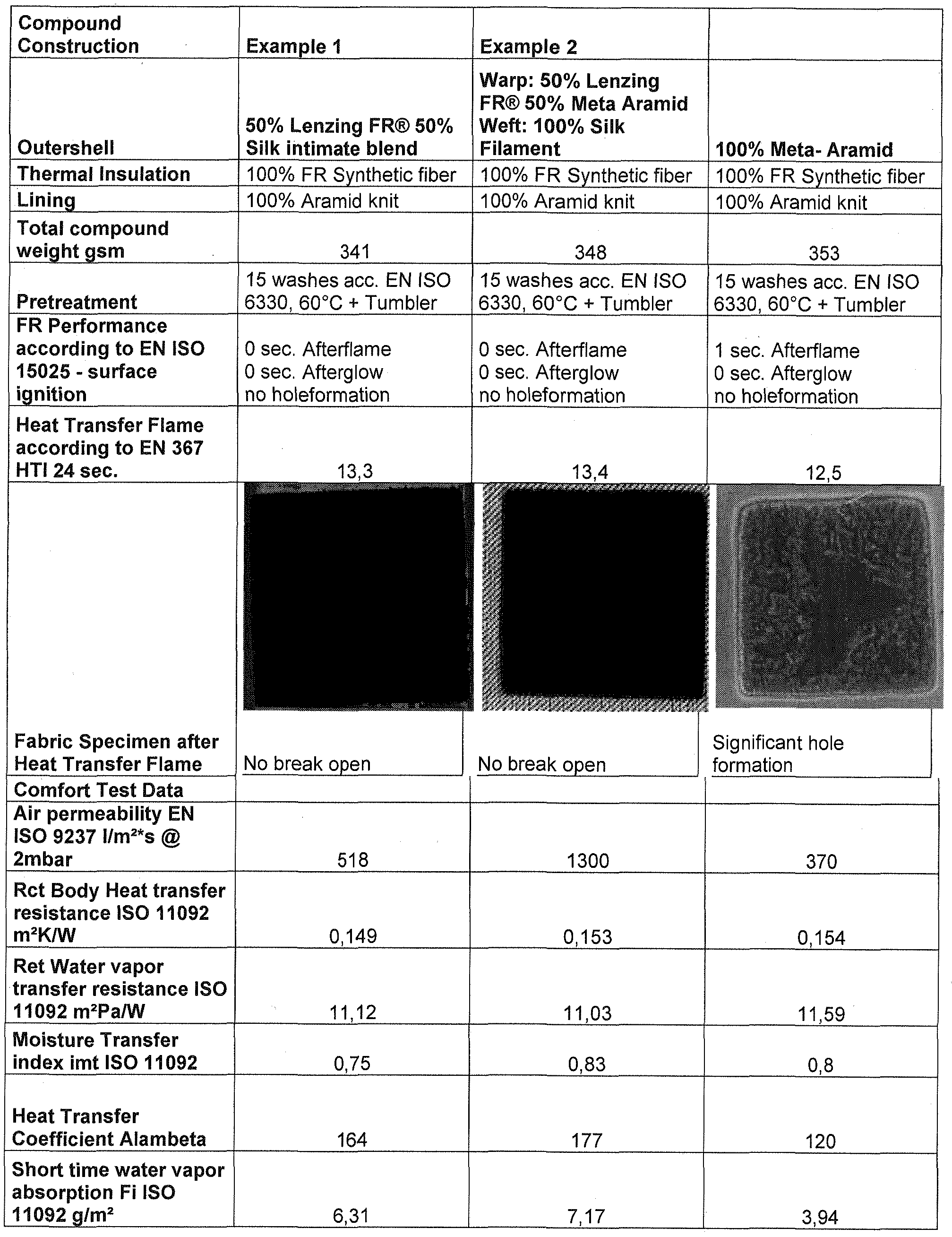
The fabrics from example 1 and 2 have been also tested in a full sandwich composite as it is used for motor sport protective garments. Table 2 shows the result in comparison with a 100% meta-aramid composite - the current bench mark for woven race wear fabrics. Each of the three full sandwich composites tested had the same thermal insulation layer and lining taken from the same lots of fabric. Only the outershell fabric was varied.
The fabrics of invention, example 1 and example 2 show superior protection performance though flammable silk fiber is used. The 100% aramid fabric showed significant hole formation, where as fabric from example 1 and example 2 did not break open during test.
Table 2 Fabric compound comparison results:
A twill weave fabric was woven from the following components:
Yarn: A Nm 38/2 spun yarn in which 50% of the fibre was 2,2 dtex 51 mm Lenzing FR®, 40% Mulberry Silk average length 50mm 1 1 -12,5 microns staple fiber and 10% of the fibre was high tenacity PA6. Lenzing FR® is an FR modal fibre available from Lenzing AG, Austria, which is produced according to a modal process (see AT-A 1371/2009) and which contains Exolith® as an incorporated FR pigment. The three fibre components were blended together in drafting of the slivers during preparatory processing. The resulting fabric had a mass per unit area of 360 g/m2
Flame protection:
The resulting fabric could not be ignited in normal atmospheric conditions. On exposure to flame directed at the surface of the fabric, the fabric charred but maintained its structure and continued to act as a barrier to flame. No holes were formed in the fabric after flame exposure according to EN ISO 15025 procedure A (surface ignition). Furthermore no heat shrinkage of the fabric was observed when the flame was directed at the fabric surface and during the whole flaming time of 10 seconds.
Afterflame and afterglow of the fabric when tested according to EN ISO 15025 procedure A were 0 seconds in the warp direction and 0 seconds in the weft direction.
Metal splash protection:
The fabric of the invention was tested according to ISO 9185 and
classification according to EN ISO 1 1612. Despite of it's relatively low fabric weight of 360 g/m2 the result was on the highest protection level which can be achieved: E3 (Iron Splash). For comparison: A typical fabric already used for iron metal splash protection has a fabric weight of 400 g/m2 and only shows a protection level E1 .
This test assesses the ability of the fabric to withstand a certain quantity of molten metal and how the metal interacts with the fabric. The best performing materials retain their structure and the metal does not adhere to the surface. Damage done to the fabric. is minimized. The fabric was also tested against codeletter D (Liquid Aluminium splash) and achieved also the highest ranking for aluminium metal splash protection D3.
Further more the fabric was subjected to the following other metal splash: Cryolite (Aluminum Bath), Brass, Lead, Zink, Steel, Copper, Magnesium, Gold and Silver.
It also performed outstandingly well, with no metal sticking on the fabric, no break open of the fabric, no damage on the skin simulant, which has been used straight under the fabric. Electric Arc protection:
The fabric of the invention was tested according to EN ISO IEC 61482 1 -2, 4kA and 7kA. The fabric passed with excellent values the required Stoll criteria for 4kA, and exhibited no break open of the fabric in a single layer, when tested to 7kA. The Stoll curve is a curve of thermal energy and time produced from data on human tissue tolerance to heat and used to predict the onset of second-degree burn injury (cited from EN ISO IEC 61482 1 -2).
Mechanical Performance testing:
The tear test results tested according to ISO 13937-2 were as follows compared to some of the other products currently used in personal protective clothing in table 3:
Table 3 - Fabric Performance Results

The fabric of the invention has a higher tear strength compared with most of the other materials on the market in similar weight.
Similar blends with PVA fiber instead or in addition to PA have been developed and tested showing also remarkable results for molten metal splash and electric arc protection.
Claims
1. A flame resistant fabric for use in personal protective clothing which provides a high level of protection from flames and other sources of heat, characterized in that it contains a first fibre component which is a flame resistant fibre and a second fibre component which is silk.
2. A flame resistant fabric according to claim 1 , wherein the flame
resistant fibres are inherently flame resistant fibres.
3. A flame resistant fabric according to claim 1 , wherein the flame
resistant fibres are flame resistant cellulosic fibres.
4. A flame resistant fabric according to claim 3, wherein the flame
resistant cellulosic fibres are chosen from the group consisting of FR Modal, FR viscose, FR Lyocell fibers and blends thereof.
5. A flame resistant fabric according to claim 1 , wherein the flame
resistant fibres are chosen from the group consisting of para-aramid, meta-aramid, aromatic PES, PBI, PVA, Modacryl and blends of these fibres.
6. A flame resistant fabric according to claim 1 , wherein the flame
resistant fibres are either staple fibres or filaments.
7. A flame resistant fabric according to claim 1 , wherein the silk is in the form of either staple fibres or filament.
8. A flame resistant fabric according to claim 1 , wherein the fabric
additionally contains a third fibre component which is a polymer fibre.
9. A flame resistant fabric according to claim 8, wherein the polymer fibre is a flame resistant synthetic polymer fibre, preferably chosen from the group consisting of para-aramid, meta-aramid, aromatic PES, PBI, Modacryl and blends of these fibres.
10. Fabric according to claim 8, wherein the polymer fibre is a non-FR cellulosic fibre, chosen from the group consisting of cotton, viscose, modal, lyocell, hemp, linen, jute, ramie and sisal.
1 1. A flame resistant fabric according to claim 1 , characterized in that its construction consists of a yarn which is an intimate blend containing the first fibre component and the second fibre component.
12. A flame resistant fabric according to claim 1 1 , characterized in that the yarn additionally contains the third fibre component.
13. A flame resistant fabric according to claim 1 , characterized in that its construction contains a first yarn consisting of the first fibre component and a second yarn which is 100% silk filament.
14. A flame resistant fabric according to claim , characterized in that its construction contains a first yarn which is an intimate blend of the first fibre component staple fibre and the third fibre component staple fibre and a second yarn which is 100% silk filament.
15. A flame resistant fabric according to claim 1 , characterized in that its construction contains a first yarn which is 100% first fibre component filament and a second yarn which is 100% silk filament.
16. Fabric according to claim 1 , characterized by a silk content of 10 to 50 weight-%.
17. Fabric according to claim 8, wherein the blend ratio is in the range of 10 to 50 weight-% flame resistant cellulosic fibres, 10 to 30 weight-% flame resistant polymer fibres and 0 to 50 weight-% silk staple fibres.
18. Fabric according to claim 1 , which has been made antistatic by the addition of 1 % to 5% of an antistatic staple fibre.
19. Fabric according to claim 1 , which has been made antistatic by
incorporating a grid pattern of yarns consisting of a ground yarn twisted with anti static continuous filament yarn.
20. Fabric according to claim 1 , wherein one or more of the individual fibre components has been dope dyed, or is stock dyed staple fibre or dyed tops, yarn or fabric [Flame resistant polymer fibres can be either dope dyed or dyed in flock or tops state].
21. Fabric according to Claims 1 , produced by weaving or knitting
technology.
22. Fabric according to Claims 1 , produced by a non woven fabric
production method.
Applications Claiming Priority (2)
| Application Number | Priority Date | Filing Date | Title |
|---|---|---|---|
| ATA818/2012A AT513219B1 (en) | 2012-07-23 | 2012-07-23 | Flame retardant textile fabric for protective clothing |
| ATA818/2012 | 2012-07-23 |
Publications (1)
| Publication Number | Publication Date |
|---|---|
| WO2014015351A1 true WO2014015351A1 (en) | 2014-01-30 |
Family
ID=48953292
Family Applications (1)
| Application Number | Title | Priority Date | Filing Date |
|---|---|---|---|
| PCT/AT2013/000106 Ceased WO2014015351A1 (en) | 2012-07-23 | 2013-06-27 | Flame resistant fabric for protective clothing |
Country Status (2)
| Country | Link |
|---|---|
| AT (1) | AT513219B1 (en) |
| WO (1) | WO2014015351A1 (en) |
Cited By (9)
| Publication number | Priority date | Publication date | Assignee | Title |
|---|---|---|---|---|
| CN104120536A (en) * | 2014-07-07 | 2014-10-29 | 西安工程大学 | Inflaming retarding comfortable fabric and preparing method thereof |
| EP3467171A1 (en) * | 2017-10-06 | 2019-04-10 | Lenzing Aktiengesellschaft | Lyocell filament denim |
| RU189219U1 (en) * | 2018-10-15 | 2019-05-16 | Общество с ограниченной ответственностью "Сезон" (ООО "Сезон") | KNITTING FIRE-, HEAT-RESISTANT FUTTING CLOTH "NETHOGON 400" |
| EP3747295A1 (en) * | 2020-01-21 | 2020-12-09 | Lenzing Aktiengesellschaft | Footwear that contains a lyocell continuous filament yarn |
| US20200398523A1 (en) * | 2019-06-20 | 2020-12-24 | Milliken & Company | Fire-resistant textile composite |
| CN115161827A (en) * | 2022-08-01 | 2022-10-11 | 优普泰(深圳)科技有限公司 | Yarn, fabric and garment for electric arc and flame protection |
| CN116411376A (en) * | 2023-04-04 | 2023-07-11 | 山东省产品质量检验研究院 | A kind of comfortable flame-retardant arc-proof fabric and its preparation method and application |
| US12091781B2 (en) | 2017-10-06 | 2024-09-17 | Lenzing Aktiengesellschaft | Silk-like woven garment containing or consisting of lyocell filaments |
| EP4534745A1 (en) * | 2014-08-29 | 2025-04-09 | Southern Mills, Inc. | Flame resistant fabrics having cellulosic filament yarns |
Citations (5)
| Publication number | Priority date | Publication date | Assignee | Title |
|---|---|---|---|---|
| US3913309A (en) * | 1970-03-17 | 1975-10-21 | Nereo Chiarotto | Fibrous composition of matter |
| US4950540A (en) * | 1987-10-28 | 1990-08-21 | The Dow Chemical Company | Method of improving the flame retarding and fire blocking characteristics of a fiber tow or yarn |
| US20010009832A1 (en) * | 1998-09-28 | 2001-07-26 | Shaffer Donald E. | Flame resistant fabrics |
| US20070077839A1 (en) * | 2005-04-28 | 2007-04-05 | Mckinnon Land Llc | Flame resistant matelasse fabrics |
| WO2007117052A1 (en) * | 2006-04-07 | 2007-10-18 | Duck Yeul Hwang | Flame-retarded composite spun yarn |
Family Cites Families (4)
| Publication number | Priority date | Publication date | Assignee | Title |
|---|---|---|---|---|
| DE10133787A1 (en) * | 2001-07-16 | 2003-02-06 | Basf Ag | Flame retardant textile fabrics |
| DE20321511U1 (en) * | 2003-12-22 | 2007-11-29 | W. L. Gore & Associates Gmbh | Material for protective clothing |
| WO2012040332A2 (en) * | 2010-09-23 | 2012-03-29 | Invista Technologies S.A R.L. | Flame retardant fibers, yarns, and fabrics made therefrom |
| AT510909B1 (en) * | 2010-12-20 | 2013-04-15 | Chemiefaser Lenzing Ag | FLAME-RESISTANT CELLULOSIC MAN-MADE FIBERS |
-
2012
- 2012-07-23 AT ATA818/2012A patent/AT513219B1/en not_active IP Right Cessation
-
2013
- 2013-06-27 WO PCT/AT2013/000106 patent/WO2014015351A1/en not_active Ceased
Patent Citations (5)
| Publication number | Priority date | Publication date | Assignee | Title |
|---|---|---|---|---|
| US3913309A (en) * | 1970-03-17 | 1975-10-21 | Nereo Chiarotto | Fibrous composition of matter |
| US4950540A (en) * | 1987-10-28 | 1990-08-21 | The Dow Chemical Company | Method of improving the flame retarding and fire blocking characteristics of a fiber tow or yarn |
| US20010009832A1 (en) * | 1998-09-28 | 2001-07-26 | Shaffer Donald E. | Flame resistant fabrics |
| US20070077839A1 (en) * | 2005-04-28 | 2007-04-05 | Mckinnon Land Llc | Flame resistant matelasse fabrics |
| WO2007117052A1 (en) * | 2006-04-07 | 2007-10-18 | Duck Yeul Hwang | Flame-retarded composite spun yarn |
Cited By (16)
| Publication number | Priority date | Publication date | Assignee | Title |
|---|---|---|---|---|
| CN104120536A (en) * | 2014-07-07 | 2014-10-29 | 西安工程大学 | Inflaming retarding comfortable fabric and preparing method thereof |
| EP4534745A1 (en) * | 2014-08-29 | 2025-04-09 | Southern Mills, Inc. | Flame resistant fabrics having cellulosic filament yarns |
| RU2753288C1 (en) * | 2017-10-06 | 2021-08-12 | Ленцинг Актиенгеселльшафт | Denim from lyocell fibres |
| US12091781B2 (en) | 2017-10-06 | 2024-09-17 | Lenzing Aktiengesellschaft | Silk-like woven garment containing or consisting of lyocell filaments |
| CN111183249A (en) * | 2017-10-06 | 2020-05-19 | 连津格股份公司 | Lyocell Filament Denim |
| AU2018345581B2 (en) * | 2017-10-06 | 2021-04-29 | Lenzing Aktiengesellschaft | Lyocell filament denim |
| WO2019068476A1 (en) * | 2017-10-06 | 2019-04-11 | Lenzing Aktiengesellschaft | Lyocell filament denim |
| CN111183249B (en) * | 2017-10-06 | 2025-05-13 | 连津格股份公司 | Lyocell filament denim |
| EP3467171A1 (en) * | 2017-10-06 | 2019-04-10 | Lenzing Aktiengesellschaft | Lyocell filament denim |
| RU189219U1 (en) * | 2018-10-15 | 2019-05-16 | Общество с ограниченной ответственностью "Сезон" (ООО "Сезон") | KNITTING FIRE-, HEAT-RESISTANT FUTTING CLOTH "NETHOGON 400" |
| US20200398523A1 (en) * | 2019-06-20 | 2020-12-24 | Milliken & Company | Fire-resistant textile composite |
| US11691379B2 (en) * | 2019-06-20 | 2023-07-04 | Milliken & Company | Fire-resistant textile composite |
| EP3747295A1 (en) * | 2020-01-21 | 2020-12-09 | Lenzing Aktiengesellschaft | Footwear that contains a lyocell continuous filament yarn |
| CN115161827A (en) * | 2022-08-01 | 2022-10-11 | 优普泰(深圳)科技有限公司 | Yarn, fabric and garment for electric arc and flame protection |
| CN116411376B (en) * | 2023-04-04 | 2024-03-22 | 山东省产品质量检验研究院 | Comfortable flame-retardant arc-preventing fabric and preparation method and application thereof |
| CN116411376A (en) * | 2023-04-04 | 2023-07-11 | 山东省产品质量检验研究院 | A kind of comfortable flame-retardant arc-proof fabric and its preparation method and application |
Also Published As
| Publication number | Publication date |
|---|---|
| AT513219B1 (en) | 2015-08-15 |
| AT513219A1 (en) | 2014-02-15 |
Similar Documents
| Publication | Publication Date | Title |
|---|---|---|
| EP2643508B1 (en) | Flame resistant fabric for protective clothing | |
| CN102666954B (en) | Flame Retardant Fabrics for Protective Clothing | |
| WO2014015351A1 (en) | Flame resistant fabric for protective clothing | |
| JP6282272B2 (en) | Fiber mix for heat-resistant properties and comfort | |
| JP6037405B2 (en) | Clothing items for thermal protection | |
| KR102041835B1 (en) | Fiber blends, yarns, fabrics, and garments for arc and flame protection | |
| US20150159304A1 (en) | Flame and heat resistant yarns and fabrics | |
| US20140187113A1 (en) | Fiber blends for dual hazard and comfort properties | |
| CN102859055A (en) | Crystallized meta-aramid blends for flash fire and arc protection having improved comfort | |
| KR20110033851A (en) | Crystallized meta-aramid blends for improved sudden fire and arc protection | |
| CA2953336A1 (en) | Lightweight, dual hazard fabrics | |
| KR20120031480A (en) | Crystallized meta-aramid blends for improved flash fire and superior arc protection | |
| AU2011282564A1 (en) | Fire resistant woven fabrics and garments | |
| JP2022520887A (en) | Flame-retardant fabric | |
| WO2014107750A1 (en) | Flame resistant fabric for protective clothing and upholstery applications and its use | |
| EP3245320A1 (en) | Flame resistant fabric | |
| CN112647174A (en) | Flame-retardant yarn, fabric, corresponding manufacturing method, finishing method and garment | |
| CN214300543U (en) | Flame-retardant yarn, corresponding flame-retardant fabric and garment | |
| CA3190203C (en) | Fabric material that is resistant to molten metals | |
| US12215442B2 (en) | Flame resistant fabric comprising a PTW fiber blend | |
| US20240035208A1 (en) | Thermal camouflage fabric with flame resistant properties |
Legal Events
| Date | Code | Title | Description |
|---|---|---|---|
| 121 | Ep: the epo has been informed by wipo that ep was designated in this application |
Ref document number: 13747776 Country of ref document: EP Kind code of ref document: A1 |
|
| NENP | Non-entry into the national phase |
Ref country code: DE |
|
| 122 | Ep: pct application non-entry in european phase |
Ref document number: 13747776 Country of ref document: EP Kind code of ref document: A1 |