WO2013176239A1 - 酸化オリゴ糖で架橋したゲル材料 - Google Patents
酸化オリゴ糖で架橋したゲル材料 Download PDFInfo
- Publication number
- WO2013176239A1 WO2013176239A1 PCT/JP2013/064433 JP2013064433W WO2013176239A1 WO 2013176239 A1 WO2013176239 A1 WO 2013176239A1 JP 2013064433 W JP2013064433 W JP 2013064433W WO 2013176239 A1 WO2013176239 A1 WO 2013176239A1
- Authority
- WO
- WIPO (PCT)
- Prior art keywords
- crosslinkable composition
- oligosaccharide
- oxide
- cells
- chitosan
- Prior art date
- Legal status (The legal status is an assumption and is not a legal conclusion. Google has not performed a legal analysis and makes no representation as to the accuracy of the status listed.)
- Ceased
Links
Images

Classifications
-
- A—HUMAN NECESSITIES
- A61—MEDICAL OR VETERINARY SCIENCE; HYGIENE
- A61L—METHODS OR APPARATUS FOR STERILISING MATERIALS OR OBJECTS IN GENERAL; DISINFECTION, STERILISATION OR DEODORISATION OF AIR; CHEMICAL ASPECTS OF BANDAGES, DRESSINGS, ABSORBENT PADS OR SURGICAL ARTICLES; MATERIALS FOR BANDAGES, DRESSINGS, ABSORBENT PADS OR SURGICAL ARTICLES
- A61L27/00—Materials for grafts or prostheses or for coating grafts or prostheses
- A61L27/36—Materials for grafts or prostheses or for coating grafts or prostheses containing ingredients of undetermined constitution or reaction products thereof, e.g. transplant tissue, natural bone, extracellular matrix
- A61L27/38—Materials for grafts or prostheses or for coating grafts or prostheses containing ingredients of undetermined constitution or reaction products thereof, e.g. transplant tissue, natural bone, extracellular matrix containing added animal cells
-
- A—HUMAN NECESSITIES
- A61—MEDICAL OR VETERINARY SCIENCE; HYGIENE
- A61L—METHODS OR APPARATUS FOR STERILISING MATERIALS OR OBJECTS IN GENERAL; DISINFECTION, STERILISATION OR DEODORISATION OF AIR; CHEMICAL ASPECTS OF BANDAGES, DRESSINGS, ABSORBENT PADS OR SURGICAL ARTICLES; MATERIALS FOR BANDAGES, DRESSINGS, ABSORBENT PADS OR SURGICAL ARTICLES
- A61L27/00—Materials for grafts or prostheses or for coating grafts or prostheses
- A61L27/14—Macromolecular materials
- A61L27/20—Polysaccharides
-
- A—HUMAN NECESSITIES
- A61—MEDICAL OR VETERINARY SCIENCE; HYGIENE
- A61L—METHODS OR APPARATUS FOR STERILISING MATERIALS OR OBJECTS IN GENERAL; DISINFECTION, STERILISATION OR DEODORISATION OF AIR; CHEMICAL ASPECTS OF BANDAGES, DRESSINGS, ABSORBENT PADS OR SURGICAL ARTICLES; MATERIALS FOR BANDAGES, DRESSINGS, ABSORBENT PADS OR SURGICAL ARTICLES
- A61L27/00—Materials for grafts or prostheses or for coating grafts or prostheses
- A61L27/50—Materials characterised by their function or physical properties, e.g. injectable or lubricating compositions, shape-memory materials, surface modified materials
- A61L27/52—Hydrogels or hydrocolloids
-
- A—HUMAN NECESSITIES
- A61—MEDICAL OR VETERINARY SCIENCE; HYGIENE
- A61L—METHODS OR APPARATUS FOR STERILISING MATERIALS OR OBJECTS IN GENERAL; DISINFECTION, STERILISATION OR DEODORISATION OF AIR; CHEMICAL ASPECTS OF BANDAGES, DRESSINGS, ABSORBENT PADS OR SURGICAL ARTICLES; MATERIALS FOR BANDAGES, DRESSINGS, ABSORBENT PADS OR SURGICAL ARTICLES
- A61L27/00—Materials for grafts or prostheses or for coating grafts or prostheses
- A61L27/50—Materials characterised by their function or physical properties, e.g. injectable or lubricating compositions, shape-memory materials, surface modified materials
- A61L27/58—Materials at least partially resorbable by the body
-
- C—CHEMISTRY; METALLURGY
- C08—ORGANIC MACROMOLECULAR COMPOUNDS; THEIR PREPARATION OR CHEMICAL WORKING-UP; COMPOSITIONS BASED THEREON
- C08B—POLYSACCHARIDES; DERIVATIVES THEREOF
- C08B15/00—Preparation of other cellulose derivatives or modified cellulose, e.g. complexes
- C08B15/005—Crosslinking of cellulose derivatives
-
- C—CHEMISTRY; METALLURGY
- C08—ORGANIC MACROMOLECULAR COMPOUNDS; THEIR PREPARATION OR CHEMICAL WORKING-UP; COMPOSITIONS BASED THEREON
- C08B—POLYSACCHARIDES; DERIVATIVES THEREOF
- C08B31/00—Preparation of derivatives of starch
- C08B31/003—Crosslinking of starch
- C08B31/006—Crosslinking of derivatives of starch
-
- C—CHEMISTRY; METALLURGY
- C08—ORGANIC MACROMOLECULAR COMPOUNDS; THEIR PREPARATION OR CHEMICAL WORKING-UP; COMPOSITIONS BASED THEREON
- C08B—POLYSACCHARIDES; DERIVATIVES THEREOF
- C08B37/00—Preparation of polysaccharides not provided for in groups C08B1/00 - C08B35/00; Derivatives thereof
- C08B37/0006—Homoglycans, i.e. polysaccharides having a main chain consisting of one single sugar, e.g. colominic acid
- C08B37/0009—Homoglycans, i.e. polysaccharides having a main chain consisting of one single sugar, e.g. colominic acid alpha-D-Glucans, e.g. polydextrose, alternan, glycogen; (alpha-1,4)(alpha-1,6)-D-Glucans; (alpha-1,3)(alpha-1,4)-D-Glucans, e.g. isolichenan or nigeran; (alpha-1,4)-D-Glucans; (alpha-1,3)-D-Glucans, e.g. pseudonigeran; Derivatives thereof
- C08B37/0018—Pullulan, i.e. (alpha-1,4)(alpha-1,6)-D-glucan; Derivatives thereof
-
- C—CHEMISTRY; METALLURGY
- C08—ORGANIC MACROMOLECULAR COMPOUNDS; THEIR PREPARATION OR CHEMICAL WORKING-UP; COMPOSITIONS BASED THEREON
- C08B—POLYSACCHARIDES; DERIVATIVES THEREOF
- C08B37/00—Preparation of polysaccharides not provided for in groups C08B1/00 - C08B35/00; Derivatives thereof
- C08B37/0006—Homoglycans, i.e. polysaccharides having a main chain consisting of one single sugar, e.g. colominic acid
- C08B37/0009—Homoglycans, i.e. polysaccharides having a main chain consisting of one single sugar, e.g. colominic acid alpha-D-Glucans, e.g. polydextrose, alternan, glycogen; (alpha-1,4)(alpha-1,6)-D-Glucans; (alpha-1,3)(alpha-1,4)-D-Glucans, e.g. isolichenan or nigeran; (alpha-1,4)-D-Glucans; (alpha-1,3)-D-Glucans, e.g. pseudonigeran; Derivatives thereof
- C08B37/0021—Dextran, i.e. (alpha-1,4)-D-glucan; Derivatives thereof, e.g. Sephadex, i.e. crosslinked dextran
-
- C—CHEMISTRY; METALLURGY
- C08—ORGANIC MACROMOLECULAR COMPOUNDS; THEIR PREPARATION OR CHEMICAL WORKING-UP; COMPOSITIONS BASED THEREON
- C08B—POLYSACCHARIDES; DERIVATIVES THEREOF
- C08B37/00—Preparation of polysaccharides not provided for in groups C08B1/00 - C08B35/00; Derivatives thereof
- C08B37/0006—Homoglycans, i.e. polysaccharides having a main chain consisting of one single sugar, e.g. colominic acid
- C08B37/0024—Homoglycans, i.e. polysaccharides having a main chain consisting of one single sugar, e.g. colominic acid beta-D-Glucans; (beta-1,3)-D-Glucans, e.g. paramylon, coriolan, sclerotan, pachyman, callose, scleroglucan, schizophyllan, laminaran, lentinan or curdlan; (beta-1,6)-D-Glucans, e.g. pustulan; (beta-1,4)-D-Glucans; (beta-1,3)(beta-1,4)-D-Glucans, e.g. lichenan; Derivatives thereof
- C08B37/0027—2-Acetamido-2-deoxy-beta-glucans; Derivatives thereof
- C08B37/003—Chitin, i.e. 2-acetamido-2-deoxy-(beta-1,4)-D-glucan or N-acetyl-beta-1,4-D-glucosamine; Chitosan, i.e. deacetylated product of chitin or (beta-1,4)-D-glucosamine; Derivatives thereof
-
- C—CHEMISTRY; METALLURGY
- C08—ORGANIC MACROMOLECULAR COMPOUNDS; THEIR PREPARATION OR CHEMICAL WORKING-UP; COMPOSITIONS BASED THEREON
- C08B—POLYSACCHARIDES; DERIVATIVES THEREOF
- C08B37/00—Preparation of polysaccharides not provided for in groups C08B1/00 - C08B35/00; Derivatives thereof
- C08B37/006—Heteroglycans, i.e. polysaccharides having more than one sugar residue in the main chain in either alternating or less regular sequence; Gellans; Succinoglycans; Arabinogalactans; Tragacanth or gum tragacanth or traganth from Astragalus; Gum Karaya from Sterculia urens; Gum Ghatti from Anogeissus latifolia; Derivatives thereof
- C08B37/0063—Glycosaminoglycans or mucopolysaccharides, e.g. keratan sulfate; Derivatives thereof, e.g. fucoidan
- C08B37/0069—Chondroitin-4-sulfate, i.e. chondroitin sulfate A; Dermatan sulfate, i.e. chondroitin sulfate B or beta-heparin; Chondroitin-6-sulfate, i.e. chondroitin sulfate C; Derivatives thereof
-
- C—CHEMISTRY; METALLURGY
- C08—ORGANIC MACROMOLECULAR COMPOUNDS; THEIR PREPARATION OR CHEMICAL WORKING-UP; COMPOSITIONS BASED THEREON
- C08B—POLYSACCHARIDES; DERIVATIVES THEREOF
- C08B37/00—Preparation of polysaccharides not provided for in groups C08B1/00 - C08B35/00; Derivatives thereof
- C08B37/006—Heteroglycans, i.e. polysaccharides having more than one sugar residue in the main chain in either alternating or less regular sequence; Gellans; Succinoglycans; Arabinogalactans; Tragacanth or gum tragacanth or traganth from Astragalus; Gum Karaya from Sterculia urens; Gum Ghatti from Anogeissus latifolia; Derivatives thereof
- C08B37/0063—Glycosaminoglycans or mucopolysaccharides, e.g. keratan sulfate; Derivatives thereof, e.g. fucoidan
- C08B37/0072—Hyaluronic acid, i.e. HA or hyaluronan; Derivatives thereof, e.g. crosslinked hyaluronic acid (hylan) or hyaluronates
-
- C—CHEMISTRY; METALLURGY
- C08—ORGANIC MACROMOLECULAR COMPOUNDS; THEIR PREPARATION OR CHEMICAL WORKING-UP; COMPOSITIONS BASED THEREON
- C08H—DERIVATIVES OF NATURAL MACROMOLECULAR COMPOUNDS
- C08H1/00—Macromolecular products derived from proteins
-
- C—CHEMISTRY; METALLURGY
- C08—ORGANIC MACROMOLECULAR COMPOUNDS; THEIR PREPARATION OR CHEMICAL WORKING-UP; COMPOSITIONS BASED THEREON
- C08H—DERIVATIVES OF NATURAL MACROMOLECULAR COMPOUNDS
- C08H1/00—Macromolecular products derived from proteins
- C08H1/06—Macromolecular products derived from proteins derived from horn, hoofs, hair, skin or leather
-
- C—CHEMISTRY; METALLURGY
- C08—ORGANIC MACROMOLECULAR COMPOUNDS; THEIR PREPARATION OR CHEMICAL WORKING-UP; COMPOSITIONS BASED THEREON
- C08L—COMPOSITIONS OF MACROMOLECULAR COMPOUNDS
- C08L1/00—Compositions of cellulose, modified cellulose or cellulose derivatives
- C08L1/08—Cellulose derivatives
-
- C—CHEMISTRY; METALLURGY
- C08—ORGANIC MACROMOLECULAR COMPOUNDS; THEIR PREPARATION OR CHEMICAL WORKING-UP; COMPOSITIONS BASED THEREON
- C08L—COMPOSITIONS OF MACROMOLECULAR COMPOUNDS
- C08L3/00—Compositions of starch, amylose or amylopectin or of their derivatives or degradation products
- C08L3/04—Starch derivatives, e.g. crosslinked derivatives
-
- C—CHEMISTRY; METALLURGY
- C08—ORGANIC MACROMOLECULAR COMPOUNDS; THEIR PREPARATION OR CHEMICAL WORKING-UP; COMPOSITIONS BASED THEREON
- C08L—COMPOSITIONS OF MACROMOLECULAR COMPOUNDS
- C08L5/00—Compositions of polysaccharides or of their derivatives not provided for in groups C08L1/00 or C08L3/00
-
- C—CHEMISTRY; METALLURGY
- C08—ORGANIC MACROMOLECULAR COMPOUNDS; THEIR PREPARATION OR CHEMICAL WORKING-UP; COMPOSITIONS BASED THEREON
- C08L—COMPOSITIONS OF MACROMOLECULAR COMPOUNDS
- C08L5/00—Compositions of polysaccharides or of their derivatives not provided for in groups C08L1/00 or C08L3/00
- C08L5/02—Dextran; Derivatives thereof
-
- C—CHEMISTRY; METALLURGY
- C08—ORGANIC MACROMOLECULAR COMPOUNDS; THEIR PREPARATION OR CHEMICAL WORKING-UP; COMPOSITIONS BASED THEREON
- C08L—COMPOSITIONS OF MACROMOLECULAR COMPOUNDS
- C08L5/00—Compositions of polysaccharides or of their derivatives not provided for in groups C08L1/00 or C08L3/00
- C08L5/08—Chitin; Chondroitin sulfate; Hyaluronic acid; Derivatives thereof
-
- C—CHEMISTRY; METALLURGY
- C08—ORGANIC MACROMOLECULAR COMPOUNDS; THEIR PREPARATION OR CHEMICAL WORKING-UP; COMPOSITIONS BASED THEREON
- C08L—COMPOSITIONS OF MACROMOLECULAR COMPOUNDS
- C08L89/00—Compositions of proteins; Compositions of derivatives thereof
-
- C—CHEMISTRY; METALLURGY
- C08—ORGANIC MACROMOLECULAR COMPOUNDS; THEIR PREPARATION OR CHEMICAL WORKING-UP; COMPOSITIONS BASED THEREON
- C08L—COMPOSITIONS OF MACROMOLECULAR COMPOUNDS
- C08L89/00—Compositions of proteins; Compositions of derivatives thereof
- C08L89/04—Products derived from waste materials, e.g. horn, hoof or hair
- C08L89/06—Products derived from waste materials, e.g. horn, hoof or hair derived from leather or skin, e.g. gelatin
-
- C—CHEMISTRY; METALLURGY
- C12—BIOCHEMISTRY; BEER; SPIRITS; WINE; VINEGAR; MICROBIOLOGY; ENZYMOLOGY; MUTATION OR GENETIC ENGINEERING
- C12N—MICROORGANISMS OR ENZYMES; COMPOSITIONS THEREOF; PROPAGATING, PRESERVING, OR MAINTAINING MICROORGANISMS; MUTATION OR GENETIC ENGINEERING; CULTURE MEDIA
- C12N5/00—Undifferentiated human, animal or plant cells, e.g. cell lines; Tissues; Cultivation or maintenance thereof; Culture media therefor
- C12N5/0068—General culture methods using substrates
-
- C—CHEMISTRY; METALLURGY
- C12—BIOCHEMISTRY; BEER; SPIRITS; WINE; VINEGAR; MICROBIOLOGY; ENZYMOLOGY; MUTATION OR GENETIC ENGINEERING
- C12N—MICROORGANISMS OR ENZYMES; COMPOSITIONS THEREOF; PROPAGATING, PRESERVING, OR MAINTAINING MICROORGANISMS; MUTATION OR GENETIC ENGINEERING; CULTURE MEDIA
- C12N2533/00—Supports or coatings for cell culture, characterised by material
- C12N2533/70—Polysaccharides
- C12N2533/78—Cellulose
Definitions
- the present invention relates to a gel material cross-linked with an oligosaccharide oxide, a cross-linking agent composed of an oligosaccharide oxide used for the preparation of the gel material, a cell culture system and a transplant system using the gel material.
- Non-patent Document 1 a technique for culturing and stacking cells on a cell sheet.
- Non-patent Document 1 a technique for culturing and stacking cells on a cell sheet.
- Non-patent Document 1 a technique for culturing and stacking cells on a cell sheet.
- the exchange of oxygen and substances by passive diffusion is limited to several hundred microns, so even if a large regenerated tissue can be created, if the vascular system is not introduced, the regenerated tissue Even if transplanted to the host, the center is necrotic.
- Spheroids have attracted attention as microregenerative tissue units.
- Spheroids are those in which a large number of cells aggregate to form a spherical mass, and spheroid culture can maintain the function of cells for a long period of time compared to conventional monolayer culture, and can be said to be a culture method closer to a living body. Therefore, a technique for transplanting spheroids to a host, inducing (organizing) blood vessels to the spheroids, and constructing the organized spheroids three-dimensionally (Patent Document 1, Non-Patent Documents 4 to 5) has been studied.
- angiogenesis cannot be successfully induced because there is no support for maintaining the stretch and structure of blood vessels around the spheroids. Therefore, a scaffold material that induces angiogenesis is required.
- the present invention is a scaffold for constructing a large regenerative tissue. (1) It has a high cell affinity, (2) it has a stable structure even in a physiological environment, and (3) it is rapidly produced after transplantation. (4) can be stably carried inside without leaking the blood vessel inducing factor, and (5) has transparency enough to observe the state of cells cultured in the gel over time, ( 6) It aims at providing the material which has the characteristics which can adjust the intensity
- the present inventors have conceived that collagen is prevented from forming an aggregate by forming a chemical crosslink in order to stably maintain a collagen gel under conditions suitable for cell culture.
- water-soluble carbodiimide, glutaraldehyde, and the like are known as water-soluble cross-linking agents that form chemical cross-links.
- it is not appropriate to use these because of problems of irritation to cells and toxicity.
- a colorless and transparent gel can be obtained when an oligosaccharide oxide is used as a crosslinking agent.
- an oxidation reaction in an aqueous system is preferable because the solubility of oligosaccharides in an organic solvent is low, and in the oxidation reaction using lead tetraacetate, the toxicity of residual lead has been a concern. Accordingly, the present inventors have established a technique that allows an iodine compound to be easily removed by selecting an oxidation reaction with periodic acid and adding an alcohol after the oxidation reaction.
- the present invention (1) a crosslinkable composition comprising an oligosaccharide oxide having an aldehyde group and a polypeptide or polysaccharide having an amino group in the side chain; (2) The crosslinkable composition according to (1), wherein the oligosaccharide oxide is generated from periodate oxidation of an oligosaccharide, (3) The crosslinkable composition according to (1) or (2), wherein the polypeptide is selected from collagen, atelocollagen, gelatin, derivatives thereof or mixtures thereof, (4) The polysaccharide is deacetylated chitin or chitosan, succinylated chitosan, glycerylated chitosan, carboxymethylated chitosan, hydroxybutyl-hydroxypropylated chitosan, aminated dextran, aminated starch, aminoalkylated pullulan, amino The crosslinkable composition according to (1) or (2), which is selected from hydrogenated hyaluronic
- (6) A crosslinked product obtained from the crosslinkable composition according to any one of (1) to (5), (7) The crosslinked product according to (6), wherein an aldehyde group of the oligosaccharide oxide and an amino group of the polypeptide or polysaccharide are covalently bonded, (8) The crosslinked product according to (6) or (7), which is in a gelled state, (9) The cross-linked product according to any one of (6) to (8), which contains an angiogenic factor, (10) The crosslinked body according to any one of (6) to (9), comprising a cell or a cell tissue, (11) The crosslinked product according to (10), which contains a cell culture medium, (12) A cell culture system using the cross-linked product according to any one of (6) to (11), (13) A system for transplanting the crosslinked body according to any one of (6) to (11) into the body of a subject, (14) A system for transplanting cultured cells obtained by the cell culture system according to (12) into the body of a subject, (15) (
- a polysaccharide having an amino group in the side chain is deacetylated chitin or chitosan, succinylated chitosan, glycerylated chitosan, carboxymethylated chitosan, hydroxybutyl-hydroxypropylated chitosan, aminated dextran, aminated starch,
- Polysaccharides with amino groups in the side chains such as collagen or polysaccharides with amino groups such as chitosan derivatives are chemically cross-linked with oligosaccharide oxides to suppress the formation of aggregates and prepare transparent and uniform gels It became possible to do.
- a transparent and uniform gel allows easy observation of cells and progresses promptly with no degradation in vivo.
- chemical cross-linking limits and suppresses structural changes such as gel shrinkage, swelling, and dissolution under physiological conditions, and maintains an appropriate cross-link density that provides sufficient strength and decomposition rate as a cell scaffolding material. be able to.
- oligosaccharide oxides are less irritating and toxic than lower aldehydes, and are safe crosslinking agents for cells and as a transplant material.
- the aldehyde group of the oligosaccharide oxide can carry angiogenic factors and the like by covalent bonds.
- a carboxylic acid generated by oxidation of an aldehyde can also carry a basic factor such as bFGF by electrostatic interaction. Therefore, since the gel material of the present invention hardly releases angiogenic factors or the like outside in a living body, it becomes possible to induce angiogenesis efficiently.
- Crosslinking agent One form of this invention is a crosslinking agent which consists of an oligosaccharide oxide which has an aldehyde group.
- oligosaccharide refers to a compound having a molecular weight of about 300 to 3,000 among compounds in which monosaccharides are bonded by a glycosidic bond.
- examples of oligosaccharides that can be used in the present invention include disaccharides such as sucrose, lactose, maltose, trehalose, turanose, and cellobiose; trisaccharides such as raffinose, panose, maltotriose, melezitose, and gentianose; Cyclic dextrins such as cyclodextrin and cycloawaodoline, etc .; fructooligosaccharides and galactooligosaccharides that are monosaccharide polymers; mannan oligosaccharides and xylooligosaccharides as degradation products of polysaccharides; Extract; selected from the group consisting of these derivatives and mixtures of two or more thereof.
- the oligosaccharide oxide having an aldehyde group refers to one in which the vicinal diol group of the oligosaccharide is partially dissociated and oxidized to an aldehyde group.
- an oligosaccharide having a vicinal diol group oxidized to an aldehyde group can be obtained by various methods.
- an oligosaccharide oxide having an aldehyde group an oligosaccharide periodate is used as an oligosaccharide oxide having an aldehyde group.
- an oxide generated from oxidation is particularly preferred.
- a method for producing oligosaccharide by periodate oxidation will be described.
- Oligosaccharide is dissolved in a basic aqueous solution such as water or sodium hydroxide solution, and periodate oxidation reaction of oligosaccharide is performed by adding sodium periodate under ice cooling.
- the pH of the reaction solution is preferably 7 or less, particularly preferably around 5-6.
- the ratio of sodium periodate to oligosaccharide sugar units is preferably 1: 2 or less.
- the reaction solvent for example, various solvents such as water, water / ethanol mixed solvent, water / DMF mixed solvent and the like can be used, but water is preferably used.
- the reaction time is appropriately determined depending on the type of sugar, but it can usually be carried out in 5 minutes to 96 hours, particularly preferably 1 to 60 hours.
- a polar solvent is added to precipitate and remove the iodine compound.
- the polar solvent is preferably a low boiling point solvent because it must be removed under reduced pressure during the preparation of the oligosaccharide oxide.
- the cross-linking agent comprising an oligosaccharide oxide having an aldehyde group of the present invention can be suitably used for a cross-linking reaction with a polypeptide or polysaccharide having an amino group in the side chain as described later.
- Crosslinkable composition Another form of the present invention is a crosslinkable composition comprising a crosslinking agent comprising an oligosaccharide oxide having an aldehyde group and a polypeptide or polysaccharide having an amino group in the side chain.
- Non-limiting examples of polypeptides having an amino group in the side chain include naturally occurring polypeptides, artificially synthesized polypeptides that mimic or improve their functions, genetically modified proteins, and the like.
- Naturally-derived polypeptides include silkworm-derived fibroin, sericin, and the like, and naturally-derived extracellular matrix components such as collagen, atelocollagen, gelatin, proteoglycan, fibronectin, laminin, elastin, entactin and their derivatives. It is done.
- Artificially synthesized polypeptides and genetically engineered proteins include, but are not limited to, dehydrated condensates of oligopeptides such as Poly (PHG), Poly (PHG / QGIA), Poly (PHG / RGD), Poly (PHG / YIGSR / IKVAV) And the like, such as “Pronectin F” and “Pronectin L” manufactured by Sanyo Chemical Industries, “RetroNectin” manufactured by Takara Shuzo, and the like.
- the polypeptide having an amino group in the side chain is preferably collagen, atelocollagen, gelatin, fibronectin, Poly (PHG / RGD), derivatives thereof, or a mixture thereof, more preferably collagen, atelocollagen.
- Gelatin, fibronectin, derivatives thereof and mixtures thereof are particularly preferred.
- Collagen is one of the proteins that make up the dermis, ligaments, tendons, bones, cartilage, etc., and is the element that makes up the extracellular matrix.
- the peptide chain of collagen protein has a primary structure “-(glycine)-(amino acid X)-(amino acid Y)-” and glycine repeats every three residues. In many types of collagen, three of these peptide chains gather to form a helical structure and are called tropocollagen.
- one peptide chain of type I collagen has a sequence that repeats 1014 amino acid residues and has a molecular weight of about 100,000. It is known that there are more than 30 types of human collagen.
- type I collagen is the main component in dermis, ligaments, tendons, bones, etc.
- type II collagen is the main component in articular cartilage.
- type IV collagen is mainly contained in the basement membrane which is the lining structure of all epithelial tissues. The most abundant in the body is type I collagen.
- collagen Preferably it is soluble collagen. More preferred is collagen that is soluble in water.
- the collagen may be peptided collagen (collagen fragment).
- Atelocollagen is collagen obtained by removing telopeptides present at both ends of collagen molecules by enzymatic treatment, and is soluble in water. Atelocollagen may be peptideized.
- Gelatin means the collagen extracted into water by heating with water for a long time.
- the gelatin may be peptideized.
- the peptide of gelatin is the same as that of collagen.
- Gelatin is a heat-denatured substance of collagen, so its amino acid composition is almost the same as collagen. Although it depends on the origin, there are about 12% acidic groups, and about one third of them are amidated.
- Gelatin includes acid-treated gelatin, alkali-treated gelatin, and the like depending on the pretreatment step of water extraction. Acid-treated gelatin is treated with inorganic acids such as hydrochloric acid and sulfuric acid for several tens of hours to several days, and the deamidation rate is low, whereas alkali-treated gelatin is almost 100% deamidated in the limestone process for 2 to 3 months. Has been.
- the polypeptide having an amino group in the side chain is preferably selected from collagen, atelocollagen, gelatin, derivatives thereof or a mixture thereof.
- the polysaccharide is a sugar in which a monosaccharide molecule is polymerized by glycosidic bonds.
- the polysaccharide having an amino group in the side chain in the present invention include deacetylated chitin and chitosan (eg, Daichitosan VL manufactured by Dainichi Seika), succinylated chitosan, glycerylated chitosan, carboxymethylated chitosan, hydroxybutyl-hydroxy
- Examples include chitosan derivatives such as propylated chitosan, derivatives of natural and semi-artificial polysaccharides such as aminated dextran, aminated starch, aminoalkylated pullulan, aminated hyaluronic acid, aminated chondroitin sulfate, and aminated cellulose.
- the concentration of the polypeptide or polysaccharide or oligosaccharide oxide having an amino group in the side chain depends on the type thereof, taking into account the reactivity or viscosity of the composition solution. It can be set appropriately.
- the concentration is preferably 0.3% or more, and in the case of gelatin, the concentration is preferably 5% or more.
- the concentration of the oligosaccharide oxide is usually 0.01% or more, preferably 0.05% or more in the case of raffinose oxide, for example.
- the crosslinkable composition of the present invention includes other additives such as a crosslinking agent, a reaction accelerator, a retarder, a dispersant (anti-aggregation agent), and a reinforcing material (fiber, filament, whisker, particle, microgel). , Droplets and the like can be contained.
- Crosslinked body The further form of this invention is a crosslinked body obtained from the said crosslinkable composition.
- the cross-linked product of the present invention refers to an oligosaccharide oxide-polypeptide complex in which an aldehyde group of an oligosaccharide oxide and an amino group of a polypeptide or polysaccharide are covalently bonded (-polypeptide-oligosaccharide oxide-poly Peptide-) and oligosaccharide oxide-polysaccharide complex (polysaccharide-oligosaccharide oxide-polysaccharide).
- the covalent bond between the oligosaccharide oxide and the polypeptide is usually a covalent bond between the aldehyde group of the oligosaccharide oxide and the amino group of the side chain of the polypeptide, and the amino group of the oligosaccharide oxide and the polypeptide. It consists of a mixture of covalent bonds of the terminal amino group, but it may consist only of a covalent bond between the aldehyde group of the oligosaccharide oxide and the amino group of the side chain of the polypeptide, or it may consist of the aldehyde group and the polysaccharide of the oligosaccharide oxide. It may consist only of a covalent bond of the amino group at the amino terminus of the peptide.
- the covalent bond between the aldehyde group of the oligosaccharide oxide and the amino group of the polypeptide or polysaccharide means that the covalent bond between the aldehyde group of the oligosaccharide oxide and the amino group of the polypeptide or polysaccharide is present in the crosslinked product. It means that there is at least one.
- the crosslinked product preferably contains an aldehyde group of an oligosaccharide oxide that does not participate in a covalent bond and an amino group of a polypeptide or a polysaccharide.
- a functional group for interacting with these physiologically active substances may be required.
- bFGF whose charge is positively biased has an electrostatic interaction with the aldehyde group of the oligosaccharide oxide.
- the side chain structure of the polypeptide is destroyed by the formation of a covalent bond between the aldehyde group of the oligosaccharide oxide and the amino group of the polypeptide or polysaccharide. It is desirable to minimize structural changes.
- a preferred embodiment of the present invention is a state where the crosslinked body is gelled (hereinafter also simply referred to as “gel”).
- the gel means that the fluidity is lost in the crosslinked body (crosslinkable composition).
- the cross-linked product in the present invention refers to an oligosaccharide oxide-polypeptide complex, or an aldehyde group of an oligosaccharide oxide and a multi-valent compound by covalently bonding an aldehyde group of an oligosaccharide oxide and an amino group of a polypeptide.
- the saccharide amino group is covalently bonded to form an oligosaccharide oxide-polysaccharide complex, and the crosslinked product of the present invention includes a case where it is not gelled.
- the crosslinkable composition By making the crosslinkable composition into a gel, it is possible to obtain a large regenerative tissue scaffolding material having a stable structure, which is particularly preferable.
- the crosslinked body of the present invention can contain a physiologically active substance.
- physiologically active substances include growth factors and cytokines, antibodies and the like.
- growth factors and cytokines include vascular endothelial growth factor (VEGF), acidic fibroblast growth factor (a-FGF), basic fibroblast growth factor.
- Base fibroblast growth factor b-FGF
- platelet-derived endothelial cell growth factor PD-ECGF
- transforming growth factor transforming growth factor, TGF- ⁇ , TGF- ⁇
- tumor Necrosis factor angiogenin tumor necrosis factor- ⁇ , TNF- ⁇
- HGF hepatocyte growth factor
- GM-CSF granulocyte / macrophage-colony stimulating factor
- insulin Insulin-like growth factor (IGF-I, IGF-II), Ellis Lopoietin (EPO), thrombopoietin (TPO), epidermal growth factor (EGF), heparin binding growth factor (hbgf), nerve growth factor (NGF), muscle formation factor (Muscle morphogenic factor: MMF), bone morphogenetic protein (BMP) and the like.
- Non-limiting examples of antibodies include antibodies that can stimulate cells such as anti-CD3 antibodies and anti-CD28 antibodies.
- basic fibroblast growth factor b-FGF
- VEGF vascular endothelial growth factor
- PD-ECGF platelet-derived endothelial cell growth factor
- HGF hepatocyte growth factor
- GM-CSF granulocyte / macrophage-colony stimulating factor
- the physiologically active substance may be a cell that secretes a physiologically active substance.
- the crosslinked body of this invention can contain a cell.
- the cell type is not limited, but preferably chondrocytes; fibrochondrocytes; bone cells; osteoblasts; osteoclasts; synovial cells; bone marrow cells; mesenchymal cells; Peripheral blood progenitor cells; insulin-producing cells; antibody-producing cells such as B cells or hybridomas; hormone-producing cells; mast cells; chemotransmitter-producing cells (immune cells); genetically modified cells; stem cells (ES cells, EG cells) , IPS cells, and adult (tissue) stem cells); cells that produce bioactive factors of the liver, nerves, thyroid, thymus, adrenal medulla, adrenal cortex, kidney or gastrointestinal tract; and combinations of these cells with other cells Is mentioned.
- the cells may be in aggregated form (spheroids etc.) or part of tissue.
- the origin of the cells is not limited, but preferably mammals, more preferably pets such as dogs and cats; humans; livestock animals such as cows, pigs, horses, sheep, goats; monkeys, rabbits, mice, rats And the like, particularly preferably humans.
- the cells are preferably derived from a transplant subject.
- the crosslinked body of this invention can contain a culture solution further.
- the type of the culture solution is variously prepared depending on the type, state, and purpose of the cell. Examples include, but are not limited to, pure water, physiological saline, and body fluid of the host.
- the crosslinked product of the present invention can be produced by preparing a crosslinkable composition containing an oligosaccharide oxide having an aldehyde group and a polypeptide or polysaccharide having an amino group in the side chain, and allowing the crosslinking reaction to proceed. it can. Specifically, a phosphate buffer solution of a polypeptide or polysaccharide having an amino group in the side chain is prepared, pH is adjusted, and an oligosaccharide oxide having an aldehyde group is added thereto to obtain a crosslinkable composition. The reaction is allowed to proceed with stirring for a predetermined time. If the stirring is continued, the solution thickens, and if the stirring is further performed, the fluidity is lost and a gel can be formed.
- the chemical bonding reaction between the aldehyde group of the oligosaccharide oxide and the amino group of the polypeptide or polysaccharide is considered to be significantly accelerated under alkaline conditions. It is adjusted to 7.0 or more, more preferably 7.6 or more.
- the reaction temperature can be set according to the type of polypeptide used, but the higher the reaction temperature, the shorter the gelation time.
- the concentration of the oligosaccharide oxide can be set according to the type of polypeptide used, etc., but the gelation time can be shortened as the concentration of the oligosaccharide oxide increases.
- Cell culture system The further form of this invention is related with the cell culture system using the bridge
- an oligosaccharide oxide having an aldehyde group and a polypeptide or polysaccharide having an amino group in the side chain are mixed to prepare a crosslinkable composition, its pH is adjusted, and a gel is prepared. Progress. Then, before the gelation progresses, during the progress, and at any time after the completion, the cells and the culture solution are added to culture the cells.
- the cells when the crosslinkable composition is thickened, the cells are added to and mixed with this, and the cell mixture is injected into a petri dish or the like, and left to stand for a predetermined temperature and time for gelation.
- the cells can be cultured by coating a disc-shaped gel having a predetermined thickness and diameter with a culture solution.
- spheroids obtained by seeding cells in a separate step and culturing for a predetermined period are added and mixed, and allowed to stand at a predetermined temperature and time.
- the cells can be cultured by coating a disc-shaped gel having a predetermined thickness and diameter with a culture solution.
- Examples of the culture solution include pure water, physiological saline, phosphate buffer, Eagle basal medium (Basal Medium Eagle: BME), Dulbecco's Modified eagle's Medium: DMEM, DMEM: F12 medium, Glasgow Minimum Essential Medium (GMEM), Grace's Insect Medium, Ham's Medium, Iscove's Dulbecco's Medium : IMDM), L-15 (Leibovitz) medium (L-15 (Leibovitz) Medium), McCoy's 5A medium (Mc oy's 5A Medium, Minimum Essential Medium-Eagle (MEM Eagle / E-MEM), 199 Medium (Medium 199), NCTC-109 Medium (NCTC-109 Medium), Richter CM (Richter's CM), RPMI 1640 Medium (RPMI 1640 Medium), insect medium, Weymouth's Medium, William's Medium, body fluid, and the like, but are not limited thereto.
- Basal Medium Eagle: BME Eagle basal medium
- the cells, spheroids, and cell culture solution described above can be used.
- the aforementioned physiologically active substance can be appropriately added to the gel.
- a reinforcing material can be contained in a gel.
- a flow system can be incorporated that injects the culture medium into the gel as described in the implantation system below.
- the cell culture system of the present invention is highly transparent and suitable for cell observation. Therefore, in addition to the components and factors necessary for cell growth assuming transplantation, it is also possible to add other drugs that affect the behavior of cells (good or bad influence) into the gel.
- the gel of the present invention can exhibit a function as a drug carrier.
- Transplantation system A further aspect of the present invention is a system and method for transplanting the crosslinked body of the present invention or the cultured cells obtained by the cell culture system of the present invention into the body.
- cells or tissue are encapsulated in a gel formed from a crosslinkable composition containing an oligosaccharide oxide having an aldehyde group and a polypeptide or polysaccharide having an amino group in the side chain. It is a transplant material for constructing a regenerative tissue that is buried and used to be transplanted into the body of a subject.
- a cross-linked body containing cells a cross-linked body containing cell tissues such as spheroids (for example, a spheroid surrounded by a cross-linked body that is a scaffold material), a plurality of cell tissues
- a cross-linked body encapsulated for example, a plurality of cellular tissues covered with a cross-linked body in a two-dimensional or three-dimensional manner
- a cross-linked body not containing cells can be transplanted into a host mother bed.
- the cross-linked body used in the transplantation system of the present invention has a matrix structure with appropriate gaps, and can maintain a stable structure in vivo because of its good adhesion to vascular wall constituent cells, Since it is decomposed by angiogenic protease, a space for blood vessel growth can be secured, and angiogenesis can be efficiently induced.
- the crosslinked body preferably contains an angiogenic factor, and particularly preferably bound to a polypeptide in the crosslinked body.
- the blood vessel can be induced inside the crosslinked body without releasing the angiogenic factor outside the crosslinked body.
- the transplant system of this invention can also be equipped with the means to supply a culture solution from the exterior to the bridge
- the culture solution can be injected under pressure into the center (in some cases, a plurality of points) of the gel by a pump or the like.
- the transplanted cultured cells will express the function for a long time in the human body and become an artificial organ as it is.
- the expression level of the function can be controlled by the size and shape of the cultured cells, or both.
- hepatocytes are used as cultured cells, it shows a role as an artificial liver, such as liver enzyme deficiency, hemophilia, coagulopathy, liver failure, fulminant hepatitis, chronic hepatitis, cirrhosis, treatment of patients with hepatectomy, It is used for the essential treatment of each disease mentioned in infectious diseases, etc., or for the purpose of assisting liver function.
- transplanted tissues include liver, heart, vascular tissue, kidney, lung, pancreas (islet), gastrointestinal tissue, eye (cornea), brain, nerve tissue, bone marrow, bone, tooth, cartilage, and skin. (Hair) and muscles.
- the transplant system of the present invention becomes a cultured cell transplant animal.
- the expression level of the function can be controlled by the size and shape of the cultured cells.
- animals used herein include rats, mice, guinea pigs, marmosets, rabbits, dogs, pigs, chimpanzees, and immunodeficient animals thereof, but are not particularly limited.
- Such an islet transplanted animal is used for the purpose of, for example, a pancreatic function evaluation system in which a test substance is administered to the pancreatic islet transplanted animal and the influence of the test substance on pancreatic function is determined. Is not to be done.
- Example 1 A 0.8% atelocollagen (Nitta gelatin, collagen BM, derived from pig, Type-I) phosphate buffer solution (pH 7.6) was prepared on gelled ice (4 ° C.) of the collagen solution. This solution was dispensed into an Eppendorf tube in an amount of 0.3 mL, 0.08 mL of the aqueous solution of sugar oxide (3%) prepared in the conditions (1) and (2) of Synthesis Examples 1 to 5 was added, and stirred. Allowed to stand at ° C. Periodically, the solution was contacted with a glass rod, and the time required from the addition of oxidized sugar to the loss of fluidity was defined as the gel time. For comparison, an experiment was also performed on sugars that had not been subjected to periodate oxidation treatment.
- the collagen solution prepared at a neutral pH is fibrillated and gelled due to the influence of hydrophobic interaction and the like as the temperature rises.
- the collagen solution to which raffinose was added turned into a fibrillated and white turbid gel at about 20 minutes at 37 ° C.
- raffinose oxide was added to the collagen solution, fibrosis was not observed even at 37 ° C., and gelled in about 1 hour while being colorless and transparent. This is probably because the cross-linking of collagen molecules with raffinose oxide limited the association / aggregation of collagens, so that fibrosis was suppressed and a colorless and transparent gel was obtained.
- the preparation temperature was 4 ° C.
- the gelation time was as slow as 7 hours, and as the temperature increased, the gelation time tended to be shortened.
- Example 2 Gelation of gelatin solution (1) Gelation of porcine-derived gelatin with sugar oxide An aqueous solution of gelatin (077-03155 manufactured by Wako Pure Chemical Industries, Ltd., derived from pig) was prepared at 40 ° C., and a phosphate buffer solution was added, and finally 15% A gelatin solution (pH 7.6) was prepared. To 0.3 mL of this solution, 0.06 mL of a 3% sugar oxide aqueous solution was added and stirred, and allowed to stand at 40 ° C.
- porcine-derived gelatin forms a reversible physical gel at room temperature
- the gel preparation test was performed at 40 ° C. when the gelatin solution melts. Gelation was observed when raffinose oxide and sucrose oxide were added, but no gelation was observed with glucose oxide, maltose oxide, or flucotose oxide. At 40 ° C., it is expected that the thermal degradation of collagen and the cross-linking reaction by sugar oxide proceed at the same time. Therefore, it is considered that a quick cross-linking reaction is necessary to prepare the gel. Although all of the above sugar oxides are considered to form a crosslinked structure, raffinose oxide and sucrose oxide were recognized to have an ability to gel efficiently.
- Example 3 Cell culture test At 4 ° C., 0.8% atelocollagen (Nitta gelatin, collagen BM) phosphate buffer solution (pH 7.6, 1 mL) and 3% oxidized raffinose aqueous solution (oxidation conditions of Synthesis Example 1 (1)) (0. 2 mL) was added and stirred. This mixed solution was allowed to stand at 18 ° C. for 4 hours. When the viscosity was increased, 120 ⁇ L was collected, and each cell was added and mixed. A hole ( ⁇ 8 mm) was made in a vinyl sheet having a thickness of 2 mm that was in close contact with the petri dish, and the cell mixture was poured into it, and left to stand at 18 ° C. for 1 hour to cause gelation. Disc-shaped gel (thickness 2 mm, ⁇ 8 mm) was coated with a culture solution and cultured.
- atelocollagen Nita gelatin, collagen BM
- HUVEC normal human umbilical vein endothelial cells
- HUVEC Angio-Proteomie
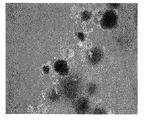
- Hepatocytes Hepatocytes were collected from the liver of Wistar rats (300 g) by the collagenase perfusion method. Primer-Surfae 24-well plates (Sumitomo Bakelite) were seeded with hepatocytes (8 ⁇ 10 4 cells / well), and after culturing for 4 days, the spheroids were added to 24 wells in a disc-shaped gel (120 ⁇ L). The culture solution was prepared according to the method of Yoshizato et al. FIG. 2 shows the results of observation with a microscope on the third day after the spheroids were added to the gel.
- the obtained gel was highly transparent, and it was possible to observe the three-dimensional growth process of cells inside the gel over time. There was no problem with the cytotoxicity of the gel, and in the case of hepatocyte spheroids, a process in which new cells sprout from the spherical cell mass was observed as indicated by the arrows in FIG.
- hepatocyte spheroids a process in which new cells sprout from the spherical cell mass was observed as indicated by the arrows in FIG.
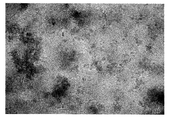
- HIUVEC and cardiomyocytes a cell branching structure was observed the day after in-gel culture, and a three-dimensional network structure was constructed after several days.
- cardiomyocytes the pulsation gradually shifted from the individual pulsation to the pulsation linked to the individual cells, and finally the entire gel pulsated (the part indicated by the arrow in FIG. 3).
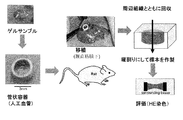
- Example 4 Implantation experiment to rat 0.3 mL of 0.8% atelocollagen (Nitta gelatin, collagen BM) phosphate buffer solution (pH 7.6) was prepared on ice (4 ° C.). To this solution, 0.06 mL of 3% (50 mM) raffinose oxide aqueous solution was added and stirred. 14 ⁇ L each was dispensed into an ePTFE artificial blood vessel (height 1 mm, inner diameter ⁇ 3 mm) cut into a ring and allowed to stand at 18 ° C. for 4 hours 30 minutes to gel. The gel was coated with a HANKS buffer to suppress the progress of gelation and allowed to stand overnight at 37 ° C. under humidity.
- FIG. 4 shows a schematic flow diagram of the transplantation experiment.
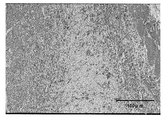
- Fig. 5 shows the results of observation with an optical microscope. It can be seen that the transplanted gel (portion surrounded by a yellow broken line in the center of the photograph) was replaced with a granule tissue rich in blood vessels in 5 days. Moreover, the case where only the blood vessel has invaded using the gel as a scaffold is also seen, and the effect of inducing the blood vessel is also expected.
Landscapes
- Chemical & Material Sciences (AREA)
- Health & Medical Sciences (AREA)
- Life Sciences & Earth Sciences (AREA)
- Medicinal Chemistry (AREA)
- Organic Chemistry (AREA)
- Chemical Kinetics & Catalysis (AREA)
- Polymers & Plastics (AREA)
- Engineering & Computer Science (AREA)
- General Health & Medical Sciences (AREA)
- Biochemistry (AREA)
- Materials Engineering (AREA)
- Dermatology (AREA)
- Molecular Biology (AREA)
- Epidemiology (AREA)
- Public Health (AREA)
- Veterinary Medicine (AREA)
- Animal Behavior & Ethology (AREA)
- Biomedical Technology (AREA)
- Transplantation (AREA)
- Oral & Maxillofacial Surgery (AREA)
- Zoology (AREA)
- Cell Biology (AREA)
- Biotechnology (AREA)
- Bioinformatics & Cheminformatics (AREA)
- Genetics & Genomics (AREA)
- Wood Science & Technology (AREA)
- Microbiology (AREA)
- General Engineering & Computer Science (AREA)
- Botany (AREA)
- Dispersion Chemistry (AREA)
- Materials For Medical Uses (AREA)
- Compositions Of Macromolecular Compounds (AREA)
Abstract
【解決課題】 大型の再生組織を構築するためのスキャホールドとして、(1)高い細胞親和性をもち、(2)生理環境下でも構造が安定で、(3)移植後に速やかに生体内分解し、(4)血管誘導因子を漏洩することなく内部に安定に担持でき、(5)ゲル内部で培養している細胞の状態を経時的に観察できる程度の透明性を有し、(6)得られるゲルの強度を容易に調整できる特徴を兼備した材料を提供すること。 【解決手段】 アルデヒド基を有するオリゴ糖酸化物、及び側鎖にアミノ基を有するポリペプチド又は多糖類を含む架橋性組成物。
Description
本発明は、オリゴ糖酸化物で架橋したゲル材料、当該ゲル材料の調製に用いられるオリゴ糖酸化物からなる架橋剤、当該ゲル材料を用いた細胞培養システム及び移植システムに関る。
近年、細胞を三次元培養して、大型の再生組織を構築する研究が活発に行なわれており、細胞シート上に細胞を培養して積層化する技術などが提案されている(非特許文献1~3)。ここで、大型再生組織の構築にあたっては、血管系をいかにして導入するかを検討することが必要である。即ち、受動拡散による酸素や物質のやりとりは数百ミクロンが限界であるとされているため、仮に大型の再生組織を作成することができても、血管系が導入されていないと、当該再生組織をホストに移植しても中心が壊死してしまう。
大型再生組織に血管系を導入する手法として、血管系を含んだ再生組織を組織工学的に作ることが理想的ではあるが、そのためには血管系構築技術を確立することが必要であり、この技術は現時点では確立していない。また、別の方法として、ホストの移植母床での血管新生機構を制御することが考えられる。これは、ホストに再生組織を移植し、ホスト母床からの血管新生を誘導し、再生組織に栄養血管を引き込む手法である。
近年、微小再生組織単位としてスフェロイドが注目されている。スフェロイドとは、細胞が多数凝集して球状塊になったものであり、スフェロイド培養は、従来の単層培養に比べ、細胞の機能を長期間維持でき、より生体に近い培養法といえる。そこで、スフェロイドをホストに移植し、スフェロイドへ血管を誘導(器質化)し、器質化されたスフェロイドを三次元構築する技術が検討されている(特許文献1、非特許文献4~5)。
しかしながら、スフェロイドのみをホスト母床に移植してもすぐに分散してしまい適所に留めることは困難である。さらに、スフェロイド周辺において血管の伸張や構造を維持する支持体がないため血管新生をうまく誘導することができない。そこで、血管新生を誘導するような足場材料が必要となる。
しかしながら、スフェロイドのみをホスト母床に移植してもすぐに分散してしまい適所に留めることは困難である。さらに、スフェロイド周辺において血管の伸張や構造を維持する支持体がないため血管新生をうまく誘導することができない。そこで、血管新生を誘導するような足場材料が必要となる。
このような足場材料として、細胞接着性や生体内分解性に優れることから、コラーゲンがこれまで検討されてきた(特許文献2)。また、近年、コラーゲンを基盤としたゲル内細胞培養システムが市販されている。しかしながら、コラーゲンのゲル化機構はコラーゲン分子同士の凝集によるため、得られたゲルの強度や透明性は、コラーゲンの濃度、イオン強度、pHに大きく依存する。従って、このような凝集体によって形成されたゲルは、生体内において安定とは言い難い。
Haraguchi Y.,Shimizu T.,Yamato M.,Okano T.,J.Tissue Eng Regen.Med.,4(4),291-299(2010).
Sekiya S.,Shimizu T.,Yamato M.,Okano T.,J. Artif. Organs,14(1),43-51(2011).
Ohashi K.,Yokoyama T.,Yamato M.,Kuge H.,Kanehiro H.,Tsutsumi M.,Amanuma T.,Iwata,H. Yang J.,Okano T.,Nakajima Y.,Nat.Med.13,880-885(2007).
Lazar A.,Mann H-J.,Remmel R-P.,Shatford R-A.,Cerra F-B.,Hu W-S.,In Vitro Cell Dev. Biol. Anim.,31(5):340-6(1995).
高山利夫、田口哲志、小山博之、小林尚俊、宮田哲郎、名川弘一、脈管学 48巻、S100号(2008)
本発明は、大型の再生組織を構築するためのスキャホールド(足場)として、(1)高い細胞親和性をもち、(2)生理環境下でも構造が安定で、(3)移植後に速やかに生体内分解し、(4)血管誘導因子を漏洩することなく内部に安定に担持でき、(5)ゲル内部で培養している細胞の状態を経時的に観察できる程度の透明性を有し、(6)得られるゲルの強度を容易に調整できる特徴を兼備した材料を提供することを目的とする。
本発明者らは、コラーゲンゲルを細胞培養に適した条件で安定に維持するため、化学架橋を形成させることにより、コラーゲンが凝集体を形成することを抑制することを着想した。ここで、化学架橋を形成する水溶性の架橋剤としては、水溶性カルボジイミドやグルタルアルデヒドなどが知られているが、細胞に対する刺激性や毒性の問題からこれらを使用することは適切ではない。そこで、鋭意検討した結果、オリゴ糖の酸化物を架橋剤として使用すると無色透明なゲルが得られることを見出した。
酸化反応としては、オリゴ糖の有機溶媒に対する溶解性が低いため水系における酸化反応が好ましく、また四酢酸鉛を用いた酸化反応では残留鉛の毒性が懸念された。従って、過ヨウ素酸による酸化反応を選択し、酸化反応後にアルコールを添加することで容易にヨウ素化合物を除去できる技術を確立し、本発明に到達した。
酸化反応としては、オリゴ糖の有機溶媒に対する溶解性が低いため水系における酸化反応が好ましく、また四酢酸鉛を用いた酸化反応では残留鉛の毒性が懸念された。従って、過ヨウ素酸による酸化反応を選択し、酸化反応後にアルコールを添加することで容易にヨウ素化合物を除去できる技術を確立し、本発明に到達した。
すなわち、本発明は、
(1)アルデヒド基を有するオリゴ糖酸化物、及び側鎖にアミノ基を有するポリペプチド又は多糖類を含む架橋性組成物、
(2)オリゴ糖酸化物がオリゴ糖の過ヨウ素酸酸化から生成された、(1)に記載の架橋性組成物、
(3)前記ポリペプチドが、コラーゲン、アテロコラーゲン、ゼラチン、それらの誘導体又はこれらの混合物から選択される、(1)又は(2)に記載の架橋性組成物、
(4)前記多糖類が、脱アセチル化キチン又はキトサン、スクシニル化キトサン、グリセリル化キトサン、カルボキシメチル化キトサン、ヒドロキシブチル―ヒドロキシプロピル化キトサン、アミノ化デキストラン、アミノ化デンプン、アミノアルキル化プルラン、アミノ化ヒアルロン酸、アミノ化コンドロイチン硫酸、アミノ化セルロース、それらの誘導体又はこれらの混合物から選択される、(1)又は(2)に記載の架橋性組成物、
(5)前記オリゴ糖が、スクロース、マルトース、ラフィノース、これらの誘導体及びこれらの2以上の混合物からなる群から選択される、(1)~(4)のいずれか1に記載の架橋性組成物、
(6)(1)~(5)のいずれか1に記載の架橋性組成物から得られる架橋体、
(7)前記オリゴ糖酸化物のアルデヒド基と前記ポリペプチド又は多糖類のアミノ基が共有結合している、(6)に記載の架橋体、
(8)ゲル化した状態にある、(6)又は(7)に記載の架橋体、
(9)血管新生因子を含有する、(6)~(8)のいずれか1に記載の架橋体、
(10)細胞又は細胞組織を含有する、(6)~(9)のいずれか1に記載の架橋体、
(11)細胞培養液を含有する、(10)に記載の架橋体、
(12)(6)~(11)のいずれか1に記載の架橋体を用いた、細胞培養システム、
(13)(6)~(11)のいずれか1に記載の架橋体を被験者の体内に移植するシステム、
(14)(12)に記載の細胞培養システムで得られる培養細胞を、被験者の体内に移植するシステム、
(15)(a)(1)~(5)のいずれか1に記載の架橋性組成物を調製する工程、
(b)前記架橋性組成物のpHを7.0以上に調整する工程
を含む、前記架橋性組成物のゲルを調製する方法、
(16)(a)(1)~(5)のいずれか1に記載の架橋性組成物を調製する工程、
(b)前記架橋性組成物のpHを7.0以上に調整する工程、
(c)前記架橋性組成物をゲル化させる工程
を含み、(c)の工程前、工程中または工程後の時点で、前記架橋性組成物に細胞又は細胞組織を添加する、細胞を培養する方法、
(17)前記(c)の工程前、工程中または工程後の時点で前記架橋性組成物に培養液を添加する、(16)に記載の細胞を培養する方法、
(18)(15)に記載の方法で得られるゲルを被験者の体内に移植する方法、
(19)(16)又は(17)に記載の方法で得られる培養細胞を被験者の体内に移植する方法、
(20)アルデヒド基を有するオリゴ糖酸化物及び側鎖にアミノ基を有するポリペプチド又は多糖類を含む架橋性組成物から形成されたゲル中に細胞又は細胞組織が包埋されており、被験者の体内に移植されるように用いられる、再生組織を構築するための移植材料、
(21)アルデヒド基を有するオリゴ糖酸化物からなり、側鎖にアミノ基を有するポリペプチド又は多糖類との架橋反応に用いられる架橋剤、
(22)オリゴ糖酸化物がオリゴ糖の過ヨウ素酸酸化から生成される、(21)に記載の架橋剤、
(23)前記オリゴ糖が、スクロース、マルトース、ラフィノース、これらの誘導体及びこれらの2以上の混合物からなる群から選択される、(21)又は(22)に記載の架橋剤、
(24)側鎖にアミノ基を有するポリペプチドが、コラーゲン、アテロコラーゲン、ゼラチン、それらの誘導体又はこれらの混合物から選択される、(21)~(23)のいずれか1に記載の架橋剤、及び
(25)側鎖にアミノ基を有する多糖類が、脱アセチル化キチン又はキトサン、スクシニル化キトサン、グリセリル化キトサン、カルボキシメチル化キトサン、ヒドロキシブチル―ヒドロキシプロピル化キトサン、アミノ化デキストラン、アミノ化デンプン、アミノアルキル化プルラン、アミノ化ヒアルロン酸、アミノ化コンドロイチン硫酸、アミノ化セルロース、それらの誘導体又はこれらの混合物から選択される、(21)~(23)のいずれか1に記載の架橋剤
を、提供するものである。
(1)アルデヒド基を有するオリゴ糖酸化物、及び側鎖にアミノ基を有するポリペプチド又は多糖類を含む架橋性組成物、
(2)オリゴ糖酸化物がオリゴ糖の過ヨウ素酸酸化から生成された、(1)に記載の架橋性組成物、
(3)前記ポリペプチドが、コラーゲン、アテロコラーゲン、ゼラチン、それらの誘導体又はこれらの混合物から選択される、(1)又は(2)に記載の架橋性組成物、
(4)前記多糖類が、脱アセチル化キチン又はキトサン、スクシニル化キトサン、グリセリル化キトサン、カルボキシメチル化キトサン、ヒドロキシブチル―ヒドロキシプロピル化キトサン、アミノ化デキストラン、アミノ化デンプン、アミノアルキル化プルラン、アミノ化ヒアルロン酸、アミノ化コンドロイチン硫酸、アミノ化セルロース、それらの誘導体又はこれらの混合物から選択される、(1)又は(2)に記載の架橋性組成物、
(5)前記オリゴ糖が、スクロース、マルトース、ラフィノース、これらの誘導体及びこれらの2以上の混合物からなる群から選択される、(1)~(4)のいずれか1に記載の架橋性組成物、
(6)(1)~(5)のいずれか1に記載の架橋性組成物から得られる架橋体、
(7)前記オリゴ糖酸化物のアルデヒド基と前記ポリペプチド又は多糖類のアミノ基が共有結合している、(6)に記載の架橋体、
(8)ゲル化した状態にある、(6)又は(7)に記載の架橋体、
(9)血管新生因子を含有する、(6)~(8)のいずれか1に記載の架橋体、
(10)細胞又は細胞組織を含有する、(6)~(9)のいずれか1に記載の架橋体、
(11)細胞培養液を含有する、(10)に記載の架橋体、
(12)(6)~(11)のいずれか1に記載の架橋体を用いた、細胞培養システム、
(13)(6)~(11)のいずれか1に記載の架橋体を被験者の体内に移植するシステム、
(14)(12)に記載の細胞培養システムで得られる培養細胞を、被験者の体内に移植するシステム、
(15)(a)(1)~(5)のいずれか1に記載の架橋性組成物を調製する工程、
(b)前記架橋性組成物のpHを7.0以上に調整する工程
を含む、前記架橋性組成物のゲルを調製する方法、
(16)(a)(1)~(5)のいずれか1に記載の架橋性組成物を調製する工程、
(b)前記架橋性組成物のpHを7.0以上に調整する工程、
(c)前記架橋性組成物をゲル化させる工程
を含み、(c)の工程前、工程中または工程後の時点で、前記架橋性組成物に細胞又は細胞組織を添加する、細胞を培養する方法、
(17)前記(c)の工程前、工程中または工程後の時点で前記架橋性組成物に培養液を添加する、(16)に記載の細胞を培養する方法、
(18)(15)に記載の方法で得られるゲルを被験者の体内に移植する方法、
(19)(16)又は(17)に記載の方法で得られる培養細胞を被験者の体内に移植する方法、
(20)アルデヒド基を有するオリゴ糖酸化物及び側鎖にアミノ基を有するポリペプチド又は多糖類を含む架橋性組成物から形成されたゲル中に細胞又は細胞組織が包埋されており、被験者の体内に移植されるように用いられる、再生組織を構築するための移植材料、
(21)アルデヒド基を有するオリゴ糖酸化物からなり、側鎖にアミノ基を有するポリペプチド又は多糖類との架橋反応に用いられる架橋剤、
(22)オリゴ糖酸化物がオリゴ糖の過ヨウ素酸酸化から生成される、(21)に記載の架橋剤、
(23)前記オリゴ糖が、スクロース、マルトース、ラフィノース、これらの誘導体及びこれらの2以上の混合物からなる群から選択される、(21)又は(22)に記載の架橋剤、
(24)側鎖にアミノ基を有するポリペプチドが、コラーゲン、アテロコラーゲン、ゼラチン、それらの誘導体又はこれらの混合物から選択される、(21)~(23)のいずれか1に記載の架橋剤、及び
(25)側鎖にアミノ基を有する多糖類が、脱アセチル化キチン又はキトサン、スクシニル化キトサン、グリセリル化キトサン、カルボキシメチル化キトサン、ヒドロキシブチル―ヒドロキシプロピル化キトサン、アミノ化デキストラン、アミノ化デンプン、アミノアルキル化プルラン、アミノ化ヒアルロン酸、アミノ化コンドロイチン硫酸、アミノ化セルロース、それらの誘導体又はこれらの混合物から選択される、(21)~(23)のいずれか1に記載の架橋剤
を、提供するものである。
コラーゲン等の側鎖にアミノ基を有するポリペプチド又はキトサン誘導体等のアミノ基を有する多糖類をオリゴ糖酸化物で化学架橋することにより、凝集体の形成を抑制し、透明で均一なゲルを調製することが可能となった。透明で均一なゲルは、細胞の観察が容易であり、生体内での分解もむらなく速やかに進行する。また、化学架橋は、生理環境下におけるゲルの収縮・膨潤・溶解などの構造変化を制限・抑制し、細胞用足場材料として十分な強度と分解速度が得られるような適切な架橋密度を維持することができる。
また、オリゴ糖酸化物は低級アルデヒドと比較して刺激・毒性が低く、細胞に対しても、また移植用材料としても安全な架橋剤となる。
更に、オリゴ糖酸化物のアルデヒド基は血管新生因子などを共有結合により担持することができる。また、アルデヒドの酸化によって生じたカルボン酸もbFGFなどの塩基性因子を静電相互作用によって担持することができる。従って、本発明のゲル材料は生体内で血管新生因子などを外部に放出しにくいため、効率的に血管新生を誘導することが可能となる。
また、オリゴ糖酸化物は低級アルデヒドと比較して刺激・毒性が低く、細胞に対しても、また移植用材料としても安全な架橋剤となる。
更に、オリゴ糖酸化物のアルデヒド基は血管新生因子などを共有結合により担持することができる。また、アルデヒドの酸化によって生じたカルボン酸もbFGFなどの塩基性因子を静電相互作用によって担持することができる。従って、本発明のゲル材料は生体内で血管新生因子などを外部に放出しにくいため、効率的に血管新生を誘導することが可能となる。
架橋剤
本発明の一つの形態は、アルデヒド基を有するオリゴ糖酸化物からなる架橋剤である。
本発明の一つの形態は、アルデヒド基を有するオリゴ糖酸化物からなる架橋剤である。
オリゴ糖とは、単糖類同士がグリコシド結合によって結合した化合物の中で、分子量としては300~3000程度のものを指す。本発明において使用できるオリゴ糖は、二糖であるスクロース、ラクトース、マルトース、トレハロース、ツラノース、セロビオースなど;三糖であるラフィノース、パノース、マルトトリオース、メレジトース、ゲンチアノースなど;四糖であるアカルボース、スタキオースなど;環状オリゴ糖であるシクロデキストリン、シクロアワオドリンなど;単糖の重合体であるフラクトオリゴ糖、ガラクトオリゴ糖など;多糖の分解産物としてのマンナンオリゴ糖、キシロオリゴ糖など;天然物からの分解・抽出物;これらの誘導体及びこれらの2以上の混合物からなる群から選択される。
本発明においては、これらの中でも、スクロース、マルトース、ラフィノース、シクロデキストリンが好ましく、スクロース、マルトース、ラフィノースが特に好ましい。
本発明においては、これらの中でも、スクロース、マルトース、ラフィノース、シクロデキストリンが好ましく、スクロース、マルトース、ラフィノースが特に好ましい。
本発明におけるアルデヒド基を有するオリゴ糖酸化物とは、オリゴ糖のビシナルジオール基が一部解離してアルデヒド基に酸化されているものを言う。ここで、オリゴ糖のビシナルジオール基がアルデヒド基に酸化されたものは種々の方法により得ることができるが、本発明においては、アルデヒド基を有するオリゴ糖酸化物として、オリゴ糖の過ヨウ素酸酸化から生成された酸化物であることが特に好ましい。
本発明の架橋剤の製造方法に関して、オリゴ糖の過ヨウ素酸酸化により製造する方法について説明する。
オリゴ糖を水又は水酸化ナトリウム溶液などの塩基性水溶液に溶解し、氷冷下で過ヨウ素酸ナトリウムを添加して、オリゴ糖の過ヨウ素酸酸化反応を行なう。反応溶液のpHは、7以下であることが好ましく、5~6付近であることが特に好ましい。
また、過剰な酸化は糖を分解し、副生成物であるギ酸やホルムアルデヒドなどが発生することが危惧されるため、オリゴ糖の糖ユニットに対する過ヨウ素酸ナトリウムの比率は1:2以下が望ましい。また、反応溶媒としては、例えば、水、水/エタノール混合溶媒、水/DMF混合溶媒など各種の溶媒を使用することができるが、水を用いるのが好ましい。
オリゴ糖を水又は水酸化ナトリウム溶液などの塩基性水溶液に溶解し、氷冷下で過ヨウ素酸ナトリウムを添加して、オリゴ糖の過ヨウ素酸酸化反応を行なう。反応溶液のpHは、7以下であることが好ましく、5~6付近であることが特に好ましい。
また、過剰な酸化は糖を分解し、副生成物であるギ酸やホルムアルデヒドなどが発生することが危惧されるため、オリゴ糖の糖ユニットに対する過ヨウ素酸ナトリウムの比率は1:2以下が望ましい。また、反応溶媒としては、例えば、水、水/エタノール混合溶媒、水/DMF混合溶媒など各種の溶媒を使用することができるが、水を用いるのが好ましい。
反応時間は、糖の種類により適宜決定されるが、通常5分~96時間で行なうことができ、特に1~60時間で行なうのが好ましい。反応終了後、過ヨウ素酸酸化により残留しているヨウ素化合物を除去するため、極性溶媒を添加してヨウ素化合物を析出させて除去する。極性溶媒としては、オリゴ糖酸化物の調製過程で減圧除去する必要があることから低沸点溶媒であることが望ましい。また、生体に対する安全性が高い溶媒であることが好ましい。これらの点から、極性溶媒として、エタノール、イソプロパノールなどのアルコール、アセトン、テトラヒドロフランなどを使用することが好ましく、特にエタノールが好ましい。
本発明のアルデヒド基を有するオリゴ糖酸化物からなる架橋剤は、後述する通り、側鎖にアミノ基を有するポリペプチド又は多糖類との架橋反応に好適に用いることができる。
架橋性組成物
本発明のもう一つの形態は、アルデヒド基を有するオリゴ糖酸化物からなる架橋剤及び側鎖にアミノ基を有するポリペプチド又は多糖類を含む架橋性組成物である。
本発明のもう一つの形態は、アルデヒド基を有するオリゴ糖酸化物からなる架橋剤及び側鎖にアミノ基を有するポリペプチド又は多糖類を含む架橋性組成物である。
側鎖にアミノ基を有するポリペプチドには、限定されない例として、天然由来のポリペプチドおよびその機能を模倣や改良した人工合成ポリペプチドや遺伝子組み換えタンパク質などがあげられる。
天然由来のポリペプチドには、カイコ由来のフィブロインやセリシン等、及び天然由来の細胞外マトリクス構成要素、例えば、コラーゲン、アテロコラーゲン、ゼラチン、プロテオグリカン、フィブロネクチン、ラミニン、エラスチン、エンタクチン等およびそれらの誘導体があげられる。
人工合成ポリペプチドや遺伝子組み換えタンパク質には、限定されない例として、Poly(PHG)などのオリゴペプチドの脱水縮合体、Poly(PHG/QGIA)やPoly(PHG/RGD)、Poly(PHG/YIGSR/IKVAV)等の機能性ペプチド配列との共重合体等(特開2003-321500)、三洋化成工業製の「プロネクチンF」、「プロネクチンL」、宝酒造製の「レトロネクチン」などがあげられる。
本発明においては、側鎖にアミノ基を有するポリペプチドは、好ましくは、コラーゲン、アテロコラーゲン、ゼラチン、フィブロネクチン、Poly(PHG/RGD)、それらの誘導体及びこれらの混合物であり、より好ましくはコラーゲン、アテロコラーゲン、ゼラチン、フィブロネクチン、それらの誘導体及びこれらの混合物である。特に好ましくは、哺乳動物または魚由来のコラーゲン、アテロコラーゲン、ゼラチン、それらの誘導体及びこれらの混合物である。
コラーゲンとは、真皮、靭帯、腱、骨、軟骨などを構成するたんぱく質のひとつであり、細胞外マトリックスを構成する要素である。コラーゲンタンパク質のペプチド鎖は、“-(グリシン)-(アミノ酸X)-(アミノ酸Y)-”と、グリシンが3残基ごとに繰り返す一次構造を有する。多くの型のコラーゲンでは、このペプチド鎖が3本集まり、らせん構造を形成し、トロポコラーゲンと呼ばれる。例えば、I型コラーゲンの1本のペプチド鎖は1014アミノ酸残基繰返す配列を持っており、分子量は10万程度である。ヒトのコラーゲンには、30種類以上あることが知られており、例えば、真皮、靱帯、腱、骨などではI型コラーゲンが、関節軟骨ではII型コラーゲンが主成分である。また、すべての上皮組織の裏打ち構造である基底膜にはIV型コラーゲンが主に含まれている。体内で最も豊富に存在しているのはI型コラーゲンである。
コラーゲンであれば限定されないが、好ましくは可溶性コラーゲンである。より好ましくは水に可溶なコラーゲンである。可溶性コラーゲンには、中性塩(例えば、0.15~0.5M NaCl in 0.05M Tris=HCl,pH7.5)溶液に可溶化した中性塩可溶性コラーゲン、酸(例えば、0.5M酢酸または0.1~0.3Mクエン酸緩衝液、pH3.5~3.7)溶液に可溶化した酸可溶性コラーゲン、酵素(例えば、ペプシン)で可溶化した酵素可溶性コラーゲンなどがある。コラーゲンは、ペプチド化されたコラーゲン(コラーゲンフラグメント)であってもよい。
アテロコラーゲンとは、コラーゲン分子の両端に存在するテロペプチドを酵素処理で取り外したコラーゲンであり、水に可溶となったコラーゲンである。アテロコラーゲンは、ペプチド化されていてもよい。
ゼラチンとは、コラーゲンのうち水で長時間加熱することで、水に抽出されたものを意味する。ゼラチンは、ペプチド化されていてもよい。ゼラチンのペプチドは、コラーゲンの場合と同じである。
ゼラチンは、コラーゲンの熱変性物質であるため、アミノ酸組成はコラーゲンとほぼ同じである。由来にもよるが、酸性基が12%程度存在し、その約3分の1がアミド化されている。ゼラチンは、水抽出の前処理工程によって、酸処理ゼラチンとアルカリ処理ゼラチンなどが存在する。酸処理ゼラチンは、塩酸や硫酸などの無機酸によって数十時間から数日処理され、脱アミド率が低いのに対し、アルカリ処理ゼラチンは、2~3ヶ月の石灰漬工程で100%近く脱アミドされている。
本発明においては、側鎖にアミノ基を有するポリペプチドとして、前記の中でも、コラーゲン、アテロコラーゲン、ゼラチン、それらの誘導体又はこれらの混合物から選択されるものが好ましい。
本発明において、多糖とは、単糖分子がグリコシド結合によって多数重合した糖のことである。本発明における側鎖にアミノ基を有する多糖類としては、脱アセチル化キチンやキトサン(例えば大日精化製のダイキトサンVL)、スクシニル化キトサン、グリセリル化キトサン、カルボキシメチル化キトサン、ヒドロキシブチル―ヒドロキシプロピル化キトサンなどのキトサン誘導体、アミノ化デキストラン、アミノ化デンプン、アミノアルキル化プルラン、アミノ化ヒアルロン酸、アミノ化コンドロイチン硫酸、アミノ化セルロースなどの天然及び半人工多糖類の誘導体が挙げられる。
本発明の架橋性組成物において、側鎖にアミノ基を有するポリペプチド又は多糖類、オリゴ糖酸化物の濃度は、それらの種類に応じて、組成物溶液の反応性や粘度などを考慮して適宜設定することができる。例えば、側鎖にアミノ基を有するポリペプチドがコラーゲンの場合、その濃度は好ましくは0.3%以上であり、ゼラチンの場合、その濃度は好ましくは5%以上である。また、例えば、側鎖にアミノ基を有する多糖類がキトサンの場合、その濃度は1%以上が好ましい。また、オリゴ糖酸化物の濃度としては、例えば、ラフィノース酸化物の場合、通常0.01%以上であり、好ましくは0.05%以上である。
本発明の架橋性組成物は、その他の添加剤、例えば架橋剤の助剤、反応促進剤、遅延剤、分散剤(凝集防止剤)、補強材(繊維、フィラメント、ウィスカー、粒子、微小ゲル)、液滴などを含有することができる。
架橋体
本発明の更なる形態は、前記架橋性組成物から得られる架橋体である。
本発明の架橋体とは、オリゴ糖酸化物のアルデヒド基とポリペプチド又は多糖類のアミノ基が共有結合しているオリゴ糖酸化物-ポリペプチド複合体(-ポリペプチド-オリゴ糖酸化物-ポリペプチド-)及びオリゴ糖酸化物-多糖類複合体(多糖-オリゴ糖酸化物-多糖)を意味する。ここで、オリゴ糖酸化物-ポリペプチド間の共有結合は、通常、オリゴ糖酸化物のアルデヒド基とポリペプチドの側鎖のアミノ基の共有結合およびオリゴ糖酸化物のアルデヒド基とポリペプチドのアミノ末端のアミノ基の共有結合の混合からなるが、オリゴ糖酸化物のアルデヒド基とポリペプチドの側鎖のアミノ基の共有結合だけからなっていてもよいし、オリゴ糖酸化物のアルデヒド基とポリペプチドのアミノ末端のアミノ基の共有結合だけからなっていてもよい。
本発明の更なる形態は、前記架橋性組成物から得られる架橋体である。
本発明の架橋体とは、オリゴ糖酸化物のアルデヒド基とポリペプチド又は多糖類のアミノ基が共有結合しているオリゴ糖酸化物-ポリペプチド複合体(-ポリペプチド-オリゴ糖酸化物-ポリペプチド-)及びオリゴ糖酸化物-多糖類複合体(多糖-オリゴ糖酸化物-多糖)を意味する。ここで、オリゴ糖酸化物-ポリペプチド間の共有結合は、通常、オリゴ糖酸化物のアルデヒド基とポリペプチドの側鎖のアミノ基の共有結合およびオリゴ糖酸化物のアルデヒド基とポリペプチドのアミノ末端のアミノ基の共有結合の混合からなるが、オリゴ糖酸化物のアルデヒド基とポリペプチドの側鎖のアミノ基の共有結合だけからなっていてもよいし、オリゴ糖酸化物のアルデヒド基とポリペプチドのアミノ末端のアミノ基の共有結合だけからなっていてもよい。
オリゴ糖酸化物のアルデヒド基とポリペプチド又は多糖類のアミノ基が共有結合しているとは、架橋体中に、オリゴ糖酸化物のアルデヒド基とポリペプチド又は多糖類のアミノ基の共有結合が少なくとも1つ存在することを意味する。
架橋体には、共有結合に参加していないオリゴ糖酸化物のアルデヒド基とポリペプチド又は多糖類のアミノ基が存在していることが好ましい。血管伸張を誘導するための血管新生因子などを担持するためには、これらの生理活性物質と相互作用するための官能基を必要とする場合がある。例えば電荷が正に偏っているbFGFは、オリゴ糖酸化物のアルデヒド基と静電相互作用をする。また、良好な細胞接着性や酵素分解性を維持するためには、オリゴ糖酸化物のアルデヒド基とポリペプチド又は多糖類のアミノ基間の共有結合形成によるポリペプチド側鎖構造の破壊や、立体構造変化を最小限にすることが望ましい。
本発明の好ましい実施態様は、架橋体がゲル化した状態(以下単に「ゲル」とも言う。)である。ここで、ゲルとは架橋体(架橋性組成物)において流動性が失われた状態にあることをいう。本発明における架橋体とは、上記の通り、オリゴ糖酸化物のアルデヒド基とポリペプチドのアミノ基が共有結合してオリゴ糖酸化物-ポリペプチド複合体、又はオリゴ糖酸化物のアルデヒド基と多糖類のアミノ基が共有結合してオリゴ糖酸化物-多糖類複合体を形成しているものをいい、本発明の架橋体にはゲル化していない場合も含まれるが、本発明においては、前記架橋性組成物をゲル化させることにより、安定した構造を有する大型の再生組織の足場材料を得ることが可能となり特に好ましい。
本発明の架橋体は、生理活性物質を含有することができる。
生理活性物質には、限定されない例として、増殖因子およびサイトカイン、抗体などが挙げられる。増殖因子およびサイトカインには、限定されない例として、血管内皮細胞増殖因子(vascular endothelial growth factor,VEGF)、酸性線維芽細胞増殖因子(acidic fibroblast growth factor,a-FGF)、塩基性線維芽細胞増殖因子(basic fibroblast growth factor,b-FGF)、血小板由来内皮細胞増殖因子(platelet-derived endothelial cell growth factor,PD-ECGF)、トランスフォーミング増殖因子(transforming growth factor,TGF-α、TGF-β)、腫瘍壊死因子(angiogenin tumor necrosis factor-α,TNF-α)、肝細胞増殖因子(hepatocyte growth factor,HGF)、顆粒球マクロファージ-コロニー刺激因子(Granulocyte/Macrophage-Colony Stimulating Factor,GM-CSF)、インシュリン、インシュリン様成長因子(Insulin-like growth factor,IGF-I、IGF-II)、エリスロポエチン(EPO)、トロンボポエチン(TPO)、上皮細胞増殖因子(epidermal growth factor:EGF)、ヘパリン結合性増殖因子(heparin binding growth factor:hbgf)、神経成長因子(nerve growth factor:NGF)、筋肉形成因子(muscle morphogenic factor:MMF)、骨形成タンパク質(bone morphogenetic protein,BMP)等があげられる。抗体には、限定されない例として、抗CD3抗体や抗CD28抗体などの細胞を刺激できる抗体などが挙げられる。好ましくは、塩基性線維芽細胞増殖因子(basic fibroblast growth factor,b-FGF)、血管内皮細胞増殖因子(vascular endothelial growth factor,VEGF)、血小板由来内皮細胞増殖因子(platelet-derived endothelial cell growth factor,PD-ECGF)、肝細胞増殖因子(hepatocyte growth factor,HGF)、顆粒球マクロファージ-コロニー刺激因子(granulocyte/macrophage-colony stimulating factor,GM-CSF)であり、より好ましくは塩基性線維芽細胞増殖因子(basic fibroblast growth factor,b-FGF)、血管内皮細胞増殖因子(vascular endothelial growth factor,VEGF)である。生理活性物質は、生理活性物質を分泌する細胞であってもよい。
生理活性物質には、限定されない例として、増殖因子およびサイトカイン、抗体などが挙げられる。増殖因子およびサイトカインには、限定されない例として、血管内皮細胞増殖因子(vascular endothelial growth factor,VEGF)、酸性線維芽細胞増殖因子(acidic fibroblast growth factor,a-FGF)、塩基性線維芽細胞増殖因子(basic fibroblast growth factor,b-FGF)、血小板由来内皮細胞増殖因子(platelet-derived endothelial cell growth factor,PD-ECGF)、トランスフォーミング増殖因子(transforming growth factor,TGF-α、TGF-β)、腫瘍壊死因子(angiogenin tumor necrosis factor-α,TNF-α)、肝細胞増殖因子(hepatocyte growth factor,HGF)、顆粒球マクロファージ-コロニー刺激因子(Granulocyte/Macrophage-Colony Stimulating Factor,GM-CSF)、インシュリン、インシュリン様成長因子(Insulin-like growth factor,IGF-I、IGF-II)、エリスロポエチン(EPO)、トロンボポエチン(TPO)、上皮細胞増殖因子(epidermal growth factor:EGF)、ヘパリン結合性増殖因子(heparin binding growth factor:hbgf)、神経成長因子(nerve growth factor:NGF)、筋肉形成因子(muscle morphogenic factor:MMF)、骨形成タンパク質(bone morphogenetic protein,BMP)等があげられる。抗体には、限定されない例として、抗CD3抗体や抗CD28抗体などの細胞を刺激できる抗体などが挙げられる。好ましくは、塩基性線維芽細胞増殖因子(basic fibroblast growth factor,b-FGF)、血管内皮細胞増殖因子(vascular endothelial growth factor,VEGF)、血小板由来内皮細胞増殖因子(platelet-derived endothelial cell growth factor,PD-ECGF)、肝細胞増殖因子(hepatocyte growth factor,HGF)、顆粒球マクロファージ-コロニー刺激因子(granulocyte/macrophage-colony stimulating factor,GM-CSF)であり、より好ましくは塩基性線維芽細胞増殖因子(basic fibroblast growth factor,b-FGF)、血管内皮細胞増殖因子(vascular endothelial growth factor,VEGF)である。生理活性物質は、生理活性物質を分泌する細胞であってもよい。
また、本発明の架橋体は、細胞を含有することができる。
細胞の種類は、限定されないが、好ましくは、軟骨細胞;繊維軟骨細胞;骨細胞;骨芽細胞;破骨細胞;滑膜細胞;骨髄細胞;間葉細胞;間質細胞;脂肪組織由来の前駆細胞;末梢血液前駆細胞;インシュリン産生細胞;B細胞あるいはハイブリドーマ等の抗体産生細胞;ホルモン産生細胞;肥満細胞;化学伝達物質産生細胞(免疫系細胞);遺伝子組み替え細胞;幹細胞(ES細胞、EG細胞、iPS細胞、および成体(組織)幹細胞など);肝、神経、甲状腺、胸腺、副腎髄質、副腎皮質、腎臓あるいは消化管の生理活性因子を産生する細胞;及びこれらの細胞と他の細胞の組み合わせが挙げられる。細胞は、凝集形態(スフェロイド等)や組織の一部であってもよい。細胞の由来は、限定されないが、好ましくは、哺乳動物、より好ましくは、イヌ、ネコ等の愛玩動物;ヒト;ウシ、ブタ、ウマ、ヒツジ、ヤギ等の家畜動物;サル、ウサギ、マウス、ラット等の実験動物、特に好ましくはヒトである。また、細胞は、免疫による拒絶を避けるために、移植対象由来であることが好ましい。
細胞の種類は、限定されないが、好ましくは、軟骨細胞;繊維軟骨細胞;骨細胞;骨芽細胞;破骨細胞;滑膜細胞;骨髄細胞;間葉細胞;間質細胞;脂肪組織由来の前駆細胞;末梢血液前駆細胞;インシュリン産生細胞;B細胞あるいはハイブリドーマ等の抗体産生細胞;ホルモン産生細胞;肥満細胞;化学伝達物質産生細胞(免疫系細胞);遺伝子組み替え細胞;幹細胞(ES細胞、EG細胞、iPS細胞、および成体(組織)幹細胞など);肝、神経、甲状腺、胸腺、副腎髄質、副腎皮質、腎臓あるいは消化管の生理活性因子を産生する細胞;及びこれらの細胞と他の細胞の組み合わせが挙げられる。細胞は、凝集形態(スフェロイド等)や組織の一部であってもよい。細胞の由来は、限定されないが、好ましくは、哺乳動物、より好ましくは、イヌ、ネコ等の愛玩動物;ヒト;ウシ、ブタ、ウマ、ヒツジ、ヤギ等の家畜動物;サル、ウサギ、マウス、ラット等の実験動物、特に好ましくはヒトである。また、細胞は、免疫による拒絶を避けるために、移植対象由来であることが好ましい。
また、本発明の架橋体は、更に培養液を含有することができる。
培養液の種類は、細胞の種類や状態、目的によってさまざまに調製され、例えば、純水、生理食塩水、ホストの体液などがあるが、これらに限定されるものではない。
培養液の種類は、細胞の種類や状態、目的によってさまざまに調製され、例えば、純水、生理食塩水、ホストの体液などがあるが、これらに限定されるものではない。
本発明の架橋体は、アルデヒド基を有するオリゴ糖酸化物と側鎖にアミノ基を有するポリペプチド又は多糖類を含有する架橋性組成物を調製し、架橋反応を進行させることにより製造することができる。具体的には、側鎖にアミノ基を有するポリペプチド又は多糖類のリン酸緩衝溶液を調製してpHを調整し、これにアルデヒド基を有するオリゴ糖酸化物を添加して架橋性組成物とし、所定時間攪拌して反応を進行させる。攪拌を続けると、溶液が増粘し、更に攪拌すると流動性が失われてゲルを形成することができる。
本発明においては、オリゴ糖酸化物のアルデヒド基とポリペプチド又は多糖類のアミノ基との化学結合反応はアルカリ条件下で顕著に促進されると考えられるため、架橋性組成物のpHを好ましくは7.0以上、より好ましくは7.6以上に調整する。
本発明においては、オリゴ糖酸化物のアルデヒド基とポリペプチド又は多糖類のアミノ基との化学結合反応はアルカリ条件下で顕著に促進されると考えられるため、架橋性組成物のpHを好ましくは7.0以上、より好ましくは7.6以上に調整する。
本発明の架橋体の製造方法において、反応温度は使用するポリペプチドの種類に応じて設定することができるが、反応温度が高いほどゲル化時間を短くすることができる。また、オリゴ糖酸化物の濃度は使用するポリペプチドの種類などに応じて設定することができるが、オリゴ糖酸化物の濃度が高いほどゲル化時間を短くすることができる。
細胞培養システム
本発明の更なる形態は、本発明の架橋体を用いた細胞培養システム及び細胞を培養する方法に関る。
本発明の細胞の培養方法においては、アルデヒド基を有するオリゴ糖酸化物と側鎖にアミノ基を有するポリペプチド又は多糖類を混合して架橋性組成物を調製し、そのpHを調整し、ゲル化を進行させる。そして、ゲル化を進行させる前、進行中、完了後の任意の時点において、細胞、培養液を添加して細胞を培養する。
本発明の一つの態様として、架橋性組成物が増粘したところで、これに細胞を添加し混合して、シャーレ等に細胞混合液を注入して、所定の温度・時間静置してゲル化させて所定の厚み・径を有するディスク状ゲルを培養液で被覆して細胞を培養することができる。
また、別の態様として、架橋性組成物が増粘したところで、これに別工程で細胞を播種して所定期間培養して得たスフェロイドを添加し混合して、所定の温度・時間静置してゲル化させて所定の厚み・径を有するディスク状ゲルを培養液で被覆して細胞を培養することができる。
本発明の更なる形態は、本発明の架橋体を用いた細胞培養システム及び細胞を培養する方法に関る。
本発明の細胞の培養方法においては、アルデヒド基を有するオリゴ糖酸化物と側鎖にアミノ基を有するポリペプチド又は多糖類を混合して架橋性組成物を調製し、そのpHを調整し、ゲル化を進行させる。そして、ゲル化を進行させる前、進行中、完了後の任意の時点において、細胞、培養液を添加して細胞を培養する。
本発明の一つの態様として、架橋性組成物が増粘したところで、これに細胞を添加し混合して、シャーレ等に細胞混合液を注入して、所定の温度・時間静置してゲル化させて所定の厚み・径を有するディスク状ゲルを培養液で被覆して細胞を培養することができる。
また、別の態様として、架橋性組成物が増粘したところで、これに別工程で細胞を播種して所定期間培養して得たスフェロイドを添加し混合して、所定の温度・時間静置してゲル化させて所定の厚み・径を有するディスク状ゲルを培養液で被覆して細胞を培養することができる。
培養液としては、例えば、純水、生理食塩水、リン酸緩衝液、イーグル基礎培地(Basal Medium Eagle:BME)、ダルベッコ改変イーグル培地(Dulbecco’s Modi ed Eagle’s Medium:DMEM)、DMEM:F12培地、グラスゴー最少必須培地(Glasgow Minimum Essential Medium:GMEM)、グレース昆虫培地(Grace’s Insect Medium)、ハム培地(Ham’s Medium)、イスコフ改変ダルベッコ培地(Iscove’s Modi ed Dulbecco’s Medium:IMDM)、L-15(リーボビッツ)培地(L-15(Leibovitz)Medium)、マッコイ5A培地(McCoy’s 5A Medium)、最小必須培地-イーグル(MEM Eagle/E-MEM)、199培地(Medium 199)、NCTC-109培地(NCTC-109 Medium)、リヒター CM(Richter’s CM)、RPMI1640培地(RPMI 1640 Medium)、昆虫培地、ウェイマス培地(Waymouth’s Medium)、ウィリアム培地(William’s Medium)、体液などが挙げられるが、これらに限定されない。
本発明の細胞培養システム及び細胞の培養方法においては、前記した細胞及びスフェロイド、細胞培養液を使用することができる。また、本発明の細胞培養システムでは、前記した生理活性物質をゲル中に適宜添加することができる。また、ゲルの機械的強度を上げるため、ゲル中に補強材を含有させることができる。
更に、下記の移植システムに記載するような、培養液をゲルに注入するフローシステムを組み込むことができる。
更に、下記の移植システムに記載するような、培養液をゲルに注入するフローシステムを組み込むことができる。
また、本発明の細胞培養システムは、透明性が高く細胞観察にも適したシステムである。従って、移植を想定した細胞増殖に必要な成分・因子以外にも、細胞の挙動に影響(好影響・悪影響)を与える他の薬剤をゲル中に添加することも可能である。この場合は、本発明のゲルは、薬物担体としての機能を発揮し得る。
移植システム
本発明の更なる形態は、本発明の架橋体又は本発明の細胞培養システムで得られる培養細胞を、体内に移植するシステム及び方法である。また、本発明の別の態様は、アルデヒド基を有するオリゴ糖酸化物及び側鎖にアミノ基を有するポリペプチド又は多糖類を含む架橋性組成物から形成されたゲル中に細胞又は細胞組織が包埋されており、被験者の体内に移植されるように用いられる、再生組織を構築するための移植材料である。
本発明の更なる形態は、本発明の架橋体又は本発明の細胞培養システムで得られる培養細胞を、体内に移植するシステム及び方法である。また、本発明の別の態様は、アルデヒド基を有するオリゴ糖酸化物及び側鎖にアミノ基を有するポリペプチド又は多糖類を含む架橋性組成物から形成されたゲル中に細胞又は細胞組織が包埋されており、被験者の体内に移植されるように用いられる、再生組織を構築するための移植材料である。
本発明の移植システムにおいては、細胞を内包した架橋体、スフェロイド等の細胞組織を内包した架橋体(例えば、スフェロイドの周囲を足場材料である架橋体で被覆されたもの)、複数の細胞組織を内包した架橋体(例えば、周囲を架橋体で被覆された複数の細胞組織が二次元又は三次元に配置されたもの)、細胞を含まない架橋体を、宿主母床に移植することができる。
本発明の移植システムで用いられる架橋体は、適度な隙間のあるマトリックス構造を有し、血管壁構成細胞との接着性が良好であるため生体内で安定した構造を保つことができ、一方、血管新生プロテアーゼには分解されるため血管が成長していくためのスペースを確保することができ血管新生を効率的に誘導することが可能である。
本発明の移植システムで用いられる架橋体は、適度な隙間のあるマトリックス構造を有し、血管壁構成細胞との接着性が良好であるため生体内で安定した構造を保つことができ、一方、血管新生プロテアーゼには分解されるため血管が成長していくためのスペースを確保することができ血管新生を効率的に誘導することが可能である。
本発明の移植システムにおいては、前記架橋体が血管新生因子を含有していることが好ましく、架橋体中のポリペプチドに結合していることが特に好ましい。これにより、血管新生因子を架橋体外部に放出せずに、架橋体内部に血管を誘導させることができる。
また、本発明の移植システムは、移植後の架橋体又は培養細胞に、外部から培養液を供給する手段を備えることもできる。ホスト血管床から血管新生を誘導し架橋体内部に引き込み移植細胞内に血管豊富な肉芽組織を誘導するには数日間かかり、その間中心壊死により細胞数が徐々に低減する傾向にある。培養液を外部から供給することによって、肉芽組織が誘導されるまでの間中心壊死を抑制して細胞を数日間にわたって生存させることが可能となる。
外部から培養液を供給するには、培養液をポンプ等によってゲルの中心(場合によっては複数点)に加圧的に注入することができる。
外部から培養液を供給するには、培養液をポンプ等によってゲルの中心(場合によっては複数点)に加圧的に注入することができる。
本発明の移植システムをヒトに対し利用すれば、移植された培養細胞はヒトの生体内で機能を長期間発現することとなり、そのまま人工臓器となる。培養細胞の大きさや形状、もしくは両者で機能の発現量を制御できる。培養細胞として肝実質細胞を用いれば人工肝臓としての役割を示し、例えば肝酵素欠損症、血友病、凝固異常症、肝不全症、劇症肝炎、慢性肝炎、肝硬変、肝切除患者の治療、感染症等で挙げられる各疾患の本質的な治療、もしくは肝機能の補佐を目的に使用される。また、移植される組織(臓器)としては、肝臓、心臓、血管組織、腎臓、肺、膵臓(膵島)、胃腸組織、眼(角膜)、脳、神経組織、骨髄、骨、歯、軟骨、皮膚(毛髪)、筋肉などがある。
本発明の移植システムを動物に対し利用すれば、培養細胞移植動物となる。培養細胞の大きさや形状で機能の発現量を制御できる。ここで使用される動物はラット、マウス、モルモット、マーモセット、ウサギ、イヌ、ブタ、チンパンジーあるいはそれらの免疫不全動物等が挙げられるが特に限定されるものではない。このような膵島移植動物は、例えば、被検物質をこの膵島移植動物に投与し、当該被検物質の膵機能への影響を判定する膵機能評価システム等を目的に使用されるが、特に限定されるものではない。
以下に本発明の実施例を説明するが、本発明は、これらの実施例に何ら限定されるものではない。
アルデヒド基を有するオリゴ糖酸化物の調製
[合成例1]
ラフィノース五水和物(和光純薬、Mw:594.5)800mg(1.4mmol、糖ユニットでは4mmol)を(1)0.1N水酸化ナトリウム水溶液(10mL)または(2)蒸留水(10mL)に溶解し、さらに氷冷下で過ヨウ素酸ナトリウム640mg(3mmol)を添加した。この混合溶液を遮光下24℃で60時間撹拌し、酸化反応をおこなった。反応溶液にエタノール(40mL)を添加し、12時間静置した後、析出したヨウ素酸化物の沈殿物を濾過にて除去した。濾液を減圧下にて濃縮乾固し、ラフィノース酸化物を得た(収量:580mg)。
[合成例1]
ラフィノース五水和物(和光純薬、Mw:594.5)800mg(1.4mmol、糖ユニットでは4mmol)を(1)0.1N水酸化ナトリウム水溶液(10mL)または(2)蒸留水(10mL)に溶解し、さらに氷冷下で過ヨウ素酸ナトリウム640mg(3mmol)を添加した。この混合溶液を遮光下24℃で60時間撹拌し、酸化反応をおこなった。反応溶液にエタノール(40mL)を添加し、12時間静置した後、析出したヨウ素酸化物の沈殿物を濾過にて除去した。濾液を減圧下にて濃縮乾固し、ラフィノース酸化物を得た(収量:580mg)。
[合成例2]
スクロース(和光純薬、Mw:342.3)690mg(2mmol、糖ユニットでは4mmol)を(1)0.1N水酸化ナトリウム水溶液(10mL)または(2)蒸留水(10mL)に溶解し、さらに氷冷下で過ヨウ素酸ナトリウム640mg(3mmol)を添加した。この混合溶液を遮光下24℃で60時間撹拌し、酸化反応をおこなった。反応溶液にエタノール(40mL)を添加し、12時間静置した後、析出したヨウ素酸化物の白色沈殿物を濾過にて除去した。濾液の含水エタノールを減圧下、共沸によって蒸発させることで、スクロース酸化物を濃縮乾固物として得た(収量:640mg)。
スクロース(和光純薬、Mw:342.3)690mg(2mmol、糖ユニットでは4mmol)を(1)0.1N水酸化ナトリウム水溶液(10mL)または(2)蒸留水(10mL)に溶解し、さらに氷冷下で過ヨウ素酸ナトリウム640mg(3mmol)を添加した。この混合溶液を遮光下24℃で60時間撹拌し、酸化反応をおこなった。反応溶液にエタノール(40mL)を添加し、12時間静置した後、析出したヨウ素酸化物の白色沈殿物を濾過にて除去した。濾液の含水エタノールを減圧下、共沸によって蒸発させることで、スクロース酸化物を濃縮乾固物として得た(収量:640mg)。
[合成例3]
グルコース(和光純薬、Mw:180.2)730mg(4mmol)を(1)0.1N水酸化ナトリウム水溶液(10mL)または(2)蒸留水(10mL)に溶解し、さらに氷冷下で過ヨウ素酸ナトリウム640mg(3mmol)を添加した。この混合溶液を遮光下24℃で60時間撹拌し、酸化反応をおこなった。反応溶液にエタノール(40mL)を添加し、12時間静置した後、析出したヨウ素酸化物の白色沈殿物を濾過にて除去した。濾液の含水エタノールを減圧下、共沸によって蒸発させることで、グルコース酸化物を濃縮乾固物として得た(収量:730mg)。
グルコース(和光純薬、Mw:180.2)730mg(4mmol)を(1)0.1N水酸化ナトリウム水溶液(10mL)または(2)蒸留水(10mL)に溶解し、さらに氷冷下で過ヨウ素酸ナトリウム640mg(3mmol)を添加した。この混合溶液を遮光下24℃で60時間撹拌し、酸化反応をおこなった。反応溶液にエタノール(40mL)を添加し、12時間静置した後、析出したヨウ素酸化物の白色沈殿物を濾過にて除去した。濾液の含水エタノールを減圧下、共沸によって蒸発させることで、グルコース酸化物を濃縮乾固物として得た(収量:730mg)。
[合成例4]
マルトース一水和物(和光純薬、Mw:360.3)730mg(2mmol、糖ユニットでは4mmol)を(1)0.1N水酸化ナトリウム水溶液(10mL)または(2)蒸留水(10mL)に溶解し、さらに氷冷下で過ヨウ素酸ナトリウム640mg(3mmol)を添加した。この混合溶液を遮光下24℃で60時間撹拌し、酸化反応をおこなった。反応溶液にエタノール(40mL)を添加し、12時間静置した後、析出したヨウ素酸化物の白色沈殿物を濾過にて除去した。濾液の含水エタノールを減圧下、共沸によって蒸発させることで、マルトース酸化物を濃縮乾固物として得た(収量:610mg)。
マルトース一水和物(和光純薬、Mw:360.3)730mg(2mmol、糖ユニットでは4mmol)を(1)0.1N水酸化ナトリウム水溶液(10mL)または(2)蒸留水(10mL)に溶解し、さらに氷冷下で過ヨウ素酸ナトリウム640mg(3mmol)を添加した。この混合溶液を遮光下24℃で60時間撹拌し、酸化反応をおこなった。反応溶液にエタノール(40mL)を添加し、12時間静置した後、析出したヨウ素酸化物の白色沈殿物を濾過にて除去した。濾液の含水エタノールを減圧下、共沸によって蒸発させることで、マルトース酸化物を濃縮乾固物として得た(収量:610mg)。
[合成例5]
フルクトース(和光純薬、Mw:180.2)730mg(4mmol)を(1)0.1N水酸化ナトリウム水溶液(10mL)または(2)蒸留水(10mL)に溶解し、さらに氷冷下で過ヨウ素酸ナトリウム640mg(3mmol)を添加した。この混合溶液を遮光下24℃で60時間撹拌し、酸化反応をおこなった。反応溶液にエタノール(40mL)を添加し、12時間静置した後、析出したヨウ素酸化物の白色沈殿物を濾過にて除去した。濾液の含水エタノールを減圧下、共沸によって蒸発させることで、フルクトース酸化物を濃縮乾固物として得た(収量:580mg)。
フルクトース(和光純薬、Mw:180.2)730mg(4mmol)を(1)0.1N水酸化ナトリウム水溶液(10mL)または(2)蒸留水(10mL)に溶解し、さらに氷冷下で過ヨウ素酸ナトリウム640mg(3mmol)を添加した。この混合溶液を遮光下24℃で60時間撹拌し、酸化反応をおこなった。反応溶液にエタノール(40mL)を添加し、12時間静置した後、析出したヨウ素酸化物の白色沈殿物を濾過にて除去した。濾液の含水エタノールを減圧下、共沸によって蒸発させることで、フルクトース酸化物を濃縮乾固物として得た(収量:580mg)。
[実施例1]
(1)コラーゲン溶液のゲル化
氷上(4℃)にて0.8%アテロコラーゲン(新田ゼラチン、コラーゲンBM、ブタ由来、Type-I)リン酸緩衝溶液(pH7.6)を調製した。この溶液をエッペンチューブに0.3mLずつ分注し、合成例1~5の条件(1)、(2)で調製した糖酸化物水溶液(3%)を0.08mL添加して撹拌し、18℃で静置した。定期的に溶液をガラス棒で接触し、酸化糖を添加してから流動性が失われるまでに要した時間をゲル化時間とした。また、比較のため過ヨウ素酸酸化処理をしていない糖についても実験を行なった。
(1)コラーゲン溶液のゲル化
氷上(4℃)にて0.8%アテロコラーゲン(新田ゼラチン、コラーゲンBM、ブタ由来、Type-I)リン酸緩衝溶液(pH7.6)を調製した。この溶液をエッペンチューブに0.3mLずつ分注し、合成例1~5の条件(1)、(2)で調製した糖酸化物水溶液(3%)を0.08mL添加して撹拌し、18℃で静置した。定期的に溶液をガラス棒で接触し、酸化糖を添加してから流動性が失われるまでに要した時間をゲル化時間とした。また、比較のため過ヨウ素酸酸化処理をしていない糖についても実験を行なった。

糖水溶液に過ヨウ素酸を添加(調製条件(2))するとpH2~3程度になる。この状態で酸化反応を行うと、反応初期に発熱し、次第に溶液が黄褐色となり、さらに黒紫色のヨウ素の微結晶が析出した。得られた糖酸化物は褐色となった。同様の反応を0.1N水酸化ナトリウム水溶液(調製条件(1))で行うと、pH5~6程度となり、溶液の褐色化やヨウ素の析出は生起しなかった。
コラーゲン溶液に糖の過ヨウ素酸酸化物を添加したところ、ゲル化は単糖であるグルコース酸化物、フルクトース酸化物と比較してオリゴ糖由来であるスクロース酸化物、ラフィノース酸化物、マルトース酸化物のほうが早いことが分かった。
また、糖酸化物の調製条件によってゲル化に違いが見られ、pH5~6程度で酸化した(調製条件(1))糖酸化物をコラーゲン溶液に添加した場合はゲル化し易い傾向がみられた。
コラーゲン溶液に糖の過ヨウ素酸酸化物を添加したところ、ゲル化は単糖であるグルコース酸化物、フルクトース酸化物と比較してオリゴ糖由来であるスクロース酸化物、ラフィノース酸化物、マルトース酸化物のほうが早いことが分かった。
また、糖酸化物の調製条件によってゲル化に違いが見られ、pH5~6程度で酸化した(調製条件(1))糖酸化物をコラーゲン溶液に添加した場合はゲル化し易い傾向がみられた。
(2)ゲル調製時の温度によるゲル化時間への影響
氷上(4℃)にて0.3mLの0.8%アテロコラーゲン(新田ゼラチン、コラーゲンBM)リン酸緩衝溶液(pH7.6)を調製した。この溶液に0.08mLの3%(50mM)ラフィノース酸化物またはラフィノースの水溶液を添加して撹拌し、4℃、18℃、24℃、37℃で静置した。
氷上(4℃)にて0.3mLの0.8%アテロコラーゲン(新田ゼラチン、コラーゲンBM)リン酸緩衝溶液(pH7.6)を調製した。この溶液に0.08mLの3%(50mM)ラフィノース酸化物またはラフィノースの水溶液を添加して撹拌し、4℃、18℃、24℃、37℃で静置した。

pHを中性付近に調製したコラーゲン溶液は、温度上昇に伴って疎水性相互作用等の影響によって線維化し、ゲル化する。ラフィノースを添加したコラーゲン溶液は、37℃において20分程度で線維化し白濁したゲル状態となった。一方、コラーゲン溶液にラフィノース酸化物を添加した場合、37℃でも線維化は認められず、無色透明のまま1時間程度でゲル化した。これはラフィノース酸化物によるコラーゲン分子の架橋化が、コラーゲン同士の会合・凝集を制限したため、線維化が抑制され、無色透明なゲルが得られたと考えられる。調製温度が4℃の場合にはゲル化時間が7時間と遅く、温度が高くなるにつれてゲル化時間が短縮する傾向がみられた。
(3)コラーゲン溶液のpHによるゲル化への影響
氷上(4℃)にて0.3mLの0.8%アテロコラーゲン(新田ゼラチン、コラーゲンBM)リン酸緩衝溶液(pH7.2、pH7.6、pH8.0)を調製した。この溶液に0.08mLの3%(50mM)酸化ラフィノース水溶液を添加して撹拌し、18℃で静置した。
氷上(4℃)にて0.3mLの0.8%アテロコラーゲン(新田ゼラチン、コラーゲンBM)リン酸緩衝溶液(pH7.2、pH7.6、pH8.0)を調製した。この溶液に0.08mLの3%(50mM)酸化ラフィノース水溶液を添加して撹拌し、18℃で静置した。
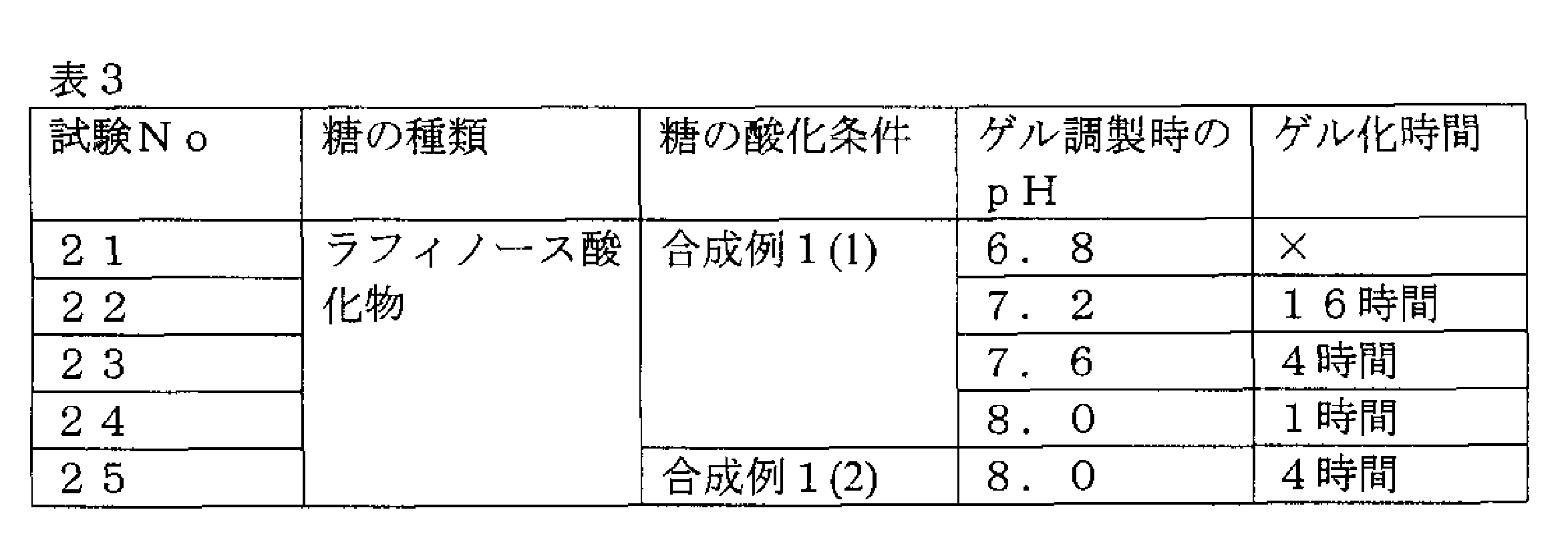
中性よりも低いpHでは反応が十分進行せず、pHが7.6以上の場合に、ゲル化は早く進行した。また、pHが5以下で過塩素酸酸化をしたラフィノース酸化物(合成例1(2))を使用した場合であっても、ゲル調製時におけるコラーゲン溶液のpHが高い場合には、ゲル化することが確認された。
[実施例2]
ゼラチン溶液のゲル化
(1)ブタ由来ゼラチンの糖酸化物によるゲル化
40℃にてゼラチン(和光純薬社製077-03155、ブタ由来)の水溶液を作製し、リン酸緩衝溶液を添加し、最終的に15%ゼラチン溶液(pH7.6)を調製した。この溶液0.3mLに3%糖酸化物の水溶液0.06mLを添加して撹拌し、40℃で静置した。
ゼラチン溶液のゲル化
(1)ブタ由来ゼラチンの糖酸化物によるゲル化
40℃にてゼラチン(和光純薬社製077-03155、ブタ由来)の水溶液を作製し、リン酸緩衝溶液を添加し、最終的に15%ゼラチン溶液(pH7.6)を調製した。この溶液0.3mLに3%糖酸化物の水溶液0.06mLを添加して撹拌し、40℃で静置した。

ブタ由来ゼラチンは室温で可逆性の物理ゲルを形成することから、上記ゲルの作製試験は、ゼラチン溶液が融解する40℃で行った。ラフィノース酸化物とスクロース酸化物を添加した場合にはゲル化したが、グルコース酸化物、マルトース酸化物、フルコトース酸化物ではゲル化は認められなかった。40℃においては、コラーゲンの熱劣化と糖酸化物による架橋反応が同時に進行すると予想されるため、ゲルを調製するには速やかな架橋反応が必要と考えられる。上記の糖酸化物はいずれも架橋構造は形成すると考えられるが、ラフィノース酸化物とスクロース酸化物は、効率良くゲル化する能力が認められた。
(2)ゼラチン溶液のpHによるゲル化への影響
40℃にてゼラチン(和光純薬社製077-03155、ブタ由来)の水溶液を作成し、リン酸緩衝溶液を添加し、最終的に15%ゼラチン溶液(pH8、pH9)を調製した。この溶液0.3mLに3%ラフィノース酸化物または3%スクロース酸化物の水溶液0.06mLを添加して撹拌し、40℃で静置した。
40℃にてゼラチン(和光純薬社製077-03155、ブタ由来)の水溶液を作成し、リン酸緩衝溶液を添加し、最終的に15%ゼラチン溶液(pH8、pH9)を調製した。この溶液0.3mLに3%ラフィノース酸化物または3%スクロース酸化物の水溶液0.06mLを添加して撹拌し、40℃で静置した。
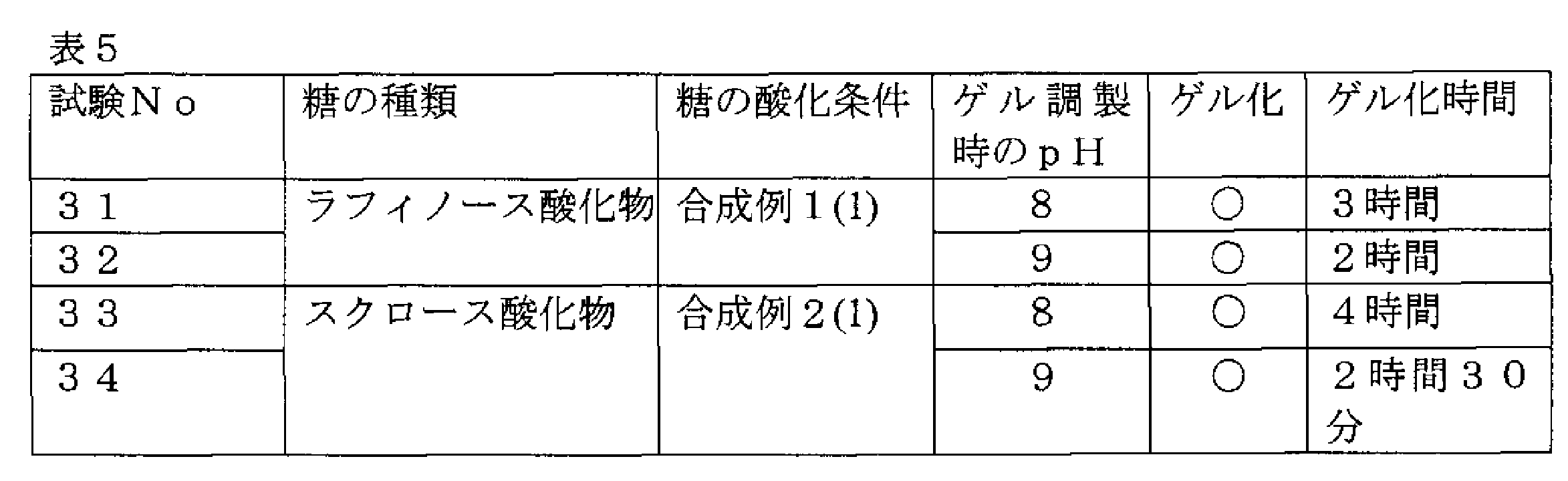
pHが中性付近ではゲル化が十分進行しないことが確認された。また、ゼラチン溶液のpHが高い場合には、ゲル化時間が短縮する傾向が認められた。
(3)糖酸化物の添加濃度によるゼラチン溶液のゲル化への影響
40℃にてゼラチン(和光純薬社製、077-03155、ブタ由来)の水溶液を作成し、リン酸緩衝溶液を添加し、最終的に15%ゼラチン溶液(pH9)を調製した。この溶液0.3mLに3%、6%、9%ラフィノース酸化物または3%、6%、9%スクロース酸化物の水溶液0.06mLを添加して撹拌し、40℃で静置した。
40℃にてゼラチン(和光純薬社製、077-03155、ブタ由来)の水溶液を作成し、リン酸緩衝溶液を添加し、最終的に15%ゼラチン溶液(pH9)を調製した。この溶液0.3mLに3%、6%、9%ラフィノース酸化物または3%、6%、9%スクロース酸化物の水溶液0.06mLを添加して撹拌し、40℃で静置した。
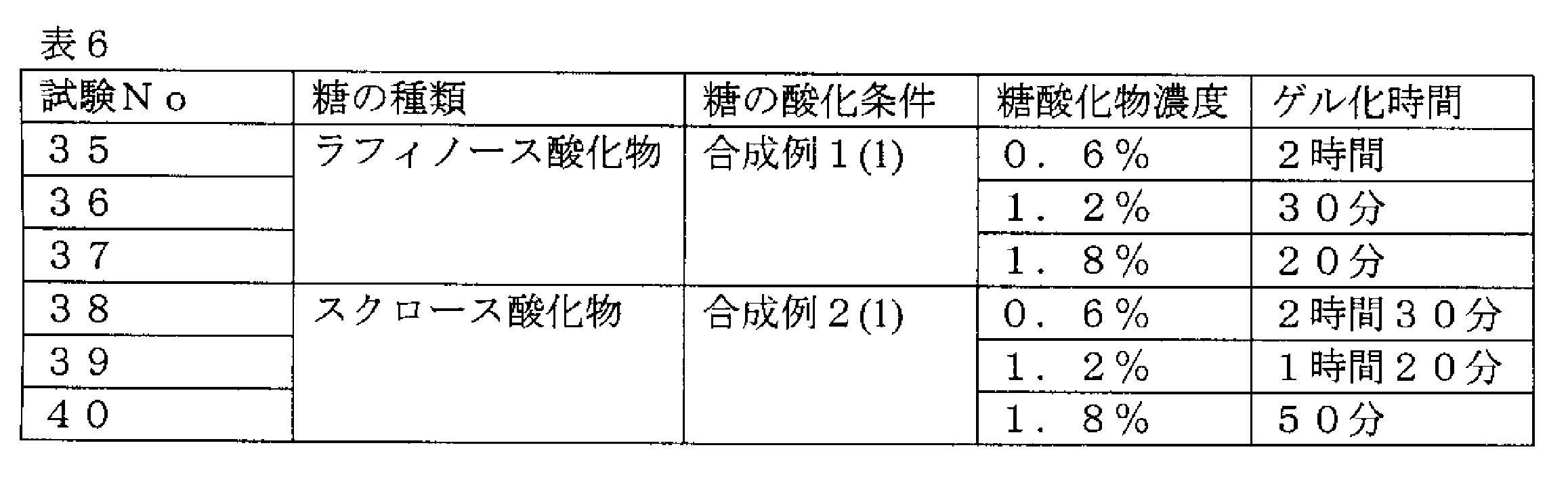
糖酸化物の添加濃度が高くなるにつれて、ゼラチン溶液のゲル化時間が短縮する傾向が認められた。
(4)魚由来ゼラチンの糖酸化物によるゲル化
18℃にてゼラチン(SIGMA社製、G7041-100G、魚由来)の水溶液を作製し、リン酸緩衝溶液を添加し、最終的に15%ゼラチン溶液(pH7.6)を調製した。この溶液0.3mLに3%糖酸化物の水溶液0.06mLを添加して撹拌し、18℃で静置した。
18℃にてゼラチン(SIGMA社製、G7041-100G、魚由来)の水溶液を作製し、リン酸緩衝溶液を添加し、最終的に15%ゼラチン溶液(pH7.6)を調製した。この溶液0.3mLに3%糖酸化物の水溶液0.06mLを添加して撹拌し、18℃で静置した。

魚由来ゼラチンはおよそ4℃以下で可逆性の物理ゲルを形成することから、上記のゲルの作製試験は室温付近(18℃)で行った。ラフィノース酸化物とスクロース酸化物を添加した場合にはゲル化したが、グルコース酸化物、マルトース酸化物、フルコトース酸化物ではゲル化は認められなかった。
(5)キトサン誘導体のラフィノース酸化物によるゲル化
24℃にてカルボキシメチルキトサン(大日精化製、CMキトサン)の2%水溶液(pH8)を調製した。この溶液0.3mLに9%ラフィノース酸化物の水溶液0.06mLを添加して撹拌し、24℃にて静置した。
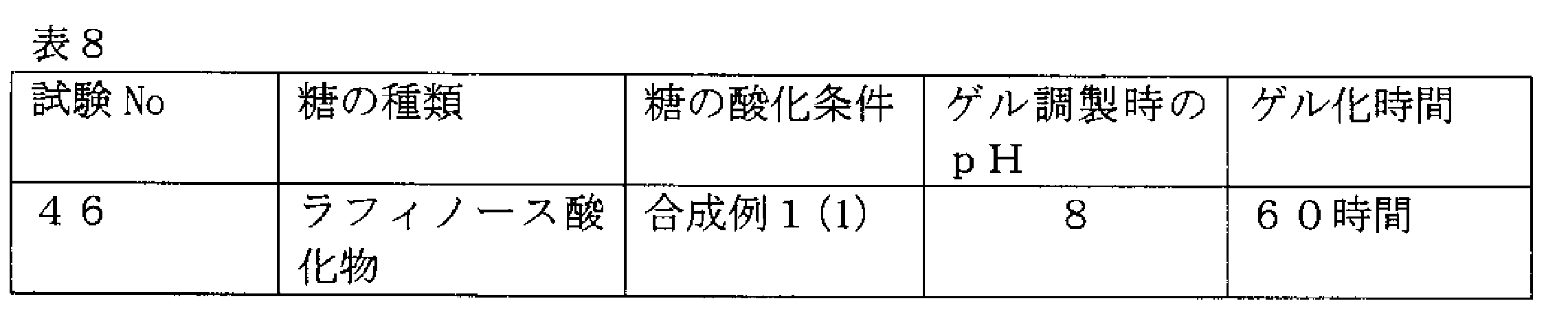
カルボキシメチルキトサンは分子中に反応性のアミノ基を有する水溶性の多糖類である。調製した水溶液は弱アルカリ性を示した。この水溶液にラフィノース酸化物を添加したところ、次第に増粘しゲル化した。
24℃にてカルボキシメチルキトサン(大日精化製、CMキトサン)の2%水溶液(pH8)を調製した。この溶液0.3mLに9%ラフィノース酸化物の水溶液0.06mLを添加して撹拌し、24℃にて静置した。
カルボキシメチルキトサンは分子中に反応性のアミノ基を有する水溶性の多糖類である。調製した水溶液は弱アルカリ性を示した。この水溶液にラフィノース酸化物を添加したところ、次第に増粘しゲル化した。
[実施例3]
細胞培養試験
4℃で0.8%アテロコラーゲン(新田ゼラチン、コラーゲンBM)リン酸緩衝溶液(pH7.6、1mL)に3%酸化ラフィノース水溶液(合成例1(1)の酸化条件)(0.2mL)を添加して撹拌した。この混合溶液を18℃で4時間静置し、増粘したところで120μLを分取し、各細胞を添加して混合した。シャーレに密着した厚さ2mmのビニールシートに穴(φ8mm)をあけ、その中に細胞混合液を注入し、湿潤下18℃で1時間静置してゲル化させた。ディスク状ゲル(厚さ2mm,φ8mm)を培養液で被覆して培養した。
細胞培養試験
4℃で0.8%アテロコラーゲン(新田ゼラチン、コラーゲンBM)リン酸緩衝溶液(pH7.6、1mL)に3%酸化ラフィノース水溶液(合成例1(1)の酸化条件)(0.2mL)を添加して撹拌した。この混合溶液を18℃で4時間静置し、増粘したところで120μLを分取し、各細胞を添加して混合した。シャーレに密着した厚さ2mmのビニールシートに穴(φ8mm)をあけ、その中に細胞混合液を注入し、湿潤下18℃で1時間静置してゲル化させた。ディスク状ゲル(厚さ2mm,φ8mm)を培養液で被覆して培養した。
(1)正常ヒト臍帯静脈内皮細胞(HUVEC)
上記のディスク状ゲル(120μL)1つ分にGFP-expressing HUVEC(Angio-Proteomie社)が6×10⁶細胞混入するように調製した。培養液はEGM-2(Lonza社)を用いた。
培養を開始して5日目の顕微鏡での観察結果を図1に示す。
上記のディスク状ゲル(120μL)1つ分にGFP-expressing HUVEC(Angio-Proteomie社)が6×10⁶細胞混入するように調製した。培養液はEGM-2(Lonza社)を用いた。
培養を開始して5日目の顕微鏡での観察結果を図1に示す。
(2)肝細胞
肝細胞はウイスターラット(300g)の肝よりコラーゲナーゼ灌流法にて採取した。Prime-Sarfae24穴プレート(住友ベークライト)に肝細胞(8×10⁴細胞/穴)を播種し、4日間培養した後にスフェロイドになったところで24穴分をディスク状ゲル(120μL)に添加した。培養液は吉里らの方法に従って調製して用いた。
スフェロイドをゲルに添加してから3日目の顕微鏡での観察結果を図2に示す。
肝細胞はウイスターラット(300g)の肝よりコラーゲナーゼ灌流法にて採取した。Prime-Sarfae24穴プレート(住友ベークライト)に肝細胞(8×10⁴細胞/穴)を播種し、4日間培養した後にスフェロイドになったところで24穴分をディスク状ゲル(120μL)に添加した。培養液は吉里らの方法に従って調製して用いた。
スフェロイドをゲルに添加してから3日目の顕微鏡での観察結果を図2に示す。
(3)心筋細胞
心筋細胞は生後1日のウイスターラットの子供から採取した。Prime-Sarfae24穴プレート(住友ベークライト)に心筋細胞(8×10⁴細胞/穴)を播種し、4~6日間培養した後にスフェロイドになったところで6穴分をディスク状ゲル(120μL)に添加した。培養液はRCBM(Rat Cardiac Myocyte Basal Medium,Lonza社)を用いた。
スフェロイドをゲルに添加してから3日目の顕微鏡での観察結果を図2に示す。
心筋細胞は生後1日のウイスターラットの子供から採取した。Prime-Sarfae24穴プレート(住友ベークライト)に心筋細胞(8×10⁴細胞/穴)を播種し、4~6日間培養した後にスフェロイドになったところで6穴分をディスク状ゲル(120μL)に添加した。培養液はRCBM(Rat Cardiac Myocyte Basal Medium,Lonza社)を用いた。
スフェロイドをゲルに添加してから3日目の顕微鏡での観察結果を図2に示す。
上記(1)~(3)の実験において、得られたゲルは透明性が高く、ゲル内部における細胞の三次元的な増殖過程を経時的に観察することが可能であった。ゲルの細胞毒性は問題なく、肝細胞スフェロイドの場合、図2の矢印で示すように、球状の細胞塊から新たな細胞が萌芽する過程が観察された。HIUVECや心筋細胞ではゲル内培養翌日には細胞の分岐構造が観察され、数日後には三次元的な網目構造が構築された。心筋細胞では細胞個々の拍動から次第に連動した拍動に移行し、最終的にはゲル全体が拍動した(図3中矢印で示した部分)。
[実施例4]
ラットへの移植実験
氷上(4℃)にて0.3mLの0.8%アテロコラーゲン(新田ゼラチン、コラーゲンBM)リン酸緩衝溶液(pH7.6)を調製した。この溶液に0.06mLの3%(50mM)ラフィノース酸化物水溶液を添加して撹拌した。輪切りにしたePTFE人工血管(高さ1mm、内径φ3mm)に14μLずつ分注し、18℃で4時間30分静置してゲル化させた。ゲルにHANKS緩衝液を被覆してゲル化の進行を抑制し、37℃、湿潤下で一晩静置した。
得られたゲルをWister系オスラット(8週齢、体重300-600g)腹部に皮下埋植し、5日後に摘出した。Hematoxylin-eosin(H-E)染色を施し、光学顕微鏡下で組織学的に観察した。図4に移植実験の概略フロー図を示す。
ラットへの移植実験
氷上(4℃)にて0.3mLの0.8%アテロコラーゲン(新田ゼラチン、コラーゲンBM)リン酸緩衝溶液(pH7.6)を調製した。この溶液に0.06mLの3%(50mM)ラフィノース酸化物水溶液を添加して撹拌した。輪切りにしたePTFE人工血管(高さ1mm、内径φ3mm)に14μLずつ分注し、18℃で4時間30分静置してゲル化させた。ゲルにHANKS緩衝液を被覆してゲル化の進行を抑制し、37℃、湿潤下で一晩静置した。
得られたゲルをWister系オスラット(8週齢、体重300-600g)腹部に皮下埋植し、5日後に摘出した。Hematoxylin-eosin(H-E)染色を施し、光学顕微鏡下で組織学的に観察した。図4に移植実験の概略フロー図を示す。
図5に光学顕微鏡での観察結果を示す。移植したゲル(写真中央部の黄色破線で囲まれた部分)は、5日間で血管豊富な肉芽組織に置き換わったことが分かる。また、ゲルを足場として血管のみが侵入している場合も見られ、血管を誘導する効果も期待される。
Claims (25)
- アルデヒド基を有するオリゴ糖酸化物、及び側鎖にアミノ基を有するポリペプチド又は多糖類を含む架橋性組成物。
- オリゴ糖酸化物がオリゴ糖の過ヨウ素酸酸化から生成された、請求項1に記載の架橋性組成物。
- 前記ポリペプチドが、コラーゲン、アテロコラーゲン、ゼラチン、それらの誘導体又はこれらの混合物から選択される、請求項1又は2に記載の架橋性組成物。
- 前記多糖類が、脱アセチル化キチン又はキトサン、スクシニル化キトサン、グリセリル化キトサン、カルボキシメチル化キトサン、ヒドロキシブチル―ヒドロキシプロピル化キトサン、アミノ化デキストラン、アミノ化デンプン、アミノアルキル化プルラン、アミノ化ヒアルロン酸、アミノ化コンドロイチン硫酸、アミノ化セルロース、それらの誘導体又はこれらの混合物から選択される、請求項1又は2に記載の架橋性組成物。
- 前記オリゴ糖が、スクロース、マルトース、ラフィノース、これらの誘導体及びこれらの2以上の混合物からなる群から選択される、請求項1~4のいずれか1項に記載の架橋性組成物。
- 請求項1~5のいずれか1項に記載の架橋性組成物から得られる架橋体。
- 前記オリゴ糖酸化物のアルデヒド基と前記ポリペプチド又は多糖類のアミノ基が共有結合している、請求項6に記載の架橋体。
- ゲル化した状態にある、請求項6又は7に記載の架橋体。
- 血管新生因子を含有する、請求項6~8のいずれか1項に記載の架橋体。
- 細胞又は細胞組織を含有する、請求項6~9のいずれか1項に記載の架橋体。
- 細胞培養液を含有する、請求項10に記載の架橋体。
- 請求項6~11のいずれか1項に記載の架橋体を用いた、細胞培養システム。
- 請求項6~11のいずれか1項に記載の架橋体を被験者の体内に移植するシステム。
- 請求項12に記載の細胞培養システムで得られる培養細胞を、被験者の体内に移植するシステム。
- (a)請求項1~5のいずれか1項に記載の架橋性組成物を調製する工程、
(b)前記架橋性組成物のpHを7.0以上に調整する工程
を含む、前記架橋性組成物のゲルを調製する方法。 - (a)請求項1~5のいずれか1項に記載の架橋性組成物を調製する工程、
(b)前記架橋性組成物のpHを7.0以上に調整する工程、
(c)前記架橋性組成物をゲル化させる工程
を含み、(c)の工程前、工程中または工程後の時点で、前記架橋性組成物に細胞又は細胞組織を添加する、細胞を培養する方法。 - 前記(c)の工程前、工程中または工程後の時点で前記架橋性組成物に培養液を添加する、請求項16に記載の細胞を培養する方法。
- 請求項15に記載の方法で得られるゲルを被験者の体内に移植する方法。
- 請求項16又は17に記載の方法で得られる培養細胞を被験者の体内に移植する方法。
- アルデヒド基を有するオリゴ糖酸化物及び側鎖にアミノ基を有するポリペプチド又は多糖類を含む架橋性組成物から形成されたゲル中に細胞又は細胞組織が包埋されており、被験者の体内に移植されるように用いられる、再生組織を構築するための移植材料。
- アルデヒド基を有するオリゴ糖酸化物からなり、側鎖にアミノ基を有するポリペプチド又は多糖類との架橋反応に用いられる架橋剤。
- オリゴ糖酸化物がオリゴ糖の過ヨウ素酸酸化から生成される、請求項21に記載の架橋剤。
- 前記オリゴ糖が、スクロース、マルトース、ラフィノース、これらの誘導体及びこれらの2以上の混合物からなる群から選択される、請求項21又は22に記載の架橋剤。
- 側鎖にアミノ基を有するポリペプチドが、コラーゲン、アテロコラーゲン、ゼラチン、それらの誘導体又はこれらの混合物から選択される、請求項21~23のいずれか1項に記載の架橋剤。
- 側鎖にアミノ基を有する多糖類が、脱アセチル化キチン又はキトサン、スクシニル化キトサン、グリセリル化キトサン、カルボキシメチル化キトサン、ヒドロキシブチル―ヒドロキシプロピル化キトサン、アミノ化デキストラン、アミノ化デンプン、アミノアルキル化プルラン、アミノ化ヒアルロン酸、アミノ化コンドロイチン硫酸、アミノ化セルロース、それらの誘導体又はこれらの混合物から選択される、請求項21~23のいずれか1項に記載の架橋剤。
Priority Applications (1)
| Application Number | Priority Date | Filing Date | Title |
|---|---|---|---|
| JP2014516859A JP6055466B2 (ja) | 2012-05-24 | 2013-05-24 | 酸化オリゴ糖で架橋したゲル材料 |
Applications Claiming Priority (2)
| Application Number | Priority Date | Filing Date | Title |
|---|---|---|---|
| JP2012118380 | 2012-05-24 | ||
| JP2012-118380 | 2012-05-24 |
Publications (1)
| Publication Number | Publication Date |
|---|---|
| WO2013176239A1 true WO2013176239A1 (ja) | 2013-11-28 |
Family
ID=49623920
Family Applications (1)
| Application Number | Title | Priority Date | Filing Date |
|---|---|---|---|
| PCT/JP2013/064433 Ceased WO2013176239A1 (ja) | 2012-05-24 | 2013-05-24 | 酸化オリゴ糖で架橋したゲル材料 |
Country Status (2)
| Country | Link |
|---|---|
| JP (1) | JP6055466B2 (ja) |
| WO (1) | WO2013176239A1 (ja) |
Cited By (6)
| Publication number | Priority date | Publication date | Assignee | Title |
|---|---|---|---|---|
| CN111902424A (zh) * | 2018-04-27 | 2020-11-06 | 凸版印刷株式会社 | 含细胞外基质的组合物及其制造方法、以及三维组织体、三维组织体形成剂 |
| CN112089826A (zh) * | 2019-06-18 | 2020-12-18 | 杭州生物医药创新研究中心 | 一种包含活性生物因子的缓释药物及其制备方法 |
| CN112999418A (zh) * | 2021-03-02 | 2021-06-22 | 华东数字医学工程研究院 | 医用水凝胶组合物、医用水凝胶及其制备方法 |
| WO2023020256A1 (zh) * | 2021-08-14 | 2023-02-23 | 中国海洋大学 | 一种生物多糖水凝胶及其制备方法和应用 |
| CN117414462A (zh) * | 2023-10-23 | 2024-01-19 | 江苏博朗森思医疗器械有限公司 | 一种用于弥漫性出血的止血颗粒及其制备方法和应用 |
| CN120168700A (zh) * | 2025-03-21 | 2025-06-20 | 广东云曌医疗科技有限公司 | 一种多糖基水凝胶及其制备方法和应用 |
Families Citing this family (3)
| Publication number | Priority date | Publication date | Assignee | Title |
|---|---|---|---|---|
| KR20240115552A (ko) * | 2023-01-19 | 2024-07-26 | 주식회사 엘지화학 | 폴리머 재료 |
| KR20240115551A (ko) * | 2023-01-19 | 2024-07-26 | 주식회사 엘지화학 | 폴리머 재료 |
| KR20260051259A (ko) * | 2024-10-08 | 2026-04-16 | 주식회사 엘지화학 | 폴리머 재료 |
Citations (3)
| Publication number | Priority date | Publication date | Assignee | Title |
|---|---|---|---|---|
| WO2009057802A1 (ja) * | 2007-11-01 | 2009-05-07 | Osaka City University | β-1,3-グルカン由来ポリアルデヒド/ポリアミンハイドロゲル |
| WO2010075010A2 (en) * | 2008-12-16 | 2010-07-01 | Genzyme Corporation | Oligosaccharide-protein conjugates |
| JP2011160817A (ja) * | 2010-02-04 | 2011-08-25 | Univ Of Tokyo | 移植支援材料 |
-
2013
- 2013-05-24 WO PCT/JP2013/064433 patent/WO2013176239A1/ja not_active Ceased
- 2013-05-24 JP JP2014516859A patent/JP6055466B2/ja not_active Expired - Fee Related
Patent Citations (3)
| Publication number | Priority date | Publication date | Assignee | Title |
|---|---|---|---|---|
| WO2009057802A1 (ja) * | 2007-11-01 | 2009-05-07 | Osaka City University | β-1,3-グルカン由来ポリアルデヒド/ポリアミンハイドロゲル |
| WO2010075010A2 (en) * | 2008-12-16 | 2010-07-01 | Genzyme Corporation | Oligosaccharide-protein conjugates |
| JP2011160817A (ja) * | 2010-02-04 | 2011-08-25 | Univ Of Tokyo | 移植支援材料 |
Non-Patent Citations (1)
| Title |
|---|
| WATARU KAMIMURA ET AL.: "Ishoku-yo Sanjigen Saibo Baiyo System: Oligo-To Sankabutsu Kakyo Collagen Gel no Kaihatsu", REGENERATIVE MEDICINE, vol. 11, 1 June 2012 (2012-06-01), pages 203 * |
Cited By (7)
| Publication number | Priority date | Publication date | Assignee | Title |
|---|---|---|---|---|
| CN111902424A (zh) * | 2018-04-27 | 2020-11-06 | 凸版印刷株式会社 | 含细胞外基质的组合物及其制造方法、以及三维组织体、三维组织体形成剂 |
| CN112089826A (zh) * | 2019-06-18 | 2020-12-18 | 杭州生物医药创新研究中心 | 一种包含活性生物因子的缓释药物及其制备方法 |
| CN112999418A (zh) * | 2021-03-02 | 2021-06-22 | 华东数字医学工程研究院 | 医用水凝胶组合物、医用水凝胶及其制备方法 |
| WO2023020256A1 (zh) * | 2021-08-14 | 2023-02-23 | 中国海洋大学 | 一种生物多糖水凝胶及其制备方法和应用 |
| CN117414462A (zh) * | 2023-10-23 | 2024-01-19 | 江苏博朗森思医疗器械有限公司 | 一种用于弥漫性出血的止血颗粒及其制备方法和应用 |
| CN117414462B (zh) * | 2023-10-23 | 2024-12-27 | 江苏博朗森思医疗器械有限公司 | 一种用于弥漫性出血的止血颗粒及其制备方法和应用 |
| CN120168700A (zh) * | 2025-03-21 | 2025-06-20 | 广东云曌医疗科技有限公司 | 一种多糖基水凝胶及其制备方法和应用 |
Also Published As
| Publication number | Publication date |
|---|---|
| JPWO2013176239A1 (ja) | 2016-01-14 |
| JP6055466B2 (ja) | 2016-12-27 |
Similar Documents
| Publication | Publication Date | Title |
|---|---|---|
| JP6055466B2 (ja) | 酸化オリゴ糖で架橋したゲル材料 | |
| Krishtul et al. | Processed tissue–derived extracellular matrices: tailored platforms empowering diverse therapeutic applications | |
| Kim et al. | Heparin functionalized injectable cryogel with rapid shape-recovery property for neovascularization | |
| Zhang et al. | Natural polymer‐derived bioscaffolds for peripheral nerve regeneration | |
| Shen et al. | Engineering a highly biomimetic chitosan-based cartilage scaffold by using short fibers and a cartilage-decellularized matrix | |
| Yi et al. | Extracellular matrix scaffolds for tissue engineering and regenerative medicine | |
| Ahadian et al. | Bioconjugated hydrogels for tissue engineering and regenerative medicine | |
| Kavand et al. | Recent advances in alginate-based hydrogels for cell transplantation applications | |
| Ruvinov et al. | Alginate biomaterial for the treatment of myocardial infarction: progress, translational strategies, and clinical outlook: from ocean algae to patient bedside | |
| Klouda | Thermoresponsive hydrogels in biomedical applications: A seven-year update | |
| Van Vlierberghe et al. | Biopolymer-based hydrogels as scaffolds for tissue engineering applications: a review | |
| JP5876787B2 (ja) | 細胞移植用細胞構造体および細胞移植用細胞集合体 | |
| KR101756935B1 (ko) | 이중 가교를 갖는 하이드로젤 지지체, 그의 용도 및 이단계 가교를 사용하여 그를 제조하는 하는 방법 | |
| CN103877617B (zh) | 可注射蚕丝素蛋白-海藻酸盐双交联水凝胶及其制备方法和使用方法 | |
| Zhang et al. | Application of hydrogels in heart valve tissue engineering | |
| CN104725660A (zh) | 制备用于组织工程、细胞培养和细胞传递的多孔支架的方法 | |
| Nadi et al. | Stem cells and hydrogels for liver tissue engineering: synergistic cure for liver regeneration | |
| Tamay et al. | Bioinks—materials used in printing cells in designed 3D forms | |
| Hasirci et al. | Hydrogels in regenerative medicine | |
| Li et al. | Cartilage decellularized extracellular matrix-based hydrogel with enhanced tissue adhesion and promoted chondrogenesis for cartilage tissue engineering | |
| Pires et al. | Multifunctional Hydrogels for Biomedical Applications | |
| Zhang et al. | Biomedical application of decellularized scaffolds | |
| Adeyemi et al. | Current advances in cell therapeutics: a biomacromolecules application perspective | |
| Tormos et al. | Chitosan for cardiac tissue engineering and regeneration | |
| Lu et al. | Advances in polymer‐based cell encapsulation and its applications in tissue repair |
Legal Events
| Date | Code | Title | Description |
|---|---|---|---|
| 121 | Ep: the epo has been informed by wipo that ep was designated in this application |
Ref document number: 13793537 Country of ref document: EP Kind code of ref document: A1 |
|
| ENP | Entry into the national phase |
Ref document number: 2014516859 Country of ref document: JP Kind code of ref document: A |
|
| NENP | Non-entry into the national phase |
Ref country code: DE |
|
| 122 | Ep: pct application non-entry in european phase |
Ref document number: 13793537 Country of ref document: EP Kind code of ref document: A1 |