WO2013146232A1 - ゲームシステム及びその制御方法 - Google Patents
ゲームシステム及びその制御方法 Download PDFInfo
- Publication number
- WO2013146232A1 WO2013146232A1 PCT/JP2013/056832 JP2013056832W WO2013146232A1 WO 2013146232 A1 WO2013146232 A1 WO 2013146232A1 JP 2013056832 W JP2013056832 W JP 2013056832W WO 2013146232 A1 WO2013146232 A1 WO 2013146232A1
- Authority
- WO
- WIPO (PCT)
- Prior art keywords
- game
- stage
- user
- play
- selection
- Prior art date
- Legal status (The legal status is an assumption and is not a legal conclusion. Google has not performed a legal analysis and makes no representation as to the accuracy of the status listed.)
- Ceased
Links
Images







Classifications
-
- A—HUMAN NECESSITIES
- A63—SPORTS; GAMES; AMUSEMENTS
- A63F—CARD, BOARD, OR ROULETTE GAMES; INDOOR GAMES USING SMALL MOVING PLAYING BODIES; VIDEO GAMES; GAMES NOT OTHERWISE PROVIDED FOR
- A63F13/00—Video games, i.e. games using an electronically generated display having two or more dimensions
- A63F13/30—Interconnection arrangements between game servers and game devices; Interconnection arrangements between game devices; Interconnection arrangements between game servers
- A63F13/35—Details of game servers
-
- A—HUMAN NECESSITIES
- A63—SPORTS; GAMES; AMUSEMENTS
- A63F—CARD, BOARD, OR ROULETTE GAMES; INDOOR GAMES USING SMALL MOVING PLAYING BODIES; VIDEO GAMES; GAMES NOT OTHERWISE PROVIDED FOR
- A63F13/00—Video games, i.e. games using an electronically generated display having two or more dimensions
- A63F13/60—Generating or modifying game content before or while executing the game program, e.g. authoring tools specially adapted for game development or game-integrated level editor
- A63F13/63—Generating or modifying game content before or while executing the game program, e.g. authoring tools specially adapted for game development or game-integrated level editor by the player, e.g. authoring using a level editor
-
- A—HUMAN NECESSITIES
- A63—SPORTS; GAMES; AMUSEMENTS
- A63F—CARD, BOARD, OR ROULETTE GAMES; INDOOR GAMES USING SMALL MOVING PLAYING BODIES; VIDEO GAMES; GAMES NOT OTHERWISE PROVIDED FOR
- A63F13/00—Video games, i.e. games using an electronically generated display having two or more dimensions
- A63F13/45—Controlling the progress of the video game
- A63F13/48—Starting a game, e.g. activating a game device or waiting for other players to join a multiplayer session
-
- A—HUMAN NECESSITIES
- A63—SPORTS; GAMES; AMUSEMENTS
- A63F—CARD, BOARD, OR ROULETTE GAMES; INDOOR GAMES USING SMALL MOVING PLAYING BODIES; VIDEO GAMES; GAMES NOT OTHERWISE PROVIDED FOR
- A63F13/00—Video games, i.e. games using an electronically generated display having two or more dimensions
- A63F13/60—Generating or modifying game content before or while executing the game program, e.g. authoring tools specially adapted for game development or game-integrated level editor
- A63F13/69—Generating or modifying game content before or while executing the game program, e.g. authoring tools specially adapted for game development or game-integrated level editor by enabling or updating specific game elements, e.g. unlocking hidden features, items, levels or versions
-
- A—HUMAN NECESSITIES
- A63—SPORTS; GAMES; AMUSEMENTS
- A63F—CARD, BOARD, OR ROULETTE GAMES; INDOOR GAMES USING SMALL MOVING PLAYING BODIES; VIDEO GAMES; GAMES NOT OTHERWISE PROVIDED FOR
- A63F2300/00—Features of games using an electronically generated display having two or more dimensions, e.g. on a television screen, showing representations related to the game
- A63F2300/40—Features of games using an electronically generated display having two or more dimensions, e.g. on a television screen, showing representations related to the game characterised by details of platform network
- A63F2300/402—Communication between platforms, i.e. physical link to protocol
-
- A—HUMAN NECESSITIES
- A63—SPORTS; GAMES; AMUSEMENTS
- A63F—CARD, BOARD, OR ROULETTE GAMES; INDOOR GAMES USING SMALL MOVING PLAYING BODIES; VIDEO GAMES; GAMES NOT OTHERWISE PROVIDED FOR
- A63F2300/00—Features of games using an electronically generated display having two or more dimensions, e.g. on a television screen, showing representations related to the game
- A63F2300/40—Features of games using an electronically generated display having two or more dimensions, e.g. on a television screen, showing representations related to the game characterised by details of platform network
- A63F2300/406—Transmission via wireless network, e.g. pager or GSM
Definitions
- the present invention relates to a game system in which a user plays a game by selectively using a plurality of elements.
- a game system in which a plurality of elements such as a stage, a map, a character, an item, and a music are prepared, and the game is progressed by sequentially allowing selection by the user of these elements.
- an online game system in which items used in a game are gradually added and used for user selection is known (see Patent Document 1).
- Patent Document 1 An online game system in which items used in a game are gradually added and used for user selection is known (see Patent Document 1).
- Patent Document 1 An online game system in which items used in a game are gradually added and used for user selection.
- a game that allows a user to play a game with a limited range of selectable elements called a trial version free of charge, and then allows a user to play a game with an expanded range of selectable elements called a product version for a fee Widely adopted in the system.
- the range of elements that can be selected by the user is set in common for all users except for differences that may occur depending on the progress of the game between the users.
- the range of elements that can be selected by the user in the trial version of the game is the same regardless of the user. Therefore, the user cannot specifically know the game in which the restriction on the selection of elements is relaxed or abolished. Therefore, there is a possibility that the user is satisfied with playing a range of games and the motivation to continuously play the game is reduced.
- the user may be satisfied with a free trial version, which may cause inconvenience that the product version or the regular version is not purchased.
- an object of the present invention is to provide a game system or the like that can improve control related to whether or not an element can be selected and can give the user motivation to continuously play the game.
- the game system includes a first stage in which a game device user plays a game in a state where only some of the plurality of elements are selectable, and an element that cannot be selected in the first stage is selected.
- a game system comprising a game control means for dividing a game into a second stage for allowing the user to play a game, wherein at least some of the elements selectable in the first stage are between users
- the first selection control means for controlling the range of elements that can be selected in the first stage, and the second selection that controls whether or not the elements can be selected in the second stage according to a predetermined condition. 2 selection control means.
- the game control method of the present invention includes a first stage in which a game device user plays a game in a state where only some of the plurality of elements are selectable, and an element that cannot be selected in the first stage.
- a game progress control method in which the game is progressed separately from the second stage in which the user plays the game, wherein at least some of the elements that can be selected in the first stage are the user
- a procedure for controlling the range of elements that can be selected in the first stage and a procedure for controlling whether or not the elements can be selected in the second stage according to a predetermined condition. It is a thing.
- the range of elements that can be selected by the user in the first stage is limited. However, at least some of the elements that can be selected in the first stage differ among users. For this reason, in the first stage, there are elements that cannot be selected by each user and can be selected by other users. By exchanging information between users, each user can know the contents of elements that cannot be selected by other users. Therefore, it is possible to give the user a motivation to proceed to the second stage and continue to play the game by causing the user to feel deficient or frustrated with being unable to select elements that others have already experienced.
- the second stage it is possible in the second stage to allow the user to designate an element desired to be selected from a group of elements that cannot be selected in the first stage, and the second selection control means.
- selection regarding the element may be switched from an impossible state to a possible state.
- by causing the user to specify which element is desired to be selected in the second stage it is possible to appropriately reflect the user's intention in the control of whether or not the element can be selected in the second stage. it can.
- the second selection control means may control to switch the element from an impossible state to a possible state on condition that the user has paid a predetermined price.
- elements that cannot be selected in the first stage can be selected in the second stage in exchange for the user paying a predetermined price.
- the user obtains specific information from other users for at least some of the elements that could not be selected in the first stage, and carefully determines whether or not to allow the selection of the element by paying for it be able to. Therefore, the user's satisfaction with the payment of the price can be enhanced.
- the game system may include a server device and a client device connected to the server device via a network, and the client device may function as the game device.
- the server device may be capable of providing a service for playing a common game using the element to a plurality of users whose selected elements match.
- the user cannot play together in a common game with other users regarding elements that cannot be selected in the first stage. Therefore, it is possible to give the user a feeling of insufficiency or a frustration at not being able to play a common game with other users, and to give the user a stronger motivation to proceed to the second stage and continuously play the game. .
- the server device may be capable of providing a service for exchanging information related to a game by a user via the client device. According to this, since the user can exchange information regarding the selection of elements via the game device, the effect of the present invention can be more reliably exhibited.
- the server device may hold determination information for determining whether or not each user element can be selected, and the first and second selection control means may be provided in the server device.
- the game device may hold determination information for determining whether or not each user element can be selected, and the first and second selection control means may be provided in the game device. In the former case, the load on the client device can be reduced, and in the latter case, the load on the server device can be reduced.
- the range of elements that can be selected by the user in the first stage is limited, and at least some of the elements that can be selected in the first stage differ among users. Since the selection of elements that could not be selected in the first stage is controlled according to a predetermined condition in the second stage, each user is not allowed to select himself / herself through information exchange between users. The content of the possible elements can be specifically obtained from other users, thereby causing the user to feel deficient or frustrated that the elements that others have already experienced cannot be selected. The user can be motivated to go on and play the game continuously.
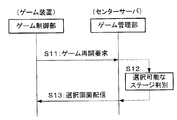
- the flowchart which shows the procedure of the process which a center server and a game device perform in order to make a user select a stage at the time of a game restart.
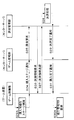
- the flowchart which shows the procedure of the process which a center server and a game device perform when a user purchases a stage.
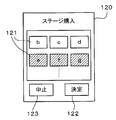
- the figure which shows an example of the screen displayed in order to specify the stage which wishes to purchase.
- the functional block diagram in the principal part of the game system which concerns on another form.
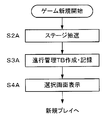
- the flowchart which shows the principal part of the procedure of the process which the game device of FIG. 12 performs at the time of the new start of a game.
- the flowchart which shows the principal part of the procedure of the process which the game device of FIG. 12 performs at the time of a play start.
- the flowchart which shows the procedure of the process which a center server and a game device perform when a user purchases a stage in the form of FIG.
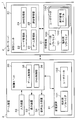
- FIG. 1 shows a schematic configuration of a game system according to one embodiment of the present invention.
- the game system 1 includes a center server 2 as a server device and a game device 3 as a client device connectable to the center server 2 via a network 4.
- the center server 2 is configured as a single logical server device by combining a plurality of server units 2A, 2B.
- the center server 2 may be configured by a single server unit.
- the center server 2 may be logically configured using cloud computing.
- the game device 3 is a kind of network terminal device having a function of allowing a user to play a game.
- FIG. 1 shows a schematic configuration of a game system according to one embodiment of the present invention.
- the game system 1 includes a center server 2 as a server device and a game device 3 as a client device connectable to the center server 2 via a network 4.
- the center server 2 is configured as a single logical server device by combining a plurality of server units 2A, 2B.
- a mobile phone including a smartphone
- Various network terminal devices that can be connected to the network and are used for personal use by the user, such as personal computers (hereinafter referred to as PCs), portable game machines, and portable tablet terminal devices, are used as the game device 3.
- PCs personal computers
- portable game machines portable tablet terminal devices
- the network 4 is configured to realize network communication using a TCP / IP protocol.
- the network 4 is configured by combining the Internet as a WAN and an intranet as a LAN.
- the game apparatus 3 is connected to the network 4 via an access point 4a as a part of the network 4, and the center server 2 is connected to the network via a router 4b.
- the center server 2 is provided with a control unit 20 and a storage device 21.
- the control unit 20 includes a microprocessor, a ROM in which a program such as an operating system to be executed by the microprocessor is recorded, and an internal storage device (not shown) such as a RAM that provides a work area for the microprocessor.
- a computer unit provided.
- the storage device 21 stores various programs and data executed by the control unit 20.
- the data recorded in the storage device 21 includes server software (including programs and data; the same applies hereinafter) that the center server 2 refers to in order to play a predetermined online game on the game device 3. 100, terminal software 101 to be installed in the game apparatus 3 to execute the game, and a group of user data 102 created in association with each game user.
- the terminal software 101 operates on, for example, a Web browser mounted on the game apparatus 3 and transmits / receives information to / from the center server 2 and data to be referred to by the application program Including.
- the user data 102 is a set of information that should be stored separately for each user, such as personal information registered by the user and information specifying the progress of the game.
- the user data 102 further includes a progress management table 103, the details of which will be described later.
- the control unit 20 may be configured so as to be considered as one control unit by a set of a plurality of physical computer units.
- the storage device 21 may also be configured so as to be considered as a single storage device by a set of a plurality of physical storage device arrays.
- a user management unit 22 Inside the control unit 20, a user management unit 22, a game management unit 23, an SNS management unit 24, and a billing management unit 25 are provided.
- Each of the units 22 to 25 is a logical device realized by a combination of the computer hardware of the control unit 20 and the server software 100.
- the user management unit 22 is in charge of processing related to user management such as registration and authentication of a user who has accessed the center server 2 from the game apparatus 3. The user authentication may be performed by acquiring the user ID and password from the game apparatus 3 in the same manner as in a known game system.
- the game management unit 23 is in charge of various processes necessary for causing the user to play a game on the game device 3.
- the game management unit 23 provides at least a part of the terminal software 101 stored in the storage device 21 to the game device 3 in response to a request from the game device 3. Further, if necessary, the game management unit 23 provides at least a part of the user data 102 corresponding to the user authenticated by the user management unit 22 to the game device 3 of the user. Furthermore, the game management unit 23 is also in charge of processing necessary for a plurality of users to participate in a common game via the network 4 and play together. Participation here includes both forms in which users play in a common game, and forms in which a plurality of users advance a game in a common game.
- the game management unit 23 performs a process of matching users who should participate in the common game according to a predetermined matching condition, and exchange of operation information and the like between the game devices 3 of the matched users ( Processing that mediates transmission / reception is also executed.
- the SNS management unit 24 is in charge of processing necessary to provide SNS (social networking service) to the user. As one of the functions realized by the SNS management unit 24, there is a function of preparing on the center server 2 a community in which users exchange information using the game device 3.
- the service provided by the SNS management unit 24 may be the same as that of a known SNS, and a detailed description of the configuration for providing the service is omitted.
- Information exchanged by the community function provided by the SNS management unit 24 is stored in the storage device 21 as necessary.
- the billing management unit 25 is in charge of processing necessary for billing when the user uses the paid service.
- the billing management unit 25 charges the price of the service from the user using an electronic payment such as a credit card, a debit card, or an electronic currency that can be paid for using electronic data exchange, Collect a price commensurate with the price.
- the electronic payment may be a publicly known one, and a description of a specific configuration and procedure for realizing it is omitted.
- the game apparatus 3 is provided with a control unit 30 and a storage device 31.
- the control unit 30 is configured as a computer unit that combines a microprocessor and peripheral devices such as an internal storage device necessary for the operation of the microprocessor.
- the storage device 31 is a storage device that can store and hold power without supplying power, such as a nonvolatile semiconductor memory or a magnetic storage device, and functions as an external storage device for the control unit 30.
- the storage device 31 stores terminal software 101 and user data 102 provided from the center server 2.
- Connected to the control unit 30 are an input device 32 that outputs a signal corresponding to a user operation, a display device 33 that displays and outputs a game screen and the like, and an audio output device 34 that reproduces and outputs game music and the like.
- a game control unit 35 and an SNS control unit 36 are provided in the control unit 30, a game control unit 35 and an SNS control unit 36 are provided.
- Each of the units 35 and 36 is a logical device realized by a combination of the computer hardware of the control unit 30 and the terminal software 101.
- the game control unit 35 is in charge of processing related to the game such as various calculations assigned to the terminal side and drawing of the game screen in order for the user to play the game on the game device 3.
- the SNS control unit 36 is in charge of various processes assigned to the terminal side so that the user can use the SNS function on the game apparatus 3.
- the content of the game played on the game device 3 may be appropriately configured as long as the user plays by selectively using a plurality of elements, in FIG. 3, a plurality of stages ( In the figure, STG is indicated with a suffix.).
- the stage here is a concept indicating a unit of a game or a break to be played, and is a concept called by various names such as a map, a chapter, a course, and a dungeon according to the type of game.
- the user can play a game by selecting any one stage from a group of stages that can be selected by the user.
- the stage is divided into a common element group in which play is permitted in common to all users and a selection element group in which whether or not the user can select is controlled to be switched for each user.
- the common element group includes stages STG1 to STG4, and the selected element group includes other stages STGa... STGn. Whether each stage can be selected is controlled for each user as follows.
- stage selection is controlled by distinguishing between two stages, an initial play stage (first stage) and an additional play stage (second stage).
- the initial play stage is the first stage that can be played free of charge when starting to play the game.
- the additional play stage is a stage where the user can play by adding to the initial play stage under predetermined conditions.
- the initial play stage for all users, at least one stage (randomly drawn for each user from all stages STG1 to STG4 included in the common element group and stages STGa to STGx included in the selected element group)
- whether or not a stage is selected is controlled so that a single stage is included in the range of elements that allow selection by the user.
- stages STG1 to STG4 of the common element group and one stage STGa drawn from the selected element group are set as a range of elements that can be selected in the initial play stage.
- stages STG1 to STG4 of the common element group and one stage STGb selected from the selected element group are set as a range of elements that can be selected in the initial play stage. Therefore, the users A and C cannot select the stage STGa in the initial play stage, and the user B cannot select the stage STGb in the initial play stage.
- the game system 1 it is possible for a plurality of users who satisfy a predetermined matching condition to participate in a common game and play together.
- at least a part of the matching condition Are set to match the selected stage. Therefore, in the initial play stage, the user A and the user C can select the stage STGa and play, but the user B cannot select the stage STGa, so the users A and C and the stage STGa Can't play against.
- a stage that cannot be selected in the initial play stage for example, a user A and a user C, a stage other than the stage STGa of the selected element group, and a user B that is a stage other than the stage STGb of the selected element group
- the concept of “purchase” is introduced as a condition for enabling selection. That is, in the additional play stage, the stage that the user desires to select, that is, the stage that cannot be played in the initial play stage, specifies the stage that the user desires to play, and pays a predetermined price. Is allowed to play the game at that stage. In the example of FIG.
- stage STGa 3 an example in which the user B purchases the stage STGa in the additional play stage is shown.
- user B can play stage STGb alone, and can select stage STGa and play against user A or user C (or both in some cases).
- stage STGb 3 an example in which the user B purchases the stage STGa in the additional play stage.
- some of the stage groups that can be selected by the user in the initial play stage are different among users.
- the user can obtain stage information that cannot be selected by the other user and can be selected by another user.
- Information exchange between users can be performed on the game apparatus 3 by using an SNS function provided by the SNS management unit 24 of the center server 2.
- users can also exchange information through a general-purpose information exchange tool (e-mail, bulletin board on the Web, etc.) different from the game system 1.
- other users can not play and other users attract the user's interest and interest to the stage that has been played, other users have already played by paying the price in the additional play stage Motivation to purchase the stage can be given to the user.
- the user can purchase a stage for the purpose of selecting a stage that the player cannot play and playing against other users. I can expect.
- stage STG1 A correlation between the stages such that the stage STG1 is clear, that is, the next stage STG2 cannot be selected unless a predetermined result is obtained in the stage STG1, may be set in association with whether or not the stage can be selected.
- Such a condition is applicable to all cases where a stage is selected from a selection element group.
- each of the stages that should be selectable in the initial play stage and the stage that is selected in the additional play stage are narrowed down in relation to the stage that the user has already cleared. From the narrowed selection candidate range, stages that can be selected in the initial play stage may be drawn, or a stage range that the user can purchase in the additional play stage may be set.
- FIG. 4 shows a specific example of the progress management table 103.
- the progress management table 103 is a data table in which a stage is associated with flag information for determining whether selection is possible, and functions as determination information of the present invention.
- a flag “1” is written to a stage where selection is permitted, and a flag “0” is written to a stage where selection is not permitted.
- the example of FIG. 4 is a progress management table 103 created corresponding to the users A and C of FIG. 3, the flag values of the stages STG1 to STG4 and the stage STGa are 1, and the flag values of the other stages Are set to 0, respectively.
- the stage selection when the stage selection is sequentially permitted, only the flag of the stage STG1 may be set to “1” first, and the flags of other stages may be set to “0”.
- the progress management table 103 is created for each user and stored in the storage device 21 as part of the user data 102. Therefore, when a specific user desires to play a game, the game management unit 23 can determine a stage that can be selected by the user by specifying the progress management table 103 corresponding to the user.
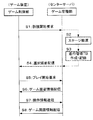
- FIG. 5 shows a processing procedure of the center server 2 and the game device 3 when the user newly starts a game.
- the terminal software 101 is distributed from the game management unit 23 of the center server 2 to the game apparatus 3 in advance.
- the user authentication is completed through cooperation between the game apparatus 3 and the user management unit 22 of the center server 2 prior to the start of processing. That is, the process described below is a process performed in a state where the center server 2 can identify the user in response to a request from the game apparatus 3.
- a predetermined initial screen is displayed on the display device 33 of the game apparatus 3.
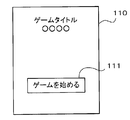
- an initial screen 110 including a new start button 111 for instructing a new start of the game is displayed.
- the game control unit 35 requests the game management unit 23 of the center server 2 to start a new game (step S ⁇ b> 1), and in response to this, the game The management unit 23 draws a stage from the selection element group that should be allowed to be selected by the user in the initial play stage (step S2). This lottery may be a random lottery using random numbers.
- the game management unit 23 creates a user progress management table 103 according to the lottery result, and records this in the storage device 21 (step S3).
- the flag value of the progress management table 103 is set so that only the stages STG1 to STG4 included in the common element group and the stage selected in step SS20 can be selected.
- the progress management table 103 created at this point is a data table for each user describing the range of stages that can be selected in the initial play stage.
- the game management unit 23 distributes information necessary for displaying a stage selection screen to the game device 3 (step S4).
- An example of the selection screen is shown in FIG.
- the selection screen 112 shown in FIG. 7 includes a group of selection buttons 113 for each stage recorded as selection permission in the progress management table 103, a determination button 114, and a cancel button 115.
- the selection buttons 113 corresponding to the stages that cannot be selected by the user are displayed together in a non-selectable manner (for example, displayed in gray). You may make a user recognize presence.
- step S4 the processing following step S4 in FIG. 5 is started.
- the game control unit 35 requests the game management unit 23 to start playing the selected stage (step S5), and in response to this, the game management unit 23 is necessary for drawing the game screen of the selected stage.
- Such information is distributed to the game control unit 35 of the game apparatus 3 (step S6).
- the game control unit 35 of the game apparatus 3 draws a game screen on the display device 33, thereby starting the play of the game.
- the game control unit 35 transmits user operation information to the game management unit 23 (step S7), and the game management unit 23 calculates the progress of the game based on the operation information received from the game device 3, Based on the result, information necessary for drawing the game screen of the next frame is distributed to the game control unit 35 of the game apparatus 3 (step S8). Thereafter, the same process is repeated and the game progresses.
- a predetermined end condition is satisfied, the game ends, and the play result is recorded in the user data 102 by the game management unit 23.
- FIG. 8 shows an example of a game screen that the game control unit 35 displays on the display device 33 according to the terminal software 101 when the user plays the game for the second time or later.
- the game screen 116 displayed in the second and subsequent game play indicates a resumption button 117 for instructing the resumption of the game, and a battle with another user.
- a battle button 118 is included.
- a purchase button 119 for purchasing a stage is further included in the game screen 116.
- the game control unit 35 of the game apparatus 3 requests the game management unit 23 of the center server 2 to resume the game (step S11), and the game management unit 23 proceeds with the user's progress.
- the stages selectable by the user are determined (step S12). After the determination, the game management unit 23 distributes a stage selection screen to the game apparatus 3 (step S13).
- the selection screen at this time includes a group of selection buttons 113, a determination button 114, and a cancel button 115 for each stage recorded as selection permission in the progress management table 103. It is a waste.
- the processing after the selection screen is displayed is the same as that after step S5 in FIG.
- a selection screen is presented by the same processing as in FIG. 9, and the game management unit 23 of the center server 2 selects users with matching stages according to the selection result. Match.
- the selection screen is controlled so that only the stage determined to be selectable based on the progress management table 103 can be selected every time the user instructs the game restart or the battle. Therefore, the user cannot select a stage that is not permitted to be selected and play the stage alone, or cannot play against other users on the stage where the selection is not possible.
- the selection button 113 corresponding to the stage that cannot be selected by the user is also displayed in a non-selectable manner (for example, displayed in gray). The user may be made aware of the presence of an impossible stage.
- FIG. 11 shows a processing procedure of the center server 2 and the game apparatus 3 when the purchase button 119 is selected and operated.
- the game control unit 35 of the game apparatus 3 requests the game management unit 23 of the center server 2 to purchase a stage (step S21).
- the game management unit 23 stores the user's progress management table 103.
- a stage that can be purchased by the user is determined (step S22).
- the stages that can be purchased have a maximum range of all stages other than those already allowed by the user.
- the range of stages that can be purchased is determined in consideration of the success or failure of the conditions.
- the game management unit 23 determines a stage that can be purchased, the game management unit 23 distributes information necessary for displaying the purchase selection screen to the game control unit 35 (step S23).
- An example of the selection screen is shown in FIG.
- the purchase selection screen 120 shown in FIG. 11 includes a group of designation buttons 121 for each stage recorded as not selectable in the progress management table 103, a decision button 122, and a cancel button 123.
- the designation button 121 includes two types, a button corresponding to a stage that can be purchased (stage b, c, d) and a button corresponding to a stage that cannot be purchased (stage e, f, g%) Their types are shown in different ways. For example, the stage buttons 121 that cannot be purchased are displayed in a dark color, and the purchaseable stage buttons 121 are displayed in a light color.
- step S23 When the user selects the designation button 121 of the stage desired to be purchased and operates the decision button 122, the stage corresponding to the designation button 121 is determined as the stage designated as the purchase desire of the user, as shown in FIG.
- the process following step S23 is started.
- the game control unit 35 notifies the game management unit 23 of the purchase of the stage designated by the user (step S24), and the game management unit 23 requests charging from the charging management unit 25 (step S25).
- the charge management unit 25 requests the game control unit 35 of the game apparatus 3 for information necessary to settle the purchase price for the stage (step S26).
- the game control unit 35 transmits the payment information to the charge management unit 25 (step S27).
- the billing management unit 25 executes a settlement process based on the obtained settlement information (Step S28). For example, if it is a credit card payment, a process of accessing the server that manages the payment of the credit card and obtaining a payment approval is performed in step S28. If the payment information is registered in the user data 102 in advance, the charging management unit 25 may automatically perform the payment process without requiring the user to input payment information. In addition, the payment process may be executed by an appropriate procedure according to the payment means.
- the charge management unit 25 notifies the game management unit 23 of the completion of settlement (step S29).
- the game management unit 23 updates the user's progress management table 103 so that selection of the purchased stage is permitted. That is, the game management unit 23 rewrites the value of the flag corresponding to the stage purchased this time to “1”.
- the game management unit 23 notifies the game control unit 35 of the game apparatus 3 that the stage purchase has been completed (step S31).
- the game control unit 35 notifies the user of the purchase completion via the display device 33. Since the purchase of the stage is reflected in the progress management table 103, the purchased stage is determined as a selectable stage in step S12 in FIG. 9, and the user selects the stage and plays the game. Is possible.
- the game management unit 23 of the center server 2 and the game control unit 35 of the game apparatus 3 cooperate to function as the game control means of the present invention.
- the game management unit 23 functions as the second selection control unit by executing the process of Step S30 in FIG.
- the present invention is not limited to the embodiment described above, and can be implemented with appropriate modifications. Other forms will be described below.
- the game management unit 23 of the center server 2 executes game calculation control, and the game control unit 35 of the game apparatus 3 provides user operation information and the like, or displays a game screen. Is included in the terminal software 101 and installed in the game device 3, thereby allowing the game device 3 to control the game operation and control. It is good also as what this game control part 35 performs.
- FIG. 12 shows an example of such a form.
- step S2 to S4 in FIG. 5, steps S12 and S13 in FIG. 9, steps S22 and S30 in FIG. 10 are executed by the game control unit 35.
- the center server 2 requests only the processing related to the battle, the provision of the SNS function, and the billing processing for the stage purchase (the processing in steps S25, S26, S28, S29, and S31 in FIG. 10) from the game device 3.
- FIG. 13 shows a process when a game is newly started.
- the game control unit 35 of the game apparatus 3 sequentially executes a lottery process (step S2A) of a stage corresponding to steps SS and S3 in FIG. 5 and a creation and recording process (step S3A) of the progress management table 1103.
- step S4A a creation and recording process
- step S3A a creation and recording process
- step S4A a creation and recording process
- FIG. 14 shows processing at the time of the second and subsequent play of the game.
- the game control unit 35 of the game apparatus 3 sequentially executes a stage determination process (step S12A) corresponding to step S12 in FIG.
- FIG. 15 shows a process for purchasing a stage.
- the processing in FIG. 15 includes a purchaseable stage determination process (step S22A) corresponding to step S22 in FIG. 10 and a progress management table 103 update process (step S30A) corresponding to step S30 in FIG.
- the game processing unit 35 executes the billing process corresponding to the stage purchase (the processes in steps S25, S26, S28, S29, and S31 in FIG. 10) using the center server 2 in the same manner as in FIG. .
- the game management unit 23 of the center server 2 and the game control unit 35 of the game apparatus 3 cooperate to function as the game control means of the present invention, and the game control unit of the game apparatus 3 35 functions as first selection control means by executing steps S2A and S3A in FIG. 13, and the game control unit 35 functions as second selection control means by executing the processing in step S30A in FIG. To do.
- the terminal software 101 may include data of all stages constituting the game in advance, or the stages whose selection is permitted in the progress management table 103. Only data may be included. In the latter case, the game control unit 35 of the game apparatus 3 is used when the stage flag is rewritten to a selection permission value with the purchase of the stage, or when the purchased stage is selected and played for the first time. Accesses the game management unit 23 of the center server 2, requests transmission of data corresponding to the stage, provides the data to the game device 3 from the center server 2, and sends it to the terminal software 101 of the storage device 21. Add it.
- the user data 102 recorded in the storage device 31 may be stored as backup data in the storage device 21 of the center server 2 as necessary.
- the user data 102 stored in the center server 2 is called into the game apparatus 3 in response to a user request and stored in the storage device 21 of the center server 2 at an appropriate timing such as when the game ends, the game apparatus 3
- the present invention can be implemented by controlling whether or not a stage can be selected for each user on the game device 3.
- the game apparatus 3 is used only by a specific user such as a home-use game machine or a personal PC, and all the programs and data necessary for the game are stored in the storage device 31 of the game apparatus 3. Therefore, it is not necessary to store the user data 102 in the center server 2. Further, regarding the billing when purchasing the stage, the user pays the purchase price for the stage using means other than the game apparatus 3, and issues a code for permitting stage selection to the user in response to the payment, The progress management table 103 of the storage device 31 may be updated so that selection of a purchased stage is permitted by the user inputting a code into the game apparatus 3. That is, the purchase process is not necessarily limited to the process using the game apparatus 3 and the center server 2.
- the purchase target in the additional play stage can be specified in units of stages. However, multiple stages can be purchased in a lump and whether or not these stages can be selected can be selected from a state where selection is impossible. It is good also as what can be switched to a different state. Alternatively, all the stages that are not permitted to be selected in the initial play stage may be purchased in a batch at the additional play stage. In this case, the initial play stage can be positioned as a free version or a trial version of the game, and a set of stages that cannot be selected in the initial play stage can be positioned as a paid version of a game that can be additionally purchased. However, the initial play stage is not limited to the one that can be played free of charge, and a certain fee may be charged for the initial play stage.
- the condition for enabling selection of the stage in the additional play stage is not limited to an example in which the purchase price is paid.
- a stage is set so that selection of a stage is permitted in association with the grade and the number of plays in the initial play stage, and selection of at least one stage in the additional play stage is permitted when the condition is satisfied.
- the availability of selection may be controlled. Even in this case, if the range of stages that can be selected in the initial play stage is different between users, the user is requested to play a stage that another user has already played, and the game play Motivation for can be given to the user.
- game elements are not limited to stages. If it is an element that can be selectively used on a game such as a map, a character, an item, and a song, the operational effects of the present invention can be achieved by controlling whether or not the element can be selected according to the present invention.
- the element may be a game play time.
- the game play time is divided into a plurality of elements such as 1 minute, 2 minutes, 3 minutes, and the user can select only a relatively short play time in the first stage. The user may purchase a play time that cannot be selected in one stage, and the selection may be made possible.
- the game system of the present invention is not limited to a server-client type game system.
- the game apparatus 3 is configured by associating a condition for controlling whether or not to select a stage in the additional play stage with a game play result or the like or paying a stage purchase price offline.
- a server device is not necessary if a code for permitting stage selection is input, and a so-called stand-alone game device itself may be included in the category of the game system of the present invention.
- the software for the game device may be distributed to the user as so-called package software, or the game device may be temporarily connected to the server device and the software downloaded from the server device to the game device. .
- the initial play stage corresponds to the first stage
- the additional play stage corresponds to the second stage, but these stages only need to be distinguished in the control of whether elements can be selected.
- the time to start playing the game in the second stage can be set as appropriate after the time when the game in the first stage can be started. As an example, it may be possible to play the game in the second stage after playing all the games in the first stage, or even before the first stage game is completed, It is good also as what can play a game by going ahead and purchasing an element. If the second stage is started later in time than the first stage, all elements that should be selectable in the second stage are either at the start of the first stage or the second stage It does not need to be prepared at the beginning of the phase.
- the element may be added as appropriate, and the selection may be permitted to the user who satisfies the conditions such as purchase.
- the first stage is not set only when a game is newly started.
- the first stage may be set at an arbitrary time after the game is newly started, and the second stage may be set in association therewith. Further, the combination of the first stage and the second stage may be generated a plurality of times.
- the stage of the common element group is included in the range of stages that can be selected in the first stage. However, even in the first stage, it should be selectable in common for all users.
- the element is not necessarily required.
- the range of elements that can be selected in the first stage is an element that cannot be selected by each user through information exchange between users if there is a difference between users regarding at least some of the elements within the range. The specific contents of the above can be obtained, and thereby the effects of the present invention can be exhibited.
Landscapes
- Engineering & Computer Science (AREA)
- Multimedia (AREA)
- Management, Administration, Business Operations System, And Electronic Commerce (AREA)
Description
本発明は、ユーザが複数の要素を選択的に利用してゲームをプレイするゲームシステムに関する。
ステージ、マップ、キャラクタ、アイテム、楽曲といった複数の要素が用意され、それらの要素のユーザによる選択を順次許可してゲームを進行させるゲームシステムが周知である。一例として、ゲームで利用するアイテムを漸次追加してユーザの選択に供するオンライン型のゲームシステムが知られている(特許文献1参照)。この種のゲームシステムによれば、ゲームの内容が新規要素の追加によって変化し、それにより、ゲームのプレイに対するユーザのモチベーションの維持向上を図ることが可能である。体験版と称して選択可能な要素の範囲を制限したゲームをユーザに無償でプレイさせ、その後、選択可能な要素の範囲を拡大したゲームを製品版と称してユーザに有償でプレイさせる仕組みもゲームシステムでは広く採用されている。
従来のゲームシステムにおいて、ユーザが選択可能な要素の範囲は、ユーザ間におけるゲームの進度に応じて生じ得る相違を除けば、全てのユーザに対して共通に設定されている。例えば、体験版のゲームでユーザが選択可能な要素の範囲はユーザを問わず共通である。したがって、ユーザは、要素の選択に関する制限が緩和され、あるいは撤廃された状態のゲームを具体的に知ることができない。そのため、ユーザが一部の範囲のゲームのプレイで満足し、ゲームを継続的にプレイするモチベーションが低下するおそれがある。一例として、無償の体験版でユーザが満足し、有償の製品版あるいは正規版の購入に結び付かないといった不都合が生じるおそれがある。
そこで、本発明は、要素の選択の可否に関する制御を改良して、ゲームを継続的にプレイするモチベーションをユーザに与えることが可能なゲームシステム等を提供することを目的とする。
本発明のゲームシステムは、複数の要素の一部のみが選択可能な状態でゲーム装置のユーザにゲームをプレイさせる第1の段階と、前記第1の段階では選択不可能な要素を選択して前記ユーザにゲームをプレイさせる第2の段階とに区分してゲームを進行させるゲーム制御手段を備えたゲームシステムであって、前記第1の段階にて選択可能な要素の少なくとも一部がユーザ間で相違するように、当該第1の段階にて選択可能な要素の範囲を制御する第1の選択制御手段と、前記第2の段階における前記要素の選択の可否を所定の条件に従って制御する第2の選択制御手段と、を備えたものである。
また、本発明のゲームの制御方法は、複数の要素の一部のみが選択可能な状態でゲーム装置のユーザにゲームをプレイさせる第1の段階と、前記第1の段階では選択不可能な要素を選択して前記ユーザにゲームをプレイさせる第2の段階とに区分してゲームを進行させるゲームの進行制御方法であって、前記第1の段階にて選択可能な要素の少なくとも一部がユーザ間で相違するように、当該第1の段階にて選択可能な要素の範囲を制御する手順と、前記第2の段階における前記要素の選択の可否を所定の条件に従って制御する手順と、を備えたものである。
本発明においては、第1の段階でユーザが選択可能な要素の範囲が制限される。しかし、その第1の段階で選択可能な要素の少なくとも一部がユーザ間で相違する。このため、第1の段階で、各ユーザにとっては、自己が選択不可能で、他のユーザは選択が可能な要素が存在する。ユーザ間の情報交換により、各ユーザは自己が選択不可能な要素の内容を他のユーザから具体的に知得することができる。そのため、他人が既に体験した要素を選択できないことに対する不足感、あるいは焦燥感をユーザに生じさせ、第2の段階へと進んでゲームを継続的にプレイするモチベーションをユーザに与えることができる。
本発明の一態様において、前記第1の段階では選択不可能な要素の群からユーザに選択を希望する要素を指定させることが前記第2の段階において可能であり、前記第2の選択制御手段は、ユーザが指定した要素に関して所定の条件が満たされた場合に、当該要素に関する選択を不可能な状態から可能な状態へと切り替え制御してもよい。この態様によれば、第2の段階でどの要素の選択を希望するかをユーザに指定させることにより、第2の段階における要素の選択の可否の制御にユーザの意思を適切に反映させることができる。
また、前記第2の選択制御手段は、ユーザが所定の代金を支払ったことを条件として前記要素の選択を不可能な状態から可能な状態へと切り替え制御するものとしてもよい。この態様によれば、ユーザが所定の代金を支払ったことと引き換えに、第1の段階で選択不可能な要素が第2の段階で選択可能となる。ユーザは、第1の段階で選択できなかった要素の少なくとも一部について他のユーザから具体的な情報を得て、代金を支払ってその要素の選択を可能とすべきか否かについて慎重に判断することができる。したがって、代金の支払いに対するユーザの納得感を高めることができる。
本発明の一態様において、ゲームシステムは、サーバ装置と、該サーバ装置とネットワークを介して接続されたクライアント装置とを含み、前記クライアント装置が前記ゲーム装置として機能するものとしてもよい。この場合、前記サーバ装置は、選択した要素が一致する複数のユーザに対して、当該要素を利用した共通のゲームをプレイさせるサービスを提供可能とされてもよい。この場合、ユーザは、第1の段階で選択不可能な要素に関して、他のユーザと共通のゲームで一緒にプレイすることができない。そのため、他のユーザと共通のゲームをプレイできないことに対する不足感、あるいは焦燥感をユーザに生じさせ、第2の段階に進んでゲームを継続的にプレイするより強いモチベーションをユーザに与えることができる。
また、前記サーバ装置は、前記クライアント装置を介してユーザがゲームに関連する情報を交換するサービスを提供可能であってもよい。これによれば、ゲーム装置を介してユーザが要素の選択に関する情報を交換することができるので、本発明の効果をより確実に発揮させることができる。
さらに、ユーザの要素毎の選択可否を判別するための判別情報を前記サーバ装置が保持し、前記第1及び第2の選択制御手段が前記サーバ装置に設けられてもよい。あるいは、ユーザの要素毎の選択可否を判別するための判別情報を前記ゲーム装置が保持し、前記第1及び第2の選択制御手段が前記ゲーム装置に設けられてもよい。前者の場合はクライアント装置の負担を軽減でき、後者の場合はサーバ装置の負担を軽減することができる。
以上に説明したように、本発明によれば、第1の段階でユーザが選択可能な要素の範囲を制限しつつ、その第1の段階で選択可能な要素の少なくとも一部にユーザ間で相違を生じさせ、第1の段階で選択が不可能であった要素の選択の可否を第2の段階で所定の条件に従って制御するものとしたため、ユーザ間の情報交換を通じて各ユーザに自己が選択不可能な要素の内容を他のユーザから具体的に知得することを可能とし、それにより、他人が既に体験した要素を選択できないことに対する不足感、あるいは焦燥感をユーザに生じさせ、第2の段階へと進んでゲームを継続的にプレイするモチベーションをユーザに与えることができる。
以下、本発明をサーバ-クライアント型のオンラインゲームシステムに適用した一形態を説明する。図1は本発明の一形態に係るゲームシステムの概略構成を示している。ゲームシステム1は、サーバ装置としてのセンターサーバ2と、そのセンターサーバ2に対してネットワーク4を介して接続可能なクライアント装置としてのゲーム装置3とを含む。センターサーバ2は、複数のサーバユニット2A、2B…が組み合わされることにより一台の論理的なサーバ装置として構成されている。ただし、単一のサーバユニットによりセンターサーバ2が構成されてもよい。あるいは、クラウドコンピューティングを利用して論理的にセンターサーバ2が構成されてもよい。一方、ゲーム装置3は、ユーザにゲームをプレイさせる機能を備えたネットワーク端末装置の一種である。図1では、ゲーム装置3の一例として、携帯電話(スマートフォンを含む。)が図示されている。パーソナルコンピュータ(以下、PCと表記する。)、携帯型ゲーム機、携帯型タブレット端末装置といった、ネットワーク接続が可能でかつユーザの個人用途に供される各種のネットワーク端末装置がゲーム装置3として利用されてよい。ネットワーク4は、一例として、TCP/IPプロトコルを利用してネットワーク通信を実現するように構成される。典型的には、WANとしてのインターネットとLANとしてのイントラネットとを組み合わせてネットワーク4が構成される。図1の例において、ゲーム装置3は、ネットワーク4の一部としてのアクセスポイント4aを介してネットワーク4に接続され、センターサーバ2はルータ4bを介してネットワークに接続されている。
次に、図2を参照して、センターサーバ2及びゲーム装置3における制御系の主要部の構成を説明する。まず、センターサーバ2から説明する。センターサーバ2には、制御ユニット20と、記憶装置21とが設けられている。制御ユニット20は、マイクロプロセッサと、そのマイクロプロセッサにて実行されるべきオペレーティングシステム等のプログラムが記録されたROM、及びマイクロプロセッサに対する作業領域を提供するRAM等の内部記憶装置(不図示)とを備えたコンピュータユニットである。記憶装置21は、制御ユニット20にて実行される各種のプログラムやデータを記憶する。記憶装置21に記録されるデータとしては、ゲーム装置3にて所定のオンライン型ゲームをプレイさせるためにセンターサーバ2が参照するサーバ用ソフトウエア(プログラム及びデータを含む。以下、同様である。)100、そのゲームを実行するためにゲーム装置3に実装されるべき端末用ソフトウエア101、及びゲームのユーザ毎に関連付けて作成されるユーザデータ102の群を含む。
端末用ソフトウエア101は、例えば、ゲーム装置3に実装されたWebブラウザ上で動作し、センターサーバ2との間で情報を送受信するためのアプリケーションプログラムと、そのアプリケーションプログラムにて参照されるべきデータとを含む。ユーザデータ102は、ユーザが登録した個人情報やゲームの進行状況を特定する情報のように、ユーザ毎に区別して保持されるべき情報の集合である。ユーザデータ102はさらに進行管理テーブル103を含むが、その詳細は後述する。なお、制御ユニット20は、複数の物理的なコンピュータユニットの集合により、一つの制御ユニットとして観念できるように構成されてもよい。記憶装置21についても、複数の物理的な記憶装置アレイの集合により、一つの記憶装置として観念できるように構成されてもよい。
制御ユニット20の内部には、ユーザ管理部22、ゲーム管理部23、SNS管理部24、及び課金管理部25が設けられる。各部22~25は、いずれも制御ユニット20のコンピュータハードウエアとサーバ用ソフトウエア100との組み合わせによって実現される論理的装置である。ユーザ管理部22は、ゲーム装置3からセンターサーバ2にアクセスしたユーザの登録や認証といったユーザの管理に関連した処理を担当する。ユーザの認証は、公知のゲームシステムと同様に、ユーザのID及びパスワードをゲーム装置3から取得して行うものでよい。ゲーム管理部23は、ゲーム装置3にてユーザにゲームをプレイさせるために必要な各種の処理を担当する。例えば、ゲーム管理部23は、ゲーム装置3からの要求に応じ、記憶装置21に保存されている端末用ソフトウエア101の少なくとも一部をゲーム装置3に提供する。また、ゲーム管理部23は、必要があれば、ユーザ管理部22によって認証されたユーザに対応するユーザデータ102の少なくとも一部をそのユーザのゲーム装置3に提供する。さらに、ゲーム管理部23は、複数のユーザがネットワーク4を介して共通のゲームに参加して一緒にプレイするために必要な処理も担当する。ここでいう参加とは、共通のゲームにてユーザ同士が対戦する形態、共通のゲームで複数のユーザが協力しつつゲームを進める形態のいずれも含む。共通のゲームのプレイを実現するため、ゲーム管理部23は、共通のゲームに参加させるべきユーザを所定のマッチング条件に従ってマッチングする処理、マッチングされたユーザのゲーム装置3間における操作情報等の交換(送受信)を媒介する処理等も実行する。
SNS管理部24は、ユーザに対してSNS(ソーシャル・ネットワーキング・サービス)を提供するために必要な処理を担当する。SNS管理部24によって実現される機能の一つとして、ユーザ同士がゲーム装置3を利用して情報を交換するコミュニティをセンターサーバ2上に用意する機能がある。SNS管理部24が提供するサービスは、公知のSNSと同様でよく、これを提供するための詳細な構成の説明は省略する。SNS管理部24が提供するコミュニティ機能によって交わされる情報は、必要に応じて記憶装置21に記憶される。課金管理部25は、ユーザが有償サービスを利用する際の課金に必要な処理を担当する。例えば、課金管理部25は、クレジットカード、デビットカード、あるいは電子通貨といった、電子データのやり取りを利用して代金を支払うことが可能な電子決済を利用して、ユーザからサービスの対価を課金し、その対価に見合った代金を徴収する。電子決済は公知のものでよく、それを実現するための具体的構成や手順は説明を省略する。
次に、ゲーム装置3には、制御ユニット30と、記憶装置31とが設けられている。制御ユニット30は、マイクロプロセッサと、そのマイクロプロセッサの動作に必要な内部記憶装置等の周辺装置とを組み合わせたコンピュータユニットとして構成されている。記憶装置31は、例えば不揮発性半導体メモリや磁気記憶装置のように、電源を供給しなくとも記憶保持が可能な記憶装置であり、制御ユニット30に対する外部記憶装置として機能する。記憶装置31は、センターサーバ2から提供された端末用ソフトウエア101及びユーザデータ102を記憶する。制御ユニット30には、ユーザの操作に対応した信号を出力する入力装置32、ゲーム画面等を表示出力する表示装置33、及びゲームの音楽等を再生出力する音声出力装置34が接続されている。
制御ユニット30の内部には、ゲーム制御部35及びSNS制御部36が設けられる。各部35、36は、いずれも制御ユニット30のコンピュータハードウエアと端末用ソフトウエア101との組み合わせによって実現される論理的装置である。ゲーム制御部35は、ゲーム装置3上でユーザにゲームをプレイさせるために端末側に割り当てられた各種の演算やゲーム画面の描画といったゲームに関連した処理を担当する。SNS制御部36は、ゲーム装置3上でユーザにSNS機能を利用させるために端末側に割り当てられた各種の処理を担当する。
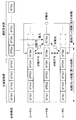
次に、図3を参照して、ゲームシステム1にて実行されるゲームの特徴を説明する。ゲーム装置3上でプレイされるゲームの内容は、複数の要素を選択的に利用してユーザにプレイさせる限りにおいて適宜に構成されてよいが、図3では、複数の要素として、複数のステージ(図ではSTGに添え字を付して表記。)が用意されている。ここでいうステージは、ゲームの構成単位、あるいはプレイする区切りを示す概念であって、ゲームの種類に応じ、マップ、チャプタ、コース、ダンジョンといった様々な名称で呼ばれる概念である。ユーザは、自らが選択可能なステージ群からいずれか一つのステージを選択してゲームをプレイすることができる。
ステージは、全てのユーザに共通してプレイが許可される共通要素群と、ユーザによる選択の可否がユーザ毎に切り替え制御される選択要素群とに区分される。共通要素群にはステージSTG1~STG4が含まれ、選択要素群にはその他のステージSTGa……STGnが含まれる。各ステージの選択の可否は、ユーザ毎に以下のように制御される。
まず、ステージの選択は、初期プレイ段階(第1の段階)と、追加プレイ段階(第2の段階)の二つの段階に区別して制御される。初期プレイ段階は、ゲームのプレイを開始する際に無償でプレイ可能な最初の段階である。一方、追加プレイ段階は、ユーザが所定の条件下で初期プレイ段階に追加するようにしてプレイすることが可能な段階である。初期プレイ段階では、全てのユーザに対して、共通要素群に含まれる全てのステージSTG1~STG4と、選択要素群に含まれるステージSTGa~STGxからユーザ毎にランダムに抽選された少なくとも一つのステージ(図3では一つのステージである。)とがユーザによる選択を許可する要素の範囲に含まれるように、ステージ選択の可否が制御される。図3では、ユーザA及びユーザCに対して、共通要素群のステージSTG1~STG4と、選択要素群から抽選された一つのステージSTGaとが初期プレイ段階にて選択可能な要素の範囲として設定される。一方、ユーザBに対しては、共通要素群のステージSTG1~STG4と、選択要素群から選択された一つのステージSTGbとが初期プレイ段階にて選択可能な要素の範囲として設定される。したがって、ユーザA及びCは、初期プレイ段階にてステージSTGaを選択することができず、ユーザBは、初期プレイ段階にてステージSTGbを選択することができない。
上述したように、ゲームシステム1では、所定のマッチング条件を満たした複数のユーザが共通のゲームに参加して一緒にプレイすることが可能であるが、特に本形態では、マッチング条件の少なくとも一部として、選択したステージが一致することが設定されている。したがって、初期プレイ段階において、ユーザA及びユーザCは、ステージSTGaを選択して対戦することが可能であるが、ユーザBは、ステージSTGaを選択することができないので、ユーザA、CとステージSTGaに関して対戦することができない。
初期プレイ段階において選択不可能なステージ、一例としてユーザA及びユーザCについては、選択要素群のステージSTGa以外のステージ、ユーザBについては、選択要素群のステージSTGb以外のステージ、の選択の可否は、追加プレイ段階において所定の条件に従って制御される。選択を可能とする条件として、本形態では「購入」の概念が導入されている。すなわち、追加プレイ段階において、ユーザが選択を希望するステージ、つまり、初期プレイ段階ではプレイ不可能なステージのうち、ユーザがプレイを希望するステージを指定して所定の代金を支払うことにより、当該ステージの選択が許可されてそのステージのゲームをプレイすることが可能となる。図3の例では、ユーザBが追加プレイ段階でステージSTGaを購入した例が示されている。ユーザBは、ステージSTGaを購入することにより、ステージSTGbを単独でプレイすることができるとともに、ステージSTGaを選択してユーザA又はユーザC(場合によっては両者)と対戦することが可能となる。ユーザA又はユーザCが、追加プレイ段階でステージSTGbを購入した場合も、そのステージSTGbを選択してユーザBと対戦することが可能である。
このように、本形態では、初期プレイ段階にてユーザが選択可能なステージ群の一部がユーザ間で相違している。ユーザは他のユーザとの間で、初期プレイ段階に含まれるステージの情報を交換することにより、自らが選択不可能でかつ他のユーザは選択が可能なステージの情報を得ることができる。ユーザ間の情報交換は、センターサーバ2のSNS管理部24が提供するSNS機能を利用してゲーム装置3上で行うことができる。もちろん、ゲームシステム1とは別の汎用的な情報交換ツール(電子メール、Web上の掲示板など)を通じてユーザ同士が情報を交換することもできる。そして、ユーザ間の情報交換により、自己がプレイ不可能で他のユーザはプレイ済のステージに対してユーザの関心や興味を惹き付け、追加プレイ段階で代金を払って他のユーザがプレイ済のステージを購入する動機付けをユーザに与えることができる。また、ユーザが同一ステージを選択して対戦することができる仕組みが設けられているため、自己がプレイできないステージを選択可能として他のユーザと対戦することを目的としてユーザがステージを購入することも期待できる。
なお、ステージの選択可否の制御に関しては、購入に加えてさらなる条件が設定されてもよい。例えば、ユーザのゲームの進行状況、ユーザのスキル、成績、プレイ回数といった様々な観点から購入可能なステージの範囲を絞り込み、その絞り込まれた範囲からユーザがステージを選択的に購入できるものとしてもよい。ステージSTG1がクリア、つまりステージSTG1にて所定の成績を収めなければ次のステージSTG2を選択することができない、といったステージ間の相関関係がステージの選択可否と関連付けて設定されてもよい。そのような条件は、選択要素群からステージを選択する場合の全てに適用可能である。つまり、初期プレイ段階で選択可能とすべきステージを抽選する場合、及び追加プレイ段階にてステージを選択する場合のそれぞれにて、ユーザが既にクリアしたステージと関連付けて選択候補のステージを絞り込み、その絞り込まれた選択候補の範囲から、初期プレイ段階にて選択可能なステージを抽選し、あるいは、追加プレイ段階でユーザが購入し得るステージの範囲を設定してもよい。
次に、ステージの選択制御を実現するためのゲームシステム1の具体的構成及び手順を説明する。まず、図4は進行管理テーブル103の具体例を示す。進行管理テーブル103は、ステージと選択の可否を判別するためのフラグ情報とを対応付けたデータテーブルであり、本発明の判別情報として機能するものである。進行管理テーブル103において、選択が許可されているステージにはフラグ「1」が、選択が許可されていないステージにはフラグ「0」が書き込まれる。図4の例は、図3のユーザA、Cに対応して作成される進行管理テーブル103であり、ステージSTG1~STG4、及びステージSTGaのフラグの値は1に、その他のステージのフラグの値は0にそれぞれ設定されている。ただし、初期プレイ段階において、ステージの選択を順次許可する場合には、最初にステージSTG1のみフラグを「1」に設定し、他のステージのフラグを全て「0」に設定してもよい。上述したように、進行管理テーブル103はユーザ毎に作成され、ユーザデータ102の一部として記憶装置21に保存される。したがって、ゲーム管理部23は、特定のユーザがゲームのプレイを希望する場合、そのユーザに対応する進行管理テーブル103を特定することにより、当該ユーザが選択可能なステージを判別することができる。
図5は、ユーザがゲームを新規に開始する際のセンターサーバ2及びゲーム装置3の処理手順を示している。なお、この処理に先立って、予めゲーム装置3にはセンターサーバ2のゲーム管理部23から端末用ソフトウエア101が配信されているものとする。以下の説明では、処理の開始に先立って、ゲーム装置3とセンターサーバ2のユーザ管理部22とが協働してユーザの認証が完了しているものとする。つまり、以下に説明する処理は、ゲーム装置3からの要求に対してセンターサーバ2がユーザを特定可能な状態で行われる処理である。ユーザが新規にゲームを開始する場合、ゲーム装置3の表示装置33には所定の初期画面が表示される。一例として、図6に示したように、ゲームの新規開始を指示する新規開始ボタン111を含んだ初期画面110が表示される。
図5に戻って、新規開始ボタン110をユーザが選択操作すると、ゲーム制御部35はセンターサーバ2のゲーム管理部23に対してゲームの新規開始を要求し(ステップS1)、これに応じてゲーム管理部23は、ユーザに対して初期プレイ段階で選択を許可すべきステージを選択要素群から抽選する(ステップS2)。この抽選は乱数を用いたランダム抽選でよい。次に、ゲーム管理部23は、抽選結果に従ってユーザの進行管理テーブル103を作成し、これを記憶装置21に記録する(ステップS3)。この段階では、共通要素群に含まれるステージSTG1~STG4と、ステップSS20で抽選されたステージのみ選択可能となるように進行管理テーブル103のフラグの値が設定される。つまり、この時点で作成される進行管理テーブル103は、初期プレイ段階にて選択可能なステージの範囲を記述したユーザ毎のデータテーブルである。
記憶装置21にユーザの進行管理テーブル103が記録されると、ゲーム管理部23は、ゲーム装置3に対してステージ選択画面を表示させるために必要な情報を配信する(ステップS4)。選択画面の一例を図7に示す。図7に示した選択画面112は、進行管理テーブル103にて選択許可と記録されているステージ毎の選択ボタン113の群と、決定ボタン114と、中止ボタン115とを含む。なお、この段階で、ユーザが選択不可能なステージに対応する選択ボタン113を、選択不可能な態様(一例としてグレー色で表示する等)で併せて表示することにより、選択不可能なステージの存在をユーザに認識させてもよい。
ユーザが、希望するステージのボタン113を選択して決定ボタン114を操作すると、図5のステップS4に続く処理が開始される。ゲーム制御部35はゲーム管理部23に対して選択されたステージのプレイの開始を要求し(ステップS5)、これに応答してゲーム管理部23は、選択されたステージのゲーム画面の描画に必要な情報をゲーム装置3のゲーム制御部35に配信する(ステップS6)。これを受けてゲーム装置3のゲーム制御部35は表示装置33にゲーム画面を描画し、それによりゲームのプレイが開始される。プレイ開始後、ゲーム制御部35はユーザの操作情報をゲーム管理部23に送信し(ステップS7)、ゲーム管理部23は、ゲーム装置3から受け取った操作情報に基づいてゲームの進行を演算し、その結果に基づいて次フレームのゲーム画面の描画に必要な情報をゲーム装置3のゲーム制御部35に配信する(ステップS8)。以下、同様の処理が繰り返されてゲームが進行する。所定の終了条件が満たされるとゲームが終了し、プレイ結果がゲーム管理部23によってユーザデータ102に記録される。
図8は、ユーザが2回目以降にゲームをプレイする際に端末用ソフトウエア101に従ってゲーム制御部35が表示装置33上に表示させるゲーム画面の例である。2回目以降のゲームのプレイで表示されるゲーム画面116は、ゲームの新規開始を指示する新規開始ボタン111に加えて、ゲームの再開を指示する再開ボタン117、他のユーザとの対戦を指示する対戦ボタン118を含んでいる。また、追加プレイ段階でのゲームが可能な場合には、ステージを購入するための購入ボタン119がさらにゲーム画面116に含まれる。
ユーザが新規開始ボタン111を選択操作した場合には、記憶装置21に保持されていたユーザのプレイ結果のデータ及び進行管理テーブル103が破棄され、上述した新規開始時の処理が再び行われる。一方、再開ボタン117が選択操作された場合には、記憶装置21に記録されているユーザのデータを参照してゲームが再開される。その場合、図9に示したように、ゲーム装置3のゲーム制御部35はセンターサーバ2のゲーム管理部23に対してゲームの再開を要求し(ステップS11)、ゲーム管理部23はユーザの進行管理テーブル103を参照して、ユーザが選択可能なステージを判別する(ステップS12)。判別後、ゲーム管理部23は、ゲーム装置3に対してステージ選択画面を配信する(ステップS13)。このときの選択画面は、図7の選択画面112と同様に、進行管理テーブル103にて選択許可と記録されているステージ毎の選択ボタン113の群と決定ボタン114と、中止ボタン115とを含むものである。選択画面表示後の処理は図5のステップS5以降と同様であり、詳細は省略する。また、ユーザが対戦ボタン118を操作した場合には、図9と同様の処理により選択画面が提示され、選択結果に応じて、センターサーバ2のゲーム管理部23が、ステージの一致するユーザ同士をマッチングする。
以上のように、ゲームシステム1では、ユーザがゲーム再開や対戦を指示する毎に、進行管理テーブル103に基づいて選択可能と判別されたステージのみが選択できるように選択画面が制御される。したがって、選択が許可されていないステージをユーザが選択してそのステージを単独でプレイし、あるいはその選択不可能なステージにて他のユーザと対戦することはできない。なお、ゲーム再開時における選択画面においても、ユーザが選択不可能なステージに対応する選択ボタン113を、選択不可能な態様(一例としてグレー色で表示する等)で併せて表示することにより、選択不可能なステージの存在をユーザに認識させてもよい。
次に、ユーザが購入ボタン119を選択操作した場合の処理を説明する。図11は、購入ボタン119が選択操作された場合のセンターサーバ2及びゲーム装置3の処理手順を示している。まず、ゲーム装置3のゲーム制御部35は、センターサーバ2のゲーム管理部23に対してステージ購入を要求し(ステップS21)、これに応じて、ゲーム管理部23はユーザの進行管理テーブル103を参照して、ユーザが購入可能なステージを判別する(ステップS22)。購入可能なステージは、ユーザの選択が既に許可されているステージ以外の全てのステージを最大範囲とする。ステージの選択の可否に関して、購入以外の条件が追加されている場合には、その条件の成否も加味して購入可能なステージの範囲が判別される。
ゲーム管理部23は、購入可能なステージを判別すると、購入選択画面を表示させるために必要な情報をゲーム制御部35に配信する(ステップS23)。選択画面の一例を図11に示す。図11に示した購入選択画面120は、進行管理テーブル103にて選択不可と記録されているステージ毎の指定ボタン121の群と、決定ボタン122と、中止ボタン123とを含む。指定ボタン121は、購入が可能なステージに対応するボタン(ステージb、c、d)と、購入が不可能なステージ(ステージe、f、g…)に対応するボタンとの二種類を含み、それらの種類は異なる態様で示される。例えば、購入不可能なステージのボタン121は暗色で表示され、購入可能なステージのボタン121は明色で表示される、といった区別がなされる。
ユーザが、購入を希望するステージの指定ボタン121を選択操作して決定ボタン122を操作すると、その指定ボタン121に対応するステージが、ユーザの購入希望として指定されたステージとして確定し、図10のステップS23に続く処理が開始される。ゲーム制御部35はゲーム管理部23に対して、ユーザが指定したステージの購入を通知し(ステップS24)、ゲーム管理部23は、課金管理部25に対して課金を要求する(ステップS25)。課金管理部25は、ステージの購入代金を決済するために必要な情報をゲーム装置3のゲーム制御部35に対して要求する(ステップS26)。ユーザが決済に必要な情報(例えばクレジットカード決済ならば、カード番号等)を入力すると、ゲーム制御部35は決済情報を課金管理部25に送信する(ステップS27)。課金管理部25は、得られた決済情報に基づいて決済処理を実行する(ステップS28)。例えば、クレジットカード決済であれば、クレジットカードの決済を運営するサーバにアクセスして決済承認を得るといった処理がステップS28で行われる。なお、決済情報を予めユーザデータ102に登録させている場合には、ユーザに決済情報の入力を求めることなく、課金管理部25が自動的に決済処理を行ってもよい。その他にも決済処理は、決済手段に応じて適宜の手順で実行されてよい。
決済処理が完了すると、課金管理部25はゲーム管理部23に対して決済完了を通知する(ステップS29)。ゲーム管理部23は、購入されたステージの選択が許可されるようにユーザの進行管理テーブル103を更新する。つまり、ゲーム管理部23は、今回購入されたステージに対応するフラグの値を「1」に書き替える。その後、ゲーム管理部23は、ゲーム装置3のゲーム制御部35に対してステージの購入が完了した旨を通知する(ステップS31)。ゲーム制御部35は、表示装置33を介してユーザに購入完了を通知する。ステージの購入が進行管理テーブル103に反映されることにより、以降、図9のステップS12において、購入済のステージが選択可能なステージと判別され、ユーザはそのステージを選択してゲームをプレイすることが可能となる。
以上の形態においては、センターサーバ2のゲーム管理部23とゲーム装置3のゲーム制御部35とが協働して本発明のゲーム制御手段として機能し、センターサーバ2のゲーム管理部23が図5のステップS2及びステップS3を実行することにより第1の選択制御手段として機能し、ゲーム管理部23が図10のステップS30の処理を実行することにより第2の選択制御手段として機能する。
本発明は上述した形態に限らず、適宜に変更して実施することができる。以下に、他の形態を説明する。まず、上記の形態では、センターサーバ2のゲーム管理部23にてゲームの演算制御を実行し、ゲーム装置3のゲーム制御部35を、ユーザの操作情報等を提供し、あるいはゲーム画面を表示させるための端末制御手段として機能させているが、ゲームの演算制御機能を実現するアプリケーションプログラムを端末用ソフトウエア101に含め、これをゲーム装置3にインストールすることにより、ゲームの演算制御をゲーム装置3のゲーム制御部35が実行するものとしてもよい。図12はそのような形態の一例を示す。
図12に示した形態では、ゲーム装置3の記憶装置31にユーザデータ102が記憶され、ゲーム装置3のユーザに対応した進行管理テーブル103がその記憶装置31のユーザデータ102に格納されている。進行管理テーブル103に関連付けられた処理(図5のステップS2~S4、図9のステップS12、S13、図10のステップS22、S30)はゲーム制御部35にて実行される。この場合、センターサーバ2は、対戦に関する処理、SNS機能の提供、及びステージ購入に際する課金処理(図10のステップS25、S26、S28、S29、S31の処理)のみをゲーム装置3からの要求に応じて実行すればよい。この形態における処理手順の概要を図13~図15に示す。なお、これらの処理のうち、図5、図9及び図10の処理に対して実行主体が変更されているものステップの参照符号に添え字Aを付して示す。
図13はゲームを新規に開始する際の処理である。その処理では、ゲーム装置3のゲーム制御部35が、図5のステップSS、S3にそれぞれ相当するステージの抽選処理(ステップS2A)及び進行管理テーブル1103の作成、記録処理(ステップS3A)を順次実行し、その後、進行管理テーブル103に基づいてステージ選択画面112を表示させる(ステップS4A)。以降は、ステージの選択結果に応じて新規にゲームのプレイが開始される。図14はゲームの2回目以降のプレイ時の処理である。その処理では、ゲーム装置3のゲーム制御部35が、図9のステップS12に相当するステージの判別処理(ステップS12A)、ステップS13に相当する選択画面の表示処理(ステップS13A)を順次実行する。以降は、ステージの選択結果に基づいて次のゲームのプレイが開始される。図15は、ステージを購入する際の処理である。図15の処理は、図10のステップS22に相当する購入可能なステージの判別処理(ステップS22A)、及び図10のステップS30に相当する進行管理テーブル103の更新処理(ステップS30A)をゲーム装置3のゲーム制御部35がそれぞれ実行し、ステージ購入に対応した課金処理(図10のステップS25、S26、S28、S29、S31の処理)は、センターサーバ2を利用して図10と同様に行われる。
図12~図15に示す形態では、センターサーバ2のゲーム管理部23とゲーム装置3のゲーム制御部35とが協働して本発明のゲーム制御手段として機能し、ゲーム装置3のゲーム制御部35が図13のステップS2A及びステップS3Aを実行することにより第1の選択制御手段として機能し、ゲーム制御部35が図15のステップS30Aの処理を実行することにより第2の選択制御手段として機能する。
なお、図12~図15の形態において、端末用ソフトウエア101には、ゲームを構成する全てのステージのデータを予め含めてもよいし、進行管理テーブル103にて選択が許可されているステージのデータのみを含めてもよい。後者の場合、ステージの購入に伴って当該ステージのフラグが選択許可の値へと書き替えられる際、又はその購入したステージが初めて選択されてプレイされる際に、ゲーム装置3のゲーム制御部35がセンターサーバ2のゲーム管理部23にアクセスして、当該ステージに対応するデータの送信を要求し、そのデータをセンターサーバ2からゲーム装置3に提供して記憶装置21の端末用ソフトウエア101に追加すればよい。
ゲーム制御部35にてステージの選択の可否を制御する場合、記憶装置31に記録されたユーザデータ102は、必要に応じてセンターサーバ2の記憶装置21にバックアップデータとして保存すればよい。例えば、センターサーバ2に保存されたユーザデータ102をユーザの求めに応じてゲーム装置3に呼び込み、ゲーム終了時などの適宜なタイミングでセンターサーバ2の記憶装置21に保存すれば、ゲーム装置3が商業用ゲーム機のように多数のユーザに利用され得るクライアント装置であっても、そのゲーム装置3上でユーザ毎にステージの選択可否を制御して本発明を実施することができる。
一方、ゲーム装置3が家庭用の据置型ゲーム機、あるいは個人用のPCのように、特定のユーザに限って利用され、かつゲームに必要なプログラムやデータの一切をゲーム装置3の記憶装置31に保持するに適した装置として存在している場合には、センターサーバ2にユーザデータ102を保存することを要しない。さらに、ステージを購入する際の課金に関しても、ゲーム装置3以外の手段を利用してユーザがステージの購入代金を支払い、その支払いに対応してユーザにステージ選択許可用のコードを発行し、そのコードをユーザがゲーム装置3に入力することにより、購入済ステージの選択が許可されるように記憶装置31の進行管理テーブル103が更新されてもよい。つまり、購入処理は必ずしもゲーム装置3とセンターサーバ2とを利用した処理に限らない。
上述した形態では、追加プレイ段階における購入対象をステージ単位で指定できるものとしたが、複数のステージを一括して購入し、それらのステージの選択可否を一括して選択不可能な状態から選択可能な状態に切り替え得るものとしてもよい。あるいは、初期プレイ段階で選択が許可されなかった全てのステージを追加プレイ段階で一括して購入可能としてもよい。この場合、初期プレイ段階をゲームの無償版あるいは体験版、初期プレイ段階で選択不可能なステージの集合を、追加購入可能なゲームの有償版としてそれぞれ位置付けることができる。ただし、初期プレイ段階は無償でプレイできるものに限定されず、初期プレイ段階に関しても一定の代金が課金されてもよい。
一方、追加プレイ段階におけるステージの選択を可能とする条件は、購入代金の支払いを条件とする例に限定されない。例えば、初期プレイ段階での成績、プレイ回数と関連付けてステージの選択を許可する条件を設定し、その条件が満たされた場合に追加プレイ段階における少なくとも一つのステージの選択が許可されるようにステージ選択の可否が制御されてもよい。この場合でも、初期プレイ段階で選択可能なステージの範囲がユーザ間で相違していれば、他のユーが既にプレイしているステージを自らもプレイしたいという要望をユーザに生じさせ、ゲームのプレイに対するモチベーションをユーザに付与することができる。
本発明において、ゲームの要素はステージに限定されない。マップ、キャラクタ、アイテム、楽曲といったゲーム上で選択的に利用され得る要素であれば、本発明に従ってその選択の可否を制御することにより、本発明の作用効果を奏することができる。さらに、要素は、ゲームのプレイ時間であってもよい。例えば、ゲームのプレイ時間を1分、2分、3分といったように複数の要素に区分し、第1の段階では相対的に短いプレイ時間のみユーザに選択可能とし、第2の段階では、第1の段階で選択不可能なプレイ時間をユーザが購入し、その選択を可能としてもよい。
また、本発明のゲームシステムは、サーバ-クライアント型のゲームシステムに限定されない。例えば、図12~図15の形態の変形例として、追加プレイ段階におけるステージの選択可否を制御する条件を、ゲームのプレイ成績等と関連付け、あるいはステージ購入代金をオフラインにて支払って、ゲーム装置3にはステージ選択を許可するコードを入力する例であればサーバ装置は不要であり、いわゆるスタンドアローンのゲーム装置それ自体も本発明のゲームシステムの範疇に含まれ得る。この場合、ゲーム装置用のソフトウエアは、いわゆるパッケージソフトとしてユーザに配布され、あるいは、ゲーム装置を一時的にサーバ装置に接続して、そのサーバ装置からゲーム装置にソフトウエアがダウンロードされてもよい。
上述した形態では、初期プレイ段階が第1の段階、追加プレイ段階が第2の段階にそれぞれ相当するが、それらの段階は、要素の選択可否の制御において区別できればよい。第2の段階におけるゲームのプレイを開始させる時期は、第1の段階のゲームが開始可能となった時期以降で適宜に設定することができる。一例として、第1の段階のゲームを全てプレイした後に第2の段階でゲームをプレイすることが可能とされてもよいし、第1の段階のゲームが完了する以前でも、第2の段階に進んで要素を購入する等してゲームをプレイできるものとしてもよい。第2の段階を第1の段階よりも時期的に遅く開始させる場合には、その第2の段階にて選択可能とされるべき全ての要素が、第1の段階の開始時又は第2の段階の開始時点で用意されていることを要しない。第2の段階における要素の購入等が開始された後であっても、要素を適宜に追加し、購入等の条件を満たしたユーザに対してその選択を許可するようにしてもよい。さらに、第1の段階はゲームが新規に開始される場合に限って設定されるものではない。ゲームを新規に開始した後の任意の時期に第1の段階が設定され、それと関連付けて第2の段階が設定されてもよい。さらに、第1の段階と第2の段階との組み合わせを複数回に亘って生じさせてもよい。
上記の形態では、第1の段階で選択可能なステージの範囲に共通要素群のステージを含めているが、第1の段階であっても、全てのユーザに共通して選択可能とされるべき要素は必ずしも必要ない。第1の段階にて選択可能な要素の範囲は、その範囲内の少なくとも一部の要素に関してユーザ間で相違が生じていれば、ユーザ同士の情報交換を通じて各ユーザが自己の選択不可能な要素の具体的内容を知得することができ、それにより本発明の作用効果を発揮させることができる。
Claims (9)
- 複数の要素の一部のみが選択可能な状態でゲーム装置のユーザにゲームをプレイさせる第1の段階と、前記第1の段階では選択不可能な要素を選択して前記ユーザにゲームをプレイさせる第2の段階とに区分してゲームを進行させるゲーム制御手段を備えたゲームシステムであって、
前記第1の段階にて選択可能な要素の少なくとも一部がユーザ間で相違するように、当該第1の段階にて選択可能な要素の範囲を制御する第1の選択制御手段と、
前記第2の段階における前記要素の選択の可否を所定の条件に従って制御する第2の選択制御手段と、
を備えたゲームシステム。 - 前記第1の段階では選択不可能な要素の群からユーザに選択を希望する要素を指定させることが前記第2の段階において可能であり、前記第2の選択制御手段は、ユーザが指定した要素に関して所定の条件が満たされた場合に、当該要素に関する選択を不可能な状態から可能な状態へと切り替え制御する請求項1のゲームシステム。
- 前記第2の選択制御手段は、ユーザが所定の代金を支払ったことを条件として前記要素の選択を不可能な状態から可能な状態へと切り替え制御する請求項1又は2のゲームシステム。
- サーバ装置と、該サーバ装置とネットワークを介して接続されたクライアント装置とを含み、前記クライアント装置が前記ゲーム装置として機能する請求項1~3のいずれか一項のゲームシステム。
- 前記サーバ装置は、選択した要素が一致する複数のユーザに対して、当該要素を利用した共通のゲームをプレイさせるサービスを提供可能である請求項4のゲームシステム。
- 前記サーバ装置は、前記クライアント装置を介してユーザがゲームに関連する情報を交換するサービスを提供可能である請求項4又は5のゲームシステム。
- ユーザの要素毎の選択可否を判別するための判別情報を前記サーバ装置が保持し、前記第1及び第2の選択制御手段が前記サーバ装置に設けられている請求項4~6のいずれか一項のゲームシステム。
- ユーザの要素毎の選択可否を判別するための判別情報を前記ゲーム装置が保持し、前記第1及び第2の選択制御手段が前記ゲーム装置に設けられている請求項4~6のいずれか一項のゲームシステム。
- 複数の要素の一部のみが選択可能な状態でゲーム装置のユーザにゲームをプレイさせる第1の段階と、前記第1の段階では選択不可能な要素を選択して前記ユーザにゲームをプレイさせる第2の段階とに区分してゲームを進行させるゲームの制御方法であって、
前記第1の段階にて選択可能な要素の少なくとも一部がユーザ間で相違するように、当該第1の段階にて選択可能な要素の範囲を制御する手順と、
前記第2の段階における前記要素の選択の可否を所定の条件に従って制御する手順と、を備えたゲームの制御方法。
Applications Claiming Priority (2)
| Application Number | Priority Date | Filing Date | Title |
|---|---|---|---|
| JP2012080687A JP5548721B2 (ja) | 2012-03-30 | 2012-03-30 | ゲームシステム及びその制御方法 |
| JP2012-080687 | 2012-03-30 |
Publications (1)
| Publication Number | Publication Date |
|---|---|
| WO2013146232A1 true WO2013146232A1 (ja) | 2013-10-03 |
Family
ID=49259500
Family Applications (1)
| Application Number | Title | Priority Date | Filing Date |
|---|---|---|---|
| PCT/JP2013/056832 Ceased WO2013146232A1 (ja) | 2012-03-30 | 2013-03-12 | ゲームシステム及びその制御方法 |
Country Status (2)
| Country | Link |
|---|---|
| JP (1) | JP5548721B2 (ja) |
| WO (1) | WO2013146232A1 (ja) |
Cited By (3)
| Publication number | Priority date | Publication date | Assignee | Title |
|---|---|---|---|---|
| JP2016191971A (ja) * | 2015-03-30 | 2016-11-10 | 任天堂株式会社 | コンテンツ提供システム、コンテンツ提供方法、コンテンツサーバ、及びコンテンツ提供プログラム |
| CN111346384A (zh) * | 2019-03-29 | 2020-06-30 | 株式会社万代 | 游戏装置、记录介质以及游戏系统 |
| JP2022002784A (ja) * | 2020-05-26 | 2022-01-11 | 株式会社ミクシィ | 情報処理装置、プログラム及び情報処理方法 |
Families Citing this family (7)
| Publication number | Priority date | Publication date | Assignee | Title |
|---|---|---|---|---|
| JP5617023B1 (ja) * | 2013-10-30 | 2014-10-29 | 株式会社カプコン | ゲームプログラム及びゲーム装置 |
| JP6017717B1 (ja) * | 2016-02-17 | 2016-11-02 | グリー株式会社 | プログラム、情報処理装置の制御方法および情報処理装置 |
| JP2018187240A (ja) * | 2017-05-10 | 2018-11-29 | 株式会社コロプラ | ゲームプログラム、方法、および情報処理装置 |
| JP6842024B2 (ja) * | 2018-07-17 | 2021-03-17 | 株式会社コナミデジタルエンタテインメント | 管理装置、及び、管理装置で実行可能なプログラム |
| JP6792120B2 (ja) * | 2018-07-17 | 2020-11-25 | 株式会社コナミデジタルエンタテインメント | 管理装置、及び、管理装置で実行可能なプログラム |
| JP2020075156A (ja) * | 2020-01-31 | 2020-05-21 | 株式会社コナミデジタルエンタテインメント | ゲームシステム、及びそれに用いられるコンピュータプログラム |
| JP7606100B2 (ja) * | 2021-09-08 | 2024-12-25 | 株式会社Mixi | 情報処理装置、プログラム、及び情報処理方法 |
Citations (1)
| Publication number | Priority date | Publication date | Assignee | Title |
|---|---|---|---|---|
| JP2009230585A (ja) * | 2008-03-24 | 2009-10-08 | Sony Computer Entertainment Inc | 情報処理装置 |
-
2012
- 2012-03-30 JP JP2012080687A patent/JP5548721B2/ja active Active
-
2013
- 2013-03-12 WO PCT/JP2013/056832 patent/WO2013146232A1/ja not_active Ceased
Patent Citations (1)
| Publication number | Priority date | Publication date | Assignee | Title |
|---|---|---|---|---|
| JP2009230585A (ja) * | 2008-03-24 | 2009-10-08 | Sony Computer Entertainment Inc | 情報処理装置 |
Non-Patent Citations (3)
| Title |
|---|
| "Patapon 3", DENGEKI PLAYSTATION, vol. 17, no. 12, 14 April 2011 (2011-04-14), pages 172 - 175 * |
| "RAGNAROK Hikari to Yami no Kojo", SHUKAN FAMI TSU, vol. 26, no. 42, 29 September 2011 (2011-09-29), pages 86 - 87 * |
| "Shin Sangoku Muso MULTI RAID 2", DENGEKI PLAYSTATION, vol. 16, no. 9, 12 February 2010 (2010-02-12), pages 178 - 181 * |
Cited By (8)
| Publication number | Priority date | Publication date | Assignee | Title |
|---|---|---|---|---|
| JP2016191971A (ja) * | 2015-03-30 | 2016-11-10 | 任天堂株式会社 | コンテンツ提供システム、コンテンツ提供方法、コンテンツサーバ、及びコンテンツ提供プログラム |
| CN111346384A (zh) * | 2019-03-29 | 2020-06-30 | 株式会社万代 | 游戏装置、记录介质以及游戏系统 |
| JP2022002784A (ja) * | 2020-05-26 | 2022-01-11 | 株式会社ミクシィ | 情報処理装置、プログラム及び情報処理方法 |
| JP7335523B2 (ja) | 2020-05-26 | 2023-08-30 | 株式会社Mixi | 情報処理装置、プログラム及び情報処理方法 |
| JP2023145765A (ja) * | 2020-05-26 | 2023-10-11 | 株式会社Mixi | 情報処理装置、プログラム及び情報処理方法 |
| JP7553858B2 (ja) | 2020-05-26 | 2024-09-19 | 株式会社Mixi | 情報処理装置、プログラム及び情報処理方法 |
| JP2024156002A (ja) * | 2020-05-26 | 2024-10-31 | 株式会社Mixi | 情報処理装置、プログラム及び情報処理方法 |
| JP7733337B2 (ja) | 2020-05-26 | 2025-09-03 | 株式会社Mixi | 情報処理装置、プログラム及び情報処理方法 |
Also Published As
| Publication number | Publication date |
|---|---|
| JP5548721B2 (ja) | 2014-07-16 |
| JP2013208285A (ja) | 2013-10-10 |
Similar Documents
| Publication | Publication Date | Title |
|---|---|---|
| JP5548721B2 (ja) | ゲームシステム及びその制御方法 | |
| JP5439626B1 (ja) | ゲームプログラム、及び、情報処理装置 | |
| JP6573397B2 (ja) | 情報処理システム、サーバ、情報処理プログラム、および、オブジェクト付与方法 | |
| KR20130028157A (ko) | 온라인 특권의 안전한 양도 시스템 | |
| JP2018047100A (ja) | 情報処理システム、サーバ、情報処理プログラム、および、オブジェクト付与方法 | |
| JP5819510B1 (ja) | プログラム、制御方法及びサーバ装置 | |
| JP6505915B1 (ja) | コンピュータプログラム、およびコンピュータ装置 | |
| JP2022082269A (ja) | ゲームプログラム、ゲーム装置、ゲームシステム | |
| JP2022032950A (ja) | サーバ、ゲームプログラム、情報処理方法 | |
| KR101487077B1 (ko) | 게임 시스템 및 그 제어 방법 | |
| US11176528B2 (en) | Securing customized third-party content within a computing environment configured to enable third-party hosting | |
| JP4781402B2 (ja) | ビデオゲーム処理システム | |
| JP7356045B2 (ja) | 情報処理システム、情報処理方法及びプログラム | |
| JP2015047494A (ja) | ゲームプログラム、及び、情報処理装置 | |
| JP6505932B1 (ja) | コンピュータプログラム、およびコンピュータ装置 | |
| KR101196614B1 (ko) | 온라인 게임의 아이템 거래정보 제공 시스템 및 그 방법 | |
| JP2020054857A (ja) | ゲームプログラムおよびゲームシステム | |
| JP2020072784A (ja) | 情報処理システム、サーバ、情報処理プログラム、および、オブジェクト付与方法 | |
| JP7008849B1 (ja) | ゲームサーバ、ゲームプログラム、情報処理方法 | |
| JP2020095642A (ja) | ゲーム内オークションシステム | |
| JP7093017B2 (ja) | コンピュータプログラム、およびコンピュータ装置 | |
| JP7626949B2 (ja) | 情報処理方法、情報処理システムおよびプログラム | |
| JP2022124316A (ja) | ゲームプログラム、ゲーム装置、ゲームシステム | |
| JP2019150397A (ja) | ゲームプログラムおよびゲーム装置 | |
| JP7038938B1 (ja) | ゲームサーバ、ゲームプログラム、情報処理方法 |
Legal Events
| Date | Code | Title | Description |
|---|---|---|---|
| 121 | Ep: the epo has been informed by wipo that ep was designated in this application |
Ref document number: 13767792 Country of ref document: EP Kind code of ref document: A1 |
|
| NENP | Non-entry into the national phase |
Ref country code: DE |
|
| 122 | Ep: pct application non-entry in european phase |
Ref document number: 13767792 Country of ref document: EP Kind code of ref document: A1 |
|
| NENP | Non-entry into the national phase |
Ref country code: DE |