WO2013047733A1 - 研磨用組成物 - Google Patents
研磨用組成物 Download PDFInfo
- Publication number
- WO2013047733A1 WO2013047733A1 PCT/JP2012/075051 JP2012075051W WO2013047733A1 WO 2013047733 A1 WO2013047733 A1 WO 2013047733A1 JP 2012075051 W JP2012075051 W JP 2012075051W WO 2013047733 A1 WO2013047733 A1 WO 2013047733A1
- Authority
- WO
- WIPO (PCT)
- Prior art keywords
- polishing
- phase change
- polishing composition
- acid
- change alloy
- Prior art date
- Legal status (The legal status is an assumption and is not a legal conclusion. Google has not performed a legal analysis and makes no representation as to the accuracy of the status listed.)
- Ceased
Links
Classifications
-
- H—ELECTRICITY
- H10—SEMICONDUCTOR DEVICES; ELECTRIC SOLID-STATE DEVICES NOT OTHERWISE PROVIDED FOR
- H10N—ELECTRIC SOLID-STATE DEVICES NOT OTHERWISE PROVIDED FOR
- H10N70/00—Solid-state devices having no potential barriers, and specially adapted for rectifying, amplifying, oscillating or switching
- H10N70/801—Constructional details of multistable switching devices
- H10N70/881—Switching materials
- H10N70/882—Compounds of sulfur, selenium or tellurium, e.g. chalcogenides
- H10N70/8828—Tellurides, e.g. GeSbTe
-
- C—CHEMISTRY; METALLURGY
- C09—DYES; PAINTS; POLISHES; NATURAL RESINS; ADHESIVES; COMPOSITIONS NOT OTHERWISE PROVIDED FOR; APPLICATIONS OF MATERIALS NOT OTHERWISE PROVIDED FOR
- C09G—POLISHING COMPOSITIONS; SKI WAXES
- C09G1/00—Polishing compositions
- C09G1/02—Polishing compositions containing abrasives or grinding agents
-
- C—CHEMISTRY; METALLURGY
- C09—DYES; PAINTS; POLISHES; NATURAL RESINS; ADHESIVES; COMPOSITIONS NOT OTHERWISE PROVIDED FOR; APPLICATIONS OF MATERIALS NOT OTHERWISE PROVIDED FOR
- C09K—MATERIALS FOR MISCELLANEOUS APPLICATIONS, NOT PROVIDED FOR ELSEWHERE
- C09K3/00—Materials not provided for elsewhere
- C09K3/14—Anti-slip materials; Abrasives
- C09K3/1436—Composite particles, e.g. coated particles
-
- C—CHEMISTRY; METALLURGY
- C09—DYES; PAINTS; POLISHES; NATURAL RESINS; ADHESIVES; COMPOSITIONS NOT OTHERWISE PROVIDED FOR; APPLICATIONS OF MATERIALS NOT OTHERWISE PROVIDED FOR
- C09K—MATERIALS FOR MISCELLANEOUS APPLICATIONS, NOT PROVIDED FOR ELSEWHERE
- C09K3/00—Materials not provided for elsewhere
- C09K3/14—Anti-slip materials; Abrasives
- C09K3/1436—Composite particles, e.g. coated particles
- C09K3/1445—Composite particles, e.g. coated particles the coating consisting exclusively of metals
-
- C—CHEMISTRY; METALLURGY
- C09—DYES; PAINTS; POLISHES; NATURAL RESINS; ADHESIVES; COMPOSITIONS NOT OTHERWISE PROVIDED FOR; APPLICATIONS OF MATERIALS NOT OTHERWISE PROVIDED FOR
- C09K—MATERIALS FOR MISCELLANEOUS APPLICATIONS, NOT PROVIDED FOR ELSEWHERE
- C09K3/00—Materials not provided for elsewhere
- C09K3/14—Anti-slip materials; Abrasives
- C09K3/1454—Abrasive powders, suspensions and pastes for polishing
- C09K3/1463—Aqueous liquid suspensions
-
- H—ELECTRICITY
- H10—SEMICONDUCTOR DEVICES; ELECTRIC SOLID-STATE DEVICES NOT OTHERWISE PROVIDED FOR
- H10N—ELECTRIC SOLID-STATE DEVICES NOT OTHERWISE PROVIDED FOR
- H10N70/00—Solid-state devices having no potential barriers, and specially adapted for rectifying, amplifying, oscillating or switching
- H10N70/011—Manufacture or treatment of multistable switching devices
-
- H—ELECTRICITY
- H10—SEMICONDUCTOR DEVICES; ELECTRIC SOLID-STATE DEVICES NOT OTHERWISE PROVIDED FOR
- H10N—ELECTRIC SOLID-STATE DEVICES NOT OTHERWISE PROVIDED FOR
- H10N70/00—Solid-state devices having no potential barriers, and specially adapted for rectifying, amplifying, oscillating or switching
- H10N70/011—Manufacture or treatment of multistable switching devices
- H10N70/061—Shaping switching materials
Definitions
- the present invention relates to a polishing composition suitable for polishing a polishing object having a phase change alloy.
- phase change random access memory devices also known as ovonic memory devices or PCRAM devices
- PCM Phase change material
- Examples of typical phase change materials suitable for this application include group VIB (chalcogenide, eg Te or Po) and group VB (eg Sb) elements of the periodic table and In, Ge, Ga, Sn, or The combination with 1 type or multiple types of metal elements, such as Ag, is mentioned.
- a particularly useful phase change material is germanium (Ge) -antimony (Sb) -tellurium (Te) alloy (GST alloy).
- phase change alloys include indium antimonite (InSb).
- InSb indium antimonite
- CMP chemical mechanical polishing
- phase change materials include sulfur (S), cerium (Ce), germanium (Ge), antimony.
- a plurality of elements such as (Sb), tellurium (Te), silver (Ag), indium (In), tin (Sn), and gallium (Ga) reversibly change between a crystalline phase and an amorphous phase. It is mixed in a certain proportion so that it can.
- phase change materials eg, GST
- the physical properties of many phase change materials differ from the physical properties of conventional metal layer materials, such as being soft compared to other materials utilized in PCM chips. Therefore, it has been difficult to apply the polishing composition for polishing a current metal-containing surface as it is for polishing a phase change material.
- Patent Documents 1 and 2 disclose a polishing composition for polishing a polishing object having a phase change alloy containing abrasive grains, a complexing agent, water, and optionally an oxidizing agent.
- the polishing compositions disclosed in these documents will reduce surface defects and phase change material residues by improving conventional typical polishing compositions used to polish metal-containing surfaces.
- the etching rate of the phase change alloy is too high. In order to lower the etching rate, it is effective to reduce the concentration of the oxidizing agent and the complexing agent that contribute to the etching.
- polishing by-product includes polishing scraps generated during polishing.
- organic residue means the foreign material containing the carbon originating in a polishing pad, a polishing apparatus, a cleaning brush, or polishing composition.
- polishing by-products and organic residues are collectively referred to as “defective foreign matter”.
- an object of the present invention is to provide a polishing composition that can be suitably used in applications for polishing a polishing object having a phase change alloy, and in particular, to prevent generation of polishing by-products and organic residues.
- An object of the present invention is to provide a polishing composition that can be used.
- a polishing composition for use in polishing a polishing object having a phase change alloy such as a GST alloy, which contains an ionic additive A polishing composition is provided.
- the ionic additive is one or more selected from a cationic surfactant, an anionic surfactant, and an amphoteric surfactant.
- the ionic additive is preferably a cationic water-soluble polymer.
- the concentration of the ionic additive in the polishing composition is preferably 0.0001 to 10% by mass.
- a method of manufacturing a phase change device including a step of polishing a surface of an object to be polished having a phase change alloy using the polishing composition of the above aspect.
- the polishing composition which can be used suitably for the use which grind
- the polishing composition of this embodiment is used for polishing a polishing object having a phase change alloy, more specifically, for manufacturing a phase change device by polishing the surface of a polishing object having a phase change alloy.
- Phase change alloys are used in PRAM (phase change random access memory) devices (also known as ovonic memory devices or PCRAM devices) for insulating amorphous and conductive crystalline phases for electronic storage applications. It is used as a material that can be electrically switched between.
- phase change alloys suitable for this application include the VIB group (chalcogenide, eg, Te or Po) and VB (eg, Sb) elements of the periodic table, and In, Ge, Ga, Sn, or Ag, etc. The combination with 1 type or multiple types of metal elements is mentioned.
- a particularly useful phase change material is germanium (Ge) -antimony (Sb) -tellurium (Te) alloy (GST alloy).
- the polishing composition of this embodiment contains an ionic additive.
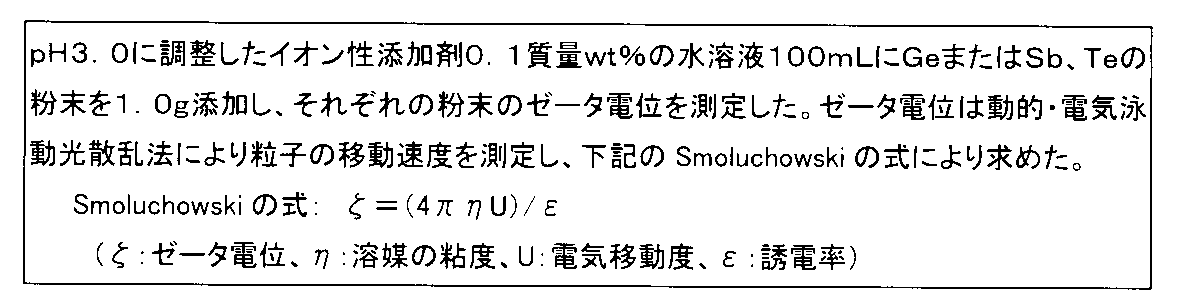
- An ionic additive is a substance having a positive or negative potential in an aqueous solution, and refers to a substance that can change the potential of an object to be polished or defective foreign matter, more specifically, the zeta potential.
- the ionic additive adjusts the charge on the surface of the phase change alloy and the defective foreign material to the same type (ie, positive or negative) by binding or adsorbing to both or one surface of the phase change alloy and the defective foreign material, It is thought that repulsive force is exerted between the phase change alloy surface and the defective foreign material surface. That is, although details are unknown, it is considered that it performs one of the following three functions.
- an ionic additive that adsorbs or adheres to the surface of the phase change alloy it is preferable to consider the type and content of the metal constituting the phase change alloy. That is, among the metals constituting the phase change alloy, the amount of charge imparted per unit area of the metal with a high content is greater than the amount of charge imparted per unit area of the metal with a low content. It is preferable to select an ionic additive. For example, in the case of a GST alloy having a mass of Ge, Sb, and Te of 2: 2: 5, the content is higher than the amount of charge imparted per unit area of Ge and Sb with a low content. It is preferable to select an ionic additive having a higher amount of charge per unit area of Te.
- an ionic additive that adsorbs or adheres to the surface of the defective foreign material it is preferable to consider the component of the defective foreign material.
- an organic residue derived from a polyurethane polishing pad has a positive charge around pH 3.0.
- the organic residue derived from the cleaning brush made of polyvinyl alcohol has a negative charge around pH 3.0.
- the ionic additive is a compound having a charge, and specifically includes a cationic surfactant, an anionic surfactant, an amphoteric surfactant, and a water-soluble polymer having a charge.
- Cationic surfactants include quaternary ammonium salt type, alkylamine salt type, and pyridine ring compound type.
- tetramethylammonium salt tetrabutylammonium salt, dodecyldimethylbenzylammonium salt, alkyl
- examples include trimethylammonium salt, alkyldimethylammonium salt, alkylbenzyldimethylammonium salt, monoalkylamine salt, dialkylamine salt, trialkylamine salt, fatty acid amidoamine and alkylpyridinium salt.
- Anionic surfactants include carboxylic acid type, sulfonic acid type, sulfate ester type and phosphate ester type.
- coconut oil fatty acid sarcosine triethanolamine coconut oil fatty acid methyl taurine salt aliphatic monocarboxylic acid Acid salts, alkylbenzene sulfonates, alkane sulfonates, ⁇ -olefin sulfonates, polyoxyethylene alkyl ether sulfates, alkyl sulfates, polyoxyethylene alkyl ether phosphates, alkyl phosphates and the like.
- amphoteric surfactants include alkyl betaines and alkyl amine oxides.
- the water-soluble polymer having a cationic charge include polysaccharides such as chitosan and cation-modified hydroxyethyl cellulose, polyalkyleneimine, polyalkylenepolyamine, polyvinylamine, polyamine-epichlorohydrin condensate, cationic polyacrylamide, and polydiallyl. Examples thereof include dimethylammonium salt and diallylamine salt-acrylamide polymer.
- Specific examples of the water-soluble polymer having an anionic charge include polyacrylates and ammonium salts of styrene-maleic acid copolymers. The repulsive force acting between the phase change alloy surface and the defective foreign material surface increases as the absolute value of the applied charge increases.
- the chemical or physical adsorption force to the phase change alloy and the defective foreign matter is high without affecting polishing and etching.
- a cationic water-soluble polymer having a large number of polar groups is preferable, and polyalkylene polyamine is more preferable.
- an anionic surfactant or an anionic water-soluble polymer is preferable, and polyoxyethylene lauryl ether phosphate is more preferable.
- the molecular weight of the ionic additive is preferably 100,000 or less, more preferably 10,000 or less. As the molecular weight of the ionic additive decreases, the steric hindrance of the ionic additive on the surface of the phase change alloy and defective foreign material decreases. As a result, charge can be efficiently applied and repulsive force can be easily applied, which is effective in reducing defective foreign matter.
- the content of the ionic additive in the polishing composition is preferably 0.001% by mass or more, and more preferably 0.01% by mass or more. As the content of the ionic additive increases, the probability that the ionic additive binds or adsorbs to the surface of the phase change alloy and the defective foreign material increases. As a result, charge can be efficiently applied and repulsive force can be easily applied, which is effective in reducing defective foreign matter.
- the polishing composition may contain abrasive grains.
- the abrasive grains may be any of inorganic particles, organic particles, and organic-inorganic composite particles.
- the inorganic particles include particles made of metal oxides such as silica, alumina, ceria, titania, and silicon nitride particles, silicon carbide particles, and boron nitride particles.
- Specific examples of the organic particles include polymethyl methacrylate (PMMA) particles. Among these, silica particles are preferable, and colloidal silica is particularly preferable.
- ⁇ Abrasive grains may be surface-modified. Since ordinary colloidal silica has a zeta potential value close to zero under acidic conditions, silica particles are not electrically repelled with each other under acidic conditions and are likely to agglomerate. On the other hand, abrasive grains whose surfaces are modified so that the zeta potential has a relatively large positive or negative value even under acidic conditions are strongly repelled and dispersed well even under acidic conditions. This will improve the storage stability.
- Such surface-modified abrasive grains can be obtained, for example, by mixing a metal such as aluminum, titanium, or zirconium or an oxide thereof with the abrasive grains and doping the surface of the abrasive grains. Alternatively, sulfonic acid or phosphonic acid may be modified on the surface of the abrasive grains using a silane coupling agent having an amino group.
- the potential of the ionic additive and the potential of the abrasive grains have the same sign.
- the abrasive grains may aggregate through the ionic additive.
- the content of abrasive grains in the polishing composition is preferably 0.01% by mass or more, more preferably 0.05% by mass or more, and further preferably 0.1% by mass or more. As the content of abrasive grains increases, there is an advantage that the removal rate of the phase change alloy by the polishing composition is improved.
- the content of abrasive grains in the polishing composition is also preferably 20% by mass or less, more preferably 15% by mass or less, and still more preferably 10% by mass or less. As the content of the abrasive grains decreases, the material cost of the polishing composition can be reduced, and in addition, aggregation of the abrasive grains hardly occurs. Moreover, it is easy to obtain a polished surface with few surface defects by polishing the phase change alloy using the polishing composition.
- the average primary particle diameter of the abrasive grains is preferably 5 nm or more, more preferably 7 nm or more, and further preferably 10 nm or more. As the average primary particle diameter of the abrasive grains increases, there is an advantage that the removal rate of the phase change alloy by the polishing composition is improved. In addition, the value of the average primary particle diameter of an abrasive grain can be calculated based on the specific surface area of the abrasive grain measured by BET method, for example.
- the average primary particle diameter of the abrasive grains is also preferably 100 nm or less, more preferably 90 nm or less, and still more preferably 80 nm or less. As the average primary particle diameter of the abrasive grains decreases, it is easy to obtain a polished surface with few surface defects by polishing the phase change alloy using the polishing composition.
- the average secondary particle diameter of the abrasive grains is preferably 150 nm or less, more preferably 120 nm or less, and still more preferably 100 nm or less.
- the value of the average secondary particle diameter of the abrasive grains can be measured by, for example, a laser light scattering method.
- the average degree of association of the abrasive grains obtained by dividing the value of the average secondary particle diameter of the abrasive grains by the value of the average primary particle diameter is preferably 1.2 or more, more preferably 1.5 or more. . As the average degree of association of the abrasive grains increases, there is an advantage that the removal rate of the phase change alloy by the polishing composition is improved.
- the average degree of association of the abrasive grains is also preferably 4 or less, more preferably 3 or less, and still more preferably 2 or less. As the average degree of association of the abrasive grains decreases, it is easy to obtain a polished surface with few surface defects by polishing the phase change alloy using the polishing composition.
- polishing composition pH and pH adjuster It is preferable that pH of polishing composition is 7 or less, More preferably, it is 5 or less, More preferably, it is 3 or less. As the pH of the polishing composition decreases, etching of the phase change alloy by the polishing composition is less likely to occur, and as a result, generation of surface defects can be further suppressed.
- a pH adjuster may be used to adjust the pH of the polishing composition to a desired value.
- the pH adjuster to be used may be either acid or alkali, and may be any of inorganic and organic compounds.
- the polishing composition may contain an oxidizing agent.
- the oxidizing agent has an action of oxidizing the surface of the object to be polished.
- an oxidizing agent is added to the polishing composition, there is an effect that the polishing rate of the phase change alloy by the polishing composition is improved.
- the phase change alloy is easily polished excessively. This is presumably because the characteristics of the phase change alloy are different from those of a metal material generally used in a semiconductor device such as copper.
- content of the oxidizing agent in polishing composition is 0.1 mass% or more, More preferably, it is 0.3 mass% or more. As the content of the oxidizing agent increases, the generation of organic residues can be suppressed.
- the content of the oxidizing agent in the polishing composition is preferably 10% by mass or less, more preferably 5% by mass or less. As the content of the oxidizing agent decreases, excessive oxidation of the phase change alloy by the oxidizing agent is less likely to occur, so that excessive polishing of the phase change alloy can be suppressed.
- Usable oxidizing agent is, for example, peroxide.
- the peroxide include, for example, hydrogen peroxide, peracetic acid, percarbonate, urea peroxide and perchloric acid, and persulfates such as sodium persulfate, potassium persulfate and ammonium persulfate.
- persulfate and hydrogen peroxide are preferable from the viewpoint of polishing rate, and hydrogen peroxide is particularly preferable from the viewpoint of stability in an aqueous solution and environmental load.
- the polishing composition may contain a complexing agent.
- the complexing agent has a function of chemically etching the surface of the phase change alloy, and functions to improve the polishing rate of the phase change alloy by the polishing composition.
- a phase change alloy is polished using a conventional typical polishing composition used to polish metal-containing surfaces, excessive etching of the phase change alloy occurs, resulting in the phase change alloy being It tends to be excessively polished. This is presumably because the characteristics of the phase change alloy are different from those of a metal material generally used in a semiconductor device such as copper.
- the content of the complexing agent in the polishing composition is preferably 0.01% by mass or more, more preferably 0.1% by mass or more. As the content of the complexing agent increases, the etching effect of the phase change alloy by the complexing agent increases, so that the polishing rate of the phase change alloy by the polishing composition is improved.
- the content of the complexing agent in the polishing composition is preferably 10% by mass or less, more preferably 1% by mass or less. As the content of the complexing agent decreases, excessive etching of the phase change alloy by the complexing agent is less likely to occur, so that excessive polishing of the phase change alloy can be suppressed.
- Usable complexing agents are, for example, inorganic acids, organic acids, and amino acids.
- specific examples of the inorganic acid include sulfuric acid, nitric acid, boric acid, carbonic acid, hypophosphorous acid, phosphorous acid and phosphoric acid.
- organic acid examples include, for example, formic acid, acetic acid, propionic acid, butyric acid, valeric acid, 2-methylbutyric acid, n-hexanoic acid, 3,3-dimethylbutyric acid, 2-ethylbutyric acid, 4-methylpentanoic acid, n-heptanoic acid, 2-methylhexanoic acid, n-octanoic acid, 2-ethylhexanoic acid, benzoic acid, glycolic acid, salicylic acid, glyceric acid, oxalic acid, malonic acid, succinic acid, glutaric acid, adipic acid, pimelic acid Maleic acid, phthalic acid, malic acid, tartaric acid, citric acid and lactic acid.
- Organic sulfuric acids such as methanesulfonic acid, ethanesulfonic acid and isethionic acid can also be used.
- a salt such as an ammonium salt or an alkali metal salt of an inorganic acid or an organic acid may be used instead of or in combination with the inorganic acid or the organic acid.
- amino acids include, for example, glycine, ⁇ -alanine, ⁇ -alanine, N-methylglycine, N, N-dimethylglycine, 2-aminobutyric acid, norvaline, valine, leucine, norleucine, isoleucine, phenylalanine, proline, Sarcosine, ornithine, lysine, taurine, serine, threonine, homoserine, tyrosine, bicine, tricine, 3,5-diiodo-tyrosine, ⁇ - (3,4-dihydroxyphenyl) -alanine, thyroxine, 4-hydroxy-proline, cysteine , Methionine, ethionine, lanthionine, cystathionine, cystine, cysteic acid, aspartic acid, glutamic acid, S- (carboxymethyl) -cysteine, 4-aminobutyric acid, asparagine,
- the complexing agent glycine, alanine, iminodiacetic acid, malic acid, tartaric acid, citric acid, glycolic acid, isethionic acid, or ammonium salts or alkali metal salts thereof are preferable from the viewpoint of improving the polishing rate.
- the polishing composition may contain a metal anticorrosive.
- a metal anticorrosive is added to the polishing composition, there is an effect that surface defects such as dishing are less likely to occur in the phase change alloy after polishing using the polishing composition.
- the metal anticorrosive agent relieves oxidation of the surface of the phase change alloy by the oxidizing agent, and the phase changing alloy by the oxidizing agent. It reacts with metal ions generated by the oxidation of the metal on the surface to generate an insoluble complex. As a result, etching of the phase change alloy by the complexing agent can be suppressed, and excessive polishing of the phase change alloy can be suppressed.
- the type of metal corrosion inhibitor that can be used is not particularly limited, but is preferably a heterocyclic compound.
- the number of heterocyclic rings in the heterocyclic compound is not particularly limited.
- the heterocyclic compound may be a monocyclic compound or a polycyclic compound having a condensed ring.
- heterocyclic compound as a metal anticorrosive examples include, for example, a pyrrole compound, a pyrazole compound, an imidazole compound, a triazole compound, a tetrazole compound, a pyridine compound, a pyrazine compound, a pyridazine compound, a pyridine compound, an indolizine compound, an indole compound, Indole compounds, indazole compounds, purine compounds, quinolidine compounds, quinoline compounds, isoquinoline compounds, naphthyridine compounds, phthalazine compounds, quinoxaline compounds, quinazoline compounds, cinnoline compounds, buteridine compounds, thiazole compounds, isothiazole compounds, oxazole compounds, isoxazole compounds and Examples thereof include nitrogen-containing heterocyclic compounds such as furazane compounds.
- pyrazole compound examples include 1H-pyrazole, 4-nitro-3-pyrazole carboxylic acid, and 3,5-pyrazole carboxylic acid.
- imidazole compound examples include, for example, imidazole, 1-methylimidazole, 2-methylimidazole, 4-methylimidazole, 1,2-dimethylpyrazole, 2-ethyl-4-methylimidazole, 2-isopropylimidazole, and benzimidazole. 5,6-dimethylbenzimidazole, 2-aminobenzimidazole, 2-chlorobenzimidazole and 2-methylbenzimidazole.
- triazole compound examples include, for example, 1,2,3-triazole, 1,2,4-triazole, 1-methyl-1,2,4-triazole, methyl-1H-1,2,4-triazole- 3-carboxylate, 1,2,4-triazole-3-carboxylic acid, methyl 1,2,4-triazole-3-carboxylate, 3-amino-1H-1,2,4-triazole, 3-amino- 5-benzyl-4H-1,2,4-triazole, 3-amino-5-methyl-4H-1,2,4-triazole, 3-nitro-1,2,4-triazole, 3-bromo-5 Nitro-1,2,4-triazole, 4- (1,2,4-triazol-1-yl) phenol, 4-amino-1,2,4-triazole, 4-amino-3,5-dipropyl-4H -1, , 4-triazole, 4-amino-3,5-dimethyl-4H-1,2,4-triazole, 4-amino-3,5-dip
- tetrazole compound examples include 1H-tetrazole, 5-methyltetrazole, 5-aminotetrazole, and 5-phenyltetrazole.
- indole compounds include 1H-indole, 1-methyl-1H-indole, 2-methyl-1H-indole, 3-methyl-1H-indole, 4-methyl-1H-indole, 5-methyl- Examples include 1H-indole, 6-methyl-1H-indole, and 7-methyl-1H-indole.
- the indazole compound include 1H-indazole and 5-amino-1H-indazole.
- phase change alloy Since these heterocyclic compounds have high chemical or physical adsorptive power to the phase change alloy, a stronger protective film is formed on the surface of the phase change alloy. Therefore, excessive etching of the phase change alloy after polishing using the polishing composition can be suppressed, and excessive polishing of the phase change alloy can be suppressed.
- the content of the metal anticorrosive in the polishing composition is preferably 0.001% by mass or more, more preferably 0.01% by mass or more, and further preferably 0.1% by mass or more. As the content of the metal anticorrosive increases, excessive etching of the phase change alloy after polishing using the polishing composition can be suppressed, and excessive polishing of the phase change alloy can be suppressed.
- the content of the metal anticorrosive in the polishing composition is also preferably 10% by mass or less, more preferably 5% by mass or less, and further preferably 1% by mass or less. As the content of the metal anticorrosive decreases, there is an effect that the polishing rate of the phase change alloy by the polishing composition is improved.
- the ionic additive contained in the polishing composition of the present embodiment is bonded to or adsorbed to either or both of the phase change alloy and the defective foreign material contained in the object to be polished, thereby causing the phase change alloy surface and the defect.
- the potential of the foreign material surface is adjusted to the same type (positive and positive, or negative and negative), and a repulsive force is applied between the phase change alloy surface and the defective foreign material surface. Therefore, the polishing composition of the present embodiment is a polishing object of defective foreign matter generated from the pad, the polishing apparatus environment and the polishing composition before or during polishing of the polishing object having a phase change alloy. Accumulation / residue on top can be suppressed.
- the embodiment may be modified as follows.
- the polishing composition of the above embodiment may contain two or more ionic additives. In this case, it is not necessary that all ionic additives have the same kind of potential, and as a result, the surface of the phase change alloy and the defective foreign matter in the object to be polished should have the same kind of potential.
- -Polishing composition of the said embodiment may further contain well-known additives like surfactant, water-soluble polymer, and antiseptic
- the polishing composition of the above embodiment may be a one-component type or a multi-component type including a two-component type.
- the polishing composition of the said embodiment may be prepared by diluting the undiluted
- a composition was prepared.
- a polishing composition of Comparative Example 1 containing no ionic additive was prepared by mixing colloidal silica with water and adding an inorganic acid as a pH adjuster to adjust the pH value to about 3.0.
- a polishing composition of Comparative Example 2 was prepared by mixing colloidal silica and an oxidizing agent in water and adding an inorganic acid as a pH adjusting agent to adjust the pH value to about 3.0.
- the details of the ionic additive in each polishing composition are as shown in Table 1.
- the colloidal silica in the polishing compositions of Examples 1 to 27 and Comparative Examples 1 to 6 are both 35 nm average primary particle diameter and about 70 nm average secondary particles. It has a diameter (average association degree 2), and the content of colloidal silica in these polishing compositions is 0.5% by mass. Moreover, the polishing composition of Comparative Example 2 contains 0.3% by mass of hydrogen peroxide as an oxidizing agent.
- Table 3 shows blanket wafers containing GST alloys (the mass ratio of Ge, Sb and Te is 2: 2: 5) using the polishing compositions of Examples 1 to 27 and Comparative Examples 1 to 6. Polishing was performed under the conditions shown.
- Polishing by-products and organic residues on each wafer after polishing were confirmed.
- all defects on each wafer after polishing are measured using a defect inspection device, and among these, polishing by-products and organic residues are identified using a scanning electron microscope (SEM). And counting.
- SEM scanning electron microscope
- Polishing is performed by obtaining the thickness of each wafer after polishing for a predetermined time under the conditions shown in Table 3 and the thickness of the wafer before polishing from the sheet resistance measurement by the DC 4-probe method and dividing the difference by the polishing time. The speed was calculated.
- Table 4 shows “ ⁇ ” when the calculated polishing rate is 1000 ⁇ / min or less, “ ⁇ ” when it is higher than 1000 and 2,000 / min or less, and “ ⁇ ” when it is higher than 2000 ⁇ / min. This is shown in the “Polishing rate” column of the “Evaluation” column.
Landscapes
- Chemical & Material Sciences (AREA)
- Engineering & Computer Science (AREA)
- Organic Chemistry (AREA)
- Materials Engineering (AREA)
- Manufacturing & Machinery (AREA)
- Composite Materials (AREA)
- Mechanical Treatment Of Semiconductor (AREA)
- Finish Polishing, Edge Sharpening, And Grinding By Specific Grinding Devices (AREA)
Abstract
Description
本実施形態の研磨用組成物はイオン性添加剤を含む。イオン性添加剤は、水溶液中で正または負の電位を有する物質であり、研磨対象物や欠陥異物の電位、さらに言えばゼータ電位を変化させることができる物質をいう。イオン性添加剤は、相変化合金及び欠陥異物の両方又は片方の表面に結合もしくは吸着することにより、相変化合金表面及び欠陥異物表面の電荷を同種(すなわち正同士又は負同士)に調整し、相変化合金表面と欠陥異物表面の間に斥力を働かせると考えられる。すなわち、詳細は不明であるが、次の3つのいずれかの働きをすると考えられる。
(1)相変化合金表面と欠陥異物表面の両方に結合又は付着して、相変化合金表面と欠陥異物表面の間に斥力を与える。
(2)主に相変化合金表面に結合又は付着して、欠陥異物が持つ本来の電荷との間に斥力を与える。
(3)主に欠陥異物に結合又は付着して、相変化合金が持つ本来の電荷との間に斥力を与える。
研磨用組成物は、砥粒を含有していてもよい。砥粒は、無機粒子、有機粒子、及び有機無機複合粒子のいずれであってもよい。無機粒子の具体例としては、例えば、シリカ、アルミナ、セリア、チタニアなどの金属酸化物からなる粒子、並びに窒化ケイ素粒子、炭化ケイ素粒子及び窒化ホウ素粒子が挙げられる。有機粒子の具体例としては、例えばポリメタクリル酸メチル(PMMA)粒子が挙げられる。その中でもシリカ粒子が好ましく、特に好ましいのはコロイダルシリカである。
研磨用組成物のpHは7以下であることが好ましく、より好ましくは5以下、さらに好ましくは3以下である。研磨用組成物のpHが小さくなるにつれて、研磨用組成物による相変化合金のエッチングが起こりにくくなり、その結果として表面欠陥の発生をより抑えることができる。
研磨用組成物は、酸化剤を含有していてもよい。酸化剤は研磨対象物の表面を酸化する作用を有する。研磨用組成物中に酸化剤を加えた場合には、研磨用組成物による相変化合金の研磨速度が向上する効果がある。しかし、金属含有表面を研磨するために使用される従来の典型的な研磨用組成物を用いて相変化合金研磨した場合、相変化合金が過度に研磨されやすい。これは、相変化合金の特性が銅のような半導体装置で一般的に使用される金属材料の特性とは異なることが理由と考えられる。
研磨用組成物は、錯化剤を含有していてもよい。錯化剤は、相変化合金の表面を化学的にエッチングする作用を有し、研磨用組成物による相変化合金の研磨速度を向上させる働きをする。しかし、金属含有表面を研磨するために使用される従来の典型的な研磨用組成物を用いて相変化合金を研磨した場合、相変化合金の過剰なエッチングが起こり、その結果、相変化合金が過度に研磨されやすい。これは、相変化合金の特性が銅のような半導体装置で一般的に使用される金属材料の特性とは異なることが理由と考えられる。
研磨用組成物は、金属防食剤を含有していてもよい。研磨用組成物中に金属防食剤を加えた場合には、研磨用組成物を用いて研磨した後の相変化合金にディッシング等の表面欠陥がより生じにくくなる効果がある。また、金属防食剤は、研磨用組成物中に酸化剤及び/又は錯化剤が含まれている場合には、酸化剤による相変化合金表面の酸化を緩和するとともに、酸化剤による相変化合金表面の金属の酸化により生じる金属イオンと反応して不溶性の錯体を生成する働きをする。その結果、錯化剤による相変化合金へのエッチングを抑制することができ、相変化合金の過度な研磨を抑制することができる。
・ 前記実施形態の研磨用組成物は一液型であってもよいし、二液型を始めとする多液型であってもよい。
・ 前記実施形態の研磨用組成物は、研磨用組成物の原液を水で希釈することにより調製されてもよい。



Claims (7)
- 相変化合金を有する研磨対象物を研磨する用途で使用される研磨用組成物であって、
イオン性添加剤を含有することを特徴とする研磨用組成物。 - イオン性添加剤が、カチオン性界面活性剤、アニオン性界面活性剤及び両性界面活性剤から選ばれる1以上である、請求項1に記載の研磨用組成物。
- イオン性添加剤が、カチオン性水溶性高分子である、請求項1に記載の研磨用組成物。
- 研磨用組成物中のイオン性添加剤の濃度が、0.0001~10質量%である、請求項1~3のいずれか一項に記載の研磨用組成物。
- 前記相変化合金がゲルマニウム-アンチモン-テルル合金である、請求項1~4のいずれか一項に記載の研磨用組成物。
- 請求項1~4のいずれか一項に記載の研磨用組成物を用いて、相変化合金を有する研磨対象物の表面を研磨する研磨方法。
- 請求項1~4のいずれか一項に記載の研磨用組成物を用いて、相変化合金を有する研磨対象物の表面を研磨する工程を含むことを特徴とする相変化デバイスの製造方法。
Priority Applications (2)
| Application Number | Priority Date | Filing Date | Title |
|---|---|---|---|
| US14/346,923 US20140242798A1 (en) | 2011-09-30 | 2012-09-28 | Polishing composition |
| KR1020147010938A KR20140072892A (ko) | 2011-09-30 | 2012-09-28 | 연마용 조성물 |
Applications Claiming Priority (2)
| Application Number | Priority Date | Filing Date | Title |
|---|---|---|---|
| JP2011-218721 | 2011-09-30 | ||
| JP2011218721A JP2013080751A (ja) | 2011-09-30 | 2011-09-30 | 研磨用組成物 |
Publications (1)
| Publication Number | Publication Date |
|---|---|
| WO2013047733A1 true WO2013047733A1 (ja) | 2013-04-04 |
Family
ID=47995758
Family Applications (1)
| Application Number | Title | Priority Date | Filing Date |
|---|---|---|---|
| PCT/JP2012/075051 Ceased WO2013047733A1 (ja) | 2011-09-30 | 2012-09-28 | 研磨用組成物 |
Country Status (5)
| Country | Link |
|---|---|
| US (1) | US20140242798A1 (ja) |
| JP (1) | JP2013080751A (ja) |
| KR (1) | KR20140072892A (ja) |
| TW (1) | TW201333129A (ja) |
| WO (1) | WO2013047733A1 (ja) |
Cited By (3)
| Publication number | Priority date | Publication date | Assignee | Title |
|---|---|---|---|---|
| WO2015123743A1 (pt) * | 2014-02-18 | 2015-08-27 | Demoiselle Industria E Comercio De Produtos Para Revitalização Ltda | Composição para limpeza, proteção e revitalização de superfícies em geral e produto assim obtido |
| EP2997104A4 (en) * | 2013-05-15 | 2017-01-25 | Basf Se | Use of a chemical-mechanical polishing (cmp) composition for polishing a substrate or layer containing at least one iii-v material |
| US9862862B2 (en) | 2013-05-15 | 2018-01-09 | Basf Se | Chemical-mechanical polishing compositions comprising polyethylene imine |
Families Citing this family (17)
| Publication number | Priority date | Publication date | Assignee | Title |
|---|---|---|---|---|
| JP2013084876A (ja) * | 2011-09-30 | 2013-05-09 | Fujimi Inc | 研磨用組成物 |
| CN104002252B (zh) * | 2014-05-21 | 2016-06-01 | 华侨大学 | 超细磨料生物高分子柔性抛光膜及其制备方法 |
| US20160053381A1 (en) * | 2014-08-22 | 2016-02-25 | Cabot Microelectronics Corporation | Germanium chemical mechanical polishing |
| KR102525356B1 (ko) * | 2014-10-21 | 2023-04-25 | 씨엠씨 머티리얼즈, 인코포레이티드 | 코발트 파임 제어제 |
| US9771496B2 (en) * | 2015-10-28 | 2017-09-26 | Cabot Microelectronics Corporation | Tungsten-processing slurry with cationic surfactant and cyclodextrin |
| US9631122B1 (en) * | 2015-10-28 | 2017-04-25 | Cabot Microelectronics Corporation | Tungsten-processing slurry with cationic surfactant |
| JP6218000B2 (ja) * | 2016-02-19 | 2017-10-25 | メック株式会社 | 銅のマイクロエッチング剤および配線基板の製造方法 |
| JP6901297B2 (ja) | 2017-03-22 | 2021-07-14 | 株式会社フジミインコーポレーテッド | 研磨用組成物 |
| KR102846745B1 (ko) * | 2017-09-29 | 2025-08-13 | 가부시끼가이샤 레조낙 | 연마액, 연마액 세트 및 연마 방법 |
| JP7187770B2 (ja) * | 2017-11-08 | 2022-12-13 | Agc株式会社 | 研磨剤と研磨方法、および研磨用添加液 |
| WO2019167540A1 (ja) * | 2018-02-28 | 2019-09-06 | 株式会社フジミインコーポレーテッド | 研磨用組成物、研磨用組成物の製造方法及び研磨方法 |
| JP7299102B2 (ja) * | 2018-09-25 | 2023-06-27 | 株式会社フジミインコーポレーテッド | 中間原料、ならびにこれを用いた研磨用組成物および表面処理組成物 |
| KR102886739B1 (ko) | 2019-02-11 | 2025-11-17 | 삼성전자주식회사 | 연마 조성물 및 이를 사용한 반도체 소자 제조 방법 |
| CN113004797B (zh) * | 2019-12-19 | 2024-04-12 | 安集微电子(上海)有限公司 | 一种化学机械抛光液 |
| US11680186B2 (en) * | 2020-11-06 | 2023-06-20 | Fujifilm Electronic Materials U.S.A., Inc. | Polishing compositions and methods of using same |
| US20230128096A1 (en) * | 2020-11-11 | 2023-04-27 | Showa Denko Materials Co., Ltd. | Polishing liquid and polishing method |
| CN115651608B (zh) * | 2022-10-31 | 2024-03-26 | 太仓硅源纳米材料有限公司 | 一种纳米氧化铝复合磨粒的制备方法及应用 |
Citations (5)
| Publication number | Priority date | Publication date | Assignee | Title |
|---|---|---|---|---|
| JP2009525615A (ja) * | 2006-02-01 | 2009-07-09 | キャボット マイクロエレクトロニクス コーポレイション | 相変化合金をcmpするための組成物及び方法 |
| JP2010114446A (ja) * | 2008-11-05 | 2010-05-20 | Rohm & Haas Electronic Materials Cmp Holdings Inc | ケミカルメカニカル研磨組成物及びそれに関連する方法 |
| JP2010141288A (ja) * | 2008-11-11 | 2010-06-24 | Hitachi Chem Co Ltd | スラリ及び研磨液セット並びにこれらから得られるcmp研磨液を用いた基板の研磨方法及び基板 |
| JP2010534934A (ja) * | 2007-07-26 | 2010-11-11 | キャボット マイクロエレクトロニクス コーポレイション | 相変化材料を化学的機械的に研磨するための組成物及び方法 |
| WO2011048889A1 (ja) * | 2009-10-22 | 2011-04-28 | 日立化成工業株式会社 | 研磨剤、濃縮1液式研磨剤、2液式研磨剤及び基板の研磨方法 |
Family Cites Families (7)
| Publication number | Priority date | Publication date | Assignee | Title |
|---|---|---|---|---|
| US20060096179A1 (en) * | 2004-11-05 | 2006-05-11 | Cabot Microelectronics Corporation | CMP composition containing surface-modified abrasive particles |
| US20090001339A1 (en) * | 2007-06-29 | 2009-01-01 | Tae Young Lee | Chemical Mechanical Polishing Slurry Composition for Polishing Phase-Change Memory Device and Method for Polishing Phase-Change Memory Device Using the Same |
| US7915071B2 (en) * | 2007-08-30 | 2011-03-29 | Dupont Air Products Nanomaterials, Llc | Method for chemical mechanical planarization of chalcogenide materials |
| JP2009099819A (ja) * | 2007-10-18 | 2009-05-07 | Daicel Chem Ind Ltd | Cmp用研磨組成物及び該cmp用研磨組成物を使用したデバイスウェハの製造方法 |
| US9382450B2 (en) * | 2009-01-20 | 2016-07-05 | Cabot Corporation | Compositions comprising silane modified metal oxides |
| JP2011048889A (ja) * | 2009-08-28 | 2011-03-10 | Toshiba Corp | 不揮発性半導体記憶装置 |
| US8790160B2 (en) * | 2011-04-28 | 2014-07-29 | Rohm And Haas Electronic Materials Cmp Holdings, Inc. | Chemical mechanical polishing composition and method for polishing phase change alloys |
-
2011
- 2011-09-30 JP JP2011218721A patent/JP2013080751A/ja active Pending
-
2012
- 2012-09-28 KR KR1020147010938A patent/KR20140072892A/ko not_active Ceased
- 2012-09-28 TW TW101135839A patent/TW201333129A/zh unknown
- 2012-09-28 US US14/346,923 patent/US20140242798A1/en not_active Abandoned
- 2012-09-28 WO PCT/JP2012/075051 patent/WO2013047733A1/ja not_active Ceased
Patent Citations (5)
| Publication number | Priority date | Publication date | Assignee | Title |
|---|---|---|---|---|
| JP2009525615A (ja) * | 2006-02-01 | 2009-07-09 | キャボット マイクロエレクトロニクス コーポレイション | 相変化合金をcmpするための組成物及び方法 |
| JP2010534934A (ja) * | 2007-07-26 | 2010-11-11 | キャボット マイクロエレクトロニクス コーポレイション | 相変化材料を化学的機械的に研磨するための組成物及び方法 |
| JP2010114446A (ja) * | 2008-11-05 | 2010-05-20 | Rohm & Haas Electronic Materials Cmp Holdings Inc | ケミカルメカニカル研磨組成物及びそれに関連する方法 |
| JP2010141288A (ja) * | 2008-11-11 | 2010-06-24 | Hitachi Chem Co Ltd | スラリ及び研磨液セット並びにこれらから得られるcmp研磨液を用いた基板の研磨方法及び基板 |
| WO2011048889A1 (ja) * | 2009-10-22 | 2011-04-28 | 日立化成工業株式会社 | 研磨剤、濃縮1液式研磨剤、2液式研磨剤及び基板の研磨方法 |
Cited By (3)
| Publication number | Priority date | Publication date | Assignee | Title |
|---|---|---|---|---|
| EP2997104A4 (en) * | 2013-05-15 | 2017-01-25 | Basf Se | Use of a chemical-mechanical polishing (cmp) composition for polishing a substrate or layer containing at least one iii-v material |
| US9862862B2 (en) | 2013-05-15 | 2018-01-09 | Basf Se | Chemical-mechanical polishing compositions comprising polyethylene imine |
| WO2015123743A1 (pt) * | 2014-02-18 | 2015-08-27 | Demoiselle Industria E Comercio De Produtos Para Revitalização Ltda | Composição para limpeza, proteção e revitalização de superfícies em geral e produto assim obtido |
Also Published As
| Publication number | Publication date |
|---|---|
| US20140242798A1 (en) | 2014-08-28 |
| JP2013080751A (ja) | 2013-05-02 |
| KR20140072892A (ko) | 2014-06-13 |
| TW201333129A (zh) | 2013-08-16 |
Similar Documents
| Publication | Publication Date | Title |
|---|---|---|
| WO2013047733A1 (ja) | 研磨用組成物 | |
| CN109456704B (zh) | 金属化学机械平面化(cmp)组合物及其方法 | |
| JP6222907B2 (ja) | 研磨用組成物 | |
| JP6050934B2 (ja) | 研磨用組成物並びにそれを用いた研磨方法及び基板の製造方法 | |
| WO2013047734A1 (ja) | 研磨用組成物 | |
| JP2013138053A (ja) | 研磨用組成物 | |
| WO2012133561A1 (ja) | 研磨用組成物および研磨方法 | |
| US9631121B2 (en) | Polishing composition | |
| JP2013080752A (ja) | 研磨用組成物 | |
| JP2008244316A (ja) | 金属用研磨液及び研磨方法 | |
| JP2014072336A (ja) | 研磨用組成物 | |
| JP5945123B2 (ja) | 研磨用組成物 | |
| JP2013157582A (ja) | 研磨用組成物 | |
| JP2017163148A (ja) | スクラッチ低減剤及びスクラッチ低減方法 | |
| JP2013157579A (ja) | 研磨用組成物 | |
| JP2013098392A (ja) | 研磨用組成物および研磨方法 | |
| JP2013157583A (ja) | 研磨用組成物 | |
| JP2017038070A (ja) | 研磨用組成物の製造方法 | |
| JP2012253076A (ja) | 研磨用組成物および研磨方法 |
Legal Events
| Date | Code | Title | Description |
|---|---|---|---|
| 121 | Ep: the epo has been informed by wipo that ep was designated in this application |
Ref document number: 12836987 Country of ref document: EP Kind code of ref document: A1 |
|
| WWE | Wipo information: entry into national phase |
Ref document number: 14346923 Country of ref document: US |
|
| NENP | Non-entry into the national phase |
Ref country code: DE |
|
| ENP | Entry into the national phase |
Ref document number: 20147010938 Country of ref document: KR Kind code of ref document: A |
|
| 122 | Ep: pct application non-entry in european phase |
Ref document number: 12836987 Country of ref document: EP Kind code of ref document: A1 |