Semiconductor Compounds
This invention relates to novel semiconducting polytriarylamine polymers.
Polyarylamine and polytriarylamine compounds have been known for many years and have useful properties causing them to be used in electronic devices. Among their useful properties is that these compounds are semiconductors.
In recent years research into polyarylamines has centred around producing compounds having improved charge mobility. A considerable body of prior art exists relating to polyarylamine polymers. The most relevant prior art is Application number WO
1999/32537 which is primarily concerned with photoelectric effects and use of these compounds in the field of electrophotography. This specification reviews a large body of earlier work related to polyarylamines and as its inventive step proposes a method of making polyarylamines using end capping agents to control the molecular weight of said compounds. The compounds of the present invention may or may not be end capped. (W0199/32537) claims among other things a range of substituents including nitrilo, nitro, cyano and Ci-C4 alkoxy substitution and "carbyl derived" substituents which from the text on page 21 would seem to cover a very wide range of compounds. Both polymers and copolymers are covered (see page 20). The inventors of patent application
(W0199/32537) have not referred to or recognised any significance relating to the dielectric constant of the compounds and have not disclosed how an increase in permittivity could be achieved.
Subsequent workers in the field of organic electronics have used polyarylamines in combination with non-polymeric organic semiconductors but have specifically rejected binders which have permittivity above 3.3 at 1000 Hz (see WO02/45184 and WO
2005/055248). In WO 2007/078993 further attempts to use binders of permittivity greater than 3.3 produced very poor charge mobilities which are a critical aspect of the performance of semiconductors formulations used in organic field effect transistors.
We have discovered a novel class of polytriarylamines which have increased permittivity which is believed to alter their polarity and surface properties and increase their attractiveness for use as semiconducting binders used in combination with non- polymeric semiconductors.
Co-pending PCT and Taiwanese patent applications entitled "Transistors and Methods of Making Them" of common filing date and filed by The Centre For Process Innovation Ltd provide further information relating to this. The co-pending application and the
present application share common priority dates of 26th May 201 1 and 1 st November 201 1 , the application numbers of the priority documents of the co-pending application in the United Kingdom being respectively 1 108865.5 and 1 108867.9. This invention comprises a semiconducting polymer represented by Formula (I) having a permittivity greater than 3.4 preferably at least 3.5 and suitably at least 3.7, for example at least 4.1 at 1000 Hz and a charge mobility in the pure state of greater than 10"7 cm2V" 1 s"1 more preferably greater than 10"6 cm2V"V1 for example greater than 10"5cm2V"V1. In general the higher the charge mobility the better.
Preferred polymers are those of Formula (I) which can be homopolymers or copolymers. Copolymers are those polymers prepared from two or more different monomers and include terpolymers, tetrapolymers and the like. The monomers can join to form random, block, or segmented copolymers, as well as any variety of other structural arrangements.
Formula (I)
The invention comprises a polytriarylamine polymer of Formula (I) wherein:
Rx is independently hydrogen, an alkyl group preferably having 1 to 10 carbon atoms, an alkoxy group preferably having 1 to 10 carbon atoms, halogen, a nitro group or Ry; where each Ry is independently a cyano group (CN), or an organic group that includes at least one CN group, with the proviso that at least one repeat unit and preferably at least 30 percent of the repeat units in the triarylamine polymer includes an Ry group and that the sum of indices G+k+l) is at least one. Sufficient groups Ry should be present in the polymer to ensure that its permittivity is greater than 3.4 at 1000Hz. It will be appreciated that the Rx groups may not be the same in all of the repeat units of the first part of Formula 1 .
Rz is independently in each occurrence an alkyl group and is intended to include not only pure open chain saturated hydrocarbon alkyl substituents such as methyl, ethyl, propyl, t-butyl and the like, but also alkyl substituents bearing further substituents known in the art, such as hydroxyl, alkoxy, alkylsulphonyl, halogen atoms, cyano, nitro, amino, carboxyl, etc. Thus "alkyl group" includes ether groups, haloalkyls, etc. Preferred Rz groups include CrC2o hydrocarbyl groups, and more preferably Ci-C5 alkyl groups, more preferably methyl groups,
Different selections from the alternatives within the definitions of Rxand Ry may be made in different units of the polymer.
A is independently in each occurrence hydrogen, halogen or any suitable end- capping group including those described in WO 1999/32537, j and I are independently in each occurrence 0 to 4, k is independently in each occurrence 0 to 5, more preferably the sum of indices (j+k+l), which may differ between different monomer units is at least 1 in at least 10% of the monomer units. a is the number of monomer units of Formula (II) in the polytriarylamine compound, if it is a homopolymer then the polymer will have 100% of monomer of Formula (II). The copolymers preferably comprise between 5-100% of monomer of Formula (II), more preferably 10-80% of monomer of Formula (II), still more preferably 30-70% of monomer of Formula (II), b is the number of monomer units of monomer of Formula (III) in the polytriarylamine compound, in some cases b will equal 0, X is a halogen,for example Br or I but more preferably CI.
* (asterisk)- represents halogen atoms or a suitable leaving group
As used herein, the term "organic group" means a carbon atom, a hydrocarbon group (with optional elements other than carbon and hydrogen, such as cyano, oxygen,
nitrogen, sulphur, silicon and halogens) that is classified as an aliphatic group, cyclic group, or combination of aliphatic and cyclic groups (e.g. alkaryl and aralkyi groups). The term aliphatic group means a saturated or unsaturated linear or branched hydrocarbon group. This term is used to encompass alkyl, alkenyl, and alkynyl groups for example. The term "alkyl" group means a saturated linear or branched hydrocarbon group including for example, methyl, ethyl, isopropyl, t-butyl, hexyl, heptyl, 2-ethylhexyl and the like. The term "alkenyl group" means an unsaturated linear or branched hydrocarbon group with one or more carbon-carbon double bonds, such as a vinyl group. The term "alkynyl group" means an unsaturated linear or branched hydrocarbon group with one or more carbon-carbon triple bonds. The term "cyclic group" means a closed ring hydrocarbon group that is classified as an alicyclic, aromatic, or heterocyclic group. The term "alicyclic group" means a cyclic hydrocarbon having properties resembling those of aliphatic groups. The term "aromatic group" or aryl group means a mono-or polynuclear aromatic hydrocarbon group, including within its scope alkaryl or aralkyi groups. The term "heterocyclic group" means a closed ring hydrocarbon in which one or more of the atoms in the ring is an element other than carbon (e.g. nitrogen, oxygen, sulphur, etc.).
The number average molecular weight of the polymers is suitably in the range 1000 to 500,00 for example 5000 to 100,000.
For certain embodiments, the semiconducting polymer includes a group that can be cross-linked and on cross-linking and patterning thereby renders the semiconducting layer less susceptible to dissolution when layers are solution coated on top of it. The polytriarylamine copolymers thus comprise repeat units of Formulae (II) and (III) of which at least some are substituted by cyano groups or by groups which comprise cyano groups or alkoxy groups.
The polymer preferably has cyano substitution on any of the aromatic rings in the polytriarylamine units: more preferably if cyano groups are directly substituted onto the aromatic ring they should be in the 2 and/or 6 positions relative to the nitrogen atom. It is preferred that such cyano substitution is on the "pendant" aromatic ring, that is, the aromatic ring which is not directly bonded into the polymer 'backbone' chain. It is also preferred that the cyano group should be attached indirectly through a linking group.
In another preferred case the polymer preferably has alkoxy substituents directly substituted onto the aromatic ring. These substituents should be in the 2, 4, and/or 6 positions relative to the nitrogen atom. It is more preferred that such alkoxy substitution is on the "pendant" aromatic ring. If a cyano group is also present it is preferred that the cyano group is in the 2-position on the pendant aromatic ring.
In a most preferred case, R is a group having a linker group between the pendant aromatic ring and a cyano group. The linker group may be an alkyl group, a substituted alkyl group (for example -CH2CN, -CR2-CN) which is substituted with at least one additional cyano group. The linker group may be a phenylene group which may be substituted for example by an additional CN group; suitably Rx may be a group of formula -C6H4 CN, -C6H4-CH2CN or -C6H4-(CR2)CN. A preferred repeat unit is represented by Formula (I la)
Formula (I la)
in which the group or groups D are independently CN groups or groups which comprise a CN group attached to the aromatic ring by a linking group, and/or D are alkoxy groups. In one embodiment, of the invention, polymers of Formula (I) have one or two of the Rx groups preferably as a cyano group, preferably in the 2,4 and/or 6 positions on the pendant aromatic ring. Most preferably one cyano group is located on the 2-position on the pendant aromatic ring (see Example 1 ). In another preferred case Rx is a methoxy group on the pendant aromatic ring in polymers of Formula (I), in this case k is preferably >1 and more preferably the methoxy groups are substituted on the 2 and 4-positions on the pendant aromatic ring (see Example 2). If a cyano group is also present it is preferred that the cyano group is in the 2-position.
Preparative Examples 1 to 9 and Comparative Examples 10 to 15
NMR data was collected using instruments supplied by JEOL, specifically models ECX 300 and ECX 400.
All solvents used were of HPLC grade, unless otherwise stated.
Silica gel purifications were carried out using Davisil® 6θΑ 40-63μη"ΐ, a product of Grace Davison Discovery Sciences, unless otherwise stated.
The number average molecular weight (Mn) quoted in the Examples herein were determined by gel permeation chromatography using a Hewlett Packard 1 100 HPLC system with UV detection @ 254nm, liquid chromatography data was processed using a CIRRUS GPC-Multi detector software calibrated against polystyrene standards (supplied by Varian 13 points molecular weight range 162-1 13300).
Also for convenience the Examples herein which are polymers are identified by the substituents on the aromatic rings in the repeat unit (for example 2-cyano- polytriarylamine polymer). Examples 1 to 8 and Comparative Example 10 to 15 were all
synthesised by polymerising the corresponding dihalo substituted monomer(s), no end- capping reagent as defined in WO 1999/32537 was used in this invention. Example 9 was synthesised using Suzuki polymerisation. The polymerisation method described in WO 1999/32537 is equally applicable to preparing the polymers of this invention.
Method for the Measurement of the permittivity, £r of the Polymers
The permittivities of the semiconducting polymers in Examples 1 to 9 and in the Comparative Examples 10 to 15 were measured by fabricating capacitors according to the method detailed below.
50 nm titanium bottom contact pads were prepared using sputter coating and standard photolithography and wet etching techniques. The semiconducting polymer of interest was then coated from solution, using a spin coater, to obtain a film thickness of typically greater than 500 nm. The solvents used to dissolve the materials are shown in the text below. A top contact pad of approximately 50 nm aluminium was then deposited using shadow mask evaporation. The capacitance was measured using a calibrated Agilent Precision LCR meter E4980A set at a frequency of 1000 Hz. Film thickness
measurements were performed using a Dektak surface profilometer and cross correlated with a Taylor Hobson Talysurf CCI white light interferometer. The two techniques were found to agree to within +/-3% for all films studied. The area of overlap for the top and bottom contact pads, i.e. the area of the capacitor formed, was measured using a Zeiss stereo microscope equipped with image analysis software. Using these values the permittivities were then calculated using the equation:
C.d
ε = Equationl
A £0
Equation 1 : Calculation of permittivity.
Where,
8r is the permittivity of the polytriarylamine analogue
C is the measured capacitance of the capacitor
d is the thickness of the film of the polytriarylamine analogue
A is the area of the capacitor and £0 is the permittivity of free space (a constant with a value of 8.854 x 10"12 F/m).
The capacitor array used contains 64 capacitors with areas of 0.1 1 cm2 and 0.06 cm2 respectively (32 of each size). The standard deviation for the value of permittivity on each array was calculated, which includes the standard deviation of capacitance, film thickness and area measurement combined. In addition, where possible, each semiconducting polymer was tested at two different film thicknesses to confirm that the permittivity value did not vary with film thickness.
Permittivity Data Using the above described method the data included in Table 1 was obtained.
Table 1 : Details of capacitor arrays fabricated and measured for each polymer a 5 wt% of polymer formulated in tetralin, coated at 300 rpm, 20 s
b 5 wt% of polymer formulated in tetralin, coated at 500 rpm, 20 s
c 5 wt% of polymer formulated in o-dichlorobenzene, coated at 300 rpm, 20 s d 10 wt% of polymer formulated in o-dichlorobenzene, coated at 300 rpm, 20 s e 3 wt% of polymer formulated in dichloromethane, coated at 300 rpm, 20 s
2 wt% of polymer formulated in dichloromethane, coated at 300 rpm, 20 s
9 Prepared using gold top and bottom contacts and capacitors with an area of 0.24 cm2
h 10 wt% of polymer formulated in toluene, coated at 700 rpm, 20 s
' Prepared using gold top and bottom contacts and capacitors with an area of 0.15 cm2 1 10 wt% of polymer formulated in tetralin, coated at 500 rpm, 20 s
k Prepared using gold top and bottom contacts and capacitors with an area of 0.1 1 and 0.06 cm2
' 10 wt% of polymer formulated in toluene, coated at 500 rpm, 20s
m 5 wt% of polymer formulated in 50/50 vol THF/cyclohexanone, coated at 300 rpm, 20 s
° 5 wt% of polymer formulated in toluene, coated at 300 rpm, 20 s
p 5 wt% of polymer formulated in toluene, coated at 500 rpm, 20 s
q 5 wt% of polymer formulated in o-dichlorobenzene, coated at 500 rpm, 20 s
r 5 wt% of polymer formulated in bromobenzene, coated at 300 rpm, 20 s
s 5 wt% of polymer formulated in bromobenzene, coated at 500 rpm, 20 s
u 3wt% of polymer formulated in phenetole, coated at 100 rpm, 20 s
v 3wt% of polymer formulated in phenetole, coated at 200 rpm, 20 s
w 7wt% of polymer formulated in tetralin, coated at 300rpm, 20s
x 7wt% of polymer formulated in tetralin, coated at 500rpm, 20s
y 5wt% of polymer formulated in toluene, coated at 400rpm, 20s
The mobillities of the polymers were measured via fabrication of OTFTs on glass as described below.
Method for fabricating the Organic Thin Film Transistors (OTFTs) and for characterising mobility, (u) in cm2 Vs OTFTs were fabricated in top gate configuration (refer to Fig 1 ) using glass substrates. The method of fabrication is as described below.
Glass based OTFT devices
4" square glass substrates (ex Corning Eagle 2000) were cleaned using sonication 20 minutes in Deconex (3% in water) followed by rinsing in ultrapure water and dried using compressed air. The source and drain metal (Au 50nm on top of Ti 5nm) was sputter coated onto the glass. The source-drain (SD) electrodes were patterned using standard photolithography and wet chemical etching. The transistor SD pattern on the lithographic mask consisted of electrodes with channel lengths ranging from 4μη"ΐ, Ι Ομηη, 30μη"ΐ, and Ι ΟΟμηη, and channel widths of 0.5mm, 3mm and 15mm. The pattern was arrayed to
produce 36 transistors of each channel length over a 4" square substrate. Following inspection of the etched pattern, the photoresist material was stripped chemically and the SD channel lengths were measured using a compound microscope. The substrates then underwent plasma treatment (model PE100, ex Plasma Etch Inc.) using 50 seem argon /50 seem oxygen plasma and a RF power of 250 W, treatment time 60s. Prior to spin coating of the OSC solution, a 10mM solution of pentafluorobenzenethiol was applied to the surface of the electrodes for 1 minute followed by spin coating and rinsing in 2-propanol, followed by drying on a hotplate at 100 °C. The organic semiconductor (OSC) formulation was spin coated onto the SD electrodes using a Suss RC12 spinner set at 1000 rpm followed by baking on a hotplate for 60 seconds at 100°C. A solution of 2 parts Cytop CTL 809M (Asahi Glass) to 1 part FC43 solvent (Acros Organics) was spin coated at 1500 rpm and the sample was baked on a hotplate for 60s at 100°C. Gate electrodes were defined by evaporation of gold through a shadow mask in a thermal evaporator system.
OTFT characterisation
OTFTs were tested using a Wentworth Pegasus 300S semi-automated probe station in conjunction with a Keithley S4200 semiconductor parameter analyser. This allowed a statistically significant number of OTFT device measurements to be made on each substrate. The Keithley system calculated the linear mobility according to the equation shown below (Equation 2)
01 DS L
d Vc €νΓ),
Where L is the transistor length, W is the transistor width and C, is the dielectric capacitance per unit area. Vds was set at -2V unless otherwise stated. The mobility values reported are an average of the 5 highest points in accumulation for each transistor. The standard deviation of the mobility values is reported as a percentage of the mean, and the number of devices measured is indicated in the table of results also. Table 2: TFT mobility of each polymer, with polymer formulation details
Polymer Polymer formulation Mobility at Standard Number of
(Polytriarylamine = PTAA) 4 μηη deviation of working channel mobility, % transistors length, tested on cm2A s substrate
(out of 36)
2-cyano-PTAA homopolymer 1wt% in 1 .2χ10"ΰ 6.6 27 Example (1 ) bromobenzene
2,4-DiMeO-PTAA 1wt% in 3x10"4 1 1.7 12 homopolymer bromobenzene
Example (2)
4-isopropylcyano -PTAA 1wt% in 1 .1x10* 2.7 3 homopolymer dichloromethane
Example (3)
50:50 random copolymer, 4- 1 wt% in tetralin 8x10"5 15.4 25 isopropylcyano PTAA:2,4- dimethyl-PTAA
Example (4)
30:70 random copolymer, 4- 1 wt% in toluene 1 x10"4 14.7 35 isopropylcyano- PTAA:2,4- dimethyl-PTAA
Example (5)
2,4-Dimethoxyphenyl-PTAA 1wt% in 5x10"4 5.5 19 homopolymer bromobenzene
Example (6)
50:50 copolymer of 1wt% in 1 x10"4 6.0 29 4-isopropylcyano phenyl- bromobenzene
PTAA: 2,4-Dimethyl-PTAA
Example (7)
4-cyclohexylcyano-PTAA 1wt% in phenetole 1 x 10"5 9.5 13 homopolymer
Example (8)
70:30 2,4-Dimethyl-PTAA: 1wt% in toluene 1 .7 x 10"4 24.9 32
4-isopropylcyano-PTAA Bis- aryl end terminated copolymer
from Suzuki coupling,
Example (9)
2,4-Dimethyl- PTAA 1wt% in toluene 3.7x10"3 12.7 27 homopolymer
Comparative Example (10)
3-Methoxy- PTAA 1wt% in tetralin 8.4x10"4 5.4 17 homopolymer
Comparative Example (1 1 )
2,4-Difluoro- PTAA 1wt% in tetralin 9.2x10"5 29.8 25 homopolymer
Comparative Example (12)
3,5-bis(trifluoromethyl)- PTAA 1wt% in 9.3x10"ΰ 26.8 18 homopolymer THF/Cyclohexanone
Comparative Example (13) (1 :3 by volume)
Backbone 2-methoxy PTAA 1wt% in toluene 6.8 x 10"5 4.0 27 homopolymer
Comparative example (14)
4-Phenoxy-PTAA 1wt% in tetralin 1.1 x 10"3 6.6 32 homopolymer
Comparative Example (15)
Preparative Examples 1 to 9
Example (1 ): Synthesis of the 2-cvano-PTAA Polymer (1)
CI
1(a) Synthesis of the 2-cyano monomer
A 500 millilitre (mL) 3-neck round bottom flask fitted with magnetic stirrer, thermometer, condenser and argon inlet was charged with 250ml_ N-methylpyrrolidinone (GPR grade, Sigma Aldrich) which was then degassed for 15 minutes. 24.2 grams (g) of 2- fluorobenzonitrile (Fluorochem), 23.8g of bis(4-chlorophenyl)amine (Example 3) and 30.4g of caesium fluoride (Alfa-Aesar) were added to the vessel and was heated to 175°C for 18 hours, before cooling to room temperature. The mixture was poured into water (1800ml_), extracting with toluene. The organic phase was dried (magnesium sulphate)(MgS04) and concentrated to give a brown solid. This material was slurried in methanol to give a tan solid, which was further purified by recrystallising from methanol and charcoal to give the product as a tan solid. Yield: 21 g. 1H NMR (400MHz, CDCI3): δ 7.6 (1 H, m, ArH), 7.5 (1 H, m, ArH), 7.3-7.15 (6H, m, ArH), 6.9 (4H, m, ArH) Synthesis of the 2-cyano-PTAA homopolymer
A 500ml three neck round bottom flask was fitted with overhead stirrer, thermometer, air condenser, Claisen adaptor and septum inlet. The apparatus was flushed with argon. 200ml_ of anhydrous Ν,Ν-dimethylacetamide (Sigma Aldrich) was charged to the vessel via cannula needle and was degassed with argon for 15 minutes. Triphenylphosphine (7.78g, Sigma Aldrich), 2,2 -bipyridyl (368 miligrams (mg), Sigma Aldrich), zinc (1 1.38g, Alfa Aesar) and nickel (II) chloride (253mg, Sigma Aldrich) were added to the vessel. The contents were heated to 70-80°C where the mixture turned red-brown in colour. A few crystals of iodine were added, and the reaction was left to stir for 1 hour. The monomer (19.95g) was added to the vessel. Anhydrous toluene (29ml_, Sigma Aldrich) was added, and the reaction was left to stir at 70-80°C for 19 hours, before being cooled to room temperature. The reaction was filtered through celite, eluting with N,N- dimethylacetamide (50ml_). The filtrates were added dropwise to a stirred portion of methanol (1.5 litres (L)). The suspension was stirred for 1 hour, collected by vacuum filtration and washed with methanol. The filter cake was dissolved in dichloromethane (500ml_) and washed with 1 M aqueous sodium hydroxide solution (250ml_), three times with water (3 x 250ml_), dried (sodium sulphate) (NaS04) and concentrated to give an orange solid. A solution of this material was prepared by dissolving the product in 120ml_ of tetrahydrofuran at 50°C and diluting with 60ml_ of toluene. This solution was filtered through silica gel, eluting with 2:1 mixture of tetrahydrofuran: toluene (800ml_). The combined filtrates were concentrated to give a yellow solid. The material was dissolved
in tetrahydrofuran (180ml_) and charged to a 500ml_ round bottom flask equipped with magnetic stirrer and condenser. Activated charcoal (1.8g) was added and the mixture was heated to 60°C for 35 minutes. The mixture was filtered through filter paper in a Buchner funnel, washing with tetrahydrofuran. The carbon screening was repeated three times in total, filtering the third treatment through a glass sinter funnel. The filtrates were concentrated to give a yellow-orange solid. A solution of this material was prepared in tetrahydrofuran (100ml_) and added dropwise to a stirred portion of methanol (400ml_). The suspension was stirred for 1 hour, collected by vacuum filtration, washed with methanol and dried to constant weight to give the product as a yellow solid. This precipitation was then repeated, using 120ml_ of LC tetrahydrofuran and 400ml_ of methanol, to give the product as a yellow powder. Yield: 12.72g. Mn = 2514g/mol. n = 9.4. Polydispersity = 2.0.
The dielectric constant of polymer (1 ) was 3.8. Example (2): Synthesis of the 2,4-dimethoxy-PTAA polymer (2)
2(a): Synthesis of the 2,4-dimethoxy-PTAA monomer
A 2 litre (L) 3-neck round bottom flask fitted with magnetic stirrer, thermometer, argon inlet and condenser was charged with 875 mL of toluene, which was degassed for 15 minutes. 5.12 g of palladium (II) acetate (Precious Metals Online) and 13.19g of 4,5- bis(diphenylphosphino)-9,9-dimethylxanthene (Alfa-Aesar) were charged to the vessel. The mixture was heated to 50°C with stirring, and once the internal temperature reached 50°C, was cooled to room temperature. The mixture was left to stir at room temperature for 1 hour. 2,4-dimethoxyaniline (35g, Alfa-Aesar), 4-chloroiodobenzene (1 19.70g, Apollo Scientific) and sodium-ie f-butoxide (48.25g, Alfa-Aesar) were added and the reaction was heated to 95°C for 18 hours. The reaction was cooled to room temperature and filtered through a silica pad. The filtrates were concentrated to give a brown solid. This material was recrystallised from isopropyl alcohol/acetone. After cooling, the solids were
collected by vacuum filtration and washed three times with cold isopropyl alcohol/acetone. The solids were recrystallised further from dichloromethane/methanol to give the product as a brown solid. Yield: 30.95g. 1H NMR (300MHz, CDCI3): δ 7.1 (4H, m, ArH), 6.8 (4H, m, ArH) 3.8 (3H, s, ArOMe), 3.6 (3H, s, ArOMe).
Synthesis of the 2,4-dimethoxy-PTAA polymer (2)
A 500ml_l three neck round bottom flask was fitted with overhead stirrer, thermometer, air condenser, Claisen adaptor and septum inlet. The apparatus was flushed with argon. 150ml_ of anhydrous Ν,Ν-dimethylacetamide (Sigma Aldrich) was charged to the vessel via cannula needle and was degassed with argon for 15 minutes. Triphenylphosphine (5.36g, Sigma Aldrich), 2,2'-bipyridyl (250mg, Sigma Aldrich), zinc (8.1 g, Alfa-Aesar) and nickel (II) chloride (150mg, Sigma Aldrich) were added to the vessel and the contents were heated to 70-80°C. The solution turned red-brown and a few crystals of iodine were added to the mixture. The reaction was left to stir for 1 hour at this temperature before the monomer (15g) and anhydrous toluene (24ml_, Sigma Aldrich) was added. The reaction was left to stir at 70-80°C for 19 hours. The reaction was cooled to room temperature and filtered through a celite pad, eluting with N,N-dimethylacetamide. The filtrate was added dropwise into a stirred portion of methanol (1250ml_). The suspension was stirred for 1 hour, before being collected by vacuum filtration. The solids were dissolved in dichloromethane (250ml_) and washed with 1 M aqueous hydrochloric acid (200ml_), water (2 x 200ml_), dried (sodium sulphate) and concentrated to give an orange-yellow solid. This was dissolved in tetrahydrofuran (200ml_) and filtered through silica gel, eluting with tetrahydrofuran. The filtrates were combined and concentrated to give an orange solid. The material was dissolved in tetrahydrofuran (250ml_) and charged to a 500ml_ round bottom flask fitted with magnetic stirrer and condenser. Activated charcoal (1 .14g) was added and the mixture was heated to 60°C for 30 minutes. The mixture was filtered through filter paper in a Buchner funnel and washed with tetrahydrofuran. The carbon screening was repeated three times in total, filtering the third treatment through a glass sinter funnel. The filtrates were concentrated to give an orange-yellow solid. A solution of this material in tetrahydrofuran (64ml_) was added dropwise to a stirred portion of methanol (320ml_). The suspension was stirred for 45 minutes, before being collected by vacuum filtration, washed with methanol, and dried. This precipitation procedure was repeated a second time using tetrahydrofuran (95ml_) and methanol (475ml_) to give a yellow solid. This solid was then stirred in methanol (350ml_) for 2 hours and filtered. A final precipitation using tetrahydrofuran (60ml) and
methanol (300ml_) gave, after drying, the product as a yellow solid. Yield: 6.3g. Mn = 3471 g/mol. n = 1 1 .5. Polydispersity = 2.6.
The dielectric constant of polymer (2) was 3.9
Example 3: Synthesis of the 4-isopropylcyano polytriarylamine homopolymer (3)
3(a): Synthesis of intermediate compound, 4-lodophenylacetonitrile
A round bottomed flask fitted with a magnetic stirrer was charged with 1 .22g of copper iodide (Sigma Aldrich), 25g of 4-bromophenylacetonitrile (Apollo Scientific) and 38.37g of sodium iodide (Sigma Aldrich) under argon. The round bottomed flask was evacuated and backfilled with argon three times. N,N'-Dimethylethylenediamine (1 .38 mL, Sigma Aldrich) and 25ml_ dioxane were added and the mixture was heated to 1 10°C for 2 hours (h). The reaction was allowed to cool to room temperature (rt) and 125ml_ of 30% aqueous ammonia was added. The mixture was then poured onto 500ml_ water and extracted three times with dichloromethane (DCM) and the combined organics dried over MgSCv The solvent was removed under reduced pressure to afford the title compound as brown oil that solidified on standing. Yield: 29.97g. 1H NMR (400MHz, CDCI3), δ 7.71 (2H, d, Ar-H), 7.08 (2H, d, Ar-H), 3.66 (2H, s, CH2).
3(b):Synthesis of the intermediate compound 2-(4-iodophenyl)-2- methylpropanenitrile
A three necked round bottom flask, fitted with a thermometer, argon inlet and stirrer bar, was charged with 15.82g sodium tert-butoxide (Alfa-Aesar) in 25ml_ tetrahydrofuran (THF, Univar) under argon and cooled to 0°C. N-Methylpyrrolidinone (NMP) (25ml_) was then added. A solution of 10g of 4-iodophenylacetonitrile and 10.2 mL methyl iodide (Sigma Aldrich) in 22ml_ THF:NMP (1 :1 , volume: volume (v/v)) was prepared and this was added to the cooled reaction mixture at such a rate as to keep the temperature below 10°C. On completion of the addition, the reaction was allowed to warm to rt and stirred for 2 h. 3M aqueous hydrochloric acid (HCI) (120ml_) was added followed by 120ml_ toluene, the phases were separated and the aqueous layer extracted two more times with 120ml_ toluene. The combined organic layers were washed with saturated aqueous sodium bicarbonate (120ml_), brine (120ml_), aqueous sodium thiosulfate solution (120ml_) and dried over MgS04. Removal of the solvent under reduced pressure gave the crude product as a brown oil. Purification by column chromatography in ethyl acetate/heptane mixtures gave the title compound as a pale yellow oil. Yield: 4.55g. 1H NMR (400MHz, CDCI3), δ 7.71 (2H, d, Ar-H), 7.23 (2H, d, Ar-H), 1 .70 (6H, s, CH3).
3(c ): Synthesis of intermediate compound Bis(4-chlorophenyl)amine
A 10L jacketed vessel fitted with overhead stirrer, temperature probe, argon inlet and condenser was charged with 6.6L of anhydrous toluene (Sigma Aldrich) and then degassed for 15 minutes. 7.46 g of palladium (II) acetate (Precious Metals Online) and 20.64g of racemic 2,2'-bis(diphenylphosphino)-1 ,1 '-binaphthyl (Alfa-Aesar) were added to the vessel, and the contents were heated to 50°C with stirring, before being cooled back to room temperature once internal temperature reached 50°C, and left to stir for an hour. 4-chloroaniline (443.98g, Alfa-Aesar), 4-chloroiodobenzene (794.49g, Apollo Scientific) and sodium-ie f-butoxide (318.63g, Alfa-Aesar) were charged to the vessel and the contents were heated to reflux for 2 hours, whereupon HPLC analysis showed
no remaining starting materials. The reaction was cooled to room temperature and washed with water (3.3L), 2M aqueous hydrochloric acid (3.3L), water (3.3L) and brine (3.3L). The organic phase was dried (sodium sulphate) and concentrated to give a brown solid. This was recrystallised in 6:1 methanokwater (total volume of 6.53L) to give the product as a light brown solid. Yield: 362g. 1H NMR (400MHz, CDCI3): δ 7.22-7.20 (4H, m, ArH), 6.96-6.94 (4H, m, ArH), 5.62 (1 H, s, Ar2NH)
3(d):Synthesis of 2-(4-(bis(4-chlorophenyl)amino)phenyl)-2-methylpropanenitrile; also called the 4-isopropylcyano-PTAA monomer
Palladium acetate (261 mg, Precious Metals Online) and (+/-) 2,2'- bis(diphenylphosphino)-1 ,1 '-binaphthyl (723mg, Alfa-Aesar) were added to 400ml_ of degassed toluene which was then heated under argon to 45°C over 30 minutes. The solution was cooled and 2-(4-iodophenyl)-2-methylpropanenitrile (28.6g), bis-(4- chlorophenyl)amine (25.12g) and sodium ie f-butoxide (1 1 .15g) were added over ten minutes. On completion of addition, the reaction mixture was heated to reflux for 20 h. The reaction mixture was cooled, filtered through a silica plug and solvent removed under reduced pressure. Purification by column chromatography using EtOAc/heptane mixtures gave the product as a yellow solid. The product was then refluxed in methanol (150ml_) and filtered hot to give a cream solid. The solids from the filtrate were also collected and the combined solids recrystallised from 57ml_ industrial methylated spirits (IMS): EtOAc (1 :2, v/v), filtered and washed with IMS (30ml_) to give a cream solid. Yield: 10.5g. 1H NMR (400 MHz, CDCI3) δ 7.31 (2H, d, Ar-H), 7.21 (4H, d, Ar-H), 6.97 - 7.02 (6H, m, Ar-H), 1.71 (6H, s, 2 x CH3).
Synthesis of the 4-isopropylcyano-PTAA homopolymer (3)
A 500ml three neck round bottom flask was fitted with overhead stirrer, thermometer, air condenser, Claisen adaptor and septum inlet. The apparatus was flushed with argon. 150ml_ of anhydrous Ν,Ν-dimethylacetamide (Sigma Aldrich) was charged to the vessel via cannula needle and was degassed with argon for 15rminut.es. Triphenylphosphine (3.53g, Sigma Aldrich), 2,2 -bipyridyl (169mg, Sigma Aldrich), zinc (5.37g, Alfa-Aesar) and nickel (II) chloride (99mg, Sigma Aldrich) were added to the vessel and the contents were heated to 70-80°C. The solution turned red-brown and a few crystals of iodine were added to the mixture. The reaction was left to stir for 1 hour at this temperature before the monomer (10.8g) and anhydrous toluene (18ml_, Sigma Aldrich) were added. The reaction was left to stir at 70-80°C for 18 hours. The reaction was cooled to room temperature, causing the mixture to slowly gel. Once at room temperature, the mixture fully gelled. This was filtered, and the collected solid was dissolved in dichloromethane (500ml_) and filtered through celite, eluting with dichloromethane (2 x 500ml_). The filtrates were concentrated to give a damp residue, which was triturated in methanol (500ml_) and filtered to give a yellow solid. This solid was dissolved in dichloromethane (500ml_) with sonication and washed with 1 M aqueous sodium hydroxide solution (250ml_) and water (3 x 250ml_), before drying (sodium sulphate) and concentrating to give a yellow solid. A solution of this material was prepared in dichloromethane (1 OOmL), requiring extended sonication, and filtered through a silica pad, eluting with
dichloromethane. The filtrates were concentrated to give a yellow solid. This was dissolved in dichloromethane (50ml_), requiring extended sonication, and added slowly to a stirred portion of methanol (250ml_). The suspension was stirred for 2 hours, before being filtered, washed with the filtrate and methanol and dried to constant weight to give product as a yellow solid. Yield: 3.1 1 g.
The dielectric constant of polymer (3) was 5.9.
Example 4: Polymer (4), 50:50 4-isopropylcyano-PTAA: 2,4-dimethyl-PTAA
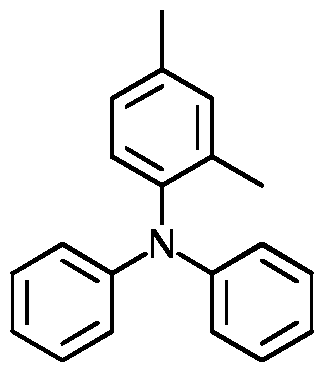
Synthesis of the 2,4-dimethyl PTAA monomer
A 10 L jacketed vessel fitted with overhead stirrer, temperature probe, argon inlet and condenser was charged with 4.5L of toluene, which was degassed for 15 minutes. 5.56 g of palladium (II) acetate (Precious Metals Online) and 15.47g of racemic 2,2'- bis(diphenylphosphino)-1 ,1 '-binaphthyl (Alfa-Aesar) were charged to the vessel. The mixture was heated to 50°C with stirring, and once the internal temperature reached 50°C, was cooled to room temperature. The mixture was left to stir at room temperature for 1 hour. 2,4-Dimethylaniline (300.03g, Alfa-Aesar), 4-chloroiodobenzene (1306.51 g, Apollo Scientific) and sodium-ie f-butoxide (523.87g, Alfa-Aesar) were added and the reaction was heated at reflux for 24 hours, whereupon HPLC analysis showed complete reaction. The reaction was cooled to room temperature and washed twice with water (2 x 4L) and the organic phase was filtered through celite, giving a second split, which was separated. The organics were then concentrated to give a brown solid (935.5g). 838.46g of this material was recrystallised from 3:1 industrial methylated spirits (IMS): ethyl acetate (4450ml_) in a 6L jacketed vessel fitted with overhead stirrer, temperature probe, argon inlet and condenser. The suspension was cooled to 0°C for 1 hour, then the solids collected by vacuum filtration and washed three times with cold 3:1 IMS:ethyl acetate (3 x 840ml_). The solids were dried overnight to give the product as a grey solid. Yield: 699g. 1H NMR (300MHz, CDCI3): δ 7.16 - 6.86 (1 1 H, m, ArH), 2.35 (3H, s, ArMe), 1 .99 (3H, s, ArMe).
Synthesis of the 50:50 2,4-dimethyl: 4-isopropylcvano PTAA copolymer (4)
A 500ml_ three neck round bottom flask was fitted with overhead stirrer, thermometer, air condenser, Claisen adaptor and septum inlet. The apparatus was flushed with argon.
200ml_ of anhydrous Ν,Ν-dimethylacetamide (Sigma Aldrich) was charged to the vessel via cannula needle, and degassed with argon for 15 minutes. Triphenylphosphine (6.5 g, Sigma Aldrich), 2,2'-bipyridyl (0.29g, Sigma Aldrich), zinc (9.52g, Alfa-Aesar) and nickel (II) chloride (0.19g, Sigma Aldrich) were added to the vessel. The contents were heated to 70-80°C. A few crystals of iodine were added to facilitate catalyst formation, turning the solution red-brown. The mixture was stirred at this temperature for a further hour. The 2,4-dimethyl monomer (8.12g) and the 4-isopropylcyano monomer (9g) were added to the vessel, followed by anhydrous toluene (27.5ml_, Sigma Aldrich). The reaction was stirred at 70-80°C for 20 hours, before being cooled to room temperature. The solids were collected by vacuum filtration and redissolved in toluene at 50°C. The mixture was cooled and the excess zinc was removed by filtration. The filtrates were washed with 1 M aqueous sodium hydroxide solution (250ml_), water (250ml_) and 10% aqueous sodium chloride solution (250ml_), before being dried (sodium sulphate) and concentrated to give a yellow solid. This material was dissolved in toluene (100ml_) and filtered through silica, eluting with toluene. The filtrates were concentrated to give a yellow solid. The material was dissolved in toluene (250ml_) and charged to a 500ml_ round bottom flask fitted with magnetic stirrer and condenser. Activated charcoal (0.4g) was added and the mixture heated to 50°C for 30 minutes. The mixture was filtered through filter paper in a Buchner funnel and washed with toluene. The carbon screening was repeated three times in total, filtering the third treatment through a glass sinter funnel. The filtrates were concentrated to give a yellow solid. A solution of this material was prepared in tetrahydrofuran (80ml_), which was added dropwise to a stirred portion of methanol (400ml_). The resulting suspension was stirred for 1 hour, before being collected by vacuum filtration, washing with methanol, and drying to a constant weight, to yield the product as a yellow powder. Yield: 2.6g. Mn = 15091 g/mol. n = 26. Polydispersity = 1.18.
The dielectric constant of polymer (4) was 4.1.
Example (5): Polymer (5) 30:70 4-isopropylcyano-PTAA: 2,4-Dimethyl PTAA copolymer
5(a):Synthesis of 4-lodophenylacetonitrile
A mixture of potassium cyanide (33.23g, Sigma-Aldrich) and 4-iodobenzyl bromide (101 g, Apollo Scientific) in 3:1 IMS/water (1 L) was heated to reflux for 2 hours then cooled to room temperature. The organics were removed in vacuo and the aqueous was extracted with EtOAc (2 x 750ml_). The combined organics were washed with brine (300ml_), dried (magnesium sulphate) and concentrated in vacuo to give the product as oil that solidified on standing. Yield: 78.4g. 1H NMR (400MHz, CDCI3): δ 7.71 (2H, d, ArH), 7.08 (2H, d, ArH) 3.66 (2H, s, ArCH2CN).
5(b): Synthesis of 2-(4-lodophenyl)-2-methylpropanenitrile
NMP (197ml_, Sigma-Aldrich) was added to a suspension of sodium ie f-butoxide (124.0g, Alfa-Aesar) in THF (197ml_, Univar) under argon. The mixture was cooled to 0°C and a solution of iodomethane (87.9ml_, Sigma-Aldrich) and 4-iodophenylacetonitrile (78.4g) in a 50:50 mixture of NMP/THF (173ml_) was added dropwise keeping the internal temperature below 10°C.The mixture was warmed to room temperature and stirred overnight. 2M HCI (930ml_) and toluene (930ml_) were added then the aqueous layer was separated and extracted with toluene (2 x 465ml_). The combined organics were washed with saturated sodium bicarbonate (930ml_), brine (930ml_), 2M sodium thiosulfate (930ml_), dried (magnesium sulphate) and concentrated in vacuo to a yellow/orange solid. Purification by column chromatography eluting with EtOAc/heptane mixtures gave the title compound as a pale yellow oil. Yield 4.55g, 1H NMR (400MHz, CDCIs): δ 7.71 (2H, d, Ar-H), 7.23 (2H, d, Ar-H), 1.70 (6H, s, CH3).
5(c):2-(4-(bis(4-chlorophenyl)amino)phenyl)-2-methylpropanenitrile:4-isopropyl- cyano-PTAA monomer
Palladium acetate (261 mg, Precious Metals Online) and (+) 2,2'-bis(diphenylphosphino)- 1 ,1 '-binaphthyl (BINAP) (723mg, Alfa-Aesar) were added to 400ml_ of degassed toluene
which was then heated under argon to 45°C over 30 minutes. The solution was cooled and 2-(4-iodophenyl)-2-methylpropanenitrile (28.6g), bis-(4-chlorophenyl)amine (25.12g) and sodium tert-butoxide (1 1.15g) ( were added over ten minutes. On completion of addition, the reaction mixture was heated to reflux for 20 h. The reaction mixture was cooled, filtered through a silica plug and solvent removed under reduced pressure. Purification by column chromatography using EtOAc/ heptane mixtures gave the product as a yellow solid. The product was then refluxed in methanol (150ml_) and filtered hot to give a cream solid. The solids from the filtrate were also collected and the combined solids recystallised from acetonitrile, washing the solids with acetonitrile (x2). Yield 10.5g. 1H NMR (400 MHz, CDCI3) δ 7.31 (2H, d, Ar-H), 7.21 (4H, d, Ar-H), 6.97 - 7.02 (6H, m, Ar-H), 1.71 (6H, s, 2 x CH3).
Synthesis of 30:70 4-isopropylcyano-PTAA: 2,4-Dimethyl PTAA copolymer
A 500ml_ three neck round bottom flask was fitted with overhead stirrer, thermometer, air condenser, Claisen adaptor and septum inlet. The apparatus was flushed with argon.
N,N-dimethylacetamide (278.5mL, Sigma Aldrich) was charged and degassed for 15 minutes. Triphenylphosphine (10.74g, Aldrich), 2,2'-bipyridyl (500mg, Sigma Aldrich), zinc (15.85g, Alfa-Aesar) and nickel (II) chloride (300mg, Aldrich) were added to the vessel. The contents were heated to 70-80°C where the mixture turned red-brown in colour. A few crystals of iodine were added, and the reaction was left to stir for 1 hour. The 2,4-dimethyl (18.87g) and 4-isopropylcyano (8.99g) monomers were added to the vessel. Anhydrous toluene (45ml_, Sigma Aldrich) was added. The reaction was left to stir at 70-80°C for 19 hours, before being cooled to room temperature. The reaction was filtered, washing the solids with N,N-dimethylacetamide. The filter cake was dissolved in toluene (500ml_) and filtered through celite. The filtrates were washed with 1 M sodium hydroxide solution (250ml_), water (250ml_) and 10% NaCI solution (250ml_), dried (sodium sulphate) and concentrated to give a yellow solid. This material was dissolved into toluene (250ml_) and filtered through silica, eluting with toluene. The silica was also flushed with tetrahydrofuran to remove all product from the pad. Product fractions were combined and concentrated to give a yellow solid (14.5g). This was dissolved in toluene (500ml_) and charcoal treated. The filtrates were then concentrated to give a yellow solid. This material was dissolved in tetrahydrofuran (80ml_) and added dropwise to methanol (400ml_) with stirring. After stirring for 1 hour, the resulting suspension was collected by filtration to give a pale yellow powder. Yield: 9.9g. Mn = 9694g/mol. n= 34. Polydispersity = 1 .9.
The dielectric constant of polymer (5) was 3.7
Example 6: Polymer (6), 2,4-Dimethoxyphenyl-PTAA homopolymer
Synthesis of the 2,4-dimethoxyphenyl monomer
Tetrakis(triphenylphosphine)palladium(0) (Pd(PPh3)4) (6.62g, Peakdale Molecular) was added to a mixture of 4-bromo-N,N-bis(4-chlorophenyl)aniline (Example 7a (i))(75g), 2,4- dimethoxyboronic acid (38.2g, Alfa-Aesar) and sodium carbonate (64.7g) in tetrahydrofuran (1 120ml_) and H20 (750mL) under argon and the mixture was heated to reflux overnight. The organics were separated, the aqueous layer was extracted with ethyl acetate (x2) and the combined organics were dried and concentrated to a black solid. The solid was adsorbed onto silica and columned eluting ethyl acetate/heptane mixtures to give a green/brown solid. Methanol was added and the mixture was stirred for 20 minutes then filtered and washed with methanol (x2). Methanol was added, the mixture was heated to 40°C and dichloromethane was added portion wise until all solids had dissolved. The solution was stirred for 10 minutes, cooled in an ice-bath for 1 h then the solids were filtered, washed with 50:50 methanol/dichloromethane (x2) and dried to give the product as a light green/brown solid. Yield: 40.8g. 1H NMR (400MHz, CDCI3): δ 7.40 (2H, d, ArH), 7.19-7.25 (5H, m, ArH), 7.00-7.05 (6H, m, ArH), 6.55 (2H, m, ArH), 3.84 (3H, s, OMe), 3.81 (3H, s, OMe).
Synthesis of the 2,4- dimethoxyphenyl-PTAA polymer
A 500ml_ three neck round bottom flask was fitted with overhead stirrer, thermometer, air condenser, Claisen adaptor and septum inlet. The apparatus was flushed with argon.
Ν,Ν-dimethylacetamide (150ml_, Sigma Aldrich) was charged and degassed for 15 minutes. Triphenylphosphine (4.54g, Sigma Aldrich), 2,2'-bipyridyl (210mg, Sigma- Aldrich), zinc (6.71 g, Alfa-Aesar) and nickel (II) chloride (130mg, Sigma Aldrich) were added to the vessel and the contents were heated to 70-80°C where the mixture turned red-brown in colour. A few crystals of iodine were added, and the reaction was left to stir for 1 hour. The monomer (15g) was added to the vessel followed by anhydrous toluene (24ml_, Sigma-Aldrich). The reaction was left to stir for 15 hours before being cooled to room temperature. The reaction was filtered, washing the solids with N,N- dimethylacetamide. The filter cake was dissolved in dichloromethane (500ml_) and filtered through celite. The filtrates were washed with 1 M hydrochloric acid (250ml_), water (250ml_) and 10% brine solution (250ml_), dried (magnesium sulphate) and concentrated to give a yellow solid. This material was dissolved into dichloromethane (500ml_) and filtered through silica, eluting with dichloromethane. Product fractions were combined and concentrated to give a yellow solid. This was dissolved in chloroform (250ml_) and charcoal treated. The filtrates were then concentrated to give a yellow solid. This material was dissolved in chloroform (150ml_) and added dropwise to a stirred portion of methanol (750ml_). The resulting suspension was stirred for 1 hour before being collected by filtration to give a pale yellow powder. Yield: 6.67g. Mn = 3368g/mol. n = 8.8. Polydispersity = 2.4.
The dielectric constant of polymer (6) was 3.5
Example 7: polymer (7), 50:50 4-lsopropylcvanophenyl-PTAA: 2,4-Dimethyl PTAA copolymer
7 (a): Synthesis of the 4-lsopropylcvanophenyl-PTAA monomer
(i) 4-bromo-N,N-bis (4-chlorophenyl) aniline
A 5L three neck flat bottomed flask, fitted with a condenser, thermometer and argon inlet, was flushed with argon. The flask was then charged with toluene (1 .4L), bis(4- chlorophenyl)amine, Compound of Example 3(c), (40g), 4-bromo iodobenzene (52.3g, Apollo Scientific), tris(dibenzylideneacetone)dipalladium(0)Pd2-(dba)3) (461 mg, Acros), (±)-2,2'-bis(diphenylphosphino)-1 ,1 '-binaphthyl (1.05g, Alfa-Aesar) and sodium-ie f- butoxide (35.5g, Alfa-Aesar). The resulting black solution was heated to 100°C for 48 hours then cooled and filtered through a pad of celite, washing with toluene. The filtrate was concentrated to approximately half volume before washing with water (1 L), saturated brine (1 L), drying over MgS04 and concentrating to a green oil. Purification by dry flash column chromatography eluting with ethyl acetate/heptane mixtures followed by recrystallisation from acetonitrile gave the target compound. Yield: 32g, off-white solid. 1H NMR (400MHz, CDCI3): δ 7.35 (2H, m, Ar-H), 7.20 (4H, m, Ar-H), 6.98 (4H, m, Ar-H), 6.92 (2H, m, Ar-H).
(ii) 4-(bis(4-chlorophenyl)amino)phenyl) boronic acid
A three neck round bottomed flask was fitted with a thermometer, argon inlet and a pressure equalizing dropping funnel. The flask was charged with anhydrous 2- methyltetrahydrofuran (1 .1 L) and 4-bromo-N,N-bis(4-chlorophenyl)aniline (60.9g) before being cooled to -78°C. n-Butyllithium (1 .95M solution in hexanes, 95.4ml_) was added dropwise and the solution was stirred at -78°C for 1 hour. Trimethyl borate (26ml_, Sigma-Aldrich) was then added dropwise via syringe and the reaction left to stir at -78°C for 1.5 hours then warmed to room temperature overnight. 1 M hydrochloric acid (630ml_) was added portionwise to the reaction mixture, the layers were split and the organics washed with water (600ml_), brine (600ml_), dried over MgS04 and concentrated to a pale yellow solid. The solid was slurried in heptane and stirred at room temp, for 1 hour. The solid was filtered off and washed with heptane before being dried under vacuum to give a pale yellow powder. Yield: 39.3g.1H NMR (400MHz, CDCI3): δ 8.02 (2H, m, Ar-H), 7.27 (4H, m, Ar-H), 7.05 (6H, m, Ar-H).
(iii) 2-(4'-(bis(4-chlorophenyl)amino)-f1 ,1 '-biphenvn-4-yl)-2-methylpropanenitrile
A 2L flat bottomed flask fitted with an argon inlet and condenser was charged with (4- (bis(4-chlorophenyl)amino)phenyl)boronic acid (39.3g), 2-(4-iodophenyl)-2- methylpropanenitrile, compound from Example 5 (c) (27.1 g) and tetrahydrofuran
(591 ml_). Sodium carbonate (33.9g) was dissolved in water (393ml_) and this was added to the tetrahydrofuran mixture. The reaction mixture was then heated to 75°C for 16 hours. Ethyl acetate (200ml_) and water (200ml_) were added and the mixture filtered through a celite pad. The layers were split, the organic layers washed with brine
(600ml_), dried over MgS04 and concentrated. The resulting material was purified by flash column chromatography eluting with ethyl acetate/heptane mixtures. The fractions were concentrated to a thick slurry and the solid filtered off, washed with heptane and dried under vacuum to give an off-white solid. Yield: 27g. 1H NMR (400MHz, CDCI3): δ 7.56-7.42 (6H, m, Ar-H), 7.21 (4H, m, Ar-H), 7.15-7.02 (6H, m, Ar-H), 1.77 (6H, s, CH3). lsopropylcvanophenyl-PTAA:2,4-dimethyl-PTAA 50:50 copolymer
A 250ml_ three-necked round bottom flask was fitted with overhead stirrer, thermometer, air condenser, Claisen adaptor and septum inlet. The apparatus was flushed with argon. Ν,Ν-dimethylacetamide (128ml_, Sigma Aldrich) was charged and degassed for 15 minutes. Triphenylphosphine (4.17g, Sigma Aldrich), 2,2'-bipyridyl (191 mg, Sigma- Aldrich), zinc (6.16g, Alfa-Aesar) and nickel (II) chloride (120mg, Sigma Aldrich) were added to the vessel. The contents were heated to 70-80°C where the mixture turned red- brown in colour. A few crystals of iodine were added, and the reaction was left to stir for 1 hour. The 2,4-dimethyl monomer (5.8g) and 2-(4'-(bis(4-chlorophenyl)amino)-[1 ,1 '- biphenyl]-4-yl)-2-methylpropanenitrile (7.0g) were added to the reaction followed by anhydrous toluene (21 mL, Sigma Aldrich) and the reaction was stirred at this temperature for 16 hours. The reaction was cooled and the solids were filtered off, washing with N,N-dimethylacetamide. Toluene (600ml_) was added and the mixture was heated to 50°C then filtered through a pad of celite. The remaining solids were dissolved in dichloromethane (500ml_), warmed to 40°C then filtered through a pad of celite. The toluene filtrates were concentrated to a sticky solid, dichloromethane (500ml_) was added and combined with the previous dichloromethane filtrates. The combined organics were washed with 1 M aqueous sodium hydroxide (800ml_), water (800ml_), 10% brine (800ml_), dried over MgS04 and concentrated. The resulting solid was dissolved in dichloromethane (250ml_) and passed through a silica pad, washing with dichloromethane. The combined fractions were concentrated to a solid which was dissolved in tetrahydrofuran (400ml_) and charcoal treated and concentrated to a yellow solid. The solid was dissolved in tetrahydrofuran (100ml_) and added dropwise to methanol (500ml_), filtered and dried under vacuum to give the target compound. Yield: 4.85g. Mn = 7139g/mol. n = 10.8. Polydispersity = 1.59.
The dielectric constant of polymer (7) was 4.0
Example 8: Polymer (8), 4-cvclohexylcyano-PTAA homopolymer
Synthesis of the 4-cyclohexylcvano PTAA oligomer
1 -(4-iodophenyl)cvclohexanecarbonitrile
N-Methylpyrrolidinone (NMP) (197ml_, Sigma-Aldrich) was added to a suspension of sodium ie f-butoxide (124. Og, Alfa-Aesar) in tetrahydrofuran (THF) (197ml_, Univar) under argon. The mixture was cooled to 0°C and a solution of 1 ,5-dibromopentane (87.9ml_, Sigma-Aldrich) and 4-iodophenylacetonitrile (78.4g) in a 50:50 mixture of NMP/THF (173ml_) was added dropwise keeping the internal temperature below 10°C. The mixture was warmed to room temperature and stirred overnight. 2M hydrochloric acid (930ml_) and toluene (930ml_) were added then the aqueous layer was separated and extracted with toluene (2 x 465ml_). The combined organics were washed with saturated sodium bicarbonate (930ml_), brine (930ml_), 2M sodium thiosulfate (930ml_), dried (magnesium sulphate) and concentrated in vacuo to a yellow/orange solid. Dichloromethane was added and the solid was filtered and washed with dichloromethane to give the product as a white solid. Yield: 22.55g. 1H NMR (400MHz, CDCIs): δ 7.70-7.72 (2H, m, ArH), 7.22-7.25 (2H, m, ArH), 2.10-2.13 (2H, m, -CH2.)> 1 .67-1 .89 (7H, m, -CH-), 1.22-1.32 (1 H, m, -CH-). 1 -(4-(bis(4-chlorophenyl)amino)phenyl)cvclohexanecarbonitrile - 4-cyclohexylcvano PTAA monomer
A solution of palladium acetate (179mg) and (±)-2,2'-bis(diphenylphosphino)-1 ,1 '- binaphthyl (496mg) in toluene (338ml_) was heated to 50°C then cooled to room temperature. 1 -(4-lodophenyl)cyclohexanecarbonitrile (22.55g), bis(4- chlorophenyl)amine (17.26g) and sodium ie f-butoxide (7.66g) were added and the
mixture was heated to reflux overnight. The mixture was cooled to room temperature, filtered through a pad of silica then concentrated in vacuo to an oil. Purification by column chromatography eluting ethyl acetate/heptane mixtures followed by
recrystallisation from IPA gave the product as a white solid. Yield: 12.5g. 1H NMR (400MHz, CDCIs): δ 7.31 -7.35 (2H, m, ArH), 7.19-7.23 (4H, m, ArH), 6.97-7.04 (4H, m, ArH), 2.14-2.17 (2H, m-CH2-), 1 .68-1.86 (7H, m, -CH2-), 1 .20-1 .32 (1 H, m, -CH-).
Synthesis of 4-cyclohexylcvano PTAA oligomer
500ml three neck round bottom flask was fitted with overhead stirrer, thermometer, air condenser, Claisen adaptor and septum inlet. The apparatus was flushed with argon.
Ν,Ν-dimethylacetamide (125ml_, Sigma-Aldrich) was charged and degassed for 15 minutes. Triphenylphosphine (4.04g, Sigma-Aldrich), 2,2'-bipyridyl (200mg, Sigma- Aldrich), zinc (6.00g, Alfa-Aesar) and nickel (II) chloride (120mg, Sigma-Aldrich) were added to the vessel and the contents were heated to 70-80°C where the mixture turned red-brown in colour. A few crystals of iodine were added and the reaction was left to stir for 1 hour. The 4-cyclohexylcyano monomer (12.5g) was added to the vessel followed by anhydrous toluene (20ml_, Sigma-Aldrich) and the reaction was left to stir for 19 hours before being cooled to room temperature. The reaction was filtered, washing the solids with N,N-dimethylacetamide. The filter cake was dissolved in dichloromethane (250ml_) and filtered through celite. The filtrates were washed with 1 M sodium hydroxide (250ml_), water (250ml_), 10% NaCI solution (250ml_), dried (sodium sulphate) and concentrated to give a yellow solid. This material was dissolved into dichloromethane (250ml_) and filtered through silica, eluting with dichloromethane. Product fractions were combined and concentrated to give an off white solid (8g). The solid was dissolved in chloroform (250ml_) and charcoal treated three times (3 x 0.8g charcoal). The filtrates were then concentrated to give an off white solid. This material was dissolved in chloroform (125ml_) and added dropwise to a stirred portion of methanol (625ml_). The resulting suspension was stirred for 1 hour before being collected by filtration to give an off white powder. Yield: 6.5g. Due to insolubility, no GPC data was obtained.
The dielectric constant of polymer (8) was 4.1.
Example 9: polymer (9), 30:70 isopropylcyano-PTAA: 2,4-Dimethyl PTAA Bis-aryl end terminated copolymer
9(a): Synthesis of 2-(4-(bis(4-bromophenyl)amino)phenyl)-2-methylpropanenitrile (i) 2-(4-(diphenylamino)phenyl)-2-methylpropanenitrile
Palladium(ll) acetate (3.01 g, Precious Metals Online) and 4,5-bis(diphenylphosphino)- 9,9-dimethylxanthene (7.76g, Manchester Organics) were dissolved in toluene (550ml_) and the solution was degassed. Diphenylamine (22.7g, Alfa-Aesar), sodium ie f-butoxide (28.4g, Alfa-Aesar) and 2-(4-iodophenyl)-2-methylpropanenitrile (40g) were added and the solution heated to 90°C for 18 hours. The reaction was cooled, filtered through a celite pad, washed with water, brine, dried (MgS04) and concentrated. The residue purified by flash column eluting ethyl acetate:heptane mixtures to give an oil. Heptane was added to the oil and the resulting solid was filtered to give the product as a white solid. Yield; 17.5g. 1H NMR (400MHz, CDCI3); 7.22-7.32 (9H, m), 7.00-7.10 (6H, m), 1 .71 (6H, s) (ii) 2-(4-(bis(4-bromophenyl)amino)phenyl)-2-methylpropanenitrile
2-(4-(diphenylamino)phenyl)-2-methylpropanenitrile (7.5g) was dissolved in ethyl acetate (128ml_). N-Bromosuccinimide (NBS) (8.55g, Apollo Scientific) was added portionwise before leaving the reaction to stir at room temperature for 18 hours. The reaction mixture was washed with water, sodium carbonate, brine, dried (MgS04) and concentrated. Heptane was added to the residue and the resulting solid was filtered off to give the product as a grey solid. Yield; 6.4g. 1H NMR (400MHz, CDCI3); 7.30 (6H, m), 7.04 (2H, d), 6.93 (4H, d), 1 .71 (6H, s).
9(b): Synthesis of 2-(4-(bis(4-bromophenyl)amino)phenyl)-2-methylpropanenitrile (i) 2,4-dimethyl-A/,A/-diphenylaniline
Toluene (735ml_) was degassed for 10 minutes then diphenylamine (15g, Alfa Aesar), 4- iodoxylene 5 (21.6g, Alfa-Aesar) and sodium ie f-butoxide (10.65g, Alfa Aesar) were added before degassing for a further 5 minutes. Pd2(dba)3 (812mg, Acros) and tri-ie f- butylphosphine (1.08ml_, Alfa Aesar) were added and the mixture was heated to 95°C for 3.5 hours. The reaction was cooled, quenched with water (750ml_), stirred for 10 minutes then filtered through celite. The organic layer was separated, washed with brine (2 x 500ml_), dried (MgS04) and concentrated to a brown oil. Yield: 24.46g. The oil was redissolved in toluene and passed through a silica plug. The filtrates were concentrated to give the title compound as a brown oil. 1H NMR (400MHz, CDCI3): δ 7.16-7.23 (4H, m, ArH), 6.86-7.05 (9H, m, ArH), 2.33 (3H, s, CH3), 2.00 (3H, s, CH3).
(U) A/,A/-Bis(4-bromophenyl)-2,4-dimethylaniline
NBS (31.55g, Apollo Scientific) was added to a solution of 2,4-dimethyl-/V,/V- diphenylaniline (24.23g) in EtOAc (410ml_). The mixture slowly warmed over 5 minutes and was stirred for a further 1 hour until the solution had re-cooled. The mixture was washed with water (250mL), Na2C03 (2 x 375mL), brine (250mL), dried (MgS04) and concentrated to a dark brown solid. Recrystallisation from THF/MeCN gave the title compound as a grey solid. Yield: 27.70g. 1H NMR (400MHz, CDCI3): δ 7.22-7.30 (4H, m, ArH), 7.05 (1 H, d, ArH), 7.00 (1 H, dd, ArH), 6.95 (1 H, d, ArH), 2.33 (3H, s, CH3), 1 .97 (3H, s, CH3). (c):Svnthesis of 2,4-Dimethyl-A/,A/-bisi4-i4,4,5,5-tetramethyl-1 ,3,2-dioxaborolan-2- vDphenvDaniline
A mixture of /V,/V-bis(4-bromophenyl)-2,4-dimethylaniline 7 (10g), bis(pinacolato)diboron (12.96g, Allychem), and potassium acetate (7.97g, Alfa-Aesar) in dioxane (250mL) was degassed for 10 minutes then [1 ,1 '-bis(diphenylphosphino)ferrocene]dichloropalladium (II) complex with dichloromethane (947mg, Peakdale Molecular) was added and the mixture was heated to 100°C overnight. The mixture was concentrated and the residue was dissolved in DCM (300ml_) and passed through a plug of celite. The filtrates were washed with water (2 x 200ml_), dried (MgS04) and concentrated to a dark brown solid.
Purification by column chromatography eluting with EtOAc/heptane mixtures followed by recrystallisation from THF/MeCN gave the title compound as a white solid. Yield: 5.60g. 1H NMR (400MHz, CDCI3): δ 7.62-7.64 (4H, m, ArH), 6.92-7.05 (7H, m, ArH), 2.34 (3H, s, CH3), 1.95 (3H, s, CH3), 1.29 (24H, s, CH3).
Synthesis of 30:70 4-isopropylcyano-PTAA: 2, 4-Di methyl -PTAA copolymer 9a
2-(4-(Bis(4-bromophenyl)amino)phenyl)-2-methylpropanenitrile (Example 9a (ii) (537.4mg), /V,/V-bis(4-bromophenyl)-2,4-dimethylaniline (Example 9b (ii) (328.5mg) and 2,4-dimethyl-/V,/V-bis(4-(4,4,5,5-tetramethyl-1 ,3,2-dioxaborolan-2-yl)phenyl)aniline
(Example 9 (c) (1 .01 g) were added to a mixture of toluene:dioxane:water
(9.3mL:4.6mL:4.6ml_) followed by potassium phosphate (1 .61 g, Alfa-Aesar) and Aliquat 336 (4 drops, Alfa Aesar). The mixture was degassed for 10 minutes then Pd2(dba)3 (8.8mg, Acros) and tri(o-tolyl)phosphine] (17.4mg, Sigma-Aldrich) were added and the mixture was heated to 90°C until the required Mn was reached. Mn was determined by sampling the reaction every hour and analysing by GPC. At this point, the
pinacolatoboron moieties were substituted by addition of bromobenzene (1 .5g, Sigma Aldrich) and heating the mixture at 90°C overnight. The mixture was cooled, poured into MeOH (92.5ml_) and the precipitate was filtered and dissolved in toluene (100ml_). The solution was washed with 1 M NaOH (92.5ml_), water (92.5ml_), brine (92.5ml_), dried (magnesium sulphate) and concentrated to give an orange solid. The solid was dissolved in toluene (10ml_) and filtered through a silica plug eluting THF:toluene
(50:50). The filtrates were concentrated to an orange solid that was dissolved in THF (10ml_) and added dropwise to MeOH (50ml_). The suspension was stirred for 15 minutes then filtered to give a yellow solid that was dissolved in toluene, treated with charcoal (3 x 80mg) and the filtrates were concentrated. The solid was dissolved in THF (10ml_) and added dropwise to MeOH (50ml_). The resulting solid was filtered and dried to give the title compound as a yellow solid. Yield: 620mg. Mn = 3900g/mol. n = 13.8. Polydispersity = 2.29.
Synthesis of 30:70 4-isopropylcyano-PTAA: 2,4-Dimethyl-PTAA 9
Toluene (170ml_) was degassed for 10 minutes then 2-(4-(bis(4- bromophenyl)amino)phenyl)-2-methylpropanenitrile (2.70g), /V,/V-bis(4-bromophenyl)- 2,4-dimethylaniline (1.66g) and 2!4-dimethyl-/V!/V-bis(4-(4!4!5!5-tetramethyl-1 !3,2- dioxaborolan-2-yl)phenyl)aniline (5.01 g) were added followed by (Ph3P)4Pd (27.7mg, Peakdale Molecular) and 1 M Na2C03 (95ml_). The mixture was heated to 95°C until the required Mn was reached. Mn was determined by sampling the reaction and analysing by GPC. At this point, the pinacolatoboron moieties were substituted by addition of bromobenzene (7.5g, Sigma Aldrich) and heating the mixture at 95°C overnight. The mixture was then cooled and poured into methanol (1325ml_). The resulting suspension was collected by filtration, dissolved in toluene (250ml_) and filtered through celite. The filtrates were washed with 1 M NaOH (250ml_), water (250ml_), brine (250ml_), dried (MgS04) and concentrated to give a yellow solid. To remove the bromide moieties, this was dissolved into degassed toluene (170ml_) and to it was added 1 M Na2C03 (95ml_), (Ph3P)4Pd (27.7mg, Peakdale Molecular) and phenylboronic acid (5.81 g, Apollo Scientific). This was heated to 95°C overnight. The workup was repeated as above, concentrating to 150ml_. This was filtered through silica, eluting with 50:50 toluene:THF mixture. The filtrates were concentrated to a brown solid which was dissolved in toluene (100ml_), treated with charcoal (3 x 500mg) and the filtrates were concentrated. The solid was dissolved in THF (50ml_) and precipitated into MeOH (250ml_). The resulting suspension was filtered to yield the title compound as a grey solid. Yield: 4.0g. Mn = 1992g/mol. n = 7.0. Polydispersity = 3.35.
The dielectric constant of polymer 9 was 3.6.
Alternative method
Toluene (34ml_) was degassed for 10 minutes then 2-(4-(bis(4- bromophenyl)amino)phenyl)-2-methylpropanenitrile 4 (537.4mg), /V,/V-bis(4-
bromophenyl)-2,4-dimethylaniline 7 (328.7mg) and 2,4-dimethyl-/V,/V-bis(4-(4,4,5,5- tetramethyl-1 ,3,2-dioxaborolan-2-yl)phenyl)aniline 8 (1 .00g) were added followed by (Ph3P)4Pd (5.7mg, Peakdale Molecular) and 1 M Na2C03 (19ml_). The mixture was heated to 95°C for 12 hours then the pinacolatoboron moieties were substituted by addition of bromobenzene (1 .5g, Sigma Aldrich) and heating the mixture at 95°C overnight. The bromide moieties were then substituted by addition of phenylboronic acid (1 .16g, Apollo Scientific) and heating the mixture overnight. Purification as above gave the product as a grey solid. Yield: 825mg. Mn = 2300g/mol. n = 8.1 . Polydispersity = 3.1 Comparative Example (10): Polymer (10) 2,4-dimethyl-PTAA polymer
a
Synthesis of the 2,4-Dimethyl-polvtriarylamine polymer (10)
A 1 L three neck round bottom flask was fitted with overhead stirrer, thermometer, air condenser, Claisen adaptor and septum inlet. The apparatus was flushed with argon. 500ml_ of anhydrous Ν,Ν-dimethylacetamide (Sigma Aldrich) was charged to the vessel using a cannula needle, and the solution was degassed with argon for 15 minutes. Triphenylphosphine (19.65g, Sigma Aldrich), 2,2'-bipyridyl (0.92g, Sigma Aldrich), zinc (29.65g, Alfa-Aesar) and nickel (II) chloride (0.51 g, Sigma Aldrich) were added and the reaction mass heated to 70-80°C, whereupon the mixture turned red-brown in colour. After 20 minutes, a few crystals of iodine were added and the mixture was left stirring at 70-80°C for a further 40 minutes. The 2,4-dimethyl PTAA monomer (49.88g, see Example 4) was added, followed by anhydrous toluene (75ml_, Aldrich). The reaction was left to stir at 70-80°C for 19 hours. The reaction was cooled to room temperature and filtered. The solids were washed with the filtrate before being transferred back into the vessel and dissolved into toluene (500ml_) at 50°C. The mixture was cooled to room temperature, and the excess zinc was quenched by slow addition of concentrated hydrochloric acid (80ml_). The layers were separated and the organic phase washed with
10% aqueous sodium chloride solution (3 x 250ml_). The organic phase was then dried (sodium sulphate) and filtered through a celite pad. The filtrates were concentrated to give a yellow solid. This was dissolved in toluene (200ml_) and filtered through a pad of silica gel (100g), eluting with toluene until no further product was seen by UV spot on a TLC plate. The filtrates were combined and concentrated to give a yellow solid. A solution of this solid in 150ml_ of tetrahydrofuran was prepared and then added into a stirred portion of methanol (750ml_) over 1 hour. The suspension was stirred for 1 hour before being filtered, washed with methanol (2 x 100ml_) and dried to give a yellow powder. Yield: 25.78g. Mn = 3263 g/mol, n = 12.0, polydispersity = 1 .7.
Hydrodechlorination process
A 1 L autoclave fitted with magnetic stirrer was charged with 1 1 .22g of the 2,4-dimethyl - polytriarylamine polymer and 500ml_ of toluene (Fisher Scientific). To this was added a slurry of 10% palladium on carbon (5.6g, Sigma Aldrich) in water (90ml_). Triethylamine (17ml_, Alfa-Aesar) was added to this stirred solution and the reaction mixture hydrogenated at 300psi/50°C for 72 hours. After cooling and venting, the mixture was filtered through celite, eluting with toluene. The filtrates were washed with water (4 x 500ml_), dried (sodium sulphate) and concentrated to give a yellow solid. This material was dissolved in toluene (100ml_) and filtered through a silica pad, eluting with toluene until no further product was seen by a UV spot on a TLC plate. The filtrates were then concentrated to give a yellow solid. A 500mL round bottom flask was charged with a solution of the product in toluene (250mL) and activated charcoal (1.2g). The mixture was heated to 60°C for 30 minutes, then filtered hot through a Buchner funnel, washing with the minimum amount of toluene. This carbon screening process was repeated twice more, filtering the third treatment through a glass sinter. The filtrates were concentrated to give a dark yellow solid. A solution of this material in tetrahydrofuran (60mL) was prepared and added slowly to a stirred portion of methanol (300mL). The resulting suspension was stirred for 1 hour, collected by vacuum filtration, washed with methanol (3 x 50mL) and dried to give the product as a pale yellow powder. Yield: 9.75g. Mn = 3138g/mol. n = 1 1 .6. Polydispersity = 1.8. Chlorine content = 19ppm.
The permittivity of the 2,4-Dimethyl PTAA polymer (10) was 3.0
Comparative Examples (11 )-3-Methoxy-PTAA and (12)- 2,4-Difluoro-PTAA: these polymers were synthesised using the same methodology as described in Examples 1 to 9. The permittivities of the corresponding PTAA polymers are listed in Table 1.
Comparative Example 13:Synthesis of the 3,5-bistrifluoromethyl polytriarylamine polymer (13)
a
Synthesis of the 3,5-bis(trifluoromethyl) monomer
A 2L 3-neck round bottom flask fitted with mechanical stirrer, thermometer, condenser and argon inlet was charged with toluene (1 .125L), palladium acetate (494.4mg, Precious Metals) and (±)-2,2'-bis(diphenylphosphino)-1 ,1 '-binaphthyl (1 .37g, Alfa-Aesar) were added to the vessel and the contents were heated to 50°C and then cooled to room temperature once reached and left to stir for 1 hour. 3,5-bis(trifluoromethyl)iodobenzene (75g, Maybridge), bis(4-chlorophenyl)aniline (52.5g) and sodium-ie f-butoxide (23.28g, Alfa-Aesar) were added to the vessel which was heated to 1 10°C for 8 hours. The reaction was cooled and water (750ml_) was added. The mixture was filtered and the layers separated. The organic phase was washed with water, filtered through a pad of celite and concentrated. The crude product was purified by chromatography using heptane as an eluent, followed by recrystallising twice from methanol. Yield: 35g. 1H NMR (400MHz, CDCI3): δ 7.31 -7.29 (7H, m, ArH), 7.04-7.02 (3H, m, ArH).
Synthesis of the 3,5-bis(trifluoromethyl) PTAA oligomer (13)
A 1 L three neck round bottom flask was fitted with overhead stirrer, thermometer, air condenser, Claisen adaptor and septum inlet. The apparatus was flushed with argon. Ν,Ν-dimethylacetamide (250ml_, Sigma-Aldrich) was charged and degassed for 15 minutes. Triphenylphosphine (7.58g, Sigma-Aldrich), 2,2'-bipyridyl (346.2mg, Sigma- Aldrich), zinc (1 1.17g, Alfa-Aesar) and nickel (II) chloride (216.7mg, Sigma-Aldrich) were added to the vessel. The contents were heated to 70-80°C where the mixture turned red- brown in colour. A few crystals of iodine were added, and the reaction was left to stir for 1 hour. The 3,5-bis(trifluoromethyl) monomer (24.98g) was added to the vessel. Anhydrous toluene (41 mL, Sigma-Aldrich) was added and the reaction was left to stir for
19 hours, before being cooled to room temperature. The reaction was filtered, washing the solids with N,N-dimethylacetamide (100ml_). The filter cake was dissolved in tetrahydrofuran (300ml_), filtered through a celite pad and concentrated. This material was dissolved into tetrahydrofuran (250ml_) and filtered through silica, eluting with tetrahydrofuran. Product fractions were combined and concentrated to give a yellow solid. This was dissolved in 2-methyltetrahydrofuran (230ml_), washed with 1 M sodium hydroxide solution (200ml_), water (200ml_), 10% sodium chloride solution (200ml_) and water (200m L) before being concentrated to give a yellow solid (8.5g). This was dissolved in tetrahydrofuran (50ml_) and charcoal treated three times (3 x 0.85g of charcoal) then concentrated. This material was dissolved in tetrahydrofuran (60ml_) and added dropwise to a stirred portion of methanol (300ml_). The resulting suspension was stirred for 1 hour before being collected by filtration and dried. Yield: 7.5g. Mn = 5350g/mol. n = 14.1. Polydispersity = 1.3.
The dielectric constant of polymer (13) was 2.8.
Comparative Example 14: Polymer (14), 2-Methoxy backbone PTAA homopolymer
a
Synthesis of the 2-methoxy backbone PTAA monomer
(a) Synthesis of 4-chloro-2-methoxyaniline
A mixture of 5-chloro-2-nitroanisole (1 .0g, Sigma-Aldrich), ammonium formate (3.36g, Alfa-Aesar) and 10% platinum on carbon (100mg) in MeOH (10ml_) was heated to reflux for 45 minutes then cooled to room temperature and filtered through celite, washing with MeOH. The filtrates were concentrated and the residue was dissolved in EtOAc and water. The organics were dried (MgS04) and concentrated to a brown oil. The material was absorbed onto silica and columned eluting ethyl acetate/heptane mixtures to give
the product as a brown oil. Yield: 0.7g. 1H NMR (400MHz, CDCI3): δ 6.72-6.78 (2H, m, ArH), 6.58-6.62 (1 H, m, ArH), 3.83 (3H, s, OMe).
(b) Synthesis of 4-chloro-A/-(4-chlorophenyl)-2-methoxyaniline
A solution of palladium (II) acetate (949mg, Precious Metals Online) and (+/-)-2,2'- bis(diphenylphosphino)-1 ,1 '-binaphthyl (2.63g, Alfa-Aesar) in toluene (l OOOmL) was heated to 50°C under argon then cooled to room temperature. 4-Chloro-2- methoxyaniline (66.6g), 4-iodochlorobenzene (105.81 g, Apollo Scientific) and sodium ie f-butoxide (44.68g, Alfa-Aesar) were added and the mixture was heated to reflux for 90 minutes. The mixture was cooled to room temperature, quenched with water (500ml_) then the organics were separated, dried (MgS04) and concentrated. The residue was absorbed onto silica and columned eluting ethyl acetate/heptane mixtures to give the product as a dark orange oil that solidified on standing. Yield: 97.86g. 1H NMR (400MHz, CDCIs): δ 7.18-7.23 (2H, m, ArH), 7.12 (1 H, d, ArH), 7.00-7.05 (2H, m, ArH), 6.82-6.85 (2H, m, ArH), 6.00 (1 H, br s, NH), 3.87 (3H, s, OMe).
(c) Synthesis of 4-chloro-A/-(4-chlorophenyl)-2-methoxy-A/-phenylaniline-2-MeO- backbone PTAA monomer
Palladium(ll) acetate (3.84g, Precious Metals Online) and 4,5-bis(diphenylphosphino)- 9,9-dimethylxanthene (9.91 g, Manchester Organics) were dissolved in toluene (690ml_) and stirred at room temperature under argon for 1 hour. 4-Chloro-/V-(4-chlorophenyl)-2- methoxyaniline (45.9g), iodobenzene (47.9ml_, Sigma-Aldrich) and sodium ie f-butoxide (42.78g, Alfa Aesar) were added and the mixture was heated to 85°C overnight. The mixture was cooled to room temperature, quenched with water (690ml_) and filtered through celite. The organics were separated, dried (MgS04) and concentrated to a black oil. The material was absorbed onto silica and columned eluting ethyl acetate/heptane mixtures to give a brown oil. MeOH was added and the mixture was cooled to 0°C and stirred for 1 hour. The solid was filtered and recrystallised from DCM/MeOH to give the product as a white solid. Yield: 14.5g. 1H NMR (400MHz, CDCI3): δ 7.18-7.23 (2H, m, ArH), 7.10-7.15 (2H, m, ArH), 7.05 (1 H, d, ArH), 6.89-6.99 (5H, m, ArH), 6.84-6.88 (2H, m, ArH), 3.63 (3H, s, OMe).
Synthesis of the 2-methoxy backbone PTAA polymer 14
A 500ml_ three neck round bottom flask was fitted with overhead stirrer, thermometer, air condenser, Claisen adaptor and septum inlet. The apparatus was flushed with argon.
Ν,Ν-dimethylacetamide (150ml_, Sigma-Aldrich) was charged and degassed for 15 minutes. Triphenylphosphine (5.75g, Sigma-Aldrich), 2,2'-bipyridyl (263.1 mg, Sigma- Aldrich), zinc (8.48g, Alfa-Aesar) and nickel (II) chloride (163.8mg, Sigma-Aldrich) were added to the vessel and the contents were heated to 70-80°C where the mixture turned red-brown in colour. A few crystals of iodine were added, and the reaction was left to stir for 1 hour. The monomer (14.5g) was added to the vessel followed by anhydrous toluene (24ml_, Sigma-Aldrich) and the mixture was left to stir overnight before being cooled to room temperature. The reaction was filtered and the filtrates were added dropwise to MeOH (1 150ml_). The solids were filtered, washed with MeOH and dried before being redissolved in toluene (750ml_). The solution was washed with 1 M hydrochloric acid (250ml_), water (250ml_), 10% brine (250ml_), dried (MgS04) and concentrated to give a yellow solid. This was dissolved in toluene and passed through a silica pad eluting toluene then 50:50 toluene:THF. The filtrates were concentrated then redissolved in toluene and charcoal treated (3 x 1.24g). The filtrates were then concentrated to give a yellow solid. This material was dissolved in THF (250ml_) and added dropwise to a stirred portion of methanol (1250ml_). The resulting suspension was stirred for 30 minutes before being collected by filtration to give a pale yellow powder. Yield: 8.93g. Mn = 3221 g/mol. n = 1 1.8. Polydispersity = 2.43.
The dielectric constant of poymer (14) was 3.29
Comparative Example 15: Polymer (15) 4-Phenoxy- PTAA homopolymer
Synthesis of the 4-phenoxy monomer
A 1 litre 3-neck round bottom flask fitted with magnetic stirrer, thermometer, condenser and argon inlet was charged with 300 mL toluene, palladium acetate (250 mg, Precious
Metals) and (±)-2,2'-bis(diphenylphosphino)-1 ,1 '-binaphthyl (0.69 grams (g), Alfa-Aesar) were added to the vessel and the contents were heated to 50°C and then cooled to room temperature once reached and left to stir for 1 hour. 4-phenoxyaniline (20.02g, Alfa- Aesar), 4-chloroiodobenzene (59.96g, Apollo Scientific) and sodium-ie f-butoxide (22.83g, Alfa-Aesar) were added to the vessel which was heated to 1 10°C for 54 hours. The reaction was cooled and water (200ml) was added. The mixture was filtered and the layers separated. The organic phase washed with water, filtered through a pad of celite, dried over sodium sulphate and concentrated. The crude product was purified by automated chromatography, using 2% ethyl acetate in heptane as an eluent, and then by silica pad using heptane to remove impurities and then 10% ethyl acetate in heptane. Product fractions were combined and concentrated Yield: 29g. 1H NMR (400MHz, CDCIs): δ 7.5-6.9 (17H, m, ArH)
Synthesis of the 4-phenoxy PTAA oligomer
A 500ml three neck round bottom flask was fitted with overhead stirrer, thermometer, air condenser, Claisen adaptor and septum inlet. The apparatus was flushed with argon. Ν,Ν-dimethylacetamide (130ml_, Aldrich) was charged and degassed for 15 minutes. Triphenylphosphine (1.50g, Aldrich), 2,2'-bipyridyl (69.8mg, Aldrich), zinc (2.24g, Alfa- Aesar) and nickel (II) chloride (42.4mg, Aldrich) were added to the vessel. The contents were heated to 70-80°C where the mixture turned red-brown in colour. A few crystals of iodine were added, and the reaction was left to stir for 1 hour. The monomer (13g) was added to the vessel, followed by anhydrous toluene (45.5ml_, Aldrich). After 3 hours, further nickel (II) chloride (42.8mg) was added and the reaction was left to stir for 15 hours, before being cooled to room temperature. The reaction was filtered through celite, eluting with N,N-dimethylacetamide (50ml_). Solids began precipitating in the filtrates which were collected by filtration. The filtrates were measured (350ml_) and added dropwise to a stirred portion of methanol (1750ml_). The suspension was stirred for 1 hour, collected by vacuum filtration and washed with methanol. The solids were combined with the solids collected from the celite filtration and dissolved in tetrahydrofuran (250ml_), washed three times with 10% sodium chloride solution (200ml) and concentrated to give a yellow solid. This material was dissolved into tetrahydrofuran (250ml_) and filtered through silica, eluting with tetrahydrofuran. Product fractions were combined and concentrated to give a yellow solid (15g). This material was dissolved in tetrahydrofuran (250ml_) and charcoal treated three times (3 x 1 .5g of charcoal). The filtrates were concentrated. This material was dissolved in tetrahydrofuran (120ml_) and
added dropwise to a stirred portion of methanol (120ml_). The resulting suspension was stirred for 1 hour before being collected by filtration and dried. Yield: 8.6g. Mn = 2047g/mol. n = 6.1 . Polydispersity = 2.1 .
The dielectric constant of polymer (15) was 2.7.