WO2012131897A1 - 抗ピリング性繊維製品 - Google Patents
抗ピリング性繊維製品 Download PDFInfo
- Publication number
- WO2012131897A1 WO2012131897A1 PCT/JP2011/057786 JP2011057786W WO2012131897A1 WO 2012131897 A1 WO2012131897 A1 WO 2012131897A1 JP 2011057786 W JP2011057786 W JP 2011057786W WO 2012131897 A1 WO2012131897 A1 WO 2012131897A1
- Authority
- WO
- WIPO (PCT)
- Prior art keywords
- pilling
- fiber
- fiber product
- fibers
- owf
- Prior art date
- Legal status (The legal status is an assumption and is not a legal conclusion. Google has not performed a legal analysis and makes no representation as to the accuracy of the status listed.)
- Ceased
Links
Classifications
-
- D—TEXTILES; PAPER
- D06—TREATMENT OF TEXTILES OR THE LIKE; LAUNDERING; FLEXIBLE MATERIALS NOT OTHERWISE PROVIDED FOR
- D06M—TREATMENT, NOT PROVIDED FOR ELSEWHERE IN CLASS D06, OF FIBRES, THREADS, YARNS, FABRICS, FEATHERS OR FIBROUS GOODS MADE FROM SUCH MATERIALS
- D06M13/00—Treating fibres, threads, yarns, fabrics or fibrous goods made from such materials, with non-macromolecular organic compounds; Such treatment combined with mechanical treatment
- D06M13/10—Treating fibres, threads, yarns, fabrics or fibrous goods made from such materials, with non-macromolecular organic compounds; Such treatment combined with mechanical treatment with compounds containing oxygen
- D06M13/184—Carboxylic acids; Anhydrides, halides or salts thereof
- D06M13/207—Substituted carboxylic acids, e.g. by hydroxy or keto groups; Anhydrides, halides or salts thereof
- D06M13/21—Halogenated carboxylic acids; Anhydrides, halides or salts thereof
-
- D—TEXTILES; PAPER
- D06—TREATMENT OF TEXTILES OR THE LIKE; LAUNDERING; FLEXIBLE MATERIALS NOT OTHERWISE PROVIDED FOR
- D06M—TREATMENT, NOT PROVIDED FOR ELSEWHERE IN CLASS D06, OF FIBRES, THREADS, YARNS, FABRICS, FEATHERS OR FIBROUS GOODS MADE FROM SUCH MATERIALS
- D06M2101/00—Chemical constitution of the fibres, threads, yarns, fabrics or fibrous goods made from such materials, to be treated
- D06M2101/02—Natural fibres, other than mineral fibres
- D06M2101/04—Vegetal fibres
- D06M2101/06—Vegetal fibres cellulosic
-
- D—TEXTILES; PAPER
- D06—TREATMENT OF TEXTILES OR THE LIKE; LAUNDERING; FLEXIBLE MATERIALS NOT OTHERWISE PROVIDED FOR
- D06M—TREATMENT, NOT PROVIDED FOR ELSEWHERE IN CLASS D06, OF FIBRES, THREADS, YARNS, FABRICS, FEATHERS OR FIBROUS GOODS MADE FROM SUCH MATERIALS
- D06M2200/00—Functionality of the treatment composition and/or properties imparted to the textile material
- D06M2200/35—Abrasion, pilling or fibrillation resistance
Definitions
- the present invention relates to an anti-pilling fiber product having excellent anti-pilling properties and high fiber strength.
- An object of the present invention is to provide an anti-pilling fiber product having excellent anti-pilling properties and having high strength in fibers.
- the present invention is an anti-pilling fiber product containing cellulosic fibers having a carboxymethyl group.
- the present invention is described in detail below.
- the present inventor has found that, in a fiber product containing a cellulosic fiber, the anti-pilling property is improved by introducing a carboxymethyl group into the cellulosic fiber.
- the present inventor has found that such an anti-pilling fiber product does not impair the strength of the fiber, and can achieve both excellent anti-pilling property and high strength of the fiber, and has completed the present invention.
- the textile product means not only a fabric but all products such as clothing in which fibers are usually used.
- clothing in which fibers are usually used.
- swimwear, sportswear, underwear, outerwear, socks, panties examples include clothes such as stockings, gloves, hats, hair bands, ties, handkerchiefs, towels, face masks, mufflers, sheets, pillow covers, futons, cushions, diapers, and diaper covers.
- pilling means a state in which fibers on the surface of a fiber product are fluffed by friction or the like, and the fluff is further entangled to form a small spherical lump, that is, a pill.
- the pilling property means a property that pilling hardly occurs due to friction or the like.
- the anti-pilling fiber product of the present invention contains a cellulosic fiber having a carboxymethyl group.
- Conventional fiber products treated with caustic soda or caustic potash or cellulase have improved fiber anti-pilling properties but reduced fiber strength.
- the anti-pilling fiber product of the present invention contains a cellulosic fiber having a carboxymethyl group, so that the anti-pilling property is excellent and the fiber has high strength.
- the anti-pilling fiber product of the present invention has a high moisture absorption rate and exhibits high deodorizing performance, for example, even after repeated washing. Deodorant performance can be maintained.
- the cellulose fiber having a carboxymethyl group is preferably obtained by carboxymethylating an untreated cellulose fiber not having a carboxymethyl group.
- an untreated cellulosic fiber having no carboxymethyl group is also simply referred to as an untreated cellulosic fiber. It does not specifically limit as said untreated cellulose fiber, A conventionally well-known cellulose fiber can be used.
- the untreated cellulosic fiber may be a spun yarn or a filament yarn, but the surface area is increased by including innumerable short fibers, and the resulting anti-pilling fiber product exhibits high deodorizing performance. Of these, spun yarn is preferable.
- the surface area of the untreated cellulosic fiber is large, the number of reactive sites that are carboxymethylated increases, and the anti-pilling property, deodorizing performance, and moisture absorption rate of the resulting anti-pilling fiber product are further improved.
- untreated cellulosic fibers examples include natural cellulosic fibers such as cotton, hemp, flax, and bacterial cellulose, regenerated cellulosic fibers such as rayon, cupra, and polynosic, and these natural cellulosic fibers or regenerated cellulose.
- a preferable lower limit is 0.3 dtex, and a preferable upper limit is 3 dtex. If the single fiber fineness is less than 0.3 dtex, the strength of the fibers of the resulting anti-pilling fiber product may be reduced. When the single fiber fineness exceeds 3 dtex, the surface area of the cellulose fiber having the carboxymethyl group becomes small, and the resulting anti-pilling fiber product may not exhibit high deodorizing performance.
- the single fiber fineness exceeds 3 dtex, the convergence due to the interaction between the single fibers is reduced, and the cellulose-based fibers having the carboxymethyl group are likely to fluff, so that the anti-pilling of the resulting anti-pilling fiber product May decrease.
- the more preferable lower limit of the single fiber fineness of the untreated cellulosic fiber is 0.5 dtex, and the more preferable upper limit is 2 dtex.
- the single fiber refers to individual short fibers constituting the spun yarn in the case of spun yarn, and refers to individual single yarns constituting the filament yarn in the case of filament yarn.
- the method for carboxymethylating the untreated cellulosic fiber is not particularly limited, but the untreated cellulosic fiber is knitted with other fibers as necessary, rather than the method of carboxymethylating in the fiber state. Then, the method of carboxymethylating the obtained fiber product containing the untreated cellulosic fiber is preferable.
- the method for carboxymethylating the fiber product containing untreated cellulosic fiber include, for example, monochloroacetic acid or an alkali metal salt of monochloroacetic acid and an alkali metal
- a method of reacting at a predetermined temperature for a predetermined time after contacting with a treatment liquid containing the hydroxide there may be mentioned a method of reacting at a predetermined temperature for a predetermined time after contacting with a treatment liquid containing the hydroxide.
- the alkali metal salt in the alkali metal salt of monochloroacetic acid is not particularly limited, and examples thereof include sodium salt and potassium salt.
- the concentration of monochloroacetic acid or an alkali metal salt of monochloroacetic acid in the treatment liquid may be determined appropriately so that the content of the carboxymethyl group described later has a target value, but the preferred lower limit is 5% owf, a preferred upper limit is 40% owf, a more preferred lower limit is 7% owf, a more preferred upper limit is 37% owf, a further preferred lower limit is 9% owf, and a more preferred upper limit is 35% owf.
- the treatment liquid preferably contains an alkali metal hydroxide, for example, sodium hydroxide.
- an alkali metal hydroxide for example, sodium hydroxide.
- sodium hydroxide By adding sodium hydroxide, the content of carboxymethyl group described later can be increased.
- concentration of sodium hydroxide in the treatment solution is increased, the reactivity of carboxymethylation tends to increase, and it is usually preferably 0.5% owf or more.
- the texture of the resulting anti-pilling fiber product tends to deteriorate, so care should be taken.
- a processing aid is further blended into the treatment liquid.
- the carboxymethylation reaction progresses evenly in both the surface direction and the thickness direction of the fiber product containing the untreated cellulosic fibers in a shorter time, and partial anti-pilling. Sexual deterioration is unlikely to occur.
- the processing aid is not particularly limited, and examples thereof include higher alcohol sulfates, polyoxyalkylene alkyl ether sulfates, alkylbenzene sulfonates, alkyl naphthalene sulfonates, naphthalene sulfonate formalin condensates, and higher alcohol phosphorus.
- examples include acid ester salts, polyoxyalkylene alkyl ether phosphate ester salts, polyoxyalkylene alkyl ether carboxylate salts, polycarboxylic acid salts, funnel oil, petroleum sulfonates, and alkyl diphenyl ether sulfonate salts. These may be used independently and 2 or more types may be used together.
- processing aids examples include color fine, silkerol (above, manufactured by Daiichi Kogyo Seiyaku Co., Ltd.), neolate, texport (above, manufactured by Nikka Chemical Co., Ltd.), Flora Knit (produced by Henkel Japan), marserine Meisei Chemical Co., Ltd.), score roll (Kitahiro Chemical Co., Ltd.) and the like.
- concentration of the processing aid in the said processing liquid A preferable minimum is 0.1% owf and a preferable upper limit is 20% owf.
- concentration of the processing aid is less than 0.1% owf, the anti-pilling property of the resulting anti-pilling fiber product may be partially deteriorated, particularly in the surface direction of the anti-pilling fiber product. There may be variations in sex.
- concentration of the processing aid exceeds 20% owf, the anti-pilling property of the resulting anti-pilling fiber product may be lowered.
- a more preferable lower limit of the concentration of the processing aid in the treatment liquid is 0.2% owf, and a more preferable upper limit is 10% owf.
- Examples of the method of bringing the fiber product containing untreated cellulosic fibers into contact with the treatment liquid include, for example, a liquid flow method in which the fiber product is rotated in the treatment liquid; padding ( (Squeezing) and the like. In terms of use efficiency, it is effective to lower the bath ratio (use ratio of the treatment liquid), and a method of padding after dipping in this respect is effective.
- reaction temperature after making the said fiber product containing the untreated cellulosic fiber contact the said process liquid A preferable minimum is 60 degreeC, a preferable upper limit is 180 degreeC, and a more preferable minimum is 105. ° C.
- reaction time after contacting the fiber product containing the untreated cellulosic fibers with the treatment liquid is not particularly limited, but a preferred lower limit is 10 seconds, a preferred upper limit is 25 minutes, and a more preferred lower limit. Is 15 seconds, a more preferred upper limit is 15 minutes, and a particularly preferred upper limit is 9 minutes.
- the anti-pilling fiber product of the present invention may further contain fibers other than cellulosic fibers.
- the other fibers may be natural fibers or synthetic fibers.
- the natural fiber is not particularly limited, and examples thereof include silk and wool.
- the synthetic fiber is not particularly limited, and examples thereof include polyester such as polyethylene terephthalate, acetate, nylon, vinylon, vinylidene, polyvinyl chloride, acrylic, acrylic, polyethylene, polypropylene, and polyurethane. These may be used independently and 2 or more types may be used together.
- synthetic fibers such as polyester, nylon, polyurethane, acrylic, and acrylic are preferable because they have appropriate water-absorbing and diffusibility and can easily cause the treatment liquid to act on the untreated cellulose fibers without unevenness.
- the other fiber may be a spun yarn or a filament yarn.
- the other fibers may be a blended fiber of plural fibers, a twisted fiber, a mixed fiber, a conjugate fiber, or the like.
- the conjugate fiber is not particularly limited, and examples thereof include a core-sheath conjugate fiber, a side-by-side conjugate fiber, a radial conjugate fiber, and a hollow annular conjugate fiber.
- the shape of the core-sheath conjugate fiber is not particularly limited.
- the cross-sectional shape when cut perpendicularly to the length direction of the fiber may be a perfect circle, an ellipse, or the like. Good.
- the core-sheath conjugate fiber may be a concentric core-sheath conjugate fiber in which a core part and a sheath part are formed concentrically, and the core part and the sheath part are formed eccentrically.
- an eccentric core-sheath conjugate fiber may be used.
- the core-sheath conjugate fiber may be a partially-opened core-sheath conjugate fiber in which a part of the sheath is opened, or a core when cut perpendicular to the length direction of the fiber.
- a structure in which a plurality of parts exist may be used.
- the preferable lower limit is 30% as the mixing ratio of the cellulose-based fibers having the carboxymethyl group. If the mixing ratio is less than 30%, the anti-pilling property, deodorizing performance or moisture absorption rate of the resulting anti-pilling fiber product may be lowered.
- a more preferable lower limit of the mixing ratio of the cellulose fiber having the carboxymethyl group is 40%.
- the mixing ratio of cellulosic fibers having carboxymethyl groups means the mixing ratio of cellulosic fibers having carboxymethyl groups in the anti-pilling fiber product of the present invention.
- the mixing ratio of the cellulosic fibers having a carboxymethyl group is required to correspond to the mixing ratio of the untreated cellulosic fibers in the fiber product containing the untreated cellulosic fibers.
- the anti-pilling fiber product of the present invention may further contain a deodorant.
- the anti-pilling fiber product of the present invention can exhibit a high deodorizing performance by containing a cellulosic fiber having a carboxymethyl group, but by adding a deodorizing agent, a higher deodorizing performance can be obtained.
- the deodorant is not particularly limited, and examples thereof include conventionally known deodorants such as zinc oxide, titanium oxide, silver, zeolite, and plant extract. Among these, a zinc oxide-based deodorant is preferable because it can be easily processed into fibers.
- a preferable lower limit is 0.1 mol%, and a preferable upper limit is 10 mol%.
- the content of the carboxymethyl group is less than 0.1 mol%, the anti-pilling property, deodorizing performance or moisture absorption rate of the anti-pilling fiber product may be lowered.
- the content of the carboxymethyl group exceeds 10 mol%, the molecular weight of the cellulose portion of the cellulose fiber having the carboxymethyl group may decrease, and as a result, the fiber strength of the resulting anti-pilling fiber product May decrease.
- the more preferable lower limit of the carboxymethyl group content of the anti-pilling fiber product of the present invention is 2 mol%, and the more preferable upper limit is 5 mol%.
- the content of carboxymethyl groups means the ratio (%) of the number of COO groups in the anti-pilling fiber product of the present invention to the number of hydroxyl groups in the fiber product containing untreated cellulosic fibers. means.
- the number of COO groups in the anti-pilling fiber product of the present invention is determined by substituting all COO groups with COONa groups by immersing them in an aqueous sodium hydroxide solution (0.1N). It can obtain
- the amount of Na used for the displacement is quantified by titrating an aqueous sodium hydroxide solution (0.1N) in which the anti-pilling fiber product of the present invention is immersed using, for example, hydrochloric acid (0.1N). be able to. Specifically, the following measurement methods can be employed.
- the anti-pilling fiber product of the present invention (for example, a piece of dough) is immersed in 0.3N hydrochloric acid for 1 hour at a bath ratio of 1:50 and a liquid temperature of 20 ° C. to convert all COO groups to COOH groups. Dehydrate, dry to remove residual HCl, sample approximately 4 g and weigh out the absolute dry weight (W (g)).
- the anti-pilling fiber product of the present invention which has been weighed in absolute dry weight, is immersed in 50 mL (B (mL)) of a 0.1 N aqueous sodium hydroxide solution that has been accurately weighed and left at a liquid temperature of 20 ° C. overnight. To replace all COOH groups with COONa groups.
- the liquid is titrated using 0.1N hydrochloric acid, and the titration value is set to X (mL).
- Phenolphthalein can be used as an indicator.
- the content of the carboxymethyl group was the absolute dry weight (W (g)) of the anti-pilling fiber product of the present invention, the volume of 0.1N sodium hydroxide aqueous solution (B (mL)), and 0. It can be calculated from the volume of 1N hydrochloric acid (X (mL)) according to the following formula (1).
- Carboxymethyl content (mol%) 162.14 ⁇ (BX) ⁇ [10000W ⁇ 59.04 ⁇ (BX)] ⁇ 3 ⁇ 100 (1)
- the anti-pilling fiber product of the present invention is excellent in anti-pilling property, and pilling hardly occurs due to friction or the like. It is preferable that the anti-pilling property of the anti-pilling fiber product of the present invention measured by JIS L 1076 A method is 3rd or higher. When the anti-pilling property is less than the third grade, when the anti-pilling fiber product is worn for a certain period, pilling is likely to occur due to friction or the like, and the appearance and the touch may be impaired.
- the anti-pilling property of the anti-pilling fiber product of the present invention measured by the JIS L 1076 A method is more preferably 4th or higher.
- a preferable lower limit is 8.0%, and a preferable upper limit is 20%.
- the moisture absorption rate is less than 8.0%, the convergence due to the interaction between the single fibers is reduced, and the cellulose-based fibers having the carboxymethyl group are easily fluffed, so that the resulting anti-pilling fiber product has an anti-pilling property.
- the pilling property may decrease. If the moisture absorption rate exceeds 20%, the strength of the fibers of the resulting anti-pilling fiber product may be reduced.
- the more preferable lower limit of the moisture absorption rate of the anti-pilling fiber product of the present invention is 8.4%, and the more preferable upper limit is 15%.
- a moisture absorption rate can be calculated
- Moisture absorption rate (%) [(official weight) ⁇ (absolute dry weight) ⁇ 1] ⁇ 100 (2)
- the absolute dry weight is calculated, for example, by putting the textile product in a weighing bottle and drying it at 105 ° C. for 2 hours, then weighing it, and subtracting the weight of the weighing bottle weighed in advance. be able to.
- the official weight is calculated, for example, by weighing a fiber product that has been measured for absolute dry weight in a weighing bottle, leaving it in an atmosphere at a temperature of 20 ° C. and a humidity of 65% RH for 24 hours, and subtracting the weight of the weighing bottle. can do.
- a piece of dough having a size of about 10 ⁇ 20 cm can be used. Weighing is repeated until the weight becomes constant.
- the method for producing the anti-pilling fiber product of the present invention is not particularly limited, but contains the untreated cellulosic fibers obtained after knitting the untreated cellulosic fibers with other fibers as necessary.
- a method of carboxymethylating a textile product as described above is preferred.
- the method of knitting is not particularly limited, and examples thereof include a method of knitting using a knitting machine and a method of knitting using a loom.
- the knitted fabric structure is not particularly limited, and examples thereof include a weft knitted structure, a weft knitted structure that is easily stretchable or a fiber density controlled, a warp knitted structure, a warp knitted structure changed structure, and the like.
- Examples of the weft knitting structure include a flat knitting (also referred to as a tentacle knitting), a rubber knitting (also referred to as a rib knitting or a milling knitting), and a pearl knitting (also referred to as a links knitting).
- examples of the change structure of the weft knitting structure in which the stretchable direction or the fiber density is controlled include, for example, knitted knitting, smooth, Kanoko, teleco, and mesh.
- examples of the warp knitting structure include denby knitting, atlas knitting, cord knitting, chain knitting, and the like.
- operations such as knit, tack, miss (welt), transfer, inlay (insertion) and the like can be used in appropriate combination.
- an anti-pilling fiber product that is excellent in anti-pilling properties and that has high strength.
- Example 1 A milling machine using rayon (extra fine rayon spun yarn 60/1, single fiber fineness 0.8 dtex, spinning method: ring spinning), nylon (78 dtex) and SCY (core urethane, wound nylon)
- a fabric milled knitted fabric used for mixing yarn types, mixing ratio: 44% rayon, 53% nylon, 3% polyurethane
- the obtained dough was placed in a treatment liquid containing sodium monochloroacetate (10% owf), sodium hydroxide (2.4% owf), and Marserine HAB (1% owf) manufactured by Meisei Chemical Co., Ltd. as a processing aid.
- Example 2 Using a rayon (extra fine rayon spun yarn 40/1, single fiber fineness 0.8 dtex, spinning method: silo span), polyester (56 dtex) and SCY (core urethane, wound nylon) 20 inches, 1116 needles, 12 yarn feeders, fabric (milled knitted fabric for mixed yarn types, mixing rate: 66.7% rayon, 27.1% polyester, 3.7% nylon, 2.5% polyurethane) ) Was organized.
- the obtained dough was added to a treatment liquid containing sodium monochloroacetate (10% owf), sodium hydroxide (2% owf), and Marserine HAB (1% owf) manufactured by Meisei Chemical Co., Ltd. as a processing aid.
- Example 3 Using rayon (ultrafine rayon spun yarn 60/1, single fiber fineness 0.8 dtex, spinning method: silo span), fabric (single yarn) by milling knitting machine (bottle diameter 20 inches, number of needles 1116, number of yarn feeders 12) Knitted milling knitted fabric, mix rate: 100% rayon).
- the obtained dough was added to a treatment liquid containing sodium monochloroacetate (10% owf), sodium hydroxide (2% owf), and Marserine HAB (1% owf) manufactured by Meisei Chemical Co., Ltd. as a processing aid. After dipping in a bath ratio of 20 and squeezing with a padder, the reaction was allowed to stand at 105 ° C. for 5 minutes.
- the treated cloth was obtained by washing with water to remove unreacted materials and drying. About the obtained treated cloth, as described above, all COO groups were changed to COOH groups and immersed in an aqueous sodium hydroxide solution (0.1 N) to replace all COOH groups with COONa groups, and then used for the replacement.
- Na was quantified and the content of the carboxymethyl group was calculated according to the above formula (1), it was 4.2 mol%.
- Example 4 Using a rayon (extra fine rayon spun yarn 60/1, single fiber fineness 0.8 dtex, spinning method: silo span), nylon (78 dtex) and SCY (core urethane, wound nylon) 20 inches, number of needles 1116, number of yarn feeders 12) were knitted into a fabric (milled knitted fabric mixed with yarn type, mixing ratio: 44% rayon, 53% nylon, 3% polyurethane).
- the obtained dough was added to a treatment liquid containing sodium monochloroacetate (10% owf), sodium hydroxide (2% owf), and Marserine HAB (1% owf) manufactured by Meisei Chemical Co., Ltd. as a processing aid.
- Example 5 Using cotton 120/2 (spun yarn), fabric (milling knitted fabric using a single yarn type, blending ratio: 100% cotton) with a milling machine (20 inch hook diameter, 1116 needles, 12 yarn feeders) Organized. The obtained dough was placed in a treatment liquid containing sodium monochloroacetate (15% owf), sodium hydroxide (1.5% owf), and Marserine HAB (1% owf) manufactured by Meisei Chemical Co., Ltd. as a processing aid. After dipping at a bath ratio of 1:20 and squeezing with a padder, the reaction was allowed to stand at 105 ° C. for 5 minutes. The treated cloth was obtained by washing with water to remove unreacted materials and drying.
- a treatment liquid containing sodium monochloroacetate (15% owf), sodium hydroxide (1.5% owf), and Marserine HAB (1% owf) manufactured by Meisei Chemical Co., Ltd.
- Example 6 Using cotton 40/1 (spun yarn), fabric (milling knitted fabric using a single yarn type, mixing ratio: 100% cotton) is produced by a milling machine (20 inch hook diameter, 1116 needles, 12 yarn feeders). Organized. The obtained dough was immersed in a treatment solution containing sodium monochloroacetate (15% owf) and sodium hydroxide (1.5% owf) at a bath ratio of 1:20, and squeezed with a padder. The reaction was allowed to stand at 5 ° C. for 5 minutes. The treated cloth was obtained by washing with water to remove unreacted materials and drying.
- Example 7 Using a rayon (rayon spun yarn 60/1, single fiber fineness 1.7 dtex, spinning method: silo span), nylon (78 dtex), and SCY (core urethane, wound yarn nylon), a milling machine (cattle diameter 20) Fabrics (milled knitted fabric used for mixing yarn types, mixing ratio: 44% rayon, 53% nylon, 3% polyurethane) were knitted by inch, number of needles 1116, number of yarn feeders 12). The obtained dough was placed in a treatment liquid containing sodium monochloroacetate (10% owf), sodium hydroxide (2.4% owf), and Marserine HAB (1% owf) manufactured by Meisei Chemical Co., Ltd. as a processing aid.
- sodium monochloroacetate 10% owf
- sodium hydroxide 2.4% owf
- Marserine HAB 1% owf
- Pilling test The anti-pilling property of the treated cloth and the untreated cloth was evaluated by JIS L 1076 A method (ICI type testing machine). In all examples and comparative examples, the vertical anti-pilling property and the horizontal anti-pilling property were the same grade.
- ⁇ Deodorization rate is 90-100% ⁇ Deodorization rate is 80-90% ⁇ Deodorization rate is 70-80% ⁇ Deodorization rate is less than 70%
- the anti-pilling fiber product which is excellent in anti-pilling property and whose fiber has high strength can be provided.
Landscapes
- Engineering & Computer Science (AREA)
- Textile Engineering (AREA)
- Chemical Or Physical Treatment Of Fibers (AREA)
- Treatments For Attaching Organic Compounds To Fibrous Goods (AREA)
- Knitting Of Fabric (AREA)
Abstract
本発明は、抗ピリング性に優れ、かつ、繊維が高い強力を有する抗ピリング性繊維製品を提供することを目的とする。本発明は、カルボキシメチル基を有するセルロース系繊維を含有する抗ピリング性繊維製品である。
Description
本発明は、抗ピリング性に優れ、かつ、繊維が高い強力を有する抗ピリング性繊維製品に関する。
繊維製品は、一定期間着用すると摩擦等によって表面の繊維が毛羽立ち、この毛羽が更に絡み合い、毛玉(ピル)が生じやすくなる。このような毛玉の形成(ピリング)は、繊維製品の外観及び手触りを損ね、品位の低下につながる。
繊維製品、特にセルロース系繊維製品に抗ピリング性を付与する方法としては、従来、例えば、苛性ソーダ又は苛性カリにより仕上げを行う方法が採られてきた。また、セルロース分解酵素であるセルラーゼにより繊維表面を加水分解することにより、抗ピリング性を付与するとともに、光沢、柔軟性等を改善することが行われている(例えば、特許文献1)。更に、繊維製品の揉みたたき加工により敢えて繊維を毛羽立たせた後、セルラーゼにより毛羽を除去することも行われている。この方法によれば、一旦繊維を毛羽立たせることで、その後のピリングを抑制することができる。
しかしながら、苛性ソーダ又は苛性カリ、或いは、セルラーゼにより処理する場合には、抗ピリング性を付与することはできるものの繊維の強力を低下させてしまうことが問題である。更に、揉みたたき加工を行った後、セルラーゼにより毛羽を除去する場合には、加工を均一に行うことが難しく、また、2段階の工程を必要とするため生産性の観点からも不充分である。
本発明は、抗ピリング性に優れ、かつ、繊維が高い強力を有する抗ピリング性繊維製品を提供することを目的とする。
本発明は、カルボキシメチル基を有するセルロース系繊維を含有する抗ピリング性繊維製品である。以下、本発明を詳述する。
本発明者は、セルロース系繊維を含有する繊維製品において、セルロース系繊維にカルボキシメチル基を導入することにより、抗ピリング性が向上することを見出した。本発明者は、このような抗ピリング性繊維製品は繊維の強力が損なわれることがなく、優れた抗ピリング性と繊維の高い強力とを両立できることを見出し、本発明を完成させるに至った。
本明細書中、繊維製品とは、生地だけではなく、通常繊維が用いられる衣類等の全ての製品を意味し、具体的には、例えば、水着、スポーツウェア、肌着、上着、靴下、パンティーストッキング、手袋、帽子、ヘアバンド、ネクタイ等の衣類、ハンカチ、タオル、フェイスマスク、マフラー、シーツ、枕カバー、ふとん、クッション、おむつ、おむつカバー等が挙げられる。また、本明細書中、ピリングとは、繊維製品の表面の繊維が摩擦等によって毛羽立ち、この毛羽が更に絡み合い、小さな球状の塊、即ち、毛玉(ピル)が生じた状態を意味し、抗ピリング性とは、摩擦等によってもピリングが起きにくい性質を意味する。
本発明の抗ピリング性繊維製品は、カルボキシメチル基を有するセルロース系繊維を含有する。
苛性ソーダ又は苛性カリ、或いは、セルラーゼにより処理した従来の繊維製品は、抗ピリング性は向上するものの繊維の強力が低下していた。これに対し、本発明の抗ピリング性繊維製品は、カルボキシメチル基を有するセルロース系繊維を含有することにより、抗ピリング性に優れ、かつ、繊維が高い強力を有することができる。
また、カルボキシメチル基を有するセルロース系繊維を含有することにより、本発明の抗ピリング性繊維製品は吸湿率が高く、また、高い消臭性能を発揮し、例えば、繰り返し洗濯後であっても優れた消臭性能を維持することができる。
苛性ソーダ又は苛性カリ、或いは、セルラーゼにより処理した従来の繊維製品は、抗ピリング性は向上するものの繊維の強力が低下していた。これに対し、本発明の抗ピリング性繊維製品は、カルボキシメチル基を有するセルロース系繊維を含有することにより、抗ピリング性に優れ、かつ、繊維が高い強力を有することができる。
また、カルボキシメチル基を有するセルロース系繊維を含有することにより、本発明の抗ピリング性繊維製品は吸湿率が高く、また、高い消臭性能を発揮し、例えば、繰り返し洗濯後であっても優れた消臭性能を維持することができる。
上記カルボキシメチル基を有するセルロース系繊維は、カルボキシメチル基を有していない未処理のセルロース系繊維をカルボキシメチル化することにより得られることが好ましい。本明細書中、カルボキシメチル基を有していない未処理のセルロース系繊維を、単に、未処理のセルロース系繊維ともいう。
上記未処理のセルロース系繊維としては特に限定されず、従来公知のセルロース系繊維を用いることができる。上記未処理のセルロース系繊維は紡績糸であってもフィラメント糸であってもよいが、無数の短繊維を含むことにより表面積が大きくなり、得られる抗ピリング性繊維製品が高い消臭性能を発揮しやすいことから、紡績糸が好ましい。また、上記未処理のセルロース系繊維の表面積が大きいことにより、カルボキシメチル化される反応点が増え、得られる抗ピリング性繊維製品の抗ピリング性、消臭性能及び吸湿率がより向上する。
上記未処理のセルロース系繊維としては特に限定されず、従来公知のセルロース系繊維を用いることができる。上記未処理のセルロース系繊維は紡績糸であってもフィラメント糸であってもよいが、無数の短繊維を含むことにより表面積が大きくなり、得られる抗ピリング性繊維製品が高い消臭性能を発揮しやすいことから、紡績糸が好ましい。また、上記未処理のセルロース系繊維の表面積が大きいことにより、カルボキシメチル化される反応点が増え、得られる抗ピリング性繊維製品の抗ピリング性、消臭性能及び吸湿率がより向上する。
上記未処理のセルロース系繊維としては、例えば、綿、麻、亜麻、バクテリアセルロース等の天然セルロース系繊維、レーヨン、キュプラ、ポリノジック等の再生セルロース系繊維、及び、これらの天然セルロース系繊維又は再生セルロース系繊維と、ポリエチレンテレフタレート等のポリエステル、アセテート、ナイロン、ビニロン、ビニリデン、ポリ塩化ビニル、アクリル、アクリル系、ポリエチレン、ポリプロピレン、ポリウレタン、羊毛、絹等の繊維との混紡繊維、交撚繊維、混合繊維等が挙げられる。なかでも、レーヨン、キュプラ、ポリノジック又は綿を含む紡績糸が好ましい。
上記未処理のセルロース系繊維の単繊維繊度としては、好ましい下限が0.3dtex、好ましい上限が3dtexである。上記単繊維繊度が0.3dtex未満であると、得られる抗ピリング性繊維製品の繊維の強力が低下することがある。上記単繊維繊度が3dtexを超えると、上記カルボキシメチル基を有するセルロース系繊維の表面積が小さくなり、得られる抗ピリング性繊維製品が高い消臭性能を発揮できないことがある。また、上記単繊維繊度が3dtexを超えると、単繊維間の相互作用による収束性が低下して上記カルボキシメチル基を有するセルロース系繊維が毛羽立ちやすくなるため、得られる抗ピリング性繊維製品の抗ピリング性が低下することがある。
上記未処理のセルロース系繊維の単繊維繊度のより好ましい下限は0.5dtex、より好ましい上限は2dtexである。
本明細書中、単繊維とは、紡績糸の場合は紡績糸を構成する個々の短繊維を指し、フィラメント糸の場合はフィラメント糸を構成する個々の単糸を指す。
上記未処理のセルロース系繊維の単繊維繊度のより好ましい下限は0.5dtex、より好ましい上限は2dtexである。
本明細書中、単繊維とは、紡績糸の場合は紡績糸を構成する個々の短繊維を指し、フィラメント糸の場合はフィラメント糸を構成する個々の単糸を指す。
上記未処理のセルロース系繊維をカルボキシメチル化する方法としては特に限定されないが、繊維の状態でカルボキシメチル化する方法よりも、上記未処理のセルロース系繊維を必要に応じて他の繊維とともに編織した後、得られた未処理のセルロース系繊維を含有する繊維製品を、カルボキシメチル化する方法が好ましい。
上記未処理のセルロース系繊維を含有する繊維製品をカルボキシメチル化する方法としては、例えば、上記未処理のセルロース系繊維を含有する繊維製品を、モノクロル酢酸又はモノクロル酢酸のアルカリ金属塩と、アルカリ金属の水酸化物とを含有する処理液に接触させた後、所定の時間、所定の温度で反応させる方法等が挙げられる。
上記未処理のセルロース系繊維を含有する繊維製品をカルボキシメチル化する方法としては、例えば、上記未処理のセルロース系繊維を含有する繊維製品を、モノクロル酢酸又はモノクロル酢酸のアルカリ金属塩と、アルカリ金属の水酸化物とを含有する処理液に接触させた後、所定の時間、所定の温度で反応させる方法等が挙げられる。
上記モノクロル酢酸のアルカリ金属塩におけるアルカリ金属塩としては特に限定されず、例えば、ナトリウム塩、カリウム塩等が挙げられる。
上記処理液中における、モノクロル酢酸又はモノクロル酢酸のアルカリ金属塩の濃度としては、後述するカルボキシメチル基の含有率が目的の値となるよう処理液の条件を適宜定めればよいが、好ましい下限が5%owf、好ましい上限が40%owfであり、より好ましい下限が7%owf、より好ましい上限が37%owfであり、更に好ましい下限が9%owf、更に好ましい上限が35%owfである。
上記処理液中における、モノクロル酢酸又はモノクロル酢酸のアルカリ金属塩の濃度としては、後述するカルボキシメチル基の含有率が目的の値となるよう処理液の条件を適宜定めればよいが、好ましい下限が5%owf、好ましい上限が40%owfであり、より好ましい下限が7%owf、より好ましい上限が37%owfであり、更に好ましい下限が9%owf、更に好ましい上限が35%owfである。
上記処理液には、アルカリ金属の水酸化物、例えば、水酸化ナトリウムを配合することが好ましい。水酸化ナトリウムを配合することにより、後述するカルボキシメチル基の含有率を高めることができる。上記処理液中における水酸化ナトリウムの濃度を上げるほど、カルボキシメチル化の反応度が上がる傾向があり、通常は0.5%owf以上とすることが好ましい。ただし、大量の水酸化ナトリウムを配合すると、得られる抗ピリング性繊維製品の風合いが悪化する傾向があるので注意を要する。
上記処理液には、更に、加工助剤を配合することが好ましい。加工助剤を配合することにより、より短時間で、上記未処理のセルロース系繊維を含有する繊維製品の面方向と厚み方向との両方にわたってカルボキシメチル化反応がムラなく進み、部分的な抗ピリング性の悪化が起こりにくい。
上記加工助剤としては特に限定されず、例えば、高級アルコール硫酸エステル塩、ポリオキシアルキレンアルキルエーテル硫酸エステル塩、アルキルベンゼンスルホン酸塩、アルキルナフタレンスルホン酸塩、ナフタレンスルホン酸塩ホルマリン縮合物、高級アルコールリン酸エステル塩、ポリオキシアルキレンアルキルエーテルリン酸エステル塩、ポリオキシアルキレンアルキルエーテルカルボキシレート塩、ポリカルボン酸塩、ロート油、石油スルホネート、アルキルジフェニルエーテルスルホネート塩等が挙げられる。これらは単独で用いられてもよく、2種以上が併用されてもよい。
上記加工助剤の市販品としては、例えば、カラーファイン、シルケロール(以上、第一工業製薬社製)、ネオレート、テキスポート(以上、日華化学社製)、フロラニット(ヘンケルジャパン社製)、マーセリン(明成化学社製)、スコアロール(北広ケミカル社製)等が挙げられる。
上記加工助剤の市販品としては、例えば、カラーファイン、シルケロール(以上、第一工業製薬社製)、ネオレート、テキスポート(以上、日華化学社製)、フロラニット(ヘンケルジャパン社製)、マーセリン(明成化学社製)、スコアロール(北広ケミカル社製)等が挙げられる。
上記処理液中における加工助剤の濃度としては特に限定されないが、好ましい下限が0.1%owf、好ましい上限が20%owfである。上記加工助剤の濃度が0.1%owf未満であると、得られる抗ピリング性繊維製品の抗ピリング性が部分的に悪化することがあり、特に抗ピリング性繊維製品の面方向において抗ピリング性にバラツキを生じてしまうことがある。上記加工助剤の濃度が20%owfを超えると、得られる抗ピリング性繊維製品の抗ピリング性が低下することがある。上記処理液中における加工助剤の濃度のより好ましい下限が0.2%owf、より好ましい上限が10%owfである。
上記未処理のセルロース系繊維を含有する繊維製品を上記処理液に接触させる方法としては、例えば、処理液中で繊維製品を回転させる液流法;繊維製品を処理液中に浸漬した後にパディング(絞り)する方法等が挙げられる。使用効率の点で、浴比(処理液の使用割合)を下げることが有効であり、この点で浸漬した後にパディングする方法が有効である。
上記未処理のセルロース系繊維を含有する繊維製品を上記処理液に接触させた後の反応温度としては特に限定されないが、好ましい下限が60℃、好ましい上限が180℃であり、より好ましい下限が105℃である。
また、上記未処理のセルロース系繊維を含有する繊維製品を上記処理液に接触させた後の反応時間としては特に限定されないが、好ましい下限が10秒、好ましい上限が25分であり、より好ましい下限が15秒、より好ましい上限が15分であり、特に好ましい上限が9分である。このように比較的短時間で反応を行うことにより、抗ピリング性繊維製品に与えるダメージを抑制して繊維の強力低下を抑制することができ、得られる抗ピリング性繊維製品は、繊維がより高い強力を有することができる。
また、上記未処理のセルロース系繊維を含有する繊維製品を上記処理液に接触させた後の反応時間としては特に限定されないが、好ましい下限が10秒、好ましい上限が25分であり、より好ましい下限が15秒、より好ましい上限が15分であり、特に好ましい上限が9分である。このように比較的短時間で反応を行うことにより、抗ピリング性繊維製品に与えるダメージを抑制して繊維の強力低下を抑制することができ、得られる抗ピリング性繊維製品は、繊維がより高い強力を有することができる。
本発明の抗ピリング性繊維製品は、更に、セルロース系繊維以外の他の繊維を含有していてもよい。
上記他の繊維は、天然繊維であっても合成繊維であってもよい。上記天然繊維としては特に限定されず、例えば、絹、羊毛等が挙げられる。上記合成繊維としては特に限定されず、例えば、ポリエチレンテレフタレート等のポリエステル、アセテート、ナイロン、ビニロン、ビニリデン、ポリ塩化ビニル、アクリル、アクリル系、ポリエチレン、ポリプロピレン、ポリウレタン等が挙げられる。これらは単独で用いられてもよく、2種以上が併用されてもよい。なかでも、適度な吸水拡散性を有し、上記処理液を上記未処理のセルロース系繊維にムラなく作用させやすいことから、ポリエステル、ナイロン、ポリウレタン、アクリル、アクリル系等の合成繊維が好ましい。
上記他の繊維は、天然繊維であっても合成繊維であってもよい。上記天然繊維としては特に限定されず、例えば、絹、羊毛等が挙げられる。上記合成繊維としては特に限定されず、例えば、ポリエチレンテレフタレート等のポリエステル、アセテート、ナイロン、ビニロン、ビニリデン、ポリ塩化ビニル、アクリル、アクリル系、ポリエチレン、ポリプロピレン、ポリウレタン等が挙げられる。これらは単独で用いられてもよく、2種以上が併用されてもよい。なかでも、適度な吸水拡散性を有し、上記処理液を上記未処理のセルロース系繊維にムラなく作用させやすいことから、ポリエステル、ナイロン、ポリウレタン、アクリル、アクリル系等の合成繊維が好ましい。
上記他の繊維は、紡績糸であってもフィラメント糸であってもよい。
また、上記他の繊維は、複数の繊維の混紡繊維、交撚繊維、混合繊維、コンジュゲート繊維等であってもよい。
また、上記他の繊維は、複数の繊維の混紡繊維、交撚繊維、混合繊維、コンジュゲート繊維等であってもよい。
上記コンジュゲート繊維としては特に限定されず、例えば、芯鞘型コンジュゲート繊維、サイドバイサイド型コンジュゲート繊維、放射型コンジュゲート繊維、中空環状型コンジュゲート繊維等が挙げられる。
上記芯鞘型コンジュゲート繊維の形状としては特に限定されず、例えば、繊維の長さ方向に対して垂直に切断した場合の断面形状が真円であってもよいし、楕円等であってもよい。また、上記芯鞘型コンジュゲート繊維としては、芯部と鞘部とが同心円状に形成された同心芯鞘型コンジュゲート繊維であってもよく、芯部と鞘部とが偏心的に形成された偏心芯鞘型コンジュゲート繊維であってもよい。更に、上記芯鞘型コンジュゲート繊維としては、鞘部の一部が開口した部分開口芯鞘型コンジュゲート繊維であってもよいし、繊維の長さ方向に対して垂直に切断した場合に芯部が複数存在するような構造であってもよい。
上記芯鞘型コンジュゲート繊維の形状としては特に限定されず、例えば、繊維の長さ方向に対して垂直に切断した場合の断面形状が真円であってもよいし、楕円等であってもよい。また、上記芯鞘型コンジュゲート繊維としては、芯部と鞘部とが同心円状に形成された同心芯鞘型コンジュゲート繊維であってもよく、芯部と鞘部とが偏心的に形成された偏心芯鞘型コンジュゲート繊維であってもよい。更に、上記芯鞘型コンジュゲート繊維としては、鞘部の一部が開口した部分開口芯鞘型コンジュゲート繊維であってもよいし、繊維の長さ方向に対して垂直に切断した場合に芯部が複数存在するような構造であってもよい。
本発明の抗ピリング性繊維製品が上記他の繊維を含有する場合、上記カルボキシメチル基を有するセルロース系繊維の混率としては、好ましい下限が30%である。上記混率が30%未満であると、得られる抗ピリング性繊維製品の抗ピリング性、消臭性能又は吸湿率が低下することがある。
上記カルボキシメチル基を有するセルロース系繊維の混率のより好ましい下限は40%である。
本明細書中、カルボキシメチル基を有するセルロース系繊維の混率は、本発明の抗ピリング性繊維製品における、カルボキシメチル基を有するセルロース系繊維の混合割合を意味する。ただし、本明細書中、カルボキシメチル基を有するセルロース系繊維の混率は、未処理のセルロース系繊維を含有する繊維製品における、未処理のセルロース系繊維の混合割合に相当するものとして求められる。
上記カルボキシメチル基を有するセルロース系繊維の混率のより好ましい下限は40%である。
本明細書中、カルボキシメチル基を有するセルロース系繊維の混率は、本発明の抗ピリング性繊維製品における、カルボキシメチル基を有するセルロース系繊維の混合割合を意味する。ただし、本明細書中、カルボキシメチル基を有するセルロース系繊維の混率は、未処理のセルロース系繊維を含有する繊維製品における、未処理のセルロース系繊維の混合割合に相当するものとして求められる。
本発明の抗ピリング性繊維製品は、更に、消臭剤を含有していてもよい。本発明の抗ピリング性繊維製品は、カルボキシメチル基を有するセルロース系繊維を含有することにより高い消臭性能を発揮することができるが、消臭剤を配合することにより、更に高い消臭性能を得ることができる。
上記消臭剤としては特に限定されず、例えば、酸化亜鉛系、酸化チタン系、銀系、ゼオライト系、植物抽出物系等の従来公知の消臭剤が挙げられる。なかでも、繊維への加工が容易であることから、酸化亜鉛系の消臭剤が好ましい。
上記消臭剤としては特に限定されず、例えば、酸化亜鉛系、酸化チタン系、銀系、ゼオライト系、植物抽出物系等の従来公知の消臭剤が挙げられる。なかでも、繊維への加工が容易であることから、酸化亜鉛系の消臭剤が好ましい。
本発明の抗ピリング性繊維製品のカルボキシメチル基の含有率としては、好ましい下限が0.1モル%、好ましい上限が10モル%である。上記カルボキシメチル基の含有率が0.1モル%未満であると、抗ピリング性繊維製品の抗ピリング性、消臭性能又は吸湿率が低下することがある。上記カルボキシメチル基の含有率が10モル%を超えると、上記カルボキシメチル基を有するセルロース系繊維のセルロース部分の分子量が低下することがあり、その結果、得られる抗ピリング性繊維製品の繊維の強力が低下することがある。
本発明の抗ピリング性繊維製品のカルボキシメチル基の含有率のより好ましい下限は2モル%、より好ましい上限は5モル%である。
本発明の抗ピリング性繊維製品のカルボキシメチル基の含有率のより好ましい下限は2モル%、より好ましい上限は5モル%である。
本明細書中、カルボキシメチル基の含有率とは、未処理のセルロース系繊維を含有する繊維製品における水酸基の数に対する、本発明の抗ピリング性繊維製品におけるCOO基の数の割合(%)を意味する。
本発明の抗ピリング性繊維製品におけるCOO基の数は、全COO基をCOOH基とし、水酸化ナトリウム水溶液(0.1N)に浸漬して全COOH基をCOONa基に置換した後、その置換に使用されたNaを定量することにより求めることができる。置換に使用されたNa量は、本発明の抗ピリング性繊維製品を浸漬した水酸化ナトリウム水溶液(0.1N)を、例えば、塩酸(0.1N)を使用して滴定することにより、定量することができる。具体的には、以下の測定方法を採用することができる。
本発明の抗ピリング性繊維製品におけるCOO基の数は、全COO基をCOOH基とし、水酸化ナトリウム水溶液(0.1N)に浸漬して全COOH基をCOONa基に置換した後、その置換に使用されたNaを定量することにより求めることができる。置換に使用されたNa量は、本発明の抗ピリング性繊維製品を浸漬した水酸化ナトリウム水溶液(0.1N)を、例えば、塩酸(0.1N)を使用して滴定することにより、定量することができる。具体的には、以下の測定方法を採用することができる。
まず、本発明の抗ピリング性繊維製品(例えば、生地小片)を、0.3Nの塩酸に、浴比1:50、液温20℃の条件で1時間浸漬して全COO基をCOOH基とし、脱水し、乾燥して残留HClを除去し、約4gをサンプリングして絶乾重量(W(g))を秤量する。次いで、絶乾重量を秤量した本発明の抗ピリング性繊維製品を、精秤した0.1Nの水酸化ナトリウム水溶液50mL(B(mL))に浸漬して液温20℃で1晩放置することにより、全COOH基をCOONa基に置換する。更に、置換に使用されたNaを定量するため、0.1N塩酸を使用して液を滴定し、滴定値をX(mL)とする。指示薬としてはフェノールフタレインを使用することができる。
カルボキシメチル基の含有率は、本発明の抗ピリング性繊維製品の絶乾重量(W(g))、0.1Nの水酸化ナトリウム水溶液の体積(B(mL))、滴定に要した0.1N塩酸の体積(X(mL))から、下記式(1)に従って算出することができる。
カルボキシメチル基の含有率(モル%)
=162.14×(B-X)÷〔10000W-59.04×(B-X)〕÷3×100 (1)
カルボキシメチル基の含有率は、本発明の抗ピリング性繊維製品の絶乾重量(W(g))、0.1Nの水酸化ナトリウム水溶液の体積(B(mL))、滴定に要した0.1N塩酸の体積(X(mL))から、下記式(1)に従って算出することができる。
カルボキシメチル基の含有率(モル%)
=162.14×(B-X)÷〔10000W-59.04×(B-X)〕÷3×100 (1)
本発明の抗ピリング性繊維製品は、抗ピリング性に優れ、摩擦等によってもピリングが起きにくい。本発明の抗ピリング性繊維製品のJIS L 1076 A法により測定した抗ピリング性は、3級以上となることが好ましい。上記抗ピリング性が3級未満であると、抗ピリング性繊維製品を一定期間着用すると、摩擦等によってピリングが起きやすくなり、外観及び手触りを損ねることがある。
本発明の抗ピリング性繊維製品のJIS L 1076 A法により測定した抗ピリング性は、4級以上となることがより好ましい。
本発明の抗ピリング性繊維製品のJIS L 1076 A法により測定した抗ピリング性は、4級以上となることがより好ましい。
本発明の抗ピリング性繊維製品の吸湿率としては、好ましい下限が8.0%、好ましい上限が20%である。上記吸湿率が8.0%未満であると、単繊維間の相互作用による収束性が低下して上記カルボキシメチル基を有するセルロース系繊維が毛羽立ちやすくなるため、得られる抗ピリング性繊維製品の抗ピリング性が低下することがある。上記吸湿率が20%を超えると、得られる抗ピリング性繊維製品の繊維の強力が低下することがある。
本発明の抗ピリング性繊維製品の吸湿率のより好ましい下限は8.4%、より好ましい上限は15%である。
本発明の抗ピリング性繊維製品の吸湿率のより好ましい下限は8.4%、より好ましい上限は15%である。
本明細書中、吸湿率は、下記式(2)により求めることができる。
吸湿率(%)=〔(公定重量)÷(絶乾重量)-1〕×100 (2)
上記式(2)において、絶乾重量は、例えば、繊維製品を秤量ビンに入れて105℃で2時間乾燥させた後に秤量し、予め秤量しておいた秤量ビンの重量を差し引くことにより算出することができる。また、公定重量は、例えば、秤量ビンに入れて絶乾重量を測定した繊維製品を温度20℃、湿度65%RHの雰囲気に24時間放置した後に秤量し、秤量ビンの重量を差し引くことにより算出することができる。絶乾重量及び公定重量の測定には、例えば、10×20cm程度の大きさの生地小片等を使用することができる。秤量は、重量が一定になるまで繰り返し行う。
吸湿率(%)=〔(公定重量)÷(絶乾重量)-1〕×100 (2)
上記式(2)において、絶乾重量は、例えば、繊維製品を秤量ビンに入れて105℃で2時間乾燥させた後に秤量し、予め秤量しておいた秤量ビンの重量を差し引くことにより算出することができる。また、公定重量は、例えば、秤量ビンに入れて絶乾重量を測定した繊維製品を温度20℃、湿度65%RHの雰囲気に24時間放置した後に秤量し、秤量ビンの重量を差し引くことにより算出することができる。絶乾重量及び公定重量の測定には、例えば、10×20cm程度の大きさの生地小片等を使用することができる。秤量は、重量が一定になるまで繰り返し行う。
本発明の抗ピリング性繊維製品を製造する方法は特に限定されないが、上記未処理のセルロース系繊維を必要に応じて他の繊維とともに編織した後、得られた未処理のセルロース系繊維を含有する繊維製品を、上述したようにカルボキシメチル化する方法が好ましい。
上記編織する方法は特に限定されず、例えば、編機を用いて編成する方法、織機を用いて織成する方法等が挙げられる。
上記編織の組織としては特に限定されず、例えば、緯編組織、伸縮しやすい方向又は繊維密度をコントロールした緯編組織の変化組織、経編組織、経編組織の変化組織等が挙げられる。上記緯編組織としては、例えば、平編(天竺編みともいう)、ゴム編(リブ編又はフライス編ともいう)、パール編(リンクス編とも言う)等が挙げられる。また、上記伸縮しやすい方向又は繊維密度をコントロールした緯編組織の変化組織としては、例えば、あぜ編、スムース、鹿の子、テレコ、メッシュ等が挙げられる。また、上記経編組織としては、例えば、デンビー編、アトラス編、コード編、鎖編等が挙げられる。
また、本発明の抗ピリング性繊維製品を製造する際には、ニット、タック、ミス(ウエルト)、目移し、インレイ(挿入)等の操作を適宜組み合わせて利用することができる。
上記編織の組織としては特に限定されず、例えば、緯編組織、伸縮しやすい方向又は繊維密度をコントロールした緯編組織の変化組織、経編組織、経編組織の変化組織等が挙げられる。上記緯編組織としては、例えば、平編(天竺編みともいう)、ゴム編(リブ編又はフライス編ともいう)、パール編(リンクス編とも言う)等が挙げられる。また、上記伸縮しやすい方向又は繊維密度をコントロールした緯編組織の変化組織としては、例えば、あぜ編、スムース、鹿の子、テレコ、メッシュ等が挙げられる。また、上記経編組織としては、例えば、デンビー編、アトラス編、コード編、鎖編等が挙げられる。
また、本発明の抗ピリング性繊維製品を製造する際には、ニット、タック、ミス(ウエルト)、目移し、インレイ(挿入)等の操作を適宜組み合わせて利用することができる。
本発明によれば、抗ピリング性に優れ、かつ、繊維が高い強度を有する抗ピリング性繊維製品を提供することができる。
以下に実施例を掲げて本発明の態様を更に詳しく説明するが、本発明はこれら実施例のみに限定されない。
(実施例1)
レーヨン(極細レーヨン紡績糸60/1、単繊維繊度0.8dtex、紡績方法:リング精紡)と、ナイロン(78dtex)と、SCY(芯ウレタン、巻糸ナイロン)とを用いて、フライス編機(釜径20インチ、針本数1116本、給糸口数12)により生地(糸種混用使いのフライス編地、混率:レーヨン44%、ナイロン53%、ポリウレタン3%)を編成した。得られた生地を、モノクロル酢酸ナトリウム(10%owf)と水酸化ナトリウム(2.4%owf)と加工助剤としての明成化学社製マーセリンHAB(1%owf)とを含有する処理液中に1:20の浴比で浸漬し、パッダーで絞った後、105℃、5分間放置して反応させた。水洗して未反応物を除去し、乾燥させることにより処理布を得た。
得られた処理布について、上述したように、全COO基をCOOH基とし、水酸化ナトリウム水溶液(0.1N)に浸漬して全COOH基をCOONa基に置換した後、その置換に使用されたNaを定量し、上記式(1)に従ってカルボキシメチル基の含有率を算出したところ、3.7モル%であった。
レーヨン(極細レーヨン紡績糸60/1、単繊維繊度0.8dtex、紡績方法:リング精紡)と、ナイロン(78dtex)と、SCY(芯ウレタン、巻糸ナイロン)とを用いて、フライス編機(釜径20インチ、針本数1116本、給糸口数12)により生地(糸種混用使いのフライス編地、混率:レーヨン44%、ナイロン53%、ポリウレタン3%)を編成した。得られた生地を、モノクロル酢酸ナトリウム(10%owf)と水酸化ナトリウム(2.4%owf)と加工助剤としての明成化学社製マーセリンHAB(1%owf)とを含有する処理液中に1:20の浴比で浸漬し、パッダーで絞った後、105℃、5分間放置して反応させた。水洗して未反応物を除去し、乾燥させることにより処理布を得た。
得られた処理布について、上述したように、全COO基をCOOH基とし、水酸化ナトリウム水溶液(0.1N)に浸漬して全COOH基をCOONa基に置換した後、その置換に使用されたNaを定量し、上記式(1)に従ってカルボキシメチル基の含有率を算出したところ、3.7モル%であった。
(実施例2)
レーヨン(極細レーヨン紡績糸40/1、単繊維繊度0.8dtex、紡績方法:サイロスパン)と、ポリエステル(56dtex)と、SCY(芯ウレタン、巻糸ナイロン)とを用いて、フライス編機(釜径20インチ、針本数1116本、給糸口数12)により生地(糸種混用使いのフライス編地、混率:レーヨン66.7%、ポリエステル27.1%、ナイロン3.7%、ポリウレタン2.5%)を編成した。得られた生地を、モノクロル酢酸ナトリウム(10%owf)と水酸化ナトリウム(2%owf)と加工助剤としての明成化学社製マーセリンHAB(1%owf)とを含有する処理液中に1:20の浴比で浸漬し、パッダーで絞った後、105℃、5分間放置して反応させた。水洗して未反応物を除去し、乾燥させることにより処理布を得た。
得られた処理布について、上述したように、全COO基をCOOH基とし、水酸化ナトリウム水溶液(0.1N)に浸漬して全COOH基をCOONa基に置換した後、その置換に使用されたNaを定量し、上記式(1)に従ってカルボキシメチル基の含有率を算出したところ、3.2モル%であった。
レーヨン(極細レーヨン紡績糸40/1、単繊維繊度0.8dtex、紡績方法:サイロスパン)と、ポリエステル(56dtex)と、SCY(芯ウレタン、巻糸ナイロン)とを用いて、フライス編機(釜径20インチ、針本数1116本、給糸口数12)により生地(糸種混用使いのフライス編地、混率:レーヨン66.7%、ポリエステル27.1%、ナイロン3.7%、ポリウレタン2.5%)を編成した。得られた生地を、モノクロル酢酸ナトリウム(10%owf)と水酸化ナトリウム(2%owf)と加工助剤としての明成化学社製マーセリンHAB(1%owf)とを含有する処理液中に1:20の浴比で浸漬し、パッダーで絞った後、105℃、5分間放置して反応させた。水洗して未反応物を除去し、乾燥させることにより処理布を得た。
得られた処理布について、上述したように、全COO基をCOOH基とし、水酸化ナトリウム水溶液(0.1N)に浸漬して全COOH基をCOONa基に置換した後、その置換に使用されたNaを定量し、上記式(1)に従ってカルボキシメチル基の含有率を算出したところ、3.2モル%であった。
(実施例3)
レーヨン(極細レーヨン紡績糸60/1、単繊維繊度0.8dtex、紡績方法:サイロスパン)を用いて、フライス編機(釜径20インチ、針本数1116本、給糸口数12)により生地(単一糸種使いのフライス編地、混率:レーヨン100%)を編成した。得られた生地を、モノクロル酢酸ナトリウム(10%owf)と水酸化ナトリウム(2%owf)と加工助剤としての明成化学社製マーセリンHAB(1%owf)とを含有する処理液中に1:20の浴比で浸漬し、パッダーで絞った後、105℃、5分間放置して反応させた。水洗して未反応物を除去し、乾燥させることにより処理布を得た。
得られた処理布について、上述したように、全COO基をCOOH基とし、水酸化ナトリウム水溶液(0.1N)に浸漬して全COOH基をCOONa基に置換した後、その置換に使用されたNaを定量し、上記式(1)に従ってカルボキシメチル基の含有率を算出したところ、4.2モル%であった。
レーヨン(極細レーヨン紡績糸60/1、単繊維繊度0.8dtex、紡績方法:サイロスパン)を用いて、フライス編機(釜径20インチ、針本数1116本、給糸口数12)により生地(単一糸種使いのフライス編地、混率:レーヨン100%)を編成した。得られた生地を、モノクロル酢酸ナトリウム(10%owf)と水酸化ナトリウム(2%owf)と加工助剤としての明成化学社製マーセリンHAB(1%owf)とを含有する処理液中に1:20の浴比で浸漬し、パッダーで絞った後、105℃、5分間放置して反応させた。水洗して未反応物を除去し、乾燥させることにより処理布を得た。
得られた処理布について、上述したように、全COO基をCOOH基とし、水酸化ナトリウム水溶液(0.1N)に浸漬して全COOH基をCOONa基に置換した後、その置換に使用されたNaを定量し、上記式(1)に従ってカルボキシメチル基の含有率を算出したところ、4.2モル%であった。
(実施例4)
レーヨン(極細レーヨン紡績糸60/1、単繊維繊度0.8dtex、紡績方法:サイロスパン)と、ナイロン(78dtex)と、SCY(芯ウレタン、巻糸ナイロン)とを用いて、フライス編機(釜径20インチ、針本数1116本、給糸口数12)により生地(糸種混用使いのフライス編地、混率:レーヨン44%、ナイロン53%、ポリウレタン3%)を編成した。得られた生地を、モノクロル酢酸ナトリウム(10%owf)と水酸化ナトリウム(2%owf)と加工助剤としての明成化学社製マーセリンHAB(1%owf)とを含有する処理液中に1:20の浴比で浸漬し、パッダーで絞った後、105℃、5分間放置して反応させた。水洗して未反応物を除去し、乾燥させることにより処理布を得た。
得られた処理布について、上述したように、全COO基をCOOH基とし、水酸化ナトリウム水溶液(0.1N)に浸漬して全COOH基をCOONa基に置換した後、その置換に使用されたNaを定量し、上記式(1)に従ってカルボキシメチル基の含有率を算出したところ、4.7モル%であった。
レーヨン(極細レーヨン紡績糸60/1、単繊維繊度0.8dtex、紡績方法:サイロスパン)と、ナイロン(78dtex)と、SCY(芯ウレタン、巻糸ナイロン)とを用いて、フライス編機(釜径20インチ、針本数1116本、給糸口数12)により生地(糸種混用使いのフライス編地、混率:レーヨン44%、ナイロン53%、ポリウレタン3%)を編成した。得られた生地を、モノクロル酢酸ナトリウム(10%owf)と水酸化ナトリウム(2%owf)と加工助剤としての明成化学社製マーセリンHAB(1%owf)とを含有する処理液中に1:20の浴比で浸漬し、パッダーで絞った後、105℃、5分間放置して反応させた。水洗して未反応物を除去し、乾燥させることにより処理布を得た。
得られた処理布について、上述したように、全COO基をCOOH基とし、水酸化ナトリウム水溶液(0.1N)に浸漬して全COOH基をCOONa基に置換した後、その置換に使用されたNaを定量し、上記式(1)に従ってカルボキシメチル基の含有率を算出したところ、4.7モル%であった。
(実施例5)
綿120/2(紡績糸)を用いて、フライス編機(釜径20インチ、針本数1116本、給糸口数12)により生地(単一糸種使いのフライス編地、混率:綿100%)を編成した。得られた生地を、モノクロル酢酸ナトリウム(15%owf)と水酸化ナトリウム(1.5%owf)と加工助剤としての明成化学社製マーセリンHAB(1%owf)とを含有する処理液中に1:20の浴比で浸漬し、パッダーで絞った後、105℃、5分間放置して反応させた。水洗して未反応物を除去し、乾燥させることにより処理布を得た。
得られた処理布について、上述したように、全COO基をCOOH基とし、水酸化ナトリウム水溶液(0.1N)に浸漬して全COOH基をCOONa基に置換した後、その置換に使用されたNaを定量し、上記式(1)に従ってカルボキシメチル基の含有率を算出したところ、3.2モル%であった。
綿120/2(紡績糸)を用いて、フライス編機(釜径20インチ、針本数1116本、給糸口数12)により生地(単一糸種使いのフライス編地、混率:綿100%)を編成した。得られた生地を、モノクロル酢酸ナトリウム(15%owf)と水酸化ナトリウム(1.5%owf)と加工助剤としての明成化学社製マーセリンHAB(1%owf)とを含有する処理液中に1:20の浴比で浸漬し、パッダーで絞った後、105℃、5分間放置して反応させた。水洗して未反応物を除去し、乾燥させることにより処理布を得た。
得られた処理布について、上述したように、全COO基をCOOH基とし、水酸化ナトリウム水溶液(0.1N)に浸漬して全COOH基をCOONa基に置換した後、その置換に使用されたNaを定量し、上記式(1)に従ってカルボキシメチル基の含有率を算出したところ、3.2モル%であった。
(実施例6)
綿40/1(紡績糸)を用いて、フライス編機(釜径20インチ、針本数1116本、給糸口数12)により生地(単一糸種使いのフライス編地、混率:綿100%)を編成した。得られた生地を、モノクロル酢酸ナトリウム(15%owf)と水酸化ナトリウム(1.5%owf)とを含有する処理液中に1:20の浴比で浸漬し、パッダーで絞った後、105℃、5分間放置して反応させた。水洗して未反応物を除去し、乾燥させることにより処理布を得た。
得られた処理布について、上述したように、全COO基をCOOH基とし、水酸化ナトリウム水溶液(0.1N)に浸漬して全COOH基をCOONa基に置換した後、その置換に使用されたNaを定量し、上記式(1)に従ってカルボキシメチル基の含有率を算出したところ、2.6モル%であった。
綿40/1(紡績糸)を用いて、フライス編機(釜径20インチ、針本数1116本、給糸口数12)により生地(単一糸種使いのフライス編地、混率:綿100%)を編成した。得られた生地を、モノクロル酢酸ナトリウム(15%owf)と水酸化ナトリウム(1.5%owf)とを含有する処理液中に1:20の浴比で浸漬し、パッダーで絞った後、105℃、5分間放置して反応させた。水洗して未反応物を除去し、乾燥させることにより処理布を得た。
得られた処理布について、上述したように、全COO基をCOOH基とし、水酸化ナトリウム水溶液(0.1N)に浸漬して全COOH基をCOONa基に置換した後、その置換に使用されたNaを定量し、上記式(1)に従ってカルボキシメチル基の含有率を算出したところ、2.6モル%であった。
(実施例7)
レーヨン(レーヨン紡績糸60/1、単繊維繊度1.7dtex、紡績方法:サイロスパン)と、ナイロン(78dtex)と、SCY(芯ウレタン、巻糸ナイロン)とを用いて、フライス編機(釜径20インチ、針本数1116本、給糸口数12)により生地(糸種混用使いのフライス編地、混率:レーヨン44%、ナイロン53%、ポリウレタン3%)を編成した。得られた生地を、モノクロル酢酸ナトリウム(10%owf)と水酸化ナトリウム(2.4%owf)と加工助剤としての明成化学社製マーセリンHAB(1%owf)とを含有する処理液中に1:20の浴比で浸漬し、パッダーで絞った後、105℃、5分間放置して反応させた。水洗して未反応物を除去し、乾燥させることにより処理布を得た。
得られた処理布について、上述したように、全COO基をCOOH基とし、水酸化ナトリウム水溶液(0.1N)に浸漬して全COOH基をCOONa基に置換した後、その置換に使用されたNaを定量し、上記式(1)に従ってカルボキシメチル基の含有率を算出したところ、2.8モル%であった。
レーヨン(レーヨン紡績糸60/1、単繊維繊度1.7dtex、紡績方法:サイロスパン)と、ナイロン(78dtex)と、SCY(芯ウレタン、巻糸ナイロン)とを用いて、フライス編機(釜径20インチ、針本数1116本、給糸口数12)により生地(糸種混用使いのフライス編地、混率:レーヨン44%、ナイロン53%、ポリウレタン3%)を編成した。得られた生地を、モノクロル酢酸ナトリウム(10%owf)と水酸化ナトリウム(2.4%owf)と加工助剤としての明成化学社製マーセリンHAB(1%owf)とを含有する処理液中に1:20の浴比で浸漬し、パッダーで絞った後、105℃、5分間放置して反応させた。水洗して未反応物を除去し、乾燥させることにより処理布を得た。
得られた処理布について、上述したように、全COO基をCOOH基とし、水酸化ナトリウム水溶液(0.1N)に浸漬して全COOH基をCOONa基に置換した後、その置換に使用されたNaを定量し、上記式(1)に従ってカルボキシメチル基の含有率を算出したところ、2.8モル%であった。
(比較例1~7)
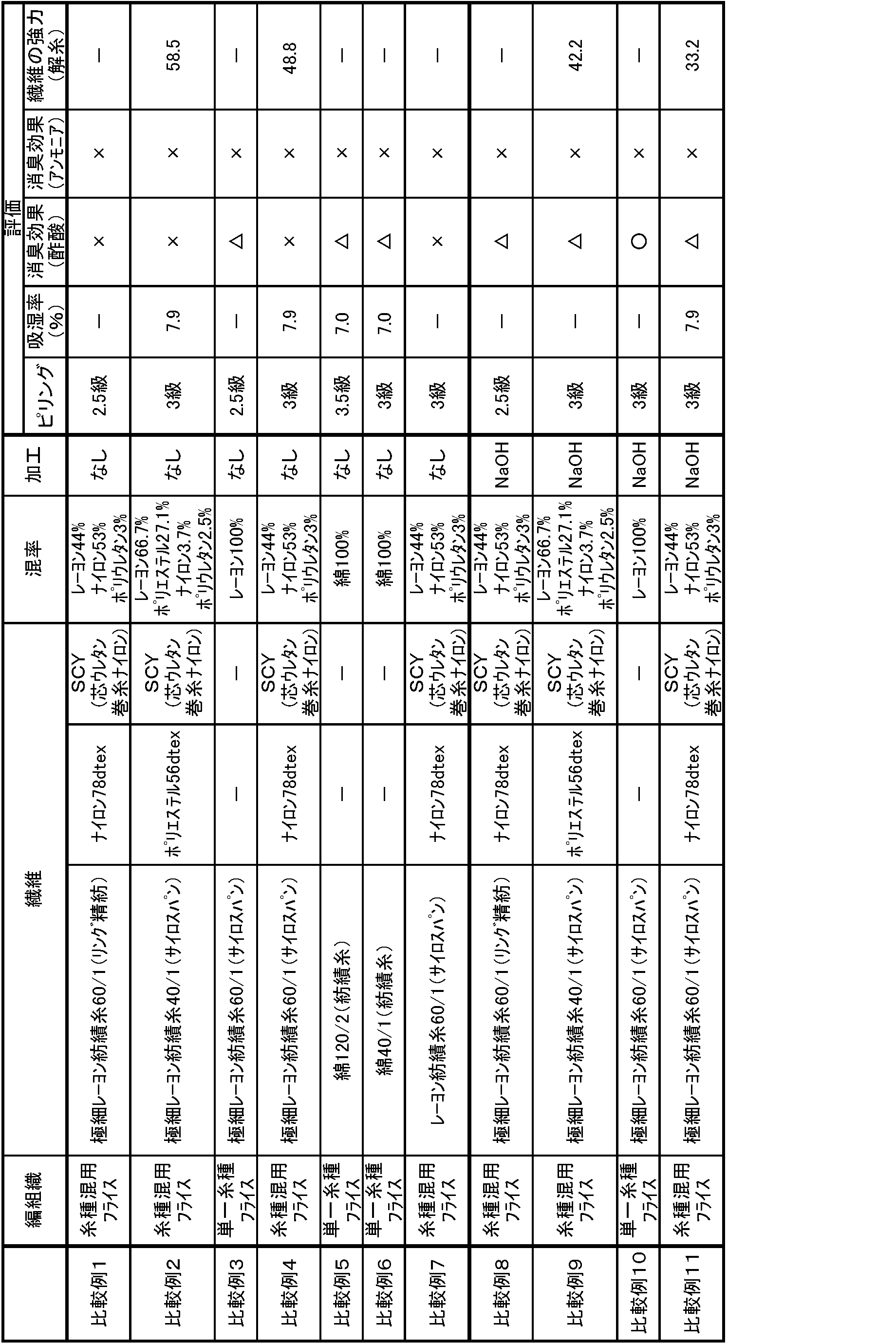
得られた生地をモノクロル酢酸ナトリウムと水酸化ナトリウムと必要に応じて加工助剤とを含有する処理液に浸漬しなかったこと以外は、それぞれ、実施例1~7と同様にして未処理布を得た。
比較例1~7のいずれにおいても、得られた処理布におけるセルロース系繊維はカルボキシメチル基を有していなかった。
得られた生地をモノクロル酢酸ナトリウムと水酸化ナトリウムと必要に応じて加工助剤とを含有する処理液に浸漬しなかったこと以外は、それぞれ、実施例1~7と同様にして未処理布を得た。
比較例1~7のいずれにおいても、得られた処理布におけるセルロース系繊維はカルボキシメチル基を有していなかった。
(比較例8~11)
得られた生地をモノクロル酢酸ナトリウムと水酸化ナトリウムと必要に応じて加工助剤とを含有する処理液に浸漬したことに代えて、水酸化ナトリウム50%owfを含有する処理液に浸漬し、パッダーで絞った後、40℃、20分間放置したこと以外は、それぞれ、実施例1~4と同様にして処理布を得た。
比較例8~11のいずれにおいても、得られた処理布におけるセルロース系繊維はカルボキシメチル基を有していなかった。
得られた生地をモノクロル酢酸ナトリウムと水酸化ナトリウムと必要に応じて加工助剤とを含有する処理液に浸漬したことに代えて、水酸化ナトリウム50%owfを含有する処理液に浸漬し、パッダーで絞った後、40℃、20分間放置したこと以外は、それぞれ、実施例1~4と同様にして処理布を得た。
比較例8~11のいずれにおいても、得られた処理布におけるセルロース系繊維はカルボキシメチル基を有していなかった。
<評価>
実施例及び比較例で得られた処理布及び未処理布について、下記の評価を行った。結果を表1及び2に示した。なお、繊維の強力の評価は実施例1、2、4、5、6、比較例2、4、9及び11で得られた処理布及び未処理布についてのみ行い、吸湿率の評価は実施例1、2、4、5、6、比較例2、4、5、6及び11で得られた処理布及び未処理布についてのみ行った。
実施例及び比較例で得られた処理布及び未処理布について、下記の評価を行った。結果を表1及び2に示した。なお、繊維の強力の評価は実施例1、2、4、5、6、比較例2、4、9及び11で得られた処理布及び未処理布についてのみ行い、吸湿率の評価は実施例1、2、4、5、6、比較例2、4、5、6及び11で得られた処理布及び未処理布についてのみ行った。
(1)ピリング試験
JIS L 1076 A法(ICI型試験機)により、処理布及び未処理布の抗ピリング性を評価した。なお、全ての実施例及び比較例において、縦の抗ピリング性と横の抗ピリング性とは同じ等級であった。
JIS L 1076 A法(ICI型試験機)により、処理布及び未処理布の抗ピリング性を評価した。なお、全ての実施例及び比較例において、縦の抗ピリング性と横の抗ピリング性とは同じ等級であった。
(2)繊維の強力
処理布又は未処理布から解糸したセルロース系繊維(糸)について、JIS L 1095に規定される標準時引張強さを測定し、単位Nで示した。
処理布又は未処理布から解糸したセルロース系繊維(糸)について、JIS L 1095に規定される標準時引張強さを測定し、単位Nで示した。
(3)吸湿率
処理布又は未処理布を裁断し、10×20cmの大きさの生地小片を作製した。得られた生地小片を秤量ビンに入れて105℃で2時間乾燥させた後に秤量し、予め秤量しておいた秤量ビンの重量を差し引くことにより、絶乾重量を算出した。次いで、秤量ビンに入れて絶乾重量を測定した生地小片を温度20℃、湿度65%RHの雰囲気に24時間放置した後に秤量し、秤量ビンの重量を差し引くことにより、公定重量を算出した。なお、秤量は、重量が一定になるまで繰り返し行った。
得られた絶乾重量と公定重量とを上記式(2)に当てはめることにより、吸湿率を求めた。
処理布又は未処理布を裁断し、10×20cmの大きさの生地小片を作製した。得られた生地小片を秤量ビンに入れて105℃で2時間乾燥させた後に秤量し、予め秤量しておいた秤量ビンの重量を差し引くことにより、絶乾重量を算出した。次いで、秤量ビンに入れて絶乾重量を測定した生地小片を温度20℃、湿度65%RHの雰囲気に24時間放置した後に秤量し、秤量ビンの重量を差し引くことにより、公定重量を算出した。なお、秤量は、重量が一定になるまで繰り返し行った。
得られた絶乾重量と公定重量とを上記式(2)に当てはめることにより、吸湿率を求めた。
(4)消臭効果試験(繰り返し洗濯後)
JIS L 0217 103法に準拠して、処理布又は未処理布の洗濯処理を30回行った(JAFET標準洗剤使用、吊干し)。洗濯後の処理布又は未処理布を裁断し、10cm×10cmの大きさの試験片を作製した。500mL(実容積625mL)の三角フラスコにマグネチィックスターラーバーを入れ、試験片に糸をつけ、糸の端を三角フラスコの外側にセロハンテープで止めることにより、試験布を三角フラスコ内に吊り下げた。次いで、アンモニア消臭の場合には2%アンモニア溶液を、酢酸消臭の場合には3%酢酸溶液をそれぞれマイクロピペットで5μL、三角フラスコの内側壁に垂らした。2重のラップで覆ったシリコン栓ですばやく三角フラスコを密栓し、更にそのラップを3重にした輪ゴムで密栓した。その後、マグネチィックスターラーで攪拌しながら20℃、120分間放置した。
120分放置した後、ラップがはがれないようにしてシリコン栓を抜き、測定用シリコン栓付検知管(ガステック社製、No.3La/アンモニア用、又は、ガステック社製、No.81/酢酸用)を用いて三角フラスコ内のガス濃度を測定した。
同様の試験を、試験布を三角フラスコ内に吊り下げない状態で行い、これをブランク測定値とした。下記式(3)を用いて消臭率(%)を求め、下記の基準により評価した。
消臭率(%)
=〔(ブランク測定値-試験布測定値)/ブランク測定値〕×100 (3)
JIS L 0217 103法に準拠して、処理布又は未処理布の洗濯処理を30回行った(JAFET標準洗剤使用、吊干し)。洗濯後の処理布又は未処理布を裁断し、10cm×10cmの大きさの試験片を作製した。500mL(実容積625mL)の三角フラスコにマグネチィックスターラーバーを入れ、試験片に糸をつけ、糸の端を三角フラスコの外側にセロハンテープで止めることにより、試験布を三角フラスコ内に吊り下げた。次いで、アンモニア消臭の場合には2%アンモニア溶液を、酢酸消臭の場合には3%酢酸溶液をそれぞれマイクロピペットで5μL、三角フラスコの内側壁に垂らした。2重のラップで覆ったシリコン栓ですばやく三角フラスコを密栓し、更にそのラップを3重にした輪ゴムで密栓した。その後、マグネチィックスターラーで攪拌しながら20℃、120分間放置した。
120分放置した後、ラップがはがれないようにしてシリコン栓を抜き、測定用シリコン栓付検知管(ガステック社製、No.3La/アンモニア用、又は、ガステック社製、No.81/酢酸用)を用いて三角フラスコ内のガス濃度を測定した。
同様の試験を、試験布を三角フラスコ内に吊り下げない状態で行い、これをブランク測定値とした。下記式(3)を用いて消臭率(%)を求め、下記の基準により評価した。
消臭率(%)
=〔(ブランク測定値-試験布測定値)/ブランク測定値〕×100 (3)
◎ 消臭率が90~100%
○ 消臭率が80~90%
△ 消臭率が70~80%
× 消臭率が70%未満
○ 消臭率が80~90%
△ 消臭率が70~80%
× 消臭率が70%未満

本発明によれば、抗ピリング性に優れ、かつ、繊維が高い強力を有する抗ピリング性繊維製品を提供することができる。
Claims (4)
- カルボキシメチル基を有するセルロース系繊維を含有することを特徴とする抗ピリング性繊維製品。
- カルボキシメチル基を有するセルロース系繊維の混率が30%以上であることを特徴とする請求項1記載の抗ピリング性繊維製品。
- カルボキシメチル基の含有率が0.1~10モル%であることを特徴とする請求項1又は2記載の抗ピリング性繊維製品。
- 繰り返し洗濯後も優れた消臭性能を維持することを特徴とする請求項1、2又は3記載の抗ピリング性繊維製品。
Applications Claiming Priority (2)
| Application Number | Priority Date | Filing Date | Title |
|---|---|---|---|
| JP2011068428A JP2012202005A (ja) | 2011-03-25 | 2011-03-25 | 抗ピリング性繊維製品 |
| JP2011-068428 | 2011-03-25 |
Publications (1)
| Publication Number | Publication Date |
|---|---|
| WO2012131897A1 true WO2012131897A1 (ja) | 2012-10-04 |
Family
ID=46929730
Family Applications (1)
| Application Number | Title | Priority Date | Filing Date |
|---|---|---|---|
| PCT/JP2011/057786 Ceased WO2012131897A1 (ja) | 2011-03-25 | 2011-03-29 | 抗ピリング性繊維製品 |
Country Status (3)
| Country | Link |
|---|---|
| JP (1) | JP2012202005A (ja) |
| TW (1) | TW201239153A (ja) |
| WO (1) | WO2012131897A1 (ja) |
Citations (6)
| Publication number | Priority date | Publication date | Assignee | Title |
|---|---|---|---|---|
| JPH03279471A (ja) * | 1990-03-22 | 1991-12-10 | Toyobo Co Ltd | 超吸水短繊維の製造法 |
| JPH09137387A (ja) * | 1995-08-09 | 1997-05-27 | Kanebo Ltd | 抗ピリング性及びピーチスキン加工性に優れた溶剤紡糸セルロース系繊維、その繊維構造物及びその製造方法 |
| JP2002339245A (ja) * | 2001-05-10 | 2002-11-27 | Gunze Ltd | 耐洗濯性のある消臭機能が付与されたセルロース系繊維又はセルロース系繊維製品及びそれらの加工方法 |
| JP2004315990A (ja) * | 2003-04-11 | 2004-11-11 | Nisshinbo Ind Inc | 防風性を有する吸湿発熱性セルロース系繊維製品及びその製造方法 |
| WO2005005711A1 (ja) * | 2003-07-14 | 2005-01-20 | Gunze Limited | 無洗剤洗濯機能の付与方法及び洗剤を用いずに洗濯できる繊維製品 |
| JP2007063723A (ja) * | 2005-09-01 | 2007-03-15 | Alcare Co Ltd | 靴下又は筒状の下肢用サポーター |
Family Cites Families (2)
| Publication number | Priority date | Publication date | Assignee | Title |
|---|---|---|---|---|
| JPS61296133A (ja) * | 1985-06-21 | 1986-12-26 | 花王株式会社 | 混紡糸 |
| JP2004315991A (ja) * | 2003-04-14 | 2004-11-11 | Kuraray Co Ltd | 液体塗布用繊維集合体 |
-
2011
- 2011-03-25 JP JP2011068428A patent/JP2012202005A/ja active Pending
- 2011-03-29 WO PCT/JP2011/057786 patent/WO2012131897A1/ja not_active Ceased
- 2011-03-31 TW TW100111158A patent/TW201239153A/zh unknown
Patent Citations (6)
| Publication number | Priority date | Publication date | Assignee | Title |
|---|---|---|---|---|
| JPH03279471A (ja) * | 1990-03-22 | 1991-12-10 | Toyobo Co Ltd | 超吸水短繊維の製造法 |
| JPH09137387A (ja) * | 1995-08-09 | 1997-05-27 | Kanebo Ltd | 抗ピリング性及びピーチスキン加工性に優れた溶剤紡糸セルロース系繊維、その繊維構造物及びその製造方法 |
| JP2002339245A (ja) * | 2001-05-10 | 2002-11-27 | Gunze Ltd | 耐洗濯性のある消臭機能が付与されたセルロース系繊維又はセルロース系繊維製品及びそれらの加工方法 |
| JP2004315990A (ja) * | 2003-04-11 | 2004-11-11 | Nisshinbo Ind Inc | 防風性を有する吸湿発熱性セルロース系繊維製品及びその製造方法 |
| WO2005005711A1 (ja) * | 2003-07-14 | 2005-01-20 | Gunze Limited | 無洗剤洗濯機能の付与方法及び洗剤を用いずに洗濯できる繊維製品 |
| JP2007063723A (ja) * | 2005-09-01 | 2007-03-15 | Alcare Co Ltd | 靴下又は筒状の下肢用サポーター |
Also Published As
| Publication number | Publication date |
|---|---|
| TW201239153A (en) | 2012-10-01 |
| JP2012202005A (ja) | 2012-10-22 |
Similar Documents
| Publication | Publication Date | Title |
|---|---|---|
| CN103194838B (zh) | 一种生物质再生纤维混纺柔软光洁面料及生产方法 | |
| CN113172956A (zh) | 一种抗菌防皱针织面料及其制备方法 | |
| CN103194826A (zh) | 海藻纤维、蛹蛋白纤维和莱竹纤维的混纺纱、面料及生产工艺 | |
| US10196764B2 (en) | Textured spun yarn and woven or knitted fabric using same | |
| JP2010275653A (ja) | 編物及びその製造方法 | |
| JP2006225785A (ja) | 混紡糸及びそれを用いてなる抗菌性織編物 | |
| JP2006225786A (ja) | 二層構造紡績糸及び織編物 | |
| CN105780233A (zh) | 一种纺织材料及其制备方法 | |
| WO2012131897A1 (ja) | 抗ピリング性繊維製品 | |
| CN107237017A (zh) | 一种纺织材料及其制备方法 | |
| CN216193150U (zh) | 一种锌抗菌弹力透气面料 | |
| CN103243452A (zh) | 一种耐腐蚀性防水面料 | |
| JP5144193B2 (ja) | 編地 | |
| JP4742286B2 (ja) | カルボキシアルキル化セルロース繊維及び抗菌性金属カルボキシアルキル化セルロース繊維の製造方法 | |
| KR20070118526A (ko) | 폴리사카라이드 항균소취성 혼방사의 제조방법 및 그혼방사 및 그로 제조된 원단 및 섬유제품 | |
| CN222080272U (zh) | 一种抗静电改性粘胶混纺面料 | |
| JP2006132008A (ja) | コアヤーン縫糸 | |
| JP2014198924A (ja) | 汗滲防止機能を有するインナー用編地 | |
| CN107254730A (zh) | 一种隔热抗紫外抗菌防透面料纱线的生产方法 | |
| JP2023153752A (ja) | コラーゲン含有紡績糸 | |
| JP2004124323A (ja) | キチン・キトサン内填紙を用いた編織物およびその製造方法 | |
| CN119427843A (zh) | 一种针织面料及其制备方法 | |
| CN119531024A (zh) | 一种全棉抗菌消臭面料的制备工艺及其制品 | |
| JP2025130573A (ja) | 編地、その製造方法及び衣料 | |
| CN111101269A (zh) | 一种抗紫外咖啡碳包芯纱针织面料及其生产方法 |
Legal Events
| Date | Code | Title | Description |
|---|---|---|---|
| 121 | Ep: the epo has been informed by wipo that ep was designated in this application |
Ref document number: 11862272 Country of ref document: EP Kind code of ref document: A1 |
|
| NENP | Non-entry into the national phase |
Ref country code: DE |
|
| 122 | Ep: pct application non-entry in european phase |
Ref document number: 11862272 Country of ref document: EP Kind code of ref document: A1 |