WO2012114566A1 - 無機繊維の製造方法 - Google Patents
無機繊維の製造方法 Download PDFInfo
- Publication number
- WO2012114566A1 WO2012114566A1 PCT/JP2011/069275 JP2011069275W WO2012114566A1 WO 2012114566 A1 WO2012114566 A1 WO 2012114566A1 JP 2011069275 W JP2011069275 W JP 2011069275W WO 2012114566 A1 WO2012114566 A1 WO 2012114566A1
- Authority
- WO
- WIPO (PCT)
- Prior art keywords
- mass
- spinning
- group
- water
- inorganic fiber
- Prior art date
- Legal status (The legal status is an assumption and is not a legal conclusion. Google has not performed a legal analysis and makes no representation as to the accuracy of the status listed.)
- Ceased
Links
Images

Classifications
-
- C—CHEMISTRY; METALLURGY
- C04—CEMENTS; CONCRETE; ARTIFICIAL STONE; CERAMICS; REFRACTORIES
- C04B—LIME, MAGNESIA; SLAG; CEMENTS; COMPOSITIONS THEREOF, e.g. MORTARS, CONCRETE OR LIKE BUILDING MATERIALS; ARTIFICIAL STONE; CERAMICS; REFRACTORIES; TREATMENT OF NATURAL STONE
- C04B35/00—Shaped ceramic products characterised by their composition; Ceramics compositions; Processing powders of inorganic compounds preparatory to the manufacturing of ceramic products
- C04B35/622—Forming processes; Processing powders of inorganic compounds preparatory to the manufacturing of ceramic products
- C04B35/62227—Forming processes; Processing powders of inorganic compounds preparatory to the manufacturing of ceramic products obtaining fibres
- C04B35/62231—Forming processes; Processing powders of inorganic compounds preparatory to the manufacturing of ceramic products obtaining fibres based on oxide ceramics
- C04B35/62236—Fibres based on aluminium oxide
-
- C—CHEMISTRY; METALLURGY
- C03—GLASS; MINERAL OR SLAG WOOL
- C03C—CHEMICAL COMPOSITION OF GLASSES, GLAZES OR VITREOUS ENAMELS; SURFACE TREATMENT OF GLASS; SURFACE TREATMENT OF FIBRES OR FILAMENTS MADE FROM GLASS, MINERALS OR SLAGS; JOINING GLASS TO GLASS OR OTHER MATERIALS
- C03C13/00—Fibre or filament compositions
-
- C—CHEMISTRY; METALLURGY
- C04—CEMENTS; CONCRETE; ARTIFICIAL STONE; CERAMICS; REFRACTORIES
- C04B—LIME, MAGNESIA; SLAG; CEMENTS; COMPOSITIONS THEREOF, e.g. MORTARS, CONCRETE OR LIKE BUILDING MATERIALS; ARTIFICIAL STONE; CERAMICS; REFRACTORIES; TREATMENT OF NATURAL STONE
- C04B35/00—Shaped ceramic products characterised by their composition; Ceramics compositions; Processing powders of inorganic compounds preparatory to the manufacturing of ceramic products
- C04B35/622—Forming processes; Processing powders of inorganic compounds preparatory to the manufacturing of ceramic products
- C04B35/62227—Forming processes; Processing powders of inorganic compounds preparatory to the manufacturing of ceramic products obtaining fibres
- C04B35/62231—Forming processes; Processing powders of inorganic compounds preparatory to the manufacturing of ceramic products obtaining fibres based on oxide ceramics
- C04B35/6224—Fibres based on silica
- C04B35/62245—Fibres based on silica rich in aluminium oxide
-
- C—CHEMISTRY; METALLURGY
- C04—CEMENTS; CONCRETE; ARTIFICIAL STONE; CERAMICS; REFRACTORIES
- C04B—LIME, MAGNESIA; SLAG; CEMENTS; COMPOSITIONS THEREOF, e.g. MORTARS, CONCRETE OR LIKE BUILDING MATERIALS; ARTIFICIAL STONE; CERAMICS; REFRACTORIES; TREATMENT OF NATURAL STONE
- C04B35/00—Shaped ceramic products characterised by their composition; Ceramics compositions; Processing powders of inorganic compounds preparatory to the manufacturing of ceramic products
- C04B35/622—Forming processes; Processing powders of inorganic compounds preparatory to the manufacturing of ceramic products
- C04B35/626—Preparing or treating the powders individually or as batches ; preparing or treating macroscopic reinforcing agents for ceramic products, e.g. fibres; mechanical aspects section B
- C04B35/63—Preparing or treating the powders individually or as batches ; preparing or treating macroscopic reinforcing agents for ceramic products, e.g. fibres; mechanical aspects section B using additives specially adapted for forming the products, e.g.. binder binders
- C04B35/632—Organic additives
- C04B35/634—Polymers
- C04B35/63404—Polymers obtained by reactions only involving carbon-to-carbon unsaturated bonds
- C04B35/63424—Polyacrylates; Polymethacrylates
-
- D—TEXTILES; PAPER
- D01—NATURAL OR MAN-MADE THREADS OR FIBRES; SPINNING
- D01D—MECHANICAL METHODS OR APPARATUS IN THE MANUFACTURE OF ARTIFICIAL FILAMENTS, THREADS, FIBRES, BRISTLES OR RIBBONS
- D01D5/00—Formation of filaments, threads, or the like
- D01D5/0007—Electro-spinning
-
- C—CHEMISTRY; METALLURGY
- C03—GLASS; MINERAL OR SLAG WOOL
- C03C—CHEMICAL COMPOSITION OF GLASSES, GLAZES OR VITREOUS ENAMELS; SURFACE TREATMENT OF GLASS; SURFACE TREATMENT OF FIBRES OR FILAMENTS MADE FROM GLASS, MINERALS OR SLAGS; JOINING GLASS TO GLASS OR OTHER MATERIALS
- C03C2213/00—Glass fibres or filaments
- C03C2213/02—Biodegradable glass fibres
-
- C—CHEMISTRY; METALLURGY
- C04—CEMENTS; CONCRETE; ARTIFICIAL STONE; CERAMICS; REFRACTORIES
- C04B—LIME, MAGNESIA; SLAG; CEMENTS; COMPOSITIONS THEREOF, e.g. MORTARS, CONCRETE OR LIKE BUILDING MATERIALS; ARTIFICIAL STONE; CERAMICS; REFRACTORIES; TREATMENT OF NATURAL STONE
- C04B2235/00—Aspects relating to ceramic starting mixtures or sintered ceramic products
- C04B2235/02—Composition of constituents of the starting material or of secondary phases of the final product
- C04B2235/30—Constituents and secondary phases not being of a fibrous nature
- C04B2235/32—Metal oxides, mixed metal oxides, or oxide-forming salts thereof, e.g. carbonates, nitrates, (oxy)hydroxides, chlorides
- C04B2235/3205—Alkaline earth oxides or oxide forming salts thereof, e.g. beryllium oxide
- C04B2235/3208—Calcium oxide or oxide-forming salts thereof, e.g. lime
-
- C—CHEMISTRY; METALLURGY
- C04—CEMENTS; CONCRETE; ARTIFICIAL STONE; CERAMICS; REFRACTORIES
- C04B—LIME, MAGNESIA; SLAG; CEMENTS; COMPOSITIONS THEREOF, e.g. MORTARS, CONCRETE OR LIKE BUILDING MATERIALS; ARTIFICIAL STONE; CERAMICS; REFRACTORIES; TREATMENT OF NATURAL STONE
- C04B2235/00—Aspects relating to ceramic starting mixtures or sintered ceramic products
- C04B2235/02—Composition of constituents of the starting material or of secondary phases of the final product
- C04B2235/30—Constituents and secondary phases not being of a fibrous nature
- C04B2235/32—Metal oxides, mixed metal oxides, or oxide-forming salts thereof, e.g. carbonates, nitrates, (oxy)hydroxides, chlorides
- C04B2235/3217—Aluminum oxide or oxide forming salts thereof, e.g. bauxite, alpha-alumina
-
- C—CHEMISTRY; METALLURGY
- C04—CEMENTS; CONCRETE; ARTIFICIAL STONE; CERAMICS; REFRACTORIES
- C04B—LIME, MAGNESIA; SLAG; CEMENTS; COMPOSITIONS THEREOF, e.g. MORTARS, CONCRETE OR LIKE BUILDING MATERIALS; ARTIFICIAL STONE; CERAMICS; REFRACTORIES; TREATMENT OF NATURAL STONE
- C04B2235/00—Aspects relating to ceramic starting mixtures or sintered ceramic products
- C04B2235/02—Composition of constituents of the starting material or of secondary phases of the final product
- C04B2235/30—Constituents and secondary phases not being of a fibrous nature
- C04B2235/34—Non-metal oxides, non-metal mixed oxides, or salts thereof that form the non-metal oxides upon heating, e.g. carbonates, nitrates, (oxy)hydroxides, chlorides
- C04B2235/3418—Silicon oxide, silicic acids or oxide forming salts thereof, e.g. silica sol, fused silica, silica fume, cristobalite, quartz or flint
-
- C—CHEMISTRY; METALLURGY
- C04—CEMENTS; CONCRETE; ARTIFICIAL STONE; CERAMICS; REFRACTORIES
- C04B—LIME, MAGNESIA; SLAG; CEMENTS; COMPOSITIONS THEREOF, e.g. MORTARS, CONCRETE OR LIKE BUILDING MATERIALS; ARTIFICIAL STONE; CERAMICS; REFRACTORIES; TREATMENT OF NATURAL STONE
- C04B2235/00—Aspects relating to ceramic starting mixtures or sintered ceramic products
- C04B2235/02—Composition of constituents of the starting material or of secondary phases of the final product
- C04B2235/30—Constituents and secondary phases not being of a fibrous nature
- C04B2235/44—Metal salt constituents or additives chosen for the nature of the anions, e.g. hydrides or acetylacetonate
- C04B2235/443—Nitrates or nitrites
-
- C—CHEMISTRY; METALLURGY
- C04—CEMENTS; CONCRETE; ARTIFICIAL STONE; CERAMICS; REFRACTORIES
- C04B—LIME, MAGNESIA; SLAG; CEMENTS; COMPOSITIONS THEREOF, e.g. MORTARS, CONCRETE OR LIKE BUILDING MATERIALS; ARTIFICIAL STONE; CERAMICS; REFRACTORIES; TREATMENT OF NATURAL STONE
- C04B2235/00—Aspects relating to ceramic starting mixtures or sintered ceramic products
- C04B2235/02—Composition of constituents of the starting material or of secondary phases of the final product
- C04B2235/30—Constituents and secondary phases not being of a fibrous nature
- C04B2235/44—Metal salt constituents or additives chosen for the nature of the anions, e.g. hydrides or acetylacetonate
- C04B2235/444—Halide containing anions, e.g. bromide, iodate, chlorite
-
- C—CHEMISTRY; METALLURGY
- C04—CEMENTS; CONCRETE; ARTIFICIAL STONE; CERAMICS; REFRACTORIES
- C04B—LIME, MAGNESIA; SLAG; CEMENTS; COMPOSITIONS THEREOF, e.g. MORTARS, CONCRETE OR LIKE BUILDING MATERIALS; ARTIFICIAL STONE; CERAMICS; REFRACTORIES; TREATMENT OF NATURAL STONE
- C04B2235/00—Aspects relating to ceramic starting mixtures or sintered ceramic products
- C04B2235/02—Composition of constituents of the starting material or of secondary phases of the final product
- C04B2235/30—Constituents and secondary phases not being of a fibrous nature
- C04B2235/44—Metal salt constituents or additives chosen for the nature of the anions, e.g. hydrides or acetylacetonate
- C04B2235/448—Sulphates or sulphites
-
- C—CHEMISTRY; METALLURGY
- C04—CEMENTS; CONCRETE; ARTIFICIAL STONE; CERAMICS; REFRACTORIES
- C04B—LIME, MAGNESIA; SLAG; CEMENTS; COMPOSITIONS THEREOF, e.g. MORTARS, CONCRETE OR LIKE BUILDING MATERIALS; ARTIFICIAL STONE; CERAMICS; REFRACTORIES; TREATMENT OF NATURAL STONE
- C04B2235/00—Aspects relating to ceramic starting mixtures or sintered ceramic products
- C04B2235/02—Composition of constituents of the starting material or of secondary phases of the final product
- C04B2235/30—Constituents and secondary phases not being of a fibrous nature
- C04B2235/44—Metal salt constituents or additives chosen for the nature of the anions, e.g. hydrides or acetylacetonate
- C04B2235/449—Organic acids, e.g. EDTA, citrate, acetate, oxalate
-
- C—CHEMISTRY; METALLURGY
- C04—CEMENTS; CONCRETE; ARTIFICIAL STONE; CERAMICS; REFRACTORIES
- C04B—LIME, MAGNESIA; SLAG; CEMENTS; COMPOSITIONS THEREOF, e.g. MORTARS, CONCRETE OR LIKE BUILDING MATERIALS; ARTIFICIAL STONE; CERAMICS; REFRACTORIES; TREATMENT OF NATURAL STONE
- C04B2235/00—Aspects relating to ceramic starting mixtures or sintered ceramic products
- C04B2235/02—Composition of constituents of the starting material or of secondary phases of the final product
- C04B2235/50—Constituents or additives of the starting mixture chosen for their shape or used because of their shape or their physical appearance
- C04B2235/52—Constituents or additives characterised by their shapes
- C04B2235/5208—Fibers
- C04B2235/5264—Fibers characterised by the diameter of the fibers
-
- C—CHEMISTRY; METALLURGY
- C04—CEMENTS; CONCRETE; ARTIFICIAL STONE; CERAMICS; REFRACTORIES
- C04B—LIME, MAGNESIA; SLAG; CEMENTS; COMPOSITIONS THEREOF, e.g. MORTARS, CONCRETE OR LIKE BUILDING MATERIALS; ARTIFICIAL STONE; CERAMICS; REFRACTORIES; TREATMENT OF NATURAL STONE
- C04B2235/00—Aspects relating to ceramic starting mixtures or sintered ceramic products
- C04B2235/65—Aspects relating to heat treatments of ceramic bodies such as green ceramics or pre-sintered ceramics, e.g. burning, sintering or melting processes
- C04B2235/656—Aspects relating to heat treatments of ceramic bodies such as green ceramics or pre-sintered ceramics, e.g. burning, sintering or melting processes characterised by specific heating conditions during heat treatment
- C04B2235/6562—Heating rate
-
- C—CHEMISTRY; METALLURGY
- C04—CEMENTS; CONCRETE; ARTIFICIAL STONE; CERAMICS; REFRACTORIES
- C04B—LIME, MAGNESIA; SLAG; CEMENTS; COMPOSITIONS THEREOF, e.g. MORTARS, CONCRETE OR LIKE BUILDING MATERIALS; ARTIFICIAL STONE; CERAMICS; REFRACTORIES; TREATMENT OF NATURAL STONE
- C04B2235/00—Aspects relating to ceramic starting mixtures or sintered ceramic products
- C04B2235/70—Aspects relating to sintered or melt-casted ceramic products
- C04B2235/96—Properties of ceramic products, e.g. mechanical properties such as strength, toughness, wear resistance
- C04B2235/9669—Resistance against chemicals, e.g. against molten glass or molten salts
Definitions
- the present invention relates to a method for producing inorganic fibers.
- Inorganic fibers are mainly composed of fibers composed of inorganic compounds and are expected as constituent materials such as heat insulating materials and refractory materials. Particularly, those having an average fiber diameter of 1 ⁇ m or less are filter materials and sealing materials. Use as a constituent material is expected.
- asbestos (asbestos) has been conventionally known as an inorganic fiber having a small fiber diameter. Since this asbestos has a small fiber diameter and high chemical resistance to body fluids, It is said that it affects the human body by giving long-term stimulation to cells in the alveoli. Also in the inorganic fibers other than asbestos, inorganic fibers with improved heat resistance composed mainly of SiO 2, when the SiO 2 has reached the lungs inner part by generating breathing cristobalite was crystallized in a high temperature environment It is said that it affects the human body.
- an object of the present invention is to provide a method for easily producing inorganic fibers having a high biological dissolution rate and high heat resistance.
- the present inventors have conducted intensive studies and found that a water-soluble basic aluminum acid, a water-soluble calcium compound, and a water-soluble or water-dispersible silicon compound are dissolved in an aqueous medium. After preparing the spinning raw material aqueous solution, the spinning raw material aqueous solution is spun to obtain coarse inorganic fibers, and then the coarse inorganic fibers are fired to obtain 35 mass% to 88 mass% of Al 2 O 3.
- the present invention (1) After preparing a spinning raw material aqueous solution by dissolving a water-soluble basic aluminum acid, a water-soluble calcium compound, and a water-soluble or water-dispersible silicon compound in an aqueous medium.
- a crude inorganic fiber is obtained by spinning the spinning raw material aqueous solution, Next, by firing the crude inorganic fiber, The total content of Al 2 O 3 , CaO and SiO 2 containing 35% by weight to 88% by weight Al 2 O 3 , 3% by weight to 45% by weight CaO and 5% by weight to 40% by weight SiO 2
- a method for producing an inorganic fiber, wherein the inorganic fiber is 98% by mass or more of the total fiber (2)
- the water-soluble basic aluminum acid is represented by the following formula (I) Al (OH) X Y Z (I) (However, X is a positive number greater than 0 and less than 3, Y is any one selected from Cl atom, NO 3 group, SO 4 group, and RCOO group,
- inorganic fibers having a high biological dissolution rate and high heat resistance can be easily produced.
- inorganic fibers of the present invention after preparing a spinning raw material aqueous solution by dissolving a water-soluble basic aluminum acid, a water-soluble calcium compound, and a water-soluble or water-dispersible silicon compound in an aqueous medium. Then, the spinning raw material aqueous solution is spun to obtain coarse inorganic fibers, and then the coarse inorganic fibers are fired to obtain 35% by mass to 88% by mass of Al 2 O 3 , 3% by mass to 45% by mass of CaO. And inorganic fibers having a total content of Al 2 O 3 , CaO and SiO 2 of 98% by mass or more of the total amount of SiO 2 containing 5% by mass to 40% by mass of SiO 2. is there.
- a water-soluble basic acid aluminum is used as the aluminum raw material.
- the acid salt As the aluminum raw material, it is possible to suppress generation of chlorine and nitric acid that have a large environmental load during firing, which will be described later.
- the water-soluble basic aluminum acid used as a raw material is represented by the following formula (I): Al (OH) X Y Z (I) (However, X is a positive number greater than 0 and less than 3, Y is any one selected from Cl atom (chlorine atom), NO 3 group, SO 4 group, RCOO group (carboxyl group), Z is 3-X when Y is a Cl atom, NO 3 group, or RCOO group, and (3-X) / 2 when Y is a SO 4 group, and the R is a hydrogen atom or a carbon number of 1 to 10 In the case where a plurality of RCOO groups are present, each R may be the same or different).
- Such basic aluminum carboxylates are octahedrally coordinated aluminum polynuclear complexes (inorganic ionic polymers) cross-linked with hydroxy groups, and can take the form of dimers or oligomers.
- X is preferably a positive number of 1 or more and less than 3, more preferably a positive number of 1 or more and 2.5 or less. 2 is more preferable.
- composition formula (I) can be calculated from the composition ratio of the acid added during the synthesis of the basic acid aluminum.
- R is a hydrogen atom, a hydrocarbon group having 1 to 10 carbon atoms, or a hydroxyl group-containing hydrocarbon group.
- R is a hydrocarbon group or a hydroxyl group-containing hydrocarbon group
- the carbon number thereof is 1 to 10, preferably 1 to 5.
- the basic aluminum carboxylate represented by the formula (I) becomes difficult to show water solubility.
- the hydrocarbon group portion may be linear or branched, and may be a saturated hydrocarbon group or an unsaturated hydrocarbon group.
- R is a hydrocarbon group
- examples of the hydrocarbon group include an alkyl group, an alkenyl group, a cycloalkyl group, and an alkylcycloalkyl group.
- an alkyl group such as a methyl group, an ethyl group, a propyl group, or a butyl group (if these alkyl groups can be branched, the alkyl group may be linear or branched);
- An alkenyl group such as a propenyl group or a butenyl group (when these alkenyl groups can be branched, the alkenyl group may be linear or branched, and the position of the double bond is arbitrary);
- Examples thereof include a cycloalkyl group such as a cyclopropyl group and a cyclobutyl group; an alkylcycloalkyl group such as a methylcyclopropyl group and a methylcyclobutyl group (the substitution position of the alkyl group to the cycloalkyl group is also arbitrary), and the like.
- R is a hydroxyl group-containing hydrocarbon group
- examples of the hydroxyl group-containing hydrocarbon group include a hydroxyalkyl group, a hydroxyalkenyl group, and a hydroxycycloalkyl group.
- a hydroxyalkyl group such as a hydroxymethyl group, a hydroxyethyl group, a hydroxypropyl group, or a hydroxybutyl group (if these hydroxyalkyl groups can be branched, the alkyl group constituting the hydroxyalkyl group) May be linear or branched); a hydroxyalkenyl group such as a hydroxybutenyl group (the alkenyl group constituting the hydroxyalkenyl group may be linear or branched, and the position of the double bond is arbitrary) And a hydroxycycloalkyl group such as a hydroxycyclopropyl group and a hydroxycyclobutyl group (the substitution position of a hydroxyl group or an alkyl group to a cycloalkyl group is also arbitrary).
- the RCOO group is preferably a reaction residue of a carboxylic acid selected from formic acid, acetic acid, lactic acid, etc. (HCOO group, CH 3 COO group, CH 3 CH (OH) COO group). .
- a water-soluble calcium compound is used as the calcium raw material, and the calcium compound exhibits water solubility and can be dissolved in a desired amount in an aqueous solution of a spinning raw material described later. If it is, it will not restrict
- the calcium compound to be dissolved in the spinning raw material aqueous solution is a basic aluminum carboxylate
- the calcium compound is also preferably a carboxylate salt.
- calcium acetate monohydrate is more preferable.
- a water-soluble or water-dispersible silicon compound is used as the silicon raw material, and the silicon compound is not particularly limited as long as it is dissolved or dispersed in the spinning raw material aqueous solution.
- water-soluble silicon compounds include water-soluble silicates, water-soluble silicon alkoxides (tetramethoxysilane, tetraethoxysilane, tetrapropoxysilane, etc.), and water dispersible silicon.
- the compound include silica sol (colloidal silica), and among these silicon compounds, silica sol (colloidal silica) is preferable from the viewpoint of viscosity stability of the spinning raw material aqueous solution.
- the silica sol is preferably obtained by dispersing silica having a particle size of 4 to 100 nm in a medium having a solid content of 5 to 30% by mass.
- the silica sol may be a sol-gel method produced from alkoxysilane, sodium silicate, or the like. It can be manufactured by a sodium silicate method manufactured from
- a spinning aid can be further used as necessary.
- the spinning aid is not particularly limited as long as it can produce a desired inorganic fiber, but is preferably a water-soluble organic polymer in view of ease of handling and solubility. Examples thereof include polyethylene oxide, polypropylene oxide, polyvinyl alcohol, polyvinyl ether, polyvinyl ester, polyacrylic acid ester and copolymers thereof, and among these, polyacrylic acid ester is preferable.
- inorganic fibers of the present invention by using a spinning raw material aqueous solution to which a spinning aid is further added, variation in fiber diameter can be suppressed and stable spinning can be performed. In addition, the strength of the unsintered fiber after the electrospinning is increased and the handling property is excellent.
- the water-soluble basic aluminum acid, the water-soluble calcium compound, the water-soluble or water-dispersible silicon compound, and, if necessary, a spinning aid are dissolved in an aqueous medium. Let the spinning raw material aqueous solution.
- aqueous medium water is preferable, and in order to improve the stability of the solution or to improve the spinning stability, other media that are water-soluble and soluble in water, such as alcohols, ketones, amines, etc. , Amides, carboxylic acids and the like may be added. Further, an organic salt such as ammonium chloride may be added to these media.
- the concentration of the water-soluble basic aluminum acid in the spinning raw material aqueous solution is preferably 4% by mass to 83% by mass, and more preferably 4% by mass to 68% by mass.
- the abundance ratio of aluminum element to the total amount of aluminum element, calcium element, and silicon element is as follows: aluminum element is converted to Al 2 O 3 , calcium element is converted to CaO, and silicon element is converted to SiO 2 . It is preferably 35% by mass to 88% by mass in terms of Al 2 O 3 , more preferably 39% by mass to 87% by mass, still more preferably 39% by mass to 83% by mass, and 39% by mass. It is more preferably from 66% by mass, and even more preferably from 49% by mass to 66% by mass.
- the abundance ratio of the aluminum element is more than 88% by mass in terms of Al 2 O 3 with respect to the total amount of the aluminum element, the calcium element, and the silicon element, the abundance ratio of the calcium element becomes small and it is difficult to obtain desired biological solubility. If the abundance ratio of the aluminum element with respect to the total amount of the aluminum element, calcium element and silicon element is less than 35% by mass in terms of Al 2 O 3 , it becomes difficult to exhibit desired heat resistance and biological solubility.
- the concentration of the water-soluble calcium compound in the spinning raw material aqueous solution is preferably 0.4% by mass to 46% by mass, and more preferably 2% by mass to 46% by mass.
- the abundance ratio of the calcium element with respect to the total amount of the aluminum element, the calcium element, and the silicon element is determined by converting the aluminum element into Al 2 O 3 , the calcium element into CaO, and the silicon element into Ca 2 It is preferably 3% by mass to 45% by mass, more preferably 3% by mass to 42% by mass, and further preferably 26% by mass to 42% by mass.
- the abundance ratio of the calcium element with respect to the total amount of the aluminum element, the calcium element, and the silicon element is more than 45% by mass in terms of CaO, the abundance ratio of the other metal elements is lowered and it is difficult to obtain desired heat resistance. If it is less than mass%, it is difficult to obtain desired biological solubility.
- the concentration of the water-soluble or water-dispersible silicon compound in the spinning raw material aqueous solution is preferably 0.4% by mass to 24% by mass, more preferably 0.4% by mass to 16% by mass, More preferably, the content is 0.4% by mass to 8% by mass.
- the abundance ratio of the silicon element with respect to the total amount of the aluminum element, the calcium element, and the silicon element is obtained when the aluminum element is converted to Al 2 O 3 , the calcium element is converted to CaO, and the silicon element is converted to SiO 2 . It is preferably 5% by mass to 40% by mass in terms of SiO 2 , more preferably 8% by mass to 39% by mass, further preferably 8% by mass to 28% by mass, and more preferably 8% by mass to 16% by mass. More preferably, it is mass%.
- the existing ratio of silicon element to the total amount of aluminum element, calcium element, and silicon element is more than 40% by mass in terms of SiO 2 , the existing ratio of calcium element becomes small and it becomes difficult to obtain desired biological solubility. If the abundance ratio of the silicon element with respect to the total amount of the element, calcium element and silicon element is less than 5% by mass in terms of SiO 2 , it becomes difficult to exhibit desired heat resistance.
- the concentration of the spinning aid is preferably 0.1% by mass to 10% by mass, more preferably 0.1% by mass to 5% by mass.
- the spinning aid is preferably as small as possible because the fibers are densified after firing and the strength is maintained. However, since the form at the time of fiber preparation may not be stable with a small amount, the amount added may be increased as necessary. It is preferable to adjust.
- the raw material aqueous solution contains raw material components such as a water-soluble basic aluminum carboxylate, a water-soluble calcium compound, and a water-soluble or water-dispersible silicon compound.
- the method for preparing the spinning raw material aqueous solution is not particularly limited.
- an aqueous medium, a water-soluble basic aluminum acid, a water-soluble calcium compound, a water-soluble or water-dispersible silicon compound, a spinning aid, and other Arbitrary components may be prepared by mixing each component to a desired concentration, or an aqueous solution of a water-soluble basic aluminum acid, an aqueous solution of a water-soluble calcium compound, You may produce by mixing the aqueous solution of a water-dispersible silicon compound, the aqueous solution of a spinning auxiliary agent, and other arbitrary components so that each component may become a desired density
- the viscosity of the spinning raw material aqueous solution is preferably about 0.01 to 5.0 Pa ⁇ s, more preferably about 0.05 to 3.0 Pa ⁇ s.
- the spinning raw material aqueous solution may not form a filament during spinning, and spherical particles may be formed, and the spinning raw material aqueous solution has a viscosity of 5.0 Pa ⁇ s. If it is super, fiberizing treatment becomes difficult.
- the viscosity of the spinning raw material aqueous solution can be adjusted by adjusting the amount of the spinning aid added or by appropriately performing a concentration operation by heat treatment or reduced pressure treatment.
- the viscosity of the spinning raw material aqueous solution is measured using a viscoelasticity measuring device (Physica MCR301 manufactured by Anton Paar), maintaining the liquid temperature of the spinning solution at 25 ° C., and a shear rate of 10 s ⁇ 1 . Means shear viscosity.
- a viscoelasticity measuring device Physical MCR301 manufactured by Anton Paar
- inorganic fibers of the present invention it is preferable to obtain crude inorganic fibers by spinning the above spinning raw material aqueous solution by an electrostatic spinning method.
- the electrostatic spinning method is a method of applying a voltage to a spinning raw material aqueous solution containing a fiber-forming compound and discharging the spinning raw material aqueous solution into fibers using electrostatic repulsion.
- any method can be used.
- the spinning raw material aqueous solution is supplied to an appropriate position in the electrostatic field, and the spinning raw material aqueous solution is supplied.
- a method of applying a voltage to the yarn to form a fiber using an electric field can be mentioned.
- the spinning raw material aqueous solution is supplied to the nozzle and placed at an appropriate position in the electrostatic field, and the spinning raw material aqueous solution is spun from the nozzle by an electric field to be fiberized. Can do.
- FIG. 1 is a diagram showing an example of a spinning device used for electrostatic spinning.
- the spinning device 1 includes a syringe 2, a nozzle 3, a high voltage generator 4, and a sample collection stand 5.
- the spinning raw material aqueous solution is fed into the syringe 2 and then fed to the tip of the nozzle 3.
- the high voltage generator 4 is electrically connected to a conductive fixing part provided around the nozzle 3 and a conductive sample collection base 5, respectively, and the nozzle 3 passes through the fixing part provided around the nozzle 3.
- the spinning raw material aqueous solution is ejected from the tip of the nozzle 3 to be fiberized to obtain coarse inorganic fibers.
- the obtained crude inorganic fiber is collected on the sample collection stand 5 which is a counter electrode.
- a plurality of nozzles 3 may be used, and the nozzles 3 may be arranged in parallel to increase the production rate of the fibrous material.
- the voltage applied during electrostatic spinning is the distance between the nozzle tip and the counter electrode (distance between the electrodes), the viscosity of the spinning raw material aqueous solution, the concentration of the spinning raw material aqueous solution, etc. In consideration of the above conditions, it is preferably 1 to 100 kV, more preferably 3 to 30 kV.
- the distance between the electrodes depends on the charge amount, the nozzle size, the ejection amount of the spinning raw material aqueous solution from the nozzle, the concentration of the spinning raw material aqueous solution, etc., but is preferably 20 to 500 mm, more preferably 50 to 300 mm, and more preferably 100 to 200 mm. Is more preferable.
- the coarse inorganic fiber obtained by electrostatic spinning preferably has an average fiber diameter of 10 nm to 2000 nm, and more preferably 50 nm to 1000 nm.
- the average fiber diameter of the coarse inorganic fibers is selected at 10 to 111 locations at random from a photograph (magnification 2000 to 5000 times) taken with a scanning electron microscope (JSM-5800LV manufactured by JEOL). It means the average value calculated from the widths of the fibers measured.
- inorganic fibers of the present invention coarse inorganic fibers obtained by spinning a spinning raw material aqueous solution are fired.
- the calcination temperature is preferably 500 ° C. or higher and lower than the liquid phase generation temperature, and specifically, it is preferably a temperature that is 500 ° C. or higher and 1350 ° C. or lower and does not generate a liquid phase.
- the firing temperature is less than 500 ° C, organic components such as organic polymers used as a spinning aid are likely to remain in the obtained inorganic fiber, and when the firing temperature is higher than 1350 ° C, The inorganic fiber obtained by the growth becomes very brittle or reacts with the hearth by forming a liquid phase.
- the firing temperature be in a predetermined range according to the composition of the inorganic fiber to be obtained.
- Firing can be performed using a known electric furnace or the like, and the atmosphere during firing is preferably air or an oxidizing atmosphere in order to decompose organic substances used as a spinning aid or the like.
- an inert atmosphere such as nitrogen may be used.
- the target inorganic fiber can be produced easily and at low cost.
- Inorganic fibers obtained by the process of the present invention includes 35% to Al 2 88 wt% O 3, 3 wt% to 45 wt% of CaO and 5% to 40% by weight of SiO 2, Al 2
- the total content of O 3 , CaO and SiO 2 is 98% by mass or more of the entire fiber.
- the inorganic fiber obtained by the production method of the present invention contains 35% to 88% by mass of Al 2 O 3 , preferably 39% to 87% by mass, and preferably contains 39% to 83% by mass. More preferably, it contains 39 mass% to 66 mass%, more preferably 49 mass% to 66 mass%. When the content ratio of Al 2 O 3 is within the above range, desired heat resistance can be easily obtained.
- the inorganic fiber obtained by the production method of the present invention contains 3% to 45% by weight of CaO, more preferably 3% to 42% by weight, and more preferably 26% to 42% by weight. It is further preferable. When the content ratio of CaO is within the above range, desired biological solubility can be easily obtained.
- the inorganic fiber obtained by the production method of the present invention contains 5% to 40% by mass of SiO 2 , preferably 8% to 39% by mass, and preferably contains 8% to 28% by mass. And more preferably 8 to 16% by mass.
- SiO 2 preferably 8% to 39% by mass
- 8% to 28% by mass preferably contains 8% to 28% by mass.
- more preferably 8 to 16% by mass preferably 8 to 16% by mass.
- the total content of Al 2 O 3 , CaO and SiO 2 is 98% by mass or more of the whole fiber, and more preferably 99% by mass or more of the whole fiber.
- the inorganic fiber obtained by the production method of the present invention can contain less than 2% by mass of unavoidable components, and the unavoidable component means an impurity component mixed during the preparation of the inorganic fiber.
- Inorganic fibers obtained by the process of the present invention includes 35% to Al 2 88 wt% O 3, 3 wt% to 45 wt% of CaO and 5% to 40% by weight of SiO 2, Al 2 When the total content of O 3 , CaO, and SiO 2 is 98% by mass or more of the entire fiber, desired biosolubility and heat resistance can be exhibited.
- the inorganic fiber obtained by the production method of the present invention contains 39% by mass to 66% Al 2 O 3 , 26% by mass to 42% by mass CaO, and 8% by mass to 28% by mass SiO 2, and contains Al 2
- the total content of O 3 , CaO, and SiO 2 is 98% by mass or more of the entire fiber, desired biological solubility and heat resistance can be further exhibited.
- the content ratios of Al 2 O 3 , CaO and SiO 2 contained in the inorganic fiber obtained by the production method of the present invention are the water-soluble basic aluminum carboxylate, water-soluble calcium compound and water-soluble or water-dispersed used as raw materials. It can adjust by controlling the usage-amount of a functional silicon compound.
- the content ratio (mass%) of each component constituting the inorganic fiber obtained is partially taken out from the spinning raw material aqueous solution used at the time of fiber production, dried, and then fired at 1000 ° C. for 2 hours. It means the value when measured using a fluorescent X-ray analyzer (RIX2000 manufactured by Rigaku) using the powder subjected to the above as a measurement sample.
- RIX2000 fluorescent X-ray analyzer manufactured by Rigaku
- the inorganic fiber obtained by the production method of the present invention can exhibit biosolubility even when the average fiber diameter is less than 4 ⁇ m, and the average fiber diameter of the inorganic fiber is preferably 3 ⁇ m or less, preferably 1 ⁇ m. What is below is more suitable, and what is 0.5 micrometer or less is still more suitable.
- the average fiber diameter of the inorganic fibers is 1 ⁇ m or less, it can be suitably used as a constituent material for the filter material and the seal material.
- Inorganic fibers having an average fiber diameter of 1 ⁇ m or less can be produced by adjusting the atmosphere and applied voltage during electrostatic spinning by the electrostatic spinning method, adjusting the concentration and viscosity of the spinning raw material aqueous solution, and the like. it can.
- the inorganic fiber obtained by the production method of the present invention preferably has a dissolution rate of 20 ng / cm 2 ⁇ h or more at 0 to 24 hours after the start of the test when evaluated by a biosolubility evaluation method described later. It is more preferable that it is 40 ng / cm 2 ⁇ h or more. Further, those having a dissolution rate of 20 ng / cm 2 ⁇ h or more in 24 to 48 hours after the start of the test are preferable, and those having a dissolution rate of 40 ng / cm 2 ⁇ h or more are more preferable.
- the solubility is low even if the dissolution rate at 24 to 48 hours after the start of the test is 20 ng / cm 2 ⁇ h or less. I can expect.
- the upper limit of the dissolution rate is not particularly limited, but is usually about 5400 ng / cm 2 ⁇ h.
- the inorganic fiber obtained by the production method of the present invention has a high biological dissolution rate and excellent biological solubility, even if the average fiber diameter is small, the influence on the living environment is small. It can be easily made into fine fibers by the production method. For this reason, for example, a fine fiber product having an average fiber diameter of 1 ⁇ m or less can be used in various industrial fields as a constituent material of a filter material and a sealing material.
- the average fiber diameter of the inorganic fibers is 10 to 111 fibers randomly selected from a photograph (magnification 2000 to 5000 times) taken with a scanning electron microscope (JSM-5800LV, manufactured by JEOL). Means the average value calculated from these widths.
- the inorganic fiber obtained by the production method of the present invention preferably has a melting point of 1300 ° C. or higher, more preferably 1350 ° C. or higher, and further preferably 1367 ° C. or higher.
- fusing point of inorganic fiber means the value calculated
- biosolubility was evaluated by the following method.
- this evaluation sample was placed on a PTFE (polytetrafluoroethylene) membrane filter having a pore diameter of 0.1 ⁇ m, and a PTFE membrane filter having a pore diameter of 1 ⁇ m was placed on the evaluation sample and fixed as a filter unit.
- pH 5.0 physiological saline having the composition described in Table 1 was circulated at a rate of 0.15 ml / min.
- the physiological saline that has passed through the evaluation sample is collected in a tank provided at the lower part of the filter unit, but the inorganic fiber components are also eluted by the physiological saline passing through the evaluation sample.
- the physiological saline solution during the evaluation test was maintained at 37 ° C., which is the temperature of the biological fluid, and the inorganic fiber component eluate stored in the tank was taken out 24 hours and 48 hours after the start of the test. The elution amount of the component was quantified, and the solubility was calculated from the value.
- the fiber surface area is obtained by separately measuring the fiber diameter, and the measured value of the solubility, the true density of the fiber, the use of the sample.
- the solubility per unit time and unit fiber surface area (ng / cm 2 ⁇ h) was calculated from the amount and used as the dissolution rate.
- the dissolution rate is determined from 0 to 24 hours after the start of the test, and in Examples 1, 10 to 13, 16 to 20, 22 to 23, and 25, the test is performed. The rate at 24 to 48 hours after the start was also determined.
- the surface area of the inorganic fiber was calculated by determining the total area of the inorganic fiber as a cylindrical shape.
- the mass of the inorganic fiber is M (g)
- the total length of the inorganic fiber is L (m)
- the average fiber diameter of the inorganic fiber is d (m)
- the true density of the inorganic fiber is ⁇ (kg / m 3 )
- M ⁇ ⁇ d 2 ⁇ L ⁇ ⁇ / 4
- the surface area A (m 2 ) of the inorganic fiber is represented by the formula (2).
- A ⁇ ⁇ d ⁇ L (2)
- L A / ( ⁇ ⁇ d) from the equation (2), when this L is substituted into the equation (1) and summarized for A, the following equation (3) is obtained.
- A 4M / d ⁇ (3)
- the average fiber diameter d (m) of the inorganic fiber was measured using a scanning electron microscope (JSM-5800LV, manufactured by JEOL) as described above, and a pycnometer method was used.
- the surface area A (m 2 ) of the inorganic fiber can be calculated by measuring the true density ⁇ (kg / m 3 ) of the inorganic fiber from the pulverized inorganic fiber and substituting it into the above formula (3). .
- the dissolution rate in physiological saline obtained by the above evaluation is an index of chemical resistance to body fluids. The higher this value, the lower the chemical resistance to body fluids, and the harmfulness to living organisms is. It is said to be low.
- Example 1 As the basic aluminum carboxylate, Al (OH) X (RCOO) 3-X (X is a value of 1.7 and R has a carbon number of 0 to 2)
- a spinning raw material aqueous solution was prepared as follows.
- the calcium acetate aqueous solution 47.2 having a calcium concentration calculated as CaO of 7.3% by mass. Adding 2 parts by mass of 29.2 parts by mass of colloidal silica whose silicon concentration in terms of SiO 2 is 20.5% by mass, and 28.6 parts by mass of an aqueous polyacrylate ester solution prepared to a concentration of 6.0% by mass, After mixing, the solution was concentrated as appropriate to prepare a spinning raw material aqueous solution having a viscosity of 1.0 Pa ⁇ s.
- the spinning raw material aqueous solution was spun using the spinning device 1 shown in FIG.
- the above spinning raw material aqueous solution is filled into the syringe 2 and then fed to the tip of the nozzle 3, and is electrically connected to the fixed portion provided around the nozzle 3 and the sample collection base 5.
- the spinning raw material aqueous solution is ejected from the tip of the nozzle 3, fiberized, and the sample collection base 5 adjusted to a distance of 150 mm from the tip of the nozzle 3. Collected on top to obtain crude inorganic fibers.
- the obtained crude inorganic fiber was baked by raising the temperature to 1000 ° C. at 500 ° C./hour in an electric furnace in an air atmosphere and holding it for 2 hours to obtain inorganic fiber.
- the average fiber diameter of the obtained inorganic fiber is 1.53 ⁇ m, contains 53.4% by mass (39.6 mol%) of Al 2 O 3 , and 18.7% by mass (25.2 mol%) of CaO. SiO 2 was contained at 27.9% by mass (35.2 mol%).
- the dissolution rate of the obtained inorganic fiber was measured by the method described above.
- the dissolution rate from 0 to 48 hours after the start of the test was 458 ng / cm 2 ⁇ h.
- the dissolution rate from 24 to 48 hours was 560 ng / cm 2 ⁇ h, and the melting point was 1392 ° C.
- Table 2 shows the firing temperature and the composition (in terms of mass% and mol%) of the obtained inorganic fiber
- Table 3 shows the average fiber diameter, dissolution rate, and melting point of the obtained inorganic fiber.
- Examples 2 to 27, Comparative Example 1 The amount of basic aluminum carboxylate aqueous solution, the amount of calcium acetate aqueous solution and the colloidal silica in the spinning raw material aqueous solution so that the amount of Al 2 O 3 in the obtained inorganic fiber, the amount of CaO and the amount of SiO 2 are as shown in Table 2. While adjusting the amount, the firing temperature (temperature maintained in an electric furnace for 2 hours) was changed to the temperature shown in Table 3, and inorganic fibers were produced in the same manner as in Example 1.
- Example 13 the average fiber diameter was determined in the same manner as in Example 1, and the biosolubility was evaluated and the melting point was measured. The results are shown in Table 3. In Example 13 and the like, the dissolution rate from 24 to 48 hours after the start of the test is lower than the dissolution rate from 0 to 24 hours after the start of the test. ⁇ This is because it disappeared.
- Table 2 shows the firing temperature and the composition (in terms of mass% and mol%) of the obtained inorganic fiber
- Table 3 shows the average fiber diameter, dissolution rate, and melting point of the obtained inorganic fiber.
- spinning was not possible because a spinning raw material aqueous solution was prepared and a precipitate was formed at the stage where the viscosity was adjusted.
- the inorganic fibers obtained in Examples 1 to 27 have a dissolution rate of 65 ng / cm 2 ⁇ h or more from 0 hours to 24 hours after the start of the test, and 24 hours after the start of the test. Since the dissolution rate in 48 hours is 47 ng / cm 2 ⁇ h or more, it can be seen that it exhibits excellent biosolubility, and since the melting point is 1367 ° C. or more, it exhibits high heat resistance. I understand that.
Landscapes
- Chemical & Material Sciences (AREA)
- Engineering & Computer Science (AREA)
- Manufacturing & Machinery (AREA)
- Ceramic Engineering (AREA)
- Organic Chemistry (AREA)
- Materials Engineering (AREA)
- Structural Engineering (AREA)
- Inorganic Chemistry (AREA)
- Chemical Kinetics & Catalysis (AREA)
- Life Sciences & Earth Sciences (AREA)
- General Chemical & Material Sciences (AREA)
- Geochemistry & Mineralogy (AREA)
- Mechanical Engineering (AREA)
- Textile Engineering (AREA)
- Inorganic Fibers (AREA)
Abstract
平均繊維径が1μm以下であるものであっても人体や生活環境に及ぼす影響が抑制された、高い生体溶解性を発揮するとともに、フィルター材やシール材等の構成材料として好適な耐熱性を発揮する無機繊維を簡便に製造する方法を提供する。 水溶性の塩基性カルボン酸アルミニウムと水溶性のカルシウム化合物と水溶性または水分散性のケイ素化合物とを水性媒体中に溶解して紡糸原料水性溶液を作製した後、該紡糸原料水性溶液を紡糸して粗無機繊維を得、次いで、該粗無機繊維を焼成することにより、35質量%~88質量%のAl2O3、3質量%~45質量%のCaOおよび5質量%~40質量%のSiO2を含み、Al2O3、CaOおよびSiO2を合計した含有割合が繊維全体の98質量%以上である無機繊維を製造することを特徴とする無機繊維の製造方法である。
Description
本発明は、無機繊維の製造方法に関する。
無機繊維は、無機化合物より成る繊維を主構成成分とするものであり、断熱材や耐火材等の構成材料として期待されており、特に平均繊維径1μm以下であるものは、フィルター材及びシール材の構成材料としての用途が期待される。
ところで、繊維径の小さな無機繊維としては、従来よりアスベスト(石綿)が知られており、このアスベストは、繊維径が小さく、体液に対する化学的抵抗性が高いものであるために、呼吸によって肺奥部に達し、肺胞内の細胞に長期間の刺激を与え、人体に影響するとされている。また、アスベスト以外の無機繊維においても、SiO2を主成分とする耐熱性を向上させた無機繊維は、高温環境下でSiO2が結晶化してクリストバライトを生成し呼吸によって肺奥部に達した場合には、人体に影響するとされている。
このため、生体溶解性を有し、体液に対する化学的な抵抗性が低い無機繊維として、オキシ塩化アルミニウムとコロイダルシリカと増粘剤とを含む溶液からなる紡糸液を多数の紡糸孔から引き出して繊維前駆体とした後、これを急速加熱および急速冷却処理してなる、65~99重量%のAl2O3および1~35重量%SiO2からなる無機繊維が提案されている(特許文献1(特許第3979494号公報)参照)。
しかしながら、本発明者等が鋭意検討を行ったところ、特許文献1記載の無機繊維は必ずしも生体溶解性を示すものでないことが判明した。また、無機繊維の用途によっては、特許文献1記載の無機繊維よりも、さらに生体溶解速度の速いものが求められるようになっている。
このような状況下、本発明は、生体溶解速度が大きく耐熱性が高い無機繊維を簡便に製造する方法を提供することを目的とするものである。
上記技術課題を解決すべく、本発明者等が鋭意検討を行ったところ、水溶性の塩基性酸アルミニウムと水溶性のカルシウム化合物と水溶性または水分散性のケイ素化合物とを水性媒体中に溶解して紡糸原料水性溶液を作製した後、該紡糸原料水性溶液を紡糸して粗無機繊維を得、次いで、該粗無機繊維を焼成することにより、35質量%~88質量%のAl2O3、3質量%~45質量%のCaOおよび5質量%~40質量%のSiO2を含み、Al2O3、CaOおよびSiO2を合計した含有割合が繊維全体の98質量%以上である無機繊維を製造することにより、解決し得ることを見出して、本発明を完成するに至った。
すなわち、本発明は、
(1)水溶性の塩基性酸アルミニウムと水溶性のカルシウム化合物と水溶性または水分散性のケイ素化合物とを水性媒体中に溶解して紡糸原料水性溶液を作製した後、
該紡糸原料水性溶液を紡糸して粗無機繊維を得、
次いで、該粗無機繊維を焼成することにより、
35質量%~88質量%のAl2O3、3質量%~45質量%のCaOおよび5質量%~40質量%のSiO2を含み、Al2O3、CaOおよびSiO2を合計した含有割合が繊維全体の98質量%以上である無機繊維を製造する
ことを特徴とする無機繊維の製造方法、
(2)前記上記水溶性の塩基性酸アルミニウムが、下記式(I)
Al(OH)XYZ (I)
(ただし、Xは0を超え3未満の正の数であり、Yは、Cl原子、NO3基、SO4基、RCOO基から選ばれるいずれか一種であり、Zは、YがCl原子、NO3基、RCOO基である場合3-X、YがSO4基である場合(3-X)/2であり、前記Rは水素原子または炭素数1~10の炭化水素基若しくは水酸基含有炭化水素基であって、RCOO基が複数存在する場合、各Rは同一であっても異なっていてもよい)
で表される化合物から選ばれる一種以上である上記(1)に記載の無機繊維の製造方法、
(3)前記紡糸が静電紡糸法により行われる上記(1)に記載の無機繊維の製造方法、
(4)前記紡糸が静電紡糸法により行われる上記(2)に記載の無機繊維の製造方法、
(5)前記焼成する温度が、500℃以上液相生成温度未満である上記(1)~(4)のいずれかに記載の無機繊維の製造方法、
を提供するものである。
(1)水溶性の塩基性酸アルミニウムと水溶性のカルシウム化合物と水溶性または水分散性のケイ素化合物とを水性媒体中に溶解して紡糸原料水性溶液を作製した後、
該紡糸原料水性溶液を紡糸して粗無機繊維を得、
次いで、該粗無機繊維を焼成することにより、
35質量%~88質量%のAl2O3、3質量%~45質量%のCaOおよび5質量%~40質量%のSiO2を含み、Al2O3、CaOおよびSiO2を合計した含有割合が繊維全体の98質量%以上である無機繊維を製造する
ことを特徴とする無機繊維の製造方法、
(2)前記上記水溶性の塩基性酸アルミニウムが、下記式(I)
Al(OH)XYZ (I)
(ただし、Xは0を超え3未満の正の数であり、Yは、Cl原子、NO3基、SO4基、RCOO基から選ばれるいずれか一種であり、Zは、YがCl原子、NO3基、RCOO基である場合3-X、YがSO4基である場合(3-X)/2であり、前記Rは水素原子または炭素数1~10の炭化水素基若しくは水酸基含有炭化水素基であって、RCOO基が複数存在する場合、各Rは同一であっても異なっていてもよい)
で表される化合物から選ばれる一種以上である上記(1)に記載の無機繊維の製造方法、
(3)前記紡糸が静電紡糸法により行われる上記(1)に記載の無機繊維の製造方法、
(4)前記紡糸が静電紡糸法により行われる上記(2)に記載の無機繊維の製造方法、
(5)前記焼成する温度が、500℃以上液相生成温度未満である上記(1)~(4)のいずれかに記載の無機繊維の製造方法、
を提供するものである。
本発明によれば、生体溶解速度が大きく耐熱性が高い無機繊維を簡便に製造することができる。
本発明の無機繊維の製造方法は、水溶性の塩基性酸アルミニウムと水溶性のカルシウム化合物と水溶性または水分散性のケイ素化合物とを水性媒体中に溶解して紡糸原料水性溶液を作製した後、該紡糸原料水性溶液を紡糸して粗無機繊維を得、次いで、該粗無機繊維を焼成することにより、35質量%~88質量%のAl2O3、3質量%~45質量%のCaOおよび5質量%~40質量%のSiO2を含み、Al2O3、CaOおよびSiO2を合計した含有割合が繊維全体の98質量%以上である無機繊維を製造することを特徴とするものである。
本発明の無機繊維の製造方法において、アルミニウム原料としては、水溶性の塩基性酸アルミニウムが用いられる。アルミニウム原料として上記酸塩を用いることにより、後述する焼成時において環境負荷の大きい塩素や硝酸の発生を抑制することができる。
本発明の無機繊維の製造方法において、原料として用いられる水溶性の塩基性酸アルミニウムとしては、下記式(I)
Al(OH)XYZ (I)
(ただし、Xは0を超え3未満の正の数であり、Yは、Cl原子(塩素原子)、NO3基、SO4基、RCOO基(カルボキシル基)から選ばれるいずれか一種であり、Zは、YがCl原子、NO3基、RCOO基である場合3-X、YがSO4基である場合(3-X)/2であり、前記Rは水素原子または炭素数1~10の炭化水素基若しくは水酸基含有炭化水素基であって、RCOO基が複数存在する場合、各Rは同一であっても異なっていてもよい)で表わされる化合物を挙げることができる。なお、こうした塩基性カルボン酸アルミニウムは、ヒドロキシ基で架橋された8面体配位のアルミニウム多核錯体(無機イオン性ポリマー)で、2量体やオリゴマーの形をとり得る。
Al(OH)XYZ (I)
(ただし、Xは0を超え3未満の正の数であり、Yは、Cl原子(塩素原子)、NO3基、SO4基、RCOO基(カルボキシル基)から選ばれるいずれか一種であり、Zは、YがCl原子、NO3基、RCOO基である場合3-X、YがSO4基である場合(3-X)/2であり、前記Rは水素原子または炭素数1~10の炭化水素基若しくは水酸基含有炭化水素基であって、RCOO基が複数存在する場合、各Rは同一であっても異なっていてもよい)で表わされる化合物を挙げることができる。なお、こうした塩基性カルボン酸アルミニウムは、ヒドロキシ基で架橋された8面体配位のアルミニウム多核錯体(無機イオン性ポリマー)で、2量体やオリゴマーの形をとり得る。
組成式(I)で表される塩基性酸アルミニウムにおいて、Xは1以上3未満の正の数であることが好ましく、1以上2.5以下の正の数であることがより好ましく、1~2がさらに好ましい。
組成式(I)において、Xは、塩基性酸アルミニウムの合成時に、添加した酸等の組成比から算出することができる。
また、RCOO基においてRは水素原子または炭素数1~10の炭化水素基若しくは水酸基含有炭化水素基である。
Rが炭化水素基若しくは水酸基含有炭化水素基である場合、その炭素数は1~10であり、1~5であることが好ましい。炭素数が10を超えると、式(I)で表される塩基性カルボン酸アルミニウムが水溶性を示し難くなる。また、Rが炭化水素基若しくは水酸基含有炭化水素基である場合、炭化水素基部分は、直鎖状でも分枝状でもよく、また、飽和炭化水素基でも不飽和炭化水素基でもよい。
Rが炭化水素基である場合、炭化水素基としては、アルキル基、アルケニル基、シクロアルキル基、アルキルシクロアルキル基等が挙げられる。
具体的には、メチル基、エチル基、プロピル基、ブチル基等のアルキル基(これらのアルキル基が分枝状になり得る場合には、アルキル基は直鎖状でも分枝状でもよい);プロペニル基、ブテニル基等のアルケニル基(これらのアルケニル基が分枝状になり得る場合には、アルケニル基は直鎖状でも分枝状でもよく、また二重結合の位置も任意である);シクロプロピル基、シクロブチル基等のシクロアルキル基;メチルシクロプロピル基、メチルシクロブチル基等のアルキルシクロアルキル基(アルキル基のシクロアルキル基への置換位置も任意である)等を例示することができる。
Rが水酸基含有炭化水素基である場合、水酸基含有炭化水素基としては、ヒドロキシアルキル基、ヒドロキシアルケニル基、ヒドロキシシクロアルキル基等が挙げられる。
具体的には、ヒドロキシメチル基、ヒドロキシエチル基、ヒドロキシプロピル基、ヒドロキシブチル基等のヒドロキシアルキル基(これらのヒドロキシアルキル基が分枝状になり得る場合には、ヒドロキシアルキル基を構成するアルキル基は直鎖状でも分枝状でもよい);ヒドロキシブテニル基等のヒドロキシアルケニル基(ヒドロキシアルケニル基を構成するアルケニル基は直鎖状でも分枝状でもよく、また二重結合の位置も任意である);ヒドロキシシクロプロピル基、ヒドロキシシクロブチル基等のヒドロキシシクロアルキル基(ヒドロキシル基やアルキル基のシクロアルキル基への置換位置も任意である)等を例示することができる。
水中での安定性等を考慮すると、RCOO基としては、ギ酸、酢酸、乳酸等から選ばれるカルボン酸の反応残基(HCOO基、CH3COO基、CH3CH(OH)COO基)が好ましい。
本発明の無機繊維の製造方法において、カルシウム原料としては、水溶性のカルシウム化合物が用いられ、該カルシウム化合物としては、水溶性を示すとともに、後述する紡糸原料水性溶液中に所望量溶解し得るものであれば特に制限されず、例えば、カルシウムの炭酸塩、硝酸塩、硫酸塩、酢酸塩、水酸化物、塩化物、フッ化物、ホウ酸塩、リン酸塩などが挙げられる。
これ等のカルシウム化合物のうち、紡糸原料水性溶液中に溶解させるアルミニウム化合物が塩基性カルボン酸アルミニウムであることから、カルシウム化合物もカルボン酸塩であることが好ましく、紡糸原料水性溶液への溶解性や材料の入手の容易さから酢酸カルシウム一水和物であることがより好ましい。
本発明の無機繊維の製造方法において、ケイ素原料としては、水溶性または水分散性のケイ素化合物が用いられ、該ケイ素化合物としては、紡糸原料水溶液に溶解または分散するものであれば特に制限されず、例えば、水溶性のケイ素化合物としては、水溶性のケイ酸塩、水溶性のケイ素のアルコキシド(テトラメトキシシラン、テトラエトキシシラン、テトラプロポキシシラン等)等を挙げることができ、水分散性のケイ素化合物としては、シリカゾル(コロイダルシリカ)等を挙げることができ、これ等のケイ素化合物のうち、紡糸原料水溶液の粘度安定性等の観点から、シリカゾル(コロイダルシリカ)が好ましい。
シリカゾルとしては、4~100nmの粒子径のシリカを、固形分5~30質量%媒体中に分散してなるものが好ましく、シリカゾルは、アルコキシシランから製造されるゾル-ゲル法や、ケイ酸ナトリウムから製造されるケイ酸ソーダ法により製造することができる。
本発明の無機繊維の製造方法においては、必要に応じて、さらに紡糸助剤を用いることもできる。紡糸助剤としては、所望の無機繊維を作製し得るものであれば特に制限されないが、取扱いの容易性や溶解性を考慮すると水溶性の有機高分子であることが好ましい。例えば、ポリエチレンオキシド、ポリプロピレンオキシド、ポリビニルアルコール、ポリビニルエーテル、ポリビニルエステル、ポリアクリル酸エステルならびにこれらの共重合体が挙げられ、これ等のうち、ポリアクリル酸エステルが好ましい。
本発明の無機繊維の製造方法においては、さらに紡糸助剤を添加した紡糸原料水性溶液を用いることにより、繊維径のばらつきを抑制し、安定して紡糸することができる。また、静電紡糸後の未焼成繊維の強度が増し、ハンドリング性に優れる。
本発明の無機繊維の製造方法においては、上記水溶性の塩基性酸アルミニウムと水溶性のカルシウム化合物と水溶性または水分散性のケイ素化合物と、必要に応じ紡糸助剤とを水性媒体中に溶解させて、紡糸原料水性溶液する。
水性媒体としては、水が好ましく、溶液の安定性を向上させたり、紡糸の安定性を向上させるために、水を主成分として水に可溶な他の媒体、例えばアルコール類、ケトン類、アミン類、アミド類、カルボン酸類などを添加したものであってもよい。また、これらの媒体に対して塩化アンモニウムなどの有機塩を添加したものであってもよい。
紡糸原料水性溶液中における水溶性の塩基性酸アルミニウムの濃度は、4質量%~83質量%であることが好ましく、4質量%~68質量%であることがより好ましい。
また、紡糸原料水性溶液中において、アルミニウム元素とカルシウム元素とケイ素元素の総量に対するアルミニウム元素の存在割合は、アルミニウム元素をAl2O3、カルシウム元素をCaO、ケイ素元素をSiO2に換算したときのAl2O3換算で35質量%~88質量%であることが好ましく、39質量%~87質量%であることがより好ましく、39質量%~83質量%であることがさらに好ましく、39質量%~66質量%であることが一層好ましく、49質量%~66質量%であることがより一層好ましい。
アルミニウム元素とカルシウム元素とケイ素元素の総量に対する、アルミニウム元素の存在割合がAl2O3換算で88質量%超であると、カルシウム元素の存在割合が小さくなって所望の生体溶解性を得難くなり、アルミニウム元素とカルシウム元素とケイ素元素の総量に対する、アルミニウム元素の存在割合がAl2O3換算で35質量%未満であると、所望の耐熱性や生体溶解性を示し難くなる。
紡糸原料水性溶液中における水溶性のカルシウム化合物の濃度は、0.4質量%~46質量%であることが好ましく、2質量%~46質量%であることがより好ましい。
また、紡糸原料水性溶液において、アルミニウム元素とカルシウム元素とケイ素元素の総量に対するカルシウム元素の存在割合は、アルミニウム元素をAl2O3、カルシウム元素をCaO、ケイ素元素をSiO2に換算したときのCaO換算で3質量%~45質量%であることが好ましく、3質量%~42質量%であることがより好ましく、26質量%~42質量%であることがさらに好ましい。
アルミニウム元素とカルシウム元素とケイ素元素の総量に対する、カルシウム元素の存在割合がCaO換算で45質量%超であると、他の金属元素の存在割合が低下して所望の耐熱性を得難くなり、3質量%未満であると所望の生体溶解性を得難くなる。
紡糸原料水性溶液中における水溶性または水分散性のケイ素化合物の濃度は、0.4質量%~24質量%であることが好ましく、0.4質量%~16質量%であることがより好ましく、0.4質量%~8質量%であることがさらに好ましい。
また、紡糸原料水性溶液中において、アルミニウム元素とカルシウム元素とケイ素元素の総量に対するケイ素元素の存在割合は、アルミニウム元素をAl2O3、カルシウム元素をCaO、ケイ素元素をSiO2に換算したときのSiO2換算で5質量%~40質量%であることが好ましく、8質量%~39質量%であることがより好ましく、8質量%~28質量%であることがさらに好ましく、8質量%~16質量%であることが一層好ましい。
アルミニウム元素とカルシウム元素とケイ素元素の総量に対する、ケイ素元素の存在割合がSiO2換算で40質量%超であると、カルシウム元素の存在割合が小さくなって所望の生体溶解性を得難くなり、アルミニウム元素とカルシウム元素とケイ素元素の総量に対する、ケイ素元素の存在割合がSiO2換算で5質量%未満であると、所望の耐熱性を示し難くなる。
紡糸原料水性溶液が紡糸助剤を含む場合、紡糸助剤の濃度は、0.1質量%~10質量%が好ましく、0.1質量%~5質量%がより好ましい。紡糸助剤は、焼成後に繊維が緻密化し、強度が保持されるために可能な限り少ない方が好ましいが、少量では繊維作製時の形態が安定しない場合があるため、必要に応じて添加量を調整することが好ましい。
本発明の無機繊維の製造方法においては、後述する焼成処理後に得られる無機繊維中のAl2O3、CaOおよびSiO2を合計した含有割合が繊維全体の98質量%以上になるように、紡糸原料水性溶液が、水溶性の塩基性カルボン酸アルミニウムと水溶性のカルシウム化合物と水溶性または水分散性のケイ素化合物等の原料成分を含有する。
紡糸原料水性溶液の作製方法は、特に制限されず、例えば、水性媒体と、水溶性の塩基性酸アルミニウム、水溶性のカルシウム化合物、水溶性または水分散性のケイ素化合物、紡糸助剤およびその他の任意成分を、各成分がそれぞれ所望濃度になるように混合することにより作製してもよいし、水溶性の塩基性酸アルミニウムの水性溶液と、水溶性のカルシウム化合物の水性溶液と、水溶性または水分散性のケイ素化合物の水性溶液と、紡糸助剤の水性溶液と、その他の任意成分とを、各成分が所望濃度になるように混合することにより作製してもよい。
紡糸原料水性溶液の粘度は、0.01~5.0Pa・s程度が好ましく、0.05~3.0Pa・s程度がより好ましい。紡糸原料水性溶液の粘度が0.01Pa・s未満であると、紡糸時に紡糸原料水性溶液が糸状化せずに球状の粒を生ずる場合があり、紡糸原料水性溶液の粘度が5.0Pa・s超であると、繊維化処理が困難となる。紡糸原料水性溶液の粘度は、紡糸助剤の添加量を調整したり、適宜、加熱処理や減圧処理による濃縮操作を行うことによって調整することもできる。
なお、本出願書類において、紡糸原料水性溶液の粘度は、粘弾性測定装置(Anton Paar社製 Physica MCR301)を用い、紡糸液の液温を25℃に維持し、せん断速度10s-1の時のせん断粘度を意味する。以降、上記の条件で測定した粘度を本出願書類の粘度とする。
本発明の無機繊維の製造方法においては、上記紡糸原料水性溶液を、静電紡糸法により紡糸して粗無機繊維を得ることが好ましい。
静電紡糸法とは、繊維形成性化合物を含む紡糸原料水性溶液に対して電圧を印加し、静電反発力を利用して紡糸原料水性溶液を吐出し繊維化する方法である。
紡糸原料水性溶液を電圧を印加した静電場中に吐出する方法としては、任意の方法を用いることができ、例えば、紡糸原料水性溶液を、静電場中の適切な位置に供給し、紡糸原料水溶液に対して電圧を印加することによって電界を利用して曳糸して繊維化する方法を挙げることができる。具体的には、例えば、紡糸原料水性溶液をノズルに供給した状態で、静電場中の適切な位置に置き、そのノズルから紡糸原料水性溶液を電界によって曳糸して繊維化する方法を挙げることができる。
以下、本発明の無機繊維の製造方法において、静電紡糸法による紡糸の具体的態様を図1を参照しつつ説明する。
図1は、静電紡糸に供する紡糸装置の一例を示す図である。図1において、紡糸装置1は、シリンジ2と、ノズル3と、高電圧発生装置4と、試料捕集台5から構成されている。
図1に示す紡糸装置1において、紡糸原料水性溶液は、シリンジ2内に充填された後、ノズル3の先端部まで送液される。高電圧発生装置4は、それぞれノズル3周囲に設けられた導電性の固定部と導電性の試料捕集台5に電気的に接続されており、ノズル3周囲に設けられた固定部を通じてノズル3に電圧を印加することにより、ノズル3の先端から紡糸原料水性溶液を噴出し、繊維化して、粗無機繊維とする。得られた粗無機繊維は、対向電極である試料捕集台5上に捕集される。
紡糸原料水性溶液をノズル3から静電場中に供給する場合、複数のノズル3を用い、ノズル3を並列に配置して繊維状物質の生産速度を上げてもよい。
本発明の無機繊維の製造方法において、静電紡糸時に印加する電圧は、ノズル先端と対向電極との距離(電極間の距離)や、紡糸原料水性溶液の粘度や、紡糸原料水性溶液の濃度等の条件を考慮しつつ、1~100kVとすることが好ましく、3~30kVとすることがより好ましい。
電極間の距離は、帯電量、ノズル寸法、紡糸原料水性溶液のノズルからの噴出量、紡糸原料水性溶液濃度等に依存するが、20~500mmが好ましく、50~300mmがより好ましく、100~200mmがさらに好ましい。
静電紡糸により得られる粗無機繊維は、平均繊維径が10nm~2000nmであることが好ましく、50nm~1000nmであることがより好ましい。
なお、本出願書類において、粗無機繊維の平均繊維径は、走査型電子顕微鏡(日本電子製 JSM‐5800LV)により撮影した写真(倍率2000~5000倍)から無作為に10~111箇所選定して繊維の幅を計測し、これ等の幅から算出した平均値を意味する。
本発明の無機繊維の製造方法においては、紡糸原料水溶液を紡糸して得られた粗無機繊維を焼成する。
焼成温度は、500℃以上液相生成温度未満が好ましく、具体的には、500℃以上1350℃以下であって液相生成しない温度であることが好適である。
焼成温度が500℃未満であると、紡糸助剤として用いた有機高分子などの有機成分が得られる無機繊維中に残留し易くなり、また、焼成温度が1350℃超であると、結晶粒の成長が生じて得られる無機繊維が非常に脆くなったり、液相を生じて炉床と反応し易くなる。
また、上記焼成温度は、得ようとする無機繊維の組成に応じて所定範囲にすることが望ましい。
本発明の無機繊維の製造方法においては、焼成温度を所望範囲内に制御することによって、得られる無機繊維により優れた生体溶解性を付与することができる。
焼成は、公知の電気炉等を用いて行うことができ、焼成時の雰囲気は、紡糸助剤等として用いた有機物を分解するために、大気または酸化性雰囲気とすることが好ましい。残留有機物の分解能を考慮しなくてよい場合には、窒素等の不活性雰囲気であってもよい。
このようにして、目的とする無機繊維を、簡便かつ低コストに製造することができる。
本発明の製造方法で得られる無機繊維は、35質量%~88質量%のAl2O3、3質量%~45質量%のCaOおよび5質量%~40質量%のSiO2を含み、Al2O3、CaOおよびSiO2を合計した含有割合が繊維全体の98質量%以上であるものである。
本発明の製造方法で得られる無機繊維は、Al2O3を35質量%~88質量%含むものであり、39質量%~87質量%含むものであることが好ましく、39質量%~83質量%含むものであることがより好ましく、39質量%~66質量%含むものであることがさらに好ましく、49質量%~66質量%含むものであることが一層好ましい。
Al2O3の含有割合が上記範囲内にあることにより、所望の耐熱性を得やすくなる。
Al2O3の含有割合が上記範囲内にあることにより、所望の耐熱性を得やすくなる。
また、本発明の製造方法で得られる無機繊維は、CaOを3質量%~45質量%含むものであり、3質量%~42質量%含むものであることがより好ましく、26質量%~42質量%含むものであることがさらに好ましい。
CaOの含有割合が上記範囲内にあることにより、所望の生体溶解性を得やすくなる。
CaOの含有割合が上記範囲内にあることにより、所望の生体溶解性を得やすくなる。
本発明の製造方法で得られる無機繊維は、SiO2を5質量%~40質量%含むものであり、8質量%~39質量%含むものであることが好ましく、8質量%~28質量%含むものであることがより好ましく、8質量%~16質量%含むものであることが一層好ましい。
SiO2の含有割合が上記範囲内にあることにより、所望の耐熱性を得やすくなる。
SiO2の含有割合が上記範囲内にあることにより、所望の耐熱性を得やすくなる。
本発明の製造方法で得られる無機繊維は、Al2O3、CaOおよびSiO2を合計した含有割合が繊維全体の98質量%以上であり、繊維全体の99質量%以上であることより好ましい。
本発明の製造方法で得られる無機繊維は、不可避的成分を2質量%未満含み得るものであり、ここで、不可避的成分とは、無機繊維の調製時に混入する不純物成分を意味する。
本発明の製造方法で得られる無機繊維は、35質量%~88質量%のAl2O3、3質量%~45質量%のCaOおよび5質量%~40質量%のSiO2を含み、Al2O3、CaOおよびSiO2を合計した含有割合が繊維全体の98質量%以上であることにより、所望の生体溶解性と耐熱性を発揮することができる。
また、本発明の製造方法で得られる無機繊維が、39質量%~66のAl2O3、26質量%~42質量%のCaOおよび8質量%~28質量%のSiO2を含み、Al2O3、CaOおよびSiO2を合計した含有割合が繊維全体の98質量%以上である場合には、所望の生体溶解性と耐熱性をより一層発揮することができる。
本発明の製造方法で得られる無機繊維に含まれるAl2O3、CaOおよびSiO2の含有割合は、原料として用いる水溶性の塩基性カルボン酸アルミニウム、水溶性のカルシウム化合物および水溶性または水分散性のケイ素化合物の使用量を制御すること等により調整することができる。
本発明の製造方法において、得られる無機繊維を構成する各成分の含有割合(質量%)は、繊維作製時に使用した紡糸原料水性溶液から一部取り出して乾燥させ、次いで1000℃にて2時間焼成を行った粉末を測定試料として、蛍光X線分析装置(Rigaku社製 RIX2000)を用いて測定した際の値を意味する。なお、得られる無機繊維にはバランス成分が含まれる場合があるが、この場合はバランス成分を除いた金属酸化物の合計値が100質量%となるように、補正計算を行うものとする。
本発明の製造方法で得られる無機繊維は、平均繊維径4μm未満でも生体溶解性を発揮することができるものであり、無機繊維の平均繊維径は、3μm以下であるものが好適であり、1μm以下であるものがより好適であり、0.5μm以下であるものがさらに好適である。
無機繊維の平均繊維径が1μm以下であることにより、フィルター材及びシール材の構成材料として好適に使用することができる。平均繊維径が1μm以下である無機繊維は、上記静電紡糸法による静電紡糸時の雰囲気や印加電圧を調整したり、紡糸原料水性溶液の濃度や粘度を調整すること等によって製造することができる。
無機繊維の平均繊維径が1μm以下であることにより、フィルター材及びシール材の構成材料として好適に使用することができる。平均繊維径が1μm以下である無機繊維は、上記静電紡糸法による静電紡糸時の雰囲気や印加電圧を調整したり、紡糸原料水性溶液の濃度や粘度を調整すること等によって製造することができる。
本発明の製造方法で得られる無機繊維は、後述する生体溶解性の評価方法により評価したときに、試験開始後0時間~24時間における溶解速度が20ng/cm2・h以上であるものが好適であり、40ng/cm2・h以上であるものがより好適である。また、試験開始後24時間~48時間における溶解速度が20ng/cm2・h以上であるものが好適であり、40ng/cm2・h以上であるものがより好適である。なお、試験開始後0~24時間における溶解速度が500ng/cm2・h以上であれば、試験開始後24~48時間の溶解速度が20ng/cm2・h以下であっても、溶解性は期待できる。溶解速度の上限については、特に制限はないが、通常、5400ng/cm2・h程度である。
本発明の製造方法で得られる無機繊維は、生体溶解速度が大きく、生体溶解性に優れたものであるので、平均繊維径が小さいものであっても生活環境に与える影響が小さく、本発明の製造方法により容易に細繊維化し得るものである。このため、例えば、平均繊維径が1μm以下の細繊維化物を、フィルター材及びシール材の構成材料等として、種々の産業分野で利用することができる。
なお、本出願書類において、無機繊維の平均繊維径は、走査型電子顕微鏡(日本電子製 JSM‐5800LV)により撮影した写真(倍率2000~5000倍)から無作為に選定した10~111箇所の繊維の幅を計測し、これ等の幅から算出した平均値を意味する。
本発明の製造方法で得られる無機繊維は、融点が1300℃以上であるものが好適であり、1350℃以上であるものがより好適であり、1367℃以上であるものがさらに好適である。本発明の無機繊維が、融点が1300℃以上の耐熱性の高いものであることにより、フィルター材及びシール材等として好適に使用することができる。
なお、本出願書類において、無機繊維の融点は、上述した無機繊維組成を基に、熱力学平衡計算から求めた値を意味する。
なお、本出願書類において、無機繊維の融点は、上述した無機繊維組成を基に、熱力学平衡計算から求めた値を意味する。
このように、本発明によれば、生体溶解速度が大きく生体溶解性に優れるとともに、耐熱性の高い無機繊維を簡便に製造することができる。
以下、本発明を実施例および比較例によりさらに詳細に説明するが、本発明は以下の例により何ら限定されるものではない。
なお、以下の実施例および比較例において、生体溶解性は、以下に示す方法により評価した。
(生体溶解性の評価方法)
得られた無機繊維のうち、評価試料として25mgの範囲に収まる量を精秤した。
得られた無機繊維のうち、評価試料として25mgの範囲に収まる量を精秤した。
次に、この評価試料を孔径0.1μmのPTFE(ポリテトラフルオロエチレン)製メンブレンフィルタ上に置き、さらに評価試料上部に孔径1μmのPTFE製メンブレンフィルタを乗せてフィルタユニットとして固定した。このフィルタユニットに対し、表1に記載した組成を有するpH5.0の生理食塩水を0.15ml/minの割合で流通させた。
評価試料を流通した生理食塩水は、フィルタユニット下部に設けたタンク内に溜まるが、生理食塩水が評価試料を通ることによって無機繊維成分も溶出する。評価試験中の生理食塩水は生体液の温度である37℃に維持しつつ、タンクに貯めた無機繊維成分溶出液を試験開始から24時間後と48時間後に取り出し、ICP発光分析装置により、繊維成分の溶出量を定量し、その値から溶解度を算出した。
ここで、単純な溶解度では、繊維径の違いによる繊維表面積の差が出てくるため、繊維径を別途計測して繊維表面積を求め、これと溶解度の測定値、繊維の真密度、試料の使用量より単位時間、単位繊維表面積あたりの溶解度(ng/cm2・h)を算出し溶解速度とした。溶解速度は、試験開始後0時間~24時間における速度を求めるともに、実施例1、実施例10~実施例13、実施例16~20、実施例22~実施例23および実施例25においては試験開始後24~48時間における速度も求めた。
なお、得られた無機繊維の外形が概略円柱状であることから、無機繊維の表面積は、無機繊維形状が円柱状であるとしてその全側面積を求めることにより算出した。
すなわち、無機繊維の質量をM(g)、無機繊維の全長をL(m)、無機繊維の平均繊維径をd(m)、無機繊維の真密度をρ(kg/m3)とすると、下記(1)式が成り立つ。
M=π×d2×L×ρ/4(1)
また、無機繊維の表面積A(m2)は式(2)で表わされる。
A=π×d×L (2)
式(2)よりL=A/(π×d)であることから、このLを式(1)に代入してAについてまとめると、以下の式(3)のとおりとなる。
A=4M/dρ (3)
M=π×d2×L×ρ/4(1)
また、無機繊維の表面積A(m2)は式(2)で表わされる。
A=π×d×L (2)
式(2)よりL=A/(π×d)であることから、このLを式(1)に代入してAについてまとめると、以下の式(3)のとおりとなる。
A=4M/dρ (3)
無機繊維の質量M(g)を実測するとともに、上述したように走査型電子顕微鏡(日本電子製 JSM‐5800LV)を用いて無機繊維の平均繊維径d(m)を測定し、ピクノメーター法により無機繊維の粉砕物から無機繊維の真密度ρ(kg/m3)を測定して、上記式(3)にそれぞれ代入することにより、無機繊維の表面積A(m2)を算出することができる。
なお、上記評価によって得られた生理食塩水への溶解速度は、体液への化学的抵抗性の指標であり、この値が高いほど体液への化学的抵抗性は低く、生体への有害性は低いとされる。

(実施例1) 塩基性カルボン酸アルミニウムとして、Al(OH)X(RCOO)3-X(Xが1.7の値、Rの炭素数が0~2の値である)を用いて、以下のとおり紡糸原料水溶液を調製した。
すなわち、Al2O3換算したアルミニウム濃度が10.5質量%である塩基性カルボン酸アルミニウム水溶液100質量部に対して、CaO換算したカルシウム濃度が7.3質量%である酢酸カルシウム水溶液47.2質量部と、SiO2換算したケイ素濃度が20.5質量%であるコロイダルシリカ29.2質量部と、濃度6.0質量%に調製したポリアクリル酸エステル水溶液28.6質量部とを添加、混合した後、適宜濃縮することにより、粘度が1.0Pa・sの紡糸原料水性溶液を調製した。
この紡糸原料水性溶液は、アルミニウム元素をAl2O3、カルシウム元素をCaO、ケイ素元素をSiO2に換算したときに、アルミニウム元素とカルシウム元素とケイ素元素の総量に対し、アルミニウム元素を52.6質量%、カルシウム元素を17.4質量%、ケイ素元素を30.0質量%含むものである。
次いで、図1に示す紡糸装置1を用いて、上記紡糸原料水性溶液を紡糸した。紡糸処理に際しては、上記紡糸原料水性溶液をシリンジ2内に充填した後、ノズル3の先端部まで送液し、ノズル3周囲に設けられた固定部と試料捕集台5に電気的に接続した高電圧発生装置4から10.0kVの電圧を印加することにより、ノズル3の先端から紡糸原料水性溶液を噴出させ、繊維化して、ノズル3先端からの距離を150mmに調整した試料捕集台5上に捕集して、粗無機繊維を得た。
得られた粗無機繊維を、大気雰囲気下、電気炉中で500℃/時で1000℃まで昇温し、2時間保持することによって焼成して、無機繊維を得た。
得られた無機繊維の平均繊維径は1.53μmであり、Al2O3を53.4質量%(39.6モル%)含むとともに、CaOを18.7質量%(25.2モル%)、SiO2を27.9質量%(35.2モル%)含むものであった。
この無機繊維の生体溶解性を評価するために、上述した方法により、得られた無機繊維の溶解速度を測定したところ、試験開始後0時間~48時間における溶解速度は458ng/cm2・hであり、24時間~48時間における溶解速度は560ng/cm2・hであり、融点は1392℃であった。
上記焼成時の温度および得られた無機繊維の組成(質量%およびモル%表示)を表2に示すとともに、得られた無機繊維の平均繊維径、溶解速度および融点を表3に示す。
上記焼成時の温度および得られた無機繊維の組成(質量%およびモル%表示)を表2に示すとともに、得られた無機繊維の平均繊維径、溶解速度および融点を表3に示す。
(実施例2~実施例27、比較例1)
得られる無機繊維中のAl2O3量、CaO量およびSiO2量が表2に示す割合になるように、紡糸原料水性溶液中の塩基性カルボン酸アルミニウム水溶液量、酢酸カルシウム水溶液量およびコロイダルシリカ量を調整するとともに、焼成温度(電気炉中で2時間保持した温度)を表3に示す温度にして、実施例1と同様にして無機繊維を作製した。
得られる無機繊維中のAl2O3量、CaO量およびSiO2量が表2に示す割合になるように、紡糸原料水性溶液中の塩基性カルボン酸アルミニウム水溶液量、酢酸カルシウム水溶液量およびコロイダルシリカ量を調整するとともに、焼成温度(電気炉中で2時間保持した温度)を表3に示す温度にして、実施例1と同様にして無機繊維を作製した。
得られた無機繊維について、実施例1と同様にして平均繊維径を求めるともに、生体溶解性の評価および融点の測定を行った。結果を表3に示す。なお、実施例13等においては、試験開始後0~24時間までの溶解速度に比較して、試験開始後24~48時間までの溶解速度が低下しているが、これは試料の大半が溶解・消失したためである。
上記焼成時の温度および得られた無機繊維の組成(質量%およびモル%表示)を表2に示すとともに、得られた無機繊維の平均繊維径、溶解速度および融点を表3に示す。
なお、比較例1においては、紡糸原料水溶液を作製し、粘度調整した段階で沈殿が生成したため、紡糸できなかった。
なお、比較例1においては、紡糸原料水溶液を作製し、粘度調整した段階で沈殿が生成したため、紡糸できなかった。
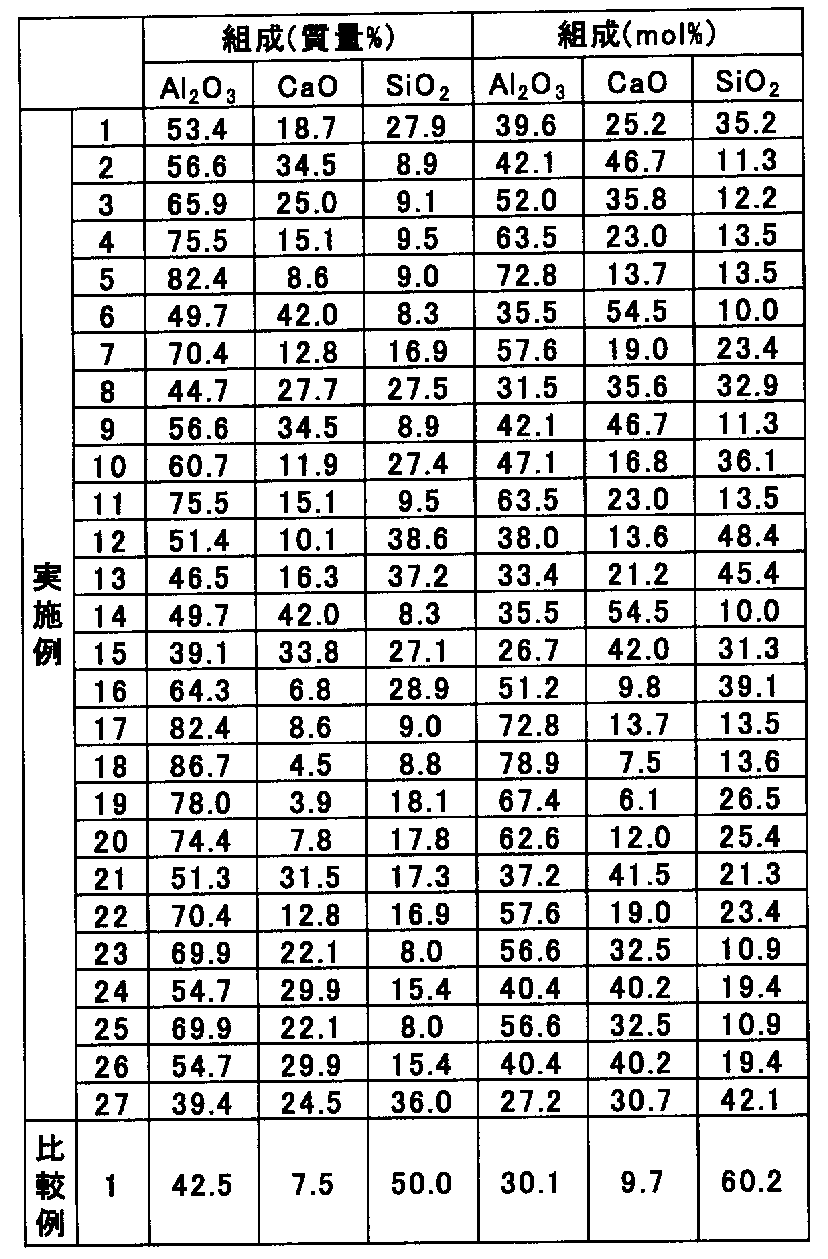
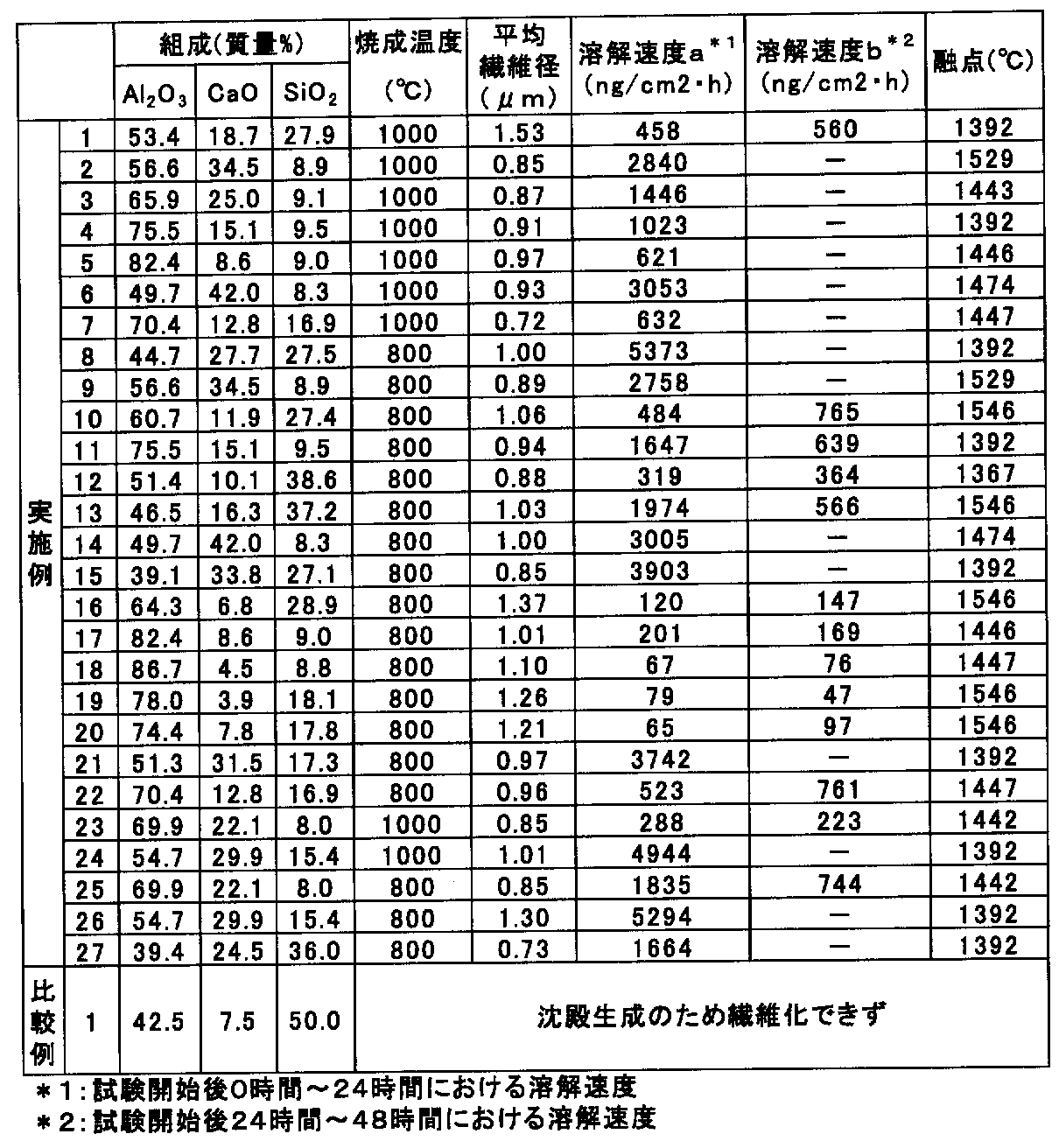
表3に示す結果より、実施例1~実施例27で得られた無機繊維は、試験開始後0時間~24時間における溶解速度が65ng/cm2・h以上であり、試験開始後24時間~48時間おける溶解速度が47ng/cm2・h以上であることから、優れた生体溶解性を示すものであることが分かり、融点が1367℃以上であることから、高い耐熱性を示すものであることが分かる。
これに対し、比較例1の紡糸原料水溶液は、繊維化できないものであることが分かる。
本発明によれば、生体溶解速度が大きく生体溶解性に優れるとともに、耐熱性の高い無機繊維を簡便に製造することができる。
1 紡糸装置
2 シリンジ
3 ノズル
4 高電圧発生装置
5 試料捕集台
2 シリンジ
3 ノズル
4 高電圧発生装置
5 試料捕集台
Claims (5)
- 水溶性の塩基性酸アルミニウムと水溶性のカルシウム化合物と水溶性または水分散性のケイ素化合物とを水性媒体中に溶解して紡糸原料水性溶液を作製した後、
該紡糸原料水性溶液を紡糸して粗無機繊維を得、
次いで、該粗無機繊維を焼成することにより、
35質量%~88質量%のAl2O3、3質量%~45質量%のCaOおよび5質量%~40質量%のSiO2を含み、Al2O3、CaOおよびSiO2を合計した含有割合が繊維全体の98質量%以上である無機繊維を製造する
ことを特徴とする無機繊維の製造方法。 - 前記上記水溶性の塩基性酸アルミニウムが、下記式(I)
Al(OH)XYZ (I)
(ただし、Xは0を超え3未満の正の数であり、Yは、Cl原子、NO3基、SO4基、RCOO基から選ばれるいずれか一種であり、Zは、YがCl原子、NO3基、RCOO基である場合3-X、YがSO4基である場合(3-X)/2であり、前記Rは水素原子または炭素数1~10の炭化水素基若しくは水酸基含有炭化水素基であって、RCOO基が複数存在する場合、各Rは同一であっても異なっていてもよい)
で表される化合物から選ばれる一種以上である請求項1に記載の無機繊維の製造方法。 - 前記紡糸が静電紡糸法により行われる請求項1に記載の無機繊維の製造方法。
- 前記紡糸が静電紡糸法により行われる請求項2に記載の無機繊維の製造方法。
- 前記焼成する温度が、500℃以上液相生成温度未満である請求項1~請求項4のいずれかに記載の無機繊維の製造方法。
Applications Claiming Priority (2)
| Application Number | Priority Date | Filing Date | Title |
|---|---|---|---|
| JP2011-038404 | 2011-02-24 | ||
| JP2011038404A JP5798758B2 (ja) | 2010-02-25 | 2011-02-24 | 無機繊維の製造方法 |
Publications (1)
| Publication Number | Publication Date |
|---|---|
| WO2012114566A1 true WO2012114566A1 (ja) | 2012-08-30 |
Family
ID=46721524
Family Applications (1)
| Application Number | Title | Priority Date | Filing Date |
|---|---|---|---|
| PCT/JP2011/069275 Ceased WO2012114566A1 (ja) | 2011-02-24 | 2011-08-26 | 無機繊維の製造方法 |
Country Status (1)
| Country | Link |
|---|---|
| WO (1) | WO2012114566A1 (ja) |
Cited By (1)
| Publication number | Priority date | Publication date | Assignee | Title |
|---|---|---|---|---|
| WO2016194055A1 (ja) * | 2015-05-29 | 2016-12-08 | 富士電機株式会社 | 無機繊維及び真空断熱材 |
Citations (5)
| Publication number | Priority date | Publication date | Assignee | Title |
|---|---|---|---|---|
| JP2756258B2 (ja) * | 1987-06-05 | 1998-05-25 | ミネソタ マイニング アンド マニユフアクチユアリング カンパニー | 耐火性固体物品及びその製法 |
| WO2006129844A1 (ja) * | 2005-05-31 | 2006-12-07 | Teijin Limited | セラミック繊維及びその製造方法 |
| JP2009515800A (ja) * | 2005-11-10 | 2009-04-16 | ザ・モーガン・クルーシブル・カンパニー・ピーエルシー | 高い温度に対して耐性である繊維 |
| JP2011106050A (ja) * | 2009-11-17 | 2011-06-02 | Nichias Corp | 無機繊維の製造方法 |
| JP2011196008A (ja) * | 2010-02-25 | 2011-10-06 | Nichias Corp | 無機繊維の製造方法 |
-
2011
- 2011-08-26 WO PCT/JP2011/069275 patent/WO2012114566A1/ja not_active Ceased
Patent Citations (5)
| Publication number | Priority date | Publication date | Assignee | Title |
|---|---|---|---|---|
| JP2756258B2 (ja) * | 1987-06-05 | 1998-05-25 | ミネソタ マイニング アンド マニユフアクチユアリング カンパニー | 耐火性固体物品及びその製法 |
| WO2006129844A1 (ja) * | 2005-05-31 | 2006-12-07 | Teijin Limited | セラミック繊維及びその製造方法 |
| JP2009515800A (ja) * | 2005-11-10 | 2009-04-16 | ザ・モーガン・クルーシブル・カンパニー・ピーエルシー | 高い温度に対して耐性である繊維 |
| JP2011106050A (ja) * | 2009-11-17 | 2011-06-02 | Nichias Corp | 無機繊維の製造方法 |
| JP2011196008A (ja) * | 2010-02-25 | 2011-10-06 | Nichias Corp | 無機繊維の製造方法 |
Cited By (1)
| Publication number | Priority date | Publication date | Assignee | Title |
|---|---|---|---|---|
| WO2016194055A1 (ja) * | 2015-05-29 | 2016-12-08 | 富士電機株式会社 | 無機繊維及び真空断熱材 |
Similar Documents
| Publication | Publication Date | Title |
|---|---|---|
| JP5798758B2 (ja) | 無機繊維の製造方法 | |
| US9816206B2 (en) | Carbonaceous metal/ceramic nanofibers | |
| JP5642956B2 (ja) | 無機繊維の製造方法 | |
| US9617660B2 (en) | Reinforcing nanofiber additives | |
| EP2811055B1 (en) | Inorganic fiber and process for manufacturing same | |
| WO2012114565A1 (ja) | 無機繊維 | |
| Milanović et al. | Preparation of low cost alumina nanofibers via electrospinning of aluminium chloride hydroxide/poly (vinyl alcohol) solution | |
| JP5655094B2 (ja) | 無機繊維およびその製造方法 | |
| WO2012114566A1 (ja) | 無機繊維の製造方法 | |
| JP5649297B2 (ja) | 無機繊維 | |
| JP6361418B2 (ja) | 無機繊維、無機繊維集合体及び無機繊維成形体 | |
| Uslu et al. | Synthesis and characterization of boron doped alumina stabilized zirconia fibers | |
| Liang et al. | Preparation of superhydrophobic silicon-based net-like hollow nanostructure using electrospinning | |
| Dai | Calcium Phosphate Scaffolds from Electrospun PVA/inorganic Sol Precursors |
Legal Events
| Date | Code | Title | Description |
|---|---|---|---|
| 121 | Ep: the epo has been informed by wipo that ep was designated in this application |
Ref document number: 11859414 Country of ref document: EP Kind code of ref document: A1 |
|
| NENP | Non-entry into the national phase |
Ref country code: DE |
|
| 122 | Ep: pct application non-entry in european phase |
Ref document number: 11859414 Country of ref document: EP Kind code of ref document: A1 |