WO2012108497A1 - 製鋼スラグによる堆肥化促進法、及びこれにより得られる堆肥 - Google Patents
製鋼スラグによる堆肥化促進法、及びこれにより得られる堆肥 Download PDFInfo
- Publication number
- WO2012108497A1 WO2012108497A1 PCT/JP2012/052960 JP2012052960W WO2012108497A1 WO 2012108497 A1 WO2012108497 A1 WO 2012108497A1 JP 2012052960 W JP2012052960 W JP 2012052960W WO 2012108497 A1 WO2012108497 A1 WO 2012108497A1
- Authority
- WO
- WIPO (PCT)
- Prior art keywords
- steelmaking slag
- composting
- compost
- slag
- livestock
- Prior art date
- Legal status (The legal status is an assumption and is not a legal conclusion. Google has not performed a legal analysis and makes no representation as to the accuracy of the status listed.)
- Ceased
Links
Images


Classifications
-
- C—CHEMISTRY; METALLURGY
- C02—TREATMENT OF WATER, WASTE WATER, SEWAGE, OR SLUDGE
- C02F—TREATMENT OF WATER, WASTE WATER, SEWAGE, OR SLUDGE
- C02F11/00—Treatment of sludge; Devices therefor
- C02F11/12—Treatment of sludge; Devices therefor by de-watering, drying or thickening
- C02F11/16—Treatment of sludge; Devices therefor by de-watering, drying or thickening using drying or composting beds
-
- C—CHEMISTRY; METALLURGY
- C02—TREATMENT OF WATER, WASTE WATER, SEWAGE, OR SLUDGE
- C02F—TREATMENT OF WATER, WASTE WATER, SEWAGE, OR SLUDGE
- C02F11/00—Treatment of sludge; Devices therefor
- C02F11/12—Treatment of sludge; Devices therefor by de-watering, drying or thickening
- C02F11/14—Treatment of sludge; Devices therefor by de-watering, drying or thickening with addition of chemical agents
- C02F11/143—Treatment of sludge; Devices therefor by de-watering, drying or thickening with addition of chemical agents using inorganic substances
-
- C—CHEMISTRY; METALLURGY
- C02—TREATMENT OF WATER, WASTE WATER, SEWAGE, OR SLUDGE
- C02F—TREATMENT OF WATER, WASTE WATER, SEWAGE, OR SLUDGE
- C02F11/00—Treatment of sludge; Devices therefor
- C02F11/12—Treatment of sludge; Devices therefor by de-watering, drying or thickening
- C02F11/14—Treatment of sludge; Devices therefor by de-watering, drying or thickening with addition of chemical agents
- C02F11/143—Treatment of sludge; Devices therefor by de-watering, drying or thickening with addition of chemical agents using inorganic substances
- C02F11/145—Treatment of sludge; Devices therefor by de-watering, drying or thickening with addition of chemical agents using inorganic substances using calcium compounds
-
- C—CHEMISTRY; METALLURGY
- C05—FERTILISERS; MANUFACTURE THEREOF
- C05D—INORGANIC FERTILISERS NOT COVERED BY SUBCLASSES C05B, C05C; FERTILISERS PRODUCING CARBON DIOXIDE
- C05D3/00—Calcareous fertilisers
- C05D3/02—Calcareous fertilisers from limestone, calcium carbonate, calcium hydrate, slaked lime, calcium oxide, waste calcium products
-
- C—CHEMISTRY; METALLURGY
- C05—FERTILISERS; MANUFACTURE THEREOF
- C05F—ORGANIC FERTILISERS NOT COVERED BY SUBCLASSES C05B, C05C, e.g. FERTILISERS FROM WASTE OR REFUSE
- C05F17/00—Preparation of fertilisers characterised by biological or biochemical treatment steps, e.g. composting or fermentation
- C05F17/10—Addition or removal of substances other than water or air to or from the material during the treatment
-
- C—CHEMISTRY; METALLURGY
- C02—TREATMENT OF WATER, WASTE WATER, SEWAGE, OR SLUDGE
- C02F—TREATMENT OF WATER, WASTE WATER, SEWAGE, OR SLUDGE
- C02F2103/00—Nature of the water, waste water, sewage or sludge to be treated
- C02F2103/20—Nature of the water, waste water, sewage or sludge to be treated from animal husbandry
-
- Y—GENERAL TAGGING OF NEW TECHNOLOGICAL DEVELOPMENTS; GENERAL TAGGING OF CROSS-SECTIONAL TECHNOLOGIES SPANNING OVER SEVERAL SECTIONS OF THE IPC; TECHNICAL SUBJECTS COVERED BY FORMER USPC CROSS-REFERENCE ART COLLECTIONS [XRACs] AND DIGESTS
- Y02—TECHNOLOGIES OR APPLICATIONS FOR MITIGATION OR ADAPTATION AGAINST CLIMATE CHANGE
- Y02P—CLIMATE CHANGE MITIGATION TECHNOLOGIES IN THE PRODUCTION OR PROCESSING OF GOODS
- Y02P20/00—Technologies relating to chemical industry
- Y02P20/141—Feedstock
- Y02P20/145—Feedstock the feedstock being materials of biological origin
-
- Y—GENERAL TAGGING OF NEW TECHNOLOGICAL DEVELOPMENTS; GENERAL TAGGING OF CROSS-SECTIONAL TECHNOLOGIES SPANNING OVER SEVERAL SECTIONS OF THE IPC; TECHNICAL SUBJECTS COVERED BY FORMER USPC CROSS-REFERENCE ART COLLECTIONS [XRACs] AND DIGESTS
- Y02—TECHNOLOGIES OR APPLICATIONS FOR MITIGATION OR ADAPTATION AGAINST CLIMATE CHANGE
- Y02W—CLIMATE CHANGE MITIGATION TECHNOLOGIES RELATED TO WASTEWATER TREATMENT OR WASTE MANAGEMENT
- Y02W30/00—Technologies for solid waste management
- Y02W30/40—Bio-organic fraction processing; Production of fertilisers from the organic fraction of waste or refuse
Definitions
- the present invention relates to a method for promoting composting of livestock excrement using steelmaking slag, which is a by-product generated from the steelmaking process of the steel industry, and a compost containing steelmaking slag produced by this method.
- the management status of livestock excrement is about 80% of the farmhouses with compost, but there are insufficient measures to prevent the inflow of rainwater on the roof etc., and about 20% of urine and slurry.
- the farmer had been excavated and stored.
- Livestock farmers that are subject to management under the “Law Concerning the Optimization and Management of Use of Livestock Waste” (Act No. 112 of 1999) have improved the management and management of livestock waste disposal facilities.
- the management standards were to be observed by all farmers.
- the results of the enforcement status survey (as of December 1, 2009) of the “Act on the Appropriate Management of Livestock Excretion and Promotion of Use” were as follows.
- Non-Patent Document 1 There are 56,184 livestock farmers of a certain scale or more nationwide to which the management standards based on the “Law Concerning the Optimization of Use and Promotion of Use of Livestock Waste” are applied. Of these, 99.96% meet the management standards (according to the Ministry of Agriculture, Forestry and Fisheries). However, at present, it is difficult to say that livestock excrement is still being used effectively. In particular, among cattle excreta, cattle manure is generated in Japan about 51.93 million tons per year, and the amount produced is higher than chicken manure (domestic annual production of about 12.85 million tons) and pork poultry (domestic annual production of about 22.91 million tons). Many. Therefore, effective utilization of cow dung is very important (Non-Patent Document 1).
- steelmaking slag produced in steelmaking processes such as converters is generated about 10 million tons per year, CaO, FeO, Fe 2 O 3 , SiO 2 as the main components, and dephosphorization of lime.
- generated more is included.
- This is steelmaking slag in addition to the basic component of the iron oxide (CaO) is contained in a large amount, not bound with SiO 2 and P 2 O 5 and Fe 2 O 3 or the like, so-called free lime is present . Since steelmaking slag contains free lime, it causes expansion and collapse due to hydration and carbonation, thus preventing effective use.
- blast furnace slag generated from the iron making process of the same steel industry is utilized in various applications. For example, blast furnace slag is used effectively for cement materials, fine aggregates for concrete, and the like.
- Non-Patent Document 2 reports that when dairy cow dung was composted, blast furnace slag was added to dairy cow dung to try to promote composting. Yes. In Non-Patent Document 2, it is reported that composting was promoted by adding large sawdust and blast furnace slag to dairy cow dung.
- cow dung as an example of livestock excreta
- the water content of cow dung is usually about 70-80%, but the water content appropriate for composting is about 50%.
- aerobic microorganisms act to evaporate water from the cattle manure as the temperature rises, and the water content can be adjusted to about 50% suitable for composting.
- the temperature rise due to aerobic microorganisms does not proceed so quickly, and composting of cow dung usually requires a long period of about 3 to 6 months. It takes a long time to create compost because the composting being created in the indoor facility with a roof is based on the “Law Concerning the Optimization of the Management of Livestock Excretion and the Promotion of Use” (Act No. 112 of 1999).
- Non-Patent Document 2 reports that, when composting dairy cow manure, blast furnace slag generated from the ironmaking industry's ironmaking process was added to the dairy cattle manure to try to promote composting. However, just adding blast furnace slag to dairy cow dung and composting did not show any change in the temperature rise of dairy cow dung compared to the case without adding blast furnace slag, and reported that fermentation was not promoted. Has been. Further, in Non-Patent Document 2, a large rise of sawdust and blast furnace slag is added to dairy cow dung in layers, and the temperature rises during composting compared to the case where these are not added.
- Non-Patent Document 2 composting could be promoted by adding large sawdust and granulated slag in layers to dairy cattle even when using granulated slag, which is a type of blast furnace slag. Has been reported.
- blast furnace slag and granulated slag which is a kind of blast furnace slag, generated from the ironmaking process of the steel industry were added to dairy cow dung, and an attempt was made to promote composting.
- composting could not be promoted even if slag was added to cow dung alone. Therefore, there is a demand for the development of materials that can promote composting independently without adding large sawdust in layers.
- attempts to promote composting by adding steelmaking slag generated from the steelmaking process, which is completely different from the blast furnace slag generated from the ironmaking process of the steel industry, to the livestock excrement.
- cow manure compost is known to have a lower fertilizer effect due to its lower phosphoric acid and lime content compared to chicken manure compost. For this reason, cattle manure compost is rarely used as a substitute for chemical fertilizer like chicken manure compost.
- an object of the present invention is to provide a method for promoting composting of livestock excrement and a compost obtained thereby.
- Composting promotion method by steelmaking slag as described in any one.
- (6) The method for promoting composting using steelmaking slag according to any one of (1) to (5), wherein the livestock excrement is bovine dung.
- (7) The method for promoting composting using steelmaking slag according to any one of (1) to (6), wherein the steelmaking slag has a particle size of 3 mm or less.
- (8) Compost obtained by the method for promoting composting according to any one of (1) to (7), wherein the compost contains steelmaking slag.
- the present invention makes it possible to compost livestock excrement in a short period of time using steelmaking slag generated from the steelmaking process of the steel industry, thereby promoting effective use of livestock excrement. It can also be expected to improve the environment such as reducing the burden on livestock farmers and dairy farmers and preventing bad odors. Moreover, livestock excrement compost including steelmaking slag (especially cow manure compost) can be expected to have a fertilizer effect for the cultivation of agricultural crops.
- the livestock excrement targeted by the present invention is beef dung, pork dung, chicken dung, horse dung, sheep dung, etc. that are generated by livestock breeding such as livestock industry and dairy farming.
- cattle are bred on a large scale, and it is preferable to obtain a large amount of cattle manure generated there.
- the moisture content of cow dung is about 70-80%, but the moisture content suitable for composting is about 50%.
- the temperature rises due to the action of aerobic microorganisms.
- the water does not evaporate, and it takes time to reach a moisture content of about 50% suitable for composting. There is a problem that the system does not progress efficiently.
- compost is a fertilizer that has organic substances completely differentiated by microorganisms. It may be used synonymously with organic materials (organic fertilizers), while organic materials contain easily decomposable organic matter and undegraded organic matter residues, whereas compost refers to the fully decomposed organic matter, Also called compost.
- organic fertilizers organic fertilizers
- compost refers to the fully decomposed organic matter, Also called compost.
- compost and compost are treated as synonyms.
- anaerobic microorganisms decompose organic matter mainly by fermentation metabolism. Fermentation metabolism reduces degradation rate, suppresses temperature rise, lowers raw material pH due to the production of acids such as acetic acid and butyric acid, and produces malodorous sources, so anaerobic microorganisms are unsuitable for composting.
- water content water content
- the amount of water is large, it is difficult to ensure air permeability. Therefore, if the amount of water is excessively increased, the decomposition rate is consequently reduced.
- a moisture content of about 50% is good.
- the moisture content is adjusted by adding water when the moisture content is low, and mixing and heating auxiliary materials such as straw when the moisture content is high.
- raw materials with high water content such as cow dung may be squeezed by applying mechanical pressure to perform solid-liquid separation.
- thermophilic bacteria having activity in a high temperature region (50 to 80 ° C.), and the peak of activity is at 60 to 75 ° C.
- the rate of decomposition is higher in the high temperature range, and it is preferable to inactivate pathogenic bacteria, pest eggs, viruses, and weed seeds by raising the temperature to a high temperature range from the viewpoint of hygiene.
- the US Environmental Protection Agency requires exposure to temperatures of 55 ° C or higher for 3 days or longer.
- the temperature When composting at a composter or composting facility, the temperature may be forcibly increased by heating. When heating is not performed, the temperature easily rises to a high temperature range by depositing compost and performing heat insulation with compost. If the temperature does not rise smoothly, other environmental factors may not be appropriate. For this reason, temperature is one of the indicators for investigating whether composting is being conducted properly.
- the steelmaking slag used in the present invention is obtained as a converter slag, hot metal pretreatment slag, dephosphorization slag, etc. from the steelmaking process of the steel industry. In the present invention, these can be used alone or in combination as appropriate as steelmaking slag.
- composition of the steelmaking slag used in the present invention and the mechanism by which the temperature rises in a short time at the start of composting will be described by mixing the steelmaking slag with the livestock excrement.
- composition of the steel slag to be used in the present invention in mass%, CaO: 20% or more than 50% total iron, 8% to 25% or less, MgO: 8% 1% or more less, SiO 2: 10% or more 30 Steelmaking slag having a composition comprising:% or less, MnO: 2% or more and 10% or less, Total sulfur content (TS): 1% or less (including 0%), P 2 O 5 : 1% or more and 20% or less is there.
- TS Total sulfur content
- Ca contained in the steelmaking slag will be described. Ca contained in the steel slag, lime CaO, dicalcium silicate 2CaOSiO 2, present in the chemical form such as tricalcium silicate 3CaOSiO 2. Usually, when expressing the composition of steelmaking slag, all Ca is displayed as CaO content. Quick lime CaO generates heat when it reacts with water contained in livestock excrement to become slaked lime Ca (OH) 2, and contributes to the promotion of temperature rise in the initial stage of composting. Further, slaked lime Ca (OH) 2 generated after quicklime CaO reacts with water is a main causative component of alkalinization by steelmaking slag.
- the temperature rise effect by the quicklime CaO contained in the steelmaking slag may be insufficient.
- the effect of alkalinization by Ca (OH) 2 generated by the reaction of quick lime CaO contained in the steelmaking slag with water is weakened, and the quality is improved by aerobic microorganisms. May not facilitate the creation of compost.
- the CaO content of the steelmaking slag used in the present invention is preferably 20% by mass or more and 50% by mass or less.
- the CaO content of the steelmaking slag is more preferably 40% by mass or more and 50% by mass.
- the CaO content of the steelmaking slag can be measured by, for example, fluorescent X-ray analysis.
- steelmaking slag containing iron Fe 2 O 3, FeO, as metallic iron.
- metallic iron and FeO contained in the steelmaking slag also have a feature that contributes to the promotion of the initial temperature rise by oxidation. Therefore, it is preferable to use a steelmaking slag having a high content of metallic iron and FeO, but the iron content of the steelmaking slag is measured here by measuring the total iron content by titration with titanium chloride (III) reduced potassium dichromate. Then, the composition is described by the total iron content.
- the total iron content of the steelmaking slag is less than 8% by mass, there is a possibility that a sufficient amount of metallic iron and FeO that contribute to an increase in composting temperature may not be supplied. Therefore, the total iron content of the steelmaking slag is preferably 8% by mass or more. On the other hand, steelmaking slag whose total iron content exceeds 25% by mass hardly occurs in the ironmaking process and is difficult to obtain. Therefore, it is preferable to use steelmaking slag having a total iron content of 8% by mass to 25% by mass.
- Mg contained in the steelmaking slag contains Mg as magnesium oxide MgO.
- MgO reacts with water in the same manner as quicklime CaO to become Mg (OH) 2 .
- Mg (OH) 2 is a causative substance of alkalinization.
- MgO contained in steelmaking slag contributes to the production of high-quality compost by aerobic microorganisms from the viewpoint of pH adjustment.
- Mg is also important as a nutrient salt for aerobic microorganisms responsible for composting.
- the pH adjustment effect by these MgO and the Mg supply effect to aerobic microorganisms responsible for composting may be insufficient.
- the MgO content of the steelmaking slag can be measured, for example, by fluorescent X-ray analysis.
- Si contained in the steelmaking slag will be described.
- Si exists mainly as SiO 2 in the steelmaking slag.
- Steelmaking slag having a SiO 2 content of less than 10% by mass or exceeding 30% by mass is hardly generated in the steelmaking process, and thus is not readily available. Accordingly, the SiO 2 content is preferably less than 10% by mass and 30% by mass or less.
- the content of SiO 2 contained in the steelmaking slag for example, can be measured by X-ray fluorescence analysis.
- Mn contained in the steelmaking slag will be described.
- Mn exists mainly as MnO in steelmaking slag.
- Steelmaking slag having a MnO content of less than 2% by mass or more than 10% by mass hardly occurs in the iron making process, and is difficult to obtain. Therefore, the MnO content is preferably 2% by mass or more and 10% by mass or less.
- the MnO content of the steelmaking slag can be measured, for example, by fluorescent X-ray analysis.
- S contained in the steelmaking slag will be described.
- S is hardly contained in steelmaking slag.
- S 2 ⁇ is a strong reducing agent, and causes a favorable environment for anaerobic microorganisms by lowering the redox potential.
- the TS content of the steelmaking slag is set to 1% by mass or less.
- the TS content of steelmaking slag can be measured by, for example, high-frequency heating combustion in an oxygen stream-infrared absorption method.
- Phosphorus (P) is steelmaking slag and is mainly represented by a composition of P 2 O 5 .
- Phosphorus is also important as a nutrient component of microorganisms responsible for composting.
- Steelmaking slag having a P 2 O 5 content of less than 1% by mass or steelmaking slag having a P 2 O 5 content of more than 20% by mass hardly occur in the iron making process, and thus are difficult to obtain. Therefore, the P 2 O 5 content is preferably 1% by mass or more and 20% by mass or less.
- P 2 O 5 content of steelmaking slag for example, can be measured by X-ray fluorescence analysis.
- the water content evaporates from the livestock excrement as the temperature rises, so that the water content can be reached in a short time with a water content of about 30% to 50% suitable for composting.
- the time required to reach a high temperature range of 50 ° C. or higher after composting can be used. Therefore, the present invention pays attention to the time when the temperature of the livestock excrement reaches a high temperature range of 50 ° C. or more, in which dehydration and composting from the livestock excretion proceed efficiently, and the temperature of the mixture of the livestock excrement and the steelmaking slag is Reaching 50 ° C. within 48 hours after mixing was used as an index for promoting composting.
- the time required to reach a temperature of 50 ° C. or higher is also affected by the initial temperature at the start of compost production and the ambient air temperature.
- the initial temperature at the start of composting and the ambient air temperature are compared under the same conditions, by mixing livestock excrement and steelmaking slag, the temperature reaches 50 ° C or higher compared to the case where no mixing is performed. It is possible to reduce the time required to do this.
- livestock excrement and steelmaking slag are mixed, the temperature can reach 50 ° C. within 48 hours.
- steelmaking slag is hygroscopic, not only water evaporation due to temperature rise due to heat generation as described above, but also water contained in livestock excrement is absorbed by steelmaking slag by mixing with steelmaking slag. It is also possible to reduce the moisture content of livestock excrement due to the effect of
- Y ⁇ 10 ⁇ (0.7 ⁇ X + 0.3) / (270 ⁇ Z-2.4)
- Y Mass ratio of steelmaking slag added when the mass of livestock excrement is 1.
- X Moisture content of livestock excrement
- Z Mass ratio of CaO contained in steelmaking slag
- the reaction used in the initial temperature increase of composting is the exothermic reaction that occurs when quick lime CaO contained in steelmaking slag reacts with the water contained in livestock waste, and the metallic iron contained in steelmaking slag. This is an exothermic reaction that occurs during oxidation.
- the reaction proceeds by storing the steelmaking slag in the atmosphere, heat generation can be expected when the steelmaking slag is stored in a condition free of oxygen or used immediately after pulverization.
- the mass of livestock excrement is W [kg] and the moisture content is X
- the mass of water contained in the livestock excrement will be WX [kg]
- the dry matter mass of the livestock excrement will be W (1-X) [kg]. .
- the mass of the livestock excrement is set to 1 when the mass of the livestock excrement is 1 for the steelmaking slag containing quick lime CaO with a mass ratio of Z
- the mass of the steelmaking slag added to the livestock excrement of mass W [kg] is WY. [Kg].
- the mass of quicklime CaO added to livestock excrement becomes WYZ [kg].
- steelmaking slag that is about twice the lower limit of the mass ratio of steelmaking slag to be mixed with livestock excrement calculated from the above formula, It is more desirable to mix with excrement.
- the amount of the mixture of livestock excrement and steelmaking slag having a pH of 9 is preferably set as the upper limit of the amount of steelmaking slag added to livestock excrement.
- steelmaking slag contains an alkaline substance such as CaO and MgO, the steelmaking slag alone exhibits alkalinity of about pH 9.5 to 12.5.
- the pH of livestock excrement is about 6, but by mixing steelmaking slag with livestock excrement, it is possible to adjust to pH 7-9, which is a pH condition that can promote composting. However, if steelmaking slag is added too much, the pH will exceed 9, so that it will deviate from the pH conditions that promote composting.
- the water content of the livestock excrement is about 70 to 80%. More preferably, the water content of the livestock excrement as a raw material is adjusted to the range of 70% by mass or more and 72% by mass or less, and then the steelmaking slag. It is possible to promote efficient composting by mixing about 15% by mass with respect to livestock excrement, for example. However, the present invention is not limited only to this condition.
- the method for mixing the livestock excrement and the steelmaking slag may be any method as long as the livestock excrement and the steelmaking slag can be mixed.
- mixing using a wheel loader or a manual spreader is also possible.
- cow dung is most preferable as the livestock excrement targeted by the present invention. This is because cow dung is produced in large quantities, and since it contains less phosphorus and nitrogen than pork and chicken dung, its use as compost has not progressed.
- the present invention is applicable to pork buns, horse buns, and the like other than beef buns.
- the particle size of the steelmaking slag used by this invention is 3 mm or less.
- the specific surface area of the steelmaking slag is smaller than that when the particle diameter is 3 mm or less, so the hydrolysis reaction of CaO contained in the steelmaking slag and the steelmaking slag are included. This is because the oxidation reaction of Fe is less likely to occur, so heat generation due to these chemical reactions is suppressed, and the temperature rise effect at the beginning of compost production is reduced.
- the elution efficiency of the steelmaking slag-containing component is high and the operability is good by mixing with livestock excrement, a smaller particle size is preferable, and thus the steelmaking slag particle size is desirably 3 mm or less.
- the particle size of the steelmaking slag can be measured in which particle size range the steelmaking slag is, for example, by using sieves having different mesh intervals.
- the powder obtained by crushing steelmaking slag or the powder obtained by crushing steelmaking slag is a binder. It may be made more granular. Any binder can be used as long as it is used for granulation of fertilizers. For example, lignin sulfonic acid or the like can be used.
- compost making methods include a deposition method, an open stirring method, and a closed stirring method, but any method may be used.
- An important factor in compost production is the supply of oxygen.
- the deposition method it is possible to supply oxygen necessary for composting to the inside of the deposit by turning over the mixture of livestock excrement and steelmaking slag at least once a week.
- oxygen can be supplied by stirring a mixture of livestock excrement and steelmaking slag using a rotary scoop or the like.
- oxygen can be supplied by stirring with a stirring propeller or the like.
- the progress of composting can be confirmed by measuring the temperature in the mixture of livestock excrement and steelmaking slag over time.
- the temperature reaches a high temperature of 50 ° C. or more within 48 hours.
- the completion of compost can be confirmed, for example, by the following method. For example, since the fermentation for decomposing the easily decomposable substance is completed, it can be confirmed that the temperature rise immediately after supplying oxygen by turning back or the like slows down. Alternatively, it can be confirmed that the temperature of compost does not rise to 50 ° C. or higher even immediately after oxygen is supplied by turning over or the like.
- the compost produced as described above is compost containing a steelmaking slag and having a water content of less than 50%.
- the completed compost has a content of soluble silicic acid, lime, and iron that is 10 times or more, 3 times or more, 50 times or more higher than compost made without adding steelmaking slag. It can be expected to contribute to the growth promotion and yield increase of necessary crops.
- Example 1 26 t of cow dung with a moisture content of 80% was divided into two 13 t.
- the amount of the steelmaking slag added to the cow dung was determined as follows based on the formula described below.
- Y Mass ratio of steelmaking slag added when the mass of cow dung is 1.
- X Moisture content of cow dung
- Z Mass ratio of CaO contained in steelmaking slag
- the remaining beef dung 13t was composted in parallel in the same manner under the condition that no steelmaking slag was added, and used as a control.
- Fig. 1 shows the temperature measurement results.
- the temperature of the mixture of cow dung and steelmaking slag became 50 ° C. or more 24 hours after the start of the test.
- temperature became 50 degreeC or more 72 hours after the test start. Therefore, the effect of increasing the initial temperature at the start of composting was confirmed by adding steelmaking slag to cow dung.
- the mixture of cow dung and steelmaking slag has a temperature that is about 10 ° C higher for 30 days after the start of composting, compared to the case where steelmaking slag is not added to the control cow dung 60 It was maintained at ⁇ 72 ° C.
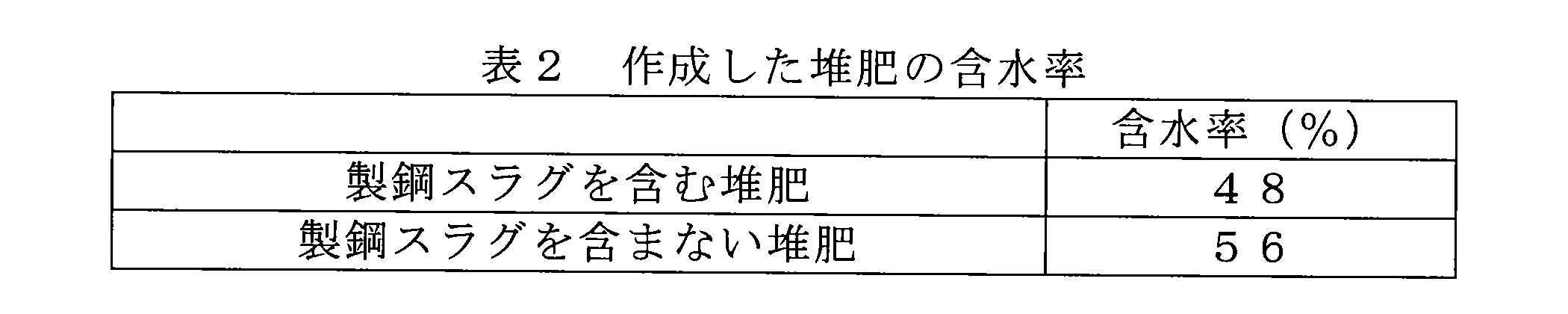
- Table 2 shows the analysis results of compost containing and not containing steelmaking slag, created after a 51-day composting test.
- the compost prepared by adding steelmaking slag contained 3.8% soluble silicic acid, 18.8% lime, and 3.66% iron.
- soluble silicic acid was 0.15%
- lime was 2.9%
- iron was 0.02%
- Soluble silicic acid was 25 times higher
- lime was 6.4 times higher
- iron content was 180 times higher. Therefore, compost prepared by adding steelmaking slag contains more than 10 times more soluble silicic acid, more than 3 times more lime, and more than 50 times more iron than compost made without adding steelmaking slag. I was able to confirm that.
- Example 2 Fertilizer effect of compost containing steelmaking slag Using the compost containing steelmaking slag and the compost not containing steelmaking slag as prepared in Example 1, paddy rice (variety Koshihikari) was cultivated, The effect on yield was investigated.
- Table 4 shows the results of lodging rates. In the test area cultivated with compost containing steelmaking slag, lodging was not seen, whereas in the test area cultivated with compost not containing steelmaking slag, 18% lodging was seen. It is thought that silicic acid contained in the compost containing steelmaking slag works effectively to increase the lodging resistance of paddy rice.
- Table 5 shows the yield (14% wet mass) results.
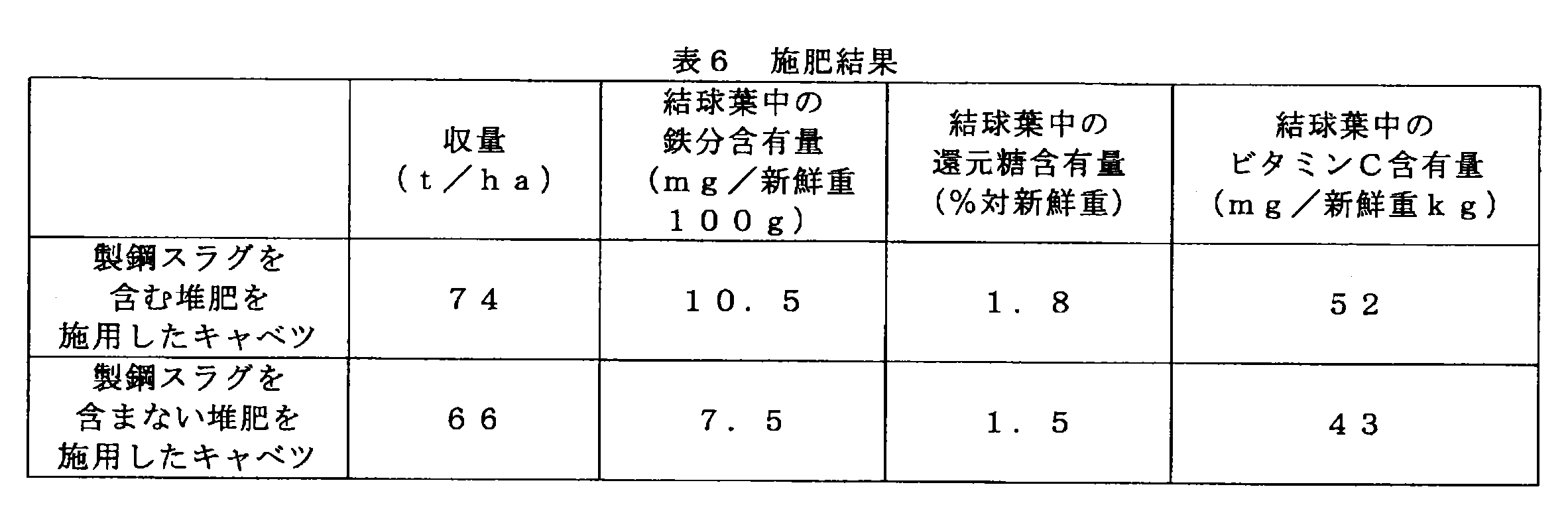
- Example 3 Fertilizer effect of compost containing steelmaking slag Using the compost containing steelmaking slag prepared in Example 1 and compost not containing steelmaking slag as a control, cabbage was cultivated, and cabbage yield and head leaves The effects on the reducing sugar and vitamin C content were investigated.
- each 5 m ⁇ 2 m field there was provided a test zone in which the compost containing the steelmaking slag prepared in Example 1 and the compost not containing the control steelmaking slag were applied 10 t / ha each.
- each fertilizer was applied with 300 kg / ha of urea as nitrogen. The results are shown in Table 6.
- the yield of cabbage increased by 12% compared to when compost not containing steelmaking slag was applied.
- the iron content in the head leaves also increased by 40%, the reducing sugar content by 20%, and the vitamin C content in the head leaves also increased by 21%.
- Example 4 20 t of cow dung with a moisture content of 71% was divided into two 10 t.
- One cow dung 10t was added with steelmaking slag having the composition shown in Table 7 to be composted, and the amount of steelmaking slag added to cow dung was determined as follows based on the formula described below.
- Y Mass ratio of steelmaking slag added when the mass of cow dung is 1.
- X Moisture content of cow dung
- Z Mass ratio of CaO contained in steelmaking slag
- the steelmaking slag having a composition shown in Table 7 (with a particle size of 3 mm or less) of 1.5 t (the weight of the cow dung was 1) was added to 10 t of the cow dung with a moisture content of 71%. 15) Added and mixed. When the pH of the mixture was measured after mixing, it was confirmed that it was pH 8.6 and less than pH 9.
- the remaining 10t of cow dung was composted in parallel in the same manner without adding steelmaking slag, and used as a control.
- Fig. 2 shows the temperature measurement results.
- the temperature of the mixture of cow dung and steelmaking slag became 50 ° C. or more 24 hours after the start of the test.
- temperature became 50 degreeC or more 72 hours after the test start. Therefore, the effect of increasing the initial temperature at the start of composting was confirmed by adding steelmaking slag to cow dung.
- the mixture of cow dung and steelmaking slag has a temperature that is about 10 ° C. higher for 16 days after the start of composting compared to the case where steelmaking slag is not added to the control cow dung 60 It was maintained at ⁇ 72 ° C.
- Table 8 shows the analysis results of compost containing and not containing steelmaking slag, which was created after the 23-day composting test.
- the moisture content of the compost added with steelmaking slag was 32%, which was easy to handle as compost (30% to 50%).
- the moisture content of the compost without adding the control steelmaking slag was 52%, and it was revealed that the moisture content was still high for use as compost.
- Example 1 when 15% by mass of steelmaking slag was added to 80% moisture content of cow dung, the moisture content of compost became 48% by composting for 51 days, whereas in this example, When 15% by mass of steelmaking slag was added to cow dung with a moisture content of 71%, the moisture content of compost became 32% after composting for 23 days. Therefore, it was found that composting can be promoted more efficiently by mixing about 15% by mass of steelmaking slag with livestock excrement having a moisture content in the range of 70% by mass to 72% by mass. .
Landscapes
- Chemical & Material Sciences (AREA)
- Organic Chemistry (AREA)
- Engineering & Computer Science (AREA)
- Life Sciences & Earth Sciences (AREA)
- Chemical Kinetics & Catalysis (AREA)
- Hydrology & Water Resources (AREA)
- Environmental & Geological Engineering (AREA)
- Water Supply & Treatment (AREA)
- General Chemical & Material Sciences (AREA)
- Biochemistry (AREA)
- Biotechnology (AREA)
- Health & Medical Sciences (AREA)
- Microbiology (AREA)
- Molecular Biology (AREA)
- Inorganic Chemistry (AREA)
- Fertilizers (AREA)
- Processing Of Solid Wastes (AREA)
- Treatment Of Sludge (AREA)
Abstract
Description
(1)家畜排せつ物に製鋼スラグを混合することにより、家畜排せつ物と製鋼スラグの混合物の温度を混合後48時間以内に少なくとも50℃に到達させ、含水率を30~50%とする、製鋼スラグによる堆肥化促進法。
(2)前記製鋼スラグの組成が、質量%にて、CaO:20%以上50%以下、全鉄:8%以上25%以下、MgO:1%以上8%以下、SiO2:10%以上30%以下、MnO:2%以上10%以下、全硫黄分(T-S):1%以下(0%を含む)、P2O5:1%以上20%以下である、(1)に記載の製鋼スラグによる堆肥化促進法。
(3)家畜排せつ物と混合する製鋼スラグの質量割合の下限を次式により算出する、(1)又は(2)に記載の製鋼スラグによる堆肥化促進法。
Y ≧ 10×(0.7×X+0.3)/(270×Z-2.4)
Y;家畜排せつ物の質量を1とした場合に加える製鋼スラグの質量割合
X;家畜排せつ物の含水率
Z;製鋼スラグに含まれるCaOの質量割合
(4)家畜排せつ物に製鋼スラグを混合する際に、家畜排せつ物と製鋼スラグの混合物のpHが9になる量を、家畜排せつ物への製鋼スラグ添加量の上限とする、(1)~(3)のいずれかに記載の製鋼スラグによる堆肥化促進法。
(5)前記家畜排せつ物と前記製鋼スラグとの混合物との温度を、60℃~75℃に到達させ、当該60℃~75℃の温度が3日以上継続する、(1)~(4)のいずれかに記載の製鋼スラグによる堆肥化促進法。
(6)前記家畜排せつ物が牛ふんである、(1)~(5)のいずれかに記載の製鋼スラグによる堆肥化促進法。
(7)前記製鋼スラグの粒径が3mm以下である、(1)~(6)のいずれかに記載の製鋼スラグによる堆肥化促進法。
(8)(1)~(7)のいずれかに記載の堆肥化促進法で得られる堆肥であって、堆肥中に製鋼スラグを含有する、堆肥。
(9)(8)に記載の堆肥であって、製鋼スラグを含有することによって、製鋼スラグを含有しない場合と比較して、可溶性ケイ酸を10倍以上、石灰を3倍以上、鉄分を50倍以上多く含有する、堆肥。
本発明で使用する製鋼スラグは、製鉄業の製鋼工程から、転炉スラグ、溶銑予備処理スラグ、脱リンスラグ等として得られるものである。これらを単独、あるいは適宜組み合わせて混合したものを、本発明では製鋼スラグとして使用することが可能である。
製鋼スラグに含まれるCaは、生石灰CaO、ダイカルシウムシリケート2CaOSiO2、トリカルシウムシリケート3CaOSiO2等の化学形態で存在する。通常、製鋼スラグの組成を表す場合には、全CaをCaO含有量として表示する。生石灰CaOは、家畜排せつ物に含まれる水と反応して消石灰Ca(OH)2となる際に発熱し、堆肥化の初期における温度上昇促進に寄与する。また、生石灰CaOが水と反応した後に生ずる消石灰Ca(OH)2は、製鋼スラグによるアルカリ化の主要な原因成分である。通常、家畜排せつ物の堆肥化では、酸素を十分供給した条件で堆肥化を実施すると好気性微生物の働きでタンパク質等の分解が進み、アンモニアが発生することで堆肥のpHが8~9程度のアルカリ性に保たれて、良質な堆肥ができることが報告されている。一方、酸素の供給が不十分な場合には、嫌気性微生物の働きにより有機酸等が発生して堆肥が酸性化してしまい、品質の悪い堆肥ができることも報告されている。したがって、製鋼スラグに含まれるCaOは、pH調整の点からも、好気性微生物による良質な堆肥作成に寄与する。
製鋼スラグは、鉄をFe2O3、FeO、金属鉄として含む。堆肥化の促進では、製鋼スラグに含まれる金属鉄及びFeOも、酸化によって初期の温度上昇促進に寄与する特長がある。したがって、金属鉄、FeOの含有量が高い製鋼スラグを用いることが好ましいが、製鋼スラグの鉄の含有量は、塩化チタン(III)還元二クロム酸カリウム滴定法により全鉄分を測定するため、ここでは全鉄含有量で組成を記述する。
製鋼スラグは、Mgを酸化マグネシウムMgOとして含む。MgOは、生石灰CaOと同様に水と反応して、Mg(OH)2となる。Mg(OH)2は、アルカリ化の原因物質である。前記のように堆肥のpHを8~9の弱アルカリ性に保つことにより、好気性微生物により良質な堆肥ができることが報告されている。したがって、製鋼スラグに含まれるMgOは、pH調整の点からも、好気性微生物による良質な堆肥作成に寄与する。また、Mgは、堆肥化を担う好気性微生物の栄養塩としても重要である。製鋼スラグのMgO含有量が1質量%未満の場合には、これらMgOによるpH調整効果、堆肥化を担う好気性微生物へのMg供給効果が、不十分となる可能性がある。
Siは、製鋼スラグ中で主にSiO2として存在する。SiO2含有量が10質量%未満、あるいは、30質量%を超えるような製鋼スラグは、製鉄工程で殆ど発生しないため、入手することが容易でない。したがって、SiO2含有量は、10質量%未満30質量%以下が好ましい。尚、製鋼スラグに含まれるSiO2の含有量は、例えば、蛍光X線分析法により測定可能である。
Mnは、製鋼スラグ中で主にMnOとして存在する。MnO含有量が2質量%未満、あるいは、10質量%を超える製鋼スラグは、製鉄工程で殆ど発生しないため、入手が困難である。したがって、MnO含有量は2質量%以上10質量%以下が好ましい。尚、製鋼スラグのMnO含有量は、例えば、蛍光X線分析法により測定可能である。
Sは、製鋼スラグには殆ど含まれない。但し、脱硫スラグとして硫化物S2-の含有量を高めた製鋼スラグがある。S2-は強力な還元剤であり、酸化還元電位を低下させることにより、嫌気性微生物にとって有利な環境を形成する要因となる。好気性微生物による堆肥化を促進するためには、硫化物S2-の含有量がなるべく低い製鋼スラグを用いることが好ましい。したがって、本発明では、このようなS2-による悪影響を防止するため、製鋼スラグのT-S含有量を、1質量%以下とした。尚、製鋼スラグのT-S含有量は、例えば、酸素気流中高周波加熱燃焼-赤外線吸収法により測定可能である。
リン(P)は、製鋼スラグで主にP2O5の組成で表される。リンは、堆肥化を担う微生物の栄養成分としても重要である。P2O5含有量が1質量%未満の製鋼スラグ、あるいは、P2O5含有量が20質量%を超える製鋼スラグは、製鉄工程で殆ど発生しないため、入手が困難である。したがって、P2O5含有量は1質量%以上20質量%以下であることが好ましい。尚、製鋼スラグのP2O5含有量は、例えば、蛍光X線分析法により測定可能である。
Y ≧ 10×(0.7×X+0.3)/(270×Z-2.4)
Y;家畜排せつ物の質量を1とした場合に加える製鋼スラグの質量割合
X;家畜排せつ物の含水率
Z;製鋼スラグに含まれるCaOの質量割合
CaO + H2O → Ca(OH)2
ΔH=-15036[Cal/mol]=-270[kCal/kg]
である。
10WX + 10CdW(1-X) + 10CsWY
= 10W{(1-Cd)X + CsY + Cd} [kcal]
270WZY ≧ 10W{(1-Cd)X + CsY + Cd}
Y ≧ 10{(1-Cd)X + Cd}/(270Z - 10Cs)
となる。
Y ≧ 10×(0.7X + 0.3)/(270Z - 2.4)
となる。したがって、上式により、家畜排せつ物の含水率(X)、製鋼スラグに含まれるCaOの質量割合(Z)を用いて、堆肥化の初期に家畜排せつ物と製鋼スラグとの混合物の温度を10℃高めるために必要な製鋼スラグの最小添加量を、計算することができる。但し、製鋼スラグとの混合による堆肥化の初期温度上昇促進効果を安定化させるため、上式から計算される家畜排せつ物と混合する製鋼スラグの質量割合の下限の2倍程度の製鋼スラグを、家畜排せつ物と混合することがより望ましい。
含水率80%の牛ふん26tを13tずつ2つに分けた。一方の牛ふん13tは、表1に記載の組成の製鋼スラグを加えて堆肥化するために、牛ふんに加える製鋼スラグの量を、以下に記載の式に基づき、以下のように決定した。
Y ≧ 10×(0.7X+0.3)/(270Z-2.4)
Y;牛ふんの質量を1とした場合に加える製鋼スラグの質量割合
X;牛ふんの含水率
Z;製鋼スラグに含まれるCaOの質量割合
表1に記載の製鋼スラグに含まれるCaOは41%のため、Z=0.41とした。

Y≧0.08
となる。

実施例1で作成した製鋼スラグを含む堆肥、及び、対照の製鋼スラグを含まない堆肥を用いて、水稲(品種 コシヒカリ)を栽培して、水稲収量への影響を調べた。


実施例1で作成した製鋼スラグを含む堆肥、及び、対照の製鋼スラグを含まない堆肥を用いて、キャベツを栽培して、キャベツ収量及び結球葉中の還元糖、ビタミンC含有量への影響を調べた。
含水率71%の牛ふん20tを10tずつ2つに分けた。一方の牛ふん10tは、表7に記載の組成の製鋼スラグを加えて堆肥化するために、牛ふんに加える製鋼スラグの量を、以下に記載の式に基づき、以下のように決定した。
Y ≧ 10×(0.7X+0.3)/(270Z-2.4)
Y;牛ふんの質量を1とした場合に加える製鋼スラグの質量割合
X;牛ふんの含水率
Z;製鋼スラグに含まれるCaOの質量割合
表7に記載の製鋼スラグに含まれるCaOは45%のため、Z=0.45とした。

Y≧0.07
となる。

Claims (9)
- 家畜排せつ物に製鋼スラグを混合することにより、家畜排せつ物と製鋼スラグとの混合物の温度を混合後48時間以内に少なくとも50℃に到達させ、含水率を30~50%とする、製鋼スラグによる堆肥化促進法。
- 前記製鋼スラグの組成が、質量%にて、
CaO:20%以上50%以下、
全鉄:8%以上25%以下、
MgO:1%以上8%以下、
SiO2:10%以上30%以下、
MnO:2%以上10%以下、
全硫黄分(T-S):1%以下(0%を含む)、
P2O5:1%以上20%以下である、請求項1に記載の製鋼スラグによる堆肥化促進法。 - 家畜排せつ物と混合する製鋼スラグの質量割合の下限を、次式により算出する、請求項1に記載の製鋼スラグによる堆肥化促進法。
Y ≧ 10×(0.7×X+0.3)/(270×Z-2.4)
Y;家畜排せつ物の質量を1とした場合に加える製鋼スラグの質量割合
X;家畜排せつ物の含水率
Z;製鋼スラグに含まれるCaOの質量割合 - 家畜排せつ物に製鋼スラグを混合する際に、家畜排せつ物と製鋼スラグの混合物のpHが9になる量を、家畜排せつ物への製鋼スラグ添加量の上限とする、請求項1に記載の製鋼スラグによる堆肥化促進法。
- 前記家畜排せつ物と前記製鋼スラグとの混合物との温度を、60℃~75℃に到達させ、当該60℃~75℃の温度が3日以上継続する、請求項1に記載の製鋼スラグによる堆肥化促進法。
- 前記家畜排せつ物が牛ふんである、請求項1に記載の製鋼スラグによる堆肥化促進法。
- 前記製鋼スラグの粒径が3mm以下である、請求項1に記載の製鋼スラグによる堆肥化促進法。
- 請求項1に記載の堆肥化促進法で得られる堆肥であって、堆肥中に製鋼スラグを含有する、堆肥。
- 請求項8に記載の堆肥であって、製鋼スラグを含有することによって、製鋼スラグを含有しない場合と比較して、可溶性ケイ酸を10倍以上、石灰を3倍以上、鉄分を50倍以上多く含有する、堆肥。
Priority Applications (1)
| Application Number | Priority Date | Filing Date | Title |
|---|---|---|---|
| PH1/2013/501520A PH12013501520A1 (en) | 2011-02-10 | 2012-02-09 | Method for promoting composting using steel slag, and compost obtained therefrom |
Applications Claiming Priority (2)
| Application Number | Priority Date | Filing Date | Title |
|---|---|---|---|
| JP2011027298 | 2011-02-10 | ||
| JP2011-027298 | 2011-02-10 |
Publications (1)
| Publication Number | Publication Date |
|---|---|
| WO2012108497A1 true WO2012108497A1 (ja) | 2012-08-16 |
Family
ID=46638709
Family Applications (1)
| Application Number | Title | Priority Date | Filing Date |
|---|---|---|---|
| PCT/JP2012/052960 Ceased WO2012108497A1 (ja) | 2011-02-10 | 2012-02-09 | 製鋼スラグによる堆肥化促進法、及びこれにより得られる堆肥 |
Country Status (4)
| Country | Link |
|---|---|
| JP (1) | JP5797127B2 (ja) |
| MY (1) | MY166426A (ja) |
| PH (1) | PH12013501520A1 (ja) |
| WO (1) | WO2012108497A1 (ja) |
Cited By (2)
| Publication number | Priority date | Publication date | Assignee | Title |
|---|---|---|---|---|
| CN109232055A (zh) * | 2018-11-15 | 2019-01-18 | 湖南泰谷生态工程有限公司 | 一种具有抗倒伏功能的生物肥料及其制备方法 |
| MA65525A1 (fr) * | 2024-04-18 | 2025-10-31 | Societe Concamine | Amendement organo-mineral mur et stable a base des scories associees au fumier de cheval |
Families Citing this family (2)
| Publication number | Priority date | Publication date | Assignee | Title |
|---|---|---|---|---|
| JP6492896B2 (ja) * | 2015-04-02 | 2019-04-03 | 新日鐵住金株式会社 | 堆肥製造方法 |
| JP7633644B2 (ja) * | 2020-10-16 | 2025-02-20 | 四国ケージ株式会社 | 堆肥製造方法 |
Citations (4)
| Publication number | Priority date | Publication date | Assignee | Title |
|---|---|---|---|---|
| JPS55149185A (en) * | 1979-05-11 | 1980-11-20 | Kawasaki Steel Co | Composting composition |
| JPS5669294A (en) * | 1979-11-12 | 1981-06-10 | Nippon Steel Corp | Blended fertilizer manufacture utilizing iron slag |
| JPH0279910A (ja) * | 1988-09-19 | 1990-03-20 | Ninaki Akira | 粒状天然ゼオライトを主成分とする混合園芸培土 |
| JP2006321703A (ja) * | 2005-05-19 | 2006-11-30 | Ok Soo Oh | 有機質肥料の製造方法および得られる有機質肥料 |
Family Cites Families (4)
| Publication number | Priority date | Publication date | Assignee | Title |
|---|---|---|---|---|
| JPS5556086A (en) * | 1978-10-17 | 1980-04-24 | Noriyoshi Monma | Slag mixed fertilizer |
| JPS5829273B2 (ja) * | 1979-11-02 | 1983-06-21 | 義芳 門馬 | 肥料製造法 |
| JPS62191487A (ja) * | 1986-02-18 | 1987-08-21 | 株式会社バイオスター | 醗酵肥料製造促進剤 |
| JPH1135388A (ja) * | 1997-07-14 | 1999-02-09 | Chichibu Onoda Cement Corp | 有機質肥料の製造方法 |
-
2012
- 2012-02-09 JP JP2012026115A patent/JP5797127B2/ja active Active
- 2012-02-09 MY MYPI2013701237A patent/MY166426A/en unknown
- 2012-02-09 PH PH1/2013/501520A patent/PH12013501520A1/en unknown
- 2012-02-09 WO PCT/JP2012/052960 patent/WO2012108497A1/ja not_active Ceased
Patent Citations (4)
| Publication number | Priority date | Publication date | Assignee | Title |
|---|---|---|---|---|
| JPS55149185A (en) * | 1979-05-11 | 1980-11-20 | Kawasaki Steel Co | Composting composition |
| JPS5669294A (en) * | 1979-11-12 | 1981-06-10 | Nippon Steel Corp | Blended fertilizer manufacture utilizing iron slag |
| JPH0279910A (ja) * | 1988-09-19 | 1990-03-20 | Ninaki Akira | 粒状天然ゼオライトを主成分とする混合園芸培土 |
| JP2006321703A (ja) * | 2005-05-19 | 2006-11-30 | Ok Soo Oh | 有機質肥料の製造方法および得られる有機質肥料 |
Cited By (3)
| Publication number | Priority date | Publication date | Assignee | Title |
|---|---|---|---|---|
| CN109232055A (zh) * | 2018-11-15 | 2019-01-18 | 湖南泰谷生态工程有限公司 | 一种具有抗倒伏功能的生物肥料及其制备方法 |
| MA65525A1 (fr) * | 2024-04-18 | 2025-10-31 | Societe Concamine | Amendement organo-mineral mur et stable a base des scories associees au fumier de cheval |
| MA65525B1 (fr) * | 2024-04-18 | 2026-01-30 | Societe Concamine | Amendement organo-mineral mur et stable a base des scories associees au fumier de cheval |
Also Published As
| Publication number | Publication date |
|---|---|
| JP5797127B2 (ja) | 2015-10-21 |
| JP2012180266A (ja) | 2012-09-20 |
| PH12013501520A1 (en) | 2013-09-16 |
| MY166426A (en) | 2018-06-26 |
Similar Documents
| Publication | Publication Date | Title |
|---|---|---|
| Möller | Effects of anaerobic digestion on soil carbon and nitrogen turnover, N emissions, and soil biological activity. A review: K. Möller | |
| Yadav et al. | Industrial wastes and sludges management by vermicomposting | |
| CN102173926B (zh) | 含有有机多元微量元素的微生物肥料的制备方法 | |
| CN100584806C (zh) | 多养分有机复合肥料及其制法 | |
| CN102079668A (zh) | 一种高效有机肥及制备方法 | |
| CN103708890B (zh) | 一种生物酶肥料及其制备方法 | |
| CN106431576A (zh) | 一种水稻机插秧育秧基质及其制备方法 | |
| CN101157585A (zh) | 有机氮肥 | |
| CN101723730A (zh) | 一种富氮高磷的肥料及其制备方法 | |
| JP5791728B2 (ja) | 有機肥料の製造方法 | |
| JP5797127B2 (ja) | 製鋼スラグによる堆肥化促進法 | |
| JP2018030777A (ja) | 高腐植酸含有率の完熟肥料を製造する方法 | |
| CN102079669A (zh) | 一种高效有机复合肥及制备方法 | |
| Ren et al. | Role of bulking agents and additive on composting | |
| JP3439701B2 (ja) | 木質原料堆肥の製造方法 | |
| CN116924856A (zh) | 一种固废基人造土壤的制备方法 | |
| Shakywal et al. | Role of organic manure for improving soil health | |
| CN114874046B (zh) | 一种人造土壤的生产方法 | |
| CN108911806A (zh) | 一种畜禽粪便发酵有机肥及其制备方法 | |
| CN112457076A (zh) | 用于制作有机肥的配方及用其制作有机肥的方法 | |
| KR100799660B1 (ko) | 가축분뇨의 퇴비화 방법 | |
| JP2008050248A (ja) | イネ科植物由来の有機発酵肥料及びその製造方法 | |
| CN108440132A (zh) | 一种玉米秸秆碳化生产有机肥料 | |
| CN1033969C (zh) | 一种有机复合肥料的生产方法 | |
| Rahman | Production and evaluation of vermicompost from different types of livestock manures |
Legal Events
| Date | Code | Title | Description |
|---|---|---|---|
| 121 | Ep: the epo has been informed by wipo that ep was designated in this application |
Ref document number: 12744930 Country of ref document: EP Kind code of ref document: A1 |
|
| WWE | Wipo information: entry into national phase |
Ref document number: 12013501520 Country of ref document: PH |
|
| WWE | Wipo information: entry into national phase |
Ref document number: 1301004386 Country of ref document: TH |
|
| NENP | Non-entry into the national phase |
Ref country code: DE |
|
| 122 | Ep: pct application non-entry in european phase |
Ref document number: 12744930 Country of ref document: EP Kind code of ref document: A1 |