WO2012108234A1 - セルロース誘導体、樹脂組成物、成形体及びその製造方法並びに電気電子機器用筐体 - Google Patents
セルロース誘導体、樹脂組成物、成形体及びその製造方法並びに電気電子機器用筐体 Download PDFInfo
- Publication number
- WO2012108234A1 WO2012108234A1 PCT/JP2012/050842 JP2012050842W WO2012108234A1 WO 2012108234 A1 WO2012108234 A1 WO 2012108234A1 JP 2012050842 W JP2012050842 W JP 2012050842W WO 2012108234 A1 WO2012108234 A1 WO 2012108234A1
- Authority
- WO
- WIPO (PCT)
- Prior art keywords
- group
- cellulose derivative
- hydrocarbon group
- cellulose
- chloride
- Prior art date
- Legal status (The legal status is an assumption and is not a legal conclusion. Google has not performed a legal analysis and makes no representation as to the accuracy of the status listed.)
- Ceased
Links
Images

Classifications
-
- C—CHEMISTRY; METALLURGY
- C08—ORGANIC MACROMOLECULAR COMPOUNDS; THEIR PREPARATION OR CHEMICAL WORKING-UP; COMPOSITIONS BASED THEREON
- C08B—POLYSACCHARIDES; DERIVATIVES THEREOF
- C08B13/00—Preparation of cellulose ether-esters
-
- C—CHEMISTRY; METALLURGY
- C08—ORGANIC MACROMOLECULAR COMPOUNDS; THEIR PREPARATION OR CHEMICAL WORKING-UP; COMPOSITIONS BASED THEREON
- C08L—COMPOSITIONS OF MACROMOLECULAR COMPOUNDS
- C08L1/00—Compositions of cellulose, modified cellulose or cellulose derivatives
- C08L1/08—Cellulose derivatives
Definitions
- the present invention relates to a cellulose derivative, a resin composition, a molded article, a method for producing the same, and a casing for electric and electronic equipment.
- PC Polycarbonate
- ABS Acrylonitrile-butadiene-styrene resin
- PC / ABS etc.
- These resins are produced by reacting compounds obtained from petroleum as a raw material.
- fossil resources such as oil, coal, and natural gas are mainly composed of carbon that has been fixed in the ground for many years.
- fossil resources or products made from fossil resources are burned and carbon dioxide is released into the atmosphere, carbon that was originally not deep in the atmosphere but fixed deep in the ground Is rapidly released as carbon dioxide, and carbon dioxide in the atmosphere greatly increases, which causes global warming.
- polymers such as ABS and PC made from petroleum, which is a fossil resource, have excellent characteristics as materials for electrical and electronic equipment, but are made from petroleum, which is a fossil resource. Therefore, it is desirable to reduce the amount used from the viewpoint of preventing global warming.
- a plant-derived resin is originally produced by a photosynthesis reaction using carbon dioxide and water in the atmosphere as raw materials. Therefore, even if plant-derived resin is incinerated to generate carbon dioxide, the carbon dioxide is equivalent to carbon dioxide originally in the atmosphere, so the balance of carbon dioxide in the atmosphere is plus or minus zero After all, there is an idea that the total amount of CO 2 in the atmosphere is not increased. Based on this idea, plant-derived resins are referred to as so-called “carbon neutral” materials. The use of carbon-neutral materials in place of petroleum-derived resins is an urgent need to prevent global warming in recent years.
- Patent Document 2 describes cellulose ether esters in which the average carbon number of each ether group and ester group, and the average hydroxyl group substitution degree per glucose unit are specified in a specific range, and an optical film using the same.
- Patent Document 3 describes a cellulose derivative in which a hydrogen atom of a hydroxyl group contained in cellulose is substituted with a hydrocarbon group having 1 to 7 carbon atoms and an aliphatic acyl group having 4 to 11 carbon atoms. It is disclosed that a molding material having excellent moldability, toughness, and heat resistance can be obtained with a cellulose derivative. However, higher performance is required for rigidity and toughness, and further improvements are desired.
- Japanese Unexamined Patent Publication No. 56-55425 Japanese Unexamined Patent Publication No. 2007-99876 Japanese Unexamined Patent Publication No. 2010-031228
- An object of the present invention is to provide a cellulose derivative and a resin composition having good moldability, toughness, rigidity, and excellent bending resistance.
- the present inventors paid attention to the molecular structure of cellulose, and found that by forming the cellulose into a cellulose derivative having a specific structure, good moldability, toughness, and rigidity that can be molded at a low temperature are expressed. . Furthermore, it has been found that according to the cellulose derivative, a molded product having specific physical properties that it is difficult to break when bent can be formed, and the present invention has been completed. That is, the said subject can be achieved by the following means.
- [6] [1] to [5] a method for producing a cellulose derivative according to any one of Hydrocarbon group: —R 1 , hydrocarbon group: —R 2 , and hydroxyalkyl group: —R 4 —OH (R 1 represents a methyl group.
- R 2 represents a hydrocarbon group having 2 to 8 carbon atoms.
- a method for producing a cellulose derivative, comprising the step of esterifying a cellulose ether having R 4 represents a hydrocarbon group having 2 to 4 carbon atoms.
- [7] [1] A resin composition comprising the cellulose derivative according to any one of [5].
- [8] A molded article obtained by molding the cellulose derivative according to any one of [1] to [5] or the resin composition according to [7].
- [9] [1] A method for producing a molded body, comprising a step of heating and molding the cellulose derivative according to any one of [5] or the resin composition according to [7]. [10] [8] An electrical and electronic equipment casing comprising the molded article according to [8].
- the cellulose derivative and the resin composition of the present invention have excellent thermoplasticity, they can be formed into a molded body. Further, the molded body formed of the cellulose derivative or resin composition of the present invention has good impact resistance, high elastic modulus, etc., components such as automobiles, home appliances, electrical and electronic equipment, mechanical parts, It can be suitably used as a house / building material. Moreover, since it is a plant-derived resin, it can be replaced with a conventional petroleum-derived resin as a material that can contribute to the prevention of global warming.
- Example 6 is a stress-strain curve during a bending test of Example 12 and Comparative Example 3.
- the cellulose derivative of the present invention comprises: A) Hydrocarbon group: —R 1 (R 1 represents a methyl group) B) Hydrocarbon group: —R 2 (R 2 represents a hydrocarbon group having 2 to 8 carbon atoms.) C) A group containing an acyl group: —CO—R 3 and an alkyleneoxy group: —R 4 —O— (R 3 represents a hydrocarbon group. R 4 represents a hydrocarbon group having 2 to 4 carbon atoms. And D) an acyl group: —CO—R 5 (R 5 represents a hydrocarbon group).
- the cellulose derivative of the present invention at least part of the hydrogen atoms of the hydroxyl group contained in cellulose ⁇ (C 6 H 10 O 5 ) n ⁇ is A) a hydrocarbon group: —R 1 , B) a hydrocarbon group. : -R 2 , C) substituted by an acyl group (—CO—R 3 ) and an alkyleneoxy group (—R 4 —O—), and D) an acyl group (—CO—R 5 ) Yes. More specifically, the cellulose derivative in the present invention has a repeating unit represented by the following general formula (2).
- R A , R B and R C are each independently a hydrogen atom, A) a hydrocarbon group (methyl group), B) a hydrocarbon group (R 2 ), C) an acyl group ( A group containing —CO—R 3 ) and an alkyleneoxy group (—R 4 —O—), or D) an acyl group (—CO—R 5 ).
- R 4 represents a hydrocarbon group having 2 to 4 carbon atoms.
- R 5 represents a hydrocarbon group.
- R A, R B, and at least a portion of R C is, A) represents a hydrocarbon group (methyl group), R A, R B, and at least a portion of R C is B) a hydrocarbon group (R It represents 2), R a, at least part of R B, and R C represents a group containing an acyl group (-CO-R 3) an alkylene group (-R 4 -O-), R a , At least a part of R B and R C represents an acyl group (—CO—R 5 ).
- the cellulose derivative of the present invention is a novel compound, and as described above, at least a part of the hydroxyl groups of the ⁇ -glucose ring are A) a hydrocarbon group (methyl group), B) a hydrocarbon group (R 2 ), C It is etherified and esterified with an acyl group (—CO—R 3 ) and an alkyleneoxy group (—R 4 —O—), and D) an acyl group (—CO—R 5 ).
- cellulose derivatives generally inferior in thermoplasticity can be imparted with thermoplasticity equivalent to or higher than that of general-purpose molding resins. Become.
- the cellulose derivative of the present invention can be a molding material having excellent moldability, rigidity, and toughness, and can form a molded body that is difficult to break when bent.
- this cellulose derivative can exhibit excellent rigidity and toughness as a molded body, and is particularly useful as a thermoforming material.
- cellulose is a completely plant-derived component, it is carbon neutral and can greatly reduce the burden on the environment.
- the “cellulose” referred to in the present invention is a polymer compound in which a large number of glucoses are bonded by ⁇ -1,4-glycosidic bonds, and the carbon atoms at the 2nd, 3rd and 6th positions in the glucose ring of cellulose. Means that the hydroxyl group bonded to is unsubstituted. Further, “hydroxyl group contained in cellulose” refers to a hydroxyl group bonded to carbon atoms at the 2nd, 3rd and 6th positions in the glucose ring of cellulose.
- the hydrogen atom of the hydroxyl group contained in cellulose is A) a hydrocarbon group: at least one group substituted with —R 1 (R 1 represents a methyl group), B) a hydrocarbon group: at least one group substituted with —R 2 (R 2 represents a hydrocarbon group having 2 to 8 carbon atoms); C) a group containing an acyl group: —CO—R 3 and an alkyleneoxy group: —R 4 —O— (R 3 represents a hydrocarbon group; R 4 represents a hydrocarbon group having 2 to 4 carbon atoms) And at least one group substituted with the above-mentioned D) acyl group: —CO—R 5 (R 5 represents a hydrocarbon group).
- the cellulose derivative of the present invention may have two or more different groups as A) to D).
- the cellulose derivative has an A) hydrocarbon group (methyl group), B) hydrocarbon group (R 2 ), C) acyl group (—CO—R 3 ) and alkyleneoxy group (— R 4 —O—) and D) an acyl group (—CO—R 5 ) may be included, and may be composed of the same repeating unit, or a plurality of types of repeating units. It may consist of. Further, the cellulose derivative need not contain all the substituents A) to D) in one repeating unit. More specific embodiments include the following embodiments, for example.
- a part of R A , R B and R C is A) a repeating unit substituted with a hydrocarbon group (methyl group), and part of R A , R B and R C are B ) A repeating unit substituted with a hydrocarbon group (R 2 ), and a part of R A , R B , and R C are C) an acyl group (—CO—R 3 ) and an alkyleneoxy group (—R 4).
- a cellulose derivative composed of (2) A cellulose derivative in which repeating units having different substitution positions and different types of substituents are bonded at random. Further, a part of the cellulose derivative may contain an unsubstituted repeating unit (that is, a repeating unit in which R A , R B , and R C are all hydrogen atoms in the general formula (1)).
- the cellulose derivative may have other substituents other than A) hydrocarbon group, B) hydrocarbon group, C) acyl group, and D) acyl group.
- the hydrocarbon group is a methyl group.
- the hydrocarbon group (R 2 ) may be either an aliphatic group or an aromatic group as long as it has 2 to 8 carbon atoms. In the case of an aliphatic group, it may be linear, branched or cyclic, and may have an unsaturated bond. Examples of the aliphatic group include an alkyl group, a cycloalkyl group, an alkenyl group, and an alkynyl group. In the case of an aromatic group, either a single ring or a condensed ring may be used. In the case where R 2 is an aromatic group, the preferred carbon number is 6 to 8, more preferably 6. As an aromatic group, a phenyl group is mentioned, for example.
- the hydrocarbon group (R 2 ) is preferably an aliphatic group because the resulting molding material (hereinafter sometimes referred to as “resin composition”) is excellent in impact resistance, and it has a melt flow rate.
- the alkyl group is more preferable, and the alkyl group having 2 to 4 carbon atoms (lower alkyl group) is more preferable.
- ethyl group, n-propyl group, i-propyl group, butyl group, i-butyl group, pentyl group, hexyl group, heptyl group, octyl group, 2-ethylhexyl group, sec-butyl group, tert- A butyl group, i-heptyl group, benzyl group and the like can be mentioned, and an ethyl group or an n-propyl group is particularly preferable.
- R 3 represents a hydrocarbon group.
- R 3 may be either an aliphatic group or an aromatic group, but is particularly preferably an aliphatic hydrocarbon group.
- R 3 When R 3 is an aliphatic group, it may be linear, branched, or cyclic, and may have an unsaturated bond. Examples of the aliphatic group include an alkyl group, a cycloalkyl group, an alkenyl group, and an alkynyl group.
- R 3 is an aromatic group, it may be either a single ring or a condensed ring.
- R 3 is preferably an alkyl group or an aryl group.
- R 3 is more preferably an alkyl group having 1 to 12 carbon atoms or an aryl group, still more preferably an alkyl group having 1 to 12 carbon atoms, still more preferably an alkyl group having 1 to 4 carbon atoms, Particularly preferred is an alkyl group having 1 to 3 carbon atoms, and most preferred is an alkyl group having 1 or 2 carbon atoms.
- R 3 is also preferably a hydrocarbon group having a branched structure having 3 to 10 carbon atoms, more preferably an alkyl group having a branched structure having 3 to 10 carbon atoms, and having 3 to 8 carbon atoms. More preferably, it is an alkyl group having a branched structure.
- R 3 include methyl group, ethyl group, n-propyl group, i-propyl group, butyl group, i-butyl group, pentyl group, hexyl group, n-heptyl group, 2-ethylhexyl group, Examples thereof include a tert-butyl group and an i-heptyl group.
- R 3 is a methyl group, an ethyl group, an n-propyl group, or a 2-ethylhexyl group, and more preferably a methyl group, an ethyl group, or an n-propyl group.
- R 4 represents a hydrocarbon group having 2 to 4 carbon atoms, preferably an alkylene group having 2 to 4 carbon atoms, and having a carbon number. Two or three alkylene groups are more preferred. That is, the alkyleneoxy group contained in C) is preferably an ethyleneoxy group or a propyleneoxy group. R 4 may be linear, branched or cyclic, but is preferably linear or branched, and more preferably linear. Specific examples of the alkyleneoxy group (—R 4 —O—) include the following structures.
- the group of C) may contain a plurality of alkyleneoxy groups or may contain only one.
- the group of C) can be represented by the following general formula (3).
- R 3 represents a hydrocarbon group
- R 4 represents an alkylene group having 2 to 4 carbon atoms.
- the preferable ranges of R 3 and R 4 are the same as those described above.
- n is an integer of 1 or more.
- the upper limit of n is not particularly limited, and varies depending on the amount of alkyleneoxy group introduced, but is about 10, for example.
- n is preferably 1 to 5, more preferably 1 to 3, and still more preferably 2 or 3.
- the group of C) containing only one alkyleneoxy group the group in which n is 1 in the above formula (3)
- the group of C) containing two or more alkyleneoxy groups In the above general formula (3), n is 2 or more).
- R 5 represents a hydrocarbon group.
- the hydrocarbon group R 5 represented can be applied the same as those described in the above R 3.
- the preferable range of R 5 is the same as R 3 described above.
- the hydrocarbon group having 2 to 8 carbon atoms represented by R 2, the hydrocarbon group having 2 to 4 carbon atoms represented by R 4 , and the hydrocarbon group represented by R 3 and R 5 have a further substituent. It may be substituted or unsubstituted, but is preferably unsubstituted.
- R 3 ⁇ R 5 has a further substituent
- examples of the further substituent include a halogen atom (e.g. fluorine atom, chlorine atom, bromine atom, iodine atom), hydroxy group, an alkoxy group (carbon atoms in the alkyl moiety The number is preferably 1 to 5), and examples thereof include an alkenyl group.
- R is other than an alkyl group, it may have an alkyl group (preferably having 1 to 5 carbon atoms) as a substituent.
- R 3 and R 5 have further substituents, it is preferable that they are substantially free of carboxyl groups, sulfonic acid groups, and salts thereof.
- the molding material of the present invention can be made water-insoluble and the moldability can be further improved.
- the cellulose derivative has a carboxyl group, a sulfonic acid group, and a salt thereof, it is known that the compound stability is deteriorated, and in particular, thermal decomposition may be promoted. It is preferable.
- substantially free of carboxyl groups, sulfonic acid groups, and salts thereof means only when the cellulose derivative in the present invention has no carboxyl groups, sulfonic acid groups, and salts thereof.
- the case where the cellulose derivative in the present invention has a trace amount of carboxyl groups, sulfonic acid groups, and salts thereof in a range insoluble in water is included.
- cellulose as a raw material may contain a carboxyl group
- a cellulose derivative using the above-described substituents A) to D) introduced therein may contain a carboxyl group.
- a sulfonic acid group, and a cellulose derivative substantially free of salts thereof may contain 1% by mass or less, more preferably 0.5% by mass or less, based on the cellulose derivative.
- the cellulose derivative in the present invention is preferably insoluble in water.
- “being insoluble in water” means that the solubility in 100 parts by mass of water at 25 ° C. is 5 parts by mass or less.
- the substitution position of the group and D) acyl group (—CO—R 5 ), and the number of each substituent (substitution degree) per ⁇ -glucose ring unit are not particularly limited.
- A) Degree of substitution DSa of a hydrocarbon group (methyl group) (A) number of hydrocarbon groups (methyl groups) with respect to hydroxyl groups at positions 2, 3 and 6 of the ⁇ -glucose ring in the repeating unit) is: 0.5 ⁇ DSa is preferable, and 0.5 ⁇ DSa ⁇ 2.5 is more preferable.
- substitution degree DSb (repeating units B) hydrocarbon group (R 2), 2-position of the ⁇ - glucose ring, 3- and 6-position of B to the hydroxyl group) hydrocarbon group (the number of R 2)) is zero. 5 ⁇ DSb is preferable, and 0.5 ⁇ DSb ⁇ 2.5 is more preferable.
- D) Degree of substitution DSd of the acyl group (—CO—R 5 ) (C) the number of acyl groups in the repeating unit relative to the hydroxyl groups at the 2nd, 3rd and 6th positions of the cellulose structure of the ⁇ -glucose ring) is 0. 1 ⁇ DSd is preferable, and 0.1 ⁇ DSd ⁇ 2.0 is more preferable.
- the number of unsubstituted hydroxyl groups present in the cellulose derivative is not particularly limited.
- the substitution degree DSh of hydrogen atoms (ratio in which the hydroxyl groups at the 2-position, 3-position and 6-position in the repeating unit are unsubstituted) can be in the range of 0 to 1.5, preferably 0 to 0.6. do it. By setting DSh to 0.6 or less, it is possible to improve the fluidity of the thermoforming material, or to accelerate the thermal decomposition and suppress foaming due to water absorption of the thermoforming material during molding.
- the cellulose derivative in the present invention includes the A) hydrocarbon group (methyl group), B) hydrocarbon group (R 2 ), C) acyl group (—CO—R 3 ) and alkyleneoxy group (—R 4 —). And a substituent other than D) an acyl group (—CO—R 5 ).
- substituents that may be included include a hydroxyethyl group, a hydroxypropyl group, a hydroxyethoxyethyl group, a hydroxypropoxypropyl group, a hydroxyethoxyethoxyethyl group, and a hydroxypropoxypropoxypropyl group. Therefore, the sum of the degree of substitution of all substituents of the cellulose derivative is 3, but (DSa + DSb + DSc + DSd + DSh) is 3 or less.
- the amount of alkyleneoxy group introduced in the group C) is expressed in terms of molar substitution (MS: number of moles of substituent introduced per glucose residue) (edited by Cellulose Society, Cellulose Dictionary P142).
- the molar substitution degree MS of the alkyleneoxy group is preferably 0 ⁇ MS, more preferably 0 ⁇ MS ⁇ 3.0, and still more preferably 1.0 ⁇ MS ⁇ 3.0.
- MS is 1.0 or more (1.0 ⁇ MS)
- toughness and moldability can be improved, and a cellulose derivative suitable for a thermoforming material can be obtained.
- the number average molecular weight (Mn) is preferably in the range of 100 ⁇ 10 3 to 10000 ⁇ 10 3 , more preferably in the range of 200 ⁇ 10 3 to 1000 ⁇ 10 3 , and 500 ⁇ 10 3 to 900 ⁇ 10 3. A range of 3 is most preferred.
- the weight average molecular weight (Mw) is preferably in the range of 1000 ⁇ 10 3 to 10000 ⁇ 10 3 , more preferably in the range of 2000 ⁇ 10 3 to 10000 ⁇ 10 3 , and in the range of 5000 ⁇ 10 3 to 7000 ⁇ 10 3 . Is most preferred.
- the molecular weight distribution is preferably in the range of 1.1 to 12.0, more preferably in the range of 5.0 to 11.0. By setting the molecular weight distribution within this range, moldability and the like can be improved.
- the number average molecular weight (Mn), weight average molecular weight (Mw) and molecular weight distribution (MWD) can be measured using gel permeation chromatography (GPC).
- N-methylpyrrolidone is used as a solvent
- a polystyrene gel is used, and the molecular weight can be determined using a conversion molecular weight calibration curve obtained in advance from a standard monodisperse polystyrene constituent curve.
- the method for producing a cellulose derivative in the present invention is not particularly limited, and the cellulose derivative of the present invention can be produced by using cellulose as a raw material and etherifying and esterifying cellulose. More preferably, the method includes etherification and esterification with respect to cellulose ether or esterification with respect to cellulose ether. Most preferably, the method for producing a cellulose derivative of the present invention comprises a hydrocarbon group: —R 1 , carbonization Hydrogen group: —R 2 , and hydroxyalkyl group: —R 4 —OH (R 1 represents a methyl group. R 2 represents a hydrocarbon group having 2 to 8 carbon atoms. R 4 represents a carbon group having 2 to 4 carbon atoms. A step of further esterifying the cellulose ether having a hydrocarbon group.
- the raw material of cellulose is not limited, and examples thereof include cotton, linter, and pulp.
- a step of esterification by reacting the resulting cellulose ether derivative with an acid chloride or an acid anhydride in the presence of a base a step of esterification by reacting the resulting cellulose ether derivative with an acid chloride or an acid anhydride in the presence of a base.
- alkyl halide or alkylene oxide for example, the method described in “Encyclopedia of Cellulose”, pages 131 to 164 (Asakura Shoten, 2000) can be used as a reference.
- As a method for reacting acid chloride for example, the method described in Cellulose 10; 283-296, 2003 can be used.
- cellulose ether for example, those in which at least a part of the hydrogen atoms of the hydroxyl groups at the 2nd, 3rd and 6th positions of the ⁇ -glucose ring contained in cellulose are substituted with hydrocarbon groups can be used. Specific examples include methyl cellulose, ethyl cellulose, propyl cellulose, butyl cellulose, allyl cellulose, and benzyl cellulose.
- the cellulose ether having a hydrocarbon group and a hydroxyethyl group include hydroxyethylmethylcellulose, hydroxyethylethylcellulose, hydroxyethylpropylcellulose, methylethylhydroxyethylcellulose, hydroxyethylallylcellulose, hydroxyethylbenzylcellulose and the like. . Preferred is methyl ethyl hydroxyethyl cellulose.
- Specific examples of the cellulose ether having a hydrocarbon group and a hydroxypropyl group include hydroxypropylmethylcellulose, hydroxypropylethylcellulose, hydroxypropylpropylcellulose, hydroxypropylallylcellulose, hydroxypropylbenzylcellulose, and the like. Preferred are hydroxypropylmethylcellulose and hydroxypropylethylcellulose.
- cellulose ether having a hydrocarbon group and a hydroxybutyl group examples include hydroxybutylmethylcellulose, hydroxybutylethylcellulose, hydroxybutylpropylcellulose, methylethylhydroxybutylcellulose, hydroxybutylallylcellulose, hydroxyethylbenzylcellulose and the like. It is done. Preferred are methyl ethyl hydroxyethyl cellulose, hydroxyethyl methyl cellulose, and hydroxyethyl ethyl cellulose.
- methyl ethyl hydroxyethyl cellulose a commercially available product may be used. Commercial products have multiple viscosity types with viscosity values of about 1000 to 8,000. In general, a high viscosity grade has a higher molecular weight (Mn, Mw) than a low viscosity grade. You may adjust the molecular weight of the cellulose derivative to produce
- an acyl group contained in the above C) and a carboxylic acid chloride corresponding to D) an acyl group can be used.
- the carboxylic acid chloride include acetyl chloride, propionyl chloride, butyryl chloride, isobutyryl chloride, pentanoyl chloride, 2-methylbutanoyl chloride, 3-methylbutanoyl chloride, pivaloyl chloride, hexanoyl chloride, 2-methylpentanoyl chloride, 3-methylpentanoyl chloride, 4-methylpentanoyl chloride, 2,2-dimethylbutanoyl chloride, 2,3-dimethylbutanoyl chloride, 3,3-dimethylbutanoyl chloride, 2- Ethylbutanoyl chloride, heptanoyl chloride, 2-methylhexanoyl chloride, 3-methylhexanoyl chloride, 4-methylhexanoyl chloride
- a carboxylic acid anhydride corresponding to the acyl group contained in C) and D) acyl group can be used.
- carboxylic anhydrides include acetic anhydride, propionic anhydride, butyric anhydride, valeric anhydride, hexanoic anhydride, heptanoic anhydride, octanoic anhydride, 2-ethylhexanoic acid.
- An anhydride, nonanoic acid anhydride, etc. are mentioned.
- the cellulose derivative in the present invention preferably has no carboxylic acid as a substituent, for example, a dicarboxylic acid such as phthalic anhydride, maleic anhydride, or the like, and a compound that generates a carboxyl group by reacting with cellulose. It is preferable not to use.
- a dicarboxylic acid such as phthalic anhydride, maleic anhydride, or the like
- a compound that generates a carboxyl group by reacting with cellulose It is preferable not to use.
- An acid may be used as the catalyst.
- Preferred acids include, for example, sulfuric acid, methanesulfonic acid, p-toluenesulfonic acid, perchloric acid, phosphoric acid, trifluoroacetic acid, trichloroacetic acid and the like. More preferred are sulfuric acid and methanesulfonic acid.
- Bisulfates may also be used, and examples include lithium bisulfate, sodium bisulfate, and potassium bisulfate.
- a solid acid catalyst may also be used.
- a polymer solid acid catalyst such as an ion exchange resin, an inorganic oxide solid acid catalyst typified by zeolite, and a carbon type used in JP2009-67730A.
- a solid acid catalyst is mentioned.
- a Lewis acid catalyst may also be used, and examples thereof include titanic acid ester catalysts and zinc chloride used in US Pat. No. 2,976,277.
- a base may be used as the catalyst.
- examples thereof include pyridines, alkali metal salts of acetic acid such as sodium acetate, dimethylaminopyridine, and anilines.
- reaction system in which the esterification reaction proceeds without using a catalyst.
- a reaction system using N, N-dimethylacetamide as a solvent and acetyl chloride or propionyl chloride as an acetylating agent can be mentioned.
- a general organic solvent can be used.
- carboxylic acids and carboxamide solvents are preferred.
- the carboxylic acid for example, the carboxylic acid corresponding to the acyl group contained in B) and the acyl group contained in C) can be used.
- carboxylic acid ethyl acetate or acetonitrile may be used in combination.
- the carboxamide-based solvent include those used in JP-T-10-5117129 and US Pat. No. 2,705,710, and examples thereof include N, N-dimethylacetamide.
- dimethyl sulfoxide containing lithium chloride as used in JP-A-2003-41052 may be used.
- a rogenated solvent may be used, preferably dichloromethane.
- Pyridine that can be used as a base may be used as a solvent.
- acid chloride used as an esterifying agent may be used as a solvent.
- Cellulose derivatives used as raw materials are made from biomass resources such as cotton linter and wood pulp.
- biomass resources such as cotton linter and wood pulp.
- raw materials other than cellulose derivatives those made from biomass resources may be used. Examples thereof include acetic acid and acetic anhydride produced by fermentation from ethanol produced from cellulosic biomass or starch biomass.
- acetic acid containing a carboxylic acid or a small amount of an acid catalyst may be added to the raw material cellulose derivative and mixed.
- the raw material cellulose derivative may be dried before use to reduce the water content. Since the moisture content causes a side reaction that reacts with acetic anhydride, the amount of acetic anhydride to be used can be reduced by reducing the moisture content.
- the rate of the esterification reaction may be controlled by adding the catalyst in portions, changing the addition rate, or combining them.
- the esterification reaction is a vigorous exothermic reaction, and since the reaction solution becomes highly viscous, it is effective when heat removal is difficult.
- the generated vapor is condensed and discharged to harm to the reaction system.
- the reaction product may be concentrated.
- heat can be removed by removing the reaction heat generated by the esterification reaction with the latent heat of evaporation of the volatile solvent.
- the esterification reaction may be performed in multiple stages as disclosed in JP-T-2000-511588. For example, as a first step, cellulose is reacted with a first acetylating agent in the presence of a base catalyst, and then as a second step, it is reacted with a second acetylating agent in the presence of an acid catalyst.
- the esterification reaction rate is accelerated and the reaction time can be shortened, but the molecular weight is likely to decrease due to the depolymerization reaction. If the temperature is low, the esterification reaction becomes slow. It is preferable to adjust the reaction temperature and time depending on the structure of the target cellulose derivative and the target molecular weight (Mn, Mw).
- the reaction may be performed by irradiating ultrasonic waves.
- the mixture in the reactor gradually exhibits a dope shape from the solid-liquid state, and the dope viscosity in the reaction system becomes very high.
- the dope viscosity is further increased in a method in which the gas phase component of the reaction system is distilled out of the reaction system and the esterification reaction is performed under reduced pressure conditions.
- the dope viscosity becomes very high as described above, it is desirable to use a biaxial kneader as the esterification reactor.
- a general glass lined reaction kettle or the like should be used by reducing the dope viscosity by increasing the amount of carboxylic acid as a solvent or by using another organic solvent in combination to lower the concentration of the reaction solution. You can also.
- a base usually in the form of an aqueous solution
- water alcohol may be used
- a base is added, the acid catalyst is neutralized, and when water is added, the acid catalyst is not neutralized.
- it is better to neutralize but it is not necessary to neutralize.
- the case where it is better to neutralize is, for example, the case where the thermal stability of the synthesized polymer is lowered due to the influence of bound sulfuric acid bonded to the cellulose derivative.
- the bound sulfuric acid is decomposed without neutralization at once by a method such as continuous addition of a base.
- a method of neutralizing step by step while maintaining easy liquidity can be employed.
- the neutralizing agent is not particularly limited as long as it is a base, but preferably includes an alkali metal compound and an alkaline earth metal compound. Specifically, sodium acetate, potassium acetate, calcium acetate, magnesium acetate, Calcium hydroxide, magnesium hydroxide and the like.
- the method for separating the target cellulose derivative is not particularly limited, and for example, precipitation, filtration, washing, drying, extraction, concentration, column chromatography and the like can be used alone or in appropriate combination of two or more. From the viewpoints of properties and purification efficiency, a method of separating the cellulose derivative by precipitation (reprecipitation) operation is preferable.
- the solution containing the cellulose derivative is mixed with the poor solvent, for example, the reaction solution containing the cellulose derivative is put into the poor solvent of the cellulose derivative, or the poor solvent is put into the solution containing the cellulose derivative. Is done.
- the poor solvent for the target cellulose derivative may be a solvent having low solubility of the cellulose derivative, and examples thereof include dilute acetic acid, water, and alcohols. Preferably, it is dilute acetic acid or water.
- the solid-liquid separation method of the obtained precipitate is not particularly limited, and methods such as filtration and sedimentation can be used. Filtration is preferred, and various dehydrators using decompression, pressurization, gravity, squeezing, centrifugation and the like can be used. For example, a vacuum dehydrator, a pressure dehydrator, a belt press, a centrifugal filtration dehydrator, a vibrating screen, a roller press, a belt screen, and the like can be given.
- the separated precipitate often removes acetic acid, acid used as an acid catalyst, solvent, and free metal components by washing such as water.
- acetic acid and the acid used as the acid catalyst are preferably removed because they cause a decrease in the molecular weight of the resin during molding and a decrease in physical performance.
- a neutralizing agent may be added during washing.
- the neutralizing agent is not particularly limited as long as it is a base, but preferably includes an alkali metal compound and an alkaline earth metal compound. Specifically, sodium acetate, potassium acetate, calcium acetate, magnesium acetate, Calcium hydroxide, magnesium hydroxide and the like. Further, as disclosed in JP-B-6-67961, a buffer solution may be used for washing.
- the drying method is not particularly limited, and various dryers that perform drying under conditions such as air blowing and reduced pressure can be used.
- the resin composition of the present invention contains the cellulose derivative described above, and may contain other additives as necessary.
- the content ratio of the components contained in the thermoforming material is not particularly limited.
- the cellulose derivative is preferably contained in an amount of 75% by mass or more, more preferably 80% by mass or more, and still more preferably 80 to 100% by mass.
- the thermoforming material of the present invention may contain various additives such as a filler and a flame retardant as required in addition to the cellulose derivative of the present invention.
- the resin composition of the present invention may contain a filler (reinforcing material). By containing the filler, the mechanical properties of the formed article can be enhanced.
- the shape of the filler may be any of fibrous, plate-like, granular, powdery and the like. Further, it may be inorganic or organic. Specifically, as the inorganic filler, glass fiber, carbon fiber, graphite fiber, metal fiber, potassium titanate whisker, aluminum borate whisker, magnesium whisker, silicon whisker, wollastonite, sepiolite, slag fiber, zonolite, Elastadite, gypsum fiber, silica fiber, silica-alumina fiber, zirconia fiber, boron nitride fiber, silicon nitride fiber and boron fiber, and other inorganic fillers; glass flakes, non-swellable mica, carbon black, graphite, metal foil , Ceramic beads, talc, clay, mica, sericite, zeolite, bentonite, dolomite, kaolin, fine silicate, feldspar, potassium titanate, shirasu
- Organic fillers include synthetic fibers such as polyester fiber, nylon fiber, acrylic fiber, regenerated cellulose fiber, and acetate fiber, and natural fibers such as kenaf, ramie, cotton, jute, hemp, sisal, Manila hemp, flax, linen, silk, and wool. Examples thereof include fibrous organic fillers obtained from microcrystalline cellulose, sugar cane, wood pulp, paper waste, waste paper and the like, and granular organic fillers such as organic pigments.
- the content thereof is not limited, but is usually 30 parts by mass or less, preferably 5 to 10 parts by mass with respect to 100 parts by mass of the cellulose derivative.
- the resin composition of the present invention may contain a flame retardant.
- the flame retardant is not particularly limited, and a conventional flame retardant can be used.
- a conventional flame retardant can be used.
- brominated flame retardants, chlorine-based flame retardants, phosphorus-containing flame retardants, silicon-containing flame retardants, nitrogen compound-based flame retardants, inorganic flame retardants and the like can be mentioned.
- hydrogen halides are not generated by thermal decomposition during resin compounding or molding, and do not corrode processing machines or molds or deteriorate the working environment.
- Phosphorus-containing flame retardants and silicon-containing flame retardants are preferred because they are less likely to adversely affect the environment through the generation of harmful substances such as dioxins when they are diffused or decomposed.
- the phosphorus-containing flame retardant is not particularly limited, and a commonly used one can be used. Examples thereof include organic phosphorus compounds such as phosphate esters, phosphate condensation esters, and polyphosphates.
- phosphate esters include trimethyl phosphate, triethyl phosphate, tributyl phosphate, tri (2-ethylhexyl) phosphate, tributoxyethyl phosphate, triphenyl phosphate, tricresyl phosphate, trixylenyl phosphate, tris (isopropylphenyl) Phosphate, tris (phenylphenyl) phosphate, trinaphthyl phosphate, cresyl diphenyl phosphate, xylenyl diphenyl phosphate, diphenyl (2-ethylhexyl) phosphate, di (isopropylphenyl) phenyl phosphate, monoisodecyl phosphate, 2-acryloyloxyethyl Acid phosphate, 2-methacryloyloxyethyl acid phosphate, diphenyl -2-acryloyloxye
- Examples of the phosphoric acid condensed ester include resorcinol polyphenyl phosphate, resorcinol poly (di-2,6-xylyl) phosphate, bisphenol A polycresyl phosphate, hydroquinone poly (2,6-xylyl) phosphate, and condensates thereof. Aromatic phosphoric acid condensed ester and the like.
- polyphosphates composed of salts of phosphoric acid, polyphosphoric acid and metals of Groups 1 to 14 of the periodic table, ammonia, aliphatic amines, and aromatic amines can also be mentioned.
- lithium salts, sodium salts, calcium salts, barium salts, iron (II) salts, iron (III) salts, aluminum salts and the like as metal salts, methylamine salts as aliphatic amine salts examples include ethylamine salts, diethylamine salts, triethylamine salts, ethylenediamine salts, piperazine salts, and examples of aromatic amine salts include pyridine salts and triazines.
- halogen-containing phosphate esters such as trischloroethyl phosphate, trisdichloropropyl phosphate, tris ( ⁇ -chloropropyl) phosphate), and structures in which a phosphorus atom and a nitrogen atom are connected by a double bond Phosphazene compounds having phosphoric acid and phosphoric ester amides.
- phosphorus-containing flame retardants may be used singly or in combination of two or more.
- silicon-containing flame retardant examples include an organic silicon compound having a two-dimensional or three-dimensional structure, polydimethylsiloxane, or a methyl group at a side chain or a terminal of polydimethylsiloxane, a hydrogen atom, a substituted or unsubstituted aliphatic hydrocarbon group, Examples thereof include those substituted or modified with an aromatic hydrocarbon group, so-called silicone oils, or modified silicone oils.
- Examples of the substituted or unsubstituted aliphatic hydrocarbon group and aromatic hydrocarbon group include an alkyl group, a cycloalkyl group, a phenyl group, a benzyl group, an amino group, an epoxy group, a polyether group, a carboxyl group, a mercapto group, Examples include a chloroalkyl group, an alkyl higher alcohol ester group, an alcohol group, an aralkyl group, a vinyl group, or a trifluoromethyl group.
- These silicon-containing flame retardants may be used alone or in combination of two or more.
- Examples of the flame retardant other than the phosphorus-containing flame retardant or the silicon-containing flame retardant include, for example, magnesium hydroxide, aluminum hydroxide, antimony trioxide, antimony pentoxide, sodium antimonate, zinc hydroxystannate, zinc stannate, Metastannic acid, tin oxide, tin oxide salt, zinc sulfate, zinc oxide, ferrous oxide, ferric oxide, stannous oxide, stannic oxide, zinc borate, ammonium borate, ammonium octamolybdate, tungsten Inorganic flame retardants such as acid metal salts, complex oxides of tungsten and metalloid, ammonium sulfamate, ammonium bromide, zirconium compounds, guanidine compounds, fluorine compounds, graphite, and swellable graphite can be used. . These other flame retardants may be used alone or in combination of two or more.
- the resin composition of the present invention contains a flame retardant
- its content is not limited, but is usually 30 parts by mass or less, preferably 2 to 10 parts by mass with respect to 100 parts by mass of the cellulose derivative. By setting it as this range, impact resistance, brittleness, etc. can be improved, or generation
- the resin composition of the present invention is not limited to the purpose of the present invention, and other properties are intended to further improve various properties such as moldability and flame retardancy.
- Ingredients may be included.
- other components include polymers other than the cellulose derivatives, plasticizers, stabilizers (antioxidants, UV absorbers, etc.), mold release agents (fatty acids, fatty acid metal salts, oxyfatty acids, fatty acid esters, aliphatic moieties.
- Saponified ester paraffin, low molecular weight polyolefin, fatty acid amide, alkylene bis fatty acid amide, aliphatic ketone, fatty acid lower alcohol ester, fatty acid polyhydric alcohol ester, fatty acid polyglycol ester, modified silicone), antistatic agent, flame retardant aid, Examples include processing aids, anti-drip agents, antibacterial agents, and antifungal agents. Further, a coloring agent containing a dye or a pigment can be added.
- thermoplastic polymer As the polymer other than the cellulose derivative, either a thermoplastic polymer or a thermosetting polymer can be used, but a thermoplastic polymer is preferable from the viewpoint of moldability.
- polymers other than cellulose derivatives include low density polyethylene, linear low density polyethylene, high density polyethylene, polypropylene, ethylene-propylene copolymer, ethylene-propylene-nonconjugated diene copolymer, ethylene-butene- 1 copolymer, polypropylene homopolymer, polypropylene copolymer (such as ethylene-propylene block copolymer), polyolefins such as polybutene-1 and poly-4-methylpentene-1, polybutylene terephthalate, polyethylene terephthalate and other aromatic polyesters, etc.
- Polyamide such as polyester, nylon 6, nylon 46, nylon 66, nylon 610, nylon 612, nylon 6T, nylon 12, etc., polystyrene, high impact polystyrene, polyacetate (Including homopolymers and copolymers), polyurethanes, aromatic and aliphatic polyketones, polyphenylene sulfide, polyether ether ketone, thermoplastic starch resins, polymethyl methacrylate and methacrylate-acrylate copolymers Acrylic resin, AS resin (acrylonitrile-styrene copolymer), ABS resin, AES resin (ethylene rubber reinforced AS resin), ACS resin (chlorinated polyethylene reinforced AS resin), ASA resin (acrylic rubber reinforced AS resin) ), Polyvinyl chloride, polyvinylidene chloride, vinyl ester resin, maleic anhydride-styrene copolymer, MS resin (methyl methacrylate-styrene copolymer), polycarbonate, polyarylate, polysulfone,
- a multi-layer structure polymer called a so-called core-shell rubber which is composed of one or more shell layers to be covered and whose adjacent layers are composed of different types of polymers, can also be used, and further a core-shell rubber containing a silicone compound Can also be used.
- These polymers may be used alone or in combination of two or more.
- the content thereof is preferably 30 parts by mass or less, more preferably 2 to 10 parts by mass with respect to 100 parts by mass of the cellulose derivative.
- the resin composition of the present invention may contain a plasticizer.
- a plasticizer those commonly used for polymer molding can be used. Examples thereof include polyester plasticizers, glycerin plasticizers, polycarboxylic acid ester plasticizers, polyalkylene glycol plasticizers, and epoxy plasticizers.
- polyester plasticizer examples include acid components such as adipic acid, sebacic acid, terephthalic acid, isophthalic acid, naphthalenedicarboxylic acid, diphenyldicarboxylic acid, rosin, propylene glycol, 1,3-butanediol, 1,4 -Polyesters composed of diol components such as butanediol, 1,6-hexanediol, ethylene glycol and diethylene glycol, and polyesters composed of hydroxycarboxylic acids such as polycaprolactone. These polyesters may be end-capped with a monofunctional carboxylic acid or monofunctional alcohol, or may be end-capped with an epoxy compound or the like.
- acid components such as adipic acid, sebacic acid, terephthalic acid, isophthalic acid, naphthalenedicarboxylic acid, diphenyldicarboxylic acid, rosin, propylene glycol, 1,3-butanediol, 1,4
- glycerin plasticizer examples include glycerin monoacetomonolaurate, glycerin diacetomonolaurate, glycerin monoacetomonostearate, glycerin diacetomonooleate, and glycerin monoacetomonomontanate.
- polyvalent carboxylic acid plasticizer examples include dimethyl phthalate, diethyl phthalate, dibutyl phthalate, dioctyl phthalate, diheptyl phthalate, dibenzyl phthalate, butyl benzyl phthalate, trimellitic acid, etc.
- Trimellitic acid esters such as tributyl, trioctyl trimellitic acid, trihexyl trimellitic acid, diisodecyl adipate, n-octyl-n-decyl adipate, methyl diglycol butyl diglycol adipate, benzyl methyl diglycol adipate, adipic acid
- Adipic acid esters such as benzylbutyl diglycol, citrate esters such as triethyl acetylcitrate and tributyl acetylcitrate, azelaic acid esters such as di-2-ethylhexyl azelate, sebashi Dibutyl, and include di-2-ethylhexyl sebacate and the like.
- polyalkylene glycol plasticizer examples include polyethylene glycol, polypropylene glycol, poly (ethylene oxide / propylene oxide) block and / or random copolymer, polytetramethylene glycol, ethylene oxide addition polymer of bisphenols, and bisphenols.
- a polyalkylene glycol such as a propylene oxide addition polymer, a tetrahydrofuran addition polymer of bisphenol, or a terminal epoxy-modified compound thereof, a terminal ester-modified compound, a terminal ether-modified compound, and the like.
- the epoxy plasticizer generally refers to an epoxy triglyceride composed of an alkyl epoxy stearate and soybean oil, but there are also so-called epoxy resins mainly made of bisphenol A and epichlorohydrin. Can be used.
- plasticizers include benzoate esters of aliphatic polyols such as neopentyl glycol dibenzoate, diethylene glycol dibenzoate, triethylene glycol di-2-ethylbutyrate, fatty acid amides such as stearamide, oleic acid
- aliphatic carboxylic acid esters such as butyl, oxy acid esters such as methyl acetylricinoleate and butyl acetylricinoleate, pentaerythritol, and various sorbitols.
- the resin composition of the present invention contains a plasticizer
- its content is usually 5 parts by mass or less, preferably 0.005 to 5 parts by mass, more preferably 0.005 parts by mass with respect to 100 parts by mass of the cellulose derivative. 01 to 1 part by mass.
- the molded body of the present invention can be obtained by molding a resin composition containing the cellulose derivative. More specifically, it is obtained by a production method including a step of heating the cellulose derivative or the resin composition containing the cellulose derivative and various additives as necessary, and molding them by various molding methods. Examples of the molding method include injection molding, extrusion molding, blow molding and the like.
- the heating temperature is usually 160 to 300 ° C, preferably 180 to 260 ° C.
- the use of the molded product of the present invention is not particularly limited.
- interior or exterior parts of electrical and electronic equipment home appliances, OA / media related equipment, optical equipment, communication equipment, etc.
- automobiles mechanical parts, etc.
- materials for housing and construction for example, from the viewpoint of having excellent moldability and impact resistance and a low environmental load, for example, exterior parts (especially housings) for electric and electronic devices such as copiers, printers, personal computers, and televisions. Body).
- ⁇ Synthesis Example 1 Synthesis of cellulose derivative P-1> Weigh 50 g of hydroxypropylmethylcellulose (trade name Marporose 90MP4000; manufactured by Matsumoto Yushi) in a 2 L three-necked flask equipped with a mechanical stirrer, thermometer, condenser, and dropping funnel, and measure an aqueous solution of sodium hydroxide (92 g of sodium hydroxide / 62 mL of water). And stirred at room temperature for 1 hour. Furthermore, 62 mL of toluene and 248 mL of benzyl chloride were added and reacted at 120 ° C. for 6 hours.
- hydroxypropylmethylcellulose trade name Marporose 90MP4000; manufactured by Matsumoto Yushi
- the reaction solution was allowed to cool to room temperature, and 2 L of methanol was added with vigorous stirring at room temperature to obtain a white amorphous solid.
- the white amorphous solid was washed with a large amount of hexane and filtered repeatedly to obtain a white powder.
- the obtained white powder was vacuum-dried at 100 ° C. for 6 hours to obtain the target cellulose derivative (P-1) precursor methylbenzylhydroxypropylcellulose as a white powder (61 g).
- the white solid was filtered off by suction filtration and washed with a large amount of water three times.
- the obtained white solid was vacuum-dried at 100 ° C. for 6 hours to obtain the desired cellulose derivative (P-1) as a white powder (48 g).
- ⁇ Synthesis Example 3 Synthesis of cellulose derivative P-3> Weigh 100 g of hydroxypropylmethylcellulose (trade name Marporose 90MP4000; manufactured by Matsumoto Yushi) in an autoclave (manufactured by pressure-resistant glass industry, simple autoclave TEM-D3000M), and measure aqueous sodium hydroxide (148 g of sodium hydroxide / 150 mL of water) under a nitrogen atmosphere. And stirred at 45 ° C. for 1 hour. After allowing to cool, the mixture was cooled to ⁇ 40 ° C.
- the target cellulose derivative (P-3) precursor methylethylhydroxypropylcellulose as an off-white powder (yield 125 g).
- 50 g of methylethylhydroxypropylcellulose and 2000 mL of N, N-dimethylacetamide were weighed into a 5 L three-necked flask equipped with a mechanical stirrer, thermometer, condenser, and dropping funnel, and stirred at room temperature. After confirming that the reaction system became transparent and completely dissolved, 300 mL of acetyl chloride was slowly added dropwise to raise the temperature of the system to 80 ° C. to 90 ° C. After stirring for 3 hours, the temperature of the reaction system was cooled to room temperature.
- ⁇ Synthesis Example 4 Synthesis of cellulose derivative P-4>
- the target cellulose derivative (P-4) was prepared in the same manner as in Synthesis Example 3 except that hydroxypropylmethylcellulose was changed to methylcellulose (trade name SM-15, manufactured by Shin-Etsu Chemical Co., Ltd.) and chloroethane was changed to chloroethane / 1,2-butylene oxide. Obtained as a white powder (yield 43 g).
- ⁇ Synthesis Example 8 Synthesis of cellulose derivative P-8>
- the target cellulose derivative (P-8) was obtained as a pale yellow powder in the same manner as in Synthesis Example 7 except that propionyl chloride was changed to hexanoyl chloride (yield 130 g).
- Molecular weight measurement of cellulose derivatives About the obtained cellulose derivative, the number average molecular weight (Mn) and the weight average molecular weight (Mw) were measured. These measuring methods are as follows. For the measurement of the number average molecular weight (Mn) and the weight average molecular weight (Mw), gel permeation chromatography (GPC) was used. Specifically, N-methylpyrrolidone was used as a solvent, a polystyrene gel was used, and the molecular weight was determined using a conversion molecular weight calibration curve obtained in advance from a constituent curve of standard monodisperse polystyrene. As the GPC apparatus, HLC-8220 GPC (manufactured by Tosoh Corporation) was used. The number average molecular weight (Mn) and the weight average molecular weight (Mw) are shown together in Table 1.
- Example 1 Production of molded body made of cellulose derivative> [Test specimen preparation]
- the cellulose derivative (P-1) obtained above was supplied to an injection molding machine (semi-automatic injection molding machine, manufactured by Imoto Seisakusho Co., Ltd.) and the molding temperature (cylinder temperature) and mold temperature 40 ° C. shown in Table 2 were obtained.
- 4 ⁇ 10 ⁇ 80 mm multipurpose test pieces (impact test pieces and bent test pieces) were molded at an injection pressure of 2.0 kgf / cm 2 .
- Examples 2 to 15 and Comparative Examples 1 to 4 In the same manner as in Example 1, cellulose derivatives (P-2) to (P-11), and cellulose derivatives (H-1) (manufactured by Akzo Nobel: Bermocoll EBM8000), (H-2) (Matsumoto Yushi) as comparative compounds (Product: Marporose 90MP-100000) and Comparative Example (H-3) were molded according to the molding conditions shown in Table 2 to prepare multipurpose test pieces.
- the cellulose derivatives (H-1) and (H-2) as raw materials do not express thermoplasticity, but Examples 1 to 11 in which acyl groups are modified are suitable. It can be seen that the thermoplastic resin is imparted with high thermoplasticity and can be molded, and also exhibits high impact resistance and flexural modulus. Further, the cellulose derivatives (H-3) of Comparative Examples 3 to 4 were thermoformable, but the cellulose derivatives of Examples 1 to 11 could be molded at a low temperature and had Charpy impact strength compared to these. It can be seen that the bending elastic modulus gives the same or higher result.
- FIG. 1 shows stress-strain curves in the flexural modulus test of Example 12 and Comparative Example 3.
- the stress-strain curve shows the relationship between the stress applied to the test piece during the elastic modulus test and the strain (mm) of the test piece generated at that time.
- the test sample made of the conventional cellulose derivative (H-3) is destroyed during the test (Comparative Example 3), whereas it consists of the cellulose derivative (P-10) of the present invention. It can be seen that the test sample (Example 12) exhibits a certain stress without being broken to the measurement limit point.
- the cellulose derivative and the resin composition of the present invention have excellent thermoplasticity, they can be formed into a molded body. Further, the molded body formed of the cellulose derivative or resin composition of the present invention has good impact resistance, high elastic modulus, etc., components such as automobiles, home appliances, electrical and electronic equipment, mechanical parts, It can be suitably used as a house / building material. Moreover, since it is a plant-derived resin, it can be replaced with a conventional petroleum-derived resin as a material that can contribute to the prevention of global warming.
Landscapes
- Chemical & Material Sciences (AREA)
- Health & Medical Sciences (AREA)
- Chemical Kinetics & Catalysis (AREA)
- Medicinal Chemistry (AREA)
- Polymers & Plastics (AREA)
- Organic Chemistry (AREA)
- Life Sciences & Earth Sciences (AREA)
- Engineering & Computer Science (AREA)
- Biochemistry (AREA)
- Materials Engineering (AREA)
- Polysaccharides And Polysaccharide Derivatives (AREA)
- Compositions Of Macromolecular Compounds (AREA)
Abstract
良好な熱可塑性、強度及び成形性、靭性、剛性を有し、成形加工に適したセルロース誘導体及び樹脂組成物を提供する。 A)炭化水素基:-R1(R1はメチル基を表す。) B)炭化水素基:-R2(R2は炭素数2~8の炭化水素基を表す。) C)アシル基:-CO-R3とアルキレンオキシ基:-R4-O-とを含む基(R3は炭化水素基を表す。R4は炭素数2~4の炭化水素基を表す。)、及び D)アシル基:-CO-R5(R5は炭化水素基を表す。)を有するセルロース誘導体。
Description
本発明は、セルロース誘導体、樹脂組成物、成形体及びその製造方法並びに電気電子機器用筐体に関する。
コピー機、プリンター等の電気電子機器を構成する部材には、その部材に求められる特性、機能等を考慮して、各種の素材が使用されている。例えば、電気電子機器の駆動機等を収納し、当該駆動機を保護する役割を果たす部材(筐体)にはPC(Polycarbonate)、ABS(Acrylonitrile-butadiene-styrene)樹脂、PC/ABS等が一般的に多量に使用されている(特許文献1)。これらの樹脂は、石油を原料として得られる化合物を反応させて製造されている。
ところで、石油、石炭、天然ガス等の化石資源は、長年月の間、地中に固定されてきた炭素を主成分とするものである。このような化石資源、又は化石資源を原料とする製品を燃焼させて、二酸化炭素が大気中に放出された場合には、本来、大気中に存在せずに地中深くに固定されていた炭素を二酸化炭素として急激に放出することになり、大気中の二酸化炭素が大きく増加し、これが地球温暖化の原因となっている。したがって、化石資源である石油を原料とするABS、PC等のポリマーは、電気電子機器用部材の素材としては、優れた特性を有するものであるものの、化石資源である石油を原料とするものであるため、地球温暖化の防止の観点からは、その使用量の低減が望ましい。
一方、植物由来の樹脂は、元々、植物が大気中の二酸化炭素と水とを原料として光合成反応によって生成したものである。そのため、植物由来の樹脂を焼却して二酸化炭素が発生しても、その二酸化炭素は元々、大気中にあった二酸化炭素に相当するものであるから、大気中の二酸化炭素の収支はプラスマイナスゼロとなり、結局、大気中のCO2の総量を増加させない、という考え方がある。このような考えから、植物由来の樹脂は、いわゆる「カーボンニュートラル」な材料と称されている。石油由来の樹脂に代わって、カーボンニュートラルな材料を用いることは、近年の地球温暖化を防止する上で急務となっている。
このため、PCポリマーにおいて、石油由来の原料の一部としてデンプン等の植物由来資源を使用することにより石油由来資源を低減する方法が提案されている。例えば、特許文献2には、エーテル基及びエステル基各々の平均炭素数、並びにグルコース単位あたりの平均の水酸基置換度を特定の範囲に規定したセルロースエーテルエステル及びそれを用いた光学フィルムが記載されている。また、特許文献3には、セルロースに含まれる水酸基の水素原子が炭素数1~7の炭化水素基及び炭素数4~11の脂肪族アシル基に置換されたセルロース誘導体が記載されており、該セルロース誘導体によれば成形性、靭性、耐熱性に優れる成形材料が得られることが開示されている。
しかし、剛性、及び靭性についてより高い性能が求められており、さらなる改良が望まれている。
しかし、剛性、及び靭性についてより高い性能が求められており、さらなる改良が望まれている。
本発明者らは、カーボンニュートラルな樹脂として、セルロースを使用することに初めて着目した。しかし、セルロースは一般的に熱可塑性を持たないため、加熱等により成形することが困難であるため、成形加工に適さない。また、たとえ熱可塑性を付与できたとしても、靭性、剛性に問題がある。更には、成形性の点でも改良の余地がある。
本発明の目的は、良好な成形性、靭性、剛性を有し、折り曲げ耐性に優れたセルロース誘導体及び樹脂組成物を提供することである。
本発明の目的は、良好な成形性、靭性、剛性を有し、折り曲げ耐性に優れたセルロース誘導体及び樹脂組成物を提供することである。
本発明者らは、セルロースの分子構造に着目し、当該セルロースを特定構造のセルロース誘導体にすることにより、低温で成形可能であるという良好な成形性、靭性、及び剛性を発現することを見出した。更に該セルロース誘導体によれば、折り曲げた際に割れ難いという特異的な物性を有する成形体を形成し得ることを見出し本発明を完成するに至った。
すなわち、上記課題は以下の手段により達成することができる。
すなわち、上記課題は以下の手段により達成することができる。
〔1〕
A)炭化水素基:-R1(R1はメチル基を表す。)
B)炭化水素基:-R2(R2は炭素数2~8の炭化水素基を表す。)
C)アシル基:-CO-R3とアルキレンオキシ基:-R4-O-とを含む基(R3は炭化水素基を表す。R4は炭素数2~4の炭化水素基を表す。)、及び
D)アシル基:-CO-R5(R5は炭化水素基を表す。)を有するセルロース誘導体。
〔2〕
前記B)におけるR2がエチル基又はn-プロピル基である〔1〕記載のセルロース誘導体。
〔3〕
前記C)におけるR4がエチレン基又はn-プロピレン基である〔1〕又は〔2〕に記載のセルロース誘導体。
〔4〕
前記R3及びR5が表す炭化水素基が、脂肪族炭化水素基である、〔1〕~〔3〕のいずれか1項に記載のセルロース誘導体。
〔5〕
前記R3及びR5が、それぞれ独立に、メチル基、エチル基、又はn-プロピル基である、〔1〕~〔4〕のいずれか1項に記載のセルロース誘導体。
〔6〕
〔1〕~〔5〕のいずれか1項に記載のセルロース誘導体の製造方法であって、
炭化水素基:-R1、炭化水素基:-R2、及びヒドロキシアルキル基:-R4-OH(R1はメチル基を表す。R2は炭素数2~8の炭化水素基を表す。R4は炭素数2~4の炭化水素基を表す。)を有するセルロースエーテルをエステル化する工程を含む、セルロース誘導体の製造方法。
〔7〕
〔1〕~〔5〕のいずれか1項に記載のセルロース誘導体を含有する樹脂組成物。
〔8〕
〔1〕~〔5〕のいずれか1項に記載のセルロース誘導体又は〔7〕に記載の樹脂組成物を成形して得られる成形体。
〔9〕
〔1〕~〔5〕のいずれか1項に記載のセルロース誘導体又は〔7〕に記載の樹脂組成物を加熱し、成形する工程を備えた、成形体の製造方法。
〔10〕
〔8〕に記載の成形体から構成される電気電子機器筐体。
A)炭化水素基:-R1(R1はメチル基を表す。)
B)炭化水素基:-R2(R2は炭素数2~8の炭化水素基を表す。)
C)アシル基:-CO-R3とアルキレンオキシ基:-R4-O-とを含む基(R3は炭化水素基を表す。R4は炭素数2~4の炭化水素基を表す。)、及び
D)アシル基:-CO-R5(R5は炭化水素基を表す。)を有するセルロース誘導体。
〔2〕
前記B)におけるR2がエチル基又はn-プロピル基である〔1〕記載のセルロース誘導体。
〔3〕
前記C)におけるR4がエチレン基又はn-プロピレン基である〔1〕又は〔2〕に記載のセルロース誘導体。
〔4〕
前記R3及びR5が表す炭化水素基が、脂肪族炭化水素基である、〔1〕~〔3〕のいずれか1項に記載のセルロース誘導体。
〔5〕
前記R3及びR5が、それぞれ独立に、メチル基、エチル基、又はn-プロピル基である、〔1〕~〔4〕のいずれか1項に記載のセルロース誘導体。
〔6〕
〔1〕~〔5〕のいずれか1項に記載のセルロース誘導体の製造方法であって、
炭化水素基:-R1、炭化水素基:-R2、及びヒドロキシアルキル基:-R4-OH(R1はメチル基を表す。R2は炭素数2~8の炭化水素基を表す。R4は炭素数2~4の炭化水素基を表す。)を有するセルロースエーテルをエステル化する工程を含む、セルロース誘導体の製造方法。
〔7〕
〔1〕~〔5〕のいずれか1項に記載のセルロース誘導体を含有する樹脂組成物。
〔8〕
〔1〕~〔5〕のいずれか1項に記載のセルロース誘導体又は〔7〕に記載の樹脂組成物を成形して得られる成形体。
〔9〕
〔1〕~〔5〕のいずれか1項に記載のセルロース誘導体又は〔7〕に記載の樹脂組成物を加熱し、成形する工程を備えた、成形体の製造方法。
〔10〕
〔8〕に記載の成形体から構成される電気電子機器筐体。
本発明のセルロース誘導体及び樹脂組成物は、優れた熱可塑性を有するため、成形体とすることができる。また、本発明のセルロース誘導体又は樹脂組成物によって形成された成形体は、良好な耐衝撃性、高弾性率等を有しており、自動車、家電、電気電子機器等の構成部品、機械部品、住宅・建築用材料等として好適に使用することができる。また、植物由来の樹脂であるため、温暖化防止に貢献できる素材として、従来の石油由来の樹脂に代替できる。
以下、本発明について詳細に説明する。
1.セルロース誘導体
本発明のセルロース誘導体は、
A)炭化水素基:-R1(R1はメチル基を表す。)
B)炭化水素基:-R2(R2は炭素数2~8の炭化水素基を表す。)
C)アシル基:-CO-R3とアルキレンオキシ基:-R4-O-とを含む基(R3は炭化水素基を表す。R4は炭素数2~4の炭化水素基を表す。)、及び
D)アシル基:-CO-R5(R5は炭化水素基を表す。)を有する。
すなわち、本発明におけるセルロース誘導体は、セルロース{(C6H10O5)n}に含まれる水酸基の水素原子の少なくとも一部が、前記A)炭化水素基:-R1、B)炭化水素基:-R2、C)アシル基(-CO-R3)とアルキレンオキシ基(-R4-O-)とを含む基、及び前記D)アシル基(-CO-R5)により置換されている。
より詳細には、本発明におけるセルロース誘導体は、下記一般式(2)で表される繰り返し単位を有する。
1.セルロース誘導体
本発明のセルロース誘導体は、
A)炭化水素基:-R1(R1はメチル基を表す。)
B)炭化水素基:-R2(R2は炭素数2~8の炭化水素基を表す。)
C)アシル基:-CO-R3とアルキレンオキシ基:-R4-O-とを含む基(R3は炭化水素基を表す。R4は炭素数2~4の炭化水素基を表す。)、及び
D)アシル基:-CO-R5(R5は炭化水素基を表す。)を有する。
すなわち、本発明におけるセルロース誘導体は、セルロース{(C6H10O5)n}に含まれる水酸基の水素原子の少なくとも一部が、前記A)炭化水素基:-R1、B)炭化水素基:-R2、C)アシル基(-CO-R3)とアルキレンオキシ基(-R4-O-)とを含む基、及び前記D)アシル基(-CO-R5)により置換されている。
より詳細には、本発明におけるセルロース誘導体は、下記一般式(2)で表される繰り返し単位を有する。

上記一般式(2)において、RA、RB及びRCは、それぞれ独立に、水素原子、A)炭化水素基(メチル基)、B)炭化水素基(R2)、C)アシル基(-CO-R3)とアルキレンオキシ基(-R4-O-)とを含む基、又はD)アシル基(-CO-R5)を表す。R4は炭素数2~4の炭化水素基を表す。R5は炭化水素基を表す。但し、RA、RB、及びRCの少なくとも一部が、A)炭化水素基(メチル基)を表し、RA、RB、及びRCの少なくとも一部がB)炭化水素基(R2)を表し、RA、RB、及びRCの少なくとも一部がアシル基(-CO-R3)とアルキレンオキシ基(-R4-O-)とを含む基を表し、RA、RB、及びRCの少なくとも一部がアシル基(-CO-R5)を表す。
本発明のセルロース誘導体は、新規化合物であって、上記のようにβ-グルコース環の水酸基の少なくとも一部が、A)炭化水素基(メチル基)、B)炭化水素基(R2)、C)アシル基(-CO-R3)とアルキレンオキシ基(-R4-O-)とを含む基、及びD)アシル基(-CO-R5)によってエーテル化及びエステル化されている。少なくとも4成分以上の上記A)~D)の特定置換基で化学修飾したことにより、一般的に熱可塑性に劣るセルロース誘導体が汎用成形樹脂と比較して同等若しくはそれ以上の熱可塑性付与が可能となる。更に、特定の炭化水素基及びアルキレンオキシ基とアシル基の組合せにより非常に高いレベルでの剛性と靭性のバランス付与が可能となり、特に2種類以上の炭化水素基を組み合わせることで非常に高い靭性、すなわち折り曲げ耐性という効果を奏する。そのため、本発明のセルロース誘導体は、成形性、剛性、靭性に優れる成形材料とすることができ、折り曲げた際に割れ難い成形体を形成することができる。
また、このセルロース誘導体は、成形体としても優れた剛性及び靭性を発現することができ、特に熱成形材料として有用である。更には、セルロースは完全な植物由来成分であるため、カーボンニュートラルであり、環境に対する負荷を大幅に低減することができる。
また、このセルロース誘導体は、成形体としても優れた剛性及び靭性を発現することができ、特に熱成形材料として有用である。更には、セルロースは完全な植物由来成分であるため、カーボンニュートラルであり、環境に対する負荷を大幅に低減することができる。
なお、本発明にいう「セルロース」とは、多数のグルコースがβ-1,4-グリコシド結合によって結合した高分子化合物であって、セルロースのグルコース環における2位、3位、6位の炭素原子に結合している水酸基が無置換であるものを意味する。また、「セルロースに含まれる水酸基」とは、セルロースのグルコース環における2位、3位、6位の炭素原子に結合している水酸基を指す。
本発明のセルロース誘導体は、セルロースに含まれる水酸基の水素原子が、
前記A)炭化水素基:-R1(R1はメチル基を表す。)で置換された基を少なくとも1つ、
前記B)炭化水素基:-R2(R2は炭素数2~8の炭化水素基を表す。)で置換された基を少なくとも1つ、
前記C)アシル基:-CO-R3とアルキレンオキシ基:-R4-O-とを含む基(R3は炭化水素基を表す。R4は炭素数2~4の炭化水素基を表す。)とを含む基で置換された基を少なくとも1つ、及び
前記D)アシル基:-CO-R5(R5は炭化水素基を表す。)で置換された基を少なくとも1つ含む。
本発明のセルロース誘導体は、前記A)~D)として異なる2種以上の基を有していてもよい。
前記A)炭化水素基:-R1(R1はメチル基を表す。)で置換された基を少なくとも1つ、
前記B)炭化水素基:-R2(R2は炭素数2~8の炭化水素基を表す。)で置換された基を少なくとも1つ、
前記C)アシル基:-CO-R3とアルキレンオキシ基:-R4-O-とを含む基(R3は炭化水素基を表す。R4は炭素数2~4の炭化水素基を表す。)とを含む基で置換された基を少なくとも1つ、及び
前記D)アシル基:-CO-R5(R5は炭化水素基を表す。)で置換された基を少なくとも1つ含む。
本発明のセルロース誘導体は、前記A)~D)として異なる2種以上の基を有していてもよい。
前記セルロース誘導体は、その全体のいずれかの部分にA)炭化水素基(メチル基)、B)炭化水素基(R2)、C)アシル基(-CO-R3)とアルキレンオキシ基(-R4-O-)とを含む基、及びD)アシル基(-CO-R5)を含んでいればよく、同一の繰り返し単位からなるものであってもよいし、複数の種類の繰り返し単位からなるものであってもよい。また、前記セルロース誘導体は、ひとつの繰り返し単位において前記A)~D)の置換基をすべて含有する必要はない。
より具体的な態様としては、例えば以下の態様が挙げられる。(1)RA、RB、及びRCの一部が、A)炭化水素基(メチル基)で置換されている繰り返し単位と、RA、RB、及びRCの一部が、B)炭化水素基(R2)で置換されている繰り返し単位と、RA、RB、及びRCの一部が、C)アシル基(-CO-R3)とアルキレンオキシ基(-R4-O-)とを含む基で置換されている繰り返し単位と、RA、RB、及びRCの一部が、D)アシル基(-CO-R5)で置換されている繰り返し単位と、から構成されるセルロース誘導体。(2)置換位置や置換基の種類が異なる繰り返し単位が、ランダムに結合しているセルロース誘導体。
また、セルロース誘導体の一部には、無置換の繰り返し単位(すなわち、前記一般式(1)において、RA、RB、及びRCすべてが水素原子である繰り返し単位)を含んでいてもよい。
また、セルロース誘導体は、A)炭化水素基、B)炭化水素基、C)アシル基及びD)アシル基以外のその他の置換基を有していても良い。
より具体的な態様としては、例えば以下の態様が挙げられる。(1)RA、RB、及びRCの一部が、A)炭化水素基(メチル基)で置換されている繰り返し単位と、RA、RB、及びRCの一部が、B)炭化水素基(R2)で置換されている繰り返し単位と、RA、RB、及びRCの一部が、C)アシル基(-CO-R3)とアルキレンオキシ基(-R4-O-)とを含む基で置換されている繰り返し単位と、RA、RB、及びRCの一部が、D)アシル基(-CO-R5)で置換されている繰り返し単位と、から構成されるセルロース誘導体。(2)置換位置や置換基の種類が異なる繰り返し単位が、ランダムに結合しているセルロース誘導体。
また、セルロース誘導体の一部には、無置換の繰り返し単位(すなわち、前記一般式(1)において、RA、RB、及びRCすべてが水素原子である繰り返し単位)を含んでいてもよい。
また、セルロース誘導体は、A)炭化水素基、B)炭化水素基、C)アシル基及びD)アシル基以外のその他の置換基を有していても良い。
A)炭化水素基はメチル基である。
B)炭化水素基(R2)は、炭素数2~8であれば脂肪族基及び芳香族基のいずれでもよい。
脂肪族基である場合は、直鎖、分岐及び環状のいずれでもよく、不飽和結合を持っていてもよい。脂肪族基としては、例えば、アルキル基、シクロアルキル基、アルケニル基、アルキニル基等が挙げられる。
芳香族基である場合は、単環、及び縮環のいずれでもよい。R2が芳香族基である場合の好ましい炭素数は6~8であり、より好ましくは6である。芳香族基としては、例えば、フェニル基が挙げられる。
B)炭化水素基(R2)は、得られる成形材料(以下「樹脂組成物」と称する場合がある。)の耐衝撃性が優れることから、脂肪族基であることが好ましく、メルトフローレート等の成形加工性が優れることから、より好ましくはアルキル基であり、更に好ましくは炭素数2~4のアルキル基(低級アルキル基)である。具体的には、エチル基、n-プロピル基、i-プロピル基、ブチル基、i-ブチル基、ペンチル基、ヘキシル基、ヘプチル基、オクチル基、2-エチルヘキシル基、sec-ブチル基、tert-ブチル基、i-ヘプチル基、ベンジル基等が挙げられ、エチル基又はn-プロピル基が特に好ましい。
B)炭化水素基(R2)は、炭素数2~8であれば脂肪族基及び芳香族基のいずれでもよい。
脂肪族基である場合は、直鎖、分岐及び環状のいずれでもよく、不飽和結合を持っていてもよい。脂肪族基としては、例えば、アルキル基、シクロアルキル基、アルケニル基、アルキニル基等が挙げられる。
芳香族基である場合は、単環、及び縮環のいずれでもよい。R2が芳香族基である場合の好ましい炭素数は6~8であり、より好ましくは6である。芳香族基としては、例えば、フェニル基が挙げられる。
B)炭化水素基(R2)は、得られる成形材料(以下「樹脂組成物」と称する場合がある。)の耐衝撃性が優れることから、脂肪族基であることが好ましく、メルトフローレート等の成形加工性が優れることから、より好ましくはアルキル基であり、更に好ましくは炭素数2~4のアルキル基(低級アルキル基)である。具体的には、エチル基、n-プロピル基、i-プロピル基、ブチル基、i-ブチル基、ペンチル基、ヘキシル基、ヘプチル基、オクチル基、2-エチルヘキシル基、sec-ブチル基、tert-ブチル基、i-ヘプチル基、ベンジル基等が挙げられ、エチル基又はn-プロピル基が特に好ましい。
C)アシル基:-CO-R3において、R3は炭化水素基を表す。R3は、脂肪族基、及び芳香族基のいずれでもよいが、特に、脂肪族炭化水素基であることが好ましい。
R3が脂肪族基である場合は、直鎖、分岐、及び環状のいずれでもよく、不飽和結合を持っていてもよい。脂肪族基としては、例えば、アルキル基、シクロアルキル基、アルケニル基、アルキニル基等が挙げられる。
R3が芳香族基である場合は、単環、及び縮環のいずれでもよい。芳香族基としては、フェニル基、ナフチル基、フェナントリル基、アントリル基等が挙げられる。
R3は、好ましくはアルキル基又はアリール基である。R3は、より好ましくは炭素数1~12のアルキル基又はアリール基であり、更に好ましくは炭素数1~12のアルキル基であり、より更に好ましくは炭素数1~4のアルキル基であり、特に好ましくは炭素数1~3のアルキル基であり、最も好ましくは炭素数1又は2のアルキル基である。
また、R3は、炭素数3~10の分岐構造を有する炭化水素基であることも好ましく、炭素数3~10の分岐構造を有するアルキル基であることがより好ましく、炭素数3~8の分岐構造を有するアルキル基であることが更に好ましい。
R3としては、具体的には、メチル基、エチル基、n-プロピル基、i-プロピル基、ブチル基、i-ブチル基、ペンチル基、ヘキシル基、n-ヘプチル基、2-エチルヘキシル基、tert-ブチル基、及びi-プヘプチル基等が挙げられる。好ましくは、R3はメチル基、エチル基、n-プロピル基、又は2-エチルヘキシル基であり、より好ましくはメチル基、エチル基、又はn-プロピル基である。
R3が脂肪族基である場合は、直鎖、分岐、及び環状のいずれでもよく、不飽和結合を持っていてもよい。脂肪族基としては、例えば、アルキル基、シクロアルキル基、アルケニル基、アルキニル基等が挙げられる。
R3が芳香族基である場合は、単環、及び縮環のいずれでもよい。芳香族基としては、フェニル基、ナフチル基、フェナントリル基、アントリル基等が挙げられる。
R3は、好ましくはアルキル基又はアリール基である。R3は、より好ましくは炭素数1~12のアルキル基又はアリール基であり、更に好ましくは炭素数1~12のアルキル基であり、より更に好ましくは炭素数1~4のアルキル基であり、特に好ましくは炭素数1~3のアルキル基であり、最も好ましくは炭素数1又は2のアルキル基である。
また、R3は、炭素数3~10の分岐構造を有する炭化水素基であることも好ましく、炭素数3~10の分岐構造を有するアルキル基であることがより好ましく、炭素数3~8の分岐構造を有するアルキル基であることが更に好ましい。
R3としては、具体的には、メチル基、エチル基、n-プロピル基、i-プロピル基、ブチル基、i-ブチル基、ペンチル基、ヘキシル基、n-ヘプチル基、2-エチルヘキシル基、tert-ブチル基、及びi-プヘプチル基等が挙げられる。好ましくは、R3はメチル基、エチル基、n-プロピル基、又は2-エチルヘキシル基であり、より好ましくはメチル基、エチル基、又はn-プロピル基である。
前記C)に含まれるアルキレンオキシ基(-R4-O-)において、R4は炭素数が2~4の炭化水素基を表し、炭素数が2~4のアルキレン基が好ましく、炭素数が2又は3のアルキレン基がより好ましい。すなわち、C)に含まれるアルキレンオキシ基としてはエチレンオキシ基又はプロピレンオキシ基が好ましい。R4は、直鎖状、分岐状、又は環状のいずれでもよいが、直鎖状、又は分岐状が好ましく、直鎖状がより好ましい。
アルキレンオキシ基(-R4-O-)としては、具体的には下記構造が挙げられる。
アルキレンオキシ基(-R4-O-)としては、具体的には下記構造が挙げられる。

上記の中でも、得られる樹脂組成物の靭性が優れることから、-R4-O-が直鎖状である下記式(1)又は(2)で表される基が好ましい。

前記C)の基は、アルキレンオキシ基を複数含んでいてもよいし、1つだけ含むものであってもよい。好ましくは、前記C)の基は、下記一般式(3)で表すことができる。
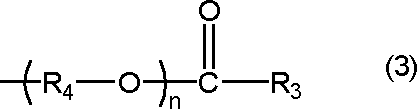
一般式(3)中、R3は炭化水素基を表し、R4は炭素数が2~4のアルキレン基を表す。R3及びR4の好ましい範囲は、前記したものと同様である。nは1以上の整数である。nの上限は特に限定されず、アルキレンオキシ基の導入量等により変わるが、例えば10程度である。nは好ましくは1~5であり、より好ましくは1~3であり、更に好ましくは2又は3である。
本発明のセルロース誘導体において、アルキレンオキシ基を1つだけ含む前記C)の基(上記式一般式(3)においてnが1である基)と、アルキレンオキシ基を2以上含む前記C)の基(上記式一般式(3)においてnが2以上である基)とを含んでいてもよい。
本発明のセルロース誘導体において、アルキレンオキシ基を1つだけ含む前記C)の基(上記式一般式(3)においてnが1である基)と、アルキレンオキシ基を2以上含む前記C)の基(上記式一般式(3)においてnが2以上である基)とを含んでいてもよい。
D)アシル基(-CO-R5)において、R5は炭化水素基を表す。R5が表す炭化水素基としては、前記R3で挙げたものと同様のものを適用することができる。R5の好ましい範囲も前記R3と同様である。
前記R2が表す炭素数2~8の炭化水素基、及び前記R4が表す炭素数2~4の炭化水素基、前記R3及び前記R5が表す炭化水素基は、さらなる置換基を有していてもよいし無置換でもよいが、無置換であることが好ましい。
前記R3~R5がさらなる置換基を有する場合、さらなる置換基としては、例えば、ハロゲン原子(例えばフッ素原子、塩素原子、臭素原子、ヨウ素原子)、ヒドロキシ基、アルコキシ基(アルキル基部分の炭素数は好ましくは1~5)、アルケニル基等が挙げられる。なお、前記Rがアルキル基以外である場合は、アルキル基(好ましくは炭素数1~5)を置換基として有することもできる。
特に、R3及びR5がさらなる置換基を有する場合、カルボキシル基、スルホン酸基、及びこれらの塩を実質的に有さないことが好ましい。セルロース誘導体がカルボキシル基、スルホン酸基、及びこれらの塩を実質的に有さないことにより、本発明の成形材料を水不溶性とすることができ、成形性を更に向上させることができる。また、セルロース誘導体がカルボキシル基、スルホン酸基、及びこれらの塩を有する場合、化合物安定性を悪化させることが知られており、特に熱分解を促進することがあるため、これらの基を含まないことが好ましい。
なお、「カルボキシル基、スルホン酸基、及びこれらの塩を実質的に有さない」とは、本発明におけるセルロース誘導体が全くカルボキシル基、スルホン酸基、及びこれらの塩を有さない場合のみならず、本発明におけるセルロース誘導体が水に不溶な範囲で微量のカルボキシル基、スルホン酸基、及びこれらの塩を有する場合を包含するものとする。例えば、原料であるセルロースにカルボキシル基が含まれる場合があり、これを用いて前記A)~D)の置換基を導入したセルロース誘導体はカルボキシル基が含まれる場合があるが、これは「カルボキシル基、スルホン酸基、及びこれらの塩を実質的に有さないセルロース誘導体」に含まれるものとする。
この場合、カルボキシル基、スルホン酸基、及びこれらの塩の好ましい含有量としては、セルロース誘導体に対して1質量%以下、より好ましくは0.5質量%以下である。
なお、「カルボキシル基、スルホン酸基、及びこれらの塩を実質的に有さない」とは、本発明におけるセルロース誘導体が全くカルボキシル基、スルホン酸基、及びこれらの塩を有さない場合のみならず、本発明におけるセルロース誘導体が水に不溶な範囲で微量のカルボキシル基、スルホン酸基、及びこれらの塩を有する場合を包含するものとする。例えば、原料であるセルロースにカルボキシル基が含まれる場合があり、これを用いて前記A)~D)の置換基を導入したセルロース誘導体はカルボキシル基が含まれる場合があるが、これは「カルボキシル基、スルホン酸基、及びこれらの塩を実質的に有さないセルロース誘導体」に含まれるものとする。
この場合、カルボキシル基、スルホン酸基、及びこれらの塩の好ましい含有量としては、セルロース誘導体に対して1質量%以下、より好ましくは0.5質量%以下である。
また、本発明におけるセルロース誘導体は、水に不溶であることが好ましい。ここで、「水に不溶である」とは、25℃の水100質量部への溶解度が5質量部以下であることとする。
本発明におけるセルロース誘導体の具体例としては、
アセトキシエチルメチルエチルアセチルセルロース、アセトキシエチルメチルプロピルアセチルセルロース、アセトキシエチルメチルイソプロピルアセチルセルロース、アセトキシエチルメチルヘキシルアセチルセルロース、アセトキシエチルメチルベンジルアセチルセルロース、プロピオニルオキシエチルメチルエチルアセチルセルロース、プロピオニルオキシエチルメチルプロピルアセチルセルロース、プロピオニルオキシエチルメチルイソプロピルアセチルセルロース、プロピオニルオキシエチルメチルヘキシルアセチルセルロース、プロピオニルオキシエチルメチルベンジルアセチルセルロース
ブチリルオキシエチルメチルエチルアセチルセルロース、ブチリルオキシエチルメチルプロピルアセチルセルロース、ブチリルオキシエチルメチルイソプロピルアセチルセルロース、ブチリルオキシエチルメチルヘキシルアセチルセルロース、ブチリルオキシエチルメチルベンジルアセチルセルロース、ヘキサノイルオキシエチルメチルエチルアセチルセルロース、ヘキサノイルオキシエチルメチルプロピルアセチルセルロース、ヘキサノイルオキシエチルメチルイソプロピルアセチルセルロース、ヘキサノイルオキシエチルメチルヘキシルアセチルセルロース、ヘキサノイルオキシエチルメチルベンジルアセチルセルロース、ベンゾイルオキシエチルメチルエチルアセチルセルロース、ベンゾイルオキシエチルメチルプロピルアセチルセルロース、ベンゾイルオキシエチルメチルイソプロピルアセチルセルロース、ベンゾイルオキシエチルメチルヘキシルアセチルセルロース、ベンゾイルオキシエチルメチルベンジルアセチルセルロース
アセトキシプロピルメチルエチルアセチルセルロース、アセトキシプロピルメチルプロピルアセチルセルロース、アセトキシプロピルメチルイソプロピルアセチルセルロース、アセトキシプロピルメチルヘキシルアセチルセルロース、アセトキシプロピルメチルベンジルアセチルセルロース、プロピオニルオキシプロピルメチルエチルアセチルセルロース、プロピオニルオキシプロピルメチルプロピルアセチルセルロース、プロピオニルオキシプロピルメチルイソプロピルアセチルセルロース、プロピオニルオキシプロピルメチルヘキシルアセチルセルロース、プロピオニルオキシプロピルメチルベンジルアセチルセルロース
ブチリルオキシプロピルメチルエチルアセチルセルロース、ブチリルオキシプロピルメチルプロピルアセチルセルロース、ブチリルオキシプロピルメチルイソプロピルアセチルセルロース、ブチリルオキシプロピルメチルヘキシルアセチルセルロース、ブチリルオキシプロピルメチルベンジルアセチルセルロース、ヘキサノイルオキシプロピルメチルエチルアセチルセルロース、ヘキサノイルオキシプロピルメチルプロピルアセチルセルロース、ヘキサノイルオキシプロピルメチルイソプロピルアセチルセルロース、ヘキサノイルオキシプロピルメチルヘキシルアセチルセルロース、ヘキサノイルオキシプロピルメチルベンジルアセチルセルロース、ベンゾイルオキシプロピルメチルエチルアセチルセルロース、ベンゾイルオキシプロピルメチルプロピルアセチルセルロース、ベンゾイルオキシプロピルメチルイソプロピルアセチルセルロース、ベンゾイルオキシプロピルメチルヘキシルアセチルセルロース、ベンゾイルオキシプロピルメチルベンジルアセチルセルロース
アセトキシブチルメチルエチルアセチルセルロース、アセトキシブチルメチルプロピルアセチルセルロース、アセトキシブチルメチルイソプロピルアセチルセルロース、アセトキシブチルメチルヘキシルアセチルセルロース、アセトキシブチルメチルベンジルアセチルセルロース、プロピオニルオキシブチルメチルエチルアセチルセルロース、プロピオニルオキシブチルメチルプロピルアセチルセルロース、プロピオニルオキシブチルメチルイソプロピルアセチルセルロース、プロピオニルオキシブチルメチルヘキシルアセチルセルロース、プロピオニルオキシブチルメチルベンジルアセチルセルロース
ブチリルオキシブチルメチルエチルアセチルセルロース、ブチリルオキシブチルメチルプロピルアセチルセルロース、ブチリルオキシブチルメチルイソプロピルアセチルセルロース、ブチリルオキシブチルメチルヘキシルアセチルセルロース、ブチリルオキシブチルメチルベンジルアセチルセルロース、ヘキサノイルオキシブチルメチルエチルアセチルセルロース、ヘキサノイルオキシブチルメチルプロピルアセチルセルロース、ヘキサノイルオキシブチルメチルイソプロピルアセチルセルロース、ヘキサノイルオキシブチルメチルヘキシルアセチルセルロース、ヘキサノイルオキシブチルメチルベンジルアセチルセルロース、ベンゾイルオキシブチルメチルエチルアセチルセルロース、ベンゾイルオキシブチルメチルプロピルアセチルセルロース、ベンゾイルオキシブチルメチルイソプロピルアセチルセルロース、ベンゾイルオキシブチルメチルヘキシルアセチルセルロース、ベンゾイルオキシブチルメチルベンジルアセチルセルロース
セルロース誘導体中のA)炭化水素基(メチル基)、B)炭化水素基(R2)、C)アシル基(-CO-R3)とアルキレンオキシ基(-R4-O-)とを含む基、及びD)アシル基(-CO-R5)の置換位置、並びにβ-グルコース環単位当たりの各置換基の数(置換度)は特に限定されない。
例えば、A)炭化水素基(メチル基)の置換度DSa(繰り返し単位中、β-グルコース環の2位、3位及び6位の水酸基に対するA)炭化水素基(メチル基)の数)は、0.5<DSaであることが好ましく、0.5<DSa<2.5がより好ましい。
B)炭化水素基(R2)の置換度DSb(繰り返し単位中、β-グルコース環の2位、3位及び6位の水酸基に対するB)炭化水素基(R2)の数)は、0.5<DSbであることが好ましく、0.5<DSb<2.5がより好ましい。
C)アシル基(-CO-R3)とアルキレンオキシ基(-R4-O-)とを含む基の置換度DSc(繰り返し単位中、β-グルコース環のセルロース構造の2位、3位及び6位の水酸基に対するB)アシル基とアルキレンオキシ基を含む基の数)は、0<DScであることが好ましい。0<DScであることにより、溶融開始温度を低くできるので、熱成形をより容易に行うことができる。
D)アシル基(-CO-R5)の置換度DSd(繰り返し単位中、β-グルコース環のセルロース構造の2位、3位及び6位の水酸基に対するC)アシル基の数)は、0.1<DSdであることが好ましく、0.1<DSd<2.0であることがより好ましい。
B)炭化水素基(R2)の置換度DSb(繰り返し単位中、β-グルコース環の2位、3位及び6位の水酸基に対するB)炭化水素基(R2)の数)は、0.5<DSbであることが好ましく、0.5<DSb<2.5がより好ましい。
C)アシル基(-CO-R3)とアルキレンオキシ基(-R4-O-)とを含む基の置換度DSc(繰り返し単位中、β-グルコース環のセルロース構造の2位、3位及び6位の水酸基に対するB)アシル基とアルキレンオキシ基を含む基の数)は、0<DScであることが好ましい。0<DScであることにより、溶融開始温度を低くできるので、熱成形をより容易に行うことができる。
D)アシル基(-CO-R5)の置換度DSd(繰り返し単位中、β-グルコース環のセルロース構造の2位、3位及び6位の水酸基に対するC)アシル基の数)は、0.1<DSdであることが好ましく、0.1<DSd<2.0であることがより好ましい。
また、セルロース誘導体中に存在する無置換の水酸基の数も特に限定されない。水素原子の置換度DSh(繰り返し単位中、2位、3位及び6位の水酸基が無置換である割合)は0~1.5の範囲とすることができ、好ましくは0~0.6とすればよい。DShを0.6以下とすることにより、熱成形材料の流動性を向上させたり、熱分解の加速・成形時の熱成形材料の吸水による発泡等を抑制させたりできる。
また、本発明におけるセルロース誘導体は、前記A)炭化水素基(メチル基)、B)炭化水素基(R2)、C)アシル基(-CO-R3)とアルキレンオキシ基(-R4-O-)とを含む基、及びD)アシル基(-CO-R5)以外の置換基を有しても良い。有してもよい置換基の例としては、例えばヒドロキシエチル基、ヒドロキシプロピル基、ヒドロキシエトキシエチル基、ヒドロキシプロポキシプロピル基、ヒドロキシエトキシエトキシエチル基、ヒドロキシプロポキシプロポキシプロピル基が挙げられる。よって、セルロース誘導体が有するすべての置換基の各置換度の総和は3であるが、(DSa+DSb+DSc+DSd+DSh)は3以下である。
また、前記C)の基におけるアルキレンオキシ基の導入量はモル置換度(MS:グルコース残基あたりの置換基の導入モル数)で表される(セルロース学会編集、セルロース辞典P142)。アルキレンオキシ基のモル置換度MSは、0<MSであることが好ましく、0<MS≦3.0であることがより好ましく、1.0≦MS<3.0であることが更に好ましい。MSが1.0以上(1.0≦MS)であることにより、靭性・成形性等を向上させることができ、熱成形材料に好適なセルロース誘導体が得られる。
セルロース誘導体の分子量は、数平均分子量(Mn)が100×103~10000×103の範囲が好ましく、200×103~1000×103の範囲が更に好ましく、500×103~900×103の範囲が最も好ましい。また、重量平均分子量(Mw)は、1000×103~10000×103の範囲が好ましく、2000×103~10000×103の範囲が更に好ましく、5000×103~7000×103の範囲が最も好ましい。この範囲の平均分子量とすることにより、成形体の成形性、力学強度等を向上させることができる。
分子量分布(MWD)は1.1~12.0の範囲が好ましく、5.0~11.0の範囲が更に好ましい。この範囲の分子量分布とすることにより、成形性等を向上させることができる。
本発明における、数平均分子量(Mn)、重量平均分子量(Mw)及び分子量分布(MWD)の測定は、ゲル・パーミエーション・クロマトグラフィー(GPC)を用いて行うことができる。具体的には、N-メチルピロリドンを溶媒とし、ポリスチレンゲルを使用し、標準単分散ポリスチレンの構成曲線から予め求められた換算分子量較正曲線を用いて求めることができる。
分子量分布(MWD)は1.1~12.0の範囲が好ましく、5.0~11.0の範囲が更に好ましい。この範囲の分子量分布とすることにより、成形性等を向上させることができる。
本発明における、数平均分子量(Mn)、重量平均分子量(Mw)及び分子量分布(MWD)の測定は、ゲル・パーミエーション・クロマトグラフィー(GPC)を用いて行うことができる。具体的には、N-メチルピロリドンを溶媒とし、ポリスチレンゲルを使用し、標準単分散ポリスチレンの構成曲線から予め求められた換算分子量較正曲線を用いて求めることができる。
2.セルロース誘導体の製造方法
本発明におけるセルロース誘導体の製造方法は特に限定されず、セルロースを原料とし、セルロースに対しエーテル化及びエステル化することにより本発明のセルロース誘導体を製造することができる。セルロースエーテルに対しエーテル化及びエステル化する工程あるいはセルロースエーテルに対しエステル化する工程を含むことが更に好ましく、最も好ましくは、本発明のセルロース誘導体の製造方法は、炭化水素基:-R1、炭化水素基:-R2、及びヒドロキシアルキル基:-R4-OH(R1はメチル基を表す。R2は炭素数2~8の炭化水素基を表す。R4は炭素数2~4の炭化水素基を表す。)を有するセルロースエーテルを更にエステル化する工程を含むものである。セルロースの原料としては限定的でなく、例えば、綿、リンター、パルプ等が挙げられる。
本発明におけるセルロース誘導体の製造方法は特に限定されず、セルロースを原料とし、セルロースに対しエーテル化及びエステル化することにより本発明のセルロース誘導体を製造することができる。セルロースエーテルに対しエーテル化及びエステル化する工程あるいはセルロースエーテルに対しエステル化する工程を含むことが更に好ましく、最も好ましくは、本発明のセルロース誘導体の製造方法は、炭化水素基:-R1、炭化水素基:-R2、及びヒドロキシアルキル基:-R4-OH(R1はメチル基を表す。R2は炭素数2~8の炭化水素基を表す。R4は炭素数2~4の炭化水素基を表す。)を有するセルロースエーテルを更にエステル化する工程を含むものである。セルロースの原料としては限定的でなく、例えば、綿、リンター、パルプ等が挙げられる。
前記A)炭化水素基:-R1(R1はメチル基を表す。)、B)炭化水素基:-R2(R2は炭素数2~8の炭化水素基を表す。)、C)アシル基:-CO-R3とアルキレンオキシ基:-R4-O-とを含む基(R3は炭化水素基を表す。R4は炭素数2~4の炭化水素基を表す。)、及びD)アシル基:-CO-R5(R5は炭化水素基を表す。)を有するセルロース誘導体の好ましい製造方法の態様は、セルロースエーテルに、塩基存在下、アルキルハライド又はアルキレンオキシド等を反応させることにより、更にエーテル化する工程、及び、得られたセルロースエーテル誘導体に、塩基存在下、酸クロリド又は酸無水物等を反応させることにより、エステル化する工程を含むものである。
アルキルハライド又はアルキレンオキシド等を反応させる方法としては、例えば、「セルロースの事典」131頁~164頁(朝倉書店、2000年)等に記載の方法を参考に行うことができる。また、酸クロライドを反応させる方法としては、例えばCellulose 10;283-296,2003に記載の方法を用いることができる。
前記セルロースエーテルとしては、例えば、セルロースに含まれるβ-グルコース環の2位、3位、及び6位の水酸基の水素原子の少なくとも一部が、炭化水素基に置換されたものを用いることができ、具体的には、メチルセルロース、エチルセルロース、プロピルセルロース、ブチルセルロース、アリルセルロース、ベンジルセルロース等が挙げられる。
アルキルハライド又はアルキレンオキシド等を反応させる方法としては、例えば、「セルロースの事典」131頁~164頁(朝倉書店、2000年)等に記載の方法を参考に行うことができる。また、酸クロライドを反応させる方法としては、例えばCellulose 10;283-296,2003に記載の方法を用いることができる。
前記セルロースエーテルとしては、例えば、セルロースに含まれるβ-グルコース環の2位、3位、及び6位の水酸基の水素原子の少なくとも一部が、炭化水素基に置換されたものを用いることができ、具体的には、メチルセルロース、エチルセルロース、プロピルセルロース、ブチルセルロース、アリルセルロース、ベンジルセルロース等が挙げられる。
炭化水素基とヒドロキシエチル基を有するセルロースエーテルとしては、具体的には、ヒドロキシエチルメチルセルロース、ヒドロキシエチルエチルセルロース、ヒドロキシエチルプロピルセルロース、メチルエチルヒドロキシエチルセルロース、ヒドロキシエチルアリルセルロース、ヒドロキシエチルベンジルセルロース等が挙げられる。好ましくは、メチルエチルヒドロキシエチルセルロースである。
炭化水素基とヒドロキシプロピル基を有するセルロースエーテルとしては、具体的には、ヒドロキシプロピルメチルセルロース、ヒドロキシプロピルエチルセルロース、ヒドロキシプロピルプロピルセルロース、ヒドロキシプロピルアリルセルロース、ヒドロキシプロピルベンジルセルロース等が挙げられる。好ましくは、ヒドロキシプロピルメチルセルロース、ヒドロキシプロピルエチルセルロースである。
炭化水素基とヒドロキシプロピル基を有するセルロースエーテルとしては、具体的には、ヒドロキシプロピルメチルセルロース、ヒドロキシプロピルエチルセルロース、ヒドロキシプロピルプロピルセルロース、ヒドロキシプロピルアリルセルロース、ヒドロキシプロピルベンジルセルロース等が挙げられる。好ましくは、ヒドロキシプロピルメチルセルロース、ヒドロキシプロピルエチルセルロースである。
炭化水素基とヒドロキシブチル基を有するセルロースエーテルとしては、具体的には、ヒドロキシブチルメチルセルロース、ヒドロキシブチルエチルセルロース、ヒドロキシブチルプロピルセルロース、メチルエチルヒドロキシブチルセルロース、ヒドロキシブチルアリルセルロース、ヒドロキシエチルベンジルセルロース等が挙げられる。好ましくは、メチルエチルヒドロキシエチルセルロース、ヒドロキシエチルメチルセルロース、ヒドロキシエチルエチルセルロースである。
メチルエチルヒドロキシエチルセルロースの場合、市販されているものを用いても良い。市販品には複数の粘度タイプがあり、約1000~8,000の粘度値である。一般的に高粘度グレードは低粘度のグレードに対して、分子量(Mn、Mw)が大きい。使用する粘度グレードを変えることにより、生成するセルロース誘導体の分子量を調整しても良い。
酸クロリドとしては、前記C)に含まれるアシル基及びD)アシル基に対応したカルボン酸クロライドを使用することができる。カルボン酸クロリドとしては、例えば、アセチルクロライド、プロピオニルクロライド、ブチリルクロリド、イソブチリルクロリド、ペンタノイルクロリド、2-メチルブタノイルクロリド、3-メチルブタノイルクロリド、ピバロイルクロリド、ヘキサノイルクロリド、2-メチルペンタノイルクロリド、3-メチルペンタノイルクロリド、4-メチルペンタノイルクロリド、2,2-ジメチルブタノイルクロリド、2,3-ジメチルブタノイルクロリド、3,3-ジメチルブタノイルクロリド、2-エチルブタノイルクロリド、ヘプタノイルクロリド、2-メチルヘキサノイルクロリド、3-メチルヘキサノイルクロリド、4-メチルヘキサノイルクロリド、5-メチルヘキサノイルクロリド、2,2-ジメチルペンタノイルクロリド、2,3-ジメチルペンタノイルクロリド、3,3-ジメチルペンタノイルクロリド、2-エチルペンタノイルクロリド、シクロヘキサノイルクロリド、オクタノイルクロリド、2-メチルヘプタノイルクロリド、3-メチルヘプタノイルクロリド、4-メチルヘプタノイルクロリド、5-メチルヘプタノイルクロリド、6-メチルヘプタノイルクロリド、2,2-ジメチルヘキサノイルクロリド、2,3-ジメチルヘキサノイルクロリド、3,3-ジメチルヘキサノイルクロリド、2-エチルヘキサノイルクロリド、2-プロピルペンタノイルクロリド、ノナノイルクロリド、2-メチルオクタノイルクロリド、3-メチルオクタノイルクロリド、4-メチルオクタノイルクロリド、5-メチルオクタノイルクロリド、6-メチルオクタノイルクロリド、2,2-ジメチルヘプタノイルクロリド、2,3-ジメチルヘプタノイルクロリド、3,3-ジメチルヘプタノイルクロリド、2-エチルヘプタノイルクロリド、2-プロピルヘキサノイルクロリド、2-ブチルペンタノイルクロリド、デカノイルクロリド、2-メチルノナノイルクロリド、3-メチルノナノイルクロリド、4-メチルノナノイルクロリド、5-メチルノナノイルクロリド、6-メチルノナノイルクロリド、7-メチルノナノイルクロリド、2,2-ジメチルオクタノイルクロリド、2,3-ジメチルオクタノイルクロリド、3,3-ジメチルオクタノイルクロリド、2-エチルオクタノイルクロリド、2-プロピルヘプタノイルクロリド、2-ブチルヘキサノイルクロリド等が挙げられる。
酸無水物としては、例えば前記C)に含まれるアシル基及びD)アシル基に対応したカルボン酸無水物を使用することができる。このようなカルボン酸無水物としては、例えば、酢酸無水物、プロピオン酸無水物、酪酸無水物、吉草酸無水物、ヘキサン酸無水物、ヘプタン酸無水物、オクタン酸無水物、2-エチルヘキサン酸無水物、ノナン酸無水物等が挙げられる。
なお、前述したとおり、本発明におけるセルロース誘導体は置換基としてカルボン酸を有さないことが好ましいため、例えば無水フタル酸、無水マレイン酸等のジカルボン酸等、セルロースと反応させてカルボキシル基が生じる化合物を用いないことが好ましい。
なお、前述したとおり、本発明におけるセルロース誘導体は置換基としてカルボン酸を有さないことが好ましいため、例えば無水フタル酸、無水マレイン酸等のジカルボン酸等、セルロースと反応させてカルボキシル基が生じる化合物を用いないことが好ましい。
触媒として、酸を用いても良い。好ましい酸としては、例えば硫酸、メタンスルホン酸、p-トルエンスルホン酸、過塩素酸、リン酸、トリフルオロ酢酸、トリクロロ酢酸等がある。更に好ましくは硫酸とメタンスルホン酸である。また、重硫酸塩も用いても良く、例えば、重硫酸リチウム、重硫酸ナトリウム、重硫酸カリウムが挙げられる。また、固体酸触媒も用いても良く、例えばイオン交換樹脂等の高分子固体酸触媒、ゼオライトに代表される無機酸化物固体酸触媒、特開2009-67730号公報で用いられるようなカーボン形の固体酸触媒が挙げられる。また、ルイス酸触媒も用いても良く、米国特許2,976,277号明細書で用いられるようなチタン酸エステル触媒、塩化亜鉛などが挙げられる。
触媒としては、塩基を用いても良い。例えば、ピリジン類、酢酸ナトリウムなどの酢酸のアルカリ金属塩、ジメチルアミノピリジン、アニリン類が挙げられる。
触媒を用いなくてもエステル化反応が進行する反応系もある。例えば、溶媒としてN,N―ジメチルアセトアミド、アセチル化剤としてアセチルクロライド或いはプロピオニルクロライドを使用する反応系が挙げられる。
溶剤としては、一般的な有機溶剤を使用することができる。中でも、カルボン酸やカルボキサミド系の溶剤が好ましい。カルボン酸としては、例えば前記B)に含まれるアシル基及びC)に含まれるアシル基に対応したカルボン酸を用いることができる。カルボン酸を用いる場合には、酢酸エチルやアセトニトリルを併用しても良い。カルボキサミド系の溶剤としては、特表10-5117129号や米国特許第2705710号明細書で用いられるようなものがあり、例えばN,N-ジメチルアセトアミドが挙げられる。また、特開2003-41052号公報で用いられるような塩化リチウムを含むジメチルスルホキサイドを用いても良い。又はロゲン化溶剤を使用しても良く、好ましくはジクロロメタンである。また塩基として用いることが可能なピリジンを溶剤として用いても良い。また特開平9-157301号公報で用いられるように、エステル化剤として用いる酸クロリドを溶剤として用いても良い。
原料として用いるセルロース誘導体(セルロースを含む)は、綿花リンタ及び木材パルプ等のバイオマス資源から作られる。セルロース誘導体以外の原料についてもバイオマス資源から作られたものを用いても良い。例えば、セルロース系バイオマス又はデンプン系バイオマスから生成されたエタノールから発酵法により生成された酢酸や無水酢酸を挙げることができる。
前処理として、特許2754066号公報にあるように、カルボン酸又は少量の酸触媒を含んだ酢酸を、原料のセルロース誘導体に添加して、混合しても良い。
原料のセルロース誘導体を使用前に乾燥して、含有水分を低減しても良い。含有水分は、無水酢酸と反応する副反応の原因となるため、含有水分を減らすことで、使用する無水酢酸量の低減が可能である。
特許第2754066号公報にあるように、触媒を分割して添加する、或いは添加速度をかえること、又はそれらを組み合わせることで、エステル化反応の速度を制御しても良い。エステル化反応は激しい発熱反応であり、かつ反応液が高粘となるため、除熱が困難となる場合には、有効である。
特開昭60-139701号公報にあるように、エステル化反応の全期間或いは初期を含む一部の期間、反応系内を減圧にし、発生する蒸気を凝縮させ、反応系害に流出させることにより反応生成物の濃縮を行っても良い。この方法では、エステル化反応によって発生する反応熱を揮発性溶媒の蒸発潜熱で奪うことにより除熱をすることができる。
特表2000-511588号公報にあるように多段階でエステル化反応を行っても良い。例えば、第1段階として、塩基触媒の存在下でセルロースを第1アセチル化剤と反応させた後で、第2段階として、酸触媒の存在下で第2アセチル化剤と反応するなどである。
エステル化反応の温度は、高ければエステル化反応速度が早まり、反応時間短縮が可能となるが、解重合反応による分子量低下が起き易くなる。温度が低ければエステル化反応が遅くなる。目的のセルロース誘導体の構造、目標の分子量(Mn、Mw)により、反応温度及び時間の調整することが好ましい。
エステル化反応を行う際に、国際公開第01/070820号にあるように、超音波を照射して反応しても良い。
エステル化反応では、反応の進行に伴って、反応器内の混合物は固液状態から次第にドープ状を呈するようになり、反応系内のドープ粘度が非常に高くなる。特公平2-5761号公報に記載されているように、反応系の気相成分を反応系外に留去しつつ、減圧条件でエステル化反応する方法では、更にドープ粘度が高くなる。これらのようにドープ粘度が非常に高くなる場合には、エステル化反応器として二軸のニーダーを用いるのが望ましい。ただし、溶媒のカルボン酸を増量する、或いは他の有機溶媒を併用することにより、反応液の濃度を下げることにより、ドープ粘度を下げることで、汎用のグラスラインニング製反応釜 等を使用することもできる。
エステル化工程が終了した後、塩基(通常は水溶液の形態)、又は水(アルコールでも良い)を加えて、未反応の無水酢酸を分解して反応を停止する。塩基を加える場合には、酸触媒が中和され、水を加える場合には酸触媒は中和されない。一般的には中和した方が良いが、中和しなくても良い。中和した方が良い場合は、例えばセルロース誘導体に結合した結合硫酸の影響により、合成したポリマーの熱安定性が低下する場合である。また、結合硫酸量を低減させるための方法として、特開2006-89574号公報にあるように、塩基を連続的に添加するなどの方法により、一度に中和せずに、結合硫酸が分解しやすい液性を保ちつつ、段階的に中和する方法をとることができる。中和剤として用いられるものとしては、塩基であれば特に限定されないが、好ましくはアルカリ金属化合物やアルカリ土類金属化合物が挙げられ、具体的には酢酸ナトリウム、酢酸カリウム、酢酸カルシウム、酢酸マグネシウム、水酸化カルシウム、水酸化マグネシウムなどである。
目的のセルロース誘導体の分離方法としては、特に限定されず、例えば沈殿、濾過、洗浄、乾燥、抽出、濃縮、カラムクロマトグラフィーなどの方法を単独で、又は2以上を適宜組み合わせて使用できるが、操作性、精製効率等の観点で、沈殿(再沈殿)操作により該セルロース誘導体を分離する方法が好ましい。沈殿操作は、該セルロース誘導体を含む反応液を該セルロース誘導体の貧溶媒中に投入する、又は該セルロース誘導体を含む溶液に貧溶媒を投入するなど、該セルロース誘導体を含む溶液を該貧溶媒と混合することにより行われる。
目的のセルロース誘導体の貧溶媒としては、該セルロース誘導体の溶解度の低い溶媒であれば良く、例えば、希酢酸、水、アルコール類などが挙げられる。好ましくは、希酢酸或いは水である。
得られた沈殿の固液分離方法としては、特に限定されず、濾過、沈降などの方法が使用できる。好ましくは濾過であり、減圧、加圧、重力、圧搾、遠心などを用いる各種脱水機を使用することができる。例えば、真空脱水機、加圧脱水機、ベルトプレス、遠心濾過脱水機、振動スクリーン、ローラープレス、ベルトスクリーンなどが挙げられる。
分離された沈殿物は、水洗などの洗浄により酢酸、酸触媒として使用した酸、溶媒、遊離の金属成分を除去する場合が多い。特に酢酸、酸触媒として使用した酸は、成形時における樹脂の分子量低下とそれによる物理性能の低下の原因となるため、除くことが好ましい。
洗浄の際に中和剤を加えても良い。中和剤として用いられるものとしては、塩基であれば特に限定されないが、好ましくはアルカリ金属化合物やアルカリ土類金属化合物が挙げられ、具体的には酢酸ナトリウム、酢酸カリウム、酢酸カルシウム、酢酸マグネシウム、水酸化カルシウム、水酸化マグネシウムなどである。また、特公平6-67961号公報にあるように、緩衝液を洗浄に用いても良い。
乾燥方法は特に限定されず、送風や減圧などの条件下乾燥を行う、各種乾燥機を使用することができる。
そのほかの具体的な製造条件等は、常法に従うことができる。例えば、「セルロースの事典」131頁~164頁(朝倉書店、2000年)等に記載の方法を参考にすることができる。
3.樹脂組成物及び成型体
本発明の樹脂組成物は、上記で説明したセルロース誘導体を含有しており、必要に応じてその他の添加剤を含有することができる。
熱成形材料に含まれる成分の含有割合は、特に限定されない。好ましくはセルロース誘導体を75質量%以上、より好ましくは80質量%以上、更に好ましくは80~100質量%含有する。
本発明の熱成形材料は、本発明のセルロース誘導体のほか、必要に応じて、フィラー、難燃剤等の種々の添加剤を含有していてもよい。
本発明の樹脂組成物は、上記で説明したセルロース誘導体を含有しており、必要に応じてその他の添加剤を含有することができる。
熱成形材料に含まれる成分の含有割合は、特に限定されない。好ましくはセルロース誘導体を75質量%以上、より好ましくは80質量%以上、更に好ましくは80~100質量%含有する。
本発明の熱成形材料は、本発明のセルロース誘導体のほか、必要に応じて、フィラー、難燃剤等の種々の添加剤を含有していてもよい。
本発明の樹脂組成物は、フィラー(強化材)を含有してもよい。フィラーを含有することにより、形成される成形体の機械的特性を強化することができる。
フィラーとしては、公知のものを使用できる。フィラーの形状は、繊維状、板状、粒状、粉末状等いずれでもよい。また、無機物でも有機物でもよい。
具体的には、無機フィラーとしては、ガラス繊維、炭素繊維、グラファイト繊維、金属繊維、チタン酸カリウムウイスカー、ホウ酸アルミニウムウイスカー、マグネシウム系ウイスカー、珪素系ウイスカー、ワラステナイト、セピオライト、スラグ繊維、ゾノライト、エレスタダイト、石膏繊維、シリカ繊維、シリカ・アルミナ繊維、ジルコニア繊維、窒化硼素繊維、窒化硅素繊維及び硼素繊維等の繊維状の無機フィラーや;ガラスフレーク、非膨潤性雲母、カーボンブラック、グラファイト、金属箔、セラミックビーズ、タルク、クレー、マイカ、セリサイト、ゼオライト、ベントナイト、ドロマイト、カオリン、微粉ケイ酸、長石粉、チタン酸カリウム、シラスバルーン、炭酸カルシウム、炭酸マグネシウム、硫酸バリウム、酸化カルシウム、酸化アルミニウム、酸化チタン、酸化マグネシウム、ケイ酸アルミニウム、酸化ケイ素、水酸化アルミニウム、水酸化マグネシウム、石膏、ノバキュライト、ドーソナイト、白土等の板状や粒状の無機フィラーが挙げられる。
具体的には、無機フィラーとしては、ガラス繊維、炭素繊維、グラファイト繊維、金属繊維、チタン酸カリウムウイスカー、ホウ酸アルミニウムウイスカー、マグネシウム系ウイスカー、珪素系ウイスカー、ワラステナイト、セピオライト、スラグ繊維、ゾノライト、エレスタダイト、石膏繊維、シリカ繊維、シリカ・アルミナ繊維、ジルコニア繊維、窒化硼素繊維、窒化硅素繊維及び硼素繊維等の繊維状の無機フィラーや;ガラスフレーク、非膨潤性雲母、カーボンブラック、グラファイト、金属箔、セラミックビーズ、タルク、クレー、マイカ、セリサイト、ゼオライト、ベントナイト、ドロマイト、カオリン、微粉ケイ酸、長石粉、チタン酸カリウム、シラスバルーン、炭酸カルシウム、炭酸マグネシウム、硫酸バリウム、酸化カルシウム、酸化アルミニウム、酸化チタン、酸化マグネシウム、ケイ酸アルミニウム、酸化ケイ素、水酸化アルミニウム、水酸化マグネシウム、石膏、ノバキュライト、ドーソナイト、白土等の板状や粒状の無機フィラーが挙げられる。
有機フィラーとしては、ポリエステル繊維、ナイロン繊維、アクリル繊維、再生セルロース繊維、アセテート繊維等の合成繊維、ケナフ、ラミー、木綿、ジュート、麻、サイザル、マニラ麻、亜麻、リネン、絹、ウール等の天然繊維、微結晶セルロース、さとうきび、木材パルプ、紙屑、古紙等から得られる繊維状の有機フィラーや、有機顔料等の粒状の有機フィラーが挙げられる。
樹脂組成物がフィラーを含有する場合、その含有量は限定的でないが、セルロース誘導体100質量部に対して、通常30質量部以下、好ましくは5~10質量部とすればよい。
本発明の樹脂組成物は、難燃剤を含有してもよい。これによって、その燃焼速度の低下又は抑制といった難燃効果を向上させることができる。
難燃剤は、特に限定されず、常用のものを用いることができる。例えば、臭素系難燃剤、塩素系難燃剤、リン含有難燃剤、ケイ素含有難燃剤、窒素化合物系難燃剤、無機系難燃剤等が挙げられる。これらの中でも、樹脂との複合時や成形加工時に熱分解してハロゲン化水素が発生して加工機械や金型を腐食させたり、作業環境を悪化させたりすることがなく、また、焼却廃棄時にハロゲンが気散したり、分解してダイオキシン類等の有害物質の発生等によって環境に悪影響を与える可能性が少ないことから、リン含有難燃剤及びケイ素含有難燃剤が好ましい。
難燃剤は、特に限定されず、常用のものを用いることができる。例えば、臭素系難燃剤、塩素系難燃剤、リン含有難燃剤、ケイ素含有難燃剤、窒素化合物系難燃剤、無機系難燃剤等が挙げられる。これらの中でも、樹脂との複合時や成形加工時に熱分解してハロゲン化水素が発生して加工機械や金型を腐食させたり、作業環境を悪化させたりすることがなく、また、焼却廃棄時にハロゲンが気散したり、分解してダイオキシン類等の有害物質の発生等によって環境に悪影響を与える可能性が少ないことから、リン含有難燃剤及びケイ素含有難燃剤が好ましい。
リン含有難燃剤としては、特に限定されることはなく、常用のものを用いることができる。例えば、リン酸エステル、リン酸縮合エステル、ポリリン酸塩などの有機リン系化合物が挙げられる。
リン酸エステルの具体例としては、トリメチルホスフェート、トリエチルホスフェート、トリブチルホスフェート、トリ(2-エチルヘキシル)ホスフェート、トリブトキシエチルホスフェート、トリフェニルホスフェート、トリクレジルホスフェート、トリキシレニルホスフェート、トリス(イソプロピルフェニル)ホスフェート、トリス(フェニルフェニル)ホスフェート、トリナフチルホスフェート、クレジルジフェニルホスフェート、キシレニルジフェニルホスフェート、ジフェニル(2-エチルヘキシル)ホスフェート、ジ(イソプロピルフェニル)フェニルホスフェート、モノイソデシルホスフェート、2-アクリロイルオキシエチルアシッドホスフェート、2-メタクリロイルオキシエチルアシッドホスフェート、ジフェニル-2-アクリロイルオキシエチルホスフェート、ジフェニル-2-メタクリロイルオキシエチルホスフェート、メラミンホスフェート、ジメラミンホスフェート、メラミンピロホスフェート、トリフェニルホスフィンオキサイド、トリクレジルホスフィンオキサイド、メタンホスホン酸ジフェニル、フェニルホスホン酸ジエチルなどを挙げることができる。
リン酸縮合エステルとしては、例えば、レゾルシノールポリフェニルホスフェート、レゾルシノールポリ(ジ-2,6-キシリル)ホスフェート、ビスフェノールAポリクレジルホスフェート、ハイドロキノンポリ(2,6-キシリル)ホスフェート並びにこれらの縮合物などの芳香族リン酸縮合エステル等を挙げることができる。
また、リン酸、ポリリン酸と周期律表1族~14族の金属、アンモニア、脂肪族アミン、芳香族アミンとの塩からなるポリリン酸塩を挙げることもできる。ポリリン酸塩の代表的な塩として、金属塩としてリチウム塩、ナトリウム塩、カルシウム塩、バリウム塩、鉄(II)塩、鉄(III)塩、アルミニウム塩など、脂肪族アミン塩としてメチルアミン塩、エチルアミン塩、ジエチルアミン塩、トリエチルアミン塩、エチレンジアミン塩、ピペラジン塩などがあり、芳香族アミン塩としてはピリジン塩、トリアジン等が挙げられる。
また、前記以外にも、トリスクロロエチルホスフェート、トリスジクロロプロピルホスフェート、トリス(β-クロロプロピル)ホスフェート)などの含ハロゲンリン酸エステル、また、リン原子と窒素原子が二重結合で結ばれた構造を有するホスファゼン化合物、リン酸エステルアミドを挙げることができる。
これらのリン含有難燃剤は、1種単独でも2種以上を組み合わせて用いてもよい。
これらのリン含有難燃剤は、1種単独でも2種以上を組み合わせて用いてもよい。
ケイ素含有難燃剤としては、二次元又は三次元構造の有機ケイ素化合物、ポリジメチルシロキサン、又はポリジメチルシロキサンの側鎖又は末端のメチル基が、水素原子、置換又は非置換の脂肪族炭化水素基、芳香族炭化水素基で置換又は修飾されたもの、いわゆるシリコーンオイル、又は変性シリコーンオイルが挙げられる。
置換又は非置換の脂肪族炭化水素基、芳香族炭化水素基としては、例えば、アルキル基、シクロアルキル基、フェニル基、ベンジル基、アミノ基、エポキシ基、ポリエーテル基、カルボキシル基、メルカプト基、クロロアルキル基、アルキル高級アルコールエステル基、アルコール基、アラルキル基、ビニル基、又はトリフロロメチル基等が挙げられる。
これらのケイ素含有難燃剤は1種単独でも2種以上を組み合わせて用いてもよい。
これらのケイ素含有難燃剤は1種単独でも2種以上を組み合わせて用いてもよい。
また、前記リン含有難燃剤又はケイ素含有難燃剤以外の難燃剤としては、例えば、水酸化マグネシウム、水酸化アルミニウム、三酸化アンチモン、五酸化アンチモン、アンチモン酸ソーダ、ヒドロキシスズ酸亜鉛、スズ酸亜鉛、メタスズ酸、酸化スズ、酸化スズ塩、硫酸亜鉛、酸化亜鉛、酸化第一鉄、酸化第二鉄、酸化第一錫、酸化第二スズ、ホウ酸亜鉛、ホウ酸アンモニウム、オクタモリブデン酸アンモニウム、タングステン酸の金属塩、タングステンとメタロイドとの複合酸化物、スルファミン酸アンモニウム、臭化アンモニウム、ジルコニウム系化合物、グアニジン系化合物、フッ素系化合物、黒鉛、膨潤性黒鉛等の無機系難燃剤を用いることができる。これらの他の難燃剤は、1種単独で用いても、2種以上を併用して用いてもよい。
本発明の樹脂組成物が難燃剤を含有する場合、その含有量は限定的でないが、セルロース誘導体100質量部に対して、通常30質量部以下、好ましくは2~10質量部とすればよい。この範囲とすることにより、耐衝撃性・脆性等を改良させたり、ペレットブロッキングの発生を抑制できる。
本発明の樹脂組成物は、前記のセルロース誘導体、フィラー及び難燃剤以外にも、本発明の目的を阻害しない範囲で、成形性・難燃性等の各種特性をより一層改善する目的で他の成分を含んでいてもよい。
他の成分としては、例えば、前記セルロース誘導体以外のポリマー、可塑剤、安定剤(酸化防止剤、紫外線吸収剤など)、離型剤(脂肪酸、脂肪酸金属塩、オキシ脂肪酸、脂肪酸エステル、脂肪族部分鹸化エステル、パラフィン、低分子量ポリオレフィン、脂肪酸アミド、アルキレンビス脂肪酸アミド、脂肪族ケトン、脂肪酸低級アルコールエステル、脂肪酸多価アルコールエステル、脂肪酸ポリグリコールエステル、変成シリコーン)、帯電防止剤、難燃助剤、加工助剤、ドリップ防止剤、抗菌剤、防カビ剤等が挙げられる。更に、染料や顔料を含む着色剤などを添加することもできる。
他の成分としては、例えば、前記セルロース誘導体以外のポリマー、可塑剤、安定剤(酸化防止剤、紫外線吸収剤など)、離型剤(脂肪酸、脂肪酸金属塩、オキシ脂肪酸、脂肪酸エステル、脂肪族部分鹸化エステル、パラフィン、低分子量ポリオレフィン、脂肪酸アミド、アルキレンビス脂肪酸アミド、脂肪族ケトン、脂肪酸低級アルコールエステル、脂肪酸多価アルコールエステル、脂肪酸ポリグリコールエステル、変成シリコーン)、帯電防止剤、難燃助剤、加工助剤、ドリップ防止剤、抗菌剤、防カビ剤等が挙げられる。更に、染料や顔料を含む着色剤などを添加することもできる。
前記セルロース誘導体以外のポリマーとしては、熱可塑性ポリマー、熱硬化性ポリマーのいずれも用い得るが、成形性の点から熱可塑性ポリマーが好ましい。セルロース誘導体以外のポリマーの具体例としては、低密度ポリエチレン、直鎖状低密度ポリエチレン、高密度ポリエチレン、ポリプロピレン、エチレン-プロピレン共重合体、エチレン-プロピレン-非共役ジエン共重合体、エチレン-ブテン-1共重合体、ポリプロピレンホモポリマー、ポリプロピレンコポリマー(エチレン-プロピレンブロックコポリマーなど)、ポリブテン-1及びポリ-4-メチルペンテン-1等のポリオレフィン、ポリブチレンテレフタレート、ポリエチレンテレフタレート及びその他の芳香族ポリエステル等のポリエステル、ナイロン6、ナイロン46、ナイロン66、ナイロン610、ナイロン612、ナイロン6T、ナイロン12等のポリアミド、ポリスチレン、ハイインパクトポリスチレン、ポリアセタール(ホモポリマー及び共重合体を含む)、ポリウレタン、芳香族及び脂肪族ポリケトン、ポリフェニレンサルファイド、ポリエーテルエーテルケトン、熱可塑性澱粉樹脂、ポリメタクリル酸メチルやメタクリル酸エステル-アクリル酸エステル共重合体などのアクリル樹脂、AS樹脂(アクリロニトリル-スチレン共重合体)、ABS樹脂、AES樹脂(エチレン系ゴム強化AS樹脂)、ACS樹脂(塩素化ポリエチレン強化AS樹脂)、ASA樹脂(アクリル系ゴム強化AS樹脂)、ポリ塩化ビニル、ポリ塩化ビニリデン、ビニルエステル系樹脂、無水マレイン酸-スチレン共重合体、MS樹脂(メタクリル酸メチル-スチレン共重合体)、ポリカーボネート、ポリアリレート、ポリスルホン、ポリエーテルスルホン、フェノキシ樹脂、ポリフェニレンエーテル、変性ポリフェニレンエーテル、ポリエーテルイミド等の熱可塑性ポリイミド、ポリテトラフルオロエチレン、テトラフルオロエチレン-ヘキサフルオロプロピレン共重合体、テトラフルオロエチレン-エチレン共重合体、テトラフルオロエチレン-パーフルオロアルキルビニルエーテル共重合体、ポリクロロトリフルオロエチレン、ポリフッ化ビニリデン、テトラフルオロエチレン-ヘキサフルオロプロピレン-パーフルオロアルキルビニルエーテル共重合体などのフッ素系ポリマー、酢酸セルロース、ポリビニルアルコール、不飽和ポリエステル、メラミン樹脂、フェノール樹脂、尿素樹脂、ポリイミドなどを挙げることができる。
また、各種アクリルゴム、エチレン-酢酸ビニル共重合体、エチレン-アクリル酸共重合体及びそのアルカリ金属塩(いわゆるアイオノマー)、エチレン-アクリル酸アルキルエステル共重合体(例えば、エチレン-アクリル酸エチル共重合体、エチレン-アクリル酸ブチル共重合体)、ジエン系ゴム(例えば、1,4-ポリブタジエン、1,2-ポリブタジエン、ポリイソプレン、ポリクロロプレン)、ジエンとビニル単量体との共重合体(例えば、スチレン-ブタジエンランダム共重合体、スチレン-ブタジエンブロック共重合体、スチレン-ブタジエン-スチレンブロック共重合体、スチレン-イソプレンランダム共重合体、スチレン-イソプレンブロック共重合体、スチレン-イソプレン-スチレンブロック共重合体、ポリブタジエンにスチレンをグラフト共重合させたもの、ブタジエン-アクリロニトリル共重合体)、ポリイソブチレン、イソブチレンとブタジエン又はイソプレンとの共重合体、ブチルゴム、天然ゴム、チオコールゴム、多硫化ゴム、アクリルゴム、ニトリルゴム、ポリエーテルゴム、エピクロロヒドリンゴム、フッ素ゴム、シリコーンゴム、その他ポリウレタン系やポリエステル系、ポリアミド系などの熱可塑性エラストマー等が挙げられる。
また、各種アクリルゴム、エチレン-酢酸ビニル共重合体、エチレン-アクリル酸共重合体及びそのアルカリ金属塩(いわゆるアイオノマー)、エチレン-アクリル酸アルキルエステル共重合体(例えば、エチレン-アクリル酸エチル共重合体、エチレン-アクリル酸ブチル共重合体)、ジエン系ゴム(例えば、1,4-ポリブタジエン、1,2-ポリブタジエン、ポリイソプレン、ポリクロロプレン)、ジエンとビニル単量体との共重合体(例えば、スチレン-ブタジエンランダム共重合体、スチレン-ブタジエンブロック共重合体、スチレン-ブタジエン-スチレンブロック共重合体、スチレン-イソプレンランダム共重合体、スチレン-イソプレンブロック共重合体、スチレン-イソプレン-スチレンブロック共重合体、ポリブタジエンにスチレンをグラフト共重合させたもの、ブタジエン-アクリロニトリル共重合体)、ポリイソブチレン、イソブチレンとブタジエン又はイソプレンとの共重合体、ブチルゴム、天然ゴム、チオコールゴム、多硫化ゴム、アクリルゴム、ニトリルゴム、ポリエーテルゴム、エピクロロヒドリンゴム、フッ素ゴム、シリコーンゴム、その他ポリウレタン系やポリエステル系、ポリアミド系などの熱可塑性エラストマー等が挙げられる。
更に、各種の架橋度を有するものや、各種のミクロ構造、例えばシス構造、トランス構造等を有するもの、ビニル基などを有するもの、あるいは各種の平均粒径を有するものや、コア層とそれを覆う1以上のシェル層から構成され、また隣接し合った層が異種の重合体から構成されるいわゆるコアシェルゴムと呼ばれる多層構造重合体なども使用することができ、更にシリコーン化合物を含有したコアシェルゴムも使用することができる。
これらのポリマーは、1種単独で用いても、2種以上を併用してもよい。
これらのポリマーは、1種単独で用いても、2種以上を併用してもよい。
本発明の樹脂組成物がセルロース誘導体以外のポリマーを含有する場合、その含有量は、セルロース誘導体100質量部に対して30質量部以下が好ましく、2~10質量部がより好ましい。
本発明の樹脂組成物は、可塑剤を含有してもよい。これにより、難燃性及び成形性をより一層向上させることができる。可塑剤としては、ポリマーの成形に常用されるものを用いることができる。例えば、ポリエステル系可塑剤、グリセリン系可塑剤、多価カルボン酸エステル系可塑剤、ポリアルキレングリコール系可塑剤及びエポキシ系可塑剤等が挙げられる。
ポリエステル系可塑剤の具体例としては、アジピン酸、セバチン酸、テレフタル酸、イソフタル酸、ナフタレンジカルボン酸、ジフェニルジカルボン酸、ロジンなどの酸成分と、プロピレングリコール、1,3-ブタンジオール、1,4-ブタンジオール、1,6-ヘキサンジオール、エチレングリコール、ジエチレングリコールなどのジオール成分からなるポリエステルや、ポリカプロラクトンなどのヒドロキシカルボン酸からなるポリエステル等が挙げられる。これらのポリエステルは単官能カルボン酸若しくは単官能アルコールで末端封鎖されていてもよく、またエポキシ化合物などで末端封鎖されていてもよい。
グリセリン系可塑剤の具体例としては、グリセリンモノアセトモノラウレート、グリセリンジアセトモノラウレート、グリセリンモノアセトモノステアレート、グリセリンジアセトモノオレート及びグリセリンモノアセトモノモンタネート等が挙げられる。
多価カルボン酸系可塑剤の具体例としては、フタル酸ジメチル、フタル酸ジエチル、フタル酸ジブチル、フタル酸ジオクチル、フタル酸ジヘプチル、フタル酸ジベンジル、フタル酸ブチルベンジルなどのフタル酸エステル、トリメリット酸トリブチル、トリメリット酸トリオクチル、トリメリット酸トリヘキシルなどのトリメリット酸エステル、アジピン酸ジイソデシル、アジピン酸n-オクチル-n-デシル、アジピン酸メチルジグリコールブチルジグリコール、アジピン酸ベンジルメチルジグリコール、アジピン酸ベンジルブチルジグリコールなどのアジピン酸エステル、アセチルクエン酸トリエチル、アセチルクエン酸トリブチルなどのクエン酸エステル、アゼライン酸ジ-2-エチルヘキシルなどのアゼライン酸エステル、セバシン酸ジブチル、及びセバシン酸ジ-2-エチルヘキシル等が挙げられる。
ポリアルキレングリコール系可塑剤の具体例としては、ポリエチレングリコール、ポリプロピレングリコール、ポリ(エチレンオキサイド・プロピレンオキサイド)ブロック及び/又はランダム共重合体、ポリテトラメチレングリコール、ビスフェノール類のエチレンオキシド付加重合体、ビスフェノール類のプロピレンオキシド付加重合体、ビスフェノール類のテトラヒドロフラン付加重合体などのポリアルキレングリコールあるいはその末端エポキシ変性化合物、末端エステル変性化合物、及び末端エーテル変性化合物等が挙げられる。
エポキシ系可塑剤とは、一般にはエポキシステアリン酸アルキルと大豆油とからなるエポキシトリグリセリドなどを指すが、その他にも、主にビスフェノールAとエピクロロヒドリンを原料とするような、いわゆるエポキシ樹脂も使用することができる。
その他の可塑剤の具体例としては、ネオペンチルグリコールジベンゾエート、ジエチレングリコールジベンゾエート、トリエチレングリコールジ-2-エチルブチレートなどの脂肪族ポリオールの安息香酸エステル、ステアリン酸アミドなどの脂肪酸アミド、オレイン酸ブチルなどの脂肪族カルボン酸エステル、アセチルリシノール酸メチル、アセチルリシノール酸ブチルなどのオキシ酸エステル、ペンタエリスリトール、各種ソルビトール等が挙げられる。
本発明の樹脂組成物が可塑剤を含有する場合、その含有量は、セルロース誘導体100質量部に対して通常5質量部以下であり、0.005~5質量部が好ましく、より好ましくは0.01~1質量部である。
本発明の成形体は、前記セルロース誘導体を含む樹脂組成物を成形することにより得られる。
より具体的には、前記セルロース誘導体、又は、前記セルロース誘導体及び必要に応じて各種添加剤等を含む樹脂組成物を加熱し、各種の成形方法により成形する工程を含む製造方法によって得られる。
成形方法としては、例えば、射出成形、押し出し成形、ブロー成形等が挙げられる。
加熱温度は、通常160~300℃であり、好ましくは180~260℃である。
より具体的には、前記セルロース誘導体、又は、前記セルロース誘導体及び必要に応じて各種添加剤等を含む樹脂組成物を加熱し、各種の成形方法により成形する工程を含む製造方法によって得られる。
成形方法としては、例えば、射出成形、押し出し成形、ブロー成形等が挙げられる。
加熱温度は、通常160~300℃であり、好ましくは180~260℃である。
本発明の成形体の用途は、とくに限定されるものではないが、例えば、電気電子機器(家電、OA・メディア関連機器、光学用機器及び通信機器等)の内装又は外装部品、自動車、機械部品、住宅・建築用材料等が挙げられる。これらの中でも、優れた成形性、及び耐衝撃性を有しており、環境への負荷が小さい観点から、例えば、コピー機、プリンター、パソコン、テレビ等といった電気電子機器用の外装部品(特に筐体)として好適に使用することができる。
以下に実施例及び比較例を挙げて本発明を具体的に説明するが、本発明の範囲は以下に示す実施例に限定されるものではない。
<合成例1:セルロース誘導体P-1の合成>
メカニカルスターラー、温度計、冷却管、滴下ロートをつけた2Lの三ツ口フラスコにヒドロキシプロピルメチルセルロース(商品名マーポローズ90MP4000;松本油脂製)50g、水酸化ナトリウム水溶液(水酸化ナトリウム92g/水62mL)を量りとり、室温で1時間攪拌した。更に、トルエン62mL、ベンジルクロリド248mLを投入し、120℃で6時間反応させた。反応液を室温まで放冷し、室温で激しく攪拌しながらメタノール2Lを添加すると白色無定形固体が得られた。白色無定形固体を大量のヘキサンで洗浄、ろ過を繰り返すことで、白色粉体が得られた。得られた白色粉体を100℃で6時間真空乾燥することで、目的のセルロース誘導体(P-1)の前駆体メチルベンジルヒドロキシプロピルセルロースを白色粉体として得た(61g)。
次に、メカニカルスターラー、温度計、冷却管、滴下ロートをつけた5Lの三ツ口フラスコに前記のメチルベンジルヒドロキシプロピルセルロース50g、N,N-ジメチルアセトアミド2000mLを量り取り、室温で攪拌した。反応系が透明になり完溶したことを確認した後、アセチルクロライド300mLをゆっくりと滴下し、系の温度を80℃~90℃に昇温した。このまま3時間攪拌した後、反応系の温度を室温まで冷却した。反応溶液を水10Lへ激しく攪拌しながら投入すると、白色固体が析出した。白色固体を吸引ろ過によりろ別し、大量の水で3回洗浄を行った。得られた白色固体を100℃で6時間真空乾燥することにより目的のセルロース誘導体(P-1)を白色粉体として得た(48g)。
メカニカルスターラー、温度計、冷却管、滴下ロートをつけた2Lの三ツ口フラスコにヒドロキシプロピルメチルセルロース(商品名マーポローズ90MP4000;松本油脂製)50g、水酸化ナトリウム水溶液(水酸化ナトリウム92g/水62mL)を量りとり、室温で1時間攪拌した。更に、トルエン62mL、ベンジルクロリド248mLを投入し、120℃で6時間反応させた。反応液を室温まで放冷し、室温で激しく攪拌しながらメタノール2Lを添加すると白色無定形固体が得られた。白色無定形固体を大量のヘキサンで洗浄、ろ過を繰り返すことで、白色粉体が得られた。得られた白色粉体を100℃で6時間真空乾燥することで、目的のセルロース誘導体(P-1)の前駆体メチルベンジルヒドロキシプロピルセルロースを白色粉体として得た(61g)。
次に、メカニカルスターラー、温度計、冷却管、滴下ロートをつけた5Lの三ツ口フラスコに前記のメチルベンジルヒドロキシプロピルセルロース50g、N,N-ジメチルアセトアミド2000mLを量り取り、室温で攪拌した。反応系が透明になり完溶したことを確認した後、アセチルクロライド300mLをゆっくりと滴下し、系の温度を80℃~90℃に昇温した。このまま3時間攪拌した後、反応系の温度を室温まで冷却した。反応溶液を水10Lへ激しく攪拌しながら投入すると、白色固体が析出した。白色固体を吸引ろ過によりろ別し、大量の水で3回洗浄を行った。得られた白色固体を100℃で6時間真空乾燥することにより目的のセルロース誘導体(P-1)を白色粉体として得た(48g)。
<合成例2:セルロース誘導体P-2の合成>
合成例1においてベンジルクロリドをプロピルブロミドに変更した以外は同様にして目的のセルロース誘導体(P-2)を黄白色粉体として得た(収量49g)。
合成例1においてベンジルクロリドをプロピルブロミドに変更した以外は同様にして目的のセルロース誘導体(P-2)を黄白色粉体として得た(収量49g)。
<合成例3:セルロース誘導体P-3の合成>
オートクレーブ(耐圧硝子工業製、簡易型オートクレーブTEM-D3000M)にヒドロキシプロピルメチルセルロース(商品名マーポローズ90MP4000;松本油脂製)100g、水酸化ナトリウム水溶液(水酸化ナトリウム148g/水150mL)を量り取り、窒素雰囲気下、45℃で1時間攪拌した。放冷後、ドライアイス/メタノールバスで-40℃に冷却し、更に、トルエン150mL、クロロエタン93gを加えて、60℃で1時間、90℃で6時間攪拌した。室温に戻した後、系内の残存ガスを排気し、内容物を水6Lへ激しく攪拌しながら投入することで灰褐色固体を得た。得られた灰褐色固体を熱水6Lで洗浄する操作を3回、更にメタノール2L/水6L混合溶媒で洗浄する操作を3回繰り返すことで灰白色固体を得た。得られた灰白色固体を吸引濾過によりろ別し、100℃で6時間真空乾燥することにより目的のセルロース誘導体(P-3)の前駆体メチルエチルヒドロキシプロピルセルロースを灰白色粉体として得た(収量125g)。
次に、メカニカルスターラー、温度計、冷却管、滴下ロートをつけた5Lの三ツ口フラスコに前記のメチルエチルヒドロキシプロピルセルロース50g、N,N-ジメチルアセトアミド2000mLを量り取り、室温で攪拌した。反応系が透明になり完溶したことを確認した後、アセチルクロライド300mLをゆっくりと滴下し、系の温度を80℃~90℃に昇温した。このまま3時間攪拌した後、反応系の温度を室温まで冷却した。反応溶液を水10Lへ激しく攪拌しながら投入すると、白色固体が析出した。白色固体を吸引ろ過によりろ別し、大量の水で3回洗浄を行った。得られた白色固体を100℃で6時間真空乾燥することにより目的のセルロース誘導体(P-3)を白色粉体として得た(45g)。
オートクレーブ(耐圧硝子工業製、簡易型オートクレーブTEM-D3000M)にヒドロキシプロピルメチルセルロース(商品名マーポローズ90MP4000;松本油脂製)100g、水酸化ナトリウム水溶液(水酸化ナトリウム148g/水150mL)を量り取り、窒素雰囲気下、45℃で1時間攪拌した。放冷後、ドライアイス/メタノールバスで-40℃に冷却し、更に、トルエン150mL、クロロエタン93gを加えて、60℃で1時間、90℃で6時間攪拌した。室温に戻した後、系内の残存ガスを排気し、内容物を水6Lへ激しく攪拌しながら投入することで灰褐色固体を得た。得られた灰褐色固体を熱水6Lで洗浄する操作を3回、更にメタノール2L/水6L混合溶媒で洗浄する操作を3回繰り返すことで灰白色固体を得た。得られた灰白色固体を吸引濾過によりろ別し、100℃で6時間真空乾燥することにより目的のセルロース誘導体(P-3)の前駆体メチルエチルヒドロキシプロピルセルロースを灰白色粉体として得た(収量125g)。
次に、メカニカルスターラー、温度計、冷却管、滴下ロートをつけた5Lの三ツ口フラスコに前記のメチルエチルヒドロキシプロピルセルロース50g、N,N-ジメチルアセトアミド2000mLを量り取り、室温で攪拌した。反応系が透明になり完溶したことを確認した後、アセチルクロライド300mLをゆっくりと滴下し、系の温度を80℃~90℃に昇温した。このまま3時間攪拌した後、反応系の温度を室温まで冷却した。反応溶液を水10Lへ激しく攪拌しながら投入すると、白色固体が析出した。白色固体を吸引ろ過によりろ別し、大量の水で3回洗浄を行った。得られた白色固体を100℃で6時間真空乾燥することにより目的のセルロース誘導体(P-3)を白色粉体として得た(45g)。
<合成例4:セルロース誘導体P-4の合成>
合成例3においてヒドロキシプロピルメチルセルロースをメチルセルロース(商品名SM-15:信越化学製)に、クロロエタンをクロロエタン/1,2-ブチレンオキシドに変更した以外は同様にして目的のセルロース誘導体(P-4)を白色粉体として得た(収量43g)。
合成例3においてヒドロキシプロピルメチルセルロースをメチルセルロース(商品名SM-15:信越化学製)に、クロロエタンをクロロエタン/1,2-ブチレンオキシドに変更した以外は同様にして目的のセルロース誘導体(P-4)を白色粉体として得た(収量43g)。
<合成例5:セルロース誘導体P-5の合成>
合成例1においてベンジルクロリドをヘキシルブロミドに変更した以外は同様にして目的のセルロース誘導体(P-5)を白色粉体として得た(収量51g)。
合成例1においてベンジルクロリドをヘキシルブロミドに変更した以外は同様にして目的のセルロース誘導体(P-5)を白色粉体として得た(収量51g)。
<合成例6:セルロース誘導体P-6の合成>
合成例1においてベンジルクロリドをイソプロピルブロミドに変更した以外は同様にして目的のセルロース誘導体(P-6)を黄白色粉体として得た(収量46g)。
合成例1においてベンジルクロリドをイソプロピルブロミドに変更した以外は同様にして目的のセルロース誘導体(P-6)を黄白色粉体として得た(収量46g)。
<合成例7:セルロース誘導体P-7の合成>
メカニカルスターラー、温度計、冷却管、滴下ロートをつけた5Lの三ツ口フラスコに前記のメチルエチルヒドロキシエチルセルロース(商品名Bermocoll8000:アクゾノーベル製)100g、N,N-ジメチルアセトアミド4000mLを量り取り、室温で攪拌した。反応系が透明になり完溶したことを確認した後、プロピオニルクロリド300mLをゆっくりと滴下し、系の温度を80℃~90℃に昇温した。このまま3時間攪拌した後、反応系の温度を室温まで冷却した。反応溶液を水10Lへ激しく攪拌しながら投入すると、白色固体が析出した。白色固体を吸引ろ過によりろ別し、大量の水で3回洗浄を行った。得られた白色固体を100℃で6時間真空乾燥することにより目的のセルロース誘導体(P-7)を白色粉体として得た(110g)。
メカニカルスターラー、温度計、冷却管、滴下ロートをつけた5Lの三ツ口フラスコに前記のメチルエチルヒドロキシエチルセルロース(商品名Bermocoll8000:アクゾノーベル製)100g、N,N-ジメチルアセトアミド4000mLを量り取り、室温で攪拌した。反応系が透明になり完溶したことを確認した後、プロピオニルクロリド300mLをゆっくりと滴下し、系の温度を80℃~90℃に昇温した。このまま3時間攪拌した後、反応系の温度を室温まで冷却した。反応溶液を水10Lへ激しく攪拌しながら投入すると、白色固体が析出した。白色固体を吸引ろ過によりろ別し、大量の水で3回洗浄を行った。得られた白色固体を100℃で6時間真空乾燥することにより目的のセルロース誘導体(P-7)を白色粉体として得た(110g)。
<合成例8:セルロース誘導体P-8の合成>
合成例7においてプロピオニルクロリドをヘキサノイルクロリドに変更した以外は同様にして目的のセルロース誘導体(P-8)を黄白色粉体として得た(収量130g)。
合成例7においてプロピオニルクロリドをヘキサノイルクロリドに変更した以外は同様にして目的のセルロース誘導体(P-8)を黄白色粉体として得た(収量130g)。
<合成例9:セルロース誘導体P-9の合成>
合成例7においてプロピオニルクロリドをベンゾイルクロリドに変更した以外は同様にして目的のセルロース誘導体(P-9)を白色粉体として得た(収量121g)。
合成例7においてプロピオニルクロリドをベンゾイルクロリドに変更した以外は同様にして目的のセルロース誘導体(P-9)を白色粉体として得た(収量121g)。
<合成例10:セルロース誘導体P-10の合成>
合成例7においてプロピオニルクロリドをアセチルクロリドに変更した以外は同様にして目的のセルロース誘導体(P-10)を白色粉体として得た(収量97g)。
合成例7においてプロピオニルクロリドをアセチルクロリドに変更した以外は同様にして目的のセルロース誘導体(P-10)を白色粉体として得た(収量97g)。
<合成例11:セルロース誘導体P-11の合成>
合成例7においてプロピオニルクロリドをブチリルクロリドに変更した以外は同様にして目的のセルロース誘導体(P-11)を白色粉体として得た(収量105g)。
合成例7においてプロピオニルクロリドをブチリルクロリドに変更した以外は同様にして目的のセルロース誘導体(P-11)を白色粉体として得た(収量105g)。
<合成例12:比較化合物H-3の合成>
合成例7においてメチルエチルヒドロキシエチルセルロースをヒドロキシプロピルセルロース(東京化成試薬)に、プロピオニルクロリドをアセチルクロリド/プロピオニルクロリドに変更した以外は同様にして目的の比較化合物(H-3)を白色粉体として得た(収量130g)。
合成例7においてメチルエチルヒドロキシエチルセルロースをヒドロキシプロピルセルロース(東京化成試薬)に、プロピオニルクロリドをアセチルクロリド/プロピオニルクロリドに変更した以外は同様にして目的の比較化合物(H-3)を白色粉体として得た(収量130g)。
[セルロース誘導体の分子量測定]
得られたセルロース誘導体について、数平均分子量(Mn)、重量平均分子量(Mw)、を測定した。これらの測定方法は以下の通りである。
数平均分子量(Mn)、重量平均分子量(Mw)の測定は、ゲル・パーミエーション・クロマトグラフィー(GPC)を用いた。具体的には、N‐メチルピロリドンを溶媒とし、ポリスチレンゲルを使用し、標準単分散ポリスチレンの構成曲線から予め求められた換算分子量較正曲線を用いて求めた。GPC装置は、HLC-8220GPC(東ソー社製)を使用した。数平均分子量(Mn)、重量平均分子量(Mw)をまとめて表1に示す。
得られたセルロース誘導体について、数平均分子量(Mn)、重量平均分子量(Mw)、を測定した。これらの測定方法は以下の通りである。
数平均分子量(Mn)、重量平均分子量(Mw)の測定は、ゲル・パーミエーション・クロマトグラフィー(GPC)を用いた。具体的には、N‐メチルピロリドンを溶媒とし、ポリスチレンゲルを使用し、標準単分散ポリスチレンの構成曲線から予め求められた換算分子量較正曲線を用いて求めた。GPC装置は、HLC-8220GPC(東ソー社製)を使用した。数平均分子量(Mn)、重量平均分子量(Mw)をまとめて表1に示す。
[セルロース誘導体の熱分解開始温度測定]
得られたセルロース誘導体について、熱分解開始温度を測定した。これらの測定方法は以下のとおりである。
熱重量/示差熱分析装置(Seiko Instruments Inc.製)を用い、窒素雰囲気下にて10℃/minで昇温したときのサンプルの2%重量減少温度を測定し、熱分解開始温度(Td)とした。熱分解開始温度(Td)をまとめて表1に示す。
得られたセルロース誘導体について、熱分解開始温度を測定した。これらの測定方法は以下のとおりである。
熱重量/示差熱分析装置(Seiko Instruments Inc.製)を用い、窒素雰囲気下にて10℃/minで昇温したときのサンプルの2%重量減少温度を測定し、熱分解開始温度(Td)とした。熱分解開始温度(Td)をまとめて表1に示す。
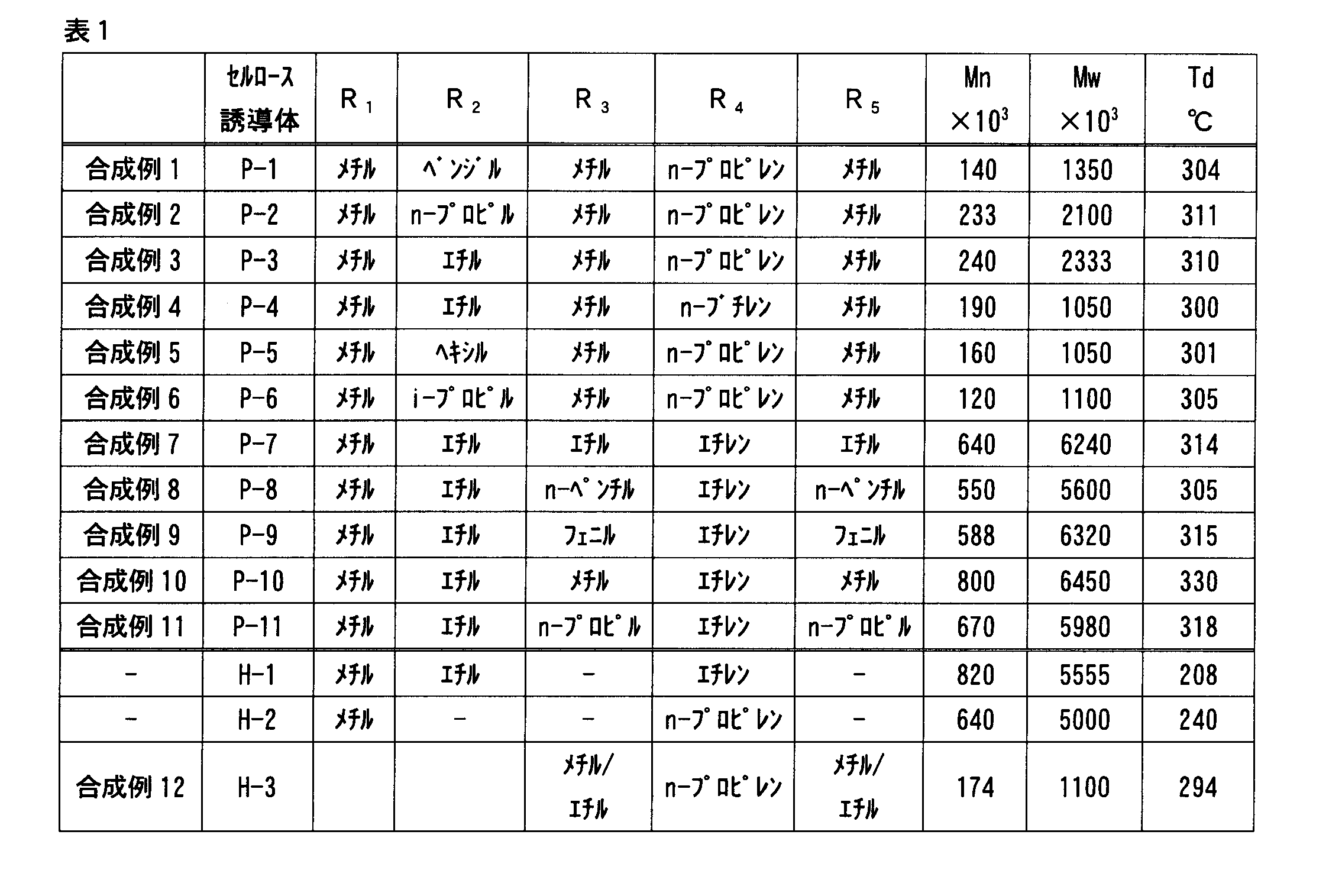
<実施例1:セルロース誘導体からなる成形体の作製>
[試験片作製]
上記で得られたセルロース誘導体(P-1)を射出成形機((株)井元製作所製、半自動射出成形機)に供給して表2に記載の成形温度(シリンダー温度)、金型温度40℃、射出圧力2.0kgf/cm2にて4×10×80mmの多目的試験片(衝撃試験片及び折り曲げ試験片)を成形した。
[試験片作製]
上記で得られたセルロース誘導体(P-1)を射出成形機((株)井元製作所製、半自動射出成形機)に供給して表2に記載の成形温度(シリンダー温度)、金型温度40℃、射出圧力2.0kgf/cm2にて4×10×80mmの多目的試験片(衝撃試験片及び折り曲げ試験片)を成形した。
<実施例2~15、比較例1~4>
実施例1と同様にして、セルロース誘導体(P-2)~(P-11)、比較化合物としてセルロース誘導体(H-1)(アクゾノーベル社製:Bermocoll EBM8000)、(H-2)(松本油脂製:マーポローズ90MP-100000)、比較例(H-3)を用いて、表2の成形条件に従って成形し多目的試験片を作製した。
実施例1と同様にして、セルロース誘導体(P-2)~(P-11)、比較化合物としてセルロース誘導体(H-1)(アクゾノーベル社製:Bermocoll EBM8000)、(H-2)(松本油脂製:マーポローズ90MP-100000)、比較例(H-3)を用いて、表2の成形条件に従って成形し多目的試験片を作製した。
[試験片の物性測定]
得られた試験片について、下記の方法にしたがってシャルピー衝撃強度、曲げ弾性率及び折り曲げ耐性を測定した。結果を表2に示す。
<シャルピー衝撃強度>
ISO179に準拠して、射出成形にて成形した試験片に入射角45±0.5°、先端0.25±0.05mmのノッチを形成し、30℃±2℃、50%±5%RHで48時間以上調整した後、シャルピー衝撃試験機によってエッジワイズにて衝撃強度を測定した。
<曲げ弾性率及び折り曲げ耐性>
JISK7171に準拠して曲げ試験機によって曲げ弾性率を測定した。また、曲げ弾性率試験において試験片の折り曲げ耐性を下記ランクに従い評価した。
◎:測定限界まで折り曲げても破壊されず、元の形状に戻る
○:測定限界まで折り曲げても破壊されないが、元の形状には戻らない
×:測定中に破壊される(破断する、若しくは亀裂を生じる)
得られた試験片について、下記の方法にしたがってシャルピー衝撃強度、曲げ弾性率及び折り曲げ耐性を測定した。結果を表2に示す。
<シャルピー衝撃強度>
ISO179に準拠して、射出成形にて成形した試験片に入射角45±0.5°、先端0.25±0.05mmのノッチを形成し、30℃±2℃、50%±5%RHで48時間以上調整した後、シャルピー衝撃試験機によってエッジワイズにて衝撃強度を測定した。
<曲げ弾性率及び折り曲げ耐性>
JISK7171に準拠して曲げ試験機によって曲げ弾性率を測定した。また、曲げ弾性率試験において試験片の折り曲げ耐性を下記ランクに従い評価した。
◎:測定限界まで折り曲げても破壊されず、元の形状に戻る
○:測定限界まで折り曲げても破壊されないが、元の形状には戻らない
×:測定中に破壊される(破断する、若しくは亀裂を生じる)
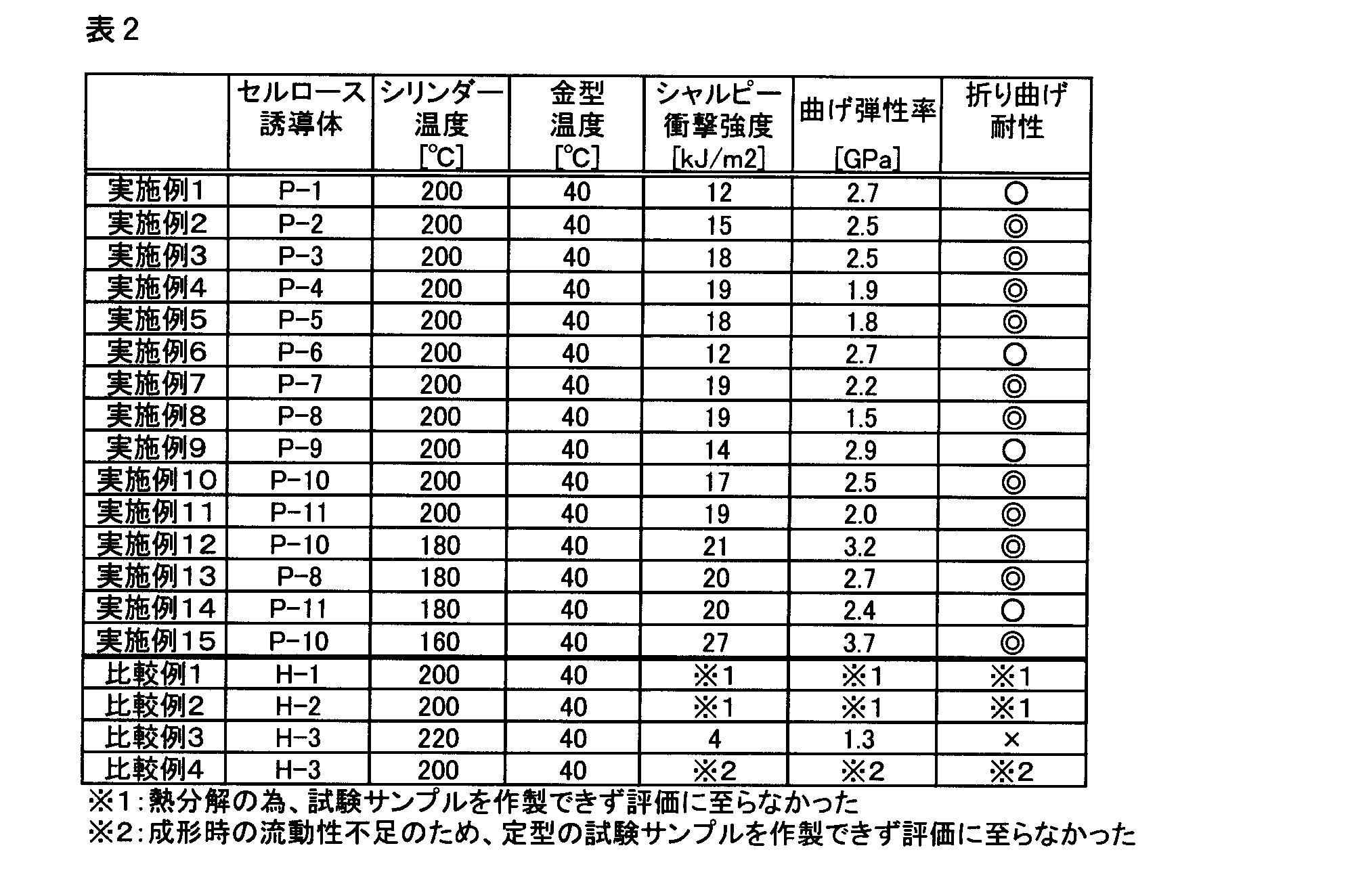
表2の結果から明らかなように、原料のセルロース誘導体(H-1)、(H-2)が熱可塑性を発現しないのに対し、これらにアシル基を修飾した本実施例1~11は好適な熱可塑性が付与され成形可能になった上、高い耐衝撃性及び曲げ弾性率を発現していることがわかる。また、比較例3~4のセルロース誘導体(H-3)は熱成形可能であったが、これらと比較しても本実施例1~11のセルロース誘導体は、低い温度で成形できかつシャルピー衝撃強度、曲げ弾性率ともに同等若しくはそれ以上の結果を与えていることがわかる。更に、本実施例12~15においては、より低い温度で成形した際に、シャルピー衝撃強度及び曲げ弾性率が向上するという驚くべき結果が得られ、より低温で熱可塑性を発現するセルロース誘導体を用いることで成形材料として好ましい靭性及び剛性を発現することがわかった。また、本発明のセルロース誘導体を用いた成形体においては、いずれも折り曲げ耐性という異質な物性を発現することを見出した。
図1に本実施例12及び比較例3の曲げ弾性率試験時の応力-歪み曲線を示す。応力-歪み曲線は、弾性率試験時に試験片にかけた応力と、その際に生じた試験片の歪み(mm)の関係を示すものである。図1から明らかなように、従来のセルロース誘導体(H-3)からなる試験サンプルが試験中に破壊されてしまう(比較例3)のに対し、本発明のセルロース誘導体(P-10)からなる試験サンプル(実施例12)は測定限界点まで破壊されることなく、ある一定の応力を示すことがわかる。
折り曲げ時に破壊され難いという性質は電気電子機器等の構成部品をはじめ、様々な用途で有用と考えられる。本発明者が鋭意検討した結果によれば、比較的分極率の低いエーテル置換基を複数個導入することにより、良好な成形性、靭性をバランス良く発現し、かつ分極率の高いエステル置換基を組み合わせることによって、エーテルのみでは得られない剛性を発現していると推測される。更に、複数個導入したエーテル置換基により適度な自由体積が生じることにより、折り曲げ時に効率良く応力を緩和することができ、折り曲げ耐性という特異物性を発現したと考えられる。
本発明のセルロース誘導体及び樹脂組成物は、優れた熱可塑性を有するため、成形体とすることができる。また、本発明のセルロース誘導体又は樹脂組成物によって形成された成形体は、良好な耐衝撃性、高弾性率等を有しており、自動車、家電、電気電子機器等の構成部品、機械部品、住宅・建築用材料等として好適に使用することができる。また、植物由来の樹脂であるため、温暖化防止に貢献できる素材として、従来の石油由来の樹脂に代替できる。
本発明を詳細にまた特定の実施態様を参照して説明したが、本発明の精神と範囲を逸脱することなく様々な変更や修正を加えることができることは当業者にとって明らかである。
本出願は、2011年2月10日出願の日本特許出願(特願2011-027909)に基づくものであり、その内容はここに参照として取り込まれる。
本出願は、2011年2月10日出願の日本特許出願(特願2011-027909)に基づくものであり、その内容はここに参照として取り込まれる。
Claims (10)
- A)炭化水素基:-R1(R1はメチル基を表す。)
B)炭化水素基:-R2(R2は炭素数2~8の炭化水素基を表す。)
C)アシル基:-CO-R3とアルキレンオキシ基:-R4-O-とを含む基(R3は炭化水素基を表す。R4は炭素数2~4の炭化水素基を表す。)、及び
D)アシル基:-CO-R5(R5は炭化水素基を表す。)を有するセルロース誘導体。 - 前記B)におけるR2がエチル基又はn-プロピル基である請求項1記載のセルロース誘導体。
- 前記C)におけるR4がエチレン基又はn-プロピレン基である請求項1又は2に記載のセルロース誘導体。
- 前記R3及びR5が表す炭化水素基が、脂肪族炭化水素基である、請求項1~3のいずれか1項に記載のセルロース誘導体。
- 前記R3及びR5が、それぞれ独立に、メチル基、エチル基、又はn-プロピル基である、請求項1~4のいずれか1項に記載のセルロース誘導体。
- 請求項1~5のいずれか1項に記載のセルロース誘導体の製造方法であって、
炭化水素基:-R1、炭化水素基:-R2、及びヒドロキシアルキル基:-R4-OH(R1はメチル基を表す。R2は炭素数2~8の炭化水素基を表す。R4は炭素数2~4の炭化水素基を表す。)を有するセルロースエーテルをエステル化する工程を含む、セルロース誘導体の製造方法。 - 請求項1~5のいずれか1項に記載のセルロース誘導体を含有する樹脂組成物。
- 請求項1~5のいずれか1項に記載のセルロース誘導体又は請求項7に記載の樹脂組成物を成形して得られる成形体。
- 請求項1~5のいずれか1項に記載のセルロース誘導体又は請求項7に記載の樹脂組成物を加熱し、成形する工程を備えた、成形体の製造方法。
- 請求項8に記載の成形体から構成される電気電子機器筐体。
Applications Claiming Priority (2)
| Application Number | Priority Date | Filing Date | Title |
|---|---|---|---|
| JP2011027909A JP2012167155A (ja) | 2011-02-10 | 2011-02-10 | セルロース誘導体、樹脂組成物、成形体及びその製造方法並びに電気電子機器用筐体 |
| JP2011-027909 | 2011-02-10 |
Publications (1)
| Publication Number | Publication Date |
|---|---|
| WO2012108234A1 true WO2012108234A1 (ja) | 2012-08-16 |
Family
ID=46638453
Family Applications (1)
| Application Number | Title | Priority Date | Filing Date |
|---|---|---|---|
| PCT/JP2012/050842 Ceased WO2012108234A1 (ja) | 2011-02-10 | 2012-01-17 | セルロース誘導体、樹脂組成物、成形体及びその製造方法並びに電気電子機器用筐体 |
Country Status (2)
| Country | Link |
|---|---|
| JP (1) | JP2012167155A (ja) |
| WO (1) | WO2012108234A1 (ja) |
Families Citing this family (2)
| Publication number | Priority date | Publication date | Assignee | Title |
|---|---|---|---|---|
| US10934368B2 (en) | 2015-12-28 | 2021-03-02 | Nec Corporation | Cellulose resin, material for molding, molded body and process for producing cellulose resin |
| US12139560B2 (en) | 2018-03-01 | 2024-11-12 | Nec Corporation | Cellulose resin, molding material, molded body, and method for producing cellulose resin |
Citations (7)
| Publication number | Priority date | Publication date | Assignee | Title |
|---|---|---|---|---|
| US3435027A (en) * | 1965-12-13 | 1969-03-25 | Hercules Inc | Cellulose ether-esters and process |
| JPS5223186A (en) * | 1975-08-14 | 1977-02-21 | Asahi Chem Ind Co Ltd | Process for preparing a thermoplastic cellulose ester |
| JPS59172501A (ja) * | 1982-12-29 | 1984-09-29 | ザ・ダウ・ケミカル・カンパニ− | エチルヒドロキシアルキルメチルセルロ−スエ−テル |
| JPH05339301A (ja) * | 1992-06-05 | 1993-12-21 | Shin Etsu Chem Co Ltd | カルボン酸エステル系セルロース誘導体の製造方法 |
| JP2005283997A (ja) * | 2004-03-30 | 2005-10-13 | Daicel Chem Ind Ltd | セルロースエーテルアセテート光学フィルム |
| JP2007099876A (ja) * | 2005-10-03 | 2007-04-19 | Daicel Chem Ind Ltd | セルロースエーテルエステル |
| WO2010001864A1 (ja) * | 2008-06-30 | 2010-01-07 | 富士フイルム株式会社 | セルロース誘導体及びその製造方法、セルロース樹脂組成物、成形体及びその製造方法、並びに電気電子機器用筐体 |
-
2011
- 2011-02-10 JP JP2011027909A patent/JP2012167155A/ja active Pending
-
2012
- 2012-01-17 WO PCT/JP2012/050842 patent/WO2012108234A1/ja not_active Ceased
Patent Citations (7)
| Publication number | Priority date | Publication date | Assignee | Title |
|---|---|---|---|---|
| US3435027A (en) * | 1965-12-13 | 1969-03-25 | Hercules Inc | Cellulose ether-esters and process |
| JPS5223186A (en) * | 1975-08-14 | 1977-02-21 | Asahi Chem Ind Co Ltd | Process for preparing a thermoplastic cellulose ester |
| JPS59172501A (ja) * | 1982-12-29 | 1984-09-29 | ザ・ダウ・ケミカル・カンパニ− | エチルヒドロキシアルキルメチルセルロ−スエ−テル |
| JPH05339301A (ja) * | 1992-06-05 | 1993-12-21 | Shin Etsu Chem Co Ltd | カルボン酸エステル系セルロース誘導体の製造方法 |
| JP2005283997A (ja) * | 2004-03-30 | 2005-10-13 | Daicel Chem Ind Ltd | セルロースエーテルアセテート光学フィルム |
| JP2007099876A (ja) * | 2005-10-03 | 2007-04-19 | Daicel Chem Ind Ltd | セルロースエーテルエステル |
| WO2010001864A1 (ja) * | 2008-06-30 | 2010-01-07 | 富士フイルム株式会社 | セルロース誘導体及びその製造方法、セルロース樹脂組成物、成形体及びその製造方法、並びに電気電子機器用筐体 |
Also Published As
| Publication number | Publication date |
|---|---|
| JP2012167155A (ja) | 2012-09-06 |
Similar Documents
| Publication | Publication Date | Title |
|---|---|---|
| JP5470032B2 (ja) | セルロース誘導体、熱成形材料、成形体及びその製造方法並びに電気電子機器用筐体 | |
| JP5757681B2 (ja) | セルロース誘導体、樹脂組成物、成形体及びその製造方法並びに電気電子機器用筐体 | |
| JP5412191B2 (ja) | セルロース樹脂組成物、成形体および電気電子機器用筐体 | |
| WO2011078275A1 (ja) | 成形材料、成形体、及びその製造方法、並びに電気電子機器用筐体 | |
| WO2011132745A1 (ja) | セルロース誘導体、樹脂組成物、成形材料、成形体、成形体の製造方法、及び電気電子機器用筐体 | |
| JP5639863B2 (ja) | 成形材料、成形体、及びその製造方法、並びに電気電子機器用筐体 | |
| WO2012108234A1 (ja) | セルロース誘導体、樹脂組成物、成形体及びその製造方法並びに電気電子機器用筐体 | |
| JP5470031B2 (ja) | 成形材料、成形体、及びその製造方法、並びに電気電子機器用筐体 | |
| JP5486918B2 (ja) | 成形材料、成形体、及びその製造方法、並びに電気電子機器用筐体 | |
| JP2011132454A (ja) | 成形材料、成形体、及びその製造方法、並びに電気電子機器用筐体 | |
| WO2011078283A1 (ja) | 成形材料、成形体、及びその製造方法、並びに電気電子機器用筐体 | |
| JP2010241848A (ja) | セルロース樹脂組成物、成形体及び電気電子機器用筺体 | |
| WO2010038711A1 (ja) | セルロース誘導体及びその製造方法、樹脂組成物、成形体及びその製造方法、電子機器用筐体 | |
| JP5639862B2 (ja) | 成形材料、成形体、及びその製造方法、並びに電気電子機器用筐体 | |
| WO2011078277A1 (ja) | 成形材料、成形体、及びその製造方法、並びに電気電子機器用筐体 | |
| WO2011078276A1 (ja) | 成形材料、成形体、及びその製造方法、並びに電気電子機器用筐体 | |
| WO2011078281A1 (ja) | 成形材料、成形体、及びその製造方法、並びに電気電子機器用筐体 | |
| WO2011078289A1 (ja) | 成形材料、成形体、及びその製造方法、並びに電気電子機器用筐体 | |
| JP2011132456A (ja) | 成形材料、成形体、及びその製造方法、並びに電気電子機器用筐体 | |
| JP2011132441A (ja) | 成形材料、成形体、及びその製造方法、並びに電気電子機器用筐体 | |
| JP2010241849A (ja) | セルロース誘導体、樹脂組成物、成形体、電気電子機器用筺体、及びセルロース誘導体の製造方法 |
Legal Events
| Date | Code | Title | Description |
|---|---|---|---|
| 121 | Ep: the epo has been informed by wipo that ep was designated in this application |
Ref document number: 12744815 Country of ref document: EP Kind code of ref document: A1 |
|
| NENP | Non-entry into the national phase |
Ref country code: DE |
|
| 122 | Ep: pct application non-entry in european phase |
Ref document number: 12744815 Country of ref document: EP Kind code of ref document: A1 |