WO2012102355A1 - 二環式化合物およびその医薬用途 - Google Patents
二環式化合物およびその医薬用途 Download PDFInfo
- Publication number
- WO2012102355A1 WO2012102355A1 PCT/JP2012/051718 JP2012051718W WO2012102355A1 WO 2012102355 A1 WO2012102355 A1 WO 2012102355A1 JP 2012051718 W JP2012051718 W JP 2012051718W WO 2012102355 A1 WO2012102355 A1 WO 2012102355A1
- Authority
- WO
- WIPO (PCT)
- Prior art keywords
- hydroxy
- thiopyran
- compound
- buten
- octahydrocyclopenta
- Prior art date
- Legal status (The legal status is an assumption and is not a legal conclusion. Google has not performed a legal analysis and makes no representation as to the accuracy of the status listed.)
- Ceased
Links
- 0 *C(C[C@]1O[Tl])[C@@](CCC2(CC2)S)[C@@]1C=O Chemical compound *C(C[C@]1O[Tl])[C@@](CCC2(CC2)S)[C@@]1C=O 0.000 description 1
- JPDPPHKKWFFLIO-RMKNXTFCSA-N CCC(/C=C/C1(C)CCCC1)O Chemical compound CCC(/C=C/C1(C)CCCC1)O JPDPPHKKWFFLIO-RMKNXTFCSA-N 0.000 description 1
Images

Classifications
-
- C—CHEMISTRY; METALLURGY
- C07—ORGANIC CHEMISTRY
- C07D—HETEROCYCLIC COMPOUNDS
- C07D335/00—Heterocyclic compounds containing six-membered rings having one sulfur atom as the only ring hetero atom
- C07D335/04—Heterocyclic compounds containing six-membered rings having one sulfur atom as the only ring hetero atom condensed with carbocyclic rings or ring systems
-
- A—HUMAN NECESSITIES
- A61—MEDICAL OR VETERINARY SCIENCE; HYGIENE
- A61P—SPECIFIC THERAPEUTIC ACTIVITY OF CHEMICAL COMPOUNDS OR MEDICINAL PREPARATIONS
- A61P27/00—Drugs for disorders of the senses
- A61P27/02—Ophthalmic agents
-
- A—HUMAN NECESSITIES
- A61—MEDICAL OR VETERINARY SCIENCE; HYGIENE
- A61P—SPECIFIC THERAPEUTIC ACTIVITY OF CHEMICAL COMPOUNDS OR MEDICINAL PREPARATIONS
- A61P27/00—Drugs for disorders of the senses
- A61P27/02—Ophthalmic agents
- A61P27/06—Antiglaucoma agents or miotics
-
- A—HUMAN NECESSITIES
- A61—MEDICAL OR VETERINARY SCIENCE; HYGIENE
- A61P—SPECIFIC THERAPEUTIC ACTIVITY OF CHEMICAL COMPOUNDS OR MEDICINAL PREPARATIONS
- A61P27/00—Drugs for disorders of the senses
- A61P27/02—Ophthalmic agents
- A61P27/10—Ophthalmic agents for accommodation disorders, e.g. myopia
-
- A—HUMAN NECESSITIES
- A61—MEDICAL OR VETERINARY SCIENCE; HYGIENE
- A61P—SPECIFIC THERAPEUTIC ACTIVITY OF CHEMICAL COMPOUNDS OR MEDICINAL PREPARATIONS
- A61P27/00—Drugs for disorders of the senses
- A61P27/02—Ophthalmic agents
- A61P27/12—Ophthalmic agents for cataracts
-
- A—HUMAN NECESSITIES
- A61—MEDICAL OR VETERINARY SCIENCE; HYGIENE
- A61P—SPECIFIC THERAPEUTIC ACTIVITY OF CHEMICAL COMPOUNDS OR MEDICINAL PREPARATIONS
- A61P43/00—Drugs for specific purposes, not provided for in groups A61P1/00-A61P41/00
-
- C—CHEMISTRY; METALLURGY
- C07—ORGANIC CHEMISTRY
- C07F—ACYCLIC, CARBOCYCLIC OR HETEROCYCLIC COMPOUNDS CONTAINING ELEMENTS OTHER THAN CARBON, HYDROGEN, HALOGEN, OXYGEN, NITROGEN, SULFUR, SELENIUM OR TELLURIUM
- C07F7/00—Compounds containing elements of Groups 4 or 14 of the Periodic Table
- C07F7/02—Silicon compounds
- C07F7/08—Compounds having one or more C—Si linkages
- C07F7/18—Compounds having one or more C—Si linkages as well as one or more C—O—Si linkages
- C07F7/1804—Compounds having Si-O-C linkages
Definitions
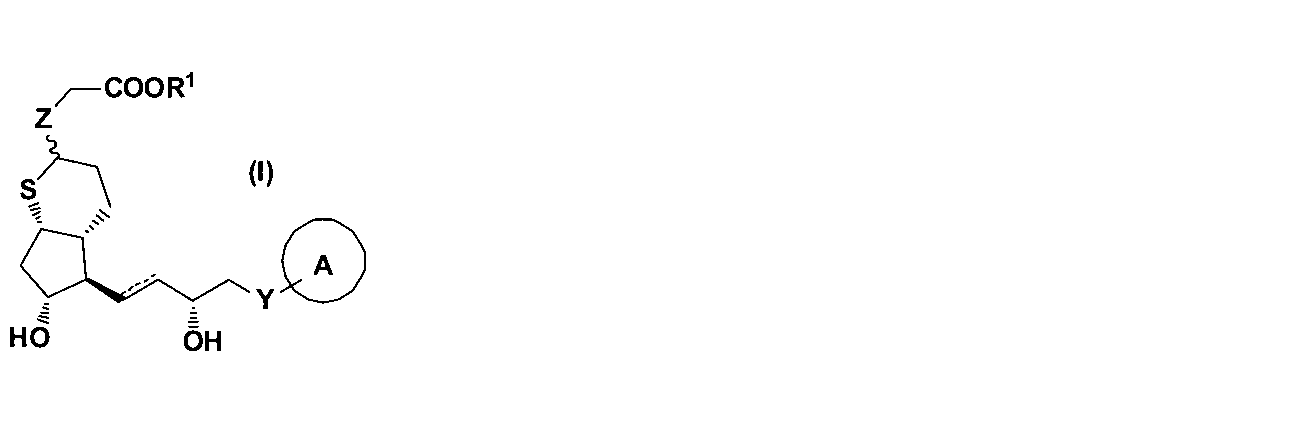
- the present invention relates to general formula (I) (Wherein all symbols have the same meanings as described later), a salt thereof or a solvate thereof, or a prodrug thereof (hereinafter sometimes abbreviated as the compound of the present invention).
- Glaucoma is an eye disease characterized by temporary or permanent visual field loss and visual impairment that causes decreased visual acuity. This is because the aqueous humor accumulates due to the circulatory disturbance of the aqueous humor, and the intraocular pressure continuously increases, and thus the optic nerve is compressed.
- it is effective to lower the intraocular pressure, and in order to lower the intraocular pressure, for example, drug treatment (eye drops, internal medicine, drip treatment), laser treatment, and surgical treatment are performed.
- PGFs and PGIs are known as those that reduce intraocular pressure.
- Development of these derivatives as a therapeutic agent for glaucoma and ocular hypertension has been promoted, and there are actually commercially available drugs (for example, latanoprost).
- existing glaucoma treatment drugs may not be sufficient to lower the intraocular pressure alone, and in the field of glaucoma treatment, a higher intraocular pressure lowering action is sought, and high concentrations or different mechanisms of action are required. Since drug combination therapy is performed, side effects are feared. Therefore, there is a demand for a drug that has a stronger action for lowering intraocular pressure and is highly safe.
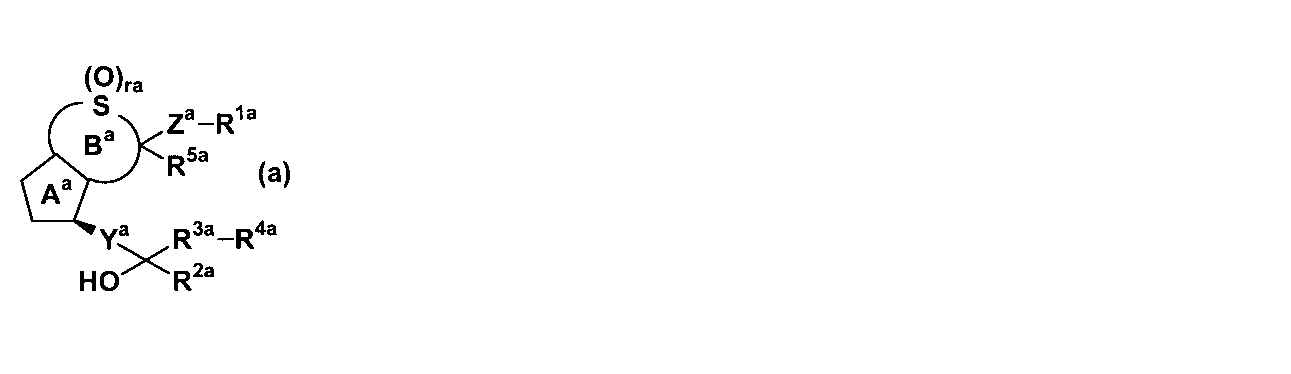
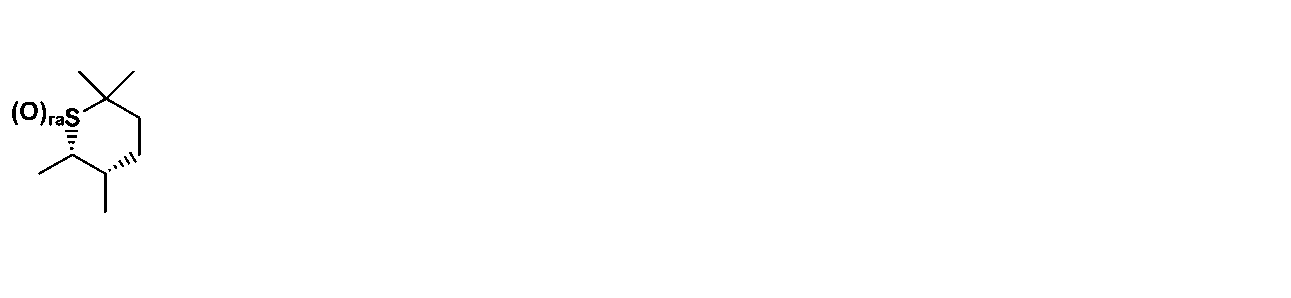
- Examples of the PG derivative having a bicyclic mother skeleton include, for example, the general formula (a) (Wherein ring A a is (In the formula Represents an ⁇ -configuration, a ⁇ -configuration or a mixture thereof. ) Etc., ring Ba is (Wherein, ra represents 0, 1 or 2), etc., Y a represents an ethylene group, vinylene group or ethynylene group, Z a represents — (CH 2 ) ma — (wherein ma represents 3, 4 R 1a represents —COOR 8a (wherein R 8a represents a hydrogen atom or a C1-12 alkyl group, etc.), etc., R 2a represents a hydrogen atom, etc., and R 3a represents a single atom.
- R 4a represents a C1-8 alkoxy group, a halogen atom, a trifluoromethyl group, a phenoxy group optionally substituted with a C1-8 alkyl group, etc.
- R 5a represents a hydrogen atom, etc. Represents. ) Is disclosed as a PGI 1 analog and is described as being useful for contraception or menstrual regulation (see Patent Document 1).
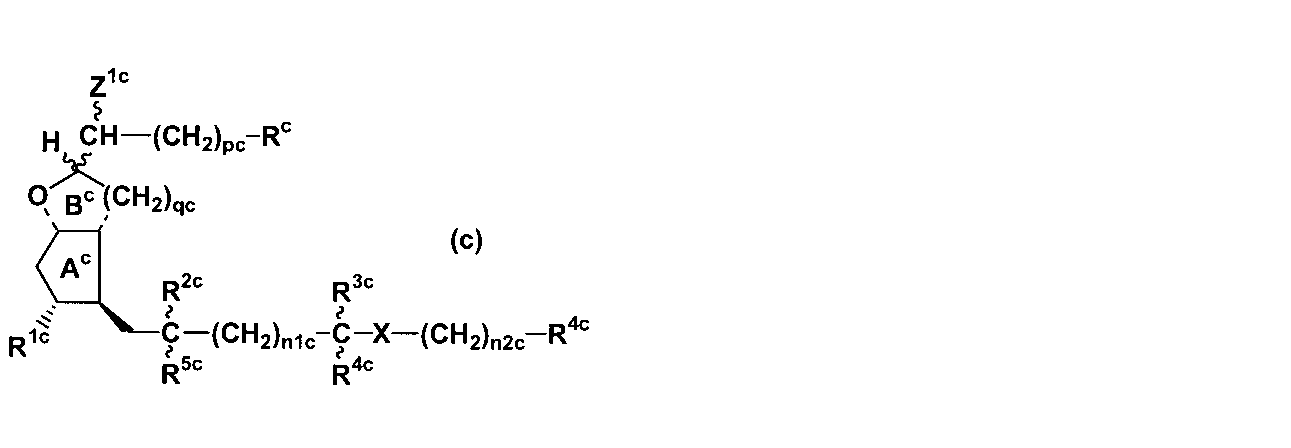
- R c is selected from (a) a free carboxy group or an esterified carboxy group, etc., Z 1c is hydrogen or halogen, pc is 0 or an integer from 1 to 7, and qc is 1 or 2, R 1c is hydrogen, hydroxy, etc., Y c is —CH 2 —CH 2 —, Wherein Z 2c is hydrogen or halogen, etc., one of R 2c and R 5c is hydrogen, C 1-6 alkyl, etc., and the other is hydroxy, etc., R 3c and Each of R 4c is the same or different and they are hydrogen, C 1-6 alkyl, fluorine; each of n 1c and n 2c is the same or different and is an integer of 0 or 1-6 X c is selected from the group consisting of —O—, —S—, and — (CH 2 ) mc —, where mc is 0 or 1, R 6c is hydrogen, C 1-4 alkyl, where mc is 0
- Non-patent Documents 1 and 4 the agonist activity to IP receptors has been reported to cause hyperemia and aqueous humor protein increase, and there is a concern that irritation to eyes may be induced (Non-patent Documents 1 and 4). 2). Therefore, since the compounds described in Patent Documents 1, 2, and 3 which are PGI2 derivatives have agonistic activity of IP receptors, they may induce eye irritation and the like.
- Non-Patent Document 3 it is known that agonist activity to EP2 and EP4 receptors is involved in the inflammatory reaction of the eye (see Non-Patent Document 3).
- the compound of the present invention is a compound having low agonist activity for the IP receptor, EP2 and EP4 receptors and having selective agonist activity for the FP receptor. There is no description or suggestion regarding).
- a compound that has a strong intraocular pressure lowering action and has no fear of side effects on the eye is desired.
- the present inventors have improved the selectivity of the PG receptor subtype, that is, low agonist activity for the IP receptor, EP2 and EP4 receptors, and selection for the FP receptor. As a result of intensive studies to find a compound having a specific agonist activity, the present invention was completed.
- the compound of the present invention has a strong intraocular pressure lowering effect, and is useful as a glaucoma therapeutic agent having no eye side effects such as eye irritation (hyperemia, corneal turbidity, etc.) and aqueous humor protein increase.
- the C1-6 alkyl group is a linear or branched chain such as methyl, ethyl, propyl, isopropyl, butyl, sec-butyl, tert-butyl, pentyl, isopentyl, tert-pentyl, neopentyl, hexyl and the like.
- the C1-4 alkyl group means a linear or branched C1-4 alkyl group such as methyl, ethyl, propyl, isopropyl, butyl, sec-butyl, tert-butyl and the like.
- the C1-4 alkoxy group means a linear or branched C1-4 alkoxy group such as methoxy, ethoxy, propoxy, isopropoxy, butoxy, isobutyloxy, tert-butoxy and the like.
- the halogen atom means fluorine, chlorine, bromine or iodine.
- the C3-10 carbocycle means a C3-10 monocyclic or bicyclic carbocycle, or a carbocycle in which part or all of which may be saturated, such as cyclopropane, Cyclobutane, cyclopentane, cyclohexane, cycloheptane, cyclooctane, cyclononane, cyclodecane, cyclopentene, cyclohexene, cycloheptene, cyclooctene, cyclopentadiene, cyclohexadiene, cycloheptadiene, cyclooctadiene, benzene, pentalene, perhydropentalene, azulene Perhydroazulene, indene, perhydroindene, indane, perhydroindane, naphthalene, dihydronaphthalene, tetrahydronaphthalene, perhydronaphthalen
- the C3-7 carbocycle means a C3-7 monocyclic carbocycle, or a carbocycle in which part or all thereof may be saturated.
- cyclopropane, cyclobutane, cyclo Examples include pentane, cyclohexane, cycloheptane, cyclooctane, cyclopentene, cyclohexene, cycloheptene, cyclopentadiene, cyclohexadiene, cycloheptadiene, and benzene.
- the 3- to 10-membered heterocyclic ring includes a 1- to 5-membered hetero atom selected from an oxygen atom, a nitrogen atom and a sulfur atom, and may be partially or fully saturated.
- pyrrole imidazole, triazole, tetrazole, pyrazole, pyridine, pyrazine, pyrimidine, pyridazine, azepine, diazepine, furan, pyran, oxepin, thiophene, thiopyran, thiepine, oxazole , Isoxazole, thiazole, isothiazole, furazane, oxadiazole, oxazine, oxadiazine, oxazepine, oxadiazepine, thiadiazole, thiazine, thiadiazine, thiazepine, thiadiazepine, aziridine,
- the sulfur atom in Z includes a sulfur atom that may be oxidized.
- the sulfur atom which may be oxidized is meant S, SO or SO 2.
- R 1 is preferably methyl, ethyl, propyl, or isopropyl.
- Z is preferably — (CH 2 ) m —.
- Y is preferably -O-.
- X is preferably -S-.
- the substituent of the benzene ring represented by ring A is preferably a C1-4 alkyl group, a C1-4 alkoxy group, CF 3 or a halogen atom, and is preferably unsubstituted.
- m is preferably 2.
- the ⁇ chain means a side chain bonded to a 6-membered ring in each general formula, and the ⁇ chain means a side chain bonded to a 5-membered ring.
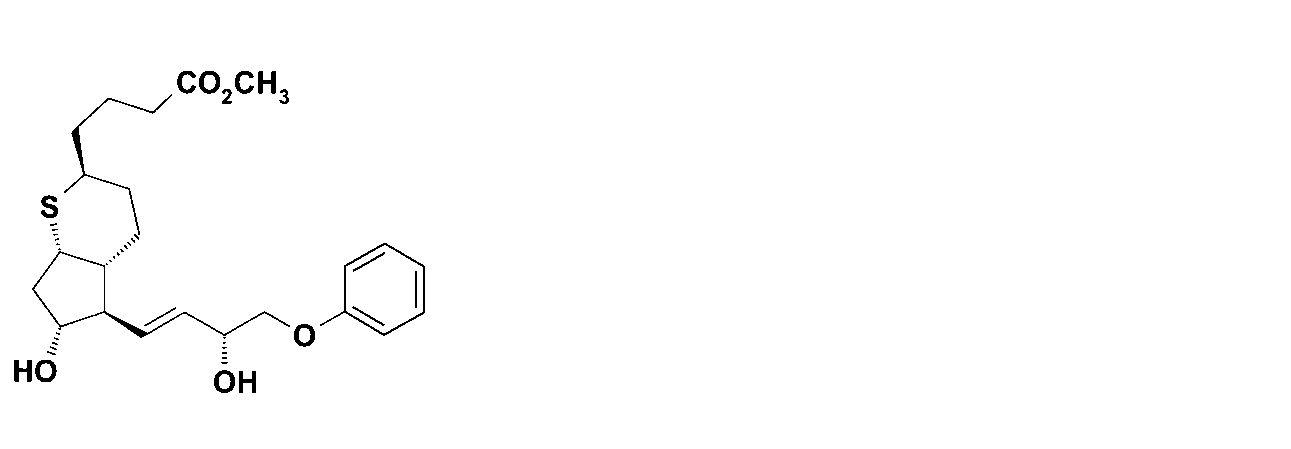
- examples of the compound represented by the general formula (I-1) include (1) Methyl 4- ⁇ (2S, 4aR, 5R, 6R, 7aS) -6-hydroxy-5-[(1E, 3R) -3-hydroxy-4-phenoxy-1-buten-1-yl] octahydro Cyclopenta [b] thiopyran-2-yl ⁇ butanoate (compound 14), (2) Methyl 4- ⁇ (2R, 4aR, 5R, 6R, 7aS) -6-hydroxy-5-[(1E, 3R) -3-hydroxy-4-phenoxy-1-buten-1-yl] octahydro Cyclopenta [b] thiopyran-2-yl ⁇ butanoate (compound 14 (3)), (3) 4- ⁇ (2S, 4aR, 5R, 6R, 7aS) -6-hydroxy-5-[(1E, 3R) -3-hydroxy-4-phenoxy-1-buten-1-yl] oc
- alkyl groups include straight chain and branched chain.
- isomers E, Z, cis, trans
- isomers due to the presence of asymmetric carbon, etc. R, S, ⁇ , ⁇ configuration, enantiomers
- Diastereomer optically active substance having optical activity (D, L, d, l form), polar form (high polar form, low polar form) by chromatographic separation, equilibrium compound, rotational isomer, any of these A mixture of this ratio and a racemic mixture are all included in the present invention.
- all the isomers by a tautomer are also included.
- optically active compound in the present invention may contain not only 100% pure but also other optical isomers of less than 50%.
- the compound represented by the general formula (I) is converted into a corresponding salt by a known method.
- the salt is preferably water-soluble. Suitable salts include alkali metal (potassium, sodium, etc.) salts, alkaline earth metal (calcium, magnesium, etc.) salts, ammonium salts, pharmaceutically acceptable organic amines (tetramethylammonium, triethylamine, methylamine).
- inorganic Acid salt hydroochloride, hydrobromide, hydroiodide, sulf
- the compound represented by the general formula (I) and a salt thereof can be converted into a solvate.
- the solvate is preferably low toxic and water soluble.
- Suitable solvates include, for example, solvates with water and alcohol solvents (for example, ethanol).
- the prodrug of the compound represented by the general formula (I) refers to a compound that is converted into a compound represented by the general formula (I) by a reaction with an enzyme, gastric acid or the like in a living body.
- a prodrug of the compound represented by the general formula (I) when the compound represented by the general formula (I) has a hydroxyl group, a compound in which the hydroxyl group is acylated, alkylated, phosphorylated or borated (for example, Compounds in which the hydroxyl group of the compound of the present invention is acetylated, palmitoylated, propanoylated, pivaloylated, succinylated, fumarylated, alanylated, dimethylaminomethylcarbonylated, etc.); carboxyl group of the compound represented by the general formula (I) Esterified, amidated compounds (eg, the carboxyl group of the compound represented by the general formula (I) is ethyl esterified, is
- the prodrug of the compound represented by the general formula (I) may be either a hydrate or a non-hydrate.
- prodrugs of the compounds represented by the general formula (I) are represented by the general formula under physiological conditions as described in Yodogawa Shoten 1990, “Drug Development”, Vol. 7, “Molecular Design”, pages 163-198. It may be changed to the compound represented by (I).
- the compound represented by the general formula (I) is an isotope (for example, 2 H, 3 H, 11 C, 13 C, 14 C, 13 N, 15 N, 15 O, 17 O, 18 O, 35 S, 18 F, 36 Cl, 123 I, 125 I, etc.).
- a preferred prodrug of the compound represented by the general formula (I) is a compound represented by the general formula (I) in which a carboxyl group is methyl Esterification, ethyl esterification, propyl esterification, isopropyl esterification, butyl esterification, isobutyl esterification, sec-butyl esterification, tert-butyl esterification, pentyl esterification, isopentyl esterification, neopentyl esterification, cyclopentyl Esterification, hexyl esterification, cyclohexyl esterification, trifluoroethyl esterification, phenyl esterification, carboxymethyl esterification, dimethylaminomethyl esterification, pivaloyloxymethyl esterification, ethoxycarbonyloxyethyl ester , Phthalidyl este
- the compound of the present invention is a known method, for example, the method described in Comprehensive Organic Transformations: A Guide to Functional Group Preparations, 2nd Edition (Richard C. Larock, John Wiley & Sons Inc, 1999) or the method shown in the Examples. It can manufacture by improving suitably etc. and using them in combination.
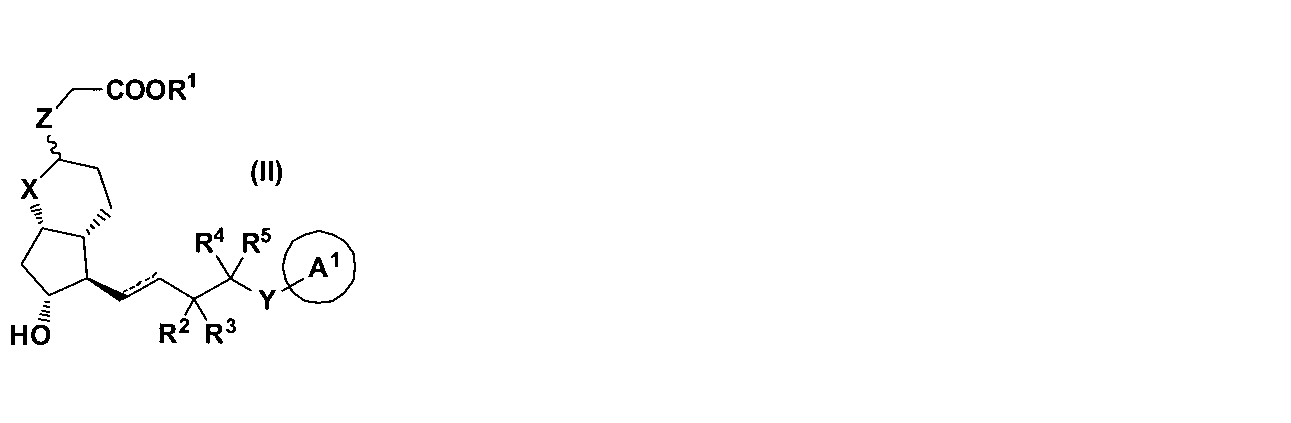
- a compound in which X is —S— in the general formula (II) is U.S. Pat. No. 4,367,237
- a compound in which X is —O— in the general formula (II) is U.S. Pat. No. 4,490,537. It can manufacture using the method described in No ..
- the compound represented by the general formula (I) can be produced by the following method.
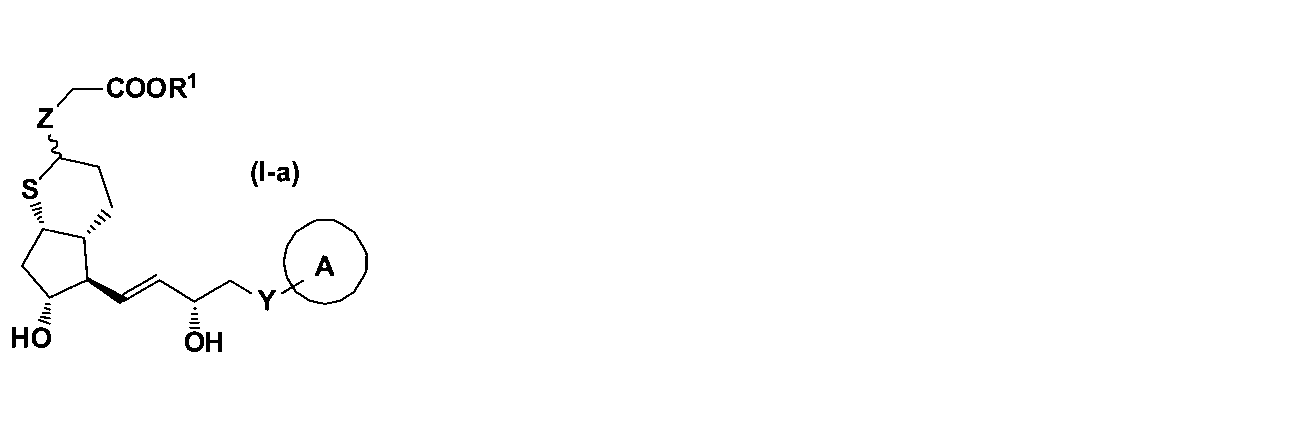
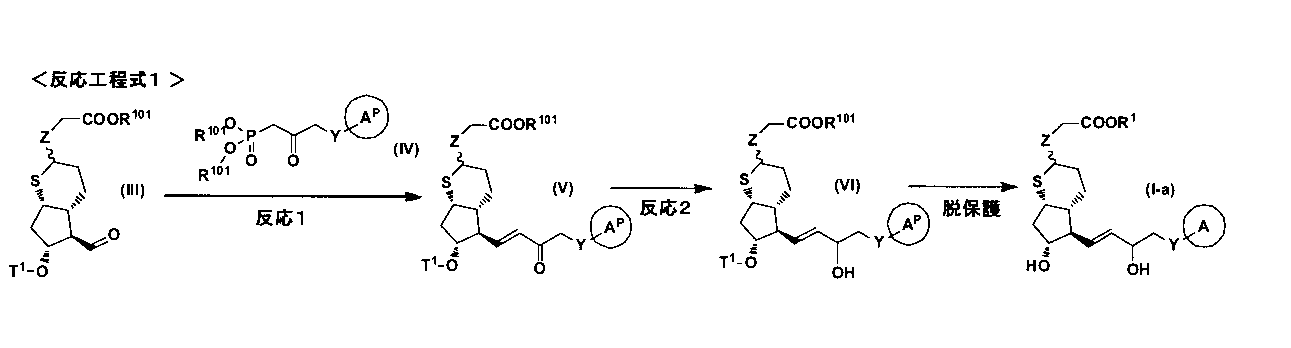
- a compound in which is a double bond ie a compound of the general formula (Ia) (Wherein all symbols have the same meanings as described above) can be produced by the following reaction process formula 1.
- R 101 represents a C1-6 alkyl group
- T 1 represents a hydroxyl protecting group (e.g., 2-tetrahydropyranyl represent (THP) group).
- Ring A P have the same meanings as ring A However, when ring A has a substituent, it must be protected when protection is required, and the other symbols have the same meanings as described above.
- reaction 1 is publicly known. For example, using a compound represented by general formula (III) and a compound represented by general formula (IV), an organic solvent (for example, tetrahydrofuran, dimethylformamide, dioxane). -20, 70 ° C in the presence of a base (sodium hydride, potassium, tert-butoxide, potassium carbonate, tertiary amine + lithium chloride, etc.) in water or a mixture thereof. This is done by reacting at temperature.
- a base sodium hydride, potassium, tert-butoxide, potassium carbonate, tertiary amine + lithium chloride, etc.
- reaction 2 is known, and the compound represented by general formula (V) obtained in reaction 1 is converted into an organic solvent (tetrahydrofuran, methanol, dimethoxyethane, toluene, dichloromethane, diethyl ether, dioxane, etc.).
- organic solvent tetrahydrofuran, methanol, dimethoxyethane, toluene, dichloromethane, diethyl ether, dioxane, etc.
- the reaction is carried out at a temperature of ⁇ 20 to 50 ° C. using a reducing agent (sodium borohydride, zinc borohydride, etc.) in the presence or absence of cerium chloride.
- an asymmetric reducing agent such as chlorodiisopinocan phenylborane
- a combination of an asymmetric auxiliary agent and a reducing agent ((R) -2-methyl-CBS-oxa
- the reaction is conducted at a temperature of ⁇ 100 to 50 ° C. using zaborolidine, a borohydride / tetrahydrofuran complex, (S)-( ⁇ )-binaphthol and lithium aluminum hydride, etc.).
- the deprotection reaction of the protecting group is known and can be carried out by the following method. For example, (1) deprotection reaction by alkaline hydrolysis, (2) deprotection reaction under acidic conditions, (3) deprotection reaction by hydrogenolysis, (4) silyl group deprotection reaction, (5) metal Deprotection reaction to be used, (6) Deprotection reaction using a metal complex, and the like.
- the deprotection reaction by alkali hydrolysis is carried out by using, for example, an alkali metal hydroxide (for example, sodium hydroxide, potassium hydroxide, lithium hydroxide) in an organic solvent (for example, methanol, tetrahydrofuran, dioxane, etc.), Performed at 0 to 40 ° C. using an alkaline earth metal hydroxide (eg, barium hydroxide, calcium hydroxide, etc.) or carbonate (eg, sodium carbonate, potassium carbonate, etc.), an aqueous solution thereof, or a mixture thereof. It is.
- an alkali metal hydroxide for example, sodium hydroxide, potassium hydroxide, lithium hydroxide
- organic solvent for example, methanol, tetrahydrofuran, dioxane, etc.
- an alkaline earth metal hydroxide eg, barium hydroxide, calcium hydroxide, etc.
- carbonate eg, sodium carbonate, potassium carbonate, etc.
- the deprotection reaction under acid conditions is carried out by using, for example, an organic acid (eg, acetic acid, trifluoroacetic acid) in an organic solvent (eg, dichloromethane, chloroform, dioxane, ethyl acetate, methanol, isopropyl alcohol, tetrahydrofuran, anisole, etc.). , Methanesulfonic acid, p-tosylic acid, etc.), or inorganic acids (eg, hydrochloric acid, sulfuric acid, etc.) or mixtures thereof (eg, hydrogen bromide / acetic acid, etc.), the presence of 2,2,2-trifluoroethanol
- an organic acid eg, acetic acid, trifluoroacetic acid
- organic solvent eg, dichloromethane, chloroform, dioxane, ethyl acetate, methanol, isopropyl alcohol, tetrahydrofuran, anisole, etc.
- the deprotection reaction by hydrogenolysis is, for example, a solvent (eg, ether type (eg, tetrahydrofuran, dioxane, dimethoxyethane, diethyl ether, etc.), alcohol type (eg, methanol, ethanol, etc.), benzene type (eg, Benzene, toluene, etc.), ketones (eg, acetone, methyl ethyl ketone, etc.), nitriles (eg, acetonitrile, etc.), amides (eg, N, N-dimethylformamide, etc.), water, ethyl acetate, acetic acid or their 2
- a catalyst for example, palladium-carbon, palladium black, palladium hydroxide-carbon, platinum oxide, Raney nickel, etc.
- a catalyst for example, palladium-carbon, palladium black, palladium hydroxide-carbon, platinum oxide, Raney nickel,
- the deprotection reaction of the silyl group is carried out at 0 to 40 ° C. using tetrabutylammonium fluoride in an organic solvent miscible with water (for example, tetrahydrofuran, acetonitrile, etc.).
- an organic acid eg, acetic acid, trifluoroacetic acid, methanesulfonic acid, p-tosylic acid, etc.
- an inorganic acid eg, hydrochloric acid, sulfuric acid, etc.
- a mixture thereof eg, hydrogen bromide / acetic acid, etc.
- the deprotection reaction using a metal is carried out in the presence of powdered zinc in an acidic solvent (for example, acetic acid, a buffer solution of pH 4.2 to 7.2 or a mixed solution thereof with an organic solvent such as tetrahydrofuran), for example. If necessary, it is carried out at 0 to 40 ° C. while applying ultrasonic waves.
- an acidic solvent for example, acetic acid, a buffer solution of pH 4.2 to 7.2 or a mixed solution thereof with an organic solvent such as tetrahydrofuran
- the deprotection reaction using a metal complex is performed by, for example, trapping reagent in an organic solvent (eg, dichloromethane, N, N-dimethylformamide, tetrahydrofuran, ethyl acetate, acetonitrile, dioxane, ethanol, etc.), water or a mixed solvent thereof.
- an organic solvent eg, dichloromethane, N, N-dimethylformamide, tetrahydrofuran, ethyl acetate, acetonitrile, dioxane, ethanol, etc.
- Electrode Eg, tributyltin hydride, triethylsilane, dimedone, morpholine, diethylamine, pyrrolidine, etc.
- organic acids eg, acetic acid, formic acid, 2-ethylhexanoic acid, etc.
- organic acid salts eg, 2-ethylhexanoic acid, etc.
- Metal complexes for example, tetrakistriphenylphosphine palladium (0), bis (dichloride), in the presence or absence of phosphine reagents (for example, triphenylphosphine) in the presence of sodium, potassium 2-ethylhexanoate, etc.
- Triphenylphosphine Radium (II), palladium (II), with tris (triphenylphosphine) rhodium (I) etc.), carried out at 0-40 ° C..
- the deprotection reaction can be performed by a method described in, for example, T. W. Greene, Protective Groups, Organic, Synthesis, Wiley, New York, 1999.
- hydroxyl protecting groups include methyl, trityl, methoxymethyl (MOM), 1-ethoxyethyl (EE), methoxyethoxymethyl (MEM), 2-tetrahydropyranyl (THP), trimethylsilyl ( TMS) group, triethylsilyl (TES) group, t-butyldimethylsilyl (TBDMS) group, t-butyldiphenylsilyl (TBDPS) group, acetyl (Ac) group, pivaloyl group, benzoyl group, benzyl (Bn) group, p -Methoxybenzyl group, allyloxycarbonyl (Alloc) group, 2,2,2-trichloroethoxycarbonyl (Troc) group and the like.
- TMS trimethylsilyl
- TES triethylsilyl
- TDMS t-butyldimethylsilyl
- TDPS t-butyldiphen
- amino-protecting groups include benzyloxycarbonyl group, t-butoxycarbonyl group, allyloxycarbonyl (Alloc) group, 1-methyl-1- (4-biphenyl) ethoxycarbonyl (Bpoc) group, trifluoroacetyl group , 9-fluorenylmethoxycarbonyl group, benzyl (Bn) group, p-methoxybenzyl group, benzyloxymethyl (BOM) group, 2- (trimethylsilyl) ethoxymethyl (SEM) group and the like.
- the hydroxyl-protecting group is not particularly limited as long as it is a group that can be easily and selectively eliminated other than those described above.
- those described in T. W. Greene, Protective Groups in Organic Synthesis, Wiley, New York, 1999 are used.
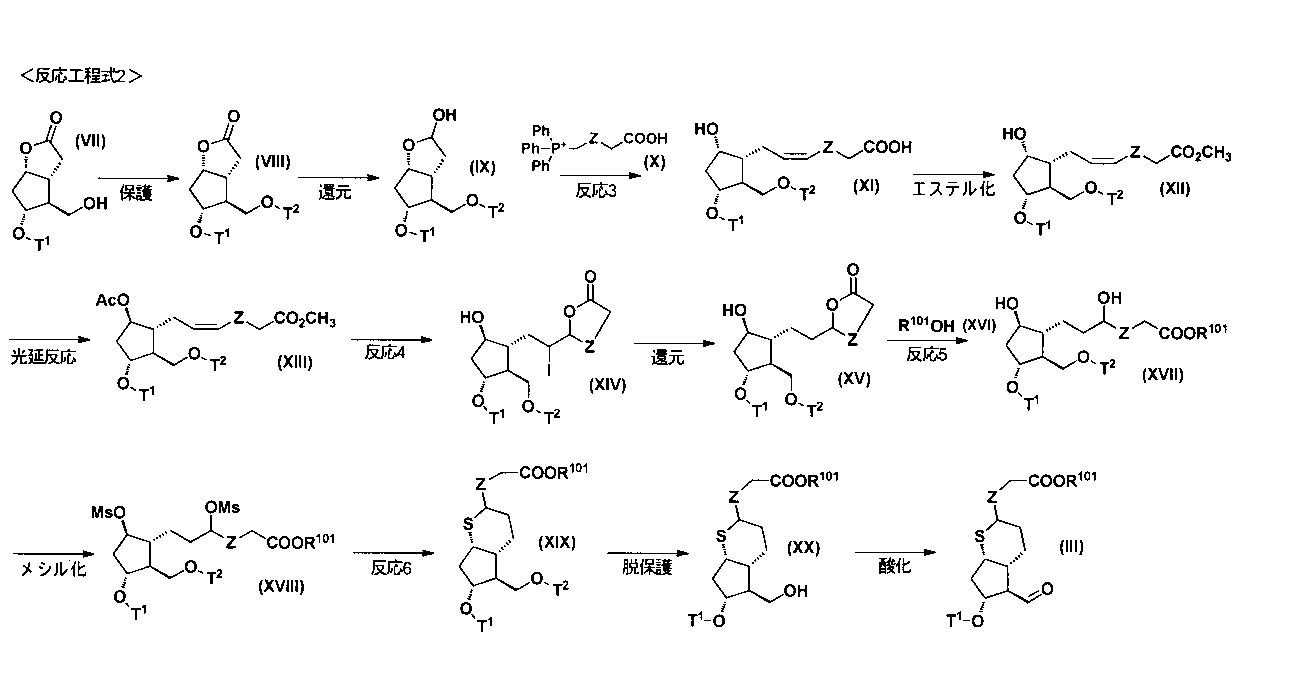
- the compound represented by the general formula (III) can be produced by the following reaction process formula 2.
- T 2 represents a hydroxyl-protecting group (for example, tert-butyldimethylsilyl (TBDMS or TBS) group)
- Ph represents a phenyl group
- Ac represents an acetyl group
- Ms represents a mesyl group
- the compound represented by the general formula (VIII) can be produced by subjecting the compound represented by the general formula (VII) to a protection reaction.
- a base eg, imidazole
- an organic solvent eg, DMF
- a silane compound eg, trimethylsilane chloride (TESCl), tert-butyldimethylsilane chloride (TBSCl), tert-butyldiphenyl chloride
- Silane eg, trimethylsilane chloride (TESCl), tert-butyldimethylsilane chloride (TBSCl), tert-butyldiphenyl chloride
- TDPSCl trimethylsilane chloride
- TBDPSCl tert-butyldimethylsilane chloride
- TBDPSCl tert-butyldiphenyl chloride
- the compound represented by the general formula (IX) can be produced by subjecting the compound represented by the general formula (VIII) to a reduction reaction.
- a reduction reaction is performed at ⁇ 78 to 80 ° C. in an organic solvent (eg, toluene, ethanol, tetrahydrofuran, hexane, etc.) using a reducing agent (eg, diisobutylaluminum hydride (DIBAL), lithium aluminum hydride, etc.).
- DIBAL diisobutylaluminum hydride
- the reaction 3 is known and using a compound represented by the general formula (IX), for example, in an organic solvent (eg, anhydrous tetrahydrofuran, dimethoxyethane, toluene, etc.), a base (eg, lithium diisopropyl). (Amide, butyl lithium, potassium t-butoxide, sodium hydride, etc.) in the presence of a Wittig reagent represented by the general formula (X) at a temperature of ⁇ 78 to 50 ° C.
- an organic solvent eg, anhydrous tetrahydrofuran, dimethoxyethane, toluene, etc.
- a base eg, lithium diisopropyl
- Amide, butyl lithium, potassium t-butoxide, sodium hydride, etc. in the presence of a Wittig reagent represented by the general formula (X) at a temperature of ⁇ 78 to 50 ° C.
- the compound represented by the general formula (XII) can be produced by subjecting the compound represented by the general formula (XI) to an esterification reaction.
- esterification reactions include: (1) Method using alkyl halide (2) Method using acid halide, (3) a method using a mixed acid anhydride, (4) A method using a condensing agent is exemplified.
- alkyl halide For example, a method using an alkyl halide is specifically described.
- a carboxylic acid in an organic solvent for example, acetonitrile, acetone, N, N-dimethylformamide, dimethyl sulfoxide, chloroform, dichloromethane, diethyl ether, tetrahydrofuran, etc.
- Alkyl halides in the presence of carbonates eg cesium carbonate, sodium carbonate, potassium carbonate etc.
- organic bases eg dimethylformamide, triethylamine, diisopropylethylamine etc.
- alkali metal hydrides sodium hydride etc.
- the compound represented by the general formula (XIII) can be produced by subjecting the compound represented by the general formula (XII) to Mitsunobu reaction.
- Mitsunobu reaction is known, for example, alcohol in an organic solvent (dichloromethane, diethyl ether, tetrahydrofuran, acetonitrile, benzene, toluene, etc.), an azo compound (diethyl azodicarboxylate (DEAD), diisopropyl azodicarboxylate, 1,1 ′ -(Azodicarbonyl) dipiperidine, 1,1'-azobis (N, N-dimethylformamide), etc.) and phosphine compounds (triphenylphosphine, tributylphosphine, trimethylphosphine, polymer supported triphenylphosphine, etc.)
- the reaction is carried out by reacting with an acid (formic acid, acetic acid, benzoic acid,
- the reaction 4 is known, and the compound represented by the general formula (XIII) is used, for example, in an organic solvent (methanol, ethanol, acetonitrile, N, N-dimethylformamide, tetrahydrofuran, etc.), or Iodination reagent (iodine, potassium iodide, N-iodosuccinimide (NIS), etc.) in the presence or absence of a base (sodium hydroxide, sodium carbonate, sodium bicarbonate, etc.) in water or a mixture thereof And carried out by reacting at a temperature of ⁇ 30 to 100 ° C.
- organic solvent methanol, ethanol, acetonitrile, N, N-dimethylformamide, tetrahydrofuran, etc.
- Iodination reagent iodine, potassium iodide, N-iodosuccinimide (NIS), etc.
- a base sodium hydroxide, sodium carbonate, sodium bicarbon
- the compound represented by the general formula (XV) can be produced by subjecting the compound represented by the general formula (XIV) to a reduction reaction in the same manner as described above.
- the reaction 5 is known, and the compound represented by the general formula (XV) is used, for example, an acid (hydrochloric acid, p-toluenesulfonic acid, iodo) in an alcohol represented by the general formula (XVI).
- an acid hydroochloric acid, p-toluenesulfonic acid, iodo
- an alcohol represented by the general formula (XVI) Trimethylsilane or the like) or a base (sodium methylate, potassium carbonate, triethylamine or the like), and the reaction is carried out at a temperature of 0 to 100 ° C.
- the reaction 6 is known, and the compound represented by the general formula (XVIII) is used, for example, in an organic solvent (methanol, ethanol, acetonitrile, N, N-dimethylformamide, tetrahydrofuran, etc.), or In water or a mixture thereof, in the presence or absence of a base (sodium methylate, sodium hydroxide, sodium bicarbonate, potassium carbonate, etc.), sodium hydrosulfide n hydrate, thioacetic acid, potassium thioacetate, etc. And carried out by reacting at a temperature of 0 to 100 ° C.
- an organic solvent methanol, ethanol, acetonitrile, N, N-dimethylformamide, tetrahydrofuran, etc.
- a base sodium methylate, sodium hydroxide, sodium bicarbonate, potassium carbonate, etc.
- sodium hydrosulfide n hydrate sodium hydrosulfide n hydrate
- thioacetic acid potassium thio
- the compound represented by the general formula (XX) can be produced by subjecting the compound represented by the general formula (XIX) to a deprotection reaction in the same manner as described above.
- the compound represented by the general formula (III) can be produced by subjecting the compound represented by the general formula (XX) to an oxidation reaction.
- an oxidation reaction for example, (1) a method using DMSO oxidation (for example, Swern oxidation), (2) Method using Dess-Martin Reagent, (3) Examples include a method using a TEMPO reagent.
- an activator eg, oxalyl chloride, acetic anhydride, pyridine-sulfur trioxide complex
- an organic solvent eg, chloroform, dichloromethane, ethyl acetate, etc.
- an activator eg, oxalyl chloride, acetic anhydride, pyridine-sulfur trioxide complex
- Etc. and an oxidizing agent (for example, dimethyl sulfoxide, etc.), and an alcohol compound is reacted, and a tertiary amine (for example, triethylamine, N, N-diisopropylethylamine, N-methylmorpholine, N-ethylpiperidine, diazabicyclo) [5.4.0] undec-7-ene etc.) at ⁇ 78 to 40 ° C.
- a tertiary amine for example, triethylamine, N, N-diisopropylethylamine, N-methylmorpholine, N-ethylpiperidine, diazabicyclo
- reaction involving heating can be performed using a water bath, an oil bath, a sand bath, or a microwave, as will be apparent to those skilled in the art.
- a solid-phase-supported reagent supported on a polymer eg, polystyrene, polyacrylamide, polypropylene, polyethylene glycol, etc.
- a polymer eg, polystyrene, polyacrylamide, polypropylene, polyethylene glycol, etc.
- the reaction product is obtained by a conventional purification means such as distillation under normal pressure or reduced pressure, high performance liquid chromatography using silica gel or magnesium silicate, thin layer chromatography, ion exchange resin, It can be purified by scavenger resin, column chromatography, washing or recrystallization. Purification may be performed for each reaction or after completion of several reactions.
- a conventional purification means such as distillation under normal pressure or reduced pressure, high performance liquid chromatography using silica gel or magnesium silicate, thin layer chromatography, ion exchange resin, It can be purified by scavenger resin, column chromatography, washing or recrystallization. Purification may be performed for each reaction or after completion of several reactions.
- the toxicity of the compound of the present invention is sufficiently low. For example, there is almost no eye irritation (hyperemia, corneal turbidity, etc.), aqueous humor protein increase, etc., and it can be safely used as a pharmaceutical product.
- eye diseases such as glaucoma (acute closed angle glaucoma, chronic closed angle glaucoma, secondary closed angle glaucoma, primary open angle glaucoma, secondary open angle glaucoma, congenital glaucoma, normal eyes Pressure glaucoma, aqueous humor-producing glaucoma, etc.), ocular hypertension, macular edema, macular degeneration, increased retina and optic nerve tension, myopia, hyperopia, astigmatism, dry eye, retinal detachment, cataract, trauma or inflammation, etc., It is useful as a preventive and / or therapeutic agent for increased intraocular pressure due to drugs such as steroids or hormone agents, and increased intraocular pressure after surgery.
- drugs such as steroids or hormone agents
- the compound of the present invention and the compound represented by the general formula (II) have FP agonist activity, labor pain inducer, labor pain promoter, labor promoter, dysmenorrhea therapeutic agent, osteoporosis therapeutic agent, sunburn inducer, It is also useful as a white hair inhibitor, hair growth promoter, eyelash extension agent, Meniere's disease therapeutic agent, inner ear disease therapeutic agent, and the like.
- the compound of the present invention 1) complementation and / or enhancement of the prophylactic and / or therapeutic effect of the compound, It may be administered as a concomitant drug in combination with other drugs in order to 2) improve the kinetics / absorption of the compound, reduce the dose, and / or reduce the side effects of the compound.
- the concomitant drug of the compound of the present invention and another drug may be administered in the form of a combination drug containing both components in one preparation, or may be administered in separate preparations.
- simultaneous administration and administration by time difference are included.
- administration with a time difference may be such that the compound of the present invention is administered first and the other drug may be administered later, or the other drug may be administered first and the compound of the present invention may be administered later.
- Each administration method may be the same or different.
- the disease that exerts a preventive and / or therapeutic effect by the above concomitant drug is not particularly limited as long as it is a disease that complements and / or enhances the preventive and / or therapeutic effect of the compound of the present invention.
- Examples of other drugs for complementing and / or enhancing the preventive and / or therapeutic effect of the compound of the present invention on glaucoma include, for example, sympathomimetic drugs ( ⁇ 2 agonists: for example, apraclonidine hydrochloride and the like, ⁇ 2 agonists: for example , Dipivefrin hydrochloride, etc.), parasympathomimetic drugs (eg, pilocarpine hydrochloride, carbachol, deme potassium, ecothiophosphate or distigmine bromide), sympathetic nerve inhibitors ( ⁇ 1 blockers: eg, bunazosin hydrochloride, etc., ⁇ blockers: eg, timolol maleate, hydrochloride befunolol, carteolol or betaxolol hydrochloride and the like,, alpha 1 beta-blockers: such as hydrochloric levobunolol, nipradilol, etc.), prostaglandin-
- the therapeutic agents for glaucoma to be combined with the compound of the present invention include not only those found so far but also those that will be found in the future.
- the compound of the present invention is usually administered systemically or locally in an oral or parenteral form.
- oral preparations include liquids for internal use (for example, elixirs, syrups, pharmaceutically acceptable solutions, suspensions, emulsions), solid preparations for internal use (for example, tablets (sublingual tablets, buccal cavity) Disintegrating tablets), pills, capsules (including hard capsules, soft capsules, gelatin capsules, and microcapsules), powders, granules, and troches.
- parenteral agents examples include liquids (eg, injections (subcutaneous injections, intravenous injections, intramuscular injections, intraperitoneal injections, drops, etc.), eye drops (eg, aqueous eye drops (aqueous eye drops) Liquid, aqueous suspension ophthalmic solution, viscous ophthalmic solution, solubilized ophthalmic solution, etc.), non-aqueous ophthalmic solution (non-aqueous ophthalmic solution, non-aqueous suspension ophthalmic solution, etc.)), etc. Etc.), ear drops and the like.
- These preparations may be release control agents such as immediate-release preparations and sustained-release preparations. These preparations can be produced by a known method, for example, a method described in the Japanese Pharmacopoeia.
- Oral liquids for oral use are produced, for example, by dissolving, suspending or emulsifying active ingredients in diluents (eg, purified water, ethanol or a mixture thereof) generally used.
- this liquid agent may contain a wetting agent, a suspending agent, an emulsifier, a sweetening agent, a flavoring agent, a fragrance, a preservative, a buffering agent and the like.
- the solid preparation for internal use as an oral preparation includes, for example, an active ingredient as an excipient (eg, lactose, mannitol, glucose, microcrystalline cellulose, starch, etc.), a binder (eg, hydroxypropylcellulose, polyvinylpyrrolidone, aluminum metasilicate). Magnesium oxide, etc.), disintegrating agents (eg, calcium calcium glycolate), lubricants (eg, magnesium stearate), stabilizers, solubilizing agents (glutamic acid, aspartic acid, etc.), etc. According to the formulation. Moreover, you may coat
- an active ingredient as an excipient eg, lactose, mannitol, glucose, microcrystalline cellulose, starch, etc.
- a binder eg
- an ointment is manufactured by kneading or melting an active ingredient in a base.
- the ointment base is selected from known or commonly used ones.
- higher fatty acids or higher fatty acid esters for example, adipic acid, myristic acid, palmitic acid, stearic acid, oleic acid, adipic acid ester, myristic acid ester, palmitic acid ester, stearic acid ester, oleic acid ester, etc.
- waxes E.g., beeswax, whale wax, ceresin, etc.
- surfactants e.g., polyoxyethylene alkyl ether phosphates, etc.
- higher alcohols e.g., cetanol, stearyl alcohol, cetostearyl alcohol, etc.
- silicone oils e.g., Dimethylpolysiloxane, etc.
- hydrocarbons eg, hydrophilic petrolatum, white petrolatum, purified lanolin, liquid paraffin, etc.
- glycols eg, ethylene glycol, diethylene glycol, propylene glycol, polyethylene
- glycols e
- the parenteral injection includes solutions, suspensions, emulsions and solid injections used by dissolving or suspending in a solvent at the time of use.
- An injection is used, for example, by dissolving, suspending or emulsifying an active ingredient in a solvent.
- the solvent for example, distilled water for injection, physiological saline, vegetable oil, propylene glycol, polyethylene glycol, alcohols such as ethanol, and combinations thereof are used.
- this injection contains a stabilizer, a solubilizing agent (for example, glutamic acid, aspartic acid, polysorbate 80 (registered trademark), etc.), a suspending agent, an emulsifying agent, a soothing agent, a buffering agent, a preservative and the like.
- a sterile solid preparation for example, a lyophilized product, can be produced and used by dissolving it in sterilized or sterile distilled water for injection or other solvent before use.
- Preferred dosage forms of the compound of the present invention include eye drops, eye ointments, tablets and the like, and more preferred are eye drops or eye ointments. These can be formulated using widely used techniques. For example, in the case of eye drops, isotonic agents, buffers, pH adjusters, solubilizers, thickeners, stabilizers, preservatives and the like can be appropriately added as additives. In addition, a stable eye drop can be obtained by adding a pH adjuster, a thickener, a dispersant and the like to suspend the drug.
- isotonic agent examples include glycerin, propylene glycol, sodium chloride, potassium chloride, sorbitol, mannitol and the like.
- buffer examples include phosphoric acid, phosphate, citric acid, acetic acid, and ⁇ -aminocaproic acid.
- pH adjuster examples include hydrochloric acid, citric acid, phosphoric acid, acetic acid, sodium hydroxide, potassium hydroxide, boric acid, borax, sodium carbonate, sodium hydrogen carbonate and the like.
- solubilizer examples include polysorbate 80, polyoxyethylene hydrogenated castor oil 60, macrogol 4000, and the like.
- thickeners and dispersants include cellulose polymers such as hydroxypropylmethylcellulose and hydroxypropylcellulose, polyvinyl alcohol, and polyvinylpyrrolidone.
- stabilizers include edetic acid and sodium edetate. Can be mentioned.
- preservatives examples include general-purpose sorbic acid, potassium sorbate, benzalkonium chloride, benzethonium chloride, methyl paraoxybenzoate, propyl paraoxybenzoate, chlorobutanol, and the like. It can also be used in combination.
- the ophthalmic solution containing the active ingredient of the present invention preferably has a pH of 4.0 to 8.5, and an osmotic pressure ratio of about 1.0.
- the dose of the active ingredient of the present invention can be appropriately selected depending on symptoms, age, dosage form, etc., but in the case of an oral preparation, it is preferably 1 to 100 mg, more preferably 5 to 30 mg once to several times a day (for example, 1 to 3 times).
- an oral preparation it is preferably 1 to 100 mg, more preferably 5 to 30 mg once to several times a day (for example, 1 to 3 times).
- eye drops one having a concentration of 0.000001 to 5% (w / v), more preferably 0.00001 to 0.05% (w / v), 1 to several drops at a time, 1 to several times a day (for example, 1 to 8 times).
- an eye ointment In the case of an eye ointment, it preferably has a concentration of 0.000001 to 5% (w / w), more preferably 0.00001 to 0.05% (w / w), 1 to several times a day (for example, 1 to 4 times). What is necessary is just to apply.
- the location of separation by chromatography and the solvent in parentheses shown in TLC indicate the elution solvent or developing solvent used, and the ratio indicates the volume ratio.
- the NMR data is 1 H-NMR data unless otherwise specified.
- the parentheses shown in the NMR part indicate the solvent used for the measurement.
- the compound name used in this specification is generally a computer program for naming according to IUPAC rules, ACD / Name (registered trademark) or ACD / Name batch (registered trademark), or IUPAC naming. Named according to the law.
- the compound represented by the formula is methyl 4- ⁇ (2S, 4aR, 5R, 6R, 7aS) -6-hydroxy-5-[(1E, 3R) -3-hydroxy-4-phenoxy-1-buten-1-yl ] Octahydrocyclopenta [b] thiopyran-2-yl ⁇ butanoate.
- Example 1 (3aR, 4S, 5R, 6aS) -4-( ⁇ [Dimethyl (2-methyl-2-propanyl) silyl] oxy ⁇ methyl) -5- (tetrahydro-2H-pyran-2-yloxy) hexahydro -2H-cyclopenta [b] furan-2-one (Compound 1) (3aR, 4S, 5R, 6aS) -4- (hydroxymethyl) -5- (tetrahydro-2H-pyran-2-yloxy) hexahydro-2H-cyclopenta [b] furan-2-one (CAS Registry Number: 69222- 61-3) (47.5 g) and imidazole (16.3 g) in anhydrous N, N-dimethylformamide (125 mL) were added to a solution of t-butyldimethylsilyl chloride (30.5 g) in anhydrous N, N-dimethylformamide in a cold water bath.
- Example 2 (3aR, 4S, 5R, 6aS) -4-( ⁇ [Dimethyl (2-methyl-2-propanyl) silyl] oxy ⁇ methyl) -5- (tetrahydro-2H-pyran-2-yloxy) hexahydro -2H-cyclopenta [b] furan-2-ol (compound 2)
- a solution of Compound 1 (68.4 g) in anhydrous toluene (315 mL) was cooled to around ⁇ 60 ° C. in a dry ice-methanol bath, and then a diisobutylaluminum hydride / toluene solution (0.99 M, 209 mL) was added dropwise over 33 minutes.
- Example 4 Methyl (5Z) -7-[(1R, 2S, 3R, 5R) -5-acetoxy-2-( ⁇ [dimethyl (2-methyl-2-propanyl) silyl] oxy ⁇ methyl) -3- (Tetrahydro-2H-pyran-2-yloxy) cyclopentyl] -5-heptenoate (Compound 4)
- a solution of compound 3 (79.6 g) and triphenylphosphine (57.6 g) in anhydrous tetrahydrofuran (482 mL) was cooled to around ⁇ 40 ° C. in a dry ice-methanol bath.
- Acetic acid (12.6 mL) was added to the solution, and then a 40% diethyl azodicarboxylate / toluene solution (100 mL) was added dropwise over 15 minutes. After stirring at room temperature for 4.5 hours, the reaction mixture was poured into water (1600 mL), and a mixed solution of hexane (550 mL) and ethyl acetate (550 mL) was added and stirred. After separating the two layers, the organic layer was washed with water (540 mL) and saturated brine (540 mL), dried over anhydrous sodium sulfate, and concentrated.
- Example 5 (6R) -6- ⁇ 2-[(1R, 2S, 3R, 5R) -2-( ⁇ [Dimethyl (2-methyl-2-propanyl) silyl] oxy ⁇ methyl) -5-hydroxy-3- (tetrahydro -2H-pyran-2-yloxy) cyclopentyl] -1-iodoethyl ⁇ tetrahydro-2H-pyran-2-one (high polarity compound: Compound 5a) (6S) -6- ⁇ 2-[(1R, 2S, 3R, 5R) -2-( ⁇ [Dimethyl (2-methyl-2-propanyl) silyl] oxy ⁇ methyl) -5-hydroxy-3- (tetrahydro -2H-pyran-2-yloxy) cyclopentyl] -1-iodoethyl ⁇ tetrahydro-2H-pyran-2-one (low polarity compound: Compound 5b) To a solution of compound 4 (34.9 g)
- Example 6 (6R) -6- ⁇ 2-[(1R, 2S, 3R, 5R) -2-( ⁇ [dimethyl (2-methyl-2-propanyl) silyl] oxy ⁇ methyl) -5-hydroxy- 3- (Tetrahydro-2H-pyran-2-yloxy) cyclopentyl] ethyl ⁇ tetrahydro-2H-pyran-2-one (Compound 6)
- Tri n-butyltin hydride (18.5 mL) and azobis (isobutyronitrile) (198 mg) were added to a solution of compound 5a (41.8 g) in anhydrous benzene (195 mL), and the mixture was heated to reflux for 3 hours.
- Example 7 Methyl (5R) -7-[(1R, 2S, 3R, 5R) -2-( ⁇ [dimethyl (2-methyl-2-propanyl) silyl] oxy ⁇ methyl) -5-hydroxy-3- (Tetrahydro-2H-pyran-2-yloxy) cyclopentyl] -5-hydroxyheptanoate (Compound 7)
- Triethylamine (25.5 mL) was added to a solution of compound 6 (33.2 g) in anhydrous methanol (306 mL), and the mixture was heated to reflux for 5 hours. After allowing to cool, the reaction mixture was concentrated.
- Example 8 Methyl (5R) -7-[(1R, 2S, 3R, 5R) -2-( ⁇ [dimethyl (2-methyl-2-propanyl) silyl] oxy ⁇ methyl) -5-[(methylsulfonyl ) Oxy] -3- (tetrahydro-2H-pyran-2-yloxy) cyclopentyl] -5-[(methylsulfonyl) oxy] heptanoate (Compound 8) A solution of compound 7 (38.0 g) and triethylamine (44 mL) in anhydrous dichloromethane (323 mL) was cooled to around ⁇ 60 ° C.
- Example 9 methyl 4-[(2S, 4aR, 5S, 6R, 7aS) -5-( ⁇ [dimethyl (2-methyl-2-propanyl) silyl] oxy ⁇ methyl) -6- (tetrahydro-2H-pyran -2-yloxy) octahydrocyclopenta [b] thiopyran-2-yl] butanoate (Compound 9)
- 70% sodium hydrosulfide n hydrate (14.9 g) was added to methanol (123 mL), and the mixture was stirred at room temperature for 15 minutes to dissolve most of it.
- Example 10 Methyl 4-[(2S, 4aR, 5S, 6R, 7aS) -5- (hydroxymethyl) -6- (tetrahydro-2H-pyran-2-yloxy) octahydrocyclopenta [b] thiopyran-2 -Il] butanoate (compound 10) To a solution of compound 9 (7.3 g) in tetrahydrofuran (74 mL) was added 1M tetrabutylammonium fluoride / tetrahydrofuran solution (27 mL), and the mixture was stirred for 3 hours.
- Example 11 Methyl 4-[(2S, 4aR, 5R, 6R, 7aS) -5-formyl-6- (tetrahydro-2H-pyran-2-yloxy) octahydrocyclopenta [b] thiopyran-2-yl] Butanoate (Compound 11) Compound 10 (200 mg) was dissolved in ethyl acetate (1.7 mL) and dimethyl sulfoxide (0.84 mL), diisopropylethylamine (0.39 mL) was added, and the mixture was cooled in an ice bath.
- Example 12 Methyl 4-[(2S, 4aR, 5R, 6R, 7aS) -5-[(1E) -3-oxo-4-phenoxy-1-buten-1-yl] -6- (tetrahydro-2H -Pyran-2-yloxy) octahydrocyclopenta [b] thiopyran-2-yl] butanoate (Compound 12) Sodium hydride (24.8 mg) was added to an anhydrous tetrahydrofuran (2.7 mL) solution of dimethyl (2-oxo-3-phenoxypropyl) phosphonate (194 mg) in an ice bath, and the mixture was stirred at room temperature for 1.5 hours.
- Example 13 Methyl 4-[(2S, 4aR, 5R, 6R, 7aS) -5-[(1E, 3R) -3-hydroxy-4-phenoxy-1-buten-1-yl] -6- (tetrahydro -2H-pyran-2-yloxy) octahydrocyclopenta [b] thiopyran-2-yl] butanoate (Compound 13) Compound 12 (250 mg) and (R) -2-methyl-CBS-oxazaborolidine (1M toluene solution, 0.135 mL) were dissolved in anhydrous tetrahydrofuran (1 mL), and 1M borane-tetrahydrofuran complex (0.323 mL) was dissolved at room temperature.
- Example 14 Methyl 4- ⁇ (2S, 4aR, 5R, 6R, 7aS) -6-hydroxy-5-[(1E, 3R) -3-hydroxy-4-phenoxy-1-buten-1-yl] octa Hydrocyclopenta [b] thiopyran-2-yl ⁇ butanoate (Compound 14)
- Compound 13 (220 mg) was dissolved in methanol (1.1 mL), p-toluenesulfonic acid monohydrate (20 mg) was added at room temperature, and the mixture was stirred for 2 hours.
- Example 14 (1) to Example 14 (3) Use compound 5a in Example 6 or use compound 5b instead and use dimethyl [2-oxo-3- (phenyloxy) propyl] phosphonate in Example 12 or use dimethyl (2-oxo instead) The same operation as in Example 6 ⁇ Example 7 ⁇ Example 8 ⁇ Example 9 ⁇ Example 10 ⁇ Example 11 ⁇ Example 12 ⁇ Example 13 ⁇ Example 14 using -4-phenylbutyl) phosphonate The following compounds were obtained.
- Example 14 (1) methyl 4- ⁇ (2R, 4aR, 5R, 6R, 7aS) -6-hydroxy-5-[(1E, 3S) -3-hydroxy-5-phenyl-1-pentene-1- Yl] octahydrocyclopenta [b] thiopyran-2-yl ⁇ butanoate (Compound 14 (1))
- Example 14 (3) methyl 4- ⁇ (2R, 4aR, 5R, 6R, 7aS) -6-hydroxy-5-[(1E, 3R) -3-hydroxy-4-phenoxy-1-butene-1- Yl] octahydrocyclopenta [b] thiopyran-2-yl ⁇ butanoate (Compound 14 (3)) TLC: Rf 0.61 (ethyl acetate); NMR (CDCl 3 ): ⁇ 1.37-1.94 (m, 11 H), 2.23-2.50 (m, 4 H), 2.62-2.76 (m, 1 H), 2.90-3.04 (m, 1 H), 3.36-3.44 (m, 1 H), 3.67 (s, 3 H), 3.82-3.94 (m, 1 H), 3.95-4.07 (m, 2 H), 4.48-4.60 (m, 1 H), 5.61-5.82 (m , 2 H), 6.87-7.01 (m, 3 H), 7.22-7.34 (m, 2 H).
- Example 15 4- ⁇ (2S, 4aR, 5R, 6R, 7aS) -6-hydroxy-5-[(1E, 3R) -3-hydroxy-4-phenoxy-1-buten-1-yl] octahydro Cyclopenta [b] thiopyran-2-yl ⁇ butanoic acid (Compound 15)
- Compound 14 (6.9 mg) was dissolved in methanol (0.4 mL), 2M aqueous sodium hydroxide solution (0.1 mL) was added at room temperature, and the mixture was stirred overnight. Diluted hydrochloric acid was added to the reaction mixture, and the mixture was extracted twice with ethyl acetate.
- Example 15 (1) 4- ⁇ (2R, 4aR, 5R, 6R, 7aS) -6-hydroxy-5-[(1E, 3S) -3-hydroxy-5-phenyl-1-penten-1-yl ] Octahydrocyclopenta [b] thiopyran-2-yl ⁇ butanoic acid (Compound 15 (1))
- Example 15 (3) 4- ⁇ (2R, 4aR, 5R, 6R, 7aS) -6-hydroxy-5-[(1E, 3R) -3-hydroxy-4-phenoxy-1-buten-1-yl ] Octahydrocyclopenta [b] thiopyran-2-yl ⁇ butanoic acid (Compound 15 (3)) TLC: Rf 0.34 (ethyl acetate); NMR (CDCl 3 ): ⁇ 1.40-1.66 (m, 7 H), 1.67-1.94 (m, 6 H), 2.29-2.49 (m, 3 H), 2.63-2.77 (m, 1 H), 2.90-3.05 (m, 1 H), 3.35-3.44 (m, 1 H), 3.85-3.94 (m, 1 H), 3.95-4.07 (m, 2 H), 4.49-4.59 (m, 1 H), 5.62-5.71 (m, 1 H), 5.71-5.80 (m, 1 H), 6.86-7.01 (m, 3 H), 7.22-7.34 (m,
- Example 15 4- ⁇ (2S, 4aR, 5R, 6R, 7aS) -5-[(1E, 3R) -4- (4-fluorophenoxy) -3-hydroxy-1-butene-1- Yl] -6-hydroxyoctahydrocyclopenta [b] thiopyran-2-yl ⁇ butanoic acid (compound 15 (4))
- TLC: Rf 0.37 (dichloromethane: methanol 10: 1); NMR (CDCl 3 ): ⁇ 1.15-1.93 (m, 11 H), 1.96-2.17 (m, 1 H), 2.31-2.51 (m, 3 H), 2.66-2.82 (m, 2 H), 3.23-3.37 (m, 1 H), 3.79-4.08 (m, 3 H), 4.47-4.61 (m, 1 H), 5.59-5.71 (m, 1 H), 5.72-5.84 (m, 1 H), 6.74-6.86 (m, 1 H), 6.87-7.01 (m, 2
- Example 15 (6) 4- ⁇ (2S, 4aR, 5R, 6R, 7aS) -6-hydroxy-5-[(1E, 3R) -3-hydroxy-4- (3-methylphenoxy) -1- Buten-1-yl] octahydrocyclopenta [b] thiopyran-2-yl ⁇ butanoic acid (Compound 15 (6))
- Example 15 (7) 4- ⁇ (2S, 4aR, 5R, 6R, 7aS) -5-[(1E, 3R) -4- (2-fluorophenoxy) -3-hydroxy-1-butene-1- Yl] -6-hydroxyoctahydrocyclopenta [b] thiopyran-2-yl ⁇ butanoic acid (Compound 15 (7))
- Example 15 (8) 4- ⁇ (2S, 4aR, 5R, 6R, 7aS) -5-[(1E, 3R) -4- (3-fluorophenoxy) -3-hydroxy-1-butene-1- Yl] -6-hydroxyoctahydrocyclopenta [b] thiopyran-2-yl ⁇ butanoic acid (compound 15 (8))
- TLC: Rf 0.46 (dichloromethane: methanol 10: 1); NMR (CDCl 3 ): ⁇ 1.04-2.18 (m, 12 H), 2.23-2.51 (m, 3 H), 2.59-2.81 (m, 2 H), 3.24-3.41 (m, 1 H), 3.86-4.14 (m, 3 H), 4.41-4.72 (m, 1 H), 5.56-5.73 (m, 1 H), 5.74-5.92 (m, 1 H), 6.99-7.19 (m, 2 H), 7.20-7.32 (m, 1 H), 7.40 (t
- TLC: Rf 0.46 (dichloromethane: methanol 10: 1); NMR (CDCl 3 ): ⁇ 1.15-2.23 (m, 12 H), 2.29-2.49 (m, 3 H), 2.59-2.78 (m, 2 H), 3.21-3.40 (m, 1 H), 3.80-4.21 (m, 6 H), 4.44-4.61 (m, 1 H), 5.54-5.68 (m, 1 H), 5.68-5.85 (m, 1 H), 6.84-7.02 (m, 4 H).
- Example 15 (11) 4- ⁇ (2S, 4aR, 5R, 6R, 7aS) -6-hydroxy-5-[(1E, 3R) -3-hydroxy-4- (3-methoxyphenoxy) -1- Buten-1-yl] octahydrocyclopenta [b] thiopyran-2-yl ⁇ butanoic acid (Compound 15 (11))
- Example 15 (12): 4- ⁇ (2S, 4aR, 5R, 6R, 7aS) -6-hydroxy-5-[(1E, 3R) -3-hydroxy-4- (4-methoxyphenoxy) -1- Buten-1-yl] octahydrocyclopenta [b] thiopyran-2-yl ⁇ butanoic acid (Compound 15 (12)) TLC: Rf 0.36 (dichloromethane: methanol 9: 1); NMR (CDCl 3 ): ⁇ 1.10-1.94 (m, 11 H), 1.95-2.12 (m, 1 H), 2.28-2.53 (m, 3 H), 2.62-2.81 (m, 2 H), 3.24-3.36 (m, 1 H), 3.77 (s, 3 H), 3.78-3.86 (m, 1 H), 3.89-4.15 (m, 2 H), 4.37-4.61 (m, 1 H), 5.46-5.70 (m , 1 H), 5.70-5.93 (m, 1 H), 6.57-6
- Example 15 (13) 4- ⁇ (2S, 4aR, 5R, 6R, 7aS) -6-hydroxy-5-[(1E, 3R) -3-hydroxy-4- (2-methylphenoxy) -1- Buten-1-yl] octahydrocyclopenta [b] thiopyran-2-yl ⁇ butanoic acid (Compound 15 (13))
- Example 15 (14) 4- ⁇ (2S, 4aR, 5R, 6R, 7aS) -6-hydroxy-5-[(1E, 3R) -3-hydroxy-4- (4-methylphenoxy) -1- Buten-1-yl] octahydrocyclopenta [b] thiopyran-2-yl ⁇ butanoic acid (Compound 15 (14))
- Example 15 4- ⁇ (2S, 4aR, 5R, 6R, 7aS) -5-[(1E, 3R) -4- (4-chlorophenoxy) -3-hydroxy-1-butene-1- Yl] -6-hydroxyoctahydrocyclopenta [b] thiopyran-2-yl ⁇ butanoic acid (compound 15 (15))
- TLC: Rf 0.48 (dichloromethane: methanol 9: 1); NMR (CDCl 3 ): ⁇ 1.18-1.94 (m, 11 H), 1.94-2.17 (m, 1 H), 2.30-2.47 (m, 3 H), 2.64-2.83 (m, 2 H), 3.24-3.37 (m, 1 H), 3.85-4.16 (m, 3 H), 4.48-4.59 (m, 1 H), 5.54-5.72 (m, 1 H), 5.73-5.88 (m, 1 H), 6.88-7.09 (m, 2 H), 7.48 (t,
- TLC: Rf 0.48 (dichloromethane: methanol 9: 1);
- NMR (CDCl 3 ): ⁇ 1.34-2.15 (m, 17 H), 2.21-2.34 (m, 1 H), 2.39 (t, J 6.95 Hz, 2 H), 2.64-2.84 (m, 1 H), 3.12-3.31 (m, 1 H), 3.69-4.25 (m, 4 H), 6.79-7.10 (m, 3 H), 7.21-7.45 (m, 2 H).
- Example 16 (1) 2-propanyl 4- ⁇ (2S, 4aR, 5R, 6R, 7aS) -6-hydroxy-5-[(1E, 3R) -3-hydroxy-4-phenoxy-1-butene- 1-yl] octahydrocyclopenta [b] thiopyran-2-yl ⁇ butanoate (Compound 16 (1))
- Example 16 (2) 2-propanyl 4- ⁇ (2S, 4aR, 5R, 6R, 7aS) -5-[(1E, 3R) -4- (3-chlorophenoxy) -3-hydroxy-1-butene -1-yl] -6-hydroxyoctahydrocyclopenta [b] thiopyran-2-yl ⁇ butanoate (Compound 16 (2))
- Example 16 (7) 2-propanyl 4- ⁇ (2S, 4aR, 5R, 6R, 7aS) -6-hydroxy-5-[(1E, 3R) -3-hydroxy-4- (2-methoxyphenoxy) -1-buten-1-yl] octahydrocyclopenta [b] thiopyran-2-yl ⁇ butanoate (Compound 16 (7))
- Test compounds and control substances (PGE 2 , PGF 2 ⁇ and iloprost) were dissolved in dimethyl sulfoxide (DMSO) to prepare a 10 mmol / L solution.
- DMSO dimethyl sulfoxide
- the prepared 10 mmol / L solution was thawed at the time of use, diluted serially with DMSO, diluted with the measurement buffer solution or the measurement buffer solution 2 and used for the experiment.
- ⁇ Cell culture> Various mouse prostanoid receptor forced expression cells were inactivated (56 ° C., 30 minutes), 9.8 vol% dialyzed FBS (dialysed-FBS) (Invitrogen) and penicillin-streptomycin-glutamine (penicillin-streptomycin-glutamine) ⁇ -MEM medium (Sigma) containing GIBCO-BRL) (for FP-CHO, EP2-CHO and EP4-CHO culture) or inactivated (56 ° C., 30 minutes) 9.8 vol% dialysed-FBS ( Invitrogen) and nucleic acid-containing ⁇ -MEM (Sigma) (for IP-CHO culture) containing penicillin-streptomycin-glutamine (Invitrogen) in the presence of 5% CO 2 and 37 Static culture was performed at 0 ° C. Subculture was performed by the following method.
- the medium was removed and washed once with phosphate buffered saline without Ca 2+ and Mg 2+ .
- An appropriate amount of trypsin-EDTA (Invtrogen) was added and incubated at 37 ° C. for about 3 minutes. After detachment of the cells, a 10-fold volume of trypsin-EDTA medium was added to stop the enzyme reaction.
- the cells were collected in a centrifuge tube and centrifuged at 120 g for 3 minutes at room temperature, and then the supernatant was removed. Cells were suspended in an appropriate amount of medium and seeded in culture flasks.
- Hanks' solution 0.1 w / v% bovine serum albumin, 2 ⁇ mol / L indomethacin, 2.5 mmol / L probenecid and 20 mmol / L HEPES (Invitrogen) containing buffer solution for measurement) Hank's balanced salt solution) (Invitrogen)
- 120 ⁇ L of a buffer solution for measurement was added to each well and allowed to stand for 30 minutes in a dark place at room temperature for stabilization, and then used for the experiment.
- a 96-well UV plate was set in a fluorescence spectrophotometer (FDSS-3000, Hamamatsu Photonics), and the intracellular calcium concentration was measured. 30 ⁇ L of a measurement buffer solution containing agonists of various concentrations was added and allowed to react. The intracellular calcium concentration was measured by alternately irradiating cells with excitation light of 340 nm and 380 nm, measuring the fluorescence intensity of 500 nm, and determining the fluorescence intensity ratio of two-wavelength excitation.
- FDSS-3000 fluorescence spectrophotometer
- EP2, EP4 and IP agonist activity measurement (cAMP concentration measurement)
- cAMP concentration measurement For EP2-CHO, EP4-CHO and IP-CHO, the medium was removed and washed once with phosphate buffered saline containing no Ca 2+ and Mg 2+ containing 2 mmol / L EDTA. Add appropriate amounts of 2 mmol / L EDTA-containing Ca 2+ and Mg 2+ -free phosphate buffered saline, incubate at room temperature for about 5 minutes, detach the cells, collect the cells in a centrifuge tube, and collect 550 g for 3 minutes After centrifugation at room temperature, the supernatant was removed.
- buffer solution for measurement 1 MEM medium (Invitrogen) containing 1.0 w / v% bovine serum albumin (Sigma) and 2 ⁇ mol / L diclofenac (Sigma)
- Buffer solution 2 for measurement 1.0 w / v% bovine serum albumin (Sigma), MEM medium (Invitrogen) containing 2 ⁇ mol / L diclofenac (Sigma) and 1 mmol / L 3-isobutyl-1-methylxanthine)
- 25 ⁇ L each was dispensed to a 96-well 1/2 area plate so that the number of cells was 5.0 ⁇ 10 4 cells per well.
- cAMP HTRF HiRange kit (CIS bio International). According to Two step protocol of the kit manual, 25 ⁇ L each of cAMP-D2 diluted with lysis buffer (Lysis Buffer) and cryptase (Cryptase) were added and incubated at room temperature for 1 hour. After 1 hour of incubation, the time-resolved fluorescence at 620 nm and 665 nm when measured at 337 nm using Analyst GT (Molecular Device) was measured, and the ratio (TRF ratio) was determined to obtain the cAMP concentration from the calibration curve. Was calculated.
- EC 50 values were calculated as indicators of agonist activity of the compounds of the present invention against mouse FP, mouse EP2, mouse EP4 and mouse IP receptor.
- Example 15 the compound of Example 15 and the following structural formula as a comparative compound
- the compound of Example 12 described below in Patent Document 2 (hereinafter sometimes abbreviated as Comparative Compound A), and the following structural formula 4- ⁇ (2S, 4aR, 5R, 6R, 7aS) -6-hydroxy, which is an optically active compound (2S form) and a carboxylic acid form of the compound described in Example 1 (F) described in Patent Document 1 -5-[(1E, 3S) -3-hydroxy-1-octen-1-yl] octahydrocyclopenta [b] thiopyran-2-yl ⁇ butanoic acid (hereinafter sometimes abbreviated as comparative compound B).
- Table 1 shows the results.
- Comparative Compound A not only has an agonist activity for the FP receptor but also has an agonist activity for the IP receptor, and Comparative Compound B has EP2 in addition to the agonist activity for the FP receptor. It also has agonist activity for EP4 and IP receptors. On the other hand, it was found that the compound of the present invention has low agonist activity for EP2, EP4 and IP receptors and has selective agonist activity for FP receptors.
- an ophthalmic surface anesthetic (Benoxyl ophthalmic solution 0.4%, Santen Pharmaceutical Co., Ltd.) was instilled and locally anesthetized, and the intraocular pressure of each test compound before and after instillation 2, 4, 6, 8, and 24 hours was measured. It was measured. Intraocular pressure was measured using a pneumatic flat tonometer (Model 30 Classic, Leichhardt). The intraocular pressure decrease rate (%) was calculated by the following formula. Of the measured values at each point, the results showing the maximum effect are shown in Table 2. The intraocular pressure of the dog administered with the compound of Example 16 (1) was stronger than that of latanoprost, which is a positive control compound.
- the general state of the eye was observed at 0, 1, 2, 4, 6 and 8 hours after instillation, and macroscopic findings of the cornea, iris and conjunctiva were observed according to the known criteria of the Draize method.
- the total score ( A 1 ⁇ B 1 ⁇ 5 + A 2 ⁇ 5 + (A 3 + B 3 + C 3 ) ⁇ 2) of the obtained items was evaluated as a Draize score.
- For classification criteria of Draize score refer to “Medical Device Examination No. 36, Pharmaceuticals and Medical Devices Agency, March 19, 2003 for reference materials related to basic concepts of biological safety testing” Created.
- Draize score 0 or more and 5 or less, non-irritant, greater than 5, 15 or less, mild stimulant, greater than 15 or less, 30 or less, stimulus greater than 30 or less than 60, moderately stimulated, greater than 60 or less than 80 Were medium to strong irritants, and those greater than 80 and 110 or less were strong irritants.
- test compound For any test compound, a dose of 1000 ⁇ g / mL was administered, and the action of each active substance was evaluated.
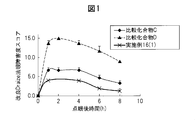
- Comparative compound C and comparative compound D were classified as mild stimulants from the maximum value of Draize score based on their agonist activity for IP receptor or IP, EP2 and EP4 agonist activity. Furthermore, both compounds also increased the aqueous humor protein concentration, which was found to induce eye side effects. On the other hand, the compound of Example 16 (1), which is a compound of the present invention, was found to be non-irritant in the Draize score and not to have an effect of increasing aqueous humor protein concentration.
- the compound of the present invention has low agonist activity for EP2, EP4 and IP receptor and has selective agonist activity for FP receptor. Therefore, the compound of the present invention such as hyperemia based on EP2, EP4 and IP receptor agonist activity, etc. It was suggested that side effects on the eye such as eye irritation and increased aqueous humor protein can be avoided.
- the intraocular pressure of both eyes was measured using a pneumatic applanation tonometer (Model 30 Classic, Leichart) (5 to 8 cases in each group).
- the difference in intraocular pressure between the control eye and the eye administered with the test substance is calculated as the intraocular pressure decrease rate using the following formula, and the maximum intraocular pressure decrease rate during measurement and the intraocular pressure decrease rate after 24 hours are calculated.
- the administration dose of the test substance was 10 ⁇ g / mL for Comparative Compound C, and 30 ⁇ g / mL for Example 16 (1).
- Formulation Example 1 The typical formulation example used for this invention is shown below. 1. Eye drops An eye drop of the following formulation was prepared using a widely used method.
- Example 16 (1) After adding glycerin (2.5 g) and polysorbate 80 (500 mg) to sterilized purified water, the compound of Example 16 (1) (1 mg) was added and dissolved, made up to a total volume of 100 mL with sterilized purified water, and sterile filtered through a membrane filter. Thereafter, it was filled in a predetermined container to obtain an ophthalmic solution having the following formulation.
- an ophthalmic solution containing 0.1 mg and 0.5 mg of the compound of Example 16 (1) in 100 mL can be prepared. Moreover, it can replace with the compound of Example 16 (1), and this invention compound can be used.
- Eye ointment An eye ointment of the following formulation was prepared using a commonly used method.
- Example 16 (1) Liquid paraffin and white petrolatum were heat sterilized in advance.
- the compound (1 mg) of Example 16 (1) was thoroughly triturated with liquid paraffin (10 g), and white petrolatum was added to make a total amount of 100 g, which was sufficiently kneaded to obtain an eye ointment.
- the compound of the present invention has a strong intraocular pressure lowering action and further has no eye side effects such as eye irritation (hyperemia, corneal turbidity, etc.) and increased aqueous humor protein, it is excellent in preventing and / or treating glaucoma and the like. Useful as an agent.
Landscapes
- Health & Medical Sciences (AREA)
- Organic Chemistry (AREA)
- Chemical & Material Sciences (AREA)
- Ophthalmology & Optometry (AREA)
- Chemical Kinetics & Catalysis (AREA)
- General Chemical & Material Sciences (AREA)
- Medicinal Chemistry (AREA)
- Nuclear Medicine, Radiotherapy & Molecular Imaging (AREA)
- Engineering & Computer Science (AREA)
- Pharmacology & Pharmacy (AREA)
- Life Sciences & Earth Sciences (AREA)
- Animal Behavior & Ethology (AREA)
- General Health & Medical Sciences (AREA)
- Public Health (AREA)
- Veterinary Medicine (AREA)
- Bioinformatics & Cheminformatics (AREA)
- Pharmaceuticals Containing Other Organic And Inorganic Compounds (AREA)
Abstract
Description






[1]一般式(I)




[2]Zが-(CH2)m-(すべての記号は前記[1]記載と同じ意味を表す。)である前記[1]記載の化合物、
[3]Yが-O-である前記[1]または[2]記載の化合物、
[4]一般式(I)で示される化合物が、
(1)メチル 4-{(2S,4aR,5R,6R,7aS)-6-ヒドロキシ-5-[(1E,3R)-3-ヒドロキシ-4-フェノキシ-1-ブテン-1-イル]オクタヒドロシクロペンタ[b]チオピラン-2-イル}ブタノアート、
(2)メチル 4-{(2R,4aR,5R,6R,7aS)-6-ヒドロキシ-5-[(1E,3R)-3-ヒドロキシ-4-フェノキシ-1-ブテン-1-イル]オクタヒドロシクロペンタ[b]チオピラン-2-イル}ブタノアート、
(3)4-{(2S,4aR,5R,6R,7aS)-6-ヒドロキシ-5-[(1E,3R)-3-ヒドロキシ-4-フェノキシ-1-ブテン-1-イル]オクタヒドロシクロペンタ[b]チオピラン-2-イル}ブタン酸、
(4)4-{(2S,4aR,5R,6R,7aS)-6-ヒドロキシ-5-[(1E,3S)-3-ヒドロキシ-5-フェニル-1-ペンテン-1-イル]オクタヒドロシクロペンタ[b]チオピラン-2-イル}ブタン酸、
(5)4-{(2R,4aR,5R,6R,7aS)-6-ヒドロキシ-5-[(1E,3R)-3-ヒドロキシ-4-フェノキシ-1-ブテン-1-イル]オクタヒドロシクロペンタ[b]チオピラン-2-イル}ブタン酸、
(6)4-{(2S,4aR,5R,6R,7aS)-5-[(1E,3R)-4-(4-フルオロフェノキシ)-3-ヒドロキシ-1-ブテン-1-イル]-6-ヒドロキシオクタヒドロシクロペンタ[b]チオピラン-2-イル}ブタン酸、
(7)4-{(2S,4aR,5R,6R,7aS)-5-[(1E,3R)-4-(3-クロロフェノキシ)-3-ヒドロキシ-1-ブテン-1-イル]-6-ヒドロキシオクタヒドロシクロペンタ[b]チオピラン-2-イル}ブタン酸、
(8)4-{(2S,4aR,5R,6R,7aS)-6-ヒドロキシ-5-[(1E,3R)-3-ヒドロキシ-4-(3-メチルフェノキシ)-1-ブテン-1-イル]オクタヒドロシクロペンタ[b]チオピラン-2-イル}ブタン酸、
(9)4-{(2S,4aR,5R,6R,7aS)-5-[(1E,3R)-4-(2-フルオロフェノキシ)-3-ヒドロキシ-1-ブテン-1-イル]-6-ヒドロキシオクタヒドロシクロペンタ[b]チオピラン-2-イル}ブタン酸、
(10)4-{(2S,4aR,5R,6R,7aS)-5-[(1E,3R)-4-(3-フルオロフェノキシ)-3-ヒドロキシ-1-ブテン-1-イル]-6-ヒドロキシオクタヒドロシクロペンタ[b]チオピラン-2-イル}ブタン酸、
(11)4-[(2S,4aR,5R,6R,7aS)-6-ヒドロキシ-5-{(1E,3R)-3-ヒドロキシ-4-[3-(トリフルオロメチル)フェノキシ]-1-ブテン-1-イル}オクタヒドロシクロペンタ[b]チオピラン-2-イル]ブタン酸、
(12)4-{(2S,4aR,5R,6R,7aS)-6-ヒドロキシ-5-[(1E,3R)-3-ヒドロキシ-4-(2-メトキシフェノキシ)-1-ブテン-1-イル]オクタヒドロシクロペンタ[b]チオピラン-2-イル}ブタン酸、
(13)4-{(2S,4aR,5R,6R,7aS)-6-ヒドロキシ-5-[(1E,3R)-3-ヒドロキシ-4-(3-メトキシフェノキシ)-1-ブテン-1-イル]オクタヒドロシクロペンタ[b]チオピラン-2-イル}ブタン酸、
(14)4-{(2S,4aR,5R,6R,7aS)-6-ヒドロキシ-5-[(1E,3R)-3-ヒドロキシ-4-(4-メトキシフェノキシ)-1-ブテン-1-イル]オクタヒドロシクロペンタ[b]チオピラン-2-イル}ブタン酸、
(15)4-{(2S,4aR,5R,6R,7aS)-6-ヒドロキシ-5-[(1E,3R)-3-ヒドロキシ-4-(2-メチルフェノキシ)-1-ブテン-1-イル]オクタヒドロシクロペンタ[b]チオピラン-2-イル}ブタン酸、
(16)4-{(2S,4aR,5R,6R,7aS)-6-ヒドロキシ-5-[(1E,3R)-3-ヒドロキシ-4-(4-メチルフェノキシ)-1-ブテン-1-イル]オクタヒドロシクロペンタ[b]チオピラン-2-イル}ブタン酸、
(17)4-{(2S,4aR,5R,6R,7aS)-5-[(1E,3R)-4-(4-クロロフェノキシ)-3-ヒドロキシ-1-ブテン-1-イル]-6-ヒドロキシオクタヒドロシクロペンタ[b]チオピラン-2-イル}ブタン酸、
(18)4-{(2S,4aR,5R,6R,7aS)-5-[(1E,3R)-4-(2-クロロフェノキシ)-3-ヒドロキシ-1-ブテン-1-イル]-6-ヒドロキシオクタヒドロシクロペンタ[b]チオピラン-2-イル}ブタン酸、
(19)4-[(2S,4aR,5R,6R,7aS)-6-ヒドロキシ-5-{(1E,3R)-3-ヒドロキシ-4-[2-(トリフルオロメチル)フェノキシ]-1-ブテン-1-イル}オクタヒドロシクロペンタ[b]チオピラン-2-イル]ブタン酸、
(20)4-[(2S,4aR,5R,6R,7aS)-6-ヒドロキシ-5-{(1E,3R)-3-ヒドロキシ-4-[4-(トリフルオロメチル)フェノキシ]-1-ブテン-1-イル}オクタヒドロシクロペンタ[b]チオピラン-2-イル]ブタン酸、
(21)4-{(2S,4aR,5R,6R,7aS)-6-ヒドロキシ-5-[(3R)-3-ヒドロキシ-4-フェノキシブチル]オクタヒドロシクロペンタ[b]チオピラン-2-イル}ブタン酸、
(22)2-プロパニル 4-{(2S,4aR,5R,6R,7aS)-6-ヒドロキシ-5-[(3R)-3-ヒドロキシ-4-フェノキシブチル]オクタヒドロシクロペンタ[b]チオピラン-2-イル}ブタノアート、
(23)2-プロパニル 4-{(2S,4aR,5R,6R,7aS)-6-ヒドロキシ-5-[(1E,3R)-3-ヒドロキシ-4-フェノキシ-1-ブテン-1-イル]オクタヒドロシクロペンタ[b]チオピラン-2-イル}ブタノアート、
(24)2-プロパニル 4-{(2S,4aR,5R,6R,7aS)-5-[(1E,3R)-4-(3-クロロフェノキシ)-3-ヒドロキシ-1-ブテン-1-イル]-6-ヒドロキシオクタヒドロシクロペンタ[b]チオピラン-2-イル}ブタノアート、
(25)2-プロパニル 4-{(2S,4aR,5R,6R,7aS)-6-ヒドロキシ-5-[(1E,3R)-3-ヒドロキシ-4-(3-メチルフェノキシ)-1-ブテン-1-イル]オクタヒドロシクロペンタ[b]チオピラン-2-イル}ブタノアート、
(26)2-プロパニル 4-{(2S,4aR,5R,6R,7aS)-5-[(1E,3R)-4-(3-フルオロフェノキシ)-3-ヒドロキシ-1-ブテン-1-イル]-6-ヒドロキシオクタヒドロシクロペンタ[b]チオピラン-2-イル}ブタノアート、
(27)2-プロパニル 4-{(2S,4aR,5R,6R,7aS)-5-[(1E,3R)-4-(4-フルオロフェノキシ)-3-ヒドロキシ-1-ブテン-1-イル]-6-ヒドロキシオクタヒドロシクロペンタ[b]チオピラン-2-イル}ブタノアート、
(28)2-プロパニル 4-{(2S,4aR,5R,6R,7aS)-6-ヒドロキシ-5-[(1E,3R)-3-ヒドロキシ-4-(3-メトキシフェノキシ)-1-ブテン-1-イル]オクタヒドロシクロペンタ[b]チオピラン-2-イル}ブタノアート、
(29)2-プロパニル 4-{(2S,4aR,5R,6R,7aS)-6-ヒドロキシ-5-[(1E,3R)-3-ヒドロキシ-4-(2-メトキシフェノキシ)-1-ブテン-1-イル]オクタヒドロシクロペンタ[b]チオピラン-2-イル}ブタノアート、および
(30)2-プロパニル 4-[(2S,4aR,5R,6R,7aS)-6-ヒドロキシ-5-{(1E,3R)-3-ヒドロキシ-4-[3-(トリフルオロメチル)フェノキシ]-1-ブテン-1-イル}オクタヒドロシクロペンタ[b]チオピラン-2-イル]ブタノアートからなる群から選択される化合物である前記[1]記載の化合物、
[5]前記[1]記載の一般式(I)で示される化合物、その塩、その溶媒和物、またはそれらのプロドラッグを含有してなる医薬組成物、
[6]前記[1]記載の一般式(I)で示される化合物、その塩、その溶媒和物、またはそれらのプロドラッグが、FPアゴニストである前記[5]記載の医薬組成物、
[7]眼疾患の予防および/または治療剤である前記[5]記載の医薬組成物、
[8]眼疾患が、緑内障、高眼圧症、黄斑浮腫、黄斑変性、網膜および視神経張力上昇、近視、遠視、乱視、ドライアイ、網膜剥離、白内障、外傷または炎症による眼圧上昇、薬剤による眼圧上昇、または術後の眼圧上昇である前記[7]記載の医薬組成物、
[9]一般式(II)

[10]前記[1]記載の一般式(I)で示される化合物、その塩、その溶媒和物、またはそれらのプロドラッグの有効量を哺乳動物に投与することを特徴とする、眼疾患の予防および/または治療方法、および
[11]眼疾患の予防および/または治療のために使用される前記[1]記載の一般式(I)で示される化合物、その塩、その溶媒和物、またはそれらのプロドラッグ等に関する。

(1)メチル 4-{(2S,4aR,5R,6R,7aS)-6-ヒドロキシ-5-[(1E,3R)-3-ヒドロキシ-4-フェノキシ-1-ブテン-1-イル]オクタヒドロシクロペンタ[b]チオピラン-2-イル}ブタノアート(化合物14)、
(2)メチル 4-{(2R,4aR,5R,6R,7aS)-6-ヒドロキシ-5-[(1E,3R)-3-ヒドロキシ-4-フェノキシ-1-ブテン-1-イル]オクタヒドロシクロペンタ[b]チオピラン-2-イル}ブタノアート(化合物14(3))、
(3)4-{(2S,4aR,5R,6R,7aS)-6-ヒドロキシ-5-[(1E,3R)-3-ヒドロキシ-4-フェノキシ-1-ブテン-1-イル]オクタヒドロシクロペンタ[b]チオピラン-2-イル}ブタン酸(化合物15)、
(4)4-{(2S,4aR,5R,6R,7aS)-6-ヒドロキシ-5-[(1E,3S)-3-ヒドロキシ-5-フェニル-1-ペンテン-1-イル]オクタヒドロシクロペンタ[b]チオピラン-2-イル}ブタン酸(化合物15(2))、
(5)4-{(2R,4aR,5R,6R,7aS)-6-ヒドロキシ-5-[(1E,3R)-3-ヒドロキシ-4-フェノキシ-1-ブテン-1-イル]オクタヒドロシクロペンタ[b]チオピラン-2-イル}ブタン酸(化合物15(3))、
(6)4-{(2S,4aR,5R,6R,7aS)-5-[(1E,3R)-4-(4-フルオロフェノキシ)-3-ヒドロキシ-1-ブテン-1-イル]-6-ヒドロキシオクタヒドロシクロペンタ[b]チオピラン-2-イル}ブタン酸(化合物15(4))、
(7)4-{(2S,4aR,5R,6R,7aS)-5-[(1E,3R)-4-(3-クロロフェノキシ)-3-ヒドロキシ-1-ブテン-1-イル]-6-ヒドロキシオクタヒドロシクロペンタ[b]チオピラン-2-イル}ブタン酸(化合物15(5))、
(8)4-{(2S,4aR,5R,6R,7aS)-6-ヒドロキシ-5-[(1E,3R)-3-ヒドロキシ-4-(3-メチルフェノキシ)-1-ブテン-1-イル]オクタヒドロシクロペンタ[b]チオピラン-2-イル}ブタン酸(化合物15(6))、
(9)4-{(2S,4aR,5R,6R,7aS)-5-[(1E,3R)-4-(2-フルオロフェノキシ)-3-ヒドロキシ-1-ブテン-1-イル]-6-ヒドロキシオクタヒドロシクロペンタ[b]チオピラン-2-イル}ブタン酸(化合物15(7))、
(10)4-{(2S,4aR,5R,6R,7aS)-5-[(1E,3R)-4-(3-フルオロフェノキシ)-3-ヒドロキシ-1-ブテン-1-イル]-6-ヒドロキシオクタヒドロシクロペンタ[b]チオピラン-2-イル}ブタン酸(化合物15(8))、
(11)4-[(2S,4aR,5R,6R,7aS)-6-ヒドロキシ-5-{(1E,3R)-3-ヒドロキシ-4-[3-(トリフルオロメチル)フェノキシ]-1-ブテン-1-イル}オクタヒドロシクロペンタ[b]チオピラン-2-イル]ブタン酸(化合物15(9))、
(12)4-{(2S,4aR,5R,6R,7aS)-6-ヒドロキシ-5-[(1E,3R)-3-ヒドロキシ-4-(2-メトキシフェノキシ)-1-ブテン-1-イル]オクタヒドロシクロペンタ[b]チオピラン-2-イル}ブタン酸(化合物15(10))、
(13)4-{(2S,4aR,5R,6R,7aS)-6-ヒドロキシ-5-[(1E,3R)-3-ヒドロキシ-4-(3-メトキシフェノキシ)-1-ブテン-1-イル]オクタヒドロシクロペンタ[b]チオピラン-2-イル}ブタン酸(化合物15(11))、
(14)4-{(2S,4aR,5R,6R,7aS)-6-ヒドロキシ-5-[(1E,3R)-3-ヒドロキシ-4-(4-メトキシフェノキシ)-1-ブテン-1-イル]オクタヒドロシクロペンタ[b]チオピラン-2-イル}ブタン酸(化合物15(12))、
(15)4-{(2S,4aR,5R,6R,7aS)-6-ヒドロキシ-5-[(1E,3R)-3-ヒドロキシ-4-(2-メチルフェノキシ)-1-ブテン-1-イル]オクタヒドロシクロペンタ[b]チオピラン-2-イル}ブタン酸(化合物15(13))、
(16)4-{(2S,4aR,5R,6R,7aS)-6-ヒドロキシ-5-[(1E,3R)-3-ヒドロキシ-4-(4-メチルフェノキシ)-1-ブテン-1-イル]オクタヒドロシクロペンタ[b]チオピラン-2-イル}ブタン酸(化合物15(14))、
(17)4-{(2S,4aR,5R,6R,7aS)-5-[(1E,3R)-4-(4-クロロフェノキシ)-3-ヒドロキシ-1-ブテン-1-イル]-6-ヒドロキシオクタヒドロシクロペンタ[b]チオピラン-2-イル}ブタン酸(化合物15(15))、
(18)4-{(2S,4aR,5R,6R,7aS)-5-[(1E,3R)-4-(2-クロロフェノキシ)-3-ヒドロキシ-1-ブテン-1-イル]-6-ヒドロキシオクタヒドロシクロペンタ[b]チオピラン-2-イル}ブタン酸(化合物15(16))、
(19)4-[(2S,4aR,5R,6R,7aS)-6-ヒドロキシ-5-{(1E,3R)-3-ヒドロキシ-4-[2-(トリフルオロメチル)フェノキシ]-1-ブテン-1-イル}オクタヒドロシクロペンタ[b]チオピラン-2-イル]ブタン酸(化合物15(17))、
(20)4-[(2S,4aR,5R,6R,7aS)-6-ヒドロキシ-5-{(1E,3R)-3-ヒドロキシ-4-[4-(トリフルオロメチル)フェノキシ]-1-ブテン-1-イル}オクタヒドロシクロペンタ[b]チオピラン-2-イル]ブタン酸(化合物15(18))、
(21)4-{(2S,4aR,5R,6R,7aS)-6-ヒドロキシ-5-[(3R)-3-ヒドロキシ-4-フェノキシブチル]オクタヒドロシクロペンタ[b]チオピラン-2-イル}ブタン酸(化合物15(20))、
(22)2-プロパニル 4-{(2S,4aR,5R,6R,7aS)-6-ヒドロキシ-5-[(3R)-3-ヒドロキシ-4-フェノキシブチル]オクタヒドロシクロペンタ[b]チオピラン-2-イル}ブタノアート(化合物16)、
(23)2-プロパニル 4-{(2S,4aR,5R,6R,7aS)-6-ヒドロキシ-5-[(1E,3R)-3-ヒドロキシ-4-フェノキシ-1-ブテン-1-イル]オクタヒドロシクロペンタ[b]チオピラン-2-イル}ブタノアート(化合物16(1))、
(24)2-プロパニル 4-{(2S,4aR,5R,6R,7aS)-5-[(1E,3R)-4-(3-クロロフェノキシ)-3-ヒドロキシ-1-ブテン-1-イル]-6-ヒドロキシオクタヒドロシクロペンタ[b]チオピラン-2-イル}ブタノアート(化合物16(2))、
(25)2-プロパニル 4-{(2S,4aR,5R,6R,7aS)-6-ヒドロキシ-5-[(1E,3R)-3-ヒドロキシ-4-(3-メチルフェノキシ)-1-ブテン-1-イル]オクタヒドロシクロペンタ[b]チオピラン-2-イル}ブタノアート(化合物16(3))、
(26)2-プロパニル 4-{(2S,4aR,5R,6R,7aS)-5-[(1E,3R)-4-(3-フルオロフェノキシ)-3-ヒドロキシ-1-ブテン-1-イル]-6-ヒドロキシオクタヒドロシクロペンタ[b]チオピラン-2-イル}ブタノアート(化合物16(4))、
(27)2-プロパニル 4-{(2S,4aR,5R,6R,7aS)-5-[(1E,3R)-4-(4-フルオロフェノキシ)-3-ヒドロキシ-1-ブテン-1-イル]-6-ヒドロキシオクタヒドロシクロペンタ[b]チオピラン-2-イル}ブタノアート(化合物16(5))、
(28)2-プロパニル 4-{(2S,4aR,5R,6R,7aS)-6-ヒドロキシ-5-[(1E,3R)-3-ヒドロキシ-4-(3-メトキシフェノキシ)-1-ブテン-1-イル]オクタヒドロシクロペンタ[b]チオピラン-2-イル}ブタノアート(化合物16(6))、
(29)2-プロパニル 4-{(2S,4aR,5R,6R,7aS)-6-ヒドロキシ-5-[(1E,3R)-3-ヒドロキシ-4-(2-メトキシフェノキシ)-1-ブテン-1-イル]オクタヒドロシクロペンタ[b]チオピラン-2-イル}ブタノアート(化合物16(7))、または
(30)2-プロパニル 4-[(2S,4aR,5R,6R,7aS)-6-ヒドロキシ-5-{(1E,3R)-3-ヒドロキシ-4-[3-(トリフルオロメチル)フェノキシ]-1-ブテン-1-イル}オクタヒドロシクロペンタ[b]チオピラン-2-イル]ブタノアート(化合物16(9))等が好ましい。
本発明においては、特に指示しない限り異性体はこれをすべて包含する。例えば、アルキル基には直鎖のものおよび分枝鎖のものが含まれる。さらに、さらに、二重結合、環、縮合環における異性体(E体、Z体、シス体、トランス体)、不斉炭素の存在等による異性体(R、S体、α、β配置、エナンチオマー、ジアステレオマー)、旋光性を有する光学活性体(D、L、d、l体)、クロマトグラフ分離による極性体(高極性体、低極性体)、平衡化合物、回転異性体、これらの任意の割合の混合物、ラセミ混合物は、すべて本発明に含まれる。また、本発明においては、互変異性体による異性体をもすべて包含する。




本発明化合物は、公知の方法、例えば、Comprehensive Organic Transformations : A Guide to Functional Group Preparations, 2nd Edition (Richard C. Larock, John Wiley & Sons Inc, 1999)に記載された方法、または実施例に示す方法等を適宜改良し、組み合わせて用いることで製造することができる。例えば、一般式(II)中のXが-S-の化合物は米国特許第4,367,237号、一般式(II)中のXが-O-の化合物は米国特許第4,490,537号に記載された方法を用いて製造することができる。

(1)アルカリ加水分解による脱保護反応は、例えば有機溶媒(例えば、メタノール、テトラヒドロフラン、ジオキサン等)中、アルカリ金属の水酸化物(例えば、水酸化ナトリウム、水酸化カリウム、水酸化リチウム等)、アルカリ土類金属の水酸化物(例えば、水酸化バリウム、水酸化カルシウム等)または炭酸塩(例えば、炭酸ナトリウム、炭酸カリウム等)あるいはその水溶液もしくはこれらの混合物を用いて、0~40℃で行なわれる。
(1)ハロゲン化アルキルを用いる方法
(2)酸ハライドを用いる方法、
(3)混合酸無水物を用いる方法、
(4)縮合剤を用いる方法
等が挙げられる。
(1)DMSO酸化(例えばスワン酸化(Swern oxidation))を用いる方法、
(2)デス-マーチン試薬(Dess-Martin Reagent)を用いる方法,
(3)TEMPO試薬を用いる方法
等が挙げられる。
本発明化合物の毒性は十分に低いものであり、例えば、眼刺激性(充血、角膜混濁等)、房水タンパク質上昇等がほとんどなく、医薬品として安全に使用することができる。
本発明化合物および一般式(II)
1)その化合物の予防および/または治療効果の補完および/または増強、
2)その化合物の動態・吸収改善、投与量の低減、および/または
3)その化合物の副作用の軽減のために他の薬物と組み合わせて、併用薬として投与してもよい。
(3aR,4S,5R,6aS)-4-(ヒドロキシメチル)-5-(テトラヒドロ-2H-ピラン-2-イルオキシ)ヘキサヒドロ-2H-シクロペンタ[b]フラン-2-オン(CAS登録番号:69222-61-3)(47.5g)とイミダゾール(16.3g)の無水N,N-ジメチルホルムアミド(125mL)溶液に、冷水浴中でt-ブチルジメチルシリルクロリド(30.5g)の無水N,N-ジメチルホルムアミド(82.5mL)溶液を滴下して加えた。室温に昇温して2時間撹拌した後、反応混合物にエタノール(1.25mL)を加えてさらに1時間撹拌した。反応混合物を冷水(500mL)に注ぎ、ヘキサン(200mL)と酢酸エチル(100mL)を加えて撹拌した。二層を分離し、有機層を1M塩酸(100mL)、水(100mL×2 回)、飽和重曹水(100mL)および飽和食塩水(100mL)で洗浄し、無水硫酸ナトリウムで乾燥し、濃縮して、以下の物性値を有する標題化合物(68.4g)を得た。
TLC : Rf 0.75(酢酸エチル:ヘキサン=1:4);
NMR (CDCl3) : δ 5.05-4.9 (m, 1H), 4.7-4.6 (m, 1H), 4.25-4.0 (m, 1H), 4.0-3.75 (m, 1H), 3.56 (t, J=7Hz, 2H), 3.6-3.4 (m, 1H), 2.9-2.0 (m, 6H), 1.9-1.4 (m, 6H), 0.89 (s, 9H), 0.04 (s, 6H)。
化合物1(68.4g)の無水トルエン(315mL)溶液を、ドライアイス-メタノール浴で-60℃付近に冷却したのち、ジイソブチルアルミニウムヒドリド/トルエン溶液(0.99M、209mL)を33分間かけて滴下した。2時間撹拌した後、反応混合物にメタノール(3.2mL)を-65℃で3分間かけて滴下して反応を停止した。反応液を0℃付近まで昇温した後、攪拌しながら水(18.5mL+18mL)を2回に分けて滴下した。ここに無水硫酸ナトリウム(7.4g)を加えて室温で1時間撹拌し、セライト(商品名)でろ過した。ろ別した固体をテトラヒドロフラン(160mL)で洗浄し、濃縮して、以下の物性値を有する標題化合物(70.7g)を得た。
TLC : Rf 0.60(酢酸エチル:ヘキサン=1:1);
NMR (CDCl3) : δ 5.7-5.35 (m, 1H), 5.3-5.0 (br), 4.8-4.55 (m, 2H), 4.3-3.75 (m, 2H), 3.7-3.3 (m, 2H), 2.7-1.4 (m, 12H), 0.89 (s, 9H), 0.04 (s, 6H)。
(4-カルボキシブチル)トリフェニルホスホニウム ブロミド(180.3g)の無水テトラヒドロフラン(1370mL)懸濁液に、水浴上で撹拌しながらカリウムt-ブトキシド(91.4g)を6分間かけて加えた。3時間撹拌したのち、反応混合物に化合物2(70.7g)の無水テトラヒドロフラン(130mL)溶液を5分間かけて滴下した。さらに室温で1時間撹拌したのち反応混合物を氷水(4.2L)に注ぎ、10%シュウ酸2水和物水溶液(約195mL)を加えてpH5~6に調整した。反応混合物をヘキサン(500mL)と酢酸エチル(500mL)の混合液で抽出(1L×3回)し、有機層を合わせて飽和食塩水(500mL)で洗浄した。無水硫酸ナトリウムで乾燥後、減圧濃縮して得られた粗生成物(161.1g)をアセトン(260mL)に溶解した。この溶液に炭酸カリウム(34.0g)およびヨウ化メチル(20mL)を加え、室温で14時間撹拌し、さらに1時間還流した。室温に放冷後、不溶固体を濾去し、ろ液を約1/2まで減圧濃縮した。この溶液に水(750mL)を加え、ヘキサン(250mL)と酢酸エチル(250mL)の混合液で抽出した。抽出液を飽和食塩水(500mL)で洗浄し、洗浄水と水層を合わせて酢酸エチル(200mL)で再度抽出した。有機層を合わせて無水硫酸ナトリウムで乾燥し、濃縮した。残渣をシリカゲルカラムクロマトグラフィー(ヘキサン:酢酸エチル=4:1→1:1)で精製して、以下の物性値を有する標題化合物(79.6g)を得た。
TLC : Rf 0.76(酢酸エチル:ヘキサン=1:1);
NMR (CDCl3) : δ 5.6-5.3(m, 2H), 4.7-4.65 (m, 1H), 4.25-4.2 (m, 1H), 4.15-4.05 (m, 1H), 3.95-3.3 (m, 7H), 2.4-1.4 (m, 19H), 0.90 (s, 9H), 0.05 (s, 6H)。
化合物3(79.6g)およびトリフェニルホスフィン(57.6g)の無水テトラヒドロフラン(482mL)溶液を、ドライアイス-メタノール浴で-40℃付近に冷却した。この溶液に酢酸(12.6mL)を加えたのち、40%アゾジカルボン酸ジエチル/トルエン溶液(100mL)を15 分間かけて滴下した。室温で4.5時間撹拌したのち、反応混合物を水(1600mL)に注ぎ、ヘキサン(550mL)と酢酸エチル(550mL)の混合溶液を加えて撹拌した。二層を分離した後、有機層を水(540mL)および飽和食塩水(540mL)で洗浄し、無水硫酸ナトリウムで乾燥し、濃縮した。得られた残渣をシリカゲルカラムクロマトグラフィー(ヘキサン:酢酸エチル=10:1)で精製して、以下の物性値を有する標題化合物(69.7g)を得た。
TLC : Rf 0.70(酢酸エチル:ヘキサン=1:4);
NMR (CDCl3) : δ 7.4-7.1 (m, 4H), 6.0-5.8 (m, 1H), 5.78 (dd, J = 16, 6Hz, 1H), 5.53 (dd, J = 16, 8Hz, 1H), 5.4-5.25 (m, 2H), 4.7-4.6 (m, 4H), 4.5-4.4 (m, 3H), 4.0-3.85 (m, 1H), 3.42 (s, 3H), 3.0-2.8 (m, 2H), 2.72 (dd, J = 19, 10Hz, 1H), 2.65-2.5 (m, 6H), 2.4-2.1 (m, 4H), 2.0-1.6 (m, 5H)。
(6R)-6-{2-[(1R,2S,3R,5R)-2-({[ジメチル(2-メチル-2-プロパニル)シリル]オキシ}メチル)-5-ヒドロキシ-3-(テトラヒドロ-2H-ピラン-2-イルオキシ)シクロペンチル]-1-ヨードエチル}テトラヒドロ-2H-ピラン-2-オン(高極性化合物:化合物5a)
(6S)-6-{2-[(1R,2S,3R,5R)-2-({[ジメチル(2-メチル-2-プロパニル)シリル]オキシ}メチル)-5-ヒドロキシ-3-(テトラヒドロ-2H-ピラン-2-イルオキシ)シクロペンチル]-1-ヨードエチル}テトラヒドロ-2H-ピラン-2-オン(低極性化合物:化合物5b)
化合物4(34.9g)のテトラヒドロフラン(140mL)溶液に、2M水酸化ナトリウム水溶液(140mL)を加えて室温で18時間、50℃で3時間撹拌した。氷-メタノール浴にて-4℃に冷却してから、反応混合物に2M塩酸(111mL)を12分間かけて2℃以下を保ちながら滴下した(pH5~6)。冷却浴を氷浴に変更し、反応混合物に炭酸水素ナトリウム(28.5g)およびヨウ素(17.5g)を加えて撹拌した。2時間後にヨウ素(34.2g)を加え、さらに2.5時間撹拌した後、5%チオ硫酸ナトリウム水溶液(1380mL)を加えた。ヨウ素の色が大部分消失したところで酢酸エチル(600mL)を加えて撹拌し、二層を分離した。有機層を水(150mL)および飽和食塩水(150mL)で洗浄し、無水硫酸ナトリウムで乾燥し、濃縮した。得られた残渣をシリカゲルカラムクロマトグラフィー(ヘキサン:酢酸エチル=1:1→5:6)で精製し、以下の物性値を有する標題化合物(低極性化合物8.0g;高極性化合物20.8g)をそれぞれ得た。
TLC : Rf 0.45(酢酸エチル:ヘキサン=1:1);
NMR (CDCl3) : δ 4.65-4.5 (m, 2H), 4.25-3.6 (m, 5H), 3.55-3.45 (m, 1H), 2.7-2.2 (m, 3H), 2.2-1.5 (m, 16H), 0.95 (s, 9H), 0.12 and 0.11 (each are s, 3H)。
TLC : Rf 0.50(酢酸エチル:ヘキサン=1:1);
NMR (CDCl3) : δ 4.65-4.55 (m, 1H), 4.4-3.6 (m, 6H), 3.55-3.45 (m, 1H), 2.7-2.25 (m, 3H), 2.1-1.5 (m, 16H), 0.93 (s, 9H), 0.12 and 0.10 (each are s, 3H)。
化合物5a(41.8g)の無水ベンゼン(195mL)溶液に、水素化トリn-ブチルスズ(18.5mL)およびアゾビス(イソブチロニトリル)(198mg)を加えて3時間加熱還流した。放冷後、反応混合物を濃縮した。得られた残渣をシリカゲルカラムクロマトグラフィー(ヘキサン:酢酸エチル=4:1→1:1→2:3)で精製して、以下の物性値を有する標題化合物(29.9g)を得た。
TLC : Rf 0.50(酢酸エチル:ヘキサン=2:1);
NMR (CDCl3) : δ 4.65-4.5 (m, 1H), 4.3-3.8 (m, 4H), 3.7-3.4 (m, 3H), 2.65-2.35 (m, 2H), 2.0-1.4 (m, 17H), 0.90 (s, 9H), 0.10 and 0.09 (each are s, 3H)。
化合物6(33.2g)の無水メタノール(306mL)溶液に、トリエチルアミン(25.5mL)を加えて5時間加熱還流した。放冷後、反応混合物を濃縮した。得られた残渣をトルエン共沸(2回)して、以下の物性値を有する標題化合物(38.0g)を得た。
TLC : Rf 0.62(酢酸エチル:ジクロロメタン=2:1);
NMR (CDCl3) : δ 4.65-4.5 (m, 1H), 4.3-4.1 (m, 1H), 4.0-3.8 (m, 3H), 3.7-3.4 (m, 4H), 3.67 (s, 3H), 2.35 (t, J = 7Hz, 2H), 2.0-1.4 (m, 18H), 0.90 (s, 9H), 0.09 and 0.08 (each are s, 3H)。
化合物7(38.0g)およびトリエチルアミン(44mL)の無水ジクロロメタン(323mL)溶液をドライアイス-メタノール浴で-60℃付近に冷却し、メシルクロリド(15mL)を約20分間かけて滴下した。氷浴に換えて2時間撹拌した後、反応混合物を冷水(600mL)に加え、ヘキサン(600mL)と酢酸エチル(600mL)の混合溶液で抽出した。有機層を1M塩酸(290mL)および飽和食塩水(300mL×3 回)で洗浄し、無水硫酸ナトリウムで乾燥後、濃縮して、以下の物性値を有する標題化合物(44.7g)を得た。
TLC : Rf 0.82(酢酸エチル:ジクロロメタン=2:1)。
70%水硫化ナトリウムn水和物(14.9g)をメタノール(123mL)に加え、室温で15分間撹拌して大部分を溶解させた。ここに炭酸水素ナトリウム(15.9g)、および化合物8(44.7g)のメタノール(200mL)溶液を加えて、室温で20分、50℃で10時間撹拌し、さらに室温で約4時間撹拌した。その後60℃まで昇温し、4時間撹拌したのち室温まで冷却した。反応混合物を冷水(1200mL)に加え、ヘキサン(600mL)と酢酸エチル(600mL)の混合溶液で抽出した。有機層を水(300mL)および飽和食塩水(300mL)で洗浄し、無水硫酸ナトリウムで乾燥し、濃縮した。得られた残渣をシリカゲルカラムクロマトグラフィー(ヘキサン:酢酸エチル=20:1)で精製して、以下の物性値を有する標題化合物(13.7g)を得た。
TLC : Rf 0.60(酢酸エチル:ヘキサン=1:4);
NMR (CDCl3) : δ 4.65-4.6 (m, 1H), 4.0-3.8 (m, 2H), 3.68 (s, 3H), 3.65-3.4 (m, 3H), 3.1-2.9 (m, 1H), 2.85-2.7 (m, 1H), 2.4-2.2 (m, 3H), 2.1-1.4 (m, 16H), 0.87 (s, 9H), 0.04 (s, 6H)。
化合物9(7.3g)のテトラヒドロフラン(74mL)溶液に、1Mテトラブチルアンモニウムフルオリド/テトラヒドロフラン溶液(27mL)を加えて3時間撹拌した。反応液を酢酸エチル(380mL)で希釈し、水(740mL)および飽和食塩水(380mL)で洗浄した。さらに水層を酢酸エチル(100mL)で抽出した。有機層を合わせて無水硫酸ナトリウムで乾燥し、濃縮した。得られた残渣をシリカゲルカラムクロマトグラフィー(ヘキサン:酢酸エチル=2:1)で精製した。得られた化合物を再度シリカゲルカラムクロマトグラフィー(ジクロロメタン:酢酸エチル=4:1→酢酸エチル)で精製して、以下の物性値を有する標題化合物(3.24g)を得た。
TLC : Rf 0.28(酢酸エチル:ヘキサン=1:1);
NMR (CDCl3) : δ 1.23 - 2.19 (m, 17 H), 2.24 - 2.40 (m, 3 H), 2.69 - 2.82 (m, 1 H), 2.92 - 3.02 (m, 1 H), 3.44 - 3.73 (m, 6 H), 3.82 - 4.07 (m, 2 H), 4.55 - 4.74 (m, 1 H)。
化合物10(200mg)を酢酸エチル(1.7mL)とジメチルスルホキシド(0.84mL)に溶解し、ジイソプロピルエチルアミン(0.39mL)を加えて氷浴中で冷却した。三酸化硫黄-ピリジン(256mg)を加えて10分間攪拌した後、水に注ぎ酢酸エチルで抽出した。有機層を水および飽和食塩水で洗浄し、無水硫酸マグネシウムで乾燥し、濃縮して、以下の物性値を有する標題化合物(200mg)を得た。
TLC : Rf 0.51(酢酸エチル:ヘキサン=1:1)。
ジメチル (2-オキソ-3-フェノキシプロピル)ホスホナート(194mg)の無水テトラヒドロフラン(2.7mL)溶液に、氷浴中で水素化ナトリウム(24.8mg)を加えて室温で1.5時間撹拌した。ここに化合物11(200mg)の無水テトラヒドロフラン(2mL)溶液を滴下し、室温で4.5時間反応させた。酢酸を少量加えてから反応液を酢酸エチルで希釈した。この溶液を水および飽和食塩水で洗浄し、無水硫酸マグネシウムで乾燥し、濃縮して、以下の物性値を有する標題化合物(250mg)を得た。
TLC : Rf 0.61(酢酸エチル:ヘキサン=1:1)。
化合物12(250mg)と(R)-2-メチル-CBS-オキサザボロリジン(1Mトルエン溶液,0.135mL)を無水テトラヒドロフラン(1mL)に溶解し、1Mボラン-テトラヒドロフラン錯体(0.323mL)を室温で加えた。10分間攪拌した後にメタノールを加えて数分間攪拌した。この反応液を酢酸エチルで希釈した。この溶液を、1M塩酸、水および飽和食塩水で洗浄し、無水硫酸マグネシウムで乾燥し、濃縮して、以下の物性値を有する標題化合物(220mg)を得た。
TLC : Rf 0.47(酢酸エチル:ヘキサン=1:1)。
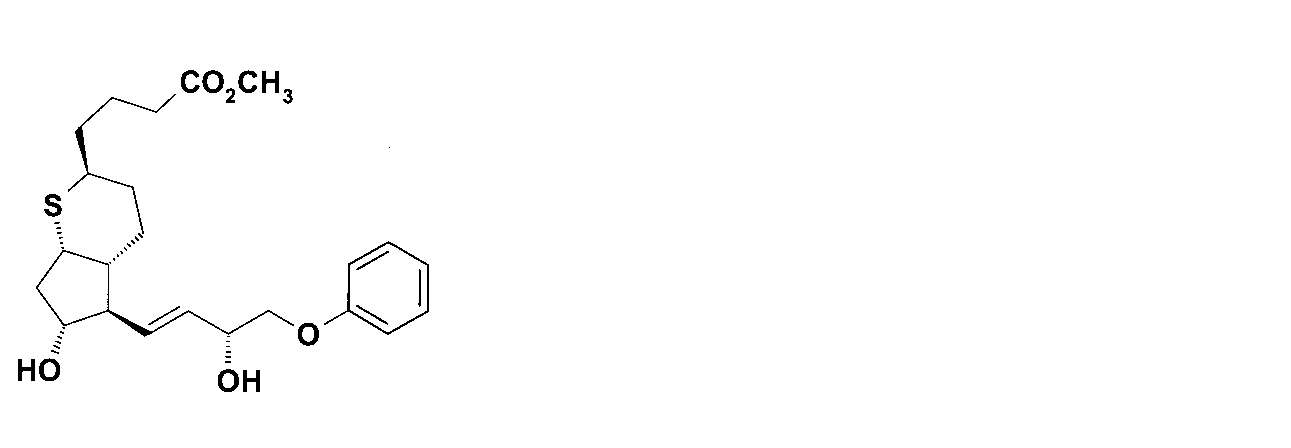
TLC : Rf 0.62(酢酸エチル);
NMR (CDCl3) : δ 1.35 - 1.96 (m, 11 H), 2.09 - 2.17 (m, 1 H), 2.28 - 2.47 (m, 3 H), 2.65 - 2.79 (m, 1 H), 3.27 - 3.36 (m, 1 H), 3.67 (s, 3 H), 3.82 - 3.94 (m, 1 H), 3.94 - 4.19 (m, 3 H), 4.48 - 4.60 (m, 1 H), 5.66 (dd, J=15.37, 5.67 Hz, 1 H), 5.78 (dd, J=15.37, 8.42 Hz, 1 H), 6.85 - 7.04 (m, 3 H), 7.20 - 7.38 (m, 2 H)。
実施例6において化合物5aを用いるか、その代わりに化合物5bを用いて、実施例12においてジメチル [2-オキソ-3-(フェニルオキシ)プロピル]ホスホナートを用いるか、その代わりにジメチル (2-オキソ-4-フェニルブチル)ホスホナートを用いて、実施例6→実施例7→実施例8→実施例9→実施例10→実施例11→実施例12→実施例13→実施例14と同様の操作を行い、以下の化合物を得た。
TLC : Rf 0.20 (ヘキサン:酢酸エチル=1:1);
NMR (CDCl3) : δ 1.39 - 1.99 (m, 13 H), 2.25 - 2.50 (m, 4 H), 2.60 - 2.79 (m, 3 H), 2.85 - 3.01 (m, 1 H), 3.33 - 3.44 (m, 1 H), 3.66 (s, 3 H), 3.93 - 4.05 (m, 1 H), 4.07 - 4.18 (m, 1 H), 5.51 (dd, J=15.37, 8.42 Hz, 1 H), 5.63 (dd, J=15.37, 6.40 Hz, 1 H), 7.11 - 7.33 (m, 5 H)。
TLC : Rf 0.19 (ヘキサン:酢酸エチル=1:1);
NMR (CDCl3) : δ 1.33 - 2.10 (m, 14 H), 2.27 - 2.47 (m, 3 H), 2.59 - 2.78 (m, 4 H), 3.22 - 3.38 (m, 1 H), 3.67 (s, 3 H), 3.88 - 4.01 (m, 1 H), 4.05 - 4.19 (m, 1 H), 5.46 - 5.70 (m, 2 H), 7.08 - 7.34 (m, 5 H)。
TLC : Rf 0.61 (酢酸エチル);
NMR (CDCl3) : δ 1.37 - 1.94 (m, 11 H), 2.23 - 2.50 (m, 4 H), 2.62 - 2.76 (m, 1 H), 2.90 - 3.04 (m, 1 H), 3.36 - 3.44 (m, 1 H), 3.67 (s, 3 H), 3.82 - 3.94 (m, 1 H), 3.95 - 4.07 (m, 2 H), 4.48 - 4.60 (m, 1 H), 5.61 - 5.82 (m, 2 H), 6.87 - 7.01 (m, 3 H), 7.22 - 7.34 (m, 2 H)。
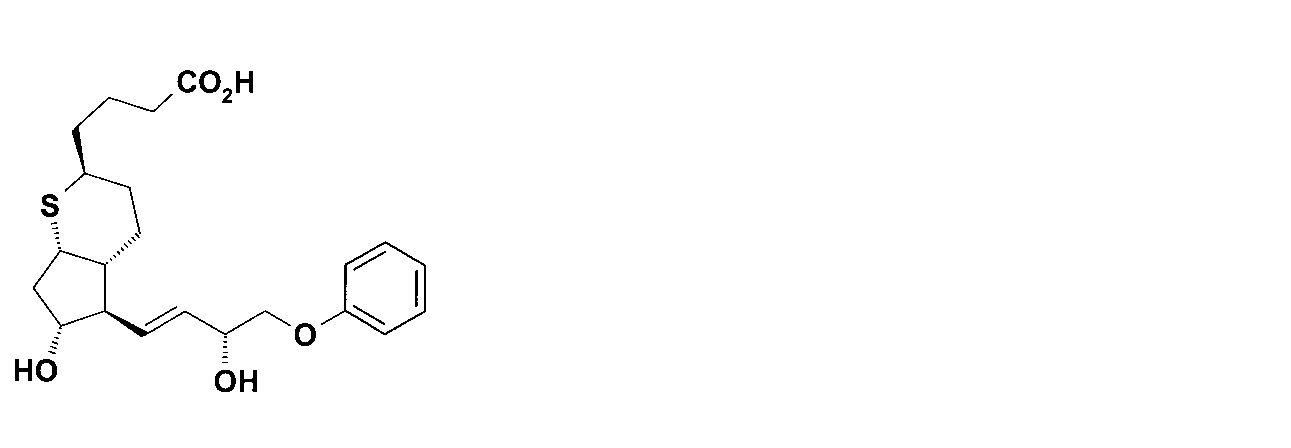
TLC : Rf 0.41(クロロホルム:メタノール=9:1);
NMR (CDCl3) : δ 1.36 - 2.12 (m, 12 H), 2.31 - 2.46 (m, 3 H), 2.65 - 2.79 (m, 2 H), 3.27 - 3.37 (m, 1 H), 3.84 - 3.95 (m, 1 H), 3.96 - 4.06 (m, 2 H), 4.49 - 4.59 (m, 1 H), 5.67 (dd, J=15.92, 5.67 Hz, 1 H), 5.79 (dd, J=15.92, 7.87 Hz, 1 H), 6.88 - 7.03 (m, 3 H), 7.23 - 7.36 (m, 2 H)。
化合物14の代わりに化合物14(1)~(3)または相当するエステル体を用いて、実施例15と同様の操作を行い、以下の化合物を得た。
TLC : Rf 0.25 (クロロホルム:メタノール=9:1);
NMR (CDCl3) : δ 1.42 - 2.01 (m, 13 H), 2.27 - 2.54 (m, 4 H), 2.62 - 2.81 (m, 3 H), 2.87 - 3.03 (m, 1 H), 3.34 - 3.43 (m, 1 H), 3.94 - 4.05 (m, 1 H), 4.06 - 4.19 (m, 1 H), 5.52 (dd, J=15.37, 8.42 Hz, 1 H), 5.64 (dd, J=15.37, 6.40 Hz, 1 H), 7.08 - 7.38 (m, 5 H)。
TLC : Rf 0.25 (クロロホルム:メタノール=9:1);
NMR (CDCl3) : δ 1.28 - 2.14 (m, 14 H), 2.31 - 2.48 (m, 3 H), 2.62 - 2.81 (m, 4 H), 3.25 - 3.38 (m, 1 H), 3.91 - 4.03 (m, 1 H), 4.07 - 4.19 (m, 1 H), 5.47 - 5.72 (m, 2 H), 7.12 - 7.37 (m, 5 H)。
TLC : Rf 0.34 (酢酸エチル);
NMR (CDCl3) : δ 1.40 - 1.66 (m, 7 H), 1.67 - 1.94 (m, 6 H), 2.29 - 2.49 (m, 3 H), 2.63 - 2.77 (m, 1 H), 2.90 - 3.05 (m, 1 H), 3.35 - 3.44 (m, 1 H), 3.85 - 3.94 (m, 1 H), 3.95 - 4.07 (m, 2 H), 4.49 - 4.59 (m, 1 H), 5.62 - 5.71 (m, 1 H), 5.71 - 5.80 (m, 1 H), 6.86 - 7.01 (m, 3 H), 7.22 - 7.34 (m, 2 H)。
TLC : Rf 0.37 (ジクロロメタン:メタノール=10:1);
NMR (CDCl3) : δ 1.18 - 1.93 (m, 11 H), 1.95 - 2.13 (m, 1 H), 2.24 - 2.54 (m, 3 H), 2.62 - 2.81 (m, 2 H), 3.19 - 3.44 (m, 1 H), 3.78 - 3.91 (m, 1 H), 3.91 - 4.04 (m, 2 H), 4.45 - 4.58 (m, 1 H), 5.58 - 5.70 (m, 1 H), 5.70 - 5.87 (m, 1 H), 6.76 - 6.91 (m, 2 H), 6.91 - 7.04 (m, 2 H)。
TLC : Rf 0.37 (ジクロロメタン:メタノール=10:1);
NMR (CDCl3) : δ 1.15 - 1.93 (m, 11 H), 1.96 - 2.17 (m, 1 H), 2.31 - 2.51 (m, 3 H), 2.66 - 2.82 (m, 2 H), 3.23 - 3.37 (m, 1 H), 3.79 - 4.08 (m, 3 H), 4.47 - 4.61 (m, 1 H), 5.59 - 5.71 (m, 1 H), 5.72 - 5.84 (m, 1 H), 6.74 - 6.86 (m, 1 H), 6.87 - 7.01 (m, 2 H), 7.19 (t, J=8.05 Hz, 1 H)。
TLC : Rf 0.42 (ジクロロメタン:メタノール=10:1);
NMR (CDCl3) : δ 1.12 - 2.16 (m, 10 H), 2.28 - 2.49 (m, 6 H), 2.64 - 2.82 (m, 2 H), 3.25 - 3.36 (m, 1 H), 3.86 (dd, J=9.33, 7.87 Hz, 3 H), 3.92 - 4.05 (m, 2 H), 4.43 - 4.61 (m, 1 H), 5.52 - 5.72 (m, 1 H), 5.72 - 5.86 (m, 1 H), 6.61 - 6.85 (m, 3 H), 7.17 (t, J=7.78 Hz, 1 H)。
TLC : Rf 0.36 (ジクロロメタン:メタノール=10:1);
NMR (CDCl3) : δ 1.13 - 1.93 (m, 11 H), 1.96 - 2.14 (m, 1 H), 2.27 - 2.49 (m, 3 H), 2.60 - 2.81 (m, 2 H), 3.31 (q, J=5.67 Hz, 1 H), 3.80 - 4.18 (m, 3 H), 4.43 - 4.66 (m, 1 H), 5.58 - 5.72 (m, 1 H), 5.72 - 5.95 (m, 1 H), 6.75 - 7.20 (m, 4 H)。
TLC : Rf 0.36 (ジクロロメタン:メタノール=10:1);
NMR (CDCl3) : δ 1.17 - 2.11 (m, 12 H), 2.24 - 2.55 (m, 3 H), 2.59 - 2.82 (m, 2 H), 3.31 (q, J=5.61 Hz, 1 H), 3.73 - 4.11 (m, 3 H), 4.46 - 4.60 (m, 1 H), 5.59 - 5.86 (m, 2 H), 6.52 - 6.85 (m, 3 H), 7.08 - 7.33 (m, 1 H)。
TLC : Rf 0.46 (ジクロロメタン:メタノール=10:1);
NMR (CDCl3) : δ 1.04 - 2.18 (m, 12 H), 2.23 - 2.51 (m, 3 H), 2.59 - 2.81 (m, 2 H), 3.24 - 3.41 (m, 1 H), 3.86 - 4.14 (m, 3 H), 4.41 - 4.72 (m, 1 H), 5.56 - 5.73 (m, 1 H), 5.74 - 5.92 (m, 1 H), 6.99 - 7.19 (m, 2 H), 7.20 - 7.32 (m, 1 H), 7.40 (t, J=8.05 Hz, 1 H)。
TLC : Rf 0.46 (ジクロロメタン:メタノール=10:1);
NMR (CDCl3) : δ 1.15 - 2.23 (m, 12 H), 2.29 - 2.49 (m, 3 H), 2.59 - 2.78 (m, 2 H), 3.21 - 3.40 (m, 1 H), 3.80 - 4.21 (m, 6 H), 4.44 - 4.61 (m, 1 H), 5.54 - 5.68 (m, 1 H), 5.68 - 5.85 (m, 1 H), 6.84 - 7.02 (m, 4 H)。
TLC : Rf 0.46 (ジクロロメタン:メタノール=10:1);
NMR (CDCl3) : δ 1.03 - 2.16 (m, 12 H), 2.24 - 2.49 (m, 3 H), 2.59 - 2.92 (m, 2 H), 3.30 (q, J=5.73 Hz, 1 H), 3.79 (s, 3 H), 3.83 - 3.91 (m, 1 H), 3.93 - 4.09 (m, 2 H), 4.44 - 4.66 (m, 1 H), 5.54 - 5.93 (m, 2 H), 6.29 - 6.59 (m, 3 H), 7.18 (t, J=8.14 Hz, 1 H)。
TLC : Rf 0.36 (ジクロロメタン:メタノール=9:1);
NMR (CDCl3) : δ 1.10 - 1.94 (m, 11 H), 1.95 - 2.12 (m, 1 H), 2.28 - 2.53 (m, 3 H), 2.62 - 2.81 (m, 2 H), 3.24 - 3.36 (m, 1 H), 3.77 (s, 3 H), 3.78 - 3.86 (m, 1 H), 3.89 - 4.15 (m, 2 H), 4.37 - 4.61 (m, 1 H), 5.46 - 5.70 (m, 1 H), 5.70 - 5.93 (m, 1 H), 6.57 - 6.96 (m, 4 H)。
TLC : Rf 0.32 (ジクロロメタン:メタノール=9:1);
NMR (CDCl3) : δ 1.16 - 2.16 (m, 12 H), 2.24 (s, 3 H), 2.31 - 2.51 (m, 3 H), 2.60 - 2.83 (m, 2 H), 3.32 (q, J=5.55 Hz, 1 H), 3.85 - 3.95 (m, 1 H), 3.97 - 4.10 (m, 2 H), 4.49 - 4.63 (m, 1 H), 5.60 - 5.92 (m, 2 H), 6.76 - 6.99 (m, 2 H), 7.10 - 7.21 (m, 2 H)。
TLC : Rf 0.34 (ジクロロメタン:メタノール=9:1);
NMR (CDCl3) : δ 1.29 - 1.91 (m, 11 H), 1.94 - 2.11 (m, 1 H), 2.29 (s, 3 H), 2.32 - 2.47 (m, 3 H), 2.62 - 2.84 (m, 2 H), 3.23 - 3.35 (m, 1 H), 3.64 - 3.89 (m, 1 H), 3.90 - 4.11 (m, 2 H), 4.38 - 4.60 (m, 1 H), 5.53 - 5.70 (m, 1 H), 5.71 - 5.86 (m, 1 H), 6.80 (d, J=8.05 Hz, 2 H), 7.07 (d, J=8.05 Hz, 2 H)。
TLC : Rf 0.36 (ジクロロメタン:メタノール=9:1);
NMR (CDCl3) : δ 1.04 - 2.14 (m, 12 H), 2.29 - 2.56 (m, 3 H), 2.61 - 2.78 (m, 2 H), 3.19 - 3.44 (m, 1 H), 3.75 - 3.91 (m, 1 H), 3.91 - 4.11 (m, 2 H), 4.42 - 4.60 (m, 1 H), 5.57 - 5.70 (m, 1 H), 5.72 - 5.89 (m, 1 H), 6.81 - 6.88 (m, 2 H), 7.14 - 7.27 (m, 2 H)。
TLC : Rf 0.48 (ジクロロメタン:メタノール=9:1);
NMR (CDCl3) : δ 1.14 - 1.92 (m, 11 H), 1.93 - 2.15 (m, 1 H), 2.31 - 2.49 (m, 3 H), 2.63 - 2.79 (m, 2 H), 3.30 (q, J=5.61 Hz, 1 H), 3.82 - 4.20 (m, 3 H), 4.50 - 4.63 (m, 1 H), 5.56 - 5.70 (m, 1 H), 5.72 - 5.84 (m, 1 H), 6.82 - 6.99 (m, 2 H), 7.17 - 7.24 (m, 1 H), 7.35 (dd, J=8.14, 1.19 Hz, 1 H)。
TLC : Rf 0.48 (ジクロロメタン:メタノール=9:1);
NMR (CDCl3) : δ 1.18 - 1.94 (m, 11 H), 1.94 - 2.17 (m, 1 H), 2.30 - 2.47 (m, 3 H), 2.64 - 2.83 (m, 2 H), 3.24 - 3.37 (m, 1 H), 3.85 - 4.16 (m, 3 H), 4.48 - 4.59 (m, 1 H), 5.54 - 5.72 (m, 1 H), 5.73 - 5.88 (m, 1 H), 6.88 - 7.09 (m, 2 H), 7.48 (t, J=7.96 Hz, 1 H), 7.56 (d, J=7.68 Hz, 1 H)。
TLC : Rf 0.48 (ジクロロメタン:メタノール=9:1);
NMR (CDCl3) : δ 1.20 - 1.94 (m, 11 H), 1.95 - 2.19 (m, 1 H), 2.28 - 2.50 (m, 3 H), 2.62 - 2.83 (m, 2 H), 3.16 - 3.43 (m, 1 H), 3.80 - 4.13 (m, 3 H), 4.44 - 4.63 (m, 1 H), 5.59 - 5.71 (m, 1 H), 5.72 - 5.91 (m, 1 H), 6.97 (d, J=8.60 Hz, 2 H), 7.54 (d, J=8.60 Hz, 2 H)。
TLC : Rf 0.48 (ジクロロメタン:メタノール=9:1);
NMR (CDCl3) : δ 1.13 - 1.94 (m, 11 H), 1.93 - 2.13 (m, 1 H), 2.27 - 2.48 (m, 3 H), 2.57 - 2.80 (m, 2 H), 2.90 - 3.07 (m, 1 H), 3.08 - 3.23 (m, 1 H), 3.27 (q, J=5.43 Hz, 1 H), 3.85 - 3.99 (m, 1 H), 4.10 - 4.27 (m, 1 H), 5.31 - 5.74 (m, 2 H), 7.02 - 7.51 (m, 5 H)。
TLC : Rf 0.48 (ジクロロメタン:メタノール=9:1);
NMR (CDCl3) : δ 1.34 - 2.15 (m, 17 H), 2.21 - 2.34 (m, 1 H), 2.39 (t, J=6.95 Hz, 2 H), 2.64 - 2.84 (m, 1 H), 3.12 - 3.31 (m, 1 H), 3.69 - 4.25 (m, 4 H), 6.79 - 7.10 (m, 3 H), 7.21 - 7.45 (m, 2 H)。
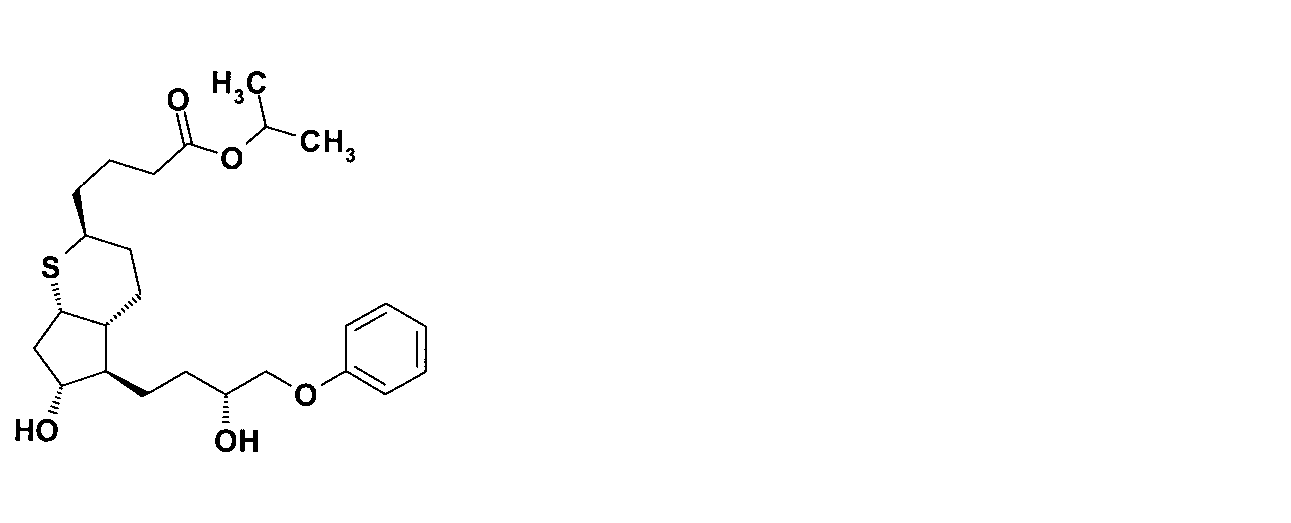
TLC : Rf 0.57 (ヘキサン:酢酸エチル=1:2)
NMR (CDCl3) : δ 1.23 (d, J=6.22 Hz, 6 H), 1.36 - 2.11 (m, 15 H), 2.14 - 2.53 (m, 5 H), 2.65 - 2.81 (m, 1 H), 3.19 (q, J=6.10 Hz, 1 H), 3.65 - 4.34 (m, 4 H), 5.00 (tt, J=6.27 Hz, 1 H), 6.65 - 7.06 (m, 3 H), 7.21 - 7.40 (m, 2 H)。
化合物15(20)の代わりに相当するカルボン酸を用いて、実施例16と同様の操作を行い、以下の化合物を得た。
TLC : Rf 0.41 (ヘキサン:酢酸エチル=1:2);
NMR (CDCl3) : δ 1.23 (d, J=6.22 Hz, 6 H), 1.33 - 1.92 (m, 9 H), 1.95 - 2.21 (m, 2 H), 2.24 - 2.33 (m, 2 H), 2.33 - 2.43 (m, 1 H), 2.45 (d, J=3.48 Hz, 1 H), 2.63 - 2.84 (m, 2 H), 3.26 - 3.38 (m, 1 H), 3.82 - 3.95 (m, 1 H), 3.95 - 4.07 (m, 2 H), 4.46 - 4.65 (m, 1 H), 4.93 - 5.07 (m, 1 H), 5.57 - 5.71 (m, 1 H), 5.71 - 5.85 (m, 1 H), 6.82 - 7.03 (m, 3 H), 7.21 - 7.34 (m, 2 H)。
TLC : Rf 0.40 (ヘキサン:酢酸エチル=1:2);
NMR (CDCl3) : δ 1.22 (d, J=6.22 Hz, 6 H), 1.35 - 1.89 (m, 9 H), 1.90 - 2.14 (m, 1 H), 2.19 - 2.58 (m, 4 H), 2.61 - 2.84 (m, 3 H), 3.18 - 3.34 (m, 1 H), 3.83 - 3.92 (m, 1 H), 3.92 - 4.05 (m, 2 H), 4.43 - 4.64 (m, 1 H), 4.91 - 5.09 (m, J=6.27, 6.27, 6.27, 6.27 Hz, 1 H), 5.59 - 5.69 (m, 1 H), 5.70 - 5.82 (m, 1 H), 6.80 (ddd, J=8.37, 2.42, 0.91 Hz, 1 H), 6.88 - 7.02 (m, 2 H), 7.19 (t, J=8.05 Hz, 1 H)。
TLC : Rf 0.43 (ヘキサン:酢酸エチル=1:2);
NMR (CDCl3) : δ 1.23 (d, J=6.22 Hz, 6 H), 1.34 - 2.11 (m, 10 H), 2.20 - 2.49 (m, 7 H), 2.53 - 2.81 (m, 3 H), 3.22 - 3.41 (m, 1 H), 3.77 - 3.94 (m, 1 H), 3.91 - 4.08 (m, 2 H), 4.31 - 4.61 (m, 1 H), 4.82 - 5.09 (m, 1 H), 5.49 - 5.70 (m, 1 H), 5.71 - 5.95 (m, 1 H), 6.49 - 6.87 (m, 3 H), 7.16 (t, J=7.78 Hz, 1 H)。
TLC : Rf 0.33 (ヘキサン:酢酸エチル=1:2);
NMR (CDCl3) : δ 1.23 (d, J=6.22 Hz, 6 H), 1.33 - 1.95 (m, 9 H), 1.96 - 2.08 (m, 1 H), 2.21 - 2.46 (m, 4 H), 2.49 - 2.57 (m, 1 H), 2.65 - 2.85 (m, 2 H), 3.23 - 3.42 (m, 1 H), 3.78 - 3.93 (m, 1 H), 3.93 - 4.08 (m, 2 H), 4.42 - 4.67 (m, 1 H), 4.85 - 5.15 (m, 1 H), 5.47 - 5.71 (m, 1 H), 5.73 - 6.03 (m, 1 H), 6.49 - 6.95 (m, 3 H), 7.03 - 7.27 (m, 1 H)。
TLC : Rf 0.41 (ヘキサン:酢酸エチル=1:2);
NMR (CDCl3) : δ 1.23 (d, J=6.22 Hz, 6 H), 1.34 - 1.94 (m, 9 H), 1.97 - 2.11 (m, 1 H), 2.20 - 2.47 (m, 4 H), 2.55 - 2.86 (m, 3 H), 3.32 (q, J=5.85 Hz, 1 H), 3.74 - 4.05 (m, 3 H), 4.47 - 4.57 (m, 1 H), 4.90 - 5.15 (m, 1 H), 5.52 - 5.71 (m, 1 H), 5.71 - 5.88 (m, 1 H), 6.81 - 6.91 (m, 2 H), 6.93 - 7.06 (m, 2 H)。
TLC : Rf 0.32 (ヘキサン:酢酸エチル=1:1);
NMR (CDCl3) : δ 1.23 (d, J=6.22 Hz, 6 H), 1.35 - 1.91 (m, 9 H), 1.93 - 2.09 (m, 1 H), 2.18 - 2.55 (m, 4 H), 2.57 - 2.82 (m, 3 H), 3.22 - 3.36 (m, 1 H), 3.78 (s, 3 H), 3.82 - 3.90 (m, 1 H), 3.92 - 4.07 (m, 2 H), 4.45 - 4.55 (m, 1 H), 4.88 - 5.08 (m, 1 H), 5.59 - 5.69 (m, 1 H), 5.70 - 5.82 (m, 1 H), 6.29 - 6.58 (m, 3 H), 7.17 (t, J=8.14 Hz, 1 H)。
TLC : Rf 0.26 (ヘキサン:酢酸エチル=1:1);
NMR (CDCl3) : δ 1.23 (d, J=6.40 Hz, 6 H), 1.34 - 1.91 (m, 9 H), 1.93 - 2.09 (m, 1 H), 2.21 - 2.51 (m, 4 H), 2.62 - 2.77 (m, 2 H), 3.16 - 3.42 (m, 2 H), 3.90 (dd, 5 H), 4.06 (dd, J=9.88, 3.11 Hz, 1 H), 4.44 - 4.58 (m, 1 H), 4.92 - 5.08 (m, 1 H), 5.49 - 5.67 (m, 1 H), 5.68 - 5.88 (m, 1 H), 6.79 - 7.11 (m, 4 H)。
TLC : Rf 0.46 (ヘキサン:酢酸エチル=1:3);
NMR (CDCl3) : δ 1.23 (d, J=6.40 Hz, 6 H), 1.32 - 1.89 (m, 9 H), 1.93 - 2.09 (m, 1 H), 2.17 - 2.45 (m, 3 H), 2.49 - 2.79 (m, 3 H), 2.79 - 3.05 (m, 2 H), 3.09 - 3.18 (m, 1 H), 3.22 - 3.35 (m, 1 H), 3.83 - 4.04 (m, 1 H), 4.11 - 4.25 (m, 1 H), 4.87 - 5.15 (m, 1 H), 5.49 - 5.68 (m, 2 H), 7.16 - 7.26 (m, 1 H), 7.28 - 7.33 (m, 2 H), 7.35 - 7.48 (m, 2 H)。
TLC : Rf 0.54 (ヘキサン:酢酸エチル=1:2);
NMR (CDCl3) : δ 1.23 (d, J=6.22 Hz, 6 H), 1.38 - 1.91 (m, 9 H), 1.95 - 2.11 (m, 1 H), 2.20 - 2.48 (m, 4 H), 2.50 - 2.59 (m, 1 H), 2.62 - 2.83 (m, 2 H), 3.25 - 3.39 (m, 1 H), 3.85 - 4.14 (m, 3 H), 4.48 - 4.64 (m, 1 H), 4.91 - 5.08 (m, J=6.27, 6.27, 6.27, 6.27 Hz, 1 H), 5.61 - 5.72 (m, 1 H), 5.74 - 5.87 (m, 1 H), 6.97 - 7.17 (m, 2 H), 7.18 - 7.29 (m, 1 H), 7.39 (t, J=8.05 Hz, 1 H)。
(1)インビトロ(in vitro)試験
各種マウスプロスタノイド受容体をそれぞれ強制発現させたCHO細胞(それぞれFP-CHO、EP2-CHO、EP4-CHOおよびIP-CHO)を用いて、FPについては細胞内カルシウム濃度、IP、EP2およびEP4については細胞内サイクリックAMP(以下、cAMPと略記する。)産生量を指標に、各種プロスタノイド受容体に対する被験化合物のアゴニスト活性を検討した。
被験化合物および対照物質(PGE2、PGF2αおよびイロプロスト)は、ジメチルスルホキシド(DMSO)にて溶解し、10mmol/L溶液を調製した。調製した10mmol/L溶液は、使用時に10mmol/L溶液を解凍し、DMSOを用いて段階希釈を行い、測定用緩衝溶液もしくは測定用緩衝溶液2にて希釈して実験に供した。
各種マウスプロスタノイド受容体強制発現細胞は、非働化(56℃、30分)した9.8vol% 透析FBS(dialysed-FBS)(Invitrogen社)およびペニシリン-ストレプトマイシン-グルタミン(penicillin-streptomycin-glutamine)(GIBCO-BRL社)を含むα-MEM培地(Sigma社)(FP-CHO、EP2-CHOおよびEP4-CHO培養用)、もしくは非働化(56℃、30分)した9.8vol% dialysed-FBS(Invitrogen社)およびペニシリン-ストレプトマイシン-グルタミン(penicillin-streptomycin-glutamine)(Invitrogen社)を含む核酸含有α-MEM(Sigma社)(IP-CHO培養用)を用いて、5%CO2存在下、37℃で静置培養した。継代培養は以下の方法で行なった。
FP-CHOは、継代培養と同様の方法にて細胞を剥離および懸濁し、測定の2日前に、96穴UVプレートに、1ウェルあたり1.0×10⁴個の細胞数となるよう播種し、5%CO2存在下、37℃で静置培養した。測定日に、96穴UVプレートの各ウェルから培地を除去した後、各ウェルをCa2+およびMg2+を含まないリン酸緩衝生理食塩水で1回洗浄した。各ウェルに5μmol/L fura 2-AM(DOJINDO社)、2.5mmol/L プロベネシド(Sigma社)、20μmol/L インドメタシン(Sigma社)および10mmol/L HEPES(Invitrogen社)を含む培地を100μL加え、CO2インキュベーター内で約60分間インキュベーションした。インキュベーション終了後、培地を除去し、測定用緩衝溶液(0.1w/v% ウシ血清アルブミン、2μmol/L インドメタシン、2.5mmol/L プロベネシドおよび20mmol/L HEPES(Invitrogen社)を含有したハンクス液(Hank’s balanced salt solution)(Invitrogen社))にて2回洗浄した。各ウェルに測定用緩衝溶液を120μL添加し、室温暗所で30分静置し安定化させ、実験に供した。
EP2-CHO、EP4-CHOおよびIP-CHOは、測定日に、培地を除去し、2mmol/L EDTAを含有するCa2+およびMg2+を含まないリン酸緩衝生理食塩水で1回洗浄した。適量の2mmol/L EDTAを含有するCa2+およびMg2+を含まないリン酸緩衝生理食塩水を加え、室温で約5分間インキュベーションし、細胞を剥離後、遠心管に細胞を回収し550g、3分間室温で遠心分離した後、上清を除去した。適量の測定用緩衝溶液1(1.0w/v% ウシ血清アルブミン(Sigma社)および2μmol/L ジクロフェナク(Sigma社)を含有したMEM培地(Invitrogen社))にて懸濁し、500g、3分間室温で遠心分離し、上清を除去した。測定用緩衝溶液2(1.0w/v% ウシ血清アルブミン(Sigma社)、2μmol/L ジクロフェナク(Sigma社)および1mmol/L 3-イソブチル-1-メチルキサンチンを含有したMEM培地(Invitrogen社))にて懸濁し、96穴1/2エリアプレートに1ウェル当たり5.0×104個の細胞数となるように25μLずつ分注した。種々の濃度のアゴニストを含む測定用緩衝溶液2を25μL添加し、室温で30分間反応させた。cAMP濃度の測定は、cAMP HTRF HiRangeキット(CIS bio International社)を用いて行った。キット説明書のTwo step protocolに従い、ライシス緩衝液(Lysis Buffer)にて希釈したcAMP-D2およびクリプターゼ(Cryptase)を25μLずつ添加し、1時間室温にてインキュベーションした。1時間のインキュベーション後に、Analyst GT(Molecular Device社)を用いて337nmにて励起した時の620nmおよび665nmにおける時間分解蛍光を測定し、その比(TRF ratio)を求めることで、検量線よりcAMP濃度を算出した。
以上の方法から得られた測定値を用いて、本発明化合物のマウスFP、マウスEP2、マウスEP4およびマウスIP受容体に対するアゴニスト活性の指標としてEC50値を算出した。


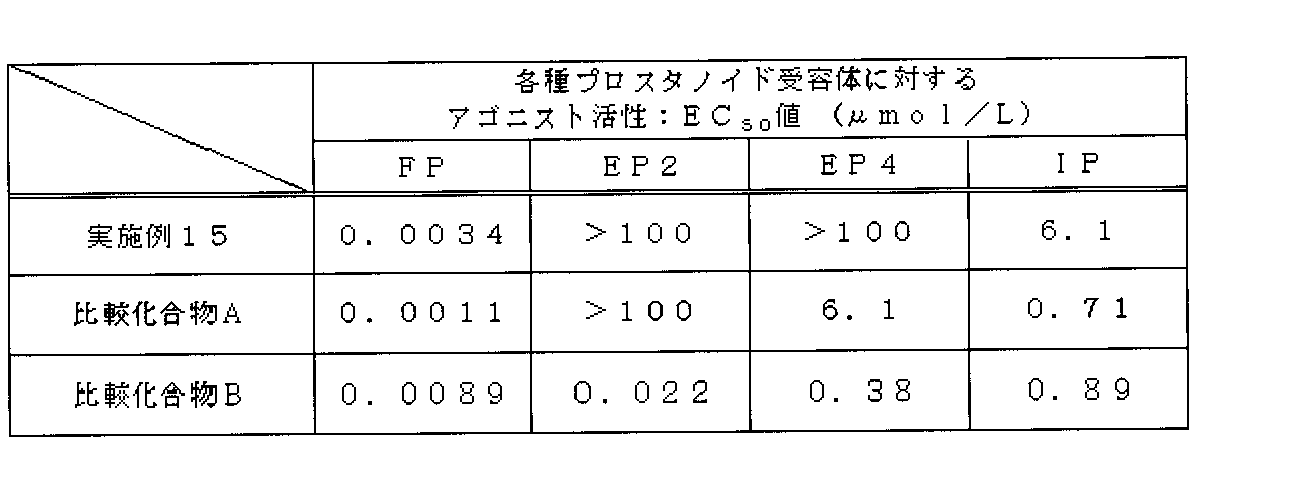
インビボ(in vivo)試験においては、当業者には容易に理解できることではあるが、いずれの被験化合物についても、活性本体であるカルボン酸は角膜透過性が悪いことから、エチルエステル体、イソプロピルエステル体等のエステル体に変換した化合物を点眼投与することによって、活性本体の薬理作用を評価した。なお、本願化合物群において、エステル体は、下記で薬理作用を確認する実験動物(ウサギ、イヌ等)において、点眼投与した後、房水中におけるカルボン酸の薬物濃度を測定することによって、当該エステル体が速やかに相当するカルボン酸に変換されることを確認した。
予め十分に馴化を行った雄性イヌ(TOYO Beagle)に、基剤(クエン酸緩衝液pH6.5、0.5%ポリソルベート80、1%プロピレングリコール、0.01%塩化ベンザルコニウム含)で0.003%(w/v)に調製した実施例16(1)の化合物を、それぞれ片眼に30μL点眼した。対眼は無処置とした。陽性対照化合物として、公知化合物であるラタノプロストを用いた。


雄性ウサギ(NewZealandWhite、2.0~3.0kg)に、基剤(クエン酸緩衝液pH6.5、0.5%ポリソルベート80、1%プロピレングリコール、0.01%塩化ベンザルコニウム含)で0.1%(w/v)に調製した実施例16(1)の化合物を、それぞれ片眼に30μL点眼した。その後、点眼0、1、2、4、6および8時間後の前房中の眼房水を採取し、房水中のタンパク質濃度を測定した。比較化合物として、上記した特許文献2記載の実施例12の化合物のメチルエステル体(すなわち、特許文献2記載の実施例10の化合物)(以下、比較化合物Cと略記することがある。)、および上記した比較化合物Bのメチルエステル体(すなわち、特許文献1記載の実施例1(F)の化合物の光学活性体(2S体))(以下、比較化合物Dと略記することがある。)を用いた。
覚醒下の雄性サル(カニクイザル)の左眼に、被験物質を上記と同様の基剤を用いて調製した溶液と、右眼には対照として基剤のみの溶液をそれぞれ30μL点眼投与した。投与後の眼圧を経時的に投与開始から24時間後まで測定した。眼圧測定の際には、カニクイザルをモンキーチェアーに保定後、眼科用表面麻酔剤(ベノキシール点眼液0.4%、参天製薬株式会社)を点眼投与して麻酔した。開瞼器(株式会社はんだや)を装着後、空圧圧平式眼圧計(モデル30クラシック、ライカート社)を用いて、両眼の眼圧を測定した(各群5~8例)。対照眼と被験物質を投与した眼との眼圧値の差を、以下の式を用いて眼圧下降率として算出し、測定中の最大眼圧下降率と24時間後の眼圧下降率を用いて、眼圧下降作用の持続性を評価した。被験物質の投与用量は、比較化合物Cは10μg/mL、および実施例16(1)は30μg/mLとした。

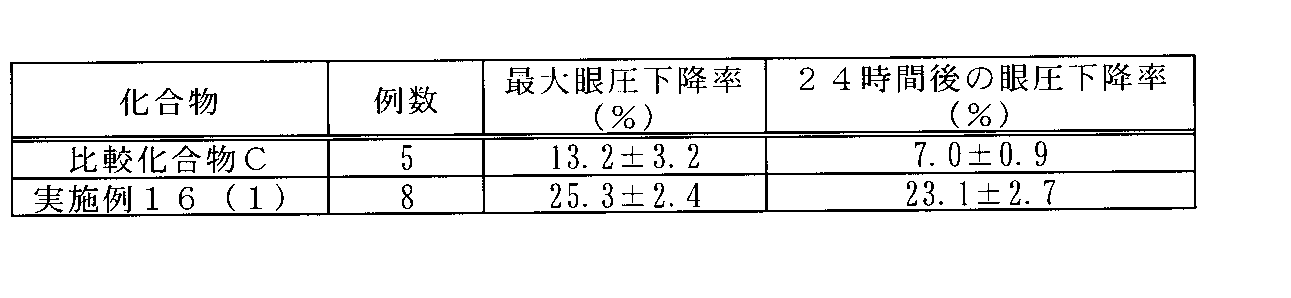
製剤例1
本発明に用いられる代表的な製剤例を以下に示す。
1.点眼剤
以下の処方の点眼剤を汎用される方法を用いて調製した。
以下の処方の眼軟膏を汎用される方法を用いて調製した。
Claims (11)
- 一般式(I)





- Zが-(CH2)m-(すべての記号は請求項1記載と同じ意味を表す。)である請求項1記載の化合物。
- Yが-O-である請求項1または2記載の化合物。
- 一般式(I)で示される化合物が、
(1)メチル 4-{(2S,4aR,5R,6R,7aS)-6-ヒドロキシ-5-[(1E,3R)-3-ヒドロキシ-4-フェノキシ-1-ブテン-1-イル]オクタヒドロシクロペンタ[b]チオピラン-2-イル}ブタノアート、
(2)メチル 4-{(2R,4aR,5R,6R,7aS)-6-ヒドロキシ-5-[(1E,3R)-3-ヒドロキシ-4-フェノキシ-1-ブテン-1-イル]オクタヒドロシクロペンタ[b]チオピラン-2-イル}ブタノアート、
(3)4-{(2S,4aR,5R,6R,7aS)-6-ヒドロキシ-5-[(1E,3R)-3-ヒドロキシ-4-フェノキシ-1-ブテン-1-イル]オクタヒドロシクロペンタ[b]チオピラン-2-イル}ブタン酸、
(4)4-{(2S,4aR,5R,6R,7aS)-6-ヒドロキシ-5-[(1E,3S)-3-ヒドロキシ-5-フェニル-1-ペンテン-1-イル]オクタヒドロシクロペンタ[b]チオピラン-2-イル}ブタン酸、
(5)4-{(2R,4aR,5R,6R,7aS)-6-ヒドロキシ-5-[(1E,3R)-3-ヒドロキシ-4-フェノキシ-1-ブテン-1-イル]オクタヒドロシクロペンタ[b]チオピラン-2-イル}ブタン酸、
(6)4-{(2S,4aR,5R,6R,7aS)-5-[(1E,3R)-4-(4-フルオロフェノキシ)-3-ヒドロキシ-1-ブテン-1-イル]-6-ヒドロキシオクタヒドロシクロペンタ[b]チオピラン-2-イル}ブタン酸、
(7)4-{(2S,4aR,5R,6R,7aS)-5-[(1E,3R)-4-(3-クロロフェノキシ)-3-ヒドロキシ-1-ブテン-1-イル]-6-ヒドロキシオクタヒドロシクロペンタ[b]チオピラン-2-イル}ブタン酸、
(8)4-{(2S,4aR,5R,6R,7aS)-6-ヒドロキシ-5-[(1E,3R)-3-ヒドロキシ-4-(3-メチルフェノキシ)-1-ブテン-1-イル]オクタヒドロシクロペンタ[b]チオピラン-2-イル}ブタン酸、
(9)4-{(2S,4aR,5R,6R,7aS)-5-[(1E,3R)-4-(2-フルオロフェノキシ)-3-ヒドロキシ-1-ブテン-1-イル]-6-ヒドロキシオクタヒドロシクロペンタ[b]チオピラン-2-イル}ブタン酸、
(10)4-{(2S,4aR,5R,6R,7aS)-5-[(1E,3R)-4-(3-フルオロフェノキシ)-3-ヒドロキシ-1-ブテン-1-イル]-6-ヒドロキシオクタヒドロシクロペンタ[b]チオピラン-2-イル}ブタン酸、
(11)4-[(2S,4aR,5R,6R,7aS)-6-ヒドロキシ-5-{(1E,3R)-3-ヒドロキシ-4-[3-(トリフルオロメチル)フェノキシ]-1-ブテン-1-イル}オクタヒドロシクロペンタ[b]チオピラン-2-イル]ブタン酸、
(12)4-{(2S,4aR,5R,6R,7aS)-6-ヒドロキシ-5-[(1E,3R)-3-ヒドロキシ-4-(2-メトキシフェノキシ)-1-ブテン-1-イル]オクタヒドロシクロペンタ[b]チオピラン-2-イル}ブタン酸、
(13)4-{(2S,4aR,5R,6R,7aS)-6-ヒドロキシ-5-[(1E,3R)-3-ヒドロキシ-4-(3-メトキシフェノキシ)-1-ブテン-1-イル]オクタヒドロシクロペンタ[b]チオピラン-2-イル}ブタン酸、
(14)4-{(2S,4aR,5R,6R,7aS)-6-ヒドロキシ-5-[(1E,3R)-3-ヒドロキシ-4-(4-メトキシフェノキシ)-1-ブテン-1-イル]オクタヒドロシクロペンタ[b]チオピラン-2-イル}ブタン酸、
(15)4-{(2S,4aR,5R,6R,7aS)-6-ヒドロキシ-5-[(1E,3R)-3-ヒドロキシ-4-(2-メチルフェノキシ)-1-ブテン-1-イル]オクタヒドロシクロペンタ[b]チオピラン-2-イル}ブタン酸、
(16)4-{(2S,4aR,5R,6R,7aS)-6-ヒドロキシ-5-[(1E,3R)-3-ヒドロキシ-4-(4-メチルフェノキシ)-1-ブテン-1-イル]オクタヒドロシクロペンタ[b]チオピラン-2-イル}ブタン酸、
(17)4-{(2S,4aR,5R,6R,7aS)-5-[(1E,3R)-4-(4-クロロフェノキシ)-3-ヒドロキシ-1-ブテン-1-イル]-6-ヒドロキシオクタヒドロシクロペンタ[b]チオピラン-2-イル}ブタン酸、
(18)4-{(2S,4aR,5R,6R,7aS)-5-[(1E,3R)-4-(2-クロロフェノキシ)-3-ヒドロキシ-1-ブテン-1-イル]-6-ヒドロキシオクタヒドロシクロペンタ[b]チオピラン-2-イル}ブタン酸、
(19)4-[(2S,4aR,5R,6R,7aS)-6-ヒドロキシ-5-{(1E,3R)-3-ヒドロキシ-4-[2-(トリフルオロメチル)フェノキシ]-1-ブテン-1-イル}オクタヒドロシクロペンタ[b]チオピラン-2-イル]ブタン酸、
(20)4-[(2S,4aR,5R,6R,7aS)-6-ヒドロキシ-5-{(1E,3R)-3-ヒドロキシ-4-[4-(トリフルオロメチル)フェノキシ]-1-ブテン-1-イル}オクタヒドロシクロペンタ[b]チオピラン-2-イル]ブタン酸、
(21)4-{(2S,4aR,5R,6R,7aS)-6-ヒドロキシ-5-[(3R)-3-ヒドロキシ-4-フェノキシブチル]オクタヒドロシクロペンタ[b]チオピラン-2-イル}ブタン酸、
(22)2-プロパニル 4-{(2S,4aR,5R,6R,7aS)-6-ヒドロキシ-5-[(3R)-3-ヒドロキシ-4-フェノキシブチル]オクタヒドロシクロペンタ[b]チオピラン-2-イル}ブタノアート、
(23)2-プロパニル 4-{(2S,4aR,5R,6R,7aS)-6-ヒドロキシ-5-[(1E,3R)-3-ヒドロキシ-4-フェノキシ-1-ブテン-1-イル]オクタヒドロシクロペンタ[b]チオピラン-2-イル}ブタノアート、
(24)2-プロパニル 4-{(2S,4aR,5R,6R,7aS)-5-[(1E,3R)-4-(3-クロロフェノキシ)-3-ヒドロキシ-1-ブテン-1-イル]-6-ヒドロキシオクタヒドロシクロペンタ[b]チオピラン-2-イル}ブタノアート、
(25)2-プロパニル 4-{(2S,4aR,5R,6R,7aS)-6-ヒドロキシ-5-[(1E,3R)-3-ヒドロキシ-4-(3-メチルフェノキシ)-1-ブテン-1-イル]オクタヒドロシクロペンタ[b]チオピラン-2-イル}ブタノアート、
(26)2-プロパニル 4-{(2S,4aR,5R,6R,7aS)-5-[(1E,3R)-4-(3-フルオロフェノキシ)-3-ヒドロキシ-1-ブテン-1-イル]-6-ヒドロキシオクタヒドロシクロペンタ[b]チオピラン-2-イル}ブタノアート、
(27)2-プロパニル 4-{(2S,4aR,5R,6R,7aS)-5-[(1E,3R)-4-(4-フルオロフェノキシ)-3-ヒドロキシ-1-ブテン-1-イル]-6-ヒドロキシオクタヒドロシクロペンタ[b]チオピラン-2-イル}ブタノアート、
(28)2-プロパニル 4-{(2S,4aR,5R,6R,7aS)-6-ヒドロキシ-5-[(1E,3R)-3-ヒドロキシ-4-(3-メトキシフェノキシ)-1-ブテン-1-イル]オクタヒドロシクロペンタ[b]チオピラン-2-イル}ブタノアート、
(29)2-プロパニル 4-{(2S,4aR,5R,6R,7aS)-6-ヒドロキシ-5-[(1E,3R)-3-ヒドロキシ-4-(2-メトキシフェノキシ)-1-ブテン-1-イル]オクタヒドロシクロペンタ[b]チオピラン-2-イル}ブタノアート、および
(30)2-プロパニル 4-[(2S,4aR,5R,6R,7aS)-6-ヒドロキシ-5-{(1E,3R)-3-ヒドロキシ-4-[3-(トリフルオロメチル)フェノキシ]-1-ブテン-1-イル}オクタヒドロシクロペンタ[b]チオピラン-2-イル]ブタノアートからなる群から選択される化合物である請求項1記載の化合物。 - 請求項1記載の一般式(I)で示される化合物、その塩、その溶媒和物、またはそれらのプロドラッグを含有してなる医薬組成物。
- 請求項1記載の一般式(I)で示される化合物、その塩、その溶媒和物、またはそれらのプロドラッグが、FPアゴニストである請求項5記載の医薬組成物。
- 眼疾患の予防および/または治療剤である請求項5記載の医薬組成物。
- 眼疾患が、緑内障、高眼圧症、黄斑浮腫、黄斑変性、網膜および視神経張力上昇、近視、遠視、乱視、ドライアイ、網膜剥離、白内障、外傷または炎症による眼圧上昇、薬剤による眼圧上昇、または術後の眼圧上昇である請求項7記載の医薬組成物。
- 一般式(II)
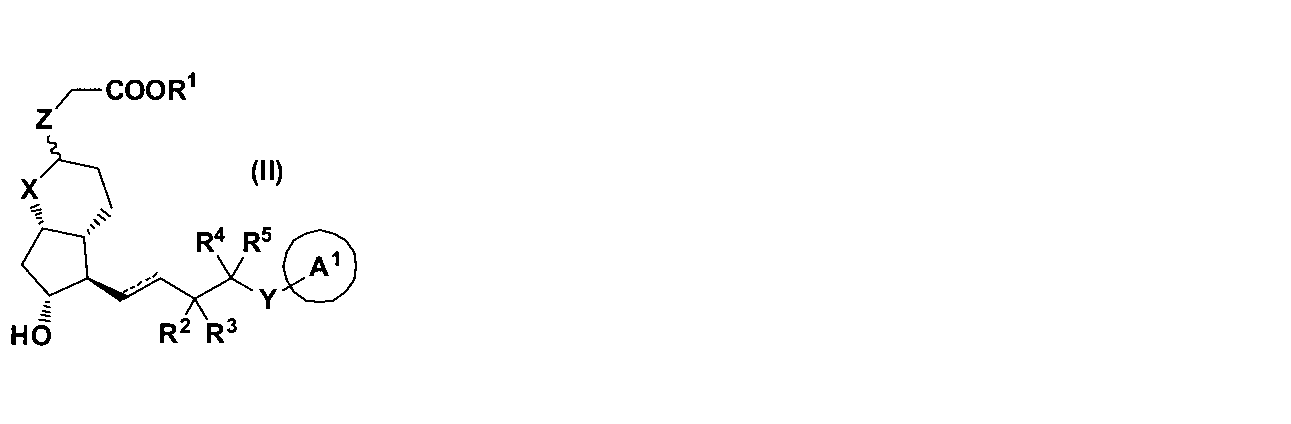
- 請求項1記載の一般式(I)で示される化合物、その塩、その溶媒和物、またはそれらのプロドラッグの有効量を哺乳動物に投与することを特徴とする、眼疾患の予防および/または治療方法。
- 眼疾患の予防および/または治療のために使用される請求項1記載の一般式(I)で示される化合物、その塩、その溶媒和物、またはそれらのプロドラッグ。
Priority Applications (4)
| Application Number | Priority Date | Filing Date | Title |
|---|---|---|---|
| JP2012554849A JP5907077B2 (ja) | 2011-01-27 | 2012-01-26 | 二環式化合物およびその医薬用途 |
| ES12739588.7T ES2581852T3 (es) | 2011-01-27 | 2012-01-26 | Compuesto bicíclico y uso del mismo para fines médicos |
| EP12739588.7A EP2669280B1 (en) | 2011-01-27 | 2012-01-26 | Bicyclic compound and use thereof for medical purposes |
| US13/982,052 US9150537B2 (en) | 2011-01-27 | 2012-01-26 | Bicyclic compound and use thereof for medical purposes |
Applications Claiming Priority (2)
| Application Number | Priority Date | Filing Date | Title |
|---|---|---|---|
| JP2011-014776 | 2011-01-27 | ||
| JP2011014776 | 2011-01-27 |
Publications (1)
| Publication Number | Publication Date |
|---|---|
| WO2012102355A1 true WO2012102355A1 (ja) | 2012-08-02 |
Family
ID=46580918
Family Applications (1)
| Application Number | Title | Priority Date | Filing Date |
|---|---|---|---|
| PCT/JP2012/051718 Ceased WO2012102355A1 (ja) | 2011-01-27 | 2012-01-26 | 二環式化合物およびその医薬用途 |
Country Status (5)
| Country | Link |
|---|---|
| US (1) | US9150537B2 (ja) |
| EP (1) | EP2669280B1 (ja) |
| JP (1) | JP5907077B2 (ja) |
| ES (1) | ES2581852T3 (ja) |
| WO (1) | WO2012102355A1 (ja) |
Cited By (5)
| Publication number | Priority date | Publication date | Assignee | Title |
|---|---|---|---|---|
| US8614340B2 (en) | 2009-07-28 | 2013-12-24 | Ono Pharmaceuticals Co., Ltd. | Bicyclic compound and use thereof for medical purposes |
| US9029574B2 (en) | 2011-01-27 | 2015-05-12 | Ono Pharmaceutical Co., Ltd. | Bicyclic compound and use thereof for medical purposes |
| WO2015129782A1 (ja) * | 2014-02-27 | 2015-09-03 | 小野薬品工業株式会社 | 選択的ep2アゴニスト活性を有する化合物 |
| JPWO2017014315A1 (ja) * | 2015-07-23 | 2018-05-10 | 小野薬品工業株式会社 | Ep2アゴニスト活性を有する化合物 |
| US10899729B2 (en) | 2016-06-30 | 2021-01-26 | Ono Pharmaceutical Co.. Ltd. | Method for producing bicyclic compound |
Families Citing this family (2)
| Publication number | Priority date | Publication date | Assignee | Title |
|---|---|---|---|---|
| US10400000B2 (en) * | 2015-06-12 | 2019-09-03 | Simon Fraser University | Amide-linked EP4 agonist-bisphosphonate compounds and uses thereof |
| AU2019466972B2 (en) * | 2019-09-19 | 2023-07-06 | Polyactiva Pty Ltd | Biodegradable drug-polymer conjugate |
Citations (7)
| Publication number | Priority date | Publication date | Assignee | Title |
|---|---|---|---|---|
| JPS5384959A (en) | 1976-12-31 | 1978-07-26 | Erba Carlo Spa | Bicyclic prostaglandin and method for its production |
| JPS53132573A (en) * | 1977-04-19 | 1978-11-18 | Upjohn Co | Product and method |
| JPS5573678A (en) * | 1978-11-29 | 1980-06-03 | Ono Pharmaceut Co Ltd | Simultated compound of thio-prostaglandin i1, its preparation and drug composition containing it as active ingredient |
| US4367237A (en) | 1978-11-26 | 1983-01-04 | Ono Pharmaceutical Co., Ltd. | Prostacyclin analogues |
| US4490537A (en) | 1977-04-19 | 1984-12-25 | The Upjohn Company | Enlarged-hetero-ring prostacyclin analogs |
| US4490548A (en) | 1977-04-19 | 1984-12-25 | The Upjohn Company | Enlarged-hetero-ring prostacyclin analogs |
| WO2001027099A2 (en) * | 1999-10-15 | 2001-04-19 | Sucampo, A.G. | Bicyclic compounds composition and method for stabilizing the same |
Family Cites Families (5)
| Publication number | Priority date | Publication date | Assignee | Title |
|---|---|---|---|---|
| JPS5411311B2 (ja) | 1973-08-11 | 1979-05-14 | ||
| JPS6468367A (en) | 1987-09-08 | 1989-03-14 | Ono Pharmaceutical Co | Novel bicyclic ethers or lactones |
| US7906552B2 (en) | 2004-08-10 | 2011-03-15 | Allergan, Inc. | Cyclopentane heptan(ENE)OIC acid, 2-heteroarylalkenyl derivatives as therapeutic agents |
| BRPI0713587A2 (pt) | 2006-06-20 | 2012-10-23 | Allergan Inc | descrição de compostos terapêuticos da invenção |
| DK2653468T3 (en) | 2009-07-28 | 2016-06-06 | Ono Pharmaceutical Co | Bicyclic compound AND USE THEREOF FOR MEDICAL PURPOSES |
-
2012
- 2012-01-26 WO PCT/JP2012/051718 patent/WO2012102355A1/ja not_active Ceased
- 2012-01-26 ES ES12739588.7T patent/ES2581852T3/es active Active
- 2012-01-26 EP EP12739588.7A patent/EP2669280B1/en active Active
- 2012-01-26 US US13/982,052 patent/US9150537B2/en active Active
- 2012-01-26 JP JP2012554849A patent/JP5907077B2/ja active Active
Patent Citations (7)
| Publication number | Priority date | Publication date | Assignee | Title |
|---|---|---|---|---|
| JPS5384959A (en) | 1976-12-31 | 1978-07-26 | Erba Carlo Spa | Bicyclic prostaglandin and method for its production |
| JPS53132573A (en) * | 1977-04-19 | 1978-11-18 | Upjohn Co | Product and method |
| US4490537A (en) | 1977-04-19 | 1984-12-25 | The Upjohn Company | Enlarged-hetero-ring prostacyclin analogs |
| US4490548A (en) | 1977-04-19 | 1984-12-25 | The Upjohn Company | Enlarged-hetero-ring prostacyclin analogs |
| US4367237A (en) | 1978-11-26 | 1983-01-04 | Ono Pharmaceutical Co., Ltd. | Prostacyclin analogues |
| JPS5573678A (en) * | 1978-11-29 | 1980-06-03 | Ono Pharmaceut Co Ltd | Simultated compound of thio-prostaglandin i1, its preparation and drug composition containing it as active ingredient |
| WO2001027099A2 (en) * | 1999-10-15 | 2001-04-19 | Sucampo, A.G. | Bicyclic compounds composition and method for stabilizing the same |
Non-Patent Citations (8)
| Title |
|---|
| "Administrative Notice Medical Device Examination", 19 March 2003, PHARMACEUTICAL AND MEDICAL DEVICES AGENCY, article "Regarding Reference Material concerning Basic Idea of Biological Safety Test" |
| "Molecular Design", vol. 7, 1990, HIROKAWA-SHOTEN LTD., article "Development of Medicaments", pages: 163 - 198 |
| INVESTIGATIVE OPHTHALMOLOGY & VISUAL SCIENCE, vol. 23, 1982, pages 383 - 392 |
| INVESTIGATIVE OPHTHALMOLOGY & VISUAL SCIENCE, vol. 28, 1987, pages 470 - 476 |
| OCULAR IMMUNOLOGY AND INFLAMMATION, vol. 14, no. 3, 2006, pages 157 - 163 |
| RICHARD C. LAROCK: "Comprehensive Organic Transformations: A Guide to Functional Group Preparations", 1999, JOHN WILEY & SONS INC |
| See also references of EP2669280A4 * |
| T. W. GREENE: "Protective Groups in Organic Synthesis", 1999, WILEY |
Cited By (15)
| Publication number | Priority date | Publication date | Assignee | Title |
|---|---|---|---|---|
| US10201520B2 (en) | 2009-07-28 | 2019-02-12 | Ono Pharmaceutical Co., Ltd. | Bicyclic compound and use thereof for medical purposes |
| US8962868B2 (en) | 2009-07-28 | 2015-02-24 | Ono Pharmaceutical Co., Ltd. | Bicyclic compound and use thereof for medical purposes |
| US8614340B2 (en) | 2009-07-28 | 2013-12-24 | Ono Pharmaceuticals Co., Ltd. | Bicyclic compound and use thereof for medical purposes |
| US9388157B2 (en) | 2009-07-28 | 2016-07-12 | Ono Pharmaceuticals Co., Ltd. | Bicyclic compound and use thereof for medical purposes |
| US12201603B2 (en) | 2009-07-28 | 2025-01-21 | Ono Pharmaceutical Co., Ltd. | Bicyclic compound and use thereof for medical purposes |
| US11617733B2 (en) | 2009-07-28 | 2023-04-04 | Ono Pharmaceutical Co., Ltd. | Bicyclic compound and use thereof for medical purposes |
| US9889114B2 (en) | 2009-07-28 | 2018-02-13 | Ono Pharmaceutical Co., Ltd. | Bicyclic compound and use thereof for medical purposes |
| US10940134B2 (en) | 2009-07-28 | 2021-03-09 | Ono Pharmaceutical Co., Ltd. | Bicyclic compound and use thereof for medical purposes |
| US9029574B2 (en) | 2011-01-27 | 2015-05-12 | Ono Pharmaceutical Co., Ltd. | Bicyclic compound and use thereof for medical purposes |
| WO2015129782A1 (ja) * | 2014-02-27 | 2015-09-03 | 小野薬品工業株式会社 | 選択的ep2アゴニスト活性を有する化合物 |
| US9890146B2 (en) | 2014-02-27 | 2018-02-13 | Ono Pharmaceutical Co., Ltd. | Compound having selective EP2 agonist activity |
| JPWO2015129782A1 (ja) * | 2014-02-27 | 2017-03-30 | 小野薬品工業株式会社 | 選択的ep2アゴニスト活性を有する化合物 |
| US10385045B2 (en) | 2015-07-23 | 2019-08-20 | Ono Pharmaceutical Co., Ltd. | Compound having EP2 agonist activity |
| JPWO2017014315A1 (ja) * | 2015-07-23 | 2018-05-10 | 小野薬品工業株式会社 | Ep2アゴニスト活性を有する化合物 |
| US10899729B2 (en) | 2016-06-30 | 2021-01-26 | Ono Pharmaceutical Co.. Ltd. | Method for producing bicyclic compound |
Also Published As
| Publication number | Publication date |
|---|---|
| EP2669280A4 (en) | 2014-08-20 |
| US20130310438A1 (en) | 2013-11-21 |
| EP2669280A1 (en) | 2013-12-04 |
| JP5907077B2 (ja) | 2016-04-20 |
| US9150537B2 (en) | 2015-10-06 |
| ES2581852T3 (es) | 2016-09-07 |
| EP2669280B1 (en) | 2016-04-27 |
| JPWO2012102355A1 (ja) | 2014-06-30 |
Similar Documents
| Publication | Publication Date | Title |
|---|---|---|
| JP6149975B2 (ja) | 二環式化合物およびその医薬用途 | |
| JP5907077B2 (ja) | 二環式化合物およびその医薬用途 | |
| JP5835236B2 (ja) | 二環式化合物およびその医薬用途 | |
| JPWO2017014315A1 (ja) | Ep2アゴニスト活性を有する化合物 | |
| WO2024190780A1 (ja) | 三環性化合物を含有する腎疾患の予防及び/又は治療剤 |
Legal Events
| Date | Code | Title | Description |
|---|---|---|---|
| 121 | Ep: the epo has been informed by wipo that ep was designated in this application |
Ref document number: 12739588 Country of ref document: EP Kind code of ref document: A1 |
|
| ENP | Entry into the national phase |
Ref document number: 2012554849 Country of ref document: JP Kind code of ref document: A |
|
| WWE | Wipo information: entry into national phase |
Ref document number: 13982052 Country of ref document: US |
|
| NENP | Non-entry into the national phase |
Ref country code: DE |
|
| WWE | Wipo information: entry into national phase |
Ref document number: 2012739588 Country of ref document: EP |