WO2012086692A1 - ハードディスク用被膜形成組成物 - Google Patents
ハードディスク用被膜形成組成物 Download PDFInfo
- Publication number
- WO2012086692A1 WO2012086692A1 PCT/JP2011/079655 JP2011079655W WO2012086692A1 WO 2012086692 A1 WO2012086692 A1 WO 2012086692A1 JP 2011079655 W JP2011079655 W JP 2011079655W WO 2012086692 A1 WO2012086692 A1 WO 2012086692A1
- Authority
- WO
- WIPO (PCT)
- Prior art keywords
- film
- forming composition
- group
- polymer
- hard disk
- Prior art date
- Legal status (The legal status is an assumption and is not a legal conclusion. Google has not performed a legal analysis and makes no representation as to the accuracy of the status listed.)
- Ceased
Links
Images

Classifications
-
- C—CHEMISTRY; METALLURGY
- C08—ORGANIC MACROMOLECULAR COMPOUNDS; THEIR PREPARATION OR CHEMICAL WORKING-UP; COMPOSITIONS BASED THEREON
- C08F—MACROMOLECULAR COMPOUNDS OBTAINED BY REACTIONS ONLY INVOLVING CARBON-TO-CARBON UNSATURATED BONDS
- C08F212/00—Copolymers of compounds having one or more unsaturated aliphatic radicals, each having only one carbon-to-carbon double bond, and at least one being terminated by an aromatic carbocyclic ring
- C08F212/02—Monomers containing only one unsaturated aliphatic radical
- C08F212/04—Monomers containing only one unsaturated aliphatic radical containing one ring
- C08F212/14—Monomers containing only one unsaturated aliphatic radical containing one ring substituted by heteroatoms or groups containing heteroatoms
- C08F212/22—Oxygen
-
- G—PHYSICS
- G11—INFORMATION STORAGE
- G11B—INFORMATION STORAGE BASED ON RELATIVE MOVEMENT BETWEEN RECORD CARRIER AND TRANSDUCER
- G11B5/00—Recording by magnetisation or demagnetisation of a record carrier; Reproducing by magnetic means; Record carriers therefor
- G11B5/84—Processes or apparatus specially adapted for manufacturing record carriers
-
- C—CHEMISTRY; METALLURGY
- C08—ORGANIC MACROMOLECULAR COMPOUNDS; THEIR PREPARATION OR CHEMICAL WORKING-UP; COMPOSITIONS BASED THEREON
- C08F—MACROMOLECULAR COMPOUNDS OBTAINED BY REACTIONS ONLY INVOLVING CARBON-TO-CARBON UNSATURATED BONDS
- C08F12/00—Homopolymers and copolymers of compounds having one or more unsaturated aliphatic radicals, each having only one carbon-to-carbon double bond, and at least one being terminated by an aromatic carbocyclic ring
- C08F12/02—Monomers containing only one unsaturated aliphatic radical
- C08F12/04—Monomers containing only one unsaturated aliphatic radical containing one ring
- C08F12/14—Monomers containing only one unsaturated aliphatic radical containing one ring substituted by hetero atoms or groups containing heteroatoms
- C08F12/22—Oxygen
-
- C—CHEMISTRY; METALLURGY
- C08—ORGANIC MACROMOLECULAR COMPOUNDS; THEIR PREPARATION OR CHEMICAL WORKING-UP; COMPOSITIONS BASED THEREON
- C08F—MACROMOLECULAR COMPOUNDS OBTAINED BY REACTIONS ONLY INVOLVING CARBON-TO-CARBON UNSATURATED BONDS
- C08F12/00—Homopolymers and copolymers of compounds having one or more unsaturated aliphatic radicals, each having only one carbon-to-carbon double bond, and at least one being terminated by an aromatic carbocyclic ring
- C08F12/34—Monomers containing two or more unsaturated aliphatic radicals
- C08F12/36—Divinylbenzene
-
- C—CHEMISTRY; METALLURGY
- C08—ORGANIC MACROMOLECULAR COMPOUNDS; THEIR PREPARATION OR CHEMICAL WORKING-UP; COMPOSITIONS BASED THEREON
- C08F—MACROMOLECULAR COMPOUNDS OBTAINED BY REACTIONS ONLY INVOLVING CARBON-TO-CARBON UNSATURATED BONDS
- C08F212/00—Copolymers of compounds having one or more unsaturated aliphatic radicals, each having only one carbon-to-carbon double bond, and at least one being terminated by an aromatic carbocyclic ring
- C08F212/02—Monomers containing only one unsaturated aliphatic radical
- C08F212/04—Monomers containing only one unsaturated aliphatic radical containing one ring
- C08F212/06—Hydrocarbons
- C08F212/08—Styrene
-
- C—CHEMISTRY; METALLURGY
- C08—ORGANIC MACROMOLECULAR COMPOUNDS; THEIR PREPARATION OR CHEMICAL WORKING-UP; COMPOSITIONS BASED THEREON
- C08F—MACROMOLECULAR COMPOUNDS OBTAINED BY REACTIONS ONLY INVOLVING CARBON-TO-CARBON UNSATURATED BONDS
- C08F212/00—Copolymers of compounds having one or more unsaturated aliphatic radicals, each having only one carbon-to-carbon double bond, and at least one being terminated by an aromatic carbocyclic ring
- C08F212/34—Monomers containing two or more unsaturated aliphatic radicals
- C08F212/36—Divinylbenzene
-
- C—CHEMISTRY; METALLURGY
- C08—ORGANIC MACROMOLECULAR COMPOUNDS; THEIR PREPARATION OR CHEMICAL WORKING-UP; COMPOSITIONS BASED THEREON
- C08F—MACROMOLECULAR COMPOUNDS OBTAINED BY REACTIONS ONLY INVOLVING CARBON-TO-CARBON UNSATURATED BONDS
- C08F290/00—Macromolecular compounds obtained by polymerising monomers on to polymers modified by introduction of aliphatic unsaturated end or side groups
- C08F290/08—Macromolecular compounds obtained by polymerising monomers on to polymers modified by introduction of aliphatic unsaturated end or side groups on to polymers modified by introduction of unsaturated side groups
- C08F290/12—Polymers provided for in subclasses C08C or C08F
-
- C—CHEMISTRY; METALLURGY
- C08—ORGANIC MACROMOLECULAR COMPOUNDS; THEIR PREPARATION OR CHEMICAL WORKING-UP; COMPOSITIONS BASED THEREON
- C08F—MACROMOLECULAR COMPOUNDS OBTAINED BY REACTIONS ONLY INVOLVING CARBON-TO-CARBON UNSATURATED BONDS
- C08F8/00—Chemical modification by after-treatment
-
- C—CHEMISTRY; METALLURGY
- C08—ORGANIC MACROMOLECULAR COMPOUNDS; THEIR PREPARATION OR CHEMICAL WORKING-UP; COMPOSITIONS BASED THEREON
- C08F—MACROMOLECULAR COMPOUNDS OBTAINED BY REACTIONS ONLY INVOLVING CARBON-TO-CARBON UNSATURATED BONDS
- C08F8/00—Chemical modification by after-treatment
- C08F8/14—Esterification
-
- C—CHEMISTRY; METALLURGY
- C09—DYES; PAINTS; POLISHES; NATURAL RESINS; ADHESIVES; COMPOSITIONS NOT OTHERWISE PROVIDED FOR; APPLICATIONS OF MATERIALS NOT OTHERWISE PROVIDED FOR
- C09D—COATING COMPOSITIONS, e.g. PAINTS, VARNISHES OR LACQUERS; FILLING PASTES; CHEMICAL PAINT OR INK REMOVERS; INKS; CORRECTING FLUIDS; WOODSTAINS; PASTES OR SOLIDS FOR COLOURING OR PRINTING; USE OF MATERIALS THEREFOR
- C09D125/00—Coating compositions based on homopolymers or copolymers of compounds having one or more unsaturated aliphatic radicals, each having only one carbon-to-carbon double bond, and at least one being terminated by an aromatic carbocyclic ring; Coating compositions based on derivatives of such polymers
- C09D125/02—Homopolymers or copolymers of hydrocarbons
- C09D125/04—Homopolymers or copolymers of styrene
- C09D125/08—Copolymers of styrene
-
- C—CHEMISTRY; METALLURGY
- C09—DYES; PAINTS; POLISHES; NATURAL RESINS; ADHESIVES; COMPOSITIONS NOT OTHERWISE PROVIDED FOR; APPLICATIONS OF MATERIALS NOT OTHERWISE PROVIDED FOR
- C09D—COATING COMPOSITIONS, e.g. PAINTS, VARNISHES OR LACQUERS; FILLING PASTES; CHEMICAL PAINT OR INK REMOVERS; INKS; CORRECTING FLUIDS; WOODSTAINS; PASTES OR SOLIDS FOR COLOURING OR PRINTING; USE OF MATERIALS THEREFOR
- C09D125/00—Coating compositions based on homopolymers or copolymers of compounds having one or more unsaturated aliphatic radicals, each having only one carbon-to-carbon double bond, and at least one being terminated by an aromatic carbocyclic ring; Coating compositions based on derivatives of such polymers
- C09D125/18—Homopolymers or copolymers of aromatic monomers containing elements other than carbon and hydrogen
-
- C—CHEMISTRY; METALLURGY
- C09—DYES; PAINTS; POLISHES; NATURAL RESINS; ADHESIVES; COMPOSITIONS NOT OTHERWISE PROVIDED FOR; APPLICATIONS OF MATERIALS NOT OTHERWISE PROVIDED FOR
- C09D—COATING COMPOSITIONS, e.g. PAINTS, VARNISHES OR LACQUERS; FILLING PASTES; CHEMICAL PAINT OR INK REMOVERS; INKS; CORRECTING FLUIDS; WOODSTAINS; PASTES OR SOLIDS FOR COLOURING OR PRINTING; USE OF MATERIALS THEREFOR
- C09D133/00—Coating compositions based on homopolymers or copolymers of compounds having one or more unsaturated aliphatic radicals, each having only one carbon-to-carbon double bond, and at least one being terminated by only one carboxyl radical, or of salts, anhydrides, esters, amides, imides, or nitriles thereof; Coating compositions based on derivatives of such polymers
- C09D133/04—Homopolymers or copolymers of esters
- C09D133/14—Homopolymers or copolymers of esters of esters containing halogen, nitrogen, sulfur or oxygen atoms in addition to the carboxy oxygen
-
- C—CHEMISTRY; METALLURGY
- C09—DYES; PAINTS; POLISHES; NATURAL RESINS; ADHESIVES; COMPOSITIONS NOT OTHERWISE PROVIDED FOR; APPLICATIONS OF MATERIALS NOT OTHERWISE PROVIDED FOR
- C09D—COATING COMPOSITIONS, e.g. PAINTS, VARNISHES OR LACQUERS; FILLING PASTES; CHEMICAL PAINT OR INK REMOVERS; INKS; CORRECTING FLUIDS; WOODSTAINS; PASTES OR SOLIDS FOR COLOURING OR PRINTING; USE OF MATERIALS THEREFOR
- C09D147/00—Coating compositions based on homopolymers or copolymers of compounds having one or more unsaturated aliphatic radicals, at least one having two or more carbon-to-carbon double bonds; Coating compositions based on derivatives of such polymers
-
- G—PHYSICS
- G11—INFORMATION STORAGE
- G11B—INFORMATION STORAGE BASED ON RELATIVE MOVEMENT BETWEEN RECORD CARRIER AND TRANSDUCER
- G11B5/00—Recording by magnetisation or demagnetisation of a record carrier; Reproducing by magnetic means; Record carriers therefor
- G11B5/84—Processes or apparatus specially adapted for manufacturing record carriers
- G11B5/8408—Processes or apparatus specially adapted for manufacturing record carriers protecting the magnetic layer
-
- G—PHYSICS
- G11—INFORMATION STORAGE
- G11B—INFORMATION STORAGE BASED ON RELATIVE MOVEMENT BETWEEN RECORD CARRIER AND TRANSDUCER
- G11B5/00—Recording by magnetisation or demagnetisation of a record carrier; Reproducing by magnetic means; Record carriers therefor
- G11B5/84—Processes or apparatus specially adapted for manufacturing record carriers
- G11B5/855—Coating only part of a support with a magnetic layer
-
- C—CHEMISTRY; METALLURGY
- C08—ORGANIC MACROMOLECULAR COMPOUNDS; THEIR PREPARATION OR CHEMICAL WORKING-UP; COMPOSITIONS BASED THEREON
- C08F—MACROMOLECULAR COMPOUNDS OBTAINED BY REACTIONS ONLY INVOLVING CARBON-TO-CARBON UNSATURATED BONDS
- C08F220/00—Copolymers of compounds having one or more unsaturated aliphatic radicals, each having only one carbon-to-carbon double bond, and only one being terminated by only one carboxyl radical or a salt, anhydride ester, amide, imide or nitrile thereof
- C08F220/62—Monocarboxylic acids having ten or more carbon atoms; Derivatives thereof
- C08F220/64—Acids; Metal salts or ammonium salts thereof
-
- C—CHEMISTRY; METALLURGY
- C08—ORGANIC MACROMOLECULAR COMPOUNDS; THEIR PREPARATION OR CHEMICAL WORKING-UP; COMPOSITIONS BASED THEREON
- C08F—MACROMOLECULAR COMPOUNDS OBTAINED BY REACTIONS ONLY INVOLVING CARBON-TO-CARBON UNSATURATED BONDS
- C08F222/00—Copolymers of compounds having one or more unsaturated aliphatic radicals, each having only one carbon-to-carbon double bond, and at least one being terminated by a carboxyl radical and containing at least one other carboxyl radical in the molecule; Salts, anhydrides, esters, amides, imides, or nitriles thereof
- C08F222/10—Esters
- C08F222/1006—Esters of polyhydric alcohols or polyhydric phenols
- C08F222/105—Esters of polyhydric alcohols or polyhydric phenols of pentaalcohols
-
- C—CHEMISTRY; METALLURGY
- C08—ORGANIC MACROMOLECULAR COMPOUNDS; THEIR PREPARATION OR CHEMICAL WORKING-UP; COMPOSITIONS BASED THEREON
- C08F—MACROMOLECULAR COMPOUNDS OBTAINED BY REACTIONS ONLY INVOLVING CARBON-TO-CARBON UNSATURATED BONDS
- C08F222/00—Copolymers of compounds having one or more unsaturated aliphatic radicals, each having only one carbon-to-carbon double bond, and at least one being terminated by a carboxyl radical and containing at least one other carboxyl radical in the molecule; Salts, anhydrides, esters, amides, imides, or nitriles thereof
- C08F222/10—Esters
- C08F222/1006—Esters of polyhydric alcohols or polyhydric phenols
- C08F222/106—Esters of polycondensation macromers
-
- G—PHYSICS
- G11—INFORMATION STORAGE
- G11B—INFORMATION STORAGE BASED ON RELATIVE MOVEMENT BETWEEN RECORD CARRIER AND TRANSDUCER
- G11B2220/00—Record carriers by type
- G11B2220/20—Disc-shaped record carriers
- G11B2220/25—Disc-shaped record carriers characterised in that the disc is based on a specific recording technology
- G11B2220/2508—Magnetic discs
- G11B2220/2516—Hard disks
Definitions
- the present invention relates to a film forming composition for a hard disk drive and a method for producing a hard disk device using the same.
- the present coating is effective in flattening and suppressing diffusion of the magnetic substance into the coating layer.
- the performance of the head and the performance of the drive medium are both improved, and the capacity and the size are being reduced.
- the capacity has been increased by increasing the surface recording density.
- the magnetic field spread becomes a problem in terms of the magnetic head, and the magnetic head is reduced in size, but there is a limit to this. Since it does not become smaller than a certain value, a phenomenon called sidelight occurs. When side writing occurs, writing to an adjacent track occurs during recording, overwriting already recorded data, and data loss occurs. Further, the magnetic field spread causes an excessive signal from an adjacent track to be read during reproduction, thereby causing crosstalk.
- the object of the present invention is to form a fine groove (several tens of nm) for the technology of discrete track media and bit patterned media, fill the groove with a non-magnetic material, photocure, and flatten the magnetic part. It is an object of the present invention to provide a non-magnetic filler, that is, a planarizing film forming composition, which is used in a method for forming a track having alternating and non-magnetic portions.
- Such a composition is sufficiently filled in fine grooves, and does not cause shrinkage at the time of photocuring (during exposure) and post-exposure baking, and the filled part is a magnetic material such as a cobalt component (cobalt , Aluminum, zirconium, chromium, nickel, zinc, iron, ruthenium, etc.) are required to be prevented from diffusing into the filling portion (nonmagnetic layer).
- a cobalt component cobalt , Aluminum, zirconium, chromium, nickel, zinc, iron, ruthenium, etc.
- the present invention provides a planarizing film forming composition for a hard disk that satisfies such required performance. And this invention provides the manufacturing method of the hard disk using the same.
- the present invention also provides a composition for forming a magnetic material diffusion barrier film.
- the first aspect of the present invention is a polymer (A1) that is liquid at room temperature under atmospheric pressure having a molecular weight of 300 to 5000 containing an aromatic group, and a large molecular weight of 300 to 5000 containing at least two photopolymerizable groups.
- the planarized film forming composition according to the first aspect in which the photopolymerizable group is an acrylate group, a methacrylate group, or a vinyl group
- the planarization film forming composition according to the first aspect or the second aspect in which the aromatic group is a group containing a benzene ring
- the hydrophobic coating material is the above (A3) alone, a mixture of (A1) and (A2), a mixture of (A1) and (A3), a mixture of (A2) and (A3), (A3) and
- the planarized film-forming composition according to any one of the first to third aspects which is a mixture of (a3), a mixture of (A1) and (a3), or a mixture of (
- planarizing film forming composition according to any one of the first aspect to the sixth aspect, as an eighth aspect, the planarization film-forming composition according to any one of the first aspect to the seventh aspect, further including a photopolymerization initiator and a solvent, As a ninth aspect, in any one of the first to eighth aspects, the film obtained from the planarization film forming composition is a film that can be planarized by etch-back with a non-halogen dry etching gas.
- a first step of forming irregularities on the magnetic material, a second step of covering the irregularities with the planarizing film forming composition according to any one of the first to ninth aspects, and etching A method of manufacturing a hard disk including a third step of flattening the coated film surface and exposing the magnetic material surface;
- the hard disk manufacturing method according to the tenth aspect further including a step of coating a hard substance as the fourth step,
- the step of forming irregularities in the first step is performed by a nanoimprint method
- the hard disk manufacturing method according to any one of the tenth aspect to the twelfth aspect, in which the planarization is performed by dry etching in the third step As a fourteenth aspect, the hard material manufacturing method according to any one of the tenth aspect to the thirteenth aspect, in which the
- the planarization film-forming composition of the present invention includes a hydrophobic coating material having an aromatic group and being photopolymerizable, the film formed from the planarization film-forming composition has excellent hydrophobicity and magnetic properties.
- the planarization film forming composition is made of an organic compound, a non-halogen gas that does not etch the magnetic layer can be applied to the etchback of the resulting planarization film.
- the hydrophobic coating material in the planarization film forming composition to be used is a liquid component at room temperature having a specific molecular weight, so that a magnetic layer in which fine grooves are formed. It exhibits excellent filling performance when applied on top, and can form a film with high flatness without reflow after coating, and after etching back the film formed in this way, Further, a hard material such as diamond carbon can be suitably coated. Moreover, the film formed from the magnetic substance diffusion prevention film forming composition of the present invention can suitably suppress the diffusion of the magnetic substance.
- the present invention is characterized. Becomes clear.
- a planarization film-forming composition containing an inorganic compound it is applied onto a concavo-convex substrate, reflowed by heating at a temperature of 200 ° C. or higher, scraped by an inorganic coating by CMP, wet etching, etc., and cured by heating. Then, it was flattened by dry etching and further coated with diamond-like carbon.
- planarizing film-forming composition of the organic compound of the present invention it is applied onto a concavo-convex substrate, exposed, and then if necessary, post-exposure heating is performed, dry etching is performed to planarize, and diamond-like Carbon coating is performed.
- a planarization film-forming composition containing an organic compound it is possible to fill fine grooves only by coating without performing reflow by heating. That is, no reflow is required in the coating step (second step of the present invention).
- planarization is performed by dry etching after removing the inorganic coating portion by CMP or wet etching.
- etching is efficiently performed with a fluorine-based gas. Is called.
- fluorine gas is known to generate hydrofluoric acid (HF) when etched, and HF causes corrosion of magnetic materials.
- the fluorine-based gas may cause roughness on the film surface after etching.
- the surface of the magnetic layer on which irregularities are formed is coated with a planarizing film-forming composition containing a non-magnetic material made of an organic compound by a coating method, and thereafter, with a non-halogen gas (for example, oxygen-based gas). Etch back is performed, and the nonmagnetic layer is etched back to form a flat surface in which the magnetic layer and the nonmagnetic layer are alternately arranged on the surface.
- the nonmagnetic layer is etched due to the etching with the oxygen-based gas, but the magnetic layer is not affected.
- the filling portion of the non-magnetic layer can prevent diffusion of a magnetic material such as a cobalt component into the non-magnetic layer portion (so-called cobalt corrosion). Mixing can be prevented.
- the present invention relates to a polymer (A1) which is liquid at room temperature under atmospheric pressure having a molecular weight of 300 to 5000 containing aromatic groups, and at room temperature under atmospheric pressure having a molecular weight of 300 to 5000 containing at least two photopolymerizable groups.
- a hydrophobic coating material and at least one polymer with a combination of at least one compound and photopolymerizable group and an aromatic group a flattening film forming composition for a hard disk.
- a photoinitiator and a solvent organic solvent
- the solid content of the planarizing film-forming composition can be used as 0.01 to 20% by mass, or 0.1 to 10% by mass, or 0.1 to 5% by mass.
- the solid content is the ratio of the remaining components excluding the solvent in the flattening film forming composition, and these are solidified by photocuring (heating after exposure if necessary).
- the polymer and compound are preferably liquid at room temperature under atmospheric pressure. The atmospheric pressure is usually 1 atm, and the normal temperature is about 20 ° C.
- a polymer contains an oligomeric low molecular weight polymer, and can be used if it belongs to the said molecular weight range.
- the proportion of the hydrophobic coating material in the solid content can be used in the range of 50 to 99% by mass, or 60 to 95% by mass, or 70 to 90% by mass.
- the photopolymerization initiator in the solid content can be used in the range of 0.5 to 30% by mass, 5 to 30% by mass, or 10 to 30% by mass.
- the surfactant additive in the solid content can be used in the range of 0.0001 to 1% by mass, or 0.001 to 0.5% by mass.
- the photosensitizer additive in the solid content can be used in the range of 0.01 to 5% by mass, or 0.1 to 1% by mass.
- the ultraviolet absorber additive in the solid content can be used in the range of 0.01 to 5% by mass, or 0.1 to 1% by mass.
- the hydrophobic coating material has at least two photopolymerizable groups, and examples of the photopolymerizable group include an acrylate group, a methacrylate group, and a vinyl group.
- the hydrophobic coating material has an aromatic group, and examples thereof include an aromatic monocycle such as a benzene ring and an aromatic condensed ring such as naphthalene.
- the photopolymerizable group can be bonded to these aromatic groups, and an oligomer or polymer having an aromatic group and a photopolymerizable group and having a molecular weight of about 300 to 5,000 can be used as the hydrophobic coating material.
- the polymer (A3) which is a liquid at normal temperature under atmospheric pressure and has a molecular weight of 300 to 5000 including the aromatic group and at least two photopolymerizable groups, has an aromatic group and a photopolymerizable group as a homopolymer. Either a polymer of a single compound or a copolymer of a compound having an aromatic group and a compound having a photopolymerizable group can be used.
- Said aromatic group can have a substituent which does not inhibit hydrophobicity, such as an alkyl group and an alkenyl group. Further, it may contain an ester group, a carbonyl group, an ether group, or the like present at a connecting portion between a vinyl group such as an acrylate group and an aromatic group.
- the flattened film obtained from the flattened film forming composition of the present invention exhibits hydrophobicity due to the hydrophobic coating material. It is possible to prevent moisture from entering the atmosphere by hydrophobizing the non-magnetic layer, thereby preventing corrosion of magnetic layer components, such as cobalt, and corrosive components of magnetic materials such as cobalt.
- Hydrophobicity is evaluated by a water contact angle test. For example, a 2 ⁇ L water droplet is brought into contact with a sample substrate surface on which a planarizing film is formed from a 22G nozzle, and the contact angle between the contacted water droplet and the planarizing film is measured by a measuring machine (fully automatic contact angle meter DM700, Kyowa Interface Science). It is possible to measure using According to this measurement, the hydrophobic coating material used in the present invention has a contact angle of 70 ° or more, and is preferably used as a planarizing film in the range of 70 ° to 150 ° or 70 ° to 85 °, for example. Can do.
- the hydrophobic coating material is a polymer or a combination of a polymer and a compound, which includes the polymer (A3) alone, the polymer mixture (A1) and (A2), the polymer mixture (A1) and (A3), (A2 ) And (A3) polymer mixture, (A3) and (a3) polymer and compound mixture, (A1) and (a3) polymer and compound mixture, or (A1) and (a2) polymer and compound mixture.
- a mixture is preferred.
- the polymer (A3) alone or a mixture of the polymers (A1) and (a2) and a compound is preferable.
- the above (A3) may be a homopolymer or a copolymer.
- the hydrophobic coating material is a styrene compound, specifically, a photopolymerizable styrene compound homopolymer, a copolymer of styrene and a photopolymerizable compound, a styrene polymer or oligomer, and a photopolymerizable compound. Or a mixture of a styrenic polymer or oligomer and a polymer or oligomer of a photopolymerizable compound.
- the photopolymerizable styrene compound include divinylbenzene and styryl (meth) acrylate.
- Examples of the photopolymerizable compound include alkenyl (meth) acrylate.
- the alkenyl group can be exemplified in the range of 2 to 10 carbon atoms.
- Examples include vinyl (meth) acrylate, allyl (meth) acrylate, 3-butenyl (meth) acrylate, 4-pentyl (meth) acrylate, and 5-hexyl (meth) acrylate.
- Examples of the photopolymerizable compound include poly (meth) acrylate, and examples thereof include compounds having 2 to 10 (meth) acrylate groups. They can also have substituents such as hydroxyl groups.
- Examples of the oligomer of the photopolymerizable compound include alkenyl (meth) acrylate oligomers, and the above alkenyl (meth) acrylate oligomers.
- hydrophobic compound examples include homopolymers and copolymers.
- a mixture of a styrene polymer or oligomer and a photopolymerizable compound can be exemplified below.
- the photopolymerization initiator in the flattened film forming composition of the present invention is not particularly limited as long as it is a compound having an action capable of initiating polymerization of the photopolymerizable group by light irradiation.
- a compound that generates an acid (Bronsted acid or Lewis acid), a base, a radical, or a cation by light irradiation can be used. It is particularly preferable to use a radical photopolymerization initiator.
- radical photopolymerization initiator examples include trade name Irgacure 369 (formula 4-1, manufactured by BASF Japan Ltd., 2-benzyl-2-dimethylamino-1- (4-morpholinophenyl) -butanone-1), Product name Irgacure 500 (Formula 4-2, manufactured by BASF Japan Ltd., 1-hydroxycyclohexyl phenyl ketone + benzophenone), Product name Irgacure 819 (Formula 4-3, manufactured by BASF Japan Ltd., bis (2,4,6-trimethylbenzoin) -phenylphosphine oxide), Product name Irgacure 651 (Formula 4-4, manufactured by BASF Japan Ltd., 2,2-dimethoxy-1,2-diphenylethane-1-one), Product name Irgacure 184 (Formula 4-5, manufactured by BASF Japan Ltd., 1-hydroxycyclohexyl phenyl ketone), Product name Danrocure 1173 (Formula
- the planarization film-forming composition of the present invention can contain a surfactant.
- surfactants include, for example, polyoxyethylene lauryl ether, polyoxyethylene stearyl ether, polyoxyethylene cetyl ether, polyoxyethylene alkyl ethers such as polyoxyethylene oleyl ether, polyoxyethylene octyl phenol ether, polyoxyethylene nonyl Polyoxyethylene alkyl allyl ethers such as phenol ether, polyoxyethylene / polyoxypropylene block copolymers, sorbitan monolaurate, sorbitan monopalmitate, sorbitan monostearate, sorbitan monooleate, sorbitan trioleate, sorbitan tristearate Sorbitan fatty acid esters such as rate, polyoxyethylene sorbitan monolaurate, polyoxyethylene sol
- Nonionic surfactants such as polyoxyethylene sorbitan fatty acid esters such as tan monopalmitate, polyoxyethylene sorbitan mono
- the planarizing film-forming composition of the present invention can contain a photosensitizer.
- the photosensitizer include thioxanthene, xanthene, ketone, thiopyrylium salt, base styryl, merocyanine, 3-substituted coumarin, 3,4-substituted coumarin, cyanine, acridine, Examples include thiazine, phenothiazine, anthracene, coronene, benzanthracene, perylene, merocyanine, ketocoumarin, fumarine, and borate.
- the said photosensitizer can be used individually or in combination of 2 or more types.
- the wavelength in the UV region can also be adjusted by using the photosensitizer.
- the ultraviolet absorber include TINUVIN (registered trademark) PS, 99-2, 109, 328, 384-2, 400, 405, 460, 477, 479, 900, 928, 1130, 111FDL, 123, 144, 152, 292, 5100, 400-DW, 477-DW, 99-DW, 123-DW, 5050, 5060, 5151 (manufactured by BASF Japan Ltd.).
- the said ultraviolet absorber can be used individually or in combination of 2 or more types. By using the ultraviolet absorber, the curing speed of the outermost surface of the film can be controlled during photocuring, and the photocurability of the thin film can be improved in some cases.
- the planarizing film-forming composition of the present invention can contain a hydrophobic coating material, a photopolymerization initiator, and an organic solvent, such as toluene, p-xylene, o-xylene, styrene, ethylene glycol dimethyl ether, Propylene glycol monomethyl ether, ethylene glycol monomethyl ether, propylene glycol, propylene glycol monoethyl ether, ethylene glycol monoethyl ether, ethylene glycol monoisopropyl ether, ethylene glycol methyl ether acetate, propylene glycol monomethyl ether acetate, ethylene glycol ethyl ether acetate, diethylene glycol Dimethyl ether, propylene glycol monobutyl ether, ethylene glycol monobutyl ether, Ethylene glycol diethyl ether, dipropylene glycol monomethyl ether, diethylene glycol monomethyl ether, dipropylene glycol monoethyl
- the present invention relates to a method of manufacturing a hard disk including a first step of forming irregularities on a magnetic material, a second step of coating the irregularities with a planarizing film forming composition, and a third step of planarizing by etching to expose the surface of the magnetic material. It is.
- a method of forming irregularities on the magnetic material for example, a track pattern is formed on the magnetic material using light or thermal nanoimprinting. Using the pattern, the magnetic surface is processed by dry etching to form irregularities.
- the etching gas used at this time can be performed by dry etching using oxygen, argon, or a fluorine-based gas. More preferred are oxygen and argon.
- fluorine-based gas examples include tetrafluoromethane (CF 4 ), perfluorocyclobutane (C 4 F 8 ), perfluoropropane (C 3 F 8 ), trifluoromethane, and difluoromethane (CH 2 F 2 ).
- CF 4 tetrafluoromethane
- C 4 F 8 perfluorocyclobutane
- C 3 F 8 perfluoropropane
- CH 2 F 2 difluoromethane
- the planarization film forming composition of this invention is apply
- Application is, for example, spin coating method, dip method, flow coating method, ink jet method, spray method, bar coating method, gravure coating method, roll coating method, transfer printing method, brush coating, blade coating method, air knife coating method, etc.
- the method can be adopted.
- the spin coating method can be preferably used. For example, it can be applied for 3 to 60 seconds at a rotational speed of 10 to 10,000 rpm.
- the film thickness can be in the range of 5 nm to 10 ⁇ m, but since the unevenness is several tens of nm, it can be used particularly in the range of 5 nm to 100 nm.
- planarizing film-forming composition is applied onto a magnetic material having a concavo-convex surface, the concavo-convex surface is filled with the planarizing film-forming composition, and the planarizing film-forming composition is further overcoated thereon.
- This film-forming composition is cured by photocuring.
- the light irradiation can be performed using, for example, light having a wavelength of 150 nm to 1000 nm, 200 to 700 nm, or 300 to 600 nm.
- light having a wavelength of 150 nm to 1000 nm, 200 to 700 nm, or 300 to 600 nm For example, ultra-high pressure mercury lamp, flash UV lamp, high pressure mercury lamp, low pressure mercury lamp, DEEP-UV (deep ultraviolet) lamp, xenon short arc lamp, short arc metal halide lamp, YAG laser excitation lamp and xenon flash lamp Etc. can be used.
- the irradiation can be performed by irradiating all wavelengths from about 250 nm to about 650 nm including an emission line spectrum having a peak at a wavelength of 579 nm.
- the irradiation amount is 10 to 1000 mW / cm 2 , or 10 to 100 mW / cm 2 for 2 to 100 seconds, or 5 to 20 seconds.
- post-exposure bake can be performed as necessary.
- the post-exposure heating is appropriately selected from a heating temperature of 50 to 170 ° C. and a heating time of 1 to 10 minutes.
- the material of the magnetic material to be applied is an alloy combining cobalt, aluminum, zirconium, chromium, nickel, zinc, iron, ruthenium and the like. Further, these magnetic materials may have a property of being easily corroded even in the air, and diamond-like carbon of several nm may be laminated on the magnetic material.
- etching gas used at this time is oxygen or a gas containing oxygen.
- a groove of a non-magnetic material (a groove filled with the planarizing film of the present invention) is formed as a track pattern on the magnetic material surface (layer), and the magnetic material surface (layer) and the non-magnetic material surface (layer) are flat. A surface is formed.
- a hard substance having a thickness of several tens of nanometers can be coated on the flattened surface by vapor deposition.
- the hard substance include diamond-like carbon.
- each measuring apparatus used in the Example is as follows.
- the film thickness was a multi-incident angle spectroscopic ellipsometer VASE manufactured by JA Woollam Japan.
- the atomic force microscope was measured using Nano Navi L-trace manufactured by SII Nanotechnology, and the cantilever was measured using SI-DF40 (back surface AL coat).
- As the UV irradiation apparatus an electrodeless lamp system QRE4016 manufactured by Oak Seisakusho was used, and the illuminance was 20 mW / cm 2 .
- the electron microscope used was S-4800 manufactured by Hitachi High-Technologies Corporation.
- the average molecular weight of the polymer was measured by Tosoh Corporation, trade name: Eco SEC HLC-8320GPC.
- Eco SEC HLC-8320GPC For quantitative determination of cobalt, XPS was used, and Quantara SXM manufactured by ULVAC-PHI Co., Ltd. was used.
- a fully automatic contact angle meter DM700 type manufactured by Kyowa Interface Science Co., Ltd. was used.
- Example 1 In a 2 L four-necked flask equipped with a thermometer and a reflux tube, 5.00 g (0.0480 mol; ratio of 70 mol% in the copolymer) of styrene, 2.97 g (0.0206 mol; 30 mol in the copolymer) %) 4-hydroxybutyl acrylate, 0.56 g (0.0034 mol; 5 mol% based on total monomers, radical polymerization initiator) azobisisobutyronitrile, 844.41 g tetrahydrofuran (solid content: 1.0 mass%) was added, the pressure was reduced using a diaphragm pump, and the system was replaced with nitrogen.
- Example 2 In a 2 L four-necked flask equipped with a thermometer and a reflux tube, 4.00 g (0.0384 mol; a proportion of 50 mol% in the copolymer) of styrene, 5.00 g (0.0384 mol; 50 mol in the copolymer) % Of divinylbenzene, 0.17 g of Nafion 117 (manufactured by Aldrich, cationic polymerization initiator: a perfluorocarbon material having a skeleton composed of carbon and fluorine and a perfluoro side chain having a sulfonic acid group), 908.33 g PGMEA (solid content: 1.0% by mass) was added, the pressure was reduced using a diaphragm pump, and the system was purged with nitrogen.
- Example 3 In a 500 mL one-necked flask, 2.00 g of Piccolastic (TM) A5 (Eastman Chemical Japan Co., Ltd., liquid polystyrene, weight average molecular weight is 400) was weighed, and a mixture of 0.50 g of dipentaerythritol hexaacrylate ( Trade name Kayalad DPHA, Nippon Kayaku Co., Ltd., liquid polyacrylate compound: a mixture of pentaacrylate and hexaacrylate of dipentaerythritol, weight average molecular weight of about 550) was added.
- the hydrophobic coating material is shown below. This hydrophobic coating material is a mixture of liquid polystyrene and a liquid polyacrylate compound.
- IRGACURE 369 (BASF Japan Ltd., photopolymerization initiator) was added to the hydrophobic coating material, and 0% of a 20 mass% PGMEA solution of 3- (trimethoxysilyl) propyl acrylate was used as an adhesion promoter.
- Add .63 g add 2.50 g of a 0.01% by weight PGMEA solution of Megafac F-554 (DIC Corporation) as a surfactant, add 306.40 g of PGMEA, and then use a stirrer at room temperature. It stirred for 24 hours and the uniform transparent solution (SDV) was prepared and it was set as the planarization film forming composition for hard disks.
- SDV uniform transparent solution
- This hydrophobic coating material was prepared.
- This hydrophobic coating material is a mixture of dipentaerythritol hexaacrylate (trade name Kayalad DPHA, Nippon Kayaku Co., Ltd., liquid polyacrylate compound: a mixture of dipentaerythritol pentaacrylate and hexaacrylate, weight average molecular weight is about 550) It is.
- a 500 mL eggplant-shaped flask was weighed with 2.00 g of a mixture of dipentaerythritol hexaacrylate and trade name Kayarad DPHA (Nippon Kayaku Co., Ltd.), and 0.40 g of IRGACURE 369 (BASF Japan Co., Ltd., photopolymerization initiator). 0.50 g of 20 mass% PGMEA solution of 3- (trimethoxysilyl) propyl acrylate as an adhesion promoter was added, and 0.01 mass% of MegaFac R-30 (DIC Corporation) as a surfactant. After adding 2.00 g of PGMEA solution and adding 245.12 g of PGMEA, the mixture was stirred at room temperature for 24 hours using a stirrer to prepare a uniform transparent solution (RV1). did.
- This hydrophobic coating material was a copolymer of styrene and acrylic acid shown below.
- AFM measured the film-forming surface after embedding the structure, and measured the average surface roughness (R a ) and the maximum surface roughness (R max ).
- the measurement location of the AFM was perpendicular to the direction in which lines and spaces existed, and the measurement range was 5 ⁇ m ⁇ 5 ⁇ m.
- a PSAV varnish with a solid content of 4.0% by mass (the hard disk flattening film forming composition obtained in Example 1 was adjusted to a solid content of 4.0% by mass) was produced on a substrate with a structure by spin coating. Filmed. The film after spin coating was irradiated with light in the atmosphere using a UV irradiation apparatus (main wavelength: 380 nm) at an illuminance of 20 mW / cm 2 for 10 seconds (200 mJ / cm 2 ). The film after the light irradiation was evaluated for flatness on the structure using AFM. AFM measurement results are shown in Table 1.
- An RV2 varnish with a solid content of 4.0% by mass (the hard disk flattening film-forming composition obtained in Comparative Example 2 was adjusted to a solid content of 4.0% by mass) was prepared on a substrate with a structure by spin coating. Filmed. The film after the spin coating was baked for 5 minutes using a hot plate at 200 ° C. in the air. The film after baking measured AFM. AFM measurement results are shown in Table 1.
- RV3 varnish with a solid content of 4.0% by mass adjusting the hard disk flattening film-forming composition obtained in Comparative Example 3 to a solid content of 4.0% by mass
- RV2 varnish A film was formed by the method described above, and AFM was measured. AFM measurement results are shown in Table 1.
- PSAV, PSDV has good R a of each membrane of SDV, RV1, since R max is 1nm or less, favorably buried structures, it was found that a good flatness. This result was attributed to the fact that the solute in the varnish is a molecule having liquid properties under atmospheric pressure, and it was found that the flatness on the substrate with a structure was excellent. On the other hand, the films of RV2 and RV3 are R max becomes more 1 nm, it was found that the surface roughness is large.
- R max is 1 nm or more
- DLC diamond-like carbon
- ⁇ Co corrosion test> A cobalt corrosion test was performed on the PSAV, PSDV, and SDV films prepared in Examples 1 to 3 and the RV1, RV2, and RV3 films prepared in Comparative Examples 1 to 3.
- the substrate used was a substrate obtained by sputtering 200 nm of cobalt on a Si substrate (Global Co., Ltd., cobalt-coated substrate).
- XPS was used to detect cobalt.
- the measurement conditions were X-ray AlKa, 1486.6 eV (25 W, 15 kV), measurement range 1000 ⁇ m ⁇ 1000 ⁇ m, Pass Energy 55.0 eV, 112.0 eV, and Photoelectron Taku Off Angle 45 ° from the substrate.
- the quantitative determination of cobalt by XPS information from the outermost surface of the film to 10 nm in the film thickness direction can be obtained. Further, the peak of cobalt by XPS appears in the vicinity of 778.2 eV.
- a PSAV varnish (a composition for forming a planarizing film for a hard disk obtained in Example 1) was formed on a Si substrate by sputtering with 200 nm of cobalt by a spin coating method so that the film thickness was 20 nm.
- the film after spin coating was irradiated with light in the atmosphere using a UV irradiation apparatus (main wavelength: 380 nm) at an illuminance of 20 mW / cm 2 for 10 seconds (200 mJ / cm 2 ).
- the film after the light irradiation was measured for the outermost surface of the film using XPS, and cobalt was quantified.
- the same film was left for 120 hours using a thermo-hygrostat set at a temperature of 90 ° C. and a relative humidity of 90% RH.
- the film after the constant temperature and humidity test measured the outermost surface of the film using XPS, and quantified cobalt.
- the XPS measurement results are shown in Table 2.
- RV2 varnish (a hard disk flattening film forming composition obtained in Comparative Example 2) was formed on a Si substrate by sputtering with 200 nm of cobalt by spin coating so as to have a film thickness of 20 nm.
- the film after the spin coating was baked for 5 minutes using a hot plate at 200 ° C. in the air.
- the film after baking measured the outermost surface of the film using XPS, and quantified cobalt.
- the same film was left for 120 hours using a thermo-hygrostat set at a temperature of 90 ° C. and a relative humidity of 90% RH.
- the film after the constant temperature and humidity test measured the outermost surface of the film using XPS, and quantified cobalt.
- the XPS measurement results are shown in Table 2.
- coat the said planarization film measured the outermost surface using XPS, and quantified cobalt. Subsequently, it was left to stand for 120 hours using a thermo-hygrostat set at a temperature of 90 ° C. and a relative humidity of 90% RH. The cobalt substrate after the constant temperature and humidity test was quantified by measuring the outermost surface of the substrate using XPS. The XPS measurement results are shown in Table 2.
- the quantitative value of cobalt before the constant temperature and humidity test was 0.00 atm%, and it was found that cobalt was not present on the outermost surface of the film immediately after film formation.
- the cobalt substrate tested for reference had a very high value of 4.87 atm% before the constant temperature and humidity test and 9.54 atm% after the constant temperature and humidity test.
- the quantitative value of cobalt after the constant temperature and humidity test was 0.1 atm% or less in each film of PSAV, PSDV, SDV, and RV3, and it was found that the proportion of cobalt diffusing on the surface of the planarizing film was very small. .
- RV1 and RV2 films were 0.86 atm% and 0.69 atm%, respectively, and it was found that cobalt was diffused on the surface of the planarization film.
- RV2 is a polymer having a polystyrene skeleton, cobalt is detected because it has carboxylic acid as a polar group. It was found that the carboxylic acid functions as a Lewis acid and corrodes the cobalt substrate.
- the non-magnetic material and the magnetic material are divided in terms of magnetism.
- Cobalt which is a magnetic material, diffuses into a non-magnetic material, causing sidelight and crosstalk, which is a problem.
- the phenomenon that a magnetic material is detected in a non-magnetic material is that the cobalt substrate of the magnetic material is ionized and corroded by acid, alkali, water vapor, etc., and this ionized component diffuses into the non-magnetic material (migration). Conceivable.
- the water contact angle of the PSDV membrane was measured in the same manner as when the PSAV membrane was used.
- the measurement results are shown in Table 3.
- the water contact angle of the SDV membrane was measured in the same manner as when the PSAV membrane was used.
- the measurement results are shown in Table 3.
- the water contact angle of the RV1 membrane was measured in the same manner as when a PSAV membrane was used.
- the measurement results are shown in Table 3.
- RV2 varnish (a hard disk flattening film forming composition obtained in Comparative Example 2) was formed on a cobalt substrate by a spin coating method so that the film thickness was 20 nm.
- the film after the spin coating was baked for 5 minutes using a hot plate at 200 ° C. in the air.
- the water contact angle of the RV2 film applied on the cobalt substrate was measured.
- the measurement results are shown in Table 3.
- the water contact angle of the RV3 film was measured in the same manner as when the RV2 film was used.
- the measurement results are shown in Table 3.
- the water contact angle was measured by using a 22G needle, dropping 2.0 ⁇ L of water at a constant rate, and using the ⁇ / 2 method according to Young's formula.
- FIG. 1 shows a cobalt quantitative value of cobalt on the surface of the flattened film after the constant temperature and humidity test after coating the flattened film on the cobalt coated substrate, and a water contact angle test value of the flattened film separately coated on the cobalt coated substrate. It is a figure which shows correlation of these.
- the vertical axis represents the quantitative value (atom%) of cobalt
- the horizontal axis represents the measured value (°) of the water contact angle. That is, it was revealed that the corrosion of cobalt can be remarkably suppressed by using a hydrophobic organic film having a water contact angle of 70 ° or more.
- the flattening film as a non-magnetic material of HDD has a flatness of the organic film surface after embedding the structure is 1 nm or less, and can suppress the corrosion and migration of cobalt after undergoing a constant temperature and humidity test. Since it was calculated
- the RV1 film has good flatness, the cobalt corrosion is poor, the RV2 film has poor flatness and cobalt corrosion, and the RV3 film has good cobalt corrosion. Is bad.
- the flatness and cobalt corrosion must be both good and good, and the flattening film-forming composition of the present invention that can satisfy both can be used favorably as a flattening film for HDD.
- Flattening for hard disks that can flatten fine grooves (several tens of nanometers) in the manufacturing process of HDD (hard disk drive) and prevent the magnetic material such as cobalt component from diffusing into the filling part (nonmagnetic layer). It can be used for a chemical film forming composition.
Landscapes
- Chemical & Material Sciences (AREA)
- Organic Chemistry (AREA)
- Health & Medical Sciences (AREA)
- Chemical Kinetics & Catalysis (AREA)
- Medicinal Chemistry (AREA)
- Polymers & Plastics (AREA)
- Engineering & Computer Science (AREA)
- Life Sciences & Earth Sciences (AREA)
- Materials Engineering (AREA)
- Wood Science & Technology (AREA)
- General Chemical & Material Sciences (AREA)
- Emergency Medicine (AREA)
- Paints Or Removers (AREA)
- Addition Polymer Or Copolymer, Post-Treatments, Or Chemical Modifications (AREA)
- Macromonomer-Based Addition Polymer (AREA)
- Manufacturing Of Magnetic Record Carriers (AREA)
- Polymerisation Methods In General (AREA)
- Magnetic Record Carriers (AREA)
Abstract
Description
メディアドライブの高性能化という点では、面記録密度を高めることで大容量化が進んでいる。記録密度を高める上では磁気ヘッドの点で磁界広がりが問題となり、磁気ヘッドを小さくする方向に進むがそれにも限界がある。ある値以下には小さくならないためにサイドライトと呼ばれる現象が発生する。サイドライトが発生すると記録時に隣接トラックへの書き込みを生じ、既に記録したデータに上書きしデータの消失を生じる。また、磁界広がりは再生時に隣接トラックからの余分な信号を読み込み、クロストークを生じる。
このような問題を解決するためにトラック間を非磁性材料で充填し、物理的、磁気的に分離することで解決しようとするディスクリートトラックメディアやビットパターンドメディアという技術が提案されている(特許文献1)。
トラック間に充填された非磁性材料からなる充填は、基板上に形成された凹凸を有する磁性層に非磁性材料を含む被膜形成組成物を被覆し、磁性層の表面までドライエッチングでエッチバックし磁性層と非磁性層が平坦になった平面を形成する。この非磁性層は底部や側部が磁性層と接触していて、磁性層から非磁性層に磁性材料の拡散が発生することがあり、これらの拡散を防止するためにポリシロキサン系の材料が用いられている(特許文献2)。
このような組成物は、微細な溝に十分に充填され、且つ光硬化時(露光時)と露光後焼成時に充填部分に収縮を生じないこと、そして充填部はコバルト成分等の磁性材料(コバルト、アルミニウム、ジルコニウム、クロム、ニッケル、亜鉛、鉄、ルテニウム等)が充填部(非磁性層)に拡散するのを防止することが求められる。本発明は、この様な要求性能を満たすハードディスク用平坦化膜形成組成物を提供するものである。そして、本発明は、それを用いたハードディスクの製造方法を提供するものである。また、本発明は磁性物質の拡散防止膜を形成するための組成物を提供するものでもある。
第2観点として、光重合性基がアクリレート基、メタクリレート基、又はビニル基である第1観点に記載の平坦化膜形成組成物、
第3観点として、芳香族基がベンゼン環を含む基である第1観点又は第2観点に記載の平坦化膜形成組成物、
第4観点として、疎水性被覆材が上記(A3)単独、(A1)と(A2)の混合物、(A1)と(A3)の混合物、(A2)と(A3)の混合物、(A3)と(a3)の混合物、(A1)と(a3)の混合物、又は(A1)と(a2)の混合物である第1観点乃至第3観点のいずれか一つに記載の平坦化膜形成組成物、
第5観点として、疎水性被覆材が上記(A3)単独又は(A1)と(a2)の混合物である第1観点乃至第3観点のいずれか一つに記載の平坦化膜形成組成物、
第6観点として、上記(A3)がホモポリマー又はコポリマーである第1観点乃至第5観点のいずれか一つに記載の平坦化膜形成組成物、
第7観点として、平坦化膜形成組成物から得られる平坦化膜は、水接触角測定において該平坦化膜と水との接触角が70°~150°となる疎水性を有する膜である第1観点乃至第6観点のいずれか一つに記載の平坦化膜形成組成物、
第8観点として、更に光重合開始剤と溶剤を含む第1観点乃至第7観点のいずれか一つに記載の平坦化膜形成組成物、
第9観点として、前記平坦化膜形成組成物から得られる膜は、非ハロゲン系のドライエッチングガスでエッチバックによる平坦化が可能な膜である第1観点乃至第8観点のいずれか一つに記載の平坦化膜形成組成物、
第11観点として、更に第4工程として硬質物質を被覆する工程を含む第10観点に記載のハードディスクの製造方法、
第12観点として、第1工程で凹凸を形成する工程がナノインプリント法で行われる第10観点又は第11観点に記載のハードディスクの製造方法、
第13観点として、第3工程で平坦化がドライエッチングで行われる第10観点乃至第12観点のいずれか一つに記載のハードディスクの製造方法、
第14観点として、第4工程で用いられる硬質物質がダイヤモンドライクカーボンである第10観点乃至第13観点のいずれか一つに記載のハードディスクの製造方法、及び
第15観点として、前記(A1)、(A2)、(A3)、(a1)、(a2)及び(a3)からなる群から選ばれる少なくとも1種のポリマー又は少なくとも1種のポリマーと少なくとも1種の化合物との組み合わせからなり且つ光重合性基と芳香族基とを有する疎水性被覆材を含む、磁性物質の拡散防止膜形成組成物である。
また、本発明のハードディスクの製造方法によると、平坦化膜形成組成物が有機系化合物からなるため、得られる平坦化膜のエッチバックに磁性層をエッチングしない非ハロゲン系ガスを適用することができることから、磁性材料の非磁性層部分への拡散を防ぎ、トラックの混在化を防止することが可能である。
また、本発明のハードディスクの製造方法によると、用いる平坦化膜形成組成物中の疎水性被覆材が特定の分子量である常温で液体の成分であることにより、微細な溝が形成された磁性層の上に塗布した場合に優れた充填性能を発揮し、塗布後のリフロー無しで平坦性の高い膜を形成することができ、また、このように形成された膜をエッチバックした後、その上にダイヤモンドカーボン等の硬質物質の被覆を好適に行うことができる。
また、本発明の磁性物質の拡散防止膜形成組成物から形成された膜は、磁性物質の拡散を好適に抑制することができるものである。
無機系化合物を含む平坦化膜形成組成物を用いる場合は、凹凸基板上に塗布し、200℃以上の温度で加熱によるリフローを行い、CMPや湿式エッチング等で無機被覆物を削り、加熱硬化し、ドライエッチングを行い平坦化させ、更にダイヤモンドライクカーボンの被覆を行っていた。
本発明の有機系化合物による平坦化膜形成組成物を用いる場合は、凹凸基板上に塗布し、露光し、その後必要であれば露光後加熱を行い、ドライエッチングを行い平坦化させ、更にダイヤモンドライクカーボンの被覆を行うものである。
有機系化合物を含む平坦化膜形成組成物を用いる場合は、加熱によるリフローを行わなくても被覆のみで微細な溝に充填することができる。即ち被覆工程(本発明の第2工程)でリフローを必要としない。
本発明では凹凸が形成された磁性層の表面に、有機系化合物からなる非磁性体を含む平坦化膜形成組成物を塗布法により被覆し、その後に非ハロゲン系ガス(例えば酸素系ガス)によってエッチバックを行い、非磁性層をエッチバックして磁性層と非磁性層が表面で交互に並ぶ平坦な面を形成するものである。酸素系ガスによるエッチングのために非磁性層はエッチングされるが、磁性層は影響を受けない。
そして、非磁性層の充填部はコバルト成分等の磁性材料の非磁性層部分への拡散(いわゆるコバルトコロージョン)を防止することができ、磁性層と非磁性層の両方が磁性体化してトラックが混在化することを防止することができる。
上記ポリマー及び化合物は大気圧下に常温で液体であることが好ましい。大気圧は通常1気圧であり、常温は約20℃を示す。
ポリマーはオリゴマー状の低分子重合体を含むものであり、上記分子量範囲に属するものであれば使用することができる。
また、固形分中での光重合開始剤は0.5~30質量%、又は5~30質量%、又は10~30質量%の範囲で用いることができる。
また、固形分中での界面活性剤の添加剤は0.0001~1質量%、又は0.001~0.5質量%の範囲で使用することができる。
また、固形分中での光増感剤の添加剤は0.01~5質量%、又は0.1~1質量%の範囲で使用することができる。
また、固形分中での紫外線吸収剤の添加剤は0.01~5質量%、又は0.1~1質量%の範囲で使用することができる。
疎水性被覆材は芳香族基を有していて、ベンゼン環のような芳香族単環や、ナフタレン等の芳香族縮合環が挙げられる。これらの芳香族基に上記光重合性基が結合することもでき、芳香族基と光重合性基を有する分子量300~5000程度のオリゴマー又はポリマーを上記疎水性被覆材として用いることができる。
上記芳香族基と少なくとも2つの光重合性基とを含む300~5000の分子量を有する大気圧下に常温で液体のポリマー(A3)は、ホモポリマーとして芳香族基と光重合性基を持った単一化合物の重合物である場合と、芳香族基を有する化合物と光重合性基を有する化合物のコポリマーである場合のいずれも使用することができる。
芳香族基と少なくとも2つの光重合性基とを含む100~1000の分子量を有する大気圧下に常温で液体の化合物(a3)は、1分子中に芳香族基と少なくとも2つの光重合性基を有する化合物である。
本発明の平坦化膜形成組成物から得られる平坦化膜は、疎水性被覆材による疎水性を発現する。非磁性層を疎水化することにより大気中の水分の侵入を防止することが可能であり、それにより磁性層成分、例えばコバルト等の腐食を防止することができ、コバルト等の磁性体の腐食成分の非磁性層への拡散(いわゆるコバルトコロージョン)を防止することが可能である。
疎水性の評価は水接触角の試験で求められる。例えば平坦化膜が形成されたサンプル基板表面に22Gのノズルから2μLの水滴を接触させ、接触した水滴と平坦化膜との接触角を、測定機械(全自動接触角計DM700型、協和界面科学株式会社製)を用いて測定することができる。この測定によれば、本発明に用いられる疎水性被覆材は該接触角が70°以上であり、例えば70°~150°、又は70°~85°の範囲の平坦化膜として好適に用いることができる。
上記疎水性被覆材はスチレン系化合物であり、具体的には光重合性スチレン系化合物の単独重合体、スチレンと光重合性化合物との共重合体、スチレン系ポリマー又はオリゴマーと光重合性化合物との混合物、又はスチレン系ポリマー又はオリゴマーと光重合性化合物のポリマー又はオリゴマーとの混合物が挙げられる。
光重合性スチレン系化合物は例えばジビニルベンゼンや、(メタ)アクリル酸スチリル等が挙げられる。
光重合性化合物は(メタ)アクリル酸アルケニルが挙げられる。ここでアルケニル基は炭素数2~10の範囲で例示することができる。例えば(メタ)アクリル酸ビニル、(メタ)アクリル酸アリル、(メタ)アクリル酸3-ブテニル、(メタ)アクリル酸4-ペンチル、(メタ)アクリル酸5-ヘキシル等が挙げられる。
また光重合性化合物はポリ(メタ)アクリレートが挙げられ、例えば2~10個の(メタ)アクリレート基を有する化合物を例示することができる。またそれらはヒドロキシル基等の置換基を有することもできる。
光重合性化合物のオリゴマーは(メタ)アクリル酸アルケニルのオリゴマーが挙げられ、上記(メタ)アクリル酸アルケニルのオリゴマーが挙げられる。


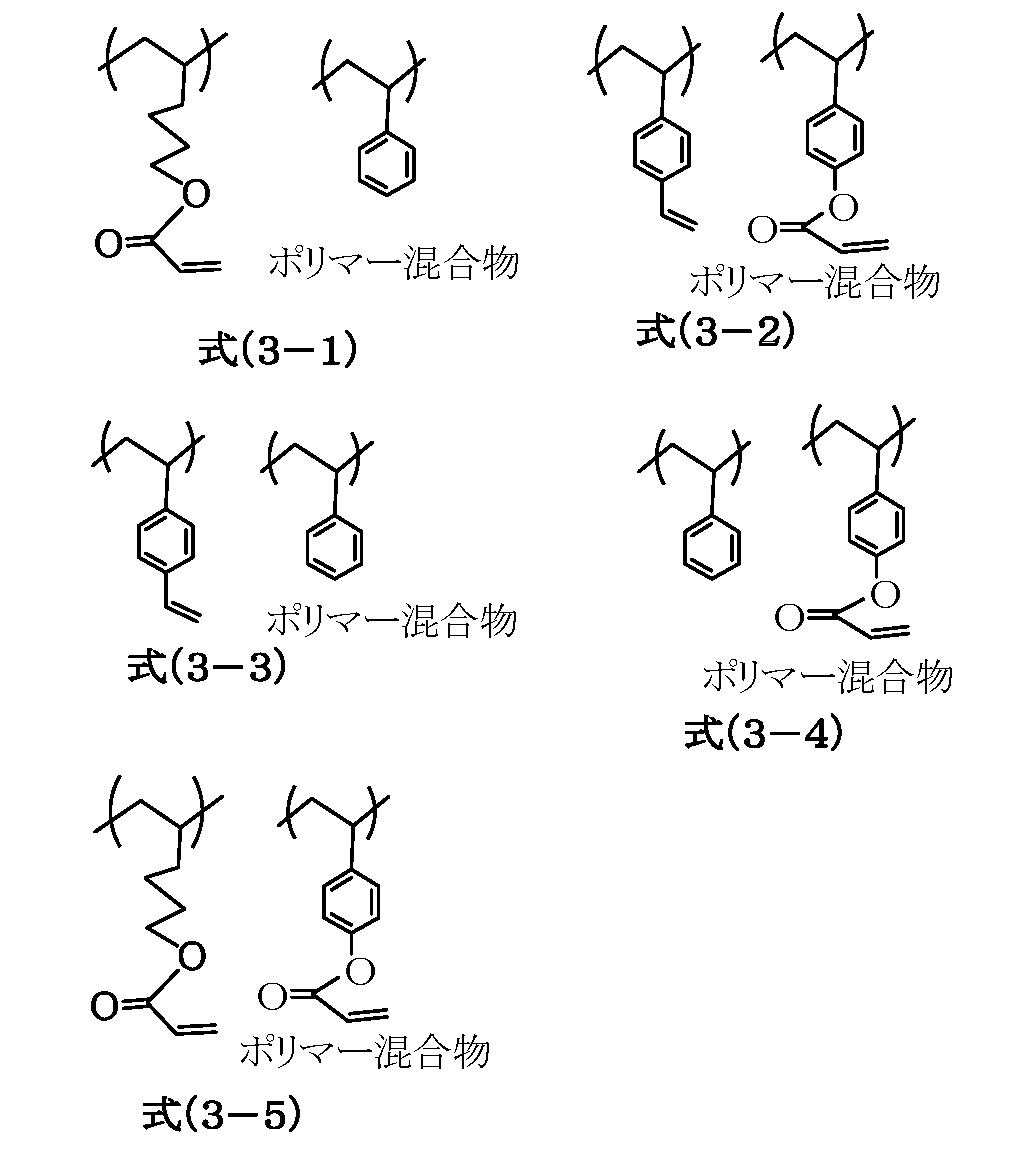
上記光ラジカル重合開始剤は、例えば商品名イルガキュア369(式4-1、BASFジャパン(株)製、2-ベンジル-2-ジメチルアミノ-1-(4-モルフォリノフェニル)-ブタノン-1)、
商品名イルガキュア500(式4-2、BASFジャパン(株)製、1-ヒドロキシシクロヘキシルフェニルケトン+ベンゾフェノン)、
商品名イルガキュア819(式4-3、BASFジャパン(株)製、ビス(2,4,6-トリメチルベンゾイン)-フェニルフォスフィンオキサイド)、
商品名イルガキュア651(式4-4、BASFジャパン(株)製、2,2-ジメトキシ-1,2-ジフェニルエタン-1-オン)、
商品名イルガキュア184(式4-5、BASFジャパン(株)製、1-ヒドロキシシクロヘキシルフェニルケトン)、
商品名ダンロキュア1173(式4-6、BASFジャパン(株)製、2-ヒドロキシ-2-メチル-1-フェニルプロパン-1-オン)、
商品名イルガキュア2959(式4-7、BASFジャパン(株)製、1-(4-(2-ヒドロキシエトキシ)フェニル)-2-ヒドロキシ-2-メチル)-1-プロパン-1-オン)、
商品名イルガキュア127(式4-8、BASFジャパン(株)製、2-ヒドロキシ-1-(4-(4-(2-ヒドロキシ-2-メチルプロピオニル)ベンジル)フェニル)-2-メチル-プロパン-1-オン)、
商品名イルガキュア907(式4-9、BASFジャパン(株)製、2-メチル-1-(4-メチルチオフェニル)-2-モルフォリノプロパン-1-オン)、
商品名イルガキュア379(式4-10、BASFジャパン(株)製、2-(ジメチルアミノ)-2-(4-(メチルフェニル)メチル)-1-(4-(4-モルホリニル)フェニル)-1-ブタノン)、
商品名イルガキュアOXE01(式4-11、BASFジャパン(株)製、1,2-オクタンジオン1,4-(4-フェニルチオ)-2-(O-ベンゾイルオキシム))等が挙げられる。

それら界面活性剤は例えば、ポリオキシエチレンラウリルエーテル、ポリオキシエチレンステアリルエーテル、ポリオキシエチレンセチルエーテル、ポリオキシエチレンオレイルエーテル等のポリオキシエチレンアルキルエーテル類、ポリオキシエチレンオクチルフエノールエーテル、ポリオキシエチレンノニルフエノールエーテル等のポリオキシエチレンアルキルアリルエーテル類、ポリオキシエチレン・ポリオキシプロピレンブロツクコポリマー類、ソルビタンモノラウレート、ソルビタンモノパルミテート、ソルビタンモノステアレート、ソルビタンモノオレエート、ソルビタントリオレエート、ソルビタントリステアレート等のソルビタン脂肪酸エステル類、ポリオキシエチレンソルビタンモノラウレート、ポリオキシエチレンソルビタンモノパルミテート、ポリオキシエチレンソルビタンモノステアレート、ポリオキシエチレンソルビタントリオレエート、ポリオキシエチレンソルビタントリステアレート等のポリオキシエチレンソルビタン脂肪酸エステル類等のノニオン系界面活性剤、商品名エフトップEF301、EF303、EF352((株)トーケムプロダクツ製)、商品名メガファックF171、F173、R-08、R-30(大日本インキ化学工業(株)製)、フロラードFC430、FC431(住友スリーエム(株)製)、商品名アサヒガードAG710,サーフロンS-382、SC101、SC102、SC103、SC104、SC105、SC106(旭硝子(株)製)等のフッ素系界面活性剤、及びオルガノシロキサンポリマ-KP341(信越化学工業(株)製)等を挙げることができる。これらの界面活性剤は単独で使用してもよいし、また二種以上の組み合わせで使用することもできる。
光増感剤としては、例えば、チオキサンテン系、キサンテン系、ケトン系、チオピリリウム塩系、ベーススチリル系、メロシアニン系、3-置換クマリン系、3,4-置換クマリン系、シアニン系、アクリジン系、チアジン系、フェノチアジン系、アントラセン系、コロネン系、ベンズアントラセン系、ペリレン系、メロシアニン系、ケトクマリン系、フマリン系、ボレート系等が挙げられる。
上記光増感剤は、単独又は2種以上の組み合わせで使用することができる。当該光増感剤を用いることによって、UV領域の波長を調整することもできる。
上記紫外線吸収剤としては、例えば、TINUVIN(登録商標)PS、同99-2、同109、同328、同384-2、同400、同405、同460、同477、同479、同900、同928、同1130、同111FDL、同123、同144、同152、同292、同5100、同400-DW、同477-DW、同99-DW、同123-DW、同5050、同5060、同5151(BASFジャパン(株)製)等が挙げられる。
上記紫外線吸収剤は、単独又は2種以上の組み合わせで使用することができる。当該紫外線吸収剤を用いることによって、光硬化時に膜の最表面の硬化速度を制御することができ、薄膜の光硬化性を向上できる場合がある。
第1工程において、磁性体上に凹凸を形成する方法は、例えば磁性体上に光又は熱ナノインプリント法を用いてトラックパターンを形成する。そのパターンを用いてドライエッチング法により磁性体面を加工し凹凸を形成する。この時に用いるエッチングガスとしては、酸素、アルゴン、フッ素系ガスによるドライエッチングによって行なわれることができる。より好ましくは酸素、アルゴンである。フッ素系ガスとしては、例えば、テトラフルオロメタン(CF4)、パーフルオロシクロブタン(C4F8)、パーフルオロプロパン(C3F8)、トリフルオロメタン、及びジフルオロメタン(CH2F2)等が挙げられる。フッ素系ガスを用いてドライエッチングした場合、エッチング時にHFが生成する場合があり、このHFが磁性体を腐食することがある。
塗布は例えば、スピンコート法、ディップ法、フローコート法、インクジェット法、スプレー法、バーコート法、グラビアコート法、ロールコート法、転写印刷法、刷毛塗り、ブレードコート法、エアーナイフコート法等の方法を採用できる。
スピンコート法は好ましく用いることができる。例えば10~10000rpmの回転数で、3~60秒間適用することができる。
膜厚としては5nm~10μmの範囲とすることが可能であるが、凹凸が数十nmであるために、特に5nm~100nmの範囲で用いることが可能である。
平坦化膜形成組成物を凹凸面を有する磁性体上に塗布し、平坦化膜形成組成物で凹凸面が充填され、更にその上に平坦化膜形成組成物が上塗りされる。この膜形成組成物は光硬化によって硬化する。
露光後、必要に応じて露光後加熱(post exposure bake)を行なうこともできる。露光後加熱は、加熱温度50℃~170℃、加熱時間1~10分間から適宜、選択される。
塗布する磁性体の材質はコバルト、アルミニウム、ジルコニウム、クロム、ニッケル、亜鉛、鉄、ルテニウム等を組み合わせた合金である。また、これらの磁性体は大気中においても腐食しやすい性質を有していることがあり、磁性体の上に数nmのダイヤモンドライクカーボンが積層されていても良い。
このようにして磁性体面(層)に非磁性体(本発明の平坦化膜が充填された溝)の溝がトラックパターンとして形成され、磁性体面(層)と非磁性体面(層)は平坦な面を形成している。
膜厚はジェー・エー・ウーラム・ジャパン製の多入射角分光エリプソメーターVASEを使用した。
原子間力顕微鏡はエスアイアイ・ナノテクノロジー(株)製、Nano Navi L-traceを用い、カンチレバーはSI-DF40(背面ALコート)を用いて測定した。
UV照射装置はオーク製作所製、無電極ランプシステムQRE4016を用い、照度が20mW/cm2として使用した。
電子顕微鏡は株式会社日立ハイテクノロジーズ社製 S-4800を使用した。
ポリマーの平均分子量測定は東ソー株式会社製、商品名:Eco SEC HLC-8320GPCを使用した。
コバルトの定量はXPSを用い、アルバック-ファイ株式会社製、Quantera SXMを使用した。
接触角測定は協和界面科学株式会社製の全自動接触角計DM700型を使用した。
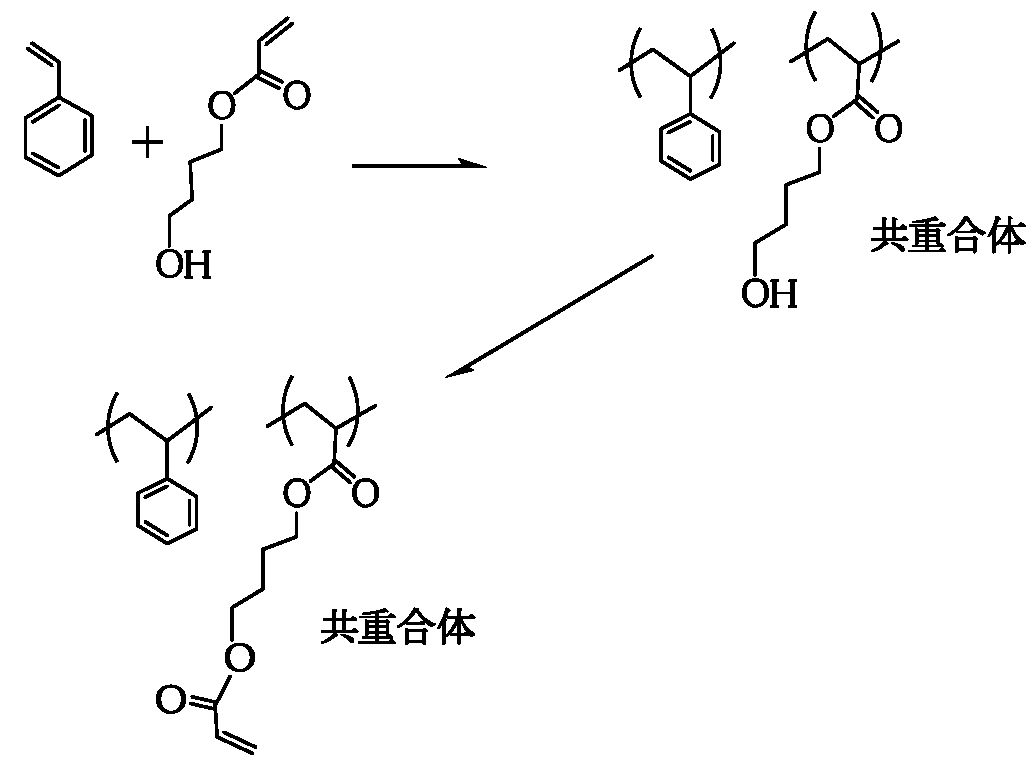
温度計、還流管を備えた2Lの4つ口フラスコに5.00g(0.0480mol;共重合体中に70mol%の割合)のスチレン、2.97g(0.0206mol;共重合体中に30mol%の割合)のアクリル酸4-ヒドロキシブチル、0.56g(0.0034mol;全モノマーに対して5mol%、ラジカル重合開始剤)のアゾビスイソブチロニトリル、844.41gのテトラヒドロフラン(固形分:1.0質量%)を加え、ダイアフラムポンプを用いて減圧し、系内を窒素置換した。次いで、マグネティックスターラーで撹拌させながら、オイルバスを用いて66℃で還流し、1時間反応させた。反応終了後、23℃まで自然冷却した。
反応液は後処理を行わず、窒素雰囲気を保持したまま、氷浴を用いて0℃に冷却し、3.12g(0.0309mol;アクリル酸4-ヒドロキシブチルの1.5当量)のトリエチルアミン、2.79g(0.0309mol;アクリル酸4-ヒドロキシブチルの1.5当量)のアクリル酸クロリドを注射器を用いて加えた。反応温度は0℃乃至5℃の間で保持したまま、3時間反応させ、次いで、氷浴を取り去り23℃で40時間反応させた。
反応液のGPCを測定したところ、Mwが1007、Mnが548、Mw/Mnが1.84のポリマー(PSA)の溶液を得た。
PSAはエバポレーターを用いて完全に溶媒を留去したとき、液状であることを確認した。
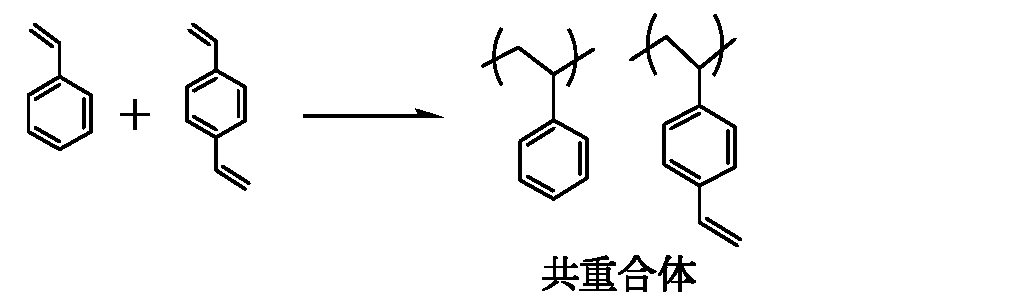
温度計、還流管を備えた2Lの4つ口フラスコに4.00g(0.0384mol;共重合体中に50mol%の割合)のスチレン、5.00g(0.0384mol;共重合体中に50mol%の割合)のジビニルベンゼン、0.17gのNafion117(Aldrich社製、カチオン重合開始剤:炭素とフッ素からなる骨格とスルホン酸基を持つパーフルオロ側鎖を有するパーフルオロカーボン材料)、908.33gのPGMEA(固形分:1.0質量%)を加え、ダイアフラムポンプを用いて減圧し、系内を窒素置換した。次いで、マグネティックスターラーで撹拌させながら、23℃で24時間反応させた。
反応終了後、系内に浮遊したNafion117をろ過し、ろ液を得た。
反応液のGPCを測定したところ、Mwが808、Mnが448、Mw/Mnが1.80のポリマー(PSD)の溶液を得た。
PSDはエバポレーターを用いて完全に溶媒を留去したとき、液状であることを確認した。
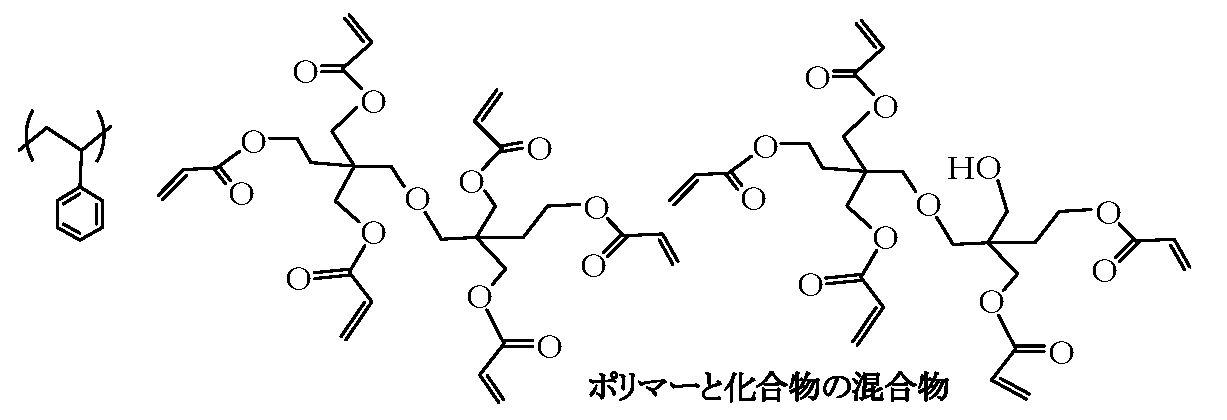
500mLの1つ口フラスコに2.00gのPiccolastic(TM)A5(イーストマンケミカルジャパン(株)、液状ポリスチレン、重量平均分子量は400)を秤量し、0.50gのジペンタエリスリトールヘキサアクリレートの混合物(商品名カヤラッド DPHA、日本化薬(株)、液状ポリアクリレート化合物:ジペンタエリスリトールのペンタアクリレート及びヘキサアクリレートの混合物、重量平均分子量は約550)を加えた。
上記疎水性被覆材は以下に示した。この疎水性被覆材は液状ポリスチレンと液状ポリアクリレート化合物の混合物である。
上記疎水性被覆材を準備した。この疎水性被覆材はジペンタエリスリトールヘキサアクリレートの混合物(商品名カヤラッド DPHA、日本化薬(株)、液状ポリアクリレート化合物:ジペンタエリスリトールのペンタアクリレート及びヘキサアクリレートの混合物、重量平均分子量は約550)である。

500mLのナス型フラスコにスチレンとアクリル酸を85:15(共重合体中のmol%比)で共重合したポリマー(Mw=14300、Mn=5600;大阪有機化学工業(株)、固形状ポリマー)の35%PGMEA溶液を5.00g秤量した。
この疎水性被覆材は下記に示すスチレンとアクリル酸の共重合体であった。

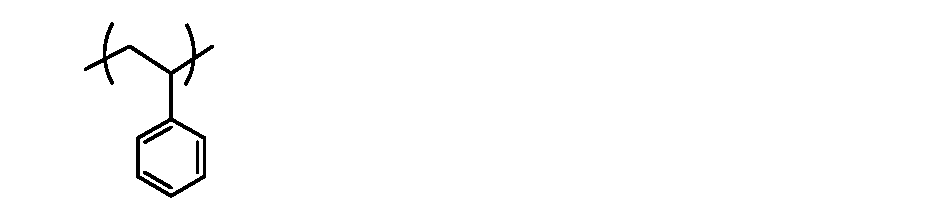
500mLのナス型フラスコにポリスチレン(Mw=2000;和光純薬工業(株)、固形状ポリマー)を2.00g秤量した。
この疎水性被覆材は下記に示すポリスチレンであった。
実施例1乃至3で調製したPASV、PSDV、SDV、比較例1乃至3で調製したRV1、RV2、RV3はエバポレーターを用いて減圧濃縮し、固形分が4.0%質量になるように調製した。
固形分が4.0質量%に調製したワニス(ハードディスク用平坦化膜形成組成物)を用いて構造物付き基板上でスピンコートを行った。構造物付き基板の材質はシリコンであり、深さが100nm、ラインとスペースは30nmの等間隔で形成されているものを使用した。スピンコートは構造物が付いていないシリコン基板上で85nm製膜できる条件と同様の条件とした。
AFMは構造体を埋め込んだ後の製膜面を測定し、平均表面粗さ(Ra)及び最大表面粗さ(Rmax)を測定した。AFMの測定箇所はラインとスペースが存在する方向の垂直方向とし、測定範囲は5μm×5μmとした。
固形分が4.0質量%のPSAVワニス(実施例1で得られたハードディスク用平坦化膜形成組成物を固形分4.0質量%に調整)を構造物付き基板上にスピンコート法で製膜した。スピンコート後の膜はUV照射装置(メイン波長380nm)を用い、照度が20mW/cm2にて10秒間(200mJ/cm2)、大気下で光照射した。
光照射後の膜はAFMを用いて構造体上の平坦性を評価した。AFMの測定結果は表1に示す。
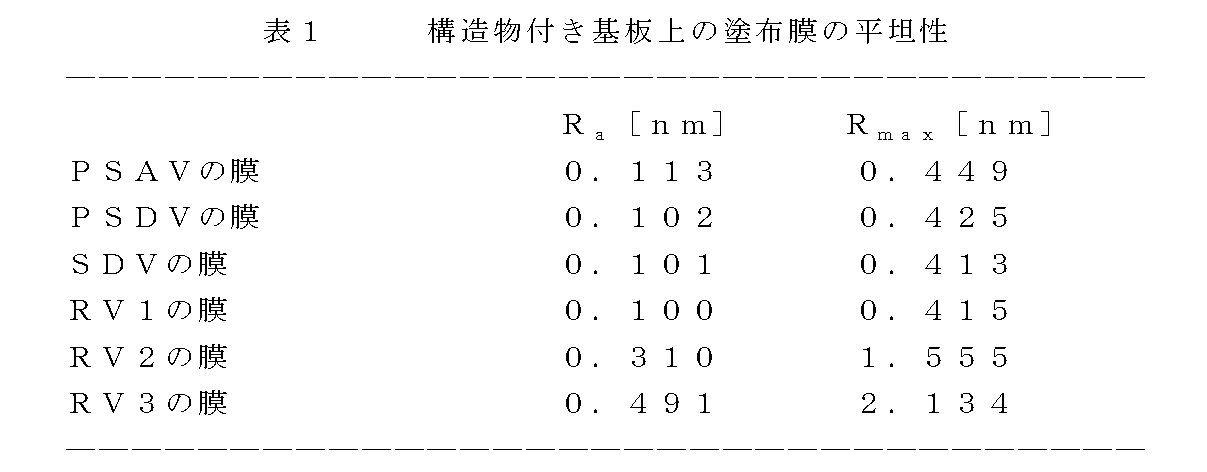
一方、RV2及びRV3の各膜はRmaxが1nm以上となり、表面ラフネスが大きいことがわかった。Rmaxが1nm以上であると、後工程で平坦化材料にダイヤモンドライクカーボン(DLC)を積層した際に、平坦化膜のラフネスを踏襲して、DLCにラフネスが反映してしまい、ハードディスク上を浮上しているヘッドとクラッシュする可能性がある。ヘッドとハードディスクとの距離は5nm以下が求められており、1nm以下のRmaxを有していることが重要である。
実施例1乃至3で調製したPSAV、PSDV、SDVの各膜、比較例1乃至3で調製したRV1、RV2、RV3の各膜のコバルトコロージョン試験を行った。
用いた基板はSi基板上に200nmのコバルトをスパッタリングした基板(グローバルネット(株)製、コバルト被覆基板)を使用した。
コバルトの検出にはXPSを使用した。測定条件はX線がAlKa、1486.6eV(25W、15kV)、測定範囲が1000μm×1000μm、Pass Energyが55.0eV、112.0eV、Photoelectron Taku Off Angleが基板から45°とした。XPSによるコバルトの定量は膜の最表面から膜厚方向に10nmまでの情報が得られる。また、XPSによるコバルトのピークは778.2eV付近に現れる。
光照射後の膜はXPSを用いて膜の最表面を測定し、コバルトを定量した。次いで、同一の膜を温度が90℃、相対湿度が90%RHに設定した恒温恒湿器を使用して120時間放置した。恒温恒湿試験後の膜はXPSを用いて膜の最表面を測定し、コバルトを定量した。XPSの測定結果は表2に示す。
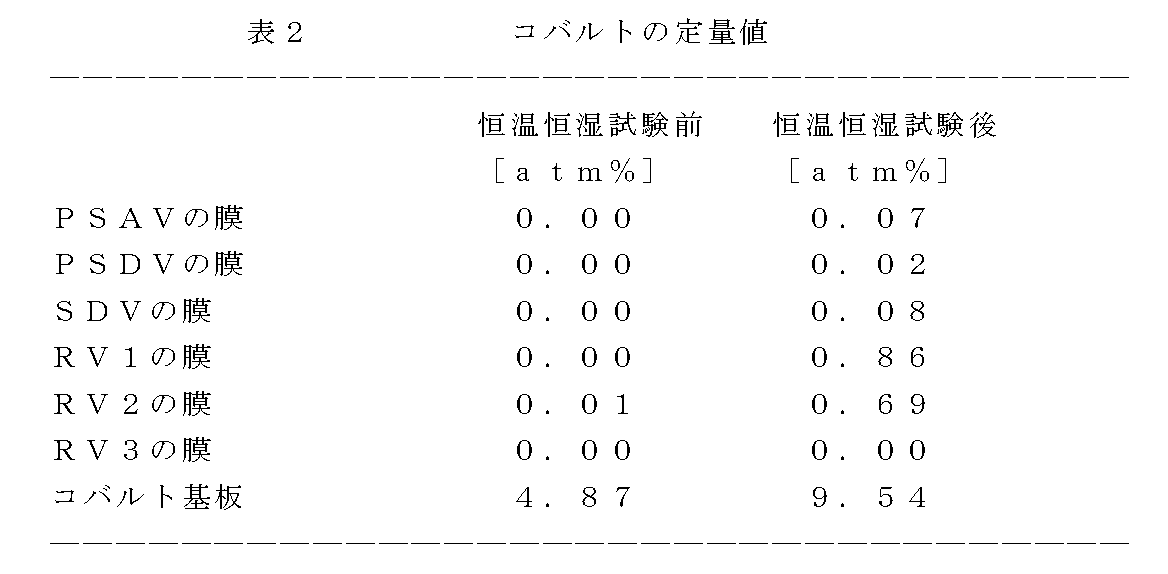
恒温恒湿試験後のコバルトの定量値はPSAV、PSDV、SDV、RV3の各膜において0.1atm%以下となり、平坦化膜の表面にコバルトが拡散している割合が非常に小さいことがわかった。一方でRV1及びRV2の各膜は0.86atm%及び0.69atm%となり、平坦化膜の表面にコバルトが拡散していることがわかった。RV2はポリスチレン骨格を有するポリマーでありながら、コバルトが検出されるのは、極性基としてカルボン酸を有しているためである。カルボン酸はルイス酸として機能しコバルト基板を腐食させてしまうことがわかった。
非磁性体に磁性体が検出されてしまう現象は、磁性体のコバルト基板が酸やアルカリ、水蒸気などでイオン化して腐食(コロージョン)し、このイオン化した成分が非磁性体に拡散(マイグレーション)すると考えられる。したがって、恒温恒湿試験後の非磁性体の表面からコバルトが検出されないことは、非磁性体材料が磁性体であるコバルト基板を腐食させず、拡散させないことを示しており、高信頼性のハードディスクを提供できる。
実施例1乃至実施例3、比較例1乃至比較例3で得た膜の水接触角を測定した。
PSAVワニス(実施例1で得られたハードディスク用平坦化膜形成組成物)をコバルト基板に膜厚が20nmとなるようにスピンコート法で製膜した。スピンコート後の膜はUV照射装置(メイン波長380nm)を用い、照度が20mW/cm2にて10秒間(200mJ/cm2)、大気下で光照射した。コバルト基板上に塗布されたPSAV膜の水接触角を測定した。測定結果は表3に示す。
PSDV膜の水接触角は、PSAV膜を用いた場合と同様に測定した。測定結果は表3に示す。
SDV膜の水接触角は、PSAV膜を用いた場合と同様に測定した。測定結果は表3に示す。
RV1膜の水接触角は、PSAV膜を用いた場合と同様に測定した。測定結果は表3に示す。
RV2ワニス(比較例2で得られたハードディスク用平坦化膜形成組成物)をコバルト基板に膜厚が20nmとなるようにスピンコート法で製膜した。スピンコート後の膜は大気下で200℃のホットプレートを用い5分間焼成を行った。
コバルト基板上に塗布されたRV2膜の水接触角を測定した。測定結果は表3に示す。
RV3膜の水接触角は、RV2膜を用いた場合と同様に測定した。測定結果は表3に示す。
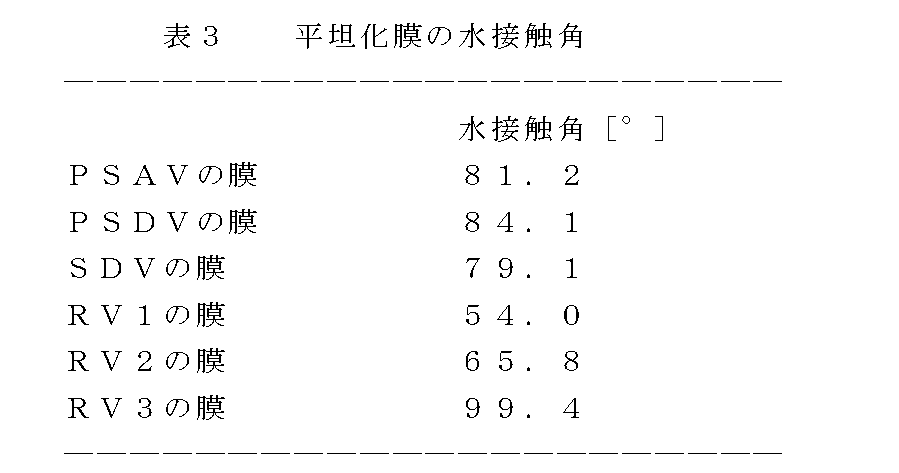
これらの水接触角の結果は、表2で示したコバルトのコロージョン試験結果と相関関係があることがわかり、図1に示した。図1はコバルト被覆基板上に平坦化膜を被覆して恒温恒湿試験後の平坦化膜表面のコバルトの定量値と、別途コバルト被覆基板上に被覆した平坦化膜の水接触角試験値との相関関係を示す図である。縦軸はコバルトの定量値(atom%)であり、横軸は水接触角の測定値(°)である。すなわち、水接触角が70°以上の疎水的な有機膜を用いることでコバルトのコロージョンを著しく抑制できることが明らかとなった。
Claims (15)
- 芳香族基を含む300~5000の分子量を有する大気圧下に常温で液体のポリマー(A1)、少なくとも2つの光重合性基を含む300~5000の分子量を有する大気圧下に常温で液体のポリマー(A2)、芳香族基と少なくとも2つの光重合性基とを含む300~5000の分子量を有する大気圧下に常温で液体のポリマー(A3)、芳香族基を含む100~1000の分子量を有する大気圧下に常温で液体の化合物(a1)、少なくとも2つの光重合性基を含む100~1000の分子量を有する大気圧下に常温で液体の化合物(a2)、及び芳香族基と少なくとも2つの光重合性基とを含む100~1000の分子量を有する大気圧下に常温で液体の化合物(a3)からなる群から選ばれる少なくとも1種のポリマー又は少なくとも1種のポリマーと少なくとも1種の化合物との組み合わせからなり且つ光重合性基と芳香族基とを有する疎水性被覆材を含む、ハードディスク用平坦化膜形成組成物。
- 前記光重合性基がアクリレート基、メタクリレート基、又はビニル基である請求項1に記載の平坦化膜形成組成物。
- 前記芳香族基がベンゼン環を含む基である請求項1又は請求項2に記載の平坦化膜形成組成物。
- 前記疎水性被覆材が上記(A3)単独、(A1)と(A2)の混合物、(A1)と(A3)の混合物、(A2)と(A3)の混合物、(A3)と(a3)の混合物、(A1)と(a3)の混合物、又は(A1)と(a2)の混合物である請求項1乃至請求項3のいずれか1項に記載の平坦化膜形成組成物。
- 前記疎水性被覆材が上記(A3)単独又は(A1)と(a2)の混合物である請求項1乃至請求項3のいずれか1項に記載の平坦化膜形成組成物。
- 上記(A3)がホモポリマー又はコポリマーである請求項1乃至請求項5のいずれか1項に記載の平坦化膜形成組成物。
- 前記平坦化膜形成組成物から得られる平坦化膜は、水接触角測定において該平坦化膜と水との接触角が70°~150°となる疎水性を有する膜である請求項1乃至請求項6のいずれか1項に記載の平坦化膜形成組成物。
- 更に光重合開始剤と溶剤を含む請求項1乃至請求項7のいずれか1項に記載の平坦化膜形成組成物。
- 前記平坦化膜形成組成物から得られる膜は、非ハロゲン系のドライエッチングガスでエッチバックによる平坦化が可能な膜である請求項1乃至請求項8のいずれか1項に記載の平坦化膜形成組成物。
- 磁性体上に凹凸を形成する第1工程、該凹凸を請求項1乃至請求項9のいずれか1項に記載の平坦化膜形成組成物で被覆する第2工程、エッチングにより、被覆された膜表面を平坦化するとともに磁性体表面を露出する第3工程を含むハードディスクの製造方法。
- 更に第4工程として硬質物質を被覆する工程を含む請求項10に記載のハードディスクの製造方法。
- 前記第1工程で凹凸を形成する工程がナノインプリント法で行われる請求項10又は請求項11に記載のハードディスクの製造方法。
- 前記第3工程で平坦化がドライエッチングで行われる請求項10乃至請求項12のいずれか1項に記載のハードディスクの製造方法。
- 前記第4工程で用いられる硬質物質がダイヤモンドライクカーボンである請求項10乃至請求項13のいずれか1項に記載のハードディスクの製造方法。
- 前記(A1)、(A2)、(A3)、(a1)、(a2)及び(a3)からなる群から選ばれる少なくとも1種のポリマー又は少なくとも1種のポリマーと少なくとも1種の化合物との組み合わせからなり且つ光重合性基と芳香族基とを有する疎水性被覆材を含む、磁性物質の拡散防止膜形成組成物。
Priority Applications (4)
| Application Number | Priority Date | Filing Date | Title |
|---|---|---|---|
| US13/996,755 US9217096B2 (en) | 2010-12-22 | 2011-12-21 | Film forming composition for hard disk |
| KR1020137016389A KR20140005188A (ko) | 2010-12-22 | 2011-12-21 | 하드디스크용 피막 형성 조성물 |
| CN201180061314.7A CN103262165B (zh) | 2010-12-22 | 2011-12-21 | 形成硬盘用被膜的组合物 |
| JP2012549848A JP5915862B2 (ja) | 2010-12-22 | 2011-12-21 | ハードディスク用被膜形成組成物 |
Applications Claiming Priority (2)
| Application Number | Priority Date | Filing Date | Title |
|---|---|---|---|
| JP2010285740 | 2010-12-22 | ||
| JP2010-285740 | 2010-12-22 |
Publications (1)
| Publication Number | Publication Date |
|---|---|
| WO2012086692A1 true WO2012086692A1 (ja) | 2012-06-28 |
Family
ID=46313960
Family Applications (1)
| Application Number | Title | Priority Date | Filing Date |
|---|---|---|---|
| PCT/JP2011/079655 Ceased WO2012086692A1 (ja) | 2010-12-22 | 2011-12-21 | ハードディスク用被膜形成組成物 |
Country Status (6)
| Country | Link |
|---|---|
| US (1) | US9217096B2 (ja) |
| JP (1) | JP5915862B2 (ja) |
| KR (1) | KR20140005188A (ja) |
| CN (1) | CN103262165B (ja) |
| TW (1) | TWI525106B (ja) |
| WO (1) | WO2012086692A1 (ja) |
Cited By (1)
| Publication number | Priority date | Publication date | Assignee | Title |
|---|---|---|---|---|
| WO2013042655A1 (ja) * | 2011-09-22 | 2013-03-28 | 日産化学工業株式会社 | ハードディスク用平坦化膜形成組成物 |
Citations (6)
| Publication number | Priority date | Publication date | Assignee | Title |
|---|---|---|---|---|
| JP2005235356A (ja) * | 2004-02-23 | 2005-09-02 | Tdk Corp | 磁気記録媒体の製造方法 |
| JP2006120222A (ja) * | 2004-10-20 | 2006-05-11 | Toshiba Corp | 磁気記録媒体およびその製造方法 |
| JP2007072374A (ja) * | 2005-09-09 | 2007-03-22 | Tokyo Ohka Kogyo Co Ltd | ナノインプリント用の膜形成組成物およびパターン形成方法 |
| JP2007250091A (ja) * | 2006-03-16 | 2007-09-27 | Toshiba Corp | パターンド媒体およびその製造方法、ならびに磁気記録装置 |
| JP2009226750A (ja) * | 2008-03-24 | 2009-10-08 | Fujifilm Corp | インプリント用モールド構造体、及び該インプリント用モールド構造体を用いたインプリント方法、並びに、磁気記録媒体、及びその製造方法 |
| JP2009259370A (ja) * | 2008-03-18 | 2009-11-05 | Showa Denko Kk | 磁気記録媒体の製造方法、磁気記録媒体、及び磁気記録再生装置 |
Family Cites Families (6)
| Publication number | Priority date | Publication date | Assignee | Title |
|---|---|---|---|---|
| JP2005100496A (ja) | 2003-09-22 | 2005-04-14 | Tdk Corp | 磁気記録媒体の製造方法及び磁気記録媒体 |
| US8113116B2 (en) * | 2006-03-14 | 2012-02-14 | Fujifilm Corporation | Lithographic printing plate precursor |
| JP2008202022A (ja) * | 2007-01-23 | 2008-09-04 | Fujifilm Corp | 光ナノインプリントリソグラフィ用硬化性組成物およびそれを用いたパターン形成方法 |
| US8715906B2 (en) * | 2008-12-12 | 2014-05-06 | E I Du Pont De Nemours And Company | High resolution, solvent resistant, thin elastomeric printing plates |
| US8467143B2 (en) * | 2010-02-03 | 2013-06-18 | HGST Netherlands, B.V. | Servo patterning and writing compatible with planarization of patterned magnetic disks |
| CN103765512B (zh) * | 2011-09-22 | 2017-06-30 | 日产化学工业株式会社 | 形成硬盘用平坦化膜的组合物 |
-
2011
- 2011-12-21 JP JP2012549848A patent/JP5915862B2/ja not_active Expired - Fee Related
- 2011-12-21 CN CN201180061314.7A patent/CN103262165B/zh not_active Expired - Fee Related
- 2011-12-21 US US13/996,755 patent/US9217096B2/en not_active Expired - Fee Related
- 2011-12-21 KR KR1020137016389A patent/KR20140005188A/ko not_active Ceased
- 2011-12-21 WO PCT/JP2011/079655 patent/WO2012086692A1/ja not_active Ceased
- 2011-12-22 TW TW100148063A patent/TWI525106B/zh not_active IP Right Cessation
Patent Citations (6)
| Publication number | Priority date | Publication date | Assignee | Title |
|---|---|---|---|---|
| JP2005235356A (ja) * | 2004-02-23 | 2005-09-02 | Tdk Corp | 磁気記録媒体の製造方法 |
| JP2006120222A (ja) * | 2004-10-20 | 2006-05-11 | Toshiba Corp | 磁気記録媒体およびその製造方法 |
| JP2007072374A (ja) * | 2005-09-09 | 2007-03-22 | Tokyo Ohka Kogyo Co Ltd | ナノインプリント用の膜形成組成物およびパターン形成方法 |
| JP2007250091A (ja) * | 2006-03-16 | 2007-09-27 | Toshiba Corp | パターンド媒体およびその製造方法、ならびに磁気記録装置 |
| JP2009259370A (ja) * | 2008-03-18 | 2009-11-05 | Showa Denko Kk | 磁気記録媒体の製造方法、磁気記録媒体、及び磁気記録再生装置 |
| JP2009226750A (ja) * | 2008-03-24 | 2009-10-08 | Fujifilm Corp | インプリント用モールド構造体、及び該インプリント用モールド構造体を用いたインプリント方法、並びに、磁気記録媒体、及びその製造方法 |
Cited By (3)
| Publication number | Priority date | Publication date | Assignee | Title |
|---|---|---|---|---|
| WO2013042655A1 (ja) * | 2011-09-22 | 2013-03-28 | 日産化学工業株式会社 | ハードディスク用平坦化膜形成組成物 |
| JPWO2013042655A1 (ja) * | 2011-09-22 | 2015-03-26 | 日産化学工業株式会社 | ハードディスク用平坦化膜形成組成物 |
| US9523020B2 (en) | 2011-09-22 | 2016-12-20 | Nissan Chemical Industries, Ltd. | Flattening film forming composition for hard disk |
Also Published As
| Publication number | Publication date |
|---|---|
| US20130270222A1 (en) | 2013-10-17 |
| TWI525106B (zh) | 2016-03-11 |
| TW201245230A (en) | 2012-11-16 |
| CN103262165A (zh) | 2013-08-21 |
| JPWO2012086692A1 (ja) | 2014-05-22 |
| KR20140005188A (ko) | 2014-01-14 |
| JP5915862B2 (ja) | 2016-05-11 |
| CN103262165B (zh) | 2016-08-31 |
| US9217096B2 (en) | 2015-12-22 |
Similar Documents
| Publication | Publication Date | Title |
|---|---|---|
| JP4993119B2 (ja) | 光架橋硬化のレジスト下層膜を形成するためのレジスト下層膜形成組成物 | |
| JP5589387B2 (ja) | シロキサン樹脂組成物およびそれを用いたタッチパネル用保護膜 | |
| TWI363251B (en) | Sublayer coating-forming composition for lithography containing compound having protected carboxy group | |
| KR101436336B1 (ko) | 광가교 경화의 레지스트 하층막을 형성하기 위한 규소 함유레지스트 하층막 형성 조성물 | |
| JP4525805B2 (ja) | 複合ハードコート層付き物体及び複合ハードコート層の形成方法 | |
| JP5511415B2 (ja) | インプリント用硬化性組成物、パターン形成方法およびパターン | |
| TWI814966B (zh) | 感光性樹脂組成物,感光性乾膜及圖案形成方法 | |
| JP2015065443A (ja) | パターン形成方法 | |
| TW202348433A (zh) | 柔性單層聚矽氧烷硬塗層 | |
| JP5915862B2 (ja) | ハードディスク用被膜形成組成物 | |
| JP5818020B2 (ja) | ハードディスク用平坦化膜形成組成物及びそれを用いたハードディスクの製造方法 | |
| JP5999375B2 (ja) | ハードディスク用平坦化膜形成組成物 | |
| US20250208510A1 (en) | Compound For Forming Metal-Containing Film, Composition For Forming Metal-Containing Film, And Patterning Process | |
| WO2015147294A1 (ja) | 表面粗化方法 | |
| US20240295816A1 (en) | Compound For Forming Metal-Containing Film, Composition For Forming Metal-Containing Film, And Patterning Process | |
| TWI849203B (zh) | 皮膜形成用組成物、塗佈該皮膜形成用組成物而成之積層體、使用該積層體而成之觸控面板、及硬化皮膜之形成方法 | |
| CN120192535A (zh) | 含金属的膜形成用化合物、含金属的膜形成用组成物、图案形成方法 | |
| JP2006294137A (ja) | 光ディスク |
Legal Events
| Date | Code | Title | Description |
|---|---|---|---|
| 121 | Ep: the epo has been informed by wipo that ep was designated in this application |
Ref document number: 11852123 Country of ref document: EP Kind code of ref document: A1 |
|
| ENP | Entry into the national phase |
Ref document number: 2012549848 Country of ref document: JP Kind code of ref document: A |
|
| WWE | Wipo information: entry into national phase |
Ref document number: 13996755 Country of ref document: US |
|
| ENP | Entry into the national phase |
Ref document number: 20137016389 Country of ref document: KR Kind code of ref document: A |
|
| NENP | Non-entry into the national phase |
Ref country code: DE |
|
| 122 | Ep: pct application non-entry in european phase |
Ref document number: 11852123 Country of ref document: EP Kind code of ref document: A1 |