WO2012043734A1 - アンケートの回答を収集するサーバ装置 - Google Patents
アンケートの回答を収集するサーバ装置 Download PDFInfo
- Publication number
- WO2012043734A1 WO2012043734A1 PCT/JP2011/072415 JP2011072415W WO2012043734A1 WO 2012043734 A1 WO2012043734 A1 WO 2012043734A1 JP 2011072415 W JP2011072415 W JP 2011072415W WO 2012043734 A1 WO2012043734 A1 WO 2012043734A1
- Authority
- WO
- WIPO (PCT)
- Prior art keywords
- questionnaire
- scene
- answer
- terminal device
- target
- Prior art date
- Legal status (The legal status is an assumption and is not a legal conclusion. Google has not performed a legal analysis and makes no representation as to the accuracy of the status listed.)
- Ceased
Links
Images




Classifications
-
- H—ELECTRICITY
- H04—ELECTRIC COMMUNICATION TECHNIQUE
- H04L—TRANSMISSION OF DIGITAL INFORMATION, e.g. TELEGRAPHIC COMMUNICATION
- H04L65/00—Network arrangements, protocols or services for supporting real-time applications in data packet communication
- H04L65/40—Support for services or applications
- H04L65/403—Arrangements for multi-party communication, e.g. for conferences
-
- G—PHYSICS
- G06—COMPUTING OR CALCULATING; COUNTING
- G06Q—INFORMATION AND COMMUNICATION TECHNOLOGY [ICT] SPECIALLY ADAPTED FOR ADMINISTRATIVE, COMMERCIAL, FINANCIAL, MANAGERIAL OR SUPERVISORY PURPOSES; SYSTEMS OR METHODS SPECIALLY ADAPTED FOR ADMINISTRATIVE, COMMERCIAL, FINANCIAL, MANAGERIAL OR SUPERVISORY PURPOSES, NOT OTHERWISE PROVIDED FOR
- G06Q30/00—Commerce
- G06Q30/02—Marketing; Price estimation or determination; Fundraising
-
- G—PHYSICS
- G06—COMPUTING OR CALCULATING; COUNTING
- G06Q—INFORMATION AND COMMUNICATION TECHNOLOGY [ICT] SPECIALLY ADAPTED FOR ADMINISTRATIVE, COMMERCIAL, FINANCIAL, MANAGERIAL OR SUPERVISORY PURPOSES; SYSTEMS OR METHODS SPECIALLY ADAPTED FOR ADMINISTRATIVE, COMMERCIAL, FINANCIAL, MANAGERIAL OR SUPERVISORY PURPOSES, NOT OTHERWISE PROVIDED FOR
- G06Q30/00—Commerce
- G06Q30/02—Marketing; Price estimation or determination; Fundraising
- G06Q30/0201—Market modelling; Market analysis; Collecting market data
- G06Q30/0203—Market surveys; Market polls
Definitions
- the present invention relates to a technical field such as an apparatus for collecting questionnaire responses from respondents who answer a questionnaire regarding an object that is composed of a plurality of scenes and that changes over time.
- a questionnaire survey on the movie that has been screened has been conducted.
- a method has been adopted in which a questionnaire is distributed to each viewer and is filled in after watching the movie.
- the viewer does not remember all the scenes of the movie that was watched, so the scenes that left a strong impression were reflected in the questionnaire results, but other scenes (scenes that were somehow good) Is often not reflected in the questionnaire results.
- Patent Document 1 it is difficult for a person who conducts a questionnaire survey to obtain the result according to the content that the person wants to investigate.
- various surveys regarding scenes are often performed, such as collecting information on both scenes where viewers are interested and scenes where they are not interested.
- the present invention has been made in view of the above points, and is a server that can accurately collect questionnaire responses according to the content that the person who conducts the questionnaire survey wants to survey from viewers who watch video, music, theater, etc.
- An object is to provide a device or the like.
- the invention according to claim 1 is a terminal of a respondent who answers a questionnaire regarding the object while viewing the object which is composed of a plurality of scenes and the scene changes with the passage of time.
- a server device that collects answers to the questionnaire from a device, the storage means for storing the sound data of the target, and an answer operation for answering the questionnaire when the respondent is viewing the target
- receiving means for receiving sound data around the terminal device collected when the answer operation is performed, and the received sound data and the storage means are stored.
- a specifying unit that compares the target sound data and specifies a scene that is the answer target of the questionnaire based on the comparison result.
- the server device can identify the scene where the respondent answered the questionnaire from the sound data collected when the answer operation was performed, so the questionnaire response to the scene is not confused with the answer to other scenes. Can be collected accurately.
- the Invention of Claim 2 is the server apparatus of Claim 1, Comprising: The said receiving means further receives the reply information for specifying the reply content of the said questionnaire, The reply which the said receiving means received Response storage means for storing the response contents of the questionnaire specified based on the information in association with the scene specified by the specifying means is further provided.
- invention of Claim 3 is the server apparatus of Claim 2, Comprising: The said some response operation is determined according to the response content of the said several different said questionnaire, The said response information It is information for specifying the content of the questionnaire response according to the response operation.
- a type information transmitting unit that transmits type information indicating a type of each target to the terminal device.
- the storage means stores the sound data for each type of the object, and the receiving means selects the type of the object selected by the respondent from the terminal device based on the transmitted type information.
- the selection means information is further received, and the specifying unit compares the sound data corresponding to the type indicated by the received selection type information with the received sound data, and specifies the scene based on the comparison result It is characterized by doing.
- the storage unit associates evaluation position information indicating a position where the target should be appreciated for each view with the target.
- the receiving means further receives terminal position information indicating the position of the terminal device and answer target information indicating an object to which a questionnaire is answered from the terminal device, and the questionnaire indicated by the received answer target information If the evaluation position information stored in the storage means in association with the target to be answered is different from the received terminal position information, the questionnaire response based on the sound data transmitted from the terminal device is invalid. It further comprises a position fraud determination means for determining that
- the server device further includes a transmission unit that transmits information indicating the scene of the target specified by the specifying unit to the terminal device.
- the means receives confirmation information by the respondent indicating whether or not the identified scene is a scene to be answered in the questionnaire from the terminal device, and the identifying means has the received confirmation information In the case where it is indicated that the scene is not the target of answering the questionnaire, the fact that the target scene is specified is canceled.
- the invention according to claim 7 is the server device according to claim 2, wherein the answering operation by the respondent is an operation of shaking the terminal device, and the receiving unit performs the shaking operation. Further receiving operation value information for specifying an operation value of at least one of the acceleration of the terminal device or the number of times the terminal device is shaken, and specifying the operation value information based on the received operation value information Level specifying means for specifying the level of the answer content of the questionnaire from the operation value, and the answer storage means associates the level specified by the level specifying means with the scene specified by the specifying means. Further, it is memorized.
- the level of the answer content of the questionnaire can be specified from the operation value of at least one of the acceleration and the number of times the responder performed the operation of shaking the terminal device.
- the invention according to claim 8 is the server apparatus according to claim 1, wherein the answering operation by the respondent is an operation of shaking the terminal device, and the receiving unit performs the shaking operation. Further receiving operation value information for specifying an operation value of at least one of the acceleration of the terminal device or the number of times the terminal device is shaken, and specifying the operation value information based on the received operation value information
- a level specifying means for specifying an evaluation level for the respondent to the scene at the time when the answer operation is performed from an operation value, and an evaluation level specified by the level specifying means are specified by the specifying means.
- Level storage means for storing in association with the scenes.
- the level of evaluation for the respondent to the scene can be specified from the operation value of at least one of the acceleration and the number of times the respondent performed the operation of shaking the terminal device.
- the invention according to claim 9 is the server device according to claim 7 or 8, wherein the operation value storage unit stores the operation value information received by the reception unit, and is stored in the operation value storage unit. And calculating the average of the operation values of all the respondents who performed the answering operation of the questionnaire, and calculating the average of the operation values of any one respondent who performed the answering operation of the questionnaire. Based on the ratio between the average calculating means for calculating and the average of the operation values calculated for the entire respondent by the average calculating means and the average of the operation values calculated for the one respondent Correction means for correcting the operation value specified by the operation value information transmitted from the terminal device, wherein the level specifying means calculates the level from the operation value corrected by the correction means. Characterized in that it constant.
- the invention according to claim 10 is composed of a plurality of scenes, and responds to the questionnaire from a respondent's terminal device that answers a questionnaire regarding the object while appreciating the object that the scene changes over time.
- a questionnaire response collection method executed by a computer included in a server device for collecting, from the terminal device that has performed an answer operation for answering the questionnaire when the respondent is watching the target, Receiving sound data around the terminal device collected when the answer operation is performed, the received sound data, and target sound data stored in the storage unit of the server device; And identifying a scene that is the answer target of the questionnaire based on the comparison result.
- the invention according to claim 11 is composed of a plurality of scenes, and from the terminal device of the respondent who answers the questionnaire regarding the subject while appreciating the subject where the scene changes as time passes, A computer included in the server device to be collected is collected when the answer operation is performed from the terminal device that has performed an answer operation for answering the questionnaire while the respondent is viewing the target.
- Receiving means for receiving sound data around the terminal device the received sound data is compared with the target sound data stored in the storage means of the server device, and based on the comparison result,
- a computer-readable record that records a questionnaire response collection program that functions as a means to identify the scenes that were the subject of a questionnaire response It is a body.
- the invention according to claim 12 is composed of a plurality of scenes, and responds to the questionnaire from a respondent's terminal device that answers a questionnaire regarding the object while appreciating the object that the scene changes over time.
- a computer included in the server device to be collected is collected when the answer operation is performed from the terminal device that has performed an answer operation for answering the questionnaire while the respondent is viewing the target.
- Receiving means for receiving sound data around the terminal device the received sound data is compared with the target sound data stored in the storage means of the server device, and based on the comparison result,
- This is a questionnaire response collection program characterized by functioning as a specifying means for specifying a scene that is the subject of a questionnaire response.
- the server device can identify the scene where the respondent answered the questionnaire from the sound data collected when the answer operation was performed, so the questionnaire response to the scene is not confused with the answer to other scenes. Can be collected accurately.
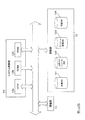
- FIG. 1 is embodiment at the time of applying this invention with respect to the server 1 of the questionnaire system S.
- the questionnaire system S includes a server 1 (an example of a “server device”) and a mobile terminal 2 (an example of a “terminal device”).
- server 1 an example of a “server device”
- mobile terminal 2 an example of a “terminal device”.
- the server 1 an example of a “server device”
- terminal device an example of a “terminal device”.
- one mobile terminal 2 is shown, but in reality, many mobile terminals 2 can communicate with the server 1.
- the server 1 and the portable terminal 2 can exchange data with each other via the network NW, for example, using TCP / IP as a communication protocol.
- the network NW is constructed by, for example, the Internet, a dedicated communication line (for example, a CATV (CommunityCommunAntenna Television) line), a mobile communication network (including a base station, etc.), a gateway, and the like.
- the server 1 collects questionnaire responses in real time from viewers watching movies in a movie theater or the like, and the scene that the viewer feels interesting (the scene in which the viewer showed interest) is boring. (Such as a scene where the viewer did not show interest).
- application software for answering a movie questionnaire hereinafter referred to as “movie questionnaire app” is installed in advance on the mobile terminal 2 possessed by the viewer, and the viewer is “interesting” while watching the movie.
- ambient sound data collected by the mobile terminal 2 based on a predetermined operation performed on the mobile terminal 2 in a scene where it is felt “not boring” is transmitted to the server 1.
- the server 1 identifies which scene the viewer felt “interesting” or “bottom” based on the received sound data.
- the movie questionnaire application indicates which type of operation has been performed in accordance with a plurality of types of operations (operations corresponding to “interesting” and operations corresponding to “not boring”) on the mobile terminal 2 by the viewer. Impression identification information is transmitted together with sound data.
- the server 1 specifies whether the viewer felt “interesting” or “drilled” the scene specified based on the sound data based on the received impression identification information.
- the mobile terminal 2 may transmit only sound data according to a single operation (an operation corresponding to “interesting” or an operation corresponding to “not boring”) to the mobile terminal 2 by the viewer.
- the server 1 specifies whether or not the viewer feels “interesting” or “not boring” the scene specified based on the received sound data, in accordance with a predetermined questionnaire method.
- this questionnaire method the viewer is instructed to operate the mobile terminal 2 only in a scene that is considered “interesting”, or the mobile terminal 2 is operated only in a scene that is considered “not boring”. Instruct them to do so.
- the kind of questionnaire is restrict
- the member when the owner of the mobile terminal 2 downloads the movie questionnaire application to the mobile terminal 2, the member registers from the download site, and the server 1 can make any member (viewer) participate in the movie questionnaire. You can identify whether you answered. In addition, a privilege is given when a member answers a questionnaire. The member registration may be performed from the movie questionnaire app after downloading the movie questionnaire app.
- the server 1 is roughly divided into a communication unit 11, a storage unit 12, and a system control unit 13.
- the communication unit 11 is connected to the network NW and controls communication with the mobile terminal 2.
- the storage unit 12 includes, for example, a hard disk drive and stores various programs such as an operating system and server software.
- the various programs may be acquired from, for example, another server device or the like via the network NW, or may be recorded on a recording medium and read via the drive device. That is, various programs stored in the storage unit 12 (including a program for executing processing on the server 1 side in the questionnaire processing described later) can be transmitted via the network NW, and can be read by a computer. It can be recorded on a recording medium and transferred.
- a member database (DB) 121 a screening schedule DB 122, a questionnaire result DB 123, and a scene DB 124 are constructed.
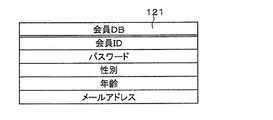
- member information such as member ID, password, sex, age, and mail address of a registered member (movie viewer (evaluator)) is registered.
- a movie ID, a screening location, a screening start time, a screening end time, and the like of a movie to be surveyed are registered.
- the screening location the address, latitude / longitude, etc. of the facility where the movie is shown are registered.
- the screen type is also registered.
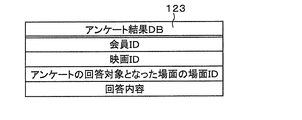
- the member ID of the member who answered the questionnaire, the movie ID of the movie subject to the questionnaire, and the scene where the member answered the questionnaire (feeling “interesting” or “uninteresting” Scene ID) and the response contents (impressions such as “feeling funny” or “feeling boring”) are registered. This makes it possible to specify which member felt “interesting” or “drilling” for which scene of which movie.
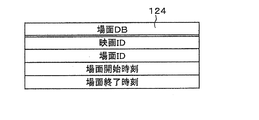
- the scene start time and the scene end time are registered according to the movie ID and the scene ID of the movie to be surveyed. Specifically, as shown in FIG. 7, since the start time and end time of each scene are determined by dividing a movie into a plurality of scenes according to the contents, etc. As shown in FIG. 8, an ID is assigned and the start time and end time of each scene are registered in the scene DB 124 in association with the movie ID of the movie and the assigned scene ID. Thus, by referring to the scene DB 124, the scene ID corresponding to the scene at that time can be specified from the elapsed time from the screening start time.
- the elapsed time from the screening start time can be calculated based on the current time by referring to the screening schedule DB 122 and the corresponding scene can be specified.
- the storage unit 12 is an example of the “storage unit” and “answer storage unit” of the present invention.
- the storage unit 12 stores sound image data of a movie to be surveyed in association with a movie ID.
- the system control unit 13 compares the sound and video data with the sound data transmitted from the mobile terminal 2 to acquire the time corresponding to the portion where the sounds match, and the acquired time corresponds to any scene. By judging whether or not, one scene of the movie is specified.
- the system control unit 13 includes a CPU (Central Processing Unit) 13a, a ROM (Read Only Memory) 13b, a RAM (Random Access Memory) 13c, and the like, and functions as a computer.
- the CPU 13a implements various functions by reading and executing various programs stored in the ROM 13b or the storage unit 12.
- the system control unit 13 is an example of the “reception unit”, “identification unit”, and “type information transmission unit” of the present invention.
- the server 1 may be constituted by a plurality of server devices such as a server that manages various databases, a scene specifying processing server that performs processing for specifying a movie scene, and a WWW server that provides various information.
- server devices such as a server that manages various databases, a scene specifying processing server that performs processing for specifying a movie scene, and a WWW server that provides various information.
- the portable terminal 2 is operated by the owner, for example, a system control unit having a CPU, RAM, ROM, etc., a storage unit, a communication unit for communicating with the server 1 and the like An operation unit, a display unit that displays a web page, an operation screen, and the like, an acceleration sensor, and a sound collection unit are provided.
- the mobile terminal 2 include a computer, a smartphone, a PDA (Personal Digital Assistant), a mobile phone, and the like used by the user.
- Accelerometer measures at least horizontal and vertical acceleration. Based on the acceleration measured by the acceleration sensor and its direction, the system control unit of the mobile terminal 2 determines whether the mobile terminal 2 has been moved in the horizontal direction (was shaken) or has been moved in the vertical direction (vibration). Can be determined.
- the operation of moving the mobile terminal 2 in the horizontal direction corresponds to “interesting”
- the mobile terminal 2 is moved in the vertical direction (mobile terminal)
- the operation of (shaking 2 in the vertical direction) corresponds to “bouncing”.
- An operation corresponding to “interesting” performed in an interesting scene or an operation corresponding to “bouncing” performed in an uninteresting scene by the viewer while the movie questionnaire application is activated is referred to as a questionnaire response operation.
- the operation of moving the mobile terminal 2 in the horizontal or vertical direction is an example of a questionnaire response operation.
- a triaxial acceleration sensor can be used as the acceleration sensor.
- the sound collection unit collects sound around the mobile terminal 2.
- a questionnaire response operation for example, detection by an acceleration sensor
- sound of a movie being screened is collected for a certain period of time.
- the collected sound is converted into sound data by the system control unit of the portable terminal 2 and transmitted to the server 1.
- the system control unit of the mobile terminal 2 prompts the viewer who watches the movie to input authentication information (member ID and password), and transmits the input authentication information to the server 1 (step S1A).
- the system control unit 13 of the server 1 performs an authentication process based on the received authentication information and the member ID and password registered in the member DB 121 (step S1B).
- the system control unit of the mobile terminal 2 receives the movie ID of the movie (movie to be answered in the questionnaire) viewed by the viewer in response to the terminal operation by the viewer and the screening location information indicating the screening location in the server 1. Transmit (step S2A).
- the system control unit of the portable terminal 2 receives in advance a list of movies that are the subject of the questionnaire from the server 1 when the application is started, and presents the list to the viewer, and then selects a movie to view.
- the movie ID specified from the movie ID or title input by the viewer may be transmitted. .
- the system control unit 13 of the server 1 specifies the movie and the display location that the member who has been authenticated in the process of step S1B views based on the received movie ID and the display location information (step S2B). Note that the processing up to this point is preferably performed until the viewer starts watching the movie.
- the system control unit of the mobile terminal 2 performs a questionnaire response operation to move the mobile terminal 2 in the horizontal direction (corresponding to “interesting”) or the vertical direction (corresponding to “not boring”) by the viewer until the movie ends.
- the system control unit of the mobile terminal 2 causes the sound collection unit to collect ambient sound (particularly movie sound) for a certain period of time.
- the sound that has been sounded is converted into sound data and transmitted to the server 1 (step S4A).
- the system control unit of the mobile terminal 2 corresponds to “interesting” or “bottom” depending on whether the questionnaire response operation is an operation of moving the mobile terminal 2 in the horizontal direction or the vertical direction as an example. Impression identification information to be transmitted together with sound data. Furthermore, when the system control unit of the mobile terminal 2 transmits the sound data, the server 1 side can identify the source data (for example, member ID, terminal identification information) so that it can be distinguished from the sound data transmitted from the other mobile terminal 2. ) And send.
- the source data for example, member ID, terminal identification information
- step S5A determines that the movie has ended (step S5A: YES)
- the system control unit 13 of the server 1 waits for the reception of sound data from the portable terminal 2 until the movie ends after the process of step S2B (step S3B: NO, step S6B: NO).
- step S3B: NO, step S6B: NO the system control unit 13 compares the sound image data of the movie specified in the process of step S2B and the received sound data with respect to the sound, and corresponds to the portion where the sound matches.
- the scene ID of the movie scene to be identified is specified (step S4B). Specifically, the system control unit 13 acquires the time of the portion where the audio matches (time indicating the elapsed time from the start of the movie), and then refers to the scene DB 124 to determine which time the acquired time is.
- the scene ID is specified by determining whether it is included between the scene start time and the scene end time corresponding to the scene ID. Note that the system control unit 13 compares the sound from the portion in which the sound matched in the previous step S4B, except when it is the first step S4B, when performing the process of step S4B. Do. As a result, the processing load can be reduced as compared with the case where audio is compared from the head of the audio-video data. Further, the system control unit 13 specifies what impression the viewer has with respect to the scene corresponding to the specified scene ID based on the impression identification information received together with the sound data.
- the system control unit 13 receives the member ID authenticated in the process of step S1B, the movie ID of the movie specified in the process of step S2B, and the scene ID of the movie scene specified in the process of step S4B. Data that associates the viewer's impressions (questionnaire response contents) identified based on the impression identification information is added to the questionnaire result DB 123 (step S5B).
- step S6B determines that the movie has ended (step S6B: YES)
- the process in the flowchart ends.
- the storage unit 12 (an example of the “storage unit” in the present invention) has the sound video data (the “object” in the present invention) of the movie (an example of the “target” in the present invention).
- An example of “sound data” is stored in advance, and the system controller 13 (an example of “reception means” and “specification means” of the present invention) is viewed by a viewer (an example of “respondent” of the present invention).
- the mobile terminal 2 collected when the questionnaire response operation is performed from the mobile terminal 2 (an example of the “terminal device” of the present invention) that performed the questionnaire response operation in order to answer the questionnaire
- the surrounding sound data is received, the received sound data is compared with the sound image data of the movie stored in the storage unit 12, and the scene that is the answer target of the questionnaire is specified based on the comparison result.
- the questionnaire system S when a viewer intends to answer a questionnaire about a scene constituting a movie being viewed, the viewer may perform a questionnaire response operation on the mobile terminal 2 during the scene. Easy to answer. Therefore, not only the scenes that left a strong impression for viewers but also the scenes that were somehow good could be collected as questionnaire responses.
- the server 1 since the server 1 can identify the scene where the viewer answered the questionnaire from the time acquired based on the sound data collected when the questionnaire response operation is performed, the server 1 can answer the questionnaire with respect to the scene. It can be collected accurately without being confused with the answer to the scene.
- questionnaire responses can be collected in real time by executing the processing of step S4B and step S5B of FIG. 9 when sound data is received.
- the viewer can respond to the questionnaire even if the movie screening schedule has been changed due to delay or advancement. It is possible to reliably identify the scene that has been performed.
- the system control unit 13 of the server 1 also includes impression identification information (an example of “response information” of the present invention) for specifying the response content of the questionnaire (that is, “interesting” or “not boring”).
- impression identification information an example of “response information” of the present invention
- the questionnaire result DB 123 of the storage unit 12 stores the answer contents “interesting” or “uninteresting” specified based on the received impression identification information in association with the scene specified based on the sound data. To do. This makes it possible to collect the contents of the questionnaire responses for the scenes that are subject to the questionnaire responses. Further, as shown in FIG.
- a questionnaire response operation in which the mobile terminal 2 is shaken in the horizontal direction or the vertical direction is determined in accordance with the contents of the questionnaire response of “interesting” or “not boring”. This is information for specifying the answer content of the questionnaire corresponding to the answer operation. Therefore, it is possible to identify and acquire the answer contents having different contents such as “interesting” or “not boring” for the scenes to be answered in the questionnaire, and the contents of the questionnaire survey can be enhanced.
- the system control unit 13 (an example of “type information transmission unit” of the present invention) of the server 1 is configured so that, when a plurality of movies are targeted for the questionnaire, each movie type (“type information” of the present invention) A movie list indicating an example) is transmitted to the mobile terminal 2.
- the storage unit 12 stores sound and video data for each movie type, and the system control unit 13 selects the movie type selected by the viewer based on the previously transmitted movie list from the portable terminal 2.
- a movie ID (an example of “selection type information” of the present invention) is received, and the scene of the movie is specified based on the received sound data and the sound image data corresponding to the received movie ID.
- the questionnaire system S is effective when used in a questionnaire conducted at a movie preview. For example, two movies with different ending contents were screened at the preview, and the ending that was well-received in the questionnaire results, that is, the ending that was often evaluated as “interesting” in the scene corresponding to the ending, Can be adopted.
- the questionnaire system S is not limited to a movie screened at a facility such as a movie theater, but can be applied to, for example, a movie or a drama screened on a television broadcast. In this case, the questionnaire can be conducted without installing a dedicated device for answering the questionnaire in each household.
- the storage unit 12 of the server 1 stores evaluation position information indicating a screening place (“position to be viewed” of the present invention) for each movie in association with the movie, and controls the system.
- the unit 13 (an example of the “location fraud determination unit” of the present invention) receives terminal position information indicating the position of the mobile terminal 2 from the mobile terminal 2 and answer target information indicating a movie for answering the questionnaire.
- the sound transmitted from the portable terminal 2 when the evaluation position information stored in the storage unit 12 in association with the movie that answers the questionnaire indicated by the received response target information is different from the received terminal position information. It is good also as a structure which determines with the answer of the questionnaire based on data being injustice. In this configuration, when the viewer does not actually watch the movie but answers the questionnaire at a position different from the position where the movie is shown, the answer can be determined to be illegal. .
- the system control unit 13 (an example of the “transmission unit” of the present invention) of the server 1 performs audio / video data (“information indicating the target scene” of the present invention) corresponding to the movie scene identified in the process of step S4B. Example) is transmitted to the mobile terminal 2 so that the viewer who has viewed the sound / video data on the mobile terminal 2 determines whether or not the scene is the target of the questionnaire response.
- the confirmation information indicating the determination result is transmitted from the portable terminal 2.
- the system control part 13 is good also as a structure which cancels having specified the scene of the movie by the process of step S4B, when the received confirmation information shows that it is not the scene made into the reply object of a questionnaire.
- the viewer can confirm whether the movie scene that the viewer actually answered the questionnaire matches the movie scene specified on the server 1 side, It is possible to improve the accuracy related to the specification of a movie scene.
- “information indicating the target scene” of the present invention the sound data corresponding to the movie scene specified in step S4B is transmitted, and the viewer is asked to listen to the transmitted sound data. It may be determined whether or not the scene matches the scene that was answered in the questionnaire. In this case, even if it is the portable terminal 2 which is not provided with the display part, a viewer can confirm the specified scene. Also, since the sound data having a smaller amount of data compared to the sound video data is transmitted, the transmission cost can be suppressed.
- the questionnaire system S can also be applied when a viewer views a movie or other content recorded on a recording medium such as a DVD at home or the like.
- the questionnaire response operations Two types of operations for moving the mobile terminal 2 in the horizontal or vertical direction are exemplified as the questionnaire response operations. However, these operations are performed with the surface of the mobile terminal 2 facing upward and downwards. By distinguishing from the case where it carries out, it can also be set to four types. Thereby, in addition to interesting scenes and boring scenes, crying scenes, scary scenes and the like can be added as scenes for answering a questionnaire, and various answers can be collected.
- the contents of the questionnaire responses (for example, interesting, boring, crying, scary, etc.) are displayed on the display section in a selectable manner with a cursor, etc. You may make it select either.
- the contents of the questionnaire responses may be associated with the buttons on the operation unit in advance, and the viewer may be prompted to press any one.
- the sound image data of the movie is stored in advance in the storage unit 12 of the server 1 until the movie is shown, and the system control unit 13 of the server 1 transmits it from the portable terminal 2 of the viewer.
- the system control unit 13 of the server 1 stores the sound data, impression identification information, and transmission source information received during the movie screening in the storage unit 12.
- the sound image data of the movie cannot be stored in the storage unit 12 until the movie is shown, or the scene ID, the scene start time, and the scene end time cannot be registered in the scene DB 124.
- the sound image data is stored in the storage unit 12 and the scene ID, the scene start time, and the scene end time are registered in the scene DB 124, the sound data stored in the storage unit 12 during the movie is shown.
- the process corresponding to each of the process of step S4B and the process of step S5B that is, the scene of the movie and the content of the response to the scene are specified, and the process of adding data to the questionnaire result DB 123 is performed at any time Can do.
- this configuration is effective when collecting questionnaire responses for viewing targets for which sound and video data cannot be prepared in advance, such as in live performances or concerts.
- the target of the questionnaire is a concert
- the system control unit 13 of the server 1 receives sound data, impression identification information, and transmission source information from the portable terminal 2 of the viewer, and stores the storage unit 12.
- a recording device different from the server 1 records a concert pattern at the concert venue. After the concert, the system control unit 13 of the server 1 records the sound image data recorded by the recording device, the data of the scene DB 124 registered based on the sound image data, and the sound data stored in the storage unit 12 during the concert. Based on the impression identification information, the scene of the concert and the content of the response to the scene may be specified and added to the questionnaire result DB 123.
- the audio / video data to be viewed such as a movie is stored in the storage unit 12 of the server 1, but it is only necessary to be able to compare with the audio data received from the mobile terminal 2. Sound data to be viewed may be stored instead of the video data.
- a signal transmitter for example, Bluetooth (registered trademark) as a communication standard
- Bluetooth registered trademark
- a wireless transmitter it is also possible to install a wireless transmitter to be adopted so that the questionnaire can be answered only from the portable terminal 2 that has received the signal.
- the mobile terminal 2 is configured to convert the signal output from the acceleration sensor into impression identification information indicating “interesting” or “not boring” and transmit it to the server 1 together with the sound data. Not limited to this.
- the portable terminal 2 transmits a signal output from the acceleration sensor (a signal indicating acceleration in the vertical direction or the horizontal direction) to the server 1 as it is, and the server 1 “interesting” or “not boring” the signal indicating this acceleration. It may be converted into comment identification information indicating the above.
- the viewer feels that the scene is interesting depending on whether the viewer shakes the mobile terminal 2 in the horizontal direction (corresponding to “interesting”) or in the vertical direction (corresponding to “bouncing”). Although it is supposed to collect as an answer to the questionnaire whether it felt that it was boring or boring, the degree (level) that the viewer felt interesting or boring was further collected from the acceleration and the number of times the viewer shook the mobile terminal 2 It is good to do. This is based on the idea that in a scene that the viewer feels very interesting, the mobile terminal 2 is shaken more quickly and the number of times it is shaken is greater than in a scene that is felt a little interesting.
- step S3A in FIG. 9 when the control unit of the mobile terminal 2 detects the questionnaire response operation, the control value information indicating the acceleration and the number of times of shaking when the questionnaire response operation is performed is obtained. get.
- the control unit of the mobile terminal 2 may acquire the maximum acceleration when the questionnaire response operation is performed as the acceleration included in the operation value information, or when the questionnaire response operation is performed. The average acceleration may be acquired.
- the control unit of the mobile terminal 2 transmits the operation value information and the impression identification information to the server 1 together with the sound data.
- the system control unit 13 of the server 1 receives the impression identification information based on the operation value information received together with the sound data.
- the degree of strength (hereinafter referred to as “impression level”) is acquired for the viewer's impression (an impression that it is interesting or boring).
- impression level The degree of strength
- the system control unit 13 registers it in the questionnaire result DB 123 in association with the viewer's impression.
- the questionnaire result DB 123 in addition to the member ID, the movie ID, the scene ID of the scene that is the answer target of the questionnaire, the answer content (interesting or boring), the impression level is associated and registered. .
- the storage unit 12 in which the questionnaire result DB 123 in this case is constructed is an example of the “level storage unit” in the present invention.
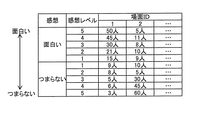
- an impression level acquisition table as shown in FIG. 11 is created in advance, and the acceleration included in the operation value information and the number of times the mobile terminal 2 is shaken. Based on this, it is possible to use a method of acquiring the impression levels “1” to “5”.
- the impression level acquisition table shown in FIG. 11 is defined such that the acquired impression level increases as the acceleration increases and the number of times the mobile terminal 2 is shaken increases. The impression level indicates that the greater the value, the stronger the impression.
- the system control unit 13 further adds the moving distance (that is, the swing width) of the mobile terminal 2 to the acceleration and the number of swings when the questionnaire response operation is performed, and obtains the impression level from these three elements.
- the system control unit 13 may acquire the impression level based on at least one of these three elements. Moreover, the system control part 13 is good also as acquiring an impression level based on another method. As described above, the system control unit 13 registers the impression level in the questionnaire result DB 123, so that the number registered for each impression level for each scene ID and for each answer content “interesting” or “not boring” later. As shown in FIG. 12, the number of viewers who answered “interesting” felt the interest level “5” and the feeling level “1” was boring. Etc. can be specified respectively.
- the system control unit 13 adds or integrates the values with the acceleration and the number of times the mobile terminal 2 is shaken being dimensionless or as it is, and then preliminarily calculates the sum or the integrated value.
- Each boundary value that divides each impression level of “1” to “5” defined for comparison is compared with the sum value or the integrated value, and the sum value or the integrated value indicates which boundary value and boundary value It is good also as acquiring an impression level according to whether it is included in between.
- the system control unit 13 obtains each impression level, and each viewer is In consideration of individual differences when the mobile terminal 2 is shaken, it is preferable to correct at least one of acceleration and the number of times the mobile terminal 2 is shaken. This is based on the idea that the acceleration and the number of times of shaking should be different even when each viewer feels the same level of interest.
- the system control unit 13 takes into account individual differences when conducting the questionnaire response operation, so that the same impression level can be acquired for the scene that the viewer feels as interesting or boring as the same.
- the impression level is acquired by correcting the data such as the number of times the data has been recorded. Needless to say, such correction is unnecessary when specifying a scene that is most interesting for a specific viewer (scene with impression level “5”).
- a known method can be employed.
- a method using an average value, variance, standard deviation, median value, mode value, or the like can be employed.
- Z (X ⁇ ) / ⁇ ⁇ : arithmetic average of acceleration at the time of viewer A's questionnaire response operation
- ⁇ standard deviation calculated from acceleration at the time of viewer A's questionnaire response operation
- X acceleration to be normalized
- Z normalized acceleration
- the system control unit 13 stores all operation value information received from each viewer's terminal device 2 in the storage unit 12 or the like. Then, the system control unit 13 (an example of the “average calculation unit” of the present invention) periodically calculates the average acceleration of the entire viewer with reference to all stored past operation value information. At the same time, the average acceleration of each viewer is calculated. Further, the system control unit 13 calculates, for each viewer, the average acceleration ratio (referred to as “correction ratio”) of the entire viewer based on the average acceleration of the viewer.
- the system control unit 13 calculates, for each viewer, the average acceleration ratio (referred to as “correction ratio”) of the entire viewer based on the average acceleration of the viewer.
- the system control unit 13 (an example of the “correction unit” of the present invention) actually receives the operation value information from the portable terminal 2 of a certain viewer C and acquires the impression level, Acceleration is corrected by multiplying the acceleration calculated for one viewer C by the acceleration included in the received operation value information. For example, when the system control unit 13 calculates the average acceleration of the entire viewer as “0.5 m / s 2 ” from the past operation value information and calculates the average acceleration of the viewer C as “0.8 m / s 2 ”. The correction ratio “5/8” is calculated for the viewer C.
- the system control unit 13 multiplies the acceleration included in the received operation value information by the correction ratio “5/8” to obtain the acceleration. It will be corrected. In this way, the system control unit 13 corrects the acceleration that is the basis for obtaining the impression level of each viewer based on the ratio of the average acceleration of the entire viewer and the average acceleration of the individual viewer. To do. Note that the system control unit 13 corrects the number of shakes in the same manner as the acceleration.
- each viewer simply gave each scene a five-step evaluation, and the evaluation value (“for the respondent to the scene”
- An example of “evaluation level” may be stored in the storage unit 12.
- the viewer's five-stage evaluation value for each scene can be acquired, and for example, the average evaluation value for each scene can be acquired.
- the questionnaire response operation only needs to shake the mobile terminal 2, and the control unit of the mobile terminal 2 transmits to the server 1 operation value information for specifying the acceleration at the time of the questionnaire response operation and the number of shakes.
- the system control unit 13 (an example of the “level specifying unit” of the present invention) of the server 1 specifies the acceleration and the number of shakes from the received operation value information, performs the above-described correction, and then sets the impression level “1”.
- “5” is acquired as the evaluation value of the five-level evaluation, and is stored in the storage unit 12 (an example of the “level storage unit” of the present invention) in association with the corresponding scene.
- the five-level evaluation has been described, it may be divided into any number of stages such as three or seven stages. However, the impression level acquisition table needs to be appropriately corrected.
- a plurality of items for example, “degree of action”, “degree of crying”, “degree of fear”, “degree of laughter”, etc.
- system control unit 13 is considered to have a tendency that the evaluator's reaction tends to be smaller for each scene belonging to the second half of the movie than for each scene belonging to the first half. Also, at least one of the number of times the mobile terminal 2 is shaken may be corrected by multiplying a predetermined coefficient empirically obtained from the tendency to increase the numerical value.
- the system control unit 13 may exclude, for example, responses by questionnaire respondents who have an abnormally large or small number of questionnaire response operations when counting the questionnaire results.
Landscapes
- Business, Economics & Management (AREA)
- Engineering & Computer Science (AREA)
- Strategic Management (AREA)
- Accounting & Taxation (AREA)
- Development Economics (AREA)
- Finance (AREA)
- Entrepreneurship & Innovation (AREA)
- Physics & Mathematics (AREA)
- Economics (AREA)
- Marketing (AREA)
- Game Theory and Decision Science (AREA)
- General Business, Economics & Management (AREA)
- General Physics & Mathematics (AREA)
- Theoretical Computer Science (AREA)
- Data Mining & Analysis (AREA)
- Multimedia (AREA)
- Computer Networks & Wireless Communication (AREA)
- Signal Processing (AREA)
- Management, Administration, Business Operations System, And Electronic Commerce (AREA)
- Information Transfer Between Computers (AREA)
- Telephonic Communication Services (AREA)
Abstract
Description
先ず、図1を用いて本発明の本実施形態に係るアンケートシステムSの構成について説明する。
次に、サーバ1の構成について、図2~図8を用いて説明する。
携帯端末2は、図示しないが、例えば、CPU、RAM、ROM等を有するシステム制御部と、記憶部と、サーバ1等との間で通信を行うための通信部と、所持者により操作される操作部と、Webページや操作画面等を表示する表示部と、加速度センサーと、集音部を備えている。なお、携帯端末2の一例として、ユーザが利用するコンピュータ、スマートフォン、PDA(Personal Digital Assistant)、携帯電話機等がある。
次に、図9に示すフローチャートを用いて、アンケート処理時におけるサーバ1及び携帯端末2の動作について説明する。なお、図9に示すアンケート処理は、映画を視聴する視聴者が、映画の開始前に携帯端末2の映画アンケートアプリを起動した後に実行される。
[5.1.不正対策1]
なお、サーバ1の記憶部12に、映画毎に当該映画が上映される上映場所(本発明の「鑑賞されるべき位置」)を示す評価位置情報を当該映画と対応付けて記憶させ、システム制御部13(本発明の「位置不正判定手段」の一例)が、携帯端末2から当該携帯端末2の位置を示す端末位置情報と、アンケートの回答を行う映画を示す回答対象情報を受信し、当該受信した回答対象情報の示すアンケートの回答を行う映画と対応付けて記憶部12に記憶されている評価位置情報と、当該受信した端末位置情報とが異なる場合に、携帯端末2から送信された音データに基づくアンケートの回答は不正であると判定する構成としてもよい。この構成とした場合、視聴者が実際に映画を視聴していないにもかかわらず、映画が上映される位置とは異なる位置でアンケートに回答した場合に、その回答を不正と判定することができる。
また、サーバ1のシステム制御部13(本発明の「送信手段」の一例)は、ステップS4Bの処理で特定した映画の場面に対応する音映像データ(本発明の「対象の場面を示す情報」の一例)を携帯端末2に送信することにより、携帯端末2にてその音映像データを視聴した視聴者に、その場面がアンケートの回答の対象とした場面であるか否かを判定してもらい、その判定結果を示す確認情報を携帯端末2から送信してもらう。そして、システム制御部13は、受信した確認情報がアンケートの回答の対象とした場面でないことを示す場合に、ステップS4Bの処理で映画の場面を特定したことを取り消す構成としてもよい。この構成とした場合、視聴者が実際にアンケートの回答を行った映画の場面と、サーバ1側で特定した映画の場面が一致しているか否かを視聴者に確認してもらうことができ、映画の場面の特定に係る精度を向上させることができる。なお、本発明の「対象の場面を示す情報」として、ステップS4Bの処理で特定した映画の場面に対応する音データを送信することとし、視聴者には送信した音データを聴いてもらい、その場面がアンケートの回答をした場面と一致するか否かを判定してもらうこととしてもよい。この場合、表示部を備えていない携帯端末2であっても特定した場面を視聴者に確認してもらうことができる。また、音映像データと比較してデータ量の少ない音データを送信するため送信コストを抑えることができる。
また、アンケートシステムSは、家庭などで視聴者がDVD等の記録媒体に記録された映画又はその他のコンテンツを視聴する場合についても適用することができる。
また、本実施形態においては、アンケート回答操作として、携帯端末2を水平又は垂直方向に移動させる操作の2種類を例示したが、これらの操作を携帯端末2の表面を上向きにして行う場合と下向きにして行う場合とで区別することにより、4種類にすることもできる。これにより、面白い場面及びつまらない場面に加えて、泣ける場面や怖い場面などをアンケートの回答をする場面として追加することができ、多様な回答を収集することができる。また、携帯端末2を水平又は垂直方向に移動させる操作の代わりに、表示部にアンケートの回答内容(例えば、面白い、つまらない、泣ける、怖い等)をカーソルなどで選択可能に表示して、視聴者に何れかを選択させるようにしてもよい。更に、予めアンケートの回答内容と操作部のボタンとをそれぞれ対応付けておき、視聴者に何れかを押下させるようにしてもよい。
また、本実施形態においては、映画の上映時までにサーバ1の記憶部12に映画の音映像データが予め記憶されており、サーバ1のシステム制御部13が、視聴者の携帯端末2から送信された音データに基づいてステップS4Bの処理及びステップS5Bの処理を映画の上映中に行う構成としたが、これに替えて、ステップS4Bの処理及びステップS5Bの処理を映画の上映終了後に行う構成とすることもできる。但し、サーバ1のシステム制御部13は、映画の上映中に受信した音データ、感想識別情報、送信元情報を記憶部12に記憶させておくこととする。この構成によれば、映画の上映時までに映画の音映像データを記憶部12に記憶させられない場合や、場面DB124に場面ID、場面開始時刻及び場面終了時刻を登録させられない場合であっても、音映像データを記憶部12に記憶させ、場面DB124に場面ID、場面開始時刻及び場面終了時刻を登録させた後であれば、映画の上映中に記憶部12に記憶させた音データ、感想識別情報に基づいて、ステップS4Bの処理及びステップS5Bの処理それぞれに対応する処理、すなわち映画の場面及びその場面に対する回答内容を特定し、アンケート結果DB123にデータを追加する処理をいつでも行うことができる。なお、この構成は、生演奏で行われる演劇やコンサートなど、予め音映像データを準備することができない視聴対象についてアンケートの回答を収集する場合に有効である。例えば、アンケートの対象がコンサートである場合には、そのコンサート中に、サーバ1のシステム制御部13が視聴者の携帯端末2から音データ、感想識別情報、送信元情報を受信して記憶部12に記憶させる一方、サーバ1とは異なる録画装置がコンサート会場でのコンサートの模様を録画する。そして、コンサート終了後に、サーバ1のシステム制御部13は、録画装置により録画された音映像データ及びこれに基づいて登録された場面DB124のデータと、コンサート中に記憶部12に記憶させた音データ、感想識別情報とに基づいて、コンサートの場面及びその場面に対する回答内容を特定し、アンケート結果DB123に追加する処理を行うこととしてもよい。
また、本実施形態においては、サーバ1の記憶部12に映画など視聴対象の音映像データを記憶させることとしたが、携帯端末2から受信する音データと比較することができればよいことから、音映像データの代わりに視聴対象の音データを記憶させることとしてもよい。
また、実際に映画を視聴していない者がアンケートに回答できないように、映画館に、携帯端末2が受信可能な信号を送信する信号送信機(例えば、通信規格としてBluetooth(登録商標))を採用する無線送信機)を設置し、当該信号を受信した携帯端末2からのみアンケートに回答できるようにしてもよい。
また、上述した実施形態では、携帯端末2が、加速度センサーから出力される信号を「面白い」又は「つまらない」などを示す感想識別情報に変換して音データとともにサーバ1に送信する構成としているがこれに限らない。例えば、携帯端末2が、加速度センサーから出力される信号(垂直方向又は水平方向の加速度を示す信号)をそのままサーバ1に送信し、サーバ1がこの加速度を示す信号を「面白い」又は「つまらない」などを示す感想識別情報に変換するようにしてもよい。
また、上述した実施例では、視聴者が携帯端末2を水平方向(「面白い」に対応)又は垂直方向(「つまらない」に対応)に振ったかに応じて、視聴者がその場面を面白いと感じたか又はつまらないと感じたかをアンケートの回答として収集することとしているが、視聴者が携帯端末2を振った際の加速度や振った回数などから、面白い又はつまらないと感じた度合い(レベル)を更に収集することとしてもよい。これは、視聴者がとても面白いと感じた場面では、少し面白いと感じた場面よりも、携帯端末2を素早く振ったり、振る回数が多くなったりするとの考えに基づく。これにより、従来のアンケート用紙を用いたアンケートのように、各場面について面白さ又はつまらなさを5段階評価してもらうことを、アンケートシステムSで実現することができる。なお、この場合には、面白さ又はつまらなさの度合いが大きいときほど、携帯端末2を素早く振ったり、回数を多く振ったりするように、予め視聴者に知らせておくのが好ましい。
Z=(X-μ)/σ
μ:視聴者Aのアンケート回答操作時における加速度の算術平均
σ:視聴者Aのアンケート回答操作時における加速度から算出した標準偏差
X:正規化すべき加速度
Z:正規化された加速度
また、システム制御部13は、アンケート結果の精度を高めるために、例えば、アンケート回答操作が異常に多い又は少ないアンケート回答者による回答については、アンケート結果を集計する際に除外することとしてもよい。
また、映画の音声に、人間にとって可聴範囲外の音声を混在させて出力するとともに、サーバ1の記憶部12には当該可聴範囲外の音声を音データとして記憶させておき、サーバ1のシステム制御部13は、図9のステップ4Bの処理において、携帯端末2から受信した音データに含まれる可聴範囲外の音声と、記憶部12に記憶された音データに含まれる可聴範囲外の音声を比較することにより、時刻を取得し、場面IDを特定することとしてもよい。
11 サーバ/通信部
12 サーバ/記憶部
13 サーバ/システム制御部
121 会員DB
122 上映スケジュールDB
123 アンケート結果DB
124 場面DB
2 携帯端末
NW ネットワーク
S アンケートシステム
Claims (12)
- 複数の場面で構成され、時間の経過に伴って前記場面が移り変わる対象を鑑賞しつつ前記対象に関するアンケートに回答する回答者の端末装置から、前記アンケートの回答を収集するサーバ装置であって、
前記対象の音データを記憶する記憶手段と、
前記回答者が前記対象を鑑賞している際に前記アンケートに回答するための回答操作を行った前記端末装置から、前記回答操作が行われた際に集音された前記端末装置の周囲の音データを受信する受信手段と、
前記受信した音データと前記記憶手段により記憶されている対象の音データとを比較し、比較結果に基づいて前記アンケートの回答対象となった場面を特定する特定手段と、
を備えることを特徴とするサーバ装置。 - 請求項1に記載のサーバ装置であって、
前記受信手段は、前記アンケートの回答内容を特定するための回答情報を更に受信し、
前記受信手段が受信した回答情報に基づいて特定される前記アンケートの回答内容を、前記特定手段により特定された場面と対応付けて記憶する回答記憶手段、
を更に備えることを特徴とするサーバ装置。 - 請求項2に記載のサーバ装置であって、
複数の異なる前記アンケートの回答内容にそれぞれ応じて複数の前記回答操作が定められており、
前記回答情報は、前記回答操作に応じた前記アンケートの回答内容を特定するための情報であることを特徴とするサーバ装置。 - 請求項1又は2に記載のサーバ装置において、
複数の前記対象がある場合に、各対象の種別を示す種別情報を前記端末装置に送信する種別情報送信手段を更に備え、
前記記憶手段は、前記対象の種別毎に前記音データを記憶し、
前記受信手段は、前記端末装置から、前記送信した種別情報に基づいて前記回答者により選択された対象の種別を示す選択種別情報を更に受信し、
前記特定手段は、前記受信した選択種別情報の示す種別に対応する前記音データと、前記受信した音データとを比較し、比較結果に基づいて前記場面を特定することを特徴とするサーバ装置。 - 請求項1又は2に記載のサーバ装置において、
前記記憶手段は、前記視象毎当該対象が鑑賞されるべき位置を示す評価位置情報を当該対象と対応付けて更に記憶し、
前記受信手段は、前記端末装置から当該端末装置の位置を示す端末位置情報と、アンケートの回答を行う対象を示す回答対象情報を更に受信し、
前記受信した回答対象情報の示すアンケートの回答を行う対象と対応付けて前記記憶手段に記憶されている評価位置情報と、前記受信した端末位置情報とが異なる場合に、前記端末装置から送信された音データに基づくアンケートの回答は不正であると判定する位置不正判定手段を、
更に備えることを特徴とするサーバ装置。 - 請求項1又は2に記載のサーバ装置において、
前記特定手段により特定された対象の場面を示す情報を前記端末装置に送信する送信手段、
を更に備え、
前記受信手段は、前記特定された場面が前記アンケートの回答の対象とした場面であるか否かを示す前記回答者による確認情報を前記端末装置から受信し、
前記特定手段は、前記受信した確認情報が前記アンケートの回答の対象とした場面でないことを示す場合に、対象の場面を特定したことを取り消すことを特徴とするサーバ装置。 - 請求項2に記載のサーバ装置であって、
前記回答者による前記回答操作は、前記端末装置を振る操作であり、
前記受信手段は、前記振る操作が行われた際の前記端末装置の加速度又は前記端末装置が振られた回数の少なくとも何れか一方の操作値を特定するための操作値情報を更に受信し、
前記受信した操作値情報に基づいて特定した前記操作値から前記アンケートの回答内容のレベルを特定するレベル特定手段、を更に備え、
前記回答記憶手段は、前記レベル特定手段により特定されたレベルを、前記特定手段により特定された場面と対応付けて更に記憶することを特徴とするサーバ装置。 - 請求項1に記載のサーバ装置であって、
前記回答者による前記回答操作は、前記端末装置を振る操作であり、
前記受信手段は、前記振る操作が行われた際の前記端末装置の加速度又は前記端末装置が振られた回数の少なくとも何れか一方の操作値を特定するための操作値情報を更に受信し、
前記受信した操作値情報に基づいて特定した前記操作値から前記回答操作が行われた時点での場面に対する前記回答者にとっての評価のレベルを特定するレベル特定手段と、
前記レベル特定手段により特定された評価のレベルを、前記特定手段により特定された場面と対応付けて記憶するレベル記憶手段と、
を更に備えることを特徴とするサーバ装置。 - 請求項7又は8に記載のサーバ装置であって、
前記受信手段が受信した前記操作値情報を記憶する操作値記憶手段と、
前記操作値記憶手段に記憶された前記操作値情報を参照し、前記アンケートの回答操作を行った回答者全体の操作値の平均を算出するとともに、前記アンケートの回答操作を行った何れか一の回答者の操作値の平均を算出する平均算出手段と、
前記平均算出手段により前記回答者全体について算出された操作値の平均と前記一の回答者について算出された操作値の平均との比率に基づいて、前記一の回答者の端末装置から送信された前記操作値情報で特定される前記操作値を補正する補正手段と、
を更に備え、
前記レベル特定手段は、前記補正手段により補正された前記操作値から前記レベルを特定することを特徴とするサーバ装置。 - 複数の場面で構成され、時間の経過に伴って前記場面が移り変わる対象を鑑賞しつつ前記対象に関するアンケートに回答する回答者の端末装置から、前記アンケートの回答を収集するサーバ装置に含まれるコンピュータにより実行されるアンケート回答収集方法であって、
前記回答者が前記対象を鑑賞している際に前記アンケートに回答するための回答操作を行った前記端末装置から、前記回答操作が行われた際に集音された前記端末装置の周囲の音データを受信するステップと、
前記受信した音データと、前記サーバ装置の記憶手段により記憶されている対象の音データとを比較し、比較結果に基づいて前記アンケートの回答対象となった場面を特定するステップと、
を含むことを特徴とするアンケート回答収集方法。 - 複数の場面で構成され、時間の経過に伴って前記場面が移り変わる対象を鑑賞しつつ前記対象に関するアンケートに回答する回答者の端末装置から、前記アンケートの回答を収集するサーバ装置に含まれるコンピュータを、
前記回答者が前記対象を鑑賞している際に前記アンケートに回答するための回答操作を行った前記端末装置から、前記回答操作が行われた際に集音された前記端末装置の周囲の音データを受信する受信手段、
前記受信した音データと、前記サーバ装置の記憶手段により記憶されている対象の音データとを比較し、比較結果に基づいて前記アンケートの回答対象となった場面を特定する特定手段、
として機能させるアンケート回答収集プログラムを記録したコンピュータ読み取り可能な記録媒体。 - 複数の場面で構成され、時間の経過に伴って前記場面が移り変わる対象を鑑賞しつつ前記対象に関するアンケートに回答する回答者の端末装置から、前記アンケートの回答を収集するサーバ装置に含まれるコンピュータを、
前記回答者が前記対象を鑑賞している際に前記アンケートに回答するための回答操作を行った前記端末装置から、前記回答操作が行われた際に集音された前記端末装置の周囲の音データを受信する受信手段、
前記受信した音データと、前記サーバ装置の記憶手段により記憶されている対象の音データとを比較し、比較結果に基づいて前記アンケートの回答対象となった場面を特定する特定手段、
として機能させることを特徴とするアンケート回答収集プログラム。
Priority Applications (2)
| Application Number | Priority Date | Filing Date | Title |
|---|---|---|---|
| US13/824,884 US8645506B2 (en) | 2010-09-30 | 2011-09-29 | Server apparatus for collecting a response of a questionnaire, questionnaire response collection method, questionnaire response collection program and computer-readable recording medium recorded with a questionnaire response collection program |
| JP2012534891A JP5150793B2 (ja) | 2010-09-30 | 2011-09-29 | アンケートの回答を収集するサーバ装置 |
Applications Claiming Priority (2)
| Application Number | Priority Date | Filing Date | Title |
|---|---|---|---|
| JP2010-220970 | 2010-09-30 | ||
| JP2010220970 | 2010-09-30 |
Publications (1)
| Publication Number | Publication Date |
|---|---|
| WO2012043734A1 true WO2012043734A1 (ja) | 2012-04-05 |
Family
ID=45893172
Family Applications (1)
| Application Number | Title | Priority Date | Filing Date |
|---|---|---|---|
| PCT/JP2011/072415 Ceased WO2012043734A1 (ja) | 2010-09-30 | 2011-09-29 | アンケートの回答を収集するサーバ装置 |
Country Status (4)
| Country | Link |
|---|---|
| US (1) | US8645506B2 (ja) |
| JP (1) | JP5150793B2 (ja) |
| TW (1) | TWI397017B (ja) |
| WO (1) | WO2012043734A1 (ja) |
Cited By (4)
| Publication number | Priority date | Publication date | Assignee | Title |
|---|---|---|---|---|
| JP2015069513A (ja) * | 2013-09-30 | 2015-04-13 | 大日本印刷株式会社 | 調査システム、調査方法、サーバ、ユーザ端末、プログラム、記録媒体 |
| EP2849138A4 (en) * | 2012-07-17 | 2015-06-17 | Aisin Aw Co | INFORMATION SHARING SYSTEM, INFORMATION SHARING METHOD, AND TERMINAL DEVICE |
| CN108874268A (zh) * | 2017-05-09 | 2018-11-23 | 腾讯科技(深圳)有限公司 | 用户行为数据的采集方法及装置 |
| JP2020013270A (ja) * | 2018-07-17 | 2020-01-23 | Zホールディングス株式会社 | 情報処理装置、情報処理方法、及び情報処理プログラム |
Families Citing this family (1)
| Publication number | Priority date | Publication date | Assignee | Title |
|---|---|---|---|---|
| CN112100461B (zh) * | 2020-11-11 | 2021-02-05 | 平安国际智慧城市科技股份有限公司 | 基于数据分析的问卷数据处理方法、装置、服务器和介质 |
Citations (5)
| Publication number | Priority date | Publication date | Assignee | Title |
|---|---|---|---|---|
| JP2004054954A (ja) * | 2002-07-17 | 2004-02-19 | Tokio Marine & Fire Insurance Co Ltd | リスク診断システム、リスクマップデータ生成方法及びプログラム |
| JP2004213570A (ja) * | 2003-01-08 | 2004-07-29 | Sony Corp | 情報提供方法 |
| JP2008136210A (ja) * | 2001-02-06 | 2008-06-12 | Sony Corp | コンテンツ再生装置、コンテンツ受信装置、コンテンツ評価収集解析方法、コンテンツ評価収集解析装置、コンテンツ評価集計管理方法およびコンテンツ評価集計管理装置 |
| JP2009211685A (ja) * | 2008-02-07 | 2009-09-17 | Yahoo Japan Corp | 質疑応答システム、サーバ装置、質疑応答集計方法及びプログラム |
| JP2010015325A (ja) * | 2008-07-02 | 2010-01-21 | Dainippon Printing Co Ltd | 回答集計方法およびシステム |
Family Cites Families (4)
| Publication number | Priority date | Publication date | Assignee | Title |
|---|---|---|---|---|
| AU2003901036A0 (en) * | 2003-03-07 | 2003-03-20 | 80-20 Software Pty. Limited | Questionnaire software module |
| US20080295126A1 (en) | 2007-03-06 | 2008-11-27 | Lee Hans C | Method And System For Creating An Aggregated View Of User Response Over Time-Variant Media Using Physiological Data |
| TW201025168A (en) * | 2008-12-25 | 2010-07-01 | Chunghwa Telecom Co Ltd | Media streaming marketing system of interactive multimedia service and method thereof |
| TW201030663A (en) * | 2009-02-10 | 2010-08-16 | 104 Corp | Method of evaluating a resume |
-
2011
- 2011-09-29 US US13/824,884 patent/US8645506B2/en active Active
- 2011-09-29 JP JP2012534891A patent/JP5150793B2/ja active Active
- 2011-09-29 WO PCT/JP2011/072415 patent/WO2012043734A1/ja not_active Ceased
- 2011-09-30 TW TW100135666A patent/TWI397017B/zh active
Patent Citations (5)
| Publication number | Priority date | Publication date | Assignee | Title |
|---|---|---|---|---|
| JP2008136210A (ja) * | 2001-02-06 | 2008-06-12 | Sony Corp | コンテンツ再生装置、コンテンツ受信装置、コンテンツ評価収集解析方法、コンテンツ評価収集解析装置、コンテンツ評価集計管理方法およびコンテンツ評価集計管理装置 |
| JP2004054954A (ja) * | 2002-07-17 | 2004-02-19 | Tokio Marine & Fire Insurance Co Ltd | リスク診断システム、リスクマップデータ生成方法及びプログラム |
| JP2004213570A (ja) * | 2003-01-08 | 2004-07-29 | Sony Corp | 情報提供方法 |
| JP2009211685A (ja) * | 2008-02-07 | 2009-09-17 | Yahoo Japan Corp | 質疑応答システム、サーバ装置、質疑応答集計方法及びプログラム |
| JP2010015325A (ja) * | 2008-07-02 | 2010-01-21 | Dainippon Printing Co Ltd | 回答集計方法およびシステム |
Cited By (4)
| Publication number | Priority date | Publication date | Assignee | Title |
|---|---|---|---|---|
| EP2849138A4 (en) * | 2012-07-17 | 2015-06-17 | Aisin Aw Co | INFORMATION SHARING SYSTEM, INFORMATION SHARING METHOD, AND TERMINAL DEVICE |
| JP2015069513A (ja) * | 2013-09-30 | 2015-04-13 | 大日本印刷株式会社 | 調査システム、調査方法、サーバ、ユーザ端末、プログラム、記録媒体 |
| CN108874268A (zh) * | 2017-05-09 | 2018-11-23 | 腾讯科技(深圳)有限公司 | 用户行为数据的采集方法及装置 |
| JP2020013270A (ja) * | 2018-07-17 | 2020-01-23 | Zホールディングス株式会社 | 情報処理装置、情報処理方法、及び情報処理プログラム |
Also Published As
| Publication number | Publication date |
|---|---|
| US20130198289A1 (en) | 2013-08-01 |
| JP5150793B2 (ja) | 2013-02-27 |
| TW201232451A (en) | 2012-08-01 |
| US8645506B2 (en) | 2014-02-04 |
| TWI397017B (zh) | 2013-05-21 |
| JPWO2012043734A1 (ja) | 2014-02-24 |
Similar Documents
| Publication | Publication Date | Title |
|---|---|---|
| US11924486B2 (en) | Portable multi-purpose audience measurement systems, apparatus and methods | |
| JP5150793B2 (ja) | アンケートの回答を収集するサーバ装置 | |
| US20240236415A1 (en) | Methods and apparatus to determine an audience composition based on thermal imaging and facial recognition | |
| US9813091B2 (en) | Methods and apparatus for communicating with a receiving unit | |
| JP5150794B2 (ja) | アンケートの回答を収集するサーバ装置 | |
| US20230232071A1 (en) | Methods and apparatus to determine an audience composition based on voice recognition | |
| US20210374394A1 (en) | Methods and apparatus for monitoring an audience of media based on thermal imaging | |
| EP2278543A2 (en) | Portable multi-purpose audience measurement system | |
| JP5691474B2 (ja) | 評価装置、評価方法およびプログラム | |
| JP6846492B1 (ja) | 監視システムおよび監視方法 | |
| MXPA06004286A (en) | Portable multi-purpose audience measurement system |
Legal Events
| Date | Code | Title | Description |
|---|---|---|---|
| 121 | Ep: the epo has been informed by wipo that ep was designated in this application |
Ref document number: 11829287 Country of ref document: EP Kind code of ref document: A1 |
|
| WWE | Wipo information: entry into national phase |
Ref document number: 2012534891 Country of ref document: JP |
|
| WWE | Wipo information: entry into national phase |
Ref document number: 13824884 Country of ref document: US |
|
| NENP | Non-entry into the national phase |
Ref country code: DE |
|
| 122 | Ep: pct application non-entry in european phase |
Ref document number: 11829287 Country of ref document: EP Kind code of ref document: A1 |