WO2012017966A1 - 金属錯体化合物及び当該金属錯体化合物を利用したアミド類の製造方法 - Google Patents
金属錯体化合物及び当該金属錯体化合物を利用したアミド類の製造方法 Download PDFInfo
- Publication number
- WO2012017966A1 WO2012017966A1 PCT/JP2011/067531 JP2011067531W WO2012017966A1 WO 2012017966 A1 WO2012017966 A1 WO 2012017966A1 JP 2011067531 W JP2011067531 W JP 2011067531W WO 2012017966 A1 WO2012017966 A1 WO 2012017966A1
- Authority
- WO
- WIPO (PCT)
- Prior art keywords
- substituent
- group
- ruthenium
- osmium
- general formula
- Prior art date
- Legal status (The legal status is an assumption and is not a legal conclusion. Google has not performed a legal analysis and makes no representation as to the accuracy of the status listed.)
- Ceased
Links
- UHOVQNZJYSORNB-UHFFFAOYSA-N c1ccccc1 Chemical compound c1ccccc1 UHOVQNZJYSORNB-UHFFFAOYSA-N 0.000 description 2
Images

Classifications
-
- C—CHEMISTRY; METALLURGY
- C07—ORGANIC CHEMISTRY
- C07C—ACYCLIC OR CARBOCYCLIC COMPOUNDS
- C07C231/00—Preparation of carboxylic acid amides
- C07C231/06—Preparation of carboxylic acid amides from nitriles by transformation of cyano groups into carboxamide groups
-
- B—PERFORMING OPERATIONS; TRANSPORTING
- B01—PHYSICAL OR CHEMICAL PROCESSES OR APPARATUS IN GENERAL
- B01J—CHEMICAL OR PHYSICAL PROCESSES, e.g. CATALYSIS OR COLLOID CHEMISTRY; THEIR RELEVANT APPARATUS
- B01J31/00—Catalysts comprising hydrides, coordination complexes or organic compounds
- B01J31/16—Catalysts comprising hydrides, coordination complexes or organic compounds containing coordination complexes
- B01J31/24—Phosphines, i.e. phosphorus bonded to only carbon atoms, or to both carbon and hydrogen atoms, including e.g. sp2-hybridised phosphorus compounds such as phosphabenzene, phosphole or anionic phospholide ligands
-
- B—PERFORMING OPERATIONS; TRANSPORTING
- B01—PHYSICAL OR CHEMICAL PROCESSES OR APPARATUS IN GENERAL
- B01J—CHEMICAL OR PHYSICAL PROCESSES, e.g. CATALYSIS OR COLLOID CHEMISTRY; THEIR RELEVANT APPARATUS
- B01J31/00—Catalysts comprising hydrides, coordination complexes or organic compounds
- B01J31/16—Catalysts comprising hydrides, coordination complexes or organic compounds containing coordination complexes
- B01J31/18—Catalysts comprising hydrides, coordination complexes or organic compounds containing coordination complexes containing nitrogen, phosphorus, arsenic or antimony as complexing atoms, e.g. in pyridine ligands, or in resonance therewith, e.g. in isocyanide ligands C=N-R or as complexed central atoms
- B01J31/1845—Catalysts comprising hydrides, coordination complexes or organic compounds containing coordination complexes containing nitrogen, phosphorus, arsenic or antimony as complexing atoms, e.g. in pyridine ligands, or in resonance therewith, e.g. in isocyanide ligands C=N-R or as complexed central atoms the ligands containing phosphorus
-
- B—PERFORMING OPERATIONS; TRANSPORTING
- B01—PHYSICAL OR CHEMICAL PROCESSES OR APPARATUS IN GENERAL
- B01J—CHEMICAL OR PHYSICAL PROCESSES, e.g. CATALYSIS OR COLLOID CHEMISTRY; THEIR RELEVANT APPARATUS
- B01J31/00—Catalysts comprising hydrides, coordination complexes or organic compounds
- B01J31/16—Catalysts comprising hydrides, coordination complexes or organic compounds containing coordination complexes
- B01J31/18—Catalysts comprising hydrides, coordination complexes or organic compounds containing coordination complexes containing nitrogen, phosphorus, arsenic or antimony as complexing atoms, e.g. in pyridine ligands, or in resonance therewith, e.g. in isocyanide ligands C=N-R or as complexed central atoms
- B01J31/1845—Catalysts comprising hydrides, coordination complexes or organic compounds containing coordination complexes containing nitrogen, phosphorus, arsenic or antimony as complexing atoms, e.g. in pyridine ligands, or in resonance therewith, e.g. in isocyanide ligands C=N-R or as complexed central atoms the ligands containing phosphorus
- B01J31/185—Phosphites ((RO)3P), their isomeric phosphonates (R(RO)2P=O) and RO-substitution derivatives thereof
-
- B—PERFORMING OPERATIONS; TRANSPORTING
- B01—PHYSICAL OR CHEMICAL PROCESSES OR APPARATUS IN GENERAL
- B01J—CHEMICAL OR PHYSICAL PROCESSES, e.g. CATALYSIS OR COLLOID CHEMISTRY; THEIR RELEVANT APPARATUS
- B01J31/00—Catalysts comprising hydrides, coordination complexes or organic compounds
- B01J31/16—Catalysts comprising hydrides, coordination complexes or organic compounds containing coordination complexes
- B01J31/22—Organic complexes
- B01J31/2282—Unsaturated compounds used as ligands
- B01J31/2295—Cyclic compounds, e.g. cyclopentadienyls
-
- C—CHEMISTRY; METALLURGY
- C07—ORGANIC CHEMISTRY
- C07C—ACYCLIC OR CARBOCYCLIC COMPOUNDS
- C07C231/00—Preparation of carboxylic acid amides
- C07C231/06—Preparation of carboxylic acid amides from nitriles by transformation of cyano groups into carboxamide groups
- C07C231/065—By hydration using metals or metallic ions as catalyst
-
- C—CHEMISTRY; METALLURGY
- C07—ORGANIC CHEMISTRY
- C07F—ACYCLIC, CARBOCYCLIC OR HETEROCYCLIC COMPOUNDS CONTAINING ELEMENTS OTHER THAN CARBON, HYDROGEN, HALOGEN, OXYGEN, NITROGEN, SULFUR, SELENIUM OR TELLURIUM
- C07F15/00—Compounds containing elements of Groups 8, 9, 10 or 18 of the Periodic Table
- C07F15/0006—Compounds containing elements of Groups 8, 9, 10 or 18 of the Periodic Table compounds of the platinum group
- C07F15/0033—Iridium compounds
-
- C—CHEMISTRY; METALLURGY
- C07—ORGANIC CHEMISTRY
- C07F—ACYCLIC, CARBOCYCLIC OR HETEROCYCLIC COMPOUNDS CONTAINING ELEMENTS OTHER THAN CARBON, HYDROGEN, HALOGEN, OXYGEN, NITROGEN, SULFUR, SELENIUM OR TELLURIUM
- C07F15/00—Compounds containing elements of Groups 8, 9, 10 or 18 of the Periodic Table
- C07F15/0006—Compounds containing elements of Groups 8, 9, 10 or 18 of the Periodic Table compounds of the platinum group
- C07F15/0046—Ruthenium compounds
-
- C—CHEMISTRY; METALLURGY
- C07—ORGANIC CHEMISTRY
- C07F—ACYCLIC, CARBOCYCLIC OR HETEROCYCLIC COMPOUNDS CONTAINING ELEMENTS OTHER THAN CARBON, HYDROGEN, HALOGEN, OXYGEN, NITROGEN, SULFUR, SELENIUM OR TELLURIUM
- C07F15/00—Compounds containing elements of Groups 8, 9, 10 or 18 of the Periodic Table
- C07F15/0006—Compounds containing elements of Groups 8, 9, 10 or 18 of the Periodic Table compounds of the platinum group
- C07F15/0073—Rhodium compounds
-
- C—CHEMISTRY; METALLURGY
- C07—ORGANIC CHEMISTRY
- C07F—ACYCLIC, CARBOCYCLIC OR HETEROCYCLIC COMPOUNDS CONTAINING ELEMENTS OTHER THAN CARBON, HYDROGEN, HALOGEN, OXYGEN, NITROGEN, SULFUR, SELENIUM OR TELLURIUM
- C07F17/00—Metallocenes
- C07F17/02—Metallocenes of metals of Groups 8, 9 or 10 of the Periodic Table
-
- C—CHEMISTRY; METALLURGY
- C07—ORGANIC CHEMISTRY
- C07F—ACYCLIC, CARBOCYCLIC OR HETEROCYCLIC COMPOUNDS CONTAINING ELEMENTS OTHER THAN CARBON, HYDROGEN, HALOGEN, OXYGEN, NITROGEN, SULFUR, SELENIUM OR TELLURIUM
- C07F19/00—Metal compounds according to more than one of main groups C07F1/00 - C07F17/00
-
- C—CHEMISTRY; METALLURGY
- C07—ORGANIC CHEMISTRY
- C07F—ACYCLIC, CARBOCYCLIC OR HETEROCYCLIC COMPOUNDS CONTAINING ELEMENTS OTHER THAN CARBON, HYDROGEN, HALOGEN, OXYGEN, NITROGEN, SULFUR, SELENIUM OR TELLURIUM
- C07F9/00—Compounds containing elements of Groups 5 or 15 of the Periodic Table
- C07F9/02—Phosphorus compounds
- C07F9/06—Phosphorus compounds without P—C bonds
- C07F9/08—Esters of oxyacids of phosphorus
- C07F9/141—Esters of phosphorous acids
- C07F9/1411—Esters of phosphorous acids with hydroxyalkyl compounds with further substituents on alkyl
-
- C—CHEMISTRY; METALLURGY
- C07—ORGANIC CHEMISTRY
- C07F—ACYCLIC, CARBOCYCLIC OR HETEROCYCLIC COMPOUNDS CONTAINING ELEMENTS OTHER THAN CARBON, HYDROGEN, HALOGEN, OXYGEN, NITROGEN, SULFUR, SELENIUM OR TELLURIUM
- C07F9/00—Compounds containing elements of Groups 5 or 15 of the Periodic Table
- C07F9/02—Phosphorus compounds
- C07F9/06—Phosphorus compounds without P—C bonds
- C07F9/08—Esters of oxyacids of phosphorus
- C07F9/141—Esters of phosphorous acids
- C07F9/145—Esters of phosphorous acids with hydroxyaryl compounds
-
- C—CHEMISTRY; METALLURGY
- C07—ORGANIC CHEMISTRY
- C07F—ACYCLIC, CARBOCYCLIC OR HETEROCYCLIC COMPOUNDS CONTAINING ELEMENTS OTHER THAN CARBON, HYDROGEN, HALOGEN, OXYGEN, NITROGEN, SULFUR, SELENIUM OR TELLURIUM
- C07F9/00—Compounds containing elements of Groups 5 or 15 of the Periodic Table
- C07F9/02—Phosphorus compounds
- C07F9/28—Phosphorus compounds with one or more P—C bonds
- C07F9/46—Phosphinous acids [R2POH], [R2P(= O)H]: Thiophosphinous acids including[R2PSH]; [R2P(=S)H]; Aminophosphines [R2PNH2]; Derivatives thereof
-
- B—PERFORMING OPERATIONS; TRANSPORTING
- B01—PHYSICAL OR CHEMICAL PROCESSES OR APPARATUS IN GENERAL
- B01J—CHEMICAL OR PHYSICAL PROCESSES, e.g. CATALYSIS OR COLLOID CHEMISTRY; THEIR RELEVANT APPARATUS
- B01J2531/00—Additional information regarding catalytic systems classified in B01J31/00
- B01J2531/80—Complexes comprising metals of Group VIII as the central metal
- B01J2531/82—Metals of the platinum group
- B01J2531/821—Ruthenium
Definitions
- the present invention relates to a metal complex compound, a catalyst containing the metal complex compound, and a method for producing amides using the catalytic action of the metal complex compound.
- Amides such as acrylamide are used in various applications such as flocculants, paper strength enhancers, paints, crude oil mining chemicals, petroleum (crude oil) enhanced recovery chemicals, lubricants, plasticizers, mold release agents and antifoaming agents. It is an important compound used.
- a method for producing such amides a method of reacting nitriles with water in the presence of a catalyst is known, and a method using a solid catalyst, a biocatalyst or a metal complex catalyst is mainly used.
- Patent Documents 1 and 2 As a solid catalyst method, for example, a method using a catalyst containing copper is known (Patent Documents 1 and 2). However, since the conversion rate of the raw material from nitrile to amide does not reach 100%, it is necessary to recycle the raw material. There are problems such as that there is a small amount of copper ions derived from the catalyst in the product amide.
- the biocatalyst method is used as a method of overcoming the drawbacks of the solid catalyst method and having a conversion rate of 100% and no copper ions being mixed (Non-patent Document 1).
- a living body since a living body is used, a large amount of water is required for the reaction system, and a process / equipment (a large amount of energy) for removing the large amount of water is required to obtain a crystalline amide. Necessary.
- there was room for improvement such as culture and frozen storage of biocatalysts, complicated thawing conditions, and a method for removing biocatalysts from produced amides.
- Patent Document 3 a method using a platinum phosphine complex catalyst is known.
- the platinum complex catalyst has high activity, but there are problems such as high cost and complicated preparation.
- the present inventors have been researching a method for synthesizing an amide compound using a catalytic action by a combination of a ruthenium complex or an iridium complex and a phosphine compound (Patent Documents 4 and 5).
- Non-Patent Document 3 discloses a ruthenium complex having a phosphine compound having a pentafluorobenzyl group as a ligand.
- the use of the compound, in particular as a catalyst in the production of amides, is not described or suggested at all.
- JP 61-076447 Japanese Unexamined Patent Publication No. 53-039409 WO96 / 030379 Publication JP 2008-088153 A JP 2009-023925 A
- the present invention has been made in view of the situation as described above, has high catalytic activity, is inexpensive and is a solid catalyst method (problem of contamination with a small amount of copper ions, etc.) or a biocatalyst method (a large amount of water or bacteria). It is an object of the present invention to provide a method for producing amides using a complex catalyst that does not have a fundamental restriction during production, and a complex compound used in the method.
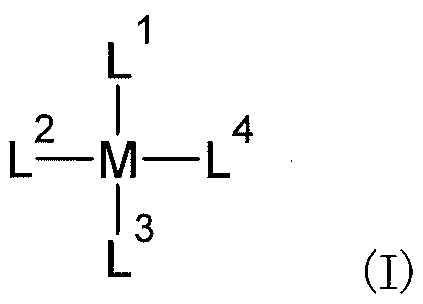
- the present inventors have found that a metal complex compound comprising a predetermined compound has an excellent catalytic effect, and has completed the present invention. That is, the present invention (1) It relates to a metal complex compound comprising a compound represented by the following general formula (I).
- M represents a metal ion selected from the group consisting of ruthenium, osmium, rhodium, iridium, nickel, palladium or platinum
- L 1 has 1 to 30 carbon atoms which may have a substituent.
- a cyclic or acyclic neutral or ⁇ 1 unsaturated hydrocarbon group, and L 2 and L 3 may each independently have fluorine, chlorine, bromine, iodine, a hydroxy group, or a substituent.
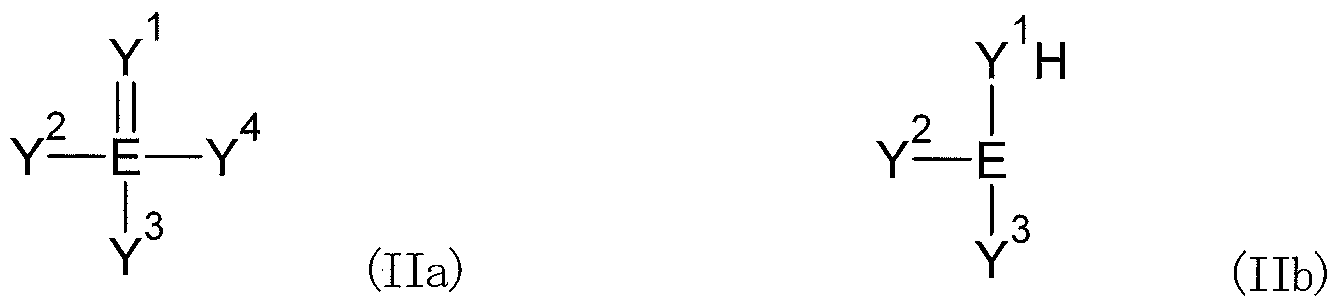
- An alkoxy group or an aryloxy group which may have a substituent is represented, and L 4 is a compound represented by the following general formula (IIa) or (IIb) bonded to M via phosphorus or arsenic.
- E represents phosphorus or arsenic
- Y 1 represents oxygen or sulfur
- Y 2 , Y 3 , and Y 4 each independently represent a hydrogen atom, a hydroxy group
- an alkyl represents an aryl group which may have a hetero atom other than a group, a substituent and carbon, an alkoxy group which may have a substituent or an aryloxy group which may have a substituent
- H represents a hydrogen atom.
- Such metal complex compounds have high catalytic activity, are inexpensive, and have a solid catalyst method (such as a problem of contamination with a small amount of copper ions) or a biocatalyst method (such as a problem of maintaining a large amount of water or bacterial cell activity). It can be used as a catalyst without any restriction in principle when producing amides.
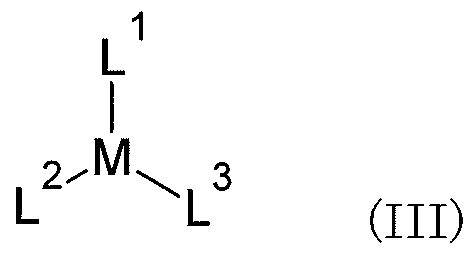
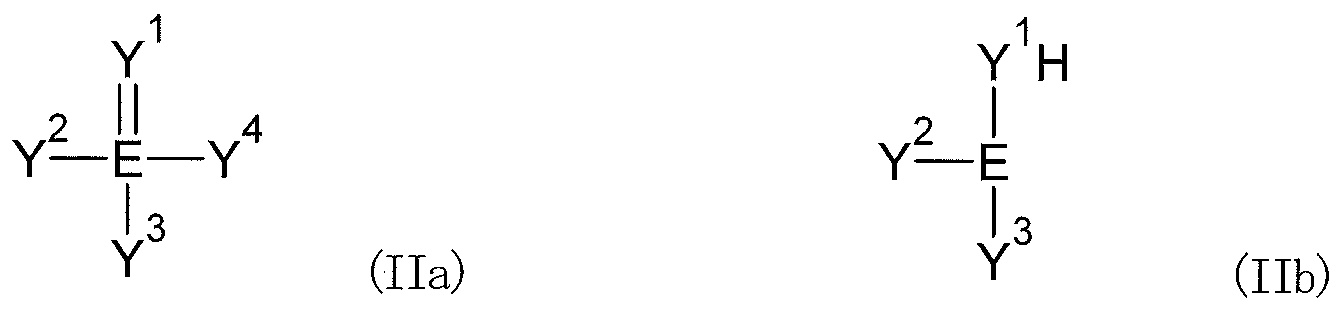
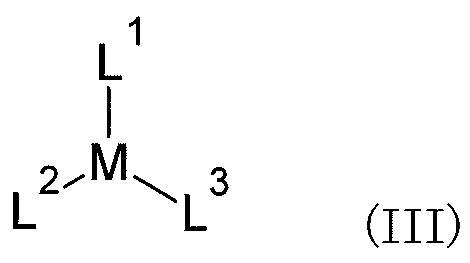
- the present invention also relates to a complex comprising a compound represented by the following general formula (III) and a compound represented by the following general formula (IIa) or (IIb).
- M represents a metal ion selected from the group consisting of ruthenium, osmium, rhodium, iridium, nickel, palladium or platinum, and L 1 has 1 to 30 carbon atoms which may have a substituent.
- a cyclic or acyclic neutral or ⁇ 1 unsaturated hydrocarbon group, and L 2 and L 3 may each independently have fluorine, chlorine, bromine, iodine, a hydroxy group, or a substituent.
- E represents phosphorus or arsenic
- Y 1 represents oxygen or sulfur
- Y 2 , Y 3 , and Y 4 each independently represent a hydrogen atom, a hydroxy group
- an alkyl represents an aryl group which may have a hetero atom other than a group, a substituent and carbon, an alkoxy group which may have a substituent or an aryloxy group which may have a substituent
- H represents a hydrogen atom.
- L 1 is a cyclic diene, triene or tetraene having 1 to 30 carbon atoms which may have a substituent.
- L 1 is an acyclic diene, triene or tetraene having 1 to 30 carbon atoms which may have a substituent. And may be a neutral or ⁇ 1-valent unsaturated hydrocarbon group.
- L 4 that is, the compound represented by the general formula (IIa) or (IIb) may have a substituent.
- Secondary phosphine oxide having 1 to 30 carbon atoms, aliphatic phosphate ester, aliphatic phosphite ester, aromatic phosphate ester or aromatic phosphite ester may be used, (6) L 4 of the compound described in the above (5), that is, the compound represented by the general formula (IIa) or (IIb) may have a diarylphosphine oxide or dialkylphosphine oxide which may have a substituent.
- the present invention also provides a catalyst comprising the metal complex compound described in (1) or above or the complex described in (2) above.
- the catalyst described in (7) above can be used for hydration reaction.
- the hydration catalyst as described in said (8) may contain a reaction accelerator other than the metal complex compound as described in said (1) or (2).
- the reaction accelerator may have a diphenylphosphine oxide, a dialkylphosphine oxide, or a substituent which may have a substituent.
- the hydration catalyst according to (9) is accelerated by the reaction with respect to 1 mol of the metal complex compound represented by the general formula (I) or the compound represented by the general formula (II).
- the agent may be contained in the range of 1 to 100 mol.
- the hydration catalyst described in the above (8) to (11) can be effectively used for hydration of nitriles, for example.
- the present invention further comprises a step of preparing a catalyst containing the metal complex compound according to the above (1) or (2); and a step of adding the catalyst to a mixture of nitriles and water and / or an organic solvent. And a step of reacting the mixture to which the catalyst has been added at a temperature of 0 to 150 ° C.
- the nitrile in the method for producing an amide as described in (13) above, may be an aliphatic nitrile having 1 to 30 carbon atoms which may have a substituent.
- the nitrile in the method for producing an amide described in (13) above, may be an aromatic nitrile having 1 to 30 carbon atoms which may have a substituent.
- the nitrile may be acrylonitrile, methacrylonitrile, polyacrylonitrile, or polymethacrylonitrile.
- the metal complex compound provided by the present invention has high catalytic activity, is inexpensive and is a solid catalyst method (problem of contamination with a small amount of copper ions, etc.) and biocatalyst method (activity of a large amount of water and bacterial cells) It has become possible to produce amides without any restriction in principle during the production of amides possessed by problems such as retention.
- FIG. 1 is an infrared absorption spectrum of the polyacrylamide obtained in Example 9-7 of the present application.
- the present invention provides a metal complex compound represented by the following general formula (I) (hereinafter sometimes referred to as “metal complex compound (I)”).
- M in the general formula (I) represents a metal ion selected from the group consisting of ruthenium, osmium, rhodium, iridium, nickel, palladium or platinum.
- L 1 represents a cyclic or non-cyclic neutral or ⁇ 1 unsaturated hydrocarbon group which may have a substituent, such as ethylene, propylene, isoprene, butadiene, 2, 3 -Dimethyl-1,3-butadiene, cyclohexene, acetylene, propyne, phenylacetylene, trimethylsilylpropyne, phenylpropyne, diphenylacetylene, pyridine, 4,4-dimethylaminopyridine, imidazole, acetonitrile, benzonitrile, butadiene, 1,4 -Diphenyl-1,3-butadiene, cyclooctene, 1,5-cyclooctadiene, norbornadiene, benzene, hexamethylbenzene, p-cymene, anisole, naphthalene, methylnaphthalene, cyclooctatetraene,
- the bond between M and L 1 may be a covalent bond, an ionic bond, or a coordinate bond.
- the line connecting M and L 1 in the general formula (I) indicates that the M and L 1 are bonded by any of the above, and is limited to L 1 being monodentate. is not.
- L 1 is cyclooctene
- L 1 is a monodentate coordinate with a coordination bond
- L 1 is cyclooctadiene
- L 1 is a cyclopentadienyl group
- Each of them binds to M in a tridentate coordination
- the line connecting M and L 1 in the general formula (I) includes bonds in any of these cases.
- L 2 and L 3 each independently represent hydrogen, fluorine, chlorine, bromine, iodine, a hydroxy group, an alkoxy group that may have a substituent, or an aryloxy group that may have a substituent.
- alkoxy group or aryloxy group include a group represented by the general formula —OR or a group represented by —OCOR (acyloxy group).
- R in the formula is hydrogen, a saturated or unsaturated, linear or branched hydrocarbon group having 1 to 30 carbon atoms, a saturated or unsaturated cyclic hydrocarbon group having 1 to 30 carbon atoms, It is selected from the group consisting of aromatic compound residues having 6 to 30 carbon atoms, alkoxy groups, and aryloxy groups.
- the alkoxy group which may have a substituent includes a methoxy group, an ethoxy group, an n-propoxy group, an isopropoxy group, a butoxy group, an isobutoxy group, a hydroxymethoxy group, a chloromethoxy group, 2-
- a hydroxyoxy group, a 2-fluoroethoxy group, a 2-chloroethoxy group, and an optionally substituted acyloxy group include —OCOCH 3 , —OCOC 2 H 5 , —OCOC 3 H 7 , —OCOCF 3 , -OCOC 6 H 5 , -OCOC 6 F 5 and the like can be mentioned.
- a bidentate ligand such as an acetylacetonato group which may have a substituent can also be exemplified as L 2 and / or L 3 .
- substituent for the acetylacetonato group include a methyl group, an ethyl group, a phenyl group, and a fluoro group.
- examples of the acetylacetonate group which may have a substituent include 1,3-diphenyl-1,3-propanedionate group, 2,2,6,6-tetramethyl-3,5-heptanedionate group, hexa
- a fluoroacetylacetonato group can be exemplified.
- L 2 and L 3 include —OSO 2 CF 3 , —OSO 2 CH 3 and the like.
- the bond between M and L 2 and L 3 may be any of a covalent bond, an ionic bond, and a coordinate bond.
- a line connecting M and L 2 and L 3 in the general formula (I) indicates that the M, L 2 and L 3 are bonded by any of the above, and L 2 and L 3 are monodentate. It is not limited to being a rank. For example, when L 2 is an acetylacetonato group or the like, two oxygen atoms are coordinated to M as a bidentate ligand, but the line connecting M and L 2 in general formula (I) is such The case binding is also included.
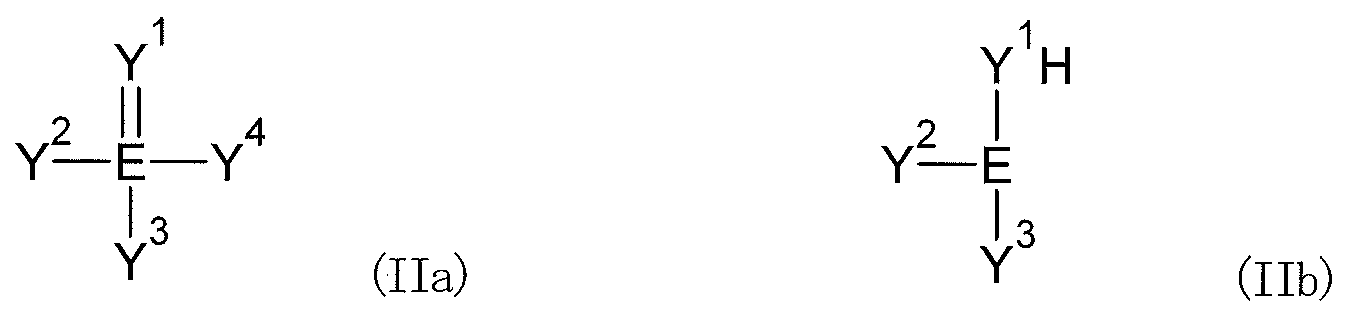
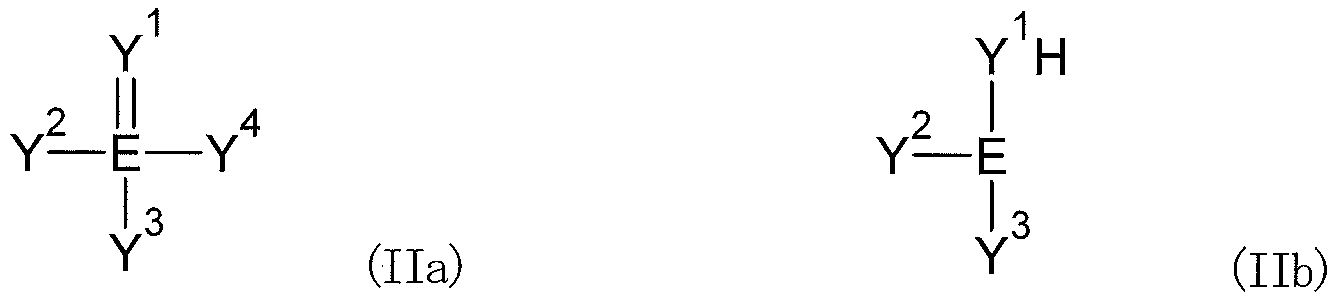
- L 4 is a compound represented by the general formula (IIa) or (IIb) bonded to M via phosphorus or arsenic (hereinafter referred to as “compound (IIa)” or “compound (IIb)”, respectively). is there).
- Compound (IIb) includes tautomers of compound (IIa). For example, when the metal complex compound (I) is isolated, the compound (IIb) can exist as a tautomer of the compound (IIa).
- E represents phosphorus or arsenic
- Y 1 represents oxygen or sulfur
- Y 2 , Y 3 , and Y 4 are each independently a hydrogen atom, a hydroxy group, an alkyl group (for example, a methyl group, an ethyl group, an n-propyl group, an i-propyl group, an n-butyl group, an i-butyl group, t-butyl group, n-hexyl group, n-octyl group), aryl group which may have a hetero atom other than a substituent and carbon (for example, phenyl group), aryloxy which may have a substituent Represents a group (for example, a phenoxy group).
- the alkyl group, aryl group, alkoxy group and aryloxy group usually have 1 to 30 carbon atoms.
- substituents include a hydroxyl group, an amino group, a carboxyl group, and a mercapto group.
- the compounds (IIa) and (IIb) include phenylphosphinic acid, diphenylphosphine oxide, di (4-methylphenyl) phosphine oxide, di (3-methylphenyl) phosphine oxide, di (2-methylphenyl) phosphine Oxide, di (4-fluorophenyl) phosphine oxide, di (3-trifluoromethylphenyl) phosphine oxide, di (2-trifluoromethylphenyl) phosphine oxide, di (tetrafluoropyridyl) phosphine oxide, dimethylphosphine oxide, diethyl Phosphine oxide, di-n-butylphosphine oxide, di-t-butylphosphine oxide, di-n-pentylphosphine oxide, methylphenylphosphine oxide, ethylphenylphosphine oxide t-butylmethylphosphine oxide, dieth
- metal complex compound (I) examples include the following.
- the above mixture, compound and aggregate are collectively referred to as “complex”.
- mode of the said compound the said metal complex compound (I) is included.
- the compound (III) and the compound (IIa) or (IIb) (particularly the compound (IIa)) are in a mixture state in which it is not confirmed that a specific compound or aggregate is formed.
- the catalyst activity can be exhibited.
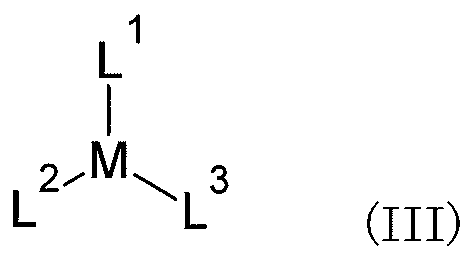
- M, L 1 , L 2 and L 3 are the same as in the compound represented by formula (I).
- the bond between M and each of L 1 , L 2 , and L 3 may be any of a covalent bond, an ionic bond, and a coordinate bond, as in the general formula (I).
- a line connecting M and each of L 1 , L 2 , and L 3 in the general formula (III) indicates that the M and L 1 , L 2 , and L 3 are bonded together in any one of the above. 1 , L 2 , and L 3 are not limited to monodentate coordination.
- L 3 may not exist (when +1 and +2) depending on the valence of M.
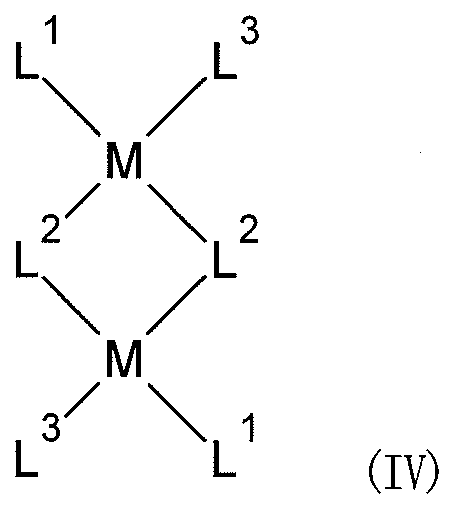
- the compounds represented by the general formula (III) may form an aggregate represented by the following formula (IV), for example.
- ruthenium compound represented by the general formula (III) examples include benzene ruthenium dichloride, methylbenzene ruthenium dichloride, hexamethylbenzene ruthenium dichloride, (p-cymene) ruthenium dichloride, methoxybenzene ruthenium dichloride, ethoxybenzene ruthenium dichloride, Hydroxybenzene ruthenium dichloride, naphthalene ruthenium dichloride, methyl naphthalene ruthenium dichloride, 2-phenoxyethanol ruthenium dichloride, benzene ruthenium dibromide, methylbenzene ruthenium dibromide, hexamethylbenzene ruthenium dibromide, (p-cymene) ruthenium dibromide, methoxybenzene ruthenium Dibromide, ethoxybenzene ruthenium dibromide, hydroxy Benz
- osmium compound represented by the general formula (III) examples include benzene osmium dichloride, methylbenzene osmium dichloride, hexamethylbenzene osmium dichloride, (p-cymene) osmium dichloride, methoxybenzene osmium dichloride, ethoxybenzene osmium dichloride, Hydroxybenzene osmium dichloride, naphthalene osmium dichloride, methyl naphthalene osmium dichloride, 2-phenoxyethanol osmium dichloride, benzene osmium dibromide, methylbenzene osmium dibromide, hexamethylbenzene osmium dibromide, (p-cymene) osmium dibromide, methoxybenzene osmium Dibromide, ethoxy
- rhodium compound represented by the general formula (III) include chloro (cyclooctadiene) rhodium, cyclooctadiene ( ⁇ -hydroxo) rhodium, cyclooctadiene ( ⁇ -methoxo) rhodium, cyclooctadiene ( ⁇ -Etoxo) rhodium, cyclooctadiene ( ⁇ -isopropoxo) rhodium, fluoro (cyclooctadiene) rhodium, bromo (cyclooctadiene) rhodium, iodo (cyclooctadiene) rhodium, fluoro (norbornadiene) rhodium, chloro (norbornadiene) rhodium , Bromo (norbornadiene) rhodium, iodonorbornadiene rh
- iridium compound represented by the general formula (III) include chloro (cyclooctadiene) iridium, cyclooctadiene ( ⁇ -hydroxy) iridium, cyclooctadiene ( ⁇ -methoxo) iridium, cyclooctadiene ( ⁇ -Etoxo) iridium, cyclooctadiene ( ⁇ -isopropoxo) iridium, fluoro (cyclooctadiene) iridium, bromo (cyclooctadiene) iridium, iodo (cyclooctadiene) iridium, fluoronorbornadiene iridium, chloronorbornadiene iridium, bromo (norbornadiene) ) Iridium, iodonorbornadiene iridium, cyclooctadiene ( ⁇ -sulfanide) i
- the amount ratio of compound (III) to compound (IIa) or (IIb) is usually from the viewpoint of the catalytic activity and reaction rate, to compound (IIa) or ( IIb) is 0.01 to 100 mol, preferably 0.1 to 10 mol, more preferably 0.5 to 5 mol.
- the present invention also provides a catalyst containing the metal complex compound (I) and a catalyst containing a complex comprising the compound (III) and the compound (IIa) or (IIb).
- a catalyst has a high catalytic activity particularly as a hydration catalyst when producing amides from nitriles.
- the nitrile compound to which the catalyst of the present invention can be applied is not particularly limited, and examples thereof include aliphatic nitriles and aromatic nitriles having 1 to 30 carbon atoms, each of which may have a substituent.
- Specific examples of the aliphatic nitrile include monovalent aliphatic nitriles such as acetonitrile, propionitrile, butyronitrile, polyhydric aliphatic nitriles such as malononitrile, succinonitrile, and adiponitrile, non-valents such as acrylonitrile and methacrylonitrile. Saturated aliphatic nitriles are mentioned.
- Specific examples of the aromatic nitrile include benzonitrile, 3-cyanopyridine, phthalonitrile and the like.
- the catalyst of the present invention is particularly suitable for use in producing acrylamide from acrylonitrile.
- the catalyst in the present invention may contain a reaction accelerator in addition to the complex composed of the metal complex compound (I) or the compound (III) and the compound (IIa) or (IIb).
- the reaction accelerator include oxygen-containing compounds.
- An example of such an oxygen-containing compound is an organophosphorus compound corresponding to compound (IIa) or (IIb), which is considered to function as a further ligand of the metal complex compound, and may have a substituent.
- Diphenylphosphine oxide optionally substituted dialkylphosphine oxide, optionally substituted phenyl group or optionally substituted alkyl group phosphine oxide, 1 to 30 carbon atoms
- Dialkyl phosphites optionally substituted diphenyl phosphites or optionally substituted phenyl groups and optionally substituted alkyl groups You can choose from esters.
- diphenylphosphine oxide di-n-butylphosphine oxide, n-butylphenylphosphine oxide, dimethylphosphine oxide, diethylphosphine oxide diethyl phosphite, dibutyl phosphite, diisobutyl phosphite, phosphorous acid
- examples thereof include di-t-butyl, diphenyl phosphite, phenylphosphinic acid, diphenylphosphine sulfide, and the like.
- examples of the oxygen-containing compound include a compound containing a hydroxyl group, and an aliphatic alcohol that may have a substituent, an aromatic alcohol that may have a substituent, and a fat that may have a substituent.
- An aromatic carboxylic acid which may have an aromatic carboxylic acid and a substituent can be selected.
- methanol, ethanol, 2-propanol, n-butanol, t-butanol, n-octanol phenol, 2-methoxyphenol, 3-methoxyphenol, 4-methoxyphenol, 2-methylphenol, 3-methyl
- the reaction accelerator can be contained in the range of 0.1 to 100 mol, preferably 0.5 to 10 mol, relative to 1 mol of metal complex compound (I) or compound (IIa) or (IIb). More preferably, it is 1 to 5 mol.
- the amount is less than 0.1 mol, there is a disadvantage that the catalyst efficiency is not improved, and when the amount is more than 100 mol, there is a disadvantage from the viewpoint of complexity of the separation step from the target product and economical efficiency.
- Examples of the method for producing amides by hydrating nitriles using the catalyst of the present invention include a method of adding the catalyst of the present invention to a mixture of nitriles and water and / or an organic solvent and reacting them.
- Water and the organic solvent can be used alone or as a mixture.
- the amount of water and / or organic solvent used at that time (the amount of water used alone, the amount of organic solvent used alone or the amount of mixture of water and organic solvent) is 0.1 to 0.1 mol per mole of nitrile group. It may be 10,000 moles, preferably 0.5 to 1000 moles, more preferably 1 to 100 moles. If the amount of water and / or organic solvent used is too small, the yield of the produced amide is greatly reduced, and if too much, the yield of the produced amide is lowered by preventing the contact between the nitrile and the catalyst. To do.
- the reaction temperature can be selected from the range of 0 ° C. to 150 ° C., preferably 30 to 130 ° C., more preferably 40 to 120 ° C. If the reaction temperature is too low, the reaction rate decreases and this is industrially disadvantageous. If it is too high, problems such as decomposition of the catalyst components and increase in production costs occur.
- the reaction time may be in the range of 0.1 to 48 hours, preferably 0.1 to 10 hours, more preferably 1 to 5 hours.
- the reaction pressure is arbitrary as long as the reaction system is maintained at a liquid phase, but a pressure vessel is not required when the reaction proceeds at a temperature below the boiling point of water.
- the atmosphere is preferably an inert gas such as nitrogen, argon, helium or carbon dioxide.
- the reaction can be carried out either batchwise or continuously.
- the product amide compound can be recovered by methods such as distillation and crystallization. Further, since the catalyst is dissolved in the remaining liquid after the product is recovered (for example, the filtrate after the precipitated amide compound is filtered), it can be directly or indirectly circulated and used again for the reaction. If desired, the catalyst can be recovered.
- Table 1-2 shows experimental examples in which the amount of catalyst (amount of complex A) was increased in the same manner as in Examples 1-1 to 1-12.
- Table 1-3 shows experimental examples in which the ratio (molar ratio) between the complex A and the ligand a was changed.
- Examples 2-1 to 2-12 Under an argon atmosphere, in a screw-type glass test tube, the complex A (0.05 mmol as Ru), ligand b (0.01 mmol), acrylonitrile (67 ⁇ L, 1 mmol), a predetermined amount of water, solvent 0. 5 mL was added and sealed. And it heated at the predetermined temperature for the predetermined time. The yield of acrylamide was calculated using a gas chromatograph. Table 2 shows the results of the hydration reaction of acrylonitrile.
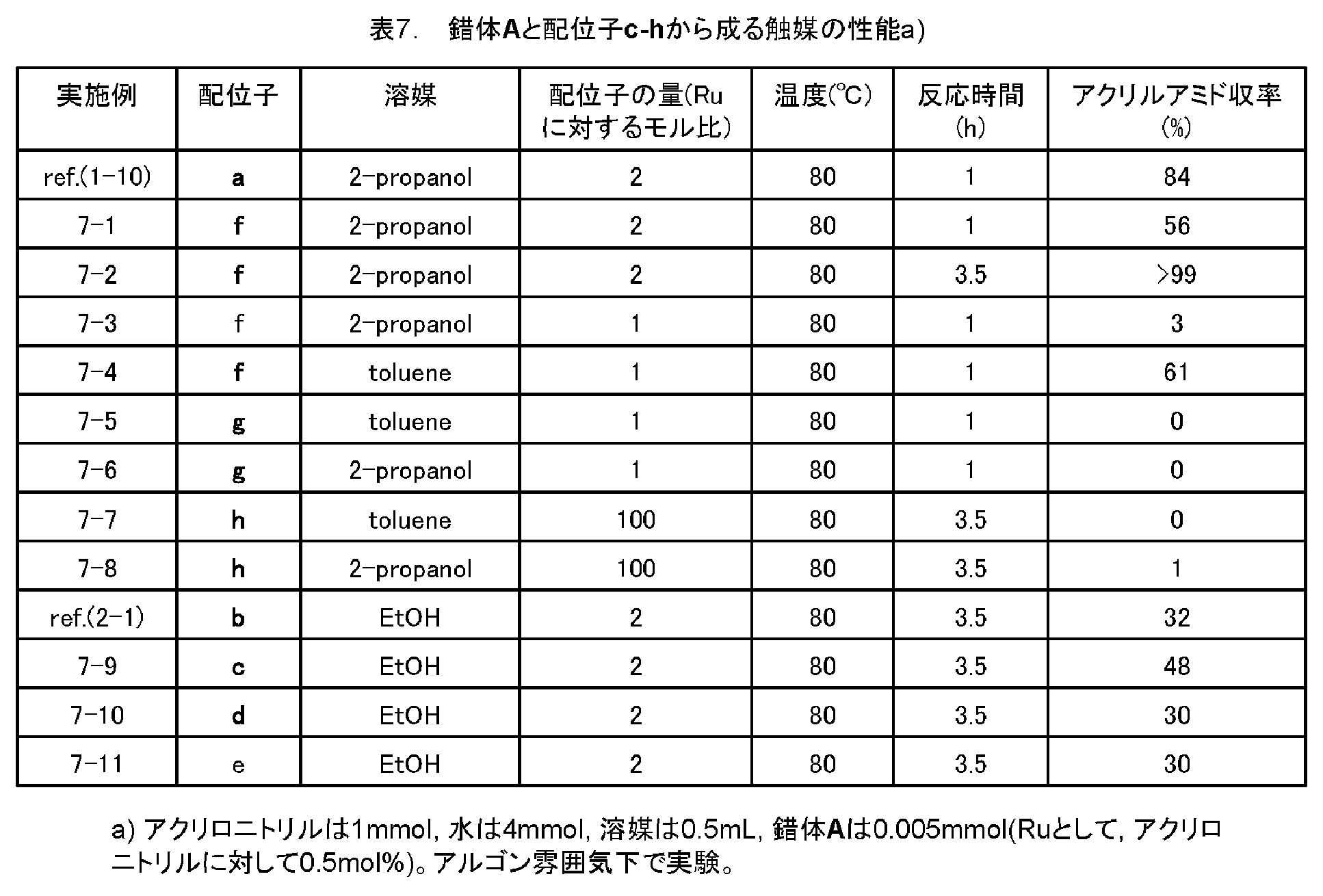
- Table 7 summarizes experimental examples of the hydration reaction of acrylonitrile by the catalyst comprising the complex A and the ligands c, d, e, f, g, and h shown below.
- complex A 0.005 mmol as Ru
- a predetermined amount of ligand, acrylonitrile 67 ⁇ L, 1 mmol
- water 72 ⁇ L, 4 mmol
- a predetermined solvent 0. 5 mL was added and sealed. And it heated at 80 degreeC for the predetermined time.
- the yield of acrylamide was calculated using a gas chromatograph.
- Table 9 summarizes the results of catalytic hydration of various nitriles using Complex B.
- complex A 0.005 mmol as Ru
- a predetermined amount of ligand 67 ⁇ L, 1 mmol
- water 72 ⁇ L, 4 mmol
- a predetermined solvent 0. 5 mL was added and sealed. And it heated at 80 degreeC for the predetermined time. The yield of acrylamide was calculated using a gas chromatograph.
- Table 10 shows examples of the hydration reaction of acrylonitrile using a complex catalyst containing iridium and rhodium.
- a complex 0.005 mmol as a metal
- a predetermined amount of ligand acrylonitrile (67 ⁇ L, 1 mmol)
- water 72 ⁇ L, 4 mmol
- a predetermined solvent 0.5 mL
- the yield of acrylamide was calculated using a gas chromatograph.
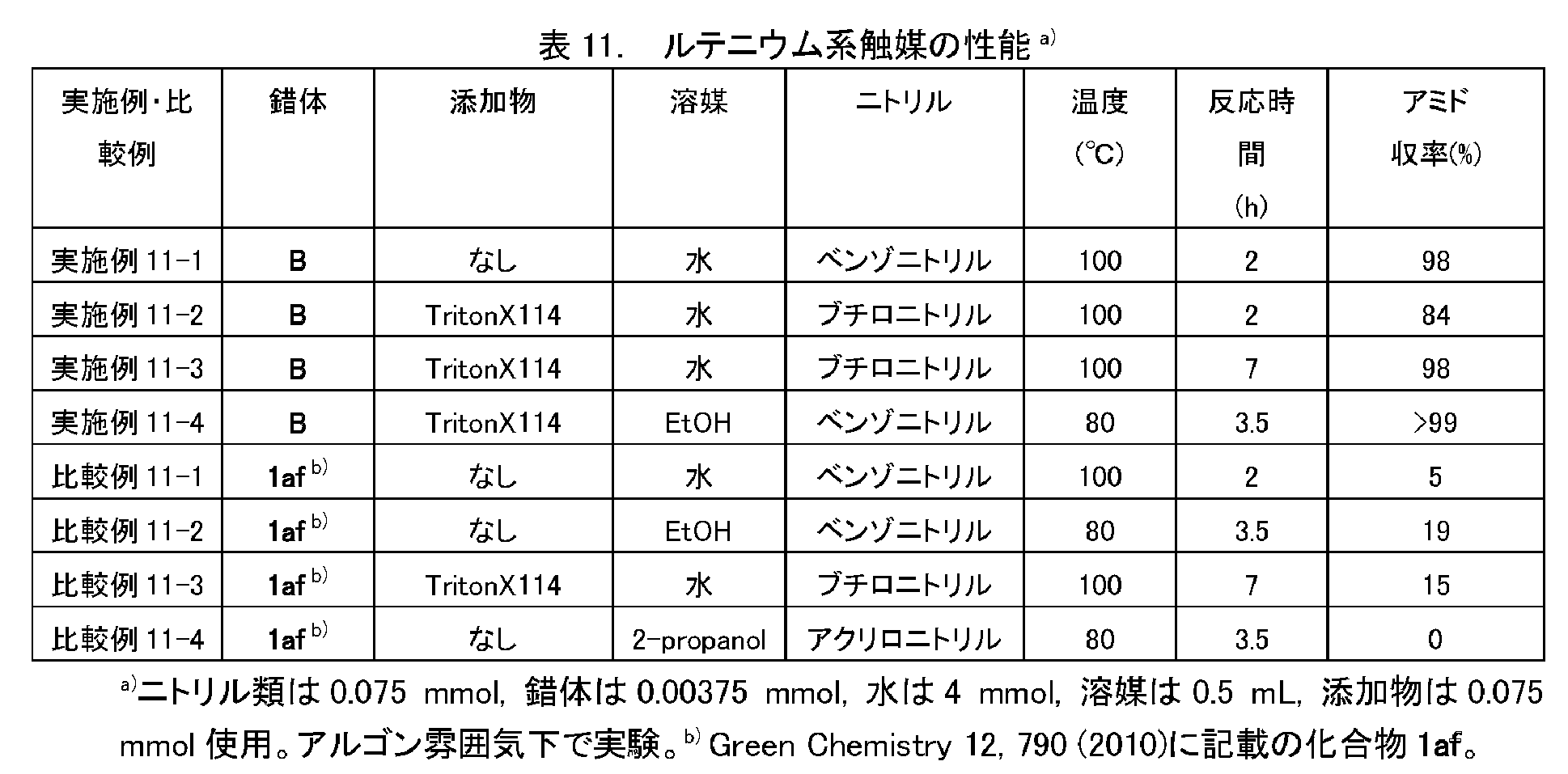
- Example 11-1 to 11-4 and Comparative Examples 11-1 to 11-3) Experiments were performed to compare with the catalytic activity of the prior art document (Non-patent Document 2 Green Chemistry 12, 790 (2010)). Complex 1af described in Non-Patent Document 2 was synthesized (Because there is no description of the synthesis method in Non-Patent Document 2, NMR data was also entered). The following experiment was conducted with the raw materials described in Non-Patent Document 2.
- Example 11-1 to 11-4 and Comparative Examples 11-1 to 11-3 are compared, the experiment of Examples 11-1 to 11-4 uses the complex 1af described in Non-Patent Document 2. It can be seen that there is a particularly significant difference in effect compared to.
- Example 1-8 and Example 3-1 are compared with Comparative Example 11-4, the complex 1af described in Non-Patent Document 2 is used in the experiments of Example 1-8 and Example 3-1. It can be seen that there is a markedly different effect compared to the experiment.
- Example 12-1 to 12-9 Experiments on the hydration reaction of acrylonitrile using the following complexes J, K, and L were conducted. The results are summarized in Table 12. Under an argon atmosphere, in a screw-type glass test tube, a complex (0.005 mmol as a metal), a predetermined amount of ligand, acrylonitrile (67 ⁇ L, 1 mmol), water (72 ⁇ L, 4 mmol), a predetermined solvent 0.5 mL was added and sealed. And it heated at 80 degree
Landscapes
- Chemical & Material Sciences (AREA)
- Organic Chemistry (AREA)
- Chemical Kinetics & Catalysis (AREA)
- Inorganic Chemistry (AREA)
- Materials Engineering (AREA)
- Engineering & Computer Science (AREA)
- Life Sciences & Earth Sciences (AREA)
- Molecular Biology (AREA)
- General Health & Medical Sciences (AREA)
- Biochemistry (AREA)
- Health & Medical Sciences (AREA)
- Catalysts (AREA)
- Organic Low-Molecular-Weight Compounds And Preparation Thereof (AREA)
Abstract
Description
(1)下記一般式(I)で表される化合物からなる金属錯体化合物に関する。
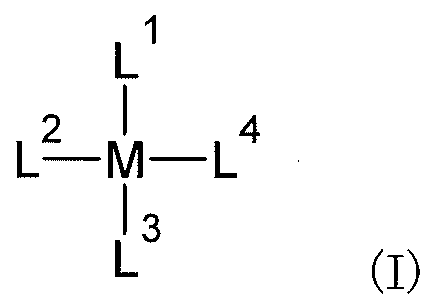
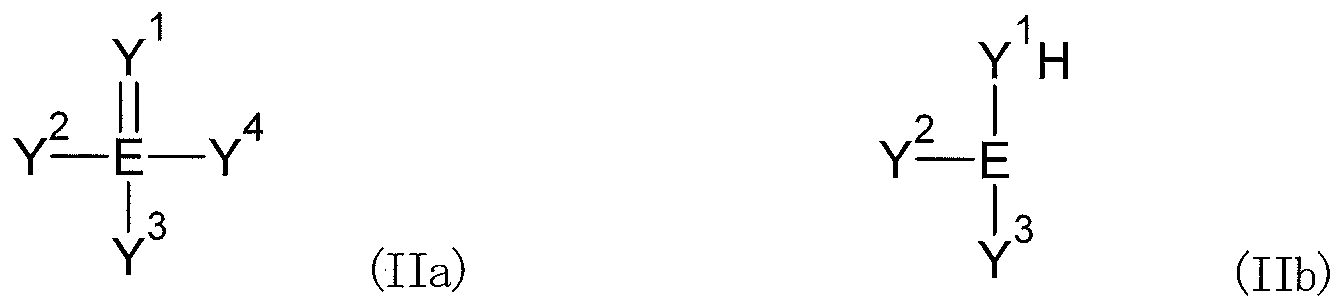
(2)また、本発明は、下記一般式(III)で表される化合物と、下記一般式(IIa)又は(IIb)で表される化合物とからなる複合体にも関する。
(3)ここで、上記(1)及び(2)に記載された化合物において、L1は、置換基を有していてもよい炭素数が1~30である環状のジエン、トリエン又はテトラエンからなりかつ中性又は-1価の不飽和炭化水素基であってもよい。
(4)又は、上記(1)及び(2)に記載された化合物において、L1が、置換基を有していてもよい炭素数が1~30である非環状のジエン、トリエン又はテトラエンからなりかつ中性又は-1価の不飽和炭化水素基であってもよい。
(5)また、上記(1)及び(2)に記載された化合物において、L4、すなわち前記一般式(IIa)又は(IIb)で表される化合物が、置換基を有していてもよい炭素数が1~30の2級のホスフィンオキシド、脂肪族リン酸エステル、脂肪族亜リン酸エステル、芳香族リン酸エステル又は芳香族亜リン酸エステルのいずれかであってもよく、
(6)上記(5)に記載された化合物のL4、すなわち前記一般式(IIa)又は(IIb)で表される化合物は、置換基を有していてもよいジアリールホスフィンオキシド、ジアルキルホスフィンオキシド、置換基を有していてもよいフェニル基と置換基を有していてもよいアルキル基を有する2級のホスフィンオキシド、炭素数1~30のジアルキル亜リン酸エステル、置換基を有していてもよいジフェニル亜リン酸エステル又は置換基を有していてもよいフェニル基と置換基を有していてもよいアルキル基を有する亜リン酸エステル、のいずれかであってもよい。
(7)さらに、本発明は、上記(1)又はに記載された金属錯体化合物又は上記(2)に記載された複合体を含む触媒も提供する。
(8)上記(7)に記載の触媒は、水和反応に用いることができる。
(9)また、上記(8)に記載の水和触媒は、前記(1)又は(2)に記載された金属錯体化合物の他に、反応促進剤を含むものであってもよい。
(10)ここで、上記(9)に記載の水和触媒においては、前記反応促進剤が、置換基を有していてもよいジフェニルホスフィンオキシド、ジアルキルホスフィンオキシド、置換基を有していてもよいフェニル基又は置換基を有していてもよいアルキル基を有するホスフィンオキシド、炭素数1~30のジアルキル亜リン酸エステル、置換基を有していてもよいジフェニル亜リン酸エステル、置換基を有していてもよいフェニル基と置換基を有していてもよいアルキル基を有する亜リン酸エステル、置換基を有してもよい脂肪族アルコール、置換基を有してもよい芳香族アルコール、置換基を有してもよい脂肪族カルボン酸又は置換基を有してもよい芳香族カルボン酸、のいずれかであってもよい。
(11)また、上記(9)記載の水和触媒は、前記一般式(I)で表される金属錯体化合物又は前記一般式(II)で表される化合物1モルに対して、前記反応促進剤を1~100モルの範囲で含むものであってもよい。
(12)なお、上記(8)~(11)に記載の水和触媒は、例えばニトリル類の水和に有効に用いることができる。
(13)本発明は、さらに上記(1)又は(2)に記載の金属錯体化合物を含む触媒を準備する工程と;前記触媒を、ニトリル類と水及び/又は有機溶媒の混合物に添加する工程と;前記触媒を加えた混合物を0~150℃の温度で、0.1~48時間反応させる工程と;を含むことを特徴とする、アミドの製造方法も提供する。かかる反応条件を用いることで、効率的にアミドを製造することができる。
(14)ここで、上記(13)に記載のアミドの製造方法において、前記ニトリル類は、置換基を有してもよい炭素数1~30の脂肪族ニトリルであってもよい。
(15)ここで、上記(13)に記載のアミドの製造方法において、前記ニトリル類は、置換基を有してもよい炭素数1~30の芳香族ニトリルであってもよい。
(16)さらに、上記(14)に記載のアミドの製造方法において、前記ニトリル類は、アクリロニトリル、メタクリロニトリル、ポリアクリロニトリル、ポリメタクリロニトリルのいずれかであってもよい。

アルゴン雰囲気下で、ネジ式のガラス製試験管に、以下に示す錯体A(Ruとして0.005mmol)、配位子a(0.01mmol)、アクリロニトリル(67μL、1mmol)、所定量の水、溶媒0.5mLを加えて密閉した。そして所定温度で所定時間加熱した。ガスクロマトグラフ装置でアクリルアミドの収率を算出した。このアクリロニトリルの水和反応の結果を表1-1に示す。
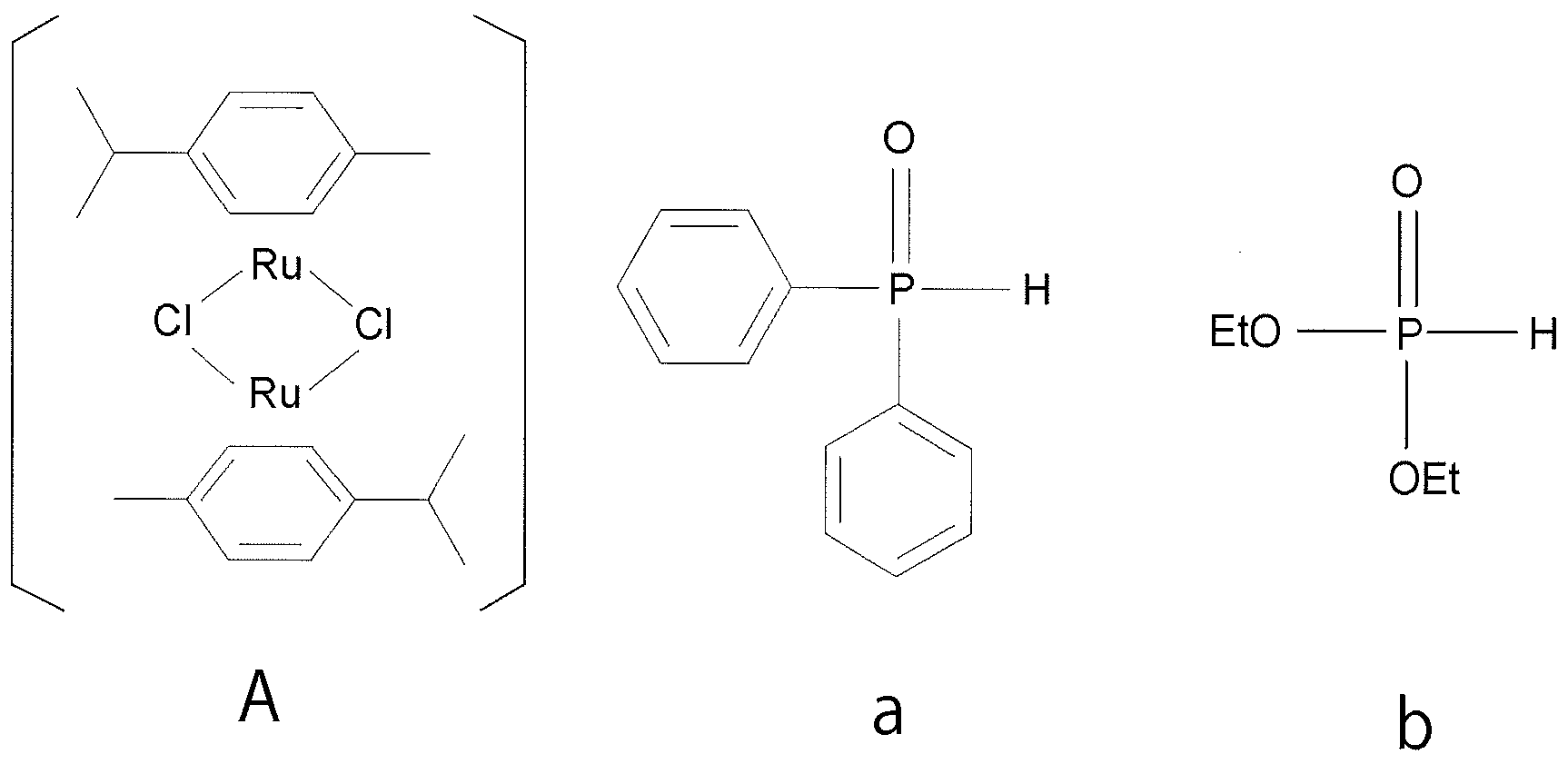
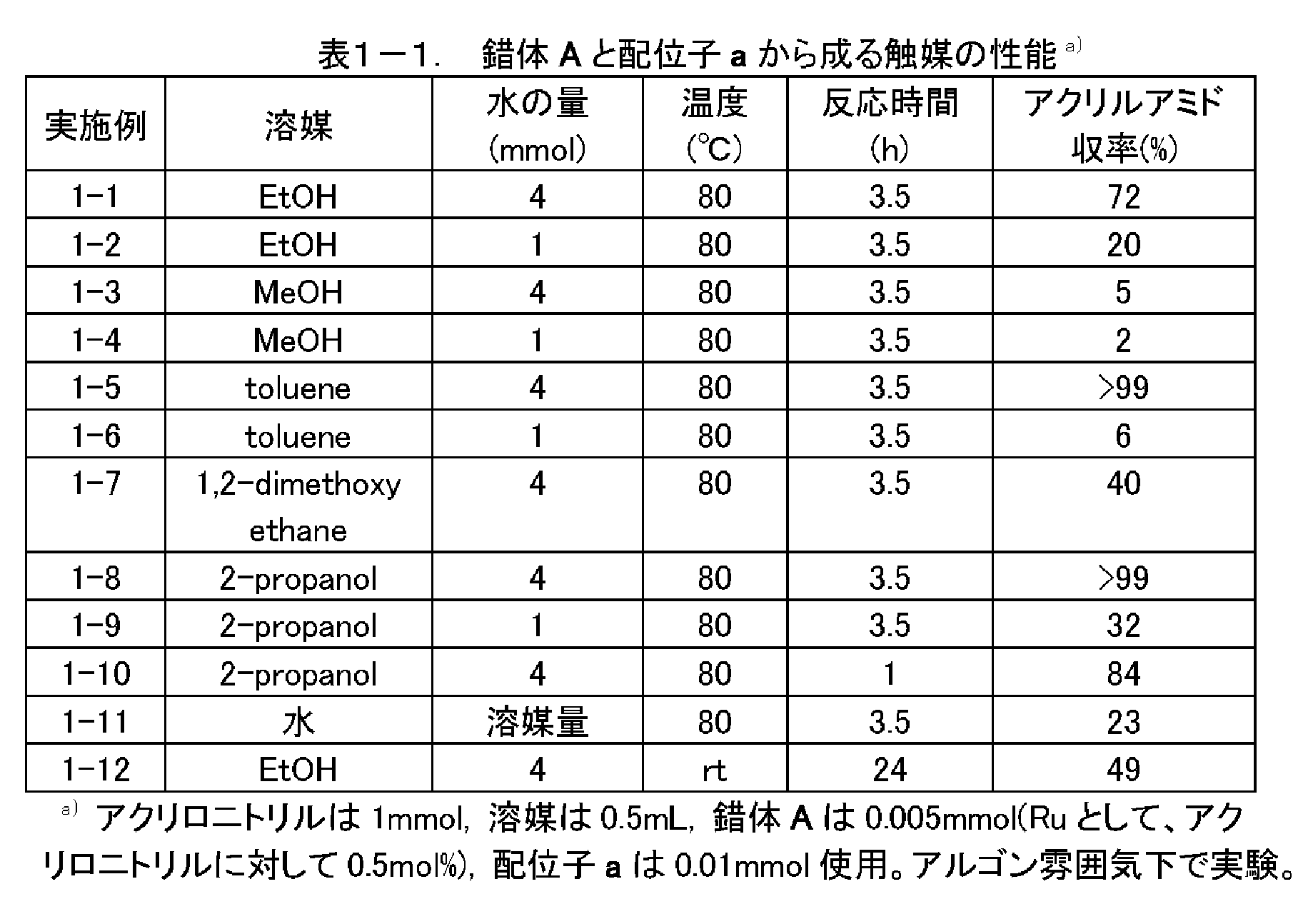
表1-2は、実施例1-1~1-12と同様の方法で、触媒量(錯体Aの量)を増やした実験例である。
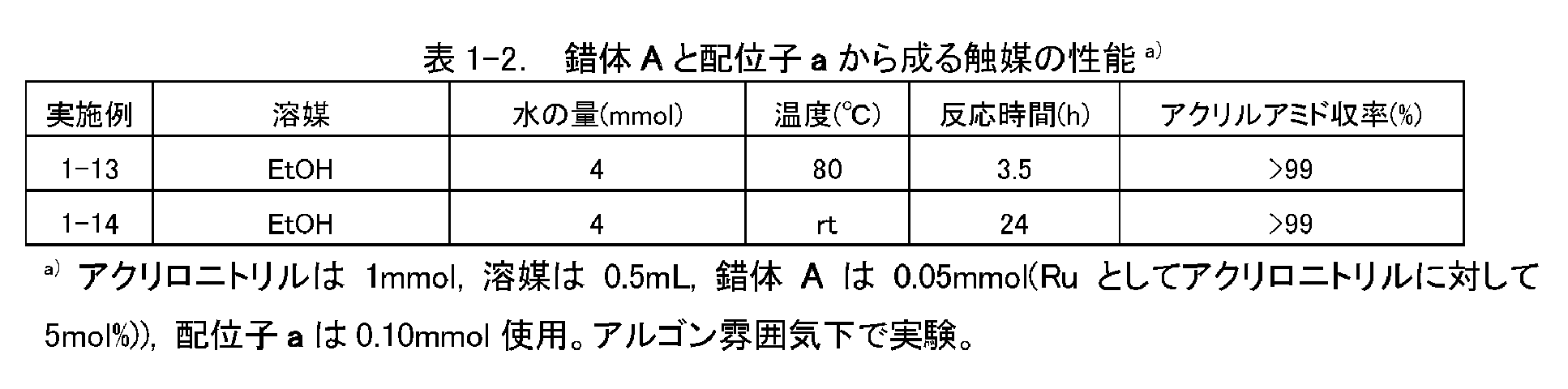
表1-3は錯体Aと配位子aの比率(モル比)を変えた実験例である。

アルゴン雰囲気下で、ネジ式のガラス製試験管に、前記錯体A(Ruとして0.05mmol)、配位子b(0.01mmol)、アクリロニトリル(67μL、1mmol)、所定量の水、溶媒0.5mLを加えて密閉した。そして所定温度で所定時間加熱した。ガスクロマトグラフ装置でアクリルアミドの収率を算出した。このアクリロニトリルの水和反応の結果を表2に示す。

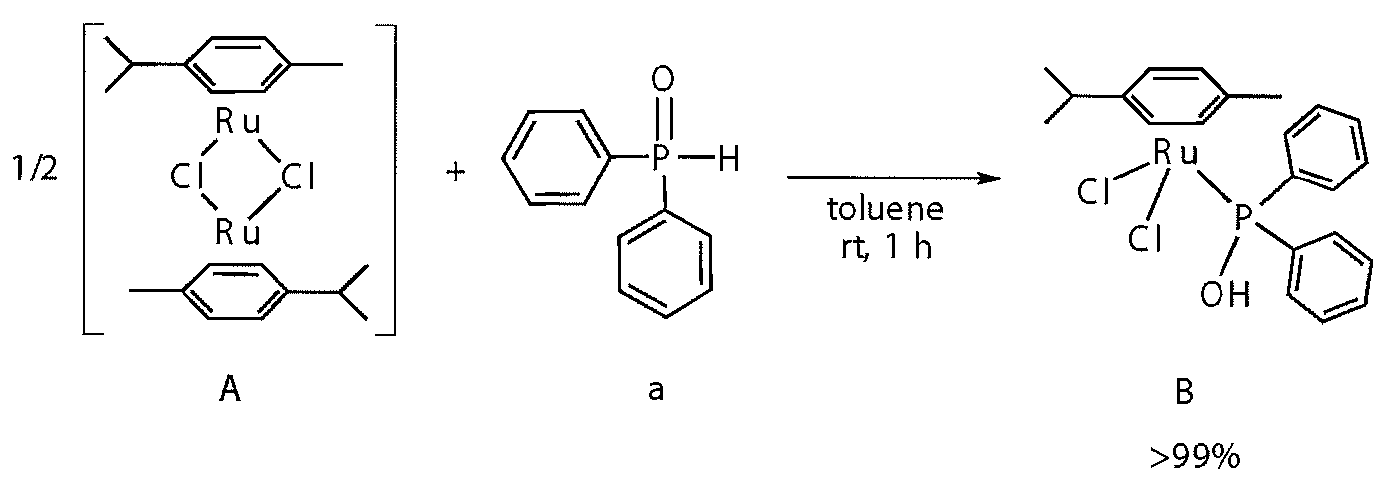
錯体Bの合成;アルゴン雰囲気下でシュレンク管に、(p-シメン)ルテニウムジクロリドダイマーA(0.50g、0.82mmol)とジフェニルホスフィンオキシド(0.33g、1.64mmol)を加えた。シリンジで、脱気及び脱水したトルエン40mLを加え、密栓した後、室温で1時間かくはんした。かくはん終了後、溶媒を減圧下で留去し、赤茶色の粉末として以下に示す錯体Bを得た(0.83g、1.64mmol)。
1H NMR (C6D6)δ0.82 (d, J = 6.8 Hz, 6H), 1.69 (s, 3H), 2.50 (quin, J = 6.8 Hz, 1H), 4.85-4.91 (m, 4H), 7.08-7.19(m, 6H), 7.75-7.81(m, 4H).31P{1H} NMR (C6D6)δ105.4(s).
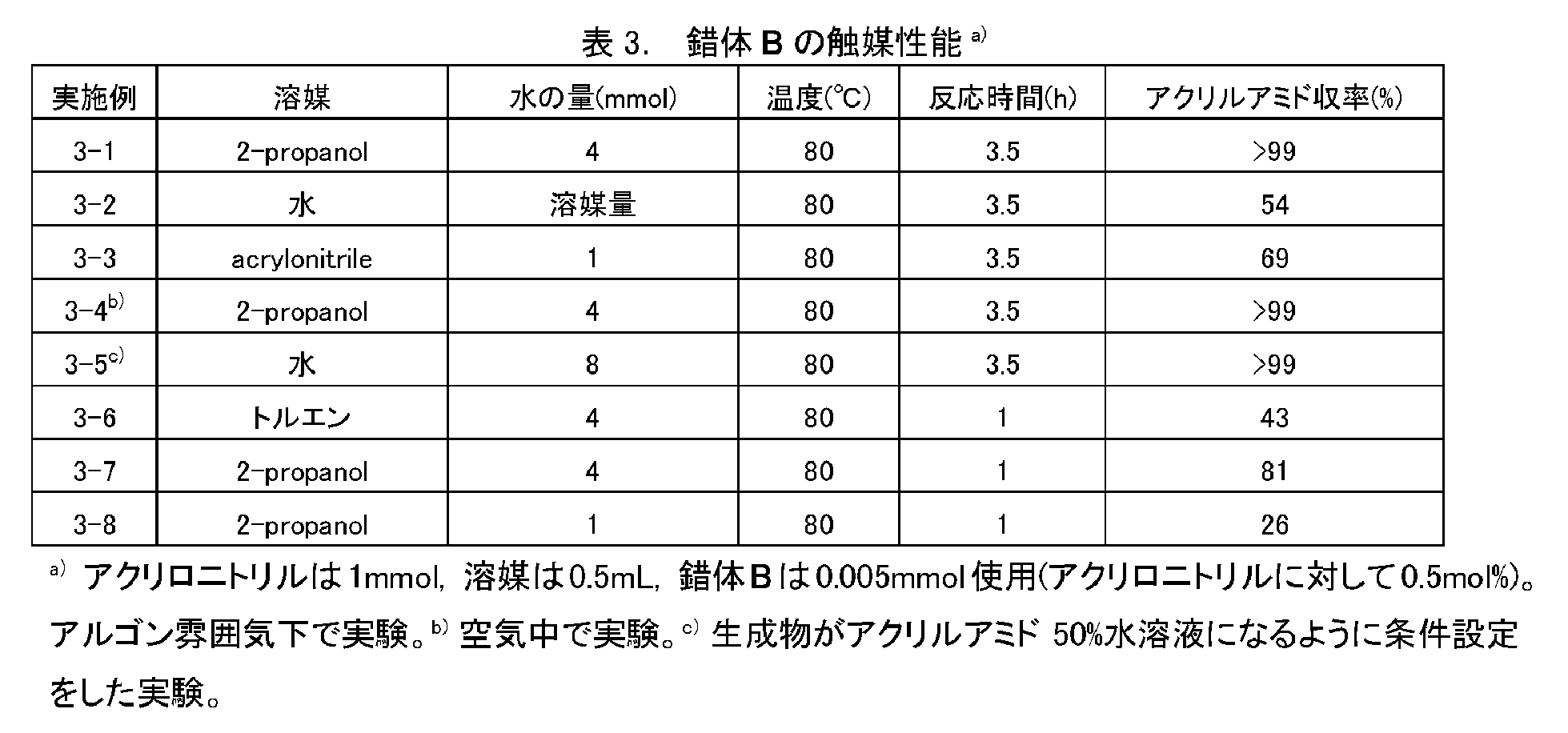
次に、前記錯体Bの触媒系に反応促進剤を加えた実験を行い、結果を表4にまとめた。アルゴン雰囲気下で、ネジ式のガラス製試験管に、錯体B(Ruとして0.005mmol)、所定量の添加物、アクリロニトリル(67μL、1mmol)、水(72μL、4mmol)、溶媒としてトルエン0.5mLを加えて密閉した。そして80℃で1時間加熱した。ガスクロマトグラフ装置でアクリルアミドの収率を算出した。

錯体Cの合成;アルゴン雰囲気下でシュレンク管に、ベンゼンルテニウムジクロリドダイマー(0.50g、1.00mmol)とジフェニルホスフィンオキシド(0.40g、2.00mmol)を加えた。シリンジで、脱気及び脱水したジクロロメタン30mLを加え、密栓した後、室温で1時間かくはんした。かくはん終了後、溶媒を減圧下で留去し、赤茶色の粉末として以下に示す錯体Cを得た(0.80g、0.88mmol)。錯体C*は同様の方法で、溶媒をアセトニトリルに替えて合成した。
錯体CのNMRデータ
1H NMR (C6D6)δ4.40 (d, 6H), 7.08-7.19(m, 6H), 7.75-7.81(m, 4H). 31P{1H} NMR (C6D6)δ101.1(s).
錯体Dの合成;アルゴン雰囲気下でシュレンク管に、ヘキサメチルベンゼンルテニウムジクロリドダイマー(0.67g、1.00mmol)とジフェニルホスフィンオキシド(0.40g、2.00mmol)を加えた。シリンジで、脱気及び脱水したトルエン40mLを加え、密栓した後、室温で1時間かくはんした。かくはん終了後、溶媒を減圧下で留去し、赤茶色の粉末として以下に示す錯体Dを得た(1.07g、1.00mmol)。
錯体DのNMRデータ
1H NMR (C6D6)δ1.55 (m, 18H), 7.00-7.19(m, 6H), 7.75-7.90(m, 4H). 31P{1H} NMR (C6D6)δ115.6(s).
錯体Eの合成;アルゴン雰囲気下でシュレンク管に、(p-シメン)ルテニウムジクロリドダイマー(0.31g、0.50mmol)とジn-ブチルホスフィンオキシド(0.16g、1.00mmol)を加えた。シリンジで、脱気及び脱水したトルエン40mLを加え、密栓した後、室温で1時間かくはんした。かくはん終了後、溶媒を減圧下で留去し、赤茶色の粉末として以下に示す錯体Eを得た(0.46g、1.00mmol)。
錯体EのNMRデータ
1H NMR (C6D6)δ0.92 (t, J = 7.3 Hz, 6H), 1.08 (d, J = 7.0 Hz, 6H), 1.81, 1.88 (s, 3H), 1.10-2.25 (m, 12H), 4.85-5.13 (m, 4H).
31P{1H} NMR (C6D6)δ121.4(s).


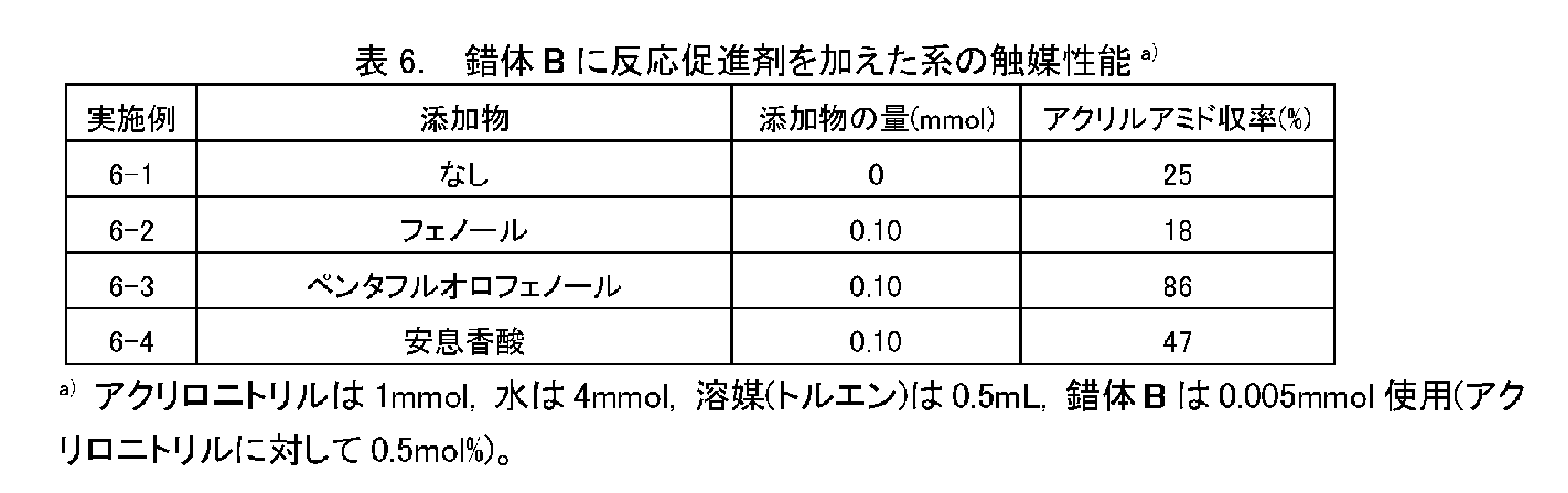
次に、錯体Bに反応促進剤を添加した結果を、表6にまとめた。アルゴン雰囲気下で、ネジ式のガラス製試験管に、錯体B(Ruとして0.005mmol)、所定量の添加物、アクリロニトリル(67μL、1mmol)、水(72μL、4mmol)、溶媒としてトルエン0.5mLを加えて密閉した。そして80℃で1時間加熱した。ガスクロマトグラフ装置でアクリルアミドの収率を算出した。
錯体Aと以下に示す配位子c、d、e、f、g、hからなる触媒によるアクリロニトリルの水和反応の実験例を表7にまとめた。アルゴン雰囲気下で、ネジ式のガラス製試験管に、錯体A(Ruとして0.005mmol)、所定量の配位子、アクリロニトリル(67μL、1mmol)、水(72μL、4mmol)、所定の溶媒0.5mLを加えて密閉した。そして80℃で所定時間加熱した。ガスクロマトグラフ装置でアクリルアミドの収率を算出した。

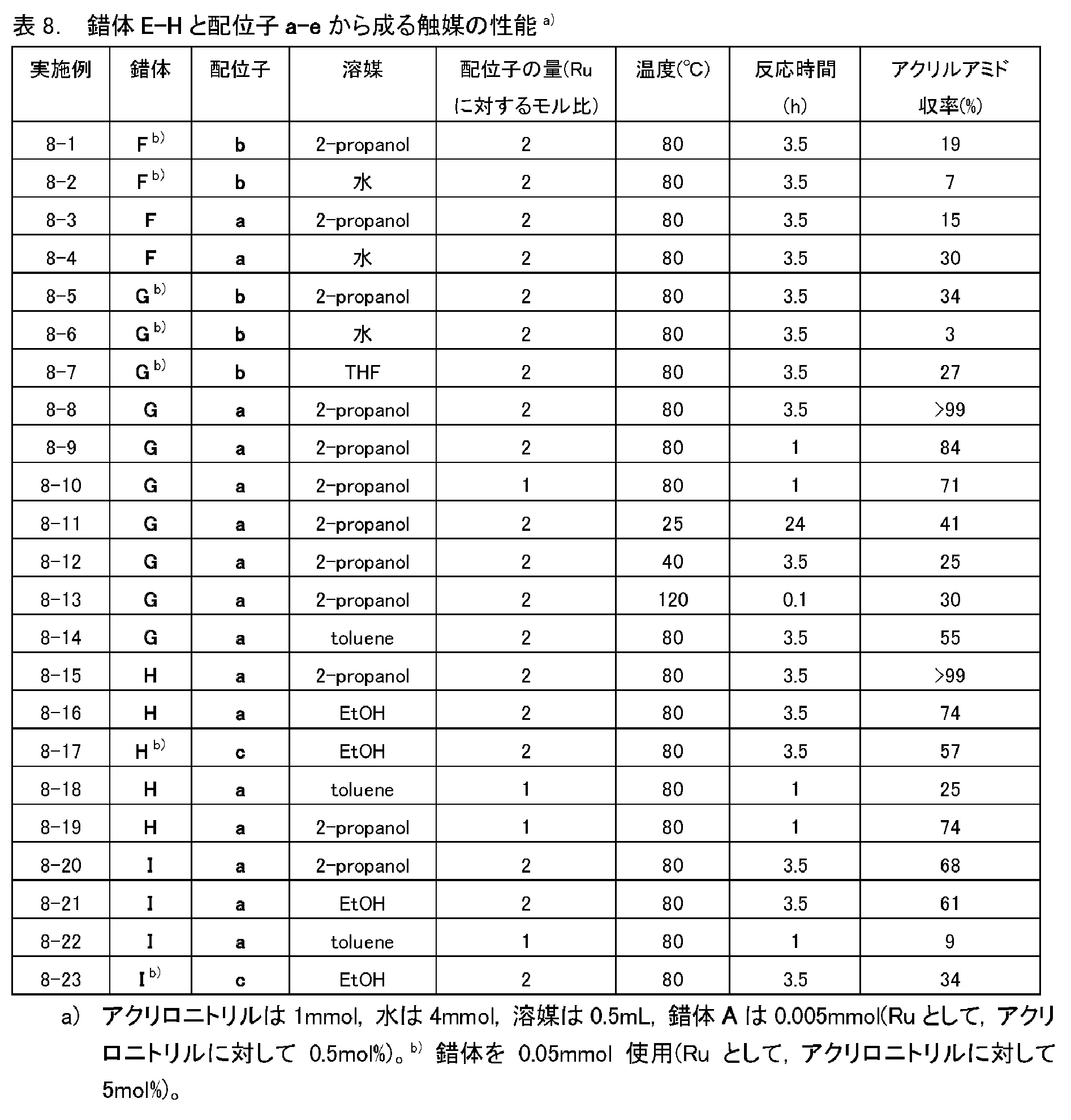
次に、以下に示す錯体F、G、H、Iを用いるアクリロニトリルの水和反応の実験を行い、結果を表8にまとめた。アルゴン雰囲気下で、ネジ式のガラス製試験管に、錯体(Ruとして0.005mmol)、所定量の配位子、アクリロニトリル(67μL、1mmol)、水(72μL、4mmol)、所定の溶媒0.5mLを加えて密閉した。そして所定の温度で所定時間加熱した。ガスクロマトグラフ装置でアクリルアミドの収率を算出した。

錯体Bを用いて、さまざまなニトリル類の触媒的水和反応を行った結果を表9にまとめた。アルゴン雰囲気下で、ネジ式のガラス製試験管に、錯体A(Ruとして0.005mmol)、所定量の配位子、アクリロニトリル(67μL、1mmol)、水(72μL、4mmol)、所定の溶媒0.5mLを加えて密閉した。そして80℃で所定時間加熱した。ガスクロマトグラフ装置でアクリルアミドの収率を算出した。

イリジウム、ロジウムを含む錯体触媒を用いるアクリロニトリルの水和反応の実施例を表10にまとめた。アルゴン雰囲気下で、ネジ式のガラス製試験管に、錯体(金属として0.005mmol)、所定量の配位子、アクリロニトリル(67μL、1mmol)、水(72μL、4mmol)、所定の溶媒0.5mLを加えて密閉した。そして80℃で所定時間加熱した。ガスクロマトグラフ装置でアクリルアミドの収率を算出した。


先行技術文献(非特許文献2 Green Chemistry 12、790(2010))の触媒活性と比較するための実験を行った。非特許文献2に記載された錯体1afを合成した(非特許文献2に合成法の記載がないため、NMRデータも記入した)。非特許文献2に記載された原料で下記の実験を行った。
錯体1afのNMRデータ
1H NMR (C6D6)δ0.96 (d, J = 8.0 Hz, 6H), 1.03 (t, J = 7.2 Hz, 3H), 1.64 (s, 3H), 2.74 (q, J = 6.8 Hz, 1H), 3.96 (q, J = 5.6 Hz, 4H), 4.88-4.97 (m, 4H), 7.02-7.11 (m, 6H), 8.21-8.27 (m, 4H).
31P{1H} NMR (C6D6)δ109(s).
以下に示す錯体J、K、Lを用いるアクリロニトリルの水和反応の実験を行った。結果を表12にまとめた。アルゴン雰囲気下で、ネジ式のガラス製試験管に、錯体(金属として0.005mmol)、所定量の配位子、アクリロニトリル(67μL、1mmol)、水(72μL、4mmol)、所定の溶媒0.5mLを加えて密閉した。そして80度で3.5時間加熱した。ガスクロマトグラフ装置でアクリルアミドの収率を算出した。

1H NMR (C6D6)δ0.84 (d, J = 7.2 Hz, 6H), 1.76 (s, 3H), 2.71 (quin, J = 6.8 Hz, 1H), 4.96 (m, 4H), 7.00-7.30 (m, 6H), 7.50-7.57(m, 2H), 7.87-7.93(m, 2H).
31P{1H} NMR (C6D6)δ102.4(s).
錯体KのNMRデータ
1H NMR (C6D6)δ0.87 (d, J = 7.2 Hz, 6H), 1.88 (s, 3H), 3.03 (quin, J = 6.8 Hz, 1H), 4.95-5.02 (m, 4H), 6.98-7.12 (m, 6H), 7.50-7.57(m, 2H), 7.98-8.02(m, 2H).
31P{1H} NMR (C6D6)δ100.8(s).
錯体LのNMRデータ
1H NMR (C6D6)δ1.25 (s, 15H), 7.07-7.13 (m, 6H), 7.80-7.86 (m, 4H).
31P{1H} NMR (C6D6)δ74.2 (s).

Claims (16)
- 下記一般式(I)で表される金属錯体化合物。

- 下記一般式(III)
で表される化合物と、
下記一般式(IIa)又は(IIb)
で表される化合物とからなる複合体。 - L1が、置換基を有していてもよい炭素数が1~30である環状のジエン、トリエン又はテトラエンからなりかつ中性又は-1価の不飽和炭化水素基である、請求項1に記載の金属錯体化合物又は請求項2に記載の複合体。
- L1が、置換基を有していてもよい炭素数が1~30である非環状のジエン、トリエン又はテトラエンからなりかつ中性又は-1価の不飽和炭化水素基である、請求項1に記載の金属錯体化合物又は請求項2に記載の複合体。
- 前記一般式(IIa)又は(IIb)で表される化合物が、置換基を有していてもよい炭素数が1~30の2級のホスフィンオキシド、脂肪族リン酸エステル、脂肪族亜リン酸エステル、芳香族リン酸エステル又は芳香族亜リン酸エステルのいずれかである、請求項1に記載の金属錯体化合物又は請求項2に記載の複合体。
- 前記一般式(IIa)又は(IIb)で表される化合物が、置換基を有していてもよいジアリールホスフィンオキシド、ジアルキルホスフィンオキシド、置換基を有していてもよいフェニル基と置換基を有していてもよいアルキル基を有する2級のホスフィンオキシド、炭素数1~30のジアルキル亜リン酸エステル、置換基を有していてもよいジフェニル亜リン酸エステル、又は置換基を有していてもよいフェニル基と置換基を有していてもよいアルキル基を有する亜リン酸エステル、のいずれかである、請求項1に記載の金属錯体化合物又は請求項2に記載の複合体。
- 請求項1に記載の金属錯体化合又は請求項2に記載の複合体を含む触媒。
- 請求項7に記載の触媒であって、水和反応に用いられる水和触媒。
- さらに反応促進剤を含む、請求項8に記載の水和触媒。
- 前記反応促進剤が、置換基を有していてもよいジフェニルホスフィンオキシド、ジアルキルホスフィンオキシド、置換基を有していてもよいフェニル基又は置換基を有していてもよいアルキル基を有するホスフィンオキシド、炭素数1~30のジアルキル亜リン酸エステル、置換基を有していてもよいジフェニル亜リン酸エステル、置換基を有していてもよいフェニル基と置換基を有していてもよいアルキル基を有する亜リン酸エステル、置換基を有してもよい脂肪族アルコール、置換基を有してもよい芳香族アルコール、置換基を有してもよい脂肪族カルボン酸又は置換基を有してもよい芳香族カルボン酸、のいずれかである請求項9に記載の水和触媒。
- 前記一般式(I)で表される金属錯体化合物又は前記一般式(II)で表される化合物1モルに対して、前記反応促進剤を1~100モルの範囲で含む請求項9に記載の水和触媒。
- ニトリル類の水和に用いられる、請求項8~11のいずれかに記載の水和触媒。
- 請求項12に記載の触媒を準備する工程と、
前記触媒を、ニトリル類と水及び/又は有機溶媒の混合物に添加する工程と、
前記触媒を加えた混合物を0~150℃の温度で、0.1~48時間反応させる工程と、
を含むことを特徴とする、アミドの製造方法。 - 前記ニトリル類が、置換基を有してもよい炭素数1~30の脂肪族ニトリルである、請求項13に記載のアミドの製造方法。
- 前記ニトリル類が、置換基を有してもよい炭素数1~30の芳香族ニトリルである、請求項13に記載のアミドの製造方法。
- 前記ニトリル類が、アクリロニトリル、メタクリロニトリル、ポリアクリロニトリル、ポリメタクリロニトリルのいずれかである、請求項14に記載のアミドの製造方法。
Priority Applications (2)
| Application Number | Priority Date | Filing Date | Title |
|---|---|---|---|
| US13/813,725 US8722912B2 (en) | 2010-08-02 | 2011-07-29 | Metal complex compound and process for producing amides utilizing the metal complex compound |
| JP2012527726A JP5732678B2 (ja) | 2010-08-02 | 2011-07-29 | 金属錯体化合物及び当該金属錯体化合物を利用したアミド類の製造方法 |
Applications Claiming Priority (2)
| Application Number | Priority Date | Filing Date | Title |
|---|---|---|---|
| JP2010174025 | 2010-08-02 | ||
| JP2010-174025 | 2010-08-02 |
Publications (1)
| Publication Number | Publication Date |
|---|---|
| WO2012017966A1 true WO2012017966A1 (ja) | 2012-02-09 |
Family
ID=45559465
Family Applications (1)
| Application Number | Title | Priority Date | Filing Date |
|---|---|---|---|
| PCT/JP2011/067531 Ceased WO2012017966A1 (ja) | 2010-08-02 | 2011-07-29 | 金属錯体化合物及び当該金属錯体化合物を利用したアミド類の製造方法 |
Country Status (3)
| Country | Link |
|---|---|
| US (1) | US8722912B2 (ja) |
| JP (1) | JP5732678B2 (ja) |
| WO (1) | WO2012017966A1 (ja) |
Cited By (1)
| Publication number | Priority date | Publication date | Assignee | Title |
|---|---|---|---|---|
| CN104399528A (zh) * | 2014-10-15 | 2015-03-11 | 安徽工业大学 | 一种偶氮类铜配合物水氧化催化剂 |
Families Citing this family (1)
| Publication number | Priority date | Publication date | Assignee | Title |
|---|---|---|---|---|
| CN104496894A (zh) * | 2014-11-22 | 2015-04-08 | 安徽国星生物化学有限公司 | 一种高纯度烟酰胺及烟酸的制备方法 |
Citations (1)
| Publication number | Priority date | Publication date | Assignee | Title |
|---|---|---|---|---|
| JPH0242093A (ja) * | 1988-06-08 | 1990-02-13 | Basf Ag | 遷移金属錯体 |
Family Cites Families (5)
| Publication number | Priority date | Publication date | Assignee | Title |
|---|---|---|---|---|
| US3597481A (en) | 1969-01-16 | 1971-08-03 | Dow Chemical Co | Heterogeneous catalyst for the liquid phase hydrolysis of nitriles to amides |
| JPS6176447A (ja) | 1984-09-20 | 1986-04-18 | Mitsui Toatsu Chem Inc | ニトリル化合物の水和方法 |
| GB9506389D0 (en) | 1995-03-29 | 1995-05-17 | King S College London | Catalyst and process for preparing amides |
| JP2008088153A (ja) | 2006-04-10 | 2008-04-17 | Okayama Univ | アミド化合物を製造する方法及びその方法に使用される触媒 |
| JP2009023925A (ja) | 2007-07-18 | 2009-02-05 | Okayama Univ | アミド化合物を製造する方法及びその方法に使用される触媒 |
-
2011
- 2011-07-29 WO PCT/JP2011/067531 patent/WO2012017966A1/ja not_active Ceased
- 2011-07-29 US US13/813,725 patent/US8722912B2/en not_active Expired - Fee Related
- 2011-07-29 JP JP2012527726A patent/JP5732678B2/ja not_active Expired - Fee Related
Patent Citations (1)
| Publication number | Priority date | Publication date | Assignee | Title |
|---|---|---|---|---|
| JPH0242093A (ja) * | 1988-06-08 | 1990-02-13 | Basf Ag | 遷移金属錯体 |
Non-Patent Citations (4)
Cited By (1)
| Publication number | Priority date | Publication date | Assignee | Title |
|---|---|---|---|---|
| CN104399528A (zh) * | 2014-10-15 | 2015-03-11 | 安徽工业大学 | 一种偶氮类铜配合物水氧化催化剂 |
Also Published As
| Publication number | Publication date |
|---|---|
| JPWO2012017966A1 (ja) | 2013-10-03 |
| US20130131366A1 (en) | 2013-05-23 |
| US8722912B2 (en) | 2014-05-13 |
| JP5732678B2 (ja) | 2015-06-10 |
Similar Documents
| Publication | Publication Date | Title |
|---|---|---|
| Nattmann et al. | Ni (4-Tbustb) 3: A robust 16-electron Ni (0) olefin complex for catalysis | |
| Ghebreab et al. | Intermolecular zirconium-catalyzed hydrophosphination of alkenes and dienes with primary phosphines | |
| Kong et al. | Rational Design and Synthesis of Porous Organic− Inorganic Hybrid Frameworks Constructed by 1, 3, 5-Benzenetriphosphonic Acid and Pyridine Synthons | |
| Kendall et al. | The synthesis of heteroleptic phosphines | |
| Basalov et al. | Reactivity of ytterbium (II) hydride. redox reactions: ytterbium (II) vs hydrido ligand. metathesis of the Yb–H bond | |
| KR102338544B1 (ko) | 실릴렌 리간드를 가지는 신규한 촉매 | |
| JP4004123B2 (ja) | ルテニウム錯体を触媒とするアルコール化合物の製造方法 | |
| Kireenko et al. | Palladium complexes with stabilized germylene and stannylene ligands | |
| JP2013513654A5 (ja) | ||
| CN1747960A (zh) | 制备金属配合物的方法 | |
| Genin et al. | Efficient synthesis of trisubstituted alkenes in an aqueous–organic system using a versatile and recyclable Rh/m-TPPTC catalyst | |
| Xu et al. | Transition metal-catalyzed efficient and green transformations of P (O)-H compounds to functional organophosphorus compounds | |
| Vargas et al. | Iridium Complexes with Phosphine− Phosphite Ligands. Structural Aspects and Application in the Catalytic Asymmetric Hydrogenation of N-Aryl Imines | |
| Cadierno et al. | Neutral and cationic (η6-arene)-ruthenium (II) complexes containing the iminophosphorane–phosphine ligand Ph2PCH2P ( Np-C5F4N) Ph2: influence of the arene ring in catalytic transfer hydrogenation of cyclohexanone | |
| Wang et al. | An air-stable N-heterocyclic [PSiP] pincer iron hydride and an analogous nitrogen iron hydride: synthesis and catalytic dehydration of primary amides to nitriles | |
| Honaker et al. | The synthesis of tertiary and secondary phosphines and their applications in organic synthesis | |
| Field et al. | Rhodium (I) and iridium (I) complexes containing bidentate phosphine-imidazolyl donor ligands as catalysts for the hydroamination and hydrothiolation of alkynes | |
| Adamson et al. | Iron-mediated C–C bond formation via reductive coupling with carbon dioxide | |
| JP5732678B2 (ja) | 金属錯体化合物及び当該金属錯体化合物を利用したアミド類の製造方法 | |
| Ozerov et al. | Missing link: PCP pincer ligands containing P–N bonds and their Pd complexes | |
| EP1355912B1 (en) | Ligands and their use | |
| Zheng et al. | Synthesis of new dipyridinylamine and dipyridinylmethane ligands and their coordination chemistry with Mg (II) and Zn (II) | |
| Lu | Vanadium (IV) tetrachloride catalyzed oxidative homo-coupling of aryl lithium under mild reaction condition | |
| CA2740500C (en) | Method for preparing a metal catalyst | |
| Aydemir et al. | Asymmetric transfer hydrogenation of acetophenone derivatives with novel chiral phosphinite based η6-p-cymene/ruthenium (II) catalysts |
Legal Events
| Date | Code | Title | Description |
|---|---|---|---|
| 121 | Ep: the epo has been informed by wipo that ep was designated in this application |
Ref document number: 11814592 Country of ref document: EP Kind code of ref document: A1 |
|
| DPE1 | Request for preliminary examination filed after expiration of 19th month from priority date (pct application filed from 20040101) | ||
| WWE | Wipo information: entry into national phase |
Ref document number: 2012527726 Country of ref document: JP |
|
| WWE | Wipo information: entry into national phase |
Ref document number: 13813725 Country of ref document: US |
|
| NENP | Non-entry into the national phase |
Ref country code: DE |
|
| 122 | Ep: pct application non-entry in european phase |
Ref document number: 11814592 Country of ref document: EP Kind code of ref document: A1 |