WO2012015014A1 - 吸汁害虫の交尾行動かく乱剤 - Google Patents
吸汁害虫の交尾行動かく乱剤 Download PDFInfo
- Publication number
- WO2012015014A1 WO2012015014A1 PCT/JP2011/067369 JP2011067369W WO2012015014A1 WO 2012015014 A1 WO2012015014 A1 WO 2012015014A1 JP 2011067369 W JP2011067369 W JP 2011067369W WO 2012015014 A1 WO2012015014 A1 WO 2012015014A1
- Authority
- WO
- WIPO (PCT)
- Prior art keywords
- flonicamid
- composition
- pest
- rice
- pests
- Prior art date
- Legal status (The legal status is an assumption and is not a legal conclusion. Google has not performed a legal analysis and makes no representation as to the accuracy of the status listed.)
- Ceased
Links
Images


Classifications
-
- A—HUMAN NECESSITIES
- A01—AGRICULTURE; FORESTRY; ANIMAL HUSBANDRY; HUNTING; TRAPPING; FISHING
- A01N—PRESERVATION OF BODIES OF HUMANS OR ANIMALS OR PLANTS OR PARTS THEREOF; BIOCIDES, e.g. AS DISINFECTANTS, AS PESTICIDES OR AS HERBICIDES; PEST REPELLANTS OR ATTRACTANTS; PLANT GROWTH REGULATORS
- A01N43/00—Biocides, pest repellants or attractants, or plant growth regulators containing heterocyclic compounds
- A01N43/34—Biocides, pest repellants or attractants, or plant growth regulators containing heterocyclic compounds having rings with one nitrogen atom as the only ring hetero atom
- A01N43/40—Biocides, pest repellants or attractants, or plant growth regulators containing heterocyclic compounds having rings with one nitrogen atom as the only ring hetero atom six-membered rings
-
- A—HUMAN NECESSITIES
- A01—AGRICULTURE; FORESTRY; ANIMAL HUSBANDRY; HUNTING; TRAPPING; FISHING
- A01N—PRESERVATION OF BODIES OF HUMANS OR ANIMALS OR PLANTS OR PARTS THEREOF; BIOCIDES, e.g. AS DISINFECTANTS, AS PESTICIDES OR AS HERBICIDES; PEST REPELLANTS OR ATTRACTANTS; PLANT GROWTH REGULATORS
- A01N25/00—Biocides, pest repellants or attractants, or plant growth regulators, characterised by their forms, or by their non-active ingredients or by their methods of application, e.g. seed treatment or sequential application; Substances for reducing the noxious effect of the active ingredients to organisms other than pests
-
- A—HUMAN NECESSITIES
- A01—AGRICULTURE; FORESTRY; ANIMAL HUSBANDRY; HUNTING; TRAPPING; FISHING
- A01N—PRESERVATION OF BODIES OF HUMANS OR ANIMALS OR PLANTS OR PARTS THEREOF; BIOCIDES, e.g. AS DISINFECTANTS, AS PESTICIDES OR AS HERBICIDES; PEST REPELLANTS OR ATTRACTANTS; PLANT GROWTH REGULATORS
- A01N25/00—Biocides, pest repellants or attractants, or plant growth regulators, characterised by their forms, or by their non-active ingredients or by their methods of application, e.g. seed treatment or sequential application; Substances for reducing the noxious effect of the active ingredients to organisms other than pests
- A01N25/08—Biocides, pest repellants or attractants, or plant growth regulators, characterised by their forms, or by their non-active ingredients or by their methods of application, e.g. seed treatment or sequential application; Substances for reducing the noxious effect of the active ingredients to organisms other than pests containing solids as carriers or diluents
- A01N25/10—Macromolecular compounds
-
- A—HUMAN NECESSITIES
- A01—AGRICULTURE; FORESTRY; ANIMAL HUSBANDRY; HUNTING; TRAPPING; FISHING
- A01N—PRESERVATION OF BODIES OF HUMANS OR ANIMALS OR PLANTS OR PARTS THEREOF; BIOCIDES, e.g. AS DISINFECTANTS, AS PESTICIDES OR AS HERBICIDES; PEST REPELLANTS OR ATTRACTANTS; PLANT GROWTH REGULATORS
- A01N25/00—Biocides, pest repellants or attractants, or plant growth regulators, characterised by their forms, or by their non-active ingredients or by their methods of application, e.g. seed treatment or sequential application; Substances for reducing the noxious effect of the active ingredients to organisms other than pests
- A01N25/12—Powders or granules
-
- A—HUMAN NECESSITIES
- A01—AGRICULTURE; FORESTRY; ANIMAL HUSBANDRY; HUNTING; TRAPPING; FISHING
- A01N—PRESERVATION OF BODIES OF HUMANS OR ANIMALS OR PLANTS OR PARTS THEREOF; BIOCIDES, e.g. AS DISINFECTANTS, AS PESTICIDES OR AS HERBICIDES; PEST REPELLANTS OR ATTRACTANTS; PLANT GROWTH REGULATORS
- A01N43/00—Biocides, pest repellants or attractants, or plant growth regulators containing heterocyclic compounds
- A01N43/72—Biocides, pest repellants or attractants, or plant growth regulators containing heterocyclic compounds having rings with nitrogen atoms and oxygen or sulfur atoms as ring hetero atoms
- A01N43/80—Biocides, pest repellants or attractants, or plant growth regulators containing heterocyclic compounds having rings with nitrogen atoms and oxygen or sulfur atoms as ring hetero atoms five-membered rings with one nitrogen atom and either one oxygen atom or one sulfur atom in positions 1,2
Definitions
- the present invention relates to a copulation disruption agent for sucking pests.
- N-cyanomethyl-4-trifluoromethyl-3-pyridinecarboxamide (generic name flonicamid) is a compound described as Patent No. 1 in Patent Document 1.
- Patent Document 2 describes a pesticidal composition containing a pyridine-based compound containing flonicamid and various efficacy enhancing components.
- Root beetles which are sucking pests that are regarded as the main pests in the field of rice cultivation, have a high growth potential and cause enormous damage to rice.
- the brown planthopper repeatedly grows over a number of generations until the harvest season, and the main damage is caused by the dryness of rice. “Tsubo withering” refers to the damage that rice dies and / or surrenders due to the sucking damage of the brown planthopper.
- neonicotinoid insecticides are the mainstream as a control agent for planthoppers, but recently, planthoppers with reduced susceptibility to neonicotinoid insecticides have been seen.
- a control agent or control method that can replace neonicotinoid insecticides and become a new mainstream.
- the ecology of the green planthopper is characteristic, and the present inventors conducted research in connection with the characteristic ecology in the control of planthoppers including the green planthopper.
- Tobiro planta cannot overwinter in areas north of Vietnam.
- Japan the long-winged adult worms that fly from the lower part of the jet stream from overseas during the rainy season from late June to July are the source.
- the flying density is considerably lower than that of the overseas flying white smelt, and the parasitic density at the time of flying does not cause a big problem.
- the copulation behavior disturbing action in the present invention refers to an action of suppressing a series of mating actions in which a female searches for a female by suppressing the action of calling the male by vibration of the abdomen.
- the present invention relates to a method for controlling sucking pests by causing flonicamid to act on sucking pests, a method for reducing the next generation population of sucking pests, and a method for disturbing the mating behavior of sucking pests.
- the mating behavior disrupting agent and control method for sucking pests according to the present invention can exhibit a stable and high control effect over a long period of time.
- the present invention is completely different from the use of flonicamid as a simple pesticide, and has an unexpected effect of reducing the next-generation population of pests.
- a conventionally used control agent cannot be expected to have a long-lasting residual effect, and therefore it is necessary to treat the spray agent a plurality of times. It is possible to reduce the number of times of agent treatment.
- Applying the completely unexpected effect of “reducing the next generation of pests” disclosed by the present invention for example, when applied to a seedling box treatment, it is usually desired to control sucking pests over a sufficiently long period of time. The effect is demonstrated.
- the active ingredient for agricultural chemicals in the present invention is flonicamid.
- Flonicamid is a common name and its chemical name is N-cyanomethyl-4-trifluoromethyl-3-pyridinecarboxamide. Flonicamid may form a salt.
- examples of the rice parasitic sucking insects include planthoppers, leafhoppers, and stink bugs.
- the planthoppers include brown planthoppers, white-spotted planthoppers, and leafhoppers.
- the leafhoppers include leafhopper leafhoppers and the like, and the stink bugs include akazikakasomika and akahigehosomidorikamikameka.
- the soup pests preferably include planthoppers and leafhoppers. More preferably, a planthopper is mentioned. More preferred is a brown planthopper.
- Examples of the sucking pests to be controlled according to the present invention include sucking pests having reduced sensitivity to neonicotinoid insecticides.
- flonicamid is selected from the group consisting of nonionic surfactants, anionic surfactants, cationic surfactants, amphoteric surfactants, animal and vegetable oils, mineral oils, water-soluble polymers, resins and waxes.
- at least one efficacy enhancing component can be used in combination.
- flonicamid can be formulated in various forms such as emulsions, powders, wettable powders, liquids, granules, suspensions and the like by blending with various adjuvants as in the case of conventional agricultural chemical preparations.
- auxiliary agent include a carrier, a suspending agent, a thickening agent, a stabilizer, a dispersing agent, a wetting agent, a penetrating agent, an antifreezing agent, an antifoaming agent, and the like.
- Carriers are divided into solid carriers and liquid carriers, and solid carriers include starch, sugar, cellulose powder, cyclodextrin, activated carbon, soybean powder, wheat flour, rice bran powder, wood powder, fish powder, milk powder, and other animal and vegetable powders.
- Talc kaolin, bentonite, organic bentonite, calcium carbonate, calcium sulfate, sodium bicarbonate, zeolite, diatomaceous earth, white carbon, clay, alumina, silica, sulfur powder, mineral powder such as slaked lime, etc., liquid carrier
- liquid carrier As: water; alcohols such as ethyl alcohol and ethylene glycol; ketones such as acetone, methyl ethyl ketone, methyl isobutyl ketone, and isophorone; ethers such as dioxane and tetrahydrofuran; and aliphatic hydrocarbons such as kerosene, kerosene, and liquid paraffin Toluene, xylene, tri Aromatic hydrocarbons such as tilbenzene, tetramethylbenzene, cyclohexane and solvent naphtha; Halogenated hydrocarbons such as chloroform and chlorobenzene; Acid amides such as
- nitriles such as acetonitrile; sulfur-containing compounds such as dimethyl sulfoxide; N-methyl-2-pyrrolidone and the like.
- the dispersant include polycarboxylic acid or a salt thereof, lignin sulfonic acid or a salt thereof, and the like.
- flonicamid can be treated in a nursery box or treated in a paddy field.
- a seedling box treatment is desirable because a particularly significant effect can be achieved by sucking the soup pest. This is because flonicamid which is an active ingredient of agricultural chemicals having high water solubility can be efficiently taken into the plant body by the action of sucking up the drug from the root of rice by the seedling box treatment.
- flonicamid can be formulated into various forms as described above, but from the viewpoint that the seedling box treatment is desirable, it is desirable to use a granule for the seedling box treatment.
- a composition containing flonicamid and a poorly water-soluble resin is used as a granule for treatment of a seedling box suitable for exerting the effects of the present invention.
- flonicamid and the poorly water-soluble resin are difficult to form a matrix, that is, flonicamid is difficult.
- the composition characterized by forming the composition taken in by water-soluble resin is mentioned, It mentions in full detail below.
- the active ingredient flonicamid used in the present invention is known to be a compound having a very high water solubility (water solubility at 20 ° C .: 5200 mg / L). Since chemicals for nursery box treatment need to maintain their efficacy over a long period of time, it is required to control the elution of active ingredients of agricultural chemicals, while a compound with extremely high water solubility such as flonicamid is applied to this usage mode. It has been difficult to do.
- the composition is an effective embodiment for solving the problems caused by the aqueous solubility of flonicamid.
- the blending amount is 0.1 to 30% by weight, preferably 0.5 to 25% by weight.
- the average particle size of flonicamid used in the present invention is 1 to 500 ⁇ m, preferably 1 to 100 ⁇ m, and more preferably 5 to 50 ⁇ m.
- the poorly water-soluble resin that can be used in the present invention ethylene / vinyl acetate copolymer, ethylene / acrylic acid copolymer, ethylene / veova copolymer, styrene / acrylic acid copolymer, acrylic ester, Acrylic / silicone copolymer, polyethylene oxide, urethane resin, petroleum resin and the like can be mentioned.
- the poorly water-soluble resin is desirably used as an emulsion, and in particular, an ethylene / acrylic acid copolymer emulsion is desirable.
- ethylene / acrylic acid copolymer emulsion examples include HYTEC S-3111, HYTEC S-3121, and HYTEC S-3127 (manufactured by Toho Chemical Industry Co., Ltd.). These resin emulsions can be used alone or in combination.
- the blending amount is 0.1 to 30% by weight, preferably 1 to 15% by weight in terms of solid content.
- the carrier used in the present invention is not particularly limited, and for example, a carrier such as clay, bentonite, talc, calcium carbonate, gericite, sericite, acid clay, diatomaceous earth, zeolite, perlite, attapulgite and the like can be used. .
- the blending amount is not particularly limited, but is in the range of 40 to 99.8% by weight, preferably 60 to 98.5% by weight. Since the composition uses a poorly water-soluble resin, it does not fit well with water, and the drug may float after transplantation into Nissan. Therefore, it is desirable to add a wetting agent.
- the wetting agent include sodium dioctyl sulfosuccinate, sodium alkylbenzene sulfonate, higher alcohol sulfate ester, sodium alkyl naphthalene sulfonate, polyoxyethylene phenyl ether sulfate, polyoxyethylene styryl phenyl ether sulfate, polyoxyethylene alkyl ether, and the like.
- polyoxyethylene styryl phenyl ether sulfate is used.
- wetting agents can be used alone or in combination.
- the blending amount is not particularly limited, but is 0.01 to 10% by weight, preferably 0.1 to 5% by weight.
- the composition is a granulation method usually used in the production of agricultural chemicals, for example, extrusion granulation method, tumbling granulation method, tumbling fluidized granulation method, fluidized bed granulation method, compression granulation method, stirring and granulation method. It can be prepared by a granulation method, a coating granulation method, a tableting method or the like.
- an elution control agent such as paraffin can be added to the composition to further control the elution rate as desired.
- composition in addition to the components described above, as an optional component, for example, the purpose of stably maintaining the pesticidal active ingredient in the pesticidal formulation of the present invention and / or the purpose of improving the granulation property when granulating
- a surfactant, an auxiliary agent and the like can be contained as necessary.
- agrochemical components other than flonicamid such as fungicides, insecticides, acaricides, nematicides, antiviral agents, attractants, herbicides, plant growth regulators, etc. Can be used in combination, and in this case, a more excellent effect may be exhibited. For example, it is possible to improve the application range, the timing of chemical treatment, the control activity, and the like in a preferable direction.
- Flonicamid and the other active ingredient compounds of other agricultural chemicals may be prepared separately and mixed at the time of spraying, or both may be used together. For example, when preparing the composition, it can be formulated together with flonicamid and other agrochemical ingredients.
- the present invention includes a case where the active ingredients are mixed and applied in this way.
- an insecticidal compound that is, an insecticidal compound (generic name; including some pending applications or test codes)
- an insecticidal compound for example, profenofos, dichlorvos, fenamiphos, fenitrothion, EPN, diazinon, chlorpyrifos, chlorpyrifos-methyl, acephatethio, prothiophos , Fosthiazate, cadusafos, dislufoton, isoxathion, isofenphos, ethion, etrimfos, quinalphos, dimethylvinphos, dimethoate (dimethoate) dimethoate), sulprofos, Thiometon, bamidothion, pyraclofos, pyridaphenthion, pirimiphos-methyl, propaphos, phosalone,
- Bacillus thuringienses aizawai, Bacillus thuringienses kurstaki, Bacillus thuringienses israelensis, Bacillus thuringienses japonensis, Bacillus thuringienses tenebrionis, crystalline protein toxins produced by Bacillus thuringienses, entomopathogenic fungi, nematopathogenic fungi, etc.
- Microbial pesticides such as avermectin, emamectin benzoate, milbemectin, milbemycin, spinosad, ivermectin, lepimectin, DE-175, abamectin ), Antibiotics such as emamectin, spinetoram and semi-synthetic antibiotics; natural products such as azadirachtin and rotenone; repellents such as deet; etc. And mixed use It is also possible to.
- a bactericidal agent that is, a bactericidal compound (generic name; including partial application, or Japan Plant Protection Association test code), for example, mepanipyrim, pyrimethanil (pyrimethanil) ), Anilinopyrimidine compounds such as cyprodinil, ferimzone; Tria such as 5-chloro-7- (4-methylpiperidin-1-yl) -6- (2,4,6-trifluorophenyl) [1,2,4] triazolo [1,5-a] pyrimidine Zolopyrimidine compounds; Pyridinamine compounds such as fluazinam; Triadimefon, bitertanol, triflumizole, etaconazole, propiconazole, penconazole, flusilazole, microbutanil, cyproconazole cyproconazole), tebuconazole, hexaconazole
- a bactericidal compound generator name; including partial application, or
- the amount of flonicamid treated varies depending on the conditions of the target crop, treatment method, formulation form, etc., and is generally difficult to define, but is usually 0.1 to 24,000 g / ha.
- the treatment amount of flonicamid is usually 0.1 to 10,000 g / ha, preferably 1 to 1,000 g / ha, more preferably 10 to 500 g / ha, and further The preferred range is 25 to 500 g / ha.
- the treatment amount of flonicamid is usually 5 to 1,000 g / ha, desirably 10 to 1,000 g / ha, and more desirably 50 to 600 g / ha.
- the treatment amount of flonicamid is usually 0.001 to 100 g / box, preferably 0.01 to 10 g / box, and more preferably 0.1 to 5 g / box.
- the effective concentration of flonicamid is 0.05 to 7,000 ppm, desirably 0.5 to 700 ppm, more desirably 0.5 to 350 ppm, and still more desirably 0.8 to 200 ppm.
- a mating behavior disturbing agent for a parasitic parasitic insect of rice containing flonicamid as an active ingredient (2) The mating behavior disruptor according to (1), wherein the pest is at least one selected from the group consisting of planthoppers and leafhoppers. (3) The mating behavior disruptor according to (1), wherein the pest is a planthopper. (4) A method for controlling a copulation behavior disruptor of a rice parasitic sucking pest containing flonicamid as an active ingredient to control the pest. (5) A method for disturbing the mating behavior of a pest of rice parasitic juice pests containing flonicamid as an active ingredient by treating the agent.
- a pest control composition comprising flonicamid and a poorly water-soluble resin.
- a composition for controlling pests, wherein the composition according to (25) to (27) or (29) is a granule.
- Formulation Example 1 After mixing 1 part by weight of flonicamid, 20 parts by weight of bentonite (manufactured by Toyoshun Kogyo Co., Ltd.) and 76 parts by weight of powdered calcium carbonate (manufactured by Shimizu Kogyo Co., Ltd.), Toxanone GR-31A (polycarboxylate aqueous solution, manufactured by Sanyo Chemical Industries, Ltd.) ) 3 parts by weight, 3 parts by weight of Sun Extract C (calcium lignin sulfonate, manufactured by Nippon Paper Chemical Co., Ltd.) and the required amount of water are kneaded, granulated by an extrusion granulator, dried and sized. A pesticide granule was obtained.
- bentonite manufactured by Toyoshun Kogyo Co., Ltd.
- powdered calcium carbonate manufactured by Shimizu Kogyo Co., Ltd.
- Toxanone GR-31A polycarbox
- Formulation Example 2 After mixing 2 parts by weight of flonicamid, 92.3 parts by weight of powdered calcium carbonate, and 3 parts by weight of polyoxyethylene styryl phenyl ether sulfate (Solpol 5096, manufactured by Toho Chemical Industry Co., Ltd.), an ethylene / acrylic acid copolymer was mixed with 27 w / w. % Aqueous emulsion (trade name: HYTEC S-3111 (manufactured by Toho Chemical Industry Co., Ltd.)), add the required amount, knead, granulate with an extruder, dry and sizing to obtain agrochemical granules It was.
- HYTEC S-3111 manufactured by Toho Chemical Industry Co., Ltd.
- Formulation Example 3 After mixing 2 parts by weight of flonicamid, 92.3 parts by weight of clay and 3 parts by weight of polyoxyethylene styryl phenyl ether sulfate (Solpol 5096, manufactured by Toho Chemical Industry Co., Ltd.), 27% w / w ethylene / acrylic acid copolymer is contained. Add 10 parts by weight of an aqueous emulsion (trade name: HYTEC S-3121 (manufactured by Toho Chemical Industry Co., Ltd.)), add the necessary amount, knead, granulate with an extruder, dry and sizing to obtain agrochemical granules.
- HYTEC S-3121 manufactured by Toho Chemical Industry Co., Ltd.
- Test Example 1 Control effect against brown planthopper by treatment with flonicamid seedling box 1.2 mg ⁇ 1.2 cm cell seedlings (3 / strain) at a ratio of 1.5 mg ai / strain, prepared according to Formulation Example 1
- the agent was processed in a nursery box.
- One day after the flonicamid treatment the rice was extracted from the cell together with the soil, transplanted one strain per pot, and the water depth was maintained at 3 cm.
- Two small greenhouses were prepared, and 24 pots for flonicamid treatment and no treatment were installed in each small greenhouse. Ten , 17 and 30 days after transplanting, 100 adults of Nilaparvata lugens / greenhouse were released.
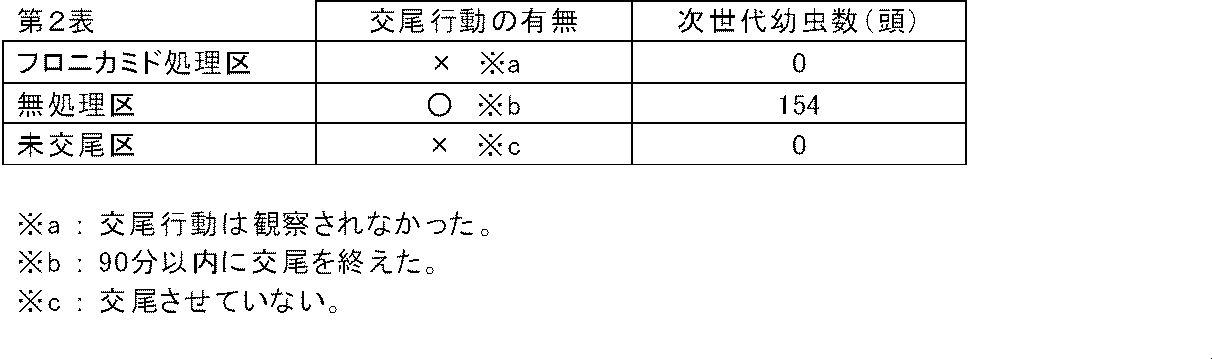
- Test Example 2 Mating behavior disturbing action against a brown planthopper 10 seeds of rice were sown on 40 mm ⁇ 40 mm absorbent cotton to prepare a rice seedling having a height of about 5 cm. Rice seedlings were immersed in an aqueous solution containing 200 ppm of the active ingredient flonicamid, air-dried, and placed in a glass vial (inner diameter 40 mm ⁇ height 75 mm; capacity 50 ml). An adult non-mating leafhopper ( Nilaparvata lugens ) raised from the age of the old larvae was bred with drug-untreated rice seedlings. From the 6th day after emergence, the animals were bred on immersion-treated rice for 24 hours.
- next-generation larvae was measured by comparing the number of newly born next-generation larvae in immersion-treated rice seedlings (flonicamide treated group) and drug-untreated rice seedlings (untreated group). Moreover, when one male and one female were put together, they were observed for 2 hours to confirm the presence or absence of mating behavior. In order to confirm that no next-generation larvae were generated in an unmated state, an unmated female was bred alone in an untreated group, and the number of next-generation larvae was measured (unmated group). The results are shown in Table 2.
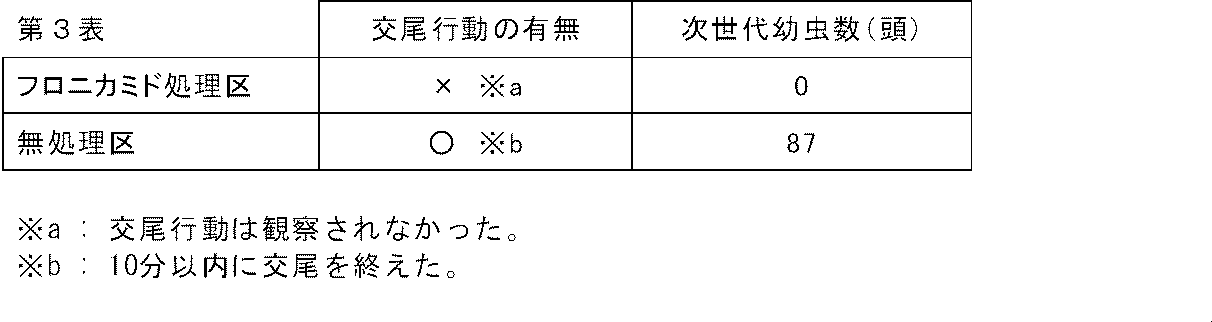
- Test Example 3 Mating behavior disruptive effect on a brown planthopper line that is less sensitive to neonicotinoid insecticides
- the testimony of the planthopper of Test Example 2 is less sensitive to the common name imidacloprid, a typical neonicotinoid insecticide
- the same test was conducted in place of the brown planthopper, and the number of next-generation larvae was measured in comparison with the flonicamid treated group and the untreated group. The results are shown in Table 3.
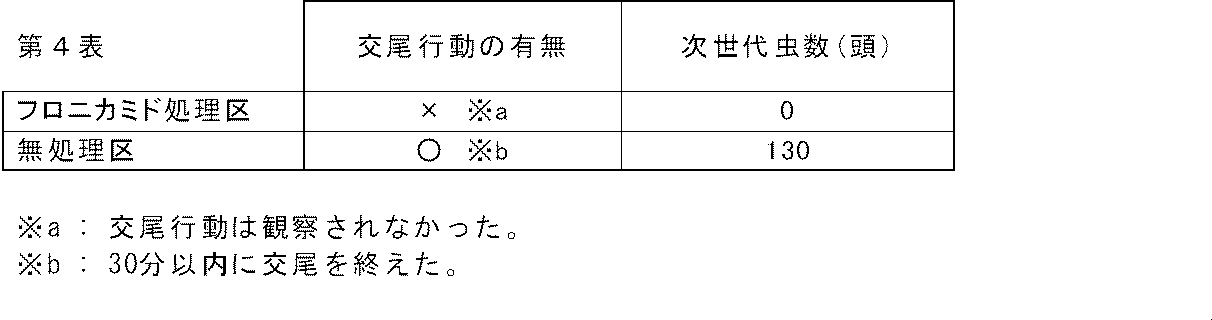
- Test example 4 Disrupting effect of mating behavior on white- spotted plant
- the white- spotted planthopper in Test example 2 was replaced with a white- spotted planthopper ( Sogatella furcifera ), and the same test was conducted. Was measured. The results are shown in Table 4.
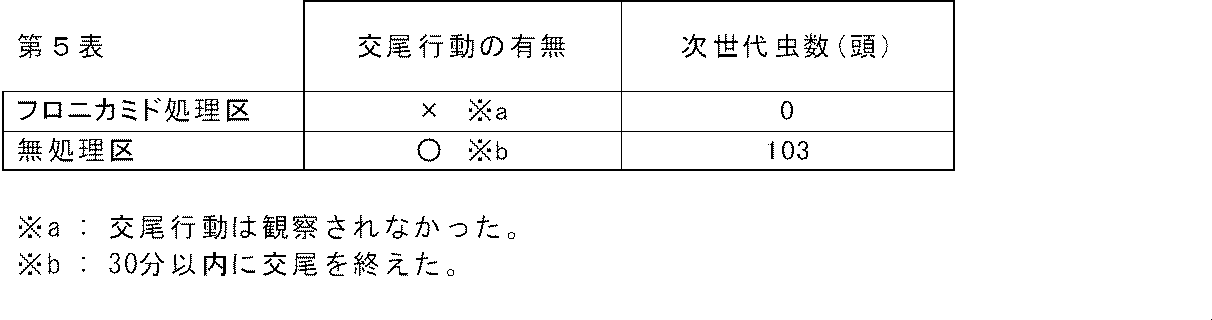
- Test Example 5 Mating behavior disruption effect on Japanese brown planthopper
- the Japanese brown planthopper of Test Example 2 was replaced with Japanese brown planthopper ( Laodelphax striatella ), and the same test was carried out.
- the number of next-generation larvae compared with the flonicamid treated group and the untreated group was measured. The results are shown in Table 5.
- Test Example 6 Disturbance of mating behavior against brown planthopper A rice seedling was tested according to Test Example 2 except that it was treated with an aqueous solution containing the active ingredients flonicamid 50, 12.5, 3.1 and 0.8 ppm. It was. Table 6 shows the results of measuring the number of generations of next-generation larvae in comparison with the flonicamid-treated group and the non-treated group.
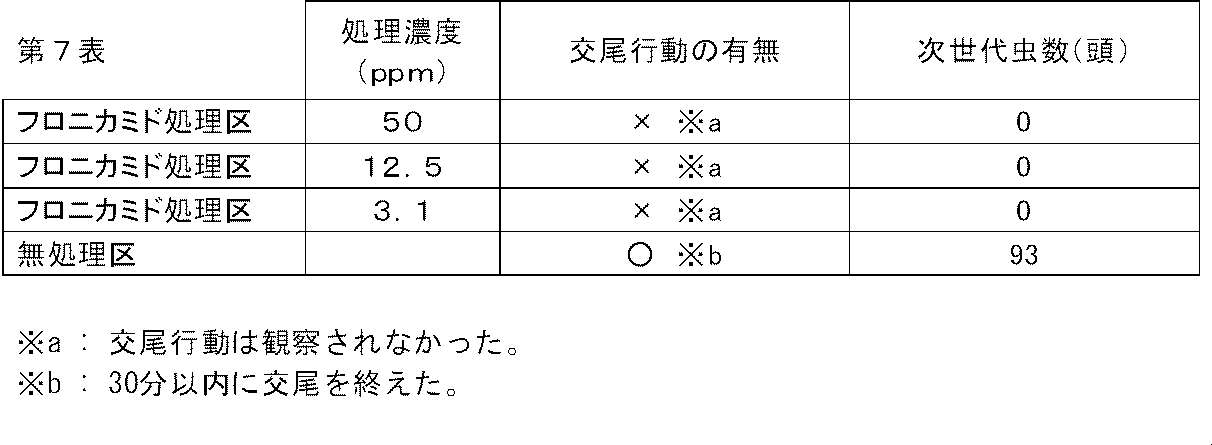
- Test Example 7 Mating Action Disturbing Action on White-Spotted Plant A rice seedling was tested according to Test Example 4 except that it was treated with an aqueous solution containing the active ingredients flonicamid 50, 12.5 and 3.1 ppm. Table 7 shows the results of measuring the number of generations of next-generation larvae in comparison with the flonicamid-treated group and the untreated group.
- Test Example 8 Mating Behavior Disturbing Action for Brown Bean Spike A test was conducted according to Test Example 5 except that rice seedlings were treated with an aqueous solution containing the active ingredients flonicamid 50, 12.5, and 3.1 ppm. Table 8 shows the results of measuring the number of generations of next-generation larvae in comparison with the flonicamid-treated group and the non-treated group.
- Test Example 9 Mating behavior disturbing action against a brown planthopper line that is less sensitive to neonicotinoid insecticides Tested according to Test Example 3 except that rice seedlings were treated with an aqueous solution containing 0.8 ppm of the active ingredient flonicamid Went. Table 9 shows the results of measuring the number of generations of next-generation larvae in comparison with the flonicamid-treated group and the non-treated group.
- Test Example 10 Mating behavior disturbing action against leafhopper leafhopper
- leafhopper leafhopper Nephotettix cincticeps
- rice seedlings were treated with flonicamid treated with an aqueous solution containing the active ingredient flonicamid 200, 50 ppm.
- the number of next-generation larvae was measured in comparison with the ward and the untreated ward. The results are shown in Table 10.
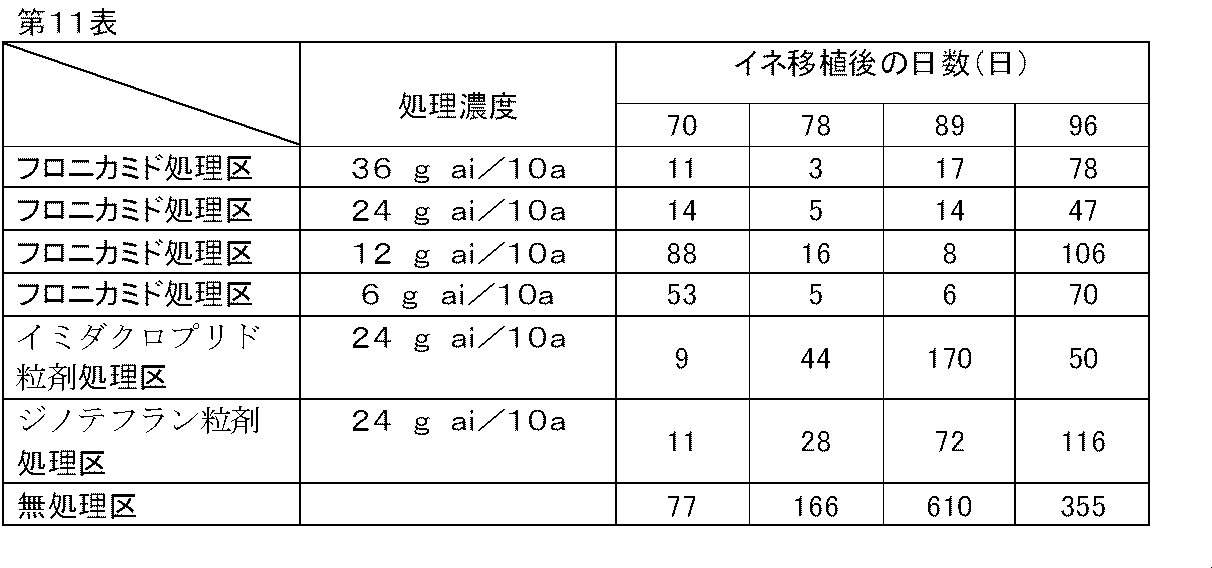
- Test Example 11 Control effect against brown planthopper by treatment with flonicamid nursery box A pest control composition prepared according to Formulation Example 2 in a ratio of 6, 12, 24 and 36 g ai / box in a 30 cm ⁇ 60 cm nursery box Processed. Untreated zone and dinotefuran granule (trade name: Starkle box granule, manufactured by Mitsui Chemicals Agro) Treatment zone (24 g ai / box) and imidacloprid granule (trade name: Admeier box granule, manufactured by Bayer CropScience) A treatment zone (24 g ai / box) was installed.
- FIG. 2 shows a graph of the flonicamid-treated section as a representative example of the 24 g ai / 10a flonicamid-treated section.
- ⁇ - ⁇ black circle
- ⁇ - ⁇ white square mark
- xx x mark
- the present invention is particularly useful in the situation of controlling rice parasitic sap pests where there is a demand to suppress the increase in the number of insect pests as long as possible after the chemical treatment.
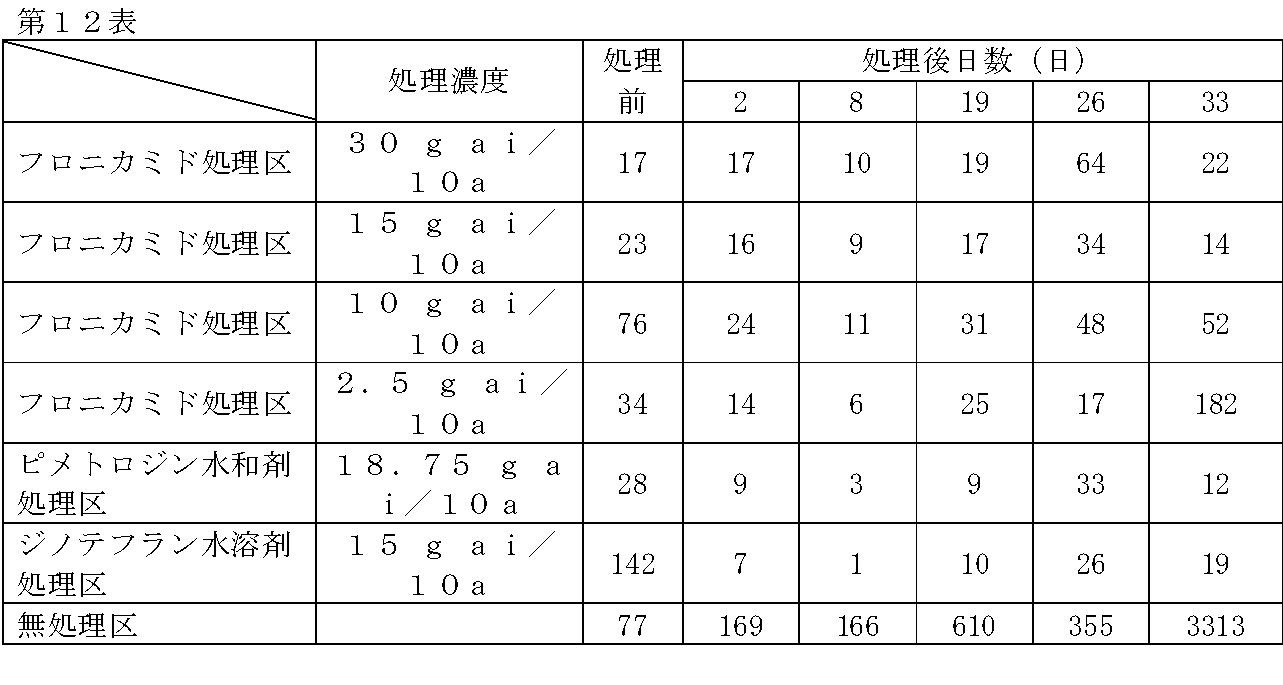
- Test Example 12 Control effect against brown planthopper by treatment with flonicamid stalks and leaves The plant was transplanted to a field of 32 m 2 in 1 ward by a rice planting machine. 36, 43, 51, 57, and 65 days after transplantation, 500 adults of brown planthopper and 12,000 eggs were released on 100 m 2 of the field. 70 days after transplantation, flonicamid was treated with foliacamide at a heading period with a spraying amount of 150 L / 10a.
- the present invention can be used for controlling planthoppers that are sucking pests that are regarded as major pests in the field of rice cultivation. It should be noted that the entire contents of the specification, claims, drawings and abstract of Japanese Patent Application 2010-170936 filed on July 29, 2010 are cited herein as disclosure of the specification of the present invention. Incorporated.
Landscapes
- Life Sciences & Earth Sciences (AREA)
- General Health & Medical Sciences (AREA)
- Health & Medical Sciences (AREA)
- Wood Science & Technology (AREA)
- Pest Control & Pesticides (AREA)
- Plant Pathology (AREA)
- Engineering & Computer Science (AREA)
- Dentistry (AREA)
- Agronomy & Crop Science (AREA)
- Zoology (AREA)
- Environmental Sciences (AREA)
- Toxicology (AREA)
- Agricultural Chemicals And Associated Chemicals (AREA)
Abstract
Description
トビイロウンカはベトナム以北の地域では越冬できない。例えば日本では、主に6月下旬~7月の梅雨期に海外から下層ジェット気流に乗って飛来してくる長翅型成虫が発生源となる。飛来密度は、同じく海外飛来性のセジロウンカに比べてかなり低く、飛来した時点での寄生密度では大きな問題は引き起こさない。
しかし、飛来後、雌成虫は約4日間の産卵前期間を経てイネ葉鞘の組織内に産卵し、25℃では卵期間7~9日、幼虫期間14日を経て次世代(第1世代)成虫となる。第1世代の雌成虫は増殖率の高い短翅型となることが多い。短翅型雌はあまり移動せず、産卵数も多いため、第2世代個体群は局所的に、しかも幾何級数的に密度が高くなり、第2世代又は第3世代の発生時期に、坪枯れを引き起こす。
また、トビイロウンカが越冬できるベトナム以南の東南アジア諸国においても、上記のような、局所的な増殖及び坪枯れによる甚大な被害が生じることは同様である。
さらに、現状では、トビイロウンカの卵に対して有効で、且つ環境及び益虫に対する安全性を有する農薬は見出されていない。
このようなことから、本発明者らは、トビイロウンカの被害を防ぐ方法を見出すべく、飛来成虫及び第1世代成虫に産卵させないこと、産卵させにくくすること及び卵が孵化しないようにすることなど、害虫の次世代個体数や密度を低下させることに着目した。
即ち、本発明は、フロニカミドを吸汁害虫に作用させることにより、吸汁害虫を防除する方法、吸汁害虫の次世代個体数を低下させる方法及び吸汁害虫の交尾行動をかく乱する方法に関する。
また、本発明は、フロニカミドの単純な殺有害生物剤としての使用とは一線を画す、害虫の次世代個体数を低下させるという全く予期されなかった効果を奏するものである。例えば、育苗箱処理を行った場合、従来用いられてきた防除剤では、長期間の残効が期待できないため散布剤を複数回処理する必要があるが、本発明の方法においては、少なくとも、散布剤処理の回数を軽減することが可能である。本発明が開示する「害虫の次世代個体数を低下させる」という全く予期されなかった効果を応用し、例えば育苗箱処理に適用した場合、通常所望される十分な長期間に亘って吸汁害虫防除効果が発揮される。
ウンカ類はトビイロウンカ、セジロウンカ、ヒメトビウンカ等が挙げられ、ヨコバイ類はツマグロヨコバイ等が挙げられ、カメムシ類はアカスジカスミカメ、アカヒゲホソミドリカスミカメ等が挙げられる。
本発明において前記吸汁害虫は、好ましくはウンカ類及びヨコバイ類が挙げられる。より好ましくはウンカ類が挙げられる。
更に好ましくはトビイロウンカが挙げられる。
本発明の防除対象である前記吸汁害虫には、ネオニコチノイド系殺虫剤に感受性が低下した吸汁害虫が挙げられる。
本発明の効果を発揮させるために適した育苗箱処理用の粒剤としては、フロニカミドと難水溶性樹脂を含有する組成物で、製剤中でフロニカミドと難水溶性樹脂がマトリックス、即ちフロニカミドが難水溶性樹脂に取り込まれた組成物を形成していることを特徴とする組成物が挙げられ、以下に詳述する。
本発明で使用するフロニカミドの平均粒子径は、1~500μm、望ましくは1~100μm、更に望ましくは5~50μmである。
本発明で使用することのできる難水溶性樹脂としては、エチレン・酢酸ビニル共重合体、エチレン・アクリル酸共重合体、エチレン・ベオバ共重合体、スチレン・アクリル酸共重合体、アクリル酸エステル、アクリル・シリコン共重合体、酸化ポリエチレン、ウレタン樹脂、石油樹脂などを挙げることができる。難水溶性樹脂はエマルションとして使用することが望ましく、特に、エチレン・アクリル酸共重合体エマルションが望ましい。エチレン・アクリル酸共重合体エマルションとしては、例えば、HYTEC S-3111、HYTEC S-3121、HYTEC S-3127(東邦化学工業社製)などが挙げられる。これらの樹脂エマルションは単独で使用されるのみならず混合して使用することもできる。配合量については固形分で0.1~30重量%、好ましくは1~15重量%である。
本発明に使用する担体としては、特に限定されないが、例えば、クレー、ベントナイト、タルク、炭酸カルシウム、ジークライト、セリサイト、酸性白土、珪藻土、ゼオライト、パーライト、アタパルジャイトなどの担体を使用することができる。配合量については、特に制限されないが、40~99.8重量%、好ましくは60~98.5重量%の範囲内である。
前記組成物は、難水溶性樹脂を使用するため水とのなじみが悪く、本田移植後に薬剤が浮遊することがあるため、湿潤剤を添加することが望ましい。湿潤剤としては、ジオクチルスルホコハク酸ナトリウム、アルキルベンゼンスルホン酸ナトリウム、高級アルコール硫酸エステル、アルキルナフタレンスルホン酸ナトリウム、ポリオキシエチレンフェニルエーテルサルフェート、ポリオキシエチレンスチリルフェニルエーテルサルフェート、ポリオキシエチレンアルキルエーテルなどが挙げられ、望ましくは、ポリオキシエチレンスチリルフェニルエーテルサルフェートが挙げられる。これらの湿潤剤は単独で使用されるのみならず混合して使用することもできる。湿潤剤を使用する場合、配合量については特に制限されないが、0.01~10重量%、好ましくは0.1~5重量%である。
前記組成物は、農薬の製造において通常用いられる造粒法、例えば、押し出し造粒法、転動造粒法、転動流動造粒法、流動層造粒法、圧縮造粒法、攪拌混合造粒法、被覆造粒法、打錠法などにより調製することができる。
例えば、フロニカミド、湿潤剤及び担体を均一に混合した後、難水溶性樹脂エマルションを加えてニーダーなどで混練し、ドームグランなど押出し造粒機により造粒し、乾燥、整粒することにより前記組成物を得ることができる。
また、前記組成物は、所望により溶出速度を更に制御するため、パラフィン等の溶出制御剤を添加することができる。
前記組成物には、以上述べた成分以外に、任意成分として、例えば、本発明の農薬製剤中で農薬活性成分を安定に保つ目的および/または造粒する際の造粒性などを向上させる目的で、必要に応じて、界面活性剤、補助剤などを含有せしめることができる。
カルバリル(carbaryl)、プロポキスル(propoxur)、アルジカルブ(aldicarb)、カルボフラン(carbofuran)、チオジカルブ(thiodicarb)、メソミル(methomyl)、オキサミル(oxamyl)、エチオフェンカルブ(ethiofencarb)、ピリミカルブ(pirimicarb)、フェノブカルブ(fenobucarb)、カルボスルファン(carbosulfan)、ベンフラカルブ(benfuracarb)、ベンダイオカルブ(bendiocarb)、フラチオカルブ(furathiocab)、イソプロカルブ(isoprocarb)、メトルカルブ(metolcarb)、キシリルカルブ(xylylcarb)、XMC、フェノチオカルブ(fenothiocarb)のようなカーバメート系化合物;
カルタップ(cartap)、チオシクラム(thiocyclam)、ベンスルタップ(bensultap)、チオスルタップナトリウム(thiosultap-sodium)、モノスルタップ(monosultap)、ビスルタップ(bisultap)、シュウ酸水素チオシクラム(thiocyclam hydrogen oxalate)のようなネライストキシン誘導体;
ジコホル(dicofol)、テトラジホン(tetradifon)、エンドスルファン(endosulfan)、ジエノクロル(dienochlor)、ディルドリン(dieldrin)のような有機塩素系化合物;
酸化フェンブタスズ(fenbutatin oxide)、シヘキサチン(cyhexatin)のような有機金属系化合物;
フェンバレレート(fenvalerate)、ペルメトリン(permethrin)、シペルメトリン(cypermethrin)、デルタメトリン(deltamethrin)、シハロトリン(cyhalothrin)、テフルトリン(tefluthrin)、エトフェンプロックス(ethofenprox)、フルフェンプロックス(flufenprox)、シフルトリン(cyfluthrin)、フェンプロパトリン(fenpropathrin)、フルシトリネート(flucythrinate)、フルバリネート(fluvalinate)、シクロプロトリン(cycloprothrin)、ラムダシハロトリン(lambda-cyhalothrin)、ピレスリン(pyrethrins)、エスフェンバレレート(esfenvalerate)、テトラメスリン(tetramethrin)、レスメスリン(resmethrin)、プロトリフェンブト(protrifenbute)、ビフェントリン(bifenthrin)、ゼータシペルメトリン(zeta-cypermethrin)、アクリナトリン(acrinathrin)、アルファシペルメトリン(alpha-cypermethrin)、アレスリン(allethrin)、ガンマシハロトリン(gamma-cyhalothrin)、シータシペルメトリン(theta-cypermethrin)、タウフルバリネート(tau-fluvalinate)、トラロメスリン(tralomethrin)、プロフルスリン(profluthrin)、ベータシペルメトリン(beta-cypermethrin)、ベータシフルトリン(beta-cyfluthrin)、メトフルトリン(metofluthrin)、フェノトリン(phenothrin)、フルメトリン(flumethrin)、デカメトリン(decamethrin)のようなピレスロイド系化合物;
ジフルベンズロン(diflubenzuron)、クロルフルアズロン(chlorfluazuron)、テフルベンズロン(teflubenzuron)、フルフェノクスロン(flufenoxuron)、トリフルムロン(triflumuron)、ヘキサフルムロン(hexaflumuron)、ルフェヌロン(lufenuron)、ノバルロン(novaluron)、ノビフルムロン(noviflumuron)、ビストリフルロン(bistrifluron)、フルアズロン(fluazuron)のようなベンゾイルウレア系化合物;
メトプレン(methoprene)、ピリプロキシフェン(pyriproxyfen)、フェノキシカルブ(fenoxycarb)、ジオフェノラン(diofenolan)のような幼若ホルモン様化合物;
ピリダベン(pyridaben)のようなピリダジノン系化合物;
フェンピロキシメート(fenpyroximate)、フィプロニル(fipronil)、テブフェンピラド(tebufenpyrad)、エチプロール(ethiprole)、トルフェンピラド(tolfenpyrad)、アセトプロール(acetoprole)、ピラフルプロール(pyrafluprole)、ピリプロール(pyriprole)のようなピラゾール系化合物;
イミダクロプリド(imidacloprid)、ニテンピラム(nitenpyram)、アセタミプリド(acetamiprid)、チアクロプリド(thiacloprid)、チアメトキサム(thiamethoxam)、クロチアニジン(clothianidin)、ニジノテフラン(nidinotefuran)、ジノテフラン(dinotefuran)、ニチアジン(nithiazine)等のネオニコチノイド;
テブフェノジド(tebufenozide)、メトキシフェノジド(methoxyfenozide)、クロマフェノジド(chromafenozide)、ハロフェノジド(halofenozide)等のヒドラジン系化合物;
スピロディクロフェン(spirodiclofen)等のようなテトロニック酸系化合物;
フルアクリピリム(fluacrypyrin)等のようなストロビルリン系化合物;
フルフェネリム(flufenerim)等のようなピリジナミン系化合物;
ジニトロ系化合物、有機硫黄化合物、尿素系化合物、トリアジン系化合物、ヒドラゾン系化合物、また、その他の化合物として、ブプロフェジン(buprofezin)、ヘキシチアゾクス(hexythiazox)、アミトラズ(amitraz)、クロルジメホルム(chlordimeform)、シラフルオフェン(silafluofen)、トリアザメイト(triazamate)、ピメトロジン(pymetrozine)、ピリミジフェン(pyrimidifen)、クロルフェナピル(chlorfenapyr)、インドキサカルブ(indoxacarb)、アセキノシル(acequinocyl)、エトキサゾール(etoxazole)、シロマジン(cyromazine)、1,3-ジクロロプロペン(1,3-dichloropropene)、ジアフェンチウロン(diafenthiuron)、ベンクロチアズ(benclothiaz)、ビフェナゼート(bifenazate)、スピロメシフェン(spiromesifen)、スピロテトラマット(spirotetramat)、プロパルギット(propargite)、クロフェンテジン(clofentezine)、メタフルミゾン(metaflumizone)、3-ブロモ-N-(2-ブロモ-4-クロロ-6-(1-シクロプロピルエチルカルバモイル)フェニル)-1-(3-クロロピリジン-2-イル)-1H-ピラゾール-5-カルボキサミド、3-ブロモ-N-(4-クロロ-2-(1-シクロプロピルエチルカルバモイル)-6-メチルフェニル)-1-(3-クロロピリジン-2-イル)-1H-ピラゾール-5-カルボキサミド、3-ブロモ-N-(2-ブロモ-4-クロロ-6-(シクロプロピルメチルカルバモイル)フェニル)-1-(3-クロロピリジン-2-イル)-1H-ピラゾール-5-カルボキサミド、フルベンジアミド(flubendiamide)、シフルメトフェン(cyflumetofen)、クロラントラニリプロール(chlorantraniliprole)、シアントラニリプロール(Cyantraniliprole)、シエノピラフェン(cyenopyrafen)、ピリフルキナゾン(pyrifluquinazone)、フェナザキン(fenazaquin)、アミドフルメット(amidoflumet)、クロロベンゾエート(chlorobenzoate)、スルフルアミド(sulfluramid)、ヒドラメチルノン(hydramethylnon)、メタアルデヒド(metaldehyde)、HGW-86、AKD‐1022、リアノジン(ryanodine)、ピリダリル(pyridalyl)、ベルブチン(verbutin)、チアゾリルシナノニトリル(thiazolylcinnanonitrile)のような化合物;等が挙げられる。更に、Bacillus thuringienses aizawai、Bacillus thuringienses kurstaki、Bacillus thuringienses israelensis、Bacillus thuringienses japonensis、Bacillus thuringienses tenebrionis、Bacillus thuringiensesが生成する結晶タンパク毒素、昆虫病原ウイルス剤、昆虫病原糸状菌剤、線虫病原糸状菌剤等のような微生物農薬、アベルメクチン(avermectin)、エマメクチンベンゾエート(emamectin Benzoate)、ミルベメクチン(milbemectin)、ミルベマイシン(milbemycin)、スピノサッド(spinosad)、イベルメクチン(ivermectin)、レピメクチン(lepimectin)、DE-175、アバメクチン(abamectin)、エマメクチン(emamectin)、スピネトラム(spinetoram)のような抗生物質及び半合成抗生物質;アザディラクチン(azadirachtin)、ロテノン(rotenone)のような天然物;ディート(deet)のような忌避剤;等と、混用、併用することもできる。
5-クロロ-7-(4-メチルピペリジン-1-イル)-6-(2,4,6-トリフルオロフェニル)[1,2,4]トリアゾロ[1,5-a]ピリミジンのようなトリアゾロピリミジン系化合物;
フルアジナム(fluazinam)のようなピリジナミン系化合物;
トリアジメホン(triadimefon)、ビテルタノール(bitertanol)、トリフルミゾール(triflumizole)、エタコナゾール(etaconazole)、プロピコナゾール(propiconazole)、ペンコナゾール(penconazole)、フルシラゾール(flusilazole)、マイクロブタニル(myclobutanil)、シプロコナゾール(cyproconazole)、テブコナゾール(tebuconazole)、ヘキサコナゾール(hexaconazole)、ファーコナゾールシス(furconazole‐cis)、プロクロラズ(prochloraz)、メトコナゾール(metconazole)、エポキシコナゾール(epoxiconazole)、テトラコナゾール(tetraconazole)、オキスポコナゾールフマル酸塩(oxpoconazole fumarate)、シプコナゾール(sipconazole)、プロチオコナゾール(prothioconazole)、トリアジメノール(triadimenol)、フルトリアホール(flutriafol)、ジフェノコナゾール(difenoconazole)、フルキンコナゾール(fluquinconazole)、フェンブコナゾール(fenbuconazole)、ブロムコナゾール(bromuconazole)、ジニコナゾール(diniconazole)、トリシクラゾール(tricyclazole)、プロベナゾール(probenazole)、シメコナゾール(simeconazole)、ペフラゾエート(pefurazoate)、イプコナゾール(ipconazole)、イミベンコナゾール(imibenconazole)のようなアゾール系化合物;
キノメチオネート(quinomethionate)のようなキノキサリン系化合物;
マンネブ(maneb)、ジネブ(zineb)、マンゼブ(mancozeb)、ポリカーバメート(polycarbamate)、メチラム(metiram)、プロピネブ(propineb)、チラム(thiram)のようなジチオカーバメート系化合物;
フサライド(fthalide)、クロロタロニル(chlorothalonil)、キントゼン(quintozene)のような有機塩素系化合物;
ベノミル(benomyl)、チオファネートメチル(thiophanate‐methyl)、カーベンダジム(carbendazim)、チアベンダゾール(thiabendazole)、フベリアゾール(fuberiazole)のようなイミダゾール系化合物;
シモキサニル(cymoxanil)のようなシアノアセトアミド系化合物;
メタラキシル(metalaxyl)、メタラキシル-M(metalaxyl-M)、メフェノキサム(mefenoxam)、オキサジキシル(oxadixyl)、オフレース(ofurace)、ベナラキシル(benalaxyl)、ベナラキシル-M(benalaxyl-M、別名キララキシル(kiralaxyl、chiralaxyl))、フララキシル(furalaxyl)、シプロフラム(cyprofuram)、カルボキシン(carboxin)、オキシカルボキシン(oxycarboxin)、チフルザミド(thifluzamide)、ボスカリド(boscalid)、ビキサフェン(bixafen)、イソチアニル(isotianil)、チアジニル(tiadinil)、セダキサン(sedaxane)のようなアニリド系化合物;
ジクロフルアニド(dichlofluanid)のようなスルファミド系化合物;
水酸化第二銅(cupric hydroxide)、有機銅(oxine copper)のような銅系化合物;
ヒメキサゾール(hymexazol)のようなイソキサゾール系化合物;
ホセチルアルミニウム(fosetyl‐Al)、トルクロホスメチル(tolclofos‐Methyl)、S-ベンジル O,O-ジイソプロピルホスホロチオエート、O-エチル S,S-ジフェニルホスホロジチオエート、アルミニウムエチルハイドロゲンホスホネート、エジフェンホス(edifenphos)、イプロベンホス(iprobenfos)のような有機リン系化合物;
キャプタン(captan)、キャプタホル(captafol)、フォルペット(folpet)のようなフタルイミド系化合物;
プロシミドン(procymidone)、イプロジオン(iprodione)、ビンクロゾリン(vinclozolin)のようなジカルボキシイミド系化合物;
フルトラニル(flutolanil)、メプロニル(mepronil)のようなベンズアニリド系化合物;
ペンチオピラド(penthiopyrad)、3-(ジフロロメチル)-1-メチル-N-[(1RS,4SR,9RS)-1,2,3,4-テトラヒドロ-9-イソプロピル-1,4-メタノナフタレン-5-イル]ピラゾール-4-カルボキサミドと3-(ジフロロメチル)-1-メチル-N-[(1RS,4SR,9SR)-1,2,3,4-テトラヒドロ-9-イソプロピル-1,4-メタノナフタレン-5-イル]ピラゾール-4-カルボキサミドの混合物(イソピラザム(isopyrazam))、シルチオファム(silthiopham)、フェノキサニル(fenoxanil)、フラメトピル(furametpyr)のようなアミド系化合物;
フルオピラム(fluopyram)、ゾキサミド(zoxamide)のようなベンズアミド系化合物;
トリホリン(triforine)のようなピペラジン系化合物;
フロニカミド(flonicamid)、ピリフェノックス(pyrifenox)のようなピリジン系化合物;
フェナリモル(fenarimol)のようなカルビノール系化合物;
フェンプロピディン(fenpropidin)のようなピペリジン系化合物;
フェンプロピモルフ(fenpropimorph)、トリデモルフ(tridemorph)のようなモルフォリン系化合物;
フェンチンヒドロキシド(fentin hydroxide)、フェンチンアセテート(fentin acetate)のような有機スズ系化合物;
ペンシキュロン(pencycuron)のような尿素系化合物;
ジメトモルフ(dimethomorph)、フルモルフ(flumorph)のようなシンナミック酸系化合物;
ジエトフェンカルブ(diethofencarb)のようなフェニルカーバメート系化合物;
フルジオキソニル(fludioxonil)、フェンピクロニル(fenpiclonil)のようなシアノピロール系化合物;
アゾキシストロビン(azoxystrobin)、クレソキシムメチル(kresoxim‐methyl)、メトミノストロビン(metominostrobin)、トリフロキシストロビン(trifloxystrobin)、ピコキシストロビン(picoxystrobin)、オリザストロビン(oryzastrobin)、ジモキシストロビン(dimoxystrobin)、ピラクロストロビン(pyraclostrobin)、フルオキサストロビン(fluoxastrobin)のようなストロビルリン系化合物;
ファモキサドン(famoxadone)のようなオキサゾリジノン系化合物;
エタボキサム(ethaboxam)のようなチアゾールカルボキサミド系化合物;
イプロバリカルブ(iprovalicarb)、ベンチアバリカルブ-イソプロピル(benthiavalicarb-isopropyl)のようなバリンアミド系化合物;
メチル N-(イソプロポキシカルボニル)-L-バリル-(3RS)-3-(4-クロロフェニル)-β-アラニナート(valiphenalate)のようなアシルアミノアシッド系化合物;
フェナミドン(fenamidone)のようなイミダゾリノン系化合物;
フェンヘキサミド(fenhexamid)のようなハイドロキシアニリド系化合物;
フルスルファミド(flusulfamide)のようなベンゼンスルホンアミド系化合物;
シフルフェナミド(cyflufenamid)のようなオキシムエーテル系化合物;
アトラキノン系化合物;
クロトン酸系化合物;
バリダマイシン(validamycin)、カスガマイシン(kasugamycin)、ポリオキシン(polyoxins)のような抗生物質;
イミノクタジン(iminoctadine)、ドディン(dodine)のようなグアニジン系化合物;
6-ターシャリーブチル-8-フルオロ-2,3-ジメチルキノリン-4-イル アセテート(テブフロキン(tebufloquin))のようなキノリン系化合物;
(Z)-2-(2-フルオロ-5-(トリフルオロメチル)フェニルチオ)-2-(3-(2-メトキシフェニル)チアゾリジン-2-イリデン)アセトニトリル(フルチアニル(flutianil))のようなチアゾリジン系化合物;
その他の化合物として、ピリベンカルブ(pyribencarb)、イソプロチオラン(isoprothiolane)、ピロキロン(pyroquilon)、ジクロメジン(diclomezine)、キノキシフェン(quinoxyfen)、プロパモカルブ塩酸塩(propamocarb hydrochloride)クロルピクリン(chloropicrin)、ダゾメット(dazomet)、メタムナトリウム塩(metam‐sodium)、ニコビフェン(nicobifen)、メトラフェノン(metrafenone)、UBF-307、ジクロシメット(diclocymet)、プロキンアジド(proquinazid)、アミスルブロム(amisulbrom;別名アミブロドール(amibromdole))、3-(2,3,4-トリメトキシ-6-メチルベンゾイル)-5-クロロ-2-メトキシ-4-メチルピリジン、4-(2,3,4-トリメトキシ-6-メチルベンゾイル)-2,5-ジクロロ-3-トリフルオロメチルピリジン、ピリオフェノン(pyriofenone)、マンジプロパミド(mandipropamid)、フルオピコリド(fluopicolide)、カルプロパミド(carpropamid)、メプチルジノキャップ(meptyldinocap)、N-[(3', 4'-ジクロロ-1,1-ジメチル)フェナシル]-3-トリフルオロメチル-2-ピリジンカルボキサミド、N-[(3', 4'-ジクロロ-1,1-ジメチル)フェナシル]-3-メチル-2-チオフェンカルボキサミド、N-[(3', 4'-ジクロロ-1,1-ジメチル)フェナシル]-1-メチル-3-トリフルオロメチル-4-ピラゾールカルボキサミド、N-[[2'-メチル-4'-(2-プロピルオキシ)-1,1-ジメチル]フェナシル]-3-トリフルオロメチル-2-ピリジンカルボキサミド、N-[[2'-メチル-4'-(2-プロピルオキシ)-1,1-ジメチル]フェナシル]-3-メチル-2-チオフェンカルボキサミド、N-[[2'-メチル-4'-(2-プロピルオキシ)-1,1-ジメチル]フェナシル]-1-メチル-3-トリフルオロメチル-4-ピラゾールカルボキサミド、N-[[4'-(2-プロピルオキシ)-1,1-ジメチル]フェナシル]-3-トリフルオロメチル-2-ピリジンカルボキサミド、N-[[4'-(2-プロピルオキシ)-1,1-ジメチル]フェナシル]-3-メチル-2-チオフェンカルボキサミド、N-[[4'-(2-プロピルオキシ)-1,1-ジメチル]フェナシル]-1-メチル-3-トリフルオロメチル-4-ピラゾールカルボキサミド、N-[[2'-メチル-4'-(2-ペンチルオキシ)-1,1-ジメチル]フェナシル]-3-トリフルオロメチル-2-ピリジンカルボキサミド、N-[[4'-(2-ペンチルオキシ)-1,1-ジメチル]フェナシル]-3-トリフルオロメチル-2-ピリジンカルボキサミド、フェリムゾン(ferimzone)、スピロキサミン(spiroxamine)、S-2188(fenpyrazamine)、S-2200、ZF-9646、BCF-051、BCM-061、BCM-062等が挙げられる。
フロニカミドの有効濃度としては、0.05~7,000ppmであり、望ましくは0.5~700ppmであり、より望ましくは0.5~350ppmであり、更に望ましくは0.8~200ppmである。
(1)フロニカミドを有効成分として含有するイネ寄生吸汁害虫の交尾行動かく乱剤。
(2)該害虫が、ウンカ類及びヨコバイ類からなる群より選ばれる少なくとも1種である、(1)に記載された交尾行動かく乱剤。
(3)該害虫が、ウンカ類である、(1)に記載された交尾行動かく乱剤。
(4)フロニカミドを有効成分として含有するイネ寄生吸汁害虫の交尾行動かく乱剤を処理して、該害虫を防除する方法。
(5)フロニカミドを有効成分として含有するイネ寄生吸汁害虫の交尾行動かく乱剤を処理して、該害虫の交尾行動をかく乱する方法。
(6)さらに該害虫の次世代個体数を抑制する、(5)に記載された方法。
(7)さらに該害虫の次世代個体数を抑制し、イネを該害虫から保護する、(5)に記載された方法。
(8)フロニカミドの有効成分量が0.1~24,000 g/haで処理される、(5)に記載された方法。
(9)該処理が土壌処理である、(5)に記載された方法。
(10)該交尾行動かく乱剤を水田内に処理する、(5)に記載された方法。
(11)該交尾行動かく乱剤を育苗箱内に処理する、(5)に記載された方法。
(12)フロニカミドを水田内に、0.1~10,000g/haの処理量で散布処理して該害虫を防除する、(5)に記載された方法。
(13)フロニカミドを水田内に、5~1,000g/haの処理量で水面処理して該害虫を防除する、(5)に記載された方法。
(14)フロニカミドを育苗箱内に、0.001~100g/箱の処理量で処理して該害虫を防除する、(5)に記載された方法。
(15)(11)に記載の方法に用いる、フロニカミドと難水溶性樹脂とを含有する有害生物防除用組成物。
(16)製剤中でフロニカミドと難水溶性樹脂がマトリックスを形成していることを特徴とする(15)に記載の有害生物防除用組成物。
(17)難水溶性樹脂が、エチレン・アクリル酸共重合体である、(15)~(16)に記載の組成物。
(18)湿潤剤をさらに含有する、(15)~(17)に記載の組成物。
(19)フロニカミドの平均粒子径が1~100μmである、(15)~(17)に記載の組成物。
(20)フロニカミドの平均粒子径が1~100μmである、(18)に記載の組成物。
(21)(15)~(17)又は(19)に記載された組成物が粒剤である、有害生物防除用組成物。
(22)(18)又は(20)に記載された組成物が粒剤である、有害生物防除用組成物。
(23)フロニカミド及びエチレン・アクリル酸共重合体を混合・混練・造粒し、乾燥する工程を有することを特徴とする(21)に記載の組成物の製造方法。
(24)フロニカミド、エチレン・アクリル酸共重合体及び湿潤剤を混合・混練・造粒し、乾燥する工程を有することを特徴とする(22)に記載の組成物の製造方法。
(25)フロニカミドと難水溶性樹脂とを含有する有害生物防除用組成物。
(26)製剤中でフロニカミドと難水溶性樹脂がマトリックスを形成していることを特徴とする(25)に記載の有害生物防除用組成物。
(27)難水溶性樹脂が、エチレン・アクリル酸共重合体である(25)~(26)に記載の組成物。
(28)湿潤剤をさらに含有する(25)~(27)に記載の有害生物防除用組成物。
(29)フロニカミドの平均粒子径が1~100μmである、(25)~(27)に記載の組成物。
(30)フロニカミドの平均粒子径が1~100μmである、(28)に記載の組成物。
(31)(25)~(27)又は(29)に記載の組成物が粒剤である、有害生物防除用組成物。
(32)(28)又は(30)に記載の組成物が粒剤である、有害生物防除用組成物。
(33)フロニカミド及びエチレン・アクリル酸共重合体を混合・混練・造粒し、乾燥する工程を有することを特徴とする(31)に記載の組成物の製造方法。
(34)フロニカミド及びエチレン・アクリル酸共重合体を混合・混練・造粒し、乾燥する工程を有することを特徴とする(32)に記載の組成物の製造方法。
製剤例1
フロニカミド1重量部、ベントナイト(豊順工業社製)20重量部、粉末炭酸カルシウム(清水工業社製)76重量部を混合した後、トキサノンGR-31A(ポリカルボン酸塩水溶液、三洋化成工業社製)3重量部、サンエキスC(リグニンスルホン酸カルシウム水溶液、日本製紙ケミカル社製)3重量部と必要量の水を加えて混練し、押し出し造粒機により造粒後、乾燥、整粒して農薬粒剤を得た。
フロニカミド2重量部、粉末炭酸カルシウム92.3重量部及びポリオキシエチレンスチリルフェニルエーテルサルフェート(ソルポール5096、東邦化学工業社製)3重量部を混合した後、エチレン・アクリル酸共重合体を27w/w%含む水性エマルション(商品名:HYTEC S-3111(東邦化学工業社製))を10重量部加え、必要量加水し混練、押し出し機により造粒後、乾燥、整粒して農薬粒剤を得た。
フロニカミド2重量部、クレー 92.3重量部及びポリオキシエチレンスチリルフェニルエーテルサルフェート(ソルポール5096、東邦化学工業社製)3重量部を混合した後、エチレン・アクリル酸共重合体を27w/w%含む水性エマルション(商品名:HYTEC S-3121(東邦化学工業社製))を10重量部加え、必要量加水し混練、押し出し機により造粒後、乾燥、整粒して農薬粒剤を得る。
1.2cm×1.2cmセル苗(3本/株)の株元に1.5mg ai/株の割合で、製剤例1に準じて調製した粒剤を育苗箱に処理した。フロニカミド処理1日後にイネをセルから土壌ごと引き抜き、1ポットに1株ずつ移植し、水深を3cmに保持した。小型温室を2つ用意し、フロニカミド処理・無処理それぞれ24ポットを各小型温室に設置した。移植10、17及び30日後にトビイロウンカ(Nilaparvata lugens)成虫各100頭/温室を放虫した。放虫後、一定期間毎にイネに寄生した、イネ24株あたりの成虫の数及び新たに生まれた次世代の幼虫の数を測定した。結果を第1表及び図1に示す。なお、図1中で、○-○(丸印)はフロニカミド処理区における成幼虫数(頭)を表し、△-△(三角印)は無処理区における成幼虫数(頭)を表す。

40mm×40mmの脱脂綿に10粒のイネを播種し、背丈約5cmとなったイネ苗を準備した。イネ苗は有効成分フロニカミド200ppmを含有する水溶液で浸漬処理し、風乾し、ガラスバイアル瓶(内径40mm×高さ75mm;容量50ml)内に入れた。老齢幼虫の時点から1頭飼育した未交尾状態のトビイロウンカ(Nilaparvata lugens)の成虫を薬剤無処理イネ苗で飼育した。羽化後6日目から24時間の間は1頭ずつ浸漬処理イネで飼育した。羽化後7日目に浸漬処理イネ上でオスメス各1頭を一緒にしてから24時間経過した後、オスを取り除き、メスは、その後羽化14日目まで産卵させ、取り除いた。新たに生まれた次世代幼虫の数を浸漬処理イネ苗(フロニカミド処理区)および薬剤無処理イネ苗(無処理区)について対比して、次世代幼虫の発生数を測定した。また、オスメス各1頭を一緒にしたとき2時間観察し、交尾行動の有無を確認した。
なお、未交尾状態で次世代幼虫の発生が無いことを確認するため、無処理区で未交尾のメスを単独で飼育し、次世代幼虫の発生数を測定した(未交尾区)。結果を第2表に示す。
試験例2のトビイロウンカを、代表的なネオニコチノイド系殺虫剤である一般名イミダクロプリドに対して感受性の低下したトビイロウンカに置き換えて、同様に試験を行い、フロニカミド処理区及び無処理区について対比して、次世代幼虫の発生数を測定した。結果を第3表に示す。
試験例2のトビイロウンカを、セジロウンカ(Sogatella furcifera)に置き換えて、同様に試験を行い、フロニカミド処理区及び無処理区について対比して、次世代幼虫の発生数を測定した。結果を第4表に示す。
試験例2のトビイロウンカを、ヒメトビウンカ(Laodelphax striatella)に置き換えて、同様に試験を行い、フロニカミド処理区及び無処理区について対比して、次世代幼虫の発生数を測定した。結果を第5表に示す。
イネ苗を、有効成分フロニカミド50、12.5、3.1及び0.8ppmを含有する水溶液で処理したこと以外は、試験例2に準じて試験を行った。フロニカミド処理区及び無処理区について対比して次世代幼虫の発生数を測定した結果を、第6表に示す。

イネ苗を、有効成分フロニカミド50、12.5及び3.1ppmを含有する水溶液で処理したこと以外は、試験例4に準じて試験を行った。フロニカミド処理区及び無処理区について対比して次世代幼虫の発生数を測定した結果を、第7表に示す。
イネ苗を、有効成分フロニカミド50、12.5及び3.1ppmを含有する水溶液で処理したこと以外は、試験例5に準じて試験を行った。フロニカミド処理区及び無処理区について対比して次世代幼虫の発生数を測定した結果を、第8表に示す。

イネ苗を、有効成分フロニカミド0.8ppmを含有する水溶液で処理したこと以外は、試験例3に準じて試験を行った。フロニカミド処理区及び無処理区について対比して、次世代幼虫の発生数を測定した結果を、第9表に示す。

試験例2のトビイロウンカを、ツマグロヨコバイ(Nephotettix cincticeps)に置き換えて、同様に試験を行い、イネ苗は有効成分フロニカミド200、50ppmを含有する水溶液で処理したフロニカミド処理区及び無処理区について対比して、次世代幼虫の発生数を測定した。結果を第10表に示す。

30cm×60cm育苗箱に6、12、24及び36g ai/箱の割合で、前記製剤例2に準じて調製した有害生物防除用組成物を育苗箱に処理した。無処理区とジノテフラン粒剤(商品名:スタークル箱粒剤、三井化学アグロ社製)処理区(24g ai/箱)及びイミダクロプリド粒剤(商品名:アドマイヤー箱粒剤、バイエルクロップサイエンス社製)処理区(24g ai/箱)を設置した。移植当日処理にフロニカミドを処理し、田植え機により1区32m2の圃場に移植した。移植36、43、51、57及び65日後に圃場100m2に対してトビイロウンカ成虫各500頭及び卵12000個を放虫した。移植78、89及び96にイネに寄生した、イネ24株あたりの成虫の数及び新たに生まれた次世代の幼虫の数を測定した。結果を第11表に示す。なお、参考として図2に、フロニカミド処理区について、24 g ai/10aフロニカミド処理区の場合を代表してグラフに表す。●-●(黒色丸印)は24 g ai/10aフロニカミド処理区における成幼虫数(頭)を表し、□-□(白色四角印)はイミダクロプリド粒剤処理区における成幼虫数(頭)を表し、△-△(白色三角印)はジノテフラン粒剤処理区における成幼虫数(頭)を表し、×-×(×印)は無処理区における成幼虫数(頭)を表す。
田植え機により1区32m2の圃場に移植した。移植36、43、51、57及び65日後に圃場100m2に対してトビイロウンカ成虫各500頭及び卵12000個を放虫した。移植70日後、出穂期にフロニカミドを150L/10aの散布水量で茎葉処理した。無処理区とピメトロジン水和剤(商品名:チェス水和剤、シンジェンタ社製)処理区及びジノテフラン水溶剤(商品名:スタークル顆粒水溶剤、三井化学アグロ社製)処理区を設置した。処理直前、処理2、8、19、26及び33日後にイネに寄生した、イネ24株あたりの成虫の数及び新たに生まれた次世代の幼虫の数を測定した。結果を第12表に示す。
なお、2010年7月29日に出願された日本特許出願2010-170936号の明細書、特許請求の範囲、図面及び要約書の全内容をここに引用し、本発明の明細書の開示として、取り入れるものである。
Claims (19)
- フロニカミドを有効成分として含有するイネ寄生吸汁害虫の交尾行動かく乱剤。
- 該害虫が、ウンカ類である、請求項1に記載された交尾行動かく乱剤。
- フロニカミドを有効成分として含有するイネ寄生吸汁害虫の交尾行動かく乱剤を処理して、該害虫を防除する方法。
- フロニカミドを有効成分として含有するイネ寄生吸汁害虫の交尾行動かく乱剤を処理して、該害虫の交尾行動をかく乱する方法。
- さらに該害虫の次世代個体数を抑制する、請求項4に記載された方法。
- さらに該害虫の次世代個体数を抑制し、イネを該害虫から保護する、請求項4に記載された方法。
- フロニカミドの有効成分量が0.1~24,000 g/haで処理される、請求項4に記載された方法。
- 該処理が土壌処理である、請求項4に記載された方法。
- 該交尾行動かく乱剤を育苗箱内に処理する、請求項4に記載された方法。
- 請求項9に記載の方法に用いる、フロニカミドと難水溶性樹脂とを含有する有害生物防除用組成物。
- 難水溶性樹脂が、エチレン・アクリル酸共重合体である請求項10に記載の組成物。
- 湿潤剤をさらに含有する、請求項10に記載の組成物。
- 湿潤剤が、ポリオキシエチレンスチリルフェニルエーテルサルフェートである請求項12に記載の組成物。
- フロニカミドの平均粒子径が1~100μmである請求項10に記載の組成物。
- 請求項10に記載の組成物が、粒剤である、有害生物防除用組成物。
- フロニカミド及びエチレン・アクリル酸共重合体を混合・混練・造粒し、乾燥する工程を有することを特徴とする請求項15に記載の組成物の製造方法。
- フロニカミドと難水溶性樹脂とを含有する有害生物防除用組成物。
- 湿潤剤をさらに含有する、請求項17に記載の有害生物防除用組成物。
- 請求項18に記載の組成物が粒剤である、有害生物防除用組成物。
Priority Applications (3)
| Application Number | Priority Date | Filing Date | Title |
|---|---|---|---|
| PH1/2013/500318A PH12013500318B1 (en) | 2010-07-29 | 2011-07-28 | Copulation disruption agent for sap-sucking pests |
| CN201180046967.8A CN103140135B (zh) | 2010-07-29 | 2011-07-28 | 吸汁害虫的交尾行动干扰剂 |
| KR1020137005007A KR101801427B1 (ko) | 2010-07-29 | 2011-07-28 | 흡즙 해충의 교미 행동 교란제 |
Applications Claiming Priority (2)
| Application Number | Priority Date | Filing Date | Title |
|---|---|---|---|
| JP2010-170936 | 2010-07-29 | ||
| JP2010170936 | 2010-07-29 |
Publications (1)
| Publication Number | Publication Date |
|---|---|
| WO2012015014A1 true WO2012015014A1 (ja) | 2012-02-02 |
Family
ID=45530214
Family Applications (1)
| Application Number | Title | Priority Date | Filing Date |
|---|---|---|---|
| PCT/JP2011/067369 Ceased WO2012015014A1 (ja) | 2010-07-29 | 2011-07-28 | 吸汁害虫の交尾行動かく乱剤 |
Country Status (7)
| Country | Link |
|---|---|
| JP (1) | JP5860626B2 (ja) |
| KR (1) | KR101801427B1 (ja) |
| CN (1) | CN103140135B (ja) |
| MY (1) | MY165281A (ja) |
| PH (1) | PH12013500318B1 (ja) |
| TW (1) | TWI501725B (ja) |
| WO (1) | WO2012015014A1 (ja) |
Cited By (2)
| Publication number | Priority date | Publication date | Assignee | Title |
|---|---|---|---|---|
| CN112239383A (zh) * | 2020-10-28 | 2021-01-19 | 中诚国联(河南)生物科技有限公司 | 一种含有呋虫胺和杀虫单的药肥颗粒剂在水稻上的应用 |
| CN118791439A (zh) * | 2024-09-14 | 2024-10-18 | 美信佳中维药业股份有限公司 | 改性甜菜碱的制备方法及包含改性甜菜碱的抗菌纤维素醚 |
Families Citing this family (2)
| Publication number | Priority date | Publication date | Assignee | Title |
|---|---|---|---|---|
| CN113812411A (zh) * | 2020-06-18 | 2021-12-21 | 江苏功成生物科技有限公司 | 一种含有氟啶虫酰胺的卫生杀虫组合物及其应用 |
| JP2023011536A (ja) * | 2021-07-12 | 2023-01-24 | バイエルクロップサイエンス株式会社 | 昆虫に対する行動抑制効果評価方法 |
Citations (5)
| Publication number | Priority date | Publication date | Assignee | Title |
|---|---|---|---|---|
| WO2008075454A1 (ja) * | 2006-12-19 | 2008-06-26 | Mitsui Chemicals, Inc. | 有害生物防除組成物 |
| WO2008075453A1 (ja) * | 2006-12-19 | 2008-06-26 | Mitsui Chemicals, Inc. | 有害生物防除組成物 |
| CN101692817A (zh) * | 2009-07-21 | 2010-04-14 | 深圳诺普信农化股份有限公司 | 一种杀虫组合物及其应用 |
| CN101700024A (zh) * | 2009-08-01 | 2010-05-05 | 深圳诺普信农化股份有限公司 | 一种增效农药组合物及其应用 |
| JP2011126837A (ja) * | 2009-12-21 | 2011-06-30 | Nippon Nohyaku Co Ltd | 農園芸用有害生物防除剤組成物及びその使用方法 |
Family Cites Families (3)
| Publication number | Priority date | Publication date | Assignee | Title |
|---|---|---|---|---|
| EP1734822A4 (en) * | 2004-04-14 | 2010-03-31 | Fmc Corp | DISPERSIBLE PESTICIDE COMPOSITIONS |
| JP5611535B2 (ja) * | 2008-04-17 | 2014-10-22 | 石原産業株式会社 | 有害生物防除剤組成物及び有害生物の防除方法 |
| CN101647460A (zh) * | 2009-07-21 | 2010-02-17 | 深圳诺普信农化股份有限公司 | 一种具有增效作用的农药组合物 |
-
2011
- 2011-07-28 KR KR1020137005007A patent/KR101801427B1/ko active Active
- 2011-07-28 CN CN201180046967.8A patent/CN103140135B/zh active Active
- 2011-07-28 PH PH1/2013/500318A patent/PH12013500318B1/en unknown
- 2011-07-28 MY MYPI2013700164A patent/MY165281A/en unknown
- 2011-07-28 JP JP2011164896A patent/JP5860626B2/ja active Active
- 2011-07-28 WO PCT/JP2011/067369 patent/WO2012015014A1/ja not_active Ceased
- 2011-07-29 TW TW100127004A patent/TWI501725B/zh active
Patent Citations (5)
| Publication number | Priority date | Publication date | Assignee | Title |
|---|---|---|---|---|
| WO2008075454A1 (ja) * | 2006-12-19 | 2008-06-26 | Mitsui Chemicals, Inc. | 有害生物防除組成物 |
| WO2008075453A1 (ja) * | 2006-12-19 | 2008-06-26 | Mitsui Chemicals, Inc. | 有害生物防除組成物 |
| CN101692817A (zh) * | 2009-07-21 | 2010-04-14 | 深圳诺普信农化股份有限公司 | 一种杀虫组合物及其应用 |
| CN101700024A (zh) * | 2009-08-01 | 2010-05-05 | 深圳诺普信农化股份有限公司 | 一种增效农药组合物及其应用 |
| JP2011126837A (ja) * | 2009-12-21 | 2011-06-30 | Nippon Nohyaku Co Ltd | 農園芸用有害生物防除剤組成物及びその使用方法 |
Cited By (2)
| Publication number | Priority date | Publication date | Assignee | Title |
|---|---|---|---|---|
| CN112239383A (zh) * | 2020-10-28 | 2021-01-19 | 中诚国联(河南)生物科技有限公司 | 一种含有呋虫胺和杀虫单的药肥颗粒剂在水稻上的应用 |
| CN118791439A (zh) * | 2024-09-14 | 2024-10-18 | 美信佳中维药业股份有限公司 | 改性甜菜碱的制备方法及包含改性甜菜碱的抗菌纤维素醚 |
Also Published As
| Publication number | Publication date |
|---|---|
| PH12013500318B1 (en) | 2018-10-12 |
| CN103140135B (zh) | 2014-07-23 |
| PH12013500318A1 (ja) | 2013-03-25 |
| KR101801427B1 (ko) | 2017-11-24 |
| CN103140135A (zh) | 2013-06-05 |
| JP5860626B2 (ja) | 2016-02-16 |
| JP2012046504A (ja) | 2012-03-08 |
| TWI501725B (zh) | 2015-10-01 |
| TW201216848A (en) | 2012-05-01 |
| MY165281A (en) | 2018-03-21 |
| KR20130141451A (ko) | 2013-12-26 |
Similar Documents
| Publication | Publication Date | Title |
|---|---|---|
| JP5611535B2 (ja) | 有害生物防除剤組成物及び有害生物の防除方法 | |
| JP6013032B2 (ja) | 殺菌剤組成物及び植物病害の防除方法 | |
| AU2009283423B2 (en) | Method for controlling degradation of agricultural chemical active ingredient | |
| EP2928298B1 (en) | Oil-based pesticidal suspension | |
| JP5829061B2 (ja) | 水性懸濁状有害生物防除用組成物 | |
| KR20100120215A (ko) | 식물 병해 방제제 | |
| JP5502354B2 (ja) | 農園芸用殺菌剤組成物及び植物病害の防除方法 | |
| JP5860626B2 (ja) | 吸汁害虫の交尾行動かく乱剤 | |
| WO2018123971A1 (ja) | シクラニリプロール又はその塩を含有する有害生物防除用固形組成物 | |
| JP5173591B2 (ja) | 農園芸用殺菌剤組成物及び植物病害の防除方法 | |
| JP2014015449A (ja) | 殺菌剤組成物及び植物病害の防除方法 | |
| EP2451275B2 (en) | Agricultural or horticultural fungicide composition and its use for controlling plant pathogens | |
| JP5940368B2 (ja) | 殺菌剤組成物及び植物病害の防除方法 | |
| JP2018104362A (ja) | シクラニリプロール又はその塩を含有する植物繁殖体処理用組成物 | |
| JP2021035912A (ja) | 有害生物防除用組成物及び有害生物の防除方法 |
Legal Events
| Date | Code | Title | Description |
|---|---|---|---|
| WWE | Wipo information: entry into national phase |
Ref document number: 201180046967.8 Country of ref document: CN |
|
| 121 | Ep: the epo has been informed by wipo that ep was designated in this application |
Ref document number: 11812603 Country of ref document: EP Kind code of ref document: A1 |
|
| NENP | Non-entry into the national phase |
Ref country code: DE |
|
| WWE | Wipo information: entry into national phase |
Ref document number: 12013500318 Country of ref document: PH |
|
| ENP | Entry into the national phase |
Ref document number: 20137005007 Country of ref document: KR Kind code of ref document: A |
|
| 122 | Ep: pct application non-entry in european phase |
Ref document number: 11812603 Country of ref document: EP Kind code of ref document: A1 |
|
| NENP | Non-entry into the national phase |
Ref country code: JP |