WO2011158768A1 - 情報端末装置およびこれを利用した個人認証方法 - Google Patents
情報端末装置およびこれを利用した個人認証方法 Download PDFInfo
- Publication number
- WO2011158768A1 WO2011158768A1 PCT/JP2011/063444 JP2011063444W WO2011158768A1 WO 2011158768 A1 WO2011158768 A1 WO 2011158768A1 JP 2011063444 W JP2011063444 W JP 2011063444W WO 2011158768 A1 WO2011158768 A1 WO 2011158768A1
- Authority
- WO
- WIPO (PCT)
- Prior art keywords
- pattern
- input
- information terminal
- terminal device
- release
- Prior art date
- Legal status (The legal status is an assumption and is not a legal conclusion. Google has not performed a legal analysis and makes no representation as to the accuracy of the status listed.)
- Ceased
Links
Images












Classifications
-
- G—PHYSICS
- G06—COMPUTING OR CALCULATING; COUNTING
- G06F—ELECTRIC DIGITAL DATA PROCESSING
- G06F3/00—Input arrangements for transferring data to be processed into a form capable of being handled by the computer; Output arrangements for transferring data from processing unit to output unit, e.g. interface arrangements
- G06F3/01—Input arrangements or combined input and output arrangements for interaction between user and computer
- G06F3/048—Interaction techniques based on graphical user interfaces [GUI]
- G06F3/0487—Interaction techniques based on graphical user interfaces [GUI] using specific features provided by the input device, e.g. functions controlled by the rotation of a mouse with dual sensing arrangements, or of the nature of the input device, e.g. tap gestures based on pressure sensed by a digitiser
- G06F3/0488—Interaction techniques based on graphical user interfaces [GUI] using specific features provided by the input device, e.g. functions controlled by the rotation of a mouse with dual sensing arrangements, or of the nature of the input device, e.g. tap gestures based on pressure sensed by a digitiser using a touch-screen or digitiser, e.g. input of commands through traced gestures
- G06F3/04883—Interaction techniques based on graphical user interfaces [GUI] using specific features provided by the input device, e.g. functions controlled by the rotation of a mouse with dual sensing arrangements, or of the nature of the input device, e.g. tap gestures based on pressure sensed by a digitiser using a touch-screen or digitiser, e.g. input of commands through traced gestures for inputting data by handwriting, e.g. gesture or text
-
- H—ELECTRICITY
- H04—ELECTRIC COMMUNICATION TECHNIQUE
- H04L—TRANSMISSION OF DIGITAL INFORMATION, e.g. TELEGRAPHIC COMMUNICATION
- H04L63/00—Network architectures or network communication protocols for network security
- H04L63/08—Network architectures or network communication protocols for network security for authentication of entities
- H04L63/083—Network architectures or network communication protocols for network security for authentication of entities using passwords
- H04L63/0846—Network architectures or network communication protocols for network security for authentication of entities using passwords using time-dependent-passwords, e.g. periodically changing passwords
-
- G—PHYSICS
- G06—COMPUTING OR CALCULATING; COUNTING
- G06F—ELECTRIC DIGITAL DATA PROCESSING
- G06F21/00—Security arrangements for protecting computers, components thereof, programs or data against unauthorised activity
- G06F21/30—Authentication, i.e. establishing the identity or authorisation of security principals
- G06F21/31—User authentication
- G06F21/36—User authentication by graphic or iconic representation
-
- G—PHYSICS
- G06—COMPUTING OR CALCULATING; COUNTING
- G06F—ELECTRIC DIGITAL DATA PROCESSING
- G06F21/00—Security arrangements for protecting computers, components thereof, programs or data against unauthorised activity
- G06F21/30—Authentication, i.e. establishing the identity or authorisation of security principals
- G06F21/44—Program or device authentication
-
- H—ELECTRICITY
- H04—ELECTRIC COMMUNICATION TECHNIQUE
- H04L—TRANSMISSION OF DIGITAL INFORMATION, e.g. TELEGRAPHIC COMMUNICATION
- H04L9/00—Cryptographic mechanisms or cryptographic arrangements for secret or secure communications; Network security protocols
- H04L9/32—Cryptographic mechanisms or cryptographic arrangements for secret or secure communications; Network security protocols including means for verifying the identity or authority of a user of the system or for message authentication, e.g. authorization, entity authentication, data integrity or data verification, non-repudiation, key authentication or verification of credentials
- H04L9/3226—Cryptographic mechanisms or cryptographic arrangements for secret or secure communications; Network security protocols including means for verifying the identity or authority of a user of the system or for message authentication, e.g. authorization, entity authentication, data integrity or data verification, non-repudiation, key authentication or verification of credentials using a predetermined code, e.g. password, passphrase or PIN
Definitions
- the present invention relates to an information terminal device provided with a touch panel input, and in particular, an information terminal device capable of releasing the use restriction (key lock or the like) of the information terminal device by using the touch panel input, and an individual using the information terminal device It relates to the authentication method.
- Japanese Patent Laid-Open No. 2009-303209 discloses that video data generated via a camera is displayed in a video display area, and touch data is generated by touch input in a touch area attached corresponding to the video display area.
- a mobile communication terminal that stores generated touch data together with video data is disclosed. According to this mobile communication terminal, touch data such as characters and pictures can be displayed at the time of input of touch data during reproduction of video data.
- an object of the present invention is to provide an information terminal device capable of releasing a use restriction such as a key lock by using an input function of a touch panel.
- an information terminal device disclosed herein is an information terminal device including a display unit and a touch panel, and is input to the touch panel in order to release the use restriction of the information terminal device.
- a pattern storage unit that allows a user to designate and store a release pattern to be stored as a graphic pattern
- a verification unit that determines whether the input pattern input to the touch panel matches the cancellation pattern
- the verification And a control unit that cancels the use restriction of the information terminal device when it is determined that the input pattern matches the release pattern.
- an information terminal device capable of performing personal authentication with a high degree of difficulty in decryption by a third party by releasing the use restriction using the input function of the touch panel.
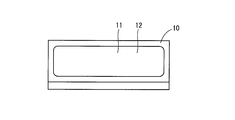
- FIG. 1 is a perspective view showing a schematic configuration of the information terminal device according to the first embodiment, and shows a state in which the display unit is slid from the main body unit.
- FIG. 2 is a front view illustrating a schematic configuration of the information terminal device according to the first embodiment, and illustrates a state where the slide of the display unit is closed with respect to the main body unit.
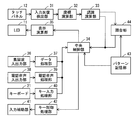
- FIG. 3 is a block diagram showing a functional configuration of the information terminal device 1.
- FIG. 4 is a schematic diagram illustrating an example of a key lock release screen.
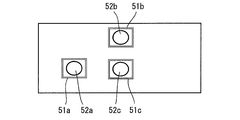
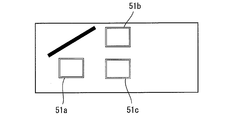
- FIG. 5A is a diagram illustrating an example of a display of a lock release pattern.
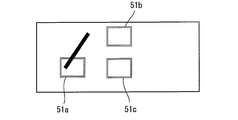
- FIG. 5B is a diagram illustrating an example of a pattern that is different from the unlock pattern of FIG. 5A and that does not release the key lock.
- FIG. 5C is a diagram showing an example of a pattern that is different from the unlock pattern of FIG. 5A and that does not release the key lock.
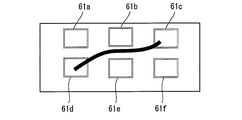
- FIG. 6A is a diagram illustrating an example of a display of an unlock pattern.
- FIG. 6B is a diagram showing an example of a pattern that is different from the unlock pattern of FIG. 6A and that does not release the key lock.
- FIG. 6C is a diagram showing an example of a pattern that is different from the unlock pattern of FIG. 6A and that does not release the key lock.
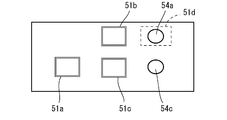
- FIG. 7A is a diagram illustrating an example of a display of an unlock pattern.
- FIG. 7B is a diagram illustrating an example of a pattern that is different from the unlock pattern of FIG. 7A and that does not release the key lock.
- FIG. 7A is a diagram illustrating an example of a display of an unlock pattern.
- FIG. 7B is a diagram illustrating an example of a pattern that is different from the unlock pattern of FIG. 7A and that does not
- FIG. 7C is a diagram showing an example of a pattern that is different from the unlock pattern of FIG. 7A and that does not release the key lock.
- FIG. 8A is a diagram illustrating an example of a display of an unlock pattern.
- FIG. 8B is a diagram showing an example of a pattern that is different from the unlock pattern of FIG. 8A and that does not release the key lock.
- FIG. 9A is a diagram illustrating an example of a display of a lock release pattern.
- FIG. 9B is a diagram showing an example of a pattern that is different from the unlock pattern of FIG. 9A and that does not release the key lock.
- FIG. 9C is a diagram illustrating an example of a pattern that is different from the unlock pattern of FIG. 9A and that does not release the key lock.
- FIG. 9A is a diagram illustrating an example of a pattern that is different from the unlock pattern of FIG. 9A and that does not release the key lock.
- FIG. 10A is a diagram illustrating an example of a display of a lock release pattern.
- FIG. 10B is a diagram showing an example of a pattern that is different from the unlock pattern of FIG. 10A and that does not release the key lock.
- FIG. 10C is a diagram illustrating an example of a pattern that is different from the unlock pattern of FIG. 10A and that does not release the key lock.
- FIG. 11A is a diagram illustrating an example of a display of an unlock pattern.
- FIG. 11B is a diagram showing an example of a pattern that is different from the unlock pattern of FIG. 11A and that does not release the key lock.
- FIG. 11C is a diagram showing an example of a pattern that is different from the unlock pattern of FIG. 11A and that does not release the key lock.
- FIG. 11A is a diagram illustrating an example of a display of a lock release pattern.
- FIG. 11B is a diagram showing an example of a pattern that is different from the unlock pattern of FIG. 11A and
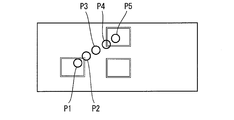
- FIG. 12A is a diagram illustrating an example of a line segment that is touch-inputted to the touch panel.
- 12B is a diagram illustrating coordinates detected from the line segment illustrated in FIG. 12A.
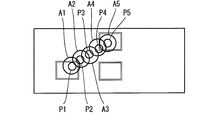
- FIG. 12C is a diagram illustrating a connection region obtained by enlarging each of the coordinates illustrated in FIG. 12B.
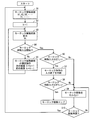
- FIG. 13 is a flowchart showing the operation of the information terminal device.
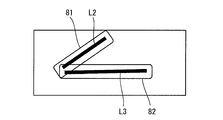
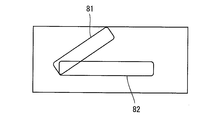
- FIG. 14A is a diagram illustrating an example of a pattern that a user inputs to the touch panel to register an unlock pattern in the information terminal device according to the second embodiment.
- FIG. 14B is a diagram illustrating a state where an input allowable range is generated from the input pattern of FIG. 14A.
- FIG. 14C is a diagram illustrating a lock release pattern generated from the input allowable range of FIG. 14B.
- FIG. 14D is a diagram illustrating an example of a pattern that is different from the unlock pattern of FIG. 14C and that does not release the key lock.
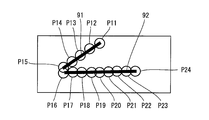
- FIG. 15A is a diagram illustrating an example of a pattern that a user inputs to the touch panel to register an unlock pattern and coordinates detected from the pattern in the information terminal device according to the second embodiment.
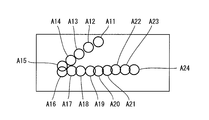
- FIG. 15B is a diagram illustrating a lock release pattern generated from the input pattern of FIG. 15A.
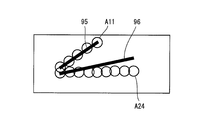
- FIG. 15C is a diagram showing an example of a pattern that is different from the unlock pattern of FIG. 15B and that does not release the key lock.
- FIG. 15A is a diagram illustrating an example of a pattern that is different from the unlock pattern of FIG. 15B and that does not release the key lock.
- FIG. 15D is a diagram illustrating an example of a pattern that is different from the unlock pattern of FIG. 15B and that does not release the key lock.
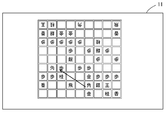
- FIG. 16 is a diagram showing a shogi board surface displayed as an input request pattern in the information terminal device according to the third embodiment.
- An information terminal device is an information terminal device including a display unit and a touch panel, and a release pattern input to the touch panel in order to release the use restriction of the information terminal device, A pattern storage unit that is designated and stored by the user as a graphic pattern, a collation unit that determines whether the input pattern input to the touch panel matches the release pattern, and the input pattern and the When it is determined that the cancellation pattern matches, the configuration includes a control unit that cancels the use restriction of the information terminal device (first configuration).
- Graphic pattern means an arbitrary pattern drawn continuously or discontinuously on the touch panel. For example, a set of a plurality of points input by touching a plurality of locations on the touch panel is also included in the “graphic pattern”. Alternatively, an arbitrary pattern composed of lines drawn on the touch panel is also included in the graphic pattern. Of course, a pattern formed by a combination of dots and lines is also included in the graphic pattern. According to the first configuration, compared to the case of using a release pattern as a password combining numbers and characters, there are more variations of the release pattern and ease of storage of the release pattern by the user of the information terminal device. And both. Thereby, it is possible to provide an information terminal device capable of personal authentication that is highly difficult to decode by a third party.
- an input request pattern suggesting the input of the release pattern is stored in the pattern storage unit, and when the usage restriction of the information terminal device is released, It is preferable to display the input request pattern on the display unit (second configuration).
- the user inputs the release pattern while viewing the displayed input request pattern.
- a pattern that serves as a hint for the release pattern may be used. If such a pattern is used, it will help the user to remember the correct release pattern, or, conversely, a pattern that intentionally leads to an incorrect release pattern as an input request pattern. May be used. If such a pattern is used, it can be difficult for a person who is not a regular user to guess a correct release pattern, and the difficulty of decoding can be further increased.
- the pattern storage unit stores a plurality of input request patterns suggesting the input of the release pattern, and when releasing the use restriction of the information terminal device
- an input request pattern selected from the plurality of input request patterns is displayed on the display unit (third configuration).
- an input request pattern selected from a plurality of input request patterns is displayed, so that a person who is not a regular user can cancel a correct release pattern compared to a case where the same input request pattern is always displayed. Can be difficult to guess, and the difficulty of decoding can be made higher.
- the input request pattern includes a plurality of input suggestion regions for suggesting input of the release pattern
- the release pattern includes the plurality of input suggestions. It is preferably set based on one or a plurality of input suggestion areas selected from the areas (fourth configuration).
- the release pattern is set based on at least one region selected from the plurality of input suggestion regions, so that the number of release pattern variations that can be set can be increased. As a result, it is possible to make it difficult for a person who is not a regular user to guess a correct release pattern, and it is possible to further increase the difficulty of decoding.
- the input request pattern includes a plurality of input suggestion regions for suggesting input of the release pattern
- the release pattern includes the plurality of input suggestions. It is preferable to set based on at least a part of the input suggestion region and a region other than the plurality of input suggestion regions (fifth configuration).
- the release pattern is set based on the input suggestion region and a region other than the input suggestion region. Therefore, if it is a regular user, the release pattern in the area other than the input suggestion area can be correctly input based on the memory when the release pattern is set. Such input is extremely difficult.
- the input request pattern includes a plurality of input suggestion regions for suggesting input of the release pattern
- the release pattern includes the plurality of input suggestions. It is preferable that the pattern is set as a pattern that passes only a part of the input suggestion region (sixth configuration). According to the sixth configuration, it can be made more difficult for a person who is not a regular user to analogize a release pattern from a plurality of input suggestion areas.
- the input request pattern includes an input suggestion area for suggesting input of the release pattern, and the release pattern is outside the input suggestion area. It is preferable to set as an existing pattern (seventh configuration).
- the release pattern is set as a pattern that exists outside the input suggestion area, it is possible to realize higher deciphering difficulty in reverse of human psychology. That is, when an input suggestion area is displayed, it is a general human psychology to imagine that some input should be made in the input suggestion area. Therefore, if the release pattern is intentionally set as a pattern that exists outside the input suggestion region, it becomes difficult for a third party to guess the release pattern.
- a board game board surface is displayed as the input request pattern, and a movement of a specific piece among the pieces used in the board game is defined as the release pattern.
- the release pattern Preferably (eighth configuration).
- the movement of the piece defined as the release pattern follows the rules for how to move the piece in an actual board game, the user can easily store the release pattern.
- the movement of the piece defined as the release pattern may be different from the rule of how to move the piece in the actual board game. In this case, higher deciphering difficulty can be realized by illuminating human psychology. That is, when a board game piece is displayed, it is a general human psychology to imagine that the release rule according to the rule of how to move the piece is used. Therefore, if a movement that does not comply with the rules is intentionally set as a release pattern, it becomes difficult for a third party to guess the release pattern.
- the information terminal device further includes a pattern generation unit that generates the release pattern from a pattern input by a user to the touch panel and stores the pattern in the pattern storage unit.
- a pattern generation unit that generates the release pattern from a pattern input by a user to the touch panel and stores the pattern in the pattern storage unit.
- FIGS. 1 and 2 are diagrams showing a schematic configuration of an information terminal device 1 according to an embodiment of the present invention.
- the information terminal device 1 includes a display unit 10 and a main body unit 20.
- the display unit 10 is configured to be slidable with respect to the main body unit 20. That is, FIG. 1 is a perspective view showing a state in which the keyboard 21 of the main body unit 20 can be used by sliding the display unit 10 from the main body unit 20.
- FIG. 2 is a front view showing a state in which the slide of the display unit 10 is closed with respect to the main body unit 20.
- the configuration in which the display unit 10 slides along the short side direction of the information terminal device 1 is illustrated, but the display unit 10 has the long side direction or other directions (for example, oblique directions). The structure which slides along may be sufficient.
- the display unit 10 includes a liquid crystal display 11 and a touch panel 12 provided on the surface of the liquid crystal display 11.
- a liquid crystal display 11 and a touch panel 12 provided on the surface of the liquid crystal display 11.
- the structure which the display part 10 was provided with the liquid crystal display 11 is illustrated, it is also possible to utilize displays other than a liquid crystal display.
- the main unit 20 has a battery, a memory, and various control circuits inside, and has the keyboard 21 on the surface thereof.
- the type of the keyboard 21 is arbitrary depending on the use of the information terminal device 1.
- the keyboard 21 includes, for example, a numeric keypad mainly used for inputting a telephone number, a numeric keypad capable of both number input and character input, and function keys assigned with various functions. Further, a so-called full keyboard or the like can be used as the keyboard 21.
- the information terminal device 1 is arbitrary.
- the information terminal device 1 is not limited to these, but various information such as mobile phones, PDAs (Personal Digital Assistants), smartphones, electronic dictionaries, portable game machines, music / video players, personal computers, electronic book browsing machines, and the like. Can be used for applications.
- the touch panel 12 detects that a finger or a touch pen is in contact with or close to the surface, and outputs coordinate information of the contact or proximity position. Based on this coordinate information, it is possible to detect what pattern is input at which position of the touch panel 12 by an arithmetic circuit described later.
- the type of touch panel 12 is not particularly limited, and any type of touch panel can be used.
- touch panels such as a resistive film method, a capacitance method, an electromagnetic induction method, an infrared method, a surface acoustic wave method (ultrasonic method), and an image recognition method using an optical sensor
- the touch panel 12 can be employed.
- an image recognition type touch panel using an optical sensor it is not laminated on the surface of the liquid crystal display 11, but an optical sensor is incorporated as an internal structure of the liquid crystal display 11, and the liquid crystal display 11 with a touch panel function. It may be configured as.
- an optical sensor for example, a photodiode, a phototransistor, a CCD element, or a CMOS element is used.
- FIG. 3 is a block diagram showing a functional configuration of the information terminal device 1.
- the information terminal device 1 includes an input repetition detection unit 31, a coordinate calculation unit 32, a recognition calculation unit 33, a central control unit 34, a display calculation unit 35, a high frequency input / output unit 36, a data processing unit 37, A telephone voice input / output unit 38, a telephone voice processing unit 39, a key input processing unit 40, an input auxiliary unit 41, a key control processing unit 42, a pattern storage unit 43, and a verification unit 44 are provided.
- the information terminal device 1 has a telephone function, but the telephone function is not essential. Therefore, the telephone voice input / output unit 38 and the telephone voice processing unit 39 may be omitted.
- arbitrary components not shown in FIG. 3 may be added according to functions required for the device.
- the input repetition detection unit 31 detects a repeated input within a unit time by a finger or a touch pen. In other words, the input repetition detection unit 31 serves to identify an unintentional accidental touch and a significant touch intended for input.
- the coordinate calculation unit 32 calculates the coordinate information of the input position when the input repetition detection unit 31 detects the repetition input.
- the coordinate information calculated by the coordinate calculation unit 32 is sent to the recognition calculation unit 33.
- the recognition calculation unit 33 determines whether the input is a single point or a line according to the coordinate information received from the coordinate calculation unit 32.
- the central control unit 34 receives information from each unit and controls each unit based on the received information, thereby controlling the overall operation of the information terminal device 1.
- the display calculation unit 35 performs calculation of image data to be displayed on the liquid crystal display 11 and calculation of data for controlling the display operation of the liquid crystal display 11 and the like.
- the high frequency input / output unit 36 performs transmission / reception via a mobile phone antenna, wireless communication, or the like.
- the data processing unit 37 processes various data transmitted and received by the high frequency input / output unit 36. For example, processing of a packet transmitted / received by packet communication, data encryption / decryption processing, etc. are performed when necessary.
- the telephone voice input / output unit 38 transmits / receives telephone voice via the antenna of the mobile phone.
- the telephone voice processing unit 39 performs sampling and restoration processing of voice transmitted and received by the telephone voice input / output unit 38.
- the key input processing unit 40 performs a keyboard scan on the keyboard 21, and specifies input characters, numbers, functions, or the like in a time series based on the position of the pressed key and the pressed time. Process. By this processing, input data from the keyboard 21 is acquired. Under the control of the key control processing unit 42, the input auxiliary unit 41 turns on the key of the keyboard 21 and reproduces a push sound when the key is pressed, thereby preventing an erroneous operation.
- the pattern storage unit 43 stores an input request pattern used when releasing the key lock and a lock release pattern registered in advance by the user.
- the collation unit 44 collates the pattern input from the touch panel 12 with the unlock pattern registered in the pattern storage unit 43, and releases the key lock if they match.
- the information terminal device 1 is configured so that key input from the keyboard 21 is not accepted unless the key lock is released by input from the touch panel 12. Further, it is preferable that the key lock is automatically applied after a predetermined time has passed without any operation even after the key lock is released.
- the information terminal device 1 has a key on the liquid crystal display 11 when the power is turned on or when the touch panel 11 is touched with a finger or a pen in the power save mode (the liquid crystal display 11 is turned off). Display the unlock screen.
- FIG. 4 is a schematic diagram showing an example of a key lock release screen.
- an input request pattern having three input suggestion areas 51 a, 51 b and 51 c is displayed on the liquid crystal display 11.
- the display of the key lock release screen is realized under the control of the central control unit 34 and the display calculation unit 35 using the input request pattern stored in the pattern storage unit 43.
- square input suggestion areas 51a to 51c represented by double lines are displayed, but the shape, size, and number of input suggestion areas included in the input request pattern are arbitrary. is there.
- the input request pattern includes, as one type, an input suggestion area that matches the unlock pattern for releasing the key lock, and gives a hint of the unlock pattern to the person who intends to release the key lock. It is a pattern.
- the input request pattern includes an input suggestion region that intentionally does not match the unlock pattern, making it difficult to guess the unlock pattern.
- the pattern storage unit 43 stores in advance a lock release pattern for releasing the key lock. That is, the authorized user of the information terminal device 1 registers in advance the lock release pattern determined by the user. Then, when the key unlock screen is displayed, if the pre-registered unlock pattern is correctly input, the key lock is released. On the other hand, if the input pattern is different from the unlock pattern registered in advance, the key lock is not released.
- a pattern including all of the input suggestion areas 51a to 51c of the input request pattern is registered as the unlock pattern. That is, in the example of FIG. 5A, the key lock is released by performing touch input once for all of the input suggestion areas 51a to 51c as indicated by the circles 52a to 52c.
- the order in which the input suggestion areas 51a to 51c constituting the lock release pattern are touched may be set to a specific order, and the order in which these areas are touched is arbitrary. It is good as well. In the former case, information indicating the order in which the input suggestion areas 51 a to 51 c are to be touched needs to be registered in the pattern storage unit 43.
- the collation unit 44 determines that the input pattern and the unlock pattern are Judged as inconsistent. Therefore, in this case, the key lock is not released. Further, as shown by a circle 53d in FIG. 6C, in addition to the input suggestion areas 51a and 51b, when the touch input is made at a place other than the input suggestion area, the collation unit 44 determines whether the input pattern, the unlock pattern, Is determined to be inconsistent. Therefore, the key lock is not released also in this case.
- FIG. 7A is an example in which an area 51d in a location other than the input suggestion areas 51a to 51c is registered as a lock release pattern.
- the area 51d in FIG. 7A is included in the unlock pattern, but is not displayed as the input suggestion area in the input request pattern. That is, the area 51d is indicated by a broken line in FIG. 7A, but is not displayed on the actual screen. Therefore, the user needs to perform touch input to the region 51d based on only the memory, as schematically shown by a circle 54a in FIG. 7A. Needless to say, when the area 51d is not touch-inputted, the key lock is not released.
- the unlock pattern As described above, by allowing at least a part of the unlock pattern to be set in an area other than the input suggestion area, an authorized user of the information terminal device 1 can perform key unlock based on the storage. On the other hand, it is extremely difficult for a third party to decipher the unlock pattern.
- an extra touch input is made at a position not included in the unlock pattern (circle 54b in FIG. 7B or circle 54c in FIG. 7C). In such a case, the key lock is not released.
- the input suggestion area 51b among the input suggestion areas 51a to 51c and the area 51d outside the input suggestion area are registered as a lock release pattern.
- the area 51d is included in the unlock pattern, but is not displayed as an input suggestion area in the input request pattern.
- the key lock is released by touching both the region 51b and the region 51d included in the unlock pattern.
- touch input is not performed on the area 51c that is not included in the unlock pattern (circle 55c in FIG. 8B), or touch input is not performed on the area 51d included in the unlock pattern. If this happens, the key lock is not released.
- a part of the area included in the unlock pattern may not be displayed as the input suggestion area in the input request pattern.
- the user performs touch input according to the storage for the area not displayed as the input suggestion area in the input request pattern, it is possible to make the decryption by a third party more difficult.
- FIG. 9A is an example in which a line segment L connecting the input suggestion areas 51a and 51b is registered as a lock release pattern.
- the unlock pattern shown in FIG. 9A is a line segment, the unlock pattern may be a curve.
- FIG. 9B when both ends of the pattern input by the user do not exist in either of the input suggestion areas 51a and 51b, or as shown in FIG.
- the collation unit 44 determines that the input pattern and the unlock pattern do not match.
- the determination result is sent from the collation unit 44 to the central control unit 34, and the central control unit 34 determines that the key lock should not be released.
- the unlock pattern defined as a line, which one of both ends of the line segment is the starting point is stored in the pattern storage unit 43, and the start point of the input pattern corresponds to the starting point of the unlock pattern. It may be a condition for unlocking. Alternatively, it may be a rule that the relationship between the start point and the end point of the input pattern may be opposite to the relationship between the start point and the end point of the unlock pattern.
- FIG. 10A six input suggestion areas 61a to 61f are displayed on the liquid crystal display 11, and a curve that connects the input suggestion areas 61c and 61d and does not cross the other input suggestion areas is registered as an unlock pattern.
- the key lock is not released when both ends of the pattern input by the user do not exist in the input suggestion areas 61c and 61d.
- FIG. 10C even if both ends of the pattern input by the user exist in the input suggestion regions 61c and 61d, they cross the other input suggestion regions (here 61b).
- the collation unit 44 determines that the input pattern and the unlock pattern do not match.
- the collation unit 44 matches both ends of the input pattern with the unlocking pattern, and the input pattern crosses another input suggestion region in the middle. It is determined that the input pattern and the unlock pattern match with each other on the condition that there is not.
- a curve that connects 61c and 61d and does not cross the other input suggestion regions is registered as the unlock pattern, but three or more inputs are registered.
- a curve connecting the suggestion areas may be used as an unlock pattern.
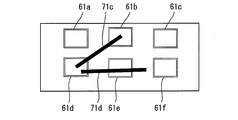
- an unlock pattern including a plurality of lines can be set.
- the condition for releasing the key lock is that both ends of the input pattern match the unlock pattern.
- the line segment 71c matches the line segment 71a of the unlock pattern, but both ends of the line segment 71d do not match the both ends of the line segment 71b of the unlock pattern.
- the line segment 71f matches the line segment 71b of the unlock pattern, but both ends of the line segment 71e do not match the both ends of the line segment 71a of the unlock pattern. Therefore, the key lock is not released in the input patterns shown in FIGS. 11B and 11C.
- a plurality of input request patterns and unlock patterns corresponding to each of the input request patterns are registered in advance, and the user selects which input request pattern is used each time the key lock is released. It is also preferable to be able to do this.
- the input repetition detection unit 31, the coordinate calculation unit 32, and the recognition calculation unit 33 detect coordinate information at a predetermined reading cycle. Therefore, the coordinates actually detected are a set of discontinuous points P1 to P5 as shown in FIG. 12B.
- the collation unit 44 enlarges each of the points P1 to P5 to a region (enlarged region A1 to A5) having an appropriate size based on the coordinate information obtained from the recognition calculation unit 33.
- the sizes of the enlarged areas A1 to A5 can be appropriately determined according to various conditions such as the length of the reading cycle and the movement speed of the touch input so as to overlap each other. For example, it is assumed that the average value of the distance that the finger or the pen moves in one reading cycle is about 25 mm from calculation or experiment. In this case, when the detected coordinate points are enlarged, the enlarged regions preferably have a diameter of about 30 mm so that the enlarged regions overlap each other.
- the collation unit 44 enlarges the detected coordinate point to an area having a predetermined size, and determines whether the enlarged areas actually overlap each other. For example, if there are portions where the enlarged regions do not overlap, the lines are not connected and are interrupted in the middle. Then, as shown in FIG. 12C, the collation unit 44 determines whether or not it matches the unlock pattern within the range where the enlarged regions A1 to A5 are connected.
- the level of the signal output from the touch panel 12 is set to S1, and the level of the signal output when there is no touch input on the touch panel 12 is set to S2. Then, it is determined whether or not the value obtained by subtracting S2 from S1 exceeds a predetermined threshold value.
- the value of S2 the average value of the output signal in the state where there is no touch input to the touch panel 12, or the output signal value immediately before the touch input is used. That is, the touch panel 12 detects any noise component and outputs a signal (S2) including noise even when there is no touch input in any type of touch panel. Therefore, by subtracting the signal S2 from the signal S1 when the touch input is made on the touch panel 12, the presence or absence of the touch input can be detected with higher accuracy without being affected by the noise component.
- a plurality of sensors often react when a finger or a touch pen comes into contact with or comes close to.
- a plurality of sensors at discrete positions may react. Therefore, in order for the user to more accurately detect the position coordinates where the user tried to perform the touch input, the position where the sensor output takes the maximum value in a predetermined range centered on the coordinates estimated to be the touch input, Alternatively, it is preferable that the position of the weighted centroid point is obtained and the obtained position is detected as the position where the touch input is made. Thereby, there is an advantage that the position where the user performs the touch input can be detected more accurately, and the influence of the noise signal from the vicinity of the touch input position can be reduced.
- the input repetition detection unit 31 obtains the sum of signals detected over a plurality of reading cycles, and compares the sum with a threshold value to detect the touch input. It is also preferable to determine that there has been one touch input only when the presence / absence is estimated and the period in which the touch input is estimated is continued a predetermined number of times.
- the reading cycle from the touch panel 12 is 0.01 seconds, and signals from the touch panel 12 are transmitted at times T 1 , T 2 , T 3 ,..., T i , T i + 1 ,. Shall be detected.
- the sum of the signals detected at times T k ⁇ 10 , T k ⁇ 9 ,..., T k ⁇ 1 is obtained, and the obtained sum is compared with a threshold value to obtain the time T k It is determined whether or not there is a touch input during a period of ⁇ 10 to T k ⁇ 1 .
- the sum of the signals detected at times T k , T k + 1 ,..., T k + 9 is obtained, and the obtained sum is compared with a threshold value, so that the period from time T k to T k + 9 is obtained. It is determined whether or not there is a touch input. Thus, the presence or absence of touch input is determined every 0.1 second period (reading cycle 10 cycles). For example, when it is determined that touch input has occurred for 0.3 seconds or longer, one touch input is performed. Judge that there was touch input. Such processing can suppress malfunction caused by ambiguous touch input.
- FIG. 13 is a flowchart showing the operation of the information terminal device 1.
- the user purchases the information terminal device 1 and starts using the information terminal device 1, the user selects one or a plurality of patterns from a plurality of input request patterns prepared in advance, and selects the selected input request pattern. For each of them, the unlock pattern determined by itself is set.
- the unlock pattern set by the user is stored in the pattern storage unit 43 in association with the selected input request pattern.
- the input request patterns stored in the pattern storage unit 43 are V1, V2, V3,..., Vi,.
- step S2 the parameter k is set to 1 as an initial value (step S2), and the process proceeds to step S3.
- step S3 a key lock release screen including the input request pattern Vk is displayed on the liquid crystal display 11.
- step S6 If the user performs a touch input for releasing the key lock from the touch panel 12 (Yes in step S4), the process proceeds to step S6. On the other hand, when the user performs a key lock release screen selection operation from the touch panel 12 (No in step S4), the process proceeds to step S5. In step S5, the parameter value is increased or decreased by 1 according to the selection operation. Thereafter, returning to step S3, a key lock release screen including the next input request pattern Vk + 1 or a key lock release screen including the previous input request pattern Vk-1 is displayed.
- step S6 the collation unit 44 compares the pattern input by the user with the unlock pattern. Based on the result, the central control unit 34 determines whether or not the key lock can be released. In step S6, even if the collation unit 44 determines that the pattern input by the user matches the unlock pattern, whether or not the user ends pattern input for unlocking the key. In step S7, it is determined whether or not a predetermined time (for example, 3 seconds) elapses after the touch input is interrupted.
- a predetermined time for example, 3 seconds
- step S7 When it is determined in step S7 that the pattern input has been completed, when the collation unit 44 confirms that the pattern input by the user matches the unlock pattern (Yes in step S8), the central control unit 34 Releases the key lock. On the other hand, if the pattern input by the user does not match the unlock pattern (No in step S6 or step S8), it is determined that there is an error in the key unlock input, and the central control unit 34 The image display on the display 11 and the input receiving operation from the touch panel 12 are continuously performed, but the key lock is not released (step S9). When the user requests to redo the key lock release operation (Yes in step S10), the process returns to step S1.
- the information terminal device 1 executes a key lock release process using the touch panel 12 according to the above flow.
- the input request pattern and the unlock pattern are stored in advance in the pattern storage unit 43, and the input request pattern is displayed on the liquid crystal display 11. Touch input is performed on the touch panel 12. That is, if the user registers in advance the unlock pattern determined by the user with respect to the input request pattern, the user unlocks the key by performing touch input in accordance with the stored unlock pattern. be able to.
- the method of inputting the same pattern as the unlock pattern by touch input has the following advantages.
- the user can easily store the release method, and the release operation is simple.
- the first embodiment for example, there are a total of 25 input suggestion areas, 5 in the horizontal direction and 5 in the vertical direction, and a lock is selected by selecting four areas from among them.
- the release pattern when used, there are 53,130 unlock patterns. This is much more difficult to decipher than in the case of four digits.
- FIGS. 7A and 8A by making the unlock pattern exist in a place other than the input suggestion area, it is extremely difficult for a third party to decode the unlock pattern.
- the first embodiment it is possible to realize an information terminal device having both the ease of unlocking operation, the ease of storing the unlocking method, and the difficulty of decoding when voyeurized. it can.
- the information terminal device is different from the first embodiment in that the input request pattern is not displayed on the key lock release screen.
- the user registers his / her favorite unlocking pattern by touch-inputting an arbitrary pattern to the touch panel 12 of the information terminal device 1. Can do.
- FIG. 14A it is assumed that the user inputs an unlock pattern including two line segments L2 and L3 to the touch panel 12.
- rectangular areas 81 and 82 having a predetermined width around the input line segments L2 and L3 are generated, and the rectangular areas 81 and 82 are input allowable ranges of the unlock pattern. As determined. The width and length of the rectangular regions 81 and 82 may be set as appropriate. The position information of the rectangular areas 81 and 82 determined as the input allowable range is stored in the pattern storage unit 43.
- the collation unit 44 determines whether or not the key lock can be released by determining whether or not the pattern input by the user matches the unlock pattern stored in the pattern storage unit 43. Judging.
- the user since the input request pattern is not displayed, the user uses the same pattern as the unlock pattern based on the memory to store a predetermined area of the unlock screen (the rectangular area 81, in the above example). 82) needs to be touch-input. Therefore, there is an advantage that the difficulty in decoding is higher than in the first embodiment in which the input request pattern is displayed on the unlock screen.
- the unlock pattern as shown in FIG. 14C is stored in the pattern storage unit 43.
- the line segment 83 fits in the rectangular area 81, but the line segment 84 does not fit in the rectangular area 82. Therefore, when the pattern input as shown in FIG. 14D is performed, the collation unit 44 determines that the input pattern and the unlock pattern do not match, so the key lock is not released.
- the collation unit 44 performs horizontal movement, vertical movement, and rotational movement of the input pattern as necessary when collating the input pattern with the unlock pattern. It is also preferable to do. This is because the input request pattern is not displayed on the liquid crystal display 11 in the present embodiment, unlike the first embodiment in which the input request pattern including the input suggestion area that is the target of pattern input is displayed. In the case of this configuration, for example, in the example of FIG. 14C, the input pattern is moved horizontally, vertically, or rotated even if the input pattern does not enter the rectangular regions 81 and 82. If the result matches the rectangular areas 81 and 82, it is determined that the correct unlocking pattern has been input. As a result, it is possible to prevent the authorized user from being rejected while making it difficult to guess the unlock pattern.
- the unlock pattern is generated as a rectangular area including the line segment input by the user.
- the following example is also possible as a modification of the second embodiment.
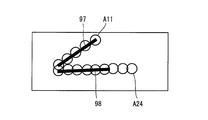
- the coordinates indicated by points P11 to P24 are detected from line segments 91 and 92, respectively, as shown in FIG. 15A.
- enlarged regions A11 to A24 having a predetermined size with these points as the center are generated, and these regions are stored in the pattern storage unit 43 as unlock patterns.
- the collation unit 44 determines whether or not the pattern touched by the user matches all the areas of the enlarged areas A11 to A24 included in the unlock pattern, so that the input pattern can be locked. Check against the release pattern. For example, in the example of FIG. 15C, the line segment 95 of the pattern touched by the user matches the enlarged areas A11 to A15, but the line segment 96 does not match the enlarged areas A16 to A24. In the example of FIG. 15D, the line segment 97 of the pattern touched by the user matches the enlarged areas A11 to A15, and the line segment 98 matches the enlarged areas A16 to A21, but the enlarged areas A22 to A24. Does not match. Therefore, neither the example of FIG. 15C nor the example of FIG. 15D releases the key lock.
- the information terminal device 1 according to the second embodiment allows the user to input a pattern without displaying the input request pattern on the unlock screen. Therefore, the information terminal device 1 according to the second embodiment has an advantage that higher decoding difficulty can be realized as compared with the first embodiment in which the input request pattern is displayed on the unlock screen.
- the unlock pattern is generated from the pattern freely inputted by the user to the touch panel 12 and stored in the pattern storage unit 43. Therefore, the user can create and register an unlock pattern by himself / herself that is easy to memorize and difficult to guess by others.
- the information terminal device is different from the first and second embodiments in that a shogi board is displayed as the input request pattern of the key lock release screen.
- Shogi is a chess-like board game (board game) that uses various pieces that each have a range that can be moved around. If you take it, it will be done under the rule of winning.
- the user causes the pattern storage unit 43 to store a rule for moving any piece selected according to his / her preference in the direction and distance determined according to his / her preference as a lock release pattern.
- the rule “moving 4 squares to the left and 2 squares up” is stored in the pattern storage unit 43 as an unlock pattern.
- the unlock pattern be determined so as to be different from the rule for moving the “corner” piece in the actual shogi rule. This is because it is possible to realize a higher level of difficulty in deciphering the human psychology.
- the shogi board displayed as the input request pattern changes randomly every time the key lock release screen is displayed. Even if the board surface changes, the unlock pattern remains, for example, as described above, for example, the “corner” piece “moves 4 squares left and 2 squares up”. Thereby, even if the place where the input for releasing the key lock is performed is taken, the input request pattern changes at random, so that the difficulty of decoding is improved.
- the input request pattern on the key lock release screen is used as a shogi board surface, and the pattern in which the user moves the piece determined by himself according to the rule determined by himself is used as the unlock pattern. Register in advance. This has the advantage that the user can easily store the unlocking pattern.
- the number of input request patterns can be increased by changing the shogi board displayed as an input request pattern at random. There is an advantage that it is possible to maintain the difficulty of deciphering even if a voyeur is taken.
- an information terminal device separately provided with a liquid crystal display with a touch panel and a keyboard as hardware is illustrated.
- the present invention is also applicable to an information terminal device that does not include a keyboard as hardware and provides a software keyboard with a touch panel display.
- the information terminal device that releases the key lock by inputting to the touch panel is illustrated, but the target to be released is not limited to the key lock.
- the present invention can be used to release various constraint conditions related to the use of the information terminal device. For example, although not limited thereto, the restriction on communication from the information terminal device is released, the access restriction on data stored in the information terminal device is released, or the information terminal device is mounted on the information terminal device.
- the present invention can also be applied to canceling the execution restrictions of existing application programs.
- the present invention can be industrially used as an information terminal device capable of releasing a key lock using touch panel input.
Landscapes
- Engineering & Computer Science (AREA)
- Computer Security & Cryptography (AREA)
- Theoretical Computer Science (AREA)
- General Engineering & Computer Science (AREA)
- Physics & Mathematics (AREA)
- General Physics & Mathematics (AREA)
- Computer Hardware Design (AREA)
- Computer Networks & Wireless Communication (AREA)
- Signal Processing (AREA)
- Software Systems (AREA)
- Human Computer Interaction (AREA)
- Computing Systems (AREA)
- User Interface Of Digital Computer (AREA)
Abstract
Description
以下、本発明のより詳細な実施形態について、図面を参照しながら説明する。以下で参照する各図は、説明の便宜上、本発明の実施形態の構成部材のうち、本発明を説明するために必要な主要部材のみを簡略化して示したものである。
[情報端末装置の構成]
最初に、図1および図2を参照しながら、本発明の第1の実施形態にかかる情報端末装置の概略構成について説明する。図1および図2は、本発明の一実施形態にかかる情報端末装置1の概略構成を示す図である。
ここで、以上の構成にかかる情報端末装置1における、タッチパネル12を利用したキーロック解除について説明する。情報端末装置1は、タッチパネル12からの入力によってキーロック解除をしなければ、キーボード21からのキー入力が受け付けられないように構成されている。また、一旦、キーロック解除を行っても、何も操作せずに所定の時間が経過すると、自動的にキーロックがかかるように構成されていることが好ましい。
ここで、ロック解除パターンと入力パターンとの対応関係の例をいくつか示す。なお、以下の例において、図5A等に示す丸印は、タッチ入力がなされた箇所を模式的に表す記号であって、ペン等でタッチされた際の実際の接触箇所の大きさを示すものではない。
なお、図9A~図11Aのような、ロック解除パターンおよび入力パターンが線である場合の、照合部44における判断手法の詳細は次のとおりである。
また、タッチパネル12におけるタッチ入力の検出について、以下のような手法をとることが好ましい。
ここで、図13を参照し、情報端末装置1の全体的な動作の流れについて説明する。図13は、情報端末装置1の動作を示すフローチャートである。
以上のとおり、第1の実施形態にかかる情報端末装置1によれば、予め入力要求パターンとロック解除パターンとをパターン記憶部43に記憶しておき、入力要求パターンを液晶ディスプレイ11に表示し、タッチパネル12にタッチ入力を行わせる。すなわち、使用者は、入力要求パターンに対して、自分が決定したロック解除パターンを予め登録しておけば、記憶しているロック解除パターンのとおりにタッチ入力を行うことにより、キーロックを解除することができる。
本発明にかかる情報端末装置の他の実施形態について、以下に説明する。
以上のとおり、第2の実施形態にかかる情報端末装置1は、入力要求パターンをロック解除画面に表示することなく、使用者にパターンを入力させる。したがって、第2の実施形態にかかる情報端末装置1は、入力要求パターンをロック解除画面に表示する第1の実施形態と比較して、より高い解読困難性を実現できるという利点がある。
本発明にかかる情報端末装置の他の実施形態について、以下に説明する。
以上のとおり、第3の実施形態によれば、キーロック解除画面における入力要求パターンを将棋の盤面とし、使用者が、自らが決定した駒を自らが決定したルールで動かすパターンをロック解除パターンとして予め登録する。これにより、使用者にとっては、ロック解除パターンを容易に記憶することができるという利点がある。また、キーロック解除画面を表示する毎に、入力要求パターンとして表示される将棋の盤面をランダムに変更することにより、入力要求パターンの数を極めて多く設けることができ、ロック解除用のパターンを入力しているところを仮に盗撮されたとしても、解読の困難性を維持できるという利点がある。
以上、本発明についての実施形態を説明したが、本発明は上述の各実施形態にのみ限定されず、発明の範囲内で種々の変更が可能である。
Claims (9)
- 表示部とタッチパネルとを備えた情報端末装置であって、
当該情報端末装置の利用制限を解除するために前記タッチパネルへ入力される解除パターンを、図形パターンとして使用者に指定させて記憶するパターン記憶部と、
前記タッチパネルへ入力された入力パターンと前記解除パターンとが合致するか否かを判断する照合部と、
前記照合部において入力パターンと前記解除パターンとが合致すると判断された場合に、当該情報端末装置の利用制限を解除する制御部とを備えた、情報端末装置。 - 前記パターン記憶部に、前記解除パターンの入力を示唆する入力要求パターンが記憶されており、
当該情報端末装置の利用制限を解除する際には、前記表示部に前記入力要求パターンを表示する、請求項1に記載の情報端末装置。 - 前記パターン記憶部に、前記解除パターンの入力を示唆する入力要求パターンが複数記憶されており、
当該情報端末装置の利用制限を解除する際には、前記表示部に前記複数の入力要求パターンから選択された入力要求パターンを表示する、請求項2に記載の情報端末装置。 - 前記入力要求パターンが、前記解除パターンの入力を示唆するための複数の入力示唆領域を含み、
前記解除パターンは、前記複数の入力示唆領域から選択される1つまたは複数の入力示唆領域に基づいて設定される、請求項2または3に記載の情報端末装置。 - 前記入力要求パターンが、前記解除パターンの入力を示唆するための複数の入力示唆領域を含み、
前記解除パターンは、前記複数の入力示唆領域の少なくとも一部の入力示唆領域と、前記複数の入力示唆領域以外の領域とに基づいて設定される、請求項2または3に記載の情報端末装置。 - 前記入力要求パターンが、前記解除パターンの入力を示唆するための複数の入力示唆領域を含み、
前記解除パターンは、前記複数の入力示唆領域のうち、一部の入力示唆領域のみを通るパターンとして設定される、請求項2または3に記載の情報端末装置。 - 前記入力要求パターンが、前記解除パターンの入力を示唆するための入力示唆領域を含み、
前記解除パターンは、前記入力示唆領域の外に存在するパターンとして設定される、請求項2または3に記載の情報端末装置。 - 前記入力要求パターンとして、ボードゲームの盤面を表示し、
前記解除パターンとして、前記ボードゲームに用いられる駒のうち、特定の駒の動きを規定する、請求項2または3に記載の情報端末装置。 - 前記タッチパネルへ使用者が入力したパターンから前記解除パターンを生成して前記パターン記憶部へ記憶させるパターン生成部をさらに備えた、請求項1ないし8のいずれか一項に記載の情報端末装置。
Priority Applications (2)
| Application Number | Priority Date | Filing Date | Title |
|---|---|---|---|
| JP2012520430A JP5367169B2 (ja) | 2010-06-18 | 2011-06-13 | 情報端末装置およびこれを利用した個人認証方法 |
| US13/703,690 US8800026B2 (en) | 2010-06-18 | 2011-06-13 | Information terminal device and method of personal authentication using the same |
Applications Claiming Priority (2)
| Application Number | Priority Date | Filing Date | Title |
|---|---|---|---|
| JP2010139577 | 2010-06-18 | ||
| JP2010-139577 | 2010-06-18 |
Publications (1)
| Publication Number | Publication Date |
|---|---|
| WO2011158768A1 true WO2011158768A1 (ja) | 2011-12-22 |
Family
ID=45348167
Family Applications (1)
| Application Number | Title | Priority Date | Filing Date |
|---|---|---|---|
| PCT/JP2011/063444 Ceased WO2011158768A1 (ja) | 2010-06-18 | 2011-06-13 | 情報端末装置およびこれを利用した個人認証方法 |
Country Status (3)
| Country | Link |
|---|---|
| US (1) | US8800026B2 (ja) |
| JP (1) | JP5367169B2 (ja) |
| WO (1) | WO2011158768A1 (ja) |
Cited By (9)
| Publication number | Priority date | Publication date | Assignee | Title |
|---|---|---|---|---|
| JPS58103744A (ja) * | 1981-12-16 | 1983-06-20 | Hitachi Ltd | 螢光ランプの製造方法 |
| JP2014048713A (ja) * | 2012-08-29 | 2014-03-17 | Nec Personal Computers Ltd | 入力情報認証装置および装置のプログラム |
| WO2014148095A1 (ja) * | 2013-03-18 | 2014-09-25 | 株式会社Nttドコモ | 端末装置及び操作ロック解除方法 |
| JP2015526781A (ja) * | 2012-07-02 | 2015-09-10 | ▲華▼▲為▼▲終▼端有限公司 | タッチスクリーンのロックを解除するための方法および装置 |
| JP2017004565A (ja) * | 2016-09-29 | 2017-01-05 | グリー株式会社 | 情報処理方法、情報処理システム及びプログラム |
| JP2017076236A (ja) * | 2015-10-14 | 2017-04-20 | ウェルネット株式会社 | 電子チケット管理システムおよび管理方法 |
| JP2017142859A (ja) * | 2017-05-11 | 2017-08-17 | オムロン株式会社 | 認証装置、認証方法、制御プログラムおよび記録媒体 |
| JP2018507469A (ja) * | 2015-03-30 | 2018-03-15 | エックス デベロップメント エルエルシー | 機械制御のためのジェスチャベースのスイッチに関する方法及びシステム |
| US11392680B2 (en) | 2016-05-05 | 2022-07-19 | Advanced New Technologies Co., Ltd. | Authentication and generation of information for authentication |
Families Citing this family (9)
| Publication number | Priority date | Publication date | Assignee | Title |
|---|---|---|---|---|
| JP5666641B2 (ja) * | 2013-03-13 | 2015-02-12 | パナソニック インテレクチュアル プロパティ コーポレーション オブアメリカPanasonic Intellectual Property Corporation of America | 情報端末 |
| GB201308784D0 (en) * | 2013-05-15 | 2013-06-26 | King Com Ltd | Mobile device game interface |
| CN105069349B (zh) * | 2015-07-24 | 2018-04-17 | 北京元心科技有限公司 | 移动终端上密码输入界面的生成方法以及移动终端 |
| CN105631287A (zh) * | 2015-09-30 | 2016-06-01 | 宇龙计算机通信科技(深圳)有限公司 | 一种移动终端及其解锁方法和装置 |
| US10496852B1 (en) * | 2016-07-12 | 2019-12-03 | Symantec Corporation | Systems and methods of dynamic obfuscation pattern generation for preventing smudge attacks on touch screen devices |
| US10706304B2 (en) * | 2017-09-28 | 2020-07-07 | Fortinet, Inc. | User authentication via a combination of a fingerprint and a tactile pattern |
| KR102079868B1 (ko) * | 2018-07-26 | 2020-02-20 | 고려대학교 산학협력단 | 멀티코어 기반의 단말 장치에 적용되는 잠금 패턴의 보안 강도를 측정하는 장치 및 방법 |
| US11440767B2 (en) * | 2018-07-30 | 2022-09-13 | Otis Elevator Company | Dynamic assignment of selection buttons on a destination entry system of an elevator |
| CN112699319B (zh) * | 2021-03-23 | 2021-06-29 | 上海迹寻科技有限公司 | 空间杂波信号的校验方法及装置 |
Citations (3)
| Publication number | Priority date | Publication date | Assignee | Title |
|---|---|---|---|---|
| JP2007264929A (ja) * | 2006-03-28 | 2007-10-11 | Pioneer Electronic Corp | ユーザ認証システム、ユーザ認証方法、操作端末及びサーバ等 |
| JP2007531942A (ja) * | 2004-04-01 | 2007-11-08 | ヤコブソン,ドヴ | マウス動作識別 |
| WO2009042392A2 (en) * | 2007-09-24 | 2009-04-02 | Apple Inc. | Embedded authentication systems in an electronic device |
Family Cites Families (13)
| Publication number | Priority date | Publication date | Assignee | Title |
|---|---|---|---|---|
| US6280552B1 (en) * | 1999-07-30 | 2001-08-28 | Microtouch Systems, Inc. | Method of applying and edge electrode pattern to a touch screen and a decal for a touch screen |
| US20060075250A1 (en) * | 2004-09-24 | 2006-04-06 | Chung-Wen Liao | Touch panel lock and unlock function and hand-held device |
| US9063647B2 (en) * | 2006-05-12 | 2015-06-23 | Microsoft Technology Licensing, Llc | Multi-touch uses, gestures, and implementation |
| KR100846188B1 (ko) | 2006-08-08 | 2008-07-14 | (주)멜파스 | 복수의 접촉 센서를 구비한 사용자 입력 장치, 및 상기장치로부터 사용자의 접촉을 감지하여 디지털 기기를제어하는 방법 |
| US8127254B2 (en) * | 2007-06-29 | 2012-02-28 | Nokia Corporation | Unlocking a touch screen device |
| KR20090050280A (ko) * | 2007-11-15 | 2009-05-20 | 방학술 | 잠금해제손잡이 |
| JP5371002B2 (ja) | 2008-04-23 | 2013-12-18 | シャープ株式会社 | 携帯情報端末、コンピュータ読取可能なプログラムおよび記録媒体 |
| US8594740B2 (en) | 2008-06-11 | 2013-11-26 | Pantech Co., Ltd. | Mobile communication terminal and data input method |
| KR101509245B1 (ko) * | 2008-07-31 | 2015-04-08 | 삼성전자주식회사 | 휴대용 단말기에서 패턴 인식을 이용한 사용자 인터페이스장치 및 방법 |
| KR101022087B1 (ko) * | 2009-01-16 | 2011-03-17 | 삼성모바일디스플레이주식회사 | 터치 스크린 패널 |
| KR101559178B1 (ko) * | 2009-04-08 | 2015-10-12 | 엘지전자 주식회사 | 명령어 입력 방법 및 이를 적용한 이동 통신 단말기 |
| KR101561703B1 (ko) * | 2009-06-08 | 2015-10-30 | 엘지전자 주식회사 | 메뉴 실행 방법 및 이를 적용한 이동 통신 단말기 |
| US20110049807A1 (en) * | 2009-08-27 | 2011-03-03 | Trellisys.net Pvt.Ltd. | Methods and apparatus for an interactive word game of skill |
-
2011
- 2011-06-13 JP JP2012520430A patent/JP5367169B2/ja not_active Expired - Fee Related
- 2011-06-13 WO PCT/JP2011/063444 patent/WO2011158768A1/ja not_active Ceased
- 2011-06-13 US US13/703,690 patent/US8800026B2/en not_active Expired - Fee Related
Patent Citations (3)
| Publication number | Priority date | Publication date | Assignee | Title |
|---|---|---|---|---|
| JP2007531942A (ja) * | 2004-04-01 | 2007-11-08 | ヤコブソン,ドヴ | マウス動作識別 |
| JP2007264929A (ja) * | 2006-03-28 | 2007-10-11 | Pioneer Electronic Corp | ユーザ認証システム、ユーザ認証方法、操作端末及びサーバ等 |
| WO2009042392A2 (en) * | 2007-09-24 | 2009-04-02 | Apple Inc. | Embedded authentication systems in an electronic device |
Cited By (11)
| Publication number | Priority date | Publication date | Assignee | Title |
|---|---|---|---|---|
| JPS58103744A (ja) * | 1981-12-16 | 1983-06-20 | Hitachi Ltd | 螢光ランプの製造方法 |
| JP2015526781A (ja) * | 2012-07-02 | 2015-09-10 | ▲華▼▲為▼▲終▼端有限公司 | タッチスクリーンのロックを解除するための方法および装置 |
| JP2014048713A (ja) * | 2012-08-29 | 2014-03-17 | Nec Personal Computers Ltd | 入力情報認証装置および装置のプログラム |
| WO2014148095A1 (ja) * | 2013-03-18 | 2014-09-25 | 株式会社Nttドコモ | 端末装置及び操作ロック解除方法 |
| JP2014183364A (ja) * | 2013-03-18 | 2014-09-29 | Ntt Docomo Inc | 端末装置及び操作ロック解除方法 |
| JP2018507469A (ja) * | 2015-03-30 | 2018-03-15 | エックス デベロップメント エルエルシー | 機械制御のためのジェスチャベースのスイッチに関する方法及びシステム |
| JP2017076236A (ja) * | 2015-10-14 | 2017-04-20 | ウェルネット株式会社 | 電子チケット管理システムおよび管理方法 |
| US11392680B2 (en) | 2016-05-05 | 2022-07-19 | Advanced New Technologies Co., Ltd. | Authentication and generation of information for authentication |
| US11416598B2 (en) | 2016-05-05 | 2022-08-16 | Advanced New Technologies Co., Ltd. | Authentication and generation of information for authentication |
| JP2017004565A (ja) * | 2016-09-29 | 2017-01-05 | グリー株式会社 | 情報処理方法、情報処理システム及びプログラム |
| JP2017142859A (ja) * | 2017-05-11 | 2017-08-17 | オムロン株式会社 | 認証装置、認証方法、制御プログラムおよび記録媒体 |
Also Published As
| Publication number | Publication date |
|---|---|
| US8800026B2 (en) | 2014-08-05 |
| US20130086671A1 (en) | 2013-04-04 |
| JPWO2011158768A1 (ja) | 2013-08-19 |
| JP5367169B2 (ja) | 2013-12-11 |
Similar Documents
| Publication | Publication Date | Title |
|---|---|---|
| JP5367169B2 (ja) | 情報端末装置およびこれを利用した個人認証方法 | |
| TWI574197B (zh) | 手勢鎖定模糊化的系統及方法 | |
| CN103634107B (zh) | 电子装置的认证方法及密码设定方法及认证系统 | |
| US10977358B2 (en) | System and method for signature pathway authentication and identification | |
| US20200081615A1 (en) | Screenshot based tui process for in-app purchase authentication | |
| CN110781479B (zh) | 用于电子设备的方向性触摸解锁 | |
| KR101445070B1 (ko) | 모바일 단말기 및 모바일 단말기의 잠금 상태 해제 방법 | |
| EP3151163A1 (en) | Fingerprint enrollment method, electronic apparatus and computer-readable storage medium thereof | |
| WO2011162832A1 (en) | System and method for signature pathway authentication and identification | |
| US10885164B2 (en) | Login process for mobile phones, tablets and other types of touch screen devices or computers | |
| KR102393892B1 (ko) | 생체정보를 이용한 사용자인증을 수행하는 단말 장치 및 방법 | |
| US20140025957A1 (en) | Method for entering password and portable electronic device and unlocking method and data authenticating method | |
| JP6314834B2 (ja) | 情報端末装置、情報端末制御方法及びプログラム | |
| US10282528B2 (en) | Portable terminal and method of setting and releasing use restriction therefor | |
| JP2006191245A (ja) | ダイヤルロック機能認証装置及びその方法並びにそれを用いた携帯端末 | |
| JP5651742B1 (ja) | パスワードの入力方法、入力端末、及び入力システム | |
| KR20150089104A (ko) | 이동 단말에서의 숫자와 패턴을 조합한 잠금해제 방법 및 이를 위한 이동 단말 | |
| JP2014006706A (ja) | 電子機器、およびプログラム | |
| KR101281875B1 (ko) | 진동 피드백과 화면 터치를 이용한 사용자 인증 방법 | |
| RU2648940C2 (ru) | Способ и устройство для мобильной оплаты | |
| JP5104659B2 (ja) | 入力装置、携帯端末装置、及び入力装置の入力方法 | |
| KR101969838B1 (ko) | 다이얼식 가상 보안 키패드 및 이를 이용한 인증 방법 및 장치 | |
| US10691833B2 (en) | Method and an apparatus for activating a predetermined function | |
| KR20220061930A (ko) | 지문인식을 이용한 암호화모듈 및 이의 제어방법 | |
| JP2016130963A (ja) | タッチパネルを備えた電子機器および当該電子機器を制御するためのプログラム |
Legal Events
| Date | Code | Title | Description |
|---|---|---|---|
| 121 | Ep: the epo has been informed by wipo that ep was designated in this application |
Ref document number: 11795674 Country of ref document: EP Kind code of ref document: A1 |
|
| WWE | Wipo information: entry into national phase |
Ref document number: 2012520430 Country of ref document: JP |
|
| WWE | Wipo information: entry into national phase |
Ref document number: 13703690 Country of ref document: US |
|
| NENP | Non-entry into the national phase |
Ref country code: DE |
|
| 122 | Ep: pct application non-entry in european phase |
Ref document number: 11795674 Country of ref document: EP Kind code of ref document: A1 |