WO2011142440A1 - 誘導給電システム、受電装置、及び、制御方法 - Google Patents
誘導給電システム、受電装置、及び、制御方法 Download PDFInfo
- Publication number
- WO2011142440A1 WO2011142440A1 PCT/JP2011/061001 JP2011061001W WO2011142440A1 WO 2011142440 A1 WO2011142440 A1 WO 2011142440A1 JP 2011061001 W JP2011061001 W JP 2011061001W WO 2011142440 A1 WO2011142440 A1 WO 2011142440A1
- Authority
- WO
- WIPO (PCT)
- Prior art keywords
- diode
- self
- terminal
- capacitor
- coil
- Prior art date
- Legal status (The legal status is an assumption and is not a legal conclusion. Google has not performed a legal analysis and makes no representation as to the accuracy of the status listed.)
- Ceased
Links
Images






Classifications
-
- B—PERFORMING OPERATIONS; TRANSPORTING
- B60—VEHICLES IN GENERAL
- B60L—PROPULSION OF ELECTRICALLY-PROPELLED VEHICLES; SUPPLYING ELECTRIC POWER FOR AUXILIARY EQUIPMENT OF ELECTRICALLY-PROPELLED VEHICLES; ELECTRODYNAMIC BRAKE SYSTEMS FOR VEHICLES IN GENERAL; MAGNETIC SUSPENSION OR LEVITATION FOR VEHICLES; MONITORING OPERATING VARIABLES OF ELECTRICALLY-PROPELLED VEHICLES; ELECTRIC SAFETY DEVICES FOR ELECTRICALLY-PROPELLED VEHICLES
- B60L53/00—Methods of charging batteries, specially adapted for electric vehicles; Charging stations or on-board charging equipment therefor; Exchange of energy storage elements in electric vehicles
- B60L53/10—Methods of charging batteries, specially adapted for electric vehicles; Charging stations or on-board charging equipment therefor; Exchange of energy storage elements in electric vehicles characterised by the energy transfer between the charging station and the vehicle
- B60L53/12—Inductive energy transfer
-
- H—ELECTRICITY
- H02—GENERATION; CONVERSION OR DISTRIBUTION OF ELECTRIC POWER
- H02J—ELECTRIC POWER NETWORKS; CIRCUIT ARRANGEMENTS OR SYSTEMS FOR SUPPLYING OR DISTRIBUTING ELECTRIC POWER; SYSTEMS FOR STORING ELECTRIC ENERGY
- H02J50/00—Circuit arrangements or systems for wireless supply or distribution of electric power
- H02J50/10—Circuit arrangements or systems for wireless supply or distribution of electric power using inductive coupling
- H02J50/12—Circuit arrangements or systems for wireless supply or distribution of electric power using inductive coupling of the resonant type
-
- H—ELECTRICITY
- H02—GENERATION; CONVERSION OR DISTRIBUTION OF ELECTRIC POWER
- H02J—ELECTRIC POWER NETWORKS; CIRCUIT ARRANGEMENTS OR SYSTEMS FOR SUPPLYING OR DISTRIBUTING ELECTRIC POWER; SYSTEMS FOR STORING ELECTRIC ENERGY
- H02J50/00—Circuit arrangements or systems for wireless supply or distribution of electric power
- H02J50/70—Circuit arrangements or systems for wireless supply or distribution of electric power involving the reduction of electric, magnetic or electromagnetic leakage fields
-
- H—ELECTRICITY
- H02—GENERATION; CONVERSION OR DISTRIBUTION OF ELECTRIC POWER
- H02J—ELECTRIC POWER NETWORKS; CIRCUIT ARRANGEMENTS OR SYSTEMS FOR SUPPLYING OR DISTRIBUTING ELECTRIC POWER; SYSTEMS FOR STORING ELECTRIC ENERGY
- H02J50/00—Circuit arrangements or systems for wireless supply or distribution of electric power
- H02J50/80—Circuit arrangements or systems for wireless supply or distribution of electric power involving the exchange of data, concerning supply or distribution of electric power, between transmitting devices and receiving devices
-
- H—ELECTRICITY
- H02—GENERATION; CONVERSION OR DISTRIBUTION OF ELECTRIC POWER
- H02M—APPARATUS FOR CONVERSION BETWEEN AC AND AC, BETWEEN AC AND DC, OR BETWEEN DC AND DC, AND FOR USE WITH MAINS OR SIMILAR POWER SUPPLY SYSTEMS; CONVERSION OF DC OR AC INPUT POWER INTO SURGE OUTPUT POWER; CONTROL OR REGULATION THEREOF
- H02M7/00—Conversion of AC power input into DC power output; Conversion of DC power input into AC power output
- H02M7/02—Conversion of AC power input into DC power output without possibility of reversal
- H02M7/04—Conversion of AC power input into DC power output without possibility of reversal by static converters
- H02M7/12—Conversion of AC power input into DC power output without possibility of reversal by static converters using discharge tubes with control electrode or semiconductor devices with control electrode
- H02M7/21—Conversion of AC power input into DC power output without possibility of reversal by static converters using discharge tubes with control electrode or semiconductor devices with control electrode using devices of a triode or transistor type requiring continuous application of a control signal
- H02M7/217—Conversion of AC power input into DC power output without possibility of reversal by static converters using discharge tubes with control electrode or semiconductor devices with control electrode using devices of a triode or transistor type requiring continuous application of a control signal using semiconductor devices only
-
- Y—GENERAL TAGGING OF NEW TECHNOLOGICAL DEVELOPMENTS; GENERAL TAGGING OF CROSS-SECTIONAL TECHNOLOGIES SPANNING OVER SEVERAL SECTIONS OF THE IPC; TECHNICAL SUBJECTS COVERED BY FORMER USPC CROSS-REFERENCE ART COLLECTIONS [XRACs] AND DIGESTS
- Y02—TECHNOLOGIES OR APPLICATIONS FOR MITIGATION OR ADAPTATION AGAINST CLIMATE CHANGE
- Y02T—CLIMATE CHANGE MITIGATION TECHNOLOGIES RELATED TO TRANSPORTATION
- Y02T10/00—Road transport of goods or passengers
- Y02T10/60—Other road transportation technologies with climate change mitigation effect
- Y02T10/70—Energy storage systems for electromobility, e.g. batteries
-
- Y—GENERAL TAGGING OF NEW TECHNOLOGICAL DEVELOPMENTS; GENERAL TAGGING OF CROSS-SECTIONAL TECHNOLOGIES SPANNING OVER SEVERAL SECTIONS OF THE IPC; TECHNICAL SUBJECTS COVERED BY FORMER USPC CROSS-REFERENCE ART COLLECTIONS [XRACs] AND DIGESTS
- Y02—TECHNOLOGIES OR APPLICATIONS FOR MITIGATION OR ADAPTATION AGAINST CLIMATE CHANGE
- Y02T—CLIMATE CHANGE MITIGATION TECHNOLOGIES RELATED TO TRANSPORTATION
- Y02T10/00—Road transport of goods or passengers
- Y02T10/60—Other road transportation technologies with climate change mitigation effect
- Y02T10/7072—Electromobility specific charging systems or methods for batteries, ultracapacitors, supercapacitors or double-layer capacitors
-
- Y—GENERAL TAGGING OF NEW TECHNOLOGICAL DEVELOPMENTS; GENERAL TAGGING OF CROSS-SECTIONAL TECHNOLOGIES SPANNING OVER SEVERAL SECTIONS OF THE IPC; TECHNICAL SUBJECTS COVERED BY FORMER USPC CROSS-REFERENCE ART COLLECTIONS [XRACs] AND DIGESTS
- Y02—TECHNOLOGIES OR APPLICATIONS FOR MITIGATION OR ADAPTATION AGAINST CLIMATE CHANGE
- Y02T—CLIMATE CHANGE MITIGATION TECHNOLOGIES RELATED TO TRANSPORTATION
- Y02T90/00—Enabling technologies or technologies with a potential or indirect contribution to GHG emissions mitigation
- Y02T90/10—Technologies relating to charging of electric vehicles
- Y02T90/14—Plug-in electric vehicles
Definitions
- the present invention relates to an induction power feeding system, a power receiving apparatus, and a control method.
- a magnetic energy regenerative current switch that works like a variable-capacitance series capacitor is already known (for example, described in Patent Document 1).
- This magnetic energy regenerative switch controls the current phase by controlling the switching timing of the self-extinguishing element constituting the magnetic energy regenerative switch.
- the magnetic energy regenerative current switch can function as a variable-capacitance series capacitor.
- the present invention has been made in view of the above-described problems, and provides an induction power feeding system, a power receiving device, and a control method using a magnetic energy regenerative switch that can supply power from an AC power source to a load wirelessly and with high efficiency.
- the purpose is to do.
- an induction power feeding system includes: A first coil connected in series to an AC power source; A second coil electromagnetically coupled to the first coil; Leakage in electromagnetic coupling between the first coil and the second coil, comprising at least one capacitor and at least one self-extinguishing element, connected between the second coil and a load
- a magnetic energy regenerative switch that regenerates the magnetic energy stored in the inductance as electrostatic energy in the form of electric charge in response to the on / off of the self-extinguishing element,
- a current detection unit for detecting a current flowing in the first coil; A controller that controls on / off of the self-extinguishing element of the magnetic energy regenerative switch based on the current detected by the current detector; Is provided.
- a power receiving device provides: A second coil that is electromagnetically coupled to a first coil connected in series to an AC power source; Comprising a capacitor and a self-extinguishing element, connected between the second coil and a load, and storing magnetic energy stored in a leakage inductance in the coupling between the first coil and the second coil, In response to turning on and off of the self-extinguishing element, a magnetic energy regenerative switch that regenerates the capacitor as electrostatic energy in the form of electric charge; A control device for controlling on / off of the self-extinguishing element of the magnetic energy regenerative switch based on information on a current detected by a current detection unit that detects a current flowing in the first coil; Is provided.
- a control method includes: A first coil that includes a capacitor and a self-extinguishing element and is electromagnetically coupled to a first coil connected in series to an AC power source; and a load; Magnetic energy regeneration that regenerates the magnetic energy stored in the leakage inductance in the coupling with the second coil as electrostatic energy in the form of electric charge in the capacitor corresponding to the on / off of the self-extinguishing element.
- a control method for controlling the self-extinguishing element of a switch, On / off control of the self-extinguishing element of the magnetic energy regenerative switch is controlled based on the current flowing through the first coil.
- FIG. 1 It is a figure which shows the structure of the inductive electric power feeding system which concerns on one Embodiment of this invention. It is a figure for demonstrating operation
- induction power supply system of FIG. 1 it is a figure for demonstrating the change of the electric power supplied by induction when the leakage inductance changes.
- induction power supply system of FIG. 1 it is a figure for demonstrating the change of the electric power supplied by induction when the leakage inductance changes.
- It is a figure which shows the application example of the induction power feeding system of FIG. It is a figure for demonstrating operation
- movement of the induction power feeding system of FIG. it is a figure for demonstrating operation
- FIG. 8 is a diagram for explaining a change in inductively fed power when the leakage inductance changes in the conventional resonant transformer of FIG. 7.
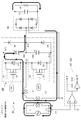
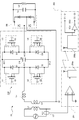
- the inductive power feeding system 10 includes a power feeding device 11 and a power receiving device 12.
- the power feeding device 11 includes an AC power source VS, a primary coil L1, a current sensor CT, and a wireless control device 201.
- the power receiving device 12 includes a secondary coil L2, a leakage inductance Ls, and a magnetic energy regenerative switch 100. And a rectifier DB, a smoothing capacitor Cs, a load LD, and a wireless control device 202.
- the magnetic energy regenerative switch 100 is a vertical half-bridge magnetic energy regenerative switch, and includes first and second AC terminals AC1 and AC2, first and second DC terminals DC1 and DC2, and a first diode. From a parallel circuit of a first reverse conducting semiconductor switch SW1 composed of a parallel circuit of D1 and a first self-extinguishing element S1, and a second diode D2 and a second self-extinguishing element S2 The second reverse conducting semiconductor switch SW2 is configured, third and fourth diodes D3 and D4, and first and second capacitors CM1 and CM2.
- the AC terminal AC1 has the anode of the diode D1 and the cathode of the diode D2, the DC terminal DC1 has the cathode of the diode D1, the positive electrode of the capacitor CM1, and the cathode of the diode D3.
- the AC terminal AC2 has the negative electrode of the capacitor CM1 and the capacitor.
- the positive electrode of CM2, the anode of the diode D3, and the cathode of the diode D4 are connected to the DC terminal DC2, and the anode of the diode D2, the negative electrode of the second capacitor CM2, and the anode of the diode D4 are connected.
- the rectifier DB includes first and second AC input terminals I1 and I2, first and second DC output terminals O1 and O2, and four diodes D5 to D8.
- the AC input terminal I1 has the anode of the diode D5 and the cathode of the diode D6, the AC input terminal I2 has the anode of the diode D7 and the cathode of the diode D8, and the DC output terminal O1 has the cathode of the diode D5 and the diode D7.
- the anode of the diode D6 and the anode of the diode D8 are connected to the DC output terminal O2.
- AC power supply VS forms a series circuit with primary coil L1, and supplies alternating current to primary coil L1.
- the AC power source VS is a 100 A, 25 kHz AC current source.
- the AC power supply VS is a sine wave voltage type inverter power supply that feedback-controls the output current so that a predetermined AC current flows through the induction coil without depending on the load, although it is practically widespread.
- the primary coil L1 is grounded at one end.
- the primary coil L1 generates a magnetic field by a current supplied from the AC power source VS.
- the inductance of the primary coil L1 is 21.68 microH.
- the secondary coil L2 is electromagnetically coupled to the primary coil, a current is induced by the magnetic field generated from the primary coil L1, and power is inductively fed from the AC power source VS via the primary coil L1.
- current flows from the other end of the primary coil to one end, current is induced from the other end of the secondary coil to one end, and when current flows from one end of the primary coil to the other end, the secondary A current is induced in the direction from one end of the coil to the other end.
- the inductance of the secondary coil L2 is 21.68 microH.
- the leakage inductance Ls is a leakage inductance in the coupling between the primary coil L1 and the secondary coil L2.
- the primary coil L1, the secondary coil L2, and the leakage inductance Ls in the figure are the simplest transformer coupling models.
- the leakage inductance Ls has one end connected to one end of the secondary coil L2 and the other end connected to the AC terminal AC1 of the magnetic energy regenerative switch 100.
- the leakage inductance Ls is virtual and does not exist as an element on the actual circuit. In the actual circuit, one end of the secondary coil L2 is connected to the AC terminal AC1.
- the inductance of the leakage inductance Ls varies depending on the physical position of the primary coil L1 and the secondary coil L2. For example, when the distance between the primary coil L1 and the secondary coil L2 is long, the inductance of the leakage inductance Ls is large (the degree of coupling is low). For example, when the distance is short, the inductance of the leakage inductance Ls is small (the degree of coupling is high). .
- the self-extinguishing elements S1 and S2 of the magnetic energy regeneration switch 100 include gates G1 and G2, which are turned on when an on signal is input to the gates G1 and G2, respectively, and an off signal is input to the gates G1 and G2. Then it turns off.
- both ends of the diodes D1 and D2 are short-circuited, and the reverse conducting semiconductor switches SW1 and SW2 are in a conducting state (on) in which current can flow in both forward and reverse directions.
- the self-extinguishing elements S1 and S2 are turned off, the diodes D1 and D2 function, and the reverse conducting semiconductor switches SW1 and SW2 conduct current in a direction opposite to the conducting direction (forward direction) of the diodes D1 and D2. It will not flow (off).
- the reverse conducting semiconductor switches SW1, SW2 are, for example, N-channel silicon MOSFETs (MOSFETs: Metal-Oxide-Semiconductor, Field-Effect Transistor), and the diodes D1, D2 are parasitic diodes of the reverse conducting semiconductor switches SW1, SW2. is there.
- MOSFETs Metal-Oxide-Semiconductor, Field-Effect Transistor
- the magnetic energy regenerative switch 100 collects the magnetic energy stored in the leakage inductance Ls in response to the on / off of the self-extinguishing elements S1 and S2, and outputs them as electrostatic energy in the form of charges in the capacitors CM1 and CM2. Accumulate (regenerate).
- the capacitance of the capacitor CM1 is adjusted in advance so that the resonance frequency determined by the capacitance of the capacitor CM1 and the inductance of the secondary coil L2 is much lower than the output frequency of the AC power supply VS (for example, 1/10). That is, the capacitance of the capacitor CM1 and the like are determined so that the resonance frequency determined by the capacitance of the capacitor CM1 and the leakage inductance Ls is always lower than the output frequency of the AC power supply VS.
- the capacitance of the capacitor CM2 is adjusted in advance so as to be almost the same value as the capacitance of the capacitor CM1.
- the capacitances of the capacitors CM1 and CM2 are both 10 micro F. Note that the pulsation of the voltage accumulated in the capacitors CM1 and CM2 is preferably about 5% or less, and even if the capacitances of the capacitors CM1 and CM2 are smaller values, the effect is sufficient.
- the AC input terminal I1 is connected to the AC terminal AC2 of the magnetic energy regenerative switch 100, and the AC input terminal I2 is connected to the other end of the secondary coil L2 and a ground point.
- the rectifier DB rectifies AC power input from the AC input terminals I1 and I2 and outputs DC power from the DC output terminals O1 and O2.
- the smoothing capacitor Cs is connected in parallel with the load LD between the DC output terminals O1 and O2 of the rectifier DB.
- the smoothing capacitor Cs smoothes the DC power supplied from the rectifier DB and supplies it to the load LD.
- the load LD is, for example, a battery.
- the current sensor CT detects the current flowing through the primary coil L1, converts the detected current into a voltage, and outputs the voltage to the wireless control device 201.
- the current sensor CT is, for example, an instrument current transformer (CT: Current Transformer).
- the direction from the other end of the primary coil L1 to the one end is positive, and the direction from one end to the other end of the primary coil L1 is negative. Called the direction.
- the wireless control devices 201 and 202 include wireless communication devices 250a and 250b that transmit signals wirelessly.
- the wireless control device 201 includes a wireless communication device 250a, a comparator, and the like.
- the wireless control device 201 checks the positive / negative of the voltage (based on the positive / negative) and determines the positive / negative of the current flowing through the primary coil L1. This determination is made by a comparator. If the voltage is positive, the current is also positive. If the voltage is negative, the current is also negative.
- the wireless communication device 250a of the wireless control device 201 acquires current positive / negative information CD, which is information indicating the determination result of this determination, from the comparator, converts the acquired current positive / negative information CD into a radio wave signal, and transmits the radio signal 250b. Send to.
- the current positive / negative information CD indicates that the current flowing through the primary coil L1 (that is, the voltage output from the current sensor CT) is positive or negative. For example, if the current positive / negative information CD is a signal having a positive voltage value, the current is positive. If the current positive / negative information CD is a signal having a negative voltage value, the current is negative. In the present embodiment, the wireless control device 201 detects the positive / negative of the current flowing through the primary coil L1 in this way and outputs it to the wireless control device 202.
- the wireless control device 202 includes a wireless communication device 250b, a NOT circuit, and the like.
- the radio communication device 250b receives the radio signal from the radio communication device 250a
- the radio communication device 250b extracts the current positive / negative information CD from the received radio signal, and based on the extracted current positive / negative information CD, the on signal or the off signal is output to the gates G1, G2. Output for.
- a NOT circuit is connected between the gate G2 and the wireless communication device 250b, so that a signal supplied to the gate G2 is an inverted signal output from the wireless communication device 250b.
- the signals supplied from the radio controller 202 to the gates G1 and G2 are referred to as gate signals SG1 and SG2, respectively. As described above, the gate signals SG1 and SG2 are signals that are turned on and off in reverse.
- the radio network controller 202 outputs the gate signal SG2 that is an on signal and the gate that is an off signal if the current positive / negative information CD is positive (the current flowing through the primary coil is in the positive direction).
- the signal SG1 is output. If the current positive / negative information CD is negative (the current flowing through the primary coil is in the negative direction), the wireless control device 202 outputs a gate signal SG2 that is an off signal and a gate signal SG1 that is an on signal. In this way, the wireless control device 202 controls the reverse conducting semiconductor switches SW1, SW2 (self-extinguishing elements S1, S2) based on the positive / negative of the current flowing through the primary coil L1.
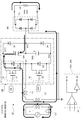
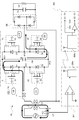
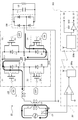
- FIGS. 2A to 2D arrows indicate the direction of current flow.
- the notations of the wireless communication devices 250a and 250b are omitted.
- the current flowing from the AC power source VS flows from one end of the primary coil L1 to the other end (negative direction), the current flows from the other end of the secondary coil L2 to one end, and the gate signal SG1.
- Is an off signal the self-extinguishing element S1 is off
- the gate signal SG2 is an on signal (the self-extinguishing element S2 is on)
- charges are accumulated in the capacitors CM1 and CM2, which will be described later in phase P4. The description will be made assuming that the state is (FIG. 2D).
- Phase P1 It is assumed that the direction of the current flowing from the AC power source VS is switched at time T10, and the current starts to flow in the direction from the other end of the primary coil L1 to one end (positive direction). Then, the wireless control devices 201 and 202 switch the gate signal SG1 to the on signal and the gate signal SG2 to the off signal. The self-extinguishing element S1 is turned on and the self-extinguishing element S2 is turned off.
- the current flowing through the self-extinguishing element S2 is cut off, and the current flowing through the leakage inductance Ls flows into the positive electrode of the capacitor CM1 via the ON self-extinguishing element S1 and the diode D1, as shown in FIG. 2A. .
- the current flowing out from the negative electrode of the capacitor CM1 is supplied to the smoothing capacitor Cs and the load LD via the rectifier DB, and flows through the secondary coil L2 and the leakage inductance Ls.
- the current flowing through the leakage inductance Ls is interrupted by the capacitor CM1.
- the capacitor CM1 recovers the magnetic energy accumulated in the leakage inductance Ls and accumulates it as electrostatic energy in the form of electric charges.
- the magnetic field generated by the current flowing through the primary coil L1 induces a current from the other end of the secondary coil L2 to the one end (the direction of the arrow in FIG. 2A), and power is supplied. This power also flows into the positive electrode of the capacitor CM1, and charges the capacitor CM1.
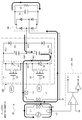
- Phase P3 At time T30 when the direction of the current flowing out from the AC power supply VS is switched (switched from the positive direction to the negative direction), the wireless control devices 201 and 202 switch the gate signal SG1 to the off signal and the gate signal SG2 to the on signal.
- the self-extinguishing element S1 is turned off and the self-extinguishing element S2 is turned on.
- the current flowing through the self-extinguishing element S1 is cut off, and the current flowing through the leakage inductance Ls passes through the secondary coil L2, the rectifier DB, the smoothing capacitor Cs, and the load LD as shown in FIG. Flows into the positive electrode.
- the current flowing out from the negative electrode of the capacitor CM2 returns to the leakage inductance Ls via the ON self-extinguishing element S2 and the diode D2.
- the current flowing through the leakage inductance Ls is interrupted by the capacitor CM2. Therefore, the magnetic energy accumulated in the leakage inductance Ls is recovered as electrostatic energy in the form of electric charges by the capacitor CM2.
- Phase P4 At time T40 when the capacitor CM finishes collecting the magnetic energy of the leakage inductance Ls, the capacitor CM2 starts discharging electrostatic energy. As shown in FIG. 2D, the current flowing out from the positive electrode of the capacitor CM2 is supplied to the smoothing capacitor Cs and the load LD via the rectifier DB, passes through the secondary coil L2, the leakage inductance Ls, and is turned on. It flows into the negative electrode of the capacitor CM2 via S2.
- the power receiving device 12 repeats the above operation, receives power from the AC power supply VS, and supplies the power to the load.
- the capacitor CM1 collects the magnetic energy accumulated in the leakage inductance Ls, accumulates it as electrostatic energy, and discharges the collected magnetic energy by discharging in the phase P2.
- the inductance is returned to Ls. That is, in the phases P1 and P2, the leakage inductance Ls and the capacitor CM1 are in series resonance. Similarly, in the phases P3 and P4, the leakage inductance Ls and the capacitor CM2 are in series resonance.
- the leakage inductance Ls is always in a resonance state by repeating the phases P1 to P4. Therefore, the imaginary part of the input impedance of the power receiving device 12 with respect to the power feeding device 11 is almost zero. Therefore, the power factor of the power received by the power receiving device 12 from the power feeding device 11 is approximately 1, and the power can be efficiently received from the AC power supply VS.
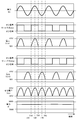
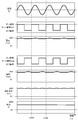
- the inductive power feeding system 10 having the above configuration, the sum of the gate signal SG1, the voltage Vcm1 of the capacitor CM1, the gate signal SG2, the voltage Vcm2 of the capacitor CM, the voltage Vcm1 and the voltage Vcm2 with respect to the current Iin output from the AC power supply VS.
- the relationship between the voltage Vcm and the power W supplied to the load LD is as shown in FIGS. 3A to 3D.
- FIG. 3A shows changes over time in the current Iin, the gate signal SG1, the voltage Vcm1, the gate signal SG2, the voltage Vcm2, the voltage Vcm, and the power W when the leakage inductance Ls is 10 microH. This is a common time axis.
- FIG. 3B shows the relationship obtained when the leakage inductance Ls is 10 microH in an actual simulation.
- FIG. 3C shows changes over time in the current Iin, the gate signal SG1, the voltage Vcm1, the gate signal SG2, the voltage Vcm2, the voltage Vcm, and the power W when the leakage inductance Ls is 20 microH. This is a common time axis.
- FIG. 3D shows the above relationship obtained when the leakage inductance Ls is 20 microH in the actual simulation.
- T00 to T50 indicated on the time axis in FIGS. 3A and 3B correspond to the times T00 to T50 of the phases P1 to P4.
- the gate signal SG1 is output from the AC power supply VS.
- the positive signal eg, time T10 to T30
- the negative signal eg, time T30 to T50
- the capacitor CM1 is charged and discharged while the gate signal SG1 is on.
- the voltage Vcm1 does not change while SG1 is off. However, since the gate signal SG1 is switched to the off signal before the discharge is completed, the voltage remains in the voltage Vcm1.
- the gate signal SG2 is controlled to be an off signal while the output of the AC power supply VS is positive (for example, times T10 to T30) and to an on signal when the output is negative (for example, times T30 to T50), and the capacitor CM2 Charge / discharge is performed while the gate signal SG2 is on.
- the gate signal SG2 is switched to the off signal before the discharge is completed, the voltage remains in the voltage Vcm2.
- the capacitors CM1, CM2 and the leakage inductance Ls resonate in response to the on / off of the self-extinguishing elements S1, S2.
- the resonance period is synchronized with the on / off period of the self-extinguishing elements S1 and S2, that is, the output period of the AC power supply VS. Therefore, even if the leakage inductance Ls changes, the resonance period between the capacitors CM1 and CM2 and the leakage inductance Ls does not change. Therefore, as shown in FIGS. 3A to 3D, in the present embodiment, the power W supplied to the load LD does not depend on the leakage inductance Ls and is almost 760 watts and hardly changes.
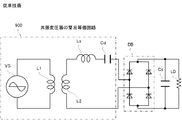
- FIG. 7 shows an example of a conventionally known resonant transformer.
- FIG. 8 shows the result of simulating the change in power supplied from the primary side to the secondary side when the coupling degree of the transformer changes in the resonant transformer shown in FIG.
- a resonance transformer 900 illustrated in FIG. 7 is obtained by replacing the magnetic power regeneration switch 100 and the wireless control devices 201 and 202 with a resonance capacitor Cd in the inductive power feeding system 10 using an AC power source VS as an AC voltage source.
- Other configurations are the same as those of the induction power feeding system 10.
- the resonant capacitor Cd is adjusted to resonate with the leakage inductance Ls of 10 microH (here, the capacitance of the resonant capacitor Cd is 0.9 microF).
- the leakage inductance Ls is changed from 10 microH to 20 microH, the resonance between the leakage inductance Ls and the resonance capacitor Cd disappears, and the power supplied from the primary coil L1 to the secondary coil L2 is shown in FIG. As shown, it decreases greatly from 760W to 674W.
- the inductive power feeding system 10 turns on and off the self-extinguishing elements S1 and S2 in synchronization with the positive / negative switching of the output current of the AC power supply VS.
- CM1 and CM2 and the leakage inductance Ls can always be resonated. Therefore, regardless of the degree of coupling between the primary coil L1 and the secondary coil L2, the power factor of the electric power supplied from the power supply device 11 to the power reception device 12 is approximately 1, and the power reception device 12 is connected with the efficiency from the AC power source VS. Can receive power well.
- the power feeding device 11 can supply power to the power receiving device 12 wirelessly and with high efficiency.
- ⁇ Previous MERS applications were such that the resonant frequency of the MERS capacitor was set to be approximately the same or higher than the output frequency of the power supply.
- a capacitor having a sufficiently lower capacitance than the output frequency of the AC power supply VS that is, a capacitor having a sufficiently large capacitance is selected.
- the power receiving apparatus 12 can receive power with high efficiency (for example, can receive the maximum power) by controlling the MERS with the phase always advanced by 90 degrees.
- the phase signal advanced by 90 degrees can be obtained from the output of the current sensor CT because it is synchronized with the positive / negative signal of the current on the power feeding device 11 side. Accordingly, the leakage inductance Ls can always be resonated by simple control of controlling on / off of the self-extinguishing elements S1, S2 based on the positive / negative of the current flowing through the primary coil Ls.
- the electric power feeder 11 and the power receiving apparatus 12 can also communicate wirelessly, The relationship between the two can be completely wireless.
- the inductive power feeding system 20 according to the present embodiment is obtained by replacing the vertical half-bridge magnetic energy regenerative switch 100 with a full-bridge magnetic energy regenerative switch 110.
- Other configurations are the same as those of the induction power feeding system 10 according to the first embodiment.
- the magnetic energy regenerative switch 110 connects the capacitor CM between the DC terminals DC1 and DC2 in place of the capacitors CM1 and CM2 in the magnetic energy regenerative switch 100, and connects the self-extinguishing element S3 in parallel with the diode D3.
- a self-extinguishing element S4 is connected in parallel to D4.
- the self-extinguishing elements S3 and S4 include gates G3 and G4.
- the gate signal SG2 is supplied to the gate G3, and the gate signal SG1 is supplied to the gate G4.
- the current flowing from one end to the other end of the leakage inductance Ls flows through the capacitor CM through the on-self-extinguishing element S1 and the diode D1, and the on-self-extinguishing element S4 and the diode D4. Charge.
- the current flowing from the other end of the leakage inductance Ls to the one end discharges the capacitor CM through the on-self-extinguishing element S1 and the on-self-extinguishing element S4. .
- the gate signal SG1 is an off signal and the gate signal SG2 is an on signal. Therefore, as shown in FIGS. 5C and 5D, the self-extinguishing elements S1 and S4 are turned off. The arc-shaped elements S2 and S3 are on.
- the current flowing from one end of the leakage inductance Ls to the other end discharges the capacitor CM through the on-self-extinguishing element S3 and the on-self-extinguishing element S2. .
- the capacitor CM resonates with the leakage inductance Ls corresponding to the on / off of the self-extinguishing elements S1 to S4.
- the inductive power feeding system 20 turns on and off the self-extinguishing elements S1 to S4 based on whether the output current of the AC power supply VS is positive or negative, thereby leaking from the capacitor CM.
- the inductance Ls is resonated. Therefore, since the leakage inductance Ls is always in a resonance state, the power factor of the electric power supplied from the power feeding device 11 to the power receiving device 12 is almost 1 regardless of the degree of coupling between the primary coil L1 and the secondary coil L2.
- the power receiving device 12 can receive power from the AC power source VS wirelessly and efficiently (with high efficiency).
- the DC power is supplied to the load LD by rectifying the AC power supplied from the AC terminals AC1 and AC2 by the rectifier DB.
- the rectifier DB increases the number of parts. Therefore, there is room for improvement in that DC power is supplied to the load LD without using the rectifier DB.
- the inductive power feeding system 30 supplies DC power to the load LD without using the rectifier DB in the second embodiment.
- the inductive power feeding system 30 includes a diode DR instead of the rectifier DB.
- the series circuit of the diode DR and the load LD is connected between the DC terminals DC1 and DC2, and the diode DR is connected so as to cut off the current flowing from the load LD to the positive electrode of the capacitor CM.
- Other configurations are the same as those of the inductive power feeding system 20.
- the diode DR is not necessary when no current is generated from the load LD to the positive electrode of the capacitor CM.
- a DC voltage is generated in the capacitor CM. This voltage is applied to the load LD.
- the induction power feeding system 30 supplies DC power to the load LD without using a rectifier by connecting the load LD between the DC terminals DC1 and DC2 of the magnetic energy regenerative switch. can do.
- the diode DR blocks the current flowing from the load LD to the positive electrode of the capacitor CM, the battery can be charged as the load LD.
- each setting value in the above embodiment is an example, and various settings are possible. Moreover, it is not necessary to provide all the configurations described in the above-described embodiment, and a combination of some configurations may be used as long as the intended purpose can be achieved.
- the wireless control devices 201 and 202 are electronic circuits including wireless communication units 250a and 250b, respectively.
- the wireless control devices 201 and 202 include a CPU such as a central processing unit (CPU), a storage unit such as a RAM (Random Access Memory) and a ROM (Read Only Memory), a computer such as a microcontroller, a wireless communication unit, and the like.
- a program for outputting the above-described gate signal may be stored in the microcomputer in advance.
- the reverse conducting semiconductor switches SW1 and SW2 are not limited to N-channel MOSFETs.
- the reverse conducting semiconductor switches SW1 and SW2 may be composed of a normal bipolar transistor and a diode, or may be composed of an IGBT (Insulated Gate By-polar Transistor) or a thyristor.
- IGBT Insulated Gate By-polar Transistor
- you may be comprised from the element and diode for arbitrary switching.
- the self-extinguishing elements S1 to S4 may be elements such as N-channel MOSFETs.
- the magnetic energy regeneration is performed based on (according to) the positive / negative of the current flowing through the primary coil L1, that is, the current flowing direction (an example of current information (that is, current state)).
- the on / off of the self-extinguishing element of the switches 100 and 110 was controlled.
- on / off of the self-extinguishing type elements of the magnetic energy regenerative switches 100 and 110 may be controlled based on other current information such as phase and current value instead of positive and negative.
- the self-extinguishing element is switched on / off after a predetermined time (for example, a time corresponding to 90 degrees when one cycle of the AC power supply VS is 360 degrees) from the peak of the current flowing through the primary coil L1. Also good.
- a predetermined time for example, a time corresponding to 90 degrees when one cycle of the AC power supply VS is 360 degrees
- the wireless control device 201 and the wireless control device 202 are connected by radio communication using radio waves.
- optical communication using infrared rays or wireless communication using microwave signals or sound waves may be used. Good.
- the output of the current sensor CT may be directly input to the wireless control device 202.
- the wireless control devices 201 and 202 may be control devices. When the output of the current sensor CT is directly input to the wireless control device 202, detection of the direction of the current and the like are also performed by the wireless control device 202.
- the current sensor CT can detect the current flowing through the primary coil L1 in a non-contact manner, even if the wireless control device 201 and the wireless control device 202 are connected by wire, the output of the current sensor CT to the wireless control device 202. Even if is directly input, it is possible to perform non-contact power feeding.
- the AC power supply VS may be one obtained by converting the output voltage of a commercial power supply into a current source, as already used in other systems.
- the diodes D1 and D2 may be omitted. However, when both the self-extinguishing elements S1 and S2 are turned off, current may flow only through the diodes D1 and D2. Therefore, it is preferable that the diodes D1 and D2 are present. Similarly, in the third embodiment, the diodes D1 to D4 of the magnetic energy regenerative switch 110 are preferably provided.
- the smoothing capacitor Cs may not be provided.
- a coil may be further provided in series with the leakage inductance Ls.
- the present invention can be used in various ways.
- the mobile terminal when the power receiving device 12 is incorporated into a mobile terminal, the mobile terminal can charge the battery from the power supply device 11 wirelessly and with high efficiency.
- wireless power feeding can be performed with high efficiency regardless of the degree of coupling of the transformer, it is also effective to be incorporated in a moving object, for example, an automobile.
- the automobile can charge a battery while traveling.
- Power feeding device 12 Power receiving device 100, 110 Magnetic energy regenerative switch AC1, AC2 AC terminal DC1, DC2 DC terminal SW1, SW2, SW3, SW4 Reverse conducting semiconductor switch D1, D2, D3, D4 , D5, D6, D7, D8, DR diode S1, S2, S3, S4 Self-extinguishing element G1, G2, G3, G4 Gate CM, CM1, CM2 Capacitor 201, 202 Wireless controller 250a, 250b Wireless communication device SG1 , SG2 Gate signal L1 Primary coil L2 Secondary coil VS AC power supply LD Load DB Rectifier Cs Smoothing capacitor CT Current sensor
Landscapes
- Engineering & Computer Science (AREA)
- Power Engineering (AREA)
- Computer Networks & Wireless Communication (AREA)
- Physics & Mathematics (AREA)
- Electromagnetism (AREA)
- Transportation (AREA)
- Mechanical Engineering (AREA)
- Inverter Devices (AREA)
Applications Claiming Priority (2)
| Application Number | Priority Date | Filing Date | Title |
|---|---|---|---|
| JP2010-111524 | 2010-05-13 | ||
| JP2010111524A JP2011239655A (ja) | 2010-05-13 | 2010-05-13 | 誘導給電システム、受電装置、及び、制御方法 |
Publications (1)
| Publication Number | Publication Date |
|---|---|
| WO2011142440A1 true WO2011142440A1 (ja) | 2011-11-17 |
Family
ID=44914492
Family Applications (1)
| Application Number | Title | Priority Date | Filing Date |
|---|---|---|---|
| PCT/JP2011/061001 Ceased WO2011142440A1 (ja) | 2010-05-13 | 2011-05-12 | 誘導給電システム、受電装置、及び、制御方法 |
Country Status (2)
| Country | Link |
|---|---|
| JP (1) | JP2011239655A (https=) |
| WO (1) | WO2011142440A1 (https=) |
Cited By (1)
| Publication number | Priority date | Publication date | Assignee | Title |
|---|---|---|---|---|
| EP3216108A4 (en) * | 2014-11-05 | 2017-10-25 | PowerbyProxi Limited | An inductive power receiver |
Families Citing this family (6)
| Publication number | Priority date | Publication date | Assignee | Title |
|---|---|---|---|---|
| US20110285211A1 (en) * | 2010-05-20 | 2011-11-24 | Advantest Corporation | Wireless power supply system |
| JP5860458B2 (ja) | 2011-06-02 | 2016-02-16 | 株式会社アドバンテスト | ワイヤレス受電装置、ワイヤレス給電装置およびワイヤレス給電システム、自動チューニング補助回路 |
| JP5831275B2 (ja) * | 2012-02-10 | 2015-12-09 | 日産自動車株式会社 | 電力変換装置及びその駆動方法 |
| CN107078549A (zh) * | 2014-11-06 | 2017-08-18 | 富士通株式会社 | 受电器、以及电力传送系统 |
| JP6402818B2 (ja) | 2015-02-20 | 2018-10-10 | 富士通株式会社 | 受電器、及び、電力伝送システム |
| WO2016132560A1 (ja) | 2015-02-20 | 2016-08-25 | 富士通株式会社 | 受電器、及び、電力伝送システム |
Citations (3)
| Publication number | Priority date | Publication date | Assignee | Title |
|---|---|---|---|---|
| JP2004072832A (ja) * | 2002-08-02 | 2004-03-04 | Hitachi Kiden Kogyo Ltd | 非接触給電方法 |
| JP2007174723A (ja) * | 2005-12-19 | 2007-07-05 | Tokyo Institute Of Technology | 交流/直流変換電源装置及び、それを利用した発光ダイオード駆動システム |
| WO2010046962A1 (ja) * | 2008-10-20 | 2010-04-29 | 株式会社MERSTech | 原動機システム |
-
2010
- 2010-05-13 JP JP2010111524A patent/JP2011239655A/ja not_active Withdrawn
-
2011
- 2011-05-12 WO PCT/JP2011/061001 patent/WO2011142440A1/ja not_active Ceased
Patent Citations (3)
| Publication number | Priority date | Publication date | Assignee | Title |
|---|---|---|---|---|
| JP2004072832A (ja) * | 2002-08-02 | 2004-03-04 | Hitachi Kiden Kogyo Ltd | 非接触給電方法 |
| JP2007174723A (ja) * | 2005-12-19 | 2007-07-05 | Tokyo Institute Of Technology | 交流/直流変換電源装置及び、それを利用した発光ダイオード駆動システム |
| WO2010046962A1 (ja) * | 2008-10-20 | 2010-04-29 | 株式会社MERSTech | 原動機システム |
Non-Patent Citations (1)
| Title |
|---|
| KAZUYUKI WAKASUGI ET AL.: "Jiki Energy Kaisei Switch o Mochiita Hi Sesshoku Kyuden no Chokuretsu Hoshoho", HEISEI 21 NEN NATIONAL CONVENTION RECORD, I.E.E. JAPAN, 31 August 2009 (2009-08-31), pages 16 * |
Cited By (4)
| Publication number | Priority date | Publication date | Assignee | Title |
|---|---|---|---|---|
| EP3216108A4 (en) * | 2014-11-05 | 2017-10-25 | PowerbyProxi Limited | An inductive power receiver |
| CN107636931A (zh) * | 2014-11-05 | 2018-01-26 | 鲍尔拜普罗克西有限公司 | 感应功率接收器 |
| CN107636931B (zh) * | 2014-11-05 | 2020-12-18 | 苹果公司 | 感应功率接收器 |
| US10923953B2 (en) | 2014-11-05 | 2021-02-16 | Apple Inc. | Received wireless power regulation |
Also Published As
| Publication number | Publication date |
|---|---|
| JP2011239655A (ja) | 2011-11-24 |
Similar Documents
| Publication | Publication Date | Title |
|---|---|---|
| US10892648B2 (en) | Wireless power transfer method, apparatus and system for low and medium power | |
| US8987941B2 (en) | Power transmission system | |
| US8552596B2 (en) | Power transmitting apparatus and power transmission system | |
| CN102195366B (zh) | 无线馈电装置以及无线电力传输系统 | |
| EP2587613B1 (en) | Wireless power receiver for adjusting magnitude of wireless power | |
| RU2596606C2 (ru) | Динамическая резонансная согласующая схема для беспроводных приемников энергии | |
| KR102099819B1 (ko) | 무선 전력 전송방법, 무선 전력 전송장치 및 무선 충전 시스템 | |
| EP3306781A1 (en) | Wireless power transmission system and method for driving same | |
| WO2011142440A1 (ja) | 誘導給電システム、受電装置、及び、制御方法 | |
| JP5549745B2 (ja) | ワイヤレス給電装置およびワイヤレス電力伝送システム | |
| TWI565182B (zh) | 無線受電裝置、無線供電裝置以及無線送電系統 | |
| CN105052009B (zh) | 非接触式供电系统 | |
| KR20160019281A (ko) | 무선 전력 전송장치 및 무선 충전 시스템 | |
| CN112448484B (zh) | 非接触供电装置 | |
| US20170149282A1 (en) | Wireless power transfer receiver having synchronous rectifier synchronized to wireless power transfer signal | |
| US20140177305A1 (en) | Gate drive circuit for synchronous rectification | |
| KR20150076001A (ko) | 전계 결합형 무선 충전장치 | |
| JP6176547B2 (ja) | 非接触給電装置及び非接触給電装置の始動方法 | |
| KR101949127B1 (ko) | 하이브리드 동기화 기법을 적용한 무선 에너지 수신 방법 및 장치 | |
| JP7238423B2 (ja) | 非接触給電装置及び送電装置 | |
| CN112448482A (zh) | 非接触供电装置及送电装置 | |
| WO2019176432A1 (ja) | 受電装置 | |
| KR101305828B1 (ko) | 무선전력 송신장치, 무선전력 수신장치, 무선전력 전송 시스템 및 무선전력 전송 방법 | |
| KR20130102511A (ko) | 무선전력 송신장치, 무선전력 수신장치, 무선전력 전송 시스템 및 무선전력 전송 방법 | |
| JP2021083140A (ja) | 受電装置 |
Legal Events
| Date | Code | Title | Description |
|---|---|---|---|
| 121 | Ep: the epo has been informed by wipo that ep was designated in this application |
Ref document number: 11780697 Country of ref document: EP Kind code of ref document: A1 |
|
| NENP | Non-entry into the national phase |
Ref country code: DE |
|
| 122 | Ep: pct application non-entry in european phase |
Ref document number: 11780697 Country of ref document: EP Kind code of ref document: A1 |