WO2011127336A1 - Silane - Google Patents
Silane Download PDFInfo
- Publication number
- WO2011127336A1 WO2011127336A1 PCT/US2011/031664 US2011031664W WO2011127336A1 WO 2011127336 A1 WO2011127336 A1 WO 2011127336A1 US 2011031664 W US2011031664 W US 2011031664W WO 2011127336 A1 WO2011127336 A1 WO 2011127336A1
- Authority
- WO
- WIPO (PCT)
- Prior art keywords
- dye
- compound
- fabric
- formula
- fiber
- Prior art date
- Legal status (The legal status is an assumption and is not a legal conclusion. Google has not performed a legal analysis and makes no representation as to the accuracy of the status listed.)
- Ceased
Links
- 0 CCC(C)(CC(C)(C)C)CC(C)(C)N(*)* Chemical compound CCC(C)(CC(C)(C)C)CC(C)(C)N(*)* 0.000 description 2
- PMZIYKKERWDIFE-UHFFFAOYSA-N CO[Si](CCCNCCN(CCC[Si](OC)(OC)OC)CCC[Si](OC)(OC)OC)(OC)OC Chemical compound CO[Si](CCCNCCN(CCC[Si](OC)(OC)OC)CCC[Si](OC)(OC)OC)(OC)OC PMZIYKKERWDIFE-UHFFFAOYSA-N 0.000 description 1
- PHQOGHDTIVQXHL-UHFFFAOYSA-N CO[Si](CCCNCCN)(OC)OC Chemical compound CO[Si](CCCNCCN)(OC)OC PHQOGHDTIVQXHL-UHFFFAOYSA-N 0.000 description 1
Classifications
-
- C—CHEMISTRY; METALLURGY
- C11—ANIMAL OR VEGETABLE OILS, FATS, FATTY SUBSTANCES OR WAXES; FATTY ACIDS THEREFROM; DETERGENTS; CANDLES
- C11D—DETERGENT COMPOSITIONS; USE OF SINGLE SUBSTANCES AS DETERGENTS; SOAP OR SOAP-MAKING; RESIN SOAPS; RECOVERY OF GLYCEROL
- C11D3/00—Other compounding ingredients of detergent compositions covered in group C11D1/00
- C11D3/16—Organic compounds
- C11D3/162—Organic compounds containing Si
-
- C—CHEMISTRY; METALLURGY
- C11—ANIMAL OR VEGETABLE OILS, FATS, FATTY SUBSTANCES OR WAXES; FATTY ACIDS THEREFROM; DETERGENTS; CANDLES
- C11D—DETERGENT COMPOSITIONS; USE OF SINGLE SUBSTANCES AS DETERGENTS; SOAP OR SOAP-MAKING; RESIN SOAPS; RECOVERY OF GLYCEROL
- C11D3/00—Other compounding ingredients of detergent compositions covered in group C11D1/00
- C11D3/0005—Other compounding ingredients characterised by their effect
- C11D3/0021—Dye-stain or dye-transfer inhibiting compositions
-
- D—TEXTILES; PAPER
- D06—TREATMENT OF TEXTILES OR THE LIKE; LAUNDERING; FLEXIBLE MATERIALS NOT OTHERWISE PROVIDED FOR
- D06M—TREATMENT, NOT PROVIDED FOR ELSEWHERE IN CLASS D06, OF FIBRES, THREADS, YARNS, FABRICS, FEATHERS OR FIBROUS GOODS MADE FROM SUCH MATERIALS
- D06M13/00—Treating fibres, threads, yarns, fabrics or fibrous goods made from such materials, with non-macromolecular organic compounds; Such treatment combined with mechanical treatment
- D06M13/50—Treating fibres, threads, yarns, fabrics or fibrous goods made from such materials, with non-macromolecular organic compounds; Such treatment combined with mechanical treatment with organometallic compounds; with organic compounds containing boron, silicon, selenium or tellurium atoms
- D06M13/51—Compounds with at least one carbon-metal or carbon-boron, carbon-silicon, carbon-selenium, or carbon-tellurium bond
- D06M13/513—Compounds with at least one carbon-metal or carbon-boron, carbon-silicon, carbon-selenium, or carbon-tellurium bond with at least one carbon-silicon bond
-
- D—TEXTILES; PAPER
- D06—TREATMENT OF TEXTILES OR THE LIKE; LAUNDERING; FLEXIBLE MATERIALS NOT OTHERWISE PROVIDED FOR
- D06P—DYEING OR PRINTING TEXTILES; DYEING LEATHER, FURS OR SOLID MACROMOLECULAR SUBSTANCES IN ANY FORM
- D06P1/00—General processes of dyeing or printing textiles, or general processes of dyeing leather, furs, or solid macromolecular substances in any form, classified according to the dyes, pigments, or auxiliary substances employed
- D06P1/44—General processes of dyeing or printing textiles, or general processes of dyeing leather, furs, or solid macromolecular substances in any form, classified according to the dyes, pigments, or auxiliary substances employed using insoluble pigments or auxiliary substances, e.g. binders
- D06P1/52—General processes of dyeing or printing textiles, or general processes of dyeing leather, furs, or solid macromolecular substances in any form, classified according to the dyes, pigments, or auxiliary substances employed using insoluble pigments or auxiliary substances, e.g. binders using compositions containing synthetic macromolecular substances
- D06P1/5264—Macromolecular compounds obtained otherwise than by reactions involving only unsaturated carbon-to-carbon bonds
- D06P1/5292—Macromolecular compounds obtained otherwise than by reactions involving only unsaturated carbon-to-carbon bonds containing Si-atoms
-
- D—TEXTILES; PAPER
- D06—TREATMENT OF TEXTILES OR THE LIKE; LAUNDERING; FLEXIBLE MATERIALS NOT OTHERWISE PROVIDED FOR
- D06P—DYEING OR PRINTING TEXTILES; DYEING LEATHER, FURS OR SOLID MACROMOLECULAR SUBSTANCES IN ANY FORM
- D06P1/00—General processes of dyeing or printing textiles, or general processes of dyeing leather, furs, or solid macromolecular substances in any form, classified according to the dyes, pigments, or auxiliary substances employed
- D06P1/44—General processes of dyeing or printing textiles, or general processes of dyeing leather, furs, or solid macromolecular substances in any form, classified according to the dyes, pigments, or auxiliary substances employed using insoluble pigments or auxiliary substances, e.g. binders
- D06P1/64—General processes of dyeing or printing textiles, or general processes of dyeing leather, furs, or solid macromolecular substances in any form, classified according to the dyes, pigments, or auxiliary substances employed using insoluble pigments or auxiliary substances, e.g. binders using compositions containing low-molecular-weight organic compounds without sulfate or sulfonate groups
- D06P1/642—Compounds containing nitrogen
-
- D—TEXTILES; PAPER
- D06—TREATMENT OF TEXTILES OR THE LIKE; LAUNDERING; FLEXIBLE MATERIALS NOT OTHERWISE PROVIDED FOR
- D06P—DYEING OR PRINTING TEXTILES; DYEING LEATHER, FURS OR SOLID MACROMOLECULAR SUBSTANCES IN ANY FORM
- D06P1/00—General processes of dyeing or printing textiles, or general processes of dyeing leather, furs, or solid macromolecular substances in any form, classified according to the dyes, pigments, or auxiliary substances employed
- D06P1/44—General processes of dyeing or printing textiles, or general processes of dyeing leather, furs, or solid macromolecular substances in any form, classified according to the dyes, pigments, or auxiliary substances employed using insoluble pigments or auxiliary substances, e.g. binders
- D06P1/64—General processes of dyeing or printing textiles, or general processes of dyeing leather, furs, or solid macromolecular substances in any form, classified according to the dyes, pigments, or auxiliary substances employed using insoluble pigments or auxiliary substances, e.g. binders using compositions containing low-molecular-weight organic compounds without sulfate or sulfonate groups
- D06P1/642—Compounds containing nitrogen
- D06P1/645—Aliphatic, araliphatic or cycloaliphatic compounds containing amino groups
-
- D—TEXTILES; PAPER
- D06—TREATMENT OF TEXTILES OR THE LIKE; LAUNDERING; FLEXIBLE MATERIALS NOT OTHERWISE PROVIDED FOR
- D06P—DYEING OR PRINTING TEXTILES; DYEING LEATHER, FURS OR SOLID MACROMOLECULAR SUBSTANCES IN ANY FORM
- D06P5/00—Other features in dyeing or printing textiles, or dyeing leather, furs, or solid macromolecular substances in any form
- D06P5/22—Effecting variation of dye affinity on textile material by chemical means that react with the fibre
-
- D—TEXTILES; PAPER
- D06—TREATMENT OF TEXTILES OR THE LIKE; LAUNDERING; FLEXIBLE MATERIALS NOT OTHERWISE PROVIDED FOR
- D06P—DYEING OR PRINTING TEXTILES; DYEING LEATHER, FURS OR SOLID MACROMOLECULAR SUBSTANCES IN ANY FORM
- D06P5/00—Other features in dyeing or printing textiles, or dyeing leather, furs, or solid macromolecular substances in any form
- D06P5/22—Effecting variation of dye affinity on textile material by chemical means that react with the fibre
- D06P5/225—Aminalization of cellulose; introducing aminogroups into cellulose
Definitions
- Dyes are commonly used to alter the color of objects, for example human hair and textiles.
- dyes may be difficult to handle.
- the product may lose the color which has been added, in particular by the dye leaching during the laundry process.
- Hair fibers may be completely and durably colored by oxidation which leads to permanent coloration.
- the coloring precursors are aromatic compounds including diamines, amino phenols, amino naphthols, phenols or naphthols which are oxidized by hydrogen peroxide and an alkaline base which is alternatively ammonia. These precursors form highly reactive radical intermediates which dimerise to form coloured polymers which may firmly fix into the keratinous fiber. Permanent coloring is performed in strongly oxidizing conditions with high concentrations of hydrogen peroxide (generally 3%) and use of a strong base such as ammonia to alkalize the medium (resulting pH around 11).
- the permanent coloring technique gives good results in terms of coverage of white hairs, the range of shades available and the resistance to removal during washing of the coloration obtained.
- a disadvantage of this technique is the use of strong oxidizing alkaline conditions which after repeated use may cause degradation of the hair and irritate sensitive scalps. Further, in the long term, hair may become dry and harsh to the touch, and lose its softness and natural brilliance. Further, ammonia is a highly volatile strong base which releases a disagreeable and stifling odour during the preparation of the product and its use.
- the evaporation of the ammonia involves problems in retaining a constant level of alkalinity during the manufacture of the product.
- This invention relates to the use of a silane to complex a dye and in particular the use of the silane as a color-care additive in a laundry process, in the treatment of waste water comprising water-soluble dyes and as a colour fixing agent.
- the present invention provides the use of a compound to complex a dye, wherein the compound is either a compound of formula (I) or a condensation product of a compound of formula (I), and wherein the compound of formula (I) has the formula:
- x is an integer which is 0, 1, or 2
- Rl represents a group
- R5 is independently selected from hydrogen and C1-C4 alkyl
- R2, R3 and R4 are independently selected from hydrogen and wherein y is an integer which is 0, 1, 2 or 3, and R5, R6 and R7 are independently selected from hydrogen and C1-C4 alkyl.
- the compounds of formula (I) are alkoxysilanes. Alkoxysilanes, and in particular aminoalkoxysilanes, are prone to condense when they come into contact with water. Two successive reactions may occur: a hydrolysis step (a) which leads to the formation of silanol groups (Si-OH) and a subsequent condensation step either between two silanol groups (bl) or a silanol and a alkoxy silane group (b2) to form a siloxane (-Si-O-Si-).
- step (b2) and (bl) which have -Si-O-Si- bonds are referred to herein in as condensation products.
- condensation products may be of a variety of different formulas and include, for N-(2-aminoethyl)-3- aminopropyltrimethoxysilane, amongst others, compounds of the formulae:
- the invention includes not only uses of the compounds of formula (I) but also uses of the condensation products of the compounds of formula (I).
- the condensation products include self-condensation products of one compound of formula (I) and also cross- condensation products between two or more compounds of formula (I) and mixtures thereof, and all such condensation products fall within the scope of the invention and are appropriate for the uses of the invention.
- references to a "compound of the invention” herein refer to compounds of formula (I) and condensation products of one or more compounds of formula (I) and all references to “compound of the invention” should be construed accordingly.
- the invention provides a method of complexing a dye comprising the step of contacting the dye with a compound of the invention.
- the word complex is used to describe a species which forms when the dye and the compound of the invention bind together to form a discrete species held together by attractions between the compound of the invention and the dye.
- the compounds of the invention have an affinity for dyes. Without being bound by theory, it is thought that the nitrogen atoms of the core of the compounds are attracted to water-soluble dyes and, after the compounds of the invention come into contact with a dye, a reaction takes place involving the silicon atoms and a dye thereby causing the dye and the compound of the invention to become attached. In particular it is thought that intermolecular forces between the dye molecule and the silane e.g. hydrogen bonding attract the silane to the dye molecule, and the silane then condenses around the dye molecule. The complex comprising the dye and compound of the invention is then thought to precipitate.
- a dye may generally be described as a colored substance that has an affinity to the substrate to which it is being applied.
- the dye is generally applied in an aqueous solution.
- the dye may be an anionic dye (for example a direct dye or an acid dye), a reactive dye, a nonionic dye (for example a disperse dye) or a pigment dye (for example a vat dye).
- the dye is an anionic dye, a reactive dye or a non- ionic dye.
- Direct dyes are generally large, planar, aromatic systems generally used to dye cotton, for example direct red 80.
- Reactive dyes are medium sized generally used for cotton and wool having fibre- reactive terminal group which forms a covalent bond with an atom of the fabric, for example remazol brilliant blue R and procion blue 3G.
- Disperse dyes are compact, aromatic molecules used for polyester, or dark shades on nylon and include disperse blue 11.
- Vat Dyes are used for cotton, mainly prints and denims.
- the water-soluble reduced form is oxidised in situ to form the insoluble dye. Examples include vat blue 4.
- the compound of formula (I) may have a variety of structures.
- the compound of formula (I) has the formula (I):
- x is an integer which is 0, 1, or 2;
- Rl is a group
- y is an integer which is 0, 1, 2 or 3
- R 5 , R 6 and R 7 are independently selected from hydrogen and C C 4 alkyl
- R2, R3 and R4 are independently selected from hydrogen and
- R5 is independently selected from hydrogen and C1-C4 alkyl.
- x is 1 and therefore the core of the molecule of formula (I) is a 1,2 diaminoethyl moiety.
- x may also be 2 in which case the core of the molecule of formula (I) is a 1,3 diaminopropyl moiety.
- y is 2 and therefore the nitrogen atom and the silicon atom are separated by a linker comprising three CH2 groups.
- y may also be 1 and therefore the nitrogen atom and the silicon atom are separated by a linker comprising two CH2 groups or y may 3 and therefore the nitrogen atom and the silicon atom are separated by a linker comprising four CH2 groups.
- the invention also includes all combinations of the above definitions of x and y. However, typically x is 1 and y is 2.
- R5, R6 and R7 may be C1-C4 alkyl groups or hydrogen.
- C1-C4 alkyl includes methyl, ethyl, propyl, i-propyl, n-butyl, i-butyl or t-butyl, and R5, R6 and R7 may be independently selected from any of these alternatives and hydrogen.
- R5, R6 and R7 all represent methyl.
- R5, R6 and R7 all represent H and the compound is then said to be in its hydrolysed form.
- R 2 , R 3 and R 4 are
- none of R 2 , R 3 and R 4 represents hydn
- R 2 and R 3 are identical to each other.
- R 4 is H.
- one of the N atoms of the core of the molecule is bound to one hydrogen atom, and the other N atom is not bound to a hydrogen atom.
- R 2 is and R 3 and R 4 are H.
- one of the N atoms of the core of the molecule is bound to two hydrogen atoms and therefore is a group NH 2 and the other N atom is not bound to a hydrogen atom.
- R 3 is
- R 2 and R 4 are H.
- each of the N atoms of the core of the molecule is bound to one hydrogen atom.
- R 2 , R 3 and R 4 each represent hydrogen.
- one of the N atoms of the core of the molecule is bound to two hydrogen atoms and therefore is a group NH 2 and the other N atom is bound to one hydrogen atom.
- the compound of formula I is selected from:
- N-(2-aminoethyl)-3-aminopropyltrimethoxysilane is sold by Dow Corning in two grades: Z-6020 and Z-6094. Best results for the uses and methods of the invention are obtained by use of Z-6020.
- the fibers may be of animal, vegetal or synthetic origin.
- Animal fibers include but are not limited to silk and protein fibers, such as wool, hair, angora, mohair, cashmere.
- Vegetal fibers include but are not limited to cellulose or cotton fibers.
- Synthetic fibers include but are not limited to polyester, nylon, spandex and rayon acetate.
- Certain of the compounds of the invention exist at atmospheric temperature and pressure as liquids, and these compounds may be used in the various uses of the invention and incorporated into the various compositions of the invention in liquid form.
- One embodiment of the invention provides a solid comprising a compound of the invention.
- the solid may take a variety of different forms, and in particular the invention provides a solid comprising a compound of the invention wherein the solid is in the form of granules, pellets or a powder.
- the invention provides a solid comprising a compound of the invention.
- the solid may be provided comprising a compound of the invention and a binder.
- the binder is a wax.
- the binder is a film forming polymer.
- the wax is a heat-sensitive substance generally consisting of hydrocarbons or esters of fatty acids that are insoluble in water but soluble in nonpolar organic solvents.
- waxes that can be mentioned include mono-, di-, and tri-glycerides, polyethylene glycols (for example PEG monostearate e.g. Radiasurf 7473 from Oleon, PEG distearate e.g. Radiasurf 7454), fatty acids (for example stearic acid or other C12-C22 e.g.Radiacid 414 from Oleon), polyol esters, fatty alcohols (for example stearyl alcohol e.g.
- fatty esters for example ethylene glycol esters e.g. ethylene glycol mono or distearate (i.e. Radia 7268 or Radiasurf 7270), glycerides e.g. mono, di, tri- stearate or behenate (i.e. Radia 7515), amides (for example erucamide e.g. Crodamide ER from Croda), and ethoxylates (for example Oleth 20 (Volpo 20 from Croda) or Steareth 20 (Volpo S20 from Croda)).
- natural waxes such as bees wax or carnauba wax can be mentioned.
- the wax may have a polar functional group.
- polar groups include alcohol groups, and examples of waxes include long chain primary, secondary or tertiary alcohols including fatty alcohols, which are typically saturated alcohols, ethoxylated fatty alcohols, ethoxylated fatty acids, ethoxylated alkyl phenols and partial esters of polyols.
- the polar group may be a COOH group, for example a fatty acid, typically saturated acids, having 8 to 36 carbon atoms, for example stearic acid, palmitic acid, behenic acid or 12-hydroxystearic acid. Mixtures of fatty acids can be used.
- the polar group may be an amide group, for example a monoamide of saturated or unsaturated fatty acids having 12 to 36 carbon atoms, for example stearamide or the amides sold under the Trade Mark Crodamide.
- the polar group may also be an amino groups, for example an alkyl amine having 8 to 30 carbon atoms such as 1-octylamine and 1-dodecylamine or stearylamine.
- the wax may also be non polar for example a polyol ester.
- the polyol ester may be substantially fully esterified by carboxylate groups each having 7 to 36 carbon atoms.
- the polyol ester may be a glycerol triester or an ester of a higher polyol such as pentaerythritol or sorbitol, but may be a diester of a glycol such as ethylene glycol or propylene glycol, particularly with a fatty acid having at least 16 carbon atoms, for example ethylene glycol distearate.
- glycerol triesters are glycerol tristearate, glycerol tripalmitate and glycerol triesters of saturated carboxylic acids having 20 or 22 carbon atoms such as the material of melting point 54° C.
- Alternative suitable polyol esters are esters of pentaerythritol such as pentaerythritol tetrabehenate and pentaerythritol tetrastearate.
- the polyol ester can advantageously contain fatty acids of different chain length, which is common in natural products. Most typically the polyol ester is substantially fully esterified by carboxylate groups each having 14 to 22 carbon atoms.
- substantially fully esterified it is meant that for a diol such as ethylene glycol or a triol such as glycerol, at least 90% and alternatively at least 95% of the hydroxyl groups of the polyol are esterified.
- Higher polyols particularly those such as pentaerythritol which show steric hindrance, may be substantially fully esterified when at least 70 or 75% of the hydroxyl groups of the polyol are esterified; for example pentaerythritol tristearate has the effect of a fully esterified polyol ester.
- the non-polar wax may be an ether or a hydrocarbon wax.
- the wax may comprise at least one paraffin wax, optionally blended with microcrystalline wax.
- the wax may contain the above listed examples in any combination and number.
- film forming polymers include polyvinyl alcohol, partially hydrolyzed polyvinyl acetate, polyvinyl pyrrolidone, alkyl celluloses such as methylcellulose, ethylcellulose, propylcellulose and derivatives thereof, such as the ethers and esters of alkyl celluloses, and acrylic polymers such as water soluble polyacrylates, polyacrylamides, and acrylic maleic anhydride copolymers.
- the film forming polymer is polyvinyl alcohol.
- the invention also provides a process for the preparation of a solid comprising a compound of the invention and a binder, comprising mixing the compound of the invention and the binder.
- the process comprises mixing the compound of the invention and the binder to form a liquid which is then solidified.
- the process comprises mixing the compound of the invention and an aqueous solution of the film-forming polymer and then spray drying the resulting mixture (i.e. spraying the liquid whilst drying with hot air). Examples of this type of process are found in WO 2004/098898 and US 2004/0019141.
- the process comprises mixing the compound of the invention and the molten wax, and then allowing the resulting mixture to cool.
- the mixture is cooled by a flow of air wherein the air is at an ambient, or lower, temperature.
- the invention also provides a solid comprising a compound of the invention, a binder and a carrier.
- the carrier supports the mixture of the compound of the invention and the binder.
- Examples of carriers include silica (such as diatomaceous earth, calcined diatomaceous earth or feldspar), silicates (such as phyllosilicates like mica, talc, sepiolite, bentonite, calcium silicate such as wollastonite, aluminosilicates, such as zeolite or metakaolin, fly ash), organic materials (such as wood flour, stearates, rice, starch and native starch), carbonates (such as sodium carbonate, dolomite), industrial products (such as methyl cellulose, carboxy methyl cellulose, polystyrene beads), sulfates (such as sodium sulfate, calcium sulfate, magnesium sulfate) and oxides (such as magnesium oxide, titanium dioxide).
- silica such as diatomaceous earth, calcined diatomaceous earth or feldspar
- silicates such as phyllosilicates like mica, talc, sepiolite,
- the invention provides a solid comprising a compound of the invention and a carrier.
- the presence of a binder is not essential and the compound of the invention may be added directly to the carrier without a binder being present.
- the invention provides a solid comprising a compound of the invention and a porous material into which the compound of the invention is adsorbed.
- porous materials include porous polyolefins such as Accurel® from Membrana. These microporous polymer products are made from commercially available resins. Some common resins available in microporous form are polypropene, linear low density polyethylene, low density polyethylene, high density polyethylene and polyamide.
- microporous products act like tiny sponges with the ability to absorb several times their own weight of a silane into their micron-size voids by capillary absorption.
- this technology is the most efficient method for converting silanes into solid forms in that hydrolysis and condensation reactions can be avoided, a drawback with this approach is the high price of the porous polymers, and therefore the use of this process is limited.
- the fading, or reduction in color of, colored textiles is particularly problematic because it causes a degradation in their appearance over time.
- the problem is particularly acute with cotton fabrics that are dyed with direct dyes (substantive dyes which are physically absorbed onto cellulose fibers by hydrogen bonding).
- the treatment of the textile or fiber with a compound of the invention promotes the substantivity or adhesion of a dye thereto.
- the agent could be applied to a fiber which forms a fabric or textile, in particular an article of clothing to promote the adhesion of a dye to the fabric or textile.
- the agent could be applied to hair fibers, in particular human hair, to promote the adhesion of a dye to the hair.
- the invention provides the use of a compound of the invention to treat a textile or fiber to improve substantivity of a dye subsequently applied to the textile or fiber.
- the invention provides a method of dyeing a textile or fiber comprising treating the textile or fiber with a compound of the invention before treating the textile or fiber with the dye.
- the textile or fiber is dyed after having been contacted with the compound of the invention, the textile or fiber is more resistant to loss of dye, or fading, by washing.
- the invention provides a method of dyeing a fiber comprising:
- the invention also provides a method of fixing the color of a dyed textile or dyed fiber comprising the step of contacting the dyed textile or dyed fiber with a compound of the invention. Treating the dyed textile or dyed fiber with a compound of the invention fixes the dye to the textile or fiber, and therefore when the treated textile or fiber is washed with detergent the loss of color is less pronounced than it would be if a non-treated textile or fiber is treated with detergent.
- the dye fixing agent is left in contact with the dyed textile or dyed fiber for long enough to improve the fixing of the dye to the textile or fiber. This may take up to 5 minutes, up to 15 minutes, up to 30 minutes or longer, but generally less than 6 hours is required. In embodiments of the invention the dye fixing agent is left in contact with the textile or fiber for at least 0.5 hours, at least 1 hour or at least 2 hours.
- the textile or fiber, non dyed or dyed is treated with an aqueous solution of a compound of the invention which comprises from 0.01 wt to 30 wt%, 0.1 to 25 wt or 0.5 to 20 wt of a compound of formula (I).
- the method may comprise an additional step in which the article to be is treated with saline solution such as sodium chloride.
- the treatment with saline solution may take place prior to treatment with the compound of the invention.
- the saline solution contains at least 0.1 wt NaCl, alternatively 0.2 wt% NaCl and more alternatively 0.5 wt% NaCl.
- the treatment with saline solution may take place simultaneously with the treatment with the compound of the invention.
- the invention also provides a composition comprising a saline solution and a compound of the invention.
- the composition comprises at least 0.1 wt NaCl, alternatively 0.2 wt NaCl and more alternatively 0.5 wt% NaCl.
- the composition may comprise at least 0.1 wt%, alternatively 0.2 wt% and more alternatively 0.5 wt% of the compound of the invention.
- composition may comprise, for example, 0.5 wt% NaCl and 0.2 wt% of the compound of the invention.
- the laundry process is necessary in order to remove dirt, stains and malodours from fabrics or textiles, in particular clothes and household fabrics.
- the laundry process involves harsh conditions which often result in damage to the fabric such as fabric pilling, shrinkage and loss of color intensity and/or loss of color definition.
- a number of approaches have been proposed in the art to retain the appearance of colored fabrics following the laundry process.
- the invention provides a color-care additive for use in laundry treatment products comprising a compound of the invention.
- the invention provides the use of a compound of the invention as a color-care additive.
- laundry product any product adapted to be applied to a fabric or textile e.g. clothing in order to improve the appearance or condition of the fabric or textile.
- Examples include detergents and softeners.
- a laundry detergent composition means a composition suitable to wash or clean fabrics e.g. clothes.
- color-care additive is meant a substance which may be put in contact with a fabric during the laundry process in order to retain the integrity of its color, for example the intensity and shade of color of the fabric. Surprisingly, the use of the color-care additive in a laundry treatment product leads to lower levels of fabric dye loss than would otherwise occur in the absence of the color-care additive.
- the color-care additive may be provided to an end user with instructions to use the additive in combination with another laundry product e.g. a detergent, softener or pre-wash composition. That is the cleaning or softening product would be supplied separately to the color-care additive.
- a detergent, softener or pre-wash composition e.g. a detergent, softener or pre-wash composition. That is the cleaning or softening product would be supplied separately to the color-care additive.
- the color-care additive may be supplied to an end user already incorporated within a laundry product. Therefore, one embodiment of the invention provides a laundry product comprising the color-care additive as defined above.
- the detergent composition according to the invention includes a sufficient quantity of the compound of the invention in order to retain the appearance of a colored fabric after the laundry process.
- the detergent composition may include from 0.1 to 25 wt%, alternatively 0.5 to 20 wt%, alternatively from 1 to 15 wt%, and alternatively from 2.0 to 10 wt of the compound of the invention.
- the invention provides a detergent composition
- a detergent composition comprising a color-care additive as described above and a surfactant.
- Surfactants aid the removal of soil from fabrics, inhibit redeposition of soil and also cause foaming of the washing composition.
- This composition may comprise 0.01 to 30 wt surfactant, 1 to 25 wt surfactant, or 2 to 20 wt surfactant.
- the composition may include a single surfactant or a mixture of two or more surfactants.
- any surfactant may be used, including anionic, non-ionic, cationic, amphoteric and zwitterionic surfactants.
- the surfactant is anionic, non-ionic or a mixture of the two.
- One type of surfactant that may be mentioned is a detersive surfactant, which provides a detersive i.e. cleaning effect to fabrics.
- Particular anionic surfactants that may be used include alkali and alkaline earth metal salts of fatty alcohol sulfates, including primary alkyl sulfates.
- non-ionic surfactants that may be used include fatty acid alkoxylates, especially ethoxylates, having an alkyl chain of from C8-C35, alternatively C8-C30, more alternatively C10-C24, especially C10-C18 carbon atoms.
- the color-care additive may also be supplied in combination with any other standard component that would be present in a laundry composition.
- the detergent composition includes one or more of:
- Builders are chelating agents for metal cations, especially divalent metal cations which cause or are associated with hard water, and therefore inclusion of a builder results in water softening.
- Suitable builders include amino carboxylates, phosphates, phosphonates, amino phosphonates, polyfunctionally-substituted aromatic chelating agents and mixtures thereof.
- the composition may include from 1 to 90 wt builder, from 5 to 70 wt builder or from 10 to 50 wt% builder.
- Suitable enzymes for use in the present invention include proteases, amylases, lipases, cellulases, peroxidases, and mixtures thereof, of any suitable origin, such as vegetable, animal, bacterial, fungal and yeast origin.
- bacterial proteases and fungal cellulases may be mentioned.
- Enzymes may be incorporated into the composition at a level sufficient to provide a cleaning effect.
- the composition may include 0.1 to 5 wt or 0.1 to 1 wt enzyme.
- the composition may also contain a perfume in order to impart a fragrance to a fabric.
- a perfume in order to impart a fragrance to a fabric.
- Any chemically compatible material which exudes a pleasant odor may be used.
- Typical perfumes include aldehydes, ketones and esters.
- Naturally occurring plant and animal oils and exudates comprising complex mixtures of various chemical components are also known for use as perfumes.
- Typical perfumes may comprise, for example, woody/earthy bases containing exotic materials such as sandalwood, civet and patchouli oil.
- the perfumes may be of a light floral fragrance, e.g., rose extract, violet extract, and lilac.
- the perfumes may also be formulated to provide desirable fruity odors, e.g., lime, lemon, and orange.
- the detergent is adapted for use in a washing machine.
- the composition may be adapted to be used when hand washing.
- the detergent compositions according to the present invention may be in liquid, paste, laundry bar, or granular form. Such compositions maybe prepared by combining the color- care additive and the other components of the detergent in the required amounts in any suitable order and by any conventional means.
- the detergent composition may be a pre-wash treatment composition. In this embodiment the composition is suitable for application to the fabric prior to washing.
- the color-care additive of the present invention may be incorporated into granular detergent compositions in a variety of ways for example they may be suitably added as a slurry followed by spray drying of the slurry, the dispersants may be added as a separate particle, sprayed on to a nearly finished product, added with the balance of adjunct ingredients.
- granular compositions are generally made by combining base granule ingredients, e. g., surfactants, builders, water, etc., as a slurry, and spray drying the resulting slurry to a low level of residual moisture (5-12%).
- base granule ingredients e. g., surfactants, builders, water, etc.
- the remaining dry ingredients may be admixed in granular powder form with the spray dried granules in a rotary mixing drum.
- the liquid ingredients e. g., solutions of the enzymes and perfumes may be sprayed onto the resulting granules to form the finished detergent composition.
- Liquid detergent compositions may be prepared by admixing the essential and optional ingredients thereof in any desired order to provide compositions containing components in the requisite concentrations.
- the invention also provides a method of cleaning a fabric comprising the step of contacting the fabric with a detergent composition comprising the color-care additive.
- the invention also provides a kit comprising the detergent composition according to the invention and instructions to use the composition to clean a fabric.
- the invention also provides a laundry fabric-softening composition comprising a color-care additive as described above.
- a fabric-softening composition is used in the laundry process to prevent static cling in a laundered fabric and thereby make the fabric softer.
- Contemporary fabric softeners tend to be based on quaternary ammonium salts with one or two long alkyl chains, for example dipalmitoylethyl hydroxyethylmonium methosulfate.
- Other examples are derived from imidazolium, substituted amine salts, or quaternary alkoxy ammonium salts.
- the fabric-softening composition comprises the color-care additive according to the invention and a quaternary ammonium salt.
- the invention also provides a method of softening a fabric comprising the step of contacting the fabric with a fabric-softening composition comprising the color-care additive.
- the invention also provides a kit comprising the fabric softening composition according to the invention and instructions to use the composition to soften a fabric.
- the complex formed by the compound of the invention and a dye has advantages in the treatment of fabric coloring waste water.
- the effluent discharged from factories engaged in the dyeing processes includes large quantities of water in which waste dye is dissolved.
- a major issue in the textile industry is the removal of color from dyebath effluent prior to discharge to local sewage treatment facilities.
- the textile dyeing and printing sector has a water consumption as high as 400 m3/ton of fabric. Disposing of the contaminated water represents a major expense and is also problematic for the environment.
- Wastewater that originates from reactive dye processes is particularly problematic because such large proportion of the dye may not fix to the fibers of the fabric to be dyed - 30% percent or more of the dyes used may be hydrolyzed and then released into waterways. These brightly colored unfixed dyes are highly water soluble and are not removed by conventional treatment systems. Further, although these dyes are generally not themselves toxic, they may be converted into potentially carcinogenic amines after release into the aquatic environment.
- the invention provides an agent for the removal of a dye from an aqueous solution of the dye, the agent comprising a compound of the invention.
- the invention provides the use of a compound of the invention above to remove a dye from an aqueous solution of the dye.
- the invention provides a method of removing a dye from an aqueous solution of the dye comprising the step of contacting the aqueous solution with a compound of the invention thereby forming insoluble complex comprising the dye, and separating the insoluble complex from the aqueous solution. Any suitable method to remove the precipitate may be used, for example filtration or decantation.
- the compound of the invention is added to the aqueous solution which contains 0.1 wt% of the dye.
- the compound of the invention is added to the aqueous solution in sufficient quantity to cause the dye to precipitate.
- the compound of the invention is added to the aqueous solution of the dye at a concentration of at least 0.02 wt%, alternatively 0.04 wt%, alternatively 0.06 wt % and alternatively 0.10 wt .
- the compound of the invention is left in contact with the aqueous solution for long enough such that substantially all of the dye is removed from the aqueous solution by precipitation. This may take up to 1 hour, up to 12 hours, up to 24 hours or longer, but generally less than 2 days is required. In embodiments of the invention the compound of the invention is left in the aqueous solution of the dye for at least 0.5 hours, at least 1 hour or at least 2 hours.
- AISE International Agency for Soaps Detergence and Maintenance Products fabrics are standard materials well known to the person skilled in the art which are used to evaluate the performances of color care additives.
- the AISE fabric is a piece of fabric onto which has been attached various other fabrics each colored by one of a variety of dyes.
- the AISE fabric aims to represent a wash load including a variety of colored fabrics (see “Bleach containing Detergents-Assessment of Color Damage", H. Rohwer; T. Wieprecht, SOFW, 133, 7-2007).
- Cotton pillow cases are used to represent a total wash load accompanying the AISE fabrics and may also be used to see the transfer of color when applicable
- Liquid detergent 1 is a commercial product which contains non-ionic and anionic surfactants, soap, phosphonates, enzymes (proteases, glycosidases), optical brightener, perfume (butylphenyl methylpropional, geraniol, limonene, hexyl cinnamal, linalool), preservatives (benisothiazolinone, octylisothiazolinone, tetramethylolglycoluril) .
- Liquid detergent 2 is a commercial product (leading brand color-care detergent) which contains non-ionic and anionic surfactants, phosphonates, soap, enzymes, perfume, benzyl salicylate, butylphenyl methylpropional, citronellol, geraniol, hexyl cinnamal.
- Liquid detergent 3 is an internal test detergent used by the applicant that comprises 7.3% Dehydol(R) LT7 from Cognis and 17.7% Maranil(R) Paste from Cognis and 75% water.
- the detergents When the detergents are mixed with a compound of the invention to provide a modified detergent, they are set to "age" in certain conditions: 4 weeks at room temperature. These aged versions may be used in certain evaluations to show if the properties of the modified detergent have been maintained in time. 3) Colorimetric method
- AL Ln - Lo
- Aa an - ao
- Ab bn - bo.
- a solid form of the compound of the invention was prepared as follows: N-(2- aminoethyl)-3-aminopropyltrimethoxysilane was added drop wise to the carboxymethyl cellulose solution under agitation. Heat was generated and the viscosity of the mixture increased. The agitation was maintained until the viscosity decreased. The silane/binder mixture was then sprayed onto diatomeous earth until a granule was obtained. The resulting granule was dried in a fluidized bed (this process is referred to within the literature as an agglomeration process). The final composition of the agglomerate/granule is given in Table 1.
- Reactive Violet at 0.01 w%.
- the Reactive Violet dye was selected because the color change is more easily seen and violet solutions are the most difficult to decolorize.
- a solid form of the compound of the invention was prepared as follows: the waxes were mixed and heated at 80°C. They were then granulated with the silane using a spray cooling equipment from Glatt equipped with a bi-fluid nozzle in order to minimize the contact between the silane and the hot wax, producing the granulated silane formulation of Table 3.
- Reactive Violet dye at 0.01 w% Three tubes containing 0.01 wt% of Reactive Violet dye were prepared. The following components were added to the tubes:
- Tube 1 Nothing added (reference)
- Tube 2 N-(2-aminoethyl)-3-aminopropyltrimethoxysilane, 0.1 wt%
- Tube 3 Granulated silane formulation from Table 3, 0.26 wt% of granule (39 wt% active).
- Delta E for the solution of Tube 2 with the liquid N-(2- aminoethyl)-3-aminopropyltrimethoxysilane is 61.72, while it is of 94.48 (clearer) for the solution of Tube 3 with the granulated silane formulation from Table 3.
- N-(2-aminoethyl)-3-aminopropyltrimethoxysilane was granulated using either agglomeration or spray cooling techniques as described before.
- the silane is sprayed onto silica using mixing equipment.
- the Accurel XP100 is placed into a beaker and the silane is poured onto it under gentle agitation using a magnetic stirrer.
- Comparative Powder A 0.2 wt% (the powder is 50% active)
- Comparative Powder B 0.2 wt% (the powder is 50% active)
- aqueous solutions comprising 1 wt% of N-(2-aminoethyl)-3- aminopropyltrimethoxysilane was prepared, and a white piece of nylon fabric was dipped for one hour in the aqueous solution. The piece of nylon fabric was then dried overnight at room temperature. A Direct Red 80 solution at 0.1 wt% was prepared, and white piece of nylon fabric was dipped for one hour in the dye solution and then rinsed in clean water twice. As a control, a white piece of nylon fabric that was not contacted with an aqueous solution comprising a compound of formula I was also dipped for one hour in the dye solution.
- aqueous solutions comprising 1 wt%, 2 wt%, 3 wt% and 5 wt% of N-(2- aminoethyl)-3-aminopropyltrimethoxysilane were prepared, and a swatch of human hair was dipped for one hour in each aqueous solution. The swatches were then dried overnight at room temperature. A Direct Red 80 solution at 0.1 wt% was prepared, and each dried hair was dipped for one hour in the dye solution and then rinsed in clean water twice. As a control, a hair swatch that was not contacted with an aqueous solution comprising a compound of formula I was also dipped for one hour in the dye solution.
- AISE Fabric N° 569 60g detergent 1 and 5 wt% of N-(2-aminoethyl)-3- aminopropyltrimethoxysilane.
- AISE Fabric N°567 60g detergent 1 and 3 wt% of N-(2-aminoethyl)-3- aminopropyltrimethoxysilane.
- Table 6 shows the measurements of ⁇ after the 10 washes for the red fabrics and demonstrates that inclusion of 3 wt and 5 wt N-(2-aminoethyl)-3- aminopropyltrimethoxysilane provided improved color retention in comparison with Detergent 1 alone or only 1 wt .
- Table 7 shows that ⁇ after 10 washes is lower for white fabrics - that is lower amounts of dye are transferred to the white fabrics during the wash when the color-care additive is present.
- silane presence tends to prevent the color fading and also color transfer (also named color bleeding) so that no transfer occurs on the white monitors.
- Tables 8 and 9 show that ⁇ for both the red and white fabrics is lower for compositions including the color-care additive according to the invention. TABLE 8
- Aqueous dye solutions were prepared containing 0.01 wt in total of one or more dye. To the resulting solution was then added 0.1 wt of a compound according to the invention, and the mixture was then agitated for 20 minutes and then observed after 2 hours, 24 hours and 48 hours. The supernatant (aqueous solution without the precipitate) was collected after 72h and L, a and b values were measured using the colorimeter.
Landscapes
- Chemical & Material Sciences (AREA)
- Engineering & Computer Science (AREA)
- Textile Engineering (AREA)
- Chemical Kinetics & Catalysis (AREA)
- Organic Chemistry (AREA)
- General Chemical & Material Sciences (AREA)
- Life Sciences & Earth Sciences (AREA)
- Oil, Petroleum & Natural Gas (AREA)
- Wood Science & Technology (AREA)
- Inorganic Chemistry (AREA)
- Detergent Compositions (AREA)
Abstract
The invention provides the use of a compound of formula (I) to complex a water soluble dye, wherein the compound of formula (I) has the formula: wherein: x is an integer which is 0, 1, or 2; R1 represents a group wherein y is an integer which is 0, 1, 2 or 3, and R5, R6 and R7 are independently selected from hydrogen and C1-C4 alkyl; R 2, R 3 and R 4 are independently selected from hydrogen and wherein y is an integer which is 0, 1, 2 or 3, and R5, R6 and R7 are independently selected from hydrogen and C1-C4 alkyl. The invention has applications in the fields of dye-fixing, as a dyeing agent, and in the treatment of effluent the dyeing industry.
Description
SILANE
CROSS-REFERENCE TO RELATED APPLICATIONS
[0001] This application claims priority to 991/CHE/2010 filed in India on April 9, 2010.
BACKGROUND OF THE INVENTION
[0002] Dyes are commonly used to alter the color of objects, for example human hair and textiles. However, dyes may be difficult to handle. For example, in the process of application of the dye to a textile, in the disposal of waste products, including large quantities of aqueous solution of the dyes, and in the step of fixing the dye to the textile to be colored. Furthermore, after the textile has been dyed, the product may lose the color which has been added, in particular by the dye leaching during the laundry process.
[0003] In the textile industry, depending on the fiber type, various dyeing processes may be used. Classically, acid dyes have been used to color protein fibers and polyamide fibers. This dyeing process generally takes place under acidic conditions in which the amino- and imino-groups of the fibers are protonated and therefore positively charged. The charge results in an electrostatic interaction between the dye and the fabric fibers promoting deposition of the dye on the fibers. A drawback of this approach is that the acidic conditions are harsh and may result in degradation of the fiber to be dyed.
[0004] Hair fibers may be completely and durably colored by oxidation which leads to permanent coloration. The coloring precursors are aromatic compounds including diamines, amino phenols, amino naphthols, phenols or naphthols which are oxidized by hydrogen peroxide and an alkaline base which is alternatively ammonia. These precursors form highly reactive radical intermediates which dimerise to form coloured polymers which may firmly fix into the keratinous fiber. Permanent coloring is performed in strongly oxidizing conditions with high concentrations of hydrogen peroxide (generally 3%) and use of a strong base such as ammonia to alkalize the medium (resulting pH around 11).
[0005] The permanent coloring technique gives good results in terms of coverage of white hairs, the range of shades available and the resistance to removal during washing of the coloration obtained. However, a disadvantage of this technique is the use of strong oxidizing alkaline conditions which after repeated use may cause degradation of the hair and irritate
sensitive scalps. Further, in the long term, hair may become dry and harsh to the touch, and lose its softness and natural brilliance. Further, ammonia is a highly volatile strong base which releases a disagreeable and stifling odour during the preparation of the product and its use. In addition, on the industrial scale, the evaporation of the ammonia involves problems in retaining a constant level of alkalinity during the manufacture of the product.
[0006] For this reason, new oxidation coloring compositions known as "tone on tone" which are semi-permanent and non-lightening, have been developed in recent years. These new types of coloration use the same coloring precursors as the conventional oxidation coloring, but ammonia is replaced by monoethanolamine or aminomethylpropanol, and the peroxide concentration of the oxidant is reduced by around 50%. These colorations are aimed at young women (from 25 to 40 years old) who have a low percentage of white hairs, and seek natural shades or "fashions" covering their original color transparently but without the appearance of uncolored roots and without damage to their scalps. These new formulae are very attractive to customers who do not require an irreversible coloration.
[0007] However, such mild colorations do not provide the coloration efficiency of the conventional ammonia colorations in particular in relation to their coverage of white hairs and their resistance to washing. Therefore there remains a need in the art for methods to color hair which provide good coloration efficiency but which do not utilize harsh conditions.
BRIEF SUMMARY OF THE INVENTION
[0008] This invention relates to the use of a silane to complex a dye and in particular the use of the silane as a color-care additive in a laundry process, in the treatment of waste water comprising water-soluble dyes and as a colour fixing agent.
DETAILED DESCRPTION OF THE INVENTION
[0009] The present invention provides the use of a compound to complex a dye, wherein the compound is either a compound of formula (I) or a condensation product of a compound of
formula (I), and wherein the compound of formula (I) has the formula:


Rl represents a group
wherein y is an integer which is 0, 1, 2 or 3, and R5, R6 and R7 are independently selected from hydrogen and C1-C4 alkyl; R2, R3 and R4 are independently selected from hydrogen and wherein y is an integer which is 0, 1, 2 or 3, and R5, R6 and R7 are independently selected from hydrogen and C1-C4 alkyl.
[0010] The compounds of formula (I) are alkoxysilanes. Alkoxysilanes, and in particular aminoalkoxysilanes, are prone to condense when they come into contact with water. Two successive reactions may occur: a hydrolysis step (a) which leads to the formation of silanol groups (Si-OH) and a subsequent condensation step either between two silanol groups (bl) or a silanol and a alkoxy silane group (b2) to form a siloxane (-Si-O-Si-).
(a) -Si-OR + H20 -> -Si-OH + R-OH
(bl) -Si-OH + HO-Si- -> -Si-O-Si- + H20
(b2) -Si-OR + HO-Si- -Si-O-Si- + R-OH
[0011] The products of step (b2) and (bl) which have -Si-O-Si- bonds are referred to herein in as condensation products.
[0012] In the case of the compounds of formula (I), the condensation products may be of a variety of different formulas and include, for N-(2-aminoethyl)-3- aminopropyltrimethoxysilane, amongst others, compounds of the formulae:

[0014] For the avoidance of doubt, references to a "compound of the invention" herein refer to compounds of formula (I) and condensation products of one or more compounds of formula (I) and all references to "compound of the invention" should be construed accordingly.
[0015] In other words, the invention provides a method of complexing a dye comprising the step of contacting the dye with a compound of the invention. The word complex is used to describe a species which forms when the dye and the compound of the invention bind together to form a discrete species held together by attractions between the compound of the invention and the dye.
[0016] Surprisingly it has been found that the compounds of the invention have an affinity for dyes. Without being bound by theory, it is thought that the nitrogen atoms of the core of the compounds are attracted to water-soluble dyes and, after the compounds of the invention come into contact with a dye, a reaction takes place involving the silicon atoms and a dye
thereby causing the dye and the compound of the invention to become attached. In particular it is thought that intermolecular forces between the dye molecule and the silane e.g. hydrogen bonding attract the silane to the dye molecule, and the silane then condenses around the dye molecule. The complex comprising the dye and compound of the invention is then thought to precipitate.
[0017] A dye may generally be described as a colored substance that has an affinity to the substrate to which it is being applied. The dye is generally applied in an aqueous solution.
[0018] The dye may be an anionic dye (for example a direct dye or an acid dye), a reactive dye, a nonionic dye (for example a disperse dye) or a pigment dye (for example a vat dye). Alternatively for the uses of the invention the dye is an anionic dye, a reactive dye or a non- ionic dye.
[0019] Direct dyes are generally large, planar, aromatic systems generally used to dye cotton, for example direct red 80.

direct black 56
[0020] Reactive dyes are medium sized generally used for cotton and wool having fibre- reactive terminal group which forms a covalent bond with an atom of the fabric, for example remazol brilliant blue R and procion blue 3G.

[0021] Disperse dyes are compact, aromatic molecules used for polyester, or dark shades on nylon and include disperse blue 11.

[0022] Vat Dyes are used for cotton, mainly prints and denims. The water-soluble reduced form is oxidised in situ to form the insoluble dye. Examples include vat blue 4.

[0023] As mentioned above, without wishing to be bound by theory, it is thought that interaiolecular forces between the dye molecule and the silane e.g. hydrogen bonding attract
the silane to the dye molecule, and the silane then condenses around the dye molecule to form a complex which precipitates.
[0024] The compound of formula (I) may have a variety of structures. In one embodiment of the invention the compound of formula (I) has the formula (I):

wherein:
x is an integer which is 0, 1, or 2;
Rl is a group
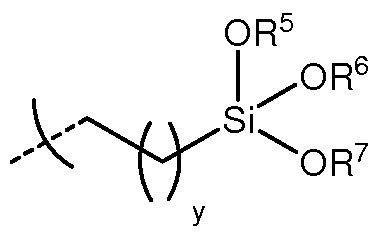
wherein y is an integer which is 0, 1, 2 or 3,
and R5, R6 and R7 are independently selected from hydrogen and C C4 alkyl;
R2, R3 and R4 are independently selected from hydrogen and

wherein y is an integer which is 0, 1, 2 or 3, and R5, R6 and R7 are independently selected from hydrogen and C1-C4 alkyl.
[0025] In one embodiment of the invention, x is 1 and therefore the core of the molecule of formula (I) is a 1,2 diaminoethyl moiety. However, other lengths of carbon chain may be used and in particular x may also be 2 in which case the core of the molecule of formula (I) is a 1,3 diaminopropyl moiety.
[0026] In one embodiment of the invention, y is 2 and therefore the nitrogen atom and the silicon atom are separated by a linker comprising three CH2 groups. However, again other lengths of carbon chain may be used and in particular y may also be 1 and therefore the
nitrogen atom and the silicon atom are separated by a linker comprising two CH2 groups or y may 3 and therefore the nitrogen atom and the silicon atom are separated by a linker comprising four CH2 groups.
[0027] The invention also includes all combinations of the above definitions of x and y. However, typically x is 1 and y is 2.
[0028] R5, R6 and R7 may be C1-C4 alkyl groups or hydrogen. C1-C4 alkyl includes methyl, ethyl, propyl, i-propyl, n-butyl, i-butyl or t-butyl, and R5, R6 and R7 may be independently selected from any of these alternatives and hydrogen. However, in particular, R5, R6 and R7 all represent methyl. Alternatively, R5, R6 and R7 all represent H and the compound is then said to be in its hydrolysed form.
[0029] In one embodiment of the invention R2, R3 and R4 are

In this embodiment of the invention, none of R 2 , R 3 and R 4 represents hydn
[0030] In one embodiment of the invention R2 and R3 are

and R4 is H. In this embodiment of the invention, one of the N atoms of the core of the molecule is bound to one hydrogen atom, and the other N atom is not bound to a hydrogen atom.
[0031] In one embodiment of the invention R2 is
 and R3 and R4 are H. In this embodiment of the invention, one of the N atoms of the core of the molecule is bound to two hydrogen atoms and therefore is a group NH2 and the other N atom is not bound to a hydrogen atom.
[0032] In one embodiment of the invention R3 is

and R 2 and R 4 are H. In this embodiment of the invention each of the N atoms of the core of the molecule is bound to one hydrogen atom.
[0033] In one embodiment of the invention R2, R3 and R4 each represent hydrogen. In this embodiment of the invention, one of the N atoms of the core of the molecule is bound to two hydrogen atoms and therefore is a group NH2 and the other N atom is bound to one hydrogen atom.
[0034] In one embodiment of the invention the compound of formula I is selected from:


Aminoethylaminopropylsilane triol.
[0035] A typical compound of formula I is

(N- (2- aminoethyl) -3 - aminopropyltrimethoxy silane) .
[0036] N-(2-aminoethyl)-3-aminopropyltrimethoxysilane is sold by Dow Corning in two grades: Z-6020 and Z-6094. Best results for the uses and methods of the invention are obtained by use of Z-6020.
[0037] Another typical compound of formula I is:

[0038] The fibers may be of animal, vegetal or synthetic origin. Animal fibers include but are not limited to silk and protein fibers, such as wool, hair, angora, mohair, cashmere.
Vegetal fibers include but are not limited to cellulose or cotton fibers. Synthetic fibers include but are not limited to polyester, nylon, spandex and rayon acetate.
[0039] Certain of the compounds of the invention exist at atmospheric temperature and pressure as liquids, and these compounds may be used in the various uses of the invention and incorporated into the various compositions of the invention in liquid form.
[0040] However, in general chemicals may be more easily handled in solid form and the compounds used in the present invention may be used in a solid form. One embodiment of the invention provides a solid comprising a compound of the invention. The solid may take a variety of different forms, and in particular the invention provides a solid comprising a compound of the invention wherein the solid is in the form of granules, pellets or a powder.
[0041] In one embodiment, the invention provides a solid comprising a compound of the invention. The solid may be provided comprising a compound of the invention and a binder. In one embodiment the binder is a wax. In one embodiment the binder is a film forming polymer.
[0042] The wax is a heat- sensitive substance generally consisting of hydrocarbons or esters of fatty acids that are insoluble in water but soluble in nonpolar organic solvents. Examples of waxes that can be mentioned include mono-, di-, and tri-glycerides, polyethylene glycols (for example PEG monostearate e.g. Radiasurf 7473 from Oleon, PEG distearate e.g. Radiasurf 7454), fatty acids (for example stearic acid or other C12-C22 e.g.Radiacid 414 from Oleon), polyol esters, fatty alcohols (for example stearyl alcohol e.g. Nacol 18-98 from Sasol), fatty esters (for example ethylene glycol esters e.g. ethylene glycol mono or distearate (i.e. Radia 7268 or Radiasurf 7270), glycerides e.g. mono, di, tri- stearate or behenate (i.e. Radia 7515), amides (for example erucamide e.g. Crodamide ER from Croda), and ethoxylates (for example Oleth 20 (Volpo 20 from Croda) or Steareth 20 (Volpo S20 from Croda)). Further, natural waxes such as bees wax or carnauba wax can be mentioned.
[0043] The wax may have a polar functional group. Example of polar groups include alcohol groups, and examples of waxes include long chain primary, secondary or tertiary alcohols including fatty alcohols, which are typically saturated alcohols, ethoxylated fatty alcohols, ethoxylated fatty acids, ethoxylated alkyl phenols and partial esters of polyols.
[0044] In addition the polar group may be a COOH group, for example a fatty acid, typically saturated acids, having 8 to 36 carbon atoms, for example stearic acid, palmitic acid, behenic acid or 12-hydroxystearic acid. Mixtures of fatty acids can be used. Alternatively the polar group may be an amide group, for example a monoamide of saturated or unsaturated fatty acids having 12 to 36 carbon atoms, for example stearamide or the amides sold under the Trade Mark Crodamide. The polar group may also be an amino groups, for example an alkyl amine having 8 to 30 carbon atoms such as 1-octylamine and 1-dodecylamine or stearylamine.
[0045] The wax may also be non polar for example a polyol ester. The polyol ester may be substantially fully esterified by carboxylate groups each having 7 to 36 carbon atoms. The polyol ester may be a glycerol triester or an ester of a higher polyol such as pentaerythritol or sorbitol, but may be a diester of a glycol such as ethylene glycol or propylene glycol, particularly with a fatty acid having at least 16 carbon atoms, for example ethylene glycol distearate. Examples of typical glycerol triesters are glycerol tristearate, glycerol tripalmitate and glycerol triesters of saturated carboxylic acids having 20 or 22 carbon atoms such as the material of melting point 54° C. Alternative suitable polyol esters are esters of pentaerythritol such as pentaerythritol tetrabehenate and pentaerythritol tetrastearate. The polyol ester can advantageously contain fatty acids of different chain length, which is common in natural products. Most typically the polyol ester is substantially fully esterified by carboxylate groups each having 14 to 22 carbon atoms. By substantially fully esterified it is meant that for a diol such as ethylene glycol or a triol such as glycerol, at least 90% and alternatively at least 95% of the hydroxyl groups of the polyol are esterified. Higher polyols, particularly those such as pentaerythritol which show steric hindrance, may be substantially fully esterified when at least 70 or 75% of the hydroxyl groups of the polyol are esterified; for example pentaerythritol tristearate has the effect of a fully esterified polyol ester.
[0046] Alternatively, the non-polar wax may be an ether or a hydrocarbon wax. For example the wax may comprise at least one paraffin wax, optionally blended with microcrystalline wax.
[0047] The wax may contain the above listed examples in any combination and number.
[0048] Examples of film forming polymers include polyvinyl alcohol, partially hydrolyzed polyvinyl acetate, polyvinyl pyrrolidone, alkyl celluloses such as methylcellulose, ethylcellulose, propylcellulose and derivatives thereof, such as the ethers and esters of alkyl celluloses, and acrylic polymers such as water soluble polyacrylates, polyacrylamides, and acrylic maleic anhydride copolymers. Typically the film forming polymer is polyvinyl alcohol.
[0049] The invention also provides a process for the preparation of a solid comprising a compound of the invention and a binder, comprising mixing the compound of the invention and the binder. Alternatively, the process comprises mixing the compound of the invention and the binder to form a liquid which is then solidified.
[0050] When the binder is a film-forming polymer, the process comprises mixing the compound of the invention and an aqueous solution of the film-forming polymer and then spray drying the resulting mixture (i.e. spraying the liquid whilst drying with hot air). Examples of this type of process are found in WO 2004/098898 and US 2004/0019141.
[0051] When the binder is a wax, the process comprises mixing the compound of the invention and the molten wax, and then allowing the resulting mixture to cool. Alternatively the mixture is cooled by a flow of air wherein the air is at an ambient, or lower, temperature.
[0052] The invention also provides a solid comprising a compound of the invention, a binder and a carrier. The carrier supports the mixture of the compound of the invention and the binder.
[0053] Examples of carriers include silica (such as diatomaceous earth, calcined diatomaceous earth or feldspar), silicates (such as phyllosilicates like mica, talc, sepiolite, bentonite, calcium silicate such as wollastonite, aluminosilicates, such as zeolite or metakaolin, fly ash), organic materials (such as wood flour, stearates, rice, starch and native starch), carbonates (such as sodium carbonate, dolomite), industrial products (such as methyl cellulose, carboxy methyl cellulose, polystyrene beads), sulfates (such as sodium sulfate, calcium sulfate, magnesium sulfate) and oxides (such as magnesium oxide, titanium dioxide).
[0054] In another embodiment the invention provides a solid comprising a compound of the invention and a carrier. In this embodiment, the presence of a binder is not essential and the compound of the invention may be added directly to the carrier without a binder being present.
[0055] In another embodiment, the invention provides a solid comprising a compound of the invention and a porous material into which the compound of the invention is adsorbed. Examples of porous materials include porous polyolefins such as Accurel® from Membrana. These microporous polymer products are made from commercially available resins. Some common resins available in microporous form are polypropene, linear low density polyethylene, low density polyethylene, high density polyethylene and polyamide. The microporous products act like tiny sponges with the ability to absorb several times their own weight of a silane into their micron-size voids by capillary absorption. Although this technology is the most efficient method for converting silanes into solid forms in that hydrolysis and condensation reactions can be avoided, a drawback with this approach is the high price of the porous polymers, and therefore the use of this process is limited.
[0056] The applicant has found that when preparing the compounds of the invention significant amounts of the compound of formula (I) undergo condensation when preparing the solids of the invention because the conditions of the process for preparing the solid are either at elevated temperature (when preparing the solid comprising a wax in order to melt the wax) or are aqueous (when the binder is a film-forming polymer). The condensed products are as effective in the uses of the invention as are the compounds of formula I.
[0057] The fading, or reduction in color of, colored textiles is particularly problematic because it causes a degradation in their appearance over time. The problem is particularly acute with cotton fabrics that are dyed with direct dyes (substantive dyes which are physically absorbed onto cellulose fibers by hydrogen bonding).
[0058] Various methods have been developed to improve the wash fastness of cloths thereby limiting the "washing out" of dyes. These treatments notably involve the use of cationic polymers that interact with anionic dyes thus reducing their solubility and minimizing the dye loss. However, there remains a need in the art for additional ways to minimise color loss from textiles.
[0059] The treatment of the textile or fiber with a compound of the invention promotes the substantivity or adhesion of a dye thereto. For example, the agent could be applied to a fiber which forms a fabric or textile, in particular an article of clothing to promote the adhesion of
a dye to the fabric or textile. Alternatively, the agent could be applied to hair fibers, in particular human hair, to promote the adhesion of a dye to the hair.
[0060] It has been found that dyeing of articles which would otherwise require harsh condition such as low pH or alkaline oxidising conditions may be easily performed by use of a pre-treatment process where the article to be dyed is treated with a solution comprising a dye and a compound of the invention. The dyeing process is therefore made safer, and involves less harsh conditions allowing a broader range of dyes to be used that are unstable to harsh dyeing conditions.
[0061] Accordingly, the invention provides the use of a compound of the invention to treat a textile or fiber to improve substantivity of a dye subsequently applied to the textile or fiber.
[0062] In addition, the invention provides a method of dyeing a textile or fiber comprising treating the textile or fiber with a compound of the invention before treating the textile or fiber with the dye. When the textile or fiber is dyed after having been contacted with the compound of the invention, the textile or fiber is more resistant to loss of dye, or fading, by washing.
[0063] Accordingly, the invention provides a method of dyeing a fiber comprising:
- treating the textile or fiber with a compound of the invention and then treating the textile or fiber with a dye to dye the textile or fiber; or
- simultaneously treating the textile or fiber with a compound of the invention and a dye to dye the textile or fiber.
[0064] The invention also provides a method of fixing the color of a dyed textile or dyed fiber comprising the step of contacting the dyed textile or dyed fiber with a compound of the invention. Treating the dyed textile or dyed fiber with a compound of the invention fixes the dye to the textile or fiber, and therefore when the treated textile or fiber is washed with detergent the loss of color is less pronounced than it would be if a non-treated textile or fiber is treated with detergent.
[0065] The dye fixing agent is left in contact with the dyed textile or dyed fiber for long enough to improve the fixing of the dye to the textile or fiber. This may take up to 5 minutes, up to 15 minutes, up to 30 minutes or longer, but generally less than 6 hours is required. In
embodiments of the invention the dye fixing agent is left in contact with the textile or fiber for at least 0.5 hours, at least 1 hour or at least 2 hours.
[0066] Without wishing to be bound by theory, it is thought that when the compound of the invention is contacted with a dyed fabric or fiber, the compound of the invention forms a complex with the dye which is insoluble in water, and therefore when the dye is contacted with a detergent the dye is less likely to leave the fabric or fiber.
[0067] The textile or fiber, non dyed or dyed, is treated with an aqueous solution of a compound of the invention which comprises from 0.01 wt to 30 wt%, 0.1 to 25 wt or 0.5 to 20 wt of a compound of formula (I).
[0068] Optionally, the method may comprise an additional step in which the article to be is treated with saline solution such as sodium chloride.
[0069] The treatment with saline solution may take place prior to treatment with the compound of the invention. In one embodiment the saline solution contains at least 0.1 wt NaCl, alternatively 0.2 wt% NaCl and more alternatively 0.5 wt% NaCl.
[0070] Alternatively, the treatment with saline solution may take place simultaneously with the treatment with the compound of the invention. The invention also provides a composition comprising a saline solution and a compound of the invention. In one embodiment the composition comprises at least 0.1 wt NaCl, alternatively 0.2 wt NaCl and more alternatively 0.5 wt% NaCl.
[0071] The composition may comprise at least 0.1 wt%, alternatively 0.2 wt% and more alternatively 0.5 wt% of the compound of the invention.
[0072] The previously listed proportions may be combined in all possible manners - that is the composition may comprise, for example, 0.5 wt% NaCl and 0.2 wt% of the compound of the invention.
[0073] The laundry process is necessary in order to remove dirt, stains and malodours from fabrics or textiles, in particular clothes and household fabrics. However, the laundry process involves harsh conditions which often result in damage to the fabric such as fabric pilling, shrinkage and loss of color intensity and/or loss of color definition.
[0074] A number of approaches have been proposed in the art to retain the appearance of colored fabrics following the laundry process.
[0075] However, there remains a need in the art for color-care additives which may be used during the laundry process which allow the cleaning and/or softening of colored fabrics whilst retaining the appearance of colored fabrics.
[0076] Accordingly, the invention provides a color-care additive for use in laundry treatment products comprising a compound of the invention. In addition, the invention provides the use of a compound of the invention as a color-care additive.
[0077] By laundry product is meant any product adapted to be applied to a fabric or textile e.g. clothing in order to improve the appearance or condition of the fabric or textile. Examples include detergents and softeners. A laundry detergent composition means a composition suitable to wash or clean fabrics e.g. clothes.
[0078] By color-care additive is meant a substance which may be put in contact with a fabric during the laundry process in order to retain the integrity of its color, for example the intensity and shade of color of the fabric. Surprisingly, the use of the color-care additive in a laundry treatment product leads to lower levels of fabric dye loss than would otherwise occur in the absence of the color-care additive.
[0079] Again without wishing to be bound by theory, it is thought that during the laundry process the compound of the invention forms a complex with the dye on the fabric or clothing being laundered, and this complex has greater resistance to removal from the clothing, and therefore color loss, than the non-complexed dye.
[0080] The color-care additive may be provided to an end user with instructions to use the additive in combination with another laundry product e.g. a detergent, softener or pre-wash composition. That is the cleaning or softening product would be supplied separately to the color-care additive.
[0081] Alternatively, the color-care additive may be supplied to an end user already incorporated within a laundry product. Therefore, one embodiment of the invention provides a laundry product comprising the color-care additive as defined above.
[0082] The detergent composition according to the invention includes a sufficient quantity of the compound of the invention in order to retain the appearance of a colored fabric after the laundry process. Typically, the detergent composition may include from 0.1 to 25 wt%,
alternatively 0.5 to 20 wt%, alternatively from 1 to 15 wt%, and alternatively from 2.0 to 10 wt of the compound of the invention.
[0083] Typically, the invention provides a detergent composition comprising a color-care additive as described above and a surfactant. Surfactants aid the removal of soil from fabrics, inhibit redeposition of soil and also cause foaming of the washing composition. This composition may comprise 0.01 to 30 wt surfactant, 1 to 25 wt surfactant, or 2 to 20 wt surfactant.
[0084] The composition may include a single surfactant or a mixture of two or more surfactants. In general any surfactant may be used, including anionic, non-ionic, cationic, amphoteric and zwitterionic surfactants. Typically, the surfactant is anionic, non-ionic or a mixture of the two. One type of surfactant that may be mentioned is a detersive surfactant, which provides a detersive i.e. cleaning effect to fabrics.
[0085] Particular anionic surfactants that may be used include alkali and alkaline earth metal salts of fatty alcohol sulfates, including primary alkyl sulfates.
[0086] Particular non-ionic surfactants that may be used include fatty acid alkoxylates, especially ethoxylates, having an alkyl chain of from C8-C35, alternatively C8-C30, more alternatively C10-C24, especially C10-C18 carbon atoms.
[0087] The color-care additive may also be supplied in combination with any other standard component that would be present in a laundry composition. In one embodiment of the invention the detergent composition includes one or more of:
• water; or
• a builder; or
• an enzyme; or
• a perfume; or
· a fabric softening component; or
• a preservative.
[0088] Builders are chelating agents for metal cations, especially divalent metal cations which cause or are associated with hard water, and therefore inclusion of a builder results in water softening. Suitable builders include amino carboxylates, phosphates, phosphonates, amino phosphonates, polyfunctionally-substituted aromatic chelating agents and mixtures
thereof. The composition may include from 1 to 90 wt builder, from 5 to 70 wt builder or from 10 to 50 wt% builder.
[0089] Suitable enzymes for use in the present invention include proteases, amylases, lipases, cellulases, peroxidases, and mixtures thereof, of any suitable origin, such as vegetable, animal, bacterial, fungal and yeast origin. In particular, bacterial proteases and fungal cellulases may be mentioned. Enzymes may be incorporated into the composition at a level sufficient to provide a cleaning effect. The composition may include 0.1 to 5 wt or 0.1 to 1 wt enzyme.
[0090] The composition may also contain a perfume in order to impart a fragrance to a fabric. Any chemically compatible material which exudes a pleasant odor may be used. Typical perfumes include aldehydes, ketones and esters. Naturally occurring plant and animal oils and exudates comprising complex mixtures of various chemical components are also known for use as perfumes. Typical perfumes may comprise, for example, woody/earthy bases containing exotic materials such as sandalwood, civet and patchouli oil. The perfumes may be of a light floral fragrance, e.g., rose extract, violet extract, and lilac. The perfumes may also be formulated to provide desirable fruity odors, e.g., lime, lemon, and orange.
[0091] In one embodiment the detergent is adapted for use in a washing machine. In another embodiment, the composition may be adapted to be used when hand washing.
[0092] The detergent compositions according to the present invention may be in liquid, paste, laundry bar, or granular form. Such compositions maybe prepared by combining the color- care additive and the other components of the detergent in the required amounts in any suitable order and by any conventional means. In addition, the detergent composition may be a pre-wash treatment composition. In this embodiment the composition is suitable for application to the fabric prior to washing.
[0093] The color-care additive of the present invention may be incorporated into granular detergent compositions in a variety of ways for example they may be suitably added as a slurry followed by spray drying of the slurry, the dispersants may be added as a separate particle, sprayed on to a nearly finished product, added with the balance of adjunct ingredients.
[0094] As a non-limiting example, granular compositions are generally made by combining base granule ingredients, e. g., surfactants, builders, water, etc., as a slurry, and spray drying
the resulting slurry to a low level of residual moisture (5-12%). The remaining dry ingredients may be admixed in granular powder form with the spray dried granules in a rotary mixing drum. The liquid ingredients, e. g., solutions of the enzymes and perfumes may be sprayed onto the resulting granules to form the finished detergent composition.
[0095] Liquid detergent compositions may be prepared by admixing the essential and optional ingredients thereof in any desired order to provide compositions containing components in the requisite concentrations.
[0096] The invention also provides a method of cleaning a fabric comprising the step of contacting the fabric with a detergent composition comprising the color-care additive.
[0097] The invention also provides a kit comprising the detergent composition according to the invention and instructions to use the composition to clean a fabric.
[0098] The invention also provides a laundry fabric-softening composition comprising a color-care additive as described above.
[0099] A fabric-softening composition is used in the laundry process to prevent static cling in a laundered fabric and thereby make the fabric softer. Contemporary fabric softeners tend to be based on quaternary ammonium salts with one or two long alkyl chains, for example dipalmitoylethyl hydroxyethylmonium methosulfate. Other examples are derived from imidazolium, substituted amine salts, or quaternary alkoxy ammonium salts.
[00100] In one embodiment, the fabric-softening composition comprises the color-care additive according to the invention and a quaternary ammonium salt.
[00101] The invention also provides a method of softening a fabric comprising the step of contacting the fabric with a fabric-softening composition comprising the color-care additive.
[00102] The invention also provides a kit comprising the fabric softening composition according to the invention and instructions to use the composition to soften a fabric.
[00103] In one embodiment of the invention, the complex formed by the compound of the invention and a dye has advantages in the treatment of fabric coloring waste water.
[00104] The effluent discharged from factories engaged in the dyeing processes includes large quantities of water in which waste dye is dissolved. A major issue in the textile industry is the removal of color from dyebath effluent prior to discharge to local
sewage treatment facilities. The textile dyeing and printing sector has a water consumption as high as 400 m3/ton of fabric. Disposing of the contaminated water represents a major expense and is also problematic for the environment.
[00105] Wastewater that originates from reactive dye processes is particularly problematic because such large proportion of the dye may not fix to the fibers of the fabric to be dyed - 30% percent or more of the dyes used may be hydrolyzed and then released into waterways. These brightly colored unfixed dyes are highly water soluble and are not removed by conventional treatment systems. Further, although these dyes are generally not themselves toxic, they may be converted into potentially carcinogenic amines after release into the aquatic environment.
[00106] Several industrial-scale decolorization systems are commercially available.
These include adsorption, filtration, precipitation, and activated sludge systems. All of these technologies work by concentrating the dyestuffs and transferring them to a solid form that subsequently needs disposal. Other technologies involve the use of enzymes (specifically laccase).
[00107] However, there remains a need in the art for methods to remove dyes from aqueous solutions to avoid contamination of the environment.
[00108] Accordingly, the invention provides an agent for the removal of a dye from an aqueous solution of the dye, the agent comprising a compound of the invention. In addition the invention provides the use of a compound of the invention above to remove a dye from an aqueous solution of the dye. Further, the invention provides a method of removing a dye from an aqueous solution of the dye comprising the step of contacting the aqueous solution with a compound of the invention thereby forming insoluble complex comprising the dye, and separating the insoluble complex from the aqueous solution. Any suitable method to remove the precipitate may be used, for example filtration or decantation.
[00109] Again without wishing to be bound by theory, it is thought that when the compound of the invention is added to an aqueous solution of the dye, the compound of the invention forms a complex with the dye which is insoluble in water, and therefore forms a precipitate which may be separated.
[00110] Typically, the compound of the invention is added to the aqueous solution which contains 0.1 wt% of the dye. The compound of the invention is added to the aqueous
solution in sufficient quantity to cause the dye to precipitate. Typically the compound of the invention is added to the aqueous solution of the dye at a concentration of at least 0.02 wt%, alternatively 0.04 wt%, alternatively 0.06 wt % and alternatively 0.10 wt .
[00111] The compound of the invention is left in contact with the aqueous solution for long enough such that substantially all of the dye is removed from the aqueous solution by precipitation. This may take up to 1 hour, up to 12 hours, up to 24 hours or longer, but generally less than 2 days is required. In embodiments of the invention the compound of the invention is left in the aqueous solution of the dye for at least 0.5 hours, at least 1 hour or at least 2 hours.
EXAMPLES
[00112] The following examples are included to demonstrate preferred embodiments of the invention. It should be appreciated by those of skill in the art that the techniques disclosed in the examples which follow represent techniques discovered by the inventor to function well in the practice of the invention, and thus can be considered to constitute preferred modes for its practice. However, those of skill in the art should, in light of the present disclosure, appreciate that many changes can be made in the specific embodiments which are disclosed and still obtain a like or similar result without departing from the spirit and scope of the invention. All percentages are by weight , unless otherwise indicated
[00113] Materials and techniques
1) Substrates
AISE (International Agency for Soaps Detergence and Maintenance Products) fabrics are standard materials well known to the person skilled in the art which are used to evaluate the performances of color care additives. The AISE fabric is a piece of fabric onto which has been attached various other fabrics each colored by one of a variety of dyes. The AISE fabric aims to represent a wash load including a variety of colored fabrics (see "Bleach containing Detergents-Assessment of Color Damage", H. Rohwer; T. Wieprecht, SOFW, 133, 7-2007).
Cotton pillow cases are used to represent a total wash load accompanying the AISE fabrics and may also be used to see the transfer of color when applicable
- Standard dyed cotton fabrics from wfk Testgewebe GmbH in Germany
Caucasian hair from International Hair Importers & Products in US
Detergents
Liquid detergent 1 is a commercial product which contains non-ionic and anionic surfactants, soap, phosphonates, enzymes (proteases, glycosidases), optical brightener, perfume (butylphenyl methylpropional, geraniol, limonene, hexyl cinnamal, linalool), preservatives (benisothiazolinone, octylisothiazolinone, tetramethylolglycoluril) .
Liquid detergent 2 is a commercial product (leading brand color-care detergent) which contains non-ionic and anionic surfactants, phosphonates, soap, enzymes, perfume, benzyl salicylate, butylphenyl methylpropional, citronellol, geraniol, hexyl cinnamal.
Liquid detergent 3 is an internal test detergent used by the applicant that comprises 7.3% Dehydol(R) LT7 from Cognis and 17.7% Maranil(R) Paste from Cognis and 75% water.
When the detergents are mixed with a compound of the invention to provide a modified detergent, they are set to "age" in certain conditions: 4 weeks at room temperature. These aged versions may be used in certain evaluations to show if the properties of the modified detergent have been maintained in time. 3) Colorimetric method
The CIELAB color parameters were measured by use of a Minolta CT310 colorimeter:
• L (Lightness): + is lighter and - is darker
• a (green/red component): + is more red and - is more green
• b (blue/yellow component) : + is more yellow and - is more blue
The color difference = Delta E = ΔΕ after wash cycle n may then be calculated:
ΔΕ = ((AL)2 + (Aa)2 + (Ab)2)l/2
where, after n washes:
AL = Ln - Lo; Aa = an - ao; Ab = bn - bo.
[00114] Three measurements were taken before and after each wash cycle on the tested pieces of fabric. The same colorimeter was used to measure the aqueous solutions, where Delta E is calculated with the reference solution as the benchmark (Lo; ao; bo).
EXAMPLE 1
[00115] A solid form of the compound of the invention was prepared as follows: N-(2- aminoethyl)-3-aminopropyltrimethoxysilane was added drop wise to the carboxymethyl cellulose solution under agitation. Heat was generated and the viscosity of the mixture increased. The agitation was maintained until the viscosity decreased. The silane/binder mixture was then sprayed onto diatomeous earth until a granule was obtained. The resulting granule was dried in a fluidized bed (this process is referred to within the literature as an agglomeration process). The final composition of the agglomerate/granule is given in Table 1.
TABLE 1

[00116] The resulting granulated silane formulation was added to a solution of
Reactive Violet at 0.01 w%. The Reactive Violet dye was selected because the color change is more easily seen and violet solutions are the most difficult to decolorize.
[00117] Five tubes containing 100ml of an aqueous solution of reactive violet dye
(0.01 wt%) were prepared. The following components were added to the tubes:
• Nothing added (reference)
• Liquid N-(2-aminoethyl)-3-aminopropyltrimethoxysilane, 0.1 wt%
• Carboxymethyl cellulose, 0.1 wt%
• CalFlo E, 0.1 wt%
• Granulated silane formulation from Table 1
[00118] After 2 hours the color is still intense for the solution treated with liquid N-(2- aminoethyl)-3-aminopropyltrimethoxysilane, but discoloration is already visible for the solution treated with the granulated silane formulation from Table 1. After 48 hours the difference is still apparent. Results obtained for the individual components of the granule (binder and carrier) confirm that the beneficial effect is caused by the N-(2-aminoethyl)-3- aminopropyltrimethoxysilane, as there is no significant change in color (Delta E close to 0 after 72 hours). In the present case, the solid form improves the efficiency of the compound
of the invention, as can be seen from Table 2, where after 72 hours, Delta E is higher for the granulated silane formulation compared to the liquid silane.
TABLE 2

[00119] A solid form of the compound of the invention was prepared as follows: the waxes were mixed and heated at 80°C. They were then granulated with the silane using a spray cooling equipment from Glatt equipped with a bi-fluid nozzle in order to minimize the contact between the silane and the hot wax, producing the granulated silane formulation of Table 3.
TABLE 3

[00120] The resulting granulated silane formulation was added to a solution of
Reactive Violet dye at 0.01 w%. Three tubes containing 0.01 wt% of Reactive Violet dye were prepared. The following components were added to the tubes:
1. Tube 1 : Nothing added (reference)
2. Tube 2: N-(2-aminoethyl)-3-aminopropyltrimethoxysilane, 0.1 wt%
3. Tube 3: Granulated silane formulation from Table 3, 0.26 wt% of granule (39 wt% active).
[00121] Results after 2 hours have shown that while the color is still intense for the solution treated with liquid N-(2-aminoethyl)-3-aminopropyltrimethoxysilane, discoloration
is already visible for the solution treated with the granulated silane formulation from Table 3. After 48 hours, only a slight coloration still visible for the N-(2-aminoethyl)-3- aminopropyltrimethoxysilane treated solution but the solution treated with the granule is completely clear. After 72 hours, Delta E for the solution of Tube 2 with the liquid N-(2- aminoethyl)-3-aminopropyltrimethoxysilane is 61.72, while it is of 94.48 (clearer) for the solution of Tube 3 with the granulated silane formulation from Table 3.
EXAMPLE 3
[00122] In the present example, N-(2-aminoethyl)-3-aminopropyltrimethoxysilane was granulated using either agglomeration or spray cooling techniques as described before. For the preparation of Comparative powders A and B, the silane is sprayed onto silica using mixing equipment. For the preparation of the Comparative pellets, the Accurel XP100 is placed into a beaker and the silane is poured onto it under gentle agitation using a magnetic stirrer.
TABLE 4

[00124] Two sets of seven tubes containing either 0.01 wt% of Indosol blue or 0.01 wt% of Direct Red dye were prepared. The following components were added to each set of the 7 tubes:
1. Nothing added - Reference
2. Liquid N-(2-aminoethyl)-3-aminopropyltrimethoxysilane, 0.1%
3. Granule A, 0.28wt%
4. Comparative Powder A, 0.2 wt% (the powder is 50% active)
5. Comparative Powder B, 0.2 wt% (the powder is 50% active)
6. Comparative Pellets, 0.2 wt% (the pellets are 50% active)
7. Granule B, 0.24wt % (the granule is 42% active)
[00125] Results have shown for both types of dyes that efficient dye precipitation was achieved for each tube to which N-(2-aminoethyl)-3-aminopropyltrimethoxysilane was added and the dye solutions were clear after 72h. However, faster precipitation was seen for some of the solutions studied. Granule A and Granule B caused the most effective discoloration after 2 hours. Comparative Powders A and B still had some color in suspension after 48 hours. Comparative Pellets showed effective discoloration, but some particles remained on the surface of the tube, showing there is residual material not precipitating, making this material not suited for the application of water treatment. The present results indicate a significant improvement in terms of treatment efficiency and would certainly be valued in industrial processes where reducing process times allows for important cost savings.
EXAMPLE 4
[00126] An aqueous solutions comprising 1 wt% of N-(2-aminoethyl)-3- aminopropyltrimethoxysilane was prepared, and a white piece of nylon fabric was dipped for one hour in the aqueous solution. The piece of nylon fabric was then dried overnight at room temperature. A Direct Red 80 solution at 0.1 wt% was prepared, and white piece of nylon fabric was dipped for one hour in the dye solution and then rinsed in clean water twice. As a control, a white piece of nylon fabric that was not contacted with an aqueous solution comprising a compound of formula I was also dipped for one hour in the dye solution.
[00127] Results have shown that when the fabric is not pre-treated with a solution of compound I then the dye is not absorbed into the fabric, and so the fabric remains white. In contrast, when the fabric is pre-treated with an aqueous solution including N-(2-aminoethyl)- 3-aminopropyltrimethoxysilane then the fabric absorbs the dye and becomes light red. This evidences the fact that the compound of the invention can act as a fixing agent.
EXAMPLE 5
[00128] Three pieces of white cotton fabrics are dipped into silane solution containing respectively 1 wt%, 3 wt or 5 wt of N-(2-aminoethyl)-3-aminopropyltrimethoxysilane for 2 hours. A fourth sample was a control and was not treated with a N-(2-aminoethyl)-3- aminopropyltrimethoxysilane solution. The fabrics were then dried for one night at room temperature and dipped into a dye solution (0.1% Red Dye 80) for two hours.
[00129] The results indicate that the fabric which had not been pre treated is only slightly pink colored, while the pre-treated fabrics are bright red, increasingly with the strength of the N-(2-aminoethyl)-3-aminopropyltrimethoxysilane solution. This evidences the fact that the compound of the invention can act as a fixing agent.
EXAMPLE 6
[00130] Four aqueous solutions comprising 1 wt%, 2 wt%, 3 wt% and 5 wt% of N-(2- aminoethyl)-3-aminopropyltrimethoxysilane were prepared, and a swatch of human hair was dipped for one hour in each aqueous solution. The swatches were then dried overnight at room temperature. A Direct Red 80 solution at 0.1 wt% was prepared, and each dried hair was dipped for one hour in the dye solution and then rinsed in clean water twice. As a control, a hair swatch that was not contacted with an aqueous solution comprising a compound of formula I was also dipped for one hour in the dye solution.
[00131] Results have shown that the swatch that was not pre-treated is not dyed, whereas the swatches which were pre-treated are dyed increasingly intensely dependent on the strength of the solution of the solution of the compound of formula I with which they were pre-treated. After 10 wash cycles in a shampoo formulation (a 9% aqueous solution of sodium lauryl ether sulphate) the color intensity of the hair was shown to be retained.
EXAMPLE 7
[00132] Four pieces of dyed cotton fabrics from wfk GmbH, 2 dyed with direct red and
2 dyed with direct blue were used. 1 Piece of each blue and red were impregnated with a 5% N-(2-aminoethyl)-3-aminopropyltrimethoxysilane solution. These pieces of fabric are then line-dried for one night. The remaining pieces of blue and red fabric were used as control and not impregnated. The 4 pieces of fabric were then placed individually into a 6g/l solution of Detergent 3.
[00133] After 12 hours, results have shown that the non-treated fabrics have lost significant quantities of dye to the wash liquor. However, for the pre-treated fabrics the dye is fixed and no or little dye goes into the solution. The same results were obtained with yellow and pink dyed fabrics (also provided by wfk GmbH).
EXAMPLE 8
[00134] An AISE dye set fabric and 15 new cotton pillow cases were washed in a washing machine at 40°C, 600 RPM for 10 wash cycles.
[00135] Four different detergent compositions were used:
• AISE Fabric N° 570: 60g detergent 1.
• AISE Fabric N° 569: 60g detergent 1 and 5 wt% of N-(2-aminoethyl)-3- aminopropyltrimethoxysilane.
· AISE Fabric N°568: 50g detergent 2.
• AISE Fabric N°567: 60g detergent 1 and 3 wt% of N-(2-aminoethyl)-3- aminopropyltrimethoxysilane.
[00136] After each wash cycle the AISE fabrics were line-dried, and color was measured as described above.
[00137] It may be seen from Table 5, which illustrates ΔΕ for yellow cotton, black cotton, black cotton (treated with dihydroxydimethylolethyleneurea), black cotton (treated with cationic after-treatment agent), navy/black (pale depth of shade), red reactive dye and blue reactive dye respectively, that when the silane is added to the liquid detergent formulation ΔΕ decreases showing that the silane presence tends to interact with the fabric and reduces the color fading.
TABLE 5

EXAMPLE 9
[00138] Red fabrics (10 cm x 10 cm) and 15 new white pillow cases (10 cm x 10 cm) were washed in 350 ml soft water with 2.1 g Detergent 1 (see example 1).
[00139] The test was repeated:
- in the absence of N-(2-aminoethyl)-3-aminopropyltrimethoxysilane;
- with 1 wt N-(2-aminoethyl)-3-aminopropyltrimethoxysilane; and
- with 3 wt N-(2-aminoethyl)-3-aminopropyltrimethoxysilane; and
- with 5 wt N-(2-aminoethyl)-3-aminopropyltrimethoxysilane.
[00140] The fabrics were washed at 40°C, 45 rpm and dried 10 times and ΔΕ was measured after each time.
[00141] Table 6 shows the measurements of ΔΕ after the 10 washes for the red fabrics and demonstrates that inclusion of 3 wt and 5 wt N-(2-aminoethyl)-3-
aminopropyltrimethoxysilane provided improved color retention in comparison with Detergent 1 alone or only 1 wt .
TABLE 6

[00142] Further, Table 7 shows that ΔΕ after 10 washes is lower for white fabrics - that is lower amounts of dye are transferred to the white fabrics during the wash when the color-care additive is present.
TABLE 7

[00143] In summary the silane presence tends to prevent the color fading and also color transfer (also named color bleeding) so that no transfer occurs on the white monitors.
EXAMPLE 10
[00144] The same procedure as for Example 9, but for only 8 washes, was also carried out for Liquid detergent 1 and Liquid detergent 3 alone and also together with 3 wt and 6 wt of aminoethylaminopropylsilane triol (here coded as Silane 1) and N-(2-aminoethyl)-3- aminopropyltrimethoxysilane under 2 grades (here coded as Silane 2 and Silane 3 respectively).
[00145] Tables 8 and 9 show that ΔΕ for both the red and white fabrics is lower for compositions including the color-care additive according to the invention.
TABLE 8

TABLE 9

EXAMPLE 11
[00146] A series of colored solutions comprising 0.1 wt of the following dyes were prepared:
Blue SF-GLP370 Indosol (from Clariant)
· Direct Black 56 (from SIGMA)
Direct Red 80 (from SIGMA)
Reactive Black 5 (from SIGMA)
[00147] To each solution was added 0.00 wt%, 0.02 wt , 0.04 wt , 0.06 wt%, 0.08 wt%, or 0.10 wt of N-(2-aminoethyl)-3-aminopropyltrimethoxysilane, and precipitation was monitored and represented in Table 10. Precipitation of the dye occurred from the solution between 1 hour and 24 hours later.
TABLE 10

P = complete precipitation of dye
SP = some precipitation
NP = no precipitation
[00148] The use of N-(2-aminoethyl)-3-aminopropyltrimethoxysilane at 0.06 wt% caused complete removal of the dyes as precipitates from the aqueous solution, leaving a transparent/clear solution, compared to the colored aqueous solutions of tubes 1 containing no silane.
EXAMPLE 12
[00149] A dye solution was prepared having the following components (dyes obtained from Dylon):
• Red colour (Scarlet) 5.3g
• Yellow colour (Indian corn) 6.7g
· Blue colour (Arabian night) 4.6g
• Black colour (velvet black) 5.15g
NaCl 104 g
and a solution comprising 0.1 wt of the components in water was formed by heating the solution at 80°C for 1 h before being cooled prior to use
[00150] Three tubes comprising a solution containing the 0.1 wt dye solution were prepared. The following components were added to the individual tubes:
1. Nothing added (reference)
2. Liquid N-(2-aminoethyl)-3-aminopropyltrimethoxysilane, 0.1 wt
3. Liquid N-(2-aminoethyl)-3-aminopropyltrimethoxysilane, 0.2 wt
[00151] The results have shown the N-(2-aminoethyl)-3-aminopropyltrimethoxysilane is efficient to remove the dye mixture from the solution, as after 2 hours most of the dye is precipitated and only a slight coloration remained visible in the solution.
EXAMPLE 13
[00152] Aqueous dye solutions were prepared containing 0.01 wt in total of one or more dye. To the resulting solution was then added 0.1 wt of a compound according to the invention, and the mixture was then agitated for 20 minutes and then observed after 2 hours, 24 hours and 48 hours. The supernatant (aqueous solution without the precipitate) was collected after 72h and L, a and b values were measured using the colorimeter.
Claims
1. The use of a compound to complex a dye, wherein the compound is either a compound of formula (I) or a condensation product of a compound of formula (I), and wherein the compound of formula (I) has the formula:

wherein:
x is an integer which is 0, 1, or 2;
R1 represents a group
OR5
l ./0R6 y
wherein y is an integer which is 0, 1, 2 or 3, and R5, R6 and R7 are independently selected from hydrogen and C C4 alkyl;
R 2", R 3J and R 4" are independently selected from hydrogen and  wherein y is an integer which is 0, 1, 2 or 3, and R5, R6 and R7 are independently selected from hydrogen and C C4 alkyl.
2. The use according to claim 1 wherein x is 1.
3. The use according to any preceding claim wherein y is 2.
4. The use according to any preceding claim wherein R5, R6 and R7 are independently selected from methyl, ethyl, propyl, i-propyl, n-butyl, i-butyl or t-butyl.
5. The use according to claim 4 wherein R5, R6 and R7 are methyl.
2 3 4
6. The use according to any preceding claim wherein R , R and R are H.
2 3 4
7. The use according to any one of claims 1 to 5 wherein R , R and R are 
2 3 8. The use according to any one of claims 1 to 5 wherein R and R are 
and R4 is H.
2 ·
9. The use according to any one of claims 1 to 5 wherein R is 
and R3 and R4 are H.
10. The use according to any one of claims 1 to 5 wherein R3 is 
and R2 and R4 are H.
11. The use according to any one of claims 1 to 5 wherein the compound of formula I is selected from:

12. The use according to any one of claims 1 to 5 wherein the compound is in a solid form.
13. A method of complexing a dye comprising the step of contacting the dye with a compound as defined in any one of claims 1 to 12.
14. A color-care additive for use in laundry treatment products comprising a compound as defined in any one of claims 1 to 12.
15. A laundry product according to claim 14 wherein the laundry product is a laundry detergent composition.
16. A laundry product according to claim 14 wherein the laundry product is a fabric- softening composition.
17. An agent for the removal of a dye from an aqueous solution of the dye, the agent comprising a compound as defined in any one of claims 1 to 12.
18. The use of a compound as defined in any one of claims 1 to 12 to remove a dye from an aqueous solution of the dye.
19. A method of removing a dye from an aqueous solution of the dye comprising the step of contacting the aqueous solution with a compound as defined in any one of claims 1 to 12 thereby forming insoluble complex comprising the dye, and separating the insoluble complex from the aqueous solution.
20. A method of dyeing a fiber comprising:
- treating the fiber with a compound as defined in any one of claims 1 to 12 and then treating the fiber with a dye to dye the fiber; or
- simultanesously treating the fiber with a compound as defined in any one of claims 1 to 12 and a dye to dye the fiber.
21. The use of a compound of formula I as defined in any one of claims 1 to 12 to improve substantivity of a dye to a textile.
22. A method of improving substantivity of a dye to a textile comprising treating the textile with a compound of formula I as defined in any one of claims 1 to 12.
Applications Claiming Priority (2)
| Application Number | Priority Date | Filing Date | Title |
|---|---|---|---|
| IN991CH2010 | 2010-04-09 | ||
| IN991/CHE/2010 | 2010-04-09 |
Publications (1)
| Publication Number | Publication Date |
|---|---|
| WO2011127336A1 true WO2011127336A1 (en) | 2011-10-13 |
Family
ID=44343048
Family Applications (1)
| Application Number | Title | Priority Date | Filing Date |
|---|---|---|---|
| PCT/US2011/031664 Ceased WO2011127336A1 (en) | 2010-04-09 | 2011-04-08 | Silane |
Country Status (1)
| Country | Link |
|---|---|
| WO (1) | WO2011127336A1 (en) |
Cited By (8)
| Publication number | Priority date | Publication date | Assignee | Title |
|---|---|---|---|---|
| WO2020119968A1 (en) * | 2018-12-13 | 2020-06-18 | Henkel Ag & Co. Kgaa | Method for treating textiles with organosilicon compounds |
| WO2020119973A1 (en) * | 2018-12-13 | 2020-06-18 | Henkel Ag & Co. Kgaa | Method for colouring textiles, comprising the use of an organosilicon compound, an oligoalkylsiloxane and a colouring compound |
| WO2020119967A1 (en) * | 2018-12-13 | 2020-06-18 | Henkel Ag & Co. Kgaa | Method for colouing textiles with organosilicon compounds and colouring compounds |
| WO2020119972A1 (en) * | 2018-12-13 | 2020-06-18 | Henkel Ag & Co. Kgaa | Method for dyeing textiles, comprising the use of an organosilicon compound, a dyeing compound and a silicone oil |
| WO2020119971A1 (en) * | 2018-12-13 | 2020-06-18 | Henkel Ag & Co. Kgaa | Method for colouring textiles, comprising the use of an organosilicon compound, a silicon polymer and a colouring compound |
| WO2020119970A1 (en) * | 2018-12-13 | 2020-06-18 | Henkel Ag & Co. Kgaa | Method for colouring textiles, comprising the use of an organosilicon compound, a reactive colouring agent and/or a pigment |
| WO2020119969A1 (en) * | 2018-12-13 | 2020-06-18 | Henkel Ag & Co. Kgaa | Method for colouring textiles comprising the use of an organosilicon compound, a colouring compound and a film-forming hydrophilic polymer |
| WO2020119964A1 (en) * | 2018-12-13 | 2020-06-18 | Henkel Ag & Co. Kgaa | Method for colouring textiles comprising the use of an organosilicon compound, a colouring compound and a film-forming hydrophilic polymer |
Citations (8)
| Publication number | Priority date | Publication date | Assignee | Title |
|---|---|---|---|---|
| US3504998A (en) * | 1960-05-13 | 1970-04-07 | Dow Corning | Dyeing textile coated with an aminoethylaminopropyl trialkoxy silane |
| US4446033A (en) * | 1981-09-25 | 1984-05-01 | The Procter & Gamble Company | Fabric conditioning compositions containing amino-silanes |
| CA2068267A1 (en) * | 1991-05-11 | 1992-11-12 | Andreas Schrell | Process for dyeing fiber materials modified with silanes, the modification of fiber materials with silane compounds, and silanes containing amino groups |
| US5411585A (en) * | 1991-02-15 | 1995-05-02 | S. C. Johnson & Son, Inc. | Production of stable hydrolyzable organosilane solutions |
| WO1997042200A1 (en) * | 1996-05-07 | 1997-11-13 | Bioshield Technologies, Inc. | Water-stabilized organosilane compounds and methods for using the same |
| EP1116813A1 (en) * | 2000-01-10 | 2001-07-18 | Dow Corning Corporation | Hydrophilic softener for textiles comprising epoxy glycol siloxane polymers and amine funtional materials |
| US20040019141A1 (en) | 2002-07-25 | 2004-01-29 | Wacker-Polymer Systems Gmbh & Co. Kg | Hydrophobically modified polymers |
| WO2004098898A1 (en) | 2003-05-08 | 2004-11-18 | Wacker Polymer Systems Gmbh & Co. Kg | Compound of a powdery coating agent |
-
2011
- 2011-04-08 WO PCT/US2011/031664 patent/WO2011127336A1/en not_active Ceased
Patent Citations (8)
| Publication number | Priority date | Publication date | Assignee | Title |
|---|---|---|---|---|
| US3504998A (en) * | 1960-05-13 | 1970-04-07 | Dow Corning | Dyeing textile coated with an aminoethylaminopropyl trialkoxy silane |
| US4446033A (en) * | 1981-09-25 | 1984-05-01 | The Procter & Gamble Company | Fabric conditioning compositions containing amino-silanes |
| US5411585A (en) * | 1991-02-15 | 1995-05-02 | S. C. Johnson & Son, Inc. | Production of stable hydrolyzable organosilane solutions |
| CA2068267A1 (en) * | 1991-05-11 | 1992-11-12 | Andreas Schrell | Process for dyeing fiber materials modified with silanes, the modification of fiber materials with silane compounds, and silanes containing amino groups |
| WO1997042200A1 (en) * | 1996-05-07 | 1997-11-13 | Bioshield Technologies, Inc. | Water-stabilized organosilane compounds and methods for using the same |
| EP1116813A1 (en) * | 2000-01-10 | 2001-07-18 | Dow Corning Corporation | Hydrophilic softener for textiles comprising epoxy glycol siloxane polymers and amine funtional materials |
| US20040019141A1 (en) | 2002-07-25 | 2004-01-29 | Wacker-Polymer Systems Gmbh & Co. Kg | Hydrophobically modified polymers |
| WO2004098898A1 (en) | 2003-05-08 | 2004-11-18 | Wacker Polymer Systems Gmbh & Co. Kg | Compound of a powdery coating agent |
Non-Patent Citations (1)
| Title |
|---|
| H. ROHWER, T. WIEPRECHT: "Bleach containing Detergents-Assessment of Color Damage", SOFW, vol. 133, pages 7 - 2007 |
Cited By (8)
| Publication number | Priority date | Publication date | Assignee | Title |
|---|---|---|---|---|
| WO2020119968A1 (en) * | 2018-12-13 | 2020-06-18 | Henkel Ag & Co. Kgaa | Method for treating textiles with organosilicon compounds |
| WO2020119973A1 (en) * | 2018-12-13 | 2020-06-18 | Henkel Ag & Co. Kgaa | Method for colouring textiles, comprising the use of an organosilicon compound, an oligoalkylsiloxane and a colouring compound |
| WO2020119967A1 (en) * | 2018-12-13 | 2020-06-18 | Henkel Ag & Co. Kgaa | Method for colouing textiles with organosilicon compounds and colouring compounds |
| WO2020119972A1 (en) * | 2018-12-13 | 2020-06-18 | Henkel Ag & Co. Kgaa | Method for dyeing textiles, comprising the use of an organosilicon compound, a dyeing compound and a silicone oil |
| WO2020119971A1 (en) * | 2018-12-13 | 2020-06-18 | Henkel Ag & Co. Kgaa | Method for colouring textiles, comprising the use of an organosilicon compound, a silicon polymer and a colouring compound |
| WO2020119970A1 (en) * | 2018-12-13 | 2020-06-18 | Henkel Ag & Co. Kgaa | Method for colouring textiles, comprising the use of an organosilicon compound, a reactive colouring agent and/or a pigment |
| WO2020119969A1 (en) * | 2018-12-13 | 2020-06-18 | Henkel Ag & Co. Kgaa | Method for colouring textiles comprising the use of an organosilicon compound, a colouring compound and a film-forming hydrophilic polymer |
| WO2020119964A1 (en) * | 2018-12-13 | 2020-06-18 | Henkel Ag & Co. Kgaa | Method for colouring textiles comprising the use of an organosilicon compound, a colouring compound and a film-forming hydrophilic polymer |
Similar Documents
| Publication | Publication Date | Title |
|---|---|---|
| WO2011127336A1 (en) | Silane | |
| ES2383564T3 (en) | Compositions for the treatment of laundry | |
| ES2372328T3 (en) | COMPOSITION OF MATIZED. | |
| ES2424793T3 (en) | Compositions for washing clothes | |
| JP6980801B2 (en) | Consumer product composition containing microcapsules | |
| EP2675880B1 (en) | Liquid cleaning compositions | |
| WO2008003631A1 (en) | Washing, cleaning and care products | |
| JP7000554B2 (en) | Functionalized siloxane polymer and composition containing it | |
| BR112014027516B1 (en) | PARTICLE INCLUDING TONING AGENT AND CLAY | |
| CN107208004A (en) | Cleaning and/or treatment compositions | |
| CN104284969A (en) | Laundry detergent composition comprising particles with toner and clay | |
| JP2022068286A (en) | How to use leuco colorant as a bluish agent in laundry care compositions | |
| BR0208323B1 (en) | Water dispersible particle, method of depositing a benefit agent on a substrate, and, composition | |
| DE10338070A1 (en) | Agent on substrate surfaces | |
| DE102011006314A1 (en) | Fragrance composition with allyl ethers as a fragrance precursor | |
| CN101535465A (en) | Fabric treatment composition with a fabric substantive dye | |
| ES2520646T3 (en) | Detergent composition that has matting and lipase dyes | |
| DE102010063693A1 (en) | A perfume composition comprising fragrance aldehyde or ketone and oxazolidine fragrance precursors | |
| JP7059363B2 (en) | How to use leuco colorant as a bluish agent in laundry care compositions | |
| WO2023286794A1 (en) | Liquid detergent | |
| BR0112852B1 (en) | laundry particulate detergent composition; and, color particulate composition for use as a color splash composition in a laundry detergent composition. | |
| KR100517164B1 (en) | Composition of laundry detergent having a fabric softening effect | |
| JP7676246B2 (en) | Liquid cleaning agents and cleaning fluids | |
| CN102918142A (en) | Laundry detergent composition | |
| CN102453628A (en) | Fading-resistant laundry detergent |
Legal Events
| Date | Code | Title | Description |
|---|---|---|---|
| 121 | Ep: the epo has been informed by wipo that ep was designated in this application |
Ref document number: 11715638 Country of ref document: EP Kind code of ref document: A1 |
|
| NENP | Non-entry into the national phase |
Ref country code: DE |
|
| 122 | Ep: pct application non-entry in european phase |
Ref document number: 11715638 Country of ref document: EP Kind code of ref document: A1 |