WO2011125686A1 - 感放射線性樹脂組成物及び重合体 - Google Patents
感放射線性樹脂組成物及び重合体 Download PDFInfo
- Publication number
- WO2011125686A1 WO2011125686A1 PCT/JP2011/057921 JP2011057921W WO2011125686A1 WO 2011125686 A1 WO2011125686 A1 WO 2011125686A1 JP 2011057921 W JP2011057921 W JP 2011057921W WO 2011125686 A1 WO2011125686 A1 WO 2011125686A1
- Authority
- WO
- WIPO (PCT)
- Prior art keywords
- group
- polymer
- repeating unit
- compound
- mol
- Prior art date
- Legal status (The legal status is an assumption and is not a legal conclusion. Google has not performed a legal analysis and makes no representation as to the accuracy of the status listed.)
- Ceased
Links
- 0 CCC(C)(*)C(OC(*)(*)C1(CC(C2)C3)CC3CC2C1)=O Chemical compound CCC(C)(*)C(OC(*)(*)C1(CC(C2)C3)CC3CC2C1)=O 0.000 description 1
Classifications
-
- G—PHYSICS
- G03—PHOTOGRAPHY; CINEMATOGRAPHY; ANALOGOUS TECHNIQUES USING WAVES OTHER THAN OPTICAL WAVES; ELECTROGRAPHY; HOLOGRAPHY
- G03F—PHOTOMECHANICAL PRODUCTION OF TEXTURED OR PATTERNED SURFACES, e.g. FOR PRINTING, FOR PROCESSING OF SEMICONDUCTOR DEVICES; MATERIALS THEREFOR; ORIGINALS THEREFOR; APPARATUS SPECIALLY ADAPTED THEREFOR
- G03F7/00—Photomechanical, e.g. photolithographic, production of textured or patterned surfaces, e.g. printing surfaces; Materials therefor, e.g. comprising photoresists; Apparatus specially adapted therefor
- G03F7/004—Photosensitive materials
- G03F7/039—Macromolecular compounds which are photodegradable, e.g. positive electron resists
- G03F7/0392—Macromolecular compounds which are photodegradable, e.g. positive electron resists the macromolecular compound being present in a chemically amplified positive photoresist composition
- G03F7/0397—Macromolecular compounds which are photodegradable, e.g. positive electron resists the macromolecular compound being present in a chemically amplified positive photoresist composition the macromolecular compound having an alicyclic moiety in a side chain
-
- C—CHEMISTRY; METALLURGY
- C08—ORGANIC MACROMOLECULAR COMPOUNDS; THEIR PREPARATION OR CHEMICAL WORKING-UP; COMPOSITIONS BASED THEREON
- C08F—MACROMOLECULAR COMPOUNDS OBTAINED BY REACTIONS ONLY INVOLVING CARBON-TO-CARBON UNSATURATED BONDS
- C08F220/00—Copolymers of compounds having one or more unsaturated aliphatic radicals, each having only one carbon-to-carbon double bond, and only one being terminated by only one carboxyl radical or a salt, anhydride ester, amide, imide or nitrile thereof
- C08F220/02—Monocarboxylic acids having less than ten carbon atoms; Derivatives thereof
- C08F220/10—Esters
- C08F220/12—Esters of monohydric alcohols or phenols
- C08F220/16—Esters of monohydric alcohols or phenols of phenols or of alcohols containing two or more carbon atoms
- C08F220/18—Esters of monohydric alcohols or phenols of phenols or of alcohols containing two or more carbon atoms with acrylic or methacrylic acids
- C08F220/1807—C7-(meth)acrylate, e.g. heptyl (meth)acrylate or benzyl (meth)acrylate
-
- G—PHYSICS
- G03—PHOTOGRAPHY; CINEMATOGRAPHY; ANALOGOUS TECHNIQUES USING WAVES OTHER THAN OPTICAL WAVES; ELECTROGRAPHY; HOLOGRAPHY
- G03F—PHOTOMECHANICAL PRODUCTION OF TEXTURED OR PATTERNED SURFACES, e.g. FOR PRINTING, FOR PROCESSING OF SEMICONDUCTOR DEVICES; MATERIALS THEREFOR; ORIGINALS THEREFOR; APPARATUS SPECIALLY ADAPTED THEREFOR
- G03F7/00—Photomechanical, e.g. photolithographic, production of textured or patterned surfaces, e.g. printing surfaces; Materials therefor, e.g. comprising photoresists; Apparatus specially adapted therefor
- G03F7/004—Photosensitive materials
- G03F7/0045—Photosensitive materials with organic non-macromolecular light-sensitive compounds not otherwise provided for, e.g. dissolution inhibitors
Definitions
- the present invention relates to a radiation-sensitive resin composition and a polymer used therefor, and more particularly to a radiation-sensitive resin composition suitably used in a photolithography process and a polymer used therefor.
- the chemically amplified radiation-sensitive resin composition generates an acid in the exposed area by irradiation with far ultraviolet rays or electron beams typified by KrF excimer laser and ArF excimer laser, and is exposed by a chemical reaction using this acid as a catalyst. A difference is caused in the dissolution rate with respect to the developing solution of the part and the unexposed part to form a resist pattern on the substrate.
- a KrF excimer laser (wavelength 248 nm) is used as a light source
- a polymer having a basic skeleton of polyhydroxystyrene (hereinafter also referred to as “PHS”) having a small absorption in the 248 nm region is used as a constituent component.
- PHS polyhydroxystyrene
- a chemically amplified radiation sensitive resin composition is used. According to this composition, it is possible to realize high sensitivity, high resolution, and good pattern formation.
- a radiation-sensitive resin composition comprising a polymer having an alicyclic hydrocarbon in its skeleton having no large absorption in the 193 nm region as a constituent component is used.
- a radiation sensitive resin composition for example, there is a composition comprising a polymer having an adamantane skeleton, a norbornane skeleton, a cyclohexane skeleton, etc. in its repeating unit (see Patent Documents 1 to 4).
- Such a radiation sensitive resin composition contains a polymer having a repeating unit containing a group that becomes alkali-soluble by the action of an acid and a repeating unit containing a lactone skeleton, so that the resolution performance as a resist is improved. It has been found to improve dramatically.
- the present invention has been made based on the above circumstances, and an object thereof is to provide a radiation-sensitive resin composition in which CDU and MEEF are reduced.
- a repeating unit represented by the following formula (1) (hereinafter also referred to as “repeating unit (I)”) and a repeating unit represented by the following formula (2) (hereinafter referred to as “repeating unit (II)”. ) ”)
- a radiation-sensitive resin composition containing a polymer (hereinafter also referred to as“ [A] polymer ”).
- R 1 is a hydrogen atom or a methyl group.
- R 2 and R 3 are each independently an alkyl group having 1 to 5 carbon atoms.
- R 4 is a hydrogen atom or a methyl group.
- R 5 is an alkyl group having 2 to 5 carbon atoms.
- a is an integer of 1 to 5.
- the radiation-sensitive resin composition may further contain [B] a radiation-sensitive acid generator (hereinafter also referred to as “[B] acid generator”).
- [B] acid generator a radiation-sensitive acid generator
- the radiation-sensitive resin composition may further contain a fluorine atom-containing polymer.
- the [A] polymer may further include at least one repeating unit (III) selected from the group consisting of a repeating unit having a lactone skeleton and a repeating unit having a cyclic carbonate structure.
- the present invention is a polymer including the repeating unit (I) represented by the following formula (1) and the repeating unit (II) represented by the following formula (2).
- R 1 is a hydrogen atom or a methyl group.
- R 2 and R 3 are each independently an alkyl group having 1 to 5 carbon atoms.
- R 4 is a hydrogen atom or a methyl group.
- R 5 is an alkyl group having 2 to 5 carbon atoms.
- a is an integer of 1 to 5.
- the radiation sensitive resin composition of the present invention can reduce CDU and MEEF, and can form a good pattern.
- the polymer contains the repeating unit (I) represented by the above formula (1) and the repeating unit (II) represented by the above formula (2).
- the repeating units (I) and (II) both have an acid dissociable group that is dissociated by an acid, and have an alkali-soluble property when the acid dissociable group is dissociated. Therefore, the polymer [A] is hardly soluble or insoluble in alkali, but becomes alkali-soluble by an acid generated by exposure.
- the repeating unit (I) and the repeating unit (II) having the specific structure are different in the ease of dissociation by an acid, and have two types of acid dissociable groups having such different properties, so that the radiation sensitive substance
- the functional resin composition can drastically reduce the MEEF value.
- the repeating unit (I) is a repeating unit including a specific structure having an adamantyl group represented by the above formula (1).
- the formula (1), R 1 is a hydrogen atom or a methyl group.
- R 2 and R 3 are each independently an alkyl group having 1 to 5 carbon atoms.
- Examples of the alkyl group having 1 to 5 carbon atoms represented by R 3 include a methyl group, an ethyl group, an n-propyl group, an i-propyl group, an n-butyl group, and an n-pentyl group.
- repeating units (I) are those in which R 2 and R 3 in the above formula (1) are both methyl groups.
- the [A] polymer can have 1 type (s) or 2 or more types of repeating unit (I).
- the content of the repeating unit (I) is preferably 5 to 70 mol%, more preferably 10 to 50 mol%, based on all repeating units in the [A] polymer.
- the radiation-sensitive resin composition can reduce the values of MEEF and CDU.
- the repeating unit (II) is a repeating unit derived from a cycloalkyl (meth) acrylate substituted with an alkyl group having 2 to 5 carbon atoms represented by the above formula (2).
- R 4 is a hydrogen atom or a methyl group.
- R 5 is an alkyl group having 2 to 5 carbon atoms.
- a is an integer of 1 to 5.
- examples of the alkyl group having 2 to 5 carbon atoms represented by R 5 include an ethyl group, an n-propyl group, an i-propyl group, an n-butyl group, and an n-pentyl group. It is done. Of these, ethyl group and i-propyl group are preferable.
- the [A] polymer may contain 1 type (s) or 2 or more types of repeating unit (II).
- the content ratio of the repeating unit (II) is preferably 5 to 35 mol%, more preferably 10 to 25 mol%, based on all repeating units in the [A] polymer.
- the repeating unit (II) has a property of being easily dissociated by an acid and becoming alkali-soluble as compared with the repeating unit (I).
- the radiation-sensitive resin composition can lower the temperature of post-baking (PEB) in the resist pattern forming step, and lower the MEEF value. There is an effect.
- the polymer preferably contains at least one repeating unit (III) selected from the group consisting of a repeating unit having a lactone structure and a repeating unit having a cyclic carbonate structure.
- the repeating unit (III) there is an effect that adhesion to the substrate is improved.
- repeating unit (III) having a lactone structure examples include repeating units represented by the following formulas (iii-1) to (iii-9).
- R 6 is a hydrogen atom or a methyl group.
- the repeating unit (III) is preferably a repeating unit having a norbornane lactone skeleton represented by the following formula (3).
- R 6 is a hydrogen atom or a methyl group.
- R 7 is a linear or branched alkyl group having 1 to 4 carbon atoms, a linear or branched fluorinated alkyl group having 1 to 4 carbon atoms, or a linear or branched alkyl group having 1 to 4 carbon atoms. An alkoxy group or a cyano group.
- c is 2 or more, the plurality of R 7 may be the same or different.
- A is a single bond, a divalent hydrocarbon group having 1 to 4 carbon atoms, -A'-O-, -A'-COO- or -A'-OCO-.
- a ′ is a divalent hydrocarbon group having 1 to 4 carbon atoms.
- linear or branched alkyl group having 1 to 4 carbon atoms represented by R 7 in the above formula (3) a methyl group or an ethyl group is preferable.
- the linear or branched fluorinated alkyl group having 1 to 4 carbon atoms is preferably a trifluoromethyl group.
- the linear or branched alkoxy group having 1 to 4 carbon atoms is preferably a methoxy group.
- the divalent hydrocarbon group having 1 to 4 carbon atoms represented by A and A ′ is an alkanediyl group having 1 to 4 carbon atoms or an alicyclic group having 3 to 4 carbon atoms.
- Etc linear alkanediyl groups such as a methylene group, an ethylene group, an n-propylene group, and an n-butylene group are preferable.
- B is preferably 0.
- c is preferably 0 or 1.
- repeating unit (III) having a norbornane lactone skeleton include repeating units represented by the following formulas (3-1) to (3-8). Of these, the repeating unit represented by the following formula (3-1) is preferable.
- R 6 is a hydrogen atom or a methyl group.
- repeating unit (III) having a cyclic carbonate structure examples include repeating units represented by the following formulas (iii-10) to (iii-30). Of these, the repeating unit represented by the formula (iii-10) is preferable.
- R 6 is a hydrogen atom or a methyl group.
- the [A] polymer can have 1 type (s) or 2 or more types of repeating units (III).
- the content ratio of the repeating unit (III) is preferably 10 mol% to 60 mol% with respect to all the repeating units in the [A] polymer. When the content ratio is within this range, there is an effect that the adhesion to the substrate is improved.
- the polymer is a repeating unit (IV) having an acid dissociable group other than the repeating unit (I) and the repeating unit (II), and other repeating units other than these. You may have a unit.
- repeating unit (IV) preferred are repeating units represented by the following formulas (iv-1) to (iv-3).
- R 8 to R 10 are each independently a hydrogen atom or a methyl group.
- R 11 to R 13 are an alkyl group having 1 to 10 carbon atoms or an alicyclic hydrocarbon group having 3 to 20 carbon atoms.
- d and e are each independently an integer of 1 to 5.
- the content rate of a repeating unit (IV) is 30 mol% or less with respect to all the repeating units in a [A] polymer.
- the polymer may further contain a repeating unit other than the repeating units (I) to (IV).
- repeating units include, for example, adamantane-1-yl (meth) acrylate, 3-methyladamantan-1-yl (meth) acrylate, 3-ethyladamantan-1-yl (meth) acrylate, (meth ) 3-hydroxyadamantan-1-yl acrylate, 3,5-dihydroxyadamantan-1-yl (meth) acrylate, 3-cyanoadamantan-1-yl (meth) acrylate, 3-carboxy (meth) acrylate Adamantan-1-yl, 3,5-dicarboxyadamantan-1-yl (meth) acrylate, 3-carboxy-5-hydroxyadamantan-1-yl (meth) acrylate, 3-methoxycarbonyl (meth) acrylate -5-hydroxyadamantan-1-yl, 2-hydroxyethyl (meth) acrylate, Meth) 2-hydroxybutyl acrylate, 5,5,5-trifluoro-4-hydroxy-4-tri
- the content of other repeating units is preferably 20 mol% or less with respect to all repeating units in the [A] polymer.
- the polymer can be produced, for example, by polymerizing a monomer corresponding to each predetermined structural unit in a suitable solvent using a radical polymerization initiator.
- a method of dropping a solution containing a monomer and a radical initiator into a reaction solvent or a solution containing the monomer to cause a polymerization reaction, a solution containing the monomer, and a solution containing the radical initiator Separately, a method of dropping a reaction solvent or a monomer-containing solution into a polymerization reaction, a plurality of types of solutions containing each monomer, and a solution containing a radical initiator, It can synthesize
- the reaction temperature in each of the above reactions can be appropriately set depending on the kind of the initiator, but is preferably 30 to 180 ° C, more preferably 40 to 160 ° C, and further preferably 50 to 140 ° C.
- the time required for dropping can be appropriately set depending on the reaction temperature, the type of initiator, and the monomer to be reacted, but it is preferably 30 minutes to 8 hours, more preferably 45 minutes to 6 hours. More preferably, it is 1 hour to 5 hours.
- the total reaction time including the dropping time can be appropriately set, but is preferably 30 minutes to 8 hours, more preferably 45 minutes to 7 hours, and 1 hour to 6 hours. Is more preferable.
- the content ratio of the monomer in the dropped solution is preferably 30 mol% or more, and 50 mol% or more with respect to the total amount of monomers used for the polymerization. More preferably, it is 70 mol% or more.
- radical initiators used for the polymerization include 2,2′-azobis (4-methoxy-2,4-dimethylvaleronitrile), 2,2′-azobis (2-cyclopropylpropionitrile), 2,2 '-Azobis (2,4-dimethylvaleronitrile), 2,2'-azobisisobutyronitrile, 2,2'-azobis (2-methylbutyronitrile), 1,1'-azobis (cyclohexane-1 -Carbonitrile), 2,2′-azobis (2-methyl-N-phenylpropionamidine) dihydrochloride, 2,2′-azobis (2-methyl-N-2-propenylpropionamidine) dihydrochloride, 2,2 '-Azobis [2- (5-methyl-2-imidazolin-2-yl) propane] dihydrochloride, 2,2'-azobis ⁇ 2-methyl-N- 1,1-bis (hydroxymethyl) 2-hydroxyethyl] propionamide ⁇ , dimethyl-2,2′-azo
- the solvent used for the polymerization can be used unless it dissolves the monomer used and inhibits the polymerization (for example, nitrobenzenes, mercapto compounds).
- the monomer used and inhibits the polymerization for example, nitrobenzenes, mercapto compounds.
- alcohols, ethers, ketones, amides, esters, lactones, nitriles, mixed liquids thereof, and the like can be given.
- alcohols include methanol, ethanol, propanol, isopropanol, butanol, ethylene glycol, propylene glycol, ethylene glycol monomethyl ether, ethylene glycol monoethyl ether, 1-methoxy-2-propanol, and the like.
- ethers include propyl ether, isopropyl ether, butyl methyl ether, tetrahydrofuran, 1,4-dioxane, 1,3-dioxolane, 1,3-dioxane and the like.
- ketones include acetone, methyl ethyl ketone, diethyl ketone, methyl isopropyl ketone, and methyl isobutyl ketone.
- amides include N, N-dimethylformamide and N, N-dimethylacetamide.
- esters include ethyl acetate, methyl acetate, and isobutyl acetate.
- lactones include ⁇ -butyrolactone.
- nitriles include acetonitrile, propionitrile, butyronitrile, and the like. These solvents can be used alone or in combination of two or more.
- the reaction solution After completion of the polymerization, it is preferable to throw the reaction solution into a reprecipitation solvent and recover the target polymer as a powder.
- the reprecipitation solvent include water, alcohols, ethers, ketones, amides, esters, lactones, nitriles, a mixed solution thereof, and the like.
- alcohols include methanol, ethanol, propanol, isopropanol, butanol, ethylene glycol, propylene glycol, and 1-methoxy-2-propanol.
- ethers include propyl ether, isopropyl ether, butyl methyl ether, tetrahydrofuran, 1,4-dioxane, 1,3-dioxolane, 1,3-dioxane and the like.
- ketones include acetone, methyl ethyl ketone, diethyl ketone, methyl isopropyl ketone, and methyl isobutyl ketone.
- amides include N, N-dimethylformamide and N, N-dimethylacetamide.
- the esters include ethyl acetate, methyl acetate, and isobutyl acetate.
- lactones include ⁇ -butyrolactone.
- nitriles include acetonitrile, propionitrile, butyronitrile, and the like.
- the polymer preferably has a weight average molecular weight (Mw) measured by gel permeation chromatography of 1,000 to 100,000, more preferably 1,500 to 80,000. More preferably, it is from 50,000 to 50,000.
- Mw weight average molecular weight
- Mn number average molecular weight
- the polymerization reaction liquid obtained by the above polymerization is preferably as less as possible for impurities such as halogen and metal. This is because a lower impurity content can further improve sensitivity, resolution, process stability, pattern shape, and the like when a resist film is formed.
- the purification method of the polymerization reaction solution include chemical purification methods such as washing with water and liquid-liquid extraction, and combinations of these chemical purification methods with physical purification methods such as ultrafiltration and centrifugation. Can do.
- the said radiation sensitive resin composition can contain the said [A] polymer 1 type (s) or 2 or more types.
- Acid generator examples of the acid generator [B] constituting the radiation-sensitive resin composition of the present invention include onium salts such as sulfonium salts and iodonium salts, organic halogen compounds, and sulfone compounds such as disulfones and diazomethane sulfones. .
- the acid generator is preferably an onium salt, and more preferably a compound represented by the following formula (4). Such an acid generator is excellent in acid generation efficiency.
- g is an integer of 0 to 10.
- R 14 is a hydrogen atom, a hydroxyl group, a linear or branched alkyl group having 1 to 10 carbon atoms, a linear or branched alkoxyl group having 1 to 10 carbon atoms, or a straight chain having 2 to 11 carbon atoms. Or it is a branched alkoxycarbonyl group.
- R 15 is a linear or branched alkyl group having 1 to 10 carbon atoms. However, when g is 2 or more, the plurality of R 15 may be the same or different.
- R 16 and R 17 are each independently a linear or branched alkyl group having 1 to 10 carbon atoms, an optionally substituted phenyl group, or an optionally substituted naphthyl group. However, R 16 and R 17 may be bonded to each other to form a divalent group having 2 to 10 carbon atoms together with the sulfur atom to which they are bonded. The divalent group may be substituted.
- f is an integer of 0-2.
- X ⁇ is an anion represented by R 18 C n F 2n SO 3 — .
- R 18 is a fluorine atom or an optionally substituted hydrocarbon group having 1 to 12 carbon atoms.
- n is an integer of 1 to 10.
- Examples of the linear or branched alkyl group having 1 to 10 carbon atoms represented by R 14 to R 17 include methyl group, ethyl group, n-propyl group, i-propyl group, n-butyl group, i -Butyl group, n-pentyl group, n-hexyl group, n-heptyl group, n-octyl group, n-nonyl group, n-decyl group and the like.
- Examples of the linear or branched alkoxyl group having 1 to 10 carbon atoms represented by R 14 include a methoxy group, an ethoxy group, an n-propoxy group, an i-propoxy group, an n-butoxy group, and an i-butoxy group. N-pentoxy group, n-hexyloxy group and the like.
- Examples of the linear or branched alkoxycarbonyl group having 2 to 11 carbon atoms represented by R 14 include a methoxycarbonyl group, an ethoxycarbonyl group, an n-propoxycarbonyl group, an i-propoxycarbonyl group, and an n-butoxycarbonyl group. Group, i-butoxycarbonyl group, n-pentoxycarbonyl group, n-hexyloxycarbonyl group and the like.
- the above f is preferably 0 or 1.
- an onium cation represented by the following formulas (4-1) and (4-2) is preferable because the radiation absorption efficiency is improved.
- R 19 , R 20 and R 21 are each independently a hydroxyl group, an optionally substituted linear or branched alkyl group having 1 to 12 carbon atoms or a substituted group. It may be an aryl group having 6 to 12 carbon atoms.
- q 1 to q 3 are each independently an integer of 0 to 5.
- q 4 is an integer of 0 to 7.
- q 5 is an integer of 0-6.
- q 6 is an integer of 0 to 3.
- R 22 is a hydroxyl group, an optionally substituted linear or branched alkyl group having 1 to 8 carbon atoms, or an optionally substituted aryl group having 6 to 8 carbon atoms.
- R 23 is a hydrogen atom, an optionally substituted linear or branched alkyl group having 1 to 7 carbon atoms, or an optionally substituted aryl group having 6 to 7 carbon atoms. However, when q 5 is 2 or more, any two R 23 may be bonded to each other to form a cyclic structure. A plurality of R 23 may be the same or different.
- sulfonium cation represented by the above formula (4) include cations represented by the following formulas (i-1) to (i-63).
- the amount of the acid generator used is preferably 1 to 25 parts by mass, more preferably 3 to 15 parts by mass with respect to 100 parts by mass of the [A] polymer.
- the acid generator can be used alone or in combination of two or more.
- the radiation-sensitive resin composition may contain a [C] acid diffusion controller.
- the acid diffusion control agent controls the diffusion phenomenon in the resist film of the acid generated from the [B] acid generator by exposure, and suppresses an undesirable chemical reaction in the non-exposed region.
- the storage stability of the radiation-sensitive resin composition is improved, and the resolution as a resist film is further improved.
- Examples of the [C] acid diffusion controller include Nt-butoxycarbonyl group-containing amino compounds, tertiary amine compounds, quaternary ammonium hydroxide compounds, nitrogen-containing heterocyclic compounds, and the like.
- Nt-butoxycarbonyl group-containing amino compound examples include Nt-butoxycarbonyldi-n-octylamine, Nt-butoxycarbonyldi-n-nonylamine, Nt-butoxycarbonyldi-n- Decylamine, Nt-butoxycarbonyldicyclohexylamine, Nt-butoxycarbonyl-1-adamantylamine, Nt-butoxycarbonyl-2-adamantylamine, Nt-butoxycarbonyl-N-methyl-1-adamantylamine (S)-( ⁇ )-1- (t-butoxycarbonyl) -2-pyrrolidinemethanol, (R)-(+)-1- (t-butoxycarbonyl) -2-pyrrolidinemethanol, Nt-butoxy Carbonyl-4-hydroxypiperidine, Nt-butoxycarbonylpyrrolidi N, N′-di-t-butoxycarbonylpiperazine, N, N-di-t-t
- tertiary amine compound examples include triethylamine, tri-n-propylamine, tri-n-butylamine, tri-n-pentylamine, tri-n-hexylamine, tri-n-heptylamine, tri-n-octyl.
- Tri (cyclo) alkylamines such as amine, cyclohexyldimethylamine, dicyclohexylmethylamine, tricyclohexylamine; aniline, N-methylaniline, N, N-dimethylaniline, 2-methylaniline, 3-methylaniline, 4-methyl Aromatic amines such as aniline, 4-nitroaniline, 2,6-dimethylaniline, 2,6-diisopropylaniline; alkanolamines such as triethanolamine, N, N-di (hydroxyethyl) aniline; N, N , N ', N'-Tetramethylethyl Diamine, N, N, N ′, N′-tetrakis (2-hydroxypropyl) ethylenediamine, 1,3-bis [1- (4-aminophenyl) -1-methylethyl] benzenetetramethylenediamine, bis (2- Examples thereof include dimethylaminoethyl) ether and bis (2-dieth
- Examples of the quaternary ammonium hydroxide compound include tetra-n-propylammonium hydroxide and tetra-n-butylammonium hydroxide.
- nitrogen-containing heterocyclic compound examples include pyridine, 2-methylpyridine, 4-methylpyridine, 2-ethylpyridine, 4-ethylpyridine, 2-phenylpyridine, 4-phenylpyridine, 2-methyl-4-phenylpyridine.
- Pyridines such as nicotine, nicotinic acid, nicotinamide, quinoline, 4-hydroxyquinoline, 8-oxyquinoline, acridine; piperazines such as piperazine, 1- (2-hydroxyethyl) piperazine, pyrazine, pyrazole, Pyridazine, quinosaline, purine, pyrrolidine, piperidine, 3-piperidino-1,2-propanediol, morpholine, 4-methylmorpholine, 1,4-dimethylpiperazine, 1,4-diazabicyclo [2.2.2] octane, imidazole 4-methylimidazole 1-benzyl-2-methylimidazole, 4-methyl-2-phenylimidazole, benzimidazole, and 2-phenylbenzimidazole, and the like.
- piperazines such as piperazine, 1- (2-hydroxyethyl) piperazine, pyrazine, pyrazole, Pyridazine,
- the [C] acid diffusion controller a compound represented by the following formula (5) can also be used.
- the above compound is used as an acid diffusion control agent that is decomposed by exposure and loses acid diffusion controllability (hereinafter also referred to as “photodegradable acid diffusion control agent”).
- photodegradable acid diffusion control agent By containing this compound, acid is diffused in the exposed area, and acid diffusion is controlled in the unexposed area, so that the contrast between the exposed area and the unexposed area is excellent. Since it becomes clear, it is particularly effective for improving CDU, MEEF, etc. of the radiation sensitive resin composition.
- X + is a cation represented by the following formula (5-1) or (5-2).
- Z - is OH - or an anion represented by the following formula (5-3), formula (5-4) or formula (5-5).
- R D2 to R D4 each independently represent a hydrogen atom, an alkyl group, an alkoxyl group, a hydroxyl group or a halogen atom.
- R D5 and R D6 each independently represent a hydrogen atom, an alkyl group, an alkoxyl group, a hydroxyl group or a halogen atom.
- R D1 is an optionally substituted alkyl group, monovalent alicyclic hydrocarbon group or aryl group.
- R D21 is an alkyl group or a monovalent alicyclic hydrocarbon group in which some or all of the hydrogen atoms are substituted with fluorine atoms.
- R D2 to R D4 in the formula (5-1) are preferably a hydrogen atom, an alkyl group, an alkoxy group, or a halogen atom from the viewpoint of reducing the solubility of the compound in a developer.
- (R D5 and R D6 in formula (5-2) are preferably a hydrogen atom, an alkyl group, or a halogen atom.
- Examples of the optionally substituted alkyl group represented by R D1 in the above formulas (5-3) to (5-5) include a hydroxyalkyl group having 1 to 4 carbon atoms such as a hydroxymethyl group; a methoxy group and the like And a group having one or more substituents such as a cyano group; a cyanoalkyl group having 2 to 5 carbon atoms, and the like. Of these, a hydroxymethyl group, a cyano group, and a cyanomethyl group are preferable.
- Examples of the optionally substituted alicyclic hydrocarbon group represented by R D1 include cycloalkane skeletons such as hydroxycyclopentane, hydroxycyclohexane, and cyclohexanone; 1,7,7-trimethylbicyclo [2.2 .1] Monovalent groups derived from alicyclic hydrocarbons such as a bridged alicyclic skeleton such as heptan-2-one (camphor). Of these, a group derived from 1,7,7-trimethylbicyclo [2.2.1] heptan-2-one is preferred.
- Examples of the optionally substituted aryl group represented by R D1 include a phenyl group, a benzyl group, a phenylethyl group, a phenylpropyl group, and a phenylcyclohexyl group. Moreover, what substituted these compounds by the hydroxyl group, the cyano group, etc. can be mentioned. Of these, a phenyl group, a benzyl group and a phenylcyclohexyl group are preferred.
- R D1 in the above formulas (5-3) to (5-5) has the effect of lowering the solubility of the above compound in a developer, and therefore may be substituted with the above-described alicyclic hydrocarbon group or aryl.
- a group is more preferable, and a group derived from 1,7,7-trimethylbicyclo [2.2.1] heptan-2-one, a phenyl group, a benzyl group, and a phenylcyclohexyl group are more preferable.
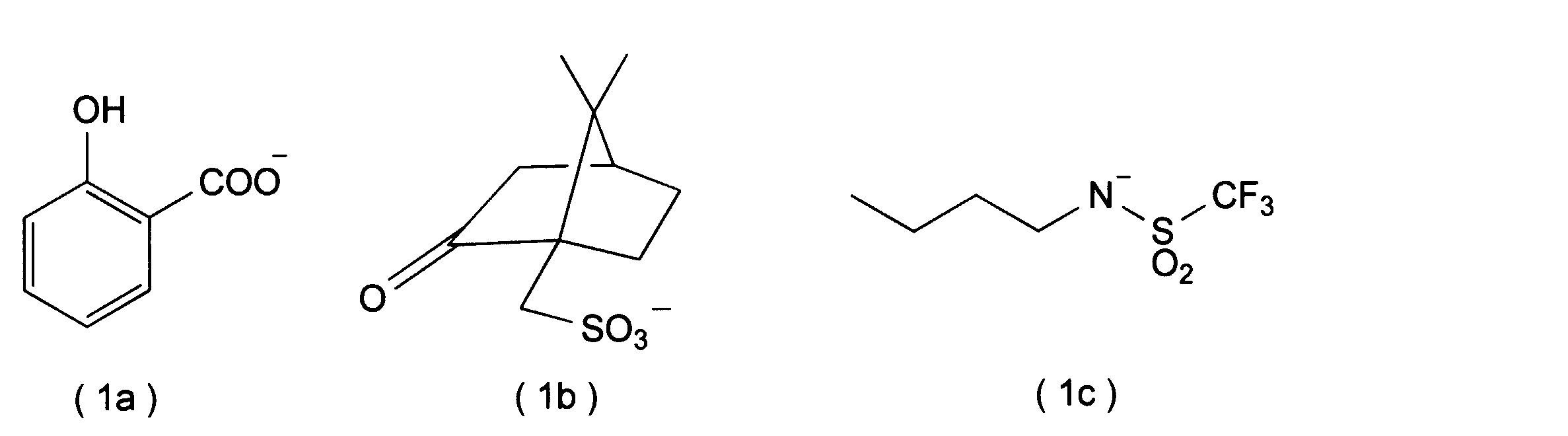
- Z ⁇ in the formula (5) is preferably an anion represented by the following formula (1a), an anion represented by the following formula (1b) and an anion represented by the following formula (1c).
- photodegradable acid diffusion controller represented by the above formula (5) include sulfonium salt compounds and iodonium salt compounds that satisfy the above conditions.
- sulfonium salt compound examples include triphenylsulfonium hydroxide, triphenylsulfonium salicylate, triphenylsulfonium 4-trifluoromethyl salicylate, diphenyl-4-hydroxyphenylsulfonium salicylate, triphenylsulfonium 10- Examples thereof include camphorsulfonate, 4-t-butoxyphenyl diphenylsulfonium 10-camphorsulfonate, and the like.
- these sulfonium salt compounds can be used individually by 1 type or in combination of 2 or more types.
- iodonium salt compound examples include bis (4-t-butylphenyl) iodonium hydroxide, bis (4-t-butylphenyl) iodonium salicylate, and bis (4-t-butylphenyl) iodonium 4-trifluoro. Examples thereof include methyl salicylate and bis (4-tert-butylphenyl) iodonium 10-camphorsulfonate. In addition, these iodonium salt compounds can be used individually by 1 type or in combination of 2 or more types.
- the [C] acid diffusion controlling agent can be used alone or in combination of two or more.
- the amount of the acid diffusion controller used is preferably 10 parts by mass or less with respect to 100 parts by mass of the polymer [A] from the viewpoint of ensuring high sensitivity as a resist film.
- the amount is more preferably 0.001 to 5 parts by mass. If the amount used exceeds 10 parts by mass, the sensitivity of the resist film may be significantly reduced. In addition, the effect of this invention may not be acquired as the usage-amount of a [C] acid diffusion control agent is less than 0.001 mass part.
- the radiation-sensitive resin composition usually contains a solvent.
- a solvent Specifically, ethylene glycol monomethyl ether acetate, ethylene glycol monoethyl ether acetate, ethylene glycol mono-n-propyl ether acetate, ethylene glycol mono- ethylene glycol monoalkyl ether acetates such as n-butyl ether acetate; propylene glycol monoalkyl ethers such as propylene glycol monomethyl ether, propylene glycol monoethyl ether, propylene glycol mono-n-propyl ether, propylene glycol mono-n-butyl ether; Propylene glycol dimethyl ether, propylene glycol diethyl ether, propylene glycol di-n-propyl ether Propylene glycol dialkyl ethers such as propylene glycol di-n-butyl ether; propylene glycol such as propylene glycol monomethyl ether acetate, propylene glycol
- Lactic acid esters such as methyl lactate, ethyl lactate, n-propyl lactate, i-propyl lactate; formate esters such as n-amyl formate and i-amyl formate; ethyl acetate, n-propyl acetate, i-acetate Acetic acid esters such as propyl, n-butyl acetate, i-butyl acetate, n-amyl acetate, i-amyl acetate, 3-methoxybutyl acetate, 3-methyl-3-methoxybutyl acetate; i-propyl propionate, propionate Propionates such as n-butyl acid, i-butyl propionate, 3-methyl-3-methoxybutyl propionate; ethyl hydroxyacetate, ethyl 2-hydroxy-2-methylpropionate, 2-hydroxy-3- Methyl methylbutyrate, eth
- Ketones such as methyl ethyl ketone, 2-pentanone, 2-hexanone, 2-heptanone, 3-heptanone, 4-heptanone, cyclohexanone; N-methylformamide, N, N-dimethylformamide, N-methylacetamide, N, N-dimethyl Examples thereof include amides such as acetamide and N-methylpyrrolidone; lactones such as ⁇ -butyrolacun. These solvents can be used alone or in combination of two or more.
- the radiation sensitive resin composition may have a fluorine atom-containing polymer.
- the fluorine atom-containing polymer exhibits an action of developing water repellency on the resist film surface particularly in immersion exposure.
- it has the effect of suppressing the elution of components from the resist film to the immersion liquid, and even when immersion exposure is performed by high-speed scanning, it does not leave droplets, resulting in immersion-derived defects such as watermark defects. There is an effect to suppress.
- fluorine atom-containing polymer for example, A fluorine atom-containing polymer which is itself insoluble in a developer and becomes alkali-soluble by the action of an acid; A fluorine atom-containing polymer which is itself soluble in a developer and whose alkali solubility is increased by the action of an acid; A fluorine atom-containing polymer which is itself insoluble in a developer and becomes alkali-soluble by the action of an alkali; Examples thereof include a fluorine atom-containing polymer which is itself soluble in a developer and whose alkali solubility is increased by the action of an alkali.
- fluorine atom-containing polymer a polymer having a fluorine atom-containing structural unit is preferable.
- monomers that give a fluorine atom-containing structural unit include trifluoromethyl (meth) acrylate, 2,2,2-trifluoroethyl (meth) acrylate, and perfluoroethyl (meth) acrylate.
- the fluorine atom-containing polymer for example, a copolymer having the above-described fluorine atom-containing structural unit and a structural unit constituting the [A] polymer is preferable.
- the radiation sensitive resin composition can contain one or more of these fluorine atom-containing polymers.
- the radiation-sensitive resin composition includes an alicyclic additive having an acid-dissociable group, a surfactant, a sensitizer, an alkali-soluble resin, and an acid-dissociable protective group. It may further contain other additives such as a low-molecular alkali solubility control agent, an antihalation agent, a storage stabilizer, and an antifoaming agent.
- the alicyclic additive having an acid dissociable group is a component having an action of further improving dry etching resistance, pattern shape, adhesion to a substrate, and the like.
- Examples of such alicyclic additives include t-butyl 1-adamantanecarboxylate, t-butoxycarbonylmethyl 1-adamantanecarboxylate, di-t-butyl 1,3-adamantanedicarboxylate, and 1-adamantaneacetic acid.
- adamantane derivatives such as t-butyl, 1-adamantane acetate t-butoxycarbonylmethyl, 1,3-adamantanediacetate di-t-butyl; deoxycholate t-butyl, deoxycholate t-butoxycarbonylmethyl, deoxychol Deoxycholic acid esters such as 2-ethoxyethyl acid, 2-cyclohexyloxyethyl deoxycholic acid, 3-oxocyclohexyl deoxycholic acid, tetrahydropyranyl deoxycholic acid, mevalonolactone ester deoxycholic acid; t-butyl lithocholic acid , List of lithocholic acid esters such as t-butoxycarbonylmethyl cholic acid, 2-ethoxyethyl lithocholic acid, 2-cyclohexyloxyethyl lithocholic acid, 3-oxocyclohexyl lithocholic acid, tetrahydropyranyl lit
- Surfactant is a component having an action of improving coatability, striation, developability and the like.
- examples of such surfactants include polyoxyethylene lauryl ether, polyoxyethylene stearyl ether, polyoxyethylene oleyl ether, polyoxyethylene n-octylphenyl ether, polyoxyethylene n-nonylphenyl ether, and polyethylene glycol dilaurate.
- nonionic surfactants such as polyethylene glycol distearate.
- Commercially available surfactants are all trade names below, such as KP341 (manufactured by Shin-Etsu Chemical Co., Ltd.), Polyflow No. 75, no.
- the radiation sensitive resin composition includes, for example, a raw material composition containing [A] polymer, [B] acid generator, [C] acid diffusion controller, and other additives, and its total solid content concentration. Can be obtained by dissolving it in a solvent so that it becomes 3 to 50% by mass (preferably 5 to 25% by mass) and then filtering with a filter having a pore diameter of about 200 nm.
- the radiation sensitive resin composition is particularly useful as a chemically amplified resist.
- the formation method of the resist pattern using the said radiation sensitive resin composition is demonstrated.
- a resist film made of the radiation sensitive resin composition is formed on a substrate.
- the formed resist film is exposed.
- the acid dissociable group in the [A] polymer is dissociated by the action of the sulfonic acid generated from the [B] acid generator by exposure to generate a carboxyl group.
- the carboxyl group is generated, the solubility in an alkali developer in the exposed portion of the resist film is increased.
- a positive resist pattern can be formed.
- the resist pattern forming method will be described more specifically below.
- the radiation sensitive resin composition is prepared by the method described above.
- a resist film is formed by applying the prepared composition solution onto a substrate such as a silicon wafer or a wafer coated with aluminum by an appropriate application means such as spin coating, cast coating, or roll coating. .
- a heat treatment (hereinafter also referred to as “SB”) is performed in advance in some cases, and then the resist film is exposed to form a predetermined resist pattern.
- the radiation used for the exposure can be appropriately selected from visible light, ultraviolet light, far ultraviolet light, X-rays, charged particle beam, and the like.
- ArF excimer laser (wavelength 193 nm) or KrF excimer laser (wavelength 248 nm)
- a far ultraviolet ray represented by the formula (1) is preferable, and an ArF excimer laser (wavelength 193 nm) is particularly preferable.
- PEB heat treatment after exposure.
- the heating conditions for PEB vary depending on the composition of the radiation sensitive resin composition, but are preferably 30 to 200 ° C, more preferably 50 to 170 ° C.
- an organic or inorganic system is used. It is also possible to form an antireflection film.
- a protective film can be provided on the resist film as disclosed in, for example, Japanese Patent Laid-Open No. 5-188598. These techniques can be used in combination.
- a predetermined resist pattern can be obtained by developing the exposed resist film.
- the developer used for development include sodium hydroxide, potassium hydroxide, sodium carbonate, sodium silicate, sodium metasilicate, aqueous ammonia, ethylamine, n-propylamine, diethylamine, and di-n-propylamine.
- alkaline aqueous solution in which at least one alkaline compound such as [4.3.0] -5-nonene is dissolved is preferable.
- concentration of the alkaline aqueous solution is preferably 10% by mass or less. When the concentration of the alkaline aqueous solution exceeds 10% by mass, the unexposed area may be dissolved in the developer.
- an organic solvent can be added to the developer.
- the organic solvent include ketones such as acetone, methyl ethyl ketone, methyl i-butyl ketone, cyclopentanone, cyclohexanone, 3-methylcyclopentanone, and 2,6-dimethylcyclohexanone; methyl alcohol, ethyl alcohol, n-propyl Alcohols such as alcohol, i-propyl alcohol, n-butyl alcohol, t-butyl alcohol, cyclopentanol, cyclohexanol, 1,4-hexanediol and 1,4-hexanedimethylol; ethers such as tetrahydrofuran and dioxane Esters such as ethyl acetate, n-butyl acetate and i-amyl acetate; aromatic hydrocarbons such as toluene and xylene; phenol, acetony
- the amount of the organic solvent used is preferably 100% by volume or less with respect to the alkaline aqueous solution. If the amount of the organic solvent used exceeds 100% by volume, the developability is lowered and there is a possibility that the undeveloped portion of the exposed area increases. Further, an appropriate amount of the above-described surfactant or the like can be added to the developer. In addition, after developing with the said developing solution, it is preferable to wash
- the “low molecular weight component” refers to a component having a monomer as a main component, more specifically, a component having a molecular weight of less than 1,000, preferably a component having a molecular weight equal to or less than that of the trimer.
- Example 1 Polymer (A-1)] Dissolve 11.87 g (15 mol%) of compound (M-1), 39.88 g (35 mol%) of compound (M-5), and 48.25 g (50 mol%) of compound (M-10) in 200 g of 2-butanone. Then, AIBN 7.13 g (10 mol%) was added to prepare a monomer solution. A 1,000 mL three-necked flask containing 100 g of 2-butanone was purged with nitrogen for 30 minutes, then heated to 80 ° C. with stirring, and the prepared monomer solution was added dropwise over 3 hours using a dropping funnel. The dripping start was set as the polymerization reaction start time, and the polymerization reaction was carried out for 6 hours.
- the polymerization solution was cooled with water and cooled to 30 ° C. or lower.
- the cooled polymerization solution was put into 2,000 g of methanol, and the precipitated white powder was filtered off.
- the filtered white powder was washed twice with 400 g of methanol, filtered and dried at 50 ° C. for 17 hours to obtain a white powdery polymer (A-1) (77 g, yield 77%).
- Mw of the obtained polymer (A-1) was 5,300
- Mw / Mn was 1.54, and the residual ratio of the low molecular weight component was 0.05%.
- the content ratio of the repeating unit derived from the compound (M-1): the repeating unit derived from the compound (M-5): the repeating unit derived from the compound (M-10) was 13.4: 33.8: 52.8 (mol%).
- Example 2 Polymer (A-2)] Dissolve 12.67 g (15 mol%) of compound (M-2), 39.52 g (35 mol%) of compound (M-5), and 47.81 g (50 mol%) of compound (M-10) in 200 g of 2-butanone. Then, 7.07 g (10 mol%) of AIBN was added to prepare a monomer solution. A 1,000 mL three-necked flask containing 100 g of 2-butanone was purged with nitrogen for 30 minutes, then heated to 80 ° C. with stirring, and the prepared monomer solution was added dropwise over 3 hours using a dropping funnel. The dripping start was set as the polymerization reaction start time, and the polymerization reaction was carried out for 6 hours.
- the polymerization solution was cooled with water and cooled to 30 ° C. or lower.
- the cooled polymerization solution was put into 2,000 g of methanol, and the precipitated white powder was filtered off.
- the filtered white powder was washed twice with 400 g of methanol, filtered, and dried at 50 ° C. for 17 hours to obtain a white powdery polymer (A-2) (75 g, yield 75%).
- Mw of the obtained polymer (A-2) was 5,200
- Mw / Mn was 1.56, and the residual ratio of the low molecular weight component was 0.04%.
- the content ratio of the repeating unit derived from the compound (M-2): the repeating unit derived from the compound (M-5): the repeating unit derived from the compound (M-10) was 13.1: 33.9: 53.0 (mol%).
- Example 3 Polymer (A-3)
- Compound (M-3) 14.22 g (15 mol%), compound (M-5) 38.81 g (35 mol%), and compound (M-10) 46.96 g (50 mol%) were dissolved in 200 g of 2-butanone.
- 6.94 g (10 mol%) of AIBN was added to prepare a monomer solution.
- a 1,000 mL three-necked flask containing 100 g of 2-butanone was purged with nitrogen for 30 minutes, then heated to 80 ° C. with stirring, and the prepared monomer solution was added dropwise over 3 hours using a dropping funnel.
- the dripping start was set as the polymerization reaction start time, and the polymerization reaction was carried out for 6 hours.
- the polymerization solution was cooled with water and cooled to 30 ° C. or lower.
- the cooled polymerization solution was put into 2,000 g of methanol, and the precipitated white powder was filtered off.
- the filtered white powder was washed twice with 400 g of methanol, filtered, and dried at 50 ° C. for 17 hours to obtain a white powdery polymer (A-3) (76 g, yield 76%).
- Mw of the obtained polymer (A-3) was 5,300
- Mw / Mn was 1.55, and the residual ratio of the low molecular weight component was 0.04%.
- the content ratio of the repeating unit derived from the compound (M-3): the repeating unit derived from the compound (M-5): the repeating unit derived from the compound (M-10) was 13.7: 33.2: 53.1 (mol%).
- Example 4 Polymer (A-4)] Compound (M-2) 12.98 g (15 mol%), Compound (M-5) 17.35 g (15 mol%), Compound (M-6) 20.67 g (20 mol%), and Compound (M-10) 49 0.000 g (50 mol%) was dissolved in 200 g of 2-butanone, and 7.24 g (10 mol%) of AIBN was added to prepare a monomer solution. A 1,000 mL three-necked flask containing 100 g of 2-butanone was purged with nitrogen for 30 minutes, then heated to 80 ° C. with stirring, and the prepared monomer solution was added dropwise over 3 hours using a dropping funnel.
- the dripping start was set as the polymerization reaction start time, and the polymerization reaction was carried out for 6 hours.
- the polymerization solution was cooled with water and cooled to 30 ° C. or lower.
- the cooled polymerization solution was put into 2,000 g of methanol, and the precipitated white powder was filtered off.
- the filtered white powder was washed twice with 400 g of methanol, filtered, and dried at 50 ° C. for 17 hours to obtain a white powdery polymer (A-4) (74 g, yield 74%).
- Mw of the obtained polymer (A-4) was 5,000, Mw / Mn was 1.47, and the residual ratio of the low molecular weight component was 0.05%.
- the repeating unit derived from compound (M-2) the repeating unit derived from compound (M-5): the repeating unit derived from compound (M-6): derived from compound (M-10)
- the content ratio of the repeating unit was 13.4: 14.7: 18.2: 53.7 (mol%).
- Example 5 Polymer (A-5)] Compound (M-2) 13.19 g (15 mol%), Compound (M-5) 41.15 g (35 mol%), Compound (M-7) 5.83 g (10 mol%), and Compound (M-10) 39 .83 g (40 mol%) was dissolved in 200 g of 2-butanone, and 7.36 g (10 mol%) of AIBN was added to prepare a monomer solution.
- a 1,000 mL three-necked flask containing 100 g of 2-butanone was purged with nitrogen for 30 minutes, then heated to 80 ° C. with stirring, and the prepared monomer solution was added dropwise over 3 hours using a dropping funnel.
- the dripping start was set as the polymerization reaction start time, and the polymerization reaction was carried out for 6 hours.
- the polymerization solution was cooled with water and cooled to 30 ° C. or lower.
- the cooled polymerization solution was put into 2,000 g of methanol, and the precipitated white powder was filtered off.
- the filtered white powder was washed twice with 400 g of methanol, filtered, and dried at 50 ° C. for 17 hours to obtain a white powdery polymer (A-5) (69 g, yield 69%).
- Mw of the obtained polymer (A-5) was 4,700
- Mw / Mn was 1.38
- the residual ratio of the low molecular weight component was 0.04%.
- the repeating unit derived from the compound (M-2) the repeating unit derived from the compound (M-5): the repeating unit derived from the compound (M-7): derived from the compound (M-10)
- the content ratio of the repeating unit was 12.8: 33.9: 8.1: 45.2 (mol%).
- Example 6 Polymer (A-6)] Compound (M-2) 12.87 g (15 mol%), Compound (M-5) 40.14 g (35 mol%), Compound (M-8) 8.14 g (10 mol%), and Compound (M-10) 38 .85 g (40 mol%) was dissolved in 200 g of 2-butanone, and 7.18 g (10 mol%) of AIBN was added to prepare a monomer solution. A 1,000 mL three-necked flask containing 100 g of 2-butanone was purged with nitrogen for 30 minutes, then heated to 80 ° C. with stirring, and the prepared monomer solution was added dropwise over 3 hours using a dropping funnel.
- the dripping start was set as the polymerization reaction start time, and the polymerization reaction was carried out for 6 hours.
- the polymerization solution was cooled with water and cooled to 30 ° C. or lower.
- the cooled polymerization solution was put into 2,000 g of methanol, and the precipitated white powder was filtered off.
- the filtered white powder was washed twice with 400 g of methanol, filtered, and dried at 50 ° C. for 17 hours to obtain a white powdery polymer (A-6) (72 g, yield 72%).
- Mw of the obtained resin (A-6) was 4,300
- Mw / Mn was 1.34
- the residual ratio of the low molecular weight component was 0.03%.
- the repeating unit derived from the compound (M-2) the repeating unit derived from the compound (M-5): the repeating unit derived from the compound (M-8): derived from the compound (M-10)
- the content ratio of the repeating unit was 12.6: 34.1: 8.4: 44.9 (mol%).
- Example 7 Polymer (A-7)] Compound (M-2) 12.29 g (15 mol%), Compound (M-5) 38.33 g (35 mol%), Compound (M-9) 12.28 g (10 mol%), and Compound (M-10) 37 .10 g (40 mol%) was dissolved in 200 g of 2-butanone, and 6.85 g (10 mol%) of AIBN was added to prepare a monomer solution.
- a 1,000 mL three-necked flask containing 100 g of 2-butanone was purged with nitrogen for 30 minutes, then heated to 80 ° C. with stirring, and the prepared monomer solution was added dropwise over 3 hours using a dropping funnel.
- the dripping start was set as the polymerization reaction start time, and the polymerization reaction was carried out for 6 hours.
- the polymerization solution was cooled with water and cooled to 30 ° C. or lower.
- the cooled polymerization solution was put into 2,000 g of methanol, and the precipitated white powder was filtered off.
- the filtered white powder was washed twice with 400 g of methanol, filtered, and dried at 50 ° C. for 17 hours to obtain a white powdery polymer (A-7) (68 g, yield 68%).
- Mw of the obtained resin (A-7) was 4,100
- Mw / Mn was 1.31
- the residual ratio of the low molecular weight component was 0.05%.
- the repeating unit derived from compound (M-2) the repeating unit derived from compound (M-5): the repeating unit derived from compound (M-9): derived from compound (M-10)
- the content ratio of the repeating unit was 13.2: 33.7: 8.0: 45.1 (mol%).
- Example 8 Polymer (A-8)] Compound (M-2) 13.53 g (15 mol%), Compound (M-5) 18.09 g (15 mol%), Compound (M-6) 21.54 g (20 mol%), Compound (M-7) 5. 98 g (10 mol%) and 40.86 g (40 mol%) of the compound (M-10) were dissolved in 200 g of 2-butanone, and AIBN 7.55 g (10 mol%) was added to prepare a monomer solution. A 1,000 mL three-necked flask containing 100 g of 2-butanone was purged with nitrogen for 30 minutes, then heated to 80 ° C. with stirring, and the prepared monomer solution was added dropwise over 3 hours using a dropping funnel.
- the dripping start was set as the polymerization reaction start time, and the polymerization reaction was carried out for 6 hours.
- the polymerization solution was cooled with water and cooled to 30 ° C. or lower.
- the cooled polymerization solution was put into 2,000 g of methanol, and the precipitated white powder was filtered off.
- the filtered white powder was washed twice with 400 g of methanol, filtered, and dried at 50 ° C. for 17 hours to obtain a white powdery polymer (A-8) (64 g, yield 64%).
- Mw of the obtained polymer (A-8) was 4,100
- Mw / Mn was 1.29
- the residual ratio of the low molecular weight component was 0.05%.
- the repeating unit derived from compound (M-2) the repeating unit derived from compound (M-5): the repeating unit derived from compound (M-6): derived from compound (M-7)
- the content ratio of the repeating unit derived from Compound (M-10) was 13.6: 14.2: 18.4: 7.9: 45.9 (mol%).
- the polymerization solution was cooled with water and cooled to 30 ° C. or lower.
- the cooled polymerization solution was put into 2,000 g of methanol, and the precipitated white powder was filtered off.
- the filtered white powder was washed twice with 400 g of methanol, filtered, and dried at 50 ° C. for 17 hours to obtain a white powdery polymer (a-1) (64 g, yield 64%).
- Mw of the obtained polymer (a-1) was 3,800
- Mw / Mn was 1.32
- the residual ratio of low molecular weight components was 0.03%.
- the content ratio of the repeating unit derived from the compound (M-1): the repeating unit derived from the compound (M-6): the repeating unit derived from the compound (M-10) was 13.4: It was 32.8: 53.8 (mol%).
- the polymerization solution was cooled with water and cooled to 30 ° C. or lower.
- the cooled polymerization solution was put into 2,000 g of methanol, and the precipitated white powder was filtered off.
- the filtered white powder was washed twice with 400 g of methanol, filtered and dried at 50 ° C. for 17 hours to obtain a white powdery polymer (a-1) (75 g, yield 75%).
- Mw of the obtained polymer (a-1) was 5,400
- Mw / Mn was 1.52
- the residual ratio of the low molecular weight component was 0.04%.
- the content ratio of the repeating unit derived from the compound (M-4): the repeating unit derived from the compound (M-5): the repeating unit derived from the compound (M-10) was 13.8: 33.7: 52.5 (mol%).
- the dripping start was set as the polymerization reaction start time, and the polymerization reaction was carried out for 6 hours.
- the polymerization solution was cooled with water and cooled to 30 ° C. or lower.
- the reaction solution was transferred to a 4 L separatory funnel, the polymerization solution was uniformly diluted with 300 g of n-hexane, and 1,200 g of methanol was added and mixed.
- 60 g of distilled water was added, and the mixture was further stirred and allowed to stand for 30 minutes. Thereafter, the lower layer was recovered to obtain a propylene glycol monomethyl ether acetate solution (yield 60%).
- Mw of the obtained polymer (E-1) was 7,200, Mw / Mn was 2.00, and the residual ratio of the low molecular weight component was 0.07%.
- the content ratio of the repeating unit derived from the compound (M-1) to the repeating unit derived from the compound (M-11) was 71.1: 28.9 (mol%).
- the polymerization solution was cooled with water and cooled to 30 ° C. or lower.
- the polymerization solution was concentrated under reduced pressure using an evaporator until the weight of the polymerization solution reached 150 g. Thereafter, the concentrated solution was poured into a mixed solution of 760 g of methanol and 40 g of water to precipitate a slime-like white solid. The liquid part was removed by decantation, and the collected solid was vacuum-dried at 60 ° C. for 15 hours to obtain 47 g of a white powder (polymer (E-2)) (yield 47%).
- Mw was 3,700 and Mw / Mn was 1.40.
- the content ratio of the repeating unit derived from the compound (M-3) to the repeating unit derived from the compound (M-12) was 42.5: 57.5 (mol%).
- Example 9 100 parts by mass of the polymer (A-1) obtained in Example 1, 3 parts by mass of the polymer (E-1) obtained in Synthesis Example 1, 7 parts by mass of the acid generator (B-1), acid diffusion Control agent (C-1) 0.7 parts by mass, solvent (D-1) 1900 parts by mass, (D-2) 830 parts by mass, and (D-3) 30 parts by mass were mixed, and the resulting mixture The solution was filtered through a filter having a pore size of 0.20 ⁇ m to prepare a radiation sensitive resin composition. This radiation-sensitive resin composition was designated as composition (J-1).
- each radiation-sensitive resin composition was post-baked (PEB) at the temperature shown in Table 5 for 60 seconds. Thereafter, the resist film was developed with a 2.38 mass% tetramethylammonium hydroxide aqueous solution, washed with water, and dried to form a positive resist pattern. At this time, the exposure amount at which the exposed portion formed a hole having a diameter of 65 nm was determined as the optimum exposure amount (Eop). For measurement, a scanning electron microscope (CG-4000, manufactured by Hitachi High-Technologies Corporation) was used.
- the vertical axis represents the diameter (nm) of the hole formed in the resist film using the mask pattern portion in which the hole diameter of the pattern after reduction projection is 73 nm, 74 nm, 75 nm, 76 nm, and 77 nm.
- the slope of the straight line when the design size (nm) was plotted on the horizontal axis was calculated as MEEF.
- the MEEF has a better mask reproducibility as the value is closer to 1, and the case where the value is 1.50 or more and less than 2.50 is “good (A)”, and the case where the value is 2.50 or more and less than 3.00. “Slightly good (B)” was set, and cases of 3.00 or more were set as “bad (C)”.
- the radiation-sensitive resin composition of the present invention can be suitably used as a lithography material using an ArF excimer laser as a light source. Moreover, it can respond also to immersion exposure.
Landscapes
- Physics & Mathematics (AREA)
- Spectroscopy & Molecular Physics (AREA)
- Chemical & Material Sciences (AREA)
- General Physics & Mathematics (AREA)
- Health & Medical Sciences (AREA)
- Chemical Kinetics & Catalysis (AREA)
- Medicinal Chemistry (AREA)
- Polymers & Plastics (AREA)
- Organic Chemistry (AREA)
- Materials For Photolithography (AREA)
- Addition Polymer Or Copolymer, Post-Treatments, Or Chemical Modifications (AREA)
- Exposure And Positioning Against Photoresist Photosensitive Materials (AREA)
Abstract
本発明は、ホールパターン形成時に、CDU(CD Uniformity)、MEEF(Mask Error Enhanced Factor)の低減等の多様な要求特性を満足させる感放射線性樹脂組成物及びそれに用いる重合体を提供することを目的とする。アダマンタン構造を有する特定構造の繰り返し単位と、シクロアルカン構造を有する特定構造の繰り返し単位とを含む重合体と、上記重合体を含有する感放射線性樹脂組成物を提供する。
Description
本発明は、感放射線性樹脂組成物及びこれに用いる重合体に関するものであり、詳細にはフォトリソグラフィー工程に好適に使用される感放射線性樹脂組成物及びこれに用いる重合体に関する。
化学増幅型の感放射線性樹脂組成物は、KrFエキシマレーザー及びArFエキシマレーザーに代表される遠紫外線や電子線の照射により露光部に酸を生成させ、この酸を触媒とする化学反応により、露光部と未露光部の現像液に対する溶解速度に差を生じさせ、基板上にレジストパターンを形成させる。
例えば、KrFエキシマレーザー(波長248nm)を光源として用いる場合には、248nm領域での吸収が小さいポリヒドロキシスチレン(以下、「PHS」ともいう。)等を基本骨格とする重合体を構成成分とする化学増幅型感放射線性樹脂組成物が用いられている。この組成物によれば、高感度、高解像度、かつ良好なパターン形成を実現することが可能である。
しかし、更なる微細加工を目的として、より短波長のArFエキシマレーザー(波長193nm)を光源として用いる場合、上記PHS等の芳香族化合物は193nm領域に大きな吸収を示すことから、これらを構成成分とする組成物では不都合が生じる。
そこで、ArFエキシマレーザーを光源とするリソグラフィー材料としては、193nm領域に大きな吸収を有しない脂環式炭化水素を骨格中に有する重合体を構成成分とする感放射線性樹脂組成物が用いられている。このような感放射線性樹脂組成物としては、例えば、その繰り返し単位中に、アダマンタン骨格、ノルボルナン骨格、シクロヘキサン骨格等を有する重合体を構成成分とするものがある(特許文献1~4参照)。このような感放射線性樹脂組成物は、酸の作用によりアルカリ可溶性となる基を含む繰り返し単位と、ラクトン骨格を含む繰り返し単位とを有する重合体を含有することで、レジストとしての解像性能が飛躍的に向上することが見出されている。
しかしながら、レジストパターンの微細化が線幅90nm以下のレベルまで進展している現在にあっては、解像性能のみならず、他の性能も要求されるようになってきている。具体的には、ホールパターン形成時に、CDU(CD Uniformity)及びMEEF(Mask Error Enhancement Factor)の低減等の多様な要求特性を満足させる感放射線性樹脂組成物の開発が求められている。
本発明は、以上のような事情に基づいてなされたものであり、その目的は、CDU及びMEEFが低減された感放射線性樹脂組成物を提供することである。
上記課題を解決するためになされた発明は、
[1][A]下記式(1)で表される繰り返し単位(以下、「繰り返し単位(I)」ともいう)及び下記式(2)で表される繰り返し単位(以下、「繰り返し単位(II)」ともいう)を含む重合体(以下、「[A]重合体」ともいう)を含有する感放射線性樹脂組成物である。

(式(1)中、R1は水素原子又はメチル基である。R2及びR3はそれぞれ独立して炭素数1~5のアルキル基である。
式(2)中、R4は水素原子又はメチル基である。R5は炭素数2~5のアルキル基である。aは1~5の整数である。)
[1][A]下記式(1)で表される繰り返し単位(以下、「繰り返し単位(I)」ともいう)及び下記式(2)で表される繰り返し単位(以下、「繰り返し単位(II)」ともいう)を含む重合体(以下、「[A]重合体」ともいう)を含有する感放射線性樹脂組成物である。
式(2)中、R4は水素原子又はメチル基である。R5は炭素数2~5のアルキル基である。aは1~5の整数である。)
[2]当該感放射線性樹脂組成物は[B]感放射線性酸発生剤(以下、「[B]酸発生剤」ともいう)をさらに含有するとよい。
[3]当該感放射線性樹脂組成物はフッ素原子含有重合体をさらに含有するとよい。
[4][A]重合体が、ラクトン骨格を有する繰り返し単位及び環状カーボネート構造を有する繰り返し単位からなる群より選択される少なくとも1種の繰り返し単位(III)をさらに含むとよい。
[5]また、本発明は、下記式(1)で表される繰り返し単位(I)及び下記式(2)で表される繰り返し単位(II)を含む重合体である。
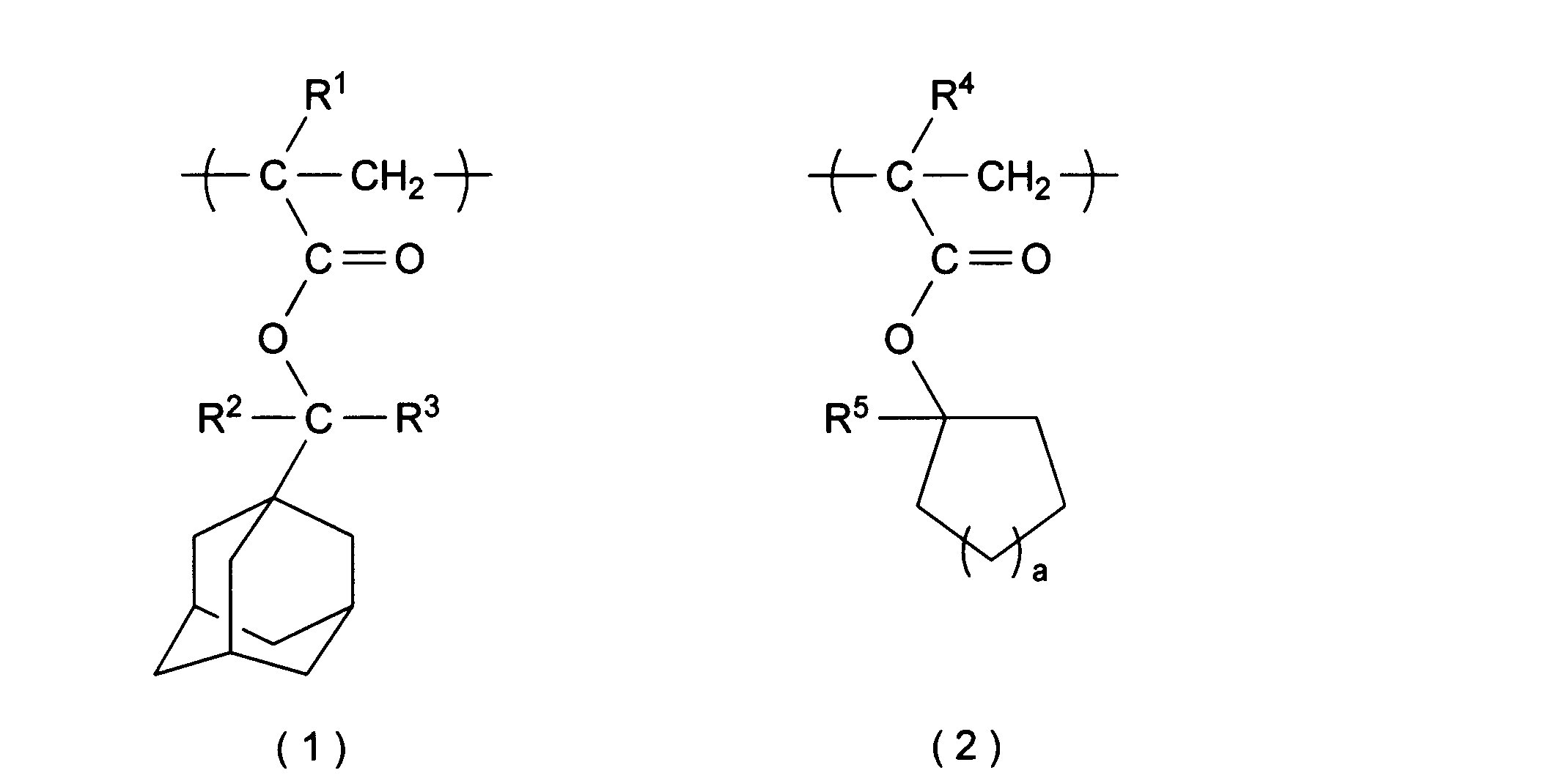
(式(1)中、R1は水素原子又はメチル基である。R2及びR3はそれぞれ独立して炭素数1~5のアルキル基である。
式(2)中、R4は水素原子又はメチル基である。R5は炭素数2~5のアルキル基である。aは1~5の整数である。)
式(2)中、R4は水素原子又はメチル基である。R5は炭素数2~5のアルキル基である。aは1~5の整数である。)
本発明の感放射線性樹脂組成物は、CDU及びMEEFを低減することができ、良好なパターンを形成することができる。
以下、本発明を実施するための形態について説明するが、本発明は以下の実施の形態に限定されるものではない。
<[A]重合体>
[A]重合体は、上記式(1)で表される繰り返し単位(I)、及び上記式(2)で表される繰り返し単位(II)を含む。繰り返し単位(I)及び(II)は共に酸により解離する酸解離性基を有し、上記酸解離性基が解離するとアルカリ可溶性となる性質を有する。そのため、[A]重合体はアルカリ難溶性又は不溶性であるが、露光により発生する酸によりアルカリ可溶性となる。上記特定構造の繰り返し単位(I)と繰り返し単位(II)とは、酸による解離のし易さが異なり、このような異なる性質を有する2種の酸解離性基を有することにより、当該感放射線性樹脂組成物は、MEEFの値を飛躍的に低下させることが可能になる。
[A]重合体は、上記式(1)で表される繰り返し単位(I)、及び上記式(2)で表される繰り返し単位(II)を含む。繰り返し単位(I)及び(II)は共に酸により解離する酸解離性基を有し、上記酸解離性基が解離するとアルカリ可溶性となる性質を有する。そのため、[A]重合体はアルカリ難溶性又は不溶性であるが、露光により発生する酸によりアルカリ可溶性となる。上記特定構造の繰り返し単位(I)と繰り返し単位(II)とは、酸による解離のし易さが異なり、このような異なる性質を有する2種の酸解離性基を有することにより、当該感放射線性樹脂組成物は、MEEFの値を飛躍的に低下させることが可能になる。
<繰り返し単位(I)>
繰り返し単位(I)は、上記式(1)で表されるアダマンチル基を有する特定構造を含む繰り返し単位である。上記式(1)中、R1は水素原子又はメチル基である。R2及びR3はそれぞれ独立して炭素数1~5のアルキル基である。
繰り返し単位(I)は、上記式(1)で表されるアダマンチル基を有する特定構造を含む繰り返し単位である。上記式(1)中、R1は水素原子又はメチル基である。R2及びR3はそれぞれ独立して炭素数1~5のアルキル基である。
上記R3で表される炭素数1~5のアルキル基としては、例えばメチル基、エチル基、n-プロピル基、i-プロピル基、n-ブチル基、n-ペンチル基等が挙げられる。
繰り返し単位(I)のうち特に好ましいものとしては、上記式(1)におけるR2及びR3がいずれもメチル基である繰り返し単位が挙げられる。なお、[A]重合体は、繰り返し単位(I)を、1種又は2種以上有することができる。
繰り返し単位(I)の含有割合は、[A]重合体中の全繰り返し単位に対して、5~70モル%であることが好ましく、10~50モル%であることがより好ましい。含有割合が上記範囲であることにより、当該感放射線性樹脂組成物は、MEEF及びCDUの値を低下させることができる。
<繰り返し単位(II)>
繰り返し単位(II)は、上記式(2)で表される炭素数2~5のアルキル基で置換されたシクロアルキル(メタ)アクリレートに由来する繰り返し単位である。上記式(2)中、R4は水素原子又はメチル基である。R5は炭素数2~5のアルキル基である。aは1~5の整数である。
繰り返し単位(II)は、上記式(2)で表される炭素数2~5のアルキル基で置換されたシクロアルキル(メタ)アクリレートに由来する繰り返し単位である。上記式(2)中、R4は水素原子又はメチル基である。R5は炭素数2~5のアルキル基である。aは1~5の整数である。
上記式(2)中、R5で表される炭素数2~5のアルキル基としては、例えばエチル基、n-プロピル基、i-プロピル基、n-ブチル基、n-ペンチル基等が挙げられる。これらのうち、エチル基、i-プロピル基が好ましい。
上記式(2)中、aとしては、1~4が好ましく、1、2、4がより好ましい。
なお、[A]重合体は、繰り返し単位(II)を、1種又は2種以上含んでもよい。
繰り返し単位(II)の含有割合は、[A]重合体中の全繰り返し単位に対して、5~35モル%であることが好ましく、10~25モル%であることがより好ましい。
また、繰り返し単位(II)は、繰り返し単位(I)と比較して、酸により解離してアルカリ可溶性となりやすい性質であることが好ましい。[A]重合体がこのような特徴を有することにより、当該感放射線性樹脂組成物は、レジストパターン形成工程におけるポストベーク(PEB)の温度を低下させることができ、MEEFの値を低下させるという効果を奏する。
<繰り返し単位(III)>
[A]重合体は、ラクトン構造を有する繰り返し単位及び環状カーボネート構造を有する繰り返し単位からなる群より選択される少なくとも1種の繰り返し単位(III)を含むことが好ましい。繰り返し単位(III)を含むことにより、基板への密着性が向上するという効果を奏する。
[A]重合体は、ラクトン構造を有する繰り返し単位及び環状カーボネート構造を有する繰り返し単位からなる群より選択される少なくとも1種の繰り返し単位(III)を含むことが好ましい。繰り返し単位(III)を含むことにより、基板への密着性が向上するという効果を奏する。
ラクトン構造を有する繰り返し単位(III)としては、例えば、下記式(iii-1)~(iii-9)で表される繰り返し単位を挙げることができる。

上記式中、R6は水素原子又はメチル基である。
繰り返し単位(III)としては、下記式(3)で表されるノルボルナンラクトン骨格を有する繰り返し単位が好ましい。
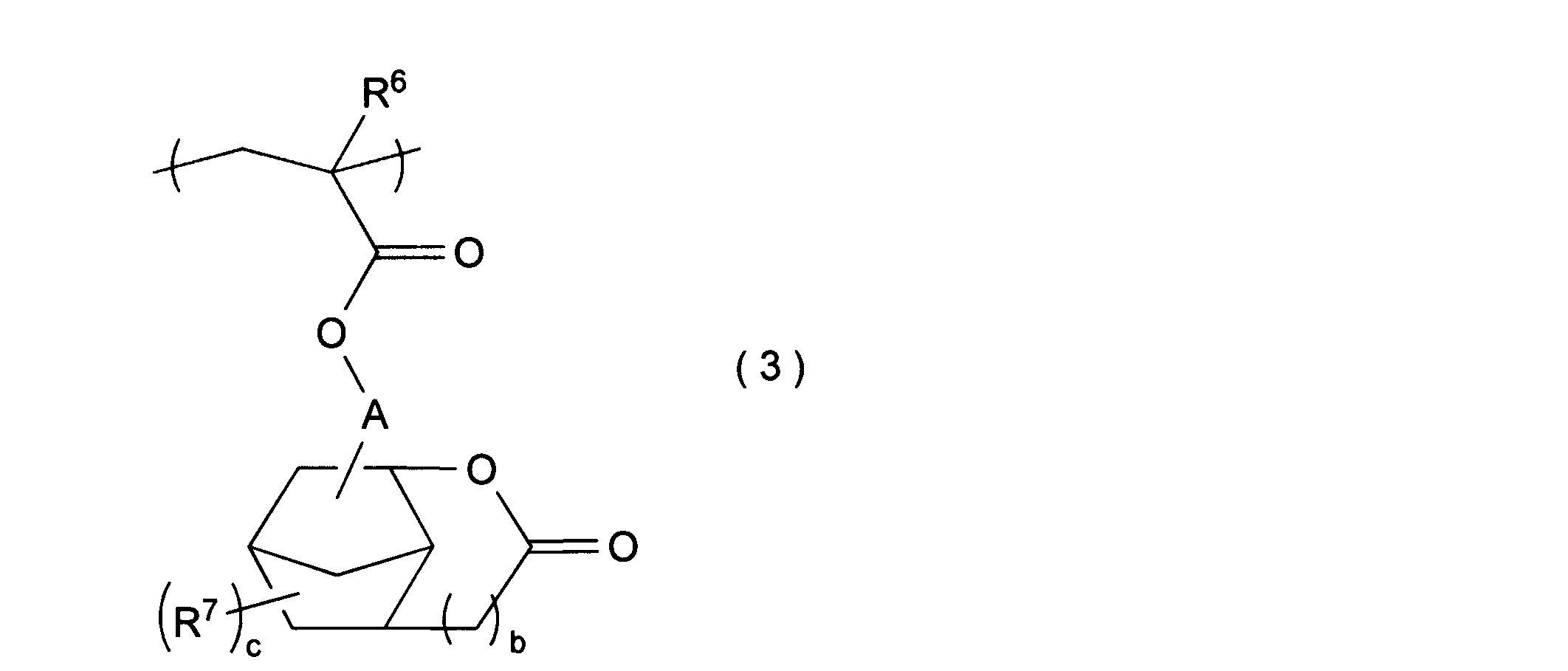
上記式(3)中、bは0又は1の整数である。cは0~3の整数である。R6は水素原子又はメチル基である。R7は炭素数1~4の直鎖状若しくは分岐状のアルキル基、炭素数1~4の直鎖状若しくは分岐状のフッ素化アルキル基、炭素数1~4の直鎖状若しくは分岐状のアルコキシ基又はシアノ基である。cが2以上のとき、複数のR7は同一でも異なっていてもよい。Aは単結合、炭素数1~4の2価の炭化水素基、-A’-O-、-A’-COO-又は-A’-OCO-である。A’は炭素数1~4の2価の炭化水素基である。
上記式(3)中のR7で表される炭素数1~4の直鎖状若しくは分岐状のアルキル基としては、メチル基、エチル基が好ましい。上記炭素数1~4の直鎖状若しくは分岐状のフッ素化アルキル基としては、トリフルオロメチル基が好ましい。上記炭素数1~4の直鎖状若しくは分岐状のアルコキシ基としては、メトキシ基が好ましい。
上記式(3)中、A及びA’で表される炭素数1~4の2価の炭化水素基としては、炭素数1~4のアルカンジイル基又は炭素数3~4の脂環式基等が挙げられる。これらのうち、メチレン基、エチレン基、n-プロピレン基、n-ブチレン基等の直鎖状アルカンジイル基が好ましい。なお、bとしては、0が好ましい。cとしては、0、1が好ましい。
ノルボルナンラクトン骨格を有する繰り返し単位(III)の具体例としては、下記式(3-1)~(3-8)で表される繰り返し単位等が挙げられる。これらのうち、下記式(3-1)で表される繰り返し単位が好ましい。
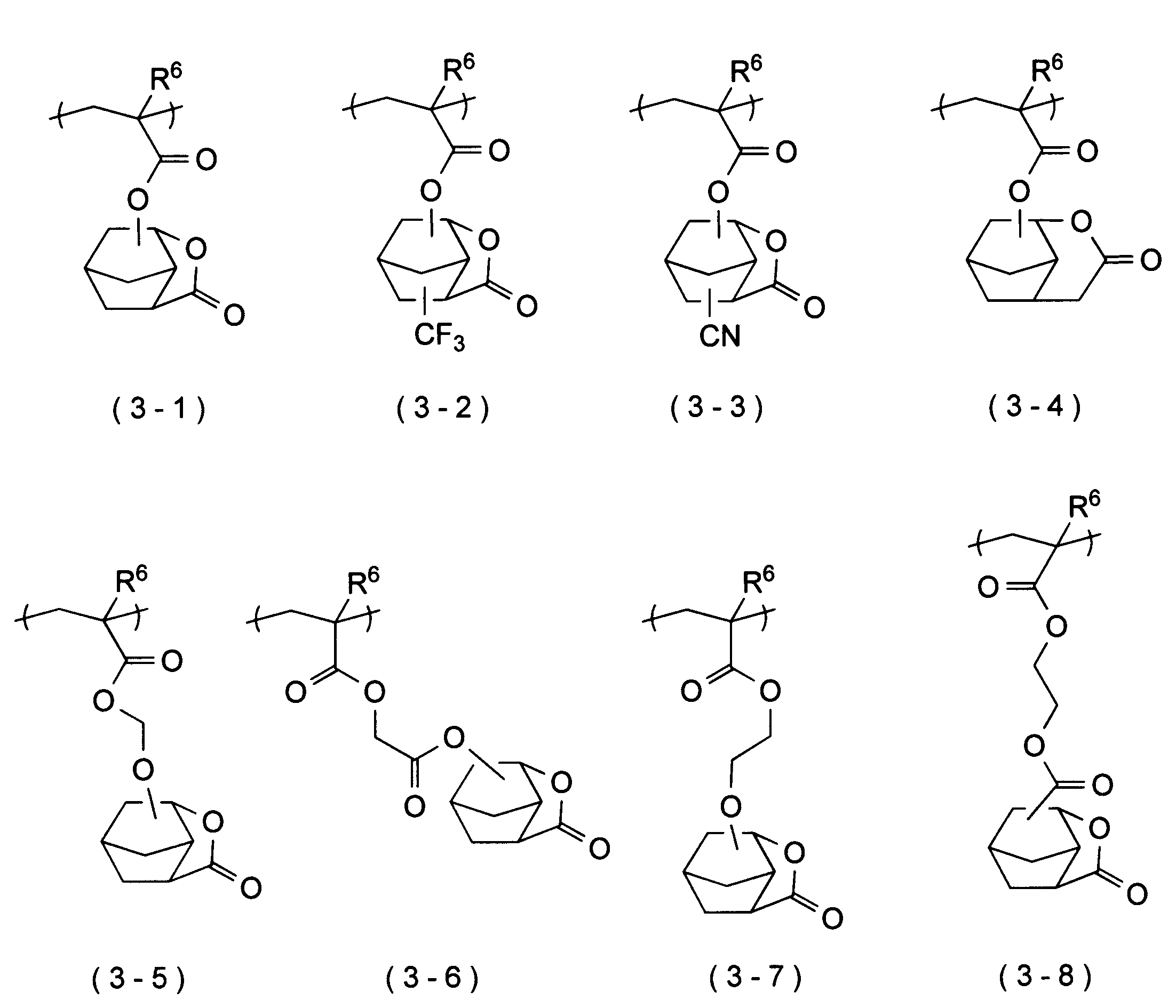
上記式中、R6は、水素原子又はメチル基である。
環状カーボネート構造を有する繰り返し単位(III)としては、例えば、下記式(iii-10)~(iii-30)で表される繰り返し単位を挙げることができる。これらのうち、式(iii-10)で表される繰り返し単位が好ましい。

上記式中、R6は水素原子又はメチル基である。
なお、[A]重合体は、繰り返し単位(III)を、1種又は2種以上有することができる。
繰り返し単位(III)の含有割合は、[A]重合体中の全繰り返し単位に対して、10モル%~60モル%であることが好ましい。含有割合がこの範囲であることにより、基板への密着性が向上するという効果を奏する。
[A]重合体は、繰り返し単位(I)~(III)以外に、繰り返し単位(I)及び繰り返し単位(II)以外の酸解離性基を有する繰り返し単位(IV)、これら以外のその他の繰り返し単位を有していてもよい。
繰り返し単位(IV)としては、下記式(iv-1)~(iv-3)で表される繰り返し単位が好ましいものとして挙げられる。

上記式中、R8~R10はそれぞれ独立して水素原子又はメチル基である。R11~R13は炭素数1~10のアルキル基又は炭素数3~20の脂環式炭化水素基である。d及びeはそれぞれ独立して1~5の整数である。
繰り返し単位(IV)の含有割合は、[A]重合体中の全繰り返し単位に対して、30モル%以下であることが好ましい。
<その他の繰り返し単位>
[A]重合体は、繰り返し単位(I)~(IV)以外の繰り返し単位をさらに含有していてもよい。
[A]重合体は、繰り返し単位(I)~(IV)以外の繰り返し単位をさらに含有していてもよい。
その他の繰り返し単位としては、例えば、(メタ)アクリル酸アダマンタン-1-イル、(メタ)アクリル酸3-メチルアダマンタン-1-イル、(メタ)アクリル酸3-エチルアダマンタン-1-イル、(メタ)アクリル酸3-ヒドロキシアダマンタン-1-イル、(メタ)アクリル酸3,5-ジヒドロキシアダマンタン-1-イル、(メタ)アクリル酸3-シアノアダマンタン-1-イル、(メタ)アクリル酸3-カルボキシアダマンタン-1-イル、(メタ)アクリル酸3,5-ジカルボキシアダマンタン-1-イル、(メタ)アクリル酸3-カルボキシ-5-ヒドロキシアダマンタン-1-イル、(メタ)アクリル酸3-メトキシカルボニル-5-ヒドロキシアダマンタン-1-イル、(メタ)アクリル酸2-ヒドロキシエチル、(メタ)アクリル酸2-ヒドロキシブチル、5,5,5-トリフルオロ-4-ヒドロキシ-4-トリフルオロメチルペンタン-2-イル-メタクリレート等の単量体から得られる繰り返し単位を挙げることができる。
その他の繰り返し単位の含有割合は、[A]重合体中の全繰り返し単位に対して、20モル%以下であることが好ましい。
<[A]重合体の合成方法>
[A]重合体は、例えば所定の各構造単位に対応する単量体を、ラジカル重合開始剤を使用し、適当な溶媒中で重合することにより製造できる。例えば、単量体及びラジカル開始剤を含有する溶液を、反応溶媒又は単量体を含有する溶液に滴下して重合反応させる方法、単量体を含有する溶液と、ラジカル開始剤を含有する溶液とを各別に、反応溶媒又は単量体を含有する溶液に滴下して重合反応させる方法、各々の単量体を含有する複数種の溶液と、ラジカル開始剤を含有する溶液とを各別に、反応溶媒又は単量体を含有する溶液に滴下して重合反応させる方法等の方法で合成することができる。
[A]重合体は、例えば所定の各構造単位に対応する単量体を、ラジカル重合開始剤を使用し、適当な溶媒中で重合することにより製造できる。例えば、単量体及びラジカル開始剤を含有する溶液を、反応溶媒又は単量体を含有する溶液に滴下して重合反応させる方法、単量体を含有する溶液と、ラジカル開始剤を含有する溶液とを各別に、反応溶媒又は単量体を含有する溶液に滴下して重合反応させる方法、各々の単量体を含有する複数種の溶液と、ラジカル開始剤を含有する溶液とを各別に、反応溶媒又は単量体を含有する溶液に滴下して重合反応させる方法等の方法で合成することができる。
上記各反応における反応温度は、開始剤の種類によって適宜設定することができるが、30~180℃が好ましく、40~160℃であることがより好ましく、50~140℃であることがさらに好ましい。滴下に要する時間は、反応温度、開始剤の種類、反応させる単量体によって適宜設定することができるが、30分~8時間であることが好ましく、45分~6時間であることがより好ましく、1時間~5時間であることがさらに好ましい。また、滴下時間を含む全反応時間は、適宜設定することができるが、30分~8時間であることが好ましく、45分~7時間であることがより好ましく、1時間~6時間であることがさらに好ましい。単量体を含有する溶液に滴下する場合、滴下する溶液中の単量体の含有割合は、重合に用いられる単量体の総量に対して、30mol%以上であることが好ましく、50mol%以上であることがより好ましく、70mol%以上であることがさらに好ましい。
重合に使用されるラジカル開始剤としては、2,2’-アゾビス(4-メトキシ-2,4-ジメチルバレロニトリル)、2,2’-アゾビス(2-シクロプロピルプロピオニトリル)、2,2’-アゾビス(2,4-ジメチルバレロニトリル)、2,2’-アゾビスイソブチロニトリル、2,2’-アゾビス(2-メチルブチロニトリル)、1,1’-アゾビス(シクロヘキサン-1-カルボニトリル)、2,2’-アゾビス(2-メチル-N-フェニルプロピオンアミジン)ジヒドロクロリド、2,2’-アゾビス(2-メチル-N-2-プロペニルプロピオンアミジン)ジヒドロクロリド、2,2’-アゾビス〔2-(5-メチル-2-イミダゾリン-2-イル)プロパン〕ジヒドロクロリド、2,2’-アゾビス{2-メチル-N-〔1,1-ビス(ヒドロキシメチル)2-ヒドロキシエチル〕プロピオンアミド}、ジメチル-2,2’-アゾビス(2-メチルプロピオネ-ト)、4,4’-アゾビス(4-シアノバレリックアシッド)、2,2’-アゾビス(2-(ヒドロキシメチル)プロピオニトリル)等を挙げることができる。これら開始剤は1種単独又は2種以上を使用することができる。
重合に使用する溶媒としては、使用する単量体を溶解し、重合を阻害するような溶媒(例えば、ニトロベンゼン類、メルカプト化合物)でなければ使用可能である。例えば、アルコール類、エーテル類、ケトン類、アミド類、エステル類、ラクトン類、ニトリル類、その混合液等を挙げることができる。
アルコール類としては、例えば、メタノール、エタノール、プロパノール、イソプロパノール、ブタノール、エチレングリコール、プロピレングリコール、エチレングリコールモノメチルエーテル、エチレングリコールモノエチルエーテル、1-メトキシ-2-プロパノール等を挙げることができる。エーテル類としては、例えば、プロピルエーテル、イソプロピルエーテル、ブチルメチルエーテル、テトラヒドロフラン、1,4-ジオキサン、1,3-ジオキソラン、1,3-ジオキサン等を挙げることができる。ケトン類としては、例えば、アセトン、メチルエチルケトン、ジエチルケトン、メチルイソプロピルケトン、メチルイソブチルケトン等を挙げることができる。アミド類としては、例えば、N,N-ジメチルホルムアミド、N,N-ジメチルアセトアミド等を挙げることができる。エステル類としては、例えば、酢酸エチル、酢酸メチル、酢酸イソブチル等を挙げることができる。ラクトン類としては、例えば、γ-ブチロラクトン等を挙げることができる。ニトリル類としては、例えば、アセトニトリル、プロピオニトリル、ブチロニトリル等を挙げることができる。なお、これらの溶媒は、1種単独又は2種以上を使用することができる。
重合終了後、反応液を再沈溶媒に投入し、目的の重合体を粉体として回収することが好ましい。再沈溶媒としては、例えば、水、アルコール類、エーテル類、ケトン類、アミド類、エステル類、ラクトン類、ニトリル類、これらの混合液等を挙げることができる。アルコール類としては、例えば、メタノール、エタノール、プロパノール、イソプロパノール、ブタノール、エチレングリコール、プロピレングリコール、1-メトキシ-2-プロパノール等を挙げることができる。エーテル類としては、例えば、プロピルエーテル、イソプロピルエーテル、ブチルメチルエーテル、テトラヒドロフラン、1,4-ジオキサン、1,3-ジオキソラン、1,3-ジオキサン等を挙げることができる。ケトン類としては、例えば、アセトン、メチルエチルケトン、ジエチルケトン、メチルイソプロピルケトン、メチルイソブチルケトン等を挙げることができる。アミド類としては、例えば、N,N-ジメチルホルムアミド、N,N-ジメチルアセトアミド等を挙げることができる。エステル類としては、例えば、酢酸エチル、酢酸メチル、酢酸イソブチル等を挙げることができる。ラクトン類としては、例えば、γ-ブチロラクトン等を挙げることができる。ニトリル類としては、例えば、アセトニトリル、プロピオニトリル、ブチロニトリル等を挙げることができる。
[A]重合体は、ゲルパーミエーションクロマトグラフィにより測定した重量平均分子量(Mw)が、1,000~100,000であることが好ましく、1,500~80,000であることがより好ましく、2,000~50,000であることがさらに好ましい。上記[A]重合体のMwが1,000未満であると、レジスト被膜の耐熱性が低下するおそれがある。一方、100,000を超えると、レジスト被膜の現像性が低下するおそれがある。また、上記[A]重合体のMwと数平均分子量(Mn)との比(Mw/Mn)は、1~5であることが好ましく、1~3であることがより好ましい。
なお、上記重合によって得られる重合反応液は、ハロゲン、金属等の不純物が少ないほど好ましい。不純物の含有量が少ない方が、レジスト被膜を形成したときの感度、解像度、プロセス安定性、パターン形状等を更に改善することができるためである。重合反応液の精製法としては、例えば、水洗、液々抽出等の化学的精製法や、これらの化学的精製法と限外ろ過、遠心分離等の物理的精製法との組み合わせ等を挙げることができる。なお、当該感放射線性樹脂組成物は、上記[A]重合体を、1種又は2種以上含有することができる。
<[B]酸発生剤>
本発明の感放射線性樹脂組成物を構成する[B]酸発生剤としては、スルホニウム塩、ヨードニウム塩等のオニウム塩、有機ハロゲン化合物、ジスルホン類やジアゾメタンスルホン類等のスルホン化合物を挙げることができる。
本発明の感放射線性樹脂組成物を構成する[B]酸発生剤としては、スルホニウム塩、ヨードニウム塩等のオニウム塩、有機ハロゲン化合物、ジスルホン類やジアゾメタンスルホン類等のスルホン化合物を挙げることができる。
[B]酸発生剤としては、オニウム塩が好ましく、下記式(4)で表される化合物がより好ましい。このような酸発生剤は、酸発生効率に優れる。
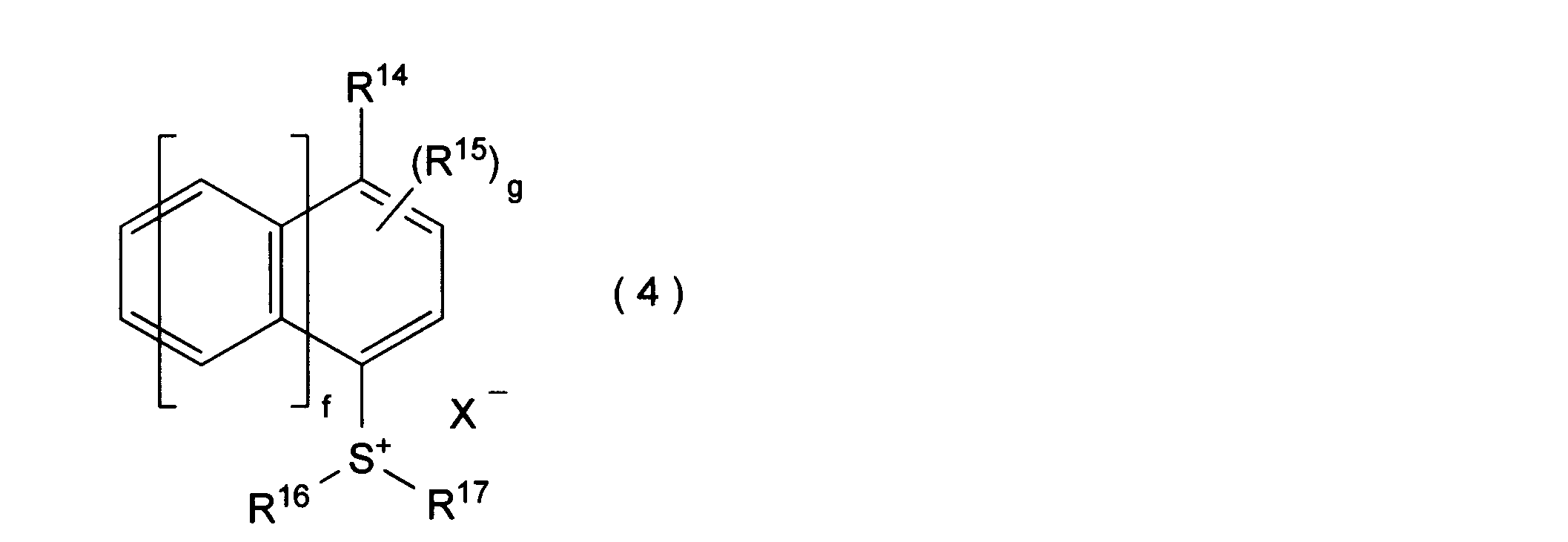
上記式(4)中、gは0~10の整数である。R14は水素原子、水酸基、炭素数1~10の直鎖状若しくは分岐状のアルキル基、炭素数1~10の直鎖状若しくは分岐状のアルコキシル基、又は炭素数2~11の直鎖状若しくは分岐状のアルコキシカルボニル基である。R15は炭素数1~10の直鎖状若しくは分岐状のアルキル基である。但し、gが2以上の場合、複数のR15は同一でも異なっていてもよい。R16及びR17はそれぞれ独立して、炭素数1~10の直鎖状若しくは分岐状のアルキル基、置換されていてもよいフェニル基、又は置換されていてもよいナフチル基である。但し、R16及びR17は互いに結合して、それらが結合する硫黄原子と共に、炭素数2~10の2価の基を形成してもよい。また、上記2価の基は置換されていてもよい。fは0~2の整数である。X-はR18CnF2nSO3
-で表されるアニオンである。R18は、フッ素原子又は置換されていてもよい炭素数1~12の炭化水素基である。nは1~10の整数である。
上記R14~R17で表される炭素数1~10の直鎖状若しくは分岐状のアルキル基としては、メチル基、エチル基、n-プロピル基、i-プロピル基、n-ブチル基、i-ブチル基、n-ペンチル基、n-ヘキシル基、n-ヘプチル基、n-オクチル基、n-ノニル基、n-デシル基等が挙げられる。
上記R14で表される炭素数1~10の直鎖状若しくは分岐状のアルコキシル基としては、メトキシ基、エトキシ基、n-プロポキシ基、i-プロポキシ基、n-ブトキシ基、i-ブトキシ基、n-ペントキシ基、n-ヘキシロキシ基等が挙げられる。
上記R14で表される炭素数2~11の直鎖状若しくは分岐状のアルコキシカルボニル基としては、メトキシカルボニル基、エトキシカルボニル基、n-プロポキシカルボニル基、i-プロポキシカルボニル基、n-ブトキシカルボニル基、i-ブトキシカルボニル基、n-ペントキシカルボニル基、n-ヘキシロキシカルボニル基等が挙げられる。
上記fとしては、0又は1が好ましい。
上記式(4)中のスルホニウムカチオンとしては、放射線の吸収効率が向上するため、下記式(4-1)、(4-2)で表されるオニウムカチオンが好ましい。
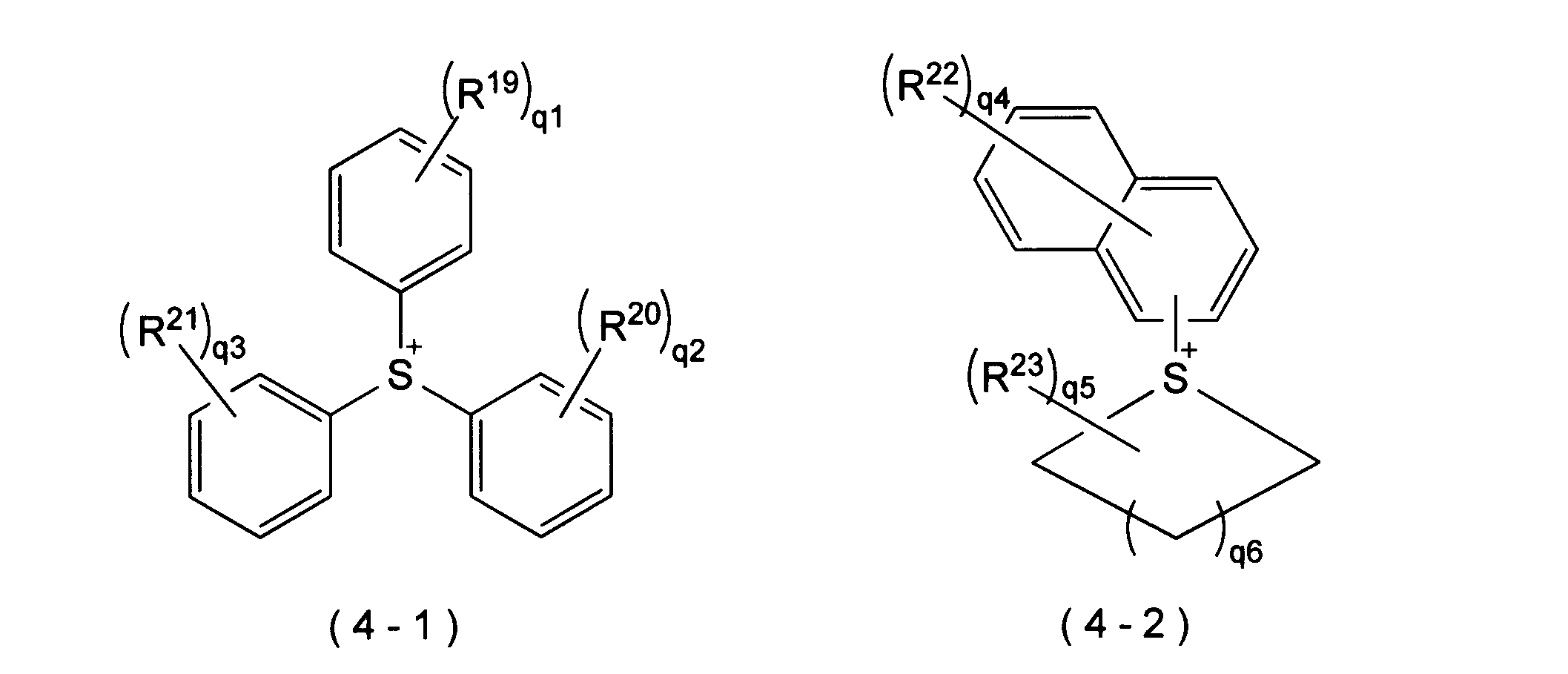
上記式(4-1)中、R19、R20及びR21はそれぞれ独立して、水酸基、置換されていてもよい炭素数1~12の直鎖状若しくは分岐状のアルキル基又は置換されていてもよい炭素数6~12のアリール基である。q1~q3はそれぞれ独立して、0~5の整数である。
上記式(4-2)中、q4は0~7の整数である。q5は0~6の整数である。q6は0~3の整数である。R22は水酸基、置換されていてもよい炭素数1~8の直鎖状若しくは分岐状のアルキル基、又は置換されていてもよい炭素数6~8のアリール基である。R23は、水素原子、置換されていてもよい炭素数1~7の直鎖状若しくは分岐状のアルキル基、又は置換されていてもよい炭素数6~7のアリール基である。但し、q5が2以上の場合、いずれか2つのR23は互いに結合して環状構造を形成していてもよい。また、複数のR23は同一でも異なっていてもよい。
上記式(4-2)中、q4は0~7の整数である。q5は0~6の整数である。q6は0~3の整数である。R22は水酸基、置換されていてもよい炭素数1~8の直鎖状若しくは分岐状のアルキル基、又は置換されていてもよい炭素数6~8のアリール基である。R23は、水素原子、置換されていてもよい炭素数1~7の直鎖状若しくは分岐状のアルキル基、又は置換されていてもよい炭素数6~7のアリール基である。但し、q5が2以上の場合、いずれか2つのR23は互いに結合して環状構造を形成していてもよい。また、複数のR23は同一でも異なっていてもよい。
上記式(4)で表されるスルホニウムカチオンとしては、具体的には、下記式(i-1)~(i-63)表されるカチオン等を挙げることができる。
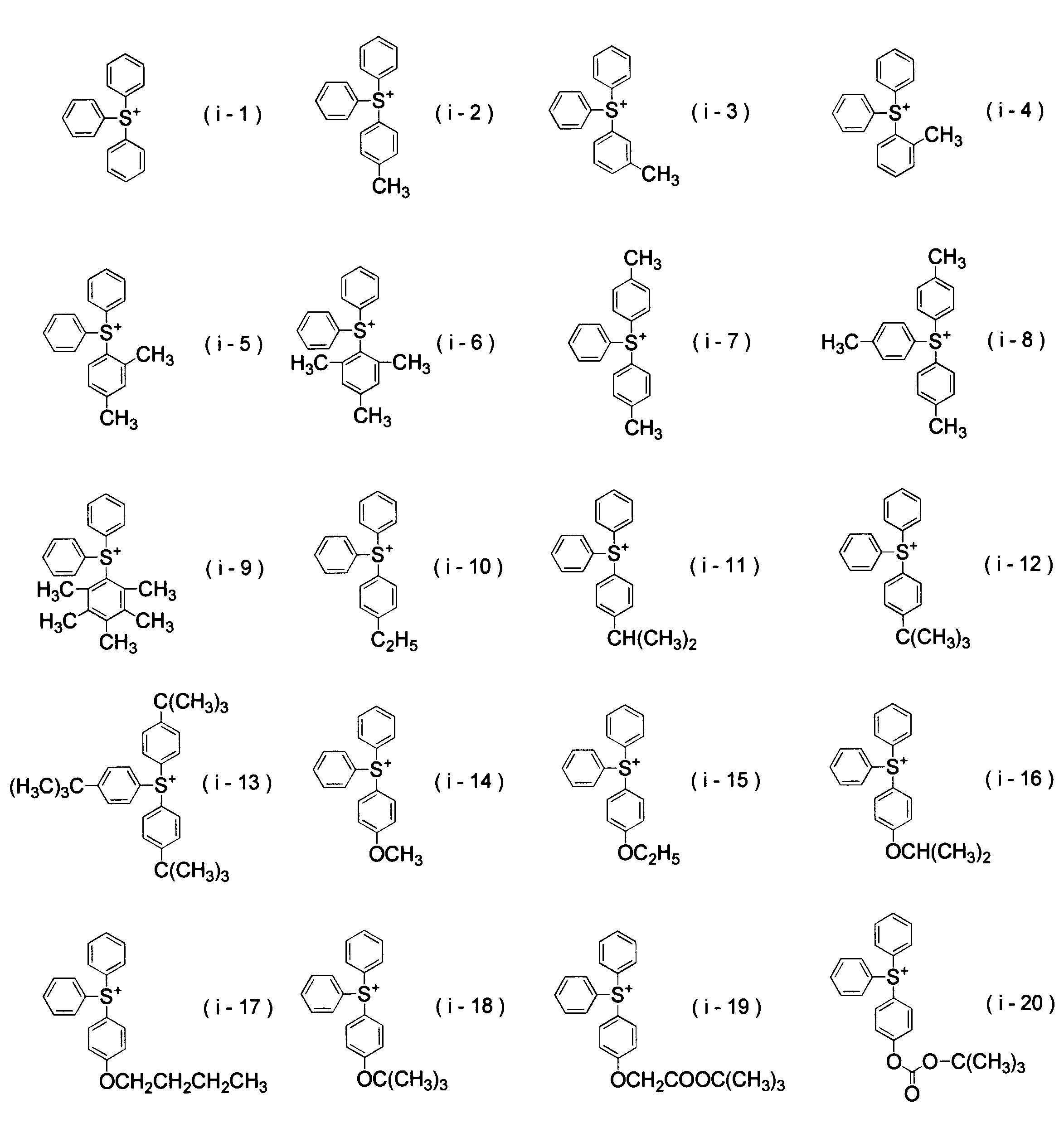
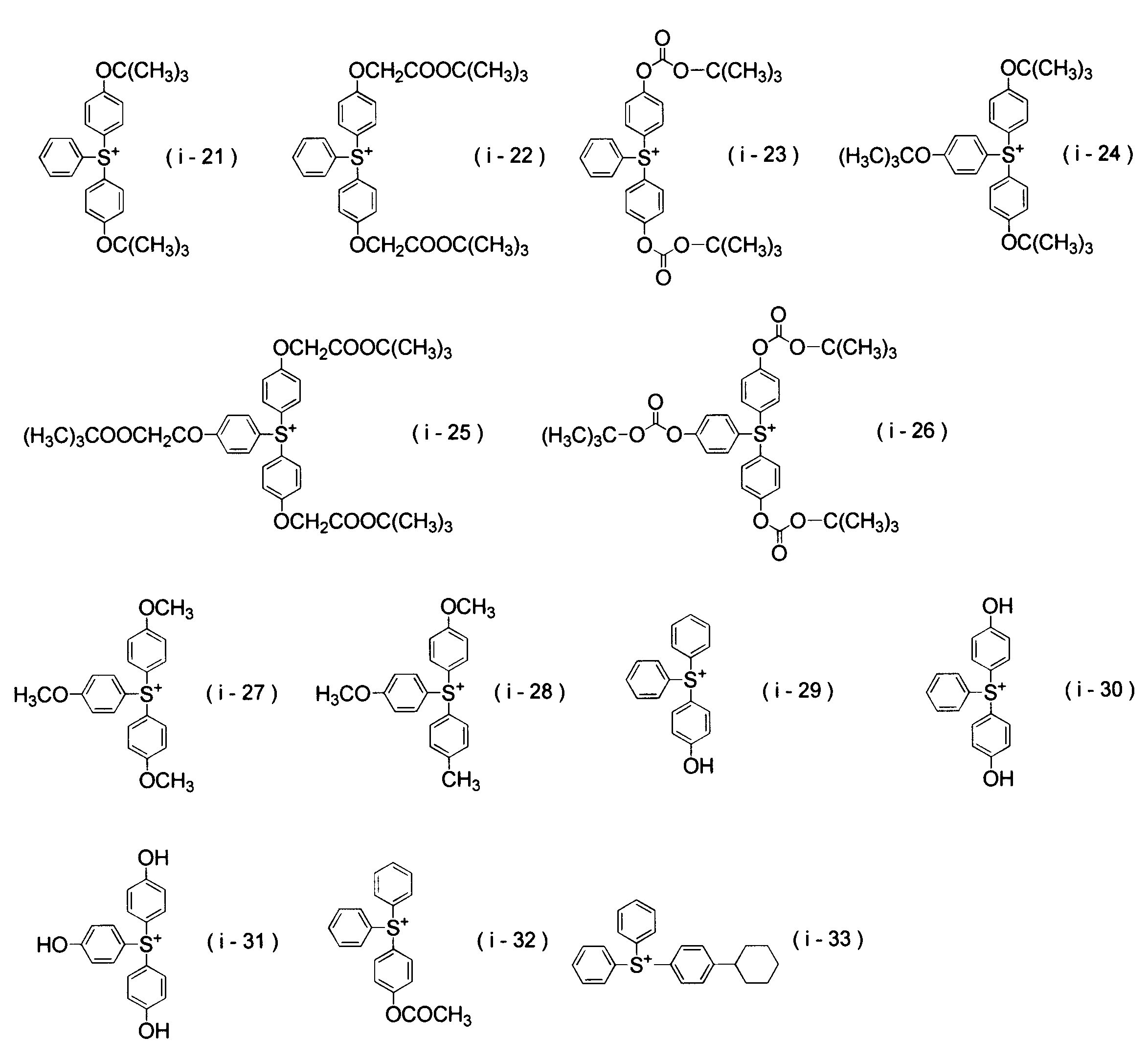
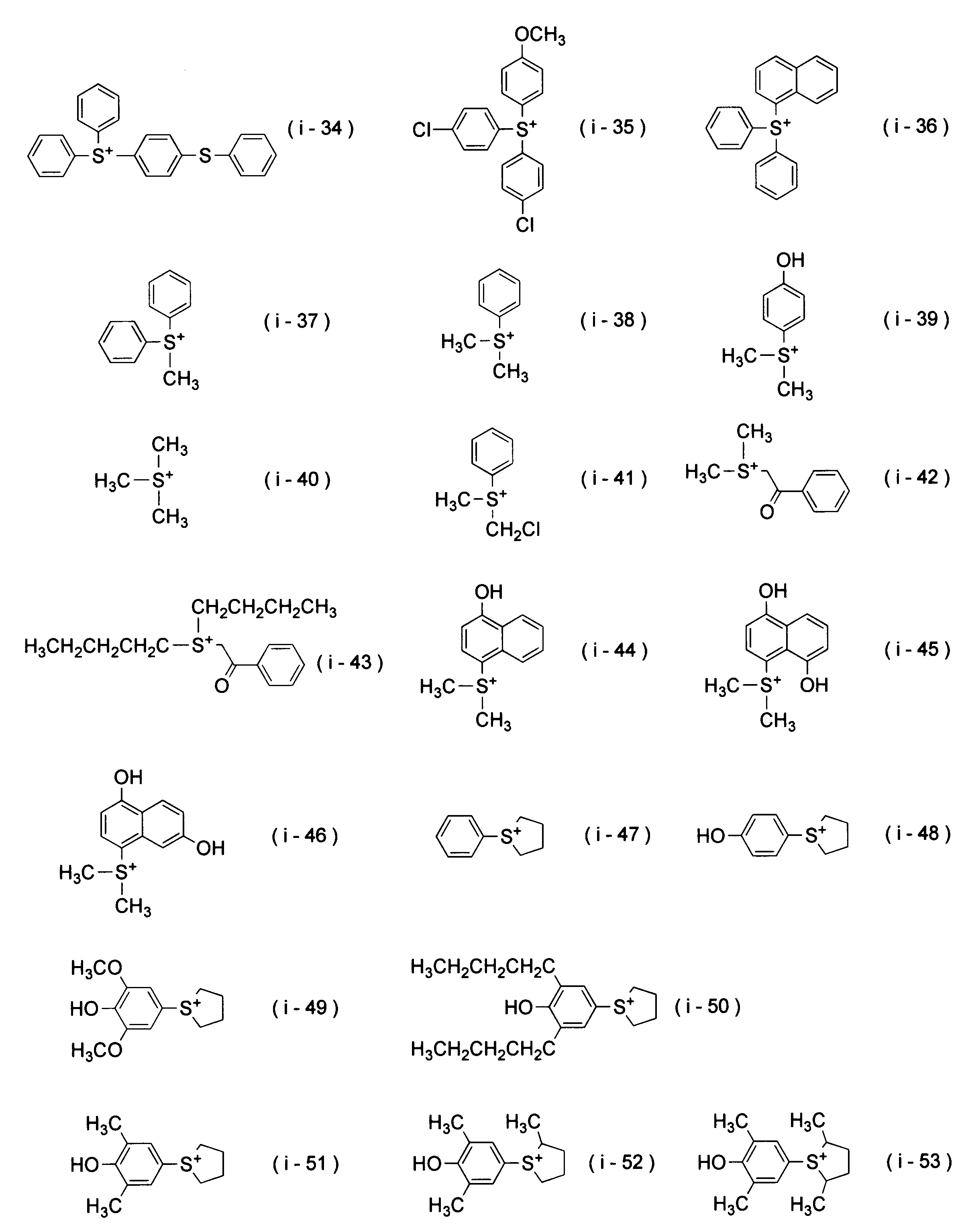
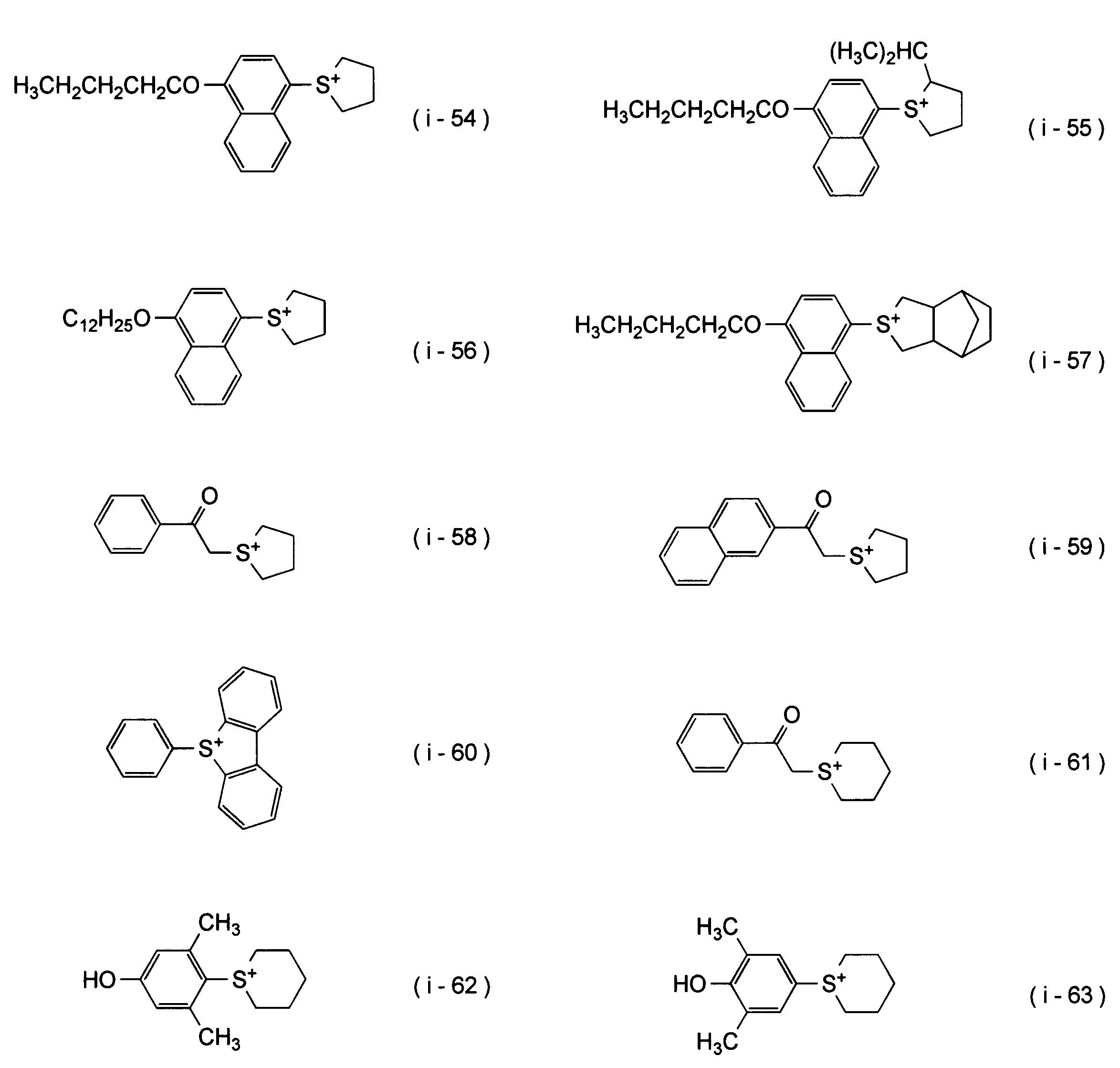
これらの1価のオニウムカチオンのうち、上記式(i-1)、(i-2)、(i-6)、(i-8)、(i-13)、(i-19)、(i-25)、(i-27)、(i-29)、(i-33)、(i-51)、(i-54)で表されるスルホニウムカチオンが好ましい。
[B]酸発生剤の使用量は、[A]重合体100質量部に対して、1~25質量部であることが好ましく、3~15質量部であることがより好ましい。なお、[B]酸発生剤は、1種単独又は2種以上を使用することができる。
<[C]酸拡散制御剤>
当該感放射線性樹脂組成物は、[C]酸拡散制御剤を含有してもよい。[C]酸拡散制御剤は、露光により[B]酸発生剤から生じる酸のレジスト被膜中の拡散現象を制御し、非露光領域における好ましくない化学反応を抑制するものである。このような[C]酸拡散制御剤を配合することにより、当該感放射線性樹脂組成物の貯蔵安定性が向上し、レジスト被膜としての解像度がさらに向上する。また、露光から加熱処理までの引き置き時間(PED)の変動によるレジストパターンの線幅変化を抑えることができ、プロセス安定性に極めて優れた感放射線性樹脂組成物を得ることができる。
当該感放射線性樹脂組成物は、[C]酸拡散制御剤を含有してもよい。[C]酸拡散制御剤は、露光により[B]酸発生剤から生じる酸のレジスト被膜中の拡散現象を制御し、非露光領域における好ましくない化学反応を抑制するものである。このような[C]酸拡散制御剤を配合することにより、当該感放射線性樹脂組成物の貯蔵安定性が向上し、レジスト被膜としての解像度がさらに向上する。また、露光から加熱処理までの引き置き時間(PED)の変動によるレジストパターンの線幅変化を抑えることができ、プロセス安定性に極めて優れた感放射線性樹脂組成物を得ることができる。
[C]酸拡散制御剤としては、例えばN-t-ブトキシカルボニル基含有アミノ化合物、3級アミン化合物、4級アンモニウムヒドロキシド化合物、含窒素複素環化合物等が挙げられる。
上記N-t-ブトキシカルボニル基含有アミノ化合物としては、例えばN-t-ブトキシカルボニルジ-n-オクチルアミン、N-t-ブトキシカルボニルジ-n-ノニルアミン、N-t-ブトキシカルボニルジ-n-デシルアミン、N-t-ブトキシカルボニルジシクロヘキシルアミン、N-t-ブトキシカルボニル-1-アダマンチルアミン、N-t-ブトキシカルボニル-2-アダマンチルアミン、N-t-ブトキシカルボニル-N-メチル-1-アダマンチルアミン、(S)-(-)-1-(t-ブトキシカルボニル)-2-ピロリジンメタノール、(R)-(+)-1-(t-ブトキシカルボニル)-2-ピロリジンメタノール、N-t-ブトキシカルボニル-4-ヒドロキシピペリジン、N-t-ブトキシカルボニルピロリジン、N、N’-ジ-t-ブトキシカルボニルピペラジン、N,N-ジ-t-ブトキシカルボニル-1-アダマンチルアミン、N,N-ジ-t-ブトキシカルボニル-N-メチル-1-アダマンチルアミン、N-t-ブトキシカルボニル-4,4’-ジアミノジフェニルメタン、N,N’-ジ-t-ブトキシカルボニルヘキサメチレンジアミン、N,N,N’N’-テトラ-t-ブトキシカルボニルヘキサメチレンジアミン、N,N’-ジ-t-ブトキシカルボニル-1,7-ジアミノヘプタン、N,N’-ジ-t-ブトキシカルボニル-1,8-ジアミノオクタン、N,N’-ジ-t-ブトキシカルボニル-1,9-ジアミノノナン、N,N’-ジ-t-ブトキシカルボニル-1,10-ジアミノデカン、N,N’-ジ-t-ブトキシカルボニル-1,12-ジアミノドデカン、N,N’-ジ-t-ブトキシカルボニル-4,4’-ジアミノジフェニルメタン、N-t-ブトキシカルボニルベンズイミダゾール、N-t-ブトキシカルボニル-2-メチルベンズイミダゾール、N-t-ブトキシカルボニル-2-フェニルベンズイミダゾール等を挙げることができる。
上記3級アミン化合物としては、例えばトリエチルアミン、トリ-n-プロピルアミン、トリ-n-ブチルアミン、トリ-n-ペンチルアミン、トリ-n-ヘキシルアミン、トリ-n-ヘプチルアミン、トリ-n-オクチルアミン、シクロヘキシルジメチルアミン、ジシクロヘキシルメチルアミン、トリシクロヘキシルアミン等のトリ(シクロ)アルキルアミン類;アニリン、N-メチルアニリン、N,N-ジメチルアニリン、2-メチルアニリン、3-メチルアニリン、4-メチルアニリン、4-ニトロアニリン、2,6-ジメチルアニリン、2,6-ジイソプロピルアニリン等の芳香族アミン類;トリエタノールアミン、N,N-ジ(ヒドロキシエチル)アニリン等のアルカノールアミン類;N,N,N’,N’-テトラメチルエチレンジアミン、N,N,N’,N’-テトラキス(2-ヒドロキシプロピル)エチレンジアミン、1,3-ビス〔1-(4-アミノフェニル)-1-メチルエチル〕ベンゼンテトラメチレンジアミン、ビス(2-ジメチルアミノエチル)エーテル、ビス(2-ジエチルアミノエチル)エーテル等を挙げることができる。
上記4級アンモニウムヒドロキシド化合物としては、例えばテトラ-n-プロピルアンモニウムヒドロキシド、テトラ-n-ブチルアンモニウムヒドロキシド等を挙げることができる。
上記含窒素複素環化合物としては、例えばピリジン、2-メチルピリジン、4-メチルピリジン、2-エチルピリジン、4-エチルピリジン、2-フェニルピリジン、4-フェニルピリジン、2-メチル-4-フェニルピリジン、ニコチン、ニコチン酸、ニコチン酸アミド、キノリン、4-ヒドロキシキノリン、8-オキシキノリン、アクリジン等のピリジン類;ピペラジン、1-(2-ヒドロキシエチル)ピペラジン等のピペラジン類のほか、ピラジン、ピラゾール、ピリダジン、キノザリン、プリン、ピロリジン、ピペリジン、3-ピペリジノ-1,2-プロパンジオール、モルホリン、4-メチルモルホリン、1,4-ジメチルピペラジン、1,4-ジアザビシクロ[2.2.2]オクタン、イミダゾール、4-メチルイミダゾール、1-ベンジル-2-メチルイミダゾール、4-メチル-2-フェニルイミダゾール、ベンズイミダゾール、2-フェニルベンズイミダゾール等を挙げることができる。
また、[C]酸拡散制御剤としては、下記式(5)で表される化合物を用いることもできる。上記化合物は、露光により分解して酸拡散制御性を失う酸拡散制御剤(以下、「光分解性酸拡散制御剤」ともいう)として用いられるものである。この化合物を含有することによって、露光部では酸が拡散し、未露光部では酸の拡散が制御されることにより露光部と未露光部のコントラストに優れ、露光部と未露光部の境界部分が明確になるため、特に当該感放射線性樹脂組成物のCDU、MEEF等の改善に有効である。

上記式(5)中、X+は下記式(5-1)又は(5-2)で表されるカチオンである。Z-はOH-又は下記式(5-3)、式(5-4)若しくは式(5-5)で表されるアニオンである。

上記式(5-1)中、RD2~RD4は、それぞれ独立して水素原子、アルキル基、アルコキシル基、水酸基又はハロゲン原子である。
上記式(5-2)中、RD5及びRD6は、それぞれ独立して水素原子、アルキル基、アルコキシル基、水酸基又はハロゲン原子である。
上記式(5-2)中、RD5及びRD6は、それぞれ独立して水素原子、アルキル基、アルコキシル基、水酸基又はハロゲン原子である。
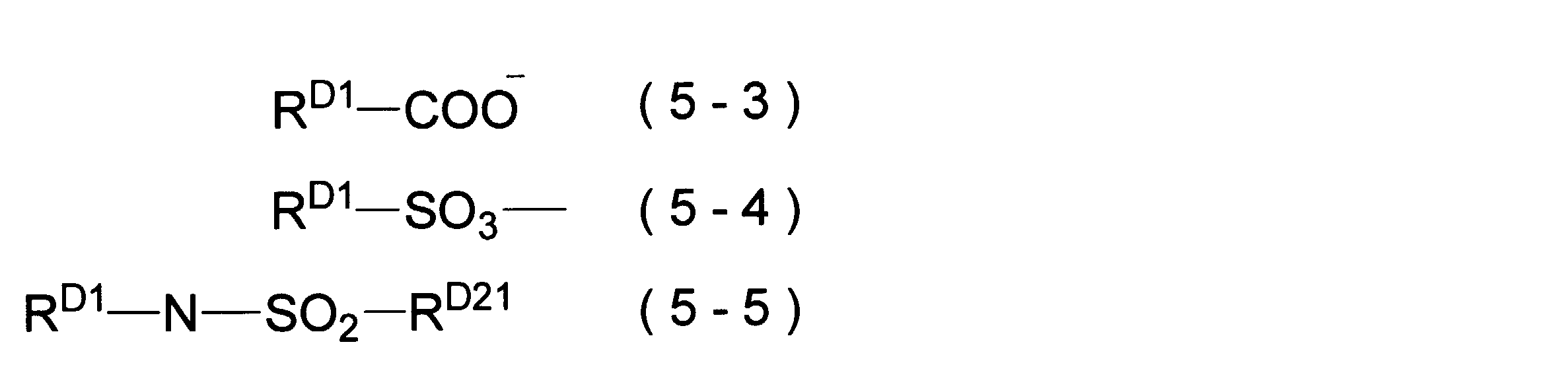
上記式(5-3)~(5-5)中、RD1は置換されていてもよいアルキル基、1価の脂環式炭化水素基又はアリール基である。RD21は一部又は全部の水素原子がフッ素原子で置換されたアルキル基若しくは1価の脂環式炭化水素基である。
上記式(5-1)におけるRD2~RD4としては、上記化合物の現像液に対する溶解性を低下させる効果があるという観点から、水素原子、アルキル基、アルコキシ基、ハロゲン原子が好ましい。また、式(5-2)における(RD5及びRD6としては、水素原子、アルキル基、ハロゲン原子が好ましい。
上記式(5-3)~(5-5)におけるRD1で表される置換されていてもよいアルキル基としては、例えばヒドロキシメチル基等の炭素数1~4のヒドロキシアルキル基;メトキシ基等の炭素数1~4のアルコキシル基;シアノ基;炭素数2~5のシアノアルキル基等の置換基を一種以上有する基等を挙げることができる。これらうち、ヒドロキシメチル基、シアノ基及びシアノメチル基が好ましい。
上記RD1で表される置換されていてもよい脂環式炭化水素基としては、例えば、ヒドロキシシクロペンタン、ヒドロキシシクロヘキサン、シクロヘキサノン等のシクロアルカン骨格;1,7,7-トリメチルビシクロ[2.2.1]ヘプタン-2-オン(カンファー)等の有橋脂環骨格等の脂環式炭化水素由来の1価の基等を挙げることができる。これらのうち、1,7,7-トリメチルビシクロ[2.2.1]ヘプタン-2-オン由来の基が好ましい。
上記RD1で表される置換されていてもよいアリール基としては、例えば、フェニル基、ベンジル基、フェニルエチル基、フェニルプロピル基、フェニルシクロヘキシル基等を挙げることができる。また、これらの化合物を、ヒドロキシル基、シアノ基等で置換したもの等を挙げることができる。これらのうち、フェニル基、ベンジル基及びフェニルシクロヘキシル基が好ましい。
上記式(5-3)~(5-5)におけるRD1としては、上記化合物の現像液に対する溶解性を低下させる効果があるため、上記置換されていてもよい脂環式炭化水素基又はアリール基がより好ましく、1,7,7-トリメチルビシクロ[2.2.1]ヘプタン-2-オン由来の基、フェニル基、ベンジル基及びフェニルシクロヘキシル基がさらに好ましい。
式(5)中のZ-としては、下記式(1a)で表されるアニオン、下記式(1b)で表されるアニオン及び下記式(1c)で表されるアニオンであることが好ましい。
上記式(5)で表される上記光分解性酸拡散制御剤としては、具体的には、上記条件を満たすスルホニウム塩化合物、ヨードニウム塩化合物等が挙げられる。
上記スルホニウム塩化合物としては、例えば、トリフェニルスルホニウムハイドロオキサイド、トリフェニルスルホニウムサリチラート、トリフェニルスルホニウム4-トリフルオロメチルサリチラート、ジフェニル-4-ヒドロキシフェニルスルホニウムサリチラート、トリフェニルスルホニウム10-カンファースルホナート、4-t-ブトキシフェニル・ジフェニルスルホニウム10-カンファースルホナート等を挙げることができる。
なお、これらのスルホニウム塩化合物は、1種単独で又は2種以上を組み合わせて用いることができる。
なお、これらのスルホニウム塩化合物は、1種単独で又は2種以上を組み合わせて用いることができる。
上記ヨードニウム塩化合物としては、例えば、ビス(4-t-ブチルフェニル)ヨードニウムハイドロオキサイド、ビス(4-t-ブチルフェニル)ヨードニウムサリチラート、ビス(4-t-ブチルフェニル)ヨードニウム4-トリフルオロメチルサリチラート、ビス(4-t-ブチルフェニル)ヨードニウム10-カンファースルホナート等を挙げることができる。なお、これらのヨードニウム塩化合物は、1種単独で又は2種以上を組み合わせて用いることができる。
なお、[C]酸拡散制御剤は、1種単独又は2種以上を使用することができる。
[C]酸拡散制御剤の使用量は、レジスト被膜としての高い感度を確保することができるという観点から、[A]重合体100質量部に対して、10質量部以下であることが好ましく、0.001~5質量部であることがより好ましい。上記使用量が10質量部を超えると、レジスト被膜の感度が著しく低下するおそれがある。なお、[C]酸拡散制御剤の使用量が0.001質量部未満であると、本発明の効果が得られない場合がある。
<溶剤>
当該感放射線性樹脂組成物は、通常、溶剤を含有しており、具体的には、エチレングリコールモノメチルエーテルアセテート、エチレングリコールモノエチルエーテルアセテート、エチレングリコールモノ-n-プロピルエーテルアセテート、エチレングリコールモノ-n-ブチルエーテルアセテート等のエチレングリコールモノアルキルエーテルアセテート類;プロピレングリコールモノメチルエーテル、プロピレングリコールモノエチルエーテル、プロピレングリコールモノ-n-プロピルエーテル、プロピレングリコールモノ-n-ブチルエーテル等のプロピレングリコールモノアルキルエーテル類;プロピレングリコールジメチルエーテル、プロピレングリコールジエチルエーテル、プロピレングリコールジ-n-プロピルエーテル、プロピレングリコールジ-n-ブチルエーテル等のプロピレングリコールジアルキルエーテル類;プロピレングリコールモノメチルエーテルアセテート、プロピレングリコールモノエチルエーテルアセテート、プロピレングリコールモノ-n-プロピルエーテルアセテート、プロピレングリコールモノ-n-ブチルエーテルアセテート等のプロピレングリコールモノアルキルエーテルアセテート類;
当該感放射線性樹脂組成物は、通常、溶剤を含有しており、具体的には、エチレングリコールモノメチルエーテルアセテート、エチレングリコールモノエチルエーテルアセテート、エチレングリコールモノ-n-プロピルエーテルアセテート、エチレングリコールモノ-n-ブチルエーテルアセテート等のエチレングリコールモノアルキルエーテルアセテート類;プロピレングリコールモノメチルエーテル、プロピレングリコールモノエチルエーテル、プロピレングリコールモノ-n-プロピルエーテル、プロピレングリコールモノ-n-ブチルエーテル等のプロピレングリコールモノアルキルエーテル類;プロピレングリコールジメチルエーテル、プロピレングリコールジエチルエーテル、プロピレングリコールジ-n-プロピルエーテル、プロピレングリコールジ-n-ブチルエーテル等のプロピレングリコールジアルキルエーテル類;プロピレングリコールモノメチルエーテルアセテート、プロピレングリコールモノエチルエーテルアセテート、プロピレングリコールモノ-n-プロピルエーテルアセテート、プロピレングリコールモノ-n-ブチルエーテルアセテート等のプロピレングリコールモノアルキルエーテルアセテート類;
乳酸メチル、乳酸エチル、乳酸n-プロピル、乳酸i-プロピル等の乳酸エステル類;ぎ酸n-アミル、ぎ酸i-アミル等のぎ酸エステル類;酢酸エチル、酢酸n-プロピル、酢酸i-プロピル、酢酸n-ブチル、酢酸i-ブチル、酢酸n-アミル、酢酸i-アミル、3-メトキシブチルアセテート、3-メチル-3-メトキシブチルアセテート等の酢酸エステル類;プロピオン酸i-プロピル、プロピオン酸n-ブチル、プロピオン酸i-ブチル、3-メチル-3-メトキシブチルプロピオネート等のプロピオン酸エステル類;ヒドロキシ酢酸エチル、2-ヒドロキシ-2-メチルプロピオン酸エチル、2-ヒドロキシ-3-メチル酪酸メチル、メトキシ酢酸エチル、エトキシ酢酸エチル、3-メトキシプロピオン酸メチル、3-メトキシプロピオン酸エチル、3-エトキシプロピオン酸メチル、3-エトキシプロピオン酸エチル、3-メチル-3-メトキシブチルブチレート、アセト酢酸メチル、アセト酢酸エチル、ピルビン酸メチル、ピルビン酸エチル等のほかのエステル類;トルエン、キシレン等の芳香族炭化水素類;
メチルエチルケトン、2-ペンタノン、2-ヘキサノン、2-ヘプタノン、3-ヘプタノン、4-ヘプタノン、シクロヘキサノン等のケトン類;N-メチルホルムアミド、N,N-ジメチルホルムアミド、N-メチルアセトアミド、N,N-ジメチルアセトアミド、N-メチルピロリドン等のアミド類;γ-ブチロラクン等のラクトン類等を挙げることができる。これらの溶剤は、1種単独又は2種以上を使用することができる。
<フッ素原子含有重合体>
当該感放射線性樹脂組成物は、フッ素原子含有重合体を有するものであってもよい。フッ素原子含有重合体は、特に液浸露光においてレジスト膜表面に撥水性を発現させる作用を示す。また、レジスト膜から液浸液への成分の溶出を抑制する効果を奏し、さらに高速スキャンにより液浸露光を行ったとしても液滴を残さないため、結果としてウォーターマーク欠陥等の液浸由来欠陥を抑制する効果がある。
当該感放射線性樹脂組成物は、フッ素原子含有重合体を有するものであってもよい。フッ素原子含有重合体は、特に液浸露光においてレジスト膜表面に撥水性を発現させる作用を示す。また、レジスト膜から液浸液への成分の溶出を抑制する効果を奏し、さらに高速スキャンにより液浸露光を行ったとしても液滴を残さないため、結果としてウォーターマーク欠陥等の液浸由来欠陥を抑制する効果がある。
フッ素原子含有重合体の構造としては、例えば、
それ自体が現像液に不溶で、酸の作用によりアルカリ可溶性となるフッ素原子含有重合体;
それ自体が現像液に可溶で、酸の作用によりアルカリ可溶性が増大するフッ素原子含有重合体;
それ自体が現像液に不溶で、アルカリの作用によりアルカリ可溶性となるフッ素原子含有重合体;
それ自体が現像液に可溶で、アルカリの作用によりアルカリ可溶性が増大するフッ素原子含有重合体等を挙げることができる。
それ自体が現像液に不溶で、酸の作用によりアルカリ可溶性となるフッ素原子含有重合体;
それ自体が現像液に可溶で、酸の作用によりアルカリ可溶性が増大するフッ素原子含有重合体;
それ自体が現像液に不溶で、アルカリの作用によりアルカリ可溶性となるフッ素原子含有重合体;
それ自体が現像液に可溶で、アルカリの作用によりアルカリ可溶性が増大するフッ素原子含有重合体等を挙げることができる。
フッ素原子含有重合体としては、フッ素原子含有構造単位を有する重合体が好ましい。フッ素原子含有構造単位を与える単量体としては、例えば、トリフルオロメチル(メタ)アクリル酸エステル、2,2,2-トリフルオロエチル(メタ)アクリル酸エステル、パーフルオロエチル(メタ)アクリル酸エステル、パーフルオロn-プロピル(メタ)アクリル酸エステル、パーフルオロi-プロピル(メタ)アクリル酸エステル、パーフルオロn-ブチル(メタ)アクリル酸エステル、パーフルオロi-ブチル(メタ)アクリル酸エステル、パーフルオロt-ブチル(メタ)アクリル酸エステル、2-(1,1,1,3,3,3-ヘキサフルオロプロピル)(メタ)アクリル酸エステル、1-(2,2,3,3,4,4,5,5-オクタフルオロペンチル)(メタ)アクリル酸エステル、パーフルオロシクロヘキシルメチル(メタ)アクリル酸エステル、1-(2,2,3,3,3-ペンタフルオロプロピル)(メタ)アクリル酸エステル、1-(3,3,4,4,5,5,6,6,7,7,8,8,9,9,10,10,10-ヘプタデカフルオロデシル)(メタ)アクリル酸エステル、1-(5-トリフルオロメチル-3,3,4,4,5,6,6,6-オクタフルオロヘキシル)(メタ)アクリル酸エステル等が挙げられる。
フッ素原子含有重合体としては、例えば、上記フッ素原子含有構造単位と、[A]重合体を構成する構造単位とを有する共重合体等が好ましい。当該感放射線性樹脂組成物は、これらのフッ素原子含有重合体を、1種又は2種以上含有できる。
<その他の添加剤>
当該感放射線性樹脂組成物には、本発明の効果を損なわない限り、酸解離性基を有する脂環族添加剤、界面活性剤、増感剤、アルカリ可溶性樹脂、酸解離性の保護基を有する低分子のアルカリ溶解性制御剤、ハレーション防止剤、保存安定化剤、消泡剤等のその他の添加剤をさらに含有させることができる。
当該感放射線性樹脂組成物には、本発明の効果を損なわない限り、酸解離性基を有する脂環族添加剤、界面活性剤、増感剤、アルカリ可溶性樹脂、酸解離性の保護基を有する低分子のアルカリ溶解性制御剤、ハレーション防止剤、保存安定化剤、消泡剤等のその他の添加剤をさらに含有させることができる。
酸解離性基を有する脂環族添加剤は、ドライエッチング耐性、パターン形状、基板との接着性等を更に改善する作用を有する成分である。このような脂環族添加剤としては、例えば、1-アダマンタンカルボン酸t-ブチル、1-アダマンタンカルボン酸t-ブトキシカルボニルメチル、1,3-アダマンタンジカルボン酸ジ-t-ブチル、1-アダマンタン酢酸t-ブチル、1-アダマンタン酢酸t-ブトキシカルボニルメチル、1,3-アダマンタンジ酢酸ジ-t-ブチル等のアダマンタン誘導体類;デオキシコール酸t-ブチル、デオキシコール酸t-ブトキシカルボニルメチル、デオキシコール酸2-エトキシエチル、デオキシコール酸2-シクロヘキシルオキシエチル、デオキシコール酸3-オキソシクロヘキシル、デオキシコール酸テトラヒドロピラニル、デオキシコール酸メバロノラクトンエステル等のデオキシコール酸エステル類;リトコール酸t-ブチル、リトコール酸t-ブトキシカルボニルメチル、リトコール酸2-エトキシエチル、リトコール酸2-シクロヘキシルオキシエチル、リトコール酸3-オキソシクロヘキシル、リトコール酸テトラヒドロピラニル、リトコール酸メバロノラクトンエステル等のリトコール酸エステル類を挙げることができる。なお、これらの脂環族添加剤は、一種単独で又は2種以上を使用することができる。
界面活性剤は、塗布性、ストリエーション及び現像性等を改良する作用を有する成分である。このような界面活性剤としては、例えば、ポリオキシエチレンラウリルエーテル、ポリオキシエチレンステアリルエーテル、ポリオキシエチレンオレイルエーテル、ポリオキシエチレンn-オクチルフェニルエーテル、ポリオキシエチレンn-ノニルフェニルエーテル、ポリエチレングリコールジラウレート、ポリエチレングリコールジステアレート等のノニオン系界面活性剤が挙げられる。また、市販の界面活性剤としては、以下全て商品名で、KP341(信越化学工業社製)、ポリフローNo.75、同No.95(以上、共栄社化学社製)、エフトップEF301、同EF303、同EF352(以上、トーケムプロダクツ社製)、メガファックスF171、同F173(以上、大日本インキ化学工業社製)、フロラードFC430、同FC431(以上、住友スリーエム社製)、アサヒガードAG710、サーフロンS-382、同SC-101、同SC-102、同SC-103、同SC-104、同SC-105、同SC-106(以上、旭硝子社製)等を挙げることができる。なお、これらの界面活性剤は、一種単独で又は2種以上を使用することができる。
<感放射線性樹脂組成物の調製方法>
当該感放射線性樹脂組成物は、例えば、[A]重合体、[B]酸発生剤、[C]酸拡散制御剤、及びその他の添加剤を含有する原料組成物を、その全固形分濃度が3~50質量%(好ましくは5~25質量%)となるように溶剤に溶解した後、孔径200nm程度のフィルターでろ過することにより得ることができる。
当該感放射線性樹脂組成物は、例えば、[A]重合体、[B]酸発生剤、[C]酸拡散制御剤、及びその他の添加剤を含有する原料組成物を、その全固形分濃度が3~50質量%(好ましくは5~25質量%)となるように溶剤に溶解した後、孔径200nm程度のフィルターでろ過することにより得ることができる。
<レジストパターンの形成方法>
当該感放射線性樹脂組成物は、特に化学増幅型レジストとして有用である。以下に、当該感放射線性樹脂組成物を用いたレジストパターンの形成方法について説明する。まず、当該感放射線性樹脂組成物からなるレジスト被膜を基板上に形成する。その後、形成したレジスト被膜を露光する。ここで、露光により[B]酸発生剤から発生したスルホン酸の作用で[A]重合体中の酸解離性基を解離させ、カルボキシル基を生じさせる。カルボキシル基が生じると、レジスト被膜の露光部における、アルカリ現像液に対する溶解性が高くなる。その後、レジスト被膜を現像することによって、即ち、露光部をアルカリ現像液によって溶解、除去することによって、ポジ型のレジストパターンを形成することができる。以下にレジストパターンの形成方法について更に具体的に説明する。
当該感放射線性樹脂組成物は、特に化学増幅型レジストとして有用である。以下に、当該感放射線性樹脂組成物を用いたレジストパターンの形成方法について説明する。まず、当該感放射線性樹脂組成物からなるレジスト被膜を基板上に形成する。その後、形成したレジスト被膜を露光する。ここで、露光により[B]酸発生剤から発生したスルホン酸の作用で[A]重合体中の酸解離性基を解離させ、カルボキシル基を生じさせる。カルボキシル基が生じると、レジスト被膜の露光部における、アルカリ現像液に対する溶解性が高くなる。その後、レジスト被膜を現像することによって、即ち、露光部をアルカリ現像液によって溶解、除去することによって、ポジ型のレジストパターンを形成することができる。以下にレジストパターンの形成方法について更に具体的に説明する。
まず、上述した方法により当該感放射線性樹脂組成物を調製する。調製した組成物溶液を、回転塗布、流延塗布、ロール塗布等の適宜の塗布手段によって、例えば、シリコンウェハ、アルミニウムで被覆されたウェハ等の基板上に塗布することにより、レジスト被膜を形成する。
その後、場合により予め加熱処理(以下、「SB」ともいう)を行った後、所定のレジストパターンを形成するように上記レジスト被膜に露光する。なお、露光に使用される放射線としては、可視光線、紫外線、遠紫外線、X線、荷電粒子線等を適宜選定することができるが、ArFエキシマレーザー(波長193nm)又はKrFエキシマレーザー(波長248nm)で代表される遠紫外線が好ましく、特にArFエキシマレーザー(波長193nm)が好ましい。また、露光後に加熱処理(以下、「PEB」ともいう)を行うことが好ましい。このPEBにより、レジスト被膜中の酸解離性基の解離反応が円滑に進行する。PEBの加熱条件は、当該感放射線性樹脂組成物の配合組成によって変わるが、30~200℃であることが好ましく、50~170℃であることがより好ましい。
なお、当該感放射線性樹脂組成物は、その潜在能力を最大限に引き出すため、例えば、特公平6-12452号公報等に開示されているように、使用される基板上に有機系又は無機系の反射防止膜を形成しておくこともできる。また、環境雰囲気中に含まれる塩基性不純物等の影響を防止するため、例えば、特開平5-188598号公報等に開示されているように、レジスト被膜上に保護膜を設けることもできる。なお、これらの技術を併用することもできる。
次に、露光されたレジスト被膜を現像することにより、所定のレジストパターンを得ることができる。現像に使用される現像液としては、例えば、水酸化ナトリウム、水酸化カリウム、炭酸ナトリウム、けい酸ナトリウム、メタけい酸ナトリウム、アンモニア水、エチルアミン、n-プロピルアミン、ジエチルアミン、ジ-n-プロピルアミン、トリエチルアミン、メチルジエチルアミン、エチルジメチルアミン、トリエタノールアミン、テトラメチルアンモニウムヒドロキシド、ピロール、ピペリジン、コリン、1,8-ジアザビシクロ-[5.4.0]-7-ウンデセン及び1,5-ジアザビシクロ-[4.3.0]-5-ノネン等のアルカリ性化合物の少なくとも一種を溶解したアルカリ性水溶液が好ましい。上記アルカリ性水溶液の濃度は、10質量%以下であることが好ましい。アルカリ性水溶液の濃度が10質量%を超えると、非露光部も現像液に溶解するおそれがある。
また、上記現像液には、例えば、有機溶媒を添加することもできる。上記有機溶媒としては、例えば、アセトン、メチルエチルケトン、メチルi-ブチルケトン、シクロペンタノン、シクロヘキサノン、3-メチルシクロペンタノン、2,6-ジメチルシクロヘキサノン等のケトン類;メチルアルコール、エチルアルコール、n-プロピルアルコール、i-プロピルアルコール、n-ブチルアルコール、t-ブチルアルコール、シクロペンタノール、シクロヘキサノール、1,4-ヘキサンジオール、1,4-ヘキサンジメチロール等のアルコール類;テトラヒドロフラン、ジオキサン等のエーテル類;酢酸エチル、酢酸n-ブチル、酢酸i-アミル等のエステル類;トルエン、キシレン等の芳香族炭化水素類や、フェノール、アセトニルアセトン、ジメチルホルムアミドを挙げることができる。なお、これらの有機溶媒は、1種単独又は2種以上を使用することができる。
有機溶媒の使用量は、上記アルカリ性水溶液に対して、100容量%以下であることが好ましい。有機溶媒の使用量が100容量%を超えると、現像性が低下して、露光部の現像残りが多くなるおそれがある。また、上記現像液には、上述した界面活性剤等を適量添加することもできる。なお、上記現像液で現像した後、水で洗浄して乾燥することが好ましい。
以下、本発明を実施例に基づいて具体的に説明するが、本発明はこれらの実施例に限定されるものではない。なお、実施例、比較例中の「部」及び「%」は、特に断らない限り質量基準である。また、各種物性値の測定方法、及び諸特性の評価方法を以下に示す。
[重量平均分子量(Mw)及び数平均分子量(Mn)]
東ソー社製のGPCカラム(G2000HXL2本、G3000HXL1本、G4000HXL1本)を使用し、流量:1.0mL/分、溶出溶媒:テトラヒドロフラン、カラム温度:40℃の分析条件で、単分散ポリスチレンを標準とするゲルパーミエーションクロマトグラフィ(GPC)により測定した。また、分散度(Mw/Mn)は、Mw及びMnの測定結果より算出した。
東ソー社製のGPCカラム(G2000HXL2本、G3000HXL1本、G4000HXL1本)を使用し、流量:1.0mL/分、溶出溶媒:テトラヒドロフラン、カラム温度:40℃の分析条件で、単分散ポリスチレンを標準とするゲルパーミエーションクロマトグラフィ(GPC)により測定した。また、分散度(Mw/Mn)は、Mw及びMnの測定結果より算出した。
[低分子量成分の残存割合(%)]
ジーエルサイエンス社製のInertsil ODS-25μmカラム(4.6mmφ×250mm)を使用し、流量:1.0mL/分、溶出溶媒:アクリロニトリル/0.1%リン酸水溶液の分析条件で、高速液体クロマトグラフィー(HPLC)により測定した。なお、「低分子量成分」とは、モノマーを主成分とする成分をいい、より具体的には、分子量1,000未満の成分、好ましくはトリマーの分子量以下の成分をいう。
ジーエルサイエンス社製のInertsil ODS-25μmカラム(4.6mmφ×250mm)を使用し、流量:1.0mL/分、溶出溶媒:アクリロニトリル/0.1%リン酸水溶液の分析条件で、高速液体クロマトグラフィー(HPLC)により測定した。なお、「低分子量成分」とは、モノマーを主成分とする成分をいい、より具体的には、分子量1,000未満の成分、好ましくはトリマーの分子量以下の成分をいう。
[13C-NMR分析]
日本電子社製のJNM-EX400を使用し、測定溶媒としてDMSOを使用して分析を行った。
日本電子社製のJNM-EX400を使用し、測定溶媒としてDMSOを使用して分析を行った。
<[A]重合体の合成>
[A]重合体及び後述するフッ素原子含有重合体は、下記式に示す単量体(M-1)~(M-12)を用いて合成した。
[A]重合体及び後述するフッ素原子含有重合体は、下記式に示す単量体(M-1)~(M-12)を用いて合成した。
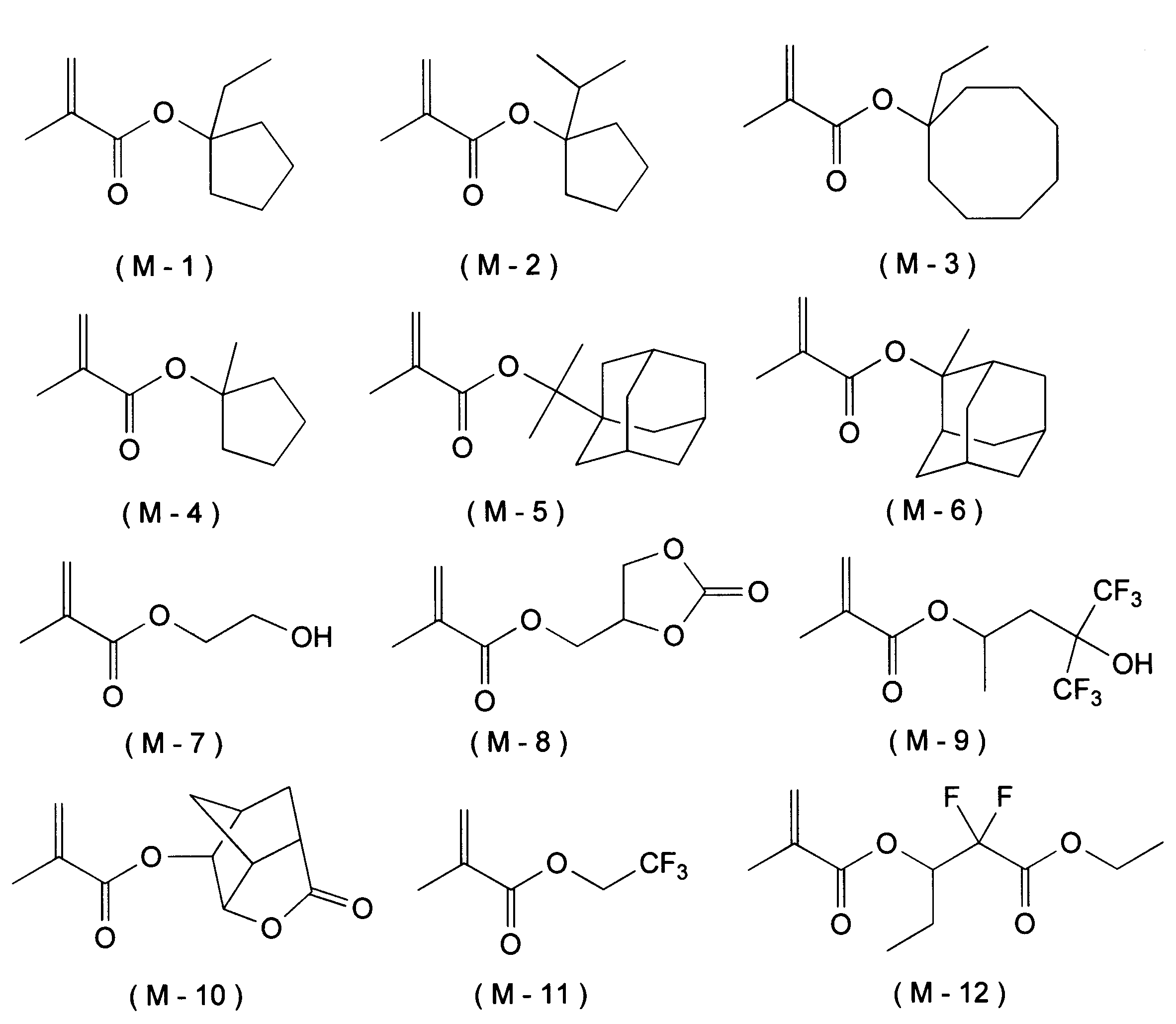
[実施例1:重合体(A-1)]
化合物(M-1)11.87g(15mol%)、化合物(M-5)39.88g(35mol%)、及び化合物(M-10)48.25g(50mol%)を200gの2-ブタノンに溶解し、AIBN7.13g(10mol%)を添加して単量体溶液を調製した。100gの2-ブタノンを入れた1,000mLの三口フラスコを30分窒素パージした後、撹拌しながら80℃に加熱し、調製した単量体溶液を滴下漏斗にて3時間かけて滴下した。滴下開始を重合反応の開始時間とし、重合反応を6時間実施した。重合反応終了後、重合溶液を水冷して30℃以下に冷却した。2,000gのメタノール中に冷却した重合溶液を投入し、析出した白色粉末をろ別した。ろ別した白色粉末を400gのメタノールで2回洗浄した後、ろ別し、50℃で17時間乾燥させて白色粉末状の重合体(A-1)を得た(77g、収率77%)。得られた重合体(A-1)のMwは5,300であり、Mw/Mnは1.54であり、低分子量成分の残存割合は0.05%であった。
また、13C-NMR分析の結果、化合物(M-1)由来の繰り返し単位:化合物(M-5)由来の繰り返し単位:化合物(M-10)由来の繰り返し単位の含有比率が13.4:33.8:52.8(mol%)であった。
化合物(M-1)11.87g(15mol%)、化合物(M-5)39.88g(35mol%)、及び化合物(M-10)48.25g(50mol%)を200gの2-ブタノンに溶解し、AIBN7.13g(10mol%)を添加して単量体溶液を調製した。100gの2-ブタノンを入れた1,000mLの三口フラスコを30分窒素パージした後、撹拌しながら80℃に加熱し、調製した単量体溶液を滴下漏斗にて3時間かけて滴下した。滴下開始を重合反応の開始時間とし、重合反応を6時間実施した。重合反応終了後、重合溶液を水冷して30℃以下に冷却した。2,000gのメタノール中に冷却した重合溶液を投入し、析出した白色粉末をろ別した。ろ別した白色粉末を400gのメタノールで2回洗浄した後、ろ別し、50℃で17時間乾燥させて白色粉末状の重合体(A-1)を得た(77g、収率77%)。得られた重合体(A-1)のMwは5,300であり、Mw/Mnは1.54であり、低分子量成分の残存割合は0.05%であった。
また、13C-NMR分析の結果、化合物(M-1)由来の繰り返し単位:化合物(M-5)由来の繰り返し単位:化合物(M-10)由来の繰り返し単位の含有比率が13.4:33.8:52.8(mol%)であった。
[実施例2:重合体(A-2)]
化合物(M-2)12.67g(15mol%)、化合物(M-5)39.52g(35mol%)、及び化合物(M-10)47.81g(50mol%)を200gの2-ブタノンに溶解し、AIBN7.07g(10mol%)を添加して単量体溶液を調製した。100gの2-ブタノンを入れた1,000mLの三口フラスコを30分窒素パージした後、撹拌しながら80℃に加熱し、調製した単量体溶液を滴下漏斗にて3時間かけて滴下した。滴下開始を重合反応の開始時間とし、重合反応を6時間実施した。重合反応終了後、重合溶液を水冷して30℃以下に冷却した。2,000gのメタノール中に冷却した重合溶液を投入し、析出した白色粉末をろ別した。ろ別した白色粉末を400gのメタノールで2回洗浄した後、ろ別し、50℃で17時間乾燥させて白色粉末状の重合体(A-2)を得た(75g、収率75%)。得られた重合体(A-2)のMwは5,200であり、Mw/Mnは1.56であり、低分子量成分の残存割合は0.04%であった。
また、13C-NMR分析の結果、化合物(M-2)由来の繰り返し単位:化合物(M-5)由来の繰り返し単位:化合物(M-10)由来の繰り返し単位の含有比率が13.1:33.9:53.0(mol%)であった。
化合物(M-2)12.67g(15mol%)、化合物(M-5)39.52g(35mol%)、及び化合物(M-10)47.81g(50mol%)を200gの2-ブタノンに溶解し、AIBN7.07g(10mol%)を添加して単量体溶液を調製した。100gの2-ブタノンを入れた1,000mLの三口フラスコを30分窒素パージした後、撹拌しながら80℃に加熱し、調製した単量体溶液を滴下漏斗にて3時間かけて滴下した。滴下開始を重合反応の開始時間とし、重合反応を6時間実施した。重合反応終了後、重合溶液を水冷して30℃以下に冷却した。2,000gのメタノール中に冷却した重合溶液を投入し、析出した白色粉末をろ別した。ろ別した白色粉末を400gのメタノールで2回洗浄した後、ろ別し、50℃で17時間乾燥させて白色粉末状の重合体(A-2)を得た(75g、収率75%)。得られた重合体(A-2)のMwは5,200であり、Mw/Mnは1.56であり、低分子量成分の残存割合は0.04%であった。
また、13C-NMR分析の結果、化合物(M-2)由来の繰り返し単位:化合物(M-5)由来の繰り返し単位:化合物(M-10)由来の繰り返し単位の含有比率が13.1:33.9:53.0(mol%)であった。
[実施例3:重合体(A-3)]
化合物(M-3)14.22g(15mol%)、化合物(M-5)38.81g(35mol%)、及び化合物(M-10)46.96g(50mol%)を200gの2-ブタノンに溶解し、AIBN6.94g(10mol%)を添加して単量体溶液を調製した。100gの2-ブタノンを入れた1,000mLの三口フラスコを30分窒素パージした後、撹拌しながら80℃に加熱し、調製した単量体溶液を滴下漏斗にて3時間かけて滴下した。滴下開始を重合反応の開始時間とし、重合反応を6時間実施した。重合反応終了後、重合溶液を水冷して30℃以下に冷却した。2,000gのメタノール中に冷却した重合溶液を投入し、析出した白色粉末をろ別した。ろ別した白色粉末を400gのメタノールで2回洗浄した後、ろ別し、50℃で17時間乾燥させて白色粉末状の重合体(A-3)を得た(76g、収率76%)。得られた重合体(A-3)のMwは5,300であり、Mw/Mnは1.55であり、低分子量成分の残存割合は0.04%であった。
また、13C-NMR分析の結果、化合物(M-3)由来の繰り返し単位:化合物(M-5)由来の繰り返し単位:化合物(M-10)由来の繰り返し単位の含有比率が13.7:33.2:53.1(mol%)であった。
化合物(M-3)14.22g(15mol%)、化合物(M-5)38.81g(35mol%)、及び化合物(M-10)46.96g(50mol%)を200gの2-ブタノンに溶解し、AIBN6.94g(10mol%)を添加して単量体溶液を調製した。100gの2-ブタノンを入れた1,000mLの三口フラスコを30分窒素パージした後、撹拌しながら80℃に加熱し、調製した単量体溶液を滴下漏斗にて3時間かけて滴下した。滴下開始を重合反応の開始時間とし、重合反応を6時間実施した。重合反応終了後、重合溶液を水冷して30℃以下に冷却した。2,000gのメタノール中に冷却した重合溶液を投入し、析出した白色粉末をろ別した。ろ別した白色粉末を400gのメタノールで2回洗浄した後、ろ別し、50℃で17時間乾燥させて白色粉末状の重合体(A-3)を得た(76g、収率76%)。得られた重合体(A-3)のMwは5,300であり、Mw/Mnは1.55であり、低分子量成分の残存割合は0.04%であった。
また、13C-NMR分析の結果、化合物(M-3)由来の繰り返し単位:化合物(M-5)由来の繰り返し単位:化合物(M-10)由来の繰り返し単位の含有比率が13.7:33.2:53.1(mol%)であった。
[実施例4:重合体(A-4)]
化合物(M-2)12.98g(15mol%)、化合物(M-5)17.35g(15mol%)、化合物(M-6)20.67g(20mol%)、及び化合物(M-10)49.00g(50mol%)を200gの2-ブタノンに溶解し、AIBN7.24g(10mol%)を添加して単量体溶液を調製した。100gの2-ブタノンを入れた1,000mLの三口フラスコを30分窒素パージした後、撹拌しながら80℃に加熱し、調製した単量体溶液を滴下漏斗にて3時間かけて滴下した。滴下開始を重合反応の開始時間とし、重合反応を6時間実施した。重合反応終了後、重合溶液を水冷して30℃以下に冷却した。2,000gのメタノール中に冷却した重合溶液を投入し、析出した白色粉末をろ別した。ろ別した白色粉末を400gのメタノールで2回洗浄した後、ろ別し、50℃で17時間乾燥させて白色粉末状の重合体(A-4)を得た(74g、収率74%)。得られた重合体(A-4)のMwは5,000であり、Mw/Mnは1.47であり、低分子量成分の残存割合は0.05%であった。また、13C-NMR分析の結果、化合物(M-2)由来の繰り返し単位:化合物(M-5)由来の繰り返し単位:化合物(M-6)由来の繰り返し単位:化合物(M-10)由来の繰り返し単位の含有比率が13.4:14.7:18.2:53.7(mol%)であった。
化合物(M-2)12.98g(15mol%)、化合物(M-5)17.35g(15mol%)、化合物(M-6)20.67g(20mol%)、及び化合物(M-10)49.00g(50mol%)を200gの2-ブタノンに溶解し、AIBN7.24g(10mol%)を添加して単量体溶液を調製した。100gの2-ブタノンを入れた1,000mLの三口フラスコを30分窒素パージした後、撹拌しながら80℃に加熱し、調製した単量体溶液を滴下漏斗にて3時間かけて滴下した。滴下開始を重合反応の開始時間とし、重合反応を6時間実施した。重合反応終了後、重合溶液を水冷して30℃以下に冷却した。2,000gのメタノール中に冷却した重合溶液を投入し、析出した白色粉末をろ別した。ろ別した白色粉末を400gのメタノールで2回洗浄した後、ろ別し、50℃で17時間乾燥させて白色粉末状の重合体(A-4)を得た(74g、収率74%)。得られた重合体(A-4)のMwは5,000であり、Mw/Mnは1.47であり、低分子量成分の残存割合は0.05%であった。また、13C-NMR分析の結果、化合物(M-2)由来の繰り返し単位:化合物(M-5)由来の繰り返し単位:化合物(M-6)由来の繰り返し単位:化合物(M-10)由来の繰り返し単位の含有比率が13.4:14.7:18.2:53.7(mol%)であった。
[実施例5:重合体(A-5)]
化合物(M-2)13.19g(15mol%)、化合物(M-5)41.15g(35mol%)、化合物(M-7)5.83g(10mol%)、及び化合物(M-10)39.83g(40mol%)を200gの2-ブタノンに溶解し、AIBN7.36g(10mol%)を添加して単量体溶液を調製した。100gの2-ブタノンを入れた1,000mLの三口フラスコを30分窒素パージした後、撹拌しながら80℃に加熱し、調製した単量体溶液を滴下漏斗にて3時間かけて滴下した。滴下開始を重合反応の開始時間とし、重合反応を6時間実施した。重合反応終了後、重合溶液を水冷して30℃以下に冷却した。2,000gのメタノール中に冷却した重合溶液を投入し、析出した白色粉末をろ別した。ろ別した白色粉末を400gのメタノールで2回洗浄した後、ろ別し、50℃で17時間乾燥させて白色粉末状の重合体(A-5)を得た(69g、収率69%)。得られた重合体(A-5)のMwは4,700であり、Mw/Mnは1.38であり、低分子量成分の残存割合は0.04%であった。また、13C-NMR分析の結果、化合物(M-2)由来の繰り返し単位:化合物(M-5)由来の繰り返し単位:化合物(M-7)由来の繰り返し単位:化合物(M-10)由来の繰り返し単位の含有比率が12.8:33.9:8.1:45.2(mol%)であった。
化合物(M-2)13.19g(15mol%)、化合物(M-5)41.15g(35mol%)、化合物(M-7)5.83g(10mol%)、及び化合物(M-10)39.83g(40mol%)を200gの2-ブタノンに溶解し、AIBN7.36g(10mol%)を添加して単量体溶液を調製した。100gの2-ブタノンを入れた1,000mLの三口フラスコを30分窒素パージした後、撹拌しながら80℃に加熱し、調製した単量体溶液を滴下漏斗にて3時間かけて滴下した。滴下開始を重合反応の開始時間とし、重合反応を6時間実施した。重合反応終了後、重合溶液を水冷して30℃以下に冷却した。2,000gのメタノール中に冷却した重合溶液を投入し、析出した白色粉末をろ別した。ろ別した白色粉末を400gのメタノールで2回洗浄した後、ろ別し、50℃で17時間乾燥させて白色粉末状の重合体(A-5)を得た(69g、収率69%)。得られた重合体(A-5)のMwは4,700であり、Mw/Mnは1.38であり、低分子量成分の残存割合は0.04%であった。また、13C-NMR分析の結果、化合物(M-2)由来の繰り返し単位:化合物(M-5)由来の繰り返し単位:化合物(M-7)由来の繰り返し単位:化合物(M-10)由来の繰り返し単位の含有比率が12.8:33.9:8.1:45.2(mol%)であった。
[実施例6:重合体(A-6)]
化合物(M-2)12.87g(15mol%)、化合物(M-5)40.14g(35mol%)、化合物(M-8)8.14g(10mol%)、及び化合物(M-10)38.85g(40mol%)を200gの2-ブタノンに溶解し、AIBN7.18g(10mol%)を添加して単量体溶液を調製した。100gの2-ブタノンを入れた1,000mLの三口フラスコを30分窒素パージした後、撹拌しながら80℃に加熱し、調製した単量体溶液を滴下漏斗にて3時間かけて滴下した。滴下開始を重合反応の開始時間とし、重合反応を6時間実施した。重合反応終了後、重合溶液を水冷して30℃以下に冷却した。2,000gのメタノール中に冷却した重合溶液を投入し、析出した白色粉末をろ別した。ろ別した白色粉末を400gのメタノールで2回洗浄した後、ろ別し、50℃で17時間乾燥させて白色粉末状の重合体(A-6)を得た(72g、収率72%)。得られた樹脂(A-6)のMwは4,300であり、Mw/Mnは1.34であり、低分子量成分の残存割合は0.03%であった。また、13C-NMR分析の結果、化合物(M-2)由来の繰り返し単位:化合物(M-5)由来の繰り返し単位:化合物(M-8)由来の繰り返し単位:化合物(M-10)由来の繰り返し単位の含有比率が12.6:34.1:8.4:44.9(mol%)であった。
化合物(M-2)12.87g(15mol%)、化合物(M-5)40.14g(35mol%)、化合物(M-8)8.14g(10mol%)、及び化合物(M-10)38.85g(40mol%)を200gの2-ブタノンに溶解し、AIBN7.18g(10mol%)を添加して単量体溶液を調製した。100gの2-ブタノンを入れた1,000mLの三口フラスコを30分窒素パージした後、撹拌しながら80℃に加熱し、調製した単量体溶液を滴下漏斗にて3時間かけて滴下した。滴下開始を重合反応の開始時間とし、重合反応を6時間実施した。重合反応終了後、重合溶液を水冷して30℃以下に冷却した。2,000gのメタノール中に冷却した重合溶液を投入し、析出した白色粉末をろ別した。ろ別した白色粉末を400gのメタノールで2回洗浄した後、ろ別し、50℃で17時間乾燥させて白色粉末状の重合体(A-6)を得た(72g、収率72%)。得られた樹脂(A-6)のMwは4,300であり、Mw/Mnは1.34であり、低分子量成分の残存割合は0.03%であった。また、13C-NMR分析の結果、化合物(M-2)由来の繰り返し単位:化合物(M-5)由来の繰り返し単位:化合物(M-8)由来の繰り返し単位:化合物(M-10)由来の繰り返し単位の含有比率が12.6:34.1:8.4:44.9(mol%)であった。
[実施例7:重合体(A-7)]
化合物(M-2)12.29g(15mol%)、化合物(M-5)38.33g(35mol%)、化合物(M-9)12.28g(10mol%)、及び化合物(M-10)37.10g(40mol%)を200gの2-ブタノンに溶解し、AIBN6.85g(10mol%)を添加して単量体溶液を調製した。100gの2-ブタノンを入れた1,000mLの三口フラスコを30分窒素パージした後、撹拌しながら80℃に加熱し、調製した単量体溶液を滴下漏斗にて3時間かけて滴下した。滴下開始を重合反応の開始時間とし、重合反応を6時間実施した。重合反応終了後、重合溶液を水冷して30℃以下に冷却した。2,000gのメタノール中に冷却した重合溶液を投入し、析出した白色粉末をろ別した。ろ別した白色粉末を400gのメタノールで2回洗浄した後、ろ別し、50℃で17時間乾燥させて白色粉末状の重合体(A-7)を得た(68g、収率68%)。得られた樹脂(A-7)のMwは4,100であり、Mw/Mnは1.31であり、低分子量成分の残存割合は0.05%であった。また、13C-NMR分析の結果、化合物(M-2)由来の繰り返し単位:化合物(M-5)由来の繰り返し単位:化合物(M-9)由来の繰り返し単位:化合物(M-10)由来の繰り返し単位の含有比率が13.2:33.7:8.0:45.1(mol%)であった。
化合物(M-2)12.29g(15mol%)、化合物(M-5)38.33g(35mol%)、化合物(M-9)12.28g(10mol%)、及び化合物(M-10)37.10g(40mol%)を200gの2-ブタノンに溶解し、AIBN6.85g(10mol%)を添加して単量体溶液を調製した。100gの2-ブタノンを入れた1,000mLの三口フラスコを30分窒素パージした後、撹拌しながら80℃に加熱し、調製した単量体溶液を滴下漏斗にて3時間かけて滴下した。滴下開始を重合反応の開始時間とし、重合反応を6時間実施した。重合反応終了後、重合溶液を水冷して30℃以下に冷却した。2,000gのメタノール中に冷却した重合溶液を投入し、析出した白色粉末をろ別した。ろ別した白色粉末を400gのメタノールで2回洗浄した後、ろ別し、50℃で17時間乾燥させて白色粉末状の重合体(A-7)を得た(68g、収率68%)。得られた樹脂(A-7)のMwは4,100であり、Mw/Mnは1.31であり、低分子量成分の残存割合は0.05%であった。また、13C-NMR分析の結果、化合物(M-2)由来の繰り返し単位:化合物(M-5)由来の繰り返し単位:化合物(M-9)由来の繰り返し単位:化合物(M-10)由来の繰り返し単位の含有比率が13.2:33.7:8.0:45.1(mol%)であった。
[実施例8:重合体(A-8)]
化合物(M-2)13.53g(15mol%)、化合物(M-5)18.09g(15mol%)、化合物(M-6)21.54g(20mol%)、化合物(M-7)5.98g(10mol%)、及び化合物(M-10)40.86g(40mol%)を200gの2-ブタノンに溶解し、AIBN7.55g(10mol%)を添加して単量体溶液を調製した。100gの2-ブタノンを入れた1,000mLの三口フラスコを30分窒素パージした後、撹拌しながら80℃に加熱し、調製した単量体溶液を滴下漏斗にて3時間かけて滴下した。滴下開始を重合反応の開始時間とし、重合反応を6時間実施した。重合反応終了後、重合溶液を水冷して30℃以下に冷却した。2,000gのメタノール中に冷却した重合溶液を投入し、析出した白色粉末をろ別した。ろ別した白色粉末を400gのメタノールで2回洗浄した後、ろ別し、50℃で17時間乾燥させて白色粉末状の重合体(A-8)を得た(64g、収率64%)。得られた重合体(A-8)のMwは4,100であり、Mw/Mnは1.29であり、低分子量成分の残存割合は0.05%であった。また、13C-NMR分析の結果、化合物(M-2)由来の繰り返し単位:化合物(M-5)由来の繰り返し単位:化合物(M-6)由来の繰り返し単位:化合物(M-7)由来の繰り返し単位:化合物(M-10)由来の繰り返し単位の含有比率が13.6:14.2:18.4:7.9:45.9(mol%)であった。
化合物(M-2)13.53g(15mol%)、化合物(M-5)18.09g(15mol%)、化合物(M-6)21.54g(20mol%)、化合物(M-7)5.98g(10mol%)、及び化合物(M-10)40.86g(40mol%)を200gの2-ブタノンに溶解し、AIBN7.55g(10mol%)を添加して単量体溶液を調製した。100gの2-ブタノンを入れた1,000mLの三口フラスコを30分窒素パージした後、撹拌しながら80℃に加熱し、調製した単量体溶液を滴下漏斗にて3時間かけて滴下した。滴下開始を重合反応の開始時間とし、重合反応を6時間実施した。重合反応終了後、重合溶液を水冷して30℃以下に冷却した。2,000gのメタノール中に冷却した重合溶液を投入し、析出した白色粉末をろ別した。ろ別した白色粉末を400gのメタノールで2回洗浄した後、ろ別し、50℃で17時間乾燥させて白色粉末状の重合体(A-8)を得た(64g、収率64%)。得られた重合体(A-8)のMwは4,100であり、Mw/Mnは1.29であり、低分子量成分の残存割合は0.05%であった。また、13C-NMR分析の結果、化合物(M-2)由来の繰り返し単位:化合物(M-5)由来の繰り返し単位:化合物(M-6)由来の繰り返し単位:化合物(M-7)由来の繰り返し単位:化合物(M-10)由来の繰り返し単位の含有比率が13.6:14.2:18.4:7.9:45.9(mol%)であった。
[合成例1:重合体(a-1)]
化合物(M-1)12.40g(15mol%)、化合物(M-6)37.20g(35mol%)、及び化合物(M-10)50.40g(50mol%)を200gの2-ブタノンに溶解し、AIBN7.45g(10mol%)を添加して単量体溶液を調製した。100gの2-ブタノンを入れた1,000mLの三口フラスコを30分窒素パージした後、撹拌しながら80℃に加熱し、調製した単量体溶液を滴下漏斗にて3時間かけて滴下した。滴下開始を重合反応の開始時間とし、重合反応を6時間実施した。重合反応終了後、重合溶液を水冷して30℃以下に冷却した。2,000gのメタノール中に冷却した重合溶液を投入し、析出した白色粉末をろ別した。ろ別した白色粉末を400gのメタノールで2回洗浄した後、ろ別し、50℃で17時間乾燥させて白色粉末状の重合体(a-1)を得た(64g、収率64%)。得られた重合体(a-1)のMwは3,800であり、Mw/Mnは1.32であり、低分子量成分の残存割合は0.03%であった。
また、13C-NMR分析の結果、化合物(M-1)由来の繰り返し単位:化合物(M-6)由来の繰り返し単位:化合物(M-10)由来の繰り返し単位の含有比率が13.4:32.8:53.8(mol%)であった。
化合物(M-1)12.40g(15mol%)、化合物(M-6)37.20g(35mol%)、及び化合物(M-10)50.40g(50mol%)を200gの2-ブタノンに溶解し、AIBN7.45g(10mol%)を添加して単量体溶液を調製した。100gの2-ブタノンを入れた1,000mLの三口フラスコを30分窒素パージした後、撹拌しながら80℃に加熱し、調製した単量体溶液を滴下漏斗にて3時間かけて滴下した。滴下開始を重合反応の開始時間とし、重合反応を6時間実施した。重合反応終了後、重合溶液を水冷して30℃以下に冷却した。2,000gのメタノール中に冷却した重合溶液を投入し、析出した白色粉末をろ別した。ろ別した白色粉末を400gのメタノールで2回洗浄した後、ろ別し、50℃で17時間乾燥させて白色粉末状の重合体(a-1)を得た(64g、収率64%)。得られた重合体(a-1)のMwは3,800であり、Mw/Mnは1.32であり、低分子量成分の残存割合は0.03%であった。
また、13C-NMR分析の結果、化合物(M-1)由来の繰り返し単位:化合物(M-6)由来の繰り返し単位:化合物(M-10)由来の繰り返し単位の含有比率が13.4:32.8:53.8(mol%)であった。
[合成例2:重合体(a-2))
化合物(M-4)11.06g(15mol%)、化合物(M-5)40.25g(35mol%)、及び化合物(M-10)48.70g(50mol%)を200gの2-ブタノンに溶解し、AIBN7.20g(10mol%)を添加して単量体溶液を調製した。100gの2-ブタノンを入れた1,000mLの三口フラスコを30分窒素パージした後、撹拌しながら80℃に加熱し、調製した単量体溶液を滴下漏斗にて3時間かけて滴下した。滴下開始を重合反応の開始時間とし、重合反応を6時間実施した。重合反応終了後、重合溶液を水冷して30℃以下に冷却した。2,000gのメタノール中に冷却した重合溶液を投入し、析出した白色粉末をろ別した。ろ別した白色粉末を400gのメタノールで2回洗浄した後、ろ別し、50℃で17時間乾燥させて白色粉末状の重合体(a-1)を得た(75g、収率75%)。得られた重合体(a-1)のMwは5,400であり、Mw/Mnは1.52であり、低分子量成分の残存割合は0.04%であった。また、13C-NMR分析の結果、化合物(M-4)由来の繰り返し単位:化合物(M-5)由来の繰り返し単位:化合物(M-10)由来の繰り返し単位の含有比率が13.8:33.7:52.5(mol%)であった。
化合物(M-4)11.06g(15mol%)、化合物(M-5)40.25g(35mol%)、及び化合物(M-10)48.70g(50mol%)を200gの2-ブタノンに溶解し、AIBN7.20g(10mol%)を添加して単量体溶液を調製した。100gの2-ブタノンを入れた1,000mLの三口フラスコを30分窒素パージした後、撹拌しながら80℃に加熱し、調製した単量体溶液を滴下漏斗にて3時間かけて滴下した。滴下開始を重合反応の開始時間とし、重合反応を6時間実施した。重合反応終了後、重合溶液を水冷して30℃以下に冷却した。2,000gのメタノール中に冷却した重合溶液を投入し、析出した白色粉末をろ別した。ろ別した白色粉末を400gのメタノールで2回洗浄した後、ろ別し、50℃で17時間乾燥させて白色粉末状の重合体(a-1)を得た(75g、収率75%)。得られた重合体(a-1)のMwは5,400であり、Mw/Mnは1.52であり、低分子量成分の残存割合は0.04%であった。また、13C-NMR分析の結果、化合物(M-4)由来の繰り返し単位:化合物(M-5)由来の繰り返し単位:化合物(M-10)由来の繰り返し単位の含有比率が13.8:33.7:52.5(mol%)であった。
<フッ素原子含有重合体の合成>
[合成例3:重合体(E-1)]
化合物(M-1)71.67g(70mol%)、及び化合物(M-11)28.33g(30mol%)を100gの2-ブタノンに溶解し、ジメチル-2,2’-アゾビスイソブチレート10.35g(8mol%)を添加して単量体溶液を調製した。100gの2-ブタノンを入れた1,000mLの三口フラスコを30分窒素パージした後、撹拌しながら80℃に加熱し、調製した単量体溶液を滴下漏斗にて3時間かけて滴下した。滴下開始を重合反応の開始時間とし、重合反応を6時間実施した。重合反応終了後、重合溶液を水冷して30℃以下に冷却した。反応溶液を4L分液漏斗に移液した後、300gのn-ヘキサンでその重合溶液を均一に希釈し、1,200gのメタノールを投入して混合した。次いで、60gの蒸留水を投入し、更に攪拌して30分静置した。その後、下層を回収し、プロピレングリコールモノメチルエーテルアセテート溶液とした(収率60%)。得られた重合体(E-1)のMwは7,200であり、Mw/Mnは2.00であり、低分子量成分の残存割合は0.07%であった。また、13C-NMR分析の結果、化合物(M-1)由来の繰り返し単位:化合物(M-11)由来の繰り返し単位の含有比率が71.1:28.9(mol%)であった。
[合成例3:重合体(E-1)]
化合物(M-1)71.67g(70mol%)、及び化合物(M-11)28.33g(30mol%)を100gの2-ブタノンに溶解し、ジメチル-2,2’-アゾビスイソブチレート10.35g(8mol%)を添加して単量体溶液を調製した。100gの2-ブタノンを入れた1,000mLの三口フラスコを30分窒素パージした後、撹拌しながら80℃に加熱し、調製した単量体溶液を滴下漏斗にて3時間かけて滴下した。滴下開始を重合反応の開始時間とし、重合反応を6時間実施した。重合反応終了後、重合溶液を水冷して30℃以下に冷却した。反応溶液を4L分液漏斗に移液した後、300gのn-ヘキサンでその重合溶液を均一に希釈し、1,200gのメタノールを投入して混合した。次いで、60gの蒸留水を投入し、更に攪拌して30分静置した。その後、下層を回収し、プロピレングリコールモノメチルエーテルアセテート溶液とした(収率60%)。得られた重合体(E-1)のMwは7,200であり、Mw/Mnは2.00であり、低分子量成分の残存割合は0.07%であった。また、13C-NMR分析の結果、化合物(M-1)由来の繰り返し単位:化合物(M-11)由来の繰り返し単位の含有比率が71.1:28.9(mol%)であった。
[合成例4:重合体(E-2)]
化合物(M-3)37.41g(40mol%)、及び化合物(M-12)62.59g(60mol%)を100gの2-ブタノンに溶解し、AIBN4.79g(7mol%)を添加して単量体溶液を調製した。100gの2-ブタノンを入れた1,000mLの三口フラスコを30分窒素パージした後、撹拌しながら80℃に加熱し、調製した単量体溶液を滴下漏斗にて3時間かけて滴下した。滴下開始を重合反応の開始時間とし、重合反応を6時間実施した。重合反応終了後、重合溶液を水冷して30℃以下に冷却した。その重合溶液をエバポレーターにて重合溶液の重量が150gになるまで減圧濃縮した。その後、760gのメタノール及び40gの水の混合液中に濃縮液を投入し、スライム状の白色固体を析出させた。デカンテーションにて液体部を取り除き、回収した固体を60度15時間で真空乾燥することにより、白色の粉体(重合体(E-2))を47g得た(収率47%)。Mwは3,700であり、Mw/Mnは1.40であった。また、13C-NMR分析の結果、化合物(M-3)由来の繰り返し単位:化合物(M-12)由来の繰り返し単位の含有比率が42.5:57.5(mol%)であった。
化合物(M-3)37.41g(40mol%)、及び化合物(M-12)62.59g(60mol%)を100gの2-ブタノンに溶解し、AIBN4.79g(7mol%)を添加して単量体溶液を調製した。100gの2-ブタノンを入れた1,000mLの三口フラスコを30分窒素パージした後、撹拌しながら80℃に加熱し、調製した単量体溶液を滴下漏斗にて3時間かけて滴下した。滴下開始を重合反応の開始時間とし、重合反応を6時間実施した。重合反応終了後、重合溶液を水冷して30℃以下に冷却した。その重合溶液をエバポレーターにて重合溶液の重量が150gになるまで減圧濃縮した。その後、760gのメタノール及び40gの水の混合液中に濃縮液を投入し、スライム状の白色固体を析出させた。デカンテーションにて液体部を取り除き、回収した固体を60度15時間で真空乾燥することにより、白色の粉体(重合体(E-2))を47g得た(収率47%)。Mwは3,700であり、Mw/Mnは1.40であった。また、13C-NMR分析の結果、化合物(M-3)由来の繰り返し単位:化合物(M-12)由来の繰り返し単位の含有比率が42.5:57.5(mol%)であった。
<感放射線性樹脂組成物の調製>
感放射線性樹脂組成物の調製に用いた[B]酸発生剤、[C]酸拡散制御剤及び溶剤を以下に示す。
感放射線性樹脂組成物の調製に用いた[B]酸発生剤、[C]酸拡散制御剤及び溶剤を以下に示す。
<[B]酸発生剤>
下記式(B-1)~(B-4)で表される化合物。
下記式(B-1)~(B-4)で表される化合物。

<[C]酸拡散制御剤>
下記式(C-1)~(C-5)で表される化合物。
下記式(C-1)~(C-5)で表される化合物。

<溶剤>
(D-1):プロピレングリコールモノメチルエーテルアセテート
(D-2):シクロヘキサノン
(D-3):γ-ブチロラクトン
(D-1):プロピレングリコールモノメチルエーテルアセテート
(D-2):シクロヘキサノン
(D-3):γ-ブチロラクトン
[実施例9]
実施例1で得られた重合体(A-1)100質量部、合成例1で得られた重合体(E-1)3質量部、酸発生剤(B-1)7質量部、酸拡散制御剤(C-1)0.7質量部、並びに溶剤(D-1)1900質量部、(D-2)830質量部、及び(D-3)30質量部を混合し、得られた混合溶液を孔径0.20μmのフィルターでろ過して感放射線性樹脂組成物を調製した。この感放射線性樹脂組成物を組成物(J-1)とした。
実施例1で得られた重合体(A-1)100質量部、合成例1で得られた重合体(E-1)3質量部、酸発生剤(B-1)7質量部、酸拡散制御剤(C-1)0.7質量部、並びに溶剤(D-1)1900質量部、(D-2)830質量部、及び(D-3)30質量部を混合し、得られた混合溶液を孔径0.20μmのフィルターでろ過して感放射線性樹脂組成物を調製した。この感放射線性樹脂組成物を組成物(J-1)とした。
[実施例10~24、比較例1~4]
表1に示す配合処方にしたこと以外は、実施例9と同様にして各感放射線性樹脂組成物(J-2)~(J-20)を調製した。
表1に示す配合処方にしたこと以外は、実施例9と同様にして各感放射線性樹脂組成物(J-2)~(J-20)を調製した。
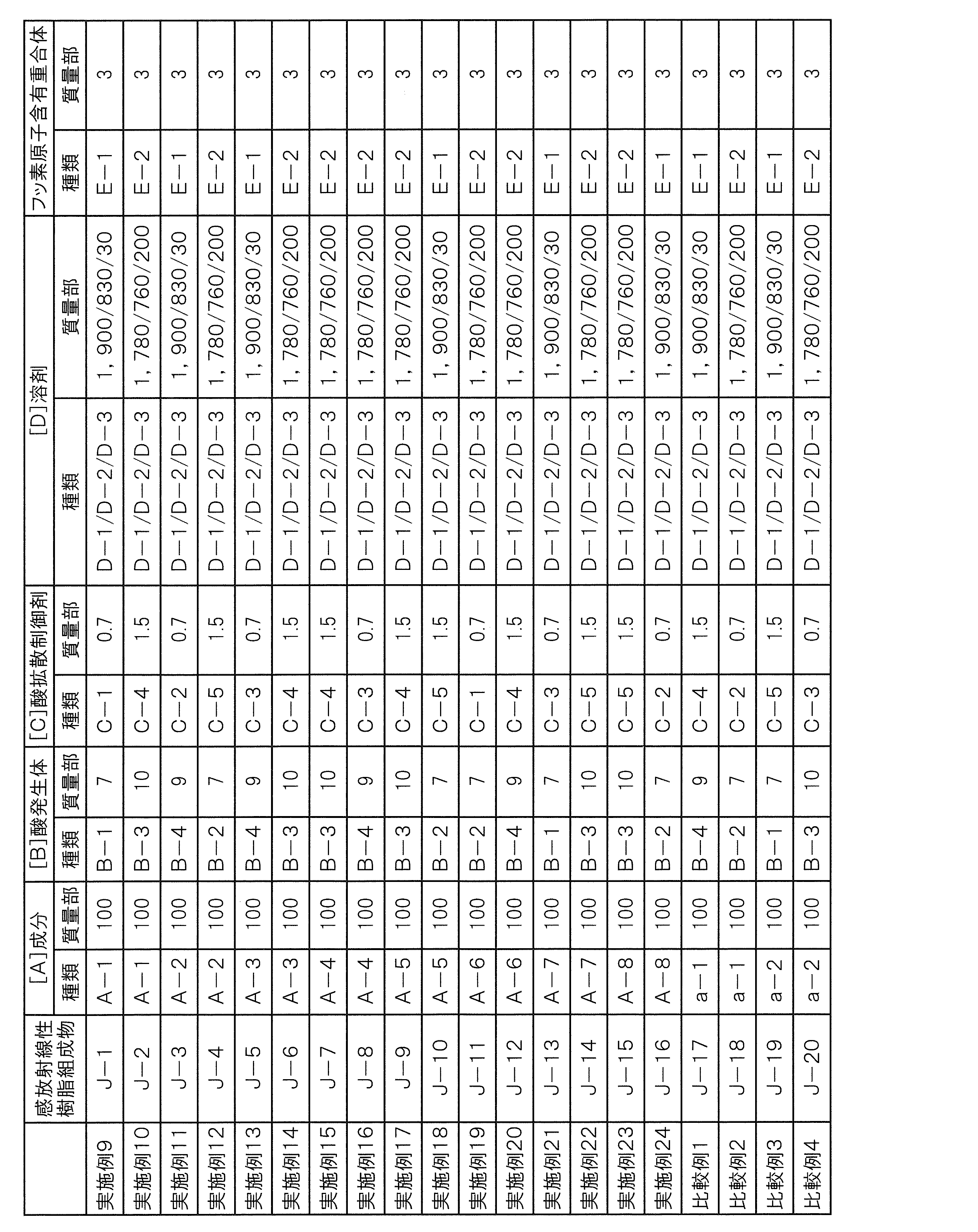
<評価方法>
得られた実施例9~24及び比較例1~4の感放射線性樹脂組成物について、ArFエキシマレーザーを光源として、下記のようにCDU及びMEEFについて評価を行った。評価の結果は表2に示す。
得られた実施例9~24及び比較例1~4の感放射線性樹脂組成物について、ArFエキシマレーザーを光源として、下記のようにCDU及びMEEFについて評価を行った。評価の結果は表2に示す。
[CDU(CD Uniformity)]
下層反射防止膜(ARC66、日産化学社製)を形成した12インチシリコンウェハ上に、感放射線性樹脂組成物によって、膜厚100nmの被膜を形成し、100℃で60秒間ソフトベーク(SB)を行った。次に、この被膜を、ArFエキシマレーザー液浸露光装置(NSR S610C、NIKON社製)を用い、NA=1.3、iNA=1.27、ratio=0.800、Annularの条件により、縮小投影後のパターンが75nmホール110nmピッチとなるパターン形成用マスクを介して露光した。露光後、各感放射線性樹脂組成物について表5に記載の温度で60秒間ポストベーク(PEB)を行った。その後、2.38質量%のテトラメチルアンモニウムヒドロキシド水溶液により現像し、水洗し、乾燥して、ポジ型のレジストパターンを形成した。このとき、露光した部分が直径65nmのホールを形成する露光量を最適露光量(Eop)とした。なお、測長には走査型電子顕微鏡(CG-4000、日立ハイテクノロジーズ社製)を用いた。
下層反射防止膜(ARC66、日産化学社製)を形成した12インチシリコンウェハ上に、感放射線性樹脂組成物によって、膜厚100nmの被膜を形成し、100℃で60秒間ソフトベーク(SB)を行った。次に、この被膜を、ArFエキシマレーザー液浸露光装置(NSR S610C、NIKON社製)を用い、NA=1.3、iNA=1.27、ratio=0.800、Annularの条件により、縮小投影後のパターンが75nmホール110nmピッチとなるパターン形成用マスクを介して露光した。露光後、各感放射線性樹脂組成物について表5に記載の温度で60秒間ポストベーク(PEB)を行った。その後、2.38質量%のテトラメチルアンモニウムヒドロキシド水溶液により現像し、水洗し、乾燥して、ポジ型のレジストパターンを形成した。このとき、露光した部分が直径65nmのホールを形成する露光量を最適露光量(Eop)とした。なお、測長には走査型電子顕微鏡(CG-4000、日立ハイテクノロジーズ社製)を用いた。
上記Eopにて形成された直径65nmのホールパターンを計30個測長し、計30個の測長値の平均偏差を算出し、3倍した値をCDUとして算出した。CDUの値が3.00以上5.50未満の場合を「良好(A)」とし、5.50以上7.00未満の場合を「やや良好(B)」とし、7.00以上の場合を「不良(C)」とした。
[マスクエラーファクター(MEEF)]
上記Eopにて、縮小投影後のパターンのホール直径が73nm、74nm、75nm、76nm、77nmとなるマスクパターンの部分を用いてレジスト膜に形成されたホールの直径(nm)を縦軸に、パターンの設計サイズ(nm)を横軸にプロットしたときの直線の傾きをMEEFとして算出した。MEEFは、その値が1に近いほどマスク再現性が良好であり、値が1.50以上2.50未満の場合を「良好(A)」とし、2.50以上3.00未満の場合を「やや良好(B)」とし、3.00以上の場合を「不良(C)」とした。
上記Eopにて、縮小投影後のパターンのホール直径が73nm、74nm、75nm、76nm、77nmとなるマスクパターンの部分を用いてレジスト膜に形成されたホールの直径(nm)を縦軸に、パターンの設計サイズ(nm)を横軸にプロットしたときの直線の傾きをMEEFとして算出した。MEEFは、その値が1に近いほどマスク再現性が良好であり、値が1.50以上2.50未満の場合を「良好(A)」とし、2.50以上3.00未満の場合を「やや良好(B)」とし、3.00以上の場合を「不良(C)」とした。
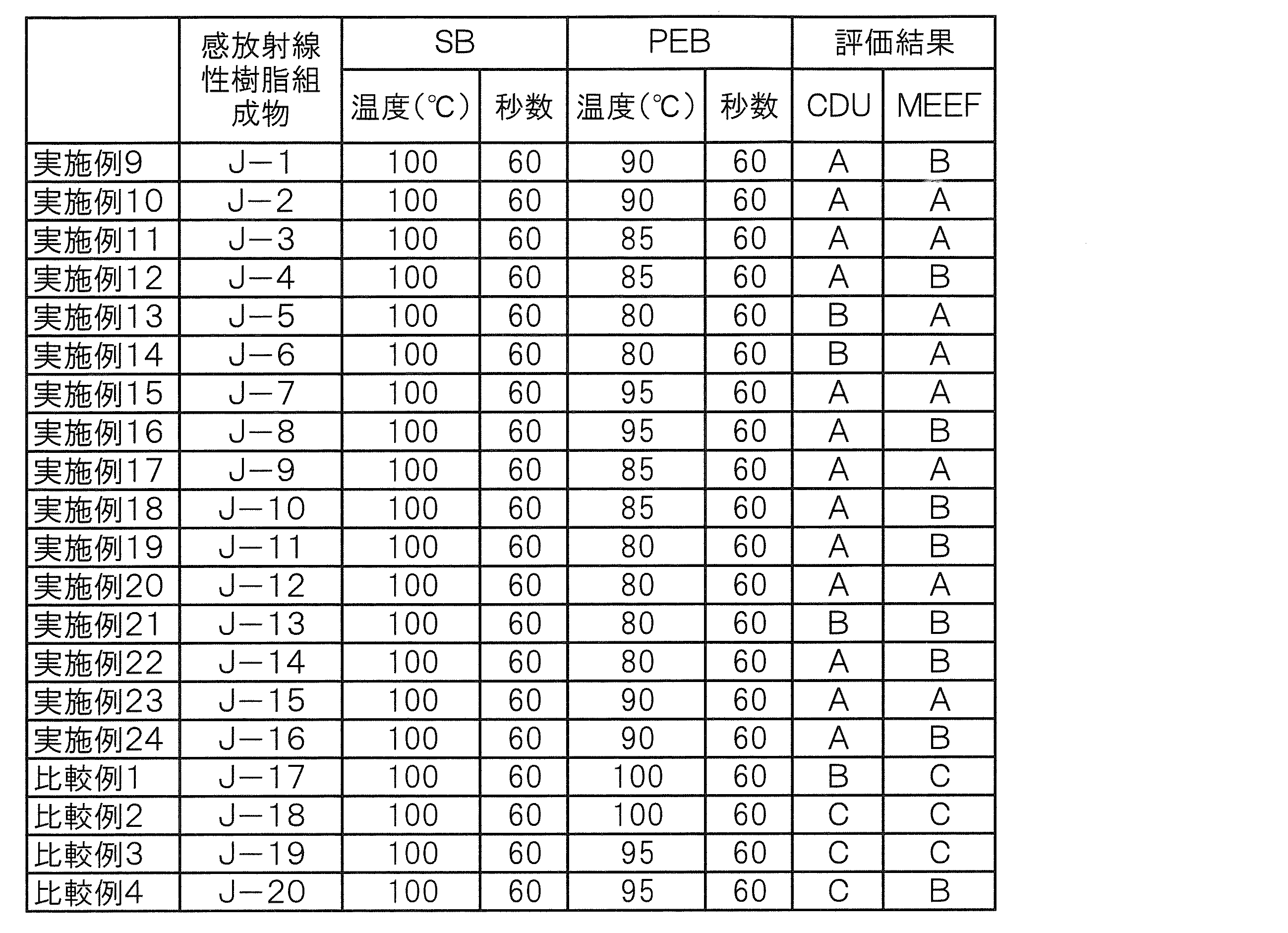
表2から明らかなように、当該感放射線性樹脂組成物を用いれば、CDU及びMEEFを低減することができる。
本発明の感放射線性樹脂組成物は、ArFエキシマレーザーを光源とするリソグラフィー材料として好適に用いることができる。また、液浸露光にも対応可能である。
Claims (5)
- [A]下記式(1)で表される繰り返し単位(I)及び下記式(2)で表される繰り返し単位(II)を含む重合体を含有する感放射線性樹脂組成物。

式(2)中、R4は水素原子又はメチル基である。R5は水炭素数2~5のアルキル基である。aは1~5の整数である。) - [B]感放射線性酸発生剤をさらに含有する請求項1に記載の感放射線性樹脂組成物。
- フッ素原子含有重合体をさらに含有する請求項1に記載の感放射線性樹脂組成物。
- [A]重合体が、ラクトン骨格を有する繰り返し単位及び環状カーボネート構造を有する繰り返し単位からなる群より選択される少なくとも1種の構造単位(III)をさらに含む請求項1に記載の感放射線性樹脂組成物。
- 下記式(1)で表される繰り返し単位(I)及び下記式(2)で表される繰り返し単位(II)を含む重合体。
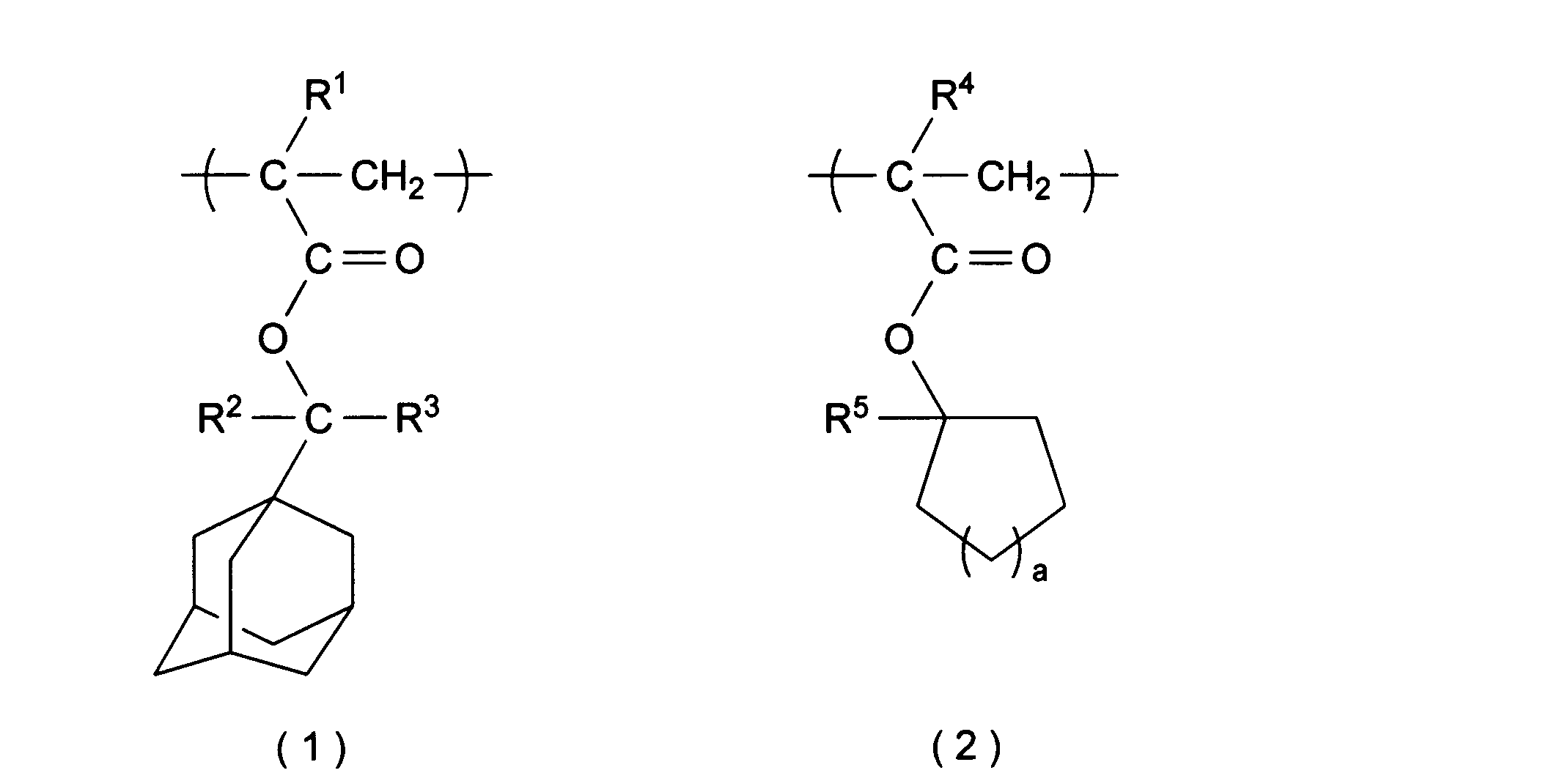
(式(1)中、R1は水素原子又はメチル基である。R2及びR3はそれぞれ独立して炭素数1~5のアルキル基である。
式(2)中、R4は水素原子又はメチル基である。R5は炭素数2~5のアルキル基である。aは1~5の整数である。)
Priority Applications (1)
| Application Number | Priority Date | Filing Date | Title |
|---|---|---|---|
| JP2012509497A JPWO2011125686A1 (ja) | 2010-03-31 | 2011-03-29 | 感放射線性樹脂組成物及び重合体 |
Applications Claiming Priority (2)
| Application Number | Priority Date | Filing Date | Title |
|---|---|---|---|
| JP2010-084492 | 2010-03-31 | ||
| JP2010084492 | 2010-03-31 |
Publications (1)
| Publication Number | Publication Date |
|---|---|
| WO2011125686A1 true WO2011125686A1 (ja) | 2011-10-13 |
Family
ID=44762631
Family Applications (1)
| Application Number | Title | Priority Date | Filing Date |
|---|---|---|---|
| PCT/JP2011/057921 Ceased WO2011125686A1 (ja) | 2010-03-31 | 2011-03-29 | 感放射線性樹脂組成物及び重合体 |
Country Status (3)
| Country | Link |
|---|---|
| JP (2) | JPWO2011125686A1 (ja) |
| TW (1) | TW201142496A (ja) |
| WO (1) | WO2011125686A1 (ja) |
Cited By (1)
| Publication number | Priority date | Publication date | Assignee | Title |
|---|---|---|---|---|
| US20130020684A1 (en) * | 2011-07-20 | 2013-01-24 | Fujifilm Corporation | Actinic ray-sensitive or radiation-sensitive resin composition, and actinic ray-sensitive or radiation-sensitive film and pattern forming method using the same |
Citations (2)
| Publication number | Priority date | Publication date | Assignee | Title |
|---|---|---|---|---|
| JP2009217253A (ja) * | 2008-02-13 | 2009-09-24 | Shin Etsu Chem Co Ltd | ポジ型レジスト材料及びパターン形成方法 |
| JP2010033031A (ja) * | 2008-06-30 | 2010-02-12 | Fujifilm Corp | 感光性組成物及びそれを用いたパターン形成方法 |
Family Cites Families (10)
| Publication number | Priority date | Publication date | Assignee | Title |
|---|---|---|---|---|
| US20100323292A1 (en) * | 2007-03-16 | 2010-12-23 | Jsr Corporation | Resist pattern formation method, and resin composition capable of insolubilizing resist pattern |
| KR20120032024A (ko) * | 2007-05-23 | 2012-04-04 | 제이에스알 가부시끼가이샤 | 감방사선성 수지 조성물 |
| JP5401051B2 (ja) * | 2008-05-12 | 2014-01-29 | 東京応化工業株式会社 | レジスト組成物、レジストパターン形成方法および新規な化合物 |
| JP5314944B2 (ja) * | 2008-06-20 | 2013-10-16 | 富士フイルム株式会社 | 液浸露光用レジスト組成物及びそれを用いたパターン形成方法 |
| JP5746818B2 (ja) * | 2008-07-09 | 2015-07-08 | 富士フイルム株式会社 | 感活性光線性または感放射線性樹脂組成物及びそれを用いたパターン形成方法 |
| JP5503916B2 (ja) * | 2008-08-04 | 2014-05-28 | 富士フイルム株式会社 | レジスト組成物及びそれを用いたパターン形成方法 |
| JP5077137B2 (ja) * | 2008-08-11 | 2012-11-21 | Jsr株式会社 | レジストパターン形成方法及びそれに用いるポジ型感放射線性樹脂組成物 |
| JP5277128B2 (ja) * | 2008-09-26 | 2013-08-28 | 富士フイルム株式会社 | 液浸露光用ポジ型レジスト組成物及びパターン形成方法 |
| JP5377172B2 (ja) * | 2009-03-31 | 2013-12-25 | 富士フイルム株式会社 | 感活性光線性又は感放射線性樹脂組成物及びそれを用いたパターン形成方法 |
| JP5544130B2 (ja) * | 2009-09-01 | 2014-07-09 | 富士フイルム株式会社 | 感活性光線性または感放射線性樹脂組成物及びそれを用いたパターン形成方法 |
-
2011
- 2011-03-29 WO PCT/JP2011/057921 patent/WO2011125686A1/ja not_active Ceased
- 2011-03-29 JP JP2012509497A patent/JPWO2011125686A1/ja active Pending
- 2011-03-31 TW TW100111343A patent/TW201142496A/zh unknown
-
2015
- 2015-09-28 JP JP2015190436A patent/JP6304186B2/ja active Active
Patent Citations (2)
| Publication number | Priority date | Publication date | Assignee | Title |
|---|---|---|---|---|
| JP2009217253A (ja) * | 2008-02-13 | 2009-09-24 | Shin Etsu Chem Co Ltd | ポジ型レジスト材料及びパターン形成方法 |
| JP2010033031A (ja) * | 2008-06-30 | 2010-02-12 | Fujifilm Corp | 感光性組成物及びそれを用いたパターン形成方法 |
Cited By (2)
| Publication number | Priority date | Publication date | Assignee | Title |
|---|---|---|---|---|
| US20130020684A1 (en) * | 2011-07-20 | 2013-01-24 | Fujifilm Corporation | Actinic ray-sensitive or radiation-sensitive resin composition, and actinic ray-sensitive or radiation-sensitive film and pattern forming method using the same |
| US8993211B2 (en) * | 2011-07-20 | 2015-03-31 | Fujifilm Corporation | Actinic ray-sensitive or radiation-sensitive resin composition, and actinic ray-sensitive or radiation-sensitive film and pattern forming method using the same |
Also Published As
| Publication number | Publication date |
|---|---|
| JP6304186B2 (ja) | 2018-04-04 |
| TW201142496A (en) | 2011-12-01 |
| JP2016048374A (ja) | 2016-04-07 |
| JPWO2011125686A1 (ja) | 2013-07-08 |
Similar Documents
| Publication | Publication Date | Title |
|---|---|---|
| JP4798027B2 (ja) | イオンインプランテーション用感放射線性樹脂組成物、及びイオンインプランテーション用パターン形成方法 | |
| JP5660037B2 (ja) | 感放射線性樹脂組成物 | |
| JP5685919B2 (ja) | 感放射線性樹脂組成物及びレジストパターン形成方法 | |
| JP5617339B2 (ja) | 感放射線性樹脂組成物、重合体及び化合物 | |
| JP5900340B2 (ja) | 感放射線性樹脂組成物及びレジストパターン形成方法 | |
| TWI588164B (zh) | Radiation sensitive resin composition and polymer | |
| KR20110013315A (ko) | 감방사선성 수지 조성물 및 그것에 이용되는 화합물 | |
| JP5434323B2 (ja) | 感放射線性樹脂組成物及びスルホニウム塩 | |
| JP6304186B2 (ja) | 感放射線性樹脂組成物 | |
| JP4765625B2 (ja) | アクリル系重合体および感放射線性樹脂組成物 | |
| US8916333B2 (en) | Radiation-sensitive resin composition | |
| JP2005068418A (ja) | アクリル系重合体および感放射線性樹脂組成物 | |
| JP5761175B2 (ja) | 感放射線性樹脂組成物及びレジストパターン形成方法 | |
| WO2011118490A1 (ja) | 感放射線性樹脂組成物 | |
| JP2011059516A (ja) | 感放射線性樹脂組成物 | |
| JP5539371B2 (ja) | 感放射線性樹脂組成物 | |
| WO2011111641A1 (ja) | 感放射線性樹脂組成物 | |
| JP5617504B2 (ja) | 感放射線性樹脂組成物 | |
| JP4962142B2 (ja) | 共重合体および感放射線性樹脂組成物 | |
| JP2011075750A (ja) | 化学増幅型レジスト用感放射線性樹脂組成物および重合体 |
Legal Events
| Date | Code | Title | Description |
|---|---|---|---|
| 121 | Ep: the epo has been informed by wipo that ep was designated in this application |
Ref document number: 11765586 Country of ref document: EP Kind code of ref document: A1 |
|
| WWE | Wipo information: entry into national phase |
Ref document number: 2012509497 Country of ref document: JP |
|
| NENP | Non-entry into the national phase |
Ref country code: DE |
|
| 122 | Ep: pct application non-entry in european phase |
Ref document number: 11765586 Country of ref document: EP Kind code of ref document: A1 |