WO2011102414A1 - オリゴヌクレオチド誘導体 - Google Patents
オリゴヌクレオチド誘導体 Download PDFInfo
- Publication number
- WO2011102414A1 WO2011102414A1 PCT/JP2011/053373 JP2011053373W WO2011102414A1 WO 2011102414 A1 WO2011102414 A1 WO 2011102414A1 JP 2011053373 W JP2011053373 W JP 2011053373W WO 2011102414 A1 WO2011102414 A1 WO 2011102414A1
- Authority
- WO
- WIPO (PCT)
- Prior art keywords
- general formula
- group
- carbon atoms
- represented
- oligonucleotide derivative
- Prior art date
- Legal status (The legal status is an assumption and is not a legal conclusion. Google has not performed a legal analysis and makes no representation as to the accuracy of the status listed.)
- Ceased
Links
- 0 C1C2C1CC*2 Chemical compound C1C2C1CC*2 0.000 description 2
Images

Classifications
-
- C—CHEMISTRY; METALLURGY
- C07—ORGANIC CHEMISTRY
- C07H—SUGARS; DERIVATIVES THEREOF; NUCLEOSIDES; NUCLEOTIDES; NUCLEIC ACIDS
- C07H21/00—Compounds containing two or more mononucleotide units having separate phosphate or polyphosphate groups linked by saccharide radicals of nucleoside groups, e.g. nucleic acids
- C07H21/04—Compounds containing two or more mononucleotide units having separate phosphate or polyphosphate groups linked by saccharide radicals of nucleoside groups, e.g. nucleic acids with deoxyribosyl as saccharide radical
-
- A—HUMAN NECESSITIES
- A61—MEDICAL OR VETERINARY SCIENCE; HYGIENE
- A61K—PREPARATIONS FOR MEDICAL, DENTAL OR TOILETRY PURPOSES
- A61K31/00—Medicinal preparations containing organic active ingredients
- A61K31/70—Carbohydrates; Sugars; Derivatives thereof
- A61K31/7088—Compounds having three or more nucleosides or nucleotides
-
- A—HUMAN NECESSITIES
- A61—MEDICAL OR VETERINARY SCIENCE; HYGIENE
- A61P—SPECIFIC THERAPEUTIC ACTIVITY OF CHEMICAL COMPOUNDS OR MEDICINAL PREPARATIONS
- A61P31/00—Antiinfectives, i.e. antibiotics, antiseptics, chemotherapeutics
- A61P31/12—Antivirals
-
- A—HUMAN NECESSITIES
- A61—MEDICAL OR VETERINARY SCIENCE; HYGIENE
- A61P—SPECIFIC THERAPEUTIC ACTIVITY OF CHEMICAL COMPOUNDS OR MEDICINAL PREPARATIONS
- A61P35/00—Antineoplastic agents
-
- C—CHEMISTRY; METALLURGY
- C12—BIOCHEMISTRY; BEER; SPIRITS; WINE; VINEGAR; MICROBIOLOGY; ENZYMOLOGY; MUTATION OR GENETIC ENGINEERING
- C12N—MICROORGANISMS OR ENZYMES; COMPOSITIONS THEREOF; PROPAGATING, PRESERVING, OR MAINTAINING MICROORGANISMS; MUTATION OR GENETIC ENGINEERING; CULTURE MEDIA
- C12N15/00—Mutation or genetic engineering; DNA or RNA concerning genetic engineering, vectors, e.g. plasmids, or their isolation, preparation or purification; Use of hosts therefor
- C12N15/09—Recombinant DNA-technology
- C12N15/11—DNA or RNA fragments; Modified forms thereof; Non-coding nucleic acids having a biological activity
- C12N15/111—General methods applicable to biologically active non-coding nucleic acids
-
- C—CHEMISTRY; METALLURGY
- C12—BIOCHEMISTRY; BEER; SPIRITS; WINE; VINEGAR; MICROBIOLOGY; ENZYMOLOGY; MUTATION OR GENETIC ENGINEERING
- C12N—MICROORGANISMS OR ENZYMES; COMPOSITIONS THEREOF; PROPAGATING, PRESERVING, OR MAINTAINING MICROORGANISMS; MUTATION OR GENETIC ENGINEERING; CULTURE MEDIA
- C12N2310/00—Structure or type of the nucleic acid
- C12N2310/10—Type of nucleic acid
- C12N2310/11—Antisense
-
- C—CHEMISTRY; METALLURGY
- C12—BIOCHEMISTRY; BEER; SPIRITS; WINE; VINEGAR; MICROBIOLOGY; ENZYMOLOGY; MUTATION OR GENETIC ENGINEERING
- C12N—MICROORGANISMS OR ENZYMES; COMPOSITIONS THEREOF; PROPAGATING, PRESERVING, OR MAINTAINING MICROORGANISMS; MUTATION OR GENETIC ENGINEERING; CULTURE MEDIA
- C12N2310/00—Structure or type of the nucleic acid
- C12N2310/30—Chemical structure
- C12N2310/35—Nature of the modification
- C12N2310/351—Conjugate
Definitions
- the present invention relates to an oligonucleotide derivative, and particularly relates to an oligonucleotide having two or more substituents capable of dissociating into anions at the 5 ′ end or 3 ′ end of the molecule.
- the oligonucleotide derivative of the present invention shows a strong binding force to RNA having a sequence complementary to itself, but shows weak binding to RNA having a sequence complementary to itself at the non-terminal portion. . That is, it has a short RNA binding ability, which shows a strong binding force to short RNAs but only weak bonds to long RNAs.
- These properties are useful as a probe nucleic acid in a technique for selectively detecting an active substance such as microRNA, which acts as an active RNA after being cut short from a long precursor RNA in a cell.
- MicroRNA is RNA transcribed from the genome of an organism and usually has a chain length of about 19 to 23 bases, and in some cases about 15 to 30 bases, which does not encode a protein. Recent research suggests that miRNA plays an important role in processes such as cell development, differentiation and canceration, and viral infection processes. The mechanism of production of active mature miRNA is as follows.
- a pri-miRNA of about 1000 bases transcribed from the genome is cleaved to generate a pre-miRNA of 70-100 bases.
- This pre-miRNA is further cleaved to produce an active mature miRNA of about 19 to 23 bases.
- This mature miRNA binds to the target messenger RNA and controls its translation, thereby regulating the expression level of the protein synthesized based on the information of the messenger RNA.
- Non-patent Document 1 A method for detecting only RNA is known (Non-patent Document 1). According to this method, since a long-chain nucleic acid is not contained in a sample, only a short-chain nucleic acid can be analyzed. However, it takes time and cost to perform column chromatography and electrophoresis, and operation is difficult. There is a problem that it is difficult to implement unless it is a skilled engineer due to its complexity.
- Non-patent document 2 a method of using a fluorescent label of a nucleic acid using an enzymatic reaction capable of chain extension only when short-chain RNA is used as a primer in order to omit the molecular process of short-chain RNA has been reported ( Non-patent document 2).
- this method uses a plurality of enzyme reactions, there is a problem that the operation becomes complicated.
- Non-Patent Document 3 discloses a mature miRNA selective RT-PCR method using a hairpin primer that binds only to a short RNA.
- hairpin primers need to be precisely designed for thermodynamic stability of the hairpin structure, and are not necessarily universal and easy to use.
- RT-PCR is not an optimal method in terms of throughput because it is difficult to comprehensively detect many miRNAs present in cells.
- the root cause of the above problem is that natural and non-natural oligonucleotides that have existed so far can selectively recognize the sequence of a nucleic acid molecule, but cannot recognize its size. That is, since an oligonucleotide complementary to a certain sequence also binds to a long nucleic acid molecule that includes the target sequence as a part thereof, an RNA that includes the mature miRNA sequence as a part thereof, such as pre-miRNA, It is difficult to distinguish mature RNA from hybridization.
- RNA that includes the mature miRNA sequence as a part thereof such as pre-miRNA
- Non-patent Document 4 a mature RNA selective microarray in which a hairpin type probe is immobilized on a microarray has been reported.
- the document describes that only mature miRNAs that have been processed short by this hairpin probe can be recognized, but in order to form a hairpin structure in the probe, the length of the probe must be made longer than necessary. Therefore, it is not an optimal method when considering the cost of probe synthesis. Also, the quantitative evaluation of how much the hairpin primer actually binds to the mature miRNA is not sufficient.
- a method for detecting only short RNA by introducing a sterically bulky substituent at both ends of the oligonucleotide probe has been reported (Non-patent Document 5). It is not a low and practical method.
- Patent Document 1 also reports a method of detecting only short RNAs by introducing sterically bulky substituents at both ends of the oligonucleotide probe, but has low selectivity for binding to short RNAs. Not practical.
- Patent Document 2 discloses an oligonucleotide derivative in which a substituent having a phosphate group is introduced into the terminal nucleobase moiety. If this oligonucleotide derivative is used, only short-chain RNA can be detected. However, an oligonucleotide derivative with higher selectivity for short RNA is desired.
- An object of the present invention is to provide an oligonucleotide derivative that binds only to a short complementary strand and does not bind to a long complementary strand RNA or complementary DNA.
- the present inventors have solved the above problems by using an oligonucleotide derivative having two or more substituents capable of dissociating into anions at the end of the oligonucleotide. I got the knowledge that I get.
- the present invention has been made based on the above findings, and provides an oligonucleotide derivative represented by the general formula (1) and a salt thereof.
- R 1 is a hydroxyl group or a group represented by the following general formula (2)
- W 1 is a natural or non-natural nucleobase or the following general formula (3)
- general formula (5) Y 1 represents a hydroxyl group, a hydrogen atom, a fluorine atom or an alkoxy group which may have a substituent
- Y 2 represents a group represented by any one of General Formula (6) and General Formula (7)
- X k is the same or different for each k value
- Each represents a hydroxyl group, a hydrogen atom, a fluorine atom or an alkoxy group which may have a substituent
- B k may be the same or different for each value of k, Represents a natural or non-natural nucleobase
- k is an integer of 1 to 50 Represents
- W 2 is
- R 2 is a hydroxyl group or a group represented by the general formula (2) (provided that at least one of R 1 , R 2 or Y 2 is a group represented by the general formula (2);
- W 1 is any one of general formula (3), general formula (5), general formula (6), or general formula (7);
- General formula (5) is any of formulas (6) or formula (7))
- Q 3 and T 3 may be the same or different and each represents an oxygen atom or a sulfur atom
- R 3 represents a hydrogen atom or an alkyl group having 1 to 6 carbon atoms
- L 1 represents an alkane-diyl group having 2 to 6 carbon atoms, a cycloalkane-diyl group having 4 to 8 carbon atoms
- R 4 represents
- Q 4 and T 4 may be the same or different and each represents an oxygen atom or a sulfur atom
- R 4 represents a hydrogen atom or an alkyl group having 1 to 6 carbon atoms
- Z represents a hydrogen atom or an alkyl group having 1 to 6 carbon atoms
- L 2 represents an alkane having 2 to 6 carbon atoms.
- R 5 represents a carboxyl group, an alkyl group having 1 to 6 carbon atoms having a carboxyl group at the terminal, a general formula (It represents a group represented by (4) or an alkyl group having 1 to 6 carbon atoms having a group represented by the general formula (4) at its terminal.)
- R 6 represents a hydrogen atom or an alkyl group having 1 to 6 carbon atoms
- L 3 represents an alkane-diyl group having 2 to 6 carbon atoms, a cycloalkane-diyl group having 4 to 8 carbon atoms
- R 7 represents a carboxyl group, an alkyl group having 1 to 6 carbon atoms having a carboxyl
- L 4 and L 5 may be the same or different from each other, and may be an alkane-diyl group having 2 to 6 carbon atoms, a cycloalkane-diyl group having 4 to 8 carbon atoms, a phenylene group, or Represents a naphthylidene group
- R 8 and R 9 may be the same or different from each other, a carboxyl group, an alkyl group having 1 to 6 carbon atoms having a carboxyl group at the terminal, a group represented by the general formula (4) Or an alkyl group having 1 to 6 carbon atoms having a group represented by the general formula (4) at the terminal.
- R 1 is a group represented by the general formula (2), Q 3 and T 3 in the general formula (2) are oxygen atoms, and W 1 is the general formula (3).
- R 2 and / or Y 2 is a group represented by the general formula (2), Q 3 and T 3 in the general formula (2) are oxygen atoms
- W 2 is A group represented by general formula (3), general formula (5), general formula (6) or general formula (7), wherein Q 4 and T 4 in general formula (4) are oxygen atoms.
- R 1 is a phosphate group
- W 1 is a group represented by general formula (3), general formula (5), general formula (6) or general formula (7).
- Q 4 and T 4 are oxygen atoms.
- R 2 and / or Y 2 is a phosphate group
- W 2 is represented by general formula (3), general formula (5), general formula (6) or general formula (7).
- R 2 and / or Y 2 is a phosphate group
- W 2 is the general formula (3), general formula (5), general formula (6), or general formula (7).
- Q 4 and T 4 in the general formula (4) are oxygen atoms.
- the oligonucleotide derivative of the present invention is preferably used as a probe for nucleic acid detection.
- the present invention also provides an oligonucleotide array in which the oligonucleotide derivative is immobilized on a solid support.
- the present invention also provides a pharmaceutical composition comprising the above oligonucleotide derivative.
- the present invention also provides reverse transcriptase primers, DNA polymerase primers, and DNA polymerase templates useful for PCR and RT-PCR.
- the oligonucleotide derivative of the present invention Since the oligonucleotide derivative of the present invention has two or more substituents capable of dissociating into anions at the terminal portion thereof, by setting appropriate reaction conditions, it binds only to a short complementary strand, It is an oligonucleotide derivative that does not bind to long complementary RNA or DNA.
- the oligonucleotide derivative of the present invention by reacting the oligonucleotide derivative of the present invention with nucleic acids having various chain lengths and sequences extracted from cells, it binds only to nucleic acids having a complementary sequence to the added oligonucleotide and having a short chain length. And can be used for isolation, detection, and function control of a nucleic acid having a short chain length.
- the oligonucleotide derivative of the present invention is represented by the following general formula (1).
- R 1 is a hydroxyl group or a group represented by the following general formula (2).
- Q 3 and T 3 may be the same or different and each represents an oxygen atom or a sulfur atom.
- Q 3 and T 3 are oxygen atoms. That is, one in which R 1 in the general formula (1) is a phosphoric acid group can be mentioned.
- W 1 is a natural or non-natural nucleobase or any one of the following general formula (3), general formula (5), general formula (6), or general formula (7). Represents the group to be represented.
- Examples of natural nucleobases include thymin-1-yl, cytosine-1-yl, 5-methyl-cytosyn-1-yl, uracil-1-yl, uracil-5-yl, adenine-9-yl, Examples include guanine-9-yl.
- the non-natural nucleobase is a chemical modification such as having a substituent on the exocyclic oxygen atom, exocyclic nitrogen atom, cyclin nitrogen atom or carbocyclic carbon atom of the natural nucleobase, or exocyclic oxygen.
- R 3 represents a hydrogen atom or an alkyl group having 1 to 6 carbon atoms.
- alkyl group include, but are not limited to, methyl, ethyl, n-propyl, isopropyl, n-butyl, isobutyl, butan-2-yl, n-pentyl, and n-hexyl.
- L 1 represents an alkane-diyl group having 2 to 6 carbon atoms, a cycloalkane-diyl group having 4 to 8 carbon atoms, a phenylene group, or a naphthylidene group.
- the alkane-diyl group represents an alkanediyl group having 2 to 6 carbon atoms, for example, ethylene, propane-1,3-diyl, butane-1,4-diyl, pentane-1,5-diyl, hexane- 1,6-diyl and the like can be mentioned. Also included are branched groups such as butane-1,3-diyl.
- the cycloalkane-diyl group means a divalent group derived from a cycloalkane having 4 to 8 carbon atoms, for example, cyclobutane-1,3-diyl, cyclobutane-1,2-diyl, cyclopentane-1 , 3-diyl, cyclopentane-1,2-diyl, cyclohexane-1,2-diyl, cyclohexane-1,3-diyl, cyclohexane-1,4-diyl, etc.
- groups both are included.
- the phenylene group means a divalent group derived from benzene, and includes 1,2-phenylene, 1,3-phenylene, 1,4-phenylene and the like.
- the naphthylidene group means a divalent group derived from naphthalene.
- 1,2-naphthylidene, 1,3-naphthylidene, 1,4-naphthylidene, 1,5-naphthylidene, 1,6-naphthylidene, 1,7- Examples include naphthylidene, 1,8-naphthylidene, 2,3-naphthylidene, 2,6-naphthylidene, 2,7-naphthylidene, and the like.
- R 4 is a carboxyl group, an alkyl group having 1 to 6 carbon atoms having a carboxyl group at the terminal, a group represented by the general formula (4), or a group having 1 to carbon atoms having a group represented by the general formula (4) at the terminal.
- an alkyl group is mentioned as an alkyl group.
- Q 4 and T 4 may be the same as or different from each other, and represent an oxygen atom or a sulfur atom.
- R 4 represents a hydrogen atom or an alkyl group having 1 to 6 carbon atoms.
- alkyl group include, but are not limited to, methyl, ethyl, n-propyl, isopropyl, n-butyl, isobutyl, butan-2-yl, n-pentyl, and n-hexyl.
- Z represents a hydrogen atom or an alkyl group having 1 to 6 carbon atoms.
- alkyl group examples include, but are not limited to, methyl, ethyl, n-propyl, isopropyl, n-butyl, isobutyl, butan-2-yl, n-pentyl, and n-hexyl.
- L 2 represents an alkane-diyl group having 2 to 6 carbon atoms, a cycloalkane-diyl group having 4 to 8 carbon atoms, a phenylene group, or a naphthylidene group.
- the alkane-diyl group represents an alkanediyl group having 2 to 6 carbon atoms, for example, ethylene, propane-1,3-diyl, butane-1,4-diyl, pentane-1,5-diyl, hexane- 1,6-diyl and the like can be mentioned. Also included are branched groups such as butane-1,3-diyl.
- the cycloalkane-diyl group means a divalent group derived from a cycloalkane having 4 to 8 carbon atoms, for example, cyclobutane-1,3-diyl, cyclobutane-1,2-diyl, cyclopentane-1 , 3-diyl, cyclopentane-1,2-diyl, cyclohexane-1,2-diyl, cyclohexane-1,3-diyl, cyclohexane-1,4-diyl, etc.
- groups both are included.
- the phenylene group means a divalent group derived from benzene, and includes 1,2-phenylene, 1,3-phenylene, 1,4-phenylene and the like.
- the naphthylidene group means a divalent group derived from naphthalene.
- 1,2-naphthylidene, 1,3-naphthylidene, 1,4-naphthylidene, 1,5-naphthylidene, 1,6-naphthylidene, 1,7- Examples include naphthylidene, 1,8-naphthylidene, 2,3-naphthylidene, 2,6-naphthylidene, 2,7-naphthylidene, and the like.
- R 5 is a carboxyl group, an alkyl group having 1 to 6 carbon atoms having a carboxyl group at the terminal, a group represented by the general formula (4), or a group having 1 to carbon atoms having a group represented by the general formula (4) at the terminal.
- R 6 represents a hydrogen atom or an alkyl group having 1 to 6 carbon atoms.
- alkyl group include, but are not limited to, methyl, ethyl, n-propyl, isopropyl, n-butyl, isobutyl, butan-2-yl, n-pentyl, and n-hexyl.
- L 3 represents an alkane-diyl group having 2 to 6 carbon atoms, a cycloalkane-diyl group having 4 to 8 carbon atoms, a phenylene group, or a naphthylidene group.
- the alkane-diyl group represents an alkanediyl group having 2 to 6 carbon atoms, for example, ethylene, propane-1,3-diyl, butane-1,4-diyl, pentane-1,5-diyl, hexane- 1,6-diyl and the like can be mentioned. Also included are branched groups such as butane-1,3-diyl.
- the cycloalkane-diyl group means a divalent group derived from a cycloalkane having 4 to 8 carbon atoms, for example, cyclobutane-1,3-diyl, cyclobutane-1,2-diyl, cyclopentane-1 , 3-diyl, cyclopentane-1,2-diyl, cyclohexane-1,2-diyl, cyclohexane-1,3-diyl, cyclohexane-1,4-diyl, etc.
- groups both are included.
- the phenylene group means a divalent group derived from benzene, and includes 1,2-phenylene, 1,3-phenylene, 1,4-phenylene and the like.
- the naphthylidene group means a divalent group derived from naphthalene.
- 1,2-naphthylidene, 1,3-naphthylidene, 1,4-naphthylidene, 1,5-naphthylidene, 1,6-naphthylidene, 1,7- Examples include naphthylidene, 1,8-naphthylidene, 2,3-naphthylidene, 2,6-naphthylidene, 2,7-naphthylidene, and the like.
- R 7 is a carboxyl group, an alkyl group having 1 to 6 carbon atoms having a carboxyl group at the terminal, a group represented by the general formula (4), or a group having 1 to carbon atoms having a group represented by the general formula (4) at the terminal.
- L 4 and L 5 may be the same or different, and the alkane-diyl group having 2 to 6 carbon atoms, the cycloalkane-diyl group having 4 to 8 carbon atoms, phenylene Group or a naphthylidene group.
- the alkane-diyl group represents an alkanediyl group having 2 to 6 carbon atoms, for example, ethylene, propane-1,3-diyl, butane-1,4-diyl, pentane-1,5-diyl, hexane- 1,6-diyl and the like can be mentioned. Also included are branched groups such as butane-1,3-diyl.
- the cycloalkane-diyl group means a divalent group derived from a cycloalkane having 4 to 8 carbon atoms, for example, cyclobutane-1,3-diyl, cyclobutane-1,2-diyl, cyclopentane-1 , 3-diyl, cyclopentane-1,2-diyl, cyclohexane-1,2-diyl, cyclohexane-1,3-diyl, cyclohexane-1,4-diyl, etc.
- groups both are included.
- the phenylene group means a divalent group derived from benzene, and includes 1,2-phenylene, 1,3-phenylene, 1,4-phenylene and the like.
- the naphthylidene group means a divalent group derived from naphthalene.
- 1,2-naphthylidene, 1,3-naphthylidene, 1,4-naphthylidene, 1,5-naphthylidene, 1,6-naphthylidene, 1,7- Examples include naphthylidene, 1,8-naphthylidene, 2,3-naphthylidene, 2,6-naphthylidene, 2,7-naphthylidene, and the like.
- R 8 and R 9 may be the same or different, and may be a carboxyl group, an alkyl group having 1 to 6 carbon atoms having a carboxyl group at the terminal, a group represented by the general formula (3), or a general terminal. This represents an alkyl group having 1 to 6 carbon atoms having a group represented by the formula (3).
- an alkyl group may be the same or different, and may be a carboxyl group, an alkyl group having 1 to 6 carbon atoms having a carboxyl group at the terminal, a group represented by the general formula (3), or a general terminal. This represents an alkyl group having 1 to 6 carbon atoms having a group represented by the formula (3).
- an alkyl group may be a carboxyl group, an alkyl group having 1 to 6 carbon atoms having a carboxyl group at the terminal, a group represented by the general formula (3), or a general terminal.
- Y 1 represents a hydroxyl group, a hydrogen atom, a fluorine atom, or an alkoxy group that may have a substituent.
- the alkoxy group is preferably an alkoxy group having 1 to 6 carbon atoms. Examples of such an alkoxy group include a methoxy group, an ethoxy group, a propoxy group, a propan-1-yloxy group, and a butan-1-yloxy group. 1-butyloxy group, 1-pentyloxy group, 1-hexyloxy group and the like, and branched alkoxy groups such as 2-propyloxy group, isobutyloxy group, cyclopropyloxy group, cyclobutyl, etc.
- alkoxy group in which a part or all of the side chain is cyclized such as an oxy group, a cyclopentyloxy group, a cyclohexyloxy group, and a cyclopropylmethyloxy group is also included.
- substituents include bromo, chloro, iodo, hydroxyl, cyano, alkoxy, amino, alkylamino, dialkylamino, aryl, heteroaryl and the like.
- Y 2 is a hydroxyl group, a hydrogen atom, a fluorine atom, an alkoxy group which may have a substituent, or a group represented by the general formula (2).
- alkoxy group include those described above.
- General formula (2) is as described above.
- substituent include bromo, chloro, iodo, hydroxyl, cyano, alkoxy, amino, alkylamino, dialkylamino, aryl, heteroaryl and the like.
- X k may be the same as or different from each value of k, and each alkoxy group may have a hydroxyl group, a hydrogen atom, a fluorine atom, or a substituent.
- the alkoxy group include those described above.
- the substituent include bromo, chloro, iodo, hydroxyl, cyano, alkoxy, amino, alkylamino, dialkylamino, aryl, heteroaryl and the like.
- B k may be the same or different for each value of k, and each represents a natural or non-natural nucleobase.
- the natural or unnatural nucleobase include those described in W 1.
- B k in the general formula (1) such as a sequence complementary to the nucleic acid to be detected can be chosen such that the sequence with the appropriate cohesive strength.
- k is an integer of 1 to 50, preferably 5 to 30.
- k can be changed depending on the chain length of the RNA (miRNA or the like) to be detected. That is, the oligonucleotide derivative of the present invention has two or more substituents that can be dissociated into anions at the terminal portion, and the complementary strand RNA or complementary strand DNA is obtained by dissociating these substituents into anions. Electrostatic repulsion occurs and long chain lengths cannot be bound, and only DNA strands and RNA strands that are shorter than the length of the anion at the end are bound to the oligonucleotide derivative of the present invention. Will be able to. Therefore, it is possible to vary the range of k depending on the length of the miRNA or the like to be detected.
- W 2 is a natural or non-natural nucleobase, or any one of the general formula (3), the general formula (5), the general formula (6), or the general formula (7). Represents the group to be represented. Natural or unnatural nucleobase, general formula (3), for the general formula (5), the general formula (6), or the general formula (7) are the same as those described in W 1.
- Q 1 and Q 2 may be the same or different and each represents an oxygen atom or a sulfur atom.
- T 1 and T 2 may be the same or different and each represents an oxygen atom or a sulfur atom.
- R 2 is a hydroxyl group or a group represented by the general formula (2).
- General formula (2) is as described above.
- R 1 , R 2 or Y 2 is a group represented by the general formula (2).
- W 1 represents the general formula (3), the general formula (5), the general formula (6), or the general formula ( 7);
- R 2 or Y 2 is a group represented by the general formula (2), W 2 represents the general formula (3), the general formula (5), or the general formula (6).
- a group represented by general formula (7) That is, the oligonucleotide derivative of the present invention has two or more substituents capable of dissociating into anions at the 5 ′ end or 3 ′ end of the molecule.
- R 1 is a group represented by the general formula (2)
- W 1 is represented by any one of the general formula (3), the general formula (5), the general formula (6), or the general formula (7). It is a group. That is, when R 1 is a group represented by the general formula (2), W 1 represents a carboxyl group, an alkyl group having 1 to 6 carbon atoms having a carboxyl group at the terminal, represented by the general formula (4). Or an alkyl group having 1 to 6 carbon atoms having a group represented by the general formula (4) at the terminal.
- the oligonucleotide derivative molecule has two phosphate groups at its 5 ′ end, or has a phosphate group and a carboxylic acid group, so it can dissociate into an anion at the 5 ′ end. Two substituents are included.
- W 2 is any one of the general formula (3), the general formula (5), the general formula (6), or the general formula (7).
- W 1 represents a carboxyl group having 1 to 6 carbon atoms having a carboxyl group at the terminal.
- Two or more substituents capable of dissociating into anions are included.
- both R 2 and Y 2 are groups represented by the general formula (2)
- the 3 ′ end of the oligonucleotide derivative molecule contains three substituents that can dissociate into anions; Become.
- Q 3 and T 3 in the general formula (2) and Q 4 and T 4 in the general formula (4) are oxygen atoms, that is, represented by the general formula (2).
- a group in which the group is a phosphate group.
- both R 1 and R 2 may be groups (or phosphate groups) represented by the general formula (2).
- the oligonucleotide derivative of the present invention may be in the form of its salt.
- the salt used in the present specification means a compound in which protons of some or all of the phosphate groups and carboxyl groups contained in the nucleotide derivatives of the present invention are replaced with cations.
- Examples of the cation include ammonium ions such as ammonium, monoalkylammonium, dialkylammonium, trialkylammonium, and tetraalkylammonium, and sodium ions, potassium ions, lithium ions, calcium ions, magnesium ions, manganese ions, and iron ions. And metal ions such as copper ions.
- the oligonucleotide derivative of the present invention has two or more substituents capable of dissociating into anions at its 5 ′ end, 3 ′ end, or both ends, so that appropriate reaction conditions are set. By doing so, an anion is generated at the terminal portion.
- a method for detecting only a short complementary strand using the oligonucleotide derivative of the present invention will be described with reference to the drawings.
- FIG. 1 is a diagram schematically showing a method for detecting only a short complementary strand using the oligonucleotide derivative of the present invention.
- the oligonucleotide derivative of the present invention generates an anion at the end under appropriate reaction conditions.
- a short complementary strand here, the short complementary strand means a complementary strand having a sequence complementary to the oligonucleotide derivative of the present invention at the end,
- the complementary strand means a complementary strand having a sequence complementary to the oligonucleotide derivative of the present invention at a non-terminal portion.
- the long complementary strand even though it has a complementary portion that binds to the oligonucleotide derivative of the present invention, there are two or more anions at the end of the oligonucleotide derivative of the present invention. Electrostatic repulsion occurs at this portion, and the long complementary strand cannot bind to the oligonucleotide derivative of the present invention.
- the oligonucleotide derivative of the present invention reacts with nucleic acids having various chain lengths and sequences extracted from cells, thereby having a sequence complementary to the oligonucleotide of the present invention.
- the oligonucleotide derivative of the present invention can be used as a nucleic acid detection probe.
- suitable reaction conditions are well-known in the said technical field, and mean the conditions for hybridizing a probe and oligonucleotide.
- Hybridization may be performed in a 96-well or 384-well plastic plate. The oligonucleotide of the present invention is spotted in the hole of such a plate, and then a sample is added to perform hybridization. Or you may use the oligonucleotide array of this invention mentioned later. Hybridization is preferably performed in the temperature range of room temperature to about 70 ° C. for 6 to 20 hours.
- oligonucleotide derivative of the present invention can be produced by a method known to those skilled in the art, for example, a phosphoramidite method. When carrying out the phosphoramidite method, the oligonucleotide derivative of the present invention can be produced by using a known phosphoramidite compound. Specifically, it can be synthesized according to the method described in the examples of this specification.
- the oligonucleotide derivative of the present invention can be used as a primer for a reverse transcriptase reaction.
- it can be applied to the RT-PCR method.
- RT-PCR method For example, by performing reverse transcription on a sample containing RNA in the presence of the oligonucleotide derivative of the present invention, only miRNA is reverse transcribed and cDNA is synthesized. The obtained cDNA is synthesized by RT-PCR. Thus, DNA having a portion complementary only to miRNA can be obtained.
- Conventionally known methods can be used for reverse transcription, RT-PCR conditions and the like.
- the oligonucleotide derivative of the present invention can be further used for oligonucleotide arrays, pharmaceuticals and the like as described below. Furthermore, the oligonucleotide derivative of the present invention can also be used as a primer for reverse transcriptase, a primer for DNA polymerase, and a template for DNA polymerase useful for PCR and RT-PCR.
- the oligonucleotide array of the present invention is formed by immobilizing the oligonucleotide derivative of the present invention on a solid support.
- the oligonucleotide array of the present invention is used to detect an oligonucleotide having a specific base sequence and a short chain length (usually 50 bases or less). Therefore, the base sequence of the oligonucleotide derivative immobilized on the solid phase carrier is a sequence having an appropriate binding force, such as one having a sequence complementary to the sequence to be detected.
- an oligonucleotide derivative immobilized on a solid phase carrier binds to an oligonucleotide to be detected by specific binding through hybridization.
- the oligonucleotide array can be produced by synthesizing the oligonucleotide directly on the solid support surface (on-chip method) or by immobilizing the prepared oligonucleotide on the solid support surface.
- the method is known.
- the oligonucleotide array in the present invention can be produced by any of these methods.
- an on-chip method for example, a combination of the use of a protective group that is selectively removed by light irradiation, and a photolithographic technique and a solid-phase synthesis technique that are used in semiconductor manufacturing can be used in a predetermined region of a minute matrix. (Masking technology: for example, Fodor, S.P.A.
- Oligonucleotides are generally covalently bound to a surface-treated solid support via a spacer or a crosslinker.
- a method is also known in which polyacrylamide gel tiny pieces are aligned on a glass surface, and a synthetic oligonucleotide is covalently bound thereto (Yershov, G. et al. Proc. Natl. Acad. Sci. USA 94: 4913, 1996).
- an oligonucleotide is synthesized in advance on a solid phase carrier such as porous glass or polystyrene by a solid phase synthesis method, and the solid phase carrier is immobilized on a glass substrate by an appropriate method such as an adhesive or a physical method.
- an appropriate method such as an adhesive or a physical method.
- the solid phase carrier to be used, those conventionally used for producing DNA chips and gene detection microarrays can be used without particular limitation.
- the solid support used include: silicon; glass such as microporous glass and porous glass; metal; magnetic beads having ferrite as a core and the surface covered with glycine methacrylate; plastic (for example, polyester resin, polyethylene resin, polypropylene) Resin, acrylonitrile butadiene styrene resin, nylon, acrylic resin, fluororesin, polycarbonate resin, polyurethane resin, methylpentene resin, phenol resin, melamine resin, epoxy resin, vinyl chloride resin) and the like.
- the shape of the carrier may be any shape such as a plate shape (substrate shape), a bead shape, a thread shape, a spherical shape, a polygonal shape, and a powder shape.
- the solid phase carrier may be one in which a surface treatment layer of diamond-like carbon is formed.
- Diamond-like carbon (DLC, Diamond ⁇ Like Carbon) is a general term for an incomplete diamond structure that is a mixture of diamond and carbon, and the mixing ratio is not particularly limited.
- the thickness of the layer is preferably 1 nm to 10 ⁇ m.
- oligonucleotide of the present invention in order to covalently bond the oligonucleotide of the present invention to the solid phase carrier, those having an amino group bound to the surface of the solid phase carrier may be used. Therefore, it is preferable to use a carrier having an amino group bonded to the surface or capable of bonding an amino group.
- the pharmaceutical composition of the present invention contains the above-described oligonucleotide derivative of the present invention.
- the oligonucleotide derivative of the present invention binds only to a short-chain complementary strand and can be used to control the function of such a short-chain complementary strand.
- the present invention provides a pharmaceutical composition comprising the above-described oligonucleotide derivative of the present invention.
- the pharmaceutical composition of the present invention can be produced by a known method such as mixing a pharmaceutically acceptable carrier.
- the pharmaceutical composition of the present invention itself or mixed with appropriate pharmacologically acceptable excipients, diluents, etc., and as tablets, capsules, granules, powders, syrups, etc., or injections , Suppositories, patches, or external preparations.
- the pharmaceutical composition includes excipients (eg, sugar derivatives such as lactose, sucrose, sucrose, mannitol, sorbitol; starches such as corn starch, potato starch, ⁇ starch, dextrin; crystalline cellulose; gum arabic; dextran; pullulan; Silicate derivatives such as light anhydrous silicic acid, synthetic aluminum silicate, calcium silicate, magnesium metasilicate aluminate; calcium hydrogen phosphate; calcium carbonate; calcium sulfate, lubricant (eg stearic acid, calcium stearate, Magnesium stearate, talc, colloidal silica, sodium lauryl sulfate, magnesium lauryl sulfate), binders (eg, hydroxypropylcellulose, hydroxypropylmethylcellulose, polyvinylpyrrolidone, macrogol , Disintegrants (eg low substituted hydroxypropylcellulose, carboxymethylcellulose, carboxymethylcellulose calcium, internally cross
- a colloidal dispersion system For the method of introducing the pharmaceutical composition of the present invention into a subject, a colloidal dispersion system may be used.
- the colloidal dispersion system has an effect of enhancing the stability of the compound in the living body and an effect of efficiently transporting the compound to a specific organ, tissue or cell.
- the colloidal dispersion system is not particularly limited as long as it is usually used, and is based on lipids including polymer composites, nanocapsules, microspheres, beads, and oil-in-water emulsifiers, micelles, mixed micelles and liposomes. And a dispersion system.
- unilamellar liposomes having a size of 0.2 to 0.4 ⁇ m can encapsulate a considerable proportion of an aqueous buffer containing macromolecules, and the oligonucleotide derivative is encapsulated in this aqueous inner membrane.
- the composition of the liposome is usually a complex of a lipid, particularly a phospholipid (preferably a phospholipid having a high phase transition temperature), with a steroid, particularly cholesterol.
- lipids useful for the production of liposomes include phosphatidyl compounds such as phosphatidylglycerol, phosphatidylcholine, phosphatidylserine, sphingolipid, phosphatidylethanolamine, cerebroside and ganglioside.
- phosphatidyl compounds such as phosphatidylglycerol, phosphatidylcholine, phosphatidylserine, sphingolipid, phosphatidylethanolamine, cerebroside and ganglioside.
- the dose of the pharmaceutical composition containing the oligonucleotide derivative of the present invention varies depending on symptoms and age, but in the case of oral administration, the lower limit is 1 mg (preferably 30 mg) and the upper limit is 2000 mg (preferably, In the case of injection, a lower limit of 0.1 mg (preferably 5 mg) and an upper limit of 1000 mg (preferably 500 mg) can be administered by subcutaneous injection, intramuscular injection or intravenous injection.
- Raw material synthesis example 1 Synthesis of 3′-5′-O-bis- (tert-butyldimethylsilyl) -6-N- [N- (trans-4-hydroxycyclohexyl) carbamoyl] -2′-O-methyladenosine 3′-5 ′ -O-bis- (tert-butyldimethylsilyl) -2'-O-methyladenosine (1.6 g, 3.1 mmol) was dissolved in 40 mL of pyridine, and then phenyl chloroformate (0.85 mL, 6.8).
- Raw material synthesis example 2 3′-5′-O-bis- (tert-butyldimethylsilyl) -6-N- [N- [trans-4- (4-oxopentanoyloxy) cyclohexyl] carbamoyl] -2′-O-methyladenosine
- the compound (2.1 g, 3.2 mmol) obtained in the raw material synthesis example 1 was dissolved in 30 mL of dichloromethane, and levulinic acid (0.72 mL, 6.3 mmol), N, N′-dicyclohexylcarbodiimide (1 .3 g, 6.3 mmol) and 4-dimethylaminopyridine (40 mg, 0.32 mmol) were added, and the mixture was stirred at room temperature for 21 hours.
- Raw material synthesis example 3 6-N- [N- (trans-4- (4-oxopentanoyloxy) cyclohexyl] carbamoyl] -2′-O-methyladenosine
- the compound obtained in Raw Material Synthesis Example 2 (1.6 g, 2.1 mmol) ) was dissolved in 20 mL of pyridine, triethylamine trihydrofluoride (1.8 mL, 11 mmol) and triethylamine (1.5 mL, 11 mmol) were added thereto, and the mixture was stirred at room temperature for 3 days.
- the reaction system was chloroform (50 mL).
- Raw material synthesis example 4 5'-O- (4,4'-dimethoxytrityl) -6-N- [N- (trans-4- (4-oxopentanoyloxy) cyclohexyl) carbamoyl] -2'-O-methyladenosine
- Raw material synthesis example 3 The compound obtained in step (0.98 g, 1.9 mmol) was dissolved in 10 mL of pyridine, and 4,4′-dimethoxytrityl chloride (0.77 g, 2.3 mmol) was added thereto, followed by stirring at room temperature for 3 hours. did.
- Raw material synthesis example 5 5′-O- (4,4′-dimethoxytrityl) -6-N- [N- (trans-4- (4-oxopentanoyloxy) cyclohexyl) carbamoyl] -2′-O-methyladenosine 3 ′-( 2-cyanoethyl N, N-diisopropyl phosphoramidite)
- the compound obtained in Raw Material Synthesis Example 4 (250 mg, 0.30 mmol) was dissolved in 4.4 mL of dichloromethane, and diisopropylethylamine (261 ⁇ L, 1.5 mmol), 2-cyanoethyldiisopropylchlorophosphoramidite (177 mg) was dissolved therein.
- Example 1 Synthesis of oligonucleotide 5 ′-(dA *) CAACCUACU- 3 ′ (SEQ ID NO: 1)
- the underlined nucleotide residue represents a 2′-O-methyl-ribonucleotide residue
- dA * is It represents a nucleotide residue represented by the following formula.
- the solid phase carrier was transferred to a glass filter, and the DMTr group was removed by washing the solid phase carrier with 3% trichloroacetic acid diluted with methylene chloride.
- phosphalink reagent 50 equivalents purchased from Glen Research was reacted for 2 minutes in the presence of 1H-tetrazole (100 equivalents). The reaction with the phosphalink reagent was repeated once more, followed by iodine oxidation by a conventional method.
- the solid phase carrier was treated with 3% trichloroacetic acid diluted with methylene chloride to remove the DMTr group, and then concentrated aqueous ammonia. And stirred at room temperature for 17 hours. After the aqueous ammonia was distilled off, the resulting crude product was purified by anion exchange HPLC to give the title compound.
- the structure of the title compound was confirmed by MALDI-TOF mass spectrometry. 5 ′-(dA *) CAACCUACU- 3 ′ (SEQ ID NO: 1) MALDI-TOF mass Calcd 3498.63 Found 3500.03
- Example 2 Synthesis of Oligonucleotide 5 ′-(dA *) CAACCTACT- 3 ′ (SEQ ID NO: 2)
- the underlined nucleotide residue represents a deoxyribonucleotide residue.
- the title compound was synthesized in the same manner as in Example 1 except that DNA phosphoramidite was used instead of 2′-O-methyl RNA phosphoramidite.
- the structure of the target product was confirmed by MALDI-TOF mass spectrometry.
- 5 ′-(dA *) CAACCTACT- 3 ′ (SEQ ID NO: 2) MALDI-TOF mass Calcd 32566.5711 Found 3258.81
- a solid phase carrier (1.0 ⁇ mol) supporting 2′-O-methyluridine purchased from Glen Research and 2′-O-methyl RNA phosphoramidite reagent purchased from Glen Research, ABI-392DNA / Synthesis of 5'- CAACCCUACU having a DMTr group at the 5'-terminal hydroxyl group and a protected nucleobase and phosphate moiety on a solid support using a standard 1.0 ⁇ mol scale RNA synthesis protocol of an RNA synthesizer did.
- half of the solid support (0.5 ⁇ mol) was transferred to a glass filter, and the DMTr group was removed by washing the solid support with 3% trichloroacetic acid diluted with methylene chloride.
- phosphalink reagent 50 equivalents purchased from Glen Research was reacted for 2 minutes in the presence of 1H-tetrazole (100 equivalents). The reaction with the phosphalink reagent was repeated once more, followed by iodine oxidation by a conventional method.
- the solid support was treated with 3% trichloroacetic acid diluted with methylene chloride to remove the DMTr group, and then concentrated aqueous ammonia was added. And stirred at room temperature for 17 hours. After the aqueous ammonia was distilled off, the obtained crude product was purified by anion exchange HPLC to obtain the desired product.
- the structure of the target product was confirmed by MALDI-TOF mass spectrometry. 5 '-(Am *) CAACCUACU- 3' (SEQ ID NO: 3) MALDI-TOF mass Calcd 35288.6455 Found 3530.316
- trans-4-aminocyclohexanol (3.6 g, 31.3 mmol) was added without performing the extraction operation, and the mixture was reacted at 85 ° C. for 30 minutes.
- the solvent was distilled off under reduced pressure and dissolved in chloroform, followed by extraction with saturated sodium bicarbonate.
- the organic layer was collected, dried by adding sodium sulfate, filtered, and the solvent was distilled off under reduced pressure.
- the resulting residue was purified by NH silica gel chromatography using hexane / chloroform as a developing solvent to obtain the title compound (2.95 g, 76%) represented by the following formula.
- Phosphoramidite compound 5 (5′-O- (4,4′-dimethoxytrityl) -N6- [N- (trans-4- (4-oxopentanoyloxy) cyclohexyl) carbamoyl] deoxyadenosine 3 ′-(2 Synthesis of —Cyanoethyl N, N-diisopropylphosphoramidite) Compound 4 (350 mg, 0.441 mmol) was azeotroped three times each in the order of pyridine (dehydration), toluene (dehydration), and dichloromethane (dehydration) Dissolved in 4.4 ml of dichloromethane (dehydrated), tetrazole (19 mg, 0.264 mmol), diisopropylamine (37 ⁇ l, 0.264 mmol) and 2-cyanoethyl-bis (N, N-diisopropyl)- Add phosphoramidite (154 ⁇ l, 0.4
- Example 4 Analysis of chain length-dependent hybridization by Tm measurement
- the oligonucleotides obtained in Example 1, Example 2, Example 3 and Comparative Example 1 were added in 10 mM phosphate buffer (pH 7.0) and 0.1 M NaCl. The concentration was adjusted to 1.0 ⁇ M.
- the following long-chain RNA (SEQ ID NO: 5) or short-chain RNA (SEQ ID NO: 6) is similarly dissolved to a concentration of 1.0 ⁇ M, and the temperature dependency of absorbance at 260 nm is changed from 5 ° C. to 90 ° C. Measured to ° C.
- the obtained UV melting curve was differentiated, and the temperature at which the first derivative became a maximum was defined as Tm.
- Tm of the following natural type probe and non-anionic probe was also measured. The results are shown in Table 1.
- Examples 5 to 10 The same operation as in Example 2 was performed to synthesize the following oligonucleotides. 5 ′-(dA *) TAACCTACT-3 ′ (SEQ ID NO: 9, Example 5): MALDI-TOF mass Calcd 3271.57 Found 3277.29 5 ′-(dA *) CTACCTACT-3 ′ (SEQ ID NO: 10, Example 6): MALDI-TOF mass Calcd 3247.56 Found 3247.56 5 ′-(dA *) CGACTACTACT-3 ′ (SEQ ID NO: 11, Example 7): MALDI-TOF mass Calcd 3272.57 Found 3274.48 5 ′-(dA *) CCACCCTACT-3 ′ (SEQ ID NO: 12, Example 8): MALDI-TOF mass Calcd 3232.56 Found 3234.88 5 ′-(dA *) TTACCTACT-3 ′ (SEQ ID NO: 13, Example 9): MALDI-TOF mass Calcd 32
- Example 11 Analysis of chain length-dependent hybridization by Tm measurement
- concentration of the oligonucleotide obtained in Examples 5 to 11 is 1.0 ⁇ M in 10 mM phosphate buffer (pH 7.0) and 0.1 M NaCl. It was prepared as follows. In this solution, the following long RNAs or short RNAs were similarly dissolved to a concentration of 1.0 ⁇ M, and the temperature dependence of absorbance at 260 nm was measured from 5 ° C. to 90 ° C. The obtained UV melting curve was differentiated, and the temperature at which the first derivative became a maximum was defined as Tm.
- the long RNAs or short RNAs used are shown in Table 2, and the results are shown in Table 3.
Landscapes
- Health & Medical Sciences (AREA)
- Life Sciences & Earth Sciences (AREA)
- Chemical & Material Sciences (AREA)
- Organic Chemistry (AREA)
- Engineering & Computer Science (AREA)
- Molecular Biology (AREA)
- General Health & Medical Sciences (AREA)
- Genetics & Genomics (AREA)
- Biomedical Technology (AREA)
- Biotechnology (AREA)
- Pharmacology & Pharmacy (AREA)
- Medicinal Chemistry (AREA)
- Animal Behavior & Ethology (AREA)
- Public Health (AREA)
- Veterinary Medicine (AREA)
- Biochemistry (AREA)
- General Engineering & Computer Science (AREA)
- Wood Science & Technology (AREA)
- General Chemical & Material Sciences (AREA)
- Chemical Kinetics & Catalysis (AREA)
- Nuclear Medicine, Radiotherapy & Molecular Imaging (AREA)
- Zoology (AREA)
- Bioinformatics & Cheminformatics (AREA)
- Plant Pathology (AREA)
- Microbiology (AREA)
- Physics & Mathematics (AREA)
- Biophysics (AREA)
- Virology (AREA)
- Communicable Diseases (AREA)
- Oncology (AREA)
- Epidemiology (AREA)
- Measuring Or Testing Involving Enzymes Or Micro-Organisms (AREA)
- Saccharide Compounds (AREA)
- Pharmaceuticals Containing Other Organic And Inorganic Compounds (AREA)
Abstract
【課題】短い相補鎖とのみ結合し、長い相補鎖RNAや相補DNAとは結合しないオリゴヌクレオチド誘導体を提供すること。 【解決手段】本発明のオリゴヌクレオチド誘導体は下記一般式(1)で表わされる。 本発明のオリゴヌクレオチド誘導体は、短いRNA には強い結合力を示すのに対し、長いRNA とは弱い結合しか示さない。これらの性質は細胞内で長い前駆体RNA から短く切りだされた後に活性体RNA として作用するRNA、たとえばmicroRNA などの活性体を選択的に検出する手法におけるプローブ核酸として有用である。また、本発明のオリゴヌクレオチド誘導体は、核酸検出用プローブ、オリゴヌクレオチドアレイ、医薬組成物として用いられる。
Description
本発明はオリゴヌクレオチド誘導体に関し、特には、分子の5'末端もしくは3'末端にアニオンに解離することが可能な置換基を2個以上有するオリゴヌクレオチドに関する。本発明のオリゴヌクレオチド誘導体は、自身と相補的な配列を末端にもつRNAとは強い結合力を示すのに対し、自身と相補的な配列を非末端部にもつRNAとは弱い結合しか示さない。すなわち短いRNAには強い結合力を示すのに対し、長いRNAとは弱い結合しか示さないという短鎖RNA選択的結合能を有する。これらの性質は細胞内で長い前駆体RNAから短く切りだされた後に活性体RNAとして作用するRNA、たとえばmicroRNAなどの活性体を選択的に検出する手法におけるプローブ核酸として有用である。
マイクロRNA(miRNA)は生物のゲノムから転写された、タンパク質をコードしない通常19~23塩基程度、場合によっては15~30塩基程度の鎖長のRNAである。最近の研究により、miRNAが細胞の発生、分化、癌化などの過程やウイルスの感染プロセスなどに重要な役割を果たしていることが示唆されている。活性な成熟miRNAの生成機構は以下のとおりである。
まず、ゲノムより転写された1000塩基程度のpri-miRNAが切断され70-100塩基のpre-miRNAが生成する。このpre-miRNAが更に切断され、19~23塩基程度の活性な成熟miRNAが生成する。この成熟miRNAは標的のメッセンジャーRNAに結合しその翻訳を制御することで、そのメッセンジャーRNAの情報をもとに合成されるタンパク質の発現量の調節を行っている。これらのmiRNAの機能を解明し、それらの情報を疾患の診断や治療に応用するためには細胞内に存在する多数のRNAの中から成熟miRNAを迅速かつ網羅的に検出する技術の開発が必要である。
現在使用されている手法としては、生体内の全RNAをカラムクロマトグラフィーやゲル電気泳動で鎖長にしたがって分離し、短鎖RNAのみを含む画分を溶出した後、ハイブリダイゼーション技術により、短鎖RNAのみを検出する方法が知られている(非特許文献1)。この方法によれば、サンプル中に長鎖核酸が含まれていないため、短鎖核酸のみを分析することができるが、カラムクロマトグラフィーや電気泳動を行うのに時間やコストがかかること、操作が煩雑なため熟練した技術者でなければ実施が困難であるなどの問題点がある。
また、短鎖RNAの分子工程を省略するためにDNAポリメラーゼを用いて短鎖RNAをプライマーとした場合のみ鎖伸長が可能な酵素反応を用いた核酸の蛍光ラベルを用いる方法が報告されている(非特許文献2)。しかし、この方法は、複数の酵素反応を用いる方法であるため、操作が煩雑になるという問題がある。
また、非特許文献3には、短いRNAのみに結合するヘアピンプライマーを用いた成熟miRNA選択的なRT-PCR法が開示されている。しかし、ヘアピンプライマーはそのヘアピン構造の熱力学的安定性を精密にデザインする必要があり、かならずしも汎用的かつ容易に用いることができるものではない。またRT-PCRでは細胞内に多数存在するmiRNAを網羅的に検出することが困難であるためスループットの点では最適な方法ではない。
上記問題の根本原因は、これまでに存在する天然型および非天然型のオリゴヌクレオチドは核酸分子の配列を選択的に認識することはできるが、そのサイズを認識することができない点にある。すなわち、ある配列に相補的なオリゴヌクレオチドはそのターゲットとする配列を一部として含む長い核酸分子にも結合してしまうため、pre-miRNAのように成熟miRNAの配列をその一部に含むRNAと成熟RNAとをハイブリダイゼーションにより区別することが困難である。これらの問題点に関する解決法がいくつか提唱されている。
例えば、マイクロアレイ上にヘアピン型のプローブを固定化した成熟RNA選択的マイクロアレイが報告されている(非特許文献4)。該文献には、このヘアピンプローブにより短くプロセッシングされた成熟miRNAのみを認識できると記載されているが、プローーブにヘアピン構造を形成するためには、プローブの鎖長を必要以上に長くしなければならないため、プローブの合成コストを考えた場合最適な手法ではない。また、ヘアピンプライマーが実際にどのくらい成熟miRNAに選択的に結合するのかといった定量的評価も充分ではない。
また、オリゴヌクレオチドプローブの両末端に立体的に嵩高い置換基を導入して短鎖RNAのみを検出する方法も報告されている(非特許文献5)が、短鎖RNAに対する結合の選択性が低く実用的な方法ではない。
また、オリゴヌクレオチドプローブの両末端に立体的に嵩高い置換基を導入して短鎖RNAのみを検出する方法も報告されている(非特許文献5)が、短鎖RNAに対する結合の選択性が低く実用的な方法ではない。
また、特許文献1には、オリゴヌクレオチドプローブの両末端に立体的に嵩高い置換基を導入して短鎖RNAのみを検出する方法も報告されているが短鎖RNAに対する結合の選択性が低く実用的ではない。
更に、特許文献2には、末端の核酸塩基部分にリン酸基を有する置換基を導入したオリゴヌクレオチド誘導体が開示されている。このオリゴヌクレオチド誘導体を用いれば、短鎖RNAのみを検出することができる。しかしながら、更に短鎖RNAに対する選択性の高いオリゴヌクレオチド誘導体が望まれている。
更に、特許文献2には、末端の核酸塩基部分にリン酸基を有する置換基を導入したオリゴヌクレオチド誘導体が開示されている。このオリゴヌクレオチド誘導体を用いれば、短鎖RNAのみを検出することができる。しかしながら、更に短鎖RNAに対する選択性の高いオリゴヌクレオチド誘導体が望まれている。
従って、より効果的な分子デザインにより、簡素な化学修飾のみで優れた短鎖RNA選択性を示すことのできる、生産コスト的にも優れた人工オリゴヌクレオチドプローブの開発と、それらを用いた信頼性の高いRNA検出デバイスの開発が望まれている。本発明の目的は、短い相補鎖とのみ結合し、長い相補鎖RNAや相補DNAとは結合しないオリゴヌクレオチド誘導体を提供することにある。
上記目的を達成するため、本発明者らは鋭意検討した結果、オリゴヌクレオチドの末端にアニオンに解離することが可能な置換基を2個以上有するオリゴヌクレオチド誘導体を用いることにより、上記課題を解決し得るという知見を得た。
本発明は、上記知見に基づいてなされたものであり、一般式(1)で表わされるオリゴヌクレオチド誘導体及びそれらの塩を提供するものである。

(式中、R1は、水酸基又は下記一般式(2)で表わされる基であり、W1は、天然型もしくは非天然型の核酸塩基又は下記一般式(3)、一般式(5)、一般式(6)又は一般式(7)のいずれかで表わされる基を表わし;Y1は、水酸基、水素原子、フッ素原子又は置換基を有していてもよいアルコキシ基を表し;Y2は、水酸基、水素原子、フッ素原子置換基を有していてもよいアルコキシ基又は下記一般式(2)で表わされる基であり;Xkは、各kの値に対し、同一であっても異なっていてもよく、それぞれ水酸基、水素原子、フッ素原子又は置換基を有していてもよいアルコキシ基を表し;Bkは、各kの値に対し同一であっても異なっていてもよく、それぞれ天然もしくは非天然型の核酸塩基を表し;kは1~50の整数を表し;W2は、天然型もしくは非天然型の核酸塩基又は下記一般式(3)、一般式(5)、一般式(6)又は一般式(7)のいずれかで表わされる基を表わし; Q1及びQ2は同一であっても異なっていてもよく、それぞれ、酸素原子又は硫黄原子を表し;T1及びT2は同一であっても異なっていてもよく、それぞれ、酸素原子又は硫黄原子を表し;R2は水酸基又は一般式(2)で表わされる基である(ただし、R1、R2又はY2のうち少なくとも1個は、一般式(2)で表わされる基であり;R1が一般式(2)で表わされる基であるときには、W1は一般式(3)、一般式(5)、一般式(6)又は一般式(7)のいずれかであり;R2又はY2が一般式(2)で表わされる基であるときには、W2は一般式(3)、一般式(5)、一般式(6)又は一般式(7)のいずれかである))

(式中、Q3及びT3は同一であっても異なっていてもよく、それぞれ、酸素原子又は硫黄原子を表す)
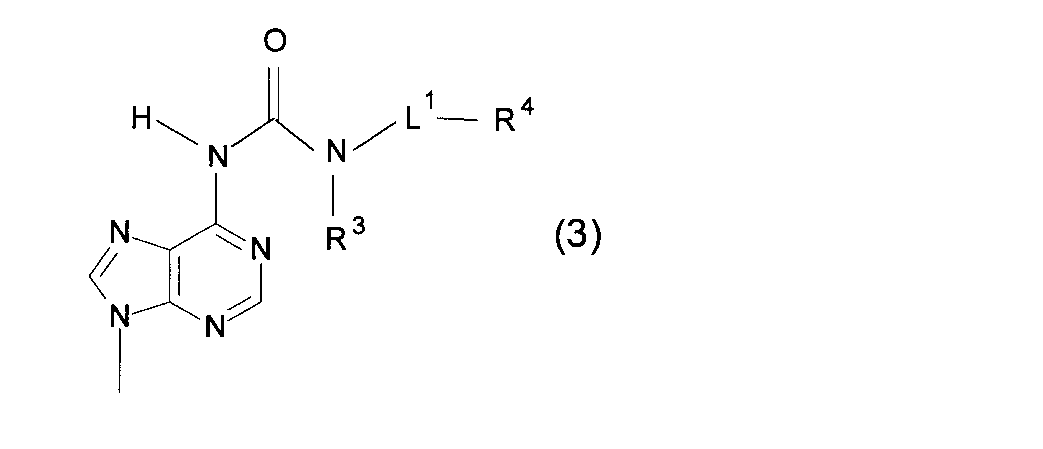
(式中、R3は水素原子又は炭素数1~6個のアルキル基を表わし、L1は炭素数2~6個のアルカン-ジイル基、炭素数4~8個のシクロアルカン-ジイル基、フェニレン基、又はナフチリデン基を表わし、R4はカルボキシル基、末端にカルボキシル基を有する炭素数1~6個のアルキル基、一般式(4)で表わされる基、又は末端に一般式(4)で表わされる基を有する炭素数1~6個のアルキル基を表わす。)
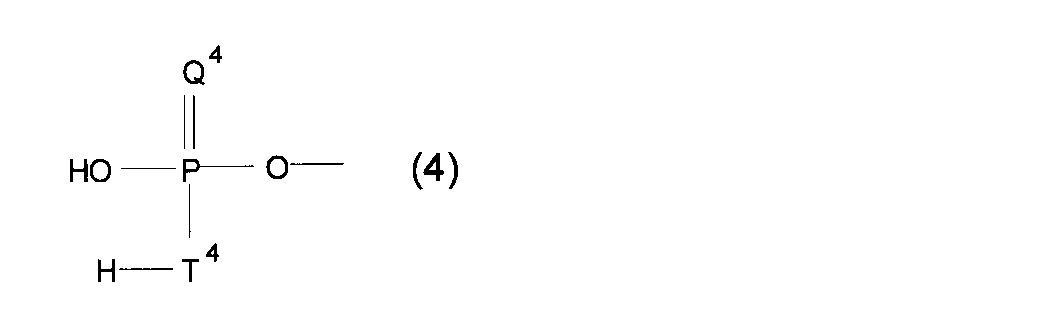
(式中、Q4及びT4は同一であっても異なっていてもよく、それぞれ、酸素原子又は硫黄原子を表す)
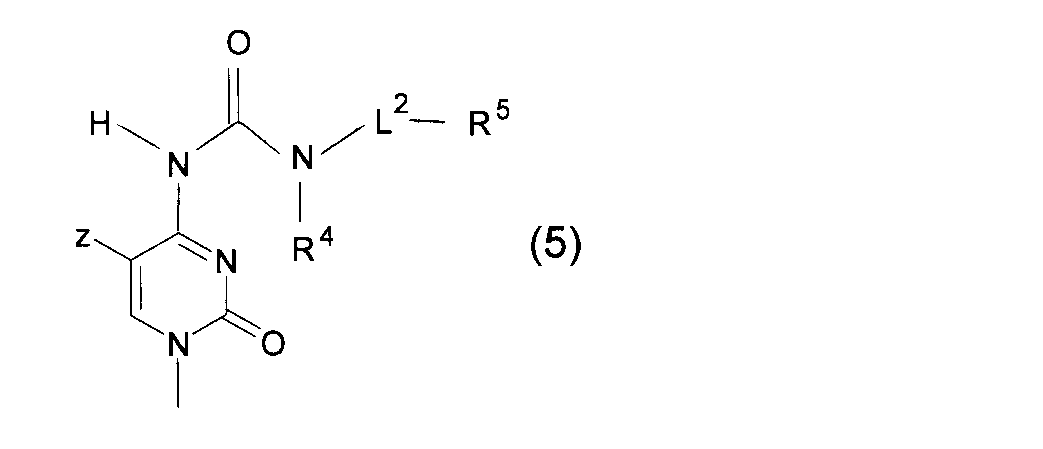
(式中、R4は水素原子又は炭素数1~6個のアルキル基を表わし、Zは水素原子又は炭素数1~6個のアルキル基を表わし、L2は炭素数2~6個のアルカン-ジイル基、炭素数4~8個のシクロアルカン-ジイル基、フェニレン基、又はナフチリデン基を表わし、R5はカルボキシル基、末端にカルボキシル基を有する炭素数1~6個のアルキル基、一般式(4)で表わされる基、又は末端に一般式(4)で表わされる基を有する炭素数1~6個のアルキル基を表わす。)

(式中、R6は水素原子又は炭素数1~6個のアルキル基を表わし、L3は炭素数2~6個のアルカン-ジイル基、炭素数4~8個のシクロアルカン-ジイル基、フェニレン基、又はナフチリデン基を表わし、R7はカルボキシル基、末端にカルボキシル基を有する炭素数1~6個のアルキル基、一般式(4)で表わされる基、又は末端に一般式(4)で表わされる基を有する炭素数1~6個のアルキル基を表わす。)

(式中、L4、L5は互いに同一であっても異なっていてもよく炭素数2~6個のアルカン-ジイル基、炭素数4~8個のシクロアルカン-ジイル基、フェニレン基、又はナフチリデン基を表わし、R8、R9は互いに同一であっても異なっていてもよくカルボキシル基、末端にカルボキシル基を有する炭素数1~6個のアルキル基、一般式(4)で表わされる基、又は末端に一般式(4)で表わされる基を有する炭素数1~6個のアルキル基を表わす。)
本発明は、上記知見に基づいてなされたものであり、一般式(1)で表わされるオリゴヌクレオチド誘導体及びそれらの塩を提供するものである。
本発明のオリゴヌクレオチド誘導体としては、R1が一般式(2)で表わされる基であり、一般式(2)中のQ3及びT3が酸素原子であり、W1が一般式(3)、一般式(5)、一般式(6)又は一般式(7)で表わされる基であり、一般式(4)中のQ4及びT4が酸素原子であるものが挙げられる。
本発明のオリゴヌクレオチド誘導体としては、R2及び/又はY2が一般式(2)で表わされる基であり、一般式(2)中のQ3及びT3が酸素原子であり、W2が一般式(3)、一般式(5)、一般式(6)又は一般式(7)で表わされる基であり、一般式(4)中のQ4及びT4が酸素原子であるものが挙げられる。
本発明のオリゴヌクレオチド誘導体としては、R1がリン酸基であり、W1が一般式(3)、一般式(5)、一般式(6)又は一般式(7)で表わされる基であり、一般式(4)中のQ4及びT4が酸素原子であるものが挙げられる。
本発明のヌクレオチド誘導体としては、R2及び/又はY2がリン酸基であり、W2が一般式(3)、一般式(5)、一般式(6)又は一般式(7)で表わされる基であり、一般式(4)中のQ4及びT4が酸素原子であるものが挙げられる。
また、本発明のヌクレオチド誘導体としては、R2及び/又はY2がリン酸基であり、W2が一般式(3)、一般式(5)、一般式(6)又は一般式(7)で表わされる基であり、一般式(4)中のQ4及びT4が酸素原子であるものが挙げられる。
本発明のオリゴヌクレオチド誘導体としては、R2及び/又はY2が一般式(2)で表わされる基であり、一般式(2)中のQ3及びT3が酸素原子であり、W2が一般式(3)、一般式(5)、一般式(6)又は一般式(7)で表わされる基であり、一般式(4)中のQ4及びT4が酸素原子であるものが挙げられる。
本発明のオリゴヌクレオチド誘導体としては、R1がリン酸基であり、W1が一般式(3)、一般式(5)、一般式(6)又は一般式(7)で表わされる基であり、一般式(4)中のQ4及びT4が酸素原子であるものが挙げられる。
本発明のヌクレオチド誘導体としては、R2及び/又はY2がリン酸基であり、W2が一般式(3)、一般式(5)、一般式(6)又は一般式(7)で表わされる基であり、一般式(4)中のQ4及びT4が酸素原子であるものが挙げられる。
また、本発明のヌクレオチド誘導体としては、R2及び/又はY2がリン酸基であり、W2が一般式(3)、一般式(5)、一般式(6)又は一般式(7)で表わされる基であり、一般式(4)中のQ4及びT4が酸素原子であるものが挙げられる。
本発明のオリゴヌクレオチド誘導体は、好ましくは核酸検出用プローブとして用いられる。
また、本発明は、上記オリゴヌクレオチド誘導体を固体担体上に固定化してなるオリゴヌクレオチドアレイを提供する。
また、本発明は、上記オリゴヌクレオチド誘導体を含む医薬組成物を提供する。
また、本発明はPCRやRT-PCRに有用な、逆転写酵素のプライマー、DNAポリメラーゼのプライマー、DNAポリメラーゼのテンプレートを提供する。
また、本発明は、上記オリゴヌクレオチド誘導体を固体担体上に固定化してなるオリゴヌクレオチドアレイを提供する。
また、本発明は、上記オリゴヌクレオチド誘導体を含む医薬組成物を提供する。
また、本発明はPCRやRT-PCRに有用な、逆転写酵素のプライマー、DNAポリメラーゼのプライマー、DNAポリメラーゼのテンプレートを提供する。
本発明のオリゴヌクレオチド誘導体は、その末端部にアニオンに解離することが可能な置換基を2個以上有しているので、適当な反応条件を設定することにより、短い相補鎖とのみ結合し、長い相補鎖RNAや相補DNAとは結合しないオリゴヌクレオチド誘導体である。その結果、本発明のオリゴヌクレオチド誘導体と細胞から抽出した様々な鎖長及び配列を有する核酸を反応させることにより、加えたオリゴヌクレオチドに相補的な配列を有し、鎖長の短い核酸とのみ結合させ、鎖長の短い核酸の単離、検出、機能制御に用いることができる。
以下、まず本発明のオリゴヌクレオチド誘導体について説明する。
本発明のオリゴヌクレオチド誘導体は、下記一般式(1)で表わされる。

本発明のオリゴヌクレオチド誘導体は、下記一般式(1)で表わされる。
上記一般式(1)において、R1は水酸基又は下記一般式(2)で表わされる基である。
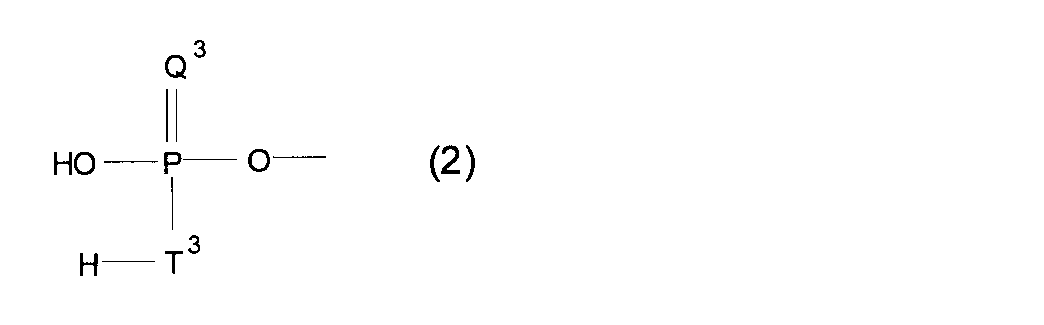
上記一般式(2)において、Q3及びT3は同一であっても異なっていてもよく、それぞれ、酸素原子又は硫黄原子を表す。本発明においては、Q3及びT3が酸素原子であるものが挙げられる。すなわち、一般式(1)におけるR1がリン酸基であるものが挙げられる。
上記一般式(1)において、W1は、天然型もしくは非天然型の核酸塩基又は下記一般式(3)、一般式(5)、一般式(6)又は一般式(7)のいずれかで表わされる基を表わす。天然型の核酸塩基としては、例えば、チミン-1-イル、シトシン-1-イル、5-メチル-シトシン-1-イル、ウラシル-1-イル、ウラシル-5-イル、アデニン-9-イル、グアニン-9-イルなどが挙げられる。また、非天然型の核酸塩基とは、天然型の核酸塩基の環外酸素原子や環外窒素原子や環内窒素原子や環内炭素原子に置換基を有するなどの化学修飾、または環外酸素原子や環内窒素原子や環内炭素原子が他の原子に置換されるなどの化学修飾、もしくはこれらの化学修飾をともに有する核酸塩基の誘導体を表わし特に限定はされないが、好ましくは2-チオチミン-1-イル、2-チオウラシル-1-イル、N2-アシル-3-デアザグアニン-9-イル、N2-カルバモイルグアニン-9-イル、N4-アシルシトシン-1-イル、N6-アシル-7-デアザアデニン-9-イル、N6-アシル-7-デアザ-8‐アザアデニン-9-イルなどがあげられ、特に好ましくは2-チオチミン-1-イル、2-チオウラシル-1-イル、N2-アセチル-3-デアザグアニン-9-イル、N2-カルバモイルグアニン-9-イル、N4-アセチルシトシン-1-イル、N6-アセチル-7-デアザアデニン-9-イル、N6-アセチル-7-デアザ-8‐アザアデニン-9-イルなどがあげられる。また、これらの互変異性体であってもよい。
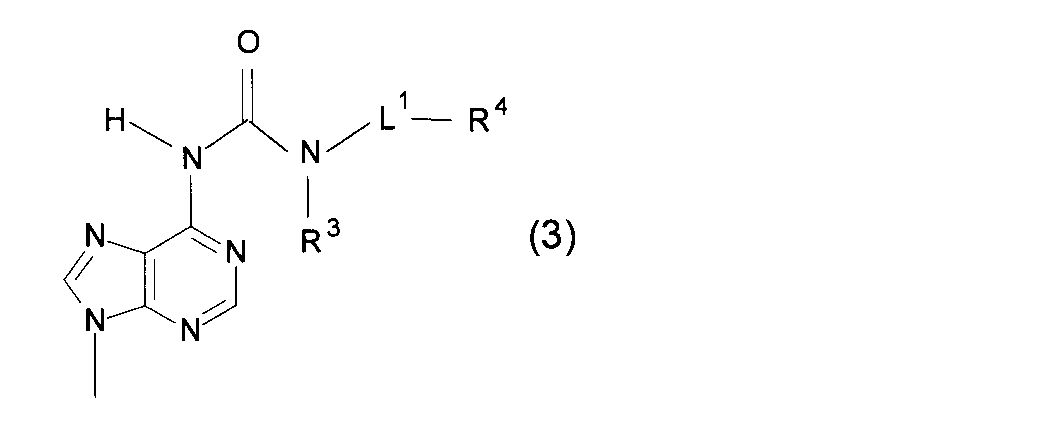
上記一般式(3)において、R3は水素原子又は炭素数1~6個のアルキル基を表わす。アルキル基としては、例えば、メチル、エチル、n-プロピル、イソプロピル、n-ブチル、イソブチル、ブタン-2-イル、n-ペンチル、n-ヘキシルが挙げられるが、これらに限定されない。
L1は炭素数2~6個のアルカン-ジイル基、炭素数4~8個のシクロアルカン-ジイル基、フェニレン基、又はナフチリデン基を表わす。アルカン-ジイル基としては、例えば、炭素数2~6個のアルカンジイル基を表わし、エチレン、プロパン-1,3-ジイル、ブタン-1,4-ジイル、ペンタン-1,5-ジイル、ヘキサン-1,6-ジイル等が挙げられる。また、ブタン-1,3-ジイルなどの分岐した基も含まれる。シクロアルカン-ジイル基とは、例えば、炭素数4~8個のシクロアルカンから導かれる二価の基を意味し、シクロブタン-1,3-ジイル、シクロブタン-1,2-ジイル、シクロペンタン-1,3-ジイル、シクロペンタン-1,2-ジイル、シクロヘキサン-1,2-ジイル、シクロヘキサン-1,3-ジイル、シクロヘキサン-1,4-ジイル等が含まれ、シス、トランスの区別が可能な基についてはその双方が含まれる。フェニレン基はベンゼンから導かれる二価の基を意味し、1,2-フェニレン、1,3-フェニレン、1,4-フェニレン等が含まれる。ナフチリデン基とはナフタレンから導かれる二価の基を意味し、1,2-ナフチリデン、1,3-ナフチリデン、1,4-ナフチリデン、1,5-ナフチリデン、1,6-ナフチリデン、1,7-ナフチリデン、1,8-ナフチリデン、2,3-ナフチリデン、2,6-ナフチリデン、2,7-ナフチリデン等が挙げられる。
R4はカルボキシル基、末端にカルボキシル基を有する炭素数1~6個のアルキル基、一般式(4)で表わされる基、又は末端に一般式(4)で表わされる基を有する炭素数1~6個のアルキル基を表わす。ここで、アルキル基としては、上述したものが挙げられる。
L1は炭素数2~6個のアルカン-ジイル基、炭素数4~8個のシクロアルカン-ジイル基、フェニレン基、又はナフチリデン基を表わす。アルカン-ジイル基としては、例えば、炭素数2~6個のアルカンジイル基を表わし、エチレン、プロパン-1,3-ジイル、ブタン-1,4-ジイル、ペンタン-1,5-ジイル、ヘキサン-1,6-ジイル等が挙げられる。また、ブタン-1,3-ジイルなどの分岐した基も含まれる。シクロアルカン-ジイル基とは、例えば、炭素数4~8個のシクロアルカンから導かれる二価の基を意味し、シクロブタン-1,3-ジイル、シクロブタン-1,2-ジイル、シクロペンタン-1,3-ジイル、シクロペンタン-1,2-ジイル、シクロヘキサン-1,2-ジイル、シクロヘキサン-1,3-ジイル、シクロヘキサン-1,4-ジイル等が含まれ、シス、トランスの区別が可能な基についてはその双方が含まれる。フェニレン基はベンゼンから導かれる二価の基を意味し、1,2-フェニレン、1,3-フェニレン、1,4-フェニレン等が含まれる。ナフチリデン基とはナフタレンから導かれる二価の基を意味し、1,2-ナフチリデン、1,3-ナフチリデン、1,4-ナフチリデン、1,5-ナフチリデン、1,6-ナフチリデン、1,7-ナフチリデン、1,8-ナフチリデン、2,3-ナフチリデン、2,6-ナフチリデン、2,7-ナフチリデン等が挙げられる。
R4はカルボキシル基、末端にカルボキシル基を有する炭素数1~6個のアルキル基、一般式(4)で表わされる基、又は末端に一般式(4)で表わされる基を有する炭素数1~6個のアルキル基を表わす。ここで、アルキル基としては、上述したものが挙げられる。
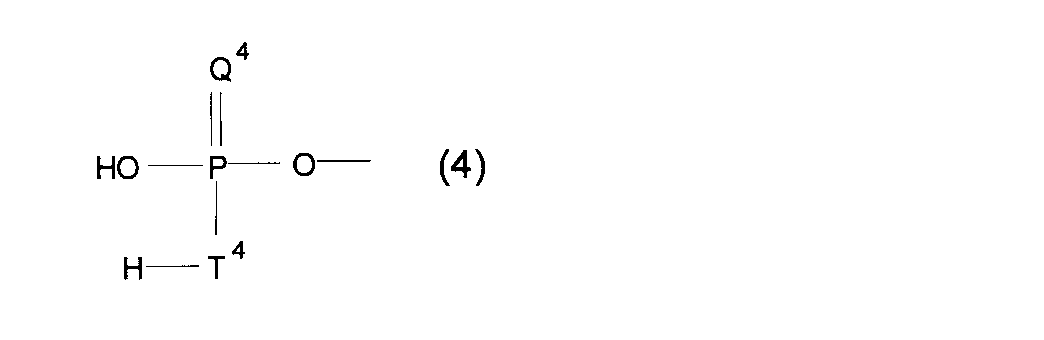
上記一般式(4)において、Q4及びT4は、互いに同一であっても異なっていてもよく、酸素原子又は硫黄原子を表わす。

上記一般式(5)において、R4は水素原子又は炭素数1~6個のアルキル基を表わす。アルキル基としては、例えば、メチル、エチル、n-プロピル、イソプロピル、n-ブチル、イソブチル、ブタン-2-イル、n-ペンチル、n-ヘキシルが挙げられるが、これらに限定されない。Zは水素原子又は炭素数1~6個のアルキル基を表わす。アルキル基としては、例えば、メチル、エチル、n-プロピル、イソプロピル、n-ブチル、イソブチル、ブタン-2-イル、n-ペンチル、n-ヘキシルが挙げられるが、これらに限定されない。
L2は炭素数2~6個のアルカン-ジイル基、炭素数4~8個のシクロアルカン-ジイル基、フェニレン基、又はナフチリデン基を表わす。アルカン-ジイル基としては、例えば、炭素数2~6個のアルカンジイル基を表わし、エチレン、プロパン-1,3-ジイル、ブタン-1,4-ジイル、ペンタン-1,5-ジイル、ヘキサン-1,6-ジイル等が挙げられる。また、ブタン-1,3-ジイルなどの分岐した基も含まれる。シクロアルカン-ジイル基とは、例えば、炭素数4~8個のシクロアルカンから導かれる二価の基を意味し、シクロブタン-1,3-ジイル、シクロブタン-1,2-ジイル、シクロペンタン-1,3-ジイル、シクロペンタン-1,2-ジイル、シクロヘキサン-1,2-ジイル、シクロヘキサン-1,3-ジイル、シクロヘキサン-1,4-ジイル等が含まれ、シス、トランスの区別が可能な基についてはその双方が含まれる。フェニレン基はベンゼンから導かれる二価の基を意味し、1,2-フェニレン、1,3-フェニレン、1,4-フェニレン等が含まれる。ナフチリデン基とはナフタレンから導かれる二価の基を意味し、1,2-ナフチリデン、1,3-ナフチリデン、1,4-ナフチリデン、1,5-ナフチリデン、1,6-ナフチリデン、1,7-ナフチリデン、1,8-ナフチリデン、2,3-ナフチリデン、2,6-ナフチリデン、2,7-ナフチリデン等が挙げられる。
R5はカルボキシル基、末端にカルボキシル基を有する炭素数1~6個のアルキル基、一般式(4)で表わされる基、又は末端に一般式(4)で表わされる基を有する炭素数1~6個のアルキル基を表わす。ここで、アルキル基としては、上述したものが挙げられる。
L2は炭素数2~6個のアルカン-ジイル基、炭素数4~8個のシクロアルカン-ジイル基、フェニレン基、又はナフチリデン基を表わす。アルカン-ジイル基としては、例えば、炭素数2~6個のアルカンジイル基を表わし、エチレン、プロパン-1,3-ジイル、ブタン-1,4-ジイル、ペンタン-1,5-ジイル、ヘキサン-1,6-ジイル等が挙げられる。また、ブタン-1,3-ジイルなどの分岐した基も含まれる。シクロアルカン-ジイル基とは、例えば、炭素数4~8個のシクロアルカンから導かれる二価の基を意味し、シクロブタン-1,3-ジイル、シクロブタン-1,2-ジイル、シクロペンタン-1,3-ジイル、シクロペンタン-1,2-ジイル、シクロヘキサン-1,2-ジイル、シクロヘキサン-1,3-ジイル、シクロヘキサン-1,4-ジイル等が含まれ、シス、トランスの区別が可能な基についてはその双方が含まれる。フェニレン基はベンゼンから導かれる二価の基を意味し、1,2-フェニレン、1,3-フェニレン、1,4-フェニレン等が含まれる。ナフチリデン基とはナフタレンから導かれる二価の基を意味し、1,2-ナフチリデン、1,3-ナフチリデン、1,4-ナフチリデン、1,5-ナフチリデン、1,6-ナフチリデン、1,7-ナフチリデン、1,8-ナフチリデン、2,3-ナフチリデン、2,6-ナフチリデン、2,7-ナフチリデン等が挙げられる。
R5はカルボキシル基、末端にカルボキシル基を有する炭素数1~6個のアルキル基、一般式(4)で表わされる基、又は末端に一般式(4)で表わされる基を有する炭素数1~6個のアルキル基を表わす。ここで、アルキル基としては、上述したものが挙げられる。
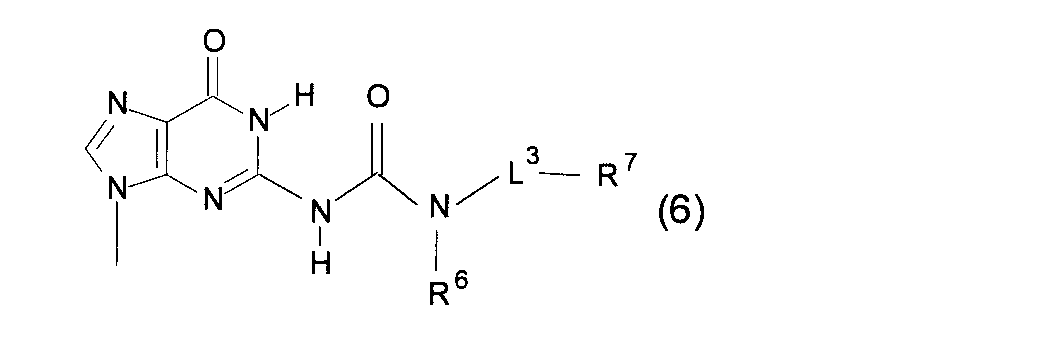
上記一般式(6)において、R6は水素原子又は炭素数1~6個のアルキル基を表わす。アルキル基としては、例えば、メチル、エチル、n-プロピル、イソプロピル、n-ブチル、イソブチル、ブタン-2-イル、n-ペンチル、n-ヘキシルが挙げられるが、これらに限定されない。
L3は炭素数2~6個のアルカン-ジイル基、炭素数4~8個のシクロアルカン-ジイル基、フェニレン基、又はナフチリデン基を表わす。アルカン-ジイル基としては、例えば、炭素数2~6個のアルカンジイル基を表わし、エチレン、プロパン-1,3-ジイル、ブタン-1,4-ジイル、ペンタン-1,5-ジイル、ヘキサン-1,6-ジイル等が挙げられる。また、ブタン-1,3-ジイルなどの分岐した基も含まれる。シクロアルカン-ジイル基とは、例えば、炭素数4~8個のシクロアルカンから導かれる二価の基を意味し、シクロブタン-1,3-ジイル、シクロブタン-1,2-ジイル、シクロペンタン-1,3-ジイル、シクロペンタン-1,2-ジイル、シクロヘキサン-1,2-ジイル、シクロヘキサン-1,3-ジイル、シクロヘキサン-1,4-ジイル等が含まれ、シス、トランスの区別が可能な基についてはその双方が含まれる。フェニレン基はベンゼンから導かれる二価の基を意味し、1,2-フェニレン、1,3-フェニレン、1,4-フェニレン等が含まれる。ナフチリデン基とはナフタレンから導かれる二価の基を意味し、1,2-ナフチリデン、1,3-ナフチリデン、1,4-ナフチリデン、1,5-ナフチリデン、1,6-ナフチリデン、1,7-ナフチリデン、1,8-ナフチリデン、2,3-ナフチリデン、2,6-ナフチリデン、2,7-ナフチリデン等が挙げられる。
R7はカルボキシル基、末端にカルボキシル基を有する炭素数1~6個のアルキル基、一般式(4)で表わされる基、又は末端に一般式(4)で表わされる基を有する炭素数1~6個のアルキル基を表わす。ここで、アルキル基としては、上述したものが挙げられる。
L3は炭素数2~6個のアルカン-ジイル基、炭素数4~8個のシクロアルカン-ジイル基、フェニレン基、又はナフチリデン基を表わす。アルカン-ジイル基としては、例えば、炭素数2~6個のアルカンジイル基を表わし、エチレン、プロパン-1,3-ジイル、ブタン-1,4-ジイル、ペンタン-1,5-ジイル、ヘキサン-1,6-ジイル等が挙げられる。また、ブタン-1,3-ジイルなどの分岐した基も含まれる。シクロアルカン-ジイル基とは、例えば、炭素数4~8個のシクロアルカンから導かれる二価の基を意味し、シクロブタン-1,3-ジイル、シクロブタン-1,2-ジイル、シクロペンタン-1,3-ジイル、シクロペンタン-1,2-ジイル、シクロヘキサン-1,2-ジイル、シクロヘキサン-1,3-ジイル、シクロヘキサン-1,4-ジイル等が含まれ、シス、トランスの区別が可能な基についてはその双方が含まれる。フェニレン基はベンゼンから導かれる二価の基を意味し、1,2-フェニレン、1,3-フェニレン、1,4-フェニレン等が含まれる。ナフチリデン基とはナフタレンから導かれる二価の基を意味し、1,2-ナフチリデン、1,3-ナフチリデン、1,4-ナフチリデン、1,5-ナフチリデン、1,6-ナフチリデン、1,7-ナフチリデン、1,8-ナフチリデン、2,3-ナフチリデン、2,6-ナフチリデン、2,7-ナフチリデン等が挙げられる。
R7はカルボキシル基、末端にカルボキシル基を有する炭素数1~6個のアルキル基、一般式(4)で表わされる基、又は末端に一般式(4)で表わされる基を有する炭素数1~6個のアルキル基を表わす。ここで、アルキル基としては、上述したものが挙げられる。

上記一般式(7)において、L4、L5は同一であっても異なっていてもよく炭素数2~6個のアルカン-ジイル基、炭素数4~8個のシクロアルカン-ジイル基、フェニレン基、又はナフチリデン基を表わす。アルカン-ジイル基としては、例えば、炭素数2~6個のアルカンジイル基を表わし、エチレン、プロパン-1,3-ジイル、ブタン-1,4-ジイル、ペンタン-1,5-ジイル、ヘキサン-1,6-ジイル等が挙げられる。また、ブタン-1,3-ジイルなどの分岐した基も含まれる。シクロアルカン-ジイル基とは、例えば、炭素数4~8個のシクロアルカンから導かれる二価の基を意味し、シクロブタン-1,3-ジイル、シクロブタン-1,2-ジイル、シクロペンタン-1,3-ジイル、シクロペンタン-1,2-ジイル、シクロヘキサン-1,2-ジイル、シクロヘキサン-1,3-ジイル、シクロヘキサン-1,4-ジイル等が含まれ、シス、トランスの区別が可能な基についてはその双方が含まれる。フェニレン基はベンゼンから導かれる二価の基を意味し、1,2-フェニレン、1,3-フェニレン、1,4-フェニレン等が含まれる。ナフチリデン基とはナフタレンから導かれる二価の基を意味し、1,2-ナフチリデン、1,3-ナフチリデン、1,4-ナフチリデン、1,5-ナフチリデン、1,6-ナフチリデン、1,7-ナフチリデン、1,8-ナフチリデン、2,3-ナフチリデン、2,6-ナフチリデン、2,7-ナフチリデン等が挙げられる。
R8、R9は同一であっても異なっていてもよく、カルボキシル基、末端にカルボキシル基を有する炭素数1~6個のアルキル基、一般式(3)で表わされる基、又は末端に一般式(3)で表わされる基を有する炭素数1~6個のアルキル基を表わす。ここで、アルキル基とは、上述したものが挙げられる。
R8、R9は同一であっても異なっていてもよく、カルボキシル基、末端にカルボキシル基を有する炭素数1~6個のアルキル基、一般式(3)で表わされる基、又は末端に一般式(3)で表わされる基を有する炭素数1~6個のアルキル基を表わす。ここで、アルキル基とは、上述したものが挙げられる。
上記一般式(1)において、Y1は、水酸基、水素原子,フッ素原子、又は置換基を有していてもよいアルコキシ基を表す。アルコキシ基としては、炭素数が1~6個のアルコキシ基が好ましく、このようなアルコキシ基としては、例えば、メトキシ基、エトキシ基、プロポキシ基、プロパン-1-イルオキシ基、ブタン-1-イルオキシ基、1-ブチルオキシ基、1-ペンチルオキシ基、1-ヘキシルオキシ基等が挙げられ、また、2-プロピルオキシ基、イソブチルオキシ基等のように分枝したアルコキシ基、シクロプロピルオキシ基、シクロブチルオキシ基、シクロペンチルオキシ基、シクロヘキシルオキシ基、シクロプロピルメチルオキシ基等の、側鎖の一部もしくは全部が環化したアルコキシ基も含む。また、上記置換基としては、例えば、ブロモ、クロロ、ヨード、ヒドロキシル、シアノ、アルコキシ、アミノ、アルキルアミノ、ジアルキルアミノ、アリール、ヘテロアリール等が挙げられる。
上記一般式(1)において、Y2は、水酸基、水素原子、フッ素原子、置換基を有していてもよいアルコキシ基又は一般式(2)で表わされる基である。アルコキシ基としては、上述したものが挙げられる。一般式(2)については上述した通りである。また、上記置換基としては、例えば、ブロモ、クロロ、ヨード、ヒドロキシル、シアノ、アルコキシ、アミノ、アルキルアミノ、ジアルキルアミノ、アリール、ヘテロアリール等が挙げられる。
上記一般式(1)において、Xkは、各kの値に対し、同一であっても異なっていてもよく、それぞれ、水酸基、水素原子、フッ素原子又は置換基を有していてもよいアルコキシ基を表す。アルコキシ基としては、上述したものが挙げられる。また、上記置換基としては、例えば、ブロモ、クロロ、ヨード、ヒドロキシル、シアノ、アルコキシ、アミノ、アルキルアミノ、ジアルキルアミノ、アリール、ヘテロアリール等が挙げられる。
上記一般式(1)において、Bkは、各kの値に対し同一であっても異なっていてもよく、それぞれ天然もしくは非天然型の核酸塩基を表わす。天然もしくは非天然型の核酸塩基としては、W1において説明したものが挙げられる。
上記一般式(1)におけるBkは、検出しようとする核酸に相補的な配列となるなど、適当な結合力を有する配列となるように選択することができる。
上記一般式(1)におけるBkは、検出しようとする核酸に相補的な配列となるなど、適当な結合力を有する配列となるように選択することができる。
上記一般式(1)において、kは1~50の整数であり、好ましくは5~30である。kは、検出しようとするRNA(miRNA等)の鎖長によって変えることができる。すなわち、本発明のオリゴヌクレオチド誘導体は、その末端部にアニオンに解離することが可能な置換基を2個以上有しており、この置換基がアニオンに解離することにより相補鎖RNA又は相補鎖DNAと静電反発が起こり、長い鎖長のものは結合できなくなり、末端部のアニオンとアニオンとの長さのものよりも短いDNA鎖及びRNA鎖のみが、本発明のオリゴヌクレオチド誘導体と結合することができるようになる。従って、検出しようとするmiRNA等の長さによって、kの範囲を変動させることが可能である。
上記一般式(1)において、W2は、天然型もしくは非天然型の核酸塩基、又は一般式(3)、一般式(5)、一般式(6)又は一般式(7)のいずれかで表わされる基を表わす。天然型もしくは非天然型の核酸塩基、一般式(3)、一般式(5)、一般式(6)、又は一般式(7)については、W1において説明したものと同様である。
上記一般式(1)において、Q1及びQ2は同一であっても異なっていてもよく、それぞれ、酸素原子又は硫黄原子を表す。また、上記一般式(1)において、T1及びT2は同一であっても異なっていてもよく、それぞれ、酸素原子又は硫黄原子を表す。
上記一般式(1)において、R2は水酸基又は一般式(2)で表わされる基である。一般式(2)については上述した通りである。
上記一般式(1)において、R1、R2又はY2のうち少なくとも1個は、一般式(2)で表わされる基である。また、上記一般式(1)において、R1が一般式(2)で表わされる基であるときには、W1は一般式(3)、一般式(5)、一般式(6)又は一般式(7)のいずれかで表わされる基であり;R2又はY2が一般式(2)で表わされる基であるときには、W2は一般式(3)、一般式(5)、一般式(6)又は一般式(7)のいずれかで表わされる基である。すなわち、本発明のオリゴヌクレオチド誘導体は、分子の5’末端若しくは3’末端にアニオンに解離することが可能な置換基を2個以上有するものである。
例えば、R1が一般式(2)で表わされる基であるときには、W1は一般式(3)、一般式(5)、一般式(6)又は一般式(7)のいずれかで表わされる基である。すなわち、R1が一般式(2)で表わされる基であるときに、W1には、カルボキシル基、末端にカルボキシル基を有する炭素数1~6個のアルキル基、一般式(4)で表わされる基、又は末端に一般式(4)で表わされる基を有する炭素数1~6個のアルキル基が含まれる。この場合には、オリゴヌクレオチド誘導体分子は、その5’末端に、リン酸基を2個有するか、又はリン酸基とカルボン酸基とを有するので、5’末端にアニオンに解離することが可能な置換基が2個含まれることとなる。
また、R2又はY2が一般式(2)で表わされる基であるときには、W2は一般式(3)、一般式(5)、一般式(6)又は一般式(7)のいずれかで表わされる基であるので、この場合には、R2が一般式(2)で表わされる基であるときに、W1には、カルボキシル基、末端にカルボキシル基を有する炭素数1~6個のアルキル基、一般式(4)で表わされる基、又は末端に一般式(4)で表わされる基を有する炭素数1~6個のアルキル基が含まれ、オリゴヌクレオチド誘導体分子の3’末端に、アニオンに解離することが可能な置換基が2個以上含まれる。R2及びY2の両方が一般式(2)で表わされる基である場合には、オリゴヌクレオチド誘導体分子の3’末端に、アニオンに解離することが可能な置換基が3個含まれることとなる。
なお、本発明のオリゴヌクレオチド誘導体においては、一般式(2)におけるQ3及びT3、一般式(4)におけるQ4及びT4が酸素原子であるもの、すなわち、一般式(2)で表わされる基がリン酸基であるものが挙げられる。また、上記一般式(1)においては、R1及びR2の両方が一般式(2)で表わされる基(又はリン酸基)であってもよい。
なお、本発明のオリゴヌクレオチド誘導体においては、一般式(2)におけるQ3及びT3、一般式(4)におけるQ4及びT4が酸素原子であるもの、すなわち、一般式(2)で表わされる基がリン酸基であるものが挙げられる。また、上記一般式(1)においては、R1及びR2の両方が一般式(2)で表わされる基(又はリン酸基)であってもよい。
本発明のオリゴヌクレオチド誘導体は、その塩の形態であってもよい。本明細書で用いられる塩とは、本発明のヌクレオチド誘導体中に含まれる一部もしくは全てのリン酸基及びカルボキシル基のプロトンが陽イオンに置き換わった化合物を意味する。陽イオンとしては、例えば、アンモニウム、モノアルキルアンモニウム、ジアルキルアンモニウム、トリアルキルアンモニウム、テトラアルキルアンモニウムなどのアンモニウムイオン類および、ナトリウムイオン、カリウムイオン、リチウムイオン、カルシウムイオン、マグネシウムイオン、マンガンイオン、鉄イオン、銅イオンなどの金属イオン類が挙げられる。
本発明のオリゴヌクレオチド誘導体は、その5’末端又は3’末端、若しくはその両方の末端部にアニオンに解離することが可能な置換基を2個以上有しているので、適当な反応条件を設定することにより、末端部にアニオンが生成する。本発明のオリゴヌクレオチド誘導体を用いて、短い相補鎖のみを検出する方法について図面を参照しつつ説明する。図1は、本発明のオリゴヌクレオチド誘導体を用いて、短い相補鎖のみを検出する方法を模式的に示した図である。
図1に示すように、本発明のオリゴヌクレオチド誘導体は、適当な反応条件下では、その末端部にアニオンが生成する。ここに、長い相補鎖と短い相補鎖を混合すると、短い相補鎖(ここで、短い相補鎖とは、、本発明のオリゴヌクレオチド誘導体と相補的な配列を末端にもつ相補鎖を意味し、長い相補鎖とは、本発明のオリゴヌクレオチド誘導体と相補的な配列を非末端部にもつ相補鎖を意味する。)は、本発明のオリゴヌクレオチド誘導体と結合する。一方、長い相補鎖においては、本発明のオリゴヌクレオチド誘導体と結合する相補的な部分を有しているにもかかわらず、本発明のオリゴヌクレオチド誘導体の末端部にアニオンが2個以上存在するため、この部分で静電反発が起こり、長い相補鎖は本発明のオリゴヌクレオチド誘導体と結合することができない。
このような性質を利用することにより、本発明のオリゴヌクレオチド誘導体と細胞から抽出した様々な鎖長及び配列を有する核酸とを反応させることにより、本発明のオリゴヌクレオチドに相補的な配列を有し、かつ鎖長の短い核酸のみと結合させ、鎖長の短い核酸を単離、検出、機能制御することが可能となる。例えば、細胞内に存在する成熟miRNAをPre-mRNAと区別して検出することが可能となる。すなわち、本発明のオリゴヌクレオチド誘導体は、核酸検出プローブとして用いることができる。
なお、適当な反応条件とは、当該技術分野において公知であり、プローブとオリゴヌクレオチドとをハイブリダイズするための条件を意味する。
なお、適当な反応条件とは、当該技術分野において公知であり、プローブとオリゴヌクレオチドとをハイブリダイズするための条件を意味する。
なお、上記適当な条件とは、検出しようとするオリゴヌクレオチド、また、本発明のヌクレオチドの塩基配列や塩基組成等により異なるため、一概には規定できないが、一般的な条件としては下記の通りである。
ハイブリダイゼーションは、96穴又は384穴のプラスチックプレート中で実施してもよい。このようなプレートの穴に、本発明のオリゴヌクレオチドを点着させ、次いで、試料を添加してハイブリダイゼーションを行う。又は、後述する、本発明のオリゴヌクレオチドアレイを用いてもよい。ハイブリダイゼーションは、室温~70℃程度の温度範囲で、6~20時間の範囲で実施することが好ましい。ハイブリダイゼーション終了後、界面活性剤と緩衝液との混合溶液を用いて洗浄を行い、未反応のオリゴヌクレオチドを除去する。界面活性剤としては、ドデシル硫酸ナトリウム(SDS)等が挙げられる。ハイブリダイゼーションを実施する緩衝液としては、例えば、クエン酸緩衝液、リン酸緩衝液、ホウ酸緩衝液、トリス緩衝液、グッド緩衝液等が挙げられる。
本発明のオリゴヌクレオチド誘導体は、当業者に公知の方法、例えばホスホロアミダイト法を用いて製造することができる。ホスホロアミダイト法を実施する際には、公知のホスホロアミダイト化合物を用いることにより、本発明のオリゴヌクレオチド誘導体を製造することができる。具体的には、本明細書の実施例に記載されている方法に従って合成することができる。
ハイブリダイゼーションは、96穴又は384穴のプラスチックプレート中で実施してもよい。このようなプレートの穴に、本発明のオリゴヌクレオチドを点着させ、次いで、試料を添加してハイブリダイゼーションを行う。又は、後述する、本発明のオリゴヌクレオチドアレイを用いてもよい。ハイブリダイゼーションは、室温~70℃程度の温度範囲で、6~20時間の範囲で実施することが好ましい。ハイブリダイゼーション終了後、界面活性剤と緩衝液との混合溶液を用いて洗浄を行い、未反応のオリゴヌクレオチドを除去する。界面活性剤としては、ドデシル硫酸ナトリウム(SDS)等が挙げられる。ハイブリダイゼーションを実施する緩衝液としては、例えば、クエン酸緩衝液、リン酸緩衝液、ホウ酸緩衝液、トリス緩衝液、グッド緩衝液等が挙げられる。
本発明のオリゴヌクレオチド誘導体は、当業者に公知の方法、例えばホスホロアミダイト法を用いて製造することができる。ホスホロアミダイト法を実施する際には、公知のホスホロアミダイト化合物を用いることにより、本発明のオリゴヌクレオチド誘導体を製造することができる。具体的には、本明細書の実施例に記載されている方法に従って合成することができる。
本発明のオリゴヌクレオチド誘導体は、逆転写酵素反応のプライマーとして用いることができる。例えば、RT-PCR法に応用することができる。例えば、RNAを含む試料について、本発明のオリゴヌクレオチド誘導体の存在下に逆転写を行うことにより、miRNAのみが逆転写され、cDNAが合成される、得られたcDNAをRT-PCRにて合成することにより、miRNAにのみ相補的な部分を有するDNAを得ることができる。逆転写、RT-PCRの条件等については従来公知の方法を用いることができる。
本発明のオリゴヌクレオチド誘導体は、更に、以下に説明するような、オリゴヌクレオチドアレイ、医薬品等に用いることができる。更に、本発明のオリゴヌクレオチド誘導体は、PCRやRT-PCRに有用な、逆転写酵素のプライマー、DNAポリメラーゼのプライマー、DNAポリメラーゼのテンプレートとしても用いることができる。
次に、本発明のオリゴヌクレオチドアレイについて説明する。
本発明のオリゴヌクレオチドアレイは、本発明のオリゴヌクレオチド誘導体を固相担体上に固定化してなる。本発明のオリゴヌクレオチドアレイは、特定の塩基配列を有する、短い鎖長(通常、50塩基以下)のオリゴヌクレオチドを検出するために用いられる。従って、固相担体に固定するオリゴヌクレオチド誘導体の塩基配列は、検出しようとする配列の相補的配列を有するものなど、適当な結合力を有する配列となる。一般に、固相担体に固定化されているオリゴヌクレオチド誘導体は、検出しようとするオリゴヌクレオチドとハイブリダイゼーションにより特異的結合により結合する。
本発明のオリゴヌクレオチドアレイは、本発明のオリゴヌクレオチド誘導体を固相担体上に固定化してなる。本発明のオリゴヌクレオチドアレイは、特定の塩基配列を有する、短い鎖長(通常、50塩基以下)のオリゴヌクレオチドを検出するために用いられる。従って、固相担体に固定するオリゴヌクレオチド誘導体の塩基配列は、検出しようとする配列の相補的配列を有するものなど、適当な結合力を有する配列となる。一般に、固相担体に固定化されているオリゴヌクレオチド誘導体は、検出しようとするオリゴヌクレオチドとハイブリダイゼーションにより特異的結合により結合する。
なお、本明細書において、オリゴヌクレオチドアレイを製造する方法としては、固相担体表面で直接オリゴヌクレオチド を合成する方法(オン・チップ法)と、予め調製したオリゴヌクレオチドを固相担体表面に固定する方法とが知られている。本発明におけるオリゴヌクレオチドアレイは、このいずれの方法でも製造することができる。オン・チップ法としては、例えば光照射で選択的に除去される保護基の使用と、半導体製造に利用されるフォトリソグラフィー技術および固相合成技術とを組み合わせて、微少なマトリックスの所定の領域での選択的合成を行う方法(マスキング技術:例えば、Fodor,S.P.A.Science 251:767,1991)等によって行うことができるが、この方法に限定されるものではない。一方、予め調製したオリゴヌクレオチドを固相担体表面に固定する場合には、官能基を導入したオリゴヌクレオチドを合成し、表面処理した固相担体表面にオリゴヌクレオチドを点着し、共有結合させる(例えば、Lamture,J.B.et al.Nucl.Acids Res.22:2121-2125,1994;Guo,Z.et al.Nucl.Acids Res.22:5456-5465,1994)。オリゴヌクレオチドは、一般的には、表面処理した固相担体にスペーサーやクロスリンカーを介して共有結合させる。ガラス表面にポリアクリルアミドゲルの微小片を整列させ、そこに合成オリゴヌクレオチド を共有結合させる方法も知られている(Yershov,G.et al.Proc.Natl.Acad.Sci.USA 94:4913,1996)。
また、ポーラスガラス、ポリスチレンなどの固相担体にあらかじめオリゴヌクレオチドを固相合成法で合成しておき、その固相担体を接着剤などの適当な方法や物理的手法によりガラス基板上に固定化する方法も含まれる。
また、ポーラスガラス、ポリスチレンなどの固相担体にあらかじめオリゴヌクレオチドを固相合成法で合成しておき、その固相担体を接着剤などの適当な方法や物理的手法によりガラス基板上に固定化する方法も含まれる。
用いられる固相担体としては、従来よりDNAチップ及び遺伝子検出用マイクロアレイを製造するために用いられているものを特に制限なく用いることができる。用いられる固相担体としては、例えば、シリコン;微小多孔質ガラス、ポーラスガラス等のガラス;金属;フェライトを芯にグリシンメタクリレートで表面を覆った磁性ビーズ;プラスチック(例えば、ポリエステル樹脂、ポリエチレン樹脂、ポリプロピレン樹脂、アクリロニトリルブタジエンスチレン樹脂、ナイロン、アクリル樹脂、フッ素樹脂、ポリカーボネート樹脂、ポリウレタン樹脂、メチルペンテン樹脂、フェノール樹脂、メラミン樹脂、エポキシ樹脂、塩化ビニル樹脂)等が挙げられる。担体の形状としては、板状(基板状)、ビーズ状、糸状、球状、多角形状、粉末状等、どのような形状のものであってもよい。
上記固相担体は、ダイヤモンドライクカーボンによる表面処理層を形成したものであってもよい。ダイヤモンドライクカーボン(DLC、Diamond Like Carbon)とは、ダイヤモンドとカーボンとの混合体である不完全ダイヤモンド構造体の総称であり、その混合割合は特に限定されない。ダイヤモンドライクカーボンによる表面処理層を形成する場合、その層の厚みは好ましくは1nm~10μmである。
また、本発明のオリゴヌクレオチドを固相担体に共有結合させるためには、固相担体表面にアミノ基が結合しているものを用いてもよい。従って、担体としては、表面にアミノ基が結合しているか、又はアミノ基を結合することのできるものを用いることが好ましい。
次に、本発明の医薬組成物について説明する。本発明の医薬組成物は、上述した本発明のオリゴヌクレオチド誘導体を含む。
本発明のオリゴヌクレオチド誘導体は、上述したように、短い鎖長の相補鎖とのみ結合し、このような短鎖長の相補鎖の機能を制御するために用いることができ、例えば、細胞内に存在する成熟miRNAの制御か可能となり、がん、腫瘍、白血病、悪性リンパ腫、ウイルス感染症、細菌感染症、ヘルペス感染症、メタボリックシンドローム、糖尿病、高脂血症、高血圧、アレルギー性疾患、パーキンソン病、、筋ジストロフィー、神経変性疾患、自己免疫疾患、炎症、ダウン症、アルツハイマー病、筋萎縮症、 ALS、 頸髄損傷、 脊髄損傷、 ギランバレー症、ベーチェット病、 膠原病、リウマチなどの治療薬に用いることができる。従って、本発明は、上述した、本発明のオリゴヌクレオチド誘導体を含む医薬組成物を提供する。
本発明のオリゴヌクレオチド誘導体は、上述したように、短い鎖長の相補鎖とのみ結合し、このような短鎖長の相補鎖の機能を制御するために用いることができ、例えば、細胞内に存在する成熟miRNAの制御か可能となり、がん、腫瘍、白血病、悪性リンパ腫、ウイルス感染症、細菌感染症、ヘルペス感染症、メタボリックシンドローム、糖尿病、高脂血症、高血圧、アレルギー性疾患、パーキンソン病、、筋ジストロフィー、神経変性疾患、自己免疫疾患、炎症、ダウン症、アルツハイマー病、筋萎縮症、 ALS、 頸髄損傷、 脊髄損傷、 ギランバレー症、ベーチェット病、 膠原病、リウマチなどの治療薬に用いることができる。従って、本発明は、上述した、本発明のオリゴヌクレオチド誘導体を含む医薬組成物を提供する。
本発明の医薬組成物は、医薬として許容できる担体の混合などの公知の方法によって製造することができる。本発明の医薬組成物は、それ自体又は適宜の薬理学的に許容される、賦形剤、希釈剤等と混合し、錠剤、カプセル剤、顆粒剤、散剤若しくはシロップ剤等として、又は注射剤、坐剤、貼付剤、若しくは外用剤等として製造することが出来る。
上記医薬組成物は、賦形剤(例えば、乳糖、白糖、葡萄糖、マンニトール、ソルビトール等の糖誘導体;トウモロコシデンプン、バレイショデンプン、αデンプン、デキストリン等のデンプン類;結晶セルロース;アラビアゴム;デキストラン;プルラン;軽質無水ケイ酸、合成ケイ酸アルミニウム、ケイ酸カルシウム、メタケイ酸アルミン酸マグネシウムの等のケイ酸塩誘導体;燐酸水素カルシウム;炭酸カルシウム;硫酸カルシウム、滑沢剤(例えば、ステアリン酸、ステアリン酸カルシウム、ステアリン酸マグネシウム、タルク、コロイドシリカ、ラウリル硫酸ナトリウム、ラウリル硫酸マグネシウム)、結合剤(例えば、ヒドロキシプロピルセルロース、ヒドロキシプロピルメチルセルロース、ポリビニルピロリドン、マクロゴール)、崩壊剤(例えば、低置換度ヒドロキシプロピルセルロース、カルボキシメチルセルロース、カルボキシメチルセルロースカルシウム、内部架橋カルボキシメチルセルロースナトリウム、カルボキシメチルスターチ、カルボキシメチルスターチナトリウム、架橋ポリビニルピロリドン)、乳化剤(例えば、ベントナイト、ビーガム、水酸化マグネシウム、水酸化アルミニウム、ラウリル硫酸ナトリウム、ステアリン酸カルシウム、塩化ベンザルコニウム等の陽イオン界面活性剤、ポリオキシエチレンアルキルエーテル、ポリオキシエチレンソルビタン脂肪酸エステル、ショ糖脂肪酸エステル等の非イオン界面活性剤)、安定剤(メチルパラベン、プロピルパラベン、クロロブタノール、ベンジルアルコール、フェニルエチルアルコール、塩化ベンザルコニウム、フェノール、クレゾール、チメロサール、デヒドロ酢酸、ソルビン酸)、矯味矯臭剤(甘味料、酸味料、香料等)、希釈剤等の添加剤を用いて周知の方法により製造することができる。
上記医薬組成物は、賦形剤(例えば、乳糖、白糖、葡萄糖、マンニトール、ソルビトール等の糖誘導体;トウモロコシデンプン、バレイショデンプン、αデンプン、デキストリン等のデンプン類;結晶セルロース;アラビアゴム;デキストラン;プルラン;軽質無水ケイ酸、合成ケイ酸アルミニウム、ケイ酸カルシウム、メタケイ酸アルミン酸マグネシウムの等のケイ酸塩誘導体;燐酸水素カルシウム;炭酸カルシウム;硫酸カルシウム、滑沢剤(例えば、ステアリン酸、ステアリン酸カルシウム、ステアリン酸マグネシウム、タルク、コロイドシリカ、ラウリル硫酸ナトリウム、ラウリル硫酸マグネシウム)、結合剤(例えば、ヒドロキシプロピルセルロース、ヒドロキシプロピルメチルセルロース、ポリビニルピロリドン、マクロゴール)、崩壊剤(例えば、低置換度ヒドロキシプロピルセルロース、カルボキシメチルセルロース、カルボキシメチルセルロースカルシウム、内部架橋カルボキシメチルセルロースナトリウム、カルボキシメチルスターチ、カルボキシメチルスターチナトリウム、架橋ポリビニルピロリドン)、乳化剤(例えば、ベントナイト、ビーガム、水酸化マグネシウム、水酸化アルミニウム、ラウリル硫酸ナトリウム、ステアリン酸カルシウム、塩化ベンザルコニウム等の陽イオン界面活性剤、ポリオキシエチレンアルキルエーテル、ポリオキシエチレンソルビタン脂肪酸エステル、ショ糖脂肪酸エステル等の非イオン界面活性剤)、安定剤(メチルパラベン、プロピルパラベン、クロロブタノール、ベンジルアルコール、フェニルエチルアルコール、塩化ベンザルコニウム、フェノール、クレゾール、チメロサール、デヒドロ酢酸、ソルビン酸)、矯味矯臭剤(甘味料、酸味料、香料等)、希釈剤等の添加剤を用いて周知の方法により製造することができる。
本発明の医薬組成物を被験者に導入する方法については、コロイド分散系を用いてもよい。コロイド分散系は化合物の生体内の安定性を高める効果や、特定の臓器、組織又は細胞へ化合物を効率的に輸送する効果を奏する。コロイド分散系は、通常用いられるものであれば特に制限はなく、高分子複合体、ナノカプセル、ミクロスフェア、ビーズ、及び水中油系の乳化剤、ミセル、混合ミセル及びリポソームを包含する脂質をベースとする分散系が挙げられる。また、0.2~0.4μmのサイズの単膜リポソームは、巨大分子を含有する水性緩衝液のかなりの割合を被包化することができ、オリゴヌクレオチド誘導体がこの水性内膜に被胞化され、生物学的に活性な形態で脳細胞へ輸送される。リポソームの組成は、通常、脂質、特にリン脂質(相転移温度の高いリン脂質が好ましい)を、ステロイド、特にコレステロールと通常複合したものである。リポソームの製造に有用な脂質の具体れとしては、ホスファチジルグリセロール、ホスファチジルコリン、ホスファチジルセリン、スフィンゴ脂質、ホスファチジルエタノールアミン、セレブロシド及びガングリオシド等のホスファチジル化合物が挙げられる。
本発明のオリゴヌクレオチド誘導体を含む医薬組成物の投与量は症状や年齢等により異なるが、経口投与の場合には、1回当り下限1mg(好適には、30mg)、上限2000mg(好適には、1500mg)を、注射の場合には、1回当り下限0.1mg(好適には、5mg)、上限1000mg(好適には、500mg)を皮下注射、筋肉注射または静脈注射によって投与することができる。
以下、本発明を実施例により更に詳細に説明する。なお、本発明の範囲は、かかる実施例に限定されないことはいうまでもない。
原料合成例1
3’-5’-O-ビス-(tert-ブチルジメチルシリル)-6-N-[N-(トランス-4-ヒドロキシシクロヘキシル)カルバモイル]-2’-O-メチルアデノシンの合成
3’-5’-O-ビス-(tert-ブチルジメチルシリル)-2’-O-メチルアデノシン(1.6g,3.1ミリモル)をピリジン40mLに溶解し、ここにクロロギ酸フェニル(0.85mL,6.8ミリモル)を加え、室温で2.5時間攪拌した。続いて、トランス-4-アミノシクロヘキサノール(1.8g,16ミリモル)を加え、85℃で2.5時間攪拌した。反応系をクロロホルム(50mL)で希釈し、飽和炭酸ナトリウム水溶液(30mL)で3回洗浄した。有機層を無水硫酸ナトリウムで乾燥し、溶媒を減圧下留去し、下記式で表される標題の化合物を得た。本化合物についてはこれ以上の精製は行わずに、以下の原料合成例2の合成に用いた。
原料合成例1
3’-5’-O-ビス-(tert-ブチルジメチルシリル)-6-N-[N-(トランス-4-ヒドロキシシクロヘキシル)カルバモイル]-2’-O-メチルアデノシンの合成
3’-5’-O-ビス-(tert-ブチルジメチルシリル)-2’-O-メチルアデノシン(1.6g,3.1ミリモル)をピリジン40mLに溶解し、ここにクロロギ酸フェニル(0.85mL,6.8ミリモル)を加え、室温で2.5時間攪拌した。続いて、トランス-4-アミノシクロヘキサノール(1.8g,16ミリモル)を加え、85℃で2.5時間攪拌した。反応系をクロロホルム(50mL)で希釈し、飽和炭酸ナトリウム水溶液(30mL)で3回洗浄した。有機層を無水硫酸ナトリウムで乾燥し、溶媒を減圧下留去し、下記式で表される標題の化合物を得た。本化合物についてはこれ以上の精製は行わずに、以下の原料合成例2の合成に用いた。

原料合成例2
3’-5’-O-ビス-(tert-ブチルジメチルシリル)-6-N-[N-[トランス-4-(4-オキソペンタノイルオキシ)シクロヘキシル]カルバモイル]-2’-O-メチルアデノシン
原料合成例1で得られた化合物(2.1g,3.2ミリモル)をジクロロメタン30mLに溶解し、ここにレブリン酸(0.72mL,6.3ミリモル)、N,N’-ジシクロヘキシルカルボジイミド(1.3g,6.3ミリモル)、4-ジメチルアミノピリジン(40mg,0.32ミリモル)を加え、室温で21時間攪拌した。反応系をクロロホルム(50mL)で希釈し、飽和炭酸水素ナトリウム水溶液(30mL)で3回洗浄した。有機層を無水硫酸ナトリウムで乾燥し、溶媒を減圧下留去した。残渣をシリカゲルカラムクロマトグラフィー(クロロホルム-メタノール=4:1,v/v)で精製し、下記式で表される標題の化合物(1.56g,65%)を得た。
3’-5’-O-ビス-(tert-ブチルジメチルシリル)-6-N-[N-[トランス-4-(4-オキソペンタノイルオキシ)シクロヘキシル]カルバモイル]-2’-O-メチルアデノシン
原料合成例1で得られた化合物(2.1g,3.2ミリモル)をジクロロメタン30mLに溶解し、ここにレブリン酸(0.72mL,6.3ミリモル)、N,N’-ジシクロヘキシルカルボジイミド(1.3g,6.3ミリモル)、4-ジメチルアミノピリジン(40mg,0.32ミリモル)を加え、室温で21時間攪拌した。反応系をクロロホルム(50mL)で希釈し、飽和炭酸水素ナトリウム水溶液(30mL)で3回洗浄した。有機層を無水硫酸ナトリウムで乾燥し、溶媒を減圧下留去した。残渣をシリカゲルカラムクロマトグラフィー(クロロホルム-メタノール=4:1,v/v)で精製し、下記式で表される標題の化合物(1.56g,65%)を得た。

1H-NMR(CDCl3)δ0.10-0.11(12H,m),0.93-0.94(18H,m),1.45-1.53(4H,m),2.01-2.03(2H,m),2.15-2.17(2H,m),2.19(3H,m),2.57-2.58(2H,m),2.74-2.76(2H,m),3.48(3H,s),3.77-3.80(1H,m)3.84(1H,m),3.98-4.01(1H,m),4.12-4.15(2H,m),4.52(1H,t,J=4.9 Hz),4.77-4.81(1H,m),6.17(1H,d,J=3.9 Hz),7.84(1H,s),8.31(1H,s),8.51(1H,s),9.39(1H,d,J=7.6 Hz)
原料合成例3
6-N-[N-(トランス-4-(4-オキソペンタノイルオキシ)シクロヘキシル]カルバモイル]-2’-O-メチルアデノシン
原料合成例2で得られた化合物(1.6g,2.1ミリモル)をピリジン20mLに溶解し、ここにトリエチルアミントリヒドロフルオリド(1.8mL,11ミリモル)、トリエチルアミン(1.5mL,11ミリモル)を加え、室温で3日間攪拌した。反応系をクロロホルム(50mL)で希釈し、飽和炭酸水素ナトリウム水溶液(30mL)で3回洗浄した。有機層を無水硫酸ナトリウムで乾燥し、溶媒を減圧下留去した。残渣をシリカゲルカラムクロマトグラフィー(クロロホルム-メタノール=98:2,v/v)で精製し、下記式で表される標題の化合物(0.98 g,91%)を得た。
6-N-[N-(トランス-4-(4-オキソペンタノイルオキシ)シクロヘキシル]カルバモイル]-2’-O-メチルアデノシン
原料合成例2で得られた化合物(1.6g,2.1ミリモル)をピリジン20mLに溶解し、ここにトリエチルアミントリヒドロフルオリド(1.8mL,11ミリモル)、トリエチルアミン(1.5mL,11ミリモル)を加え、室温で3日間攪拌した。反応系をクロロホルム(50mL)で希釈し、飽和炭酸水素ナトリウム水溶液(30mL)で3回洗浄した。有機層を無水硫酸ナトリウムで乾燥し、溶媒を減圧下留去した。残渣をシリカゲルカラムクロマトグラフィー(クロロホルム-メタノール=98:2,v/v)で精製し、下記式で表される標題の化合物(0.98 g,91%)を得た。

1H-NMR(CDCl3)δ1.48-1.55(4H,m),2.02-2.04(2H,m),2.15-2.17(2H,m),2.19(3H,m),2.56-2.58(2H,m),2.70(1H,s),2.74-2.76(2H,m),3.35(3H,s),3.76-3.81(1H,m),3.85(1H,m),3.96-3.98(1H,m),4.37(1H,s),4.58-4.59(1H,m),4.67(1H,t,J = 4.9 Hz),4.69-4.78(1H,m),5.90(1H,d,J = 7.3 Hz),5.98(1H,d,J = 10.0 Hz),8.01(1H,s),8.02(1H,s),8.51(1H,s),9.26(1H,d,J = 7.3 Hz)
原料合成例4
5’-O-(4,4’-ジメトキシトリチル)-6-N-[N-(トランス-4-(4-オキソペンタノイルオキシ)シクロヘキシル)カルバモイル]-2’-O-メチルアデノシ
原料合成例3で得られた化合物(0.98g,1.9ミリモル)をピリジン10mLに溶解し、ここに4,4’-ジメトキシトリチルクロリド(0.77g,2.3ミリモル)を加え、室温で3時間攪拌した。反応系をクロロホルム(50mL)で希釈し、飽和炭酸水素ナトリウム水溶液(30mL)で3回洗浄した。有機層を無水硫酸ナトリウムで乾燥し、溶媒を減圧下留去した。残渣をシリカゲルカラムクロマトグラフィー(ヘキサン-クロロホルム=1:4,v/v)で精製し、下記式で表される標題の化合物(1.1g,70%)を得た。
5’-O-(4,4’-ジメトキシトリチル)-6-N-[N-(トランス-4-(4-オキソペンタノイルオキシ)シクロヘキシル)カルバモイル]-2’-O-メチルアデノシ
原料合成例3で得られた化合物(0.98g,1.9ミリモル)をピリジン10mLに溶解し、ここに4,4’-ジメトキシトリチルクロリド(0.77g,2.3ミリモル)を加え、室温で3時間攪拌した。反応系をクロロホルム(50mL)で希釈し、飽和炭酸水素ナトリウム水溶液(30mL)で3回洗浄した。有機層を無水硫酸ナトリウムで乾燥し、溶媒を減圧下留去した。残渣をシリカゲルカラムクロマトグラフィー(ヘキサン-クロロホルム=1:4,v/v)で精製し、下記式で表される標題の化合物(1.1g,70%)を得た。
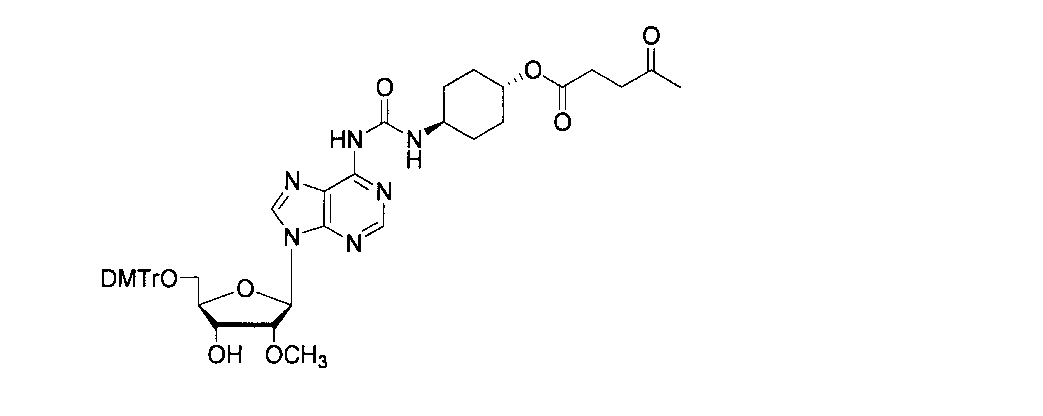
1H-NMR(CDCl3)δ1.47-1.53(4H,m),2.01-2.03(2H,m),2.15-2.17(2H,m),2.56-2.61(3H,m),2.74-2.77(2H,m),3.42-3.44(1H,m),3.51-3.52(1H,m),3.57(3H,s),3.79(6H,s),4.20(1H,s),4.39-4.40(1H,m),4.50-4.51(1H,m),4.79(1H,m),6.17(1H,d,J=3.4 Hz),6.81(4H,d,J=8.3 Hz),7.22-7.43(9H,m),7.87(1H,s),8.14(1H,s),8.45(1H,s),9.37(1H,d,J=7.6 Hz)
原料合成例5
5’-O-(4,4’-ジメトキシトリチル)-6-N-[N-(トランス-4-(4-オキソペンタノイルオキシ)シクロヘキシル)カルバモイル]-2’-O-メチルアデノシ 3’-(2-シアノエチル N, N-ジイソプロピルホスホロアミダイト)
原料合成例4で得られた化合物(250mg,0.30ミリモル)をジクロロメタン4.4mLに溶解し、ここにジイソプロピルエチルアミン(261μL,1.5ミリモル)、2-シアノエチルジイソプロピルクロロホスホロアミジト(177mg,0.75ミリモル)を加え、室温で6時間攪拌した。反応系をクロロホルム(50mL)で希釈し、飽和炭酸水素ナトリウム水溶液(30mL)で3回洗浄した。濃縮後、さらにジイソプロピルエーテル-ジエチルエーテル=1:2,v/vの溶液50mLに溶解させ、2%炭酸ナトリウム水溶液で10回洗浄した。有機層を無水硫酸ナトリウムで乾燥し、溶媒を減圧下留去した。続いてゲル濾過カラムを用いて精製を行い、下記式で表される標題の化合物(223 mg,73%)を得た。
5’-O-(4,4’-ジメトキシトリチル)-6-N-[N-(トランス-4-(4-オキソペンタノイルオキシ)シクロヘキシル)カルバモイル]-2’-O-メチルアデノシ 3’-(2-シアノエチル N, N-ジイソプロピルホスホロアミダイト)
原料合成例4で得られた化合物(250mg,0.30ミリモル)をジクロロメタン4.4mLに溶解し、ここにジイソプロピルエチルアミン(261μL,1.5ミリモル)、2-シアノエチルジイソプロピルクロロホスホロアミジト(177mg,0.75ミリモル)を加え、室温で6時間攪拌した。反応系をクロロホルム(50mL)で希釈し、飽和炭酸水素ナトリウム水溶液(30mL)で3回洗浄した。濃縮後、さらにジイソプロピルエーテル-ジエチルエーテル=1:2,v/vの溶液50mLに溶解させ、2%炭酸ナトリウム水溶液で10回洗浄した。有機層を無水硫酸ナトリウムで乾燥し、溶媒を減圧下留去した。続いてゲル濾過カラムを用いて精製を行い、下記式で表される標題の化合物(223 mg,73%)を得た。

1H-NMR(CDCl3)δ1.06-1.25(12H,m),1.45-1.56(4H,m),2.01-2.03(2H,m),2.15-2.17(2H,m),2.20(3H,m),2.38(1H,t,J=6.1 Hz),2.56-2.57(2H,m),2.64(1H,t,J=6.4 Hz),2.74-2.76(2H,m),2.33-2.36(1H,m),2.37-2.51(3H,m),3.54-3.67(4H,m),3.78-3.79(6H,m),3.85-3.92(1H,m),4.34-4.40(1H,m),4.56-4.57(1H,m),4.60-4.64(1H,m),4.79(1H,m),6.11-6.13(1H,m),6.78-6.81(4H,m),7.22-7.44(9H,m),7.84(1H,s),8.08-8.13(1H,m),8.42-8.43(1H,m),9.37(1H,d,J=7.1 Hz)
実施例1
オリゴヌクレオチド5’-(dA*)CAACCUACU-3’(配列番号:1)の合成
標題の化合物において、下線部のヌクレオチド残基は2’-O-メチル-リボヌクレオチド残基を表し、dA*は下記式で表されるヌクレオチド残基を表す。
オリゴヌクレオチド5’-(dA*)CAACCUACU-3’(配列番号:1)の合成
標題の化合物において、下線部のヌクレオチド残基は2’-O-メチル-リボヌクレオチド残基を表し、dA*は下記式で表されるヌクレオチド残基を表す。
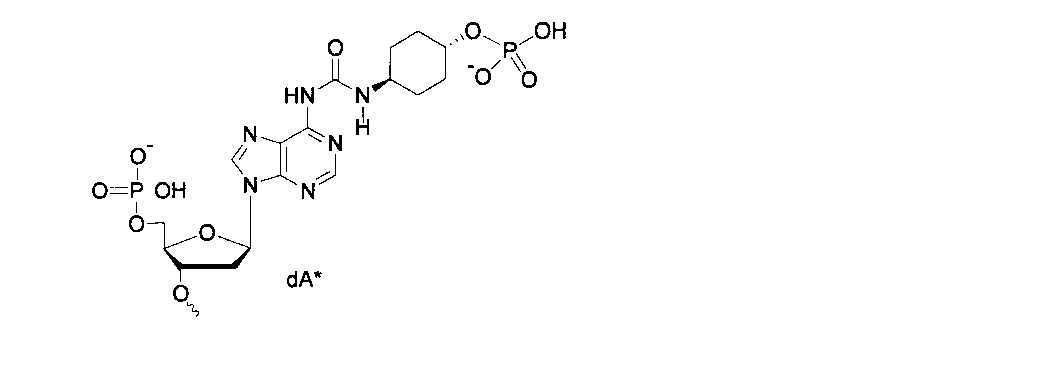
グレンリサーチ社より購入した2’-O-メチルウリジンを担持した固相担体(1μmol)およびグレンリサーチ社より購入した2’-O-メチルRNA ホスホロアミダイト試薬を用い、ABI-392DNA/RNA合成機の標準的な1.0μmolスケールRNA合成プロトコールにて固相担体上に5’末端の水酸基にDMTr基を有し、核酸塩基部およびリン酸部が保護された2’-O-メチルRNA:CAACCUACUを合成した。次いで、固相担体をグラスフィルターに移し、固相担体を塩化メチレンで希釈した3%トリクロロ酢酸で洗浄することによりDMTr基を除去した。次いで、後述するホスホロアミダイト化合物5(40mg,40μmol)をアセトニトリルに溶解した0.25Mアクチベーター42(400μL,100μmol)を加え、アルゴン雰囲気下室温で15分反応させた。溶液を除去し、グラスフィルター上に残った固相担体を乾燥アセトニトリルで洗浄した。次いで、固相担体を0.02Mヨウ素/THF-ピリジン-水溶液を用いて処理し、引き続き、固相担体を塩化メチレンで希釈した3%トリクロロ酢酸で処理してDMTr基を除去し、オリゴヌクレオチドを得た。
次いで、得られたオリゴヌクレオチドに対して、50当量のヒドラジン(ピリジン-酢酸、3:2,V/V 溶液)を加え、室温で15分間放置することにより、Lev基を除去した。溶液を除去し、グラスフィルター上に残った固相担体を塩化メチレンで洗浄した。ついで、グレンリサーチ社より購入したホスファリンク試薬(50当量)を1H-テトラゾール(100当量)の存在下に2分間反応させた。ホスファリンク試薬との反応を更に1度繰り返した後、常法によるヨウ素酸化を行い、固相担体を塩化メチレンで希釈した3%トリクロロ酢酸で処理してDMTr基を除去し、ついで濃アンモニア水を加え、室温で17時間攪拌した。アンモニア水を留去した後、得られた目的物の粗精製物を陰イオン交換HPLCで精製して標題の化合物を得た。標題の化合物の構造はMALDI-TOF 質量分析により確認した。
5’-(dA*)CAACCUACU-3’ (配列番号:1)MALDI-TOFマス Calcd 3498.63 Found 3500.03
5’-(dA*)CAACCUACU-3’ (配列番号:1)MALDI-TOFマス Calcd 3498.63 Found 3500.03
実施例2
オリゴヌクレオチド5’-(dA*)CAACCTACT-3’(配列番号:2)の合成
ここで下線部のヌクレオチド残基はデオキシリボヌクレオチド残基を表す。
2’-O-メチルRNAホスホロアミダイトに代え、DNAホスホロアミダイトを用いた以外は実施例1と同様に操作を行い、標題の化合物を合成した。目的物の構造はMALDI-TOF 質量分析により確認した。
5’-(dA*)CAACCTACT-3’(配列番号:2)MALDI-TOFマス Calcd 3256.5711 Found 3258.81
オリゴヌクレオチド5’-(dA*)CAACCTACT-3’(配列番号:2)の合成
ここで下線部のヌクレオチド残基はデオキシリボヌクレオチド残基を表す。
2’-O-メチルRNAホスホロアミダイトに代え、DNAホスホロアミダイトを用いた以外は実施例1と同様に操作を行い、標題の化合物を合成した。目的物の構造はMALDI-TOF 質量分析により確認した。
5’-(dA*)CAACCTACT-3’(配列番号:2)MALDI-TOFマス Calcd 3256.5711 Found 3258.81
実施例3
オリゴヌクレオチド5’-(Am*)CAACCUACU-3’(配列番号:3)の合成
ここで下線部のヌクレオチド残基は2’-O-メチル-リボヌクレオチド残基を表す。Am*は下図で示すヌクレオチド残基を表す。
オリゴヌクレオチド5’-(Am*)CAACCUACU-3’(配列番号:3)の合成
ここで下線部のヌクレオチド残基は2’-O-メチル-リボヌクレオチド残基を表す。Am*は下図で示すヌクレオチド残基を表す。
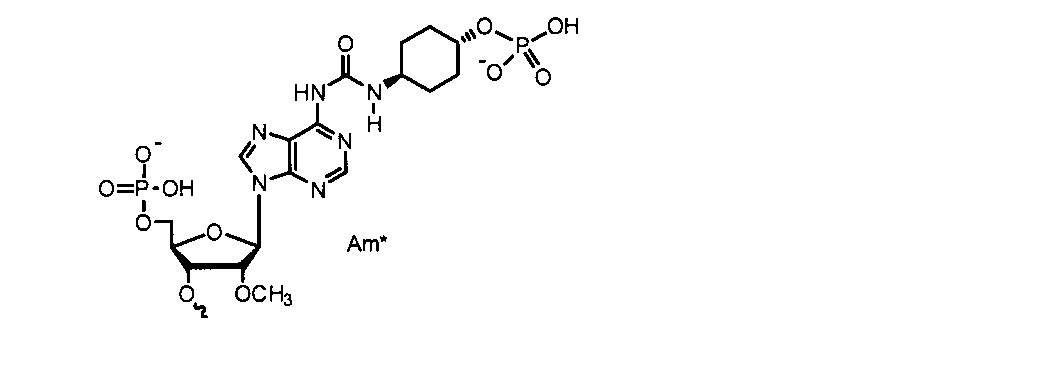
グレンリサーチ社より購入した2’-O-メチルウリジンを担持した固相担体(1.0 μmol)およびグレンリサーチ社より購入した2’-O-メチルRNA ホスホロアミダイト試薬を用い、ABI-392DNA/RNA合成機の標準的な1.0μmolスケールRNA合成プロトコールにて固相担体上に5’末端の水酸基にDMTr基を有し、核酸塩基部およびリン酸部が保護された5’-CAACCUACUを合成した。次いで、固相担体の半分(0.5μmol)をグラスフィルターに移し、固相担体を塩化メチレンで希釈した3%トリクロロ酢酸で洗浄することによりDMTr基を除去した。次いで、原料合成例5で得られた化合物(25 mg,25μmol)および、アセトニトリルに溶解した0.25Mアクチベーター42(250μL,62.5μmol)を加え、アルゴン雰囲気下室温で15分反応させた。溶液を除去し、グラスフィルター上に残った固相担体を乾燥アセトニトリルで洗浄した。次いで、固相担体を0.02Mヨウ素/THF-ピリジン-水溶液を用いて処理し、引き続き、固相担体を塩化メチレンで希釈した3%トリクロロ酢酸で処理してDMTr基を除去し、オリゴヌクレオチドを得た。
次いで、得られたオリゴヌクレオチドに対して、50当量のヒドラジン(ピリジン-酢酸、3:2,V/V 溶液)を加え、室温で15分間放置することにより、Lev基を除去した。溶液を除去し、グラスフィルター上に残った固相担体を塩化メチレンで洗浄した。次いで、グレンリサーチ社より購入したホスファリンク試薬(50当量)を1H-テトラゾール(100当量)の存在下2分間反応させた。ホスファリンク試薬との反応を更に1度繰り返した後、常法によるヨウ素酸化を行い、固相担体を塩化メチレンで希釈した3%トリクロロ酢酸で処理してDMTr基を除去し、次いで濃アンモニア水を加え、室温で17時間攪拌した。アンモニア水を留去した後、得られた目的物の粗精製物を陰イオン交換HPLCで精製して目的物を得た。目的物の構造はMALDI-TOF 質量分析により確認した。
5’-(Am*)CAACCUACU-3’(配列番号:3) MALDI-TOFマス Calcd 3528.6455 Found 3530.316
5’-(Am*)CAACCUACU-3’(配列番号:3) MALDI-TOFマス Calcd 3528.6455 Found 3530.316
比較例1
オリゴヌクレオチド5’-(dA#)CAACCUACU-3’(配列番号:4)の合成
標記化合物においては、ここで下線部のヌクレオチド残基は2’-O-メチル-リボヌクレオチド残基を表し、dA#は下記式で表されるヌクレオチド残基を表す。
オリゴヌクレオチド5’-(dA#)CAACCUACU-3’(配列番号:4)の合成
標記化合物においては、ここで下線部のヌクレオチド残基は2’-O-メチル-リボヌクレオチド残基を表し、dA#は下記式で表されるヌクレオチド残基を表す。

上記オリゴヌクレオチドを合成するために、以下に示す化合物1~4を合成した。
化合物1(3’-5’-O-ビス-(t-ブチルジメチルシリル)- N6-[N-(トランス-4-ヒドロキシシクロヘキシル)カルバモイル]デオキシアデノシン)の合成
3’-5’-O-ビス-(t-ブチルジメチルシリル)デオキシアデノシン(3.0g,6.25ミリモル)をピリジン63mlに溶解させた後、クロロ炭酸フェニル(1.72ml,13.8ミリモル)を加え、室温で2時間反応させた。次いで、抽出操作を行わずにトランス-4-アミノシクロヘキサノール(3.6g,31.3ミリモル)を加え、85℃で30分間反応させた。反応終了後、溶媒を減圧下留去してクロロホルムに溶解させた後、飽和炭酸水素ナトリウムで抽出操作を行った。有機層を集め、硫酸ナトリウムを加え乾燥させた後、濾過し溶媒を減圧下留去した。得られた残渣を、展開溶媒としてヘキサン/クロロホルムを用いてNHシリカゲルクロマトグラフィーにより精製し、下記式で表される標題の化合物(2.95g,76%)を得た。
化合物1(3’-5’-O-ビス-(t-ブチルジメチルシリル)- N6-[N-(トランス-4-ヒドロキシシクロヘキシル)カルバモイル]デオキシアデノシン)の合成
3’-5’-O-ビス-(t-ブチルジメチルシリル)デオキシアデノシン(3.0g,6.25ミリモル)をピリジン63mlに溶解させた後、クロロ炭酸フェニル(1.72ml,13.8ミリモル)を加え、室温で2時間反応させた。次いで、抽出操作を行わずにトランス-4-アミノシクロヘキサノール(3.6g,31.3ミリモル)を加え、85℃で30分間反応させた。反応終了後、溶媒を減圧下留去してクロロホルムに溶解させた後、飽和炭酸水素ナトリウムで抽出操作を行った。有機層を集め、硫酸ナトリウムを加え乾燥させた後、濾過し溶媒を減圧下留去した。得られた残渣を、展開溶媒としてヘキサン/クロロホルムを用いてNHシリカゲルクロマトグラフィーにより精製し、下記式で表される標題の化合物(2.95g,76%)を得た。

1H NMR (DMSO, 500 MHz) δ 0.08-0.11 (12H, m), 0.79-0.93 (18H, m), 1.26-1.34 (4H, m), 1.82-1.84 (2H, br), 1.94-1.96 (2H, br), 2.33-2.38 (1H, m), 2.91-2.96 (1H, m), 3.46-3.48 (1H, m), 3.55-3.57 (1H, m), 3.65 (1H, dd, J = 4.4 Hz, J = 11.0 Hz), 3.79 (1H, dd, J = 5.9 Hz, J = 11.0 Hz), 3.85-3.88 (1H, m), 4.57 (1H, dd, J = 4.4 Hz), 4.63-4.66 (1H, m), 6.40 (1H, t, J = 6.6 Hz); 8.52 (1H, s), 8.57 (1H, s), 9.35 (1H, d, J = 7.6 Hz), 9.54 (1H, s); 13C NMR (DMSO) δ -5.5, -5.0, -4.8, 17.7, 17.9, 25.7, 30.4, 33.5, 38.5, 48.0, 62.4, 67.8, 71.8, 83.5, 87.1, 120.3, 142.1, 150.0, 150.3, 150.7, 152.6。
化合物2(3’-5’-O-ビス-(t-ブチルジメチルシリル)- N6-[N-(トランス-4-(4-オキソペンタノイルオキシ)シクロヘキシル)カルバモイル]デオキシアデノシン)の合成
化合物1(2.2g,3.55ミリモル)にピリジン(脱水)を加えて共沸した後、ジクロロメタン(脱水)36mlに溶解させた。ここに、レブリン酸(729μg,7.09ミリモル)、N,N’-ジシクロヘキシルカルボジイミド(1.46g,7.09ミリモル)、4-ジメチルアミノピリジン(43mg,0.34ミリモル)を加え、室温で1時間反応させた。反応終了後、吸引濾過により析出物を除去して、ジクロロメタンで洗いこみを行った。ろ液を飽和炭酸水素ナトリウムで抽出操作を行い、有機層を集め硫酸ナトリウムを加え乾燥させた後、濾過し溶媒を減圧下留去した。得られた残渣を、展開溶媒としてヘキサン/クロロホルムを用いてNHシリカゲルカラムクロマトグラフィーにより精製し、下記式で表される標題の化合物(1.62g,64%)を得た。
化合物1(2.2g,3.55ミリモル)にピリジン(脱水)を加えて共沸した後、ジクロロメタン(脱水)36mlに溶解させた。ここに、レブリン酸(729μg,7.09ミリモル)、N,N’-ジシクロヘキシルカルボジイミド(1.46g,7.09ミリモル)、4-ジメチルアミノピリジン(43mg,0.34ミリモル)を加え、室温で1時間反応させた。反応終了後、吸引濾過により析出物を除去して、ジクロロメタンで洗いこみを行った。ろ液を飽和炭酸水素ナトリウムで抽出操作を行い、有機層を集め硫酸ナトリウムを加え乾燥させた後、濾過し溶媒を減圧下留去した。得られた残渣を、展開溶媒としてヘキサン/クロロホルムを用いてNHシリカゲルカラムクロマトグラフィーにより精製し、下記式で表される標題の化合物(1.62g,64%)を得た。
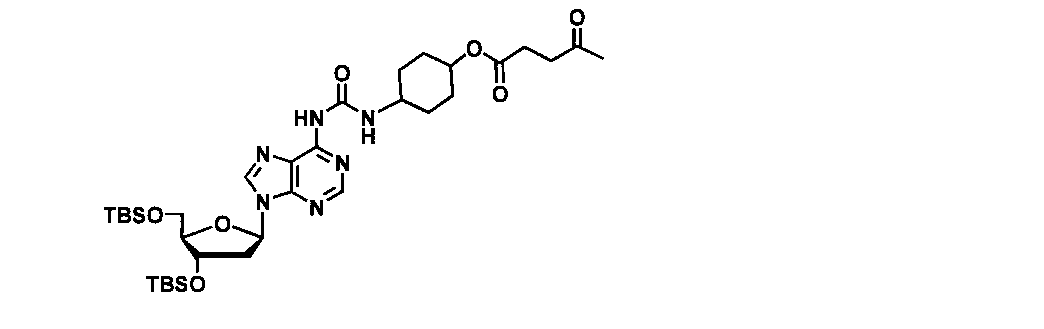
1H NMR (CDCl3, 500 MHz) δ 0.05-0.09 (12H, m), 0.84-0.90 (18H, m), 1.46-1.57 (4H, m), 1.99-2.01 (2H, br), 2.13-2.15 (2H, br), 2.18 (3H, m), 2.42-2.46 (1H, m), 2.54-2.56 (2H, m), 2.61-2.66 (1H, m), 2.72-2.75 (2H, m), 3.73-3.76 (1H, m), 3.83-3.86 (2H, m), 4.00-4.01 (1H, m), 4.61 (1H, m), 4.75-4.79 (1H, m), 6.44-6.47 (1H, m), 8.33 (1H, s), 8.49 (1H, s), 9.45-9.46 (1H, m)。
化合物3(N6-[N-(トランス-4-(4-オキソペンタノイルオキシ)シクロヘキシル)カルバモイル]デオキシアデノシン)の合成
化合物2(1.5 g,2.08ミリモル)にピリジン(脱水)を加えて共沸した後、ピリジン(脱水) 21 mlに溶解させた。ここにトリエチルアミントリヒドロフルオリド(1.70 ml,10.4ミリモル)及びトリエチルアミン(1.44ml,10.4ミリモル)を加え、室温で12時間反応させた。水でクエンチした後、溶媒を減圧下留去してクロロホルムに溶解させ、飽和炭酸水素ナトリウムで抽出操作を行った。有機層を集め硫酸ナトリウムを加え乾燥させた後、濾過し溶媒を減圧下留去した。得られた残渣を展開溶媒としてクロロホルム/メタノールを用いてNHシリカゲルカラムクロマトグラフィーにより精製し、下記式で表される標題の化合物(730mg,72%)を得た。
化合物2(1.5 g,2.08ミリモル)にピリジン(脱水)を加えて共沸した後、ピリジン(脱水) 21 mlに溶解させた。ここにトリエチルアミントリヒドロフルオリド(1.70 ml,10.4ミリモル)及びトリエチルアミン(1.44ml,10.4ミリモル)を加え、室温で12時間反応させた。水でクエンチした後、溶媒を減圧下留去してクロロホルムに溶解させ、飽和炭酸水素ナトリウムで抽出操作を行った。有機層を集め硫酸ナトリウムを加え乾燥させた後、濾過し溶媒を減圧下留去した。得られた残渣を展開溶媒としてクロロホルム/メタノールを用いてNHシリカゲルカラムクロマトグラフィーにより精製し、下記式で表される標題の化合物(730mg,72%)を得た。

1H NMR (CDCl3, 500 MHz) δ 1.45-1.59 (4H, m) 2.01-2.02 (2H, m), 2.14-2.16 (2H, m), 2.19 (3H, s), 2.39-2.43 (1H, m), 2.55-2.57 (2H, m), 2.74-2.76 (2H, m), 2.96-3.00 (2H, m), 3.80-3.84 (2H, m), 3.96-3.99 (1H, m), 4.23 (1H, s), 4.76-4.80 (2H, m), 5.74-5.76 (1H, m), 6.43-6.45 (1H, m), 7.26 (1H, s), 8.26 (1H, m), 8.48 (1H, s), 8.75 (1H, s), 9.44-9.48 (1H, m); 13C NMR (CDCl3) δ 28.4, 29.8, 30.0, 30.4, 38.1, 41.1, 48.3, 63.3, 72.1, 73.1, 87.5, 89.5, 121.9, 142.8, 149.4, 150.7, 151.0, 153.5, 172.4, 207.0。
化合物4(5’-O-(4,4’-ジメトキシトリチル)- N6-[N-(トランス-4-(4-オキソペンタノイルオキシ)シクロヘキシル)カルバモイル]デオキシアデノシン)の合成
化合物3(600mg,1.22ミリモル)にピリジン(脱水)を加えて共沸した後、ピリジン(脱水)12 mlに溶解させた。ここに4,4’-ジメトキシトリチルクロリド(497mg,1.47ミリモル)を加え、室温で4時間反応させた。メタノールでクエンチした後、クロロホルムで反応溶媒を希釈し、飽和炭酸水素ナトリウムで抽出操作を行った。有機層を集め硫酸ナトリウムを加え乾燥させた後、濾過し溶媒を減圧下留去した。得られた残渣を、展開溶媒としてヘキサン/クロロホルムを用いてNHシリカゲルカラムクロマトグラフィーにより精製し、下記式で表される標題の化合物(741mg,77%) を得た。
化合物3(600mg,1.22ミリモル)にピリジン(脱水)を加えて共沸した後、ピリジン(脱水)12 mlに溶解させた。ここに4,4’-ジメトキシトリチルクロリド(497mg,1.47ミリモル)を加え、室温で4時間反応させた。メタノールでクエンチした後、クロロホルムで反応溶媒を希釈し、飽和炭酸水素ナトリウムで抽出操作を行った。有機層を集め硫酸ナトリウムを加え乾燥させた後、濾過し溶媒を減圧下留去した。得られた残渣を、展開溶媒としてヘキサン/クロロホルムを用いてNHシリカゲルカラムクロマトグラフィーにより精製し、下記式で表される標題の化合物(741mg,77%) を得た。
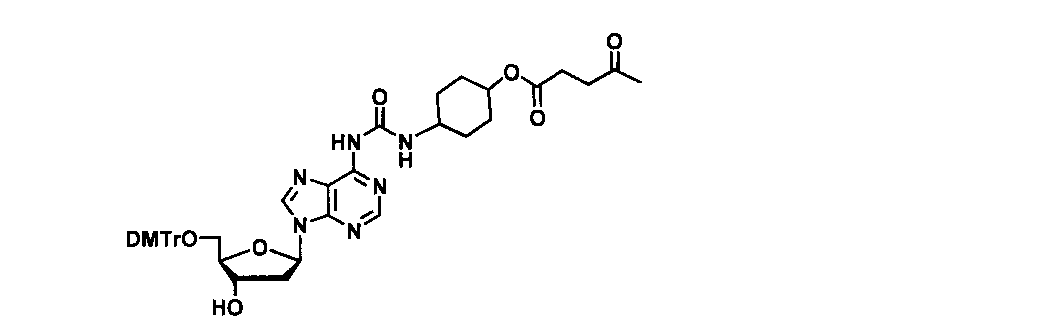
1H NMR (CDCl3, 500 MHz) δ 1.45-1.60 (4H, m), 2.01-2.03 (2H, br), 2.14-2.18 (2H, br), 2.20 (3H, s), 2.54-2.58 (3H, m), 2.75 (2H, t, J = 6.5 Hz), 2.82-2.87 (1H, m), 3.36-3.43 (2H, m), 3.76 (6H, s), 3.84-3.86 (1H, m), 4.15-4.18 (1H, dd, J = 4.4 Hz, J = 8.3 Hz), 4.68-4.71 (1H, m), 4.77-4.81 (1H, m), 6.47 (1H, t, J = 6.3 Hz), 6.78 (4H, d, J = 8.5 Hz), 7.19-7.39 (9H, m), 8.09 (1H, s), 8.13 (1H, br), 8.43 (1H, s), 9.38 (1H, d J = 7.6 Hz); 13C NMR (CDCl3) δ 28.5, 29.8, 30.0, 30.4, 38.1, 40.3, 48.2, 55.3, 63.8, 72.2, 72.5, 84.6, 86.3, 86.7, 113.3, 120.9, 127.1, 128.0, 128.2, 130.1, 135.7, 141.1, 144.6, 150.0, 150.4, 151.1, 153.3, 158.7, 172.4, 206.9。
ホスホロアミダイト化合物5(5’-O-(4,4’-ジメトキシトリチル)- N6-[N-(トランス-4-(4-オキソペンタノイルオキシ)シクロヘキシル)カルバモイル]デオキシアデノシン3’-(2-シアノエチルN, N-ジイソプロピルホスホロアミダイト)の合成
化合物4(350mg,0.441ミリモル)をピリジン(脱水)、トルエン(脱水)、ジクロロメタン(脱水)の順で各々3回ずつ共沸した後、ジクロロメタン(脱水)4.4 mlに溶解させた。これにテトラゾール(19mg,0.264ミリモル)、ジイソプロピルアミン(37 μl,0.264ミリモル)及び2-シアノエチル-ビス(N,N-ジイソプロピル)-ホスホロアミダイト(154μl,0.486ミリモル)を加え、室温で4時間反応させた。水でクエンチした後、溶媒を減圧下留去した後、酢酸エチル-ジエチルエーテルの混合溶媒に溶解させ、0.2 M水酸化ナトリウム水溶液で3回抽出操作を行い、有機層を集め溶媒を減圧下留去した。得られた残渣を、展開溶媒としてクロロホルムを用いてリサイクルHPLCで精製し、下記式で表される標題の化合物(303mg,77%)を得た。
化合物4(350mg,0.441ミリモル)をピリジン(脱水)、トルエン(脱水)、ジクロロメタン(脱水)の順で各々3回ずつ共沸した後、ジクロロメタン(脱水)4.4 mlに溶解させた。これにテトラゾール(19mg,0.264ミリモル)、ジイソプロピルアミン(37 μl,0.264ミリモル)及び2-シアノエチル-ビス(N,N-ジイソプロピル)-ホスホロアミダイト(154μl,0.486ミリモル)を加え、室温で4時間反応させた。水でクエンチした後、溶媒を減圧下留去した後、酢酸エチル-ジエチルエーテルの混合溶媒に溶解させ、0.2 M水酸化ナトリウム水溶液で3回抽出操作を行い、有機層を集め溶媒を減圧下留去した。得られた残渣を、展開溶媒としてクロロホルムを用いてリサイクルHPLCで精製し、下記式で表される標題の化合物(303mg,77%)を得た。

1H NMR (CDCl3, 500 MHz) δ 1.12-1.21 (12H, m), 1.48-1.60 (4H, m), 2.02-2.04 (2H, br), 2.15-2.17 (2H, br), 2.20 (3H, s), 2.46-2.48 (1H, m), 2.56-2.63 (3H, m), 2.74-2.77 (2H, m), 2.93-2.98 (1H, m), 3.35-3.43 (2H, m), 3.60-3.75 (4H, m), 3.77 (6H, s), 3.80-3.86 (1H, m), 4.29-4.32 (1H, m), 4.78-4.81 (2H, m), 6.43-6.46 (1H, m), 6.76-6.79 (4H, m), 7.18-7.40 (9H, m), 8.21-8.24 (1H, m), 8.34-8.36 (1H, br), 8.43 (1H, s), 9.48 (1H, d, J = 7.6 Hz); 13C NMR (CDCl3) δ 20.2, 20.3, 20.4, 20.5, 24.5, 24.6, 24.7, 28.4, 29.7, 29.9, 30.3, 38.0, 39.3, 43.3, 43.4, 48.0, 48.2, 55.2, 55.3, 58.2, 58.3, 58.5, 63.3, 63.5, 72.1, 73.3, 73.4, 74.0, 84.8, 86.0, 86.5, 113.1, 117.5, 117.6, 121.0, 126.9, 127.9, 128.1, 128.2, 130.1, 135.7, 141.6, 144.6, 150.0, 150.4, 151.0, 153.3, 158.6, 172.3, 206.7;31P NMR (CDCl3) δ 149.7, 149.8。
グレンリサーチ社より購入したユニバーサルサポートII(1μmol)を固相担体として用い、上記で得られたホスホロアミダイト化合物、およびグレンリサーチ社より購入した2’-O-メチルRNA ホスホロアミダイト試薬を用い、ABI-392DNA/RNA合成機の標準的な1.0μmolスケールRNA合成プロトコールにて合成を行った。5’末端のヌクレオチド残基を結合後、オリゴヌクレオチドに対して、50当量のヒドラジン(ピリジン-酢酸、3:2,V/V 溶液)を加え、室温で15分間放置することにより、Lev基を除去した。
次いで、グレンリサーチ社より購入したホスファリンク試薬(50当量)を1H-テトラゾール(50当量)の存在下反応させ、次いで、常法によりヨウ素酸化と2M アンモニア/メタノールによる切り出しついで、濃アンモニア水で室温18時間攪拌した。このアンモニア溶液をC18カートリッジカラムに担持し、副生物を洗浄した後、2%トリフルオロ酢酸水溶液で処理した後、目的物を溶出した。得られた目的物の粗精製物を陰イオン交換HPLCで精製して標題の化合物を得た。目的物の構造はMALDI-TOF 質量分析により確認した。
実施例4
Tm測定による鎖長依存的ハイブリダイゼーションの解析
実施例1、実施例2、実施例3及び比較例1で得られたオリゴヌクレオチドを10mM リン酸緩衝液(pH 7.0)、0.1M NaCl中に、濃度が1.0 μMになるように調製した。この溶液に、下記長鎖RNA(配列番号:5)又は短鎖RNA(配列番号:6)を同じく濃度1.0μMになるように溶解し、260nmでの吸光度の温度依存性を5℃から90℃まで測定した。得られたUV融解曲線を微分し、その一次微分係数が極大となる温度をTmとした。また、比較として、下記天然型プローブ及び非アニオン性プローブのTmも測定した。結果を表1に示す。
Tm測定による鎖長依存的ハイブリダイゼーションの解析
実施例1、実施例2、実施例3及び比較例1で得られたオリゴヌクレオチドを10mM リン酸緩衝液(pH 7.0)、0.1M NaCl中に、濃度が1.0 μMになるように調製した。この溶液に、下記長鎖RNA(配列番号:5)又は短鎖RNA(配列番号:6)を同じく濃度1.0μMになるように溶解し、260nmでの吸光度の温度依存性を5℃から90℃まで測定した。得られたUV融解曲線を微分し、その一次微分係数が極大となる温度をTmとした。また、比較として、下記天然型プローブ及び非アニオン性プローブのTmも測定した。結果を表1に示す。
長鎖RNA(配列番号:5):3’-AUUAUAUGUUGGAUGAUGGUUA-5’
短鎖RNA(配列番号:6):3’-GUUGGAUGA-5’
モノリン酸プローブ(配列番号:4、比較例1):5’-(dA#)CAACCUACU-3’
天然型プローブ(配列番号:7):5’-(dC)CAACCUACU(dC)-3’
非アニオン性プローブ((配列番号:8):5’-(dA##)CAACCUACU(dA###)の3’
ここで、A,U、G、Cはリボヌクレオチド残基である。下線部のヌクレオチド残基は2’-O-メチル-リボヌクレオチド残基である。dA##、dA###はそれぞれ下記式に表すヌクレオチド残基を表わす。
短鎖RNA(配列番号:6):3’-GUUGGAUGA-5’
モノリン酸プローブ(配列番号:4、比較例1):5’-(dA#)CAACCUACU-3’
天然型プローブ(配列番号:7):5’-(dC)CAACCUACU(dC)-3’
非アニオン性プローブ((配列番号:8):5’-(dA##)CAACCUACU(dA###)の3’
ここで、A,U、G、Cはリボヌクレオチド残基である。下線部のヌクレオチド残基は2’-O-メチル-リボヌクレオチド残基である。dA##、dA###はそれぞれ下記式に表すヌクレオチド残基を表わす。
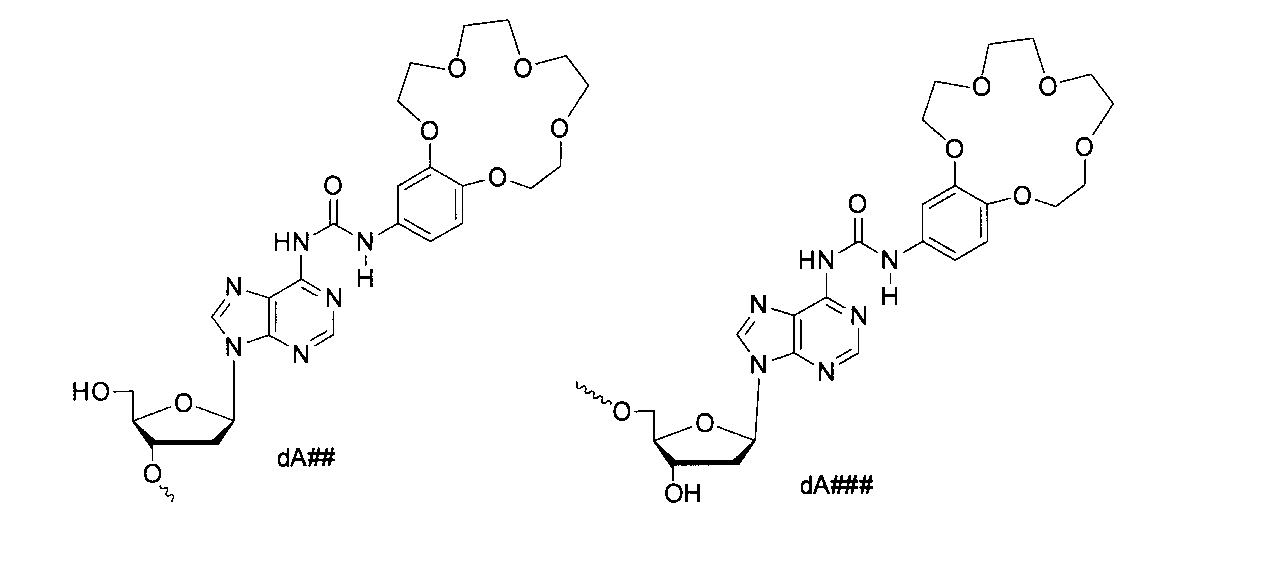

表1より、以下のことが明らかになった。
プローブ5’末端のヌクレオシド残基の塩基部と5’水酸基にともにリン酸基を導入した実施例1、実施例2、実施例3のオリゴヌクレオチドは長鎖RNAよりも短鎖RNAに強く結合し、高いΔTm値を示した。5’ 末端のヌクレオシド残基の塩基部のみにリン酸基を導入した比較例1のオリゴヌクレオチドは長鎖RNAよりも短鎖RNAに強く結合したが、そのΔTm値は実施例1~3のものよりも小さかった。
天然型プローブは、逆に短鎖RNAよりも長鎖RNAに強く結合した。
末端にアニオンに解離することが可能な置換基を有しない、非アニオン性プローブは長鎖RNAよりも短鎖RNAにより強く結合したが、その選択性の指標であるΔTm=+4
は、実施例1~3のオリゴヌクレオチド誘導体の値よりも小さかった。
プローブ5’末端のヌクレオシド残基の塩基部と5’水酸基にともにリン酸基を導入した実施例1、実施例2、実施例3のオリゴヌクレオチドは長鎖RNAよりも短鎖RNAに強く結合し、高いΔTm値を示した。5’ 末端のヌクレオシド残基の塩基部のみにリン酸基を導入した比較例1のオリゴヌクレオチドは長鎖RNAよりも短鎖RNAに強く結合したが、そのΔTm値は実施例1~3のものよりも小さかった。
天然型プローブは、逆に短鎖RNAよりも長鎖RNAに強く結合した。
末端にアニオンに解離することが可能な置換基を有しない、非アニオン性プローブは長鎖RNAよりも短鎖RNAにより強く結合したが、その選択性の指標であるΔTm=+4
は、実施例1~3のオリゴヌクレオチド誘導体の値よりも小さかった。
実施例5~10
実施例2と同様に操作を行い、下記オリゴヌクレオチドを合成した。
5’-(dA*)TAACCTACT-3’(配列番号:9、実施例5):MALDI-TOFマス Calcd 3271.57 Found 3277.29
5’-(dA*)CTACCTACT-3’(配列番号:10、実施例6):MALDI-TOFマス Calcd 3247.56 Found 3247.56
5’-(dA*)CGACCTACT-3’(配列番号:11、実施例7):MALDI-TOFマス Calcd 3272.57 Found 3274.48
5’-(dA*)CCACCTACT-3’(配列番号:12、実施例8):MALDI-TOFマス Calcd 3232.56 Found 3234.88
5’-(dA*)TTACCTACT-3’(配列番号:13、実施例9):MALDI-TOFマス Calcd 3262.56 Found 3262.45
5’-(dA*)TGACCTACT-3’(配列番号:14、実施例10):MALDI-TOFマス Calcd 3287.57 Found 3289.11
実施例2と同様に操作を行い、下記オリゴヌクレオチドを合成した。
5’-(dA*)TAACCTACT-3’(配列番号:9、実施例5):MALDI-TOFマス Calcd 3271.57 Found 3277.29
5’-(dA*)CTACCTACT-3’(配列番号:10、実施例6):MALDI-TOFマス Calcd 3247.56 Found 3247.56
5’-(dA*)CGACCTACT-3’(配列番号:11、実施例7):MALDI-TOFマス Calcd 3272.57 Found 3274.48
5’-(dA*)CCACCTACT-3’(配列番号:12、実施例8):MALDI-TOFマス Calcd 3232.56 Found 3234.88
5’-(dA*)TTACCTACT-3’(配列番号:13、実施例9):MALDI-TOFマス Calcd 3262.56 Found 3262.45
5’-(dA*)TGACCTACT-3’(配列番号:14、実施例10):MALDI-TOFマス Calcd 3287.57 Found 3289.11
実施例11
Tm測定による鎖長依存的ハイブリダイゼーションの解析
実施例5~11で得られたオリゴヌクレオチドを10mM リン酸緩衝液(pH 7.0)、0.1M NaCl中に、濃度が1.0 μMになるように調製した。この溶液に、下記長鎖RNA又は短鎖RNAを同じく濃度1.0μMになるように溶解し、260nmでの吸光度の温度依存性を5℃から90℃まで測定した。得られたUV融解曲線を微分し、その一次微分係数が極大となる温度をTmとした。用いた長鎖RNA又は短鎖RNAを表2に、結果を表3に示す。
Tm測定による鎖長依存的ハイブリダイゼーションの解析
実施例5~11で得られたオリゴヌクレオチドを10mM リン酸緩衝液(pH 7.0)、0.1M NaCl中に、濃度が1.0 μMになるように調製した。この溶液に、下記長鎖RNA又は短鎖RNAを同じく濃度1.0μMになるように溶解し、260nmでの吸光度の温度依存性を5℃から90℃まで測定した。得られたUV融解曲線を微分し、その一次微分係数が極大となる温度をTmとした。用いた長鎖RNA又は短鎖RNAを表2に、結果を表3に示す。


表3より、以下のことが明らかになった。
プローブ5’末端のヌクレオシド残基の塩基部と5’水酸基にともにリン酸基を導入した実施例6~10のオリゴヌクレオチドは長鎖RNAよりも短鎖RNAに強く結合し、高いΔTm値を示した。
プローブ5’末端のヌクレオシド残基の塩基部と5’水酸基にともにリン酸基を導入した実施例6~10のオリゴヌクレオチドは長鎖RNAよりも短鎖RNAに強く結合し、高いΔTm値を示した。
Claims (12)
- 一般式(1)で表わされるオリゴヌクレオチド誘導体及びそれらの塩。

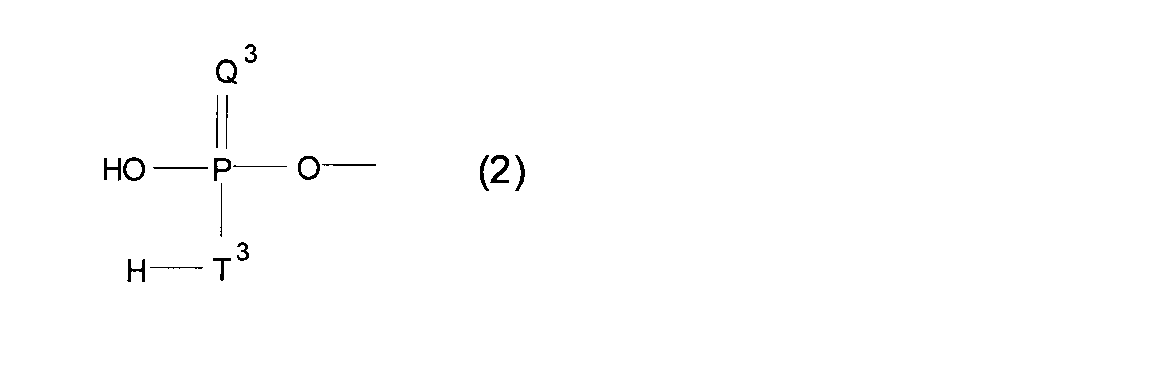


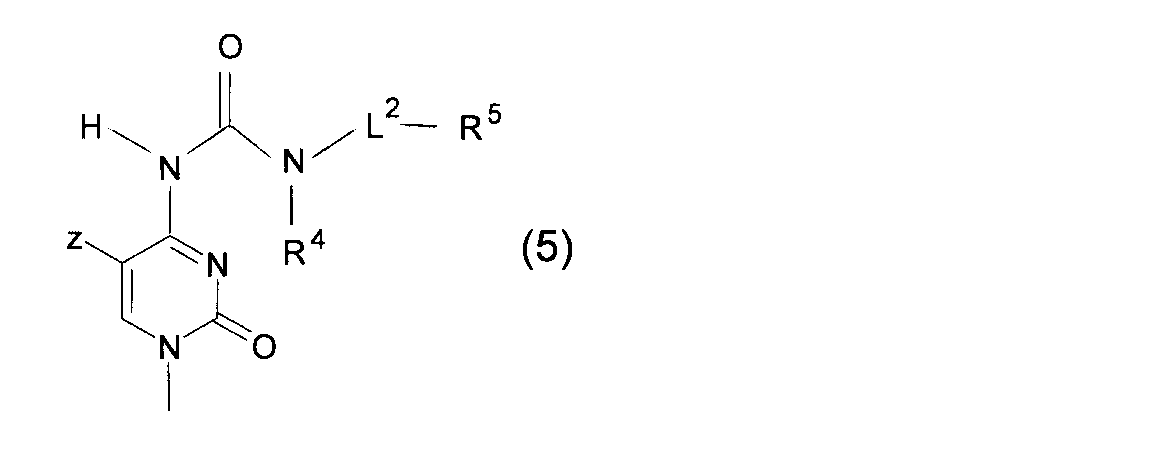

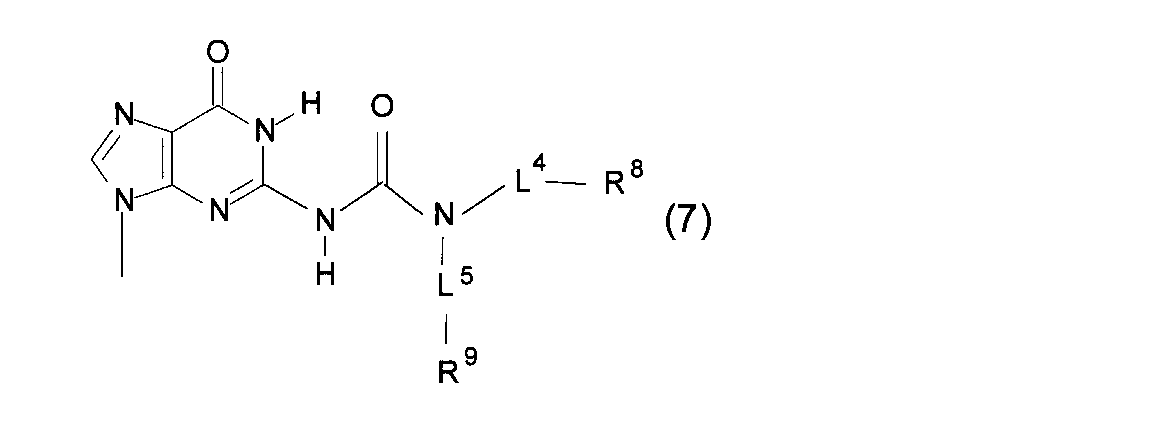
- R1が一般式(2)で表わされる基であり、一般式(2)中のQ3及びT3が酸素原子であり、W1が一般式(3)、一般式(5)、一般式(6)又は一般式(7)で表わされる基であり、一般式(4)中のQ4及びT4が酸素原子である、請求項1記載のオリゴヌクレオチド誘導体。
- R1がリン酸基であり、W1が一般式(3)、一般式(5)、一般式(6)又は一般式(7)で表わされる基であり、一般式(4)中のQ4及びT4が酸素原子である、請求項1記載のオリゴヌクレオチド誘導体。
- R2及び/又はY2が一般式(2)で表わされる基であり、一般式(2)中のQ3及びT3が酸素原子であり、W2が一般式(3)、一般式(5)、一般式(6)又は一般式(7)で表わされる基であり、一般式(4)中のQ4及びT4が酸素原子である、請求項1記載のオリゴヌクレオチド誘導体。
- R2及び/又はY2がリン酸基であり、W2が一般式(3)、一般式(5)、一般式(6)又は一般式(7)で表わされる基であり、一般式(4)中のQ4及びT4が酸素原子である、請求項1記載のオリゴヌクレオチド誘導体。
- R2及び/又はY2がリン酸基であり、W2が一般式(3)、一般式(5)、一般式(6)又は一般式(7)で表わされる基であり、一般式(4)中のQ4及びT4が酸素原子である、請求項3又は4記載のオリゴヌクレオチド誘導体。
- 核酸検出用プローブとして用いられる、請求項1~6のいずれか1項記載のオリゴヌクレオチド誘導体。
- 請求項1~6のいずれか1項記載のオリゴヌクレオチド誘導体を固体担体上に固定化してなるオリゴヌクレオチドアレイ。
- 請求項1~6のいずれか1項記載のオリゴヌクレオチド誘導体を含む医薬組成物。
- 逆転写酵素反応のプライマーとして用いられる請求項1~6のいずれか1項記載のオリゴヌクレオチド誘導体。
- DNAポリメラーゼ反応のプライマーとして用いられる請求項1~6のいずれか1項記載のオリゴヌクレオチド誘導体。
- DNAポリメラーゼ反応のテンプレートとして用いられる請求項1~6のいずれか1項記載のオリゴヌクレオチド誘導体。
Priority Applications (1)
| Application Number | Priority Date | Filing Date | Title |
|---|---|---|---|
| JP2012500643A JPWO2011102414A1 (ja) | 2010-02-19 | 2011-02-17 | オリゴヌクレオチド誘導体 |
Applications Claiming Priority (2)
| Application Number | Priority Date | Filing Date | Title |
|---|---|---|---|
| JP2010-034297 | 2010-02-19 | ||
| JP2010034297 | 2010-02-19 |
Publications (1)
| Publication Number | Publication Date |
|---|---|
| WO2011102414A1 true WO2011102414A1 (ja) | 2011-08-25 |
Family
ID=44483000
Family Applications (1)
| Application Number | Title | Priority Date | Filing Date |
|---|---|---|---|
| PCT/JP2011/053373 Ceased WO2011102414A1 (ja) | 2010-02-19 | 2011-02-17 | オリゴヌクレオチド誘導体 |
Country Status (2)
| Country | Link |
|---|---|
| JP (1) | JPWO2011102414A1 (ja) |
| WO (1) | WO2011102414A1 (ja) |
Citations (2)
| Publication number | Priority date | Publication date | Assignee | Title |
|---|---|---|---|---|
| JP2007238550A (ja) * | 2006-03-10 | 2007-09-20 | Tokyo Institute Of Technology | オリゴヌクレオチド誘導体 |
| JP2009190983A (ja) * | 2008-02-12 | 2009-08-27 | Tokyo Institute Of Technology | オリゴヌクレオチド誘導体 |
-
2011
- 2011-02-17 JP JP2012500643A patent/JPWO2011102414A1/ja active Pending
- 2011-02-17 WO PCT/JP2011/053373 patent/WO2011102414A1/ja not_active Ceased
Patent Citations (2)
| Publication number | Priority date | Publication date | Assignee | Title |
|---|---|---|---|---|
| JP2007238550A (ja) * | 2006-03-10 | 2007-09-20 | Tokyo Institute Of Technology | オリゴヌクレオチド誘導体 |
| JP2009190983A (ja) * | 2008-02-12 | 2009-08-27 | Tokyo Institute Of Technology | オリゴヌクレオチド誘導体 |
Also Published As
| Publication number | Publication date |
|---|---|
| JPWO2011102414A1 (ja) | 2013-06-17 |
Similar Documents
| Publication | Publication Date | Title |
|---|---|---|
| JP2009190983A (ja) | オリゴヌクレオチド誘導体 | |
| US6590093B1 (en) | Orthoester protecting groups | |
| HK1048322A1 (zh) | L-核糖-lna类似物 | |
| HK1048639A1 (zh) | 木-lna类似物 | |
| AU2017203685B2 (en) | 3'end caps for RNAi agents for use in RNA interference | |
| AU2020292763B2 (en) | Process for the preparation of oligonucleotides using modified oxidation protocol | |
| CN116143854A (zh) | 一种核糖环修饰的mRNA帽类似物及其制备方法和应用 | |
| EP4484439B1 (en) | 6'-cyano-modified locked nucleoside, nucleotide, and nucleic acid polymer | |
| US6407223B1 (en) | Process for the synthesis of modified P-chiral nucleotide analogues | |
| JP3898532B2 (ja) | 新規なヘアピン型ポリアミド | |
| JPWO2011102414A1 (ja) | オリゴヌクレオチド誘導体 | |
| JP6429264B2 (ja) | ボラノホスフェート化合物、及び核酸オリゴマー | |
| Jastrzębska et al. | P-Stereodefined morpholino dinucleoside 3′, 5′-phosphorothioates | |
| JP4047814B2 (ja) | 新規カリックス[4]アレーン−ヌクレオシドおよびカリックス[4]アレーン−オリゴヌクレオチドハイブリッド | |
| US7495095B2 (en) | Thionucleoside-S-nitrosyl derivative | |
| CN120535560B (zh) | 一种n-甲基-5'-o-(4,4'-二甲氧基三苯甲基)-2'-o-甲基腺苷的制备方法 | |
| KR102934598B1 (ko) | 신규한 몰포리노 올리고뉴클레오티드 유도체 | |
| Madsen et al. | LNA 5′-phosphoramidites for 5′→ 3′-oligonucleotide synthesis | |
| CN117264004B (zh) | 一种化合物及核酸合成方法 | |
| US8816062B2 (en) | Maleimide-furanyl compounds that can be used in a general method for preparing maleimide-oligonucleotide derivatives | |
| EP4249495A1 (en) | Method for the purification of polynucleotides and analogues thereof | |
| JP2005514462A6 (ja) | 新規カリックス[4]アレーン−ヌクレオシドおよびカリックス[4]アレーン−オリゴヌクレオチドハイブリッド | |
| CN117756872A (zh) | 一种基于点击化学技术制备n-乙酰半乳糖胺寡聚核苷酸偶联物的方法 | |
| CN117756871A (zh) | 一种基于点击化学技术制备n-乙酰半乳糖胺寡聚核苷酸偶联物的方法 | |
| CN117866028A (zh) | 一种医药中间体及其制备方法 |
Legal Events
| Date | Code | Title | Description |
|---|---|---|---|
| 121 | Ep: the epo has been informed by wipo that ep was designated in this application |
Ref document number: 11744700 Country of ref document: EP Kind code of ref document: A1 |
|
| DPE1 | Request for preliminary examination filed after expiration of 19th month from priority date (pct application filed from 20040101) | ||
| WWE | Wipo information: entry into national phase |
Ref document number: 2012500643 Country of ref document: JP |
|
| NENP | Non-entry into the national phase |
Ref country code: DE |
|
| 122 | Ep: pct application non-entry in european phase |
Ref document number: 11744700 Country of ref document: EP Kind code of ref document: A1 |