WO2011090184A1 - 加工性とスポット溶接性に優れた高強度溶融亜鉛めっき鋼板およびその製造方法 - Google Patents
加工性とスポット溶接性に優れた高強度溶融亜鉛めっき鋼板およびその製造方法 Download PDFInfo
- Publication number
- WO2011090184A1 WO2011090184A1 PCT/JP2011/051159 JP2011051159W WO2011090184A1 WO 2011090184 A1 WO2011090184 A1 WO 2011090184A1 JP 2011051159 W JP2011051159 W JP 2011051159W WO 2011090184 A1 WO2011090184 A1 WO 2011090184A1
- Authority
- WO
- WIPO (PCT)
- Prior art keywords
- steel sheet
- less
- galvanized steel
- dip galvanized
- strength
- Prior art date
- Legal status (The legal status is an assumption and is not a legal conclusion. Google has not performed a legal analysis and makes no representation as to the accuracy of the status listed.)
- Ceased
Links
Images
Classifications
-
- C—CHEMISTRY; METALLURGY
- C23—COATING METALLIC MATERIAL; COATING MATERIAL WITH METALLIC MATERIAL; CHEMICAL SURFACE TREATMENT; DIFFUSION TREATMENT OF METALLIC MATERIAL; COATING BY VACUUM EVAPORATION, BY SPUTTERING, BY ION IMPLANTATION OR BY CHEMICAL VAPOUR DEPOSITION, IN GENERAL; INHIBITING CORROSION OF METALLIC MATERIAL OR INCRUSTATION IN GENERAL
- C23C—COATING METALLIC MATERIAL; COATING MATERIAL WITH METALLIC MATERIAL; SURFACE TREATMENT OF METALLIC MATERIAL BY DIFFUSION INTO THE SURFACE, BY CHEMICAL CONVERSION OR SUBSTITUTION; COATING BY VACUUM EVAPORATION, BY SPUTTERING, BY ION IMPLANTATION OR BY CHEMICAL VAPOUR DEPOSITION, IN GENERAL
- C23C2/00—Hot-dipping or immersion processes for applying the coating material in the molten state without affecting the shape; Apparatus therefor
- C23C2/04—Hot-dipping or immersion processes for applying the coating material in the molten state without affecting the shape; Apparatus therefor characterised by the coating material
- C23C2/06—Zinc or cadmium or alloys based thereon
-
- B—PERFORMING OPERATIONS; TRANSPORTING
- B32—LAYERED PRODUCTS
- B32B—LAYERED PRODUCTS, i.e. PRODUCTS BUILT-UP OF STRATA OF FLAT OR NON-FLAT, e.g. CELLULAR OR HONEYCOMB, FORM
- B32B15/00—Layered products comprising a layer of metal
- B32B15/01—Layered products comprising a layer of metal all layers being exclusively metallic
- B32B15/013—Layered products comprising a layer of metal all layers being exclusively metallic one layer being formed of an iron alloy or steel, another layer being formed of a metal other than iron or aluminium
-
- C—CHEMISTRY; METALLURGY
- C21—METALLURGY OF IRON
- C21D—MODIFYING THE PHYSICAL STRUCTURE OF FERROUS METALS; GENERAL DEVICES FOR HEAT TREATMENT OF FERROUS OR NON-FERROUS METALS OR ALLOYS; MAKING METAL MALLEABLE, e.g. BY DECARBURISATION OR TEMPERING
- C21D8/00—Modifying the physical properties of ferrous metals or ferrous alloys by deformation combined with, or followed by, heat treatment
- C21D8/02—Modifying the physical properties of ferrous metals or ferrous alloys by deformation combined with, or followed by, heat treatment during manufacturing of plates or strips
- C21D8/04—Modifying the physical properties of ferrous metals or ferrous alloys by deformation combined with, or followed by, heat treatment during manufacturing of plates or strips to produce plates or strips for drawing, e.g. for deep-drawing
- C21D8/0421—Modifying the physical properties of ferrous metals or ferrous alloys by deformation combined with, or followed by, heat treatment during manufacturing of plates or strips to produce plates or strips for drawing, e.g. for deep-drawing characterised by the working steps
- C21D8/0426—Hot rolling
-
- C—CHEMISTRY; METALLURGY
- C21—METALLURGY OF IRON
- C21D—MODIFYING THE PHYSICAL STRUCTURE OF FERROUS METALS; GENERAL DEVICES FOR HEAT TREATMENT OF FERROUS OR NON-FERROUS METALS OR ALLOYS; MAKING METAL MALLEABLE, e.g. BY DECARBURISATION OR TEMPERING
- C21D8/00—Modifying the physical properties of ferrous metals or ferrous alloys by deformation combined with, or followed by, heat treatment
- C21D8/02—Modifying the physical properties of ferrous metals or ferrous alloys by deformation combined with, or followed by, heat treatment during manufacturing of plates or strips
- C21D8/04—Modifying the physical properties of ferrous metals or ferrous alloys by deformation combined with, or followed by, heat treatment during manufacturing of plates or strips to produce plates or strips for drawing, e.g. for deep-drawing
- C21D8/0421—Modifying the physical properties of ferrous metals or ferrous alloys by deformation combined with, or followed by, heat treatment during manufacturing of plates or strips to produce plates or strips for drawing, e.g. for deep-drawing characterised by the working steps
- C21D8/0436—Cold rolling
-
- C—CHEMISTRY; METALLURGY
- C21—METALLURGY OF IRON
- C21D—MODIFYING THE PHYSICAL STRUCTURE OF FERROUS METALS; GENERAL DEVICES FOR HEAT TREATMENT OF FERROUS OR NON-FERROUS METALS OR ALLOYS; MAKING METAL MALLEABLE, e.g. BY DECARBURISATION OR TEMPERING
- C21D9/00—Heat treatment, e.g. annealing, hardening, quenching or tempering, adapted for particular articles; Furnaces therefor
- C21D9/46—Heat treatment, e.g. annealing, hardening, quenching or tempering, adapted for particular articles; Furnaces therefor for sheet metals
-
- C—CHEMISTRY; METALLURGY
- C22—METALLURGY; FERROUS OR NON-FERROUS ALLOYS; TREATMENT OF ALLOYS OR NON-FERROUS METALS
- C22C—ALLOYS
- C22C38/00—Ferrous alloys, e.g. steel alloys
- C22C38/001—Ferrous alloys, e.g. steel alloys containing N
-
- C—CHEMISTRY; METALLURGY
- C22—METALLURGY; FERROUS OR NON-FERROUS ALLOYS; TREATMENT OF ALLOYS OR NON-FERROUS METALS
- C22C—ALLOYS
- C22C38/00—Ferrous alloys, e.g. steel alloys
- C22C38/002—Ferrous alloys, e.g. steel alloys containing In, Mg, or other elements not provided for in one single group C22C38/001 - C22C38/60
-
- C—CHEMISTRY; METALLURGY
- C22—METALLURGY; FERROUS OR NON-FERROUS ALLOYS; TREATMENT OF ALLOYS OR NON-FERROUS METALS
- C22C—ALLOYS
- C22C38/00—Ferrous alloys, e.g. steel alloys
- C22C38/02—Ferrous alloys, e.g. steel alloys containing silicon
-
- C—CHEMISTRY; METALLURGY
- C22—METALLURGY; FERROUS OR NON-FERROUS ALLOYS; TREATMENT OF ALLOYS OR NON-FERROUS METALS
- C22C—ALLOYS
- C22C38/00—Ferrous alloys, e.g. steel alloys
- C22C38/04—Ferrous alloys, e.g. steel alloys containing manganese
-
- C—CHEMISTRY; METALLURGY
- C22—METALLURGY; FERROUS OR NON-FERROUS ALLOYS; TREATMENT OF ALLOYS OR NON-FERROUS METALS
- C22C—ALLOYS
- C22C38/00—Ferrous alloys, e.g. steel alloys
- C22C38/06—Ferrous alloys, e.g. steel alloys containing aluminium
-
- C—CHEMISTRY; METALLURGY
- C23—COATING METALLIC MATERIAL; COATING MATERIAL WITH METALLIC MATERIAL; CHEMICAL SURFACE TREATMENT; DIFFUSION TREATMENT OF METALLIC MATERIAL; COATING BY VACUUM EVAPORATION, BY SPUTTERING, BY ION IMPLANTATION OR BY CHEMICAL VAPOUR DEPOSITION, IN GENERAL; INHIBITING CORROSION OF METALLIC MATERIAL OR INCRUSTATION IN GENERAL
- C23C—COATING METALLIC MATERIAL; COATING MATERIAL WITH METALLIC MATERIAL; SURFACE TREATMENT OF METALLIC MATERIAL BY DIFFUSION INTO THE SURFACE, BY CHEMICAL CONVERSION OR SUBSTITUTION; COATING BY VACUUM EVAPORATION, BY SPUTTERING, BY ION IMPLANTATION OR BY CHEMICAL VAPOUR DEPOSITION, IN GENERAL
- C23C2/00—Hot-dipping or immersion processes for applying the coating material in the molten state without affecting the shape; Apparatus therefor
- C23C2/02—Pretreatment of the material to be coated, e.g. for coating on selected surface areas
- C23C2/022—Pretreatment of the material to be coated, e.g. for coating on selected surface areas by heating
- C23C2/0224—Two or more thermal pretreatments
-
- C—CHEMISTRY; METALLURGY
- C23—COATING METALLIC MATERIAL; COATING MATERIAL WITH METALLIC MATERIAL; CHEMICAL SURFACE TREATMENT; DIFFUSION TREATMENT OF METALLIC MATERIAL; COATING BY VACUUM EVAPORATION, BY SPUTTERING, BY ION IMPLANTATION OR BY CHEMICAL VAPOUR DEPOSITION, IN GENERAL; INHIBITING CORROSION OF METALLIC MATERIAL OR INCRUSTATION IN GENERAL
- C23C—COATING METALLIC MATERIAL; COATING MATERIAL WITH METALLIC MATERIAL; SURFACE TREATMENT OF METALLIC MATERIAL BY DIFFUSION INTO THE SURFACE, BY CHEMICAL CONVERSION OR SUBSTITUTION; COATING BY VACUUM EVAPORATION, BY SPUTTERING, BY ION IMPLANTATION OR BY CHEMICAL VAPOUR DEPOSITION, IN GENERAL
- C23C2/00—Hot-dipping or immersion processes for applying the coating material in the molten state without affecting the shape; Apparatus therefor
- C23C2/02—Pretreatment of the material to be coated, e.g. for coating on selected surface areas
- C23C2/024—Pretreatment of the material to be coated, e.g. for coating on selected surface areas by cleaning or etching
-
- C—CHEMISTRY; METALLURGY
- C23—COATING METALLIC MATERIAL; COATING MATERIAL WITH METALLIC MATERIAL; CHEMICAL SURFACE TREATMENT; DIFFUSION TREATMENT OF METALLIC MATERIAL; COATING BY VACUUM EVAPORATION, BY SPUTTERING, BY ION IMPLANTATION OR BY CHEMICAL VAPOUR DEPOSITION, IN GENERAL; INHIBITING CORROSION OF METALLIC MATERIAL OR INCRUSTATION IN GENERAL
- C23C—COATING METALLIC MATERIAL; COATING MATERIAL WITH METALLIC MATERIAL; SURFACE TREATMENT OF METALLIC MATERIAL BY DIFFUSION INTO THE SURFACE, BY CHEMICAL CONVERSION OR SUBSTITUTION; COATING BY VACUUM EVAPORATION, BY SPUTTERING, BY ION IMPLANTATION OR BY CHEMICAL VAPOUR DEPOSITION, IN GENERAL
- C23C2/00—Hot-dipping or immersion processes for applying the coating material in the molten state without affecting the shape; Apparatus therefor
- C23C2/26—After-treatment
- C23C2/28—Thermal after-treatment, e.g. treatment in oil bath
-
- C—CHEMISTRY; METALLURGY
- C21—METALLURGY OF IRON
- C21D—MODIFYING THE PHYSICAL STRUCTURE OF FERROUS METALS; GENERAL DEVICES FOR HEAT TREATMENT OF FERROUS OR NON-FERROUS METALS OR ALLOYS; MAKING METAL MALLEABLE, e.g. BY DECARBURISATION OR TEMPERING
- C21D2211/00—Microstructure comprising significant phases
- C21D2211/002—Bainite
-
- C—CHEMISTRY; METALLURGY
- C21—METALLURGY OF IRON
- C21D—MODIFYING THE PHYSICAL STRUCTURE OF FERROUS METALS; GENERAL DEVICES FOR HEAT TREATMENT OF FERROUS OR NON-FERROUS METALS OR ALLOYS; MAKING METAL MALLEABLE, e.g. BY DECARBURISATION OR TEMPERING
- C21D2211/00—Microstructure comprising significant phases
- C21D2211/005—Ferrite
-
- C—CHEMISTRY; METALLURGY
- C21—METALLURGY OF IRON
- C21D—MODIFYING THE PHYSICAL STRUCTURE OF FERROUS METALS; GENERAL DEVICES FOR HEAT TREATMENT OF FERROUS OR NON-FERROUS METALS OR ALLOYS; MAKING METAL MALLEABLE, e.g. BY DECARBURISATION OR TEMPERING
- C21D2211/00—Microstructure comprising significant phases
- C21D2211/009—Pearlite
Definitions
- the present invention relates to a high-strength hot-dip galvanized steel sheet excellent in workability and spot weldability suitable as a member used in industrial fields such as automobiles and electricity, and a method for producing the same.
- Patent Document 1 proposes a steel sheet having excellent ductility by specifying chemical components, volume ratios of retained austenite and martensite, and manufacturing methods thereof.
- the steel plate excellent in ductility is proposed by prescribing
- Patent Document 3 proposes a steel sheet having excellent ductility by defining chemical components and defining volume fractions of ferrite, bainitic ferrite and retained austenite.
- Patent Documents 1 to 3 are mainly aimed at improving the ductility of high-strength thin steel sheets, the stretch flangeability (hole expansibility) is not sufficiently considered, so parts in press forming There is a problem that the application range of the shape is limited. Furthermore, in order to achieve the desired strength and workability, it is necessary to add a large amount of alloying elements. Hardening of the melted part of the spot welded part, softening of the heat affected zone (HAZ part), and solidification of the molten part There was a tendency for the weld strength to decrease due to the embrittlement of the steel.
- Patent Document 4 a high-strength cold-rolled steel sheet with improved spot weldability by microstructure control and a small amount of Mo is added.
- Patent Document 6 a steel sheet that has improved spot weldability is proposed in Patent Document 6 by reducing the amount of Si and P added to the composite structure steel sheet.
- Patent Document 4 it is proposed to suppress weld defects such as cracks and voids during spot welding by adding Mo, but only the tensile shear strength is examined, and cross tension is likely to cause problems with high-strength materials. It is hard to say that strength (ductility ratio) has been fully studied.
- Patent Document 5 it is proposed to ensure strength by precipitation strengthening of ferrite with charcoal and nitride, and to suppress the addition amount of C, Si, Mn so as not to cause cracks in the nugget at the check check. However, even if it can cope with the check at the time of welding, the practical spot weld strength is not considered.
- Patent Document 6 only the generation of dust and the fracture mode of the tensile test are examined, and not only the spot weld strength in practical use is taken into consideration, but also limited to manufacturing in the hot rolling process. Yes.
- the present invention has a high strength (tensile strength TS of 540 MPa or more), a high strength hot dip galvanized steel sheet excellent in workability (high ductility and high hole expansibility) and spot weldability, and It aims at providing the manufacturing method.
- C is 0.04 to 0.16%
- Si is 0.7 to 2.3%
- Mn is 1.5 to 1.6%
- P is 0.01 to 0.02%
- S is 0.
- the obtained steel was heated to 1200 ° C. and then hot-rolled to a thickness of 3.2 mm at a finishing temperature of 870 ° C. and held in a furnace at 520 ° C. for 1 hour. After that, the furnace was cooled. After pickling, the sheet thickness was cold-rolled to 1.4 mm to produce a cold-rolled steel sheet.
- an annealing treatment was performed at 825 ° C. for 120 seconds, and after cooling to 520 ° C., it was held as it was for 60 seconds.
- the obtained cold-rolled steel sheet was immersed in a hot-dip galvanizing bath and plated, and then alloyed at 550 ° C. for 15 seconds to produce a hot-dip galvanized steel sheet.
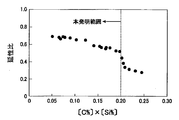
- the obtained steel sheet is subjected to spot welding of two layers under a welding condition where the cross-sectional nugget diameter is 5.0 mm, the shear tensile strength and the cross tensile strength are measured, and the ductility ratio (cross tensile strength / shear tensile strength) is evaluated. did.
- the spot welding was conducted and evaluated according to the Japan Welding Association (JWES) standard WES7301. As a result, as shown in FIG. 1, the product of C addition amount and Si addition amount showed a high ductility ratio in the range of 0.20 or less, and it was found that spot weldability was remarkably improved.
- JWES Japan Welding Association
- the present inventors further obtain a high-strength hot-dip galvanized steel sheet having high strength (tensile strength TS of 540 MPa or more) and excellent workability (high ductility and high hole expansibility) and spot weldability.
- high strength tensile strength TS of 540 MPa or more
- excellent workability high ductility and high hole expansibility
- the ferrite phase fraction (area ratio) and the structure of the second phase are appropriately adjusted, and the product of the addition amount of C and the addition amount of Si is further calculated.
- high strength and workability ductility and hole expansibility
- the present invention has been made based on the above findings, and the gist thereof is as follows.
- Component composition is mass% C: 0.04% to 0.10%, Si: 0.7% to 2.3%, Mn: 0.8% to 2.0%, P : 0.03% or less, S: 0.003% or less, Al: 0.1% or less, N: 0.008% or less, and [C%] ⁇ [Si%] ⁇ 0.20 [C%] and [Si%] indicate the content of C and Si (mass%).
- the balance is composed of iron and inevitable impurities, and the structure has a ferrite phase of 75% or more in area ratio.
- a component composition it contains at least one element selected from Ti: 0.01% to 0.1% and Nb: 0.01% to 0.1% by mass%.
- a component composition it contains at least one element selected from Ta: 0.001% to 0.010% and Sn: 0.002% to 0.2% by mass%
- a steel slab having the composition described in any one of (1) to (5) is hot-rolled, pickled, and cold-rolled as necessary, and then up to a temperature range of 650 ° C. or higher.
- Heat at an average heating rate of °C / s or more hold for 15 to 600 s in the temperature range of 750 to 900 ° C, cool, hold for 10 to 200 s in the temperature range of 450 to 550 ° C, and then hot dip galvanizing After applying, in the temperature range of 500-600 °C 0.45 ⁇ exp [200 / (400 ⁇ T)] ⁇ ln (t) ⁇ 1.0
- T Average holding temperature (° C.)
- t Holding time (s)
- a method for producing a high-strength hot-dip galvanized steel sheet excellent in workability and spot weldability characterized by subjecting a galvanizing alloying treatment under conditions satisfying the above conditions.
- the present invention it becomes possible to produce a high-strength hot-dip galvanized steel sheet having high strength (tensile strength TS of 540 MPa or more) and excellent workability (high ductility and high hole expansibility) and spot weldability. .
- high-strength hot-dip galvanized steel sheet according to the present invention to, for example, automobile structural members, it is possible to further improve the safety of passengers and improve fuel efficiency by significantly reducing the weight of the vehicle body.
- Component composition C 0.04% or more and 0.10% or less C is an element important for strengthening steel, has high solid solution strengthening ability, and has an area ratio when utilizing structure strengthening. It is an indispensable element for adjusting hardness. If the amount of C is less than 0.04%, it will be difficult to obtain the necessary strengthening ability. On the other hand, if the amount of C exceeds 0.10%, weldability deteriorates and a low temperature transformation phase such as martensite is markedly cured, leading to a decrease in formability, particularly hole expansibility. Therefore, the C content is 0.04 to 0.10%.
- Si 0.7% or more and 2.3% or less Si promotes the formation of ferrite and improves the work hardening ability of the ferrite phase to improve ductility. In addition, it is an element effective for solid solution strengthening and effective for increasing strength. In order to obtain these effects, addition of 0.7% or more is necessary. However, excessive addition of Si exceeding 2.3% causes deterioration of surface properties and deterioration of plating adhesion. Therefore, Si is made 0.7% to 2.3%. Preferably, it is 1.2% or more and 1.8% or less.
- Mn 0.8% or more and 2.0% or less
- Mn is an element effective for strengthening steel.
- it is an element that stabilizes austenite, and is an element necessary for adjusting the fraction of the second phase. For this reason, it is necessary to add 0.8% or more of Mn.
- Mn is made 0.8% or more and 2.0% or less. Preferably they are 1.0% or more and 1.8% or less.
- P 0.03% or less
- P is an element effective for strengthening steel, but when added in excess of 0.03%, it causes embrittlement due to segregation at the grain boundary, and deteriorates impact resistance. It promotes solidification cracking during welding and reduces welding strength. Therefore, P is set to 0.03% or less. Preferably it is 0.02% or less, More preferably, it is 0.01% or less.
- S 0.003% or less S segregates at the grain boundary and embrittles the steel during hot working, and also exists as a sulfide to reduce local deformability. Furthermore, solidification cracking during welding is promoted and welding strength is reduced. Therefore, S is made 0.003% or less. Preferably it is 0.002% or less, More preferably, it is 0.001% or less.
- Al 0.1% or less Al is a ferrite-forming element and is an effective element for controlling the amount of ferrite produced during production. However, excessive addition of Al deteriorates slab quality during steelmaking. Therefore, Al is made 0.1% or less.
- N 0.008% or less
- N is an element that causes the most deterioration of the aging resistance of the steel, and it is preferably as small as possible. If it exceeds 0.008%, the deterioration of the aging resistance becomes significant. Therefore, N is set to 0.008% or less.
- the balance is Fe and inevitable impurities.
- at least one selected from the following elements can be added as necessary.
- Cr 0.05% to 1.0%, V: 0.005% to 0.5%, Mo: 0.005% to 0.5%, B: 0.0003% to 0.0050%
- Ni: 0.05% or more and 1.0% or less, Cu: 0.05% or more and 1.0% or less Cr, V, and Mo are added as necessary because they have an effect of improving the balance between strength and ductility. can do.
- the effect is obtained when Cr: 0.05% or more, V: 0.005% or more, and Mo: 0.005% or more.
- Cr is added in excess of 1.0%, V: 0.5%, and Mo: 0.5%
- the second phase fraction becomes excessive, and there is a concern that the strength is significantly increased.
- the cost increases. Therefore, when these elements are added, the amounts thereof are Cr: 0.05% to 1.0%, V: 0.005% to 0.5%, Mo: 0.005% to 0%, respectively. .5% or less.
- B has the effect of suppressing the formation and growth of ferrite from the austenite grain boundaries, and can be added as necessary.
- the effect is obtained at 0.0003% or more.
- it exceeds 0.0050% the workability deteriorates.
- the cost increases. Therefore, when adding B, it is made into 0.0003% or more and 0.0050% or less.
- Ni and Cu are effective elements for strengthening steel and can be used for strengthening steel as long as they are within the range specified in the present invention. It also promotes internal oxidation and improves plating adhesion. In order to obtain these effects, 0.05% or more is required. On the other hand, if both Ni and Cu are added in excess of 1.0%, the workability of the steel sheet is lowered. In addition, the cost increases. Therefore, when adding Ni and Cu, the addition amount is 0.05% or more and 1.0% or less, respectively.
- one or more elements can be contained from the following Ti and Nb.
- Nb 0.01% or more and 0.1% or less
- Ti 0.01% or more and 0.1% or less
- Nb 0.01% or more and 0.1% or less
- Ti is effective for precipitation strengthening of steel, and the effect is obtained at 0.01% or more, If it is within the range specified in the present invention, it may be used for strengthening steel. However, when each exceeds 0.1%, workability and shape freezing property will fall. In addition, the cost increases. Therefore, when adding Ti and Nb, the addition amount is set to 0.01% to 0.1% for Ti and 0.01% to 0.1% for Nb.
- one or more elements can be contained from the following Ta and Sn.
- Ta 0.001 to 0.010%
- Sn 0.002 to 0.2% Ta
- Ta forms alloy carbide and alloy carbonitride to contribute to high strength, and partly dissolves in Nb carbide and Nb carbonitride, and (Nb, Ta)
- the content is preferably 0.001% or more.
- Ta its content is preferably 0.010% or less.
- Sn can be added from the viewpoint of suppressing decarburization in the region of several tens of ⁇ m of the steel sheet surface layer caused by nitriding, oxidation, or oxidation of the steel sheet surface. By suppressing such nitriding and oxidation, the amount of martensite generated on the steel sheet surface is prevented from decreasing, and fatigue characteristics and aging resistance are improved. From the viewpoint of suppressing nitriding and oxidation, when adding Sn, its content is preferably 0.002% or more, and if it exceeds 0.2%, the toughness is reduced, so its content is reduced to 0. .2% or less is desirable.
- Sb 0.002 to 0.2%
- Sb can also be added from the viewpoint of suppressing decarburization in the region of several tens of ⁇ m of the steel sheet surface layer caused by nitridation, oxidation, or oxidation of the steel sheet surface, similarly to Sn. By suppressing such nitriding and oxidation, the amount of martensite generated on the steel sheet surface is prevented from decreasing, and fatigue characteristics and aging resistance are improved. From the viewpoint of suppressing nitriding and oxidation, when Sb is added, its content is preferably 0.002% or more, and if it exceeds 0.2%, the toughness is reduced, so the content is reduced to 0. .2% or less is desirable.
- Area ratio of ferrite phase 75% or more In order to ensure good ductility, the ferrite phase needs to have an area ratio of 75% or more.
- Area ratio of bainitic ferrite phase 1% or more In order to ensure good hole expansibility, that is, to reduce the hardness difference between soft ferrite and hard martensite, the area ratio of bainitic ferrite phase is 1 % Or more is necessary.
- Area ratio of pearlite phase 1% or more and 10% or less
- the area ratio of the pearlite phase needs to be 1% or more.
- the area ratio of the pearlite phase is set to 10% or less.
- Area ratio of martensite phase less than 5% In order to ensure good material stability, the area ratio of the martensite phase that greatly affects the tensile properties (TS, EL) needs to be less than 5%.
- reduce the amount of martensite that causes the material variation in the phase structure of the second phase and increase the amount of bainitic ferrite and pearlite that are softer than martensite. That is, it is necessary to satisfy the martensite area ratio / (bainitic ferrite area ratio + pearlite area ratio) ⁇ 0.6.
- carbides such as retained austenite, tempered martensite, and cementite may be produced. If the rate is satisfied, the object of the present invention can be achieved.
- the area ratio of ferrite, bainitic ferrite, pearlite, and martensite in the present invention is the area ratio of each phase in the observation area.
- the high-strength hot-dip galvanized steel sheet of the present invention is a steel slab having a component composition suitable for the above-described component composition range, hot-rolled, pickled, and cold-rolled as necessary, and a temperature range of 650 ° C. or higher. Is heated at an average heating rate of 5 ° C./s or more, held at a temperature range of 750 to 900 ° C. for 15 to 600 s, cooled, held at a temperature range of 450 to 550 ° C.
- the steel having the above component composition is melted by a generally known process, then formed into a slab through a lump or continuous casting, and then into a hot coil through hot rolling.
- hot rolling it is preferable to heat the slab to 1100 to 1300 ° C., perform hot rolling at a final finishing temperature of 850 ° C. or higher, and wind it on a steel strip at 400 to 650 ° C.
- the coiling temperature exceeds 650 ° C., the carbides in the hot-rolled sheet are coarsened, and such coarsened carbides cannot be melted during soaking at the time of annealing, so that the required strength may not be obtained. .
- cold rolling is performed as necessary.
- the annealing temperature exceeds 900 ° C.
- the austenite grains grow remarkably, and it becomes difficult to ensure the stability of bainitic ferrite due to the bainite transformation that occurs during holding after cooling, and the hole expansibility decreases.
- austenite coarsens it becomes difficult to ensure desired strength, and it may cause an increase in cost due to enormous energy consumption.
- the steel sheet is infiltrated into a normal bath temperature plating bath to perform hot dip galvanization, and the amount of adhesion is adjusted by gas wiping or the like. Furthermore, galvanization alloying treatment is performed under the following conditions.
- T average holding temperature (° C.)
- t holding time (s) is the following formula; 0.45 ⁇ exp [200 / (400 ⁇ T)] ⁇ ln (t) ⁇ 1.0
- An alloying treatment of galvanization is performed under conditions that satisfy the above conditions.
- the holding temperature does not have to be constant as long as it is within the above-described temperature range, and even if the heating rate changes during heating, it may be within the specified range. Thus, the gist of the present invention is not impaired. Further, as long as the thermal history is satisfied, the steel sheet may be heat-treated by any equipment. In addition, temper rolling of the steel sheet of the present invention for shape correction after heat treatment is also included in the scope of the present invention. In the present invention, it is assumed that the steel material is manufactured through normal steelmaking, casting, and hot rolling processes, but the manufacturing process is performed by omitting part or all of the hot rolling process by thin casting, for example. You may do it.
- the cold-rolled steel sheet or hot-rolled steel sheet (after pickling) obtained as described above is subjected to annealing, hot-dip galvanizing, and alloying treatment with a continuous hot-dip galvanizing line under the production conditions shown in Table 2, and hot-dip zinc A plated steel sheet was produced.
- the amount of plating adhesion was adjusted to be 35 to 45 g / m 2 per side.
- the area ratio of ferrite, bainitic ferrite, pearlite, and martensite in the obtained hot-dip galvanized steel sheet was corroded with 3% nital after polishing the plate thickness section parallel to the rolling direction of the steel sheet, and SEM (scanning type) Ten fields of view were observed at a magnification of 2000 using an electron microscope, and image processing was performed using Image-Pro of Media Cybernetics.
- the volume fraction of retained austenite is the same as that of the fcc iron with respect to the X-ray diffraction integrated intensity of the ⁇ 200 ⁇ , ⁇ 211 ⁇ , ⁇ 220 ⁇ planes of bcc iron on a 1/4 thickness plane using a Mo—K ⁇ radiation source. 200 ⁇ , ⁇ 220 ⁇ , and ⁇ 311 ⁇ plane X-ray diffraction integrated intensity ratio.
- the tensile test is conducted in accordance with Japanese Industrial Standard (JIS Z2241) using JIS No. 5 test piece with the tensile direction perpendicular to the rolling direction of the steel sheet, and TS (tensile strength) and EL (total elongation) are measured. did.
- JIS Z2241 Japanese Industrial Standard
- TS tensile strength
- EL total elongation
- the hole expansion test was performed in accordance with the Japan Iron and Steel Federation standard (JFST1001). After punching a hole with a diameter of 10 mm in a steel plate, a punch having a 60 ° cone was pushed into the hole in a state where the periphery was constrained, and the hole diameter at the crack initiation limit was measured. From the following formula, the hole expansion ratio ⁇ (%) was obtained, and the hole expandability (stretch flangeability) was evaluated.
- Limit hole expansion rate ⁇ (%) ⁇ (Df ⁇ D0) / D0 ⁇ ⁇ 100
- Df is the hole diameter at the time of crack occurrence (mm)
- D0 is the initial hole diameter (mm)
- ⁇ ⁇ 70 (%) is determined to be good.
- the spot welding and its evaluation were performed in accordance with the Japan Welding Association standard (WES7301).
- Two-layer spot welding of steel sheets was performed under welding conditions with a cross-sectional nugget diameter of 5.0 mm, shear tensile strength and cross tensile strength were measured, and ductility ratio (cross tensile strength / shear tensile strength) was evaluated. In the present invention, it was determined that the ductility ratio ⁇ 0.5 was good.
- the evaluation results are shown in Table 3.
- the high-strength hot-dip galvanized steel sheets of the examples of the present invention all have a TS of 540 MPa or more, exhibit excellent ductility and hole expansibility, and exhibit high spot weld strength.
- the high-strength hot-dip galvanized steel sheet of the comparative example is inferior in at least one characteristic of ductility, hole expansibility and spot welding strength.
- the present invention it is possible to produce a high-strength hot-dip galvanized steel sheet having high strength (tensile strength TS of 540 MPa or more) and excellent workability (high ductility and high hole expansibility) and spot weldability. It becomes.
- high-strength hot-dip galvanized steel sheet according to the present invention to, for example, automobile structural members, it is possible to further improve the safety of passengers and improve fuel efficiency by significantly reducing the weight of the vehicle body.
Landscapes
- Chemical & Material Sciences (AREA)
- Engineering & Computer Science (AREA)
- Materials Engineering (AREA)
- Mechanical Engineering (AREA)
- Metallurgy (AREA)
- Organic Chemistry (AREA)
- Physics & Mathematics (AREA)
- Thermal Sciences (AREA)
- Chemical Kinetics & Catalysis (AREA)
- Crystallography & Structural Chemistry (AREA)
- Oil, Petroleum & Natural Gas (AREA)
- Heat Treatment Of Sheet Steel (AREA)
- Coating With Molten Metal (AREA)
Priority Applications (6)
| Application Number | Priority Date | Filing Date | Title |
|---|---|---|---|
| EP11734790.6A EP2527484B1 (en) | 2010-01-22 | 2011-01-18 | Method for manufacturing a high-strength galvanized steel sheet having excellent formability and spot weldability |
| CA2786381A CA2786381C (en) | 2010-01-22 | 2011-01-18 | High-strength galvanized steel sheet having excellent formability and spot weldability and method for manufacturing the same |
| US13/522,050 US20130048155A1 (en) | 2010-01-22 | 2011-01-18 | High-strength galvanized steel sheet having excellent formability and spot weldability and method for manufacturing the same |
| KR1020127020267A KR101445465B1 (ko) | 2010-01-22 | 2011-01-18 | 가공성과 스폿 용접성이 우수한 고강도 용융 아연 도금 강판 및 그 제조 방법 |
| CN201180006873.8A CN102712978B (zh) | 2010-01-22 | 2011-01-18 | 加工性和点焊性优良的高强度热镀锌钢板及其制造方法 |
| MX2012008274A MX2012008274A (es) | 2010-01-22 | 2011-01-18 | Hoja de acero galvanizado de alta resistencia sumergido en caliente que tiene capacidad de formacion y capacidad de soldarse por puntos excelentes y metodo para su fabricacion. |
Applications Claiming Priority (4)
| Application Number | Priority Date | Filing Date | Title |
|---|---|---|---|
| JP2010-011951 | 2010-01-22 | ||
| JP2010011951 | 2010-01-22 | ||
| JP2010262089A JP4883216B2 (ja) | 2010-01-22 | 2010-11-25 | 加工性とスポット溶接性に優れた高強度溶融亜鉛めっき鋼板およびその製造方法 |
| JP2010-262089 | 2010-11-25 |
Publications (1)
| Publication Number | Publication Date |
|---|---|
| WO2011090184A1 true WO2011090184A1 (ja) | 2011-07-28 |
Family
ID=44306985
Family Applications (1)
| Application Number | Title | Priority Date | Filing Date |
|---|---|---|---|
| PCT/JP2011/051159 Ceased WO2011090184A1 (ja) | 2010-01-22 | 2011-01-18 | 加工性とスポット溶接性に優れた高強度溶融亜鉛めっき鋼板およびその製造方法 |
Country Status (9)
| Country | Link |
|---|---|
| US (1) | US20130048155A1 (enExample) |
| EP (1) | EP2527484B1 (enExample) |
| JP (1) | JP4883216B2 (enExample) |
| KR (1) | KR101445465B1 (enExample) |
| CN (1) | CN102712978B (enExample) |
| CA (1) | CA2786381C (enExample) |
| MX (1) | MX2012008274A (enExample) |
| TW (1) | TWI433960B (enExample) |
| WO (1) | WO2011090184A1 (enExample) |
Cited By (3)
| Publication number | Priority date | Publication date | Assignee | Title |
|---|---|---|---|---|
| US20130000796A1 (en) * | 2010-03-31 | 2013-01-03 | Nippon Steel Corporation | High strength, hot dipped galvanized steel sheet excellent in shapeability and method of production of same |
| EP2781614A4 (en) * | 2011-11-17 | 2015-07-15 | Jfe Steel Corp | HOT-ROLLED STEEL SHEET FOR HIGH-STRENGTH HOT-DIP GALVANIZED STEEL SHEET OR HIGH-STRENGTH HOT-DIP GALVANIZED STEEL SHEET, AND PROCESS FOR PRODUCTION THEREOF |
| EP2792762A4 (en) * | 2011-12-12 | 2015-07-29 | Jfe Steel Corp | HIGH STRENGTH COLD LAMINATED STEEL SHEET AND HIGH ELASTICITY RATIO AND PROCESS FOR PRODUCING THE SAME |
Families Citing this family (9)
| Publication number | Priority date | Publication date | Assignee | Title |
|---|---|---|---|---|
| JP5786317B2 (ja) * | 2010-01-22 | 2015-09-30 | Jfeスチール株式会社 | 材質安定性と加工性に優れた高強度溶融亜鉛めっき鋼板およびその製造方法 |
| US10081073B2 (en) * | 2012-04-25 | 2018-09-25 | Nippon Steel & Sumitomo Metal Corporation | Spot welded joint |
| JP5633594B2 (ja) * | 2013-04-02 | 2014-12-03 | Jfeスチール株式会社 | 打ち抜き性および耐熱ひずみ特性に優れた冷延鋼板およびその製造方法 |
| MX2017013132A (es) * | 2015-04-15 | 2018-01-26 | Nippon Steel & Sumitomo Metal Corp | Hoja de acero laminada en caliente y metodo para producir la misma. |
| CN109695006A (zh) * | 2017-10-20 | 2019-04-30 | 鞍钢股份有限公司 | 一种耐腐蚀链板用钢及其制造方法 |
| CN113677818B (zh) * | 2019-03-29 | 2022-09-13 | 杰富意钢铁株式会社 | 钢板及其制造方法 |
| KR102245228B1 (ko) * | 2019-09-20 | 2021-04-28 | 주식회사 포스코 | 균일연신율 및 가공경화율이 우수한 강판 및 이의 제조방법 |
| CN117802400A (zh) * | 2022-09-23 | 2024-04-02 | 宝山钢铁股份有限公司 | 一种低点焊裂纹敏感性的带镀层超高强钢及其制造方法 |
| CN118703903A (zh) * | 2023-03-27 | 2024-09-27 | 宝山钢铁股份有限公司 | 一种点焊性能优异的带镀层超高强钢及其制造方法 |
Citations (10)
| Publication number | Priority date | Publication date | Assignee | Title |
|---|---|---|---|---|
| JPH0426744A (ja) | 1990-05-22 | 1992-01-29 | Nippon Steel Corp | 溶融亜鉛めっき高張力冷延鋼板の製造方法 |
| JP2001140022A (ja) | 1999-08-27 | 2001-05-22 | Nippon Steel Corp | プレス成形性に優れた高強度合金化溶融亜鉛めっき鋼板の製造方法 |
| JP2001152287A (ja) | 1999-11-26 | 2001-06-05 | Kobe Steel Ltd | スポット溶接性に優れた高強度冷延鋼板 |
| JP2001279377A (ja) | 2000-03-31 | 2001-10-10 | Kawasaki Steel Corp | スポット溶接性に優れる溶融亜鉛めっき鋼板及びその製造方法 |
| JP2002080931A (ja) | 2000-09-07 | 2002-03-22 | Nippon Steel Corp | 加工性とスポット溶接性に優れた高強度冷延鋼板および高強度めっき鋼板とその製造方法 |
| JP2007182625A (ja) | 2005-12-06 | 2007-07-19 | Kobe Steel Ltd | 耐パウダリング性に優れた高強度合金化溶融亜鉛めっき鋼板およびその製造方法 |
| JP2008291304A (ja) * | 2007-05-24 | 2008-12-04 | Jfe Steel Kk | 深絞り性と強度−延性バランスに優れた高強度冷延鋼板および高強度溶融亜鉛めっき鋼板ならびにその製造方法 |
| JP2009149938A (ja) * | 2007-12-20 | 2009-07-09 | Jfe Steel Corp | 高強度溶融亜鉛めっき鋼板および高強度合金化溶融亜鉛めっき鋼板の製造方法 |
| JP2009209451A (ja) * | 2008-02-08 | 2009-09-17 | Jfe Steel Corp | 加工性に優れた高強度溶融亜鉛めっき鋼板およびその製造方法 |
| JP2010255097A (ja) * | 2009-02-25 | 2010-11-11 | Jfe Steel Corp | 加工性に優れた高強度溶融亜鉛めっき鋼板およびその製造方法 |
Family Cites Families (10)
| Publication number | Priority date | Publication date | Assignee | Title |
|---|---|---|---|---|
| CA2231760A1 (en) * | 1998-03-11 | 1999-09-11 | Nisshin Steel Co., Ltd. | Cold-rolled steel strip and hot-dip coated cold-rolled steel strip for use as building material and manufacturing method thereof |
| US7074282B2 (en) * | 2000-12-20 | 2006-07-11 | Kabushiki Kaisha Kobe Seiko Sho | Steel wire rod for hard drawn spring, drawn wire rod for hard drawn spring and hard drawn spring, and method for producing hard drawn spring |
| TW567231B (en) * | 2001-07-25 | 2003-12-21 | Nippon Steel Corp | Multi-phase steel sheet excellent in hole expandability and method of producing the same |
| JP4314842B2 (ja) * | 2003-02-24 | 2009-08-19 | Jfeスチール株式会社 | 強度−伸びバランスおよび疲労特性に優れる高張力溶融亜鉛めっき鋼板およびその製造方法 |
| JP4676923B2 (ja) * | 2006-06-05 | 2011-04-27 | 新日本製鐵株式会社 | 耐食性および溶接強度に優れた高強度高延性溶融亜鉛めっき鋼板およびその製造方法 |
| JP5320681B2 (ja) * | 2007-03-19 | 2013-10-23 | Jfeスチール株式会社 | 高強度冷延鋼板及び高強度冷延鋼板の製造方法 |
| JP5092481B2 (ja) * | 2007-03-22 | 2012-12-05 | 住友金属工業株式会社 | 高強度冷延鋼板およびその製造方法 |
| JP5194811B2 (ja) * | 2007-03-30 | 2013-05-08 | Jfeスチール株式会社 | 高強度溶融亜鉛めっき鋼板 |
| JP5786317B2 (ja) * | 2010-01-22 | 2015-09-30 | Jfeスチール株式会社 | 材質安定性と加工性に優れた高強度溶融亜鉛めっき鋼板およびその製造方法 |
| JP5786319B2 (ja) * | 2010-01-22 | 2015-09-30 | Jfeスチール株式会社 | 耐バリ性に優れた高強度溶融亜鉛めっき鋼板およびその製造方法 |
-
2010
- 2010-11-25 JP JP2010262089A patent/JP4883216B2/ja active Active
-
2011
- 2011-01-18 CA CA2786381A patent/CA2786381C/en not_active Expired - Fee Related
- 2011-01-18 CN CN201180006873.8A patent/CN102712978B/zh not_active Expired - Fee Related
- 2011-01-18 WO PCT/JP2011/051159 patent/WO2011090184A1/ja not_active Ceased
- 2011-01-18 US US13/522,050 patent/US20130048155A1/en not_active Abandoned
- 2011-01-18 EP EP11734790.6A patent/EP2527484B1/en active Active
- 2011-01-18 KR KR1020127020267A patent/KR101445465B1/ko not_active Expired - Fee Related
- 2011-01-18 MX MX2012008274A patent/MX2012008274A/es active IP Right Grant
- 2011-01-20 TW TW100102079A patent/TWI433960B/zh not_active IP Right Cessation
Patent Citations (10)
| Publication number | Priority date | Publication date | Assignee | Title |
|---|---|---|---|---|
| JPH0426744A (ja) | 1990-05-22 | 1992-01-29 | Nippon Steel Corp | 溶融亜鉛めっき高張力冷延鋼板の製造方法 |
| JP2001140022A (ja) | 1999-08-27 | 2001-05-22 | Nippon Steel Corp | プレス成形性に優れた高強度合金化溶融亜鉛めっき鋼板の製造方法 |
| JP2001152287A (ja) | 1999-11-26 | 2001-06-05 | Kobe Steel Ltd | スポット溶接性に優れた高強度冷延鋼板 |
| JP2001279377A (ja) | 2000-03-31 | 2001-10-10 | Kawasaki Steel Corp | スポット溶接性に優れる溶融亜鉛めっき鋼板及びその製造方法 |
| JP2002080931A (ja) | 2000-09-07 | 2002-03-22 | Nippon Steel Corp | 加工性とスポット溶接性に優れた高強度冷延鋼板および高強度めっき鋼板とその製造方法 |
| JP2007182625A (ja) | 2005-12-06 | 2007-07-19 | Kobe Steel Ltd | 耐パウダリング性に優れた高強度合金化溶融亜鉛めっき鋼板およびその製造方法 |
| JP2008291304A (ja) * | 2007-05-24 | 2008-12-04 | Jfe Steel Kk | 深絞り性と強度−延性バランスに優れた高強度冷延鋼板および高強度溶融亜鉛めっき鋼板ならびにその製造方法 |
| JP2009149938A (ja) * | 2007-12-20 | 2009-07-09 | Jfe Steel Corp | 高強度溶融亜鉛めっき鋼板および高強度合金化溶融亜鉛めっき鋼板の製造方法 |
| JP2009209451A (ja) * | 2008-02-08 | 2009-09-17 | Jfe Steel Corp | 加工性に優れた高強度溶融亜鉛めっき鋼板およびその製造方法 |
| JP2010255097A (ja) * | 2009-02-25 | 2010-11-11 | Jfe Steel Corp | 加工性に優れた高強度溶融亜鉛めっき鋼板およびその製造方法 |
Cited By (7)
| Publication number | Priority date | Publication date | Assignee | Title |
|---|---|---|---|---|
| US20130000796A1 (en) * | 2010-03-31 | 2013-01-03 | Nippon Steel Corporation | High strength, hot dipped galvanized steel sheet excellent in shapeability and method of production of same |
| US9228244B2 (en) * | 2010-03-31 | 2016-01-05 | Nippon Steel & Sumitomo Metal Corporation | High strength, hot dipped galvanized steel sheet excellent in shapeability and method of production of same |
| US10113220B2 (en) | 2010-03-31 | 2018-10-30 | Nippon Steel & Sumitomo Metal Corporation | High strength, hot dipped galvanized steel sheet excellent in shapeability and method of production of same |
| EP2781614A4 (en) * | 2011-11-17 | 2015-07-15 | Jfe Steel Corp | HOT-ROLLED STEEL SHEET FOR HIGH-STRENGTH HOT-DIP GALVANIZED STEEL SHEET OR HIGH-STRENGTH HOT-DIP GALVANIZED STEEL SHEET, AND PROCESS FOR PRODUCTION THEREOF |
| US9758847B2 (en) | 2011-11-17 | 2017-09-12 | Jfe Steel Corporation | Hot-rolled steel sheet for high-strength galvanized steel sheet or high-strength galvannealed steel sheet and method for manufacturing the same (as amended) |
| EP2792762A4 (en) * | 2011-12-12 | 2015-07-29 | Jfe Steel Corp | HIGH STRENGTH COLD LAMINATED STEEL SHEET AND HIGH ELASTICITY RATIO AND PROCESS FOR PRODUCING THE SAME |
| US9994941B2 (en) | 2011-12-12 | 2018-06-12 | Jfe Steel Corporation | High strength cold rolled steel sheet with high yield ratio and method for producing the same |
Also Published As
| Publication number | Publication date |
|---|---|
| JP4883216B2 (ja) | 2012-02-22 |
| CA2786381A1 (en) | 2011-07-28 |
| EP2527484B1 (en) | 2019-03-13 |
| CN102712978A (zh) | 2012-10-03 |
| CA2786381C (en) | 2017-07-04 |
| EP2527484A1 (en) | 2012-11-28 |
| TWI433960B (zh) | 2014-04-11 |
| JP2011168879A (ja) | 2011-09-01 |
| TW201137171A (en) | 2011-11-01 |
| CN102712978B (zh) | 2014-07-30 |
| KR101445465B1 (ko) | 2014-09-26 |
| MX2012008274A (es) | 2012-08-03 |
| US20130048155A1 (en) | 2013-02-28 |
| EP2527484A4 (en) | 2016-02-17 |
| KR20120099517A (ko) | 2012-09-10 |
Similar Documents
| Publication | Publication Date | Title |
|---|---|---|
| JP4998756B2 (ja) | 加工性に優れた高強度溶融亜鉛めっき鋼板およびその製造方法 | |
| JP5765092B2 (ja) | 延性と穴広げ性に優れた高降伏比高強度溶融亜鉛めっき鋼板およびその製造方法 | |
| JP4883216B2 (ja) | 加工性とスポット溶接性に優れた高強度溶融亜鉛めっき鋼板およびその製造方法 | |
| JP5454745B2 (ja) | 高強度鋼板およびその製造方法 | |
| JP5418047B2 (ja) | 高強度鋼板およびその製造方法 | |
| JP4894863B2 (ja) | 加工性に優れた高強度溶融亜鉛めっき鋼板およびその製造方法 | |
| JP5365112B2 (ja) | 高強度鋼板およびその製造方法 | |
| JP5493986B2 (ja) | 加工性に優れた高強度鋼板および高強度溶融亜鉛めっき鋼板並びにそれらの製造方法 | |
| JP5786316B2 (ja) | 加工性および耐衝撃特性に優れた高強度溶融亜鉛めっき鋼板およびその製造方法 | |
| JP5786318B2 (ja) | 疲労特性と穴拡げ性に優れた高強度溶融亜鉛めっき鋼板およびその製造方法 | |
| JP5924332B2 (ja) | 加工性に優れた高強度溶融亜鉛めっき鋼板およびその製造方法 | |
| JP5793971B2 (ja) | 材質安定性、加工性およびめっき外観に優れた高強度溶融亜鉛めっき鋼板の製造方法 | |
| JP5967320B2 (ja) | 高強度鋼板およびその製造方法 | |
| JP5397437B2 (ja) | 加工性と材質安定性に優れた冷延鋼板用熱延鋼板、溶融亜鉛めっき鋼板用熱延鋼板およびその製造方法 | |
| JP2010065272A (ja) | 高強度鋼板およびその製造方法 | |
| JP5786317B2 (ja) | 材質安定性と加工性に優れた高強度溶融亜鉛めっき鋼板およびその製造方法 | |
| TW201323625A (zh) | 加工性優異之高強度鋼板及其製造方法 | |
| JP5256690B2 (ja) | 加工性および耐衝撃特性に優れる高強度溶融亜鉛めっき鋼板およびその製造方法 |
Legal Events
| Date | Code | Title | Description |
|---|---|---|---|
| WWE | Wipo information: entry into national phase |
Ref document number: 201180006873.8 Country of ref document: CN |
|
| 121 | Ep: the epo has been informed by wipo that ep was designated in this application |
Ref document number: 11734790 Country of ref document: EP Kind code of ref document: A1 |
|
| WWE | Wipo information: entry into national phase |
Ref document number: 1625/KOLNP/2012 Country of ref document: IN |
|
| ENP | Entry into the national phase |
Ref document number: 2786381 Country of ref document: CA |
|
| WWE | Wipo information: entry into national phase |
Ref document number: MX/A/2012/008274 Country of ref document: MX |
|
| NENP | Non-entry into the national phase |
Ref country code: DE |
|
| ENP | Entry into the national phase |
Ref document number: 20127020267 Country of ref document: KR Kind code of ref document: A |
|
| WWE | Wipo information: entry into national phase |
Ref document number: 2011734790 Country of ref document: EP |
|
| WWE | Wipo information: entry into national phase |
Ref document number: 13522050 Country of ref document: US |