WO2011040503A1 - 抗癌剤耐性を獲得した癌細胞の抗癌剤感受性を回復する方法 - Google Patents
抗癌剤耐性を獲得した癌細胞の抗癌剤感受性を回復する方法 Download PDFInfo
- Publication number
- WO2011040503A1 WO2011040503A1 PCT/JP2010/067028 JP2010067028W WO2011040503A1 WO 2011040503 A1 WO2011040503 A1 WO 2011040503A1 JP 2010067028 W JP2010067028 W JP 2010067028W WO 2011040503 A1 WO2011040503 A1 WO 2011040503A1
- Authority
- WO
- WIPO (PCT)
- Prior art keywords
- cisplatin
- fgf13
- cancer
- resistance
- cells
- Prior art date
- Legal status (The legal status is an assumption and is not a legal conclusion. Google has not performed a legal analysis and makes no representation as to the accuracy of the status listed.)
- Ceased
Links
Images



Classifications
-
- A—HUMAN NECESSITIES
- A61—MEDICAL OR VETERINARY SCIENCE; HYGIENE
- A61K—PREPARATIONS FOR MEDICAL, DENTAL OR TOILETRY PURPOSES
- A61K33/00—Medicinal preparations containing inorganic active ingredients
- A61K33/24—Heavy metals; Compounds thereof
- A61K33/243—Platinum; Compounds thereof
-
- C—CHEMISTRY; METALLURGY
- C12—BIOCHEMISTRY; BEER; SPIRITS; WINE; VINEGAR; MICROBIOLOGY; ENZYMOLOGY; MUTATION OR GENETIC ENGINEERING
- C12N—MICROORGANISMS OR ENZYMES; COMPOSITIONS THEREOF; PROPAGATING, PRESERVING, OR MAINTAINING MICROORGANISMS; MUTATION OR GENETIC ENGINEERING; CULTURE MEDIA
- C12N15/00—Mutation or genetic engineering; DNA or RNA concerning genetic engineering, vectors, e.g. plasmids, or their isolation, preparation or purification; Use of hosts therefor
- C12N15/09—Recombinant DNA-technology
- C12N15/11—DNA or RNA fragments; Modified forms thereof; Non-coding nucleic acids having a biological activity
- C12N15/111—General methods applicable to biologically active non-coding nucleic acids
-
- A—HUMAN NECESSITIES
- A61—MEDICAL OR VETERINARY SCIENCE; HYGIENE
- A61K—PREPARATIONS FOR MEDICAL, DENTAL OR TOILETRY PURPOSES
- A61K31/00—Medicinal preparations containing organic active ingredients
- A61K31/70—Carbohydrates; Sugars; Derivatives thereof
- A61K31/7088—Compounds having three or more nucleosides or nucleotides
- A61K31/713—Double-stranded nucleic acids or oligonucleotides
-
- A—HUMAN NECESSITIES
- A61—MEDICAL OR VETERINARY SCIENCE; HYGIENE
- A61K—PREPARATIONS FOR MEDICAL, DENTAL OR TOILETRY PURPOSES
- A61K45/00—Medicinal preparations containing active ingredients not provided for in groups A61K31/00 - A61K41/00
- A61K45/06—Mixtures of active ingredients without chemical characterisation, e.g. antiphlogistics and cardiaca
-
- A—HUMAN NECESSITIES
- A61—MEDICAL OR VETERINARY SCIENCE; HYGIENE
- A61P—SPECIFIC THERAPEUTIC ACTIVITY OF CHEMICAL COMPOUNDS OR MEDICINAL PREPARATIONS
- A61P35/00—Antineoplastic agents
-
- A—HUMAN NECESSITIES
- A61—MEDICAL OR VETERINARY SCIENCE; HYGIENE
- A61P—SPECIFIC THERAPEUTIC ACTIVITY OF CHEMICAL COMPOUNDS OR MEDICINAL PREPARATIONS
- A61P43/00—Drugs for specific purposes, not provided for in groups A61P1/00-A61P41/00
-
- C—CHEMISTRY; METALLURGY
- C12—BIOCHEMISTRY; BEER; SPIRITS; WINE; VINEGAR; MICROBIOLOGY; ENZYMOLOGY; MUTATION OR GENETIC ENGINEERING
- C12N—MICROORGANISMS OR ENZYMES; COMPOSITIONS THEREOF; PROPAGATING, PRESERVING, OR MAINTAINING MICROORGANISMS; MUTATION OR GENETIC ENGINEERING; CULTURE MEDIA
- C12N15/00—Mutation or genetic engineering; DNA or RNA concerning genetic engineering, vectors, e.g. plasmids, or their isolation, preparation or purification; Use of hosts therefor
- C12N15/09—Recombinant DNA-technology
- C12N15/11—DNA or RNA fragments; Modified forms thereof; Non-coding nucleic acids having a biological activity
- C12N15/113—Non-coding nucleic acids modulating the expression of genes, e.g. antisense oligonucleotides; Antisense DNA or RNA; Triplex- forming oligonucleotides; Catalytic nucleic acids, e.g. ribozymes; Nucleic acids used in co-suppression or gene silencing
- C12N15/1136—Non-coding nucleic acids modulating the expression of genes, e.g. antisense oligonucleotides; Antisense DNA or RNA; Triplex- forming oligonucleotides; Catalytic nucleic acids, e.g. ribozymes; Nucleic acids used in co-suppression or gene silencing against growth factors, growth regulators, cytokines, lymphokines or hormones
-
- C—CHEMISTRY; METALLURGY
- C12—BIOCHEMISTRY; BEER; SPIRITS; WINE; VINEGAR; MICROBIOLOGY; ENZYMOLOGY; MUTATION OR GENETIC ENGINEERING
- C12N—MICROORGANISMS OR ENZYMES; COMPOSITIONS THEREOF; PROPAGATING, PRESERVING, OR MAINTAINING MICROORGANISMS; MUTATION OR GENETIC ENGINEERING; CULTURE MEDIA
- C12N2310/00—Structure or type of the nucleic acid
- C12N2310/10—Type of nucleic acid
- C12N2310/14—Type of nucleic acid interfering nucleic acids [NA]
-
- C—CHEMISTRY; METALLURGY
- C12—BIOCHEMISTRY; BEER; SPIRITS; WINE; VINEGAR; MICROBIOLOGY; ENZYMOLOGY; MUTATION OR GENETIC ENGINEERING
- C12N—MICROORGANISMS OR ENZYMES; COMPOSITIONS THEREOF; PROPAGATING, PRESERVING, OR MAINTAINING MICROORGANISMS; MUTATION OR GENETIC ENGINEERING; CULTURE MEDIA
- C12N2320/00—Applications; Uses
- C12N2320/30—Special therapeutic applications
- C12N2320/31—Combination therapy
-
- C—CHEMISTRY; METALLURGY
- C12—BIOCHEMISTRY; BEER; SPIRITS; WINE; VINEGAR; MICROBIOLOGY; ENZYMOLOGY; MUTATION OR GENETIC ENGINEERING
- C12N—MICROORGANISMS OR ENZYMES; COMPOSITIONS THEREOF; PROPAGATING, PRESERVING, OR MAINTAINING MICROORGANISMS; MUTATION OR GENETIC ENGINEERING; CULTURE MEDIA
- C12N2330/00—Production
- C12N2330/50—Biochemical production, i.e. in a transformed host cell
Definitions
- the present invention relates to a method for suppressing anticancer drug resistance of cancer cells by inhibiting the molecular function of FGF13 and a method for restoring drug sensitivity to cancer cells that have acquired drug resistance to anticancer drugs.
- the present invention relates to a method for restoring cisplatin sensitivity of cisplatin resistant cancer cells.
- Non-patent Document 1 One of the platinum complex anticancer drugs, cisplatin (cis-diamine dichloroplatinum; CDDP), causes DNA replication and RNA transcription inhibition in proliferating cancer cells, thereby stopping the cell cycle in the G2 phase.
- the mechanism of cell death is considered (Non-patent Document 1), and it is a drug with high anticancer activity mainly against various solid cancers such as testicular tumor, bladder cancer, prostate cancer, ovarian cancer and the like.
- cancer cells tend to acquire resistance, which is a big problem in clinical use (Non-patent Document 2).
- Non-Patent Documents 3 and 4 a small tubule multidrug-specific organic anion transporter that functions as a drug efflux pump.
- glutathione has been conventionally involved in the promotion of inactivation of anticancer agents (Non-patent Document 5).
- a cisplatin-resistant strain established by Hamilton et al. Is a y-glutamylcysteine synthetase inhibitor.
- Non-Patent Document 6 thionine sulfoximine
- L-5-hydroxy-4-oxonorvaline which has glutathione biosynthesis inhibitory activity, is expected from actinomycetes in soil as a drug resistance release agent caused by glutathione.
- Patent Document 1 L-5-hydroxy-4-oxonorvaline (HON), which has glutathione biosynthesis inhibitory activity, is expected from actinomycetes in soil as a drug resistance release agent caused by glutathione.
- Patent Document 2 L-5-hydroxy-4-oxonorvaline
- ⁇ 5 ⁇ 1 integrin is involved in acquiring cisplatin resistance of cancer cells, so that an ⁇ 5 ⁇ 1 integrin function inhibitor is used as a drug for reducing cisplatin resistance
- Patent Document 3 a proteasome activity inhibitor such as lactastatin enhances the cisplatin cell killing effect together with an anticancer agent comprising a topoisomerase activity inhibitor.
- Drug resistance mechanisms include (1) changes in cell membrane, changes in drug membrane transport mechanism, (2) target enzyme, protein amplification, (3) drug activation mechanism, enzyme decrease, (4) DNA, etc.
- Various factors such as enhancement of injury repair mechanism in humans and (5) promotion of inactivation mechanism of anticancer agents are considered (Non-patent document 5), and the mechanism of action for acquiring resistance of cancer cells to cisplatin is also considered to be various. Therefore, in anticancer treatment using cisplatin, which easily obtains resistance, it is strongly desired to search for an effective sensitivity recovery agent corresponding to various mechanisms of action.
- Non-Patent Document 6 established strains that have been used as cisplatin-resistant strains (for example, cisplatin-resistant strains from ovarian cancer cells by Hamilton et al., Non-Patent Document 6) are not so much resistant to cisplatin, and have an IC 50 with the parent strain.
- the present invention aims to elucidate the mechanism of acquiring resistance to cisplatin, and in the present invention, cancer cells that have newly acquired resistance to cisplatin. It was decided to establish.
- Non-patent Document 9 A mouse cell line that has acquired resistance has been established (Non-patent Document 9).
- the same technique was applied to cervical cancer cell-derived HeLa cells widely used as human solid cancer model cells. Specifically, a low concentration of cisplatin is added to the culture medium of HeLa cells, and the amount is gradually increased to continue culturing for many years. Finally, the difference in IC 50 from the parent strain is about 60 times rare. A cell line that acquired high cisplatin resistance was established.
- FGF-13 Fibroblast Growth Factor-13
- FGF-13 Fibroblast Growth Factor-13
- FGF-13 has been added to members of the fibroblast growth factor (FGF) family because of the structural similarity in amino acid sequence, but the original “fiber” such as classical FGF factors such as FGF-1 It does not have “blast proliferation promoting activity”.
- FGF fibroblast growth factor
- an RNAi vector capable of expressing miRNA of the target FGF13 gene is introduced into a cisplatin-resistant strain using RNAi technology for surely suppressing the expression of the target gene, and stable cells are obtained. Got the stock.
- RNAi technology for surely suppressing the expression of the target gene, and stable cells are obtained.
- the resistance to cisplatin disappeared with a large decrease in FGF13 gene expression.
- the sensitivity of cisplatin could be completely restored, which means that the FGF13 gene is resistant to cisplatin in cancer cells. It is an essential gene for the ability to acquire.
- Classical FGF factors such as FGF-1 are widely known for their ability to promote the proliferation of cells in general, and they are also known to exert their functions for promoting cell proliferation against cancer cells. Attempts have been made to suppress the growth of cancer cells using an inhibitor, and by using in combination with an anticancer agent, the cancer-killing cell effect of the anticancer agent has been increased and a certain effect has been achieved (Patent Document 5). The effect of inhibiting the cell growth promoting function of the FGF factor and suppressing the cell growth of cancer cells was only expected. On the other hand, in the present invention, cisplatin resistance has already been acquired to a high degree by inhibiting the gene expression of FGF-13, which does not have the fibroblast growth promoting ability inherent in FGF, as a target. It was possible to obtain a surprising effect that the resistance of cancer cells can be released. In the present invention, a gene essential for the ability of cancer cells to acquire resistance to cisplatin could be determined. And by obtaining these findings, the present invention could be completed.
- the present invention includes the following.
- a pharmaceutical composition for recovering cisplatin sensitivity of cancer cells that have acquired cisplatin resistance comprising an FGF13 gene expression inhibitor as an active ingredient.
- the FGF13 gene expression inhibitor is an RNAi vector capable of expressing an RNAi substance targeting the FGF13 gene in a cell.
- the RNAi vector is a miRNA vector capable of expressing miRNA of the FGF13 gene.
- the miRNA vector comprises the base sequence shown as SEQ ID NO: 1.
- a cisplatin anti-cancer effect enhancer for administration in combination with cisplatin comprising an FGF13 gene expression inhibitor as an active ingredient.
- An anticancer agent comprising cisplatin as an active ingredient, wherein the FGF13 gene expression inhibitor contains an effective amount capable of suppressing the ability of a target cancer cell to acquire cisplatin resistance.
- a cancer cell that has strongly acquired cisplatin resistance can be released from the cisplatin resistance of the cancer cell by using a drug that targets the FGF-13 gene.
- gene therapy that inhibits FGF-13 gene expression can restore cisplatin sensitivity in cancer patients who have acquired strong cisplatin resistance. Sufficient cisplatin anticancer treatment without worrying about acquisition has become possible.
- Sensitivity of parent strain (HeLa S) and resistant strain (HeLa cisR) to cisplatin The vertical axis represents the percentage of surviving cells, and the horizontal axis represents the cisplatin concentration.
- IC 50 of parent and resistant strains in the presence of cisplatin IC 50 is the amount of drug required for 50% cell death, and the higher the value, the stronger the resistance.
- RNAi # 7-1 and # 7-2 are two types of cloned cells into which an RNAi vector containing miRNA against FGF13 has been introduced.
- RNAi # 9 has the same miRNA against FGF13 but another RNAi vector introduced Cloned cells. Inhibition of FGF13 expression in RNAi vector-introduced strains. (Analysis of FGF13 protein expression using FGF13 antibody). Restoration of cisplatin sensitivity in RNAi vector-introduced cells (1).
- Non-Patent Document 9 The method for establishing a cisplatin-resistant strain established by the inventors of the S-180 strain, which is a mouse sarcoma cell (Non-Patent Document 9), is applied to human cancer cells. Specifically, cancer cells are cultured in a culture solution (for example, a medium containing 10% fetal calf serum (FCS) containing 1.0 ug / ml of cisplatin) to which a low concentration of cisplatin is added. By culturing for more than a year, a cell line that has acquired high cisplatin resistance can be established.
- a culture solution for example, a medium containing 10% fetal calf serum (FCS) containing 1.0 ug / ml of cisplatin
- HeLa cells which are established strains derived from cervical cancer cells, which are typical human solid cancer models, are used, but not limited thereto, other established cancer cells such as HT1080 may be used. It may be a cancer cell derived from a patient.
- cisplatin resistance could be acquired to a high degree of about 60 times difference in IC 50 with respect to the parent strain.
- Detection of Cancer Cell Cisplatin Resistance and Cisplatin Sensitivity can be applied to the cisplatin resistance activity of cancer cells.
- the method was carried out by the method of Carmichael et al. (Cancer Res. 1987 47,936-42). Specifically, 20ul / well of cisplatin was added to the cancer cells in the culture medium on Well, after 72 hours of culture, MTT reagent (manufactured by DOJINDO) was added and further cultured for 4 hours, and the absorbance at 450nm Was measured.
- the relative number of cells was calculated based on the absorbance when the cells were completely killed by high-concentration mitomycin C as the background and the absorbance when the culture medium alone was added as 100%.
- the parent strain (HeLa) is almost completely killed by CDDP at a concentration of about 1.25 ug / ml, whereas the resistant strain (HeLa cisR) survives more than half even at 20 ug / ml of CDDP.
- the resistant strain was found to have a very strong resistance (FIG. 1).
- a 50% inhibitory concentration (IC 50 ) or half-inhibitory concentration is a value that indicates the effectiveness of a compound's biological or biochemical inhibitory action.
- IC 50 is originally an abbreviation for “half maximal (50%) inhibitory concentration” in English, but at present, the notation of IC 50 is more common.
- the compound of interest is a drug candidate compound.
- IC 50 is widely used as a value indicating the effectiveness of inhibitors in pharmaceutical research. According to the FDA (Food and Drug Administration), IC 50 represents the concentration of drug required for 50% inhibition in vitro. The IC 50 values sensitivity is high for small enough the agent of the cell, sensitive enough an IC 50 value is large, the lower (resistance is large).
- using a cisplatin concentration of resistant strains are killed 50%, to calculate the IC 50 for cisplatin in both cells, confirming that there is a difference between 60 times the IC 50 of the parent strain of the resistant strains (FIG. 2).
- FGF13 is included in a group of molecules of the FGF family called fibroblast growth factor (FGF).
- FGF fibroblast growth factor
- the FGF11 subfamily generally includes FGF11 to FGF14.
- FGF12 and 14 knockout mice can survive even after birth and showed slight abnormal phenotypes in the nervous system, but no FGF13 knockout mice have been produced.
- FGF13 is a molecule that was originally called FHF2 (FGF homologus factor 2). It is an intracellular protein that does not bind to tyrosine kinase receptors, and is a classic FGF such as FGF-1. It is very different from the factor and does not have the ability to promote fibroblast proliferation, which is the origin of the FGF name.
- FGF13 plays an important role in the development and function of the central nervous system, is strongly expressed in the skin (especially stem cells), and binds to the p38 MAP kinase scaffold protein to affect p38 signaling. Etc. are known, but the full function of the FGF11 subfamily seems to have unknown useful functions, and the FGF11 subfamily is considered to be the same as other FGF families. There is an argument that it should not. (Non-patent document 12) In the present invention, FGF13 and its gene typically refer to human-derived FGF13 (refer to GenBank accession number: NM_004114), but other than human, such as mouse FGF13 (refer to GenBank accession number: NM_010200.2). FGF13 derived from mammals and its gene are also included.
- FGF13 gene is targeted in cisplatin-resistant strains, it typically refers to suppression of FGF13 gene expression.
- RNAi substances that are already commercially available for knockout and have known sequences, such as miRNA, siRNA, shRNA, and RNAi vectors that can express them in cells, and nucleic acid preparations such as FGF13 antisense oligonucleotides and ribozymes Point to.
- inhibition of intracellular FGF13 protein activity also has the same effect, and therefore includes protein preparations such as anti-FGF13 antibodies and FGF13 activity inhibitors.
- RNAi capable of expressing miRNA developed for FGF gene knockout A vector (manufactured by Invitrogen) was used. Introducing multiple types of RNAi vectors into cisplatin-resistant strains, and obtaining clones in which FGF13 expression is completely suppressed from FGF13 expression-suppressed cell lines established using one of these RNAi vectors I was able to. Suppression of FGF13 gene expression was confirmed by quantitative RT-PCR, and it was confirmed that it was also suppressed at the protein level by Western blot analysis.
- FGF13 gene expression is essential for cancer cells to acquire cisplatin resistance, and that FGF13 gene is one of the causative genes for acquiring cisplatin resistance in various cancer cells. We were able to. In contrast, even cancer cells that have acquired a high level of resistance to cisplatin can recover their sensitivity to cisplatin by suppressing the gene expression of FGF13 in the cell or by suppressing the activity of FGF13 itself. Prove that you can.
- cancer stem cells are said to have high anticancer drug resistance, it is expected that overcoming anticancer drug resistance targeting cancer stem cells will eventually lead to overcoming anticancer drug resistance of cancer cells.
- FGF13 gene expression inhibitor or FGF activity inhibitor for cisplatin sensitivity recovery (1) FGF13 gene expression inhibitor
- the FGF13 miRNA preparation used in the examples of the present invention expressed SEQ ID NO: 1 as a miRNA sequence in cells.
- a commercially available miRNA expression vector manufactured by Invitrogen
- miRNA production techniques are well known to those skilled in the art, and vectors are also retrovirus vectors and adenovirus vectors developed for gene therapy. Etc. can be used as appropriate.
- the miRNA sequence is not limited to the specific base sequence capable of expressing the following miRNA, and miRNA selected from any non-coding region can be used.
- RNAi substances such as siRNA, antisense, and ribozyme, which are commonly used for gene knockout and gene expression suppression. Can do.
- RNAi substances such as siRNA, antisense, and ribozyme, which are commonly used for gene knockout and gene expression suppression. Can do.
- FGF13 Stealth Select RNAi TM 3 siRNA HSS142009; HSS142010; HSS142011, etc. manufactured by invitrogen are easily available as nucleic acid sequences capable of expressing siRNA of FGF13 gene in cells. .
- Anti-FGH13 monoclonal antibodies or functional fragments thereof that can directly suppress FGF13 expressed in cells, repressor proteins that bind to the FGF13 promoter, and the like can be used as protein preparations.
- FGF13 antiserum In order to obtain FGF13 antiserum, it can be prepared by using FGF13 such as human or mouse. It is not necessary to use full-length FGF13 as an antigen, and a predetermined continuous region in full-length FGF13 can be used as an antigen in consideration of hydrophobicity, secondary structure, differentiation from other proteins, and the like.
- An example in which the present inventors have actually produced an anti-FGF13 antibody using a partial peptide of mouse-derived FGF13 is already known (Patent Document 6).
- Patent Document 6 When producing antiserum, it is preferable to use a plurality of different FGF13 partial peptides as antigens. Examples of the method for inhibiting the activity of FGF13 include a method of administering an antibody against FGF13.
- the antibody contained in the antiserum reacts with the FGF13 antigen in skin stem cells to inhibit the activity of the FGF13 antigen. can do.
- Anticancer drug sensitivity-recoverable cancer cells of interest The FGF13 gene expression inhibitor or FGF activity inhibitor according to the present invention is administered to cancer cells that have acquired cisplatin resistance alone or in combination with cisplatin although it will be used as a pharmaceutical composition for restoring sensitivity or an anticancer agent composition by combination therapy with cisplatin, the target cancer cells are preferably solid cancers effective for cisplatin therapy, but are not limited thereto. Specific examples include lung cancer, liver cancer, glioblastoma, myeloma, stomach cancer, pancreatic cancer, brain tumor, colon cancer, renal cancer, bladder cancer, ovarian cancer, cervical cancer, prostate cancer and the like. Ovarian cancer is particularly preferable.
- the FGF13 gene expression inhibition vector or FGF activity inhibitor of the present invention is used for cancer patients who have acquired anticancer drug resistance, particularly cisplatin resistance. It can be used to release the resistance to cisplatin and allow cisplatin treatment to be started again, and when the cisplatin treatment is administered, the FGF13 gene expression inhibiting vector or FGF activity inhibitor of the present invention is administered at the same time. By doing so, it is possible to give a sufficient treatment without worrying about acquiring resistance due to cisplatin.
- FGF13 is a factor that plays an important role in patient cells, particularly in the brain, systemic administration forms such as oral administration and intramuscular injection are preferably avoided as much as possible. Therefore, when the FGF13 gene expression inhibition vector according to the present invention is used in the form of a pharmaceutical composition, it is preferably administered directly to a cancer tissue of a cancer patient typically as an injection or a liposome preparation.
- a cancer tissue of a cancer patient typically as an injection or a liposome preparation.
- an appropriate solvent buffer solution such as PBS, physiological saline, sterilized water, etc.
- it may be sterilized by filtration with a filter and then filled into an aseptic container. It can be prepared by the usual method.
- a conventional carrier or the like may be added to the injection as necessary.
- a liposome preparation in a liposome such as HVJ-liposome, a suspension, a freezing agent, or a centrifugal concentrated freezing agent can be used. Moreover, it can also be embedded near a cancer tissue as a sustained-release pellet preparation or the like.
- the content of the vector is, for example, preferably 1 to 20 mg, more preferably 10 to 20 mg.
- the dosage of the pharmaceutical composition for cancer treatment can be adjusted as appropriate according to the stage, age, weight, etc. of the cancer patient, and is, for example, preferably 1 to 20 mg, more preferably 10 to 20 mg. It is desirable to administer such dose 1 to 10 times, more preferably 5 to 10 times.
- Example 1 Eagle medium containing HeLa (human cervical cancer) cells, which are the parent strains of cells highly resistant to cisplatin, containing 10% fetal calf serum (FCS) containing 1.0 ug / ml cisplatin
- FCS fetal calf serum
- MCS fetal calf serum
- Example 2 Detection of sensitivity of resistant strain and parent strain to cisplatin
- HeLa cisR highly resistant cisplatin-resistant strain cells
- HeLa S parent strain
- MEM Eagle's medium
- FCS fetal calf serum
- the relative cell number was calculated with the absorbance when added as 100%.
- the parent strain (HeLa) is almost completely killed by CDDP at a concentration of about 1.25 ug / ml, whereas the resistant strain (HeLa cisR) survives more than half at 20 ug / ml CDDP, and the resistant strain is very It was found to have strong resistance (FIG. 1).
- Example 3 Comparison of IC50 of resistant strain and parent strain Using the same method as in Example 2, the concentration of cisplatin was increased and the concentration at which the resistant strain was killed by 50% was used to determine the IC 50 against cisplatin of both cells. Calculated. As a result, the IC50 of the parent strain was 0.49 ug / ml, whereas the IC50 of the resistant strain was 29.7 ug / ml, indicating a difference of about 60 times (FIG. 2).
- Example 4 Comparison of expression of FGF13 between the resistant strain and the parent strain The difference in gene expression between the established resistant strain and the parent strain was comprehensively analyzed by the DNA microarray method. As a result of extracting mRNA from each cell and analyzing about 47,000 genes using a microarray chip (manufactured by affymetrix), the gene of FGF13 was identified as a gene in which a large difference was detected in its expression. Therefore, the following primers for the FGF13 gene were synthesized, and the expression of mRNA extracted from each of the parent cells and resistant strains was analyzed by quantitative RT-PCR. As a result, it was found that the resistant strain expressed about 14 times as much mRNA as the parent strain (FIG. 3).
- Example 5 Establishment of FGF13 expression suppression resistant strain and analysis of mRNA expression (5-1) Establishment of FGF13 expression suppression resistant strain In order to analyze the role of FGF13 against cisplatin resistance, SEQ ID NO: 1 was used as a miRNA sequence. A commercially available miRNA expression vector (manufactured by Invitrogen) that can be expressed in the gene was introduced into a resistant strain to establish FGF13 expression-suppressed cell line # 7. Each cell line was separated into individual cells and cultured, and two clones (# 7-1, # 7-2,) were obtained. The sequences for miRNA expression of FGF13 introduced into clone # 7-1 and clone # 7-2 are as follows.
- RNAi vector manufactured by Invitrogen
- SEQ ID NO: 2 for knocking out the same FGF13 gene is introduced into a resistant strain in the same manner as in # 7, and the same treatment is carried out to obtain clone # 9 was obtained.
- both clone FGF13Kd1 and clone FGF13Kd2 hardly expressed FGF13 mRNA, and showed a very high FGF13 gene knockdown effect.
- This result showed the same result by repeating the same test 3 times. From these results, it was confirmed that the clones # 7-1 and # 7-2 were subcultured for 4 months, so that various nucleotide fragments for introduction that had been slightly contaminated in the cells were dropped, or It is thought that only the pure clone cell with a higher FGF13 inhibitory effect was able to be concentrated because the incomplete knockdown cell which was slightly mixed in the colony of each clone dropped out.
- Example 6 Establishment of FGF13 expression suppression resistant strain and analysis of protein expression Cell clones (# 7-1, # 7-2) in which gene expression of FGF13 obtained in Example 5 (5-1) was suppressed
- analysis was performed by Western blot method. Specifically, SDS polyacrylamide gel electrophoresis was performed using a solubilized product of each cell (extracted using a solubilizing agent manufactured by Roche), and the gel after the electrophoresis was PVDF membrane (manufactured by Invitrogen).
- an anti-human FGF13 polyclonal antibody (Abnova) and its secondary antibody (GE Healthcare HRP-conjugated anti-mouse IgG antibody) were added, and a luminescence reagent (GE Healthcare ECL plus Western Blotting Detection Reagents) was used to detect the presence and concentration of the protein.
- a luminescence reagent GE Healthcare ECL plus Western Blotting Detection Reagents
- Example 7 Analysis of sensitivity of FGF13 expression-suppressed cells to cisplatin (7-1) Recovery of cisplatin resistance by suppression of FGF13 gene expression-1
- the sensitivity of the cell clones (# 7-1, # 7-2) with suppressed FGF13 gene expression obtained in Example 5 (5-1) to cisplatin was analyzed by the same MTT assay as in Example 2.
- RNAi # 7-2 clones in which the expression of FGF13 was greatly suppressed showed almost the same sensitivity to cisplatin as the parent strain, and almost all of them were killed by 1.25 ug / ml cisplatin. This clearly shows that FGF13 is greatly involved in the resistance acquisition mechanism of cisplatin (FIG. 6).
Landscapes
- Health & Medical Sciences (AREA)
- Life Sciences & Earth Sciences (AREA)
- Chemical & Material Sciences (AREA)
- Engineering & Computer Science (AREA)
- Genetics & Genomics (AREA)
- General Health & Medical Sciences (AREA)
- Biomedical Technology (AREA)
- Medicinal Chemistry (AREA)
- Organic Chemistry (AREA)
- Pharmacology & Pharmacy (AREA)
- Veterinary Medicine (AREA)
- Animal Behavior & Ethology (AREA)
- Public Health (AREA)
- Molecular Biology (AREA)
- Bioinformatics & Cheminformatics (AREA)
- Wood Science & Technology (AREA)
- Biotechnology (AREA)
- Epidemiology (AREA)
- Zoology (AREA)
- General Engineering & Computer Science (AREA)
- Biochemistry (AREA)
- Plant Pathology (AREA)
- Biophysics (AREA)
- General Chemical & Material Sciences (AREA)
- Microbiology (AREA)
- Physics & Mathematics (AREA)
- Nuclear Medicine, Radiotherapy & Molecular Imaging (AREA)
- Chemical Kinetics & Catalysis (AREA)
- Inorganic Chemistry (AREA)
- Endocrinology (AREA)
- Medicines That Contain Protein Lipid Enzymes And Other Medicines (AREA)
- Pharmaceuticals Containing Other Organic And Inorganic Compounds (AREA)
Abstract
本発明は、シスプラチン耐性を獲得した癌細胞に対してシスプラチン感受性を回復する方法に関するものであり、FGF13遺伝子の発現阻害物質、例えばFGF13遺伝子を標的とするRNAi物質を細胞内で発現し得るRNAiベクターを有効成分とする薬剤組成物を用いることで、シスプラチン耐性を獲得した癌細胞のシスプラチン感受性を回復する方法、及びシスプラチンと併用することによりシスプラチン耐性獲得能を抑制した抗癌治療法を提供する。
Description
本発明は、FGF13の分子機能を阻害することによる癌細胞の抗癌剤耐性を抑制する方法及び抗癌剤に対する薬剤耐性を獲得した癌細胞に対して薬剤感受性を回復する方法に関する。特に、シスプラチン耐性癌細胞のシスプラチン感受性の回復方法に関する。
白金錯体系抗癌剤の1種のシスプラチン(cis-ジアミンジクロロ白金;CDDP)は、増殖性の癌細胞に対してDNA複製及びRNA転写阻害を起こさせることで、細胞サイクルをG2期に停止させるか、そのまま細胞死させる作用機序が考えられており(非特許文献1)、主に睾丸腫瘍、膀胱癌、前立腺癌、卵巣癌等各種の固型癌に対して抗癌活性が高い薬剤であるが、その一方で、癌細胞が耐性を獲得しやすく、臨床での使用において大きな問題となっている(非特許文献2)。
シスプラチン耐性獲得の作用機序については、従来から多くの研究が報告されており、例えば、ATP結合カセット膜貫通トランスポーター、多剤耐性タンパク質(MRP)及び、多剤耐性細胞中で過発現し、薬剤排出ポンプとして機能する小細管多剤特異的有機アニオントランスポーター(cMOAT)の発現に関するものが研究されている(非特許文献3,4)。
また、従来からグルタチオンは抗癌剤不活化の促進に関与していることが指摘されていた(非特許文献5)が、Hamiltonらの樹立したシスプラチン耐性株にy-グルタミルシステイン合成酵素阻害剤であるブチオニンスルフォキシミン(BSO)を加えて細胞内グルタチオン量を減少させることでシスプラチン感受性が上昇することが見いだされ、グルタチオンがシスプラチン耐性にも関与していることが示された(非特許文献6)。BSOについては、in
vivoでのシスプラチン感受性上昇の報告(非特許文献7)や、実際に卵巣癌患者に投与することにより、治療効果が見られたという報告(非特許文献8)がなされているが、白血球減少、血小板減少などの重篤な副作用が認められたため、シスプラチンとの併用療法への使用が制限されることになった。グルタチオンに起因する薬剤耐性の解除剤としては、その後、土壌中の放線菌からグルタチオンの生合成阻害活性のあるL-5-ヒドロキシ-4-オキソノルバリン(HON)が得られ、期待されている(特許文献1)。
さらに、他の因子として、癌細胞のシスプラチン耐性獲得にα5β1インテグリンが関与していることを見出したことにより、α5β1インテグリン機能阻害物質がシスプラチン耐性の低減用薬剤として用いられること(特許文献2)や、ラクタスタチンなどのプロテアソーム活性阻害剤がトポイソメラーゼ活性阻害物質からなる抗癌剤と共にシスプラチン殺細胞効果を増強すること(特許文献3)も知られている。
薬剤耐性化の機構としては、(1)細胞膜の変化、薬剤の膜輸送機構の変化、(2)標的酵素、蛋白質の増幅、(3)薬剤活性化機構、酵素の低下、(4)DNA等の傷害修復機構の亢進、(5)抗癌剤不活化機構の促進などの様々な要因が考えられており(非特許文献5)、癌細胞のシスプラチンに対する耐性獲得の作用機構も様々であることが考えられるので、耐性を獲得しやすいシスプラチンを用いる抗癌治療においては、種々の作用機構に対応した効果的な感受性回復剤の探索は強く望まれることである。
シスプラチン耐性獲得の作用機序については、従来から多くの研究が報告されており、例えば、ATP結合カセット膜貫通トランスポーター、多剤耐性タンパク質(MRP)及び、多剤耐性細胞中で過発現し、薬剤排出ポンプとして機能する小細管多剤特異的有機アニオントランスポーター(cMOAT)の発現に関するものが研究されている(非特許文献3,4)。
また、従来からグルタチオンは抗癌剤不活化の促進に関与していることが指摘されていた(非特許文献5)が、Hamiltonらの樹立したシスプラチン耐性株にy-グルタミルシステイン合成酵素阻害剤であるブチオニンスルフォキシミン(BSO)を加えて細胞内グルタチオン量を減少させることでシスプラチン感受性が上昇することが見いだされ、グルタチオンがシスプラチン耐性にも関与していることが示された(非特許文献6)。BSOについては、in
vivoでのシスプラチン感受性上昇の報告(非特許文献7)や、実際に卵巣癌患者に投与することにより、治療効果が見られたという報告(非特許文献8)がなされているが、白血球減少、血小板減少などの重篤な副作用が認められたため、シスプラチンとの併用療法への使用が制限されることになった。グルタチオンに起因する薬剤耐性の解除剤としては、その後、土壌中の放線菌からグルタチオンの生合成阻害活性のあるL-5-ヒドロキシ-4-オキソノルバリン(HON)が得られ、期待されている(特許文献1)。
さらに、他の因子として、癌細胞のシスプラチン耐性獲得にα5β1インテグリンが関与していることを見出したことにより、α5β1インテグリン機能阻害物質がシスプラチン耐性の低減用薬剤として用いられること(特許文献2)や、ラクタスタチンなどのプロテアソーム活性阻害剤がトポイソメラーゼ活性阻害物質からなる抗癌剤と共にシスプラチン殺細胞効果を増強すること(特許文献3)も知られている。
薬剤耐性化の機構としては、(1)細胞膜の変化、薬剤の膜輸送機構の変化、(2)標的酵素、蛋白質の増幅、(3)薬剤活性化機構、酵素の低下、(4)DNA等の傷害修復機構の亢進、(5)抗癌剤不活化機構の促進などの様々な要因が考えられており(非特許文献5)、癌細胞のシスプラチンに対する耐性獲得の作用機構も様々であることが考えられるので、耐性を獲得しやすいシスプラチンを用いる抗癌治療においては、種々の作用機構に対応した効果的な感受性回復剤の探索は強く望まれることである。
Kartalou,M., Essigmann,J.M., Mechanisms of resistance to cisplatin. Mutat.Res.,478(1-2):23-43,2001.
Shen,D.W., Akiyama,S., Schoenlein,P., Pastan,I., Gottesman,M.M., Characterisation of high-level cisplatin-resistant cell lines established from a human hepatoma cell line and human KB adenocarcinoma cells:cross-resistance and protein changes.Br.J.Cancer.,71(4):676-83,1995.
Ishikawa,T., Bao,J.J., Yamane,Y., Akimaru,K., Frindrich,K., Wright,C.D., Kuo,M.T., Coordinated induction of MRP/GS-X pump and gamma-glutamylcysteine synthetase by heavy metals in human leukemia cells.J.Biol.Chem.,271(25):14981-8,1996.
Taniguchi K, Wada M, Kohno K, Nakamura T, Kawabe T, Kawakami M, Kagotani K, Okumura K, Akiyama S, Kuwano M., A human canalicular multispecific organic anion transporter(cMOAT) gene is overexpressed in cisplatin-resistant human cancer cell lines with decreased drug accumulation. Cancer Res.,56(18):4124-9,1996.
石川ら、最新医学・50巻・4号127,1995
Cancer Treatment and Research:Drug Resistance,ed.Ozols,R.F.,pp.151-169,1989
Br.J.Cancer,68:1071-1079,1993
J.National Cancer Institute,84:264-267,1992
T Okada, I M El-Mehaseb, M Kodaka, T Tomohiro, K Okamoto, H Okuno. Mononuclear Platimun(II) Complex with 2-phenylpyridine ligands showing high cytotoxicity against mouse sarcoma 180 cells acquiring high cisplatin resistance. J Med Chem(2001),44,4661-4667.
Itoh,N. and Ornits,D.M.(2004)Evolution of the FGF and FGFR genefamilies.Trends Genet,20,563-569.
Yu,X. and White,K.E.(2005)FGF 23 and disorders of phosphatehomeostasis.Cytokine Growth Factor Rev,16,221-232.
Olsen SK et al. Fibroblast Growth Factor(FGF) Homologous Factors ShareStructural but Not Functional Homology with FGFs. THE JOURNAL OF BIOLOGICAL CHEMISTRY Vol.278, No.36,pp.34226-34236,2003
Kawano M, Suzuki S, Suzuki M, Oki J, Imamura T.Bulge- and basal layer-specific expression of fibroblast growth factor-13(FHF-2) in mouse skin. J Invest Dermatol.2004 May;122(5):1084-90.
Rao RR, Stice SL. Gene expression profiling of embryonic stem cells leads to greater understanding of pluripotency and early developmental events. Biol Reprod.2004 Dec;71(6):1772-8.
本発明は、シスプラチン耐性を獲得した癌細胞に対してシスプラチン感受性を回復する方法を提供することを目的とする。
また、本発明は、癌細胞のシスプラチン耐性獲得能を抑制する方法及びシスプラチンとの併用投与によりシスプラチン抗癌作用を高める薬剤の提供も目的とする。
また、本発明は、癌細胞のシスプラチン耐性獲得能を抑制する方法及びシスプラチンとの併用投与によりシスプラチン抗癌作用を高める薬剤の提供も目的とする。
従来、シスプラチン耐性株として用いられてきた樹立株(例えば、Hamiltonらによる卵巣癌細胞からのシスプラチン耐性株、非特許文献6)は、いずれもシスプラチン耐性の度合いがそれ程大きくなく、親株とのIC50の差が数倍から10倍程度であったため、本発明では、上記課題を解決するために、まずシスプラチンに対する耐性獲得機構を解明することをめざし、新たにシスプラチンに対する耐性を高度に獲得した癌細胞を樹立することとした。
本発明者らは、以前からシスプラチン耐性株の性状解析の研究を行ってきており、マウス肉腫細胞であるS-180株に対して、長い年月をかけてシスプラチンの馴化培養を続け、高いシスプラチン耐性を獲得したマウス細胞株を樹立している(非特許文献9)。
本発明においては、ヒト固形癌モデル細胞として広く用いられている子宮頸ガン細胞由来のHeLa細胞に対して同様な手法を適用した。具体的には、HeLa細胞の培養液に低濃度のシスプラチンを添加し、その量を少しずつ増やしながら長年に渡り培養を続け、遂に親株とのIC50の差が約60倍という類まれに見る高いシスプラチン耐性を獲得した細胞株を樹立した。
その細胞の遺伝子発現をDNAマイクロアレイを用いて親株細胞と比較解析した結果、耐性株において、FGF-13(Fibroblast Growth Factor-13)の発現が、顕著に亢進している事が判明した。FGF-13は、アミノ酸配列の構造的類似性から繊維芽細胞増殖因子(FGF)ファミリーの一員に加えられているが、古典的なFGF因子、例えばFGF-1などのような、本来の「繊維芽細胞増殖促進活性」を有していない。
最近、二本鎖RNAを用いたRNAi技術を利用して各種疾患を治療するための研究が活発化しているが、癌治療においても、DNA修復遺伝子Rad 51等の病原遺伝子をターゲットとし、病原遺伝子のsiRNAの導入が、抗癌剤効果を増強することが示されている(特許文献4)。
本発明においても、このようなターゲット遺伝子を確実に発現抑制するためのRNAi技術を利用し、ターゲットとするFGF13遺伝子のmiRNAを発現可能なRNAiベクターを、シスプラチン耐性株に遺伝子導入し、安定な細胞株を得た。その細胞株のシスプラチンに対する感受性を調べた結果、FGF13遺伝子発現の大きな低下に伴って、シスプラチンに対する耐性が消失することを確認した。つまり、シスプラチンに対する強い耐性を獲得した癌細胞のFGF13の遺伝子発現を抑制することによって、シスプラチン感受性が完全に回復させることができたことであるから、このことは、FGF13遺伝子が癌細胞のシスプラチン耐性獲得能にとって必須遺伝子であるということである。
FGF-1などの古典的なFGF因子は広く細胞一般への増殖促進機能が知られており、癌細胞に対しても細胞増殖促進機能を発揮することが知られているため、これらFGF因子の阻害剤を用いて癌細胞の増殖を抑制する試みが行われており、抗癌剤と併用することで、抗癌剤の殺癌細胞効果を高め、一定の効果を上げていた(特許文献5)が、あくまで、FGF因子の細胞増殖促進機能を阻害して癌細胞の細胞増殖を抑える効果が期待されていたにすぎないものであった。
一方、本発明では、FGFファミリーのうちでも、FGF本来の繊維芽細胞増殖促進能も有さないFGF-13をターゲットとしてその遺伝子発現を阻害することで、すでにシスプラチン耐性を高度に獲得してしまった癌細胞の耐性を解除できるという驚くべき効果を得ることができたものである。また、本発明においては、癌細胞のシスプラチン耐性獲得能に必須の遺伝子を確定することができたものである。
そして、これら知見を得たことで、本発明を完成させることができた。
本発明者らは、以前からシスプラチン耐性株の性状解析の研究を行ってきており、マウス肉腫細胞であるS-180株に対して、長い年月をかけてシスプラチンの馴化培養を続け、高いシスプラチン耐性を獲得したマウス細胞株を樹立している(非特許文献9)。
本発明においては、ヒト固形癌モデル細胞として広く用いられている子宮頸ガン細胞由来のHeLa細胞に対して同様な手法を適用した。具体的には、HeLa細胞の培養液に低濃度のシスプラチンを添加し、その量を少しずつ増やしながら長年に渡り培養を続け、遂に親株とのIC50の差が約60倍という類まれに見る高いシスプラチン耐性を獲得した細胞株を樹立した。
その細胞の遺伝子発現をDNAマイクロアレイを用いて親株細胞と比較解析した結果、耐性株において、FGF-13(Fibroblast Growth Factor-13)の発現が、顕著に亢進している事が判明した。FGF-13は、アミノ酸配列の構造的類似性から繊維芽細胞増殖因子(FGF)ファミリーの一員に加えられているが、古典的なFGF因子、例えばFGF-1などのような、本来の「繊維芽細胞増殖促進活性」を有していない。
最近、二本鎖RNAを用いたRNAi技術を利用して各種疾患を治療するための研究が活発化しているが、癌治療においても、DNA修復遺伝子Rad 51等の病原遺伝子をターゲットとし、病原遺伝子のsiRNAの導入が、抗癌剤効果を増強することが示されている(特許文献4)。
本発明においても、このようなターゲット遺伝子を確実に発現抑制するためのRNAi技術を利用し、ターゲットとするFGF13遺伝子のmiRNAを発現可能なRNAiベクターを、シスプラチン耐性株に遺伝子導入し、安定な細胞株を得た。その細胞株のシスプラチンに対する感受性を調べた結果、FGF13遺伝子発現の大きな低下に伴って、シスプラチンに対する耐性が消失することを確認した。つまり、シスプラチンに対する強い耐性を獲得した癌細胞のFGF13の遺伝子発現を抑制することによって、シスプラチン感受性が完全に回復させることができたことであるから、このことは、FGF13遺伝子が癌細胞のシスプラチン耐性獲得能にとって必須遺伝子であるということである。
FGF-1などの古典的なFGF因子は広く細胞一般への増殖促進機能が知られており、癌細胞に対しても細胞増殖促進機能を発揮することが知られているため、これらFGF因子の阻害剤を用いて癌細胞の増殖を抑制する試みが行われており、抗癌剤と併用することで、抗癌剤の殺癌細胞効果を高め、一定の効果を上げていた(特許文献5)が、あくまで、FGF因子の細胞増殖促進機能を阻害して癌細胞の細胞増殖を抑える効果が期待されていたにすぎないものであった。
一方、本発明では、FGFファミリーのうちでも、FGF本来の繊維芽細胞増殖促進能も有さないFGF-13をターゲットとしてその遺伝子発現を阻害することで、すでにシスプラチン耐性を高度に獲得してしまった癌細胞の耐性を解除できるという驚くべき効果を得ることができたものである。また、本発明においては、癌細胞のシスプラチン耐性獲得能に必須の遺伝子を確定することができたものである。
そして、これら知見を得たことで、本発明を完成させることができた。
すなわち、本発明は以下を包含する。
〔1〕 FGF13遺伝子の発現阻害物質を有効成分とする、シスプラチン耐性を獲得した癌細胞のシスプラチン感受性を回復するための薬剤組成物。
〔2〕 前記FGF13遺伝子の発現阻害物質が、FGF13遺伝子を標的とするRNAi物質を細胞内で発現し得るRNAiベクターである、前記〔1〕に記載の薬剤組成物。
〔3〕 前記RNAiベクターが、FGF13遺伝子のmiRNAを発現し得るmiRNAベクターである前記〔2〕に記載の薬剤組成物。
〔4〕 前記miRNAベクターが、配列番号1として示される塩基配列を含む、前記〔3〕に記載の薬剤組成物。
〔5〕 FGF13遺伝子の発現阻害物質を有効成分とする、シスプラチンと併用投与するためのシスプラチン抗癌作用増強剤。
〔6〕 シスプラチンを有効成分とするする抗癌剤であって、FGF13遺伝子の発現阻害物質が標的癌細胞のシスプラチン耐性獲得能を抑制し得る有効量含まれることを特徴とする抗癌剤。
〔1〕 FGF13遺伝子の発現阻害物質を有効成分とする、シスプラチン耐性を獲得した癌細胞のシスプラチン感受性を回復するための薬剤組成物。
〔2〕 前記FGF13遺伝子の発現阻害物質が、FGF13遺伝子を標的とするRNAi物質を細胞内で発現し得るRNAiベクターである、前記〔1〕に記載の薬剤組成物。
〔3〕 前記RNAiベクターが、FGF13遺伝子のmiRNAを発現し得るmiRNAベクターである前記〔2〕に記載の薬剤組成物。
〔4〕 前記miRNAベクターが、配列番号1として示される塩基配列を含む、前記〔3〕に記載の薬剤組成物。
〔5〕 FGF13遺伝子の発現阻害物質を有効成分とする、シスプラチンと併用投与するためのシスプラチン抗癌作用増強剤。
〔6〕 シスプラチンを有効成分とするする抗癌剤であって、FGF13遺伝子の発現阻害物質が標的癌細胞のシスプラチン耐性獲得能を抑制し得る有効量含まれることを特徴とする抗癌剤。
本発明によれば、シスプラチン耐性を強く獲得した癌細胞であっても、FGF-13遺伝子をターゲットとする薬剤を用いることで、癌細胞のシスプラチン耐性を解除することができる。シスプラチンによる抗癌剤治療において、FGF-13遺伝子発現を阻害する遺伝子治療を行うことで、強いシスプラチン耐性を獲得した癌患者のシスプラチン感受性を回復させることができ、またシスプラチンとの併用療法によって、シスプラチン耐性の獲得を心配することのない十分なシスプラチンによる抗癌治療が可能となった。
以下、本発明についてさらに詳細に説明する。
1.シスプラチン耐性癌細胞の樹立
本発明者らがすでにマウス肉腫細胞であるS-180株で確立したシスプラチン耐性株の樹立方法(非特許文献9)を、ヒト癌細胞に適用する。具体的には、癌細胞を低濃度のシスプラチンを添加した培養液(例えば、シスプラチン1.0ug/mlを含む10%ウシ胎児血清(FCS)含有培地)で培養し、シスプラチン量を徐々に増やしながら1年以上に渡り培養を続けることで、高いシスプラチン耐性を獲得した細胞株を樹立することができる。
本発明の実施例では、典型的なヒト固形癌モデルである子宮頸癌細胞由来の樹立株であるHeLa細胞を用いたが、これに限らず、HT1080など他の樹立癌細胞であってもよく、患者由来の癌細胞であっても良い。本発明実施例では、親株に対するIC50の差が約60倍という高度にシスプラチン耐性を獲得させることができた。
1.シスプラチン耐性癌細胞の樹立
本発明者らがすでにマウス肉腫細胞であるS-180株で確立したシスプラチン耐性株の樹立方法(非特許文献9)を、ヒト癌細胞に適用する。具体的には、癌細胞を低濃度のシスプラチンを添加した培養液(例えば、シスプラチン1.0ug/mlを含む10%ウシ胎児血清(FCS)含有培地)で培養し、シスプラチン量を徐々に増やしながら1年以上に渡り培養を続けることで、高いシスプラチン耐性を獲得した細胞株を樹立することができる。
本発明の実施例では、典型的なヒト固形癌モデルである子宮頸癌細胞由来の樹立株であるHeLa細胞を用いたが、これに限らず、HT1080など他の樹立癌細胞であってもよく、患者由来の癌細胞であっても良い。本発明実施例では、親株に対するIC50の差が約60倍という高度にシスプラチン耐性を獲得させることができた。
2.癌細胞のシスプラチン耐性、シスプラチン感受性の検出
癌細胞のシスプラチン耐性活性は、公知の薬剤感受性測定法を適用できる。本発明の実施例では、Carmichaelらの方法(Cancer Res.1987 47,936-42)により行った。具体的には、Well上の培養液中の癌細胞に対してシスプラチンを20ul/well加え、72時間培養後、MTT試薬(DOJINDO社製)を加えてさらに4時間培養してから、450nmの吸光度を測定した。高濃度mitomycin Cにより細胞を完全に死滅させた場合の吸光度をバックグラウンドとし、培養液のみの場合を加えた場合の吸光度を100%として、相対的な細胞数を計算した。本発明の実施例では、親株(HeLa)が1.25ug/ml程度の濃度のCDDPでほぼ完全に死滅するのに対して、耐性株(HeLa cisR)は20ug/mlのCDDPでも半分以上生存しており、耐性株が非常に強い耐性を有していることが判明した(図1)。また、当該耐性株のFGF13遺伝子発現を抑制したクローンでは、親株(HeLa)が1.25ug/ml程度の濃度のCDDPで完全に死滅し、シスプラチン感受性が完全に回復したことが確認できた(図6)。
癌細胞のシスプラチン耐性活性は、公知の薬剤感受性測定法を適用できる。本発明の実施例では、Carmichaelらの方法(Cancer Res.1987 47,936-42)により行った。具体的には、Well上の培養液中の癌細胞に対してシスプラチンを20ul/well加え、72時間培養後、MTT試薬(DOJINDO社製)を加えてさらに4時間培養してから、450nmの吸光度を測定した。高濃度mitomycin Cにより細胞を完全に死滅させた場合の吸光度をバックグラウンドとし、培養液のみの場合を加えた場合の吸光度を100%として、相対的な細胞数を計算した。本発明の実施例では、親株(HeLa)が1.25ug/ml程度の濃度のCDDPでほぼ完全に死滅するのに対して、耐性株(HeLa cisR)は20ug/mlのCDDPでも半分以上生存しており、耐性株が非常に強い耐性を有していることが判明した(図1)。また、当該耐性株のFGF13遺伝子発現を抑制したクローンでは、親株(HeLa)が1.25ug/ml程度の濃度のCDDPで完全に死滅し、シスプラチン感受性が完全に回復したことが確認できた(図6)。
また、薬剤の細胞等に対する感受性を比較する際に、その細胞が50%死滅する時の濃度を算出する方法がよく用いられる。50%阻害濃度(IC50)または半数阻害濃度とは、化合物の生物学的または生化学的阻害作用の有効度を示す値である。IC50は元来英語の"half maximal(50%) inhibitory concentration"の略語であるが、現在ではIC50の表記の方が一般的である。しばしば対象にされる化合物とは医薬品候補化合物である。この定量的値は、特定の薬物もしくはその他の物質(阻害剤)が注目する生物学的プロセス(もしくはプロセスの要素、例えば酵素、細胞、受容体、微生物)の半数を阻害するにはどれだけの濃度が必要かを示し、より低い値を示す化合物は阻害剤としての活性がより高いと言える。IC50は薬学研究において阻害剤の有効性を示す値として広く用いられている。FDA(アメリカ食品医薬品局)によればIC50はin vitroにおける50%阻害のために必要な薬物の濃度を表している。
IC50値が小さいほどその細胞のその薬剤に対する感受性は高く、IC50値が大きいほど感受性は低く(耐性は大きく)なる。本発明の実施例では、耐性株が50%死滅するシスプラチン濃度を用い、両細胞のシスプラチンに対するIC50を算出し、親株のと耐性株とのIC50に60倍程度の差のあることを確認した(図2)。
IC50値が小さいほどその細胞のその薬剤に対する感受性は高く、IC50値が大きいほど感受性は低く(耐性は大きく)なる。本発明の実施例では、耐性株が50%死滅するシスプラチン濃度を用い、両細胞のシスプラチンに対するIC50を算出し、親株のと耐性株とのIC50に60倍程度の差のあることを確認した(図2)。
3.シスプラチン耐性株におけるFGF13の役割について
(1)シスプラチン耐性癌細胞株で特異的発現するFGF13遺伝子の同定
樹立したシスプラチン耐性癌細胞株で特異的に発現している遺伝子は、DNAマイクロアレイ法などを用いて、親株(HeLa細胞株)での遺伝子発現の違いを網羅的に解析することができる。
本発明の実施例では、耐性株及び親株それぞれのmRNAを抽出し、affymetrix社製のマイクロアレイチップを用いた遺伝子解析により、両者での発現に大きく差異が検出された遺伝子のうちでFGF13遺伝子を同定した。
(1)シスプラチン耐性癌細胞株で特異的発現するFGF13遺伝子の同定
樹立したシスプラチン耐性癌細胞株で特異的に発現している遺伝子は、DNAマイクロアレイ法などを用いて、親株(HeLa細胞株)での遺伝子発現の違いを網羅的に解析することができる。
本発明の実施例では、耐性株及び親株それぞれのmRNAを抽出し、affymetrix社製のマイクロアレイチップを用いた遺伝子解析により、両者での発現に大きく差異が検出された遺伝子のうちでFGF13遺伝子を同定した。
FGF13は、繊維芽細胞増殖因子(FGF)と呼ばれるFGFファミリーの分子群に含まれる。
FGFファミリーは、アミノ酸配列の相同性と構造的類似性から、現在ヒト及びマウスにおいては22種類存在することが知られている。すべてのFGFファミリーメンバーの活性機能が明らかにされている訳ではないが、既に機能に関する研究が進んでいるメンバーは、いずれも繊維芽細胞の増殖活性のみならず、広範な細胞に対する増殖や分化の制御活性を有することが知られ、形態形成、血管形成、神経生存維持、代謝調節などといった多様な生命現象に深く関わっている因子群である(非特許文献10,11)。
FGF13は、このメンバーの中で比較的最近FGFファミリーに加わったFGFであり、FGF11サブファミリーに属する。FGF11サブファミリーには、一般的にはFGF11~FGF14を含める。FGF12及び14に関してはFGF12,14ノックアウトマウスは生後も生存可能で、神経系に軽微な異常表現形質を示したが、FGF13ノックアウトマウスは作製されていない。
FGF13は、元来FHF2(FGF homologus factor 2)と呼ばれていた分子で、チロシンキナーゼ型リセプターに結合せず、細胞内蛋白質であるという点で、FGF-1などに代表される古典的なFGF因子とは大きく異なっており、FGFの名前の由来である繊維芽細胞増殖促進能も有していない。FGF13については、中枢神経の発生や機能に重要な役割を果たすこと、皮膚(特に幹細胞)で強く発現していること、p38MAPキナーゼのスキャホールド蛋白に結合してp38のシグナル伝達に影響を及ぼすこと等が知られているが、その機能の全容は明らかにされておらず、未知の有用な機能を有している可能性があると思われ、FGF11サブファミリーを他のFGFファミリーと同列に考えるべきでないという議論がある。(非特許文献12)
なお、本発明においてFGF13及びその遺伝子というとき、典型的にはヒト由来のFGF13(GenBankアクセッション番号:NM_004114参照)を指すが、マウスFGF13(GenBankアクセッション番号:NM_010200.2参照)など、ヒト以外の哺乳動物由来のFGF13及びその遺伝子である場合も含まれる。
FGFファミリーは、アミノ酸配列の相同性と構造的類似性から、現在ヒト及びマウスにおいては22種類存在することが知られている。すべてのFGFファミリーメンバーの活性機能が明らかにされている訳ではないが、既に機能に関する研究が進んでいるメンバーは、いずれも繊維芽細胞の増殖活性のみならず、広範な細胞に対する増殖や分化の制御活性を有することが知られ、形態形成、血管形成、神経生存維持、代謝調節などといった多様な生命現象に深く関わっている因子群である(非特許文献10,11)。
FGF13は、このメンバーの中で比較的最近FGFファミリーに加わったFGFであり、FGF11サブファミリーに属する。FGF11サブファミリーには、一般的にはFGF11~FGF14を含める。FGF12及び14に関してはFGF12,14ノックアウトマウスは生後も生存可能で、神経系に軽微な異常表現形質を示したが、FGF13ノックアウトマウスは作製されていない。
FGF13は、元来FHF2(FGF homologus factor 2)と呼ばれていた分子で、チロシンキナーゼ型リセプターに結合せず、細胞内蛋白質であるという点で、FGF-1などに代表される古典的なFGF因子とは大きく異なっており、FGFの名前の由来である繊維芽細胞増殖促進能も有していない。FGF13については、中枢神経の発生や機能に重要な役割を果たすこと、皮膚(特に幹細胞)で強く発現していること、p38MAPキナーゼのスキャホールド蛋白に結合してp38のシグナル伝達に影響を及ぼすこと等が知られているが、その機能の全容は明らかにされておらず、未知の有用な機能を有している可能性があると思われ、FGF11サブファミリーを他のFGFファミリーと同列に考えるべきでないという議論がある。(非特許文献12)
なお、本発明においてFGF13及びその遺伝子というとき、典型的にはヒト由来のFGF13(GenBankアクセッション番号:NM_004114参照)を指すが、マウスFGF13(GenBankアクセッション番号:NM_010200.2参照)など、ヒト以外の哺乳動物由来のFGF13及びその遺伝子である場合も含まれる。
(2)シスプラチン耐性株でのFGF13遺伝子発現の抑制によるシスプラチン感受性の回復
シスプラチン耐性株において、FGF13遺伝子をターゲットとする、というとき典型的にはFGF13遺伝子の発現を抑制することをいうため、FGF13遺伝子ノックアウト用に既に市販もされ、公知配列となっている各種RNAi物質、例えばmiRNA,siRNA,shRNA,及びそれらを細胞内で発現できるRNAiベクターなど、並びにFGF13のアンチセンスオリゴヌクレオチド、リボザイムなどの核酸製剤を指す。
しかしながら、細胞内のFGF13タンパク質の活性を阻害する場合も同様の効果を奏するので、抗FGF13抗体、FGF13活性阻害剤などのタンパク質製剤も包含する。
本発明の実施例においては、シスプラチン耐性獲得におけるFGF13の遺伝子の機能を解析する目的であったため、FGF13遺伝子を完全にノックアウトするために、FGF遺伝子ノックアウト用に開発されたmiRNAを発現可能な市販RNAiベクター(invitrogen社製)を用いた。当該RNAiベクターを複数種類、シスプラチン耐性株に遺伝子導入し、そのうちの1種類のRNAiベクターを用いて樹立されたFGF13発現抑制細胞株の中から、FGF13の発現が完全に抑えられたクローンを得ることができた。
FGF13遺伝子発現の抑制は、定量的RT-PCRにより確認すると共に、Western blot法による解析で蛋白質レベルでも抑制されていることを確認した。
そして、FGF遺伝子発現がノックアウトされたクローンにおいては、シスプラチンに対して、耐性を獲得する前の親株とほぼ同様の感受性を示すことも確認された。
このことから、癌細胞がシスプラチン耐性を獲得するためには、FGF13遺伝子の発現が欠かせないこと及びFGF13遺伝子こそが各種の癌細胞においてシスプラチン耐性を獲得する原因遺伝子の1つであることを実証することができた。
そして、また、反対に高度にシスプラチン耐性を獲得してしまった癌細胞であっても、細胞内のFGF13の遺伝子発現を抑えることにより、あるいはFGF13自体の活性を抑えることによりシスプラチンへの感受性を回復することができることを実証した。
シスプラチン耐性株において、FGF13遺伝子をターゲットとする、というとき典型的にはFGF13遺伝子の発現を抑制することをいうため、FGF13遺伝子ノックアウト用に既に市販もされ、公知配列となっている各種RNAi物質、例えばmiRNA,siRNA,shRNA,及びそれらを細胞内で発現できるRNAiベクターなど、並びにFGF13のアンチセンスオリゴヌクレオチド、リボザイムなどの核酸製剤を指す。
しかしながら、細胞内のFGF13タンパク質の活性を阻害する場合も同様の効果を奏するので、抗FGF13抗体、FGF13活性阻害剤などのタンパク質製剤も包含する。
本発明の実施例においては、シスプラチン耐性獲得におけるFGF13の遺伝子の機能を解析する目的であったため、FGF13遺伝子を完全にノックアウトするために、FGF遺伝子ノックアウト用に開発されたmiRNAを発現可能な市販RNAiベクター(invitrogen社製)を用いた。当該RNAiベクターを複数種類、シスプラチン耐性株に遺伝子導入し、そのうちの1種類のRNAiベクターを用いて樹立されたFGF13発現抑制細胞株の中から、FGF13の発現が完全に抑えられたクローンを得ることができた。
FGF13遺伝子発現の抑制は、定量的RT-PCRにより確認すると共に、Western blot法による解析で蛋白質レベルでも抑制されていることを確認した。
そして、FGF遺伝子発現がノックアウトされたクローンにおいては、シスプラチンに対して、耐性を獲得する前の親株とほぼ同様の感受性を示すことも確認された。
このことから、癌細胞がシスプラチン耐性を獲得するためには、FGF13遺伝子の発現が欠かせないこと及びFGF13遺伝子こそが各種の癌細胞においてシスプラチン耐性を獲得する原因遺伝子の1つであることを実証することができた。
そして、また、反対に高度にシスプラチン耐性を獲得してしまった癌細胞であっても、細胞内のFGF13の遺伝子発現を抑えることにより、あるいはFGF13自体の活性を抑えることによりシスプラチンへの感受性を回復することができることを実証した。
(3)FGF13遺伝子発現が関与する、癌細胞における抗癌剤耐性獲得機構について
最近の研究により、FGF13は、皮膚幹細胞の存在場所(ニッチ)において高いレベルで発現し存在すること(非特許文献13)、幹細胞でその発現レベルが高い遺伝子群に属すること(非特許文献14)、が報告されている。したがって、FGF13は、幹細胞にとって重要な機能を有している可能性が推定される。
一方、癌を形成する細胞集団の中に、大半を占める癌細胞とは異なる性質を有する、自己複製能と多分化能を有する癌幹細胞が存在することがわかってきた。癌幹細胞は単独でも高率に癌を形成する。癌幹細胞は高い抗癌剤耐性をもつとされているので、癌幹細胞を標的とした抗癌剤耐性の克服が、結果的に広く癌細胞の抗癌剤耐性の克服につながることが期待できる。
本発明で樹立された高度にシスプラチン耐性の癌細胞における耐性獲得の原因遺伝子がFGF13遺伝子であったことの解明は、シスプラチンのみならず他の抗癌剤耐性獲得においても癌幹細胞の働きであることを強く示唆するものである。
このことは、FGF13機能を抑制することで、癌幹細胞の抑制につながり、引いては癌の増殖の阻害につながることが期待できる。従って、本発明で示したFGF13を選択的に抑制することによるHeLa細胞のシスプラチンに対する耐性の克服は、広く癌細胞の抗癌剤耐性の克服につながることが期待できる。
すなわち、シスプラチンとHeLa細胞、という特定の抗癌剤と癌細胞の組み合わせにとどまらず、より多くの種類の抗癌剤に対する、より多くの種類の癌細胞の耐性に対しても、FGF13を選択的に抑制することにより、耐性を抑制できることが合理的に期待される。
最近の研究により、FGF13は、皮膚幹細胞の存在場所(ニッチ)において高いレベルで発現し存在すること(非特許文献13)、幹細胞でその発現レベルが高い遺伝子群に属すること(非特許文献14)、が報告されている。したがって、FGF13は、幹細胞にとって重要な機能を有している可能性が推定される。
一方、癌を形成する細胞集団の中に、大半を占める癌細胞とは異なる性質を有する、自己複製能と多分化能を有する癌幹細胞が存在することがわかってきた。癌幹細胞は単独でも高率に癌を形成する。癌幹細胞は高い抗癌剤耐性をもつとされているので、癌幹細胞を標的とした抗癌剤耐性の克服が、結果的に広く癌細胞の抗癌剤耐性の克服につながることが期待できる。
本発明で樹立された高度にシスプラチン耐性の癌細胞における耐性獲得の原因遺伝子がFGF13遺伝子であったことの解明は、シスプラチンのみならず他の抗癌剤耐性獲得においても癌幹細胞の働きであることを強く示唆するものである。
このことは、FGF13機能を抑制することで、癌幹細胞の抑制につながり、引いては癌の増殖の阻害につながることが期待できる。従って、本発明で示したFGF13を選択的に抑制することによるHeLa細胞のシスプラチンに対する耐性の克服は、広く癌細胞の抗癌剤耐性の克服につながることが期待できる。
すなわち、シスプラチンとHeLa細胞、という特定の抗癌剤と癌細胞の組み合わせにとどまらず、より多くの種類の抗癌剤に対する、より多くの種類の癌細胞の耐性に対しても、FGF13を選択的に抑制することにより、耐性を抑制できることが合理的に期待される。
4.シスプラチン感受性回復のためのFGF13遺伝子発現阻害剤又はFGF活性阻害剤について
(1)FGF13遺伝子発現阻害剤について
本発明の実施例で用いたFGF13のmiRNA製剤は、miRNA配列として配列番号1を細胞に発現させることのできる市販のmiRNA発現ベクター(invitrogen社製)を用いたものであるが、miRNA作成技術は当業者にとって周知であり、べクターも遺伝子治療用に開発されたレトロウイルスベクター、アデノウイルスベクターなどを適宜用いることができる。また、miRNA配列も下記miRNAを発現し得る特定塩基配列に限られず、任意の非コード領域から選択したmiRNAを用いることができる。
また、同様に遺伝子ノックアウト、遺伝子発現の抑制用に一般に広く用いられている、siRNAなど他のRNAi物質、アンチセンス、リボザイムなどの核酸を発現できるように、適宜周知のウイルスベクターなどに組み込み用いることができる。
これらは、既に各種市販されており、例えばFGF13遺伝子のsiRNAを細胞内で発現可能な核酸配列としてはinvitrogen社製のFGF13 Stealth Select RNAiTM 3 siRNA HSS142009; HSS142010; HSS142011等として簡単に入手可能である。
(1)FGF13遺伝子発現阻害剤について
本発明の実施例で用いたFGF13のmiRNA製剤は、miRNA配列として配列番号1を細胞に発現させることのできる市販のmiRNA発現ベクター(invitrogen社製)を用いたものであるが、miRNA作成技術は当業者にとって周知であり、べクターも遺伝子治療用に開発されたレトロウイルスベクター、アデノウイルスベクターなどを適宜用いることができる。また、miRNA配列も下記miRNAを発現し得る特定塩基配列に限られず、任意の非コード領域から選択したmiRNAを用いることができる。
また、同様に遺伝子ノックアウト、遺伝子発現の抑制用に一般に広く用いられている、siRNAなど他のRNAi物質、アンチセンス、リボザイムなどの核酸を発現できるように、適宜周知のウイルスベクターなどに組み込み用いることができる。
これらは、既に各種市販されており、例えばFGF13遺伝子のsiRNAを細胞内で発現可能な核酸配列としてはinvitrogen社製のFGF13 Stealth Select RNAiTM 3 siRNA HSS142009; HSS142010; HSS142011等として簡単に入手可能である。
(2)FGF活性阻害剤について
また、細胞内で発現したFGF13を直接抑えることができる抗FGH13モノクローナル抗体又はその機能的断片、FGF13プロモーターに結合するリプレッサータンパク質などをタンパク質製剤として用いることができる。
また、細胞内で発現したFGF13を直接抑えることができる抗FGH13モノクローナル抗体又はその機能的断片、FGF13プロモーターに結合するリプレッサータンパク質などをタンパク質製剤として用いることができる。
FGF13抗血清を得るためには、ヒト又はマウスなどのFGF13を用いることで作製できる。全長FGF13を抗原として使用する必要はなく、疎水性、二次構造及び他のタンパク質との差別化等を考慮して、全長FGF13における連続した所定の領域を抗原として使用することができる。本発明者らにより、実際にマウス由来のFGF13の部分ペプチドを用いて抗FGF13抗体を作製した例がすでに公知である(特許文献6)。抗血清を作製する際には、異なる複数のFGF13部分ペプチドを抗原として使用することが好ましい。
FGF13の活性を阻害する方法としては、FGF13に対する抗体を投与する方法が挙げられる。例えば、FGF13の全長又は部分ペプチドを含む感作抗原を用いて作製した抗血清を投与することによって、当該抗血清に含まれる抗体を皮膚幹細胞内のFGF13抗原と反応させ、FGF13抗原の活性を阻害することができる。
FGF13の活性を阻害する方法としては、FGF13に対する抗体を投与する方法が挙げられる。例えば、FGF13の全長又は部分ペプチドを含む感作抗原を用いて作製した抗血清を投与することによって、当該抗血清に含まれる抗体を皮膚幹細胞内のFGF13抗原と反応させ、FGF13抗原の活性を阻害することができる。
5.対象となる抗癌剤感受性回復可能な癌細胞について
本発明に係るFGF13遺伝子発現阻害剤又はFGF活性阻害剤は、シスプラチン耐性を獲得した癌細胞に対して単独で投与するか、又はシスプラチンと併用投与するシスプラチン感受性回復用医薬組成物又はシスプラチンとの併用療法による抗癌剤組成物として用いることになるが、対象となる癌細胞は、シスプラチン療法が効果的な固形癌が好ましいがそれには限定されない。
具体的には、肺癌、肝臓癌、神経膠芽腫、骨髄腫、胃癌、膵臓癌、脳腫瘍、大腸癌、腎癌、膀胱癌、卵巣癌、子宮頸癌、前立腺癌等が挙げられる。特に卵巣癌が好ましい。
本発明に係るFGF13遺伝子発現阻害剤又はFGF活性阻害剤は、シスプラチン耐性を獲得した癌細胞に対して単独で投与するか、又はシスプラチンと併用投与するシスプラチン感受性回復用医薬組成物又はシスプラチンとの併用療法による抗癌剤組成物として用いることになるが、対象となる癌細胞は、シスプラチン療法が効果的な固形癌が好ましいがそれには限定されない。
具体的には、肺癌、肝臓癌、神経膠芽腫、骨髄腫、胃癌、膵臓癌、脳腫瘍、大腸癌、腎癌、膀胱癌、卵巣癌、子宮頸癌、前立腺癌等が挙げられる。特に卵巣癌が好ましい。
6.本発明に係るFGF13遺伝子発現阻害用ベクター又はFGF活性阻害剤を用いた医薬組成物について
本発明のFGF13遺伝子発現阻害用ベクター又はFGF活性阻害剤は、抗癌剤耐性、特にシスプラチン耐性を獲得した癌患者に対してのシスプラチン耐性を解除し、再度シスプラチン治療を開始できるようにするために用いることができ、また、シスプラチン治療を施す場合に同時に本発明のFGF13遺伝子発現阻害用ベクター又はFGF活性阻害剤を投与することで、シスプラチンによる耐性獲得の心配無しに存分な治療を施すことができる。
しかしながら、FGF13は、患者細胞内、特に脳内などで重要な働きをしている因子であるため、経口投与や筋肉注射など全身的な投与形態はできるだけ避けることが好ましい。
したがって、本発明に係るFGF13遺伝子発現阻害用ベクターを医薬組成物の形態として用いる場合は、典型的には注射剤及びリポソーム製剤として癌患者の癌組織に直接投与することが好ましい。例えば、注射剤の場合、適切な溶剤(PBS等の緩衝液、生理食塩水、滅菌水等)に溶解した後、場合によっては、フィルター等で濾過滅菌し、次いで無菌的な容器に充填する等の常法により調製することができる。当該注射剤には必要に応じて慣用の担体等を加えても良い。リポソーム製剤の場合には、HVJ-リポソーム等のリポソームにおいて、懸濁剤、凍結剤、遠心分離濃縮凍結剤とすることができる。また、徐放性のペレット製剤等として、癌組織近くに埋め込むこともできる。
FGF13遺伝子発現阻害用ベクターを有効成分として含有する場合のベクターの含量は、例えば、1~20mg、より好ましくは10~20mgであることが望ましい。癌治療用医薬組成物の投与量は、癌患者の病期、年齢、体重等により適宜調節することができ、例えば、1~20mg、より好ましくは10~20mgであることが望ましい。かかる投与量を1~10回、より好ましくは5~10回投与することが望ましい。
本発明のFGF13遺伝子発現阻害用ベクター又はFGF活性阻害剤は、抗癌剤耐性、特にシスプラチン耐性を獲得した癌患者に対してのシスプラチン耐性を解除し、再度シスプラチン治療を開始できるようにするために用いることができ、また、シスプラチン治療を施す場合に同時に本発明のFGF13遺伝子発現阻害用ベクター又はFGF活性阻害剤を投与することで、シスプラチンによる耐性獲得の心配無しに存分な治療を施すことができる。
しかしながら、FGF13は、患者細胞内、特に脳内などで重要な働きをしている因子であるため、経口投与や筋肉注射など全身的な投与形態はできるだけ避けることが好ましい。
したがって、本発明に係るFGF13遺伝子発現阻害用ベクターを医薬組成物の形態として用いる場合は、典型的には注射剤及びリポソーム製剤として癌患者の癌組織に直接投与することが好ましい。例えば、注射剤の場合、適切な溶剤(PBS等の緩衝液、生理食塩水、滅菌水等)に溶解した後、場合によっては、フィルター等で濾過滅菌し、次いで無菌的な容器に充填する等の常法により調製することができる。当該注射剤には必要に応じて慣用の担体等を加えても良い。リポソーム製剤の場合には、HVJ-リポソーム等のリポソームにおいて、懸濁剤、凍結剤、遠心分離濃縮凍結剤とすることができる。また、徐放性のペレット製剤等として、癌組織近くに埋め込むこともできる。
FGF13遺伝子発現阻害用ベクターを有効成分として含有する場合のベクターの含量は、例えば、1~20mg、より好ましくは10~20mgであることが望ましい。癌治療用医薬組成物の投与量は、癌患者の病期、年齢、体重等により適宜調節することができ、例えば、1~20mg、より好ましくは10~20mgであることが望ましい。かかる投与量を1~10回、より好ましくは5~10回投与することが望ましい。
以下、実施例を用いて本発明を詳細に説明するが、本発明の技術的範囲は以下の実施例に限定されるものではない。なお、特に断りがない場合は、公知の方法、例えばMolecular Cloning 3rd edition Sambrook Jら、Cold Spring Harbor Laboratory Press,2001年記載の遺伝子操作技術、 細胞工学別冊「バイオ実験イラストレイテッド」(秀潤社、2001年)記載の蛋白質操作技術などに従って実施可能であり、市販の試薬やキット等を用いる場合には市販品の指示書に従って実施可能である。また、本明細書で引用した文献中の記載は本明細書中の記載として組み入れる。
〔実施例1〕シスプラチンに対する高度に耐性を有する細胞の樹立
親株であるHeLa(ヒト子宮頸部癌)細胞を、シスプラチン1.0ug/mlを含む10%ウシ胎児血清(FCS)を含有する、Eagle培地(MEM)の培養液で3~4日培養した結果、90~95%程度の細胞は死滅したが、5~10%の細胞は生き残った。シスプラチン1.0ug/mlを含む培地で培地の交換をしながら1~2ヶ月培養を継続した結果、増殖する細胞が増えて来たため、シスプラチン濃度を1.2ug/mlに増やしたところ、80~90%程度の細胞は死滅したが、10~20%の細胞は生き残った。このようにして徐々にシスプラチンの濃度を増やしながら培養を約2年間継続した結果、シスプラチン濃度6ug/mlで増殖する耐性株,HeLa cisRを得た。
親株であるHeLa(ヒト子宮頸部癌)細胞を、シスプラチン1.0ug/mlを含む10%ウシ胎児血清(FCS)を含有する、Eagle培地(MEM)の培養液で3~4日培養した結果、90~95%程度の細胞は死滅したが、5~10%の細胞は生き残った。シスプラチン1.0ug/mlを含む培地で培地の交換をしながら1~2ヶ月培養を継続した結果、増殖する細胞が増えて来たため、シスプラチン濃度を1.2ug/mlに増やしたところ、80~90%程度の細胞は死滅したが、10~20%の細胞は生き残った。このようにして徐々にシスプラチンの濃度を増やしながら培養を約2年間継続した結果、シスプラチン濃度6ug/mlで増殖する耐性株,HeLa cisRを得た。
〔実施例2〕耐性株と親株のシスプラチンに対する感受性の検出
まず、高度にシスプラチンに対して耐性を獲得した耐性株細胞(HeLa cisR)と親株(HeLa S)とのシスプラチンに対する薬剤耐性活性を測定した。本実施例では、細胞は上記同様10%ウシ胎児血清(FCS)を含有する、Eagle培地(MEM)の培養液で培養し、96 well plateにwell当り5×10³個/180ul蒔き込んで、0~200ug/mlに調製したシスプラチンを20ul/well 加え、72時間5%CO2、37℃で培養後、MTT試薬(DOJINDO社製、Cell counting Kit 8, 10ul/well)を加えてさらに同上に4時間培養してから、450nmの吸光度を測定した(Carmichael J,et al., Cancer Res.1987 47,936-42の方法による。)。シスプラチンの代わりに高濃度(200ug/ml)のmitomycin C(抗生物質)を加えて細胞を完全に死滅させた場合の吸光度を、バックグラウンドとして全部の測定値から引き、シスプラチンの代わりに培養液を加えた場合の吸光度を100%として、相対的な細胞数を計算した。親株(HeLa)が1.25ug/ml程度の濃度のCDDPでほぼ完全に死滅するのに対して、耐性株(HeLa cisR)は20ug/mlのCDDPでも半分以上生存しており、耐性株が非常に強い耐性を有している事が判明した(図1)。
まず、高度にシスプラチンに対して耐性を獲得した耐性株細胞(HeLa cisR)と親株(HeLa S)とのシスプラチンに対する薬剤耐性活性を測定した。本実施例では、細胞は上記同様10%ウシ胎児血清(FCS)を含有する、Eagle培地(MEM)の培養液で培養し、96 well plateにwell当り5×10³個/180ul蒔き込んで、0~200ug/mlに調製したシスプラチンを20ul/well 加え、72時間5%CO2、37℃で培養後、MTT試薬(DOJINDO社製、Cell counting Kit 8, 10ul/well)を加えてさらに同上に4時間培養してから、450nmの吸光度を測定した(Carmichael J,et al., Cancer Res.1987 47,936-42の方法による。)。シスプラチンの代わりに高濃度(200ug/ml)のmitomycin C(抗生物質)を加えて細胞を完全に死滅させた場合の吸光度を、バックグラウンドとして全部の測定値から引き、シスプラチンの代わりに培養液を加えた場合の吸光度を100%として、相対的な細胞数を計算した。親株(HeLa)が1.25ug/ml程度の濃度のCDDPでほぼ完全に死滅するのに対して、耐性株(HeLa cisR)は20ug/mlのCDDPでも半分以上生存しており、耐性株が非常に強い耐性を有している事が判明した(図1)。
〔実施例3〕耐性株と親株のIC50の比較
実施例2と同様の方法で、シスプラチンの濃度をより高くし、耐性株が50%死滅する濃度を用いて、両細胞のシスプラチンに対するIC50を算出した。その結果、親株のIC50が0.49ug/mlであるのに対し、耐性株のIC50は29.7ug/mlとなり、60倍程度の差のあることが判明した(図2)。
実施例2と同様の方法で、シスプラチンの濃度をより高くし、耐性株が50%死滅する濃度を用いて、両細胞のシスプラチンに対するIC50を算出した。その結果、親株のIC50が0.49ug/mlであるのに対し、耐性株のIC50は29.7ug/mlとなり、60倍程度の差のあることが判明した(図2)。
〔実施例4〕耐性株と親株のFGF13の発現の比較
樹立した耐性株と親株の遺伝子発現の違いを、DNAマイクロアレイ法により網羅的に解析した。それぞれの細胞からmRNAを抽出し、マイクロアレイチップ(affymetrix社製)を用い約47,000の遺伝子を解析した結果、その発現に大きく差異が検出された遺伝子としてFGF13の遺伝子が同定された。
そこでFGF13の遺伝子に対する下記のprimerを合成し、定量的RT-PCRにより、親細胞及び耐性株のそれぞれから抽出したmRNAの発現を解析した。
その結果、耐性株は親株に対して約14倍のmRNAを発現している事が判明した(図3)。
<human FGF13 primer 配列>
Forward: aca agc ctg cag ctc att tt(配列番号3)
Reverse: ctt ttg ccc tca ctg gct ac(配列番号4)
樹立した耐性株と親株の遺伝子発現の違いを、DNAマイクロアレイ法により網羅的に解析した。それぞれの細胞からmRNAを抽出し、マイクロアレイチップ(affymetrix社製)を用い約47,000の遺伝子を解析した結果、その発現に大きく差異が検出された遺伝子としてFGF13の遺伝子が同定された。
そこでFGF13の遺伝子に対する下記のprimerを合成し、定量的RT-PCRにより、親細胞及び耐性株のそれぞれから抽出したmRNAの発現を解析した。
その結果、耐性株は親株に対して約14倍のmRNAを発現している事が判明した(図3)。
<human FGF13 primer 配列>
Forward: aca agc ctg cag ctc att tt(配列番号3)
Reverse: ctt ttg ccc tca ctg gct ac(配列番号4)
〔実施例5〕FGF13発現抑制耐性株の樹立、mRNA発現の解析
(5-1) FGF13発現抑制耐性株の樹立
そこでシスプラチン耐性に対するFGF13の役割を解析するために、miRNA配列として配列番号1を細胞に発現させることのできる市販のmiRNA発現ベクター(invitrogen社製)を耐性株に遺伝子導入し、FGF13発現抑制細胞株#7を樹立した。それぞれの細胞株を個々の細胞毎に分離して培養を続け、2つのクローン(#7-1,#7-2,)を得た。
クローン#7-1及びクローン#7-2に導入したFGF13のmiRNA発現用の配列は下記の通りである。
#7:
GTAAGCTAAGCACTTCGTGGCCGTCGATCGTTTAAAGGGAGGTAGTGAGTCGACCAGTGGATCCTGGAGGCTTGCTGAAGGCTGTATGCTGTTCAGACCCAGATACCACCCTGTTTTGGCCACTGACTGACAGGGTGGTCTGGGTCTGAACAGGACACAAGGCCTGTTACTAGCACTCACATGGAACAAATGGCCCAGATCTGGCCGCACTCGAGATATCTAGACCCAGCTTTCTTGTACAAAGTGGTTGATCT(配列番号1)
(下線はmiRNAコンストラクト用オリゴDNAの配列:配列番号5を示す。)
また、同じFGF13遺伝子ノックアウト用の下記配列番号2に示される公知miRNA発現用の配列を含むRNAiベクター(invitrogen社製)を上記#7と同様に耐性株に導入し同様の処理を行ってクローン#9を得た。
#9:
CACTTCGTGGCCGTCGATCGTTTAAAGGGAGGTAGTGAGTCGACCAGTGGATCCTGGAGGCTTGCTGAAGGCTGTATGCTGTAAACAGAGTGTAAGTGCTGTGTTTTGGCCACTGACTGACACAGCACTCACTCTGTTTACAGGACACAAGGCCTGTTACTAGCACTCACATGGAACAAATGGCCCAGATCTGGCCGCACTCGAGATATCTAGACCCAGCTTTCTTGTACAAAGTGGTTGATCT(配列番号2)
(下線はmiRNAコンストラクト用オリゴDNAの配列:配列番号6を示す。)
(5-1) FGF13発現抑制耐性株の樹立
そこでシスプラチン耐性に対するFGF13の役割を解析するために、miRNA配列として配列番号1を細胞に発現させることのできる市販のmiRNA発現ベクター(invitrogen社製)を耐性株に遺伝子導入し、FGF13発現抑制細胞株#7を樹立した。それぞれの細胞株を個々の細胞毎に分離して培養を続け、2つのクローン(#7-1,#7-2,)を得た。
クローン#7-1及びクローン#7-2に導入したFGF13のmiRNA発現用の配列は下記の通りである。
#7:
GTAAGCTAAGCACTTCGTGGCCGTCGATCGTTTAAAGGGAGGTAGTGAGTCGACCAGTGGATCCTGGAGGCTTGCTGAAGGCTGTATGCTGTTCAGACCCAGATACCACCCTGTTTTGGCCACTGACTGACAGGGTGGTCTGGGTCTGAACAGGACACAAGGCCTGTTACTAGCACTCACATGGAACAAATGGCCCAGATCTGGCCGCACTCGAGATATCTAGACCCAGCTTTCTTGTACAAAGTGGTTGATCT(配列番号1)
(下線はmiRNAコンストラクト用オリゴDNAの配列:配列番号5を示す。)
また、同じFGF13遺伝子ノックアウト用の下記配列番号2に示される公知miRNA発現用の配列を含むRNAiベクター(invitrogen社製)を上記#7と同様に耐性株に導入し同様の処理を行ってクローン#9を得た。
#9:
CACTTCGTGGCCGTCGATCGTTTAAAGGGAGGTAGTGAGTCGACCAGTGGATCCTGGAGGCTTGCTGAAGGCTGTATGCTGTAAACAGAGTGTAAGTGCTGTGTTTTGGCCACTGACTGACACAGCACTCACTCTGTTTACAGGACACAAGGCCTGTTACTAGCACTCACATGGAACAAATGGCCCAGATCTGGCCGCACTCGAGATATCTAGACCCAGCTTTCTTGTACAAAGTGGTTGATCT(配列番号2)
(下線はmiRNAコンストラクト用オリゴDNAの配列:配列番号6を示す。)
(5-2) FGF13のmRNA発現量の比較-1
得られたFGF13発現抑制樹立株の2種類のクローン#7-1及び#7-2のFGF13のmRNA発現量を、実施例4で用いたのと同じprimerを用いて定量的RT-PCRによって解析した。
その結果、クローン#9は殆どFGF13の発現が抑制されておらず、クローン#7-1は少し、クローン#7-2は大きくFGF13の発現が抑制されていることが判明した(図4)。このことからみてクローン#7-2は、FGF13発現抑制樹立株から単離された、特にFGF13発現の抑制度が高いクローンであるということができる。
得られたFGF13発現抑制樹立株の2種類のクローン#7-1及び#7-2のFGF13のmRNA発現量を、実施例4で用いたのと同じprimerを用いて定量的RT-PCRによって解析した。
その結果、クローン#9は殆どFGF13の発現が抑制されておらず、クローン#7-1は少し、クローン#7-2は大きくFGF13の発現が抑制されていることが判明した(図4)。このことからみてクローン#7-2は、FGF13発現抑制樹立株から単離された、特にFGF13発現の抑制度が高いクローンであるということができる。
(5-3) FGF13のmRNA発現量の比較-2
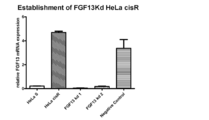
(5-1)で得られたクローン#7-1及び#7-2を4箇月継代培養したところ、順調に生育し安定なコロニーを形成したので、それぞれにFGF13Kd1(FGF13Kd#1ともいう。)及びクローンFGF13Kd2(FGF13Kd#2ともいう。)と呼び、上記(5-2)と同じ条件下での追試実験を行った。具体的には、クローンFGF13Kd1及びクローンFGF13Kd2に対して、(5-2)と全く同様の条件下での定量RT-PCRを行い、それぞれのクローンのFGF13mRNAの発現量を測定した(図7)。
その結果、クローンFGF13Kd1及びクローンFGF13Kd2の両者ともほとんどFGF13mRNAを発現せず、極めて高いFGF13遺伝子のノックダウン効果を示した。この結果は、3回の同一試験を繰り返して同一結果を示した。
このことから、クローン#7-1及び#7-2に対して4箇月の継代培養を施したことにより、細胞中にわずかに混入していた導入用の各種ヌクレオチド断片が脱落したか、又は各クローンのコロニー内にわずかに混入していた不完全なノックダウン細胞が脱落したことで、よりFGF13抑制効果の高い純粋なクローン細胞のみを濃縮することができたものと考えられる。
(5-1)で得られたクローン#7-1及び#7-2を4箇月継代培養したところ、順調に生育し安定なコロニーを形成したので、それぞれにFGF13Kd1(FGF13Kd#1ともいう。)及びクローンFGF13Kd2(FGF13Kd#2ともいう。)と呼び、上記(5-2)と同じ条件下での追試実験を行った。具体的には、クローンFGF13Kd1及びクローンFGF13Kd2に対して、(5-2)と全く同様の条件下での定量RT-PCRを行い、それぞれのクローンのFGF13mRNAの発現量を測定した(図7)。
その結果、クローンFGF13Kd1及びクローンFGF13Kd2の両者ともほとんどFGF13mRNAを発現せず、極めて高いFGF13遺伝子のノックダウン効果を示した。この結果は、3回の同一試験を繰り返して同一結果を示した。
このことから、クローン#7-1及び#7-2に対して4箇月の継代培養を施したことにより、細胞中にわずかに混入していた導入用の各種ヌクレオチド断片が脱落したか、又は各クローンのコロニー内にわずかに混入していた不完全なノックダウン細胞が脱落したことで、よりFGF13抑制効果の高い純粋なクローン細胞のみを濃縮することができたものと考えられる。
〔実施例6〕FGF13発現抑制耐性株の樹立、蛋白質発現の解析
実施例5(5-1)で得られたFGF13の遺伝子発現が抑制された細胞クローン(#7-1,#7-2)において、FGF13の発現量が蛋白質レベルでも抑制されている事を確認するために、Western blot法により解析を行なった。具体的には、各細胞の可溶化物(Roche社製の可溶化剤を用いて抽出したもの)を用いてSDSポリアクリルアミドゲル電気泳動を行ない、泳動後のゲルをPVDF膜(invitrogen社製)にblottingした後、抗ヒトFGF13ポリクローナル抗体(Abnova社製)及びその2次抗体(GE Healthcare社製HRP結合抗マウスIgG抗体)を添加し、発光試薬(GE Healthcare社製ECL plus Western Blotting Detection Reagents)により蛋白質の有無及び濃度を検出した。その結果、図5に示すように、親株では薄いFGF13のバンドが耐性株では濃くなり、FGF13の遺伝子発現を大きく抑制した#7-2のクローンではバンドが薄くなっている事が判明した。なお、同じ各細胞の可溶化物をb-actinに対する抗体を用いて同様に検出した場合は、バンドの濃さが変わらなかった。
実施例5(5-1)で得られたFGF13の遺伝子発現が抑制された細胞クローン(#7-1,#7-2)において、FGF13の発現量が蛋白質レベルでも抑制されている事を確認するために、Western blot法により解析を行なった。具体的には、各細胞の可溶化物(Roche社製の可溶化剤を用いて抽出したもの)を用いてSDSポリアクリルアミドゲル電気泳動を行ない、泳動後のゲルをPVDF膜(invitrogen社製)にblottingした後、抗ヒトFGF13ポリクローナル抗体(Abnova社製)及びその2次抗体(GE Healthcare社製HRP結合抗マウスIgG抗体)を添加し、発光試薬(GE Healthcare社製ECL plus Western Blotting Detection Reagents)により蛋白質の有無及び濃度を検出した。その結果、図5に示すように、親株では薄いFGF13のバンドが耐性株では濃くなり、FGF13の遺伝子発現を大きく抑制した#7-2のクローンではバンドが薄くなっている事が判明した。なお、同じ各細胞の可溶化物をb-actinに対する抗体を用いて同様に検出した場合は、バンドの濃さが変わらなかった。
〔実施例7〕FGF13発現抑制細胞のシスプラチンに対する感受性の解析
(7-1)FGF13遺伝子発現抑制によるシスプラチン耐性の回復-1
実施例5(5-1)で得られたFGF13遺伝子発現が抑制された細胞クローン(#7-1,#7-2)のシスプラチンに対する感受性を、実施例2と同様のMTTアッセイにより解析した。その結果、FGF13の発現が大きく抑制されたRNAi#7-2のクローンは、シスプラチンに対して親株とほぼ同様の感受性を示し、1.25ug/mlのシスプラチンでほぼ全部死滅した。これはFGF13がシスプラチンの耐性獲得機構に大きく関わっていることを明らかに示すものである(図6)。
(7-1)FGF13遺伝子発現抑制によるシスプラチン耐性の回復-1
実施例5(5-1)で得られたFGF13遺伝子発現が抑制された細胞クローン(#7-1,#7-2)のシスプラチンに対する感受性を、実施例2と同様のMTTアッセイにより解析した。その結果、FGF13の発現が大きく抑制されたRNAi#7-2のクローンは、シスプラチンに対して親株とほぼ同様の感受性を示し、1.25ug/mlのシスプラチンでほぼ全部死滅した。これはFGF13がシスプラチンの耐性獲得機構に大きく関わっていることを明らかに示すものである(図6)。
(7-2)FGF13遺伝子発現抑制によるシスプラチン耐性の回復-2
実施例5(5-3)で得られたFGF13Kd1(FGF13Kd#1)及びFGF13Kd2(FGF13Kd#2)に対しても、上記(7―1)と同じ条件下での追試実験を行った。具体的には、クローンFGF13Kd1及びクローンFGF13Kd2に対して、(7-1)と全く同様の条件下でMTTアッセイを行い、それぞれのクローンのシスプラチン感受性を測定した(図8)。
図8には、同時に行った親株(HeLaS)及びシスプラチン耐性樹立株(HeLa cisR)におけるシスプラチン感受性の測定結果をNegative Controlと共に示している。
このように、継代培養によってより純粋なクローンとなったFGF13Kd1(FGF13Kd#1)及びFGF13Kd2(FGF13Kd#2)では、親株(HeLaS)とほぼ同等にまでシスプラチン耐性を回復した。
実施例5(5-3)で得られたFGF13Kd1(FGF13Kd#1)及びFGF13Kd2(FGF13Kd#2)に対しても、上記(7―1)と同じ条件下での追試実験を行った。具体的には、クローンFGF13Kd1及びクローンFGF13Kd2に対して、(7-1)と全く同様の条件下でMTTアッセイを行い、それぞれのクローンのシスプラチン感受性を測定した(図8)。
図8には、同時に行った親株(HeLaS)及びシスプラチン耐性樹立株(HeLa cisR)におけるシスプラチン感受性の測定結果をNegative Controlと共に示している。
このように、継代培養によってより純粋なクローンとなったFGF13Kd1(FGF13Kd#1)及びFGF13Kd2(FGF13Kd#2)では、親株(HeLaS)とほぼ同等にまでシスプラチン耐性を回復した。
Claims (6)
- FGF13遺伝子の発現阻害物質を有効成分とする、シスプラチン耐性を獲得した癌細胞のシスプラチン感受性を回復するための薬剤組成物。
- 前記FGF13遺伝子の発現阻害物質が、FGF13遺伝子を標的とするRNAi物質を細胞内で発現し得るRNAiベクターである、請求項1に記載の薬剤組成物。
- 前記RNAiベクターが、FGF13遺伝子のmiRNAを発現し得るmiRNAベクターである請求項2に記載の薬剤組成物。
- 前記miRNAベクターが、配列番号1又は配列番号5として示される塩基配列を含む、請求項3に記載の薬剤組成物。
- FGF13遺伝子の発現阻害物質を有効成分とする、シスプラチンと併用投与するためのシスプラチン抗癌作用増強剤。
- シスプラチンを有効成分とするする抗癌剤であって、FGF13遺伝子の発現阻害物質が標的癌細胞のシスプラチン耐性獲得能を抑制し得る有効量含まれることを特徴とする抗癌剤。
Priority Applications (1)
| Application Number | Priority Date | Filing Date | Title |
|---|---|---|---|
| JP2011534291A JP5382746B2 (ja) | 2009-09-30 | 2010-09-30 | 抗癌剤耐性を獲得した癌細胞の抗癌剤感受性を回復する方法 |
Applications Claiming Priority (2)
| Application Number | Priority Date | Filing Date | Title |
|---|---|---|---|
| JP2009-227727 | 2009-09-30 | ||
| JP2009227727 | 2009-09-30 |
Publications (1)
| Publication Number | Publication Date |
|---|---|
| WO2011040503A1 true WO2011040503A1 (ja) | 2011-04-07 |
Family
ID=43826315
Family Applications (1)
| Application Number | Title | Priority Date | Filing Date |
|---|---|---|---|
| PCT/JP2010/067028 Ceased WO2011040503A1 (ja) | 2009-09-30 | 2010-09-30 | 抗癌剤耐性を獲得した癌細胞の抗癌剤感受性を回復する方法 |
Country Status (2)
| Country | Link |
|---|---|
| JP (1) | JP5382746B2 (ja) |
| WO (1) | WO2011040503A1 (ja) |
-
2010
- 2010-09-30 WO PCT/JP2010/067028 patent/WO2011040503A1/ja not_active Ceased
- 2010-09-30 JP JP2011534291A patent/JP5382746B2/ja not_active Expired - Fee Related
Non-Patent Citations (8)
| Title |
|---|
| HIDEKI TANZAWA: "Henpei Johi Gan ni Okeru Koganzai Taisei to Hoshasen Taisei ni Taisuru Kokateki Chiryoho no Kaihatsu", JOURNAL OF JAPANESE BIOCHEMICAL SOCIETY, 25 September 2009 (2009-09-25) * |
| KAZUHIRO MURATA ET AL.: "Establishment of cisplatin-resistant HeLa cells and analysis of the underlying mechanism", PROCEEDINGS OF THE JAPANESE CANCER ASSOCIATION, vol. 68, 31 August 2009 (2009-08-31), pages 85 * |
| KIYOSUMI SHIBATA ET AL.: "Establishment of cisplatin-resistant ovarian yolk sac tumor cells and investigation the resistance mechanism", PROCEEDINGS OF THE JAPANESE CANCER ASSOCIATION, vol. 68, 31 August 2009 (2009-08-31), pages 85 * |
| MACLEOD K. ET AL.: "Altered ErbB receptor signaling and gene expression in cisplatin- resistant ovarian cancer.", CANCER RESEARCH, vol. 65, no. 15, 2005, pages 6789 - 6800, XP002519751, DOI: doi:10.1158/0008-5472.CAN-04-2684 * |
| MASANOBU YAMATOJI ET AL.: "Tokeibu Gan Chiryo ni Okeru Cisplatin Teikosei to PDGF-C Hatsugen tono Kanren", JOURNAL OF THE JAPANESE STOMATOLOGICAL SOCIETY, vol. 58, no. 4, 10 September 2009 (2009-09-10), pages 238 * |
| NISHIMOTO S. ET AL.: "Fibroblast growth factor 13 is essential for neural differentiation in Xenopus early embryonic development.", JOURNAL OF BIOLOGICAL CHEMISTRY, vol. 282, no. 33, 2007, pages 24255 - 24261 * |
| SCOTT B.J. ET AL.: "APM2 is a novel mediator of cisplatin resistance in a variety of cancer cell types regardless of p53 or MMR status.", INTERNATIONAL JOURNAL OF CANCER, vol. 125, no. 5, 1 September 2009 (2009-09-01), pages 1193 - 1204 * |
| YU X.L. ET AL.: "Changes of gene expression profile in homoharringtonine-induced leukemia multi-drug resistant cell line K562/HHT.", CHINESE JOURNAL OF HEMATOLOGY, vol. 30, no. 6, June 2009 (2009-06-01), pages 363 - 367 * |
Also Published As
| Publication number | Publication date |
|---|---|
| JP5382746B2 (ja) | 2014-01-08 |
| JPWO2011040503A1 (ja) | 2013-02-28 |
Similar Documents
| Publication | Publication Date | Title |
|---|---|---|
| Du et al. | ANXA2P2/miR-9/LDHA axis regulates Warburg effect and affects glioblastoma proliferation and apoptosis | |
| TW201632207A (zh) | 細胞穿透抗體 | |
| US12595227B2 (en) | Compositions and methods for treatment of platinum-based chemotherapeutic resistant tumors | |
| JP2022542167A (ja) | C/EBPアルファsaRNAを使用する組成物および方法 | |
| Zhang et al. | Tumor-associated macrophage-derived exosomal miR-513b-5p is a target of jianpi yangzheng decoction for inhibiting gastric cancer | |
| JP6262707B2 (ja) | がん幹細胞を含むまたはそれに由来するがんの治療、予防および診断のための方法および組成物 | |
| JP5933010B2 (ja) | 癌治療剤 | |
| Tu et al. | CD164 regulates proliferation and apoptosis by targeting PTEN in human glioma | |
| US9469854B2 (en) | Pharmaceutical composition for treating liver diseases | |
| Zhao et al. | Circ_0018168 inhibits the proliferation and osteogenic differentiation of fibroblasts in ankylosing spondylitis via regulating miR-330-3p/DKK1 axis | |
| Zhang et al. | Apoptotic breast cancer cells after chemotherapy induce pro-tumour extracellular vesicles via LAP-competent macrophages | |
| CN116617391A (zh) | tRF-Gln-TTG靶向抑制剂在制备治疗肝癌的药物中的应用 | |
| WO2013022157A1 (ko) | 피불린-3 단백질을 유효성분으로 함유하는 암 줄기세포 성장 억제용 약학적 조성물 | |
| Liu et al. | APLNR inhibited nasopharyngeal carcinoma growth and immune escape by downregulating PD-L1 | |
| JP5382746B2 (ja) | 抗癌剤耐性を獲得した癌細胞の抗癌剤感受性を回復する方法 | |
| WO2020036183A1 (ja) | がん幹細胞マーカー及びがん幹細胞標的薬 | |
| CN104511028B (zh) | Klf9基因在抑制肝癌中的应用 | |
| WO2011118778A1 (ja) | 細胞増殖抑制剤及びそのスクリーニング方法 | |
| JP6018068B2 (ja) | 細胞の増殖抑制方法、nek10バリアント遺伝子に対するrna干渉作用を有する核酸分子、及び抗癌剤 | |
| US20190359560A1 (en) | Anti-inflammatory drug and uses thereof | |
| CN116617245B (zh) | Utp11抑制剂及其在肿瘤抑制中的用途 | |
| CN118477179B (zh) | 靶向esr1抑制galnt7表达在提高乳腺癌细胞内质网应激敏感度中的应用 | |
| US20240299347A1 (en) | Methods and compositions to treat huntington's disease by targeting alox5- mediated ferroptosis | |
| KR101525229B1 (ko) | Gpr171 단백질의 발현 또는 활성 억제제를 포함하는 암 치료 또는 암 전이 억제용 약학적 조성물 | |
| CN121774997A (zh) | 靶向isca2抑制乳腺癌的组合物及其应用 |
Legal Events
| Date | Code | Title | Description |
|---|---|---|---|
| 121 | Ep: the epo has been informed by wipo that ep was designated in this application |
Ref document number: 10820618 Country of ref document: EP Kind code of ref document: A1 |
|
| WWE | Wipo information: entry into national phase |
Ref document number: 2011534291 Country of ref document: JP |
|
| NENP | Non-entry into the national phase |
Ref country code: DE |
|
| 122 | Ep: pct application non-entry in european phase |
Ref document number: 10820618 Country of ref document: EP Kind code of ref document: A1 |