WO2011024700A1 - 成形型、光学素子及び成形型の製造方法 - Google Patents
成形型、光学素子及び成形型の製造方法 Download PDFInfo
- Publication number
- WO2011024700A1 WO2011024700A1 PCT/JP2010/063983 JP2010063983W WO2011024700A1 WO 2011024700 A1 WO2011024700 A1 WO 2011024700A1 JP 2010063983 W JP2010063983 W JP 2010063983W WO 2011024700 A1 WO2011024700 A1 WO 2011024700A1
- Authority
- WO
- WIPO (PCT)
- Prior art keywords
- resin
- mold
- group
- glass substrate
- oxide film
- Prior art date
- Legal status (The legal status is an assumption and is not a legal conclusion. Google has not performed a legal analysis and makes no representation as to the accuracy of the status listed.)
- Ceased
Links
Images


Classifications
-
- B—PERFORMING OPERATIONS; TRANSPORTING
- B29—WORKING OF PLASTICS; WORKING OF SUBSTANCES IN A PLASTIC STATE IN GENERAL
- B29C—SHAPING OR JOINING OF PLASTICS; SHAPING OF MATERIAL IN A PLASTIC STATE, NOT OTHERWISE PROVIDED FOR; AFTER-TREATMENT OF THE SHAPED PRODUCTS, e.g. REPAIRING
- B29C33/00—Moulds or cores; Details thereof or accessories therefor
- B29C33/56—Coatings, e.g. enameled or galvanised; Releasing, lubricating or separating agents
- B29C33/60—Releasing, lubricating or separating agents
- B29C33/62—Releasing, lubricating or separating agents based on polymers or oligomers
- B29C33/64—Silicone
-
- B—PERFORMING OPERATIONS; TRANSPORTING
- B29—WORKING OF PLASTICS; WORKING OF SUBSTANCES IN A PLASTIC STATE IN GENERAL
- B29C—SHAPING OR JOINING OF PLASTICS; SHAPING OF MATERIAL IN A PLASTIC STATE, NOT OTHERWISE PROVIDED FOR; AFTER-TREATMENT OF THE SHAPED PRODUCTS, e.g. REPAIRING
- B29C33/00—Moulds or cores; Details thereof or accessories therefor
- B29C33/38—Moulds or cores; Details thereof or accessories therefor characterised by the material or the manufacturing process
- B29C33/40—Plastics, e.g. foam or rubber
-
- B—PERFORMING OPERATIONS; TRANSPORTING
- B29—WORKING OF PLASTICS; WORKING OF SUBSTANCES IN A PLASTIC STATE IN GENERAL
- B29C—SHAPING OR JOINING OF PLASTICS; SHAPING OF MATERIAL IN A PLASTIC STATE, NOT OTHERWISE PROVIDED FOR; AFTER-TREATMENT OF THE SHAPED PRODUCTS, e.g. REPAIRING
- B29C33/00—Moulds or cores; Details thereof or accessories therefor
- B29C33/42—Moulds or cores; Details thereof or accessories therefor characterised by the shape of the moulding surface, e.g. ribs or grooves
- B29C33/424—Moulding surfaces provided with means for marking or patterning
-
- B—PERFORMING OPERATIONS; TRANSPORTING
- B29—WORKING OF PLASTICS; WORKING OF SUBSTANCES IN A PLASTIC STATE IN GENERAL
- B29C—SHAPING OR JOINING OF PLASTICS; SHAPING OF MATERIAL IN A PLASTIC STATE, NOT OTHERWISE PROVIDED FOR; AFTER-TREATMENT OF THE SHAPED PRODUCTS, e.g. REPAIRING
- B29C33/00—Moulds or cores; Details thereof or accessories therefor
- B29C33/56—Coatings, e.g. enameled or galvanised; Releasing, lubricating or separating agents
-
- B—PERFORMING OPERATIONS; TRANSPORTING
- B29—WORKING OF PLASTICS; WORKING OF SUBSTANCES IN A PLASTIC STATE IN GENERAL
- B29C—SHAPING OR JOINING OF PLASTICS; SHAPING OF MATERIAL IN A PLASTIC STATE, NOT OTHERWISE PROVIDED FOR; AFTER-TREATMENT OF THE SHAPED PRODUCTS, e.g. REPAIRING
- B29C33/00—Moulds or cores; Details thereof or accessories therefor
- B29C33/56—Coatings, e.g. enameled or galvanised; Releasing, lubricating or separating agents
- B29C33/60—Releasing, lubricating or separating agents
- B29C33/62—Releasing, lubricating or separating agents based on polymers or oligomers
-
- B—PERFORMING OPERATIONS; TRANSPORTING
- B29—WORKING OF PLASTICS; WORKING OF SUBSTANCES IN A PLASTIC STATE IN GENERAL
- B29D—PRODUCING PARTICULAR ARTICLES FROM PLASTICS OR FROM SUBSTANCES IN A PLASTIC STATE
- B29D11/00—Producing optical elements, e.g. lenses or prisms
- B29D11/00009—Production of simple or compound lenses
- B29D11/0048—Moulds for lenses
- B29D11/00548—Moulds for lenses with surfaces formed by films
-
- G—PHYSICS
- G02—OPTICS
- G02B—OPTICAL ELEMENTS, SYSTEMS OR APPARATUS
- G02B3/00—Simple or compound lenses
- G02B3/0006—Arrays
- G02B3/0012—Arrays characterised by the manufacturing method
- G02B3/0031—Replication or moulding, e.g. hot embossing, UV-casting, injection moulding
-
- B—PERFORMING OPERATIONS; TRANSPORTING
- B29—WORKING OF PLASTICS; WORKING OF SUBSTANCES IN A PLASTIC STATE IN GENERAL
- B29L—INDEXING SCHEME ASSOCIATED WITH SUBCLASS B29C, RELATING TO PARTICULAR ARTICLES
- B29L2011/00—Optical elements, e.g. lenses, prisms
-
- Y—GENERAL TAGGING OF NEW TECHNOLOGICAL DEVELOPMENTS; GENERAL TAGGING OF CROSS-SECTIONAL TECHNOLOGIES SPANNING OVER SEVERAL SECTIONS OF THE IPC; TECHNICAL SUBJECTS COVERED BY FORMER USPC CROSS-REFERENCE ART COLLECTIONS [XRACs] AND DIGESTS
- Y10—TECHNICAL SUBJECTS COVERED BY FORMER USPC
- Y10T—TECHNICAL SUBJECTS COVERED BY FORMER US CLASSIFICATION
- Y10T428/00—Stock material or miscellaneous articles
- Y10T428/24—Structurally defined web or sheet [e.g., overall dimension, etc.]
- Y10T428/24479—Structurally defined web or sheet [e.g., overall dimension, etc.] including variation in thickness
Definitions
- the present invention relates to a mold, an optical element, and a method for manufacturing the mold.
- Patent Documents 1 and 2 disclose a mold using an epoxy resin or a urethane resin. Further, Patent Documents 3 to 5 disclose a resin mold using a special silicone resin, and attempts have been made to improve transferability to a molded product by using a mold of such a material. .
- Japanese Patent Laid-Open No. 5-301227 JP 7-24839 A Japanese Unexamined Patent Publication No. 7-178754 Japanese Unexamined Patent Publication No. 7-76303 JP-A-10-95920
- Patent Documents 1 and 2 Even if the resins disclosed in Patent Documents 1 and 2 are applied, it is not easy to release the molded product from the mold, and the release property is inferior. Patent Documents 1 and 2 do not disclose a mold release process suitable for a resin mold that is frequently used or a mold release process for maintaining transfer accuracy. Further, even if the resins disclosed in Patent Documents 3 to 5 are used, it is difficult to think that sufficient transfer accuracy can be obtained to the extent that precision molding can be handled.
- the main object of the present invention is to provide a molding die capable of reliably transferring the shape of the molding die to the molded product, even when precision molding with a shape error of 1 ⁇ m or less, and a manufacturing method thereof, It is providing the optical element obtained using a type
- a glass substrate One or more resin molds formed on the glass substrate; An inorganic oxide film covering the glass substrate and the resin mold,
- the resin mold is made of a photocurable resin, has a light transmittance of 20% or more for light having a wavelength of 365 nm, and a hardness of Shore D of 30 to 90,
- a mold is provided in which the inorganic oxide film is subjected to a mold release treatment.
- a photocurable resin is molded on a glass substrate, and one or more resin molds having a light transmittance of 20% or more for light having a wavelength of 365 nm and a hardness of Shore D of 30 to 90 are formed on the glass substrate.
- molding die characterized by having is provided.
- the resin mold has a certain hardness and the inorganic oxide film is subjected to a mold release treatment, it is easy from the mold even when precision molding with a shape error of 1 ⁇ m or less is performed.
- the mold can be released from the mold, and the mold manufacturing method capable of reliably transferring the shape of the mold to the mold, and the mold and the optical element obtained by using the mold can be provided. It was.
- a mold 1 As shown in FIG. 1, a mold 1 according to a preferred embodiment of the present invention includes a flat glass substrate 10 and a plurality of resin dies 20.
- Each resin mold 20 is formed on the glass substrate 10 with a minute space between each other.
- a plurality of convex portions 22 having a convex shape are formed on the surface of each resin mold 20.
- the resin mold 20 has a transmittance of 20% or more for light having a wavelength of 365 nm and a hardness of Shore D of 30 to 90 (preferably 70 to 90). If the transmittance with respect to light having a wavelength of 365 nm is less than 20%, it takes a very long time to perform the photocuring reaction through the resin mold 20, and also causes insufficient hardness due to the fact that short wavelength light is not irradiated. It will be. “Shore D” represents hardness measured according to a method based on JIS K6253 standard.
- the resin mold 20 having such characteristics is mainly composed of a photocurable resin, and is composed of, for example, the following resins (1) to (4).
- a known initiator can be used for the photocurable resin depending on the type of the resin (monomer), and the photocurable resin can be radically polymerizable, cationically polymerizable, or condensed depending on the type of the initiator. It may have any polymerizable property.
- the (meth) acrylate used for the polymerization reaction is not particularly limited, and the following (meth) acrylate produced by a general production method can be used.
- ester (meth) acrylate, urethane (meth) acrylate, epoxy (meth) acrylate, ether (meth) acrylate, alkyl (meth) acrylate, alkylene (meth) acrylate, (meth) acrylate having an aromatic ring, alicyclic (Meth) acrylate etc. which have a structure are mentioned.
- ester (meth) acrylate, urethane (meth) acrylate, epoxy (meth) acrylate, ether (meth) acrylate, alkyl (meth) acrylate, alkylene (meth) acrylate, (meth) acrylate having an aromatic ring, alicyclic (Meth) acrylate etc. which have a structure are mentioned.
- One or more of these can be used.
- (meth) acrylate having an alicyclic structure is preferable, and an alicyclic structure containing an oxygen atom or a nitrogen atom may be used.
- a compound having an adamantane skeleton is preferable.
- 2-alkyl-2-adamantyl (meth) acrylate see Japanese Patent Application Laid-Open No. 2002-193883
- adamantyl di (meth) acrylate see Japanese Patent Application Laid-Open No. 57-5000785
- diallyl adamantyl dicarboxylate Japanese Patent Application Laid-Open No. 60-10000537
- perfluoroadamantyl acrylate see JP 2004-123687
- (meth) acrylate for example, methyl acrylate, methyl methacrylate, n-butyl acrylate, n-butyl methacrylate, 2-ethylhexyl acrylate, 2-ethylhexyl methacrylate, isobutyl acrylate, isobutyl methacrylate, tert-butyl acrylate Tert-butyl methacrylate, phenyl acrylate, phenyl methacrylate, benzyl acrylate, benzyl methacrylate, cyclohexyl acrylate, cyclohexyl methacrylate, and the like.
- polyfunctional (meth) acrylate examples include trimethylolpropane tri (meth) acrylate, pentaerythritol tetra (meth) acrylate, pentaerythritol tri (meth) acrylate, dipentaerythritol hexa (meth) acrylate, dipentaerythritol penta (meth) ) Acrylate, dipentaerythritol tetra (meth) acrylate, dipentaerythritol tri (meth) acrylate, tripentaerythritol octa (meth) acrylate, tripentaerythritol septa (meth) acrylate, tripentaerythritol hexa (meth) acrylate, tripenta Erythritol penta (meth) acrylate, tripentaerythritol tetra (meth) acrylate, tripent
- Allyl ester resin An allyl ester resin is a resin having an allyl group and cured by radical polymerization. Examples thereof include the following, but are not particularly limited to the following.
- Bromine-containing (meth) allyl ester not containing an aromatic ring see JP-A-2003-66201
- allyl (meth) acrylate see JP-A-5-286896
- allyl ester resin JP-A-5-286896
- JP 2003-66201 A a copolymer of an acrylate ester and an epoxy group-containing unsaturated compound
- JP 2003-128725 A an acrylate compound
- an acrylic And ester compounds see JP 2005-2064 A.
- Epoxy resin is not particularly limited as long as it has an epoxy group and is polymerized and cured by light or heat, and an acid anhydride, a cation generator, or the like can be used as a curing initiator.
- Examples of the epoxy resin include novolak phenol type epoxy resin, biphenyl type epoxy resin, and dicyclopentadiene type epoxy resin.
- Examples include bisphenol F diglycidyl ether, bisphenol A diglycidyl ether, 2,2'-bis (4-glycidyloxycyclohexyl) propane, 3,4-epoxycyclohexylmethyl-3,4-epoxycyclohexanecarboxylate, vinyl Cyclohexene dioxide, 2- (3,4-epoxycyclohexyl) -5,5-spiro- (3,4-epoxycyclohexane) -1,3-dioxane, bis (3,4-epoxycyclohexyl) adipate, 1,2 -Cyclopropanedicarboxylic acid bisglycidyl ester and the like.
- a silicone resin having a siloxane bond with Si—O—Si as the main chain can be used.
- a silicone resin made of a predetermined amount of polyorganosiloxane resin can be used (for example, see JP-A-6-9937).
- the polyorganosiloxane resin is not particularly limited as long as it becomes a three-dimensional network structure with a siloxane bond skeleton by continuous hydrolysis-dehydration condensation reaction by heating, and generally exhibits curability when heated at high temperature for a long time. Once cured, it has the property of not being easily re-softened by overheating.
- Such a polyorganosiloxane resin includes the following general formula (A) as a structural unit, and the shape thereof may be any of a chain, a ring, and a network.
- R 1 and R 2 represent the same or different substituted or unsubstituted monovalent hydrocarbon groups.
- an alkyl group such as a methyl group, an ethyl group, a propyl group, or a butyl group, an alkenyl group such as a vinyl group or an allyl group, an allyl group such as a phenyl group or a tolyl group, or cyclohexyl Group, a cycloalkyl group such as a cyclooctyl group, or a group in which a hydrogen atom bonded to a carbon atom of these groups is substituted with a halogen atom, a cyano group, an amino group, or the like, for example, a chloromethyl group, 3, 3, 3- Examples thereof include a trifluoropropyl group, a cyanomethyl
- the polyorganosiloxane resin is usually used after being dissolved in a hydrocarbon solvent such as toluene, xylene, or a petroleum solvent, or a mixture of these with a polar solvent. Moreover, you may mix
- a hydrocarbon solvent such as toluene, xylene, or a petroleum solvent, or a mixture of these with a polar solvent.
- the method for producing the polyorganosiloxane resin is not particularly limited, and any known method can be used. For example, it can be obtained by hydrolysis or alcoholysis of one or a mixture of two or more organohalogenosilanes.
- the polyorganosiloxane resin generally contains a hydrolyzable group such as a silanol group or an alkoxy group, These groups are contained in an amount of 1 to 10% by mass in terms of silanol groups.
- the reactions are generally carried out in the presence of a solvent capable of melting the organohalogenosilane. It can also be obtained by a method of synthesizing a block copolymer by hydrolyzing a linear polyorganosiloxane having a hydroxyl group, an alkoxy group or a halogen atom at the molecular chain terminal together with an organotrichlorosilane.
- the polyorganosiloxane resin thus obtained generally contains residual HCl, but in the composition of the present embodiment, from the viewpoint of improving storage stability, the HCl content is 10 ppm or less, Preferably, 1 ppm or less is used.
- initiators can be used depending on the type of the photocurable resin (monomer).
- the following initiators are exemplified as usable initiators.
- photopolymerization initiators corresponding to acrylic resins include benzophenone, acetophenone, benzoin, benzoin ethyl ether, benzoin isobutyl ether, benzyl methyl ketal, azobisisobutyronitrile, hydroxycyclohexyl phenyl ketone, 2-hydroxy-2- Methyl-1-phenylpropan-1-one and the like can be used.
- photopolymerization initiators may be used alone or in combination of two or more. Furthermore, if necessary, a photosensitizer such as an amine compound or a phosphorus compound can be added to speed up the polymerization.
- a photosensitizer such as an amine compound or a phosphorus compound can be added to speed up the polymerization.
- photopolymerization initiator corresponding to the epoxy resin a photoradical polymerization initiator or a photocationic polymerization initiator can be used.
- photo radical polymerization agent examples include ⁇ -diketones such as benzyl and diacetyl, acyloins such as benzoin, acyloin ethers such as benzoin methyl ether, benzoin ethyl ether, and benzoin isopropyl ether, thioxanthone, and 2,4-diethyl.
- Benzophenones such as thioxanthone, thioxanthone-4-sulfonic acid, benzophenone, 4,4'-bis (dimethylamino) benzophenone, 4,4'-bis (diethylamino) benzophenone, acetophenone, p-dimethylaminoacetophenone, ⁇ , ⁇ ' -Dimethoxyacetoxybenzophenone, 2,2'-dimethoxy-2-phenylacetophenone, p-methoxyacetophenone, 2-methyl [4- (methylthio) phenyl] -2-morpholino-1 Acetophenones such as propanone and 2-benzyl-2-dimethylamino-1- (4-morpholinophenyl) -butan-1-one, quinones such as anthraquinone and 1,4-naphthoquinone, phenacyl chloride, tribromomethyl Examples thereof include halogen compounds such as phen
- photocationic polymerization initiator commercially available products as shown below can also be used.
- examples of commercially available products that can be suitably used include Uvacure 1590 (manufactured by Daicel Cytec Co., Ltd.), UVI-6950, UVI-6970, UVI-6974, UVI-6990 (above, Union Carbide), and Adekaoptomer SP.
- the mold 1 has an inorganic oxide film 30, and the inorganic oxide film 30 is formed on the surface of the resin mold 20 or the surface of the glass substrate 10 (the glass substrate 10 exposed from the gap between the resin molds 20. (See the enlarged view of FIG. 1, including the surface.)
- the inorganic oxide constituting the inorganic oxide film 30 SiO 2 , Al 2 O 3 , TiO 2 or the like is used, and the inorganic oxide film 30 is processed (release process) with a release agent.
- a photocurable resin is dispensed at a predetermined position of the glass substrate 10, and a metal mold 40 (matrix) is pressed against the resin to irradiate with light. Thereafter, as shown in FIGS. 2 and 3, such an operation is sequentially repeated while moving the mold 40 to form a plurality of resin dies 20 on the glass substrate 10 one by one.
- the number of the resin molds 20 may be simply one. In this case, it is not necessary to repeat the dispensing of the resin on the glass substrate 10, the pressing of the mother die 40, and the light irradiation, and it is sufficient to simply dispense the resin on the glass substrate 10 and then press the mother die 40 for the light irradiation. .
- an inorganic oxide film 30 is formed on the surface of the glass substrate 10 and the resin mold 20 by vacuum vapor deposition or sputtering.
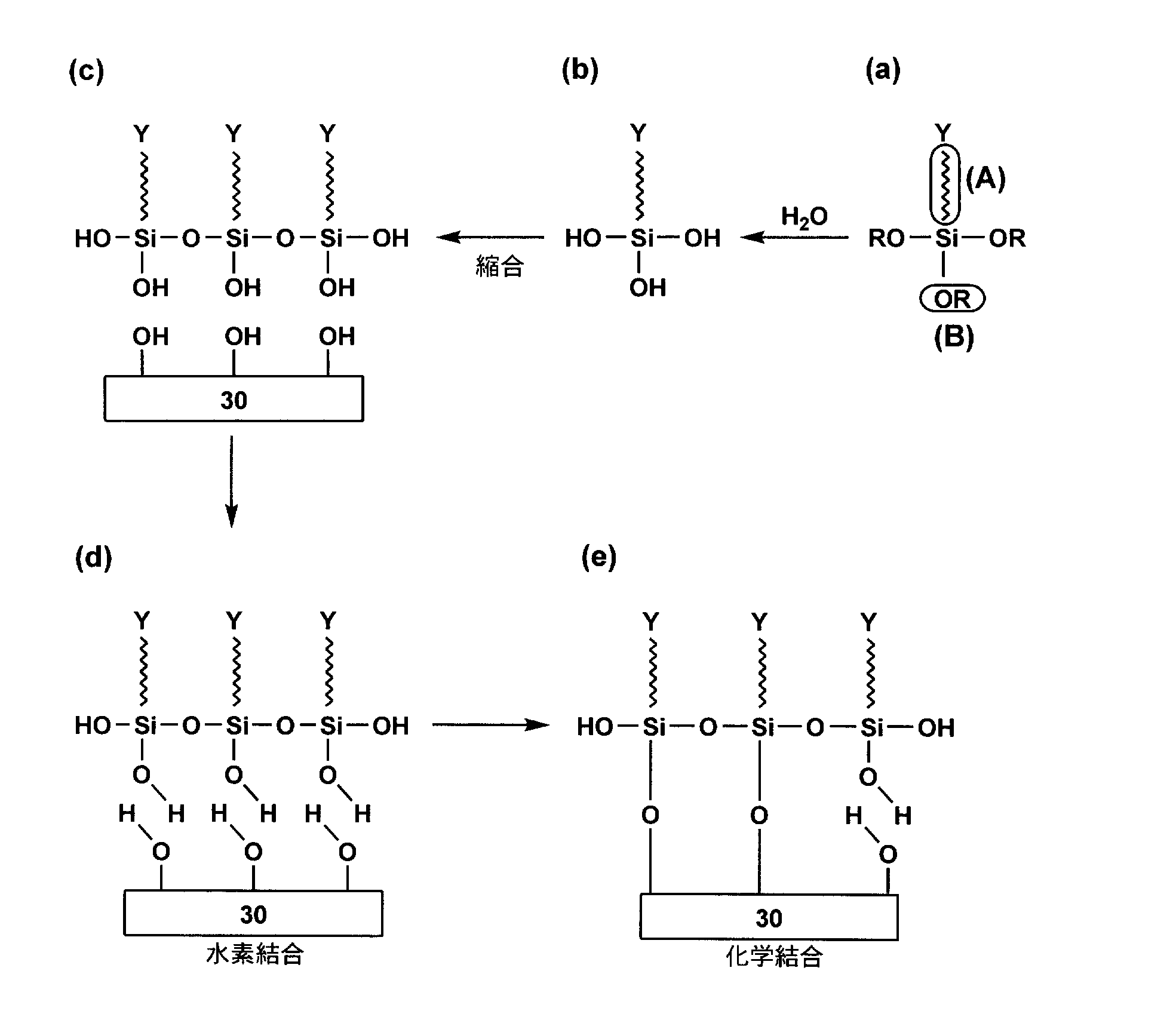
- the release agent is a compound having a hydrolyzable functional group bonded to the end, such as a silane coupling agent structure, that is, dehydration with an OH group present on the surface of the inorganic oxide film 30 (metal).
- a silane coupling agent structure that is, dehydration with an OH group present on the surface of the inorganic oxide film 30 (metal).
- examples thereof include compounds having a structure in which condensation or hydrogen bonding or the like is caused to bond.
- the compound having a hydrolyzable functional group bonded to the terminal preferably includes a compound having an alkoxysilane group, a halogenated silane group, a quaternary ammonium salt, a phosphate ester group or the like as the functional group.
- the terminal group may be a group that causes a strong bond with the mold, such as triazine thiol. Specifically, it is a compound having an alkoxysilane group represented by the following general formula (B) or a halogenated silane group represented by the following general formula (C).
- R 1 and R 2 each represents an alkyl group (eg, a methyl group, an ethyl group, a propyl group, a butyl group, etc.), and n and m are each 1, 2 or 3 and R 3 represents an alkyl group (for example, methyl group, ethyl group, propyl group, butyl group, etc.) or an alkoxy group (for example, methoxy group, ethoxy group, butoxy group, etc.).
- X represents a halogen atom (for example, Cl, Br, I).
- R 3 When two or more R 3 are bonded to the Si atom, they may be different within the above group or atom range, for example, so that two R 3 are an alkyl group and an alkoxy group.
- R 1 , R 2 , R 3 , and X when two or more of R 1 , R 2 , R 3 , and X are bonded to the Si atom, within the above group or atom range, for example, an alkyl group, such as a methyl group and an ethyl group May be different.
- the alkoxysilane group —SiOR 1 and the halogenated silane group —SiX react with moisture to become —SiOH, which further causes dehydration condensation or hydrogen bonding with the OH groups present on the surface of the inorganic oxide film 30. And combine.
- A represents a main chain having a releasability function
- —OR represented by B represents an alkoxy group which is a hydrolyzable functional group.
- alkoxy group represented by B include methoxy (—OCH 3 ) and ethoxy (—OC 2 H 5 ), and methanol (CH 3 OH) and ethanol (C 2 H 5 OH) are obtained by hydrolysis.
- silanol (—SiOH) represented by the reaction formula (b).
- silanol (—SiOH) represented by the reaction formula (b).
- silanol condensate as shown in reaction formula (c).
- reaction formula (d) it is adsorbed by OH groups and hydrogen bonds on the surface of the inorganic oxide film 30, and finally dehydrated as shown in the reaction formula (e) to form —O—chemical bond (co-bond).
- the release agent used in the present invention is chemically bonded to the surface of the inorganic oxide film 30 at one end, and the functional group is oriented at the other end so as to cover the inorganic oxide film 30.
- a uniform release layer having excellent durability can be formed.
- a structure having a releasability function preferably has a low surface energy, for example, a fluorine-substituted hydrocarbon group or a hydrocarbon group.
- fluorine-based release agent As the fluorine-substituted hydrocarbon group, in particular, a perfluoro group such as a CF 3 (CF 2 ) a — group or a CF 3 .CF 3 .CF (CF 2 ) b — group at one end of the molecular structure (a and b are And a perfluoro group having a length of 2 or more in terms of carbon number, and a CF 2 group following CF 3 of CF 3 (CF 2 ) a — Is preferably 5 or more.
- a perfluoro group such as a CF 3 (CF 2 ) a — group or a CF 3 .CF 3 .CF (CF 2 ) b — group at one end of the molecular structure (a and b are And a perfluoro group having a length of 2 or more in terms of carbon number, and a CF 2 group following CF 3 of CF 3 (CF 2 ) a — Is
- the perfluoro group does not need to be a straight chain and may have a branched structure.
- a structure such as CF 3 (CF 2 ) c — (CH 2 ) d — (CF 2 ) e — may be used in response to recent environmental problems.
- c is 3 or less
- d is an integer (preferably 1)
- e is 4 or less.
- the above-mentioned fluorine release agent is usually solid, but in order to apply it to the surface of the inorganic oxide film 30, it is necessary to use a fluorine release agent solution dissolved in an organic solvent. Although it varies depending on the molecular structure of the release agent, in most cases, a fluorinated hydrocarbon solvent or a mixture of some organic solvent is suitable as the solvent.
- the concentration of the solvent is not particularly limited, but the required release film is particularly thin. Therefore, a low concentration is sufficient and may be in the range of 1 to 3% by mass.
- this fluorine release agent solution to the surface of the inorganic oxide film 30
- a normal wet coating method such as dip coating, spray coating, brush coating, or spin coating can be used. After coating, the solvent is evaporated by natural drying to obtain a dry coating film.
- the film thickness applied at this time is not particularly specified, but 20 ⁇ m or less is appropriate.
- fluorine release agent examples include OPTOOL DSX manufactured by Daikin Industries, Durasurf HD-1100, HD-2100, Novec EGC1720 manufactured by Sumitomo 3M, vapor deposition of triazine thiol manufactured by Takeuchi's vacuum coating, and amorphous fluorine Top grade M, anti-fouling coat OPC-800 manufactured by N Material, etc.
- the hydrocarbon group may be linear, such as C n H 2n + 1 , or may be branched. Silicone release agents are included in this category.
- compositions are known as a composition mainly composed of an organopolysiloxane resin and forming a cured film exhibiting water repellency.
- JP-A-55-48245 discloses a hydroxyl group-containing methylpolysiloxane resin, ⁇ , ⁇ -dihydroxydiorganopolysiloxane, and organosilane, which are cured to provide excellent releasability and antifouling properties.
- Compositions have been proposed that form the films shown.
- 59-140280 discloses a composition mainly composed of a partial cohydrolyzed condensate of an organosilane mainly composed of a perfluoroalkyl group-containing organosilane and an amino group-containing organosilane.
- a composition that forms a cured film excellent in oil repellency has been proposed.
- mold spats manufactured by AGC Seimi Chemical Co. Olga-Tix SIC-330,434 manufactured by Matsumoto Fine Chemical Co., SR-2410 manufactured by Toray Dow Chemical Co., Ltd., and the like.
- SAMLAY manufactured by Nippon Soda Co., Ltd. can be mentioned.
- the mold 1 can be manufactured by performing the above mold release treatment on the inorganic oxide film 30.
- a resin-made optical element can be manufactured using the mold 1.
- a predetermined resin is dispensed (dropped) on a wafer-shaped glass substrate, and a plurality of molds 1 (resin mold 20) are pressed against the resin to cure the resin.
- a so-called wafer lens having a resin part can be manufactured.
- the resin mold 20 has a certain hardness, and the inorganic oxide film 30 is subjected to the mold release process.
- the mold can be easily released, and the shape of the resin mold 20 of the mold 1 (the shape of the convex portion 22) can be reliably transferred to the resin of the wafer lens.
- a concave portion may be formed on the surface of the resin mold 20 instead of the convex portion 22, and in this case, a resin convex lens can be manufactured from the mold 1.
- the mold 1 (convex portion 22) is used as the first mold, and the second mold (concave portion) is formed from the first mold, and the optical element (resin convex portion) is formed from the second mold (concave portion). ) Can be manufactured.
- an inorganic oxide film (see Table 1) was formed by vapor deposition on each resin mold and the glass substrate exposed from the gap. Thereafter, a release agent (Optool DSX, manufactured by Daikin Industries, Ltd.) is applied to the inorganic oxide film, a release treatment is applied to the inorganic oxide film, and Samples 1 to 17 that are a plurality of molding dies according to the type of resin are prepared. Manufactured.
- a release agent (Optool DSX, manufactured by Daikin Industries, Ltd.) is applied to the inorganic oxide film, a release treatment is applied to the inorganic oxide film, and Samples 1 to 17 that are a plurality of molding dies according to the type of resin are prepared. Manufactured.
- Variation (shape error) is less than 200 nm
- Variation (shape error) is 200 nm or more and less than 500 nm ⁇ : Variation (shape error) is 500 nm or more and less than 1.0 ⁇ m ⁇ : Variation (Shape error) is 1.0 ⁇ m or more.
- (3) Evaluation of releasability When a resin-made optical element is produced using each mold, the releasability of the molded element produced after the first shot. Evaluated. The case where the molded optical element can be released from the molding die while maintaining the surface shape was evaluated as “ ⁇ ”, and the case where the molded optical element could not be released was evaluated as “X”. The evaluation results are similarly shown in Table 1.
- Samples 4 and 8 of Comparative Examples in which the mold release treatment was performed without forming the inorganic oxide film could not be released in a form that maintained the surface shape of the molding element.
Landscapes
- Engineering & Computer Science (AREA)
- Mechanical Engineering (AREA)
- Manufacturing & Machinery (AREA)
- Physics & Mathematics (AREA)
- General Physics & Mathematics (AREA)
- Optics & Photonics (AREA)
- Health & Medical Sciences (AREA)
- Ophthalmology & Optometry (AREA)
- Moulds For Moulding Plastics Or The Like (AREA)
- Manufacture Of Macromolecular Shaped Articles (AREA)
Abstract
Description
ガラス基板と、
ガラス基板上に形成された一又は複数の樹脂型と、
前記ガラス基板と前記樹脂型とを被覆する無機酸化物膜と、を備え、
前記樹脂型は、光硬化性樹脂製であって、波長365nmの光に対する光透過率が20%以上でかつショアDが30~90の硬度を有し、
前記無機酸化物膜は、離型処理されていることを特徴とする成形型が提供される。
ガラス基板上で光硬化性樹脂を成形して、波長365nmの光に対する光透過率が20%以上でかつショアDが30~90の硬度を有する一又は複数の樹脂型を、前記ガラス基板上に形成する工程と、
前記ガラス基板と前記樹脂型との表面に無機酸化物膜を形成する工程と、
前記無機酸化物膜を離型処理する工程と、
を有することを特徴とする成形型の製造方法が提供される。
重合反応に用いられる(メタ)アクリレートは、特に制限はなく、一般的な製造方法により製造された下記(メタ)アクリレートを使用することができる。例えば、エステル(メタ)アクリレート、ウレタン(メタ)アクリレート、エポキシ(メタ)アクリレート、エーテル(メタ)アクリレート、アルキル(メタ)アクリレート、アルキレン(メタ)アクリレート、芳香環を有する(メタ)アクリレート、脂環式構造を有する(メタ)アクリレート等が挙げられる。これらを1種類又は2種類以上を用いることができる。
アリルエステル樹脂とは、アリル基を有し、ラジカル重合により硬化する樹脂で、例えば、次のものが挙げられるが、特に以下のものに限定されるわけではない。
エポキシ樹脂としては、エポキシ基を持ち光又は熱により重合硬化するものであれば特に限定されず、硬化開始剤としても酸無水物やカチオン発生剤等を用いることができる。
本発明では、Si-O-Siを主鎖としたシロキサン結合を有するシリコーン樹脂を使用することができる。当該シリコーン樹脂として、所定量のポリオルガノシロキサン樹脂よりなるシリコーン系樹脂が使用可能である(例えば、特開平6-9937号公報参照)。
((R1)(R2)SiO)n
上記一般式(A)において、R1及びR2は、同種又は異種の置換もしくは非置換の一価炭化水素基を示す。具体的には、R1及びR2としては、メチル基、エチル基、プロピル基、ブチル基等のアルキル基、ビニル基、アリル基等のアルケニル基、フェニル基、トリル基等のアリル基、シクロヘキシル基、シクロオクチル基等のシクロアルキル基、またはこれらの基の炭素原子に結合した水素原子をハロゲン原子、シアノ基、アミノ基などで置換した基、例えば、クロロメチル基、3,3,3-トリフルオロプロピル基、シアノメチル基、γ-アミノプロピル基、N-(β-アミノエチル)-γ-アミノプロピル基などが例示される。R1及びR2は、水酸基およびアルコキシ基から選択される基であってもよい。また、上記一般式(A)において、nは50以上の整数を示す。
-Si(OR1)nR2 3-n
一般式(C)
-SiXmR3 3-m
上記一般式(B)、(C)において、R1、R2は、各々アルキル基(例えば、メチル基、エチル基、プロピル基、ブチル基など)を表し、n、mは各々1、2または3を表し、R3はアルキル基(例えば、メチル基、エチル基、プロピル基、ブチル基など)またはアルコキシ基(例えば、メトキシ基、エトキシ基、ブトキシ基など)を表す。Xは、ハロゲン原子(例えば、Cl、Br、I)を表す。
フッ素置換炭化水素基としては、特に、分子構造の一端にCF3(CF2)a-基や、CF3・CF3・CF(CF2)b-基などのパーフルオロ基(aおよびbは、整数を表す)を有するフッ素置換炭化水素基が好ましく、また、パーフルオロ基の長さが炭素数にして2個以上が好ましく、CF3(CF2)a-のCF3につづくCF2基の数は5以上が好ましい。
炭化水素基としては、CnH2n+1のように直鎖でもよいし、分岐していてもよい。シリコーン系離型剤がこの分類に含まれる。
10.2cm(4インチ)のガラス基板全面に対し、樹脂(表1に詳細を記載)のディスペンスと球面金型(深さ0.35mm,φ2,R4)の押圧と光の照射とを、球面金型を移動させながら繰り返して行い、複数の樹脂型を形成した。その後、形成した各樹脂型について、硬度(JIS K 6253規格に準拠した方法に従って測定)と波長365nmの光に対する分光透過率の測定(日立製作所製:330型自記分光光度計)を行い、その測定結果を表1に示す。
各成形型から樹脂製の光学素子を作製(成形)し、各光学素子の表面形状を測定することで、成形型の良否を判断した。表面形状の測定では、非接触式表面形状測定装置(Panasonic社製 UA3P)を用い、表面形状の設計値からのばらつき(形状誤差)を測定した。その測定結果を、表1に示す。なお、表1に記載した◎、○、△、×の基準は、下記の通りである。
○:ばらつき(形状誤差)が、200nm以上、500nm未満である
△:ばらつき(形状誤差)が、500nm以上、1.0μm未満である
×:ばらつき(形状誤差)が、1.0μm以上である
(3)離型性の評価
各成形型を用いて樹脂製の光学素子を作製する際、最初の1ショット後に作製された成形素子の離型性を評価した。成形された光学素子が成形金型から表面形状を維持した形で離型できるものを○とし、離型できないものを×と評価した。その評価結果を、同様に表1に示す。
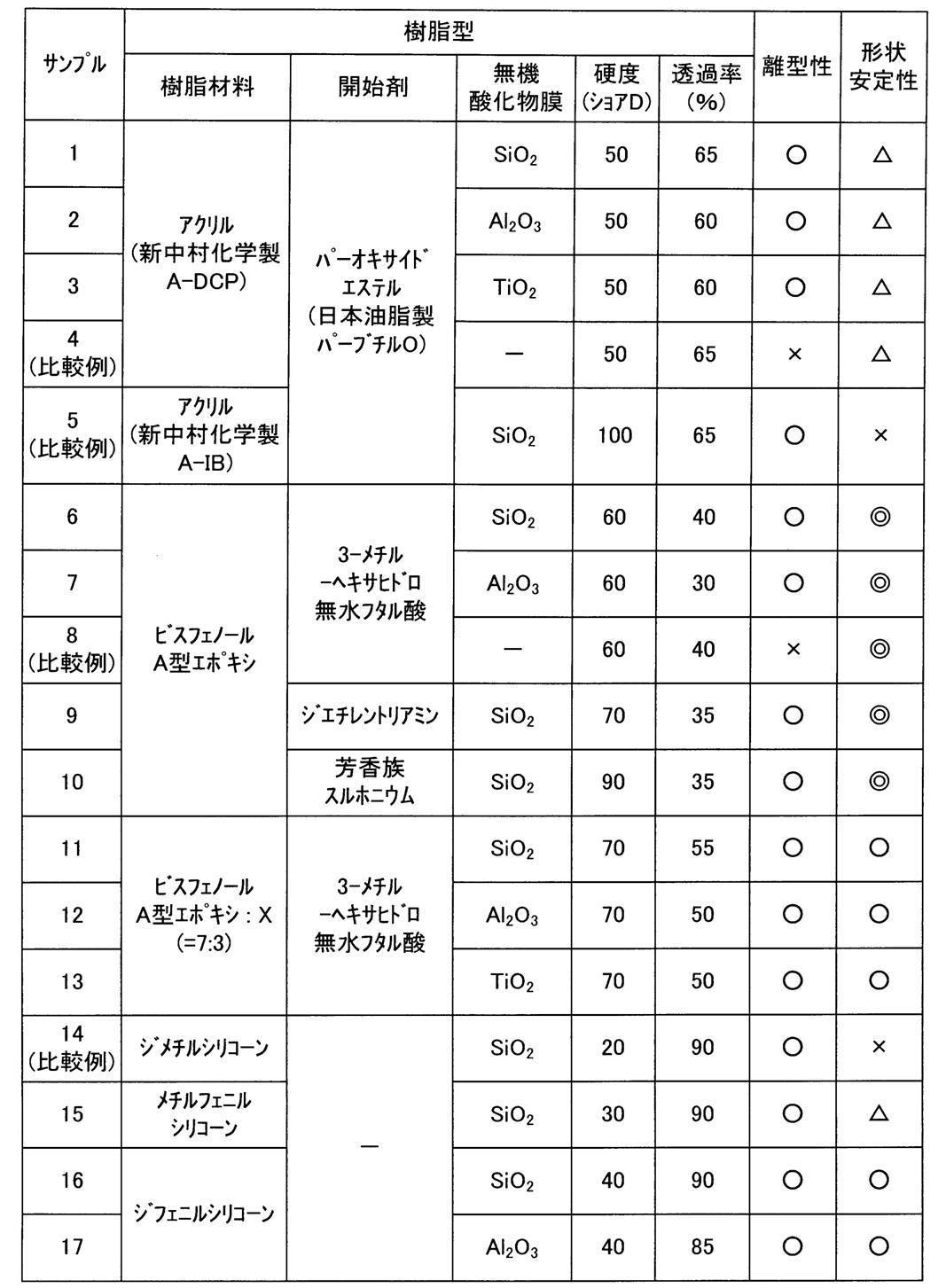
表1に示す通り、本発明のサンプル1~4、6~13、15~17と比較例のサンプル4、14とを比較すると、サンプル1~4、6~13、15~17から作製した光学素子は、表面形状が安定していた。
10 ガラス基板
20 樹脂型
22 凸部
30 無機酸化物膜
40 金型
Claims (7)
- ガラス基板と、
ガラス基板上に形成された1個又は複数個の樹脂型と、
前記ガラス基板と前記樹脂型とを被覆する無機酸化物膜と、を備え、
前記樹脂型は、光硬化性樹脂製であって、波長365nmの光に対する光透過率が20%以上で、かつショアDが30~90の硬度を有し、
前記無機酸化物膜は、離型処理されていることを特徴とする成形型。 - 請求項1に記載の成形型において、
前記光硬化性樹脂がラジカル重合性の樹脂であることを特徴とする成形型。 - 請求項1に記載の成形型において、
前記光硬化性樹脂が、カチオン重合性の樹脂であることを特徴とする成形型。 - 請求項1に記載の成形型において、
前記光硬化性樹脂が、縮重合性の樹脂であることを特徴とする成形型。 - 請求項1から4のいずれか1項に記載の成形型を用いて成形されたことを特徴とする光学素子。
- ガラス基板上で光硬化性樹脂を成形して、波長365nmの光に対する光透過率が20%以上でかつショアDが30~90の硬度を有する1個又は複数個の樹脂型を、前記ガラス基板上に形成する工程と、
前記ガラス基板と前記樹脂型との表面に無機酸化物膜を形成する工程と、
前記無機酸化物膜を離型処理する工程と、
を有することを特徴とする成形型の製造方法。 - 請求項6に記載の成形型の製造方法において、
前記複数個の樹脂型を形成する工程は、前記ガラス基板上で、母型を移動させながら、1個ずつ樹脂型を形成することを特徴とする成形型の製造方法。
Priority Applications (3)
| Application Number | Priority Date | Filing Date | Title |
|---|---|---|---|
| US13/392,745 US20120164387A1 (en) | 2009-08-31 | 2010-08-19 | Molding Die, Optical Element, and Method of Preparing Molding Die |
| JP2011528754A JPWO2011024700A1 (ja) | 2009-08-31 | 2010-08-19 | 成形型、光学素子及び成形型の製造方法 |
| CN201080037604.3A CN102574309B (zh) | 2009-08-31 | 2010-08-19 | 成型模、光学元件及成型模的制造方法 |
Applications Claiming Priority (2)
| Application Number | Priority Date | Filing Date | Title |
|---|---|---|---|
| JP2009-199332 | 2009-08-31 | ||
| JP2009199332 | 2009-08-31 |
Publications (1)
| Publication Number | Publication Date |
|---|---|
| WO2011024700A1 true WO2011024700A1 (ja) | 2011-03-03 |
Family
ID=43627806
Family Applications (1)
| Application Number | Title | Priority Date | Filing Date |
|---|---|---|---|
| PCT/JP2010/063983 Ceased WO2011024700A1 (ja) | 2009-08-31 | 2010-08-19 | 成形型、光学素子及び成形型の製造方法 |
Country Status (4)
| Country | Link |
|---|---|
| US (1) | US20120164387A1 (ja) |
| JP (1) | JPWO2011024700A1 (ja) |
| CN (1) | CN102574309B (ja) |
| WO (1) | WO2011024700A1 (ja) |
Cited By (1)
| Publication number | Priority date | Publication date | Assignee | Title |
|---|---|---|---|---|
| JP2017073542A (ja) * | 2015-09-11 | 2017-04-13 | 東洋合成工業株式会社 | 組成物 |
Families Citing this family (4)
| Publication number | Priority date | Publication date | Assignee | Title |
|---|---|---|---|---|
| JP2012230289A (ja) * | 2011-04-27 | 2012-11-22 | Seiko Epson Corp | アレイ基板の製造方法及びアレイ基板並びにスクリーンの製造方法及びスクリーン |
| US20130235334A1 (en) * | 2011-08-31 | 2013-09-12 | Michael F. Widman | Ophthalmic lens forming optic |
| DE102011114641B4 (de) * | 2011-09-30 | 2021-08-12 | OSRAM Opto Semiconductors Gesellschaft mit beschränkter Haftung | Optoelektronisches Halbleiterbauelement und Verfahren zur Herstellung eines optoelektronischen Halbleiterbauelements |
| EP3594725A4 (en) * | 2017-03-07 | 2020-12-16 | Nippon Sheet Glass Company, Limited | OPTICAL COMPONENT AND OPTICAL COMPONENT MANUFACTURING PROCESS |
Citations (4)
| Publication number | Priority date | Publication date | Assignee | Title |
|---|---|---|---|---|
| JP2002321227A (ja) * | 2001-04-25 | 2002-11-05 | Canon Inc | 光学素子成形用母型の製造方法、及び該母型を用いた光学素子の製造方法、該製造方法による光学素子 |
| JP2002327127A (ja) * | 2001-02-28 | 2002-11-15 | Asahi Kasei Corp | 感光性樹脂組成物及びそれを使用した型 |
| JP2009043998A (ja) * | 2007-08-09 | 2009-02-26 | Canon Inc | インプリント方法およびインプリント装置 |
| JP2009184117A (ja) * | 2008-02-01 | 2009-08-20 | Konica Minolta Opto Inc | 樹脂成形金型及びその製造方法 |
Family Cites Families (3)
| Publication number | Priority date | Publication date | Assignee | Title |
|---|---|---|---|---|
| CN1928711B (zh) * | 2005-09-06 | 2010-05-12 | 佳能株式会社 | 模具、压印方法和用于生产芯片的工艺 |
| KR100831046B1 (ko) * | 2006-09-13 | 2008-05-21 | 삼성전자주식회사 | 나노 임프린트용 몰드 및 그 제조 방법 |
| WO2008126313A1 (ja) * | 2007-03-30 | 2008-10-23 | Pioneer Corporation | インプリント用モールドおよびインプリント用モールドの製造方法 |
-
2010
- 2010-08-19 CN CN201080037604.3A patent/CN102574309B/zh not_active Expired - Fee Related
- 2010-08-19 WO PCT/JP2010/063983 patent/WO2011024700A1/ja not_active Ceased
- 2010-08-19 JP JP2011528754A patent/JPWO2011024700A1/ja active Pending
- 2010-08-19 US US13/392,745 patent/US20120164387A1/en not_active Abandoned
Patent Citations (4)
| Publication number | Priority date | Publication date | Assignee | Title |
|---|---|---|---|---|
| JP2002327127A (ja) * | 2001-02-28 | 2002-11-15 | Asahi Kasei Corp | 感光性樹脂組成物及びそれを使用した型 |
| JP2002321227A (ja) * | 2001-04-25 | 2002-11-05 | Canon Inc | 光学素子成形用母型の製造方法、及び該母型を用いた光学素子の製造方法、該製造方法による光学素子 |
| JP2009043998A (ja) * | 2007-08-09 | 2009-02-26 | Canon Inc | インプリント方法およびインプリント装置 |
| JP2009184117A (ja) * | 2008-02-01 | 2009-08-20 | Konica Minolta Opto Inc | 樹脂成形金型及びその製造方法 |
Cited By (1)
| Publication number | Priority date | Publication date | Assignee | Title |
|---|---|---|---|---|
| JP2017073542A (ja) * | 2015-09-11 | 2017-04-13 | 東洋合成工業株式会社 | 組成物 |
Also Published As
| Publication number | Publication date |
|---|---|
| JPWO2011024700A1 (ja) | 2013-01-31 |
| US20120164387A1 (en) | 2012-06-28 |
| CN102574309A (zh) | 2012-07-11 |
| CN102574309B (zh) | 2015-03-25 |
Similar Documents
| Publication | Publication Date | Title |
|---|---|---|
| KR101708256B1 (ko) | 나노 임프린트용 레지스트 하층막 형성 조성물 | |
| JP5435879B2 (ja) | ナノインプリント用硬化性樹脂組成物 | |
| US20110008577A1 (en) | Process for production of fine structure | |
| JP5429159B2 (ja) | ウエハレンズの製造方法 | |
| US8668487B2 (en) | Micro-pattern transferring stamper | |
| TW200846824A (en) | Curing composition for photonano-imprinting lithography and pattern forming method by using the same | |
| WO2011111741A1 (ja) | 樹脂モールド | |
| US8936898B2 (en) | Photosensitive resin composition for imprinting process and method for forming organic layer over substrate | |
| JP7514461B2 (ja) | 硬化性樹脂組成物及び硬化物 | |
| WO2011024700A1 (ja) | 成形型、光学素子及び成形型の製造方法 | |
| WO2009116371A1 (ja) | ウエハレンズの製造方法 | |
| KR101757573B1 (ko) | 임프린트용 경화성 조성물 | |
| JP5212463B2 (ja) | ウエハレンズの製造方法 | |
| JP5839877B2 (ja) | スピンコート用樹脂鋳型 | |
| JP2009226638A (ja) | ウエハレンズの製造方法 | |
| JP6008628B2 (ja) | 光硬化性ナノインプリント用組成物を用いたパターンの製造方法 | |
| US8690559B2 (en) | Nano-imprinting resin stamper and nano-imprinting apparatus using the same | |
| JP2011148117A (ja) | インプリント用モールド離型剤 | |
| JP5488464B2 (ja) | 光学素子、光学素子の製造方法、及び電子機器の製造方法 | |
| JP5315737B2 (ja) | ウエハレンズの製造方法 | |
| JP2009226637A (ja) | マスター成形型の製造方法 | |
| US10457829B2 (en) | Photocurable resin composition for transferring surface free energy and method for producing substrate using same | |
| KR20250159001A (ko) | 수지 조성물, 경화막, 경화막의 패턴 형성 기판의 제조 방법, 광학 소자, 및 폴리실록산의 제조 방법 | |
| JP2009226634A (ja) | サブマスター成形型の製造方法 |
Legal Events
| Date | Code | Title | Description |
|---|---|---|---|
| WWE | Wipo information: entry into national phase |
Ref document number: 201080037604.3 Country of ref document: CN |
|
| 121 | Ep: the epo has been informed by wipo that ep was designated in this application |
Ref document number: 10811750 Country of ref document: EP Kind code of ref document: A1 |
|
| WWE | Wipo information: entry into national phase |
Ref document number: 2011528754 Country of ref document: JP |
|
| WWE | Wipo information: entry into national phase |
Ref document number: 13392745 Country of ref document: US |
|
| NENP | Non-entry into the national phase |
Ref country code: DE |
|
| 122 | Ep: pct application non-entry in european phase |
Ref document number: 10811750 Country of ref document: EP Kind code of ref document: A1 |